THE WRITTEN WORD
The Mother on Education
Paragraph references are specific to this digital edition.
Articles
The Science of Living
An aimless life is always a miserable life.
Every one of you should have an aim. But do not forget that on the quality of your aim will depend the quality of your life.
Your aim should be high and wide, generous and disinterested; this will make your life precious to yourself and to others.
But whatever your ideal, it cannot be perfectly realised unless you have realised perfection in yourself.
To work for your perfection, the first step is to become conscious of yourself, of the different parts of your being and their respective activities. You must learn to distinguish these different parts one from another, so that you may become clearly aware of the origin of the movements that occur in you, the many impulses, reactions and conflicting wills that drive you to action. It is an assiduous study which demands much perseverance and sincerity. For man's nature, especially his mental nature, has a spontaneous tendency to give a favourable explanation for everything he thinks, feels, says and does. It is only by observing these movements with great care, by bringing them, as it were, before the tribunal of our highest ideal, with a sincere will to submit to its judgment, that we can hope to form in ourselves a discernment that never errs. For if we truly want to progress and acquire the capacity of knowing the truth of our being, that is to say, what we are truly created for, what we can call our mission upon earth, then we must, in a very regular and constant manner, reject from us or eliminate in us whatever contradicts the truth of our existence, whatever is opposed to it. In this way, little by little, all the parts, all the elements of our being can be organised into a homogeneous whole around our psychic centre. This work of unification requires much time to be brought to some degree of perfection. Therefore, in order to accomplish it, we must arm ourselves with patience and endurance, with a determination to prolong our life as long as necessary for the success of our endeavour.
As you pursue this labour of purification and unification, you must at the same time take great care to perfect the external and instrumental part of your being. When the higher truth manifests, it must find in you a mind that is supple and rich enough to be able to give the idea that seeks to express itself a form of thought which preserves its force and clarity. This thought, again, when it seeks to clothe itself in words, must find in you a sufficient power of expression so that the words reveal the thought and do not deform it. And the formula in which you embody the truth should be manifested in all your feelings, all your acts of will, all your actions, in all the movements of your being. Finally, these movements themselves should, by constant effort, attain their highest perfection.
All this can be realised by means of a fourfold discipline, the general outline of which is given here. The four aspects of the discipline do not exclude each other, and can be followed at the same time; indeed, this is preferable. The starting-point is what can be called the psychic discipline. We give the name "psychic" to the psychological centre of our being, the seat within us of the highest truth of our existence, that which can know this truth and set it in movement. It is therefore of capital importance to become conscious of its presence in us, to concentrate on this presence until it becomes a living fact for us and we can identify ourselves with it.
In various times and places many methods have been prescribed for attaining this perception and ultimately achieving this identification. Some methods are psychological, some religious, some even mechanical. In reality, everyone has to find the one which suits him best, and if one has an ardent and steadfast aspiration, a persistent and dynamic will, one is sure to meet, in one way or another—outwardly through reading and study, inwardly through concentration, meditation, revelation and experience—the help one needs to reach the goal. Only one thing is absolutely indispensable: the will to discover and to realise. This discovery and realisation should be the primary preoccupation of our being, the pearl of great price which we must acquire at any cost. Whatever you do, whatever your occupations and activities, the will to find the truth of your being and to unite with it must be always living and present behind all that you do, all that you feel, all that you think.
To complement this movement of inner discovery, it would be good not to neglect the development of the mind. For the mental instrument can equally be a great help or a great hindrance. In its natural state the human mind is always limited in its vision, narrow in its understanding, rigid in its conceptions, and a constant effort is therefore needed to widen it, to make it more supple and profound. So it is very necessary to consider everything from as many points of view as possible. Towards this end, there is an exercise which gives great suppleness and elevation to the thought. It is as follows: a clearly formulated thesis is set; against it is opposed its antithesis, formulated with the same precision. Then by careful reflection the problem must be widened or transcended until a synthesis is found which unites the two contraries in a larger, higher and more comprehensive idea.
Many other exercises of the same kind can be undertaken; some have a beneficial effect on the character and so possess a double advantage: that of educating the mind and that of establishing control over the feelings and their consequences. For example, you must never allow your mind to judge things and people, for the mind is not an instrument of knowledge; it is incapable of finding knowledge, but it must be moved by knowledge. Knowledge belongs to a much higher domain than that of the human mind, far above the region of pure ideas. The mind has to be silent and attentive to receive knowledge from above and manifest it. For it is an instrument of formation, of organisation and action, and it is in these functions that it attains its full value and real usefulness.
There is another practice which can be very helpful to the progress of the consciousness. Whenever there is a disagreement on any matter, such as a decision to be taken, or an action to be carried out, one must never remain closed up in one's own conception or point of view. On the contrary, one must make an effort to understand the other's point of view, to put oneself in his place and, instead of quarrelling or even fighting, find the solution which can reasonably satisfy both parties; there always is one for men of goodwill.
Here we must mention the discipline of the vital. The vital being in us is the seat of impulses and desires, of enthusiasm and violence, of dynamic energy and desperate depressions, of passions and revolts. It can set everything in motion, build and realise; but it can also destroy and mar everything. Thus it may be the most difficult part to discipline in the human being. It is a long and exacting labour requiring great patience and perfect sincerity, for without sincerity you will deceive yourself from the very outset, and all endeavour for progress will be in vain. With the collaboration of the vital no realisation seems impossible, no transformation impracticable. But the difficulty lies in securing this constant collaboration. The vital is a good worker, but most often it seeks its own satisfaction. If that is refused, totally or even partially, the vital gets vexed, sulks and goes on strike. Its energy disappears more or less completely and in its place leaves disgust for people and things, discouragement or revolt, depression and dissatisfaction. At such moments it is good to remain quiet and refuse to act; for these are the times when one does stupid things and in a few moments one can destroy or spoil the progress that has been made during months of regular effort. These crises are shorter and less dangerous for those who have established a contact with their psychic being which is sufficient to keep alive in them the flame of aspiration and the consciousness of the ideal to be realised. They can, with the help of this consciousness, deal with their vital as one deals with a rebellious child, with patience and perseverance, showing it the truth and light, endeavouring to convince it and awaken in it the goodwill which has been veiled for a time. By means of such patient intervention each crisis can be turned into a new progress, into one more step towards the goal. Progress may be slow, relapses may be frequent, but if a courageous will is maintained, one is sure to triumph one day and see all difficulties melt and vanish before the radiance of the truth-consciousness.
Lastly, by means of a rational and discerning physical education, we must make our body strong and supple enough to become a fit instrument in the material world for the truth-force which wants to manifest through us.
In fact, the body must not rule, it must obey. By its very nature it is a docile and faithful servant. Unfortunately, it rarely has the capacity of discernment it ought to have with regard to its masters, the mind and the vital. It obeys them blindly, at the cost of its own well-being. The mind with its dogmas, its rigid and arbitrary principles, the vital with its passions, its excesses and dissipations soon destroy the natural balance of the body and create in it fatigue, exhaustion and disease. It must be freed from this tyranny and this can be done only through a constant union with the psychic centre of the being. The body has a wonderful capacity of adaptation and endurance. It is able to do so many more things than one usually imagines. If, instead of the ignorant and despotic masters that now govern it, it is ruled by the central truth of the being, you will be amazed at what it is capable of doing. Calm and quiet, strong and poised, at every minute it will be able to put forth the effort that is demanded of it, for it will have learnt to find rest in action and to recuperate, through contact with the universal forces, the energies it expends consciously and usefully. In this sound and balanced life a new harmony will manifest in the body, reflecting the harmony of the higher regions, which will give it perfect proportions and ideal beauty of form. And this harmony will be progressive, for the truth of the being is never static; it is a perpetual unfolding of a growing perfection that is more and more total and comprehensive. As soon as the body has learnt to follow this movement of progressive harmony, it will be possible for it to escape, through a continuous process of transformation, from the necessity of disintegration and destruction. Thus the irrevocable law of death will no longer have any reason to exist.
When we reach this degree of perfection which is our goal, we shall perceive that the truth we seek is made up of four major aspects: Love, Knowledge, Power and Beauty. These four attributes of the Truth will express themselves spontaneously in our being. The psychic will be the vehicle of true and pure love, the mind will be the vehicle of infallible knowledge, the vital will manifest an invincible power and strength and the body will be the expression of a perfect beauty and harmony.
Bulletin, November 1950
Q&A: 13 January 1951
"An aimless life is always a miserable life."
"The Science of Living", On Education
Why?
If one has an aim, one can follow quietly the way which leads to the goal.
It is not necessary to have a goal in order to follow the way quietly. So many men who have no goal follow quite calmly the course of their daily round without making any effort!
An aim gives joy.
Sometimes it takes an entire lifetime to attain one's aim; one would then find joy only at the end of one's life!
An aim is an ideal and an ideal is an enrichment.
Yes, but one may have an altogether material ideal; it is not the ideal which gives joy.
An aim gives a meaning, a purpose to life, and this purpose implies an effort; and it is in effort that one finds joy.
Exactly. It is the effort which gives joy; a human being who does not know how to make an effort will never find joy. Those who are essentially lazy will never find joy—they do not have the strength to be joyful! It is effort which gives joy. Effort makes the being vibrate at a certain degree of tension which makes it possible for you to feel the joy.
But is the effort which brings joy an effort imposed by circumstances or an effort which makes for progress?
You are mixing up two things: one physical, the other psychological. It is quite obvious that an act done because one has decided to do it and an act imposed by circumstances, more or less favourable, do not have at all the same result. It is known, for instance, that people who follow yogic discipline often fast. Many yogic disciplines require very long fastings and those who practise them are generally very happy to do so, for that is their own choice. But take this very person and put him in circumstances where food is scarce, either because it cannot be had or because this person has no money, and you will see him in a lamentable state, complaining that life is terrible, though the conditions may be identically the same; but in one case there was the decision not to eat, whilst in the other the man did not eat because he could not do otherwise. That is obvious, but this is not the only reason.
It is only effort, in whatever domain it be—material effort, moral effort, intellectual effort—which creates in the being certain vibrations which enable you to get connected with universal vibrations; and it is this which gives joy. It is effort which pulls you out of inertia; it is effort which makes you receptive to the universal forces. And the one thing above all which spontaneously gives joy, even to those who do not practise yoga, who have no spiritual aspiration, who lead quite an ordinary life, is the exchange of forces with universal forces. People do not know this, they would not be able to tell you that it is due to this, but so it is.
There are people who are just like beautiful animals—all their movements are harmonious, their energies are spent harmoniously, their uncalculating efforts call in energies all the time and they are always happy; but sometimes they have no thoughts in their head, sometimes they have no feelings in their heart, they live an altogether animalish life. I have known people like that: beautiful animals. They were handsome, their gestures were harmonious, their forces quite balanced and they spent without reckoning and received without measure. They were in harmony with the material universal forces and they lived in joy. They could not perhaps have told you that they were happy—joy with them was so spontaneous that it was natural—and they would have been still less able to tell you why, for their intelligence was not very developed. I have known such people, who were capable of making the necessary effort (not a prudent and calculated effort but a spontaneous one) in no matter what field: material, vital, intellectual, etc., and in this effort there was always joy. For example, a man sits down to write a book, he makes an effort which sets vibrating something in his brain to attract ideas; well, suddenly, this man experiences joy. It is quite certain that, whatever you do, even the most material work, like sweeping a room or cooking, if you make the necessary effort to do this work to the maximum of your ability, you will feel joy, even if what you do is against your nature. When you want to realise something, you make quite spontaneously the necessary effort; this concentrates your energies on the thing to be realised and that gives a meaning to your life. This compels you to a sort of organisation of yourself, a sort of concentration of your energies, because it is this that you wish to do and not fifty other things which contradict it. And it is in this concentration, this intensity of the will, that lies the origin of joy. This gives you the power to receive energies in exchange for those you spend.
"To work for your perfection the first step is to become conscious of yourself."
"The Science of Living", On Education
"To know oneself and control oneself"1 what does this mean?
This means to be conscious of one's inner truth, conscious of the different parts of one's being and their respective functions. You must know why you do this, why you do that; you must know your thoughts, know your feelings, all your activities, all your movements, of what you are capable, etc. And to know oneself is not enough: this knowledge must bring a conscious control. To know oneself perfectly is to control oneself perfectly.
But there must be an aspiration at every moment. It is never too early to begin, never too late to continue. That is, even when you are quite young, you can begin to study yourself and know yourself and gradually to control yourself. And even when you are what is called "old", when you are quite aged, it is not too late to make the effort to know yourself better and better and control yourself better and better. That is the Science of Living.
To perfect oneself, one must first become conscious of oneself. I am sure, for instance, that the following situation has arisen many times in your life: someone asks you suddenly, "Why have you done that?" Well, the spontaneous reply is, "I don't know." If someone asks you, "What are you thinking of?" You reply, "I don't know." "Why are you tired?"—"I don't know.Why are you happy?"—"I don't know", and so on. I can take indeed fifty people and ask them suddenly, without preparation, "Why have you done that?" and if they are not inwardly "awake", they will all answer, "I don't know." (Of course I am not speaking here of those who have practised a discipline of self-knowledge and of following up their movements to the extreme limits; these people can, naturally, collect themselves, concentrate and give the right answer, but only after a little while.) You will see that it is like that if you look well at your whole day. You say something and you don't know why you say it—is only after the words are out of your mouth that you notice that this was not quite what you wanted to say. For instance, you go to see someone, you prepare beforehand the words you are going to speak, but once you are in front of the person in question, you say nothing or it is other words which come from your mouth. Are you able to say to what extent the atmosphere of the other person has influenced you and stopped you from saying what you had prepared? How many people can say that? They do not even observe that the person was in such or such a state and that it was because of this that they could not tell him what they had prepared. Of course, there are very obvious instances when you find people in such a bad mood that you can ask nothing of them. I am not speaking of these. I am speaking of the clear perception of reciprocal influences: what acts and reacts on your nature; it is this one does not have. For example, one becomes suddenly uneasy or happy, but how many people can say, "It is this"? And it is difficult to know, it is not at all easy. One must be quite "awake"; one must be constantly in a very attentive state of observation.
There are people who sleep twelve hours a day and say the rest of the time, "I am awake"! There are people who sleep twenty hours a day and the rest of the time are but half awake!
To be in this state of attentive observation, you must have, so to say, antennae everywhere which are in constant contact with your true centre of consciousness. You register everything, you organise everything and, in this way, you cannot be taken unawares, you cannot be deceived, mistaken, and you cannot say anything other than what you wanted to say. But how many people normally live in this state? It is this I mean, precisely, when I speak of "becoming conscious". If you want to benefit most from the conditions and circumstances in which you find yourself, you must be fully awake: you must not be taken by surprise, you must not do things without knowing why, you must not say things without knowing why. You must be constantly awake.
You must also understand that you are not separate individualities, that life is a constant exchange of forces, of consciousnesses, of vibrations, of movements of all kinds. It is as in a crowd, you see: when everyone pushes all go forward, and when all recede, everyone recedes. It is the same thing in the inner world, in your consciousness. There are all the time forces and influences acting and reacting upon you, it is like a gas in the atmosphere, and unless you are quite awake, these things enter into you, and it is only when they have gone well in and come out as if they came from you, that you become aware of them. How many times people meet those who are nervous, angry, in a bad mood, and themselves become nervous, angry, moody, just like that, without quite knowing why. Why is it that when you play against certain people you play very well, but when you play against others you cannot play? And those very quiet people, not at all wicked, who suddenly become furious when they are in a furious crowd! And no one knows who has started it: it is something that went past and swept off the consciousness. There are people who can let out vibrations like this and others respond without knowing why. Everything is like that, from the smallest to the biggest things.
To be individualised in a collectivity, one must be absolutely conscious of oneself. And of which self?—the Self which is above all intermixture, that is, what I call the Truth of your being. And as long as you are not conscious of the Truth of your being, you are moved by all kinds of things, without taking any note of it at all. Collective thought, collective suggestions are a formidable influence which act constantly on individual thought. And what is extraordinary is that one does not notice it. One believes that one thinks "like that", but in truth it is the collectivity which thinks "like that". The mass is always inferior to the individual. Take individuals with similar qualities, of similar categories, well, when they are alone these individuals are at least two degrees better than people of the same category in a crowd. There is a mixture of obscurities, a mixture of unconsciousness, and inevitably you slip into this unconsciousness. To escape this there is but one means: to become conscious of oneself, more and more conscious and more and more attentive.
Try this little exercise: at the beginning of the day, say: "I won't speak without thinking of what I say." You believe, don't you, that you think all that you say! It is not at all true, you will see that so many times the word you do not want to say is ready to come out, and that you are compelled to make a conscious effort to stop it from coming out.
I have known people who were very scrupulous about not telling lies, but all of a sudden, when together in a group, instead of speaking the truth they would spontaneously tell a lie; they did not have the intention of doing so, they did not think of it a minute before doing it, but it came "like that". Why?—because they were in the company of liars; there was an atmosphere of falsehood and they had quite simply caught the malady!
It is thus that gradually, slowly, with perseverance, first of all with great care and much attention, one becomes conscious, learns to know oneself and then to become master of oneself.
Q&A: 15 January 1951
"It is only by observing these movements (of our being) with great care, by bringing them, as it were, before the tribunal of our highest ideal, with a sincere will to submit to its judgment, that we can hope to educate in us a discernment which does not err."
"The Science of Living", On Education
One must be clearly aware of the origin of one's movements because there are contradictory velleities in the being—some pushing you here, others pushing you there, and that obviously creates a chaos in life. If you observe yourself, you will see that as soon as you do something which disturbs you a little, the mind immediately gives you a favourable reason to justify yourself—this mind is capable of gilding everything. In these conditions it is difficult to know oneself. One must be absolutely sincere to be able to do it and to see clearly into all the little falsehoods of the mental being.
If in your mind you go over the various movements and reactions of the day like one repeating indefinitely the same thing, you will not progress. If this reviewing is to make you progress, you must find something within you in whose light you yourself can be your own judge, something which represents for you the best part of yourself, which has some light, some goodwill and which precisely is in love with progress. Place that before you and, first of all, pass across it as at a cinema all that you have done, all that you have felt, your impulses, your thoughts, etc.; then try to coordinate them, that is, find out why this has followed that. And look at the luminous screen that is before you: certain things pass across it well, without throwing a shadow; others, on the contrary, throw a little shadow; others yet cast a shadow altogether black and disagreeable. You must do this very sincerely, as though you were playing a game: under such circumstances I did such and such a thing, feeling like this and thinking in this way; I have before me my ideal of knowledge and self-mastery, well, was this act in keeping with my ideal or not? If it was, it would not leave any shadow on the screen, which would remain transparent, and one would not have to worry about it. If it is not in conformity, it casts a shadow. Why has it left this shadow? What was there in this act that was contrary to the will to self-knowledge and self-mastery? Most often you will find that it corresponds to unconsciousness—then you file it among unconscious things and resolve that next time you will try to be conscious before doing anything. But in other cases you will see that it was a nasty little egoism, quite black, which had come to distort your action or your thought. Then you place this egoism before your "light" and ask yourself: "Why has it the right to make me act like that, think like that?..." And instead of accepting any odd explanation you must search and you will find in a corner of your being something which thinks and says, "Ah, no, I shall accept everything but that." You will see that it is a petty vanity, a movement of self-love, an egoistic feeling hidden somewhere, a hundred things. Then you take a good look at these things in the light of your ideal: "Is cherishing this movement in conformity with my seeking and the realisation of my ideal or not? I put this little dark corner in front of the light until the light enters into it and it disappears." Then the comedy is over. But the comedy of your whole day is not finished yet, you know, for there are many things which have to pass thus before the light. But if you continue this game—for truly it is a game, if you do this sincerely—I assure you that in six months you will not recognise yourself, you will say to yourself, "What? I was like that! It is impossible!"
You may be five years old or twenty, fifty or sixty and yet transform yourself in this way by putting everything before this inner light. You will see that the elements which do not conform with your ideal are not generally elements which you have to throw wholly out of yourself (there are very few of this kind); they are simply things not in their place. If you organise everything—your feelings, your thoughts, your impulses, etc,—around the psychic centre which is the inner light, you will see that all inner disorder will change into a luminous order.
It is quite evident that if a similar procedure were adopted by a nation or by the earth, most of the things which make men unhappy would disappear, for the major part of the world's misery comes from the fact that things are not in their place. If life were organised in such a way that nothing was wasted and each thing was in its place, most of these miseries would not exist any longer. An old sage has said:
"There is no evil. There is only a lack of balance.
"There is nothing bad. Only things are not in their place."
If everything were in its place, in nations, in the material world, in the actions and thoughts and feelings of individuals, the greater part of human suffering would disappear.
There are two things to be considered: consciousness and the instruments through which consciousness manifests. Let us take the instruments: there is the mental being which produces thoughts, the emotional being which produces feeling, the vital being which produces the power of action and the physical being that acts.
The man of genius may use anything at all and make something beautiful because he has genius; but give this genius a perfect instrument and he will make something wonderful. Take a great musician; well, even with a wretched piano and missing notes, he will produce something beautiful; but give him a good piano, well-tuned, and he will do something still more beautiful. The consciousness is the same in either case but for expression it needs a good instrument—a body with mental, vital, psychic and physical capacities.
If physically you are badly built, badly set up, it will be difficult for you, even with good training, to do gymnastics as well as one with a beautiful well-built body. It is the same with the mind—one who has a well-organised mind, complex, complete, refined, will express himself much better than one who has a rather mediocre or badly organised mind. First of all, you must educate your consciousness, become conscious of yourself, organise your consciousness according to your ideal, but at the same time do not neglect the instruments which are in your body.
Take an example. You are in your body with your deepest ideal but you find yourself before a school class and you have to teach something to the students. Well, this light is up there, this light of consciousness, but when you have to explain to your class the science you have to teach, is it more convenient to have a fund of knowledge or will the inspiration be such that you will not need this fund of knowledge? What is your personal experience?...You find, don't you, that there are days when everything goes well—you are eloquent, your students listen to you and understand you easily. But there are other days when what you have to teach does not come, they do not listen to you—that is, you are bored and are boring. This means that in the former case your consciousness is awake and concentrated upon what you are doing, while in the second it is more or less asleep—you are left to your most external means. But in this case, if you have a fund of knowledge you can tell your students something; if you have a mind trained, prepared, a good instrument responding well when you want to make use of it, and if you have also gathered all necessary notes and notions all will go very well. But if you have nothing in your head and, besides, you are not in contact with your higher consciousness, then you have no other recourse than to take a book and read out your lesson—you will be obliged to make use of someone else's mind.
Take games. There too you find days when everything goes well; you have done nothing special previously, but even so you succeed in everything; but if you have practised well beforehand, the result is still more magnificent. If, for example, you find yourself facing someone who has trained himself slowly, seriously, with patience and endurance, and who all of a sudden has a strong aspiration, well, this one will beat you in spite of your aspiration unless your aspiration is very much superior to that of your adversary. If you have opposite you someone who knows only the technique of the game but has no conscious aspiration, while you are in a fully conscious state, evidently it is you who will defeat him because the quality of consciousness is superior to the quality of technique. But one cannot replace the other. The one which is superior is more important, granted, but you must also have nerves which respond quickly, spontaneous movements; you must know all the secrets of the game to be able to play perfectly. You must have both the things. What is higher is the consciousness which enables you to make the right movement at the right moment but it is not exclusive. When you seek perfection, you must not neglect the one under the pretext that you have the other.
Should one play in order to win?
When you have a three or four-year old consciousness, this is an altogether necessary stimulant. But you may have a four-year old consciousness even at the age of fifty, may you not? No, when you have a ripe consciousness you must not play in order to win. You must play for the sake of playing and to learn how to play and to progress in games and in order that your play may become the expression of your inner consciousness at its highest—is this which is important. For example, people who like to play well do not go and choose bad players to play with, simply for the pleasure of winning—they choose those who are the best players and play with them. I remember having learned to play tennis when I was eight, it was a passion; but I never wished to play with my little comrades because I learned nothing (usually I used to defeat them), I always went to the best players. At times they looked surprised, but in the end they played with me—I never won but I learned much.
Q&A: 20 January 1951
"To complete this movement of inner discovery, it is good not to neglect the mental development. For the mental instrument can be equally a great help or a great hindrance. In its natural state the human mind is always limited in its vision, narrow in its understanding, rigid in its conceptions, and a certain effort is needed to enlarge it, make it supple and deep."
"The Science of Living", On Education
Unfortunately, most people, the more they think, the more they believe themselves superior. The mind is satisfied with itself and does not aspire much for progress—it thinks it knows everything. And many people believe that their way of thinking is the best; they cannot understand that there are always several ways of thinking about the same subject. And the more their thought is strong and precise, the more are they convinced that there is only one way of thinking. That is why I have said here that certain exercises can enlarge your thought and give you the habit of seeing things from several points of view at the same time:
"It is very necessary that one should consider everything from as many points of view as possible. There is an exercise in this connection which gives great suppleness and elevation to thought; it is as follows. A clearly formulated thesis is set; against it is opposed the antithesis, formulated with the same precision. Then by careful reflection, the problem must be widened or transcended until a synthesis is found which unites the two contraries in a larger, higher and more comprehensive idea."
"The Science of Living", On Education
Give me a thesis.
X: Thesis: Each one carries his cross in the world. Antithesis: There are men who are above all human affliction.
And the synthesis?
Y: There is one part of the being in everyone which is above all affliction.
Z: There are different types of people in the world.
W: The cross is necessary to leap beyond suffering.
That is not a synthesis.
X: In my thesis I spoke of ordinary men. In the antithesis I speak of extraordinary men.
Yes, but you believe that extraordinary men do not have their cross! Even higher beings have their cross to bear.
It is a question of a difference of consciousness. In some it is the external states of consciousness which are most developed; others, on the contrary, have taken care to develop the higher states of consciousness. So, to say "each one bears his cross" is true of the external consciousness (of material happenings, happenings which touch the vital being, the emotional being and the mental being); for such people there will always be a considerable number of catastrophes, all the more because catastrophes seem to be proportionate to the capacity of the individual, they seem to be dealt out according to his capacity to bear things. It may just be that those who have greater capacities have an over-plus of suffering and misfortune.
But there are people who are above all misfortune and yet misfortunes exist for them. Why? Because the inner consciousness in them is stronger, more developed than the other consciousness (I do not speak here of "transformed" beings, for in them one can visualise a state of things in which even the physical being is above suffering; we are speaking of men as they are at present). If your consciousness is seated in a place where these external things do not exist, then it may be said that you do not bear your cross because you are above it. Yet there are exceptions, there are human beings who are above afflictions, yet carry their cross. How can we reconcile these two apparently contradictory things?
Misfortunes are of different kinds.
No, human miseries and misfortunes are always of the same nature; there are sufferings that come from yourself, from circumstances or from the general state of things, that is, you are subject to these sufferings from your birth and none can escape them. They do not always have the same intensity but they are always there. Hence it seems there is a contradiction and yet this is not correct: because for some people it is as if the thing did not exist, even when it exists! As if it was not, even while it was! Neither the one nor the other is wholly true, neither the one nor the other is wholly false.
There is a state of human consciousness (it is not yet superhuman, it is truly human) in which the two things may coexist. One may have sufferings and not feel them, be as if they did not exist. That is, a misfortune, a "cross" touches only the outer consciousness, the physical, the mental, the vital, but the psychic—in truth, the psychic is above all suffering. Let us take a very simple example: an illness. A physical disorder brings suffering, at times much suffering, but there are people who are in such a state of consciousness that their physical sufferings do not exist, they are not real for them. It is the same thing with separation; if you love someone and are separated from that person, you suffer—this is one of the most common of sufferings, it is the ties which are broken—well, in a certain state of consciousness the real link between two beings cannot be broken, for it does not belong to the domain where things break. Therefore one is above what may happen.
But before one reaches a higher state of consciousness, there is a stage where one can develop in oneself the faculty of reason a clear, precise, logical reason, sufficiently objective in its vision of things. And when one has developed this reason—well, all impulses, feelings, desires, all disturbances can be put in the presence of this reason and that makes you reasonable. Most people, when something troubles them, become very unreasonable. When, for example, they are ill, they pass their time saying, "Oh, how ill I am, how frightful it is; is it going to last like that all the time?" And naturally it gets worse and worse. Or when some misfortune befalls them, they cry out: "It is only to me that these things happen and I was thinking that everything was fine before", and they burst into a fit of tears, a fit of nerves. Well, not to speak of superman, in man himself there is a higher capacity called reason, which is able to look at things calmly, coolly, reasonably. And this reason tells you, "Don't worry, that will improve nothing, you must not grumble, you must accept the thing since it has come." Then you immediately become calm. It is a very good mental training, it develops judgment, vision, objectivity and at the same time it has a very healthy action upon your character. It helps you to avoid the ridiculousness of giving way to your nerves and lets you behave like a reasonable person.
There is one thing very difficult for the mind to do but very important, according to me: you must never allow your mind to judge things and men. To say, "This is good, that is bad, this is right, that is wrong, this one has this defect, that one has that bad thing, etc."—this is depreciatory judgment.
For people who exercise their intelligence, the more intelligent they are, the more do they grow aware that they know nothing at all and that with the mind one can know nothing. One may think in a particular way, judge and see in a particular way, but one is never sure of anything—and never will be sure of anything. One can always say, "Perhaps it is like that" or "Perhaps it is like this" and so on, indefinitely, because the mind is not an instrument of knowledge.
Above the thoughts, there are pure ideas; thoughts serve to express pure ideas. And Knowledge is well above the domain of pure ideas, as these are well above thought. One must hence know how to climb from thought to pure idea, and pure idea is itself nothing but a translation of Knowledge. And Knowledge can be obtained only by a total identification. So, when you put yourself in your small human mentality, the mentality of the physical consciousness which is at work all the time, which looks at everything, judges everything from the height of its derisive superiority, which says, "That is bad, it should not be like that", you are sure to be always mistaken, without exception. The best is to keep silent and look well at things, and little by little you make notes within yourself and keep the record without pronouncing any judgment. When you are able to keep all that within you, quietly, without agitation and present it very calmly before the highest part of your consciousness, with an attempt to maintain an attentive silence, and wait, then perhaps, slowly, as if coming from a far distance and from a great height, something like a light will manifest and you will know a little more of truth.
But as long as you excite your thoughts and cut them up into little bits, you will never know anything. I shall repeat this to you a hundred times if necessary, but I can assure you that so long as you are not convinced of this you will never come out of your ignorance.
Is there an exact number of pure ideas?
To know that, you must go and see the Supreme and ask Him! I am not interested in statistics!
Here is a little story. One of my friends had made a trip to India and was requested to give an account of his travels. An old, very credulous lady was there and she asked him, "In India, do they count the souls?" He answered, "Yes.How many are there?" asked the old lady. He answered, "One only."
Q&A: 25 January 1951
"The vital being in us is the seat of impulses and desires, of enthusiasm and violence, of dynamic energy and desperate depression, of passions and revolt. It can set in motion everything, build up and realise, it can also destroy and mar everything. It seems to be, in the human being, the most difficult part to train. It is a long labour requiring great patience, and it demands a perfect sincerity, for without sincerity one will deceive oneself from the very first step, and all endeavour for progress will go in vain."
"The Science of Living", On Education
It is very difficult to find the borderland between a true need and a desire (the yogic ideal, of course, is never to have any need, and therefore not to want anything), but this essay is written for all men of goodwill who try to know themselves and control themselves. And there we really face a problem which compels an extraordinary sincerity, for the very first way in which the vital meets life is through desire—and yet, there are necessities. But how to know if things are really necessary, not desired?...For that you must observe yourself very, very attentively, and if there is anything in you which produces something like a small intense vibration, then you may be sure that there lies a desire. For example, you say, "This food is necessary for me"—you believe, you imagine, you think that you need such and such a thing and you find the necessary means to obtain the thing. To know if it is a need or a desire, you must look at yourself very closely and ask yourself, "What will happen if I cannot get the thing?" Then if the immediate answer is, "Oh, it will be very bad", you may be sure that it is a matter of desire. It is the same for everything. For every problem you draw back, look at yourself and ask, "Let us see, am I going to have the thing?" If at that moment something in you jumps up with joy, you may be certain there is a desire. On the other hand, if something tells you, "Oh, I am not going to get it", and you feel very depressed, then again it is a desire.
If the vital is not to deceive you, you must not only be very mindful but your sincerity must also be almost miraculous—it is not to discourage you that I have used the word "miraculous"; on the contrary, it is in order to give you a greater aspiration for sincerity.
"With the collaboration of the vital no realisation seems impossible, no transformation impracticable."
"The Science of Living", On Education
It is this which is so wonderful. I believe the vital is very conscious of its power and that is why it is important: it has that dynamic energy which makes no difficulty too difficult for it; but it must be on the right side. If it collaborates, everything is wonderful, but it is not easy to get from it this constant collaboration. It is a very good worker, it works very, very well, but in working it seeks always its own satisfaction, it wants to get something from the work, all the pleasure that can be drawn from it, all the advantage that can be had, and when this satisfaction is not given for one reason or another (there may be many reasons), it is not happy, not at all happy: "That's not fair, I work, and I am given nothing in return"; then it sulks, it does not move, it keeps mum, and at times it says, "I do not exist." Then all energy runs out from the body, you get tired, exhausted, you can no longer do anything. And all of a sudden this becomes worse, for I must tell you that the mind is very friendly with the vital—not the reasoning mind but the physical mind is very, very friendly with the vital; so, as soon as the vital begins to say, "I have nothing to do with that, I have been badly treated, I won't have anything to do with it", the mind naturally comes in to encourage it, to explain, give good reasons, and it is the same old story: "Life is not worth living, people are truly disgusting and all circumstances are against me, it is better to leave it all", and so on. This happens very often, but at times there is a little glimmer of reason somewhere which tells you, "Ah, enough of this comedy!"
But if this becomes very strong and you do not react in time, then you fall into despair: "Really this life is not made for people like me; I would be happier elsewhere, in heaven where everybody is very nice and one can do whatever one wants", etc., whence paradisiac conceptions—indeed I think it is these two accomplices, the mind and the vital, who have invented paradise! For if life, existence, does not conform to your desires, you begin to lament: "Oh, I have had enough of it, this world is miserable and deceitful, I want to die." Then there is a moment when this situation becomes serious; discouragement changes into revolt and depression into dissatisfaction: I speak of people who are rather ill-natured—there are people who are ill-natured (it is not their fault!) and there are people who are good-natured (it is not their fault either!) but things are like that—well, those who are ill-natured get angry, revolt, want to break and pull down everything: "You will see, they do not do what I want, they will be punished!" Then this becomes a little more serious, because the mind is always there to serve as the accomplice and it begins to have wonderful ideas of revenge—from discouragement you do one kind of stupid thing, from wickedness you do another. The stupidities of discouragement concern you personally, whilst the stupidities of wickedness concern others; and sometimes these latter stupidities are very serious. If you have a little goodwill, it is better at the time when such fits seize you to make it a rule not to stir, telling yourself, "I am not going to move, I shall wait for the storm to pass", for in a few moments one can destroy or ruin months of regular effort.
But here I give you a consolation:
"These crises are of less duration and are less dangerous in the case of those who have established a contact with their psychic being sufficient to keep alive in them the flame of aspiration and the consciousness of the ideal to be realised. They can, with the help of this consciousness, deal with their vital as one deals with a child in revolt, with patience and perseverance showing it the truth and light, endeavouring to convince it and awaken in it the goodwill which for a moment was veiled."
"The Science of Living", On Education
And the last consolation. For those who are truly sincere, truly good-willed, all these fits can be changed into a means for progress. Each time that you have an attack of this kind, a sort of storm, you can change the crisis into a new progress, into one more step towards the goal. If precisely you have the necessary sincerity to look straight in the face, within you, at the cause of the fit—the wrong you have done, the wrong you have thought, the wrong you have felt—if you see the weakness, the violence or the vanity (for I forgot to tell you that the vital is much more full of vanity than the mind), if you look at all that full in the face and if you recognise honestly and sincerely that what has happened is due to your fault, then you are able to put a red-hot iron as it were on the affected spot. You can purify the weakness and turn it into a new consciousness. And you find after the storm that you have grown a little more, you have truly made a progress.
"Progress may be slow, falls may be frequent, but if a courageous will is maintained one is sure to triumph some day and see all difficulties melt and vanish before the radiant consciousness of truth."
"The Science of Living", On Education
If I lay stress here upon defects and difficulties, it is not to discourage you from making an effort but to tell you that you must do things with the necessary courage and precisely not be disheartened because you are not successful at once; but if the aspiration is there in you, if the will is there in you, it is absolutely certain that sooner or later you will succeed. And I am saying this for people who live in very ordinary circumstances, less favourable perhaps than yours, but who can, even so, learn to know themselves and conquer themselves, master themselves, control themselves. Therefore, if the conditions are favourable you have a much greater chance of succeeding. One thing is always necessary, not to give up the game for it is a great game—and the result is worth the trouble of playing it through.
"Lastly, we must, by means of a rational and clear-seeing physical education, make our body strong and supple so that it may become in the material world a fit instrument for the truth-force which wills to manifest through us."
"The Science of Living", On Education
It is much easier to organise the body than the vital, for instance. But the mind and the vital, with the character and temperament they have, what do they not do with this poor slave of a body! After having ill-treated it, perhaps ruined it (it protests a little, falls ill a little), this is what the two accomplices say: "What a beast is this body, it cannot follow us in our movement!" Unhappily, the body obeys its masters, the mind and the vital, blindly, without any discrimination. The mind comes along with its theories: "You must not eat that, it will harm you; you must not do that, it is bad", and if the mind is not wise and clear-sighted, the poor body suffers the consequences of the orders it receives. I do not speak of the orders it receives from the vital. The mind with its rigid principles and the vital with its excesses and outbursts and passions are quick to destroy the body's equilibrium and to create a condition of fatigue, exhaustion and illness.
"It must be freed from this tyranny; that can be done only through a constant union with the psychic centre of the being."
"The Science of Living", On Education
That is evidently the cure of all ills.
"The body has a remarkable capacity of adaptation and endurance. It is fit to do so many more things than one can usually imagine. If instead of the ignorant and despotic masters that govern it, it is ruled by the central truth of the being, one will be surprised at what it is capable of doing."
"The Science of Living", On Education
During the last war, it was proved that the body was capable of enduring such suffering as is normally impossible to endure. You have surely read or heard these stories of war in which the body was made to suffer and endure terrible things, and it withstood all that, it proved that it had almost inexhaustible capacities of endurance. Some people happened to be under conditions that should have killed them; if they survived, it was because they had in them a very strong will to survive and the body obeyed that will.
"In this sound and balanced life a new harmony will manifest in the body, reflecting the harmony of the higher regions, which will give it the perfect proportions and the ideal beauty of form."
"The Science of Living", On Education
That is the last stage. If you compare the human body as it now is with a higher ideal of beauty, obviously very few would pass the examination. In almost everyone there is a sort of unbalance in the proportions; we are so accustomed to it that we do not notice it, but if we look from the standpoint of the higher beauty, it becomes visible; very few bodies would bear comparison with perfect beauty. There are a thousand reasons for this unbalance but only one remedy, to instil into the being this instinct, this sense of true beauty, a supreme beauty which will gradually act on the cells and make the body capable of expressing beauty. This is still a thing which is not known: the body is infinitely more plastic than you believe. You must have surely noticed (perhaps very vaguely) that those who live in an inner peace, in an inner beauty, a light, and perfect goodwill, have an expression which is not quite the same as of people who live in bad thoughts, in the lower part of their nature. When the human being is at his best, above his base animality, he reflects something which is not there when he lives in a state of bestiality.
If one tried to change one's form out of egoism or that famous thing, vanity, naturally, one would not succeed, for it is something deeper which has the power to act; but if one could refrain from having at all times bad will, wicked thoughts, one would see a kind of harmony beginning to express itself gradually in the forms and features, for it is a fact that the body expresses the inner states.
But you forget one thing. If you have in the whole day five or six hours of higher consciousness, you feel that it is already much, and the rest of the time you live more or less like a little animal, you let yourself go, you are driven by circumstances. And you forget completely to approach the Thing which is above, which can prevent you from descending into the lower regions of your nature.
You could get much more from your body if you only took the trouble.
You must not despise it nor scold it too much, for it is not the culprit; if you follow a suitable method to train and educate your body, you will have an infinitely greater output than you have now. It is quite recently that men have begun to speak of physical culture as an important thing; if you go back a hundred years, it was the privilege of those who had nothing else to do. A hundred years ago it was a luxury. When someone said, "I do not want to send my child to school, he must earn his living", there were many who answered, "No, pardon me, you make a serious mistake; if you do not prepare your child for his adult life, he will be incapable of doing what he should do." People said this about the mind but it was not said about the body. So many children lived in more or less good conditions, with a body which was indeed a difficulty, but it used to be said, "That will get corrected, that will be all right...." With training and patience you can acquire a body with which you can get along in life. Nowadays, people recognise the value of a healthy and balanced life. And I have said that this harmony will be progressive:
"This harmony will be progressive, for the truth of the being is never static, it is a continual unfolding of a growing, a more and more global and comprehensive perfection. As soon as the body learns to follow the movement of progressive harmony, it will be possible for it, through a continuous process of transformation, to escape the necessity of disintegration and destruction. Thus the irrevocable law of death will have no reason for existing any more.
"... These four attributes of the Truth will spontaneously express themselves in our being. The psychic will be the vehicle of true and pure love, the mind that of infallible knowledge, the vital will manifest an invincible power and strength and the body will be the expression of a perfect beauty and a perfect harmony."
"The Science of Living", On Education
This is a thing very little known among mystics and religious people: in each part of the being the Divine manifests Himself differently. In the higher parts He manifests as Power, Love, etc., but in the physical He manifests as Harmony and Beauty.
Hence, the problem of the expression of physical beauty is a spiritual problem.
Q&A: 16 December 1953
Sweet Mother, you have said: "...Many methods have been framed to attain this perception [of the psychic being in us] and finally to achieve this identification [with the psychic being]. Some methods are psychological, some religious, some even mechanical."
On Education, CWM Vol. 12, p. 4
Will you give some examples of this?
Mechanical, these are the Asanas, Hathayoga. It is done with this intention. Religious, these are for those who believe in a particular religion and pray and perform religious ceremonies. When one believes in a religion—no matter which—one abides by the discipline of the religion and prays and asks, one undergoes the discipline according to the teaching and observing the beliefs of the religion. The psychological method is Yoga. To seek within oneself through introspection what is permanent, what is constant. That's all.
"Your aim should be high and wide, generous and disinterested."
On Education, CWM Vol. 12, p. 3
What does this mean?
You are asking what that means! High?... For instance, there are those whose aim is to make a fortune, and there are those whose aim is to find a cure for a disease. That of making one's fortune is obviously more self-seeking and lower than the one of finding a remedy for an illness. There are those who have for their aim in life a comfortable and quiet living, with a family and children, wanting the best in the best of possible worlds. That is a pretty low aim, in any case quite an ordinary one. There are those who seek the betterment of the whole of society or those who study to make new discoveries, like Mr. and Mrs. Curie, for example, who discovered radium. That is a higher aim. "Disinterested", that means what is not for one's own small personal profit, for one's personal pleasure, but solely for helping others. Naturally, the highest aim is to unite with the Divine and fulfil His work, but that, that's right at the top of the ladder. In this first chapter I took good care not to say anything of this kind, for I wrote it intentionally for everybody, even for those who have no mystical conception. But still, it goes without saying that the discovery of the Divine in oneself and uniting with Him and accomplishing His work is the highest and most disinterested aim, and the least selfish.
What adjectives have I used?
High and wide, generous and disinterested.
Yes. Wide, it is something that's not limited to a small purely personal consciousness and its small purely selfish advantages, something embracing a whole—which may be a group, a nation, a continent or the entire earth. For man an action working on the entire earth is surely a wide action.
After that you have said: "This will make your life precious to yourself and to all."
Yes. If you are useless, it is not precious, if you are useful, it becomes precious! There is nothing more disgusting than to be busy with all the little details of a narrow personal existence. One feels empty, hollow, useless. One has no interest in life. There are people all shut up in their little family, and if the baby coughs, they spend hours in fretting, if the dinner is not well-cooked, they quarrel, or if the gentleman has lost his job and is looking for another, he laments: "How shall I feed my family?"—That's existing like an earth-worm in a hole.
In everybody, is the psychic always pure or has it to be made pure?
It is always pure. But it is either more or less individualised and independent in its action. What is psychic in the being is always pure, by its very definition, for it is that part of the being which is in contact with the Divine and expresses the truth of the being. But this may be like a spark in the darkness of the being or it may be a being of light, conscious, fully formed and independent. There are all the gradations between the two.
Usually is it veiled?
It is the outer consciousness that is not in contact with it, for it is turned outwards instead of being turned inwards—for it lives amidst all the external noises and movements, in what it sees, what it does, what it says, instead of looking within, into the depths of the being and listening to the inner inspirations.
Has the psychic any power?
Power? It is usually the psychic which guides the being. One knows nothing about it because one is not conscious of it but usually it is that which guides the being. If one is very attentive, one becomes aware of it. But the majority of men haven't the least idea of it. For instance, when they have decided, in their outer ignorance, to do something, and instead of their being able to do it, all the circumstances are so organised that they do something else, they start shouting, storming, flying into a rage against fate, saying (that depends on what they believe, their beliefs) that Nature is wicked or their destiny baleful or God unjust, or... no matter what (it depends on what they believe). Whilst most of the time it is just the very circumstance which was most favourable for their inner development. And naturally, if you ask the psychic to help you to fashion a pleasant life for yourself, to earn money, have children who will be the pride of the family, etc., well, the psychic will not help you. But it will create for you all the circumstances necessary to awaken something in you so that the need of union with the Divine may be born in your consciousness. At times you have made fine plans, and if they had succeeded, you would have been more and more encrusted in your outer ignorance, your stupid little ambition and your aimless activity. Whilst if you receive a good shock, and the post you coveted is denied to you, the plan you made is shattered, and you find yourself completely thwarted, then, sometimes this opposition opens to you a door on something truer and deeper. And when you are a little awake and look back, if you are in the least sincere, you say: "Ah! it wasn't I who was right—it was Nature or the divine Grace or my psychic being who did it." It is the psychic being which organised that.
Is it the psychic will which wants the being to be identified with the Divine?
Yes, surely. It is the will of the psychic. It is also the very reason of its existence. It is for that it is there. For example, in the mind certain activities (and even at times in the physical and vital certain activities awaken to the influence of the psychic without even knowing it. That is why those parts adhere to it and begin to aspire also for the divine knowledge, the divine union, the relation with the Divine.
How does the psychic manifest the truth?
I have said that it manifests the truth?
"We give the name 'psychic' to the psychological centre of our being, the seat within of the highest truth of our existence, that which can know and manifest this truth."
On Education, CWM Vol. 12, p. 4
Oh! the truth of our existence—not just the Truth. The truth of the being, that is, the central raison d'etre of an existence. It is that, indeed, which organises circumstances so that the truth of the being may be expressed or the superficial outer being be led to turn round within not—find any support outside, for instance, and turn within to have a support; it finds the psychic support.
"The body has a wonderful capacity of adaptation and endurance. It is fit to do so many more things than one can usually imagine. If instead of the ignorant and despotic masters that govern it, it is ruled by the central truth of the being, one will be surprised at what it is capable of doing. Calm and quiet, strong and poised, it will at every minute put forth the effort that is demanded of it, for it will have learnt to find rest in action, to recuperate through contact with the universal forces the energies it spends consciously and use-fully."
On Education, CWM Vol. 12, p. 7
How can one have "rest in action"?
That comes from a kind of certitude of inner choice. When one aspires for something, if at the same time one knows that the aspiration will be heard and answered in the best way possible, that establishes a quietude in the being, a quietude in its vibrations; whilst if there is a doubt, an uncertainty, if one does not know what will lead one to the goal or if ever one will reach it or whether there is a way of doing so, and so on, then one gets disturbed and that usually creates a sort of little whirlwind around the being, which prevents it from receiving the real thing. Instead, if one has a quiet faith, if whilst aspiring one knows that there is no aspiration (naturally, sincere aspiration) which remains unanswered, then one is quiet. One aspires with as much fervour as possible, but does not stand in nervous agitation asking oneself why one does not get immediately what one has asked for. One knows how to wait. I have said somewhere: "To know how to wait is to put time on one's side." That is quite true. For if one gets excited, one loses all one's time—one loses one's time, loses one's energy, loses one's movements. To be very quiet, calm, peaceful, with the faith that what is true will take place, and that if one lets it happen, it will happen so much the quicker. Then, in that peace everything goes much better.
Q&A: 23 December 1953
If the mind "is incapable of finding knowledge"2 what part of the being finds knowledge?
One must enter the knowledge which belongs to the supramental region.
But in order to bring it down?
Every time something attracts this knowledge (something which is evidently ready to receive it), it comes.
It does not come down into the mind, Sweet Mother?
Yes, it descends into the mind. Into a higher part of the mind or rather into the psychic. One may have knowledge from the psychic—though it is of another kind and is not formulated as in the mind. It is a sort of inner certitude which makes you do the right thing at the right moment and in the right way, without necessarily passing through the reason or mental formation.
For instance, one may act with a perfect knowledge of what should be done, and without intervention—the least intervention—of the reasoning mind. The mind is silent: it simply looks on and listens in order to register things, it does not act.
Here you have said: "Knowledge belongs to a region much higher than that of the human mind, even beyond the region of pure ideas."
On Education, CWM Vol. 12, p. 5
Sweet Mother, what do you mean by "pure ideas"?
We have already spoken about this once, and not so long ago. Pure ideas are those which are translated into numerous thoughts. One idea may give birth to many thoughts, and can be expressed in many different ways; and yet it remains what it is.
Sometimes we look fixedly at a point; one forgets everything at that moment and if there is a noise one is disturbed. What is this state?
Concentration! It is exactly the very principle of concentration. Can you do it spontaneously?
Yes, many times.
Indeed, that's very good!
Yes, Sweet Mother, but what I thought at that moment I cannot capture.
Ah!... If you are suddenly pulled out from it, thought vanishes?
Yes.
That's because you enter a state of consciousness which is different from your ordinary state of consciousness and probably the link between the two is not established very well. That takes time. It is as though one had to build a bridge. Otherwise one takes a sudden jump to one side or the other, and then in jumping one forgets what was there. One leaves behind the experience one had. But if the thing is done methodically, that is, if every day one keeps a particular time for this, and meditates for ten or fifteen minutes in order to establish a contact between that and the outer life, well, after some time one succeeds and then one remembers, and this becomes very useful. It is very useful. And if your power of concentration is complete, then there is not a problem you cannot solve-I don't mean arithmetic problems (laughter), I mean problems about leading one's life, about decisions to be taken, psychological problems which need solving. There is not one that can resist this power of concentration.
And in fact it is very convenient to take a point: one looks steadily at the point, and so steadily that at a certain moment one becomes the point. One is no longer somebody looking at the point; one is the point. And then, if you continue with sufficient strength and quietness, without anything disturbing you, you may suddenly find yourself before a door which opens and you pass to the other side. And then you have the revelation.
Since when have you been doing this? This has always happened? Or is it recent?
I don't know.
You don't know? Perhaps you were doing it and were not aware of it!
I didn't know.
But you don't do it deliberately? It just comes upon you, takes hold of you?
Yes.
Ah! this is perhaps also one of the reasons why you don't remember.
(Another child) Sweet Mother, when one passes into the region of knowledge, is it necessary to pass through the intermediary regions?
Intermediary? But you see, if one does it by a methodical discipline, generally one is obliged to pass from one plane to another: one wakes up in a particular plane, and then there one enters a sort of sleep and wakes up in another plane, and so on. And if one does it this way, then one remembers, for one does it with one's conscious will and witnesses the working—these movements for quietening the being, precisely, in order to enter somewhere and see what is happening there, and the movement of taking notes of what is happening and preparing oneself for another higher opening, all this establishes conscious contact between the different parts of the being, and then one can have experiences without forgetting anything, and even at will.
But there are some rather uneducated people, for instance, who suddenly develop a faculty and have a direct experience somewhere in the higher mind or the psychic being or in some other part of the being. There are many reasons for this: it may be the result of former lives, it may be a phenomenon of consciousness of this life, it could be many things. In any case, for it to be fully useful, it should be done with the will to use it for one's progress and become conscious of the different parts of the being in order to be able to do what one ought to do to the best of one's ability. For instance, I have known people who were absolutely ignorant and uneducated but had a gift of vision, and a remarkable gift: they were put into trance and saw marvellously and described things—they knew how to see and describe all they saw whilst they were seeing it. But when they came out of that condition, they were absolutely ordinary beings without any education and intelligence. Yet that was a marvellous gift. That means there are beings who can make the greatest progress from the spiritual point of view, and even the intellectual, and who yet are apparently and in their outer life quite ordinary. There are others—I have known some who had an absolutely marvellous spiritual realisation, who lived constantly in the divine Presence and yet never had a vision in all their life! And they used to complain about it.... It is a question of temperament, destiny, and probably of the work one has to do, for evidently one can't do everything—physically it is impossible. Consequently one must choose.
When the body falls ill, do the mind and vital also fall ill?
Not necessarily. Illness (I have explained this to you) comes usually from a dislocation between the different parts of the being, from a sort of disharmony. Well, it can very well happen that the body has not followed a certain movement of progress, for instance, that it has remained behind, and that, on the other hand, the other parts of the being have progressed, and so that disequilibrium, that rupture of harmony creates the illness, and the mind may be in a very fine state and the vital also. There are people who have been ill for years—with terrible, incurable diseases—and who have kept their mental capacity marvellously clear and progressed mentally. There is a French poet (a very good poet) called Sully Prudhomme; he was mortally ill; and it was then that he wrote his most beautiful poems. He remained charming, amiable, smiling—amiable with everyone, and yet his body was going to pieces. That depends on people. There are others still—as soon as they feel the least bit ill, everything is upset from top to bottom they are then good for nothing. For each one the combination is different.
It is said there is a relation between the body and the mind. If the mind is not quite all right, then what?
But certainly there is a relation between the body and the mind! There is even more than a relation: it is a very close tie, for most of the time it is the mind which makes the body ill. In any case, it is the principal factor.
And if the body is not well?
That depends on people, I told you. There are people—as soon as the least thing happens to their body, their mind is completely upset. There are others still who may be very ill and yet keep their mind clear. It is rarer and more difficult to see a mind that's upset and the body remaining healthy—it is not impossible but it is much rarer, for the body depends a great deal on the state of the mind. The mind (I have written it there in the book) is the master of the physical being. And I have said the latter was a very docile and obedient servant. Only one doesn't know how to use one's mind, rather the opposite. Not only does one not know how to use it, but one uses it ill—as badly as possible. The mind has a considerable power of formation and a direct action on the body, and usually one uses this power to make oneself ill. For as soon as the least thing goes wrong, the mind begins to shape and build all the catastrophes possible, to ask itself whether it could be this, whether it could be that, if it is going to be like that, and how it will all end. Well, if instead of letting the mind do this disastrous work, one used the same capacity to make favourable formations—simply, for example, to give confidence to the body, to tell it that it is just a passing disturbance and that it is nothing, and if it enters a real state of receptivity, the disorder will disappear as easily as it has come, and one can cure oneself in a few seconds—if one knows how to do that, one gets wonderful results.
There is a moment for choice, even in an accident. For instance, one slips and falls. Just between the moment one has slipped and the moment one falls there is a fraction of a second. At that moment one has the choice: it may be nothing much, it may be very serious. Only, the consciousness must naturally be wide awake and one must be in contact with one's psychic being constantly—there is no time to make the contact, one must be in contact. Between the moment one slips and the moment one is on the ground, if the mental and psychic formation is sufficiently strong, then there is nothing, nothing will happen—nothing happens. But if at that moment, the mind according to its habit becomes a pessimist and tells itself: "Oh! I have slipped...." That lasts the fraction of a second; that doesn't take even a minute, it is a fraction of a second; during a fraction of a second one has the choice. But one must be so awake, every minute of one's life! For a fraction of a second one has the choice, there is a fraction of a second in which one can prevent the accident from being serious, can prevent the illness from entering in. One always has the choice. But it is for a fraction of a second and one must not miss it. If one misses it, it is finished.
One can make it afterwards? (laughter)
No. Afterwards there is yet another moment.... One has fallen, one is already hurt; but there is still a moment when one can change things for the better or worse, so that it may be something very fugitive the bad effects of which will quickly disappear or something which becomes as serious, as grave as it can be. I don't know if you have noticed that there are people who never miss the opportunity of an accident! Every time there is the possibility of an accident, they have it. And never is their accident ordinary. Every time the accident can be serious, it is serious. Well, usually in life one says: "Oh! he is unlucky, he is unfortunate, indeed he has no luck." But all that is ignorance. It depends absolutely on the working of his consciousness. I could give you examples—only I would have to speak about certain people and I don't want to. But I could give you striking examples! And this—this is the sort of thing one sees all the time, all the time here! There are people who could have been killed and who come out of it unscathed; there are others for whom it was not serious, and it becomes serious.
But that does not depend on thought, on the working of the ordinary thought. They may apparently have thoughts as good as the others—it is not that. It is the second of the choice—people knowing how to react just in the right way at the right time .I could give you hundreds of examples. It is quite interesting.
This depends absolutely on character. Some have such an awakened consciousness, so alert, that they are not asleep, they are awake within. Just at the second it is required they call the help. Or they invoke the divine Force. But just at the second it is needed. So the danger is averted, nothing happens. They could have been killed: they come out of it absolutely unhurt. Others, on the contrary, as soon as they have the least little scratch, something gets dislocated in their being: a sort of fright or pessimism or defeatism in their consciousness which automatically comes up—it was nothing, they had just twisted their leg and the next minute they break it. There is no reason for it. They could very well have not broken their leg.
There are others who climb up to a first floor on a ladder which gives way under them. They could have collapsed—they come out of that without the least hurt. How did they manage it? Apparently this seems wonderful, and still this is how things happen to them. They find themselves lying on the ground in an altogether fine state; nothing has happened to them. I could give you the names, I am telling you exact facts.
So, on what does this depend? It depends on whether one is sufficiently awake for the second of the choice to... And note that this is not at all mental, it is not that: it is an attitude of the being, it is the consciousness reacting in the right way. It goes quite far, very far, it is formidable, the power of this attitude. But as it is just a fraction of a second, it implies an altogether awakened consciousness which never sleeps, never enters the inconscient. For one does not know when these things are going to happen, isn't that so? Hence, one does not have the time to wake up. One must be awake.
I knew someone who, indeed, should have died and did not die because of this. For his consciousness reacted very fast. He had taken poison by mistake: instead of taking one dose of a certain medicine, he had taken twelve and it was a poison; he should have died, the heart should have stopped (it was many years ago) and he is still quite alive! He reacted in the right way.
If these things were narrated they would be called miracles. They are not miracles: it is an awakened consciousness.
How were we saved the other day when working down there with the crane?3
I suppose you ought to know!
We know partly.
Very partially, vaguely, a sort of impression "like that"—an impression, almost an attitude, but not knowledge. How that works, one would not be able to say!
It was by Grace.
But if you can explain to me how that works, it would be interesting for everybody. It would be very interesting to know who exactly had that wakeful consciousness, had faith and a sort of... something that answered automatically, and perhaps not consciously.
There are degrees, many degrees. Human intelligence is such that unless there is a contrast it does not understand. You know, I have received hundreds of letters from people thanking me because they had been saved; but it is very, very rarely that someone writes to thank me because nothing has happened, you understand! Let us take an accident, it is already the beginning of a disorder. Naturally when it is a public or collective accident, the atmosphere of each person has its part in the thing, and that depends on the proportion of defeatists and those who, on the contrary, are on the right side. I don't know if I have written this—it is written somewhere—but it is a very interesting thing. I am going to tell you... People are not aware of the workings of Grace except when there has been some danger, that is, when there has been the beginning of an accident or the accident has taken place and they have escaped it. Then they become aware. But never are they aware that if, for instance, a journey or anything whatever, passes without any accident, it is an infinitely higher Grace. That is, the harmony is established in such a way that nothing can happen. But that seems to them quite natural. When people are ill and get well quickly, they are full of gratitude; but never do they think of being grateful when they are well; and yet that is a much greater miracle! In collective accidents, what is interesting is exactly the proportion, the sort of balance or disequilibrium, the combination made by the different atmospheres of people.
There was an aviator, one of the great "aces" as they are called of the First [World] War, and a marvellous aviator. He had won numerous battles, nothing had ever happened to him. But something occurred in his life and suddenly he felt that something was going to happen to him, an accident, that it was now all over. What they call their "good luck" had gone. This man left the military to enter civil aviation and he piloted one of these lines—no, not civil aviation: the war ended, but he continued flying military planes. And then he wanted to make a trip to South Africa: from France to South Africa. Evidently, something must have been upset in his consciousness (I did not know him personally, so I don't know what happened). He started from a certain city in France to go to Madagascar, I believe (I am not sure, I think it was Madagascar). And from there he wanted to come back to France. My brother was at that time governor of the Congo, and he wanted to get back quickly to his post. He asked to be allowed as a passenger on the plane (it was one of those planes for professional tours, to show what these planes could do). Many people wanted to dissuade my brother from going by it; they told him, "No, these trips are always dangerous, you must not go on them." But finally he went all the same. They had a breakdown and stopped in the middle of the Sahara, a situation not very pleasant. Yet everything was arranged as by a miracle, the plane started again and put down my brother in the Congo, exactly where he wanted to go, then it went farther south. And soon after, half-way the plane crashed—and the other man was killed.... It was obvious that this had to happen. But my brother had an absolute faith in his destiny, a certitude that nothing would happen. And it was translated in this way: the mixture of the two atmospheres made the dislocation unavoidable, for there was a breakdown in the Sahara and the plane was obliged to land, but finally everything was in order and there was no real accident. But once he was no longer there, the other man had all the force of his "ill-luck" (if you like), and the accident was complete and he was killed.
A similar incident happened to a boat. There were two persons (they were well-known people but I cannot remember their names now), who had gone to Indo-China by plane. There was an accident, they were the only ones to have been saved, all the others were killed, indeed it was quite a dramatic affair. But these two (husband and wife) must have been what may be called bringers of bad-luck—it is a sort of atmosphere—they carry. Well, these two wanted to go back to France (for, in fact, the accident occurred on their way back to France), they wanted to return to France, they took a boat. And quite unexpectedly, exceptionally, right in the midst of the Red Sea the boat ran into a reef (a thing that doesn't happen even once in a million journeys) and sank; and the others were drowned, and these two were saved. And I could do nothing, you know, I wanted to say: "Take care, never travel with these people!"... There are people of this sort, wherever they are, they come out of the thing very well, but the catastrophes are for the others.
If one sees things from the ordinary viewpoint, one does not notice this. But the associations of atmosphere—one must take care of that. That is why when one travels in groups, one must know with whom one travels. One should have an inner knowledge, should have a vision. And then, if one sees somebody who has a kind of small black cloud around him, one must take care not to travel with him, for, surely an accident will occur—though perhaps not to him. Hence, it is quite useful to know things a little more deeply than in the altogether superficial way.
(Looking at the child) He looks as if he found life becoming very difficult in this way!
Education
The education of a human being should begin at birth and continue throughout his life.
Indeed, if we want this education to have its maximum result, it should begin even before birth; in this case it is the mother herself who proceeds with this education by means of a twofold action: first, upon herself for her own improvement, and secondly, upon the child whom she is forming physically. For it is certain that the nature of the child to be born depends very much upon the mother who forms it, upon her aspiration and will as well as upon the material surroundings in which she lives. To see that her thoughts are always beautiful and pure, her feelings always noble and fine, her material surroundings as harmonious as possible and full of a great simplicity—this is the part of education which should apply to the mother herself. And if she has in addition a conscious and definite will to form the child according to the highest ideal she can conceive, then the very best conditions will be realised so that the child can come into the world with his utmost potentialities. How many difficult efforts and useless complications would be avoided in this way!
Education to be complete must have five principal aspects corresponding to the five principal activities of the human being: the physical, the vital, the mental, the psychic and the spiritual. Usually, these phases of education follow chronologically the growth of the individual; this, however, does not mean that one of them should replace another, but that all must continue, completing one another until the end of his life.
We propose to study these five aspects of education one by one and also their interrelationships. But before we enter into the details of the subject, I wish to make a recommendation to parents. Most parents, for various reasons, give very little thought to the true education which should be imparted to children. When they have brought a child into the world, provided him with food, satisfied his various material needs and looked after his health more or less carefully, they think they have fully discharged their duty. Later on, they will send him to school and hand over to the teachers the responsibility for his education.
There are other parents who know that their children must be educated and who try to do what they can. But very few, even among those who are most serious and sincere, know that the first thing to do, in order to be able to educate a child, is to educate oneself, to become conscious and master of oneself so that one never sets a bad example to one's child. For it is above all through example that education becomes effective. To speak good words and to give wise advice to a child has very little effect if one does not oneself give him an example of what one teaches. Sincerity, honesty, straightforwardness, courage, disinterestedness, unselfishness, patience, endurance, perseverance, peace, calm, self-control are all things that are taught infinitely better by example than by beautiful speeches. Parents, have a high ideal and always act in accordance with it and you will see that little by little your child will reflect this ideal in himself and spontaneously manifest the qualities you would like to see expressed in his nature. Quite naturally a child has respect and admiration for his parents; unless they are quite unworthy, they will always appear to their child as demigods whom he will try to imitate as best he can.
With very few exceptions, parents are not aware of the disastrous influence that their own defects, impulses, weaknesses and lack of self-control have on their children. If you wish to be respected by a child, have respect for yourself and be worthy of respect at every moment. Never be authoritarian, despotic, impatient or ill-tempered. When your child asks you a question, do not give him a stupid or silly answer under the pretext that he cannot understand you. You can always make yourself understood if you take enough trouble; and in spite of the popular saying that it is not always good to tell the truth, I affirm that it is always good to tell the truth, but that the art consists in telling it in such a way as to make it accessible to the mind of the hearer. In early life, until he is twelve or fourteen, the child's mind is hardly open to abstract notions and general ideas. And yet you can train it to understand these things by using concrete images, symbols or parables. Up to quite an advanced age and for some who mentally always remain children, a narrative, a story, a tale well told teach much more than any number of theoretical explanations.
Another pitfall to avoid: do not scold your child without good reason and only when it is quite indispensable. A child who is too often scolded gets hardened to rebuke and no longer attaches much importance to words or severity of tone. And above all, take good care never to scold him for a fault which you yourself commit. Children are very keen and clear-sighted observers; they soon find out your weaknesses and note them without pity.
When a child has done something wrong, see that he confesses it to you spontaneously and frankly; and when he has confessed, with kindness and affection make him understand what was wrong in his movement so that he will not repeat it, but never scold him; a fault confessed must always be forgiven. You should not allow any fear to come between you and your child; fear is a pernicious means of education: it invariably gives birth to deceit and lying. Only a discerning affection that is firm yet gentle and an adequate practical knowledge will create the bonds of trust that are indispensable for you to be able to educate your child effectively. And do not forget that you have to control yourself constantly in order to be equal to your task and truly fulfil the duty which you owe your child by the mere fact of having brought him into the world.
Bulletin, February 1951
Q&A: 30 December 1953
What do you mean by the instinct of destruction in children?
It is not there in all children. I have known many who, on the contrary, were very careful.
Children are not as "concretised", materialised in their physical consciousness as older people—as one grows up, it is as though one is coagulated and becomes more and more gross in one's consciousness unless through a willed action one develops otherwise. For instance, the majority of children find it very difficult to distinguish their imagination, their dreams, what they see within themselves from outer things. The world is not as limited as when one is older and more precise. And they are extremely sensitive within; they are much closer to their psychic being than when they are grown up, and much more sensitive to the forces which, later, will become invisible to them—but at this moment are not. It is not unusual for children to have some sort of fits of fear or even of joy in their sleep, from dreams. Children are afraid of all sorts of things which for older people don't exist any more. Their vision is not solely material. They have a kind of perception, more or less exact and precise, of the play of the forces behind. So, being in that state they are influenced by forces which otherwise have no hold over people who are shut up in themselves and more gross. And these forces—the forces of destruction, for example, or forces of cruelty, forces of wickedness, of ill-will—all, all these things are in the atmosphere. When one is more conscious and well-formed within, one can see that they are outside oneself and deny them any expression. But when one is very young and lives in a half-dream, these things can exercise much influence and make children do things which in their normal state they would not do. I believe it is due to that above all.
There is also the phenomenon of unconsciousness. Very often a child does harm without even being aware that it is doing harm; they are unconscious, they are shut up in their movement, and they are not aware of the effect of what they do. That happens very often.
That means that if a child is rightly educated, and if one appeals to his best feelings and explains to him that to do things in such and such a way is harmful to others (and one can make this very tangible for them with a little demonstration), they stop doing harm, very often.
It is above all a question of education. These half-conscious movements of cruelty—it is very rare for parents not to have them; well, that is enough to set its impression upon a child's consciousness. There are some—but that is a very small number—who have an adverse formation inside them. These are irretrievably wicked children. But they are very rare. There are none here, happily.
"For it is certain that the nature of the child about to be born will depend very much upon the mother who forms it, upon her aspiration and will as much as upon the material surroundings in which she lives. The part of education which the mother has to go through is to see that her thoughts are always beautiful and pure, her feelings always noble and fine, her material surroundings as harmonious as possible and full of a great simplicity. And if in addition she has a conscious and definite will to form the child according to the highest ideal she can conceive, then the very best conditions are provided for the child to come into the world with the maximum of possibilities."
On Education, CWM Vol. 12, p. 9
When great souls want to be born upon earth, do they choose their parents?
Ah! that depends on their state of consciousness, it depends on the state of their psychic formation. If the psychic being is completely formed, if it has reached the perfection of its being and is free to reincarnate or not, it has also the capacity of choosing. But I believe I have explained that to you already. They don't have a physical sight like ours so long as they are not in a body. So, evidently, they look for a body which is adapted and fit to express them, but they must give its share to the material inconscience, if it may be put thus, and to the necessity to adapt themselves to the most material laws of the body. So, from the point of view of the psychic, the choice of the place where one is born is important, it is more than an insignificant detail. But there are so many things that can't be foreseen. For instance, one chooses an environment, a country, a certain type of family, one tries to see the nature of the likely parents, one asks for certain already well-developed qualities in them and a sufficient self-mastery. But all this is not enough if one does not carry in oneself a sufficient dynamism to overcome the obstacles. So, all things considered, this is not enormously important. Anyhow, even at the best, even if the parents have collaborated consciously, there is an enormous mass of the subconscient and the yet lower inconscient which from time to time rises again to the surface, gets stirred up, damages the work, makes calmness and silence indispensable. Always, always a preparation is needed, even if one has chosen—a long preparation. Not to speak of the phenomenon of being half-stunned at the moment of birth, the descent into the body, which often lasts for a very long time before one can escape from it completely.
Some children are wicked. Is it because their parents did not aspire for them?
It is perhaps a subconscious wickedness in the parents. It is said that people throw out their wickedness from themselves by giving it birth in their children. One has always a shadow in oneself. There are people who project this outside—that does not always free them from it, but still perhaps it comforts them! But it is the child who "profits" by it, you see? It is quite evident that the state of consciousness in which the parents are at that moment is of capital importance. If they have very low and vulgar ideas, the children will reflect them quite certainly. And all these children who are ill-formed, ill-bred, incomplete (specially from the point of view of intelligence: with holes, things missing), children who are only half-conscious and half-formed—this is always due to the state of consciousness in which the parents were when they conceived the child. Even as the state of consciousness of the last moments of life is of capital importance for the future of the one who is departing, so too the state of consciousness in which the parents are at the moment of conception gives a sort of stamp to the child, which it will reflect throughout its life. So, these are apparently such little things—the mood of the moment, the moment's aspiration or degradation, anything whatsoever, everything that takes place at a particular moment—it seems to be so small a thing, and it has so great a consequence: it brings into the world a child who is incomplete or wicked or finally a failure. And people are not aware of that.
Later, when the child behaves nastily, they scold it. But they should begin by scolding themselves, telling themselves: "In what a horrible state of consciousness I must have been when I brought that child into the world." For it is truly that.
Sometimes it so happens that a mother educates her child well, but the people around spoil it. Then what can the mother do?
Yes, that's perfectly true. The worst of all (which men usually do) is to leave their children with servants. It is a crime. For these people have an altogether vulgar consciousness, altogether low, altogether obscure; and quite spontaneously, without wanting to do so, they let it enter the children. Naturally, there is also the age when children are put to school and there they begin to come in contact with a host of children whose company is not always quite desirable. It is very difficult to avoid these relations. But all the same, if one has started life with a little consciousness and much goodwill, when one meets people who are not desirable company, one feels it. And if one is good-willed, immediately one tries not to see them or not to be with them.
But if the power of ill-will is greater than the other person's goodwill?
Yes, that's true, that may happen. Fundamentally, this is why we always come back to the same thing: one must do all one can, as well as possible, and do it as an offering to the Divine, and then, once all this is settled and organised, well, if there is really an aspiration in the being, and a being that is a being of light, it can counteract all bad influences. But once one puts one's foot into this world, one can't hope very much to be quite pure and free from bad influences. Every time one eats, one absorbs them; every time one breathes, one absorbs them. Then, essentially, what is necessary is to do the work of cleansing, progressively, as much as possible.
Why do some children take interest in things only when there is some excitement?
They are tamasic. It is due to the large proportion of tamas in their nature. The more tamasic one is, the more does one need something violent and exciting circumstances. When the physical is tamasic, unless one eats spices and highly flavoured food, one does not feel nourished. And yet these are poisons. They act exactly like poison on the nerves. They do not nourish. But it is because people are tamasic, because they do not have sufficient consciousness in their body. Well, mentally it is the same thing, vitally the same thing. If they are tamasic, they always need new excitements, dramas, murders, suicides, etc. to feel anything at all, otherwise.... And there is nothing, nothing that makes one more wicked and cruel than tamas. For it is this need of excitement which shakes you up a little, makes you come out of yourself. And one must also learn, there, to distinguish between those who are exclusively tamasic and those who are mixed, and those who are struggling within themselves with their different parts. One can, one must know in what proportion their nature is constituted, so as to be able to insist at need on one thing or another. Some people constantly need a whipping from life in order to move, otherwise they would spend their time sleeping. Others, on the contrary, need soothing things, silence, a retreat in the country-side—all things that do a lot of good but which must disappear as soon as one needs to make an effort for progress or to realise something or struggle against a defect, conquer an obstacle.... It is complicated, don't you think so?
The proportion is very important, this proportion of the three "gunas" (you know the three gunas?4) the proportion of the three gunas in the nature. And one must know the exact proportion in oneself and how to use one guna to fight the other, and so on. But there is a moment when one should attain a certain equilibrium, and then be capable of establishing it in oneself a little steadily and facing life without having to fall into holes or struggle against terrible things. From that moment on everything goes well.
It had been proposed that education in our school and our university centre would be given in accordance with the ideals of Sri Aurobindo. But so far the education given here is the same as in other schools; one follows the same programme.
Yes, my child. And for years I have been fighting for it to be otherwise. When you—you children, here—when you are old enough and ready to become teachers, then you will be entrusted with teaching the newcomers the right thing, in the right way. Actually, for the time being, it is much more a school of teachers than a school of students! What is wanted is that you prepare yourselves by learning what everybody knows—for there is an indispensable basis: it is not anything very much, it is not a very detailed or very deeply established basis, but still there is a basis of general human knowledge that's necessary—but once you have that basis and have at the same time benefited by the influence that is here, and when you have read and understood sufficiently well to be able to see from that angle—the angle of the true life—well, when you know all that, you will be the ones asked to teach the children from outside what you have learnt. That is part of the work.
It is true that apart from a few rare exceptions, the teaching is given on the most ordinary principles. I know it. But, for instance, in order that it be otherwise, the books which are used should be prepared here, with the extracts chosen here, even with the method of teaching worked out here. I have asked several persons to do it. But this is one of those interminable tasks which make you always put off for the next year the possibility of taking a class which does not follow the grooves of the past. That preparation of the material, for instance, for the true understanding of things, that takes time. One has to face very concrete problems. It is difficult to teach children without their having books to be able to study. But these books, finally, are perforce ordered from the stock available. There is not much choice. One tries to find the best that is available, but the best that is there is yet not very good. There also, I need people to prepare them, these books. But precisely, I believe that someone who has grown up here from childhood and felt things quite subconsciously when very young—and who has in spite of every-thing... that leaves a trace, it cannot go without any effect; and when one sees children brought up here beside those who come from outside, there is truly a great difference (perhaps not outwardly in the mechanical part of training, but in the understanding, the intelligence, in the inner awakening), there is a considerable difference, and the new ones need some time to come up to the same level. It is something beyond books, don't you see? It is like the difference between living in a pure atmosphere, filling the lungs with pure air every time one breathes and living in an infected atmosphere and poisoning oneself every time one breathes. From the point of view of consciousness it is the same phenomenon, and it is essentially the most important thing. And it is this which completely escapes the superficial consciousness. You are plunged in a sea of consciousness full of light, aspiration, true understanding, essential purity, and whether you want it or not it enters. Even for those who are shut up in their outer consciousness, well, they cannot sleep in vain. There is an action here during sleep which is quite considerable, considerable. So that has an effect, it is visible. I have seen people who had come altogether from outside, who knew nothing (only they had spent their life taking interest in children), well, the impression of these people—visitors, people just passing by they—are all quite bewildered: "But you have children here as I have never seen elsewhere!" As for us, we are used to it, aren't we? They are spontaneously like that, quite naturally. But there is an awakening in the consciousness, there is a kind of inner response and a feeling of blossoming, of inner freedom which is not found elsewhere. Some of the children who come here are terribly well brought up—so polite, so well-bred, who answer you so... and one gets the impression of little puppets, just half alive, who have been well polished, well brushed, well groomed outside, but within there is no response. Here, I cannot say that we give an example of unusual politeness (!), one is rather a little... a little what people call "ill-bred". But in that too one is so alive! One feels a consciousness vibrating here. And that is the most important part of all. And of this one does not speak, for these are things one does, but does not tell—occasion like today's has to be there for me to speak to you about it. Indeed, you have been here for so many years, and this is the first time I have had it. Voilà.
You have exhausted all your questions?
It is outside the subject. Mother, every year you give a message on the first of January. What does it exactly indicate?
Yes, every year.... During the war it was wonderful, it was like a prophecy of what was going to come. Now there is no longer any war and no more need of prophecy! But it is always an indication of the progress which has to be made. You will receive it tomorrow morning, the prayer.5 But I advise you to reflect deeply on it. For truly it was spoken and considered as of great importance. Now we are becoming almost a thing of public interest, in the sense that there are lots of visitors coming and lots of people concerned about what we are doing here, and then they are taken round and told what we have supposedly done and what we are going to do and all that. And there was truly a great need to say: "I beg of you, don't speak so much about what we are doing: do it." That is all.
"My Lord, here is Thy advice to all, for this year:
"'Never boast about anything, let your acts speak for you.'"
It is always better to do than to speak, and in the least details also.
There is another meaning too, much deeper. But about that I shall speak to you another time.
Voilà, au revoir my children.
Vital Education
Of all education, vital education is perhaps the most important, the most indispensable. Yet it is rarely taken up and pursued with discernment and method. There are several reasons for this: first, the human mind is in a state of great confusion about this particular subject; secondly, the undertaking is very difficult and to be successful in it one must have endless endurance and persistence and a will that no failure can weaken.
Indeed, the vital in man's nature is a despotic and exacting tyrant. Moreover, since it is the vital which holds power, energy, enthusiasm, effective dynamism, many have a feeling of timorous respect for it and always try to please it. But it is a master that nothing can satisfy and its demands are without limit. Two ideas which are very wide-spread, especially in the West, contribute towards making its domination more sovereign. One is that the chief aim of life is to be happy; the other that one is born with a certain character and that it is impossible to change it.
The first idea is a childish deformation of a very profound truth: that all existence is based upon delight of being and without delight of being there would be no life. But this delight of being, which is a quality of the Divine and therefore unconditioned, must not be confused with the pursuit of pleasure in life, which depends largely upon circumstances. The conviction that one has the right to be happy leads, as a matter of course, to the will to "live one's own life" at any cost. This attitude, by its obscure and aggressive egoism, leads to every kind of conflict and misery, disappointment and discouragement, and very often ends in catastrophe.
In the world as it is now the goal of life is not to secure personal happiness, but to awaken the individual progressively to the Truth-consciousness.
The second idea arises from the fact that a fundamental change of character demands an almost complete mastery over the subconscient and a very rigorous disciplining of whatever comes up from the inconscient, which, in ordinary natures, expresses itself as the effects of atavism and of the environment in which one was born. Only an almost abnormal growth of consciousness and the constant help of Grace can achieve this Herculean task. That is why this task has rarely been attempted and many famous teachers have declared it to be unrealisable and chimerical. Yet it is not unrealisable. The transformation of character has in fact been realised by means of a clear-sighted discipline and a perseverance so obstinate that nothing, not even the most persistent failures, can discourage it.
The indispensable starting-point is a detailed and discerning observation of the character to be transformed. In most cases, that itself is a difficult and often a very baffling task. But there is one fact which the old traditions knew and which can serve as the clue in the labyrinth of inner discovery. It is that everyone possesses in a large measure, and the exceptional individual in an increasing degree of precision, two opposite tendencies of character, in almost equal proportions, which are like the light and the shadow of the same thing. Thus someone who has the capacity of being exceptionally generous will suddenly find an obstinate avarice rising up in his nature, the courageous man will be a coward in some part of his being and the good man will suddenly have wicked impulses. In this way life seems to endow everyone not only with the possibility of expressing an ideal, but also with contrary elements representing in a concrete manner the battle he has to wage and the victory he has to win for the realisation to become possible. Consequently, all life is an education pursued more or less consciously, more or less willingly. In certain cases this education will encourage the movements that express the light, in others, on the contrary, those that express the shadow. If the circumstances and the environment are favourable, the light will grow at the expense of the shadow; otherwise the opposite will happen. And in this way the individual's character will crystallise according to the whims of Nature and the determinisms of material and vital life, unless a higher element comes in in time, a conscious will which, refusing to allow Nature to follow her whimsical ways, will replace them by a logical and clear-sighted discipline. This conscious will is what we mean by a rational method of education.
That is why it is of prime importance that the vital education of the child should begin as early as possible, indeed, as soon as he is able to use his senses. In this way many bad habits will be avoided and many harmful influences eliminated.
This vital education has two principal aspects, very different in their aims and methods, but both equally important. The first concerns the development and use of the sense organs. The second the progressing awareness and control of the character, culminating in its transformation.
The education of the senses, again, has several aspects, which are added to one another as the being grows; indeed it should never cease. The sense organs, if properly cultivated, can attain a precision and power of functioning far exceeding what is normally expected of them.
In some ancient initiations it was stated that the number of senses that man can develop is not five but seven and in certain special cases even twelve. Certain races at certain times have, out of necessity, developed more or less perfectly one or the other of these supplementary senses. With a proper discipline persistently followed, they are within the reach of all who are sincerely interested in this development and its results. Among the faculties that are often mentioned, there is, for example, the ability to widen the physical consciousness, project it out of oneself so as to concentrate it on a given point and thus obtain sight, hearing, smell, taste and even touch at a distance.
To this general education of the senses and their functioning there will be added, as early as possible, the cultivation of discrimination and of the aesthetic sense, the capacity to choose and adopt what is beautiful and harmonious, simple, healthy and pure. For there is a psychological health just as there is a Physical health, a beauty and harmony of the sensations as of the body and its movements. As the capacity of understanding grows in the child, he should be taught, in the course of his education, to add artistic taste and refinement to power and precision. He should be shown, led to appreciate, taught to love beautiful, lofty, healthy and noble things, whether in Nature or in human creation. This should be a true aesthetic culture, which will protect him from degrading influences. For, in the wake of the last wars and the terrible nervous tension which they provoked, as a sign, perhaps, of the decline of civilisation and social decay, a growing vulgarity seems to have taken possession of human life, individual as well as collective, particularly in what concerns aesthetic life and the life of the senses. A methodical and enlightened cultivation of the senses can, little by little, eliminate from the child whatever is by contagion vulgar, commonplace and crude. This education will have very happy effects even on his character. For one who has developed a truly refined taste will, because of this very refinement, feel incapable of acting in a crude, brutal or vulgar manner. This refinement, if it is sincere, brings to the being a nobility and generosity which will spontaneously find expression in his behaviour and will protect him from many base and perverse movements.
And this brings us quite naturally to the second aspect of vital education which concerns the character and its transformation.
Generally, all disciplines dealing with the vital being, its purification and its control, proceed by coercion, suppression, abstinence and asceticism. This procedure is certainly easier and quicker, although less deeply enduring and effective, than a rigorous and detailed education. Besides, it eliminates all possibility of the intervention, help and collaboration of the vital. And yet this help is of the utmost importance if one wants the individual's growth and action to be complete.
To become conscious of the various movements in oneself and be aware of what one does and why one does it, is the indispensable starting-point. The child must be taught to observe, to note his reactions and impulses and their causes, to become a discerning witness of his desires, his movements of violence and passion, his instincts of possession and appropriation and domination and the background of vanity which supports them, together with their counterparts of weakness, discouragement, depression and despair.
Evidently, for this process to be useful, along with the growth of the power of observation the will for progress and perfection must also grow. This will should be instilled into the child as soon as he is capable of having a will, that is to say, at a much earlier age than is usually believed.
In order to awaken this will to surmount and conquer, different methods are appropriate in different cases; with certain individuals rational arguments are effective, for others their feelings and goodwill should be brought into play, with yet others the sense of dignity and self-respect. For all, the most powerful method is example constantly and sincerely shown.
Once the resolution has been firmly established, one has only to proceed rigorously and persistently and never to accept any defeat as final. To avoid all weakening and backsliding, there is one important point you must know and never forget: the will can be cultivated and developed just as the muscles can by methodical and progressive exercise. You must not shrink from demanding the maximum effort of your will even for a thing that seems of no importance, for it is through effort that its capacity grows, gradually acquiring the power to apply itself even to the most difficult things. What you have decided to do, you must do, whatever the cost, even if you have to renew your effort over and over again any number of times in order to do it. Your will will be strengthened by the effort and you will have only to choose with discernment the goal to which you will apply it.
To sum up: one must gain a full knowledge of one's character and then acquire control over one's movements in order to achieve perfect mastery and the transformation of all the elements that have to be transformed.
Now all will depend upon the ideal which the effort for mastery and transformation seeks to achieve. The value of the effort and its result will depend upon the value of the ideal. This is the subject we shall deal with next, in connection with mental education.
Bulletin, August 1951
Q&A: 3 February 1954
"In some ancient initiations it was stated that the number of sees that man can develop is not five but seven and in certain special cases even twelve. Certain races at certain times have, out of necessity, developed more or less perfectly one or another of these supplementary sees. With a proper discipline persistently followed, they are within the reach of all who are sincerely interested in this development and its results. Among the faculties that are often mentioned, there is, for example, the ability to widen the physical consciousness, project it out of oneself so as to concentrate it on a given point and thus obtain sight, hearing, smell, taste and even touch at a distance."
What are the names of these twelve senses?
The names? In the Chaldean tradition they were in Chaldaic. In other traditions, in other languages; in Egypt they were written in hieroglyphs. Each system gave its names. I had a list of the names—not only of the names but also of what they represented, what kind of see each represented—but it was a very long time ago, I don't remember them any longer. As I have said there, it is in the field of things seen, felt, done at a distance by a concentrated projection of consciousness. For in stance, one is in a room and, due to an illness or an accident, one cannot move. Next to this room there is another; next to that there is a sort of bridge; after the bridge there are steps going down; and these steps go down to a big studio in the middle of a garden. Now, the person laid up in the room wishes to know what is going on in the studio. He concentrates his consciousness and then extends it, so to say (truly it is as though he extended it almost materially), and he goes along the whole way and reaches the studio. If he does this properly, he sees what there is in the studio, can hear what is going on, though he is not there himself: the body is lying in a bed in a room, but the consciousness is projected. It is a physical consciousness. It is not an inner state, for one sees physically, hears physically. If there are people in the room one sees them, and if they are speaking one hears them speaking. Naturally, it is not from the very first day that one succeeds; it asks for a very rigorous discipline. It corresponds a little (a little) to that capacity which was developed in the Red India due to the conditions of their life. I don't know how it is at present, but formerly they used to put their ear to the earth, and they had so fine an ear that they could hear steps more than a mile away. They heard the steps of those who were walking at a distance of more than two or three kilometres simply by putting their ear to the ground. Or take the dog which, if given something to smell, finds the trail of that scent again, can follow it with its nose. Well, it is one kind of super-see, that is, a see that has reached such a degree of intensity and refinement that it can indeed feel what the ordinary see does not feel, can see at a distance, really see, see physically at a distance, through walls. It is said that the blind develop a see which enables them to feel an object at a distance. They do not see, they walk in darkness as in a black night; but they have a kind of see of touch at a distance, a material contact due to which, long before touching the object, they know; for example, if there is a piece of furniture in their way, long before knocking against it, they feel it from a distance.
In children the mind is not developed when they are small. Is this also true of the vital?
No, the vital is much more developed than the mind. You know, I have said there that things are crystallised,6 that is, they take a form, and a more and more precise, a more and more fixed form (the more precise the form, the more fixed it is). In children it is much more like water; it is not yet in a very concrete and precise form. That is why, moreover, one can have a great influence upon them, for it is still supple, it is not crystallised; one can notice it: it has something malleable about it, as though one were moulding butter; however, as soon as they are about twenty or twenty-five, the special disposition, the turn of character is fixed and, at that moment, instead of preventing defects, it becomes necessary to mend them. That is another thing. If one wants to give an education which prevents bad habits from being formed or bad tendencies from being pursued, an education which leads children constantly into the right path (that one wants them to follow), well, when they are small it is possible, when they become bigger, it becomes hard. One cannot change the imprint easily. Even sometimes it is necessary to break things to be able to change them: as those who are not progressive, who are fixed and remain fixed, who cling with all their strength to their petty habits. While the little ones are supple, one can change their opinion, one can make them progress, give them the see that tomorrow one must do better than today.
Are bad habits, as for instance that of not keeping things in order, due to the vital?
That depends. For example, children who have no order, who can't keep their things carefully but lose or spoil them—there are three reasons for this. Most often it is a child who lacks vitality. When it is like that, when it can't keep its things care fully and all is in disorder around it, this is always a sign of a lack of vitality; it does not have sufficient vitality to take interest in these outer things. The second reason is that it lacks interest in material life, the life of things, and that it has no discipline, doesn't discipline itself. For instance, children when they undress throw their clothes all over the place; or else, when they have finished playing, they leave their toys lying about; when they have written out their homework, everything is littered all around: the fountain-pen on one side, the notebook on another, the reader on a third, and then all these get lost. Unfortunately that's how it is with the great majority of the children here at the school, they lose everything. I have found books reduced to pulp because they had spent the whole night on a flower-pot and it had rained the next morning! When they were found, they were like gruel. But that is rare. Pencils too—I have a collection of fountain-pens and pencils picked up thus, having been lost. These are absolutely undisciplined natures, those who have no method—and within themselves they don't have any method. And into the bargain they despise things—so, as Sri Aurobindo says, they are not worthy of having them. People who don't know how to deal with things carefully, don't deserve to have them. Sri Aurobindo has often written on this subject in his letters. He has said that if you don't know how to take care of material things, you have no right to have them. Indeed this shows a kind of selfishness and confusion in the human being, and it is not a good sign. And then later when they grow up, some of them cannot keep a cupboard in order or a drawer in order. They may be in a room which looks very tidy and very neat outwardly, and then you open a drawer or a cupboard, it is like a battlefield! Everything is pell-mell. You find everything in a jumble; nothing is arranged. These are people with a poor little head in which ideas lie in the same state as their material objects. They have not organised their ideas. They haven't put them in order. They live in a cerebral confusion. And that is a sure sign, I have never met an exception to this rule: people who don't know how to keep their things in order—their ideas are in disorder in their heads, always. They exist together, the most contradictory ideas are put together, and not through a higher synthesis, don't you believe it: simply because of a disorder and an incapacity to organise their ideas. You don't need to speak even for ten minutes with people if you can manage to enter their room and open the drawers of their tables and look into their cupboard. You know in what state they are, don't you?
On the other hand, there was someone (I shall tell you who afterwards) who had in his room hundreds of books, countless sheets of paper, notebooks and all sorts of things, and so you entered the room and saw books and papers everywhere—a whole pile, it was quite full. But if you were unfortunate enough to shift a single little bit of paper from its place, he knew it immediately and asked you, "Who has touched my things?" You, when you come in, see so many things that you feel quite lost. And yet each thing had its place. And it was so consciously done, I tell you, that if one paper was displaced—for instance, a paper with notes on it or a letter or something else which was taken away from one place and placed in another with the idea of putting things in order—he used to say, "You have touched my things; you have displaced them and created a disorder in my things." That of course was Sri Aurobindo! That means you must not confuse order with poverty. Naturally if you have about a dozen books and a very limited number of things, it is easier to keep them in order, but what one must succeed in doing is to put into order—and a logical, conscious, intelligent order—a countless number of things. That asks for a capacity of organization.
Of course, if someone is very ill, has no strength to spare, then that's different. And yet even here, there are limits. I knew ill people who could tell you, "Open this drawer and in the left corner at the back you will find such and such a thing under such another"; the man could not move and take it himself, but he knew very well where it was. But apart from that, the ideal is to have some organization, as for instance of the kind found in libraries where there are hundreds of thousands of books and where everything is classified (naturally it is not done by just one man), but it is a work in which each thing is so well classified that, despite all, if you bring a card and say "I want this book", a quarter of an hour later you have it or sometimes in five minutes. That is organization. And yet there are rooms full of books there. But all this is the result of work perfected by a large number of men, the result of a professional organization. Well, for oneself, one must organise one's own things—and at the same time one's own ideas—in the same way, and must know exactly where things are and be able to go straight to them, because one's organization is logical. It is your own logic—it may not be your neighbour's logic, not necessarily, it is your own logic—but your organization being logical, you know exactly where a thing is and, as I told you, if that thing is displaced, you know it immediately. And those who can do that are generally those who can put their ideas into order and can also organise their character and can finally control their movements. And then, if you make progress, you succeed in governing your physical life; you begin to have a control over your physical movements. If you take life in that way, truly it be comes interesting. If one lives in a confusion, a disorder, an inner and outer chaos in which everything is mixed up and one is conscious of nothing and still less is master of things, this is not living. This is not living, it is being in a sea of Inconscience, being tossed about by the waves, caught by the currents, thrown against rocks, seized again by another wave and thrown against another rock; and one goes on thus with bruises and blows and bumps. And then, should one ask you, "Why is it like this?"—"I don't know."—"Why did you do that?"—"I don't know."—"Why do you think in this way?"—"I don't know."—"Why did you make that movement?"—"I don't know." All the answers are "I don't know".
Essentially there is but one single true reason for living: it is to know oneself. We are here—to learn to learn what we are, why we are here, and what we have to do. And if we don't know that, our life is altogether empty—for ourselves and for others.
And so, generally, it is better to begin early, for there is much to learn. If one wants to learn about life as it is, the world as it is, and then really know the why and the how of life, one can begin when very young, from the time one is very, very tiny—before the age of five. And then, when one is a hundred, he will still be able to learn. So it is interesting. And all the time one can have surprises, always learn something one didn't know, meet with an experience one did not have before, find some thing one was ignorant of. It is surely very interesting. And the more one knows, the more aware does one become that one has everything to learn. Truly, I could say that only fools believe they know. That indeed is a sure sign, someone coming and telling you, "Oh! I know all that; oh! I know all that"; he is immediately sized up!
You have said: "Everyone possesses... two opposite tendencies of character,... which are like the light and the shadow of the same thing."7
Why are things made in this way? Can't one have only the light?
Yes, if one eliminates the shadow. But it must be eliminated. That does not happen by itself. The world as it is is a mixed world. You cannot have an object which gets the light from one side without its casting a shadow on the other. It is like that, and indeed it is the shadows which make you see the lights. The world is like that, and to have only the light one must definitely go through the entire discipline necessary for eliminating the shadow. This is what I have explained a little farther; I have said that this shadow was like a sign of what you had to conquer in your nature in order to be able to realise what you have come to do. If you have a part to play, a mission to fulfil, you will always carry in yourself the main difficulty preventing you from realizing it, so that you have within your reach the victory you must win. If you had to fight against a difficulty which is everywhere on earth, it would be very difficult (you would need to have a very vast consciousness and a very great power), while if you carry in your own nature just the shadow or defect you must conquer, well, it is there, within your reach: you see all the time the effects of this thing and can fight it directly, immediately. It is a very practical organization.
You haven't seen in the Bulletin that letter of Sri Aurobindo's: the "Evil Persona"? It is in the Bulletin. The thing is very well explained there.8
"What you say about the "Evil Persona" interests me greatly as it answers to my consistent experience that a person greatly endowed for the work has, always or almost always,—perhaps one ought not to make a too rigid universal rule about these things—a being attached to him, sometimes appearing like a part of him, which is just the contradiction of the thing he centrally represents in the work to be done. Or, if it is not there at first, not bound to his personality, a force of this kind enters into his environment as soon as he begins his movement to realise. Its business seems to be to oppose, to create stumbling and wrong conditions, in a word, to set before him the whole problem of the work he has started to do. It would seem as if the problem could not, in the occult economy of things, be solved other wise than by the predestined instrument making the difficulty his own. That would explain many things that seem very disconcerting on the surface."
Letters on Yoga, SABCL, Vol. 24, p. 1660
Mental Education
Of all lines of education, mental education is the most widely known and practised, yet except in a few rare cases there are gaps which make it something very incomplete and in the end quite insufficient.
Generally speaking, schooling is considered to be all the mental education that is necessary. And when a child has been made to undergo, for a number of years, a methodical training which is more like cramming than true schooling, it is considered that whatever is necessary for his mental development has been done. Nothing of the kind. Even conceding that the training is given with due measure and discrimination and does not permanently damage the brain, it cannot impart to the human mind the faculties it needs to become a good and useful instrument. The schooling that is usually given can, at the most, serve as a system of gymnastics to increase the suppleness of the brain. From this standpoint, each branch of human learning represents a special kind of mental gymnastics, and the verbal formulations given to these various branches each constitute a special and well-defined language.
A true mental education, which will prepare man for a higher life, has five principal phases. Normally these phases follow one after another, but in exceptional individuals they may alternate or even proceed simultaneously. These five phases, in brief, are:
(1) Development of the power of concentration, the capacity of attention.
(2) Development of the capacities of expansion, widening, complexity and richness.
(3) Organisation of one's ideas around a central idea, a higher ideal or a supremely luminous idea that will serve as a guide in life.
(4) Thought-control, rejection of undesirable thoughts, to become able to think only what one wants and when one wants.
(5) Development of mental silence, perfect calm and a more and more total receptivity to inspirations coming from the higher regions of the being.
It is not possible to give here all the details concerning the methods to be employed in the application of these five phases of education to different individuals. Still, a few explanations on points of detail can be given.
Undeniably, what most impedes mental progress in children is the constant dispersion of their thoughts. Their thoughts flutter hither and thither like butterflies and they have to make a great effort to fix them. Yet this capacity is latent in them, for when you succeed in arousing their interest, they are capable of a good deal of attention. By his ingenuity, therefore, the educator will gradually help the child to become capable of a sustained effort of attention and a faculty of more and more complete absorption in the work in hand. All methods that can develop this faculty of attention from games to rewards are good and can all be utilised according to the need and the circumstances. But it is the psychological action that is most important and the sovereign method is to arouse in the child an interest in what you want to teach him, a liking for work, a will to progress. To love to learn is the most precious gift that one can give to a child: to love to learn always and everywhere, so that all circumstances, all happenings in life may be constantly renewed opportunities for learning more and always more.
For that, to attention and concentration should be added observation, precise recording and faithfulness of memory. This faculty of observation can be developed by varied and spontaneous exercises, making use of every opportunity that presents itself to keep the child's thought wakeful, alert and prompt. The growth of the understanding should be stressed much more than that of memory. One knows well only what one has understood. Things learnt by heart, mechanically, fade away little by little and finally disappear; what is understood is never forgotten. Moreover, you must never refuse to explain to a child the how and the why of things. If you cannot do it yourself, you must direct the child to those who are qualified to answer or point out to him some books that deal with the question. In this way you will progressively awaken in the child the taste for true study and the habit of making a persistent effort to know.
This will bring us quite naturally to the second phase of development in which the mind should be widened and enriched.
You will gradually show the child that everything can become an interesting subject for study if it is approached in the right way. The life of every day, of every moment, is the best school of all, varied, complex, full of unexpected experiences, problems to be solved, clear and striking examples and obvious consequences. It is so easy to arouse healthy curiosity in children, if you answer with intelligence and clarity the numerous questions they ask. An interesting reply to one readily brings others in its train and so the attentive child learns without effort much more than he usually does in the classroom. By a choice made with care and insight, you should also teach him to enjoy good reading-matter which is both instructive and attractive. Do not be afraid of anything that awakens and pleases his imagination; imagination develops the creative mental faculty and through it study becomes living and the mind develops in joy.
In order to increase the suppleness and comprehensiveness of his mind, one should see not only that he studies many varied topics, but above all that a single subject is approached in various ways, so that the child understands in a practical manner that there are many ways of facing the same intellectual problem, of considering it and solving it. This will remove all rigidity from his brain and at the same time it will make his thinking richer and more supple and prepare it for a more complex and comprehensive synthesis. In this way also the child will be imbued with the sense of the extreme relativity of mental learning and, little by little, an aspiration for a truer source of knowledge will awaken in him.
Indeed, as the child grows older and progresses in his studies, his mind too ripens and becomes more and more capable of forming general ideas, and with them almost always comes a need for certitude, for a knowledge that is stable enough to form the basis of a mental construction which will permit all the diverse and scattered and often contradictory ideas accumulated in his brain to be organised and put in order. This ordering is indeed very necessary if one is to avoid chaos in one's thoughts. All contradictions can be transformed into complements, but for that one must discover the higher idea that will have the power to bring them harmoniously together. It is always good to consider every problem from all possible standpoints so as to avoid partiality and exclusiveness; but if the thought is to be active and creative, it must, in every case, be the natural and logical synthesis of all the points of view adopted. And if you want to make the totality of your thoughts into a dynamic and constructive force, you must also take great care as to the choice of the central idea of your mental synthesis; for upon that will depend the value of this synthesis. The higher and larger the central idea and the more universal it is, rising above time and space, the more numerous and the more complex will be the ideas, notions and thoughts which it will be able to organise and harmonise.
It goes without saying that this work of organisation cannot be done once and for all. The mind, if it is to keep its vigour and youth, must progress constantly, revise its notions in the light of new knowledge, enlarge its frame-work to include fresh notions and constantly reclassify and reorganise its thoughts, so that each of them may find its true place in relation to the others and the whole remain harmonious and orderly.
All that has just been said concerns the speculative mind, the mind that learns. But learning is only one aspect of mental activity; the other, which is at least equally important, is the constructive faculty, the capacity to form and thus prepare action. This very important part of mental activity has rarely been the subject of any special study or discipline. Only those who want, for some reason, to exercise a strict control over their mental activities think of observing and disciplining this faculty of formation; and as soon as they try it, they have to face difficulties so great that they appear almost insurmountable.
And yet control over this formative activity of the mind is one of the most important aspects of self-education; one can say that without it no mental mastery is possible. As far as study is concerned, all ideas are acceptable and should be included in the synthesis, whose very function is to become more and more rich and complex; but where action is concerned, it is just the opposite. The ideas that are accepted for translation into action should be strictly controlled and only those that agree with the general trend of the central idea forming the basis of the mental synthesis should be permitted to express themselves in action. This means that every thought entering the mental consciousness should be set before the central idea; if it finds a logical place among the thoughts already grouped, it will be admitted into the synthesis; if not, it will be rejected so that it can have no influence on the action. This work of mental purification should be done very regularly in order to secure a complete control over one's actions.
For this purpose, it is good to set apart some time every day when one can quietly go over one's thoughts and put one's synthesis in order. Once the habit is acquired, you can maintain control over your thoughts even during work and action, allowing only those which are useful for what you are doing to come to the surface. Particularly, if you have continued to cultivate the power of concentration and attention, only the thoughts that are needed will be allowed to enter the active external consciousness and they then become all the more dynamic and effective. And if, in the intensity of concentration, it becomes necessary not to think at all, all mental vibration can be stilled and an almost total silence secured. In this silence one can gradually open to the higher regions of the mind and learn to record the inspirations that come from there.
But even before reaching this point, silence in itself is supremely useful, because in most people who have a somewhat developed and active mind, the mind is never at rest. During the day, its activity is kept under a certain control, but at night, during the sleep of the body, the control of the waking state is almost completely removed and the mind indulges in activities which are sometimes excessive and often incoherent. This creates a great stress which leads to fatigue and the diminution of the intellectual faculties.
The fact is that like all the other parts of the human being, the mind too needs rest and it will not have this rest unless we know how to provide it. The art of resting one's mind is something to be acquired. Changing one's mental activity is certainly one way of resting; but the greatest possible rest is silence. And as far as the mental faculties are concerned a few minutes passed in the calm of silence are a more effective rest than hours of sleep.
When one has learned to silence the mind at will and to concentrate it in receptive silence, then there will be no problem that cannot be solved, no mental difficulty whose solution cannot be found. When it is agitated, thought becomes confused and impotent; in an attentive tranquillity, the light can manifest itself and open up new horizons to man's capacity.
Bulletin, November 1951
Q&A: 10 February 1954
What is the method of increasing the "capacities of expansion and widening"?
I say there that a great variety of subjects should be studied. I believe that is it. For instance, if you are at school, to study all the subjects possible. If you are reading at home, not to read just one kind of thing, read all sorts of different things.
But, Sweet Mother, at school it is not possible to take many subjects. We have to specialize.
Yes, yes! I have heard that, especially from your teachers. I don't agree. And I know it very well, this is being continuously repeated to me: if anything is to be done properly, one must specialize. It is the same thing for sports also. It is the same for every thing in life. It is said and repeated, and there are people who will prove it: to do something well one must specialize. One must do that and concentrate. If one wants to become a good philosopher, one must learn only philosophy, if one wants to be a good chemist, one must learn chemistry only. And if one wants to become a good tennis-player, one must play only tennis. That's not what I think, that is all I can say. My experience is different. I believe there are general faculties and that it is much more important to acquire these than to specialise—unless, naturally, it be like M. and Mme. Curie who wanted to develop a certain science, find something new, then of course they were compelled to concentrate on that science. But still that was only till they had discovered it; once they had found it, nothing stopped them from widening their mind.
This is something I have heard from my very childhood, and I believe our great grandparents heard the same thing, and from all time it has been preached that if you want to succeed in something you must do only that. And as for me, I was scolded all the time because I did many different things! And I was always told I would never be good at anything. I studied, I did painting, I did music, and besides was busy with other things still. And I was told my music wouldn't be up to much, my painting wouldn't be worthwhile, and my studies would be quite incomplete. Probably it is quite true, but still I have found that this had its advantages—those very advantages I am speaking about, of widening, making supple one's mind and understanding. It is true that if I had wanted to be a first-class player and to play in concerts, it would have been necessary to do what they said. And as for painting, if I had wanted to be among the great artists of the period, it would have been necessary to do that. That's quite understandable. But still, that is just one point of view. I don't see any necessity of being the greatest artist, the greatest musician. That has always seemed to me a vanity. And besides, it is a question of opinion....
There is but one instance, that's when one wants to make a discovery. Then, naturally, one must dedicate all one's effort to that. But that is not necessarily a whole lifetime's effort—unless one chooses a very difficult subject as the Curies did. There was a time they had made their discovery—they could go beyond it.
Yet spontaneously, people who wish to keep their balance rest from one activity and take up another. Examples are always cited of great performers or great artists or great scientists who have a kind of mania, a diversion. You have perhaps heard of Ingres's violin. Ingres was a painter; he did not lack talent and when he had some free time he started playing the violin, and his violin interested him much more than his painting. It seems he did not play the violin very well but it interested him more. And his painting he did very well and it interested him less. But believe that was quite simply because he needed balance. Concentration on a single thing in order to attain one's aim is very necessary for the human mind in its normal functioning, but one can arrive at a different working that's more complete, more subtle. Naturally, physically one is bound to be limited, for in physical life one depends a great deal on time and space, and also it is difficult to realise great things without special concentration. But if one wants to lead a higher and deeper life, I believe one can acquire perhaps much greater capacities by other means than those of restriction and limitation. There is a considerable advantage in getting rid of one's limits, if not from the point of view of realisation in action, at least from that of spiritual realisation.
Why do we forget things?
Ah! I suppose there are several reasons. First, because one makes use of the memory to remember. Memory is a mental instrument and depends on the formation of the brain. Your brain is constantly growing, unless it begins to degenerate, but still its growth can continue for a very, very long time, much longer than that of the body. And in this growth, necessarily some things will take the place of others. And as the mental instrument develops, things which have served their term or the transitory moment in the development may be wiped out to give place to the result. So the result of all that you knew is there, living in itself, but the road traversed to reach it may be completely blurred. That is, a good functioning of the memory means remembering only the results so as to be able to have the elements for moving forward and a new construction. That is more important than just retaining things rigidly in the mind.
Now, there is another aspect also. Outside the mental memory, which is something defective, there are states of consciousness. Each state of consciousness in which one happen to be registers the phenomena of that moment, whatever they may be. If your consciousness remain limpid, wide and strong, you can at any moment whatsoever, by concentrating, call into the active consciousness what you did, thought, saw, observed at any time before; all this you can remember by bringing up in yourself the same state of consciousness. And that, that is never for gotten. You could live a thousand years and you would remember it. Consequently, if you don't want to forget, it must be your consciousness which remembers and not your mental memory. Your mental memory will perforce be wiped out, get blurred, and new things will take the place of the old ones. But things of which you are conscious you do not forget. You have only to bring up the same state of consciousness again. And thus one can remember circumstances one has lived thousands of years ago, if one knows how to bring up the same state of consciousness. It is in this way that one can remember one's past lives. This never gets blotted out, while you don't have any more the memory of what you have done physically when you were very young. You would be told many things you no longer remember. That gets wiped off immediately. For the brain is constantly changing and certain weaker cells are replaced by others, which are much stronger, and by other combinations, other cerebral organisations. And so, what was there before is effaced or deformed.
One can remember things, which happened thousands of years ago!
Yes, if you go to a certain place, if you succeed in entering into contact with the place, which existed thousands of years ago. And, moreover (I believe I have written this somewhere), there is the record of the earth's consciousness, and if you know how to go to that place, you can not only remember your own life but everything that happened upon earth. It is recorded there, and it is a phenomenon of consciousness.
But how does one remember, Sweet Mother, for when one changes the body, the mind....
I have just told you how, my child, you did not listen to what I said. I said that if it is a mental remembrance it will be effaced; even in your present life you cannot recall incidents which took place twenty or thirty or forty years ago. But a state of consciousness is not a mental state. It has nothing to do with the mind. Indeed, most minds are dissolved with the body, except when there is a very well made special formation, very "cohesive", very well organised, which can last. But that is fairly rare. These are only exceptional cases. But consciousness is something quite different. Consciousness is an eternal state. The state of consciousness is an eternal state. Creation is born through consciousness and if consciousness were withdrawn, there would be no creation any longer. And if you enter into contact with consciousness, you can discover the whole history of creation, for creation comes from consciousness. Consciousness is eternal.
Mother, at times unpleasant thoughts come and disturb us. How can we get rid of them?
There are several methods. Generally—but it depends on people—generally, the easiest way is to think of something else. That is, to concentrate one's attention upon something that has nothing to do with that thought has no connection with that thought, like reading or some work—generally something creative, some creative work. For instance, those who write, while they are writing (let us take simply a novelist), while he is writing, all other thoughts are gone, for he is concentrated on what he is doing. When he finishes writing, if he has no control, the other thoughts will return. But precisely when one is attacked by a thought, one can try to do some creative work; for example, the scientist could do some research work, a special study to discover something, something that is very absorbing; that is the easiest way. Naturally, those who have begun to control their thought can make a movement of rejection; push aside the thought as one would a physical object. But that is more difficult and asks for a much greater mastery. If one can manage it, it is more active, in the sense that if you reject that movement, that thought, if you chase it off effectively and constantly or almost repeatedly, finally it does not come any more. But in the other case, it can always return. That makes two methods.
The third means is to be able to bring down a sufficiently great light from above which will be the "denial" in the deeper sense; that is, if the thought which comes is something dark (and especially if it comes from the subconscient or inconscient and is sustained by instinct), if one can bring down from above the light of a true knowledge, a higher power, and put that light upon the thought, one can manage to dissolve it or enlighten or transform it—this is the supreme method. This is still a little more difficult. But it can be done, and if one does it, one is cured—not only does the thought not come back but the very cause is removed.
The first step is to think of something else (but in this way, you know, it will be indefinitely repeated); the second is to fight; and the third is to transform. When one has reached the third step, not only is one cured but one has made a permanent progress.
Psychic Education and Spiritual Education
So far we have dealt only with the education that can be given to all children born upon earth and which is concerned with purely human faculties. But one need not inevitably stop there. Every human being carries hidden within him the possibility of a greater consciousness which goes beyond the bounds of his present life and enables him to share in a higher and a vaster life. Indeed, in all exceptional beings it is always this consciousness that governs their lives and organises both the circumstances of their existence and their individual reaction to these circumstances. What the human mental consciousness does not know and cannot do, this consciousness knows and does. It is like a light that shines at the centre of the being, radiating through the thick coverings of the external consciousness. Some have a vague intimation of its presence; a good many children are under its influence, which shows itself very distinctly at times in their spontaneous actions and even in their words. Unfortunately, since parents most often do not know what it is and do not understand what is happening in their child, their reaction to these phenomena is not a good one and all their education consists in making the child as unconscious as possible in this domain and concentrating all his attention on external things, thus accustoming him to think that they are the only ones that matter. It is true that this concentration on external things is very useful, provided that it is done in the proper way. The three lines of education—physical, vital and mental—deal with that and could be defined as the means of building up the personality, raising the individual out of the amorphous subconscious mass and making him a well-defined self-conscious entity. With psychic education we come to the problem of the true motive of existence, the purpose of life on earth, the discovery to which this life must lead and the result of that discovery: the consecration of the individual to his eternal principle. Normally this discovery is associated with a mystic feeling, a religious life, because it is mainly the religions that have concerned themselves with this aspect of life. But it need not necessarily be so: the mystic notion of God may be replaced by the more philosophical notion of truth and still the discovery will remain essentially the same, but the road leading to it may be taken even by the most intransigent positivist. For mental notions and ideas have only a very secondary importance in preparing one for the psychic life. The important thing is to live the experience; that carries with it its own reality and force apart from any theory that may precede or accompany or follow it, for most often theories are no more than explanations that one gives to oneself in order to have, more or less, the illusion of knowledge. Man clothes the ideal or the absolute he seeks to attain with different names according to the environment in which he is born and the education he has received. The experience is essentially the same, if it is sincere; it is only the words and phrases in which it is formulated that differ according to the belief and the mental education of the one who has the experience. All formulation is thus only an approximation that should be progressive and grow in precision as the experience itself becomes more and more precise and co-ordinated. Still, to sketch a general outline of psychic education, we must give some idea, however relative it may be, of what we mean by the psychic being. One could say, for example, that the creation of an individual being is the result of the projection, in time and space, of one of the countless possibilities latent in the supreme origin of all manifestation which, through the medium of the one and universal consciousness, takes concrete form in the law or the truth of an individual and so, by a progressive development, becomes his soul or psychic being.
I must emphasise that what is stated briefly here does not claim to be a complete exposition of the reality and does not exhaust the subject—far from it. It is only a very summary explanation for a practical purpose, to serve as a basis for the education which we intend to consider now.
It is through this psychic presence that the truth of an individual being comes into contact with him and the circumstances of his life. In most cases the presence acts, so to say, from behind the veil, unrecognised and unknown; but in some, it is perceptible and its action recognisable and even, in a very few, the presence becomes tangible and its action fully effective. These go forward in life with an assurance and a certitude all their own; they are masters of their destiny. It is for the purpose of obtaining this mastery and becoming conscious of the psychic presence that psychic education should be practised. But for that there is need of a special factor, the personal will. For till now, the discovery of the psychic being and identification with it have not been among the recognised subjects of education, and although one can find in special treatises useful and practical hints on the subject, and although in exceptional cases one may have the good fortune of meeting someone who is capable of showing the way and giving the help that is needed to follow it, most often the attempt is left to one's own personal initiative. The discovery is a personal matter and a great determination, a strong will and an untiring perseverance are indispensable to reach the goal. Each one must, so to say, trace out his own path through his own difficulties. The goal is known to some extent, for most of those who have reached it have described it more or less clearly. But the supreme value of the discovery lies in its spontaneity, its ingenuousness, and that escapes all ordinary mental laws. And that is why anyone wanting to take up the adventure usually first seeks out some person who has successfully undertaken it and is able to sustain him and enlighten him on his way. Yet there are some solitary travellers and for them a few general indications may be useful.
The starting-point is to seek in yourself that which is independent of the body and the circumstances of life, which is not born of the mental formation that you have been given, the language you speak, the habits and customs of the environment in which you live, the country where you are born or the age to which you belong. You must find, in the depths of your being, that which carries in it a sense of universality, limitless expansion, unbroken continuity. Then you decentralise, extend and widen yourself; you begin to live in all things and in all beings; the barriers separating individuals from each other break down. You think in their thoughts, vibrate in their sensations, feel in their feelings, live in the life of all. What seemed inert suddenly becomes full of life, stones quicken, plants feel and will and suffer, animals speak in a language more or less inarticulate, but clear and expressive; everything is animated by a marvellous consciousness without time or limit. And this is only one aspect of the psychic realisation; there are others, many others. All help you to go beyond the barriers of your egoism, the walls of your external personality, the impotence of your reactions and the incapacity of your will.
But, as I have already said, the path to that realisation is long and difficult, strewn with snares and problems to be solved, which demand an unfailing determination. It is like the explorer's trek through virgin forest in quest of an unknown land, of some great discovery. The psychic being is also a great discovery which requires at least as much fortitude and endurance as the discovery of new continents. A few simple words of advice may be useful to one who has resolved to undertake it.
The first and perhaps the most important point is that the mind is incapable of judging spiritual things. All those who have written on this subject have said so; but very few are those who have put it into practice. And yet, in order to proceed on the path, it is absolutely indispensable to abstain from all mental opinion and reaction.
Give up all personal seeking for comfort, satisfaction, enjoyment or happiness. Be only a burning fire for progress, take whatever comes to you as an aid to your progress and immediately make whatever progress is required.
Try to take pleasure in all you do, but never do anything for the sake of pleasure.
Never get excited, nervous or agitated. Remain perfectly calm in the face of all circumstances. And yet be always alert to discover what progress you still have to make and lose no time in making it.
Never take physical happenings at their face value. They are always a clumsy attempt to express something else, the true thing which escapes our superficial understanding.
Never complain of the behaviour of anyone, unless you have the power to change in his nature what makes him act in this way; and if you have the power, change him instead of complaining.
Whatever you do, never forget the goal which you have set before you. There is nothing great or small once you have set out on this great discovery; all things are equally important and can either hasten or delay its success. Thus before you eat, concentrate a few seconds in the aspiration that the food you are about to eat may bring your body the substance it needs to serve as a solid basis for your effort towards the great discovery, and give it the energy for persistence and perseverance in the effort.
Before you go to sleep, concentrate a few seconds in the aspiration that the sleep may restore your fatigued nerves, bring calm and quietness to your brain so that on waking you may, with renewed vigour, begin again your journey on the path of the great discovery.
Before you act, concentrate in the will that your action may help or at least in no way hinder your march forward towards the great discovery.
When you speak, before the words come out of your mouth, concentrate just long enough to check your words and allow only those that are absolutely necessary to pass, only those that are not in any way harmful to your progress on the path of the great discovery.
To sum up, never forget the purpose and goal of your life. The will for the great discovery should be always there above you, above what you do and what you are, like a huge bird of light dominating all the movements of your being.
Before the untiring persistence of your effort, an inner door will suddenly open and you will emerge into a dazzling splendour that will bring you the certitude of immortality, the concrete experience that you have always lived and always shall live, that external forms alone perish and that these forms are, in relation to what you are in reality, like clothes that are thrown away when worn out. Then you will stand erect, freed from all chains, and instead of advancing laboriously under the weight of circumstances imposed upon you by Nature, which you had to endure and bear if you did not want to be crushed by them, you will be able to walk on, straight and firm, conscious of your destiny, master of your life.
And yet this release from all slavery to the flesh, this liberation from all personal attachment is not the supreme fulfilment. There are other steps to climb before you reach the summit. And even these steps can and should be followed by others which will open the doors to the future. These following steps will form the object of what I call spiritual education.
But before we enter on this new stage and deal with the question in detail, an explanation is necessary. Why is a distinction made between the psychic education of which we have just spoken and the spiritual education of which we are about to speak now? Because the two are usually confused under the general term of "yogic discipline", although the goals they aim at are very different: for one it is a higher realisation upon earth, for the other an escape from all earthly manifestation, even from the whole universe, a return to the unmanifest.
So one can say that the psychic life is immortal life, endless time, limitless space, ever-progressive change, unbroken continuity in the universe of forms. The spiritual consciousness, on the other hand, means to live the infinite and the eternal, to be projected beyond all creation, beyond time and space. To become conscious of your psychic being and to live a psychic life you must abolish all egoism; but to live a spiritual life you must no longer have an ego.
Here also, in spiritual education, the goal you set before you will assume, in the mind's formulation of it, different names according to the environment in which you have been brought up, the path you have followed and the affinities of your temperament. Those who have a religious tendency will call it God and their spiritual effort will be towards identification with the transcendent God beyond all forms, as opposed to the immanent God dwelling in each form. Others will call it the Absolute, the Supreme Origin, others Nirvana; yet others, who view the world as an unreal illusion, will name it the Only Reality and to those who regard all manifestation as falsehood it will be the Sole Truth. And every one of these expressions contains an element of truth, but all are incomplete, expressing only one aspect of that which is. Here too, however, the mental formulation has no great importance and once you have passed through the intermediate stages, the experience is identical. In any case, the most effective starting-point, the swiftest method is total self-giving. Besides, no joy is more perfect than the joy of a total self-giving to whatever is the summit of your conception: for some it is the notion of God, for others that of Perfection. If this self-giving is made with persistence and ardour, a moment comes when you pass beyond the concept and arrive at an experience that escapes all description, but which is almost always identical in its effects. And as your self-giving becomes more and more perfect and integral, it will be accompanied by the aspiration for identification, a total fusion with That to which you have given yourself, and little by little this aspiration will overcome all differences and all resistances, especially if with the aspiration there is an intense and spontaneous love, for then nothing can stand in the way of its victorious drive.
There is an essential difference between this identification and the identification with the psychic being. The latter can be made more and more lasting and, in certain cases, it becomes permanent and never leaves the person who has realised it, whatever his outer activities may be. In other words, the identification is no longer realised only in meditation and concentration, but its effects are felt at every moment of one's life, in sleep as well as in waking.
On the other hand, liberation from all form and the identification with that which is beyond form cannot last in an absolute manner; for it would automatically bring about the dissolution of the material form. Certain traditions say that this dissolution happens inevitably within twenty days of the total identification. Yet it is not necessarily so; and even if the experience is only momentary, it produces in the consciousness results that are never obliterated and have repercussions on all states of the being, both internal and external. Moreover, once the identification has been realised, it can be renewed at will, provided that you know how to put yourself in the same conditions.
This merging into the formless is the supreme liberation sought by those who want to escape from an existence which no longer holds any attraction for them. It is not surprising that they are dissatisfied with the world in its present form. But a liberation that leaves the world as it is and in no way affects the conditions of life from which others suffer, cannot satisfy those who refuse to enjoy a boon which they are the only ones, or almost the only ones, to possess, those who dream of a world more worthy of the splendours that lie hidden behind its apparent disorder and wide-spread misery. They dream of sharing with others the wonders they have discovered in their inner exploration. And the means to do so is within their reach, now that they have arrived at the summit of their ascent.
From beyond the frontiers of form a new force can be evoked, a power of consciousness which is as yet unexpressed and which, by its emergence, will be able to change the course of things and give birth to a new world. For the true solution to the problem of suffering, ignorance and death is not an individual escape from earthly miseries by self-annihilation into the unmanifest, nor a problematical collective flight from universal suffering by an integral and final return of the creation to its creator, thus curing the universe by abolishing it, but a transformation, a total transfiguration of matter brought about by the logical continuation of Nature's ascending march in her progress towards perfection, by the creation of a new species that will be to man what man is to the animal and that will manifest upon earth a new force, a new consciousness and a new power. And so will begin a new education which can be called the supramental education; it will, by its all-powerful action, work not only upon the consciousness of individual beings, but upon the very substance of which they are built and upon the environment in which they live.
In contrast with the types of education we have mentioned previously, which progress from below upwards by an ascending movement of the various parts of the being, the supramental education will progress from above downwards, its influence spreading from one state of being to another until at last the physical is reached. This last transformation will only occur visibly when the inner states of being have already been considerably transformed. It is therefore quite unreasonable to try to recognise the presence of the supramental by physical appearances. For these will be the last to change and the supramental force can be at work in an individual long before anything of it becomes perceptible in his bodily life.
To sum up, one can say that the supramental education will result no longer in a progressive formation of human nature and an increasing development of its latent faculties, but in a transformation of the nature itself, a transfiguration of the being in its entirety, a new ascent of the species above and beyond man towards superman, leading in the end to the appearance of a divine race upon earth.
Bulletin, February 1952
Psychic Education and Spiritual Education
Q&A: 17 February 1954
Once the being has entered into contact with the psychic, why does the psychic again hide itself?
It is not the psychic that hides itself, it is the being which returns to its ordinary consciousness!... It is difficult for it to remain at its highest. One slides down, falls back. Only, the second time the discovery is easier. And each time the road is easier until one no longer falls back.
Sweet Mother, I don't understand this: "Normally this discovery [of the eternal principle in oneself] is associated with a mystic feeling, a religious life, because it is mainly the religions that have concerned themselves with this aspect of life. But it need not necessarily be so: the mystic notion of God may be replaced by the more philosophical notion of truth and still the discovery will remain essentially the same, but the road leading to it may be taken even by the most intransigent positivist."
What don't you understand? I mean that what one thinks is not of much importance because thought is formed by the surroundings in which one is born and the education one has received—but that is only one way of saying things. And you can say them in all sorts of ways: they remain what they are. What don't you understand?
If the mystic notion of God is replaced by the more philosophical notion...
It all depends on what meaning you put into the word "God". It is a word (I have told you this at least four or five times) to express "something" you do not know but are trying to attain. Well, if you have received a religious education, you are accustomed to call this "God". If you have received a more positivist and also a more philosophical education, you are accustomed to call this by all sorts of names, and you may at the same time have the idea that it is the supreme truth. If one wants to speak of God and describe him, one is obliged to make use of things which are the most inaccessible to our consciousness, and to call God what is beyond anything we know and can grasp and be—all that is too far for us to be able to understand, we call God. Only some religions (there are some) give a precise form to the godhead; and sometimes they give several forms and they have several gods; sometimes they give one form and have only one God; but all this is human fabrication. There is "something", there is a reality which is beyond all our expressions, but which we can succeed in contacting by practising a discipline. We can identify ourselves with it. Once one is identified with it one knows what it is, but one cannot express it, for words cannot say it. So, if you use one kind of vocabulary, if you have a particular mental conviction, you will use the vocabulary corresponding to that conviction. If you belong to another group which has another way of speaking, you will call it or even think about it in that way. I am telling you this to give you the true impression, that there is something there which cannot be grasped—grasped by thought—but which exists. But the name you give it matters little, that's of no importance, it exists. And so the only thing to do is to enter into contact with it—not to give it a name or describe it. In fact, there is hardly any use giving it a name or describing it. One must try to enter into contact, to concentrate upon it, live it, live that reality, and whatever the name you give it is not at all important once you have the experience. The experience alone counts. And when people associate the experience with a particular expression—and in so narrow a way, so closed up in itself that apart from this formula one can find nothing—that is an inferiority. One must be able to live that reality through all possible paths, all occasions, all formations; one must live it, for that indeed is true, for that is supremely good, that is all-powerful, that knows all, that... Yes, one can live that, but one cannot speak about it. And if one does speak, all that one says about it has no great importance. It is only one way of speaking that is all. There is an entire line of philosophers and people who have replaced the notion of God by the notion of an impersonal Absolute or by a notion of Truth or a notion of justice or even by a notion of progress—of something eternally progressive; but for one who has within him the capacity of identifying himself with that, what has been said about it hasn't much importance. Sometimes one may read a whole book of philosophy and not progress a step farther. Sometimes one may be quite a fervent devotee of a religion and not progress. There are people who have spent entire lifetimes seated in contemplation and attained nothing. There are people (we have well-known examples) who used to do the most modest of manual works, like a cobbler mending old shoes, and who had an experience. It is altogether beyond what one thinks and says of it. It is some gift that's there, that is all. And all that is needed is to be that—to succeed in identifying oneself with it and live it. At times you read one sentence in a book and that leads you there. Sometimes you read entire books of philosophy or religion and they get you nowhere. There are people, however, whom the reading of philosophy books helps to go ahead. But all these things are secondary. There is only one thing that's important: that is a sincere and persistent will, for these things don't happen in a twinkling. So one must persevere. When someone feels that he is not advancing, he must not get discouraged; he must try to find out what it is in the nature that is opposing, and then make the necessary progress. And suddenly one goes forward. And when you reach the end you have an experience. And what is remarkable is that people who have followed altogether different paths, with altogether different mental constructions, from the greatest believer to the most unbelieving, even materialists, have arrived at that experience, it is the same for everyone. Because it is true—because it is real, because it is the sole reality. And it is quite simply that. I do not say anything more. This is of no importance, the way one speaks about it, what is important is to follow the path, your path, no matter which—yes, to go there.
I did not understand the explanation of the psychic you have given: "One could say, for example, that the creation of an individual being is the result of the projection, in time and space, of one of the countless possibilities latent in the supreme origin of all manifestation which, through the medium of the one and universal consciousness, takes concrete form in the law or the truth of an individual and so, by a progressive development, becomes his soul or psychic being."
It is a little philosophical... You know the difference between what is subjective and what is objective? You know it! Well, imagine precisely this Reality we were speaking about, which is at the origin of all things, passing from the subjective to the objective state. That is, what was within becomes as though projected outside. It is the it same thing: it is the state that changes. And so, within it there are all the possibilities of objective existence; within they are unexpressed, unmanifested; outside they are projected, as a picture is projected on the cinema-screen: we see it before us. And every element that was a possibility within, a law, becomes the law of a realisation. And every one of these possibilities becomes the reality of a being, of an individuality if you like, of something existing objectively. And it is that law which is the origin of the centre of the psychic being: it is the truth of the being or the law of the being. The Buddha called it the "law", he spoke of the Dharma. It is the truth of the being. It is that which binds it again indestructibly to its origin. And that is the starting-point of the psychic being. And so, even as this develops, like the picture on the screen, it takes a more and more complex and precise form in the manifestation. But the reality of that form is one, it is bound to the One. And all the units are linked together and reproduce the One.
Is it not easier?... (Looking at the child) It is still more difficult! But indeed, that's what I have said here.
Sweet Mother, you have said: "Give up all personal seeking for comfort, satisfaction, enjoyment or happiness. Be only a burning fire for progress, take whatever comes to you as an aid to your progress and immediately make whatever progress is required."
Yes, that's quite simple! It is very clear!
Yes, but if I want to progress in sports, for instance, then that would be a personal progress, wouldn't it?
Eh? What? In sports? No, the value of the will depends on your aim. If it is in order to be successful and earn a reputation for yourself and be better than others—all sorts of ideas like that—then that becomes something very egoistic, very personal and you won't be able to progress—yes, you will make progress but still it won't lead you anywhere. But if you do it with the idea of being open, even in the physical, to the divine Influence, to be a good instrument and manifest Him, then that is very good. Not clear?
Yes.
Physical things are not necessarily more egoistic than mental or emotional ones. Far from it. They are often much less so. Egoism does not lie in that, egoism lies in the inner attitude. It does not depend on the field in which you are concentrated, it depends on the attitude you have. It does not depend on what you do, it depends on the way you do it.
Sweet Mother, you say: "Never take physical happenings at their face value. They are always a clumsy attempt to express something else, the true thing which escapes our superficial understanding." But, Mother, it is said one must not be pessimistic, and here you have said, "They are always a clumsy attempt...."
This means that the material world, just as it is, is very awkward at expressing the truth which is behind. That is obvious. I believe we don't need to reflect very deeply to perceive that, unless there are people... Yes, in "The Four Austerities" I speak of those who are perfectly adjusted in life and find everything wonderful, but I haven't yet met many of these who can believe it all their life through. I am speaking of optimists—one is optimistic so long as one is healthy and very young, and then, as soon as one begins to be less strong and less healthy, optimism vanishes. But still, if one has a little see and sensibility, it is easy to see that everything is not for the best in the best possible world, for if you yourself are comfortable and have all you need, if you are getting on well and have no cares, that does not mean that there are not millions of beings in altogether painful and sad situation. Then, it may be very easy to think only of oneself. But it is not something very advisable. I knew people who were very rich and had never had the chance to come into contact with those who had nothing or hadn't enough, and for them it was something unthinkable. I knew a lady (I knew many) who lived in a very fine apartment with many servants and all possible comfort—she had always lived thus and had never known any but easy circumstances—and one day I spoke to her about someone, a person of great worth and merit but who had nothing, hadn't enough to eat—and I asked her to help that person, not with money for she would not have accepted it, but with some work or by inviting her to pass some time with her (for she had a philosophical mind and could have helped intellectually). So I told her: "You know, she doesn't always eat her fill." I saw that she did not understand. I said: "Well, yes, she does not always have enough money to buy food—buy bread and what she needs to eat."—"But surely there is always bread and food in the kitchen!" (Laughter) She said that so spontaneously!
Q&A: 24 February 1954
Sweet Mother, here you have said: "From beyond the frontiers of form a new force can be evoked, a power of consciousness which is as yet unexpressed and which, by its emergence, will be able to change the course of things and give birth to a new world." Is the force you are speaking about the Divine?
What do you call the Divine? Give me your definition of the Divine. We have already dealt with this here once.
All that is upon earth is the expression of the Divine?
No, I am asking you what you call the Divine. You have an idea of the Divine, haven't you? You say "the Divine", what do you mean by that?
The Creator.
That's but a word. The Creator!!!
Where have I said it was necessary to be identified with the Divine in us?—In the Bulletin, I think. Don't you remember?
In any case, I have already told you many a time that the manifestation was progressive and will always be progressive and that what manifests in a certain period is only the beginning of something that will be manifested in the following age. Therefore, if one reaches the summit of creation, one must come upon something which has not yet manifested but will manifest since there are always new elements which manifest. This is exactly what I have said. I have said that if one attained the summit of consciousness and passed beyond the forms at present manifested, one would enter into contact with a force, a reality which is not yet manifested but will manifest. And this summit of consciousness is never the last, for what has been attained one day, what seemed to be the final consciousness will be only a step so that the next day, in the next period, the next age, there may manifest something which was beyond and not then ready to manifest, not on the point of being manifested.
How can depressions be controlled?
Oh! There's a very simple way. Depression occurs generally in the vital, and one is overpowered by depression only when one keeps the consciousness in the vital, when one remains there. The only thing to do is to get out of the vital and enter a deeper consciousness. Even the higher mind, the luminous, higher mind, the most lofty thoughts have the power to drive away depression. Even when one reaches just the highest domain of thought, usually the depression disappears. But in any case, if one seeks shelter in the psychic, then there is no longer any room for depression.
Depression may come from two causes: either from a want of vital satisfaction or from a considerable nervous fatigue in the body. Depression arising from physical fatigue is set right fairly easily: one has but to take rest. One goes to bed and sleeps until one feels well again, or else one rests, dreams, lies down. The want of vital satisfaction is pretty easily produced and usually one must face it with one's reason, must ferret out the cause of the depression, what has brought about the lack of satisfaction in the vital; and then one looks at it straight in the face and asks oneself whether that indeed has anything to do with one's inner aspiration or whether it is simply quite an ordinary movement. Generally one discovers that it has nothing to do with the inner aspiration and one can quite easily overcome it and resume one's normal movement. If that does not suffice, then one must go deeper and deeper until one touches the psychic reality. Then one has only to put this psychic reality in contact with the movement of depression, and instantaneously it will vanish into thin air.
As for fighting in the vital domain itself—well, some people are good fighters and love to struggle with their vital—but to tell you the truth, that is much more difficult.
Once the psychic has come to the front, can it withdraw again?
Yes. Generally one has a series of experiences of identification, very intense at first, which later gradually diminish, and then one day you find that they have disappeared. Still you must not be disturbed, for it is quite a common phenomenon. But next time—the second time—the contact is more easily obtained. And then comes a moment, which is not very far off, when as soon as one concentrates and aspires, one gets a contact. One may not have the power of keeping it all the time, but can get it at will. Then, from that moment things become very easy. When one feels a difficulty or there is a problem to be solved, when one wants to make progress or there is just a depression to conquer or an obstacle to be overcome or else simply for the joy of identification (for it is an experience that gives a very concrete joy; at the moment of identification one truly feels a very, very great joy), then, at any moment whatever, one may pause, concentrate for a while and aspire, and quite naturally the contact is established and all problems which were to be solved are solved. Simply to concentrate—to sit down and concentrate—to aspire in this way, and the contact is made, so to say, instantaneously.
There comes a time, as I said, when this does not leave you, that is, it is in the depths of the consciousness and supports all that you do, and you never lose the contact. Then many things disappear. For instance, depression is one of these things, discontentment, revolt, fatigue, depression, all these difficulties. And if one makes it a habit to step back, as we say, in one's consciousness and see on the screen of one's psychic consciousness—see all the circumstances, all the events, all the ideas, all the knowledge, everything—at that moment one sees that and has an altogether sure guide for everything that one may do. But this, perforce, takes a very long time to come.
To escape from life and become identified with the Unmanifest, isn't it necessary not only to be free from all egoism but also not to have the ego any longer?
Naturally.
But this very attitude of wanting to become identified with the Unmanifest and letting the world suffer, isn't this selfishness?
Yes. And so what happen is very remarkable, the result is always the same: those who have done that, at the last minute, have received a sort of intimation that they had to return to the world and do their work. It is as though they reached the door and—"Ah! No, no, not yet—go back and work. When the world is ready, then this will be all right."
Indeed this attitude of flight in the face of difficulty is a supreme selfishness. You are told, "Do this, and then, when all the others have done it, all will be well with the whole world", but it is only a very small élite among men who are ready to be able to do it. And these precisely are those who can be the most useful to the earth, for they know more about things than others, they have overcome many difficulties and can be of help to others just where those others can't. But the whole human mass, the immense human mass... For when some have succeeded—even a few hundred—one may tend to think it is "humanity", but truly speaking it is only a kind of 'elite of humanity, it is a selection. The immense mass, all the people living all over the earth—merely in India, the immense population—formidable—which lives in the villages, the countryside, there is no question of their making an effort for liberation, to come out of the world in order to live the spiritual life. They don't even have the time to become aware of themselves! They are just there, attached to their work like a horse to the plough. They move in a rut from which, generally, they can't get out. So they can't be told, "Do as I do and all will be well." Because "Do as I do" means nothing at all. There are perhaps a few hundred who can do the same thing, no more!
Why does the body get tired? We have more or less regular activities, but one day we are full of energy and the next day we are quite tired.
Generally this comes from a kind of inner disequilibrium. There may be many reasons for it, but it all comes to this: a sort of disequilibrium between the different parts of the being. Now, it is also possible that the day one had the energy, one spent it too much, though this is not the case with children; children spend it until they can no longer do so. One sees a child active till the moment he suddenly falls fast asleep. He was there, moving, running; and then, all of a sudden, pluff! Finished, he is asleep. And it is in this way that he grows up, becomes stronger and stronger. Consequently, it is not the spending that harms you. The expenditure is made up by the necessary rest—that is set right very well. No, it is a disequilibrium: the harmony between the different parts of the being is no longer sufficient.
People think they have only to continue doing forever what they were doing or at least remain in the same state of consciousness, day after day do their little work, and all will go well. But it is not like that. Suddenly, for some reason or other, one part of the being—either your feelings or your thoughts or your vital—makes progress, has discovered something, received a light, progressed. It takes a leap in progress. All the rest remain behind. This brings about a disequilibrium. That is enough to make you very tired. But in fact, it is not tiredness: it is something which makes you want to keep quiet, to concentrate, remain within yourself, be like that, and build up slowly a new harmony among the different parts of the being. And it is very necessary to have, at a given moment, a sort of rest, for an assimilation of what one has learnt and a harmonization of the different parts of the being.
Now, as you know, from the physical point of view human beings live in frightful ignorance. They cannot even say exactly... For instance, would you be able to tell exactly, at every meal, the amount of food and the kind of food your body needs?—simply that, nothing more than that: how much should be taken and when it should be taken.... You know nothing about it, there's just a vague idea of it, a sort of imagination or guesswork or deduction or... all sorts of things which have nothing to do with knowledge. But that exact knowledge: "This is what I must eat, I must eat this much"—and then it is finished. "This is what my body needs." Well, that can be done. There's a time when one knows it very well. But it asks for years of labour, and above all years of work almost without any mental control, just with a consciousness that's subtle enough to establish a connection with the elements of transformation and progress. And to know also how to determine for one's body, exactly, the amount of physical effort, of material activity, of expenditure and recuperation of energy, the proportion between what is received and what is given, the utilisation of energies to re-establish a state of equilibrium which has been broken, to make the cells which are lagging behind progress, to build conditions for the possibility of higher progress, etc... it is a formidable task. And yet, it is that which must be done if one hopes to transform one's body. First it must be put completely in harmony with the inner consciousness. And to do that, it is a work in each cell, so to say, in each little activity, in every movement of the organs. With this alone one could be busy day and night without having to do anything else.... One does not keep up the effort and, above all, the concentration, nor the inner vision.
I have put to you quite a superficial question: it seems astonishing to you that one can know the exact amount of what one should eat, and what should be eaten at a certain time, and at what time one should take one's meal, and when one is ready for another! Well, that is an altogether superficial part of the problem, yet if you enter into the combination of the cells and the inner organisation in order that all this may be ready to respond to the descending Force.... First, are you conscious of your physical cells and their different characteristics, their activity, the degree of their receptivity, of what is in a healthy condition and what is not? Can you say with certainty when you are tired, why you are tired? When there's something wrong somewhere, can you say, "It is because of this that I am suffering"?... Why do people rush to the doctor? Because they are under the illusion that the doctor knows better than they how to look inside their body and find out what's going on there—which is not very reasonable, but still that's the habit! But for oneself, who can look inside himself quite positively and precisely and know exactly what is out of order, why it is disturbed, how it has been disturbed? And all this is simply a work of observation; afterwards one must do what is necessary to put it back into order again, and that is still more difficult.
Well, this is the A B C of the transformation of the body. Voilà.
An International University Centre
An International University Centre - I
The conditions in which men live on earth are the result of their state of consciousness. To seek to change these conditions without changing the consciousness is a vain chimera. Those who have been able to perceive what could and ought to be done to improve the situation in the various domains of human life—economic, political, social, financial, educational and sanitary—are individuals who have, to a greater or lesser extent, developed their consciousness in an exceptional way and put themselves in contact with higher planes of consciousness. But their ideas have remained more or less theoretical or, if an attempt has been made to realise them practically, it has always failed lamentably after a certain period of time; for no human organisation can change radically unless human consciousness itself changes. Prophets of a new humanity have followed one another; religions, spiritual or social, have been created; their beginnings have sometimes been promising, but as humanity has not been fundamentally transformed, the old errors arising from human nature itself have gradually reappeared and after some time we find ourselves almost back at the point we had started from with so much hope and enthusiasm. Also, in this effort to improve human conditions, there have always been two tendencies, which seem to be contrary but which ought to complement each other so that progress may be achieved. The first advocates a collective reorganisation, something which could lead to the effective unity of mankind. The other declares that all progress is made first by the individual and insists that the individual should be given the conditions in which he can progress freely. Both are equally true and necessary, and our effort should be directed along both these lines at once. For collective progress and individual progress are interdependent. Before the individual can take a leap forward, at least a little of the preceding progress must have been realised in the collectivity. A way must therefore be found so that these two types of progress may proceed side by side.
It is in answer to this urgent need that Sri Aurobindo conceived the scheme of his international university, in order to prepare the human elite who will be able to work for the progressive unification of mankind and be ready at the same time to embody the new force which is descending to transform the earth. A few broad ideas will serve as a basis for the organisation of this university centre and will govern its programme of studies. Most of them have already been presented in the various writings of Sri Aurobindo and in the series of articles on education in this it Bulletin.
The most important idea is that the unity of the human race can be achieved neither by uniformity nor by domination and subjection. Only a synthetic organisation of all nations, each one occupying its true place according to its own genius and the part it has to play in the whole, can bring about a comprehensive and progressive unification which has any chance of enduring. And if this synthesis is to be a living one, the grouping should be effectuated around a central idea that is as wide and as high as possible, in which all tendencies, even the most contradictory, may find their respective places. This higher idea is to give men the conditions of life they need in order to be able to prepare themselves to manifest the new force that will create the race of tomorrow.
All impulsions of rivalry, all struggle for precedence and domination must disappear and give way to a will for harmonious organisation, for clear-sighted and effective collaboration.
To make this possible, the children should be accustomed from a very early age not merely to the idea itself, but to its practice. That is why the international university centre will be international; not because students from all countries will be admitted here, nor even because they will be taught in their own language, but above all because the cultures of the various parts of the world will be represented here so as to be accessible to all, not merely intellectually in ideas, theories, principles and language, but also vitally in habits and customs, art in all its forms—painting, sculpture, music, architecture, decoration—and physically through natural scenery, dress, games, sports, industries and food. A kind of permanent world-exhibition should be organised in which all countries will be represented in a concrete and living way. The ideal would be for every nation with a well-defined culture to have a pavilion representing that culture, built in a style that is most expressive of the customs of the country; it will exhibit the nation's most representative products, natural as well as manufactured, and also the best expressions of its intellectual and artistic genius and its spiritual tendencies. Each nation would thus have a very practical and concrete interest in this cultural synthesis and could collaborate in the work by taking responsibility for the pavilion that represents it. Living accommodation, large or small according to the need, could be attached, where students of the same nationality could stay and thus enjoy the true culture of their native country and at the same time receive at the university centre the education which will introduce them to all the other cultures that exist on earth. In this way, international education will not be merely theoretical, in the classroom, but practical in all the details of life.
Only a general idea of the organisation is given here; its detailed application will be presented little by little in this Bulletin as it is carried out.
The first aim will therefore be to help individuals to become aware of the fundamental genius of the nation to which they belong and at the same time to bring them into contact with the ways of life of other nations, so that they learn to know and respect equally the true spirit of all the countries of the world. For, in order to be real and workable, any world-organisation must be based on this mutual respect and understanding between nation and nation as well as between individual and individual.
Only in order and collective organisation, in collaboration based on mutual goodwill, is there any possibility of lifting man out of the painful chaos in which he finds himself now. It is with this aim and in this spirit that all human problems will be studied at the university centre; and the solution to them will be given in the light of the supramental knowledge which Sri Aurobindo has revealed in his writings.
Bulletin, April 1952
An International University Centre - II
Concerning the principles which will govern the education given at the Sri Aurobindo International University Centre, it has been mentioned that each nation must occupy its own place and play its part in the world concert.
This should not be taken to mean that each nation can choose its place arbitrarily, according to its own ambitions and cravings. A country's mission is not something which can be decided mentally with all the egoistic and ignorant preferences of the external consciousness, for in that case the field of conflict between nations might be shifted, but the conflict would continue, probably with even greater force.
Just as each individual has a psychic being which is his true self and which governs his destiny more or less overtly, so too each nation has a psychic being which is its true being and moulds its destiny from behind the veil: it is the soul of the country, the national genius, the spirit of the people, the centre of national aspiration, the fountainhead of all that is beautiful, noble, great and generous in the life of the country. True patriots feel its presence as a tangible reality. In India it has been made into an almost divine entity, and all who truly love their country call it "Mother India" (Bharat Mata) and offer her a daily prayer for the welfare of their country. It is she who symbolises and embodies the true ideal of the country, its true mission in the world.
The thinking elite in India even identifies her with one of the aspects of the universal Mother, as the following extract from the Hymn to Durga illustrates:
"Mother Durga! Rider on the lion, giver of all strength,... we, born from thy parts of Power, we the youth of India, are seated here in thy temple. Listen, O Mother, descend upon earth, make thyself manifest in this land of India.
"Mother Durga! Giver of force and love and knowledge, terrible art thou in thy own self of might, Mother beautiful and fierce. In the battle of life, in India's battle, we are warriors commissioned by thee; Mother, give to our heart and mind a titan's energy, to our soul and intelligence a god's character and knowledge.
"Mother Durga! India, world's noblest race, lay whelmed in darkness. Mother, thou risest on the eastern horizon, the dawn comes with the glow of thy divine limbs scattering the darkness. Spread thy light, Mother, destroy the darkness.
"Mother Durga! We are thy children, through thy grace, by thy influence may we become fit for the great work, for the great Ideal. Mother, destroy our smallness, our selfishness, our fear.
"Mother Durga! Thou art Kali... sword in hand, thou slayest the Asura. Goddess, do thou slay with thy pitiless cry the enemies who dwell within us, may none remain alive there, not one. May we become pure and spotless, this is our prayer, O Mother, make thyself manifest.
"Mother Durga! India lies low in selfishness and fearfulness and littleness. Make us great, make our efforts great, our hearts vast, make us true to our resolve. May we no longer desire the small, void of energy, given to laziness, stricken with fear.
"Mother Durga! Extend wide the power of Yoga. We are thy Aryan children, develop in us again the lost teaching, character, strength of intelligence, faith and devotion, force of austerity, power of chastity and true knowledge, bestow all that upon the world. To help mankind, appear, O Mother of the world, dispel all ills.
"Mother Durga! Slay the enemy within, then root out all obstacles abroad. May the noble heroic mighty Indian race, supreme in love and unity, truth and strength, arts and letters, force and knowledge, ever dwell in its holy woodlands, its fertile fields, under its sky-scraping hills, along the banks of its pure streaming rivers. This is our prayer at the feet of the Mother. Make thyself manifest.
"Mother Durga! Enter our bodies in thy Yogic strength. We shall become thy instruments, thy sword slaying all evil, thy lamp dispelling all ignorance. Fulfil this yearning of thy young children, O Mother. Be the master and drive thy instrument, wield thy sword and slay the evil, hold up the lamp and spread the light of knowledge. Make thyself manifest."9
One would like to see in all countries the same veneration for the national soul, the same aspiration to become fit instruments for the manifestation of its highest ideal, the same ardour for progress and self-perfection enabling each people to identify itself with its national soul and thus find its true nature and role, which makes each one a living and immortal entity regardless of all the accidents of history.
Bulletin, August 1952
An International University Centre - III
Advice to Newcomers
The International University Centre is being organised little by little. Until it is possible to erect the new buildings where it will be permanently housed, and for which the plans are now ready, certain departments such as the library, the reading room and a limited number of classes have been accommodated in the old premises that are going to be pulled down. Already future teachers and future students are beginning to arrive, some from outside, new to the climate and customs of the country. They are arriving in the Ashram for the first time and know nothing of its life or its customs. Some of them come with a mental aspiration, either to serve or to learn; others come in the hope of doing yoga, of finding the Divine and uniting with Him; finally there are those who want to devote themselves entirely to the divine work upon earth. All of them come impelled by their psychic being, which wants to lead them towards self-realisation. They come with their psychic in front and ruling their consciousness; they have a psychic contact with people and things. Everything seems beautiful and good to them, their health improves, their consciousness grows more luminous; they feel happy, peaceful and safe; they think that they have reached their utmost possibility of consciousness. This peace and fullness and joy given by the psychic contact they naturally find everywhere, in everything and everybody. It gives an openness towards the true consciousness pervading here and working out everything. So long as the openness is there, the peace, the fullness and the joy remain with their immediate results of progress, health and fitness in the physical, quietness and goodwill in the vital, clear understanding and broadness in the mental and a general feeling of security and satisfaction. But it is difficult for a human being to keep up a constant contact with his psychic. As soon as he settles down and the freshness of the new experience fades away, the old person comes back to the surface with all its habits, preferences, small manias, shortcomings and misunderstandings; the peace is replaced by restlessness, the joy vanishes, the understanding is blinded and the feeling that the place is the same as everywhere else creeps in, because one has become what one was everywhere else. Instead of seeing only what has been accomplished, he becomes aware more and more and almost exclusively of what has yet to be done; he becomes morose and discontented and blames people and things instead of blaming himself. He complains of the lack of comfort, of the unbearable climate, of the unsuitable food that makes his digestion painful. Taking support from Sri Aurobindo's teaching that the body is an indispensable basis for the yoga, that it should not be neglected and that, on the contrary, great care should be given to it, the physical consciousness concentrates almost exclusively on the body and tries to find ways of satisfying it. This is practically impossible, for, with a very few exceptions, the more it is given, the more it demands. Besides, the physical being is ignorant and blind; it is full of false notions, preconceived ideas, prejudices and preferences. Indeed, it cannot deal effectively with the body. Only the psychic consciousness has the knowledge and the insight needed to do the right thing in the right way.
You might well ask, what is the remedy for this state of affairs? For here we are going round in a vicious circle, since the whole trouble comes from drawing away from the psychic and only the psychic can find the solution to the problems. There is consequently only one remedy: be on your guard, hold fast to the psychic, do not allow anything in your consciousness to slip in between your psychic and yourself, close your ears and your understanding to all other suggestions and rely only on the psychic.
Usually, those who become conscious of their psychic being expect that it will liberate them from vital and physical attractions and activities; they seek to escape from the world in order to live in the joy of contemplation of the Divine, and in the immutable peace of constant contact with Him. The attitude of those who want to practise Sri Aurobindo's integral yoga is quite different. When they have found their psychic being and are united with it, they ask it to turn its gaze towards the physical being in order to act on it with the knowledge that comes from the contact with the Divine, and to transform the body so that it may be able to receive and manifest the divine consciousness and harmony.
This is the goal of our efforts here; this will be the culmination of your studies in the International University Centre.
So, to all those who come to join the University Centre, I shall say once more: never forget our programme and the deeper reason of your coming here. And if in spite of all your efforts the horizon sometimes darkens, if hope and joy fade away, if enthusiasm flags, remember that it is a sign that you have drawn away from your psychic being and lost contact with its ideal. In this way you will avoid making the mistake of throwing the blame on the people and things around you and thus quite needlessly increasing your sufferings and your difficulties.
Bulletin, November 1952
An International University Centre
The Four Austerities and the Four Liberations
The Four Austerities and the Four Liberations - I
To pursue an integral education that leads to the supramental realisation, four austerities are necessary, and with them four liberations.
Austerity is usually confused with self-mortification, and when someone speaks of austerities, we think of the discipline of the ascetic who, in order to avoid the arduous task of spiritualising the physical, vital and mental life, declares it incapable of transformation and casts it away ruthlessly as a useless encumbrance, as a bondage and an impediment to all spiritual progress, in any case as something incorrigible, as a load that has to be borne more or less cheerfully until Nature, or divine Grace, delivers you from it by death. At best, life on earth is a field for progress and one should take advantage of it as best one can in order to reach as soon as possible the degree of perfection which will put an end to the ordeal by making it unnecessary.
For us the problem is quite different. Life on earth is not a passage or a means; by transformation it must become a goal and a realisation. Consequently, when we speak of austerities, it is not out of contempt for the body nor to detach ourselves from it, but because of the need for control and mastery. For there is an austerity which is far greater, far more complete and far more difficult than all the austerities of the ascetic: it is the austerity which is necessary for the integral transformation, the fourfold austerity which prepares the individual for the manifestation of the supramental truth. For example, one can say that few austerities are as strict as those which physical culture demands for the perfection of the body. But we shall return to this point in due time.
Before starting to describe the four kinds of austerity required, it is necessary to clarify one question which is a source of much misunderstanding and confusion in the minds of most people. It is the question of ascetic practices, which they mistake for spiritual disciplines. These practices, which consist of ill-treating the body in order, so they say, to liberate the spirit from it, are in fact a sensuous distortion of spiritual discipline; it is a kind of perverse need for suffering which drives the ascetic to self-mortification. The sadhu's recourse to the bed of nails or the Christian anchorite's resort to the whip and the hair-shirt are the result of a more or less veiled sadistic tendency, unavowed and unavowable; it is an unhealthy seeking or a subconscious need for violent sensations. In reality, these things are very far removed from all spiritual life, for they are ugly and base, dark and diseased; whereas spiritual life, on the contrary, is a life of light and balance, beauty and joy. They are invented and extolled by a sort of mental and vital cruelty towards the body. But cruelty, even with regard to one's own body, is nonetheless cruelty, and all cruelty is a sign of great unconsciousness. Unconscious natures need very strong sensations, for without them they can feel nothing; and cruelty, which is one form of sadism, brings very strong sensations. The avowed purpose of such practices is to abolish all sensation so that the body may no longer stand in the way of one's flight towards the spirit; but the effectiveness of this method is open to doubt. It is a recognised fact that in order to progress rapidly, one must not be afraid of difficulties; on the contrary, by choosing to do the difficult thing at every opportunity, one increases the will-power and strengthens the nerves. Now, it is much more difficult to lead a life of moderation and balance, in equanimity and serenity, than to try to contend with over-indulgence in pleasure and the obscuration it entails, by over-indulgence in asceticism and the disintegration it causes. It is much more difficult to achieve the harmonious and progressive development of one's physical being in calm and simplicity than to ill-treat it to the point of annihilation. It is much more difficult to live soberly and without desire than to deprive the body of its indispensable nourishment and cleanliness and boast proudly of one's abstinence. It is much more difficult to avoid or to surmount and conquer illness by an inner and outer harmony, purity and balance, than to disregard and ignore it and leave it free to do its work of destruction. And the most difficult thing of all is to maintain the consciousness constantly at the height of its capacity, never allowing the body to act under the influence of a lower impulse.
This is why we shall have recourse to the four austerities which will result in four liberations within us. The practice of these austerities will constitute a fourfold discipline or tapasya which can be defined as follows:
Tapasya of love
Tapasya of knowledge
Tapasya of power
Tapasya of beauty
These terms have been listed from top to bottom, so to say, but their order should not be taken to indicate anything superior or inferior, or more or less difficult, or the order in which these disciplines can and ought to be practised. The order, importance and difficulty vary with each individual and no absolute rule can be formulated. Each one must find and work out his own system according to his personal needs and capacities.
Accordingly, only an overall view will be given here, presenting an ideal procedure that is as complete as possible. Each one will then have to apply as much of it as he can in the best possible way.
The tapasya or discipline of beauty will lead us, through austerity in physical life, to freedom in action. Its basic programme will be to build a body that is beautiful in form, harmonious in posture, supple and agile in its movements, powerful in its activities and robust in its health and organic functioning.
To achieve these results, it will be good, as a general rule, to make use of habit as a help in organising one's material life, for the body functions more easily within the framework of a regular routine. But one must know how to avoid becoming a slave to one's habits, however good they may be; the greatest flexibility must be maintained so that one may change them each time it becomes necessary to do so.
One must build up nerves of steel in powerful and elastic muscles in order to be able to endure anything whenever it is indispensable. But at the same time great care must be taken not to demand more from the body than the effort which is strictly necessary, the expenditure of energy that fosters growth and progress, while categorically excluding everything that causes exhaustion and leads in the end to physical decline and disintegration.
A physical culture which aims at building a body capable of serving as a fit instrument for a higher consciousness demands very austere habits: a great regularity in sleep, food, exercise and every activity. By a scrupulous study of one's own bodily needs—for they vary with each individual—a general programme will be established; and once this has been done well, it must be followed rigorously, without any fantasy or slackness. There must be no little exceptions to the rule that are indulged in "just for once" but which are repeated very often—for as soon as one yields to temptation, even "just for once", one lessens the resistance of the will-power and opens the door to every failure. One must therefore forgo all weakness: no more nightly escapades from which one comes back exhausted, no more feasting and carousing which upset the normal functioning of the stomach, no more distractions, amusements and pleasures that only waste energy and leave one without the strength to do the daily practice. One must submit to the austerity of a sensible and regular life, concentrating all one's physical attention on building a body that comes as close to perfection as possible. To reach this ideal goal, one must strictly shun all excess and every vice, great or small; one must deny oneself the use of such slow poisons as tobacco, alcohol, etc., which men have a habit of developing into indispensable needs that gradually destroy the will and the memory. The all-absorbing interest which nearly all human beings, even the most intellectual, have in food, its preparation and its consumption, should be replaced by an almost chemical knowledge of the needs of the body and a very scientific austerity in satisfying them. Another austerity must be added to that of food, the austerity of sleep. It does not consist in going without sleep but in knowing how to sleep. Sleep must not be a fall into unconsciousness which makes the body heavy instead of refreshing it. Eating with moderation and abstaining from all excess greatly reduces the need to spend many hours in sleep; however, the quality of sleep is much more important than its quantity. In order to have a truly effective rest and relaxation during sleep, it is good as a rule to drink something before going to bed, a cup of milk or soup or fruit-juice, for instance. Light food brings a quiet sleep. One should, however, abstain from all copious meals, for then the sleep becomes agitated and is disturbed by nightmares, or else is dense, heavy and dulling. But the most important thing of all is to make the mind clear, to quieten the emotions and calm the effervescence of desires and the preoccupations which accompany them. If before retiring to bed one has talked a lot or had a lively discussion, if one has read an exciting or intensely interesting book, one should rest a little without sleeping in order to quieten the mental activity, so that the brain does not engage in disorderly movements while the other parts of the body alone are asleep. Those who practise meditation will do well to concentrate for a few minutes on a lofty and restful idea, in an aspiration towards a higher and vaster consciousness. Their sleep will benefit greatly from this and they will largely be spared the risk of falling into unconsciousness while they sleep.
After the austerity of a night spent wholly in resting in a calm and peaceful sleep comes the austerity of a day which is sensibly organised; its activities will be divided between the progressive and skilfully graded exercises required for the culture of the body, and work of some kind or other. For both can and ought to form part of the physical tapasya. With regard to exercises, each one will choose the ones best suited to his body and, if possible, take guidance from an expert on the subject, who knows how to combine and grade the exercises to obtain a maximum effect. Neither the choice nor the execution of these exercises should be governed by fancy. One must not do this or that because it seems easier or more amusing; there should be no change of training until the instructor considers it necessary. The self-perfection or even simply the self-improvement of each individual body is a problem to be solved, and its solution demands much patience, perseverance and regularity. In spite of what many people think, the athlete's life is not a life of amusement or distraction; on the contrary, it is a life of methodical efforts and austere habits, which leave no room for useless fancies that go against the result one wants to achieve.
In work too there is an austerity. It consists in not having any preferences and in doing everything one does with interest. For one who wants to grow in self-perfection, there are no great or small tasks, none that are important or unimportant; all are equally useful for one who aspires for progress and self-mastery. It is said that one only does well what one is interested in doing. This is true, but it is truer still that one can learn to find interest in everything one does, even in what appear to be the most insignificant chores. The secret of this attainment lies in the urge towards self-perfection. Whatever occupation or task falls to your lot, you must do it with a will to progress; whatever one does, one must not only do it as best one can but strive to do it better and better in a constant effort for perfection. In this way everything without exception becomes interesting, from the most material chore to the most artistic and intellectual work. The scope for progress is infinite and can be applied to the smallest thing.
This leads us quite naturally to liberation in action. For, in one's action, one must be free from all social conventions, all moral prejudices. However, this does not mean that one should lead a life of licence and dissoluteness. On the contrary, one imposes on oneself a rule that is far stricter than all social rules, for it tolerates no hypocrisy and demands a perfect sincerity. One's entire physical activity should be organised to help the body to grow in balance and strength and beauty. For this purpose, one must abstain from all pleasure-seeking, including sexual pleasure. For every sexual act is a step towards death. That is why from the most ancient times, in the most sacred and secret schools, this act was prohibited to every aspirant towards immortality. The sexual act is always followed by a longer or shorter period of unconsciousness that opens the door to all kinds of influences and causes a fall in consciousness. But if one wants to prepare oneself for the supramental life, one must never allow one's consciousness to slip into laxity and inconscience under the pretext of pleasure or even of rest and relaxation. One should find relaxation in force and light, not in darkness and weakness. Continence is therefore the rule for all those who aspire for progress. But especially for those who want to prepare themselves for the supramental manifestation, this continence must be replaced by a total abstinence, achieved not by coercion and suppression but by a kind of inner alchemy, as a result of which the energies that are normally used in the act of procreation are transmuted into energies for progress and integral transformation. It is obvious that for the result to be total and truly beneficial, all sexual impulses and desires must be eliminated from the mental and vital consciousness as well as from the physical will. All radical and durable transformation proceeds from within outwards, so that the external transformation is the normal, almost inevitable result of this process.
A decisive choice has to be made between lending the body to Nature's ends in obedience to her demand to perpetuate the race as it is, and preparing this same body to become a step towards the creation of the new race. For it is not possible to do both at the same time; at every moment one has to decide whether one wants to remain part of the humanity of yesterday or to belong to the superhumanity of tomorrow.
One must renounce being adapted to life as it is and succeeding in it if one wants to prepare for life as it will be and to become an active and efficient part of it.
One must refuse pleasure if one wants to open to the delight of existence, in a total beauty and harmony.
This brings us quite naturally to vital austerity, the austerity of the sensations, the tapasya of power. For the vital being is the seat of power, of effective enthusiasm. It is in the vital that thought is transformed into will and becomes a dynamism for action. It is also true that the vital is the seat of desires and passions, of violent impulses and equally violent reactions, of revolt and depression. The normal remedy is to strangle and starve the vital by depriving it of all sensation; sensations are indeed its main sustenance and without them it falls asleep, grows sluggish and starves to death.
In fact, the vital has three sources of subsistence. The one most easily accessible to it comes from below, from the physical energies through the sensations.
The second is on its own plane, when it is sufficiently vast and receptive, by contact with the universal vital forces.
The third, to which it usually opens only in a great aspiration for progress, comes to it from above by the infusion and absorption of spiritual forces and inspiration.
To these sources men always strive more or less to add another, which is for them at the same time the source of most of their torments and misfortunes. It is the interchange of vital forces with their fellows, usually in groups of two, which they most often mistake for love, but which is only the attraction between two forces that take pleasure in mutual interchange.
Thus, if we do not wish to starve our vital, sensations must not be rejected or diminished in number and intensity. Neither should we avoid them; rather we must make use of them with wisdom and discernment. Sensations are an excellent instrument of knowledge and education, but to make them serve these ends, they must not be used egoistically for the sake of enjoyment, in a blind and ignorant search for pleasure and self-satisfaction.
The senses should be capable of enduring everything without disgust or displeasure, but at the same time they must acquire and develop more and more the power of discerning the quality, origin and effect of the various vital vibrations in order to know whether they are favourable to harmony, beauty and good health or whether they are harmful to the balance and progress of the physical being and the vital. Moreover, the senses should be used as instruments to approach and study the physical and vital worlds in all their complexity; in this way they will take their true place in the great endeavour towards transformation.
It is by enlightening, strengthening and purifying the vital, and not by weakening it, that one can contribute to the true progress of the being. To deprive oneself of sensations is therefore as harmful as depriving oneself of food. But just as the choice of food must be made wisely and solely for the growth and proper functioning of the body, so too the choice of sensations and their control should be made with a very scientific austerity and solely for the growth and perfection of the vital, of this highly dynamic instrument, which is as essential for progress as all the other parts of the being.
It is by educating the vital, by making it more refined, more sensitive, more subtle and, one should almost say, more elegant, in the best sense of the word, that one can overcome its violence and brutality, which are in fact a form of crudity and ignorance, of lack of taste.
In truth, a cultivated and illumined vital can be as noble and heroic and disinterested as it is now spontaneously vulgar, egoistic and perverted when it is left to itself without education. It is enough for each one to know how to transform in himself the search for pleasure into an aspiration for the supramental plenitude. If the education of the vital is carried far enough, with perseverance and sincerity, there comes a time when, convinced of the greatness and beauty of the goal, the vital gives up petty and illusory sensorial satisfactions in order to win the divine delight.
Bulletin, February 1953
The Four Austerities and the Four Liberations - II
The question of mental austerity immediately brings to mind long meditations leading to control of thought and culminating in inner silence. This aspect of yogic discipline is too well known to need dwelling upon. But there is another aspect of the subject which is usually given less attention, and that is control of speech. Apart from a very few exceptions, only absolute silence is set in opposition to loose talk. And yet it is a far greater and far more fruitful austerity to control one's speech than to abolish it altogether.
Man is the first animal on earth to be able to use articulate sounds. Indeed, he is very proud of this capacity and exercises it without moderation or discernment. The world is deafened with the sound of his words and sometimes one almost misses the harmonious silence of the plant kingdom.
Besides, it is a well-known fact that the weaker the mental power, the greater is the need to use speech. Thus there are primitive and uneducated people who cannot think at all unless they speak, and they can be heard muttering sounds more or less loudly to themselves, because this is the only way they can follow a train of thought, which would not be formulated in them but for the spoken word.
There are also a great many people, even among those who are educated but whose mental power is weak, who do not know what they want to say until they say it. This makes their speech interminable and tedious. For as they speak, their thought becomes clearer and more precise, and so they have to repeat the same thing several times in order to say it more and more exactly.
Some need to prepare beforehand what they have to say, and splutter when they are obliged to improvise, because they have not had time to elaborate step by step the exact terms of what they want to say.
Lastly, there are born orators who are masters of the spoken word; they spontaneously find all the words they need to say what they want to say and say it well.
None of this, however, from the point of view of mental austerity, goes beyond the category of idle talk. For by idle talk I mean every word that is spoken without being absolutely indispensable. One may ask, how can one judge? For this, one must first make a general classification of the various categories of spoken words.
First, in the physical domain, we have all the words that are spoken for material reasons. They are by far the most numerous and most probably also the most useful in ordinary life.
A constant babble of words seems to be the indispensable accompaniment to daily work. And yet as soon as one makes an effort to reduce the noise to a minimum, one realises that many things are done better and faster in silence and that this helps to maintain one's inner peace and concentration.
If you are not alone and live with others, cultivate the habit of not externalising yourself constantly by speaking aloud, and you will notice that little by little an inner understanding is established between yourself and others; you will then be able to communicate among yourselves with a minimum of words or even without any words at all. This outer silence is most favourable to inner peace, and with goodwill and a steadfast aspiration, you will be able to create a harmonious atmosphere which is very conducive to progress.
In social life, in addition to the words that concern material life and occupations, there will be those that express sensations, feelings and emotions. Here the habit of outer silence proves of valuable help. For when one is assailed by a wave of sensations or feelings, this habitual silence gives you time to reflect and, if necessary, to regain possession of yourself before projecting the sensation or feeling in words. How many quarrels can be avoided in this way; how many times one will be saved from one of those psychological catastrophes which are only too often the result of uncontrolled speech.
Without going to this extreme, one should always control the words one speaks and never allow one's tongue to be prompted by a movement of anger, violence or temper. It is not only the quarrel that is bad in its results, but the fact of allowing one's tongue to be used to project bad vibrations into the atmosphere; for nothing is more contagious than the vibrations of sound, and by giving these movements a chance to express themselves, one perpetuates them in oneself and in others.
Among the most undesirable kinds of idle talk must also be included everything that is said about others.
Unless you are responsible for certain people, as a guardian, a teacher or a departmental head, what others do or do not do is no concern of yours and you must refrain from talking about them, from giving your opinion about them and what they do, and from repeating what others may think or say about them.
It may happen that the very nature of your occupation makes it your duty to report what is taking place in a particular department, undertaking or communal work. But then the report should be confined to the work alone and not touch upon private matters. And as an absolute rule, it must be wholly objective. You should not allow any personal reaction, any preference, any like or dislike to creep in. And above all, never introduce your own petty personal grudges into the work that is assigned to you.
In all cases and as a general rule, the less one speaks of others, even to praise them, the better. It is already so difficult to know exactly what is happening in oneself—how can one know with certainty what is happening in others? So you must totally abstain from pronouncing upon anybody one of those final judgments which cannot but be foolish if not spiteful.
When a thought is expressed in speech, the vibration of the sound has a considerable power to bring the most material substance into contact with the thought, thus giving it a concrete and effective reality. That is why one must never speak ill of people or things or say things which go against the progress of the divine realisation in the world. This is an absolute general rule. And yet it has one exception. You should not criticise anything unless at the same time you have the conscious power and active will to dissolve or transform the movements or things you criticise. For this conscious power and active will have the capacity of infusing Matter with the possibility to react and refuse the bad vibration and ultimately to correct it so that it becomes impossible for it to go on expressing itself on the physical plane.
This can be done without risk or danger only by one who moves in the gnostic realms and possesses in his mental faculties the light of the spirit and the power of the truth. He, the divine worker, is free from all preference and all attachment; he has broken down the limits of his ego and is now only a perfectly pure and impersonal instrument of the supramental action upon earth.
There are also all the words that are uttered to express ideas, opinions, the results of reflection or study. Here we are in an intellectual domain and we might think that in this domain men are more reasonable, more self-controlled, and that the practice of rigorous austerity is less indispensable. It is nothing of the kind, however, for even here, into this abode of ideas and knowledge, man has brought the violence of his convictions, the intolerance of his sectarianism, the passion of his preferences. Thus, here too, one must resort to mental austerity and carefully avoid any exchange of ideas that leads to controversies which are all too often bitter and nearly always unnecessary, or any clash of opinion which ends in heated discussions and even quarrels, which are always the result of some mental narrowness that can easily be cured when one rises high enough in the mental domain.
For sectarianism becomes impossible when one knows that any formulated thought is only one way of saying something which eludes all expression. Every idea contains a little of the truth or one aspect of the truth. But no idea is absolutely true in itself.
This sense of the relativity of things is a powerful help in keeping one's balance and preserving a serene moderation in one's speech. I once heard an old occultist of some wisdom say, "Nothing is essentially bad; there are only things which are not in their place. Put each thing in its true place and you will have a harmonious world."
And yet, from the point of view of action, the value of an idea is in proportion to its pragmatic power. It is true that this power varies a great deal according to the individual on whom it acts. An idea that has great impelling force in one individual may have none whatsoever in another. But the power itself is contagious. Certain ideas are capable of transforming the world. They are the ones that ought to be expressed; they are the ruling stars in the firmament of the spirit that will guide the earth towards its supreme realisation.
Lastly, we have all the words that are spoken for the purpose of teaching. This category ranges from the kindergarten to the university course, not forgetting all the artistic and literary creations of mankind that seek to entertain or instruct. In this domain, everything depends on the worth of the creation, and the subject is too vast to be dealt with here. It is a fact that concern about education is very much in vogue at present and praiseworthy attempts are being made to make use of new scientific discoveries in the service of education. But even in this matter, austerity is demanded from the aspirant towards truth.
It is generally admitted that in the process of education a certain kind of lighter, more frivolous, more entertaining productions are necessary to reduce the strain of effort and give some relaxation to the children and even to adults. From a certain point of view, this is true; but unfortunately this concession has served as an excuse to justify a whole category of things which are nothing but the efflorescence of all that is vulgar, crude and base in human nature. Its coarsest instincts, its most depraved taste find in this concession a good excuse to display and impose themselves as an inevitable necessity. They are nothing of the kind, however; one can relax without being dissolute, take rest without being vulgar, enjoy oneself without allowing the grosser elements in the nature to rise to the surface. But from the point of view of austerity, these needs themselves change their nature; relaxation is transformed into inner silence, rest into contemplation and enjoyment into bliss.
This generally recognised need for entertainment, slackening of effort and more or less long and total forgetfulness of the aim of life and the purpose of existence should not be considered as something altogether natural and indispensable, but as a weakness to which one yields because of lack of intensity in the aspiration, because of instability in the will, because of ignorance, unconsciousness and sloth. Do not justify these movements and you will soon realise that they are unnecessary; there will even come a time when they become repugnant and unacceptable to you. Then the greater part of human creation, which is ostensibly entertaining but in reality debasing, will lose its support and cease to be encouraged.
However, one should not think that the value of spoken words depends on the nature of the subject of conversation. One can talk idly on spiritual matters just as much as on any other, and this kind of idle talk may well be one of the most dangerous. For example, the neophyte is always very eager to share with others the little he has learnt. But as he advances on the path, he becomes more and more aware that he does not know very much and that before trying to instruct others, he must be very sure of the value of what he knows, until he finally becomes wise and realises that many hours of silent concentration are needed to be able to speak usefully for a few minutes. Moreover, where inner life and spiritual effort are concerned, the use of speech should be subjected to a still more stringent rule and nothing should be said unless it is absolutely indispensable.
It is a well-known fact that one must never speak of one's spiritual experiences if one does not want to see vanishing in a flash the energy accumulated in the experience, which was meant to hasten one's progress. The only exception which can be made to the rule is with regard to one's guru, when one wants to receive some explanation or teaching from him concerning the content and meaning of one's experience. Indeed, one can speak about these things without danger only to one's guru, for only the guru is able by his knowledge to use the elements of the experience for your own good, as steps towards new ascents.
It is true that the guru himself is subject to the same rule of silence with regard to what concerns him personally. In Nature everything is in movement; thus, whatever does not move forward is bound to fall back. The guru must progress even as his disciples do, although his progress may not be on the same plane. And for him too, to speak about his experiences is not favourable: the greater part of the dynamic force for progress contained in the experience evaporates if it is put into words. But on the other hand, by explaining his experiences to his disciples, he greatly helps their understanding and consequently their progress. It is for him in his wisdom to know to what extent he can and ought to sacrifice the one to the other. It goes without saying that no boasting or vainglory should enter into his account, for the slightest vanity would make him no longer a guru but an imposter.
As for the disciple, I would tell him: "In all cases, be faithful to your guru whoever he is; he will lead you as far as you can go. But if you have the good fortune to have the Divine as your guru, there will be no limit to your realisation."
Nevertheless, even the Divine, when incarnate on earth, is subject to the same law of progress. His instrument of manifestation the physical being he has assumed, should be in a constant state of progress, and the law of his personal self-expression is in a way linked to the general law of earthly progress. Thus even the embodied god cannot be perfect on earth until men are ready to understand and accept perfection. That day will come when everything that is now done out of a sense of duty towards the Divine will be done out of love for Him. Progress will be a joy instead of being an effort and often even a struggle. Or, more exactly, progress will be made in joy, with the full adherence of the whole being, instead of by coercing the resistance of the ego, which entails great effort and sometimes even great suffering.
In conclusion, I would say this: if you want your speech to express the truth and thus acquire the power of the Word, never think out beforehand what you want to say, do not decide what is a good or bad thing to say, do not calculate the effect of what you are going to say. Be silent in mind and remain unwavering in the true attitude of constant aspiration towards the All-Wisdom, the All-Knowledge, the All-Consciousness. Then, if your aspiration is sincere, if it is not a veil for your ambition to do well and to succeed, if it is pure, spontaneous and integral, you will then be able to speak very simply, to say the words that ought to be said, neither more nor less, and they will have a creative power.
Bulletin, April 1953
The Four Austerities and the Four Liberations - III
Of all austerities the most difficult is the austerity of feelings and emotions, the tapasya of love.
Indeed, in the domain of feelings, more perhaps than in any other, man has the sense of the inevitable, the irresistible, of a fatality that dominates him and which he cannot escape. Love (or at least what human beings call love) is particularly regarded as an imperious master whose caprice one cannot elude, who strikes you according to his fancy and forces you to obey him whether you will or not. In the name of love the worst crimes have been perpetrated, the greatest follies committed.
And yet men have invented all kinds of moral and social rules in the hope of controlling this force of love, of making it amenable and docile. But these rules seem to have been made only to be broken; and the restraint they impose on its free activity merely increases its explosive power. For it is not by rules that the movements of love can be disciplined. Only a greater, higher and truer power of love can subdue the uncontrollable impulses of love. Only love can rule over love by enlightening, transforming and exalting it. For here too, more than anywhere else, control does not consist of suppression and abolition but of transmutation—a sublime alchemy. This is because, of all the forces at work in the universe, love is the most powerful, the most irresistible. Without love the world would fall back into the chaos of inconscience.
Consciousness is indeed the creatrix of the universe, but love is its saviour. Conscious experience alone can give a glimpse of what love is, of its purpose and process. Any verbal transcription is necessarily a mental travesty of something which eludes all expression in every way. Philosophers, mystics, occultists, have all tried to define love, but in vain. I have no pretension of succeeding where they have failed. But I wish to state in the simplest possible terms what in their writings takes such an abstract and complicated form. My words will have no other aim than to lead towards the living experience, and I wish to be able to lead even a child to it.
Love is, in its essence, the joy of identity; it finds its ultimate expression in the bliss of union. Between the two lie all the phases of its universal manifestation.
At the beginning of this manifestation, in the purity of its origin, love is composed of two movements, two complementary poles of the urge towards complete oneness. On one hand there is the supreme power of attraction and on the other the irresistible need for absolute self-giving. No other movement could have better bridged the abyss that was created when in the individual being consciousness was separated from its origin and became unconsciousness.
What had been projected into space had to be brought back to itself without, however, annihilating the universe which had thus been created. That is why love burst forth, the irresistible power of union.
It brooded over the darkness and the inconscience; it was scattered and fragmented in the bosom of unfathomable night. And then began the awakening and the ascent, the slow formation of Matter and its endless progression. It is indeed love, in a corrupted and darkened form, that is associated with all the impulses of physical and vital Nature, as the urge behind all movement and all grouping, which becomes quite perceptible in the plant kingdom. In trees and plants, it is the need to grow in order to obtain more light, more air, more space; in flowers, it is the offering of their beauty and fragrance in a loving efflorescence. Then, in animals, it is love that lies behind hunger and thirst, the need for appropriation, expansion, procreation, in short, behind every desire, whether conscious or not. And among the higher species, it is in the self-sacrificing devotion of the female to her young. This brings us quite naturally to the human race in which, with the triumphant advent of mental activity, this association reaches its climax, for it has become conscious and deliberate. Indeed, as soon as terrestrial development made it possible. Nature took up this sublime force of love and put it at the service of her creative work by linking and mixing it with her movement of procreation. This association has even become so close, so intimate, that very few human beings are illumined enough in their consciousness to be able to dissociate these movements from each other and experience them separately. In this way, love has suffered every degradation, it has been debased to the level of the beast.
From then on, too, there clearly appears in Nature's works the will to rebuild, by steps and stages and through ever more numerous and complex groupings, the primordial oneness. Having made use of the power of love to bring two human beings together to form the biune group, the origin of the family, after having broken the narrow limits of personal egoism, changing it into a dual egoism. Nature, with the appearance of children, brought forth a more complex unit, the family. And in course of time, with multifarious associations between families, individual interchanges and mingling of blood, larger groupings were formed: clans, tribes, castes, classes, leading to the creation of nations. This work of group formation proceeded simultaneously in the various parts of the world, crystallising in the different races. And little by little. Nature will fuse these races too in her endeavour to build a real and material foundation for human unity.
In the consciousness of most men, all this is the outcome of chance; they are not aware of the existence of a global plan and take circumstances as they come, for better or for worse according to their temperament: some are satisfied, others discontented.
Among the contented, there is a certain category of people who are perfectly adapted to Nature's ways: these are the optimists. For them the days are brighter because of the nights, colours are vivid because of the shadows, joy is more intense because of suffering, pain gives a greater charm to pleasure, illness gives health all its value; I have even heard some of them say that they are glad to have enemies because it made them appreciate their friends all the more. In any case, for all these people, sexual activity is one of the most enjoyable of occupations, satisfaction of the palate is a delight of life that they cannot go without; and it is quite normal to die since one is born: death puts an end to a journey which would become tedious if it were to last too long.
In short, they find life quite all right as it is and do not care to know whether it has a purpose or a goal; they do not worry about the miseries of others and do not see any need for progress.
Never try to "convert" these people; it would be a serious mistake. If they were unfortunate enough to listen to you, they would lose the balance they have without being able to find a new one. They are not ready to have an inner life, but they are Nature's favourites; they have a very close alliance with her, and this realisation should not be needlessly disturbed.
To a lesser degree, and above all, in a less durable way, there are other contented people in the world whose contentment is due to the magic effect of love. Each time an individual breaks the narrow limitations in which he is imprisoned by his ego and emerges into the open air, through self-giving, whether for the sake of another human being or his family, his country or his faith, he finds in this self-forgetfulness a foretaste of the marvellous delight of love, and this gives him the impression that he has come into contact with the Divine. But most often it is only a fleeting contact, for in the human being love is immediately mixed with lower egoistic movements which debase it and rob it of its power of purity. But even if it remained pure, this contact with the divine existence could not last for ever, for love is only one aspect of the Divine, an aspect which here on earth has suffered the same distortions as the others.
Besides, all these experiences are very good and useful for the ordinary man who follows the normal way of Nature in her stumbling march towards the future unity. But they cannot satisfy those who want to hasten the movement, or rather, who aspire to belong to another line of more direct and rapid movement, to an exceptional movement that will liberate them from ordinary mankind and its interminable march, so that they may take part in the spiritual advance which will lead them along the swiftest paths towards the creation of the new race, the race that will express the supramental truth upon earth. These rare souls must reject all forms of love between human beings, for however beautiful and pure they may be, they cause a kind of short-circuit and cut off the direct connection with the Divine.
For one who has known love for the Divine, all other forms of love are obscure and too mixed with pettiness and egoism and darkness; they are like a perpetual haggling or a struggle for supremacy and domination, and even among the best they are full of misunderstanding and irritability, of friction and incomprehension.
Moreover, it is a well-known fact that one grows into the likeness of what one loves. Therefore if you want to be like the Divine, love Him alone. Only one who has known the ecstasy of the exchange of love with the Divine can know how insipid and dull and feeble any other exchange is in comparison. And even if the most austere discipline is required to arrive at this exchange, nothing is too hard, too long or too severe in order to achieve it, for it surpasses all expression.
This is the marvellous state we want to realise on earth; it is this which will have the power to transform the world and make it a habitation worthy of the Divine Presence. Then will pure and true love be able to incarnate in a body that will no longer be a disguise and a veil for it. Many a time, in order to make the discipline easier and to create a closer and more easily perceptible intimacy, the Divine has sought, in his highest form of love, to assume a physical body similar in appearance to the human body; but each time, imprisoned within the gross forms of Matter, he was able to express only a caricature of himself. And in order to manifest in the fullness of his perfection he waits only for human beings to have made some indispensable progress in their consciousness and in their bodies; for the vulgarity of man's vanity and the stupidity of his conceit mistake the sublime divine love, when it expresses itself in a human form, for a sign of weakness and dependence and need.
And yet man already knows, at first obscurely, but more and more clearly as he draws nearer to perfection, that love alone can put an end to the suffering of the world; only the ineffable joy of love in its essence can sweep away from the universe the burning pain of separation. For only in the ecstasy of the supreme union will creation discover its purpose and its fulfilment.
That is why no effort is too arduous, no austerity too rigorous if it can illumine, purify, perfect and transform the physical substance so that it may no longer conceal the Divine when he takes on an outer form in Matter. For then this marvellous tenderness will be able to express itself freely in the world, the divine love which has the power of changing life into a paradise of sweet joy.
This, you will say, is the culmination, the crown of the effort, the final victory; but what must be done in order to achieve it? What is the path to be followed and what are the first steps on the way?
Since we have decided to reserve love in all its splendour for our personal relationship with the Divine, we shall replace it in our relations with others by a total, unvarying, constant and egoless kindness and goodwill that will not expect any reward or gratitude or even any recognition. However others may treat you, you will never allow yourself to be carried away by any resentment; and in your unmixed love for the Divine, you will leave him sole judge as to how he is to protect you and defend you against the misunderstanding and bad will of others.
You will await your joys and pleasures from the Divine alone. In him alone will you seek and find help and support. He will comfort you in all your sorrows, guide you on the path, lift you up if you stumble, and if there are moments of failure and exhaustion, he will take you up in his strong arms of love and enfold you in his soothing sweetness.
To avoid any misunderstanding, I must point out here that because of the exigencies of the language in which I am expressing myself, I am obliged to use the masculine gender whenever I mention the Divine. But in fact the reality of love I speak of is above and beyond all gender, masculine or feminine; and when it incarnates in a human body, it does so indifferently in the body of a man or a woman according to the needs of the work to be done.
In summary, austerity in feelings consists then of giving up all emotional attachment, of whatever nature, whether for a person, for the family, for the country or anything else, in order to concentrate on an exclusive attachment for the Divine Reality. This concentration will culminate in an integral identification and will be instrumental to the supramental realisation upon earth.
This leads us quite naturally to the four liberations which will be the concrete forms of this achievement. The liberation of the feelings will be at the same time the liberation from suffering, in a total realisation of the supramental oneness.
The mental liberation or liberation from ignorance will establish in the being the mind of light or gnostic consciousness, whose expression will have the creative power of the Word.
The vital liberation or liberation from desire gives the individual will the power to identify itself perfectly and consciously with the divine will and brings constant peace and serenity as well as the power which results from them.
Finally, crowning all the others, comes the physical liberation or liberation from the law of material cause and effect. By a total self-mastery, one is no longer a slave of Nature's laws which make men act according to subconscious or semi-conscious impulses and maintain them in the rut of ordinary life. With this liberation one can decide in full knowledge the path to be taken, choose the action to be accomplished and free oneself from all blind determinism, so that nothing is allowed to intervene in the course of one's life but the highest will, the truest knowledge, the supramental consciousness.
Bulletin, August 1953
The Four Austerities and the Four Liberations
Q&A: 17 March 1954
Here you have said: "The avowed purpose of such [ascetic] practices is to abolish all sensation so that the body may no longer stand in the way of one's flight towards the Spirit."
In the old spiritual doctrines, the body was always considered incapable of being transformed and only as something inert and useless obstructing the path—the spirit had to be made to go out of its body so that, free, it could have all possible experiences. And so they ill-treated the body as much as they could to take away from it its vitality and strength, to keep it very quiet like something utterly useless.
The physical consciousness was for them something to be done away with.
That was it. I am speaking as they themselves spoke. I am putting myself in their place.
Last time, in the text it was said: "They [those who have faith in a God, their God] belong to him integrally; all the events of their lives are an expression of the divine will and they accept them not merely with calm submission but with gratitude, for they are convinced that whatever happen to them is always for their own good."
What is the difference between a calm and a grateful submission?
A calm and a grateful submission?... When you receive an order, you may carry it out with resignation because you have resolved to submit; so you carry out this order without any joy or pleasure, just very drily and superficially, and you tell yourself, "I was told to do this and I am doing it." This means that you do not try to understand and make no effort to adhere willingly to what is asked. This is resigned submission. You accept your fate and if you do not complain it is because you have determined not to complain, it is because of this determination, otherwise you would complain.
The other instance is of understanding why an order was given, of grasping its inner value and wanting to express what has been asked with all one's strength, with the knowledge and joy that it is something, perforce, that's bound to bring the Divine closer and give you full satisfaction. Then you are happy, you are satisfied and you collaborate. That makes quite a considerable difference.
In a calm submission, doesn't one feel happy?
Usually one is very proud of oneself! One becomes vain, tells oneself that one is doing something remarkable. One doesn't question, doesn't try to understand: one obeys, and besides is resigned. One doesn't even ask oneself if it is good or not: one is too superior! One is puffed up with pride. There are many people of this kind here.
So it is not a true submission, is it?
I think the other one is better. At least here one has the satisfaction of understanding why he does things; one does them with joy and feels strengthened through the very fact of doing them, while in the first instance one bends the head lower and lower and feels as though one were a poor victim of some despotic authority crushing one with its omnipotence.
In the temples people offer animals to the Divine. In this case can it be called cruelty?
This comes much closer to ignorance and unconsciousness than to cruelty. They don't do it because they are cruel—there are exceptions—but still, generally speaking, it is not that they feel a special pleasure in killing but they are afraid of a particular god and think that by such killing they will win his favour.
Close by here, near the seashore, there is a fishermen's temple—Virampatnam, I think; when you go as far as Ariancouppam and from there turn to the left and go towards the sea, at the end of the road there is a temple. It is the temple of a strange godhead... it is one of the Kalis. Well, extraordinary stories are told about this Kali, but in any case, the custom is to kill a fairly large number of chickens every year in her honour. I happened to go down there—I believe it was the day after the festival had been celebrated: one could still see all the feathers scattered on the sands—and, above all, there was in that place an atmosphere of creepy dread and total ignorance, and also (I don't know the practice—who eats the chickens? whether it is the one who kills them or the priests—but here truly there were too many! If the priests ate all that they would be quite sick! So it must probably have been also the people who had killed the chickens), there was that atmosphere of greed, not only greed but of gluttony, of people who think about eating. And there was that Kali who was particularly satisfied with all the vital forces of all those poor little chickens; they had been killed off by hundreds and each one had a little vital force which escaped when its throat was cut, and so that Kali was feeding upon all that: she was very happy. And there was evidently—I don't know if it could be called cruelty, it was rather greed,—greed of vital forces, of a very unconscious vital force, for these poor chickens don't have anything very conscious. And the whole thing created a very low, very heavy, very unconscious and painful atmosphere, yet not of the intensity of cruelty. So it can't be said that this practice is due to cruelty, I don't think so. Perhaps some of these people, had they to sacrifice a little kid, a little lamb they loved, perhaps they would even find this a little sad. It is rather a great unconsciousness and a great fear. Oh, fear! In religions there is so much fear! Fear: "If I don't do this or that, if I don't cut the throat of a dozen chickens, disastrous things will happen to me all my life through or at least the whole of this year. My children will be ill, I shall lose my job, I won't be able to earn my living; very, very unpleasant things will happen to me.".... And so, let us sacrifice the dozen chickens. But it is not from the desire to kill. It can't be said that it's through cruelty: it's through unconsciousness.
What did that Kali do when you went to see her?
You know the story, don't you?... I did not know the place, but there is a bit of a road between Ariancouppam and this temple. And so, half-way, I was seated quietly in my car knowing nothing—I knew nothing, neither the story of that Kali nor of the chickens nor anything—I was seated in my car when suddenly I saw a black being coming, with hair all disheveled, who asked me to make a pact. And she assumed a tone of great supplication and told me, "Ah! If you wish, if you wish to adopt me and come to help me, how many people would come, how very glorious this place would become." She was a funny little creature. She was black, dishevelled, quite thin, she didn't seem to be flourishing much! Later I was told—I don't know the story exactly, I can't say—that some misfortune had befallen her: her head had been cut off, wasn't that it? Something like that. (Turning to a disciple) Amrita, do you know the story of the Kali of Virampatnam?... No, you don't? Someone had related it to me, anyway it was not very interesting, it was an unfortunate Kali. I told her to remain quiet and that I did not understand what she wanted of me, that I came... that if she had a sincere aspiration, well, there would be a response to her aspiration. The next moment we reached the temple; then I began to understand that this was the person for whom the temple had been built. Later we went to walk on the seashore under the casuarinas trees, and there we saw all the feathers and drops of blood and the remain of the fire—the fire on which, evidently, people had cooked their chickens. And we asked for the story. And I knew then the story of that Kali and how, for that festival, chickens were massacred in great numbers.
So, that's it. I don't suppose that creature felt any considerable satisfaction in seeing the chickens killed—I know nothing about it. As I said, all the profit she could get out of it was the absorption of some vital forces coming out of the chicken. But it was evident that she felt an enormous satisfaction in seeing a large crowd—the more people came there and the more chickens were killed, the greater was the sign of success. This proved that she had become a person of considerable importance! And so in her ingenuousness she came to ask my help, telling me that if I wanted to help her and give her something of my vital force and vital presence, there would be still more people and more chickens! Then that would be a very great success. I replied that as things stood it was quite enough, that she should remain quiet.
To what plane did she belong, Mother?
The most material vital.
Why is she called Kali?
I don't know. It is one of the Kalis—I have a vague impression that her head was cut off or that she was buried up to the neck or I don't know what. Something like that. There is a story of a head which comes out of the sand, buried up to the neck. But that, anyone in this country will tell you the story, I don't remember it. It is a form of Kali—there are countless forms of Kali. Each believer has his image, has his particular relation with a certain Kali. Sometimes it is their own Kali: there are family Kalis—lots of family Kalis. I knew families who had very dangerous Kalis. If what they wanted was not done, always some misfortune befell the family members. There was a very strong formations. I suppose it was the family members who were still more responsible than their Kali. And I knew people who, when the misfortune came, a real misfortune in the family—someone's death—took the image of Kali and went and threw it into the Ganges.
This Kali has no connection with Mahakali, has she?
No. She has a very close connection with the human mind. I believe these are almost exclusively constructions of the human mind.... But I have found that there is really a Ganapati—something I didn't believe. I used to think it was a purely human formations, that story of the elephant head—but there is a being like that. I saw it, it is quite alive, and it is not a formations. So too there is a black Kali with her garland of skulls and her huge hanging tongue. I have seen her. I saw her entering my room with her eyes wide open. So I am sure she exists. And it was not a human formations: it was a being—a real being. Now, it is possible that some of the details may have been added by human thought. But still the being was a real being, it was not purely a formations.
What does that black Kali do?
Well, I believe she does fairly bad things! It is obvious that she takes a great pleasure in destruction.
That one—it was at the time of the First World War, the early days of the First War. I was here. I was staying in the house on Dupleix Street, Dupleix House. From the terrace of that house could be seen Sri Aurobindo's room, the one in the Guest House. Sri Aurobindo was staying there. He had two rooms and the small terrace. And from the terrace of Dupleix House the terrace of the Guest House could be seen. I don't know if it can still be seen; that depends on the houses in between, but at that time it could. And I used to sit on the terrace to meditate every morning, facing Sri Aurobindo's room. That day I was in my room, but looking at Sri Aurobindo's room through a small window. I was in meditation but my eyes were open. I saw this Kali entering through my door; I asked her, "What do you want?" And she was dancing, a truly savage dance. She told me, "Paris is taken, Paris will be destroyed." We used to have no news; it was just at the beginning of the war. I was in meditation. I turned towards her and told her, "No, Paris will not be taken, Paris will be saved", quietly, just like this, but with a certain force. She made a face and went away. And the next day, we received the "dispatch". In those days there were no radios yet, we had telegraph messages, "dispatches", which were proclaimed, posted on the gate of the Government House. We got the news that the German had been marching upon Paris, that Paris was not defended; the way was quite open, they had to advance only a few kilometres more and they would have entered the city. But when they saw that the road was clear, that there was nobody to oppose them, they felt convinced that it was an ambush; that a trap had been set for them. So they turned round and went back! (Laughter) And when the French armies saw that, naturally they gave chase and caught them, and there was a battle. It was the decisive battle: they were stopped. Well, evidently it was that. It took this form: When I said to Kali, "No", they were panic-stricken. They turned back. Otherwise, if they had continued to advance it would have been all over.
What is Mahakali like?
Well, my children, when you see her, you can tell me! She is not like that Kali. All I can tell you is that she is not black, she doesn't stick out a big tongue, and she doesn't wear a necklace of human heads!
Here you have said: "The sadhu's recourse to the bed of nails or the Christian anchorite's resort to the whip and the hair shirt are the result of a more or less veiled sadistic tendency, unavowed and unavowable; it is an unhealthy seeking or a subconscious need for violent sensations."
Ah! You know there are ascetics who sleep on nails. Have you never seen them? I have seen some photographs myself. This sort of thing is done; they sleep upon a nail-bed. Even quite recently I saw a photograph like that. Well, they do that for... I don't know if it is to prove their saintliness. You know, when they do this in public, one always suspects that it is a bit of histrionics. But still there are those who can do it sincerely, in the see that they don't do it for display. And so these, if they are asked why they do it, say that it is to prove to themselves that they are detached from the body. And there are others who go still farther: they say that the body must be made to suffer in order to liberate the spirit. Well, if you ask me, I would say that behind this there is a vital taste for suffering which imposes suffering on the body because the vital takes a very perverse pleasure in suffering. I have known children who had hurt themselves somewhere or other and who pressed as hard as they could on the injury to make it hurt still more! And they took pleasure in it. I have known grown-ups also. Morally, it is a very well known fact. I spend my time telling people, "If you are unhappy, it is because you want to be. If you suffer, it is because you like suffering, otherwise you would not suffer." This sort of thing I call unhealthy, for it is against harmony and beauty, it is a kind of morbid need for strong sensations.
I don't know if you know that China is a country where the most frightful tortures have been invented, unthinkable things. When I was in Japan I asked a Japanese, who liked the Chinese very much (which is very rare) and always spoke very highly about China, why this was so. He told me, "It is because all the peoples of the Far East, including the Japanese themselves, have a very blunted sensitivity. They feel very little; unless the suffering is extremely strong, they feel nothing. And so this has compelled them to use their intelligence to invent extremely acute sufferings." Well, all these people who are unconscious, the more unconscious they are, the more tamasic they are; the more blunted their sensibility, the more do they need strong sensations to feel something. And usually this is what makes people cruel, for cruelty gives very strong sensations. That kind of nervous tension obtained through suffering imposed upon somebody, that gives a sensation, and they need it in order to feel; otherwise they feel nothing. And that is why entire races are particularly cruel. They are very unconscious—vitally unconscious. They may not be unconscious mentally or otherwise, but they are unconscious vitally or physically—above all, physically.
Can those who have a see of beauty also become cruel?
That's a psychological problem. It depends on where their sense of beauty is located. One may have a physical see of beauty, a vital sense of beauty, a mental sense of beauty. If one has a moral sense of beauty—a sense of moral beauty and nobility—one will never be cruel. One will always be generous and magnanimous in all circumstances. But as men are made of many different pieces.... For instance, I was thinking about all the artists I knew—I knew all the greatest artists of the last century or the beginning of this century, and they truly had a sense of beauty, but morally, some of them were very cruel. When the artist was seen at his work, he lived in a magnificent beauty but when you saw the gentleman at home, he had only a very limited contact with the artist in himself and usually he became someone very vulgar, very ordinary. Many of them did, I am sure of it. But those who were unified, in the sense that they truly lived their art—those, no; they were generous and good.
I remember a very amusing story that Rodin told me. You know Rodin—not the man but what he has done? Rodin put a question to me one day; he asked me, "How can one prevent two women from being jealous of each other?" (Laughter) I said to him, "Ah, here's a problem indeed! But won't you please tell me why?" Then he told me, "It's like this: most of my work I do in clay, at least much of it, before sculpting it in stone or casting it in bronze. And so this is what happen: at times I go away for a day or two or more. I leave my clay models covered with wet cloth because if it dries up it cracks and all the work is lost, I have to do it over again." All sculptors know this. And this is what happened to that poor man: he had a wife, and he had his favourite model who was quite... very intimate in the house, she came in when she liked—she was the model he used for his sculptures. Now, the wife wanted to be the wife. And when Rodin was absent, she came early every morning to the studio and sprinkled water on all the cloths, all the heads or bodies, everything. It was all covered up, wrapped in wet cloth. Water is sprinkled upon it as on plants. So she came and sprayed them. And then, after a while, two or three hours later, there came the model who had the key to the studio. She opened the studio and she sprayed them. She saw very well that it was all wet, but she had the privilege of looking after the sculpture of her sculptor—and so she sprayed it. "And so," said Rodin to me, "the result is that when I return from my travels, all my sculpture is flowing and nothing of what I had done is any longer there!"
He was an old man, already old at that time. He was magnificent. He had a faun's head, like a Greek faun. He was short, quite thick-set, solid; he had shrewd eyes. He was remarkably ironical and a little... He laughed at it, but still he would have preferred to find his sculpture intact!
And what was your reply? (Laughter)
I don't remember now. (Laughter) Perhaps I answered by a joke. No, I remember one thing, I asked him, "But why don't you say: this one will sprinkle the water?" He then pulled at the little hair that was left on his head and said, "But that would be a war to the knife." (Laughter)
Voilà, good night.
Q&A: 24 March 1954
If one eats a heavy meal, why is the sleep disturbed by nightmares?
Because there is a very close connection between dreams and the condition of the stomach. Observations have been made and it has been noticed that in accordance with what is eaten, dreams are of one kind or another, and that if the digestion is difficult, the dream always turns into a nightmare—those nightmares which have no reality but still are nightmares all the same and very unpleasant—seeing tigers, cats, etc.... Or else you experience things like... for instance, you are facing a great danger and must hurry up, get dressed quickly and go out, and then you can't dress, try as you will, you can't put on your things, you don't find your things any more, and if you want to put on your shoes they never fit you, and if you want to go somewhere very fast, the legs don't move any longer, they are paralysed and you are stuck there making formidable efforts to advance, and you can't move. It is this kind of nightmare that comes from a disordered stomach.
Why do tobacco and alcohol destroy the memory and will?
Why? Because, they do so. There is no moral reason. It is a fact. There is a poison in alcohol, there is a poison in tobacco; and this poison goes into the cells and damages them. Alcohol is never expelled, so to say; it accumulates in a certain part of the brain, and then, after the accumulation, these cells no longer function at all—some people even go mad because of it, that is what is called delirium tremens, the result of having swallowed too much alcohol which is not absorbed but remain in this way concentrated in the brain. And it is so radical even that... There is a province in France, for instance, which produces wine, a wine with a very low percentage of alcohol: I believe it is four or five per cent, a very low percentage, you understand; and these people, because they make it, drink wine as one drinks water. They drink it neat, and after some time they become ill. They have cerebral disorders. I knew people of this kind, the brain was disordered, didn't function any more. And tobacco—nicotine is a very serious poison. It is a poison that destroys the cells. I have said that it is a slow poison because one doesn't feel it immediately except when one smokes for the first time and it makes one very ill. And this should make you understand that it ought not to be done. Only, people are so stupid that they think it is a weakness and so continue until they get used to the poison. And the body no longer reacts, it allows itself to be destroyed without reacting: you get rid of the reaction.
It is the same thing physically as morally. When you do something you ought not to do and your psychic tells you in its still small voice not to do it, then if you do it in spite of that, after a while it will no longer tell you anything, and you will no longer have any inner reactions at all to your bad actions, because you have refused to listen to the voice when it spoke to you. And then, naturally, you go from bad to worse and tumble into the hole. Well, for tobacco it is the same thing: the first time the body reacts violently, it vomits, it tells you, "I don't want it at any cost." You compel it with your mental and vital stupidity, you force it to do so; it doesn't react any longer and so lets itself be poisoned gradually until it decomposes. The functioning deteriorates; it is the nerves that are affected; they no longer transmit the will because they are affected, they are poisoned. They no longer have the strength to transmit the will. And finally people begins to tremble, they have nervous movements. There are quite a few, one doesn't need to go very far to find them. And they are like that only because they have committed excesses: they drank and smoked. And when they lift an object, their hands shake (gesture). That's what one gets by doing this.
Some people have a well-developed body but in spite of that they are very nervous. Then...?
Usually it is... Perhaps they have a very weak vital build: their nerves may be weak, they may have a weak nervous system; perhaps it is that, perhaps it is an irregularity from birth. But it could also be a mental weakness, because while it is true that a healthy body gives strong nerves, it is still more important to have healthy thoughts in order to have solid nerves. If your thought is not healthy, if your feelings and thoughts are bad so to speak, your nerves become very bad, still worse. For instance, those who entertain all kinds of unhealthy fancies, those who like unhealthy reading, unhealthy conversations—there are many of this kind, there is a large number of them—well, they may lose all control over their nerves, they may become extremely nervous and yet have a body that's in a fine condition and very healthy. Unhealthy conversations and reading—I can tell you that there's nothing worse than that, and when you do sadhana truly, when you are really trying to progress, you notice that when you say useless words, no matter how few they are, immediately there is a terrible uneasiness which gets hold of you; you feel as though all the nerves of the head were being pulled and there is also something churning here (gesture) which hurts you, and you feel a great emptiness within and have heartburn, as though you had eaten something very bad—all this only because of some uselessly spoken words. Besides, it is a sure indication: as soon as the uneasiness begins, one knows one must stop: "Now it is finished." Only, most people are so unconscious that they don't even notice it, and with their warped will they compel their system to do what it should not. So, the system is more or less docile, obeys and continues to deteriorate slowly, in this way, without even showing visible reactions.
I did not understand this passage from the text: "Continence is therefore the rule for all those who aspire for progress. But especially for those who want to prepare themselves for the supramental manifestation, this continence must be replaced by a total abstinence, achieved not by coercion and suppression but by a kind of inner alchemy, as a result of which the energies that are normally used in the act of procreation are transmuted into energies for progress and integral transformations."
This is quite well known in yogic disciplines in India, when one begins to become conscious of one's energies and have control over them. You know, don't you, the theory of the different "centres" where the energies are concentrated? Generally, it is said that there are five. But the true number is seven or even twelve. Anyway, these centres are centres of accumulation of energy, energies which control certain activities. Thus, there is an accumulation of energy at the sex-centre, a great accumulation of energy, and those who have control over these energies succeed in mastering them and raising them up, and they place them here (Mother points to the centre of the chest). And here is the centre of the energies of progress. This is what is called the seat of Agni, but it is the energies of progress, the will to progress, that are here. So the energies concentrated in the sex-centre are pulled upwards and placed here. And they increase considerably, so that the sex-centre becomes absolutely calm, peaceful, immobile.
The ordinary practice for controlling these energies is to manage to "uncoil" the Kundalini which is coiled up at the base of the spine and raise the energies through the spinal column to the different centres, and awaken the centres, open them, wake them up and set them in motion one after another right up to the top of the head, and then, go out from up there. And when one has succeeded in doing this (this is the first practice), when one has uncoiled the Kundalini, next to master it, guide and develop it, to guide it to all the centres, awaken all these centres. Once that has been done, one is master of the functioning. Once one is master of the functioning, instead of leaving the energies in places where they are not wanted, one pulls them up and puts them in places where they are useful, and uses them in this way for progress, for transformations.
All this is the result of enlightened, assiduous, very patient practice; this is not done it just like that, while thinking of other things or playing about. These are disciplines. Naturally, once one is master of the working, it becomes very interesting. But this is not done in a flash without one's doing what is necessary.
Once you said that human love was distorted and disfigured by men. What was love in its origin?
What?
Human love.
Human? Why, haven't I said it? It is Love. When it becomes human love, it is as I have described it. Love in its origin is divine love. Love in man, that is, love grown human, is distorted, deformed; it is only divine love which is pure.
How can the senses be used for self-development?
Developing through sensations? It is very much in fashion.
It is much in fashion. Now in the schools certain disciplines are invented to develop children's power of observation, the quickness of decision, of choice, the capacity to reckon with the eyes, appreciation, all that. All kinds of games are made for children now, to teach them all that. The sense of hearing can also be developed, the sense of smell, the sense of sight—all these can be methodically developed. If, instead of merely living in one's sensations—this is "pleasant or unpleasant", this is "pleasing or displeasing" and all kinds of things which are perfectly useless—one succeeds in calculating, measuring, comparing, noting, studying in detail all the vibrations.... You see, human beings live like blind men, constantly, absolutely unconscious, and they plunge into sensations and reactions, all the impulses, and so it is pleasant, it is unpleasant, it is pleasing, it is displeasing, all that. What is all that, then? What's the see in it?—None at all. One ought to be able to appreciate, calculate, judge, compare, note, know exactly and scientifically the full value of the vibrations, the relations between things, study everything, everything—for instance, study all sensations in connection with the reactions they produce, follow the movement from the sensation to the brain, and then follow the movement of response from the brain to the sensations. And in this way one succeeds in controlling one's will, one's sensations completely, to such an extent that if there is something one does not want to feel, it is enough, with one's will, to cut it off: one feels it no longer. There are many disciplines of this kind. Some of them keep you busy for a lifetime, and if they are well followed, you don't waste a moment and are altogether interested. You no longer have time for impulses, this takes away all impulses. When you become scientific in these studies, you are no longer like a cork: one wave sending you here, another sending you there! There is a passing movement of Nature. Nature, oh how she plays with men! Good heave, when you see how it is, oh! Truly it is enough to make you revolt. I don't understand how they do not revolt.... She sends round a wave of desire, and they are all like sheep running after their desires; she sends round a wave of violence, they are once again like other sheep living in violence, and so on, for everything. Anger—she just does "poof", and everybody gets into a rage. She has but to make a gesture—a gesture of her caprice—and the human mobs follow. Or else it passes from one to another, just like that; they don't know why. They are asked, "Why?"—"Well, suddenly I felt angry. Suddenly I was seized by desire." Oh! It is shameful.
Good night.
Q&A: 31 March 1954
"...the vital has three sources of subsistence. The one most easily accessible to it comes from below, from the physical energies through the sensations.
"The second is on its own plane, when it is sufficiently vast and receptive, by contact with the universal vital forces.
"The third, to which it usually opens only in a great aspiration for progress, comes to it from above by the infusion and absorption of spiritual forces and inspiration."
Sweet Mother, here I have not understood. You have said: "... a great aspiration for progress comes to it from above by the infusion and absorption of spiritual forces and inspiration."
What haven't you understood?
The meaning, Sweet Mother.
You are breaking up the sentence wrongly. (Mother looks at the text.)
There are three sources, you know. The third source is usually closed to people; it comes to them only in moments of great aspiration. When they have a very great aspiration and rise towards higher forces, at that time the vital can receive these higher forces into itself; and then this becomes a source of considerable energy for it. But in its ordinary, habitual life it is not in contact with these forces—unless, of course, it is transformed; but I am speaking of the ordinary vital in ordinary life. It is not open to this source of higher forces, and for it this is even altogether non-existent. In the immense majority of people all their vital force comes to them from below, from the earth, from food, from all the sensations. From food... they draw vital energy out of food, and they... it is by seeing, hearing, touching, feeling that they contact the energies contained in matter. They draw them in this way. This is their customary food.
Now, some people have a very developed vital which they have subjected to a discipline—and they have a see of immensity and are in contact with the world and the movements of world-forces. And so they can receive... if in a movement of calling... they can receive the universal vital forces, which enter them and renew the dose of energy they need.
There are others, very rare ones—or maybe in very rare moments of their individual life—who have an aspiration for the higher consciousness, higher force, higher knowledge, and who, by this call, draw to themselves the forces of higher domains. And so this also renews in them very special energies, of a special value.
But unless one is practising yoga, a regular discipline, usually one does not often contact this source; one draws from the same level or from below.
You have said: "Sensations are an excellent instrument for knowledge and education." How?
How? But it is through sensations that you learn: by seeing, observing, hearing. Classes develop your sensations, studies develop your sensations, the mind receives things through sensations. By the education of the sees the growth of one's general education is aided; if you learn to see well, exactly, precisely; if you learn to hear well; if you learn through touch to know the nature of things; if you learn through the see of smell to distinguish between different odours—all these are a powerful means of education. In fact, they should be used for this, as instruments of observation, control and knowledge. If one is sufficiently developed, one can know the nature of things through sight; through the see of smell one may also know the value, the different nature of things; by touch one can recognise things. It is a question of education; that is, one must work for it.
For example, there is a considerable difference between the vision of ordinary people and that of artists. Their way of seeing things is much more conscious and complete than that of ordinary people. When one has not trained one's vision, one sees vaguely, imprecisely, and has impressions rather than an exact vision. An artist, when he sees something and has learnt to use his eyes—for instance, when he sees a figure, instead of seeing just a form, like that, you know, a form, the general effect of a form, of which he can vaguely say that this person resembles or doesn't much resemble what he sees—sees the exact structure of the figure, the proportions of the different parts, whether the figure is harmonious or not, and why; and also of what kind or type or form it is; all sorts of things at one glance, you understand, in a single vision, as one sees the relations between different forms.
When you have trained your eyes to see things with exactness, you can do so; it is an exercise you can quite easily do. For example, you have to put something, an object or a number of things, into a box. An ordinary person will need to take the measure tape and measure the box to find out precisely what is needed. The man who has trained his eyes will see the things which are to be put in and at a glance will see which box is required; or perhaps, if there is a liquid to be poured, he will know the exact size of the bottle, because his eye is used to measuring things and he can, by seeing the thing, know its exact size. For instance, see another example: you have to put a ring on someone's finger. Ordinary people are obliged to take the rings and try them on one after another till they find one of the right size. He who has trained his eyes looks at the finger and then at the rings; he won't be deceived and will immediately pick up the ring, which fits exactly, without making a mistake. Well, this kind of training for the eyes can also be given to hearing, in order to distinguish sounds and all the qualities of sound. It can be given to the see of smell, to distinguish odours and the different qualities of odours; for taste, the same thing.
And if you approach things with this idea—of studying, of wanting to develop exactitude of perception and the relation between things—then, instead of living in sensations for sensations' sake (that is, "Oh, this is pleasant" or "this is unpleasant", "I like this, I don't like that" and all this kind of foolishness), you know the quality of things, their use and their interrelations through this study of the sees. This puts you in contact with the world in a completely conscious way. For everything, the least detail...
For example, you are obliged to cook and want to prepare a good dish. Well, if you have not trained your sees you will have to try out a little of this and a little of that and then taste it and again correct, arrange. If you have trained your taste you know very well—the taste and smell at the same time, these two are very close and must complement each other—you know what kind of food you are cooking, you get the smell of the thing you are cooking and then, because of the smell and the nature of the thing you will know exactly what more you can put in to complete the taste, what you must add of this thing or that, all kinds of ingredients, you see, to combine things; combine the different vegetables, for instance, or the different tastes of things, in such a way that they make a homogeneous whole. And then you will have a dish without needing to taste it every three minutes to find out if you have put enough salt or pepper, enough butter or... You will know exactly what should be done and will do it without a mistake.
It is the same thing for smell. If you have trained your see of smell, for instance, you can mix things in exact proportions, know the nature... the nature of a perfume, for example, know with which other perfume... Take flowers; you smell them. Well, there are smells, which do not harmonise. If you put them together it makes something that grates, that has no... harmony, unity. But if you have cultivated your see of smell, when you get one particular odour you know exactly what kind of smells can go harmoniously with it. And you will be able to bring close things made to go together.
With colours it is the same thing. The education in colours is tremendous—in both detail and complexity. If you learn how to distinguish all the colours, to know to what family of colours each belongs, what kind of harmony it can bring about—you can know, it is the same thing. You can keep the memory of the colour as you keep the memory of the form. You want to match all your things... for example, you want to match two things: you want to match a cloak with a skirt or a... well, anything at all... or maybe one kind of cloth with another. Usually you are obliged to take one and then go and compare it with the others; and finally, after many trials, if you are not too clumsy, you finish by finding it. But if you have the training in colour, you look at the colour once and go straight to what matches with it, without any hesitation, because you remember exactly the nature of this colour and go to a colour that can harmonise with it.
But you see, in order to educate yourself you can make lots and lots of... almost games, can't you? You have a whole series of things, take anything you like: bits of cloth, anything at all, bits of ribbons, little bits of paper, many different colours. And then you arrange them to make a scale, and you see in what order they have to be put. By the side of this one, which should go? By the side of this other, which should go? And so on. And you make an uninterrupted scale in such a way that nothing shouts and you can go from one extreme of colour to the other.
There are countless opportunities for doing things like that. One doesn't use them. But if you look at the problem from the point of view of education, you have constantly an opportunity for educating yourself, constantly. It seems people make terrible mistakes in taste; if you knew, from the point of view of artistic harmony, you simply live in a chaos! Take just the relations of colours—there are many other things, there is the relation of forms which is more complicated still—but the relation of colours: you take a colour and put it beside another; and it happen that these groups of colours don't go together. Then, if you have no training, sometimes you are not even aware of it. Sometimes you say, "Oh, it is not very pretty." But you don't know why, you are not at all conscious of the reason. But when you are trained, when you have trained your eye, first of all you never make a mistake like this, you never bring together two things which don't go together; and if by chance, on someone else you see things which are not at all made to go together, you don't have that vague kind of feeling which says, "Oh, it is not pretty, oh, it is not good", a kind of vague thing... you don't know why it isn't pretty, it isn't pleasant. And it is precisely because one colour belongs to one class and the other to another class of colours, and if you bring together these two different classes without some intermediary colours to harmonise them, they shriek. You can immediately find the remedy because you know where the fault lies.
Well, from the point of view of forms it is the same thing, you know. You arrange a room. You place anything at all anywhere at all and then, when entering, someone who has a sense of harmony feels uneasy. He feels he is entering a chaos. But if you have the sense of colour and form, you must add to it the sense of order and organisation; but still, even without this utilitarian see of order and organisation, if you have the true see of form—of forms which can complement and harmonise with one another, and of colours which can complement and harmonise with one another—when you have to arrange a room, even if you have just three pieces of furniture, you will put them in the right place. But most people do not know, it makes no difference to them. They think only of one thing: "Oh, it will be more convenient to have this here and more convenient to have that there!" And then, sometimes they don't even think of this, they put things anywhere at all.
But when they enter their room, the place where they have to live for several hours of the day, they enter a confusion and disorder; and if they are not sensitive they do not become aware of it, they do not feel uneasy. However, this does not help in harmonising them within; while if one has... You have a room like that; in this room which has certain dimensions, you have to put a certain given number of articles of furniture, not more, not less; and you must arrange them in a particular order. For example, there is a harmony of lines, you see; and if you place things without considering this harmony of lines, immediately you get the impression of something shouting aloud. But if you know where a curve is required, where an angle, where something small is needed and where something large, and you put things in order.... Take just four articles of furniture: you can put them in the right place or the wrong one; and it happen that if you truly have good taste and are well trained, your organisation is not only harmonious but the most practical. Some people, you know, pile up a considerable number of things in one small place and put them so clumsily that they can't even move without knocking against something.
I know people of this kind. They enter their room and spend their time bumping against this and that; and so they have to go round about and make all kinds of extraordinary movements in order to be able to use the things they need. And they don't give it a thought, they don't give it a thought, it happened like that.... Most people are so unconscious that when they are asked, "Why is it like that?"—"It happened like that, it is like that." It happened like that, you see, by chance! And they live all their life "by chance", things happen like that.... Well, this is indeed a lack of the education of the senses. If you really train them in the true way, first of all you escape immediately from this unbearable thing: "It is pleasant, it is unpleasant, this pleases, that displeases.... Oh, what an unpleasant sensation!" One doesn't know why, besides, it is just this. And then, suddenly, "Ah, how pleasant it is!"
And then again, you eat too much of something because you find it good, and you make yourself ill. Or again you can't take a remedy because it is not pleasant and so... you don't even have a remedy—I mean something that does you good! Many times I have to tell people, "But why don't you take this?"—"Oh, it is so bad!" But if it does good, it should not seem bad to you. If you are conscious, you ought to feel the good it does and that prevents you from finding it bad.
It is the want of knowledge of the senses which betrays you to this feeling. You see, you can begin the training when quite small, quite small, and you can continue for more than a hundred years. And then, truly, within yourself to begin with, you never grow old because it is always interesting and always you make progress; and finally, after some time, not very long, something like about twenty years—that's not much—you succeed in using your senses in a logical, rational, useful way and this helps you to enter into contact with the world consciously. Otherwise you go like half-blind people groping in the darkness there, like this (gesture), trying to find your way and at every step bumping into something. Or maybe, you mistake the road and then you must begin again. You make a mistake you must correct it. And I tell you, it is like a small exercise you can do, which can be done during any... "Why is it like that? Why have you done that?"—"I don't know."—"Why have you arranged this in this way?"—"I don't know." If you are honest to yourself, you will be obliged to say to yourself a hundred times a day, "I don't know."
I don't think there's one in a hundred who does things consciously and deliberately and who is in tune with an inner principle of taste or see of harmony. There are people like that, but not many, not very many. And even those who have an innate taste (there are people with an innate taste, whose senses are refined from birth—they should show some gratefulness to their parents always, for it is something very rare and they must have been born under a lucky star), even these can reach through education an extraordinary perfection. To develop the faculty of observation, nowadays they do—it is in fashion—they do exercises. I think... I don't know, perhaps you are made to do them also, all kinds of exercises of all types; as for example, putting a certain number of objects on a table, like that. And then the students are called in—certain objects are put in certain places: they come in, stay for a few seconds and go out again. And then they are asked what was on the table. Now it is interesting to see who has looked. They know, of course, that they have to see something; they are informed beforehand, not even taken by surprise. They are informed, they are told, "You are to look."
And so, those who can tell exactly how many objects there were and where they were, these are first-class ones. But you can do it for yourself as an exercise, it is very interesting. You go somewhere... you go to a friend's and then come out after a while and ask yourself, "Where was the furniture? How was it arranged? What were the objects on the table?" You will see whether you can remember and have observed clearly or not. What was the colour of the curtains? What was the colour of the cushions? All kinds of things; it is an interminable field.
When one of the organs fails?
Well, you must train it.
I mean when it is not very good.
Well, you develop it, you can develop it. Everything can be developed, methodically. This is again something else, this kind of submission to fate. "Oh, my eyes are bad! Oh, my nose does not work! Oh, my ears are of no use!" And what's more, one spends his time repeating, "My eyes are bad", so this becomes worse and worse. Unless there is, you see—yes, of course, there can be people who from their birth have no eyes at all. But then that is hopeless, one cannot mend them. But those who have just... most people have one organ which is bad because they did not know how to use it, because from their very childhood they have not made good use of it; and in every case one can improve it so much—by education—so much that it becomes quite sufficient.
Of course you will tell me there are people who don't have legs and others who don't have fingers or who... This may happen; but to these I won't say, "Use your legs or your fingers!" I am not so unreasonable. But I think that if children are taken very young, there are very few who cannot be set right so much so that they become normal—if not exceptional at least normal. Naturally, there can be accidents, that is something else. But even with an accident one can lessen its importance and its consequences through an appropriate education at the proper time. You see, it is exactly the same thing as the woodland or virgin forest and the cultivated garden. Obviously, the woodland or virgin forest can have its beauty but in any case it is a chaos: it is the beauty of chaos. On the other hand, say you have a cultivated garden: you can in a given space have all kinds of flowers, for example, and produce the maximum number of things. Well, a human body is like that. If it grows up like that, as it wants, it is a woodland or a virgin forest, a jungle. But if you take it very young and take great care of it, well, it can become a very beautiful garden; and yet the elements are the same. You are not asked to change the nature of the ground, you are told to cultivate it, instead of letting it go its own way in disorder.
Some people, of course, will tell you, "Oh, the woodland is beautiful, it is more beautiful than a garden!" It depends on how one sees things; but then we shall not speak about education any longer, it is not worthwhile. We shall no longer speak of self-mastery, it is not worthwhile. We won't speak of discipline any more, we won't speak of yoga any more, we shall leave Nature to go her own way as she wants. It amuses her but doesn't amuse certain people. So these prefer to do otherwise. Those who are amused by it can continue if they like, but those who are not must have the power to do otherwise. There are some who find that all is all right. They feel this until something fairly unpleasant happen to them; then, at that time the little ego says, "Oh, yes! It is no longer as good as I thought." Yet for a time some people say, "Why! But I have no fault to find with the world. It is quite charming." Let them enjoy their world. But otherwise, if we want to make something of it, well, we must cultivate our garden. Here we are!
Sweet Mother, many people tell us to ask questions in the class. Mother, if the questions are not ours, what should we do?
Well, you can ask one... If I find it interesting I shall reply, if not we shall leave it. What is it? Give me a sample.
Not today, Sweet Mother.
(Another child) Very often this happen.
(Another child) In North India a child was brought up by a wolf.
What, what?
Brought up by a wolf.
Ah, yes. I saw the photographs, yes.
How did it happen?
How did it happen? But I don't know about it. I know nothing about this adventure. I saw a photograph, that's all; and I did not find it at all interesting and thought a lot of noise was being made about something quite uninteresting. The child was hideous. A little monstrosity. That's all.
The psychic being which incarnated in it before its birth wanted to have some experience, didn't it? But this accident from its birth... what will happen?
Perhaps it wanted this accident, what do you know about it? It could have just this desire to have an experience of this kind. I don't know. I saw the photograph... there didn't seem to be much of a psychic being there! (Laughter) It was rather a rudimentary something, a possibility which will be realised after centuries and centuries. Still, even if it was a conscious psychic being which wanted an experience, perhaps it wanted this one, perhaps it asked itself: "What kind of sensations does one have if nursed by a wolf instead of a woman?" This should not be very thrilling; still perhaps it was someone who had been struck by the history of the foundation of Rome and wanted to see how it felt if it was true; but in any case it did not succeed. Kipling's story is finer than this real history. The little child there was nursed by a wolf... his name was... Mowgli, wasn't it? But at least he was good, he was nice; while this child is a horror. It is something... it is not interesting. Are these the kind of questions people ask you? This type?
Not always.
Something better than this?
Yes.
But you don't have these for today? No? Then we shall stop. Au revoir.
Q&A: 7 April 1954
"When a thought is expressed in speech, the vibration of the sound has a considerable power to bring the most material substance into contact with the thought, thus giving it a concrete and effective reality. That is why one must never speak ill of people or things or say things, which go against the progress of the divine realisation in the world. This is an absolute general rule. And yet it has one exception. You should not criticise anything unless at the same time you have the conscious power and active will to dissolve or transform the movements or things you criticise. For this conscious power and active will have the capacity of infusing Matter with the possibility to react and refuse the bad vibrations and ultimately to correct it so that it becomes impossible for it to go on expressing itself on the physical plane.
"This can be done without risk or danger only by one who moves in the gnostic realms and possesses in his mental faculties the light of the spirit and the power of the truth."
What is the "the gnostic realm"?
It is just another way of speaking about the Supermind. Gnostic—it means Knowledge, but the true knowledge. It is the knowledge aspect of the supramental realms.
"...cultivate the habit of not externalising yourself constantly by speaking aloud, and you will notice that little by little an inner understanding is established between yourself and others; you will then be able to communicate among yourselves with a minimum of words or even without any words at all."
Can an inner understanding be established in every instance between two people, even in material things?
Um!... And so? What do you want to know?
Whether this inner understanding can be established.
Yes, words serve merely as a means of communication between one mind and another. That is their only justification. But if the mind is clear and powerful enough to communicate without using words, it communicates much better, much more clearly and precisely and much more exactly. And then words are not needed.
Even in altogether material things?
Yes, one may try an experiment. For instance, when two people have attuned their minds, if one thinks, "Why, that object ought to be here instead of being there", the other goes quite naturally looking for the object and puts it in its place. He understands quite clearly, he doesn't need to be told. Or else one thinks, "It is time to go out", or else, "I need such and such a thing", the other will understand perfectly well and does not need to be told. Before reaching so far, something happen very frequently—I am speaking of those who exercise a control over themselves and are conscious, people living together—one answers a question that the other has not pronounced. He had it in his mind, and the other answers: "Why, yes, that's how it is; no, that was not done." The other person has not asked but he has heard, has understood, received the message. That happen often, doesn't it? And then, even in things where it is necessary to pronounce words, well, instead of saying ten you may say one, and it is sufficient, the rest is understood, known. And this direct communication is an experience, which may be had very easily. If you speak with a new person and don't have a sufficient mental contact with him, he will use words, which you are accustomed, to use in a particular see and you won't understand him at all, it is as though you did not speak the same language. After a while, if you meet several times and are attuned mentally, you begin to understand each other.
Indeed, words serve only as a vehicle for something that is beyond words and can be expressed without words for those who have a sufficiently developed and precise instrument. When one is truly in the realm of thought, words diminish the meaning. They reduce it, make it narrow, limited, they take away its power. Thought which is projected directly is much more powerful than that expressed through words. Words reduce, limit, harden, take away the suppleness and true strength—the life. It is simply because men's apparatus is ill adjusted that we can't have telegraphy without words. If the sets were very well tuned in, one would not have to say even ten words in the whole day, and yet be understood all the while.
I don't understand this: you have said, "Even here, into the abode of ideas and knowledge, man has brought the violence of his convictions, the intolerance of his sectarianism, the passion of his preferences."
Yes, what is there in this that cannot be understood? It's a perpetual thing!
No other questions? You don't have courage?
Yes, I have courage, but I don't have questions!
(Another child) Sweet Mother, can it happen that though a person does not move forward very much he doesn't move backward either?10
I have only said that one cannot remain still. You say, "does not move forward much"—one may go forward just a very little! And that is enough for not moving backward. But if one is not very careful all the time, as one is made up of a lot of pieces, if he doesn't have the habit of dragging along those parts which lag behind, he may advance on one side and go backward on another. That happens. And then the sum total is not very, very satisfactory.
In ordinary life, with ordinary people, this happen all the time. For instance, take someone who is studying, working—a scientist making discoveries. He progresses in his studies, he knows more and more. But as he does not take any care of his inner life or private life or outward life, he may become more and more backward or unconscious or even full of nasty defects; even though he progresses from the scientific point of view, as a man he may become an absolutely regrettable being. That's quite a frequent occurrence. And for oneself, if one does not take good care, one may have a part which is progressing and another that's going backward. If one does not keep a close watch, if one does not control one's outer movements, if one does not take a special care not to allow the vital to go according to its own fancy, well, he will suddenly realise that he has formed very bad habits and is following a very nasty road though the mental part of the being was full of aspiration and progressing in knowledge and even in the spiritual life. If one does not pay attention, things slide very easily into a hole: one takes a false step, then slips and suddenly bumps against the bottom of the hole. Then one asks oneself, "But how did this come about? What happened?" Simply a false step: you did not take care, you allowed that part of the being to draw you into its own field; because you did not pull it out of its way, did not compel it to follow you, it now drags you back instead.
If one wants to lead the spiritual life, one must not be three-fourths asleep. It is necessary to be wide awake and very attentive, otherwise you are like a little boat upon a river or a great sea with terrible currents, and if you are not alert, if you do not pay close heed to these currents, if you relax, relax your vigilance, all of a sudden you find that you are at the other end from where you wanted to go! You are carried away, just like that, quite naturally. "Why, yes, I wanted to go there and I find myself here!"
That's how it is.
In ordinary life this happen all the time. Only, you know, in ordinary life one says, "It is circumstances, it is fate, it's my bad luck, it is their fault", or else, "I have no luck." That is very, very, very convenient. One veils everything and expects... yes, one has happy moments and then bad ones, and finally—ah, well, finally one falls into a hole, for everybody tumbles over, and expects to, sooner or later. So, one does not worry, or worries all the time—which comes to the same thing. That is, one is unconscious, one lives unconsciously and puts all the blame for what happen on others and on the circumstances but never tells oneself: "Why! It is my own fault."... It needs a sufficiently vast consciousness to begin. Even among those who profess to be conscious, there are not many who see clearly enough to become aware that all that happen to them comes from what they are and from nothing else. They always say, "He is wrong; circumstances are unfavourable; oh! Why was that done?"—If you were not what you are, it would not happen in this way. It would happen differently.
Often we express in words our real sensations, our feelings, emotions and goodwill. But is it truly necessary to express oneself in words when it is not asked of us?
No, it is not at all necessary, not at all. It is just one of the bad habits. Why, on the 1st of January this year I wrote something like that: "Do not boast, do not boast about anything. Let your acts speak for themselves."11 It is exactly that. It is not worthwhile saying, "Oh! I have so great a goodwill for you and I want to do so much and I..." Do it. That's all.
Mother, when we think, when we are following an idea, we speak within ourselves, not aloud; but does this mean that thinking necessitates the inner word? Does thought exist without words?
This means that one has not yet touched the true domain of the idea In the domain of the idea there are no words: there are states of consciousness.
What does the Word mean?
That's something else. The Word—it is not pronounced speech and words. There are old traditions, which speak of "Let there be light and there was light." The Word is the Mantra. But it is something quite exceptional, it is when the will formulated in the spirit wants to come down into matter and act directly upon matter that it makes use of the sound—not only of the word but of the sound, the vibrations of the sound—to act directly upon matter itself, in matter. It is the opposite movement. You are in the region of thought formulated in words, then from there you may rise higher and get an expression of the silent idea; again from there you may rise yet higher and have the Force: the Force is the Consciousness which is the very source of that thought. And so it becomes a total consciousness instead of something formulated—expressed and formulated. That is, you climb right back to the source. From there, once you possess this light in itself, this consciousness in itself and want to act upon matter to produce a result, this will comes down from plane to plane, and as it becomes more and more material, it defines itself clearly in words or even in a single word, and when it touches matter, instead of its being a silent word, it becomes a word articulated with sounds: a vibrations that will act directly upon matter. But one must first have gone high up above in order to be able to come down again. One must have reached the silent consciousness to be able to descend and do this. It must come from above, the source of this word must be up there, not in any intermediary domain. That then is the Word. And one must do what I have said—it is not an easy thing.
What I have said there (Mother shows "The Four Austerities") is that one must keep the right attitude and be mentally silent: an attitude not expressed through words or through formulated thoughts, but through a living state of consciousness. An attitude of aspiration, you understand. I am obliged to put it in words because it must be printed on paper (this is why all this loses three-fourths of its force), but still otherwise it would not be acceptable at all; if I gave you a blank sheet, you would not know exactly what I have put there! I am obliged to put it into words.
An aspiration for all that is essentially true, real, perfect. And this aspiration must be free from words, simply a silent attitude, but extremely intense and unvacillating. Not a word must be allowed the right to enter there and disturb it. It must be like a column of vibrations of aspiration, which nothing can touch—and in total silence—and therein, if something comes down, what descends (and will be clothed in words in your mind and in sounds in your mouth) will be the Word. But nothing less than this will do.
There we are. Au revoir, my children, good night.
Q&A: 14 April 1954
Sweet Mother, I did not understand this: "At the beginning of this manifestation, in the purity of its origin, love is composed of two movements, two complementary poles of the urge towards complete oneness. On the one hand there is the supreme power of attraction and on the other the irresistible need for absolute self-giving."
There is nothing to understand; it is a fact. You don't know what "the power of attraction" means? You don't know what "the need for self-giving" means?... Well, you put them face-to-face and when they unite, that creates love. It is as simple as that. If you wish, it is like the obverse and reverse of the same medal; but it is not the obverse and reverse. These two things are destined to unite by their very nature and it is through this meeting that love in its external manifestation is born.
After that you have said: "No other movement could have better bridged the abyss that was created when in the individual being consciousness was separated from its origin and became unconsciousness."
Yes, because the moment the individual consciousness broke off from the divine Consciousness, from its divine source, it created the see of separation. The moment the individual consciousness ceased to follow, did not remain identified with the movement of the divine Consciousness, this produced a separation. The divine Consciousness follows its own movement, and if the individual consciousness does not remain united and does not follow or changes the course or slows down on the way, this creates a separation. And it is this separation that is the cause of all misery. All the miseries in the universe are the result of this separation of the individual consciousness, which, for some reason or other, did not remain identified with the primal Consciousness, its origin, and separated from it. Separated... it did not deliberately separate itself, but it did not remain identified. So, not remaining identified, while the divine Consciousness followed one particular movement, it followed another, and naturally this caused them to move farther and farther away from each other. Let us take an illustration: one goes forward with a certain movement, a certain speed, and the other, not having remained united, is unable to follow and consequently, little by little, falls farther and farther behind, far, far, very far; the first one goes ahead and the other is left behind. It goes limping along while the first one flies; it takes one step while the other leaps. So this brings about a greater and greater separation. And it is this separation which has created all other separations, and it is all these separations which have caused universal misery—or in any case the misery on earth, the one we know. It began by a separation of consciousness and finished with a separation of worlds and of the elements of matter. It began by a division of consciousness and ended with the kind of division we see (Mother points at those around her). There are thousands of things all separated from one another and it is due to this that there are all these miseries. If they had remained united in consciousness, there would have been no misery. But as the consciousness was separated, this separation of consciousness caused the separation of forms and the separation of forms produced all the miseries.
If the sense of unity were re-established, the miseries would disappear.
Before our nature is transformed, can a person love another truly?
Love another? I have said there that it is impossible. I have said that if one wants to know what love is, one must love the Divine. Then there is a chance of knowing what love is. I have said that one grows into the likeness of what one loves. So if one loves the Divine, gradually, through this effort of love, one grows more and more like the Divine, and then one can be identified with the divine love and know what it is, otherwise one can't.
Inevitably, love between two human beings, whatever it may be, is always made of ignorance, lack of understanding, weakness and that terrible see of separation. It is as though one wanted to enter the presence of a unique Splendour and that the first thing one did was to put a curtain, two curtains, three curtains between oneself and that Splendour, and one is quite surprised to have only a vague impression and not at all the thing itself. The first thing to do is to remove the curtains, to take them all away, to go through and find oneself in the presence of the Splendour. And then you will know what that Splendour is. But if you put veil after veil between it and yourself, you will never see it. You may have a sort of vague feeling like "Oh! There is something", but that is all.
Naturally, there are all those who don't care for the Splendour, who turn their back upon it and live in their instincts, who are just animals, a little perfected. Let us not speak of these. We have only to let them do what they like, that is of no importance at all. They don't affect us. It is not for them that I have written these things.
In order to know how to love truly, should the nature be transformed?
The quality of the love is in proportion to the transformations of your consciousness.
I don't understand.
It is childishly simple. If you have the consciousness of an animal, you will love like an animal. If you have the consciousness of an ordinary man, you will love like an ordinary man. If you have the consciousness of an elite being, you will love like an élite being, and if you have a god's consciousness, you will love like a god. It is simple! That's what I have said. And so, if by an effort for progress and inner transformations, by aspiration and growth, you pass from one consciousness to the other and your consciousness becomes vaster and vaster, well, the love you experience will be vaster and vaster. That is quite clear!
You take the purest water, water from the crystalline rocks, you collect it in a fairly large vase, and then, in this vase there is a little mud, or much, or a huge quantity of mud. And you could not say it is the same water which came down, yet it is the same, only you have mixed it with so many things in your vase that it no longer resembles it at all! Well, love in its essence is an absolutely pure, crystalline, perfect thing. In the human consciousness it gets mixed with a fairly considerable amount of mud. So it becomes more and more muddy in proportion to the amount of mud.
It has been said that the tiger's need for devouring is one of the first expressions of love in the world. I think that long before the tiger, there must have been primitive creatures in the depths of the sea, which had only this one function: a stomach. They existed only as stomachs. And so they swallowed—that was their one occupation. Evidently that was one of the first results of the Power of Love infiltrating into Matter, for before this there was nothing: there was perfect inconscience, complete immobility, nothing stirred. With Love movement began: the awakening of consciousness and the movement of transformations. Well, the first forms, it may be said, were the first expression of Love in Matter. So we can go from the need of swallowing which is the only consciousness—a need of swallowing, of uniting—right up to... Excuse me, we say that Love is the power of the world—it is a primitive way of uniting with things, but it is a very direct way: one swallows and absorbs the thing; well, the tiger indeed takes a great joy in it. So there is a joy already, it is already quite a high form of love. You may go higher and end up with one of the highest expressions of love in human beings: the total self-giving to what is loved, that is, to die for one's country or to give one's life to defend somebody, and things like that. That indeed is already... fairly high. It is still mixed with some mud. It is not the highest form but it is already something. And you see all the steps, don't you? Well, from this one has still to climb a good deal to reach the true expression, to reach what I have described, which is at the summit of the ascent—I would not like to travesty my own words (Mother takes her copy of "The Four Austerities" and reads):
"Love is, in its essence, the joy of identity; it finds its expression in the bliss of union."
At first, before the emanation of love, there is something, which we may express very clumsily by "the joy of identity". That indeed is very difficult to conceive, for human thought cannot conceive of things except by their opposites, while the supreme phase comes when love has gone the whole round of the universe in order to climb back to its origin; then it has the result of all that experience it gained and it returns to its starting-point. It goes back to its starting-point with something more, which it did not have before starting: the experience of the universe. And fundamentally, that is the very raison d'être of creation. It is because the consciousness would not be what it is if it had not expressed itself in a creation. Well, the return from creation—which, mark it, is not something that takes place in time—is very difficult to conceive, for we conceive time and space and for us things are successive, one thing follows another, but if it were possible to conceive a total movement which would englobe everything and be at once the beginning and the end, and which would contain everything, well, this return, which would not be a return in time, which would be a return in consciousness—how shall I explain that to you?—the return of love to its origin, instead of being simply the joy of identity, becomes the ecstasy of union—and obviously, if one sees from the pure psychological point of view, there is an enriching of consciousness which comes from the experience gained in the universe; that is, there is a richness of content and a plenitude of consciousness which would not be there if there had been no manifested universe. And that obviously is the most logical explanation, the most logical reason for the creation.
What does this sentence mean, Sweet Mother: "Each time an individual breaks the narrow limitations in which he is imprisoned by his ego and emerges into the open air, through self-giving, whether for the sake of another human being or his family, his country or his faith, he finds in this self-forgetfulness a foretaste of the marvellous delight of love, and this gives him the impression that he has come into contact with the Divine. But most often it is only a fleeting contact, for in the human being love is immediately mixed with lower egoistic movements, which debase it and rob it of its power of purity. But even if it remained pure, this contact with the divine existence could not last for ever, for love is only one aspect of the Divine, an aspect which here on earth has suffered the same distortions as the others."
What is it, what haven't you understood? That the universe and the world as it is, are a deformations of the Divine? The world as it is, in the state of consciousness in which it is, is a deformations of the Divine, and love here also is a deformations of the Divine. So, even if your love remained as pure as it can be in the manifested world, it could not keep you in constant contact with the Divine unless all the rest was transformed. For it is deformed in the same way as the rest. For it should be said, surely, that purity as conceived on earth has nothing to do with divine purity. At the best it is an approximation.
Haven't understood? It will come one day.
Sweet Mother, what kind of love do parents have for their children?
What kind? A human love, don't they? Like all human loves: frightfully mixed, with all sorts of things. The need of possession, a formidable egoism. At first, I must tell you that a wonderful picture has been painted... many books written, wonderful things said about a mother's love for her children. I assure you that except for the capacity of speaking about the subject in flowery phrases, the love of the higher animals like the... well, the mammals for their children is exactly of the same nature: the same devotion, the same self-forgetfulness, the same self-denial, the same care for education, the same patience, the same... I have seen absolutely marvellous things, and if they had been written down and applied to a woman instead of to a cat, superb novels would have been made, people would have said: "What a person! How marvellously devoted are these women in their maternal love!" Exactly the same thing. Only, cats could not use flowery language. That's all. They could not write books and make speeches, that is the only difference. But I have seen absolutely astonishing things. And that kind of self-giving and self-oblivion—as soon as there is the beginning of love, it comes. But men... I sincerely believe, from all that I have studied, that there is perhaps a greater purity in animals for they do not think, while human beings with their mental power, their capacity of reflecting, reasoning, analysing, studying, all that, oh! They spoil the most lovely movement. They begin to calculate, reason, doubt, organise.
Take, for instance, parents. At the risk of removing many illusions in your consciousness, I must tell you something about the source of a mother's love for her child. It is because this child is made of her very own substance, and for quite a long time, relatively long, the material link, the link of substance, between mother and child is extremely close—it is as though a bit of her flesh had been taken out and put apart at a distance—and it is only much later that the tie between the two is completely cut. There is a kind of tie, of subtle sensation, such that the mother feels exactly what the child feels, as she would feel it in herself. That then is the material basis of the mother's attachment for the child. It is a basis of material identity, nothing else but that. Feeling comes much later (it may come earlier, that depends on people), but I am speaking of the majority: feeling comes only long afterwards, and it is conditioned. There are all kinds of things... I could speak to you for hours on the subject. But still this must not be mixed up with love. It is a material identification which makes the mother feel intimately, feel quite concretely and tangibly what the child is feeling: if the child receives a shock, well, the mother feels it. This lasts at least for two months.
This is the basis. The rest comes from people's nature, their state of development, their consciousness, education and capacity for feeling. This is added to the first. And then there are all the collective suggestions which go to the making of novels—for people are wonderful at constructing novels. They write novels about everything. They have used their minds to build imaginations which circulate in the atmosphere and then are caught just like that. So some catch a certain type of these, others another kind, and then, as imagination is a force of propulsion, with it one begins to act, and then finally one lives a novel in his life, if he is in the least imaginative.... This has absolutely nothing to do with the true consciousness, with the psychic being, nothing at all, but people come to speak to you in a florid style and tell you stories—all that is in wandering imaginations. If one could see, that is, if you could see this mental atmosphere, that of the physical mind, which is circulating everywhere, making you move, making you feel, making you think, making you act, oh, good heave! You would lose many of your illusions about your personality. But indeed it is like that. Whether one knows it or not, it is like that.
There are many souls upon earth, human beings... Obviously, those who have a certain culture, a certain development, a certain individualisation gather together usually: instinctively they get together, form groups. And so one can find in space and time a number—not considerable but still sufficiently large—of cultured beings who are united, but one must not believe that this gives the exact proportion of the culture and development of human beings. It is only like a sort of foam that has been brought up and is on the surface. But even among these latter, even among these beings who are already a selection, there is hardly one in a thousand who is a truly individual being, conscious of himself, united with his psychic being, governed by his inner law and, consequently, almost if not totally free from external influences; for, being conscious, when these influences come, he sees them: those that seem to him to harmonise with his inner development and normal growth he accepts; those which are opposed he refuses. And so, instead of being a chaos—or in any case a frightful mixture—they are organised beings, individual, conscious of themselves, walking through life knowing where they want to go and how they want to.
Of these, if you like, we may say that they are men. That is, they are what Nature may produce of the best as far as men go—they are still men. But this is the summit of man. They are ready to become something else. But unless one is that, one is to a great extent an animal still and a very slight beginning of a man. Only that can be called man. So there you are, you have only to look into yourselves and know... whether you are men or not.
Au revoir.
I am saying this in the hope that you will become that.
To the Students, Young and Old
There are, in the history of the earth, moments of transition when things that have existed for thousands of years must give way to those that are about to manifest. A special concentration of the world consciousness, one might almost say, an intensification of its effort, occurs at such times, varying according to the kind of progress to be made, the quality of the transformation to be realised. We are at precisely such a turning-point in the world's history. Just as Nature has already created upon earth a mental being, man, so too there is now a concentrated activity in this mentality to bring forth a supramental consciousness and individuality.
Certain beings who, I might say, are in the secret of the gods, are aware of the importance of this moment in the life of the world, and they have taken birth on earth to play their part in whatever way they can. A great luminous consciousness broods over the earth, creating a kind of stir in its atmosphere. All who are open receive a ripple from this eddy, a ray of this light and seek to give form to it, each according to his capacity.
We have here the unique privilege of being at the very centre of this radiating light, at the fount of this force of transformation.
Sri Aurobindo, incarnating the supramental consciousness in a human body, has not only revealed to us the nature of the path to follow and the way to follow it in order to reach the goal, but has also by his own personal realisation given us the example; he has provided us, so to say, with the proof that the thing can be done and that the time has come to do it.
Consequently, we are not here to repeat what others have done, but to prepare ourselves for the blossoming of a new consciousness and a new life. That is why I address myself to you, the students, that is, to all who wish to learn, to learn always more and always better, so that one day you may be capable of opening yourselves to the new force and of giving it the possibility of manifesting on the physical plane. For that is our programme and we must not forget it. To understand the true reason why you are here, you must remember that we want to become instruments that are as perfect as possible, instruments that express the divine will in the world. And if the instruments are to be perfect, they must be cultivated, educated, trained. They must not be left like fallow land or a formless piece of stone. A diamond reveals all its beauty only when it is artistically cut. It is the same for you. If you want your physical being to be a perfect instrument for the manifestation of the supramental consciousness, you must cultivate it, sharpen it, refine it, give it what it lacks, perfect what it already possesses. That is why you go to school, my children, whether you are big or small, for one can learn at any age—and so you must go to your classes.
Sometimes, if you are not in a very good mood, you say, "How boring it is going to be!" Yes, perhaps the teacher who is taking your class does not know how to amuse you. He may be a very good teacher, but at the same time he may not know how to entertain you, for it is not always easy. There are days when one does not feel like being entertaining. There are days, for him as for you, when one would like to be elsewhere than in school. But still, you go to your class. You go because you must, for if you obey all your fancies you will never have any control over yourselves; your fancies will control you. So you go to your class, but instead of going there and thinking, "How bored I am going to be; I am sure it is not going to be interesting", you should tell yourselves, "There is not a single minute in life, not one circumstance that is not an opportunity for progress. So what progress am I going to make today? The class I am going to now is on a subject that does not interest me. But perhaps that is because something is lacking in me; perhaps, in my brain, a certain number of cells are deficient and that is why I cannot find any interest in the subject. If so, I shall try, I shall listen carefully, concentrate hard and above all drive out of my mind this aimlessness, this superficial shallowness which makes me feel bored when there is something I cannot grasp. I am bored because I do not make an effort to understand, because I do not have this will for progress." When one does not progress, one feels bored, everyone, young or old; for we are here on earth to progress. How tedious life would be without progress! Life is monotonous. Most often it is not fun. It is far from being beautiful. But if you take it as a field for progress, then everything changes, everything becomes interesting and there is no longer any room for boredom. Next time your teacher seems boring to you, instead of wasting your time doing nothing, try to understand why he bores you. Then if you have a capacity of observation and if you make an effort to understand, you will soon see that a kind of miracle has occurred and that you are no longer feeling bored at all.
This remedy is good in almost every case. Sometimes, in certain circumstances, everything seems dull, boring, stupid; this means that you are as boring as the circumstances and it clearly shows that you are not in a state of progress. It is simply a passing wave of boredom, and nothing is more contrary to the purpose of existence. At such a moment you might make an effort and ask yourself, "This boredom shows that I have something to learn, some progress to make in myself, some inertia to conquer, some weakness to overcome." Boredom is a dullness of the consciousness; and if you seek the cure within yourself, you will see that it immediately dissolves. Most people, when they feel bored, instead of making an effort to rise one step higher in their consciousness, come down one step lower; they come down even lower than they were before and do stupid things, they make themselves vulgar in the hope of amusing themselves. That is why men intoxicate themselves, spoil their health, deaden their brains. If they had risen instead of falling, they would have made use of this opportunity to progress.
In fact, the same thing holds true in all circumstances, when life gives you a severe blow, one of those blows which men call a misfortune. The first thing they try to do is to forget, as if they did not forget too soon! And in order to forget, they do all kinds of things. When something is very painful, they try to distract themselves—what they call distracting themselves, that is, doing stupid things, lowering their consciousness instead of raising it. If something extremely painful happens to you, never try to deaden yourself; you must not forget, you must not sink into unconsciousness. Go right to the heart of the pain and there you will find the light, the truth, the strength and the joy which are hidden behind this pain. But for that you must be firm and refuse to let yourself slide.
In this way every event in life, great or small, can be an opportunity for progress. Even the most insignificant details can lead to revelations if you know how to profit from them. Whenever you are engaged in something which does not demand the whole of your attention, use it as an opportunity to develop your faculty of observation and you will see that you will make interesting discoveries. To help you to understand what I mean, I shall give you two examples. They are two brief moments in life which are insignificant in themselves, but still leave a deep and lasting impression.
The first example takes place in Paris. You have to go out into this immense city; here all is noise, apparent confusion, bewildering activity. Suddenly you see a woman walking in front of you; she is like most other women, her dress has nothing striking about it, but her gait is remarkable, supple, rhythmic, elegant, harmonious. It catches your attention and you are full of wonder. Then, this body moving along so gracefully reminds you of all the splendours of ancient Greece and the unparalleled lesson in beauty which its culture gave to the whole world, and you live an unforgettable moment—all that just because of a woman who knows how to walk!
The second example is from the other end of the world, from Japan. You have just arrived in this beautiful country for a long stay and very soon you find out that unless you have at least a minimum knowledge of the language, it will be very difficult for you to get along. So you begin to study Japanese and in order to become familiar with the language you do not miss a single opportunity to hear people talking, you listen to them carefully, you try to understand what they are saying; and then, beside you, in a tram where you have just taken your seat, there is a small child of four or five years with his mother. The child begins to talk in a clear and pure voice and listening to him you have the remarkable experience that he knows spontaneously what you have to learn with so much effort, and that as far as Japanese is concerned he could be your teacher in spite of his youth.
In this way life becomes full of wonder and gives you a lesson at each step. Looked at from this angle, it is truly worth living.
Bulletin, November 1953
To the Students, Young and Old
Foresight
To foresee destiny! How many have attempted it, how many systems have been elaborated, how many sciences of divination have been created and developed only to perish under the charge of charlatanism or superstition. And why is destiny always so unforeseeable? Since it has been proved that everything is ineluctably determined, how is it that one cannot succeed in knowing this determinism with any certainty?
Here again the solution is to be found in Yoga. And by yogic discipline one can not only foresee destiny but modify it and change it almost totally. First of all, Yoga teaches us that we are not a single being, a simple entity which necessarily has a single destiny that is simple and logical. Rather we have to acknowledge that the destiny of most men is complex, often to the point of incoherence. Is it not this very complexity which gives us the impression of unexpectedness, of indeterminacy and consequently of unpredictability?
To solve the problem one must know that, to begin with, all living creatures, and more especially human beings, are made up of a combination of several entities that come together, interpenetrate, sometimes organising themselves and completing each other, sometimes opposing and contradicting one another. Each one of these beings or states of being belongs to a world of its own and carries within it its own destiny, its own determinism. And it is the combination of all these determinisms, which is sometimes very heterogeneous, that results in the destiny of the individual. But as the organisation and relationship of all these entities can be altered by personal discipline and effort of will, as these various determinisms act on each other in different ways according to the concentration of the consciousness, their combination is nearly always variable and therefore unforeseeable.
For example, the physical or material destiny of a being comes from his paternal and maternal forebears, from the physical conditions and circumstances in which he is born; one should be able to foresee the events of his physical life, his state of health and approximately how long his body will last. But then there comes into play the formation of his vital being (the being of desires and passions, but also of impulsive energy and active will) which brings with it its own destiny. This destiny affects the physical destiny and can alter it completely and often even change it for the worse. For example, if a man born with a very good physical balance, who ought to live in very good health, is driven by his vital to all kinds of excesses, bad habits and even vices, he can in this way partly destroy his good physical destiny and lose the harmony of health and strength which would have been his but for this unfortunate interference. This is only one example. But the problem is much more complex, for, to the physical and vital destinies, there must be added the mental destiny, the psychic destiny, and many others besides.
In fact, the higher a being stands on the human scale, the more complex is his being, the more numerous are his destinies and the more unforeseeable his fate seems to be as a consequence. This is however only an appearance. The knowledge of these various states of being and their corresponding inner worlds gives at the same time the capacity to discern the various destinies, their interpenetration and their combined or dominant action. Higher destinies are quite obviously the closest to the central truth of the universe, and if they are allowed to intervene, their action is necessarily beneficent. The art of living would then consist in maintaining oneself in one's highest state of consciousness and thus allowing one's highest destiny to dominate the others in life and action. So one can say without any fear of making a mistake: be always at the summit of your consciousness and the best will always happen to you. But that is a maximum which is not easy to reach. If this ideal condition turns out to be unrealisable, the individual can at least, when he is confronted by a danger or a critical situation, call upon his highest destiny by aspiration, prayer and trustful surrender to the divine will. Then, in proportion to the sincerity of his call, this higher destiny intervenes favourably in the normal destiny of the being and changes the course of events insofar as they concern him personally. It is events of this kind that appear to the outer consciousness as miracles, as divine interventions.
Bulletin, February 1950
Transformation
We want an integral transformation, the transformation of the body and all its activities. But there is an absolutely indispensable first step that must be accomplished before anything else can be undertaken: the transformation of the consciousness. The starting-point is of course the aspiration for this transformation and the will to realise it; without that nothing can be done. But if in addition to the aspiration there is an inner opening, a kind of receptivity, then one can enter into this transformed consciousness at a single stroke and maintain oneself there. This change of consciousness is abrupt, so to say; when it occurs, it occurs all of a sudden, although the preparation for it may have been long and slow. I am not speaking here of a mere change in mental outlook, but of a change in the consciousness itself. It is a complete and absolute change, a revolution in the basic poise; the movement is like turning a ball inside out. To the transformed consciousness everything appears not only new and different, but almost the reverse of what it seemed to the ordinary consciousness. In the ordinary consciousness you advance slowly, by successive experiences, from ignorance to a very distant and often doubtful knowledge. In the transformed consciousness your starting-point is knowledge and you proceed from knowledge to knowledge. However, this is a beginning; for the outer consciousness, the various planes and parts of the outer active being are transformed slowly and gradually as a result of the inner transformation.
There is a partial change of consciousness which makes you lose all interest in things that you once found desirable; but it is a change of consciousness and not what we call the transformation. For the transformation is fundamental and absolute; it is not merely a change, but a reversal of consciousness: the being turns inside out, as it were, and takes a completely different position. In this reversed consciousness the being stands above life and things and deals with them from there; it is at the centre of everything and directs its action outwards from there. Whereas in the ordinary consciousness the being stands outside and below: from outside it strives to reach the centre; from below, crushed by the weight of its own ignorance and blindness, it struggles desperately to rise above them. The ordinary consciousness is ignorant of what things are in reality; it sees their shell. But the true consciousness is at the centre, at the heart of reality and has the direct vision of the origin of all movements. Seated within and above, it knows the source, the cause and effect of all things and forces.
I repeat, this reversal is sudden. Something opens within you and all at once you find yourself in a new world. The change may not be final and definitive to begin with; it sometimes requires time to settle permanently and become your normal nature. But once the change has taken place, it is there, in principle, once and for all; and then what is needed is to express it gradually in the details of practical life. The first manifestation of the transformed consciousness always seems to be abrupt. You do not feel that you are changing slowly and gradually from one state into another; you feel that you are suddenly awakened or newly born. No effort of the mind can lead you to this state, for with the mind you cannot imagine what it is and no mental description can be adequate.
Such is the starting-point of all integral transformation.
Bulletin, August 1950
The Fear of Death and the Four Methods of Conquering It
Generally speaking, perhaps the greatest obstacle in the way of man's progress is fear, a fear that is many-sided, multiform, self-contradictory, illogical, unreasoning and often unreasonable. Of all fears the most subtle and the most tenacious is the fear of death. It is deeply rooted in the subconscient and it is not easy to dislodge. It is obviously made up of several interwoven elements: the spirit of conservatism and the concern for self-preservation so as to ensure the continuity of consciousness, the recoil before the unknown, the uneasiness caused by the unexpected and the unforeseeable, and perhaps, behind all that, hidden in the depths of the cells, the instinct that death is not inevitable and that, if certain conditions are fulfilled, it can be conquered; although, as a matter of fact, fear in itself is one of the greatest obstacles to that conquest. For one cannot conquer what one fears, and one who fears death has already been conquered by it.
How can one overcome this fear? Several methods can be used for this purpose. But first of all, a few fundamental notions are needed to help us in our endeavour. The first and most important point is to know that life is one and immortal. The forms are countless, fleeting and brittle. This knowledge must be securely and permanently established in the mind and one must identify one's consciousness as far as possible with the eternal life that is independent of every form, but which manifests in all forms. This gives the indispensable psychological basis with which to confront the problem, for the problem remains. Even if the inner being is enlightened enough to be above all fear, the fear still remains hidden in the cells of the body, obscure, spontaneous, beyond the reach of reason, usually almost unconscious. It is in these obscure depths that one must find it out, seize hold of it and cast upon it the light of knowledge and certitude.
Thus life does not die, but the form is dissolved, and it is this dissolution that the physical consciousness dreads. And yet the form is constantly changing and in essence there is nothing to prevent this change from being progressive. This progressive change could make death no longer inevitable, but it is very difficult to achieve and demands conditions that very few people are able to fulfil. Thus the method to be followed in order to overcome the fear of death will differ according to the nature of the case and the state of the consciousness. These methods can be classified into four principal kinds, although each one includes a large number of varieties; in fact, each individual must develop his own system.
The first method appeals to the reason. One can say that in the present state of the world, death is inevitable; a body that has taken birth will necessarily die one day or another, and in almost every case death comes when it must: one can neither hasten nor delay its hour. Someone who craves for it may have to wait very long to obtain it and someone who dreads it may suddenly be struck down in spite of all the precautions he has taken. The hour of death seems therefore to be inexorably fixed, except for a very few individuals who possess powers that the human race in general does not command. Reason teaches us that it is absurd to fear something that one cannot avoid. The only thing to do is to accept the idea of death and quietly do the best one can from day to day, from hour to hour, without worrying about what is going to happen. This process is very effective when it is used by intellectuals who are accustomed to act according to the laws of reason; but it would be less successful for emotional people who live in their feelings and let themselves be ruled by them. No doubt, these people should have recourse to the second method, the method of inner seeking. Beyond all the emotions, in the silent and tranquil depths of our being, there is a light shining constantly, the light of the psychic consciousness. Go in search of this light, concentrate on it; it is within you. With a persevering will you are sure to find it and as soon as you enter into it, you awake to the sense of immortality. You have always lived, you will always live; you become wholly independent of your body; your conscious existence does not depend on it; and this body is only one of the transient forms through which you have manifested. Death is no longer an extinction, it is only a transition. All fear instantly vanishes and you walk through life with the calm certitude of a free man.
The third method is for those who have faith in a God, their God, and who have given themselves to him. They belong to him integrally; all the events of their lives are an expression of the divine will and they accept them not merely with calm submission but with gratitude, for they are convinced that whatever happens to them is always for their own good. They have a mystic trust in their God and in their personal relationship with him. They have made an absolute surrender of their will to his and feel his unvarying love and protection, wholly independent of the accidents of life and death. They have the constant experience of lying at the feet of their Beloved in an absolute self-surrender or of being cradled in his arms and enjoying a perfect security. There is no longer any room in their consciousness for fear, anxiety or torment; all that has been replaced by a calm and delightful bliss.
But not everyone has the good fortune of being a mystic.
Finally there are those who are born warriors. They cannot accept life as it is and they feel pulsating within them their right to immortality, an integral and earthly immortality. They possess a kind of intuitive knowledge that death is nothing but a bad habit; they seem to be born with the resolution to conquer it. But this conquest entails a desperate combat against an army of fierce and subtle assailants, a combat that has to be fought constantly, almost at every minute. Only one who has an indomitable spirit should attempt it. The battle has many fronts; it is waged on several planes that intermingle and complement each other.
The first battle to be fought is already formidable: it is the mental battle against a collective suggestion that is massive, overwhelming, compelling, a suggestion based on thousands of years of experience, on a law of Nature that does not yet seem to have had any exception. It translates itself into this stubborn assertion: it has always been so, it cannot be any different; death is inevitable and it is madness to hope that it can be anything else. The concert is unanimous and till now even the most advanced scientist has hardly dared to sound a discordant note, a hope for the future. As for the religions, most of them have based their power of action on the fact of death and they assert that God wanted man to die since he created him mortal. Many of them make death a deliverance, a liberation, sometimes even a reward. Their injunction is: submit to the will of the Highest, accept without revolt the idea of death and you shall have peace and happiness. In spite of all this, the mind must remain unshakable in its conviction and sustain an unbending will. But for one who has resolved to conquer death, all these suggestions have no effect and cannot affect his certitude which is based on a profound revelation.
The second battle is the battle of the feelings, the fight against attachment to everything one has created, everything one has loved. By assiduous labour, sometimes at the cost of great efforts, you have built up a home, a career, a social, literary, artistic, scientific or political work, you have formed an environment with yourself at the centre and you depend on it at least as much as it depends on you. You are surrounded by a group of people, relatives, friends, helpers, and when you think of your life, they occupy almost as great a place as yourself in your thought, so much so that if they were to be suddenly taken away from you, you would feel lost, as if a very important part of your being had disappeared.
It is not a matter of giving up all these things, since they make up, at least to a great extent, the aim and purpose of your existence. But you must give up all attachment to these things, so that you may feel capable of living without them, or rather so that you may be ready, if they leave you, to rebuild a new life for yourself, in new circumstances, and to do this indefinitely, for such is the consequence of immortality. This state may be defined in this way: to be able to organise and carry out everything with utmost care and attention and yet remain free from all desire and attachment, for if you wish to escape death, you must not be bound by anything that will perish.
After the feelings come the sensations. Here the fight is pitiless and the adversaries formidable. They can sense the slightest weakness and strike where you are defenceless. The victories you win are only fleeting and the same battles are repeated indefinitely. The enemy whom you thought you had defeated rises up again and again to strike you. You must have a strongly tempered character, an untiring endurance to be able to withstand every defeat, every rebuff, every denial, every discouragement and the immense weariness of finding yourself always in contradiction with daily experience and earthly events.
We come now to the most terrible battle of all, the physical battle which is fought in the body; for it goes on without respite or truce. It begins at birth and can end with the defeat of one of the two combatants: the force of transformation and the force of disintegration. I say at birth, for in fact the two movements are in conflict from the very moment one comes into the world, although the conflict becomes conscious and deliberate only much later. For every indisposition, every illness, every malformation, even accidents, are the result of the action of the force of disintegration, just as growth, harmonious development, resistance to attack, recovery from illness, every return to the normal functioning, every progressive improvement, are due to the action of the force of transformation. Later on, with the development of the consciousness, when the fight becomes deliberate, it changes into a frantic race between the two opposite and rival movements, a race to see which one will reach its goal first, transformation or death. This means a ceaseless effort, a constant concentration to call down the regenerating force and to increase the receptivity of the cells to this force, to fight step by step, from point to point against the devastating action of the forces of destruction and decline, to tear out of its grasp everything that is capable of responding to the ascending urge, to enlighten, purify and stabilise. It is an obscure and obstinate struggle, most often without any apparent result or any external sign of the partial victories that have been won and are ever uncertain—for the work that has been done always seems to need to be redone; each step forward is most often made at the cost of a setback elsewhere and what has been done one day can be undone the next. Indeed, the victory can be sure and lasting only when it is total. And all that takes time, much time, and the years pass by inexorably, increasing the strength of the adverse forces.
All this time the consciousness stands like a sentinel in a trench: you must hold on, hold on at all costs, without a quiver of fear or a slackening of vigilance, keeping an unshakable faith in the mission to be accomplished and in the help from above which inspires and sustains you. For the victory will go to the most enduring.
There is yet another way to conquer the fear of death, but it is within the reach of so few that it is mentioned here only as a matter of information. It is to enter into the domain of death deliberately and consciously while one is still alive, and then to return from this region and re-enter the physical body, resuming the course of material existence with full knowledge. But for that one must be an initiate.
Bulletin, February 1954
Reply to Questions
Raised by the last paragraph of "The Fear of Death it and the Four Methods of Conquering It"
All these questions can be reduced to a single one: what is this knowledge or discipline which gives the capacity to face death without fear?
Until now, nothing has been said here about this method of knowledge, which is also a method of action, because the study and practice of this science cannot be put into the hands of one and all. To talk about occult things is of little value; one must gain experience of them. And this experimentation demands not only special capacities that very few men possess but also a psychological development that very few people can achieve. In the modern world, this knowledge is hardly recognised as scientific, and yet it is so, for it fulfils the conditions usually required for a science. It is a system of knowledge organised according to certain principles; it follows precise processes, and by reproducing exactly the same conditions, one obtains the same results. It is also a progressive knowledge; one can devote oneself to studying it and develop it in a regular and logical way, just like any other recognised science of today. But this study deals with realities which do not belong to the most material world. In order to take it up, one must possess special senses, for the domain in which it moves lies beyond our ordinary senses. These special senses are latent in men. Just as we have a physical body, so too we have other more subtle bodies with their own senses; these senses are much more refined and precise, much more powerful than our physical senses. But of course, as education does not usually deal with this domain, these senses are not normally developed and the worlds in which they function elude our ordinary knowledge. And yet children spontaneously live a great deal in this domain. They see all kinds of things that are as real for them as physical objects. When they speak about them, most often they are told that they are stupid or liars, because they mention phenomena of which others have no experience, but which for them are as true, as tangible, as real as what everyone can see. The dreams that children so often have either in sleep or while they are awake are extremely vivid and have a great importance in their lives. With intensive mental development do these capacities fade away in children and even sometimes disappear in the end. Yet there are people who have the good fortune to be born with spontaneously developed inner senses and nothing can prevent these senses from remaining awake and even developing. If these people, before it is too late, meet someone who has the knowledge and can help them in the methodical education of the subtle senses, they will become very interesting instruments of research and discovery in the occult worlds.
In all ages, there have been isolated individuals or small groups on earth who were the guardians of a very ancient tradition, corroborated by their own experiences, and who practised this type of science. They sought out especially gifted individuals and gave them the necessary training. Usually these groups lived more or less in secret or in hiding, because ordinary men are very intolerant of this kind of capacity and activity, which is beyond them and frightens them. But there have been great periods in human history when recognised schools of initiation were established and were highly esteemed and respected, as in ancient Egypt, ancient Chaldea, ancient India, and even to some extent in Greece and Rome. Even in Europe, in the Middle Ages, there were institutions that taught occult science, but they had to conceal themselves very carefully, for they were pursued and persecuted by the official Christian religion. And if by chance it was discovered that a man or a woman practised this occult science, they were burnt alive at the stake as sorcerers. Now this knowledge is almost lost; very few people possess it. But with the knowledge, the intolerance has gone too. In our times, it is true, most educated people prefer to deny the existence of this science or to dub it imagination or even fraud in order to hide from themselves their own ignorance and the uneasiness they would feel if they had to recognise the reality of a power over which they have no control. And even among those who do not deny it, most of them are not very fond of these things; they are disturbed and troubled by them. However, they are obliged to admit that it is not a crime. And people who practise occultism are no longer burnt at the stake or thrown into prison. Since it is no longer necessary to hide, many people claim to have the knowledge, but very few of them really know anything. Some unscrupulous and ambitious people take advantage of the mystery which formerly used to shroud occult science and use it as a means of mystification and deceit. But it is not by these people that we should judge the knowledge which they wrongly claim to possess. In every domain of human activity, there are charlatans and impostors, but we should not allow their tricks to throw discredit upon a true science which they falsely claim to possess. That is why, during the great periods when this science was flourishing, when there were recognised schools where it could be practised, before anyone was allowed to undertake this study, he had to undergo for a very long time, sometimes for many years, a very strict twofold discipline of self-development and self-mastery. On one hand, the sincerity and disinterestedness of the aspirant's intentions, the purity of his motives, of his capacity for self-forgetfulness and self-abnegation, his sense of sacrifice and unselfishness were ascertained, as far as possible. In this way the loftiness and nobility of the candidate's aspiration were proved, while on the other hand he was subjected to a series of ordeals intended to show that his capacities were adequate and that he could without danger practise the science to which he wished to devote himself. These ordeals laid a special emphasis on the mastery of passions and desires, on the establishment of an unshakable calm, and above all on the absence of all fear, for in this endeavour an unflinching fearlessness is an essential condition of safety.
In one of its aspects, occult science is like a kind of chemistry applied to the play of forces and the structure of the worlds and individual forms of the inner dimensions. Just as in the chemistry of Matter the manipulation of certain substances is not without danger, so too in the occult worlds the wielding of certain forces and contact with them involve risks which a great self-control and an unshakable calm can render innocuous.
In another of its aspects, occult science is, for the individual seeker, like the discovery and exploration of unknown countries whose laws and customs one often learns at one's own cost. Some of these realms are even rather terrifying for the beginner, who finds himself surrounded by new and unexpected perils. However, most of these dangers are more imaginary than real, and if one faces them without fear they lose the greater part of their reality.
In any case, at all times it has been recommended that one should take up these studies under a very reliable guide who can point out the paths to follow, put you on guard against dangers, whether illusory or not, and give protection when needed.
Thus it is difficult to give more details here about the science itself, except to say that the indispensable basis of occult studies is a recognition of the concrete and objective reality of the many states of being and the inner worlds, which is a psychological application of the theory of four-dimensional or multi-dimensional space.
Occult science could thus be defined as a concrete objectification, in the world of forms, of what spiritual disciplines teach from the purely psychological point of view. The two should complement each other for the perfection of self-development and integral action. Occult knowledge without spiritual discipline is a dangerous instrument, for the one who uses it as for others, if it falls into impure hands. Spiritual knowledge without occult science lacks precision and certainty in its objective results; it is all-powerful only in the subjective world. The two, when combined in inner or outer action, are irresistible and are fit instruments for the manifestation of the supramental power.
Bulletin, April 1954
The Fear of Death and the Four Methods of Conquering It
A Dream
There should be somewhere on earth a place which no nation could claim as its own, where all human beings of goodwill who have a sincere aspiration could live freely as citizens of the world and obey one single authority, that of the supreme truth; a place of peace, concord and harmony where all the fighting instincts of man would be used exclusively to conquer the causes of his sufferings and miseries, to surmount his weaknesses and ignorance, to triumph over his limitations and incapacities; a place where the needs of the spirit and the concern for progress would take precedence over the satisfaction of desires and passions, the search for pleasure and material enjoyment. In this place, children would be able to grow and develop integrally without losing contact with their souls; education would be given not for passing examinations or obtaining certificates and posts but to enrich existing faculties and bring forth new ones. In this place, titles and positions would be replaced by opportunities to serve and organise; the bodily needs of each one would be equally provided for, and intellectual, moral and spiritual superiority would be expressed in the general organisation not by an increase in the pleasures and powers of life but by increased duties and responsibilities. Beauty in all its artistic forms, painting, sculpture, music, literature, would be equally accessible to all; the ability to share in the joy it brings would be limited only by the capacities of each one and not by social or financial position. For in this ideal place money would no longer be the sovereign lord; individual worth would have a far greater importance than that of material wealth and social standing. There, work would not be a way to earn one's living but a way to express oneself and to develop one's capacities and possibilities while being of service to the community as a whole, which, for its own part, would provide for each individual's subsistence and sphere of action. In short, it would be a place where human relationships, which are normally based almost exclusively on competition and strife, would be replaced by relationships of emulation in doing well, of collaboration and real brotherhood.
The earth is certainly not ready to realise such an ideal, for mankind does not yet possess sufficient knowledge to understand and adopt it nor the conscious force that is indispensable in order to execute it; that is why I call it a dream.
And yet this dream is in the course of becoming a reality; that is what we are striving for in Sri Aurobindo's Ashram, on a very small scale, in proportion to our limited means. The realisation is certainly far from perfect, but it is progressive; little by little we are advancing towards our goal which we hope we may one day be able to present to the world as a practical and effective way to emerge from the present chaos, to be born into a new life that is more harmonious and true.
Bulletin, August 1954
Helping Humanity
For those who practise the integral Yoga, the welfare of humanity can be only a consequence and a result, it cannot be the aim. And if all the efforts to improve human conditions have miserably failed in the end in spite of all the ardour and enthusiasm and self-consecration they have inspired at first, it is precisely because the transformation of the conditions of human life can be achieved by another preliminary transformation, the transformation of the human consciousness or at least of a few exceptional individuals capable of laying the foundations for a more widespread transformation.
But we shall return to this subject later on; it will form our conclusion. First of all, I want to tell you about two striking examples chosen from among the adepts of true philanthropy.
Two outstanding beings at the two extremes of thought and action, two of the finest human souls expressing themselves in sensitive and compassionate hearts, received the same psychic shock when they came into contact with the misery of men. Both devoted their whole lives to finding the remedy for the suffering of their fellow-men, and both believed they had found it. But because their solutions, which may be described as contraries, were each in its own domain incomplete and partial, both of them failed to relieve the suffering of humanity.
One in the East, Prince Siddhartha, later known as the Buddha, and the other in the West, Monsieur Vincent, who came to be called Saint Vincent de Paul after his death, stood, so to say, at the two poles of human consciousness, and their methods of assistance were diametrically opposite. Yet both believed in salvation through the spirit, through the Absolute, unknowable to thought, which one called God and the other Nirvana.
Vincent de Paul had an ardent faith and preached to his flock that one must save one's soul. But on coming into contact with human misery, he soon discovered that in order to find one's soul one must have time to look for it. And when do those who labour from morning till night and often from night till morning to eke out a living really have time to think of their souls? So in the simplicity of his charitable heart he concluded that if the poor were at least assured of the barest necessities by those who possess more than they need, these unfortunate people would have enough leisure to lead a better life. He believed in the virtue and efficacy of social work, of active and material charity. He believed that misery could be cured by the multiplication of individual cures, by bringing relief to a greater number, to a very large number of individuals. But this is only a palliative, not a cure. The fullness of consecration, self-abnegation and courage with which he carried on his work has made of him one of the most beautiful and touching figures in human history. And yet his endeavour seems to have rather multiplied than diminished the number of the destitute and the helpless. Certainly the most positive result of his apostleship was to create an appreciable sense of charity in the mentality of a certain section of the well-to-do. And because of this, the work was truly more useful to those who were giving charity than to those who were the object of this charity.
At the other extreme of consciousness stands the Buddha with his pure and sublime compassion. For him the suffering arising out of life could be abolished by the abolition of life; for life and the world are the outcome of the desire to be, the fruit of ignorance. Abolish desire, eliminate ignorance, and the world will disappear and with it all suffering and misery. In a great effort of spiritual aspiration and silent concentration he elaborated his discipline, one of the most uplifting and the most effective disciplines ever given to those who are eager for liberation.
Millions have believed in his doctrine, although the number of individuals capable of putting it into practice has been very small. But the condition of the earth has remained practically the same and there has been no appreciable diminution in the mass of human suffering.
However, men have canonised the first and deified the second in their attempt to express their gratitude and admiration. But very few have sincerely tried to put into practice the lesson and example that were given to them, although that is truly the only effective way of showing one's gratitude. And yet, even if that had been done, the conditions of human life would not have been perceptibly improved. For to help is not the same as to cure, nor is escaping the same as conquering. Indeed, to alleviate physical hardships, the solution proposed by Vincent de Paul can in no way be enough to cure humanity of its misery and suffering, for not all human sufferings come from physical destitution and can be cured by material means─far from it. Bodily well-being does not inevitably bring peace and joy; and poverty is not necessarily a cause of misery, as is shown by the voluntary poverty of the ascetics of all countries and all ages, who found in their destitution the source and condition of a perfect peace and happiness. Whereas on the contrary, the enjoyment of worldly possessions, of all that material wealth can provide in the way of comfort and pleasure and external satisfaction is powerless to prevent one who possesses these things from suffering pain and sorrow.
Neither can the other solution, escape, the solution of the Buddha, present a practical remedy to the problem. For even if we suppose that a very large number of individuals are capable of practising the discipline and achieving the final liberation, this can in no way abolish suffering from earth and cure others of it, all the others who are still incapable of following the path that leads to Nirvana.
Indeed, true happiness is the happiness one can feel in any circumstances whatsoever, because it comes from regions which cannot be affected by any external circumstances. But this happiness is accessible to a very few individuals, and most of the human race is still subject to terrestrial conditions. So we can say on one hand that a change in the human consciousness is absolutely indispensable and, on the other, that without an integral transformation of the terrestrial atmosphere, the conditions of human life cannot be effectively changed. In either case, the remedy is the same: a new consciousness must manifest on earth and in man. Only the appearance of a new force and light and power accompanying the descent of the supramental consciousness into this world can raise man out of the anguish and pain and misery in which he is submerged. For only the supramental consciousness bringing down upon earth a higher poise and a purer and truer light can achieve the great miracle of transformation.
Nature is striving towards this new manifestation. But her ways are tortuous and her march is uncertain, full of halts and regressions, so much so that it is difficult to perceive her true plan. However, it is becoming more and more clear that she wants to bring forth a new species out of the human species, a supramental race that will be to man what man is to the animal. But the advent of this transformation, this creation of a new race which Nature would take centuries of groping attempts to bring about, can be effected by the intelligent will of man, not in a much shorter time but also with much less waste and loss.
Here the integral Yoga has its rightful place and utility. For Yoga is meant to overcome, by the intensity of its concentration and effort, the delay that time imposes on all radical transformation, on all new creation.
The integral Yoga is not an escape from the physical world which leaves it irrevocably to its fate, nor is it an acceptance of material life as it is without any hope of decisive change, or of the world as the final expression of the Divine Will.
The integral Yoga aims at scaling all the degrees of consciousness from the ordinary mental consciousness to a supramental and divine consciousness, and when the ascent is completed, to return to the material world and infuse it with the supramental force and consciousness that have been won, so that this earth may be gradually transformed into a supramental and divine world.
The integral Yoga is especially intended for those who have realised in themselves all that man can realise and yet are not satisfied, for they demand from life what it cannot give. Those who yearn for the unknown and aspire for perfection, who ask themselves agonising questions and have not found any definitive answers to them, thy are the ones who are ready for the integral Yoga.
For there is a series of fundamental questions which those who are concerned about the fate of mankind and are not satisfied with current formulas inevitably ask themselves. They can be formulated approximately as follows:
Why is one born if only to die?
Why does one live if only to suffer?
Why does one love if only to be separated?
Why does one think if only to err?
Why does one act if only to make mistakes?
The sole acceptable answer is that things are not what they ought to be and that these contradictions are not only not inevitable but they are rectifiable and will one day disappear. For the world is not irremediably what it is. The earth is in a period of transition that certainly seems long to the brief human consciousness, but which is infinitesimal for the eternal consciousness. And this period will come to an end with the appearance of the supramental consciousness. The contradictions will then be replaced by harmonies and the oppositions by syntheses.
This new creation, the appearance of a superhuman race, has already been the object of much speculation and controversy. It pleases man's imagination to draw more or less flattering portraits of what the superman will be like. But only like can know like, and it is only by becoming conscious of the divine nature in its essence that one will be able to have a conception of what the divine nature will be in the manifestation. Yet those who have realised this consciousness in themselves are usually more anxious to become the superman than to give a description of him.
However, it may be useful to say what the superman will certainly not be, so as to clear away certain misunderstandings. For example, I have read somewhere that the superhuman race would be fundamentally cruel and insensitive; since it is above suffering, it will attach no importance to the suffering of others and will take it as a sign of their imperfection and inferiority. No doubt, those who think in this way are judging the relations between superman and man from the manner in which man behaves towards his lesser brethren, the animals. But such behaviour, far from being a proof of superiority, is a sure sign of unconsciousness and stupidity. This is shown by the fact that as soon as man rises to a little higher level, he begins to feel compassion towards animals and seeks to improve their lot. Yet there is an element of truth in the conception of the unfeeling superman: it is this, that the higher race will not feel the kind of egoistic, weak and sentimental pity which men call charity. This pity, which does more harm than good, will be replaced by a strong and enlightened compassion whose only purpose will be to provide a true remedy to suffering, not to perpetuate it.
On the other hand, this conception describes fairly well what the reign of a race of vital beings upon earth would be like. They are immortal in their nature and much more powerful than man in their capacities, but they are also incurably anti-divine in their will, and their mission in the universe seems to be to delay the divine realisation until the instruments of this realisation, that is to say, men, become pure and strong and perfect enough to overcome all obstacles. It might not perhaps be useless to put the poor afflicted earth on guard against the possibility of such an evil domination.
Until the superman can come in person to show man what his true nature is, it might be wise for every human being of goodwill to become conscious of what he can conceive as the most beautiful, the most noble, the truest and purest, the most luminous and best, and to aspire that this conception may be realised in himself for the greatest good of the world and men.
Bulletin, November 1954
The Problem of Woman
I wish to speak to you about the problem of woman, a problem as old as mankind in appearance, but infinitely older in origin. For if we want to find the law that governs and solves it, we must go back to the origin of the universe, even beyond the creation.
Some of the most ancient traditions, perhaps even the most ancient, ascribed the cause of the creation of the universe to the will of a Supreme Absolute to manifest by his own self-objectification; and the first act of this objectification was said to be the emanation of the creative Consciousness. Now, these ancient traditions usually speak of the Absolute in the masculine gender and of the Consciousness in the feminine, thus making this primordial gesture the origin of the differentiation between man and woman and at the same time giving a kind of priority to the masculine over the feminine. In fact, although they are one, identical and coexistent before the manifestation, the masculine took the original decision and emanated the feminine to carry it out, which amounts to saying that while there is no creation without the feminine, neither is there any feminine manifestation without the previous decision of the masculine.
We could certainly ask whether this explanation is not a little too human. But, to tell the truth, all the explanations that men can give must always necessarily be human, at least in their formulation. For, in their spiritual ascent towards the Unknowable and Unthinkable, certain exceptional individuals have been able to transcend human nature and identify themselves with the object of their seeking in a sublime and, in a way, unformulable experience. But as soon as they sought to share the benefit of their discovery with others, they had to formulate it, and in order to be comprehensible their formula had, of necessity, to be human and symbolic.
We could also ask whether these experiences and their disclosure are responsible for the sense of superiority which man nearly always feels towards woman, or whether, on the contrary, it is this widespread sense of superiority that is responsible for the form given to the experiences....
In any case, the indisputable fact remains: man feels superior and wants to dominate, woman feels oppressed and revolts, openly or secretly; and the eternal quarrel between the sexes is perpetuated from age to age, identical in essence, innumerable in its forms and hues.
Of course man throws the whole blame on woman, just as woman throws the entire blame on man. In truth the blame should be equally distributed between the two and neither can boast of being superior to the other. Moreover, until this notion of superiority and inferiority is eliminated, nothing and no one can put an end to the misunderstanding that divides the human species into two opposite camps, and the problem will not be solved.
So many things have been said and written on this problem, it has been approached from so many angles, that a whole volume would not be enough to expound all its aspects. Generally speaking, the theories are excellent, or, in any case, all have their own virtues; but the practice has proved less successful and I do not know whether from the point of view of realisation we have made any headway since the Stone Age. For in their mutual relationships, man and woman are at once rather despotic masters and somewhat pitiable slaves to each other.
Yes, slaves; for so long as one has desires, preferences and attachments, one is a slave of these things and of the people on whom one is dependent for their satisfaction.
Thus woman is enslaved to man because of the attraction she feels for the male and his strength, because of the desire for a home and the security it brings, and lastly because of the attachment to motherhood. Man too on his side is enslaved to woman, because of his possessiveness, his thirst for power and domination, because of his desire for sexual relations and because of his attachment to the little comforts and conveniences of married life.
That is why no law can liberate women unless they liberate themselves; likewise, men too, in spite of all their habits of domination, will cease to be slaves only when they have freed themselves from all inner enslavement.
And this state of veiled struggle, often unavowed but always present in the subconscient even in the best cases, seems unavoidable, unless human beings rise above their ordinary consciousness to identify themselves with the perfect consciousness and unite with the Supreme Reality. For as soon as one attains this higher consciousness one realises that the difference between man and woman reduces itself to a purely physical difference.
As a matter of fact, there may have been on earth in the beginning a pure masculine type and a pure feminine type, each with its own special and clearly differentiated characteristics; but in course of time, the inevitable mixture, heredity, all the sons that looked like their mothers, all the daughters that looked like their fathers, social progress, similar occupations—all this has made it impossible today to discover one of these pure types: all men are feminine in many respects and all women are masculine in many traits, especially in modern societies. But unfortunately, because of the physical appearance, the habit of quarrelling is perpetuated, perhaps even aggravated by a spirit of rivalry.
In their best moments, both man and woman can forget their difference of sex, but it reappears at the slightest provocation; the woman feels she is a woman, the man knows he is a man and the quarrel is revived indefinitely in one form or another, open or veiled, and perhaps all the more bitter the less it is admitted. And one wonders whether it will not be so until there are no longer any men or women, but living souls expressing their identical origin in sexless bodies.
For one dreams of a world in which all these oppositions will at last disappear and where a being will be able to live and prosper who will be the harmonious synthesis of all that is best in the human race, uniting conception and execution, vision and creation in one single consciousness and action.
Until such a happy and radical solution is reached, India remains, on this point as on many others, the land of violent and conflicting contrasts, which can nevertheless be resolved by a very wide and comprehensive synthesis.
Indeed, is it not in India that we find the most intense adoration, the most complete veneration of the Supreme Mother, creatrix of the universe, conqueror of all enemies, mother of all the gods and all the worlds, dispenser of all boons?
And is it not in India too that we find the most radical condemnation, the uttermost contempt for the feminine principle, Prakriti, Maya, corrupting illusion, cause of every fall and every misery, Nature that deceives and defiles and lures away from the Divine?
The whole life of India is shot through with this contradiction; she suffers from it in both mind and heart. Everywhere feminine deities are erected on her altars; the children of India await salvation and liberation from their Mother Durga. And yet is it not one of her children who said that the Avatar would never incarnate in the body of a woman, because no right-minded Hindu would recognise him! Fortunately, the Divine is not affected by such a narrow sectarian spirit or moved by such petty considerations. And when it pleases him to manifest in a terrestrial body, he cares very little whether or not he is recognised by men. Besides, in all his incarnations, he seems always to have preferred children and simple hearts to the learned.
In any case, until the manifestation of a new conception and consciousness compels Nature to create a new species which would no longer have to yield to the necessity of animal procreation and thus be under the obligation of dividing into two complementary sexes, the best that can be done for the progress of the present human race is to treat both sexes on a footing of perfect equality, to give them the same education and training and to teach them to find, through a constant contact with a Divine Reality that is above all sexual differentiation, the source of all possibilities and harmonies.
And it may be that India, the land of contrasts, will also be the land of new realisations, even as she was the cradle of their conception.
Bulletin, April 1955
Messages
Significance of the Symbol of the Sri Aurobindo International Centre of Education
One of the most recent forms under which Sri Aurobindo conceived of the development of his work was to establish at Pondicherry an International University Centre open to students from all over the world.
It is considered that the most fitting memorial to his name would be to found this University now so as to give concrete expression to the fact that his work continues with unabated vigour.
1951
Significance of the Symbol of the Sri Aurobindo International Centre of Education
Inaugural Message for the Sri Aurobindo Memorial Convention
Sri Aurobindo is present in our midst, and with all the power of his creative genius he presides over the formation of the University Centre which for years he considered as one of the best means of preparing the future humanity to receive the supramental light that will transform the élite of today into a new race manifesting upon earth the new light and force and life.
In his name I open today this convention meeting here with the purpose of realising one of his most cherished ideals.
24 April 1951
Inaugural Message for the Sri Aurobindo Memorial Convention
Students Prayer
Make of us the hero warriors we aspire to become. May we fight successfully the great battle of the future that is to be born, against the past that seeks to endure; so that the new things may manifest and we may be ready to receive them.
6 January 1952
I am perfectly sure, I am quite confident, there is not the slightest doubt in my mind, that this University, which is being established here, will be the greatest seat of knowledge upon earth.
It may take fifty years, it may take a hundred years, and you may doubt about my being there; I may be there or not, but these children of mine will be there to carry out my work.
And those who collaborate in this divine work today will have the joy and pride of having participated in such an exceptional achievement.
28 May 1953
We are not here to do (only a little better) what the others do.
We are here to do what the others it cannot do because they do not have the idea that it can be done.
We are here to open the way of the Future to children who belong to the Future.
Anything else is not worth the trouble and not worthy of Sri Aurobindo's help.
6 September 1961
Messages for the Annual Re-Opening of Classes
Another year has passed, leaving behind it its burden of lessons, some hard, some even painful.
Now, a new year begins, bringing possibilities of progress and of realisation. But to take full advantage of these possibilities, we must understand the previous lessons.
It is more important to know that all accidents are the effect of unconsciousness. However, externally, one of their chief causes is a spirit of indiscipline, a kind of contempt for discipline.
It is left to us to prove, by a sustained and disciplined effort, that we are sincere in our aspiration for a life more conscious and more true.
16 December 1966
Let the Truth be your master and your guide.
We aspire for the Truth and its triumph in our being and our activities.
Let the aspiration for the Truth be the dynamism of our efforts.
O Truth! We want to be guided by Thee. May Thy reign come upon earth.
16 December 1967
When one lives in the truth, one is above all contradictions.
16 December 1968
You must have lived what you want to teach.
To speak of the new consciousness, let it penetrate you and reveal to you its secrets. For only then can you speak with any competence.
To rise into the new consciousness, the first condition is to have enough modesty of mind to be convinced that all that you think you know is nothing in comparison to what yet remains to be learnt.
All that you have learnt outwardly must be just a step allowing you to rise towards a higher knowledge.
16 December 1969
It is only in the calm that one can know and do. All that is done in agitation and violence is an aberration and a folly. The first sign of the divine presence in the being is peace.
We are here to do better than elsewhere and to prepare ourselves for a supramental future. This should never be forgotten. I appeal to the sincere goodwill of all so that our ideal may be realised.
16 December 1971
Messages for the Annual Re-Opening of Classes
Messages to The Mother's International School, Delhi
A new Light has appeared upon earth. Let this new School opened today be guided by it.
Blessings.
23 April 1956
Teach us to be really sincere in our effort towards the Truth.
23 April 1957
Let yesterday's realisation be a springboard for tomorrow's achievement.
23 April 1958
Let us prepare ourselves for the new life that is manifesting upon earth.
23 April 1959
The best students are those who want to know, not those who want to show.
23 April 1966
The Mother's School. Sincerity.
23 April 1967
The measure of the sincerity is the measure of the success.
23 April 1968
The Future is full of promise. Prepare yourself for it.
Blessings.
23 April 1969
Messages to The Mother's International School, Delhi
Message for the Inauguration of Sri Mirambika High School, Ahmedabad
Faith and Sincerity are the twin agents of success.
Blessings.
14 June 1966
Message for the Inauguration of Sri Mirambika High School, Ahmedabad
Aims
Aims
Why are we here in the Sri Aurobindo Ashram?
There is an ascending evolution in nature which goes from the stone to the plant, from the plant to the animal, from the animal to man. Because man is, for the moment, the last rung at the summit of the ascending evolution, he considers himself as the final stage in this ascension and believes there can be nothing on earth superior to him. In that he is mistaken. In his physical nature he is yet almost wholly an animal, a thinking and speaking animal, but still an animal in his material habits and instincts. Undoubtedly, nature cannot be satisfied with such an imperfect result; she endeavours to bring out a being who will be to man what man is to the animal, a being who will remain a man in its external form, and yet whose consciousness will rise far above the mental and its slavery to ignorance.
Sri Aurobindo came upon earth to teach this truth to men. He told them that man is only a transitional being living in a mental consciousness, but with the possibility of acquiring a new consciousness, the Truth-consciousness, and capable of living a life perfectly harmonious, good and beautiful, happy and fully conscious. During the whole of his life upon earth, Sri Aurobindo gave all his time to establish in himself this consciousness he called supramental, and to help those gathered around him to realise it.
You have the immense privilege of having come quite young to the Ashram, that is to say, still plastic and capable of being moulded according to this new ideal and thus become the representatives of the new race. Here, in the Ashram, you are in the most favourable conditions with regard to the environment, the influence, the teaching and the example, to awaken in you this supramental consciousness and to grow according to its law.
Now, all depends on your will and your sincerity. If you have the will no more to belong to ordinary humanity, no more to be merely evolved animals; if your will is to become men of the new race realising Sri Aurobindo's supramental ideal, living a new and higher life upon a new earth, you will find here all the necessary help to achieve your purpose; you will profit fully by your stay in the Ashram and eventually become living examples for the world.
24 July 1951
What is the real purpose, the aim of our Education Centre? Is it to teach Sri Aurobindo's works? And these only? And all or some of these? Or is it to prepare students to read Sri Aurobindo's works and Mother's? Is it to prepare them for the Ashram life or also for other 'outside' occupation? There are so many opinions floating around, and even those older people whom we expect to know make so many different statements, that one does not know what to believe and act by. Then on what basis can we work without any real sure knowledge? I pray, Mother, give us your guidance.
It is not a question of preparing to read these works or other works. It is a question of pulling all those who are capable to do so, out of the general human routine of thought, feeling and action; it is to give all opportunities to those who are here to cast off from them the slavery to the human way of thinking and doing; it is to teach all those who want to listen that there is another and truer way of living, that Sri Aurobindo has taught us how to live and become a true being—and that the aim of the education here is to prepare the children and make them fit for it that life.
For all the rest, the human ways of thinking and living, the world is vast and there is place out there for everybody.
It is not a number that we want—it is a selection; it is not brilliant students that we want, it is living souls.
It should be known and we should not hesitate to say openly that the purpose of our school is to discover and encourage those in whom the need for progress has become conscious enough to orient their life.
From the worldly standpoint, from the point of view of result achieved certainly things can be done better. But I am speaking of the effort put in, effort in the deepest sense of the word. Work is prayer done with the body. With that effort in your work the Divine is satisfied; the eye of the Consciousness that has viewed it is indeed pleased. Not that from the human standpoint one cannot do better. For us, however, this particular endeavour is one among many; it is only one movement in our Sadhana. We are engaged in many other things. To bring one particular item of work to something like perfection requires time and means and resources which are not at our disposal. But we do not seek perfection in one thing, our aim is an integral achievement.
An outside view may find many things to criticise and criticise much, but from the inner view what has been done has been done well. In an outside view, you come with all kinds of mental, intellectual formations and find there is nothing uncommon in what is done here. But thereby you miss what is behind: the Sadhana. A deeper consciousness would see the march towards a realisation that surpasses all. The outside view does not see the spiritual life; it judges by its own smallness.
There are people who write wanting to join our University and they ask what kind of diploma or degree we prepare for, the career we open out. To them I say: go elsewhere, please, if you want that; there are many other places, very much better than ours, even in India, in that respect. We do not have their equipment or magnificence. You will get there the kind of success you look for. We do not compete with them. We move in a different sphere, on a different level.
But this does not mean that I ask you to feel superior to others. The true consciousness is incapable of feeling superior. It is only the small consciousness that seeks to show its superiority. Even a child is superior to such a being: for it is spontaneous in its movements. Rise above all that. Do not be interested in anything other than your relation with the Divine, what you wish to do for Him. That is the only thing interesting.12
30 November 1955
We are not here to lead an easy and comfortable life. We are here to find the Divine, to become divine, to manifest the Divine.
What happens to us is the Divine's affair, not ours.
The Divine knows better than we do what is good for the world's progress and for the world's progress and for our own.
23 August 1967
To develop the spirit of service is part of the training here and it completes the other studies.
13 June 1971
You must not confuse a religious teaching with a spiritual one.
Religious teaching belongs to the past and halts progress.
Spiritual teaching is the teaching of the future it illumines the consciousness and prepares it for the future—it realisation.
Spiritual teaching is above religions and strives towards a global Truth.
It teaches us to enter into direct relations with the Divine.
12 February 1972
The aim of education is not to prepare a man to succeed in life and society, but to increase his perfectibility to its utmost.
Do not aim at success. Our aim is perfection. Remember you are on the threshold of it a new world, participating in its birth and instrumental in its creation. There is nothing more important than the transformation. There is no interest more worth-while.
In a general way, education, culture, refinement of the senses are the means of curing movements of crude instinct and desire and passion. To obliterate them is not curing them; instead they should be cultivated, intellectualised, refined. That is the surest way of curing them. To give them their maximum growth in view of the progress and development of consciousness, so that one may attain to a sense of harmony and exactitude of perception is a part of culture and education for the human being.
Students
Students
You who are young, are the hope of the country. Prepare yourselves to be worthy of this expectation.
Blessings.
Of one thing you can be sure—your future is in your hands. You will become the man you want to be and the higher your ideal and your aspiration, the higher will be your realisation, but you must keep a firm resolution and never forget your true aim in life.
2 April 1963
To be young is to live in the future.
To be young is to be always ready to give up what we are in order to become what we must be.
To be young is never to accept the irreparable.
28 March 1967
Only those years that are passed uselessly make you grow old.
A year spent uselessly is a year during which no progress has been accomplished, no growth in consciousness has been achieved, no further step has been taken towards perfection.
Consecrate your life to the realisation of something higher and broader than yourself and you will never feel the weight of the passing years.
21 February 1958
It is not the number of years you have lived that makes you grow old. You become old when you stop progressing.
As soon as you feel you have done what you had to do, as soon as you think you know what you ought to know, as soon as you want to sit and enjoy the results of your effort, with the feeling you have worked enough in life, then at once you become old and begin to decline.
When, on the contrary, you are convinced that what you know is nothing compared to all which remains to be known, when you feel that what you have done is just the starting-point of what remains to be done, when you see the future like an attractive sun shining with the innumerable possibilities yet to be achieved, then you are young, however many are the years you have passed upon earth, young and rich with all the realisations of tomorrow.
And if you do not want your body to fail you, avoid wasting your energies in useless agitation. Whatever you do, do it in a quiet and composed poise. In peace and silence is the greatest strength.
21 February 1968
For a happy and effective life, the essentials are sincerity, humility, perseverance and an insatiable thirst for progress. Above all, one must be convinced of a limitless possibility of progress. Progress is youth; at a hundred years of age one can be young.
14 January 1972
If the growth of consciousness were considered as the principal goal of life, many difficulties would find their solution.
The best way of not becoming old is to make progress the goal of our life.
18 January 1972
To know how to be reborn into a new life at every moment is the secret of eternal youth.
One must learn always not only intellectually but also psychologically, one must progress in regard to character, one must cultivate the qualities and correct the defects; everything should be made an occasion to cure ourselves of ignorance and incapacity; life becomes then tremendously interesting and worth the trouble of living it.
27 January 1972
The child does not worry about his growth, he simply grows.
There is a great power in the simple confidence of a child.
17 November 1954
When a child lives in normal conditions, it has a spontaneous confidence that all it needs will be given to it.
This confidence should persist, unshaken, throughout life; but the limited idea, ignorant and superficial, of its needs which a child has, must be replaced progressively by a wider, deeper and truer conception which culminates in the perfect conception of needs in accordance with the supreme wisdom, until we realise that the Divine alone knows what our true needs are and rely upon Him for everything.
19 November 1954
The most important condition is trust, a child-like trust, the candid feeling that knows that needed things will come, that there is no question about it. When the child has need of anything he is certain that it is coming. This kind of simple trust or reliance is the most important condition.
Why do children have fear? Because they are weak.
Physically they are weaker than the grown-ups around them and, generally, they are also weaker vitally and mentally.
Fear stems from a sense of inferiority.
However, there is a way to be free from it: it is to have faith in the Divine Grace and to rely on It to protect you in all circumstances.
The more you grow up, the more will you get over your fear if you let the contact with your soul develop in you that is to say, with the truth of your being and if you always strive that all you think, all you speak, all you do should be more and more the expression of this deep truth.
When you will consciously live in it, you will fear nothing any longer, in any domain of your being, because you will be united with the universal Truth which governs the world.
8 August 1964
Sweet Mother,
How can a child know without the help of his parents or teachers, what he is?
You must find it out yourself, but not with your mind.
It is only the psychic that can tell you.
Divine Mother,
When we are children, we are told what is good and what is bad. That's why we repeat the same all our life, "This is good! That is bad". How should one know, in fact, what is good and what is bad?
You can know the truth only when you are conscious of the Divine.
How can I abstain from error?
By knowing what is true.
Lord, we pray to Thee:
May we understand better why we are here, May we do better what we have to do here, May we be what we ought to become here, So that Thy will may be fulfilled harmoniously.
15 January 1962
Let our effort of every day and all time be to know You better and to serve You better.
1 January 1973
Permit, Sweet Mother, that we be, Now and for ever more, Thy simple children, loving thee More and still more.
I have a sweet little mother sitting close in my heart.
We are so happy together; never will we part.
Sweet Mother,
Can you hear me whenever I call you?
My dear child,
Be sure that I hear you each time you call and my help and force go straight to you.
With my blessings.
1 June 1960
Bonne Fête.
I embrace you with all my heart and give you my blessings for the fulfilment of your highest aspiration.
With my love.
30 August 1963
Bonne Fête.
With a whole bunch of roses (surrender) so that your aspiration may be fulfilled and you become my ideal child aware of your soul and the true goal of your life.
With my blessings and my love.
30 August 1964
MESSAGES TO STUDENT BOARDING HOUSES
Prayer Given to the Children of Dortoir Boarding
We all want to be the true children of our Divine Mother. But for that, sweet Mother, give us patience and courage, obedience, goodwill, generosity and unselfishness, and all the necessary virtues.
This is our prayer and aspiration.
15 January 1947
To Big Boys' Boarding
May this day be for you the beginning of a new life in which you will strive to understand better and better why you are here and what is expected of you.
Live always in the aspiration of realising your most complete and most true perfection.
And for a beginning take care to be honest, sincere, straightforward, noble and pure in a rigorous discipline that you will impose on yourselves.
I shall always be present to help you and to guide you.
My blessings.
1963
To Dortoir Boarding Annex
Today, we who are united in a common remembrance aspire that this intensity may be the symbol of a true oneness based on a common effort towards ever truer and more perfect realisations.
15 January 1968
Young Man's Boarding
Be always faithful to your Ideal and sincere in your action.
Study
My dear child,
The true wisdom is to be ready to learn from whatever source the knowledge can come.
We can learn things from a flower, an animal, a child, if we are eager to know always more, because there is only One Teacher in the world—the Supreme Lord, and He manifests through everything.
With all my love.
9 March 1967
To do good work one must have good taste.
Taste can be educated by study and the help of those who have good taste.
To learn, it is necessary to feel first that one does not know.
15 December 1965
When you feel that you know nothing then you are ready to learn.13
December 1965
The whole question is to know whether the students go to school to increase their knowledge and to learn what is needed to know how to live well—or whether they go to school to pretend and to have good marks which they can boast about.
Before the Eternal Consciousness, one drop of sincerity has more value than an ocean of pretence and hypocrisy.
You see, my child, the unfortunate thing is that you are too busy with yourself. At your age I was exclusively occupied with my studies—informing myself, learning, understanding, knowing. That was my interest, even my passion. My mother, who loved us—my brother and myself—very much, never allowed us to be bad-tempered or dissatisfied or lazy. If we went and complained to her about something or other and told her that we were not satisfied, she would laugh at us and scold us and say to us, "What is this foolishness? Don't be ridiculous, off you go and work, and don't take any notice of your good or bad moods! That is not interesting at all."
My mother was perfectly right and I have always been very grateful to her for having taught me discipline and the necessity of self-forgetfulness in concentration on what one is doing.
I have told you this because the anxiety you speak of comes from the fact that you are far too busy with yourself. It would be far better for you to attend more to what you are doing (painting or music), to develop your mind which is still very uncultivated and to learn the elements of knowledge which are indispensable to a man if he does not want to be ignorant and uncultured.
If you worked regularly eight to nine hours a day, you would be hungry and you would eat well and sleep peacefully, and you would have no time to wonder whether you are in a good or a bad mood.
I am telling you these things with all my affection, and I hope that you will understand them.
Your mother who loves you.
15 May 1934
O Mother, I want to act according to your will and nothing else.
Then quickly leave the path you have taken—don't waste your time wandering about and talking to girls. Start working in earnest again, study, educate yourself, occupy your mind with interesting and useful things and not with futile chatter, and do not give false excuses for your vital attractions. If your wish is truly sincere you can be sure that you will have my force to help you conquer.
27 September 1934
On the days when I do not study I feel worse. But when I begin to study, happiness comes. I do not understand this process.
What do you mean by process? It is not a process; the disappearance of the bad feeling is the very natural result of concentrating the mind on study, which on the one hand provides it with a healthy activity, and on the other draws its attention away from this morbid contemplation of the little physical ego.
3 December 1934
Mother, is it good to go to D's house to read the poems he has written in Gujarati?
It all depends on the effect it has on you. If you come away feeling more peaceful and content, it is all right. If, on the contrary, it makes you feel melancholy and dissatisfied it would be better not to go there. You can simply observe and see how it affects you and decide accordingly.
13 December 1934
In the dream I saw You had written, "My dear child, why have you stopped studying?" You had written much more, and I would like You to write it here, if possible.
Yes, in fact last night I asked you why you had not studied, and I told you that to yield like that to the impulses of the vital was certainly not the way to control it. You must create a discipline for yourself and impose it on yourself at all costs if you want to put an end to vital bad will and mental depressions. Without discipline one cannot do anything in life and all yoga is impossible.
For physical work it is not difficult, but for study it becomes difficult to follow the discipline when I feel bad. All the same, I have decided that on the days when I do not study, I will not eat my lunch.
What a funny idea you have! To punish your body for a fault the vital has committed! It is not fair.
22 December 1934
Just this morning there is a very big depression and so it is becoming impossible to study.
This will not do.
O Mother, what shall I do?
Force yourself to study and your depression will go away. Can you imagine a student in school coming and telling his teacher, "Sir, I did not do my homework today because I felt depressed"? The teacher would certainly punish him very severely.
16 January 1935
I think there is one thing You do not like very much—that I do not apply myself to my studies.
Studies strengthen the mind and turn its concentration away from the impulses and desires of the vital. Concentrating on study is one of the most powerful ways of controlling the mind and the vital; that is why it is so important to study.
28 January 1935
My mind does not become peaceful, I think, because I do not study hard. Studying does not give me much pleasure.
One does not study for the sake of pleasure—one studies to learn and to develop one's brain.
1 February 1935
It is quite impossible for me to study, because inertia came.
If you do not study the inertia will go on increasing.
4 March 1935
I do not know how to spend my time, understanding nothing.
Study, that is the best way to understand.
You tell me to study, but I do not like studying.
You do not give enough time to study, that is why it does not interest you. Everything one does with care necessarily becomes interesting.
10 April 1935
Which path must I take then? What is the right and true way of making the effort?
Do what I explained to you yesterday—make your brain work by studying regularly and systematically; then during the hours when you are not studying, your brain, having worked enough, will be able to rest and it will be possible for you to concentrate in the depths of your heart and find there the psychic source; with it you will become conscious of both gratitude and true happiness.
22 May 1935
My studies are suffering because of constant depression.
I have told you that it is by study that you can overcome the depression.
27 July 1935
I would like to know whether as a general rule it is good for little children to play all the time.
For children there should be a time for work and study and a time for play.
16 November 1936
Do you think my mind is developing?
Regular study certainly cannot fail to develop it.
7 December 1936
I am turning more and more towards study and giving less attention to my sadhana. I do not know whether this is desirable.
It is all right; study can become part of the sadhana.
8 December 1936
If someone is teaching me, is it necessary for him to identify himself with me, to concentrate on me?
Without concentration one cannot achieve anything.
18 May 1937
Do you think that the tiredness comes from too much mental work?
No, it comes from mental tamas.
21 January 1941
(A teacher wrote that his students did not work very hard.)
Continue to be patient—is some kind of mental tamas; one day they will wake up.
The students cannot learn their lessons, even when they have their books.
One must have a lot of patience with young children, and repeat the same thing to them several times, explaining it to them in various ways. It is only gradually that it enters their mind.
Intelligence and capacity of understanding are surely more important than regularity in work. Steadiness may be acquired later on.
Mother, how can one get rid of laziness?
Laziness comes from weakness, or from lack of interest. For curing the first—one must become strong.
For curing the second—one must do something interesting.
Sweet Mother,
You have told me that one must become strong to cure weakness. Mother, would you tell me how one can become strong?
First you must want it integrally and then you must do what is needed.
How to get rid of mental inertia?
The cure is not in trying to wake up the mind but in turning it, immobile and silent, upward towards the region of intuitive light, in a steady and quiet aspiration, and to wait in silence, for the light to come down and flood your brain which will, little by little, wake up to this influence and become capable of receiving and expressing the intuition.
Love and blessings.
26 September 1967
Sweet Mother,
We do not know what is the matter this year. We are unable to make any progress, either in our studies or at the Playground. Our minds are always restless and troubled. We have lost our concentration. We are wasting our time gossiping and thinking about bad things. We are not able to overcome our failings. Sweet Mother, we beg you to deliver us from this painful situation. We want to progress. We want to be your true children. Please show us the way.
Crying does not help at all.
You must have the will and make the necessary effort.
What is to be done to make the will stronger?
To educate it, to exercise it as one exercises the muscles by using them.
23 March 1934
Concentration and will can be developed as well as muscles; they grow by regular training and exercise.
Mother, how can one strengthen one's will-power?
By exercise.
It takes more than a few months to learn something. One must work assiduously to make progress.
12 November 1954
It is a passing impulse which pushes me so much to study.
So long as you need to form yourself, to build your brain, you will feel this strong urge to study; but when the brain is well formed, the taste for studies will gradually die away.
What is the utility of reason in our life?
Without reason, human life would be incoherent and unregulated; we would be like impulsive animals or unbalanced madmen.
6 April 1961
Mother, what are knowledge and intelligence? Have they important roles to play in our life?
Knowledge and intelligence are precisely the qualities of the higher mind in man which differentiate him from the animal.
Without knowledge and intelligence, one is not a man but an animal in human form. Blessings.
30 December 1969
In Your Conversations You have said that the intellect is like a mediator between the true knowledge and its realisation down here. Does it not follow that intellectual culture is indispensable for rising above the mind to find there the true knowledge?
Intellectual culture is indispensable for preparing a good mental instrument, large, supple and rich, but its action stops there.
In rising above the mind, it is more often a hindrance than a help, for, in general, a refined and educated mind finds its satisfaction in itself and rarely seeks to silence itself so as to be surpassed.
All that you know, however fine it may be, is nothing in comparison with what you can know, if you are able to use other methods.
The best way to understand is always to rise high enough in the consciousness to be able to unite all contradictory ideas in a harmonious synthesis.
And for the correct attitude, to know how to pass flexibly from one position to another without ever losing sight even for a moment of the one goal of self-consecration to the Divine and identification with Him.
29 April 1964
The important point is to know that the mind is incapable of understanding the One Supreme—that is why all that is said and thought about it is a travesty and an approximation and is necessarily full of irreconcilable contradictions.
That is also why it has always been taught that mental silence is indispensable in order to have true knowledge.
31 August 1965
A very, very quiet head is indispensable for a clear understanding and vision and a right action.
Please help me to distinguish between the bubbling of ideas and an inner vision of necessities.
The mind must be quiet and silent before you can receive an inspiration from above.
The mind must remain quiet to let the Force flow through it for an integral manifestation.
How does one teach a student to think correctly?
Mental capacity is developed in silent meditation.
23 March 1966
I shall try to work with the help of intuition. Help me in my efforts.
Calm the vital.
Silence the mind.
Keep the brain silent and still like an even surface turned upwards and attentive.
And wait....
29 September 1967
It is not by mental activity that you can quiet your mind, it is from a higher or deeper level that you can receive the help you need. And both can be reached in silence only.
18 December 1971
How to stop discussions in the mind?
The first condition is to talk as little as possible.
The second is to think just of what you are doing at the moment and not of what you have to do or of what you have done before.
Never regret what is past or imagine what will be.
Check pessimism in your thoughts as much as you can and become a voluntary optimist.
Mother, a free, quiet, silent mind is such a nice thing; I would like to have more of that. I want to be free from the constant whirlwinds of thoughts and emotions within me, tossing me like a toy.
It comes progressively.
Do not strain.
Be calm and confident.
12 March 1973
Now, what the intellect has understood let the whole being realise. Mental knowledge must be replaced by the flaming power of progress.
Reading
Sweet Mother, You have said that I do not think well. How can one develop one's thought?
You must read with great attention and concentration, not novels or dramas, but books that make you think. You must meditate on what you have read, reflect on a thought until you have understood it. Talk little, remain quiet and concentrated and speak only when it is indispensable.
31 May 1960
I am reading a book on motor-cars, but I read it hastily; I skip the descriptions of complicated mechanisms.
If you don't want to learn a thing thoroughly, conscientiously and in all its details, it is better not to take it up at all. It is a great mistake to think that a little superficial and incomplete knowledge of things can be of any use whatsoever; it is good for nothing except making people conceited, for they imagine they know and in fact know nothing.
Read carefully whatever you read, and read it again a second time if you have not understood it properly.
Y has just written to me about the great number of novels that you read. I do not think that this kind of reading is good for you—and if it is to study style, as you told me, an attentive study of one good book by a good author, done with care, teaches much more than this hasty and superficial reading.
I had two reasons for reading novels, to learn words and style.
In order to learn you must read very carefully and choose with care what you read.
25 October 1934
Do you think I should stop reading Gujarati literature?
It all depends on the effect this literature has on your imagination. If it fills your head with undesirable ideas and your vital with desires, it is certainly better to stop reading this kind of book.
2 November 1934
Is there any harm in my reading novels in French?
Reading novels is never beneficial.
24 April 1937
When one reads dirty books, an obscene novel, does not the vital enjoy through the mind?
In the mind also there are perversions. It is a very poor and unrefined vital which can take pleasure in such things!
In unformed minds what they read sinks in without any regard to its value and imprints itself as truth. It is advisable therefore to be careful about what one gives them to read and to see that only what is true and useful for their formation gets a place.
3 June 1939
I do not approve of these literature classes in which, ostensibly for the sake of knowledge, they flounder in the mud of a state of mind which is out of place here and which cannot in any way help to build up the consciousness of tomorrow. I repeated this to X yesterday in connection with your letter, and I explained briefly to him how I saw the transition period between what was and what will be.
If we could discover, either here or there, the expression of a sincere and luminous aspiration, it could be made into an opportunity for study and become an interesting development.
Examine the matter together and let me know what you decide.
In any case: no more "literature classes".14
18 July 1959
What is the value of literature?
It depends on what you want to be or do. If you want to be a littérateur, you must read a lot of literature. Then you will know what has been written and you won't repeat old things. You have to keep an alert mind and know how to say things in a striking manner.
But if you want real knowledge, you can't find it in literature. To me, literature as such is on a pretty low level—it is mostly a work of the creative vital, and the highest it reaches is up to the throat centre, the external expressive mind. This mind puts one in relation with outside things. And, in its activity, literature is all a game of fitting ideas to ideas and words to ideas and words to one another. It can develop a certain skill in the mind, some capacity for discussion, description, amusement and wit.
I haven't read much of English literature—I have gone through only a few hundred books. But I know French literature very well—I have read a whole library of it. And I can say that it has no great value in terms of Truth. Real knowledge comes from above the mind. What literature gives is the play of a lot of common or petty ideas. Only on a rare occasion does some ray from above come in. If you look into thousands and thousands of books, you will find just one small intuition here and there. The rest is nothing.
I can't say that the reading of literature equips one better to understand Sri Aurobindo. On the contrary, it can be a hindrance. For, the same words are used and the purpose for which they are used is so different from the purpose for which Sri Aurobindo has made use of them, the manner in which they have been put together to express things is so different from Sri Aurobindo's that these words tend to put one off from the light which Sri Aurobindo wants to convey to us through them. To get to Sri Aurobindo's light we must empty our minds of all that literature has said and done. We must go inward and stay in a receptive silence and turn it upward. Then alone we get something in the right way. At the worst, I have seen that the study of literature makes one silly and perverse enough to sit in judgment on Sri Aurobindo's English and find fault with his grammar!
But, of course, I am not discouraging the teaching of literature altogether. Many of our children are in a crude state and literature can help to give their minds some shape, some suppleness. They need a good deal of carving in many places. They have to be recharged, made active and agile. Literature can serve as a sort of gymnastics and stir up and awaken the young intelligence.
I may add that the whole controversy that has gone on among the teachers recently on the value of literature is a storm in a tea-cup. It is really part of a problem which concerns the whole basis of education. All that has been going on in every department of our School is to me one single problem at bottom. When I look at the education everywhere, I feel like the Yogi who was told to sit and meditate in front of a wall. I find myself facing a wall. It is a greyish wall, with some streaks of blue running across it—these are the efforts of the teachers to do something worthwhile—but everything goes on superficially and behind it all is like this wall here on which I am striking my hand now. It is hard and impenetrable, it shuts out the true light. There is no door—one can't enter through it and pass into that light.
When the young students come to me and tell me about their work, each time I want to say something useful I find the same solid wall blocking me.
I have the intention of taking in hand the problem of education. I am preparing myself for it. It may take two years. But I have warned Pavitra that when I intervene and remould things, it may seem like a cyclone. People may feel that they can no longer stand on their legs! So many matters will get upset. There will be all-round bewilderment at first. But, as a result of the cyclone, the wall will break down and the true light burst in.
I thought it fair to say beforehand that there would be a radical change. This way the teachers can be prepared for it.
I do not wish to doubt or ignore the goodwill among the teachers of literature. And there are some old teachers who are sincerely doing their best. I appreciate all this. And in my decision on the alternatives set before me by the School I have taken everything into consideration. But the whole discussion, I repeat, has been a lot of unnecessary excitement—what could be called a quarrel among ants or, as one says in French, "Il n'y a pas de quoi fouetter un chat."15
A spoken comment of the Mother which was noted from memory by a sadhak and approved by the Mother for publication.
There is a subtle world where you can see all possible subjects for paintings, novels, plays of all kinds, even the cinema.
It is from there that most authors receive their inspiration.
(A teacher suggested that books dealing with subjects like crime, violence and licentiousness should not be available to young people.)
It is not so much a question of subject-matter but of vulgarity of mind and narrowness and selfish common-sense in the conception of life, expressed in a form devoid of art, greatness or refinement, which must be carefully removed from the reading-matter of children both big and small. All that lowers and degrades the consciousness must be excluded.
1 November 1959
The selection [of books] has to be carefully done. Some of the books contain ideas which are sure to lower the consciousness of our children. Only such books are to be recommended as have some bearing on our Ideal or contain historic tales, adventures or explorations.
One is never too careful with books which have the most pernicious effect.
Blessings.
17 April 1967
I have been laying great stress on the stories of the Ramayana and Mahabharata and on the songs of Kabir, Mira, etc. Is it against your way to continue these old things?
Not at all—it is the attitude that is important. The past must be a spring-board towards the future, not a chain preventing from advancing. As I said, all depends on the attitude towards the past.
Some of the best poets and saints have written about the love of Radha and Krishna as if it were carnal love.
I always considered it as an incapacity of finding the true words and the correct language.
Stop reading all this nonsense. The occultism that can be found in books is vital and most dangerous.
If you want to know what is really happening in the world, you should not read newspapers of any sort, for they are full of lies.
To read a newspaper is to take part in the great collective falsehoods.
2 February 1970
Mother,
How can one know what is happening in other countries and even in our own, if we do not read papers? At least we get some idea from them, don't we? Or would it be better not to read them at all?
I did not say that you must not read papers. I said that you must not blindly believe in all that you read, you must know that truth is quite another thing.
Blessings.
4 February 1970
I want to see what will happen to me if I stop reading completely.
It is difficult to keep one's mind always fixed on the same thing, and if it is not given enough work to occupy it, it begins to become restless. So I think it is better to choose one's books carefully rather than stop reading altogether.
(Written on a slip placed in a copy of Prières et Méditations de la Mère)
Do not read this book unless you have the intention of putting it into practice.
A library should be an intellectual sanctuary where one comes to find light and progress.
Conduct
WHAT A CHILD SHOULD ALWAYS REMEMBER
The necessity of an absolute sincerity.
The certitude of Truth's final victory.
The possibility of constant progress with the will to achieve.
Q&A: 6 January 1951
“WHAT A CHILD SHOULD ALWAYS REMEMBER”
“The necessity of an absolute sincerity.
“The certitude of Truth’s final victory.
“The possibility of constant progress with the will to achieve.”
Why do I insist on absolute sincerity? Perhaps the younger children don’t understand what sincerity is, but the older ones surely ought to know! You have all passed through childhood and you probably remember what you were taught, what you were told when you were young. Parents nearly always tell their children, “You must not lie, it is very bad to tell a lie.” But the unfortunate thing is that they lie in your presence and then you wonder why they want you to do something which they don’t do themselves.
But, apart from that, why do I insist on the fact that children should be told from a very early age that it is absolutely necessary to be sincere? I am not addressing those who were brought up here, but those who were brought up in an ordinary family, with ordinary ideas. Children are very often taught how to outsmart others, how to dissimulate so as to appear good in others’ eyes. Some parents try to control children through fear, and that is the worst possible method of education, for it is an incentive to lying, deceit, hypocrisy and all the rest. But if you repeatedly explain to children something of this kind: If you are not absolutely sincere, not only with others but also with yourself, if at any time you try to cover up your imperfections and failings, you will never make any progress, you will always remain what you are throughout all your life, without ever making any progress. So, even if you only want to grow out of this primitive unconscious state into a progressive consciousness, the most important thing, the one absolutely important thing is sincerity. If you have done something which you ought not to have done, you must admit it to yourself; if a less-than-admirable movement has occurred in yourself, you must look it in the face and tell yourself, “It was not good,” or “It was disgusting,” or even “It was wicked.”
And don’t think that there are people to whom this rule does not apply, for you cannot live in the physical world without having a share in the physical nature, and physical nature is essentially a mixture. You will see, when you become absolutely sincere, that there is nothing in yourself that is absolutely unmixed. But it is only when you look yourself in the face, in the light of your highest consciousness, that whatever you want to eliminate from your nature will disappear. Without this striving for absolute sincerity, the defect, the little shadow, will stay in a corner biding its time to come out.
I am not speaking of the vital, which is hypocritical, I am merely speaking of the mind. If you have a small, disagreeable sensation, a slight uneasiness, see how quickly the mind gives you a favourable explanation! It lays the blame on someone else or on the circumstances, it says that what you did was right and that you are not responsible, and so on. If you look carefully into yourself, you will see that it is like that and you will find it most amusing too! If a child starts examining himself carefully very early, observing himself honestly so as not to deceive himself or deceive others, it will become a habit and spare him much struggling later on.
Now I am addressing parents and teachers, for it is very important to teach children that it is absolutely useless to “look” as if they were good, to “look” as if they were obedient, to “look” as if they were studying well, etc. Very often, the course parents and teachers adopt with their children is to encourage them to “look as if”. It often happens that if a child spontaneously confesses his mistake, he is given a scolding. This is one of the greatest mistakes of parents. You must have sufficient control over yourself never to scold a child, even if he has broken a very valuable and cherished object. You should simply ask him, “How did you do that?” “What happened?” For the child ought to see why it happened, so that he can be more careful next time. But that is all. In this way you will get the child to be sincere with you instead of trying to deceive you.
The greatest obstacle to the transformation of one’s own character is hypocrisy. If you always keep this in mind when dealing with a child, you can do him a lot of good. Of course, you must not sermonise or lecture him, etc. You should simply make him understand that there is a nobility in the being, a great purity, a great love of beauty, which is so powerful that even the most wicked and criminal people are forced to acknowledge a truly beautiful or heroic or selfless act.
For, in human beings, there is a presence, the most marvellous Presence on earth, and except in a few very rare cases which I need not mention here, this presence lies asleep in the heart—not the physical heart but the psychic center—of all beings. And when this Splendour is manifested with enough purity, it will awaken in all beings the echo of this Presence.
The Mother, Words of the Mother - III: 6 January 1951
Q&A: 8 January 1951
You say that one should have “the certitude of Truth’s final victory”. But doesn’t this certitude seem very different from, and often the very opposite of, what one teaches in ordinary life?
Yes. Generally it is believed that things always end badly in Nature. Everyone knows the story of those who have met a lamentable end after having enjoyed great success in their life; of those who had extraordinary capacities and who finally lost them; of a nation which for a long period was the model of a marvellous civilisation—the civilisation vanishes and the nation is changed into something so deplorable that one can no longer recollect what it was. It seems that the story of the earth is a story of victories followed by defeats and not of defeats followed by victories.
But in fact, whenever it is a question of universal and divine things, what is needed is the universal vision and divine understanding of things in order to know how the truth expresses itself. There is a kind of general pessimism which says that even if things begin well they end badly, that it is weakness, hypocrisy, falsehood and wickedness which always seem to have the upper hand. That is why those who see the world in their own personal dimension have said that the world is bad and that we have only to finish with it and get out of it as soon as possible. Teachers have taught this but their teaching only proves that their vision is too narrow and in the dimension of their human individuality.
In truth, the movements of Nature are like those of the tides: they advance, they recede, advance and recede; in the universal life and even in terrestrial life, this means a progressive advance, though apparently it is cut up by withdrawals. But these withdrawals are only an appearance, as when one draws back to spring forward. You seem to be drawing back but it is simply in order to go much farther.
You will tell me that all this is very well, but how to give a child the certitude that the truth will triumph? For, when he learns history, when he observes Nature, he will see that things don’t always end well.
Children must be taught to see the divine manifestation in the world and not the side which ends badly.
No, if the child thinks that the Divine is different from the world, his idea that everything ends badly will be quite justified.
Children must be given the idea of divine justice.
But we know nothing about it, for this justice does not manifest in the world as it is today.
However, if one observes things a little deeply, one perceives that there is progress, that things become better and better, though apparently they do not improve. And for a consciousness seated a little higher, it is quite evident that all evil—at least what we call evil—all falsehood, all that is contrary to the Truth, all suffering, all opposition is the result of a disequilibrium. I believe that one who is habituated to seeing things from this higher plane sees immediately that it is like that. Consequently, the world cannot be founded upon a disequilibrium, for if so it would have long since disappeared. One feels that at the origin of the universe there must have been a supreme Equilibrium and, perhaps, as we said the other day, a progressive equilibrium, an equilibrium which is the exact opposite of all that we have been taught and all that we are accustomed to call “evil”. There is no absolute evil, but an evil, a more or less partial disequilibrium.
This may be taught to a child in a very simple way; it may be shown with the help of material things that an object will fall if it is not balanced, that only things in equilibrium can keep their position and duration.
There is another quality which must be cultivated in a child from a very young age: that is the feeling of uneasiness, of a moral disbalance which it feels when it has done certain things, not because it has been told not to do them, not because it fears punishment, but spontaneously. For example, a child who hurts its comrade through mischief, if it is in its normal, natural state, will experience uneasiness, a grief deep in its being, because what it has done is contrary to its inner truth.
For in spite of all teachings, in spite of all that thought can think, there is something in the depths which has a feeling of a perfection, a greatness, a truth, and is painfully contradicted by all the movements opposing this truth. If a child has not been spoilt by its milieu, by deplorable examples around it, that is, if it is in the normal state, spontaneously, without its being told anything, it will feel an uneasiness when it has done something against the truth of its being. And it is exactly upon this that later its effort for progress must be founded.
For, if you want to find one teaching, one doctrine upon which to base your progress, you will never find anything—or, to be more exact, you will find something else, for in accordance with the climate, the age, the civilisation, the teaching given is quite conflicting. When one person says, “This is good”, another will say, “No, this is bad”, and with the same logic, the same persuasive force. Consequently, it is not upon this that one can build. Religion has always tried to establish a dogma, and it will tell you that if you conform to the dogma you are in the truth and if you don’t you are in the falsehood. But all this has never led to anything and has only created confusion.
There is only one true guide, that is the inner guide, who does not pass through the mental consciousness.
Naturally, if a child gets a disastrous education, it will try ever harder to extinguish within itself this little true thing, and sometimes it succeeds so well that it loses all contact with it, and also the power of distinguishing between good and evil. That is why I insist upon this, and I say that from their infancy children must be taught that there is an inner reality—within themselves, within the earth, within the universe—and that they, the earth and the universe exist only as a function of this truth, and that if it did not exist the child would not last, even the short time that it does, and that everything would dissolve even as it comes into being. And because this is the real basis of the universe, naturally it is this which will triumph; and all that opposes this cannot endure as long as this does, because it is That, the eternal thing which is at the base of the universe.
It is not a question, of course, of giving a child philosophical explanations, but he could very well be given the feeling of this kind of inner comfort, of satisfaction, and sometimes, of an intense joy when he obeys this little very silent thing within him which will prevent him from doing what is contrary to it. It is on an experience of this kind that teaching may be based. The child must be given the impression that nothing can endure if he does not have within himself this true satisfaction which alone is permanent.
Can a child become conscious of this inner truth like an adult?
For a child this is very clear, for it is a perception without any complications of word or thought—there is that which puts him at ease and that which makes him uneasy (it is not necessarily joy or sorrow which come only when the thing is very intense). And all this is much clearer in the child than in an adult, for the latter has always a mind which works and clouds his perception of the truth.
To give a child theories is absolutely useless, for as soon as his mind awakes he will find a thousand reasons for contradicting your theories, and he will be right.
This little true thing in the child is the divine Presence in the psychic—is also there in plants and animals. In plants it is not conscious, in animals it begins to be conscious, and in children it is very conscious. I have known children who were much more conscious of their psychic being at the age of five than at fourteen, and at fourteen than at twenty-five; and above all, from the moment they go to school where they undergo that kind of intensive mental training which draws their attention to the intellectual part of their being, they lose almost always and almost completely this contact with their psychic being.
If only you were an experienced observer, if you could tell what goes on in a person, simply by looking into his eyes!… It is said the eyes are the mirror of the soul; that is a popular way of speaking but if the eyes do not express to you the psychic, it is because it is very far behind, veiled by many things. Look carefully, then, into the eyes of little children, and you will see a kind of light—some describe it as frank—but so true, so true, which looks at the world with wonder. Well, this sense of wonder, it is the wonder of the psychic which sees the truth but does not understand much about the world, for it is too far from it. Children have this but as they learn more, become more intelligent, more educated, this is effaced, and you see all sorts of things in their eyes: thoughts, desires, passions, wickedness—but this kind of little flame, so pure, is no longer there. And you may be sure it is the mind that has got in there, and the psychic has gone very far behind.
Even a child who does not have a sufficiently developed brain to understand, if you simply pass on to him a vibration of protection or affection or solicitude or consolation, you will see that he responds. But if you take a boy of fourteen, for example, who is at school, who has ordinary parents and has been ill-treated, his mind is very much in the forefront; there is something hard in him, the psychic being has gone behind. Such boys do not respond to the vibration. One would say they are made of wood or plaster.
If the inner truth, the divine presence in the psychic is so conscious in the child, it could no longer be said that a child is a little animal, could it?
Why not? In animals there is sometimes a very intense psychic truth. Naturally, I believe that the psychic being is a little more formed, a little more conscious in a child than in an animal. But I have experimented with animals, just to know; well, I assure you that in human beings I have rarely come across some of the virtues which I have seen in animals, very simple, unpretentious virtues. As in cats, for example: I have studied cats a lot; if one knows them well they are marvellous creatures. I have known mother-cats which have sacrificed themselves entirely for their babies—people speak of maternal love with such admiration, as though it were purely a human privilege, but I have seen this love manifested by mother-cats to a degree far surpassing ordinary humanity. I have seen a mother-cat which would never touch her food until her babies had taken all they needed. I have seen another cat which stayed eight days beside her kittens, without satisfying any of her needs because she was afraid to leave them alone; and a cat which repeated more than fifty times the same movement to teach her young one how to jump from a wall on to a window, and I may add, with a care, an intelligence, a skill which many uneducated women do not have. And why is it thus?—because there was no mental intervention. It was altogether spontaneous instinct. But what is instinct?—it is the presence of the Divine in the genus of the species, and that, that is the psychic of animals; a collective, not an individual psychic.
I have seen in animals all the reactions, emotional, affective, sentimental, all the feelings of which men are so proud. The only difference is that animals cannot speak of them and write about them, so we consider them inferior beings because they cannot flood us with books on what they have felt.
When I was a child if I did something bad immediately I felt uneasy and I would decide never to do that again. Then my parents also used to tell me never again to do it. Why? Because I had myself decided not to do it any more.
A child should never be scolded. I am accused of speaking ill of parents! But I have seen them at work, you see, and I know that ninety per cent of parents snub a child who comes spontaneously to confess a mistake: “You are very naughty. Go away, I am busy”—instead of listening to the child with patience and explaining to him where his fault lies, how he ought to have acted. And the child, who had come with good intentions, goes away quite hurt, with the feeling: “Why am I treated thus?” Then the child sees his parents are not perfect—which is obviously true of them today—he sees that they are wrong and says to himself: “Why does he scold me, he is like me!”
The Mother, Questions and Answers (1950 - 1951): 8 January 1951
AN IDEAL CHILD
IS GOOD-TEMPERED
He does not become angry when things seem to go against him or decisions are not in his favour.
IS GAME
Whatever he does he does it to the best of his capacity and keeps on doing in the face of almost certain failure. He always thinks straight and acts straight.
IS TRUTHFUL
He never fears to say the truth whatever may be the consequences.
IS PATIENT
He does not get disheartened if he has to wait a long time to see the results of his efforts.
IS ENDURING
He faces the inevitable difficulties and sufferings without grumbling.
IS PERSERVERING
He never slackens his effort however long it has to last.
IS POISED
He keeps equanimity in success as well as in failure.
IS COURAGEOUS
He always goes on fighting for the final victory though he may meet with many defeats.
IS CHEERFUL
He knows how to smile and keep a happy heart in all circumstances.
IS MODEST
He does not become conceited over his success, neither does he feel himself superior to his comrades.
IS GENEROUS
He appreciates the merits of others and is always ready to help another to succeed.
IS FAIR AND OBEDIENT
He observes the discipline and is always honest.
Bulletin, August 1950
The ideal child is intelligent. He understands everything he is told, he knows his lesson before he has learnt it and answers every question he is asked.
He has faith in the future which is rich with all the realisations that are to come, full of beauty and light.
Childhood is the symbol of the future and the Hope of all the victories to come.
THE IDEAL CHILD
... likes to study when he is at school,
... he likes to play when he is in the playground,
... he likes to eat at meal-time,
... he likes to sleep at bed-time,
... and always he is full of love for all those around him,
... full of confidence in the divine Grace,
... full of deep respect for the Divine.
The things to be taught to a child
The necessity of absolute sincerity.
The certitude of the final victory of Truth.
The possibility and the will to progress.
Good temper, fair-play, truthfulness.
Patience, endurance, perseverance.
Equanimity, courage, cheerfulness.
What should be the main concern in education for children aged eleven to thirteen?
The most important thing to teach them is the absolute necessity of being sincere.
All untruth, however slight, should be refused.
They should also be taught to progress constantly, for as soon as one stops making any progress, one falls back and that is the beginning of decay.
According to what I see and know, as a general rule, children over 14 should be allowed their independence and should be given advice only if and when they ask for it.
They should know that they are responsible for managing their own existence.
I am very pleased to hear the ideas and sentiments you have expressed just now and I give you my blessings. Only I wish that your ideas did not remain as mere ideals, but became realities. That should be your vow, to materialise the ideal in your life and character. I take this occasion, however, to tell you something that I have wanted to tell you for a long time. It is with regard to your studies. Naturally there are exceptions, but it is the exceptions that give force to the rule. For instance, you asked for leave today. I did not think you required more relaxation. Your life here is organised on a routine of almost constant relaxation. However, I agreed to your request. But the way in which you received the "good news" pained me. Some of you even seemed to consider it a victory. But I ask, victory of what, against what? The victory of inconscience against the joy of learning and knowing more and more? The victory of unruliness against order and rule? The victory of the ignorant and superficial will over the endeavour towards progress and self-conquest?
This is, you must know, the very ordinary movement of those who live in the ordinary condition of life and education. But as for you, if you wish to realise the great ideal that is our goal, you must not remain content with the ordinary and futile reactions of ordinary people who live in the blind and ignorant conditions of ordinary life.
It looks as if I were very conservative when I say so, still I must tell you that you should be very careful about outside influences and ordinary habits. You must not allow them to shape your feelings and ways of life. Whatever comes from an outside and foreign atmosphere should not be permitted to jump into you—all that is mediocre and ignorant. If you wish to belong to the family of the new man, do not imitate pitifully the children of today and yesterday. Be firm and strong and full of faith; fight in order to win, as you say, the great victory. I have trust in you and I count upon you.
Until now I have not published what I told you on the anniversary day of the University. I hoped you would profit by the lesson and mend your ways, but to my great regret I am compelled to note that the situation has not improved: it seems some students have chosen the time when they are in the class to bring out the worst they have in them, they behave like street urchins; they not only take no advantage of the teacher given to them, but seem to take a mischievous pleasure in preventing others from benefiting by the lessons.
We want to show to the world what must be the new man of tomorrow. Is this the example that we will set before them?16
Published in April 1953
(An extract from the minutes of teachers' meeting:) The meeting felt concern over lack of discipline, good manners and right behaviour among some students.
I insist on the necessity of having good manners. I do not see anything grand in the manners of a gutter-snipe.
4 March 1960
True strength and protection come from the Divine Presence in the heart.
If you want to keep this Presence constantly in you, avoid carefully all vulgarity in speech, behaviour and acts.
Do not mistake liberty for license and freedom for bad manners: the thoughts must be pure and the aspiration ardent.
26 February 1965
Isn't this immense freedom we are given dangerous for those who are not yet awake, who are still unconscious? How can we account for this good fortune we have been given?
Danger and risk form part of all forward movement. Without them, nothing would ever move; besides, they are indispensable in forming the character of those who want to progress.
13 April 1966
Two things need to be done. Children must be taught:
a) not to tell a lie, whatever the consequences;
b) to control violence, rage, anger.
If these two things can be done, they can be led towards superhumanity.
There is an idea that if one breaks conventions, restrictions, one is free from the limitations of ordinary humanity. But this is wrong.
Those two things must be achieved to be able to be what may be called "superman": not to tell lies and to control oneself.
A complete devotion to the Divine is the last condition, but these are the first two things to be achieved.17
18 July 1971
Discipline is indispensable to be a man. Without discipline one is nothing but an animal. I give you two weeks to show that you really want to change and become disciplined. If you become disciplined and obedient I am willing to give you another chance. But do not try to be deceitful... At the least sign of insincerity, I shall have to send you away.
One begins to be a man only when one aspires to a higher and truer life and accepts a discipline of transformation.
For this one must begin by mastering one's lower nature and one's desires.
8 March 1972
To the students
To be noisy in class is an act of selfish stupidity.
If you don't intend to attend the class silently and attentively, it is better not to come.
It is forbidden to fight at school, to fight in class, to fight in the playground, to fight in the street, to fight at home (whether at your parents' house or in a boarding).
Always and everywhere children are forbidden to fight among themselves, for each time that one gives a blow to another, one gives it to one's own soul.
15 January 1963
I suggest the same remedy as the one I was using in my childhood when disagreeing with my young playmates. I was at that time, as you are, very sensitive and I felt hurt when abused by them, especially by those whom I had shown only sympathy and kindness. I used to tell myself: "Why be sorry and feel miserable? If they are right in what they say, I have only to be glad for the lesson and correct myself; if they are wrong, why should I worry about it—it is for them to be sorry for their mistake. In both cases the best and the most dignified thing I can do is to remain strong, quiet and unmoved."
This lesson which I was giving myself and trying to follow when I was eight years old, still holds good in all similar cases.
17 April 1932
Some words to the children.
Never make fun of anyone if you do not want others to make fun of you.
Always act in a respectable way if you want others to respect you.
Love everybody if you want everybody to love you.
As girls and boys are educated together here we have always insisted on the relations between them to be those of simple comradeship without any mixture of sex feeling and sensuality; and to avoid all temptation they are forbidden to go in one another's room and to meet anywhere privately. This has been made clear to everybody. And if these rules are strictly followed, nothing unpleasant can happen.
16 August 1960
Astrologers say that those who are born in November will be mad about sex.
Why do you believe in what the astrologers say? It is the belief that brings the trouble.
Sri Aurobindo says that a man becomes what he thinks he is.
Try this method of thinking that you are a good boy and will become sex-free.
Try this method for five years persistently and obstinately without admitting any doubt or discouragement, and after five years you will tell me the result.
Be very careful never to have a doubt about the result.
1965
You are attaching too much importance to this sex affair.
Do not think of it at all—be interested in more interesting activities, try to grow in knowledge and consciousness and kick away the sex thought and the sex impulse when it comes—then you can hope of becoming one of my soldiers.
1965
I have already asked of you all not to think that you are girls or boys, but human beings equally endeavouring to find, become and manifest the Divine.
16 February 1966
A complete lack of knowledge about sex can produce serious trouble. I want to give some information to children whom I know.
A simple notion of medical knowledge may be useful in taking away this silly old harmful feeling of shame which brings perversion.
Students say we are looking forward towards a sexless society, so why should we bother about genders in the language?
This is just a joke... or a twist of the mind and a clever way of refusing to understand what is meant by the advice.
Some good students give so much importance to money that it gives a shock. Can we discuss the matter?
Yes, try—it is very much needed. Money seems to have become the Supreme Lord these days—truth is receding in the background, as for Love, it is quite out of sight!
I mean Divine Love because what human beings call love is a very good friend of money.
When a child wants to impress you by telling you stories of the wealth of his family, you must not keep quiet. You must explain to him that worldly wealth does not count here, only the wealth that has been offered to the Divine has some value; that you do not become big by living in big houses, travelling by first-class and spending money lavishly. You can increase in stature only by being truthful, sincere, obedient and grateful.18
I have said, and I insist on this decision, that children below 15 should not go to bed later than 9 o'clock—those who do are being disobedient and this is regrettable.
Mother, why are the hours before midnight better for sleep than the later hours?
Because, symbolically, during the hours till midnight, the sun is setting, while from the very first hour after midnight the sun begins to rise.
Blessings.
22 August 1969
Mother, how is it better to go to bed early and to get up early?
When the sun sets, a kind of peace descends upon the earth and this peace is helpful for sleep.
When the sun rises, a vigorous energy descends upon the earth and this energy is helpful for work.
When you go to bed late and get up late, you contradict the forces of Nature and that is not very wise.
Blessings.
21 December 1969
Mother, what should be our attitude towards the captains and teachers here?
An obedient, docile and affectionate attitude. They are your elder brothers and sisters who take a lot of trouble for the sake of helping you.
Blessings.
1 February 1970
Holidays
There are two rumours in the Ashram concerning holidays.
The first is that You said that this time You are allowing us to go out during the holidays, but that You will not allow it next year. The second is that You do not want us to go out.
I would like to know which rumour is true, because many students have already received Your permission to go out during the holidays.
Neither one nor the other is true.
Neither one nor the other is false.
Both of them, and many others, are the more or less distorted expression of my synthesising and harmonising will.
To each one individually my reply, if he is sincere, is the expression of his need.
17 October 1964
Mother, why and how does one lose one's spiritual gain by going outside? One can make a conscious effort and your protection is always there, is it not?
To go to one's parents is to return to an influence generally stronger than any other: and few are the cases where parents help you in your spiritual progress, because they are generally more interested in a worldly realisation.
Parents who are chiefly interested in spiritual realisation do not usually ask their children to go back to visit them.
Blessings.
8 November 1969
The students who are not present for the beginning of the school-year on 16th December will not be allowed to attend classes for the entire school-year.
November 1969
Holidays
Shall we say holy days? There are two kinds of them: traditionally, the Lord for six days (or aeons) worked to create his world and the seventh He stopped for rest, concentration and contemplation. This can be called the day of God.
The second one is: the men, the creatures, during six days work for their personal interests and egoistic motives, and the seventh they stop working to take rest and have time to look inwardly or upwardly, in contemplation of the source and origin of their existence and consciousness, in order to take a dip in It and renew their energies.
It is scarcely necessary to mention the modern manner of understanding the word or the thing, that is to say, all the possible ways of wasting time in a futile attempt at amusing oneself.
For those in Auroville who want to be true servitors, is Sunday a holiday?
In the beginning the organisation of the week was conceived in this way: six days of work for the collectivity to which the individual belonged; the seventh day of the week was reserved for the inner quest for the Divine and the offering of one's being to the divine will. This is the only meaning and the only true reason for the so-called Sunday rest.
Needless to say, sincerity is the essential condition for realisation; all insincerity is a degradation.
25 October 1971
Studies Elsewhere
I intended to let you go for your studies to England without telling you anything about it, because each one must be free to follow the path he has chosen. But after what you have written I feel compelled to write to you.
No doubt from the exterior point of view, you will find in England all that you want for learning what human beings generally call knowledge, but from the point of view of Truth and Consciousness, you can find nowhere the atmosphere in which you are living here. Elsewhere you can meet with a religious or a philosophic spirit, but true spirituality, direct contact with the Divine, constant aspiration to realise Him in life, mind and action are in the world realised only by very rare and scattered individuals and not as a living fact behind any university teaching however advanced it may be.
Practically, as far as you are concerned, there will be a great risk of drifting away from the experience you have realised and then you cannot know what will happen to you.
That is all I wanted to say—now it is left to you to choose and decide.
22 October 1952
We see many people leaving the Ashram, either to seek a career or to study; they are those who have been here since childhood. There is a kind of uncertainty in our young people when they see others leave here and they say cautiously: "Who knows whether it will not be my turn one day!" I feel there is a force behind all that. What is it?
This uncertainty and these departures are caused by the lower nature which resists the influence of the yogic power and tries to slow down the divine action, not through ill-will, but in order to be sure that nothing is forgotten or neglected in the haste to reach the goal. Few are those ready for a total consecration. Many children who have studied here need to come to grips with life before they can be ready for the divine work and that is why they leave in order to go through the test of the ordinary life.
11 November 1964
(A student received an invitation to follow a course of practical studies in Calcutta.)
Those who sincerely wish to learn, have here all the possibilities to do so. The only thing that one has outside, but does not have here, is the moral constraint of an external discipline.
Here one is free and the only constraint is the one that one sets oneself, when one is SINCERE.
Now it is for you to decide.
3 August 1966
What answer should we give or what attitude should we take with regard to some of the boys and girls who say that they have come here only for studies, not for sadhana and that therefore they can do what they like?
They can be told that they should not be here. We are not imposing any Yoga on them; but they should lead a hygienic and decent life, and if they do not want it, they should go elsewhere.
Mother, can they be sent away from here?
You can bring me one of them who is really very poor in studies. I shall not speak, but I'll try something. If it succeeds, then you can bring me the others.19
(A teacher wrote that some students were not satisfied with the Centre of Education.)
You can tell them that if they do not believe they can learn here something that is not taught elsewhere, they can very well change schools. We shall not miss them.
It is better to have a selected few than a commonplace mass.
(A student had nearly completed his course of studies. Uncertain whether to attend college in the United States or to remain at the Ashram to live and work, he asked the Mother to make the decision.)
I can tell you immediately that all depends on what you expect from life. If it is to live an ordinary or even successful life according to the usual old type, go to America and try your best.
If, on the contrary, you aspire at getting ready for the future and the new creation it prepares, remain here and prepare yourself for what is to come.
17 January 1969
We want here only those children who want to prepare themselves for a new life and who put progress before success in life. We do not want those who want to prepare themselves to earn a living and to achieve worldly success. They can go elsewhere.
The children—to understand what we expect of them, they should be over ten years of age—who are ready for a new adventure, who want a new life, who are ready for a higher realisation, who want that the world should change and no longer be what it has been for so long, these are welcome.
We shall help them.20
January 1972
Au revoir, my child, never forget what your experience was, and do not let any external darkness penetrate and veil your consciousness.
I am with you.
Au revoir, my children, I wish that life may prove happy for you, and that one day you may be born into the Light and Truth.
Teachers
Teachers
To love to learn is the most precious gift that one can make to a child, to learn always and everywhere.
It is an invaluable possession for every living being to have learnt to know himself and to master himself. To know oneself means to know the motives of one's actions and reactions, the why and the how of all that happens in oneself. To master oneself means to do what one has decided to do, to do nothing but that, not to listen to or follow impulses, desires or fancies.
To give a moral law to a child is evidently not an ideal thing; but it is very difficult to do without it. The child can be taught, as he grows up, the relativity of all moral and social laws so that he may find in himself a higher and truer law. But here one must proceed with circumspection and insist on the difficulty of discovering that true law. The majority of those who reject human laws and proclaim their liberty and their decision to "live their own life" do so only in obedience to the most ordinary vital movements which they disguise and try to justify, if not to their own eyes, at least to the eyes of others. They give a kick to morality, simply because it is a hindrance to the satisfaction of their instincts.
No one has a right to sit in judgment over moral and social laws, unless he has taken his seat above them; one cannot abandon them, unless one replaces them by something superior, which is not so easy.
In any case, the finest present one can give to a child would be to teach him to know himself and to master himself.
July 1930
PERSONALITY TRAITS OF A SUCCESSFUL TEACHER21
Complete self-control not only to the extent of not showing any anger, but remaining absolutely quiet and undisturbed under all circumstances.
In the matter of self-confidence, must also have a sense of the relativity of his importance.
Above all, must have the knowledge that the teacher himself must always progress if he wants his students to progress, must not remain satisfied either with what he is or with what he knows.
Must not have any sense of essential superiority over his students nor preference or attachment whatsoever for one or another.
Must know that all are equal spiritually and instead of mere tolerance must have a global comprehension or understanding.
"The business of both parent and teacher is to enable and to help the child to educate himself, to develop his own intellectual, moral, aesthetic and practical capacities and to grow freely as an organic being, not to be kneaded and pressured into form like an inert plastic material." (Sri Aurobindo, The Human Cycle)
Published in June 1954
Never forget that to be a good teacher one has to abolish in oneself all egoism.22
10 December 1959
And to be worthy of teaching according to the supramental truth given us by Sri Aurobindo there should no longer be any ego.23
December 1960
All studies, or in any case the greater part of studies consists in learning about the past, in the hope that it will give you a better understanding of the present. But if you want to avoid the danger that the students may cling to the past and refuse to look to the future, you must take great care to explain to them that the purpose of everything that happened in the past was to prepare what is taking place now, and that everything that is taking place now is nothing but a preparation for the road towards the future, which is truly the most important thing for which we must prepare.
It is by cultivating intuition that one prepares to live for the future.
18 September 1967
Think rather of the future than of the past.24
15 December 1972
Teaching
The school should be an opportunity for progress for the teacher as well as for the student. Each one should have the freedom to develop freely.
A method is never so well applied as when one has discovered it oneself. Otherwise it is as boring for the teacher as for the student.
There is one thing that I must emphasise. Don't try to follow what is done in the universities outside. Don't try to pump into the students mere data and information. Don't give them so much work that they may not get time for anything else. You are not in a great hurry to catch a train. Let the students understand what they learn. Let them assimilate it. Finishing the course should not be your goal. You should make the programme in such a way that the students may get time to attend the subjects they want to learn. They should have sufficient time for their physical exercises. I don't want them to be very good students, yet pale, thin, anaemic. Perhaps you will say that in this way they will not have sufficient time for their studies, but that can be made up by expanding the course over a longer period. Instead of finishing a course in four years, you can take six years. Rather it would be better for them; they will be able to assimilate more of the atmosphere here and their progress will not be just in one direction at the cost of everything else. It will be an all-round progress in all directions.25
10 September 1953
To avoid giving too much work to the students of the Higher Course, but without lowering the general standard, the ones who feel that they have too much to do could be invited to give up a few courses. They would then be able to concentrate their time and energy on those they wish to keep. This would be better than lightening the courses, which would as a result lose their value for the other students. It is only natural that besides gifted students who have no difficulty in following, we should have less gifted students who cannot follow at the same pace. The latter could set aside certain subjects and take them up later by doing an extra year. Is this a good solution?
That depends. It cannot be made the general rule; for many of them it would not be much use. They have not reached a stage where they would be able to concentrate more on certain subjects if they had fewer subjects to study. The only result would be to encourage them to slacken—the very opposite of concentration!—and it would lead to a waste of time.
The solution does not lie there. What you should do is to teach the children to take interest in what they are doing—that is not the same thing as interesting the students! You must arouse in them the desire for knowledge, for progress. One can take an interest in anything—in sweeping a room, for example—if one does it with concentration, in order to gain an experience, to make a progress, to become more conscious. I often say this to the students who complain of having a bad teacher. Even if they don't like the teacher, even if he tells them useless things or if he is not up to the mark, they can always derive some benefit from their period of class, learn something of great interest and progress in consciousness.
Most teachers want to have good students: students who are studious and attentive, who understand and know many things, who can answer—well good students. This spoils everything. The students begin to consult books, to study, to learn. Then they rely only on books, on what others say or write, and they lose contact with the superconscient part which receives knowledge by intuition. This contact often exists in a small child but it is lost in the course of his education.
For the students to be able to progress in the right direction, it is obvious that the teachers should have understood this and changed their old way of seeing and teaching. Without that, my work is at a standstill.26
16 December 1959
(There was disagreement among the teachers about whether the study of English literature should be made compulsory or optional for literature students of the Higher Course. When the matter was referred to the Mother for decision, she replied:)
To the teachers:
It is not so much the details of organisation as the attitude that must change.
It seems that unless the teachers themselves get above the usual intellectual level, it will be difficult for them to fulfil their duty and accomplish their task.
10 August 1960
It is not through uniformity that you obtain unity.
It is not through uniformity of programmes and methods that you will obtain the unity of education.
Unity is obtained through a constant reference, silent or expressed, as the case demands, to the central ideal, the central force or light, the purpose and the goal of our education.
The true, the supreme Unity expresses itself in diversity. It is mental logic that demands sameness. In practice, each one must find and apply his own method, that which he understands and feels. It is only in this way that education can be effective.
13 October 1960
Mother, would you please define in a few words what you mean essentially by "free progress"?
A progress guided by the soul and not subjected to habits, conventions or preconceived ideas.
(Several teachers submitted a report which expressed concern about the irregular study and class attendance of the students. In the opinion of the teachers, only a few students were doing satisfactory work. As a solution, they suggested a more strict organisation of classes. The Mother commented:)
First for the teachers:
I am satisfied with the figures indicated in the report. In spite of what one might think, the proportion of very good students is satisfactory. If out of 150 students, there are 7 individuals of genuine value, it is very good.
Now for the organisation:
The classes as a whole may be reorganised so as to fulfil the needs of the majority, that is to say, of those who, in the absence of any outside pressure or imposed discipline, work badly and make no progress.
But it is essential that the present system of education in the new classes should be maintained, in order to allow outstanding individuals to show themselves and develop freely. That is our true aim. It should be known—we should not hesitate to proclaim it—that the whole purpose of our school is to discover and encourage those in whom the need for progress has become conscious enough to direct their lives. It ought to be a privilege to be admitted to these Free Progress classes.
At regular intervals (every month, for example) a selection should be made and those who cannot take advantage of this special education should be sent back into the normal stream.
The criticisms made in the report apply to the teachers as much as to the students. For students of high capacity, one teacher well versed in his subject is enough—even a good text-book, together with encyclopedias and dictionaries would be enough. But as one goes down the scale and the capacity of the student becomes lower, the teacher must have higher and higher capacities: discipline, self-control, consecration, psychological understanding, infectious enthusiasm, to awaken in the student the part which is asleep the will to know, the need for progress, self-control.
Just as we organise the school in such a way as to be able to discover and help outstanding students, in the same way, the responsibility for classes should be given to outstanding teachers.
So I ask each teacher to consider his work in the school as the best and quickest way of doing his Yoga. Moreover, every difficulty and every difficult student should be an opportunity for him to find a divine solution to the problem.
5 August 1963
Mother, my students tell me that Z has told them that latent faculties could be developed by methodical exercises and that You had indicated these exercises to him. He added that we should experiment with this here in our Centre of Education.
On Z's insistence, I had indicated a first exercise—but the results were rather unfortunate, and I had to stop.
When the time has come, these things come naturally, spontaneously, so to say, and it is better not to make any arbitrary resolutions.
The education we are given here at present differs little from the education that is given elsewhere. This is precisely why we should try here to educate the latent and spiritual faculties of the student. But how can we do this in school?
This cannot be done by any external method. It depends almost entirely on the teacher's attitude and consciousness. If he does not have the vision and the inner knowledge himself, how can he transmit them to his students?
To tell the truth, we rely mainly on the all-surrounding atmosphere charged with spiritual force, which has an effect even if it is not perceived or felt.
20 April 1966
To the teachers and students:
The "Vers la Perfection" classes27 are in accord with the teaching of Sri Aurobindo.
They lead towards the realisation of the Truth.
Those who do not understand that are turning their backs on the future.
September 1966
(A teacher complained that trivial and useless things were being taught—that, for example, in the language classes students were asked to read foolish stories and given insignificant details about the life and customs of the people.)
Your difficulty comes from the fact that you have still the old belief that in life some things are high and others low. It is not exact. It is not the things or the activities that are high or low, it is the consciousness of the doer which is true or false.
If you unite your consciousness with the Supreme Consciousness and manifest it, all you think, feel or do becomes luminous and true. It is not the subject of the teaching which is to be changed, it is the consciousness with which you teach that must be enlightened.
31 July 1967
I don't even know whether I have a soul, but as a teacher I am expected to help the students and "insist on the growth of the soul"—some light please.
The contradiction comes from the fact that you want to it "mentalise" and this is impossible. It is an attitude, an inside attitude mostly but which governs the outside action as much as possible. It is something to be lived much more than to be taught.
If we are to have a new system, what exactly will this system be?
It will be put into practice in the best way possible, according to the capacity of each teacher.
25 July 1967
(A teacher suggested reorganising the curriculum of the students of a certain age-group. He advised reducing the number of scheduled classes; teachers would give individual assistance to their students in the mornings and meet them as a class only in the afternoons. His letter ended:)
Many teachers feel that the division between X's classes and what is called the "Old System" is not desirable. With the reorganisation we suggest, the differences between the two will be greatly diminished. Do you think that this division should continue? Must we go on waiting for it to disappear?
It would be infinitely preferable that the division should disappear immediately. The effectiveness of what you suggest will become apparent only in practice. Therefore it seems to me that the best thing is to try, either for a full year if the results are slow to show themselves, or for three months if the results are clearly apparent by then.
With sincerity and flexibility you should be able to solve the problem.
6 November 1967
A meeting of the teachers of the Higher Course was held on the 9th of November 1967 in order to discuss suggestions for possible changes in the Higher Course.
A proposal was made that the Higher Course may be reorganised as follows:28
1) The choice of a subject for study should be freely made by each student, and it should reflect a real and serious quest of the student;
2) Each topic thus selected would constitute a short or a long project, according to the nature of the topic;
3) In exploring each project, students would take the help of the teacher or teachers that they might choose from among the teachers competent to deal with it;
4) There will be no fixed oral classes; but teachers may by agreement with their students arrange for oral classes as and when necessary, preferably in the afternoons;
5) The exact quantum of work to be covered by each student for his selected course cannot be determined, but in order to have completed his Course, he should have shown regularity of sustained effort, development of capacities, understanding of his subjects and the power of answering relevant questions orally and in writing with sufficient clarity and precision. The quality of the work will be more important than the quantity of the work, although the latter too should not be meagre, but commensurate with our high standards.
The above proposal was met with a general approval with some exceptions and it was decided to refer it to the Mother to seek Her guidance with regard to it.
It is all right. Now the important point is to apply it with sincerity and thoroughness.
Blessings.
November 1967
X said that we should ask Mother if the project method, under which each student will be asked to select one or a few topics for intensive study and exploration, should not be accompanied by a more comprehensive study intended to impart to the students a wider understanding of the important branches of knowledge.
School is just a preparation to make the students capable of thinking, studying, progressing and becoming intelligent if they can—all that must be done during the entire life and not only in school.
November 1967
Up to the secondary level, it is understood that the children are too young to know about Yoga and to decide whether they want to take up Yoga or not. So the education to them is education and nothing else.
But for the Higher Course, I think, it must be made clear that only those who are here for Yoga can be admitted as members of this Course—then the education becomes Yoga.
If Mother gives Her directive on this point, it will make things very clear to many of us.
It is not quite like that. In all the sections, Primary, Secondary and Higher Course, the children will follow yogic methods in their education and prepare and try to bring down new knowledge. So all the students can be said to be doing Yoga.
A distinction must be made, however, between those doing Yoga and the disciples. To be a disciple one has to surrender and the decision to do so must be full and spontaneous. Such decisions have to be taken individually—when the call comes—and it cannot be imposed or even suggested.29
Blessings.30
16 November 1967
(Concerning a choice of textbooks for a mathematics class)
The French book is the only one that seems possible to me—the others are forbidding and make you disinclined to work.
But I would not advise giving this French book to the students. They do not really need books. The teacher or teachers should use the book to prepare lessons that are adapted to the knowledge, the capacity and the needs of the students. That is to say that the teachers should learn what is in the book and transcribe it and explain it to the students, bit by bit, a little at a time, with plenty of explanations, comments and practical examples so as to make the subject accessible and attractive, that is, a living application instead of dead, dry theory.
3 December 1967
Sweet Mother,
It is about a week that we started our new experiment in the Higher Course. And already a few questions have arisen with regard to which I seek Thy Light and Guidance.
The organisation and the programme of the teachers and students have been so framed as to give pre-eminent importance to the free growth and progress of the individual.
1) Some teachers have said that this is all right for the élite, but not for the common or average students.
But, Mother, should we not so endeavour as to gradually turn the average students into the élite? And, if so, would it not be good to so organise that the stress is laid on the training of the élite, and to allow now and then, for shorter or slightly longer periods, some concessions for the average students—but aiming always to eliminate ultimately such concessions?
We want here only children that can be considered as an élite. The organisation must be made for them. Those who cannot fit in, they have only to go after a one year trial.
2) Some teachers have said that there is a conflict between the needs of the individual's progress and those of the progress of the group of which the individual in question is a member. How to reconcile and resolve this conflict?
It has been contended that if the individual remains more or less with his group, he gets the advantage of sharing the group's experience, of group discussions and of a collective study.
All that is useless—if the individual can progress at his maximum the group will necessarily benefit by it. If the individual is submitted to the possibility and capacity of the group, he loses his chance of total progress.
22 December 1967
X asked me some time ago whether I would like to work in the Free Progress classes. At present I am teaching in classes where what is called the "old way" is used.
Mother, tell me whether I should remain where I am now or whether I should work in the Free Progress classes?
The old method of teaching is obviously outdated and will be gradually abandoned throughout the whole world.
But to tell the truth, each teacher, drawing his inspiration from modern ideas, should discover the method which he finds best and most suited to his nature. Only if he does not know what to do may he join his class to those of X.
Ordinary classes belong to the past and will gradually disappear. As for the choice between working alone or joining the "Vers la Perfection" classes, that depends on you. Because to teach and to conduct a class one must move away from theory and intellectual speculations to a very concrete application which has to be worked out in all its details.
Learning to teach while taking a class is certainly very good for the would-be teacher, but certainly less useful for the students.
To join "Vers la Perfection" is a kind of training which may be very useful for a beginner, who can easily learn the practical side of teaching there.
The choice is yours.
I have observed two contradictory kinds of ideas in myself: one kind in favour of individual work, another in favour of group work.
Isn't it possible to divide the class time into two parts (equal or unequal according to the need) and to try out both systems? This would give diversity to the teaching and provide a wider field for observation of the students and their capacities.
(Below is a summary of questions concerning two groups of classes for children of fourteen to eighteen. Though both groups were based on the Free Progress System, the programme of "En Avant" was more structured than that of "Vers la Perfection".)
1) There are some differences of opinion among the teachers about the direction that should be taken by our school. How to do away with these differences?
2) Should there be fixed classes and a fixed programme for children below fourteen or can they also be given the freedom to choose their line of work and to work at their own pace?
3) Is it or is it not our essential task to realise the conditions in which the inner soul of the child will find it possible to come forward and guide his development?
4) Should we envisage a fusion of the two groups "Vers la Perfection" and "En Avant"?
All of them are both right and wrong at the same time.
First of all it seems that after the age of seven, those who have a living soul are so awake that they are ready to find it, if they are helped. Below seven this is exceptional.
There are great differences among our children. First there are those who have a living soul. For them there is no question. We must help them to find it.
But there are others, the ones who are like little animals. If they are children from the outside, whose parents expect them to be taught—for them the "En Avant" classes are suitable. It is of no importance.
The problem is not whether to have classes and programmes or not. The problem is to choose the children.
Up to the age of seven, children should enjoy themselves. School should all be a game, and they learn as they play. As they play they develop a taste for learning, knowing and understanding life. The system is not very important. It is the attitude of the teacher that matters. The teacher should not be something that one endures under constraint. He should always be the friend whom you love because he helps and amuses you.
Above the age of seven, the new system can be applied to those who are ready, provided that there is a class where the others can work in the ordinary way. And for that class the teacher should be convinced that what he is doing is the right method. He should not feel that he is relegated to an inferior task.
When people do not agree, it is their pettiness, their narrowness which prevents them from doing so. They may be right in their idea... but they may not be doing the right thing, if they don't have the necessary opening.
These things should be above considerations of personality. It is a weakness to mix the two. There should be no considerations of personality.
There are some things that we cannot do. For example, if we wanted to bring up all the children by the new method, we would have to take them all on trial for one or two months, find out those who can follow, and send the others back to their families. It is impossible.
We must therefore produce the solution within. There are children who don't like the new method—responsibility worries them. I have received intimations of this in letters from children. We can only leave them as they are.
Everyone, without exception, without exception, should know that he is not someone who knows and applies what he knows. Everyone is learning to be what he should be and to do what he should do.31
16 November 1968
I have read with satisfaction what you say about your work and I approve of it for your own work.
But you must understand that other teachers can conceive their own work differently and be equally right.
I am surprised at your criticism of Y, for it does not correspond to what I know of him and his attitude.
I take this opportunity to assure you that spiritual progress and the service of Truth are based on harmony and not on division and criticism.
25 November 1968
Progress lies in widening, not in restriction.
There must be a bringing together of all points of view by putting each one in its true place, not an insistence on some to the exclusion of others.
True progress lies in the widening of the spirit and the abolition of all limits.
22 October 1971
The teachers have to grow into the needed consciousness, emphasis should be on the actual experiences of work and there should be no difference in the child's mind between work and play—all should be a joy of interest. It is the teacher's job to create that interest.
If the interest is there, the right work will follow.
1 November 1971
R was absent today and I found, after the class, that he has Your permission to stop coming to my class and take woodwork instead.
He told me he liked much better to do manual work instead of studies. I thought he was right in his instinct and his choice was the best for his nature. So I gave him the permission required.
26 March 1946
You must be very careful to see that there is no overlapping in the lessons that you teach. Your subjects are related to each other. If two teachers begin to speak on the same point, naturally there will be some difference in their points of view. The same thing seen from different angles looks different. This will bring confusion in the young minds of the students and they will start comparison amongst the teachers, which is not very desirable. So each one should try to take up his own subject without wandering about in other subjects.32
10 September 1953
Regarding the questions that will be put to the students, I would ask the teachers to think with ideas instead of with words.
And, a little later, when it becomes normal for them to think with ideas, I shall ask of them a greater progress, which will be the decisive progress, that is, instead of thinking with ideas, to think with experiences. When one can do that, one really begins to understand.
You have asked the teachers "to think with ideas instead of with words". You have also said that later on you will ask them to think with experiences. Will you throw some light on these three ways of thinking?
Our house has a very high tower; at the very top of that tower there is a bright and bare room, the last one before we emerge into the open air, into the full light.
Sometimes, when we are at leisure to do so, we climb up to this bright room, and there, if we remain very quiet, one or more visitors call on us; some are tall, others small, some single, others in groups; all are bright and graceful.
Usually, in our joy at their arrival and in our haste to receive them well, we lose our tranquillity and come galloping down to rush into the large hall which forms the base of the tower and which is the store-room of words. Here, more or less excited, we select, reject, assemble, combine, disarrange, rearrange all the words within our reach in an attempt to transcribe this or that visitor who has come to us. But most often the picture we succeed in making of her is more like a caricature than a portrait.
And yet if we were wiser, we would remain up there at the summit of the tower, quite still, in joyful contemplation. Then, after a certain length of time, we would see the visitors themselves descending slowly, gracefully, calmly, without losing anything of their elegance or their beauty and, as they cross the store-room of words, clothing themselves effortlessly, automatically, with the words needed to make them perceptible even in the material house.
This is what I call thinking with ideas.
When this process is no longer mysterious to you, I shall explain what is meant by thinking with experiences.
31 May 1960
When you think with words, you can express what you think with those words only. To think with ideas is to be able to put the same idea in many kinds of words. The words can also be of different languages, if you happen to know more than one language. This is the first, the most elementary thing about thinking with ideas.
When you think with experience, you go much deeper and you can express the same experience with many kinds of ideas. Then thought can take this form or that form in any language and through all of them the essential realisation will remain unchanged.
To be convincing when you speak, think not in ideas but in experiences.
Did you attend the teachers' meeting with X? They were meeting because in addition to their studies they wanted to give everyone a special project. They wanted to help them to discover what the scientists are discovering at the moment—"What is water?", "Why does sugar dissolve in water?"—and all these things that are leading scientists to the conclusion that they know nothing.
So I asked them the question: "What is death?"
It is very important. For hundreds of years men have been asking this question. They don't know.
The students will say that they don't know what death is, but they will find out by investigation. To understand this, you must know that (Mother makes a gesture indicating several directions), and in the end the knowledge is much wider than if one follows a straight line.
In silence, one comes into contact with the Truth. Later, the idea descends, passes through the "library" of words and picks out the most suitable ones. At first it comes hazily. You must continue until it becomes precise. You can note it down, but you should remain quiet and continue. Then you get the exact word. The word that comes then is used in its essential sense, but not in its conventional sense.
It is not quite the reality; they are the words which come closest to the reality. The teachers should do that. It would be very useful instead of (gesture of going round and round in the head).
(Silence)
I don't know whether you have tried to get mental silence. You can spend your whole life on that and achieve almost nothing, whereas this is extremely interesting.
At first nothing happens. You must stay like that: not actively—be in an aspiration towards the Divine. There must be no movement in the mind; it is not even surrender, it is a movement of perfect... something between self-giving and self-abdication. And if the mind makes an offering of its way of being, one day the answer comes spontaneously. It falls like a light.
The calmer you are, the more confidence you have, the more attentive you are, the more clearly it comes. A time comes when one has only to do that (gesture of opening).... The student asks a question. You remain (same gesture)....
And above all, do not think actively: "I want to know... What should I say to him?" No!
Then you will always get the answer for the student. Perhaps not the answer to the question he has asked, but the answer he needs. And it will always be interesting....
Up there, one knows. When you come to believe that the mind is powerless, that it knows nothing, you fall silent. You are more and more convinced that up there, there is a consciousness that not only knows but has the power, perceives the smallest detail and consequently the student's need, and replies to that. When you are convinced of that, you give up your personal intervention and say: "Take my place."33
31 July 1967
I let these three boys "drug" themselves with their games, hoping that they would grow out of it more quickly.
And in fact that is what happened at the beginning of the third week: the three children are putting their names down for individual games and forgetting their noisy games.
May I continue to do this: to let this "out of school" abscess form and then burst, not caring about the time that goes by and that seems to be wasted from the academic point of view?
Certainly, it is the best thing to do.
Within the framework of the school, should we allow "out of school" games of a certain type, such as hide-and-seek, ballgames (cricket), building a house.... Seeing the children clamouring for them, it gave us the idea that our children may have been cut off from a certain kind of activity: being able sometimes to play in complete freedom in a big park! Is this a real need in the children?
Undoubtedly.
23 September 1960
It is very difficult to choose games which are useful and profitable for a child. It asks for much consideration and reflection, and all that one does unthinkingly can have unhappy consequences.
If the children, even very small, are taught to put things in order, classify objects by kind, etc. etc., they like it very much and learn very well. There is a wonderful opportunity to give them good lessons of arrangement and tidiness, practical, effective lessons, not theory.
Try and I am sure the children will help you to arrange things.
Love and blessings.
14 December 1963
It has been noticed that quite a good number of students do not have the correct posture while sitting and writing. When they write they do not keep the notebook in front of them. It is kept at an angle of 45 to 90 degrees.
Perhaps it would be good for the teachers themselves to learn first the proper posture while writing?
With my blessings.
Sri Aurobindo, in one of his letters, has written about the young people and their readiness for sadhana. I enclose a copy of this letter for you to see. I should like to know from you if the warning given by Sri Aurobindo in this letter against enthusiastically communicating to the young people the ideas and feelings about spiritual life should be kept in mind while speaking to our students in the class? Is there a danger of "lighting an imitative and unreal fire" in them as Sri Aurobindo says here?
Sri Aurobindo's letter: "It may be said generally that to be over-anxious to pull people, especially very young people, into the sadhana is not wise. The sadhak who comes to this yoga must have a real call, and even with the real call the way is often difficult enough. But when one pulls people in a spirit of enthusiastic propagandism, the danger is of lighting an imitative and unreal fire, not the true Agni, or else a short-lived fire which cannot last and is submerged by the uprush of the vital waves. This is especially so with young people who are plastic and easily caught hold of by ideas and communicated feelings not their own—afterwards the vital rises with its unsatisfied demands and they are swung between two contrary forces or rapidly yield to the strong pull of the ordinary life and action and satisfaction of desire which is the natural bent of adolescence. Or else the unfit adhar tends to suffer under the stress of a call for which it was not ready, or at least not yet ready. When one has the real thing in oneself, one goes through and finally takes the full way of sadhana, but it is only a minority that does so. It is better to receive only people who come of themselves and of these only those in whom the call is genuinely their own and persistent."34
This quotation is splendid and very, very useful.
Certainly the warning given by Sri Aurobindo must be strictly kept in mind when speaking to the young people who are bound to change their mind easily.
In class you must remain very objective.
Blessings.
2 June 1967
I should like to know what exactly you mean by "objective" in the above answer. Do you mean that no personal feeling must be allowed to enter in thought and speech while explaining Sri Aurobindo's and your views concerning sadhana to the students?
Yes, that.
Do not speak of yourself or your own experience.
5 June 1967
Teachers must not be absent on the days and at the times of their classes. If a person is obliged to have external activities during school-hours, he cannot be a teacher.
11 March 1970
Discipline
Constraint is not the best or most effective principle of education. The true education should open out and reveal what is already there in these developing beings. Just as flowers open out in the sun, children open out in joy. Obviously joy does not mean weakness, disorder and confusion,—but a luminous kindliness that encourages what is good and does not severely emphasise what is bad. Grace is always closer to the truth than justice.
1961
Mother, what should be done in a class when a child refuses to conform to a discipline? Should he be left to do as he likes?
Generally speaking, above the age of twelve all children need discipline.
Some teachers believe that you are opposed to discipline.
For them, discipline is an arbitrary rule that they impose on the little ones, without conforming to it themselves. I am opposed to that kind of discipline.
So discipline is a rule which the child should impose on himself. How can he be led to recognise the need for it? How can he be helped to follow it?
Example is the most powerful instructor. Never demand from a child an effort of discipline that you do not make yourself. Calm, equanimity, order, method, absence of useless words, ought to be constantly practised by the teacher if he wants to instil them into his pupils.
The teacher should always be punctual and come to the class a few minutes before it begins, always properly dressed. And above all, so that his students should never lie, he must never lie himself; so that his students should never lose their tempers, he should never lose his temper with them; and to have the right to say to them, "Rough play often ends in tears", he should never raise his hand against any of them.
These are elementary and preliminary things which ought to be practised in all schools without exception.35
One can be in psychological control of the children only when one is in control of one's own nature.
16 July 1963
First, know thoroughly what you have to teach. Try to get a good understanding of your students and their particular needs.
Be very calm and very patient, never get angry; one must be master of oneself in order to be a master of others.
7 December 1964
If you have to exercise authority, have authority over yourself first. If you cannot keep discipline amongst the children, don't beat or shout or get agitated—that is not permissible. Bring down calm and peace from above and under their pressure things will improve.36
And what should we do for the little children, Mother?
Oh, little children are wonderful! I see a lot of little children. People have got into the habit of bringing them to me. And the consciousness that is already there in those who are less than two years old, is magnificent. They are conscious. They don't have the means to express themselves, the words are not there, but they are very conscious. And so to scold a child, that seems...!
The other day, the day before yesterday, one was brought to me, and he was grumbling. And of course his mother... So I gave him a rose: "See! It's for you!" Of course, he didn't understand the words, but he turned the rose this way and that, and he calmed down. Little children are wonderful. It is quite enough to surround them with things and to let them be. Never interfere unless it is absolutely necessary. And let them be. And never scold them.37
31 July 1967
You are a good teacher but it is your way of dealing with the children that is objectionable.
The children must be educated in an atmosphere of love and gentleness.
No violence, never.
No scolding, never.
Always a gentle kindness and the teacher must be the living example of the virtues the child must acquire.
The children must be happy to go to school, happy to learn, and the teacher must be their best friend who gives them the example of the qualities they must acquire.
And all that depends exclusively on the teacher. What he does and how he behaves.
The students talk so much in the class that I have to scold them often.
It is not with severity but with self-mastery that children are controlled.
I must tell you that if a teacher wants to be respected, he must be respectable. X is not the only one to say that you use violence to make yourself obeyed; nothing is less respectable. You must first control yourself and never use brute force to impose your will.
I have always thought that something in the teacher's character was responsible for the indiscipline of his students.
I hope you will give me precise instructions which will help me to keep order in my classes.
The most important is to master yourself and never lose your temper. If you don't have control over yourself, how can you expect to control others, above all, children, who feel it immediately when someone is not master of himself?
To the teachers of all the infant classes
One rule which must be rigorously applied:
It is absolutely forbidden to hit the children—all blows are forbidden, even the slightest little slap or the so-called friendly punch. To give a blow to a child because he does not obey or does not understand or because he is disturbing the others indicates a lack of self-control, and it is harmful for both teacher and student.
Disciplinary measures may be taken if necessary, but in complete calm and not because of a personal reaction.
What can I do to achieve a silent atmosphere in the classroom?
Be completely silent yourself.
Bring a piece of cardboard with you, about one metre long, on which you write in very big letters, black on white,
SILENCE
(much bigger than that) and as soon as the students start talking, put the cardboard in front of you.
Blessings.
Never tell a child something it has to forget in order to truly know. Never do something in front of a child that it must not do when it is grown up.
Never forget that a little child under six knows much more than he can express.
Homework
All the students complain that their teachers think only of their own classes and want to give them homework, each one thinking that he is giving very little and not understanding that all these little bits together make up a considerable amount.
I cannot say they are wrong.
All the teachers who give lessons to a certain group of students should agree among themselves to allot the work so that the students are not overworked and can enjoy a rest and a relaxation that are indispensable.
This collective preparation must be ready before I can give any useful advice.
As for the subjects, it is indispensable to choose those which coincide with their personal experience so as to encourage introspection, observation and analysis of personal impressions.
December 1959
(A teacher of mathematics asked whether he should strictly adhere to the policy at that time, that children below the age of ten should not be given homework; a few of his students had asked for problems to do at home. The Mother wrote:)
This homework is a very thorny matter. Let those who want to do homework write to me directly about it.
1960
In our arithmetic class we would like to be given some homework to do.
If only you could write French a little more correctly!
You may do some homework if you really want to—but it is better to do a little well than to do much without care or concentration.
If you want to be able to do anything at all, you must learn to discipline yourselves and to concentrate.
28 June 1960
I do not agree that children should work at home. At home, they must be free to do what they wish.
The solution to the problem can be found in the silence room.38
14 September 1967
This has come up after receiving many letters from both parents and children complaining that because of homework, the children go to bed late and are very tired as they do not sleep enough.
I know that all these complaints are exaggerated, but they are also the indication that some progress must be made in the routine.
This project has to be worked out in its details with plasticity and suppleness.
I am not for treating all the children in the same way; it makes a kind of uniform level, advantageous for those that are backward but detrimental for those who can rise above the common height.
Those who want to work and learn must be encouraged. But the energy of those who dislike studies must be turned to another outlet.
Things are to be arranged and organised. The details of execution will be fixed later on.
Blessings.
26 September 1967
Tests
Sometime I would like to know, Mother, Your intentions with regard to regrouping these classes in the new year, whether with an examination or without.
I consider an examination as quite necessary. In any case there will be one in French.
My love and blessings.
29 October 1946
It is not by conventional examinations that students can be selected for a class. It is only by developing in oneself the true psychological sense.
Select children who want to learn, not those who want to push themselves forward.
29 October 1965
(Concerning cheating in tests)
What should I do? Must we do what is done outside—put three teachers in a room to invigilate? The teachers do not like doing things in this way here in the Ashram.
Or should we abolish tests? I find this proposal doubtful, since the same thing happens with homework and essays.
In any case the problem exists, and in order to find the real solution we should understand why the children behave like this.
Please tell me the cause of this misbehaviour and the solution to this problem.
It is very simple. It is because most of the children study because they are compelled to do so by their families, by custom and prevalent ideas, and not because they want to learn and know. As long as their motive for studying is not rectified, as long as they do not work because they want to know, they will find all kinds of tricks to make their work easier and to obtain results with a minimum of effort.
June 1967
(The Mother indicated that repetition of the statement below, a hundred or a thousand times each day, until it becomes a living vibration, would help the student to instil in himself the right will and motive for studying. To be repeated each day by all the students:)
To be repeated each day by all the students:
It is not for our family, it is not to secure a good position, it is not to earn money, it is not to obtain a diploma, that we study.
We study to learn, to know, to understand the world, and for the sake of the joy that it gives us.
June 1967
The only solution is to annul this test and all that are to come. Keep all the papers with you in a closed bundle—as something that has not been—and continue quietly your classes.
At the end of the year you will give notes to the students, not based on written test-papers, but on their behaviour, their concentration, their regularity, their promptness to understand and their openness of intelligence.
For yourself you will take it as a discipline to rely more on inner contact, keen observation, and impartial outlook.
For the students it will be the necessity of understanding truly what they learn and not to repeat as a parrot what they have not fully understood.
And thus a true progress will have been made in the teaching.
With blessings.
21 July 1967
I find tests an obsolete and ineffective way of knowing if the students are intelligent, willing and attentive.
A silly, mechanical mind can very well answer a test if the memory is good and these are certainly not the qualities required for a man of the future.
It is by tolerance for the old habits that I consented that those who want tests can have them. But I hope that in future this concession will not be necessary.
To know if a student is good needs, if the tests are abolished, a little more inner contact and psychological knowledge for the teacher. But our teachers are expected to do Yoga, so this ought not to be difficult for them.
22 July 1967
Naturally the teacher has to test the student to know if he or she has learnt something and has made a progress. But this test must be individual and adapted to each student, not the same mechanical test for all of them. It must be a spontaneous and unexpected test leaving no room for pretence and insincerity. Naturally also, this is much more difficult for the teacher but so much more living and interesting also.
I enjoyed your remarks about your students. They prove that you have an individual relation with them—and that is essential for good teaching.
Those who are insincere do not truly want to learn but to get good marks or compliments from the teacher—they are not interesting.
25 July 1967
What should be the criteria for giving prizes in our "Free Progress Classes"?
The prizes certainly should not be based on competitive grades.
A prize of appreciation, of equivalent value, could be given to those who have exceeded a certain level of (1) capacity, plus (2) goodwill and regularity of effort.
Both should be there to warrant the prize.
Curriculum
Study of Works of Sri Aurobindo and the Mother
Sweet Mother, how should one read your books and the books of Sri Aurobindo so that they might enter into our consciousness instead of being understood only by the mind?
To read my books is not difficult because they are written in the simplest language, almost the spoken language. To draw profit from them, it is enough to read with attention and concentration and an attitude of inner goodwill with the desire to receive and to live what is taught.
To read what Sri Aurobindo writes is more difficult because the expression is highly intellectual and the language is much more literary and philosophic. The brain needs a preparation to be able truly to understand and generally a preparation takes time, unless one is specially gifted with an innate intuitive faculty.
In any case, I advise always to read a little at a time, keeping the mind as tranquil as one can, without making an effort to understand, but keeping the head as silent as possible, and letting the force contained in what one reads enter deep within. This force received in the calm and the silence will do its work of light and, if needed, will create in the brain the necessary cells for the understanding. Thus, when one re-reads the same thing some months later, one perceives that the thought expressed has become much more clear and close, and even sometimes altogether familiar.
It is preferable to read regularly, a little every day, and at a fixed hour if possible; this facilitates the brain-receptivity.
2 November 1959
Sweet Mother, with what attitude should I read Sri Aurobindo's books when they are difficult and when I do not understand? "Savitri, The Life Divine," for example.
Read a little at a time, read again and again until you have understood.
23 May 1960
What is the true method for studying Sri Aurobindo's works?
The true method is to read a little at a time, with concentration, keeping the mind as silent as possible, without actively trying to understand, but turned upwards, in silence, and aspiring for the light. Understanding will come little by little.
And later, in one or two years, you will read the same thing again and then you will know that the first contact had been vague and incomplete, and that true understanding comes later, after having tried to put it into practice.
14 October 1967
You came to earth to learn to know yourself.
Read Sri Aurobindo's books and look carefully within yourself as deeply as you can.
4 July 1969
This year, Sri Aurobindo's centenary year, tell us how we, the teachers and students of the school, can serve Sri Aurobindo.
First of all read what Sri Aurobindo has written on education. Then you will have to find a way to put it into practice.
1972
Sri Aurobindo came upon the earth to announce the manifestation of the supramental world and not merely did he announce this manifestation but embodied also in part the supramental force and showed by example what one must do to prepare oneself for manifesting it. The best thing we can do is to study all that he has told us and endeavour to follow his example and prepare ourselves for the new manifestation.
This gives life its real sense and will help us to overcome all obstacles.
Let us live for the new creation and we shall grow stronger and stronger by remaining young and progressive.
30 January 1972
For Sri Aurobindo's centenary, what is the best offering that I can personally make to Sri Aurobindo?
Offer him your mind in all sincerity.
13 November 1970
To be able to offer my mind to Sri Aurobindo in all sincerity, is it not very necessary to develop a great power of concentration? Will you tell me by what method I could cultivate this precious faculty?
Fix a time when you can be quiet every day.
Take one of Sri Aurobindo's books. Read a sentence or two. Then remain silent and concentrated to understand the deeper meaning. Try to concentrate deeply enough to obtain mental silence and begin again daily until you obtain a result.
Naturally you should not fall asleep.
3 February 1972
If one reads Sri Aurobindo carefully one finds the answers to all that one wants to know.
25 October 1972
By studying carefully what Sri Aurobindo has said on all subjects one can easily reach a complete knowledge of the things of this world.
Mother, how can one become wise?
Read Sri Aurobindo.
It is not by books that Sri Aurobindo ought to be studied but by subjects—what he has said on the Divine, on Unity, on religion, on evolution, on education, on self-perfection, on supermind, etc., etc.
Is the [English] Board right in taking it for granted that in the school course of English studies Sri Aurobindo's and Mother's works should be included?
Yes.
Is it preferable to choose entire books or selections from different works?
For the school, selections are better.
Should any extract be chosen from works on Yoga?
Very simple things as in "Elements of Yoga".
In what way should these books or extracts be used for the study of English? Should they be explained or only read through? Specially, if Mother approves of works on Yoga, how should these be studied?
Not from the Yoga point of view.
Should these extracts be prepared by each individual teacher39 according to the needs of the class, subject to the approval of the Board (in consultation with the University Board)?
Or should the Board undertake to draw up (in consultation with the University Board) a graded selection from the extracts recommended by the individual teachers?
No, because it would not be plastic enough.
There are five periods a week allotted to English in each class. Should a period or periods out of these be given entirely to Sri Aurobindo's and Mother's works?
Yes.
Should an additional period or periods be given for this purpose?
No.
Is there any limit of language level below which these works should not be given in class? If so, which of the English groups need not be included?
It depends entirely on the capacities of the students.
Note to the Professors of the Higher Course
The Mother has suggested the following procedure for the study of Sri Aurobindo's works in the Higher Course.
(1) The teacher first presents a subject and gives the necessary elements of information to the students.
(2) Next, he gives to the students, without comments, the most significant passage (or passages) from Sri Aurobindo, relevant to the subject, and asks them to read and ponder over the same.
(3) The students are then requested to express orally at the next class or in a short essay what they have understood and the conclusions they have reached.
25 October 1959
Regarding (1) above: Is it the Mother's intention that while presenting the subject, the teacher should do so without reading anything from Sri Aurobindo's book?
Surely the teacher can read to the students passages from Sri Aurobindo whenever he finds it useful.
Regarding (2): Should the teacher, after presenting the subject, only point out the relevant passages from the book to the students, but not himself read any of them in the class? Could he ask the students to read these passages in the class itself, if there is time? Or should they be asked to read at home only?
He may read them himself, ask the students to read them aloud or silently, in the class or at home; it depends on the time and circumstances. The important thing is that Sri Aurobindo's writings should not be chewed and presented to the students as a semi-digested food. The teacher may give all the elements of appreciation but the students should have the direct contact, the joy of illumination. The teacher should be careful not to interpose himself as a screen between the mind of the student and the great consciousness of Sri Aurobindo.
Regarding (3): Is it the Mother's wish that the students should be asked to express orally or in writing what they have understood in a class at every next class? If a topic or a chapter takes more than one class to complete, could they be asked to express themselves when the topic or chapter is completed?
This is naturally left to the teacher.
There are certain subjects which have been prescribed for study as introduction to the chief task of studying Sri Aurobindo's works. Instead of teaching these subjects separately before taking up Sri Aurobindo's book, can the teachers teach them simultaneously, explaining the relevant ideas from them while presenting the given subject in Sri Aurobindo's book?
You may do as you prefer, but as told above, care must always be taken that Sri Aurobindo comes to the students after they have received the necessary information and preparation, but with all his freshness and power.
While teaching a particular book of Sri Aurobindo, can the teacher include some selections from other works of Sri Aurobindo containing his views on the subjects under study? Similarly, can the teacher include selections from the Mother's writings as well?
Why hesitate and limit yourself? You may surely quote other books of Sri Aurobindo or the Mother.40
10 November 1959
(The outline of a study project "On the Spiritual History of India" was read to the Mother. She commented:)
No! It won't do. It is not to be done that way. You should begin with a big BANG!
You were trying to show the continuity of history, with Sri Aurobindo as the outcome, the culmination. It is false entirely.
Sri Aurobindo does not belong to history; he is outside and beyond history.
Till the birth of Sri Aurobindo, religions and spiritualities were always centred on past figures, and they were showing as 'the goal' the negation of life upon earth. So, you had a choice between two alternatives: either
—a life in this world with its round of petty pleasures and pains, joys and sufferings, threatened by hell if you were not behaving properly, or
—an escape into another world, heaven, nirvana, moksha....
Between these two there is nothing much to choose, they are equally bad.
Sri Aurobindo has told us that this was a fundamental mistake which accounts for the weakness and degradation of India. Buddhism, Jainism, Illusionism were sufficient to sap all energy out of the country.
True, India is the only place in the world which is still aware that something else than Matter exists. The other countries have quite forgotten it: Europe, America and elsewhere.... That is why she still has a message to preserve and deliver to the world. But at present she is splashing and floundering in the muddle.
Sri Aurobindo has shown that the truth does not lie in running away from earthly life but in remaining in it, to transform it, divinise it, so that the Divine can manifest HERE, in this PHYSICAL WORLD.
You should say all this at the first sitting. You should be square and frank... like that! (With her hands Mother makes a big square sign on the table.)
Then, when this is told, strongly, squarely, and there is no doubt about it—and then only—you can go on and amuse them with the history of religions and religious or spiritual leaders.
Then—and then only—you will be able to show the seed of weakness and falsehood that they have harboured and proclaimed.
Then—and then only—you will be able to discern, from time to time, from place to place, an 'intuition' that something else is possible; in the Vedas, for instance (the injunction to descend deep into the cave of the Panis); in the Tantras also... a little light is burning.41
31 March 1967
Sri Aurobindo does not belong to the past nor to history.
Sri Aurobindo is the Future advancing towards its realisation.
Thus we must shelter the eternal youth required for a speedy advance, in order not to become laggards on the way.
2 April 1967
About the proposal of not making any subject compulsory,42 X said that we should ask Mother if this could apply to the study of Sri Aurobindo's teaching also.
(Proposal 1: see page 176)
Yes.
He said that when the Higher Course was instituted some years back, it was Mother's chief intention that all the students should have a sufficient understanding of Sri Aurobindo's teachings and it was She who had made the Common Course compulsory for that purpose. Our Education Centre is primarily intended to impart and imbibe Sri Aurobindo's teachings, so how can their study be kept optional? In fact, it would be very strange to suppose that any student of our Centre would not be interested in studying Sri Aurobindo's works. And if he is not, how can he be expected to be a student of our Centre?
Yes, to those who want to learn in school but not for those who wish to study alone.
November 1967
It has been suggested that it is desirable that the Mother's talks and other important articles in the Bulletin which are primarily meant for the children of the Education Centre may be read out and explained to them in the class. For that purpose it is suggested that one or two periods in a month may be allotted to this subject. As to the language in which these classes should be taken we pray to the Mother to decide.
If you want to use my articles or conversations, you should do it in French.
27 July 1959
Sri Aurobindo should be read in English, and I should be read in French.
4 March 1966
You have said that it would take one or two years to understand Sri Aurobindo. So are the teachers justified in asking us questions (on the texts of Sri Aurobindo studied in class)?
I said it would take years to understand properly. But if you are intelligent you can understand something immediately; and the teacher wants to assess your degree of intelligence.
7 October 1967
The nature of my work is such that I have constantly to go on reading and writing and thinking—with the result that I live mostly in my mind. This constant preoccupation in mental activity stands in the way of the opening of the psychic centre. It has also made my life very dry and top-heavy. You have said in the "Bulletin" that this sort of constant mental activity is not good for receiving the New Consciousness that is now manifesting. But, then, if the work that I have to do demands it, how can I help it?
You seem to forget that Sri Aurobindo wrote for so many years the whole of the Arya43 in perfect mental silence leaving the inspiration from above to go through and manifest through his hands on the typewriter.
7 March 1969
It is indeed a very good idea to study the Arya. The little you can understand by yourself is better and more effective than an ocean of explanation from another.
You may profitably teach biology. And at the same time continue your study of Sri Aurobindo.
It is better to do what you do thoroughly and most seriously, than to multiply your occupations.
To be a good teacher is not easy; but it is very interesting and a good opportunity to develop oneself.
As for reading the works of Sri Aurobindo, it opens the door of the future to us.
16 November 1972
All that we read, study or learn seems to be a heap of falsehood compared to Sri Aurobindo's writings. Then why waste time on them?
I suppose it is only as a gymnastic for the mind!
My beloved Mother, I want to follow a systematic course of metaphysics and ethics. I am also thinking of reading "The Life Divine".
If you read metaphysics and ethics, you must do it just as mental gymnastics to give a little exercise to your brain, but never lose sight of the fact that this is not a source of knowledge and that it is not in this way that one can get knowledge. Naturally, this does not hold good for The Life Divine....
It seems to me that apart from the work at the Building Service, if you feel like studying, it would be more worthwhile to read Sri Aurobindo's books seriously and carefully without rushing. That will help you more than anything else for your sadhana.
9 March 1941
Which of Sri Aurobindo's books should I start with?
The Life Divine.
My blessings.
11 March 1941
(The Mother wrote out the following programme for a study group.)
Prayer (Sri Aurobindo, Mother—grant us your help in our endeavour to understand your teaching.)
Reading of Sri Aurobindo's book.
A moment of silence.
One question can be put by whoever wants to put a question on what has been read.
Answer to the question.
No general discussion.
This is not the meeting of a group but simply a class for studying Sri Aurobindo's books.
31 October 1942
Study of Works of Sri Aurobindo and the Mother
Languages
To unite East and West, to give the best of one to the other and make a true synthesis, a university will be established for all kinds of studies. Our school will form a nucleus of that university.
In our school I have put French as the medium of instruction. One of the reasons is that French is the cultural language of the world. The children can learn the Indian languages at a later stage. If more stress is laid upon Indian languages at present, then the natural tendency of the Indian mind will be to fall back upon the ancient literature, culture and religion. You know very well that we realise the value of ancient Indian things, but we are here to create something new, to bring down something that will be quite fresh for the earth. In this endeavour, if your mind is tied down to the ancient things, then it will refuse to go forward. The study of the past has its place, but it must not hamper the work for the future.44
Should French be considered as a special language, to bring the children into contact first with you and then with a certain vibration of beauty?
Something like that.
All I can say is that we are considered to be one of the best—perhaps the very best—school in India for teaching French and I think it would be a good thing to deserve this appreciation.
In my relations with the children here, I always speak to them in French.
Why should science be taught in French?
There are many reasons of which the deeper ones you ought to know in your heart without needing to be told.
Among the exterior ones I can say that French, being a very precise language, is better for Science than English which is far superior for poetry.
There are also a few practical reasons among which is the fact, for all those who will have to earn their living when they are grown up, that all those who know French thoroughly well have most easily found employment.
Blessings.
9 February 1969
French is indeed the most precise and clearest language. But from the spiritual point of view it is not true that French is the best language to use; for English has a suppleness, a fluidity which French does not have, and this suppleness is indispensable for not deforming what is vaster and more comprehensive in the experience than what mental expression can formulate.
January 1950
(Concerning translation)
Bonté = Kindness and goodwill; Bienveillance is to see the good side of everything. It is not mere optimism which closes its eyes from bad. It is rather a psychic vision which sees the Good everywhere.
There are many words which cannot be translated. Sri Aurobindo's humour and irony cannot be translated into French. English humour when translated into French sounds stupid and flat; French humour when translated into English becomes cruel and meaningless. These two languages seem to be so similar and yet their genius is quite apart.
4 July 1956
I shall send you the book [Prières et Méditations] tomorrow; but you must study grammar well if you want to understand what you read.
20 June 1932
Where should I learn good French style?
It is taught in advanced grammar courses, and there are also special books. One of the principal rules of style is that in a prose passage one should not use "I" except when it is absolutely impossible to avoid it, and in any case one should never begin two consecutive sentences with "I". This gives you an idea of what you must do to give some style to your daily report!
20 July 1933
French must be written with simplicity and clarity.
29 September 1933
French gains by being written with simplicity and clarity; an accumulation of complicated images always renders the style pretentious.
My dear little smile,
You are absolutely right, and I don't see why, instead of reading interesting things, you should start doing boring exercises.
To learn a language one must read, read, read—and talk as much as one can.
With all my love.
10 July 1935
I want to resume my study of French, particularly for speaking. Can I have some hints?
The best is to speak... courageously at every opportunity.
Mother, will You tell me the names of some good writers I could read?
If it is to learn French you should take a textbook of French literature to study and read one or two books by each author mentioned in the textbook, beginning at the beginning, that is, with the earliest authors.
22 September 1936
If You like, I will take one book that appeals to me and another from the earliest authors, as You advised me.
I did not say that you should read only the earliest authors; I said you should read one or two books by each author mentioned in the literature course, beginning with the earliest ones.
24 September 1936
Mother, I have started to read French books—S has given me a list.
It is good that you read a lot of French, that will teach you how to write.
7 April 1969
Today I took class E5 and we continued the reading and explanation of "Words of the Mother". Although I am constantly pointing to the beauty of the language with which Words is written, I am also conscious that I am putting more emphasis on the explanation than on the teaching of English.
It is quite all right because it obliges them to think in English which is the best way to learn a language.
2 May 1946
X has asked Your guidance in a difficulty concerning the education of his two young sons. He has put one of them in an Italian missionary school in Bombay where the medium of instruction is English and he also intends to put the other one in the same school shortly. But now, because of the current controversy about the language problem in India, he is feeling puzzled because he finds it difficult to decide whether it is good to give education to his children through the medium of English or whether it should be done through the mother tongue, i.e. Marathi. In the later case it will be necessary to change the school. He wants to have your guidance in this matter.
The mother tongue is all right. But for those who want to do higher studies, the English is indispensable.
Blessings.
3 November 1967
At present many of our Higher Course students do not know sufficiently well any one language in which they could express their thoughts and feelings adequately and sensitively. Is this required or not, Mother? And if so, which language should they learn? Should it be a common or international language45 or their vernacular?
If only one language is known this is better.
From the point of utility some of our students do not want to learn classical Hindi.
Teach both, the true language and what it has become—that will be very interesting indeed—and more than anything else can cure them of the habit of speaking bad Hindi.
Do you want me to continue teaching Hindi in spite of the apathy of the students?
Continue without hesitation....
Amrita says that the situation of his Tamil class is much worse than that of the Hindi one. He says that he will continue even if the students come no more—he will teach to himself!
30 September 1959
Hindi is good only for those who belong to a Hindi-speaking province. Sanskrit is good for all Indians.
I have the deepest respect for Indian languages and continue to study Sanskrit when I have time.
The Sanskrit ought to be the national language of India.
Blessings.
19 April 1971
On certain issues where You and Sri Aurobindo have given direct answers, we (Sri Aurobindo's Action) are also specific, as for instance... on the language issue where You have said for the country that (1) the regional language should be the medium of instruction, (2) Sanskrit should be the national language, and (3) English should be the international language.
Are we correct in giving these replies to such questions?
Yes.
Blessings.
4 October 1971
(Languages to be studied in Auroville)46
(1) Tamil
(2) French
(3) Simplified Sanskrit to replace Hindi as the language of India
(4) English as the international language.
15 December 1970
Facsimiles of the Mother's Handwriting in Various Languages
The following eight pages contains examples of the Mother's handwriting in these languages:
Sanskrit (Isha Upanishad, with French translation)
Hebrew
Phoenician
Chinese
Japanese
Bengali
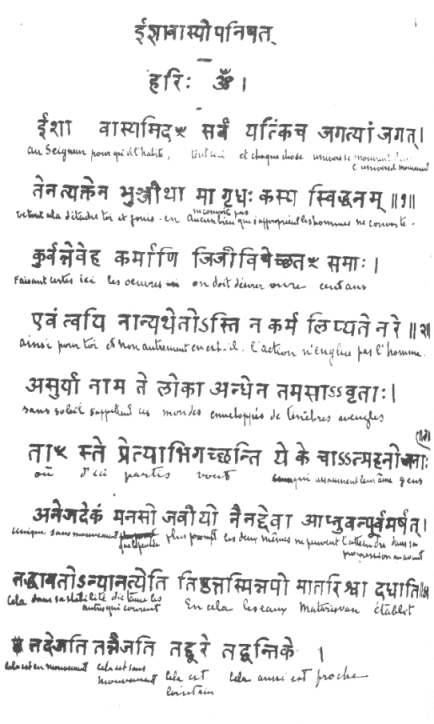
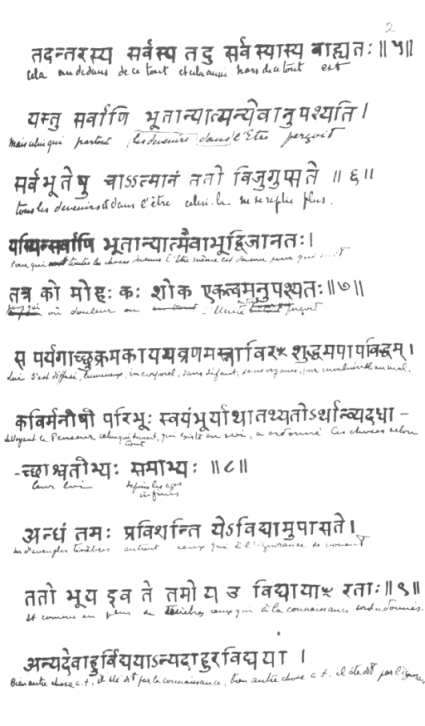
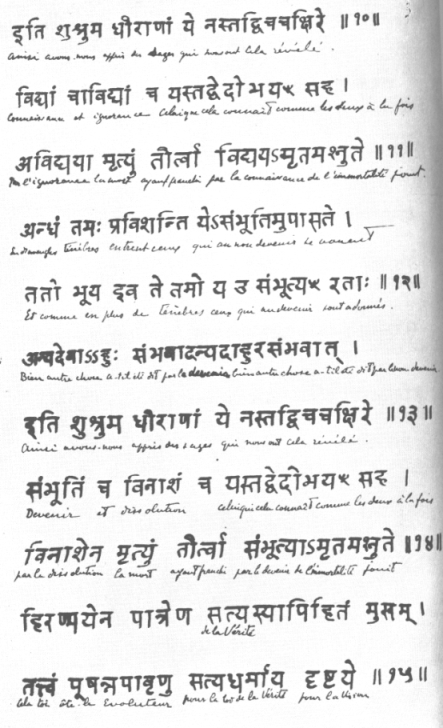
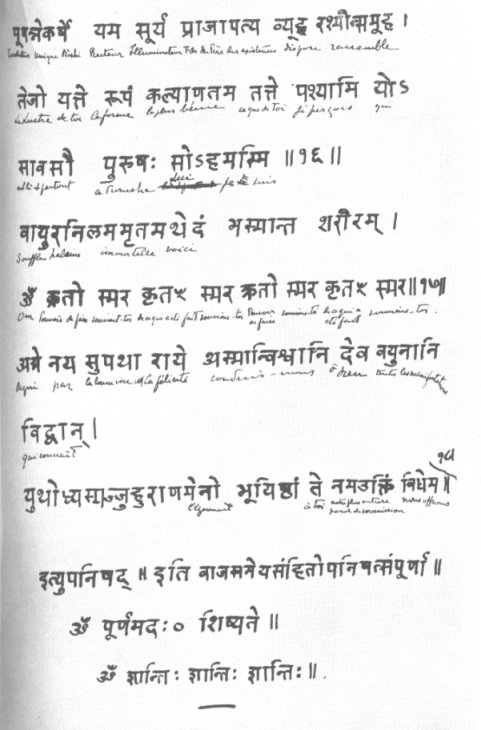
Facsimiles of the Mother's Handwriting in Various Languages
Arts
On the physical plane it is in beauty that the Divine expresses Himself.
In the physical world, of all things it is beauty that expresses best the Divine. The physical world is the world of form and the perfection of form is beauty. Beauty interprets, expresses, manifests the Eternal. Its role is to put all manifested nature in contact with the Eternal through the perfection of form, through harmony and a sense of the ideal which uplifts and leads towards something higher.
Let beauty be your constant ideal.
The beauty of the soul
The beauty of sentiments
The beauty of thoughts
The beauty of the action
The beauty in the work so that nothing comes out of your hands which is not an expression of pure and harmonious beauty.
And the Divine Help shall always be with you.
Supreme art expresses the Beauty which puts you in contact with the Divine Harmony.
If art is to manifest something in the divine Life, there also a vast and luminous peace must express itself.
Spiritual beauty has a contagious power.
Beauty is the joyous offering of Nature.
True art means the expression of beauty in the material world. In a world wholly converted, that is to say, expressing integrally the divine reality, art must serve as the revealer and teacher of this divine beauty in life.
In art also we must remain on the heights.
Good taste is the aristocracy of art.
PAINTING
The true painting aims at creating something more beautiful than the ordinary reality.
3 April 1932
Would you like me to draw birds or animals sometimes?
If you like—but drawings from nature are best for learning.
23 December 1932
I tried to copy the drawing You sent me today.
For learning, it would be better to enlarge the drawing so as to bring out the details.
5 January 1933
I have done this picture without anybody's help. How is it? Will I be able to learn?
To learn means months and months of study before any picture can be done; studies from nature, drawing first for a long time, painting only after.
If you are ready to study hard and regularly, then you can begin, otherwise it is better not to try.
6 January 1933
I would like to know if looking at pictures is harmful.
Naturally it depends on what the pictures are. Most often, they are about the things of the ordinary life, and therefore pull down the consciousness towards them.
10 December 1934
"Cubism" and Other Ultra-Modernism
If these painters were sincere, if they truly painted what they feel and see, the picture would be the expression of a confused mind and an unruly vital. But, unhappily, the painters are not sincere and then these pictures are nothing else than the expression of a falsehood, an artificial imagination based only on the will to be strange and to bewilder the public in order to attract attention and that has indeed very little to do with beauty.
27 March 1955
The largest of the flower-paintings is the best because it is more spontaneous and free. You must feel what you paint and do it with joy.
Copy many beautiful things, but try even more to catch the emotion, the deeper life of things.
12 August 1962
To make my difficulty clear to you I am sending You my two latest paintings. One I have completed, but not to my satisfaction. In the other, where the centre is unfinished, I know what I want to do, but I cannot manage it. I want to ask You whether I would make more progress by studying in Paris, or if it is better for me to try here. I shall willingly follow Your decision.
My dear child,
I have seen your paintings—they are almost perfect. But what they lack is not technique—it is consciousness. If you develop your consciousness you will spontaneously discover how to express yourself. Nobody, and especially not official teachers, can teach you that.
So to leave here and go anywhere else, to any of the "Art Academies". Would be to leave the light and step into a pit of obscurity and unconsciousness.
You cannot learn to be an artist with tricks—it is as if you wanted to realise the Divine by imitating religious ceremonies.
Above all and always the most important thing is Sincerity.
Develop your inner being—find your soul, and at the same time you will find the true artistic expression.
With my blessings.
25 May 1963
Why do you want to do the details? That is not at all necessary. Painting is not done to copy Nature, but to express an impression, a feeling, an emotion that we experience on seeing the beauty of Nature. It is this that is interesting and it is this that has to be expressed, and it is because you have the possibility of doing this that I encourage you to paint.
1963
I have seen your paintings and certainly there has been progress over the last year.
Modern art is an experiment, still very clumsy, to express something other than the simple physical appearance. The idea is good—but naturally the value of the expression depends entirely on the value of that which wants to express itself.
At present almost all artists live in the lowest vital and mental consciousness and the results are quite poor.
Try to develop your consciousness, endeavour to discover your soul, and then what you will do will be truly interesting.
This is the programme I am giving you for the year which starts for you today.
12 August 1963
I am sorry to have to say that in the paintings, I do not see much improvement on last year. They lack sincerity and spontaneity; it is not seen, it is thought—and thought in a childish way. What I said last year has yet to be achieved. The consciousness must grow in light and sincerity and the eyes must learn to see artistically.
12 August 1964
I was not able to look at your paintings until today. Certainly they represent an effort, and the one which is framed is pleasing to the eye. But you think too much and you do not see enough. In other words, your vision is not original, spontaneous or direct, which means that your execution is still conventional and lacks originality—an imitation of what others do.
There is, behind all things, a divine beauty, a divine harmony: it is with this that we must come into contact; it is this that we must express.
12 August 1965
MUSIC
To all those who took part in today's singing and music: Sri Aurobindo and myself have felt that there was a great progress this time. It was not only from the external point of view of execution, but in the greater aim of the concentration behind and in the inner attitude. May the day bring its benediction to all.
24 April 1932
I do not know who is spreading the rumour that I do not like music. That is not true at all—I like music very much, but it should be heard in a small circle, that is, played for five or six people at the most. When there is a crowd it becomes a social gathering, more often than not, and the atmosphere that is created is not good.
To keep yourself occupied with music and writing is always good; for your nature finds there its inborn occupation and that helps to maintain the vital energy and keep the balance.
About sadhana I should like to ask you: why not do sadhana through your music? Surely meditation is not the only way of doing sadhana. Through your music bhakti and aspiration can grow and prepare the nature for realisation.
If moments of meditation and concentration come of themselves then it is all right; but there is no need to force it.
23 January 1939
Music follows the rule of all things on earth—unless they are turned to the Divine they cannot be divine.
25 May 1941
Am I right in saying that when the Mother plays on the organ, certain chords of music create the necessary vibrations for the manifestation of the higher Force which the Mother wants to establish on earth?
When somebody lives in a higher consciousness, the vibrations of this higher consciousness are manifested in whatever this person does, says or thinks. These higher vibrations are manifested by the very fact of the presence of this person upon earth.
Blessings.
What is the significance of the tune that goes on repeating itself in your music so often?
You must have noticed that this tune generally comes after some trouble or chaos has been expressed. It comes as a solution to a problem. It means an advancement, a progress, a step forward in consciousness. It comes as a enlightenment. My music resembles the inner movements of the Sadhana. Sometimes a trouble, a chaos, a problem, a wrong movement which seemed conquered returns with a greater force. But then, as an answer or as an aid, the growth, the unveiling of the consciousness—and then the final enlightenment.
This music is very difficult to understand—especially for the Western mind. To people from the West it often means nothing; nor do they easily feel in them the corresponding movements. Mostly those who can appreciate the Indian Ragas can like that music; for there is some resemblance with the Ragas. But here too from the point of view of form, all conventions of musical laws and notations are broken.
30 October 1957
What should one try to do when one meditates with your music at the Playground?
This music aims at awakening certain profound feelings.
To hear it one should make oneself as silent and passive as possible. And if, in the mental silence, a part of the being can take the attitude of the witness who observes without reacting or participating, then one can take account of the effect which the music produces on the feelings and emotions; and if it produces a state of deep calm and of semi-trance, then that is quite good.
15 November 1959
Sweet Mother, how can one enter into the feelings of a piece of music played by someone else?
In the same way as one can share the emotions of another person by sympathy, spontaneously, by an affinity more or less deep, or else by an effort of concentration which ends in identification. It is this last process that one adopts when one listens to music with an intense and concentrated attention, to the point of checking all other noise in the head and obtaining a complete silence, into which fall, by drop, the notes of the music whose sound alone remains; and with the sound all the feelings, all the movements of emotion can be perceived, experienced, felt as if they were produced in ourselves.
20 October 1959
X and I play the flute together. We have found a book whose songs have very beautiful, very simple and easy-to-play tunes. We should like to know if the poems of love and death, which do not seem to go with our ideal in the Ashram, have a bad spirit in the tune. Are the Catholic religious pieces of music, which are played in churches, bad to play? If so, we shall not play either the tunes accompanied by vulgar words nor the religious compositions.
You should eliminate the words and keep only the music in both cases.
If you know how to write the music, make copies of the tunes you want to play (without copying the words). If you do not know how to write the music, ask someone who does—Jo for example—to do it for you or to teach you to do it.
Do not keep the books with you, for these books can have a bad influence.
1965
What is it we should look for in music?
How to judge the quality of a piece of music?
How to develop good taste (for music)?
What do you think of the light music (cinema, jazz, etc,) which our children like very much?
The role of music lies in helping the consciousness to uplift itself towards the spiritual heights.
All that lowers the consciousness, encourages desires and excites the passions, runs counter to the true goal of music and ought to be avoided.
It is not a question of name but of inspiration—and the spiritual consciousness alone can be the judge there.
22 July 1967
(Concerning a medieval love song)
The words are ridiculous and even in bad taste. Generally, when we studied a song, if the lyrics were unbecoming they would be changed and only the music retained.
Someone who has a sense of rhythm can do it very easily.
February 1968
(Concerning the words of two Christian canons, "Halleluia" and "Dona Nobis Pacem", inscribed on a programme of vocal music)
It is all right on condition that it is not exclusive and that other religions are also represented.
March 1968
POETRY
Poetry is sensuality of the spirit.
For me true poetry is beyond all philosophy and beyond all explanation.
PHOTOGRAPHY
Modern photography has become an art and, like all other arts, it can effectively express the inner feelings and the soul, with a true sense of beauty.
Photography is an art when the photographer is an artist.
CINEMA
We see too many films these days and I do not see how they educate us!
When one has the true attitude, everything can be an occasion to learn.
In any case, this excess should make you understand that the imperious desire of certain people to see films is as pernicious as all other desires.
11 May 1963
We would like to be able to show the children pictures of life as it should be, but we have not reached that point, far from it. These films have yet to be made. And at present, most of the time, the cinema shows life as it should not be, so strikingly that it makes you disgusted with life.
This too is useful as a preparation.
Films are permitted in the Ashram not as an amusement but as part of education. So we are faced with the problem of education.
If we consider that the child should learn and know only what can keep him pure of every low, crude, violent and degrading movement, we would have to eliminate at a stroke all contact with the rest of humanity, beginning with all these stories of war and murder, of conflict and deception which go under the name of history; we would have to eliminate all present contact with family, relatives and friends; we would have to exercise control over all the vital impulses of their being.
This was the idea behind the enclosed monastic life of convents, or the ascetic life in caves and forests.
This remedy proved to be quite ineffectual and failed to pull mankind out of the mire.
According to Sri Aurobindo, the remedy is quite different.
We must face life as a whole, with all the ugliness, falsehood and cruelty it still contains, but we must take care to discover in ourselves the source of all goodness, all beauty, all light and all truth, in order to bring this source consciously into contact with the world so as to transform it.
This is infinitely more difficult than running away or shutting our eyes so as not to see, but it is the only truly effective way—the way of those who are truly strong and pure and capable of manifesting the Truth.
29 May 1968
Mother,
How should one see a film? If one identifies oneself with the characters and if it is a tragic or detective film, one is so much involved that one weeps or is frightened. And if one keeps aloof one cannot appreciate it very well. What is to be done then?
It is the vital that is affected and moved.
If you look mentally, the interest is no more the same; instead of being moved or troubled, you can judge quietly the value of the film, whether it is well constructed and well acted and whether the pictures have any artistic value.
In the first case you are "good public", in the second you are more peaceful.
Blessings.
30 January 1970
(Concerning cinema in Auroville)
Children below fifteen years will see only educational films.
Care should be taken in selecting films to be shown in Auroville.47
All that encourages the lower movements and actions must be avoided.48
25 February 1972
Learn to be silent
The cinema is given for those who like to look at pictures and to listen to the music and the words, and they have a right to look and to hear quietly.
Those who cannot stop talking, chatting, laughing and making a noise or even running about, ought not to be there, because all what they do, they can do elsewhere without spoiling the pleasure of those who are not like them.
So here is the decision: a silent audience—or no cinema.
12 October 1962
"The Wizard of Oz"49
A short explanation will surely increase the interest of the picture to be shown to you tonight.
This picture is in three sections, two black and one, the most extensive, in colour. The two black sections (first and last) show how things appear in the physical world; the coloured one expresses a similar sequence of events and similar characters in the vital world, the world where one can go when the body is in deep sleep, when one gets out of the body. So long as you have a physical body, no true harm can happen to you in the vital world, for the physical body acts as a protection, and you can always return into it at will. This is shown in the picture in a classical way. You will see that the little girl wears on her feet some magic ruby-red slippers, and so long as she keeps the slippers on her feet nothing wrong can happen to her. The ruby-red slippers are the sign and the symbol of the connection with the physical body, and as long as the slippers are on her feet, she can, at will, return to her body and find shelter therein.
Two other details can be noted with interest. One is the snow shower that saves the party from the influence of the wicked witch who by her black magic has stopped their advance towards the emerald castle of beneficent vitality. In the vital world, snow is the symbol of purity. It is the purity of their feelings and intentions that saves them from the great danger. Note also that to go to the castle of the good wizard they must follow the broad path of golden bricks, the path of luminous confidence and joy.
The second is: when Dorothy throws water on the straw man to save him from burning, some water falls on the face of the wicked witch who lit the fire and at once she gets dissolved and dies. The water is the symbol of the power of purification and no hostile being or force can resist this power handled with goodwill and sincerity.
Finally, when the good fairy teaches the little girl how to go back home by knocking her red slippers one against the other, she says that nothing is better than home; by "home" she means the physical world which is the place of protection and realisation.
As you see, the subject of this picture is interesting and not altogether devoid of knowledge. Unhappily the rendering is not as beautiful and harmonious as it could have been. In the set-up there are some serious faults of taste and many regrettable vulgarities.
14 September 1952
Other Subjects
To know how to read and write, to speak at least one language correctly, to know a little general geography, have an overall view of modern science and know some rules of conduct—this is indispensable for living in a group or a community.
It seems to me that psychology without yoga is lifeless.
The study of psychology must necessarily lead to yoga, at least to practical yoga if not theoretical.
23 December 1960
Do not divide what is one. Both science and spirituality have the same goal—the Supreme Divinity. The only difference between them is that the latter knows it and the other not.
December 1962
Sweet Mother,
There are some things which are good for my progress but seem to me very uninteresting. For example, mathematics is a good subject but it does not appeal to me. Please tell me, how can I take interest in the things to which I am not drawn?
There are a lot of things that we need to know, not because we find them specially interesting but because they are useful and even indispensable; mathematics is one of them.
It is only when we have a strong background of knowledge that we can face life successfully.
History and geography can only become interesting to minds that are eager to know the earth on which they live.
Before one can take an interest in these two subjects, one must widen the horizons of one's thirst for knowledge as well as one's field of consciousness.
How can mathematics, history or science help me to find you?
They can help in several ways:
To become capable of receiving and bearing the light of the Truth, the mind must be made strong, wide and supple. These studies are a very good way to achieve this.
If you study science deeply enough, it will teach you the unreality of appearances and thus lead you to the spiritual reality.
The study of all the aspects and movements of physical Nature will bring you into contact with the universal Mother, and so you will be closer to me.
17 December 1966
As for arithmetic, I am much more in favour of practical than of written arithmetic, with an emphasis on the development of the faculty of mental arithmetic. It is more difficult, but it greatly increases the capacity for inner visualisation and reasoning. It is a very effective way of developing true intelligence instead of memorised knowledge.
When one knows mental arithmetic and understands arithmetic, it then takes very little time to learn written arithmetic.
With the help of similar objects—you can begin with the children themselves for small numbers and then take pebbles and counters when it comes to tens and hundreds.
In this way, by taking a little trouble, you can teach them all the operations logically and so they become for the children something real and living which has a concrete meaning.
National Education
National Education
Sublime Mother,
Our aim is no exclusive national system of education for India but an essential and fundamental education for all mankind. But, is it not true, Mother, that this education, because of India's special fitness (by virtue of its past cultural striving and attainment), is India's privilege and special responsibility towards herself and the world? At any rate, this essential education is India's national education to my mind. In fact, I regard this as the national education of each great country with characteristic differentiations peculiar to each nation.
I wonder whether this is correct and Mother would endorse it.
Yes, this is quite correct and part of what I would have said if I had had time to answer your questions.
India has or rather had the knowledge of the Spirit, but she neglected matter and suffered for it.
The West has the knowledge of matter but rejected the Spirit and suffers badly for it.
An integral education which could, with some variations, be adapted to all the nations of the world, must bring back the legitimate authority of the Spirit over a matter fully developed and utilised.
This is in short what I wanted to say.
With blessings.
26 July 1965
Basic Issues of Indian Education
1) In view of the present and the future of national and international living, what is it that India should aim at in education?
Prepare her children for the rejection of falsehood and the manifestation of Truth.
2) By what steps could the country proceed to realise this high aim? How can a beginning in that direction be made?
Make matter ready to manifest the Spirit.
3) What is India's true genius and what is her destiny?
To teach to the world that matter is false and impotent unless it becomes the manifestation of the Spirit.
4) How does the Mother view the progress of Science and Technology in India? What contribution can they make to the growth of the Spirit in man?
Its only use is to make the material basis stronger, completer and more effective for the manifestation of the Spirit.
5) The country feels much concerned about national unity. What is the Mother's vision of things? How will India do her duty by herself and by the world?
The unity of all the nations is the compelling future of the world. But for the unity of all nations to be possible, each nation must first realise its own unity.
6) The language problem harasses India a good deal. What would be our correct attitude in this matter?
Unity must be a living fact and not the imposition of an arbitrary rule. When India will be one, she will have spontaneously a language understood by all.
7) Education has normally become literacy and a social status. Is it not an unhealthy trend But how to give education its inner worth and intrinsic enjoyability?
Get out of conventions and insist on the growth of the soul.
8) What illusions and delusions is our education today beset with? How could we possibly keep clear of them?
a) The almost exclusive importance given to success, career and money.
b) Insist on the paramount importance of the contact with the Spirit and the growth and manifestation of the Truth of the being.
5 August 1965
1) How to prepare children for the rejection of falsehood (a) when the falsehood is still within the blood and every cell of my body? (b) when attachment to falsehood is becoming stronger and stronger by the egoistic and possessive nature?
2) How can the unity of each nation be realised (a) when there is no unity within the individual? (b) when there is no unity between two members of a family? (c) when there is no unity in one organisation or institution?
3) How to get out of conventions and insist on the growth of the soul when even an Ashramite spreads the infection of social status to satisfy personal wants?
4) How not to give an almost exclusive importance to success, career and money when everyone is running after money for the exhibition and satisfaction of one's ego and self-importance?50
To each one a body has been given to do that work, because it is in realising these things in oneself that one helps humanity to realise them upon earth.
The teacher must absolutely possess the qualities and the consciousness he wants his students to acquire.
I would like them (the Government) to recognise Yoga as education, not so much for ourselves, but it will be good for the country.
Matter will be transformed, that will be a solid base. Life will be divinised. Let India take the lead.
Basic Issues of Indian Education
Message for the Inauguration of a French Institute at Pondicherry
In any country the best education that can be given to children consists in teaching them what the true nature of their country is and its own qualities, the mission their nation has to fulfil in the world and its true place in the terrestrial concert. To that should be added a wide understanding of the role of other nations, but without the spirit of imitation and without ever losing sight of the genius of one's own country. France meant generosity of sentiment, newness and boldness of ideas and chivalry in action. It was that France which commanded the respect and admiration of all: it is by these virtues that she dominated the world.
An utilitarian, calculating, mercantile France is France no longer. These things do not agree with her true nature and in practising them she loses the nobility of her world position.
This is what the children of today must be made to know.
4 April 1955
Message for the Inauguration of a French Institute at Pondicherry
The New Age Association
A free talk where each one is able to express what he thinks or feels.
1964
Inaugural Session: 12 July 1964
Never believe that you know.
Always try to know better.
Blessings.
12 July 1964
First Seminar: 9 August 1964
What is the best way of surmounting the ordinary mental activity?51
My answer: Keep silent.
Second Seminar: 22 November 1964
How to be steady and sincere in our aspiration for the Divine Life.52
Consider the Divine Life as the most important thing to obtain.
Third Seminar: 14 February 1965
How to discriminate between Truth and falsehood in the impulses of action.53
Those who wish to help the Light of Truth to prevail over the forces of darkness and falsehood, can do so by carefully observing the initiating impulses of their movements and actions, and discriminating between those that come from the Truth and those that come from the falsehood, in order to obey the first and to refuse or reject the others.
This power of discrimination is one of the first effects of the Advent of the Truth's Light in the earth's atmosphere.
Indeed it is very difficult to discriminate the impulses of Truth from the impulses of falsehood, unless one has received this special gift of discrimination that the Light of Truth has brought.
However, to help at the beginning, one can take as a guiding rule that all that brings with it or creates peace, faith, joy, harmony, wideness, unity and ascending growth comes from the Truth; while all that carries with it restlessness, doubt, scepticism, sorrow, discord, selfish narrowness, inertia, discouragement and despair comes straight from the falsehood.
22 January 1965
Fourth Seminar: 25 April 1965
How to make one's studies a means of one's sadhana?54
Fifth Seminar: 8 August 1965
How to turn one's difficulties into opportunities for progress?55
Sixth Seminar: 21 November 1965
To progress oneself.
2) a. Freedom from the ego.
b. Get rid of the ego.
13 October 1965
Seventh Seminar: 20 February 1966
How to serve the Truth?58
This subject is related to the Mother's New Year message for 1966:
"Let us serve the Truth."
Eighth Seminar: 14 August 1966
What is the destiny of Man?59
Ninth Seminar: 27 November 1966
What is true love and how to find it?60
Do you know what is true love?
There is only one true love, the love from the Divine, which, in human beings, turns into love for the Divine.
Shall we say that the nature of the Divine is Love.
Tenth Seminar: 19 February 1967
Why is the Choice imperative?61
This subject is related to the New Year message for 1967:
"Men, countries, continents! The choice is imperative: Truth or the abyss."
Because we are at one of the "hours of God" as Sri Aurobindo puts it—and the transforming evolution of the world has taken a hastened and intensified movement.
Eleventh Seminar: 30 April 1967
What is the need of the hour?62
Sincerity.
Do not try to deceive the Divine.
Twelfth Seminar: 13 August 1967
Sri Aurobindo and the New Age.63
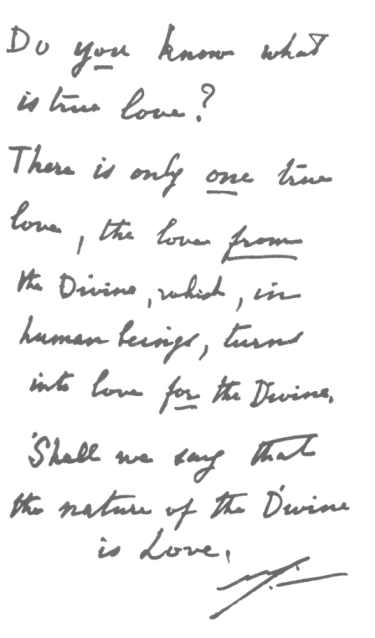
Fourth Annual Conference: 10 September 1967
To break away from the old traditions and not to obey the old rules is good—but on condition that one discovers in oneself a higher and truer consciousness which manifests Harmony, Peace, Beauty and a superior Order, vast and progressive.
26 August 1967
Thirteenth Seminar: 26 November 1967
The new outlook on education.64
What should be the guiding principles of the new ideal of education?
Truth, Harmony, Liberty.
Fourteenth Seminar: 25 February 1968
What we expect from the Mother.65
What is the right thing that we should expect from You?
Everything.
What have You been expecting from us and from humanity in general for the accomplishment of Your Work upon earth?
Nothing.
From Your long experience of over sixty years, have You found that Your expectation from us and from humanity has been sufficiently fulfilled?
As I am expecting nothing I cannot answer this question.
Does the success of Your Work for us and for humanity depend in any way upon the fulfilment of Your expectation from us and from humanity?
Happily not.
20 February 1968
Fifteenth Seminar: 28 April 196
These subjects are related to the New Year message for 1968:
"Remain young, never stop striving towards perfection."
1) Since the process of decline and disintegration which brings old age is really the beginning of death, is it possible to prevent getting old without conquering death?
Is it possible to keep the body constantly young without complete transformation of its material cells by the supramental Ananda?
How can these questions be answered before the supramental is manifested upon earth? It is only after that manifestation that we may know how it came and how it manifests.
25 April 1968
2) Does Your answer mean that the supramental is not yet manifested upon earth? Or are You referring to its full manifestation down to the roots of inconscient Matter? 29th February 1956 has been declared by You as the beginning of the supramental manifestation. So your answer may be referring to its complete manifestation. Will You please clarify this point?
I am speaking of a supramental manifestation evident to all, even the most ignorant—as the human manifestation has been evident to all when it happened.
26 April 1968
Sixteenth Seminar: 23 February 1969
What should be the attitude of the sadhak of Sri Aurobindo's yoga towards the various forms of God worshipped by different religions in the past and the present? If he continues to worship them, will it create an obstacle to his progress and prevent his realisation of his aim?
A benevolent goodwill towards all worshippers.
An enlightened indifference towards all religions.
As for the relation with the beings of the Overmind, if this relation exists already, each case must have its own solution.
What will be the role of the different gods of the religions in the supramental age? Can they help in the establishment of the supramental Truth upon earth and in the work of the transformation of Matter?
It is too soon to put such a question.
19 February 1969
Seventeenth Seminar: 27 April 1969
1) In what sense is our yoga an adventure?
It can be called an adventure because it is the first time that a yoga aims at transformation and divinisation of physical life instead of escape from it.
2) Why is faith so supremely important in yoga?
Because we are aiming at something quite new that has never been done before.
3) What is its determining power due to?
Your faith puts you under the protection of the Supreme who is all-powerful.
26 April 1969
Sixth Annual Conference: 17 August 1969
Above all words, above all thoughts, in the luminous silence of an aspiring faith give yourself totally, unreservedly, absolutely to the Supreme Lord of all existences and He will make of you what He wants you to be.
With love and blessings.72
Eighteenth Seminar: 23 November 1969
Here is the subject.
The salvation of the world lies in union and harmony. How do you conceive this union and this harmony?
Blessings.73
Nineteenth Seminar: 22 February 1970
What is the big change for which the world is preparing? How can one help it?74
This subject is related to the New Year message for 1970:
"The world is preparing for a big change. Will you help?"
1) What is the big change for which the world is preparing?
A change of consciousness. And when our consciousness will change we will know what the change is.
2) How can one help this change to come?
The change does not need our help to come, but we need to open ourselves to the consciousness so that its coming is not in vain for us.
19 February 1970
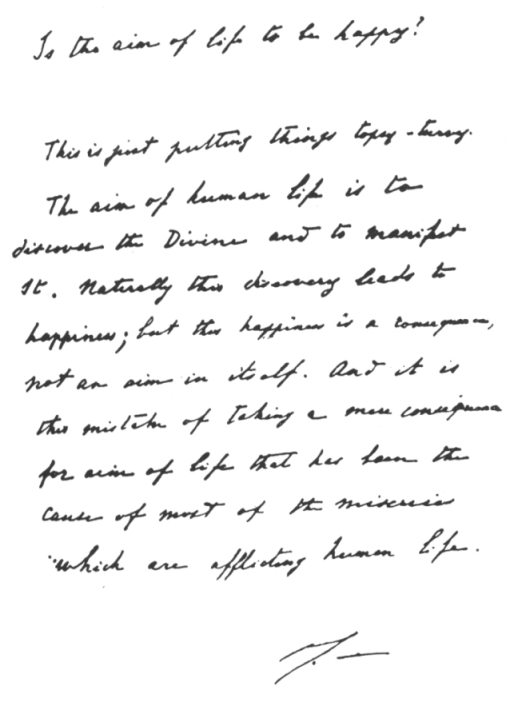
Twentieth Seminar: 26 April 1970
Is the aim of life to be happy?75
Is the aim of life to be happy?
This is just putting things topsy-turvy.
The aim of human life is to discover the Divine and to manifest it. Naturally this discovery leads to happiness; but this happiness is a consequence, not an aim in itself. And it is this mistake of taking a mere consequence for aim of life that has been the cause of most of the miseries which are afflicting human life.
28 March 1970
Seventh Annual Conference: 16 August 1970
India of Sri Aurobindo's Dream.76
You have said in one of Your messages:
"The number one problem for India is to find back and manifest her soul."
How to find back India's soul?
Become conscious of your psychic being. Let your psychic being become intensely interested in India's Soul and aspire towards it, with an attitude of service; and if you are sincere you will succeed.
15 June 1970
Twenty-First Seminar: 21 November 1970
The solution of the world's problems lies in a change of consciousness. What is your conception of this change and how to bring it about?77
The consciousness that has to be manifested is already in the earth atmosphere. It is now only a question of receptivity.
19 November 1970
Twenty-Second Seminar: 28 February 1971
How to take a leap towards the future?78
This subject is related to the New Year message for 1971:
"Blessed are those who take a leap towards the future."
In one of Your previous New Year messages You had asked us to make an "imperative choice". Now this year You have asked us to take "a leap". What is the difference between that "choice" and this "leap"?
The choice is mental. The leap is made by the whole being.
How is this leap to be taken?
Each one in his own way.
Why have You used the Biblical term "Blessed" in this year's message? Has it any significance?
"Blessed" is not the exclusive property of the Bible.
24 February 1971
Twenty-Third Seminar: 25 April 1971
What is our ideal of integral perfection?79
Conscious union with the Divine.
28 March 1971
Eighth Annual Conference: 22 August 1971
Have faith and be sincere.
Blessings.
22 August 1971
Twenty-Fourth Seminar: 28 November 1971
Sri Aurobindo's call to the youth.80
What is Sri Aurobindo's call to the youth?
To become the builders of a better future in the light of the Supramental consciousness.
27 November 1971
Twenty-Fifth Seminar: 27 February 1972
How to be worthy of Sri Aurobindo's Centenary?81
This subject is related to the New Year message for 1972:
"Let us all try to be worthy of Sri Aurobindo's centenary."
On the 1st of January this year You said: "A special help has come on to the earth for Sri Aurobindo's centenary year."
Will You please indicate the nature and action of this help and also what we should do to avail ourselves of it?
Those who will be able to become receptive by the mastery of the psychic upon their ego, will know what this help is and will have the full benefit of it.
24 February 1972
Twenty-Sixth Seminar: 23 April 1972
Education and Yoga.82
What should be the spirit and character of education when it is undertaken as a part of the discipline of Yoga?
Read Sri Aurobindo.
19 April 1972
Ninth Annual Conference: 12 August 1972
Sri Aurobindo reveals the future.83
In Your message of 2 January 1972, You have said:
"In this year of his centenary, his help will be stronger still. It is up to us to be more open and to take advantage of it.
"The future is for those who have the soul of a hero."
Will You please explain what You mean by "a hero" in the above message?
A hero fears nothing, complains of nothing and never gives way.
Twenty-Seventh Seminar: 25 February 1973
How to collaborate in all sincerity in showing to the world that man can be a true servant of the Divine?84
This subject is related to the Christmas message of 1972:
"We want to show to the world that man can be a true servant of the Divine. Who will collaborate in all sincerity?"
By being a true servant of the Divine.
24 February 1973
Twenty-Eighth Seminar: 22 April 1973
How to reconcile the individual's claim for freedom with the collectivity's need for unity and order?85
Freedom is far from meaning disorder and confusion.
It is the inner liberty that one must have, and if you have it nobody can take it away from you.
28 March 1973
Twenty-Eighth Seminar: 22 April 1973
(In October 1967, some students were reluctant to speak at the seminars, indicating the difficulties of mental inertia, and shyness and nervousness in speaking before an audience. These difficulties were referred to the Mother who wrote the following reply.)
The chief meaning of this kind of activity is just to solve the difficulties they speak of—inertia, shyness, laziness, etc., etc.
And it is just for that I asked you to do it four times a year.
The students are not here to have an easy life but to prepare themselves for the Divine Life.
How can they expect to get ready if they shun an effort, remain lazy and "tamasic"?
30 October 1967
A Glimpse of Mother's Work in the School
French in the Ashram and the School
(Two or three teachers were having a discussion about the language of instruction in the school. Their discussion was submitted to Mother with the remark:) Sri Aurobindo says in his book on education that the child should be taught in his mother-tongue.
Sri Aurobindo did say that, but he also said many other things which complete his advice and abolish all possibility of dogmatism. Sri Aurobindo himself has often repeated that if one affirms one thing, one should be able to affirm its opposite; otherwise one cannot understand the Truth.
(In the same letter, one of the teachers wondered about the future of French in the Ashram.)
French will continue to be taught in the Ashram, at least so long as I am here, because Sri Aurobindo, who loved French very much and knew it very well, considered it to be an essential part of the knowledge of languages.
23 August 1965
(In the course of a conversation about French, a disciple pointed out to Mother that now many French people, especially newcomers, speak in English, even to people who know French perfectly well. Mother concentrated for a moment and said: "So much the worse for them." The disciple then asked whether it would be helpful if she gave a message on this matter. She wrote the following message and suggested that it should be put up in the Ashram and in the school, and that a copy should be put up in the "Bibliothèque Choisie". Photocopies were made for this purpose.)
Sri Aurobindo loved French very much. He used to say that it was a clear and precise language, whose use encouraged clarity of mind. From the point of view of the development of the consciousness, that is precious. In French, one can say exactly what one wants to say.
Blessings.
19 October 1971
French in the Ashram and the School
The Organisation of Work in French Classes
(A group of teachers were considering a reorganisation of certain classes. One of them asked Mother whether she had any objection.)
No objection, these are things which you should arrange freely among yourselves.
January 1961
(Two teachers had a rather heated discussion about the work. One of them presented the problem to Mother and asked for her opinion. Mother replied:)
Truly speaking, I have no opinion. According to the truth-vision, everything is still terribly mixed, a more or less fortunate combination of light and darkness, of truth and falsehood, of knowledge and ignorance, and so long as decisions are made and action is carried out according to opinions, it will always be like that.
We want to give the example of an action that is carried out according to the truth-vision, but unfortunately we are still very far from realising this ideal; and even if the truth-vision is expressed, it is immediately distorted in its implementation.
So, in the present state of things, it is impossible to say: this is true and this is false, this leads us away from the goal, this leads us nearer to the goal.
Everything can be used for the sake of progress; everything can be useful if one knows how to use it.
The important thing is never to lose sight of the ideal you want to realise and to make use of every circumstance for this purpose.
After all, it is always preferable not to make any decision for or against things, but to watch events as they develop, with the impartiality of a witness, relying on the divine Wisdom which will decide for the best and do what is needful.
July 1961
(A teacher had passed on to several colleagues a personal answer from Mother to some questions about the work. Regretting this indiscretion, she immediately spoke to Mother about it.)
There is no harm in having said what you did, because, you see, to each person I can say, in all sincerity, that "I agree." In fact, it is a thing that is rather difficult for all of you to understand, since the mind can hardly approve of it. But behind each one's point of view there is an aspect, sometimes a very small aspect of truth, and I always agree with this aspect—on condition, of course, that it does not want to be exclusive by trying to eliminate the others.
And I am seeking for a method in action by which all these aspects can be expressed, each one in its own place, without interfering with one another. The day I find this means, I shall begin to reorganise the school. In the meantime, you can always air ideas; it is healthy, so long as it is neither dogmatic, nor exclusive, nor aggressive, and so long as you never quarrel.
August 1961
The Organisation of Work in French Classes
Teaching French to Indian Teachers Who Teach in French
Selecting a Text for Study
(While choosing a text to study with a young Indian teacher who wanted to improve her French, the French teacher asked Mother for her opinion on La Peste by Albert Camus.)
Reading certain things can be good for Europeans who have a rather thick skin, to arouse in them a feeling of true compassion; but here in India it is not necessary. And it is not good to give an even darker picture of a life that is already dark enough in itself.
(Mother suggested Recherche d'une église by Jules Romains, and sent her own copy for the French teacher to look at. The teacher was "shocked" by certain chapters of the book and reported her feelings to Mother in rather strong terms. Mother replied:)
Recherche d'une église was the book of my choice. Jules Romains is a great writer and his French is of the highest order. When I mentioned cuts,86 it was because certain passages are not quite suitable for a young woman's mind. But it would have been easy to make these cuts, and the rest is very good.
(The French teacher continued her search for texts and suggested La France d'aujourd'hui by Marc Blancpain.)
I have just been looking at the book, with interest. This time, it is very good.
May 1960
Finding a Programme of Work
(The French teacher outlined a study course on the history of civilisation for one of her students, a young Indian teacher, and submitted the project to Mother.)
Yes, this work would be of interest, but only if it is based on Sri Aurobindo's The Human Cycle (it has been published in the Bulletin). For in this book, not only are all the problems of human evolution posed, they are also solved. Each time that Sri Aurobindo mentions a civilisation or a country, the corresponding historical facts could be studied, and this work would be really interesting.
September 1960
In one French class for Indian teachers, several students wanted to read the works of contemporary authors, because the language in them is more up-to-date than in classical writings. What does Mother think?
What I know of modern authors has taken away any wish I might have had to read more of them.
Why step deliberately into the mire? What is to be gained by it? The knowledge that the Western world is wallowing in the mud? It is hardly necessary. Selected passages, carefully selected, seem to be the solution.
May 1963
(Concerning a young teacher who had to learn French intensively in order to be able to teach in French and had at the same time to keep up with a rather heavy time-table in the school.)
I fully agree. X should have the time to learn French thoroughly and her hours of work and teaching should be organised in such a way that she has the time to continue her lessons with you, until she feels that they are no longer necessary.
September 1966
Teaching French to Indian Teachers Who Teach in French
Teaching French to the Students
How can we improve the children's spelling?
Generally, for spelling, one must take the help of the eyes. Each word should have its own form, which the eye remembers. Visual memory is more useful than mental memory. One should read a lot—see, see, see, on the blackboard, in books, on pictures.
And as for style, gender, and grammar too, the best thing is to read, to read a great deal. In this way all this goes into the subconscient. It is the best way to learn.
January 1962
About Tests
Tests may be useful in giving you the academic worth of a child, but not his real worth.
As for the real worth of a child, something else is to be found, but that will be for later on, and will be of a different nature.
I am not opposing real worth to academic worth; they can coexist in the same individual, but it is a rather rare phenomenon which produces exceptional types of people.
1962
(Mother's comments in the margin of a letter from a teacher about French in the school. The students were using work-sheets.)
One of the reasons why the children do not make any progress in French is that the teachers do not correct them.
Very true.
Working with the work-sheets will be effective only if corrections are strict.
Very true.
I have begun to prepare corrected versions of all the exercises for the benefit of the teachers and the students.
Very good.
The teachers should read these corrected versions at least once...
Certainly more than once.
... so that they can become aware of their own mistakes.
Yes, they need that very much.
It would be good for the child to have this corrected version in hand so that he can compare it with his own work.
Yes, that is very useful.
Merely to underline the mistakes teaches the children nothing.
True.
I am afraid that the corrected versions I am making for the teachers may remain piously in a drawer.
Heaven forbid!
If so, by the end of the year the children will have done a considerable amount of work to no purpose.
You are right. It is the teachers, almost all of them, with only a few exceptions, who are lazy—more than the students.
I think I am bothering you with this French.
No, you are not bothering me, you are quite right.
It seems to me that so much goodwill is wasted. The goodwill of the children is wasted because, although the atmosphere in the classes is good, the work is ineffective and the work that is needed is not done.
Yes.
25 December 1962
Teaching French to the Students
The "Bibliothèque Choisie"
(A teacher noticed that the "Bibliothèque Choisie" contained a rather high proportion of books which should not be there if the library is to be worthy of its name. She spoke of this to Mother in the course of several interviews. This was the outcome:)
Mother's advice about the composition of the "Bibliothèque Choisie".87
Remove all modern novels.
Include only scholarly works, on philosophy, art, the sciences.
The best thing would be to bring the list of books to Mother, a little at a time, so that she can see what they contain.
This is an important matter.
(The teacher asked Mother what she meant by "scholarly works". She replied:)
All books that aim to teach.
The aim of the "Bibliothèque Choisie" is to teach the students good French and the best in French thought.
It should include mainly scholarly works, that is, works which aim to teach: books on philosophy, art, the sciences, etc.
There should be very few novels (the students read only too many novels), and no modern novels, unless they are of particularly good quality.
Literature has its place in the "Bibliothèque Choisie", so that the students can learn what literature is.
The most important thing to be taken into consideration when selecting books, is the quality of the language and style,88 something "splendid" as in Flaubert. No translations, or very few, and only if they are of famous works—one cannot say "masterpieces" because there are so few of them!89
(About the bad books which are to be withdrawn from the "Bibliothèque Choisie", Mother said:)
They should be put in a special place, in a special room called "Bad Books", so that those who want to study what they contain may do so.
Great care must be taken when ordering books.
The question of the "Bibliothèque Choisie" is an important one.
Messages for the "Bibliothèque Choisie"
The aim of the "Bibliothèque Choisie" is to teach French well.
The books should be well written.
Preference should be given to those that are interesting from the point of view of learning.
Include novels only if they are remarkably well written.
Very few translations—only those of famous books.
Send all the rest to the Big Library with the note: "Not to be recommended."90
1971
(The teacher read out to Mother a letter in which she had written, among other things: "I think it is possible to change most of the books in the "Bibliothèque Choisie" and to raise its standard a little. Please tell me if you approve of this and if I may try to realise it." Mother replied orally, with force:)
Completely, I approve completely. It is indispensable. We have fallen to such a level! In everything! Ah, I agree completely.
1972
Mother's Action in a Class of Children Aged Ten to Eleven
How should we teach French to the young children?
The best thing would be to tell them a story, using very simple words and phrases so that they can understand (a little story, short and interesting or amusing), and then afterwards ask them to write down in class what they have heard.
Yes, but the children are very noisy.
A minimum of silence is necessary. I know that the most undisciplined children are usually the most intelligent. But to be tamed they must feel the pressure of an intelligence that is more powerful than their own. And for that, one must be able not to come down to their level, and above all know how to remain unaffected by what they do. In fact, it is a yogic problem.
Can calm in the teacher provide the solution to all these problems?
Yes, but for that the calm must be perfect in all parts of the being so that the power can express itself through him.
(The children's notebooks had been sent to Mother for her assessment.)
I have put marks in the children's notebooks without making any classification. Is this classification really necessary? Each one has different merits and it is difficult to grade them.
June-July 1960
(Extract from one of the teacher's letters:) I trust You and I trust the children because of You; as for myself, I know nothing and I want nothing, except what You want for us. Only show me at every step what should be done and how to answer. Lead us, and may we follow You silently in the depths of our hearts, whatever the outer results may be. Only let the children grow and flower in Your Peace and Love and let us all live together for You.
The relationship that has really been established between the class, you, the children and me, is certainly the most important thing and it must be preserved at all costs. But that depends on an inner attitude much more than on an outer framework or material organisation. In fact, this same attitude should be present throughout the whole school and all the classes, in all the teachers and all the students. This is what must be obtained and what we must strive for.
(There was a considerable improvement in the class. The teacher wrote:) All this, which has so completely changed, is the result of Your work in us, isn't it?
Yes, certainly.
(The teacher asked whether, because of the experiment which was going on with Mother, it would not be better to keep the same children the following year, rather than to take another group.)
An experiment should be flexible and plastic enough to be applicable and adapted to all the children, with any changes in detail that their different characters may require. So you may rest assured that the experiment will continue. Only the children may not be the same ones.
(The teacher had organised work-groups with the children. The results were uneven and the class was noisy. The teacher asked whether they should continue.)
Let them continue with the experiment. Little by little things will settle down and the results will improve.
(After an excellent period, the work with the children became more difficult.)
This slackening is no doubt due to the approach of the holidays.
October 1960
Mother's Action in a Class of Children Aged Ten to Eleven
Mother's Action in a Class of Children Aged Seven to Nine
(Mother gave the name "Arbre Ensoleillé" ["Sunlit Tree"] to the class according to ideas expressed by the children themselves. She explained:)
The tree is life that aspires and grows. The sun is the light of Truth.
It is not the cold light of reason that helps life to grow and blossom, it is the warm and life-giving light of Truth; it is the sun, when it pours its joyful rays on the world.
(The teacher introduced activities such as doing odd jobs, gardening, making a zoo out of cardboard, observing a chrysalis, etc. The children enjoyed these activities but afterwards were reluctant to go on from there to do more "scholastic" work.)
A good beginning. It will evolve quite naturally towards more intellectual activities, and meanwhile any work that is done with care is an opportunity to learn something.
(Reply to some practical questions)
It is better not to lock the children up in the classroom, even to play.
A moment of silence and concentration is always good for all the children. But the prayer should not be compulsory. Those who want to do it will be encouraged. I suggest that you put up a notice-board in the classroom with these words written on it in large letters:
"Mother is always here amongst us to help us and guide us."
Most of the children will understand, and some are capable of feeling.
December 1960
(The teacher found the children turbulent, rather lazy and as talkative as parrots. She asked:) Is it like this because their real interest is not turned towards study?
Yes.
What can we do to obtain calm and quietness in the class and get the children to do some work?
The only effective thing is to create or awaken in them a real interest in study, the need to learn and to know, to awaken their mental curiosity.
(The teacher complained of a lack of results.)
It is only after months, and even years of assiduous, regular and obstinate effort that one can rightfully say (and even then!) that it has been useless and fruitless.
What should be done?
Compulsion is neither the best nor the most effective principle of education.
True education must reveal what is already present in the developing beings and make it blossom. Just as flowers blossom in the sun, children blossom in joy. It goes without saying that joy does not mean weakness, disorder and confusion. But a luminous kindliness which encourages the good and does not severely insist on the bad.
Grace is always much closer to Truth than justice.
What should be done so that Mother can act in the class?
There is nothing, no method, no process, which is bad in itself; everything depends on the spirit in which it is done.
If you want my help, it is not by accepting one principle of action and rejecting another that you can have it, but by concentrating before the class, by establishing silence and peace in your heart (and in your head too, if possible) and by calling my presence with a sincere aspiration that I should be behind all your actions, not in the way you think that I would act (for that can only be an arbitrary opinion and therefore necessarily wrong), but in silence and calm and inner spontaneity. This is the only true way of getting out of your difficulty.
And until you are able to achieve this, do your best quietly and perseveringly, according to your own capacities and the circumstances, with simplicity and without tormenting yourself.
The Grace is always there with anyone who wishes to do well.
What does Mother call "persevering" where work with the children is concerned?
What I meant to say in the notebook, was that it is always preferable to continue quietly with what one is doing until an inner psychological change brings about the outer change smoothly. This is what I call persevering.
January 1961
The work and the discipline are becoming slack. Is it because of a "vital strike" on the teacher's part?
Certainly. It is a weakening of the force due to the non-collaboration of the vital which causes the slackening. Children do not live in their minds enough to obey spontaneously a mental will that is not sustained by a vital force which influences them by its mere presence, without requiring any outer expression. When the vital collaborates, my force works through it and automatically maintains order simply by its presence in the vital.
Young children are not very sensitive to a mental power that is not clothed with vital power. And in order to have vital power you yourself must be perfectly calm.
(The teacher proposed to start with the children a course of study in the subjects which interested them.)
Yes, it is a good idea. An atmosphere of friendly collaboration is always best.
February 1961
A difficult period is beginning. What would be the true attitude for the teacher?
The psychic inspiration alone is true. All that comes from the vital and the mind is necessarily mixed with egoism and is arbitrary. One should not act in reaction to outer contact, but with an immutable vision of love and goodwill. Everything else is a mixture which can only have confused and mixed results, and perpetuate the disorder.
(Extract from one of the teacher's letters:) It seems that it is merely mental impulses that are making me act, and that they miss the mark. That is why although I intervene very little, I feel that it is still too much, because it is not the real thing. And I think I have learnt from You that true calm is much more effective than any external intervention.
It also seems that if I am going through an experience, perhaps the same thing may be true for the children, and in fact we are going through this experience together, we have embarked on the same boat; the Divine alone knows its meaning and its outcome.91
The problem is more far-reaching than it appears at first sight. It is in fact a revolt of the vital forces of the children against all discipline and all constraint. The normal ordinary method would have been to expel all the undisciplined children from the school and to keep only those who are "good". But this is a defeat and an impoverishment.
If, by transmitting the inner force, in absolute calm, one can finally control this revolt, it becomes a conversion and a true enrichment. That is what I want to try and I hope that it will be possible for you to go on collaborating with my action. And now that you have understood not only what I want to do, but also the mechanism and the process of this action, I am confident that we shall succeed. We must expect relapses and not be discouraged by them.
Vital forces, especially in children whose reason is not very well developed, fight desperately before accepting the light and allowing themselves to be converted by it. But success is certain in the end, and we must know how to endure and wait.
(The teacher prayed for light, love, flexibility and all that is necessary in order to collaborate with Mother's work in the class.)
All this is constantly with you. Remain open and let it work.
March 1961
(The teacher planned to let the children work in groups. Should she form the groups herself, according to their standards, or should she let the children group themselves according to their affinities?)
Let the children group themselves according to their spontaneous sympathies.
Does calm in the teacher necessarily bring about calm in the class, that is to say, "a quiet atmosphere where each one can work according to his own rhythm and capacities, without noise or restlessness, without impatience or laziness...?"
If your calm is integral, that is, both inner and outer, founded on the perception of the Divine Presence, and unchanging, that is to say, constant and unvarying in all circumstances, it will undoubtedly be all-powerful, and the children will necessarily be influenced by it and the class will certainly become, spontaneously and almost automatically, what you want it to be.92
April 1961
(The teacher thought that a liking for work and the joy of working should be developed in the children. Mother replied:)
You are quite right in everything you say about the school, the class and work, and I fully approve the effort of organisation that you want to make.
(Mother also sent these two messages to the children:)
If one does not love work, one is always unhappy in life.
In order to be truly happy in life, one must love work.
July 1961
Some Other Messages of Mother to the Children of this Class
My dear children, love work and you will be happy. Love to learn and you will progress.
(The children decided with their teacher on a programme for the yr: to speak in French, to read correctly, to write French without mistakes, to count properly, to understand arithmetic problems, to learn how to add, subtract, multiply and divide. Mother replied in the class notebook:)
My dear children, I have read your letter and I agree that it would be very good if by the end of the year you knew all the things that you have listed here.
But there is one point on which I want to draw your attention, because it is the central point and the most important one: it is your attitude in class and the state of mind in which you come to school.
To benefit from your daily attendance in class, you must go there with a sincere will to learn, to be attentive and concentrated, to listen to what your teacher tells you and to work quietly and seriously.
If you spend your time shouting, fidgeting and upsetting everything like unconscious and ill-mannered children, you are wasting your time, you are wasting the teacher's time and you will learn nothing at all. And at the end of the year I will have to say that you are bad students and do not deserve to move up into a higher class.
You must come to your class with the will to learn, otherwise it is a waste of time, because even if only one of you misbehaves all the others will be disturbed. So this is the decision I want you to take: to be good, quiet, attentive, and to work hard. This is what you must promise me to do in this notebook.
And when each of you has written, with all his goodwill, then send the notebook back to me so that I can give you my blessings.
Beginning of 1961
(The children do not sit up straight and their handwriting is bad. Mother wrote:)
It is no more tiring to hold yourself straight than to hold yourself badly. When you hold yourself straight, the body grows harmoniously. When you hold yourself badly, the body becomes misshapen and ugly.
It is no more tiring to write neatly than to scrawl. When your work is neatly written, it is read with pleasure. When it is too badly written, it cannot be read at all.
To do with care all that one does is the basis of all progress.
1961
The days pass, the weeks pass, the months pass, the years pass and time fades into the past. And later on, when they have grown up, those who no longer have the immense advantage of being children regret the time that they have wasted and that they could have used to learn all the things which are needed to know how to live.
March 1961
Mother's Action in a Class of Children Aged Seven to Nine
Mother's Action in a Class of Children Aged Sixteen to Eighteen
In 1968, while a reorganisation of the school was taking place, Mother declared that she was ready to reply to any questions that the students wished to ask her about interesting subjects of study. When someone asked her to choose a subject, she replied: "Death."
This offer was made to all the students. The following work represents the response of a French class to Mother's offer.
In the course of each session, the questions were formulated by each student individually and sent together to Mother.
(The students wrote to Mother, asking to be allowed to work with her on a study on death. Mother gave these instructions orally to the teacher.)
The subject is: What is death?
How should you begin? You must look into yourself, look inside; do not try to know by reading books or to find out what is happening in the vital and the mind: what you feel, what you think about death.
The research should be carried out exclusively on a material plane: what is death, from the physical point of view?
You must concentrate and find the answers in yourself. Don't make any speeches. Say only one sentence. The more intelligent you are, the less words you need to express yourself.
27 April 1968
(The students' replies to the question, "What is death, from the physical point of view?":
"All circulation of blood in the brain cells stops."
"When the brain stops functioning and the decomposition of the body begins, that is death."
"The cessation of all physical activity due to the absence of the energy source, or soul."
"The actual fact of death makes me think of an experience in which one is projected with increasing force into space."
Mother wrote to the class:)
I read what you sent with interest. And here is my reply:
Death is the phenomenon of decentralisation and dispersion of the cells which make up the physical body.
The consciousness is, by its very nature, immortal, and in order to manifest in the physical world, it assumes more or less lasting material forms.
The material substance is in course of transformation in order to become a multiform and increasingly perfect and lasting mode of expression for this consciousness.
18 May 1968
(This time, Mother gave separate replies to the questions and sent them to the teacher:)
Here are my replies to your students' questions. I hope they will be able to understand.
If a cell becomes conscious of its own personality, is it not liable to act only in its own self-interest, taking no account of the collective interest?
What is the self-interest of a cell!
Does the decentralisation occur all at once or by degrees?
Everything does not disperse all at once; it takes a long time.
The central will of the physical being abdicates its will to hold all the cells together. That is the first phenomenon. It accepts dissolution for one reason or another. One of the strongest reasons is the sense of an irreparable disharmony; the other is a kind of disgust with continuing the effort of coordination and harmonisation. In fact, there are innumerable reasons, but unless there is a violent accident, it is above all this will to maintain cohesion which abdicates for one reason or another, or without reason. It is this which inevitably precedes death.
Must each cell be conscious of its oneness with the centre?
It is not like that. It is still a semi-collective consciousness, it is not an individual consciousness of the cells.
Does decentralisation always occur after death, or can it start before?
It often starts before.
Do the cells disperse in space or in the body itself? If they disperse in space, the body must surely disappear with the cells?
Naturally, the body dissolves after death, but that takes a long time.
In the expression "dispersion of the cells", doesn't the word "dispersion" have a special meaning? If so, what is it?
I used the word dispersion of the cells in its most concrete sense.
When the concentration which forms the body comes to an end and the body dissolves, all the cells that have been especially developed and have become conscious of the divine Presence within them, are scattered and enter other combinations in which they awaken, by contagion, the consciousness of the Presence that each one has had. And in this way, by this phenomenon of concentration, development and dispersion, all matter evolves and learns by contagion, develops by contagion, has the experience by contagion.
Naturally, the cell dissolves with the body. It is the consciousness of the cells that enters other combinations.
5 June 1968
When the will of the physical being abdicates without reason, is it without any physical reason or without any reason at all?
The physical consciousness is conscious only physically; the will of the physical being can abdicate without any reason of which it is aware.
What causes the physical being's disgust with continuing the effort of coordination and harmonisation?
Usually, this disgust occurs when there is, in one part of the being (an important part, either vital or mental), an absolute refusal to progress. And so, physically, this is manifested as a refusal to strive against the deterioration which comes with time.
Where is the connection between the central will of the physical being and the cells established? And how?
The cells have an inner composition or structure which corresponds to the structure of the universe. So the link is established between identical external and internal states.... It is not "external", but it is external for the individual. That is, the cell, in its internal composition, receives the vibration of the corresponding state in the composition of the whole. Each cell is composed of different radiances, with a wholly luminous centre, and the connection is established between light and light. That is, the will, the central light, acts on the cell by touching the corresponding lights, by an inner contact of the being. Each cell is a world in miniature corresponding to the whole.
15 July 1968
Is the will for progress enough to prevent the deterioration that comes with time? How can the physical being prevent this deterioration?
That is precisely what the transformation of the body is: the physical cells not only become conscious, but receptive to the true Consciousness-Force; that is, they allow the working of this higher Consciousness. That is the work of transformation.
How does the will, the central light, which is not material, act on the gross matter of the cell?
It is just like asking, "How does the will act on matter?" All life is like that. You should explain to these children that their whole existence is the result of the action of the will, that without will, matter would be inert and immobile and that it is precisely the fact that the vibration of will acts on matter that makes life possible. Otherwise there would be no life. If they want a scientific answer and want to know how, it is more difficult, but the fact is there, it is a fact that can be seen at every second.
20 July 1968
How does one become conscious of the physical being?
Mankind, nearly all of mankind, is conscious only of the physical being. With education, the number of men who are conscious of their vital and mind is increasing. As for the human beings who are conscious of their psychic being, they are relatively few.
If you mean, "How does one awaken the consciousness of the physical being?", that is precisely the aim of physical education. It is physical education that teaches the cells to be conscious. But for the development of the brain, it is study, observation, intelligent education, above all observation and reasoning. And naturally, for the whole education of the consciousness from the point of view of character, it is yoga.
Does the central will of the physical being have a particular location in the body?
It is the brain.
Can one experience death without dying?
Certainly. One can experience death yogically; one can even experience it materially, if death is short enough so that the doctors do not have time to pronounce you dead.
After death, which part of the being becomes aware that one is dead?
Any part of the being that survives can become aware that the body is no longer there. It depends.
How can one tell for certain that the physical body is dead?
Only when it decomposes.
How can one control or prevent the process of disintegration?
By carefully maintaining the physical balance.
When one dies, does one necessarily feel physical pain?
Not necessarily.
28 September 1968
What should we do in our daily lives to stop the process of death?
The method is to detach one's consciousness from the body and to concentrate it on the deeper life, so as to bring this deeper consciousness into the body.
If the sense of "self" has identified itself more with the mind in life, is this the same sense of "self" that has all the experiences after death, that is, that retains at the same time the memories of life? I am asking this about the mind, for it remains formed a little longer than the other parts after death.
It is not true that the mind is more durable. The psychic consciousness which has identified itself with the little physical part leaves this little physical person. Insofar as this consciousness has shaped the life, it remembers what it has shaped and the memory is closely linked to the psychic consciousness in the events. Wherever the psychic consciousness has not taken part in events, there is no memory. And only the psychic consciousness can continue; it is not the mind that retains memories, that is quite incorrect.
1 February 1969
(A few days later, during a conversation with the teacher about this student, Mother said, by way of conclusion:)
In fact, there is no death.
Mother's Action in a Class of Children Aged Sixteen to Eighteen
Answers to a Monitress
Sutras
- Have no ambition, above all never lay claim to anything, but be at each moment the utmost that you can be.
25 February 1957
- As for your place in the universal manifestation, the Supreme alone will show it to you.
2 May 1957
- The Supreme Lord has ineluctably decreed the place you occupy in the world concert, but whatever that place may be, you have the same equal right as everyone else to scale the supreme heights as far as the supramental realisation.
17 May 1957
- What you are in the truth of your being is ineluctably decreed and nothing and no one can prevent you from being it; but the path you will take to attain it is left to your own free choice.
19 May 1957
- On the path of ascending evolution, each one is free to choose the direction he will take: the swift and steep ascent towards the summits of Truth, the supreme realisation, or, turning his back to the peaks, the easy descent towards the interminable meanderings of endless rebirths.
23 May 1957
- In the course of the ages and even in the course of your present life you can make your choice once and for all, irrevocably, and then you have only to confirm it at each new occasion; or else, if you have not taken the final decision at the outset, at each moment you will have to make a new choice between falsehood and truth.
23 May 1957
- But even supposing that you have not taken the irrevocable decision at the outset, if you have the good fortune to be alive at one of those extraordinary moments in universal history when the Grace is present, incarnate on earth, It will give you once again, at certain exceptional moments, the possibility of making a final choice that will lead you straight to the goal.
23 May 1957
Correspondence
Why are no diplomas and certificates given to the students of the Centre of Education?
For the last hundred years or so mankind has been suffering from a disease which seems to be spreading more and more and which has reached a climax in our times; it is what we may call "utilitarianism". People and things, circumstances and activities seem to be viewed and appreciated exclusively from this angle. Nothing has any value unless it is useful. Certainly something that is useful is better than something that is not. But first we must agree on what we describe as useful—useful to whom, to what, for what?
For, more and more, the races who consider themselves civilised describe as useful whatever can attract, procure or produce money. Everything is judged and evaluated from a monetary angle. That is what I call utilitarianism. And this disease is highly contagious, for even children are not immune to it.
At an age when they should be dreaming of beauty, greatness and perfection, dreams that may be too sublime for ordinary common sense, but which are nevertheless far superior to this dull good sense, children now dream of money and worry about how to earn it.
So when they think of their studies, they think above all about what can be useful to them, so that later on when they grow up they can earn a lot of money.
And the thing that becomes most important for them is to prepare themselves to pass examinations with success, for with diplomas, certificates and titles they will be able to find good positions and earn a lot of money.
For them study has no other purpose, no other interest.
To learn for the sake of knowledge, to study in order to know the secrets of Nature and life, to educate oneself in order to grow in consciousness, to discipline oneself in order to become master of oneself, to overcome one's weaknesses, incapacities and ignorance, to prepare oneself to advance in life towards a goal that is nobler and vaster, more generous and more true... they hardly give it a thought and consider it all very utopian. The only thing that matters is to be practical, to prepare themselves and learn how to earn money.
Children who are infected with this disease are out of place at the Centre of Education of the Ashram. And it is to make this quite clear to them that we do not prepare them for any official examination or competition and do not give them any diplomas or titles which they can use in the outside world.
We want here only those who aspire for a higher and better life, who thirst for knowledge and perfection, who look forward eagerly to a future that will be more totally true.
There is plenty of room in the world for all the others.
17 July 1960
Sweet Mother, in the Physical Education Section, you have made all the necessary arrangements so that by physical training we may be able to develop our body in every possible way and thus become ready to participate in the great work of integral transformation.
We have been teaching games, sports and all sorts of physical activities for several years, but we find that most of our students cannot grasp the fundamental spirit. They are usually distracted by amusement, excitement, impulsive moods and all kinds of likes and dislikes. In consequence, the discipline, the will, the resolution, the hard work and the true attitude which ensure our progress are lacking on the whole. A football match or an exciting game arouses a lot of enthusiasm but a conscientious and concentrated work which will help us to master certain physical qualities and set right certain defect is always done without much eagerness. The great majority of students, big and small, suffer from this malady. Very few approach physical education with the right attitude. How shall we learn to make it our normal practice?
The contents of the consciousness must change, the level of the consciousness must be raised, the quality of the consciousness must progress.
Things are as you have described them, because most children have their consciousness centred in the physical which is tamasic and reluctant to make any effort. They want an easy life, and only the excitement or the rivalry of a game or a competition awakens enough interest in them so that they consent to make an effort. For this, a vital passion has to be aroused to intensify the will.
The idea of progress belongs to the intelligent will which is active only in very few who are in contact with their psychic being; later on, in those who are mentally more developed and begin to understand the need to develop and control themselves.
I said that the remedy is to raise the consciousness to a higher level. But, naturally, one must start with the level of the consciousness of the captains and instructors themselves.
First of all, they should have a clear conception of what they want to obtain from those for whom they are responsible; and not only that, but they should also have realised in themselves the qualities which they demand from others. Over and above these qualities, they should have developed in their character and action a great deal of patience, endurance, kindness, understanding and impartiality. They should have no likes or dislikes, no attractions or repulsions.
That is why the new group of captains must really be an elite group in order to set a good example to the pupils and students, if we want them in their turn to adopt the true attitude.
Therefore I say to all: set to work sincerely and sooner or later the obstacles will be overcome.
5 July 1961
Sweet Mother,
Some activities in our programme of physical education are of a more serious nature than others and call for more concentration; these activities tend to become boring for the children. Should the captains organise their groups in such a way that everything they teach is interesting and amusing, or should the children try to create an interest in themselves?
Both are indispensable and should, as far as possible, be always present.
With a little imagination and inventive flexibility, the instructors should give charm and novelty to what they teach.
On their part, the children, by cultivating in themselves the will and inclination for progress, should create a constant interest in what they do.
In the meanwhile, the captains can partly entrust to the children the responsibility for organising their own exercises, using as much as possible whatever ingenious ideas may occur to them.
If the sense of collaboration and responsibility is awakened in the children, then they will take an interest in what they do and do it with pleasure.
21 July 1961
Sweet Mother,
We have a minute of concentration before and after group every day. What should we try to do during this concentration?
Before, make an offering to the Divine of what you are going to do, so that it may be done in a spirit of consecration.
Afterwards, ask the Divine to increase the will for progress in us, so that we may become instruments that are more and more capable of serving Him.
You may also, before starting, offer yourselves to the Divine in silence.
And at the end, give thanks to the Divine in silence.
I mean a movement of the heart without any words in the head.
24 July 1961
In human life the cause of all difficulties, all discords, all moral sufferings, is the presence in everyone of the ego with its desires, its likes and dislikes. Even in a disinterested work which consists in helping others, until one has learned to overcome the ego and its demands, until one can force it to keep calm and quiet in one corner, the ego reacts to everything that displeases it, starts an inner storm that rises to the surface and spoils all the work.
This work of overcoming the ego is long, slow and difficult; it demands constant alertness and sustained effort. This effort is easier for some and more difficult for others.
We are here in the Ashram to do this work together with the help of Sri Aurobindo's knowledge and force, in an attempt to realise a community that is more harmonious, more united, and consequently much more effective in life.
As long as I was physically present among you all, my presence was helping you to achieve this mastery over the ego and so it was not necessary for me to speak to you about it individually very often.
But now this effort must become the basis of each individual's existence, more especially for those of you who have a responsible position and have to take care of others. The leaders must always set the example, the leaders must always practise the virtues they demand from those who are in their care; they must be understanding, patient, enduring, full of sympathy and warm and friendly goodwill, not out of egoism to win friends for themselves, but out of generosity to be able to understand and help others.
To forget oneself, one's own likings and preferences, is indispensable in order to be a true leader.
That is what I am asking of you now, so that you can face your responsibilities as you should. And then you will find that where you used to feel disorder and disunity, they have vanished, and harmony, peace and joy have taken their place.
You know that I love you and that I am always with you to sustain you, help you and show you the way.
Blessings.
26 August 1969
Sweet Mother,
Some children ask me what is the best way of spending their holidays here.
It is an excellent opportunity to do some interesting work, to learn something new or develop some weak point in their nature or their studies.
It is an excellent opportunity to choose some occupation freely and thus discover the true capacities of their being.
Blessings.
1 November 1969
Sweet Mother,
Do you approve of students going to spend their holidays at home or elsewhere?
Rather, one could say that what the children do during their holidays shows what they are and how far they are capable of profiting from their stay here. Thus, the case is different for each one and the quality of his reaction indicates the quality of his character.
Truly speaking, those who would rather stay here than do anything else, are ready to take full advantage of their education here and are capable of fully understanding the ideal they are taught.
Blessings.
2 November 1969
Sweet Mother,
Does this mean that those who go out are incapable of fully understanding the ideal they are taught, or are we unable to make them understand the ideal?
I do not say that the teaching here is perfect and exactly what it should be. But it is certain that a good number of students are very interested and understand very well that there is something here which is not to be found elsewhere.
So, it is those students who should remain here, and as we do not have enough room to meet all demands, the choice would be easier.
Blessings.
3 November 1969
Sweet Mother,
Is it possible to teach the ideal to those who do not understand it, and how can it be taught to them? Are we, instructors and teachers, worthy of this formidable task?
What we want to teach is not only a mental ideal, it is a new idea of life and a realisation of consciousness. This realisation is new to all, and the only true way to teach others is to live according to this new consciousness oneself and to allow oneself to be transformed by it. There is no better lesson than that of an example. To tell others: "Do not be selfish," is not much use, but if somebody is free from all selfishness, he becomes a wonderful example to others; and someone who sincerely aspires to act in accordance with the Supreme Truth, creates a kind of contagion for the people around him. So the first duty of all those who are teachers or instructors is to give an example of the qualities they teach to others.
And if, among these teachers and instructors, some are not worthy of their post, because by their character they give a bad example, their first duty is to become worthy by changing their character and their action; there is no other way.
Blessings.
4 November 1969
Sweet Mother,
What qualifications do you consider essential for an instructor or a teacher in the Ashram? Isn't it better not to do this work if one feels incapable of doing it well? For then it is the children who suffer because of us, isn't that so?
Whatever imperfections the teachers and instructors here may have, they will always be better than those from outside. For all who work here do so without remuneration and in the service of a higher cause. It is clearly understood that each one, whatever his worth or capacity, can and must progress constantly to realise an ideal which is still much higher than the present realisation of humanity.
But if one is truly eager to do one's best, it is by doing the work that one progresses and learns to do it better and better.
Criticism is seldom useful, it discourages more than it helps. And all goodwill deserves encouragement, for with patience and endurance, there is no progress which cannot be made.
The main thing is to keep the certitude that whatever may have been accomplished, one can always do better if one wants to.
The ideal to attain is an unflinching equality of soul and conduct, a patience that never fails and, of course, the absence of any preference or desire.
It is obvious that for one who teaches, the essential condition for the proper fulfilment of his task is the absence of all egoism; and no human being is exempt from the necessity of this effort.
But, I repeat, this effort is easier to make here than anywhere else.
Blessings.
5 November 1969
Sweet Mother,
Should those who are much attracted by the pleasures of ordinary life, such as cinemas, restaurants, social life, etc., come to study in our school? For, as a rule, one feels that this is why most of our students go out during the holidays, and every time they come back they need quite a long time to readjust themselves here.
Those who are strongly attached to ordinary life and its agitation should not come here, for they are out of their element and create disorder.
But it is difficult to know this before they come, for most of them are very young, and their character is not yet well formed.
But as soon as they are caught in the frenzy of the world, it would be better, for themselves and for others, that they return to their parents and their habits.
Blessings.
14 November 1969
Sweet Mother,
There are several children here who are sent by their parents just for their education. The idea that they are only students and that they will go away from here after their studies, is already firmly fixed in their minds.
Once we know that these children have a clear idea of what they want to do, is it not better to advise them officially to go and study elsewhere? Or, because they have already been accepted, should we allow them to continue their studies and finish them here?
Unfortunately, there are many parents who send their children here not because they think that they will have a special education here but because the Ashram does not ask money for their studies; and consequently parents need to spend much less money here than elsewhere.
But the poor children are not responsible for this transaction, and we must give them a chance to develop fully if they are capable of it. Therefore, we accept them if we see a possibility in them. And it is only when they clearly show that they are incapable of benefiting from their education here that we are ready to let them go if they want to.
Blessings.
15 November 1969
Sweet Mother,
For the students who know that they will go away from here after their studies, is it not necessary for them to go out from time to time in order to be able to adjust themselves later to ordinary life?
There is no difficulty in adapting to ordinary life; it is a bondage to which one is subjected from birth, for all carry it in themselves by atavism, and even those who are born to be freed need to struggle seriously and continuously to get rid of this atavism in order to be truly free.
Blessings.
16 November 1969
Sweet Mother,
What do you expect of those students who are going to leave after their studies here? Surely there must be a great difference between them and ordinary people. What is the difference?
Often, as soon as they find themselves in the midst of ordinary life, many of them realise the difference and regret what they have lost. Few of them have the courage to give up the comforts they find in their ordinary surroundings, but even the others no longer face life with the same unconsciousness as those who have never been in contact with the Ashram.
The work we do is not done with the expectation of something in return, but simply to help the progress of humanity.
Blessings.
18 November 1969
Sweet Mother,
How far do you consider it the duty of a teacher or an instructor to impose discipline on the students?
To prevent the students from being irregular, rude or negligent is obviously indispensable; unkind and harmful mischief cannot be tolerated.
But as a general and absolute rule, the teachers and especially the physical education instructors must be a constant living example of the qualities demanded from the students; discipline, regularity, good manners, courage, endurance, patience in effort, are taught much more by example than by words. And as an absolute rule: never to do in front of a child what you forbid him to do.
For the rest, each case implies its own solution, and one must act with tact and discernment.
That is why to be a teacher or an instructor is the best of all disciplines, if one knows how to comply with it.
Blessings.
20 November 1969
A child ought to stop being naughty because he learns to be ashamed of being naughty, not because he is afraid of punishment.93
In the first case, he makes true progress.
In the second, he falls one step down in human consciousness, for fear is a degradation of consciousness.
21 November 1969
Sweet Mother,
Do the responsibilities of a teacher or an instructor cease after his working hours at school or at the playground?
I am asking this because our children usually behave very badly in the streets. They walk where they like, they talk in the middle of the road, and the most difficult problem is when they ride their bicycles without lights or brakes, or double. None of us take any notice of all that because it is outside our working hours.
And as nothing is being done to put a stop to this, indifference to the law has become so widespread that one even sees responsible people disregarding these laws.
The best remedy for this sorry state of affairs would be, when all the children are assembled (probably at the playground), to give them a short lesson on how to behave in the street—what one may do and what one ought not to do. Someone who knows how to speak to them and tell them this in an interesting, and even if possible an amusing way, could no doubt obtain a result.
Blessings.
21 November 1969
Sweet Mother,
Does this mean that once we have explained properly to the children how to behave in the street, we no longer have any responsibility for what they do outside our working hours?
It is difficult to interfere in an incident one has not witnessed. Gossip is always suspect. But if one of the instructors personally witnesses the bad behaviour of one of his students, then it is appropriate for him to intervene, on condition, of course, that his relation with the student is friendly and affectionate.
Blessings.
22 November 1969
Sweet Mother,
Don't you think that in our programme of education children should be taught to do some disinterested work for the Ashram, at least once a week?
It is always good to do disinterested work. But it becomes much better if the work becomes an enjoyment and not a boring task.
Blessings.
26 November 1969
Sweet Mother,
Every year we give a special prize to the best students of groups A1 and A2. This year there is a boy who has worked very well throughout the year, but now he has gone home for the holidays and hasn't taken part in the Demonstration of December 2. Do you think he should still be given the prize for this year?
All depends on how he left: whether it was to obey his parents or whether he wanted to go himself. If he wanted to leave, whatever his outer merit, it would perhaps be better not to give him the prize, because that would mean that we attach no importance to the inner attitude and to the student's understanding of the aim we pursue, that is, to prepare the men of tomorrow for the new creation.
Blessings.
9 December 1969
Sweet Mother,
Is it good to give prizes to the children or reward them in order to make them work or to create some sort of interest?
It is obvious that for the children it is better to study in order to develop their consciousness and learn a little of all they do not know; but to give prizes to those who have been particularly studious, disciplined and attentive, is not bad.
Blessings.
17 December 1969
Sweet Mother,
Don't you think that to become a teacher or an instructor here, especially for the little ones, it is necessary to have lived in the Ashram for a certain length of time?
It is a certain attitude of consciousness which is necessary—and unfortunately, living even several years in the Ashram does not always lead to this right attitude.
Truly speaking, teachers should be taken on trial to see if they can acquire this right attitude and adapt themselves to the needs of their task.
Blessings.
18 December 1969
Sweet Mother,
What do you mean by "a certain attitude of consciousness"?
The attitude of consciousness which is required is an inner certitude that, in comparison with all that is to be known, one knows nothing; and that at every moment one must be ready to learn in order to be able to teach. This is the first indispensable point.
There is a second one. It is that outer life, as we know it, is a more or less illusory appearance and that we must constantly keep a living aspiration for the Truth.
Blessings.
19 December 1969
Sweet Mother,
What is the role of parents or guardians in the Ashram? How should they contribute to a better education of their children?
Here, the first duty of the parents or guardians is not to contradict either by word or example the education that is given to their children.
In a positive way, the best thing they can do is to encourage the children to be docile and disciplined.
Blessings.
24 December 1969
Sweet Mother,
What is Your opinion about fashion, dress and ornaments?
What do you consider to be of good taste in our Ashram life?
Thank God, I have no opinions.
For me good taste means being simple and sincere.
Blessings.
4 January 1970
Sweet Mother,
How are we to teach the children to organise the freedom that You give us here?
Children have everything to learn. This should be their main preoccupation in order to prepare themselves for a useful and productive life.
At the same time, as they grow up, they must discover in themselves the thing or things which interest them most and which they are capable of doing well. There are latent faculties to be developed. There are also faculties to be discovered.
Children must be taught to like to overcome difficulties, and also that this gives a special value to life; when one knows how to do it, it destroys boredom for ever and gives an altogether new interest to life.
We are on earth to progress and we have everything to learn.
14 January 1972
Sweet Mother,
Yesterday You wrote: "There are latent faculties to be developed. There are also faculties to be discovered."
What is the role of the teacher or the instructor in the discovery of these faculties?
The teacher should not be a book that is read aloud, the same for everyone, no matter what his nature and character. The first duty of the teacher is to help the student to know himself and to discover what he is capable of doing.
For that one must observe his games, the activities to which he is drawn naturally and spontaneously and also what he likes to learn, whether his intelligence is awake, the stories he enjoys, the activities which interest him, the human achievements which attract him.
The teacher must find out the category to which each of the children in his care belongs. And if after careful observation he discovers two or three exceptional children who are eager to learn and who love progress, he should help them to make use of their energies for this purpose by giving them the freedom of choice that encourages individual growth.
The old method of the seated class to which the teacher gives the same lesson for all, is certainly economical and easy, but also very ineffective, and so time is wasted for everybody.
15 January 1972
Sweet Mother,
You have written: "If after careful observation, he (the teacher) discovers two or three exceptional children who are eager to learn and who love progress, he should help them to make use of their energies for this purpose by giving them the freedom of choice that encourages individual growth."
Do you mean that freedom of choice should be given only to exceptional children? What about the others?
I said we should give freedom of choice to exceptional children because for them it is absolutely indispensable if we truly want to help them to develop fully.
Of course this freedom of choice can be given to all the children, and after all it is a good way to find their true nature; but most of them will prove to be lazy and not very interested in studies. But, on the other hand, they may be skilful with their hands and be willing to learn to make things. This too should be encouraged. In this way the children will find their true place in society, and will be prepared to fulfil it when they grow up.
Everyone should be taught the joy of doing well whatever he does, whether it is intellectual, artistic or manual work, and above all, the dignity of all work, whatever it may be, when it is done with care and skill.
16 January 1972
Sweet Mother,
For the exceptional children, do you think that we should turn their energies towards their special talent or is it better to direct them towards a total development?
It depends entirely on the child and his capacities.
18 January 1972
Sweet Mother,
Once I asked You whether, in our programme of education, we should teach the children to do some disinterested work for the Ashram, at least once a week. And You answered:
"It is always good to do disinterested work. But this becomes much better if the work becomes an enjoyment and not a boring task."
Could You suggest how we could introduce this into our programme?
If the children could see the different kinds of work they can do, the inclination to do one thing or another would awaken and it would become as interesting as a game for them—if they are really intelligent.
18 January 1972
Sweet Mother,
When You said that we should observe the games of the children,94 what age did You have in mind?
It depends entirely on the child. Some are already awake at the age of seven, some take longer.
What is important is to give the children the chance to see and judge for themselves.
Mother, from seven to what age?95
One could say about eighteen. It depends on the case. Some children are fully developed at the age of fourteen or fifteen. It is different for each one. It depends on the case.
18 January 1972
Sweet Mother,
You have written: "The teacher must find out the category to which each of the children in his care belongs."
How can we distinguish the categories of children?
By watching them live.
To be able to classify the children one must find out about their nature by observing their habits and reactions.
The teacher must not be a machine for reciting lessons, he must be a psychologist and an observer.
19 January 1972
Sweet Mother,
Should we put the children of each category together?
That has both advantages and disadvantages. The grouping of students should be made according to the resources at our disposal and the facilities we have. The arrangement should be flexible so that it can be improved upon if necessary.
To be a good teacher one must have the insight and knowledge of a Guru with an unfailing patience.
19 January 1972
Sweet Mother,
You have said: "The first duty of the teacher is to help the student to know himself."
How can we help a student to know himself? For that, isn't it necessary for us to have attained a higher level of consciousness ourselves?
Oh, yes indeed!96
The attitude of the teacher must be one of a constant will to progress, not only in order to know always better what he wants to teach the students, but above all in order to be a living example to show them what they can become.
(After five minutes' meditation) The teacher should be the living example of what he asks the students to become.
19 January 1972
Sweet Mother,
Is that the only way of teaching the students to know themselves?97
It is the only right way. You see, a teacher who tells them, "You must not lie" and yet lies himself; "You must not lose your temper" and loses it himself—what would the result be? The children will not only lose confidence in the teacher but also in what he teaches.
Mother, every day I type out what You write, and P takes it to the School to show it to the other teachers, and they like it very much. And now some teachers are giving me questions to ask You.98
(Laughing) Good! It is very good!
19 January 1972
Sweet Mother,
When we attempt to organise the children into categories based on their capacity for initiative, we see that there is a mixture of levels of achievement in various subjects. That makes the work very difficult for certain teachers who are in the habit of taking ordinary classes in the old classical way.
We are here to do difficult things. If we repeat what others do, it is not worth the trouble; there are already many schools in the world.
Men have tried to cure the ignorance of the masses by adopting the easiest methods. But now we have passed that stage and humanity is ready to learn better and more fully. It is up to those who are in the lead to show the way so that others can follow.
21 January 1972
Sweet Mother,
How do you conceive the organisation of our education, to enable the children to discover their capacities and then follow the path of their individual development?
That is what we are trying to do here. It depends on the teacher. I do not have a theory one could put down on paper...99
This is what we are trying to do here. But doing it well depends on the teacher, on the trouble he takes, and on his power of psychological understanding. He must be capable of recognising the character and possibilities of the student, so that he can adapt his teaching to the needs of each individual.
22 January 1972
Sweet Mother,
Should the teachers be classified by subject? Is that the best way?
Classification by subject is important when one wants to study one or several subjects in depth, once an overall grounding that is useful for everyone has already been provided equally to all: for example, reading and writing, speaking at least one language correctly, a little general geography, a general outline of modern science and a few indispensable rules of conduct for group or communal living.
For a detailed and thorough study of one subject the appropriate age depends on the child and his capacity to learn.
The precocious ones can start at the age of twelve. For most it will be more like fifteen and even seventeen or eighteen.
And when one wants to master a particular subject, especially a scientific or philosophical subject, one must be prepared to spend one's whole life learning; one must never stop studying.
22 January 1972
Sweet Mother,
I come back to the same question. What do you mean exactly by "categories of children"?
Do these categories correspond only to their character or also to their interests?
The categories of character.
In assessing the possibilities of a child, ordinary moral notions are not of much use. Natures that are rebellious, undisciplined, obstinate, often conceal qualities that no one has known how to use. Indolent natures may also have a great potential for calm and patience.
It is a whole world to discover and easy solutions are not much use. The teacher must be even more hard-working than the student in order to learn how to discern and make the best possible use of different characters.
23 January 1972
Sweet Mother,
Yesterday You mentioned rules of conduct.
What are the rules of conduct You consider indispensable in our community?
Patience, perseverance, generosity, broad-mindedness, insight, calm and understanding firmness, and control over the ego until it is completely mastered or even abolished.
Mother, this is not exactly what I wanted to ask. What I understand by "rules of conduct" was "manners".
Manners belong to the moral rules of ordinary life and have no value from our point of view.
23 January 1972
Sweet Mother,
You have spoken of arranging students according to categories of character. In our present state of ignorance, if we try to impose a classification, would it not be something very arbitrary and even a dangerous game for the growing child?
Naturally, it is better not to take arbitrary and ignorant decisions. It would be disastrous for the children.
What I have said is for those who are capable of recognising characters and assessing them rightly, otherwise the result would be awful and more harmful than the usual mechanical teaching.
24 January 1972
Sweet Mother,
To be able to do what You have asked of us, isn't it the teacher's first duty to do an intense and sincere yoga instead of acting in a hasty and arbitrary manner?
Certainly!100
What I have written is an ideal to be realised; you must prepare yourselves to be able to do it.
To be able to adopt this method, the teacher must be a discerning psychologist and that requires time and experience.
24 January 1972
Sweet Mother,
You have said that the teacher must be a discerning psychologist, a Guru. You know very well that we are far from being all that. The teachers being what they are, how should the system of education be organised in order to improve our way of teaching?
By doing what they can, knowing that they have everything to learn. In this way they will gain experience and do things better and better. That is the best way to learn, and if they do it in all sincerity, in two or three years they will become experts and will be truly useful.
Naturally, work done in this way becomes really interesting and makes the teachers as well as the students progress.
25 January 1972
Sweet Mother,
Should we also have categories for the teachers as we do for the children—according to their way of teaching, of seeing things, and their affinity for certain subjects?
For that, the teacher who organises the studies must be a discerning psychologist, observant and full of goodwill, knowing that he too has to learn and progress.
The true attitude is to take life as a field of perpetual study, where one must never stop learning and think that one knows everything there is to know. One can always know more and understand better.
25 January 1972
Sweet Mother,
If the children want to do practical work from the age of nine in the field of electronics or technology, should they be encouraged?
Yes, of course.
25 January 1972
Sweet Mother,
In this method of work, the teacher must devote sufficient time to each one individually. But the teachers are few in number. How can we respect the needs of each one as fully as possible and at the same time satisfy all those who ask for help?
One cannot make a theory. It depends on each case, the possibilities and circumstances. It is an attitude which the teacher must have and apply as well as he can, and better and better if possible.
26 January 1972
Sweet Mother,
You said the other day that there were teachers who were not capable, and that they should stop teaching. What is the criterion for assessing the capacity of a teacher?
First, he must understand, he must know what we want to do and understand well how to do it.
Secondly, he must have a power of psychological discernment in dealing with the students, he must understand his students and what they are capable of doing.
Naturally, he must know the subject he is teaching. If he is teaching French, he must know French. If he is teaching English, Geography, Science, he must know what he is teaching.
But the most important thing is that he must have psychological discernment.101
31 January 1972
Sweet Mother,
Nowadays in schools elsewhere, especially in the West, much importance is given to "sex-education".
What is "sex-education"? What do they teach?
For myself, I don't like people to be preoccupied with these things. In my time we were never preoccupied with these things. Now children talk about them all the time—it is in their minds, in their feelings. It is disgusting. It is difficult, very difficult.
But if they talk about it elsewhere, we have to talk about it here too. They should be told the consequences of these things. Especially the girls ought to be told that the consequences can be disastrous. When I was young, in those days, people never spoke about all that, they never paid attention to these things. In those days, people did not talk about all that. Here, I did not want this subject to be discussed. That is why we do physical culture. In that way the energies are used to develop strength, beauty, skill and all that; and one is more capable of control. You will see, the ones who do a lot of physical culture, they are much more capable of mastering their impulses.102
(After meditation) The energies that are used in human beings for reproduction and which take such a predominant place in their existence should on the contrary be sublimated and used for progress and higher development, to prepare the advent of the new race. But first the vital and the physical must be freed from all desire, otherwise there is a great risk of disaster.
1 February 1972
Sweet Mother,
What is the essential difference between the behaviour and responsibility of a teacher with regard to young children and with regard to older students (over fourteen or fifteen, for instance)?
Naturally, as the consciousness and intelligence develop in the children, it is more and more through them that we can deal with the children.
3 February 1972
Sweet Mother,
Should one punish a child?
Punish? What do you mean by punish? If a child is noisy in class and prevents the others from working, you must tell him to behave himself; and if he continues, you can send him out of the class. That is not a punishment, it is a natural consequence of his actions. But to punish! To punish! You have no right to punish. Are you the Divine? Who has given you the right to punish? The children too can punish you for your actions. Are you perfect yourselves? Do you know what is good or what is bad? Only the Divine knows. Only the Divine has the right to punish.103
The vibrations that you emit bring you into contact with corresponding vibrations. If you emit harmful and destructive vibrations, quite naturally you draw corresponding vibrations towards yourselves and that is the real punishment, if you want to use that word; but it does not correspond at all to the divine organisation of the world.
Every action has its consequences, good or bad, but the idea of reward and punishment is a purely human idea and does not at all correspond to the way in which the Truth-Consciousness acts. If the Consciousness that rules the world had acted according to human principles of punishment and reward, there would have been no men left on earth for a long time.
When men become pure enough to transmit the divine vibrations without distorting them, then suffering will be abolished from the world. That is the only way.
3 February 1972
Some teachers have written to me that they have read what I wrote for you and that it had done them a lot of good. So you can continue showing them.104
This prayer, Mother?
Yes, if you type this out on a piece of paper:
"We want to be true servitors of the Divine."
And then the prayer:
"Supreme Lord, Perfect Consciousness, You alone truly know what we are, what we can do, the progress we must make in order to become capable and worthy of serving You as we want to do. Make us conscious of our capacities, but also of our difficulties, so that we may be able to surmount them and serve You faithfully."
And then this—the conclusion:
"The supreme happiness is to be true servitors of the Divine."
There are people whom it helps. Did you show them your notebook?
I don't show this [meditation] notebook to everyone. I type out the questions on education from the other notebook and give them to the school. But I don't show this notebook to everybody.
No, that one is for you. But you can copy things like this which are for everybody. You can show it to all those who have goodwill. I have received several letters telling me that it had done them a lot of good. So you can continue.
Yes, Mother, I don't show this notebook to everyone because l thought that You wanted to use It immediately for the it "Bulletin".
Not all of it. For example, I wouldn't put this in the Bulletin.
14 February 1972
Sweet Mother,
Concerning the categories You have mentioned for the school, should there also be similar categories for physical education?
For physical exercises, it all depends on the body and its capacities. Easy exercises that are not tiring can be given to everyone.
Afterwards, it all depends on the body, on its strength, its health, its resistance to fatigue, etc., etc.
Exercises should be given according to capacity and the children should be grouped according to these capacities. It is a matter of experience and observation.
To be a good teacher of physical culture one must know anatomy, the various functions of the body, their development and their functioning.
16 February 1972
Sweet Mother,
Could you write something on discipline for us?
Discipline is indispensable to physical life. The proper functioning of the organs is based on a discipline. It is precisely when an organ or a part of the body does not obey the general discipline of the body that one falls ill.
Discipline is indispensable to progress. It is only when one imposes a rigorous and enlightened discipline on oneself that one can be free from the discipline of others.
The supreme discipline is integral surrender to the Divine and to allow nothing else either in one's feelings or in one's activities. Nothing should ever be omitted from this surrender—that is the supreme and most rigorous discipline.
17 February 1972
Sweet Mother,
Yesterday You wrote on discipline. But what attitude should we take towards the imposed discipline to which we must conform in communal life?
Communal life must necessarily have a discipline so that the weaker are not bullied by the stronger; and this discipline must be respected by all those who want to live in that community.
But for the community to be happy, this discipline should be set by the most broad-minded person or persons, if possible the person or persons who are conscious of the Divine Presence and are surrendered to it.
For the world to be happy, power should only be in the hands of those who are conscious of the Divine Will. But for the time being that is impossible because the number of those who are truly conscious of the Divine Will is very small, and because they necessarily have no ambition.
In fact, when the time comes for this realisation, it will take place quite naturally.
The duty of each one is to prepare himself for it as completely as he can.
18 February 1972
Mother,
Some people criticise the fact that we have too many rules in our physical education and that we impose too much discipline on the children.
There can be no physical education without discipline. The body itself could not function without a strict discipline. Actually, the failure to recognise this fact is the principal cause of illness.
Digestion, growth, blood-circulation, everything, everything is a discipline. Thought, movement, gestures, everything is a discipline, and if there is no discipline people immediately fall ill.105
18 February 1972
Sweet Mother,
The students, especially the adolescents, often complain that they have to do even the physical exercises that they do not like and do not find interesting. Would you reply to this, Mother?
We are not on earth to follow our own sweet will but to progress.
Physical exercises are not done for fun or to satisfy one's whims, but as a methodical discipline to develop and strengthen the body.
True wisdom is to take pleasure in everything one does and that is possible if one takes everything one does as a way to progress. Perfection is difficult to attain and there is always a great deal of progress to be made in order to achieve it.
To seek pleasure is certainly the best way to make yourself miserable.
If you truly want peace and happiness, your constant preoccupation should be:
"What progress must I make to be able to know and serve the Divine?"106
Show this to C. She ought not to have listened to what the children say. She has been here a long time. She ought to know that.
That ["To seek pleasure is certainly the best way to make yourself miserable"] is an absolute truth. It affirms that if you want to satisfy your little ego, you are sure to be unhappy. For sure! It is the best way to make yourself miserable. To say: "Oh, it is boring; oh, I must do what I like; oh, that person is unkind to me; oh, life does not bring me what I want." Ouah!!!
"Am I what I ought to be?
"Am I doing what I ought to be doing?
"Am I progressing as much as I should?"
Then it becomes interesting.
"What should I learn in order to make my next progress? What infirmity must I cure? What shortcoming must I overcome? What weakness must I get rid of?"
And then, naturally, the next moment: "How can I become capable of understanding and serving the Divine?"
I have written it down specially so that you can show it to C.
Yes, Mother, she knows, but she wanted to know how to explain to the children.
Yes, that is all there is to say.
19 February 1972
Answers to a Monitor
Here our activities are so varied that it is difficult to stick to one thing and perfect it. Perhaps that is the reason why we are not able to go beyond a mediocre average. Or is it because of our lack of solid concentration?
The cause of mediocre work is neither the variety nor the number of activities, but lack of the power of concentration.
One must learn to concentrate and do everything with full concentration.
4 July 1961
It really is a problem to know how to create interest in the students, whether in games, athletics or gymnastics. Even our enthusiasm dwindles when we see their lack of interest in everything.
The interest of the students is proportionate to the true capacity of the teacher.
12 July 1961
(Regarding a message to the Physical Education Captains) We are very far from what you ask of us, at least I am. It is an arduous task and will take time, a very long time, but what can be done at present? To change our consciousness and become an élite will take a great deal of time. At present, we are on the same level as our students, so the immediate problem is not solved. How can we awaken interest in them for each thing and each day?
It is even more impossible than to change and become an élite. Therefore, the best thing is to start to work immediately. The rest is simply an excuse that our laziness gives to itself.
15 July 1961
We speak very often of the psychic and the soul, but I understand nothing about them. What are these two things and how can one experience them?
Sri Aurobindo has written a lot on this subject (in his letters) and I too have explained everything in the book on Education. One must read, study and above all practise.
4 October 1961
I want you to look attentively into yourself and try to explain to me what exactly it is that you enjoy in detective stories.
16 October 1961
I read them as a relaxation. In detective stories (especially Perry Mason), there is always a courtroom scene in which the lawyer Perry Mason seems certain to lose his case, his client is accused of murder, all the proofs are against him, but the master stroke of the lawyer Perry Mason changes the situation. Right through the story there are mysteries and the trial is like the mental gymnastics of a master gymnast. But each time, when I have finished the book, I feel that I have gained nothing, learnt nothing new, that it was a waste of time.
It is not absolutely useless. You have doubtless a great deal of tamas in your mind and the mental acrobatics of the author shake up this tamas a little and awaken the mind. But this cannot last long and soon you must turn to higher things.
16 October 1961
Sweet Mother,
I have noticed something which applies to all of us: it is that we take part in as many items as possible in the 2nd December programme.107 Is it not better to choose one or two items and give a very good demonstration in these rather than do several in a mediocre way?
Each one does according to his or her nature and if he (or she) follows courageously and sincerely the law of the nature, he or she acts according to truth. Thus it is impossible to judge and decide for others. One can know only for oneself, and even then one has to be very sincere in order not to deceive oneself
4 November 1961
Sweet Mother,
You have often told us that our activities must be an offering to the Divine. What does it mean exactly, and how to do it? For instance, when one plays tennis or basketball, how does one do that as an offering? Mental formations are not enough, naturally!
It means that what you do should not be done with a personal, egoistic aim, for success, for glory, for gain, for material profit or out of vanity, but as a service and an offering, in order to become more conscious of the divine will and to give oneself more entirely to it, until one has made enough progress to know and feel that it is the Divine who acts in you, His force that animates you and His will that supports you—not only a mental knowledge, but the sincerity of a state of consciousness and the power of a living experience.
For that to be possible, all egoistic motives and all egoistic reactions must disappear.
20 November 1961
Sweet Mother,
We have had a discussion with friends concerning the problem and possible methods of physical education. The fundamental problem is this: how to establish a programme which will please everyone and which will be as effective as possible for all members in general? Are tournaments necessary? Should we have no compulsion whatsoever? And if complete freedom is given, will that be practical? etc.... It is a subject to which it is not easy to find a solution which sufficiently satisfies everyone, except when Mother Herself intervenes.
It is impossible. Each has his own taste and his own temperament. One can do nothing without discipline—the whole of life is a discipline.
20 September 1962
In a discussion with a friend about our physical education programme and the other innumerable activities we have here, he asked me: "Can you give me a valid example of at least one person who takes part in so many activities and maintains a fairly high standard—one single person in the whole world?"
Do not forget—all of you who are here—that we want to realise something which does not yet exist on the earth; so it is absurd to seek elsewhere an example of what we want to do.
He told me this also: "Mother says that there is all freedom and all facilities for those who are gifted for a particular subject and want to pursue it to the full. But where is this freedom to become, for instance, a great musician, etc.?" Sweet Mother, can you please say a few words on the subject of this freedom?
The freedom of which I speak is the freedom to follow the soul's will and not that of mental and vital whims and fancies.
The freedom of which I speak is an austere truth which tends to surmount all the weaknesses and desires of the lower, ignorant being.
The freedom of which I speak is the freedom to consecrate oneself entirely and without reserve to one's highest, noblest and most divine aspiration.
Who amongst you follows sincerely that path? It is easy to judge, but it is more difficult to understand and still much more difficult to realise.
18 November 1962
Girls are always at a disadvantage: they cannot do what they want, like boys.
Why not?
One has hundreds of proofs to the contrary.
31 May 1963
I have too much "grey matter" in my head which prevents me from thinking clearly and grasping new ideas quickly. How can I free myself from this?
By studying much, by reflecting much, by doing intellectual exercises. For instance, enunciate a general idea clearly and then enunciate the opposite idea, and seek the synthesis of both these ideas, that is to say, find a third idea which harmonises the other two.
25 June 1963
Why do you read novels? It is a stupid occupation and a waste of time. It is certainly one of the reasons why your brain lacks clarity and is still in a muddle.
27 June 1963
Sweet Mother,
A few days ago I noticed something very curious in the children of group A2: the boys do not want to work with the girls; they do not even want to remain at their side or together with them. How did this idea of a difference come to these little children who are barely eleven years old! It is strange.
It is atavistic and comes from the subconscient.
This instinct is based both on masculine pride, the foolish idea of superiority, and the still more foolish fear caused by the idea that a woman is a dangerous being who entices you into sin. In children, all this is still subconscious, but it influences their actions.
3 July 1963
Sweet Mother,
You have explained that this separation of girls and boys is atavistic, but it is still necessary to ask You what we, the captains, should do. Personally, I think it is better to close one's eyes to it, but there are others who prefer to give advice or even to scold. I think that by closing one's eyes to it, one minimises the importance of the problem and so this idea of difference between girls and boys will be less striking. What do you think?
One cannot make a general rule, everything depends on the case and the circumstances. Both methods contain good and bad elements, advantages and disadvantages. For the captains, the main thing is to have tact and sufficient inner perception to intervene when necessary or to close one's eyes when it is preferable not to see.
15 July 1963
Would it not be better to have a basic discipline here instead of so much liberty from which we are not capable of profiting?
You say this, but you are one of those who revolt (at least in thought) against the minimum discipline demanded when it is absolutely indispensable, as in the physical education, for example.
21 July 1963
Our teacher X gave us a talk in a serious and significant tone: "Be prepared to go through hard tests, we are on the eve of something very difficult and dangerous." But he did not explain.
It is a pity he did not explain his thought, because I do not know what he is referring to—probably he wanted to caution you against your frivolity, your thoughtlessness, your negligence and your carelessness.
All you young people here have had a very easy life, and instead of taking advantage of it to concentrate your efforts on spiritual progress, you have amused yourselves as much as you could, without creating too much scandal, and So your vigilance has been lulled.
Doubtless X spoke like that in order to re-awaken it.
27 August 1963
I am not properly prepared for the performance of the 1st December, and, moreover, I do not feel at all enthusiastic.
When one has decided and accepted to do something, it must be done as well as one can.
Everything can be an occasion to progress in consciousness and self-mastery. And this striving to progress immediately renders the thing, no matter what it is, interesting.
26 September 1963
Sri Aurobindo writes in one of his Aphorisms: "Those who are deficient in the free, full and intelligent observation of a self-imposed law, must be placed in subjection to the will of others."108 I Mother, I am one of those. Will You take me and discipline me?
My child, it is exactly what I have been trying to do for quite a long time, especially since I have been receiving your notebook and correcting it.
It is with that disciplinary aim that I asked you to write one single sentence each day—it need not have been long, but it ought to have been without mistakes—alas!
Up to now, I have never succeeded your sentences are often long and ambiguous, others are short—but all contain mistakes and often, very often, the same mistakes of gender, agreement and conjugation that I have corrected numerous times.
One would think that even if you re-read your notebook when I send it back to you, you do not study it and do not try to profit by it to make progress.
To discipline one's life is not easy, even for those who are strong, severe with themselves, courageous and enduring.
But before trying to discipline one's whole life, one must at least try to discipline one activity, and persist until one succeeds.
13 October 1963
It seems that a list of books (English classics) was sent to you for Your approval, but that You wish only the works of the Mother and Sri Aurobindo to be read. You have even remarked that to read these old classics is to lower the level of one's consciousness.
Mother, is it only for those who are practising yoga that You advise this or is it for everybody?
First of all, what has been reported is not correct. Secondly, the advice is adapted to each case and cannot be generalised.
12 November 1963
I am very irregular in my studies, I do not know what to do.
Shake off your "tamas" a little; otherwise you will become a blockhead!
27 December 1963
One is often afraid of doing what is new; the body refuses to act in a new way, like trying a new gymnastic figure or another way of diving. From where does this fear come? How can one free oneself of it? And again, how can one encourage others to do the same?
The body is afraid of anything new because its very base is inertia, tamas; it is the vital which brings the dominance of rajas (activity). That is why, generally, the intrusion of the vital in the form of ambition, emulation and egotism, obliges the body to shake off tamas and make the necessary effort to progress.
Naturally, those in whom the mind predominates can lecture their body and provide it with all the necessary reasons to enable it to overcome its fear.
The best way for everybody is self-giving to the Divine and confidence in His infinite Grace.
13 May 1964
While waiting to become ready for a spiritual discipline, what should I do, apart from aspiring that the Mother may pull me out of the slumber and awaken my psychic consciousness?
To develop your intelligence read regularly and very attentively the teachings of Sri Aurobindo. To develop and master your vital, observe attentively your movements and reactions with the will to overcome desires, and aspire to find your psychic being and unite yourself with it. Physically, continue to do as you are doing, develop and control your body methodically, make yourself useful by working in the Playground and in the place you work, and try to do it in as selfless a way as possible.
If you are sincere and scrupulously honest, my help is certainly with you and one day you will become conscious of it.
22 July 1964
There are times when I feel like abandoning all my activities—the Playground, the band, studies, etc., and devote all my time to the work. But my logic does not accept this. From where does this idea come and why?
In this case your logic is right. In the outer nature there is often a tamasic tendency to simplify the conditions of life in order to avoid the effort of organising more complicated circumstances. But when one desires to progress in the integrality of the being, this simplification is not at all advisable.
19 August 1964
Often, when I read Sri Aurobindo's works or listen to His words, I am wonderstruck: how can this eternal truth, this beauty of expression escape people? It is really strange that He is not yet recognised, at least as a supreme creator, a pure artist, a poet par excellence! So I tell myself that my judgments, my appreciations are influenced by my devotion for the Master—and everyone is not devoted. I do not think this is true. But then why are hearts not yet enchanted by His words?
Who can understand Sri Aurobindo? He is as vast as the universe and his teaching is infinite...
The only way to come a little close to him is to love him sincerely and give oneself unreservedly to his work. Thus, each one does his best and contributes as much as he can to that transformation of the world which Sri Aurobindo has predicted.
2 December 1964
Sri Aurobindo has said somewhere that if one surrenders to the Divine Grace, it will do everything for us. Therefore, what value has tapasya?
If you want to know what Sri Aurobindo has said on a given subject, you must at least read all that he has written on that subject. You will then see that he has apparently said the most contradictory things. But when one has read everything, and understood a little, one perceives that all the contradictions complement each other and are organised and unified into an integral synthesis.
Here is another quotation from Sri Aurobindo which will show you that your question is based on ignorance. There are many others which you can read with interest and which will make your intelligence more supple:
"If there is not a complete surrender, then it is not possible to adopt the baby cat attitude; it becomes mere tamasic passivity calling itself surrender. If a complete surrender is not possible in the beginning, it follows that personal effort is necessary."
16 December 1964
How to increase concentration (single-mindedness) and will-force—they are so necessary for doing anything.
Through regular, persevering, obstinate, unflagging exercise—I mean exercise of concentration and will.
7 April 1965
Are mental indifference and lack of curiosity a sort of mental inertia?
Usually they are due to mental inertia, unless one has obtained calm and indifference through a very intense sadhana resulting in a perfect equality for which the good and bad, the pleasant and unpleasant no longer exist. But in that case, mental activity is replaced by an intuitive activity of a much higher kind.
25 May 1966
How can one get out of this mental laziness and inertia?
By wanting to, with persistence and obstinacy. By doing daily a mental exercise of reading, organisation and development.
This must alternate in the course of the day with exercises of mental silence in concentration.
1 June 1966
Conversations
5 April 1967
(Mother writes a note.) It is an answer to a question. Do you know what I told the teachers of the school? I have been asked another question. Here is the beginning of my reply:
"The division between 'ordinary life' and 'spiritual life' is an outdated antiquity."
Did you read his question? Read it again to me.
"We discussed the future. It seemed to me that nearly all the teachers were eager to do something so that the children could become more conscious of why they are here. At that point I said that in my opinion, to speak to the children of spiritual things often has the opposite result, and that these words lose all their value."
"Spiritual things"—what does he mean by spiritual things?
Obviously, if the teachers recite them like a story...
Spiritual things... They are taught history or spiritual things, they are taught science or spiritual things. That is the stupidity. In history, the Spirit is there; in science, the Spirit is there—the Truth is everywhere. And what is needed is not to teach it in a false way, but to teach it in a true way. They cannot get that into their heads.
He adds: "I have suggested that it might be better to meet and listen to Mother's voice,109 for even if we don't understand everything, your voice would accomplish its own inner work, which we are not in a position to evaluate. About this, I would like to know what is the best way of bringing the child into relation with you. For all the suggestions, including mine, seemed arbitrary to me and without any real value.
"Mother, wouldn't it be better if the teachers were to concentrate solely on the subjects they are teaching, for you are taking care of the spiritual life?"
I shall give him this reply: There is no "spiritual life"! It is still the old idea, still the old idea of the sage, the sannyasin, the... who represents spiritual life, while all the others represent ordinary life—and it is not true, it is not true, it is not true at all.
If they still need an opposition between two things—for the poor mind doesn't work if you don't give it an opposition—if they need an opposition, let them take the opposition between Truth and Falsehood, it is a little better; I don't say it is perfect, but it is a little better. So, in all things, Falsehood and Truth are mixed everywhere: in the so-called "spiritual life", in sannyasins, in swamis, in those who think they represent the life divine on earth, all that—there also, there is a mixture of Falsehood and Truth.
It would be better not to make any division.
(Silence)
For the children, precisely because they are children, it would be best to instil in them the will to conquer the future, the will to always look ahead and to want to move on as swiftly as they can towards... what will be—but they should not drag with them the burden, the millstone of the whole oppressive weight of the past. It is only when we are very high in consciousness and knowledge that it is good to look behind to find the points where this future begins to show itself. When we can look at the whole picture, when we have a very global vision, it becomes interesting to know that what will be realised later on has already been announced beforehand, in the same way that Sri Aurobindo said that the divine life will manifest on earth, because it is already involved in the depths of Matter; from this standpoint it is interesting to look back or to look down below—not to know what happened, or to know what men have known: that is quite useless.
The children should be told: There are wonderful things to be manifested, prepare yourself to receive them. Then if they want something a little more concrete and easier to understand, you can tell them: Sri Aurobindo came to announce these things; when you are able to read him, you will understand. So this awakens the interest, the desire to learn.
I see very clearly the difficulty he is referring to: most people—and in all the things that are written, or in the lectures they give—use inflated speech, without any truth of personal experience, which has no effect, or rather a negative effect. That is what he is referring to.
Yes, that is why they should do as I have said.
Ah! But not so long ago, most of the teachers were saying, "Oh! But we must do this, because it is done everywhere." (Smiling) They have already come a little distance. But there is much more to be covered.
But above all, what is most important is to eliminate these divisions. And every one of them, all of them have it in their minds: the division between leading a spiritual life and leading an ordinary life, having a spiritual consciousness and having an ordinary consciousness—there is only one consciousness.
In most people it is three-quarters asleep and distorted; in many it is still completely distorted. But what is needed, very simply, is not to leap from one consciousness into another, but to open one's consciousness (upward gesture) and to fill it with vibrations of Truth, to bring it in harmony with what must be here—there it exists from all eternity—but here, what must be here: the "tomorrow" of the earth. If you weigh yourself down with a whole burden that you have to drag behind you, if you drag behind you everything that you must abandon, you will not be able to advance very fast.
Mind you, to know things from the earth's past can be very interesting and very useful, but it must not be something that binds you or ties you to the past. If it is used as a spring-board, it is all right. But really, it is quite secondary.
(Silence)
It would be interesting to formulate or to elaborate a new method of teaching for children, to take them very young. It is easy when they are very young. We need people—oh! we would need remarkable teachers—who have, first, an ample enough documentation of what is known so as to be able to answer every question, and at the same time, at least the knowledge, if not the experience—the experience would be better—of the true intuitive intellectual attitude, and—naturally the capacity would be still more preferable—at least the knowledge that the true way of knowing is mental silence, an attentive silence turned towards the truer Consciousness, and the capacity to receive what comes from there. The best would be to have this capacity; at least, it should be explained that it is the true thing—a sort of demonstration—and that it works not only from the point of view of what must be learned, of the whole domain of knowledge, but also of the whole domain of what should be done: the capacity to receive the exact indication of how to do it; and as you go on, it changes into a very clear perception of what must be done, and a precise indication of when it must be done. At least the children, as soon as they have the capacity to think—it starts at the age of seven, but at about fourteen or fifteen it is very clear—the children should be given little indications at the age of seven, a complete explanation at fourteen, of how to do it, and that it is the only way to be in relation with the deeper truth of things, and that all the rest is a more or less clumsy mental approximation to something that can be known directly.
The conclusion is that the teachers themselves should at least have a sincere beginning of discipline and experience, that it is not a question of accumulating books and retelling them like this. One can't be a teacher in this way; let the outside world be like that if it likes. We are not propagandists, we simply want to show what can be done and try to prove that it must be done.
When you take the children very young, it is wonderful. There is so little to do: it is enough to be.
Never make a mistake.
Never lose your temper.
Always understand.
And to know and see clearly why there has been this movement, why there has been this impulse, what is the inner constitution of the child, what is the thing to be strengthened and brought forward—this is the only thing to do; and to leave them, to leave them free to blossom; simply to give them the opportunity to see many things, to touch many things, to do as many things as possible. It is great fun. And above all, not to try to impose on them what you think you know.
Never scold them. Always understand, and if the child is ready, explain; if he is not ready for an explanation—if you are ready yourself—replace the false vibration by a true one. But this... this is to demand from the teachers a perfection which they rarely have.
But it would be very interesting to make a programme for the teachers and the true programme of study, from the very bottom—which is so plastic and which receives impressions so deeply. If they were given a few drops of truth when they are very young, they would blossom quite naturally as the being grows. It would be beautiful work.
11 November 1967
So?
A: The reply you gave to B's recent letter110 has been interpreted in two different ways.
Some lay emphasis on the first sentence which says, "It would be infinitely preferable that the division should disappear immediately," and think that we should try to do away with this division at once, right down to the practical level, by adopting a single organisation for the whole school, that is, either a generalisation of the existing free-progress classes or a compromise.
The others think that we should first clear up the psychological differences and spread the spirit of free progress. On the basis of the second part of your reply, they think that a period of transition is needed for the classes that have followed the traditional pattern so far, and then we would decide what to do.
First of all, before I reply, I would like to know exactly, in a very, very practical and material way, what the difference is.
This is what I think: in the free-progress system, there are no classes with all the students sitting down, with the teacher on his dais lecturing the whole time; there are students sitting down here and there, at their tables. They do the work they want to do and the teacher is simply there, anywhere, either in a room or in a special place; they go to him and ask him questions. This is how I understand it, quite...
A: That's exactly how it is, Mother.
So now, in order to continue the old system, all the students would have to go on sitting in a row, with the teacher sitting on his dais, that is, a completely ridiculous situation. I remember very well when I used to go to the Playground, I was glad when I could sit with everyone around me and we were free.... But a table, a dais, the students tied to... I am speaking very materially, not at all from the psychological point of view; so if that changes, it will already be a great improvement.
Not all the students coming in, like that, almost in a line, and then sitting down, each one in his place, and then the teacher coming and sitting down.... Then, if they are well-mannered, all the students stand up (laughter), the teacher sits down and begins his lecture. The students think about anything whatever, all their thoughts wander off in every direction and they pay attention if they feel like it. Well, that is a waste of time, that's all.
That is very, very, very material and practical; it can change at once. The teacher can choose either a corner or a place or a little room—I don't know what, it's all the same to me—any place where the students can come and ask for his guidance, either in the room or in a room nearby. He can busy himself in an interesting way, preparing the answers he will give to his students, not thinking about something else.
That can be done at once, eh?
Now, it is not necessary that they should all call themselves by the same name. That is where... There is, in man, a kind of spirit of—ah! we can give it a polite name—well, a sheep-like spirit.... All the time they need... they need someone to lead them.
The student should come to school not like someone going to his daily grind because he cannot avoid it, but because it would be possible for him to do something interesting. The teacher should not be in school, come to school with the idea that for half an hour or three-quarters of an hour he is going to recite something which he has more or less well prepared and which is boring even for him, and that therefore he cannot amuse the students, but instead to try to come into contact mentally—and if possible more deeply—with a number of little developing individualities who, we hope, have some curiosity about things, and in order to be able to satisfy this curiosity. So he himself must be aware, very modestly, that he does not know enough and that he has a lot to learn; but not to learn from books—by trying to understand life.
So there you have another framework for your work. I don't know... You distribute things to the students....
A: Mother, I shall tell you in a minute how we are going to work: there is total freedom...
Good, good. So now, go on. Your question.
A: In any case, in our new way of seeing things, and even for practical reasons, a single monolithic organisation for several hundred students is difficult to imagine, especially if we want to establish the intimate atmosphere that the child needs in order to flourish. When we discussed this problem with C, we thought of forming families, that is, parallel groups of one hundred and eighty to two hundred children at the very maximum, and while the organisation of these groups would certainly be inspired by the same ideal and include all the facilities required for a child's development during the so-called secondary stage, each one would retain a certain originality.
These groups would of course still have every possibility of mutual exchange and multiple contacts, perhaps even occasionally certain common activities which could be more and more frequent up to the end of the secondary stage. Then comes another organisation which is adapted to the specialisation of university life.
While manifesting an overall unity of purpose, we would in this way maintain a living diversity. What do you think about that?
All right. That will do. It is good. That is the principle, isn't it?
A: Yes, Mother.
That is the principle and now, to come down to practice, you have a certain number of rooms and all that... How are you going to...
A: Now, Mother, I shall speak about our classes, that is, about the continuation of what already exists.
All right.
At this point, A gives a long report on the organisation of the free-progress classes.
That is good, that is good. So then what do you want?... It is good. But this can be made general, surely!
A: Mother, we have a few hesitations because, in the traditional classes, there are some children—the older ones, of course—who have not learnt to work in this way. So we thought, according to what you wrote in your last letter, that there would be a period of transition, and if, for example, as you suggested, in three months' time the situation favoured a more rapid evolution, well, we would make the change.
(To B) But you, for example, what do you suggest to replace what you used to do?
B: In principle, it is the same thing as A has suggested.
Yes.
B: The only difference is that in the afternoon the teachers want to see the students at a fixed time as before.
At a fixed time? The students come to school at a fixed time, don't they?
B: There will be three periods every day in the afternoon.
Three periods?
B: Three periods of forty or fifty minutes. That means that we want to keep what was there before in the afternoon, the same principle.
Three periods? Let me see...
C: Three successive classes, Mother.
The school opens at a fixed time, doesn't it? The students must be there at that time. They can't come at just any time.
A: Yes, Mother.
Because "free progress" does not mean indiscipline....
A: No, no, that is understood.
The student should not arrive half an hour late just because he is free, because this kind of freedom is not freedom, it is simply disorderliness. Each one must have a very strict discipline for himself. But a child is not capable of self-discipline, he must be taught the habit of discipline. So he should get up at the same time, get ready at the same time and go to school at the same time. That is indispensable; otherwise it becomes an impossible muddle.
A: At 7.45, Mother.
All right. So the school officially opens at 8 o'clock.
A: 7.45.
No. The school, the building opens at 7.45.
A: No, no... the classes begin at 7.45.
Ah! They begin at 7.45. And they finish?
A: At 11.30.
11.30. (To B) So you say that in the afternoon you want...
B: They will come to school at 1.50.
1.50. And when do they leave?
B: At 4 o'clock.
4 o'clock. At what time do they have to be at the Playground?
A: 4.30, Mother, something like that.
B: 4.30 or 5 o'clock.
A: Sometimes 5 o'clock.
When they go there, they eat, they are given something to eat. That's at 4.30. Well, that's possible...
B: They are given something to eat, Mother, from 3.30 to 4.30.
It is possible, if they are very regular. But I would like to understand. "Three periods" means... the same teacher takes three different groups of students, or do the same students go to three different teachers and the teacher teaches each one separately?
B: No, it is a little different, Sweet Mother.
Make yourself clear. How many students do you have in your class?
B: We have nearly one hundred and fifty.
One hundred and fifty! All right. So your one hundred and fifty come. Then what happens?
B: There, for each student, there will be a fixed class to which he has to go.
One hundred and fifty? One hundred and fifty students in one class! Impossible!
B: Not in one class. We divide them into classes, for French and English, into different standards.
Ah! They are not all at the same standard.
B: From five to ten.111
Oh, oh, oh! And so how many teachers does that make for those one hundred and fifty students?
B: Thirty teachers, almost thirty teachers.
Thirty teachers. All right. So what is going to happen? How many classes, how many classrooms do you have?
B: We shall have nearly fifteen or sixteen classrooms.
And so what do you teach in the afternoon? Look here, do you teach fixed things or is it still the same kind of work?
A: Mother, allow me... The remaining difference will be that for us the progress is entirely free, while they want to let the fixed classes go on to a certain extent as before.
Fixed classes?
A: That is, a fixed standard, with a fixed number of students, with a fixed teacher...
Ah! And so it is the teacher's method of teaching that will change, but he will teach a particular subject to particular students...
A: ... who will have to come at that time.
Yes, yes. That is good. That can do. Only this means that you have to... But what do you teach at that time? Languages?
A: Essentially languages, yes, Mother.
Ah! It is only for languages.
A: It is only for languages.
I understand. And so how many languages will there be for those one hundred and fifty students?
B: In principle, three: English, French, and their mother tongue.
Ah! But that makes a lot! There is Bengali, Gujarati, Hindi, and then Tamil, Telugu. That makes five already.
B: Sanskrit!
That is not... Everyone should learn that. Especially everyone who works here should learn that... not the Sanskrit of the scholars... all, all of them, wherever they may have been born.
A: In principle, Mother, that is what we are thinking of—next year, to make all the children do Sanskrit, plus their mother tongue.
Yes. Not Sanskrit from the point of view of scholarship, but Sanskrit, a Sanskrit—how to put it?—that opens the door to all the languages of India. I think that is indispensable. The ideal would be, in a few years, to have a rejuvenated Sanskrit as the representative language of India, that is, a Sanskrit spoken in such a way that—Sanskrit is behind all the languages of India and it should be that. This was Sri Aurobindo's idea, when we spoke about it. Because now English is the language of the whole country, but that is abnormal. It is very helpful for relations with the rest of the world, but just as each country has its own language, there should... And so here, as soon as one begins to want a national language, everyone starts quarrelling. Each one wants it to be his own, and that is foolish. But no one could object to Sanskrit. It is a more ancient language than the others and it contains the sounds, the root-sounds of many words.
This is something I studied with Sri Aurobindo and it is obviously very interesting. Some of these roots can even be found in all the languages of the world—sounds, root-sounds which are found in all those languages. Well, this, this thing, this is what ought to be learnt and this is what the national language should be. Every child born in India should know it, just as every child born in France has to know French. He does not speak properly, he does not know it thoroughly, but he has to know French a little; and in all the countries of the world it is the same thing. He has to know the national language. And then, when he learns, he learns as many languages as he likes. At the moment, we are still embroiled in quarrels, and this is a very bad atmosphere in which to build anything. But I hope that a day will come when it will be possible.
So I would like to have a simple Sanskrit taught here, as simple as possible, but not "simplified"—simple by going back to its origin... all these sounds, the sounds that are the roots of the words which were formed afterwards. I don't know whether you have anyone here who could do that. In fact, I don't know whether there is anyone in India who could do it. Sri Aurobindo knew. But someone who knows Sanskrit can.... I don't know. Who do you have to teach Sanskrit? V?
B: V, W.
W? But he is never here.
B: He is coming back in February.
A long time ago there was also X.
B: X... and there are some young teachers, Y and Z.
No, we would need someone who knows it rather well. Once I spoke to V. He told me that he was preparing a simplified grammar—I don't know what he has done—for a language that could be universal throughout the country. I don't know. Perhaps, after all, V is the best.
So, in the afternoon, which teachers do you have? You say about thirty.
B: For all the classes, for classes five to...
For the whole school?
A: The secondary stage, Mother.
Below that, it is not your concern?
A: Other groups of teachers deal with that.
Yes, of course. And you have thirty teachers for approximately one hundred and fifty students in the secondary stage. And so what do they know when they come? Nothing? In the kindergarten they are supposed to teach them French, eh? They speak to them in French. But I don't know whether it is strict.
A: Not very strict, Mother.
Not very, eh?
D: It used to be strict before. Now most of the time they speak in Hindi.
When children are very small, very young, they tend to amuse themselves, they have... there is nothing crystallised inside and they find it very amusing to learn the various names that various languages give to the same thing. They still have... or they do not yet have any mental rigidity. They still have this flexibility which makes one aware that a thing exists in itself and that the name that is given to it is simply a convention. And so for them, I think that it is like this, that the name which is given is a convention. And so, many children find it amusing to say such and such a thing, for example "yes" or "no". Take these words, "yes" or "no", the sense of affirmation and negation. In French they say it like this, in German they say it like this, in English they say it like this, in Italian they say it like this, in Hindi they say it like this, in Sanskrit they say... This is a very amusing game. If you knew how to make him play, take an object and then say, "There, you see, this is..." Like that. Or a small living dog, or a small living bird, or a small living tree, and then you tell them, "You see, there are all these languages and..." It is quite blank in there, they can learn this very well, and very easily. It is a very amusing game. (To B) But that is not your concern, you are already...
All right. So, naturally, with your thirty teachers and your one hundred and fifty students, you should... They go to the various classes, according to the language they want to learn. That is quite natural, that even seems unavoidable, because it is no use having all the teachers together—they will start chattering... and then the students will come and all that will make a... No! That is good.
When one wants to learn French, one goes to this class, when one wants to learn English, one goes there, when...
C: It's not like that, Mother.
Then?
B: It is like that in the morning.
And so you, what do you teach?
B: I teach mathematics.
That has nothing to do with languages!
B: And history.
Do you teach mathematics in French? Yes, but then, there the problem becomes more complicated.... What (laughter), what is the matter? (To B) What do you have to tell me?
A: (To B who is turning towards him) What should we explain?
B: What we want to do exactly.
C: Do you also have oral classes?
B: Oral classes, not only for languages, also for mathematics and science.
A: Mother, they are continuing the fixed classes which the children have to attend for languages, mathematics and science in the afternoon only, the morning being reserved for free work. In the afternoon they are keeping fixed classes for three subjects, whereas we have nothing...
Languages?
A: Languages, mathematics and science... and history too.
Science?
A: And science too, yes, natural science, physics.
Yes, it's a whole world. Then why?... What is left? Literature? And what else? Besides your science which covers everything, there is literature, and then? Arts? Naturally, this...
A: (To B) Are you keeping fixed classes for all subjects? (To Mother) Mother, to sum up, we can say that, to a certain extent, in the afternoon, they are keeping an organisation which is very similar to what was there before, that is, fixed classes. But in the morning, the work is relatively free.
Here, I am curious. How is a language taught? Because a teacher who starts telling everyone the same thing... They come out of there and they have understood nothing! A language is precisely the thing that should have the most life, the most life! And in order for it to have some life, the students have to participate. They should not be ears listening and sitting on a bench! Otherwise, they come out of there and they have learnt nothing.
A: Mother, as far as we are concerned, languages are organised in the following way: for all the written work, there is an individual relationship between teachers and students. For all the oral work, meetings, etc., we offer the children various possibilities every day and they are free to attend this one or that one.
Possibilities?
A: For example, there is discussion, conversation, with various subjects of conversation—some children would rather take a scientific subject, for example, than a subject on current affairs, etc. Or there will also be dramatic improvisation, etc. All this is announced to the children on the preceding day or on the day itself; they have to go to a class, but they can choose where they want to go... and everything that Concerns composition, grammar, etc., all that.
Yes, because these children already know the language. (To B) And you?
A: For him it is the same thing too.
(To A) Yes, like that, it is all right.
(To B) But then your afternoon class... How are you going to go about it? Like that? The children sitting on the bench and the teacher giving a lecture? My God, how boring it is! The teacher feels bored, he is the first one to feel bored, so naturally he passes on his boredom to his students.
There could be an organisation like this: you take a subject and the teacher asks questions here and there, to this one, "There, what do you have to say about this? What do you know about this?" And so on, like that. And then, naturally, if the others are listening, they can benefit. A kind of organisation like that, with some life in it—not a boring lecture where everyone falls asleep after five minutes. You ask questions, or else, if there is a blackboard, on the blackboard you write a large question in large letters so that everyone can read, and you say, "Who can answer?" You do that and then you ask questions, here and there, you question those who have asked.... And so when one of them answers, then you say, "Is there anyone who can add to what this one has said?" The teacher must have some life in him.
I understand that—one class for each language, separate groups—that is understood, in the afternoon. But for heaven's sake, none of that... sitting on a bench and, "When is it going to end?" They look at their watches.... Not one teacher out of a hundred is amusing enough to amuse everyone. And to begin with, he is the first one to feel bored. For him, it is... not here, but outside, it is his livelihood, so...
You should have twenty, thirty students, forty students there.... How many at a time? Twenty? About twenty?
B: Yes, Mother.
Just: "Ah! We are going to have some fun. Let's see what we can do to have some fun. What game can we play?" And so, naturally, in this way you find, you invent. And he [the teacher] remains living himself, because he has to find something. And the students are there, like that.... When they have a little self-respect, they want to be able to say something, and that creates a living atmosphere. Wouldn't that be more amusing for you than doing... learning at home? If you are honest, you work in the evening for the class you are going to take the next day, you learn very carefully, you take notes and you write, and... You can prepare a subject, prepare, see, so that you are ready to answer every question. It is not always easy. But to prepare your subject well, that is good; to try to receive a little light and inspiration during the night, and then, on the next day to find a living way of living what you know. And not the students and the teacher... no! A group of living beings, some of whom know a little more than the others, that's all.
A: Mother, now there is one question, another important question. You have often told us that it is only in the inner silence that we can find the true answer to a question. What is the best way to make the children discover how this silence is established? Is this how consciousness is substituted for knowledge?
(Long silence)
You see, in this system of classes where everyone is sitting down, the teacher is there and they have a limited time in which to do the work, it is not possible. It is only if you have absolute freedom that you can establish the silence when you need to be silent. But when all the students are in class and the teacher is in class... when the teacher is establishing the silence in himself, all the students... then it is not possible.
He can establish the silence at home, at night, the day before, to prepare himself for the next day, but you cannot... It cannot be an immediate rule. Naturally, when you are at the very top of the scale and you are used to keeping your mind absolutely silent, you cannot help it; but you have not reached that point, none of you. So it is better not to speak about it. So I think that during the... Especially with this system, classes with a fixed time, with a fixed number of students, with a fixed teacher, and a fixed subject... you must be active while you are there.
It must be... If the students want to practise meditation, concentration, to try to come into... it is to come into contact with the intuitive plane, it is—instead of receiving a purely mental reply which is like that—to receive a reply from above which is a little luminous and living. But that habit should be acquired at home.
Naturally, someone who has this habit, in the class-when the teacher asks the question, writes this question on the blackboard, "Who can answer?"—he can do this (Mother puts both hands to her forehead), receive, oh! and then say... But when we reach that point, it will be a great progress.
Otherwise, they bring out of the storeroom everything they have learnt. It is not very interesting, but at least it gives them some mental gymnastics. And the class system is a democratic system, eh? This is because... you must be able in a limited time, in a limited space... you have to teach the greatest possible number of people, so that everyone can benefit. This is the democratic spirit, absolutely. So this requires, this requires a kind of... equalisation. Well... you put them all on the same level and that is deplorable. But in the present state of the world, we can say, "This is still something necessary." Only the children of the rich would be able to afford... obviously, it is not pleasant to think of. No, there will be a primary class problem for the whole population... for Auroville. And that will be an interesting problem: how can we prepare the children, children taken from anywhere, who have no way of learning at home, whose parents are ignorant, who have no possibility of having any means to learn, nothing, nothing, nothing but the raw material, like that—how can we teach them to live? That will be an interesting problem.
A: With what we have done for next year, Mother, we shall achieve total respect for the child's personality, you know. Total, at every moment—he alone will count, not the group to which he belongs. Absolutely. And then, concerning the question I was asking you just now, the working conditions in the morning are rather different, since the work will be free. So, in these conditions, perhaps the children will be able to...
Yes, there, the morning work, like the work they do there, "Vers la Perfection"112... They can very well do that: remain silent, concentrated for a moment, silence all that, everything that is noisy inside, like that, and wait. In the morning, they can do that. No, I mean, when you have an hour's class, or three-quarters of an hour's class with... all together with the teacher... you have to keep yourselves busy. It would be amusing if for three-quarters of an hour everyone could stay... (laughter).
One thing could be done once, at least once: you set a subject, like that, from the course of subjects, you set it and tell them, "For a quarter of an hour we shall remain silent, silent; no noise, no one should make any noise. We shall remain silent for a quarter of an hour. For a quarter of an hour try to remain completely silent, still and attentive, and then we shall see in a quarter of an hour what comes out of it." You can reduce it to five minutes to begin with, three minutes, two minutes, it doesn't matter. A quarter of an hour is a lot, but you should do... try that... see. Some of them will start to fidget. Very few children, perhaps, know how to keep still; or else they fall asleep—but it doesn't matter if they fall asleep. You could try that at least once, see what happens: "Let's see! Who will answer my question after ten minutes' silence? And not ten minutes which you will spend trying to get hold of everything you may know mentally about the subject, no, no—ten minutes during which you will be just like this, blank, still, silent, attentive... attentive and silent."
Now, if the teacher is a true teacher, during these ten minutes, he brings down from the domain of intuition the knowledge which he spreads over his class. And so you do some interesting work, and you will see the results. Then the teacher himself will begin to progress a little. You can try. Try, you will see!
A: We have tried that, Mother.
You see, for those who are sincere, sincere and very—how to put it?—very straight in their aspiration, there is a marvellous help, there is an absolutely living, active consciousness which is ready to... to respond to any attentive silence. You could do six years' work in six months, but there should... there should not be any pretension, there should not be anything which tries to imitate, there should be no wanting to put on airs. There should... you should be truly, absolutely honest, pure, sincere, conscious that... you exist only by what comes from above. Then... then... then you could advance with giant strides.
But don't do it daily, regularly, at a fixed time, because it becomes a habit and a bore. It should be... unexpected! Suddenly you say, "Ah! Supposing we did this"... when you feel a little like that yourself, a little ready. That would be very interesting.
You ask a question, a question that is as intelligent as you can make it, not a dogmatic question, an academic question, no—a question that has a little life in it. That would be interesting.
(Silence)
You will see, the more you strive to realise, you will discover in the nature—the lower nature, that is, the lower mind, the lower vital, the physical—how much pretension, sham and ambition there is.... One can use any... The desire to put on airs: all that must be eliminated, absolutely, radically, and replaced by a sincere flame of aspiration, of aspiration for the purity which makes us live only for what the Supreme Consciousness demands of us, which makes us able to do only what it wants, which makes us do only what it wants, when it wants. Then we can be entirely different.... It is a little far along the path, but we try to do that, always, this purification of the whole being which...
Then there is no more school, teachers, students, boredom; there is... life trying to transform itself. There: that is the ideal, this is where we have to go.
Do you have any more questions to ask me?
A: Mother, will you please give a message to the children for the first day of school, on December 16th?
If it comes, I shall give it.
E, give me the flowers. There is a vase with red flowers. There. These are for these two. There.
(To A) Here, this is for you.
(To B) And this is for you. You—you have a whole future before you. You must break the... You know, you are still bound up in old habits of thought. You have not taken sufficient advantage of the fact that you have lived here all the time, you are still too much like that....
So now, you must take that, break everything, break everything, break everything. Live only by the light that comes from above. Liberate, liberate your consciousness. This is important. It is good that you came. You are still very closed, like that, bound up in all the old habits and... and still, there is still something more, there is still the weight of atavism and all that.... It is the same for everyone, but, well, for the moment it is only... I am still liberating you. You are still like that... like that... like that... like that... your old habits of thought, your old habits of learning, your old habits—not very old—old habits of teaching. So all that: break it! Like that... when you go to class, every day, before you go to class, you should say a kind of prayer, make an invocation to the Supreme Consciousness, and ask it to help you to bring all this mass, this mass of living matter under its influence. Then it will become interesting, living. There you see.
Good-bye.
And now, for D, a rose.
(To D) Here. Now this, you see, this is more dynamic. You won't be able to see it, but it is more dynamic.
But women, women are in principle the executive power. You must never forget that. And in order to receive the inspiration, you can take support from a masculine consciousness if you feel the need for it. There is the Supreme Consciousness which is more certain, but still, if you need an intermediary... But for the execution, it is you who have the power to carry it out in all the details, with all the power of organisation. I am instilling this into our women Members of Parliament—you know, there are women in Parliament, and I am teaching them that: do not be submissive to men. It is you who have the power of execution. This will have its effect.
(To A and B) Oh! This is not to belittle... (laughter) The inspiration comes... the execution is... There.
So I have given to you, I have given to you... (To E) You—I haven't given to you. Over there!
Here. And this is for C.
There, my children. Good-bye.
(To A) And when you need something, you can always write. I don't say that I shall reply immediately, but like that (Mother puts her hand to her forehead), I reply immediately. You must learn that, eh? Like that (writing), it takes time. But, well, all the same, it is better to keep me informed.
A: Yes, Mother.
Good-bye.
8 February 1973
A: What is the best way of preparing ourselves, until we can establish a new system?
Naturally, it is to widen and illumine your consciousness—but how to do it? Your own consciousness... to widen and illumine it. And if you could find, each one of you, your psychic and unite with it, all the problems would be solved.
The psychic being is the representative of the Divine in the human being. That's it, you see—the Divine is not something remote and inaccessible. The Divine is in you but you are not fully conscious of it. Rather you have... it acts now as an influence rather than as a Presence. It should be a conscious Presence; you should be able at each moment to ask yourself what is... how... how the Divine sees. It is like that: first how the Divine sees, and then how the Divine wills, and then how the Divine acts. And it is not to go away into inaccessible regions, it is right here. Only, for the moment, all the old habits and the general unconsciousness put a kind of covering which prevents us from seeing and feeling. You must... you must lift, you must lift that up.
In fact, you must become conscious instruments... conscious... conscious of the Divine.
Usually this takes a whole lifetime, or sometimes, for some people it is several lifetimes. Here, in the present conditions, you can do it in a few months. For those who are... who have an ardent aspiration, in a few it months they can do it.
(Long silence)
Did you feel anything?
Be completely sincere. Say whether you felt anything, or whether there was no difference for you. Completely sincere. Well? Nobody is answering. (Mother asks each person in turn and each gives his or her reaction.)
B: Sweet Mother, may I ask you whether there was a special descent?
There is no descent. That is another wrong idea: there is no descent. It is something that is always there but which you do not feel. There is no descent: it is a completely wrong idea.
Do you know what the fourth dimension is? Do you know what it is?
B: We have heard about it....
Do you have the experience?
B: No, Sweet Mother.
Ah! But in fact that is the best approach of modern science: the fourth dimension. The Divine, for us, is the fourth dimension... within the fourth dimension. It is everywhere, you see, everywhere, always. It does not come and go, it is there, always, everywhere. It is we, our stupidity which prevents us from feeling. There is no need to go away, not at all, not at all, not at all.
To be conscious of your psychic being, you must once be capable of feeling the fourth dimension, otherwise you cannot know what it is.
My God! For seventy years I have known what the fourth dimension is... more than seventy years!
(Silence)
Indispensable, indispensable! Life begins with that. Otherwise one is in falsehood, in a muddle and in confusion and in darkness. The mind, mind, mind, mind! Otherwise, to be conscious of your own consciousness, you have to mentalise it. It is dreadful, dreadful! There.
A: The new life, Mother, is not the continuation of the old, is it? It springs up from within.
Yes, yes...
A: There is nothing in common between...
There is, there is, but you are not conscious of it. But you must, you must... It is the mind which prevents you from feeling it. You must be... You mentalise everything, everything.... What you call consciousness is the thinking of things, that is what you call consciousness: the thinking of things. But it is not that at all, that is not consciousness. The consciousness must be capable of being totally lucid and without words.
(Silence)
There, everything becomes luminous and warm... strong! And peace, the true peace, which is not inertia and which is not immobility.
A: And Mother, can this be given as an aim to all the children?
All... no. They are not all of the same age, even when they are of the same age physically. There are children who... who are at an elementary stage. You should... If you were fully conscious of your psychic, you would know the children who have a developed psychic. There are children in whom the psychic is only embryonic. The age of the psychic is not the same, far from it. Normally the psychic takes several lives to form itself completely, and it is that which passes from one body to another and that is why we are not conscious of our past lives: it is because we are not conscious of our psychic. But sometimes, there is a moment when the psychic has participated in an event; it has become conscious, and that makes a memory. One sometimes has... one sometimes has a fragmentary recollection, the memory of a circumstance or an event, or of a thought or even an act, like that: this is because the psychic was conscious.
You see how it is, now I am nearing a hundred, it's only five years away now. I started making an effort to become conscious at five years old, my child. This is to let you know.... And I go on, and it goes on. Only... Of course, I have come to the point where I am doing the work for the cells of the body, but still, the work began a long time ago.
This is not to discourage you, but... it is to let you know that it does not happen just like that!
The body... the body is made of a substance which is still very heavy, and it is the substance itself which has to change for the Supermind to be able to manifest.
There you are.
14 February 1973
In connection with a question on the need for continuity in organising the work with young children, Mother made the following remarks:
But there is one thing, one thing which is the main difficulty: it is the parents. When the children live with their parents I consider that it is hopeless, because the parents want their child to be educated as they were themselves, and they want them to get good jobs, to earn money—all the things that are contrary to our aspiration.
The children who are with their parents... really, I don't know what to do. The parents have such a great influence on them that in the end they ask to go away to a school somewhere else.
And that, of all the difficulties—all of them—that is the greatest: the influence of the parents. And if we try to counteract that influence the parents will begin to detest us and it will be even worse than before, because they will say unpleasant things about us. There.
That is my experience. In ninety-nine cases out of a hundred the children have taken a bad turn because of the parents.
This seems indispensable to me. We should write a circular letter saying: "Parents who want their children to be educated in the ordinary way and learn in order to get a good job, to earn their living and have brilliant careers, should not send them here." There.
We should... And that is very important.
You see, there are many, many parents who send their children here because it is less expensive than anywhere else. And that is worse than anything, worse than anything. We should... we should... we must absolutely tell them: "If you want your children to be educated in order to have a brilliant career, to earn money, do not send them here." There.
A: Mother, we shall write a circular letter and I shall read you the text. We shall write something with B and the others.
There were some children who were doing very well and were very happy. They went to their parents for the holidays and came back completely changed and spoiled. And then if we tell them that, it will be even worse because their parents will tell them, "Oh, these people are bad, they are turning you against us." So it must be... the parents must know that before they send them.
This has been my experience for so many, so many, so many years, so many years! The danger is not the children, it is not laziness, it is not even that the children are rebellious: the danger, the great danger is the parents.
Those who send their children here should do it knowingly, they should do it because it is unlike anywhere else. And there are many who won't come... And those who come only because it is less expensive, well, they will stop sending them.
When the teacher was about to leave, Mother added:
I would like... I would like the attitude of our school to be made known to people before they send their children, because it is a pity when the children are happy and the parents are not; and that creates situations that are ridiculous and sometimes dangerous. This is very important, very important!
18 February 1973
A: Tonight, I am going to read you a letter from X. She gave us a letter about her class. You know that this year she has started working with the young children.
Oh!
A: So this is what she writes: "We would like to make it possible for each child to develop integrally and above all we want his desire to learn to remain spontaneous." (The letter goes on to describe the games suggested to the children, the material prepared for them and various group activities, and continues:) "But because all the tendencies of the children come into play when they are given enough free scope, several difficulties arise, especially in controlling the noise and movements they make. A few days ago, they began to make swords and pistols out of meccano."
Oh!
A (continuing to read the letter): "We have tried giving them a play to act in the hope that it will calm down after a while. But what should we do with this desire for violence, this preference for war—or even detective-stories?"
Do you have something to write with?
A: Yes.
Violence is necessary so long as men are dominated by their ego and its desires.... Is that all right?
A: Yes, Mother.
But violence should be used only as a means of self-defence if one is attacked. The ideal towards which humanity is moving and which we want to realise, is a state of luminous understanding in which the needs of each one and of the overall harmony are taken into account.
A: Yes, Mother.
The future will have no need of violence, for it will be ruled by the divine Consciousness in which everything harmonises with and completes everything else.
Is that enough?
A: Yes. I shall read out what you have just said, Mother. (A reads out the note)
Is that all right?
A: Yes, Mother. Quite all right.
So, in a general way, when these things come up, when the children are engaged in this kind of activity, X was asking: "Should we intervene, or wait until the movement dies down and disappears?"
You should... you should question the children and ask them in an off-hand way, "Oh, you have enemies? Who are these enemies?"... That is what you should say.... You should make them talk a little.... It is because they see that... There is strength and a beauty in the army which children feel strongly. But that should be preserved. Only, armies should be used not to attack and capture but to defend and...
A: Protect.
... and protect. That's it.
First she must understand properly: for the moment, we are in a condition where weapons are still necessary. We have to understand that this is a passing condition, not final, but that we must move towards that.
Peace—peace, harmony—should be the natural result of a change of consciousness.
A: And so, she has a second question, Mother. She says—I remind you that she has children aged eight to ten—she says: "As this is the age when the mental approach is beginning to appear in several children, how can we make use of this mental movement and enrich it without hampering the inner spontaneity?"
That depends so much on the case, and the child!
You see, there is this idea of non-violence about India, which has replaced material violence by moral violence—but that is far worse!
You should make them understand this.... You can say this, explain to the children that to replace physical violence, material violence, by moral violence, is no better.
Lying down in front of a train to prevent it from passing is a moral violence which can create more disturbances than physical violence. You... can you hear me?
But it depends on the child, it depends on the case. You must not give any names, say what this or that person has said. We must make them understand ideas and reactions.
You should... That is a good example: you should make them understand that lying down in front of a train to prevent it from passing is as great a violence... even greater than attacking it with weapons. You understand, there are many, many things that could be said. It depends on the case.
I myself encouraged fencing a great deal because it gives a skill, a control of one's movements and a discipline in violence. At one time I encouraged fencing a great deal, and then too, I learned to shoot. I used to shoot with a pistol, I used to shoot with a rifle because that gives you a steadiness and skill and a sure-sightedness that is excellent, and it obliges you to stay calm in the midst of danger. I don't see why all these things... One must not be hopelessly non-violent—that makes characters that are... soft!
If she sees children... What was it? They were making swords?
A: Yes, Mother, they made swords out of meccano.
She should have taken the opportunity to tell them, "Oh, you should learn fencing!"
And a pistol too?
A: Yes, Mother.
And tell them... teach them to shoot... make it into an art, into an art and into a training of calm and self-controlled skill. One should never... never raise a hue and cry.... That will not do at all, at all, at all. I am not at all in favour of that. The methods of self-defence should be mastered, and for that they must be practised.
At this point A mentioned archery as it is practised in Flanders in the North of France, but for lack of a precise explanation, Mother thought that he was referring to toy bows and arrows.
They will start killing birds....
A: But we do not have the facilities here, Mother, for archery, and that is the difficulty.
They would start damaging things. I am not very... Of course if there is... But when they have thoroughly grasped that it should be a means of self-defence, not anything else....
No, we would have accidents. I don't think that it is prudent. You can teach them fencing and shooting if they show that they are interested, that is, like that, like what I am writing to X.... If she sees a child doing that, she must not... (Mother raises her arms as if in horror). She should tell him, she must know how to explain to him, "It gives you control over your muscles, it obliges you to be strong and calm and self-controlled." On the contrary, it is an opportunity to give them a very good lesson. But you must be able to understand yourself, and above all, above all, make them understand... make them understand that moral violence is just as bad as physical violence. It can even be worse; that is, at least physical violence obliges you to become strong, self-controlled, whereas moral violence... You can be like this (Mother demonstrates an apparent calm) and yet have a terrible moral violence.
24 February 1973
A: For this evening I would like to read you a letter from X, which follows on from what you said the other day in reply to her question: "We have noticed that in some children there is a very strong vital movement which follows the physical gesture. For others, it is just a game. There is even one boy who marches up and down the veranda, announcing that he is going to be a soldier in 'Mother's Army'. Have you any precise indication to give us about these various cases?"
Marches what?
A: He marches on the veranda.
Not on the edge?
A: No, no. And then he makes an about-turn, he stands to attention, saying, "I am going to be a soldier in Mother's Army."
That's very good.
A: Shall I go on, Mother?
Yes, yes.
A: "As for moral violence, I do not understand very well which elements in the nature may indicate the possibility of it. Is it, for example, the tendency in a child to sulk, to revolt against everything that checks his fancies or something else? What must be done to turn this in the right direction so that it can in the end be transformed?"
I think that you should not give any importance to these little movements in the children—that only encourages them. You must not take any notice, don't look as if you attach any importance to them. That is a much better way of getting rid of them than by giving them importance. You must not... you must not pay any attention to all these little movements of self-importance. Don't look as if you have even noticed—that removes all their psychological support. If a child sulks, you don't take any notice. That robs his sulking of all effect. You understand?
A: Yes, Mother.
You must not give any importance to these little movements in the children... above all, no importance.
A: Because if they notice that you attach importance to them, they are tempted to do it again.
But of course!
Children instinctively want to attract attention to themselves. Like the boy who pretends to be a soldier on the terrace... and things like that. You must not give it any importance, you must let them be. Don't scold them, above all, don't scold them... and don't take any notice.
Children are weak creatures, and so they think that by making themselves awkward they will attract attention to themselves. They must see that it doesn't work.
A: And we shouldn't scold them, should we?
Oh, especially not that! Above all, don't scold them, don't scold them..The teacher becomes just as bad as the student. When he scolds he gives the impression that... he loses his temper. That means that he is on the same level as the student. One must know how to keep smiling... always.
A: That is very important.
Very, very, very important.
B reads a paragraph from The Supramental Manifestation Upon Earth by Sri Aurobindo
"The Supermind is in its very essence a truth-consciousness, a consciousness always free from the Ignorance which is the foundation of our present natural or evolutionary existence and from which nature in us is trying to arrive at self-knowledge and world-knowledge and a right consciousness and the right use of our existence in the universe. The Supermind, because it is a truth-consciousness, has this knowledge inherent in it and this power of true existence; its course is straight and can go direct to its aim, its field is wide and can even be made illimitable. This is because its very nature is knowledge: it has not to acquire knowledge but possesses it in its own right; its steps are not from nescience or ignorance into some imperfect light, but from truth to greater truth, from right perception to deeper perception, from intuition to intuition, from illumination to utter and boundless luminousness, from growing widenesses to the utter vasts and to very infinitude. On its summits it possesses the divine omniscience and omnipotence, but even in an evolutionary movement of its own graded self-manifestation by which it would eventually reveal its own highest heights it must be in its very nature essentially free from ignorance and error: it starts from truth and light and moves always in truth and light. As its knowledge is always true, so too its will is always true; it does not fumble in its handling of things or stumble in its paces. In the Supermind feeling and emotion do not depart from their truth, make no slips or mistakes, do not swerve from the right and the real, cannot misuse beauty and delight or twist away from a divine rectitude. In the Supermind sense cannot mislead or deviate into the grossnesses which are here its natural imperfections and the cause of reproach, distrust and misuse by our ignorance. Even an incomplete statement made by the Supermind is a truth leading to a further truth, its incomplete action a step towards completeness. All the life and action and leading of the Supermind is guarded in its very nature from the falsehoods and uncertainties that are our lot; it moves in safety towards its perfection. Once the truth-consciousness was established here on its own sure foundation, the evolution of divine life would be a progress in felicity, a march through light to Ananda."113
It is very, very, very important. Very important.
All the people who pretend to manifest the Supramental will be quieted down.
(Silence)
B: That's all for this evening, Sweet Mother.
That is good. Where is it going to be published?
B: In a book I am preparing for young people.
Ah! It is so good... and so important.
In Auroville there are people who believe that they are already manifesting the Supramental. And when you tell them that it is not so, they don't believe you. They ought to read that. It should be read by everyone.
A: Mother, recently they asked me whether I would go and speak to them about Sri Aurobindo. I shall take the opportunity to read them this passage.
Oh, very good, very good, very good. You must read it slowly, so that they have time to hear it properly.
26 February 1973
A reads out to Mother a series of questions to be answered by the teachers.
A: And now the last question that we have is: "Mother wrote that there should be no difference in the mind of the child between play and work, especially for young children, for whom the joy of learning should come from interest. How do you think things should be so that there is no difference between play and work? Do you have any suggestions to make?"
The most important thing is the parents and their school... school... going to school. We could very well not tell them, "You are going to school... You are coming... Today we shall play such and such a game... today we shall play such and such a game...." And so on, like that. But the parents? Those who are here without their parents are...
A: Privileged.
Oh, highly privileged!
A little later, A asked Mother whether she had any questions to ask the teachers. After a long silence, Mother replied, laughing:
My head is blank.
14 March 1973
B reads a letter to Mother from a teacher who expressed the desire "to get away from this agitation and to leave the school for this year." Then the circumstances that determined this decision were explained to Mother.
As for me, I don't understand anything about all these matters. For me they are...What does A have to say about this?
A: I don't know what to tell you, Mother.
Just tell me: what impression do you have? I have the feeling that a spirit of confusion has entered into the school and is making a... They mean the same thing and they use different terms, and so the terms clash. I know that they have a very similar aspiration, but each one speaks his own language and so the languages are not in harmony and they argue about nothing. There, I think that the best thing to do would be for each one to remain quiet for a while. Tell me your solution.
I too, with the people who are... who are with me, I never used to have any difficulty, and now it is as if we were speaking in a different language.
A: And instead of stressing the things that bring us closer, we lay stress on the points of divergence, so...
Yes, they lay stress on that. But for me, it has a strange effect: it makes me feel as if I am ill. There is nothing wrong with me. I am well and that gives me the feeling of being ill, all the time.
A: It is a vibration of disharmony.
Yes, in truth it is the transition from the ordinary mental consciousness to the supramental consciousness. The mental consciousness is panic-stricken in the presence of the supramental consciousness. I have the feeling—I shall tell you, this is how it comes to me—that at every moment one could die, the vibration is so different. And so it is only when I am very still... the being, the consciousness... the old consciousness—which is not the mental consciousness at all, but still—the old consciousness goes on repeating its mantra. There is a mantra... it goes on repeating its mantra. And so that is like a background, like a point of contact.... It is strange.... And then beyond that, there is something which is full of light and force, but which is so new that it causes almost a panic. So, you understand, if the same thing... I who am... I have a long experience, eh? So if it causes that in me, if something like that occurs in the others, I have the feeling that we shall all go mad! There, that will do.
Does this correspond to something?
A: Yes, Mother.
So I think that we should keep very quiet so as not to lose the...
A (after a short digression on a new approach to biology): But then, to come back to our situation, couldn't we, for example, by laying stress on the things that bring us closer and by trying to realise as rapidly as possible what you were saying the other day, that is, this fusion of the various elements.... I suppose that if each one were bent on finding out how the various aspects of the work could be integrated, well, they would forget the points of divergence and think only about the things that bring them closer.
Yes, yes, but our language... I was about to tell you, "It's a good idea," but I caught hold of myself by the ear just as I was saying it to myself. It is not an idea, you understand, it is our language which has the... it is like a bell-jar covering it up, a mental bell-jar which it does not want to get rid of. Really, it is a difficult time. I think that we ought to be very quiet, very quiet, very quiet. I am going to tell you my old mantra; it keeps the outer being very quiet:
OM NAMO BHAGAVATE.
These three words. For me they meant:
OM—I implore the Supreme Lord.
NAMO—Obeisance to Him.
BHAGAVATE—Make me divine.
This is a translation of it, I mean... Did you hear?
A: Yes, Mother.
For me that has the power to calm everything.
Towards the Future
As the curtain rises, She and the School friend are sitting side by side on the sofa.
SHE How nice of you to come and see me after such a long time... I thought you had forgotten me.
SCHOOLFRIEND Certainly not. But I had lost trace of you and did not know where to find you. And now that I have found you, what a surprise! You, married... how strange! I can't believe it.
SHE I too find it hard to believe.
SCHOOLFRIEND I under stand... I remember how ironically you used to refer to marriage as "a co-operative venture in consumption and production", and how distasteful you used to find everything that displayed human animality, the beast in man. And how you used to say, "Let us not be mammals..."
SHE Yes, I have always enjoyed making fun of current ideas and social conventions. But in all fairness you must admit that I have never said anything against true love, the love that comes from a deep affinity and is marked by an identity of views and aspirations. I always dreamt of a great love that would be shared, free from all animal activity, something that could physically represent the great love which is at the origin of the worlds. This dream accounts for my marriage. But the experience has not been a very happy one. I have loved deeply, with great sincerity and intensity, but my love has not met with the response it hoped for...
SCHOOLFRIEND My poor friend!
SHE Oh, I am not telling you this to arouse your pity. I am not to be pitied. My dream is practically unrealisable in the world as it is. Human nature would have to change so much for this to become possible. Besides, my husband and I are very good friends, although that does not prevent us both from feeling very isolated. Esteem and mutual concessions create a harmony that makes life more than merely bearable. But is that happiness?
SCHOOLFRIEND For many people that might be happiness.
SHE True, but sometimes I feel such an emptiness in my life! It may have been to fill this emptiness that I gave myself entirely and in all sincerity to that marvellous cause which is so dear to me: to relieve suffering humanity, to awaken it to its capacities and its true goal and ultimate transformation.
SCHOOLFRIEND I can see that something great, something out of the ordinary rules your life. But as I do not know what it is, it seems rather mysterious to me.
SHE Of course, I owe you an explanation. I must tell you about it in detail, but that will take some time. Would you like me to come and visit you?
SCHOOLFRIEND What an excellent idea! Nothing could please me more. When will you come? Would you like to come today?
SHE Yes, I would be very glad to do so. I always find a deep joy in speaking of the marvellous teaching that guides our life and directs our wills. Just now, I have a few things to arrange so that when my husband returns from his walk he will find everything ready. And as soon as he has started his work, I can go out and I shall come and see you.
SCHOOLFRIEND Very well, then. Goodbye, I shall see you soon.
(She accompanies her friend to the door behind the screen. Then She returns to the writing table to arrange some papers and books and writing materials. She places some flowers in a vase on the table and looks around her to see that everything is in order. At that moment a key is heard turning in the lock.)
SHE Ah, there he is. (The Poet enters. She approaches him affectionately.) Did you have a pleasant walk?
POET (absent-mindedly) Yes, thank you. (He puts his hat down on a chair.) I have found an ending for my poem. It came while I was walking. A little activity in the open air really does help the inspiration. Yes, I think this will be good: I end with a song of triumph, a hymn of victory in praise of the evolved man who has discovered, together with the consciousness of his origin, the knowledge of all that he is capable of doing and the power to realise it. I describe him advancing in the happy splendour of union towards the conquest of earthly immortality. It will be beautiful and truly universal, don't you think? It is high time that art should stop being a justification for ugliness and defeat... What a happy day it will be when poetry, painting and music express only beauty, victory and joy, leading the way towards the realisation of the future, towards the advent of a world in which falsehood and suffering, ugliness and death will be no more... But meanwhile, how much misery still for man, how much pain and anguish and bitter solitude... It is terrible! Each one has his burden to bear, come what may, whether he wants it or not. (He stands deep in thought.)
SHE (approaching him affectionately and putting her hand on his arm) Come, set to work, you know that is the best cure for sadness. I am going to leave you to your inspiration. I promised my friend that I would go and spend the afternoon with her and tell her something about the marvellous teaching that guides our life. We shall probably read together some of those pages that are so full of profound truth. To meditate on these things is a great joy to both of us. That would upset the ideas of many men, wouldn't it? They are convinced that women cannot do anything except talk about clothes. On the whole, they are not entirely wrong. Most women are terribly frivolous, or at least they seem to be. For very often this lightness on the surface hides a heavy heart and veils an unfulfilled life. Poor creatures! I know so many of them who deserve to be pitied.
POET You are right. Women really deserve to be pitied. Almost all of them lack the protection they need and are like frail craft with no harbour to shelter them from the storm. For most of them do not receive the education that would teach them to protect themselves.
SHE That is true. Besides, even in the strongest of women, there is a deep need for affection and protection, for an all-powerful strength, even in the strongest of women, there is a deep need for affection and protection, for an all-powerful strength that leans over her and enfolds her in comforting sweetness. This is what she seeks in love, and when she has the good fortune to find it, it gives her confidence in life and opens up for her the door to every hope. Without that, life for her is like a barren desert that burns and shrivels up the heart.
POET Oh, how well you say these things! You say them like one who has experienced them very deeply. I shall make a note of them for my next book, which will deal with the education of women. Well then, I shall start my work.
SHE That's right; I am going. Goodbye, work well. (She takes a book and goes out.)
POET (sitting down at his desk and seeing everything ready for his work) Always the same kind and affectionate attentions. She never fails in her care and her sweetness. When I look at her, it is like seeing a light: her intelligence and kindness shine so brightly around her, spreading to all who are near her, whom she guides towards nobler horizons. I admire her, I feel a deep respect for her... But all that is not love... Love! What a dream! Will it ever become a reality? (A melody sung by a magnificent voice is heard. The poet jumps to his feet and goes to the open window.) What a wonderful voice! (He listens in silence until the melody dies away. Sighing, he is about to return to his table when there is a knock at the door.) Hello, who's there? (He opens the door. The Painter enters.)
POET It's you! Hello, old friend, what good wind brings you here?
PAINTER I had something to tell you. I met your wife and she told me you were in your "sanctum". So I am here.
POET You did the right thing... So come into the "sanctum" as you call it, and speak. Don't keep me in suspense. Is it about painting?
PAINTER No, my painting is going well. But I shall tell you about that another time. It is about music. (The Poet shows interest.) Yesterday evening,, when visiting some friends, I heard a true singer who, I am told, is your neighbour. (The Poet makes a gesture of surprise and interest.) Do you know her?
POET No, but I often hear her singing from here. She has a superb voice, a voice that stirs all the fibres of my being. The very first time it struck my ears, it sounded familiar to me, like an echo from very ancient times. For nearly six months I have been hearing this voice, which forms a kind of pleasant accompaniment to my work. I have very often wished to become acquainted with the owner of such a beautiful voice.
PAINTER What a wonderful coincidence! Yesterday evening I was introduced to this young lady and she seems to be very charming indeed. We had a long chat together and in the course of the conversation she expressed her admiration for your poetry, which she seems to read with enthusiasm. She also told me that she is all alone in life, that she has to fend for herself and that sometimes she finds it difficult to pull through, and so on. She dreams of becoming a concert-singer. I immediately thought of you and all your connections. Everyone knows how obliging you are. So I volunteered to speak to you about her and to ask you if you could introduce her to a few well-known musicians or composers. That is why I have come.
POET You did just the right thing. It will be a great pleasure for me to do something for her. So what did the two of you decide?
PAINTER It was arranged that, if you agreed, I would go and fetch her immediately—it is not very far—and bring her to you so that you may get to know each other.
POET Perfect. Go and fetch her. I shall wait for you. (The Painter goes out.)
POET (striding restlessly back and forth) How strange, how strange... There is no such thing as chance; everything is the effect of causes that are simply beyond our control. The power of affinity—who knows? I am curious to know whether the singer is as beautiful as her voice. Here they are. (The door which was only pulled to is pushed open from outside.) Oh, how pretty she is! (The Clairvoyant enters, smiling, followed by the Painter.)
PAINTER Mademoiselle, may I introduce my friend, the well-known poet whom you admire so much.
POET I am very happy to meet you, mademoiselle, and to be able to tell you how much I admire your beautiful voice, which you use with such artistry.
CLAIRVOYANT You are very kind, monsieur, and I thank you. You will excuse me, won't you, for coming with so little ceremony. But we are such near neighbours. I knew you even before I was introduced to you. I noticed that you often came to your window to listen to me singing and even, at first, I was not very pleased when you applauded me. I thought you were making fun of me.
POET How wrong you were! I simply wanted to express my admiration and to thank you for all the aesthetic pleasure you give me.
PAINTER Now that I have done my duty, I shall leave you. I have an appointment with my art-dealer. Ah, the blackguard! He wants to make me paint absurdities because, he says, it is the current taste. But I am resisting...
POET Yes, resist, resist valiantly. Do not encourage this degeneracy of modern taste, this lapse into falsehood which seems to have seeped into the consciousness of all our contemporaries, in every field of human creativity.
PAINTER Very well, my friend, I go, fired with a new courage, to do battle for the truth. Goodbye.
POET AND CLAIRVOYANT Goodbye.
POET (indicating the sofa) Please sit down, mademoiselle.
CLAIRVOYANT (sitting) So you are willing to introduce me to a few people and let them hear me?
POET Certainly. One of our foremost conductors is a friend of mine and with a talent like yours all doors will easily open to you.
CLAIRVOYANT It will be a great help to me. Thank you so much.
POET No, no, do not thank me. (He sits by her side.) If you knew all the joy you have given me... If you knew what a pleasant accompaniment the harmony of your rich voice has been to my daily work. I owe you many good and happy hours; yes, it is I who should be grateful to you.
CLAIRVOYANT It is very kind of you to tell me all this. (She looks around her, then turns to the Poet with a smile.) It is strange how familiar everything seems to me here, perhaps not so much the objects themselves as the air, the atmosphere which envelops them. Excuse my boldness, but I feel as if I were at home, I feel as if I had been coming here always. And I have the feeling that all sorts of wonderful things are going to happen to me now.
POET I shall be the first person to be glad of it.
CLAIRVOYANT (after a short silence) I must tell you a strange thing. When I came to settle in this town about six months ago, after my mother's death, in the hope of earning my living, I had a choice of several small apartments, each one with its advantages and inconveniences. The one that I rented here in this house is no better than any other, but I was impelled to take it by a kind of intuition that I would be happy here, that good things were in store for me here... It is strange, isn't it?
POET (thoughtfully) Strange, yes, very strange... (Aside) Is this affinity? Who knows? (To the Clairvoyant) You know, this is strange too, I have felt much calmer and more contented since I have been hearing your voice each day, and I had a very great desire to know you.
CLAIRVOYANT And I knew you only as a writer whose talent I greatly admired and whom I hardly dared to hope to meet one day. There are such extraordinary and mysterious things in life... mysterious perhaps only because we do not know their causes, otherwise everything would be very simple and natural. And look, at this moment, I too feel a sensation of calm and well-being, and it gives me great strength. If only you knew how much I need strength and encouragement... Life is hard for a helpless and unprotected orphan who is forced to earn her living all alone and who knows nobody to support her in her struggle. But now that I have met you, I feel that all my difficulties will melt away.
POET Rest assured that I shall do everything in my power to help you. It is a duty and a very great pleasure to be of use to an artist and a woman like you.
CLAIRVOYANT (taking his hand in a spontaneous movement) Thank you. I feel as if we have always been sitting like this, side by side, and that we are friends, old friends... We are friends, aren't we?
POET (solemnly) Yes, from the depths of our hearts.
CLAIRVOYANT I feel so much at ease here, that I am forgetting all conventions. And now to crown my impoliteness, I am overcome by an imperative need to sleep. I have been sleeping so badly at home for such a long time. I feel uneasy, spied on by invisible enemies who wish me harm. I am unable to achieve the calm which would give me a much-needed rest. Whereas here, I have the feeling that something warm and strong enfolds me like a living cloak and little by little I am being overwhelmed by sleep.
POET (looking at her tenderly) Lie down here, on these cushions. Make yourself comfortable; don't let anything bother you. And above all do not think even for a moment of customs and conventions; they are fetters of no real value which seem to have been forged by man for his own misery.
CLAIRVOYANT I am in great need of sleep. I have a persistent pain in my head which makes me suffer a great deal. I have worked so hard to achieve a result as quickly as possible and my brain is terribly tired.
POET (eagerly) Will you allow me?... I think I can easily give you some relief. (He passes his hand several times across her forehead, then lays it on her head for a moment. The Clairvoyant, who is lying on the cushions, falls asleep with an expression of joy and well-being.)
CLAIRVOYANT (half asleep) It is all right now, there is no more pain... And I feel so happy.
POET (arranging the cushions so that she may lie comfortably and sitting by her side, holding her hand in his; to himself)
Poor child, so pretty and yet so lonely.
CLAIRVOYANT (speaking in her sleep) Oh, how beautiful!
POET (softly) What is beautiful?
CLAIRVOYANT (still asleep) There, all around you, that violet light... It is like a living and luminous amethyst. It is all around me too, it is giving me strength. It is a protection, a sure protection... Nothing harmful can come near me now. (Enraptured) How beautiful is the violet light around you!
POET Since you are comfortable, sleep quietly now, without seeing anything.
CLAIRVOYANT (in a far-away voice) I am falling asleep, falling asleep. Oh, what calm, what ease.
POET (looking at her tenderly) Yes, sleep, child—a healing sleep. Life has been hard for you and you have great need of rest. (After a moment's silence) What is the use of trying to deceive myself? I have to admit it: just as her voice thrilled my whole being, so too her presence fills me with a calm and profound happiness. And now she has fallen asleep, under my protection, her first conscious sleep. Her very trust gives me a responsibility, a responsibility which would be very sweet to me. But my wife! I know that she is strong and brave, I know that long ago she realised that what I feel for her is nothing more than friendly affection. She herself cannot be satisfied with that; the depths of her love remain untouched. Yet I have responsibilities towards her too. How can I tell her that my whole being is concentrated upon another? And yet I cannot conceal my feelings; falsehood is the only evil. Besides, it would be quite useless: a woman like her cannot be deceived. Oh, life is often so cruel!
CLAIRVOYANT (still sleeping, turning round and laying her hand on his) I am happy... happy... (She rests her head on the Poet's lap in a movement of childlike confidence.)
POET Dear child! What can I do? (He gazes at her, deep in his thoughts. The Clairvoyant sighs, stretches, and wakes.)
CLAIRVOYANT (looking around her with some surprise) I have slept... How well I have slept, never in my life have I slept so well.
POET I am so glad.
CLAIRVOYANT (looking at him affectionately) You see, the light that encircled you and covered me too was at once a nourishment and a protection; it was so beautiful, so comforting. Even now that I am awake I can feel it around me.
POET Yes, it is still around you. Is this the first time you have seen coloured lights like this?
CLAIRVOYANT I remember having seen lights or a coloured mist around certain people. But I have never seen any as beautiful as yours or any to which I have felt so close. Often, around others, it is like a turbid, unwholesome fog. What is it?
POET It would take rather long to give a clear reply. But I shall try to explain it to you as best I can in a few words. Stop me if I bore you. We are made up of different states which can be compared to earth, water, air and fire. Do you follow?
CLAIRVOYANT Yes, it is most interesting.
POET A less dense state penetrates and flows through a denser one, as water evaporates through a porous vessel, with the difference that no loss follows. In the same way, what is more subtle in us forms a kind of sheath around our bodies and we call this subtle sheath the aura.
CLAIRVOYANT I understand, it is very clear. So then it can be very useful to see auras in this way?
POET You are right, it is most useful. You can easily understand that the aura is the exact reflection of what is within us, of our feelings and our thoughts. If the thoughts and feelings are calm and harmonious, the aura too will be calm and harmonious; if the feelings are tumultuous and the thoughts disturbed, the aura will express this tumult and disturbance. It will be like the mist which you say you have seen around certain people.
CLAIRVOYANT Yes, I understand. So these auras are very revealing.
POET Yes, for those who see auras, deception can no longer exist. For example, however much a man of bad will may try to look like an angel of light, it will be in vain. His aura will reveal that his thoughts and motives are dark.
CLAIRVOYANT (admiringly) Magnificent! What effects this knowledge might have in the world! But where did you learn such beautiful things? For I do not think that many people are aware of them.
POET No, especially in modern times, in an age like ours in which success and the material satisfactions it brings are the only things that matter. And yet an ever-growing number of dissatisfied people are trying to find the purpose and goal of life. On the other hand, there are those who know and strive to help suffering humanity; they are guardians of the supreme knowledge which has been handed down from generation to generation and which serves as the basis of a method of self-development whose aim is to awaken man to the consciousness of what he truly is and what he can do.
CLAIRVOYANT How beautiful this teaching must be! You will reveal it to me little by little, won't you? For we are going to see each other often, aren't we? I wish we never had to part again.... While I was asleep I felt that you were everything for me and that I belong to you for ever. And I felt that from now on your protection will always enfold me. And I who was so full of fear, who felt exposed to so many enemies, I am now quiet, calm, confident, for I can tell all who want to harm me: "I fear you no longer, I am effectively protected, by a protection that will never fail me." I am right, am I not?
POET Yes, yes, you are right.
CLAIRVOYANT I am so happy to have met you at last. I have waited for you so long! And you, are you happy?
POET Yes... Just now, while you were asleep, I felt a calm and a quiet happiness which I had never experienced before. (Thoughtfully) Yes, this is the true love, which is a force; it is the union that enables new possibilities to be realised... But...
CLAIRVOYANT But what? Since we are so happy together, what could prevent us...?
POET (rising suddenly) Oh, you do not know! (He stops short at the sight of She, who has been standing behind the screen for some time already.) Oh! (She comes forward smiling and very calm.)
CLAIRVOYANT (amazed) I did not know that you were married!
SHE (to the Clairvoyant) Do not be upset. (Turning to the Poet) Nor you. Yes, I heard the end of your conversation. I returned just as Mademoiselle was waking up. I did not want to disturb you and was about to withdraw, but I thought it would be more useful for all of us if I heard. So I stayed. For I was sure, my dear, that you would find yourself in a cruel predicament. I know your straightforwardness, your loyalty, and I knew that you would be painfully divided between two opposite paths. You know what is said in the teaching which for us is the truth: love is the only legitimate bond of union. The absence of love is enough to invalidate any union. Certainly, there are unions without love, based on esteem and mutual concessions, which can be quite tolerable, but I consider that when love comes, everything else should give way to it. My friend, you remember our pact: we promised each other full freedom the moment love would awaken in either of us. That is why I listened, and now I have come to tell you: you are free, be happy.
POET (deeply moved) But you, you? I know you always live at the summit of your consciousness, in a pure and serene light. But solitude is sometimes hard and the hours can be monotonous and sad.
SHE Oh, I shall not be alone, for I shall go and join those through whom we have found the path, those who possess the eternal wisdom and who have, from a distance, guided our steps until now. Surely they will shelter me. (She turns towards the Clairvoyant and takes her by the hand.) Come, do not be upset. Women who are sensitive and sincere have the right to freely choose the person who will be their protector and guide in life. You have acted according to the natural law and all is well. Our way of looking at things and our behaviour may surprise you; they are new to you and you do not know the reasons for them. (Pointing to the Poet) He will explain them to you. I am going away, but before I go let me join your hands. (She places the hand of the Clairvoyant in the hand of the Poet.) No blessing can ever be equal to the blessing of love. And yet I shall give you mine, knowing that it will be dear to you. And if you permit, I shall add some advice which is almost a request. Do not allow your union to serve as an excuse for the satisfaction of animal appetites or sensual desires. On the contrary, make it a means of mutual support so that you may transcend yourselves in a constant aspiration and an effort for progress towards the growing perfection of your being. May your association be both noble and generous, noble in quality, generous in action. Be an example to the world and show all men of goodwill the true aim of human life.
CLAIRVOYANT (deeply moved) You can be sure that we shall do our utmost to deserve the trust you have shown us and be worthy of your esteem. But I would like to hear from your own lips that my coming to this house and the event that has followed do not mean an irreparable misfortune to you.
SHE Have no fear. I now know for certain that only one love can satisfy my being: it is the love for the Divine, the divine love, for that alone never fails. Perhaps one day I shall find the favourable conditions and the necessary help for the achievement of the supreme realisation, the transformation and divinisation of the physical being which will change the world into a blessed place full of harmony and light, peace and beauty.
(The Clairvoyant, more and more deeply moved, remains silent, her hands clasped as if in prayer. The Poet bows respectfully to Her, takes her hand and lays his forehead on it as the curtain falls.)
Letter of the Mother Concerning "The Great Secret"
My dear André,
I know that you are a very busy man and that you do not have much time to spare. However, I am going to ask you to do something for me and I hope that it will be possible for you to do it.
The thing is this.
For the first of December I am preparing something which does not fall into any category of dramatic art and which certainly cannot be called a play, but, nevertheless, it will be put on the stage and I hope that it will not be without interest. I am putting words into the mouths of men who have had very different lives and careers, and it would be better, naturally, if they did not all speak the same language; I mean that their styles should differ. I have asked several people to put themselves in the shoes of one character or another, and to write down for me what, according to them, this character would say. If afterwards there is any touching up to do, I shall do it.
I am enclosing the introduction, which will be read out before the curtain rises; it will give you some idea of what I want to do and help you to understand what I mean.
Among the characters, you will see that there is an industrialist, a big businessman. I am not very familiar with industrial terms and language and I thought that you could help me to write something true to life. The man tells the story of his life and I want it to be the life of a big magnate (American or other) on the lines of Ford, for example. I am making them speak one after another; they each have a maximum of ten minutes to relate their lives, their great triumphs which, at this critical hour, leave them unsatisfied and yearning for something which they do not know or understand. At the same time I am sending you the conclusion of the industrialist's speech as I conceive it, but of course you can make any changes you find necessary.
I have asked Pavitra to write the account of the scientist, Nolini is dealing with the man of letters, Pranab has already written what the sportsman will say (in English, but I shall put it into French), I have already outlined the statesman, I am taking care of the artist and of course the Unknown Man, since I shall be speaking through him.
Afterwards we shall still have to decide who the actors will be; Debou will play the Unknown Man, Hriday the sportsman, I am trying to persuade Pavitra to embody the scientist, Manoj will play either the artist or the writer. Naturally, the ideal would be for you to come and speak what you have written—but maybe you will regard that as an unrealisable folly... To tell the truth, this is only a feeler; we shall speak about it again later... I hope I have not left out anything important. But if you want any further details, I shall send them to you.
7 July 1954
Letter of the Mother Concerning "The Great Secret"
Dramas
The Great Secret
Six of the world's most famous men have been brought together, apparently by chance, in a life-boat in which they have taken refuge when the ship that was carrying them to a world conference on human progress sank in mid-ocean.
There is also a seventh man in the boat. He looks young or, rather, ageless. He is dressed in a style belonging to no period or country. He sits at the helm, immobile and silent, but listens attentively to what the others are saying. They treat him as a nobody and take no notice of him.
The persons are:
The statesman
The Writer
The Scientist
The Artist
The Industrialist
The Athlete
The Unknown Man
Water is running out, provision have come to an end .Their physical suffering is becoming intolerable. No hope on the horizon: death is approaching . To take their minds off their presents miseries, each one of them in turn tells the story of his life.
The curtain rises
The Statesman
Since you ask me, I will be the first to tell you what my life has been.
Son of a politician, I was familiar from childhood with government affairs and political issues. All that was freely discussed at the dinners which my parents gave for their friends and which I used to attend from the age of twelve onwards. The opinions of the various political parties were no mystery to me and my enthusiastic young mind would find a simple solution to every difficulty.
Naturally, my studies ran along these lines and I became a brilliant student of Political Science.
Later, when the time came to pass from theory to practice, I had to face the first serious difficulties and I began to understand how virtually impossible it is to put one's ideas into practice. I had to resort to compromises and my great ideal gradually crumbled away.
I also noticed that success does not really correspond to a person's worth, but rather to his capacity to adapt himself to circumstances and to make himself agreeable. For that, one must flatter people's weaknesses rather than attempt to correct their imperfections.
No doubt, all of you know about my brilliant career, so I shall not dwell upon it. But I should like to tell you that as soon as I became Prime Minister and my position gave me some real power, I remembered the humanitarian ambitions of my youth and tried to be guided by them. I tried not to be a "party man". I wanted to find a solution to the great conflict between the various political and social trends that are tearing the world apart and all of which, nevertheless, in my opinion, have their advantages and disadvantages. None of them is perfectly good or wholly bad, and a way should be found to adopt what is good in each one in order to form a harmonious and practicable whole. But I was not able to discover the formula of the synthesis that would reconcile these contraries, not to speak of being able to translate it into action.
Thus, I wished for peace, concord, understanding between nations, collaboration for the good of all, and I was compelled by a force greater than mine to wage war and to triumph by unscrupulous means and uncharitable decisions.
And yet I am considered a great statesman, I am overwhelmed with honours and praise and people call me "a friend of humanity".
But I feel my own weakness and I know that I have lacked the true knowledge and power which would have enabled me to fulfil the beautiful hopes of my childhood.
And now that the end is near, I feel that I have done very little and perhaps even very badly, and I shall cross the threshold of death sad and disillusioned.
The Writer
With winged words I sought to capture the beauty and the truth that throb in our mortality. This panorama of creation that lies extended before our eyes—men and creatures, beings and things, scenes and happenings—and the other one equally extended in our feelings and perceptions, in our consciousness, they make a mysterious web, a Daedalus' complex. They cast their spell upon me and I heard their voice calling me to know, understand and seize, a voice sweeter and more compelling than any Aegean siren could command. The ring of that voice I sought to give to my words.
I aimed at uttering the mystery of things; I aimed at making the Sphinx speak out. What lies hidden, what lies sealed, what moves from its secrecy suns and stars and hearts, that I endeavoured to unveil and present in the broad light of day. The labour of things, mundane or supra-mundane, is a dumb and even confused pantomime; I offered speech and consciousness to them. Words appeared to me a most marvellous instrument, the instrument par excellence. It has just the consistency to embody and to express, neither so fluid as to be vague, nor so concrete as to be opaque. The word pertains to two worlds at once. It is of the material world and therefore can give a form of matter: and it is sufficiently immaterial to be in contact with subtle things, forces and vibrations, principles and ideas. It can materialise the immaterial, embody the disembodied; and above all, it can give the meaning of things, the precise sense enclosed in a form.
In my lyrics I sought to uncover the yearnings of the heart, in man or in nature, what things cry for, what their tears are for. On a larger canvas, through legends and parables, I portrayed the various facets of life's moods and urges, its rare wisdoms and common foolishnesses, gave a pulsating accent and a meaningful concreteness to episodes that constitute history, the history of man's and nature's consciousness. The tragedies and comedies of life I cast in the dramatic form too, and it is not for me to say how pleased you were to see the ancient form serving magnificently the needs and demands of the modern temperament. I moulded in unforgettable individualities figures and characters of living forces. A wider and still more explicit instrument is the novel which is perhaps more agreeable to the scientific and enquiring spirit of the age. For it is both illustrative and explanatory. I have given you the life history of individuals and social aggregates and I have attempted to give you too something of the life history of humanity taken as a whole, the massive aggregate in its circling, coiling, mounting movements. But I knew and I felt that it is not mere extension, largeness—the wide commonalty—that is enough for the human spirit. It needs uplift. It needs the grand style. So I gave you my epic. It was indeed a whole life's labour. Well, many of you do not and did not understand, more were overawed, but all felt its magic vibration. Yes, it was my desperate attempt to tear open the veil.
I have varied the theme and I have varied the manner. Like a consummate scientist I juggled with my words, I knew how to change their constitution and transmute them as it were, make them carry a new sense, a new tone, a new value. I could command something of the Ciceronian swell, something of the Miltonic amplitude, something of the Racinian suavity; I was not incapable of the simplicity of Wordsworth at his best, nor was even the Shakespearean magic quite unknown to me. The sublimity of Valmiki and the nobility of Vyasa were not peaks too high for me to compass.
And yet I have not achieved. I am not satisfied. I am unhappy. For, after all, these are dreams that I have created, "dreams have I sown in the air". I feel I have not touched the true truth of things nor their soul beauty. I have scratched the mere surface, I have caressed the outer robe that Nature puts on herself; but her very body, her own self has escaped me. I have woven a gossamer around creation's limbs, however seemingly true, however apparently delightful. The means, the instrument itself which I once thought in its nature to be faultless and perfect in its capacity to penetrate and reveal and express and embody, I found in the end failing me. A great silence, a sheer dumbness, I thought at last to be nearer the heart of things.
In this unending flux, in this myriad mutability I stretch my helpless arms and cry out like Faustus, "Where, where shall I capture thee, O infinite Nature?" Another great poet was once likened to "an ineffectual angel beating in vain its luminous wings in the void". Our whole tribe is nothing better.
At the end of my life, I ask, in the ignorance of a child, what does all this mean? To which God shall we bow down and make our offering? What is the vision of the Shekinah like? Wherefore to have lived, wherefore to die? What is the sense of this fleeting appearance upon earth, all this effort and struggle, all this success balanced against so much suffering? The marvellous hopes and the triumphant enthusiasms leading but to abysses of inconscience and ignorance that nothing can fill up? And the inevitable finale of it all: disappearance, dissolution, more mysterious than appearance, that gives the impression of something absurd, a bad joke at once gruesome and useless.
The Scientist
Unlike some of you, I did not set out in life with any intention of improving the condition of my fellow-men. In my case, knowledge rather than action was the main attraction—knowledge in its modern guise: Science. I felt that nothing could be more wonderful than to lift a corner of the veil that screens from us the secrets of Nature, to understand a little more of her hidden springs. I assumed, perhaps unconsciously, the postulate that any increase of knowledge must necessarily result in an increase of power, and that any new mastery over Nature must sooner or later bring about an improvement in man's condition, his moral as well as his material well-being. For me, as for all other thinkers who have their roots in the last century, the century of the foundations of science, ignorance was the primary if not the only evil. It was this that held back mankind in its drive towards perfection. We admitted, without any discussion, the endless perfectibility of the human race. Progress might be rapid or slow, but it was nonetheless sure. Having come so far, we knew that we could go further. For us, to know more was automatically to understand more, to become wiser, more just—in short, to become better.
There is another postulate that we also accepted implicitly: that it is possible for us to know the Universe as it really is, to grasp its laws objectively. This seemed so obvious that it was never questioned. The Universe and I—we both exist, the function of the one being to understand the other. Undoubtedly, I am part of the Universe, but in the process of knowing it, I stand apart from it and view it objectively. I admit that what I call the laws of Nature exist independently of me, of my mind; they exist in themselves and they will be the same for any other mind capable of perceiving them.
I started my work inspired by this ideal of pure knowledge. I chose the science of Physics and more particularly the study of the atom, of radioactivity, the field in which Becquerel and the Curies had mapped out a royal road. It was the period when natural radioactivity was being superseded by artificial radioactivity, when the dreams of the alchemists were coming true. I worked with the great physicists who discovered uranium fission and I saw the birth of the atom bomb: years of hard, dogged and one-pointed labour. It was at this time that I conceived the idea which was to lead me to my first discovery, the one which enables us today to obtain electric power directly from intra-atomic or nuclear energy. As you all know, this discovery resulted in a radical change in the economic condition of the whole world, because it brought energy at a low cost within the reach of all. If this discovery was so sensational, it was because it freed man from the curse of toil, from the need to earn his bread by the sweat of his brow.
So I realised the dream of my youth—a great discovery—and at the same time I saw its importance for humanity—to which, without especially intending to do so, I had brought this great boon.
I had reason enough to be fully satisfied, but if I was, it was not for long. For soon after—I can tell you this because we are now within an inch of death and my secret will probably be buried with me—soon after this, I say, I discovered the way to free atomic energy not only from uranium, thorium and some other rare metals, but from most of the common metals such as copper and aluminium. But then I was faced with a stupendous problem that strained me almost to breaking-point. Should I make known my discovery? To this day, no one knows this secret except me.
All of you know the story of the atom bomb. You know that it has been succeeded by an infinitely more destructive weapon, the hydrogen bomb. You also know as well as I do that humanity is staggering under the impact of these discoveries, which have placed in its hands an unequalled power of destruction. But if I now revealed my new discovery, if I unveiled my secret, I would place a diabolical power in the hands of just anybody. And without any control or restriction... Uranium and thorium were easily monopolised by the governments, first on account of their relative scarcity, but mostly because of the difficulty of activating them in atomic piles. But you can well imagine what would happen if any criminal or crank or fanatic could in any make-shift laboratory put together a weapon capable of blowing up Paris, London or New York! Would that not be the finishing blow for humanity? I too have reeled under the weight of my discovery. I hesitated a long time and have not yet been able to come to any decision which satisfies both my reason and my heart.
Thus the very first postulate with which I set out as a young scientist in quest of Nature's secrets, has fallen to pieces. Even though an increase in knowledge may bring an added power, it does not follow at all that humanity will be automatically bettered. Scientific progress does not necessarily imply moral progress. Scientific and intellectual knowledge is powerless to change human nature, and yet that has become the pressing need. If human greed and passion remain what they are today, almost the same as they were in the Stone Age, then humanity is doomed. We have reached a point where, unless there is a rapid and radical moral change, mankind will destroy itself with the power it has in its own hands.
Now what has happened to the second postulate of my youth? Can I at least have the joy of pure knowledge, can I be certain that I have grasped something of the hidden mechanism of Nature? Can I hope to enjoy the understanding of the true laws that govern Nature? Alas! I fear that here too my ideal has failed me. We men of science have long ago given up the idea that a theory must be either true or false. We now say only that it is convenient, that it fits the facts and gives a working explanation of them. But as for knowing whether it is true, that is to say, whether it conforms to reality—that is quite another thing. And perhaps the question itself is meaningless. Undoubtedly there are, I should say, certainly there are other theories which explain the same facts just as well and are therefore just as valid. After all, what are these theories? They are nothing but symbols. They are certainly useful, since they enable us to predict; they tell us how things happen, but not the why or wherefore. They do not bring us into touch with reality. One always has the impression of circling around the truth, the reality, of approaching it from different angles, from different points of view, without ever being able to discover it or grasp it; nor does it spring forth and reveal itself.
Then again, on the other hand, we ourselves interfere with all the measurements that we take, expecting them to tell us something about the external universe. By the very fact of measuring we disturb, however slightly, the outer phenomena and thus alter the aspect of the world. And so the knowledge that these measurements give us is not at all sure. All that we can deduce from them is a probable state of the world, not a certainty. For phenomena on our own scale, the uncertainty is negligible, but this is not the case with the infinitely small, the world of the atom. Here, it is an essential incapacity, an obstacle that we can never hope to surmount. It is due to the very nature of things and not to the imperfection of our methods of investigation, so that we shall never succeed in casting away the tinted glasses through which we study the universe. All my measurements, all my theories contain me, the human mind, just as much as they contain the universe. They are subjective as well as objective and perhaps, in fact, they exist only in my mind.
On the shores of the Infinite, I discovered a footprint and I sought to reconstruct the being which had left its mark on the sands. I succeeded at last and found that it was myself. This is where I stand—where we all stand—and I see no way out.
.....
But after all, perhaps the fact that I do not have any certitude about the world, only probabilities, leaves a ray of hope—that the fate of humanity is not finally sealed.
The Artist
Born into a thoroughly respectable bourgeois family where art was considered as a pastime rather than a career and artists as rather unreliable people, prone to debauchery and with a dangerous disregard for money, I felt, perhaps out of contrariness, a compelling need to become a painter. My entire consciousness was centred in my eyes and I could express myself more easily by a sketch than in words. I learnt much better by looking at pictures than by reading books, and what I had once seen—landscapes, faces or drawings—I never forgot.
At the age of thirteen, through much effort, I had almost mastered the techniques of drawing, water colour, pastels and oil painting. Then I had the chance to do some small commissions for friends and acquaintances of my parents, and as soon as I earned some money, my family began to take my vocation seriously. I took advantage of this to pursue my studies as far as I could. When I was old enough to be admitted, I joined the School of Fine Arts and almost immediately started taking part in competitions. I was one of the youngest artists ever to win the Prix de Rome and that gave me the opportunity to make a thorough study of Italian art. Later on, travelling scholarships allowed me to visit Spain, Belgium, Holland, England and other countries too. I did not want to be a man of one period or one school, and I studied the art of all countries, in all forms, oriental as well as occidental.
At the same time I went ahead with my own work, trying to find a new formula. Then came success and fame; I won first prizes in exhibitions, I sat on juries, my paintings were shown in the leading museums of the world and snatched up by the art dealers. It meant wealth, titles, honours; even the word "genius" was used... But I am not satisfied. My conception of genius is quite different. We have to create new forms, with new methods and processes, in order to express a new kind of beauty that is higher and purer, truer and nobler. So long as I still feel bound to human animality, I cannot free myself completely from the forms of material Nature. The aspiration was there, but the knowledge, the vision was lacking.
And now that we are about to die, I feel that I have produced nothing of what I wanted to produce, I have created nothing of what I wanted to create. And in spite of all the fame that has been heaped upon me, I feel that I am a failure.
The Industrialist
Since we are all opening our hearts and, moreover, since what I am going to say cannot be used by my competitors or by those who resent my success—my so-called success—I shall tell you the story of my life as I see it and not as it has been so often related.
The facts themselves have been correctly reported. My father was a blacksmith in a small country town. From him I inherited a liking for metal-work; it was he who taught me the joy of a work well done and the satisfaction of giving oneself entirely to one's task. He also instilled into me the desire to do always better—better than others, better than before. The desire for gain was not his chief motive, but he never denied that he was proud of being at the top of his profession and he enjoyed the praise of his fellow-townsmen without any false modesty.
At the beginning of the century, when the internal combustion engine made its first appearance, we small boys were thrilled by the possibilities it opened up, and to build a horseless carriage, or a motor-car as it was beginning to be called, presented itself as a goal worthy of our greatest efforts. For the few models we had already seen were very far from perfect.
The first car, built with my own hands from parts collected here and there and never intended for the use to which I put them, undoubtedly gave me the greatest joy of my whole life. Perched precariously on a somewhat uncomfortable seat, I drove the few hundred yards from my father's workshop to the Town Hall, and nothing seemed more beautiful to me than this odd contraption, wobbling and puffing its way along, scattering the pedestrians and making the dogs bark and the horses rear.
I shall not dwell on the years that followed, on the hostility of those who proclaimed that the horse had been created by God to draw carriages and that it was already quite impious enough to have made railways without going even further and launching these new diabolical inventions upon the roads and in the cities. Even more numerous were those who could see no future in a temperamental machine that could only be handled by experts or single-minded cranks. The few adventurous souls who lent me my first dollars to set up a small workshop, hire a couple of hands and buy some steel, seemed to have the same blind faith as the first gold-seekers who went out in pursuit of a problematical and elusive fortune in a hostile and desolate country.
As for me, I was not seeking fortune but only the satisfaction of manufacturing a motor-car that would be easier to handle and cheaper than the existing models. I felt somehow that this means of transport should be economical because, after all, its driving power would only have to be fed while it was working. If its purchase price could be made low enough, many people would buy it who would shy at the permanent expense of maintaining a team of horses.
Everybody still remembers my first mass-produced model. It was high on its wheels so that it could run on country roads, it was robustly built to stand up to the rough handling of the crudest farm-hand, but somewhat despised by those who still considered the motor-car a luxury for the wealthy. And yet this model, which could be driven easily, almost effortlessly, already foreshadowed the time when motor-cars would be handled even by the most inexperienced drivers.
Still it was not until the First World War that the motor-car won its first great victory over the horse. Ambulances, ammunition transports, everything that had to move fast, everything that was unusually heavy was "motorised". My factory reached a tremendous pitch of activity. The huge quantities ordered by the Army gave me the opportunity to improve my equipment and perfect new methods of manufacture and assembly.
By the end of the War, I had a smooth-running organisation which, however, seemed out of proportion to civilian needs. My assistants got scared. They urged me to reduce the rate of manufacture, to dismiss some of the employees, to cancel orders placed with suppliers and to wait some time to see where the actual demand would stand. This was wise, no doubt; but here was an opportunity, probably unique, to produce the cheapest car in the world. Slowing down the production would mean an increase in costs. So I decided that the problem lay in selling our output rather than in producing what people were willing to buy from us. Within six months, after a brilliant advertising campaign, I had proved my point.
From then onwards my company moved forward almost by itself. More and more I had to leave important decisions to my assistants and to confine myself to laying down the guiding principles. These were, to produce at the lowest cost without sacrificing quality and without reducing wages—actually, my workers should be the highest paid in the world; to sell at the lowest price in order to go on reaching ever new markets—not only should the profit margin be brought down to a minimum without jeopardising the stability of the company, but the advertising should be handled so as to obtain the required turnover without unduly increasing the cost of production; finally, in case normal suppliers demanded too much profit, to have no hesitation in undertaking the manufacture of our own spare parts, semi-finished products and even raw materials.
My business began to grow as if it were a living thing. Whatever I undertook seemed to become successful. This is how I became almost a legendary figure, a demi-god who had created a new way of life, an example to follow, so much so that any trifling word of mine, any act however insignificant was analysed, turned inside out, made into a great principle and presented to the masses as a new gospel.
Is there anything real in all this? My business survives only by getting bigger. Any check to its growth would be fatal. For the general expenses, which do not lag far behind the increasing production, would soon swallow up the profit margin, which is very narrow in comparison with the overall turnover. My business is growing so rapidly that it now looks more like an inflated balloon than a living body moving harmoniously and steadily towards maturity. For instance, some departments have to drive their workers like galley-slaves in order to keep pace with the rest, and as soon as this is corrected at one point by improving the equipment, it reappears at another. I feel helpless in face of this state of affairs, because any disruption in the production line would only result in more hardship for the workers.
And what have I contributed to humanity? Men travel more easily. Do they understand each other any better? Following my example, all sorts of labour-saving gadgets have been mass-produced and made available to an increasing number of customers. How far has this done anything more than to create new needs and a corresponding greed for gain? My workers are well paid but it seems that I have only succeeded in arousing in them the desire to earn always more—and above all more than workers in other factories. I feel that they are dissatisfied, unhappy in fact. Contrary to my hopes, raising their standard of living, assuring their security, has not induced them to develop their human personality. Indeed, the mass of human suffering remains practically unchanged, as formidable as ever, and, it seems, incurable by the means I have used. There is something fundamentally wrong which my actions fail to correct and which I even fail to understand. I feel that there is a secret yet to be discovered; and without this discovery all our efforts are in vain.
The Athlete
I was born in a family of athletes. Both my parents were very good performers in all sorts of games, sports and physical exercises. The speciality of my mother lay in swimming, diving, archery, fencing and dancing. She was well known for her skill in these events and she also held several local championships.
My father was a wonderful fellow. Whatever he touched turned out a success. In his student days he was a renowned footballer, basketball and tennis player. In boxing and cross-country running he was already the best in our district. Then, later, he entered a circus troupe and became famous in the flying trapeze and in horse-riding displays. But his speciality was in body-building and wrestling. He won a wide reputation for these activities.
Naturally these were ideal conditions to be born in and grow into a healthy, strong and capable state of physical fitness. All the physical qualities that were acquired by my parents by ardent practice of the different athletic exercises were easily passed on to me. Moreover, my athlete parents wanted to see their dream fulfilled in me,—they wanted me to be a great and successful athlete. So they brought me up carefully, devoting to me all their knowledge and experience of attaining health, strength, vigour and vitality; and they would let nothing that would help me to achieve this end escape. From my very birth, they fulfilled all the best conditions of health and hygiene, as regards food, clothing, sleep, cleanliness, good habits and so on, that were materially possible. Afterwards, through well-planned physical exercises, they brought out gradually in my body symmetry, proportion, grace, rhythm and harmony. Then they cultivated in me agility, a daring spirit, alertness, accuracy and co-ordination, and finally I was trained to acquire strength and endurance.
I was sent to a boarding school. Naturally the programme of physical education appealed to me the most. I started taking keen interest in it and in a few years I gradually took my place among the good players and athletes of my school. Then my first success came when I won the inter-school boxing championship. How happy and proud my parents were when they saw their dream on the way to fulfilment! I was very much encouraged by my success, and henceforth put all my determination with earnestness, care and hard effort into mastering the technique and acquiring the skills of all the branches of physical education. I was taught to develop all the different capacities of the body by participating in all the sporting activities. I believed that by an all-round physical training one could be highly successful and be master of more than one or even a few activities. That is why I participated in all the sporting items that opportunity offered me. Year after year, in open championship I regularly won the wrestling, boxing, weight-lifting, body-building, swimming, track and field events, tennis, gymnastics and many other activities also.
Now I was eighteen years old. I wanted to compete in the national games championship. As a believer in all-round development I selected the Decathlon event as my item in the national championship. It is the toughest of all events,—it demands a supreme test of speed, strength, endurance, co-ordination and many other qualities. I got down to training and after six months of hard work I took the championship easily, keeping my second man far behind.
Naturally my success made the national organisers of physical education think of sending me to compete in the world Olympics. I got an offer to represent my country in the world Olympiad which was going to be held within the next two years, in the Decathlon event. It is no joke to compete in the world championship, where the cream of the world's best athletes come together. There was not much time to waste.
So I got down to training under my father's coaching and mother's care. I had to do a lot of hard work. Sometimes the progress seemed impossible and everything seemed so difficult. But I pushed on in my work day after day, month after month, and then finally came the date of the world Olympic sports.
I should not boast, but I did much better than even I had expected. Not only did I become the world champion in the Decathlon event, but I scored so high as had never been done before, nor has again been repeated. Nobody thought it was possible. But so it happened, and the highest ambition both of myself and my parents was fulfilled.
But something strange happened in me. Though I was on the pinnacle of success and glory, I noticed a kind of sadness, a kind of emptiness was slowly approaching me;—as if somebody was saying within me that something was missing, something had to be found out, something had to be established in me. It seemed to be saying: perhaps there is something more for which my physical skill, capacity and energy may be better utilised. But I had not the slightest idea what it could be. Then slowly this condition passed away. Afterwards I joined many important competitions and did very well in all of them. But I noticed this feeling used to possess me after each success.
My reputation caused a batch of young people to gather round me. They asked me to help them in different activities of physical training, which I gladly did. Then I found that there was a great joy in helping others in my favourite occupation, that is, games, sports and physical exercises. I was also doing well as a coach. Many of my students were showing wonderful results in different events of games, sports and physical activities. Seeing my success as a teacher of physical education and because I liked games and sports so much that I did not want to lose touch with them, I thought of taking up this teaching as my life's work. In order to prepare myself in the theoretical side of it, I took my admission in a famous college of physical education and in four years I got my degree in physical education.
Being a master of both practice and theory in the subject of physical education I got down to work. So long as I was an athlete, my sole purpose had been to gain health, strength, skill, physical beauty and to reach a high perfection in my own body. Now I started helping others in order to make them do the same. I organised teachers' training centres all over my country and trained very good instructors and directors of physical education. With the help of them I opened innumerable centres of physical education in every corner of my country. The object of these centres was to spread the popularity and practice of health, physical education and recreation in a scientific way among the general masses of our country. They did their work very well and after several years the general health of my country was very much improved. They showed good results at home and abroad in games and sports. Soon my country got a very high international reputation in the sporting world. I must admit that I was helped and backed by the government of my country and a special portfolio was given to me as the Minister of Physical Education. That is why I could do so much.
Soon my name spread to every part of the world as a great physical educator and organiser, and I was considered an authority on physical education in the international sphere. I was invited to many countries by the authorities to speak on and introduce my system of physical education to their land. Letters were pouring in from every corner of the earth asking me about my method and seeking my advice on their special problems in the field of Physical Education.
But in the midst of my busy hours often I was feeling that all my energy and skill, all my country-wide organisation and the power that was growing from it, all the strong influence that I had in the international sphere, could be used perhaps for some higher, some nobler and loftier purpose and then only all that I did could have some true meaning. But up to now I could not know what it might be.
Even sometimes I have been called "superman"; but I am not a superman. I am still the slave of nature, a man with all his ignorance, his limitations and incapacities, at the mercy of an accident or illness or one of those human passions that empty you of all your energy. I feel that after all I am not above all these things and that there is something else to learn and to realise.
Now, when I am standing face to face with death, I am not afraid in the least to die. The thought of extreme suffering, hunger and thirst does not disturb me. But I am sorry that I could not solve my problems in my lifetime. I achieved a great success in life, got fame, honour, wealth and everything that a man could dream of. But I am not satisfied because I have no answers to my questions:—
"What is it that I miss so badly in the midst of all? What could be the highest use of my physical perfection and ability? For what purpose could the power of my country-wide organisation and my international influence be best utilised?"
Then the voice of the Unknown Man is heard, calm, gentle, clear, full of a serene authority.
The Unknown Man
What you want to know, I can tell you.
All of you have had a similar experience, although your activities are so different in their nature and scope. All six of you have come to a similar conclusion in spite of the success that has crowned your efforts. For you have been living in the surface consciousness, seeing only the appearance of things and unaware of the true reality of the universe.
You represent the élite of mankind, each one of you has achieved in his own sphere the utmost of what man is capable of; you are therefore at the summit of the human race. But from this summit you look down into an abyss and you can go no further. None of you are satisfied but at the same time none of you know what to do. None of you know the solution to the twofold problem presented by life and your own goodwill. I say a twofold problem, for in fact it has two aspects, one individual and the other collective: how can one fully realise one's own good and the good of others? None of you have found the solution, for this riddle of life cannot be solved by mental man, however superior he may be. For that, one must be born into a new and higher consciousness, the Truth-Consciousness. For behind these fleeting appearances there is an eternal reality, behind this unconscious and warring multitude there is a single, serene Consciousness, behind these endless and innumerable falsehoods there is a pure, radiant Truth, behind this obscure and obdurate ignorance there is a sovereign knowledge.
And this Reality is here, very near, at the centre of your being as it is at the centre of the universe. You have only to find it and live it and you will be able to solve all your problems, overcome all your difficulties.
This, you may say, is what the religions preach: most of them have spoken of this Reality, calling it God, but they have supplied no satisfactory solution to your problem, no convincing answer to your questions, and they have totally failed in their attempt to provide a remedy to the ills of suffering humanity.
Some of these religions were based on prophetic revelation, others on a philosophical and spiritual ideal, but very soon the revelation changed to rituals and the philosophical ideal to dogmas, and so the truth they contained vanished. Moreover, and most important, all religions, almost without exception, offer man an almost identical other-worldly solution, based on death, not on life. Their solution amounts to this: bear all your miseries without complaining, for this world is irremediably evil, and you shall be rewarded for your meekness after death; or else: renounce all attachment to life and you shall escape forever from the cruel necessity of living. This certainly cannot provide any remedy to the sufferings of humanity on earth nor to the condition of the world in general. On the contrary, if we want to find a true solution to the confusion, chaos and misery of the world, we have to find it in the world itself. And this is in fact where it is to be found. It exists potentially, we have only to discover it; it is neither mystic nor imaginary; it is altogether concrete and disclosed to us by Nature herself, if we know how to observe her. For the movement of Nature is an ascending one; from one form, one species, she brings forth a new one capable of manifesting something more of the universal consciousness. All goes to show that man is not the last step in terrestrial evolution. The human species will necessarily be succeeded by a new one which will be to man what man is to the animal; the present human consciousness will be replaced by a new consciousness, no longer mental but supramental. And this consciousness will give birth to a higher race, superhuman and divine.
The time has come for this possibility, promised and anticipated for so long, to become a living reality upon earth, and that is why you are all unsatisfied and feel that you have been unable to obtain what you wanted from life. Nothing but a radical change of consciousness can deliver the world from its present obscurity. Indeed, this transformation of the consciousness, this manifestation of a higher and truer consciousness, is not only possible but certain; it is the very aim of our existence, the purpose of life upon earth. First the consciousness must be transformed, then life, then forms; it is in this order that the new creation will unfold. All Nature's activity is in fact a progressive return towards the Supreme Reality which is both the origin and the goal of the universe, in its totality as well as in its smallest element. We must become concretely what we are essentially; we must live integrally the truth, the beauty, the power and the perfection that are hidden in the depths of our being, and then all life will become the expression of the sublime, eternal, divine Joy.
There is a silence as the six men exchange glances, showing their approval. Then:
The Writer
Your words have a compelling force, a contagious power. Yes, we feel that a new door has opened before us, a new hope is born in our hearts. But it will take time to realise, a long time perhaps. And now death awaits us, the end is near. Alas, it is too late.
The Unknown Man
No, it is not too late, it is never too late.
Let us unite our wills in a great aspiration; let us pray for an intervention of the Grace. A miracle can always happen. Faith has a sovereign power. And if indeed we are to take part in the great work to be done, then an intervention will come and prolong our lives. Let us pray with the humility of the wise and the candid faith of a child; let us invoke with sincerity this new Consciousness, this new Force, Truth and Beauty which must manifest, so that the earth may be transformed and the supramental life realised in the material world.
They all concentrate in silence. The Unknown Man continues:
"O Supreme Reality, grant that we may live integrally the marvellous secret that is now revealed to us."
They all repeat the prayer softly and remain in silent concentration. Suddenly the Artist cries out:
Look! Look!
A ship appears, like a dot on the horizon, and slowly comes closer. Exclamations. The Unknown Man says:
Our prayer is heard.
When the ship becomes clearly visible, the Athlete jumps up onto the gunwale waving a white handkerchief which he pulls from his pocket. The ship comes nearer. The Scientist exclaims:
They have seen us. They are coming!
And the Unknown Man says slowly:
Here is salvation, here is new life!
Curtain.
The Ascent to Truth
A Drama of Life in a Prologue, Seven Stages and an Epilogue
PERSONS OF THE DRAMA
THE PHILANTHROPIST
THE PESSIMIST
THE PESSIMIST
THE ARTIST
THREE STUDENTS
TWO LOVERS
THE ASCETIC
TWO ASPIRANTS
Prologue: In the Artist's studio, preliminary meeting.
Seven stages of the ascent, of which the seventh is at the summit.
Epilogue: The new world.
Prologue
Evening, at night-fall; the end of a meeting held by a small group of people united in a common aspiration to find the Truth.
Present:
The man of goodwill, the philanthropist.
The disillusioned man who no longer believes in the possibility of happiness on earth.
The scientist who seeks to solve the problems of Nature.
The artist who dreams of a more beautiful ideal.
A group of three students (two boys and a girl) who have faith in a better life and in themselves.
Two lovers who are seeking for perfection in human love.
The ascetic who is prepared for any austerity in order to discover the Truth.
Two beings brought together by a common aspiration, and who have chosen the Infinite because they have been chosen by the Infinite.
The curtain rises.
ARTIST My dear friends, our meeting is drawing to an end and before we close and take the final resolution which will unite us in action, I must ask you once again if you have anything to add to the declarations you have already made.
PHILANTHROPIST Yes, I would like to state once again that I have devoted my whole life to helping humanity; for many years I have tried all known and possible methods, but none has given me satisfactory results and I am now convinced that I must find the Truth if I want to succeed in my endeavour. Yes, unless one has found the true meaning of life, how can one help men effectively? All the remedies we use are mere palliatives, not cures. Only the consciousness of Truth can save humanity.
PESSIMIST I have suffered too much in life. I have experienced too many disillusionments, borne too much injustice, seen too much misery. I no longer believe in anything, I no longer expect anything from the world or from men. My last remaining hope is to find the Truth—always supposing that it is possible to find it.
FIRST ASPIRANT You see us together here because a common aspiration has linked our lives; but we are not bound by any carnal or even emotional ties. One single preoccupation dominates our existence: to find the Truth.
ONE OF THE LOVERS (indicating the Aspirants) Unlike our two friends here, we two (he puts his arm around his beloved) live only by each other and for each other. Our sole ambition is to realise a perfect union, to become a single being in two bodies, one thought, one will, one breath in two breasts, one beat in two hearts that live only by their love, in their love, for their love. It is the perfect truth of love that we want to discover and live: to that we have dedicated our lives.
ASCETIC It does not seem to me that the Truth can be reached so easily. The path that leads to it must be difficult, steep, precipitous, full of dangers and risks, of threats and deceptive illusions. An unshakable will and nerves of steel are needed to overcome all these obstacles. I am ready for every sacrifice, every austerity, every renunciation in order to make myself worthy of the sublime goal I have set before me.
ARTIST (turning to the others) You have nothing more to add? No. So we are all agreed: together, by uniting our efforts, we shall climb this sacred mountain that leads to the Truth. It is a difficult and arduous enterprise, but well worth the attempt, for when one reaches the summit, one can look upon the Truth and all problems must necessarily be solved.
So tomorrow we shall all meet at the foot of the mountain and together we shall begin the ascent. Good-bye.
All withdraw after saying good-bye.
Seven Stages of the Ascent
First Stage
A kind of green plateau from which one has a view of the whole valley. From this plateau, the path which has been easy and wide so far suddenly narrows and winds round the spurs of the massive and rocky mountain rising to the left.
All arrive together, full of energy and enthusiasm. They look down on the valley below. Then the Philanthropist calls them together with a gesture.
PHILANTHROIST Friends, I must speak to you. I have something serious to tell you. (Silence. All listen attentively.)
Cheerfully, easily, we have climbed the mountain all together as far as this plateau from which we can look at life and better understand its problems and the cause of human suffering. Our knowledge is becoming vaster and deeper and we are nearer to finding the solution I am seeking... (Silence)
But here we come to a decisive turning-point. Now the ascent will become steeper and harder and above all, we are going to cross over to the other side of the mountain where we shall no longer be able to see the valley and men. This means that I shall have to give up my work and betray my pledge to help humanity. Do not ask me to stay with you; I must leave you and return to my duty. (He starts back on the downward path. The others look at one another in surprise and disappointment.)
ASCETIC Poor friend! He has gone back, vanquished by his attachment to his work, by the illusion of the outer world and its appearances. But nothing should slow us down; let us continue on our way, without regret, without hesitation.
They set out once more.
Second Stage
A part of the path where the slope becomes steeper and turns at right angles, so that it is impossible to see where it goes. Below, a long, white, very dense cloud completely isolates it from the world.
They all pass by more or less cheerfully except the Pessimist who comes last, dragging his feet, and sinks down on the bank by the roadside. He holds his head in his hands and sits there without moving. The others notice that he is not following them and look back. One of the Students retraces his steps and touches him on the shoulder.
FIRST STUDENT Well, well, what's the matter with you? Are you tired?
PESSIMIST (waving him away) No, leave me, leave me alone. I have had enough! It's impossible!
FIRST STUDENT But why? Come on, take heart!
PESSIMIST No, no, I tell you I am worn out. It's a stupid and impossible venture. (Pointing to the cloud beneath their feet.) Just look at that! We are completely cut off from the world and life. Nothing, nothing is left on which we can base our understanding.
(He looks back towards the point where the path turns at right angles.) And there! We can't even see where we are going! It is an absurdity or a delusion—perhaps both! After all, there might not even be any Truth to discover. The world and life are only a dead end—a hell in which we are imprisoned. You can go on if you like, but I won't move, I refuse to be taken in!
He buries his head in his hands once more. The Student, losing all hope of convincing him and not wanting to linger, leaves him to his despair and joins the others. They continue their climb.
Third Stage
The Scientist and the Artist arrive together after the others, as if they had dropped behind while talking. They are nearing the end of their conversation.
SCIENTIST Yes, as I was telling you, I believe we set out on this adventure a little rashly.
artist It is true that so far our ascent seems to have been rather fruitless. Of course, we have made some very interesting observations, but these observations have not had much result.
SCIENTIST Yes, I prefer my own methods—they are much more rational. They are based on constant experimentation and I do not take a step forward until I am sure of the validity of the previous one. Let us call our friends—I think I have something to communicate to them. (He beckons and calls to the others. They draw near and the Scientist addresses them.)
My dear friends and fellow-travellers, as we move further and further away from the world and its concrete reality, I have the growing feeling that we are behaving like children. It was revealed to us that if we climbed this precipitous mountain whose summit no one has yet been able to scale, we would reach the Truth—and we set out without even bothering to study the way up. How do we know that we have not taken the wrong path? Where is our assurance that the result will conform to our hopes? It seems to me that we have acted with unpardonable imprudence and that our endeavour is not at all scientific. I have therefore decided, although to my great regret, since my friendly feelings towards you all remain intact, that I must stop here in order to study the problem and if possible to form some certainty about the path to follow, the right path, the one which leads to the goal.
(After a pause) Besides, I am convinced that if I can find the secret of the composition of the smallest thing in Nature, for example this humble stone on the path, I shall have found the Truth we are seeking. So I shall stay here and bid you au revoir—yes, au revoir, I hope; for perhaps you will come back to me and to scientific methods. Or else, if I find what I am looking for, I shall come to you to bring you the good news.
ARTIST I too am thinking of leaving you. My reasons are not the same as those of our friend the scientist, but they are just as compelling.
During this interesting climb of ours, I have had some experiences: new beauties have been revealed to me; or rather, a new sense of beauty has taken birth in me. At the same time, I have been seized with an ardent and imperious need to express my experience in concrete forms, to cast them in Matter, so that they may serve for the education of all and especially so that the physical world may be illumined by them.
I am going to leave you, then, regretfully, and stay here until I can give form to my new impressions. When I have said all that I have to say, I shall take up the ascent again and rejoin you, wherever you are, in quest of new discoveries.
Good-bye, and good luck!
All the others look at one another in some dismay. The second Student (the girl) cries out:
SECOND STUDENT What do we care about these defections! Each one follows his destiny and acts according to his own nature. Nothing can turn us away from our endeavour. Let us continue on our way, courageously, boldly, without weakening.
They all go on except the Scientist and the Artist
Fourth Stage
The two Aspirants and the Ascetic pass by together without stopping and continue their ascent at a firm and steady pace.
Behind them, the two lovers, absorbed in each other, walk hand in hand, taking no notice of the others.
Just behind them the three students arrive, visibly tired. They stop.
FIRST STUDENT Well, my friends! This is what I call a climb! What a path! It goes up and up without a break—there's no time to catch your breath. I am beginning to feel tired.
SECOND STUDENT What! You too want to give up? That's not very sporting of you!
FIRST STUDENT No, no, there's no question of giving up. But why don't we rest a while and sit down for a moment to get our breath back? My legs are hurting me. We shall climb much better after relaxing a little. Have a heart, let's sit down for a moment, only for a moment. Afterwards we shall set out with more enthusiasm. You'll see!
THIRD STUDENT All right! We don't want to leave you here moping all alone. Besides, I feel rather tired too. Let's sit down together and tell each other what we have seen and learnt.
SECOND STUDENT (after a moment's hesitation, she too sits down) Well, it's only because I don't want to part company with you. But we must not stay here long. It is dangerous to linger on the way.
The Lovers look back and seeing them sitting there, continue on their way.
Fifth Stage
Much higher up. The path is narrower and overlooks a wide horizon. The valley is still hidden from sight by dense white clouds. To the left, just off the path, stands a small house facing the sky. The first three pass on without stopping. Then the Lovers arrive arm in arm, absorbed in their mutual dream.
GIRL (noticing that they are alone)
Look, no one is left... We are alone.
What do the others matter! We don't need them—aren't we perfectly happy together?
BOY (seeing the house on the roadside) Look, darling, look at that little house on the hillside, isolated and yet so welcoming, so intimate and yet opening onto infinite space. What more do we need? An ideal place to shelter our union. For we have realised, we two, a perfect, total union, without shadow or cloud. Let us leave the others to their climb towards a problematic Truth—we have found our own, our own truth. That is enough for us.
GIRL Yes, my love. Let us settle in this house and enjoy our love without a care for anything else.
Still arm in arm, they leave the path and go towards the house.
Sixth Stage
The end of the path has become extremely narrow and stops abruptly at the foot of a huge rock whose sheer wall rises towards the sky so that the summit is out of sight. To the left, there is a kind of small plateau at the far end of which a small low hut is visible. The whole scene looks bare and deserted.
The last three climbers arrive together. But the Ascetic stops and halts the others with a gesture.
ASCETIC I have something important to communicate to you. Will you kindly listen to me, both of you? In the course of our ascent I have discovered my true being, my true Self. I have become one with the Eternal and nothing else exists for me, nothing else is necessary. All that is not That is illusory, worthless. So I consider that I have reached the end of the path. (He gestures towards the plateau on the left.) And here is a sublime and solitary spot, a place that is truly favourable to the life I shall lead from now on. I shall live here in perfect contemplation, far from earth and men, free at last from the need to live.
Without another word, without a gesture of farewell, without looking back, he goes straight towards the realisation of his personal goal.
Left to themselves, the two Aspirants look at each other, moved by the greatness of his gesture. But they recover themselves immediately and the girl cries out:
SECOND ASPIRANT No! That cannot be the Truth, the whole Truth. The universal creation cannot be merely an illusion from which one has to escape. Besides, we have not yet reached the summit of the mountain, we have not yet completed our ascent.
FIRST ASPIRANT (indicating the end of the path stopping short at the wall of rock that rises almost vertically)
But here the pathway stops. It seems that no human being has ever gone any further. To climb this sheer rock that rises before us and seems to be inaccessible, we must discover for ourselves the way to go on step by step, by our own efforts, with no other guide or help than our will and our faith. No doubt we shall have to hew our own path.
SECOND ASPIRANT (eagerly) Never mind! Let us go on, ever onwards. We still have something left to find: the creation has a meaning that we have yet to discover.
They set out once more.
Seventh Stage
The Summit
The two Aspirants who have valiantly withstood every test, haul themselves up with a supreme effort to the summit, bathed in brilliant light. Everything is light except the little patch of rock on which they stand and which is hardly big enough for their feet.
FIRST ASPIRANT The summit at last! The shining, dazzling Truth, nothing but the Truth!
SECOND ASPIRANT Everything else has disappeared. The steps by which we so laboriously climbed to the summit have vanished.
FIRST ASPIRANT Emptiness behind, in front, everywhere; there is only room for our feet, nothing more.
SECOND ASPIRANT Where do we go now? What shall we do?
FIRST ASPIRANT The Truth is here, Truth alone, all around, everywhere.
SECOND ASPIRANT And yet to realise it we must go further. And for that another secret must be found.
FIRST APIRANT Obviously, all possibility of personal effort ends here. Another power must intervene.
SECOND ASPIRANT Grace, Grace alone can act. Grace alone can open the way for us, Grace alone can perform the miracle.
FIRST ASPIRANT (stretching his arm towards the horizon) Look, look over there, far away, on the other side of the bottomless abyss, that peak resplendent with brilliant light, those perfect forms, that marvellous harmony, the promised land, the new earth!
SECOND ASPIRANT Yes, that is where we must go. But how?
FIRST ASPIRANT Since that is where we must go, the means will be given to us.
SECOND ASPIRANT Yes, we must have faith, an absolute trust in the Grace, a total surrender to the Divine.
FIRST ASPIRANT Yes, an absolute self-giving to the Divine Will. And since all visible paths have disappeared, we must leap forward without fear or hesitation, in complete trust.
SECOND ASPIRANT And we shall be carried to the place where we must go.
They leap forward.
Epilogue
A land of fairy light.
FIRST ASPIRANT Here we are, borne upon invisible wings, by a miraculous power!
SECOND ASPIRANT (looking all around) What marvellous splendour! Now we have only to learn to live the new life.
Curtain.
Questions and Answers
Q&A: Learning Constantly: 10 February 1951
I have learnt throughout my life that even a little child can give you a lesson. Not that he is less ignorant than you but he is like a mirror which reflects the image of what you are; he may tell you something which is not true but also may show you something that you did not know. You can hence profit a great deal by it if you receive the lesson without any undesirable reaction.
Every hour of my life I have learnt that one can learn something; but I have never felt bound by the opinion of others, for I consider that there is only one truth in the world which can know something, and this is the Supreme Truth. Then one is quite free. And it is this freedom that I want of you—free from all attachment, all ignorance, all reaction; free from everything except a total surrender to the Divine. This is the way out from all responsibility towards the world. The Divine alone is responsible.
It is not possible, is it, for the surrender to be total from the very beginning?
Generally, no. It needs time. But there are instantaneous conversions; to explain all that to you in detail would take too much time. You know perhaps that in all schools of initiation it used to be said that it takes thirty-five years to change one's character! So you must not expect the thing to be done in a minute.
If one is to be indifferent to everything, why are prizes given to the children?
You do not expect a schoolboy to be a yogi, do you? I have just said that it takes thirty-five years to attain that and to change one's character.
You see, individual, human authority, like the authority of a father of the family, of a teacher, of the head of a state, is a symbolic thing. They have no real authority but authority is given to them to enable them to fulfil a role in social life as it now is, that is to say, a social life founded upon falsehood and not at all on truth, for truth means unity and society is founded on division. There are people who work out their role, their function, their symbol more or less well—nobody is faultless, all is mixed in this world. But he who takes his role seriously, tries to fill it as honestly as possible, may receive inspirations which enable him to play his part a little more truly than an ordinary man. If the teacher who gives marks kept in mind that he was the representative of the divine truth, if he constantly took sufficient trouble to be in tune with the divine Will as much as this is possible for him, well, that could be very useful; for the ordinary teacher acts according to his personal preferences—what he does not like, what he likes, etc.—and he belongs to the general falsehood, but if at the time of giving marks, the teacher tries sincerely to put himself in harmony with a truth deeper than his small narrow consciousness, he may serve as an intermediary of this truth and, as such, help his students to become conscious of this truth within themselves.
This is precisely one of the things that I wanted to tell you. Education is a sacerdocy, teaching is a sacerdocy, and to be at the head of a State is a sacerdocy. Then, if the person who fulfils this role aspires to fulfil it in the highest and the most true way, the general condition of the world can become much better. Unfortunately, most people never think about this at all, they fill their role somehow—not to speak of the innumerable people who work only to earn money, but in this case their activity is altogether rotten, naturally. That was my very first basis in forming the Ashram: that the work done here be an offering to the Divine.
Instead of letting oneself go in the stream of one's nature, of one's mood, one must constantly keep in mind this kind of feeling that one is a representative of the Supreme Knowledge, the Supreme Truth, the Supreme Law, and that one must apply it in the most honest, the most sincere way one can; then one makes great progress oneself and can make others also progress. And besides, one will be respected, there will be no more indiscipline in the class, for there is in every human being something that recognises and bows down before true greatness; even the worst criminals are capable of admiring a noble and disinterested act. Therefore when children feel in a teacher, in a school master, this deep aspiration to act according to the truth, they listen to you with an obedience which you would not get if one day you were in a good mood and the next day you were not, which is disastrous for everybody.
Q&A: Learning to become Plastic: 12 March 1951
If, finally, progress consists in unlearning all that one has learned, what is the use of learning?
But it is as with gymnastics. You make all kinds of movements to form your body and make it strong, but that does not mean that you are going to spend all your life lifting weights and exercising on parallel bars! You may continue to do that as a pastime, as a profession, but surely it is not the supreme goal. For the mind it is the same thing. To have a mind capable of progressing, of adapting itself to a new life, of opening itself to higher forces, it must be put through all kinds of gymnastics. That is why children are sent to school, it is not in order that they may remember all that they learn—who remembers what he has learnt? When they are obliged to teach others, later on, they have to relearn it all, they have forgotten everything. It comes back quickly, but they have forgotten it. But if they had never gone to school, if they had never learned and had to begin everything… well, when you begin to do parallel bars at forty-five, it hurts, doesn’t it? It is the same thing for the brain, it lacks plasticity. Do you know what the best gymnastics is? It is to have a daily conversation with a metaphysician because there is nothing concrete there, you cannot concentrate on something that has a form, an objective reality; indeed, everything is carried on exclusively with words in a field of abstraction, it is purely mental gymnastics. And if you can enter into the mental formation of a metaphysician and are able to understand and answer him, it is perfect gymnastics!
The Mother, Questions and Answers (1950 - 1951): 12 March 1951
Q&A: Become what you are doing: 26 April 1951
if you want to do something well, whatever it may be, any kind of work, the least thing, play a game, write a book, do painting or music or run a race, anything at all, if you want to do it well, you must become what you are doing and not remain a small person looking at himself doing it; for if one looks at oneself acting, one is… one is still in complicity with the ego. If, in oneself, one succeeds in becoming what one does, it is a great progress. In the least little details, one must learn this. Take a very amusing instance: you want to fill a bottle from another bottle; you concentrate (you may try it as a discipline, as a gymnastic); well, as long as you are the bottle to be filled, the bottle from which one pours, and the movement of pouring, as long as you are only this, all goes well. But if unfortunately you think at a given moment: “Ah! It is getting on well, I am managing well”, the next minute it spills over! It is the same for everything, for everything. That is why work is a good means of discipline, for if you want to do the work properly, you must become the work instead of being someone who works, otherwise you will never do it well. If you remain “someone who works” and, besides, if your thoughts go vagabonding, then you may be sure that if you are handling fragile things they will break, if you are cooking, you will burn something, or if you are playing a game, you will miss all the balls! It is here, in this, that work is a great discipline. For if truly you want to do it well, this is the only way of doing it.
Take someone who is writing a book, for instance. If he looks at himself writing the book, you can’t imagine how dull the book will become; it smells immediately of the small human personality which is there and it loses all its value. When a painter paints a picture, if he observes himself painting the picture, the picture will never be good, it will always be a kind of projection of the painter’s personality; it will be without life, without force, without beauty. But if, all of a sudden, he becomes the thing he wants to express, if he becomes the brushes, the painting, the canvas, the subject, the image, the colours, the value, the whole thing, and is entirely inside it and lives it, he will make something magnificent.
For everything, everything, it is the same. There is nothing which cannot be a yogic discipline if one does it properly. And if it is not done properly, even tapasya will be of no use and will lead you nowhere. For it is the same thing, if you do your tapasya, all the time observing yourself doing it and telling yourself, “Am I making any progress, is this going to be better, am I going to succeed?”, then it is your ego, you know, which becomes more and more enormous and occupies the whole place, and there is no room for anything else. And we said the other day that the spiritual ego is the worst of all, for it is altogether unconscious of its inferiority, it is convinced it is something very superior, if not absolutely divine!
There we are. When you are at school, you must become the concentration which tries to catch what the teacher is saying, or the thought which enters you or the knowledge you are given. That is what you must be. You must not think of yourself but only of what you want to learn. And you will see that your capacities will immediately be doubled.
What gives most the feeling of inferiority, of limitation, smallness, impotence, is always this turning back upon oneself, this shutting oneself up in the bounds of a microscopic ego. One must widen oneself, open the doors. And the best way is to be able to concentrate upon what one is doing instead of concentrating upon oneself.
The Mother, Questions and Answers (1950 - 1951): 26 April 1951
Q&A: Perfecting the Instruments: 13 May 1953
If you said to yourself, my children, “We want to be as perfect instruments as possible to express the divine Will in the world”, then for this instrument to be perfect, it must be cultivated, educated, trained. It must not be left like a shapeless piece of stone. When you want to build with a stone you chisel it; when you want to make a formless block into a beautiful diamond, you chisel it. Well, it is the same thing. When with your brain and body you want to make a beautiful instrument for the Divine, you must cultivate it, sharpen it, refine it, complete what is missing, perfect what is there.
For example, you go to your class. If you are not in a very good mood, you say, “Oh, how tedious it is going to be!” Supposing it is a professor who does not know how to entertain you (one can be a very good professor without knowing how to amuse you, for it is not always easy… there are days when one does not like to be amusing), one would like to be somewhere else rather than at the school. Still, you go to your class, in that way, you go because you have to go, for if you go about according to your whims, you will never have control over yourself, it will be your whims that will control you, it won’t be you who will control yourself. You go to your class. But then, on your way there, instead of saying, “Oh, how bored I am going to be, oh, dear! it is not going to be at all interesting”, etc., if you say, “There is not a minute in life, there is not a circumstance in one’s existence that cannot bring an opportunity for progress; what then is the progress that I am going to make today?… I offer all my little person to the Divine. I want it to be a good instrument for Him to express Himself, that I may be ready one day for the transformation. What am I going to do today? I am going to that class, it is a subject that does not enthuse me; but if I do not know how to take interest in this work, it is perhaps because there is something lacking in me, because somewhere in my brain some cells are missing. But then, if that is so, I am going to try to find out; I am going to listen properly, concentrate properly and above all drive away from my mind this kind of frivolity, this outward levity which makes me feel bored when there’s something I do not grasp. Why do I get bored?… Because I do not progress.” When one does not progress, one gets bored—old and young, everybody—because we are here upon earth to progress. If we do not progress every minute, well, it is indeed boring, monotonous; it is not always pleasant, it is far from being fine. “So I am going to find out today what progress I can make in this class; there is something I do not know and which I can learn.”
If you want to learn, you can learn at every moment. As for me I have learnt even by listening to little children’s chatter. Every moment something may happen; someone may say a word to you, even an idiot may say a word that opens you to something enabling you to make some progress. And then, if you knew, how life becomes interesting! You can no longer get bored, that is gone, everything is interesting, everything is wonderful—because every minute you can learn, at each step make progress. For example, when you are in the street, instead of being simply there and not knowing what you are doing, if you look around, if you observe… I remember having been thus obliged to be in the street on a shopping errand or going to see someone or to purchase something, that’s not important; indeed, it is not always pleasant to be in the street, but if you begin to observe and to see how this person walks, how that one moves, how this light plays upon that object, how this little bit of a tree there suddenly makes the landscape pretty, how hundreds of things shine… then every minute you can learn something. Not only can you learn, but I remember to have once had—I was just walking in the street—to have had a kind of illumination, because there was a woman walking in front of me and truly she knew how to walk. How lovely it was! Her movement was magnificent! I saw that and suddenly I saw the whole origin of Greek culture, how all these forms descend towards the world to express Beauty—simply because here was a woman who knew how to walk! You understand, this is how all things become interesting. And so, instead of going to the class and doing stupid things there (I hope none of you does that, I am sure all who come here to my class will never go and do stupid things at school, that it is exceptions that prove the rule; however, I know that unfortunately too many go there and do all the idiotic things one might invent), so, instead of that, if you could go to the class in order to make progress, every day a new little progress—even if it be the understanding why your professor bores you—it would be wonderful, for all of a sudden he will no longer be boring to you, all of a sudden you will discover that he is very interesting! It is like that. If you look at life in this way, life becomes something wonderful. That is the only way of making it interesting, because life upon earth is made to be a field for progress and if we progress to the maximum we draw the maximum benefit from our life upon earth. And then one feels happy. When one does the best one can, one is happy.
When one is bored, Mother, does that mean one does not progress?
At that time, yes, certainly without a doubt; not only does one not progress, but one misses an opportunity for progressing. There was a concurrence of circumstances which seemed to you dull, boring, stupid and you were in their midst; well, if you get bored, it means that you yourself are as boring as the circumstances! And that is a clear proof that you are simply not in a state of progress. There is nothing more contrary to the very reason of existence than this passing wave of boredom. If you make a little effort within yourself at that time, if you tell yourself: “Wait a bit, what is it that I should learn? What does all that bring to me so that I may learn something? What progress should I make in overcoming myself? What is the weakness that I must overcome? What is the inertia that I must conquer?” If you say that to yourself, you will see the next minute you are no longer bored. You will immediately get interested and you will make progress!
The Mother, Questions and Answers (1953): 13 May 1953
Q&A: Like to Learn: 10 June 1953
If truly you can’t, then you have only to spend your time in seeking within yourself for the reason why it is so! Then if the teacher asks you a question, you have to tell him: “I am sorry, I was not listening.”
You don’t like to learn?
Yes
Then how can this happen?
But in some classes, I do not understand.
Then in some classes, you do not like to learn! You can say generally, “Yes, yes, I like to learn!” but if one really likes to learn, there isn’t a class in which one could not learn. Surely, whatever the class, there is always something one does not know, one can always learn. You are not a living encyclopaedia! Even if you go over the same book again (this happens, I believe, in some classes), and you may say: “Oh! I have already gone through this book, this is boring”, but that’s simply because you do not want to learn: because certainly if you repeat the same book, it means that you have not learnt it properly the first time and you must take particular care to learn what you have not learnt. Even a book of grammar! I do not say that books of grammar are very exciting, but even a grammar-book becomes interesting if you set out to learn it—even the most abstract rules of grammar. You cannot imagine how amusing it is when you truly want to learn, when you want to understand why it is so; instead of just committing to memory, learning by heart, if you want to understand: what are these words put there? For what idea, what real knowledge are they put there? What do they represent?… Any rule whatsoever is simply a human mental formula of something that exists in itself. Take any rule at all, it shows simply that a few heads have made an effort to formulate in the way most clear to them, most condensed, something which exists in itself. So if one goes behind the words and begins searching for this something—the thing existing in itself, which is there, behind the words—how interesting it becomes! It is throbbing, thrilling! It is like passing through a jungle to discover a new country, like going on an exploration to the North Pole! So, if you do that with the laws of grammar, I assure you nothing in the world can bore you afterwards.
Understand instead of learning.
I admit this asks for a very great concentration. It demands a concentration capable of penetrating, digging a hole into the mental shell and passing through to the other side. And afterwards, it becomes worth the trouble…. You have been pushed against something cold, rigid, hard, unelastic. Then you concentrate, concentrate, concentrate sufficiently until… suddenly you are on the other side, and then you emerge into the light and you understand: “Ah! that’s wonderful! Now I understand.” A very tiny thing gives you a great joy.
You see it is possible not to get bored at school.
At school one has to finish a course in a year. One must hasten a little at times. Before one has been able to understand a question well, one has to go to the next chapter.
There, my child, I fully agree with you, it is not quite right. But we shall try to change all that; because after all I don’t see why one has to finish a book in a year. It is quite arbitrary. One should not leave a chapter until it has been fully grasped; only then take up the next one and so on. And if a chapter is finished, it is finished: and if it is not finished it is not finished.
The truth is that the teacher, instead of basing his course on a text-book, should take the trouble of preparing the course himself. He must know enough and take sufficient pains to prepare his course from day to day, and in this way he will close a subject only when—I do not say when everyone has understood, for that is impossible—but at least when those whom he considers the interesting elements of his class have understood. Then the next subject is taken up. And if that continues, if a particular type of subject extends over two years instead of one or for a year and a half instead of two, it matters little; because it is his own production, his own course written by him and he writes according to the need of his class. That is my conception of teaching. Now, it has indeed its difficulties. But that is the true way of working, because by taking a book and following it, particularly a book which may very well be not at all suited to the students…. I do not say that a particular course could suit all, it is impossible to satisfy everybody. But there are those who want to make an effort; it is these that you must consider. Those who are lazy, somnolent or indolent—well, you must leave them to their laziness or somnolence or indolence. If they want to sleep all their lives, let them sleep until something shakes them up sufficiently and awakens them! But what is interesting in a class is the section that wishes to learn, those who really want to learn and it is for them that the class should be taken. Don’t you see, the present method of education is a kind of levelling; everyone must be at the same stage. So those who have their heads higher up have them cut off, and those who are too small are pushed up from below. But that doesn’t do any good. One must be concerned only with those who come up, the others will take what they can. And indeed I do not see any necessity for everybody knowing the same thing—for that is not normal. But those who want to know and who can know, those who must work, these should be given all possible means for working, must be pushed up as much as possible, must always be given new food. They are the hungry ones, they must be fed…. Ah! If I had the time I would take a class. That would interest me much, to show how it must be done. Only one cannot be everywhere at the same time!
There you are, my children, now it is very late. Good night.
The Mother, Questions and Answers (1953): 10 June 1953
Q&A: Learn to Concentrate if you want to gain Time: 24 June 1953
(A child) Sometimes there is a lot of work. One does not know what to do.
A lot of work… Truly a lot of work?
Many kinds of work. For example, in our studies, we have many subjects to read.
What do you do the whole day, from morning till evening? How much time do you devote to your toilet, to take your bath, to dress? Approximately, not exactly to a minute.
About three quarters of an hour.
How much time do you take for eating?
Fifteen minutes.
Every time? How many times per day? Four? All right. How much time do you spend in gossiping?… That you don’t know!
I don’t gossip.
You don’t gossip! You are a marvel, indeed. I shall put you on a pedestal. You don’t gossip?
Yes, I gossip, but when I have work, I don’t gossip.
Yes. And how many hours per day do you need to work to be able to do your tasks?
In the morning sometimes I get up at half-past four.
To do your home-work? You are still half asleep, aren’t you, at half-past four? Are you quite awake?… No! Ah! And then, you start working immediately?
Yes, sometimes.
Because I am leading exactly towards that… When you work, if you are able to concentrate, you can do absolutely in ten minutes what would otherwise take you one hour. If you want to gain time, learn to concentrate. It is through attention that one can do things quickly and one does them much better. If you have a task that should take you half an hour—I don’t say if you have to write for half an hour of course—but if you have to think and your mind is floating about, if you are thinking not only of what you are doing but also of what you have done and of what you will have to do and of your other subjects, all that makes you lose thrice as much time as you need to do your task. When you have too much to do, you must learn how to concentrate exclusively on what you are doing, with an intensity in your attention, and you can do in ten minutes what would otherwise take you one hour.
So I do not know, I cannot decide without full knowledge of the matter, if you have too much work, unless you bring me all the work you have to do; but I do not believe that you are overburdened with work. I say I do not believe it. Now, I do not assert this because I do not know what all the teachers do. But in any case, if you have much to do, you must learn how to concentrate much, all the more, and when you are doing a thing, to think of that only, and focus all your energy upon what you do. You gain at least half the time. So if you tell me: “I have too much work”, I answer: “You do not concentrate enough.”
(Another child) For a mathematical problem, sometimes the solution comes quickly, sometimes it takes too long.
Yes, it is exactly that: it depends on the degree of concentration. If you observe yourself, you will notice this quite well: when it does not come, it is because of a kind of haziness in the brain, something cloudy, like a fog somewhere, and then you are there as in a dream. You push forward trying to find it, and it is as though you were pushing into cotton-wool, you do not see clearly there; and so nothing comes. You may remain in that state for hours.
Concentration consists precisely in removing the cloud. You gather together all the elements of your intelligence and fix them on one point, and then you do not even try actively to find the thing. All that you do is to concentrate in such a way as to see only the problem—but seeing not only its surface, seeing it in its depth, what it conceals. If you are able to gather together all your mental energies, bringing them to a point which is fixed on the enunciation of the problem, and you stay there, fixed, as though you were about to drill a hole in the wall, all of a sudden it will come. And this is the only way. If you try: Is it this, is it that, is it this, is it that?… You will never find anything or else you will need hours. You must get your mental forces to a point with strength enough to pierce through the words and strike upon the thing that is behind. There is a thing to be found find it.
And it is always the days you are a little hazy that it becomes difficult. You are hazy: as though there is something you seem to catch and which escapes you.
Naturally, if it is materially impossible—you do not have to deal with monsters! I believe your teachers are reasonable enough and if you go to them and say, “Well, I could not do it, I had no time, I did what I could, I did not have the time”, they won’t scold you, I don’t think so. But here ninety-nine times out of a hundred, it is a kind of half-inertia of the mind which makes you think that you have too much work. If you observe yourself, you will find out that there is always something which pulls this way, something which pulls that way and then this kind of haziness as though you were living in cotton-wool, in the clouds: nothing is clear.
The usefulness of work is nothing else but that: to crystallise this mental power. For, what you learn (unless you put it in practice by some work or deeper studies), half of what you learn, at least, will vanish, disappear with time. But it will leave behind one thing: the capacity of crystallising your thought, making something clear out of it, something precise, exact and organised. And that is the true usefulness of work: to organise your cerebral capacity. If you remain in your hazy movement in that kind of cloudy fluidity, you may labour for years, it will be quite useless to you; you will not come out of it more intelligent than when you entered it. But if you are able, even for half an hour, to concentrate your attention on things that seem to you of very little interest, like a rule of grammar, for example (the rules of grammar are some of the dry things I was speaking about, there are other things much more arid, but indeed the rules of grammar are sufficiently arid), if you take one of them and try to understand it—not learn it by heart and apply mechanically what you have learnt by heart, that will be of no use—but try to understand the thought behind the words: “Why was this rule formulated in this way?” and try to find out your own formula for the thing; that is so interesting. “Why has this gentleman who wrote this rule written it in this way? But I am studying, trying to understand why. Why has he put this word after that and that word after that other, and why has he stated the rule in this way? It is because he thought that it was the most complete and the most clear way of expressing the thing.” And so that’s the thing you must find. And when you find it, you suddenly exclaim: “That is what it means! It must be seen in this way, then it becomes very clear.”
I am going to explain it to you: when you have understood, it forms a little crystal in you, like a little shining point. And when you have put in many, many, many of these, then you will begin to be intelligent. That is the utility of work, not simply to stuff the head with a heap of things that take you nowhere.
The Mother, Questions and Answers (1953): 24 June 1953
Q&A: Enlarging Memory: 16 September 1953
How can memory be enlarged? Widen your consciousness and your memory will grow. Consciousness is a much higher memory than the mechanical brain memory. I explained this to you one day, not so very long ago. 1 told you that the mechanical brain memory can forget - can confuse and deform - but if you are able to establish in you once again the state of consciousness in which you were at a given moment, you have exactly the same experience. And that is the only true memory. And this depends entirely on the development of your consciousness.
Q&A: Plasticity of Children: 30 September 1953
Naturally, at the beginning there were no children here and children were not accepted, children were all refused. It was only after the war that children were taken. But I do not regret that they have been accepted. For I believe there is much more stuff for the future among children who know nothing than among those grown-ups who believe they know everything…. I do not know if you have much knowledge of sculpture. But to do sculpture, you have to take some clay, soak it with water; it must be finely powdered clay, and you soak it with water and make a paste. You have to keep it wet all the time and you make a statue or whatever you want out of that. When it is finished, you fire it so that it sets. And after that—indeed after that—it cannot move any more. If you want to change something, you must break it and make another. For otherwise, as it is, it is rigid, as hard and stiff as stone…. Something similar happens in life. You must not attain something and then remain crystallised, fossilised, immobilised. For otherwise you have to break it, take it to pieces, or else you can do nothing with it any longer.
So long as one remains thus clay-like, very soft, very malleable, not yet formed, not aware of being formed, something can be done. And as long as one remains a child… it is a blissful state. I was saying this yesterday, children have only one idea, to become grown-ups, and they do not know that when they are grown up, they will have lost three-fourths of their worth which consists in being something which can still be developed, formed, something malleable, progressive, which need not be broken into bits so that it may progress. There are people who are compelled to take a whole turn around the mountain, in that way, from the foot to the top, and they take an entire lifetime to reach the top. There are others who know the road, the shortest cut that can be taken by which one can go straight to the top. And then, once up there, they are still full of youthfulness and energy and they can see the horizon and the next mountain. On the contrary, the others are conscious of having done a considerable work by turning round and round and spending their whole life to reach the summit. But as for you, my children, it is being tried here to take you quite at the bottom and make you go up by the funicular railway right to the top, the shortest cut. And when you are on the top, you will have the vision of the spaces before you and you will be able to choose the mountain you wish to climb.
Above all, do not be in a hurry not to be a child any more! One must be a child all one’s life, as much as one can, as long as one can. Be happy, joyful, content to be a child and remain a child, plastic stuff for shaping. Voilà.
The Mother, Questions and Answers (1953): 30 September 1953
Q&A: Sleepiness and Play; Task of Leaders to Identify with their Group: 7 October 1953
Sometimes, Mother, when children are interested in something, they don’t want to go to bed, then what should be done? Just a few minutes earlier they said they were sleepy, and then they start playing and say they don’t want to go to bed.
They shouldn’t be allowed to play when they are sleepy. This is exactly the intrusion of vital movements. A child who doesn’t live much with older people (it is bad for children to live much among older people), a child left to itself will sleep spontaneously whatever it may be doing, the moment it needs to sleep. Only, when children are used to living with older people, well, they catch all the habits of the grown-ups. Specially when they are told: “Oh! you can’t do this because you are too young! When you are older, you can do it. You can’t eat this because you are small, when you are bigger you will be able to eat it. At this particular time you must go to bed because you are young….” So, naturally, they have that idea that they must grow up at any cost or at least look grown-up!
The Mother, Questions and Answers (1953): 7 October 1953
So, the first task of those who have a responsibility—for instance, those who are in charge of educating other children, taking care of others, from rulers to teachers and monitors—their first task is to learn how to identify themselves with the others, to feel as they do. Then one knows what one should do. One keeps one’s inner light, keeps one’s consciousness where it ought to be, very high above, in the light, and at the same time gets identified, and so one feels what they are, what their reactions are, what their thoughts, and one holds that before the light one has: one succeeds in thinking out perfectly well what should be done for them. You will tell each one what he needs to hear, you will act with each one as is necessary to make him understand. And that is why it is a wonderful grace to have the responsibility for a certain number of people, for that obliges you to make the most essential progress.
The Mother, Questions and Answers (1953): 7 October 1953
Q&A: Learning to Meditation: 2 June 1954
What are the causes for not being able to meditate?
Because one has not learnt to do it.
Why, suddenly you take a fancy: today I am going to meditate. You have never done so before. You sit down and imagine you are going to begin meditating. But it is something to learn as one learn mathematics or the piano. It is not learnt just like that! It is not enough to sit with crossed arms and crossed legs in order to meditate. You must learn how to meditate. Everywhere all kinds of rules have been given about what should be done in order to be able to meditate.
If, when one was quite young and was taught, for instance, how to squat, if one was taught at the same time not to think or to remain very quiet or to concentrate or gather one’s thoughts, or… all sorts of things one must learn to do, like meditating; if, when quite young and at the same time that you were taught to stand straight, for instance, and walk or sit or even eat—you are taught many things but you are not aware of this, for they are taught when you are very small—if you were taught to meditate also, then spontaneously, later, you could, the day you decide to do so, sit down and meditate. But you are not taught this. You are taught absolutely nothing of the kind. Besides, usually you are taught very few things—you are not taught even to sleep. People think that they have only to lie down in their bed and then they sleep. But this is not true! One must learn how to sleep as one must learn to eat, learn to do anything at all. And if one does not learn, well, one does it badly! Or one takes years and years to learn how to do it, and during all those years when it is badly done, all sorts of unpleasant things occur. And it is only after suffering much, making many mistakes, committing many stupidities, that, gradually, when one is old and has white hair, one begins to know how to do something. But if, when you were quite small, your parents or those who look after you, took the trouble to teach you how to do what you do, do it properly as it should be done, in the right way, then that would help you to avoid all—all these mistakes you make through the years. And not only do you make mistakes, but nobody tells you they are mistakes! And so you are surprised that you fall ill, are tired, don’t know how to do what you want to, and that you have never been taught. Some children are not taught anything, and so they need years and years and years to learn the simplest things, even the most elementary thing: to be clean.
It is true that most of the time parents do not teach this because they do not know it themselves! For they themselves did not have anyone to teach them. So they do not know… they have groped in the dark all their life to learn how to live. And so naturally they are not in a position to teach you how to live, for they do not know it themselves. If you are left to yourself, you understand, it needs years, years of experience to learn the simplest thing, and even then you must think about it. If you don’t think about it, you will never learn.
To live in the right way is a very difficult art, and unless one begins to learn it when quite young and to make an effort, one never knows it very well. Simply the art of keeping one’s body in good health, one’s mind quiet and goodwill in one’s heart—things which are indispensable in order to live decently—I don’t say in comfort, I don’t say remarkably, I only say decently. Well, I don’t think there are many who take care to teach this to their children.
Is that all?
Sweet Mother, ought we to do some other work besides studies?
Some other work? That depends upon you. It depends upon each one and on what one wants. If you want to do sadhana, it is obvious that you must have at least partially an occupation, which is not selfish, that is, which is not done for oneself alone. Studies are all very well—very necessary, even quite indispensable, only it is a part of what I was speaking about just a while ago, that you must learn when you are young, for when you are grown-up it becomes much more difficult—but there is an age when you can have the foundation of indispensable studies and when, if you want to begin to do sadhana, you must do something which does not have an exclusively personal motive. One must do something a little unselfish, for if one is exclusively occupied with oneself, one gets shut up in a sort of carapace and is not open to the universal forces. A small unselfish movement, a small action done with no egoistic aim opens a door upon something other than one’s own small, very tiny person.
One is usually shut up in a shell and becomes aware of other shells only when there is a shock or friction. But the consciousness of the circulating Force, of the interdependence of beings—this is a very rare thing. It is one of the indispensable stages of sadhana.
Mother, can’t one study for the Divine?
That means?
Can one study for the Divine and not for oneself, prepare oneself for the divine work?
Yes, if you study with the feeling that you must develop yourselves to become instruments. But truly, it is done in a very different spirit, isn’t it?—very different. To begin with, there are no longer subjects you like and those you don’t, no longer any classes which bore you and those which don’t, no longer any difficult things and things not difficult, no longer any teachers who are pleasant or any who are not—all that disappears immediately. One enters a state in which one takes whatever happen as an opportunity to learn to prepare oneself for the divine work, and everything becomes interesting. Naturally, if one is doing that, it is quite all right.
What you have said in the Bulletin about “educating the mind”—this means that one educates oneself for that, lives and studies for the Divine. Then isn’t this a work done for the Divine?
Yes, yes, yes. It is very good if it is done with that aim. But it must be with that aim. For instance, when one wants to understand the deep laws of life, wants to be ready to receive whatever message is sent by the Divine, if one wants to be able to penetrate the secrets of the Manifestation, all this asks for a developed mind, so one studies with that will. But then one no longer needs to make a choice to study, for everything, no matter what, the least little circumstance in life, becomes a teacher who can teach you something, teach you how to think and act. Even—I think I said this precisely—even the reflections of an ignorant child can help you to understand something you didn’t understand before. Your attitude is so different. It is always an attitude which is awaiting a discovery, an opportunity for progress, a rectification of a wrong movement, a step ahead, and so it is like a magnet that attracts from all around you opportunities to make this progress. The least things can teach you how to progress. As you have the consciousness and will to progress, everything becomes an opportunity, and you project this consciousness and will to progress upon all things.
And not only is this useful for you, but it is useful for all those around you with whom you have a contact.
Let us take simply a question about your class, shall we?—the school class. Even as an undisciplined, disobedient and ill-willed child can disorganise the class—and this is why at times one is obliged to put him out, because simply by his presence he can completely disorganise the class—so too, if there is a student who has the absolutely right attitude, the will to learn in everything, so that not a word is pronounced, not a gesture made, but it becomes for him an opportunity to learn something—his presence can have the opposite effect and help the class to rise in education. If, consciously, he is in this state of intensity of aspiration to learn and correct himself, he communicates this to the others…. It is true that in the present state of things the bad example is much more contagious than the good one! It is much easier to follow the bad example than the good, but the good too is useful, and a class with a true student who is there only because he wants to learn and apply himself, who is deeply interested in every opportunity to learn,—this creates a solid atmosphere.
You can help.
The Mother, Questions and Answers (1954): 2 June 1954
Q&A: Coming out of the habit of Desires: 24 November 1954
Sweet Mother, why do some children have the habit of always asking for things?
What things?
Material things, like sweets, everything they see…
Oh, because they are full of desires. They were probably formed with vibrations of desires, and as they have no control over themselves it is expressed freely. Older people are also full of desires, but usually they have a kind of… how do we call it?… they are a little shy of showing their desires or they feel a bit ashamed or perhaps are afraid they will be laughed at; so they don’t show them. Well, they too are full of desires. Only children are more simple. When they want something they say so. They don’t tell themselves that perhaps it would be wiser not to show this, because they don’t yet have this kind of reasoning. But I think, generally speaking, with very few exceptions, that people live in perpetual desires. Only, they don’t express them, and sometimes they are ashamed also to acknowledge it to themselves. But it is there, this need of having something… you know, one sees something pretty, it is immediately translated into a desire for possession; and this is one of the things… it is absolutely childish. It is childish and indeed it is ridiculous, because at least ninety times out of a hundred, when the one who had a desire for something possesses it, he doesn’t even look at it any longer. It is very rarely that this thing continues to interest him once he has it, whatever the nature of the object.
Sweet Mother, how can we help a child to come out of this habit of always asking?
There are many ways. But first of all you must know whether you will not just stop him from freely expressing what he thinks and feels. Because this is what people usually do. They scold, even sometimes punish him; and so the child forms the habit of concealing his desires. But he is not cured of them. And you see, if he is always told, “No, you won’t have that”, then, simply, this state of mind gets settled in him: “Ah, when you are small, people don’t give you anything! You must wait till you are big. When I am big I shall have all that I want.” That’s how it is. But this does not cure them. It is very difficult to bring up a child. There is a way which consists in giving him all he wants; and naturally, the next minute he will want something else, because that’s the law, the law of desire: never to be satisfied. And so, if he is intelligent, one can tell him, “But you see, you insisted so much on having this and now you no longer care for it. You want something else.” Yet if he was very clever he would answer, “Well, the best way of curing me is to give me what I ask for.”
Some people cherish this idea all their life. When they are told that they should overcome their desires, they say, “The easiest way is to satisfy them.” This kind of logic seems impeccable. But the fact is that it is not the object desired that has to be changed, it is the impulse of desire, the movement of desire. And for this a great deal of knowledge is needed, and this is difficult for a very young child.
It is difficult. Indeed, they don’t have the capacity for reasoning; one can’t explain things to them, because they don’t understand the reasons. So you see, when it is like that the parents usually tell the child, “Keep quiet, you are a nuisance!” In this way they get out of the difficulty. But this is no solution. It is very difficult. It asks for a sustained effort and an unshakable patience. Some people are like that all their life; they are like babies throughout their existence and it is impossible to make them see reason. As soon as one tells them that they are not reasonable and that one can’t all the time be giving them things to satisfy their desires, they simply think, “These people are unpleasant. This person is not nice.” That’s all.
In fact, perhaps one should begin by shifting the movement to things which it is better to have from the true point of view, and which it is more difficult to obtain. If one could turn this impulsion of desire towards a… For example, when a child is full of desires, if one could give him a desire of a higher kind—instead of its being a desire for purely material objects, you understand, an altogether transitory satisfaction—if one could awaken in him the desire to know, the desire to learn, the desire to become a remarkable person… in this way, begin with that. As these things are difficult to do, so, gradually, he will develop his will for these things. Or even, from the material point of view, the desire to do something difficult, as for example, construct a toy which is difficult to make—or give him a game of patience which requires a great deal of perseverance.
If one can orient them—it requires much discernment, much patience, but it can be done—and if one can orient them towards something like this, to succeed in very difficult games or to work out something which requires much care and attention, and can push them in some line like this so that it exercises a persevering will in them, then this can have results: turn their attention away from certain things and towards others. This needs constant care and it seems to be a way that’s most—I can’t say the easiest, for it is certainly not easy—but the most effective way. To say “No” does not cure and to say “Yes” does not cure either; and sometimes it becomes extremely difficult also, naturally.
I knew people, for example, whose children wanted to eat everything they saw. They were allowed to do it. So they fell very ill. After that, they felt disgusted. But this is a little risky, isn’t it? There are children who fidget with everything. Now, one day, you see, one child got hold of a box of matches. Then, instead of telling him, “Don’t touch it”, they let him do it: he burnt himself. He never touched them again.
But it is a little dangerous, because some children are altogether unconscious and very bold in their desires: for example, those who like to walk on the edge of a wall or the top of a roof or have the desire to plunge into water when they see it or to dive into a river… you see, this becomes sometimes very difficult… or those who have the mania for crossing the street: each time they see a car coming… they try to cross it. So if they are allowed to do so, the experience may one day be fatal.
Well, I knew people who did this. I don’t know if they succeeded much in it. As I said, the child was burnt, but this was a nuisance because it left scars. And then too, one who played quite unthinkingly on the railing of a staircase and fell and half-broke his head… you see, this has its consequences. But to say “No” to them too doesn’t cure them, quite the contrary. And to tell them, “Especially don’t take this, this will harm you”—they don’t believe it; they think it is just to get rid of their desire.
It is a very difficult problem. There was someone who had ideas like this, on freedom in education and who made theories to tell me that individual freedom should be respected to the extent of never making use of past experience for new people, and that we ought to leave them to make all their experiments themselves. This goes very far and they criticised me very much because I was trying to prevent accidents. So they told me, “You are absolutely wrong in preventing them.” So I said, “But if someone dies?”—“Well, it means he had to die. You have no right to intervene in their destiny and the freedom of their development. They want to commit stupidities, let them do stupid things. When they realise that these are stupidities, they won’t do them.” And there are cases in which one is sure never to do it again, because one has gone beyond the limit.
It is a very difficult problem, if one wants to make a theory of it. But each case is absolutely different and asks for a different procedure. And in fact, if one truly wanted to give the best education to a child, well, one would have to spend all his time on it. One could not do anything else, because, even considering that one should not watch over him visibly, in order to do the right thing at the right time, one should always observe him, even without his knowing it. One would not be able to do anything else.
So, probably, one needs to find a middle term between the two, between the two extremes: that of watching over him all the time and that of leaving him absolutely free to do what he likes, without even warning him against the accidents which are likely to occur. An adjustment to make every minute! Difficult.
The Mother, Questions and Answers (1954): 24 November 1954
Q&A: Principle of Freedom: 15 December 1954
You see, the great thing here [at the Ashram] is that the principle of education is a principle of freedom, and to put it briefly, the whole life is organised on the maximum possible freedom in movement; that is, the rules, regulations, restrictions are reduced absolutely to the minimum. If you compare this with the way in which parents usually educate their children, with a constant “Don’t do this”, “You can’t do that”, “Do this”, “Go and do that”, and, you know, orders and rules, there is a considerable difference.
In schools and colleges everywhere there are infinitely more strict rules than what we have here. So, as one doesn’t impose on you the absolute condition of making progress, you make it when it pleases you, you don’t when it doesn’t, and then you take things as easy as you can. There are some—I do not say this absolutely—there are some who try, but they try spontaneously. Of course from the spiritual point of view this is infinitely more valuable. The progress you will make because you feel within yourself the need to make it, because it is an impulsion that pushes you forward spontaneously, and not because it is something imposed on you like a rule—this progress, from the spiritual point of view, is infinitely greater. All in you that tries to do things well, tries to do it spontaneously and sincerely; it is something that comes from within you, and not because you have been promised rewards if you do well and punishments if you do badly. Our system is not based on this.
It is possible that at a certain moment something comes along to give you the impression that your effort has been appreciated, but the effort was not made in view of that; that is, these promises are not made beforehand nor are they balanced by equivalent punishments. This is not the practice here. Usually things are such, arranged in such a way, that the satisfaction of having done well seems to be the best of rewards and one punishes himself when he does badly, in the see that one feels miserable and unhappy and ill at ease, and this is indeed the most concrete punishment he has. And so, all these movements, from the point of view of the inner spiritual growth, have an infinitely greater value than when they are the result of an outer rule.
The Mother, Questions and Answers (1954): 15 December 1954
Q&A: Developing the Reason: 25 May 1955
How can the reason be developed?
Oh! By using it. Reason is developed like the muscles, like the will. All these things are developed by a rational use. Reason! Everyone possesses reason, only he doesn’t make use of it. Some people are very much afraid of reason because it contradicts their impulses. So they prefer not to listen to it. Then, naturally, if one makes it a habit not to listen to reason, instead of developing, it loses its light more and more.
To develop reason you must want to do it sincerely; if on one side you tell yourself, “I want to develop my reason”, and on the other you don’t listen to what the reason tells you to do, then you never come to anything, because naturally, if each time it tells you, “Don’t do this” or “Do this”, you do the opposite, it will lose the habit of saying anything at all.
The Mother, Questions and Answers (1955): 25 May 1955
Q&A: Theories about the education of children: 31 August 1955
There are all kinds of different and even opposite theories [about the education of children].. Some people say, “Children must be left to have their own experience because it is through experience that they learn things best.” Like that, as an idea, it is excellent; in practice it obviously requires some reservations, because if you let a child walk on the edge of a wall and he falls and breaks a leg or his head, the experience is a little hard; or if you let him play with a match-box and he burns out his eyes, you understand, it is paying very dearly for a little knowledge! I have discussed this with… I don’t remember now who it was… an educationist, a man concerned with education, who had come from England, and had his ideas about the necessity of an absolute liberty. I made this remark to him; then he said, “But for the love of liberty one can sacrifice the life of many people.” It is one opinion. (Mother laughs)
At the same time, the opposite excess of being there all the time and preventing a child from making his experiment, by telling him, “Don’t do this, this will happen”, “Don’t do that, that will happen”—then finally he will be all shrunk up into himself, and will have neither courage nor boldness in life, and this too is very bad.
In fact it comes to this:
One must never make rules.
Every minute one must endeavour to apply the highest truth one can perceive. It is much more difficult, but it’s the only solution.
Whatever you may do, don’t make rules beforehand, because once you have made a rule you follow it more or less blindly, and then you are sure, ninety-nine and a half times out of a hundred, to be mistaken.
There is only one way of acting truly, it is to try at each moment, each second, in each movement to express only the highest truth one can perceive, and at the same time know that this perception has to be progressive and that what seems to you the most true now will no longer be so tomorrow, and that a higher truth will have to be expressed more and more through you. This leaves no room any longer for sleeping in a comfortable tamas; one must be always awake—I am not speaking of physical sleep—one must be always awake, always conscious and always full of an enlightened receptivity and of goodwill. To want always the best, always the best, always the best and never tell oneself, “Oh! It is tiring! Let me rest, let me relax! Ah, I am going to stop making an effort”; then one is sure to fall into a hole immediately and make a big stupid blunder!
The Mother, Questions and Answers (1955): 31 August 1955
Q&A: Literature and Progress: 21 September 1955
Sweet Mother, how can literature help us to progress?
It can help you to become more intelligent, to understand things better, to have a sense of literary forms, to cultivate your taste, to know how to choose between a good and a bad way of saying things, to enrich your spirit. It can help you in a hundred different ways.
There are many different kinds of progress. And if one wants to progress integrally, one must progress in all these different directions. Well, this one is an intellectual and artistic progress at the same time, in which both combine. One plays with ideas, is capable of understanding them, classifying them, organising them, and at the same time one plays with the form of these ideas, the way of expressing them, the way of saying, the way of presenting them and making them intelligible.
Sweet Mother, all that we read in literature—stories, novels, etc.—very often contains stuff which lowers our consciousness. It is not altogether possible to leave out the matter and read only from the point of view of the literary value.
You see, there is no excuse for reading any odd novels except when they are remarkably written and you want to learn the language—if they are written either in your own language or in another one and you want to study this language, then you may read anything at all provided that it is well written. It’s not what is said that’s interesting, it’s the way of saying it. And so the way to read it is exactly to be concerned only with the way it has been said, and not with what is said, which is uninteresting. Only, for instance, in a book, there are always descriptions; well, you see how these descriptions are made and how the author has chosen the words to express things. And for ideas it is the same thing: how he has made his characters speak; you take no interest in what they say but in how they say it. If you take certain books like study books, to learn just how to write sentences well and express things as you should, because these books are very well written, what the story is has not much importance. But if you start reading books for what they narrate, then in that case you must be much stricter and not take things which darken your consciousness, because that’s a waste of time; it’s worse than a waste of time. So, things like vulgar stories which are written in a vulgar way, about these, you see, there’s no longer any question. These things you should never touch.
The Mother, Questions and Answers (1955): 21 September 1955
Sweet Mother, how should one choose one’s books?
It would be better to ask someone who knows. If you ask someone who, at least, has taste and some knowledge of literature, he won’t make you read badly written books. Now, if you want to read something which helps you from the spiritual point of view, that’s another matter, you must ask someone who has a spiritual realisation to help you.
You see, there are two very different lines; they can converge because everything can be made to converge; but as I said, there are two lines really very different. One is a perpetual choice, not only of what one reads but of what one does, of what one thinks, of all one’s activities, of strictly doing only what can help you on the spiritual path; it does not necessarily have to be very narrow and limited, but it must be on a little higher plane than the ordinary life, and with a concentration of will and aspiration which does not allow any wandering on the path, going here and there uselessly. This is austere; it is difficult to take up this when one is very young, because one feels that the instrument that he is has not been sufficiently formed or is not rich enough to be allowed to remain what it is, without growing and progressing. So, generally speaking, except for a very small number, it comes later, after a certain development and some experience of life. The other path is that of as complete, as integral a development as possible of all human faculties, of all that one carries in himself, all one’s possibilities, then, spreading out as widely as possible in all directions, in order to fill one’s consciousness with all human possibilities, to know the world and life and men and their work as it now is, to create a vast and rich base for the future ascent.
Usually this is what we expect of children; except as I said, in absolutely rare, exceptional cases of children who have in them a psychic being which has already had all the experiences before incarnating this time, and no longer needs any more experiences, which only wants to realise the Divine and live Him. But these, you see, are one-in-a-million cases. Otherwise, till a certain age, so long as one is very young, it is good to develop oneself, to spread out as much as possible in all directions, to draw out all the potentialities one holds, and turn them into expressed, conscious, active things, so as to have a fairly solid foundation for the ascent. Otherwise it is a bit poor.
That is why you must learn, love to learn, always learn, not waste your time in… well, in filling yourself with useless things or doing useless things. You must do everything with this aim, to enrich your possibilities, develop those you have, acquire new ones, and become as complete, as perfect a human being as you can.
The Mother, Questions and Answers (1955): 21 September 1955
Q&A: Right to Ignorance and the Value of Learning: 13 June 1956
I think it was just today or perhaps yesterday, I was pleading for the right of everyone to remain in ignorance if it pleases him―I am not speaking of ignorance from the spiritual point of view, the world of Ignorance in which we live, I am not speaking of that. I am speaking of ignorance according to the classical ideas of education. Well, I say that if there are people who don’t want to learn and don’t like to learn, they have the right not to learn.
The only thing it is our duty to tell them is this, “Now, you are of an age when your brain is in course of preparation. It is being formed. Each new thing you study makes one more little convolution in your brain. The more you study, the more you think, the more you reflect, the more you work, the more complex and complete does your brain become in its tiny convolutions. And as you are young, it is best done at this time. That is why it is common human practice to choose youth as the period of learning, for it is infinitely easier.” And it is obvious that until the child becomes at least a little conscious of itself, it must be subjected to a certain rule, for it has not yet the capacity of choosing for itself.
That age is very variable; it depends on people, depends on each individual. But still, it is understood that in the seven-year period between the age of seven and fourteen, one begins to reach the age of reason. If one is helped, one can become a reasoning being between seven and fourteen.
Before seven there are geniuses―there are always geniuses, everywhere―but as a general rule the child is not conscious of itself and doesn’t know why or how to do things. That is the time to cultivate its attention, teach it to concentrate on what it does, give it a small basis sufficient for it not to be entirely like a little animal, but to belong to the human race through an elementary intellectual development.
After that, there is a period of seven years during which it must be taught to choose―to choose what it wants to be. If it chooses to have a rich, complex, well-developed brain, powerful in its functioning, well, it must be taught to work; for it is by work, by reflection, study, analysis and so on that the brain is formed. At fourteen you are ready―or ought to be ready―to know what you want to be.
And so I say: if at about that age some children declare categorically, “Intellectual growth does not interest me at all, I don’t want to learn, I want to remain ignorant in the ordinary way of ignorance”, I don’t see by what right one could impose studies on them nor why it should be necessary to standardise them.
There are those who are at the bottom and others who are at another level. There are people who may have very remarkable capacities and yet have no taste for intellectual growth. One may warn them that if they don’t work, don’t study, when they are grown up, they will perhaps feel embarrassed in front of others. But if that does not matter to them and they want to live a non-intellectual life, I believe one has no right to compel them. That is my constant quarrel with the teachers of the school! They come and tell me: “If they don’t work, when they are grown up they will be stupid and ignorant.” I say: “But if it pleases them to be stupid and ignorant, what right have you to interfere?”
One can’t make knowledge and intelligence compulsory. That’s all.
Now, if you believe that by abstaining from all effort and all study, you will become geniuses, and supramental geniuses at that, don’t have any illusions, it won’t happen to you. For even if you touch a higher light, through an inner aspiration or by a divine grace, you will have nothing in there, in your brain, to be able to express it. So it will remain quite nebulous and won’t in any way change your outer life. But if it pleases you to be like this, nobody has the right to compel you to be otherwise. You must wait till you are sufficiently conscious to be able to choose.
Of course, there are people who at fourteen are yet like children of five. But these―there’s little hope for them. Especially those who have lived here.
Here’s something then which already changes your outlook on education completely.
Essentially, the only thing you should do assiduously is to teach them to know themselves and choose their own destiny, the path they will follow; to teach them to look at themselves, understand themselves and to will what they want to be. That is infinitely more important than teaching them what happened on earth in former times, or even how the earth is built, or even… indeed, all sorts of things which are quite a necessary grounding if you want to live the ordinary life in the world, for if you don’t know them, anyone will immediately put you down intellectually: “Oh, he is an idiot, he knows nothing.”
But still, at any age, if you are studious and have the will to do it, you can also take up books and work; you don’t need to go to school for that. There are enough books in the world to teach you things. There are even many more books than necessary. You can exhaust all subjects simply by going there to Medhananda’s, to the Library. You will have enough to fill you up to here! (Gesture)
But what is very important is to know what you want. And for this a minimum of freedom is necessary. You must not be under a compulsion or an obligation. You must be able to do things whole-heartedly. If you are lazy, well, you will know what it means to be lazy…. You know, in life idlers are obliged to work ten times more than others, for what they do they do badly, so they are obliged to do it again. But these are things one must learn by experience. They can’t be instilled into you.
The mind, if not controlled, is something wavering and imprecise. If one doesn’t have the habit of concentrating it upon something, it goes on wandering all the time. It goes on without a stop anywhere and wanders into a world of vagueness. And then, when one wants to fix one’s attention, it hurts! There is a little effort there, like this: “Oh! how tiring it is, it hurts!” So one does not do it. And one lives in a kind of cloud. And your head is like a cloud; it’s like that, most brains are like clouds: there is no precision, no exactitude, no clarity, it is hazy―vague and hazy. You have impressions rather than a knowledge of things. You live in an approximation, and you can keep within you all sorts of contradictory ideas made up mostly of impressions, sensations, feelings, emotions―all sorts of things like that which have very little to do with thought and… which are just vague ramblings.
But if you want to succeed in having a precise, concrete, clear, definite thought on a certain subject, you must make an effort, gather yourself together, hold yourself firm, concentrate. And the first time you do it, it literally hurts, it is tiring! But if you don’t make a habit of it, all your life you will be living in a state of irresolution. And when it comes to practical things, when you are faced with―for, in spite of everything, one is always faced with―a number of problems to solve, of a very practical kind, well, instead of being able to take up the elements of the problem, to put them all face to face, look at the question from every side, and rising above and seeing the solution, instead of that you will be tossed about in the swirls of something grey and uncertain, and it will be like so many spiders running around in your head―but you won’t succeed in catching the thing.
I am speaking of the simplest of problems, you know; I am not speaking of deciding the fate of the world or humanity, or even of a country―nothing of the kind. I am speaking of the problems of your daily life, of every day. They become something quite woolly.
Well, it is to avoid this that you are told, when your brain is in course of being formed, “Instead of letting it be shaped by such habits and qualities, try to give it a little exactitude, precision, capacity of concentration, of choosing, deciding, putting things in order, try to use your reason.”
Of course, it is well understood that reason is not the supreme capacity of man and must be surpassed, but it is quite obvious that if you don’t have it, you will live an altogether incoherent life, you won’t even know how to behave rationally. The least thing will upset you completely and you won’t even know why, and still less how to remedy it. While someone who has established within himself a state of active, clear reasoning, can face attacks of all kinds, emotional attacks or any trials whatever; for life is entirely made up of these things―unpleasantness, vexations―which are small but proportionate to the one who feels them, and so naturally felt by him as very big because they are proportionate to him. Well, reason can stand back a little, look at all that, smile and say, “Oh! no, one must not make a fuss over such a small thing.”
If you do not have reason, you will be like a cork on a stormy sea. I don’t know if the cork suffers from its condition, but it does not seem to me a very happy one.
There, then.
Now, after having said all this―and it’s not just once I have told you this but several times I think, and I am ready to tell it to you again as many times as you like―after having said this, I believe in leaving you entirely free to choose whether you want to be the cork on the stormy sea or whether you want to have a clear, precise perception and a sufficient knowledge of things to be able to walk to―well, simply to where you want to go.
For there is a clarity that’s indispensable in order to be able even to follow the path one has chosen.
I am not at all keen on your being scholars, far from it! For then one falls into the other extreme: one fills one’s head with so many things that there is no longer any room for the higher light; but there is a minimum that is indispensable for not… well, for not being the cork.
Mother, some say that our general inadequacy in studies comes from the fact that too much stress is laid on games, physical education. Is this true?
Who said that? People who don’t like physical education? Stiff old teachers who can’t do exercises any longer? These?―I am not asking for names!
Well, I don’t think so.
You remember the first article Sri Aurobindo wrote in the Bulletin? He answers these people quite categorically.
I don’t think it is that. I am quite sure it is not that, I believe, rather―and I put all the blame on myself―that you have been given a fantastic freedom, my children; oh! I don’t think there is any other place in the world where children are so free. And, indeed, it is very difficult to know how to make use of a freedom like that.
However, it was worthwhile trying the experiment. You don’t appreciate it because you don’t know how it is when it is not like that; it seems quite natural to you. But it is very difficult to know how to organise one’s own freedom oneself. Still, if you were to succeed in doing that, in giving yourself your own discipline―and for higher reasons, not in order to pass exams, to make a career, please your teachers, win many prizes, or all the ordinary reasons children have: in order not to be scolded, not to be punished, for all that; we leave out all those reasons―if you manage to impose a discipline upon yourself―each one his own, there is no need to follow someone else’s―a discipline simply because you want to progress and draw the best out of yourself, then… Oh! you will be far superior to those who follow the ordinary school disciplines. That is what I wanted to try. Mind you, I don’t say I have failed; I still have great hope that you will know how to profit by this unique opportunity. But all the same, there is something you must find out; it is the necessity of an inner discipline. Without discipline you won’t be able to get anywhere, without discipline you can’t even live the normal life of a normal man. But instead of having the conventional discipline of ordinary societies or ordinary institutions, I would have liked and I still want you to have the discipline you set yourselves, for the love of perfection, your own perfection, the perfection of your being.
But without that… Note that if one didn’t discipline the body, one would not even be able to stand on two legs, one would continue like a child on all fours. You could do nothing. You are obliged to discipline yourself; you could not live in society, you could not live at all, except all alone in the forest; and even then, I don’t quite know. It is absolutely indispensable, I have told you this I don’t know how often. And because I have a very marked aversion for conventional disciplines, social and others, it does not mean that you must abstain from all discipline. I would like everyone to find his own, in the sincerity of his inner aspiration and the will to realise himself.
And so, the aim of all those who know, whether they are teachers, instructors or any others, the very purpose of those who know, is to inform you, to help you. When you are in a situation which seems difficult to you, you put your problem and, from their personal experience, they can tell you, “No, it is like this or it is like that, and you must do this, you must try that.” So, instead of forcing you to absorb theories, principles and so-called laws, and a more or less abstract knowledge, they would be there to give you information about things, from the most material to the most spiritual, each one within his own province and according to his capacity.
It is quite obvious that if you are thrown into the world without the least technical knowledge, you may do the most dangerous things. Take a child who knows nothing, the first thing he will do if he has any matches, for instance, is to burn himself. So, in that field, from the purely material point of view, it is good that there are people who know and who can inform you; for otherwise, if each one had to learn from his own experience, he would spend several lives learning the most indispensable things. That is the usefulness, the true usefulness of teachers and instructors. They have learnt more or less by practice or through a special study, and they can teach you those things it is indispensable to know. That makes you save time, a lot of time. But that is their only usefulness: to be able to answer questions. And, in fact, you should have a brain which is lively enough to ask questions. I don’t know, but you never have anything to ask me or it is so seldom. But that shows a terrible mental laziness!
At times I tell you, “Don’t question, try to find out by yourselves certain inner things”, that is understood; but when I am here and tell you, “Haven’t you any questions to ask?”― Silence…. So, that proves that you have no mental curiosity. And I don’t ask you necessarily to put questions on what I have just read; I am always ready to answer any question whatsoever, asked by anyone. Well, I must say we are not very rich in questions! It is not often that I have an opportunity of telling you something.
I hasten to tell you that if you ask me technical questions on the sciences, physics or whatever, I could very well answer, “I know nothing about it, study your books or ask your teacher”; but if you ask me questions in my field, I shall always answer you.
So, one last attempt: Has anyone here a question to ask me?
(Silence)
Wonderful! (Mother laughs) Well, that’s all then.
The Mother, Questions and Answers (1956): 13 June 1956
Q&A: Self-Control is necessary to Discipline Children: 14 November 1956
Mother, the problem comes up in our class.
Oh! oh! you get into a temper with your students? (Laughter)
To control and discipline them, what should one do if one has no self-control?
Then one can’t! (Laughter)
But the way you describe it, this control will take a whole lifetime!
Oh! what a pity! (Laughter)
But how can you hope… Let us see, you have an indisciplined, disobedient, insolent pupil; well, that represents a certain vibration in the atmosphere which, besides, is unfortunately very contagious; but if you yourself do not have within you the opposite vibration, the vibration of discipline, order, humility, of a quietude and peace which nothing can disturb, how do you expect to have any influence? You are going to tell him that this should not be done?—Either that will make things worse or he will make fun of you!
Usually…
And if by chance you don’t have any control yourself and become angry, then it’s finished! You lose for ever all possibility of exercising any authority over your students.
Teachers who are not perfectly calm, who do not have an endurance that never fails, and a quietude which nothing can disturb, who have no self-respect—those who are like that will get nowhere. One must be a saint and a hero to be a good teacher. One must be a great yogi to be a good teacher. One must have a perfect attitude to be able to exact a perfect attitude from the students. You cannot ask anyone to do what you don’t do yourself. That is a rule. So look at the difference between what is and what ought to be, and you will be able to estimate the extent of your failure in class.
That is all I can offer you.
And I may add, since there’s the occasion for it: we ask many students here when they grow up and know something, to teach others. There are some, I believe, who understand why; but there are also others who think it is because it is good to serve in some way or other and that teachers are needed and we are happy to have them. But I tell you—for it is a fact—that I have never asked anyone educated here to give lessons without seeing that this would be for him the best way of disciplining himself, of learning better what he is to teach and of reaching an inner perfection he would never have if he were not a teacher and had not this opportunity of disciplining himself, which is exceptionally severe. Those who succeed as teachers here—I don’t mean an outer, artificial and superficial success, but being truly good teachers—this means that they are capable of making an inner progress of impersonalisation, of eliminating their egoism, controlling their movements, capable of a clear-sightedness, an understanding of others and a never-failing patience.
If you go through that discipline and succeed, well, you have not wasted your time here.
And I ask all those who accept to give lessons, to accept it in that spirit. It is all very well to be kind and do some service and be useful; that is good of course, a very good thing; but it is only one aspect and perhaps the least important aspect of the problem. The most important one is that it is a Grace given to you so that you can achieve self-control, an understanding of the subject and of others which you could never have acquired but for this opportunity.
And if you have not benefited from this all these years you have been teaching others, it means that you have at the very least wasted half your time.
(Silence)
Is that all? Convinced? You are going to set to work!
(Another disciple) Mother, what you have said concerns each teacher, his inner attitude.
Yes.
But concerning the outer organisation of the school, how do you want it to be done?—because at the moment there are many disputes among the teachers.
Disputes! Not too many, I hope!
Discussions. (Laughter)
How do I want it?
I can tell you things in general, you see, but the details of the organisation… What is your problem?
So far what you have said about the University consists of general ideas, but what about the details?
Yes…
There are many differences of opinion; so what is the true way you want us to follow?
But excuse me, first you must tell me from what point of view. “Organisation” is very vague, isn’t it? If it is about the courses of study, that’s quite a formidable subject which can’t be settled just like that. If it is the method of teaching, that is something quite personal—personal in both cases. The general plan is easy, that is, it has been given quite clearly; but unless you give me an instance about which, let us say, there is some discussion and different opinions…
For example, let us take one point, Mother. You have said that the student must be given full freedom. Now, some interpret this as meaning that there should be no fixed classes, for the student should be left free to do what he likes, to come to the class or not as he likes, etc. So in this case, there should not be fixed hours for each class. And in this case the organisation becomes very complicated—how to arrange the classes?
Quite impossible! But when did I say that the student must be left free to come or not?…
Excuse me, you must not confuse things. I have said and I repeat that if a student feels quite alien to a subject, for example, if a student feels he has an ability for literature and poetry and has a distaste or at least an indifference for mathematics, if he tells me, “I prefer not to follow the mathematics course”, I can’t tell him, “No, it is absolutely necessary to go to it.” But if a student has decided to follow a class, it is an absolutely elementary discipline that he follows it, goes to it regularly and behaves himself properly there; otherwise he is altogether unworthy of going to school. I have never encouraged anyone to roam about during class-hours and to come one day and be absent the next, never, for, to begin with, if he can’t submit to this quite elementary discipline, he will never acquire the least control over himself, he will always be the slave of all his impulses and all his fancies.
If you don’t want to study a certain branch of knowledge, that is all right, no one can compel you to do it; but if you decide to do something—anything in life, if you decide to do a thing—you must do it honestly, with discipline, regularity and method. And without whims. I have never approved of anyone being the plaything of his own impulses and fancies, never, and you will never be able to have that from me, for then one is no longer a human being, one is an animal.
The Mother, Questions and Answers (1956): 14 November 1956
Q&A: Patience to Understand: 12 December 1956
or example, if at this moment you feel that what I am telling you is impossible to understand (laughing), this means that you are trying to understand it; and if you try to understand it, this means it is within your consciousness, otherwise you could not try to understand it—just as I am in your consciousness, just as my words are in your consciousness, just as what Sri Aurobindo has written is also in your consciousness, otherwise you would have no contact with it. But for the moment it is impossible to understand, for want of a few small cells in the brain, nothing else, it is very simple. And as these cells develop through attention, concentration and effort, when you have listened attentively and made an effort to understand, well, after a few hours or a few days or a few months, new convolutions will be formed in your brain, and all this will become quite natural. You will wonder how there could have been a time when you did not understand: “It is so simple!” But so long as these convolutions are not there, you may make an effort, you may even give yourself a headache, but you will not understand.
It is very encouraging because, fundamentally, the only thing necessary is to want it and to have the necessary patience. What is incomprehensible for you today will be quite clear in a short time. And note that it is not necessary that you should give yourself a headache every day and at every minute by trying to understand! One very simple thing is enough: to listen as well as you can, to have a sort of will or aspiration or, you might even say, desire to understand, and then that’s all. You make a little opening in your consciousness to let the thing enter; and your aspiration makes this opening, like a tiny notch inside, a little hole somewhere in what is shut up, and then you let the thing enter. It will work. And it will build up in your brain the elements necessary to express itself. You no longer need to think about it. You try to understand something else, you work, study, reflect, think about all sorts of things; and then after a few months—or perhaps a year, perhaps less, perhaps more—you open the book once again and read the same sentence, and it seems as clear as crystal to you! Simply because what was necessary for understanding has been built up in your brain.
So, never come to me saying, “I am no good at this subject, I shall never understand philosophy” or “I shall never be able to do mathematics” or… It is ignorance, it is sheer ignorance. There is nothing you cannot understand if you give your brain the time to widen and perfect itself. And you can pass from one mental construction to another: this corresponds to studies; from one subject to another: and each subject of study means a language; from one language to another, and build up one thing after another within you, and contain all that and many more things yet, very harmoniously, if you do this with care and take your time over it. For each one of these branches of knowledge corresponds to an inner formation, and you can multiply these formations indefinitely if you give the necessary time and care.
I do not believe at all in limits which cannot be crossed.
But I see very clearly people’s mental formations and also a sort of laziness in face of the necessary effort. And this laziness and these limits are like diseases. But they are curable diseases—unless you have a really defective cerebral structure and lack something; if something was “forgotten” when you were formed, then it is more difficult. It is much more difficult, but it is not impossible. There are people like that, really incomplete, who are like an ill-made object—logically it would be better if they didn’t continue to exist; but still (laughing) it is not the custom, it is not the ordinary human way of thinking. But if you are a normal person, well, provided you take the trouble and know the method, your capacity for growth is almost unlimited.
There is the idea that everyone belongs to a certain type, that, for example, the pine will never become the oak and the palm never become wheat. This is obvious. But that is something else: it means that the truth of your being is not the truth of your neighbour’s. But in the truth of your being, according to your own formation, your progress is almost unlimited. It is limited only by your own conviction that it is limited and by your ignorance of the true process, otherwise…
There is nothing one cannot do, if one knows how to do it.
The Mother, Questions and Answers (1956): 12 December 1956
Q&A: Dangerous Friendships: 13 March 1957
Your friend is not one who encourages you to come down to your lowest level, encourages you to do foolish things along with him or fall into bad ways with him or one who commends you for all the nasty things you do, that’s quite clear. And yet, usually, very, very often, much too often, one makes friends with somebody with whom one doesn’t feel uneasy when one has sunk lower. One considers as one’s best friend somebody who encourages one in one’s follies: one mixes with others to roam about instead of going to school, to go and steal fruit from gardens, to make fun of one’s teachers and for all kinds of things like that. I am not making any personal remarks, but indeed I could quote some examples, unhappily far too many. And perhaps this is why I said, “They are not your true friends.” But still, they are the most convenient friends, for they don’t make you feel that you are in the wrong; while to one who comes and tells you, “Now then, instead of roaming about and doing nothing or doing stupid things, if you came to the class, don’t you think it would be better!” usually one replies, “Don’t bother me! You are not my friend.” This is perhaps why I wrote this sentence. There you are. I repeat, I am not making any personal remarks, but still it is an opportunity to tell you something that unfortunately happens much too often.
There are children here who were full of promise, who were at the top of their class, who used to work seriously, from whom I expected much, and who have been completely ruined by this kind of friendship. Since we are speaking of this, I shall tell them today that I regret this very much and that I do not call such people friends but mortal enemies against whom one should protect oneself as one would against a contagious disease.
We don’t like the company of someone who has a contagious disease, and avoid him carefully; generally he is segregated so that it does not spread. But the contagion of vice and bad behaviour, the contagion of depravity, falsehood and what is base, is infinitely more dangerous than the contagion of any disease, and this is what must be very carefully avoided. You must consider as your best friend the one who tells you that he does not wish to participate in any bad or ugly act, the one who gives you courage to resist low temptations; he is a friend. He is the one you must associate with and not someone with whom you have fun and who strengthens your evil propensities. That’s all.
Now, we won’t labour the point and I hope that those I have in mind will understand what I have said.
Indeed, you should choose as friends only those who are wiser than yourself, those whose company ennobles you and helps you to master yourself, to progress, to act in a better way and see more clearly. And finally, the best friend one can have—isn’t he the Divine, to whom one can say everything, reveal everything? For there indeed is the source of all compassion, of all power to efface every error when it is not repeated, to open the road to true realisation; it is he who can understand all, heal all, and always help on the path, help you not to fail, not to falter, not to fall, but to walk straight to the goal. He is the true friend, the friend of good and bad days, the one who can understand, can heal, and who is always there when you need him. When you call him sincerely, he is always there to guide and uphold you—and to love you in the true way.
The Mother, Questions and Answers (1957 - 1958): 13 March 1957
Q&A: To begin with Reason must be the Master of House: 8 May 1957
It is a good thing to begin to learn at an early age that to lead an efficient life and obtain from one’s body the maximum it is able to give, reason must be the master of the house. And it is not a question of yoga or higher realisation, it is something which should be taught everywhere, in every school, every family, every home: man was made to be a mental being, and merely to be a man—we are not speaking of anything else, we are speaking only of being a man—life must be dominated by reason and not by vital impulses. This should be taught to all children from their infancy. If one is not dominated by reason, one is a brute lower than the animal; for animals don’t have a mind or a reason to dominate them, but they obey the instinct of the species. There is an instinct of the species which is an extremely reasonable instinct that regulates all their activities for their own good, and automatically, without knowing it, they are subject to this instinct of the species which is altogether reasonable from the point of view of that species, of each species. And those animals which for some reason or other become free of it—as I was saying just a while ago, those which live near man and begin to obey man instead of obeying the instinct of the species—are perverted and lose the qualities of their species. But an animal left to its natural life and free from human influence is an extremely reasonable being from its own point of view, for it only does things which are in conformity with its nature and its own good. Naturally, it meets with disasters, for it is constantly at war with all the other species, but it does not itself act foolishly. Stupidities and perversion begin with conscious mind and the human species. It is the wrong use man makes of his mental capacity. Perversion begins with humanity. It is a distortion of the progress of Nature which mental consciousness represents. And, therefore, the first thing which should be taught to every human being as soon as he is able to think, is that he should obey reason which is a super-instinct of the species. Reason is the master of the nature of mankind. One must obey reason and absolutely refuse to be the slave of instincts. And here I am not talking to you about yoga, I am not talking about spiritual life, not at all; it has nothing to do with that. It is the basic wisdom of human life, purely human life: every human being who obeys anything other than reason is a kind of brute lower than the animal. That’s all. And this should be taught everywhere; it is the basic education which should be given to children.
The reign of reason must come to an end only with the advent of the psychic law which manifests the divine Will.
The Mother, Questions and Answers (1957 - 1958): 8 May 1957
Q&A: Developing the Muscles of the Mind: 8 January 1958
In reality, you should take this reading [of Sri Aurobindo's The Life Divine]as an opportunity to develop the philosophical mind in yourself and the capacity to arrange ideas in a logical order and establish an argument on a sound basis. You must take this like dumb-bell exercises for developing muscles: these are dumb-bell exercises for the mind to develop one’s brain.
The Mother, Questions and Answers (1957 - 1958): 8 January 1958
You see, all those who have done ordered and organised physical exercises, have the knowledge, for instance, of the various muscles which must be moved to obtain a particular movement, and the best way to move them and how to obtain the maximum result with the minimum loss of energy. Well, it is the same thing with thought. When you train yourself methodically, there comes a time when you can follow a train of reasoning quite objectively, as you would project a picture on a screen—you can follow the logical deduction of one idea from another, and the normal, logical, organised movement, with the minimum loss of time, from a proposition to its conclusion. Once you have acquired the habit of doing that, just as you have the habit of methodically moving the muscles which must be moved to obtain a certain result, your thought becomes clear. Otherwise, movements of thought, intellectual movements, are vague, imprecise, elusive; all of a sudden something rises up, one doesn’t know why, and something else comes to contradict it, one doesn’t know why either. And if one tries to organise this clearly in order to become aware of the exact relation between ideas, the first few times one does it, one gets a fine headache! And one has the feeling of trying to find one’s way in a very dark virgin forest.
The speculative mind needs discipline for its development. If it is not disciplined methodically, one is always in a sort of a cloud. The vast majority of human beings can harbour the most contradictory ideas in their brains without being in the least troubled by them.
Well, until you try to organise your mind clearly, you risk at the very least having no control over what you think. And very often, you must come down to action before you begin to realise the value of what you think! Or, if not as far as action, at least as far as the feelings: suddenly you become aware that you have feelings which are not very desirable; then you realise you have not controlled your way of thinking at all.
The Mother, Questions and Answers (1957 - 1958): 8 January 1958
Q&A: The Danger of Not Progressing
..there is an old age much more dangerous and much more real than the amassing of years: the incapacity to grow and progress.
As soon as you stop advancing, as soon as you stop progressing, as soon as you cease to better yourself, cease to gain and grow, cease to transform yourself, you truly become old, that is to say, you go downhill towards disintegration.
There are young people who are old and there are old people who are young. If you carry in you this flame for progress and transformation, if you are ready to leave everything behind so that you may advance with an alert step, if you are always open to a new progress, a new improvement, a new transformation, then you are eternally young. But if you sit back satisfied with what has been accomplished, if you have the feeling that you have reached your goal and you have nothing left to do but enjoy the fruit of your efforts, then already more than half your body is in the tomb: it is decrepitude and the true death.
Everything that has been done is always nothing compared with what remains to be done.
Do not look behind. Look ahead, always ahead and go forward always.
The Mother, Questions and Answers (1929 - 1931): Old Age
Q&A: The Value of Education for Culturing
The world has been so made—at least up to now, let us hope that it will not be so for much longer—that, spontaneously, a man who is not cultured, when he is brought into contact with ideas, always chooses wrong ideas.
And a child who is not educated always chooses bad company. It is a thing I experience constantly and concretely. If you keep a child in a special atmosphere and if, from a very early age, you instill in him a special atmosphere, a special purity, he has a chance of not making a wrong choice. But a child who is taken from the world as it is and is placed in a society where there are good and bad elements will go straight to those who can spoil him, teach him wrong things, that is to say, towards the worst company.
A man who has no intellectual culture, if you give him some mixed ideas, just at random, to choose from, he will always choose the stupid ones; because, as Sri Aurobindo has told us, this is a world of falsehood, of ignorance and an effort is needed, an aspiration; one must come in contact with one’s inmost being—a conscious and luminous contact—if one is to distinguish the true from the false, the good influence from the bad. If you let yourself go, you sink into a hole.
Things are like that because what rules the world—oh! let us put it in the past tense, so that it becomes true—what ruled the world was falsehood and ignorance.
In fact, for the moment, it is still like that; one should have no illusions about it. But perhaps with a great effort and great vigilance we shall be able to make it otherwise… soon—the “perhaps” is for “soon”.
The Mother, Questions and Answers (1929 - 1931): The World
Q&A: Capacity of Concentration: 23 July 1958
Moreover, whatever you may want to do in life, one thing is absolutely indispensable and at the basis of everything, the capacity of concentrating the attention. If you are able to gather together the rays of attention and consciousness on one point and can maintain this concentration with a persistent will, nothing can resist it—whatever it may be, from the most material physical development to the highest spiritual one. But this discipline must be followed in a constant and, it may be said, imperturbable way; not that you should always be concentrated on the same thing—that’s not what I mean, I mean learning to concentrate.
And materially, for studies, sports, all physical or mental development, it is absolutely indispensable. And the value of an individual is proportionate to the value of his attention.
And from the spiritual point of view it is still more important. There is no spiritual obstacle which can resist a penetrating power of concentration. For instance, the discovery of the psychic being, union with the inner Divine, opening to the higher spheres, all can be obtained by an intense and obstinate power of concentration—but one must learn how to do it.
There is nothing in the human or even in the superhuman field, to which the power of concentration is not the key.
You can be the best athlete, you can be the best student, you can be an artistic, literary or scientific genius, you can be the greatest saint with that faculty. And everyone has in himself a tiny little beginning of it—it is given to everybody, but people do not cultivate it.
The Mother, Questions and Answers (1957 - 1958): 23 July 1958
Q&A: The Opportunity at the Ashram School: 13 August 1958
Sweet Mother, why don’t we profit as much as we should by our presence here in the Ashram?
Ah! That is very simple; it is because it is too easy!… When you have to go all round the world to find a teacher, when you have to give up everything to obtain only the first words of a teaching, then this teaching, this spiritual help becomes something very precious, like everything that is difficult to obtain, and you make a great effort to deserve it.
Most of you came here when you were very small, at an age when there can be no question of the spiritual life or spiritual teaching—it would be altogether premature. You have indeed lived in this atmosphere but without even being aware of it; you are accustomed to seeing me, hearing me; I speak to you as one does to all children, I have even played with you as one plays with children; you only have to come and sit here and you hear me speak, you only have to ask me a question and I answer you, I have never refused to say anything to anybody—it is so easy. It is enough to… live—to sleep, to eat, to do exercises and study at school. You live here as you would live anywhere else. And so, you are used to it.
If I had made strict rules, if I had said, “I shall not tell you anything until you have truly made an effort to know it”, then perhaps you might have made some effort, but that’s not in keeping with my idea. I believe more in the power of the atmosphere and of example than of a rigorous teaching. I count more on something awakening in the being through contagion rather than by a methodical, disciplined effort.
Perhaps, after all, something is being prepared and one day it will spring up to the surface.
That is what I hope for.
One day you will tell yourself, “Just think! I have been here so long, I could have learnt so much, realised so much and I never even thought of it! Only like that, now and then.” And then, on that day… well, on that day, just imagine, you are going to wake up all of a sudden to something you never noticed but which is deep within you and thirsts for the truth, thirsts for transformation and is ready to make the effort required to realise it. On that day you will go very fast, you will advance with giant strides…. Perhaps, as I said, that day has come now after five years? I said, “I give you five years….” Now the five years have passed, so perhaps the day has come! Perhaps you will suddenly feel an irresistible need not to live in unconsciousness, in ignorance, in that state in which you do things without knowing why, feel things without understanding why, have contradictory wills, understand nothing about anything, live only by habit, routine, reactions—you take life easy. And one day you are no longer satisfied with that.
It depends, for each one it is different. Most often it is the need to know, to understand; for some it is the need to do what must be done as it should be done; for others it is a vague feeling that behind this life, so unconscious, so futile, so empty of meaning, there is something to find which is worth being lived—that there is a reality, a truth behind these falsehoods and illusions.
One suddenly feels that everything one does, everything one sees, has no meaning, no purpose, but that there is something which has a meaning; that essentially one is here on earth for something, that all this—all these movements, all this agitation, all this wastage of force and energy—all that must have a purpose, an aim, and that this uneasiness one feels within oneself, this lack of satisfaction, this need, this thirst for something must lead us somewhere else.
And one day, you ask yourself, “But then, why is one born? Why does one die? Why does one suffer? Why does one act?”
You no longer live like a little machine, hardly half-conscious. You want to feel truly, to act truly, to know truly. Then, in ordinary life one searches for books, for people who know a little more than oneself, one begins to seek somebody who can solve these questions, lift the veil of ignorance. Here it is very simple. You only have to… do the things one does every day, but to do them with a purpose.
You go to the Samadhi, look at Sri Aurobindo’s picture, you come to receive a flower from me, sit down to a lesson; you do everything you do but… with one question within you: Why?
And then, if you ask the question, you receive the answer.
Why?
Because we don’t want life as it is any longer, because we don’t want falsehood and ignorance any longer, because we don’t want suffering and unconsciousness any longer, because we do not want disorder and bad will any longer, because Sri Aurobindo has come to tell us: It is not necessary to leave the earth to find the Truth, it is not necessary to leave life to find one’s soul, it is not necessary to give up the world or to have limited beliefs in order to enter into relation with the Divine. The Divine is everywhere, in everything, and if He is hidden… it is because we do not take the trouble to discover Him.
We can, simply by a sincere aspiration, open a sealed door in us and find… that Something which will change the whole significance of life, reply to all our questions, solve all our problems and lead us to the perfection we aspire for without knowing it, to that Reality which alone can satisfy us and give us lasting joy, equilibrium, strength, life.
All this you have heard many a time.
You have heard it—Oh! There are even some here who are so used to it that for them it seems to be the same thing as drinking a glass of water or opening a window to let in the sunlight.
But since I promised you that in five years you would be able to live these things, to have a concrete, real, convincing experience of them, well, that means you ought to be ready and that we are going to begin.
We have tried a little, but now we are going to try seriously!
The starting-point: to want it, truly want it, to need it. The next step: to think, above all, of that. A day comes, very quickly, when one is unable to think of anything else.
That is the one thing which counts. And then…
One formulates one’s aspiration, lets the true prayer spring up from one’s heart, the prayer which expresses the sincerity of the need. And then… well, one will see what happens.
Something will happen. Surely something will happen. For each one it will take a different form.
That’s all. I am glad you gave me this.
The Mother, Questions and Answers (1957 - 1958): 13 August 1958
Q&A: Development of the Mind: 17 September 1958
Mother, in our life here, what do we mean by the “development of the mind”? And how is it useful?
I believe I have already explained this to you once. I think I have even explained it in detail in the articles on education. It is quite similar to the results of physical education for the body.
We have limbs and muscles and nerves, indeed everything that constitutes the body; if we don’t give them a special development, a special education, all these things do what they can to express the Power in the body, but it is a very clumsy and very incomplete expression. It is beyond question that a physical body which has been trained according to the most complete and rational methods of physical culture is capable of things it could never do otherwise. I think no one can deny that. Well, for the mind it is the same thing. You have a mental instrument with many possibilities, faculties, but they are latent and need a special education, a special training so that they can express the Light. It is certain that in ordinary life the brain is the seat of the outer expression of the mental consciousness; well, if this brain is not developed, if it is crude, there are innumerable things which cannot be expressed, because they do not have the instrument required to express themselves. It would be like a musical instrument with most of its notes missing, and that produces a rough approximation but not something precise.
Mental culture, intellectual education changes the constitution of your brain, enlarges it considerably, and as a result the expression becomes more complete and more precise.
It is not necessary if you want to escape from life and go into inexpressible heights, but it is indispensable if you want to express your experience in outer life.
Mother, you said that if one develops these faculties of analysis, deduction and all that too much, they become obstacles to spiritual experiences, no?
If they are not controlled, mastered, yes. But not necessarily. Not necessarily. It might make the control a little more difficult, for naturally it is more difficult to master an individualised being than a crude one—with a completer individualisation the ego becomes more crystallised and also self-satisfied, doesn’t it?… But granting that this difficulty has been overcome, well, in a highly developed individuality the result is infinitely superior to the one obtained in a crude and uneducated nature. I am not saying that the process of transformation or rather of consecration is not more difficult but once it is achieved the result is far superior.
This may very well be compared with musical instruments, one of which has a certain number of notes and the other ten times as many. Well, it is perhaps easier to play an instrument of four or five notes but the music that could be played on a complete keyboard is obviously far superior!
One could even compare this to an orchestra much more than to a simple instrument. A human being, a fully developed human individuality is very much like one of those stupendous orchestras which has hundreds and hundreds of players. It is obviously very difficult to control and conduct them but the result can be marvellous.
The Mother, Questions and Answers (1957 - 1958): 17 September 1958
Q&A: The Use of Discussion
What is the use of discussions? What is the best way to make other people understand what one feels to be true?
In general, those who like to discuss things are those who need the stimulant of contradiction to clarify their ideas.
It is obviously the sign of an elementary intellectual stage.
But if you can “attend” a discussion as an impartial spectator—even while you are taking part in it and while the other person is talking with you—you can always benefit from this opportunity to consider a question or a problem from several points of view; and by attempting to reconcile opposite views, you can widen your ideas and rise to a more comprehensive synthesis.
As for the best way of proving to others what one feels to be true, one must live it—there is no other way.
The Mother, On Thoughts and Aphorisms: Aphorism - 56
Q&A: Two Tendencies that have to be simultaneously encouraged: Futurism and the Present Actuality
Indeed, in education, both tendencies should be encouraged side by side: the tendency to thirst for the marvellous, for what seems unrealisable, for something which fills you with the feeling of divinity; while at the same time encouraging exact, correct, sincere observation in the perception of the world as it is, the suppression of all imagination, a constant control, a highly practical and meticulous sense for exact details. Both should go side by side. Usually, you kill the one with the idea that this is necessary in order to foster the other—this is completely wrong. Both can be simultaneous and there comes a time when one has enough knowledge to know that they are the two aspects of the same thing: insight, a higher discernment. But instead of a narrow, limited insight and discernment, the discernment becomes entirely sincere, correct, exact, but it is vast, it includes a whole domain that does not yet belong to the concrete manifestation.
From the point of view of education, this would be very important: to see the world as it is, exactly, unadorned, in the most down-to-earth and concrete manner; and to see the world as it can be, with the freest, highest vision, the one most full of hope and aspiration and marvellous certitude—as the two poles of discernment.
The most splendid, most marvellous, most powerful, most expressive, most total things we can imagine are nothing compared to what they can be; and at the same time our meticulous exactitude in the tiniest detail is never exact enough. And both must go together. When one knows this (downward gesture) and when one knows that (upward gesture), one is able to put the two together.
The Mother, On Thoughts and Aphorisms: Aphorism - 84, 85, 86, 87
From the Mother’s Agenda
Teacher’s Attitude
And then they stuff into it what they consider intellectual reasonings, but their intellectuality is not so terribly luminous—anyway ... (Mother shows the letter) Here, I'll read this to you for your edification (!).
'And finally, Sweet Mother, what I would really like to know is the purpose of our Center of Education. Is it to teach the works of Sri Aurobindo? And only these? All the works or some only? Or is it to prepare the students to read the works of Sri Aurobindo and the Mother? Is it to prepare them for the Ashram life or for 'outside' occupations as well? So many opinions are floating in the air, and even the old disciples from whom we expect some knowledge make so many contradictory statements ...
(Laughing, to Pavitra:) I suppose that's for you!
'that we no longer know what to believe nor on what to base ourselves. So what should be our foundation upon which to work in the absence of a true and certain knowledge? Please enlighten us, Mother.'
I answered. The letters must have left. I wrote (in English) that it's not so much a question of organization as of attitude—to begin with. Then I said, 'It seems to me that unless the teachers themselves get out of this ordinary intellectuality (!), they will never be able to fulfill their duty.'
And this is what I wrote to Z (Mother reads):
'It is not a question of preparing students to read these or some other works. It is a question of drawing all those who are capable of it out of the usual human routine of thought, feelings, action; of giving those who are here every opportunity to reject the slavery of the human way of thinking and acting; of teaching all those who want to listen that there is another, truer way of living, and that Sri Aurobindo taught us to become and to live the true being—and that the purpose of education here is to prepare the children for this life and to make them capable of it.
As for all the others, all those who want the human way of thinking and living, the world is vast and there is place there for everyone.
We do not want large numbers; we want a selection. We do not want brilliant students; we want living souls.'
Once I've drummed that into their heads long enough, they may end up understanding.
Then Z asks about languages: should they choose ONE language or ... I don't know. And then, if only ONE language, which language? ... She said, 'Should it be a common or international language, or their [the students'] vernacular?' I answered her, 'If only ONE language is known [well], it is better (international or common).' 1
These are matters of common sense—I don't even know why they bring them up.
Then they asked some questions about teaching literature and poetry. I answered them. And then, at the bottom, I added this:
'If you carefully study what Sri Aurobindo has written on every subject ...
He wrote on EVERYTHING, there is not one subject on which he has not written! The point is to find it everywhere.
... a complete knowledge of the things of the world can be easily achieved.
What I call 'studying' is to take Sri Aurobindo's books, where he quotes or speaks of one thing or another, then have the corresponding books—when he quotes something, you must take the book it corresponds to; when he speaks of something, you must study the writings on that subject. This is what I call 'studying.' Then, after having read the corresponding works, you compare them with what Sri Aurobindo has said, and in this way there may be a beginning of understanding. If someone is very studious, he can 'review' all that has ever been written or taught by going through Sri Aurobindo's books. I mean this for someone who loves working.
I SEE this state of mind, this mental attitude ... Oh! It's ... it's so repugnant. People are so afraid of taking sides, so afraid of appearing biased; they are so afraid of appearing to have faith, so afraid ... Oh, it's disgraceful.
Plasticity of Mind
Yes, some 'Questions and Answers.'
More small talk!
Speaking of which, I looked at T's most recent questions on the Aphorisms again. All these children haven't the least sense of humor, so Sri Aurobindo's paradoxes throw them into a kind of despair! ... The last aphorism went something like this: 'When I could read a wearisome book from one end to the other with pleasure, then I knew I had conquered my mind.'2</supSo T asked me 'How can you read a wearisome book with pleasure?'!! I had to explain it to her. And on top of that, I have to take on a rather serious tone, for were I to reply in the same ironic fashion, they would be totally drowned! It throws them into a terrible confusion!
It's a lack of plasticity in the mind, and they are bound by the expression of things; for them, words are rigid. Sri Aurobindo explained it so well in The Secret of the Veda; he shows how language evolves and how, before, it was very supple and evocative. For example, one could at once think of a river and of inspiration. Sri Aurobindo also gives the example of a sailboat and the forward march of life. And he says that for those of the Vedic age it was quite natural, the two could go together, superimposed; it was merely a way of looking at the same thing from two sides, whereas now, when a word is said, we think only of this word all by itself, and to get a clear picture we need a whole literary or poetic imagery (with explanations to boot!). That's exactly the case with these children; they're at a stage where everything is rigid. Such is the product of modern education. It even extracts the subtlest nuance between two words and FIXES it: 'And above all, don't make any mistake, don't use this word for that word, for otherwise your writing's no good.' But it's just the opposite.
Terrible Slavery to the Lower Mind and Ashram School
One thing after another, one thing after another! This subconscient is... interminable, interminable, if you only knew... I am skipping the details-such stupidity, oh! This person I won't name, who so clumsily prepared breakfast, told me, 'Ah, yes, Sri Aurobindo is a little... morose today, he is depressed.' I could have slapped him: 'You fool! You don't understand anything!' And Sri Aurobindo, although he didn't want to show it, was completely aware of our incapacity.
(silence)
Now I should say-if it's any consolation—that each time something like this comes into my consciousness at night, things go better afterwards. It is not useless, some work has been done—cleaning, cleaning, cleaning out. But there's quite a lot to do!
Does this have an effect on people's consciousness—I mean their outer consciousness?
Ah... not much!
Yes and no in the sense that I do manage to bring about a general progress. Some individuals are receptive, sometimes astonishingly so, receiving the exact suggestion exactly where it's needed, but such a person is one in a hundred-even that is an exaggeration.
A sort of power over circumstances does come to me, however, as if I could rise above it all and give the subconscient a bit of a work-over. Naturally this has some results: entire areas are brought under control. That's the most important thing. Individuals get the repercussions later because they are very... very coagulated, a bit hard! A lack of plasticity.
Take the case of this man I'm not naming—I've been training him, working with him, for more than thirty years and I still haven't managed to get him to do things spontaneously, according to the needs of the moment, without all his preconceived ideas. That's the point where he resists: when things have to be done quickly he follows his usual rule and it takes... forever! This was illustrated strikingly that night. I told him, 'Just look: it's there—it's THERE—hurry up and warm it a little and I'll go.' Ah!... He didn't protest, didn't say anything, but he did things exactly according to his own preconceptions.
It's a terrible slavery to the lower mind, and so widespread! Oh, all these goings-on at the School, my child, all the teaching, all the teachers....2</supTerrible, terrible, terrible! I was trying to turn on the switches to give some light and not one of them worked!
Of course, these scenes are slightly exaggerated because they are seen in isolation from the rest; within the whole many things crisscross and complete each other, diminishing each other's importance. But in an experience like last night's, things are taken singly and shown in isolation, as through a magnifying glass. And after all... it's a good lesson.
Inefficiency.... All right, then.
And it all exists PRIMARILY because each individual is shut up in his own little personal formation (Mother forms an eggshell), a formation of the most ordinary mind, the mind that fabricates the details of everyday life; it's like being cramped into a narrow prison.
Drumming Exclusive Unity of the Divine in the Physical
63—God is great, says the Mahomedan. Yes, He is so great that He can afford to be weak, whenever that too is necessary.
64—God often fails in His workings; it is the sign of His illimitable godhead.
65—Because God is invincibly great, He can afford to be weak; because He is immutably pure, He can indulge with impunity in sin; He knows eternally all delight, therefore He tastes also the delight of pain; He is inalienably wise, therefore He has not debarred Himself from folly.
Can God truly be said to be weak or to fail? Does this actually happen, or is it simply the Lord's play?
That's not how it is, mon petit! This is precisely how the modern Western attitude has become twisted compared to the ancient attitude, the attitude—it isn't exactly ancient—of the Gita. It's extremely difficult for the Western mind to comprehend vividly and concretely that ALL is the Divine. It is so impregnated with the Christian spirit, with the idea of a 'Creator'—the creation on one side and God on the other! Upon reflection, one rejects this, but... it has entered into our sensations and feelings, and so—spontaneously, instinctively, almost subconsciously—one credits God with all one considers to be the best, the most beautiful, and especially with what one wishes to attain, to realize. (Each individual, of course, changes the content of his God according to his own consciousness, but it's always what he considers to be the best.) And just as instinctively, spontaneously and subconsciously, one is shocked by the idea that things one doesn't like or doesn't approve of or which don't seem to be the best, could also be God.
I am putting this purposely into rather childish terms so that it will be clearly understood. But this is the way it is. I am sure of it because I have observed it in myself for a VERY long time, and I had to.... Due to the whole subconscious formation of childhood—environment, education, and so forth—we have to DRUM into this (Mother touches her body) the consciousness of Unity: the absolute, EXCLUSIVE unity of the Divine—exclusive in the sense that nothing exists apart from this Unity, even the things which seem most repulsive.
Sri Aurobindo also had to struggle against this because he too received a Christian education. And these Aphorisms are the result—the flowering—of the necessity to struggle against the subconscious formation which has produced such questions (Mother takes on a scandalized tone): 'How can God be weak? How can God be foolish? How....' But there is nothing but God! He alone exists, there is nothing outside of Him. And whatever seems repugnant to us is something He no longer wishes to exist—He is preparing the world so that this no longer manifests, so that the manifestation can pass beyond this state to something else. So of course we violently reject everything in us that is destined to leave the active manifestation. There is a movement of rejection.
Yet it is He. There is nothing other than He! This should be repeated from morning to night, from night to morning, because we forget it every minute.
There is only He, there is nothing other than He. He alone exists, there is no existence without Him. There is only He!
Message for a Teacher
Listen, here is a letter I have written to one of the teachers at the School (Mother reads):
'We are not here to do only a little better what the others do, we are here to do what the others CANNOT do, because they do not have even the idea that it can be done. We are here to open the way of the Future to children who belong to the Future. Anything else is not worth the trouble and not worthy of Sri Aurobindo's help.'
Discussion with Pavitra
You know how children get together and play court or school or army... you know how serious they can be, don't you?
(Pavitra:) Yes, Mother.
And if someone makes a mistake, how he's punished!... Well, that's exactly how you all seem to me—children at play! That's the trouble. So I just start laughing, I can't take you seriously. You are all too serious to be taken seriously! That's the trouble. I took your papers very seriously; I wanted to be done with it all and I tried.... But as soon as I began to read your letters, your reports, I immediately pictured children on a playground (Mother takes on a solemn tone): "Now we are going to play court... now we are going to play school...." That's what I saw. "It's like this and NOT like that and be sure you don't make any mistakes. This is serious business!"
(Pavitra:) But Mother, I had no intention of making any decision; but when S. sends one letter, two letters, and then asks for Mother's reply, I have no other option but to turn to you.
But Mother does NOT WANT to make a decision because... because the solution doesn't depend on any decision from me. I can tell you how it is (you didn't ask me, but it doesn't matter—I will tell you anyway): S.'s interests lie elsewhere; he is interested in something different and that's his own business—I know it, we all know it. He holds his class at the school as a kind of duty, to do something "for the Ashram"; he does it in all seriousness, using what he knows (he has knowledge), but rigidly—work is work, no fooling around. Besides, he has no real liking for the students or any interest in whether they comprehend or make progress or not. That's how it is. He browbeats them in class, and the students are bored.
(Pavitra:) Yes, Mother, it's true.
The problem isn't what he teaches, but how he teaches it—and what are you going to do about that?
(Pavitra:) I'm going to leave it as it is and simply tell him you said we should continue as before.
No, I find his proposal reasonable, because if we say "the course is optional," no one will attend.
(Mother explains certain things)
If you tell him that, it should probably work out. So go and keep your faith (with an ironic smile): may God bless you!
Yes, Mother. (Pavitra leaves.)
(To Satprem:) It's a shame—I just can't take them seriously!
Mother’s Education
Human beings aren't that limited, after all! It is rather... yes, it's a matter of atavism, of education, of all sorts of things; and above all, I think the main reason is that you have no desire to—it's no fun for you!
(Satprem laughs in complete agreement)
I was brought up by an ascetic, a stoic; my mother was a woman like an iron bar, you know. When my brother and I were small she spent her time telling us over and over that we weren't on earth to have fun; that it's constant hell, but you have to put up with it, and the only possible satisfaction lies in doing your duty!
A splendid education, mon petit!
Splendid. I am infinitely grateful to her. My body has never asked for fun or well-being or anything else. "That's life," it said, "and you just have to take it as it is." And that's why when I first met someone who told me it could be otherwise (I was already past twenty), I said, "Oh, really? Is that so?" (Mother laughs) And then when he told me all about Théon's teachings and The Cosmic Life and about the inner God and a new world that would be a world of beauty and (at least) of peace and light... well, I rushed into it headlong.
But even then I was told: "It depends on YOU alone, not on circumstances—above all, don't blame circumstances; you must find it in yourself, the transformative element is within you. And you can do it wherever you are, even in a cell at the bottom of a hole." The groundwork was already done, you see, since the body never asked for anything.
The Faith in the Marvellous and the Present Actuality should be simultaneously encouraged
If what belongs to the supramental world materialized abruptly, rather than through a slow evolution... that would be something which man, as a mental being, even if his mentality, his mental domain, were brought to perfection, could call a miracle, for it is the intervention in his conscious life of something he doesn't consciously carry within him. The taste for miracles, which is very strong (much stronger in children or in hearts that have remained childlike than in highly mentalized beings), is basically the faith that the aspiration for the Marvelous will come true, that things beyond all that we may expect of normal life will come true.
In fact, for education, people should always encourage both tendencies side by side: the thirst for the Marvelous, the seemingly unrealizable, for something that fills you with a sense of divinity, while at the same time encouraging, in the perception of the world as it is, an exact, correct and sincere observation, the abolition of all imaginings, a constant control, and a most practical and meticulous feeling for exactness in details. Both tendencies should go side by side. Generally, people kill one with the idea that it's necessary in order to develop the other—which is totally erroneous. The two can coexist, and as knowledge grows, a moment comes when you understand that they are two aspects of the same thing, namely, a clear vision, a superior discernment. But instead of the vision and discernment being limited and narrow, they become absolutely sincere, correct, exact—AND immense, embracing an entire field that's not yet part of the concrete Manifestation.
This is very important from an educational point of view.
To see the world as it is, accurately, starkly, in the most practical and down-to-earth way, and to see the world as it can be, with the highest and freest vision, filled with hope and aspiration and a marvelous certainty—these are the two poles of discernment. All the most splendid, marvelous, powerful, expressive and total things we are able to imagine are nothing compared to what they can be; and at the same time, our minute observation of the smallest detail can never be sufficiently exact. Both things must go together. When you know this (gesture below) and you know That (gesture above), you are able to make the two meet.
This is the best possible use of the need for miracles. The need for miracles is a gesture of ignorance: "Oh, I wish it were that way!" It's a gesture of ignorance and impotence. On the other hand, those who tell you, "You live in a world of miracles," know only the lower end of things (and quite imperfectly at that), and they are impervious to anything else.
We should turn this need for miracles into a conscious aspiration to something—something that already is, that exists, and that will be manifested WITH THE HELP of all those aspirations: all those aspirations are necessary, or rather, looking at it in a truer way, they are an accompaniment—a pleasant accompaniment—to the eternal unfolding.
Mother’s Dream Experience
Last night was less pleasant.... There were again those things collapsing. I was below, you see, trying to go back up to my room, and every time I tried to go back up, all the means to do so disappeared or were done away with. Now I've chased it all away because it was tiring. But one thing I do remember: I was climbing up a sort of... not stairs or a ladder, it was a very queer thing, like blocks of dark red stone, and they were all crumbling—and coming apart. It ended up annoying me, and I had a movement not of anger, but of self-assertive will—and everything vanished.... You feel it's adverse formations trying to harass you, until I can't say I lose patience, but something gets angry (is it "angry"? Asserts itself, rather: "Ah, no! Enough!") and instantly, pfft! it all goes away. But then I found myself on a road I knew very well, but there was such a crowd! A crowd, a crowd: all the schools of the world were coming there for their holidays. There were troops of kids led by matrons and teachers, myriads and myriads of them!... And also children who stopped and played on the ground; but all those children knew me very well, and when I arrived, they would take their things out of the way to let me through—weeny little kids this high. Then I met a symbolic person (not a human person) whom I know very well, she was pale blue (that is to say, a being of the higher mind, a force of Nature in the higher mind), I know her very well, she is very often with me. She explained to me her difficulties and I explained to her what she should do; I told her, "I've already told you several times, it's like this and like that...." She stayed beside me a very long time, and she asked me, "Why do I always have to leave you?" I answered her, "Don't worry; everything is fine now." It went on for a long time. But it was interesting, a very pleasant, very refined contact: a beautiful girl—that is, a beautiful thought or a beautiful idea. A beautiful girl. And she had in her charge an innumerable amount of kids (Mother laughs), so she was somewhat worried at times, and I explained to her what she should do.
About the Ashram School
You seem to have quite a cold!
Yes! (Mother laughs) It's odd, I have been with people who had all sorts of things, including fever, and I didn't catch anything;, and the other day, Z came....
They have again made a mess at the School, they are seized with such terrible whims of independence! Do you know the story?... They put together a big display board on "sleep" for the children's education (that's their affair), but then they put at the bottom, without asking for my permission, a quotation of mine, which I am supposed to have written in 1952 and in which I am supposed to have said that children should be in bed by 9. Now, they show films till 9:30 or 10. So I received a shower of letters, from kids asking me, "What should we do?..." As for me, I don't understand a thing, and I ask what that "quotation" is. Then I learn that not only did they stick it at the bottom of their display board, but they also circulated a note of mine in which I say, "Children should go to bed at 9." I said, "What!" I never had that circulated! Maybe I said it years ago, but I said it "just like that," like a remark that "it would be better".... It caused quite a to-do, I've been assailed with protests. So when Z came, I asked him to explain this affair. He told me what they had done; it seems that the teachers, seeing that poster with my quotation (probably the teachers who don't like films or who are "against" this one or that one and found this was a good opportunity to kick up a row), said and VOTED among themselves that it should be made into a circular! They simply forgot to ask my permission.
I told Z, "Well, really, that's going a bit too far!" And he was probably upset, because suddenly something came through him: it was like black little darts (they didn't come from him directly—maybe they came from the teachers!), little black darts that rushed at my throat. I felt it: it went ztt! I said, "Oh, what's that?" And I struggled; but I struggled against a sore throat, and indeed it didn't happen—it turned into a cold!
In this School, they have a terrible tendency to turn everything into a system.
Yes, systems, rules....
They make a system, a formula out of everything, they have all their "ideas"...
Yes, yes.
...And they fuss around. The subtle impression I get of it all isn't good.
(Here Mother hands Satprem a letter of explanation from the author of the poster. The letter gives the references of Mother's quotation: a personal letter from Mother to a disciple... written ten years earlier.)
That's it! A totally private letter! What right do they have to display it?
But they do that constantly, with everything—they cut Sri Aurobindo into bits, they cut Mother into bits, and there you are: it's the Law, the Rule, the Principle.
Parents of Students of the Ashram School
And the worst of all—the worst of all—is when the family arrives! Oh!... Those parents are horrid beings, they tell them just the opposite of what we tell them, and then they argue and quarrel in front of them, they tell them all the family's little stories.
I think it's useless to put a child to bed if he isn't going to sleep—he needs to be peaceful before going to sleep. If they were given a somewhat peaceful atmosphere, they would be able to sleep....
This brought back to my mind all kinds of things from my childhood, from my infancy. My grandmother lived next door to us, and at night (in the evening after dinner), we used to visit her before going to bed. I can't say it was great fun, but she had very good armchairs (!), and so while my mother chatted with her, I had one of those splendid sleeps there, lying in that armchair—a blissful kind of sleep. But if someone had watched this from outside, without knowing anything, he would have said, "Just look! They force this child to stay awake till 10 instead of letting her sleep." But I'd be resting wonderfully!
So it depends on the child. And if he really feels sleepy, what prevents him from sleeping? What's required is to give them a peaceful atmosphere, as much peace as possible.
How can Mathematics, History, Science help finding the Mother
A child from the School asked me, "How can mathematics, history or sciences help me to find you?"
I found that quite amusing!
I answered:
"They can help in several ways:
(1) To be able to receive and bear the light of Truth, the mind must be strengthened, broadened and made supple. These studies are an excellent way to achieve this.
(2) Sciences, if you study them deeply enough, will teach you the unreality of appearances and will thus lead you to the spiritual reality.
(3) The study of all aspects and movements of physical Nature will bring you into contact with the universal Mother, and you will thus be nearer to me."
I still remember my impression when I was quite small and was told that everything is "atoms" (that was the term they used in those days). They said to me, "You see this table? You think it's a table, that it's solid and it's wood—well, it's only atoms moving about." I remember, the first time I was told that, it caused a kind of revolution in my head, bringing such a sense of the complete unreality of all appearances. All at once I said, "But if it's like that, then nothing is true!" I couldn't have been more than fourteen or fifteen.
About the accident of an Ashram School Student
(Soon afterwards, about a child from the School who drowned during a picnic organized by the School group of his age.)
I've got V.'s notebook.1</supHe writes to me (rather bluntly, as they say in English), "When I learned that B. had drowned, it neither troubled nor affected me; I simply thought it wasn't true." And why? "Because you knew" (that's what he writes me), "you knew we had all gone out for a picnic, and therefore nothing could happen." (Mother laughs) I found this delightful—delightfully impertinent2
But it's nice, too!
Yes, but the accident did happen.
So I told him... Because I looked, I immediately looked at it from THAT angle.... For my part, I see things very differently, never in that way. I am always surprised at the way people see things. To me, it's completely different, it's... the Lord's Vibration crystallizing. That's all. And always, always—at all times. So there's no "why," no "how"—it's very simple, elementary in its simplicity. But I couldn't tell him that, he wouldn't have understood. So I looked at it from his standpoint, and all of a sudden I saw; I said, "Yes indeed, how did this come about?" (Mother laughs) So I answered him (I don't remember the words I used, but in substance): The protection acts on the entire group when it works in a coordinated and disciplined way, but if individuals in it have an action INDEPENDENT of the group, then they fall back into their own determinism, which means that the protection acts according to their personal faith, not at all as something collective: according to their personal state and faith, the action of the protection is greater or lesser.
I saw it was clearly that. I saw how it had happened (because his question made me look at it, so I saw). There is an interesting point, it's that the mental initiative in swimming across that pond was P.'s and another's—so, humanly speaking, they are the ones who are "responsible" (but that's not true, it's not like that!). But anyway, they were outside the group, it was an action that had nothing to do with the group, and they did it because they were to rejoin the group at a precise time and they were late. So it was clearly an individual outgrowth. Walking round the pond would have taken three hours while there were hardly two hours left before nightfall, and they were in a jungle, without any light or anything. That was another impossibility. So with his reason and human common sense, he said, "The best is to swim across." But he hadn't foreseen (that was the reckless part) that the water would be icy.
(Sujata:) But P. had already swum across the water once, because he wasn't part of the group that had the accident: they called him from the camp, he came and swam through that water, and the accident took place on the way back. The others were on the other side.
He swam across twice, are you sure?
Yes, they called him; he had already swum across the water to come and meet them.
It was the second time.... Then it was still more reckless than I thought! He nearly met his end. Because as for me, I saw him, I knew before I got the news: I suddenly felt a great danger. But P. had faith and so he escaped, while the other one met his end.
It was quite reckless because here, the body isn't accustomed to cold water, and when you are in water that's too cold, you get cramps.
But P. was sufficiently protected to escape and be saved, while the other one met his end.
(Sujata:) It seems the three boys were calling you (there were four, you know), the three were calling you and the one who drowned was only calling P. to his aid. But the other three were strongly remembering you.
I know that very well! I always know it! I don't need to be told, I know it very well. And I knew that that boy hadn't called: he didn't feel it could help him.
It's not even a mental question: one should FEEL here (gesture to the heart), be convinced that "it" [Mother's presence] is really active, that it's something real, that it really does protect. Not a thought "just like that," a metaphysical thought: a feeling. He didn't have that.
Primary and Secondary Schools at Auroville
These new thoughts and new experiences, this new logic and new mathematics, are now taught in higher studies, but all the primary and secondary studies have remained in the old formula, so I have been very seriously thinking of opening primary and secondary schools in Auroville, based on the new system—as a trial.
Don’t divide Ordinary and Spiritual
"... We talked about the future. It seemed to me that almost all the teachers were anxious to do something so the children would become more conscious of why they are here. At this point, I said that in my opinion, telling the children about spiritual things often had the opposite result and that those words lost all their value ..."
"Spiritual things," what does he mean by spiritual things?
If the teachers churn it all out like a story, of course... Besides, often that's what they do.
"Spiritual things"!... They teach History OR spiritual things, they teach Science OR spiritual things. That's what is idiotic! In History, there is the Spirit; in Science, there is the Spirit—the Truth is everywhere. And what is needed is to teach it not in an untruthful but in a true way.
History and Sri Aurobindo
ADDENDUM
(Mother's answer in English to the School teachers when she was told that the new special afternoon classes at the library had chosen as a first research theme "India's Spiritual History.")
No! It won't do. It is not to be done that way. You should begin with a big "BANG"!
You were trying to show the continuity of History, with Sri Aurobindo as the outcome, the culmination—it is false, entirely.
Sri Aurobindo does not belong to History; he is outside and beyond History.
Till the birth of Sri Aurobindo, religions and spiritualities were always centered on past figures, and they were showing as "the goal" the negation of life upon earth. So, you had a choice between two alternatives: either a life in this world with its round of petty pleasures and pains, joys and sufferings, threatened by hell if you were not behaving properly; or an escape into another world, heaven, nirvana, moksha [liberation]....
Between the two there is nothing much to choose from, they are equally bad.
Sri Aurobindo has told us that this was a fundamental mistake which accounts for the weakness and degradation of India. Buddhism, Jainism, Illusionism were sufficient to sap all energy out of the country.
True, India is the only place in the world which is still aware that something else than matter exists. The other countries have quite forgotten it: Europe, America and elsewhere.... That is why she still has a message to preserve and deliver to the world. But at present she is splashing and floundering in the muddle.
Sri Aurobindo has shown that the truth does not lie in running away from earthly life but in remaining in it, to transform it, divinize it, so that the Divine can manifest HERE, in this PHYSICAL WORLD.
Prenatal Education
Yesterday evening, I received a big file from Y. on "prenatal education".... She says that during the first months of its life, the child needs to touch its mother's skin, and that this (Mother shows the photo of a naked Negress carrying her naked child on her back) is the ideal way to carry children!?
I read it yesterday, because she had spoken so much of this prenatal education, saying the child is fully educated by the age of three, so I wanted to know what she proposed. But there isn't a single thing in it, she doesn't say what should be done.
Just at the last page.
Yes, there is something there.
The Child of the Future
He has never met with a burst of impatience. He has never heard an angry voice. He has never seen anyone lamenting. He has never heard said "me" or "mine." Nothing has ever pulled him out of oneness. No one has ever told him, "Come!" or violated his physical rights. No one has ever told him, "You must!" and violated his psychic rights. He has always been treated as a soul in evolution. The universe is his mother and the future his school.
A child to whom you must never say, "Come".... That's not easy in the language if you can't tell him, "Come"!
No one ever tells him, "You must."
Ah, yes, that's fine.
Where is she going to find parents to do that!
Yes, it's the parents who should be educated!
Yes, to begin with.
Just in this last page there is a hint of what that education might be, but it's the negative side, what must not be. That's all. But the positive side isn't there.
She had already spoken to me once about prenatal education, so I thought it must have some meaning, but here ...
Of course, we know from experience you can give the form that you imagine; in the broad lines, you can give the character you imagine; all that is quite correct. So to begin with, it's the mother who should be educated, not the child. Then, through a very strict control of your own reactions, you can prevent certain wrong impulses from mixing into the child's making. But all that isn't new, it's been known for a long time since it's what I practiced when I was expecting a child. So I know it.
But once again, it's the mother who must be educated, before she has a child, that's what matters.
As for me, I understood that you could already give the child ideas, aspirations, tendencies (I didn't know how that was possible), but she doesn't say anything leading to that.
There's only one thing, she says somewhere that during the first few weeks, for the child the separation is painful, and so the physical contact is necessary—the touch—the contact with the skin to give the child the taste of life and the understanding of physical life.114 That's possible. But nowadays doctors say, "The last thing you should do is touch your child—put it in a cradle. You should not touch it because that will deform it." It runs quite counter to her theories. Of course, she may be right to a certain extent, it's possible. But anyway, it's a very small detail, it's nothing. I expected a lot and have been somewhat disappointed.
But what this Burmese man has said is fine—that's much more interesting: this idea that it's high time human nature changed. That's good. Because in ordinary life, ordinary people tell you, "I can't help it, that's the way I am!" It's the answer you always get.
(silence)
To do things properly, we would need a small "educational booklet" for the children of the future. A "preconceptional booklet" to prepare the father and mother (especially the mother, that's the most important). Then a booklet for the first three years of life: the qualities required, the attitude to be taken.... At any rate, the father and mother should first know the possibility (at least the possibility) of a child being more than a mere animal man.
Then, conception should take place entirely outside of desire. That's another very difficult condition to be fulfilled.
And the mother, throughout the gestation, should be in an atmosphere absolutely protected from all degrading influences: an ideally beautiful place, a wonderful climate where everything is harmonious, and a wholly spontaneous, free and harmonious and beautiful life sheltered from all vulgarities of life. And the mother herself should have the ideal of the new child. It should be done not as a mechanical but as a conscious, willed thing in an absolutely "creative" atmosphere, we might say.
All these are very difficult conditions to fulfil.115
Examinations
Oh, I have something much more interesting…. K. is giving a class (of sociology, I think), but based on what Sri Aurobindo has written. And then, you know that at the School I have AT LAST got them to agree that examinations should not be indispensable; that if a student shows interest and attention during the classes, he can move up to the higher class without needing a certificate or having to take exams. I have obtained that at last, after so many years! So the students have been told, “It’s as you like; if you want to take exams, there are exams and you can take them; but if you don’t feel the need for exams, you need not take them and can just as well move up to the next class.” But K., who has a simple heart, thought all those boys and girls had understood Sri Aurobindo’s teaching and had a total contempt for exams and the old ways. And he expected his students to tell him, “Oh, then we won’t take exams….” And each and every one of them, with a single exception, said they preferred to take the exams so as to get a certificate….
He was very disappointed. He said to me, “How is it that after all this… Well, I thought they had understood. And after having studied Sri Aurobindo, here they are following the old ideas!” Then he said, “I have found in a letter of Sri Aurobindo a passage that perhaps provides an explanation, and I would like to ask you if I should take notice.” I told him he should.
Here is the letter, I find it very good:
“It may be said generally that to be overanxious to pull people, especially very young people, into the sadhana is not wise. The sadhak who comes to this Yoga must have a real call, and even with the real call the way is often difficult enough. But when one pulls people in in a spirit of enthusiastic propagandism, the danger is of lighting an imitative and unreal fire, not the true Agni, or else a short-lived fire which cannot last and is submerged by the uprush of the vital waves. This is especially so with young people who are plastic and easily caught hold of by ideas and communicated feelings not their own—afterwards the vital rises with its unsatisfied demands and they are swung between two contrary forces or rapidly yield to the strong pull of the ordinary life and action and satisfaction of desire which is the natural bent of adolescence. Or else the unfit adhar [vessel] tends to suffer under the stress of a call for which it was not ready, or at least not yet ready. When one has the real thing in oneself, one goes through and finally takes the full way of sadhana, but it is only a minority that does so. It is better to receive only people who come of themselves and of these only those in whom the call is genuinely their own and persistent.”
Sri Aurobindo May 6, 1935
The Mother, Mother's Agenda — 1967: June 3, 1967
Examinations
Wait, there's something else again.... Oh, poor K., he held examinations (they're out of their minds with their exams!), he held examinations on a text or a subject he had dictated to the students in his class. In other words, they had the answer quite ready. Two of the boys (one of whom K. finds very intelligent—he is, moreover—and has a liking for, while he doesn't like the other) were late, and K. asked the boy he doesn't like to bring to him at home the result of their work. He brought it. K. read it, and to one of the questions, the two boys' answers were not quite identical but extremely similar. It was precisely the subject K. had dictated to them, so it was natural enough that the answers should be similar. K. "felt" right away that the boy had copied from the other, and told him so! The boy lost his temper and spoke to him rather rudely. So K. writes to tell me the whole story in his own way, and the boy writes to tell me the whole story, in his own way, moreover expressing regret that he was rude to his teacher. But K. remains convinced that he copied. So, a flood of letters ... Finally I wrote to K., "Send me the two texts, I will see" (not "see" with my eyes, but like that, "feeling" the thing). The boy did NOT copy. But to me, it's far worse, because it means K. made a mental formation with words—words put in a certain order—and stuffed it into their brains. And they repeat it parrot fashion—naturally, it bears an extraordinary similarity to his teaching. Finally, K. told me, "If I accept that the boy didn't copy, I am obliged to give him a very good mark, which I can't do!" (Mother laughs) And he asks me, "What should I do?" I replied yesterday evening: "There is a very simple way out: cancel the exam. Take all the papers, tie them into a bundle, put them away in your cupboard, and pretend it never existed—and in future, no more exams! And at the end of the year, when you have to give marks to the students, well, instead of using such an artificial method, you will be obliged to observe attentively, follow the child's inner development, have a deeper contact with him (Mother laughs mockingly), and know if he has really understood or not! Then you will be able to give marks instead of basing yourself on the parrot-like repetition of something they have learned without understanding." And I sent that. So now, they're in a fix! (Mother laughs) I find it so funny, it's very amusing!
They had to hold a "teachers' meeting" to face up to my answer! (Mother laughs) I upset the whole School!
One of the teachers has already answered me, "It's impossible to know the students' progress unless exams are taken." To this I didn't exactly reply what I thought, but I thought: of course, if the teacher is an idiot, he can't judge the students' progress unless he makes them take exams, but if he is an intelligent man with a psychic sense, there are a thousand ways to find out if a student has understood.
So they've had their meeting.
But from the technical standpoint, it's more difficult to judge progress.
Ah, yes, that's what they base themselves on. But it makes no difference! Two of the teachers of technology have shown how, from the purely technical standpoint, it was possible to evaluate without the need for exams. No, you see, I know, I did my studies there, in France, there were lots of exams and I know how it is. I attended (I was young at the time, but that makes no difference), I attended exams like the ones taken for certificates, I saw the pupils who were there, I saw how they answered.... It's one of my very concrete experiences: the ones that pass are NOT AT ALL the most intelligent ones! Never. They are the ones that repeat parrot fashion. They repeat very nicely. They have no understanding of what they say.
Examinations
(Mother gives Satprem the text of the three letters she sent to the teacher on the subject of examinations at the School:)
The teacher's question:
"About this cheating in exams, what am I to do? Should we, as is done outside, keep three teachers in the room to watch vigilantly?—The teachers don't like that way of doing things here in the Ashram.
"Or should we abolish exams? This proposal seems to me doubtful, for exercises and essays amount to the same thing.
"Anyway, the problem is there, and to solve it truly we should understand why the children behave that way.
"Please tell me the cause of this perversion and the solution to the problem."
Mother's reply:
"It is quite simple. The majority of children study because they are forced to by family, habit, current ideas, not because they want to learn and know. Until the motive for their studies is rectified, until they learn because they want to know, they will use all kinds of tricks to make their work easier and get results with the least effort."
(July 13, 1967)
(A few days later, Mother sent the following letter, in English:)
"The only solution is to annul this test and all that are to come. Keep all the papers with you in a closed bundle—as something that has not been—and continue quietly your classes.
"At the end of the year you will give notes to the students, not based on written test-papers, but on their behaviour, their concentration, their regularity, their promptness to understand and their openness of intelligence.
"For yourself you will take it as a discipline to rely more on inner contact, keen observation, and impartial outlook.
"For the students it will be the necessity of understanding truly what they learn and not to repeat as a parrot what they have not fully understood.
"And thus a true progress will have been made in the teaching."
(July 21, 1967)
(Then, the next day, Mother sent this third note:)
"I find tests an obsolete and ineffective way of knowing if the students are intelligent, willing and attentive.
Soon afterwards, regarding a letter of Sri Aurobindo's:
"... But in physics you are in the very domain of the mechanical law where process is everything and the driving consciousness has chosen to conceal itself with the greatest thoroughness—so that, 'scientifically speaking', it does not exist there. One can discover it there by occultism and yoga, but the methods of occult science and of yoga are not measurable or followable by the means of physical science—so the gulf remains in existence. It may be bridged one day, but the physicist is not likely to be the bridge-builder, so it is no use asking him to try what is beyond his province."
November 5, 1934 (XXII.201)
That's precisely the big quarrel with the Government!... The Government says, "We can't recognize you as a "research School' because the progress of yoga can't be measured." Exactly what Sri Aurobindo says! If we published this letter, it would give the Government weapons!
Examinations
And then, what goings-on ... The goings-on at the School, oh, those are ... priceless stories! But yesterday evening, I suddenly became indignant about a boy, the boy who had been accused of copying. He asserted he hadn't copied, and I saw he hadn't (but what I saw was almost worse!), and I said, "No more exams"—a dreadful row everywhere! Then K., who is really a good boy, wrote to me, "Should I not rather tell the boy that you decided he hadn't copied, because he must be worrying?" I thought, "Poor K.!" But anyway, it was a nice gesture, so I said yes. Then he called the boy, told him what he had to, also that exams were abolished and the whole matter was over and done with. As soon as the boy left him, he went and told his friends a world of lies: that I had asked K. to apologize, to express regret and reinstate the boy, and a lot of fibs ... a series of terrible lies (and lies about me). You understand, I had had a movement of sympathy for K. for what he had done; it shows a sort of nobleness of soul in him: he was so convinced, but he accepted what I said and made that gesture because he thought the boy must have been worrying. Then the boy's thoroughly disgusting reaction ... I had to restrain myself (inwardly): I was displeased. I had hoped, on the contrary, that that goodwill would give rise to a somewhat noble response, but all that is a sort of degradation.... Yesterday, I was on the point of giving the child an inner slap—I stopped myself from doing so, but he has clearly put himself in a bad spot.
Mother’s Education
For a time I attended a private school: I didn't go to a state school because my mother considered it unfitting for a girl to be in a state school! But I was in a private school, a school of high repute at the time: their teachers were really capable people. The geography teacher, a man of renown, had written books, his books on geography were well-known. He was a fine man. So then, we were doing geography (I enjoyed maps more fully because it all had to be drawn) and one day, the teacher looked at me (he was an intelligent man), he looked at me and asked, "Why are towns, the big cities, settled on rivers?" I saw the students' bewildered look, they were saying to themselves, "Lucky the question wasn't put to me!" I replied, "But it's very simple! It's because rivers are a natural means of communication." (Mother laughs) He too was taken aback!... That's how it was, all my studies were like that, I enjoyed myself all the time—enjoyed myself thoroughly, it was great fun!
The teacher of literature ... He was an old fellow full of all the most conventional ideas imaginable. What a bore he was, oh!... So all the students sat there, their noses to the grindstone. He would give subjects for essays—do you know The Path of Later On and the Road of Tomorrow? I wrote it when I was twelve, it was my homework on his question! He had given a proverb (now I forget the words) and expected to be told ... all the sensible things! I told my story, that little story, it was written at the age of twelve. Afterwards he would eye me with misgivings! (Laughing) He expected me to make a scene.... Oh, but I was a good girl!
But it was always like that: with that something looking on and seeing the sheer ridiculousness of this life which takes itself so seriously!
Change Consciousness not Subject
"Your difficulty comes from the fact that you have still the old belief that in life, there are some things high and some things low. It is not exact. It is not the things or the activities that are high or low, it is the consciousness of the doer which is true or false....
That is the interesting point.
"If you unite your consciousness with the Supreme Consciousness and manifest It, all you think, feel or do becomes luminous and true. It is not the subject of the teaching which is to be changed, it is the consciousness with which you teach that must be enlightened."
Message for the Opening of the School
Yesterday evening, Pavitra asked me for a message for the opening of the School today. I wasn’t in too good a mood(!) and sent him away. This morning, at five, a message came to me, and I wrote it down. I had barely finished writing it down when three others came! So I wrote the four of them, and at seven o’clock sent them to K., saying that each teacher or class should choose (they are all on the same subject and with the same idea, but shown from different angles).
And at eight, everyone already knew! Things spread very fast…. N. told me, “But the messages are for different classes and they haven’t been selected!” I said, “No! It’s not for me to select, but for the teacher in every class.” And I added, “That’s much more fun for me!” And with that I sent him away!
It’s true: the same idea (it’s not an “idea”), the same aspiration, the same need, depending on the state you are in and according to your state of consciousness (or, for ordinary people, their “turn of mind”), you approach from one side or the other.
I don’t at all remember what I wrote…. As usual it’s a call to the Truth.
(silence)
There is something apparently paradoxical, but it’s very interesting. It’s this (Mother takes a piece of paper and writes):
“The best way to prepare oneself to receive Divine Love is to adhere integrally to the Truth.”
(Mother then writes a second note:)
“Adhere totally to the Truth and you will be ready to receive Divine Love.”
When you say that to good intelligent folks, their heads spin!… (Mother laughs) I must say that making their heads spin amuses me very much!
But the best part is that it’s true! It’s true, it is like that. Every time that there is (it’s more than an aspiration, much more than a will, in English they call it an urge) a thirst to let Divine Love express itself completely, totally, everywhere, the base, the favourable ground is the Truth.
Sri Aurobindo said it, of course. He said it, he wrote it in black and white (I forget the exact words): “The pure divine love can manifest safely only in a … in a ground“ (it’s not ground …) “of Truth.“ I don’t remember now. If we wanted to put it poetically, we’d say, “in a land of Truth.“
So before we can proclaim, “Love, manifest yourself, win the Victory,” the ground of Truth must be ready.
That’s what I put to them all at the School: aspire, aspire to the Truth. I don’t at all remember what I wrote … (Mother tries to remember). One is, “May the Truth be our master and our guide,” then there were two others, and then, “O Truth …” I don’t remember.
The Mother, Mother's Agenda — 1967: December 16, 1967 (Mother then writes a second note:)
"Adhere totally to the Truth and you will be ready to receive Divine Love."
When you say that to good intelligent folks, their heads spin!... (Mother laughs) I must say that making their heads spin amuses me very much!
Auroville’s Charter—Unending Education
Ah, now let's get down to work. Do you know what we have to do?... We have to prepare Auroville's "Charter"! They will put it into the earth; when they throw in the earth from every country, they will put a metal box with the Charter in it, written on a piece of parchment. So we have to write it down.... I have a few little ideas.
But first there is the charter prepared by G. and the one prepared by Y. Read them out to me, we'll see (Mother holds out G.'s charter).
Auroville's Charter (G.)
1) Auroville is the first crucible of planetary man.
Ah, "planetary," he put that in as Y.'s disciple! Y. loves "planetary."
2) Auroville offers itself to discover the deep sources of man's unity with the universe, of knowledge in joy and love.
I don't understand—doesn't matter!
3) Everything in Auroville belongs to the whole earth and Auroville's members are all the beings of the earth.
4) This day, Auroville is solemnly dedicated to serve forever the union of heaven with earth and life.
Heaven? What heaven?
Here is the other one (Mother holds out Y.'s charter). It's more literary (!)
Auroville's Dedication (Y.)
1) We solemnly found this city as the first center of a planetary society...
Ah!
...tomorrow's society.
2) We solemnly dedicate this city as the constantly renewed synthesis of the latest conquests of science and the most ancient wisdom.
3) We solemnly set as the chief function of this city the preparation of every child to his highest spiritual and planetary...
There you are!
...destiny, that this city may become the cradle of a new humanity.
Is that all? It's better, but that's not it.
As for me, I didn't put any solemnities.... I didn't write it [at one go], because it's never mental, so it's not organized (Mother looks for scattered scraps of paper). From a mental point of view, it's worthless, it's not organized, but a few things did come. It's in fragments, it doesn't hang together (Mother goes on sorting out her scraps of paper). I don't even remember what I said.... It's not organized, I don't know in which order I am going to put it... Ah! (Mother pulls out a piece of paper)... First there is a material point which G. clumsily tried to express: it's that everyone is a citizen of Auroville. Here is the true thing (we won't put any solemnities, it's not necessary)...
(Mother unrolls a big parchment on her windowsill, facing the Samadhi. Perched on a low stool and armed with a huge black felt-pen that draws cuneiform-like letters, she starts copying Auroville's Charter while commenting on it.)
1) Auroville belongs to nobody in particular. Auroville belongs to humanity as a whole....
So this is the material fact. Auroville belongs... I didn't put "to no nation" because India would have been furious. I put "belongs to nobody"—"nobody" is a vague term which I used precisely so as not to say "to no human being" or "to no nation." And I put "Auroville belongs to humanity AS A WHOLE because it amounts to nothing! Since people can't agree together, the thing is impossible! I did it deliberately.
Then I don't say anything about "citizens" and all that, I say:
...But to live in Auroville one must be a willing servitor of the Divine Consciousness.
They will all balk at "Divine," but I don't care! You understand, it's the explanation of the Matrimandir1</supat the center. The Matrimandir represents the Divine Consciousness. All that goes unsaid, but it's like that.
Then:
2) Auroville will be the place of an unending education, of constant progress, and a youth that never ages.
And then:
3) Auroville wants to be the bridge between the past and the future. Taking advantage of all discoveries...
All discoveries, that is, philosophical, spiritual, moral, scientific, everything—taking advantage of the past.
...of all discoveries from without and from within, Auroville will boldly spring towards future realisations.
And finally, there are two versions: "4. Auroville will be a site of research for knowledge and means of existence leading to a human unity based on mutual understanding and goodwill."
On another piece of paper, we have, "To give a living body to an actual human Unity."
So we'll alter a little.
4) Auroville will be a site of material and spiritual researches for a living embodiment of an actual Human Unity.
There.
(Mother steps down from her stool)
It's not me who wrote all this.... I noticed something so interesting: when it comes it's imperative, there's no room for arguing; I write it down—whatever I may be doing I am FORCED to write it down. But when it's not there, it's just not there! Even if I try to remember, nothing comes, it's not there! So it's clear that it doesn't come from here: it comes from somewhere above.
Question to the Pupils: What is Death?
Then... there's something else. The pupils, we're trying to knock the rough edges off them! They're given subjects to study and research, and I was asked to give a subject for them. I gave, "What is death?"
One class took it up, and they sent me the pupils' notes—four of them.
(Mother holds out four sheets, which Satprem reads:)
Rita:
"The actual fact of death evokes in me an experience in which one is thrust into space and soars up."
Amusing! I found it very amusing. She is the only one, besides, the others are quite practical.1
Dilip:
"A cessation of all physical activity caused by the absence of a source of energy (or soul)."
It's not clear.... The other two are quite practical (!)
Anand:
"When the brain stops functioning and the body starts decomposing, it's death."
(Mother laughs heartily)
The last one is quite matter-of-fact.
Abhijit:
"Blood circulation in the brain cells stops completely."
That's death.
As for me, I'll tell them this (Mother reads with difficulty):
"Death is the phenomenon of decentralization and scattering of the cells making up the physical body.
"Consciousness is, in its very nature, immortal, and in order to manifest in the physical world, it clothes itself in material forms that are durable to a greater or lesser degree.
"The material substance is in process of transformation to become an increasingly perfect and durable multiform mode of expression for that consciousness."
I am going to send it to them. But I appreciated their notes....
The interesting thing (for me) is that when I opened these four notes yesterday evening and read Abhijit's first, "When circulation stops... ," then, I don't know, there certainly was a special grace over me, because I read those words and was instantly put in contact with the most objective, calm and detached scientific spirit—that was its way of seeing and describing the phenomenon: no emotion, no reaction, simply like that. And I saw (I understood and saw infinitely more than the boy put into it) a whole wisdom there, a scientific wisdom. And at the same time, the perception of the remedy in the evolutionary course of things. The most material remedy.
It gave me a whole series of experiences in the night and the morning, certainly far exceeding the field covered by their four reflections.... With the little girl [Rita], there was the impression, the vision of all those to whom death is a gateway to a marvelous realization.
It all came so spontaneously and naturally that I felt as if it was THERE. Now that you've read it back to me (laughing), I realize it's not there! But it came so spontaneously: I sat there, reading those four notes, and it came one after another. Especially Abhijit's, this completely objective, or anyway completely detached vision of the phenomenon: "Circulation stops..." As if you were looking at a small instrument or tool (Mother gestures as if fingering a small object), and you remarked, "Oh, it's stopped now... that's why it no longer works." Like that. In other words, none of those uncertainties or anxieties or aspirations.... All that was emotions, sentiments, psychological phenomena—it was all completely absent.... A very simple little contraption (same fingering gesture) which you look at as you would a machine, and the machine stops "because it no longer goes like that." There. And as a result, this body was completely detached from all human anguish—from everything: not only from anguish, but from the habit, the whole human formation about death—it was all gone. As if I were all the way up above, like that, and looking all the way down—hup! it went away.
It's what we might express as perfect detachment from the phenomenon.
Reply to Teachers
She even wrote to me that they were a whole group of teachers who intended to write and circulate a letter asking for a change—I don't like all that. It's a small-town boarding-school spirit. So yesterday evening, I wrote an answer.
(Mother reads)
"We would like to be able to show the children pictorial representations of what life should be, but we still have not reached that stage, very far from it. Those films are yet to be made. And for the moment, films more often than not show what life should not be, and do so strikingly enough to give you a disgust for it.
"That too is useful as a preparation.
"Films are allowed in the Ashram not as entertainment but as part of education. The problem is therefore that of education.
"If we consider that a child must only learn, know and be aware of what can keep him pure of all lower, crude, violent and degrading movements, then we should eliminate at one stroke the entire contact with the rest of mankind, beginning with all those accounts of wars, murders, conflicts and deceits that are called History; we should eliminate the present contact with family, parents and friends; and we should constantly control the child's contact with all the vital impulses of his own being.
"This idea is what led to monastic life shut in a convent, or to ascetic life in the cave or the forest.
"This remedy has proved to be totally ineffective and has not pulled mankind out of its quagmire.
"According to Sri Aurobindo, the remedy is altogether different.
"We must face integral life with all that it still entails in terms of ugliness, falsehood and cruelty, but while taking care to discover in ourselves the source of all goodness, all beauty, all light and all truth, in order to consciously put that source in contact with the world so it may transform it.
A Message for the School
(Mother reads three different versions of a message she wants to give for the opening of the School. Then she selects the first one.)
They came in succession. It’s the experience I had at that moment:
“When one lives in the Truth, one is above all contradictions.”
The other two came afterwards:
“Living in the Truth means being above all contradictions.”
Then:
“He who lives in the Truth is above all contradictions and all oppositions.”
It’s completely silent here (gesture to the forehead); I just turn (gesture upward) and wait, and I think what comes first is the purest, that is, the least mixed with activities; afterwards, it’s as if here in the atmosphere it got mixed with mental vibrations.
The Mother, Mother's Agenda — 1968: December 14, 1968
The Educative Activity of the New Consciousness
This atmosphere or consciousness [of the superman] seems to have an educative activity, because since it came, it has been looking after the education of the body—of the body's CONSCIOUSNESS—and that's quite interesting. And this education isn't something personal at all: it's the vision of the earth's evolution, especially concentrated on human evolution. There are no doubt notions of the whole, and with very particular things, quite particular viewpoints, but then, with precise details and with insistence, lasting sometimes an hour on one subject, so as to make deeply understood the cause and the consequences, and the CURVE of evolution.
Its method (in the main, not exclusively), its method consists in awakening a memory of the body that had been quite forgotten and really seemed absolutely gone; it awakens that memory and shows how the circumstance was possible in the general state, how (I'll give you an example) it's a residue of the past, and how it's unacceptable for the future.
This morning's experience was very curious.... All of a sudden, it awakened the memory of something that took place in my childhood when I was about eight or ten (which I had completely forgotten). On Sundays (I suppose so, or anyway on holidays), I used to go and play with my first cousins, the children of a brother of my father. I would go and play with them. I remember their house, I can still see it. We would usually spend our time playing scenes or enacting a story in tableaux. And today, it showed me something I had really forgotten. There's a story of "Bluebeard," isn't there? (Bluebeard... I forget, I only know what I remembered this morning.) One day, we did a tableau vivant, in several tableaux, with the story of Bluebeard who cut off his wives' heads.... (To Satprem:) That's how the story went, isn't it?... (Laughter) I only remember this morning, I don't recall the story.... Now, we played in a big room, a sort of enclosed verandah—in Paris, a big long room. We had stood (our playmates were little boys and girls), we had stood a certain number of girls against the wall: we had stuck them to the wall, with their hair strung above their heads (Mother laughs), and we had put a sheet in front to cover the rest of their bodies—the sheet reached down to the floor so that we couldn't see their bodies, only their heads!... I am saying that because I saw it this morning, otherwise I didn't remember in the least. I saw this scene, I saw the memory of that room and how it was all arranged. And at the same time there came... You see, we found it quite natural, just "a story" we had read; I remembered my impression at the time: there was no sense of horror! We didn't find it "monstrous" (laughing), we were having great fun!... So the experience came, and it remained for OVER AN HOUR to make me understand very deeply where this memory came from, how it acted and why we were in that state. And all of it not at all from a personal standpoint, not at all: from the general standpoint of the earth and humanity in general. It was exceedingly interesting! And then, at the same time, a vision showing how, with what swift movement, the universal consciousness moves (arrowlike gesture) in a progression towards the Divine—the TRUE Divine, I mean, not religions, of course—towards the TRUE Divine... through all that. And with the consciousness of the WHOLE—the whole—and nuances (Sade and all that line), from the highest to the lowest. For one hour I saw a whole stage of humanity—a stage towards the late 1800s, the second half of the 1800s—and how it moved on and progressed (gesture like a great curve). And that's... I have no words or capacity to describe it, but it's extraordinarily interesting. The vision of the human collectivity on earth, with all its stages, gradations, nuances, and how it all followed a movement... (same arrowlike gesture). And this story ("story"... this VISION, rather, because it wasn't a story: I didn't see what we said or anything, only the vision of what we did), this story came as the illustration of a certain state of mind of those times, and how children were given stories of that kind to read—we found it quite natural! (Mother laughs) And those things are so dreadful.
As soon as I am not busy talking or listening to people or doing a work, it goes on and on: certain "samples," as it were, of this body's life are taken up again, and through those samples, the whole is shown. A wonderful education! Never, never does any human education as it's conceived resemble this, because it's a vision of the whole, in which everything hangs together; you're shown everything together.
Conditions to Teach
One must have lived what one wants to teach.
To speak of the new consciousness, let it penetrate you and reveal its secrets to you. For only then will you be able to speak of it with competence.
To leap into the new consciousness, the first condition is a mental modesty sufficient to be convinced that all one thinks one knows is nothing in comparison with what remains to be learned.
School at Auromodèle
I've asked them to start a school at "Auromodèle."
Who will look after the school?
There's a French woman who was a primary school teacher (I was told she's nice, I haven't seen her), and then an Indian woman (whom I saw) who wants to teach in Auroville, and she's fine, I mean her mental attitude is good. So the two of them will start (laughing): there are five children!
Some interesting people have come to Auroville, people who are really seeking something .... So I leave them to stew there and we'll see what comes out of it!
A Parent creating problems
Z is propagandizing people to take them away from here.
From here!
Yes, a child who wrote to me. Yesterday or the day before, I got a note in which she tells me (it's a girl), "Z wants me to go to the Swiss school with her children, and suddenly," she says, "I am no longer happy here." It was the exact opposite before....
Mother, I have a certain influence over Z because it was through my book that she came, and every time she comes to see me as if to get an approval or confirmation—she feels there's something above. When she came to see me, I didn't budge, said nothing, despite all the danger and falsity I felt. But do you think I should intervene? Because if I do, she will listen to me.
I don't want her to stay.
You don't want her to stay.
No, because she needs the experience.... But when I got the child's letter, I found the case more serious. If she propagandizes people to take them away from here...
When people go away from here, they suddenly become aware of all that they've lost. As long as they're here, they are unaware of it, because our appearance is... The vital makes no fuss, you know, doesn't put on an act, so they're easily deceived! But when they go away, they suddenly become aware of all that they've lost. So... But I am not looking at it from that angle, it's the angle of what I might call the "seriousness of Z's case." When I saw she could want to pull people from here, that... as a mental aberration, it's serious.
Message to a Teacher
It's been like that since this morning, strikes and.... The school in Delhi is closed....3</supAnd then the impression that order has to be restored BY USING THE VERY ONES WHO HAVE CREATED THE DISORDER. It came to me very strongly. That's what I am trying to do in Delhi, by using the man who triggered the teacher's strike. He came to see me, and I said to him (his dismissal from the school started the whole thing): "I am putting you back in the school so you can restore order!" And he accepted. I think it can be tried out. He left today.
(Text of Mother's message to the teacher:)
"We (human beings) are not living for the satisfaction of our ego; we live to fulfill God's will. But to be able to perceive and to know the will of God, we must be without desires and preferences. Otherwise we mistake for God's will our own limited ideas and principles.
"It is in the wide peace of an absolute and devoted sincerity free from fixed ideas and preferences that we can realize the conditions required to know God's Will and it is with a fearless discipline that we must execute it."
April 30, 1971
And that is what has to be done. Instead of resting on the foundation of ordinary goodwill and all the moral and social rules—all that, brrm! fizzled out—we must rise above, we must have the Divine Will and the Divine Harmony, that is what we want; and as for those who are rebelling against the ordinary order of things and the ordinary social conventions: well, prove that you are in touch with a higher consciousness and a truer truth.
It's the time to make a ...(gesture of a leap upward).
Meeting with the Teachers
Excerpts from a meeting with the teachers.
(At the end of a long and distressing conversation that exposes the grudges of a particular individual against her neighbor, then angry remarks, then finally a request for "blessings" for a new trucking company, with a photo of the truck on the back of which Mother is asked to write something, one of the teachers announces that an epidemic of chickenpox and mumps has broken out at the school among the students and teachers, and that one of them has typhoid fever. Mother listens to all that.... This will be the last meeting with the teachers.)
I hope you're not bringing any of that here?
(the teachers laugh, uncomprehending)
Have you taken all the necessary precautions?... Otherwise it would be a real catastrophe.
(silence)
I hope you took every precaution not to bring me any of it here?
(silence, one of the teachers explains that the incubation period lasts from 3 to 4 weeks)
If you haven't, it's really a crime (there is almost anguish in Mother's voice), because.... There's nothing to explain. It's a crime. I am not AT ALL protected.
Physical Education
Articles
Youth
Youth does not depend on the small number of years one has lived, but on the capacity to grow and progress. To grow is to increase one's potentialities, one's capacities; to progress is to make constantly more perfect the capacities that one already possesses. Old age does not come from a great number of years but from the incapacity or the refusal to continue to grow and progress. I have known old people of twenty and young people of seventy. As soon as one wants to settle down in life and reap the benefits of one's past efforts, as soon as one thinks that one has done what one had to do and accomplished what one had to accomplish, in short, as soon as one ceases to progress, to advance along the road of perfection, one is sure to fall back and become old.
One can also teach the body that there is almost no limit to its growth in capacities or its progress, provided that one discovers the true method and the right conditioning. This is one of the many experiments which we want to attempt in order to break these collective suggestions and show the world that human potentialities exceed all imagination.
2 February 1949
Concentration and Dispersion
In sporting activities those who want to be successful choose a certain line or subject which appeals more to them and suits their nature; they concentrate on their choice and take great care not to disperse their energies in different directions. As in life a man chooses his career and concentrates all his attention upon it, so the sportsman chooses a special activity and concentrates all his efforts to achieve as much perfection as he can in this line. This perfection comes usually by a building up of spontaneous reflex which is the result of constant repetition of the same movements. But this spontaneous reflex can be, with advantage, replaced by the faculty of concentrated attention. This faculty of concentration belongs not only to the intellectual but to all activities and is obtained by the conscious control of the energies.
It is well known that the value of a man is in proportion to his capacity of concentrated attention, the greater the concentration the more exceptional is the result, to the extent that a perfect and unfailing concentrated attention sets the stamp of genius on what is produced. There can be genius in sports as in any other human activity.
Shall we then advise a limit to one action in order to achieve perfection in concentration?
The advantages of limitation are well known, but it has also its inconvenience, bringing narrowness and incapacity for any other line than the one chosen. This is contrary to the ideal of a perfectly developed and harmonised human being. How to conciliate these two contrary tendencies?
There seems to be only one solution to the problem. In the same way as an athlete develops methodically his muscles by a scientific and gradual training, the faculty of concentrated attention can be developed scientifically by a methodical training—developed in such a way that concentration is obtained at will and on whatever subject or activity is chosen. Thus the work of preparation instead of being done in the subconscient by a slow and steady repetition of the same movements, is done consciously by a concentration of will and a gathered attention centred on one point or another according to plan and decision. The chief difficulty seems to be to obtain this power of concentration independent from all inner and outer circumstances—difficult perhaps but not impossible for him who is determined and persevering. Moreover, whatever method of development is chosen, determination and perseverance are indispensable to obtain success.
The aim in the training is to develop this power of concentrating the attention at will on whatever subject or activity one chooses from the most spiritual to the most material, without losing anything of the fullness of the power,—for instance, in the physical field, transferring the use of the power from one game to another or one activity to another so as to succeed equally in all.
This extreme attention concentrated on a game or a physical activity like lifting, vaulting, punching, running, etc., focusing all energies on any of these movements which bring about in the body the thrill of an exhilarating joy is the thing which carries with it perfection in execution and success. Generally this happens when the sportsman is especially interested in a game or an activity and its happening escapes all control, decision or will.
Yet by a proper training of concentrated attention one can obtain the phenomenon at will, on command, so to say, and the resulting perfection in the execution of any activity follows inevitably.
This is exactly what we want to try in our Department of Physical Education. By this process the result may come more slowly than by the usual method, but the lack of rapidity will surely be compensated by a fullness and richness in the expression.
Bulletin, April 1949
Q&A
Mother reads out her article "Concentration and Dispersion" (On Education), then comments on it:
To solve a problem, to learn a lesson, a lot of concentration and attention is needed, everyone knows that—an intellectual attention and concentration. But concentration is not only an intellectual thing, it may be found in all the activities of the being, including bodily activities. The control over the nerves should be such as would allow you a complete concentration on what you are doing and, through the very intensity of your concentration, you acquire an immediate response to external touches. To attain this concentration you need a conscious control of the energies.
Are you conscious of the energies you receive and those you spend?
One is more or less conscious of the energy one spends, especially when one wastes it too much! It is a question here of the constant exchange between receiving and spending! Before the age of reason, little children receive a lot of energy and they spend it lavishly, without thinking, and this allows them to play for hours together without getting tired. But gradually, as thought develops, one begins to measure and calculate the energy spent—usually this is futile, for unless you have the knowledge of the process of receiving energy, it is better to spend freely what you get than let it stagnate within you.
First, you must become conscious of the receiving of energies, their passing into your being and their expenditure. Next, you must have a sort of higher instinct which tells you whence the most favourable energies come; then you put yourself in contact with them through thought, through stillness or any other process—there are many. You must know what energy you want, whence it comes, of what it is composed. Later comes the control of the energy received. Ninety per cent of men do not absorb enough energy or they take in too much and do not assimilate what they take—as soon as they have had a sufficient dose they immediately throw it out by becoming restless, talking, shouting, You must know how to keep within you the received energy and concentrate it fully on the desired activity and not on anything else. If you can do this, you won’t need to use your will. You need only gather together all the energies received and use them consciously, concentrate with the maximum attention in order to do everything you want.
And you must know how to give a real value to what you want to do—what the higher part of your being wants to do—for to do what one likes to do is not difficult.
What is concentration?
It is to bring back all the scattered threads of consciousness to a single point, a single idea. Those who can attain perfect attention succeed in everything they undertake; they will always make a rapid progress. And this kind of concentration can be developed exactly like the muscles; one may follow different systems, different methods of training. Today we know that the most pitiful weakling, for example, can with discipline become as strong as anyone else. One should not have a will which flickers out like a candle.
The will, concentration must be cultivated; it is a question of method, of regular exercise. If you will, you can.
But the thought “What’s the use?” must not come in to weaken the will. The idea that one is born with a certain character and can do nothing about it is a stupidity.
The Mother, Questions and Answers (1950 - 1951): 23 December 1950
Energy Inexhaustible
One of the most powerful aids that yogic discipline can provide to the sportsman is to teach him how to renew his energies by drawing them from the inexhaustible source of universal energy.
Modern science has made great progress in the art of nourishment, which is the best known means of replenishing one's energies. But this process is at best precarious and subject to all kinds of limitations. We shall not speak about it here, for the subject has already been discussed at great length. But it is quite obvious that so long as the world and men are what they are, food is an indispensable factor. Yogic science knows of other ways of acquiring energy, and we shall mention two of the most important.
The first is to put oneself in relation with the energies accumulated in the terrestrial material world and to draw freely from this inexhaustible source. These material energies are obscure and half unconscious; they encourage animality in man, but, at the same time, they establish a kind of harmonious relationship between the human being and material Nature. Those who know how to receive and use these energies are usually successful in life and succeed in everything they undertake. But they are still largely dependent on their living conditions and their state of bodily health. The harmony created in them is not immune from all attack; it usually vanishes when circumstances become adverse. The child spontaneously receives this energy from material Nature as he expends all his energies without calculating, joyfully and freely. But in most human beings, as they grow up, this faculty is blunted by the worries of life, as a result of the predominant place which mental activities come to occupy in the consciousness.
However, there is a source of energy which, once discovered, is never exhausted, whatever the outer circumstances and physical conditions of life may be. It is the energy that can be described as spiritual, and is received no longer from below, from the inconscient depths, but from above, from the supreme origin of the universe and man, from the all-powerful and eternal splendours of the superconscient. It is there, all around us, permeating everything; and to enter into contact with it and to receive it, it is enough to aspire sincerely for it, to open oneself to it in faith and trust, to widen one's consciousness and identify it with the universal Consciousness.
At the outset, this may seem very difficult, if not impossible. Yet by examining this phenomenon more closely, one can see that it is not so alien, not so remote from the normally developed human consciousness. Indeed, there are very few people who have not felt, at least once in their lives, as if lifted up beyond themselves, filled with an unexpected and uncommon force which, for a time, has made them capable of doing anything whatever; at such moments nothing seems too difficult and the word "impossible" loses its meaning.
This experience, however fleeting it may be, gives a glimpse of the kind of contact with the higher energy that yogic discipline can secure and maintain.
The method of achieving this contact can hardly be given here. Besides, it is something individual and unique for each one, which starts from where he stands, adapting itself to his personal needs and helping him to take one more step forward. The path is sometimes long and slow, but the result is worth the trouble one takes. We can easily imagine the consequences of this power to draw at will and in all circumstances on the boundless source of an energy that is all-powerful in its luminous purity. Weariness, exhaustion, illness, old age and even death become mere obstacles on the way, which a persistent will is sure to overcome.
Bulletin, August 1949
Q&A
Then Mother reads the first part of her article “Energy Inexhaustible” (On Education).
How is it that as mental activities increase, the capacity to renew one’s energies diminishes?
In adults mental activity tends to paralyse the spontaneous movement of exchange of energies. Till he is fourteen, every child, apart from a few rare exceptions, is a little animal; he renews his energies spontaneously like an animal by means of the same activities and exchanges. But the mind introduces a disequilibrium in the being; spontaneous action is replaced by something that wants to know, to regulate, to decide, etc., and to get back this capacity to renew spontaneously one’s energies, one must rise to a higher rung above the instincts, that is, from ordinary mental activity one must pass directly into intuition.
The Mother, Questions and Answers (1950 - 1951): 25 December 1950
When we play badly we find that we have no energy, but if we play well, with great enthusiasm, we find that energy comes. Why?
This is perfectly true. To enter into contact with terrestrial energy, one must establish a certain harmony within oneself. If you know the game well, if you know how to make the moves and if you take an enthusiastic interest, if you have a sort of ambition (quite childish perhaps), a desire to win, then as you go on succeeding you feel a kind of inner joy, not perhaps very profound, but creating the harmony necessary for the interchange of energy. On the other hand, those who do not know how to accept defeat, who get angry and bad-tempered when things do not go according to their wish, lose their energy more and more.
Also, if you slip into depression, you cut every source of energy—from above, from below, from everywhere. That is the best way of falling into inertia. You must absolutely refuse to be depressed.
Depression is always the sign of an acute egoism. When you feel that it is coming near, tell yourself: “I am in a state of egoistic illness, I must cure myself of it.”
The Mother, Questions and Answers (1950 - 1951): 25 December 1950
Correct Judgment
One of the great problems in sports competitions is equity of judgment.
To avoid the clashes and quarrels which would otherwise be inevitable, it has been decided once and for all that the competitors would submit without argument to the judges' decision. This may solve the problem for those who are being judged, but not for those who judge; for, if they are sincere, the more trust they are shown, the more care they should take to be absolutely correct in their judgments. That is why, to begin with, I eliminate all the cases in which the judgment is made beforehand, so to say, for reasons of policy or for any other reason. For although unfortunately this happens all too often, everyone agrees that it is vile and that human dignity demands that it should not be done.
As a rule, everything is thought to be all right when judgments are based on a thorough technical knowledge and on a sufficient degree of impartiality. These judgments rely on sense-perception, which is normally considered incontrovertible. In fact, however, this mode of perception is in itself uncertain. The sense-organs are directly under the influence of the psychological state of the individual who uses them, and thus the sense-perceptions are altered, falsified, distorted in one way or another by the perceiver's feelings towards the thing perceived.
For example, those who belong to a group or an association are either too lenient or unduly severe towards the members of this group. From the point of view of truth, neither leniency nor severity is worth more than the other, for in both cases the judgment is based on a feeling and not on the objective and disinterested perception of the facts. This is a very obvious case, but even without going to this extreme, no human being, unless he is a Yogin, is free from these attractions and repulsions, which are rarely perceived by the active consciousness, but which nonetheless exert a great influence on the functioning of the senses.
Only one who is above all likes and dislikes, all desires and preferences, can regard all things with perfect impartiality; the purely objective perception of his senses becomes like that of an extremely delicate and faultless mechanism which benefits from the light of a living consciousness.
Here too yogic discipline will come to our aid by helping us to build characters of such nobility that they can become instruments of the truth.
Bulletin, November 1949
Tournaments
January, February, March and April are for us the months of tournaments. Small and big, all participate with the same ardour, but, I must say, not in the spirit of the ordinary competitors. For we always strive, not to win, but to play the best we can and open thus the way to a new progress.
We are not aiming at success—our aim is perfection.
We are not seeking fame or reputation; we want to prepare ourselves for a Divine manifestation. That is why we can boldly say: It is better to be than to seem. We need not appear to be good if our sincerity is perfect. And by perfect sincerity we mean that all our thoughts, feelings, sensations and actions should express nothing but the central Truth of our being.
Bulletin, April 1950
Physical Discipline
Lastly, by means of a rational and discerning physical education, we must make our body strong and supple enough to become a fit instrument in the material world for the truth-force which wants to manifest through us.
In fact, the body must not rule, it must obey. By its very nature it is a docile and faithful servant. Unfortunately, it rarely has the capacity of discernment it ought to have with regard to its masters, the mind and the vital. It obeys them blindly, at the cost of its own well-being. The mind with its dogmas, its rigid and arbitrary principles, the vital with its passions, its excesses and dissipations soon destroy the natural balance of the body and create in it fatigue, exhaustion and disease. It must be freed from this tyranny and this can be done only through a constant union with the psychic centre of the being. The body has a wonderful capacity of adaptation and endurance. It is able to do so many more things than one usually imagines. If, instead of the ignorant and despotic masters that now govern it, it is ruled by the central truth of the being, you will be amazed at what it is capable of doing. Calm and quiet, strong and poised, at every minute it will be able to put forth the effort that is demanded of it, for it will have learnt to find rest in action and to recuperate, through contact with the universal forces, the energies it expends consciously and usefully. In this sound and balanced life a new harmony will manifest in the body, reflecting the harmony of the higher regions, which will give it perfect proportions and ideal beauty of form. And this harmony will be progressive, for the truth of the being is never static; it is a perpetual unfolding of a growing perfection that is more and more total and comprehensive. As soon as the body has learnt to follow this movement of progressive harmony, it will be possible for it to escape, through a continuous process of transformation, from the necessity of disintegration and destruction. Thus the irrevocable law of death will no longer have any reason to exist.
When we reach this degree of perfection which is our goal, we shall perceive that the truth we seek is made up of four major aspects: Love, Knowledge, Power and Beauty. These four attributes of the Truth will express themselves spontaneously in our being. The psychic will be the vehicle of true and pure love, the mind will be the vehicle of infallible knowledge, the vital will manifest an invincible power and strength and the body will be the expression of a perfect beauty and harmony.
Bulletin, November 1950
The Mother, On Education: The Science of Living
Q&A
There are two things to be considered: consciousness and the instruments through which consciousness manifests. Let us take the instruments: there is the mental being which produces thoughts, the emotional being which produces feeling, the vital being which produces the power of action and the physical being that acts.
The man of genius may use anything at all and make something beautiful because he has genius; but give this genius a perfect instrument and he will make something wonderful. Take a great musician; well, even with a wretched piano and missing notes, he will produce something beautiful; but give him a good piano, well-tuned, and he will do something still more beautiful. The consciousness is the same in either case but for expression it needs a good instrument—a body with mental, vital, psychic and physical capacities.
If physically you are badly built, badly set up, it will be difficult for you, even with good training, to do gymnastics as well as one with a beautiful well-built body. It is the same with the mind—one who has a well-organised mind, complex, complete, refined, will express himself much better than one who has a rather mediocre or badly organised mind. First of all, you must educate your consciousness, become conscious of yourself, organise your consciousness according to your ideal, but at the same time do not neglect the instruments which are in your body.
Take an example. You are in your body with your deepest ideal but you find yourself before a school class and you have to teach something to the students. Well, this light is up there, this light of consciousness, but when you have to explain to your class the science you have to teach, is it more convenient to have a fund of knowledge or will the inspiration be such that you will not need this fund of knowledge? What is your personal experience?…You find, don’t you, that there are days when everything goes well—you are eloquent, your students listen to you and understand you easily. But there are other days when what you have to teach does not come, they do not listen to you—that is, you are bored and are boring. This means that in the former case your consciousness is awake and concentrated upon what you are doing, while in the second it is more or less asleep—you are left to your most external means. But in this case, if you have a fund of knowledge you can tell your students something; if you have a mind trained, prepared, a good instrument responding well when you want to make use of it, and if you have also gathered all necessary notes and notions all will go very well. But if you have nothing in your head and, besides, you are not in contact with your higher consciousness, then you have no other recourse than to take a book and read out your lesson—you will be obliged to make use of someone else’s mind.
Take games. There too you find days when everything goes well; you have done nothing special previously, but even so you succeed in everything; but if you have practised well beforehand, the result is still more magnificent. If, for example, you find yourself facing someone who has trained himself slowly, seriously, with patience and endurance, and who all of a sudden has a strong aspiration, well, this one will beat you in spite of your aspiration unless your aspiration is very much superior to that of your adversary. If you have opposite you someone who knows only the technique of the game but has no conscious aspiration, while you are in a fully conscious state, evidently it is you who will defeat him because the quality of consciousness is superior to the quality of technique. But one cannot replace the other. The one which is superior is more important, granted, but you must also have nerves which respond quickly, spontaneous movements; you must know all the secrets of the game to be able to play perfectly. You must have both the things. What is higher is the consciousness which enables you to make the right movement at the right moment but it is not exclusive. When you seek perfection, you must not neglect the one under the pretext that you have the other.
Should one play in order to win?
When you have a three or four-year old consciousness, this is an altogether necessary stimulant. But you may have a four-year old consciousness even at the age of fifty, may you not? No, when you have a ripe consciousness you must not play in order to win. You must play for the sake of playing and to learn how to play and to progress in games and in order that your play may become the expression of your inner consciousness at its highest—is this which is important. For example, people who like to play well do not go and choose bad players to play with, simply for the pleasure of winning—they choose those who are the best players and play with them. I remember having learned to play tennis when I was eight, it was a passion; but I never wished to play with my little comrades because I learned nothing (usually I used to defeat them), I always went to the best players. At times they looked surprised, but in the end they played with me—I never won but I learned much.
The Mother, Questions and Answers (1950 - 1951): 15 January 1951
“Lastly, we must, by means of a rational and clear-seeing physical education, make our body strong and supple so that it may become in the material world a fit instrument for the truth-force which wills to manifest through us.”
“The Science of Living”, On Education
It is much easier to organise the body than the vital, for instance. But the mind and the vital, with the character and temperament they have, what do they not do with this poor slave of a body! After having ill-treated it, perhaps ruined it (it protests a little, falls ill a little), this is what the two accomplices say: “What a beast is this body, it cannot follow us in our movement!” Unhappily, the body obeys its masters, the mind and the vital, blindly, without any discrimination. The mind comes along with its theories: “You must not eat that, it will harm you; you must not do that, it is bad”, and if the mind is not wise and clear-sighted, the poor body suffers the consequences of the orders it receives. I do not speak of the orders it receives from the vital. The mind with its rigid principles and the vital with its excesses and outbursts and passions are quick to destroy the body’s equilibrium and to create a condition of fatigue, exhaustion and illness.
“It must be freed from this tyranny; that can be done only through a constant union with the psychic centre of the being.”
“The Science of Living”, On Education
That is evidently the cure of all ills.
“The body has a remarkable capacity of adaptation and endurance. It is fit to do so many more things than one can usually imagine. If instead of the ignorant and despotic masters that govern it, it is ruled by the central truth of the being, one will be surprised at what it is capable of doing.”
“The Science of Living”, On Education
During the last war, it was proved that the body was capable of enduring such suffering as is normally impossible to endure. You have surely read or heard these stories of war in which the body was made to suffer and endure terrible things, and it withstood all that, it proved that it had almost inexhaustible capacities of endurance. Some people happened to be under conditions that should have killed them; if they survived, it was because they had in them a very strong will to survive and the body obeyed that will.
“In this sound and balanced life a new harmony will manifest in the body, reflecting the harmony of the higher regions, which will give it the perfect proportions and the ideal beauty of form.”
“The Science of Living”, On Education
That is the last stage. If you compare the human body as it now is with a higher ideal of beauty, obviously very few would pass the examination. In almost everyone there is a sort of unbalance in the proportions; we are so accustomed to it that we do not notice it, but if we look from the standpoint of the higher beauty, it becomes visible; very few bodies would bear comparison with perfect beauty. There are a thousand reasons for this unbalance but only one remedy, to instil into the being this instinct, this sense of true beauty, a supreme beauty which will gradually act on the cells and make the body capable of expressing beauty. This is still a thing which is not known: the body is infinitely more plastic than you believe. You must have surely noticed (perhaps very vaguely) that those who live in an inner peace, in an inner beauty, a light, and perfect goodwill, have an expression which is not quite the same as of people who live in bad thoughts, in the lower part of their nature. When the human being is at his best, above his base animality, he reflects something which is not there when he lives in a state of bestiality.
If one tried to change one’s form out of egoism or that famous thing, vanity, naturally, one would not succeed, for it is something deeper which has the power to act; but if one could refrain from having at all times bad will, wicked thoughts, one would see a kind of harmony beginning to express itself gradually in the forms and features, for it is a fact that the body expresses the inner states.
But you forget one thing. If you have in the whole day five or six hours of higher consciousness, you feel that it is already much, and the rest of the time you live more or less like a little animal, you let yourself go, you are driven by circumstances. And you forget completely to approach the Thing which is above, which can prevent you from descending into the lower regions of your nature.
You could get much more from your body if you only took the trouble.
You must not despise it nor scold it too much, for it is not the culprit; if you follow a suitable method to train and educate your body, you will have an infinitely greater output than you have now. It is quite recently that men have begun to speak of physical culture as an important thing; if you go back a hundred years, it was the privilege of those who had nothing else to do. A hundred years ago it was a luxury. When someone said, “I do not want to send my child to school, he must earn his living”, there were many who answered, “No, pardon me, you make a serious mistake; if you do not prepare your child for his adult life, he will be incapable of doing what he should do.” People said this about the mind but it was not said about the body. So many children lived in more or less good conditions, with a body which was indeed a difficulty, but it used to be said, “That will get corrected, that will be all right….” With training and patience you can acquire a body with which you can get along in life. Nowadays, people recognise the value of a healthy and balanced life.
The Mother, Questions and Answers (1950 - 1951): 25 January 1951
Physical Education
Of all the domains of human consciousness, the physical is the one most completely governed by method, order, discipline, process. The lack of plasticity and receptivity in matter has to be replaced by a detailed organisation that is both precise and comprehensive. In this organisation, one must not forget the interdependence and interpenetration of all the domains of the being. However, even a mental or vital impulse, to express itself physically, must submit to an exact process. That is why all education of the body, if it is to be effective, must be rigorous and detailed, far-sighted and methodical. This will be translated into habits; the body is a being of habits. But these habits should be controlled and disciplined, while remaining flexible enough to adapt themselves to circumstances and to the needs of the growth and development of the being.
All education of the body should begin at birth and continue throughout life. It is never too soon to begin nor too late to continue.
Physical education has three principal aspects: (1) control and discipline of the functioning of the body, (2) an integral, methodical and harmonious development of all the parts and movements of the body and (3) correction of any defects and deformities.
It may be said that from the very first days, even the first hours of his life, the child should undergo the first part of this programme as far as food, sleep, evacuation, etc. are concerned. If the child, from the very beginning of his existence, learns good habits, it will save him a good deal of trouble and inconvenience for the rest of his life; and besides, those who have the responsibility of caring for him during his first years will find their task very much easier.
Naturally, this education, if it is to be rational, enlightened and effective, must be based upon a minimum knowledge of the human body, of its structure and its functioning. As the child develops, he must gradually be taught to observe the functioning of his internal organs so that he may control them more and more, and see that this functioning remains normal and harmonious. As for positions, postures and movements, bad habits are formed very early and very rapidly, and these may have disastrous consequences for his whole life. Those who take the question of physical education seriously and wish to give their children the best conditions for normal development will easily find the necessary indications and instructions. The subject is being more and more thoroughly studied, and many books have appeared and are still appearing which give all the information and guidance needed.
It is not possible for me here to go into the details of the application, for each problem is different from every other and the solution should suit the individual case. The question of food has been studied at length and in detail; the diet that helps children in their growth is generally known and it may be very useful to follow it. But it is very important to remember that the instinct of the body, so long as it remains intact, is more reliable than any theory. Accordingly, those who want their child to develop normally should not force him to eat food which he finds distasteful, for most often the body possesses a sure instinct as to what is harmful to it, unless the child is particularly capricious.
The body in its normal state, that is to say, when there is no intervention of mental notions or vital impulses, also knows very well what is good and necessary for it; but for this to be effective in practice, one must educate the child with care and teach him to distinguish his desires from his needs. He should be helped to develop a taste for food that is simple and healthy, substantial and appetising, but free from any useless complications. In his daily food, all that merely stuffs and causes heaviness should be avoided; and above all, he must be taught to eat according to his hunger, neither more nor less, and not to make his meals an occasion to satisfy his greed or gluttony. From one's very childhood, one should know that one eats in order to give strength and health to the body and not to enjoy the pleasures of the palate. Children should be given food that suits their temperament, prepared in a way that ensures hygiene and cleanliness, that is pleasant to the taste and yet very simple. This food should be chosen and apportioned according to the age of the child and his regular activities. It should contain all the chemical and dynamic elements that are necessary for his development and the balanced growth of every part of his body.
Since the child will be given only the food that helps to keep him healthy and provide him with the energy he needs, one must be very careful not to use food as a means of coercion and punishment. The practice of telling a child, "You have not been a good boy, you won't get any dessert," etc., is most harmful. In this way you create in his little consciousness the impression that food is given to him chiefly to satisfy his greed and not because it is indispensable for the proper functioning of his body.
Another thing should be taught to a child from his early years: to enjoy cleanliness and observe hygienic habits. But, in obtaining this cleanliness and respect for the rules of hygiene from the child, one must take great care not to instil into him the fear of illness. Fear is the worst instrument of education and the surest way of attracting what is feared. Yet, while there should be no fear of illness, there should be no inclination for it either. There is a prevalent belief that brilliant minds are found in weak bodies. This is a delusion and has no basis. There was perhaps a time when a romantic and morbid taste for physical unbalance prevailed; but, fortunately, that tendency has disappeared. Nowadays a well-built, robust, muscular, strong and well-balanced body is appreciated at its true value. In any case, children should be taught to respect health and admire the healthy man whose vigorous body knows how to repel attacks of illness. Often a child feigns illness to avoid some troublesome obligation, a work that does not interest him, or simply to soften his parents' hearts and get them to satisfy some caprice. The child must be taught as early as possible that this does not work and that he does not become more interesting by being ill, but rather the contrary. The weak have a tendency to believe that their weakness makes them particularly interesting and to use this weakness and if necessary even illness as a means of attracting the attention and sympathy of the people around them. On no account should this pernicious tendency be encouraged. Children should therefore be taught that to be ill is a sign of weakness and inferiority, not of some virtue or sacrifice.
That is why, as soon as the child is able to make use of his limbs, some time should be devoted every day to the methodical and regular development of all the parts of his body. Every day some twenty or thirty minutes, preferably on waking, if possible, will be enough to ensure the proper functioning and balanced growth of his muscles while preventing any stiffening of the joints and of the spine, which occurs much sooner than one thinks. In the general programme of the child's education, sports and outdoor games should be given a prominent place; that, more than all the medicines in the world, will assure the child good health. An hour's moving about in the sun does more to cure weakness or even anaemia than a whole arsenal of tonics. My advice is that medicines should not be used unless it is absolutely impossible to avoid them; and this "absolutely impossible" should be very strict. In this programme of physical culture, although there are well-known general lines to be followed for the best development of the human body, still, if the method is to be fully effective in each case, it should be considered individually, if possible with the help of a competent person, or if not, by consulting the numerous manuals that have already been and are still being published on the subject.
But in any case a child, whatever his activities, should have a sufficient number of hours of sleep. The number will vary according to his age. In the cradle, the baby should sleep longer than he remains awake. The number of hours of sleep will diminish as the child grows. But until maturity it should not be less than eight hours, in a quiet, well-ventilated place. The child should never be made to stay up late for no reason. The hours before midnight are the best for resting the nerves. Even during the waking hours, relaxation is indispensable for all who want to maintain their nervous balance. To know how to relax the muscles and the nerves is an art which should be taught to children when they are very young. There are many parents who, on the contrary, push their child to constant activity. When the child remains quiet, they imagine that he is ill. There are even parents who have the bad habit of making their child do household work at the expense of his rest and relaxation. Nothing is worse for a developing nervous system, which cannot stand the strain of too continuous an effort or of an activity that is imposed upon it and not freely chosen. At the risk of going against many current ideas and ruffling many prejudices, I hold that it is not fair to demand service from a child, as if it were his duty to serve his parents. The contrary would be more true, and certainly it is natural that parents should serve their child or at least take great care of him. It is only if a child chooses freely to work for his family and does this work as play that the thing is admissible. And even then, one must be careful that it in no way diminishes the hours of rest that are absolutely indispensable for his body to function properly.
I have said that from a young age children should be taught to respect good health, physical strength and balance. The great importance of beauty must also be emphasised. A young child should aspire for beauty, not for the sake of pleasing others or winning their admiration, but for the love of beauty itself; for beauty is the ideal which all physical life must realise. Every human being has the possibility of establishing harmony among the different parts of his body and in the various movements of the body in action. Every human body that undergoes a rational method of culture from the very beginning of its existence can realise its own harmony and thus become fit to manifest beauty. When we speak of the other aspects of an integral education, we shall see what inner conditions are to be fulfilled so that this beauty can one day be manifested.
So far I have referred only to the education to be given to children; for a good many bodily defects can be rectified and many malformations avoided by an enlightened physical education given at the proper time. But if for any reason this physical education has not been given during childhood or even in youth, it can begin at any age and be pursued throughout life. But the later one begins, the more one must be prepared to meet bad habits that have to be corrected, rigidities to be made supple, malformations to be rectified. And this preparatory work will require much patience and perseverance before one can start on a constructive programme for the harmonisation of the form and its movements. But if you keep alive within you the ideal of beauty that is to be realised, sooner or later you are sure to reach the goal you have set yourself.
Bulletin, April 1951
Q&A: 27 January 1954
Mother, does a person's body-formation express his character?
No. Even the character itself is not a simple affair, that is, the character of a person is not the expression of his true being but the result of many things. For example, atavism may be expressed, that is, what comes from the father, the mother, from both together which may have a different result; from what has gone before them—the past history, grandfathers, great-grandfathers, etc., and then from the environment in which people have lived when they were very young and had no independence at all. That has a considerable effect on the character. And this character affects the physical formation. So, just by seeing some body one cannot quite say what his true nature is. One may describe his tendencies, know his difficulties, his possibilities, but it is only with the growth of the consciousness and as the development becomes voluntary and organised that the body can begins to express the true character of the person.
And when the body has been deformed by illness?
That may be an accident, you know. Accidents are due to many things; in fact they are the result of a conflict of the forces in Nature, a conflict between the forces of growth and progress and the forces of destruction. When there is an accident, an accident that has lasting results, it is always the result of a more or less partial victory of the adverse forces, that is, of the forces of disintegration, disorganization. That is to be seen.
There are teachings, like that of theosophy for instance, which take Karma in an altogether superficial and human sense and tell you: "Oh! You have met with this accident because in a former life you did something bad, so that comes back upon you in the form of an accident." This is not true, not at all true. This is but human justice, it is neither the justice of Nature nor the justice of the Divine.
Naturally the formations of the body is very important in this see that if, for instance, one is constantly under the influence of a depression, of pessimism, discouragement, a lack of faith and of trust in life, all this enters, so to say, into one's substance, and then some people, when there is the possibility of an accident, never miss it. Every time there is a chance of something happening to them, they catch it, be it an illness or an accident. You have a whole field of observation here—it is always the same people who meet with accidents. Others do the same things, have as many chances of having an accident, but they are not touched. If you observe their character you will see that the former have a tendency to pessimism and more or less expect some thing unpleasant to happen to them—and it happen. Or else they are afraid. We know that fear always brings what one fears. If you fear an accident, this acts like a magnet drawing the accident towards you. In this see, it may be said that it is the result of character. And the same thing holds for illness. There are people who can move about among the sick and in places where there are epidemics and never catch a disease. There are others—it is enough for them to spend an hour with a sick person, they catch the illness. That too depends on what they are within themselves.
And for children, is it also the same thing?
One cannot say. It is a moral question. The problem should not be judged from a moral point of view, one should not say that those who always enjoy good health and to whom nothing happens are "good children" and those who meet with accidents and suffer catastrophes are "bad". That is not correct. For, as I was saying, the logic of Nature is not human logic and its see of justice (if it has any) is not a human see. For it there is very little of what we call good and bad. It could rather be said that there is what is constructive and what is destructive, what is progressive and what is retrogressive. That indeed is very important. And then there are those who are luminous, sunny, happy, smiling and those who are gloomy, dull, misanthropic, dissatisfied, who live in grey shadows. It is the latter who catch all the unpleasant things. Those who are radiant (they may be radiant without it being a spiritual radiance, it may be just a radiation of good see, balance, an inner confidence, the joy of living), those who carry in themselves the joy of living, these are in harmony with Nature and, being in harmony with Nature, generally avoid accidents, they are immune from diseases and their life develops pleasantly as far as it is possible in the world as it is. And now?
"There is a prevalent belief that brilliant minds are found in weak bodies." I haven't understood this.
These were old ideas of the last century. They are no longer in fashion now, but at the end of the last century it was always thought that the more weak and sickly people were, the more brilliant was their mind, the more intelligent they were! Some even explained that the development of their intelligence was due to the fact that they could not draw any joy from their body—for they were quite incapable of living fully, so all their attention was turned to their mind and it was thus that their intelligence had developed. There was even a time when it was the fashion to look a little sickly. Poets, for instance, put on these airs... An artist, he had to be a little sickly to give the impression that his mind was all afire! But that is now over. It was finished even before you were born, I believe. It was the romantic age, the end of the last century. Men like Musset, for instance—I don't know if you have ever seen a portrait of Musset, but indeed he had a sentimental and sickly look, and he added to it as much as he could by his dress. It was thought that it gave him an artistic and poetic appearance. But now this is altogether out of fashion. People favour a good physical balance, good health, a strong body and all that is given by the physical training of children.
I read a story by a very well-known French novelist (it was a novel), which was set in prehistoric times, in the Stone Age, when man lived in caves, dressed in animal-ski and hunted in order to eat and in self-defence. Now, it happened that by some sort of accident a child was born lame or at least deformed or humpbacked or something like that. And generally, in those days (so it is narrated, I don't know), malformed children were destroyed for they were an encumbrance. But for some reason or other its mother had hidden it and it had lived. And then this boy who had no means of hunting, for instance, or of doing all the work his companions were doing, had begun to develop his mind and had become the first poet, because he expressed in his words what the others did by their movements. Well, it is just ideas like these which are at the root of this feeling that in order to have a mind one must not have a body, and that the more ill one is, the more intelligent he is! Isn't that quite silly?
It is true that there is a certain independence. I think I spoke to you last time about a French poet called Sully Prudhomme who was dying of a very serious disease—a very painful and grave disease, and it was at this time that he wrote his most beautiful poems and said the most beautiful things to his friends. His mind was quite independent of his body. But still, this is not an absolute rule.
In children the psychic is always in the front, isn't it?
Not always. The psychic is more "in front" than later when they grow up and the mind develops, but it can't be said that in all children the psychic may be felt. And one cannot judge from what we have here, for the condition of admission I make when children are brought to me is this: if I see the psychic on the surface I take them, but if they are already veiled by all sorts of deformed activities, I don't take them. So, those whom we have here are an exception. It is the cream. It is a choice.
But why are there greedy children?
Oh, good heave! Greedy, that's not a crime! There are greedy children. Perhaps they have a bad digestion and so always want to eat. They don't gain by what they eat. The whole outer being is full of difficulties of all kinds, in everybody—in children also. You could ask me with much more justification: "Why are there such cruel children?" That indeed is one of the most dreadful things.... But it is due to unconsciousness. It is because they are not even aware that they are making others suffer. And usually, if care is taken to make them understand—for in stance, through experience—then they understand. Children who ill-treat animals (there are many of these)—well, that is because they don't even know that animals feel as they do. When they are made to understand that when they pinch animals or pull their hair or beat them it gives them pain, and if necessary when they are shown on their own bodies how it hurts, they don't do it any more!
There are some who are particularly wicked. These are under a perfidious influence. And at times this shows itself from their very infancy and they are like that all through their life, unless they are converted, which is not easy.
There is a sort of association between the physical and the psychic and between the mental and the vital being. A mental being is very often a very vital being. A psychic being is very often a physical being. Children—just because this psychic consciousness is in front in them—live also altogether in their body. But as soon as one begins to develop the mind, the taste for association also develops, with all the deformations that go with it. People who make very strict distinction between man and woman (I don't know why, for one is as good as the other), say that man is mental and vital and woman physical and psychic. There is some truth in it. But naturally it involves all possible exception and complication. These are arbitrary simplification. In fact the physical being has a simplicity and even a goodwill (which is not always very enlightened, far from it), but still a simplicity and goodwill which put it in a closer relation with the psychic than the passion of the vital or the pretensions of the mind. And it is probably because of that also that in children the psychic can feel more at ease, being less constantly jostled by mental and vital contradiction.
How can one know whether the psychic being is in front or not?
Who? Oneself?... It is not felt, no? You don't feel it? I am not speaking of a small child, for it has no means of control and observation, it lacks the capacity of observation. But then, when one is no longer a baby, doesn't one feel it? It doesn't make a difference?... (The child nods in assent) Ah!... There is not one of you who will dare to tell me that it makes no difference when the psychic is there, when one feels better within oneself, when one is full of light, hope, goodwill, generosity, compassion for the world, and sees life as a field of action, progress, realisation. Doesn't it make a difference from the days when one is bored, grumbling, when everything seems ugly, unpleasant, wicked, when one loves nobody, wants to break everything, gets angry, feels ill at ease, without strength, without energy, with out any joy? That makes a difference, doesn't it?
It may make a difference, but one doesn't understand that the psychic is in something else.
Naturally, if nobody has ever taught you what the psychic or the vital is, you cannot have any notion of the thing. You may say, "Today I feel good, yesterday I did not." Till I was twenty-four I knew nothing about all these things, and yet I could distinguish very well these movements. I did not use these words because no one had taught them to me and I had never read anything, but I felt very clearly the difference at different moments and in what state of consciousness I was.
But you who are here, after all that you have heard and all that you have read and all that I have taught you, you should be conversant with all the movements within you and be able to fix a little label: this is this, that is this other.
Do you know the days you are in good health and the days when you are ill? Physically. Do you know it?
Physically, yes.
Physically, quite sure? When you get up in the morning, can you say whether today the balance is good or not?
It changes from day to day.
That's true, it changes all the time. Even during the same day. But when you have just got up, when just waking up and beginning your day, do you begins your day always in the same way?
No.
Ah! There are days when everything seems to you harmonious, and days when you are as with grinding wheels. Things grate within you, they don't turn round. Well, it is something like that. If you observe it physically, for your body, afterwards you can observe it for your sensations, your feelings (a kind of inner impression), and then you observe your brain, if the head is clear or smoky. Yes?
Yes.
So it is the same thing.
In what part of the being does the power of observation develop?
I think the power of observation develops in all the parts of the being. You may have a mental power of observation, a vital power of observation, a physical power of observation. When you observe ideas, for instance, the train of ideas, the logic of the ideas, it is not altogether the same power of observation as when you look at a friend doing athletics and see whether he is making his movements correctly or not. That is, the capacity of attention is there in both cases, but it works in a different field. It can't be said that it is one part of the being observing the others; it is the faculty of observation developing in each part of the being—that is, the faculty of concentration and attention. For the capacity of observation must not be confused with the capacity of discernment. Discernment is an intellectual capacity. Something like a judgment already enters into it, what we call "discrimination": you can distinguish between the origin of one thing and of another, and the reciprocal value of these things. But that ought to be founded on a correct observation. The power of observation comes first, discernment follows.
Is there a power of observation in the psychic?
More than that! There is the capacity for a direct vision of things. It is like a mirror in which all things are reflected, what ever they may be. But that is just what most children, when not deformed, have very clearly, a great sensibility—for example, to the atmosphere of those who approach them. There are children who, without any apparent reason, rush towards one person and run away in horror from another. For you both of them are equally good or not good, you make no difference. But in one instance the child is immediately attracted by the person, and in the other, try as hard as you may, it will weep, it will cry or it will run away, but it will have nothing to do with that per son; and all this is a translation, in a consciousness of ignorance, of a psychic phenomenon: the vision of the psychic quality of that person.
Some people can concentrate very quickly while others can't.
Perhaps they are born like that, for some reason or other, or perhaps they have practised it even without knowing that they were doing so. Yes, there are children who, even when very young, are very attentive, and others who are always distracted. But that is how the inner constitution of different beings is. There are not two who are the same. Some are born with a great power of attention and there are others who don't have it.
Can it be increased?
One can develop it, one can, and there are no limits to the development. And it is even altogether indispensable to develop it.
Physical Austerity
The tapasya or discipline of beauty will lead us, through austerity in physical life, to freedom in action. Its basic programme will be to build a body that is beautiful in form, harmonious in posture, supple and agile in its movements, powerful in its activities and robust in its health and organic functioning.
To achieve these results, it will be good, as a general rule, to make use of habit as a help in organising one’s material life, for the body functions more easily within the framework of a regular routine. But one must know how to avoid becoming a slave to one’s habits, however good they may be; the greatest flexibility must be maintained so that one may change them each time it becomes necessary to do so.
One must build up nerves of steel in powerful and elastic muscles in order to be able to endure anything whenever it is indispensable. But at the same time great care must be taken not to demand more from the body than the effort which is strictly necessary, the expenditure of energy that fosters growth and progress, while categorically excluding everything that causes exhaustion and leads in the end to physical decline and disintegration.
A physical culture which aims at building a body capable of serving as a fit instrument for a higher consciousness demands very austere habits: a great regularity in sleep, food, exercise and every activity. By a scrupulous study of one’s own bodily needs—for they vary with each individual—a general programme will be established; and once this has been done well, it must be followed rigorously, without any fantasy or slackness. There must be no little exceptions to the rule that are indulged in “just for once” but which are repeated very often—for as soon as one yields to temptation, even “just for once”, one lessens the resistance of the will-power and opens the door to every failure. One must therefore forgo all weakness: no more nightly escapades from which one comes back exhausted, no more feasting and carousing which upset the normal functioning of the stomach, no more distractions, amusements and pleasures that only waste energy and leave one without the strength to do the daily practice. One must submit to the austerity of a sensible and regular life, concentrating all one’s physical attention on building a body that comes as close to perfection as possible. To reach this ideal goal, one must strictly shun all excess and every vice, great or small; one must deny oneself the use of such slow poisons as tobacco, alcohol, etc., which men have a habit of developing into indispensable needs that gradually destroy the will and the memory. The all-absorbing interest which nearly all human beings, even the most intellectual, have in food, its preparation and its consumption, should be replaced by an almost chemical knowledge of the needs of the body and a very scientific austerity in satisfying them. Another austerity must be added to that of food, the austerity of sleep. It does not consist in going without sleep but in knowing how to sleep. Sleep must not be a fall into unconsciousness which makes the body heavy instead of refreshing it. Eating with moderation and abstaining from all excess greatly reduces the need to spend many hours in sleep; however, the quality of sleep is much more important than its quantity. In order to have a truly effective rest and relaxation during sleep, it is good as a rule to drink something before going to bed, a cup of milk or soup or fruit-juice, for instance. Light food brings a quiet sleep. One should, however, abstain from all copious meals, for then the sleep becomes agitated and is disturbed by nightmares, or else is dense, heavy and dulling. But the most important thing of all is to make the mind clear, to quieten the emotions and calm the effervescence of desires and the preoccupations which accompany them. If before retiring to bed one has talked a lot or had a lively discussion, if one has read an exciting or intensely interesting book, one should rest a little without sleeping in order to quieten the mental activity, so that the brain does not engage in disorderly movements while the other parts of the body alone are asleep. Those who practise meditation will do well to concentrate for a few minutes on a lofty and restful idea, in an aspiration towards a higher and vaster consciousness. Their sleep will benefit greatly from this and they will largely be spared the risk of falling into unconsciousness while they sleep.
After the austerity of a night spent wholly in resting in a calm and peaceful sleep comes the austerity of a day which is sensibly organised; its activities will be divided between the progressive and skilfully graded exercises required for the culture of the body, and work of some kind or other. For both can and ought to form part of the physical tapasya. With regard to exercises, each one will choose the ones best suited to his body and, if possible, take guidance from an expert on the subject, who knows how to combine and grade the exercises to obtain a maximum effect. Neither the choice nor the execution of these exercises should be governed by fancy. One must not do this or that because it seems easier or more amusing; there should be no change of training until the instructor considers it necessary. The self-perfection or even simply the self-improvement of each individual body is a problem to be solved, and its solution demands much patience, perseverance and regularity. In spite of what many people think, the athlete’s life is not a life of amusement or distraction; on the contrary, it is a life of methodical efforts and austere habits, which leave no room for useless fancies that go against the result one wants to achieve.
In work too there is an austerity. It consists in not having any preferences and in doing everything one does with interest. For one who wants to grow in self-perfection, there are no great or small tasks, none that are important or unimportant; all are equally useful for one who aspires for progress and self-mastery. It is said that one only does well what one is interested in doing. This is true, but it is truer still that one can learn to find interest in everything one does, even in what appear to be the most insignificant chores. The secret of this attainment lies in the urge towards self-perfection. Whatever occupation or task falls to your lot, you must do it with a will to progress; whatever one does, one must not only do it as best one can but strive to do it better and better in a constant effort for perfection. In this way everything without exception becomes interesting, from the most material chore to the most artistic and intellectual work. The scope for progress is infinite and can be applied to the smallest thing.
This leads us quite naturally to liberation in action. For, in one’s action, one must be free from all social conventions, all moral prejudices. However, this does not mean that one should lead a life of licence and dissoluteness. On the contrary, one imposes on oneself a rule that is far stricter than all social rules, for it tolerates no hypocrisy and demands a perfect sincerity. One’s entire physical activity should be organised to help the body to grow in balance and strength and beauty. For this purpose, one must abstain from all pleasure-seeking, including sexual pleasure. For every sexual act is a step towards death. That is why from the most ancient times, in the most sacred and secret schools, this act was prohibited to every aspirant towards immortality. The sexual act is always followed by a longer or shorter period of unconsciousness that opens the door to all kinds of influences and causes a fall in consciousness. But if one wants to prepare oneself for the supramental life, one must never allow one’s consciousness to slip into laxity and inconscience under the pretext of pleasure or even of rest and relaxation. One should find relaxation in force and light, not in darkness and weakness. Continence is therefore the rule for all those who aspire for progress. But especially for those who want to prepare themselves for the supramental manifestation, this continence must be replaced by a total abstinence, achieved not by coercion and suppression but by a kind of inner alchemy, as a result of which the energies that are normally used in the act of procreation are transmuted into energies for progress and integral transformation. It is obvious that for the result to be total and truly beneficial, all sexual impulses and desires must be eliminated from the mental and vital consciousness as well as from the physical will. All radical and durable transformation proceeds from within outwards, so that the external transformation is the normal, almost inevitable result of this process.
A decisive choice has to be made between lending the body to Nature’s ends in obedience to her demand to perpetuate the race as it is, and preparing this same body to become a step towards the creation of the new race. For it is not possible to do both at the same time; at every moment one has to decide whether one wants to remain part of the humanity of yesterday or to belong to the superhumanity of tomorrow.
One must renounce being adapted to life as it is and succeeding in it if one wants to prepare for life as it will be and to become an active and efficient part of it.
One must refuse pleasure if one wants to open to the delight of existence, in a total beauty and harmony.
The Mother, On Education: The Four Austerities and the Four Liberations
Q&A
“…the vital has three sources of subsistence. The one most easily accessible to it comes from below, from the physical energies through the sensations.
“The second is on its own plane, when it is sufficiently vast and receptive, by contact with the universal vital forces.
“The third, to which it usually opens only in a great aspiration for progress, comes to it from above by the infusion and absorption of spiritual forces and inspiration.”
Sweet Mother, here I have not understood. You have said: “… a great aspiration for progress comes to it from above by the infusion and absorption of spiritual forces and inspiration.”
What haven’t you understood?
The meaning, Sweet Mother.
You are breaking up the sentence wrongly. (Mother looks at the text.)
There are three sources, you know. The third source is usually closed to people; it comes to them only in moments of great aspiration. When they have a very great aspiration and rise towards higher forces, at that time the vital can receive these higher forces into itself; and then this becomes a source of considerable energy for it. But in its ordinary, habitual life it is not in contact with these forces—unless, of course, it is transformed; but I am speaking of the ordinary vital in ordinary life. It is not open to this source of higher forces, and for it this is even altogether non-existent. In the immense majority of people all their vital force comes to them from below, from the earth, from food, from all the sensations. From food… they draw vital energy out of food, and they… it is by seeing, hearing, touching, feeling that they contact the energies contained in matter. They draw them in this way. This is their customary food.
Now, some people have a very developed vital which they have subjected to a discipline—and they have a see of immensity and are in contact with the world and the movements of world-forces. And so they can receive… if in a movement of calling… they can receive the universal vital forces, which enter them and renew the dose of energy they need.
There are others, very rare ones—or maybe in very rare moments of their individual life—who have an aspiration for the higher consciousness, higher force, higher knowledge, and who, by this call, draw to themselves the forces of higher domains. And so this also renews in them very special energies, of a special value.
But unless one is practising yoga, a regular discipline, usually one does not often contact this source; one draws from the same level or from below.
The Mother, Questions and Answers (1954): 31 March 1954
To Women about Their Body
(Answers to Some Questions)
For God's sake can't you forget that you are a girl or a boy and try to become a human being?
Each idea (or system of ideas) is true in its own time and place. But if it tries to be exclusive or to persist even when its time is over, then it ceases to be true.
The Mother
While handling children in the Group for Physical Education we meet certain problems with girl students. Most of these are suggestions put upon them by their friends, older girls, parents and the doctor. Please throw your light on the following questions so that we may be better equipped in our knowledge to execute our responsibilities more efficiently.
1) What attitude should a girl take towards her monthly periods?
2) Should a girl participate in her normal programme of Physical Education during her periods?
3) Why are some girls completely run down during their periods and suffer from pains in the lower back and abdomen while others may have slight or no inconvenience at all?
4) How can a girl overcome her suffering and pains during periods?
5) Do you think there should be different types of exercises for boys and girls? Will a girl bring harm on her genital organs by practising the so-called manly sports?
6) Will a girl's appearance change and become muscular like a man and make her look ugly if she practises vigorous exercises?
7) Will the practice of vigorous types of exercises bring difficulties in child-birth if the girls want to marry and have children afterwards?
8) What should be the ideal of Physical Education for a girl from the point of view of her sex?
9) What roles should man and woman play in our new way of life? What shall be the relation between them?
10) What should be the ideal of a woman's physical beauty?
Before answering your questions I wish to tell you something which you know no doubt, but which you must never forget if you wish to learn how to lead a wise life.
It is true that we are, in our inner being, a spirit, a living soul that holds within it the Divine and aspires to become it, to manifest it perfectly; it is equally true, for the moment at least, that in our most material external being, in our body, we are still an animal, a mammalian, of a higher order no doubt, but made like animals and subject to the laws of animal Nature.
You have been taught surely that one peculiarity of the mammal is that the female conceives the child, carries it and builds it up within herself until the moment when the young one, fully formed, comes out of the body of its mother and lives independently.
In view of this function Nature has provided the woman with an additional quantity of blood which has to be used for the child in the making. But as the use of this additional blood is not a constant need, when there is no child in the making, the surplus blood has to be thrown out to avoid excess and congestion. This is the cause of the monthly periods. It is a simple natural phenomenon, result of the way in which woman has been made and there is no need to attach to it more importance than to the other functions of the body. It is not a disease and cannot be the cause of any weakness or real discomfort. Therefore a normal woman, one who is not ridiculously sensitive, should merely take the necessary precautions of cleanliness, never think of it any more and lead her daily life as usual without any change in her programme. This is the best way to be in good health.
Besides, even while recognising that in our body we still belong dreadfully to animality, we must not therefore conclude that this animal part, as it is the most concrete and the most real for us, is one to which we are obliged to be subjected and which we must allow to rule over us. Unfortunately this is what happens most often in life and men are certainly much more slaves than masters of their physical being. Yet it is the contrary that should be, for the truth of individual life is quite another thing.
We have in us an intelligent will more or less enlightened which is the first instrument of our psychic being. It is this intelligent will that we must use in order to learn to live not like an animal man, but as a human being, candidate for Divinity.
And the first step towards this realisation is to become master of this body instead of remaining an impotent slave.
One most effective help towards this goal is physical culture.
For about a century there has been a renewal of a knowledge greatly favoured in ancient times, partially forgotten since then. Now it is reawakening, and with the progress of modern science, it is acquiring quite a new amplitude and importance. This knowledge deals with the physical body and the extraordinary mastery that can be obtained over it with the help of enlightened and systematised physical education.
This renewal has been the result of the action of a new power and light that have spread upon the earth in order to prepare it for the great transformations that must take place in the near future.
We must not hesitate to give a primary importance to this physical education whose very purpose is to make our body capable of receiving and expressing the new force which seeks to manifest upon earth.
This said, I now answer the questions you put to me.
1) What attitude should a girl take towards her monthly periods?
The attitude you take towards something quite natural and unavoidable. Give it as little importance as possible and go on with your usual life, without changing anything because of it.
2) Should a girl participate in her normal programme of Physical Education during her periods?
Certainly if she is accustomed to physical exercise, she must not stop because of that. If one keeps the habit of leading one's normal life always, very soon one does not even notice the presence of the menses.
3) Why are some girls completely run down during their periods and suffer from pain in the lower back and abdomen while others may have slight or no inconvenience at all?
It is a question of temperament and mostly of education. If from her childhood a girl has been accustomed to pay much attention to the slightest uneasiness and to make a big fuss about the smallest inconvenience, then she loses all capacity of endurance and anything becomes the occasion for being pulled down. Especially if the parents themselves get too easily anxious about the reactions of their children. It is wiser to teach a child to be a bit sturdy and enduring than to show much care for these small inconveniences and accidents that cannot always be avoided in life. An attitude of quiet forbearance is the best one can adopt for oneself and teach to the children.
It is a well-known fact that if you expect some pain you are bound to have it and, once it has come, if you concentrate upon it, then it increases more and more until it becomes what is usually termed as "unbearable", although with some will and courage there is hardly any pain that one cannot bear.
4) How can a girl overcome her suffering and pain during periods?
There are some exercises that make the abdomen strong and improve the circulation. These exercises must be done regularly and continued even after the pains have disappeared. For the grown-up girls, this kind of pain comes almost entirely from sexual desires. If we get rid of the desires we get rid of the pain. There are two ways of getting rid of desires; the first one, the usual one, is through satisfaction (or rather what is called so, because there is no such thing as satisfaction in the domain of desire). That means leading the ordinary human-animal life, marriage, children and all the rest of it.
There is, of course, another way, a better way,—control, mastery, transformation; this is more dignified and also more effective.
5) Do you think there should be different types of exercises for boys and girls? Will a girl bring harm on her genital organs by practising the so-called many sports?
In all cases, as well for boys as for girls, the exercises must be graded according to the strength and the capacity of each one. If a weak student tries at once to do hard and heavy exercises, he may suffer for his foolishness. But with a wise and progressive training, girls as well as boys can participate in all kinds of sports, and thus increase their strength and health.
To become strong and healthy can never bring harm to a body, even if it is a woman's body!
6) Will a girl's appearance change and become muscular like a muscular man's and make her look ugly if she practises vigorous exercises?
Weakness and fragility may look attractive in the view of a perverted mind, but it is not the truth of Nature nor the truth of the Spirit.
If you have ever looked at the photos of the women gymnasts you will know what perfectly beautiful bodies they have; and nobody can deny that they are muscular!
7) Will the practice of vigorous types of exercises bring difficulties in child-birth if the girls want to marry and have children afterwards?
I never came across such a case. On the contrary, women who are trained to strong exercises and have a muscular body go through the ordeal of child-formation and child-birth much more easily and painlessly.
I heard the authentic story of one of these African women who are accustomed to walk for miles carrying heavy loads. She was pregnant and the time of delivery came during one of the day's marches. She sat on the side of the track, under a tree, gave birth to the child, waited for half an hour, then she rose and adding the new-born babe to the former luggage, went on her way quietly, as if nothing had happened. This is a splendid example of what a woman can do when she is in full possession of her health and strength.
Doctors will say that such a thing cannot occur in a civilised world with all the so-called progress that humanity has achieved; but we cannot deny that, from the physical point of view, this is a more happy condition than all the sensitiveness, the sufferings and the complications created by the modern civilisations.
Moreover, usually doctors are more interested in the abnormal cases, and they judge mostly from that point of view. But for us, it is different; it is from the normal that we can rise to the supernormal, not from the abnormal which is always a sign of perversion and inferiority.
8) What should be the ideal of physical education for a girl from the point of view of her sex?
I do not see why there should be any special ideal of physical education for girls other than for boys.
Physical education has for its aim to develop all the possibilities of a human body, possibilities of harmony, strength, plasticity, cleverness, agility, endurance, and to increase the control over the functioning of the limbs and the organs, to make of the body a perfect instrument at the disposal of a conscious will. This programme is excellent for all human beings equally, and there is no point in wanting to adopt another one for girls.
9) What roles should man and woman play in our new way of life? What shall be the relation between them?
Why make at all a distinction between them? They are all equally human beings, trying to become fit instruments for the Divine Work, above sex, caste, creed and nationality, all children of the same Infinite Mother and aspirants to the one Eternal Godhead.
10) What should be the ideal of a woman's physical beauty?
A perfect harmony in the proportions, suppleness and strength, grace and force, plasticity and endurance, and above all, an excellent health, unvarying and unchanging, which is the result of a pure soul, a happy trust in life and an unshakable faith in the Divine Grace.
One word to finish:
I have told you these things, because you needed to hear them, but do not make of them absolute dogmas, for that would take away their truth.
Published in September 1960
Our Flag and Our Cover
The flag that is shown on the cover of our Bulletin represents the symbol of a full-blown golden lotus with two rows of petals, four inside and twelve outside, at the exact centre of a silver-blue square.
This blue is the blue of the spirit and the gold is the colour of the Supreme Mother. The red of the cover surrounding the flag signifies the illumined physical consciousness.
This flag was originally chosen as the flag of the J.S.A.S.A.;116 but later, when we celebrated India's Independence Day (15 August 1947), we found that it also expressed the spiritual mission of the whole of India. So for us it is the symbolic flag of a resurgent, united and victorious India rising above the torpor of the centuries, having cast off the shackles of enslavement and undergone all the pangs of a new birth to emerge once more as a great and united nation and lead the world and humanity towards the highest ideal of the spirit.
We therefore consider ourselves very fortunate to have a flag with such a symbol and we cherish it deeply.
Bulletin, April 1949
The Olympic Rings
It has been officially stated that the five rings of the symbol of the Olympic Games represent the five continents, but no special significance has been attached to the colour of the rings, nor has there been any intention of allotting a specific colour to each continent.
Nevertheless, it is interesting to study these colours and to find out what meaning they may have and what message they may convey.
It is quite well known that each colour has its significance, but the meanings attached to the various colours by different interpreters vary and are often conflicting. There does not seem to exist any universally accepted classification of these significances. This is because these colours are considered from a mental standpoint, or at least because the vision is influenced by the mind of the interpreter. But if one rises above the mind to the truly occult regions beyond, the real meaning of each colour is the same for all those who can read it directly. This is true not only in this particular case but for all occult and spiritual experience. There is a remarkable similarity in the experiences of mystics of all times and places.
Consequently, if the colours of the rings in the Olympic Symbol are viewed from this standpoint, we shall be able to find their real esoteric meaning and see how they apply to the five continents.
Green denotes a vast peaceful feeling with a direct contact and a very harmonious relationship with Nature. It could represent a continent with vast open spaces and an unspoiled population living close to the soil and Nature.
Red is the colour of the physical and material world. The red ring could therefore be allotted to a people that has achieved a great mastery over the physical world. This colour would also indicate that material success has given it predominance over the others. In any case, it represents a people that stresses physical and material things.
Blue, on the other hand, indicates a young continent with its whole future before it and great possibilities, but still new and growing.
Black is a very unfortunate choice of colour as it can only represent a continent which is fast falling into deep obscurity—the descent of a declining people into dark oblivion.
On the contrary, yellow is the most glorious colour of all. It is the golden colour of Light—the Light which comes from the Source and Origin of all things and which, with its helping hand, will lead evolving humanity back to its divine Origin.
The arrangement of the rings also has a significance. Black is the central colour upholding all the others, and this is indeed an indication of the black chaos which now governs the world and of the blindness of those who are at present struggling to guide the ship of humanity on the dark sea of ignorance.
It is our hope that in the future this black ring will be replaced by a white one, when there comes a turn in the tide of human affairs, when the shades of ignorance are dispelled by the dawn of a new light, the bright, white, self-luminous light of the new Consciousness, and when at the helm of the ship stand those who will face this brilliant radiance and set course towards the Promised Land.117
Bulletin, November 1949
The Championship Badge
During the Athletic Championships of the J.S.A.S.A. which were held this quarter, the champion of each sub-group received as a prize a badge of championship. This badge is in the form of a golden tortoise with a full circle of red in the centre from which radiate twelve white rays.
The form and colour of the badge have an occult significance and may be interpreted as follows:
The tortoise is the symbol of terrestrial immortality, that is, the immortality of the physical body on this earth. The red centre symbolises the illumined physical and from this radiate the twelve white rays of the integral Light of Truth. The rays are curved to indicate that the Light is dynamic in its nature and its action.
The golden colour of the tortoise itself shows that it is the Supramental which supports this terrestrial immortality and which alone can bring about the transformation.118
Bulletin, November 1949
Replies to Prayers of the Physical Education Groups
Group A
Sweet Mother, for us Thou hast kept the path free from all dangers and difficulties, the path that surely leads to the goal; and when the final victory will be won, it will reach out to infinity.
Mother, keep us always green, so that we may advance without stop on the road Thou hast with such labour prepared for us.
My little ones, you are the hope, you are the future. Keep always this youth which is the faculty to progress; for you the phrase "it is impossible" will have no meaning.
22 April 1949
Group B
Sweet Mother, we want to be Thy faithful soldiers to fight for Thy final victory.
Victory to Sweet Mother.
Call to Victory
I salute you, my brave little soldiers, I give you my call to the rendezvous with Victory.
3 April 1949
Group C
Lord, free from all ignorance Thy supreme workers and guide their standard of purity by the shortest way towards the Realisation.
May Thy will be done and not ours.
The Lord will name "supreme" only those of his workers who will have wholly surmounted and overpassed in them all animality. Let us be at the outset his faithful and sincere workers and when this more modest programme is accomplished we shall prepare ourselves for greater realisations.
23 April 1949
Group D
Sweet Mother, we want to be Thy valiant warriors, we will follow Thee to the final Victory.
With a single sincere heart we all will for Victory, but it is by stages that it can be achieved. A scrupulous discipline is the first step. Let your new uniform be the symbol of its fulfilment.
17 April 1949
Group DG
Sweet Mother, we are Thy little children aspiring for Thy all-powerful Light. And Thou, Sweet Mother, hast given us the assurance of the final Victory; it is Thy will that we should be Thy faithful, sincere, brave and disciplined soldiers.
Sweet Mother, here is our pledge. We are determined to be so, and above all, to place ourselves, without reserve, in Thy hands. Give us the power to do it.
I accept your pledge and you can rely upon my help to realise it. Age exists only for those who choose to become old.
Forward, ever forward, without fear and without hesitation.
22 April 1949
Group DK
Mother Divine, here is our prayer:
Grant that we may always be Thy obedient and sincere soldiers, may Thy force enable us to fight the hostile powers and win Thy victory.
Victory to the Mother!
Be always faithful and persevering and you will have your share of the realisation.
22 April 1949
Group E
We want to be what Thou wantest us to be.
I have full trust in your goodwill. Trust in my help.
Captains' Group
All you Captains of Physical Education:
You can and must be the élite. I was thinking that, in the Ashram, there should be a nucleus around which all will be organised. The Captains of Physical Education can be the nucleus of Physical Education. They need not be many in number, but a good selection, first class people, true candidates for supermanhood, ready to give themselves entirely, unreservedly to the big divine work. This is what is expected from you. This must be your programme.
March 1961
Sweet Mother,
We aspire to work all together towards the goal that Thou hast proposed to us.
Grant us the rectitude, the courage, the perseverance and the goodwill necessary to accomplish this sublime task.
Kindle in us the flame which will burn out all resistance and make us fit to be Thy faithful servants.
My children,
We are united towards the same goal and for the same accomplishment—for a work unique and new, that the divine Grace has given us to accomplish. I hope that more and more you will understand the exceptional importance of this work and that you will sense in yourselves the sublime joy that the accomplishment will give you.
The divine force is with you—feel its presence more and more and be careful never to betray it.
Feel, wish, act, that you may be new beings for the realisation of a new world and for this my blessings shall always be with you.
24 April 1961
Replies to Prayers of the Physical Education Groups
Attendance Register Facsimiles
Tara Jauhar’s Group’s Attendance Register checked by the Mother
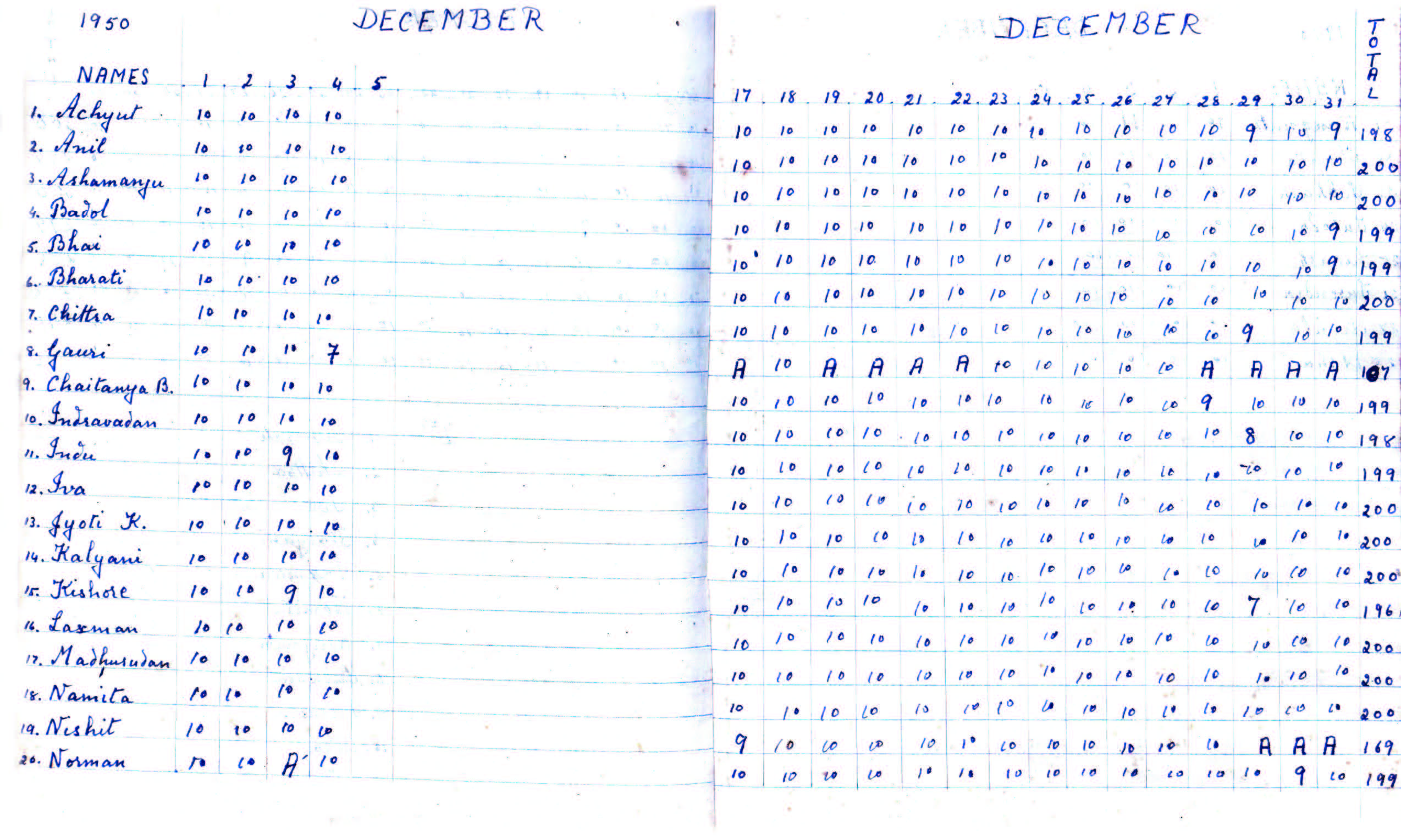
Messages for the Annual Demonstration of Physical Culture
Demonstration 1960
Bravo! To all those who participated in yesterday's performance!119 It was excellent. My congratulations to everybody. Everything was well planned and well executed.
With love and blessings to all.
November 1960
Demonstration 1963
Yesterday I was with you all the time, with all the force and all the consciousness to help you and uphold you, I knew that the rain was a test which had to be overcome.
You have done it victoriously and I am very happy about it. Let everyone know of my entire satisfaction.
With my blessings.
3 December 1963
Demonstration 1964
My blessings for all those who will take part in the demonstration so that they may be at the summit of their capacities.
2 December 1964
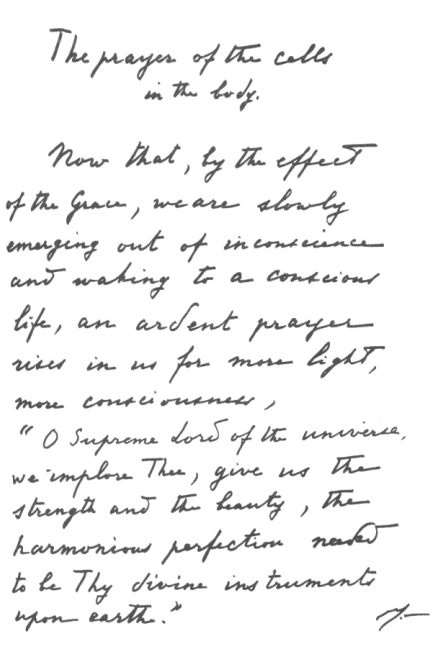
Demonstration 1966
Be courageous, enduring, vigilant; above all, be sincere, with perfect honesty.
Then you will be able to face all difficulties. And victory will be yours.
2 December 1966
Demonstration 1967
The prayer of the cells in the body
Now that, by the effect of the Grace, we are slowly emerging out of inconscience and waking to a conscious life, an ardent prayer rises in us for more light, more consciousness,
"O Supreme Lord of the universe, we implore Thee, give us the strength and the beauty, the harmonious perfection needed to be Thy divine instruments upon earth."
2 December 1967
Messages for the Annual Demonstration of Physical Culture
Notes, Letters and Messages
Become Master of your body—this will lead you to Freedom.
Physical culture is the best way of developing the consciousness of the body, and the more the body is conscious, the more it is capable of receiving the divine forces that are at work to transform it and give birth to the new race.
(Concerning a room to be used for gymnastics)
Does this room have air and light? Without air and light exercises do more harm than good.
5 October 1945
It is an urgent and indispensable lesson to be learned. Nothing useful can be won without a team-spirit and a sporting discipline.
15 January 1947
In what spirit should we take and do the sports competitions and games that we are doing now?
Read the enclosed booklet120—it will give you an answer and read also Sri Aurobindo's message in the first Bulletin.121
2 June 1949
If I understand well what you have written, you mean that by concentrating one's attention on the physical activity one is doing, it automatically stops all mental activity and this increases the efficiency of the body. This is true provided the concentration is total which is rather rare.
Blessings.
2 June 1949
(A captain, who had begun teaching athletics to a group of children ten to eleven years of age, asked Mother if he should make a plan of activities. She replied:)
A plan is good, but more for yourself than for the children. I mean to say that you must know exactly what you want to do and you must organise your work. But do not enforce too rigidly your method because the children like to be free and spontaneous in their movements, and this freedom is good for their growth.
My love and blessings.
6 June 1950
To the Soviet Gymnasts122
We salute you, brothers already so far on the way to the physical perfection for which we all aspire here.
Be welcome in the Ashram, amongst us. We feel sure that today one step more is taken towards unity of the great human family.
3 April 1956
Build in yourself the total harmony, so that when the time comes Perfect Beauty can express itself through your body.
1959
About Hatha Yoga
From our experience we have found that a particular system of exercises cannot be stamped as the only yogic type of exercises and we cannot definitely say that participation in those exercises only will help to gain health because they are yogic exercises.
Any rational system of exercises suited to one's need and capacity will help the participant to improve in health. Moreover it is the attitude that is more important. Any well-planned and scientifically arranged programme of exercises practised with a yogic attitude will become yogic exercises and the person practising them will draw full benefit from the point of view of physical health and moral and spiritual uplift.
Bulletin, April 1959
I simply want to be beautiful.
Do sincerely some physical culture and you will succeed.
1965
It does not seem to me quite wise to take children below six years to sea bathing; the sea water is too strong for them.
8 February 1966
(A captain wrote that she had told some children that Mother would be happy if they followed the discipline of their group. Mother commented)
Your reply is correct.
When one is incapable of conforming to a discipline, one is also incapable of doing anything of lasting value in life.
16 February 1967
(A captain informed Mother that he felt mentally and physically "pulled down". She wrote:)
Do not worry—with some good and regular exercises and my blessings it will be all right.
Love and blessings.
14 March 1967
Thrice I have been injured in my right knee and thrice I have recovered from it.
Ma, grant that I may not be injured once again and miss my group activities.
Be more conscious and you will no more be injured.
8 July 1968
Mother, I have seen that I am not able to force my physical body to do a little better than my actual capacity. I would like to know how I can force it. But, Mother, is it good to force one's body?
No.
The body is capable of progressing and gradually it can learn to do what it could not do. But its capacity for progress is much slower than the vital desire for progress and the mental will for progress and the mental will for progress.And if the vital and the mental were left as masters of action, they would simply harass the body, destroy its poise and upset its health.
Therefore, one must be patient and follow the rhythm of one's body; it is more reasonable and knows what it can do and what it cannot.
Naturally, there are tamasic bodies and they need some encouragement for progressing.
But in everything and in all cases, one must keep one's balance.
Blessings.
13 October 1969
Mother, why should one take part in competitions and demonstrations in sports?
Because it is an occasion to put in a greater effort and therefore to make a rapid progress.
Blessings.
16 November 1969
(Concerning accidents in sports)
I do not think there are more accidents here than outside. Certainly there should be less. But for that, children who are here must take care to grow in consciousness (a thing which they can do here more easily than anywhere else). Unfortunately, however, very few among them take the trouble to do it. So they lose the good chance given to them.
22 December 1969
Mother, what is the difference between sports and physical education?
Sports are all the games, competitions, tournaments, etc., all the things based on contests and ending in placings and prizes.
Physical education means chiefly the combination of all exercises for the sake of the growth and upkeep of the body.
Naturally, here we have the two together. But it is particularly so because human beings, especially in their young age, still require some excitement in order to make an effort.
Blessings.
14 January 1970
Sports help the body to prepare for the Transformation.
30 September 1972
(Concerning the sketch on the Games Tournament Award Card for the winner)
The drawing on the winner's card is an adaptation from a Greek bronze and is meant to express our will to use the physical strength for mastery over the black bull of passion.
(Concerning the sketch on the Games Tournament Award Card for the runner-up)
This Penseur of Rodin on the Runner-up Cards signifies the necessity of reflection to perfect means for a better result.
(Concerning the painting "Oedipus and the Sphinx" by Gustave Moreau, reproduced on the Gymnastics Competition Award Card)
The Riddle of the World
If you can solve it, you will be immortal, but if you fail you will perish.
5 Jul 1961
Sweet Mother, in the Physical Education Section, you have made all the necessary arrangements so that by physical training we may be able to develop our body in every possible way and thus become ready to participate in the great work of integral transformation.
We have been teaching games, sports and all sorts of physical activities for several years, but we find that most of our students cannot grasp the fundamental spirit. They are usually distracted by amusement, excitement, impulsive moods and all kinds of likes and dislikes. In consequence, the discipline, the will, the resolution, the hard work and the true attitude which ensure our progress are lacking on the whole. A football match or an exciting game arouses a lot of enthusiasm but a conscientious and concentrated work which will help us to master certain physical qualities and set right certain defect is always done without much eagerness. The great majority of students, big and small, suffer from this malady. Very few approach physical education with the right attitude. How shall we learn to make it our normal practice?
The contents of the consciousness must change, the level of the consciousness must be raised, the quality of the consciousness must progress.
Things are as you have described them, because most children have their consciousness centred in the physical which is tamasic and reluctant to make any effort. They want an easy life, and only the excitement or the rivalry of a game or a competition awakens enough interest in them so that they consent to make an effort. For this, a vital passion has to be aroused to intensify the will.
The idea of progress belongs to the intelligent will which is active only in very few who are in contact with their psychic being; later on, in those who are mentally more developed and begin to understand the need to develop and control themselves.
I said that the remedy is to raise the consciousness to a higher level. But, naturally, one must start with the level of the consciousness of the captains and instructors themselves.
First of all, they should have a clear conception of what they want to obtain from those for whom they are responsible; and not only that, but they should also have realised in themselves the qualities which they demand from others. Over and above these qualities, they should have developed in their character and action a great deal of patience, endurance, kindness, understanding and impartiality. They should have no likes or dislikes, no attractions or repulsions.
That is why the new group of captains must really be an elite group in order to set a good example to the pupils and students, if we want them in their turn to adopt the true attitude.
Therefore I say to all: set to work sincerely and sooner or later the obstacles will be overcome.
5 July 1961
21 Jul 1961
Sweet Mother,
Some activities in our programme of physical education are of a more serious nature than others and call for more concentration; these activities tend to become boring for the children. Should the captains organise their groups in such a way that everything they teach is interesting and amusing, or should the children try to create an interest in themselves?
Both are indispensable and should, as far as possible, be always present.
With a little imagination and inventive flexibility, the instructors should give charm and novelty to what they teach.
On their part, the children, by cultivating in themselves the will and inclination for progress, should create a constant interest in what they do.
In the meanwhile, the captains can partly entrust to the children the responsibility for organising their own exercises, using as much as possible whatever ingenious ideas may occur to them.
If the sense of collaboration and responsibility is awakened in the children, then they will take an interest in what they do and do it with pleasure.
21 July 1961
The Mother, On Education: Correspondence
24 Jul 1961
Sweet Mother,
We have a minute of concentration before and after group every day. What should we try to do during this concentration?
Before, make an offering to the Divine of what you are going to do, so that it may be done in a spirit of consecration.
Afterwards, ask the Divine to increase the will for progress in us, so that we may become instruments that are more and more capable of serving Him.
You may also, before starting, offer yourselves to the Divine in silence.
And at the end, give thanks to the Divine in silence.
I mean a movement of the heart without any words in the head.
24 July 1961
The Mother, On Education: Correspondence
Sweet Mother,
I have noticed something which applies to all of us; it is that we take part in as many items as possible in the 2nd December programme. Would it not be better to choose one or two items and give a very good demonstration in them, rather than to do several in a mediocre way?
Each one acts according to his nature and if he (or she) courageously and sincerely follows the law of that nature, he or she acts according to truth. Thus, it is impossible to judge and decide for others. One can know only for oneself, and even then one has to be very sincere so as not to deceive oneself.
The Mother, Some Answers from the Mother: 4 November 1961
Sweet Mother,
You have often told us that our activities should be an offering to the Divine. What does this mean exactly, and how can it be done? For instance, when we play tennis or basketball, how can we do it as an offering? Mental formations are not enough, of course!
It means that what you do should not be done with a personal, egoistic aim, for success, for glory, for gain, for material profit or out of pride, but as a service and an offering, in order to become more conscious of the divine will and to give yourself more entirely to it, until you have made enough progress to know and to feel that it is the Divine who acts in you, His force that impels you and His will that supports you—not just a mental knowledge, but the sincerity of a state of consciousness and the power of a living experience.
For that to be possible, all egoistic motives and all egoistic reactions must disappear.
The Mother, Some Answers from the Mother: 20 November 1961
Sweet Mother,
We have had a discussion among friends about the problem and various possible methods of physical education. The fundamental problem is this: how can we establish a programme that will satisfy everyone and be as effective as possible for all the members? Are the tournaments necessary? Should there be no compulsion whatever? And if complete freedom is given, will it be practical? And so on. It is a subject on which it is not easy to find a solution satisfactory enough for everyone, unless the Mother Herself intervenes.
It is impossible. Each one has his own taste and his own temperament. Nothing can be done without discipline—the whole of life is a discipline.
The Mother, Some Answers from the Mother: 20 September 1962
Sweet Mother,
Girls are always at a disadvantage: they cannot do what they want, as boys can.
Why not?
There are hundreds of proofs to the contrary.
The Mother, Some Answers from the Mother: 31 May 1963
Sweet Mother,
A few days ago I noticed something very odd in the children of Group A2: the boys don’t want to work with the girls; they don’t even want to stand side by side. They cannot work together. How did this idea of difference come to these little children who are barely eleven years old! It is strange.
It is atavistic and comes from the subconscient.
This instinct is based both on masculine pride, the foolish idea of superiority, and on the still more foolish fear due to the idea that woman is a dangerous being who entices you into sin. In children, all this is still subconscious, but it influences their actions.
The Mother, Some Answers from the Mother: 3 July 1963
Sweet Mother,
You have explained that this separation of girls and boys is atavistic, but it remains to ask You what we captains should do about it. Personally, I think it is better to close one’s eyes to it, but there are others who prefer to give advice or even to scold. I think that by closing one’s eyes to it, one minimises the importance of the problem and thus this idea of difference between girls and boys will be less striking. What do You think?
One cannot make a general rule; everything depends on the case and the occasion. Both methods have their good and bad points, their advantages and drawbacks. For the captains, the main thing is to have tact and sufficient inner perception to intervene when necessary or to close one’s eyes when it is preferable not to see.
The Mother, Some Answers from the Mother: 15 July 1963
weet Mother,
One is often afraid of doing what is new; the body refuses to act in a new way, such as trying a new gymnastic figure or another kind of dive. Where does this fear come from? How can one get rid of it? And again, how can one encourage others to do so?
The body is afraid of anything new because its very base is inertia, tamas; it is the vital which brings in a dominant note of rajas, activity. That is why, as a general rule, the intrusion of the vital in the form of ambition, emulation and vanity, compels the body to shake off the tamas and make the necessary effort to progress.
Naturally, those in whom the mind is dominant can lecture their body and provide it with all the reasons needed to overcome its fear.
The best way for everyone is self-giving to the Divine and trust in His infinite Grace.
The Mother, Some Answers from the Mother: 13 May 1964
I simply want to be beautiful.
Do sincerely some physical culture and you will succeed.
1965
The Mother, On Education: General Messages and Letters
Mother,
Can you tell me why in Sri Aurobindo’s Ashram, in your presence, everyone seems to think of food, physical culture and the doctor for keeping good health? The Divine help may take a fourth place if it likes. It is difficult, at present, for one to speak of your help. People seem to think that by speaking of your help either one is trying to show off or is a fanatic.
Sri Aurobindo said that the physical was to be taken into the yoga and not rejected or neglected. And almost all here thought they were doing yoga in the physical and fell the prey of the physical “needs” and desires…
To speak frankly, I like better that mistake than that of the so-called ascetics who are full of contempt, bad will and scornful feelings for the others.
No time to say all that could be said on the subject.
But… the criticising spirit is more destructive than many bad habits.
Blessings.
The Mother, More Answers from the Mother: 12 July 1967
The prayer of the cells in the body
Now that, by the effect of the Grace, we are slowly emerging out of inconscience and waking to a conscious life, an ardent prayer rises in us for more light, more consciousness,
“O Supreme Lord of the universe, we implore Thee, give us the strength and the beauty, the harmonious perfection needed to be Thy divine instruments upon earth.”
2 December 1967
The Mother, On Education: Messages for the Annual Demonstration of Physical Culture
How does one become conscious of the physical being?
Mankind, nearly all of mankind, is conscious only of the physical being. With education, the number of men who are conscious of their vital and mind is increasing. As for the human beings who are conscious of their psychic being, they are relatively few.
If you mean, “How does one awaken the consciousness of the physical being?”, that is precisely the aim of physical education. It is physical education that teaches the cells to be conscious. But for the development of the brain, it is study, observation, intelligent education, above all observation and reasoning. And naturally, for the whole education of the consciousness from the point of view of character, it is yoga.
The Mother, On Education: Mother's Action in a Class of Children Aged Sixteen to Eighteen
For some time I have had trouble sleeping due to inner and outer turmoil. I pray to You to help me.
Before trying to sleep, when you lie down to sleep, begin by relaxing yourself physically (I call this becoming a rag on the bed).
Then with all the sincerity at your disposal, offer yourself to the Divine in a complete relaxation, and… that’s all.
Keep trying until you succeed and you will see.
Blessings.
March 1969
The Mother, Words of the Mother - III: Sleep and Rest
(To a Physical Education Captain)
In human life the cause of all difficulties, all discords, all moral sufferings, is the presence in everyone of the ego with its desires, its likes and dislikes. Even in a disinterested work which consists in helping others, until one has learned to overcome the ego and its demands, until one can force it to keep calm and quiet in one corner, the ego reacts to everything that displeases it, starts an inner storm that rises to the surface and spoils all the work.
This work of overcoming the ego is long, slow and difficult; it demands constant alertness and sustained effort. This effort is easier for some and more difficult for others.
We are here in the Ashram to do this work together with the help of Sri Aurobindo’s knowledge and force, in an attempt to realise a community that is more harmonious, more united, and consequently much more effective in life.
As long as I was physically present among you all, my presence was helping you to achieve this mastery over the ego and so it was not necessary for me to speak to you about it individually very often.
But now this effort must become the basis of each individual’s existence, more especially for those of you who have a responsible position and have to take care of others. The leaders must always set the example, the leaders must always practise the virtues they demand from those who are in their care; they must be understanding, patient, enduring, full of sympathy and warm and friendly goodwill, not out of egoism to win friends for themselves, but out of generosity to be able to understand and help others.
To forget oneself, one’s own likings and preferences, is indispensable in order to be a true leader.
That is what I am asking of you now, so that you can face your responsibilities as you should. And then you will find that where you used to feel disorder and disunity, they have vanished, and harmony, peace and joy have taken their place.
You know that I love you and that I am always with you to sustain you, help you and show you the way.
Blessings.
26 August 1969
The Mother, On Education: Correspondence
Sweet Mother,
Why should one take part in the sports’ competitions and demonstrations?
Because it is a chance to put in greater effort and thus make faster progress.
Blessings.
The Mother, Some Answers from the Mother: 16 November 1969
Do not forget that to succeed in our yoga one must have a strong and healthy body.
For this, the body must do exercise, have an active and regular life, work physically, eat well, and sleep well.
It is in good health that the way towards transformation is found.
18 April 1971
The Mother, Words of the Mother - III: Illness and Health
Sweet Mother,
Concerning the categories You have mentioned for the school, should there also be similar categories for physical education?
For physical exercises, it all depends on the body and its capacities. Easy exercises that are not tiring can be given to everyone.
Afterwards, it all depends on the body, on its strength, its health, its resistance to fatigue, etc., etc.
Exercises should be given according to capacity and the children should be grouped according to these capacities. It is a matter of experience and observation.
To be a good teacher of physical culture one must know anatomy, the various functions of the body, their development and their functioning.
16 February 1972
The Mother, On Education: Correspondence
Mother,
Some people criticise the fact that we have too many rules in our physical education and that we impose too much discipline on the children.
There can be no physical education without discipline. The body itself could not function without a strict discipline. Actually, the failure to recognise this fact is the principal cause of illness.
Digestion, growth, blood-circulation, everything, everything is a discipline. Thought, movement, gestures, everything is a discipline, and if there is no discipline people immediately fall ill.
18 February 1972
The Mother, On Education: Correspondence
Sweet Mother,
The students, especially the adolescents, often complain that they have to do even the physical exercises that they do not like and do not find interesting. Would you reply to this, Mother?
We are not on earth to follow our own sweet will but to progress.
Physical exercises are not done for fun or to satisfy one’s whims, but as a methodical discipline to develop and strengthen the body.
True wisdom is to take pleasure in everything one does and that is possible if one takes everything one does as a way to progress. Perfection is difficult to attain and there is always a great deal of progress to be made in order to achieve it.
To seek pleasure is certainly the best way to make yourself miserable.
If you truly want peace and happiness, your constant preoccupation should be:
“What progress must I make to be able to know and serve the Divine?”
Show this to C. She ought not to have listened to what the children say. She has been here a long time. She ought to know that.
That [“To seek pleasure is certainly the best way to make yourself miserable”] is an absolute truth. It affirms that if you want to satisfy your little ego, you are sure to be unhappy. For sure! It is the best way to make yourself miserable. To say: “Oh, it is boring; oh, I must do what I like; oh, that person is unkind to me; oh, life does not bring me what I want.” Ouah!!!
“Am I what I ought to be?
“Am I doing what I ought to be doing?
“Am I progressing as much as I should?”
Then it becomes interesting.
“What should I learn in order to make my next progress? What infirmity must I cure? What shortcoming must I overcome? What weakness must I get rid of?”
And then, naturally, the next moment: “How can I become capable of understanding and serving the Divine?”
The Mother, On Education: Correspondence
It is good to do exercises and to lead a simple and hygienic life, but for the body to be truly perfect, it must open to the divine forces, it must be subject only to the divine influence, it must aspire constantly to realise the Divine.
The Mother, Words of the Mother - III: Illness and Health
Messages for Competitions
Athletics Competition 1959
Behind the appearances that the physical eyes can see, there is a reality much more concrete and lasting. It is in this reality that I am with you today and will be during all the athletic season. The force, the power, the light and the consciousness will be in your midst constantly to give to each one, according to his receptivity, the success in his endeavour and the progress which is the crowning result of all sincere effort.
19 July 1959
Gymnastics Competition 1959
What I told you at the opening of the athletics stands good for the Gymnastic Competition; I will be with you all through, helping you in your effort and enjoying your performances.
With my blessings.
16 October 1959
Athletics Competition 1960
In joy and confidence, let all do their best, with my force, my help and my blessings.
21 August 1960
Athletics Competition 1962
Replace the ambition to be first by the will to do the best possible.
Replace the desire for success by the yearning for progress.
Replace the eagerness for fame by the aspiration for perfection.
Physical Education is meant to bring into the body, consciousness and control, discipline and mastery, all things necessary for a higher and better life.
Keep all that in mind, practise sincerely and you will become a good athlete; this is the first step on the way to be a true man.
Blessings.
15 July 1962
Athletics Competition 1963
To all those who want to make their body fit for a Divine Life, I say, do not miss this excellent opportunity of the athletic competition and never forget that whatever we do we must aspire for perfection. For it is this yearning for perfection which will, in spite of all difficulties, lead us to our Goal.
Blessings.
21 August 1963
Athletics Competition 1964
We are here to lay the foundations of a new world.
All the virtues and skills required to succeed in athletics are exactly those the physical man must have to be fit for receiving and manifesting the new force.
I expect that with this knowledge and in this spirit you will enter this athletic competition and go through it successfully.
My blessings are with you.
24 August 1964
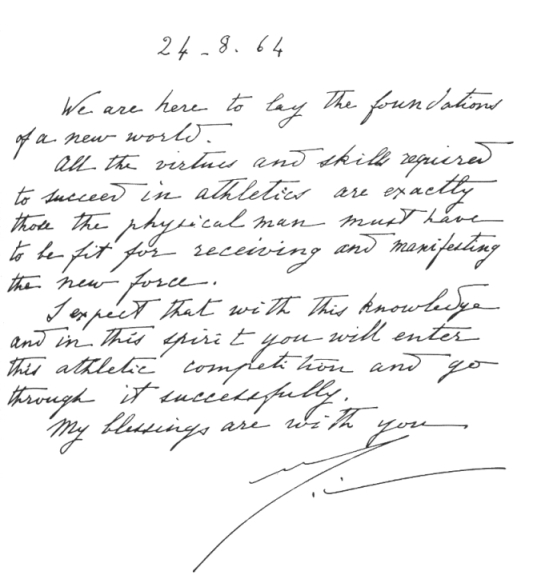
Gymnastics Competition 1964
The 18th October is a good day.
Gymnastics is a good art.
And you will be good gymnasts.
Blessings.
18 October 1964
Competitions 1966
It might be better to remind you that we are here for a special work, a work which is done nowhere else.
We want to come in contact with the supreme consciousness, the universal consciousness, we want to bring it down in ourselves and to manifest it. But for that we must have a very solid base; our base is our physical being, our body. Therefore we have to build up a body solid, healthy, enduring, skilful, agile and strong, ready for everything. There is no better way to prepare the body than physical exercise: sports, athletics, gymnastics, and all games are the best means to develop and strengthen the body.
Therefore I call you to go through the competitions beginning today, full-heartedly with all your energy and all your will.
1 April 1966
Competitions 1967
On this occasion of our physical education and sportive activities:
I must tell you once more that for us spiritual life does not mean contempt for Matter but its divinisation. We do not want to reject the body but to transform it. For this physical education is one of the means most directly effective.
So I invite you to participate in the programme beginning today with enthusiasm and discipline—discipline, because it is the indispensable condition of order; enthusiasm, because it is the essential condition of success.
Blessings.
1 April 1967
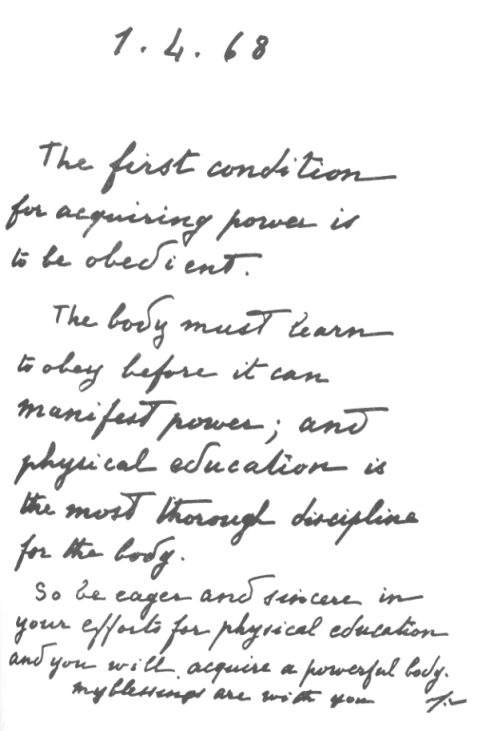
Competitions 1968
The first condition for acquiring power is to be obedient.
The body must learn to obey before it can manifest power; and physical education is the most thorough discipline for the body.
So be eager and sincere in your efforts for physical education and you will acquire a powerful body.
My blessings are with you.
1 April 1968
Competitions 1969
Since the beginning of this year a new consciousness is at work upon earth to prepare the men for a new creation, the superman. For this creation to be possible the substance that constitutes man's body must undergo a big change, it must become more receptive to the consciousness and more plastic under its working.
These are just the qualities that one can acquire through physical education.
So, if we follow this discipline with such a result in view, we are sure to obtain the most interesting result.
My blessings to all, for progress and achievement.
1 April 1969
Competitions 1970
What better offering can we make to the Divine, than to offer the skill of our growing bodies?
Let us offer our efforts towards perfection, and physical education will take for us a new meaning and a greater value.
The world is preparing for a new creation, let us help through physical education, by making our bodies stronger, more receptive and more plastic, on the way to physical transformation.
1 April 1970
Competitions 1971
We are at one of these "Hours of God", when the old bases get shaken, and there is a great confusion; but it is a wonderful opportunity for those who want to leap forward, the possibility of progress is exceptional.
Will you not be of those who take advantage of it?
Let your body be prepared through physical education for this great change!
My blessings to all.
1 April 1971
Competitions 1972
This year, let us offer all the activities of our body in consecration to Sri Aurobindo.
1 April 1972
Questions and Answers—Physical Education
Q&A: How to prepare for Sleep: 1 February 1951
What is the way to take rest before going to sleep?
There are many methods, but I will give you one. First, your body must be comfortable, on a bed, in an easy-chair—anywhere so long as it is comfortable. Then you learn how to relax your nerves one after the other, until you achieve complete relaxation. You should relax all your nerves—you can relax them all together, but perhaps it is easier to relax them one after the other, and this becomes very interesting. And when that is done, you must make your brain quiet and silent and at the same time keep your body like a rag on the bed. You must make the brain so still and absolutely quiet that it is not aware of itself. And then, don’t try to sleep, but pass very gently from this state into sleep without being aware of it. When you wake up the next morning you will be full of energy. But if you go to bed very tired and without even trying to relax, to calm down, you will fall into a heavy, dull and unconscious sleep and the vital will lose all its energy. Perhaps this won’t have any immediate effect, but it is better to try it than to plunge into sleep when you are very tired.
If you relax very gently before going to sleep, you will feel great pleasure in going to sleep. If you manage to relax the nerves, even of only one arm or leg, you will see how pleasant it is. If you go to sleep with your nerves tense, you will have a very restless sleep and change position very often during the night. That kind of rest is no good.
The Mother, Words of the Mother - III: 1 February 1951
Q&A: Increasing the receptivity of the Body: 31 March 1951
How can one increase the receptivity of the body?
It depends on the part. The method is almost the same for all parts of the being. To begin with, the first condition: to remain as quiet as possible. You may notice that in the different parts of your being, when something comes and you do not receive it, this produces a shrinking—there is something which hardens in the vital, the mind or the body. There is a stiffening and this hurts, one feels a mental, vital or physical pain. So, the first thing is to put one’s will and relax this shrinking, as one does a twitching nerve or a cramped muscle; you must learn how to relax, be able to relieve this tension in whatever part of the being it may be.
The method of relaxing the contraction may be different in the mind, the vital or the body, but logically it is the same thing. Once you have relaxed the tension, you see first if the disagreeable effect ceases, which would prove that it was a small momentary resistance, but if the pain continues and if it is indeed necessary to increase the receptivity in order to be able to receive what is helpful, what should be received, you must, after having relaxed this contraction, begin trying to widen yourself—you feel you are widening yourself. There are many methods. Some find it very useful to imagine they are floating on water with a plank under their back. Then they widen themselves, widen, until they become the vast liquid mass. Others make an effort to identify themselves with the sky and the stars, so they widen, widen themselves, identifying themselves more and more with the sky. Others again don’t need these pictures; they can become conscious of their consciousness, enlarge their consciousness more and more until it becomes unlimited. One can enlarge it till it becomes vast as the earth and even the universe. When one does that one becomes really receptive. As I have said, it is a question of training. In any case, from an immediate point of view, when something comes and one feels that it is too strong, that it gives a headache, that one can’t bear it, the method is just the same, you must act upon the contraction. One can act through thought, by calling the peace, tranquillity (the feeling of peace takes away much of the difficulty) like this: “Peace, peace, peace… tranquillity… calm.” Many discomforts, even physical, like all these contractions of the solar plexus, which are so unpleasant and give you at times nausea, the sensation of being suffocated, of not being able to breathe again, can disappear thus. It is the nervous centre which is affected, it gets affected very easily. As soon as there is something which affects the solar plexus, you must say, “Calm… calm… calm”, become more and more calm until the tension is destroyed.
The Mother, Questions and Answers (1950 - 1951): 31 March 1951
Q&A: Dealing with Inconscience one consumes with Food: 19 April 1951
Physically, we depend upon food to live—unfortunately. For with food, we daily and constantly take in a formidable amount of inconscience, of tamas, heaviness, stupidity. One can’t do otherwise—unless constantly, without a break, we remain completely aware and, as soon as an element is introduced into our body, we immediately work upon it to extract from it only the light and reject all that may darken our consciousness. This is the origin and rational explanation of the religious practice of consecrating one’s food to God before taking it. When eating one aspires that this food may not be taken for the little human ego but as an offering to the divine consciousness within oneself. In all yogas, all religions, this is encouraged. This is the origin of that practice, of contacting the consciousness behind, precisely to diminish as much as possible the absorption of an inconscience which increases daily, constantly, without one’s being aware of it.
The Mother, Questions and Answers (1950 - 1951): 19 April 1951
Q&A: Self-Identification to cure Nervous Diseases: 12 August 1953
[Self-identification] is also one of the methods used today to cure nervous diseases. When someone cannot sleep, cannot be restful because he is too excited and nervous and his nerves are ill and weakened by excessive agitation, he is told to sit in front of an aquarium, for instance—an aquarium, that’s very lovely, isn’t it?—before an aquarium with pretty little fish in it, goldfish; just to sit there, settle down in an easy-chair and try not to think of anything (particularly not of his troubles) and look at the fish. So he looks at the fish, moving around, coming and going, swimming, gliding, turning, meeting, crossing, chasing one another indefinitely, and also the water flowing slowly and the passing fish. After a while he lives the life of fishes: he comes and goes, swims, glides, plays. And at the end of the hour his nerves are in a perfect state and he is completely restful!
But the condition is that one must not think of one’s troubles, simply watch the fish.
The Mother, Questions and Answers (1953): 12 August 1953
Q&A: Rest in Action: 16 December 1953
How can one have “rest in action”?
That comes from a kind of certitude of inner choice. When one aspires for something, if at the same time one knows that the aspiration will be heard and answered in the best way possible, that establishes a quietude in the being, a quietude in its vibrations; whilst if there is a doubt, an uncertainty, if one does not know what will lead one to the goal or if ever one will reach it or whether there is a way of doing so, and so on, then one gets disturbed and that usually creates a sort of little whirlwind around the being, which prevents it from receiving the real thing. Instead, if one has a quiet faith, if whilst aspiring one knows that there is no aspiration (naturally, sincere aspiration) which remains unanswered, then one is quiet. One aspires with as much fervour as possible, but does not stand in nervous agitation asking oneself why one does not get immediately what one has asked for. One knows how to wait. I have said somewhere: “To know how to wait is to put time on one’s side.” That is quite true. For if one gets excited, one loses all one’s time—one loses one’s time, loses one’s energy, loses one’s movements. To be very quiet, calm, peaceful, with the faith that what is true will take place, and that if one lets it happen, it will happen so much the quicker. Then, in that peace everything goes much better.
The Mother, Questions and Answers (1953): 16 December 1953
Q&A: Weak Bodies and Brilliant Minds? 27 January 1954
“There is a prevalent belief that brilliant minds are found in weak bodies.” I haven’t understood this.
These were old ideas of the last century. They are no longer in fashion now, but at the end of the last century it was always thought that the more weak and sickly people were, the more brilliant was their mind, the more intelligent they were! Some even explained that the development of their intelligence was due to the fact that they could not draw any joy from their body—for they were quite incapable of living fully, so all their attention was turned to their mind and it was thus that their intelligence had developed. There was even a time when it was the fashion to look a little sickly. Poets, for instance, put on these airs… An artist, he had to be a little sickly to give the impression that his mind was all afire! But that is now over. It was finished even before you were born, I believe. It was the romantic age, the end of the last century. Men like Musset, for instance—I don’t know if you have ever seen a portrait of Musset, but indeed he had a sentimental and sickly look, and he added to it as much as he could by his dress. It was thought that it gave him an artistic and poetic appearance. But now this is altogether out of fashion. People favour a good physical balance, good health, a strong body and all that is given by the physical training of children.
The Mother, Questions and Answers (1954): 27 January 1954
Q&A: Sports and Personal Progress: 17 February 1954
Sweet Mother, you have said: “Give up all personal seeking for comfort, satisfaction, enjoyment or happiness. Be only a burning fire for progress, take whatever comes to you as an aid to your progress and immediately make whatever progress is required.”
Yes, that’s quite simple! It is very clear!
Yes, but if I want to progress in sports, for instance, then that would be a personal progress, wouldn’t it?
Eh? What? In sports? No, the value of the will depends on your aim. If it is in order to be successful and earn a reputation for yourself and be better than others—all sorts of ideas like that—then that becomes something very egoistic, very personal and you won’t be able to progress—yes, you will make progress but still it won’t lead you anywhere. But if you do it with the idea of being open, even in the physical, to the divine Influence, to be a good instrument and manifest Him, then that is very good. Not clear?
Yes.
Physical things are not necessarily more egoistic than mental or emotional ones. Far from it. They are often much less so. Egoism does not lie in that, egoism lies in the inner attitude. It does not depend on the field in which you are concentrated, it depends on the attitude you have. It does not depend on what you do, it depends on the way you do it.
The Mother, Questions and Answers (1954): 17 February 1954
Q&A: Why does Body tire: 24 February 1954
Why does the body get tired? We have more or less regular activities, but one day we are full of energy and the next day we are quite tired.
Generally this comes from a kind of inner disequilibrium. There may be many reasons for it, but it all comes to this: a sort of disequilibrium between the different parts of the being. Now, it is also possible that the day one had the energy, one spent it too much, though this is not the case with children; children spend it until they can no longer do so. One sees a child active till the moment he suddenly falls fast asleep. He was there, moving, running; and then, all of a sudden, pluff! Finished, he is asleep. And it is in this way that he grows up, becomes stronger and stronger. Consequently, it is not the spending that harms you. The expenditure is made up by the necessary rest—that is set right very well. No, it is a disequilibrium: the harmony between the different parts of the being is no longer sufficient.
People think they have only to continue doing forever what they were doing or at least remain in the same state of consciousness, day after day do their little work, and all will go well. But it is not like that. Suddenly, for some reason or other, one part of the being—either your feelings or your thoughts or your vital—makes progress, has discovered something, received a light, progressed. It takes a leap in progress. All the rest remain behind. This brings about a disequilibrium. That is enough to make you very tired. But in fact, it is not tiredness: it is something which makes you want to keep quiet, to concentrate, remain within yourself, be like that, and build up slowly a new harmony among the different parts of the being. And it is very necessary to have, at a given moment, a sort of rest, for an assimilation of what one has learnt and a harmonization of the different parts of the being.
Now, as you know, from the physical point of view human beings live in frightful ignorance. They cannot even say exactly… For instance, would you be able to tell exactly, at every meal, the amount of food and the kind of food your body needs?—simply that, nothing more than that: how much should be taken and when it should be taken…. You know nothing about it, there’s just a vague idea of it, a sort of imagination or guesswork or deduction or… all sorts of things which have nothing to do with knowledge. But that exact knowledge: “This is what I must eat, I must eat this much”—and then it is finished. “This is what my body needs.” Well, that can be done. There’s a time when one knows it very well. But it asks for years of labour, and above all years of work almost without any mental control, just with a consciousness that’s subtle enough to establish a connection with the elements of transformation and progress. And to know also how to determine for one’s body, exactly, the amount of physical effort, of material activity, of expenditure and recuperation of energy, the proportion between what is received and what is given, the utilisation of energies to re-establish a state of equilibrium which has been broken, to make the cells which are lagging behind progress, to build conditions for the possibility of higher progress, etc… it is a formidable task. And yet, it is that which must be done if one hopes to transform one’s body. First it must be put completely in harmony with the inner consciousness. And to do that, it is a work in each cell, so to say, in each little activity, in every movement of the organs. With this alone one could be busy day and night without having to do anything else…. One does not keep up the effort and, above all, the concentration, nor the inner vision.
I have put to you quite a superficial question: it seems astonishing to you that one can know the exact amount of what one should eat, and what should be eaten at a certain time, and at what time one should take one’s meal, and when one is ready for another! Well, that is an altogether superficial part of the problem, yet if you enter into the combination of the cells and the inner organisation in order that all this may be ready to respond to the descending Force…. First, are you conscious of your physical cells and their different characteristics, their activity, the degree of their receptivity, of what is in a healthy condition and what is not? Can you say with certainty when you are tired, why you are tired? When there’s something wrong somewhere, can you say, “It is because of this that I am suffering”?… Why do people rush to the doctor? Because they are under the illusion that the doctor knows better than they how to look inside their body and find out what’s going on there—which is not very reasonable, but still that’s the habit! But for oneself, who can look inside himself quite positively and precisely and know exactly what is out of order, why it is disturbed, how it has been disturbed? And all this is simply a work of observation; afterwards one must do what is necessary to put it back into order again, and that is still more difficult.
Well, this is the A B C of the transformation of the body. Voilà.
The Mother, Questions and Answers (1954): 24 February 1954
Q&A: Tobacco and Alcohol Destroy Memory and Will: 24 March 1954
Why do tobacco and alcohol destroy the memory and will?
Why? Because, they do so. There is no moral reason. It is a fact. There is a poison in alcohol, there is a poison in tobacco; and this poison goes into the cells and damages them. Alcohol is never expelled, so to say; it accumulates in a certain part of the brain, and then, after the accumulation, these cells no longer function at all—some people even go mad because of it, that is what is called delirium tremens, the result of having swallowed too much alcohol which is not absorbed but remain in this way concentrated in the brain. And it is so radical even that… There is a province in France, for instance, which produces wine, a wine with a very low percentage of alcohol: I believe it is four or five per cent, a very low percentage, you understand; and these people, because they make it, drink wine as one drinks water. They drink it neat, and after some time they become ill. They have cerebral disorders. I knew people of this kind, the brain was disordered, didn’t function any more. And tobacco—nicotine is a very serious poison. It is a poison that destroys the cells. I have said that it is a slow poison because one doesn’t feel it immediately except when one smokes for the first time and it makes one very ill. And this should make you understand that it ought not to be done. Only, people are so stupid that they think it is a weakness and so continue until they get used to the poison. And the body no longer reacts, it allows itself to be destroyed without reacting: you get rid of the reaction.
It is the same thing physically as morally. When you do something you ought not to do and your psychic tells you in its still small voice not to do it, then if you do it in spite of that, after a while it will no longer tell you anything, and you will no longer have any inner reactions at all to your bad actions, because you have refused to listen to the voice when it spoke to you. And then, naturally, you go from bad to worse and tumble into the hole. Well, for tobacco it is the same thing: the first time the body reacts violently, it vomits, it tells you, “I don’t want it at any cost.” You compel it with your mental and vital stupidity, you force it to do so; it doesn’t react any longer and so lets itself be poisoned gradually until it decomposes. The functioning deteriorates; it is the nerves that are affected; they no longer transmit the will because they are affected, they are poisoned. They no longer have the strength to transmit the will. And finally people begins to tremble, they have nervous movements. There are quite a few, one doesn’t need to go very far to find them. And they are like that only because they have committed excesses: they drank and smoked. And when they lift an object, their hands shake (gesture). That’s what one gets by doing this.
Some people have a well-developed body but in spite of that they are very nervous. Then…?
Usually it is… Perhaps they have a very weak vital build: their nerves may be weak, they may have a weak nervous system; perhaps it is that, perhaps it is an irregularity from birth. But it could also be a mental weakness, because while it is true that a healthy body gives strong nerves, it is still more important to have healthy thoughts in order to have solid nerves. If your thought is not healthy, if your feelings and thoughts are bad so to speak, your nerves become very bad, still worse. For instance, those who entertain all kinds of unhealthy fancies, those who like unhealthy reading, unhealthy conversations—there are many of this kind, there is a large number of them—well, they may lose all control over their nerves, they may become extremely nervous and yet have a body that’s in a fine condition and very healthy. Unhealthy conversations and reading—I can tell you that there’s nothing worse than that, and when you do sadhana truly, when you are really trying to progress, you notice that when you say useless words, no matter how few they are, immediately there is a terrible uneasiness which gets hold of you; you feel as though all the nerves of the head were being pulled and there is also something churning here (gesture) which hurts you, and you feel a great emptiness within and have heartburn, as though you had eaten something very bad—all this only because of some uselessly spoken words. Besides, it is a sure indication: as soon as the uneasiness begins, one knows one must stop: “Now it is finished.” Only, most people are so unconscious that they don’t even notice it, and with their warped will they compel their system to do what it should not. So, the system is more or less docile, obeys and continues to deteriorate slowly, in this way, without even showing visible reactions.
The Mother, Questions and Answers (1954): 24 March 1954
Q&A: Food and Physical Habits: 9 June 1954
There is a charming phrase here—I appreciated it fully—in which Sri Aurobindo is asked, “What is meant by the physical adhering to its own habits’?” What are the habits which the physical must throw off? It is this terrible, frightful preference for the food you were used to when you were very young, the food you ate in the country where you were born and about which you feel when you no longer get it that you have not anything at all to eat, that you are miserable.
I don’t know, I believe there won’t be a dozen people here who have come to the Ashram and eaten the food of the Ashram without saying, “Oh! I am not used to this food. It is very difficult.” And how many, how many hundreds of people who prepare their own food because they cannot eat the food of the Ashram! (Mother slams the book down on the stool.) And then, they justify this! So it is here that these ideas begin to come, and they say, “My health! I can’t digest well!” All this is only in their head. There is not a word of truth in it. NOT ONE WORD OF TRUTH . It is a perpetual lie in which everybody lives, and in this matter, indeed, I may tell you what I think, you have not advanced any farther than the mass of human beings.
I make an exception for the very, very, very rare ones who are not like that. They could be counted on one’s fingers. And all, all justify this, all, all—“Oh, my poor children! They are not used to eating this food. How shall we manage? They will die because of this change of food!” Well, I, indeed, can give a remedy for that. You take a boat, take a train and go round the world several times, you are obliged to eat in each country the food of that country, and after you have done this several times, you will understand your stupidity…. It is a stupidity. A frightful tamas. One is tied up there like this (Mother makes a movement with her hands) to one’s gastric habits.
Now I have said what was on my mind! You may ask questions.
The Mother, Questions and Answers (1954): 9 June 1954
Q&A: Eating meat and Purifying the Body: 23 June 1954
For an ordinary man, living an ordinary life, having ordinary activities, not thinking at all of anything else except earning his living, of keeping himself fit and perhaps taking care of his family, it is good to eat meat, it is all right for him to eat anything at all, whatever agrees with him, whatever does him good.
But if one wishes to pass from this ordinary life to a higher one, the problem begins to become interesting; and if, after having come to a higher life, one tries to prepare oneself for the transformations, then it becomes very important. For there certainly are foods which help the body to become subtle and others which keep it in a state of animality. But it is only at that particular time that this becomes very important, not before; and before reaching that moment, there are many other things to do. Certainly it is better to purify one’s mind and purify one’s vital before thinking of purifying one’s body. For even if you take all possible precautions and live physically taking care not to absorb anything except what will help to subtilise your body, if your mind and vital remain in a state of desire, Inconscience, darkness, passion and all the rest, that won’t be of any use at all. Only, your body will become weak, dislocated from the inner life and one fine day it will fall ill.
One must begin from inside, I have already told you this once. One must begin from above, first purify the higher and then purify the lower. I am not saying that one must indulge in all sorts of degrading things in the body. That’s not what I am telling you. Don’t take it as an advice not to exercise control over your desires! It isn’t that at all. But what I mean is, do not try to be an angel in the body if you are not already just a little of an angel in your mind and vital; for that would dislocate you in a different way from the usual one, but not one that is better. We said the other day that what is most important is to keep the equilibrium. Well, to keep the equilibrium everything must progress at the same time. You must not leave one part of your being in darkness and try to bring the other into light. You must take great care not to leave any corner dark. There you are.
The Mother, Questions and Answers (1954): 23 June 1954
Q&A: Sports for the Divine: 4 August 1954
Mother, here it is said: “Even if the idea of the separate worker is strong in you and you feel that it is you who do the act, yet it must be done for her.” For example, our study of sports—we must think that it is for the Divine?
But surely…
How?
It is not even very difficult. You can first do it as a preparation so as to become capable of receiving the divine forces, and then, as a service, so that you may help in constructing the whole organisation of the Ashram. You can do it not with any personal gain in view, but with the intention of making yourselves ready to accomplish the divine work! This seems to me even quite indispensable if you want to profit fully from the situation. If you keep the ordinary point of view, well, you will always find yourselves in conditions which are not quite satisfactory, and incapable of receiving all the forces you can receive.
Mother, if for instance in the long jump one makes an effort to jump a greater and greater distance, how does one do the divine work?
Eh? Excuse me, it is not for the pleasure of doing the long jump, it is to make your body more perfect in its functioning, and, therefore, a more suitable instrument for receiving the divine forces and manifesting them.
Why, everything, everything one does in this place must be done in this spirit, otherwise you do not even profit by the opportunity given to you, the circumstances given to you. I explained to you the other day, didn’t I, that the Consciousness is here, penetrating all things and trying to manifest in all movements? But if you, on your side, tell yourself that the effort you are making, the progress you are making, you make in order to become more capable of receiving this Consciousness and of manifesting it, the work will naturally be much better and much quicker. And this seems to me even quite elementary, to tell you the truth; I am surprised that it could be otherwise! Because your presence in an Ashram organised as it is organised would have no meaning if it were not that! Of what use would it be? There are any number of universities, schools in the world which are very well organised!
But if you are here, it is for a special reason! It is because here there is a possibility of absorbing consciousness and progress which is not found elsewhere. And if you don’t prepare yourselves to receive this, well, you will lose the chance that’s given to you!
The Mother, Questions and Answers (1954): 4 August 1954
Q&A: Physical Energy: 2 March 1955
On what do our physical reserves depend, Mother?
Physical reserves? You mean the reserve of energy?
Yes.
It depends on the capacity to receive the universal vital force; because in fact, through food also it is these vital forces one receives but one receives them from below. But in order to have reserves you must know how to receive the universal vital forces constantly and to have a kind of balance in the being which prevents you from spending more than you have.
A proportion has to be kept between the receptivity and the expenditure. It is a kind of harmony in the being which must be established. Only, some people have an almost instinctive power of attracting towards them the vital forces or absorbing them—the universal vital forces, I mean—and so they make up their expense as they go along spending. These people can produce much more than others. Some of them, in certain conditions like sleep or a kind of repose or relaxation, can accumulate forces and later they exhaust them, so to say, in their activities and they must yet once again charge the battery afterwards—this is already a much less favourable condition.
Some people don’t know how to receive the forces at all. These live on the energies concentrated in the body—for there is some concentrated energy in all the cells of the body. They live upon that, but after some time, they are drained out completely if they don’t know how to recuperate; when they have spent all the energies which were concentrated inside them either they fall ill or they never recuperate them. So this cannot last very long; it lasts the average lifetime of human beings, and yet, at the end of a certain number of years they are no longer able to make the same effort or to produce as much, or above all to make any progress.
But those who know instinctively or who have learnt to receive and accumulate the universal vital forces, these can last almost indefinitely. The wear and tear is very little, especially if they know how to do it and do it with knowledge and method; then here it can reach a certain degree of perfection.
When one knows, sometimes just two or three minutes are sufficient to recuperate the energies spent over a long period. Only, one must know how to do it.
But those who draw back upon themselves, who turn and double up on themselves, cannot do this. One must live all the time in a very vast and very expansive consciousness (I don’t know if you understand the word, it means something which extends very homogeneously and quietly, as when the tide is at its height and the water spreads like that, quietly—that’s the impression). The vital must be like that—then one is open to the universal forces. But if, for example, one has the very bad habit of exchanging vital forces with one’s fellowmen, then one loses the capacity altogether. So unless one is in relation with someone, one receives nothing at all. But naturally if you receive forces through others, you receive at the same time all the difficulties of the other person, perhaps sometimes his qualities also, but these are less contagious. This indeed is something that shuts you up most.
Some people… unless they have more or less social relations with others, relations of friendship, conversing… and then it goes still farther… they don’t receive any forces; and this is how they receive them. But this always makes a soup. The forces one receives are already half digested, in any case they don’t have their primal purity, and this affects your own capacity.
But when one has this capacity in his own consciousness—for example, you go for a walk and come to a place which is somewhat vast, like the seashore or like a great plain or the summit of a mountain, a place where the horizon is fairly vast, then if you have this kind of physical instinct which suddenly makes you as vast as the horizon, you have a sense of infinity, immensity; and the vaster you become, the quieter and more peaceful you become.
It is enough for you to have a contact with Nature like that.
There are many other means, but this one is very spontaneous. There is also… when you see something very beautiful you can have the same thing: a kind of inner joy and an opening to the forces, and so this widens you and fills you at the same time. There are many means but usually one does not use them. Naturally, if you enter into contemplation and aspire for a higher life and call down the forces from above, this recuperates your energies more than anything else. But there are numerous methods.
The Mother, Questions and Answers (1955): 2 March 1955
Q&A: Drawing Universal Vital Force: 4 May 1955
Sweet Mother, how can one draw on “the universal vital Force”?
One can do it in many ways.
First of all, you must know that it exists and that one can enter into contact with it. Secondly, you must try to make this contact, to feel it circulating everywhere, through everything, in all persons and all circumstances; to have this experience, for example, when you are in the countryside among trees, to see it circulating in the whole of Nature, in trees and things, and then commune with it, feel yourself close to it, and each time you want to deal with it, recall that impression you had and try to enter into contact.
Some people discover that with certain movements, certain gestures, certain activities, they enter into contact more closely. I knew people who gesticulated while walking… this truly gave them the impression that they were in contact—certain gestures they made while walking… But children do this spontaneously: when they give themselves completely in their games, running, playing, jumping, shouting; when they spend all their energies like that, they give themselves entirely, and in the joy of playing and moving and running they put themselves in contact with this universal vital force; they don’t know it, but they spend their vital force in a contact with the universal vital force and that is why they can run without really feeling very tired, except after a very long time. That is, they spend so much that if they were not in contact with the universal force, they would be absolutely exhausted, immediately. And that is why, besides, they grow up; it is also because they receive more than they spend; they know how to receive more than they spend. And this does not correspond to any knowledge. It is a natural, spontaneous movement. It is the movement… a movement of joy in what they are doing—of joyful expenditure. One can do many things with that.
I knew young people who had always lived in cities—in a city and in those little rooms one has in the big cities in which everyone is huddled. Now, they had come to spend their holidays in the countryside, in the south of France, and there the sun is hot, naturally not as here but all the same it is very hot (when we compare the sun of the Mediterranean coasts with that of Paris, for example, it truly makes a difference), and so, when they walked around the countryside the first few days they really began to get a terrible headache and to feel absolutely uneasy because of the sun; but they suddenly thought: “Why, if we make friends with the sun it won’t harm us any more!” And they began to make a kind of inner effort of friendship and trust in the sun, and when they were out in the sun, instead of trying to bend double and tell themselves, “Oh! How hot it is, how it burns!”, they said, “Oh, how full of force and joy and love the sun is!” etc., they opened themselves like this (gesture), and not only did they not suffer any longer but they felt so strong afterwards that they went round telling everyone who said “It is hot”—telling them “Do as we do, you will see how good it is.” And they could remain for hours in the full sun, bare-headed and without feeling any discomfort. It is the same principle.
It is the same principle. They linked themselves to the universal vital force which is in the sun and received this force which took away all that was unpleasant to them.
When one is in the countryside, when one walks under the trees and feels so close to Nature, to the trees, the sky, all the leaves, all the branches, all the herbs, when one feels a great friendship with these things and breathes that air which is so good, perfumed with all the plants, then one opens oneself, and by opening oneself communes with the universal forces. And for all things it is like that.
The Mother, Questions and Answers (1955): 4 May 1955
Q&A: Will to Reject a Vice: 4 January 1956
There are human beings also who indulge in vice—one vice or another, like drinking or drug-injections—and who know very well that this is leading them to destruction and death. But they choose to do it, knowingly.
They have no control over themselves.
There is always a moment when everyone has self-control. And if one had not said “Yes” once, if one had not taken the decision, one would not have done it.
There is not one human being who has not the energy and capacity to resist something imposed upon him—if he is left free to do so. People tell you, “I can’t do otherwise”—it is because in the depths of their heart they do not want to do otherwise; they have accepted to be the slaves of their vice. There is a moment when one accepts.
The Mother, Questions and Answers (1956): 4 January 1956
Q&A: Physical Needs: 16 May 1956
Sri Aurobindo speaks even of physical needs, the needs of the body, which are generally considered as imperative and which have their own truth; he says that even that can be only quite a partial light, that is to say, a semblance of knowledge or even something false.
That goes against all modern ideas.
People always have the impression that what they call the needs of the body, what the body demands, is an absolute law; that if it is not obeyed, well, one commits a great wrong against one’s body which will suffer the consequences. And Sri Aurobindo says that these needs in themselves are either very partial lights, that is to say, only a way of seeing things, or even no lights at all―completely false.
If one were to study the problem attentively enough, one would find out to what an extent these so-called needs of the body depend on the mental attitude. For example, the need to eat. There are people who literally die of hunger if they have not eaten for eight days. There are others who do it deliberately and observe fasting as a principle of yoga, as a necessity in yoga. And for them, at the end of eight days’ fasting, the body is as healthy as when they started, and sometimes healthier!
Finally, for all these things, it is a question of proportion, of measure. It is obvious that one can’t always live without eating. But it is as obvious that the idea people have about the need to eat is not true. Indeed, it is a whole subject for study: The importance of the mental attitude in relation to the body.
Sri Aurobindo does not recognise the needs of the body as things true in themselves. He says: it is not true, it is only an idea you have, an impression, it is not something true which carries its truth in itself.
The Mother, Questions and Answers (1956): 16 May 1956
Q&A: Spending Receiving Physical Energy: 20 June 1956
“The more you give, the more you receive,” it is said. Does this apply to physical energy? Should one undertake physical work which seems beyond one’s capacity? And what should be one’s attitude while doing this kind of work?
If one did not spend, one would never receive. The great force a child has for growth, for development is that he spends without stint.
Naturally, when one spends, one must recuperate and must have the time that is needed to recuperate; but what a child cannot do one day, he can do the next. So if you never go beyond the limit you have reached, you will never progress. It is quite obvious that people who practise physical culture, for example, if they make progress, it is just because they gradually exceed, go beyond what they could do.
It is all a matter of balance. And the period of receptivity should be in proportion to the period of expenditure.
But if one confines oneself to what one can do at a given moment… First of all it is impossible, for if one doesn’t progress, one falls back. Therefore, one must always make a little effort to do a little more than before. Then one is on the upward path. If one is afraid of doing too much, one is sure to go down again and lose one’s capacities.
One must always try a little more, a little better than one did the day before or the previous moment. Only, the more one increases one’s effort, the more should one increase one’s capacity of receptivity and the opportunities to receive. For instance, from the purely physical point of view, if one wants to develop one’s muscles, a progressive effort must be made by them, that is to say, a greater and greater effort, but at the same time one must do what is needed: massage, hydrotherapy, etc. to increase at the same time their capacity to receive.
And rest. A rest which is not a falling into the inconscient―which generally tires you more than it refreshes―but a conscious rest, a concentration in which one opens oneself and absorbs the forces which come, the universal forces.
The limits of the body’s possibilities are so elastic! People who undergo a methodical and scientific training, rational, systematic, arrive at absolutely startling results. They demand things from their bodies which, naturally, without training it would be quite impossible to do. And certainly, they must gradually go beyond what they could do, not only from the point of view of perfection, but also from the point of view of strength. If they have that fear of doing more than they are able, of overdoing things, they will never progress. Only, at the same time one must do what is necessary for recuperating. That is the whole principle of physical culture. And one sees things which for an ignorant and untrained man are absolutely miraculous, performed by bodies which have been methodically trained.
The Mother, Questions and Answers (1956): 20 June 1956
Q&A: Women and Men and Sports: 25 July 1956
“Why are women’s records not announced?” [This] question is of an altogether external kind―relatively. But it seems quite indispensable, for it concerns our sports education and also, generally, the psychological basis on which we have founded our activity here. These things have been written by Sri Aurobindo, I have written them very often, have explained them to you many a time, but I am really sorry I am obliged to state that it has not entered your consciousness.
I don’t want to start a war against what you feel and do, but I should like you at least to understand why things are done here as they are, instead of letting yourselves go in a retrograde impulsiveness and copying all that is done elsewhere under the pretext that it is “like that” that things are done, under the pretext that your parents and great-grandparents, your relatives and friends, and the grandparents of your friends, all those who stay outside continue to do things in this way and consider it the normal, natural way of doing them.
I don’t dispute the fact, in the sense that humanity was created by Nature for a special purpose and special ends, and in order to realise her ends she has produced beings and also given them special habits and special functions. Therefore, if you speak of “natural” things, I cannot tell you that this is not “natural”, for that is the way of Nature. But still, I believe I have told you―not only once but many times, and Sri Aurobindo also has written this, not once but many a time―that we are not here to recommence, perpetuate, continue what is done elsewhere. And we have given a concrete form to this fact specially in our education; for I must say, without offending anyone, that those who come here after having already seen much of life, those who have quite a heavy past behind them, may find it difficult to change their attitude and point of view immediately, but if you take very young children who have not yet been too spoiled―they are always spoiled―but those who have not yet been too spoiled by ordinary education, the ideas of their family, the atavism of their parents, etc., you have a chance of orientating the consciousness on the right path and getting a tangible and concrete result.
To tell the truth, we have nothing to complain about, for we have had striking proofs that if one knows how to do it, what we claim is possible.
What we claim is this, which in similar conditions, with the same education and the same possibilities, there is no reason to make a categorical distinction, final and imperative, between what we call men and women. For us, human beings are the expression of a single soul. It is true, as I said at the beginning, that Nature has differentiated her expressions for the satisfaction of her needs and the realisation of her purpose, but if our needs and purposes are of another kind and we don’t recognise the physical ends conceived by Nature as final, and absolute, then we can try to develop consciousness on another line.
Unfortunately, we have noticed one thing. As the years pass and the little girls grow up into big girls, suddenly we find that they begin to remember that they are girls, that they must be pretty, they must please, must dress up in a special way, put on little affectations to attract attention―and the whole result of our work collapses.
There are some―there are always exceptions to the rule―who have understood and who try to realise. But even among these there is still in the background that kind of little satisfaction of not being quite “like the others”, of being able to do what the others cannot, and for this to be clearly seen, well, they must pare themselves with the others!
So that is exactly the occasion of what I have just told you. It is a question from one of you which has given rise to another question, and I hope that if I explain to you once more in detail, insisting on the fact, we shall perhaps be able to start anew and realise something more complete and more clear.
We come down altogether to earthly things: somebody has been very successful in athletics and has come first in one event. This somebody is a “she”, for convenience in speaking. And so, ah! besides the satisfaction of having done well, there was a little satisfaction in having done better than the others, and she came to ask:
“Why are women’s records not announced?”
We have, I believe, repeated and reiterated that there are no “women’s” and no “men’s” records, there are only group records. There is the green group―the various green groups―there is the red group, the grey group, the blue group, the khaki group, the white group. You may tell me that some of these groups are exclusively men’s or women’s. I shall answer what I have just said, that unless one comes here very young, it is difficult to change one’s habits, and that is what has made this separation necessary―but it is not the ideal. And if we made it a habit to announce gloriously: “This very remarkable girl has done what no other girl could do before”, oh, la, la, what a fall it would be! Not to mention that this encourages vanity―which is not good―it is also an assertion that this fact is remarkable because it is a girl; now it is not at all a remarkable fact that it is a girl: it is remarkable because she has done very well, and there are many boys who have not done so well. But if one wants to magnify this fine fact by paring her with other girls who have not done as well, it becomes deplorable.
So this question was brought to me. I believe that person has been given the answer which I have just told you, that there are only group records and no records of sexes.
But that is not all. I am told that some have heard―not once but hundreds of times, especially from those who come from outside with all the ideas of the world outside―this question:
“Why do you have the same programme of physical education for boys and girls?”
There are some who consider it a scandal; some consider it a glaring error from the physical, material point of view. “Why aren’t girls treated in a special way and quite differently from boys?”― then the great argument―”as it is done everywhere.”
Ah! thank you. Then why do we have an Ashram? Why do we have a Centre of Education? If everywhere the same things are done, we don’t need to repeat them, we won’t do them any better than others.
And when they put this argument in my way, they couldn’t tell me anything that appears more utterly stupid to me. It is done everywhere? That is just the reason for not doing it; for if we do what others do, it is not worth the trouble doing anything at all. We want precisely to introduce into the world something which is not there; but if we keep all the habits of the world, all the preferences of the world, all the constructions of the world, I don’t see how we can get out of the rut and do something new.
My children, I have told you, repeated it in every tone, in every way: if you really want to profit by your stay here, try to look at things and understand them with a new vision and a new understanding based on something higher, something deeper, vaster, something more true, something which is not yet but will be one day. And it is because we want to build this future that we have taken this special stand.
I tell you that we have had quite material proofs of the correctness and truth of our position, but… they are not lasting. Why? Because it is extremely easy to fall back into the ordinary consciousness, and there is nothing more difficult than to always stand on the top of the ladder and try to look at the world from up there.
We don’t want to obey the orders of Nature, even if these orders have millions of years of habits behind them. And one thing is certain, the argument of Nature when she is opposed to things changing, is: “It has always been thus.” I claim this is not true. Whether she likes it or not, things change, and a day will come when it will be said: “Ah! yes, there was a time when it was like that, but now it is different.”
Well, grant only for some time, in a way which is still that of faith and trust, that we are in fact bringing about this change, that we have come to a point where things are going to take a turn and a new orientation. You are simply asked to have just a little faith and trust and allow yourselves to be guided. Otherwise, well, you will lose the advantage of being here, that’s all. And you will go back with the same weaknesses and same habits one sees in life as it is outside. There you are.
You thought I was a little severe, a little hard, and that after all it was not easy to satisfy me! That is why you tie pretty little pink ribbons in your hair or on pigtails hanging at the back. I say, perhaps a little uncharitably: “You look ridiculous!” For you think you are very fine to look at, but truly this makes you ridiculous. If you want to go out into the world and preen yourselves as girls do in the world and give yourselves airs in order to please because that is your sole defense and sole weapon, to attract attention and to please, and be quite pretty, quite seductive, you are quite free to do so, it’s no longer my concern. But indeed to do all that here is ridiculous. It is ridiculous and you also bring yourselves down immediately to a level which is not very pretty.
Naturally, you may blame me for telling you all this in front of “the other sex”. But I include him in the ridicule, for if he did not think as he does, if he did not feel as he does and did not act as he does, you would have long ago been disgusted with these childish little affectations. There we are.
Now I have told you all I wanted to say. I think this is enough for today, isn’t it? You have really had it!
The Mother, Questions and Answers (1956): 25 July 1956
Q&A: Imparting Sporting Values to Children: 10 April 1957
Sweet Mother, during our tournaments there are many who play in a very bad spirit. They try to hurt others in order to win. And we have noticed that even the little ones are learning to do this. How could it be avoided?
With children it is above all ignorance and bad example which cause the harm. So it would be good if, before they begin their games, all the group-leaders, the captains, call together all those they are in charge of and tell them, explain to them exactly what Sri Aurobindo says here, with detailed explanations like those we have given in the two little books The Code of Sportsmanship and The Ideal Child [or What a Child Should Always Remember]. These things must be repeated often to the children. And then, you must warn them against bad company, bad friends, as I told you in another class.
And above all, set them the right example…. Be yourself what you would like them to be. Give them the example of disinterestedness, patience, self-control, constant good humour, the overcoming of one’s little personal dislikes, a sort of constant goodwill, an understanding of others’ difficulties; and that equality of temper which makes children free from fear, for what makes children deceitful and untruthful, and even cunning, is the fear of being punished. If they feel secure, they will hide nothing and you will then be able to help them to be loyal and honest. Of all things the most important is good example. Sri Aurobindo speaks of that, of the invariable good humour one must have in all circumstances, this self-forgetfulness: not to throw one’s own little troubles on others; when one is tired or uncomfortable, not to become unpleasant, impatient. This asks for quite some perfection, a self-control which is a great step on the path of realisation. If one fulfilled the conditions needed to be a true leader, even if only a leader of a small group of children, well, one would already be far advanced in the discipline needed for the accomplishment of the yoga.
It is from this aspect that the problem should be seen, the aspect of self-mastery, of control, of the endurance which will not allow your personal condition to react on your group-work or collective action. To forget oneself is one of the most essential conditions for being a true leader: to have no selfish interests, to want nothing for oneself, to consider only the good of the group, of the whole, the totality that depends on one; to act only with that aim in mind, without wanting any personal profit from one’s action.
A leader of a small group can thus become a perfect leader for a large group, for a nation, and prepare himself for a collective role. It is a training-ground of great importance, and that is truly what we have attempted and are continuing to try out here: to give to everyone as soon as possible a responsibility, big or small, so that he learns to become a true leader.
To be a true leader one must be completely disinterested and efface from oneself as much as possible all self-regard and all selfish movements. To be a leader one must master one’s ego, and to master one’s ego is the first indispensable step for doing yoga. And this is what can make sports a powerful aid for the realisation of the Divine.
Very few people understand this, and generally those who are against this outer discipline of sports, this concentration on the material realisation, are people who completely lack control over their physical being. And to realise the integral yoga of Sri Aurobindo the control of one’s body is a first indispensable step. Those who despise physical activities are people who won’t be able to take a single step on the true path of integral yoga, unless they first get rid of their contempt. Control of the body in all its forms is an indispensable basis. A body which dominates you is an enemy; it is a disorder you cannot accept. It is the enlightened will in the mind which should govern the body, and not the body which should impose its law on the mind. When one knows that a thing is bad, one must be capable of not doing it. When one wants something to be realised, one must be able to do it and not be stopped at every step by the body’s inability or ill-will or lack of collaboration; and for that one must follow a physical discipline and become master in one’s own home.
It is very fine to escape into meditation and from the height of one’s so-called grandeur look down on material things, but one who is not master in his own home is a slave.
(Silence)
No questions over there? No?
Mother, one of the problems that arises in physical activities is that in order to be perfect at one game or one particular activity, one needs to concentrate only on that game or activity.
That is quite wrong. In the very first issue of the Bulletin I explained this in full detail. It is altogether wrong. Indeed someone who has acquired control over himself and developed the power of concentration can apply this power of concentration to things that are apparently extremely different, even sometimes opposite, and he ought to be able to do them without one thing interfering with the other.
There is only the question of time to be considered, but this question may be resolved by two things: first by an enlightened and methodical organisation of one’s life, then by doing away with the wastage of time which most people spend in useless activities—if these were to disappear it would be a blessing for everyone—and first among them I put chattering, that is, speaking uselessly, among friends, colleagues… in all activities. The time one can waste in talking is tremendous! When one word would be enough, one says fifty. And that is not the only loss of time…. Actually, when one is short of time, it means one does not know how to organise one’s life. Of course, there are people who do too many things, but that too shows a lack of organisation in life.
A true organisation gives a place to each thing to the extent that it is required. You all know very well that with ten to fifteen minutes of well-coordinated exercises, you can give your body all the necessary training. This you have been taught here and it has been proved to you. For the balance of the body this is enough. Naturally there are all sorts of other qualities given by games, but you don’t play for more than an hour each day at the most, as far as I know, and that is not much time spent in the day.
It is an excuse! Organise your life and you will see that you have room for everything… even for being a good student.
The Mother, Questions and Answers (1957 - 1958): 10 April 1957
Q&A: Transformation: 17 April 1957
“Perfection is the true aim of all culture, the spiritual and psychic, the mental, the vital and it must be the aim of our physical culture also. If our seeking is for a total perfection of the being, the physical part of it cannot be left aside; for the body is the material basis, the body is the instrument which we have to use. Śarīram khalu dharmasādhanam, says the old Sanskrit adage,—the body is the means of fulfilment of dharma, and dharma means every ideal which we can propose to ourselves and the law of its working out and its action. A total perfection is the ultimate aim which we set before us, for our ideal is the Divine Life which we wish to create here, the life of the Spirit fulfilled on earth, life accomplishing its own spiritual transformation even here on earth in the conditions of the material universe. That cannot be unless the body too undergoes a transformation, unless its action and functioning attain to a supreme capacity and the perfection which is possible to it or which can be made possible.“
The Supramental Manifestation, SABCL, Vol. 16, p. 5
Mother, how can the functioning of the body “attain to a supreme capacity”?
Precisely by transformation. This implies a total transformation. Sri Aurobindo speaks about it later in what follows.
For the moment, our body is simply a doubtful improvement on the animal body, for if we have gained from a certain point of view, we have lost from another. It is certain that from the point of view of purely physical capacities many animals are superior to us. Unless by a special culture and transformation we succeed in really transforming our capacities, it could be said that from the point of view of strength and muscular power a tiger or a lion is far superior to us. From the point of view of agility a monkey is far superior to us; and, for instance, a bird can travel without needing any exterior mechanism or plane, which is not yet possible for us… and so on. And we are bound by the animal necessities of the functioning of our organs; so long as we depend, for instance, on material food, on absorbing matter in such a crude form, we shall be quite inferior animals.
Therefore, I don’t want to anticipate what we are going to read, but all this purely animal functioning of our body, all this part which is exactly the same as in animal life—that we depend for life on the circulation of the blood and to have blood we need to eat, and so on, and all that this implies—these are terrible limitations and bondages! As long as material life depends on that, it is obvious that we won’t be able to divinise our life.
So, we must assume that animality in the human being should be replaced by another source of life, and this is quite conceivable—not only conceivable but partially realisable; and this is obviously the aim we ought to set before ourselves if we want to transform matter and make it capable of expressing divine qualities.
In the very, very old traditions—there was a tradition more ancient than the Vedic and the Chaldean which must have been the source of both—in that ancient tradition there is already mention of a “glorious body” which would be plastic enough to be transformed at every moment by the deeper consciousness: it would express that consciousness, it would have no fixity of form. It mentioned luminosity: the constituent matter could become luminous at will. It mentioned a sort of possibility of weightlessness which would allow the body to move about in the air only by the action of will-power and by certain processes of control of the inner energy, and so on. Much has been said about these things.
I don’t know if there ever were beings on earth who had partially realised this, but in a very small way there have been partial instances of one thing or another, examples which go to prove that it is possible. And following up this idea, one could go so far as to conceive of the replacement of material organs and their functioning as it now is, by centres of concentration of force and energy which would be receptive to the higher forces and which, by a kind of alchemy, would use them for the necessities of life and the body. We already speak of the different “centres” in the body—this knowledge is very widespread among people who have practised yoga—but these centres could be perfected to the point where they replace the different organs by a direct action of the higher energy and vibrations on matter. Those who have practised occultism well enough, in its most integral form, it could be said, know the process of materialisation of subtle energies and can put them in contact with physical vibrations. Not only is it something that can be done, but it is something which is done. And all that is a science, a science which must itself be perfected, completed, and which will obviously be used for the creation and setting in action of new bodies which will be able to manifest the supramental life in the material world.
But, as Sri Aurobindo says, before this can be done, it is good to utilise all that we have in order to increase and make more exact the control of physical activities. It is very obvious that those who practise physical culture scientifically and with coordination acquire a control over their bodies that’s unimaginable for ordinary people. When the Russian gymnasts came here, we saw with what ease they did exercises which for an ordinary man are impossible, and they did them as if it was the simplest thing in the world; there was not even the least sign of effort! Well, that mastery is already a great step towards the transformation of the body. And these people who, I could say, are materialists by profession, used no spiritual method in their education; it was solely by material means and an enlightened use of human will that they had achieved this result. If they had added to this a spiritual knowledge and power, they could have achieved an almost miraculous result…. Because of the false ideas prevalent in the world, we don’t usually see the two things together, spiritual mastery and material mastery, and so one is always incomplete without the other; but this is exactly what we want to do and what Sri Aurobindo is going to explain: if the two are combined, the result can reach a perfection that’s unthinkable for the ordinary human mind, and this is what we want to attempt.
As he goes on to say—we shall probably read it next time—first one has to fight against a formidable mass of stupid prejudices which create an irreconcilable antagonism between material and spiritual life. And it is something so deep-rooted in human consciousness that it is very difficult to eradicate it, even in those who think they have understood Sri Aurobindo’s teaching! And many people said, when for altogether different reasons I began to hold meditations again, “Ah! At last! We are returning to spiritual life….” This was indeed what prevented me from holding them for a long time. It was in order not to encourage this stupidity. But for other reasons it was necessary to do it and so I did. So long as this foolishness is not uprooted from human consciousness, the supramental force will always find it considerably difficult not to be engulfed in the obscurity of a human thought which understands nothing. That’s all. All the same, we shall succeed.
I chose this book, The Supramental Manifestation, in order to have the opportunity of putting you into contact with a truth expressed in an almost combative form, in order to fight against this old division, this total lack of understanding of the eternal Truth.
And perhaps, when we have finished reading it, I shall be able to tell you why we have started the meditations again—but certainly not “to return to spiritual life”!
And it is so deep-rooted. Oh! Even those who outwardly profess to understand—when they think of the spiritual life, they immediately think of meditation.
There we are. Now, we shall have one all the same, but for another reason!
The Mother, Questions and Answers (1957 - 1958): 17 April 1957
Q&A: Necessity of giving physical its full development: 24 April 1957
..the greatest spiritual power, if it enters material that’s not educated, will produce a result far superior to what that individual would have been able to achieve in his ordinary state, but far inferior to what a genius who has mastered matter can produce. It is not enough that “the Spirit bloweth”, the instrument must also be capable of manifesting it.
I believe that is one of the things Sri Aurobindo is going to explain: why it is necessary to give to the physical, external being, its full development, the capacity of controlling matter directly; then you put at the disposal of the Spirit an instrument capable of manifesting it, otherwise… Yes, I knew several people who in their ordinary state could not write three lines without making a mistake, not only spelling mistakes but mistakes of language, that is, who could not express one thought clearly—well, in their moments of spiritual inspiration, they used to write very beautiful things, but all the same these very beautiful things were not so beautiful as the works of the greatest writers. These things seemed remarkable in comparison with what they could do in their ordinary state; it was true, their present possibilities were used to the maximum, it was something that gave a value to what otherwise would have had none at all. But supposing you take a real genius—a musician or artist or writer of genius—who has fully mastered his instrument, who can use it to produce works that express the utmost human possibility, if you add to this a spiritual consciousness, the supramental force, then you will have something truly divine.
And this is precisely the key to the effort Sri Aurobindo wanted us to make.
And your body, if you draw from it all the possibilities it holds, if you educate it by the normal, well-known, scientific methods, if you make this instrument into something as perfect as possible, then, when the supramental truth manifests in that body, it will become immediately—without centuries of preparation—a marvellous instrument for the expression of the Spirit.
That is why Sri Aurobindo used to repeat and has always said: You must work from both ends, not let go of one for the other. And certainly, if you want to have a divine consciousness, you must not give up spiritual aspiration; but if you want to become an integral divine being on earth, take good care not to let go of the other end, and make your body the best possible instrument.
It is a disease of the ordinary human intellect—which comes, moreover, from separation, division—to make a thing always either this or that. If you choose this, you turn your back on that; if you choose that, you turn your back on this.
It is an impoverishment. One must know how to take up everything, combine everything, synthesise everything. And then one has an integral realisation.
The Mother, Questions and Answers (1957 - 1958): 24 April 1957
Q&A: Sports Competitions and Progress: 1 May 1957
Mother, are sports competitions essential to our progress?
From the point of view of moral education they are rather essential, for if one can take part in them in the right spirit, it is a very good opportunity for mastering one’s ego. If one does it without trying to overcome one’s weaknesses and lower movements, one obviously doesn’t know how to profit by them, and it does no good; but if one has the will to play in the right spirit, without any movement of a lower kind, without jealousy or ambition, keeping an attitude which could be called “fair play”, that is, doing one’s best and not caring about the result; if one can put in the utmost effort without being upset because one has not met with success or things have not turned out in one’s favour, then it is very useful. One can come out of all these competitions with a greater self-control and a detachment from results which are a great help to the formation of an exceptional character. Naturally, if you do it in the ordinary way and with all the ordinary reactions and ugly movements, it doesn’t help anything at all; but that holds good in no matter what one does; whether in the field of sports or the intellectual field, anywhere, if one acts in the ordinary way, well, one wastes one’s time. But if when playing or taking part in tournaments and competitions, you keep the right spirit, it is a very good education, for it compels you to make a special effort and to exceed your ordinary limits a little. It is certainly an opportunity to make conscious many of your movements which otherwise would always remain unconscious.
But naturally, you must not forget that this must be an opportunity and a means for progress. If you just let yourselves go and play in an altogether ordinary manner, you are wasting your time; but it is the same for everything, not only for this: for studies and for anything at all. Everything always depends on the way in which things are done, not so much on what one does but on the spirit in which one does it.
If you were all yogis and did everything you do with your utmost effort and to your utmost possibilities, as well as you can do it and always with the idea of doing it better still, then, obviously, there would be no need of competitions, prizes, rewards; but, as Sri Aurobindo writes, little children cannot be expected to be yogis, and during the period of preparation a stimulus is necessary for the most material consciousness to make an effort for progress…. And this period of childhood may last for many years!
The ideal would be exactly what I have written in the last Bulletin, I don’t know if you have read it, but I have written something like this:
Have no ambition, above all pretend nothing, but be at every moment the utmost that you can be.
That is the ideal state in the integral life—whatever one does. And if one realises that, well, one is certainly very far on the path of perfection…. But it is obvious that a certain inner maturity is needed to do this in all sincerity. You may set this as a programme for yourselves.
The Mother, Questions and Answers (1957 - 1958): 1 May 1957
Q&A: Reason instead of Vital to be the Master of Body’s House: 8 May 1957
Mother, usually we see that many of us take an interest in the games and activities in which there is some excitement, but few take interest in serious activities, serious exercises. Why is that?
Because in the vast majority of cases, what gives interest is vital satisfaction. For you to be interested in training exercises which don’t have the stimulus of games, the reason must govern the being. In ordinary men reason is the summit of human consciousness, and this is the part of the being which must govern the rest, for it is orderly and reasonable, that is, it does things with a feeling for order, for goodness, usefulness, and in accordance with a plan, a specific plan, recognised and used by each one, whereas the vital part of the being likes excitement, the unexpected, adventure—all that makes games attractive—above all, competition, the effort to win, victory over the opponent, all these things; it is the vital impulse, and the vital in man being the seat of enthusiasm, ardour, normal energy, when the attraction of the unexpected, of struggle and victory is not there, it goes to sleep, unless it is in the habit of obeying, regularly and spontaneously, the will of the reason. And this is even one of the first things for which all physical training is useful: the fact that it cannot be done really well unless the body is in the habit of obeying the reason rather than the vital impulse. For instance, the whole development of bodily perfection, of physical culture with dumb-bells and the exercises which have nothing particularly exciting and demand a discipline, habits which must be regular, reasonable, which give no scope to passion, desire, impulse—one must order one’s life according to a very strict and very regular discipline—well, in order to do them really well one must be in the habit of governing one’s life by the reason.
This is not very common. Usually, unless one has taken good care to make it otherwise, the impulses—the impulses of desire—all the enthusiasms and passions with all their reactions are the masters of human life. One must already be something of a sage to be able to undergo a rigorous discipline of the body and obtain from it the ordered, regular effort which can perfect it. There is no longer any room there for all the fancies of desire. You see, as soon as one gives way to excesses, to immoderation of any kind and a disorderly life, it becomes quite impossible to control one’s body and develop it normally, not to mention that, naturally, one spoils one’s health and as a result the most important part of the ideal of a perfect body disappears; for with bad health, impaired health, one is not much good for anything. And it is certainly the satisfaction of desires and impulses of the vital or the unreasonable demands of certain ambitions which make the body suffer and fall ill.
Naturally, there is all the ignorance of those who don’t even know the most elementary rules of life; but everybody knows one must learn how to live and, for instance, that fire burns and water can drown! People don’t need to be told all that, it is something they learn fast as they grow up; but the fact that the control of reason over life is absolutely indispensable even for good health, is not always accepted by the inferior man for whom life has no savour unless he can live out his passions.
I remember a man who came here a very long time ago, to stand as a candidate for the government. It so happened that he was introduced to me because they wanted my opinion of him, and so he asked me questions about the Ashram and the life we lead here, and about what I considered to be an indispensable discipline for life. This man used to smoke the whole day and drank much more than was necessary, and so he complained, you see, that he was often tired and sometimes could not control himself. I told him, “You know, first of all, you must stop smoking and you must stop drinking.” He looked at me with an unbelievable bewilderment and said, “But then, if one doesn’t either smoke or drink, it is not worth living!” I told him, “If you are still at that stage, it is no use saying anything more.”
And this is much more frequent than one thinks. To us it seems absurd, for we have something else which is of course more interesting than smoking and drinking, but for ordinary men the satisfaction of their desires is the very reason for existence. For them it seems to be an affirmation of their independence and their purpose in life. And it is simply a perversion, a deformation which is a denial of the life-instinct, it is an unhealthy interference of thought and vital impulse in physical life. It is an unhealthy impulse which does not usually exist even in animals. In this case, instinct in animals is infinitely more reasonable than human instinct—which, besides, doesn’t exist any more, which has been replaced by a very perverted impulse.
Perversion is a human disease, it occurs only very rarely in animals, and then only in animals which have come close to man and therefore have been contaminated by his perversion.
There is a story about some officers in North Africa—in Algeria—who had adopted a monkey. The monkey lived with them and one day at dinner they had a grotesque idea and gave the monkey something to drink. They gave it alcohol. The monkey first saw the others drink, this seemed to it something quite interesting, and it drank a glass, a full glass of wine. Afterwards it was ill, as ill as could be, it rolled under the table with all kinds of pains and was really in a very bad way, that is, it gave the men an example of the spontaneous effect of alcohol when the physical nature is not already perverted. It nearly died of poisoning. It recovered. And some time later it was again allowed to come for dinner as it was all right, and somebody placed a glass of wine in front of it. It picked it up in a terrible rage and flung it at the head of the man who had given the glass to it…. By that it showed that it was much wiser than the men!
It is a good thing to begin to learn at an early age that to lead an efficient life and obtain from one’s body the maximum it is able to give, reason must be the master of the house. And it is not a question of yoga or higher realisation, it is something which should be taught everywhere, in every school, every family, every home: man was made to be a mental being, and merely to be a man—we are not speaking of anything else, we are speaking only of being a man—life must be dominated by reason and not by vital impulses. This should be taught to all children from their infancy.
The Mother, Questions and Answers (1957 - 1958): 8 May 1957
Q&A: The Sequence of Transformation: 15 May 1957
Mother, will the transformation of the body come after the transformation of the mind and vital, or will it follow spontaneously?
Usually this kind of transformation proceeds from above downwards, not from below upwards.
Obviously, if you are a thorough-going materialist, you will say that it is the development of the form which brings out new capacities; but still, this is not quite correct, it is not exactly like this that things usually happen, and I challenge you to transform your body before your mind has been transformed. Just try, let us see!
You cannot move a finger, say a word, walk one step without the mind’s intervention; so with what instrument are you going to transform your body if your mind is not already transformed?
If you remain in the state of ignorance—of perfect ignorance, I might say—which your mind is in at present, how do you expect your body to be transformed?
Sometimes one finds a great resistance in the body. What is the reason? The mind does not interfere, but there is a resistance. The greatest resistance comes from the physical, there is a special resistance of the physical.
Where is the greatest resistance?… In your head. (Laughter) This is not a special case. Most often what refuses most to change is the physical mind—so obstinate, isn’t it, in the conviction of its own competence, ooh!… In the love it has for its own ignorance, its own way of thinking, its own way of seeing, its own way of not knowing.
Is that all?… All right! Then we won’t say anything more.
I am asking for the remedy.
Oh! Oh!… (Long silence)…. There, that’s the remedy.
The Mother, Questions and Answers (1957 - 1958): 15 May 1957
Q&A: Progressive Transformation: 29 May 1957
I have often been asked this question, “Why, after having posited as an ideal principle that when we deal with our body we ought to do it with the knowledge that it is only a result and an instrument of the supreme Reality of the universe and of the truth of our being,—why, after having taught this and shown that this is the truth to be realised, do we have in the organisation of our Ashram, doctors, dispensaries, a physical education of the body based on modern theories accepted everywhere?” And why, when some of you go for a picnic do I forbid you to drink water from just anywhere and tell you to take filtered water with you? Why do I have the fruit you eat disinfected, etc.?
All this seems contradictory, but this evening I intend to explain something to you which, I hope, will put an end to this feeling of a contradiction in you. In fact, I have told you many a time that when two ideas or principles apparently seem to contradict one another, you must rise a little higher in your thought and find the point where the contradictions meet in a comprehensive synthesis.
Here, it is very easy if we know one thing, that the method we use to deal with our body, maintain it, keep it fit, improve it and keep it in good health, depends exclusively on the state of consciousness we are in; for our body is an instrument of our consciousness and this consciousness can act directly on it and obtain what it wants from it.
So, if you are in an ordinary physical consciousness, if you see things with the eyes of the ordinary physical consciousness, if you think of them with the ordinary physical consciousness, it will be ordinary physical means you will have to use to act on your body. These ordinary physical means make up the whole science which has accumulated through thousands of years of human existence. This science is very complex, its processes innumerable, complicated, uncertain, often contradictory, always progressive and almost absolutely relative! Still, very precise results have been achieved; ever since physical culture has become a serious preoccupation, a certain number of experiments, studies, observations have accumulated, which enable us to regulate diet, activities, exercise, the whole outer organisation of life, and provide an adequate basis so that those who make the effort to study and conform strictly to these things have a chance to maintain their body in good health, correct the defects it may have and improve its general condition, and even achieve results which are sometimes quite remarkable.
I may add, moreover, that this intellectual human science, such as it is at present, in its very sincere effort to find the truth, is, surprisingly enough, drawing closer and closer to the essential truth of the Spirit. It is not impossible to foresee the movement where the two will unite in a very deep and very close understanding of the essential truth.
So, for all those who live on the physical plane, in the physical consciousness, it is physical means and processes which have to be used in dealing with the body. And as the vast majority of human beings, even in the Ashram, live in a consciousness which, if not exclusively physical, is at least predominantly physical, it is quite natural for them to follow and obey all the principles laid down by physical science for the care of the body.
Now, according to what Sri Aurobindo teaches us, this is not a final realisation, nor is it the ideal to which we want to rise. There is a higher state than this, in which the consciousness, though it still remains principally mental or partially mental in its functioning, is already open to higher regions in an aspiration for the spiritual life, and open to the supramental influence.
As soon as this opening occurs, one passes beyond the state in which life is purely physical—when I say “physical” I include the whole mental and intellectual life and all human achievements, even the most remarkable; I am speaking of a physical which is the summit of human capacities, of an earthly and material life in which man can express values of a higher order from the mental and intellectual point of view—one can go beyond that state, open oneself to the supramental force which is now acting on earth and enter a transitional zone where the two influences meet and interpenetrate, where the consciousness is still mental and intellectual in its functioning, but sufficiently imbued with the supramental strength and force to become the instrument of a higher truth.
At present this state can be realised on earth by those who have prepared themselves to receive the supramental force which is manifesting. And in that state, in that state of consciousness, the body can benefit from a much better condition than the one it was in before. It can be put into direct contact with the essential truth of its being, to the extent that, spontaneously, at every moment it knows instinctively, or intuitively, what is to be done and that it can do it.
As I say, this state can now be realised by all those who take the trouble of preparing themselves to receive the supramental force, to assimilate it and obey it.
Of course, there is a higher state than this, the state Sri Aurobindo speaks of as the ideal to be fulfilled: the divine life in a divine body. But he himself tells us that this will take time; it is an integral transformation which cannot be achieved in a moment. It will even take quite a long time. But when it is accomplished, when the consciousness has become a supramental consciousness, then action will no longer be determined at every moment by a mental choice or be dependent on the physical capacity: the entire body will spontaneously, integrally, be the perfect expression of the inner truth.
This is the ideal we must keep before us, for the realisation of which we must strive; but we must not delude ourselves and think that it can be a rapid transformation, miraculous, immediate, marvellous, without effort and without labour.
However, it is no longer only a possibility, it is no longer even only a promise for a far-off future: it is something which is in the making. And already one can not only foresee but feel the moment when the body will be able to repeat integrally the experience of the most spiritual part of the being, as the inner spirit has already done, and will itself be able to stand in its bodily consciousness before the supreme Reality, turn to it integrally and say in all sincerity, in a total self-giving of all its cells: “To be Thyself—exclusively, perfectly—Thyself, infinitely, eternally… very simply.”
The Mother, Questions and Answers (1957 - 1958): 29 May 1957
Q&A: Ordinary and Occult Processes for acting on the Body: 17 July 1957
Mother, in the physical education we practise here our aim is a greater and greater control over the body, isn’t it? So, as Sri Aurobindo has said in what we read last time, that the Hatha-yoga and Tantric methods give a very great control over the body, Why don’t we introduce these methods into our system?
These are occult processes for acting on the body—the Tantric ones, at any rate—while the modern methods of development follow the ordinary physical process to give the body all the perfection it is capable of in its present state…. I don’t quite grasp your question. The processes are completely different.
The basis of all these methods is the power exercised by the conscious will over matter. Usually it is a method which someone has used fairly successfully and set up as a principle of action, which he has taught to others who in turn have continued and perfected it until it has taken a somewhat fixed form of one kind of discipline or another. But the whole basis is the action of the conscious will on the body. The exact form of the method is not of primary importance. In various countries, at various times, one method or another has been used, but always behind it there is a canalised mental power which acts methodically. Of course, some methods try to use a higher power which would in its turn transmit its capacity to the mental power: if a power of a higher order is infused into the mental method, this method naturally becomes more effective and powerful. But essentially all these disciplines depend above all on the person who practises them and the way he uses them. One can, even in the most material, ordinary processes, make use of this altogether external basis to infuse into them powers of a higher order. And all methods, whatever they may be, depend almost exclusively on the person who uses them, on what he puts into them.
You see, if the matter is considered in its most modern, most external form, how is it that the movements we make almost constantly in our everyday life, or which we have to make in our work if it is a physical work, do not help or help very little, almost negligibly, to develop the muscles and to create harmony in the body? These same movements, on the other hand, if they are made consciously, deliberately, with a definite aim, suddenly start helping you to form your muscles and build up your body. There are jobs, for instance, where people have to carry extremely heavy loads, like bags of cement or sacks of corn or coal, and they make a considerable effort; to a certain extent they do it with an acquired facility, but that doesn’t give them harmony of the body, because they don’t do it with the idea of developing their muscles, they do it just “like that”. And someone who follows a method, either one he has learnt or one he has worked out for himself, and who makes these very movements with the will to develop this muscle or that, to create a general harmony in his body—he succeeds. Therefore, in the conscious will, there is something which adds considerably to the movement itself. Those who really want to practise physical culture as it is conceived now, everything they do, they do consciously. They walk downstairs consciously, they make the movements of ordinary life consciously, not mechanically. An attentive eye will perhaps notice a little difference but the greatest difference lies in the will they put into it, the consciousness they put into it. Walking to go somewhere and walking as an exercise is not the same thing. It is the conscious will in all these things which is important, it is that which brings about the progress and obtains the result. Therefore, what I mean is that the method one uses has only a relative importance in itself; it is the will to obtain a certain result that is important.
The yogi or aspiring yogi who does asanas to obtain a spiritual result or even simply a control over his body, obtains these results because it is with this aim that he does them, whereas I know some people who do exactly the same things but for all sorts of reasons unrelated to spiritual development, and who haven’t even managed to acquire good health by it! And yet they do exactly the same thing, sometimes they even do it much better than the yogi, but it doesn’t give them a stable health… because they haven’t thought about it, haven’t done it with this purpose in mind. I have asked them myself, I said, “But how can you be ill after doing all that?”—“Oh! but I never thought of it, that’s not why I do it.” This amounts to saying that it is the conscious will which acts on matter, not the material fact.
But you only have to try it, you will understand very well what I mean. For instance, all the movements you make when dressing, taking your bath, tidying your room… no matter what; make them consciously, with the will that this muscle should work, that muscle should work. You will see, you will obtain really amazing results.
Going up and down the stairs—you cannot imagine how useful that can be from the point of view of physical culture, if you know how to make use of it. Instead of going up because you are going up and coming down because you are coming down, like any ordinary man, you go up with the consciousness of all the muscles which are working and of making them work harmoniously. You will see. Just try a little, you will see! This means that you can use all the movements of your life for a harmonious development of your body.
You bend down to pick something up, you stretch up to find something right at the top of a cupboard, you open a door, you close it, you have to go round an obstacle, there are a hundred and one things you do constantly and which you can make use of for your physical culture and which will demonstrate to you that it is the consciousness you put into it which produces the effect, a hundred times more than just the material fact of doing it. So, you choose the method you like best, but you can use the whole of your daily life in this way…. To think constantly of the harmony of the body, of the beauty of the movements, of not doing anything that is ungraceful and awkward. You can obtain a rhythm of movement and gesture which is very exceptional.
We are going to meditate on all this.
The Mother, Questions and Answers (1957 - 1958): 17 July 1957
Q&A: Awakening Aspiration in the Body: 31 July 1957
Sweet Mother, on Friday the subject you gave for meditation was “How to awaken in the body an aspiration for the Divine.”
Yes.
How to do it, Sweet Mother?
Naturally, there are many ways of doing it and, in fact, each one should find his own. But the starting-point may be very different, apparently almost the very opposite.
In former times, when yoga was a flight from life, it was a common practice for people, apart from a few predestined ones, not to think about yoga until they were old, when they had experienced much, known all the vicissitudes of life, its pleasures, its sorrows, its joys and miseries, its responsibilities, disillusionments, indeed all that life usually brings to human beings; and naturally, all this had disabused them a little of their illusions about the joys of existence, so they were ready to think of something else, and their body, if not full of youthful enthusiasm (!), was at least not a hindrance, for as it had been satiated, it no longer asked for much…. To start from this end is all very well when one wants to leave life behind with a spiritual attitude and does not expect any collaboration from it in the transformation. This is obviously the easiest method. But it is also obvious that if one wants this material existence to participate in the divine life, to be the field of action and realisation, it is preferable not to wait until with wear and tear the body becomes sufficiently… quiet so as not to obstruct the yoga. It is much better, on the contrary, to take it quite young when it is full of all its energies and can put enough ardour and intensity into its aspiration. In this case, instead of relying on a weariness which no longer demands anything, one should rely on a kind of inner enthusiasm for the unknown, the new—for perfection. And if you have the good fortune to be in conditions where you can receive help and guidance from childhood, try while still very young to discern between the fugitive joys and superficial pleasures life can give and the marvellous thing that life, action, growth would be in a world of perfection and truth, where all the ordinary limitations, all the ordinary incapacities would be done away with.
When one is very young and as I say “well-born”, that is, born with a conscious psychic being within, there is always, in the dreams of the child, a kind of aspiration, which for its child’s consciousness is a sort of ambition, for something which would be beauty without ugliness, justice without injustice, goodness without limits, and a conscious, constant success, a perpetual miracle. One dreams of miracles when one is young, one wants all wickedness to disappear, everything to be always luminous, beautiful, happy, one likes stories which end happily. This is what one should rely on. When the body feels its miseries, its limitations, one must establish this dream in it—of a strength which would have no limit, a beauty which would have no ugliness, and of marvellous capacities: one dreams of being able to rise into the air, of being wherever it is necessary to be, of setting things right when they go wrong, of healing the sick; indeed, one has all sorts of dreams when one is very young…. Usually parents or teachers pass their time throwing cold water on it, telling you, “Oh! it’s a dream, it is not a reality.” They should do the very opposite! Children should be taught, “Yes, this is what you must try to realise and not only is it possible but it is certain if you come in contact with the part in you which is capable of doing this thing. This is what should guide your life, organise it, make you develop in the direction of the true reality which the ordinary world calls illusion.”
This is what it should be, instead of making children ordinary, with that dull, vulgar common sense which becomes an inveterate habit and, when something is going well, immediately brings up in the being the idea: “Oh, that won’t last!”, when somebody is kind, the impression, “Oh, he will change!”, when one is capable of doing something, “Oh, tomorrow I won’t be able to do it so well.” This is like an acid, a destructive acid in the being, which takes away hope, certitude, confidence in future possibilities.
When a child is full of enthusiasm, never throw cold water on it, never tell him, “You know, life is not like that!” You should always encourage him, tell him, “Yes, at present things are not always like that, they seem ugly, but behind this there is a beauty that is trying to realise itself. This is what you should love and draw towards you, this is what you should make the object of your dreams, of your ambitions.”
And if you do this when you are very small, you have much less difficulty than if later on you have to undo, undo all the bad effects of a bad education, undo that kind of dull and vulgar common sense which means that you expect nothing good from life, which makes it insipid, boring, and contradicts all the hopes, all the so-called illusions of beauty. On the contrary, you must tell a child—or yourself if you are no longer quite a baby—“Everything in me that seems unreal, impossible, illusory, that is what is true, that is what I must cultivate.” When you have these aspirations: “Oh, not to be always limited by some incapacity, all the time held back by some bad will!”, you must cultivate within you this certitude that that is what is essentially true and that is what must be realised.
Then faith awakens in the cells of the body. And you will see that you find a response in your body itself. The body itself will feel that if its inner will helps, fortifies, directs, leads, well, all its limitations will gradually disappear.
And so, when the first experience comes, which sometimes begins when one is very young, the first contact with the inner joy, the inner beauty, the inner light, the first contact with that, which suddenly makes you feel, “Oh! that is what I want,” you must cultivate it, never forget it, hold it constantly before you, tell yourself, “I have felt it once, so I can feel it again. This has been real for me, even for the space of a second, and that is what I am going to revive in myself”…. And encourage the body to seek it—to seek it, with the confidence that it carries that possibility within itself and that if it calls for it, it will come back, it will be realised again.
This is what should be done when one is young. This is what should be done every time one has the opportunity to recollect oneself, commune with oneself, seek oneself.
And then you will see. When one is normal, that is to say, unspoilt by bad teaching and bad example, when one is born and lives in a healthy and relatively balanced and normal environment, the body, spontaneously, without any need for one to intervene mentally or even vitally, has the certitude that even if something goes wrong it will be cured. The body carries within itself the certitude of cure, the certitude that the illness or disorder is sure to disappear. It is only through the false education from the environment that gradually the body is taught that there are incurable diseases, irreparable accidents, and that it can grow old, and all these stories which destroy its faith and trust. But normally, the body of a normal child—the body, I am not speaking of the thought—the body itself feels when something goes wrong that it will certainly be all right again. And if it is not like that, this means that it has already been perverted. It seems normal for it to be in good health, it seems quite abnormal to it if something goes wrong and it falls ill; and in its instinct, its spontaneous instinct, it is sure that everything will be all right. It is only the perversion of thought which destroys this; as one grows up the thought becomes more and more distorted, there is the whole collective suggestion, and so, little by little, the body loses its trust in itself, and naturally, losing its self-confidence, it also loses the spontaneous capacity of restoring its equilibrium when this has been disturbed.
But if when very young, from your earliest childhood, you have been taught all sorts of disappointing, depressing things—things that cause decomposition, I could say, disintegration—then this poor body does its best but it has been perverted, put out of order, and no longer has the sense of its inner strength, its inner force, its power to react.
If one takes care not to pervert it, the body carries within itself the certitude of victory. It is only the wrong use we make of thought and its influence on the body which robs it of this certitude of victory. So, the first thing to do is to cultivate this certitude instead of destroying it; and when it is there, no effort is needed to aspire, but simply a flowering, an unfolding of that inner certitude of victory.
The body carries within itself the sense of its divinity. There. This is what you must try to find again in yourself if you have lost it.
When a child tells you a beautiful dream in which he had many powers and all things were very beautiful, be very careful never to tell him, “Oh! life is not like that”, for you are doing something wrong. You must on the contrary tell him, “Life ought to be like that, and it will be like that!”
The Mother, Questions and Answers (1957 - 1958): 31 July 1957
Q&A: The Freedom of the Body: October 17, 1957
There are all kinds of freedom—mental freedom, vital freedom, spiritual freedom—which are the fruits of successive masteries. But a completely new freedom has become possible with the Supramental Manifestation: it is the freedom of the body.
One of the very first results of the supramental manifestation was to give the body a freedom and an autonomy it has never before known. And when I say freedom, I don’t mean some psychological perception or an inner state of consciousness, but something else and far better—it is a new phenomenon in the body, in the cells of the body. For the first time, the cells themselves have felt that they are free, that they have the power to decide. When the new vibrations came and combined with the old ones, I felt it at once and it showed me that a new world was really taking birth.
In its normal state, the body always feels that it is not its own master: illnesses invade it without its really being able to resist them—a thousand factors impose themselves or exert pressure upon it. Its sole power is the power to defend itself, to react. Once the illness has got in, it can fight and overcome it—even modern medicine has acknowledged that the body is cured only when it decides to get cured; it is not the drugs per se that heal, for if the ailment is temporarily suppressed by a drug without the body’s will, it grows up again elsewhere in some other form until the body itself has decided to be cured. But this implies only a defensive power, the power to react against an invading enemy—it is not true freedom.
But with the supramental manifestation, something new has taken place in the body: it feels it is its own master, autonomous, with its two feet solidly on the ground, as it were. This gives a physical impression of the whole being suddenly drawing itself up, with its head lifted high—I am my own master.
We live perennially with a burden on our shoulders, something that bows our heads down, and we feel pulled, led by all kinds of external forces, we don’t know by whom or what, nor where to—this is what men call Fate, Destiny. When you do yoga, one of the first experiences—the experience of the kundalini, as it is called here in India—is precisely one in which the consciousness rises, breaks through this hard ‘lid,’ here, at the crown of the head, and at last you emerge into the Light. Then you see, you know, you decide and you realize—difficulties may still remain, but truly speaking one is above them. Well, as a result of the supramental manifestation, it is THIS experience that came into the body. The body straightened its head up and felt its freedom, its independence.
During the flu epidemic, for example, I spent every day in the midst of people who were germ carriers. And one day, I clearly felt that the body had decided not to catch this flu. It asserted its autonomy. You see, it was not a question of the higher Will deciding, no. It didn’t take place in the highest consciousness: the body itself decided. When you are way above in your consciousness, you see things, you know things; but in actual fact, once you descend again into matter, it is like water running through sand. In this respect, things have changed, the body has a DIRECT power, independent of any outer intervention. Even though it is barely visible, I consider this to be a very important result.
And this new vibration in the body has allowed me to understand the mechanism of the transformation. It is not something that comes from a higher Will, not a higher consciousness that imposes itself upon the body: it is the body itself awakening in its cells, a freedom of the cells themselves, an absolutely new vibration that sets disorders right—even disorders that existed prior to the supramental manifestation.
Naturally, all this is a gradual process, but I am hopeful that little by little this new consciousness will grow, gain ground and victoriously resist the old forces of destruction and annihilation, and this Fatality we believed to be so inexorable.
The Mother, Mother's Agenda — 1951-1960: October 17, 1957
Q&A: Sadhana of the Physical Body: 25 June 1958
“In the very nature of things all evolution must proceed at first by a slow unfolding; for each new principle that evolves its powers has to make its way out of an involution in Inconscience and Ignorance. It has a difficult task in pulling itself out of the involution, out of the hold of the obscurity of the original medium, against the pull and strains, the instinctive opposition and obstruction of the Inconscience and the hampering mixture and blind obstinate retardations of the Ignorance. Nature affirms at first a vague urge and tendency which is a sign of the push of the occult, subliminal, submerged reality towards the surface; there are then small half-suppressed hints of the thing that is to be, imperfect beginnings, crude elements, rudimentary appearances, small, insignificant, hardly recognisable quanta. Afterwards there are small or large formations; a more characteristic and recognisable quality begins to show itself, first partially, here and there or in a low intensity, then more vivid, more formative; finally, there is the decisive emergence, a reversal of the consciousness, the beginning of the possibility of its radical change: but still much has to be done in every direction, a long and difficult growth towards perfection lies before the evolutionary endeavour. The thing done has not only to be confirmed, secured against relapse and the downward gravitation, against failure and extinction, but opened out into all the fields of its possibilities, its totality of entire self-achievement, its utmost height, subtlety, riches, wideness; it has to become dominant, all-embracing, comprehensive. This is everywhere the process of Nature and to ignore it is to miss the intention in her works and get lost in the maze of her procedure.“
The Life Divine, SABCL, Vol. 19, pp. 862-63
This seems to be a very exact description of individual development. It is exactly like that. And so you lose patience or lose courage, for you feel that you are not advancing. But when you engage in the development of the body—material, physical development—when you want the physical body to do sadhana, it is exactly like that. You begin by trying out all kinds of things without precision or exactitude, without knowing which end to begin with, and you feel you are groping, searching, going round and round and going nowhere. And then, gradually, one thing comes up and then another, and it is only very much later that something like a programme begins to be worked out. And this description Sri Aurobindo gives at the end, when the goal of evolution emerges and becomes perceptible, how much care must be taken for it not to be engulfed once again in the primal Inconscience!
And that is why the work seems… interminable. And yet this is the only way it can be done. The road to be covered between the usual state of the body, the almost total inconscience to which we are accustomed because we are “like that”, and the perfect awakening of consciousness, the response of all the cells, all the organs, all the functionings… between the two there seem to be centuries of labour. However, if one has learnt to open, to aspire, give oneself up, and if one can make use of these same movements in the body, teach the cells to do the same thing, then things go much faster. But much faster does not mean fast; it is still a long and slow work. And each time that an element which has not entered the movement of transformation wakes up to enter it, one feels that everything must be started again—all that one believed had been done must be done once more. But it is not true, it is not the same thing that one does again, it is something similar in a new element which was either forgotten or else left aside because it was not ready, and which, now that it is ready, awakens and wants to take its place. There are many elements like that….
The body seems to you to be something very simple, doesn’t it? It is a body, it is “my” body, and after all it has a single form—but it is not like that! There are hundreds of combined entities unaware of each other, all harmonised by something deeper which they do not know, and having a perception of unity only because they are not conscious of the multiplicity of the elements and their divergence.
In fact, this multiplicity and divergence are the cause of most disorders and even illnesses. Something is going well, you have caught the guiding thread, you are following your path, you think you are going to get a result, and then, suddenly, there!—something happens quite unexpectedly, you did not know it was there: it wakes up and insists on joining the march. But it creates a terrible disorder and you must begin everything over again.
The sadhana of all the inner beings, inner domains, has been done by many people, has been explained at length, systematised by some, the stages and paths have been traced out and you go from one stage to another, knowing that it has to be like that; but as soon as you go down into the body, it is like a virgin forest…. And everything is to be done, everything is to be worked out, everything is to be built up. So you must arm yourself with great patience, great patience, and not think that you are good for nothing because it takes so much time. You must never be despondent, never tell yourself, “Oh! This is not for me!” Everyone can do it, if he puts into it the time, the courage, the endurance and the perseverance that are demanded. But all this is needed. And above all, above all, never lose heart, be ready to begin the same thing again ten times, twenty times, a hundred times—until it is really done.
And one often feels that unless everything is done, unless the work is finished, well, it is as if one had done nothing.
The Mother, Questions and Answers (1957 - 1958): 25 June 1958
Q&A: Preserving Energy: 21 July 1958
Human beings do not know how to preserve energy. When something happens, an accident or an illness, they ask for help and a double or triple dose of energy is administered. They feel that they are receptive and they receive it. This energy is given for two reasons: to repair the disorder caused by the accident or illness, and to give a power for transformation in order to mend, to change what was the true cause of the illness or accident.
Instead of utilising energy in that way, immediately, immediately they throw it out. They begin to move about, they begin to be active, they begin to work, they begin to speak, they begin… they feel themselves full of energy and throw everything out! They can keep nothing. Then naturally, since the energy was not meant to be wasted like that, but for an inner use, they fall quite flat. And this is universal. They do not know, they do not know how to make this movement: to go within, to utilise the energy—not to keep it, it cannot be kept—to utilise it to mend the damage done to the body and to go deep down to find out the reason for the accident or the malady, and there, to change that into an aspiration, an inner transformation. Instead of this, people begin immediately to chatter, to move about, to act, to do this, to do that!
Indeed, the great majority of human beings feel that they are alive only when they waste energy; otherwise it does not look like life.
Not to waste energy means to utilise it for the purposes for which it was given. If the energy is given for transformation, for the sublimation of the being, it must be used for that; if the energy is given to set right something that has been disorganised in the body, it must be used for that.
Naturally, if someone is given a special work and if he is given the energy to do that work, it is all right, it is used for its own purposes, and it was given for that.
As soon as a man feels energetic, he rushes immediately into action. Or else, those who have not got the sense to do something useful, gossip. Worse still, those who have no control over themselves become intolerant and begin to dispute! If their will is contradicted, they feel themselves full of energy and take it as holy wrath!
The Mother, Words of the Mother - III: 21 July 1958
Q&A: The physical sciences are rituals of worship: 10 October 1958
In all religious and particularly in occult initiations, the ritual of the different ceremonies is prescribed in every detail; each word uttered, each gesture made has its importance and the least infraction of the rule, the least mistake committed can have disastrous consequences. It is the same with the material life, and if one were initiated into the true way of living, one would be able to transform physical existence.
If the body is considered as the tabernacle of the Lord, then medical science, for example, becomes the initiatory ritual for service of the temple and doctors of all categories are the priests who officiate in the different rituals of the worship. Thus, medicine is truly a priesthood and should be treated as such.
The same thing may be said of physical culture and of all the sciences dealing with the body and its working. And if the material universe is regarded as the external robe and manifestation of the Supreme, then it can be said, generally, that all the physical sciences are rituals of worship.
So we always come back to the same thing: the absolute necessity of a perfect sincerity, a perfect honesty, and a sense of the dignity of what one does, so that one does it as it should be done.
If one could know all the details truly, perfectly, all the details of the ceremony of life, of the worship of the Lord in physical life, it would be wonderful—to know and not to make more mistakes, never make any more mistakes. One performs the ceremony with the perfection of an initiation.
The Mother, Words of the Mother - III: 10 October 1958
Q&A: Physical culture is the process of infusing consciousness into the cells of the body:
[The soul’s] descent [at birth] into the physical body is necessarily a descent into darkness, ignorance, unconsciousness; and for a very long time it must labour simply to bring a little consciousness into the material substance of the body, before it can make use of it for the experience it has come for. So, if we cultivate the body by a clear-sighted and rational method, at the same time we are helping the growth of the soul, its progress and enlightenment.
Physical culture is the process of infusing consciousness into the cells of the body. One may or may not know it, but it is a fact. When we concentrate to make our muscles move according to our will, when we endeavour to make our limbs more supple, to give them an agility, or a force, or a resistance, or a plasticity which they do not naturally possess, we infuse into the cells of the body a consciousness which was not there before, thus turning it into an increasingly homogeneous and receptive instrument, which progresses in and by its activities. This is the primary importance of physical culture. Of course, that is not the only thing that brings consciousness into the body, but it is something which acts in an overall way, and this is rare. I have already told you several times that the artist infuses a very great consciousness into his hands, as the intellectual does into his brain. But these are, as it were, local phenomena, whereas the action of physical culture is more general. And when one sees the absolutely marvellous results of this culture, when one observes the extent to which the body is capable of perfecting itself, one understands how useful this can be to the action of the psychic being which has entered into this material substance. For naturally, when it is in possession of an organised and harmonised instrument which is full of strength and suppleness and possibilities, its task is greatly facilitated.
I do not say that people who practise physical culture necessarily do it for this purpose, because very few are aware of this result. But whether they are aware of it or not, this is the result. Moreover, if you are at all sensitive, when you observe the moving body of a person who has practised physical culture in a methodical and rational way, you see a light, a consciousness, a life, which is not there in others.
There are always people with a wholly external view of things who say, “Workers, for example, who have to do hard physical labour and who are compelled by their work to learn to carry heavy weights—they too build up their muscles, and instead of spending their time like aristocrats doing exercises with no useful outward results, they at least produce something.” This is ignorance. Because there is an essential difference between the muscles developed through specialised, local and limited use and muscles which have been cultivated deliberately and harmoniously according to an integral programme which leaves no part of the body without work or exercise.
People like workers and peasants, who have a specialised occupation and develop only certain muscles, always end up with occupational deformities. And this in no way helps their psychic progress because, although the whole of life necessarily contributes to the psychic development, it does so in such an unconscious way and so slowly that the poor psychic being must come back again and again and again, indefinitely, to achieve its purpose. Therefore we can say without fear of being mistaken that physical culture is the sadhana of the body and that all sadhana necessarily helps to hasten the achievement of the goal. The more consciously you do it, the quicker and more general the result, but even if you do it blindly, if you can see no further than the tips of your fingers or your feet or your nose, you help the overall development.
Finally, one can say that any discipline that is followed rigorously, sincerely, deliberately, is a considerable help, for it enables life on earth to attain its goal more rapidly and prepares it to receive the new life. To discipline oneself is to hasten the arrival of this new life and the contact with the supramental reality.
As it is, the physical body is truly nothing but a very disfigured shadow of the eternal life of the Self. But this physical body is capable of progressive development; through each individual formation, the physical substance progresses, and one day it will be capable of building a bridge between physical life as we know it and the supramental life which is to manifest.
The Mother, On Thoughts and Aphorisms: Aphorism - 11
Q&A: Cultivation of the body
The human body must be improved, perfected, and it must become a superhuman body capable of expressing a being higher than man. And this certainly cannot happen if we neglect it. It is by an enlightened physical culture and by using physical activities―the activities of the body―not for little personal needs and satisfactions, but to make the body more capable of expressing a higher beauty and consciousness. And for that, physical education has an important place, which should be given to it.
The question “Why are they like that”―everyone says to me, “They are like this. They are like that. Why are they like that?” And in every domain. And that is precisely why I thought of doing what I spoke of before: formulating the true aspiration of Auroville.
And this cultivation of the body must be done with an enlightened sense, not to do eccentric or marvellous things, but to give the body the possibility of being strong and supple enough to express a higher consciousness.
That will be part of the long list.
They need to be told a little…. Each has come with an aspiration, the idea that he would find something new, but it is not very clear. And so they must be given a clear picture, comprehensive enough for all the aspirations to be able to find their place and their expression. We will do that. We see each other once a week. We will do it little by little.
(To B) You will have to tell them, but I have just said it. They can be told, you can tell them: physical culture has an important place in preparing the body for its new functions. There! (Mother laughs.)
(There follows a quarter of an hour’s meditation. Then Mother takes back the notebook in which she has written “To Be a True Aurovilian” and point number one of the “long list” and says:)
There! I have written number two: “The Aurovilian does not want to be a slave to his desires.” It is a major resolution.
The Mother, Words of the Mother - I: Aspiration Talks
From the Mother’s Agenda
The Education of the Physical Consciousness
The education of the physical consciousness (not the body's global consciousness, but the consciousness of the cells) consists in teaching them... First of all it's a choice (it looks like one): it's choosing the divine Presence—the divine Consciousness, the divine Presence, the divine Power (all that wordlessly), the "something" we define as the absolute Master. It's a choice of EVERY SECOND between the old laws of Nature—with some mental influence and the whole life as it has been organized—the choice between that, the government by that, and the government by the supreme Consciousness, which is equally present (the feeling of the Presence is equally strong); the other thing is more habitual, and then there's the Presence. It's every second (it's infinitely interesting), and with illustrations: the nerves, for instance... if a nerve obeys all the various laws of Nature and mental conclusions and all that—the whole caboodle—then it starts aching; if it obeys the influence of the supreme Consciousness, then a strange phenomenon takes place... it's not like something getting "cured"—I might rather say, like an unreality fading away.
Goal of the Physical Education
"How does one become conscious of the physical being?"
See that, the physical being! It's senseless!
You answer:
"The near totality of humanity is conscious ONLY of the physical being. Through education, the number of people conscious of their vital and mind goes on increasing. As for the human beings conscious of their psychic being, their number is relatively minimal."
They're a bit... they're very ignorant, these children.
If at least they asked, "How does one awaken the consciousness of the physical being?"
Oh yes, that has a meaning! We could tell them: If that's what you mean, it's precisely the goal of physical education. And teaching is an attempt to replace the Consciousness with... (laughing) an inner library!... If I joke too much, they won't understand anymore!
Notes
"The Science of Living", On Education
↩On Education, CWM Vol. 12, p. 5
↩A team of young Ashram disciples was trying to lift a tree-trunk into a truck with the help of a crane, when the crane broke apart, flying into pieces on all sides, but without hurting anyone. Then the tree-trunk half lifted in began rolling slowly, causing the truck to lean on one side threatening to crush several boys, when, without any apparent reason or any physical object to hold it back, the trunk suddenly stopped in its course.
↩The three principles of Indian psychology: tamas, rajas and sattwa. Tamas is the principle of inertia and obscurity; rajas the principle of passion, desire and dynamism; sattwa the principle of light and equilibrium.
↩- ↩
"In certain cases this education will encourage the movements that express the light, in others, on the contrary, those that express the shadow. If the circumstances and the environment are favourable, the light will grow at the expense of the shadow; otherwise the opposite will happen. And in this way the individual's character will crystallize according to the whims of Nature and the determinisms of material and vital life, unless a higher element comes in in time, a conscious will which, refusing to allow Nature to follow her whimsical ways, will replace them by a logical and clear-sighted discipline. This conscious will is what we mean by a rational method of education."
↩"... Everyone possesses in a large measure, and the exceptional individual in an increasing degree of precision, two opposite tendencies of character, in almost equal proportions, which are like the light and the shadow of the same thing. Thus someone who has the capacity of being exceptionally generous will suddenly find an obstinate avarice rising up in his nature, the courageous man will be a coward in some part of his being and the good man will suddenly have wicked impulses. In this way life seems to endow everyone not only with the possibility of expressing an ideal, but also with contrary elements representing in a concrete manner the battle he has to wage and the victory he has to win for the realisation to become possible. Consequently, all life is an education pursued more or less consciously, more or less willingly."
↩The "Evil Persona"
↩Hymn to Durga, translated by Sri Nolini Kanta Gupta from Sri Aurobindo's Bengali original.
↩"In Nature everything is in movement; thus whatever does not move forward is bound to fall back."
↩New Year Message of 1954: "My Lord, here is Thy advice to all, for this year: 'Never boast about anything, let your acts speak for you.'"
↩A spoken comment of the Mother which was noted from memory by a sadhak and approved by the Mother for publication.
↩Message for the inauguration of a course in technology.
↩A spoken comment of the Mother which was noted from memory by a sadhak and approved by the Mother for publication.
↩"There is nothing to beat a cat about."
↩A spoken comment of the Mother which was noted from memory by a sadhak and approved by the Mother for publication.
↩A spoken comment of the Mother which was noted from memory by a sadhak and approved by the Mother for publication.
↩A spoken comment of the Mother which was noted from memory by a sadhak and approved by the Mother for publication.
↩A spoken comment of the Mother which was noted from memory by a sadhak and approved by the Mother for publication.
↩A spoken comment of the Mother which was noted from memory by a sadhak and approved by the Mother for publication.
↩These comments were written by the Mother after she was shown a questionnaire on the subject which had been submitted to the Centre of Education by a training college for teachers.
↩Message for the Annual Meeting of Teachers.
↩Message for the Annual Meeting of Teachers.
↩Message for the Annual Meeting of Teachers.
↩A spoken comment of the Mother which was noted from memory by a sadhak and approved by the Mother for publication.
↩A spoken comment of the Mother which was noted from memory by a sadhak and approved by the Mother for publication.
↩The name given by the Mother to a group of classes based on the Free Progress System.
↩Here are listed only five of the fourteen proposals upon which the Mother's reply is based.
↩A spoken comment of the Mother which was noted from memory by a sadhak and approved by the Mother for publication.
↩After reading this report of her comment, the Mother wrote "Blessings" and her signature.
↩A spoken comment of the Mother which was noted from memory by a sadhak and approved by the Mother for publication.
↩A spoken comment of the Mother which was noted from memory by a sadhak and approved by the Mother for publication.
↩A spoken comment of the Mother which was noted from memory by a sadhak and approved by the Mother for publication.
↩Letters on Yoga, Cent. Vol. 24, pp. 1615-16.
↩A spoken comment of the Mother which was noted from memory by a sadhak and approved by the Mother for publication.
↩A spoken comment of the Mother which was noted from memory by a sadhak and approved by the Mother for publication.
↩A spoken comment of the Mother which was noted from memory by a sadhak and approved by the Mother for publication.
↩A room where students sit or study in silence.
↩Mother underlined these words and commented "Yes" in the margin.
↩A spoken comment of the Mother which was noted from memory by a sadhak and approved by the Mother for publication.
↩A spoken comment of the Mother which was noted from memory by a sadhak and approved by the Mother for publication.
↩"The choice of a subject for study should be freely made by each student, and it should reflect a real and serious quest of the student."
↩A monthly review (1914-1921) in which Sri Aurobindo's major prose works first appeared.
↩A spoken comment of the Mother which was noted from memory by a sadhak and approved by the Mother for publication.
↩Mother underlined these words and drew an arrow to them from her answer, thus indicating her preference.
↩Written on the occasion of the inauguration of a school in Auroville. The Mother's message for the school was: "A sincere will to know and to progress."
↩A spoken comment of the Mother which was noted from memory by a sadhak and approved by the Mother for publication.
↩The first two paragraphs are based upon the Mother's comments; when the notation was shown to her, she wrote the final paragraph.
↩The Mother made this statement over the loudspeaker when this film was shown at the Ashram playground.
↩These four questions, asked by a teacher, are based upon the Mother's replies to the series of questions in the previous letter (5 August 1965).
↩subject given by the Mother
↩subject given by the Mother
↩subject given by the Mother
↩subject chosen by the Mother from a list of proposed topics.
↩subject chosen by the Mother from a list of proposed topics.
↩subject approved by the Mother
↩subject approved by the Mother
↩subject approved by the Mother
↩subject chosen by the Mother from a list of proposed topics.
↩subject chosen by the Mother from a list of proposed topics.
↩subject chosen by the Mother from a list of proposed topics.
↩subject chosen by the Mother from a list of proposed topics.
↩subject chosen by the Mother from a list of proposed topics.
↩subject chosen by the Mother from a list of proposed topics.
↩subject given by the Mother
↩subject chosen by the Mother from a list of proposed topics.
↩subject chosen by the Mother from a list of proposed topics.
↩subject chosen by the Mother from a list of proposed topics.
↩subject chosen by the Mother from a list of proposed topics.
↩subject chosen by the Mother from a list of proposed topics.
↩subject chosen by the Mother from a list of proposed topics.
↩This statement, written to a sadhak on another occasion, was approved by the Mother as the message for this conference.
↩subject given by the Mother
↩subject approved by the Mother.
↩subject chosen by the Mother from a list of proposed topics.
↩subject approved by the Mother.
↩subject chosen by the Mother from a list of proposed topics
↩subject chosen by the Mother from a list of proposed topics
↩subject chosen by the Mother from a list of proposed topics
↩subject chosen by the Mother from a list of proposed topics
↩subject approved by the Mother.
↩subject chosen by the Mother from a list of proposed topics
↩subject given by the Mother
↩subject chosen by the Mother from a list of proposed topics
↩subject approved by the Mother.
↩In a preceding letter Mother had written: "With certain cuts, some of Jules Romains' books would also be good, especially Recherche d'une église."
↩This note was taken down as Mother was speaking. It was immediately read out to her and she wrote on it "Approved" and signed it.
↩As this sentence was being read out, Mother showed particular approval.
↩This note was taken down after a conversation between Mother and the same teacher. It was read to Mother, who wrote "Approved" and signed it.
↩This message was dictated by Mother, then checked by her and signed.
↩Mother underlined this extract and wrote in the margin: "This is correct."
↩From the time of this message, calm was definitively re-established in the classroom.
↩Later Mother added: "This is the first step. When he has come so far, he can then make further progress and learn the joy of being good."
↩Letter of 15 January 1972.
↩Oral question and reply.
↩Oral reply (this sentence only).
↩Oral question and reply.
↩Oral comment and reply.
↩Oral reply (this paragraph only).
↩Oral reply (this sentence only).
↩Oral reply.
↩Oral reply (the above paragraphs only).
↩Oral reply (this paragraph only).
↩All the material for this date (14 February) is oral.
↩Oral reply (this paragraph only).
↩Written question and reply. The comment following is oral.
↩The annual demonstration of physical culture.
↩More Answers from the Mother, Cent. Vol. 17, p. 99.
↩Tape-recordings of Mother's classes during the 1950s.
↩See this volume, pages 175-176.
↩The reference is to standards, not to the age of the children.
↩The name given by Mother to a group of classes based on the Free Progress System.
↩Some Answers from the Mother, Cent, Vol. 16, pp. 41-42
↩"The sense of touch alone is fully developed (in the newborn). That allows it to remain in intimate contact with its mother and prolong the time of gestation, which is a period of intense development in the security of oneness. The least separation may cause an irreparable trauma, that 'fall on the head' which is the usual but abnormal condition of the newborn in civilized peoples. This is well-known to primitive peoples, where the mother keeps the naked child on her naked skin and never parts with it.... Until the other senses are specialized, it is chiefly through the surface of the skin that the child receives its education.... If one wants it to incarnate really, to be friends with matter, its body to become as intimate as its soul, one must invent for it a yoga of caresses and play." (It is worth noting that an attempt to put these alluring and specious theories into practice was to have catastrophic results, as we shall see later in the Agenda: the main effect of the said "caresses" is to attract into the child's body vital forces of a dark order, and "genii of sex" rather than anything else, are likely to be incarnated.)
↩This is how Mother replied to the disciple who had sent her her study on the formation of the new child: "I have read your work with keen interest—it deals with an important aspect of the problem. But a public presentation is impossible. Seeing and reading this, too many young girls would imagine they are destined to give birth to the 'solar child'—that would be a disaster." Then Mother added: "In order to realize this work, one must have gone beyond all desire; and unfortunately, this is not generally the case as yet. Whereas ambition and vanity are rather widespread maladies."
↩Jeunesse Sportive de l'Ashram de Sri Aurobindo.
↩A spoken comment of the Mother which was noted from memory by a sadhak and approved by the Mother for publication.
↩A spoken comment of the Mother which was noted from memory by a sadhak and approved by the Mother for publication.
↩A rehearsal of the demonstration.
↩Code of Sportsmanship.
↩Message to the Jeunesse Sportive de l'Ashram de Sri Aurobindo; see The Supramental Manifestation, Cent. Vol. 16, pp. 1-4.
↩Message to the Soviet Gymnasts who gave demonstrations at the Ashram sports ground on 2 and 3 April 1956.
↩