THE WRITTEN WORD
The Crucifixion
Paragraph references are specific to this digital edition.
The Crucifixion
The Crucifixion or The Passion of Jesus
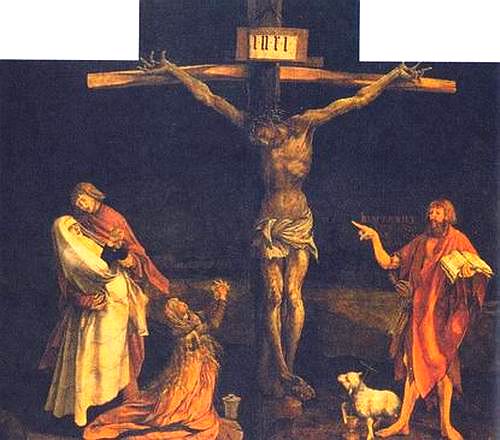 THE CRUCIFIXION, by Matthias Grunewald (c. 1475-1528)
A Brief Background
How did Jesus die? He was crucified. Crucifixion was the method of execution used for outlaws by the Romans at the time of the New Testament. It was not only humiliating, but crucifixion was a particularly cruel death as the Gospels will describe below. Briefly, the victim to be executed was tied to or nailed to a wooden cross. Jesus was nailed. The cross was raised straight up, and the condemned man was left hanging to die in the hot sun. That is, the excruciating torture before dying was the Roman's real instrument of punishment. It is this cross - the cross of the crucifixion that has become the symbol of Christianity. It symbolizes reconciliation with God through faith in Christ whose life, death, and Resurrection are proof of God's forgiveness of human sin.
Even at such ceremonies as baptism (See Note) or when giving a blessing, a Christian makes the sign of the cross with a hand motion. As the Gospels tell us, Jesus came to the world as a man with a mission and submitted to this cruel death rather than take back one word of his teachings.
Christians believe in an afterlife whereby the soul will be sent either to Heaven where the soul receives bliss by being in the presence of God for eternity, or Hell, where the soul is damned to eternal suffering. Heaven or Hell is determined according to the judgement of God about the life of a human.
To go to heaven means a life of no sin. Obviously, evil acts such as murder, lying, stealing, etc. are sinful acts. Sinful acts are to be avoided. But considering human nature, can a human being live a truly sinless life? According to Christianity, the human cannot. Throughout life, the human will sin according to the demands of human nature. Therefore, God sacrificed Himself in the person of Jesus on the Cross to redeem1 the sins of the human, and most importantly God/Jesus redeemed the Original Sin of Adam and Eve. Thus, we humans can all see the great love God has for His creation through this miracle of God coming to humanity as His Own Son, Jesus and allowing Himself to undergo the cruel sacrifice of the Crucifixion.
However, according to Christian dogma2, God makes one more demand of the human in addition to leading as sinless a life as possible. And that demand is Faith in the Crucifixion and its meaning. Without Faith in the truth of the Crucifixion and the resulting forgiveness of sin as has been described in this essay, no human can be judged and go to Heaven. But to the contrary, humans without this Faith are condemned to Hell for eternity. For this reason, Christians with this Faith, try very hard to convert all unbelievers in order to save them from eternal damnation. Christians believe that as God/Jesus has loved them, so must each Christian love all humans and try to save the souls of all unbelieving humans.
15. And he said to them. Go into all the world, and preach the gospel to everyone.
16. He that believes and is baptised shall be saved; but he that does not believe shall be damned.
Mark [16: 15-16]
Old Testament Prophecies
One factor that shaped the Passion (see below) narratives was the Hebrew Scriptures. When early Christians, many of whom were Jews, remembered the passion, death and resurrection of Jesus, they did so in the context of their sacred scriptures. They remembered Jesus' death not simply as an historical event but a divine sacrifice. They interpreted the passion of Jesus through various Old Testament passages, especially the song of the suffering servant (Isaiah 52:13- 53:12), certain psalms of lament (Psalms 22, 69), the image of the suffering righteous man (Wisdom 2, 4 and 5), and prophetic passages (Zechariah 9-14). These so-called prophetic passages allowed the Passion narrative to be coloured with divine purpose and interpretive details. Jesus' fate was the fulfillment of God's will revealed through the ages in the sacred writings of Israel. As one notable example, here is the clearest prophecy from the Book of Isaiah in the Old Testament.
52:13 Behold, my servant shall prosper, he shall be exalted and lifted up, and shall be very high.
14 As many were astonished at him —
his appearance was so marred, beyond human semblance,
and his form beyond that of the sons of men
15 so shall he startle many nations;
kings shall shut their mouths because of him;
for that which has not been told them they shall see, and that which they have not heard they shall understand.
53: 1 Who has believed what we have heard? And to whom has the arm of the Lord been revealed?
2 For he grew up before him like a young plant, and like a root out of dry ground;
he had no form or comeliness that we should look at him, and no beauty that we should desire him.
3 He was despised and rejected by men;
a man of sorrows, and acquainted with grief;
and as one from whom men hide their faces he was despised, and we esteemed him not.
4 Surely he has borne our griefs and carried our sorrows;
yet we esteemed him stricken, smitten by God, and afflicted.
5 But he was wounded for our transgressions, he was bruised for our iniquities;
upon him was the chastisement that made us whole, and with his stripes we are healed.
6 All we like sheep have gone astray;
we have turned every one to his own way;
and the Lord has laid on him the iniquity of us all.
7 He was oppressed, and he was afflicted, yet he opened not his mouth;
like a lamb that is led to the slaughter,
and like a sheep that before its shearers is dumb,
so he opened not his mouth.
8 By oppression and judgment he was taken away;
and as for his generation, who considered
that he was cut off out of the land of the living,
stricken for the transgression of my people?
9 And they made his grave with the wicked
and with a rich man in his death,
although he had done no violence,
and there was no deceit in his mouth.
10 Yet it was the will of the Lord to bruise him;
He has put him to grief;
11 After the suffering of his soul,
he will see the light of life and be satisfied;
by his knowledge my righteous servant will justify many,
and he will bear their iniquities.
12 Therefore I will give him a portion among the great,
and he will divide the spoils with the strong,
because he poured out his life unto death,
and was numbered with the transgressors.
For he bore the sin of many,
and made intercession for the transgressors.
(Isaiah 52:13-53:12)
The Paschal Lamb
At the time of Jesus, a most revered and essential sacrifice was the one offered by devour3 Israelites on Passover, and known as the Paschal Lamb. It commemorated God's deliverance of the Jews from Egyptian Bondage (see Appendix). Many Jews would each bring a lamb to the Temple in Jerusalem, and give it to a priest, who would slaughter the animal, sprinkle its blood upon the altar, and burn its entrails and fat. The remainder would be returned to the person who had donated the lamb. The animal was then taken back to the donor's family, which would eat the lamb, along with matza (see leaven in glossary), bitter herbs, and other foods that commemorated the freedom from the Egyptian Bondage. This celebration feast is the Passover seder. In one Gospel account, the Crucifixion takes place just as the priests are performing the sacrifice of the Paschal Lamb. Thus, the sacrificed Jesus is referred to as the Lamb of God.
The story of the Crucifixion: method of presentation
The story of the Crucifixion will be presented below using chapter and verse from the four canonical Gospels. Although basically the same account is given in each gospel, there are some marked differences. It is not within the scope of this essay to discuss these differences. Instead, the Passion story will be told by blending together the four accounts. In fact, this is the general understanding of most Christians, and only those familiar with the Bible concern themselves with comparing the four Gospels.
The story of the Passion begins:
The priests and scribes decide to kill Jesus
[Mat 26:1] When Jesus had finished all these sayings, he said to his disciples,
[Mat 26:2] "You know that after two days the Passover is coming, and the Son of man will be delivered up to be crucified"
[Mat 26:3] Then the chief priests and the elders of the people gathered in the palace of the high priest, who was called Caiaphas,
[Mat 26:4] and took counsel together in order to arrest Jesus by stealth and kill him.
[Mat 26:5] But they said, "Not during the feast, lest there be a tumult among the people."
The Betrayer, Judas Iscariot
[Luke 22:3] Then Satan entered into Judas called Iscariot, who was of the number of the twelve;
[Luke 22:4] he went away and conferred with the chief priests and officers how he might betray Him to them. [Luke 22:5] And they were glad, and engaged to give him money.
[Luke 22:6] So he agreed, and sought an opportunity to betray. Him to them in the absence of the multitude.
The Preparation for the Passover
[Luke 22:7] Then came the day of unleavened bread, on which the Passover lamb (see Note) had to be sacrificed. [Luke 22:8] So Jesus sent Peter and John, saying, "Go and prepare the Passover for us, that we may eat it." [Luke 22:9] They said to him, "Where will you have us prepare it?"
[Luke 22:10] He said to them, "Behold, when you have entered the city, a man carrying a jar of water will meet you; follow him into the house which he enters, [Luke 22:11] and tell the householder, 'The Teacher says to you, Where is the guest room, where I am to eat the Passover with my disciples?'
[Luke 22:12] And he will show you a large upper room furnished; there make ready."
[Luke 22:13] And they went, and found it as he had told them; and they prepared the Passover.
The Last Supper — Jesus talks and prophesises of the events to come to the twelve disciples
[Mat 26:20] When it was evening, he sat at table with the twelve disciples;
[Mat 26:21] and as they were eating, he said, "Truly, I say to you, one of you will betray me."
[Mat 26:22] And they were very sorrowful, and began to say to him one after another, "Is it I, Lord?" [Mat 26:23] He answered, "He who has dipped his hand in the dish with me, will betray me.
[Mat 26:24] The Son of man goes as it is written of him, but woe to that man by whom the Son of man is betrayed! It would have been better for that man if he had not been born." [Mat 26:25] Judas, who betrayed him, said, "Is it I, Master?" He said to him, "You have said so."
The Eucharist: The command to remember the sacrifice of the crucifixion
[Mat 26:26] Now as they were eating, Jesus took bread, and blessed, and broke it, and gave it to the disciples and said, "Take, eat; this is my body."
[Mat 26:27] And he took a cup of wine, and when he had given thanks he gave it to them, saying, "Drink of it, all of you."
[Mat 26:28] for this is my blood of the covenant, which is poured out for many for the forgiveness of sins. [Mat 26:29] I tell you I shall not drink again of this fruit of the vine until that day when I drink it new with you in my Father's kingdom."
Love replaces the laws of the Old Testament in the eyes of God. .....a new covenant
John 13:34] A new commandment I give to you, that you love one another; even as I have loved you, that you also love one another.
[John 13:35] By this all men will know that you are my disciples, if you have love for one another."
Yet Jesus knows that human nature is still weak, and he warns the disciple, Simon-Peter.
[John 13:36] Simon-Peter said to him, "Lord, where are you going?" Jesus answered, "Where I am going you cannot follow me now; but you shall follow afterward."
[John 13:37] Peter said to him, "Lord, why cannot I follow you now? I will lay down my life for you."
[John 13:38] Jesus answered, "Will you lay down your life. for me? Truly, truly, I say to you, the cock will not crow, till you have denied me three times"
Jesus is One with God... Jesus is God the Son
[John 14:5] Thomas said to him, "Lord, we do not know where you are going; how can we know the way?"
[John 14:6] Jesus said to him, "I am the way, and the truth, and the life; no one comes to the Father, but by me.
[John 14:7] If you had known me, you would have known my Father also; henceforth you know him and have seen him."
[John 14:8] Philip said to him, "Lord, show us the Father, and we shall be satisfied."
[John 14:9] Jesus said to him, "Have I been with you so long, and yet you do not know me, Philip? He who has seen me has seen the Father; how can you say, 'Show us the Father?' [John 14:10] Do you not believe that I am in the Father and the Father in me? The words that I say to you. I do not speak on my own authority; but the Father who dwells in me does his works.
The promise of the Holy Spirit as a counsellor to the faithful
[John 14:15] "If you love me, you will keep my commandments.
[John 14:16] And I will pray the Father, and he will give you
another Counsellor, to be with you forever,
(John 14:26] But the Counsellor, the Holy Spirit, whom the
Father will send in my name, he will teach you all things, and
bring to your remembrance all that I have said to you.
Jesus' commandment that Faith in his mission is necessary for heaven after death
[John 15:5] I am the vine, you are the branches. He who abides in me, and I in him, he it is that bears much fruit, for apart from me you can do nothing.
[John 15:6] If a man does not abide in me, he is cast forth as a branch and withers; and the branches are gathered, thrown into the fire and burned.
[John 15:12] "This is my commandment, that you love one
another as I have loved you.
[John 15:13] Greater love has no man than this, that a man
lay down his life for his friends,"
Jesus' promise of his Resurrection after the Crucifixion
(John 16:16] "A little while, and you will see me no more; again a little while, and you will see me." [John 16:22] "So you have sorrow now, but I will see you again and your hearts will rejoice, and no one will take your joy from you."
The promise of eternal Heaven to the faithful disciples and to all keep faith in Jesus and his mission
(John 17:24] "Father, I desire that they also, whom you have given me, may be with me where I am, to behold my glory which you have given me in your love for me before the foundation of the world.
[Mark 14:31] But he said vehemently, "If I must die with you flwill not deny you." And they all said the same.
And so ends the "The Last Supper".
Although Jesus prays in the Garden of Gethsemane to God his Father to he relieved of the suffering to follow, he accepts whatever role he must play.
[Mat 26:36] Then Jesus went with them to a place called Gethsemane, and he said to his disciples, "Sit here, while I go yonder and pray."
[Mat 26:37] And taking with him Peter and the two sons of Zebedee, he began to be sorrowful and troubled. [Mat 26:38] Then he said to them, "My soul is very sorrowful, even to death; remain here, and watch with me." [Mat 26:39] And going a little farther he fell on his face and prayed, "My Father, if it be possible, let this cup pass from me; nevertheless, not as I will, but as thou wilt." [Mat 26:40] And he came to the disciples and found them sleeping; and he said to Peter, "So, could you not watch with me one hour?
[Mat 26:41] Watch and pray that you may not enter into temptation; the spirit indeed is willing, but the flesh is weak." [Mat 26:42] Again, for the second time, he went away and prayed, "My Father, if this cannot pass unless I drink it, thy will be done."
[Mat 26:43] And again he came and found them sleeping, for their eyes were heavy.
[Mat 26:44] So, leaving them again, he went away and prayed for the third time, saying the same words. [Mat 26:45] Then he came to the disciples and said to them, "Are you still sleeping and taking your rest? Behold, the hour is at hand, and the Son of man is betrayed into the hands of sinners.
[Mat 26:46] Rise, let us be going; see, my betrayer is at hand."
Jesus is betrayed and taken prisoner
[Luke 22:47] While he was still speaking, there came a crowd, and the man called Judas, one of the twelve, was leading them. He drew near to Jesus to kiss him;
[Luke 22:48] but Jesus said to him, "Judas, would you betray the Son of man with a kiss?" [Luke 22:49] And when those who were about him saw what would follow, they said, "Lord, shall we strike with the sword?"
[Mat 26:51] And behold, one of those who were with Jesus stretched out his hand and drew his sword, and struck the slave of the high priest, and cut off his ear. [Mat 26:52] Then Jesus said to him, "Put your sword back into its place; for all who take the sword will perish by the sword.
[Mat 26:53] Do you think that I cannot appeal to my Father, and he will at once send me more than twelve legions of angels?
[Mat 26:54] But how then should the scriptures be fulfilled, that it must be so?"
[Luke 22:52] Then Jesus said to the chief priests and officers of the temple and elders, who had come out against him, "Have you come out as against a robber, with swords and clubs?
[Luke 22:53] When I was with you day after day in the temple, you did not lay hands on me. But this is your hour, and the power of darkness."
[Luke 22:54] Then they seized him and led him away, bringing him into the high priest's house. Peter followed at a distance.
Jesus is accused of blasphemy by the high priest of the temple
[Mat 26:57] Then those who had seized Jesus led him to Caiaphas, the high priest, where the scribes and the elders had gathered. [Mat 26:58] But Peter followed him at a distance, as far as the courtyard of the high priest, and going inside he sat with the guards to see the end.
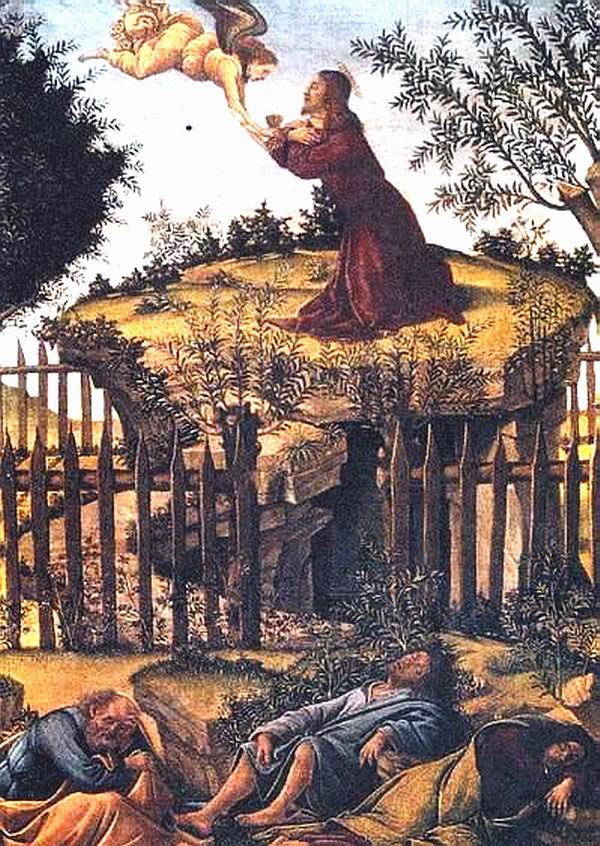 CHRIST ON THE MOUNT OP OLIVES, by Botticelli (1445-1510)
[Mat 26:59] Now the chief priests and the whole council sought false testimony against Jesus that they might put him to death,
[Mat 26:60] but they found none, though many false witnesses came forward. At last two came forward [Mat 26:61] and said, "This fellow said, 'I am able to destroy the temple of God, and to build it in three days.'" [Mat 26:62] And the high priest stood up and said, "Have you no answer to make? What is it that these men testify against you?"
[Mat 26:63] But Jesus was silent. And the high priest said to him, "I adjure you by the living God, tell us if you are the Christ, the Son of God."
[Mat 26:64] Jesus said to him, "You have said so. But I tell you, hereafter you will see the Son of man seated at the right hand of Power, and coming on the clouds of heaven." [Mat 26:65] Then the high priest tore his robes, and said, "He has uttered blasphemy. Why do we still need witnesses? You have now heard his blasphemy. [Mat 26:66] What is your judgment?" They answered, "He deserves death." [Mat 26:67] Then they spat in his face, and struck him;
and some slapped him.
Peter denies Jesus three times
[Mat 26:69] Now Peter was sitting outside in the courtyard. And a maid came up to him, and said, 'You also were with Jesus the Galilean."
[Mat 26:70] But he denied it before them all, saying, "I do not know what you mean."
[Mat 26:71] And when he went out to the porch, another maid saw him, and she said to the bystanders, 'This man was with Jesus of Nazareth."
[Mat 26:72] And again he denied it with an oath, "I do not know the man." [Mat 26:73] After a little while the bystanders came up and said to Peter, "Certainly you are also one of them, for your accent betrays you."
[Mat 26:74] Then he began to invoke a curse on himself and to swear, "I do not know the man." And immediately the cock crowed.
[Mat 26:75] And Peter remembered the saying of Jesus, "Before the cock crows, you will deny me three times." And he went out and wept bitterly.
Jesus is led to Pontius Pilate (see Note), the Roman governor for judgement
[Mat 27:1] When morning came, all the chief priests and the elders of the people took counsel against Jesus to put him to death;
[Mat 27:2] and they bound him and led him away and delivered him to Pilate the governor.
[Mat 27:11] Now Jesus stood before the governor; and the governor asked him, "Are you the King of the Jews?" Jesus said, "You have said so."
[Mat 27:12] But when he was accused by the chief priests and elders, he made no answer.
[Mat 27:13] Then Pilate said to him, "Do you not hear how many things they testify against you?"
[Mat 27:14] But he gave him no answer, not even to a single charge; so that the governor wondered greatly.
The crowd demands that Jesus be crucified
[Mat 27:15] Now at the feast the governor was accustomed to release for the crowd any one prisoner whom they wanted.'
[Mat 27:16] And they had then a notorious prisoner, called Barabbas.
[Mat 27:17] So when they had gathered, Pilate said to them, "Whom do you want me to release for you, Barabbas or Jesus who is called Christ?"
[Mat 27:18] For he knew that it was out of envy that they had delivered him up.
[Mat 27:19] Besides, while he was sitting on the Judgment seat, his wife sent word to him, "Have nothing to do with that righteous man, for I have suffered much over him today in a dream."
[Mat 27:20] Now the chief priests and the elders persuaded the people to ask for Barabbas and destroy Jesus. [Mat 27:21] The governor again said to them, "Which of the two do you want me to release for you?" And they said, "Barabbas."
[Mat 27:22] Pilate said to them, "Then what shall I do with Jesus who is called Christ?" They all said, "Let him be crucified."
[Mat 27:23] And he said, "Why, what evil has he done?" But they shouted all the more, "Let him be crucified." [Mat 27:24] So when Pilate saw that he was gaining nothing, but rather that a riot was beginning, he took water and washed his hands before the crowd, saying, "I am innocent of this man's blood; see to it yourselves." [Mat 27:25] And all the people answered, "His blood be on us and on our children!"
The cruel preparation of Jesus for the crucifixion
[Mat 27:26] Then he released for them Barabbas, and having scourged4 Jesus, delivered him to be crucified. [Mat 27:27] Then the soldiers of the governor took Jesus into the praetorium, and they gathered the whole battalion before him.
[Mat 27:28] And they stripped him and put a scarlet robe upon him,
[Mat 27:29] and plaiting a crown of thorns they put it on his head, and put a reed in his right hand. And kneeling before him they mocked him, saying, "Hail, King of the Jews!"
[Mat 27:30] And they spat upon him, and took the reed and struck him on the head. [Mat 27:31] And when they had mocked him, they stripped him of the robe, and put his own clothes on him, and led him away to crucify him.
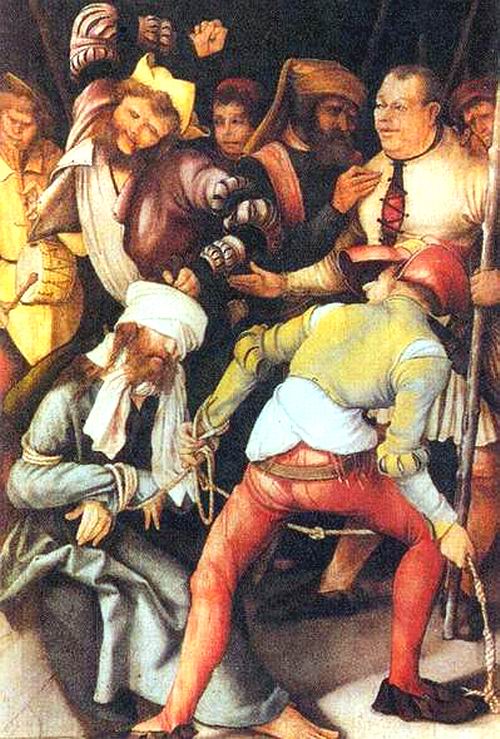 CKING OF CHRIST, by Matthias Grunewald
The crucifixion of Jesus and the various people who witnessed it The death of Jesus on the Cross
[Luke 23:26] And as they led him away, they seized one Simon of Cyrene, who was coming in from the country, and laid on him the cross, to carry it behind Jesus.
[Luke 23:32] Two others also, who were criminals, were led away to be put to death with him.
[Luke 23:33] And when they came to the place which is called Calvary or The Skull, there they crucified him, and the criminals, one on the right and one on the left.
[Luke 23:34] And Jesus said, "Father, forgive them; for they know not what they do."5 And they cast lots6 to divide his garments.
[John 19:25] So the soldiers did this. But standing by the cross of Jesus were his mother, and his mother's sister, Mary the wife of Clopas, and Mary Magdalene, (see the painting of the Crucifixion)
[John 19:26] When Jesus saw his mother, and the disciple whom he loved standing near, he said to his mother, "Woman, behold, your son!" [John 19:27] Then he said to the disciple, "Behold, your mother!" And from that hour the disciple took her to his own home.
Jesus is mocked while suffering on the cross.
[Luke 23:35] And the people stood by, watching; but the rulers scoffed at him, saying, "He saved others; let him save himself, if he is the Christ of God, his Chosen One!"
[Luke 23:36] The soldiers also mocked him, coming up and offering him vinegar,
[Luke 23:37] and saying, "If you are the King of the Jews, save yourself!"
[Luke 23:38] There was also an inscription over him, "This is the King of the Jews."
Jesus promises salvation to the crucified criminal who shows faith in Jesus' holiness7
[Luke 23:39] One of the criminals who were hanged railed at him, saying, "Are you not the Christ? Save yourself and us!"
[Luke 23:40] But the other rebuked him, saying, "Do you not fear God, since you are under the same sentence of condemnation?
[Luke 23:41] And we indeed justly; for we are receiving the due reward of our deeds; but this man has done nothing wrong."
[Luke 23:42] And he said, "Jesus, remember me when you come into your kingdom."
[Luke 23:43] And he said to him. "Truly, I say to you. today you will be with me in Paradise."
[Luke 23:44] It was now about the sixth hour, and there was darkness over the whole land until the ninth hour, [Mark 15:34] And at the ninth hour Jesus cried with a loud voice, "Elo-i, Elo-i, lama sabach-thani?" which means, "My God, my God. why hast thou forsaken me?" [Mat 27:51] And behold, the curtain of the temple was torn in two, from top to bottom; and the earth shook, and the rocks were split; [John 19:28] After this Jesus, knowing that all was "finished, said (to fulfil the scripture),"I thirst." [John 19:29] A bowl full of vinegar stood there; so put a sponge full of the vinegar on hyssop8 and held it to his mouth.
[John 19:30] When Jesus had received the vinegar, he "It is finished"; and he bowed his head and gave up his it.
[Luke 23:46] Then Jesus, crying with a loud voice, "Father, into thy hands I commit my spirit!" And having this he breathed his last.
The descent from the Cross and the burial of Jesus
[John 19:32] So the soldiers came and broke the legs of the first, and of the other who had been crucified him;
[John 19:33] but when they came to Jesus and saw the was already dead, they did not break his legs. [John 19:34] But one of the soldiers pierced his side with a spear, and at once there came out blood and water. [Mark 15:42] And when evening had come, since it the day of Preparation, that is, the day before the Sabbath [Mark 15:43] Joseph of Arimathea, a respected member the council, who was also himself looking for the king of God, took courage and went to Pilate, and asked for body of Jesus.
[Mark 15:44] And Pilate wondered if he were already dead and summoning the centurion, he asked him whether was already dead.
[Mark 15:45] And when he learned from the centurion that he was dead, he granted the body to Joseph. [Mark 15:46] And he bought a linen shroud, and taking him down, wrapped him in the linen shroud (see Note) and laid him in a tomb which had been hewn out of rock; and he rolled a stone against the door of the tomb.
[Mark 15:47] Mary Magdalene and Mary the mother of Jesus saw where he was laid.
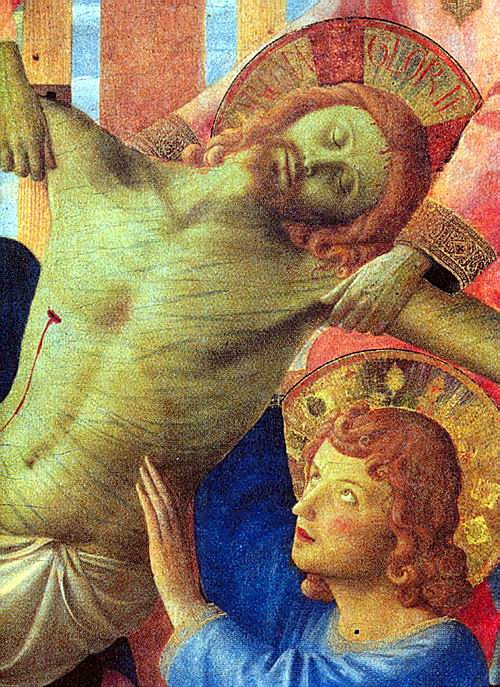 THE DESCENT FROM THE CROSS, by Fra Angelico (detail)
The. Resurrection
[Mark 16:1] And when the Sabbath was past, Mary Magdalene, and Mary the mother of James, and Salome, bought spices, so that they might go and anoint him. [Mark 16:2] And very early on the first day of the week they went to the tomb when the sun had risen.
[Mark 16:3] And they were saying to one another, "Who will roll away the stone for us from the door of the tomb?"
[Mark 16:4] And looking up, they saw that the stone was rolled back; it was very large.
[Luke 24:3] But when they went in they did not find the body.
[Luke 24:4] While they were perplexed about this, behold, two men stood by them in dazzling apparel
[Matt 28:5] But the angel said to the women, "Do not be afraid; for I know that you seek Jesus who was crucified.
[Matt 28:6] He is not here; for he has risen, as he said. Come, see the place where he lay.
[Matt 28:7] Then go quickly and tell his disciples that he has risen from the dead, and behold, he is going before you to Galilee; there you will see him. Lo, I have told you."
[Luke 24:10] Now it was Mary Magdalene and Joanna and Mary the mother of James and the other women with them who told this to the apostles;
[Luke 24:11] but these words seemed to them an idle tale, and they did not believe them.
[Luke 24:13] That very day two of them were going to a village named Emmaus, about seven miles from Jerusalem, [Luke 24:14] and talking with each other about all these things that had happened.
[Luke 24:15] While they were talking and discussing together, Jesus himself drew near and went with them. [Luke 24:16] But their eyes were kept from recognizing him.
[Matt 28:9] And behold, Jesus met them and said, "Hail!" And they came up and took hold of his feet and worshiped him. [Matt 28:10] Then Jesus said to them, "Do not be afraid; go and tell my brethren to go to Galilee, and there they will see me.
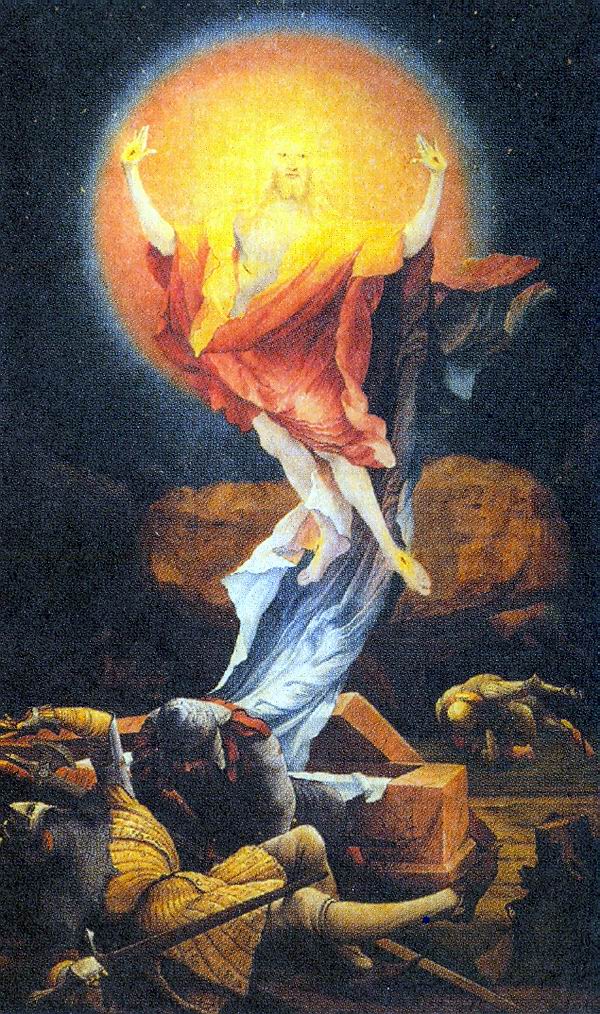 THE RESURRECTION, by Matthias Grunewald
[Matt 28:16] Now the eleven disciples went to Galilee, to the mountain to which Jesus had directed them.
[Matt 28:17] And when they saw him they worshiped him; but some doubted.
[John 20:26] Eight days later, his disciples were again in the house, and Thomas was with them. The doors were shut, but Jesus came and stood among them, and said, "Peace be with you."
[John 20:27] Then he said to Thomas, "Put your finger here, and see my hands; and put out your hand, and place it in my side; do not be faithless, but believing." [John 20:28] Thomas answered him, "My Lord and my God!"
[John 20:29] Jesus said to him, "Have you believed because you have seen me? Blessed are those who have not seen and yet believe."
[Mark 16:15] And he said to them, "Go into all the world and preach the gospel to the whole creation. [Mark 16:16] He who believes and is baptized will be saved; but he who does not believe will be condemned."
The Ascension
[Luke 24:50] Then he led them out as far as Bethany, and lifting up his hands he blessed them.
[Luke 24:51] While he blessed them, he parted from them, and was carried up into heaven.
[Luke 24:52] And they returned to Jerusalem with great joy,
[Luke 24:53] and were continually in the Temple blessing God.
The meaning of the Resurrection
The followers of Jesus were absolutely convinced that he had been raised from the dead and had been taken away into heaven as a proof of his identity as Jesus Christ, the Messiah. He was the crucified and then risen Lord. The Resurrection brings a different perspective to the understanding of Jesus. If anyone thought of him as only a prophet, as a messenger of God, that changes when he himself is raised by God from the dead. And it is really the belief in the Resurrection experience that leads the disciples to come to think of Jesus as more than even a prophet, as the Messiah... The Redeemer of Humanity from Sin... . He is the one who has been glorified and ascended into heaven as Son of God by God.
In his final commandments to the disciples before his Ascension, he clearly identifies himself and directs them to bring his message to the world.
44 Then he said to them, "These are my words which I spoke to you, while I was still with you-, that everything written about me in the law of Moses and the prophets and the psalms must be fulfilled." 45 Then he opened their minds to understand the scriptures, 46 and said to them, "Thus it is written, that the Christ should suffer and on the third day rise from the dead, 47 and that repentance and forgiveness of sins should be preached in his name to all nations, ..."
(Luke 24: 44-47)
And exhorts them to
"Go into all the world and preach the gospel to the whole creation."
(Mark 16:15)
Appendix - The Revelation to Moses
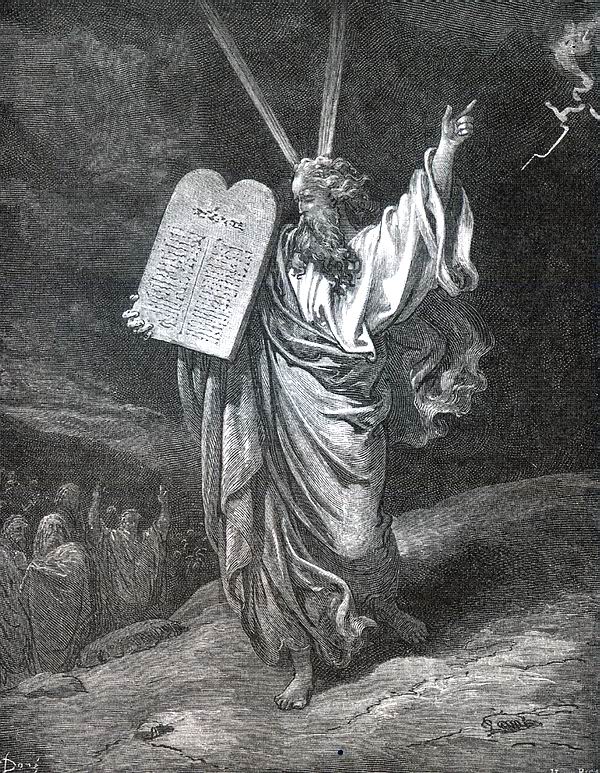 MOSES COMING DOWN FROM SINAI, by Gustave Dore
The message of Jesus which furthered the evolution of humanity was based on the previous evolutionary developments found in the history of the Jewish people. Almost all that Jesus taught can be found in the demand God made on the Jewish people to interact ethically, to interact with concern for the other. These Laws are to be found in the Torah given to the Jewish people through Moses after they escaped from the bondage in Egypt. This series of events is essential to understand if the reader is to understand Jesus. Therefore, this essay will also introduce Moses, the escape from bondage in Egypt and the giving of the Law. The greatest Actor in that drama is God, with Moses being His messenger.
Jesus said that he had not come to change the Law even a little.
Matth. 5:17 "Think not that I have come to abolish the law and the prophets; I have come not to abolish them but to fulfil them. 18 For truly, I say to you, till heaven and, earth pass away, not an iota, not a dot, will pass from the law until all is accomplished. 19 Whoever then relaxes one of the least of these commandments and teaches men so, shall be called least in the kingdom of heaven; but he who does them and teaches them shall be called great in the kingdom of heaven"..
What then is the Law that Jesus is referring to? As a Jewish rabbi who knew the sacred Jewish scriptures well enough to teach and argue about them in the synagogue Jesus certainly knew the Law very well. It is important, therefore, to understand. The Old Testament background and basic content.
The account of the giving of the Law, which is also the story of the creation of the nation of Israel of the Jewish people is to be found in the second book of the Torah (see Note), Exodus. The hero of the story is Moses. But more than being a hero, Moses, after Jesus, is the second most important individual in the entire Bible. That means for the Jewish people who accept only the Old Testament, he is the greatest of the prophets.
And there has not arisen a prophet since in Israel like Moses, whom the Lord knew face to face.
(Deuteronomy 34:10)
And so let us now read the story of the giving of the Law by God. By giving the Law to the Jewish people, God created a new nation and made a covenant with them. He created a people. For the Jewish people even today, this covenant between God and them is as strong as ever. On the other hand, for those who accept Jesus and his message, he came and while maintaining the Law, he gave it new depth and meaning.
Bondage in Egypt
However, before God gave the Law and thus creating the new nation of Israel, He liberated the Hebrew people from the bondage and slavery that was put upon them by the Egyptian Pharaoh. In these events, Moses was God's agent to accomplish both the liberation and the giving of the Law. Earlier in Genesis, the first Book of the Torah, it is told how the Hebrew people were invited to live in Egypt in peace and prosperity (Chapters. 40-50). But as the generations passed, their numbers increased, and a later Pharaoh felt that the increasing population of these non-Egyptians was threatening. So, the Pharaoh of that time turned them into slaves. The oppression continued and even worsened when the Pharaoh declared that all male Hebrew infants were to be drowned in the Nile River.
Exodus 1:22 Then Pharaoh commanded all his people, "Every son that is born to the Hebrews you shall cast into the Nile, but you shall let every daughter live."
The birth of Moses and his early years
One Hebrew mother, in desperation to save his life, set her infant son adrift in a basket made of reeds. To the mother's happiness, the basket was found by a daughter of the cruel Pharaoh, who quietly took the infant back to the palace and raised him as an Egyptian prince. She named the child Moses. The princess hired the true mother of Moses to care for her own son. Perhaps that is how he was able to have some feeling for the plight9 of the oppressed Hebrew people.
Let us note here the similarity between the infancy of Jesus (Matt 2:13) and Moses: at their births, both of their lives were threatened by cruel kings, who set out to kill all Hebrew male infants. Both had a relation with the land of Egypt.
Exodus goes on to tell us that Moses was raised in the royal Egyptian house and grew to be a strong young man and a prince of Egypt. However, his sense of justice causes a radical change in his life. He sees an Egyptian cruelly beating a Hebrew slave. This makes him very angry. Thinking that no one is watching, he kills the Egyptian to save the Hebrew slave. However, the next day, when he separates two Hebrew slaves who are fighting, one of them angrily taunts Moses that it is known that Moses had killed the Egyptian. Moses immediately understands that he is in danger. And indeed Pharaoh orders Moses killed, so he flees to Midian, and thus ends his princely life.
Even as he flees, Moses once more shows his strong sense of justice. He comes to a well where several shepherds are tormenting the seven daughters of a Midian priest. He protects them from the shepherds. The incidents seem to be related. In all three, Moses shows a deep commitment to fighting injustice. Furthermore, his concerns are not narrow-minded. He intervenes at first when a non-Jew oppresses a Jew, then when two Jews fight, and when non-Jews oppress other non-Jews.
So the Midian women take him home to meet their father. The daughters tell him about Moses' bravery. Needing a safe place to live and work, he becomes a shepherd for the father, who is a priest of the Midians, and, in fact, Moses is given one of the priest's daughters to marry. Moses then settles down in Midian, where he leads a pastoral'-'" life for several years when suddenly the first of several great encounters between God and Moses occurs.
The Burning Bush
One day, an angel of the Lord appears to him in a fire blazing forth from a bush. Moses is startled to see the bush all aflame but not burning. The symbolism of this miracle is powerful. In a "world in which nature itself is worshiped, God shows that He rules over it. When he goes to examine this miraculous sight. God calls out from the bush,
4 "When the Lord saw that he turned aside to see. God called to him out of the bush, "Moses, Moses!" And he said, "Here am I." 5 Then He said, "Do not come near; put off your shoes from your feet, for the place on which you are standing is holy ground." 6 And He said, "I am the God of your father, the God of Abraham, the God of Isaac, and the God of Jacob (see note)." And Moses hid his face, for he was afraid to look at God."
(Exodus 3:4-6)
This is Moses' first encounter with God. God tells him
9 "And now, behold, the cry of the people of Israel (see note) has come to me, and I have seen the oppression with which the Egyptians oppress them. 10 Come, I will send you to Pharaoh that you may bring forth my people, the sons of Israel, out of Egypt." 11 But Moses said to God, "Who am I that I should go to Pharaoh, and bring the sons of Israel out of Egypt?"
(Exodus 3: 9-11).
The more Moses refuses, the more God insists. It is obvious that Moses totally lacks the confidence to take up the task God has given him. However, as Moses performs the necessary commands given him by God, his character develops.
13 Then Moses said to God, "If I come to the people of Israel and say to them, 'The God of your fathers has sent me to you,' and they ask me, 'What is his name?' what shall I say to them?" 14 God said to Moses, "I am who I am." And he said, "Say this to the people of Israel, 'I am has sent me to you.'" 15 God also said to Moses, "Say this to the people of Israel, 'The Lord, the God of your fathers, the God of Abraham, the God of Isaac, and the God of Jacob, has sent me to you: this is my name for ever, and thus I am to be remembered throughout all generations."
(Exodus 3:13-15)
The Confrontation with the Pharaoh
God persuades Moses that he must go to Pharaoh. He gives Moses, who still lacks confidence, a companion, his brother Aaron, and a staff10 by which some of the miracles God will perform can be realised.
8 And the Lord said to Moses and Aaron, 9 "When Pharaoh says to you, 'Prove yourselves by working a miracle,' then you shall say to Aaron, 'Take your rod and cast it down before Pharaoh, that it may become a serpent.'" 10 So Moses and Aaron went to Pharaoh and did as the Lord commanded; Aaron cast down his rod before Pharaoh and his servants, and it became a serpent.
(Exodus 7:8-10)
Perhaps one of the most famous demands in all history is the one Moses directs at Pharaoh: "Let my people go!" Three millennia later, this verse has been taken by oppressed groups. It became a cry of black slaves in the American South. In one of their most famous folksongs, they sang: "Go down Moses, Way down in Egypt-land,
And tell old Pharaoh, To let my people go!"
God sends plagues11 on the Egyptians to convince Pharaoh to let the Israelites go. At the same time God hardens Pharaoh's heart, even though there are plagues of frogs, lice, flies, locusts, death of livestock, boils, hail, and darkness. All the ten plagues are disastrous to the Egyptians but did not affect the Jews. Yet Pharaoh only becomes more stubborn.
But why did God harden Pharaoh's heart? Had God not hardened Pharaoh's heart, it would have deprived the Egyptian king of free will. Of course he would have then allowed the Hebrew slaves to go; not out of choice, but out of terror. By hardening Pharaoh's heart, the Egyptian king no longer feared the kind of physical devastation that would terrify and cause instant obedience from a normal man. There was nothing, however, to stop Pharaoh from intellectually and emotionally recognizing the injustices he had inflicted on the Hebrew slaves, and then by his own free will letting them go. But moral responses were not Pharaoh's concerns. Here was a contest of power between him and the God of the Israelites. Only when the Egyptian firstborn started dying, did he, the great Pharaoh, finally realize that he was facing a Force immeasurably greater than his own. And perhaps being a firstborn himself, he wanted the Hebrews out in order to save his own life. It is only by free will that God expects humanity to follow His commands. Altogether, God sent ten plagues, the last of which is the most horrendous.
The Passover
Finally, the Passover (see Note) occurs. As the Tenth Plague, God vows to kill the firstborn of every family in Egypt. The Israelites are commanded to put the blood of a male lamb without blemish on their doorposts. The Angel of Death will then pass over these households and not kill the Hebrew firstborn. All of the households in Egypt thus suffer the loss of the eldest son.
Only then does Pharaoh finally realize the power of God and release his Hebrew slaves. Moses and Aaron will now lead their people away into the desert of the Sinai Peninsula. Moses, having been warned by God, knows that the Pharaoh will again change his mind and pursue his Hebrew slaves. Moses spurs his people to leave in great haste with little time to gather necessities. We must imagine that they had to leave within a matter of hours.
"And they baked unleavened cakes of the dough which they had brought out of Egypt, for it was not leavened, because they were thrust out of Egypt and could not tarry, neither had they prepared for themselves any provisions."
(Exodus 12:39)
But before they could cross the Sea of Reeds and find freedom, as predicted, Pharaoh had a change of heart and sent his chariots out to stop them. In the next great miracle, the sea parted enough for Moses to lead his people across to safety. But -when the Egyptian army attempted to follow the same route and pursue them, the waters returned and the sea swallowed them up.
God's Command to Commemorate the Coming out of Bondage
3 And Moses said to the people, "Remember this day, in which you came out from Egypt, out of .the house of bondage, for by strength of hand the Lord brought you out from this place; no leavened bread shall be eaten. 4 This day you are to go forth, in the month of Abib. 5 And when the Lord brings you into the land of the Canaanites.... which he swore to your fathers to give you, a land flowing with milk and honey, you shall keep this service in this month. 6 Seven days you shall eat unleavened bread, and on the seventh day there shall be a feast to the Lord. 7 Unleavened bread shall be eaten for seven days; no leavened bread shall be seen with you, and no leaven shall be seen with you in all your territory. 8 And you shall tell your son on that day, 'It is because of what the Lord did for me when I came out of Egypt.' 9 And it shall be to you as a sign on your hand and as a memorial between your eyes, that the law of the Lord may be in your mouth; for with a strong hand the Lord has brought you out of Egypt. 10 You shall therefore keep this ordinance at its appointed time from year to year.
The Paschal Lamb
It is from this command of the Lord that the Passover festival was initiated. The one week of Passover commemorating the liberation of the Hebrew people from Egyptian bondage over 3,000 years ago, is kept even to this day by the Jewish people. It must be understood that the significance of the Seder meal is that the Jewish people should come to see themselves as though they had even today personally left Egypt. But which Egypt? There are many kinds of Egypts; material, psychological and spiritual, and ultimately the Jew, seeking higher consciousness, must break out of all of them. It is the inner freedom from desire, anger and so on, all of which keep not only the Jew, but all human beings from truly interacting with God.
And of course, in Jesus' time as well, the Passover was of extreme importance. People from all over the Empire made pilgrimage to Jerusalem for Passover. It was one of the most crowded times in the whole year. People would go to Jerusalem, probably a week beforehand, to make sure that everybody would be in a state of purity. It just meant that while impure, you could not enter a holy part of the Temple (see Note) and offer the Paschal lamb for sacrifice in the Temple. So pilgrims frequently went a week before Passover so that they could undergo certain rituals of purification, and take part in the slaughter of the Paschal lambs that happens the night before Passover begins as God mandated it when he spoke with Moses on Mount Sinai. We can see something of this in the Gospel writings. Jesus enters with the flock of pilgrims going into Jerusalem the week before Passover. This is the triumphal entry described in the Gospel (Matt:21: l-ll). And he reaches the Temple during the week before Passover. Soon for Jesus, his Passion (see Note) will begin and the image of Jesus being the Paschal Lamb will be made very clear.
The Temple in Jerusalem was destroyed in 70 CE, so that its function as a place for ritual and ritual sacrifice was also eliminated from Jewish religious life. Therefore, the commandment to commemorate the coming out of bondage, Passover, is presently kept at the synagogue and, most importantly, at the home of every observing Jew around the world, which includes the holding of the Seder, or the feast of the Passover. It is this Seder at which Jesus gathered his disciples that became to be known in Christianity as the Last Supper (see Note).
The Covenant between God and the Israelites
But let us continue the story of Moses. The Hebrew slaves achieved freedom not as an end in itself, but to serve God. That is why Moses said to Pharaoh,
"Let my people go that they may worship Me".
(Exodus 7:16)
And that is also why, in the Jewish tradition, the culmination of Exodus is the giving of the Torah, an event which may be considered as the revelation at Mount Sinai. Seven weeks after they leave Egypt, the Hebrews reach Sinai. There God, for the first and only time, speaks to the entire Hebrew people, and declares before them the Ten Commandments. However, in the days immediately preceding God's revelation of the Ten Commandments, He has told Moses to prepare the Hebrew people for a ceremony that will formalize their relationship to Him. God also makes it known that the relationship comes with a condition.
"If you will obey Me faithfully and keep My covenant, you shall be My treasured possession among all the peoples, ..you shall be to Me a kingdom of priests and a holy nation....".
(Exodus 19:5-6)
The basic overview of Israel's obligations under the covenant is presented in Exodus 20-23. In brief, these chapters outline the Law, which is against idolatry, murder, theft, and the mistreatment of strangers, widows, orphans, and the poor. Additional laws command the observance of the Sabbath, the Sabbatical year (during which the land must lie fallow), and such feasts as Passover. Moses relays God's message to the Israelite elders, and the whole nation answers collectively.
"All that the Lord has spoken we will do".
(Exodus 19:8).
That is, a band of escaped slaves standing at the foot of Mount Sinai and pledging to God to fulfill the commandments of the Torah became a people, and, with time, came to understand the mission that came with this pledge.
God Gives the Ten Commandments to His Chosen People
Moses then leads the Israelites to the foot of Mount Sinai, where God announces the Ten Commandments.
First Commandment: "I am the Lord your God who brought you out of the land of Egypt, the house of bondage.
Second Commandment: You shall have no other gods before me. You shall not make for yourself a graven image, or any likeness of anything that is in heaven above, or that is on the earth beneath, or that is in the water under the earth; 9 you shall not bow down to them or serve them; for I the Lord your God am a jealous God, visiting the iniquity of the fathers upon the children to the third and fourth generation of those who hate me, 10 but showing steadfast love to thousands of those who love me and keep my commandments.
Third Commandment: You shall not take the name of the Lord your God in vain: for the Lord will not hold him guiltless who takes his name in vain.
Fourth Commandment: Observe the Sabbath day, to keep it holy, as the Lord your God commanded you. 13 Six days you shall labour, and do all your work; 14 but the seventh day is a Sabbath to the Lord your God; in it you shall not do any work, you, or your son, or your daughter, or your manservant, or your maidservant, or your ox, or your ass, or any of your cattle, or the sojourner who is within your gates, that your manservant and your maidservant may rest as well as you. 15 You shall remember that you were a servant in the land of Egypt, and the Lord your God brought you out thence with a mighty hand and an outstretched arm; therefore the Lord your God commanded you to keep the Sabbath day.
Fifth Commandment: Honour your father and your mother, as the Lord your God commanded you; that your days may be prolonged, and that it may go well with you, in the land which the Lord your God gives you.
Sixth Commandment: You shall not kill.
Seventh Commandment: Neither shall you commit adultery.
Eighth Commandment: Neither shall you steal.
Ninth Commandment: Neither shall you bear false witness against your neighbour.
Tenth Commandment; Neither shall you covet your neighbour's wife; and you shall not desire your neighbour's house, his field, or his manservant, or his maidservant, his ox, or his ass, or anything that is your neighbour's.
(Deuteronomy. 5:6-21)
Certainly, these Ten Commandments form the backbone of Jewish and Christian ethical monotheism, but one should not forget that they are only a part of the many Laws of the Torah. Furthermore, obedience to the Torah is the pledge the Hebrew people gave to God, Who, in return, will "treasure" them.
The Law that Moses faithfully transmits to the Jews in the Torah embraces far more than the Ten Commandments. In addition to the ritual regulations that applied exclusively to worship in the Temple in Jerusalem, the Jews are instructed to love God as well as be in awe of Him, to love their neighbours as themselves, and to love the stranger, that is, the non-Jew living among them as themselves as well. And most important, the Torah is considered a direct revelation from God, which is why these Five Books of Moses have had a unique position among all holy books of the Jewish people and a unique authority in the Jewish world for three thousand years. What the Jews have presented to the world through their sacred books has not been Moses or any individual, but rather their ethical ideas about interactions between the One God and man, and the interactions between each other. It is interesting to note that at the prayers said at the Passover, the name of Moses is mentioned only once. And despite the extraordinary veneration accorded Moses "there has not arisen a prophet since like Moses" is the Bible's verdict (Deuteronomy 34:10) no Jewish thinker ever thought he was anything other than a man.
That is to say, the freeing from Egyptian bondage, the giving of the Torah, and the covenant is due to the Power, Authority and Love of the One God.
In fact, Moses in Deuteronomy makes clear God's command to learn and obey the Torah; that is The Law God gave to the Hebrew nation.
20 "When your son asks you in time to come, What is the meaning of the testimonies and the statutes and the ordinances which the Lord our God has commanded you?' 21 then you shall say to your son, 'We were Pharaoh's slaves in Egypt; and the Lord brought us out of Egypt with a mighty hand; 22 and the Lord showed signs and wonders, great and grievous, against Egypt and against Pharaoh and all his household, before our eyes; 23 and he brought us out from there, that he might bring us in and give us the land which he swore to give to our fathers. 24 And the Lord commanded us to do all these statutes, to fear the Lord our God, for our good always, that he might preserve us alive, as at this day. 25 And it will be righteousness for us, if we are careful to do all this commandment before the Lord our God, as he has commanded us."
(Deuteronomy 20-25)
The Death of Moses
The Torah's last twelve verses record Moses' death.
Then Moses went up from the plains of Moab to Mount Nebo, to the top of Pisgah, which is opposite Jericho, and the Lord showed him the whole land: Gilead as far as Dan, 2 all Naphtali, the land of Ephraim and Manasseh, all the land of Judah as far as the Western Sea, 3 the Negeb, and the Plain that is, the valley of Jericho, the city of palm trees as far as Zoar. 4 The Lord said to him, "This is the land of which I swore to Abraham, to Isaac, and to Jacob, saying, 'I will give it to your descendants'; I have let you see it with your eyes, but you shall not cross over there." 5 Then Moses, the servant of the Lord, died there in the land of Moab, at the Lord's command. 6 He was buried in a valley in the land of Moab, opposite Beth-peor, but no one knows his burial place to this day. 7 Moses was one hundred twenty years old when he died; his sight was unimpaired and his vigour had not abated. 8 The Israelites wept for Moses in the plains of Moab thirty days; then the period of mourning for Moses was ended. 9 Joshua son of Nun was full of the spirit of wisdom, because Moses had laid his hands on him; and the Israelites obeyed him, doing as the Lord had commanded Moses. 10 Never since has there arisen a prophet in Israel like Moses, whom the Lord knew face to face. 11 He was unequaled for all the signs and wonders that the Lord sent him to perform in the land of Egypt, against Pharaoh and all his servants and his entire land, 12 and for all the mighty deeds and all the terrifying displays of power that Moses performed in the sight of all Israel.
(Deuteronomy. 34:1-12)
It may be considered that no man should know the grave of Moses so as to prevent worship there or attach any value to his mortal body. Having seen Egypt, Moses knew how prone men are to such beliefs. Instead, he, as God's messenger, helped to create an enduring image of humanity that loved and obeyed the One God, Who, in turn, would cherish the humanity He created.
Moses left his people, not being allowed to enter the promised land. Being human and imperfect, Moses had offended God at one point (Deuteronomy 32:51). All that he was allowed was to go up on a mountain to see The Promised Land before he died. The Jews have been so faithful to their vow to God, that they have never worshipped him. What the Jews have presented to the world has not been Moses or any individual, but their collective ideas about God and man. That Moses has never been deified is one of the most significant facts about the ideas of God and man in the Old Testament.
Even in death, Moses chose to serve God and the Jewish people true to the letter and spirit of the Law.
The Scriptures that Jesus Knew
By Jesus' time, the sacred books of the Hebrew people formed the basis of what he apparently knew. The synagogue service on the Sabbath would consist of communal study of various collections from these books. Jesus in his teaching referred frequently to the Law of Moses, by which is meant the five books of the Torah. In addition, he often refers frequently to the prophecies of Isaiah (see Note) or passages from the Psalms (see Note). These are the most widely quoted passages of the Old Testament in the New Testament. Whatever it was that Jesus spoke, he was speaking words of his own, he was speaking words of common wisdom, or he was referring to or explicating verses specifically from the five books of Moses, from the Torah, or more especially the prophet Isaiah or the book of the Psalms. These will have been the stuff out of which Jesus will have created his teaching and his preaching, that is, what was to become the Old Testament. And it is only some 100 years after the Crucifixion that we begin to have the creation of the New Testament (see Note).
The Golden Rule
Most Christians, and many Jews, believe that the Golden Rule was first formulated by Jesus, not realizing that when the founder of Christianity preached, "Love your neighbour," he was simply quoting the revelation to Moses... the Torah.
"Love your neighbour as yourself. I am the lord".
(Leviticus 19:18)
The last words in the verse, "I am the Lord," usually are passed over as being irrelevant to the commandment. In Jewish thought, however, the rationale for loving our neighbours is precisely because God, who created all of us in His image, demands it. Judaism sees ethics as ultimately dependent on a source above humanity, on God. Without God, morality is reduced to a matter of opinion. In his ministry, Jesus would make this connection even stronger.
In the first century before CE, more than a thousand years after the Torah was given, a would-be convert asked Hillel, the greatest rabbi of his age, to summarize Judaism briefly (literally, "while standing on one foot"). Hillel responded with a negative, and perhaps more pragmatic, version of the biblical verse: "What is hateful unto you, do not do unto your neighbour. The rest is commentary; now go and study" Rabbi Akiva who lived in the beginning of the second century CE, said that the most fundamental law of Judaism was: "What is hateful unto you, do not do unto your neighbour."
God's Love Shown in the Old Testament
In The Old Testament, God often speaks of His love and the love we should have for each other. Even though the Israelites often did wrong, God continued to love them (and all of humanity).
6.The LORD, the LORD, the compassionate and gracious God, slow to anger, abounding in love and faithfulness, 7. maintaining love to thousands, and forgiving wickedness, rebellion and sin.
(Exodus 34:6-7)
Jesus demands that we love our neighbours because that coffl' mandment was part of his Jewish background.
Furthermore, there are many instances in the Old Testamel11 where God showed His love. Since space is limited, only some chapter and verses from the Torah and the Psalms can be presented here.But let these be enough to show that a loving God was the God tb31 Jesus knew.
Rather than considering the God of the Old Testament as being vindictive, let us consider the following passage from Proverbs of the Old Testament.
11 My son, do not despise the Lord's discipline or be weary of his reproof, 12 for the Lord reproves him whom he loves, as a father the son in whom he delights.
(Proverbs 3:11-12)
Here are words of Moses to God or about God
2 The Lord is my strength and my song, and he has become my salvation; this is my God, and I will praise him, my father's God, and I will exalt him....
(Exodus 15:2)
6 The Lord passed before him, and proclaimed, "The Lord, the Lord God, merciful and gracious, slow to anger, and abounding in steadfast love and faithfulness.
(Exodus 34:6)
Let us read some of the Psalms, which are found only in the Old Testament:
61 will sing to the Lord, because he has dealt bountifully with me.."
(Psalm 13:6)
Here is one verse from Psalm 145:
8 The Lord is gracious and merciful, slow to anger and abounding in steadfast love. 9 The Lord is good to all, and his compassion is over all that he has made.
(Psalm 145:8-9)
As is noted in this essay, obeying the commandments of the Torah made great daily demands on the Hebrew people. In order for Jesus' message of salvation to be spread throughout the Roman world, Paul and the early members of the Christian church addressed both Jews and gentiles. Paul insisted that God in His mercy replaced obeying the commandments of the Torah with faith in the sacrifice of Jesus to remove the sins of humanity. This was very successful and the Roman world was Christianised. While some Jews did accept Jesus as the Messiah, most Jews would not surrender their faith in God who gave them the Torah, nor break the covenants made between them and God by Abraham and Moses. Thus, by 400 CE a new religion, Christianity, formed and the religion from which it was formed, Judaism, was cast off almost completely.
Notes
— The Annunciation (See also the Holy Spirit) According to the Gospel of Luke, 1:26 ff, the archangel Gabriel was sent to Nazareth in Galilee, to the Virgin Mary, and announced to her that she had found favour with God and would bear a son, Jesus. She asked how that would be, since she was pledged to be married to Joseph, she was pledged to remain a virgin until then. The angel replied that she would conceive through the Holy Spirit. Mary consented, saying, "Behold the handmaid of the Lord; let it happen unto me according to your word." (Luke 1:38)
— Baptism (See also Original Sin)
It is the rite of admission into the Christian church of all sects. In the Gospels, Jesus is baptized by John the Baptist "for the forgiveness of sins." (Mark 1:4). In the rite of baptism, water is poured or sprinkled on the head of an infant or a newly converted Christian. Some sects immerse the whole body of the faithful in a river, ocean or lake. Jesus does not seem to do or speak about baptism during his ministry However, after the Resurrection, he instructs:
19 "Go therefore and make disciples of all nations, baptizing them in the name of the Father and of the Son and of the Holy Spirit, 20 teaching them to observe all that I have commanded you; and lo, I am with you always, to the close of the age."
—The Bible
Basically the Bible consists of the sacred writings of the Jews (The Old Testament) and those of the Christians (The New Testament). For Christianity, much of the Old Testament is considered relevant, particularly the chapter and verses that are thought to be prophesies of the coming of Jesus and his mission on earth, and the story of Creation (Genesis) and giving of the Torah, which contained the Law, especially the Ten Commandments. When Jesus spoke, he was .speaking words of his own, he was speaking words of common wisdom, or he was referring to or explaining verses from the Hebrew Bible, that is, The Old Testament. Specifically, he referred to the five books of Moses, to the Torah, or the book of the Psalms. Along with his own original teachings, these will have been the stuff out of which Jesus created much of his teaching and his preaching.
Since the story of Jesus is told entirely in The New Testament of the Bible, it is very important that we understand that book. Of course, at the time of Jesus' ministry, there was only The Old Testament or the Hebrew Bible. Although the New Testament's history is very complex and is not entirely clear, it seems to have been written and formed by 200 CE. The division into the OT/NT as it is known today dates from the 4th century CE.
According to Jewish tradition, what the Christians came to call The Old Testament was given by God. The first five books are called The Torah by the Jews. The Torah is divided into five books, Genesis, Exodus, Leviticus, Numbers and Deuteronomy. Each book is then further divided into chapter and verse. This organisation of book-chapter-verse was continued and carried over to the writing of the New Testament as we find it today. References to the Bible in this essay has been made according to this organization.
Genesis, the first book, tells the story of the Creation of the Universe and the World, including the story of Adam and Eve in the Garden of Eden (see note on The Fall), as well as God's revealing himself to humanity. For the Jews, the most important portions of the Torah are the laws that God gave Moses on Mt. Sinai. These laws are the backbone of the morality and ethics of Western Civilization. The Torah, in Exodus, includes the Ten Commandments. God commanded that his laws be kept, and it is by these laws that the Orthodox Jew still strictly guides his life today. To put it another way, during the lifetime of a deeply believing Jew, his/her duty to God is to keep the laws of the Torah. Furthermore, in order to keep God's law, it is necessary to study the law so that each one is understood. As the circumstances of time and place change throughout history, the laws of the Torah, which were written for desert tribes perhaps about 1200 BCE have to be applied to each current situation as it comes up in the life of Jewish society. In order to record all of these changes, a process of commentary on the Torah has been going on for over 3,000 years. These commentaries were codified separately and are called the Mishna and Talmud. These are also revered and studied by Orthodox Jews.
One of the laws of the Torah further declares,
...when all Israel comes
to be seen at the presence of YHWH your God
at the place that he chooses, (= the synagogue)
you are to proclaim this Instruction (= The Torah)
in front of all Israel, in their ears. (= Read the Torah aloud)
Deuteronomy 31:11
This is true even today. Throughout the year in the synagogue, the Torah is divided into 54 sections and read in a loud clear voice in front of the congregation. When the reading of the entire Torah is finished, there is joyous celebration by the congregation12 and the cycle begins again.
Both the Torah and commentaries such as the Talmud were part of the holy texts that existed throughout Jewish history even before Jesus' time. However, the present terms Bible and Old/New Testament are Christian. The traditional Hebrew name, Tanach, is used by the Jews for all the books of The Old Testament.
Jesus being Jewish, regularly worshipped in Jewish communal worship at a synagogue. He read and preached from the Jewish sacred texts, that is, from the Torah, and other sacred writings. But it is the Torah in particular that is of the greatest importance to the mission of Jesus. In the Gospels, as in the quote just below, he refers to it as the Law.
"Think not that I have come to abolish the Law and the prophets; I have come not to abolish them but to fulfill them. For truly, I say to you, till heaven and earth pass away, not an iota, not a dot, will pass from the Law until all is accomplished."
(Matt. 5:17-18)
— The Covenant
The founding fathers of Judaism are Abraham, his son, Isaac and his son, Jacob. In Genesis, God reveals himself to Abraham and commands him:
Go forth from your native land and from your father's house to the land that I will show you. I will make of you a great nation. (Genesis 12:1,2)
Before the covenant of the Torah at Mt. Sinai, God makes an earlier covenant: The ritual of circumcision performed even today on the eighth day after birth to all male infants by the Jewish people, is this covenant. God commands Abraham:
"...you and your offspring throughout the ages shall keep My covenant. Such shall he the covenant between Me and you and your offspring, ...every male among you shall he circumcised. ...and that shall be the sign of the covenant between Me and you"
(Genesis 17: 9-11).
The covenant is understood as a two-way relationship: Abraham and his descendants are to keep faith only in God and no other gods, and He is to watch over them. Thus was the monotheism of Judaism, Christianity and Islam said to have been created.
The Three, Abraham, Isaac, and Jacob are the Patriarchs of Judaism, the religion from which Jesus springs. For Jews even today, the Patriarchs are remembered in prayer three times a day: "Blessed are You, Lord our God, and God of our fathers. God of Abraham, God of Isaac, and God of Jacob."
— Crucifixion
Crucifixion was a common method of execution used by the Romans to punish slaves and foreigners. Hung from a crossbar fixed to an upright peg, the naked victim was hung as a public spectacle until dead. No vital organs were damaged, and death was slow agony. Prior to crucifixion, the victim was scourged and made to carry the crossbar to the execution site. The crucifixion of Jesus followed this order of events after the pronouncement of sentence. The leader of the four-man execution squad led the procession bearing a sign detailing the reason for the execution. The victim's outstretched arms were affixed to the cross-bar by either nails or ropes. This was then raised and secured to the perpendicular pole (which in some areas may have been left in place permanently, both for convenience and as a warning). A small board or peg may have been provided as sort of a seat to bear some of the weight of the condemned. This only prolonged the agony of the victim. The conventional misconception is that the spikes were driven through the hands. The Romans had discovered much earlier that the skin would just tear away and the person would fall from the cross. So the spikes were certainly driven through the wrist area, between the bones there.
The feet were then secured in a manner forcing the knees into a bent position. Contrary to popular paintings and other representations of the Crucifixion, crosses were not high; the feet were probably only a few inches above the ground. The sign describing the accusation was secured to the cross. Death occurred through both suffocation and exposure.
— Easter
This is the holiest of Christian holy days. It celebrates the Crucifixion and Resurrection of Jesus. So-called Good Friday is the day of the Crucifixion, while Easter Sunday immediately follows and celebrates the Resurrection. In very early Christianity, this holiday coincided with the Jewish Passover, but Christianity soon disassociated itself from the Jewish calendar. Presently, the date of Easter is determined by a lunar calculation, which makes it occur in late March or early April.
— The Eucharist (see also The Last Supper)
The final meal of Jesus with his disciples before his death. In the three Synoptic Gospels, the Last Supper is described as a Passover meal. At this meal, Jesus takes bread and wine as his body and blood and later directed that the meal be repeated in memory of his coming sacrifice.
15 And he said to them, "I have earnestly desired to eat this passover with you before I suffer; 16 for I tell you I shall not eat it until it is fulfilled in the kingdom of God." 17 And he took a cup, and when he had given thanks he said, "Take this, and divide it among yours elves; 18 for I tell you that from now on I shall not drink of the fruit of the vine until the kingdom of God comes." 19 And he took bread, and when he had given thanks he broke it and gave it to them, saying, "This is my body which is given for you. Do this in remembrance of me." 20 And likewise the cup after supper, saying, "This cup which is poured out for you is the new covenant in my blood.
(Luke 22: 15-20)
The celebration of the Eucharist was accordingly regarded as an essential part of worship in the early church and has remained a central observance of the Christian church ever since. For example, the Mass, with the Eucharist is performed daily by priests of the Roman Catholic Church. According to the belief of the Roman Catholic Church, the bread of the Mass becomes the actual body of Jesus, while the wine becomes the actual blood of the Saviour. The priest after his training is ordained, upon which he has the mystical power to bring about this transubstantiation the transformation of the wine and bread of the Mass to the actual blood and body of Jesus, the Saviour. Thus, during the Mass, Jesus is actually, physically present as is believed by the Roman Catholic faithful.
—The Fall: see Original Sin
— Hebrews or Israelites
In the Old Testament, the term 'Jewish' is not used. Rather, Hebrew or Israelite is used when referring to what are today called Jews.
— Holy Spirit
In Christianity, the Holy Spirit is God. The Christians believe in a mystery called the Trinity: God the Father, God the Son (Jesus), and God the Holy Spirit. There are three persons in one God. Humans cannot understand this nature of God, but must simply accept it on faith. It is the Holy Spirit that conceived Jesus in the womb of Mary at the Annunciation.
The Last Supper: see also The Eucharist
The meal shared by Jesus and his disciples on the eve of his Passion at which he instituted the Holy Eucharist. The Last Supper has been immortalized by the famous painting of Leonardo da Vinci. In the painting, we see the Disciples sitting at a table with Jesus in the centre. And perhaps this is the image that the world generally has of this gathering.
Jesus being Jewish, kept Passover both as a child and an adult as can be seen by several references in the Gospels, which make it clear that the Last Supper was a Passover meal. The actuality of Jewish custom whereby the entire family celebrates together contradicts da Vinci's painting.
(a) Passover seder: The celebration or seder, which involves the sharing of a full meal, was held whilst reclining together around a low table in fellowship. Reclining is a mark of a freeman at a great feast. Indeed, even today, when the Jewish child asks the traditional questions at the Passover seder, one of them is "Why do we recline and not sit on this night?". If, as it seems, the Last Supper was a Passover meal then it is very unlikely to have looked anything like medieval paintings since they would not have been seated around a table. Another surprise to Christians is that wives and children may well have been there too, not just male disciples, since it is inconceivable that the wives and children were at home celebrating alone without the men. Passover is a feast that celebrates redemption of whole households and a nation, not individuals. This would of course have depended upon how many of Jesus' disciples' families had come to Jerusalem for the festival.
(b) (un) leavened bread: The bread of Europe and America is made with yeast which is a leavening agent that makes the bread become full of gas so that it swells and rises. This natural process takes several hours. In comparison, the chapatti of India uses no leavening, so it is one kind of flat, unleavened bread. When the Jewish people had to flee from Egypt, they had no time to make their bread with leavening, so to commemorate this fact, even today at the time of Passover, the Jewish people will absolutely refuse to eat anything but an unleavened bread, called matzo. During the flight from Egypt, God commanded the Jewish people to eat only unleavened bread. And thereafter to commemorate the flight into freedom, every orthodox Jewish family must eat only matzo for seven days. This unleavened bread represents the readiness to leap into freedom and away from slavery. With this In mind, it is the strict duty of the Jewish family to clean all leavening from the house just before the one week Passover celebration begins. This is a custom that is well over 3000 years old, and of course, at the Last Supper, a Passover meal, Jesus and his disciples ate only unleavened bread. It is this unleavened bread which became the bread of the Eucharist.
— Messiah or Christ
Christ is a Greek word and means Messiah. It was applied to Jesus even in the New Testament to show the faith of the early Christians in the unique meaning of his death and subsequent resurrection. That is, Jesus was the Messiah; he was Jesus Christ.
The Jewish belief that the coming of the Messiah still lies in the future is one of the major differences between the faith of Jews and Christians. The Christians believe that the Messiah came 2000 years ago in the person of Jesus. Although faith in the Messiah had been entirely Jewish, and still is to this day, the Christians claimed Jesus as the Messiah (Jesus Christ), but gave an entirely different meaning and belief to this word.
(a) Jewish: The rabbis taught that with the coming of the messiah, the anointed descendant of the great King David of the Old Testament, the climax of human history would be achieved and God's kingdom would be established here on Earth. Messianic speculation on when would the Messiah appear in humanity's midst thus became a constant feature of Jewish culture. Although presently, this belief is not universal throughout Judaism, the Orthodox still maintain that a Messiah, a descendant from King David, will come and reign in Jerusalem.
It is important here to note that in the Jewish belief, there is no mention of heaven, hell or even of an afterlife. God's Kingdom reigned over by the Messiah will be established here on Earth.
(b) Christian: Christianity insists that Jesus is the anointed13 descendant of King David. Through this and other signs from prophets of the Old Testament, Christianity declares Jesus to be the Messiah. In Greek, the word 'messiah' is 'christ' or the anointed one, so according to the faith of Christianity, Jesus becomes Jesus Christ. In the Gospels, Jesus refers to himself as 'the son of man' which is not a supernatural figure such as a messiah. Yet, Christianity claims that through the miraculous deeds and teachings of his public ministry, he demonstrated the power of God to change life through himself. The basic Christian dogma that God manifested Himself in the flesh as Jesus who then carried the burden of humanity's sins and thus redeemed humanity by the Crucifixion is finally officially expressed in the 4th century in the Nicene Creed. Thus Jesus Christ is the Saviour of humanity. Such an interpretation of 'messiah' remains unacceptable to both Judaism and Islam.
(c) Nicene Creed: In 325 CE, the Emperor Constantine called the Council of Nicaea to decide and establish the nature of Christ and his mission to humanity. From the earliest times after the Crucifixion, its meaning and the nature of Jesus as the Christ were disputed vigorously among the early Christians. In trying to establish itself, the early Church had to present itself with a single creed or there would be several churches, each claiming to know both Christ's true nature and the way to salvation (see below) that he promised. The Nicene Creed was established by this famous Council and has become the foundation statement of faith of all Christian sects up to today. In fact, in modern times, it has been proposed as a basis for Christian unity.
Nicene Creed:
We believe in one God, the Father, the almighty, maker of heaven and earth, of all that is, seen and unseen. We believe in one Lord, Jesus Christ, the only Son of God, eternally begotten of the Father, God from God, Light from Light, true God from true God, begotten not made, of one Being with the Father: Through him all things were made. For us men and for our salvation he came down from heaven; by the power of the Holy Spirit he became incarnate of the Virgin Mary, and was made man. For our sake he was crucified under Pontius Pilate; he suffered death and was buried. On the third day he rose again in accordance with the Scriptures; he ascended into heaven and is seated at the right hand of the Father: He will come again in glory to judge the living and the dead, and his kingdom will have no end. We believe in the Holy Spirit, the Lord, the giver of life, who proceeds from the Father (and the Son). With the Father and the Son he is worshipped and glorified. He has spoken through the Prophets. We believe in one holy, catholic and apostolic Church. We acknowledge one baptism for the forgiveness of sins. We look for the resurrection of the dead, and the life of the world to come. Amen.
— Original Sin or The Fall; Adam and Eve in the Garden of Eden
The concept of Original Sin is essential to Christian theology. Without belief in Original Sin there would be no need for crucifixion, salvation or atonement to take place. In the Garden of Eden (Paradise), where the Creation took place, God commanded Adam and Eve not to eat the fruit of the Tree of Good and Evil. In spite of God's commandment, they ate the fruit, thus becoming aware of good vs. evil. This disobedience of Adam and Eve against God's command is the Fall. According to Christianity, it was such a great sin that it created a permanent state of separation that has been passed down from Adam and Eve to all their descendants, that is, humanity. Because Jesus was crucified, the Cross has assumed the central significance for Christians. It symbolizes reconciliation with God through faith in Christ (1 Cor. 1:18-25), whose life, death, and Resurrection are proof of God's forgiveness of human sin, that is, the Original Sin of Adam.
This Original Sin is 'washed' away by Baptism (see Note). After baptism, Salvation, through Jesus' sacrifice of the crucifixion takes effect, and the baptized person enters the Christian church of the saved.
Passover (See also Appendix: Moses and above, Last Supper)
Even to this day, one of the most important celebrations in the Judaic religious calendar is Passover. It basically commemorates the Exodus or the release of the Jewish people from slavery in Egypt.
Moses then leads the former slaves into the desert of Sinai. Shortly after the escape from Egypt, he receives the Torah, the Law, which includes the Ten Commandments directly from God, by which God makes a covenant between Himself and His chosen people, which is still today one of the foundations of the Jewish faith.
— Pharisees
From about 500 BCE, the Jewish people were often forced out of Palestine and made to settle throughout the Middle East. These scattered settlements away from the Promised Land and Jerusalem -was called the Diaspora. The commandments of the Torah insisted on many customs and rites that only the Jewish people followed. For example there was circumcision, dietary laws, never worshipping idols and so on. Intermarriage with gentiles was strictly forbidden. These customs and rituals were carried to the Diaspora and practiced in Jewish settlements there. By 300 BCE, the culture of the Middle East was Greek and idolatrous14. While some Jews were influenced by Hellenistic culture and were assimilated and their Jewishness was lost or changed, many Jews reacted to the threat of assimilation by becoming fervently devoted to the Mosaic Law and living very religious lives. From this reaction, there developed a sect of Judaism. These orthodox Jews were called Pharisees, meaning those who separated themselves from the gentiles, and from the Hellenising forces and tendencies which constantly faced and threatened Judaism in the Diaspora.
By the time of Jesus, the Pharisees had become the strictest defenders of the Jewish religion and the Law. But while Jesus wished not to abolish the Law, he ardently sought the Jews to follow it with a consciousness deeper than merely the letter of the Law. In many passages of the Gospels, Christ strongly warns the multitude against the Pharisees.
23 1 Then said Jesus to the crowds and to his disciples, 2 "The scribes and the Pharisees sit on Moses' seat; 3 so practice and observe whatever they tell you, but not what they do; for they preach, but do not practice.
(Matt 23: 1-3)
Jesus is saying that the Pharisees understand only the letter of the Law and not its spirit. So in the Gospels, the Pharisees are presented very negatively. However, in spite of Jesus' strong warnings and attacks on the Pharisees in the New Testament, the Pharisees historically have played the chief role in preserving the Jewish people over the 2000 years after the Romans scattered the Jewish nation into the Diaspora after 70 CE. While always waiting and praying for the time that the Jewish nation could return to the Promised Land (now Israel), the Pharisees became the rabbis of the scattered Jewish communities and taught that it was the duty of all true Jews to give whole-hearted devotion to the Law, as well as to keeping the many Jewish observances at both the home and the synagogue.
— Pontius Pilate
Although it is only found in Matthew, the scene of Pontius Pilate washing his hands of the guilt of the wrongful condemning of Jesus, whom he feels innocent, is a famous part of the Passion story. Some historians believe that in order to maintain good relations with their Roman rulers, the early Christians when writing the Gospels, chose to not blame the Romans for the death of Jesus, but rather the Jews. Since there is no other historical source of these events but the New Testament, the point has become controversial in modern times. On the other hand, laying the blame on the Jews for Jesus' crucifixion in the Gospels became a major cause of the terrible anti-Semitism suffered by the Jewish people throughout European history.
— Sabbath
The seventh day of the week, on which observing Christians and Jews, even to this day, abstain from all work. According to Genesis of the Old Testament
1:31. Now God saw all that he had made, and behold, It was exceedingly good! There was setting, there was dawning: the sixth day. 2:1. Thus were finished the heavens and the earth, with all of their array. 2:2. God had finished, on the seventh day, his work that he had made, and then he ceased, on the seventh day, from all his work that he had made. 2:3. God gave the seventh day his blessing, and he made it holy, for on it he ceased from all his work, that by creating. God had made.
(Genesis 1:31; 2:1-3)
When God gave the Ten Commandments to the Jewish people through Moses, he included the Third Commandment
20:8. Remember the Sabbath, to hallow it. 9. For six days you are to serve and are to make all your work, 10. hut the seventh day is Sabbath for thy Lord, God: you are not to make any kind of work...
(Exodus 20: 8-10)
The early Christians were mostly Jews and at first maintained many Jewish practices of worship, including the Sabbath. But as more and more gentiles converted to believe in Jesus as the Messiah, the importance of the Jewish Sabbath became less and less. By the fourth century CE, the church service of the Last Supper (the Eucharist) was held on Sunday mornings and Jewish Sabbath observances disappeared from Christianity.
— Salvation
In Christianity, the basic meaning is that the human soul is reconciled with God through the death of Jesus Christ. The human is saved from sins committed during a lifetime, as well as from the Original Sin. Baptism saves the soul of an infant or a new church member by washing away the Original Sin, and so avoids damnation or being sent to Hell for eternity. That is, upon dying the human soul is judged by God to either be saved or damned to be in heaven or hell for eternity This judgement is brought about in several ways: a) By dying on the cross, Jesus as God in human form atoned for the sins of humanity, including the Original Sin. b) To be saved, one must have faith in the sacrifice of the Crucifixion. That is, one cannot obtain salvation by good works alone. Faith in the sacrifice by Jesus as Christ is also essential, c) to endeavour throughout life to remain sinless.
He who believes and is baptized will be saved; but be who does not believe will be condemned.
(Mark 16:16)
— Satan
According to Christianity, the devil is the opponent of the Kingdom of God and deceiver of humans, leading those weak in faith to a sinful life. The result is the soul of a sinner having to spend all of eternity in Hell, a place of great suffering. This conflict between God and Satan to capture the souls of humans is a strong Christian belief. Satan is presented as an angel that disobeyed God, was cast out, and chose to be the enemy of God and man. In the New Testament, Satan is portrayed as an evil, rebellious demon who is the enemy of God and mankind.
— Seven Last Words on the Cross
Not all seven sayings can be found in any one account of Jesus' crucifixion. The sayings are a harmonizing of texts from each of the four canonical gospels. In the gospels of Matthew and Mark, Jesus shouts the fourth phrase only, and cries out wordlessly before dying. In Luke's Gospel, the first, second and seventh sayings occur. The third, fifth and sixth sayings can only be found in John's Gospel.
Father, forgive them, for they know not what they do (Luke 23:34).
Truly, I say to you, today you will be with me in paradise (Luke 23:43).
Woman, behold your son: behold your mother (John 19:26 f.).
Eli Eli lema sabachthani? (Matthew 27:46 and Mark 15:34).
I thirst (John 19:28).
It is finished John ( 19:30).
Father, into your hands I commit my spirit (Luke 23:46).
— The Temple and Ark of the Covenant
The Temple in Jerusalem was the central place of Jewish worship in ancient times, and included animal sacrifice. It was primarily built to house the Ark of the Covenant. The Ark was a cabinet that contained the original tablets on which the Torah was inscribed. The tablets have been lost to history. There were two temples in Jewish history. The first was built by King Solomon, but was destroyed by Babylon in 586 BCE. The second Temple, which was that which Jesus knew, was built and finished in the first century BCE. However, The Temple was destroyed permanently in 70 CE by the Romans after a revolt by the Hebrews against Roman rule.
A remnant of the Second Temple remains in Jerusalem and is known as the "Western Wall". It is believed to have been part of the enclosure of the sacred precincts of the Second Temple.
GLOSSARY
Many words have two or more meanings. The meaning given here is the meaning in the context of the text.
abide: to always dwell in a place or in one's heart/mind.
alms: money or goods given to the poor or needy.
anoint: to apply oil to as a sign of holiness in a sacred rite (ceremony).
Apostles: the twelve followers (disciples) of Jesus during his ministry.
atone: the reunion of man and God by the life, and the sacrificial crucifixion of Jesus.
blasphemy: an act or words which insult God or a holy place.
bushel: a measure of about eight gallons often in the shape of a basket used by farmers.
canon(ical): the officially accepted holy writings or scriptures: the canonical Gospels are Matthew, Mark, Luke and John.
cast lots: to gamble for money, and so on by choosing straws, etc.
CE: Common Era: used by non-Christians or secular persons instead of the Christian AD (in the year of our Lord). census: (in ancient Rome) a registration of the population and property evaluation for purposes of taxation For this reason, Joseph and Mary went to Bethlehem.
circumcision: cutting off the foreskin of the penis as demanded by God of all Jewish and Muslim males. Although not practiced by Christians, the circumcision of the infant Jesus is celebrated in January in the Church calendar.
conception: under normal circumstances, the making of a new human being by the fertilizing of the egg (ovum) by a sperm, and implantation of the fertilized egg in the womb, where it will grow until birth.
congregation: a group of people regularly attending worship in a church, mosque or synagogue. covet: to wish, or crave for something, esp. the property of another person.
creed: an official or widely accepted statement or system of beliefs of a
religion.
cubit: an ancient measure of length.
denarii: the money of the time of Jesus.
devout: a very religious person who observes his religious practices very carefully.
diaspora: Jewish settlements or Jewish people living outside of Palestine. disciple: a personal follower of Jesus (including his twelve Apostles) during his earthly life.
dogma: a religious or political doctrine (s) accepted as true without proof or explanation.
fast: to not eat all or certain foods or meals, esp. as a religious observance.
fallow: to leave land unseeded after being ploughed and harrowed to regain fertility for a crop. ;.
gentile: non-Jewish person (see also heathen). grace: the divine assistance and power given to man by God; harlot: a prostitute.
hallowed: some thing, place or words taken to be sacred or holy.
heathen: a people or nation that does not recognize the God of the Bible or Quran.
heretical (heresy): unorthodox opinions or dogma strongly unacceptable by a religion.
hewn: wood or stone cut or shaped by being struck powerfully.
hyssop: a Biblical plant, used for sprinkling in the ritual practices of the Hebrews.
iota: very small amount.
idolatrous: worship of a physical object, e.g. a statue, taken as a god.
immaculate: morally pure; free from sin or spiritual corruption.
leaven: an ingredient like yeast or baking powder that causes dough, etc. to fill with bubbles of gas and thus lightens the resulting bread or cake.
See: unleavened bread.
liable: legally obliged and so responsible for the results of one's acts. Mammon: riches and greed in the form of a false god and regarded as a source of evil and corruption.
manger: a box in a stable, barn, etc., from which horses or cattle feed.
manifestation: the actual demonstration or appearance of an idea, principle or teaching that makes it clear. member: a part of the body such as an arm or leg. ministry: various acts and deeds to promote one's religion, such as teaching.
missionary: a religious person who travels to and lives with non-believers and tries to convert them to his/her religion, for example, Christian or Islamic missionaries.
ostentation: using one's wealth in a showy way for all to see;' pastoral: simple country life; relating to shepherds, their work and way of life.
plague: a disease that quickly spreads to many of the people of a region.
plight: a condition of extreme hardship or danger. pogrom: an organized attack, often murderous, against a Jewish population.
prodigal: wasteful, uncontrolled spending. rabbi: a Jew trained for professional religious leadership of a Jewish congregation.
ravenous: ferocious and greedy.
redeem: (by Jesus as Saviour or Redeemer) to free (men) from sin by his death on the Cross.
reverence: spiritually respecting God or what is holy. scathing: severe criticism. scourge: to whip severely.
scriptures: specific writings regarded as sacred by a religious group, e.g. Holy Bible.'
self-righteous: someone convinced that only he is right while intolerant of other views.
squander: to spend money wastefully.
staff: a stick with some special use such as for walking or to show authority
succinct(ly): short, accurate statement (s) or explanation that is clear and to the point.
swear: to call on God to witness your promise.
synagogue: the place of worship and gathering of a Jewish congregation.
tithe: A tenth part of produce, personal income, or profits, contributed for the support of the church.
thy: an old-fashioned word meaning 'your'; belonging to or associated in some way with 'you',
trespasses: an old fashioned word meaning sins or crimes.
unleavened bread: See leaven and Notes.
Notes
redeem: (by Jesus as Saviour) to free (men) from sin by his death on the Cross.
↩dogma: a religious or political doctrine (s) accepted as true without proof or explanation.
↩devout: a very religious person who observes his religious practices very carefully.
↩scourge: to whip severely.
↩The words that Jesus said while on the Cross are given special reverence by Christians. These words are known as The Seven Last Words on the Cross; they are underlined here to identify them. The death of Jesus on the Cross is told slightly differently in each of the canonical Gospels. However, these last spoken words of Jesus are all included in The Seven Last Words on the Cross.
↩cast lots: to gamble for money, and so on by choosing straws, etc.
↩Along with Jesus, two criminals were also crucified. Their respective attitudes toward Jesus should be noted.
↩hyssop: a Biblical plant, used for sprinkling in the ritual practice of the Hebrews.
↩plight: a condition of extreme hardship or danger.
↩staff: a stick with some special use such as for walking or to show authority.
↩plague: a disease that quickly spreads to many of the people of a region.
↩congregation: a group of people regularly attending worship in a church, mosque or synagogue.
↩anoint: to apply oil to as a sign of holiness in a sacred rite (ceremony).
↩idolatrous: worship of a physical object, e.g. a statue, taken as a god.
↩