THE WRITTEN WORD
Stories For Youth in Search of A Higher Life
Paragraph references are specific to this digital edition.
Stories For Youth in Search of A Higher Life
An Ordinary Seeker
An Ordinary Seeker - I
I am a seeker; I have been obliged to become a seeker by the pressure of all that is around me and my circumstances, external and internal. I am by any standard an ordinary person. I am not a thinker/ but I think; I do not have an oceanic heart, but I feel and sympathise; at times, greatly and deeply; I am not heroic, I must confess; often I act because I must; often I lose courage and feel ashamed; even when I dream, I do not act strenuously to realise -my dreams.
I have been living much on the surface; I have heard that there are depths and widenesses of our being, but I am ignorant of them. My psychological existence is simple. A small but clamorous company of desires and some imperative intellectual and aesthetic cravings,-these constitute the empire that I survey; I have some tastes and a few ruling or prominent ideas amid a great current of unconnected or ill-connected and mostly trivial thoughts. I have a number of vital needs, some of which are urgent and imperative. I am not strong but not unhealthy, and I have alternations of physical health and illness. My life has been a succession of uneventful joys and griefs, frequent minor disturbances and vicissitudes. Twice or thrice I had spells of strong, searchings and upheavals of mind. On the whole/ my life has had some tolerable disorderly order.
I am about thirty five years old. My life-partner is almost of the same age. We are fairly happy with two children, both of whom go to school in the neighbourhood. We are both working in private firms. I am a junior executive; my life-partner is also similarly placed. We are both science graduates, but our knowledge of science is out-dated and it has not much relevance to the kind of responsibilities that we are expected to shoulder. We are fairly attached to each other, but I remember those early days of our union and of perfect happiness. Is love a mere flower destined to wither away? Occasions are multiplying when we find strangers to each other. Our life has become a routine, and while there is much hurry for everything, the routine seems to be as stable as ever. Not being insensitive, I try to observe my thoughts and actions rather mercilessly. I have discovered many parts of my being, my intellect, will, sense-mind, heart, desires, and my body. My most disconcerting discovery is that every part of my being has its own complex individuality and natural formation independent of rest; it neither agrees with itself nor with others, nor with my ego, which is itself a kind of mystery. For the ego wants to remain what it is and yet wants to be different from itself!
Frankly, I find that I am composed not of one personality but many personalities, and each has its own demands and differing nature. Besides, I find myself besieged by battery of suggestions and ideas that seem to be pouring on me from all sides.
I am open to new ideas and when I catch at them I hurl them about in a rather confused fashion. The contemporary world is spinning fast, and I am obliged to run faster and faster even to keep myself in the present position. I know that I have to think about ethical problems, social problems, problems of science and religion. I watch political developments and form my shaky judgments. I try to look with as understanding an eye as I can attain to at all the new movements of thought and inquiry and action that chase each other across the modern field or clash upon it. I read poetry and fiction, but I have no clear ideas about art and aesthetics.
What baffles me is the torrential rain of news and advertisements that fill the chambers of my mind. Newspapers, radio and television invade with such a speed that I have no time for quiet reflection. I try to take interest in theatre and cinema; and science, too, —my own discipline, —whispers to me of its new knowledge and discoveries. I feel overwhelmed and even crushed by the explosion of information and unprecedented speed of communication.
I feel depressed too. At a time when advancing knowledge has the potentiality to serve the highest aims of civilisation, we seem to be drifting in directions that might bring about fatal disasters, notwithstanding the cessation of the cold war and bipolar world. Budgets of nations show rising graphs of expenditure on arms, and they are engrossed with developing new equations between economic change and military preparedness.
I also feel distressed to think that at a time when the world is shrinking, the gulf between the rich and the poor is widening, the sharp disparities of development and asymmetrical relations among nations are impelling disadvantaged countries to seek unattainable goals. These are bound to create vicious circles of dilemmas and predicaments from which it seems impossible to escape.
Nearer home, I find myself in a crowd of human beings who are jostling with each other in search of proper focus in their lives which is constantly eluding them. All around me there is competition and appetite to devour last morsels of pleasure. There is too much of elbowing each other to find a place under the sun. Human relations have become brittle and veils of decency are being lifted away rapidly. Ambitions are mounting, and even noble men of yesterday are found yielding themselves to the temptations that had corrupted Macbeth. And what about jealousy? Jealousy in professional life; jealousy in domestic life. Increasing number of lagos are found wandering about in their blind hunt for victims of suspicion and doubt. I shudder to enter into my own heart lest I may have to confess to myself the presence of Hamlet and his tragic dilemma to be or not to be.
I want to believe, if I can, that however imperfect and dim the present forms, the strivings of love, in the domestic and social life, will not end in self-destruction but insist on discovering their divine absolutes. I should like to see the triumph of the absolute love of man and woman, the absolute maternal or paternal, filial or fraternal love, the love of friends, the love of comrades, love of country, love of humanity. I should like to see the economic development of life succeeding in getting rid of the animal squalor and bareness and in giving to human beings the celestial ease and leisure. How much I wish that politics ceases to be the game of strife and deceit and charlatanism so as to become a large field of absolute idealism! I love the virtues of courage, energy and strength, however weak I may be in my present state.
I turn to my children and ask if I shall have the capacity and skill to foster them and provide for them the inspiration and guidance to enable them to grow into heroic humanism. Is it the fault of the time or of my circumstances that prevent me to be what I want to be for myself, my life-partner, my children, my neighbours, my country, my human family?
There is, I feel, a deep crisis, and I cannot attribute it entirely to all the factors outside myself. The crisis is within myself, as I find arrested and bewildered and can no longer find way. My external life is but a thin fibre of the huge structure that is becoming so huge that it can no more be managed even by our highest physical, vital and mental capacities. The crisis of that life is perhaps acutest and unimaginably unmanageable. But what about my internal life? Is there in my inner heart and soul a breath that can stand against the chaos of the external life?
An Ordinary Seeker - II
The other day I noticed those weaknesses rising in me for which I felt ashamed. I noticed without pity those appetites that are in the wretched and wicked. Alas! I was falling in the abyss of darkness, when I was awakened by the clamour of the complaint of my children. They were fighting with each other; they had beaten up each other; they were crying, and each was complaining that the other had torn away and destroyed the books that were lying on my desk.
Filled with my own sense of shame, I could not feel angry. A deep compassion arose in my heart, and I embraced them both with an unknown feeling of love and sweetness. The children felt the magic of my embrace, and their quarrel and complaint vanished. I simply smiled, and they returned to their room comforted and recompensed.
When I reached my desk, I. was horrified to see the state of my torn books. I lifted these books to put them in good order. These were my favourite books,—books of Tagore and Whitman, of Shakespeare and Kalidasa, Ramayana and Mahabharata. And beneath them all were a few torn pages of the Gita. As I took these pages in my hand, I tumbled and sat down in my chair. I felt exhausted and, in no time, went to sleep.
I do not know how long I slept, but when I woke up I saw two compassionate eyes of my life-partner that were pouring soothing tenderness on my torn spirit and body. I understood love behind love; I realised that there was here a fragrance that can never fade. There was complete silence, and I was put into my bed with the hands that balmed all my limbs.
An Ordinary Seeker - III
The next day was like any other day, and yet all seemed to have changed. A new resolution had emerged in my being. Even an average human being like myself, I said to myself, can overcome a crisis. There is something else, and I wanted to find it out.
When I was alone at home in quietude, I turned to those torn pages which were still on my desk in the same condition in which I had left them on the previous night. As I began to read them I saw a new light. I felt drawn to them as never before. Previously, I had looked upon them as leaves of a religious scripture, and to my mentality, religious dogma had lost much meaning and value. But these pages,- the last portion of the second chapter of that Great Book-came to me in a new aspect. Here was the goal that I was in search of, and here were the steps described with logical and scientific rigour. I read them again and again and found a solution to my crisis. I awoke with a fresh vigour. Later, I discussed all that I had learnt with the learned and devout. And, in order that I might not forget the lessons that I had derived, I jotted down the notes, which are given in the Appendix.
An Ordinary Seeker - IV
There is a need today not only to have self-knowledge but also to have the methodology by which that knowledge can be attained. I felt grateful that the study of this knowledge has uplifted me and I feel that the grip of the crisis has been loosened.
I have now an insight into the nature of my personal crisis as also of some aspects of the crisis all around in the world. Our civilisation is a huge attempt to organise life; but the principle of organisation is mechanical; it does not take into account the freedom of the human spirit.
Our civilisation looks upon man as an economic being; even the mental culture that it develops is being put at the service of the demands and needs of the economic being.
Our civilisation does not deal with the problems of egoism and vital indulgence; it has developed the science of material life but neglected the science of self-control and self-discipline. As a result, it has no remedy of the uprush of forces and violence and of appetites that come upon individuals, societies and nations from time to time.
We may find solutions to many problems that we are facing today; we may find an answer to the threat of nuclear power or of global pollution and environmental disturbances. But even these solutions will not solve the basic problems of the human passions and egoistic assertions that are bound to take serious forms of violence. It is these problems that we need to solve.
Our personal lives are conditioned by the general organisation of life, and we are gradually becoming dehumanised. We do not have the leisure to grow inwardly, to express our inner concerns and share our deepest affection or to purify it. We need a lever to uplift us. We need the knowledge of what is within us, beyond our economic being, beyond our physical, vital, mental and intellectual faculties. We need to know if there is a source of peace and tranquillity, a source of true creative and effective activity free from turbulence of hurried struggle in which we are obliged to elbow out our fellow beings by a competitive machinery.
The crisis of our personal life is that while we have become capable of high dreams, we have at the same time become incapacitated to find the right means to realise those dreams.
But in the few pages that I read that day, the knowledge that they provided awakened me to a new dimension. The learned and the wise with whom I have since discussed have enriched my understanding. These pages, I am told, is the first foundation of the teaching of the Gita, and it contains in seed all the knowledge that the Gita means to give us. It is, we might say, the first indispensable practical unity of knowledge and works with a hint already of the third crowning element in the soul's completeness, divine love and devotion.
More I hope to learn a little later. For the time being, I have the delight of finding the way and the aspiration to implement what I have learnt. I want to walk on the path.
The Princess
The Princess - I
It was 1967. I was introduced to her in April that year by one of the leading industrialists who had appointed me his adviser,—not for industrial enterprises, but for something else. He was Chairman of a number of charitable institutions, mostly devoted to education, health and social reforms. I was supposed to advise him on these matters. In that month of April, there was a Seminar at Geneva on "Modernising Management", and he was requested to preside over that Seminar. He had asked me to accompany him, and we came to stay in the famous hotel "Riviera". It was there that my Chairman had introduced me to her at the breakfast table, saying, "Meet my friend. She is the charming Princess, the only one in the world!".
And, indeed, during the next few years I found her that she was not only a charming princess, but she was also a brave and bold leader of her country, with great potentialities to grow into a world-leader, a leading stateswoman of our planet. She believed in the concept of Family of Man, of one world of human unity, of planetary civilisation. She was, at that time of our first meeting, only thirty four years old, but she had the wisdom of ripe age. She had read volumes of World History and she had expertise in matters of culture. All this and much more I came to learn about her as I grew closer to her.
At the breakfast table, the conversation was led by my Chairman, and the Princess and I listened to him with rapt attention. His main question was: Can human nature be changed?
I knew this was his pet subject, since his life had been a series of disillusionments and he had come to the conclusion that the world would be better off if ruled by innocent animals than human beings who are incorrigibly unkind, egoistic and selfish. The discussion did not last long as the Princess was called away in the midst of an argument when I was making a point that human nature can be changed and must be changed.
Princess had come as the leader of her country's delegation to the UNESCO Conference, and she was to address the Conference that morning. Late in the evening when she returned, I happened to be in the lobby, and on seeing me, she said: "I want to show you something". She took me to her suite; on the way, she said: "I was impressed with your argument this morning about the possibility of the change of human nature." She smiled. By that time we had reached her suite. When we sat down on the sofa, she took out the latest issue of "La Suisse" from her dossier; she asked me/ "Have you read this Bulletin? There is a very very important statement of the Secretary General of the UNO, U. Thant."
She was enthusiastic; she herself read it out. "Listen, what he says, and this concerns the theme of this morning's argument," she said and began:
"That a fraction of the amounts that are going to be spent in 1967 on arms could finance economic, social, national and world programmes to an extent so far unimaginable is a notion within the grasp of the man in the street. Men, if they unite, are now capable of foreseeing and, to a certain point, determining the future of human development. This, however, is possible if we stop fearing and harassing one another and if together we accept, welcome and prepare the changes that must inevitably take place. If this means a change in human nature, well, it is high time we worked for it; what must surely change is certain political attitudes and habits man has."
She finished. She smiled and exclaimed:
"Fantastic! Isn'"t" it?"
I nodded. She said: "I must write to him a letter. Can you help in drafting it?"
I replied: "Yes, but you must help me by telling me what exactly you wish to emphasise."
"You know what to say," she said.
"Yes, but I believe not merely in change of human nature, but in spiritual change. And I am not sure if you would like to speak of that."
It seemed as though our rapport with each other had become so great within one day that I felt I had known her quite well and known also the wave-length of her thoughts.
nature. And that is what you want. But, on my part, while all these things are very desirable, they are only preliminaries of the real change. The real change is spiritual."
The Princess felt uncomfortable. She felt sorry and said, rather politely, "You know, I am an atheist!"
"I know it," I said, "I mean I had conjectured it. You are basically Greek in your temperament, and I understand it very well and appreciate it very much. I too am Greek in my mind, although in my soul I am Indian —as you too, I believe, are Indian in your soul."
She remained quiet for some time and became pensive.
"You know I too am an atheist in a certain sense," I said.
She lifted her head. She looked sharply to understand what I had meant.
I said, "People say that God is good and omnipotent and that He has created the world. But how could He have created a world in which He inflicts suffering on His creatures, sanctions pain, permits evil? God being All-Good, who created pain and evil? It is argued that pain is a trial and an ordeal. But does it solve the moral problem? For by that reasoning we arrive at an immoral or non-moral God. He may be an excellent world-mechanist, a cunning psychologist, but not a God of Good and of love whom we can worship. Why? For one who invents torture as a means of test or ordeal, stands convicted either of deliberate cruelty or of moral insensibility and, if a moral being at all. He must be inferior to the highest instinct of His own creatures. It is sometimes argued that pain is an inevitable result and natural punishment of moral evil. But this does not escape the root of the ethical problem. For we might retort as to who created or why or whence was created that moral evil which entails the punishment of pain and suffering. Actually, we see that moral evil is in reality a form of mental disease or ignorance. So the question is as to who or what created this law or inevitable connection which punishes a mental disease or act of ignorance by a recoil so terrible, by tortures often so extreme or monstrous. Oh no! I do not believe in such a Creator!"
The Princess seemed deeply gratified.
"What, then do you mean by 'spiritual'?"
"May I tell you?" I asked. And I continued:
"My father was an atheist. He was a communist leader in my country. But he was deeply humane, extremely honest and sincere. He believed in internationalism. He had greatly welcomed the contest between Capital and Labour and he used to say that the First World War had become memorable for the Russian Revolution. According to him, this Revolution was a sign that a phase of civilisation had begun to pass and the Time-Spirit was preparing a new phase and a new order. And he was greatly enthused by the great hopes that this Revolution had raised."
Very interesting" the Princess remarked. "But I am not a communist," Princess said.
"I know. I understand because although I was brought up as a Marxist, I came to be greatly influenced by Socrates and Plato. It is the "Dialogues" of Plato that gave the structure and substance to my brain. And, you know, both Socrates and Plato believed in Soul and in God."
"Yes, but the Western thought developed on new lines. Christianity brought in new ideas and new beliefs. And you know how Christianity collided with Science. To my mind, the triumph of Science has been the most remarkable phenomenon of our times."
"Yes," I said and added, "but the balance-sheet of Science has a large deficit in terms of the contributions it has made to war and destruction."
"Yes, of course," she agreed instantaneously. "And that is why I advocate Scientific Humanism."
"Right. And that is precisely what, in my view, is inadequate to deal with the challenges of our times."
I paused for a while. Then I said:
"We need a Spiritual Revolution."
It was evident that she was unhappy to disagree with me or to fail to understand me. She argued: "With all your brilliant exposition of atheism, how can you reconcile yourself with religion, with spirituality—all these things which are anti- science?"
I knew that in order to answer her question, I would be required to present a long chain of thought and data. And neither of us had the time for this long presentation. So I said briefly:
"I shall explain to you when you can give me some more time. But briefly, I make a distinction between religion and spirituality, between religion and Yoga, between God who lives in Heaven only as a judge and God who is Himself the world and its suffering and its cure. I shall tell you how I came through a long-winding road to the Veda, to the Upanishad, to the Gita and the rest of the developments of spirituality. I came to realise that spirituality is knowledge, not only the knowledge of the Divine and the Soul, but also of the World, and that that knowledge is as scientific as is the scientific knowledge of Matter. And may I add, I belong to no religion?"
We had to leave our dialogue at that incomplete stage. But as I was leaving, the Princess told me: "I seem to understand what you mean. And you will draft that letter. Will you? I shall change it, if necessary, but I trust that you know my mind."
I was deeply touched by the nobility and generosity of the Princess. And I felt her tenderness intangibly as she spoke these words.
The Princess - II
For the next two days, we were all so pre-occupied that we had hardly any time except for occasional greetings at the lobby or in the restaurant. But I had given to the Princess the draft of the letter to U Thant, and she had told me the next day that it was signed by her without any amendments. At one encounter, she had asked me how big were the Vedas, Upanishads and the Gita, and whether I could lend them to her, if they were readily available with me. In reply, I had told her that while the Vedas and Upanishads are rather voluminous, the Gita was comparatively very brief and contained, in brief, the basic lines of the Yoga of what I had earlier spoken. Besides, as I had with me a copy of a good English translation of the book with me I had sent to her room that copy.
On the third day, the Princess invited my Chairman and me for a dinner. As the Chairman was very busy, he asked me to join her. This gave me an excellent opportunity to discuss, not atheism and spirituality, but something quite different.
The discussion centred in the beginning on the vast changes that are sweeping all over the world. In one sentence, the Princess summed up at one stage by saying:
"This century has been an unquiet age of gigantic ferment, chaos of ideas and inventions, clash of enormous forces, creation, catastrophe and dissolution. And how much all this has engendered agony and tension, not only of the body, but if I use your terminology, of the "soul" of mankind!"
I added: "During this period, the age of reason reached its highest pinnacles and widest amplitudes."
"True, consider experimental science alone. Armed with efficient technology it has registered phenomenal developments. But as you said the other day, the balance-sheet of scientific progress is a mixture of good and evil for humanity. For while new heights of excellence have been experienced by it, humanity has also got dwarfed as never before. A series of rivalries among nations dominated the scene. Two stupendous world-devastating wars swept over the globe and they were accompanied or followed by revolutions with far-reaching consequences. A League of Nations was formed, but broke down after some time; the UNO came to be built, but its deficiencies and weaknesses are forcing leaders to think of radical changes in its Constitution and working. Do you think will the UNO last?" she asked.
"The UNO is perhaps the most momentous development of our times. I hope it does not break down. For if it breaks down, it will have to be replaced by another world-body. And if that body is constituted as one world-state on the principles of uniformity on the model of the ancient Roman empire, it will be a curse. The best thing would be to preserve the UNO and amend its Constitution so that the power of veto is eliminated and all nations come to enjoy not only theoretical but effective and practical equality."
"But how? Take the tensions between the North and the South. Armaments are being piled up in huge quantities and, although there are talks of reductions, are they going to have practical effect?"
She continued: "My own country is small- small in size but great in culture. But big powers want to crush our economy, our greatness. My father as the Prime Minister has succeeded so far to maintain the integrity of the country and to thwart the designs of divisive forces, which are being fuelled by foreign big powers. My father is to my country what Lincoln was and is to the United States. He is a great man and a great hero. One day I shall invite you to my country and you will meet him and also my husband and our two children."
"I would love to come to your country," I said, "and I would like to assist you in your efforts."
"Yes," she said, "but what I am very much concerned with is the global crisis, threat of nuclear war, threat to environment, threat to humanism. You see all around how military expenditures are being ruthlessly planned at the cost of many important priorities,—just what U Thant has pointed out. And science continues to minister ingeniously to the art of collective massacre. Expensive life styles have been fashioned and advocated, and men, women and children are being increasingly led to isolated and divided lives. Multiplying complexities of the inner and outer life have been turning into complications and unresolved dilemmas; and chaos of views of life, each with only relative validity, has been shaking, for good or evil, foundations erected by ethical systems and humanism. Individualism, which at one time encouraged discovery of greater realms of ends, has been overtaken by egoism and selfish indulgence of impulses and passions. Don't you think that all this and much more has led humanity to a state of crisis of serious proportions?"
I nodded. After a brief pause, I said: "This crisis is not only serious but even unprecedented. At one time, it had looked as though two factors, if combined together, would mitigate the crisis."
The dinner was almost coming to an end. Dessert was already being served. And I did not want to prolong the discussion. So I paused for a while. But Princess asked:
"Which factors?"
"First was the idealism that lay behind the Russian Revolution; in fact, the parent of that idealism was the French Revolution with its ideals of liberty, equality and fraternity. And the second was the resurgence of Asia. But, as you know, socialism has turned into state socialism. It has brought in greater equality and a closer association in human life but it has imposed great fetters on human freedom and it has remained confined only to a material change. It has missed..."
The Princess interrupted to say: "That socialism is bound to collapse. It has aggravated the mechanical burden of humanity."
"Precisely," I said, "it has crushed more heavily towards the earth its spirit."
"But what about the resurgence of Asia? What about your own country?"
"The resurgence of Asia, in spite of its glorious moments of achievements, meant eventually only a redressing or shifting of international balance. India had held out a great promise; even now I have not lost hope. But India became quite dormant after a few movements of awakening. In spite of her great inner preparations, it has still not been able to provide the required conditions of the step forward which is the one thing needful, viz., a new flowering of spiritual culture which does not reject matter but transforms material life in all its splendour and beauty."
Our conversation seemed to be coming to an end. Coffee was being served, and I was about to express my thankfulness for the excellent dinner, when she asked:
"What about internationalism?"
"Yes," I replied, "Indian resurgence would have turned itself into a great force of internationalism. All our great leaders of the freedom struggle were citizens of the world. But my own feeling is that internationalism should become a vital need of the lives of nations and of the entire humanity. But this cannot come about without spiritual change. For Spirit is universal in its very nature, and it is only the sovereignty of the Spirit that can establish invincibility of universality."
The dinner had ended, and the Princess had signed the Bill. But as we rose to leave the table, she said: "Would you care for a stroll? I want to understand more of the Spirit that you are speaking of again and again."
Before I could reply, we were already in the lobby, where several members of her delegation were wanting to meet her. But she dismissed them saying it was quite late and that she would meet them the next day at the breakfast table.
We were now on the road which was lit by the full moon besides the street lights. Suddenly, it began to drizzle. So I said: "Let us get back. Besides, can one explain the Spirit? The book that I have given you will explain everything in detail."
"Don't mind the drizzle," she said, "it will soon stop. Tell me something," she pressed.
True, drizzle stopped suddenly. And we began to stroll leisurely. I said:
"Let me first explain what I think of the contemporary crisis. The modern world is growing increasingly commercial in character. A powerful impulsion of our times is towards the industrialising of the human race and the perfection of the life of the society as an economic and productive organism. You rightly predicted that communism of USSR will fall to pieces. That will be an occasion for the free world to absorb the underlying truth of communism; but that does not seem very likely. Market economy will spread out in full swing; and capitalistic competition will become more unbridled than ever before."
"I agree," Princess said, "What I am looking for and what I am working for is to subordinate commercial ends to humanism, to internationalism, to harmony of efflorescence of human personality."
"Yes, I too have the same idea or similar idea. But my studies have shown that mere idealism is not enough. Mere ideas are moonshine and romance. We must dive deep within ourselves; we have to make a discovery of the inner being, which is by its very nature universal, inherently peaceful and devoid of any tension or conflict."
The Princess was listening attentively. I said: "All the great ideals you are speaking of are being repeated day in and day out by politicians all over the world."
"Oh, I know it too well. I am constantly surrounded by politicians. There is hardly any one among them who can be called a true statesman. The politicians utter high words and noble ideas, but they make them rapidly the claptrap of a party. They represent average pettiness, selfishness, egoism, self-deception. They represent mental incompetence and moral conventionality, timidity and pretence. It is a pity that good of all has to be decided by such minds, and the governance of the world is entrusted to such hands."
I was gratified to hear these critical remarks: she looked heroic. I took over the conversation:
"Now the question is whether there is any power by which the very nature of politicians and politics can be changed. Mere ideas and propagation of ideas will not do. That which is deeper than ideas and idealism is the substance and power of the Spirit. And it is not to be a matter of beliefs or dogma. For belief and dogma will again be nothing but ideas and idealism. No, just as electricity is a power that can give shock and energise, even so spirituality is a power that can revolutionise and transform."
I paused for a while.
"And, may I tell you something more? Are you not bored?" I asked.
"No, not at all. I am keen to listen. Please tell me." Princess said enthusiastically.
I felt inspired and said:
"There is a deeper cause of the present crisis, and that cause gives an unprecedented character to that crisis. Let me explain. But shall we sit on this bench?"
"Yes, of course."
We sat down on the bench. The roads were quite empty. It was past midnight. But we both felt quite fresh. I continued:
"In previous cycles of human history there have been periods where intellect dominated, but it never reached the sweep, pitch and intensity as in our modern Age. The age of Reason is, therefore, of special significance, particularly, when we realise that human being is distinguishable from other species by virtue of its Reason. Now, over the last five hundred years, our faculty of Reason has been cultivated, subtilised and sharpened to utmost degrees of excellence. And what is the result?
"Reason had promised that it will be able to discover the ultimate Truth in all its comprehensiveness and that, too, with certainty. But now, Reason has demonstrated that the very concept of Truth is relative and that what can be known by Reason will always be circumscribed within the limits of varying degrees of probability.
"Reason had promised that when it will be allowed to apply itself to human life it will be able to bring about the right relationship between the individual and collectivity. Reason also erected three great ideals of progress, viz., ideals of liberty, equality and fraternity, and promised their harmonious fulfillment in a rational order of society. But now Reason has demonstrated that Reason can neither harmonise the individual and collectivity nor can it synthesise freedom, equality and brotherhood. It has proved, on the contrary, that when liberty is secured, equality is sacrificed, and when equality is attempted to be realised, liberty is sacrificed. As for fraternity, it is a far-off dream. Fraternity, in particular, is the quality of the mutuality of soul with the soul, not of the mind with mind.
It is thus clear that the Agenda of the Reason has now been exhausted. The question is as to what next can reason do.
"The inability of Reason to answer this question constitutes the heart of our contemporary crisis. It has either to go upward towards spiritual knowledge or to remain stagnant. If it remains stagnant, it will continue to engender scepticism, which is injurious and ruinous for humanity. For going upwards, it has to have deeper knowledge or readiness to gain that knowledge. If that readiness does not come forth,—as is very largely the case,—we can imagine what can happen to humanity. There is, of course, another possibility, equally undesirable. That possibility is that humanity will remain constantly gravitated to a certain type of fixed movement, bereft of a nisus for a higher ascent or mutation. The fact that today the centre of gravity tends to move towards the economic social ultimate, the turn of humanity will be towards an ideal material organisation of civilisation and comfort and towards the use of reason and science and education for the channelisation of a utilitarian rationality which, will mechanise life and create systems for vital and material satisfactions surrounded by luxuries of intellectual and aesthetic pastimes.
"This is the central question for us. Do we want humanity to gravitate to this lower level and become fixed in it.? Or else, do we want a higher and spiritual existence in which alone mental ideas and idealisms can be fulfilled?
"In fact, this question has never been posed before humanity decisively. This is in fact a moment of great evolutionary significance. Do we want to evolve or to stagnate or gravitate to lower depths? Our inability or refusal to answer this question is our real crisis."
I stopped. And there was a deep silence within us and in the atmosphere.
As we started returning, the Princess asked me: "What is the solution? What should be our agenda?" She looked very intense.
I said: "A great responsibility lies on the leaders of action. This responsibility cannot be discharged without deep commitment to higher ends of our life on the planet. They must first of all work for the fulfillment of the ideal of human unity which respects diversity and freedom of nationalities in which all subjection or forced inequality and subordination of one to another would have disappeared. Secondly, this unity to be real and lasting has to be based on spiritual foundation. Thirdly, therefore, there must be created atmosphere under which increasing number of individuals grow towards the necessity of the discovery of spiritual reality and its manifestation in all aspects of life. Finally, this effort must aim not merely at individual perfection but at collective perfection."
The full moon was shining bright high above us, and all around was great quietude. We walked back to the hotel. The only question she asked me just before parting at the lobby was: "Shall I find the needed light from the book you have lent me?"
"Of course," I said enthusiastically.
"And I shall meet you tomorrow again." After a pause she added: "I am leaving Geneva late tomorrow evening."
"Yes, I know," I said.
We bade goodnight to each other and left for our respective rooms.
The Princess - III
Next morning, as I was leaving my room for breakfast, my telephone rang. As I took the receiver, I found it was the Princess who was speaking. She said, "I had thought of meeting you at the breakfast table, but I have to skip the breakfast. I have too many people this morning and they want to brief me for the session today at the Conference. May be, you are also very busy throughout the day. But I have spoken to your Chairman. Do you know what I told him?"
"No, I have not yet met him. Probably he will tell me when I meet him."
"It was simply this. I told him that I have adopted his adviser as my adviser! And he laughed but added: 'But don't abduct him!' I said, 'Never! But I will invite him to my country and steal his advice from time to time.' He agreed readily."
She continued: "He added again, 'I know you are leaving this evening and both my adviser and I will be very busy till very late at night. So, I may not be able to come to see you off, and you should pardon me for it.' But before I could say anything, he said, 'Look, I shall release my adviser and send him to the airport direct and he can see you off on my behalf.' I told him not do so. I said that I will understand, and in any case, there will be plenty of people to see me off. But he insisted that he would send you on his behalf."
I smiled and said: "Well, I will be very happy to come. Actually, I was very keen to see you off, and you can see how the unseen hand of the Spirit has arranged this for me without any effort on my part!"
"Are you sure it was the hand of the Spirit? Was it not my conversation with your Chairman?"
"But in my view, yourself, the Chairman and your conversation,— all this is a part of the hand of the Spirit."
She laughed. She said, "I do not think I will be able to win in an argument with you. But let me tell you one thing in a great hurry. We may not have much time to talk to each other at the airport. So, could I make a request to you?"
"Of course," I said.
"Yesterday, you spoke of the difference between religion and Yoga. I would have liked to discuss this question with you at length. But could you just jot down a few lines to explain this distinction? I shall be happy to read it during my flight."
"Sure."
"And let me add one word. Thank you very much for our conversation. I think a new chapter has opened up in my life. And more I shall write to you at your address in India."
"You don't need to thank me. When you will read that book which I gave you, the Gita, you will know whom to thank. Till that time, keep your thanks in reserve."
The Princess laughed and said, "I must really stop now. Already, some visitors are knocking the door of my room. Please pardon me for this abrupt end of this conversation."
During the whole day I was so occupied that I did not have enough time to sit down quietly to write down that note which I had promised. I snatched, however, just ten minutes before my departure for the airport when I could write down the following lines:
"There are three things which seem similar to each other, but they are quite different from each other. These are: religion, philosophy and Yoga. Religion is a turning to God or to a representative of God or one who has come to be looked upon as God. But this turning is a turning of the mind and the heart supported by pious and worshipful thoughts and emotions as also by certain specific prescribed acts.—and all this cast in a framework of a scripture, creed, dogma, authority of the Priest or the Church, a system of rituals, ceremonies.
"Philosophy may also be a turning towards God or Absolute or Ultimate Reality. But this turning is an intellectual pursuit with rigour of logical chain of arguments, which might or might not ultimately support the belief in God, Absolute, or Ultimate Reality.
"Yoga is also a turning towards God; it may also begin with faith in God. But neither the turning nor the faith are absolutely essential for Yoga. For Yoga is practical psychology, a science of faculties of our psychological being and a scientific knowledge of how these faculties can be combined, developed, subtilised, and so organised by rigorous processes of purification and concentration so as to open up vistas of knowledge whereby the whole world is seen and experienced in larger and deeper contexts of the living experiences of our inmost self and its union with That which is even much vaster than, and transcendental of the universe. Yoga is psychological revolution and it aims at the change of consciousness. And to the seeker of Yoga, dogma, creed, ceremonies, rituals and authority of a Priest or a Church are of no essential significance and can be even completely dispensed with.
"I may only add that the book which you are going to read, the Gita, is a book of Yoga, and even though many people read it as a religious book, I look upon it as a book of scientific knowledge of the world, of man, and of all that is beyond the world and man and their interrelationship and unity. Gita is also a book of technology or methodology by which the knowledge contained in the book can be realised, internalised and securely possessed.
I would like you to read that book only in that spirit."
I folded this note and carefully put it in an envelope and sealed it.
When I reached the airport, the Princess had already arrived at her special lounge and she was surrounded by a number of dignitaries as also by the members of her own delegation.
It took a little time before I could catch her eye. But she was in the midst of a long conversation with her own ambassador to Switzerland. When she finished talking to him, she rose from her seat and came over to me. I said, "I know you are to talk to many people, and I shall not take much time. You had asked me to prepare a note for you, and I leave that note with you."
She smiled and while thanking me, she said, "I have prepared the agenda of my immediate work. This agenda has two goals: human unity and change of human nature,—those two goals of which U Thant has spoken and on which you have commented. My fortune is that my father is a Prime Minister and I have ready access to a number of countries and their governments. Let us see how things work out. I shall write to you letters from time to time. But I have to make one last request before I leave. I want to know more about your country, about your culture, your philosophy, your science, your people, your leaders and all your plans. Send me any number of books. You do not need to consult me. Your choice of books will be final; let the booksellers send the bills direct to me and they will be paid. The present limit for these books will be $ 10,000/.-"
"That will be done. And thank you very much for reposing so much trust in me."
She smiled and went back to her seat in the midst of a crowd of people. I waited until she was escorted away by the officer of the airlines. Before she left, she remembered to spot me out and shook my hands.
When I returned to the hotel, my Chairman had just returned from the session. He asked me whether I had fulfilled my duty, and he said, "I am sorry I have added to your work. But I am sure you will thank me for all this retrospectively." He laughed again.
Next day, we left for India.
The Princess - IV
During the next few months, I sent to the Princess more than 500 books on a variety of subjects connected with India. Knowing her special interest in culture, a large number of these books pertained to Indian art, Indian architecture, Indian dance, and Indian literature. Books on the Veda, Upanishad and the Gita as also on a number of modern commentators on Indian tradition of Yoga constituted quite a big bulk. The rest were connected with contemporary leaders of India and with the story of India's struggle for freedom. I also sent a number of books on Indian system of education, Indian Constitution and Indian system of governance.
I received a few letters from her, all of them extremely brief. I realised that she must be very busy and was thankful that she took trouble to write at all.
After a few months, I received a telegram from her. She had asked me if I could pay a visit to her country during the next fortnight. I showed this telegram to my Chairman. He smiled generously and said, "You must go."
Things developed quickly and I found myself in the capital of her country within less than 15 days. When I met her at her palace, I was delighted to see how faithfully she had classified and arranged the books that I had sent her in her own personal library. I was further pleased when I learnt that she had read a number of books already. Then she told me suddenly, "I was waiting for your arrival. I have taken a holiday for a week, and you will fly with me and my husband to a beautiful town on the Eastern Coast where we have a beautiful castle, which is my ancestral property. My children also will be with us, and they will have a chance to talk to you."
"One week! How could you manage to find such a long holiday?" I asked.
"It was really hard. But my father understands and I want to tell you a secret."
was eager to know it. She smiled and said, "In public affairs, nothing can be definite. Nobody can be sure. But my father has decided to reshuffle his cabinet within a fortnight."
She paused for a while. And I looked at her with deep interest and expectancy.
She said, "He wants me to be the Minister for External Affairs."
I was truly happy and burst out to congratulate her most warmly. She smiled, but she added, "You know, I have been reading the Gita. I have read over the text several times. And I have many many questions to ask you. I feel very happy with the prospect of becoming the Foreign Minister. But I wonder whether it is right for me to feel happy. What would Krishna say? Has he not said that one should be equal minded?"
"Equal-minded does not mean that you should feel miserable or you should feel indifferent. The experience of happiness has to be received without losing balance. And one should not feel disappointed, if tomorrow a different decision is taken and something unexpected and something adverse comes to pass. To receive what comes to you and to offer it to the Divine, —that is what is expected of the seeker."
"Yes, but I do not know whether I could pass that kind of a test. But at the same time, I should like to be prepared for my new responsibilities. But before I can think of anything else, my mind is full of questions, and unless they are answered my mind will not feel free to concentrate on the work that lies ahead of me."
"But what are these questions? I do not think I know much about your country and I can hardly help you in preparing for your forthcoming tasks."
"No, I do not want to discuss for the moment questions of my state affairs or of politics or of statesmanship. My immediate questions, all, pertain to Yoga, Yoga of the Gita. This book, the Gita, is extraordinary. The more you do not understand it, the more you feel you should go up to the end of it. I do not know how to express. But because it is difficult, I cannot leave it. The book seems to be pressing upon me. And I shall tell you something that I felt two months ago."
I did not know how much time she had planned to spare for me for this meeting. She had told me that she was to introduce me to her father. But before I could react to her questions, she said, "Let us go to the garden where I had this experience."
Within a few minutes, we found ourselves under a beautiful bower covered with beautiful creepers which were studded with multi-coloured flowers. She sat down on a bench and asked me to sit next to her. She said, "I was reading on that day this very precious book. I was reading the second chapter where Krishna describes the sage who is settled in the state of Samadhi. As I was reading it, I felt extremely relaxed and my mind became so quiet, so quiet, I cannot describe it. My eyes got closed, and I felt that my entire body had become immobile. Soon I experienced a great calm all over the upper part of my skull. This calm began to grow. Surprisingly, I was fully awake and calmness became truly solid. I felt as if a solid pillar of peace was descending right from the top of the skull, and I felt within a short time that my entire body had become a solid unified substance of silence. There was no movement of thought except when it occurred to me, "Look, there is no thought." Then I tried to think: but the silence was so solid that no thought could penetrate it. And in spite of my effort to make some movement of my body, I could make no movement. This silence continued to occupy my body, and then I made no effort either to think or to move. I just remained immobile, static. I could only watch the presence of this silence. It took nearly half an hour before this pillar of peace began to melt, and I could gradually feel a slow return of the current of ideas. My arms had become numb, and I had to rub them to regain the ordinary circulation of blood in my palm and my fingers."
She stopped for a while. I commented: "But this is an excellent experience. It is most precious."
She said, "But this was not the end of this experience. After a short moment, while I was still sitting quietly, I had another wave in my consciousness. And as I closed my eyes, I began to see a number of colours. The main colour was blue and then for a long time, it was orange. And then I saw something as one sees in a dream. I witnessed a huge crowd, and next I saw a figure emerging from a carriage. The figure was not distinct and clear. But I was standing in the crowd and I watched that figure climbing up the gallows. Suddenly, I knew in the dream that that figure was figure of Danton. And I heard him speak something. I could not hear those words. And within a few seconds, I saw his neck guillotined. But as the head came down on the ground, I looked up with a great sense of horror in my heart. I looked at the sky and I heard the following words:
"I am immortal, I am immortal, I am immortal."
And soon, this entire scene vanished and I found that there was a beautiful garden in the midst of which a beautiful girl was standing with a basket in her hands. No, it was not myself. She had angelic face and her eyes were shinning like diamonds. And soon, this scene also vanished. And when I came back and opened my eyes, I said to myself: "That was Joan of Arc."
I was amazed to hear an account of these two great visions. I was filled with such a thrill and astonishment that I could say nothing. She too remained silent.
Just at that time, some one came to summon us by announcing that the Prime Minister wanted to see me.
The Princess and I went back into the palace. I had an extremely interesting meeting with the Prime Minister during which he spoke to me about his country, its culture, its people, its problems, the way in which his government was planning to deal with those problems. As the Princess had told me earlier, he was extremely humane and heroic. I felt in his presence leonine power and courage. He was a man of peace and a man of dreams. At the same time, I felt he was a practical idealist. He told me towards the end of the conversation: "The world has entered into a new era. I do not believe that there would be a third world war. Forces of peace have become so powerful that people have begun to push back thoughts of war and violence."
After meeting the Prime Minister, the Princess took me to her husband. Her two children were present; they were beautiful children, a girl and a boy,-the elder one was a girl, the younger one was a boy.
The Princess was required to accompany her father for a state luncheon, and she took our leave. Before leaving, however, she told me, "Apart from many other qualifications, my husband is a photographer; and, as you know, photography is an art when the photographer is an artist. And he is an artist. Do not forget to ask him to show you his huge studio and his numerous albums of photographs."
The husband laughed; and after the Princess had left, all the four of us entered into a long dialogue. We were stopped only when we were summoned for the lunch.
The Princess - V
We had reached the Castle, the ancestral property of the Princess, located on the coast of the sea against which stood out beautiful ranges of hills. The castle was quite huge and well furnished. Carpets and curtains, sofa sets and chairs, tables and desks of various sizes, a marvellous art gallery, and a big library —all these and many more pieces of art, sculpture and articles reminiscent of medieval times would impart an impressive sight to any guest or visitor. The atmosphere was royal, and there was taste and beauty pervading all things, big and small.
During the short air travel in her private plane, tire Princess had charted out our full programme of one week. Our main work was to discuss various intricate questions that she had encountered during her study of the Gita. She had shared her study of this book with her husband who, having understood the greatness of its theme, had thought of a plan to make a long television film of the entire dialogue between Krishna and Arjuna, —not for commercial but educational purpose. In this plan, he was greatly encouraged by the Princess. But they wanted sharp clarity in their own mind about the exact content of the dialogue, and also the precise sequence in which the dialogue should be presented. They had in their mind teachers and students of their country, who, according to them, should be the first beneficiaries of the message of the film.
The Prince—that is how I had begun to address the husband of the Princess—was an excellent cameraman and was devoted to the production of films which would have direct relevance to education. He wanted to tape-record all the sessions of questions and answers between me and the Princess, and he wanted, therefore, some time for preparation of setting up the tape-recording system in one of the rooms of the castle.
The Princess wanted to write down her questions with great precision. In fact, she had already done a good deal of home work on these questions. But she was not satisfied. She wanted to go through her papers and rewrite or reformulate a few questions and add a few more.
Soon after arrival at the Castle and after a hurried breakfast, the Prince and Princess got busy with their respective tasks. I offered to go with the children to the sea-shore and enjoy the sun which had just emerged from clouds. Children were marvellous and they told me stories and legends connected with the Castle, with the sea and with the hills. I too told them a few short stories of Indian epics and dramas. When we returned, both the Prince and Princess were ready to sit down for the session.
Children had become so friendly with me that they did not want to leave me. They promised they would not disturb us, but wanted to listen to the discussions. Their request was granted.
The Princess began with her preparatory remarks; she said:
"I find that the Gita has three distinct blocks, each of six chapters, and the argument seems to run in somewhat winding manner so as to be appropriate to the psychological condition of Arjuna. But before we analyse the entire thread of the argument, could you just answer my two preliminary questions?"
I smiled and said, "I am already frightened. But let me try if I can answer your questions."
"The Gita is a book of the science of Yoga. But is seems to contain three sciences, science of Yoga of Works, Karma Yoga, science of Yoga of Knowledge, Jnanayoga, and science of Yoga of Divine Love, Bhaktiyoga. Why are these yogas so-called? Why, for instance, is Karmayoga so called?"
I answered as follows:
"Yoga of Works is so called because it employs a method of utilising all the elements of works for achieving the perfection of works. The goal is perfection of works and the method is to transform or eliminate human desire and egoism, and to transform intention, dynamism, and struggle,—all the elements that constitute works and their results.
"Yoga of knowledge is so called because the goal is to arrive at the perfect knowledge of essence and manifestation, of the relationship between multiplicity and unity, of the totality of things and of anything else that may even transcend the totality. And the method is to purify, develop, enlarge and transform our ideas and concepts, our powers of reasoning, of analysis and synthesis, our modes of knowledge, our capacities of discrimination and co-ordination, —all the elements that constitute our processes of cognition.
"Yoga of Divine Love is so called because the goal is to arrive at the climax of unmixed bliss that can never dry up, of sweetness and purity that can never be exhausted, of oceanic love that can embrace each and all, and even the One who lies beyond everything. And the method is to purify, intensify, widen, heighten and transform all our feelings, emotions, sensations and all forms of relations of love."
The Princess said:
"Why is the Gita called the Book of Synthesis?"
I answered:
"Both in method and in results, processes of work, knowledge and emotions are united. Even if one begins with works alone, the method gradually widens out in such a way, that works culminate in knowledge and the crown of the union is not subordinated, only raised, vitalised and fulfilled, and still the sacrifice of Works continues. The double path becomes the triple path of knowledge, works and devotion. And, at the end, the goal is accomplished, and the goal is union with the divine Being and oneness with the supreme divine Nature."
The Princess asked:
"The most difficult part of the Gita is, to my mind, chapters 3 to 6. And I find a great sympathy when Arjuna complains that the answers of Krishna are very perplexing. Take, for instance, at one stage Krishna says, and this is verse 49 of the second chapter, 'Action is far inferior to the Yoga of intelligence; take, therefore, refuge in intelligence, O conqueror of riches! miserable are those who accomplish action for its fruits."
"Krishna continues then the exposition of the Yoga of intelligence and shows the excellent results of this Yoga. Naturally, therefore, at the commencement of the third chapter, we find Arjuna making a complaint to Krishna:
'If you take intelligence to be superior to action, O Janardana, why do you assign to me this terrible action, O Keshava?'
"How, according to you, is this question answered?"
I said:
"We have to be careful while listening to the words of the Gita. Krishna says that action is far inferior to the Yoga of intelligence. He does not say that the Yoga of action is far inferior to the Yoga of intelligence. Actually, Krishna explains that both these Yogas are, in a sense, optional; but even then the Yoga of action is superior to the Yoga of intelligence.
"Why?
"For Yoga of intelligence demands complete renunciation of action. And as a matter of fact this demand can never be fulfilled so long as we live in the body. For even if we avoid all other actions, we are obliged to do those actions which will preserve the body. So, the Yoga of intelligence is required to give place in its frame to these works at least. And it prescribes that even While doing these works, one must remain unattached to them. That means that it accepts the principle of non-attachment to works. But once you accept this principle, why should it not be applied to all actions? And the moment you accept it you have accepted the Yoga of Action.
"On the other hand, the Yoga of Action as expounded by Krishna takes up the elements of the Yoga of intelligence. And it even announces that the Yoga of Action culminates in knowledge even while works continue to operate."
The Princess interrupted:
"Yes, but how is the argument for the Yoga of Action developed?"
I answered:
"The method of the Yoga of Works is to accept the continuation of Works; but in this method, one important element is added, and that is to look upon Works as sacrifice, as self-giving, as an offering.
"As Krishna declares:
'Because it does not accomplish works in the spirit of sacrifice, therefore, the world becomes imprisoned in the chains of works; accomplish the works as Sacrifice, O son of Kunti, free from attachment.' (3.9)
"This is the first step of the argument. Let us analyse the situation further. Works have behind them two important propelling forces:
i) Desire for the enjoyment of the fruit of the Works; and
ii) Desire to affirm one's ego in performing actions.
"Therefore, when Gita asks us to offer works as sacrifice, its first demand is to sacrifice the fruits of works. It is in this context that we have the famous declaration: 'To action alone hast thou the right, not to its fruits.'
"Next, Gita points out that action is never done by the ego; it is done by the three modes of Nature, Prakriti. In regard to this, the Gita says:
'The three modes of Nature perform all works. With understanding clouded by the sense of ego, man thinks: "It is myself that is the doer of action." (3.27)
"Hence, the Gita asks the seeker to offer as sacrifice not only the fruits of action but the sense of doership of action and action itself.
"Next is the question as to whom actions are to be offered as sacrifice.
"And here the answer is complex. But in simple terms the answer is: 'Offer actions to the one to whom they properly belong.'
"The question is: To whom do they properly belong?
"The first answer is: 'They belong to Universal Nature, Prakriti.'
"But the higher answer is obtained when the Gita points out that Prakriti ever acts for the Soul, Purusha. And Prakriti itself offers the sacrifice of all its works to Purusha.
"Hence, it follows that we should offer our actions not to Prakriti but to the Soul.
"But what is the Soul? Is it the individual soul? Or is it Universal Soul? Or is there still some other super-soul or Being?
"The final answer of the Gita is that there is the Supreme Being from whom all action ultimately proceeds, and therefore, all actions should be offered as sacrifice to the Supreme Being, who is also called in Sanskrit "Purushottama".
"This completes the central step of Karmayoga."
The Princess said:
"But why do you not tell the entire argument? For my difficulties arise when I try to hang all the steps of the argument in one chain."
I said:
"Yes. But it will take a little longer than you expect. And I am afraid we do not have that much of time right now.
"I am sure children must be feeling very hungry."
The Prince said:
"All right, let us have a quick lunch and come back quickly."
Children were truly happy and were thankful that I had thought of them.
The Princess - VI
After the lunch, we came back. But the children were rather tired and they preferred to go for a nap.
The Prince said: "We'll go straight to business. Let us start with your exposition."
I began:
"Let me recapitulate a little. And let me clarify the basic premise of Karmayoga. This will require me to bring in elements from the entire text of the Gita.
"Karmayoga is the Yoga of Works. So its basic question is: 'What is the nature of works?'
"The peculiarity of the Work is that it always produces a result.
"And behind every work there is the propulsion of energy; and at the human level, there is always a will that propels the energy, which performs a work which produces a result.
"Again, at the human level, there is behind a will a certain state of consciousness, a certain state of discriminating intelligence, which makes a choice, takes a decision and propels itself in the direction of the execution of the decision.
"The discriminating consciousness and resulting will are called in the Gita's language, "buddhi".
"Is there anything apart from Buddhi in our work?
"The Gita's answer is that Buddhi is an evolute of a vast cosmic energy which needs to be studied, if we are to deal properly and scientifically with our works.
"This Cosmic energy is called "Prakriti", universal Nature. If we analyse this energy, and if we observe it properly, we shall find that it has three modes: it has the mode of inertia (called tamas); it has the mode of passion, drive and struggle (called rajas), and it has the mode of light and satisfaction (sattwa).
"What is further observed is that there is also the element of manas, the mind which co-ordinates all the five senses of touch, smell, etc. Then there are five senses of action.—And, finally, there are five great elements, —ether, air, fire, water and earth. In brief, the Gita says that the Prakriti is eightfold: earth, water, fire, air, ether, mind, intellect (buddhi) and egoism.
"Now, Prakriti or cosmic energy cannot be propelled to action by itself. It begins to act and produce results only when its modes come into a condition of disequilibrium. And this disequilibrium is created only when its original state of equilibrium is disturbed. The disturbance arises from a source that is higher than Prakriti, that higher source is called Para Prakriti, higher Nature. Para Prakriti is not limited like the lower Nature to three modes. Its nature is vast, it is fully conscious, its will is creative of truths and harmonies of truths, it is full of delight.
"This higher Nature manifests cosmic powers, and each cosmic power is called a godhead. Godheads are figures of manifestation of one Supreme Divine that is above even higher Nature. This Supreme Divine also manifests itself into multiple individualities by means of the higher Nature. Each of these individualities is called "Jiva." Each Jiva is the individual being of the Supreme Divine, capable of witnessing, controlling, sanctioning and lordship over the movement of Higher Nature. And we may repeat that behind and supervening and overtopping the godheads, jivas, and Higher Nature is the supreme Himself without whose propulsion Higher Nature cannot act, cannot manifest. And even when the Higher Nature acts, the Supreme Being remains superior to the activity of the Higher Nature, and in that superior status it remains immobile, which is called "Akshara" in the language of the Gita. (The mobile is called "kshara").
"According to the Gita, Paraprakriti (or Higher Nature) moves only by the Will of the Supreme Being, who is also called "Purushottama".
"Thus all action ultimately issues from Purushottama.
"This being the case, we can start from any work in which we may be engaged, and trace it ultimately to the Purushottama.
"Now, this tracing our path from our present state of activity to the Purushottama is the process of Karmayoga.
"Let us now go into some details.
"Our main problem of life is connected with the Work in which we are engaged at any given time. It is, normally, a mixed packet of effectivity and ineffectivity, pleasure and grief; it is, normally, carried out in circumstances which we wish to modify or from which we wish to come out. Or else, we wish to transform them in better or best ideal forms.
"What is the way?"
"The first key lies in "buddhi" the intelligent will, which is always behind our action and its result. If this intelligent will is quieted and purified, it begins to do better discrimination and co-ordination.
"It detects that in the operation of our works, there are two limiting factors, viz., desire and ego.
"It further detects that ego's claim that it is the doer of works is false."This detection weakens ego's clamour and riot.
"The intelligent will also detects that desire is quite ignorant; it does not know how to go about to get what it wants to, and what it really wants is quite small as compared to what can be obtained if desire is eliminated.
"Normally, both ego and desire revolt against these findings of the intelligent will. And there is normally a struggle and even a long battle.
"But three things can give a great help.
I) One is the help that can be obtained from the cosmic powers of the higher Nature. If our intelligent will can persuade ego and desire to become less and less assertive and make an offering of results of works, works themselves, and the sense of ego's authorship of works, then these cosmic powers(or godheads) can lift up our entire psychological being and our circumstances to newer and higher levels.# > #This process is called the act of sacrifice to the Gods, to the cosmic Powers, and the response of these powers.# > #II) The second help can come if the intelligent will can, by becoming more and more quiet discover the Immobile Brahman.Once that is discovered, and we begin to dwell in it, —because it is acosmic, because it is quiet, silent and devoid of any movement, all our actions, when they enter into it, become quiet, and we become free from the burden and pressure of works and our circumstances.# > #III) And the third help can come to us if the intelligent will can detect the presence of jiva or its delegates or its rays of light, will and joy which are secretly present behind all our works and our circumstances.In fact, its delegates are to be found in body, in our life and in our mind and intellect.But there is also its very powerful and radical delegate, which is called in the Gita, the Soul which, even after, the death of the body, remains immortal and enters into a new body.This soul can be made more and more active; and it can guide us in the process of sacrifice.# > #"The important point here is that it can get directly in contact with the Jiva, with the Gods, with the Higher Nature and even with the Supreme Purushottama.
"Now, if we take help of all these three aids, our entire complex of works can become modified, enlarged, purified and even miraculously transformed.
"Basic process is only one: Sacrifice of our Works.
"This process consists of an ascent; our sacrifice ascends from desire and ego and makes a threefold approach; approach to the cosmic powers, approach to the Immobile Brahman, i) increase of quietude;
ii) increase of equality;
iii) weakening of desire and ego;
iv) experience of the help received from cosmic powers;
v) experience of the immobile Absolute;
iv) experience of the Jiva or Soul;
vii) ascent of our lower nature into the Higher Nature;
viii) help and interventions of the Higher Nature;
ix) help and interventions of the Supreme Being.
"When this process and these experiences continue to be repeated, we find three great results.
i) We find ourselves liberated from the hold of ego and desire; ego and desire are eliminated and destroyed; and we also find ourselves in the hands of the Supreme Being, who thereafter pours His will in us without any obstruction from our side; our work ceases to be "ours"; the Divine Work manifests automatically through us. We become vast and our work becomes universal capable of "lokasangraha", solidarity of the progressive march of humanity. This is the result that is appropriate to Karmayoga;
ii) We become aware, and we come to possess integral knowledge of the Supreme Being, His Higher Nature, godheads. Immobile Absolute, multiple individual souls and manifestation of the Supreme, —and the intricate relationships of all these with our troubled world. We come to perceive all in our self and our self in all. We also come to come to know how the troubled world can be helped to come out of its troubles and distresses. This is the result appropriate to the Jnanayoga, the Yoga of knowledge.
iii) Thirdly, we become completely self-surrendered to the Supreme Being in a state of full love, full adoration, full union. This is the result appropriate to the Bhakti Yoga, Yoga of Divine Love.
"When these three results are synthesised, we can realise the significance of the great pronouncement of the Gita which Krishna declares to Arjuna towards the close of his teaching, namely, to abandon all our standards of right and wrong and to give ourself entirely to the Supreme Divine who will manifest His perfection of Will through the instrument that is fully devoted, and surrendered to Him.
"Arjuna was bewildered because he was overpowered by conflicting notions of right and wrong in which considerations, of "mine" and "thine" and of duties derived from egoistic understanding of himself in his circle of life had circumscribed his thought and sentiment. When Arjuna was lifted to a higher level of vision in which the secret of the Divine Will and of the complete consecration of the entire being to that will were brought forth as in dear daylight, his problem was resolved; his crisis was overcome."
As I finished this long statement, the Princess said:
"There still remain several questions; but my central questions have been answered. But before we stop for the day, may I put one more question?"
The Prince, however, switched off his tape- recorder and said, "I think we deserve some refreshments before we tax ourselves any further."
We all agreed. And refreshments were ordered by the Princess. Just at that time, there was a call on telephone for her from her father. She rushed to the telephone and when she came back, she announced that there were some urgent political developments and that she was required to rush back to the capital without delay.
"My Lord," cried out the Prince, "Our entire programme of the holiday has been shattered to pieces."
"Let us not be disappointed, "said the Princess, "There must be some deeper significance."
She looked at me and added:
"We must discover the Divine Will and submit ourselves to it!"
The Princess left the room in order to get the arrangements made for the flight to return to the Capital. In the meantime, children had got up and come to our room. They too felt disappointed with this sudden cancellation of the holiday.
Within half an hour we were at the airport, where our plane was waiting for us. Before we boarded the plane, the Princess received another message that the reshuffle could not wait till the next morning, and that it was to be effected by that evening itself.
The Princess - VII
Twenty five years have elapsed since I came back from that country. That was soon after the Princess was sworn in as the Prime Minister. Yes, it was under tragic circumstances that she came to assume that hightest political office. Earlier, on that very night when she was sworn in as the Minister for External Affairs, her father was assassinated, and there was a terrible turmoil all over the country. There was evidently a conspiracy behind the assassination, and it had deep roots in the fierce opposition that was building up against the progressive policies that the Prime Minister was pursuing. These policies were affecting adversely his political rivals, plutocrats and barons of various categories who, therefore, wanted to capture power at any cost. That story, is long and need not be narrated here. The major fault of the Prime Minister was that he had underestimated the power of forces of violence, greed, corruption and selfishness. He had begun to live under the illusion that the new world of goodwill and harmony had already been established and that the only road that was to be followed was that of development, prosperity and happiness for all people of his country.
The Princess had to pass through a worst period in her life. At the initial stage, she had thought of withdrawing from the battle of life that had already erupted like a volcano. But she had told me later that she had seemed to hear the words of Krishna: "Fight. Do not calculate. The results are in My hands." She had added: "This was the occasion when I realised the meaning of Kurukshetra and why the message of the Gita is even today as fresh as it was to Arjuna." She had then narrated at length her experience of one night. She had said: "That night I was very tired and even my will had begun to show signs of weakness. I was lying in my bed, but was restless. Then I seemed to feel as though Arjuna himself was whispering into my ears: 'Protect the Right; do without fear or weakness, or faltering thy work of battle in the world; thou art the Eternal and Imperishable Spirit, thy Soul is here on its upward path to immortality. When I heard the word 'Immortality', I got up from my bed. It was past midnight and I began to walk in my bed-room with firm steps as though I was marching on the battlefield. I felt as though the spirit of Joan of Arc had entered into me. And I remembered that vision of Danton and his words: 'I am immortal, I am immortal, I am immortal.'
"I began to ask myself more seriously than ever as to why I had that vision. Yes, since the time I had studied the story of the French Revolution, I was looking for the real spirit behind that Revolution. I had studied Rousseau and Voltaire; I had studied also Mirabeau, Robespierre and several other leaders of that great epoch. And then, suddenly, when I began to study Danton and his speeches, I felt that I had discovered the real centre of that Revolution. Although history has not appreciated the importance of that great hero, I began to see clearly that Danton was the character of Revolution personified. He was the very spirit of that great time; of the great ideal of three words: Liberty, Equality, Fraternity.
"I did not sleep that night at all. I felt as if my mind and my body were being put on a furnace. I witnessed my will being forged by Arjuna, by Joan of Arc, by Danton. And by early morning I had decided. No, a firm resolution was vibrating in my entire being with the burning power of fire: 'I shall fight.' And thereafter not for a moment I hesitated. Of course, the battle was not to be fought with arms and weapons. But there was a constant danger of my assassination. All old politicians stood against me; many of them were close to my father; some were deeply respected by me; some were even my helpers and teachers of my early youth. Friends of yesterday had become enemies of today. But people were with me, and I could witness how the Spirit, if it wills, can blow its winds through the masses, awaken them, and lift them up on its mighty wings."
Yes, I was a daily companion of her election campaign and I had witnessed great masses gathering behind her and pushing her to victory. She ultimately triumphed and triumphed gloriously. Within a month, she was the Prime Minister of her country.
Just before she went to the swearing-in ceremony she had come to my room and told me:
"I was very happy when I was made Minister for External Affairs. But today I am quite different. I think I am beginning to understand Krishna's description of equality. I realise that it is not indifference, it is not resignation to the inevitable, it is not stoicism, it is not philosophical neutrality. It is something quite positive, high, uplifting. It makes me look at the world with fresh eyes as though I am in the "sky."
I was deeply gratified and felt an ineffable calm.
Soon thereafter, however, I left her country to join my Chairman, who was at that time at Calcutta. After narrating to him the entire story of what I had experienced during those days of the battle of the Princess, I expressed to him my wish to retire. He was shocked. He said, "But I thought that you not only believe in Karmayoga but are also practising Karmayoga. How can you think of retirement?"
"You are right," I said, "I should have used a better word." I then explained to him what was uppermost in my mind. I said: "I am convinced that India has a great role to play in the emergence of a new world order. India has or rather had knowledge of the Spirit. But it has neglected Matter. The West has the knowledge of Matter but has neglected Spirit. Both have become bankrupt in their own ways. Both can be replenished by each other. But who will take the lead? I think it is for India to come forward to bring about the real synthesis of the East and the West. And this can be done only if India can, first, recover its knowledge of the spirit, and second, if it can develop that knowledge in the context of the advancing western knowledge of science and technology. In these tasks, I can make my own humble contribution. Because of my background, I feel that I should devote all my time to work on these two tasks. I need to undertake a long programme of research. I want to study and practise and realise our spiritual knowledge, our integral knowledge, what the Gita calls Jnana Vijnana, the knowledge both of essence and of manifestation. And then I want to write. I should like to demonstrate through my books that spirituality is not a matter merely of attitude, merely a matter of piety, or of goodwill; I would like to show that spirituality is matter of knowledge, that it is a systematic knowledge, it is verifiable knowledge, it is progressive knowledge, and that on account of the long history and tradition of this knowledge, it has stood the test of time and can even open the doors of profounder knowledge both of the spirit and of matter. It is also quite possible that this research might lead to the discovery of new methods and technologies of both spiritual and technological and material advancement. It might even teach how spirituality can embrace the totality of life and how materialism can open its gates into the realms of the supra-physical and invisible reality. Only then shall we be able to speak meaningfully of the synthesis of science and spirituality. I have witnessed the contemporary crisis from close quarters, and I think it can be resolved effectively only by integral spirituality and an unprecedented spiritual revolution that benefits not only the strongest in spirit but even those, as Krishna says, who are weakest and even those who are wallowing in deep ignorance. Humanity as a whole has to be lifted up. Flood gates of knowledge are to be opened for all. Such is the task that I am visualising. I feel I have a call to give myself to these tasks."
My Chairman was still unhappy. "But how can you leave me?" he asked.
I could not give a reply. Then he said, "All right. I think I will have to yield. But tell me where you would like to stay. I know that you have no home, and that you have all along lived like a pilgrim. I shall make all arrangements for you. And you will have not to worry about your material needs and comforts. You are my adviser for life, wherever you may be."
I felt deeply happy. I thanked him for his kindness. Then I said, "I wish to be near Brahmaputra, somewhere on its banks so that I can watch its mighty currents and listen to those inspirations of the heaven that they constantly carry. I want to hear directly from the waters the sacred words of Agni, of the Veda and of the Upanishads."
A beautiful spot was selected, and my Chairman got a beautiful cottage constructed for me on that spot. He personally accompanied me to that cottage and left me there. The entire area around the cottage has developed over the last twenty five years. A big colony has sprung up with numerous cottages, conference rooms and various other facilities for people to come and stay in these beautiful surroundings as visitors or as permanent residents. Much of my time is being spent in meeting a number of visitors daily, and apart from my inner work and writing, I have a huge correspondence and my Chairman has provided to me an efficient secretariat.
The Princess, too, has visited me several times. Twice she had brought her family and a few members of her Cabinet. And my correspondence with her has never stopped, nor has it been ever interrupted. Just this morning, I have received a letter from her. Normally, she writes very brief letters. But this one is rather very long. She has written:
"I am writing this letter with a specific purpose. But let me explain it with a long preface.
"Since my early youth I have been trying to understand the nature of the contemporary world. That is the reason why I read World History, political theory, economics, law and international affairs. My study shows that humanity is passing through unusual times. My question was as to what was the precise nature of this unusualness. I have been discussing this question with a number of people. If you recall, we had spent several hours during our very first meeting in Geneva on this very question. Then during the last twenty five years, I have not only been a witness to the turmoil of political life but also have been its participant. The books that you have been sending have been of great utility to me. Some of the wisest leaders of India have, I believe, been able to diagnose where exactly lies the maladies of our times. They have also shown how these maladies can be cured.
When you had first spoken to me about spiritual revolution, I had hardly understood it. But now I feel that is the only way, although it is the most difficult way.
"In my own country, people are afraid of the word "spiritual", as I was myself once afraid of it. We have tried everything in our own country all that is being offered today by the best minds. (i) We have tried to bring about a perfect economic society and adopted the democratic cultus of the average man. Our economists offered a rational and scientific formula to achieve this goal. (ii) Secondly, several of my advisers presented a scenario in which society can be united through unanimity of mind and life. And they did not hesitate to suggest sacrifice of liberty of thought and expression. Even today, in spite of recent collapse of communism in the USSR, a few of my advisers feel that without compulsion of some kind by which people begin to think in terms of unanimity, society cannot be held together, (iii) A third set of advisers have insisted that we should develop an enlightened reason and will of the normal man in the expectation that he would voluntarily consent to a new socialist life by subordinating his ego for the sake of the right arrangement of the life of the community. They have further advised that reason and will can be enlightened by the aid of two agencies: the agency of a greater and better mental knowledge and the agency of a new social machinery which will solve everything by the magic of the social machine cutting humanity into a better pattern. (iv) There is also a fourth set of advisers who believe that society can achieve cohesion only by means of one common religion whose appeal can influence not only reason and will but also vital and physical habits of man.
"I have given a great deal of thought over all these four alternative propositions. Being uncertain myself as to what exactly is the right solution, and being incapable of implementing what you have called "spiritual revolution", I have been a tool of circumstances and pressure of immediate advisers who have triumphed temporarily in imposing their views. I have watched, to use the language of the Gita, the machine of prakriti, I have experienced how prakriti is inexorable, how the three gunas (sattva, rajas and tamas) determine all the activities. I have virtually experienced how my ego is nothing but a puppet in the cosmic dance of prakriti. I have often remembered Krishna's words which describe how an individual is mounted on a revolving machine and how helpless is the individual on that machine.
"No, I do not think there are any simple or ready-made basis of unity, mutuality and harmony for the common life of the people. If man consisted only of one part, if he were only a material being, if he were only an economic man, if he could live merely by bread, there could, of course, be a simple and straightforward solution. But the essential point is that man is a complex being. He lives simultaneously on the physical plane, vital plane, mental plane and spiritual plane, even though he might not experience all the planes with equal force of vividity. The main point is that man's satisfaction cannot arrive unless he constantly progresses, and this progress has to be both horizontal and vertical. Mankind has gone on progressing, although in a circle most often, but today, his complexity has become so great that he has no instrument by which this complexity can be comprehended and dealt with adequately. The central problem is to provide a constant impetus to man to progress and yet to keep the society cohesive and integrated. If, for the sake of argument, we may concede that by means of compression and compulsion, by means of clipping the flights of freedom of thought and life, we could bring about uniformity in society and some kind of integrity and cohesion, we shall find that after a brief period of apparent sunshine, clouds will gather and darkness will spread; springs of life will dry up and there will be a swift or slow decadence. Even if, for the sake of argument, we may concede that reason can become enlightened by means of education, even then after a temporary period of sophistication and multiple fashions of ideas, there will arise in the society the emergence of unreason and poisonous forces to ruin the very institutions of education and ultimately of the society.
"There is too much of unreason in humanity, and education in right ideas can have only a negligible impact on the unreason. I am constrained to come to the conclusion that something else is needed. Is that to be religion? But the immediate question is which religion? The dream of exclusive religions to occupy the whole globe and to bring about a millennium seems to be a vain chimera. You will recall that during our first meeting I had declared myself to be an atheist; it is only when I understood the distinction between religion and spirituality that I could enter into the portal of divine life. But divine life is something quite different from what is being dreamt by exclusive religions.
"Through your help I came to read the Gita and thereafter I have read a lot. I have also studied your recent works. Why was I greatly attracted by Gita? I was greatly struck when Krishna says that every way is His way, that every offering, every sacrifice made on any altar is an offering or a sacrifice made to the divine who is not limited to the four corners of a book or imprisoned in the fetters of a certain number of revelations or sacred words. Again, the Gita does not prescribe any rituals or ceremonies; it does not appoint any Priest;
it does not erect any Church. It does not limit itself to any particular community; the whole humanity, with all its diversity, with all the freedom of approach is the field of action of the divinity that we find in the Gita. Gita itself prescribes transcendence of what is contained in the book that we call Gita. As Krishna says, 'As they approach me, so do I respond to them.' "My conclusion is not that the Gita should be the sole basis for the solution of the problems of the world. My conclusion is that only by the full emergence of the Soul, only by the full manifestation of the native light and power of Spirit, can we hope to move in the right direction to solve the maladies of our present time. "I feel convinced that the present crisis of humanity is evolutionary in character. Man today is required to evolve beyond what he is today. His complexity is sharpened in some directions, arrested in others, and blunted in still others. There has to be a true integration of his complexity, a balanced development of all parts of his being, physical, vital, mental and spiritual.
"You will recall the Agenda of which I had spoken to you as far back as 1967 at Geneva. I had spoken of the Agenda for human unity and change of human nature. After so many years, I should like to reiterate that Agenda but with renewed and enriched emphasis. I have learned that even one step forward takes several years. After twenty five years of constant efforts, aided by what I can now call explicitly the divine light, I have found that there is an increasing number of individuals who are feeling the need to be free from ordinary notions of politics and religion and all other narrow concepts of life. I have visited at least ninety countries with a deliberate intention to meet such individuals and to establish some kind of contact in the battle that is being waged today for the birth of a new world of harmony and unity and fraternity, which is being opposed ferociously by the old world.
"Let me now come to the main point of my letter. I feel that the greatest hope for the future can be built only on children and youth. If we really want unity of mankind, and if we want not only ordinary change of human nature, but spiritual change of human nature, then we must address ourselves to the children and youths of the world. I intend, therefore, to build up an international union of children and youths during the next year. I have many plans to bring children and youths together from all parts of the world from time to time and provide them the best possible facilities through which they can dream freely and joyously of a new world and develop in their own fellowship the true vibrations of the sovereignty of the Spirit which allows opulent development of the mind and the body.
"Let me not say more than what I have said already. But I shall now like to invite you to join us here and be with us to guide the formation of the International Union of Children and the Youths.
"I know that you are by your inner nature, Swabhava and Swadharma, a teacher, a teacher who does not teach but who is a friend, extending constantly his helping hand to whoever cares to hold that hand.
"I am soon coming to India to meet you and to extend this invitation personally to you. I am sure you will not disappoint me."
I have read this letter several times and I feel truly happy with the conclusions to which the Princess has reached. On my part, I have handed over her invitation to the indwelling Divinity, our Master and Friend. And as He wills, so will it be.
Law and Life
My very first encounter with Law was at once embarrassing, instructive and fruitful. I was seeking admission to the Bombay Law College and I had to pass through an interview. It was 12th June 1951, and the interview began at 10.30 a.m.
"Why have you chosen to study Law?" This was the first question that Professor Chitle, the Principal of the College, threw at me.
Frankly speaking, I did not have a clear and convincing reply. Basically, I had only two alternatives: to become a teacher or to become a lawyer. It seemed to me that I had a pre-dominant inclination to become a teacher; but the profession of teaching gave no prospects of financial prosperity. On the other hand, it was difficult for me to confess even to myself that I was looking for monetary success. This confession, which was pressing upon my conscience, was hurting me. I was trained and nourished by my intensive studies in Sanskrit literature,- the subject of my preference and specialisation. How often I had condemned in debates in my College the idea of the modern commercial barbarism, which values nothing as much as success in competition for money! Man does not live by bread alone, I had argued. Man is a rational animal; nay, man is a moral and spiritual being, -I had affirmed again and again.
This was my constant theme, and I used to cite freely from the Veda, from the Upanishad, from the Gita. How then could I say that I wanted to study Law for securing better equipment for monetary success?
"I have studied a good deal of Dharmashastras," I said and paused a little. "I want to understand how the present society, in contrast to our ancient society, is organised and controlled by institutions created by modern legal system."
I knew that I was rationalising to some extent, but I could not help it.
Professor Desai, a member of the Board of interview, smiled derisively. But the Chairman, Mr. Chitle, came to my help. He said: "This is an excellent motive."
Before he could proceed further, he was interrupted by a third member of the Board, Professor Bapat. He was pensive and seemed as though he was speaking from the height of some ethereal heaven. He said:" You would have been better equipped if you had graduated in Economics Hons. or Political Hons. Students of English Hons. or Philosophy Hons., too, do quite well in Law. I grant that you have done well in your Sanskrit Hons. Let me see. Yes, you have stood first class first in the University. But are you sure that you will do well in Law? Why don't you pursue your Sanskrit studies? Do your M.A., go in for Ph.D.; and you will become an excellent Professor!"
I seemed to have reached a breaking-point. I felt shaky. There was a special reason. But I gave a somewhat diversionary reply." I have done philosophy, too, as a subsidiary subject."
"Not bad at all," said Professor Bapat. He continued. "Philosophy is a great discipline of logical thinking; and Law demands rigorous application of logic. But the question is as to where you will be more useful to yourself and to society. Given your background, I would suggest that you should go in for M.A. and continue your studies in Sanskrit."
I felt really cornered. I felt embarrassed, and I was obliged to make an explicit statement which was a sort of a confession.
"I am going to do my M.A. But I want to do at the same time LL.B also", I said.
"But that is precisely what we will not allow," said Professor Desai with a tone of rigidity.
The Chairman, however, was sympathetic. He asked me: "Mr. Bhatt, why don't you make a straight choice? We have a rule that those who are admitted to this College will not be allowed to study or take up any other course. Law is a vast and a difficult discipline. A good lawyer needs to have a very wide background and thorough grasp of a number of subjects. We do not want students to be divided in their attention. If you opt for Law, you must live in the realm of Law and in the realm of those subjects which are directly related to Law, namely, sociology, economics, politics, business administration, company affairs, etc. You will have to occupy yourself with the questions of Capital and Labour, of national and international economy, business organisation, institutions of property. Government and such other subjects. And I would also expect you to be acquainted with international organisations and the basic themes of peace, unity, human rights. And have you taken interest in progressive movements, - movements of equality and war against exploitation? I do not know if you are aware of women's movements and youth movements. No, we want you to make a choice. If we admit you here, you will have to give me a written undertaking that you will do no other course. Are you ready to do so?"
I was face to face with the conflict between Freedom and Law. "Must law always dip the wings of freedom?" I asked rather impulsively. "I am interested in both Sanskrit and Law; and I can see that both can help each other."
"You may be right," said the Chairman. Then he added with emphasis: "But we have to go strictly by our rules; law is law; and you will have to comply with it. Make a choice between M.A. and LL.B. You cannot do both at the same time. Of course, you can finish M.A. first and then come here for law. There will be no difficulty."
I did not reply.
The Chairman grew soft and looked at me with kind eyes. He said: "Look, Mr. Bhatt, you are a good student; you have good potentiality; I will admit you to this College. From your side you will agree to give up the idea of doing M.A. at the same time. Meet me tomorrow at 10 a.m. at my office."
The next candidate was called in and I had no alternative but to leave.
I was deeply disappointed, and my mind and heart were in a state of turmoil, even of revolt. But as I was climbing down the stairs of the College, I could see clearly that I was upset because I was upset. How often I had tried to teach my mind to remain quiet even in trying situations! I had to confess that I was feeling angry, and I could not appreciate the rush of anger. Just on the previous day, Vishuddha and I had discussed the psychology of anger, and Vishuddha had argued that all anger proceeds from desire, which is the enemy of our true inner Self. He had said that anger is the result of frustration of desire. I remembered the famous quotation that he had cited from the Bhagvad Gita: "When man dwells on objects in his mind, attachment to them arises. From attachment arises desire and from desire arises anger. From anger arises delusion; from delusion loss of memory, from loss of memory destruction of discrimination, and from destruction of discrimination the individual himself perishes."
I had agreed with Vishuddha, whom I had always admired for his equanimity. I had never seen him ruffled or angry. His purity of heart and mind was exemplary. He was only ten years older than I, and yet I had begun to look upon him as my friend, philosopher and guide. I had come to know him for the last two years, and during these years I always turned to him when I was in difficulty. I thought of him at that moment and decided to go straight to meet him. I knew that he would be at "Kaivalya Dham", where he caught Yoga to various categories of people. Kaivalya Dham was not far from the Law College, and I took the auto-bus and reached Kaivalya Dham within fifteen minutes.
Vishuddha was somewhat surprised at my sudden visit, but he understood that I must be having a special problem. I explained to him in detail all the thoughts and feelings that were harassing me. After listening to me, he said:
"Mahesh, there are several threads in your being which have become intertwined with each other. Your desire for material prosperity is only one of these threads. But at a deeper level, there are questions which relate to your inner nature, your own perception of what you want to be and the process by which you can become what you want to be. To use the words of the Gita, these are the questions that can be answered by inquiring into Swabhava, Swadharma, Kartavyam Karma, and Niyatam Karma.1 These questions have their root not only in your heart and mind, not only in your ego, but in your free Spirit. And they have relationship with the source both of your free Spirit and the Universe. Each individual has a specific role and place in the world, each has a movement appropriate to the rhythm of his inner development, and each has to discover his true soul. In other words, the questions that harass you can be resolved only by Karma Yoga. And the most effective method of Karma Yoga is the state of equality."
Niyatam Karma, action guided by law, action governed by demands of Karma Yoga.
My mental agitation was getting quieter, and although what Vishuddha said was not entirely new, I felt as though a fresh breeze had begun to blow in my mind. Vishuddha asked me softly:
"Would you like to remain quiet for some time? I shall withdraw from here leaving you alone. You know the Raja Yogic practice. Look, here is what Gita describes that practice."
Vishuddha drew out from his book-shelf a copy of the Gita and gave it to me. He said, "Read the sixth chapter, and particularly verses 11-15."
Vishuddha left the room, and closed it from outside so that nobody could disturb me. I was now quieter and read those verses which were recommended by Vishuddha.
Then I began to turn the pages of the Gita and undertook the exercise of collecting in my note-book all the verses which pertain to the theme of equality of consciousness. "Samatvam Yoga Uchyate", equality is the name of Yoga, I noted. Why is Yoga identified with equality? I began to reflect on this question, and as I was jotting down verse after verse from the Gita, I began to perceive that equality is not only an attitude of the mind, but is also a state of knowledge. It seemed to me that it is in the state of equality that different aspects of truth can be perceived and appreciated in their fullness and in their complementarity. It is, I felt, when all aspects of the truth are seen squarely that the problem can find a true basis for solution. I went on copying all the important verses which seemed to enlighten me and induce into me a state of equanimity.2
I did not know when exactly I fell in a deep state of intensity and how long I remained in that state. It was similar to a state of sleep, for I had become oblivious of surroundings; and yet I was intensely awake inwardly. As I came out of that state of trance, I could see clearly in my mind a short statement which had summarised with sharpness and remarkable brevity those questions that were harassing me. There was intense quietude, and I wrote down on a piece of paper that statement which seemed to have been imprinted on my mind. I wrote as follows:
"My basic question is: Is legal profession appropriate to my inner nature and law of my self-development? Is it appropriate to my swabhava and swadharma?
"Is my study of advanced Sanskrit appropriate to my inner nature and law of my self-development? Is it appropriate to my swabhava and swadharma?"
"Is there a conflict between the two?"
"If there is no conflict, why should not both be pursued simultaneously?"
"If there is a conflict between the two, which one is preferable for me?"
"There is an economic aspect also: If I do M.A., I will get fellowship and free stay in the hostel of my College where I will be doing M.A. If I do LL.B alone, I shall lose both these advantages. Moreover, Law College has no facility of hostel accommodation, nor does it award any fellowship for LL.B. students."
When I wrote down this statement, my mind became absolutely quiet. I experienced tranquillity. I did not know how long I remained in that state, but it was two o'clock in the afternoon when Vishuddha opened my room. He had brought a plate of fruits and a glass of milk.
He smiled and said, "You must be very hungry now." While he was placing the plate and the glass on my table, his eyes fell on what I had just written down on that piece of paper.
He said: "Can I see it?"
"Certainly. It is the result of my meditation, which has clarified my mind."
After reading it, Vishuddha said, "When the problem is clear, solution can never be far."
He smiled again and left the room, saying, "Remain here as long as you like; but I have to attend to a number of young people who have come to see me. We shall meet again tomorrow."
I remained in that room till very late and left for my hostel when the sun was just setting and sinking into the vast ocean, which I could see through the window of Vishuddha's room.
My agitation had really ceased, and when I went to sleep late at night, I had a feeling that my meeting with Principal Chitle the next day would turn out to be crucial for my life.
It was exactly 10 a.m. when I entered into the room of Principal Chitle. Before I could greet and take my seat, the Principal said: "Mr. Bhatt, I won't be able to give you more than two minutes.
I just want to know if you have brought the written undertaking that you will give all your time exclusively to the pursuit of your studies in this college. You can just hand over to me that undertaking and meet the Registrar who has been told to grant you admission and register your name. As you know, the College opens on 20th June, exactly after one week."
For a moment, I became immobile. It seemed to me that I was given no opportunity to explain. I had with me the note that I had written down the previous day after my meditation. I took it out and presented it to him. Then I added: "Sir, my basic question is psychological. I want to be convinced that I must pursue legal studies and nothing else. I care very much for a right decision based upon valid premises, which, in this case, relate to the ideals of Swabhava and Swadharma, - the ideals which I cherish deeply on account of my Sanskritic studies. I shall be very grateful for your help."
Principal Chitle heard me attentively and then read my note. He lifted his eyes and gave me a look of deep understanding. He said, "Your note explains to me a great deal. But I shall need to explain. And I do not have the needed time. What to do?"
"Please do find the time. Sir," I pleaded.
"I am somewhat unorthodox," he said with a soft smile. He thought for a while and asked me, "Can you come to my residence this evening at 9? I spend three hours in my library daily after the dinner, and if that is convenient to you, I could discuss with you at that time."
I was greatly comforted. I said, "I can come at any time. And 9 o'clock this evening suits me very well. In fact, I want to learn a great deal from you, and this will give me a great opportunity to do so. Thank you very much. Sir."
When I came out of the office of Mr. Chitle, I was in a state of inexpressible relief. I climbed down the stairs quickly to catch the auto-bus for Kaivalya Dham. I wanted to share my sense of relief with Vishuddha.
When I reached Kaivalya Dham, I was told that Vishuddha had gone out for some urgent work and would not return before 2 p.m. As I had nothing else to do, I decided to wait for Vishuddha in his room. I wanted to be quiet, and I thought that his room had all the atmosphere for quietude and deep reflection. But as I entered into Vishuddha's room, I found there a young man absorbed in reading a book, which he had evidently taken out of the shelf of Vishuddha's library. That young man looked at me sharply and said, "I am sure you have come to meet Vishuddha. He is not here now, but if you have patience as I have, you are welcome to wait for him."
I felt that he was, to some extent, provocative. But in reply, I smiled and said, "Sure, I can wait for him. Vishuddha has taught me the art of waiting. He has said that when you are required to wait, think that God has given you the time to think of Him. This is what I do, and if you do not mind, I shall sit here quietly. I promise you that I will not disturb you."
"You seem to be one of the disciples of Vishuddha. You know, I am not his disciple. I am in a lower category! I am his boyhood friend.
My name is Balwant, and if I mistake not, you must be Mahesh Bhatt!" He laughed mischievously.
I was really surprised and asked him: "How do you know my name?"
"Yes, I do. Vishuddha has spoken to me about you from time to time, and although I have never met you before, I could easily make an inference from the descriptions that have been given to me about you."
By this time I had taken my seat, and not intending to talk any further, I began to look at the ocean through the window.
But Balwant was irrepressible. He drew his chair near mine and said: "You are seeking admission to the Law College. Why do you want to join the company of those who sell their intellectual power for earning bread?" I was truly startled. "How do you mean?" I asked.
"I do not mean offence to you. Please forgive me for my bluntness. I am rather sarcastic, but, believe me, I have no malice. I am much improved during the last few days, and I would have been more blunt than I am today if I had to meet you, say, a month ago. During this one month, a real change has occurred in my outlook and even in my temperament. I had my first turning-point at the age of 15, and now I have the second turning-point at the age of 30. I think that I should introduce myself to you more properly."
I thought I had made a mistake in deciding to wait for Vishuddha. I had expected to remain quiet, but I had run into this talkative man. But somehow, I felt charmed by this young man, his frankness, and his disarming smile. I showed my eagerness to listen to him. He started.
"I am a teacher, an ordinary teacher, in a secondary school. Actually, I wanted to be a teacher in the primary school because children in the primary school are as frank as I am, and I feel the warmth of their innocence, their curiosity, and their sense of wonder. But the authorities found that I was too qualified to be a teacher in a primary school. You know, my father wanted me to be a very educated man. He wanted me to be a lawyer."
"Why?"
"Because he himself is a lawyer. Something like what we have in our outdated caste system. If your father is a Brahmin, you are a Brahmin; if your father is a goldsmith, you are a goldsmith. If your father is a potter, you are a potter. People do not take into account your inclination, your aspiration, your temperament, your innate faculties, your real means of fulfillment."
I was truly delighted to hear these words. Was he not echoing some of the ideas with which I was entangled at that critical moment of my life? Was he not talking about swabhava, swadharma? I became relaxed, and began to like this man. I got curious to know more about him. Balwant continued:
"So, I had to study Law, as you are now intending to do. I do not know your motive. But I studied Law only because after a lot of resistance, both active and passive, to my father's pressure, I had to yield. And I studied Law. Then my father wanted me to join him in his chamber. But I asked him: "What if I join your chamber? I shall be just like you. People will call me very clever, I shall win many debates and shall earn as much as you do. May be, even much more. But so what?"
"That is very interesting," I said. "What did you do then?"
Balwant continued: "I said, 'Father, you know I respect you. But if you do not mind, let me tell you that you do not understand me. I am by nature a thinker. It is true that thinking is not considered a profession in the present society. Our society is job-oriented. It expects you to be captured in a slot. Society has created many slots in the form of jobs; and you have to be ready to be caught in one of the slots. And without your being imprisoned, this society gives you no wages, and, therefore, no sustenance. Father, please allow me, therefore, sometime for me to think. I need a long period to think over many problems that the society of today is facing.' I said that I wanted to study history, sociology, political science, economics, philosophy and literature. I also wanted to be acquainted with modern developments in science. I told him that my study of law, which I had undertaken under duress, had ultimately benefited me greatly because it gave me a concrete sense of our social institutions and even the philosophy of civilisation. I confessed that I was grateful to him for having pressed me to study law. But I begged him that I should be allowed to study M.A. and that if I did very well, I should even be allowed to go in for doctorate. I must tell you that my father is somewhat conventional, but very kind at heart. At times, he can even be able to define as clearly as you can what freedom of spirit means. But I know my own experience. I have enjoyed freedom in my own way, and I feel as though there is in me something like a true individuality which pours out in creativity when I am truly free. Well, this is the kind of freedom which I would like everyone in society to experience and enjoy. I want to imagine a state of social existence where no institution crushes the freedom of the individual. Impelled by this aspiration, I began to study the story of Revolutions, and I wrote a thesis for my doctorate on the theme of "Modern Revolutions". I enjoyed thoroughly my research work, and the Ph.D. degree that was awarded to me was nothing as compared to the great joy I had in conducting my research. My faculties of thought and imagination were exercised to the extreme point of their limitations, and I gained some kind of clarity in regard to the maladies of the present state of humanity and even, to some extent, of, how these maladies can be cured."
I was feeling very interested and I thought that my own aspirations, although not as articulated as his, were not dissimilar. I felt happy to be drowned in his narration. I asked him: "What, in your view, are the maladies of the present day and how can they be cured?"
"No, I won't tell you all that. It is a very long story, and once I enter into it, I would not like to stop in the midway. I am opposed to half-way houses both in my talks and in my works. If you want to hear me on this subject, you must find at least five hours at a stretch, and I will talk to you; But, one very simple thing that I can
What is Education?
What is Education? - I
"Father," I addressed him softly as he came out of the bath room, clad in his white dhoti and looking nowhere with his upward gaze. His lips were repeating the gayatri mantra and his feet were speeding towards the puja room, where he would soon perform his daily worship of ritual sandhya and havan, recitation of Vedic hymns and sacrifice by lighting fire in the tinders and offering to it the oblations of clarified butter and fragrant materials, herbs and grains.
None was expected to stop him on his way to the worship, and it was unusual for me to dare to commit this impropriety. It had seemed to me that there was no alternative; I had to announce to him the truth before it was too late.
My father brought downward his awesome gaze. His eyes declared his annoyance at being disturbed in his holy routine. I felt totally discouraged and incapacitated. But I was my father's son who was taught that the first and foremost duty of man is to speak the truth, disregarding any calculations of consequences. "satyam vada, dharmam chara, speak the truth, abide by righteousness." My heart was repeating this great mantra right from the moment I had looked early that day at the colourful dawn through my window even as I had opened my eyes after a disturbed sleep full of inner struggle.
Dawn is worshipped in the Veda as a forerunner of the light of the Sun, and my father had taught me in my early years how to welcome and pray to Usha, the Goddess of the Dawn, so that she may deliver unto us a new departure from the past and bestow on us the gifts of the coming day. I knew by heart a number of the Vedic hymns addressed to Usha, but they did not come readily to me at that moment. Or they did, for it was perhaps by their aid that I was gripped by one single mantra, speak the truth, abide by righteousness, satyam vada, dharmam chara.
I had got up earlier than anyone else in the family. My elder sister and younger brother were still asleep. They had gone to sleep very late, since the bus that brought me to Dwarka was greatly delayed and they had remained awake in order to welcome me. They were very fond of me and since I had returned home after an interval of two years, they were even excited to some extent. I know that they were shocked to see my new appearance with long hair and beard which I had begun to grow since the last few months without any particular reason except that this was perhaps in imitation of a few close friends in the college. They concealed their surprise but their shock was even greater to find that my usual strong and sturdy body had been reduced to unrecognisable thinness. My sister spoke out with some anger:
"Girish, why have you ruined your body?"
I had made no reply but indicated that since father and mother were asleep and my act of giving
Appendix - I
I) The world and ourselves— these two basic phenomena are undeniable; that the world is observable and understandable by us is a fact, however mysterious may be the precise mechanism and however debatable may be the ultimate meaning we may attach to the world and our observing intelligence.
II) Our intelligence consists of the senses,—in the first place; but supreme over the senses is the mind; and supreme over the mind is the intelligent will, buddhi; that which is supreme over the intelligent will is he, the conscious self, the Purusha.
(Mind is superior to senses because even if the senses are operative, but if the mind is not attentive to the operation of the senses, we fail to take intelligent or conscious cognisance of the objects of senses. Buddhi is superior to the mind because it is buddhi that turns sensations into ideas, judgment and discrimination and co-ordination between ideas; and it is this discrimination that enables the power of will to choose and decide. Purusha is superior to the intellect because intellect itself detects the Purusha as the real observer, the real source of consciousness which stands behind operations of senses, mind and intelligent will and observes as a witness the world as its object.)
III) Purusha is the supreme cause of our subjective life; in that we have to fix our will. Then we can destroy the restless ever-active enemy of our peace and self-mastery, the mind's desire.
IV) But what is the method of fixing the intelligent will in the Purusha?
V) We must first understand the difficulties that stand in the way. Normally, our intelligent will takes its downward and outward orientation; and it gets entangled with the play of the three gunas of Prakriti (Nature), inertia and ignorance (tamas), passion, action and struggle (rajas), and light, poise and satisfaction (sattwa). As a result, we fall at the mercy of the objects of senses, and we live in the outward contact of things. The following psychological series follows:—
(a) Senses excited by their objects create a restless or often violent disturbance, a strong or even headlong outward movement towards the seizure of these objects and their enjoyment. These objects carry away the sense-mind, "as the winds carry away a ship upon the sea."
(b) Next, the mind carries away similarly the intelligent will (buddhi) also.
(c) Buddhi, therefore, loses its power of calm discrimination and mastery.
(d) As a result, the soul becomes subjected to the play of the three gunas of Prakriti. This is the cause of the troubled life of the ordinary, unenlightened, undisciplined human being.
VI) Therefore, the intelligent will should be turned upward and inward. And what is the method or technique of achieving this goal?
(a) The first movement must be obviously to get rid of desire which is the whole root of suffering. And to accomplish this:
(i) We must put an end to the cause of desire, namely, the rushing out of the senses to seize and enjoy their objects.
(ii) We must draw the senses back when they are inclined to rush out, draw them away from their objects,—as the tortoise draws in his limbs into the shell.
(iii) Senses thus drawn back enter into the quiet mind;
(iv) The quiet mind draws back into the quiet intelligent will, buddhi;
(v) The quiet intelligent will draws back into the soul and its self-knowledge, which observes quietly the action of the three gunas of Nature, but is not subject to them, not desiring anything that the objective life can give.
(b) This withdrawal of senses from the object is not external asceticism, it is not physical renunciation. This withdrawal does not mean the austerities of the rigid ascetic with his fasts, his maceration of the body, his attempt to abstain even from food.
(c) This withdrawal has to be inner withdrawal, inner renunciation. For the embodied soul, having a body, has to support it normally by food for its normal physical action. If one abstains from food, one removes the physical contact with the food, but that does not get rid of the inner relation which makes that contact hurtful. One still retains the pleasure of the sense in the object, the rasa, the liking and the disliking. The solution is that one must learn to endure the physical contact without suffering inwardly the sensuous reaction.
(d) A stage will come when desireless contact with objects, the unsensuous use of the senses, becomes possible. It is possible by the vision of the Supreme, and by living in Yoga, in union or oneness of our entire inner being with the Soul. For the one Soul is calm, satisfied in its own delight, and that delight free from duality can occur, once we see the Supreme thing in us and fix the mind and will on that. This is the true method of liberation.
VII) This is the method of self-discipline and self-control. And this method is not easy." Even the sage, the man of clear, wise and discerning soul who really labours to acquire complete self-mastery finds himself hurried and carried away by the senses. We may dwell once again on the reason for this.
(a) Mind naturally binds itself to the senses.
(b) It observes the objects of sense with an inner interest.
(c) It settles upon them and makes them the object of absorbing thought for the intelligence and of strong interest of the will.
(d) By that attachment comes.
(e) By attachment desire is excited.
(f) By desire distress, passion and anger when the desire is not satisfied or is thwarted or opposed.
(g) By passion the soul is obscured, for the intelligent will (buddhi) forgets to see and be seated in the calm observing soul.
(h) As a result, there is a fall from the memory of one's true self.
(i) By that lapse the intelligent will is also obscured, destroyed even.
(j) For the time being, the soul no longer exists to our memory of ourselves, it disappears in a cloud of passion; we become passion, wrath, grief and cease to be Self.
This must be prevented and all the senses must be brought utterly under control. Then only the wise and calm intelligent will becomes firmly established in its proper seat.
VIII) But even self-discipline is not sufficient for the purpose we have in view. It can be done by Yoga with something which is higher than itself and in which calm and self-mastery are inherent.
IX) And the Yoga can only arrive at its success by devoting, consecrating, by giving up the whole self to the Divine. For the liberator is within us, but it is not our mind, or our intelligence, nor our personal will,—they are only instruments. It is the Lord in whom we have utterly to take refuge.
(X) And for that we must make him the object of our whole being and keep in soul-contact with him. As the Gita says: "He (the seeker) must sit firm in Yoga, wholly given up to Me."
B
We can now arrive at the description of the final result of the methods and techniques indicated above.
I) It becomes possible to move among objects of sense, in contact with them, acting on them, but with the senses entirely under the control of our inner self.
II) Then, free from reactions, the senses will be delivered from the affections of liking, disliking, escape the duality of positive and negative desire.
III) Calm, peace, clearness, happy tranquillity, "atmaprasada", will settle in the seeker.
IV) Intelligent will is rapidly established in the peace of the self; suffering is destroyed.
V) This calm, desireless, griefless fixity of the Buddhi, and self-poise is called Samadhi. (The sign of the seeker in Samadhi is not that he loses consciousness of objects and surroundings and of his mental and physical self and cannot be recalled to it even by burning or torture of the body. These things happen in a trance, and people ordinarily call this state of trance as Samadhi. But while trance is a particular intensity, it is not the essential sign of Samadhi.)
VI) The state of Samadhi is tested by the following:
(a) expulsion of all desires;
(b) inability of desires to get at the mind;
(c) inner state in which freedom from desires arises;"
(d) the delight of the soul gathered within itself with the mind equal and still high-poised above the attractions and repulsions, the alternations of sunshine and storm and stress of external life;
(e) inward orientation even while action is performed externally;
(f) concentration on the Self even when gaze is on external things;
(g) entire stretching of the being towards the Divine even when to the outward vision of others, one is busy and pre-occupied with the affairs of the world;
(h) there is no outward, physical, practically discernible signs of this great state of Samadhi, which can be described in the modes of speaking, sitting and walking of the one who is seated in Samadhi, Samadhistha. But there are still other inner signs;
(i) equality is the great stamp of the liberated soul;
(j) samadhistha (one seated in Samadhi) is with mind untroubled by sorrows; he has done with desire for pleasure. From him liking and wrath and fear have passed away;
(k) he is without the triple action of the qualities of Prakriti, without dualities, ever based in his true being, without getting or having, possessed of his self;
(l) and yet he does not cease from action;
(m) but his actions are not inspired by desires or by claims for the satisfaction of the restless and energetic mind by a constant activity. Therefore, the seeker is told: "Fixed in Yoga do thy actions, having abandoned attachment, having become equal in failure and success; for it is equality that is meant by Yoga."
Three questions may arise at this stage:
First: Is there not always some kind of distress in action, because while doing action there is always a choice between a relative good and evil, the fear of sin and the difficult endeavour towards virtue?
Second: If action is entirely desireless, would it not be devoid of descisiveness, effectiveness and large or vigorous creative power?
Third: Does action not take one away from liberation towards bondage?
The answers of the Gita to these questions can be formulated as follows:
First: The liberated who has united his reason and will with the Divine, casts away from him even here in this world of dualities both good doing and evil doing, for he rises to a higher law beyond good and evil, founded in the liberty of self-knowledge.
Second: Action done in Yoga is not only the highest but the wisest, the most potent and efficient even for the affairs of the world, for it is informed by the knowledge and will of the Divine, who is the Master of Works.
Third: The sages who do works without desire for fruits and in Yoga with the Divine are liberated from the bondage of birth and reach that other perfect status in which there are none of the maladies which afflict the mind and life of a suffering humanity.
(n) The status to which the liberated worker of Divine Works reaches is called Brahmic condition, "brahmi sthitih". This status has special characteristics:
(i) It is reversal of the whole view, experience, knowledge, values, seeings of earth-bound creatures. What is night for the ordinary people is day for this new status. In other words, the life of dualities which is the day for the ordinary people is from the point of view of the new status a night, a troubled sleep and darkness of the soul. On the other hand, that higher status which is a night to the ordinary people is the luminous day of true being, knowledge and power.
(ii) That new status is of a wide ocean of being and consciousness which is even filled, yet ever motionless in its large poise of the soul.
(iii) All the desires of the world enter into him, who has this new status, as waters enter into the sea. But he has no desire not is he troubled.
(iv) He, living in this new status, is one with the one Self in all and has no "I" or "mine"
(v) He acts as others, but he has abandoned all desires and their longings.
(vi) He lives in great peace and is not bewildered by the shows of things; he has extinguished his individual ego in the One, lives in that unity. If so willed, he can even attain to extinction in the Brahman by the great immergence of the separate personal self into the vast reality.
Appendix - II
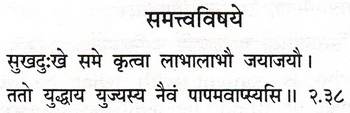
Being equal minded towards happiness and suffering, gain and loss, victory and defeat, engage yourself in the battle.
2.38

Become, O Arjuna, free from dualities, ever-balanced, unconcerned with acquisition and preservation and seated in the inmost self.
2.45
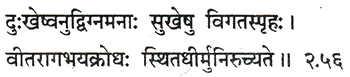
Perform action, O Arjuna, being fixed in Yoga, renouncing attachments and seated in equality in regard to success and failure. Equality is verily Yoga.
2.48
He whose mind is not perturbed by adversity, who does not crave for happiness, -who is free from attachment, fear and honour, — he is the man of wisdom with intelligence fixed in equality.
2.56

He who is content with what he obtains without fever of strain, he who has transcended dualities, and he who is without envy and is equal in success and failure, he remains free even though engaged in action.
4.22

Men of wisdom are those who have an equal eye for the brahmin imbued with learning and humility, a cow, an elephant, a dog and the despised.
5.18

Those whose mind is seated in equality have conquered phenomenal existence here itself. As the Brahman is flawless and equal in all, even so they stand established in the Brahman.
5.19

He who is seated in the Brahman, and who is the knower of the Brahman, fully awakened with stable intelligence, — he does not get excited by obtaining what is pleasant and does not get aggrieved by obtaining what is unpleasant.
5.20
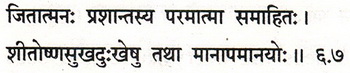
The highest self of the one who is tranquil and who has conquered the lower self is seated in equality in regard to cold and heat, pleasure and pain, honour and dishonour.
6.7
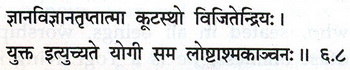
He who is satisfied with the knowledge of the essence and the knowledge of manifestation, who remains unshaken, who has conquered the senses and to whom clod, stone and gold are the same, — he is called a Yogin.
6.8
He stands out distinguished among all whose intelligence is impartial in regard to friends, companions, enemies, neutrals, arbiters, haters, relatives, saints and sinners.
6.9
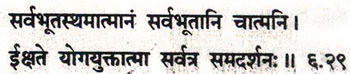
He who is settled in Yoga has an equal eye everywhere, and he sees himself in all beings and all beings in himself.
6.29

He who sees Me everywhere and sees all in Me, he never becomes lost to Me, nor do I become lost to him.
6.30

He who, seated in all beings, worships Me with Steadfast oneness, he is a Yogi living in Me even though spread out in every way.
6.31

He who sees everywhere an image of himself, and he who has an equal eye for happiness and suffering, O Arjuna, he is regarded as the supreme yogin.
6.32
He who hates none and he who has friendliness and compassion for all, who is Selfless, devoid of egoism, equal in suffering and happiness, forgiving—Ever content, self-controlled and possessed of firm conviction, and one whose mind and intelligence are consecrated to Me, that Yogi, My devotee, is dear to Me.
12.13-14
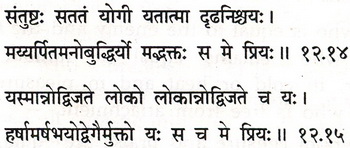
He by whom the world is not afflicted and whom the world cannot afflict, he who is free from joy, honour, fear and anxiety, he is dear to Me.
12.15

He who is devoid of wants, who is pure and efficient, seated high above and free from all trouble, and he who has renounced all egoistic initiative, and who is My devotee, - he is dear to Me.
12.16

He who does not get excited nor does he get depressed, he who envies none and desires nothing, who has given up all good and evil, and he who is full of devotion, he is dear to Me.
12.17
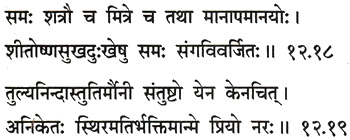
He who is equal to the enemy and the friend and he who remains equal in honour and dishonour, in cold or heat and in pleasure and pain and who is free from attachment, — To whom censure and praise are equal, who is silent, and who is content with anything, homeless, steady-minded, full of devotion, — that man is dear to Me.
12.18 - 19

He who sees the Supreme Lord seated equally in all beings, imperishable in all that perishes, he verily sees.
13.28

Because he sees the Lord, seated equally everywhere, and since he does not destroy self by the self, therefore, he attains to the Supreme goal.
13.29
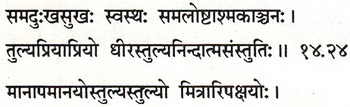
https://s3-us-west-2.amazonaws.com/kireetjoshi/images/-2021012640.jpg
He who is equal in misery and happiness, settled in well-being, viewing a clod, stone and gold alike, free from preference for the pleasant and unpleasant, firm and the same in censure and praise, — He who prefers neither honour nor dishonour, neither friend nor foe and he who has renounced all egoistic initiative, he is said to have transcended the Gunas ( modes of Nature).
14.24 - 25

He who does not desire to give up a disagreeable work or who is not attached to an agreeable work, and he who is imbued with sattwa and a steady mind where all doubts have been dispelled, — he is the renouncer.
18.10

He who has become one with the Brahman, whose self is ever glad, who desires for nothing and grieves for nothing, and he who is equal to all beings, — he attains to supreme devotion for Me.
18.54