THE WRITTEN WORD
Socrates
Paragraph references are specific to this digital edition.
Socrates
Socrates - Introduction
 Socrates
Who was Socrates?
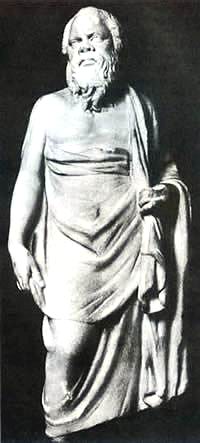
A stout man with a flat face, broad nose, thick lips, heavy beard, shabby clothes and an unduly large paunch, which he hoped to reduce by dancing this is how Socrates has been described. Not a very flattering description of a man commonly considered the founder of Western philosophy. Although far from the Greek ideal of beauty, his face shows the honesty, courage and humour which has come to be called "Socratic". Plato speaks of him as all glorious within while Alcibiades, another disciple of Socrates, compares him to a statue of Selinus ugly on the outside but full of beautiful golden statues of the gods inside
Socrates and his Times
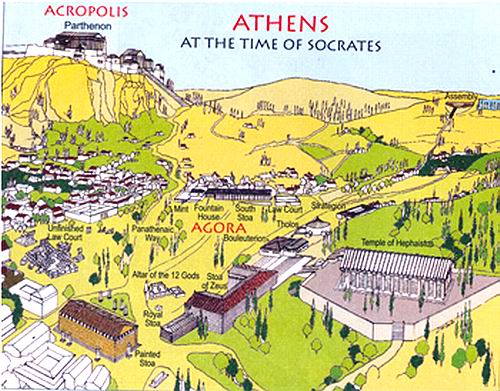
Every great mind is to a great extent the product of his Age and environment he breathes in, for he is influenced by the ideas, manners, and social and political conditions prevalent at that time. And in return, one can say that that greatness leaves something of itself as a cumulation to that civilization that nurtured him, making it that much greater. But there are greatnesses that make a distinct difference, more than just a fractional addition in the chronology of events, who step out of the shadow of time as landmarks which herald a major change in the history of mankind. To understand Socrates better, it would be useful to dwell on the historical atmosphere that existed at the time of his life. In the words of Shelley, "The period which intervened between the birth of Pericles and the death of Aristotle is undoubtedly, whether considered in itself or with reference to the effect which it produced upon the subsequent destinies of civilized man, the most memorable in the history of the world."
After the defeat of the Persians in 479 B.C., Athens dominated this period because she had won the allegiance of the other city-states by her leadership in saving Greece during the Persian invasions, which had threatened to destroy their civilization. To protect themselves against future Persian invasions, they formed the Delian Confederacy under Athenian leadership. While the other city-states contributed money towards its funds, Athens contributed ships, which led to its control over the other city-states, and the confederacy eventually transformed into an Athenian empire. This marked in single ink the preliminary sketches of the destiny of Athens prepared by Fate and brought forward by the predecessors of Pericles; it was left to him to fill in the colours, which would announce it for posterity as the Golden Age or the Age of Pericles.
Pericles
“What you leave behind is not what is engraved in stone monuments, but what is woven into the lives of others.”
— Pericles
Under the leadership of Pericles, Commander-in-chief of Athens, elected and. re-elected for almost 30 years by the Athenians, the polls (city) of Athens reached the zenith of its political power and cultural achievements, and every aspect of the collective life prospered and developed. In his childhood and youth, he received music lessons from Damon the most famous music teacher of his time, he learnt literature from Pythocleides, he absorbed philosophy through the lectures of Zeno, and he had Anaxagoras for a friend and teacher who uplifted his mind to loftier purposes. From him Pericles learnt the art of eloquence and found within himself a calmness, which could not be shaken even in the most trying circumstance. It is said that Pericles, too caught up in the affairs of state to keep in touch with his mentor, on hearing that Anaxagoras was struggling with old age and starvation, hastened to make amends and with great humility heard him as he chided, "those who have occasion for the lamp supply it with oil."
Pericles was driven by a superhuman zeal to ensure the development of Athens in all fields that make a civilization great economic, military, literary, artistic, and philosophical, and he set about in a resolute manner to accomplish his objective, successively in each and every wake of Athenian life. A man of few words, he spoke with economy but gained the admiration of enlightened minds.
Athens not only enjoyed the privileges of democracy but also the order and taste that came under the moderate leadership of his aristocratic dictatorship. He made reforms in the judiciary and began the practice of payment for jury as well as military service. He believed that the Olympic games and plays should not remain the luxury of the rich but even the lower echelons should have the privilege of enjoying them. To make that possible, he persuaded the state to make remuneration of two obols annually to each citizen. As a point of reference, it should be noted that Plato, Aristotle and Plutarch, all disapproved of these payments as, according to them, it injured the Athenian character.
He then turned towards the fortification of Athens and consequently persuaded the Assembly to supply funds for the construction of eight miles of long walls around Athens. Having secured Athens, he then turned his attention towards the beautification of the polls. He desired to transform Athens as the cultural capital of the region and to fulfill this dream he prepared a blueprint of a magnitude that would uplift the spirit of every Athenian. Pheidias Ictinus and Mnesicles, the best sculptors, were engaged for the fruition of this architectural programme. The Acropolis was crowned with the Parthenon within which stood the marvelous statue of Athena, executed in ivory and gold by Pheidias, and the Erectheum, created also by Pheidias, with its colossal statue in bronze of Athena Polias, the defender of her favourite city, along with altars devoted to Poseidon, god of the sea, and Hephaestus, god of fire, and there was also the wondrous Propylaea or assemblage of entrance gates that gave access to the whole. Athens witnessed the outpouring of artistic genius visible even now in the ruins of the Parthenon but also put to work the multitude of unemployed in the city bringing prosperity to the citizens at large. Parallel to the work of rebuilding of the ancient shrines and other magnificent edifices, Pericles desired to build the spiritual blocks of the soul and mind and to that end, lent his patronage to philosophy and literature as well. It was the Age that manifested in the highest degree, beauty, grace, self-contained dignity and grandeur, which we associate with the highest genius. Cultural events such as public performances of the great plays of Aeschylus, Sophocles and Euripides formed part of the developing urban lifestyle. All citizens, rich or poor, could enjoy these events together in an atmosphere of critical appreciation. The political and social organization of the Greek city-states is regarded as an important step in the evolution of mankind's collective organization, for it was an attempt to realize freedom and equality for the individual. Although the rights of free expression and political participation were confined to Greek citizens, and although they were not extended to the slave labour imported from foreign "barbaric" countries, the polls embodied the ideal of the dignity and independence of the human being. Politics was considered an important common concern, and participation in the daily decision-making process was the right and duty of each citizen. Athens grew into one of the largest cities of the ancient world, bursting the limits of the traditionally small city-state and establishing an empire. This, then, was the atmosphere in which Socrates took his first breath.
Athens produced during that Golden Age great men in all walks of life Socrates, the founder of Greek philosophy, Pheidias, Myron, and Polycletus, the sculptors, Zeuxis and Parrhasius, the painters, Pericles, the great orator and statesman, Herodotus and Thucydides, the historians, and Euripides and Sophocles, the tragedians.
This empire, however, did not last long; a conflict with the Greek city-state of Sparta, Athens' rival throughout Greek history, grew into the long Peloponnesian War (431-404 BC) in which Athens was ultimately defeated. Thus, Socrates knew both the splendour of the Periclean age and the chaos of war - a war which brought not only material hardship but, even more crucial for Socrates, a confusion in the sciences and an erosion of moral values.
Life of Socrates
According to the accounts of Plato and Xenophon, the first forty years of the life of Socrates were nurtured by the rich cultural atmosphere of Athens. Born in 469 BC in Athens, he followed the trade of his father, a sculptor. It is said that the statues of Hermes and the three Graces, which stood at the entrance to the Acropolis had been carved by him. His mother was a midwife. He believed in training the body to keep fit and he is said to have usually been in good physical condition. He also participated in the Olympic games. He was trained in the usual branches of a Greek education, gymnastics, reading, writing, knowledge of arithmetic and geometry, also the committal to memory and power of recitation of the poems of Homer. It is said that not only did Socrates exist at the same time as Parmenides, Protagoras, Gorgias, Hippias, Prodicus, and Thracymachus in Greece but that there are accounts by Plato of his meetings with them. He is said to have enjoyed the company of many distinguished men of his times; Archelaus, a pupil of Anaxagoras, who was for sometime his teacher, was probably responsible for turning Socrates from science to ethics, and Zenoʼs method of dialectic so impressed him that he adopted it as well. He married Xanthippe with whom he had three sons and held public office for a short time. He distinguished himself during the Peloponnesian War by his endurance and courage, serving as a foot soldier. He saved the life of a young man, Alcibiades, who for a brief time was his student, and renounced in his favour the award for courage in battle. It is said that in one of the battles with Sparta, he was the last of the Athenians to retreat and that he saved himself by glaring at the enemy. He had a remarkable endurance against hunger, cold and fatigue. .
It was around the time when he was about forty years of age when it is said that he became conscious of his special mission; a message from God, delivered to him by a spirit whom he constantly consulted to guide him, commanded him to devote himself to the task of discovering True Knowledge. This was the starting point of the philosophy of Socrates, a time when he came into his own, discovered the building blocks of his own style of philosophy, the birth of the dialogue, a means to discover knowledge of Truth, Beauty and Goodness, a step that marked a concrete shift from the world of mysticism into the world of the intellect. The next period of 25-30 years of his life, till his death in 399 BC, was spent devoted to the task of relentlessly pursuing knowledge and perfection, both in himself and others, through questioning and logic and dialogue, a period that found him making foundational contributions to the world of Western philosophy.
It is rightly said that the individual becomes perfect when he becomes universal, but the universal manifests its own perfection when .the individual brings into him something from the transcendental and adds it to the universal manifestation. Socrates was that individual who had brought something from the transcendental and fused it into the vastness of the Greek culture and enlarged the scope of the manifestation of the Greek culture. He had brought the normative ideal of virtue derived from knowledge and infused it into the growing tide of rational thought. That man of normative pursuits of virtue and clarity of pure reason imparted that special glow to Greek culture, which made it so distinctive in the history of the world.
Having discovered his divine mission, most of his time was spent in the public places of Athens in the streets, the marketplace and the gymnasium26 - engaging his fellow citizens in conversation on subjects ranging from reflections on nature to enquiries into politics; but he never set himself up as a teacher. He had no liking for the country, and seldom passed the gates of the city. "Fields and trees," Plato makes him say, "will not teach me anything; the life of the streets will." He went about his daily task of prodding men with questions about virtues, demanding answers. In fact he became a terror to all those who could not think clearly. He likened himself to a 'gadfly' 27 who made it his business to find out who was really wise and who were just pretending to be wise. A number of these conversations were recorded by Plato who, after Socrates' death, founded the "Academy", the famous school of Athens, which lasted nearly eight hundred years.
Obviously, provocations of Socrates could not remain free from criticism. His opponents complained that he was busy demolishing arguments given by others and rarely built any to replace them. He often avoided answering a direct question by replying with another question as happened with Critias, a student. Hippias, it is said, raged at Socrates and refused to speak another word till Socrates defined justice himself! To this exasperated outcry, Socrates' calm response was that he was, like his mother, but a midwife who helps in delivering; to give birth to ideas was not a privilege given him by the gods.
In many ways he was like the Sophists, and the Athenians referred to him as one too, though he begged to differ. And differ he did. Although like the Sophists he was well versed in the art of argumentation, could give analogies and change the course of a dialogue, and had a way with words, on four accounts he differed from them; he abhorred rhetoric, he aspired to strengthen the moral fibre in men, he desired nothing more than to teach men the art of self-examination, and he refused any payment for his services as instructor.
Despite all the criticism, there were those who loved him deeply. This Age produced not only men of genius in every walk of life but also those who nurtured them and stimulated them with their intelligent and sympathetic appreciation. As he said to one of his students:
Perhaps I may be able to assist you in the pursuit of honour and virtue, from being mutually disposed to love; for whenever I conceive a liking for persons I devote myself with ardour, and with my whole mind, to love them, and be loved by them in return, regretting their absence and having mine regretted by them, and longing for their society while they long for mine.
His pupils differed widely; there was no common doctrine that united them. Consequently, we see the most diverse schools of philosophical thought cropping up under their leadership Cynicism propounded by Antisthenes, which adopted the simplistic way of life of Socrates; Cyrenaic School by Aristippus, Epicureanism by Epicurus, a school which developed from the Cyrenaic school; Stoicism as improving the individual's spiritual well-being through self-control, fortitude and detachment; and finally Platonism, the founder of which was so influenced by his teacher that their lofty thoughts are united for eternity. There were others, like Phaedo a slave, who had been transformed into a philosopher by Socrates, Eucleides of Megara who was so impressed by the teachings of Socrates that he risked his life to sneak into Athens to receive instructions from his teacher when a law forbid all Megarians from entering Athens, the wealthy Crito, who took it upon himself to ensure that his friend would never be in want of anything; Critias, the oligarchic leader, an erstwhile student, whose association became one of the causes for the incrimination of Socrates that eventually led to his death sentence, and the son of Anytus, who preferred to listen to the discourses of Socrates than apply his mind to the leather business his father wanted him to look after. And then there was Alcibiades, the Adonis of Athens, whose affections for his teacher made him cry out in wild abandon:
When we hear any other speaker, even a very good one, his words produce absolutely no effect upon us in comparison, whereas the very fragment of your words, Socrates, even at second hand, and however imperfectly reported, amaze and possess the souls of every man, woman and child who comes within hearing of them.... I am conscious that if I did not shut my ears against him and fly from the voice of the siren, he would detain me until I grew old sitting at his feet..... I have known in my soul, or in my heart.... That greatest of pangs, more violent in ingenious youth than any serpent's tooth, the pang of philosophy.....
Socrates speaks of himself as a seeker of truth or a lover of wisdom — a philosopher. As a result of this reluctance to use his talents for material gains, he lived a life so poor that the Sophist Antiphon could mock: "A slave who was made to live like that would run away." Through the four seasons, his coat was the same and he preferred going around the city barefoot. Once during his visit to the marketplace he remarked, "How many things there are that I do not want!" But his simple lifestyle was not the outcome of self-torment or asceticism; it originated in his attitude of complete indifference towards physical enjoyments. He was an example of self-control and moderation. He was not a loner; in fact he liked good company and sometimes allowed the wealthy to entertain him. But he was not a slave to them for their favours; he could very well do without them as well. As he says in his discussion with Antiphon, as recorded in the 'Memorabilia' by Xenophon, "You, Antiphon, seem to think that happiness consists in luxury and extravagance, but I think that to want nothing is to resemble the Gods, and that to want as little as possible is to make the nearest approach to the Gods; that the Divine nature is perfection and that to be nearest to the Divine nature is to be nearest to perfection."
Socratic Theme of Quest
Socrates taught that the great problem of any human being lies in the question of how to live his life. Endowed with rationality, each man must decide what course his life shall take. Although mankind's common aim is a "good life" (eu-zen), there is no common agreement on what a "good life" is, or how to reach it. Socrates' answer to this question lies in the Greek term arête, which is usually translated as virtue, but more precisely means the full perfection of man's innate qualities. Socrates' concept of the excellent and perfect human life is an integral one, encompassing the development of all physical, vital and intellectual potentialities. Pursuing this aim in his own life, Socrates fought in war and participated in the Olympic games, but his primary concern was the intellect, which he considered the noblest part of man's nature.
In the history of thought, the word integrality has been understood in several ways. Basically, integrality would mean the total synthesis of all the parts of the being. In the fullness of integrality, the highest spiritual consciousness manifests itself fully on all the planes of the being, including the mental, the vital and the physical. However, there are subordinate meanings of integral aims, and these aims, even while integrating all the parts of the being, may not find it possible to manifest the highest consciousness in all parts of the being. For example, the Vedic Rishis attempted the manifestation of the highest Supramental Consciousness in the body, and although they succeeded in widening and universalizing body consciousness, they came to the conclusion that one cannot enter into the Supramental consciousness fully in the physical body. There is also a mention in the Upanishads that if one enters into the Supramental Consciousness fully, one cannot return from there into the bodily life.
In the case of Socrates, we find that he advocated full life of the intellectual and spiritual consciousness in the mind, life and body. He also maintained that since the soul is planted in the body by the Divine Providence, the body should not be discarded. At the same time, he insisted that one should not crave to continue to live in the body, when by natural means or natural circumstances, the bodily life comes to an end. In this regard Socrates was following the Orphic view of life. Socrates maintained that in the ultimate analysis, bodily consciousness imposed on the soul the limitations of cravings of senses and hampered the fullness of the life of the soul and reason. According to him, therefore, one should, while in the body, endeavour to reduce the claims and demands of the bodily senses and strive to live more and more in the rational part of the soul, which alone can perceive and know the Ideas of Truth, Beauty and Goodness. The highest abode of the soul, where the soul discovers and lives in immortality, is the abode of the Supreme Good; there bodily existence has no place and the bodily existence is seen to be a mere shadow or appearance.
There has, of course, been a long debate in the history of thought, both Eastern and Western, as to what is reality and what is appearance, and the debate is still continuing up to the present
Apology
 Apology
Plato
I do not know what effect my accusers have had upon you, gentlemen, but for my own part I was almost carried away by them; their arguments were so convincing. On the other hand, scarcely a word of what they said was true. I was especially astonished at one of their many misrepresentations: I mean when they told you that you must be careful not to let me deceive you the implication being that I am a skilful speaker. I thought that it was peculiarly brazen of them to tell you this without a blush, since they must know that they will soon be effectively confuted, when it becomes obvious that I have not the slightest skill as a speaker unless, of course, by a skilful speaker they mean one who speaks the truth. If that is what they mean, I would agree that I am an orator, though not after their pattern.
My accusers, then, as I maintain, have said little or nothing that is true, but from me you shall hear the whole truth; not, I can assure you, gentlemen, in flowery language like theirs, decked out with fine words and phrases; no, what you will hear will be a straightforward speech in the first words that occur to me, confident as I am in the justice of my cause; and I do not want any of you to expect anything different. It would hardly be suitable, gentlemen, for a man of my age to address you in the artificial language of a schoolboy orator.
One thing, however, I do most earnestly beg and entreat of you: if you hear me defending myself in the same language which it has been my habit to use, both in the open spaces of this city (where many of you have heard me) and elsewhere, do not be surprised, and do not interrupt. Let me remind you of my position. This is my first appearance in a court of law, at the age of seventy; and so I am a complete stranger to the language of this place. Now if I were really from another country, you would naturally excuse me if I spoke in the manner and dialect in which I had been brought up; and so in the present case I make this request of you, which I think is only reasonable: to disregard the manner of my speech it may be better or it may be worse and to consider and concentrate your attention upon this one question, whether my claims are fair or not. That is the first duty of the juryman, just as it is the pleader's duty to speak the truth.
The proper course for me, gentlemen of the jury, is to deal first with the earliest charges that have been falsely brought against me, and with my earliest accusers; and then with the later ones. I make this distinction because I have already been accused in your hearing by a great many people for a great many years, though without a word of truth; and I am more afraid of those people than I am of Anytus and his colleagues, although they are formidable enough. But the others are still more formidable; I mean the people who took hold of so many of you when you were children and tried to fill your minds with untrue accusations against me, saying "There is a wise man called Socrates who has theories about the heavens and has investigated everything below the earth, and can make the weaker argument defeat the stronger." It is these people, gentlemen, the disseminators of these rumours, who are my dangerous accusers; because those who hear them suppose that anyone who inquires into such matters must be an atheist. Besides, there are a great many of these accusers, and they have been accusing me now for a great many years; and what is more, they approached you at the most impressionable age, when some of you were children or adolescents; and they literally won their case by default, because there was no one to defend me. And the most fantastic thing of all is that it is impossible for me even to know and tell you their names, unless one of them happens to be a playwright. All these people, who have tried to set you against me out of envy and love of slander and some too merely passing on what they have been told by others all these are very difficult to deal with. It is impossible to bring them here for cross-examination; one simply has to conduct one's defence and argue one's case against an invisible opponent, because there is no one to answer. So I ask you to accept my statement that my critics fall into two classes: on the one hand my immediate accusers, and on the other those earlier ones whom I have mentioned; and you must suppose that I have first to defend myself against the latter. After all, you heard them abusing me longer ago and much more violently than these more recent accusers.
Very well then; I must begin my defence, gentlemen, and I must try, in the short time that I have, to rid your minds of a false impression which is the work of many years. I should like this to be the result, gentlemen, assuming it to be for your advantage and my own; and I should like to be successful in my defence; but I think that it will be difficult, and I am quite aware of the nature of my task. However, let that turn out as God wills; I must obey the law and make my defence.
Let us go back to the beginning and consider what the charge is that has made me so unpopular, and has encouraged Meletus to draw up this indictment. Very well; what did my critics say in attacking my character? I must read out their affidavit, so to speak, as though they were my legal accusers. "Socrates is guilty of criminal meddling, in that he inquires into things below the earth and in the sky, and makes the weaker argument defeat the. stronger, and teaches others to follow his example." It runs something like that. You have seen it for yourselves in the play by Aristophanes, where Socrates goes whirling round, proclaiming that he is walking on air, and uttering a great deal of other nonsense about things of which I know nothing whatsoever. I mean no disrespect for such knowledge, if anyone really is versed in it I do not want any more lawsuits brought against me by Meletus but the fact is, gentlemen, that I take no interest in it. What is more, I call upon the greater part of you as witnesses to my statement, and I appeal to all of you who have ever listened to me talking (and there are a great many to whom this applies) to clear your neighbours' minds on this point. Tell one another whether any one of you has ever heard me discuss such questions briefly or at length; and then you will realise that the other popular reports about me are equally unreliable.
The fact is that there is nothing in any of these charges; and if you have heard anyone say that I try to educate people and charge a fee, there is no truth in that either. I wish that there were, because I think that it is a fine thing if a man is qualified to teach, as in the case of Gorgias of Leontini, and Prodicus of Ceos and Hippias of Elis. Each one of these is perfectly capable of going into any city and actually persuading the young men to leave the company of their fellow-citizens, with any of whom they can associate for nothing, and attach themselves to him, and pay money for the privilege, and be grateful into the bargain. There is another expert too from Paros who I discovered was here on a visit. I happened to meet a man who has paid more in sophists' fees than all the rest put together I mean Callias, the son of Hipponicus; so I asked him (he has two sons, you see): "Callias," I said, "if your sons had been colts or calves, we should have had no difficulty in finding and engaging a trainer to perfect their natural qualities; and this trainer would have been some sort of horse-dealer or agriculturalist. But seeing that they are human beings, whom do you intend to get as their instructor? who is the expert in perfecting the human and social qualities? I assume from the fact of your having sons that you must have considered the question. Is there such a person or not?"
"Certainly", said he. "Who is he, and where does he come from?" said I, "and what does he charge?" "Evenus of Paros, Socrates", said he, "and his fee is twenty guineas." I felt that Evenus was to be congratulated if he really was a master of this art and taught it at such a moderate fee. I should certainly plume myself and give myself airs if I understood these things; but in fact, gentlemen, I do not.
Here perhaps one of you might interrupt me and say "But what is it that you do, Socrates? How is it that you have been misrepresented like this? Surely all this talk and gossip about you would never have arisen if you had confined yourself to ordinary activities, but only if your behaviour was abnormal. Tell us the explanation, if you do not want us to invent it for ourselves." This seems to me to be a reasonable request, and I will try to explain to you what it is that has given me this false notoriety; so please give me your attention. Perhaps some of you will think that I am not being serious; but I assure you that I am going to tell you the whole truth.
I have gained this reputation, gentlemen, from nothing more or less than a kind of wisdom. What kind of wisdom do I mean? Human wisdom, I suppose. It seems that I really am wise in this limited sense. Presumably the geniuses whom I mentioned just now are wise in a wisdom that is more than human; I do not know how else to account for it. I certainly have no knowledge of such wisdom, and anyone who says that I have is a liar and wilful slanderer. Now, gentlemen, please do not interrupt me if I seem to make an extravagant claim; for what I am going to tell you is not my own opinion; I am going to refer you to an unimpeachable authority. I shall call as witness to my wisdom (such as it is) the god at Delphi.
You know Chaerephon, of course. He was a friend of mine from boyhood, and a good democrat who played his part with the rest of you in the recent expulsion and restoration. And you know what he was like; how enthusiastic he was over anything that he had once undertaken. Well, one day he actually went to Delphi and asked this question of the god as I said before, gentlemen please do not interrupt he asked whether there was anyone wiser than myself. The priestess replied that there was no one. As Chaerephon is dead, the evidence for my statement will be supplied by his brother, who is here in court.
Please consider my object in telling you this. I want to explain to you how the attack upon my reputation first started. When I heard about the oracle's answer, I said to myself "What does the god mean? Why does he not use plain language? I am only too conscious that I have no claim to wisdom, great or small; so what can he mean by asserting that I am the wisest man in the world? He cannot be telling a lie; that would not be right for him."
After puzzling about it for some time, I set myself at last with considerable reluctance to check the truth of it in the following way. I went to interview a man with a high reputation for wisdom, because I felt that here if anywhere I should succeed in disproving the oracle and pointing out to my divine authority "You said that I was the wisest of men, but here is a man who is wiser than I am."
Well, I gave a thorough examination to this person I need not mention his name, but it was one of our politicians that I was studying when I had this experience and in conversation with him I formed the impression that although in many people's opinion, and especially in his own, he appeared to be wise, in fact he was not. Then when I began to try to show him that he only thought he was wise and was not really so, my efforts were resented both by him and by many of the other people present. However, I reflected as I walked away: "Well, I am certainly wiser than this man. It is only too likely that neither of us has any knowledge to boast of; but he thinks that he knows something which he does not know, whereas I am quite conscious of my ignorance. At any rate it seems that I am wiser than he is to this small extent, that I do not think that I know what I do not know."
After this I went on to interview a man with an even greater reputation for wisdom, and I formed the same impression again; and here too I incurred the resentment of the man himself and a number of others.
From that time on I interviewed one person after another. I realised with distress and alarm that I was making myself unpopular, but I felt compelled to put my religious duty first; since I was trying to find out the meaning of the oracle, I was bound to interview everyone who had a reputation for knowledge. And by Dog, gentlemen! (for I must be frank with you) my honest impression was this: it seemed to me, as I pursued my investigation at the god's command, that the people with the greatest reputations were almost entirely deficient, while others who were supposed to be their inferiors were much better qualified in practical intelligence.
I want you to think of my adventures as a sort of pilgrimage undertaken to establish the truth of the oracle once for all. After I had finished with the politicians I turned to the poets, dramatic, lyric, and all the rest, in the belief that here I should expose myself as a comparative ignoramus. I used to pick up what I thought were some of their most perfect works and question them closely about the meaning of what they had written, in the hope of incidentally enlarging my own knowledge. Well, gentlemen! I hesitate to tell you the truth, but it must be told. It is hardly an exaggeration to say that any of the bystanders could have explained those poems better than their actual authors. So I soon made up my mind about the poets too: I decided that it was not wisdom that enabled them to write their poetry, but a kind of instinct or inspiration, such as you find in seers and prophets who deliver all their sublime messages without knowing in the least what they mean. It seemed clear to me that the poets were in much the same case; and I also observed that the very fact that they were poets made them think that they had a perfect understanding of all other subjects, of which they were totally ignorant. So I left that line of inquiry too with the same sense of advantage that I had felt in the case of the politicians.
Last of all I turned to the skilled craftsmen. I knew quite well that I had practically no technical qualifications myself, and I was sure that I should find them full of impressive knowledge. In this I was not disappointed; they understood things which I did not, and to that extent they were wiser than I was. But, gentlemen, these professional experts seemed to share the same failing which I had noticed in the poets; I mean that on the strength of their technical proficiency they claimed a perfect understanding of every other subject, however important; and I felt that this error more than outweighed their positive wisdom. So. I made myself spokesman for the oracle, and asked myself whether I would rather be as I was neither wise with their wisdom nor stupid with their stupidity or possess both qualities as they did. I replied through myself to the oracle that it was best for me to be as I was.
The effect of these investigations of mine, gentlemen, has been to arouse against me a great deal of hostility, and hostility of a particularly bitter and persistent kind, which has resulted in various malicious suggestions, including the description of me as a professor of wisdom. This is due to the fact that whenever I succeed in disproving another person's claim to wisdom in a given subject, the bystanders assume that I know everything about that subject myself. But the truth of the matter, gentlemen, is pretty certainly this: that real wisdom is the property of God, and this oracle is his way of telling us that human wisdom has little or no value. It seems to me that he is not referring literally to Socrates, but has merely taken my name as an example, as if he would say to us "The wisest of you men is he who has realised, like Socrates, that in respect of wisdom he is really worthless."
That is why I still go about seeking and searching in obedience to the divine command, if I think that anyone is wise, whether citizen or stranger; and when I think that any person is not wise, I try to help the cause of God by proving that he is not. This occupation has kept me too busy to do much either in politics or in my own affairs; .in fact, my service to God has reduced me to extreme poverty.
There is another reason for my being unpopular. A number of young men with wealthy fathers and plenty of leisure have deliberately attached themselves to me because they enjoy hearing other people cross-questioned. These often take me as their model, and go on to try to question other persons; whereupon, I suppose, they find an unlimited number of people "who think that they know something, but really know little or nothing. Consequently their victims become annoyed, not with themselves but with me; and they complain that there is a pestilential busybody called Socrates who fills young people' heads with wrong ideas. If you ask them what he does, and what he teaches that has this effect, they have no answer, not knowing what to say; but as they do not want to admit their confusion, they fall back on the stock charges against any philosopher: that he teaches his pupils about things in the heavens and below the earth, and to disbelieve in gods, and to make the weaker argument defeat the stronger. They would be very loath, I fancy, to admit the truth: which is that they are being convicted of pretending to knowledge when they are entirely ignorant. So, jealous, I suppose, for their own reputation., and also energetic and numerically strong, and provided with a plausible and carefully worked-out case against me, these people have been dinning into your ears for a long time past their violent denunciations of myself. There you have the causes which led to the attack upon me by Meletus and Anytus and Lycon, Meletus being aggrieved on behalf of the poets, Anytus on behalf of the professional men and politicians, and Lycon on behalf of the orators. So, as I said at the beginning, I should be surprised if I were able, in the short time that I have, to rid your minds of a misconception so deeply implanted.
There, gentlemen, you have the true facts, which I present to you without any concealment or suppression, great or small. I am fairly certain that this plain speaking of mine is the cause of my unpopularity; and that I have described correctly the nature and the grounds of the calumny which has been brought against me. Whether you inquire into them now or later, you will find the facts as I have just described them.
So much for my defence against the charges brought by the first group of my accusers. I shall now try to defend myself against Meletus high-principled and patriotic as he claims to be and after that against the rest.
Let us consider their deposition again, as though it represented a fresh prosecution. It runs something like this: "Socrates is guilty of corrupting the minds of the young, and of believing in deities of his own invention instead of the gods recognised by the State." Such is the charge; let us examine its points one by one.
First it says that I am guilty of corrupting the young. But I say, gentlemen, that Meletus is guilty of treating a serious matter with levity, since he summons people to stand their trial on frivolous grounds, and professes concern and keen anxiety in matters about which he has never had the slightest interest. I will try to prove this to your satisfaction.
Come now, Meletus, tell me this. You regard it as supremely important, do you not, that our young people should be exposed to the best possible influence? "I do." Very well, then; tell these gentlemen who it is that influences the young for the better. Obviously you must know, if you are so much interested. You have discovered the vicious influence, as you say, in myself, and you are now prosecuting me before these gentlemen; speak up and inform them who it is that has a good influence upon the young. You see, Meletus, that you are tongue-tied and cannot answer. Do you not feel that this is discreditable, and a sufficient proof in itself of what I said, that you have no interest in the subject? Tell me, my friend, who is it that makes the young good? "The laws." That is not what I mean, my dear sir; I am asking you to name the person whose first business it is to know the laws. "These gentlemen here, Socrates, the members of the jury." Do you mean, Meletus, that they have the ability to educate the young, and to make them better? "Certainly." Does this apply to all jurymen, or only to some? "To all of them." Excellent! a generous supply of benefactors. Well, then, do these spectators who are present in court have an improving influence, or not? "Yes, they do." And what about the members of the Council? "Yes, the Councillors too." But surely, Meletus, the members of the Assembly do not corrupt the young? Or do all of them too exert an improving influence? "Yes, they do." Then it would seem that the whole population of Athens has a refining effect upon the young, except myself; and I alone demoralise them. Is that your meaning? "Most emphatically, yes." This is certainly a most unfortunate quality that you have detected in me. Well, let me put another question to you. Take the case of horses; do you believe that those who improve them make up the whole of mankind, and that there is only one person who has a bad effect on them? Or is the truth just the opposite, that the ability to improve them belongs to one person or to very few persons, who are horse-trainers, whereas most people, if they have to do with horses and make use of them, do them harm? Is not this the case, Meletus, both with horses and with all other animals? Of course it is, whether you and Anytus deny it or not. It would be a singular dispensation of fortune for our young people if there is only one person who corrupts them, while all the rest have a beneficial effect. But I need say no more; there is ample proof, Meletus, that you have never bothered your head about the young; and you make it perfectly clear that you have never taken the slightest interest in the cause for the sake of which you are now indicting me.
Here is another point. Tell me seriously, Meletus, is it better to live in a good or in a bad community? Answer my question, like a good fellow; there is nothing difficult about it. Is it not true that wicked people have a bad effect upon those with whom they are in the closest contact, and that good people have a good effect? "Quite true." Is there anyone who prefers to be harmed rather than benefited by his associates? Answer me, my good man; the law commands you to answer. Is there anyone who prefers to be harmed? "Of course not." Well, then, when you summon me before this court for corrupting the young and making their characters worse, do you mean that I do so intentionally or unintentionally? "I mean intentionally." Why, Meletus, are you at your age so much wiser than I at mine? You have discovered that bad people always have a bad effect, and good people a good effect, upon their nearest neighbours; am I so hopelessly ignorant as not even to realise that by spoiling the character of one of my companions I shall run the risk of getting some harm from him? because nothing else would make me commit this grave offence intentionally. No, I do not believe it, Meletus, and I do not suppose that anyone else does. Either I have not a bad influence, or it is unintentional; so that in either case your accusation is false. And if I unintentionally have a bad influence, the correct procedure in cases of such involuntary misdemeanours is not to summon the culprit before this court, but to take him aside privately for instruction and reproof; because obviously if my eyes are opened, I shall stop doing what I do not intend to do. But you deliberately avoided my company in the past and refused to enlighten me, and now you bring me before this court, which is the place appointed for those who need punishment, not for those who need enlightenment.
It is quite clear by now, gentlemen, that Meletus, as I said before, has never shown any degree of interest in this subject. However, I invite you to tell us, Meletus, in what sense you make out that I corrupt the minds of the young. Surely the terms of your indictment make it clear that you accuse me of teaching them to believe in new deities instead of the gods recognised by the State; is not that the teaching of mine which you say has this demoralising effect? "That is precisely what I maintain." Then I appeal to you, Meletus, in the name of these same gods about whom we are speaking, to explain yourself a little more clearly to myself and to the jury, because I cannot make out what your point is. Is it that I teach people to believe in some gods (which implies that I myself believe in gods, and am not a complete atheist, so that I am not guilty on that score), but in different gods from those recognised by the State, so that your accusation rests upon the fact that they are different? Or do you assert that I believe in no gods at all, and teach others to do the same? "Yes; I say that you disbelieve in gods altogether." You surprise me, Meletus; what is your object in saying that? do you suggest that I do not believe that the sun and moon are gods, as is the general belief of all mankind? "He certainly does not, gentlemen of the jury, since he says that the sun is a stone and the moon a mass of earth." Do you imagine that you are prosecuting Anaxagoras, my dear Meletus? Have you so poor an opinion of these gentlemen, and do you assume them to be so illiterate as not to know that the writings of Anaxagoras of Clazomenae are full of theories like these? and do you seriously suggest that it is from me that the young get these ideas, when they can buy them on occasion in the market-place for a shilling at most, and so have the laugh on Socrates if he claims them for his own, to say nothing of their being so silly? Tell me honestly, Meletus, is that your opinion of me? do I believe in no god? "No, none at all; not in the slightest degree." You are not at all convincing, Meletus; not even to yourself, I suspect. In my opinion, gentlemen, this man is a thoroughly selfish bully, and has brought this action against me out of sheer wanton aggressiveness and self-assertion. He seems to be devising a sort of intelligence test for me, saying to himself "Will the infallible Socrates realise that I am contradicting myself for my own amusement, or shall I succeed in deceiving him and the rest of my audience?" It certainly seems to me that he is contradicting himself in this indictment, which might just as well run "Socrates is guilty of not believing in the gods, but believing in the gods." And this is pure flippancy.
I ask you to examine with me, gentlemen, the line of reasoning which leads me to this conclusion. You, Meletus, will oblige us by answering my questions. Will you all kindly remember, as I requested at the beginning, not to interrupt if I conduct the discussion in my customary way?
Is there anyone in the world, Meletus, who believes in human activities, and not in human beings? Make him answer, gentlemen, and don't let him keep on making these continual objections. Is there anyone who does not believe in horses, but believes in horses' activities? or who does not believe in musicians, but believes in musical activities? No, there is not, my worthy friend. If you do not want to answer, I will supply it for you and for these gentlemen too. But the next question you must answer: Is there anyone who believes in supernatural activities and not in supernatural beings? "No." How good of you to give a bare answer under compulsion by the court! Well, do you assert that I believe and teach others to believe in supernatural activities? It does not matter whether they are new or old; the fact remains that I believe in them according to your statement; indeed you solemnly swore as much in your affidavit. But if I believe in supernatural activities, it follows inevitably that I also believe in supernatural beings. Is not that so? It is; I assume your assent, since you do not answer. Do we not hold that supernatural beings are either gods or the children of gods? Do you agree or not? "Certainly." Then if I believe in supernatural beings, as you assert, if these supernatural beings are gods in any sense, we shall reach the conclusion which I mentioned just now when I said that you were testing my intelligence for your own amusement, by stating first that I do not believe in gods, and then again that I do, since I believe in supernatural beings. If on the other hand these supernatural beings are bastard children of the gods by nymphs or other mothers, as they are reputed to be, who in the world would believe in the children of gods and not in the gods themselves? It would be as ridiculous as to believe in the young of horses or donkeys and not in horses and donkeys themselves. No, Meletus; there is not avoiding the conclusion that you brought this charge against me as a test of my wisdom, or else in despair of finding a genuine offence of which to accuse me. As for your prospect of convincing any living person with even a smattering of intelligence that belief in supernatural and divine activities does not imply belief in supernatural and divine beings, and vice versa, it is outside all the bounds of possibility.
As a matter of fact, gentlemen, I do not feel that it requires much defence to clear myself of Meletus' accusation; what I have said already is enough. But you know very well the truth of what I said in an earlier part of my speech, that I have incurred a great deal of bitter hostility; and this is what will bring about my destruction, if anything does; not Meletus nor Anytus, but the slander and jealousy of a very large section of the people. They have been fatal to a great many other innocent men, and I suppose will continue to be so; there is not likelihood that they will stop at me. But perhaps someone will say "Do you feel no compunction, Socrates, at having followed a line of action which puts you in danger of the death penalty?" I might fairly reply to him "You are mistaken, my friend, if you think that a man who is worth anything ought to spend his time weighing up the prospects of life and death. He has only one thing to consider in performing any action; that is, whether he is acting rightly or wrongly, like a good man or a bad one. On your view the heroes who died at Troy would be poor creatures, especially the son of Thetis. He, if you remember, made so light of danger in comparison with incurring dishonour that when his goddess mother warned him, eager as he was to kill Hector, in some such words as these, I fancy, 'My son, if you avenge your comrade Patroclus' death and kill Hector, you will die yourself;
Next after Hector is thy fate prepared,'
when he heard this warning, he made light of his death and danger, being much more afraid of an ignoble life and of failing to avenge his friends. 'Let me die forthwith', said he, 'when I have requited the villain, rather than remain here by the beaked ships to be mocked, a burden on the ground.' Do you suppose that he gave a thought of death and danger?"
The truth of the matter is this, gentlemen. Where a man has once taken up his stand, either because it seems best to him or in obedience to his orders, there I believe he is bound to remain and face the danger, taking no account of death or anything else before dishonour.
This being so, it would be shocking inconsistency on my part, gentlemen, if, when the officers whom you chose to command me assigned me my position at Potidaea and Amphipqlis and Delium, I remained at my post like anyone else and faced death, and yet afterwards, when God appointed me, as I supposed and believed, to the duty of leading the philosophic life, examining myself and others, I were then through fear of death or of any other danger to desert my post. That would indeed be shocking, and then I might really with justice be summoned into court for not believing in the gods, and disobeying the oracle, and being afraid of death, and thinking that I am wise when I am not. For let me tell you, gentlemen, that to be afraid of death is only another form of thinking that one is wise when one is not; it is to think that one knows what one does not know. No one knows with regard to death whether it is not really the greatest blessing that can happen to a man; but people dread it as though they were certain that it is the greatest evil; and this ignorance, which thinks that it knows what it does not, must surely be ignorance most culpable. This, I take it, gentlemen, is the degree, and this the nature of my advantage over the rest of mankind; and if I were to claim to be wiser than my neighbour in any respect, it would be in this: that not possessing any real knowledge of what comes after death, I am also conscious that I do not possess it. But I do know that to do wrong and to disobey my superior, whether God or man, is wicked and dishonourable; and so I shall never feel more fear or aversion for something which, for all I know, may really be a blessing, than for those evils which I know to be evils.
Suppose, then, that you acquit me, and pay no attention to Anytus, who has said that either I should not have appeared before this court at all, or, since I have appeared here, I must be put to death, because if I once escaped your sons would all immediately become utterly demoralised by putting the teaching of Socrates into practice. Suppose that, in view of this, you said to me "Socrates, on this occasion we shall disregard Anytus and acquit you, but only on one condition, that you give up spending your time on this quest and stop philosophizing. If we catch you going on in the same way, you shall be put to death." Well, supposing, as I said, that you should offer to acquit me on these terms, I should reply "Gentlemen, I am your very grateful and devoted servant, but I owe a greater obedience to God than to you; and so long as I draw breath and have my faculties, I shall never stop practising philosophy and exhorting you and elucidating the truth for everyone that I meet. I shall go on saying, in my usual way, My very good friend, you are an Athenian and belong to a city which is the greatest and most famous in the world for its wisdom and strength. Are you not ashamed that you give your attention to acquiring as much money as possible, and similarly with reputation and honour, and give no attention or thought to truth and understanding and the perfection of your soul?" And if any of you disputes this and professes to care about these things, I shall not at once let him go or leave him; and if it appears that in spite of his profession he has made no real progress towards goodness, I shall reprove him for neglecting what is of supreme importance, and giving his attention to trivialities. I shall do this to everyone that I meet, young or old, foreigner or fellow-citizen; but especially to you my fellow-citizens, inasmuch as you are closer to me in kinship. This, I do assure you, is what my God commands; and it is my belief that no greater good has ever befallen you in this city than my service to my God; for I spend all my time going about trying to persuade you, young and old, to make your first and chief concern not for your bodies nor for your possessions, but for the highest welfare of your souls, proclaiming as I go "Wealth does not bring goodness, but goodness brings wealth and every other blessing, both to the individual and to the State." Now if I corrupt the young by this message, the message would seem to be harmful; but if anyone says that my message is different from this, he is talking nonsense. And so, gentlemen, I would say, "You can please yourselves whether you listen to Anytus or not, and whether you acquit me or not; you know that I am not going to alter my conduct, not even if I have to die a hundred deaths."
Order, please, gentlemen! Remember my request to give me a hearing without interruption; besides, I believe that it will be to your advantage to listen. I am going to tell you something else, which may provoke a storm of protest; but please restrain yourselves. I assure you that if I am what I claim to be, and you put me to death, you will harm yourselves more than me. Neither Meletus nor Anytus can do me: any harm at all; they would not have the power, because I do' not believe that the law of God permits a better man to be harmed by a worse. No doubt my accuser might put me to; death or have me banished or deprived of civic rights; but even if he thinks, as he probably does (and others too, I dare say), that these are great calamities, I do not think so; I believe that it is far worse to do what he is doing now, trying to put an innocent man to death. For this reason, gentlemen, so fan from pleading on my own behalf, as might be supposed, I am really pleading on yours, to save you from misusing the gift of God by condemning me. If you put me to death, you will not; easily find anyone to take my place. It is literally true (even if; it sounds rather comical) that God has specially appointed me' to this city, as though it were a large thoroughbred horse. which because of its great size is inclined to be lazy and needs the stimulation of some stinging fly. It seems to me that God has attached me to this city to perform the office of such a fly; and all day long I never cease to settle here, there, and every where, rousing, persuading, reproving every one of you. You will not easily find another like me, gentlemen, and if you take my advice you will spare my life. I suspect, however, that before long you will awake from your drowsing, and in your annoyance you will take Anytus' advice and finish me off with a single slap; and then you will go on sleeping till the end of your days, unless God in his care for you sends someone to take my place.
If you doubt whether I am really the sort of person who would have been sent to this city as a gift from God, you can convince yourselves by looking at it in this way. Does it seem natural that I should have neglected my own affairs and endured the humiliation of allowing my family to be neglected for all these years, while I busied myself all the time on your behalf, going like a father or an elder brother to see each one of you privately, and urging you to set your thoughts on goodness? If I had got any enjoyment from it, or if I had been paid for my good advice, there would have been some explanation for my conduct; but as it is you can see for yourselves that although my accusers unblushingly charge me with all sorts of other crimes, there is one thing that they have not had the impudence to pretend on any testimony, and that is that I have ever exacted or asked a fee from anyone. The witness that I can offer to prove the truth of my statement is, I think, a convincing one my poverty.
It may seem curious that I should go round giving advice like this and busying myself in people's private affairs, and yet never venture publicly to address you as a whole and advise on matters of state. The reason for this is what you have often heard me say before on many other occasions: that I am subject to a divine or supernatural experience, which Meletus saw fit to travesty in his indictment. It began in my early childhood a sort of voice which comes to me; and when it comes it always dissuades me from what I am proposing to do, and never urges me on. It is this that debars me from entering public life, and a very good thing too, in my opinion; because you may be quite sure, gentlemen, that if I had tried long ago to engage in politics, I should long ago have lost my life, Without doing any good either to you or to myself. Please do not be offended if I tell you the truth. No man on earth who conscientiously opposes either you or any other organised democracy, and flatly prevents a great many wrongs and illegalities from taking place in the state to which he belongs, can possibly escape with his life. The true champion of justice, if he intends to survive even for a short time, must necessarily confine himself to private life and leave politics alone.
I will offer you substantial proofs of what I have said; not theories, but what you can appreciate better, facts. Listen while I describe my actual experiences, so that you may know that I would never submit wrongly to any authority through fear of death, but would refuse even at the cost of my life. It will be a commonplace story, such as you often hear in the courts; but it is true.
The only office which I have ever held in our city, gentlemen, was when I was elected to the Council.26 It so happened that our group was acting as the executive when you decided that the ten commanders who had failed to rescue the men who were lost in the naval engagement should be tried en bloc; which was illegal, as you all recognised later. On this occasion I was the only member of the executive who insisted that you should not act unconstitutionally, and voted against the proposal; and although your leaders were all ready to denounce and arrest me, and you were all urging them on at the top of your voices, I thought that it was my duty to face it out on the side of law and justice rather than support you,? through fear of prison or death, in your wrong decision.
This happened while we were still under a democracy. When the oligarchy came into power, the Thirty Commissioners in their turn summoned me and four others to the Round Chamber and instructed us to go and fetch Leon of Salamis from his home for execution. This was of course only one of many instances in which they issued such instructions, their object being to implicate as many people as possible in their wickedness. On this occasion, however, I again made it clear not by my words but by my actions that death did not matter to me at all (if that is not too strong an expression); but that it mattered all the world to me that I should do nothing wrong or wicked. Powerful as it was, that government did not terrify me into doing a wrong action; when we came out of the Round Chamber the other four went off to Salamis and arrested Leon, and I went home. I should probably have been put to death for this, if the government had not fallen soon afterwards. There are plenty of people who will testify to these statements.
Do you suppose that I should have lived as long as I have if I had moved in the sphere of public life, and conducting myself in that sphere like an honorable man, had always upheld the cause of right, and conscientiously set this end above all other things? Not by a very long way, gentlemen; neither would any other man. You will find that throughout my life I have been consistent in any public duties that I have performed, and the same also in my personal dealings: I have never countenanced any action that was incompatible with justice on the part of any person, including those whom some people maliciously call my pupils. I have never set up as any man's teacher; but if anyone, young or old, is eager to hear me conversing and carrying out my private mission, I never grudge him the opportunity; nor do charge a fee for talking to him, and refuse to talk without one; I am ready to answer questions for rich and poor alike, and I am equally ready if anyone prefers to listen to me and answer my questions. If any given one of these people becomes a good citizen or a bad one, I cannot fairly be held responsible, since I have never promised or imparted any teaching to anybody; and if anyone asserts that he has ever learned or heard from me privately anything which was not open to everyone else, you may be quite sure that he is not telling the truth.
But how is it that some people enjoy spending a great deal or time in my company? You have heard the reason, gentlemen; I told you quite frankly. It is because they enjoy hearing me examine those who think that they are wise when they are not; an experience which has its amusing side. This duty I have accepted, as I said, in obedience to God's commands given in oracles and dreams and in every other way that any other divine dispensation has ever impressed a duty upon man. This is a true statement, gentlemen, and easy to verify. If it is a fact that I am in process of corrupting some of the young, and have succeeded already in corrupting others; and if it were a fact that some of the latter, being now grown up, had discovered that I had ever given them bad advice when they were young, surely they ought now to be coming forward to denounce and punish me; and if they did not like to do it themselves, you would expect some of their families their fathers and brothers and other near relations to remember it now, if their own flesh and blood had suffered any harm from me. Certainly a great many of them have found their way into this court, as I can see for myself: first Crito over there, my contemporary and near neighbour, the father of this young man Critobulus; and then Lysanias of Sphettus, the father of Aeschines here; and next Antiphon of Cephisia, over there, the father of Epigenes. Then besides there are all those whose brothers have been members of our circle: Nicostratus the son of Theozotides, the brother of Theodotus but Theodotus is dead, so he cannot appeal to his brother and Paralius here, the son of Demodocus; his brother was Theages. And here is Adimantus, the son of Ariston, whose brother Plato is over there; and Aeantodorus, whose brother Apollodorus is here on this side. I can name many more besides, some of whom Meletus most certainly ought to have produced as witness in the course of his speech. If he forgot to do so then, let him do it now I am willing to make way for him; let him state whether he has any such evidence to offer. On the contrary, gentlemen, you will find that they are all prepared to help me the corrupter and evil genius of their nearest and dearest elatives, as Meletus and Anytus say. The actual victims of my corrupting influence might perhaps be excused for helping me; but as for the uncorrupted, their relations of mature age, what other reason can they have for helping me except the right and proper one, that they know Meletus is lying and I am telling the truth?
There gentlemen: that, and perhaps a little more to the same effect, is the substance of what I can say in my defence. It may be that some one of you, remembering his own case, will be annoyed that whereas he, in standing his trial upon a less serious charge than this, made pitiful appeals to the jury with floods of tears, and had his infant children produced in court to excite the maximum of sympathy, and many of his relatives and friends as well, I on the contrary intend to do nothing of the sort, and that although I am facing (as it might appear) the utmost danger. It may be that one of you, reflecting on these facts, will be prejudiced against me, and being irritated by his reflections, will give his vote in anger. If one of you is so disposed I do not expect it, but there is the possibility I think that I should be quite justified in saying to him "My dear sir, of course I have some relatives. To quote the very words of Homer, even I am not sprung 'from an oak or from a rock', but from human parents, and consequently I have relatives; yes, and sons too, gentlemen, three of them, one almost grown up and the other two only children; but all
Phaedo
 The Death of Socrates by French painter Jean-Louis David (1748-1825)
PERSONS OF THE DIALOGUE:
PHAEDO: who is the narrator of the Dialogue to Echecrates of Phlius.
ECHECRATES
SOCRATES
APOLLODORUS
SIMMIAS
CEBES
CRITO
ATTENDANT OF THE PRISON
SCENE:
The Prison of Socrates PLACE OF THE NARRATION:
Phlius
ECHECRATES. Were you yourself, Phaedo, in the prison with Socrates on the day when he drank the poison?
PHAEDO. Yes, Echecrates, I was.
ECHECRATES. I should so like to hear about his death. What did he say in his last hours? We were informed that he died by taking poison, but no one knew anything more; for no Phliasian ever goes to Athens now, and it is a long time since any stranger from Athens has found his way hither; so that we had no clear account.
PHAEDO. Did you not hear of the proceedings at the trial?
ECHECRATES. Yes; some one told us about the trial, and we could not understand why, having been condemned, he should have been put to death, not at the time, but long afterwards. What was the reason of this?
PHAEDO. An accident, Echecrates: the stern of the ship, which the Athenians send to Delos, happened to have been crowned on the day before he was tried.
ECHECRATES. What is this ship?
PHAEDO. It is the ship in which, according to Athenian tradition, Theseus went to Crete when he took with him the fourteen youths, and was the saviour of them and of himself. And they are said to have vowed to Apollo at the time, that if they were saved they would send a yearly mission to Delos. Now this custom still continues, and the whole period of the voyage to and from Delos, beginning when the priest of Apollo crowns the stern of the ship, is a holy season, during which the city is not allowed to be polluted by public executions; and when the vessel is detained by contrary winds, the time spent in going and returning is very considerable. As I was saying, the ship was crowned on the day before the trial, and this was the reason why Socrates lay in prison and was not put to death until long after he was condemned.
ECHECRATES. What was the manner of his death, Phaedo? What was said or done? And which of his friends were with him? Or did the authorities forbid them to be present - that he had no friends near him when he died?
PHAEDO. No; there were several of them with him.
ECHECRATES. If you have nothing to do, I wish that you would tell me what passed, as exactly as you can.
PHAEDO. I have nothing at all to do, and will try to gratify your wish. To be reminded of Socrates is always the greatest delight to me, whether I speak myself or hear another speak of him.
ECHECRATES. You will have listeners who are of the same mind with you, and I hope that you will be as exact as you can.
PHAEDO. I had a singular feeling at being in his company. For I could hardly believe that I was present at the death of a friend, and therefore I did not pity him, Echecrates; he died so fearlessly, and his words and bearing were so noble and gracious, that to me he appeared blessed. I thought that in going to the other world he could not be without a divine call, and that he would be happy, if any man ever was, when he arrived there; and therefore I did not pity him as might have seemed natural at such an hour. But I had not the pleasure, which I usually feel in philosophical discourse (for philosophy was the theme of which we spoke). I was pleased, but in the pleasure there was also a strange admixture of pain; for I reflected that he was soon to die, and this double feeling was shared by us all; we were laughing and weeping by turns, especially the excitable Apollodorus? you know the sort of man?
ECHECRATES. Yes.
PHAEDO. He was quite beside himself; and I and all of us were greatly moved.
ECHECRATES. Who were present?
PHAEDO. Of native Athenians there were, besides Apollodorus, Critobulus and his father Crito, Hermogenes, Epigenes, Aeschines, Antisthenes; likewise Ctesippus of the deme of Paeania, Menexenus, and some others; Plato, if I am not mistaken, was ill.
ECHECRATES. Were there any strangers?
PHAEDO. Yes, there were; Simmias the Theban, and Cebes, and Phaedondes; Euclid and Terpsion, who came from Megara.
ECHECRATES. And was Aristippus there, and Cleombrotus?
PHAEDO. No, they were said to be in Aegina.
ECHECRATES. Any one else?
PHAEDO. I think that these were nearly all.
ECHECRATES. Well, and what did you talk about?
PHAEDO. I will begin at the beginning, and endeavour to repeat the entire conversation. On the previous days we had been in the habit of assembling early in the morning at the court in which the trial took place, and which is not far from the prison. There we used to wait talking with one another until the opening of the doors (for they were not opened very early); then we went in and generally passed the day with Socrates. On the last morning we assembled sooner than usual, having heard on the day before when we quitted the prison in the evening that the sacred ship had come from Delos; and so we arranged to meet very early at the accustomed place. On our arrival the jailer who answered the door, instead of admitting us, came out and told us to stay until he called us. For the Eleven,' he said, 'are now with Socrates; they are taking off his chains, and giving orders that he is to die to-day.' He soon returned and said that we might come in. On entering we found Socrates just released from chains, and Xanthippe, whom you know, sitting by him, and holding his child in her arms. When she saw us she uttered a cry and said, as women will: 'O Socrates, this is the last time that either you will converse with your friends, or they with you.' Socrates, turned to Crito and said: 'Crito, let some one take her home.' Some of Crito's people accordingly led her away, crying out and beating herself. And when she was gone, Socrates, sitting up on the couch, bent and rubbed his leg, saying, as he was rubbing:
— How singular is the thing called pleasure, and how curiously related to pain, which might he thought to be the opposite of it; for they are never present to a man at the same instant, and yet he who pursues either is generally compelled to take the other; their bodies are two, but they are joined by a single head. And I cannot help thinking that if Aesop had remembered them, he would have made a fable about God trying to reconcile their strife, and how, when he could not, he fastened their heads together; and this is the reason why when one comes the other follows: as I know by my own experience now, when after the pain in my leg which was caused by the chain pleasure appears to succeed......
And now, O my judges, I desire to prove to you that the real philosopher has reason to be of good cheer when he is about to die, and that after death he may hope to obtain the greatest good in the other world. And how this may be, Simmias and Cebes, I will endeavour to explain. For I deem that the true votary of philosophy is likely to he misunderstood by other men; they do not perceive that he is always pursuing death and dying; and if this be so, and he has had the desire of death all his life long, why when his time comes should he repine at that which he has been always pursuing and desiring?
Simmias said laughingly: Though not in a laughing humour, you have made me laugh, Socrates; for I cannot help thinking that the many when they hear your words will say how truly you have described philosophers, and our people at home will likewise say that the life which philosophers desire is in reality death, and that they have found them out to be deserving of the death which they desire.
—And they arc right, Simmias, in thinking so, with the exception of the words 'they have found them out;ʼ for they have not found out either what is the nature of that death which the true philosopher deserves, or how he deserves or desires death. But enough of them: let us discuss the matter among ourselves. Do we believe that there is such a thing as death?
To be sure, replied Simmias.
— Is it not the separation of soul and body? And to be dead is the completion of this; when the soul exists in herself, and is released from the body and the body is released from the soul, what is this but death?
—Just so, he replied.
— There is another question, which will probably throw light on our present enquiry if you and I can agree about it: Ought the philosopher to care about the pleasures if they are to be called pleasures of eating and drinking?
— Certainly not, answered Simmias.
— And what about the pleasures of love should he care for them?
— By no means.
— And will he think much of the other ways of indulging the body, for example, the acquisition of costly raiment, or sandals, or other adornments of the body? Instead of caring about them, does he not rather despise anything more than nature needs? What do you say?
— I should say that the true philosopher would despise them.
— Would you not say that he is entirely concerned with the soul and not with the body? He would like, as far as he can, to get away from the body and to turn to the soul.
— Quite true.
— In matters of this sort philosophers, above all other men, may be observed in every sort of way to dissever the soul from the communion of the body.
—Very true.
— Whereas, Simmias, the rest of the world are of opinion that to him who has no sense of pleasure and no part in bodily pleasure, life is not worth having; and that he who is indifferent about them is as good as dead.
— That is also true.
— What again shall we say of the actual acquirement of knowledge? Is the body, if invited to share in the enquiry, a hinderer or a helper? I mean to say, have sight and hearing any truth in them? Are they not, as the poets are always telling us, inaccurate witnesses? And yet, if even they are inaccurate and indistinct, what is to be said of the other senses? For you will allow that they are the best of them?
— Certainly, he replied.
— Then when does the soul attain truth? -for in attempting to consider anything in company with the body she is obviously deceived.
— True.
— Then must not true existence be revealed to her in thought, if at all?
—Yes.
— And thought is best when the mind is gathered into herself and none of these things trouble her neither sounds nor sights nor pain nor any pleasure, when she takes leave of the body, and has as little as possible to do with it, when she has no bodily sense or desire, but is aspiring after true being?
— Certainly.
— And in this the philosopher dishonours the body; his soul runs away from his body and desires to be alone and by herself?
— That is true.
— Well, but there is another thing, Simmias: Is there or is there not an absolute justice?
—Assuredly there is.
— And an absolute beauty and absolute good?
— Of course.
— But did you ever behold any of them with your eyes?
— Certainly not.
— Or did you ever reach them with any other bodily sensed and I speak not of these alone, but of absolute greatness, and health, and strength, and of the essence or true nature of everything. Has the reality of them ever been perceived by you through the bodily organs? or rather, is not the nearest approach to the knowledge of their several natures made by him who so orders his intellectual vision as to have the most exact conception of the essence of each thing which he considers?
— Certainly.
—And he attains to the purest knowledge of them who goes to each with the mind alone, not introducing or intruding in the act of thought, sight or any other sense together with reason, but with the very light of the mind in her own clearness searches into the very truth of each; he who has got rid, as far as he can, of eyes and ears and, so to speak, of the whole body, these being in his opinion distracting elements which when they infect the soul hinder her from acquiring truth and knowledge — who, if not he, is likely to attain to the knowledge of true being?
— What you say has a wonderful truth in it, Socrates, replied Simmias.
— And when real philosophers consider all these things, will they not be led to make a reflection, which they will express in words something like the following? 'Have we not found,' they will say, 'a path of thought which seems to bring us and our argument to the conclusion, that while we are in the body, and while the soul is infected with the evils of the body, our desire will not be satisfied? and our desire is of the truth. For the body is a source of endless trouble to us by reason of the mere requirement of food; and is liable also to diseases which overtake and impede us in the search after true being: it fills us full of loves, and lusts, and fears, and fancies of all kinds, and endless foolery, and in fact, as men say, takes away from us the power of thinking at all. Whence come wars, and fightings, and factions? whence but from the body and the lusts of the body? Wars are occasioned by the love of money, and money has to be acquired for the sake and in the service of the body; and by reason of all these impediments we have no time to give to philosophy; and, last and worst of all, even if we are at leisure and betake ourselves to some speculation, the body is always breaking in upon us, causing turmoil and confusion in our enquiries, and so amazing us that we are prevented from seeing the truth. It has been proved to us by experience that if we would have pure knowledge of anything we must be quit of the body the soul in herself must behold things in themselves: and then we shall attain the wisdom which we desire, and of which we say that we are lovers; not while we live, but after death; for if while in company with the body, the soul cannot have pure knowledge, one of two things follows either knowledge is not to be attained at all, or, if at all, after death. For then, and not till then, the soul will be parted from the body and exist in herself alone. In this present life, I reckon that we make the nearest approach to knowledge when we have the least possible intercourse or communion with the body, and are not surfeited with the bodily nature, but keep ourselves pure until the hour when God himself is pleased to release us. And thus having got rid of the foolishness of the body we shall be pure and hold converse with the pure, and know of ourselves the clear light everywhere, which is no other than the light of truth.' For the impure are not permitted to approach the pure. These are the sort of words, Simmias, which the true lovers of knowledge cannot help saying to one another, and thinking. You would agree; would you not?
— Undoubtedly, Socrates.
— But, O my friend, if this be true, there is great reason to hope that, going whither I go, when I have come to the end of my journey, I shall attain that which has been the pursuit of my life. And therefore I go on my way rejoicing, and not I only, but every other man who believes that his mind has been made ready and that he is in a manner purified.
—Certainly, replied Simmias.
—And what is purification but the separation of the soul from the body, as I was saying before; the habit of the soul gathering and collecting herself into herself from all sides out of the body;
the dwelling in her own place alone, as in another life, so also in this, as far as she can; the release of the soul from the chains of the body?
— Very true, he said.
— And this separation and release of the soul from the body is termed death?
— To be sure, he said.
— And the true philosophers, and they only, are ever seeking to release the soul. Is not the separation and release of the soul from the body their especial study?
— That is true.
— And, as I was saying at first, there would be a ridiculous contradiction in men studying to live as nearly as they can in a state of death, and yet repining when it comes upon them.
— Clearly.
—And the true philosophers, Simmias, are always occupied in the practice of dying; wherefore also to them least of all men is death terrible. Look at the matter thus: if they have been in every way the enemies of the body, and are wanting to be alone with the soul, when this desire of theirs is granted, how inconsistent would they be if they trembled and repined, instead of rejoicing at their departure to that place where, when they arrive, they hope to gain that which in life they desired and this was wisdom and at the same time to be rid of the company of their enemy. Many a man has been willing to go to the world below animated by the hope of seeing there an earthly love, or wife, or son, and conversing with them. And will he who is a true lover of wisdom, and is strongly persuaded in like manner that only in the world below he can worthily enjoy her, still repine at death? Will he not depart with joy? Surely he will, O my friend, if he be a true philosopher. For he will have a firm conviction that there, and there only, he can find wisdom in her purity. And if this be true, he would be very absurd, as I was saying, if he were afraid of death.
— He would indeed, replied Simmias.
— And when you see a man who is repining at the approach of death, is not his reluctance a sufficient proof that he is not a lover of wisdom, but a lover of the body, and probably at the same time a lover of either money or power, or both?
— Quite so, he replied. ...
Cebes answered — I agree, Socrates, in the greater part of what you say. But in what concerns the soul, men are apt to be incredulous; they fear that when she has left the body her place may be nowhere, and that on the very day of death she may perish and come to an end immediately on her release from the body, issuing forth dispersed like smoke or air and in her flight vanishing away into nothingness. If she could only be collected into herself after she has obtained release from the evils of which you were speaking, there would be good reason to hope, Socrates, that what you say is true. But surely it requires a great deal of argument and many proofs to show that when the man is dead his soul yet exists, and has any force or intelligence.
— True, Cebes, said Socrates; and shall I suggest that we converse a little of the probabilities of these things?
—-I am sure, said Cebes, that I should greatly like to know your opinion about them.
— I reckon, said Socrates, that no one who heard me now, not even if he were one of my old enemies, the Comic poets, could accuse me of idle talking about matters in which I have no concern: If you please, then, we will proceed with the enquiry.
Suppose we consider the question whether the souls of men after death are or are not in the world below. There comes into my mind an ancient doctrine, which affirms that they go from hence into the other world, and returning hither, are born again from the dead. Now if it be true that the living come from the dead, then our souls must exist in the other world, for if not, how could they have been born again? And this would be conclusive, if there were any real evidence that the living are only born from the dead; but if this is not so, then other arguments will have to be adduced.
—Very true, replied Cebes.
— Then let us consider the whole question, not in relation to man only, but in relation to animals generally, and to plants, and to everything of which there is generation, and the proof will be easier. Are not all things which have opposites generated out of their opposites? I mean such things as good and evil, just and unjust and there are innumerable other opposites which are generated out of opposites. And .1 want to show that in all opposites there is of necessity a similar alternation; I mean to say, for example, that anything, which becomes greater must become greater after being less.
— True.
— And that which becomes less must have been once greater and then have become less.
— Yes.
— And the weaker is generated from the stronger, and the swifter from the slower.
— Very true.
— And the worse is from the better, and the more just is from the more unjust.
— Of course.
— And is this true of all opposites? and are we convinced that all of them are generated out of opposites?
—Yes.
— And in this universal opposition of all things, are there not also two intermediate processes which are ever going on, from one to the other opposite, and back again; where there is a greater and a less there is also an intermediate process of increase and diminution, and that which grows is said to wax, and that which decays to wane?
— Yes, he said.
— And there are many other processes, such as division and composition, cooling and heating, which equally involve a passage into and out of one another. And this necessarily holds of all opposites, even though not always expressed in words they are really generated out of one another, and there is a passing or process from one to the other of them?
— Very true, he replied.
— Well, and is there not an opposite of life, as sleep is the opposite of waking?
— True, he said.
—And what is it?
— Death, he answered.
— And these, if they are opposites, are generated the one from the other, and have their two intermediate processes also?
— Of course.
— Now, said Socrates, I will analyze one of the two pairs of opposites, which I have mentioned to you, and also its intermediate processes, and you shall analyze the other to me. One of them I term sleep, the other waking. The state of sleep is opposed to the state of waking, and out of sleeping waking is generated, and out of waking, sleeping; and the process of generation is in the one case falling asleep, and in the other waking up. Do you agree?
— I entirely agree.
— Then, suppose that you analyze life and death to me in the same manner. Is not death opposed to life?
—Yes.
— And they are generated one from the other?
—Yes.
— What is generated from the living?
— The dead.
— And what from the dead?
— I can only say in answer the living.
— Then the living, whether things or persons, Cebes, are generated from the dead?
— That is clear, he replied.
— Then the inference is that our souls exist in the world below?
— That is true.
— And one of the two processes or generations is visible -for surely the act of dying is visible?
— Surely, he said.
— What then is to be the result? Shall we exclude the opposite process? and shall we suppose nature to walk on one leg only? Must we not rather assign to death some corresponding process of generation?
— Certainly, he replied.
— And what is that process?
— Return to life.
—And return to life, if there be such a thing, is the birth of the dead into the world of the living?
— Quite true.
— Then here is a new way by which we arrive at the conclusion that the living come from the dead, just as the dead come from the living; and this, if true, affords a most certain proof that the souls of the dead exist in some place out of which they come again,
— Yes, Socrates, he said; the conclusion seems to flow necessarily out of our previous admissions.
— And that these admissions were not unfair, Cebes, he said, may be shown, I think, as follows: If generation were in a straight line only, and there were no compensation or circle in nature, no turn or return of elements into their opposites, then you know that all things would at last have the same form and pass into the same state, and there would be no more generation of them.
— What do you mean? he said.
— A simple thing enough, which I will illustrate by the case of sleep, he-replied. You know that if there were no alternation of sleeping and waking, the tale of the sleeping Endymion would in the end have no meaning, because all other things would be asleep too, and he would not be distinguishable from the rest. Or if there were composition only, and no division of substances, then the chaos of Anaxagoras would come again. And in like manner, my dear Cebes, if all things which partook of life were to die, and after they were dead remained in the form of death, and did not come to life again, all would at last die, and nothing would be alive what other result could there be? For if the living spring from 'any other things, and they too die, must not all things at last be swallowed up in death?
—There is no escape, Socrates, said Cebes; and to me your argument seems to be absolutely true.
— Yes, he said, Cebes, it is and must be so, in my opinion; and we have not been deluded in making these admissions; but I am confident that there truly is such a thing as living again, and that the living spring from the dead, and that the souls of the dead are in existence, and that the good souls have a better portion than the evil.
— Cebes added: Your favourite doctrine, Socrates, that knowledge is simply recollection, if true, also necessarily implies a previous time in which we have learned that which we now recollect. But this would be impossible unless our soul had been in some place before existing in the form of man; here then is another proof of the soul's immortality.
— But tell me, Cebes, said Simmias, interposing, what arguments are urged in favour of this doctrine of recollection. I am not very sure at the moment that I remember them.
— One excellent proof, said Cebes, is afforded by questions. If you put a question to a person in a right way, he will give a true answer of himself, but how could he do this unless there were knowledge and right reason already in him? And this is most clearly shown when he is taken to a diagram or to anything of that sort.
— But if, said Socrates, you are still incredulous, Simmias, I would ask you whether you may not agree with me when you look at the matter in another way; I mean, if you are still incredulous as to whether knowledge is recollection?
— Incredulous I am not, said Simmias; but I want to have this doctrine of recollection brought to my own recollection, and, from what Cebes has said, I am beginning to recollect and be convinced: but I should still like to hear what you were going to say.
— This is what I would say, he replied: We should agree, if 11 am not mistaken, that what a man recollects he must have known at some previous time.
— Very true.
—And what is the nature of this knowledge or recollection? I mean to ask. Whether a person who, having seen or heard or in any way perceived anything, knows not only that, but has a conception of something else which is the subject, not of the same but of some other kind of knowledge, may not be fairly said to recollect that of which he has the conception?
— What do you mean?
— / mean what I may illustrate by the following instance: The knowledge of a lyre is not the same as the knowledge of a man?
True.
— And yet what is the feeling of lovers when they recognize a lyre, or a garment, or anything else, which the beloved has been in the habit of using? Do not they, from knowing the lyre, form in the mind's eye an image of the youth to whom the lyre belongs? And this is recollection. In like manner any one who sees Simmias may remember Cebes; and there are endless examples of the same thing.
— Endless, indeed, replied Simmias.
—And recollection is most commonly a process of recovering that, which has been already forgotten through time and inattention.
— Very true, he said.
— Well; and may you not also from seeing the picture of a horse or a lyre remember a man? and from the picture of Simmias, you may be led to remember Cebes;
— True.
— Or you may also be led to the recollection of Simmias himself?
— Quite so.
—And in all these cases, the recollection may be derived from things either like or unlike?
— It may be.
—And when the recollection is derived from like things, then another consideration is sure to arise, which is whether the likeness in any degree falls short or not of that which is recollected?
— Very true, he said.
— And shall we proceed a step further, and affirm that there is such a thing as equality, not of one piece of wood or stone with another, but that, over and. above this, there is absolute equality? Shall we say so?
— Say so, yes, replied Simmias, and swear to it, with all the confidence in life.
—And do we know the nature of this absolute essence?
— To be sure, he said.
— And whence did we obtain our knowledge? Did we not see equalities of material things, such as pieces of wood and stones, and gather from them the idea of an equality, which is different from them? For you will acknowledge that there is a difference. Or look at the matter in another way: Do not the same pieces of wood or stone appear at one time equal, and at another time unequal?
— That is certain.
— But are real equals ever unequal? Or is the idea of equality the same as of inequality?
— Impossible, Socrates.
— Then these (so-called) equals are not the same with the idea of equality?
— I should say, clearly not, Socrates.
—And yet from these equals, although differing from the idea of equality, you conceived and attained that idea?
— Very true, he said.
— Which might be like, or might be unlike them?
—Yes.
— But that makes no difference: whenever from seeing one thing you conceived another, whether like or unlike, there must surely have been an act of recollection?
— Very true.
— But what would you say of equal portions of wood and stone, or other material equals? And what is the impression produced by them? Are they equals in the same sense in which absolute equality is equal? Or do they fall short of this perfect equality in a measure?
— Yes, he said, in a very great measure too.
— And must we not allow, that when I or any one, looking at any object, observes that the thing which he sees aims at being some other thing, but falls short of, and cannot be, that other thing, but is inferior, he who makes this observation must have had a previous knowledge of that to which the other, although similar, was inferior?
— Certainly.
— And has not this been our own case in the matter of equals and of absolute equality?
— Precisely.
— Then we must have known equality previously to the time when we first saw the material equals, and reflected that all these apparent equals strive to attain absolute equality, but fall short of it?
— Very true.
—— And we recognize also that this absolute equality has only been known, and can only be known, through the medium of sight or touch, or of some other of the senses, which are all alike in this respect?
— Yes, Socrates, as far as the argument is concerned, one of them is the same as the other.
— From the senses then is derived the knowledge that all sensible things aim at an absolute equality of which they fall short?
—Yes.
— Then before we began to see or hear or perceive in any way, we must have had a knowledge of absolute equality, or we could not have referred to that standard the equals which are derived from the senses? for to that they all aspire, and of that they fall short.
— No other inference can be drawn from the previous statements.
— And did we not see and hear and have the use of our other senses as soon as we were born?
— Certainly.
— Then we must have acquired the knowledge of equality at some previous time?
— Yes.
— That is to say, before we were born, I suppose?
— True.
— And. if we acquired this knowledge before we were born, and were born having the use of it, then we also knew before we were born and at the instant of birth not only the equal or the greater or the less, but all other ideas, for we are not speaking only of equality, but of beauty, goodness, justice, holiness, and of all which we stamp with the name of essence in the dialectical process, both when we ask and when we answer questions. Of all this we may certainly affirm that we acquired the knowledge before birth?
— We may.
— But if, after having acquired, we have not forgotten what in each case we acquired, then we must always have come into life having knowledge, and shall always continue to know as long as life lasts — for knowing is the acquiring and retaining knowledge and not forgetting. Is not forgetting, Simmias, just the losing of knowledge?
— Quite true, Socrates.
— But if the knowledge, which we acquired before birth was lost by us at birth, and if afterwards by the use of the senses we recovered what we previously knew, will not the process, which we call learning be a recovering of the knowledge, which is natural to us, and may not this be rightly termed recollection?
— Very true.
— So much is clear — that when we perceive something, either by the help of sight, or hearing, or some other sense, from that perception we are able to obtain a notion of some other thing like or unlike which is associated with it but has been forgotten. Whence, as I was saying, one of two alternatives follows: either we had this knowledge at birth, and continued to know through life; or, after birth, those who are said to learn only remember, and learning is simply recollection.
— Yes, that is quite true, Socrates.
— And which alternative, Simmias, do you prefer? Had we the knowledge at our birth, or did we recollect the things, which we knew previously to our birth?
— I cannot decide at the moment.
— At any rate you can decide whether he who has knowledge will or will not be able to render an account of his knowledge? What do you say?
— Certainly, he will.
— But do you think that every man is able to give an account of these very matters about which we are speaking?
— Would that they could, Socrates, but I rather fear that tomorrow, at this time, there will no longer be any one alive who is able to give an account of them such as ought to be given.
— Then you are not of opinion, Simmias, that all men know these things?
— Certainly not.
— They are in process of recollecting that which they learned before?
— Certainly.
— But when did our souls acquire this knowledge? — not since we were born as men?
— Certainly not.
— And therefore, previously?
— Yes.
— Then, Simmias, our souls must also hw existed without bodies before they were in the form of man, and must have had intelligence.
— Unless indeed you suppose, Socrates, that these notions are given us at the very moment of birth; for this is the only time which remains.
— Yes, my friend, but if so, when do we lose them? -for they are not in us when we are born that is admitted. Do we lose them at the moment of receiving them, or if not at what other time?
— No, Socrates, I perceive that I was unconsciously talking nonsense.
— Then may we not say, Simmias, that if, us we are always repeating, there is an absolute beauty, and goodness, and an absolute essence of all things; and if to this, which is now discovered to have existed in our former state, we refer all our sensations, and with this compare them, finding these ideas to be pre-existent and our inborn possession then our souls must have had a prior existence, but if not, there would be no force in the argument? There is the same proof that these ideas must have existed before we were born, as that our souls existed before we were born; and if not the ideas, then not the souls.
— Yes, Socrates; I am convinced that there is precisely the same necessity for the one as for the other; and the argument retreats successfully to the position that the existence of the soul before birth cannot be separated from the existence of the essence of which you speak. For there is nothing which to my mind is so patent as that beauty, goodness, and the other notions of which you were just now speak, ing, have a most real and absolute existence; and I am satisfied with the proof.
— Well, but is Cehes equally satisfied? for I must convince him too.
—I think, said Simmias, that Cebes is satisfied: although he is the most incredulous of mortals, yet I believe that he is sufficiently convinced of the existence of the soul before birth. But that after death the soul will continue to exist is not yet proven even to my own satisfaction. I cannot get rid of the feeling of the many to which Cebes was referring the feeling that when the man dies the soul will be dispersed, and that this may be the extinction of her. For admitting that she may have been born elsewhere, and framed out of other elements, and was in existence before entering the human body, why after having entered in and gone out again may she not herself be destroyed and come to an end?
— Very true, Simmias, said Cebes; about half of what was required has been proven; to wit, that our souls existed before we were born: that the soul will exist after death as well as before birth is the other half of which the proof is still wanting, and has to be supplied; when that is given the demonstration will be complete.
— But that proof, Simmias and Cebes, has been already given, said Socrates, if you put the two arguments together I mean this and the former one, in which we admitted that everything living is born of the dead. For if the soul exists before birth, and in coming to life and being born can be born only from death and dying, must she not after death continue to exist, since she has to be born again? Surely the proof, which you desire has been already furnished........
— We will do our best, said Crito. And in what way shall we bury you?
— In any way that you like; but you must get hold of me, and take care that I do not run away from you. Then he turned to us, and added with a smile: / cannot make Crito believe that I am the same Socrates who have been talking and conducting the argument; he fancies that I am the other Socrates whom he will soon see, a dead body — and he asks. How shall he bury me? And though I have spoken many words in the endeavour to show that when I have drunk the poison I shall leave you and go to the joys of the blessed, — these words of mine, with which I was comforting you and myself, have had, as I perceive, no effect upon Crito. And therefore I want you to be surety for me to him now, as at the trial he was surety to the judges for me: but let the promise be of another sort; for he was surety for me to the judges that I would remain, and you must be my surety to him that I shall not remain, but go away and depart; and then he will suffer less at my death, and not be grieved when he sees my body being burned or buried. I would not have him sorrow at my hard lot, or say at the burial, Thus we lay out Socrates, or. Thus we follow him to the grave or bury him; for false words are not only evil in themselves, but they infect the soul with evil. Be of good cheer then, my dear Crito, and say that you are burying my body only, and do with that whatever is usual, and what you think best.
When he had spoken these words, he arose and went into a chamber to bathe; Crito followed him and told us to wait.
So we remained behind, talking and thinking of the subject of discourse, and also of the greatness of our sorrow; he was like a father of whom we were being bereaved, and we were about to pass the rest of our lives as orphans. When he had taken the bath his children were brought to him (he had two young sons and an elder one); and the women of his family also came, and he talked to them and gave them a few directions in the presence of Crito; then he dismissed them and returned to us.
Now the hour of sunset was near, for a good deal of time had passed while he was within. When he came out, he sat down with us again after his bath, but not much was said. Soon the jailer, who was the servant of the Eleven, entered and stood by him, saying: To you, Socrates, whom I know to be the noblest and gentlest and best of all who ever came to this place, I will not impute the angry feelings of other men, who rage and swear at me, when, in obedience to the authorities, I bid them drink the poison indeed, I am sure that you will not be angry with me; for others, as you are aware, and not I, are to blame. And so fare you well, and try to bear lightly what must needs be — you know my errand. Then bursting into tears he turned away and went out.
Socrates looked at him and said: / return your good wishes, and mill do as you bid. Then turning to us, he said,
— How charming the man is: since I have been in prison he has always been coming to see me, and at times he would talk to me, and was as good to me as could be, and now see how generously he sorrows on my account. We must do as he says, Crito; and therefore let the cup be brought, if the poison is prepared: if not, let the attendant prepare some.
— Yet, said Crito, the sun is still upon the hill-tops, and I know that many a one has taken the draught late, and after the announcement has been made to him, he has eaten and drunk, and enjoyed the society of his beloved; do not hurry there is time enough.
Socrates said — Yes, Crito, and they of whom you speak are right in so acting, for they think that they will be gamers by the delay; but I am right in not following their example, for I do not think that I should gain anything by drinking the poison a little later; I should only be ridiculous in my own eyes for sparing and saving a life which is already forfeit. Please then to do as I say, and not to refuse me.
Crito made a sign to the servant, who was standing by; and he went out, and having been absent for some time, returned with the. jailer carrying the cup of poison. Socrates said: You, my good friend, who are experienced in these matters, shall give me directions how I am to proceed. The man answered: You have only to walk about until your legs are heavy, and then to lie down, and the poison will act. At the same time he handed the cup to Socrates, who in the easiest and gentlest manner, without the least fear or change of colour or feature, looking at the man with all his eyes, Echecrates, as his manner was, took the cup and said: What do you say about making a libation out of this cup to any god? May I, or not? The man answered: We only prepare, Socrates, just so much as we deem enough. I understand, he said: but I may and must ask the gods to prosper my journey from this to the other world even so and so be it according to my prayer. Then raising the cup to his lips, quite readily and cheerfully he drank off the poison. And hitherto most of us had been able to control our sorrow; but now when we saw him drinking, and saw too that he had finished the draught, we could no longer forbear, and in spite of myself my own tears were flowing fast; so that I covered my face and wept, not for him, but at the thought of my own calamity in having to part from such a friend. Nor was I the first; for Crito, when he found himself unable to restrain his tears, had got up, and I followed; and at that moment, Apollodorus, who had been weeping all the time, broke out in a loud and passionate cry which made cowards of us all. Socrates alone retained his calmness: What is this strange outcry? he said. I sent away the women mainly in order that they might not misbehave in this way, for I have been told that a man should die in peace. Be quiet then, and have patience. When we heard his words we were ashamed, and refrained our tears; and he walked about until, as he said, his legs began to fail, and then he lay on his back, according to the directions, and the man who gave him the poison now and then looked at his feet and legs; and after a while he pressed his foot hard, and asked him if he could feel; and he said, No; and then his leg, and so upwards and upwards, and showed us that he was cold and stiff. And he felt them himself, and said: When the poison reaches the heart, that will be the end. He was beginning to grow cold about the groin, when he uncovered his face, for he had covered himself up, and said they were his last words he said: Crito, I owe a cock to Asclepius; will you remember to pay the debt? The debt shall be paid, said Crito; is there anything else? There was no answer to this question; but in a minute or two a movement was heard, and the attendants uncovered him; his eyes were set, and Crito closed his eyes and mouth. Such was the end, Echecrates, of our friend; concerning whom I may truly say, that of all the men of his" time whom I have known, he was the wisest and justest and best.
Translation by Benjamin Jowett (abridged)
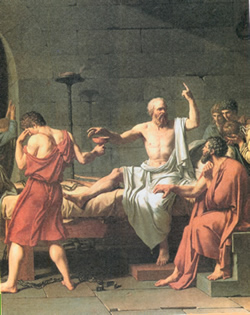 The Death of Socrates by David (detail)