THE WRITTEN WORD
Science and Spirituality
Paragraph references are specific to this digital edition.
Preface
The task of preparing teaching-learning material for value-oriented education is enormous.
There is, first, the idea that value-oriented education should be exploratory rather than prescriptive, and that the teaching-learning material should provide to the learners a growing experience of exploration.
Secondly, it is rightly contended that the proper inspiration to turn to value-orientation is provided by biographies, autobiographical accounts, personal anecdotes, epistles, short poems, stories of humour, stories of human interest, brief passages filled with pregnant meanings, reflective short essays written in well-chiselled language, plays, powerful accounts of historical events, statements of personal experiences of values in actual situations of life, and similar other statements of scientific, philosophical, artistic and literary expression.
Thirdly, we may take into account the contemporary fact that the entire world is moving rapidly towards the synthesis of the East and the West, and in that context, it seems obvious that our teaching-learning material should foster the gradual familiarisation of students with global themes of universal significance as also those that underline the importance of diversity in unity. This implies that the material should bring the students nearer to their cultural heritage, but also to the highest that is available in the cultural experiences of the world at large.
Fourthly, an attempt should be made to select from Indian and world history such examples that could illustrate the theme of the upward progress of humankind. The selected research material could be multi-sided, and it should be presented in such a way that teachers can make use of it in the manner and in the context that they need in specific situations that might obtain or that can be created in respect of the students.
The research team at the Sri Aurobindo International Institute of Educational Research (SAIIER) has attempted the creation of the relevant teaching-learning material, and they have decided to present the same in the form of monographs. The total number of these monographs will be around eighty to eighty-five.
It appears that there are three major powers that uplift life to higher and higher normative levels, and the value of these powers, if well illustrated, could be effectively conveyed to the learners for their upliftment. These powers are those of illumination, heroism and harmony.
It may be useful to explore the meanings of these terms-illumination, heroism and harmony-since the aim of these monographs is to provide material for a study of what is sought to be conveyed through these three terms. We offer here exploratory statements in regard to these three terms.
Illumination is that ignition of inner light in which meaning and value of substance and life-movement are seized, understood, comprehended, held, and possessed, stimulating and inspiring guided action and application and creativity culminating in joy, delight, even ecstasy. The width, depth and height of the light and vision determine the degrees of illumination, and when they reach the splendour and glory of synthesis and harmony, illumination ripens into wisdom. Wisdom, too, has varying degrees that can uncover powers of knowledge and action, which reveal unsuspected secrets and unimagined skills of art and craft of creativity and effectiveness.
Heroism is, essentially, inspired force and self-giving and sacrifice in the operations of will that is applied to the quest, realisation and triumph of meaning and value against the resistance of limitations and obstacles by means of courage, battle and adventure. There are degrees and heights of heroism determined by the intensity, persistence and vastness of sacrifice. Heroism attains the highest states of greatness and refinement when it is guided by the highest wisdom and inspired by the sense of service to the ends of justice and harmony, as well as when tasks are executed with consummate skill.
Harmony is a progressive state and action of synthesis and equilibrium generated by the creative force of joy and beauty and delight that combines and unites knowledge and peace and stability with will and action and growth and development. Without harmony, there is no perfection, even though there could be maximisation of one or more elements of our nature. When illumination and heroism join and engender relations of mutuality and unity, each is perfected by the other and creativity is endless.
To synthesize Science and Spirituality is a difficult task, although human heroism strives towards it, and as Sri Aurobindo and the Mother have shown, Spirit and Matter are in their essence one and can, in manifestation, be united and will be united. This synthesis is a journey of widening illumination, and their unity will be a supreme harmony, not only in the realm of knowledge but also in the realm of human fulfillment. The aim of this publication is to present citations from Sri Aurobindo and the Mother on the theme of Science and Spirituality, and it is hoped they will bring to the readers a fresh journey in the theme of unity of illumination, heroism and harmony.
Science and Materialism have come to be associated or even identified with each other; and even though Materialism as a philosophical system has largely come to be exiled, the methodology of Science which is invariably associated with measure and measurability imposes on Science dependence on knowledge derivable from physical senses; hence there is insistence on the physicality of the object of Scientific observation, experimentation and criteria of verifiability, repeatability and validity of knowledge.
Thus, to reconcile or synthesize Science with Spirituality appears to be an impossible task. However, the ideals of Spirituality, which are also ideals of human aspiration, are echoed by the recent dreams of Science. This coincidence provides a sound ground to consider whether as an interdisciplinary subject, scientists need to undertake an enquiry into or study the possible meeting point of Science and Spirituality, and whether the two need to meet each other as complements or in some degree of their complementarity.
Just as in Science, the theme of Superconductivity has come to be explored, even so, in the field of spirituality, the theme of Supramentality has come to be explored and it has even been suggested that with the increasing development of the Supramental Consciousness, and, consequently, with the development and projection of Supramental body, Science (with its demand for physical proof) can be synthesized with Spirituality or rather with Supramental Spirituality. Hence, it can be expected that Science and Spirituality can meet in a large system of a more comprehensive Science.
As a matter of fact, as a part of the experiment of human history, we stand today in the presence of the results of two great experiments, both in Europe and in India, which are both unsatisfactory and therefore in much need of uniting both of them together for existence for the individual and for the human race. As Sri Aurobindo states: “In Europe and in India, respectively, the negation of the materialist and the refusal of the ascetic have sought to assert themselves as the sole truth and to dominate the conception of Life. In India, if the result has been a great heaping up of the treasures of the Spirit,—or of some of them,—it has also been a great bankruptcy of Life; in Europe, the fullness of riches and the triumphant mastery of this world’s powers and possessions have progressed towards an equal bankruptcy in the things of the Spirit. Nor has the intellect, which sought the solution of all problems in the one term of Matter, found satisfaction in the answer that it has received.
Therefore the time grows ripe and the tendency of the world moves towards a new and comprehensive affirmation in thought and in inner and outer experience and to its corollary, a new and rich self-fulfilment in an integral human existence for the individual and for the race.”
Sri Aurobindo, The Life Divine - I: The Two Negations: The Materialist Denial
Introduction
Introduction - I
We may begin with a story. The story is symbolic and instructive. This story has been composed by The Mother in the form of a drama meant for meditation. The drama is entitled “The Great Secret”. It depicts the situation of the world of today through a story of a symbolic journey in a boat which is occupied by six passengers each one of whom represents leadership in one of the domains of world's life,—particularly, Science, Art, Athletics, Politics, Industry, Literature. Each one of them has striven his best in his field and attained considerable accomplishment. The dialogue is actually a monologue of each one of them meant for others in the boat, including one very important character, who is the seventh traveler, who is described as the Unknown Man.
They have been brought together, apparently by chance, in a lifeboat in which they have taken refuge when the ship that was carrying them to a world conference on human progress sank in mid-ocean. It is realized that water in the boat is running out; provisions have come to an end; death is approaching. To take their minds off their present miseries, each one of them tells the story of his life.
Symbolically, the drama wants to convey that the entire world is like that boat which is deadly perilous, and that all of us who are traveling in this world, are heading towards a complete ruin.
But
There is an Unknown Man,-man of wisdom, man of vision and a man who possesses the knowledge of the Supreme Secret. He is unshaken and he finds this situation to be opportune for revealing the Secret Knowledge. The Knowledge that he possesses is not merely theoretical; he knows that this world is not a chance, and there are inscrutable ways and means by which the destiny of man-kind is bound to be saved. He expounds briefly the secret knowledge and provides illumination to the passengers of the boat. At a critical point, he formulates a prayer, and all join in the prayer.
Suddenly,
Lo! Behold, a ship is seen on the horizon,-as it were from nowhere. And it reaches the boat closer and closer. The Unknown Man says slowly: “Here is salvation, here is new life!”
Of all the monologues, the most relevant monologue for our purpose is that of the Scientist (the full text of the monologue and of the full drama is given in the Appendix). But let us note down here the main points which he underlines in the monologue.
The Scientist recalls his early days, when he was full of enthusiasm for Science, and was inspired by what he calls the Postulates of Science,-Postulates that the world is knowable, that the world can be known with certainty, and that Science, by the power of its knowledge, can bring about the highest good of the world.
Gradually, however, the Scientist witnesses the progress of Science and one by one he finds that his postulates are shattered in the very process of the Progression of Science. A very interesting anecdote that he mentions in passing is connected with his inventiveness. He narrates his invention of producing atomic energy, not from Thorium, Uranium or Plutonium, but from the ordinary easily available metal, like aluminium and copper.
Let us quote his own words:
“I discovered the way to free atomic energy not only from uranium, thorium and some other rare metals, but from most of the common metals such as copper and aluminium. But then I was faced with a stupendous problem that strained me almost to breaking-point. Should I make known my discovery? To this day, no one knows this secret except me.
All of you know the story of the atom bomb. You know that it has been succeeded by an infinitely more destructive weapon, the hydrogen bomb. You also know as well as I do that humanity is staggering under the impact of these discoveries, which have placed in its hands an unequalled power of destruction. But if I now revealed my new discovery, if I unveiled my secret, I would place a diabolical power in the hands of just anybody.
And without any control or restriction... Uranium and thorium were easily monopolised by the governments, first on account of their relative scarcity, but mostly because of the difficulty of activating them in atomic piles. But you can well imagine what would happen if any criminal or crank or fanatic could in any make-shift laboratory put together a weapon capable of blowing up Paris, London or New York! Would that not be the finishing blow for humanity? I too have reeled under the weight of my discovery. I hesitated a long time and have not yet been able to come to any decision which satisfies both my reason and my heart.”
The Mother, On Education: The Great Secret
The above symbolic story is instructive, considering that the present world situation can be compared to that of the boat proceeding on its journey without any hope of survival or fulfillment of the dreams and aspirations of passengers like ourselves who are as inefficiently equipped as passengers in the symbolic story. But while the story avoids a tragic end on account of the appearance of a new ship of rescue, shall we be able to forecast a similar possibility of the rescue of the passengers of the sinking world-boat? Yes, if a Divine Body can come to be projected, that ship can rescue ‘us’ and fulfill our aspiration.
The scientist in the story is of course greatly justified in attributing to science a great disability as far as the cause of the good of the human kind is concerned. Should we not have a more equitable and impartial or cogent balance-sheet of Science? Let us, then, note that Science is an assertion of anti-obscurantism; it is the assertion of that higher part of the human being, which we call mental intelligence which can claim to have created such an edifice of Science that it can for the first time in human history defeat barbarism. In the earlier periods of history, whenever there was efflorescence of the rational, ethical or aesthetic cultures, there was victorious invasion of barbarism, as a result of which the great labour that had produced those cultures was reduced to dust. But, today, Science has equipped the civilized world, with such organizations of aggression and self-defense that they cannot be successfully utilized by any barbarous people unless they acquire Knowledge which only Science can give and the moment they acquire that knowledge, the barbarians can no more remain barbarians. The danger today therefore cannot be expected from any invasion of the barbarian people. For this Science merits to be applauded.
Again, let us affirm that two great qualities of the attainment of true knowledge-scientific or otherwise,-have been greatly affirmed and cultivated among larger portions of humanity. These two qualities are: impartiality in search of knowledge and ever-widening quest of knowledge. Science has taught that ignorance must be removed wherever it is found. It has thus enhanced the cause of education. If today, education is being promoted among nations for their own renewal, the reason must be found in the nurture of Science. It can truly be said that Science has enlarged the intellectual horizon of the human race; it has also contributed to the sharpening of the intellectual capacity of human kind.
Science may be regarded as the shining crest of this ignorant world; although human means of knowledge are limited and even though most work of the mind is accomplished through human senses, yet Science has loosened the chords of mind. Science has mapped the heavens and analysed the stars; it has even brought Space and Time in one continuum; it has sophisticated the concept of measure and measured the miles between suns in terms of light years; it has even probed into the length of time and wondered how and why time moves forward like an arrow; it has attempted to bring heaven nearer to the earth; it has even dug into the depths of the earth and extracted rich harvests from the dull brown soil. It has rendered Nature an open book for education for all, and it has sketched the tree of evolution placing each branch and twig and leaf in its own place. It has gone farther. Having detected plasm and cell and gene, the ancestry of man has been traced to its most ancient antiquity. The processes of birth and death have been delineated, even though one has yet to find out why one is born, and why one dies. It has even studied the idea of purpose and questioned whether ‘purpose’ is a purposeful quest. As a result of such advances in science, huge machinery has been erected, and having caught cosmic energy, engines have been made to pulsate. The seeming infinity and the seeming infinitesimal of the entire realm of matter has been studied as in a vast volume of innumerable pages. It is true that a few pages are still left, but science can have the privilege of presuming that even these last pages will not remain unread for long.
Science has studied Reason, not from the book of logic but from the operations of facts and processes; consequently it has both developed and questioned Reason, and by questioning Reason, it has opened the gates, although reluctantly, of that which lies below Reason and above Reason. It has reached the borderline where Science is obliged to run faster than what it has done so far.
A close study of the development of Science shows that Science is a manifestation of the dual operation of Reason. While one operation of Reason is dispassionate, the other is interested. In its dispassionate movement, Science pursues Truth for the sake of Truth and Knowledge for the sake of Knowledge. Through this operation, all that has been done is beyond reproach and this is the positive aspect of the balance-sheet. Difficulties arise when Science turns to its interested operations and tries to apply its discoveries and inventions to life-situations. There, it becomes a plaything of forces over which it has little control. That is why the balance-sheet of Science is a mixed one and in many respects, the negative aspects outweigh the positive ones. We can even tabulate the positives and the negatives as follows:
The balance-sheet of Science
(+)
1) Science has made discoveries which have served a practical humanitarianism.
2) It has made a gigantic efficiency of organization utilizable for the economic and social amelioration of the nations.
3) It has given rise to a large rationalistic altruism.
4) It has drawn mankind together and given it a new hope.
5) It has reduced or eliminated drudgery, pain and several diseases. It has advanced the causes of longevity. It has also encouraged the dream of practical immortality.
(—)
1) It has supplied monstrous weapons to egoism and mutual destruction.
2) It has placed the same efficiency of organization in the hands of national rivalries for mutual aggression, ruin and slaughter.
3) It has justified a Godless egoism, vitalism, and vulgar will to power and success.
4) It has crushed humankind with the burden of monstrous commercialism.
5) It has rendered human slavery to Machines and it has produced great fright of biological wars and ruin of environmental balance and extinction of several species including human species.
Can we stop at this stage? On the contrary, this is the appropriate place to begin the discussion of the issue more squarely. For, our aim is not to make balance-sheet of Science and its impact on Society. The issue may be stated as follows:
The advancement of Science is inevitable. Even the bombardment of Hiroshima and Nagasaki has not been able to prevent the advancement of Science. In any case, prevention of advancement of Science will be more injurious than we can think of it today. For, if Barbarism has resulted in the form of commercialism, prevention of scientific development will advance the cause of the invasion of barbarism. Therefore we must confront the issue of the contradiction between the actual and the ideal much more stringently.
The issue can be discussed on two alternative assumptions: (1) either the world is a chaos and anything can happen in the world without the necessity of explanation; but in that case, we warn that the concept of contradiction has no force in it or (2) the world can be examined rationally. In that case, a deeper question or explanation arises. A deeper question is: why is there or should there be a contradiction between the actual and the ideal?
And if we pursue this question, we shall find that Nature’s profoundest method of the development of its workings has as its part the direct opposition of the actual and ideal.
Is it not a fact that there is a direct opposition between Matter and Life? The character of Matter is that of inertia. The condition of its activity is inertia, while the very condition of activity of Life is pulsation and constant self-organized growth. Nature, in its development has accorded active life in the very Matter which is its direct opposite. Similarly, we find that Mind has developed in Life, and both Life and Mind appear to be in direct opposition to each other; for Mind has Consciousness and Conscious Will and Life is not overtly self-conscious at all. If this is the case, then, as Sri Aurobindo points out, the upward impulse of man towards the accordance of still higher opposites, Mind and Supermind, is not only rational in itself, but it is the only logical completion of a rule and an effort that seems to be a fundamental question of Nature and the very sense of our universal strivings.
Fortunately, Science itself has discovered evolution of Life in Matter and the evolution of Mind in Matter. And here, again, if we ask a question as to why Life should evolve in Matter, and Mind should evolve in Material Life, the only logical answer could be that Life must be already involved in Matter and Mind must be already involved in Life. If this reasoning is questioned, the only alternative would be that even out of nothing, anything and everything can become manifest, and we shall again go back to the irrational proposition that the world is a Chaos and that there could be anything in the world emerging out of whatever there may be or there may not be, and in that case, there could be no objection to the expectation of the fulfillment of the ideals which are so characteristic of human aspiration in human history. But the same expectation could be much more easily sustained, if the law of involution and evolution is accepted. We can then expect emergence of Supermind in the Mind.
Let us, then, come back to the question of the advancement of Science and resultant barbarism in the form of commercialism and ask as to how we can combat this consequence and work out actualization of the ideals that are imperative ideals of human aspiration.
Apart from the peril of commercialism, the essential knot of the contemporary crisis rests in the disequilibrium of its evolutionary development. In certain directions the human mind has acquired enormous development, but in others it stands arrested and bewildered. External life has been provided with huge structures, but internal life has remained depressed and deprived of its nourishment. The system of civilization has become too big for the limited mental capacity, and the moral and spiritual capacities are found inadequate for dealing with the immense complexity and huge problems of management. Globality of structure demands globality in human consciousness. Comprehensiveness of vision and capacity is imperatively needed, and the petty human egoism does not know how to abdicate its rule and give way to whole-being, whole-knowledge and whole-power.
The solutions that have been suggested have not worked, since they have relied upon machinery by which collectivity can control the individual. Even when freedom of the individual is sought to be ensured, still methods such as better information, and education are contemplated in terms of mechanization and externalization. We are witnessing their failure.
The age of reason which has dominated the contemporary world has worked itself out in great amplitude, complexity and subtlety, and in all its branches of its movements,—in science, philosophy, ethics, economics, politics,—there is now a clear acknowledgement of the inexplicable rule of Uncontrollable Unreason. When the rational ideal of Liberty is sought to be realised, the rational ideal of Equality gets strangulated, and when Equality is sought to be established, Liberty is required to be sacrificed; and the rational ideal of Fraternity or Harmony has not been given the requisite opportunity of experimentation. Indeed, it is clearly realised that Fraternity is much deeper for any system and mechanical device. It issues directly from Spirit, and it is only by Spiritual means and by inward change of human consciousness that Fraternity and its cognate ideals of Unity and Harmony can be realised.
In this context, however, there is a great possibility of the human mind to seek refuge in a return to the rule of religion. But although religion, in its higher flights arrives at Spirituality, it collides sharply in its initial steps with Science and Freedom of critical thought, and it fails to answer the variety of spiritual needs when it is sought to be applied to collective life.
As Sri Aurobindo points out, it is only by transcending barriers of Religions and even of exclusive Spiritual systems that the needed change and transformation of human consciousness can be attained. In His own words: “ It is only the full emergence of the soul, the full descent of the native light and power of the Spirit and the consequent replacement or transformation and uplifting of our insufficient mental and vital nature by a spiritual and supramental Supernature that can effect this evolutionary miracle.’’ Sri Aurobindo, The Life Divine - II: The Divine Life
Fortunately, today, the highest dreams of Science echo the very achievements that the Supramental consciousness can fructify. It is this meeting of Science and Supramental Spirituality that can ensure the highest welfare of humanity.
Introduction - II
During the long period of scientific development, there have been several variations in the concept of Science. The Greeks looked upon the universe out of curiosity and sense of wonder. The ancient Greek Scientists found that there is some kind of inner order, harmony and system in the universe. It is that harmony which they tried to capture in their scientific account of the universe. Aristotle refined this Greek view and provided to the human thought a first system of logical thought, and based upon his own studies of various branches of Knowledge, formulated a system of derivation of particulars from the universals and of universals from particulars. Certain rules of logic were illustrated in the mathematical sciences; Syllogistic reasoning was described by him in detail, and what he formulated remained unchallenged until symbolic logic was developed in the 20th century.
As distinguished from deductive logic, empirical observation of particular instances was the basis of empirical sciences,—like Physics & Biology. A great importance was assigned to the uniformity of Nature and law of causation. In due course of time, when Renaissance began to sweep over Europe, induction came to be developed in detail. The distinguishing mark of inductive logic, which provides a structure to scientific inquiry has three important elements:
1) accurate, impartial observation of particular instances, devoid of fallacies of Non-observation and mal-observation;
2) inductive leap leading to the formulation of a hypothesis which could explain in the scheme of universality the occurrences of the observed empirical instances;
3) arrival at a general conclusion by reference to crucial instances which alone could be explained by the hypothesis and which would satisfy the law of universality of Nature and the law of causation.
What was of great significance in regard to the Greek scientific thought was that it endeavoured to discover order, harmony and beauty in the world that is spread out before us. Of greater significance was the tacit view that there is meaning and purpose in the world. This is what we see in Aristotle’s view of causation, where he conceived of causation as fourfold. It not only underlines the relationship of antecedent and the consequent, but it requires us to look for material causation, formal causation, efficient causation and final causation. By final causation, Aristotle brings in the Greek concept of Teleology. To the Greeks, the ultimate cause of the order and system in the world is the purpose or goal which is sought after by all that is.
Another important point that Aristotle underlines is the idea of necessity. The Greek science looked for necessary connections. In other words, logical connections came to be considered as necessary connections. And the Greek sense of wonder of the world was to watch and witness the necessary connections in logical thought corresponding to factual connections in the empirical world. Hence, there arose in Greek Science the concept of Universal Laws, where a law implies necessary and inevitable universality of movements of phenomena.
When after the eclipse of science in Europe during the middle ages where faith and religious belief reigned supreme, a new phase in Western history swept over the entire Europe by the Renaissance, the Greek concept of Science came to be studied, acknowledged and pursued. However, even though in the beginning, scientists endeavoured to look for system and chain of causality in the world, and the rule of necessity and sweep of inevitable working of laws, there came about a fundamental drift towards empiricism and questioning of the rationalist view of Reason. It was in the philosophy of Hume that empiricism arrived at a climactical point. He questioned the law of causality and he questioned also the view that truth of logical thought and truth of empirical world is governed by necessary connections.
From the time of Hume onwards, science seems to have taken a decisive turning-point. Induction, which is the very heart of empirical sciences has come to be afflicted with the question of its very foundations. Can induction be empirically proved? And even till today, this question has been perplexing the entire realm of scientific thought. How is it possible to make inductive leap from particulars to universals, if the law of causation is empirically not verifiable?
Bertrand Russell had attempted to find the logic of empirical atomism, but could never find it. He had hoped to find empirical proof of empiricism, but he could never find it.
Modern science is still a rippling wave, and one is not yet sure whether to support the law of necessity or to acknowledge freak and fantasy in the world. Is the world Chaos and work of Chance, or else what is to be done in regard to the necessary connections and mechanical necessity that are found so impelling in the world?
Sri Aurobindo has summarized this hesitation of modern science by formulating what Science of today could put forward as a theory of explanation in terms of a self-organizing chance,-indeed, a paradox but it is necessitated by the appearance of the inevitable order on one side and of unaccountable freak and fantasy on the other side of the cosmic phenomenon, we call Nature.
He expounds this explanation as follows:
“An inconscient and inconsequent Force, we may say, that acts at random and creates this or that by a general chance without any determining principle-determinations coming in only as the result of a persistent repetition of the same rhythm of action and succeeding because only this repetitive rhythm could succeed in keeping things in being,-this is the energy of Nature. But this implies that somewhere in the origin of things there is a boundless Possibility or a womb of innumerable possibilities that are manifested out of it by the original Energy,-an incalculable Inconscient which we find some embarrassment in calling either an Existence or a Non-Existence; for without some such origin and basis the appearance and the action of the Energy is unintelligible. Yet an opposite aspect of the nature as the cosmic phenomenon as we see it appears to forbid the theory of a random action generating a persistent order. There is too much of an iron insistence on order, on a law basing the possibilities. One would be justified rather in supposing that there is an inherent Imperative Truth of things unseen by us, but a Truth capable of manifold manifestation, throwing out a multitude of possibilities and variants of itself which the creative Energy by its action turns into so many realised actualities. This brings us to a second explanation,-a mechanical necessity in things, its workings recognizable by us as so many mechanical laws of Nature;-the necessity, we might say, of some such Secret inherent Truth of things as we have supposed, governing automatically the processes we observe in action in the universe. But a theory of mechanical Necessity by itself does not elucidate the free play of the endless unaccountable variations which are visible in the evolution: there must be behind the Necessity or in it a law of unity associated with a co-existent but dependent law of multiplicity, both insisting on manifestation;...”
Sri Aurobindo, The Life Divine - I: Indeterminates, Cosmic Determinations and the Indeterminable
It is obvious that when the argument is explicitly stated this way, one would wonder if that argument can properly be called an explanation... For Chance itself admits its own irrationality and if Science is to be rational, it cannot take recourse to irrationality.
But it may be argued that Science does not aim at explanation but only at description. This is the reason why several modern Scientists describe Science and even Philosophy as descriptive. This is obviously a path of escape. For the demand for explanation is inherent in Reason and the existence of Reason is irrefutable, since refutation itself would require the process of reasoning.
It may, however, be argued that there is nothing surprising if in a chaotic world of Chance, Reason can arise, simply, by Chance. But that does not affect the consistency of the theory of Chance. The only argument against this entire edifice is that there could be several alternative reasonable and rational explanations of the universe, and therefore Chance theory is not the only and inevitable theory of explanation or of description.
It is clear that Science has to confront its own underlying limitations which lead us to unacceptable and irrational situations which are fortunately being combated in recent times by the theory of critical rationality. However, the post-modernist tendency is to overpass the demands of critical rationality and to conclude that there is, in fact, no such thing as Truth or meaning. This, we may say, is the negation of Science. To start with Science, and to come to a conclusion to deny Science is the absurdity of the Post-modernist thought.
There is something fundamentally wrong in one of the basic premises of empiricism, and that is, we might suggest, the rigid and dogmatic underpinning of the theory of materialism.
Introduction - III
Materialism as a tendency of thought or as a system of Philosophy, is as ancient as ancient India and ancient Greece. It is, in any case, inherent in a layer of intellect,-the layer of material intellect,-and therefore its appeal is immediate, and it is capable of immediate success. The evidence on which Materialism thrives is as easy as kicking of a football,-so concrete, so palpable, and seemingly self-evident or naturally obvious.
Even in modern times, Materialism has played a role even when rationalistic idealism was prominent. But with the great success of physical Science, Materialism has become dominant, and although as a system of philosophy, it has survived mainly in dialectical Materialism of Marx, yet, it has occupied both Philosophy of Science and Philosophy in general on the strength of its premise of epistemology.
The epistemological premise is that our sense organs are the only instruments of knowledge and that Reason, even in its highest flights cannot escape the hold of sense organs. This premise, if examined properly, will be found to be arbitrary, since, while it is true that sense organs are means of Knowledge, there is no proof that they are the only means of Knowledge. The argument that is put forward is that sense organs are the only means because Matter is the only reality. This reasoning will be seen to be circular, since the proof that Matter is the only reality is sought to be supported by its epistemology, and the epistemology is sought to be proved by the sweeping philosophical statement that Matter is the only reality. The argument is therefore fallacious and commits the fallacy of petitio principii. The statement that matter is reality can easily be established by appeal to the evidence of Matter that we see, but in no empirical perception can we affirm that Matter is the only reality. In any case, as soon as we begin to examine the phenomena of mental and supramental operations, the entire edifice of Materialism collapses.
Nonetheless, Materialism has played a salutary role in combating exaggerated claims of many who claimed to have supraphysical experiences but who are only wandering in cloudy regions of imagination. The insistence of Materialism and its epistemology to test every claim on rigorous evidence of experience is a sound preparation for establishing the claims of supraphysical and spiritual experiences. In our times, therefore, spirituality is required to establish itself on the grounds not only of philosophical thought but also on the evidence of renewable and verifiable experience.
It has, however, been claimed by critical rationalism that even evidence of spiritual experience needs to be interpreted and that this interpretation will have to satisfy a number of conditions such as objectivity, universality and its power of explanation. Actually, even this argument of critical rationalism is combated by a number of philosophers of Science who reject the concept of Universality and advocate that the concept of explanation is unnecessary for philosophy and science.
In fact, we find that epistemology of modern science has continued to put forward such paradigms that ultimately only the Knowledge gained through sense experience can stand as a legitimate item for consideration of the claim of Knowledge. The most recent paradigm which has been put forward by Karl Popper is that of falsifiability which makes all claims of Knowledge extremely vulnerable, and it is in that context that the claims of spiritual knowledge are made to stand in an apologetic position. But this need not be necessary, if we study Spirituality scientifically-that is, through the Science of Yoga, which has its own accumulated experience and criteria of verifiability and repeatability, as also of objectivity.
Introduction - IV
The underlying argument of this compilation of citations from the works of Sri Aurobindo and The Mother may be formulated as follows:
(a) The world as we see it, and as it has been revealed by Science, presents a number of perplexities, and in an attempt to explain it we are led to develop a possible theory of “Self-Organizing Dynamic Chance”. This is evidently a paradox, but it is necessitated by the rule of Necessity and order that we see so insistently in the world, even though there is undeniably a play of freak and fantasy and random action.
At the present level of the advancement of Science, this theory is unable to explain two important issues:
1) What is Mind, which is radically different from the Energy that produced it? Again, why is Mind able to impose its idea of order on the world and why is it that that idea of order is able to be responded to a large extent?
2) How has the original Energy which is Inconscient been able to produce Mind with its conscious power of Reason?
It may, of course be replied that all this has happened by Chance, but this reply can have no obligatory force, since by definition Chance eliminates any necessity or obligation.
Therefore, it is possible to explore alternative explanations which regard consciousness as the originating force of creation. The difficulty of this hypothesis is that it is often put forward as that of an extra-cosmic God as the creator of this world. And the retort is that God could have thought of creating a better world, and the best thought of all would have been to refrain from creating an unhappy and unintelligible world.
But this argument could have no ground, if the creator is conceived not only as extra-cosmic but also as immanent in the world casting himself in the finite possibilities and in the form of an evolving cosmic order. Under this new hypothesis, it is possible, as suggested by Sri Aurobindo, to explain all the perplexing and unexplained phenomena of the world including those of physiological functioning of the body.
But even then, it may be argued that the explanation is only speculative and what is needed further is experiential evidence for furnishing scientific proof of this hypothesis.
This experiential proof can be obtained from the Science of Yoga, which is the Science of Consciousness and Spirituality. Sri Aurobindo takes us, therefore, through the journey of development of yogic consciousness rising from the experience of the silent mind to the witness self, and then to the overmind where, too, final proof of the creative process remains undecided. It is, as pointed out by Sri Aurobindo, in a Supramental Cognition that we are left to seek for the answer. Sri Aurobindo defines Supermind as Truth-Consciousness which is at once the self-awareness of the infinite and the eternal and a power of self-determination inherent in that self-awareness. Sri Aurobindo traces the entire world creation to the original self-determining operations of the Supermind and provides an experiential proof of Supramental consciousness as the creator of the Universe and of all its diverse phenomena.
(a) It will be seen that the novelty of Sri Aurobindo’s approach to the problem of perplexing phenomena of the universe is not only to detect the operations of consciousness in some of the material phenomena, including those at their quantum level as is done often by a number of contemporary thinkers, scientists and philosophers, but to explore various faculties of knowledge as also various grades of consciousness, by means of yogic methods that satisfy the conditions of verifiability, repeatability and even of falsifiability. This approach shows not only rigor of disciplined methodology but also scrupulous thoroughness. And in doing so, Sri Aurobindo has provided a clear distinction between spirituality and religion and shows that the issue is not that of the synthesis of Science and Religion, but that of Science and Spirituality. Further, he has also shown that the synthesis in order to be satisfying can be accomplished only if in the yogic process we overpass various levels of mind including Overmind and arrive at Supermind.
Indeed, mind, Overmind, Supermind and the operations of these levels of consciousness as of the still higher levels of consciousness are Supraphysical, and Sri Aurobindo presents us detailed arguments that enable us to surpass the hold of the world of matter and enter with the required vigour of the strictness of verifiable knowledge of the realms of the Supraphysical worlds.
(b) But Sri Aurobindo goes farther. Not only do we have in the works of Sri Aurobindo and also in those of the Mother, the rigorous drive toward the synthesis of Science and Supramental Spirituality in speculative terms and in experiential terms. There is also a further drive towards experimental inventiveness. And this is what we see in a conversation of the Mother that is reported in an extract given in the compilation on the problem of Science and Spirituality. She points out refreshingly that the synthesis lies in a third position,-above Science and Spirituality, and for that purpose, there is a need to MAKE something, that She was engaged in MAKING or FABRICATING. For Sri Aurobindo and the Mother are seen as the pioneers of evolution as a result of which the Divine Body can be projected on the earth,-a body in which Spirit and Matter are synthesized under the primacy and authority of the Spirit.
(c) In this compilation, therefore, we find relevant portions of Sri Aurobindo’s breath-taking concept of the Divine Body as also a glimpse of the experiments made by the Mother to fix the Supermind in the cells of the human body. The Mother had two visions of the Divine Body in the process of its formation.
(d) Actualization of the Divine Body would be the final and concrete proof of the synthesis of Science and Spirituality, but, as can been seen through passages cited in the compilation, enough work has been accomplished and we can all feel invited to collaborate in the endeavour that can lead to the projection of the Divine Body.
As in every Scientific endeavour, progress is achieved by accumulation of experience and knowledge by collaborative efforts of the groups of collectivity, even so here in the task of the projection of the Divine Body, collective participation is indispensable, and we can look forward to a veritable synthesis of Science and Spirituality or rather of Supramental Spirituality by means of greater collaboration from all forward looking Scientists of Matter and Scientists of Spirit.
A Brief Life-Sketch of Sri Aurobindo and the Mother
Sri Aurobindo was born on the 15th August, 1872 at Calcutta. At an early age of seven, he was taken along with his elder brothers to England for education, since his father wanted him to have no Indian influence in the shaping of his outlook and personality. And yet, even though Sri Aurobindo assimilated in himself richly the best of the European culture, he returned to India in 1893 with a burning aspiration to work for the liberation of India from foreign rule. While in England, Sri Aurobindo passed the I.C.S. Examination, and yet he felt no call for it; so he got himself disqualified by remaining absent from the riding test. The Gaekwar of Baroda happened to be there at that time, and Sri Aurobindo accepted the proposal to be his Personal Secretary, and returned to India.
Soon thereafter, however, Sri Aurobindo switched over to the Baroda College as Professor of French and then of English, and when in 1906, he left for Bengal, he was the acting Principal of the College. It was during the Baroda period that Sri Aurobindo assimilated in himself the spirit and culture of India and prepared himself for his future political and spiritual work. Indeed, his political work had already begun in Baroda, but it was behind the scenes, largely of the nature of a preparation for an armed revolution for the liberation of India.
Sri Aurobindo was the first among the Indian leaders to declare and work for the aim of complete Independence of India. In 1905, Bengal was divided, and Sri Aurobindo left Baroda and, invited by the nationalistic leaders, he joined at Calcutta the newly started National College as its first Principal. It was here that Sri Aurobindo, while working secretly for the revolution, chalked out also a plan of outer action. This plan consisted of the programme of passive resistance, Boycott and Swadeshi, which was later adopted as the policy of the struggle for freedom. It was here again that Sri Aurobindo wrote powerfully and boldly for Bande Mataram, and later for Karma Yogin; through his writings, he electrified the nation and surcharged the people with a new energy which ultimately led the nation to her freedom. It was, therefore, significant that when India attained her liberation in 1947, it was on the 15th August, the birthday of Sri Aurobindo.
The pioneering work that Sri Aurobindo did for the liberation of India was evidently a part of his larger work for the entire humanity and for the whole earth. For him, the liberation of India was an indispensable part of the new world-order. Moreover, the practice of Yoga, which he had started in 1902, led him, even while in the thick of intense political and literary activity, to major realizations of the Brahmic Silence, Nirvana, and also of the universal dynamic Presence of the Divine. And, in 1908, when he was in Alipore jail during his trial under the charge of sedition, he received through numerous experiences and realizations the assurance of the liberation of the country and also the knowledge of the initial lines on which his own future work was to proceed. For he saw that even in the field of Yoga something was still lacking, something radical that alone would help resolve the problems of the world and would lead mankind to its next evolutionary stage. And so, in 1910, soon after his acquittal from the jail, he withdrew to Pondicherry to concentrate upon this new research work, to hew a new path. It has been a most dynamic work with the entire earth as its central field. It was in the course of this work that Sri Aurobindo declared that the Supramental is the Truth and that its advent on the earth is inevitable. To bring down the Supramental consciousness and power on the earth has been the central work of Sri Aurobindo.
Sri Aurobindo has explained the nature of this work, the nature of the Supermind, the necessity of its descent, the process of this descent and the dynamic consequences of this descent for the solutions of the problems of the mankind, in his voluminous writings, most of which were written serially in the philosophical monthly, “Arya”, which was started in 1914, immediately after the first arrival of the Mother from France to Pondicherry. Some of the most important of these and other writings are: The Life Divine, The Synthesis of Yoga, The Ideal of Human Unity, The Human Cycle, The Foundations of Indian Culture, Essays on the Gita, On the Veda, The Upanishads, The Future Poetry.
The Mother, Mirra Alfassa, was born in Paris on 21 February 1878 in a very materialistic, well-to-do family. A pupil at the Academie Julian, she completed a thorough education in music, painting and higher mathematics and became an accomplished artist.
Concerning her early spiritual life, the Mother has said: “Between 11 and 13 a series of psychic and spiritual experiences revealed to me not only the existence of God but man’s possibility of uniting with Him, of realising Him integrally in consciousness and action, of manifesting Him upon earth in a life divine.” Around 1905 the Mother journeyed to Tlemcen, Algeria, where she studied occultism for two years with a Polish or Russian adept, Max Theon, and his wife. Her primary interest, however, was spiritual development. In Paris she founded a group of spiritual seekers and gave talks to various groups.
In 1914 the Mother voyaged to Pondicherry to meet Sri Aurobindo, whom she at once recognised as the one who for many years had inwardly guided her spiritual development. The Mother had already by then attained to the Supramental Consciousness. Her question was whether the Supermind can descend on the earth. When she put this question to Him, Sri Aurobindo replied: “Yes”. And the Mother at once noticed Sri Aurobindo’s power of realizing what He willed. It was from that moment that Sri Aurobindo and The Mother joined together in the task of the descent of Supermind on the earth.
After a stay of eleven months, she was obliged to return to France due to the outbreak of the First World War. A year later she went to Japan for a period of four years. In April 1920 the Mother returned to Pondicherry to work with Sri Aurobindo.
In 1926, when Sri Aurobindo entered into a new phase of work for concentration on the work of the Descent of the Supermind on the earth, the Mother collaborated with the task of the descent, and also organized and developed his Ashram.
Under her guidance, which continued for nearly fifty years, the Ashram grew into a large, many-faceted spiritual community.
In 1943, a school for the education of children was founded, and after the passing of Sri Aurobindo in 1950, the Mother developed that school into an International University Centre, where numerous original and bold experiments of education were carried out under Her guidance. This educational work was a part of the Supramental Yoga, and we have rare insights into education and yoga in the volumes entitled Questions and Answers, which contain conversations of the Mother that took place in Her classes. In 1958, the Mother entered into a new phase in order to concentrate on the yoga of the body, and the supramental transformation of the physical consciousness at the cellular level. In 1968, the Mother founded Auroville, an International city as a collective field for the material and spiritual researches required for realizing human unity as a part of the Supramental action on the earth.
The Mother’s exploration into the body-consciousness and her discovery of a ‘cellular mind’ capable of restructuring the nature of the body is contained in a document of more than 6000 pages, published in 13 volumes. This is L’Agenda de Mere (Mother’s Agenda), an account of her extraordinary exploration narrated by the Mother to Satprem (a French disciple) covering a period of more than twenty years, during which the Mother slowly uncovered the ‘Great Passage’ to the next species by the Supramental transformation of the physical consciousness and fulfilled the work that Sri Aurobindo had given to her, namely, that of fixing Supramental consciousness in the mind of the cells of the material body.
The Mother left her body on 17 November 1973.
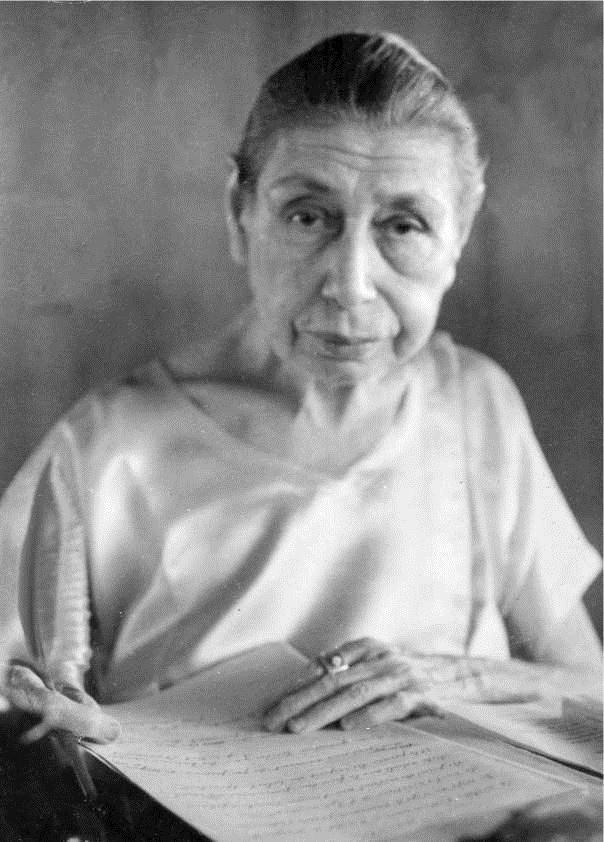
The Mother
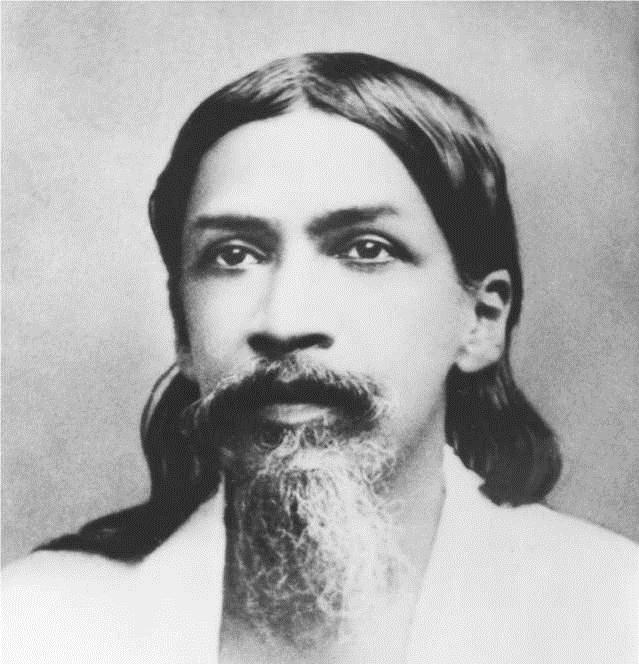
Sri Aurobindo
Ideals of Human Aspiration are echoed by the latest dreams of Science
Ideals of Human Aspiration
The earliest formula of Wisdom promises to be its last, — God, Light, Freedom, Immortality.
… To know, possess and be the divine being in an animal and egoistic consciousness, to convert our twilit or obscure physical mentality into the plenary supramental illumination, to build peace and a self-existent bliss where there is only a stress of transitory satisfactions besieged by physical pain and emotional suffering, to establish an infinite freedom in a world which presents itself as a group of mechanical necessities, to discover and realise the immortal life in a body subjected to death and constant mutation,— this is offered to us as the manifestation of God in Matter and the goal of Nature in her terrestrial evolution.
Sri Aurobindo, The Life Divine - I: The Human Aspiration
Ideal Aims that Science is seeking to fulfill
In fact, we do pursue as an ideal, so far as we may, the elimination of all these negative or adverse phenomena. We seek constantly to minimise the causes of error, pain and suffering. Science, as its knowledge increases, dreams of regulating birth and of indefinitely prolonging life, if not of effecting the entire conquest of death. But because we envisage only external or secondary causes, we can only think of removing them to a distance and not of eliminating the actual roots of that against which we struggle. And we are thus limited because we strive towards secondary perceptions and not towards root-knowledge, because we know processes of things, but not their essence. We thus arrive at a more powerful manipulation of circumstances, but not at essential control. But if we could grasp the essential nature and the essential cause of error, suffering and death, we might hope to arrive at a mastery over them which should be not relative but entire. We might hope even to eliminate them altogether and justify the dominant instinct of our nature by the conquest of that absolute good, bliss, knowledge and immortality which our intuitions perceive as the true and ultimate condition of the human being.
Sri Aurobindo, The Life Divine - I: The Ego and the Dualities
Part I: Data for Science and Theory of Self-Organizing Dynamic Chance
I.1. Data for Science
Actually to our Science this infinite or indeterminate Existence reveals itself as an Energy, known not by itself but by its works, which throws up in its motion waves of energism and in them a multitude of infinitesimals; these, grouping themselves to form larger infinitesimals, become a basis for all the creations of the Energy, even those farthest away from the material basis, for the emergence of a world of organised Matter, for the emergence of Life, for the emergence of Consciousness, for all the still unexplained activities of evolutionary Nature. On the original process are erected a multitude of processes which we can observe, follow, can take advantage of many of them, utilise; but they are none of them, fundamentally, explicable. We know now that different groupings and a varying number of electric infinitesimals can produce or serve as the constituent occasion—miscalled the cause, for here there seems to be only a necessary antecedent condition—for the appearance of larger atomic infinitesimals of different natures, qualities, powers; but we fail to discover how these different dispositions can come to constitute these different atoms,—how the differentiae in the constituent occasion or cause necessitate the differentiae in the constituted outcome or result. We know also that certain combinations of certain invisible atomic infinitesimals produce or occasion new and visible determinations quite different in nature, quality and power from the constituent infinitesimals; but we fail to discover, for instance, how a fixed formula for the combination of oxygen and hydrogen comes to determine the appearance of water which is evidently something more than a combination of gases, a new creation, a new form of substance, a material manifestation of a quite new character. We see that a seed develops into a tree, we follow the line of the process of production and we utilise it; but we do not discover how a tree can grow out of a seed, how the life and form of the tree come to be implied in the substance or energy of the seed or, if that be rather the fact, how the seed can develop into a tree. We know that genes and chromosomes are the cause of hereditary transmissions, not only of physical but of psychological variations; but we do not discover how psychological characteristics can be contained and transmitted in this inconscient material vehicle. We do not see or know, but it is expounded to us as a cogent account of Nature-process, that a play of electrons, of atoms and their resultant molecules, of cells, glands, chemical secretions and physiological processes manages by their activity on the nerves and brain of a Shakespeare or a Plato to produce or could be perhaps the dynamic occasion for the production of a Hamlet or a Symposium or a Republic; but we fail to discover or appreciate how such material movements could have composed or necessitated the composition of these highest points of thought and literature: the divergence here of the determinants and the determination becomes so wide that we are no longer able to follow the process, much less understand or utilise. These formulae of Science may be pragmatically correct and infallible, they may govern the practical how of Nature’s processes, but they do not disclose the intrinsic how or why; rather they have the air of the formulae of a cosmic Magician, precise, irresistible, automatically successful each in its field, but their rationale is fundamentally unintelligible.
There is more to perplex us; for we see the original indeterminate Energy throwing out general determinates of itself,—we might equally in their relation to the variety of their products call them generic indeterminates,—with their appropriate states of substance and determined forms of that substance: the latter are numerous, sometimes innumerable variations on the substance-energy which is their base: but none of these variations seems to be predetermined by anything in the nature of the general indeterminate. An electric Energy produces positive, negative, neutral forms of itself, forms that are at once waves and particles; a gaseous state of energy-substance produces a considerable number of different gases; a solid state of energy substance from which results the earth principle develops into different forms of earth and rock of many kinds and numerous minerals and metals; a life principle produces its vegetable kingdom teeming with a countless foison of quite different plants, trees, flowers; a principle of animal life produces an enormous variety of genus, species, individual variations: so it proceeds into human life and mind and its mind-types towards the still unwritten end or perhaps the yet occult sequel of that unfinished evolutionary chapter. Throughout there is the constant rule of a general sameness in the original determinate and, subject to this substantial sameness of basic substance and nature, a profuse variation in the generic and individual determinates; an identical law obtains of sameness or similarity in the genus or species with numerous variations often meticulously minute in the individual. But we do not find anything in any general or generic determinate necessitating the variant determinations that result from it. A necessity of immutable sameness at the base, of free and unaccountable variations on the surface seems to be the law; but who or what necessitates or determines? What is the rationale of the determination, what is its original truth or its significance? What compels or impels this exuberant play of varying possibilities which seem to have no aim or meaning unless it be the beauty or delight of creation? A Mind, a seeking and curious inventive Thought, a hidden determining Will might be there, but there is no trace of it in the first and fundamental appearance of material Nature.
Sri Aurobindo, The Life Divine - I: Indeterminates, Cosmic Determinations and the Indeterminable
I.2 Theory of Self-Organising Dynamic Chance
A first possible explanation points to a self-organising dynamic Chance that is at work,—a paradox necessitated by the appearance of inevitable order on one side, of unaccountable freak and fantasy on the other side of the cosmic phenomenon we call Nature. An inconscient and inconsequent Force, we may say, that acts at random and creates this or that by a general chance without any determining principle,—determinations coming in only as the result of a persistent repetition of the same rhythm of action and succeeding because only this repetitive rhythm could succeed in keeping things in being,—this is the energy of Nature. But this implies that somewhere in the origin of things there is a boundless Possibility or a womb of innumerable possibilities that are manifested out of it by the original Energy,—an incalculable Inconscient which we find some embarrassment in calling either an Existence or a Non-Existence; for without some such origin and basis the appearance and the action of the Energy is unintelligible. Yet an opposite aspect of the nature of the cosmic phenomenon as we see it appears to forbid the theory of a random action generating a persistent order. There is too much of an iron insistence on order, on a law basing the possibilities. One would be justified rather in supposing that there is an inherent imperative Truth of things unseen by us, but a Truth capable of manifold manifestation, throwing out a multitude of possibilities and variants of itself which the creative Energy by its action turns into so many realised actualities. This brings us to a second explanation—a mechanical necessity in things, its workings recognisable by us as so many mechanical laws of Nature;—the necessity, we might say, of some such secret inherent Truth of things as we have supposed, governing automatically the processes we observe in action in the universe. But a theory of mechanical Necessity by itself does not elucidate the free play of the endless unaccountable variations which are visible in the evolution: there must be behind the Necessity or in it a law of unity associated with a coexistent but dependent law of multiplicity, both insisting on manifestation; but the unity of what, the multiplicity of what? Mechanical Necessity can give no answer. Again the emergence of consciousness out of the Inconscient is a stumbling-block in the way of this theory; for it is a phenomenon which can have no place in an all-pervading truth of inconscient mechanical Necessity. If there is a necessity which compels the emergence, it can be only this, that there is already a consciousness concealed in the Inconscient, waiting for evolution and when all is ready breaking out from its prison of apparent Nescience. We may indeed get rid of the difficulty of the imperative order of things by supposing that it does not exist, that determinism in Nature is imposed on it by our thought which needs such an imperative order to enable it to deal with its surroundings, but in reality there is no such thing; there is only a Force experimenting in a random action of infinitesimals which build up in their general results different determinations by a repetitive persistence operative in the sum of their action; thus we go back from Necessity to Chance as the basis of our existence. But what then is this Mind, this Consciousness which differs so radically from the Energy that produced it that for its action it has to impose its idea and need of order on the world she has made and in which it is obliged to live? There would then be the double contradiction of consciousness emerging from a fundamental Inconscience and of a Mind of order and reason manifesting as the brilliant final consequence of a world created by inconscient Chance. These things may be possible, but they need a better explanation than any yet given before we can accord to them our acceptance.
This opens the way for other explanations which make Consciousness the creator of this world out of an apparent original Inconscience.
Sri Aurobindo, The Life Divine - I: Indeterminates, Cosmic Determinations and the Indeterminable
I.3. The Tide of Increasing Knowledge: Evidence of Consciousness
... The world of Matter is affirmed by the experience of the physical senses which, because they are themselves unable to perceive anything immaterial or not organised as gross Matter, would persuade us that the suprasensible is the unreal. This vulgar or rustic error of our corporeal organs does not gain in validity by being promoted into the domain of philosophical reasoning. Obviously, their pretension is unfounded. Even in the world of Matter there are existences of which the physical senses are incapable of taking cognisance. Yet the denial of the suprasensible as necessarily an illusion or a hallucination depends on this constant sensuous association of the real with the materially perceptible, which is itself a hallucination. Assuming throughout what it seeks to establish, it has the vice of the argument in a circle and can have no validity for an impartial reasoning.
Not only are there physical realities which are suprasensible, but, if evidence and experience are at all a test of truth, there are also senses which are supraphysical1 and can not only take cognisance of the realities of the material world without the aid of the corporeal sense-organs, but can bring us into contact with other realities, supraphysical and belonging to another world—included, that is to say, in an organisation of conscious experiences that are dependent on some other principle than the gross Matter of which our suns and earths seem to be made.
Constantly asserted by human experience and belief since the origins of thought, this truth, now that the necessity of an exclusive preoccupation with the secrets of the material world no longer exists, begins to be justified by new-born forms of scientific research. The increasing evidences, of which only the most obvious and outward are established under the name of telepathy with its cognate phenomena, cannot long be resisted except by minds shut up in the brilliant shell of the past, by intellects limited in spite of their acuteness through the limitation of their field of experience and inquiry, or by those who confuse enlightenment and reason with the faithful repetition of the formulas left to us from a bygone century and the jealous conservation of dead or dying intellectual dogmas.
It is true that the glimpse of supraphysical realities acquired by methodical research has been imperfect and is yet ill-affirmed; for the methods used are still crude and defective. But these rediscovered subtle senses have at least been found to be true witnesses to physical facts beyond the range of the corporeal organs. There is no justification, then, for scouting them as false witnesses when they testify to supraphysical facts beyond the domain of the material organisation of consciousness. Like all evidence, like the evidence of the physical senses themselves, their testimony has to be controlled, scrutinised and arranged by the reason, rightly translated and rightly related, and their field, laws and processes determined. But the truth of great ranges of experience whose objects exist in a more subtle substance and are perceived by more subtle instruments than those of gross physical Matter, claims in the end the same validity as the truth of the material universe. The worlds beyond exist: they have their universal rhythm, their grand lines and formations, their self-existent laws and mighty energies, their just and luminous means of knowledge. And here on our physical existence and in our physical body they exercise their influences; here also they organise their means of manifestation and commission their messengers and their witnesses.
Sri Aurobindo, The Life Divine - I: The Two Negations: The Refusal of the Ascetic
Materialism indeed insists that, whatever the extension of consciousness, it is a material phenomenon inseparable from our physical organs and not their utiliser but their result. This orthodox contention, however, is no longer able to hold the field against the tide of increasing knowledge. Its explanations are becoming more and more inadequate and strained. It is becoming always clearer that not only does the capacity of our total consciousness far exceed that of our organs, the senses, the nerves, the brain, but that even for our ordinary thought and consciousness these organs are only their habitual instruments and not their generators. Consciousness uses the brain which its upward strivings have produced, brain has not produced nor does it use the consciousness. There are even abnormal instances which go to prove that our organs are not entirely indispensable instruments,—that the heart-beats are not absolutely essential to life, any more than is breathing, nor the organised brain-cells to thought. Our physical organism no more causes or explains thought and consciousness than the construction of an engine causes or explains the motive-power of steam or electricity. The force is anterior, not the physical instrument.
Momentous logical consequences follow. In the first place we may ask whether, since even mental consciousness exists where we see inanimation and inertia, it is not possible that even in material objects a universal subconscient mind is present although unable to act or communicate itself to its surfaces for want of organs. Is the material state an emptiness of consciousness, or is it not rather only a sleep of consciousness—even though from the point of view of evolution an original and not an intermediate sleep? And by sleep the human example teaches us that we mean not a suspension of consciousness, but its gathering inward away from conscious physical response to the impacts of external things. And is not this what all existence is that has not yet developed means of outward communication with the external physical world? Is there not a Conscious Soul, a Purusha who wakes for ever even in all that sleeps?
We may go farther. When we speak of subconscious mind, we should mean by the phrase a thing not different from the outer mentality, but only acting below the surface, unknown to the waking man, in the same sense if perhaps with a deeper plunge and a larger scope. But the phenomena of the subliminal self far exceed the limits of any such definition. It includes an action not only immensely superior in capacity, but quite different in kind from what we know as mentality in our waking self. We have therefore a right to suppose that there is a superconscient in us as well as a subconscient, a range of conscious faculties and therefore an organisation of consciousness which rise high above that psychological stratum to which we give the name of mentality. And since the subliminal self in us thus rises in superconscience above mentality, may it not also sink in subconscience below mentality? Are there not in us and in the world forms of consciousness which are submental, to which we can give the name of vital and physical consciousness? If so, we must suppose in the plant and the metal also a force to which we can give the name of consciousness although it is not the human or animal mentality for which we have hitherto preserved the monopoly of that description.
Not only is this probable but, if we will consider things dispassionately, it is certain. In ourselves there is such a vital consciousness which acts in the cells of the body and the automatic vital functions so that we go through purposeful movements and obey attractions and repulsions to which our mind is a stranger. In animals this vital consciousness is an even more important factor. In plants it is intuitively evident. The seekings and shrinkings of the plant, its pleasure and pain, its sleep and its wakefulness and all that strange life whose truth an Indian scientist has brought to light by rigidly scientific methods, are all movements of consciousness, but, as far as we can see, not of mentality. There is then a sub-mental, a vital consciousness which has precisely the same initial reactions as the mental, but is different in the constitution of its self-experience, even as that which is superconscient is in the constitution of its self-experience different from the mental being.
Does the range of what we can call consciousness cease with the plant, with that in which we recognise the existence of a sub-animal life? If so, we must then suppose that there is a force of life and consciousness originally alien to Matter which has yet entered into and occupied Matter,—perhaps from another world.2 For whence, otherwise, can it have come? The ancient thinkers believed in the existence of such other worlds, which perhaps sustain life and consciousness in ours or even call it out by their pressure, but do not create it by their entry. Nothing can evolve out of Matter which is not therein already contained.
But there is no reason to suppose that the gamut of life and consciousness fails and stops short in that which seems to us purely material. The development of recent research and thought seems to point to a sort of obscure beginning of life and perhaps a sort of inert or suppressed consciousness in the metal and in the earth and in other “inanimate” forms, or at least the first stuff of what becomes consciousness in us may be there. Only while in the plant we can dimly recognise and conceive the thing that I have called vital consciousness, the consciousness of Matter, of the inert form, is difficult indeed for us to understand or imagine, and what we find it difficult to understand or imagine we consider it our right to deny. Nevertheless, when one has pursued consciousness so far into the depths, it becomes incredible that there should be this sudden gulf in Nature. Thought has a right to suppose a unity where that unity is confessed by all other classes of phenomena and in one class only, not denied, but merely more concealed than in others. And if we suppose the unity to be unbroken, we then arrive at the existence of consciousness in all forms of the Force which is at work in the world. Even if there be no conscient or superconscient Purusha inhabiting all forms, yet is there in those forms a conscious force of being of which even their outer parts overtly or inertly partake.
Sri Aurobindo, The Life Divine - I: Conscious Force
Consciousness as a self-aware Force of existence
Necessarily, in such a view, the word consciousness changes its meaning. It is no longer synonymous with mentality but indicates a self-aware force of existence of which mentality is a middle term; below mentality it sinks into vital and material movements which are for us subconscient; above, it rises into the supramental which is for us the superconscient. But in all it is one and the same thing organising itself differently. This is, once more, the Indian conception of Chit which, as energy, creates the worlds. Essentially, we arrive at that unity which materialistic Science perceives from the other end when it asserts that Mind cannot be another force than Matter, but must be merely development and outcome of material energy. Indian thought at its deepest affirms on the other hand that Mind and Matter are rather different grades of the same energy, different organisations of one conscious Force of Existence.
Sri Aurobindo, The Life Divine - I: Conscious Force
Consciousness and Purposefulness
But what right have we to assume consciousness as the just description for this Force? For consciousness implies some kind of intelligence, purposefulness, self-knowledge, even though they may not take the forms habitual to our mentality. Even from this point of view everything supports rather than contradicts the idea of a universal conscious Force. We see, for instance, in the animal, operations of a perfect purposefulness and an exact, indeed a scientifically minute knowledge which are quite beyond the capacities of the animal mentality and which man himself can only acquire by long culture and education and even then uses with a much less sure rapidity. We are entitled to see in this general fact the proof of a conscious Force at work in the animal and the insect which is more intelligent, more purposeful, more aware of its intention, its ends, its means, its conditions than the highest mentality yet manifested in any individual form on earth. And in the operations of inanimate Nature we find the same pervading characteristic of a supreme hidden intelligence, “hidden in the modes of its own workings”.
The only argument against a conscious and intelligent source for this purposeful work, this work of intelligence, of selection, adaptation and seeking is that large element in Nature’s operations to which we give the name of waste. But obviously this is an objection based on the limitations of our human intellect which seeks to impose its own particular rationality, good enough for limited human ends, on the general operations of the World-Force. We see only part of Nature’s purpose and all that does not subserve that part we call waste. Yet even our own human action is full of an apparent waste, so appearing from the individual point of view, which yet, we may be sure, subserves well enough the large and universal purpose of things. That part of her intention which we can detect, Nature gets done surely enough in spite of, perhaps really by virtue of her apparent waste. We may well trust to her in the rest which we do not yet detect.
For the rest, it is impossible to ignore the drive of set purpose, the guidance of apparent blind tendency, the sure eventual or immediate coming to the target sought, which characterize the operations of World-Force in the animal, in the plant, in inanimate things. So long as Matter was Alpha and Omega to the scientific mind, the reluctance to admit intelligence as the mother of intelligence was an honest scruple. But now it is no more than an outworn paradox to affirm the emergence of human consciousness, intelligence and mastery out of an unintelligent, blindly driving unconsciousness in which no form or substance of them previously existed. Man’s consciousness can be nothing else than a form of Nature’s consciousness. It is there in other involved forms below Mind, it emerges in Mind, it shall ascend into yet superior forms beyond Mind. For the Force that builds the worlds is a conscious Force, the Existence which manifests itself in them is conscious Being and a perfect emergence of its potentialities in form is the sole object which we can rationally conceive for its manifestation of this world of forms.
Sri Aurobindo, The Life Divine - I: Conscious Force
Towards the Science of the Supraphysical
... In the last rationalistic period of human thought from which we are emerging, ...all evidence or intimations of [the supraphysical] . have been rejected a priori as fundamentally false and undeserving of inquiry because incompatible with the axiomatic truth that only Matter and the material world and its experiences are real; all other experience purporting to be real must be either a hallucination or an imposture or a subjective result of superstitious credulity and imagination or else, if a fact, then other than what it purported to be and explicable by a physical cause: no evidence could be accepted of such a fact unless it is objective and physical in its character; even if the fact be very apparently supraphysical, it cannot be accepted as such unless it is totally unexplainable by any other imaginable hypothesis or conceivable conjecture.
Sri Aurobindo, The Life Divine - II: The Order of the Worlds
Irrationality of the Demand of Physical Proof of the Supraphysical
It should be evident that this demand for physically valid proof of a supraphysical fact is irrational and illogical; it is an irrelevant attitude of the physical mind which assumes that only the objective and physical is fundamentally real and puts aside all else as merely subjective. A supraphysical fact may impinge on the physical world and produce physical results; it may even produce an effect on our physical senses and become manifest to them, but that cannot be its invariable action and most normal character or process. Ordinarily, it must produce a direct effect or a tangible impression on our mind and our life-being, which are the parts of us that are of the same order as itself, and can only indirectly and through them, if at all, influence the physical world and physical life. If it objectivises itself, it must be to a subtler sense in us and only derivatively to the outward physical sense. This derivative objectivisation is certainly possible; if there is an association of the action of the subtle body and its senseorganisation with the action of the material body and its physical organs, then the supraphysical can become outwardly sensible to us. This is what happens, for example, with the faculty called second sight; it is the process of all those psychic phenomena which seem to be seen and heard by the outer senses and are not sensed inwardly through representative or interpretative or symbolic images which bear the stamp of an inner experience or have an evident character of formations in a subtle substance. There can, then, be various kinds of evidence of the existence of other planes of being and communication with them; objectivisation to the outer sense, subtle-sense contacts, mind contacts, life contacts, contacts through the subliminal in special states of consciousness exceeding our ordinary range. Our physical mind is not the whole of us nor, even though it dominates almost the whole of our surface consciousness, the best or greatest part of us; reality cannot be restricted to a sole field of this narrowness or to the dimensions known within its rigid circle.
Sri Aurobindo, The Life Divine - II: The Order of the Worlds
Subjective Experiences and their liability to error
If it be said that subjective experience or subtle-sense images can easily be deceptive, since we have no recognised method or standard of verification and a too great tendency to admit the extraordinary and miraculous or supernatural at its face value, this may be admitted: but error is not the prerogative of the inner subjective or subliminal parts of us, it is also an appanage of the physical mind and its objective methods and standards, and such liability to error cannot be a reason for shutting out a large and important domain of experience; it is a reason rather for scrutinising it and finding out in it its own true standards and its characteristic, appropriate and valid means of verification. Our subjective being is the basis of our objective experience, and it is not probable that only its physical objectivisations are true and the rest unreliable. The subliminal consciousness, when rightly interrogated, is a witness to truth and its testimony is confirmed again and again even in the physical and the objective field; that testimony cannot, then, be disregarded when it calls our attention to things within us or to things that belong to planes or worlds of a supraphysical experience. At the same time belief by itself is not evidence of reality; it must base itself on something more valid before one can accept it. It is evident that the beliefs of the past are not a sufficient basis for knowledge, even though they cannot be entirely neglected: for a belief is a mental construction and may be a wrong building; it may often answer to some inner intimation and then it has a value, but, as often as not, it disfigures the intimation, usually by a translation into terms familiar to our physical and objective experience, such as that which converted the hierarchy of the planes into a physical hierarchy or geographical space-extension, turned the rarer heights of subtle substance into material heights and placed the abodes of the gods on the summits of physical mountains. All truth supraphysical or physical must be founded not on mental belief alone, but on experience,—but in each case experience must be of the kind, physical, subliminal or spiritual, which is appropriate to the order of the truths into which we are empowered to enter; their validity and significance must be scrutinised, but according to their own law and by a consciousness which can enter into them and not according to the law of another domain or by a consciousness which is capable only of truths of another order; so alone can we be sure of our steps and enlarge firmly our sphere of knowledge.
Sri Aurobindo, The Life Divine - II: The Order of the Worlds
I.4 Physical and Supraphysical Faculties of Knowledge
Knowledge through Physical Senses
... So long as we confine ourselves to sense-evidence and the physical consciousness, we can conceive nothing and know nothing except the material world and its phenomena. But certain faculties in us enable our mentality to arrive at conceptions which we may indeed deduce by ratiocination or by imaginative variation from the facts of the physical world as we see them, but which are not warranted by any purely physical data or any physical experience. The first of these instruments is the pure reason.
Sri Aurobindo, The Life Divine - I: The Methods of Vedantic Knowledge
Reason: Double Action: Mixed and Pure
Human reason has a double action, mixed or dependent, pure or sovereign. Reason accepts a mixed action when it confines itself to the circle of our sensible experience, admits its law as the final truth and concerns itself only with the study of phenomenon, that is to say, with the appearances of things in their relations, processes and utilities. This rational action is incapable of knowing what is, it only knows what appears to be, it has no plummet by which it can sound the depths of being, it can only survey the field of becoming. Reason, on the other hand, asserts its pure action, when accepting our sensible experiences as a starting-point but refusing to be limited by them it goes behind, judges, works in its own right and strives to arrive at general and unalterable concepts which attach themselves not to the appearances of things, but to that which stands behind their appearances. It may arrive at its result by direct judgment passing immediately from the appearance to that which stands behind it and in that case the concept arrived at may seem to be a result of the sensible experience and dependent upon it though it is really a perception of reason working in its own right. But the perceptions of the pure reason may also—and this is their more characteristic action—use the experience from which they start as a mere excuse and leave it far behind before they arrive at their result, so far that the result may seem the direct contrary of that which our sensible experience wishes to dictate to us. This movement is legitimate and indispensable, because our normal experience not only covers only a small part of universal fact, but even in the limits of its own field uses instruments that are defective and gives us false weights and measures. It must be exceeded, put away to a distance and its insistences often denied if we are to arrive at more adequate conceptions of the truth of things. To correct the errors of the sense-mind by the use of reason is one of the most valuable powers developed by man and the chief cause of his superiority among terrestrial beings.
Sri Aurobindo, The Life Divine - I: The Methods of Vedantic Knowledge
Knowledge through Pure Reason: Metaphysical Knowledge
The complete use of pure reason brings us finally from physical to metaphysical knowledge. But the concepts of metaphysical knowledge do not in themselves fully satisfy the demand of our integral being. They are indeed entirely satisfactory to the pure reason itself, because they are the very stuff of its own existence. But our nature sees things through two eyes always, for it views them doubly as idea and as fact and therefore every concept is incomplete for us and to a part of our nature almost unreal until it becomes an experience. But the truths which are now in question, are of an order not subject to our normal experience. They are, in their nature, “beyond the perception of the senses but seizable by the perception of the reason.” Therefore, some other faculty of experience is necessary by which the demand of our nature can be fulfilled and this can only come, since we are dealing with the supraphysical, by an extension of psychological experience.
Sri Aurobindo, The Life Divine - I: The Methods of Vedantic Knowledge
Knowledge by Extension of Psychological Experience: Double Action: Mixed and Pure
In a sense all our experience is psychological since even what we receive by the senses, has no meaning or value to us till it is translated into the terms of the sense-mind, the Manas of Indian philosophical terminology. Manas, say our philosophers, is the sixth sense. But we may even say that it is the only sense and that the others, vision, hearing, touch, smell, taste are merely specialisations of the sense-mind which, although it normally uses the sense-organs for the basis of its experience, yet exceeds them and is capable of a direct experience proper to its own inherent action. As a result psychological experience, like the cognitions of the reason, is capable in man of a double action, mixed or dependent, pure or sovereign. Its mixed action takes place usually when the mind seeks to become aware of the external world, the object; the pure action when it seeks to become aware of itself, the subject. In the former activity, it is dependent on the senses and forms its perceptions in accordance with their evidence; in the latter it acts in itself and is aware of things directly by a sort of identity with them. We are thus aware of our emotions; we are aware of anger, as has been acutely said, because we become anger. We are thus aware also of our own existence; and here the nature of experience as knowledge by identity becomes apparent. In reality, all experience is in its secret nature knowledge by identity; but its true character is hidden from us because we have separated ourselves from the rest of the world by exclusion, by the distinction of ourself as subject and everything else as object, and we are compelled to develop processes and organs by which we may again enter into communion with all that we have excluded. We have to replace direct knowledge through conscious identity by an indirect knowledge which appears to be caused by physical contact and mental sympathy. This limitation is a fundamental creation of the ego and an instance of the manner in which it has proceeded throughout, starting from an original falsehood and covering over the true truth of things by contingent falsehoods which become for us practical truths of relation.
Sri Aurobindo, The Life Divine - I: The Methods of Vedantic Knowledge
Direct Cognisance without the Sense-Organs
From this nature of mental and sense knowledge as it is at present organised in us, it follows that there is no inevitable necessity in our existing limitations. They are the result of an evolution in which mind has accustomed itself to depend upon certain physiological functionings and their reactions as its normal means of entering into relation with the material universe. Therefore, although it is the rule that when we seek to become aware of the external world, we have to do so indirectly through the sense-organs and can experience only so much of the truth about things and men as the senses convey to us, yet this rule is merely the regularity of a dominant habit. It is possible for the mind—and it would be natural for it, if it could be persuaded to liberate itself from its consent to the domination of matter,—to take direct cognisance of the objects of sense without the aid of the sense-organs. This is what happens in experiments of hypnosis and cognate psychological phenomena. Because our waking consciousness is determined and limited by the balance between mind and matter worked out by life in its evolution, this direct cognisance is usually impossible in our ordinary waking state and has therefore to be brought about by throwing the waking mind into a state of sleep which liberates the true or subliminal mind. Mind is then able to assert its true character as the one and all sufficient sense and free to apply to the objects of sense its pure and sovereign instead of its mixed and dependent action. Nor is this extension of faculty really impossible but only more difficult in our waking state,—as is known to all who have been able to go far enough in certain paths of psychological experiment.
Sri Aurobindo, The Life Divine - I: The Methods of Vedantic Knowledge
Development of New Senses
The sovereign action of the sense-mind can be employed to develop other senses besides the five which we ordinarily use. For instance, it is possible to develop the power of appreciating accurately without physical means the weight of an object which we hold in our hands. Here the sense of contact and pressure is merely used as a starting-point, just as the data of sense-experience are used by the pure reason, but it is not really the sense of touch which gives the measure of the weight to the mind; that finds the right value through its own independent perception and uses the touch only in order to enter into relation with the object. And as with the pure reason, so with the sense mind, the sense-experience can be used as a mere first point from which it proceeds to a knowledge that has nothing to do with the senseorgans and often contradicts their evidence. Nor is the extension of faculty confined only to outsides and superficies. It is possible, once we have entered by any of the senses into relation with an external object, so to apply the Manas as to become aware of the contents of the object, for example, to receive or to perceive the thoughts or feelings of others without aid from their utterance, gesture, action or facial expressions and even in contradiction of these always partial and often misleading data. Finally, by an utilisation of the inner senses,—that is to say, of the sense-powers, in themselves, in their purely mental or subtle activity as distinguished from the physical which is only a selection for the purposes of outward life from their total and general action,—we are able to take cognition of sense-experiences, of appearances and images of things other than those which belong to the organisation of our material environment. All these extensions of faculty, though received with hesitation and incredulity by the physical mind because they are abnormal to the habitual scheme of our ordinary life and experience, difficult to set in action, still more difficult to systematise so as to be able to make of them an orderly and serviceable set of instruments, must yet be admitted, since they are the invariable result of any attempt to enlarge the field of our superficially active consciousness whether by some kind of untaught effort and casual ill-ordered effect or by a scientific and well-regulated practice.
Sri Aurobindo, The Life Divine - I: The Methods of Vedantic Knowledge
Knowledge though Intuition
... Intuition always stands veiled behind our mental operations. Intuition brings to man those brilliant messages from the Unknown which are the beginning of his higher knowledge. Reason only comes in afterwards to see what profit it can have of the shining harvest. Intuition gives us that idea of something behind and beyond all that we know and seem to be which pursues man always in contradiction of his lower reason and all his normal experience and impels him to formulate that formless perception in the more positive ideas of God, Immortality, Heaven and the rest by which we strive to express it to the mind. For Intuition is as strong as Nature herself from whose very soul it has sprung and cares nothing for the contradictions of reason or the denials of experience. It knows what is because it is, because itself it is of that and has come from that, and will not yield it to the judgment of what merely becomes and appears. What the Intuition tells us of, is not so much Existence as the Existent, for it proceeds from that one point of light in us which gives it its advantage, that sometimes opened door in our own self-awareness. Ancient Vedanta seized this message of the Intuition and formulated it in the three great declarations of the Upanishads, “I am He”, “Thou art That, O Swetaketu”, “All this is the Brahman; this Self is the Brahman”.
Sri Aurobindo, The Life Divine - I: The Methods of Vedantic Knowledge
… All that our sense-experience tells us of, is form and movement. Forms exist, but with an existence that is not pure, rather always mixed, combined, aggregated, relative. When we go within ourselves, we may get rid of precise form, but we cannot get rid of movement, of change. Motion of Matter in Space, motion of change in Time seem to be the condition of existence. We may say indeed, if we like, that this is existence and that the idea of existence in itself corresponds to no discoverable reality. At the most in the phenomenon of self-awareness or behind it, we get sometimes a glimpse of something immovable and immutable, something that we vaguely perceive or imagine that we are beyond all life and death, beyond all change and formation and action. Here is the one door in us that sometimes swings open upon the splendour of a truth beyond and, before it shuts again, allows a ray to touch us,—a luminous intimation which, if we have the strength and firmness, we may hold to in our faith and make a starting-point for another play of consciousness than that of the sense-mind, for the play of Intuition.
Sri Aurobindo, The Life Divine - I: The Methods of Vedantic Knowledge
I.5 Grades of Consciousness: Inconscient, Subconscient, Conscient, Circumscient, Intraconscient or Subliminal, Superconscient
Inconscient
... In Matter only an activity is manifest,—inconscient in the outside of things which is all we know; for the indwelling Consciousness in Matter is secret, subliminal, not manifested in the inconscient form and the involved energy: but in us consciousness has become partly manifest, partly awake. But this consciousness is hedged and imperfect; it is bound by its habitual self-limitation and moves in a restricted circle,—except when there are flashes, intimations or upsurgings from the secrecy within us which break the limits of the formation or flow beyond them or widen the circle. But these occasional visitations cannot enlarge us far beyond our present capacities, are not enough to revolutionise our status. That can only be done if we can bring into it the higher undeveloped lights and powers potential in our being and get them consciously and normally into play; for this we must be able to draw freely from those ranges of our being to which they are native but which are at present subconscient or rather secretly intraconscient and circumconscient or else superconscient to us. Or,—the yet more that is also possible,—we must enter into these inner and higher parts of ourselves by an inward plunge or disciplined penetration and bring back with us to the surface their secrets. Or, achieving a still more radical change of our consciousness, we must learn to live within and no longer on the surface and be and act from the inner depths and from a soul that has become sovereign over the nature.
Sri Aurobindo, The Life Divine - II: Out of the Sevenfold Ignorance towards the Sevenfold Knowledge
Subconscient
That part of us which we can strictly call subconscient because it is below the level of mind and conscious life, inferior and obscure, covers the purely physical and vital elements of our constitution of bodily being, unmentalised, unobserved by the mind, uncontrolled by it in their action. It can be held to include the dumb occult consciousness, dynamic but not sensed by us, which operates in the cells and nerves and all the corporeal stuff and adjusts their life process and automatic responses. It covers also those lowest functionings of submerged sense-mind which are more operative in the animal and in plant life; in our evolution we have overpassed the need of any large organized action of this element, but it remains submerged and obscurely at work below our conscious nature. This obscure activity extends to a hidden and hooded mental substratum into which past impressions and all that is rejected from the surface mind sink and remain there dormant and can surge up in sleep or in any absence of the mind, taking dream forms, forms of mechanical mind action or suggestion, forms of automatic vital reaction or impulse, forms of physical abnormality or nervous perturbance, forms of morbidity, disease, unbalance. Out of the subconscious we bring ordinarily so much to the surface as our waking sense-mind and intelligence need for their purpose; in so bringing them up we are not aware of their nature, origin, operation and do not apprehend them in their own values but by a translation into the values of our waking human sense and intelligence. But the risings of the subconscious, its effects upon the mind and body, are mostly automatic, uncalled for and involuntary; for we have no knowledge and therefore no control of the subconscient. It is only by an experience abnormal to us, most commonly in illness or some disturbance of balance, that we can become directly aware of something in the dumb world, dumb but very active, of our bodily being and vitality or grow conscious of the secret movements of the mechanical subhuman physical and vital mind which underlies our surface,—a consciousness which is ours but seems not ours because it is not part of our known mentality. This and much more lives concealed in the subconscience.
Sri Aurobindo, The Life Divine - II: Out of the Sevenfold Ignorance towards the Sevenfold Knowledge
Danger of Descent into the Subconscient
A descent into the subconscient would not help us to explore this region, for it would plunge us into incoherence or into sleep or a dull trance or a comatose torpor. A mental scrutiny or insight can give us some indirect and constructive idea of these hidden activities; but it is only by drawing back into the subliminal or by ascending into the superconscient and from there looking down or extending ourselves into these obscure depths that we can become directly and totally aware and in control of the secrets of our subconscient physical, vital and mental nature. This awareness, this control are of the utmost importance. For the subconscient is the Inconscient in the process of becoming conscious; it is a support and even a root of our inferior parts of being and their movements. It sustains and reinforces all in us that clings most and refuses to change, our mechanical recurrences of unintelligent thought, our persistent obstinacies of feeling, sensation, impulse, propensity, our uncontrolled fixities of character. The animal in us,—the infernal also,—has its lair of retreat in the dense jungle of the subconscience. To penetrate there, to bring in light and establish a control, is indispensable for the completeness of any higher life, for any integral transformation of the nature.
Sri Aurobindo, The Life Divine - II: Out of the Sevenfold Ignorance towards the Sevenfold Knowledge
Intraconscient and Circumconscient or the Subliminal
The part of us that we have characterised as intraconscient and circumconscient is a still more potent and much more valuable element in the constitution of our being. It includes the large action of an inner intelligence and inner sense-mind, of an inner vital, even of an inner subtle-physical being which upholds and embraces our waking consciousness, which is not brought to the front, which is subliminal, in the modern phrase. But when we can enter and explore this hidden self, we find that our waking sense and intelligence are for the most part a selection from what we secretly are or can be, an exteriorised and much mutilated and vulgarised edition of our real, our hidden being or an upthrow from its depths. Our surface being has been formed with this subliminal help by an evolution out of the Inconscient for the utility of our present mental and physical life on earth; this that is behind is a formation mediating between the Inconscient and the larger planes of Life and Mind which have been created by the involutionary descent and whose pressure has helped to bring about the evolution of mind and life in Matter. Our surface responses to physical existence have at their back the support of an activity in these veiled parts, are often responses from them modified by a surface mental rendering. But also that large part of our mentality and vitality which is not a response to the outside world but lives for itself or throws itself out on material existence to use and possess it, our personality, is the outcome, the amalgamated formulation of powers, influences, motives proceeding from this potent intraconscient secrecy.
Again, the subliminal extends itself into an enveloping consciousness through which it receives the shock of the currents and wave-circuits pouring upon us from the universal Mind, universal Life, universal subtler Matter-forces. These, unperceived by us on the surface, are perceived and admitted by our subliminal self and turned into formations which can powerfully affect our existence without our knowledge. If the wall that separates this inner existence from the outer self were penetrated, we could know and deal with the sources of our present mind energies and life action and could control instead of undergoing their results. But though large parts of it can be thus known by a penetration and looking within or a freer communication, it is only by going inward behind the veil of superficial mind and living within, in an inner mind, an inner life, an inmost soul of our being that we can be fully self-aware,—by this and by rising to a higher plane of mind than that which our waking consciousness inhabits. An enlargement and completion of our present evolutionary status, now still so hampered and truncated, would be the result of such an inward living; but an evolution beyond it can come only by our becoming conscious in what is now superconscient to us, by an ascension to the native heights of the Spirit.
Sri Aurobindo, The Life Divine - II: Out of the Sevenfold Ignorance towards the Sevenfold Knowledge
The Superconscient
In the superconscience beyond our present level of awareness are included the higher planes of mental being as well as the native heights of supramental and pure spiritual being. The first indispensable step in an upward evolution would be to elevate our force of consciousness into those higher parts of Mind from which we already receive, but without knowing the source, much of our larger mental movements, those, especially, that come with a greater power and light, the revelatory, the inspirational, the intuitive. On these mental heights, in these largenesses, if the consciousness could succeed in reaching them or maintain and centre itself there, something of the direct presence and power of the spirit, something even—however secondary or indirect —of the supermind could receive a first expression, could make itself initially manifest, could intervene in the government of our lower being and help to remould it. Afterwards, by the force of that remoulded consciousness, the course of our evolution could rise by a sublimer ascent and get beyond the mental into the supramental and the supreme spiritual nature. It is possible without an actual ascent into these at present superconscient mental planes or without a constant or permanent living in them, by openness to them, by reception of their knowledge and influences, to get rid to a certain extent of our constitutional and psychological ignorance; it is possible to be aware of ourselves as spiritual beings and to spiritualise, though imperfectly, our normal human life and consciousness. There could be a conscious communication and guidance from this greater more luminous mentality and a reception of its enlightening and transforming forces. That is within the reach of the highly developed or the spiritually awakened human being; but it would not be more than a preliminary stage. To reach an integral self-knowledge, an entire consciousness and power of being, there is necessary an ascent beyond the plane of our normal mind. Such an ascent is at present possible in an absorbed superconscience; but that could lead only to an entry into the higher levels in a state of immobile or ecstatic trance. If the control of that highest spiritual being is to be brought into our waking life, there must be a conscious heightening and widening into immense ranges of new being, new consciousness, new potentialities of action, a taking up—as integral as possible—of our present being, consciousness, activities and a transmutation of them into divine values which would effect a transfiguration of our human existence. For wherever a radical transition has to be made, there is always this triple movement—ascent, widening of field and base, integration— in Nature’s method of self-transcendence.
Sri Aurobindo, The Life Divine - II: Out of the Sevenfold Ignorance towards the Sevenfold Knowledge
Part II: Data for Science and the Hypothesis of Consciousness
Consciousness and Conscious Deity as Creator: Criticism
A Mind, a Will seems to have imagined and organised the universe, but it has veiled itself behind its creation; its first erection has been this screen of an inconscient Energy and a material form of substance, at once a disguise of its presence and a plastic creative basis on which it could work as an artisan uses for his production of forms and patterns a dumb and obedient material. All these things we see around us are then the thoughts of an extra-cosmic Divinity, a Being with an omnipotent and omniscient Mind and Will, who is responsible for the mathematical law of the physical universe, for its artistry of beauty, for its strange play of samenesses and variations, of concordances and discords, of combining and intermingling opposites, for the drama of consciousness struggling to exist and seeking to affirm itself in an inconscient universal order. The fact that this Divinity is invisible to us, undiscoverable by our mind and senses, offers no difficulty, since self-evidence or direct sign of an extra-cosmic Creator could not be expected in a cosmos which is void of his presence: the patent signals everywhere of the works of an Intelligence, of law, design, formula, adaptation of means to end, constant and inexhaustible invention, fantasy even but restrained by an ordering Reason might be considered sufficient proof of this origin of things. Or if this Creator is not entirely supra-cosmic, but is also immanent in his works, even then there need be no other sign of him,—except indeed to some consciousness evolving in this inconscient world, but only when its evolution reached a point at which it could become aware of the indwelling Presence. The intervention of this evolving consciousness would not be a difficulty, since there would be no contradiction of the basic nature of things in its appearance; an omnipotent Mind could easily infuse something of itself into its creatures. One difficulty remains; it is the arbitrary nature of the creation, the incomprehensibility of its purpose, the crude meaninglessness of its law of unnecessary ignorance, strife and suffering, its ending without a denouement or issue. A play? But why this stamp of so many undivine elements and characters in the play of One whose nature must be supposed to be divine? To the suggestion that what we see worked out in the world is the thoughts of God, the retort can be made that God could well have had better thoughts and the best thought of all would have been to refrain from the creation of an unhappy and unintelligible universe. All theistic explanations of existence starting from an extra-cosmic Deity stumble over this difficulty and can only evade it; it would disappear only if the Creator were, even though exceeding the creation, yet immanent in it, himself in some sort both the player and the play, an Infinite casting infinite possibilities into the form of an evolutionary cosmic order.
Sri Aurobindo, The Life Divine - I: Indeterminates, Cosmic Determinations and the Indeterminable
Hypothesis of Transcendental and Immanent Consciousness
On that hypothesis, there must be behind the action of the material Energy a secret involved Consciousness, cosmic, infinite, building up through the action of that frontal Energy its means of an evolutionary manifestation, a creation out of itself in the boundless finite of the material universe. The apparent inconscience of the material Energy would be an indispensable condition for the structure of the material world-substance in which this Consciousness intends to involve itself so that it may grow by evolution out of its apparent opposite; for without some such device a complete involution would be impossible. If there is such a creation by the Infinite out of itself, it must be the manifestation, in a material disguise, of truths or powers of its own being: the forms or vehicles of these truths or powers would be the basic general or fundamental determinates we see in Nature; the particular determinates, which otherwise are unaccountable variations that have emerged from the vague general stuff in which they originate, would be the appropriate forms or vehicles of the possibilities that the truths or powers residing in these fundamentals bore within them. The principle of free variation of possibilities natural to an infinite Consciousness would be the explanation of the aspect of inconscient Chance of which we are aware in the workings of Nature,—inconscient only in appearance and so appearing because of the complete involution in Matter, because of the veil with which the secret Consciousness has disguised its presence. The principle of truths, real powers of the Infinite imperatively fulfilling themselves would be the explanation of the opposite aspect of a mechanical Necessity which we see in Nature,—mechanical in appearance only and so appearing because of the same veil of Inconscience. It would then be perfectly intelligible why the Inconscient does its works with a constant principle of mathematical architecture, of design, of effective arrangement of numbers, of adaptation of means to ends, of inexhaustible device and invention, one might almost say, a constant experimental skill and an automatism of purpose. The appearance of consciousness out of an apparent Inconscience would also be no longer inexplicable.
Sri Aurobindo, The Life Divine - I: Indeterminates, Cosmic Determinations and the Indeterminable
Processes of Nature: How they get explained
All the unexplained processes of Nature would find their meaning and their place if this hypothesis proved to be tenable. Energy seems to create substance, but, in reality, as existence is inherent in Consciousness-Force, so also substance would be inherent in Energy,—the Energy a manifestation of the Force, substance a manifestation of the secret Existence. But as it is a spiritual substance, it would not be apprehended by the material sense until it is given by Energy the forms of Matter seizable by that sense. One begins to understand also how arrangement of design, quantity and number can be a base for the manifestation of quality and property; for design, quantity and number are powers of existence-substance, quality and property are powers of the consciousness and its force that reside in the existence; they can then be made manifest and operative by a rhythm and process of substance. The growth of the tree out of the seed would be accounted for, like all other similar phenomena, by the indwelling presence of what we have called the Real-Idea; the Infinite’s self-perception of the significant form, the living body of its power of existence that has to emerge from its own self-compression in energy-substance, would be carried internally in the form of the seed, carried in the occult consciousness involved in that form, and would naturally evolve out of it. There would be no difficulty either in understanding on this principle how infinitesimals of a material character like the gene and the chromosome can carry in them psychological elements to be transmitted to the physical form that has to emerge from the human seed; it would be at bottom on the same principle in the objectivity of Matter as that which we find in our subjective experience,—for we see that the subconscient physical carries in it a mental psychological content, impressions of past events, habits, fixed mental and vital formations, fixed forms of character, and sends them up by an occult process to the waking consciousness, thus originating or influencing many activities of our nature.
Sri Aurobindo, The Life Divine - I: Indeterminates, Cosmic Determinations and the Indeterminable
Explanation of Physiological functioning of the Body
On the same basis there would be no difficulty in understanding why the physiological functionings of the body help to determine the mind’s psychological actions: for the body is not mere unconscious Matter; it is a structure of a secretly conscious Energy that has taken form in it. Itself occultly conscious, it is, at the same time, the vehicle of expression of an overt Consciousness that has emerged and is self-aware in our physical energy-substance. The body’s functionings are a necessary machinery or instrumentation for the movements of this mental Inhabitant; it is only by setting the corporeal instrument in motion that the Conscious Being emerging, evolving in it can transmit its mind formations, will formations and turn them into a physical manifestation of itself in Matter. The capacity, the processes of the instrument must to a certain extent reshape the mind formations in their transition from mental shape into physical expression; its workings are necessary and must exercise their influence before that expression can become actual. The bodily instrument may even in some directions dominate its user; it may too by a force of habit suggest or create involuntary reactions of the consciousness inhabiting it before the waking Mind and Will can control or interfere. All this is possible because the body has a “subconscient” consciousness of its own which counts in our total self-expression; even, if we look at this outer instrumentation only, we can conclude that body determines mind, but this is only a minor truth and the major Truth is that mind determines body. In this view a still deeper Truth becomes conceivable; a spiritual entity ensouling the substance that veils it is the original determinant of both mind and body. On the other side, in the opposite order of process,—that by which the mind can transmit its ideas and commands to the body, can train it to be an instrument for new action, can even so impress it with its habitual demands or orders that the physical instinct carries them out automatically even when the mind is no longer consciously willing them, those also more unusual but well attested by which to an extraordinary and hardly limitable extent the mind can learn to determine the reactions of the body even to the overriding of its normal law or conditions of action,— these and other otherwise unaccountable aspects of the relation between these two elements of our being become easily understandable: for it is the secret consciousness in the living matter that receives from its greater companion; it is this in the body that in its own involved and occult fashion perceives or feels the demand on it and obeys the emerged or evolved consciousness which presides over the body. Finally, the conception of a divine Mind and Will creating the cosmos becomes justifiable, while at the same time the perplexing elements in it which our reasoning mentality refuses to ascribe to an arbitrary fiat of the Creator, find their explanation as inevitable phenomena of a Consciousness emerging with difficulty out of its opposite—but with the mission to override these contrary phenomena and manifest by a slow and difficult evolution its greater reality and true nature.
Sri Aurobindo, The Life Divine - I: Indeterminates, Cosmic Determinations and the Indeterminable
Part III.A: Experiential Proof of the Hypothesis of Consciousness
III.A.1 Important Terms:
What is Yoga?
... we mean by this term (Yoga) a methodised effort towards self-perfection by the expression of the secret potentialities latent in the being and—highest condition of victory in that effort—a union of the human individual with the universal and transcendent Existence we see partially expressed in man and in the Cosmos. But all life, when we look behind its appearances, is a vast Yoga of Nature who attempts in the conscious and the subconscious to realise her perfection in an ever-increasing expression of her yet unrealised potentialities and to unite herself with her own divine reality. In man, her thinker, she for the first time upon this Earth devises self-conscious means and willed arrangements of activity by which this great purpose may be more swiftly and puissantly attained. Yoga, as Swami Vivekananda has said, may be regarded as a means of compressing one’s evolution into a single life or a few years or even a few months of bodily existence. A given system of Yoga, then, can be no more than a selection or a compression, into narrower but more energetic forms of intensity, of the general methods which are already being used loosely, largely, in a leisurely movement, with a profuser apparent waste of material and energy but with a more complete combination by the great Mother in her vast upward labour. It is this view of Yoga that can alone form the basis for a sound and rational synthesis of Yogic methods. For then Yoga ceases to appear something mystic and abnormal which has no relation to the ordinary processes of the World-Energy or the purpose she keeps in view in her two great movements of subjective and objective self-fulfilment; it reveals itself rather as an intense and exceptional use of powers that she has already manifested or is progressively organising in her less exalted but more general operations.
Yogic methods have something of the same relation to the customary psychological workings of man as has the scientific handling of the force of electricity or of steam to their normal operations in Nature. And they, too, like the operations of Science, are formed upon a knowledge developed and confirmed by regular experiment, practical analysis and constant result. All Rajayoga, for instance, depends on this perception and experience that our inner elements, combinations, functions, forces, can be separated or dissolved, can be new-combined and set to novel and formerly impossible workings or can be transformed and resolved into a new general synthesis by fixed internal processes. Hathayoga similarly depends on this perception and experience that the vital forces and functions to which our life is normally subjected and whose ordinary operations seem set and indispensable, can be mastered and the operations changed or suspended with results that would otherwise be impossible and that seem miraculous to those who have not seized the rationale of their process. And if in some other of its forms this character of Yoga is less apparent, because they are more intuitive and less mechanical, nearer, like the Yoga of Devotion, to a supernal ecstasy or, like the Yoga of Knowledge, to a supernal infinity of consciousness and being, yet they too start from the use of some principal faculty in us by ways and for ends not contemplated in its everyday spontaneous workings. All methods grouped under the common name of Yoga are special psychological processes founded on a fixed truth of Nature and developing, out of normal functions, powers and results which were always latent but which her ordinary movements do not easily or do not often manifest.
Sri Aurobindo, The Synthesis of Yoga - I: Life and Yoga
... the Mother and myself have had one side of the mind as positive and as insistent on practical results… We could never have been contented with the shining ideas and phrases... We know well what is the difference between a subjective experience and a dynamic outward-going and realising Force... we... found ourselves. on a great ground of knowledge which we have been developing and testing all our lives. I think I can say that I have been testing day and night for years upon years more scrupulously than any scientist his theory or his method on the physical plane.
If I believe in the probability and not only possibility, if I feel practically certain of the supramental Descent., it is because I have my grounds for the belief, not a faith in the air. I know that the supramental Descent is inevitable.
Sri Aurobindo, Letters on Himself and the Ashram: 1932
What is Spirituality?
Spirituality is in its essence an awakening to the inner reality of our being, to a spirit, self, soul which is other than our mind, life and body, an inner aspiration to know, to feel, to be that, to enter into contact with the greater Reality beyond and pervading the universe which inhabits also our own being, to be in communion with It and union with It, and a turning, a conversion, a transformation of our whole being as a result of the aspiration, the contact, the union, a growth or waking into a new becoming or new being, a new self, a new nature.
Sri Aurobindo, The Life Divine - II: The Evolution of the Spiritual Man
Spirituality as Distinguished from Religion and Morality
The spiritual life (adhyatma-jivana), the religious life (dharma-jivana) and the ordinary human life of which morality is a part are three quite different things and one must know which one desires and not confuse the three together. The ordinary life is that of the average human consciousness separated from its own true self and from the Divine and led by the common habits of the mind, life and body which are the laws of the Ignorance. The religious life is a movement of the same ignorant human consciousness, turning or trying to turn away from the earth towards the Divine, but as yet without knowledge and led by the dogmatic tenets and rules of some sect or creed which claims to have found the way out of the bonds of the earth-consciousness into some beatific Beyond. The religious life may be the first approach to the spiritual, but very often it is only a turning about in a round of rites, ceremonies and practices or set ideas and forms without any issue. The spiritual life, on the contrary, proceeds directly by a change of consciousness, a change from the ordinary consciousness, ignorant and separated from its true self and from God, to a greater consciousness in which one finds one’s true being and comes first into direct and living contact and then into union with the Divine. For the spiritual seeker this change of consciousness is the one thing he seeks and nothing else matters.
Morality is a part of the ordinary life; it is an attempt to govern the outward conduct by certain mental rules or to form the character by these rules in the image of a certain mental ideal. The spiritual life goes beyond the mind; it enters into the deeper consciousness of the Spirit and acts out of the truth of the Spirit.
Sri Aurobindo, Letters on Yoga - I: Morality and Yoga
III.A.2 Experiential proof of the hypothesis of Consciousness can come only from the Science of Yoga-the Science of Consciousness and Spirituality
Mind and Witness-Self
It is only when we follow the yogic process of quieting the mind itself that a profounder result of our self-observation becomes possible. For first we discover that mind is a subtle substance, a general determinate—or generic indeterminate—which mental energy when it operates throws into forms or particular determinations of itself, thoughts, concepts, percepts, mental sentiments, activities of will and reactions of feeling, but which, when the energy is quiescent, can live either in an inert torpor or in an immobile silence and peace of self-existence. Next we see that the determinations of our mind do not all proceed from itself; for waves and currents of mental energy enter into it from outside: these take form in it or appear already formed from some universal Mind or from other minds and are accepted by us as our own thinking. We can perceive also an occult or subliminal mind in ourselves from which thoughts and perceptions and will-impulses and mental feelings arise; we can perceive too higher planes of consciousness from which a superior mind energy works through us or upon us. Finally we discover that that which observes all this is a mental being supporting the mind substance and mind energy; without this presence, their upholder and source of sanctions, they could not exist or operate. This mental being or Purusha first appears as a silent witness and, if that were all, we would have to accept the determinations of mind as a phenomenal activity imposed upon the being by Nature, by Prakriti, or else as a creation presented to it by Prakriti, a world of thought which Nature constructs and offers to the observing Purusha. But afterwards we find that the Purusha, the mental being, can depart from its posture of a silent or accepting Witness; it can become the source of reactions, accept, reject, even rule and regulate, become the giver of the command, the knower. A knowledge also arises that this mind-substance manifests the mental being, is its own expressive substance and the mental energy is its own consciousness-force, so that it is reasonable to conclude that all mind determinations arise from the being of the Purusha. But this conclusion is complicated by the fact that from another view-point our personal mind seems to be little more than a formation of universal Mind, an engine for the reception, modification, propagation of cosmic thought-waves, idea-currents, will-suggestions, waves of feeling, sense-suggestions, form-suggestions. It has no doubt its own already realised expression, predispositions, propensities, personal temperament and nature; what comes from the universal can only find a place there if it is accepted and assimilated into the self-expression of the individual mental being, the personal Prakriti of the Purusha. But still, in view of these complexities, the question remains entire whether all this evolution and action is a phenomenal creation by some universal Energy presented to the mental being or an activity imposed by Mind-Energy on the Purusha’s indeterminate, perhaps indeterminable existence, or whether the whole is something predetermined by some dynamic truth of Self within and only manifested on the mind surface. To know that we would have to touch or to enter into a cosmic state of being and consciousness to which the totality of things and their integral principle would be better manifest than to our limited mind experience.
Sri Aurobindo, The Life Divine - I: Indeterminates, Cosmic Determinations and the Indeterminable
Overmind-A Cosmic State of Being and Consciousness: Need to go still higher
Overmind consciousness is such a state or principle beyond individual mind, beyond even universal mind in the Ignorance; it carries in itself a first direct and masterful cognition of cosmic truth: here then we might hope to understand something of the original working of things, get some insight into the fundamental movements of cosmic Nature. One thing indeed becomes clear; it is self-evident here that both the individual and the cosmos come from a transcendent Reality which takes form in them: the mind and life of the individual being, its self in nature must therefore be a partial self-expression of the cosmic Being and, both through that and directly, a self-expression of the transcendent Reality,—a conditional and half-veiled expression it may be, but still that is its significance. But also we see that what the expression shall be is also determined by the individual himself: only what he can in his nature receive, assimilate, formulate, his portion of the cosmic being or of the Reality, can find shape in his mind and life and physical parts; something that derives from the Reality, something that is in the cosmos he expresses, but in the terms of his own self-expression, in the terms of his own nature. But the original question set out for us by the phenomenon of the universe is not solved by the Overmind knowledge,—the question, in this case, whether the building of thought, experience, world of perceptions of the mental Person, the mind Purusha, is truly a self-expression, a self-determination proceeding from some truth of his own spiritual being, a manifestation of that truth’s dynamic possibilities, or whether it is not rather a creation or construction presented to him by Nature, by Prakriti, and only in the sense of being individualised in his personal formation of that Nature can it be said to be his own or dependent on him; or, again, it might be a play of a cosmic Imagination, a fantasia of the Infinite imposed on the blank indeterminable of his own eternal pure existence. These are the three views of creation that seem to have an equal chance of being right, and mind is incapable of definitely deciding between them; for each view is armed with its own mental logic and its appeal to intuition and experience. Overmind seems to add to the perplexity, for the overmental view of things allows each possibility to formulate itself in its own independent right and realise its own existence in cognition, in dynamic self-presentation, in substantiating experience. In Overmind, in all the higher ranges of the mind, we find recurring the dichotomy of a pure silent self without feature or qualities or relations, self-existent, self-poised, self-sufficient, and the mighty dynamis of a determinative knowledge-power, of a creative consciousness and force which precipitates itself into the forms of the universe. This opposition which is yet a collocation, as if these two were correlatives or complementaries, although apparent contradictions of each other, sublimates itself into the coexistence of an impersonal Brahman without qualities, a fundamental divine Reality free from all relations or determinates, and a Brahman with infinite qualities, a fundamental divine Reality who is the source and container and master of all relations and determinations—Nirguna, Saguna. If we pursue the Nirguna into a farthest possible self-experience, we arrive at a supreme Absolute void of all relations and determinations, the ineffable first and last word of existence. If we enter through the Saguna into some ultimate possible of experience, we arrive at a divine Absolute, a personal supreme and omnipresent Godhead, transcendent as well as universal, an infinite Master of all relations and determinations who can uphold in his being a million universes and pervade each with a single ray of his self-light and a single degree of his ineffable existence. The Overmind consciousness maintains equally these two truths of the Eternal which face the mind as mutually exclusive alternatives; it admits both as supreme aspects of one Reality: somewhere, then, behind them there must be a still greater Transcendence which originates them or upholds them both in its supreme Eternity. But what can that be of which such opposites are equal truths, unless it be an original indeterminable Mystery of which any knowledge, any understanding by the mind is impossible? We can know it indeed to some degree, in some kind of experience or realisation, by its aspects, powers, constant series of fundamental negatives and positives through which we have to pursue it, independently in either or integrally in both together; but in the last resort it seems to escape even from the highest mentality and remain unknowable.
Sri Aurobindo, The Life Divine - I: Indeterminates, Cosmic Determinations and the Indeterminable
Supermind and Positive Experiential Solution
Overmind, then, gives us no final and positive solution; it is in a supramental cognition beyond it that we are left to seek for an answer. A Supramental Truth-consciousness is at once the self-awareness of the Infinite and Eternal and a power of self-determination inherent in that self-awareness; the first is its foundation and status, the second is its power of being, the dynamis of its self-existence. All that a timeless eternity of self-awareness sees in itself as truth of being, the conscious power of its being manifests in Time-eternity. To Supermind therefore the Supreme is not a rigid Indeterminable, an all-negating Absolute; an infinite of being complete to itself in its own immutable purity of existence, its sole power a pure consciousness able only to dwell on the being’s changeless eternity, on the immobile delight of its sheer self-existence, is not the whole Reality. The Infinite of Being must also be an Infinite of Power; containing in itself an eternal repose and quiescence, it must also be capable of an eternal action and creation: but this too must be an action in itself, a creation out of its own self eternal and infinite, since there could be nothing else out of which it could create; any basis of creation seeming to be other than itself must be still really in itself and of itself and could not be something foreign to its existence. An infinite Power cannot be solely a Force resting in a pure inactive sameness, an immutable quiescence; it must have in it endless powers of its being and energy: an infinite Consciousness must hold within it endless truths of its own self-awareness. These in action would appear to our cognition as aspects of its being, to our spiritual sense as powers and movements of its dynamis, to our aesthesis as instruments and formulations of its delight of existence. Creation would then be a self-manifestation: it would be an ordered deploying of the infinite possibilities of the Infinite. But every possibility implies a truth of being behind it, a reality in the Existent; for without that supporting truth there could not be any possibles. In manifestation a fundamental reality of the Existent would appear to our cognition as a fundamental spiritual aspect of the Divine Absolute; out of it would emerge all its possible manifestations, its innate dynamisms: these again must create or rather bring out of a non-manifest latency their own significant forms, expressive powers, native processes; their own being would develop their own becoming, svarupa, svabhava. This then would be the complete process of creation: but in our mind we do not see the complete process, we see only possibilities that determine themselves into actualities and, though we infer or conjecture, we are not sure of a necessity, a predetermining truth, an imperative behind them which capacitates the possibilities, decides the actualities. Our mind is an observer of actuals, an inventor or discoverer of possibilities, but not a seer of the occult imperatives that necessitate the movements and forms of a creation: for in the front of universal existence there are only forces determining results by some balance of the meeting of their powers; the original Determinant or determinants, if it or they exist, are veiled from us by our ignorance. But to the supramental Truth-Consciousness these imperatives would be apparent, would be the very stuff of its seeing and experience: in the supramental creative process the imperatives, the nexus of possibilities, the resultant actualities would be a single whole, an indivisible movement; the possibilities and actualities would carry in themselves the inevitability of their originating imperative,— all their results, all their creation would be the body of the Truth which they manifest in predetermined significant forms and powers of the All-Existence.
Our fundamental cognition of the Absolute, our substantial spiritual experience of it is the intuition or the direct experience of an infinite and eternal Existence, an infinite and eternal Consciousness, an infinite and eternal Delight of Existence. In overmental and mental cognition it is possible to make discrete and even to separate this original unity into three self-existent aspects: for we can experience a pure causeless eternal Bliss so intense that we are that alone; existence, consciousness seem to be swallowed up in it, no longer ostensibly in presence; a similar experience of pure and absolute consciousness and a similar exclusive identity with it is possible, and there can be too a like identifying experience of pure and absolute existence. But to a supermind cognition these three are always an inseparable Trinity, even though one can stand in front of the others and manifest its own spiritual determinates; for each has its primal aspects or its inherent self-formations, but all of these together are original to the triune Absolute. Love, Joy and Beauty are the fundamental determinates of the Divine Delight of Existence, and we can see at once that these are of the very stuff and nature of that Delight: they are not alien impositions on the being of the Absolute or creations supported by it but outside it; they are truths of its being, native to its consciousness, powers of its force of existence. So too is it with the fundamental determinates of the absolute consciousness,—knowledge and will; they are truths and powers of the original Consciousness-Force and are inherent in its very nature. This authenticity becomes still more evident when we regard the fundamental spiritual determinates of the absolute Existence; they are its triune powers, necessary first postulates for all its self-creation or manifestation,—Self, the Divine, the Conscious Being; Atman, Ishwara, Purusha.
Sri Aurobindo, The Life Divine - I: Indeterminates, Cosmic Determinations and the Indeterminable
Spirituality and the Supermind
The Supermind is in its very essence a truth-consciousness, a consciousness always free from the Ignorance which is the foundation of our present natural or evolutionary existence and from which nature in us is trying to arrive at self-knowledge and world-knowledge and a right consciousness and the right use of our existence in the universe. The Supermind, because it is a truth-consciousness, has this knowledge inherent in it and this power of true existence; its course is straight and can go direct to its aim, its field is wide and can even be made illimitable. This is because its very nature is knowledge: it has not to acquire knowledge but possesses it in its own right; its steps are not from nescience or ignorance into some imperfect light, but from truth to greater truth, from right perception to deeper perception, from intuition to intuition, from illumination to utter and boundless luminousness, from growing widenesses to the utter vasts and to very infinitude. On its summits it possesses the divine omniscience and omnipotence, but even in an evolutionary movement of its own graded self-manifestation by which it would eventually reveal its own highest heights, it must be in its very nature essentially free from ignorance and error: it starts from truth and light and moves always in truth and light. As its knowledge is always true, so too its will is always true; it does not fumble in its handling of things or stumble in its paces. In the Supermind feeling and emotion do not depart from their truth, make no slips or mistakes, do not swerve from the right and the real, cannot misuse beauty and delight or twist away from a divine rectitude. In the Supermind sense cannot mislead or deviate into the grossnesses which are here its natural imperfections and the cause of reproach, distrust and misuse by our ignorance. Even an incomplete statement made by the Supermind is a truth leading to a further truth, its incomplete action a step towards completeness. All the life and action and leading of the Supermind is guarded in its very nature from the falsehoods and uncertainties that are our lot; it moves in safety towards its perfection. Once the truth-consciousness was established here on its own sure foundation, the evolution of divine life would be a progress in felicity, a march through light to Ananda.
Supermind is an eternal reality of the divine Being and the divine Nature. In its own plane it already and always exists and possesses its own essential law of being; it has not to be created or to emerge or evolve into existence out of involution in Matter or out of non-existence, as it might seem to the view of mind which itself seems to its own view to have so emerged from life and Matter or to have evolved out of an involution in life and Matter. The nature of Supermind is always the same, a being of knowledge, proceeding from truth to truth, creating or rather manifesting what has to be manifested by the power of a preexistent knowledge, not by hazard but by a self-existent destiny in the being itself, a necessity of the thing in itself and therefore inevitable. Its manifestation of the divine life will also be inevitable; its own life on its own plane is divine and, if Supermind descends upon the earth, it will bring necessarily the divine life with it and establish it here.
Supermind is the grade of existence beyond mind, life and Matter and, as mind, life and Matter have manifested on the earth, so too must Supermind in the inevitable course of things manifest in this world of Matter. In fact, a supermind is already here but it is involved, concealed behind this manifest mind, life and Matter and not yet acting overtly or in its own power: if it acts, it is through these inferior powers and modified by their characters and so not yet recognisable. It is only by the approach and arrival of the descending Supermind that it can be liberated upon earth and reveal itself in the action of our material, vital and mental parts so that these lower powers can become portions of a total divinised activity of our whole being: it is that that will bring to us a completely realised divinity or the divine life. It is indeed so that life and mind involved in Matter have realised themselves here; for only what is involved can evolve, otherwise there could be no emergence.
The manifestation of a supramental truth-consciousness is therefore the capital reality that will make the divine life possible. It is when all the movements of thought, impulse and action are governed and directed by a self-existent and luminously automatic truth-consciousness and our whole nature comes to be constituted by it and made of its stuff that the life divine will be complete and absolute. Even as it is, in reality though not in the appearance of things, it is a secret self-existent knowledge and truth that is working to manifest itself in the creation here. The Divine is already there immanent within us, ourselves are that in our inmost reality and it is this reality that we have to manifest; it is that which constitutes the urge towards the divine living and makes necessary the creation of the life divine even in this material existence.
Sri Aurobindo, Essays in Philosophy and Yoga: Supermind and the Life Divine
III.B Yoga-the Science of Consciousness and Spirituality
III.B.1 Four Central Experiences of Yoga: Cosmic Consciousness, Acosmic Silent Self, Nirvana and All-Inclusive Transcendental Experience
Cosmic Consciousness
The possibility of a cosmic consciousness in humanity is coming slowly to be admitted in modern Psychology, like the possibility of more elastic instruments of knowledge, although still classified, even when its value and power are admitted, as a hallucination. In the psychology of the East it has always been recognised as a reality and the aim of our subjective progress. The essence of the passage over to this goal is the exceeding of the limits imposed on us by the ego-sense and at least a partaking, at most an identification with the self-knowledge which broods secret in all life and in all that seems to us inanimate.
Entering into that Consciousness, we may continue to dwell, like It, upon universal existence. Then we become aware,— for all our terms of consciousness and even our sensational experience begin to change,—of Matter as one existence and of bodies as its formations in which the one existence separates itself physically in the single body from itself in all others and again by physical means establishes communication between these multitudinous points of its being. Mind we experience similarly, and Life also, as the same existence one in its multiplicity, separating and reuniting itself in each domain by means appropriate to that movement. And, if we choose, we can proceed farther and, after passing through many linking stages, become aware of a supermind whose universal operation is the key to all lesser activities. Nor do we become merely conscious of this cosmic existence, but likewise conscious in it, receiving it in sensation, but also entering into it in awareness. In it we live as we lived before in the ego-sense, active, more and more in contact, even unified more and more with other minds, other lives, other bodies than the organism we call ourselves, producing effects not only on our own moral and mental being and on the subjective being of others, but even on the physical world and its events by means nearer to the divine than those possible to our egoistic capacity.
Real then to the man who has had contact with it or lives in it, is this cosmic consciousness, with a greater than the physical reality; real in itself, real in its effects and works.
Sri Aurobindo, The Life Divine - I: The Two Negations: The Refusal of the Ascetic
Silent Self Beyond the Cosmos
And still there is a beyond.
For on the other side of the cosmic consciousness there is, attainable to us, a consciousness yet more transcendent,—transcendent not only of the ego, but of the Cosmos itself,—against which the universe seems to stand out like a petty picture against an immeasurable background. That supports the universal activity,—or perhaps only tolerates it; It embraces Life with Its vastness,—or else rejects it from Its infinitude.
Sri Aurobindo, The Life Divine - I: The Two Negations: The Refusal of the Ascetic
… at the gates of the Transcendent stands that mere and perfect Spirit described in the Upanishads, luminous, pure, sustaining the world but inactive in it, without sinews of energy, without flaw of duality, without scar of division, unique, identical, free from all appearance of relation and of multiplicity, —the pure Self of the Adwaitins,3 the inactive Brahman, the transcendent Silence. And the mind when it passes those gates suddenly, without intermediate transitions, receives a sense of the unreality of the world and the sole reality of the Silence which is one of the most powerful and convincing experiences of which the human mind is capable.
Sri Aurobindo, The Life Divine - I: The Two Negations: The Refusal of the Ascetic
Experience of Nirvana or of Non-Being
But, still, there is the absolute withdrawal, there is the Non-Being. Out of the Non-Being, says the ancient Scripture, Being appeared.4 Then into the Non-Being it must surely sink again. If the infinite indiscriminate Existence permits all possibilities of discrimination and multiple realisation, does not the Non-Being at least, as primal state and sole constant reality, negate and reject all possibility of a real universe? The Nihil of certain Buddhist schools would then be the true ascetic solution; the Self, like the ego, would be only an ideative formation by an illusory phenomenal consciousness.
Sri Aurobindo, The Life Divine - I: Reality Omnipresent
All-Inclusive Transcendental Consciousness
Pure Being is the affirmation by the Unknowable of Itself as the free base of all cosmic existence. We give the name of Non-Being to a contrary affirmation of Its freedom from all cosmic existence,—freedom, that is to say, from all positive terms of actual existence which consciousness in the universe can formulate to itself, even from the most abstract, even from the most transcendent. It does not deny them as a real expression of Itself, but It denies Its limitation by all expression or any expression whatsoever. The Non-Being permits the Being, even as the Silence permits the Activity. By this simultaneous negation and affirmation, not mutually destructive, but complementary to each other like all contraries, the simultaneous awareness of conscious Self-being as a reality and the Unknowable beyond as the same Reality becomes realisable to the awakened human soul. Thus was it possible for the Buddha to attain the state of Nirvana and yet act puissantly in the world, impersonal in his inner consciousness, in his action the most powerful personality that we know of as having lived and produced results upon earth. When we ponder on these things, we begin to perceive how feeble in their self-assertive violence and how confusing in their misleading distinctness are the words that we use. We begin also to perceive that the limitations we impose on the Brahman arise from a narrowness of experience in the individual mind which concentrates itself on one aspect of the Unknowable and proceeds forthwith to deny or disparage all the rest. We tend always to translate too rigidly what we can conceive or know of the Absolute into the terms of our own particular relativity. We affirm the One and Identical by passionately discriminating and asserting the egoism of our own opinions and partial experiences against the opinions and partial experiences of others. It is wiser to wait, to learn, to grow, and, since we are obliged for the sake of our self-perfection to speak of these things which no human speech can express, to search for the widest, the most flexible, the most catholic affirmation possible and found on it the largest and most comprehensive harmony. We recognise, then, that it is possible for the consciousness in the individual to enter into a state in which relative existence appears to be dissolved and even Self seems to be an inadequate conception. It is possible to pass into a Silence beyond the Silence. But this is not the whole of our ultimate experience, nor the single and all-excluding truth. For we find that this Nirvana, this self-extinction, while it gives an absolute peace and freedom to the soul within is yet consistent in practice with a desireless but effective action without. This possibility of an entire motionless impersonality and void Calm within doing outwardly the works of the eternal verities, Love, Truth and Righteousness, was perhaps the real gist of the Buddha’s teaching,—this superiority to ego and to the chain of personal workings and to the identification with mutable form and idea, not the petty ideal of an escape from the trouble and suffering of the physical birth. In any case, as the perfect man would combine in himself the silence and the activity, so also would the completely conscious soul reach back to the absolute freedom of the Non-Being without therefore losing its hold on Existence and the universe. It would thus reproduce in itself perpetually the eternal miracle of the divine Existence, in the universe, yet always beyond it and even, as it were, beyond itself. The opposite experience could only be a concentration of mentality in the individual upon Non-existence with the result of an oblivion and personal withdrawal from a cosmic activity still and always proceeding in the consciousness of the Eternal Being.
Thus, after reconciling Spirit and Matter in the cosmic consciousness, we perceive the reconciliation, in the transcendental consciousness, of the final assertion of all and its negation. We discover that all affirmations are assertions of status or activity in the Unknowable; all the corresponding negations are assertions of Its freedom both from and in that status or activity. The Unknowable is Something to us supreme, wonderful and ineffable which continually formulates Itself to our consciousness and continually escapes from the formulation It has made. This it does not as some malicious spirit or freakish magician leading us from falsehood to greater falsehood and so to a final negation of all things, but as even here the Wise beyond our wisdom guiding us from reality to ever profounder and vaster reality until we find the profoundest and vastest of which we are capable. An omnipresent reality is the Brahman, not an omnipresent cause of persistent illusions.
Sri Aurobindo, The Life Divine - I: Reality Omnipresent
III.B.2 Difficulty of the Mind to Synthesize Spiritual Experiences
When the mental being seeks to know the divine, to realise it, to become it, it has first to lift this lid, to put by this veil. But when it succeeds in that difficult endeavour, it sees the divine as something superior to it, distant, high, conceptually, vitally, even physically above it, to which it looks up from its own humble station and to which it has, if at all that be possible, to rise, or if it be not possible, to call that down to itself, to be subject to it and to adore. It sees the divine as a superior plane of being, and then it regards it as a supreme state of existence, a heaven or a Sat or a Nirvana according to the nature of its own conception or realisation. Or it sees it as a supreme Being other than itself or at least other than its own present self, and then it calls it God under one name or another, and views it as personal or impersonal, qualified or without qualities, silent and indifferent Power or active Lord and Helper, again according to its own conception or realisation, its vision or understanding of some side or some aspect of that Being. Or it sees it as a supreme Reality of which its own imperfect being is a reflection or from which it has become detached, and then it calls it Self or Brahman and qualifies it variously, always according to its own conception or realisation,—Existence, Non-Existence, Tao, Nihil, Force, Unknowable.
If then we seek mentally to realise Sachchidananda, there is likely to be this first difficulty that we shall see it as something above, beyond, around even in a sense, but with a gulf between that being and our being, an unbridged or even an unbridgeable chasm...
Somehow this chasm has to be bridged.
Sri Aurobindo, The Synthesis of Yoga - I: The Difficulties of the Mental Being
It is not altogether difficult to arrive at and dwell in a pure infinite or even, at the same time, a perfect global experience of the
Existence which is Consciousness which is Delight. The mind may even extend its experience of this Unity to the multiplicity so as to perceive it immanent in the universe and in each object, force, movement in the universe or at the same time to be aware of this Existence-Consciousness-Bliss containing the universe and enveloping all its objects and originating all its movements. It is difficult indeed for it to unite and harmonise rightly all these experiences; but still it can possess Sachchidananda at once in himself and immanent in all and the continent of all. But with this to unite the final experience of all this as Sachchidananda and possess objects, movements, forces, forms as no other than He, is the great difficulty for mind. Separately any of these things may be done; the mind may go from one to the other, rejecting one as it arrives at another and calling this the lower or that the higher existence. But to unify without losing, to integralise without rejecting is its supreme difficulty.
Sri Aurobindo, The Synthesis of Yoga - I: The Difficulties of the Mental Being
III.B.3 Reason of the Difficulty: Removal of Difficulty in all-inclusive or Integral or Supramental Experience
The difficulty is created by the exclusive concentration of the mental being on its plane of pure existence in which consciousness is at rest in passivity and delight of existence at rest in peace of existence. It has to embrace also its plane of conscious force of existence in which consciousness is active as power and will and delight is active as joy of existence. Here the difficulty is that mind is likely to precipitate itself into the consciousness of Force instead of possessing it. The extreme mental state of precipitation into Nature is that of the ordinary man who takes his bodily and vital activity and the mind-movements dependent on them for his whole real existence and regards all passivity of the soul as a departure from existence and an approach towards nullity. He lives in the superficies of the active Brahman and while to the silent soul exclusively concentrated in the passive self all activities are mere name and form, to him they are the only reality and it is the Self that is merely a name. In one the passive Brahman stands aloof from the active and does not share in its consciousness; in the other the active Brahman stands aloof from the passive and does not share in its consciousness nor wholly possess its own. Each is to the other in these exclusivenesses an inertia of status or an inertia of mechanically active non-possession of self if not altogether an unreality. But the sadhaka who has once seen firmly the essence of things and tasted thoroughly the peace of the silent Self, is not likely to be content with any state which involves loss of self-knowledge or a sacrifice of the peace of the soul. He will not precipitate himself back into the mere individual movement of mind and life and body with all its ignorance and straining and disturbance. Whatever new status he may acquire, will only satisfy him if it is founded upon and includes that which he has already found to be indispensable to real self-knowledge, self-delight and self-possession.
Sri Aurobindo, The Synthesis of Yoga - I: The Passive and the Active Brahman
.. The Self as the All, not only in the unique essence of things, but in the manifold form of things, not only as containing all in a transcendent consciousness, but as becoming all by a constituting consciousness, this is the next step towards his true possession of existence...
Sri Aurobindo, The Synthesis of Yoga - I: The Passive and the Active Brahman
... The realisation of a sole Reality suffering the imposition of names and forms will give place to that of eternal Being throwing itself out into infinite becoming. All existences will be to the consciousness of the Yogin soul-forms and not merely idea-forms of the Self, of himself, one with him, contained in his universal existence. All the soul-life, mental, vital, bodily existence of all that exists will be to him one indivisible movement and activity of the Being who is the same forever. The Self will be realised as the all in its double aspect of immutable status and mutable activity and it is this that will be seen as the comprehensive truth of our existence.
Sri Aurobindo, The Synthesis of Yoga - I: The Passive and the Active Brahman
Part IV.A: Towards the Projection of the Divine Body
IV.A.1 All-Inclusive Experience as the basis of a Radical and Integral Transformation: A New Task
If it is the sole intention of Nature in the evolution of the spiritual man to awaken him to the supreme Reality and release him from herself, or from the Ignorance in which she as the Power of the Eternal has masked herself, by a departure into a higher status of being elsewhere, if this step in the evolution is a close and an exit, then in the essence her work has been already accomplished and there is nothing more to be done. The ways have been built, the capacity to follow them has been developed, the goal or last height of the creation is manifest; all that is left is for each soul to reach individually the right stage and turn of its development, enter into the spiritual ways and pass by its own chosen path out of this inferior existence. But we have supposed that there is a farther intention,—not only a revelation of the Spirit, but a radical and integral transformation of Nature. There is a will in her to effectuate a true manifestation of the embodied life of the Spirit, to complete what she has begun by a passage from the Ignorance to the Knowledge, to throw off her mask and to reveal herself as the luminous Consciousness-Force carrying in her the eternal Existence and its universal Delight of being. It then becomes obvious that there is something not yet accomplished, there becomes clear to view the much that has still to be done, bhuri aspsta kartvam; there is a height still to be reached, a wideness still to be covered by the eye of vision, the wing of the will, the self-affirmation of the spirit in the material universe. What the evolutionary Power has done is to make a few individuals aware of their souls, conscious of their selves, aware of the eternal being that they are, to put them into communion with the Divinity or the Reality which is concealed by her appearances: a certain change of nature prepares, accompanies or follows upon this illumination, but it is not the complete and radical change which establishes a secure and settled new principle, a new creation, a permanent new order of being in the field of terrestrial Nature. The spiritual man has evolved, but not the supramental being who shall thenceforward be the leader of that Nature.
Sri Aurobindo, The Life Divine - II: The Triple Transformation
IV.A.2 Towards Integral Transformation Grades of Superconscient and their powers of Transformation: Higher Mind, Illumined Mind, Intuitive Mind, Overmind and Supermind
Higher Mind
Our first decisive step out of our human intelligence, our normal mentality, is an ascent into a higher Mind, a mind no longer of mingled light and obscurity or half-light, but a large clarity of the spirit. Its basic substance is a unitarian sense of being with a powerful multiple dynamisation capable of the formation of a multitude of aspects of knowledge, ways of action, forms and significances of becoming, of all of which there is a spontaneous inherent knowledge. It is therefore a power that has proceeded from the Overmind,—but with the Supermind as its ulterior origin,—as all these greater powers have proceeded: but its special character, its activity of consciousness are dominated by Thought; it is a luminous thought-mind, a mind of spirit-born conceptual knowledge. An all-awareness emerging from the original identity, carrying the truths the identity held in itself, conceiving swiftly, victoriously, multitudinously, formulating and by self-power of the Idea effectually realising its conceptions, is the character of this greater mind of knowledge. This kind of cognition is the last that emerges from the original spiritual identity before the initiation of a separative knowledge, base of the Ignorance; it is therefore the first that meets us when we rise from conceptive and ratiocinative mind, our best-organised knowledge-power of the Ignorance, into the realms of the Spirit: it is, indeed, the spiritual parent of our conceptive mental ideation, and it is natural that this leading power of our mentality should, when it goes beyond itself, pass into its immediate source.
But here in this greater Thought there is no need of a seeking and self-critical ratiocination, no logical motion step by step towards a conclusion, no mechanism of express or implied deductions and inferences, no building or deliberate concatenation of idea with idea in order to arrive at an ordered sum or outcome of knowledge; for this limping action of our reason is a movement of Ignorance searching for knowledge, obliged to safeguard its steps against error, to erect a selective mental structure for its temporary shelter and to base it on foundations already laid and carefully laid but never firm, because it is not supported on a soil of native awareness but imposed on an original soil of nescience. There is not here, either, that other way of our mind at its keenest and swiftest, a rapid hazardous divination and insight, a play of the searchlight of intelligence probing into the little known or the unknown. This higher consciousness is a Knowledge formulating itself on a basis of self-existent all-awareness and manifesting some part of its integrality, a harmony of its significances put into thought-form. It can freely express itself in single ideas, but its most characteristic movement is a mass ideation, a system or totality of truth-seeing at a single view; the relations of idea with idea, of truth with truth are not established by logic but pre-exist and emerge already self-seen in the integral whole. There is an initiation into forms of an ever-present but till now inactive knowledge, not a system of conclusions from premisses or data; this thought is a self-revelation of eternal Wisdom, not an acquired knowledge. Large aspects of truth come into view in which the ascending Mind, if it chooses, can dwell with satisfaction and, after its former manner, live in them as in a structure; but if progress is to be made, these structures can constantly expand into a larger structure or several of them combine themselves into a provisional greater whole on the way to a yet unachieved integrality. In the end there is a great totality of truth known and experienced but still a totality capable of infinite enlargement because there is no end to the aspects of knowledge, nastyanto vistarasya me.
Sri Aurobindo, The Life Divine - II: The Ascent towards Supermind
Illumined Mind
This greater Force is that of the Illumined Mind, a Mind no longer of higher Thought, but of spiritual light. Here the clarity of the spiritual intelligence, its tranquil daylight, gives place or subordinates itself to an intense lustre, a splendour and illumination of the spirit: a play of lightnings of spiritual truth and power breaks from above into the consciousness and adds to the calm and wide enlightenment and the vast descent of peace which characterise or accompany the action of the larger conceptual-spiritual principle, a fiery ardour of realisation and a rapturous ecstasy of knowledge. A downpour of inwardly visible Light very usually envelops this action; for it must be noted that, contrary to our ordinary conceptions, light is not primarily a material creation and the sense or vision of light accompanying the inner illumination is not merely a subjective visual image or a symbolic phenomenon: light is primarily a spiritual manifestation of the Divine Reality illuminative and creative; material light is a subsequent representation or conversion of it into Matter for the purposes of the material Energy. There is also in this descent the arrival of a greater dynamic, a golden drive, a luminous “enthousiasmos” of inner force and power which replaces the comparatively slow and deliberate process of the Higher Mind by a swift, sometimes a vehement, almost a violent impetus of rapid transformation.
The Illumined Mind does not work primarily by thought, but by vision; thought is here only a subordinate movement expressive of sight. The human mind, which relies mainly on thought, conceives that to be the highest or the main process of knowledge, but in the spiritual order thought is a secondary and a not indispensable process. In its form of verbal thought, it can almost be described as a concession made by Knowledge to the Ignorance, because that Ignorance is incapable of making truth wholly lucid and intelligible to itself in all its extent and manifold implications except through the clarifying precision of significant sounds; it cannot do without this device to give to ideas an exact outline and an expressive body. But it is evident that this is a device, a machinery; thought in itself, in its origin on the higher levels of consciousness, is a perception, a cognitive seizing of the object or of some truth of things which is a powerful but still a minor and secondary result of spiritual vision, a comparatively external and superficial regard of the self upon the self, the subject upon itself or something of itself as object: for all there is a diversity and multiplicity of the self. In mind there is a surface response of perception to the contact of an observed or discovered object, fact or truth and a consequent conceptual formulation of it; but in the spiritual light there is a deeper perceptive response from the very substance of consciousness and a comprehending formulation in that substance, an exact figure or revelatory ideograph in the stuff of the being,—nothing more, no verbal representation is needed for the precision and completeness of this thought knowledge. Thought creates a representative image of Truth; it offers that to the mind as a means of holding Truth and making it an object of knowledge; but the body itself of Truth is caught and exactly held in the sunlight of a deeper spiritual sight to which the representative figure created by thought is secondary and derivative, powerful for communication of knowledge, but not indispensable for reception or possession of knowledge.
A consciousness that proceeds by sight, the consciousness of the seer, is a greater power for knowledge than the consciousness of the thinker. The perceptual power of the inner sight is greater and more direct than the perceptual power of thought: it is a spiritual sense that seizes something of the substance of Truth and not only her figure; but it outlines the figure also and at the same time catches the significance of the figure, and it can embody her with a finer and bolder revealing outline and a larger comprehension and power of totality than thought-conception can manage. As the Higher Mind brings a greater consciousness into the being through the spiritual idea and its power of truth, so the Illumined Mind brings in a still greater consciousness through a Truth Sight and Truth Light and its seeing and seizing power. It can effect a more powerful and dynamic integration; it illumines the thought-mind with a direct inner vision and inspiration, brings a spiritual sight into the heart and a spiritual light and energy into its feeling and emotion, imparts to the life-force a spiritual urge, a truth inspiration that dynamises the action and exalts the life movements; it infuses into the sense a direct and total power of spiritual sensation so that our vital and physical being can contact and meet concretely, quite as intensely as the mind and emotion can conceive and perceive and feel, the Divine in all things; it throws on the physical mind a transforming light that breaks its limitations, its conservative inertia, replaces its narrow thought-power and its doubts by sight and pours luminosity and consciousness into the very cells of the body. In the transformation by the Higher Mind the spiritual sage and thinker would find his total and dynamic fulfilment; in the transformation by the Illumined Mind there would be a similar fulfilment for the seer, the illumined mystic, those in whom the soul lives in vision and in a direct sense and experience: for it is from these higher sources that they receive their light and to rise into that light and live there would be their ascension to their native empire…
Sri Aurobindo, The Life Divine - II: The Ascent towards Supermind
Intuitive Mind
But these two stages of the ascent enjoy their authority and can get their own united completeness only by a reference to a third level; for it is from the higher summits where dwells the intuitional being that they derive the knowledge which they turn into thought or sight and bring down to us for the mind’s transmutation. Intuition is a power of consciousness nearer and more intimate to the original knowledge by identity; for it is always something that leaps out direct from a concealed identity. It is when the consciousness of the subject meets with the consciousness in the object, penetrates it and sees, feels or vibrates with the truth of what it contacts, that the intuition leaps out like a spark or lightning-flash from the shock of the meeting; or when the consciousness, even without any such meeting, looks into itself and feels directly and intimately the truth or the truths that are there or so contacts the hidden forces behind appearances, then also there is the outbreak of an intuitive light; or, again, when the consciousness meets the Supreme Reality or the spiritual reality of things and beings and has a contactual union with it, then the spark, the flash or the blaze of intimate truth-perception is lit in its depths. This close perception is more than sight, more than conception: it is the result of a penetrating and revealing touch which carries in it sight and conception as part of itself or as its natural consequence. A concealed or slumbering identity, not yet recovering itself, still remembers or conveys by the intuition its own contents and the intimacy of its self-feeling and self-vision of things, its light of truth, its overwhelming and automatic certitude….’
Sri Aurobindo, The Life Divine - II: The Ascent towards Supermind
Fourfold Power of Intuition
Intuition has a fourfold power. A power of revelatory truth seeing, a power of inspiration or truth-hearing, a power of truth-touch or immediate seizing of significance, which is akin to the ordinary nature of its intervention in our mental intelligence, a power of true and automatic discrimination of the orderly and exact relation of truth to truth,—these are the fourfold potencies of Intuition. Intuition can therefore perform all the action of reason—including the function of logical intelligence, which is to work out the right relation of things and the right relation of idea with idea,—but by its own superior process and with steps that do not fail or falter. It takes up also and transforms into its own substance not only the mind of thought, but the heart and life and the sense and physical consciousness: already all these have their own peculiar powers of intuition derivative from the hidden Light; the pure power descending from above can assume them all into itself and impart to these deeper heart perceptions and life-perceptions and the divinations of the body a greater integrality and perfection. It can thus change the whole consciousness into the stuff of intuition; for it brings its own greater radiant movement into the will, into the feelings and emotions, the life-impulses, the action of sense and sensation, the very workings of the body consciousness; it recasts them in the light and power of truth and illumines their knowledge and their ignorance. A certain integration can thus take place, but whether it is a total integration must depend on the extent to which the new light is able to take up the subconscient and penetrate the fundamental Inconscience. Here the intuitive light and power may be hampered in its task because it is the edge of a delegated and modified supermind, but does not bring in the whole mass or body of the identity knowledge. The basis of Inconscience in our nature is too vast, deep and solid to be altogether penetrated, turned into light, transformed by an inferior power of the Truth-nature.
Sri Aurobindo, The Life Divine - II: The Ascent towards Supermind
Overmind and Overmental Transformation
The next step of the ascent brings us to the Overmind; the intuitional change can only be an introduction to this higher spiritual overture. But we have seen that the Overmind, even when it is selective and not total in its action, is still a power of cosmic consciousness, a principle of global knowledge which carries in it a delegated light from the supramental gnosis. It is, therefore, only by an opening into the cosmic consciousness that the overmind ascent and descent can be made wholly possible: a high and intense individual opening upwards is not sufficient,—to that vertical ascent towards summit Light there must be added a vast horizontal expansion of the consciousness into some totality of the Spirit. At the least, the inner being must already have replaced by its deeper and wider awareness the surface mind and its limited outlook and learned to live in a large universality; for otherwise the overmind view of things and the overmind dynamism will have no room to move in and effectuate its dynamic operations. When the overmind descends, the predominance of the centralising ego-sense is entirely subordinated, lost in largeness of being and finally abolished; a wide cosmic perception and feeling of a boundless universal self and movement replaces it: many motions that were formerly ego-centric may still continue, but they occur as currents or ripples in the cosmic wideness. Thought, for the most part, no longer seems to originate individually in the body or the person but manifests from above or comes in upon the cosmic mind waves: all inner individual sight or intelligence of things is now a revelation or illumination of what is seen or comprehended, but the source of the revelation is not in one’s separate self but in the universal knowledge; the feelings, emotions, sensations are similarly felt as waves from the same cosmic immensity breaking upon the subtle and the gross body and responded to in kind by the individual centre of the universality; for the body is only a small support or even less, a point of relation, for the action of a vast cosmic instrumentation. In this boundless largeness, not only the separate ego but all sense of individuality, even of a subordinated or instrumental individuality, may entirely disappear; the cosmic existence, the cosmic consciousness, the cosmic delight, the play of cosmic forces are alone left: if the delight or the centre of Force is felt in what was the personal mind, life or body, it is not with a sense of personality but as a field of manifestation, and this sense of the delight or of the action of Force is not confined to the person or the body but can be felt at all points in an unlimited consciousness of unity which pervades everywhere....
The overmind change is the final consummating movement of the dynamic spiritual transformation; it is the highest possible status-dynamis of the spirit in the spiritual-mind plane. It takes up all that is in the three steps below it and raises their characteristic workings to their highest and largest power, adding to them a universal wideness of consciousness and force, a harmonious concert of knowledge, a more manifold delight of being. But there are certain reasons arising from its own characteristic status and power that prevent it from being the final possibility of the spiritual evolution. It is a power, though the highest power, of the lower hemisphere; although its basis is a cosmic unity, its action is an action of division and interaction, an action taking its stand on the play of the multiplicity. Its play is, like that of all Mind, a play of possibilities; although it acts not in the Ignorance but with the knowledge of the truth of these possibilities, yet it works them out through their own independent evolution of their powers. It acts in each cosmic formula according to the fundamental meaning of that formula and is not a power for a dynamic transcendence. Here in earth-life it has to work upon a cosmic formula whose basis is the entire nescience which results from the separation of Mind, Life and Matter from their own source and supreme origin. Overmind can bridge that division up to the point at which separative Mind enters into Overmind and becomes a part of its action; it can unite individual mind with cosmic mind on its highest plane, equate individual self with cosmic self and give to the nature an action of universality; but it cannot lead Mind beyond itself, and in this world of original Inconscience it cannot dynamise the Transcendence: for it is the supermind alone that is the supreme self-determining truth-action and the direct power of manifestation of that Transcendence. If then the action of evolutionary Nature ended here, the Overmind, having carried the consciousness to the point of a vast illumined universality and an organised play of this wide and potent spiritual awareness of utter existence, force consciousness and delight, could only go farther by an opening of the gates of the Spirit into the upper hemisphere and a will to enable the soul to depart out of its cosmic formation into the Transcendence.
Sri Aurobindo, The Life Divine - II: The Ascent towards Supermind
Overmind-not able to transform wholly the Inconscience
In the terrestrial evolution itself the overmind descent would not be able to transform wholly the Inconscience; all that it could do would be to transform in each man it touched the whole conscious being, inner and outer, personal and universally impersonal, into its own stuff and impose that upon the Ignorance illumining it into cosmic truth and knowledge. But a basis of Nescience would remain; it would be as if a sun and its system were to shine out in an original darkness of Space and illumine everything as far as its rays could reach so that all that dwelt in the light would feel as if no darkness were there at all in their experience of existence. But outside that sphere or expanse of experience the original darkness would still be there and, since all things are possible in an overmind structure, could reinvade the island of light created within its empire. Moreover, since Overmind deals with different possibilities, its natural action would be to develop the separate possibility of one or more or numerous dynamic spiritual formulations to their utmost or combine or harmonise several possibilities together; but this would be a creation or a number of creations in the original terrestrial creation, each complete in its separate existence. The evolved spiritual individual would be there, there might evolve also a spiritual community or communities in the same world as mental man and the vital being of the animal, but each working out its independent existence in a loose relation within the terrestrial formula. The supreme power of the principle of unity taking all diversities into itself and controlling them as parts of the unity, which must be the law of the new evolutionary consciousness, would not as yet be there. Also by this much evolution there could be no security against the downward pull or gravitation of the Inconscience which dissolves all the formations that life and mind build in it, swallows all things that arise out of it or are imposed upon it and disintegrates them into their original matter. The liberation from this pull of the Inconscience and a secured basis for a continuous divine or gnostic evolution would only be achieved by a descent of the Supermind into the terrestrial formula, bringing into it the supreme law and light and dynamis of the spirit and penetrating with it and transforming the inconscience of the material basis. A last transition from Overmind to Supermind and a descent of Supermind must therefore intervene at this stage of evolutionary Nature.
Sri Aurobindo, The Life Divine - II: The Ascent towards Supermind
Necessity of Supramental Transformation
Overmind and its delegated powers, taking up and penetrating mind and the life and body dependent upon mind, would subject all to a greatening process; at each step of this process a greater power and a higher intensity of gnosis less and less mixed with the loose, diffused, diminishing and diluting stuff of mind could establish itself: but all gnosis is in its origin power of supermind, so that this would mean a greater and greater influx of a half-veiled and indirect supramental light and power into the nature. This would continue until the point was reached at which overmind would begin itself to be transformed into supermind; the supramental consciousness and force would take up the transformation directly into its own hands, reveal to the terrestrial mind, life, bodily being their own spiritual truth and divinity and, finally, pour into the whole nature the perfect knowledge, power, significance of the supramental existence. The soul would pass beyond the borders of the Ignorance and cross its original line of departure from the supreme Knowledge: it would enter into the integrality of the supramental gnosis; the descent of the gnostic Light would effectuate a complete transformation of the Ignorance…
A transformation of human nature can only be achieved when the substance of the being is so steeped in the spiritual principle that all its movements are a spontaneous dynamism and a harmonised process of the spirit. But even when the higher powers and their intensities enter into the substance of the Inconscience, they are met by this blind opposing Necessity and are subjected to this circumscribing and diminishing law of the nescient substance. It opposes them with its strong titles of an established and inexorable Law, meets always the claim of life with the law of death, the demand of Light with the need of a relief of shadow and a background of darkness, the sovereignty and freedom and dynamism of the spirit with its own force of adjustment by limitation, demarcation by incapacity, foundation of energy on the repose of an original Inertia. There is an occult truth behind its negations which only the Supermind with its reconciliation of contraries in the original Reality can take up and so discover the pragmatic solution of the enigma. Only the supramental Force can entirely overcome this difficulty of the fundamental Nescience; for with it enters an opposite and luminous imperative Necessity which underlies all things and is the original and final self-determining truth-force of the self-existent Infinite. This greater luminous spiritual Necessity and its sovereign imperative alone can displace or entirely penetrate, transform into itself and so replace the blind Ananke of the Inconscience.
Sri Aurobindo, The Life Divine - II: The Ascent towards Supermind
Supramental Transformation: Necessity for Divine Life manifested through Divine Body
A supramental change of the whole substance of the being and therefore necessarily of all its characters, powers, movements takes place when the involved supermind in Nature emerges to meet and join with the supramental light and power descending from Supernature. The individual must be the instrument and first field of the transformation; but an isolated individual transformation is not enough and may not be wholly feasible. Even when achieved, the individual change will have a permanent and cosmic significance only if the individual becomes a centre and a sign for the establishment of the supramental Consciousness-Force as an overtly operative power in the terrestrial workings of Nature,—in the same way in which thinking Mind has been established through the human evolution as an overtly operative power in Life and Matter. This would mean the appearance in the evolution of a gnostic being or Purusha and a gnostic Prakriti, a Gnostic Nature. There must be an emergent supramental Consciousness-Force liberated and active within the terrestrial whole and an organised supramental instrumentation of the Spirit in the life and the body,—for the body consciousness also must become sufficiently awake to be a fit instrument of the workings of the new supramental Force and its new order. Till then any intermediate change could be only partial or insecure; an overmind or intuitive instrumentation of Nature could be developed, but it would be a luminous formation imposed on a fundamental and environmental Inconscience. A supramental principle and its cosmic operation once established permanently on its own basis, the intervening powers of Overmind and spiritual Mind could found themselves securely upon it and reach their own perfection; they would become in the earth-existence a hierarchy of states of consciousness rising out of Mind and physical life to the supreme spiritual level. Mind and mental humanity would remain as one step in the spiritual evolution; but other degrees above it would be there formed and accessible by which the embodied mental being, as it became ready, could climb into the gnosis and change into an embodied supramental and spiritual being. On this basis the principle of a divine life in terrestrial Nature would be manifested; even the world of ignorance and inconscience might discover its own submerged secret and begin to realise in each lower degree its divine significance.
Sri Aurobindo, The Life Divine - II: The Ascent towards Supermind
IV.B Theme of the Synthesis of Science and Spirituality or rather Supramental Spirituality
IV.B.1 Meeting of Science and Spirituality: Third Position
(From a Conversation of the Mother, dated 24-05-1962)
... I thought for a time, a very long time, that if Science went to its furthest possible limits (if this is conceivable), it would join up with true Knowledge. In the study of the composition of matter, for example—by pressing the investigation further and further on—a point would be reached where the two would meet. But when I had that experience of passing from the eternal Truth-Consciousness to the consciousness of the individualized world, [See conversation of May 13] well... it appeared impossible to me. And if you ask me now, I think that this possibility of Science pushed to its extreme limits joining up with true Knowledge, and this impossibility of any true conscious connection with the material world are both incorrect. There is something else.
And more and more these days, I find myself facing the whole problem as if I had never seen it before.
Both paths may be leading towards a third point, and that third point is what I am at present ... not exactly studying; I am rather in quest of it-the point where the two paths merge into a third that would be the TRUE thing.
But in any case, if it could be absolutely total (there’s an “if” here), objective, scientific knowledge pushed to its extreme limits would certainly bring you to the threshold. That’s what Sri Aurobindo means. But he also says it’s fatal, because all those who went in for that knowledge believed in it as an absolute truth, thus closing the door to the other approach. In this respect it is fatal.
From my own experience, though, I could say to all those who believe EXCLUSIVELY in the spiritual approach, the approach through inner experience, that this-at least if it’s exclusive-is equally fatal. For it reveals to them ONE aspect, ONE truth of the Whole-but not THE Whole. The other side seems just as indispensable to me, for when I was so utterly in that supreme Realization, this other falsified, outer realization was undeniably just a distortion (and probably accidental) of something EQUALLY TRUE.
This “something” is what we are seeking. And perhaps not merely seeking-we may be taking part in the MAKING 5 of it.
We are being made use of in the manifestation of this “something.”
Something none can yet imagine, for so far it hasn’t come into being. It is an expression yet to come.
That is all I can say.
(silence)
This is exactly the state of consciousness I am living in now. It’s as if I were facing the same eternal problem but ... from a NEW POSITION.
These positions-the spiritual and the “materialist” (if you can call it that) positions-which consider themselves exclusive (exclusive and unique, and so each one denies the other’s value in the name of Truth) are inadequate, not only because neither one will accept the other, but because even accepting and uniting them both won’t solve the problem. Something else is needed, a third position that isn’t the result of these two but something still to be discovered, which will probably open the door to total Knowledge.
Well, that’s where I stand.
More I can’t say-that’s as far as I have come.
One might wonder how to participate practically in this...
This discovery?
That... Ultimately, it’s always the same thing. It’s always the same: realize your own being, enter into conscious contact with the supreme Truth of your own being, in WHATEVER form, by WHATEVER path (that’s totally irrelevant); it’s the only way. We each carry a truth within ourselves, and we must unite with that truth; we must live that truth. And the path we have to follow to realize and unite with this truth is the very path that will lead us as near as we can possibly come to Knowledge. I mean the two are absolutely one: the personal realization and Knowledge.
Who knows? Perhaps the very multiplicity of approaches will yield the Secret-the Secret that will open the door.
The Mother, On Thoughts and Aphorisms: Aphorism - 74, 75
IV.B.2 Evolution and Projection of the Divine Body on the Earth: Towards the Experiential Proof of the Synthesis of Science and Spirituality or of Supramental Spirituality
The Divine Body
A Divine life in a divine body is the formula of the ideal that we envisage. But what will be the divine body? What will be the nature of this body, its structure, the principle of its activity, the perfection that distinguishes it from the limited and imperfect physicality within which we are now bound? What will be the conditions and operations of its life, still physical in its base upon the earth, by which it can be known as divine?
Sri Aurobindo, Essays in Philosophy and Yoga: The Divine Body
Transformation of the Body: A Condition of total transformation
If it is to be the product of an evolution, and it is so that we must envisage it, an evolution out of our human imperfection and ignorance into a greater truth of spirit and nature, by what process or stages can it grow into manifestation or rapidly arrive? The process of the evolution upon earth has been slow and tardy—what principle must intervene if there is to be a transformation, a progressive or sudden change?
It is indeed as a result of our evolution that we arrive at the possibility of this transformation. As Nature has evolved beyond Matter and manifested Life, beyond Life and manifested Mind, so she must evolve beyond Mind and manifest a consciousness and power of our existence free from the imperfection and limitation of our mental existence, a supramental or truth consciousness, and able to develop the power and perfection of the spirit. Here a slow and tardy change need no longer be the law or manner of our evolution; it will be only so to a greater or less extent so long as a mental ignorance clings and hampers our ascent; but once we have grown into the truth consciousness its power of spiritual truth of being will determine all. Into that truth we shall be freed and it will transform mind and life and body. Light and bliss and beauty and a perfection of the spontaneous right action of all the being are there as native powers of the supramental truth-consciousness and these will in their very nature transform mind and life and body even here upon earth into a manifestation of the truth-conscious spirit. The obscurations of earth will not prevail against the supramental truth-consciousness, for even into the earth it can bring enough of the omniscient light and omnipotent force of the spirit to conquer. All may not open to the fullness of its light and power, but whatever does open must to that extent undergo the change. That will be the principle of transformation.
It might be that a psychological change, a mastery of the nature by the soul, a transformation of the mind into a principle of light, of the life-force into power and purity would be the first approach, the first attempt to solve the problem, to escape beyond the merely human formula and establish something that could be called a divine life upon earth, a first sketch of supermanhood, of a supramental living in the circumstances of the earth-nature. But this could not be the complete and radical change needed; it would not be the total transformation, the fullness of a divine life in a divine body. There would be a body still human and indeed animal in its origin and fundamental character and this would impose its own inevitable limitations on the higher parts of the embodied being. As limitation by ignorance and error is the fundamental defect of an untransformed mind, as limitation by the imperfect impulses and strainings and wants of desire are the defects of an untransformed life force, so also imperfection of the potentialities of the physical action, an imperfection, a limitation in the response of its half consciousness to the demands made upon it and the grossness and stains of its original animality would be the defects of an untransformed or an imperfectly transformed body. These could not but hamper and even pull down towards themselves the action of the higher parts of the nature. A transformation of the body must be the condition for a total transformation of the nature…
Sri Aurobindo, Essays in Philosophy and Yoga: The Divine Body
Stages of Transformation: All humanity not to rise in a bloc into the Supermind
It might be also that the transformation might take place by stages; there are powers of the nature still belonging to the mental region which are yet potentialities of a growing gnosis lifted beyond our human mentality and partaking of the light and power of the Divine and an ascent through these planes, a descent of them into the mental being might seem to be the natural evolutionary course. But in practice it might be found that these intermediate levels would not be sufficient for the total transformation since, being themselves illumined potentialities of mental being not yet supramental in the full sense of the word, they could bring down to the mind only a partial divinity or raise the mind towards that but not effectuate its elevation into the complete supramentality of the truth-consciousness. Still these levels might become stages of the ascent which some would reach and pause there while others went higher and could reach and live on superior strata of a semi-divine existence. It is not to be supposed that all humanity would rise in a block into the supermind; at first those only might attain to the highest or some intermediate height of the ascent whose inner evolution has fitted them for so great a change or who are raised by the direct touch of the Divine into its perfect light and power and bliss. The large mass of human beings might still remain for long content with a normal or only a partially illumined and uplifted human nature. But this would be itself a sufficiently radical change and initial transformation of earth-life; for the way would be open to all who have the will to rise, the supramental influence of the truth consciousness would touch the earth-life and influence even its untransformed mass and a hope would be there and a promise eventually available to all which now only the few can share in or realise.
Sri Aurobindo, Essays in Philosophy and Yoga: The Divine Body
The human body to reach a more perfect form
In any case these would be beginnings only and could not constitute the fullness of the divine life upon earth; it would be a new orientation of the earthly life but not the consummation of its change. For that there must be the sovereign reign of a supramental truth-consciousness to which all other forms of life would be subordinated and depend upon it as the master principle and supreme power to which they could look up as the goal, profit by its influences, be moved and upraised by something of its illumination and penetrating force. Especially, as the human body had to come into existence with its modification of the previous animal form and its erect figure of a new power of life and its expressive movements and activities serviceable and necessary to the principle of mind and the life of a mental being, so too a body must be developed with new powers, activities or degrees of a divine action expressive of a truth-conscious being and proper to a supramental consciousness and manifesting a conscious spirit. While the capacity for taking up and sublimating all the activities of the earth-life capable of being spiritualised must be there, a transcendence of the original animality and the actions incurably tainted by it or at least some saving transformation of them, some spiritualising or psychicising of the consciousness and motives animating them and the shedding of whatever could not be so transformed, even a change of what might be called its instrumental structure, its functioning and organisation, a complete and hitherto unprecedented control of these things must be the consequence or incidental to this total change. These things have been already to some extent illustrated in the lives of many who have become possessed of spiritual powers but as something exceptional and occasional, the casual or incomplete manifestation of an acquired capacity rather than the organisation of a new consciousness, a new life and a new nature. How far can such physical transformation be carried, what are the limits within which it must remain to be consistent with life upon earth and without carrying that life beyond the earthly sphere or pushing it towards the supraterrestrial existence? The supramental consciousness is not a fixed quantity but a power which passes to higher and higher levels of possibility until it reaches supreme consummations of spiritual existence fulfilling supermind as supermind fulfils the ranges of spiritual consciousness that are pushing towards it from the human or mental level. In this progression the body also may reach a more perfect form and a higher range of its expressive powers, become a more and more perfect vessel of divinity.
This destiny of the body has rarely in the past been envisaged or else not for the body here upon earth; such forms would rather be imagined or visioned as the privilege of celestial beings and not possible as the physical residence of a soul still bound to terrestrial nature. The Vaishnavas have spoken of a spiritualised conscious body, cinmaya deha; there has been the conception of a radiant or luminous body, which might be the Vedic jyotirmaya deha. A light has been seen by some radiating from the bodies of highly developed spiritual persons, even extending to the emission of an enveloping aura and there has been recorded an initial phenomenon of this kind in the life of so great a spiritual personality as Ramakrishna. But these things have been either conceptual only or rare and occasional and for the most part the body has not been regarded as possessed of spiritual possibility or capable of transformation. It has been spoken of as the means of effectuation of the dharma and dharma here includes all high purposes, achievements and ideals of life not excluding the spiritual change: but it is an instrument that must be dropped when its work is done and though there may be and must be spiritual realisation while yet in the body, it can only come to its full fruition after the abandonment of the physical frame. More ordinarily in the spiritual tradition the body has been regarded as an obstacle, incapable of spiritualisation or transmutation and a heavy weight holding the soul to earthly nature and preventing its ascent either to spiritual fulfillment in the Supreme or to the dissolution of its individual being in the Supreme. But while this conception of the role of the body in our destiny is suitable enough for a sadhana that sees earth only as a field of the ignorance and earth-life as a preparation for a saving withdrawal from life which is the indispensable condition for spiritual liberation, it is insufficient for a sadhana which conceives of a divine life upon earth and liberation of earth-nature itself as part of a total purpose of the embodiment of the spirit here. If a total transformation of the being is our aim, a transformation of the body must be an indispensable part of it; without that no full divine life on earth is possible.
It is the past evolution of the body and especially its animal nature and animal history which seems to stand in the way of this consummation. The body, as we have seen, is an offspring and creation of the Inconscient, itself inconscient or only half conscious; it began as a form of unconscious Matter, developed life and from a material object became a living growth, developed mind and from the subconsciousness of the plant and the initial rudimentary mind or incomplete intelligence of the animal developed the intellectual mind and more complete intelligence of man and now serves as the physical base, container and instrumental means of our total spiritual endeavour. Its animal character and its gross limitations stand indeed as an obstacle to our spiritual perfection; but the fact that it has developed a soul and is capable of serving it as a means may indicate that it is capable of further development and may become a shrine and expression of the spirit, reveal a secret spirituality of Matter, become entirely and not only half-conscious, reach a certain oneness with the spirit. This much it must do, so far at least it must transcend its original earth-nature, if it is to be the complete instrument of the divine life and no longer an obstacle.
Sri Aurobindo, Essays in Philosophy and Yoga: The Divine Body
Animal body: its limitations
Still the inconveniences of the animal body and its animal nature and impulses and the limitations of the human body at its best are there in the beginning and persist always so long as there is not the full and fundamental liberation, and its inconscience or half-conscience and its binding of the soul and mind and life force to Matter, to materiality of all kinds, to the call of the unregenerated earth-nature are there and constantly oppose the call of the spirit and circumscribe the climb to higher things. To the physical being it brings a bondage to the material instruments, to the brain and heart and senses, wed to materiality and materialism of all kinds, to the bodily mechanism and its needs and obligations, to the imperative need of food and the preoccupation with the means of getting it and storing it as one of the besetting interests of life, to fatigue and sleep, to the satisfaction of bodily desire. The life-force in man also is tied down to these small things; it has to limit the scope of its larger ambitions and longings, its drive to rise beyond the pull of earth and follow the heavenlier intuitions of its psychic parts, the heart’s ideal and the soul’s yearnings. On the mind the body imposes the boundaries of the physical being and the physical life and the sense of the sole complete reality of physical things with the rest as a sort of brilliant fireworks of the imagination, of lights and glories that can only have their full play in heavens beyond, on higher planes of existence, but not here; it afflicts the idea and aspiration with the burden of doubt, the evidence of the subtle senses and the intuition with uncertainty and the vast field of supraphysical consciousness and experience with the imputation of unreality and clamps down to its earth-roots the growth of the spirit from its original limiting humanity into the supramental truth and the divine nature. These obstacles can be overcome, the denials and resistance of the body surmounted, its transformation is possible. Even the inconscient and animal part of us can be illumined and made capable of manifesting the god nature, even as our mental humanity can be made to manifest the superhumanity of the supramental truth-consciousness and the divinity of what is now superconscious to us, and the total transformation made a reality here. But for this the obligations and compulsions of its animality must cease to be obligatory and a purification of its materiality effected by which that very materiality can be turned into a material solidity of the manifestation of the divine nature. For nothing essential must be left out in the totality of the earth-change; Matter itself can be turned into a means of revelation of the spiritual reality, the Divine.
The difficulty is dual, psychological and corporeal: the first is the effect of the unregenerated animality upon the life, especially by the insistence of the body’s gross instincts, impulses, desires; the second is the outcome of our corporeal structure and organic instrumentation imposing its restrictions on the dynamism of the higher divine nature.
Sri Aurobindo, Essays in Philosophy and Yoga: The Divine Body
The divine life must always be actuated by the push towards perfection; a perfection of the joy of life is part and an essential part of it, the body’s delight in things and the body’s joy of life are not excluded from it; they too have to be made perfect. A large totality is the very nature of this new and growing way of existence, a fullness of the possibilities of the mind transmuted into a thing of light, of the life converted into a force of spiritual power and joy, of the body transformed into an instrument of a divine action, divine knowledge, divine bliss. All can be taken into its scope that is capable of transforming itself, all that can be an instrument, a vessel, an opportunity for the expression of this totality of the self-manifesting Spirit.
Sri Aurobindo, Essays in Philosophy and Yoga: The Divine Body
Change of the Physical Organs
... it may well be that the evolutionary urge would proceed to a change of the organs themselves in their material working and use and diminish greatly the need of their instrumentation and even of their existence. The centres in the subtle body, suksma sarira, of which one would become conscious and aware of all going on in it, would pour their energies into material nerve and plexus and tissue and radiate them through the whole material body; all the physical life and its necessary activities in this new existence could be maintained and operated by these higher agencies in a freer and ampler way and by a less burdensome and restricting method. This might go so far that these organs might cease to be indispensable and even be felt as too obstructive: the central force might use them less and less and finally throw aside their use altogether. If that happened they might waste by atrophy, be reduced to an insignificant minimum or even disappear. The central force might substitute for them subtle organs of a very different character or, if anything material was needed, instruments that would be forms of dynamism or plastic transmitters rather than what we know as organs.
Sri Aurobindo, Essays in Philosophy and Yoga: The Divine Body
Necessary forms and instrumentations of Matter must remain
This might well be part of a supreme total transformation of the body, though this too might not be final. To envisage such changes is to look far ahead and minds attached to the present form of things may be unable to give credence to their possibility. No such limits and no such impossibility of any necessary change can be imposed on the evolutionary urge. All has not to be fundamentally changed: on the contrary, all has to be preserved that is still needed in the totality, but all has to be perfected. Whatever is necessary for the evolutionary purpose for the increasing, enlarging, heightening of the consciousness, which seems to be its central will and aim here, or the progression of its enabling means and preserving environment, has to be kept and furthered; but what has to be overpassed, whatever has no longer a use or is degraded, what has become unhelpful or retarding, can be discarded and dropped on the way. That has been evident in the history of the evolution of the body from its beginning in elementary forms to its most developed type, the human; there is no reason why this process should not intervene in the transition from the human into the divine body. For the manifestation or building of a divine body on earth there must be an initial transformation, the appearance of a new, a greater and more developed type, not a continuance with little modifications of the present physical form and its limited possibilities. What has to be preserved must indeed be preserved and that means whatever is necessary or thoroughly serviceable for the uses of the new life on earth; whatever is still needed and will serve its purpose but is imperfect, will have to be retained but developed and perfected; whatever is no longer of use for new aims or is a disability must be thrown aside. The necessary forms and instrumentations of Matter must remain since it is in a world of Matter that the divine life has to manifest, but their materiality must be refined, uplifted, ennobled, illumined, since Matter and the world of Matter have increasingly to manifest the indwelling Spirit.
The new type, the divine body, must continue the already developed evolutionary form; there must be a continuation from the type Nature has all along been developing, a continuity from the human to the divine body, no breaking away to something unrecognisable but a high sequel to what has already been achieved and in part perfected. The human body has in it parts and instruments that have been sufficiently evolved to serve the divine life; these have to survive in their form, though they must be still further perfected, their limitations of range and use removed, their liability to defect and malady and impairment eliminated, their capacities of cognition and dynamic action carried beyond the present limits. New powers have to be acquired by the body which our present humanity could not hope to realise, could not even dream of or could only imagine. Much that can now only be known, worked out or created by the use of invented tools and machinery might be achieved by the new body in its own power or by the inhabitant spirit through its own direct spiritual force. The body itself might acquire new means and ranges of communication with other bodies, new processes of acquiring knowledge, a new aesthesis, new potencies of manipulation of itself and objects. It might not be impossible for it to possess or disclose means native to its own constitution, substance or natural instrumentation for making the far near and annulling distance, cognising what is now beyond the body’s cognisance, acting where action is now out of its reach or its domain, developing subtleties and plasticities which could not be permitted under present conditions to the needed fixity of a material frame. These and other numerous potentialities might appear and the body become an instrument immeasurably superior to what we can now imagine as possible. There could be an evolution from a first apprehending truth-consciousness to the utmost heights of the ascending ranges of supermind and it may pass the borders of the supermind proper itself where it begins to shadow out, develop, delineate expressive forms of life touched by a supreme pure existence, consciousness and bliss which constitute the worlds of a highest truth of existence, dynamism of tapas, glory and sweetness of bliss, the absolute essence and pitch of the all-creating Ananda. The transformation of the physical being might follow this incessant line of progression and the divine body reflect or reproduce here in a divine life on the earth something of this highest greatness and glory of the self-manifesting Spirit.
Sri Aurobindo, Essays in Philosophy and Yoga: The Divine Body
Development of the Divine Body
[It is only the projection of the Divine Body on the earth with the characteristics that Sri Aurobindo has indicated that we shall have the experiential and undeniable proof and actualization of the unity of Spirit and Matter and unity or synthesis of Science and Spirituality or rather Supramental Spirituality. Towards that end, the Mother developed the Yoga of the body and Yoga of Cells of the body, and there is, fortunately, the detailed account of the stages of the development towards the Divine Body, which is available in 13 Volumes of “Mother’s Agenda”.
A study of this account is indispensable for any student, particularly for any scientist, whose very work consists of inquiry and exploration.
The projection of the Divine Body has not yet taken place, but high approximations have been reached, and they can give us a sound ground for the eventual synthesis of Science and Supramental Spirituality.
For arriving at that eventuality, we (the scientists and spiritual seekers) have to strive at what the Mother has spoken of as the “Third Position”, and we have, therefore, included the full text of the Mother’s statement of May 24, 1962.
We can confidently speak of this eventuality because the most indispensable condition for that eventuality has already been fulfilled, namely, that of the “Permeation of the Supramental Consciousness in the large groups of the cells of the Mother’s body”. Thus the Supramental Consciousness has been fixed in Matter irreversibly-a momentous achievement of our Age of Crisis.]6
Appendix
The Great Secret
Six Monologues and a Conclusion by the Mother
Six of the world’s most famous men have been brought together, apparently by chance, in a life-boat in which they have taken refuge when the ship that was carrying them to a world conference on human progress sank in mid-ocean.
There is also a seventh man in the boat. He looks young or, rather, ageless. He is dressed in a style belonging to no period or country. He sits at the helm, immobile and silent, but listens attentively to what the others are saying. They treat him as a nobody and take no notice of him.
The persons are:
The Statesman
The Writer
The Scientist
The Artist
The Industrialist
The Athlete
The Unknown Man
Water is running out, provisions have come to an end. Their physical suffering is becoming intolerable. No hope on the horizon: death is approaching. To take their minds off their present miseries, each one of them in turn tells the story of his life.
The curtain rises.
The Mother, On Education: The Great Secret
The Statesman
Since you ask me, I will be the first to tell you what my life has been. Son of a politician, I was familiar from childhood with government affairs and political issues. All that was freely discussed at the dinners which my parents gave for their friends and which I used to attend from the age of twelve onwards. The opinions of the various political parties were no mystery to me and my enthusiastic young mind would find a simple solution to every difficulty.
Naturally, my studies ran along these lines and I became a brilliant student of Political Science.
Later, when the time came to pass from theory to practice, I had to face the first serious difficulties and I began to understand how virtually impossible it is to put one’s ideas into practice. I had to resort to compromises and my great ideal gradually crumbled away.
I also noticed that success does not really correspond to a person’s worth, but rather to his capacity to adapt himself to circumstances and to make himself agreeable. For that, one must flatter people’s weaknesses rather than attempt to correct their imperfections.
No doubt, all of you know about my brilliant career, so I shall not dwell upon it. But I should like to tell you that as soon as I became Prime Minister and my position gave me some real power, I remembered the humanitarian ambitions of my youth and tried to be guided by them. I tried not to be a “party man”. I wanted to find a solution to the great conflict between the various political and social trends that are tearing the world apart and all of which, nevertheless, in my opinion, have their advantages and disadvantages. None of them is perfectly good or wholly bad, and a way should be found to adopt what is good in each one in order to form a harmonious and practicable whole. But I was not able to discover the formula of the synthesis that would reconcile these contraries, not to speak of being able to translate it into action.
Thus, I wished for peace, concord, understanding between nations, collaboration for the good of all, and I was compelled by a force greater than mine to wage war and to triumph by unscrupulous means and uncharitable decisions.
And yet I am considered a great statesman, I am overwhelmed with honours and praise and people call me “a friend of humanity”.
But I feel my own weakness and I know that I have lacked the true knowledge and power which would have enabled me to fulfil the beautiful hopes of my childhood.
And now that the end is near, I feel that I have done very little and perhaps even very badly, and I shall cross the threshold of death sad and disillusioned.
The Mother, On Education: The Great Secret
The Writer
With winged words I sought to capture the beauty and the truth that throb in our mortality. This panorama of creation that lies extended before our eyes — men and creatures, beings and things, scenes and happenings—and the other one equally extended in our feelings and perceptions, in our consciousness, they make a mysterious web, a Daedalus’ complex. They cast their spell upon me and I heard their voice calling me to know, understand and seize, a voice sweeter and more compelling than any Aegean siren could command. The ring of that voice I sought to give to my words.
I aimed at uttering the mystery of things, I aimed at making the Sphinx speak out. What lies hidden, what lies sealed, what moves from its secrecy suns and stars and hearts, that I endeavoured to unveil and present in the broad light of day. The labour of things, mundane or supra-mundane, is a dumb and even confused pantomime; I offered speech and consciousness to them. Words appeared to me a most marvellous instrument, the instrument par excellence. It has just the consistency to embody and to express, neither so fluid as to be vague, nor so concrete as to be opaque. The word pertains to two worlds at once. It is of the material world and therefore can give a form of matter: and it is sufficiently immaterial to be in contact with subtle things, forces and vibrations, principles and ideas. It can materialise the immaterial, embody the disembodied; and above all, it can give the meaning of things, the precise sense enclosed in a form.
In my lyrics I sought to uncover the yearnings of the heart, in man or in nature, what things cry for, what their tears are for. On a larger canvas, through legends and parables, I portrayed the various facets of life’s moods and urges, its rare wisdoms and common foolishnesses, gave a pulsating accent and a meaningful concreteness to episodes that constitute history, the history of man’s and nature’s consciousness. The tragedies and comedies of life I cast in the dramatic form too, and it is not for me to say how pleased you were to see the ancient form serving magnificently the needs and demands of the modern temperament. I moulded in unforgettable individualities figures and characters of living forces. A wider and still more explicit instrument is the novel which is perhaps more agreeable to the scientific and enquiring spirit of the age. For it is both illustrative and explanatory. I have given you the life history of individuals and social aggregates and I have attempted to give you too something of the life history of humanity taken as a whole, the massive aggregate in its circling, coiling, mounting movements. But I knew and I felt that it is not mere extension, largeness—the wide commonalty — that is enough for the human spirit. It needs uplift. It needs the grand style. So I gave you my epic. It was indeed a whole life’s labour. Well, many of you do not and did not understand, more were overawed, but all felt its magic vibration. Yes, it was my desperate attempt to tear open the veil.
I have varied the theme and I have varied the manner. Like a consummate scientist I juggled with my words, I knew how to change their constitution and transmute them as it were, make them carry a new sense, a new tone, a new value. I could command something of the Ciceronian swell, something of the Miltonic amplitude, something of the Racinian suavity; I was not incapable of the simplicity of Wordsworth at his best, nor was even the Shakespearean magic quite unknown to me. The sublimity of Valmiki and the nobility of Vyasa were not peaks too high for me to compass.
And yet I have not achieved. I am not satisfied. I am unhappy. For, after all, these are dreams that I have created, “dreams have I sown in the air”. I feel I have not touched the true truth of things nor their soul beauty. I have scratched the mere surface, I have caressed the outer robe that Nature puts on herself; but her very body, her own self has escaped me. I have woven a gossamer around creation’s limbs, however seemingly true, however apparently delightful. The means, the instrument itself which I once thought in its nature to be faultless and perfect in its capacity to penetrate and reveal and express and embody, I found in the end failing me. A great silence, a sheer dumbness, I thought at last to be nearer the heart of things.
In this unending flux, in this myriad mutability I stretch my helpless arms and cry out like Faustus, “Where, where shall I capture thee, O infinite Nature?” Another great poet was once likened to “an ineffectual angel beating in vain its luminous wings in the void”. Our whole tribe is nothing better.
At the end of my life, I ask, in the ignorance of a child, what does all this mean? To which God shall we bow down and make our offering? What is the vision of the Shekinah like? Wherefore to have lived, wherefore to die? What is the sense of this fleeting appearance upon earth, all this effort and struggle, all this success balanced against so much suffering? The marvelous hopes and the triumphant enthusiasms leading but to abysses of inconscience and ignorance that nothing can fill up? And the inevitable finale of it all: disappearance, dissolution, more mysterious than appearance, that gives the impression of something absurd, a bad joke at once gruesome and useless.
The Mother, On Education: The Great Secret
The Scientist
Unlike some of you, I did not set out in life with any intention of improving the condition of my fellow-men. In my case, knowledge rather than action was the main attraction — knowledge in its modern guise: Science. I felt that nothing could be more wonderful than to lift a corner of the veil that screens from us the secrets of Nature, to understand a little more of her hidden springs. I assumed, perhaps unconsciously, the postulate that any increase of knowledge must necessarily result in an increase of power, and that any new mastery over Nature must sooner or later bring about an improvement in man’s condition, his moral as well as his material well-being. For me, as for all other thinkers who have their roots in the last century, the century of the foundations of science, ignorance was the primary if not the only evil. It was this that held back mankind in its drive towards perfection. We admitted, without any discussion, the endless perfectibility of the human race. Progress might be rapid or slow, but it was nonetheless sure. Having come so far, we knew that we could go further. For us, to know more was automatically to understand more, to become wiser, more just—in short, to become better.
There is another postulate that we also accepted implicitly: that it is possible for us to know the Universe as it really is, to grasp its laws objectively. This seemed so obvious that it was never questioned. The Universe and I—we both exist, the function of the one being to understand the other. Undoubtedly, I am part of the Universe, but in the process of knowing it, I stand apart from it and view it objectively. I admit that what I call the laws of Nature exist independently of me, of my mind; they exist in themselves and they will be the same for any other mind capable of perceiving them.
I started my work inspired by this ideal of pure knowledge. I chose the science of Physics and more particularly the study of the atom, of radioactivity, the field in which Becquerel and the Curies had mapped out a royal road. It was the period when natural radioactivity was being superseded by artificial radioactivity, when the dreams of the alchemists were coming true. I worked with the great physicists who discovered uranium fission and I saw the birth of the atom bomb: years of hard, dogged and one-pointed labour. It was at this time that I conceived the idea which was to lead me to my first discovery, the one which enables us today to obtain electric power directly from intra-atomic or nuclear energy. As you all know, this discovery resulted in a radical change in the economic condition of the whole world, because it brought energy at a low cost within the reach of all. If this discovery was so sensational, it was because it freed man from the curse of toil, from the need to earn his bread by the sweat of his brow.
So I realised the dream of my youth—a great discovery— and at the same time I saw its importance for humanity—to which, without especially intending to do so, I had brought this great boon.
I had reason enough to be fully satisfied, but if I was, it was not for long. For soon after — I can tell you this because we are now within an inch of death and my secret will probably be buried with me—soon after this, I say, I discovered the way to free atomic energy not only from uranium, thorium and some other rare metals, but from most of the common metals such as copper and aluminium. But then I was faced with a stupendous problem that strained me almost to breaking-point. Should I make known my discovery? To this day, no one knows this secret except me.
All of you know the story of the atom bomb. You know that it has been succeeded by an infinitely more destructive weapon, the hydrogen bomb. You also know as well as I do that humanity is staggering under the impact of these discoveries, which have placed in its hands an unequalled power of destruction. But if I now revealed my new discovery, if I unveiled my secret, I would place a diabolical power in the hands of just anybody.
And without any control or restriction... Uranium and thorium were easily monopolised by the governments, first on account of their relative scarcity, but mostly because of the difficulty of activating them in atomic piles. But you can well imagine what would happen if any criminal or crank or fanatic could in any make-shift laboratory put together a weapon capable of blowing up Paris, London or New York! Would that not be the finishing blow for humanity? I too have reeled under the weight of my discovery. I hesitated a long time and have not yet been able to come to any decision which satisfies both my reason and my heart.
Thus the very first postulate with which I set out as a young scientist in quest of Nature’s secrets, has fallen to pieces. Even though an increase in knowledge may bring an added power, it does not follow at all that humanity will be automatically bettered. Scientific progress does not necessarily imply moral progress. Scientific and intellectual knowledge is powerless to change human nature, and yet that has become the pressing need. If human greed and passion remain what they are today, almost the same as they were in the Stone Age, then humanity is doomed. We have reached a point where, unless there is a rapid and radical moral change, mankind will destroy itself with the power it has in its own hands.
Now what has happened to the second postulate of my youth? Can I at least have the joy of pure knowledge, can I be certain that I have grasped something of the hidden mechanism of Nature? Can I hope to enjoy the understanding of the true laws that govern Nature? Alas! I fear that here too my ideal has failed me. We men of science have long ago given up the idea that a theory must be either true or false. We now say only that it is convenient, that it fits the facts and gives a working explanation of them. But as for knowing whether it is true, that is to say, whether it conforms to reality—that is quite another thing. And perhaps the question itself is meaningless. Undoubtedly there are, I should say, certainly there are other theories which explain the same facts just as well and are therefore just as valid. After all, what are these theories? They are nothing but symbols. They are certainly useful, since they enable us to predict; they tell us how things happen, but not the why or wherefore. They do not bring us into touch with reality. One always has the impression of circling around the truth, the reality, of approaching it from different angles, from different points of view, without ever being able to discover it or grasp it; nor does it spring forth and reveal itself. Then again, on the other hand, we ourselves interfere with all the measurements that we take, expecting them to tell us something about the external universe. By the very fact of measuring we disturb, however slightly, the outer phenomena and thus alter the aspect of the world. And so the knowledge that these measurements give us is not at all sure. All that we can deduce from them is a probable state of the world, not a certainty. For phenomena on our own scale, the uncertainty is negligible, but this is not the case with the infinitely small, the world of the atom. Here, it is an essential incapacity, an obstacle that we can never hope to surmount. It is due to the very nature of things and not to the imperfection of our methods of investigation, so that we shall never succeed in casting away the tinted glasses through which we study the universe. All my measurements, all my theories contain me, the human mind, just as much as they contain the universe. They are subjective as well as objective and perhaps, in fact, they exist only in my mind.
On the shores of the Infinite, I discovered a footprint and I sought to reconstruct the being which had left its mark on the sands. I succeeded at last and found that it was myself. This is where I stand — where we all stand — and I see no way out.
But after all, perhaps the fact that I do not have any certitudes about the world, only probabilities, leaves a ray of hope — that the fate of humanity is not finally sealed.
The Mother, On Education: The Great Secret
The Artist
Born into a thoroughly respectable bourgeois family where art was considered as a pastime rather than a career and artists as rather unreliable people, prone to debauchery and with a dangerous disregard for money, I felt, perhaps out of contrariness, a compelling need to become a painter. My entire consciousness was centred in my eyes and I could express myself more easily by a sketch than in words. I learnt much better by looking at pictures than by reading books, and what I had once seen— landscapes, faces or drawings—I never forgot.
At the age of thirteen, through much effort, I had almost mastered the techniques of drawing, water colour, pastels and oil painting. Then I had the chance to do some small commissions for friends and acquaintances of my parents, and as soon as I earned some money, my family began to take my vocation seriously. I took advantage of this to pursue my studies as far as I could. When I was old enough to be admitted, I joined the School of Fine Arts and almost immediately started taking part in competitions. I was one of the youngest artists ever to win the Prix de Rome and that gave me the opportunity to make a thorough study of Italian art. Later on, travelling scholarships allowed me to visit Spain, Belgium, Holland, England and other countries too. I did not want to be a man of one period or one school, and I studied the art of all countries, in all forms, oriental as well as occidental.
At the same time I went ahead with my own work, trying to find a new formula. Then came success and fame; I won first prizes in exhibitions, I sat on juries, my paintings were shown in the leading museums of the world and snatched up by the art dealers. It meant wealth, titles, honours; even the word “genius” was used... But I am not satisfied. My conception of genius is quite different. We have to create new forms, with new methods and processes, in order to express a new kind of beauty that is higher and purer, truer and nobler. So long as I still feel bound to human animality, I cannot free myself completely from the forms of material Nature. The aspiration was there, but the knowledge, the vision was lacking.
And now that we are about to die, I feel that I have produced nothing of what I wanted to produce, I have created nothing of what I wanted to create. And in spite of all the fame that has been heaped upon me, I feel that I am a failure.
The Mother, On Education: The Great Secret
The Industrialist
Since we are all opening our hearts and, moreover, since what I am going to say cannot be used by my competitors or by those who resent my success—my so-called success—I shall tell you the story of my life as I see it and not as it has been so often related.
The facts themselves have been correctly reported. My father was a blacksmith in a small country town. From him I inherited a liking for metal-work; it was he who taught me the joy of a work well done and the satisfaction of giving oneself entirely to one’s task. He also instilled into me the desire to do always better— better than others, better than before. The desire for gain was not his chief motive, but he never denied that he was proud of being at the top of his profession and he enjoyed the praise of his fellow-townsmen without any false modesty.
At the beginning of the century, when the internal combustion engine made its first appearance, we small boys were thrilled by the possibilities it opened up, and to build a horseless carriage, or a motor-car as it was beginning to be called, presented itself as a goal worthy of our greatest efforts. For the few models we had already seen were very far from perfect.
The first car, built with my own hands from parts collected here and there and never intended for the use to which I put them, undoubtedly gave me the greatest joy of my whole life. Perched precariously on a somewhat uncomfortable seat, I drove the few hundred yards from my father’s workshop to the Town Hall, and nothing seemed more beautiful to me than this odd contraption, wobbling and puffing its way along, scattering the pedestrians and making the dogs bark and the horses rear.
I shall not dwell on the years that followed, on the hostility of those who proclaimed that the horse had been created by God to draw carriages and that it was already quite impious enough to have made railways without going even further and launching these new diabolical inventions upon the roads and in the cities.
Even more numerous were those who could see no future in a temperamental machine that could only be handled by experts or single-minded cranks. The few adventurous souls who lent me my first dollars to set up a small workshop, hire a couple of hands and buy some steel, seemed to have the same blind faith as the first gold-seekers who went out in pursuit of a problematical and elusive fortune in a hostile and desolate country.
As for me, I was not seeking fortune but only the satisfaction of manufacturing a motor-car that would be easier to handle and cheaper than the existing models. I felt somehow that this means of transport should be economical because, after all, its driving power would only have to be fed while it was working. If its purchase price could be made low enough, many people would buy it who would shy at the permanent expense of maintaining a team of horses.
Everybody still remembers my first mass-produced model. It was high on its wheels so that it could run on country roads, it was robustly built to stand up to the rough handling of the crudest farm-hand, but somewhat despised by those who still considered the motor-car a luxury for the wealthy. And yet this model, which could be driven easily, almost effortlessly, already foreshadowed the time when motor-cars would be handled even by the most inexperienced drivers.
Still it was not until the First World War that the motor-car won its first great victory over the horse. Ambulances, ammunition transports, everything that had to move fast, everything that was unusually heavy was “motorised”. My factory reached a tremendous pitch of activity. The huge quantities ordered by the Army gave me the opportunity to improve my equipment and perfect new methods of manufacture and assembly.
By the end of the War, I had a smooth-running organization which, however, seemed out of proportion to civilian needs. My assistants got scared. They urged me to reduce the rate of manufacture, to dismiss some of the employees, to cancel orders placed with suppliers and to wait some time to see where the actual demand would stand. This was wise, no doubt; but here was an opportunity, probably unique, to produce the cheapest car in the world. Slowing down the production would mean an increase in costs. So I decided that the problem lay in selling our output rather than in producing what people were willing to buy from us. Within six months, after a brilliant advertising campaign, I had proved my point.
From then onwards my company moved forward almost by itself. More and more I had to leave important decisions to my assistants and to confine myself to laying down the guiding principles. These were, to produce at the lowest cost without sacrificing quality and without reducing wages—actually, my workers should be the highest paid in the world; to sell at the lowest price in order to go on reaching ever new markets—not only should the profit margin be brought down to a minimum without jeopardising the stability of the company, but the advertising should be handled so as to obtain the required turnover without unduly increasing the cost of production; finally, in case normal suppliers demanded too much profit, to have no hesitation in undertaking the manufacture of our own spare parts, semi-finished products and even raw materials.
My business began to grow as if it were a living thing. Whatever I undertook seemed to become successful. This is how I became almost a legendary figure, a demi-god who had created a new way of life, an example to follow, so much so that any trifling word of mine, any act however insignificant was analysed, turned inside out, made into a great principle and presented to the masses as a new gospel.
Is there anything real in all this? My business survives only by getting bigger. Any check to its growth would be fatal. For the general expenses, which do not lag far behind the increasing production, would soon swallow up the profit margin, which is very narrow in comparison with the overall turnover. My business is growing so rapidly that it now looks more like an inflated balloon than a living body moving harmoniously and steadily towards maturity. For instance, some departments have to drive their workers like galley-slaves in order to keep pace with the rest, and as soon as this is corrected at one point by improving the equipment, it reappears at another. I feel helpless in face of this state of affairs, because any disruption in the production line would only result in more hardship for the workers.
And what have I contributed to humanity? Men travel more easily. Do they understand each other any better? Following my example, all sorts of labour-saving gadgets have been mass produced and made available to an increasing number of customers.
How far has this done anything more than to create new needs and a corresponding greed for gain? My workers are well paid but it seems that I have only succeeded in arousing in them the desire to earn always more—and above all more than workers in other factories. I feel that they are dissatisfied, unhappy in fact. Contrary to my hopes, raising their standard of living, assuring their security, has not induced them to develop their human personality. Indeed, the mass of human suffering remains practically unchanged, as formidable as ever, and, it seems, incurable by the means I have used. There is something fundamentally wrong which my actions fail to correct and which I even fail to understand. I feel that there is a secret yet to be discovered; and without this discovery all our efforts are in vain.
The Mother, On Education: The Great Secret
The Athlete
I was born in a family of athletes. Both my parents were very good performers in all sorts of games, sports and physical exercises. The speciality of my mother lay in swimming, diving, archery, fencing and dancing. She was well known for her skill in these events and she also held several local championships. My father was a wonderful fellow. Whatever he touched turned out a success. In his student days he was a renowned footballer, basketball and tennis player. In boxing and cross country running he was already the best in our district. Then, later, he entered a circus troupe and became famous in the flying trapeze and in horse-riding displays. But his speciality was in body-building and wrestling. He won a wide reputation for these activities.
Naturally these were ideal conditions to be born in and grow into a healthy, strong and capable state of physical fitness. All the physical qualities that were acquired by my parents by ardent practice of the different athletic exercises were easily passed on to me. Moreover, my athlete parents wanted to see their dream fulfilled in me,—they wanted me to be a great and successful athlete. So they brought me up carefully, devoting to me all their knowledge and experience of attaining health, strength, vigour and vitality; and they would let nothing that would help me to achieve this end escape. From my very birth, they fulfilled all the best conditions of health and hygiene, as regards food, clothing, sleep, cleanliness, good habits and so on, that were materially possible. Afterwards, through well planned physical exercises, they brought out gradually in my body symmetry, proportion, grace, rhythm and harmony. Then they cultivated in me agility, a daring spirit, alertness, accuracy and co-ordination, and finally I was trained to acquire strength and endurance.
I was sent to a boarding school. Naturally the programme of physical education appealed to me the most. I started taking keen interest in it and in a few years I gradually took my place among the good players and athletes of my school. Then my first success came when I won the inter-school boxing championship. How happy and proud my parents were when they saw their dream on the way to fulfilment! I was very much encouraged by my success, and henceforth put all my determination with earnestness, care and hard effort into mastering the technique and acquiring the skills of all the branches of physical education.
I was taught to develop all the different capacities of the body by participating in all the sporting activities. I believed that by an all-round physical training one could be highly successful and be master of more than one or even a few activities. That is why I participated in all the sporting items that opportunity offered me.
Year after year, in open championship I regularly won the wrestling, boxing, weight-lifting, body-building, swimming, track and field events, tennis, gymnastics and many other activities also.
Now I was eighteen years old. I wanted to compete in the national games championship. As a believer in all-round development I selected the Decathlon event as my item in the national championship. It is the toughest of all events,—it demands a supreme test of speed, strength, endurance, co-ordination and many other qualities. I got down to training and after six months of hard work I took the championship easily, keeping my second man far behind.
Naturally my success made the national organisers of physical education think of sending me to compete in the world Olympics. I got an offer to represent my country in the world Olympiad which was going to be held within the next two years, in the Decathlon event. It is no joke to compete in the world championship, where the cream of the world’s best athletes come together. There was not much time to waste. So I got down to training under my father’s coaching and mother’s care. I had to do a lot of hard work. Sometimes the progress seemed impossible and everything seemed so difficult.
But I pushed on in my work day after day, month after month, and then finally came the date of the world Olympic sports. I should not boast, but I did much better than even I had expected. Not only did I become the world champion in the Decathlon event, but I scored so high as had never been done before, nor has again been repeated. Nobody thought it was possible. But so it happened, and the highest ambition both of myself and my parents was fulfilled.
But something strange happened in me. Though I was on the pinnacle of success and glory, I noticed a kind of sadness, a kind of emptiness was slowly approaching me;—as if somebody was saying within me that something was missing, something had to be found out, something had to be established in me. It seemed to be saying: perhaps there is something more for which my physical skill, capacity and energy may be better utilised. But I had not the slightest idea what it could be. Then slowly this condition passed away. Afterwards I joined many important competitions and did very well in all of them. But I noticed this feeling used to possess me after each success.
My reputation caused a batch of young people to gather round me. They asked me to help them in different activities of physical training, which I gladly did. Then I found that there was a great joy in helping others in my favourite occupation, that is, games, sports and physical exercises. I was also doing well as a coach. Many of my students were showing wonderful results in different events of games, sports and physical activities. Seeing my success as a teacher of physical education and because I liked games and sports so much that I did not want to lose touch with them, I thought of taking up this teaching as my life’s work. In order to prepare myself in the theoretical side of it, I took my admission in a famous college of physical education and in four years I got my degree in physical education. Being a master of both practice and theory in the subject of physical education I got down to work. So long as I was an athlete, my sole purpose had been to gain health, strength, skill, physical beauty and to reach a high perfection in my own body. Now I started helping others in order to make them do the same.
I organised teachers’ training centres all over my country and trained very good instructors and directors of physical education. With the help of them I opened innumerable centres of physical education in every corner of my country. The object of these centres was to spread the popularity and practice of health, physical education and recreation in a scientific way among the general masses of our country. They did their work very well and after several years the general health of my country was very much improved. They showed good results at home and abroad in games and sports. Soon my country got a very high international reputation in the sporting world. I must admit that I was helped and backed by the government of my country and a special portfolio was given to me as the Minister of Physical Education. That is why I could do so much.
Soon my name spread to every part of the world as a great physical educator and organiser, and I was considered an authority on physical education in the international sphere. I was invited to many countries by the authorities to speak on and introduce my system of physical education to their land. Letters were pouring in from every corner of the earth asking me about my method and seeking my advice on their special problems in the field of Physical Education.
But in the midst of my busy hours often I was feeling that all my energy and skill, all my country-wide organisation and the power that was growing from it, all the strong influence that I had in the international sphere, could be used perhaps for some higher, some nobler and loftier purpose and then only all that I did could have some true meaning. But up to now I could not know what it might be.
Even sometimes I have been called “superman”; but I am not a superman. I am still the slave of nature, a man with all his ignorance, his limitations and incapacities, at the mercy of an accident or illness or one of those human passions that empty you of all your energy. I feel that after all I am not above all these things and that there is something else to learn and to realise.
Now, when I am standing face to face with death, I am not afraid in the least to die. The thought of extreme suffering, hunger and thirst does not disturb me. But I am sorry that I could not solve my problems in my lifetime. I achieved a great success in life, got fame, honour, wealth and everything that a man could dream of. But I am not satisfied because I have no answers to my questions:—“What is it that I miss so badly in the midst of all? What could be the highest use of my physical perfection and ability? For what purpose could the power of my country-wide organisation and my international influence be best utilised?”
Then the voice of the Unknown Man is heard, calm, gentle, clear, full of a serene authority.
The Mother, On Education: The Great Secret
The Unknown Man
What you want to know, I can tell you. All of you have had a similar experience, although your activities are so different in their nature and scope. All six of you have come to a similar conclusion in spite of the success that has crowned your efforts. For you have been living in the surface consciousness, seeing only the appearance of things and unaware of the true reality of the universe. You represent the elite of mankind, each one of you has achieved in his own sphere the utmost of what man is capable of; you are therefore at the summit of the human race. But from this summit you look down into an abyss and you can go no further. None of you are satisfied but at the same time none of you know what to do. None of you know the solution to the twofold problem presented by life and your own goodwill. I say a twofold problem, for in fact it has two aspects, one individual and the other collective: how can one fully realise one’s own good and the good of others? None of you have found the solution, for this riddle of life cannot be solved by mental man, however superior he may be. For that, one must be born into a new and higher consciousness, the Truth- Consciousness. For behind these fleeting appearances there is an eternal reality, behind this unconscious and warring multitude there is a single, serene Consciousness, behind these endless and innumerable falsehoods there is a pure, radiant Truth, behind this obscure and obdurate ignorance there is a sovereign knowledge.
And this Reality is here, very near, at the centre of your being as it is at the centre of the universe. You have only to find it and live it and you will be able to solve all your problems, overcome all your difficulties. This, you may say, is what the religions preach: most of them have spoken of this Reality, calling it God, but they have supplied no satisfactory solution to your problem, no convincing answer to your questions, and they have totally failed in their attempt to provide a remedy to the ills of suffering humanity.
Some of these religions were based on prophetic revelation, others on a philosophical and spiritual ideal, but very soon the revelation changed to rituals and the philosophical ideal to dogmas, and so the truth they contained vanished. Moreover, and most important, all religions, almost without exception, offer man an almost identical other-worldly solution, based on death, not on life. Their solution amounts to this: bear all your miseries without complaining, for this world is irremediably evil, and you shall be rewarded for your meekness after death; or else: renounce all attachment to life and you shall escape forever from the cruel necessity of living. This certainly cannot provide any remedy to the sufferings of humanity on earth nor to the condition of the world in general. On the contrary, if we want to find a true solution to the confusion, chaos and misery of the world, we have to find it in the world itself. And this is in fact where it is to be found. It exists potentially, we have only to discover it; it is neither mystic nor imaginary; it is altogether concrete and disclosed to us by Nature herself, if we know how to observe her. For the movement of Nature is an ascending one; from one form, one species, she brings forth a new one capable of manifesting something more of the universal consciousness. All goes to show that man is not the last step in terrestrial evolution. The human species will necessarily be succeeded by a new one which will be to man what man is to the animal; the present human consciousness will be replaced by a new consciousness, no longer mental but supramental. And this consciousness will give birth to a higher race, superhuman and divine.
The time has come for this possibility, promised and anticipated for so long, to become a living reality upon earth, and that is why you are all unsatisfied and feel that you have been unable to obtain what you wanted from life. Nothing but a radical change of consciousness can deliver the world from its present obscurity. Indeed, this transformation of the consciousness, this manifestation of a higher and truer consciousness, is not only possible but certain; it is the very aim of our existence, the purpose of life upon earth. First the consciousness must be transformed, then life, then forms; it is in this order that the new creation will unfold. All Nature’s activity is in fact a progressive return towards the Supreme Reality which is both the origin and the goal of the universe, in its totality as well as in its smallest element. We must become concretely what we are essentially; we must live integrally the truth, the beauty, the power and the perfection that are hidden in the depths of our being, and then all life will become the expression of the sublime, eternal, divine Joy.
There is a silence as the six men exchange glances, showing their approval. Then:
The Mother, On Education: The Great Secret
The Writer
Your words have a compelling force, a contagious power. Yes, we feel that a new door has opened before us, a new hope is born in our hearts. But it will take time to realise, a long time perhaps. And now death awaits us, the end is near. Alas, it is too late.
The Mother, On Education: The Great Secret
The Unknown Man
No, it is not too late, it is never too late. Let us unite our wills in a great aspiration; let us pray for an intervention of the Grace. A miracle can always happen. Faith has a sovereign power. And if indeed we are to take part in the great work to be done, then an intervention will come and prolong our lives. Let us pray with the humility of the wise and the candid faith of a child; let us invoke with sincerity this new Consciousness, this new Force, Truth and Beauty which must manifest, so that the earth may be transformed and the supramental life realised in the material world.
They all concentrate in silence. The Unknown Man continues:
“O Supreme Reality, grant that we may live integrally the marvelous secret that is now revealed to us.”
They all repeat the prayer softly and remain in silent concentration. Suddenly the Artist cries out:
Look! Look!
A ship appears, like a dot on the horizon, and slowly comes closer.
Exclamations.
The Unknown Man says:
Our prayer is heard.
When the ship becomes clearly visible, the Athlete jumps up onto the gunwale waving a white handkerchief which he pulls from his pocket. The ship comes nearer. The Scientist exclaims:
They have seen us. They are coming!
And the Unknown Man says slowly:
Here is salvation, here is new life!
Curtain.
The Mother, On Education: The Great Secret
Notes
Suksma indriyas, subtle organs, existing in the subtle body (suksma deha), and the means of subtle vision and experience (suksma drsti).
↩The curious speculation is now current that Life entered earth not from another world, but from another planet. To the thinker that would explain nothing. The essential question is how Life comes into Matter at all and not how it enters into the matter of a particular planet.
↩The Vedantic Monists.
↩In the beginning all this was the Non-Being. It was thence that Being was born.—Taittiriya Upanishad, II. 7
↩Italics by the Compiler
↩This is a note by the compiler
↩