THE WRITTEN WORD
Philosophy of Value-Oriented Education—Theory and Practice
Paragraph references are specific to this digital edition.
Inaugural Session
Value - Oriented education: Kireet Joshi
We are passing through a critical stage of a battle between the best possibilities and the worst possibilities. At a time when forces of unity and harmony can triumph and science and technology can be used to abolish poverty and deprivation, precisely at that time, the forces of violence and gravitational pulls of impulses of the lower human nature are pressing forward on a global scale. Rationality, in which humanity has placed great trust for arriving at the fulfilment of its ideals of true knowledge and comprehensive knowledge, appears to be overtaken by the forces of Unreason. It has, therefore, become imperative to explore deeper and higher dimensions of human resources by means of which we can successfully work for the victory of the ideal dreams, which have inspired the onward march of civilization.
It is in this context that the theme of education for character development has emerged with some imperative force. And our eyes have turned to the dimensions of values, the dimensions of will-power and the dimensions of cultural, ethical and spiritual potentialities. These dimensions have not yet been sufficiently explored, but we have begun to uncover what lies in our present framework that would meet our urgent need to uplift ourselves and the coming generations.
In India, our Constitution has been wisely prefaced with the ideals of justice, liberty, equality and fraternity in its very Preamble. It has guaranteed certain basic fundamental rights and it has given a chapter on Directive Principles of the State Policy, which although not legally enforceable, embodies ideals and values, which are salutary for the progress of India on the lines which had come to be articulated and cherished during the Freedom Struggle.
In 1976, realizing that apart from Rights, there is a need to emphasize responsibilities, obligations and duties of the citizens; Article 51A was inserted to lay down certain fundamental duties. It is to that Article that we have recently turned our focal attention, with the hope that its operationalization in the field of education would bring about a new climate of recovery of forces that can regenerate national ethos, unity and integrity.
Government of India did well, therefore, in appointing a high level committee, in July 1998, to operationalize suggestions to teach fundamental that there is no constitutional disability in imparting education about religions in our educational system. The Sriprakasa Committee had advocated moral, emotional and cultural education as understood in their widest connotations. The Kothari Commission recommended value-education that is in coherence with the development of science and scientific temper. The National Education Policy, 1986, devoted one full section to value education.
Unfortunately, our curricula, by and large, have changed little or only marginally. The main difficulty has been that there has been a long drawn out debate on what values should be promoted and what place should be given to the study of religions, which are closely connected with value systems. In answer to this debate, there is one thing which is very clear, and that is the Fundamental Duties, which have been listed in the Constitution, which represents national consensus and which has some kind of binding force.
The Fundamental Duties include, first and foremost, the obligation on the part of the citizens to abide by the Constitution and to respect its ideals and institutions. In large terms, this would mean obligation to secure justice, liberty, equality and fraternity as also the values that are embedded in the Fundamental Rights and the Directive Principles of the State Policy. In declaring that these duties will include the obligation to cherish and follow the noble ideals which inspired our national struggle for freedom, we have a wide spectrum of values, spiritual, moral, economic, social and political. Again, in laying down the obligations to value and preservation of the rich heritage of our composite culture, the Constitution has stressed the wide range of values that have come to be cherished right from the times of the Veda to the present day, which has played a role towards assimilation and synthesis. Again, in laying down the duties to develop scientific temper, humanism and the spirit of inquiry and reform, the emphasis has been laid on the value of truth, knowledge and freedom from dogmatism and obscurantism—all that is valuable in modernism. In requiring everyone to protect and improve the natural environment and in renouncing practices that are derogatory to the dignity of women and in developing compassion for living creatures, some of the most pressing problems of contemporary times in the fields of environment and empowerment of women has been taken into account. Finally, by insisting on striving towards excellence in all the spheres of individual and collective activity, a great ideal has been stressed in respect of the perfectibility of the individual and the society and their harmonious relationships.
This is not an occasion to bring out the implications of these duties and salutary effects that the operationalization of duties in the field of education could bring about. It must be said, however, that this operationalization should be regarded as a good beginning in the right direction, although the higher goals of man-making education of which Swami Vivekananda spoke will imply a still greater effort and we should not lose sight of this higher goal and the need for still greater efforts.
There is a dimension of values, which transcends the dimension of duties. That dimension is the spontaneous perception and commitment to ends-in-themselves. If I love a friend only as a matter of duty, it is, in a sense, not as valuable as I do so out of my spontaneous appreciation and admiration for him and for his achievements and qualities. Love for my own country as a duty is inferior to the love of a patriot that arises spontaneously in his heart and soul, as he looks upon his country as the very source of his breath and life. Search for truth is an end in itself, search for goodness is an end in itself, search for beauty is an end in itself; and they have to be encouraged not as duties but as irresistible demands of our being as we begin to uncover deeper and higher depths of our Selves, which transcend the limitations of egoism.
Self-knowledge and self-control are the true foundations of value education. As Socrates had pointed out, virtue is knowledge, and it is when knowledge is rightly pursued, that pursuit of virtue attains its right place as a spontaneous action and it has a lustre brighter than that obtains in performance of our duty.
These reflections have two important consequences in our formulations of value-education. Firstly, value education does not merely remain a matter of do's and don'ts; it becomes a process of exploration, and it crosses the border of constraints that are felt in the performance of duties and leads us into a realm of freedom of which discipline for performance of duty is a happy product. Secondly, value education opens before us the gates of the harmony between truth, beauty and goodness, which impart to us the sources of true humanism and even our true godliness.
It is necessary to bring out, even though briefly, these important dimensions of value education, since it will help us better to prepare our curriculum of value-education in its wider aspects, and also to prepare corresponding programmes of teacher-education.
The role of the teacher in education is irreplaceable, and unless the teachers' programmes or training are conceived in the light of the full implications of value-education, we shall not be able to equip the teachers with the right inspiration and with the required tools. If value-education has suffered so far, it is because teachers' training programmes fall short in many ways of an ideal system. We require to redesign programmes of teachers' education, both pre-service and in-service; in a certain sense, we need to overhaul our entire system of teacher-education, keeping in view that value education is absolutely imperative and unless a good teacher is himself value-oriented, we cannot fulfil the objectives of value education.
We have to realise that methods of value education have to be different from those, which are required in respect of many other subjects. The reason is that in value education what we need is not merely the cultivation of cognitive faculties but also affective and conative faculties. One cannot merely give lectures on value education and expect to fulfil the objectives. Just as swimming cannot be taught merely by lecturing, but by leading the learner to jump into the water and help him in the practical art of swimming in the midst of water, similarly, value education requires of the teacher the ability to inspire the student to enter into the waters of life-situations and give him practical abilities and art of practising values in concrete situations of life. In a sense, it may be said that value education is perhaps the most difficult domain among all domains of education.
Without going into details, it maybe said that we need to undertake a three-pronged exercise in the teacher education programmes:
Firstly, our programmes must be so inspiring that teachers come to look upon the task of teaching as sacred;
Secondly, the curriculum of teachers' training programme should have the component of the theory of value-education, both in terms of the foundations of Fundamental Duties and of the values, which lie beyond the domain of duties; and it should have also a component of practical art of the practice of exploration of values in life-situations;
And thirdly, the duration that is normally assigned to teacher education programmes should be sufficiently enlarged. A most salutary combination would be to propose an integrated programme of teacher education of the duration of five years on the completion of class XII, leading to a qualification equivalent to post-graduation. That has also consequences for career development and other aspects relevant to the structure and framework of teaching profession. But this is an aspect, which needs to be looked into separately.
In any programme of education for character development, we need to ask three important questions. Firstly, we have to determine with greater precision what we mean by character and how the development of character can be stimulated and nourished through the processes of communication and information, cultivation of faculties, and the methods by which the states of consciousness, which express themselves in virtues can be stabilized. For character development is concerned with what may be called being or the central core of the individuality, which tends to grow into universality and sovereignty of transcendence. Indeed, the concepts of individuality, universality and transcendence can be communicated to some extent in the form of information which relates to the history of these concepts and how these concepts have been interpreted by different thinkers, scholars and practitioners and how they have been applied in life and in the development of civilizations and cultures. Indeed, this information can kindle the inner urge of the individual to grow inwardly and to fashion the processes of learning, which can properly be called the processes of learning to be. But still, the part played by communication of information in the development of character is only peripheral or of primary importance and not of chief importance.
A greater part is played in the character development by the development or cultivation of faculties and if we study numerous faculties that human personality comes to possess, we shall find that they relate to four main groups, namely (1) those which pertain to understanding, comprehension, synthesis, universality, knowledge and wisdom; (2) those that relate to will-power, fearlessness, courage, heroism, control, mastery, power and strength; (3) those that relate to imagination, sensibility, emotional refinement, harmony in relationships, friendship, cooperation, loyalty, allegiance, and unfailing love; and (4) those that pertain to skills of expressions, patience, perseverance, endurance, love for precision, and detailed execution of command, order, system and search for perfection. Unfortunately, in our curricular framework, preponderant emphasis is laid upon communication of information, but no deliberate attempt is made to the task of stimulating the cultivation of faculties; and yet, if faculties develop among our students, they do so because faculties have an inborn stress in themselves to push forward their developments. But a more rational and careful curriculum should provide guidelines, occasions and exercises by which faculties can be cultivated consciously and systematically.
But of even greater importance in character development is the role played by development of attitudes and states of consciousness. The depth of seriousness, which accompanies the process of search or quest will determine the quality of search or quest and its eventual success. And the states of seriousness result from the cultivation of sincerity. If we examine closely, we shall find that what we call virtues are basically manifestations of certain states of consciousness; it is virtues that constitute character; and the stability of character depends upon the stabilization of those states of consciousness which constitute virtues. How to develop, therefore, virtuous states of consciousness and how to stabilize them should constitute a major constituent of education for character development.
Closely connected with this first set of questions is the second set of questions which relate to the aim of life. The moment we raise the question of aim of life, we begin to address ourselves to something that is central in our being, in our potentialities and in what we can become and can be fulfilled. No great character can be built where the aim of life remains a matter of doubt or tends to be neglected or retained for consideration or amusement in our hours of idleness or superficial leisure. Indeed, the theme of the aim of life should become a theme of exploration, and during the process of exploration one has to pass through periods of doubts, periods of long reflection, periods of experimentation and even of uncertainty. Educational process should provide both time and scope for this kind of exploration and every student should be provided with enough material in respect of this theme. Indeed, no prefixed aim of life should be proposed and no indoctrination or dogmatic assertions should be thrust upon on the mind and heart of the student. But the educational process should allow each student a process of exploration, experimentation and reflection as a result of which a mature decision is arrived at as to what aim of life one should pursue. It will then be seen that the quality of life and the quality of character reflect the quality of aim of life that one determines to realize.
Finally, there is a third set of questions, which are also relevant to the development of character. These questions relate to the ways and means by which students become conscious of the methods of learning and methods by which character can be developed. In other words, character development has to become a conscious process, a deliberate process, voluntary process. Students have to become conscious of the psychological complexities and how the tangles of instincts, desires, emotions, will-force, powers of thought and imagination and the powers of aesthetic, ethical and spiritual consciousness can be understood, disentangled and yet controlled, mastered and harmonized. This is perhaps the most important part of education for character development. Here we have to focus upon the processes by which students can gradually become conscious of their inner being, of their potentialities, of their own character so that students can take upon themselves the task of fashioning and perfecting what is best in them.
Whether we are dealing with the curriculum for students or for teacher education, we need to bring forth these deeper aspects. At a time when the curriculum is now being debated, it is opportune for us to delve deep into these questions and suggest those considerations that should get reflected in the framework that will emerge from the present deliberations on the curriculum.




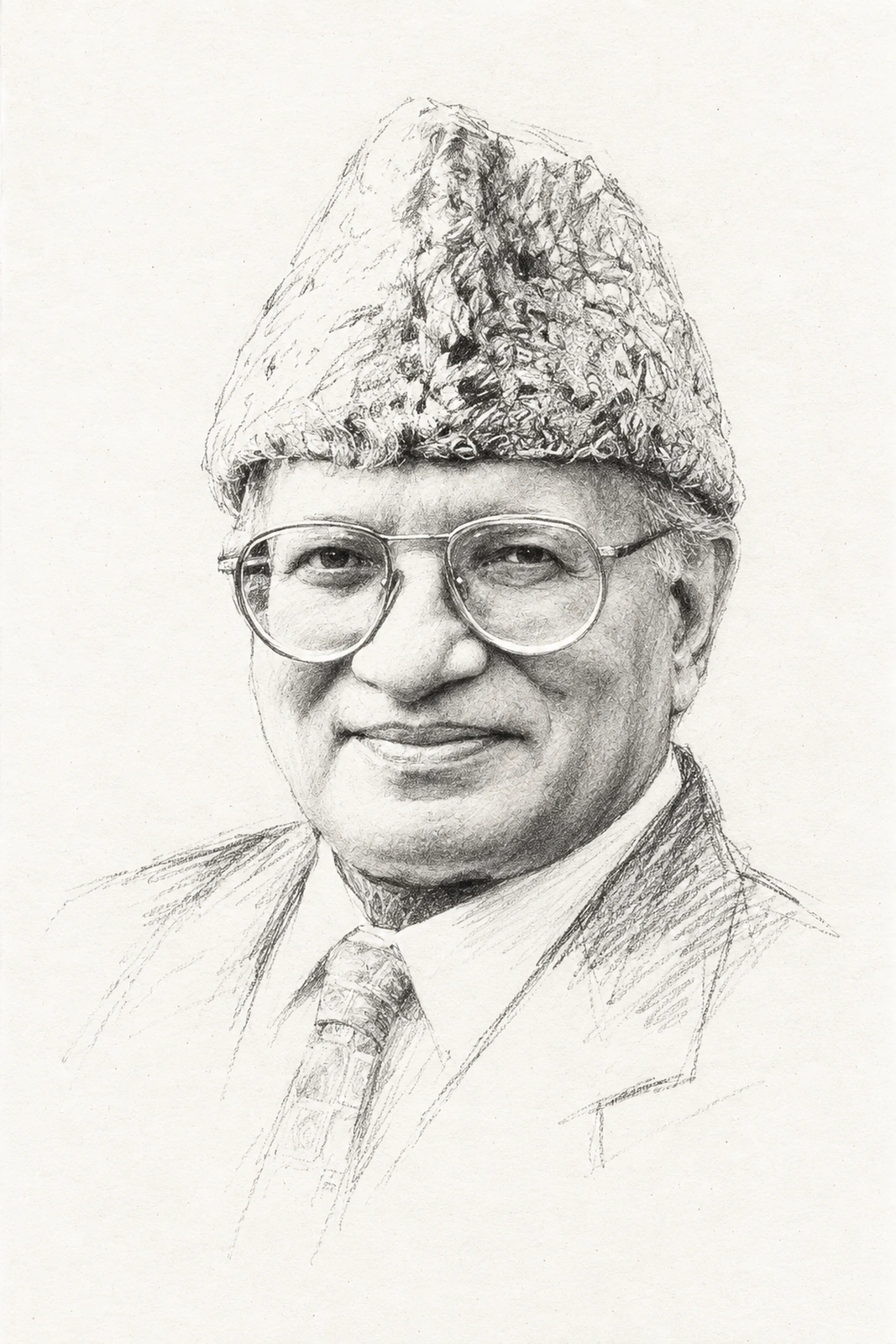
Inagural Address: Professor Murli Manohat Joshi
Inagural Address - I
Let me begin with the pregnant paradox stated in the Kenopanisad, which is directly relevant to all philosophers, scientists, educationists and other seekers of knowledge:
yasyāmatarh tasya matam matam yasya na veda sah/
avijñātam vijānatām vijñātamavijānatām// —Kenopanisad 2.3
"He by whom It is not thought out, has the thought of It; he by whom It is thought out, knows It not. It is unknown to the discernment of those who discern of It, by those who seek not to discern of It, it is discerned."
May I suggest that this paradoxical statement deserves deep reflection and contemplation, since it contains the secret of the culminating point of the ontology of Being, epistemology of Object, and axiology of Value, which are the essential subjects of your extremely important Seminar.
I believe that this is the first occasion when the Indian Council of Philosophical Research (ICPR) has envisaged a series of seminars on the Philosophy of Value-Oriented Education, and I take this to be a sign of a welcome response to the contemporary India's imperative need to provide the dimension of value to our educational system. For it is only when philosophers awake and lead that the foundations begin to be built, and without foundations no programme of education that aims at a major innovation can hope for a secure guidance and lasting fruition. Let me, therefore, congratulate the ICPR for its initiative, as also all the distinguished philosophers and educationists who have assembled here.
Inagural Address - II
Education is intrinsically and by definition Value-Oriented. To speak, therefore, of Value-Oriented education is, in a sense, tautologous. In fact, education is a subset of a larger setting of culture, and culture consists of cultivation of faculties and powers pertaining to reason, ethics and aesthetics in the light of the pursuit of Values of Truth, Beauty and Goodness (satyam, śivam, sundaram).Culture also consists of infusing the influences of this pursuit into physical and vital impulses, so as to refine them and sublimate them to the highest possible degrees, and to transmit the resultant fund of experience through various modes of expression, including those of poetry, music, dance, drama, art, architecture, and craft. The height of a culture is to be judged by the depth and height that are reached in terms of an ascending process of harmonization and, in that process, development of quest of spiritual inspiration and revelation and their manifestation in various domains of physical life. Every developed culture, therefore, inspires methodologies of transmission of accumulated normative lessons of culture to succeeding generations, and this process of transmission is greatly secured by a process of education, which, in turn, discovers and implements a more and more ripened system of acceleration of progress. Thus, the basic thrust of culture and education is inevitably Value-Oriented.
The question that arises as to why we are then obliged to think of Value-Oriented education. The answer is that there have intervened, during the last 200 years and more, certain factors that have retarded the right upward impulses of culture and education. This has happened all over the world, and everywhere there is a new awakening today to infuse Value-Orientation both in culture and in education.
Inagural Address - III
In India, we can see that since the 18th century, and even before that, there came about the decline of intellectual activity and freedom, the waning of great ideals, the loss of the gust of life, and, even in the moral and spiritual life, the rise of excessive ritualism. Public life began to become more and more irreligious, egoistic, and self-seeking. This entire process became accentuated by three factors, which can be summed up in terms of influences emerging from Macaulay, Materialism and Mercantile barbarism.
As is very well-known, Macaulay had explicitly stated the purpose of the education system that was introduced under his initiative by the British in India, namely, to create a "class Indian in blood and colour but English in taste, in opinion, in morals and intellect" who would be interpreters between the British and the teeming millions that they ruled. Unfortunately, the scheme of education that was introduced has even now continued to persist with peripheral modifications. If we examine that scheme objectively, and in the light of the basic foundations of Indian culture, we shall find that it knocked off four main elements with perilous consequences. First of all, it eliminated the study of poetry, music and art, which constitutes perfect education of the soul; secondly, it eliminated the study of philosophy, dharma and spiritual knowledge—three elements, which are the supreme components of the Indian heritage; thirdly, while it introduced some elements of world history and world geography and modern science, it presented the dominant British view of history and disturbed the Indian view of science, which always looked upon scientific inquiry as a part of the holistic quest in which Science, Philosophy and Yoga had a sound system of interrelationship; and fourthly, it omitted altogether physical education and skills of art and craft and others related to science of living, which were kept alive in India throughout the ages. What has been lost in terms of pedagogy and richness of contents of knowledge and skills has still not been remedied, and urgent steps are necessary to review the entire scheme so that we can provide to our students a genuine national system of education, which is at the same time open to the benefits of modern knowledge and modern ideals of progress towards Liberty, Equality and Fraternity.
The advent of the British rule in India coincided with the high tide of modern science in the West, and along with it the extensive spread of materialism—a phenomenon of mixed blessings. While science and scientific spirit are deep-rooted in the genius of India, materialism does not fit very well with the Indian ethos, although material poverty was never a national ideal, and abundance of wealth was a high achievement of Indian culture, until our economy was greatly shattered by the British policy.
It is mistakenly supposed that science and materialism are logically interrelated with each other, even though the triumph of physical sciences has tended to emphasize materialistic approach to knowledge and reality. In any case, the Macaulayan scheme of education does not provide the kind of scientific rigour, which is manifested in the Indian history of scientific knowledge; nor does it promote that avenue of inquiry by which the limitations of materialism can be understood and overcome.
Materialism has promoted what can be called mercantile barbarism, and that too, even in the setting of a science-based civilization. It is barbarism because its gospel is to support and aggrandise the needs of physical life, and it seeks triumph of consumerism, which can be sustained only by supporting an unjust economic and social order, environmental disasters and by inducing people to remain confined to a perpetual bondage to increasing physical wants. We have today for the entire human race a possibility to be uplifted to a higher and nobler way of life and to an order of unity and harmony, but mercantilism compels competition and strife, and we see today the horror of terrorism spreading on a global scale. We speak of globalisation today, but the dominant quest today is the quest of global markets and not the quest of global brotherhood.
The issues that confront us relate not only to promote education widely and universally, but also what kind of education, so that India can recover her true spirit and it is empowered to stand out in the world as a leader of the future, in spirituality and science, in philosophy and art and in all fields of professions and occupations so as to be opulent and prosperous capable of fostering universal culture of peace, harmony and world unity. For this aim to be fulfilled, we need to liberate our educational system from the Macaulayan mould, we need to deal with materialism both scientifically and philosophically, as also morally and spiritually, and we need to combat forces of barbarism, ignorance and division so as to inspire among the youth a burning quest for wisdom and courage, for excellence in works and skills, and for universality and all that contributes to individual and collective perfection.
One of the best means of achieving these goals is the task that we have begun earnestly during the last few years—the task of Value-Oriented Education.
Inagural Address - IV
The task is difficult and enormous, but there are several favourable circumstances, which can aid us and encourage us to undertake this task and accomplish it.
We must first take into account the fact that during the freedom struggle, five greatest leaders of modern India, who were also educationists, challenged the British system of education and developed powerful philosophies of education so as to provide to the students not only the lessons of the Indian heritage but also to prepare them for the future greatness of India. The first leonine call came from Maharshi Dayananda Saraswati who went back to the Vedic foundations and put forth a system of education that would reform India and make it progressive. He inspired the Gurukula system of education and underlined the great role of the teacher in uplifting the talent and character of the pupil. The second great effort was that of Swami Vivekananda who spoke of man-making education and, accepting Vedantic knowledge as the base, and acknowledging the truth of every religion and a synthesis of Yoga, he opened the gates of the future before the youths, filling them with a new spirit of inspiration, heroism and dynamic action. Another line of educational experiment was initiated by Mahatma Gandhi, who emphasised the training of the Hand, Heart and Head, overarched by the values of Truth, Non-Violence, Self-Control, Non-Covetousness and Renunciation, as also equal respect towards all religions and life of simplicity that aims at reconstruction and reform of rural, social, and political organizations based on equality, empowerment of the weak and the oppressed, decentralisation and brotherhood. Gurudev Rabindra Nath Tagore, the great poet of modern India, established at Shantiniketan an experimental Institution for a new aim and mode of education where the beauty and sublimity of Nature can serve as a living partner of teaching and learning and where the values of poetry, music and art can vibrate in the rhythms of life of the development of personality and mingling of cultures of Asia and of the world that would promote internationalism and world-citizenship, and universal fraternity that transcends all divisions of race and religion in the Religion of Man. And there arose also the Nationalist call of 'Vande Mataram' that gave birth to the movement of the National System of Education with the aim of recreating the ancient Indian Spirit that was at once spiritual, intellectual, scientific, artistic and productive, and empowered now with new vigour to assimilate all that is new and progressive and to create new forms of expression and synthesis of powers of personality and knowledge and harmony of the East and the West. Sri Aurobindo formulated the philosophy of this system in 1909 and developed it further in subsequent decades so as to embody the light and power of the Synthesis of Yoga and a programme of integral transformation of human life on the earth that would lead the evolution of Nature into the birth of a new humanity and superhumanity.
All these initiatives and experiments have been bold and great and inspiring, and all of them are still in various stages of growth and development; great lessons have to be learnt from these experiments, and we have here a great fund of educational research that can guide us in the tasks of value-oriented education and of the entire transformation of our educational system.
We have also a favourable climate being created by some of the progressive experiments in the West, such as those promoted by Pestalozzi, Montessori, Bertrand Russell and others; the trend is towards child-centred education, and the basic idea is that the individual is not merely a social unit, but a soul, a being, who has to fulfil his own individual truth and law as well as his natural or his assigned part in the truth and law of the collective existence. Happily, this Western idea agrees at its root with the profoundest and highest spiritual conceptions of Asia and it can easily play a great role in harmonizing our national effort at reconstruction of education with similar efforts in the West.
In this task, UNESCO's initiatives are also helpful. The two great Reports: "Learning to Be" brought out in 1971 and "Learning: Treasure Within" brought out in 1996 have underlined education for values of international understanding, peace and integral development of personality. Emphasis on Complete Education for the Complete Human Being and on four pillars of learning, viz. Learning to Know, Learning to Do, Learning to Live with Others, and Learning to be points to the need for a radical paradigm shift impelling all-round reforms in aims, contents and methods of education, as also of the system of examination, evaluation and certification.
In the wide sweep of values, which are incontrovertibly admitted universally are those contained in the Declaration of Human Rights as also those in the Declaration of Human Responsibilities. Nearer home, we have also a remarkable and unique declaration in our own Constitution under Article 51A of Fundamental Duties, which I believe, if implemented in full—as we have resolved to do—we shall have secure guidance as to what values we have to promote in our educational system, so that all citizens can be empowered to fulfil their duties.
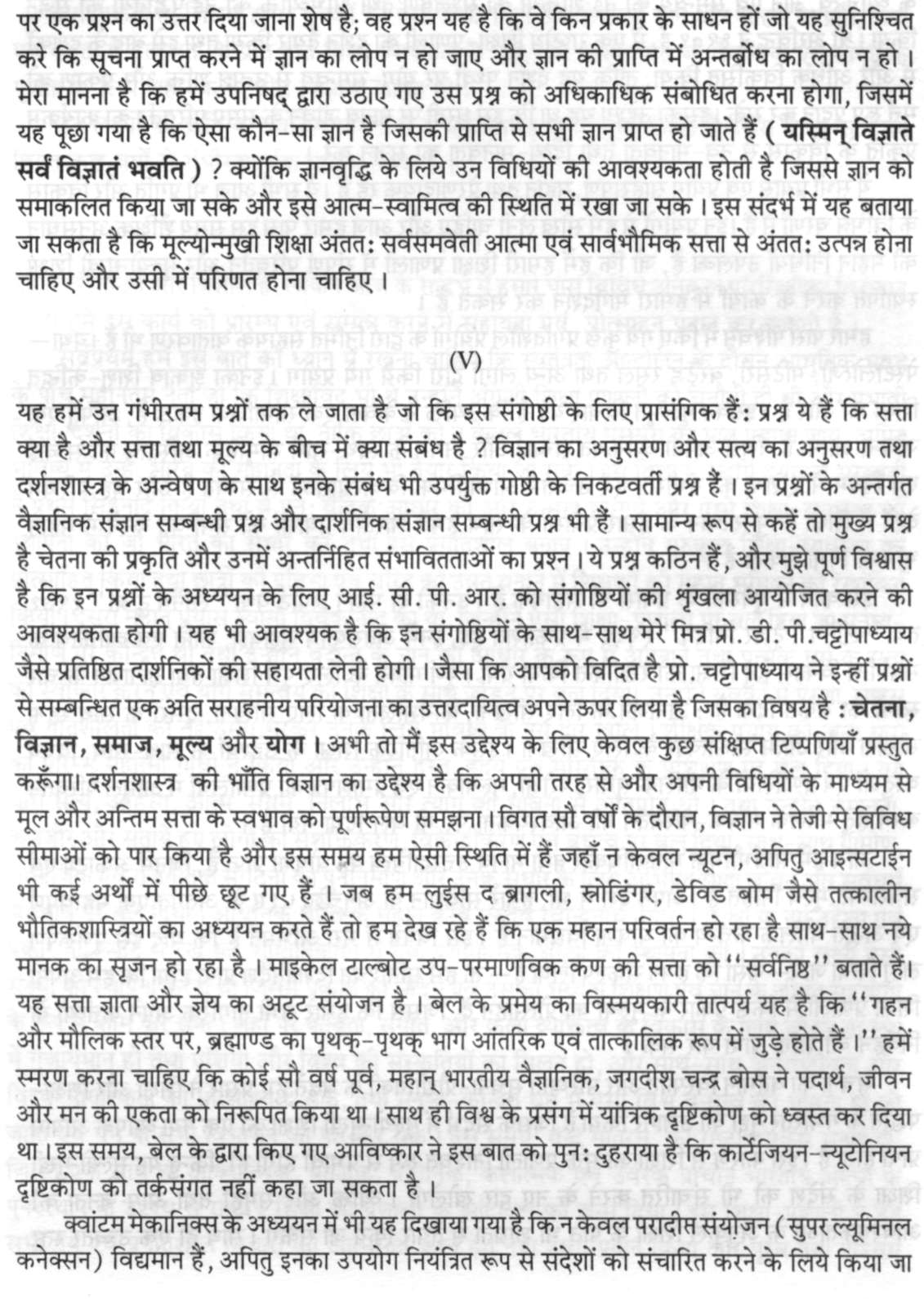
Contemporary explosion of information and increasing spread of sophisticated information technology have brought forth deeper issues of education and educational methodology, in the context of which value-oriented education assumes wider dimensions. Not only open system of education can now become very effective, but it will also open new channels of communication of the message of value-oriented education, since they can be at once adapted to the needs of the individual and of groups and masses. At a higher dimension, one question that will have to be answered is of the ways and means to ensure that knowledge does not get lost in information, and wisdom does not get lost in knowledge. I believe that more and more we shall have to address ourselves to the question that the Upanishad had raised, viz. what is that knowing which everything can be known? (yasmin vijñāte sarvam vijñātam, bhavati). For advancement of knowledge demands methods by which knowledge can be summed up and possessed in a state of self-possession. In this context, it may also be suggested that value-oriented education should ultimately issue from and result in the knowledge of what can be described as all-embracing Self and universal Reality.
Inagural Address - V
This brings us to the deepest questions that are relevant to this Seminar: questions as to what is Reality and what is the relationship between Reality and Value. And closely related are the questions of pursuit of science and pursuit of reality, and its relationship with the quest of philosophy. And underlying these questions is the question of scientific cognition and philosophical cognition, and in general, the question of the nature and potentialities of Consciousness. These are difficult questions, and I am sure that ICPR will need to organize a series of seminars to deal with these questions; or else along with these seminars, these questions will need to be taken up by eminent philosophers like my friend, Professor D.P. Chattopadhyaya, who has undertaken a very laudable project of Consciousness, Science, Society, Value and Yoga. For the present purpose, I shall make only a few brief remarks. Science, like philosophy, aims at grasping, in its own way and through its own methods, the nature of the Ultimate Reality. During the last hundred years, science has crossed rapidly several horizons, and we are now in the presence of a situation where not only Newton, but even Einstein stands over-passed in many ways. When we study the findings of recent physicists like Louise de Broglie, Schrodinger, David Bohm and others, we feel in the presence of a Great Shift and new paradigm. Michael Talbot speaks of reality of the sub-atomic particle as "omnijective", an inseparable combination of the subject and the object of knowledge. The astonishing implications of Bell's Theorem is that, "at a deep and fundamental level, the separate parts of the Universe are connected in an intimate and immediate way. We recall that a hundred years ago, the great Indian scientist, Jagadish Chandra Bose, had demonstrated the unity of matter, life and mind, and had demolished the mechanistic view of the universe. And now, the discovery made by Bell has further reiterated that the Cartesian-Newtonian approach is no more tenable.
Study of Quantum Mechanics has also shown that not only super-luminal Connections exist but also they can be used in a controllable way to communicate messages. This study has profound implications for the philosophy of materialism, and therefore, for the materialistic system of values that counsels us to work or enjoy under the impulsions of a material energy, which deceives us with a brief delusion of life or with the nobler delusion of an ethical aim and a mental consummation. It appears that the modern science is preparing itself to overcome its preoccupation with Matter so as to look upon the phenomenon of Consciousness with flesh eyes.
Philosophy, which is today highly dominated by Science, is also likely to undergo a major change and enlarge itself in its scope so as to admit the phenomena of Consciousness, which are now being studied more and more at the level of microcosm as also at the level of macrocosm. In this light, it will not be difficult for philosophy to detect the logical error of Materialism involved in its attempt to derive from the premise that Matter is real, the conclusion that Matter alone is real. The circularity of the argument becomes obvious and is rendered invalid. As Sri Aurobindo points out:
"This vulgar or rustic error of our corporeal organs does not gain in validity by being promoted into the domain of Philosophical reasoning. Obviously, their pretension is unfounded. Even in the world of Matter there are existences of which the physical senses are incapable of taking cognisance. Yet the denial of the suprasensible as necessarily an illusion or a hallucination depends on this constant sensuous association of the real with the materially perceptible, which is itself a hallucination. Assuming throughout what it seeks to establish, it has the vice of the argument in a circle and can have no validity for an impartial reasoning."1
At the stage at which we stand today, the recent advances in the field of knowledge provide us sounder foundations for the philosophy of value and philosophy of value-oriented education. Already great scientists and philosophers of science have begun to acknowledge the need to bridge the gulf between science and value, just as there is a need to bridge the gulf between art and value. It is recognised that the development of science should be supplemented by enormous development of the value of human kindness. Bertrand Russell has pointed out that there are two ancient evils that science, unwisely used, may intensify: they are tyranny and war. His counsel to mankind is to avoid "cruelty, envy, greed, competitiveness, search for irrational subjective certainty, and what Freudians call Death-Wish." He further points out the remedy in the following words: "The root of the matter is very simple and old fashioned thing... the thing I mean—please forgive me for mentioning it—is love; Christian love or compassion."
Recently, Piet Hut in one of his papers (1995) stated: "Science that does not have any ethical implication can be useful, but cannot claim in any way to describe all of reality, since clearly some form of ethics is part of our world of experience."
-
Sri Aurobindo: The Life Divine, Centenary Edition, Vol. 18, pp. 17-18. ↩
Inagural Address - VI
What emerges from the foregoing is that the programme of value-oriented education should emphasize the relationship between Science and Value. In our presentation of values, we do not need to be prescriptive; we should encourage methods of explorations. As we explore deeper and deeper, we shall find that there are values, which are relative and subjective; but we shall also find that there is in us a dimension of Value and that this is an undeniable objective fact. There is also the fact that the more one advances in the theory and practice of Value, the more is one obliged to overcome selfishness, egoism and subjectivity, and the more is one led to the discovery of the Categorical Imperative, the criterion of which is translatable in some kind of objectivity and universality, as Kant showed—although not entirely satisfactorily, and as shown by the Bhagavadgita in its concept of Loka sangraha. What we call good actions can be relative, and our judgement about them can be subjective; but there can be no denial that, objectively speaking, the highest goodwill for the highest good of all is the highest conceivable Value. To my mind, the first and the last message of value-oriented education should be to develop among all the highest Good Will, śiva-samkalpam.
Let me conclude with a prayer of the Yajurveda, which describes the highest psychological powers and prays for the infusion in them of the Good Will:
yajjāgrato duramudaiti daivarh tadu suptasya tathaivaiti/
dūrarigamam jyotisārh jyotirekarh tanme manah śivasarikalpamastu//
"The mind, irrespective of whether one is awake or asleep, travels to far distant corners; this far distant-moving mind is the light of lights. May that mind of mine be filled with Good will."
A Modern Proposal for Restoring to Eduction its Natural Role of Value-Inculation: Rajendra Prasad
That there has occurred an erosion, or some would say, a complete erosion, of values in the present-day Indian educational practice is a complaint which has become a part of our folklore, academic as well as non-academic. The complaint is made by those who are the sufferers of the erosion as well as by those who have caused it and those who can ameliorate the condition resulting there from but have no will or time to do that. Sometimes it is made more loudly by the latter two groups than by the former. It is certainly true that the erosion has occurred, but it is not the whole or complete truth. The complete truth is that the educational practice has become an agent for the inculcation of some disvalues along with its becoming denuded of some positive values. The former needs to be worried over more than, or at least as much as, the latter.
In a broad sense of the term, as per current philosophical usage, values include both positive and negative values. A positive value is one which is worthy of being inculcated and a negative one is that which ought to be abjured and gotten rid of if already inculcated. It is a negative value, which is called a disvalue, and a positive value is, for short, called simply a value. I shall follow this practice in this essay, using 'value' for 'positive value' and 'disvalue' for 'negative value'. A disvalue is, in the broad sense, a value because it is a thing about which we must not be indifferent or casual. A con (trary) -attitude towards it is as necessary as a pro-attitude towards a (positive) value. Its importance in personal or social life is as great as that of a negative number is in arithmetic. Its inculcation by an individual lowers the quality of his life, just as the addition of a negative number to a positive number reduces the value of the latter.
Any educational process essentially leads to the inculcation of some values or disvalues by the educatee who goes through it. If the educatee is cooperative and participative in the process and the conductors of the process conduct it with the seriousness and sincerity the norms set for it require, the process will be a success and will instil in the educatee some of the basic values he needs in order to live well as a person and as a member of his society. On the other hand, for some reason or the other, if the educatee is non-cooperative or non-participative in the process, or the process is ill-conducted, it will be a failure. It will then instil in the educatee, and through him in the larger society he belongs to, a number of highly pernicious disvalues. Some of them, for example, will be instilling in him a habit of being generally careless and non-serious in whatever he does, an attitude of being disrespectful or indifferent to some of the desirable traits of character, a nagging feeling that there is no use or worth in getting himself educated, etc. The latter, one's loss of faith in the value of education itself, is perhaps one of the greatest disvalues for any country and definitely for a developing one, the majority of whose citizens are uneducated, half-educated, or ill-educated.
By saying that an educational process is essentially, i.e. naturally, value-inculcating, I mean to highlight the fact that letting an educatee go through a process of educating him is itself a process of inculcating in him some values (or disvalues). There does not have to be two processes, one of educating him and another of inculcating in him some values, the two going together. And, to enable the process to inculcate the values it can, what needs to be done is to simply help it go its natural way in accordance with its built-in rules and norms, and strategies of their implementation. There is no need to buttress it with another, a separate, process of value-inculcation. What the managers of education are, therefore, to do is to arrange for the required human and material resources and then to leave the educational process to have its natural flourishing.
The above has been said keeping in mind formal education. But informal education is also, by its very nature, value-inculcating. The latter is imparted in an individual's family and social setting in an unscheduled and non-organized manner and goes a great way in shaping his personality and his performance in private and public life. Formal education is imparted in a formally organized institution required to run in accordance with well-articulated rules, regulations, and objectives. The two are very closely related to each other. Each one of them can be supportive or obstructive of the other, depending on its own and the other's character. It is not unusual to find the principal of a school complaining that he is not being able to get instilled in his students respect for discipline and decorum because a good number of them come from a social setting in which flouting discipline, or disregarding decorum, is considered to be a mark of status and smartness, and they afford to do that because of the political influence of their parents. This will be a case of a polluted informal education obstructing the value-inculcating character of a well-meaning formal education. Similarly, it is not infrequent to come across guardian of a student complaining that his efforts to develop in his ward a habit of regular self-study and hard work got thwarted by his class-teacher: the class-teacher advised him to join his coaching institute, assuring him that he would get there, in only three months, on payment of merely ten thousand rupees, ready-made materials for getting a first class in his final examination, and he preferred to follow the teacher's advice. This will be a case of a polluted formal education, obstructing a well-meaning informal education in the performance of its value-inculcating role. It is not difficult to imagine what will happen when both are polluted, nor is it difficult to locate instances in which they actually are. It is obvious, therefore, that to ensure an educational practice or system to be, even generally, if not unfailingly, successful, it is necessary that both informal and formal education are imparted in a balanced, healthy, manner. This will require toning up the functioning of formal institutions as well as changing the value-attitudes of a large number of parents, guardians, and many others. That would amount to preparing the social or societal background, or ground, for the proper appreciation of the value of value-inculcating role of education and for enabling the latter to perform the role in the manner it can when left to flower up in a natural way. To make even a beginning in the direction of discussing what is involved in this task will take me far afield. Therefore, I shall limit my observations here to formal education. These observations will be based more on my experience as a student, teacher and parent than on my predilection as a professional philosopher. Therefore, they claim to be only common-sensical and not in any way philosophical.
To see how a set of values is ingrained (anusyūta) in the very process of an educational practice conducted in a formally organized institution, say, a school, when it functions in a normal way, let us look at the major components of a formal educational programme. They can roughly be designated as follows:
I) Objectives
II) Content
III) Recipients
IV)Social Reality
V) Method
VI) Infrastructure
VII) Achievement of Objectives through Normal Routine
I) Objectives
The chief objectives of any educational process, putting them very briefly, obviously are
i. to impart to the educatee knowledge of a chosen set of items, which he is expected to need in order to live a worthwhile life. This is done, to begin with, as per his society's understanding of his needs and of the nature of a worthwhile life. Both of them are subject to modification later in accordance with his preferences when he acquires the ability to understand his needs and form his own conception of a worthwhile life;
ii. to equip him with the skill to make a creative use of his expertise in a mariner fitting with the situation he is in; and
iii. to provide him opportunities, through curricular, co-curricular and extra-curricular activities of the school, to develop into a cohesive member of his society and a discriminative individual in respect of fulfilling, or in trying to fulfil, his personal aspirations.
The best strategy to achieve these objectives is to let the educatee imbibe the education offered to him and develop his natural potentialities in a free and tensionless but constructive and disciplined manner. It is the most natural, or practical, strategy to adopt. That is why it is likely to be boring if one argues for its viability. In this respect what is true of the strategy is also true of the objectives.
II) Content
In every educational process there has to be some content or subject-matter. The subject-matter has to be chosen with an eye on the objectives and the strategy for their fulfilment, as outlined in (1) above. But there has to be some flexibility in selecting the various components of the subject-matter in order to suit the socio-cultural, environmental, background and imbibing potentialities of the educatees participating in the process. The selection process has also to keep in view the changing state of the craft, the explosion of knowledge in theoretical and practical spheres, and the findings of recent researchers in the science of education. Therefore, it has to be a dynamic and self-correcting process. This implies that syllabi may have to be changed more often than they are usually done and also that the selection of reading materials has to be done by educators, i.e. teachers, who impart education and are conversant with the state of the craft, and not by managers, administrators, or even financiers, of educational institutions.
III) Recipients
The educatee is the recipient of the goods produced in an educational process, and if the goods do not reach him, or do not touch his heart and brain and muscles, the process is a failure. The entire process, therefore, is to be directed in such a way that the educatee, who has gone through it, turns out to be a cultured, decent, person well-equipped to live well. His case is very much comparable to that of a diamond, which is crude and full of dross when taken out of a mine. But after having gone through a process of refining and grinding in an artist's workshop, it turns out to be a bright, well-shaped object of great beauty. Therefore, the contents of any educational programme have to be selected with this end in mind; the education imparted by means of teaching them must be conducive to making the educatee, the end-product of the programme, an individual of this type. This means that the contents cannot be selected in abstraction from the needs and initial calibre of the likely recipient. Therefore, even for the same standard or level of education, in two schools, or in schools of two areas, when the needs and initial caliber of students differ, different sorts of contents may have to be taught. The obvious implication here is that different types of reading materials, meeting the requirements of students, should be available.
IV) Social Reality
Since the recipients are individuals with a socio-cultural background, the social (including cultural) reality in which they live, or are likely to live after getting their education, have to be seriously taken note of in planning an educational programme. Some of the reasons why it is important are the following:
i. An educatee not only comes from a social background, but he also has to work, after receiving his education, with people who come from the same, or some different, social background. Therefore, in order to do his work successfully, he must have a knowledgeable understanding and appreciation of his own social reality and at least a few other social realities with which he may have to deal.
ii. He needs to earn his living. No society will give him a job, or like to keep him, if his method of working is not conducive to its development. Moreover, it is also one of his obligations to contribute to the development of the society in which he works. This he can do only if he has an appropriate understanding of the temper of that society, or an ability to acquire such an understanding if he does not already have it.
iii. From the point of view of his own profiting from the programme also it is important that the programme is congruent with his social reality. He will be able to learn better, to inculcate with greater ease, the traits the programme wants him to inculcate, if the programme has been planned with an understanding of his own social background. A student's finding an educational programme incommensurate with his social background, may prompt him to leave the programme and create an aversion or animosity towards joining any other.
V) Method
What has been said above in (1) to (4) makes it very easy to conjecture what should be the method of imparting education. The goods an educational programme can produce will be properly utilized by the educatee only if they are received by him in a friendly manner, i.e. when he does not have the feeling that they are imposed on him, or drilled into his head. That is, they must enter his mind, not only without stifling his creativity, but in a manner which protects it and contributes to its flourishing. To do this, it is necessary to treat him as respectable, responsive individual, having his self-dignity and a rich stock of potentialities waiting to be helped to flower up. He is not to be treated as an electronic player in which a musical cassette is to be placed and a button to be pressed to get a good song. Many teachers do this mistake with the result that the educatee develops in himself a mechanical or stereotyped mode of thinking, a mind like that of a parrot, and, therefore, fails to see what to do when he is confronted with a new, or tricky, problem in his private or public life. Instead of improving his thinking ability, re-educating himself in life's real situations, he becomes, again due to his faulty earlier education, a cynic and starts pleading that no education is of any use. To obviate this eventuality, it is necessary to inspire the educatee to cooperate with the teacher by conducting the programme in a manner, which makes the instruction enjoyable and the school a place he loves to be in. One of the ways to do it is to whet his in-quisitiveness, encourage him to put questions, and adopt a dialogical method to satisfy his curiosity. This method will make him think that the answers he gets are not just given to him by the teacher but obtained by the joint effort of both of them. The feeling that he has played a role in getting his answers will not only promote his self-confidence but will also nurse his sense of self-respect.
VI) Infrastructure
The infrastructure of any educational programme includes the resources, human and material, necessary to enable the programme to be conducted satisfactorily and successfully. Among the human resources are included individuals from the sweeper who cleans the school compound to the class-teacher-to the principal-to the Vice-chancellor-to the policy maker-financier, and so on and so forth. Among the material sources are included not only the building, library, laboratory, playground, finance, etc. but also such paltry items as chalk and duster and blackboard, etc. It is very likely that all the items, which should be there to make the infrastructure complete in every respect may not be there because it is not possible to arrange for all of them. But there is a minimum, which must be provided. It seems to me that a shortage of human resources, or supply of defective human resources, is more injurious to the programme than a supply of inadequate or defective material resources. A team of competent and committed teachers can compensate, of course within certain limits, for some of the deficiencies caused by the inadequacy of material resources. But no material resource, howsoever important, can compensate for a deficiency caused by a defective human resource. It is not very difficult to arrive at the minimum of both human and material resources required, depending on the economy of the country. But to compromise on the quality of human resources would be fatal, whatever be the case with the supply of material resources.
VII) Achievement of Objectives through Normal Routine
The language of what has been said in (1) to (6) has become sometimes explicitly, sometime implicitly, normative. But it is not preceptorial. Rather, it gives an account of what is actually considered by the common run of a teacher or educationist to be the things any educational programme is ordinarily designed to achieve in its normal, routine, working. If the present-day educational practice is not doing it, i.e. is not inculcating the values it should, it is not doing that because it is not following its own routine. To require it to be value-inculcating is not to ask it to do something extraordinary. Therefore, any one connected with it must not think that, in being asked to perform this role, an extra strain or obligation is put on his shoulders. The proposal made here, therefore, is as practisable as any down-to-earth proposal may be. Given the necessary infrastructure, a large part of its objectives an educational institution can achieve by simply implementing, with sincerity and seriousness, its regular routine in its curricular, co-curricular and extra-curricular activities. We can very reasonably, then, expect its products, the educatees, to develop into individuals with most of the values, which makes a person socially cohesive (susabhya) and personally dignified (susamskrta). Even others associated with the institution are likely to imbibe at least some of the values the institution's atmosphere will be suffused with. But in what follows I shall discuss the matter only in respect of educatees.
A school has to work according to a time-table for all concerned and for whatever it does. If it is observed regularly and uniformly, the student will acquire a habit to be punctual and to respect the time schedule in whatever he does. Every student is to be considered equal to every other as a person. If this principle is followed, a sense of social equality, which is a pre-condition of liberal democracy, is likely to be naturally inculcated. Even now, when the Indian society is riddled with discriminations and fissures, friendship among classmates or batch-mates, a natural child of social equality practised in a school, has not, in spite of their caste-economic-regional-cultural-religious differences, become non-existent. The contents of a course have to be taught according to a time-frame, required to confirm to a certain standard, and the performance of a student has to be evaluated on its merit and merit alone. Doing this as a routine affair will strengthen the motivation of a student in his studies and may even generate in him a desire for the pursuit of knowledge of things not covered by his curriculum. He will also then have the faith that he will get the grade he deserves, an awareness of his right to get what he deserves and of others' right to get what they deserve. Consequently, he can be expected to have a respect for justice and a sense of pride in getting only that, which he deserves. He may thus acquire a disposition to resent an injustice done to him, or to another student, by a functionary of his school, and later to an injustice done to anybody by anybody. This disposition will be a virtue since it will strengthen his social conscience. A school has to run according to a discipline applicable to all concerned. If the discipline is enforced in a fair manner and is generally observed, even resentment against injustice is not likely to assume an ugly form. Moreover, observance of discipline generates a habit of rule-following which is a necessary condition of civilized life. Every student is free to move from one school to another, provided he fulfils the criteria of admission in the latter. This practice, not very common in the country, mostly because of economic and linguistic considerations, if made feasible, will increase social mobility and facilitate cultural and national integration.
What I intend to show is that such values as punctuality, equality, sense of justice, awareness of rights, respect for discipline, expression of resentment against injustice in a disciplined manner, interest in the pursuit of knowledge, etc. are ingrained in the very nature of an educational practice conducted in a normal, routine, manner, provided, of course, that each segment of it performs its routine honestly and to the best of its ability. The latter is a big proviso but it is a proviso for any practice. Even when we introduce a separate stream of value inculcations, if the personnel in charge of it do not do their routine work well, the stream may itself get muddied, or ultimately dry up. There are four segments of the personnel involved in the implementation of an educational practice: students, supporting staff, teachers, and the society outside the school campus. The first three come under the control of the school administration, and, therefore, the school management can do something to make them cooperative. But the fourth one, the society from which the other three groups come, has also to be cooperative and interested in helping the school to run its affairs according to its schedule. This means that there has to be a good, regular, liaison between the school and the society it is housed in.
A word to some of my co-professionals, the philosophers, who see a serious problem, posed by philosophical controversies about some important issues in value-theory, in the way of their presenting a concrete proposal for making education value-oriented. Value-theorists are still debating whether values are subjective, objective, relational, absolute, or relative, etc. whether value judgments are descriptive, emotive, or prescriptive etc., whether or not there is any primary value, and if there is, which value is primary and which is secondary, etc., etc. Unless these debates are settled—and there does not seem to be a chance of their being settled in the near future—we cannot prepare, they say, a scheme of value-inculcation, or plead for inculcating this or that value, through an educational programme. This is a gross misunderstanding of the nature of philosophical theories of value and of philosophical disagreement. The disagreeing theories do not question the importance of a value, or the importance of value-inculcation. They present different, alternative, accounts, plans for comprehending, or analyses, of our discourse about values. To use disagreements among them as a ground for. suspending all attempts to prepare a concrete plan for enabling our educational practice to perform its natural role of value-inculcation is like using philosophical disagreements about the correct analysis of visual perception for suspending the activity of seeing anything until disagreeing epistemologists sort out their differences. Those who think this way forget that a philosophical theory operates on a level different from the level on which an activity like inculcating a value, or perceiving a thing, does. An educational practice is naturally predisposed to inculcate some values, positive or negative. Therefore, we cannot afford to be indifferent to the way it is anytime conducted. It is the kitchen, which cooks the food for, which everyone, even he who is called uneducated, eats. Therefore, a society, not keen to die because of malnutrition or ill-nutrition, cannot afford to neglect the proper running of this kitchen. To conclude, What I want to emphasize cannot be stated in a better way than by quoting the following words of The Mother of Sri Aurobindo Ashram.1
Do not pretend—be
Do not promise—act
Do not dream—realize
Value in the Context of Learning: D.P. Chattopadhyaya
Value in the Context of Learning - I
LINGUISTIC ROOTS TO VALUE
Mulya, which is ordinarily said to be value in English language, is, literally speaking, what is to be obtained from mula root, or source. Whether in the context of learning or in some other related contexts to get to the root [without remaining contented with the superficial view] of an issue is both difficult and rewarding. When the concerned issue pertains to human beings the dedicated enterprise (sadhana) required to get to root proves even more difficult and even more rewarding. To get to the root of a thing, as distinguished from that of being, is, though cognitively instructively, is not always morally elevating.
Broadly speaking, while Science, in general, or Physics, in particular, is concerned with the world of things. Ethics (dharma) is, linguistically traceable to Grk.ethikos, [time-tested] custom, Sanskrit svadha [essential indwelling or self] and concerned with beings. But this thing/being discourse in English language smacks of a kind of dualism, as if suggesting that the world of thing is perhaps devoid of value. But if one enters into the heart of discourse via the Sanskrit-rooted languages, one easily realizes that this dualism is false and that the root (mula) of both thing and being is identical. Things also have their being, potentiality, or dharma. Even the basic elements of the physical worlds like water, fire have their svadharma or muladharma. For example, water flows downstream, quenches thirst etc., and fire burns (dahika sakti), gives heat (tapa) etc. The svadharma or muladharma of human beings, one may say, is spirituality (adhayatmikata). Manusya-atma is said to be jyotirmaya (luminous, bright and obviously fire-rooted). It is evident from the bodily nature of all living beings that it requires more or less temperature (tapas) to sustain itself. The English word, spirit, is also derived from a heat—or temperature— related Latin word spiritus, which means breath, breathing. As we know, breathing imparts heat to body, i.e., tapas-sancaraka, keeping the psychosomatic system living. Inhalation and exhalation are the main two forms of breathing or heating. The exposure of any living system to, and its assimilation from, the light of immediate environment and its deep and distant sources is a veritable sort of yoga as well as tapas.
Value in the Context of Learning - II
NATURAL VIEW OF VALUE EDUCATION
The natural view of moral education, which has its different forms, is very old but has its forceful contemporary exponents. The essence of this view may be put in this way. The world of things and the world of beings are natural in a very important sense. The essential properties of natural world, through laws of evolution,vivarta (modification) or parinama (emergence), develop and reappear, first, in the biological world. In the course of further evolution, enriched development becomes further manifest in the psychological or human development. The process of this development, continuous or marked by "unpredictable" emergence, is claimed to be essentially natural. The philosophical defenders of this view, though recognize purely for an analytic purpose a distinction between Nature (Prakrti)and Supernature (Paraprakrti) maintains telos(purpose or end) is common to all the levels of reality.
Given this view, the theory of moral education, which emerges is teleologi-cal or purpose-oriented and spontaneous, i.e., characterized by a process, which is internally impelled and without external compulsion. Human beings become learner and can continue to learn due to their very native inclinations and motivations(vrttis and pravrttis). They do not need external or unnatural intervention from without. This spontaneous theory of learning emphasizes the necessity of allowing all learners, in general, and children, in particular, to follow their own natural light or tendency. Negatively speaking, this view strongly discourages unnecessary or excessive institutional intervention in the process of learning. Too much of rules and regulations, social do's and don'ts, tend to impede, rather than encourage, the natural educational development of the children.
This view is found in the Vedic-Vedantic tradition of India, Aristotle and Plato of the Hellenic era. According to Plato's view, all learning and knowing are recollection and recognition of the immortal traces in the soul which humans carry in themselves right from the beginning of their life. Aristotle speaks of telosworking at every level of reality—physical, biological, psychological and the beyond. But both Plato and Aristotle have a steady train of arguments in their works to the effect that what flows out of innate disposition or te/os-impelled development needs to be brought in line with the social requirements for a rational and just civil order.
From the classical Hellenic tradition to the modern Kantian-Rawlsian position one finds this dual demands of natural development and institutional intervention for establishment of a just social order. Neither innate universalism nor institutional guidance in isolation seems to be able to provide necessary and sufficient conditions for ideal education or learning. But their combined contribution, it is argued, can possibly ensure the best way of learning.
Among the most notable western thinkers on education in the modern period, the philosopher who has strongly emphasized the importance of the natural mode of education is Rousseau. In his book Emile (1762) he argues that the best form of education is what comes us from the nature within and around us. The learner morally develops from within, from innate seed, provided, of course, appropriate external and institutional conditions are made available to him. Though he emphasis is on naturalism or innatism, he does not deny the role of institutional circumstances and intervention. It is from this aspect of his thought, besides his version of the Social Contract Theory, that he high priests of the French Revolution drew their inspiration.
Traces of developmental approach to moral education are evident in the writings of educational psychologists like Jean Piaget and L. Kohlbarg. Unlike Rousseau's their main concern seems to be with the characteristics and stages of moral judgements of children, not their development as such.
Value in the Context of Learning - III
THE ROLE OF SOCIAL CUSTOM AND MORAL NORMS IN VALUE-EDUCATION
The received approach to value-education both in India and the west has been influenced by the consideration of desacara and lokariti, customs and uses of the country, and the norms and the virtues accepted by the people. In the Western tradition there are two main types of approach to values in general, and value-education in particular. While one tradition is basically concerned with different norms or ideals of moral action, the other attaches more importance to the virtues of human life and the ways in which those virtues can be attained. Each of these approaches has several types within it. Strictly speaking, Normative Ethics and Virtue Ethics, except for analytic or pedagogic purpose, need not be sharply demarcated. Virtues cannot be attained without following some rules and regulations, which are basically normative in character. The moral question of the relation between end and means comes up here. Can end, morally speaking, justify means? The limits of pragmatism are to be recalled.
In the Indian tradition the distinction between the said two purposes of the Western Ethics has never been a major concern. It is because of the fact that most of the Indian systems of thought do not draw a fundamental line of demarcation between theoretical reason and practical reason. All "reasons" are practical (in a very important way). Correctly speaking, the Indian traditional thought is more concerned with experience than with reason. That explains why in Indian thought there is no recognized distinction between Rationalism and Empiricism. The absence of cognitive dualism has facilitated in India an integral approach to all issues, including the issues of values and virtues, in particular. The leading Indian thinkers affirm that knowing is not only a truth-seeking enterprise (sadhana) but also an engagement with virtue-realization. In other words, to try to know is itself an act of virtue. Knowing is moving to the sphere of Light, leaving that of darkness or ignorance behind. Knowing is a tapasya for the life of immortality, beyond everything which is perishable and mortal.
The point may be clearly explicated by reference to the doctrine of purusarthas, dharma, artha, kama and moksa. Rightly understood, each one of thesepurusarthas is both value and virtue, value to be realized or attained for a virtuous life. Dharma is an inner potentiality, which if followed and developed, not only keeps humans away from wrong-doing but also promotes whatever is good and right in them and imparts excellence to their character. Artha does not necessarily mean money (as we understand it today). In addition to its monetary connotation, artha implies meaning or meaningful-ness. The ideal life must be meaningful. In the Catholic and broad spectrum of Indian values kama also finds a place of honour. The psychosomatic integrality of human nature has been duly recognized here. If body suffers starvation, illness or injury, it cannot extend its supportive role to the self for realization its highest reaches. Somatic starvation, non-fulfilment of the needs and desires of the body not only gives rise to poverty-related debasement of the individual human beings in their life but also makes social psyche sick, entailing civilizational discontent.
When humans follow the path of dharma succeeds in finding meaning in and of it, and starts becoming more and more free from poverty and illness, they become really free in whatever way we describe it, in terms of moksa, sayujya, salokya or nirvana. To put the matter from other end, while austerity as value has been recognized but its ascetic form and overtone has not met with the general approval of the mainstream Indian thought.
All human beings, be they young learners or adult seeker of values, are always engaged in the search of purusarthas.
Value in the Context of Learning - IV
SATYAM, SIVAM AND SUNDARAM
It is interesting to study the relation between purusarthas as value and the highest recognized values as satyam, sivam, sundaram.
Satya stands for true, real, actual and genuine, sincere, honest, truthful, faithful, virtuous, good, successful, valid and their cognates. Clearly these nominal or adjectival forms of satya are value-impregnated. It is also name of Visnu the supreme lord.
Siva means the God who in whom all things lie. It connotes auspicious, propitious, gracious, favourable, benign, kind, benevolent, friendly, dear, happy and fortunate. In the Hindu pantheon we find three main Gods, Trimurti, Brahma (Creator), Visnu (Preserver) and Maheswara (Destroyer). Siva is symbolic not only of destruction but also of reproduction. At times Siva has been referred to in the Epics and Puranas as Supreme God having in him all the powers of creation, destruction and regeneration. Also He is claimed to be the symbol of Status (sthiti). In contrast His wife variously named Parvati, Durga and Kali are symbolic of the Dynamic (gati) principle.
Sundara connotes beautiful, handsome, lovely, charming, agreeable and noble. The philologists presume that this word is derived from Su-nara-handsome or beautiful man. The letter d seems to be a subsequent phonetic insertion between Su'd and nara. Monier-Williams refers to the Greek word andros derived fromaner. Semantic affinity of the word between sundara and andros is notable in this connection.
In order to understand the spiritual root (mula) of different theories of value ontological, ethical and aesthetic one may profitably look into the inner meanings of the terms like Brahma, Visnu and Mahesvara. The intended meaning of all these words are traceable to Brhat and Mahat, vast, immense, all-pervasive, cosmic etc. Philosophically speaking, Self and the highest reality, Brahma, Visnu or Maheswara, by whatever name it is referred to, are identical at bottom. True, this view of Self-Reality identity is not shared alike by all thinkers.
The point, which intrigues any axiologist, theorist of value, is this: what is Absolute or all-pervasive is appearing alternative ways as Truth, as all-containing Status, as Beautiful. Admittedly the Supreme Reality may be credited to have its many aspects. At times these aspects are described as Gunas. The Highest Reality has been conceived both as Absolute, or qualityless(nirguna), and as qualified (gunas). To its later form is attributed ananta vibhuti, infinite powers.
It is pertinent to remember here that according to some philosophers of the absolutist persuasion the ultimate reality itself is not value and that it is the root or source (mula) of all values. This view is associated with the idea that the ultimate reality in its intrinsic nature is impersonal, i.e. beyond any representation, which is admirable and worshippable.
It is obvious that the highest values is not the only human values. There are many other secondary and tertiary values, which are reviewable under the above values. Dhana (deserved money, property or prize), yasas (honour, glory and renown), mana or sammana, fame, and khyati, (opinion, view, declaration and assertion) are among the worldly values. When they counted as worldly values one must not forget that these do have transcendental, mediate and self-exceeding implications. For example, honour, splendor and fame of a person spread beyond his immediate context. Often they outlive the life of the person in question.
Other very important human values are (i) knowledge, (ii) right conduct, (iii) goodwill, (iv) sacrifice, (v) self-effacement and (vi) self-control. All these values have two sides—substantive and instrumental. Value-in-use or value-in-exchange, generally speaking, presuppose the existence of values on their own right. The realist and cognitivist theories of value assert that values like Good and Right are there on their own Right, irrespective of their being appreciated, understood or recognized, and followed or cultivated.
These theories are not much in vogue in the Indian tradition. Because this tradition lays main emphasis on experience or consciousness of Value. This is not to suggest that the Vedanta or Nyaya are emotivist or attributivist in their approach to value. On the contrary they favour an approach which affirms that sense of valuecan be evoked in the rightly developed human nature, provided the concerned values have appropriate and objective properties in them. In other words, the primacy of ontology in axiological theories of India is widespread. The Indian empiricists, unlike their Euro-American counterparts, are not phenomenalist, but objectivist, if not realist, in their axiological discourse.
Value in the Context of Learning - V
VALUES IN EDUCATION AND LEARNING
Learning is itself a value. Learning is the process of acquiring knowledge, skill, valued dispositions etc. from the learner's point of view. Education is the word often used from the teacher's or educator's standpoint. Rightly speaking, one cannot be good teacher or educator unless one oneself is a perpetual learner. Openness to learning, learning new things, new ideas, etc. is a sign of good teacher. If the teacher always arrogates to himself the position or status of a teacher forgetting that he is also, perhaps more so, a learner, he cannot attain highest excellence in his practice. Unless one teaches oneself by and through the endless process of self-teaching, how can one be a good teacher? The good teacher is required to instill both in himself and in the pupils he teaches an enquiring and adventurous spirit.
It seems to me that the best way of both teaching and learning is to be intimately familiar with the lives of great teachers, researchers and learners. Those who prove good learners in their life time prove to be great teachers of the humankind.
When the great learners or the teachers of the humankind are not available to the learner at present, the latter would be well advised to read their lives, to hear of their lives from the informed authority. Knowing by examples prove to be more effective and inspiring than knowing from abstract principles, however lofty they might be.
Introducing themselves as learners, the good teacher, succeed in presenting convincingly to the students the life stories of great persons in their concreteness. The method of teaching by citing examples turns out to be very efficacious.
When, for example, Gandhi says "my life is my message", he may initially appear to be a proud person but in fact what he means is very modest. Because, in our writing or public utterances we are often found to be discharging an assumed role. But in all stages of our life, in all our actions and utterances we cannot be consistently pretender. Our life, as ordinarily lived, i.e., when it flows spontaneously, disclosing our inner nature, then our identity as available to others is genuine and authentic. It may be recalled that many teachers of the humankind, the great spiritual leaders, artists, scientists and thinkers, inspire us not so much by their style and content as by their veritable ways of life and living.
A Select Bibliography
I) Fundamental Unity of India, R.K. Mookerji.
II) History of Indian Literature, Vol. 1, Winternitz.
III) Rig-Veda Samhita (Translated by R.C. Dutt).
IV) Life in Ancient India, P.T. Srinivasa Iyengar.
V) Vinaya Texts, Rhys Davids and Oldenberg.
VI) Social Life in Ancient India, S. Chattopadhyaya.
VII) Hymns of the Tamil Saivite Saints, Kingsbury and Phillips.
VIII) Studies in Tamil Literature and History, Dikshitar.
IX) Plato (390s-350s BC) Complete Works, ed. J. Cooper, Indianapolis, IN: Hackett Publishing Company, 1996. (The Dialogues of most direct relevance are the Euthydemus, Protagoras, Meno, Gorgias, Symposium, Republic, Theaetetus and Laws).
X) Emile (1762), (or On Education), trans. A. Bloom, New York: Basic Books, 1979. (Rousseau's principal work on education).
XI) Bailin, S. (1988) 'AchievingExtraordinary Ends An Essay on Creativity, Dordrecht: Kluwer Academic Publishers.
XII) Cooper.D.E. (1986) Education, Values and Mind.'Essays for R.S. Peters, London: Routledge & Kegan Paul. (Provides a good picture of Peter's formative role in the field and a bibliography of his work.)
XIII) Frankena, W. (1965) Philosophy of Education, New York: Macmillan. (An account of the structure of a philosophy of education derived from J. S. Mill, and a sampling of twentieth-century theories).
XIV) Kaminsky.J. S. (1993) A New History of Educational Philosophy, London: Greenwood Press. (A controversial but informative history of educational philosophy as a field of study in the education schools of Australasia, the UK and the USA).
XV) Passmore.J. (1980) The Philosophy of Teaching, London: Duckworth. (A comprehensive philosophy of pedagogy).
XVI) Peters, R.S. (1966) Ethics and Education, London: Allen & Unwin. (Major statement of his early view, progressively modified in later works).
XVII) Siegel, E. (1988) Educating Reason: Rationality, Critical Thinking and Education, New York: Routledge (Referred to in 3. An important account of critical thinking as a goal of education).
Foundations of Value - Oriented Education: M.K. Kaw
The current debate on Value Education has raised several issues, which need to be directly addressed, if we have to make real progress in the programme of introducing value education into the educational curriculum of our country.
First, the fundamental question of whether value education is required at all in a modern state. There are those who argue that modern life is based on science and technology, and both are value-neutral. The world is progressing fast without any values. Values are a bugbear held out by people living in the past, glued to outdated religious principles that have no relevance to the 21st century.
Today it is not important that a young man should obey his elders. It is more important that he disobeys his elders and have the courage to launch out in a new direction. We need leaders, winners, iconoclasts, innovators. They have to be intelligent, smart, specialized and hard-nosed practical men, who can compete in today's cutthroat world. It is no use teaching them to be good, patient, submissive, cooperative, loving, non-violent and compassionate. They will just be steamrollered by the harsh forces of history.
This is an important question and cannot be brushed under the carpet. We have to clearly understand why we need value education in today's world.
I think that we have to begin by confessing that value education would not help a young man of today to be more successful, if success is assessed purely in terms of his ruthlessness in the pursuit of personal goals. In fact, we should accept that the violent, non-compassionate, totally mercenary and single-pointed chase of the glittering prizes of worldly life does not need any values. It is basic to the primitive, primordial man with his highly egotistical, animal instincts.
Value education is also not required if we are complacently happy about today's world and judge progress only in terms of bigger and more profitable versions of what we already have. For example, if the level of per capita consumption of the world's resources is considered to be a reliable index of the economic advancement of a country, it will make progress only if its citizens consume more than they are doing at present. It would be irrelevant that 50% of the marriages in that country end in divorce as the quality of family life is not a factor in the calculations of national prosperity.
A moment's consideration would also show that values, which stem from secular sources like the Constitution of a country or the Renaissance or the French Revolution or the Communist Revolution or the Internet Revolution are transient and temporary, and change with the times. The only values that have stood the test of time and are held dear by most people around the world are the ones that emanate from the great spiritual traditions.
That is why it is important that value education be seen in its real form as the vehicle by which the rich spiritual traditions of humanity are restated, reinterpreted and reformulated for each succeeding generation of human beings. Value education cannot, in my view, be secular alone. It has to be spiritual in the largest sense of the word that encompasses both the sacred and the secular.
One of the main reasons why humanity is in a big mess today is the reluctance on the part of philosophers to look at the big picture in the light of all the knowledge that is now available in the natural and social sciences and in the spiritual and mystic realm. The Theory of Everything, which scientists seek in vain, can never be grasped by natural scientists working alone. Philosophy has to wear the mantle of holistic, integrated thinking and give to a benighted world a modern, universally acceptable philosophy of living.
Such a philosophy will have to fulfil certain criteria, if it is to be acceptable to all reasonable people of the world. I would emphasize the following important ones:
It shall concern itself primarily with the affairs of living and not what happens after death;
It should teach a person about the real nature of the individual and Nature;
It should demonstrate that all life is a play of consciousness with itself.
It should relate the evolution of living species to the movement of conscious life towards increasingly higher levels of awareness;
It should declare the purpose of each life to be the realization of the divine potential in the personality;
It should teach each person the art of dynamic equilibrium, so that he never tends to extremes, but trends the middle;
It should teach us to train our mind so that we always live in the present; It should teach us to exert our utmost to achieve our objectives as if everything depended on our efforts, yet simultaneously also realize that all events are divinely ordained;
It should make us take life as it comes, accept whatever comes as a gift from the divine and remain in a state of equipoise under all circumstances;
It should help us to be steadfast in our views, but not claim exclusive truth for our doctrines, to be ready to accept alternative versions of the eternal truth as equally valid assertions, and not seek to compel anyone to accept any single version of the truth;
And finally, it should not run counter to the modern doctrines of science, gender parity, liberty, equality and fraternity, human rights and the like.
I am sure that if right thinking people professing different faiths sit together in an atmosphere of mutual trust, with the one-point agenda that they have to write down a common spiritual code for humanity based on the original teachings of all the great world teachers, the task is not unachievable. It is my fervent plea that the task should be attempted.
I am glad that the Indian Council of Philosophical Research has taken up the challenge of placing philosophy back on the pedestal where it has always belonged, by relating it to the everyday concerns of the common people. It is only when philosophy is seen to be useful that it will attain its rightful place and truly become the fountainhead of wisdom.
Thank You, Jai Hind.
Value Education in Universities-Experience of Jamia Hamdard: Siraj Hussain
I am thankful to Prof. Kireet Joshi, Chairman, Indian Council of Philosophical Research for giving me this opportunity to address this august gathering of eminent educationists, philosophers, and thinkers. I congratulate ICPR for taking lead in initiating an informed debate in the country about the need of value education in universities, colleges and other centres of higher education including technical institutions. I feel as being out of place in this intellectually rich gathering of thinkers and philosophers who will be engaged over the next three days in discussing the educational philosophy of Indian thinkers and the vision of value education for the next generation of Indians, which is presently in schools and colleges.
The founder of Jamia Hamdard, The late Hakeem Abdul Hameed, was a visionary and thinker who dreamt of establishing a complex of educational institutions, even during the tumultuous period of India's independence. He set up the Indian Institute of Islamic Studies and the Institute for History of Medicine and Medical Research to carry out researches about the impact of Islam on Indian society as well as effect of Indian society on Islam. It is a tribute to the accommodating spirit of Indian ethos that Islam that came from Arabia did not remain a "foreign" religion and developed a unique Indian flavor, which may not appeal to some puritans but inspires common Indian Muslims immensely. This unique intermingling of Hinduism and Islam led to the development of Bhakti and Tasawwuf, which have affected the hearts and minds of millions of Indians in the last few centuries. This intermingling has also been reflected in art and architecture, music and paintings, poetry and philosophy and in almost all walks of human life.
The interaction between Hindus and Muslims has affected them in so many diverse ways that a new culture—GangaJamuni Tehzeeb—was born. Hindi and Urdu, both are products of this interaction. Amir Khusro (1255-1325 AD) was a disciple of Nizamuddin Aulia and was the first poet of Khari Boli from, which the twin sisters, Hindi and Urdu have developed. It is said that he wrote one lakh stanzas consisting of Paheliyan, do sukhna, mukarnian, savnias etc. His genius that expressed itself in poetry, music and thought has survived for 750 years and many of his poems are sung even today. He was a musician, mystic, artist, and above all a devoted pupil of a great teacher, Hazrat Nizamuddin Aulia. He invented Dholak in place of Pakhawaj. He made Sitar in place of Beena. He's credited with having developed for the first time six new modes of music i.e. Qaul. Qalbane, Naqsh, Gul, Tarana, and Kheyal. It's inconceivable that the genius of Amir Khursro will not be a part of syllabus of value education for our next generation.
Introduction of value education as a subject in universities and institutions of higher education has been a subject of intense debate in the last two years. Now that the dust has settled and several institutions have already initiated modules on value education, it's worthwhile to share our ideas and experiences in a dispassionate manner. We, in Jamia Hamdard, have also initiated a course on value education. Since Jamia Hamdard offers mainly professional courses and our students are very busy in attending theory and practical classes, it decided to follow the seminar mode for value education. In these seminars, we invite eminent personalities for lectures and interaction with the students. Our syllabus includes lectures and discussions on relationship between the Creator and His creation, the concept of right path, the basic human values of honesty, truthfulness, tolerancejustice, chastity, generosity, forgiveness, gratitude, duty consciousness, straightforwardness, patience, stead fastness, modesty, hospitality, moderation and balance etc. We have also included values relating to family life like rights and duties of parents, children, spouse and neighbour, respect for elders and affection for the young and benevolence towards the relatives, the poor, the orphans and the way farers. We also proposed to expose our students to important reform movements of 18th and 19th century India. They will also be exposed to the educational contributions of Sir Syed Ahmad Khan whose vision for participation of Muslims in modern education is almost singularly responsible for educational renaissance of Indian Muslims. Hakeem Abdul Hameed also continued this mission of Sir Syed and Jamia Hamdard is a product of the same movement.
In our institution, we realize the importance of dialogue between students of different faiths. We understand the desirability of continuous effort to gain knowledge about each other's faith and philosophy of life. We want our students to realize that there is a common thread that joins different beads representing different religions. In fact, both Hinduism and Islam teach their followers to invoke the blessings of the "Great One" or "Allah" when they begin their education. This is evident from the prayers that the Hindu pupils used to recite in ancient India; it can also be seen in the prayer with which the Holy Quran begins. Thus, a devoted scholar of Upanishads in ancient India was required to say the following prayer before beginning his study:
"May my limb (Anga), organs of speech (Vanya), vitality (Prana), eyes (Chankhus), ears (Srotra), strength (Vala) and all other organs (Indriyas) be nourished and perfected; all these are means to the realization of the Infinite. May I not deny the Great One and may not the Great One forsake me. May I acquire those virtues which reside in a person devoted to Upanishad studies."Besides being a supplication to the "Great One" this prayer also proves that the aim of education was to satisfy man's desire for knowledge by keeping in view the varied elements of human nature so that a student could develop an integrated personality and be at peace with himself and the environment around him. Another famous prayer for a student of ancient India was:
"Lead me from the unreal to the real! Lead me from darkness to light! Lead me from death to immortality!"
The first prayer of the Holy Quran, Al-Fatihah, also has similar sentiments:
In the name of Allah, the Beneficent, the Merciful. Praise be to Allah, Lord of the worlds: The Beneficent, the Merciful:
Thee (alone) we worship; thee (alone) we ask for help. Show us the straight path:
The path of those whom You have favoured, Not (the path) of those who earn Your anger, nor of those who go astray."
Both the prayers acknowledge the greatness of God Almighty and seek His benevolence; likewise both acknowledge that He alone can be a source of knowledge. The Upanishads can be dated from the seventh or fifth century B.C. They mark a pleasant break from the ritualism of early Vedic period. Here a tribute must be paid to the spirit of inquiry of medieval ages, and also to the efforts of Prince Dara Shikoh, the eldest son of Emperor Shah Jahan that introduced Upanishads to the outside world. He came to know about them in Kashmir in 1640. With the help of Sanskrit Scholars of Benares, he translated them mw Persian during 1656-1657. However the European Scholars took more than 100 years to translate them into French and Latin.
Educational Philosophy in Ancient India
The most important value in ancient India, in the words of Professor Humayun Kabir, was"liberation of individual from bondage of evil." It was believed that education will achieve freedom from ignorance. Since evil was thought to originate from ignorance, it was rightly believed that education will ensure man's emancipation from it. Intense questioning of teachers on all aspects of human life was the high point of educational methodology. Nothing was sacrosanct; everything could be questioned. It is a pity that this freedom to acquire knowledge and ask questions was not available to all sections of society; and over a period of time, learning by submission to authority became the dominant norm. Also acquisition of knowledge was denied to large sections of population whose intellectual deterioration was thus a forgone conclusion. It is only in tile modern age, specially after the country's independence that these sections of our population have taken to acquiring knowledge and it is our earnest hope that this will lead to their educational renaissance.
Like Hinduism, Islam has also put a great deal of emphasis on knowledge.
The first verses that were revealed to the Prophet (PBUH) are about learning, reading and writing. Says the Holy Quran:
Read: In the name of your Lord who created,
Created man from a clot.
Read: and your Lord is the Most Bounteous,
Who taught by the pen,
Taught man that, which he knew not.
Acquisition of knowledge, thus, has been an integral part of Islam. The Arabs, who were not known for their knowledge, wisdom, value and intellectual prowess, broke the shackles of ignorance and spread far and wide in the then known world. They laid the foundations of modern world by acquiring knowledge from different parts of the world. They learnt sciences and mathematics of India, philosophy of Greece, jurisprudence of the Romans and the Jewish traditions of morality. Like the ancient Hindus, the Arab Muslims also could not continue with the Islamic spirit of acquiring knowledge from all the sources. Their 'decline' became inevitable when they gave more importance to 'taqlid'—acquiescence—than to free spirit of inquiry. Perhaps the need of the hour, both for Hindus and Muslims, the two major communities of India, is to realize the significance that their religions attach to acquisition of knowledge.
Value Education in Universities
In the ongoing debate on the desirability of introducing value education in universities, and professional institutions, I would like to say that there's a broad consensus about the need of imparting common moral values to our young generations, so as to enable our young men and women to grow into humane personalities transcending sectarian, castiest, communal, regional and linguistic barriers which have been the bane of Indian society for a long time. There's also a near consensus for a comprehensive approach to value education rather than a fragmented approach under which a variety of topics are discussed without a common thread joining them. In a plural society like India it's important that there's better understanding of religious beliefs, philosophy and faith of one another. In my own experience, I have seen that many of my Muslim friends know nothing or know little about the significance of 'Navratra' or 'Shradh' or even sometimes Holi and Diwali. Similarly many of my Hindu friends get no opportunity to learn about the importance of Ramzan or the significance of Eidul Fitr and Eidul-Azha. Many of them have no idea of the 'Haji' also. Very few are aware of the historical importance of sacrifice of Hazrat Imam Hussain at Karbala and the way in which this incidence effects the psyche of a common Muslim, especially if he happens to be a Shia. Similarly very few of my Muslim and Hindu friends have any idea of the Easter's importance to a Christian.
The point that I am trying to make or impress upon you is that despite being a plural society, despite being neighbours for centuries, despite having so many linkages and networks that consciously or unconsciously bind us together, we are a divided house and know little about each other's rituals, traditions and faiths. It is as we are living in the same house but are separated by walls of mutual ignorance:
And we are to blame but ourselves, because we have erected these walls of ignorance. It needs no emphasis that these walls have to fall if we are to ensure a brighter, healthier and prosperous future to die coming generations.
Values and ethics of all religions have striking similarities. The reason perhaps, is that man is good by nature. He likes to be good, to himself and to others. Similarly he abhors evil and wants to save others from its devastating effect. This explains why most human values are universal; why truthfulness is appreciated or why speaking a lie is condemned in all religions, traditions and civilizations. The universality of values should become a source of strength for mankind. Also this should become a part and parcel of higher education as well as a guiding principle for our life and a beacon for our youth so that they become capable of creating a balance between materialism and spirituality.
Selected Papers Presented at the Seminar - Part I
Macaulays Minutes, English Education and its Impact: R.C. Tripathi
I am honoured to be invited to this Seminar of the Indian Council of Philosophical Research. I am grateful for being given an opportunity to speak on the Minutes of Macaulay, which have influenced us and our history and education in many ways.
I) The Year 1835 is an important year in the history of Indian education. It was this year when Thomas Bebington Macaulay wrote his famous Minutes and presented them to the Governor General in Council suggesting that the English education was a panacea for the ills of the Indian society as also a part of the English responsibility. These minutes have been described variously by various people on a wide range of scale. We have a view (Hindustan Times, 08.11.1998) by Francois Gautier, the South Asia correspondent of 'Le Figaro', talking of the Indians "Haunted by Macaulay's Ghost" of being taught to reverse the evil trend and have an education that could inspire to learn through the Vedas and other literature and be taught to admire the genius of the Mahabharata and the Ramayana. "India's Dharma, her eternal quest for truth, should be drilled in the child from an early age. And from this firm base, everything then can be taught—from the most modern forms of mathematics, to the latest scientific technologies". We have another opinion (The Pioneer-28.12.2001) of Hiranmay Karlekar, "Shyamaprasad Mookerjee and Macaulay", according to which, "To attack Macaulay's children would be to attack all of them and the subsequent generations of Indians who have given India independence, democracy and development" and all these children, according to Karlekar include a galaxy of names like Michael Madhusudan Dutt, Rabindranath Tagore. Bankim Chandra Chattopadhyaya, Swami Vivekananda, Sri Surendranath Banerjee, W.C. Bannerjee, Aurobindo Ghose, Maulana Abdul Kalam Azad, M.G Ranade, Gopal Krishna Gokhale, Gandhiji, Nehru, Bose and so on. We need to study the question of Macaulay's Minutes in depth to understand what they mean and therefore should go to the basic material.
II) The minutes of Macaulay are Annexure I to this Paper. We need to go through each line and para of the minutes to understand its meaning, purpose and impart before we derive our conclusions. We should also understand the background, which led to the writing of these minutes. It is necessary that we also go through the Charter of 1813, of the British Parliament, an act that authorized the East India Company to trade in India, Extracts of which Charter are Annexure II to this Paper. However, for the sake of facility para XL III (from page 698) relating to "Provision for schools, Public Lectures or other Literary Institutions for the Benefit of Natives; regulated by Governor-General in Council, subject to Control of Board; but Appointments to offices therein made by Local Governments" is reproduced below:
"XLIII. And be it further enacted, that it shall and may be lawful for the Governor General in Council to direct, that out of any Surplus which may remain of the Rents, Revenues and Profits, arising from the said Territorial Acquisitions, after defraying the Expenses of the Military, Civil and Commercial Establishments and paying the interest of the Debt in manner hereinafter provided, a sum of not less than one lakh of rupees in each year shall be set apart and applied to the Revival and Improvement of Literature and the Encouragement of the learned Natives of India, and for the Introduction and Promotion of a Knowledge of Sciences among the Inhabitants of the British Territories in India; and that any Schools, Public Lectures and other Institutions, for the Purposes aforesaid, which shall be founded at the Presidencies of Fort William Fort Saint George or Bombay or in any other Parts of the British Territories in India, in virtue of this Act, shall be governed by such Regulations as may from time to time be made by the said Governor General in Council; subject nevertheless to such Powers as are herein vested in the said Board of Commissioners for the Affairs of India, respecting Colleges and Seminaries: Provided always that all Appointments to offices in such Schools; Lectureships and other Institutions, shall be made by or under the Authority of the Governments within which the same shall be situated."
III) The Year 1813 was also the year when James Mill had got published his "History of India" making the periodization of Indian History into three periods, i.e.the Hindu Period (ending in 1100 AD), the Muslim Period, (ending in 1707 AD) and the British Period (since 1707 to date), which was the modern and the continuing present. This history was part of the training and orientation material for the servants of the East India Company. This is a different subject. We have now classified into the ancient, medieval and modern periods.
IV) Without going into other details, let us take the Minutes of Macaulay. We find Macaulay rejecting in the opening para, the question of taking the matter back to the British Parliament; he refers to difference if any and suggest that he would prepare a short Act rescinding that Clause of the Charter of 1813 from which the difficulty arises. Such an eventuality, however, did not arise because Lord Bentinck, Governor General in Council approved the Minutes on the 7th March 1835 the emphasizing following:
i. that the great object of the British Government ought to be the promotion of European literature and science amongst the natives of India and that all funds appropriated for the purposes of education would be best employed on English education alone;
ii. that while the colleges of oriental learning were not to be abolished, the practice of supporting their students during their period of education was to be discontinued;
iii. that Government funds were not to be spent on the printing of oriental works; and
iv. that all the funds at the disposal of the Government would henceforth be spent in imparting to the Indians a knowledge of English literature and science.
V) Dr S. Radhakrishnan quotes H.H. Wilson in his Report of the University Education Commission (Dec.1948-49, Vol.1 - p.12) that there was a petition signed by about 8000 people, the Mohammedans of Calcutta, Maulavis and native gentlemen of the city who, after objecting to it upon general principles said that the evident object of the Govt, was conversion of the natives. To allay these suspicion, Lord Bentinck enunciated a policy of religious neutrality. "In schools and colleges... interference and injudicious tempering with the religious beliefs of the students mingling direct or indirect teaching of Christianity with the system of instruction might be forbidden. "This policy of neutrality was not acceptable by the missionaries. Attention to annexure II-paras XLVII to XLI pages 699-701 of the Charter of 1813 is drawn: these are self-explanatory. This however is not the subject for discussion here.
VI) When Macaulay comes to the gist of the matter, he concludes that dialects commonly spoken among the natives of this part of India contain neither literary nor scientific information and are so poor and rude that it will not be easy to translate any valuable work into them. Admitting his personal ignorance of Sanskrit and Arabic, he asserts that Orientalists themselves could not deny "that a single shelf of a good European library was worth the whole native literature of India and Arabia." This is in 1835 AD. Sir William Jones, an English Judge serving at the High Court of Calcutta, observed in 1786 in his Third Anniversary Discourse to the Asiatic Society of Bengal:
"The Sanskrit language is more copious than the Greek and Latin and more exquisitely refined than either; yet bearing to both of them a stronger affinity, both in the roots of verbs and in the forms of grammar, than could possibly have been produced by accident; so strong indeed that no philologist could examine them all three, without believing them to have sprung from some common source, which perhaps no longer exists; there is similar reason, though not quite so forceful, for supporting that both the Gothic and the Celtic, though blended with a very different idiom had the same origin with the Sanskrit; and the old Persian might be added to the same family, if this were the place for discussing any question concerning the antiquity of Persia."
VII) However, Sanskrit and Arabic (Persian) were deemed to be inadequate and therefore, the people, were to be taught in some foreign language, who cannot at present be educated by means of their mother tongue? Educationists and analysts will have to make up their minds as to what is the best medium of instruction for a child—the mother tongue or a foreign language? We also need to examine whether Sanskrit and Arabic were "so poor and rude" and inadequate compared to English language, which had only a history of about 700 years about the time Macaulay was writing his minutes! We cannot disagree with him when he observes, "whether we look at the intrinsic value of our literature, or at the particular situation of this country, the English tongue is that which would be the most useful to our native subjects". The political view for a colony warrants that natives follow the commands and imitate the masters.
VIII) Arguing his case in favour of English language, Macaulay ridicules the Committee of Public instruction and asserts with pride the growth of English Language despite the burden of the Latin and Greek and claims that it is this language which will provide true science, true philosophy and history as against the geography and history of "kings thirty feet high and reigning thirty thousand years, stories that would move laughter in girls at an English boarding school". Another instance of Russia is cited by Macaulay, which was as ignorant and barbarous as his own ancestors before the crusades. Russia, according to Macaulay, was made modern by teaching those foreign languages in which the greatest mass of information had been laid up."
"The languages of Western Europe civilized Russia. I cannot doubt that they will do for the Hindoos what they have done for the Tartar". I will not like to make any comment on the history of Russia and this observation of Lord Macaulay.
IX) Macaulay is convinced that "a nation of high intellectual attainment undertakes to superintend the education of a nation comparatively ignorant." 'The learners cannot prescribe the course which is to be taken by the teachers". It would be worthwhile to read these observations in the light of the British Parliament Debate of 1792-93 when the House of Commons debated the renewal of the East India Company's Charter, two decades prior to the year 1813. William Wilberforce, the leader of the Evangelical Party carried a resolution emphasizing the adoption of such steps as would lead to advancement in useful knowledge of the inhabitants of the British India and to achieve the objective, missionaries and schoolmasters were to be commissioned. This move was opposed by people who urged that the Hindoos had "as good a system of faith and morals as most people". One of the Directors is reported to have observed that "they had just lost America from their folly in having allowed the establishment of schools and colleges and it would not do for them to repeat the same act of folly in regard to India." Much water had flown down both the Thames and the Ganges by 1835. The British Empire was gaining sound footing in India and Asia. "It would be bad enough to consult their intellectual taste at the expense of their intellectual health".
X) Free and accessible education appears to be the basic human right in this 21st Century. So is also pronounced in the U.N. charter of human rights. Macaulay observes that, "it is not the fashion for the students in India to study at their own charges."
"Nothing is more certain than that it never can in any part of the world be necessary to pay men for doing what they think pleasant and profitable." On all such subjects the state of the market is the decisive test. "Bounties and premiums, such as ought not to be given even for the propagation of truth, we lavish on the false taste and false philosophy." According to Macaulay, money spent on the cause of Arabic and Sanskrit is bounty-money paid to raise up "champions of error". He calls the oriental interests nursed into health by the artificial means and scorns at participation of any system that may give life to them. The relevance of Sanskrit books for the Hindu Law or Arabic books for the Muslim Law did not appear a major obstacle as the Law Commission was there to digest all the laws of India. Likewise, the languages need not be continued to be studied, for Macaulay, only because they contain sacred texts or injunctions. According to Macaulay, teaching through Indian languages may be only perpetuating "false history, false astronomy, false medicine because we find them in company with a false religion". Neutrality in religious teachings is an ideal worth emulating; but to reject other beliefs as false without trial or examination is facetious.
XI) Macaulay is confident and that confidence over the years has been proved right that the natives can learn English with proficiency. That the Hindoos could learn languages better that Europeans becomes a ground to prescribe a medium of instruction, which the natives must learn. But Macaulay's intention was not to educate all the people, the masses of India. "We must at present do our best to form a class who may be interpreters between us and the millions whom we govern; a class of persons, Indian in blood and colour, but English in taste, in opinions, in morals and in intellect."
"To that class we may leave it to refine the vernacular dialects of the country, to enrich those dialects with terms of science borrowed from western nomenclature and to render them by degrees fit vehicles for carrying knowledge to the great mass of the population. "Macaulay, thus, thought of creating an "English India", which was on a higher pedestal as against "the vernacular India" or the rural India. He succeeded in the design. The English speaking elite look down upon their compatirot who may not be able to speak or write in English! Language, a means of communication, a medium, became more important than knowledge. In fact, it came to be realized as a synonym for knowledge. The Indian languages, particularly the ancient and classical languages, lost state patronage and in due course also place of pride even amongst their own people.
XII) The adoption of the English language as the medium of instruction tended to produce an unfortunate effect on the cause of education, creative imagination and original thought. Gandhiji described in 1921 the English system of education an unmitigated evil. Even Raja Rammohun Roy, a great votary of English education, wrote copiously on Vedanta and defended it against the hostile criticism of missionaries and himself went on to establish a Vedanta College in which an eminent Sanskrit Pandit gave instruction and the teaching of European science was to be countenanced provided it was done in Bengali or Sanskrit. It was believed that introduction of English education would facilitate and promote science in India. However, promotion of science is not the same thing as promotion of cultural contacts with the Britishers or learning English or admiring English literature. One cannot regard science as a finished product to be imported and yet promote it. Promotion of science depends on the spirit of free enquiry and discovery. Process of scientific discoveries cannot be separated from that of practical inventions. Can indeed the spirit of free enquiry and discovery be promoted if the young mind is imprisoned within the opaque walls of a foreign language? Prof G.C. Pande has discussed this aspect. The fact is that "the use of a foreign language in place of the mother tongue in the educational process tends to stifle originality by interposing a psychological barrier between the language of learning and the language of every day life. Significant originality occurs at the level of concept and image formation. Concepts and images are like sluices through which the material of practical experience passes into thought and attains a new birth into an autonomous looking world. When the student habitually uses one language in his daily life and quite another in serious thought, his world of thoughts tends to become more and more conventional and opaque to him. If Sanskrit education at the end of the 18th century tended to overburden the student with masses of pre-existing concepts, which he could modify and refine but hardly dare overthrow, the English education did not improve the situation at all. In fact, it made it worse because while the Sanskrit scholar provided his own norm and standard and had the freedom to re-interpret the past, which could speak only through the muffled voice of books, the new English student and scholar in India had to constantly approximate to the changing and assertive standards of a foreign country. If the past appeared authoritative to Sanskrit scholars, the past as well as the changing present of a foreign tradition appeared to be authoritative to the new English Scholar in India".
"The basic fact remains that language is not a transparent but highly creative symbolism which embodies ways of looking at the world and classifying experience. Different languages, thus, are not perfectly translatable, nor equally relevant to different cultures. Since education is the very process of culture, the use of English for education in India was bound to produce difficulties."
XIII) The value of mother tongue is realized in independent India, but the situation has become worse. There is the habit of regarding knowledge as a finished western product. Our educators and students must run faster to imitate the rapidly changing west." The poverty of original thought since Independence is the standing proof of the sterile imaginativeness of our educational system in which higher studies, the teaching of science, social prestige and employment opportunities are largely tied up with English. Diverse cultural contacts do contribute to benefits but not when mediated through compulsion or political subjugation. For progress, values sought to be imbibed from another culture are selectively adapted to ones own needs, perception and traditional values. A lip-service to incompatible or ill-understood ideas of another culture will only take the form of imitation. Only a mature Rammohun Roy or Mahatma Gandhi can delve deep into another civilization and come out with constructive ideas and ideals, which could be at once traditional and modern and truly rational.
XIV) It may be pertinent to mention here that the Japanese succeeded in promoting science in their country without using English language in the manner it was done in India. Russia, China, Korea, France, Germany are some other countries which have done well without being children of Macaulay. The great galaxy of names of the 19th and 20th centuries are those, who had European educational background, in addition to the classical and traditional system of education. Ramkrisna Paramahans Vivekananda and Maharshi Dayananda are distinct examples, so also Aurobindo Ghose and Mahatma Gandhi, Nehru, Patel and Subhash Bose. All these eminent men went beyond the pale of the Macaulay's system of education to the British and European universities and imbibed the spirit of enquiry so essential for growth of new dimensions and inventions. The prescription of English imposed restrictions in several ways. Dr. Dharampal has brought out in his book "The Beautiful Tree" the vast evidence and literature on the indigenous system of education that was operating in the county in the 18th century. We read and hear that Tipu Sultan was the first to use a prototype of modern missiles and the Marathas had a powerful navy. A Ranjit Singh could hold in check the push of the British at least during his life time. But the children of Macaulay have now come to learn the benificence of yoga or ayurveda or meditation since it is coming through the medium of English language. We have become the interpreters and must interpret what is given to in that language. In the process, Indian languages and literature have not shown the vibrancy expected so much from a country of one billion people. We have begin to consider anything not available in English as sub-standard. How can our own languages contest such a mindset!
XV) Macaulay had his justification in his approach while writing the minutes. He had little respect for the niceties of the parliamentary practice and procedure and only scorn for the natives and their languages and culture. He carried in his mind "the White Man's Burden" to educate and civilize the world and therefore, govern and determine the course of the life of the millions of the Indians. It is not my endeavour here to go into the question of indigenous education in 18th or 19th century India, nor into the questions of its reach amongst the masses. 'The Wonder That Was India' had ceased to exist; the flow of wealth from America, Africa and Australia had given the English an edge and English officials, aided by the landowners and local traders, dictated a foreign educational policy that neglected the great majority of Indians. Macaulay had, in fact, left these teeming millions at the mercy of the "interpreters" and had cleared his conscience. No wonder at the beginning of the 20th century, Lord Curzon lamented that there was only one English school for a million of Indians. And Mahatma Gandhi said on Oct 30,1931 at Chatham House, London that India was more illiterate that day than it was fifty or hundred years preceding that. The colonial mindset with the imperial decree is still governing the Indian frame of mind in general. We need to come out of it. There is nothing wrong in learning a language or languages. But the mother tongue comes first if one wants to promote genius and creativity. A sound understanding of the mother tongue may give us people having sound understanding, clear vision and a confident person, proud of his rich heritage and enthusiastic to make its richer for the future.
XVI) Macaulay had observed, "Indeed it is unusual to find, even in literary circles of the continent, any foreigner who can express himself in English with so much facility and correctness as we find in many Hindoos. "These were not the Hindoos out of or the product of the Macaulay system. But Macaulay had in mind the desire "to make natives of the country thoroughly good English scholars and that to this end our efforts ought to be directed." Demographical change as attempted in some countries by some people and governments was just not possible or applicable to India, a land for which alternatives routes through seas were charted out about three centuries ago by Vasco de Gama and an attempt was also made by Columbus. Considering the size of the land and people, any such attempt was impractical for the people of Britain, who were conscious of it all the time. Therefore, the people and their outlook had to be influenced. Other people, including the Muslims who came to India, settled down and exchanged customs, beliefs and practices and helped in the growth a of strong and vibrant culture and country which is described in the annals of several European travellers. The British on the other hand, had another thing in mind. India was a colony to them; its people and wealth their resource. The people could not be enslaved by force for all the time and so a system and a psychological approach to change the mindset. There was a kind of glasses given to Indians and the world had to be seen only through those glasses of the English language. English was given primacy, which no other language even an European language could deem in India. In the minds of the natives there was no other language or literature or knowledge but English that was to be learnt. In the process only "a single window" was created to the world and the Indian psyche was put in chains. If an idea or thought was worth consideration, it had to come through the vehicle of the English language alone. Anything else was superfluous, subsidiary and redundant. The wonder had ceased to exist and imitation and interpretation became the rule of every day life for an Indian.
MACAULAY'S MINUTE ON EDUCATION
As it seems to be the opinion of some of the gentlemen who compose the Committee of Public Instruction, that the course which they have hitherto pursued was strictly prescribed by the British Parliament in 1813, arid as, if that opinion be correct, a legislative act will be necessary to warrant a change, I have thought it right to refrain from taking any part in the preparation of the adverse statements which are now before us, and to reserve what I had to say on the subject till it should come before me as a member of the Council of India.
It does not appear to me that the Act of Parliament can, by any art of construction, be made to bear the meaning which has been assigned to it. It contains nothing about the particular languages or sciences which are to be studied. A sum is set apart "for the revival and promotion of literature and the encouragement of the learned natives of India, and for the introduction and promotion of a knowledge of the sciences among the inhabitants of the British territories." It is argued, or rather taken for granted, that by literature, the Parliament can have meant only Arabic and Sanscrit literature, that they never would have given the honorable appellation of 'a learned native' to a native who was familiar with the poetry of Milton, the Metaphysics of Locke, and the Physics of Newton; but that they meant to designate by that name only such persons as might have studied in the sacred books of the Hindoos all the uses of cusa-grass, and all the mysteries of absorption into the Deity. This does not appear to be a very satisfactory interpretation. To take a parallel case; suppose that the Pacha of Egypt, a country once superior in knowledge to the nations of Europe, but now sunk far below them, were to appropriate a sum for the purpose of reviving and promoting literature, and encouraging learned natives of Egypt', would anybody infer that he meant the Youth of his pachalic to give years to the study of hieroglyphics, to search into all the doctrines disguised under the fable of Osiris, and to ascertain with all possible accuracy the ritual with which cats and onions were anciently adored? Would he be justly charged with inconsistency, if, instead of employing his young subjects in deciphering obelisks, he were to order them to be instructed in the English and French languages and in all the sciences to which those languages are the chief keys.
The words on which the supporters of the old system rely do not bear them out, and other words follow which seem to be quite decisive on the other side. This lac of Rupees is set apart, not only, for 'reviving literature in India' the phrase on which their whole interpretation is founded, but also for 'the introduction and promotion of a knowledge of the sciences among the inhabitants of the British territories,'—words which are alone sufficient to authorise all the changes for, which I contend.
If the Council agree in my construction, no Legislative Act will be necessary. If they differ from me, I will prepare a short Act rescinding that clause of the Charter of 1813, from which the difficulty arises.
The argument, which I have been considering, affects only the form of proceeding. But the admirers of the Oriental system of education, have used another argument, which, if we admit it to be valid, is decisive against all change. They conceive that the public faith is pledged to the present system, and that to alter the appropriation of any of the funds which have hitherto been spent in encouraging the study of Arabic and Sanscrit, would be downright spoliation. It is not easy to understand by what process of reasoning they can have arrived at this conclusion. The grants, which are made from the public purse for the encouragement of literature differed in no respect from the grants which are made from the same purse for other objects of real or supposed utility. We found a sanatarium on a spot which we suppose to be healthy. Do we thereby pledge ourselves to keep a sanatarium there, if the result should not answer our expectation? We commence the erection of a pier. Is it a violation of the public faith to stop the works, if we afterwards see reason to believe that the building will be useless? The rights of property are undoubtedly sacred. But nothing endangers those rights 80 much as the practice, now unhappily too common, of attributing them to things to, which they do not belong. Those who would impart to abuses the sanctity of property are in truth imparting to the institution of property the unpopularity and the fragility of abuses. If the Government has given to any person a formal assurance; may, if the Government has excited in any person's mind a reasonable expectation that he shall receive a certain income as a teacher or a learner of Sanscrit or Arabic, I would respect that person's pecuniary interests—I would rather err on the side of liberality to individuals than suffer the public faith to be called in question. But to talk of a Government pledging itself to teach certain languages and certain sciences, though those languages may become useless, though those sciences may be exploded, seems to me quite unmeaning. There is not a single word in any public instructions, from which it can be inferred that the Indian Government ever intended to give any pledge on this subject, or ever considered the destination of these funds as unalterably fixed. But had it been otherwise, I should have denied the competence of our predecessors to bind by any pledge on such a subject. Suppose that a Government had in the last century enacted in the most solemn manner that all its subjects should, to the end of time, be inoculated for the small-pox: would that Government be bound to persist, in the practice after Jenner's discovery? These promises, of which nobody claims the performance, and from which nobody can grant a release; these vested rights, which vest in nobody; this property without proprietors; this robbery, which makes nobody poorer, may be comprehended by persons of higher faculties than mine. I consider this plea merely as a set form of words, regularly used both in England and in India, in defence of every abuse for which no other plea can be set up.
I hold this lac of rupees to be quite at the disposal of the Governor-General in Council, for the purpose of promoting learning in India, in any way, which may be thought most advisable. I hold his Lordship to be quite as free to direct that it shall no longer be employed in encouraging Arabic and Sanscrit he is to direct that the reward for killing tigers in Mysore shall be diminished, or that no more public money shall be expended on the chanting at the cathedral. We now come to the gist of the matter. We have a fund to be employed Government shall direct for the intellectual improvement of the people this country. The simple question is; what is the most useful way of employing it?
All parties seem to be agreed on one point, that the dialects commonly spoken among the natives of this part of India, contain neither, literary nor scientific information, and are, moreover, so poor and rude that, until they are enriched from some other quarter, it will not be easy to translate any valuable work into them. It seems to be admitted on all sides, that the intellectual improvement of those classes of the people who have the means of pursuing higher studies can at present be effected only by means of some language not vernacular amongst them.
What then shall that language be? One-half of the Committee maintain that it should be the English. The other hall strongly recommend the Arabic and Sanscrit. The whole question seems to me to be, which language is the best worth knowing?
I have no knowledge of either Sanscrit or Arabic. But I have done what I could to form a correct estimate of their value. I have read translations of the most celebrated Arabic and Sanscrit works, I have conversed both here and at home with men distinguished by their proficiency in the eastern-tongues. I am quite ready to take the oriental learning at the valuation of the Orientalists themselves. I have never found one among them who could deny that a single shelf of a good European library was worth the whole native literature of India and Arabia. The intrinsic superiority of the western literature is, indeed, fully admitted by those members of the Committee who support the Oriental plan of education.
It will hardly be disputed, I suppose, that the department of literature in which the eastern writers stand highest is poetry. And I certainly never met with any Orientalist who- ventured to maintain that the Arabic and Sanscrit poetry could be compared to that of the great European nations. But when we pass from works of imagination to works in which facts are recorded, and general principles investigated, the superiority of the Europeans becomes absolutely immeasurable. It is, I believe, no exaggeration to say, that all the historical information which has been collected from all the books written in the Sanscrit language is less valuable than what may be found in the most paltry abridgments used at preparatory schools in England. In every branch of physical or moral philosophy, the relative position of the two nations is nearly the same.
How, then, stands the case? We have to educate a people who cannot at present be educated by means of their mother-tongue. We must teach them some foreign language. The claims of our own language it is hardly necessary to recapitulate. It stands pre-eminent even among the languages of the West. It abounds with works of imagination not inferior to the noblest which Greece has bequeathed to us; with models of every species of eloquence, with historical compositions, which, considered merely as narratives, have seldom been surpassed, and which, considered as vehicles of ethical and political instruction, have never been equalled; with just and lively representations of human life and human nature; with the most profound speculations on metaphysics, morals, government, jurisprudence, and trade; with full and correct information respecting every experimental science which tends to preserve the health, to increase the comfort, or to expand the intellect of man. Whoever knows that language has ready access to all the was intellectual wealth, which all the wisest nations of the earth have created and hoarded in the course of ninety generations. It may safely be said, that the literature now extant in that language is of far greater value than all the literature which three hundred years ago was extant in all the languages of the world together. Nor is this all. In India, English is the language spoken by the ruling class. It is spoken by the higher class of natives at the seats of Government. It is likely to become the language of commerce throughout the seas of the East. It is the language of two great European communities which are rising, the one in the south of Africa, the other in Australasia; communities which are every year becoming more important, and more closely connected with our Indian empire. Whether we look at the intrinsic value of our literature, or at the particular situation of this country, we shall see the strongest reason to think that, of all foreign tongues, the English tongue is that, which would be the most useful to our native subjects.
The question now before us is simply whether, when it is in our power to teach this language, we shall teach languages in which, by universal confession, there are no books on any subject which deserve to be compared to our own; whether when we can teach European science, we shall teach systems which, by universal confession, whenever they differ from those of Europe, differ for the worse; and whether, when we can patronise sound philosophy and true history, we shall countenance, at the public expense, medical doctrines, which would disgrace an English farrier, astronomy—which would move laughter in girls at an English boarding school—history, abounding with kings thirty feet high, and reigns thirty thousand years long—and geography, made up of seas of treacle and seas of butter.
We are not without experience to guide us. History furnishes several analogous cases, and they all teach the same lesson. There are in modern times, to go no further, two memorable instances of a great impulse given to the mind of a whole society—of prejudices overthrown—of knowledge diffused—of taste purified—of arts and sciences planted in countries which had recently been ignorant and barbarous.
The first instance to which I refer, is the great revival of letters among the western nations at the close of the fifteenth and the beginning of the sixteenth century. At that time almost every thing that was worth reading was contained in the writings of the ancient Greeks and Romans. Had our ancestors acted as the Committee of Public Instruction has hitherto acted; had they neglected the language of Cicero and Tacitus; had they confined their attention to the old dialects of our own island; had they printed nothing and taught nothing at the, universities but chronicles in Anglo-Saxon, and romances in Norman-French, would England have been what she now is. What the Greek and Latin were to the contemporaries of More and Ascham, our tongue is to the people of India. The literature of England is now more valuable than that of classical antiquity. I doubt whether the Sanscrit literature be as valuable as that of our Saxon and Norman progenitors. In some departments—in history, for example, I am certain that it is much less so.
Another instance may be said to be still before our eyes. Within the last hundred and twenty years, a nation which had previously been in a state as barbarous as that in which our ancestors were before the crusades, has gradually emerged from the ignorance in which it was sunk, and has taken its place among civilised communities. I speak of Russia. There is now in that country a large educated class, abounding with persons fit to serve the State in the highest functions, and in nowise inferior to the most accomplished men who adorn the best circles of Paris and London. There is reason to hope that this vast empire, which in the time of our grandfathers was probably behind the Punjab, may in the time of our grandchildren, be pressing close on France and Britain in the career of improvement. And how was this charge effected? Not by flattering national prejudices; not by feeding the mind of the young Muscovite with the old woman's stories which his rude fathers had believed: not by filling his head with lying legends about St. Nicholas: not by encouraging him to study the great question, whether the world was or was not created on the 13th of September:, not by calling him 'a learned native,' when he has mastered all these points of knowledge: but by teaching him those foreign languages in which the greatest mass of information had been laid up, and thus putting all that information within his reach. The languages of Western Europe civilised Russia. I cannot doubt that they will do for the Hindoo what they have done for the Tartar.
And what are the arguments against that course which seems to be alike recommended by theory and by experience? It is said that we ought to secure the co-operation of the native public, and that we can do this only by teaching Sanscrit and Arabic.
I can by no means admit that when a nation of high intellectual attainments undertakes to superintend the education of a, nation comparatively ignorant, the learners are absolutely to prescribe the course which is to be taken by the teachers. It is not necessary, however; to say any thing on this subject. For it is proved by unanswerable evidence that we are not at present securing the co-operation of the natives. It would be bad enough to consult their intellectual taste at the expense of their intellectual health. But we are consulting neither, we are withholding from them the learning for which they are craving, we are forcing on them the mock-learning which they nauseate.
This is proved by the fact that we are forced to pay bur Arabic and Sanscrit students, while those who learn English are willing to pay us. All the declamations in the world about the love and reverence of tile natives for their sacred dialects will never, in the mind of any impartial person, out weight the undisputed fact, that we cannot find, in all our vast empire, a single student who will let us teach him those dialects unless we will pay him.
I have now before me the accounts of the Madrassa for one month, the month of December 1833. The Arabic students appear to have been seventy seven in number. All receive stipends from the public. The whole amount paid to them is above 500 rupees a month. On the other side of the account stands the following item: Deduct amount realised from the out-students of English for the months of May, June and July last, 103 rupees.
I have been told that it is merely from want of local experience that I am surprised at these phenomena, and that it is not the fashion for students in India to study at their own charges. This only confirms me in my opinion. Nothing is more certain than that it never can in any part of the world be necessary to pay men for doing what they think pleasant and profitable. India is no exception to this rule. The people of India do not require to be paid for eating rice when they are hungry, or for wearing woollen cloth in the cold season. To come nearer to the case before us, the children who learn their letters and a little elementary Arithmetic from the village school master are not paid by him. He is paid for teaching them. Why then is it necessary to pay people to learn Sanscrit and Arabic? Evidently because it is universally felt that the Sanscrit and Arabic are languages, the knowledge of which does not compensate for the trouble of acquiring them. On all such subjects the state of the market is the decisive test.
Other evidence is not wanting, if other evidence were required. A petition was presented last year to the Committee by several ex-students of the Sanscrit College. The petitioners stated that they had studied in the college ten or twelve years; that they had made themselves acquainted with Hindoo literature and science; that they had received certificates of proficiency and what is the fruit of all this! "Notwithstanding such testimonials," they say, 'we have but little prospect of bettering our condition without' the kind assistance of your Honorable Committee, the indifference with which we are generally looked upon by our countrymen leaving no hope of encouragement and assistance from them." They therefore beg that they may be recommended to the Governor-General for places under the Government, not places of high dignity or emolument, but such as may just enable them to exist.
"'We want means," they say, "for a decent living, and for our progressive improvement, which, however, we cannot obtain without the assistance of Government, by whom we have been, educated and maintained from childhood." They conclude by representing, very pathetically, that they are sure that it was never the intention of Government, after behaving so liberally to them during' their education, to abandon them to destitution and neglect.
I have been used to see petitions to Government for compensation. All these petitions, even the most unreasonable of them, proceeded on the supposition that some loss had been sustained—that some wrong had been inflicted. These are surely the first petitioners who ever demanded compensation for having been educated gratis—for having been supported by the public during twelve years, and then sent forth into the world well furnished with literature and science. They represent their education as—an injury, which gives them a claim on the Government for redress, as an injury for which the stipends paid to them during the infliction were a very inadequate compensation. And I doubt not that they are in the right. They have wasted the best years of life in learning what procures for them neither bread nor respect. Surely we might, with advantage, have saved the cost of making these persons useless and miserable; surely, men may be brought up to be burdens to the public and objects of contempt to their neighbours at a somewhat smaller charge to the State. But such is our policy. We do not even stand neuter in the contest between truth and falsehood. We are not content to leave the natives to the influence of their own hereditary prejudices. To the natural difficulties, which obstruct the progress of sound science in the East, we add fresh difficulties of our own making. Bounties and premiums, such as ought not to be given even for the propagation of truth, we lavish on the false taste and false philosophy.
By acting thus we create the very evil which we fear. We are making that opposition which we do not find. What we spend on the Arabic and Sanscrit colleges is not merely a dead loss to the cause of truth; it is bounty-money paid to raise up champions of error. It goes to form a nest, not merely of helpless place-hunters, but of bigots prompted alike by passion and by interest to raise a cry against every useful scheme of education. If there should be any opposition among the natives to the change, which I recommend, that opposition will be the effect of our own system. It will be headed by persons supported by our stipends and trained in our colleges. The longer we persevere in our present course, the more formidable will that opposition be. It will be every year reinforced by recruits whom we are paying. From the native society left to itself, we have no difficulties to apprehend; all the murmuring will come from that oriental interest which we have, by artificial means, called into being, and nursed into strength.
There is yet another fact, which is alone sufficient to prove that the feeling of the native public, when left to itself, is not such as the supporters of the old system represent it to be. The Committee have thought fit to lay out above a lac of rupees in printing Arabic and Sanscrit books. Those books find no purchasers. It is very rarely that a single copy is disposed of. Twenty-three thousand volumes, most of them folios and quartos, fill the libraries, or rather the lumber-rooms, of this body. The Committee contrive to get rid of some portion of their vast stock of oriental literature by giving books away. But they cannot give so fast as they print. About twenty thousand rupees a year are spent in adding fresh masses of waste paper to a hoard, which, I should think, is already sufficiently ample. During the last three years, about sixty thousand rupees have been expended in this manner. The sale of Arabic and Sanscrit books, during those three years, has not yielded quite one thousand rupees. In the mean time the School-Book Society is selling seven or eight thousand English volumes every year, and not pays the expenses of printing, but realises a profit of 20 per cent, on its outlay.
The fact that the Hindoo law is to be learned chiefly from Sanscrit books, and the Mohomedan law from Arabic books, has been much insisted on, but seems not to bear at all on the question. We are commanded by Parliament to ascertain and digest the laws of India. The assistance of a Law Commission has been given to us for that purpose. As soon as the code is promulgated, the Shasters and the Hedaya will be useless to a Moonsiff or Sudder Ameen. I hope and trust that before the boys who are now entering at the Madrassa and the Sanscrit College have completed their studies, this great work will be finished. It would be manifestly absurd to educate the rising generation with a view to a state of things, which we mean to alter before they reach manhood.
But there is yet another argument which seems even more untenable. It is said that the Sanscrit and Arabic are the languages in which the sacred books of a hundred millions of people are written, and that they are, on that account, entitled to peculiar encouragement. Assuredly it is the duty of the British Government in India to be not only tolerant, but neutral on all religious questions. But to encourage the study of a literature admitted to be of small intrinsic value, only because that literature inculcates the most serious errors on the most important subjects, is a course hardly reconcilable with reason, with morality, or even with that very neutrality which ought, as we all agree, to be sacredly preserved. It is confessed that a language is barren of useful knowledge. We are to teach it because it is fruitful of monstrous superstitions. We are to teach false History, false astronomy, false medicine, because we find them in company with a false religion. We abstain, and I trust shall always abstain, from giving any public encouragement to those who are engaged in the work of converting natives to Christianity. And while we act thus, can we reasonably and decently bribe men out of the revenues of the State to waste their youth in learning how they are to purify themselves after touching an ass, or what text of the Vedas they are to repeat to expiate the crime of killing a goat?
It is taken for granted by the advocates of oriental learning, that no native of this country can possibly attain more than a mere smattering of English. They do not attempt to prove this; but they perpetually insinuate it. They designate the education, which their opponents recommend as a mere spelling book education. They assume it as undeniable, that the question is between a profound knowledge of Hindoo and Arabian literature and science on the one side, and a superficial knowledge of the rudiments of English on the other. This is not merely an assumption, but an assumption contrary to all reason and experience. We know that foreigners of all nations do learn our language sufficiently to have access to all the most abstruse knowledge which it contains, sufficiently to relish even the more delicate graces of our most idiomatic writers. There are in this very town natives who are quite competent to discuss political or scientific questions with fluency and precision in the English language. I have heard the very question on which I am now writing discussed by native gentlemen with a liberality and an intelligence which would do credit to any member of the Committee of Public Instruction. Indeed it is unusual to find, even in the literary circles of the continent, any foreigner who can express himself in English with so much facility and correctness as we find in many Hindoos. Nobody, I suppose, will contend that English is so difficult to a Hindoo as Greek to an Englishman. Yet an intelligent English youth, in a much smaller number of years than our unfortunate pupils pass at the Sanscrit College, becomes able to read, to enjoy; and even to imitate, not unhappily, the compositions of the best Greek authors. Less than half the time which enables an English youth to read Herodotus and Sophocles, ought to enable a Hindoo to read Hume and Milton.
To sum what I have said, I think it clear that we are not fettered by the Act of Parliament of 1813; that we are not fettered by any pledge expressed or implied; that we are free to employ our funds as we chose; that we ought to employ them in teaching what is best worth knowing; that English is better worth knowing than Sanscrit or Arabic; that the natives are desirous to be taught English, and are not desirous to be taught Sanscrit or Arabic; that neither as the languages of law, nor as the languages of religion, have the Sanscrit and Arabic any peculiar claim to our engagement that it is possible to make natives of this country thoroughly good English scholars; and that to this end our efforts ought to be directed.
In one point I fully agree with the gentlemen to whose general views I am opposed. I feel with them, that it is impossible for us, with our limited means, to attempt to educate the body of the people. We must at present do our best to form a class who may be interpreters between us and the millions whom we govern; a class of persons, Indian in blood and colour, but English in taste, in opinions, in morals, and in intellect. To that class we may leave it to refine the vernacular dialects of the country, to enrich those dialects with terms of science borrowed from the western nomenclature, and to render them by degrees fit vehicles for conveying knowledge to the great mass of the population.
I would strictly respect all existing interests. I would deal even generously with all individuals who have had fair reason to expect a pecuniary provision. But I would strike at the root of the bad system, which has hitherto been fostered by us. I would at once stop the printing of Arabic and Sanscrit books. I would abolish the Madrassa and the Sanscrit College at Calcutta. Benares is the great seat of Brahmanical learning; Delhi, of Arabic learning. If we retain the Sanscrit College at Benares and the Mahomedan College at Delhi, we do enough, and much more than enough in my opinion, for the eastern languages. If the Benares and Delhi Colleges should be retained, I would at least recommend that no stipends small be given to any students who may hereafter repair thither, but that the people shall be left to make their own choice between the rival systems of education without being bribed by us to learn what they have no desire to know. The funds, which would thus be placed at our disposal would enable us to give larger encouragement to the Hindoo College at Calcutta, and to establish in the principal cities throughout the Presidencies of Fort William and Agra schools in which the English language might be well and thoroughly taught.
If the decision of his Lordship in Council should be such as I anticipate, I shall enter on the performance of my duties with the greatest zeal and alacrity. If, on the other hand, it be the opinion of Government that the present system ought to remain unchanged, I beg that I may be permitted to retire from the chair of the Committee. I feel that I could not be of the smallest use there—I feel, also, that I should be lending my countenance to what I firmly believe to be a mere delusion. I believe that the present system tends, not to accelerate the progress of truth, but to delay the natural death of expiring errors. I conceive that we have at present no right to the respectable name of a Board of Public Instruction. We are a Board for wasting public money, for printing books, which are of less value than the paper on which they are printed was while it was blank; for giving artificial encouragement to absurd history, absurd metaphysics, absurd physics, absurd theology; for raising up a breed of scholars who find their scholarship an encumbrance and a blemish, who live on the public while they are receiving their education, and whose education is so utterly useless to them that then they have received it they must either starve or live on the public all the rest of their lives. Entertaining these opinions, I am naturally desirous to decline all share in the responsibility of a body, which, unless it alters its whole mode of proceeding, I must consider not merely as useless, but as positively noxious.
T. B. MACAULAY
The 2nd February 1835
Source: Macaulay's Minutes on Education written in the years 1835, 1836 and 1837
By
H. Woodrow, ESQ. M.A.
Inspector of Schools, Calcutta and
formerly Fellow of CHIVS College, Cambridge
Printed by C.B. Lewis, Baptist Mission Press, 1862
C.A.P. CLV
An Act for continuing in the East India Company, for a further Term, the Possession of the British Territories in India, together with certain exclusive Privileges; for establishing further regulations for the Government of the said Territories, and the better Administration ofjutice within the same; and for regulating the Trade to and from the Places within the Limits of the said Company's Charter.
33 G.3.c.52
[21st July 1813]
Whereas by an Act of the Parliament of Great Britain, passed in the Thirty third Year of His present Majesty's Reign, for continuing in the possession of the British Territories in India, together with their exclusive Trade, under certain Limitation, and for other Purpose; the Possession and government of the British Territories in India, together with an exclusive Trade in, to and from the East Indies, and other the Limits described in an Act made in the Ninth Year of the Reign of King William the Third, or in a certain Charter of the Fifth Day of September, in the Tenth Year of the same King, were continued in the United Company of Merchants of England trading to the East Indies, for a Time thereby limited, under certain Regulations and Conditions: and whereas by an Act of the Parliament of Ireland, passed in the same Thirty third Year of His present Majesty' s Reign, for regulating the Trade of Ireland, to and from the East Indies, under certain Conditions and provisions, for a time therein mentioned, the exclusive Privileges granted to the said United Company by the said Act of the Parliament of Great Britain were confirmed, subject to certain Conditions and Restrictions: And whereas it is expedient that the Territorial Acquisitions mentioned in the said Act of the Parliament of Great Britain of the Thirty third Year of His present Majesty, together with such other Territorial Acquisitions on the Continent of Asia, or in any Islands situate to the North of the Equator, as are now in the Possession and under the Government of the said United Company, with the Revenues there of, should, without Prejudice to the undoubted Sovereignty of The Crown of the United Kingdom of Great Britain and Ireland'm and over the same, or to any claim of the said United Company to any Rights, Franchises or Immunities, remain in the Possession and under the Government of the said United Company for a further Term; subject to such powers and Authorities for the superintendance, Direction and Controul over all Acts, Operations and Concerns, which relate to the said Civil or Military Government or Revenues of the said Territories, and to such further or other powers, Authorities, Rules, regulations, and Restrictions, as have been already made or provided by any Act or Acts of parliament in that Behalf, or are made and provided by this act: And whereas it is expedient that, from and after the Tenth day of April One thousand eight hundred and fourteen, the right of trading, trafficking and adventuring, in to and from all ports and places within the Limits of the saidUnited Company's present charter, save and except the Dominions of the Emperor of China, should be open to all His Majesty's subjects, in common with the said United Company, subject to certain Regulations and Provisions; but that the existing Restraints respecting the Commercial Intercourse with china should be continued, and the exclusive Trade in Tea preserved to the said company, during the further Term hereby limited;'
स्वामी दयानन्द के शिक्षा दर्शन में मूल्यों का महत्व
जयदेव वेदालंकार
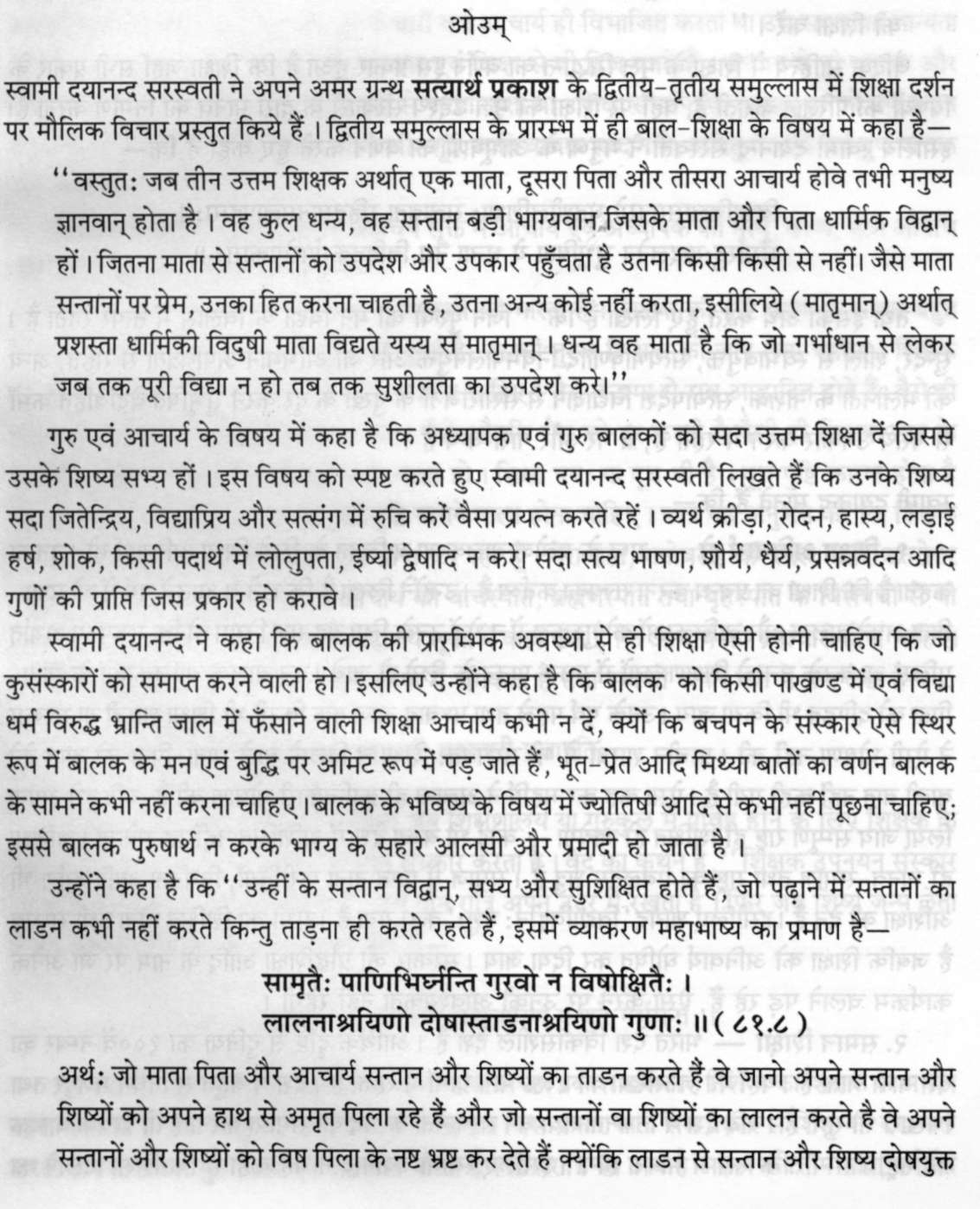


Swami Vivekanada's Philosophy of Education: Sunil Kumar
Background
Why are Indian organizations not world class?
Throughout the ages, Indian workers were known for their ability to produce unique world class products. It was for our goods that foreigners came to India to partake in our grandeur and thereafter for loot and plunder. Obviously, we had created the environment, systems and organizational structures where our workers could give their best.
In contrast, our educated managers of today have failed to create the systems, which can inspire our workers to give their best.
Obviously, our education and training and our management style are at fault.
At a very fundamental level, this fault can be attributed to:
-
lack of development of powers of concentration of mind; and
-
lack of a holistic and long term vision, i.e. lack of spirituality.
Because of these two reasons:
- we are unable to apply our mind for perfection, quality and excellence;
and
- we have become very petty and narrow-minded and think only of immediate gains instead of the long term good.
If we look at the recent news items we find that spirituality has entered corporate America in a big way. Similarly, executives in Australia and New Zealand are also now realizing that to meet the challenges of the competitive age "Most of the corporate bodies, instead of focussing on merges or acquisitions, are now directing their efforts to get their executives trained in self-development and spiritualization."
Once words like 'virtue', 'spirit', and 'ethics' got through the corporate door, God wasn't behind. Executives generally aren't an introspective lot, but in the dawn of the New Economy—with no job security or clear career path, with more responsibility and less certainty than ever—stressed out managers increasingly are turning "inside" for answers.
Summary
-
Our Self is the source of all perfection, happiness, power and glory;
-
The purpose of life is to know and to strive to manifest the perfection within, in and through our daily work and interactions;
-
Self-development is the control of mind towards perfection;
-
Understanding that we alone are responsible for all our joys and sorrows and for developing the powers of mind, gives us the inspiration to strive towards the goal by constantly holding on to good thoughts, living a regulated and disciplined life and cultivating good habits;
-
To give the conviction that company of good thoughts and daily self-study of ennobling books, life and teachings of sages, and some forms of meditation is necessary to manage unwanted thoughts and develop powers of mind—viveka, control, concentration and that is only with greater control over mind that we can achieve greater success, peace and joy.
The Need For Voe
- To be a star performer today, mere IQ and qualifications are not enough. More important is: How well we handle ourselves and others. This requires EQ, emotional stability, a big heart, and also SQ, spiritual intelligence, a feeling of oneness with all and a spontaneous feeling of love, care and concern for others.
In whatever we do, are we striving for Quality and Excellence? Excellence and feeling of oneness can be cultivated through training and control of our mind. The inspiration to strive for the highest and the best can be kept alive by daily meditation, self-study and reading of the life and teachings of saints and sages and by considering our work and duties as worship.
A Role Model
Indian culture and heritage can be understood in the light of the life and teachings of Sw. Vivekananda who has been declared, by the GOI (1984/85), as the ideal for the youth and his Birthday on 12th January has been declared as the National Youth Day.
To develop the habit of reading inspiring thoughts every morning and every evening in the schools can create study circles in each class and provide Time and Space in the Time Table in the first and the last class, of say 15-20 minutes each, for reading of good, inspiring books along with the practice of some form of Silence/Meditation. The Study circles should meet often and discuss the issues, seek classification and take on seva-oriented projects. The class teachers can take the lead in inspiring arid providing enthusiasm.
Essence of Indian Heritage: Swami Vivekananda
-
Each soul is potentially divine;
-
The goal is to manifest this Divinity within, by controlling nature, external and internal;
-
Do this either by work or worship, or psychic control, or philosophy— by one or more or all of these and be free;
-
This is the whole of religion. Doctrines, or dogmas, or forms, are but secondary details;
-
The Vedas teach that the Soul is divine, only held in the bondage of matter; perfection will be reached when this bond will burst, and the word they use for it is, therefore, Mukti—freedom, freedom from the bonds of imperfection, freedom from death and misery;
-
The background, the Reality, of everyone is that same Eternal, Ever Blessed, Ever Pure, and Ever Perfect One;
-
It is the Atman, the Soul, in the saint and the sinner, in the happy and the miserable, in the beautiful and the ugly, in men and in animals; it is the same throughout. It is the Shining One;
-
Here I stand and if I shut my eyes, and try to conceive my existence, "I", "I", "I"—what is the idea before me? The idea of a body. Am I, then, nothing but a combination of material substances? The
Vedas declare, "No". I am a spirit living in a body. I am not the body. The body will die, but I shall not die. Here am I in this body; it will fall, but I shall go on living;
-
There is no change whatsoever in the Soul—Infinite, Absolute, Eternal, Knowledge, Bliss, and Existence;
-
Know then, that thou art He, and model your whole life accordingly, and he who knows this and models his life accordingly, will no more grovel in darkness; This truth about the Soul is first to be heard. If you have heard it, think about it. Once you have done that, meditate upon it. No more vain arguments! Satisfy yourself once that you are the infinite spirit. If that is true, it must be nonsense that you are the body. You are the Self, and that must be realized. Spirit must see itself as spirit. Now the spirit is seeing itself as the body. That must stop. The moment you begin to realize that, you are released;
-
"The background, the reality, of everyone is that same Eternal, Ever Blessed, Ever Pure, and Even Perfect One. Each soul is potentially divine (infinite perfection, shanti and ananda)." Education is the manifestation of the perfection;
-
"The education which does not help the common mass of the people to equip themselves for the struggle of life, which does not bring out strength of character, a spirit of philanthropy, and the courage of lion—is it worth the name? Real education is that which enables one to stand on his own legs";
-
"We are responsible for what we are, and whatever we wish ourselves to be, we have the power to make ourselves." "Men in general lay all the blame of life on their fellowmen, or, failing that on God, or fate. We reap what we sow. We are the makers of our own fate. None else has the blame, none has the praise";
-
"Go on doing good, thinking holy thoughts continuously, that is the only way to suppress base impressions. Never say any man is hopeless because he only represents a character, a bundle of habits, which can be checked by new and better ones. Character is repeated habits, and repeated habits alone can reform character."
Failure of Present Systems
Indian organizations are today unable to offer world class results. How do we educate and train the youth who can create the environment and systems where people willingly work together to produce best results, for the good of people? This is our major challenge today. Our present education, training and administrative systems have failed to instill in our people the spirit of service and the striving for continuous improvement and quality in our work.
Can Indian Insights Help?
If we look back into our history and culture, we find that our educational systems, leadership values and managerial processes, designed by Rishis, were such that Indian workers could produce unique world class goods which had made India great, the "sone-ki-chidiya", attracting traders, as well as looters from all over.
After all the foreigners came to India only because of our riches not because we were poor! From holding 23% of world trade we now have only less than 0.2%. From being 1st we have gradually fallen to 5th (in 1947) to about 150th today.
Is this progress? Is modem education not at fault? Where have we gone wrong? What were the Indian insights? How can they help produce excellence today?
How a person behaves, feels and thinks and how he conducts himself in a given set of circumstances is largely determined by his value system and the nature of his mind. Knowing the nature of one's mind and how to concentrate, control and direct it in the right direction, is the aim and purpose of education and development.
The present education system is based on western ethos, which ignores the polishing and development of the inner instrument of man—his mind—and worse, it ignores the innate divinity, the Self within and focuses only on the body, mind and intellect.
This lack of focus on developing the powers of concentration of the mind and ignorance of the need for the unfoldment of the innate perfection, peace and happiness of the Self, is therefore directly responsible for the lowering of our character and values.
Indian ethos talks of Rtm (rhythm), a natural harmony, and when we are in tune with this Rtm, we are in a state of dynamic equilibrium, a state of ananda. How to achieve this samatva? The West has now come out with the theory of left brain and right brain, where the left is logical, rational, etc. and the right is holistic, creative, innovative, intuitive, and can create the synthesis between various facets of the One Truth. Unfortunately the entire education system today is focussed only on the left brain development.
How do we acquire this equanimity of mind? Our self-development programmes will have to focus on this aspect.
Universal Values
We need a set of universal values, which can be taught not only across the country, but globally. A suggested list of five values are being considered as a part of the national curriculum for Education in Human Values. These universal values are:
i. Good or righteous conduct: Conduct that is not wholly based on selfishness but keeps in view concerns of larger and larger groups, bahujana-hitaya, bahujana-sukhaya, and leads towards the idea that the whole world is our family, is good conduct. When an individual behaves as if he or his group alone matter, then naturally there will be clash of interest and ego will develop which will give rise to negative feelings of lust, greed, anger, attachment, arrogance and jealousy.
ii. Non-violence: If we propagate that we should go on fulfilling our desires (which in any case are infinite and perhaps can never be satisfied), or that the goodies are limited therefore grab what you can, then we are sowing the seeds of violence. We need to tell people that self-denial and cooperation with each other are much higher values. Spontaneous care and concern for others cannot be forced. It will arise when people know the Highest Truth and the Higher Goal and Purpose of Life.
iii. Love: Love arises when people get the intellectual conviction that if I help others I am only helping myself, and if I hurt others I am only hurting myself. We are all One, interconnected, interrelated, and interdependent and can live together in Rtm, harmony only if we love one another, see only their positive points and create an emotional bond with the One Truth, the whole universe.
iv. Truth: Truth is seeing that Reality is One, it is seeking the truth behind all phenomenon and trying to harmonize the wide variety so that it all hangs together in a dynamic equilibrium. Truth is accepting all this variety as a struggle to realize our Oneness with all. That is the purpose of life.
v. Peace: Peace is the fruit of the practice of the four Values and the realization of the purpose of life. Only when we follow good conduct, become non-violent, are full of love and pursue the path of truth that we can attain the state of perpetual peace and happiness, which we are all seeking from life. Our present tensions and miseries are there only because we are knowingly or unknowingly harming others, are full of negative emotions and indulging in loose passions, falsehoods, etc.
When we know who we are in essence, that the welfare of one is the welfare of all, that none of us can be a cancer on the whole, that therefore the best policy is to love all, help all, co-operate, be non-violent and pursue the noble path of truth; then alone will all our actions become good for us and for the whole world.
We need a healthy and universal world-view-of-reality explained in a logical and rational manner so that we can get the intellectual conviction in it. We then need to learn how to control our mind so that it can help and not hinder our path to Perfection. This is our objective.
Gandhian Values in Education: Ramjee Singh
Gandhian Values in Education - I
When somebody asked Gandhi, "What is your goal in education?" Gandhi replied, "Character-building. I would try to develop courage, strength, virtue, the ability to forget oneself in working towards great aims. This is more important than literacy; academic learning is only a means to this greater end."1 Literacy is neither the beginning, nor the end of education. "Literary training by itself adds not an inch to one's moral height and character-building is independent of literary training."2Here I am reminded of the words of Albert Einstein according to whom, "the most important human endeavour is the striving for morality in our actions. Our inner balance and even our very existence depend on it. Only morality in our actions can give beauty and dignity to life."3 Modern education, based on Cartesian reducationist approach of strict partition between mind and matter teaches us to know about everything except of our inner being. We do not know how much of slave we are of our selfish desires and passions. We may be performing some good acts, unaware that at the bottom of our motivation is a desire for reward, for recognition, for honour, for a 'good return' on 'investment' mode in the form of a temporary sacrifice. So, instead of serving others through these good acts, we end up by serving our own ego.4 The tragedy is that we go on performing bad acts without recognizing that they are bad. The worst is that even if we know that they are wrong, we cannot desist from them, and knowing what is right, we cannot perform it. Our education does not provide us with the capacity to discriminate between right and wrong and to bridge the gap between our prophecy and practice. Hence, thinking 'at the abstract level keep us on the ivory tower untouched by the reality of life. Hence the ideals of liberty, equality, fraternity, etc. are considered desirable on thought level and meant for others rather than ourselves. Even if we deviate from these ideals, we are hardly aware of it.
To Gandhi, these values of education are not meant for intellectual discussion but for operation in our daily life. If often seems that literate and the so-called educated people are experts of evil habits. The queer teaching methods of today break up the unity of life into two fragments—learning and living. Hence only one who is a master of one's own thoughts can truly practise any ideal, whether it be socialism, democracy or national integration, etc. To subscribe to an ideal merely at the intellectual level is hypocrisy and self-deception; it is not brought to the level of practice and conduct. This is what Socrates meant when he said, "knowledge is virtue" or as the Buddha said "Learning is a good thing but it availeth not. True wisdom is obtained by practice only." Even when Christ said, "Love thy neighbour as thyself," he wanted to obliterate the gap between theory and practice. Hence, Gandhian aim of education is human transformation rather than simply to acquire information. Today, ethics, morality compassion and such values are accepted in theory, but are difficult to implement in practice, whereas Gandhi thinks that the very implementation of these values in practical life is the very core of education.
-
Gandhi, M.K., Remakers of India, Carleton Washburne, 1932. pp. 104.105. ↩
-
Gandhi, M.K., YoungIndia, 1.6.1921. ↩
-
"Foremost Task of Education", Science, Ahimsa Centre, Gujarat Vidyapith, Ahemdabad. ↩
-
Ananthu, T.S., "Gandhi's Critique of Education", Hind Swaraj: A Fresh Look (Ed.) Nageshwar Prasad, New Delhi: Gandhi Peace Foundation, 1985, p.208. ↩
Gandhian Values in Education - I
Today there is progressive erosion of values and the resultant pollution of public life. This crisis of values is a highly dangerous development.1 Education seems to be the last hope of humanity because man cannot be made moral under threat or coercion. It is only through the educational processes that people can realize that exploitation, violence and hatred cannot sustain our social stability and peace. A coherent and an operationally viable value system would be inculcated and made more lasting through educational reorientation. This should be borne in mind that "modernization does not imply a refusal to recognize the importance of or to inculcate necessary moral and spiritual values. On the other hand, modernization, if it is to be a Living Force, must derive its strength of the spirit."2 The expanding knowledge and the growing power, which it places at the disposal of modern society must, therefore, be combined with "the strengthening and deepening of the social responsibility and a keener appreciation of moral and spiritual values."3 All the educationists and education commissions lament the weakening of social and moral values in the younger generation because it is creating many problems. Hence, there has been a serious thinking for the synthesis between science and spirituality, technology and culture, and knowledge of the outer world with the knowledge of the self, the meaning of life. Hence, if education is to be relevant and useful, it must become value-oriented. Even since our Independence, all Education Commissions (1948,1953 and 1964) and the two National Policies (1968 and 1986) have shown awareness and also concern of introducing social and moral values as component parts of educational processes. In 1959, the Central Advisory Board of Education had appointed a special Committee on Religious and Moral instructions under the Chairmanship of Sri Sri Prakash. But this is a tragedy that though the Report has been before the nation, neither the educational institutions nor the educational administrative machine has been keen much less enthusiastic about its implementation until we have been threatened by an all-enveloping culture of corruption and violence. Its undesirable effect on the life and character of the rising generation is more than evident. We should not be shy of talking about moral and spiritual values. Anything that helps us to behave properly towards others is of moral value.
Gandhian Values in Education - III
To my humble self, the root cause of this growing alienation of our educational system with moral and spiritual values despite explicit recommendations of all the Education Commissions, lies in the political leadership and its so-called wrong emphasis on distorted secularism. For example, the relevant clauses1 of the Indian Constitution ... .The framers of the Constitution perhaps failed to take note of the fact that religion is inseparable from life. Besides, Indian culture is deeply rooted in religious and spiritual value. There are many who feel that morality can take the place of religion. We have to understand that the great virtues of loyalty, courage, discipline and self-sacrifice may be used for good and bad ends. "These are essential for a successful citizen as well as for a successful villain."2 Apart from the crucial philosophical question, why should we become moral, we must understand that virtue and vice are determined by the direction in which we move, i.e. our philosophy of life. Hence, morality is taken in a larger sense, it is not enough. Then if we exclude spiritual training in our educational institutions, we would be untrue to our whole historical development and cultural heritage. Hence, 'Secularism' as mentioned in the Preamble of our Constitution, should never mean 'no to religion' but simple that there is no State religion and the State must not be partial to any one religion. On the other hand we had introduced a reverent study of the essentials of all religions, it would have been uniquely rewarding today and much of the virus of religious fundamentalism would have been wiped out. This value of Sarvadharma-Samabhava is not a fad of Gandhiji, but is also in consonance with the spirit of our country. Secularism, as it has been presented by no less a national figure than Nehru, is a negative idea. Itsing tells us that the University of Nalanda was the meeting ground of the different sects and creeds with their "possible and impossible doctrine." Banabhatta's Harsha-Carita refers to Divakaramitra's hermitage of crowds of students belonging to different creeds—Hindu, Buddhist, Jain, Lokayata, etc. In Akbar's Court, there used to be friendly discussion among the followers of the different religions. We can conclude that the proper study of the different religions of the world showing their fundamental unity that they meet in perfect harmony, the Religion of Man. The horizon of religion has been expanding. Swami Vivekananda decries the concept of Personal Religion and stoutly advocates the value of Universal Religion. Tagore speaks of the Religion of Man rather than of a particular sect or community. Gandhi, like Wordsworth's Skylark, sticking to the mooring of his own Hindu religion has advocated of equal respects for all religions. No educational system should have objection to it. Secularism should not mean an irreligious or anti-religious policy; it should belittle the importance of religion as such. Of course, we have to make a distinction between 'religious education' and 'education about religions'. The former is concerned with the teaching of the tenets and practices of a particular religion, whereas the latter is a study of religions and religious thought from a broad point of view—the eternal quest of spirit. "It is necessary for a multi-religious democratic State to promote a tolerant study of all religions,"3 is that its citizens can understand each other better and live with greater understanding and fellow-feeling. If tolerance and mutual understanding are rated as high value in the development of a democracy, highlighting the fundamental similarities in the great religions of the world and the emphasis on the cultivation of certain broadly comparable moral and spiritual values is very purposeful. The Kothari Commission Report laments the absence of provision for education in social, moral and spiritual values, because "in the life of the majority of Indians, religion is a great motivating force and is intimately bound up with the formation of character and inculcation of ethical values."4
We should not forget that there will be natural points of correlation between the moral values sought to be inculcated and the teachings of the great religions. All religions stress certain fundamental qualities of character,5 such as honesty and truthfulness, consideration for others, kindness, compassion, sacrifice and benevolence, etc. However, it is recommended that besides indirect instruction of values, specific provision for direct moral instruction at the lower level like narration of stories from great religions regarding moral values, accounts of the lives of great religious and spiritual leaders in the study of social studies or literature, celebration of the festivals of different religions, and study of comparative religions and for silent meditation at the higher level of education have been recommended by the Commission.14 Earlier the
Emotional Integration Committee appointed by the Government of India in 1961 headed by Dr. Sampurnanand has recommended explicitly that, "education will be incomplete if students are not helped to appreciate spiritual values, which the various religions present to the people."6 It recommends talks open to all on the teachings of various religions by able and competent persons and "the idea of national unity and unity of mankind should be introduced."7 The document of the National Policy on Education 1967 emphasizes "the cultivation of moral and social values. The educational system must produce young men and women of character and ability committed to national service and development."8 The abortive Draft of National Policy on Education 1979 during the Janta regime giving emphasis on Gandhi's ideas and experiments has advocated the need of "moral education as forming part of the content through inter-related curricular and co-curricular programmes in all subjects and should be the responsibility of all teachers and the entire institution."9 The document 'Education for our people' prepared under the chairmanship of Justice V.M. Tarkunde is critical of the existing educational system which lays greater emphasis on individualism, competition, verbal fluency, or linguistic ability, and more acquisition of information. It suggests that, "in the new system of education, we should recognise the significance of social objectives, cooperation and team works ... and the values of truth, equality, freedom, justice and dignity of the individual."10 Even the Report of the Committee of Members of Parliament on National Policy of Education in 1967 listed as "the most important and urgent reforms needed to transform the existing system of education in order to strengthen national unity, promote social integration, accelerate economic growth and generate moral, social and spiritual values."11 It has again and again emphasised the cultivation of moral, social and spiritual values of strengthening the moral fibre of the youth.12 The curriculum designed by the NCERT in 1975 has in most unmistakable terms emphasised that "the school curriculum should have a care centering round the objectives of character-building,"13 "cultivation of such qualities as compassion, endurance, courage, decision making, resourcefulness, respect for others, the team spirit, truthfulness, faithfulness, loyalty to duty and the common good."14 The inclusion of values in the objectives of education both at the primary stage,15 and the secondary stage,16 has been carefully designed by the NCERT but also they have not been implemented.
-
Report of the Committee on Religious and Moral Instructions, New Delhi: Ministry of Education, 1959, Para 30. ↩
-
Report of the University Education Commission, 1948-49, New Delhi: Ministry of Education, 1962. Para 29, p.300. ↩
-
Report of the Education Commission, 1966, Para 1.79, pp.36-37. ↩
-
Report of the Education Commission, 1966, Para 8.94, p.358. ↩
-
Report of the Education Committee, 1964-66, Para 8.97, p.359. ↩
-
Report of the Committee on Emotional Integration, 1961, Delhi: Publications Division, 1962, Para, 11.3.5. ↩
-
Report of the Committee on Emotional Integration, 1961, Delhi: Publications Division, 1962, Para 11.15. ↩
-
National Policy on Education, New Delhi: Ministry of Education, 1968, Para 3, p.2. ↩
-
Draft National Policy on Education 1979, New Delhi: Ministry of Education, Para, 1.3, p.2. ↩
-
Educationfor Our People—A Policy Frameforthe Development of Education overtheNext Ten Years, New Delhi: Allied Publishers, 1978, Para 2, p.2; Para, 3.2, p.18. ↩
-
Report of the Committee of the Members of Parliament on National Policy of Education, 1967, New Delhi: Ministry or Education, Para 2, p.l. ↩
-
Report of the Committee of the Members of Parliament on National Policy of Education, 1967, New Delhi: Ministry or Education, Para, 7, p.2; Para 17, p.6. ↩
-
The Curriculum for the Ten Year School: A Frame work 1975, New Delhi: NCERT, 1975, Para 2, 9, p.5. ↩
-
The Curriculum for the Ten Year School: A Frame work 1975, New Delhi: NCERT, 1975, Para 2, 9, p.5. ↩
-
The Curriculum for the Ten Year School: A Frame work 1975, New Delhi: NCERT, 1975, Para,, 3.4.5, p.13. ↩
-
The Curriculum for the Ten Year School: A Frame work 1975, New Delhi: NCERT, 1975, Para 3.2.8., p.ll. ↩
Gandhian Values in Education - IV
It is true that the Wardha Education Conference on Basic Education in 1937 under the chairmanship of Dr. Zakir Hussain did not contain any reference to moral and religious education,1 Mahatma Gandhi clarified his position to a delegation led by Hindustani Talimi Sangh in June 1938. "We have left out the teachings of religion from the Wardha scheme of education because we are afraid that religions as they are taught and practised today lead to conflict rather than unity. But I hold that the truths that are common to all religions can and should be taught to all children."2 Gandhi was critical of modern education which ignores the culture of the heart and the hand, and confines itself simply to the head."3 Though Gandhi "did not believe in State religion though the whole community had one religion" because religion was a purely personal matter and he did not like State interference in it. He was even opposed to State aid, partly or wholly, to religious bodies, "but this did not mean that State would not give ethical teaching. The fundamental ethics were common to all religions."4 Teaching of fundamental ethics is undoubtedly a function of the State.5 Character-building is the goal of education according to Gandhi.6 The National Education Conference (18-20th December 1977) organised by A.T. Nai Talim Samiti recommends "the inculcation of ethical, moral and human values and proper understanding of the essential unity of and equal respect for all religions"7 to be included in the courses of study from the pre-primary to the University levels.
In short, culture of heart and development of character was the uppermost in the mind of the Mahatma. Character is above intellectual knowledge which is valueless without character. An ounce of virtue is worth tons of high scientific knowledge or skill. The true "aim of education is not only to prepare a man for a profession, but to make him perform functions other than the production and transmission of wealth or his direct self-preservation."8 He must be awakened of duty to society, nation and humanity. Ideas and ideals quicken the moral life of a people and bring dynamism and purity in social life. 'The end of all education, all training, should he man-making"9 —says also Swami Vivekananda. Education is not the amount of information that is put into our brain and runs riot there, undigested all our lives. We must have life-building, character-making assimilation of ideas. "If education were identical with information, the libraries would be the greatest sages in the world and encyclopaedias the Rishis."10 We may have the most intellectual people the world ever saw and yet we may not come to God at all. On the other hand, irreligious men have been produced from the most intellectual training. Hence, it is one of the evils of Western civilization—intellectual education alone without taking care of heart. "It only makes men ten times more selfish."11
-
Educational Reconstruction, Wardha: Hindustani Talimi Sangh, 1956. ↩
-
Educational Reconstruction, Wardha: Hindustani Talimi Sangh, 1956., p.147 ↩
-
Gandhi, M K., Young India, 1.9.1921. ↩
-
Gandhi, M.K., Harijan, 16.3.1947. ↩
-
Gandhi, M.K. Harijan, 23.3.1947. ↩
-
Remakers of India, pp. 10-5. ↩
-
Nation Education Conference: Consensus on Action Programme, Wardha, 1977, Para 2, p.5. ↩
-
Hardayal, L., Thoughts on Education, New Delhi: Viveka Swadhyaya Mandal, 1969, p.50. ↩
-
The Complete Works of Swami Vivekananda, Mayavati Memorial Edition, Almorah: Advaita Ashram, 1962, Vol. II, p. 15. ↩
-
The Complete Works of Swami Vivekananda, Mayavati Memorial Edition, Almorah: Advaita Ashram, 1962, Vol. Ill, p. 302. ↩
-
The Complete Works of Swami Vivekananda, Mayavati Memorial Edition, Almorah: Advaita Ashram, 1962, Vol. I, P. 412. ↩
Gandhian Values in Education - V
It is a tragedy, students are taught everything of universe except his own self. Constant hammering on secularism and modernity have turned the springs of the heart into a commercial account book and naturally, a guardian or a student goes by the market-value of the educational degrees. The present intense individualism forbids the new generation to look beyond his own self. That is why the attempts of all present-day social reformers are doomed to fail. We forget that Science without Spirituality is a demon and Spirituality without Science is a defenseless woman. The greatest exponent of Secularism in modern India Pt. Nehru had to admit "life with science only as its guide and without a spiritual basis is very likely to lead to disaster for humanity."1 The present Western materialism is driving scientific research to the discovery of more and more facts about the external and physico-chemical world. But it is "one aspect only of truth." The other aspect must be sought by an inward journey of exploration. Unless this is done, our emotions and feelings are not linked with the welfare of society and then the educational enterprise will be socially irrelevant. Though, the question of religious education is very difficult, yet we cannot do without it."India will never be godless. Rank atheism cannot flourish in this land. (But) our religious teachers are hypocritical and selfish, they will have to be approached."2 Besides, "true religious teaching is not matter of literature." The essence of religion is a sound character, faith in God and the conviction that the soul is other than the body. This essential religion can only be learned from the company of good men. My only plan for religious teaching, therefore, is to choose good men as teachers—says Vinoba.3
Gandhian Values in Education - VI
Education was very close to the heart of Gandhi because he knew that it is the most powerful instrument of human and social transformation. However, he had revolutionary ideas about educational goals and strategies. He tried to break certain established idols also. First, to him literacy is neither the beginning nor the end of education. Secondly, mere intellectual knowledge is only one aspect of education; there are other aspects like proper training of will and emotions and character-building. Thirdly, individual development is not like a watertight compartment. It goes side by side with the development of society. Hence, individualistic values of education is a wrong and worn out conception. Fourthly, we can neither deny the contribution of Science nor we can shut our eyes towards the exploration of our inner self. As said in the Report. "Man's knowledge and mastery of outer-space and the space within his skull, are out of balance which mankind must seek to redress."1 We have a choice between atom and ahimsa, between co-existence, or non-existence, between universal welfare or global doomsday. We have been living in an age of tension. Hence, unless we develop an attitude of duty without attachment (anasakti), we cannot keep our peace of mind and happiness. Similarly, our modern culture has become the culture of extravagance and endless wants, hence, we adopt an attitude of voluntary simplicity and non-possession (aparigraha), we shall become a slave of our desires and wants. For all these things, we shall have to look within-education of the Spirit, rather than education of matter. Lastly, if education has to become relevant, it must cultivate the value of peace. Peace-education has a tremendous relevance in the present global crisis.42 We have to find out the alternative to war and violence. Peace-education and Peace-Research is not a fad of Gandhi, it is a necessity for the preservation of the present civilization.
-
Report of the Education, 1964-66, p. 22. ↩
Unending Education, Constant Progress and A Youth That Never Ages: Deepti Tiwari
Or we may find when all the rest has failed
Hid in ourselves the key of perfect change.
—Sri Aurobindo, Savitri, p.256
"Our call is to young India. It is the young who must be the builders of the new world.—Sri Aurobindo
There are in the history of the earth, moments, hours, special turning points, when all the old standards no longer hold good, when a spirit is abroad that shakes to the core, comfortable beliefs in well-trodden paths. Such occasions demand from us a special heroism for we must surrender our attachment to the settled order of things so as to robustly seek new solutions. We are at just such an instant, that Sri Aurobindo, writing in The Life Divine seems to have been describing where he says that Mankind is in the throes of an evolutionary crisis in which is concealed a choice of its destiny. For a stage has been reached in human evolution where an enormous though one-sided development has taken place. Yet, in certain directions, the human mind stands arrested and bewildered and can no longer find its way. Man has created a structure of external life to serve largely his baser instincts and this structure has now become so huge and so complex as to be unmanageable for his still very limited spiritual and moral capacity, "a too dangerous servant of his blundering ego and its appetites." It is obvious to even the most ordinary mentality that something else is needed: a greater aim, a seeking for a higher truth and good and beauty, "for the discovery of a greater and diviner spirit which would intervene and use life for a higher perfection of the being."
The twentieth century saw science step aside from its earlier high-standing ideals and become largely a mere hand-maid to technology, often aiding and abetting the selfish self-aggrandizing impulses of nations and peoples.
"At the same time Science has put at [man's] disposal many potencies of the universal Force and has made the life of humanity materially one; but what uses this universal Force is a little human individual or communal ego with nothing universal in its light of knowledge or its movements, no inner sense or power which would create in this physical drawing together of the human world a true life-unity, a mental unity or a spiritual oneness. All that is there is a chaos of clashing mental ideas, urges of individual and collective physical want and need, vital claims and desires, impulses of an ignorant life-push, hungers and calls for life satisfaction of individuals, classes, nations, a rich fungus of political and social and economic nostrums and notions, a hustling medley of slogans and panaceas for which men are ready to oppress and be oppressed, to kill and be killed, to impose them somehow or other by the immense and too formidable means placed at his disposal, in the belief that this is his way out to something ideal."2
Utilitarianism and Education
Humanity stands at the crossroads, and the choices we make today will create the world that our children shall inherit. If a revolution in perspective can take place perhaps we shall be able to create systems of education that can truly empower the youth to comprehend, inwardly and outwardly, the world they confront. On the other hand, educational aims may continue to remain largely utilitarian, that is valuing merely what is useful rather than what is Good and True and Beautiful. And so the system shall continue to construct 'products' whose personalities are oriented mainly towards the pursuit of successful careers and money making. For it is this aim that dominates educational pursuits and institutions, handicapping and dwarfing what should be a sacred vocation.
And thus it will remain, that at an age when children should be dreaming of beauty, of greatness and perfection, dreams that may be too sublime for ordinary common sense, children now dream of money and worry about how to earn it. What is of greatest value to them in their education is merely what may be useful when they grow up so that they too can earn a lot of money. What happens to the aspiration to learn for the sake of knowledge, to study in order to know the secrets of Nature and life, to educate oneself in order to grow in consciousness, to discipline oneself in order to become master of oneself, to overcome one's weaknesses, incapacities and ignorance, to prepare oneself to advance in life towards a goal that is nobler and vaster, more generous and more true? All of these, which ought to be the true aim of education, are swallowed up by the terrible modern-day malady of utilitarianism.
The Lessons of History
There have been cultures and civilizations in humanity's past that based their self-development upon deeper and truer value systems—Ancient India, Hellenic Greece, Renaissance Europe—all are counted as the greatest ages of mankind. But the malady of modem man is the extreme importance he gives to the aptitude for and acquisition of money alone. It is first and foremost a reversal of this perspective, of this economic barbarism, that can give Education a new value-orientation.
But to truly change one single factor we have also to transform our society and its present value-system for our educational institutions are born of its soil. We can all agree that globalization with its many negative economic connotations has to be replaced by a growing sense of concern for the All; the uncontrolled urge for ever increasing powers and desires superceded by mutuality and brotherhood. But, we ask, how is it possible to build a greater harmonic life in this atmosphere of generalized confusion and discord?
Man has harmonized life in the past by organized ideation and limitation, he has created societies based on separative fixities—ideas, customs, religions— it is these that shaped the distinct cultures that people the earth. But the world today resembles a vast melting-pot, no one can maintain a splendid isolation from the problems and issues that may arise in another part of the globe. Reason and Science, because they act by standardizing, by fixing into an artificially arranged and mechanized unity, stand arrested and unable to advance new thoughts before this vast intermingling of ideas and forces and peoples—it is apparent that a greater consciousness is called for.
"A greater whole-being, whole-knowledge, whole-power is needed to weld all into a greater unity of whole-life. A life of unity, mutuality and harmony born of a deeper and wider truth of our being is the only truth of life that can successfully replace the imperfect mental constructions of the past which were a combination of association and regulated conflict, an accommodation of egos and interests grouped or dovetailed into each other to form a society, a consolidation by common general life-motives, a unification by need and the pressure of struggle with outside forces. It is such a change and such a reshaping of life for which humanity is blindly beginning to seek, now more and more with a sense that its very existence depends upon finding the way."
In this redefining evolutionary moment what are the idea-forces that will help us to create the educational structures that will serve us for the new century? Writing in the Karmayogin in 1910, Sri Aurobindo spoke of the necessity of evolving a system of National Education for India. Many of his suggestions remain extremely relevant today. An education based upon the Indian spirit is indeed something we should have already developed for it would have served us well in meeting the many challenges India confronted. That we did not is a continuing factor in the impoverishment of the Indian mind which, functioning under an imitative foreign impress, has not been allowed to flower into its innate genius.
The Leadership of the Self-developing Soul
In this context Sri Aurobindo's idea of an integral, a universal education acquires crucial significance. It is the only method by which the youth of today can truly be empowered, taken out of their cynicism which is a cloak for their despondency, and given the tools to take charge of their own destinies. For, indeed, the solution to the present predicament lies not in outer changes but within, in the subjective being of each individual. There is in each human being, a subliminal part which ought to be first discovered and then made the true centre of consciousness. All energies, all processes of education should be directed towards seeking this part of the being which exists veiled and concealed behind one's familial, social, moral, ethical, religious and cultural background. Once located and brought forward to the front, it is this being alone that has the power to take the whole educational process out of its present mechanical round and stereotypical approaches.
As Sri Aurobindo remarks, it is now more or less acknowledged that
"each human being is a self-developing soul and that the business of both parent and teacher is to enable and to help the child to educate himself to develop his own intellectual, moral, aesthetic and practical capacities and to grow freely as an organic being, not to be kneaded and pressured into form like an inert plastic material."
But what is not yet conceived of is the true power and sovereignty of this soul. For if this soul were once allowed to come forward and assume the role of leadership in the psychological nature of the child it:
"will itself take up most of the business of education out of our hands and develop the capacity of the psychological being towards a realisation of its potentialities of which our present mechanical view of life and man and external routine methods of dealing with them prevent us from having any experience or forming any conception.3
It is this truth, brought in not merely as an idea, but as the fundamental axis and guiding principle—a standard and a norm that reorganizes—which could give birth to a new arid vibrant method of education, revolutionary in its results for the individual, the society, the nation and also humanity.
Looked at from this angle the problem of education both individual arid on a mass scale, assumes manageable dimensions. For in each case, the solution lies within the psychological being of the individual—whether teacher or student We must accept that the only way to build truly and permanently is from within outwards. It is this inner self-knowledge that is the pathway to mastery in all domains from the most material to the highest spirit. To attempt or to propose marvellous and progressive ideas on education without this change of consciousness will be shown to be a vain chimera, for we are merely somersaulting upon our habitual centre of gravity. In every case it is the spirit that can create the forms, and if the spirit is sourced in this sovereign part of the being, almost all forms, unless they are totally strait-jacketed, can be rightly fashioned or adapted.
A Reversal of Perspective
It is thus a radical change in the habitual centre of consciousness that can take the being out of its petty littleness and small life-instincts. Such an inner change, which creates in the human individual a new centre of gravity in his soul, is the only means by which humanity can evolve structures of living based upon unity, perfect mutuality and harmony. It can be said that until this fundamental transformation in human personality is wrought, the destiny of the race will remain dangerously poised. It is demonstrably clear that no real growth or change can be brought about by the present infra-spiritual and infra4ational life-self of humanity. This self in man works under the drive of the vital ego that is easily seized by colossal forces on a scale too large for man's reason and will to handle. A deeper knowledge system is needed. The legitimate question that follows is: does such a systematized knowledge system exist?
country in the world which has had the knowledge of this greater whole-being, whole-knowledge and whole-power is India. Through her various systems of Yoga she blueprinted and mapped the pathways of the inner worlds, creating a highroad that anyone can tread. In this great age of change, it is she alone if she wills, who can be the physician for the malady that afflicts not only herself but all humanity. But to offer meaningful solutions she has herself to rediscover, and redefine in the light of the modem world, this inner knowledge for it lies locked in her soul-spaces, and secret retreats. And most importantly she must master the material domains that she neglected for so many centuries— and do so if possible in the rhythms of her own particular genius.
We may equally return to the Upanishadic question: Is there something knowing which, everything can be known? The question gains enormous importance given the present-day complexities of the information-age world where one can spend one's whole life merely 'keeping up' with the knowledge explosion. For India to follow, in her educational philosophy, the already well-beaten outer paths developed by the civilization of the West, will not bring the commensurate progress and growth that we urgently seek for our emergent country for they will keep her always a step behind—no more than a poor and more backward copy of the West.
'The scientific, rationalistic, industrial, pseudo-democratic civilization of the West is now in process of dissolution and it would be a lunatic absurdity for us at this moment to build blindly on that sinking foundation. When the most advanced minds of the Occident are beginning to turn in this red evening of the West for the hope of a new and more spiritual civilization to the genius of Asia, it would be strange if we could think of nothing better than to cast away our own self and potentialities and put our trust in the dissolving and moribund past of Europe."4
A Value-orientation based upon the Indian Spirit
Solution can be found in the Indian Spirit, in her subtle and psychical sciences of Yoga which alone can bring about an accelerated development not only in the powers of the mind, but in the psychological personality and character of our people. There is no good reason why the many complex systems of the science of Yoga, that India perfected through centuries, should not be incorporated into the educational systems of India. This will be of great benefit not only for Indians themselves but a confident assertion of this culture's unique contribution towards the concert of human progress.
"Spirituality [does not mean] the moulding of the whole type of the national being to suit the limited dogmas, forms, tenets of a particular religion, as was often enough attempted by the old societies... Spirituality is much wider than any particular religion...
"India can best develop herself and serve humanity by being herself and following the law of her own nature. This does not mean, as some narrowly and blindly suppose, the rejection of everything new that comes to us in the stream of Time or happens to have been first developed or powerfully expressed by the West. Such an attitude would be intellectually absurd, physically impossible and above all unspiritual; true spirituality rejects no new light, no added means or materials of our human self-development. It means simply to keep our center, our essential way of being, our inborn nature and assimilate to it all we receive, and evolve out of it all we do and create...
"[India] can if she will, give a new and decisive turn to the problems over which all mankind is labouring and stumbling, for the clue to their solution is there in her ancient knowledge, whether she will rise or not to the height of her opportunity in the renaissance which is coming upon her, is the question other destiny."5
The Individual, the Nation and Humanity
In his Preface to National Education (1920) Sri Aurobindo spoke of the three things that had to be taken into account in any true or living education. The first was the individual in his commonness and in his uniqueness, the second was the nation or people and the third universal humanity. And of all these education had to take proper account if it wanted to be a living evocation of the powers of the mind and the spirit of the human being. It is without dispute that each element must be brought out to its fullest advantage, but there can be so many varying conceptions that may radically alter approaches to the problem. The unique feature of the thought of India is that it has not looked at man merely from his outward aspect either as a physical being alone or as pre-eminendy a reasoning animal, a thinking, feeling and willing natural existence, a mental son of physical Nature. Nor has Indian thought conceived of man solely as a political, social and economic being. These things have been accepted as part of the instrumentation of man's mind and life and action but not his whole being. For "India has seen always in man the individual a soul, a portion of the Divinity enwrapped in mind and body, a conscious manifestation in Nature of the universal self and spirit. Always she has distinguished and cultivated in him a mental, an intellectual, an ethical, dynamic and practical, an aesthetic and hedonistic, a vital and physical being but all these have been seen as powers of a soul that manifests through them and grows with their growth, and yet they are not all the soul, because at the summit of its ascent it arises to something greater than them all, into a spiritual being and it is in this that she has found the supreme manifestation of the soul of man and his ultimate divine manhood. And similarly India has not understood by the nation or people an organized State or an armed and efficient community well prepared for the struggle of life and putting all at the service of the national ego but a great communal soul and life that has appeared in the whole and has manifested a nature of its own and a law of that nature, a Swabhava and Swadharma and embodied it in its intellectual, aesthetic, ethical, dynamic, social and political forms and culture. And equally then our cultural conception of humanity must be in accordance with her ancient vision of the universal manifesting in the human race, evolving through life and mind but with a high ultimate spiritual aim—it must be the idea of the spirit, the soul of humanity advancing through struggle and concert towards oneness, increasing its experience and maintaining a needed diversity through the varied culture and the motives of its many peoples, searching for perfection through the development of the powers of the individual and his progress towards a diviner being and life, but out too though more slowly after a similar perfectibility in the life of the race... It must be an education that for the individual will make its one central object the growth of the soul and its powers and possibilities, for the, nation will keep first in view the preservation, strengthening and enrichment of the nation-soul and its Dharma and raise both into powers of the life and ascending mind and soul of humanity. And at no time will it lose sight of man's highest object, the awakening and development of his spiritual being."6
The Three Principles of Education
In his earlier preliminary writings on education, Sri Aurobindo speaks of three principles of education. It is easy to see that these are fundamental verities which, sincerely and comprehensively applied, could in themselves bring about a complete change in the way teaching and learning takes place.
'The first principle of true teaching is that nothing can be taught. The teacher is not an instructor or task-master, he is a helper and a guide. His business is to suggest and not to impose. He does not actually train the pupil's mind, he only shows him how to perfect his instruments of knowledge and helps and encourages him in the process. He does not impart knowledge to him he shows him how to acquire knowledge for himself. He does not call forth the knowledge that is within; he only shows him where it lies and how it can be habituated to rise to the surface.
"The second principle is that the mind has to be consulted in its own growth. The idea of hammering the child into the shape desired by the parent or teacher is a barbarous and ignorant superstition. It is he himself who must be induced to expand in accordance with his own nature. There can be no greater error than for the parent to arrange before hand that his son shall develop particular qualities, capacities, ideas, virtues, or be prepared for a prearranged career. To force the nature to abandon its own dharma is to do it permanent harm, mutilate its growth and deface its perfection. It is a selfish tyranny over a human soul and a wound to the nation, which loses the benefit of the best that a man could have given it and is forced to accept instead something imperfect and artificial, second-rate, perfunctory and common. Every one has in him something divine, something his own, a chance of perfection and strength in however small a sphere, which God offers him to take or refuse. The task is to find it, develop it and use it. The chief aim of education should be to help the growing soul to draw out that in itself, which is best and make it perfect for a noble use.
"The third principle of education is to work from the near to the far, from that which is to that which shall be. The basis of a man's nature is almost always, in addition to his soul's past, his heredity, his surroundings, his nationality, his country, the soil from which he draws sustenance, the air which he breathes, the sights, sounds, habits to which he is accustomed. They mould him not the less powerfully because insensibly, and from that then we must begin. We must not take up the nature by the roots from the earth in which it must grow or surround the mind with images and ideas of a life, which is alien to that in which it must physically move. If anything has to be brought in from outside it must be offered, not forced on the mind. A free and natural growth is the condition of genuine development. The past is our foundation, the present our material the future our aim and summit. Each must have its due and natural place in a national system of education.7
Integral Education
It is most important to recognize that what Sri Aurobindo and Mother propose is not only a mental principle, it is a new idea of life and a realization of consciousness. It has been said: All life is education. Yes, without a doubt, if one recognizes that one never stops learning, that progress can be made in every least thing, and that growth is the sign of youthfulness and indeed, one can be young at 90 years! Earth is a field of progress, and education is something that must be continued all one's life. It is this that gives interest and meaning to life—the ability and the aspiration to continue to hone one's faculties and develop one's capacities. A high vast and all embracing aim changes the quality of life and if one makes one's aim the growth of consciousness, then one has chosen an immeasurable path for there can be no end, no limit to the growth of consciousness. Schools are merely a preparation to make youth capable of thinking, studying, progressing and becoming intelligent, but the process of acquiring knowledge, and synthesizing it in one's being; increasing one's capacity for heroism and illumination and harmony; working upon one's power to express skill, strength, plasticity, and beauty, must be continued all one's life. For no aspect of knowledge is outside the scope of an education aiming at integrality. Rather than a linear development, one adopts a spherical method that enfolds all the world and nature too and studies its many processes from the physical to the psychical. All subjects: ethics, aesthetics, the humanities and the sciences are means by which one can touch the overarching aim which is to arrive at a unity and synthesis of knowledge based upon a deeper poise of the being.
It is such an Integral education built upon a deeper center of gravity, a psychic and spiritual education that Sri Aurobindo envisioned for the youth of India. Commenting on this 'knowledge of the Spirit' that India nurtured through millennia, Mother remarked:
"India has or rather had the knowledge of the Spirit, but she neglected matter and suffered for it.
"The West has the knowledge of matter but rejected the Spirit and suffer badly for it.
"An integral education which could, with some variations, be adapted to all the nations of the world, but bring back the legitimate authority of the Spirit over a matter fully developed and utilized."8
What then is the 'legitimate authority of the Spirit' that India knew and understood? What are the elements necessary to create a true Integral education? How does one create a matter 'fully developed and utilized' but placed at the service of the deeper truth of the spirit? It is in seeking answers to these questions that a comprehensive picture of the education that Sri Aurobindo and Mother envisioned will emerge.
The Parts of the Nature
The Mental Being
An analysis of the planes and parts of the being creates a perspective of the elements necessary in any 'organized' growth of consciousness? The outer instrumental nature of the human being is composed of the mind, the life and the body and there is the 'inner nature' composed of the psychic and the spiritual being. In any system of education, each of these parts requires a separate and finely honed action of development. But most systems stop at the first three: the mind, the life-force and the body, for the other deeper parts are seldom even conceived, leave alone addressed. Indian Education can and should base itself on the deeper layers and allow them to orient the work and the action upon the outer instrumental nature.
In one of his early essays, Sri Aurobindo discussed the structure of the external mind. This is composed first of the active and passive memory—the citta. Then there is the mind-layer, manas, the sixth sense of Indian terminology and finally the intellect or buddhi, which is the aspect of the rational being. There are upper layers of the, which include sovereign discernment, intuition and illumination among them, but these are the domains of the higher mind which can be systematically acquired only through the pursuit of Yoga. Each of these levels has their proper place in any system aimed at self-development, but, in recent times, education in India has given undue importance to the memory while neglecting to address or to awaken the mental powers of observation, comprehension, expansion, discrimination, discernment and synthesis. The capacity for reflective thought—vichar, and discriminative intelligence—vivek which were once so valued, capacities that should be and could be, native to the Indian mind are no more encouraged in the present system. All educational thinkers have lamented the lack of real and profound thinking skills in modern India. In a letter, written around 1920 Sri Aurobindo made this telling comment:
"I believe that the main cause of India's weakness is not subjection, nor poverty, nor kick of spirituality or Dharma, but a diminution of thought-power, the spread of ignorance in the motherland of Knowledge. Everywhere I see an inability or unwillingness to think—incapacity of thought or 'thought-phobia'."9
Thus he saw that if India had to arise and fulfill her potential, the youth of India had to learn to think and to think deeply, independently and fruitfully:
"Our first necessity, if India is to survive and do her appointed work in the world, is that the young of India should learn to think—to think on all subjects, to think independently fruitfully going to the heart of things, not stopped by their surface, free of prejudgments, shearing sophism and prejudice asunder as with a sharp sword, smiting down obscurantism of all kinds as with the mace of Bhima... In India alone there is self-contained, dormant, the energy and invincible spiritual individuality which can yet arise and break her own and the world's fetters."10
For it is only when the young of India—indeed all of India, but our concern is especially for the future nation-builders—think originally, concentratedly, and clear-sightedly, that an Indian renaissance will come about The young minds should become wide, complex, supple and capable of a comprehensive synthesis.
It is when one has created a widespread habit of original thought which pervades all aspects of life that one can consider an education that teaches one to think in ideas -ideas that will be creative forces to improve and change society. Finally, if the capacity of concentration is cultivated to bring about thought-control leading to mental silence and a growing receptivity to higher inspirations, the youth of India could even acquire the power to 'think' in experiences, of old, India had this gift—usually latent in human beings— developed to its full effulgence in the lives and actions of her robust soul-spirits, the Rishis, who were the true creators of our ancient long-lasting culture. It is the experiences, of these seer-poets that one finds recorded, through the medium of a finest poetic expression, in her ancient books of knowledge. The youth of India must acquire a living contact with this sublime universal heritage, the solid bedrock and foundation of India, as the ideal to which they too can aspire.
The Aesthetic and Ethical side of the Being
The mental being of man has a sort of triangular disposition—there is in our mentality a side of will, conduct, character which creates the ethical man; there is another side of sensibility to the beautiful—understanding beauty in no narrow or hyper-artistic sense—which creates the artistic and aesthetic man. Above these is the intellect or rational being. Often it is found that the aesthetic and the ethical represent two conflicting ideals, which must naturally stand opposed and look askance at each other with a mutual distrust or even reprobation. An ethical self-culture aimed at developing will and character, leading to self-discipline and finally self-mastery is the essential back-bone upon which educational structures should be built for without character, without some kind of high or strong discipline there is no enduring power of life.
The ethical being in us is the seeker for the Good, just as the aesthetic being is the seeker for the Beautiful. A balanced development of these two sides of the being is indispensable. Ancient India gives us a luminous example of a civilization that, neglecting neither aspect, found just such a harmonious balance between these two essential impulses in the human personality. This culture's great idea-force: Dharma, stands testimony to the high-charactered people and enduring civilization this master idea helped to shape. The other idea-force rooted in Indian thought, is that it is Delight, Ananda that has created the universe. This is demonstrated in the common conceptions of the Divine as Sachchidananda or as Satyam Shivam Sundaram. This Delight of existence pervaded and influenced all of India's art, painting, music, literature, sculpture and architecture. A sense of a deep joy of existence is the master-impulse of Indian Artistic expression, which as its primarily impulse, sought for the Divine as the All-beautiful.
If the education provided to the youth of today can encourage them to nurture in themselves a similar love of beauty through a tapasya of art and all forms of creativity, of music and poetry and literature, this 'worship' can in itself transmute the nature and uplift it to its spiritual heights. But even from an ordinary level, the power of a highly developed aesthetic sense to influence every part of the being is invaluable—for when one habitually surrounds oneself with all that is beautiful, noble, fine and harmonious one can grow into the image of that which one contemplates. The sense of beauty can equally awaken within oneself the idea of giving expression to a conduct that is always beautiful, refined and noble. For one instinctively abjures anything vulgar, low or ugly. And then, there is too an intellectual utility in educating the aesthetic faculty, for a mind that is accustomed to a training in art develops mobility, subtlety, fineness and delicacy.
"Poetry raises the emotions and gives each its separate delight. Art stills the emotions and teaches them the delight of restrained and limited satisfaction.......Music deepens the emotions and harmonises them with each other.
Between them, music, art and poetry are a perfect education for the soul; they make and keep its movements purified, self-controlled deep and harmonious.
These therefore are agents which cannot profitably be neglected by humanity in its onward march or degraded to the mere satisfaction of sensuous pleasure which will disintegrate rather than build the character. They are when properly used, great educating, edifying and civilizing forces."11
The Vital Being
So long as we pursue knowledge for its own sake, there is nothing to be said: the reason is performing its natural function; it is exercising securely its highest right. It is when reason tries to apply its ideas to life that the human intellect stumbles and finds itself at a loss. It is perhaps for this reason that the development of the life domains has often been neglected. It is at great cost to herself, that in her last millennia India chose to neglect life. For of what use are the acquisitions of the gifts of the spirit if there is a sheer impoverishment of life?
The Vital being is the seat of power in the human personality. It is in the vital that thought is transformed into will and becomes a dynamism for action. The vital is also the seat of desires and passions, of violent impulses and reactions and revolts and depression. It is for this reason that many disciplines seek to starve the vital into submission. But this is hardly an intelligent doctrine. It is by enlightening, strengthening and purifying the vital that one can progress. The youth of India ought to develop the habit of heroism, of self-sacrifice, of a vast and selfless energy of service. It is these habits that give real meaning to life that can awaken one to the delight and harmony and beauty of existence. It is not a coincidence that when the action of heroic self-sacrifice became generalized amongst the Indian people as it did in the Freedom Struggle, a new energy, marvelous and mystical in action and unity and force of movement was born in the country. What wants to be awakened in India is the eagle-soar of the leonine warrior spirit, not the cold comfort and weak security of the bourgeois.
The tapasya of beauty, starting with the training, cultivation and refining of the senses leading to the fostering of the aesthetic capacity is the most marvelous way to educate and refine the vital. The tapasya of character, leading to the birth of nobility, heroism and disinterested action are the mark of a cultivated and illumined vital and every youth of India should be given conditions that help him acquire these qualities. Our aim should be a spiritualized society, but to achieve it we need a highly developed, richly empowered, illumined life-force.
"It is a great error to suppose that spirituality flourishes best In an impoverished soil with the lift half-killed and the intellect discouraged and intimidated. The spirituality that so flourishes is something morbid, hectic and exposed to perilous reactions. It is when the race has lived most richly and thought most profoundly that spirituality finds its heights and its depths and its constant and many-sided fruition."12
The Body
The body is the base and pedestal on which all the qualities and capacities of the being rest. Thus a proper and comprehensive physical culture is an essential foundation upon which all education must be built. Sri Aurobindo gave great importance to the need for a discipline aimed at the perfection of the body. It is this part of the being that lends itself most to organization, order and regulation.
"The perfection of the body, as great a perfection as we can bring about by the means at our disposal, must be the ultimate aim of physical culture. Perfection is true of all culture, the spiritual and psychic, the mental, the vital and it must be the aim of our physical culture also. If our seeking is for a total perfection of the being, the physical part of it cannot be left aside; for the body is the material basis, the body is the instrument, which we have to use. Sariram khalu dharmasadhanam, says the old Sanskrit adage, the body is the means of fulfillment of dharma, and dharma means every ideal which we can propose to ourselves and the law of its working out and its action.13
Sri Aurobindo spoke in detail on the development and perfection of all the powers and capacities of the body. His first recommendation is to build the conditions for a generalization of the habit of taking part in physical exercise from childhood and youth through early manhood as this would help greatly towards the creation of physically fit and energetic people. An essential foundation must be built of health and strength and fitness in the body. But much more important is the value of sports and physical training in developing discipline and morale and sound and strong character. There are sports that necessitate the qualities of courage, hardihood, energetic action and initiative, or call for skill, steadiness of will or rapid decision and action, the perception of what is to be done in an emergency and dexterity in doing it. All of these can awaken in the body the consciousness which can see and do what is necessary without any indication from mental thought "and which is equivalent in the body to swift insight in the mind and spontaneous and rapid decision in the will."
Sports can also awaken that invaluable quality: the sporting spirit. The capacity to be good-humoured and show consideration, friendliness, self-control and a scrupulous observance of the laws of the game, the sense of fair play, and team-spirit and a calm acceptance of decisions in adverse circumstances—are all qualities that are useful for life in general. Sports can also train one in the discipline of leadership, the capacity to command or to obey, which is of utmost importance in any combined action.
"This strictness of training, this habit of discipline and obedience is not inconsistent with individual freedom; it is often the necessary condition for its right use, just as order is not inconsistent with liberty but rather the condition for the right use of liberty and even for its preservation and survival...
"The nation which possesses them in the highest degree is likely to be the strongest for victory, success and greatness, but also for the contribution it can make towards the bringing about of unity and a more harmonious world order towards which we look as our hope for humanity's future".14
The fourfold Personality
The human personality has in it a fourfold nature. There is a side of us that is a power for knowledge, another that is a power for strength and dynamic will, a third for mutuality and active and productive relation and interchange, and finally a fourth, which is a power for works and labour and service. Often it is, that depending upon our temperament, character and personality type, one or other side predominates. But each of these powers and capacities is there, latent in every being. Depending upon which of these four powers is most strongly active in us we discover our main tendencies, dominant qualities and capacities and our effective turn in action and life.
An integral education must aim at not only a conscious sounding of these four powers of the being but at their fullest development. Wisdom; strength that leads to a sovereign will-force; harmony and perfection are the attributes that each youth must develop in his being. And when through a great process of individual askesis, soul-force is manifested in fullness in the completely developed fourfold personality, these are the powers that one can anticipate in the individual being—powers that every youth can set before himself as the great and high ideal to attain in his own psychological nature:
'The godhead, the soul-power of knowledge rises to the highest degree of which the individual nature can be the supporting basis. A free mind of light develops which is open to every kind of revelation, inspiration, intuition, idea, discrimination, thinking synthesis; an enlightened life of the mind grasps at all knowledge with a delight of finding and reception and holding, a spiritual enthusiasm, passion, or ecstasy; a power of light full of spiritual force, illumination and purity of working manifests its empire, brahma-tejas, brahma-varcas; a bottomless steadiness and illimitable calm upholds all the illumination, movement, action as on some rock of ages, equal, unperturbed, unmoved, acyuta.
The godhead, the soul-power of will and strength rises to a like largeness and altitude. An absolute calm fearlessness of the free spirit, an infinite dynamic courage which no peril, limitation of possibility, wall of opposing force can deter from pursuing the work or aspiration imposed by the spirit, a high nobility of soul and will untouched by any littleness or baseness and moving with a certain greatness of step to spiritual victory or the success of the God-given work through whatever temporary defeat or obstacle, a spirit never depressed or cast down from faith and confidence in the power that works in the being, are the signs of this perfection.
'There comes too to fulfillment a large godhead, a soul-power of mutuality, a free self spending and spending of gift and possession in the work to be done, lavished for the production, the creation, the achievement, the possession, gain, utilisable return, a skill that observes the law and adapts the relation and keeps the measure, a great taking into oneself from all beings and a free giving out of oneself to all, a divine commerce, a large enjoyment of the mutual delight of life.
And finally there comes to perfection the godhead, the soul-power of service, the universal love that lavishes itself without demand of return, the embrace that takes to itself the body of God in man and works for help and service, the abnegation that is ready to bear the yoke of the Master and make the life a free servitude to Him and under his direction to the claim and need of his creatures, the self-surrender of the whole being to the Master of our being and his work in the world. These things unite, assist and enter into each other, become one."15
This is a description of the fullness of personality when the soul-force, secret in our inmost being is brought to the front and allowed to achieve its untrammeled action of fulfillment. These words and images are as yet merely delineating the potentialities secret within us, that await their day. For it is only the entering and illumining action of this soul-force into the smallest detail of our outer instrumental nature and life of action, that can energize and liberate the action of the Shakti that slumbers there within us awaiting her hour. It is with such a robust spiritual faith that every Indian especially the young should approach their life, their growth and their action in the world. This should be the aim of education in India, which of old, has been the land of spiritual living.
Psychic Education and Spiritual Education
Andre Malraux, the great French thinker and writer, speaking of the future, is said to have remarked that the Twenty First Century would either have to be spiritual or else it would NOT be. India with her ancient capacity, her long and thorough exploration of the subtle and psychical sciences, can take the lead here for all humanity. She must give her youth the opportunity of attempting an integral education aimed at bringing the fruits of the psychic and spiritual discovery into outer life and action in the world. This is Sri Aurobindo's dream for his beloved motherland. Mother's description below gives us some hint of what the fullness of the psychic realization can bring with it and what the spiritual discovery represents:
"One can say that the psychic life is immortal life, endless time, limitless space, ever-progressive change, unbroken continuity in the universe of forms. The spiritual consciousness, on the other hand, means to live the infinite and the eternal, to be projected beyond all creation, beyond time and space. To become conscious of your psychic being and to live a psychic lift you must abolish all egoism; but to live a spiritual lift you must no longer have an ego."
Experiments in Integral Education: Part - II
The Sri Aurobindo Ashram School
From the early '40's, families began to be accepted at the Sri Aurobindo Ashram. There grew to be a small collectivity of school-age children who required some sort of structured education. And that is how the school at the Ashram was born—quite organically, as a necessity of life. The teachers were requisitioned by Mother from the diverse body of sadhaks. Those selected suddenly found themselves with a wholly new element introduced into their sadhana. From the beginning, the school was rooted in the spiritual ethos of the Ashram. The children bloomed in that rarefied atmosphere, created by the seeking for a highest perfection in all the planes of the being from the most physical to the highest spiritual. And brooding over all these developments was the luminosity of Sri Aurobindo and Mother's effulgent presence. The children were given the best—the finest in music, the arts and poetry, the humanities and the sciences, the education of the body—no domain of human knowledge was excluded from the scope of their study and all was infused with the deepest spiritual culture.
It is from this golden seed-time, that in 1951, the idea of creating an International University Centre based upon Sri Aurobindo's teaching was born. The Sri Aurobindo International Centre of Education, has today completed more than fifty years of existence. The student body ranges from nursery to advanced levels and the subjects include the humanities, languages— including Sanskrit, various other Indian and other important languages of the world, fine arts, sciences, engineering, technology and vocational training. A great stress is laid upon the perfection of the body and the physical education programme of the school is deservingly famous. The Centre of Education seeks to develop every aspect of the individual, rather than to concentrate exclusively on mental training. It employs what is called the "Free Progress System" which Mother spoke of as a progress guided by the soul and not subject to habits, conventions or preconceived ideas. The student is encouraged to learn by him/herself, choose subjects of study, progress at his own pace and ultimately to take charge of his own development. The teacher is much more an advisor and source of information than an instructor. In practice, the system is adapted to the temperament of teacher and student The Centre of Education does not award degrees or diplomas, since it seeks to awaken in its students the joy of learning and an aspiration for progress that is independent of outer motives. From the beginning the aim of the center has been to create living souls, brilliance in studentship is a secondary characteristic. This short note does not in any way claim to do justice to the enormous, robust even radical, experimentation that has been undertaken here, specially in all the years when Mother's direct guidance was always available. That story has been told elsewhere. But this great and innovative experiment has demonstrated its results in the lives of the many generations of students who can be found today, bringing to bear, wherever they are, the unique perspective they imbibed here.
Auroville
Then in the year 1968, an experiment much vaster in its scope was born. Auroville, the city that wants to serve the Truth came into being on the 28th of February 1968, in a marvellous ceremony where a boy and a girl from all the countries of the world, 121 at that time, and all the 23 states of India, brought a handful of their country's soil and placed it in a lotus-shaped marble urn symbolizing and invoking the human unity that Auroville wants to embody. The endeavor of Auroville is to create a society that aims at the ever increasing perfectibility of the human being, until conditions are created that will give birth to a next species—a spiritual being who will have conquered all trace of egoism within. Auroville wants to be a place of accelerated evolution harnessing the capacity for self-consciousness and growth that is unique to the human species. A reversal of perspective must take place where man begins to change himself and his world by the power of the inner spirit.
Today Auroville is a bustling society of over 1800 persons gathered together from all corners of the world (35 nationalities at last count). These members are subjecting themselves to a voluntary apprenticeship where the workshop lies within—in each of their own psychological natures, and the tools employed are introspection, self-analysis and growth of consciousness brought about through a tapasya of work and action in a collective human environment.
Auroville is a Held of experiments, for research and study into all the means both outer and inward by which the individual and the society can grow in an accelerated manner. In the measure that Aurovilians can successfully grow in consciousness and change their mental, vital and physical nature by bringing in the light of the inner psychic consciousness, the spiritualized collectivity may take birth. There can be no artificial changes, no half-measures—either one has demonstrably grown inwardly or one is still the selfish, self-centered, egoistic human being that contributes to the unconsciousness of the world.
What sort of educational patterns should such a society have? With regard to Auroville, Mother has given few detailed directions. But the few things she has said are worth a host, so pregnant are they with significance. There is first and foremost, The Charter of Auroville—which is the core document that invokes and delineates Auroville's future programme of action. It constitutes a simple, comprehensive and all-embracing description of how Auroville should grow individually and collectively.
It is Auroville's Mantra:
The Charter of Auroville
I) Auroville belongs to nobody in particular; Auroville belongs to humanity as a whole. But to live in Auroville one must be a willing servitor of the Divine Consciousness.
II) Auroville will be the place of an unending education, of constant progress and a youth that never ages.
III) Auroville wants to be the bridge between the past and the future. Taking advantage of all discoveries from without and from within, Auroville will boldly spring towards future realizations.
IV) Auroville will be a site of material and spiritual researches for a living embodiment of an actual Human Unity.
In addition, there are the six points that Mother gave which outline the content and method of the psychological programme of action which each of the Aurovilians would subject themselves to, if they wished to attempt to grow into true Aurovilians. A complete Yoga is included in these simple points, one that would take a lifetime of concentrated focus to achieve.
To be a True Aurovilian
I) The first necessity is the inner discovery, in order to know what one truly is behind social, moral, cultural, racial and hereditary appearances. At the center there is a being free, vast and knowing who awaits our discovery and who ought to become the effective center of our being and our life in Auroville.
II) One lives in Auroville in order to be free from moral and social conventions; but this freedom must not be a new slavery to the ego, its desires and ambitions. The fulfillment of one's desires bars the way to the inner discovery which can only be achieved in the peace and transparency of perfect disinterestedness.
III) The Aurovilian should lose the sense of personal possession. For our passage in the material world, what is indispensable to our life and to our action is put at our disposal according to the place we must occupy. The more we are consciously in contact with our inner being, the more are the exact means given to us.
IV) Work, even manual work is something indispensable for the inner discovery. If one does not work, if one does not put one' s consciousness into matter, the latter will never develop. To let the consciousness organize a bit of matter by means of one's body is very good. To establish order around oneself helps to bring order within oneself One should organize one's life not according to outer and artificial rules, but according to an organized inner consciousness, for if one lets lift go on without subjecting it to the control of the higher consciousness, it becomes fickle and inexpressive. It is to waste one's time in the sense that matter remains without any conscious utilization.
V) The whole earth must prepare itself for the advent of the new species, and Auroville wants to work consciously to hasten this advent.
VI) Little by little it will be revealed to us what this new species must be, and meanwhile the best course is to consecrate one self entirely to the Divine.
Education in Auroville
One finds few specific directions with regard to Auroville Education in Mother's remarks and messages for Auroville. Yet it remains one of the core areas of the Auroville Experience. The very Charter of Auroville states clearly:
"Auroville will be the place of an unending education, constant progress and a youth that never ages."
The educational experiment that was attempted in the Sri Aurobindo Ashram under her inspiration and guidance ought to be continued, even taken further in Auroville. Certainly her remarks in the text entided A Dream are deeply applicable to Auroville:
"...In this place, children would be able to grow and develop integrally without losing contact with their souls; education would be given not for passing examinations or obtaining certificates and posts but to enrich existing faculties and bring forth new ones".16
Schools in Auroville
It is in this context that the somewhat mysterious list of names given by her for the Auroville schools assume significance:
LAST SCHOOL;
AFTER SCHOOL 1;
AFTER SCHOOL 2;
AFTER SCHOOL 3;
SUPER SCHOOL,
NO SCHOOL
For many years, this list was understood largely in its physical dimension—as a list of names of buildings in the school campus at Aspiration, the construction of which was started in 1971. ([ri fact it is still the name of one of the buildings and the whole campus is still known as the Last School Campus).
It is only recently, with its physical base more or less secured, that Auroville, as a collectivity, has begun to consciously explore some of the deeper psychological dimensions of these names. As the paramount question of an education, not imitative but rather built upon the spirit of Auroville, is more and more emerging to the forefront of the collective consciousness, these names given by Mother begin to acquire a great significance. And as we dwell upon them we discover the complete and unique educational programme that can be built around them. It is immediately clear that each name is linked in a necessary progression to the next and from the first school which is significantly called Last School to the final No School one discerns a pattern of psychological development, the clues to which are contained in the names themselves. We thus find, that what we have here is a Sutra—not a mere list—and the moment is ripe in Auroville's collective growth to explore its meaning.
The education that Mother envisioned was called by her "Free Progress"—in itself a term pregnant with meaning—the accent being on the word 'progress', with 'free' as the modifier that defines the method by which one progresses. Much can be written on the term but here is one answer Mother gave to define what she meant by Free Progress: "A progress guided by the soul and not subjected to habits, conventions or preconceived ideas."
An exploration of 'Mother's Sutra
The first School in Mother's list is called 'Last School"—clearly this suggests that it is the last school. But as it begins the list, it must correspond to the point where schooling actually commences which is necessarily post-Kindergarten. Thus it is the first years, when the child is learning, is being trained to read and write languages and make calculations, which are the years of last school. The teacher is there to train, to develop further and to awaken innate faculties so that as quickly as possible the child may learn how to learn independently.
Subsequently, we enter into the years of After School, which has three phases according to Mother's list. These can be understood literally to refer initially to the period when the youth consolidates and develops the knowledge and skills gained in the Last School phase. It is when this has been achieved that he automatically tries to experiment and apply through a process of repeated experimentation and demonstration, the knowledge learned. Finally, ready to move further, the youth enters a period of further exploration in which he widens his horizons and discovers newer vistas and worlds to learn and know about. In these three phases of After School, which can be defined broadly as stages of: Development; Demonstration; Exploration, the teacher's role, informed by keen observation and deep understanding, is more and more that of friend, guide and helper and less of instructor. And he/she uses the triple method of suggestion; influence and example—never of imposition—to work with the developing personality of the youth.
It must also be understood that each of these stages of development can exist simultaneously, based as they are on the varying level of advancement that a youth may have in any given domain. And one can conceive of a person being at the Last School stage, that is, the level of Basic training, in one subject; and of self-development or skills training and in another, i.e., After School which is the stage of further Exploration. It is only that each stage emphasizes one approach over and above the others. Free progress necessarily implies a great plasticity. All methods are valid—one has to find the right method for a given person or situation, which may be valid only for that particular person/ situation.
We come then, in Mother's list, to the term Super School. This name seems to suggest a certain amount of intensive, i.e., accelerated schooling again. But, as the youth should have learned to progress on their own by this time, it must imply a wholly other sort of schooling. Thus it must be schooling at a higher level or dimension. This can be conceived of as the stage when the youth comes into contact with great movements of world thought and action; where they can summarize in their awakened thought all the vast ideas as also the fields of human endeavour. Yet the orientation of their beings must remain turned towards the future. A teacher or a guide becomes essential at this stage to help pick up the pace of the process of learning. The aim is integral personality development, and someone is needed who can help to point out the essence of each domain. Schooling is intensive but of another order. This is also the phase of apprenticeships and the acquisitions of skills and/or professional training. Super school can be defined as a school where the subjects are of the higher levels of human thought and action and are treated in a holistic manner. The aim is to "summarise" the human past so quickly that one can have all the energies to pursue the development of the future. This requires a great deal of "schooling". Super School prepares the being to enter into "No School" which is the condition when the instrumental nature is fit to pursue on its own integral growth, i.e.: Wisdom; Heroism; Harmony; Skill in Works.
Once Super School has finished its work of preparation, the being is ready to enter into the stage of No School which can be conceived of as the moment when the awakened consciousness needs no other guide than the one within. Mother saw Auroville as a learning society and each unit necessarily should be a learning environment In the future we can envision that possibilities for apprenticeships and professional/skills training will be available in all units. Everyone will be then a teacher and learner simultaneously and Auroville will indeed be the place, materially, psychologically and spiritually, of an unending education, a constant progress and a youth that never ages.
But till then the 'schools' and the society have a work to do in growing into the dimensions indicated in Mother's Sutra for Auroville education. Such are the ideas arrived at as of now but obviously more will be discovered and developed as the underlying truth of Auroville grows and manifests. Much of what has organically developed in Auroville's schools so far can be viewed through the perspective of Mother's list of names. A certain conscious analysis and rationalization still needs to be undertaken, but already each of these stages exists in practice. Auroville's most recent initiative has been the establishing a few years ago of Super School, attempting to base itself upon the lines already indicated.
Auroville is a young society, many of its aims are so vast and so high that it is hard for the apprentice Aurovilians to even hold them constantly in the consciousness. But the aspiration to grow and to change is the flame that stokes the elan of growth, and if the collectivity can keep faith, realization is certain, now rather than in the hereafter.
An Illustration of Free Progress Methodology: Part - II
An Illustration of Free Progress Methodology
As an illustration of the effort to put in practice some of the above ideas, there is presented here, as a work in progress, an analysis of the Art and Creativity classes at Super School.
An exploration of the Art and Creativity Classes in Super School as a Document of Research in Progress
What is presented here is a report of one particular area of rigorous experimentation over the last few years. This is in the domain of the training of the aesthetic faculty of the youth. In a Free Progress system, the divisions and differences between one subject and another necessarily blurs, yet in its own domain each area can produce definite results that may influence all the other areas. The training of the aesthetic faculty has brought with it interesting consequences for all the other classes. It has been observed that those youth who have discovered a love of beauty and are attempting to express this beauty through complex artistic creations, bring a certain settled calmness into their other classes too. Art and artistic expression, pursued rightly as a tapasya, seems to bring a maturity, a refinement and an ability to take responsibility for the inner and outer environment that is quite astonishing to behold.
Recently, a group of six students in the 16-18 age group, ran a two day workshop for everyone in the school, the teachers and all the other students included. Thus, for two full school days all the other students and the teachers, with their varying artistic abilities, rubbed shoulders as equal participants being led through a range of exercises and assignments that were created, presented and run-through by this group of six. The youth, took many hours to collectively plan agree on and prepare the workshop. For days they were at the Art Centre from early morning to late evening arranging the place and the exercises. Through the duration of the Workshop (six hours each day) they watched over every individual as guides and as helpers and demonstrated a maturity and ability that was exceptional.
It is extremely important that occasions are created where the teachers present themselves as learners too. While blurring the separation between the 'teacher' and the 'taught', this truth, creates an immeasurable bond between the adults and the youth. But more importantly, it is greatly empowering when a youth finds himself/herself more competent in one domain as compared to a teacher who may have hitherto presented a picture of knowledge and of capability.
Art and creativity are a very important part of the Free Progress programme in the Auroville. They aim to awaken in the youth a sense, perception, conception and intuition of Beauty. In the following pages the basic principles by which the art classes are approached and the reasons for this as well as the broad methods by which the emotional, vital, aesthetic being is awakened and refined are also traced.
Indeed the whole school's programme is covered by these aims, for Beauty is attempted to be awakened in every class offered at Super School. What differs in different subjects is the part of the instrumental nature that is touched upon. Each subject represents a door of entry that, rightly approached, can lead the youth to absolutes such as Truth, Beauty, The Good and The Vast.
"In the physical world, of all things it is beauty that expresses best the Divine. The physical world is the world of form and the perfection of form is beauty. Beauty interprets, expresses, manifests the Eternal. It's role is to put all manifested nature in contact with the Eternal through the perfection of form, through the harmony and a sense of the ideal which uplifts and leads towards something higher."17
"True art means the expression of beauty in the material world. In a world wholly converted, that is to say, expressing integrally the divine reality, art must serve as the revealer and teacher of this divine beauty in life."18
"... if you want to have the sense of beauty in itself... you must have a universal consciousness... to know true beauty independent of all form, one must rise above all form. And once you have known it beyond every form, you can recognise it in any form whatsoever.
The aim is to make beauty the constant ideal of the youth. Not just beauty in the work they do but also beauty in action, beauty in thought, beauty of sentiments so that finally the students may discover the beauty of the soul. Therefore, it is important to note that the discipline of awakening Beauty is not just confined to the art classes but is something that the school aims at through all the subjects and domains of human knowledge. The overarching aspiration for Beauty, which is Truth, which is The Good, which is The Vast, serves as the thread that can guide, orient and unify every activity and subject and person in the school.
Stages of Development; Methods; Course Contents
In Super School's art centre, students from many of the other schools are received. Working with Auroville youth of all ages (approx 8 years to adulthood) has helped in formulating the following stages in development and the methods that are appropriate to each.
Stage 1
At this stage the child/youth has little contact with his aesthetic being as also with the materials of Art. The first effort must be aimed at building self-confidence. A great deal of care as well as constant support and guidance is needed to help the youth reach the thresholds of Art. The youth are encouraged to do free painting and drawing, as also to develop a contact with the materials. They often learn to copy pictures such as photographs of animals. They learn to do simple creative and imaginative work, first in drawing then in other fields. This is the stage of first development (which could correspond in Mother's list to After School 1).
Stage 2
At this stage a certain level of interest has been awakened which often results in the spontaneous evocation of the primary quality necessitated: Concentration. All the development that is encouraged, is based upon a freedom which aims at awakening the innate powers of the youth's own will. The students are repeatedly told that it is not what you do but how you do it. They are told to practise, and to practise and to practise again—if necessary to repeat the same work in new colours, new forms, new approaches. The teacher, at this second stage, puts more pressure, becomes more exigent, in an attempt to call forth the latent capacities of the being. But the basis of freedom is not lost for it is through freedom that the youth must discover their own will. The youth are introduced to Graphics, to still-life in pencil—an activity which awakens the power of observation, they learn to copy from great masters, they are initiated into the domains of colour. This is the stage of demonstration and exploration (corresponding to After School 2 and 3)
Stage 3
At this stage the teacher reverses the approach and begins to require more, to limit and to create a stricter frame of reference, always and only with the conscious collaboration of the student. The student discovers the tapasya of creativity. The aim is to enlarge, to deepen and to widen the being. The students are trained to become objective. Here the critical faculties of the mind are awakened as the students learn to reflect, analyse and discriminate through the kind of exercises they are given.
This stage can come about when both concentration and will are already manifest elements in the developing being. The major focus is on the harmonies of colour and the students research through practice, these various harmonies. They learn the seven contrasts of colour as well as their laws, their powers and their interactions. Finally they learn to apply, through personal creative expressions, these discoveries.
The students enter into the world of series. Everything that is done is meant to be a research into the practice of infinite variations. The students discover 10 or 15 or 20 different ways of doing a single work. The attempt is to go always deeper. The research also covers the field of graphics where the students have to develop compositions that cover the harmony of contrast. They learn, at the opposite pole, to work only with black and white and yet create both originality and beauty. They learn to work with material textures, when for example on a single sheet of paper they create endless variations of textures by either making holes, by poking or cutting or tapping or scratching, using any instrument such as a hammer a cutter or a pair of scissors, to create an endless variety of beautiful, artistic, graphic patterns. They discover that these patterns are mirrored in the world of material nature too. And they learn to work with natural materials to create things of beauty. This stage corresponds to the period when the students have explored and discovered their concentration, their will and their many capacities and are now ready for an intensive and rigorous training to widen, deepen and heighten the expressive abilities of their being. Some attempts have been made to create work that leads towards these directions. At this stage the teacher demands that the students enter mto the 'meaning' of what they do and to find this meaning through reflection and translate it into an objective piece of creative self-expression. Exercises have been given that are so formulated as to call forth the critical reason to observe the subjective imaginative process. This is done by creating a whole series of technical constraints within which a particular exercise must be fulfilled and the only way the students can liberate their imaginative and creative genius is to first analyze and reflect then to go within and awaken an inner enlargement that leads to a wider solution while at the same time attempting to rediscover and apply all that has been learned previously in the earlier three stages (corresponding to Super School).
Stage 4
This stage has notyet been fully explored or manifested by the experiment, which the Super School Arts Centre has embodied working with the students who have grown with the experiment over the last many years. It is only in recent times that some of the older youth and young adults who have undergone many years of tapasya have crossed this threshold. These moments represent the future lights which have, flashed forth their periodic illuminations in the work and expressive capacities of the students and which give the promise of future possibilities. At this stage the aim would be to enter into domains of intuition, to know through experience the capacity to fly high and see far, so that finally one can identify with the object of work. This is the stage, which can be described only in anticipation not from systematic experience of working with and observing and analyzing the youth. But the earlier stages represent a clear distillation of the observations made through long years of work and contact and discover with the youth. (This stage can be said to correspond to the No School phase of self-development)
Value of Education in Schools Concern and Emerging Perspectives: Ashok Ganguly
India has always spearheaded in providing holistic education to its learners from time immemorial. The Indian education system provided a value-based and value-conscious approach to learning. In the context of growing violence, terrorism, pollution and ecological imbalance, the value education acquires importance. The stress should be on all-round development of mind, body and soul. There should be perfect synchronization between academic excellence, physical excellence and human excellence. The first step to begin with is naturally through schools. It is necessary that every child be allowed to grow in self-reliance and self-purification.
The last two decades have witnessed explosion of knowledge and its free intercourse across the world, thanks to the development in the field of Information Technology and the process of globalization. The global access to information and entertainment has also resulted in cross currency of cultural processes. The value systems of several types stand challenged and have given rise to various conflicts. But the modernization and westernization should not mean a society bereft of values. We must remember that value-based living alone will quip us to face the increasingly complex challenges of the 21st century.
Let us examine the future directions of value systems. Some of the critical issues which we must address to are:
I) There is likely to be a paradigm shift towards global values than local values.
II) The emphasis will be more on human values than values based on religion, society and the nations.
III) The values will be closely shaped by economic considerations.
IV) The society turning consumerist, the shift in value systems and value areas will be over a shorter period of time.
V) The value systems will suffer from lack of sound social base, and therefore they will tend to be more user-friendly and supportive of the needs of gratification of the individuals.
VI) There will be more questions about the relative values causing more value conflicts.
VII) The social psychologists will have to find new answers for the emerging social dynamics and their impact on ethical foundations.
VIII) The educational infrastructure world over would find more serious challenges in human resource development.
The Indian Government has been concerned with the challenges to values in the Indian Society and have at various points of time address to cope with the relevant issues. The National Policy on Education, 1986 and the Programme of Action, 1992 have listed the relevance of Value Education in no uncertain terms. The Government with the need for re-emphasizing the values in school education set up a Standing Committee on Value Orientation of Education in 1993 with the following terms of reference:
I) To focus attention on the need for promoting the Core Programme of Value Orientation of Education;
II) To provide an overall and integrated view of several issues, programmes and projects according to specific areas of different operational agencies—both at the Centre and the states;
III) To draw up comprehensive plans and projects, at the macro and micro levels, in collaboration with various implementation agencies;
IV) To coordinate the activities of various implementation agencies of the Government;
V) To promote the development of specific projects in this area through dissemination and discussions;
VI) To advise on planning and monitoring of the programmes being implemented by various agencies at all levels; and
VII) To mobilize necessary resources to promote the programmes at different levels.
The Central Board of Secondary Education has always addressed to value education as a priority area which should be fine tuned with various aspects of learning both directly and indirectly. The Board has always facilitated the schools to implement value education in all the activities—scholastic as well as co-scholastic. To focus the activities on Value Education, Board conducted a National Seminar-cum-Workshop on Value Education some years back. The programme was basically aimed at:
I) Highlighting the component of Value Education in School Curriculum;
II) Working out the content and approaches for developing these programmes;
III) Bringing out the minimum programme of action for promoting Value Education in schools.
CBSE then brought out a handbook for teachers on Value Education to help the teachers in effective implementation of the scheme, suggesting various models and modules, which could be adopted depending upon the requirements of local situation. A reference to the various approaches adopted by different institutional organizations and systems with a proven record of experience have been illustrated. The common core of all these approaches were also identified which could be adopted and incorporated at various age groups and level of learning.
A minimum programme of action was suggested to the schools, which could be adopted at the primary, middle, secondary and senior school levels. The values were further classified to facilitate their adoption contextually, logistically and on a need-based approach in the following manner:
a) Personal Values
b) Social Values
c) Cultural Values
d) Global Values
e) Spiritual Values
The curricular approach provided needed inputs for bringing out the values both directly and as a part of hidden curriculum. Emphasis was laid on various activities, which could facilitate the learner to access these values with ease and facility. These activities include:
I) Dramatics and Mono Acting
II) Music and Dance
III) Fine Arts and Liberal Arts
IV) Group Work and Discussions
V) Assembly Activities
VI) Co-scholastic Activities
VII) Physical Education and Sports
VIII) Yoga and Meditation
The above guidelines of the Board are in complete consonance with the four pillars of learning identified in the Delor's Report:
I) Learning to know
II) Learning to do
III) Learning to Live Together
IV) Learning to Be
It is relevant to point out that Indian Education system has always emphasized spiritual dimension of education which goes concurrent with the objectives of "Learning to Be". It is very important that every child is made to realize that he is very important and all his actions affect the society and vice-versa. This will help to focus on the inner strength of child and it will also help him to be self-reliant.
An empowered teacher is a singular factor in successful implementation of the scheme. It is felt that the important teaching competencies of the teacher should include:
I) Ability to discern and create learning environment
II) Ability to use instructional strategies
III) Sensitivity to the conflict of values that may occur
IV) Exhibit intellectual integrity
V) Show sympathy and consideration
VI) Ability to draw out shy or quiet students
VII) Ability to monitor and evaluate
The Central Board of Secondary Education wants to ensure Value Education through inter-disciplinary approach across all curricular areas. It is also committed to development of resource materials for teachers in the present context, which would identify and facilitate anchoring of pedagogic process through values covered in specific learning process. These resource materials should be motivational to the teachers and help them to practice the identified values through standardized academic practices. Such practices should focus and bring out the treasure of heritage which we have inherited over the centuries. The improvised pedagogic methods should also bring out an intimate rapport between the teacher and the learner.
In order to implement it, updating of teachers' competencies is also very essential. So teachers' empowerment programme in this respect will also be taken up earnestly across the country. In the training programme, the evaluation of the values will also be taken up so that it becomes more objective. The evaluation of the values will be over a range of activities conducted by the school so that each learner would have as many opportunities available as he' would like to choose. It is in this respect that the Board has introduced the system of Continuous and Comprehensive Evaluation from March 2000 in which all the students at the secondary level would carry this Certificate issued by the school on a format designed by the Board along with the documents issued by it for the public examinations. The focus is not to evaluate the child only on cognitive domain but it must also include the affective domain. This will build up greater confidence and accountability on the school and the teachers and itwill also strengthen the relationship between the school and the learner. This School-Based Evaluation Certificate needs to be issued from Class I onwards and it must run across the entire spectrum of school education. Adequate care would be taken not to refer to the weaknesses and the deficiencies of the learner and as such the School-Based Evaluation Certificate would function as a positive and developmental input of his learning process to his futuristic activities. So it can be evaluated on four point grading scale—Outstanding, Excellent, Very Good and Good.
It is also felt that besides the Core Curriculum Approach up to secondary level in which every child has to take five compulsory subjects, it is also felt that a sixth subject may also be introduced like Music, Dance, Art, Painting, etc. which will focus on the creative skill of child's personality. Each child may be asked to take one of these subjects and they may be awarded Internal Grades without reflecting on the Pass-Fail criteria. It is also seen that the procedures of evaluating a learner and classifying him as a passed or failed candidate have led to avoidable dropouts from school system and also building up a negative psyche amongst those classified as failed candidates. It is generally felt that such students get demoralized wholly in the life process and develop inferior tendencies, which would otherwise have motivated them to contribute their latent talents to the society in other possible ways. The Board, having thoroughly examined the issue, has decided that all students will be placed in a range of grades rather than in specific raw scores. This would bring better quality amongst the learners and the schools would shift their focus from examination to education. Adequate scope will be available to focus on further strengthening of the value base of the learners in classrooms in a stress free situation.
Value- Education: A Sociological Perspective: N.K. Ambasht
Value- Education: A Sociological Perspective - I
Education is a social institution of a particular society, in the same way as family and marriage is. No human society can exist without education. Here education does not mean the skill of reading and writing. It means "the process through which the society trains its young in the art of living in that particular society." It is conditioned by the socially approved norms of behaviour. Values are such behaviours that a society nurtures, cherishes or practises. Therefore, I define 'Values" as a " Set of socially approved behaviours, whether practised or cherished."
Since it is social, it is essentially related to the society. The gamut of the society is stretchable; it may be most immediate society in the form of the family, the neighbourhood, the community, the nation, or the universe. Therefore, the values can be of different dimensions and are referential to the context it is being talked about. These, therefore, can be viewed with reference to the approved patterns of the behaviours in the family. Examples can be found. In some families the parent do not call the eldest son by name. This, however, is not the common practice at the next level of societal structure that is the community. Thus it is the family value not to call the eldest son by name. At the next higher order of the societal structure is the neighbourhood. Take an example of a value at this level. It is sometimes a practice at this level to call the elders by a kinship terminology like dada, chacha, bhaiya, tau, kaki, etc. depending on the age bracket with reference to self, father or mother, etc. Thus it is neighbourly value not to call elders by their names but to extrapolate a descriptive kinship terminology and use it in the form of classificatory kinship terminology. Let's move to community as the next step. Take the case of the community. The community has different reference groups. It can be an extension of a neighbourhood or a group of people belonging to a particular religion as Hindu community, Muslim community, etc. The set of approved behaviours is also conditioned by religious beliefs, practices, etc. Among the Hindus cross cousin marriage is incest whereas it is preferred marriage among the Muslims, and yet they may be living next door. Sometimes language could be a reference group, such as Tamil, Bengali community. The sets of approved behaviours are again conditioned by the language factor.
Let's move further to the geographical factors. Keeping upper body naked may be a permissible behaviour in hot humid areas but it is not an approved behaviour pattern in some other areas. Therefore, the sets of values as 'set of socially approved behaviour' vary according to the context. They may even cascade and collapse into each other. At the national level some socially approved behaviours may be aggregate of some of the preceding levels of societal structure and some may emanate from the aspirations and national vision of our future society. Some of these cherished values may emanate from the Constitution of the country. For example, democracy or secularism is a national value emanating from the Indian Constitution. Therefore, practice of these is nationally approved norm of behaviour But these cannot he classified as universal values because there are countries which do not practise or even profess these as a goal of behaviour. Much of the universal values emanate from two major sources—common features of all religions, such as love, universal brotherhood, etc. and various charters of world bodies like the United Nations, such as Charter of Human Rights to which almost all nations become signatories.
From the preceding discussions it would be clear that values are multi-faceted, and multi-dimensional and operate at different levels. Classifications are not clearly demarcated and very often overlap. Yet it is necessary to understand that values are very much related to the society to which it belongs.
In the multi-cultural and multi-ethnic society the complexity increases as the inter-action situations are many and varied and behaviours have ramifications in such situations. In countries like India, where various religious groups, communities, linguistic groups, tribes, geographical variations abound, values are varied and at times conflicting. The resolution of such conflicts is a matter of concern to the country at large. The conflicts arising out of contradictory values often lead to tensions. One example could be that cow is an object of veneration among the Hindus and, therefore, certain behavioural norms are prescribed towards it. Any deviant behaviour by another set of people who do not share the same values towards it has often led to serious conflicts. Imposition or otherwise of extra juridical values would always lead to social disequilibrium.
Value- Education: A Sociological Perspective - II
Education being a societal function has to be closely related to the norms of behaviour in the society concerned. It also has to prepare the younger generation to take on the emerging future challenges. The needs and aspirations of the society also get reflected in the content and processes of education. Thus values get intrinsically intertwined with education and the two cannot be separated. If we accept that it is education that shapes a man then it becomes an attendant corollary that education inculcates values. The dilemma that present day education faces that social situation has become a kaleidoscopic interplay of different cultures in the present day society. Cultural homogeneity is more mythical than real. In such circumstances, 'Education' is challenged with the task of finding the greatest common factor of all the cultural aggregates that constitute the society concerned. The task itself is extremely complex and full of difference of opinions on matters of details. The content of education has to resolve the kinds of problems that arise out of conflicting value systems that a particular society has. The genesis of values, since it involves the codes of behaviour patterns, is often religious oriented as the religions necessarily concern themselves with codes of behaviour and conduct.
Education in single religion society has lesser challenges than in multi-religious societies. The task is complicated by lack of understanding of these sociological factors that should go into the curriculum designing, planning and transaction processes. When I underscore these factors I want to reiterate that simple inclusion of certain information in the textual materials is not sufficient to inculcate values. Transactional processes assume greater importance as values need to be practised again and again so as to become a part spontaneous response system to a given stimulus or set of stimuli. That is why it is often said that values cannot be taught but is caught. In the curriculum objectives, values are the ultimate end of all educational endevours. As such the role of education can be considered at two levels: 'conscientisation' level and 'assimilation into practice' level. The text or the instructional material is of the first level. Usually, the text incorporates materials front the culture and environment. Any material that is not related to the culture of learners is not suitable as it does not take the socio-cultural experiences of the child into account. Thus the 'known' of the child is discounted in the learning process. Now in a multi-cultural society, the usual controversies arise over weightage to components of set of behavioural patterns specific to a particular religion or group of the larger society. The easiest way, a curriculum developer finds, is to ignore these components and, in the process, neglects the values, which is the ultimate objective of any educational endeavour. Information, however, can be gathered or acquired by many other modes.
Value- Education: A Sociological Perspective - III
Religion should not be an anathema to an educationist. In our concern to look equitable to all religions we tend to discard them all. This, to my mind, is a myopic view. What we need to stress is that religion being a source of socially approved norms of behaviour should be acknowledged as a storehouse of resource for educational materials, both textual as well as behavioural. Now the prime concern of a need for peaceful coexistence and universal brotherhood, capacity to adjust to live with people different from one's own has become primordial in the present day world. Could we, therefore, highlight those components of religion, which promote this particular mindset? No human society can ever exist without a religion. Not even the atheist. To them, atheism is their religion. In Hindu society, Dharm is defined as duty. And duty is nothing but the code of conduct. It is often defined as righteous conduct. As one would see that duly, by its very definition, has selflessness as an essential ingredient. Ancient Indian Literature is full of such duties and the most oft-quoted is
karmanyevadhikaraste ma phalesu kadacana
'to do thy duty is thy right, care not for the results!'
Let me not digress into an area where a lot more has been written by many a great scholars and I don't stand a shade of comparison with them. I would, however, like to quote Joshi (1983):
"the secret of teaching values is to inspire and kindle quest among students by means of one's own examples and mastery of knowledge. It is by embodying within us ourselves that we can radiate values to our students. Value orientation should not be conceived as an encounter of series of do's and don'ts."
Let me give you an experiment, which I did. You may also try if you want to. Give a child of KG class a notebook, a pencil and a red pen. Observe her. There is likelihood that she role-plays a teacher. She would most probably scribble something then with a red pen put tick marks and awards herself ten out of ten. Then she would put the signature. Compare the signature with that of the class teacher. There is every chance that the effort to copy the signature of the class teacher is obviously discernable. This reflects that the 'ideal type' of the child is the teacher. The teacher is the role model of the child. The personality of the teacher leaves a great imprint on the behaviour pattern of the children. Thus the values that get reflected from the teacher's behaviour-pattern get transferred to that of the child, even though unwittingly. One could safely make an assertion with great degree of confidence that the teacher makes the maximum imprint on the personality of the child after the parents. It follows that any effort to inculcate values among the children must follow the path via (a) parents, and (b) teachers.
Therefore the task of value inculcation must begin with the behaviour modification of the teacher. The teacher must be the embodiment of all the values that we want to inculcate and perpetuate among the young learners. The question of the ideal or the cherished values vs. practised values would always arise. It is also argued that the corrupting forces are so great and so many that it is just impossible to resist or that the teacher is the product of the society which itself is devoid of such values so it is naive to expect that (s)he would remain unpolluted by such forces. I concede that this task is extremely difficult if not impossible. But shall we rest at that or should we a make a beginning?
I have a plan. It may sound incredible. But at times when things seem beyond repair, even incredible things can produce results! I will give reasons, which may kindle hope.
i. Make teacher education, particularly primary teacher training programme a five-year programme.
ii. Make it a kind of indoctrination programme that develops a loath for all socially undesirable behaviours.
iii. Make such programmes that lead to delearning of the values acquired earlier—cleaning of the slate process.
iv. Develop rigourous behaviour modification programme, full of practice, observation, and correctional activities in stimulus-response situations.
v. Empower them to withstand the undesirable temptations or behaviours.
vi. Make teaching a very paying profession so that usual temptations can be withstood and that (s) he is able to maintain reasonably good and descent standard of living.
vii. Such programmes need to be recurrent in nature.
The analogy of military training would not be far fetched in this case. The soldier knows that in all probability he is going to die when he goes to the battle-front and yet his motivation is so strong that he hardly thinks about it. Similar strong motivation needs to be built among the teachers. I am conscious of the fact that there could be lot of counter arguments and we can go on discussing till the cows come home. My only entreaty is let us start doing it and do the damage control exercise for the survival of our society
REFERENCE
Joshi, Kireet, "An Outline of Value-Oriented Education and Relevant Pedagogical Suggestions", in Report of the Working Group to Review Teachers' Training Programme in the Light for Value Orientation. New Delhi: Govt, of India, Ministry of Education and Culture, 1983.
The Emergence of Value education in The Institutes of Higher Learning: B.P. Khandelwal
Introduction
Values hold a unique inherited strength for which our country, India stands at the most prominent place amidst developing and developed countries of the world. This is the time when reawakening is taking place with a realization that values, which formed an integral part of India's rich heritage, have been receding into the dark. Every need is felt to revive the most significant value patterns that are indispensable parts of our lives. The attractions of the Western world have been changing the ideologies of our children. They are not aware of the richness of inherited traditions of our country, which stand on the strong foundations of values our ancestors possessed. The global influences, misinterpreted most of the time, have been affecting our society vis-a-vis education system. While looking into this emerging scenario, one can stipulate that the time has arrived when one needs to insist on right education that imparts right values to our young generation. The wave can take a stride from primary to secondary and senior secondary stages of education reaching the greater heights at the institutes for higher learning when wisdom becomes more enduring and is carried throughout life. This revival in the thoughts mainly came from Delors Commission (1996), which recognizes the need for universities to take up responsibility for development of the society as a whole. Universities and other institutes of higher learning have been accepted as one of the thriving forces for passing on the accumulated experience and culture where primarily all the traditional functions are extended to advancement and transmission of knowledge, i.e. research, innovation, teaching and training and continuing education. The transition does however communicate the importance of orientation of value education to our future generation to drive them towards acceptable standards naturally through the process of education.
Value Education: A Variety in Concept
Sri Aurobindo while emphasizing the true basis of education as the study of the human mind stresses upon the need to inculcate right values, right from infancy to adulthood. He emphasizes three principles of education: "Nothing can be taught—the teacher is a helper and a guide. His business is to suggest and not impose and mind has to be consulted in its own growth and education has to work from the near to the far from that which is to that which shall be," Sri Aurobindo has been emphasizing two prime functions of higher education: knowledge of thing and knowledge of men (human thought, action, nature, creations—history, philosophy, art, Mathematics and now liberal to include modicum of science). He advocated that to make liberal and original knowledge, it is necessary to make available sound culture where a general desire as a motive for education exists. It is also largely accompanied with the earlier feeling that knowledge is necessary to keep up one's position in society and to succeed in certain lucrative or respectable profession. It is here that higher education can play a facilitating role in helping students to cultivate the best, and make the best use of it in the years to come.
In the Meet for Vice-Chancellors on Value-Oriented Education (1984), the then Governor of Rajasthan, Shri O.P. Mehra observed, "We seem to completely ignore the eternal and universal values. The world value as understood in the context of educational philosophy refers to those desirable ideals and goals that are intrinsic in themselves and which when achieved or attempted evoke a deep sense of fulfilment." In the present times, with the progress of materialistic society, our stress is too much on standards of living and not on standards of life. In this changing scenario, the very concept and interpretation to the term ' Value' is undergoing a change. The eternal values of truth, love, happiness, compassion and character are itself losing the meanings for which it stood during ancient prosperous times. This gives the impression that now is the time when we need to recognize the importance of meaning of such values and create situations, which bring back the richness of our heritage that has receded into the dark'. As Swami Vivekananda comments "The idea of all education, all training should be man-making. Education is not the amount of information that is put into your brain and runs right there, undigested, all your life. We must have life-building, man-making, character-making assimilation of ideas." In the words of Sri Satya Sai Baba, "Education is for man-making, nation-building and promotion of peaceful world order." The man-making includes a fivefold aspects of personality growth which are at the mental, physical, emotional, psychic and spiritual level; and include the human values of truth, righteous conduct, peace, love and non-violence. Mr. Amadou Mahtar M'Bow, the then Director General of UNESCO (1984) while addressing the World Congress of the UNESCO Associations and Clubs, expressed the need for renewal of values and understanding among people regarding peace and human rights. At the school level, ideals and emotional standards, prejudices and tastes have already been properly conditioned but these need to be stimulated.
While expressing the importance of value orientation in education, Dr. Radha Kamal Mukherjee observed:
"The universities are the nurseries of the values and ideals of life in every country. Without values and ideals the university with its hundred classrooms, laboratories and museums remain but impressive scaffolding, not an edifice of civilization. Values are in the melting pots in India today. We are in the midst of an all pervasive process of social westernization, that is accelerated by the rapid pace of industrialization and mechanization, resulting in the wholesale liquidation of the humane and universal values of our ancient civilization."
Thus the first objective of higher education should be to turn out integrated personalities with noble ideals. The university campus should stress on the importance of individual self-fulfilment but not self-indulgence; group cohesiveness but not group jingoism; and, work and achievement but not power and acquisitiveness for their own sake. The second function of education is to enrich the character. What we need today more than anything else is moral leadership that rests on the strong foundation of courage, intellectual integrity and a sense of values inculcated.
One may admit that one common message flows from the world over: "Generation and sustenance of an environment conducive to learning is a pre requisite for imparting value education to our children."
The concern has been shown in the colloquy of Professor T.K N. Unnithan, the then Vice Chancellor of the University of Rajasthan (1984), "The question is no more whether the value education in higher education is desirable. The question is how to make higher education value oriented?"
Orientation of Value Education in the Higher Education Setup:
Some Signals
Since our Independence, there has been an enormous quantitative expansion in the number of schools, colleges and universities, but with well-known erosion in the quality of education. It might have developed the intellectual abilities and technical skills but the humane and the emotional aspects based upon the good practices for better onward journey has been a missing link. This certainly calls for an effective designing, programming and implementation of value education characteristics entwined into the learning processes taking place in the college and university campus. The execution of value orientation in higher education requires actions and strategies according to a well chalked out plan, a few of which could be discussed as follows:
Organizational Arrangements for Planning and Monitoring
In the light of a number of recommendations flowing from different direction, the most accepted one is to appoint a National Commission, that is expected to convene national debates, seminars and symposiums, constituing working groups, to prepare a plan of action in the university or school, mobilize funds from government and manage monitoring groups to carry out following up activities. NIEPA has brought out a publication on ''Integral Education: A Mission to Integrate Values in to Education'' an experiment by 551 institutes of Higher Learning. Broad guidelines from such universities seem to policies along with the courses offered in these universities.
Intertwining of Value Education in Co-Curricular Activities:
Formal or Informal, Direct or Indirect Courses
While the direct courses can be designed in detail by the concerned university, the indirect courses can also find place in normal activities of the university campus and the colleges. Tagore and Gandhi have laid great stress on the creation of conducive atmosphere in the campus. There is every need to link teaching of every subject with underlying objective of value education in an integrated manner with sensitization and awareness created throughout the process of learning. These could be adapted from the best practices from other countries as well. Some of the popular practices may be followed like direct instructions, special programme of study discussions, talks and speeches by eminent scholars, daily assembly, collective workshops, extra-curricular activities including yoga, sports and games, formation and discussion of classroom rules, circle time, seminars and recognition of students of outstanding moral values. Prof. N. Venkataiah, Dean, University of Mysore, proposed indirect orientation to value education through (a) daily assembly with scriptures and holly books, (b) talks by eminent religious and spiritual leaders (at least one every month), (c) regular participation in sports, games, yoga-asana, and meditation, (d) Seminars on ethical topics with students participation, (e) recognition of students without outstanding moral values. He suggests that the formal course may contain foundational and optional papers in which spiritual and cultural heritage of India and the modern challenges and health education, yoga asanas, transcendental meditation and moral values in the society in re-structured pattern may be included. It also proposes how the integration of topics can be done in languages by inclusion of great personalities of India, their message, their literature in politics by including the topics of ethics by Mahatma Gandhi, Abrahim Lincon, citizens rights and duties and principles of democracy, code of conduct, etc. In economics, home science and other subjects specific topics need to be included like professional ethics, swadhesi concept and social evils, highlighting the great men and women who have stood for values in political administration and the noble services, including Mother Teresa, excerpts from Gita, Bible, Kuran and the verses of Tagore and Gandhi, Sri Aurobindo, Swami Vivekananda, Nehru and Rajaji; and ancient scientific researches in India in different fields as well as the history of great scientists.
Awareness in value assimilation through distance education although seem to be a challenging proposition but experiences of other countries do however give indications of its possibilities. A large amount of research studies have flashed strong messages that distance education mode combined with the contact programmes on specific themes (seminars, camps, NSS, scouts and guides, etc.) may develop a healthier way of value inculcation.
Encouraging Developmental Empirical Research
It is being widely accepted that meaningful and relevant research has not found its place in the domain of curricular activities taking place at the higher levels of education. The core functions of training, research and teaching are complimentary to each other and thus research, which is a missing link, needs to be made instrumental in the 'reform and revival of education'. Until certain vital components of value education are not researched upon to provide consequential guidelines and proposition, no development can take place. In this resurrection, research has to play a pivotal role in providing the basis for development programmes, policy formulations and training of middle and higher-level human resources. It is with the strong support of empirical evidences on different social, psychological and economical issues that one can rely upon a well thought out plan for implementation of a programme that can go further.
Concluding Remarks
The richness in the culture, value, and philosophical ideologies of the trendy country like India is engraved on the sound foundation of value-based education inherited from enriched ancestral possessions. Education at all levels (school, college and university), through all means (direct, indirect or formal and informal), has always been regarded here as a prime means for developing an individual as an integrated whole. At the pre-school and school level, inculcation of values take place but the necessity of value education at the higher education stage percolates from the need to accommodate individual within the desirable accepted societal norms. Taking the model from the ancient scripture of India, the Upanishad and the Gita, wherein emphasis has been laid on the understanding of human beings as an entity of quality, it will definitely be worthwhile to develop an individual with best of abilities. This process can only be initiated at the school level followed by proper grooming at the higher education stage since by that time all competencies are developed and one only needs to be spruced up. Drawing out the best and the capability of applying what is learnt can be more sharpened at this stage. Developing ambience and creating environment becomes imperative at this stage. This nourishment is envisaged to have a multiplier effect in the onward journey as one moves from student life to future challenges.
Recognizing the importance of values indoctrination in the institutes of higher learning as also suggested by eminent scholars and thinkers, NIEPA at the instance of MHRD and UGC organized a Seminar-cum-Workshop on Education in Human Values and Life Skills in Higher Education. The prime purpose of this Workshop was to develop a design of the course to be introduced at university level. The main participants of the Seminar were vice-chancellors drawn from different universities and other institutes of higher learning. In this forum an urgent need for inclusion of a programme on Education in Human Values and Life Skills for-students of Higher Education was felt. The major suggested titles were: (a) Education of Human Values and Life Skills, (b) Art of Living and (c) Life Enrichment and Self-Development. The proposed course contents will comprise even modules. The essence of each is as follows: (1) Understanding and managing self to make students understand their potentialities and interests and managing self-methods of behaviour modification; (2) Family Life to inculcate human values and rights of all the members; (3) Learning to live together ox Learning to Live Effectively Amidst Diversity (LEAD); (4) Citizens and Indian Constitution on basic values for citizenship, socialism, secular citizenry.justice as a value-social, liberty, equality and dignity of citizens and judges and others; (5) Transition to work as preparation of our youth for future avenues in fast changing employment scenario; (6) Leadership on traits, qualities and attributes, which help in managing the dynamics of organizations; (7) Indian Art and Culture to cover Indian schools of painting, music, dance and Indian literature.
Orientation to teachers to take up new roles and responsibilities and Counselling to students will form a continuous process in the most organized and professional manner help them to cope with expectations and pressures of emerging demands. One can admit that value orientation at institutes of higher learning is not an impossible proposition. It has to begin with generation of climate conducive to learning and teaching to make value education form an fundamental constituent of a person's life which involves a carefully designed plan of action and activities.
REFERENCES
Adam Curie (1973). Education for Liberation.
Delors, Jacques (1996). Learning: The Treasure Within, UNESCO.
Education Commission (1964-66). Education and National Development.
National Policy of Education (1986) MHRD
Halstead, Mark and Taylor Monica J. (2000). "Learning and Teaching about Values: A Review of Recent Research" in Cambridge Journal of Education.
MEPA(2001). Seminar-cum-Workshop on Education in Human Values and Life Skills in Higher Education, 24th May.
University of Rajasthan(1984). Vice Chancellors Meet on Value-Orientation.
Yahn, Huby, Peterson, Patricia and Thomas Murrad (1998). "Teachers' View of Moral Education in Taiwan and the USA" in International Review of Education.
Concept and Objective of Value Education: A.R. Seetharam
The Present Context
The subject value education has come to acquire increasing prominence in educational discussions at all levels during recent times in our country. The issue has been projected as one of national priority in the National Policy on Education (NPE), 1986. The Policy declares: "the growing concern over the erosion of essential values and an increasing cynicism in society has brought to focus the need for readjustments in the curriculum in order to make education a forceful tool for the cultivation of social and moral values." According to National Curriculum for Primary and Secondary Education (1985), the crisis of values our society is passing through "demands more explicit and deliberate educational efforts towards value development." The first term of reference for the National Commission on Teachers (1983) was "to lay down clear objectives for the teaching profession with reference to the search for excellence, breadth of vision and cultivation of values." The Working Group to review teachers training programmes in the light of the need for value orientation (W G) set up by the Government of India in 1983 recommended for the inclusion of a value education component in the teacher education programme besides spelling out details of curriculum, methodology and teachers role.
Concept of Value Education
Value Education, as it is generally used, refers to a wide gamut of learning and activities ranging from training in physical health, mental hygiene, etiquette and manners, appropriate social behaviour, civic rights and duties to aesthetic and even religious training.
To some, value education is simply a matter of developing appropriate behaviour and habits involving inculcation of certain virtues and habits. In opposition to such a conception, it is pointed out that value education has an essentially cognitive component in it and that this should not be ignored. Actually the ability to make moral judgement based on sound reasoning is a very important aim of value education and has to be deliberately cultivated.
Moral development of a child, according to some, results automatically from the social life of the school. The child as a member of the group imbibes
Selected Papers Presented At the Seminar (Part- I)
Selected Papers Presented At the Seminar (Part- I)
a tragedy that though the Report has been before the nation, neither the educational institutions nor the educational administrative machine has been keen much less enthusiastic about its implementation until we have been threatened by an all-enveloping culture of corruption and violence. Its undesirable effect on the life and character of the rising generation is more than evident. We should not be shy of talking about moral and spiritual values. Anything that helps us to behave properly towards others is of moral value.
III
To my humble self, the root cause of this growing alienation of our educational system with moral and spiritual values despite explicit recommendations of all the Education Commissions, lies in the political leadership and its so-called wrong emphasis on distorted secularism. For example, the relevant clauses of the Indian Constitution ... .The framers of the Constitution perhaps failed to take note of the fact that religion is inseparable from life. Besides, Indian culture is deeply rooted in religious and spiritual value. There are many who feel that morality can take the place of religion. We have to understand that the great virtues of loyalty, courage, discipline and self-sacrifice may be used for good and bad ends. "These are essential for a successful citizen as well as for a successful villain."10 Apart from the crucial philosophical question, why should we become moral, we must understand that virtue and vice are determined by the direction in which we move, i.e. our philosophy of life. Hence, morality is taken in a larger sense, it is not enough. Then if we exclude spiritual training in our educational institutions, we would be untrue to our whole historical development and cultural heritage. Hence, 'Secularism' as mentioned in the Preamble of our Constitution, should never mean 'no to religion' but simple that there is no State religion and the State must not be partial to any one religion. On the other hand we had introduced a reverent study of the essentials of all religions, it would have been uniquely rewarding today and much of the virus of religious fundamentalism would have been wiped out. This value of Sarvadharma-Samabhava is not a fad of Gandhiji, but is also in consonance with the spirit of our country. Secularism, as it has been presented by no less a national figure than Nehru, is a negative idea. Itsing tells us that the University of Nalanda was the meeting ground of the different sects and creeds with their "possible and impossible doctrine." Banabhatta's Harsha-Carita refers to Divakaramitra's hermitage of crowds of
2 Selected Papers Presented At the Seminar Part- I
2 Selected Papers Presented At the Seminar Part- I: V. Muheiti
An unnamed bird procured a gem and teased the king by saying that it was richer than the king was. The angry king robbed the bird of the jewel by force and the bird went on teasing, "the king is actually poor and grow rich with my jewel." This angered the king all the more and he threw away the entire jewel. The bird again teased the king sarcastically saying that being frightened by it, the king parted with the jewel. The king became furious this time and captured the bird with the help of hunters and handed it over to the cook to make a curry of it. The bird slipped out of the hand of the cook in his careless moment. Afraid of the king's fury, the cook prepared a curry of frogs. When the lunch was served to the king the bird teased saying, "The king is eating frogs. Look! I am here, I am here".
The following points have been discussed keeping these stories (folk-tales, legends and myths) as the samples of folk or tribal literature of Orissa.
Selection of materials;
Justification;
Common folk motifs;
Contributing to the knowledge system from generation to generation;
Exploring the possibility of the use of such materials in Value-Oriented Education.
Selected Papers/REports Presented at the Seminar: Part- II
Value Education Initiatives of NCERT and its Future Vision: J.S. Rajput
Introduction
There has been much to feel elated in the current terms. The knowledge 'explosion' has extended the mental horizons of human beings. Utilisation of skill and knowledge has brought economic affluence and political power to some. There are also areas of serious concern, which have emerged promi-nendy. The domain of human values continues to erode. The crisis of human values is worsening and its shadow looms large. The calm and peace, which could be an outcome of advancing knowledge and technological development is being shattered by turbulence, disturbance, conflict and distrust everywhere. It is not that mankind lacks knowledge and skills, but it is wisdom, character and values, which are in crisis. The economic and technological values are in conflict with 'human values.' In a world which is primarily torn between a few 'haves' and majority of 'have nots' in a highly disproportionate manner, tensions, diversities, violence, terrorism, consumerism and the like are creating a dreadful scenario. Education can be the universal hope. Education can contribute immensely to the culture of peace, social cohesion and international collaboration. Crisis of values needs to be seen both at individual and societal level. In individual it manifests itself in a sense of drift and helplessness, in an alienation of meaning and purpose of life and living. The alienation may be the result of neglect, poverty and impact of technological presence. The individual has become an object of manipulated disposition. At the societal level the crisis is manifested by increasing fragmentation and divisions of population, in the diminution of human relationship, increasing exploitation and consequent degradation of the natural environment, diminishing concern for the future and increase in all form of violence.
Education is the most powerful instrument for achieving social cohesion and harmony. In Indian context the national goals include internalising secularism, strengthening democracy, ensuring equality, striving for national integration, revamping fraternity, providing social justice and liberty. The system of education must perceive human needs, perceptions and aspirations. It must develop respect for awareness of human rights. It is essential that every child internalise the fundamental duties as enlisted in Article 51(A) of the Constitution. Unity and integrity of India, harmony, spirit of common brotherhood, preservation of rich cultural heritage of our composite culture, compassion, scientific temper, humanism, abjuring violence etc. have been included in fundamental duties incorporated in Indian Constitution by 42nd Amendment. These also highlight the need to improve and protect natural environment, develop scientific temper, humanism and spirit of enquiry. No education system can ignore these aspects. Every child needs to internalise the values enshrined in our constitution, the values that have developed in cultural contexts and could be derived from our heritage. The Delor's Commission Report, (UNESCO, 1996) very strongly recommended to every country that their education system should be 'rooted to culture and committed to progress'. The Commission visualised social cohesion and 'Learning to live together' as most important objectives of education of 21st century. Education for peace and for a culture of peace is being globally accepted and adopted by the nations and more so by the education systems worldwide. In India, the social cohesion, adherence to moral and ethical values and commitment to the society have been the hallmarks of socio-cultural ethos. Gandhiji had identified truth and non-violence as the two central pillars to ensure peace, prosperity, progress and perfection in thought and deed of every individual. In Upanisad, the guru advises his disciple who desires peace of mind to persue three fold paths of (a) knowledge to end conflict with nature (b) service to end conflict with other human beings and (c) renunciation to end the internal conflict of mind when many pleasures are greedily sought from life. Threat posed by LPG (Liberalisation, Privatisation and Globalisation) in the shape of cut-throat competition, materialism, decline of values, rise of consumerism and technological culture to the acculturating role of education, traditional values and objectives of education as perceived by great Indian thinkers, philosophers and educators needs to be analysed carefully. There is a great danger that the acculturating role of education may be relegated to the background and the influence of market forces and materialistic pursuits may overrun the traditional values. Promotion of value-oriented education thus becomes one of the critical ingredient of educational process. NCERT has a role to play. It has responded by adopting multiple strategies to strengthen value-orientation and value inculcation at all levels of school education in the country.
NCERT's Mandate
The mandate of NCERT is to advise and assist the government of India in formulation and implementation of policies and major programmes in the field of school education and also to assist and collaborate with state education departments in the implementation of their policies and programmes in the area of school education. During the last forty years NCERT and its constituent units have assisted in promoting quality and standard of school education, helped in building capacity of state-level resource institutions and developed partnership and linkages with state departments of education and state level resource institutions through inputs like development of curriculum and instructional materials, training, research, survey, extension activities, innovation, experimentation, documentation and dissemination. Education is in the concurrent list of the Constitution of India. NCERT is not a statutory but an advisory body. State Governments develop their own syllabi, text book and other materials through their own agencies. NCERT assists in such initiatives. Its professional credibility has been well established and it has also been appreciated by state agencies and institutions.
Value education initiatives
Educational Initiatives of the post-independence period have unequivocally included emphasis on values in education. These are prominently included in recommendations of Kothari Commission (1964-66), curriculum for the ten year school: A Framework (1975), National Policy of Education (1986 with 1992 modifications) National Curriculum Framework (1988) and the recommendations of Parliamentary Standing Committee on Human Resource Development—Eighty-First Report on Value based Education (1999). National Curriculum Framework for School Education (2000) has observed that
"Truth, righteous conduct, peace, love and non-violence are the core universal values that can become the foundation for building the value based education programme... These five universal values represent the five domains of human personality intellectual, physical, emotional, psychological and spiritual—are correlated with the five major objectives of education, namely knowledge, skill, balance, vision and identity."
In addition, key qualities like regularity, punctuality, cleanliness, self control, industriousness, sense of duty, desire to serve, responsibility, enterprise, sensitivity to equality, fraternity, democratic attitude and sense of obligation to environmental protection have been highlighted. The framework has proposed inculcation and nurturance of moral, ethical, humanistic and constitutional values.
Violence is the weapon of the weak;
Non-violence; that of the strong
He who has neither peace nor strength
Of mind, how can he have knowledge?
Pure love removes all weariness
Without truth it is impossible to observe
any principles or rules in life.
There must be truth in thought.
Truth in speech and Truth in action.
—Mahatma Gandhi
The Kothari Commission (1964-66) had observed that "A new pride and a deeper faith expressed in living for the noble ideals of peace and freedom, truth and compassion are now needed." As early as 1966, the Commission made significant recommendations about "Education on Social, Moral and Spiritual Values" in chapter VII on 'School Curriculum' and use of direct and indirect method in teaching of human values, which are still relevant.
A man's value does not depend on what he learn or his position or fame, or what he does, but on what he is and inwardly becomes.
Truth is the foundation of real spirituality and courage in its soul.
Love leads us from suffering of division into the bliss of perfect union.
to the acculturating role of
Sri Aurobindo
National Curriculum Framework (2000) has recommended education about religion and not religious values. Awareness of religions has been conceived as one of the major source of values. The Framework observed that
"What is required today is not religious education but education about religion, their basics, the values inherent therein and also a comparative study of the Philosophy of all religions. These needs to be inculcated at appropriate stages of education right from primary years. Students have to be given awareness that the essence of every religion is common, only the practices differ. The students should also be led to believe that differences of opinion in certain areas are also to be respected" (Page 19).
The Framework had added caution that:
"Education about religion must be handled with great care. All steps must be taken in advance to ensure that no personal prejudice or narrow minded perception are allowed to distort the real purpose of this venture and no rituals, dogmas and superstitions are propagated in the name of education about religion. All religions therefore are to be treated with equal respect (Sarva Dharma Sambhava) and there has to be no discrimination on the ground of any religion (Pathanirapekstata)" (Page 20).
The Parliamentary Standing Committee on Human Resource Development—Eighty First Report on Value based Education (1999) (Chavan Committee's Report) submitted in both houses of Parliament observed that
'Truth (Satya), Righteous conduct (Dharma), peace (Santi), Love (Prema) and Non-violence (Ahimsa) are the Core Universal Values which can be identified as the foundation stone on which the value based education programmes can be built up."
The report of the Committee in para 13 has also made significant observations:
"Another aspect that must be given some thought is religion, which is most misused and misunderstood concept. The process of making the students acquainted with the basics of all religion, the values inherent therein and also a comparative study of the philosophy of all religions should begin at the middle stage in schools and continue up to the university level. The students have to be made aware that the concept behind every religion is common, only the practices differ. Even if there are differences of opinion to certain areas people have to learn to co-exist and carry no hatred against any religion."
The ideas as elaborated are essentially based on the recommendations of the Kothari Commission 1964-66, National Policy of Education 1986 and the S. B. Chavan Committee's Report, 1999. The Kothari Commission has observed that:
"In such a society however, one had to make a distinction between 'religious education' and 'education about religions'. The former is largely concerned with the teaching of the tenets and practices of a particular religion, generally in the form in which the religious group envisages them, whereas the latter is a study of religions and religious thought form a broad point of view—the internal quest of the spirit." (Page 20, para 1.79).
The Commission had recommended that:
"It is, however, necessary for a multi-religious democratic state to promote a tolerant study of all religions so that its citizens can understand each other better and live amicably together............................we suggest that a syllabus giving well-chosen information about each of the major religion should be included as a part of the course in citizenship or as part of general education to be introduced in schools and colleges up to the first degree." (Page 20-21, para 1.79).
The Curriculum for Ten Year School—A Framework (1975) had emphasised the need of character building and cultivation of human values.
National Curriculum Framework (1986) had highlighted the need of character building and inculcation of social and moral values (p. 5) and values for strengthening of national identity and unity (p.5) and preservation of cultural heritage and traditions (p.4).
"Through law we find the freedom of peace in the external world of existence, through Goodness or Love we find our freedom in the world of deeper social relationship. Such freedom of realization is possible only because supreme Truth is Shantam, is Shivam, is Peace, is Goodness, is Love."
—Rabindranath Tagore
National Policy on Education 1986, in part VIII para 8.5 had made following observations:
"In our culturally plural society, education should foster eternal values, oriented towards the unity and integration of our people."
"................value education has a profound positive content, based on our heritage, national goals, universal perceptions."
In part XII under the heading "The future" NPE (1986) had further observed that
'The future shape of education in India is too complex to envision with precision. Yet, given our tradition which always put a high premium on intellectual and spiritual attainment we are bound to succeed in achieving our objective.
The Programme of Action and National Policy on Education 1986 in the chapter entitled 'The Cultural Perspective' under sub-heading 'Institutes of Moral Education' at the end assigned the task to NCERT:
A special place has been assigned to imparting of value oriented education in the Education Policy document. A beginning would be made by instituting a special study on value oriented education. Based on its analysis, it would in collaboration with NCERT and state institutions, help in suggesting broad parameters of values of integrity, truth, devotion, loyalty etc. with particular reference to their embodiment in Indian heritage, so as to blend naturally with the overall educational process" (Page 176).
Approach of Value Education
The NCERT approach to value education could be summarised as follows:
The Curriculum Framework for School Education has observed that: value education and education about religious would not form a separate subject of study for examination at any stage. These would be so judiciously integrated with all subject of study in the scholastic areas that the objectives thereof would be directly and indirectly achieved in the classroom, at the school assembly places, play grounds, cultural centres and other rich places.
Every teacher has to be a teacher of values.
Every activity, unit, textbooks and classroom interaction should be examined from the point of view of value identification/inculcation and reinforcement and appropriate strategy needs to be evolved.
Value education needs to be integrated to all activities of the school, classroom teaching, games, cultural activities, welfare services, help to needy students, remediation and nurturing of talent etc.
General Interventions in Value Education
The interventions in the teaching—learning process must:
highlight the values inherent in different subject area.
provide opportunities for questioning, sharing and practising values.
provide opportunities for learning democratic principles.
emphasize equalities of gender, social caste, class and religion.
underlines human rights, rights of the child, environmental protection, healthy living etc.
make the classroom atmosphere tension-free and democratic to enhance values.
encourage exhibitions, Bal-melas, Fairs and folk cultural activities.
provide appropriate guidance and counselling.
organise inter-state cultural exchange programme.
Stage Specific Inputs
The examplar activities at different stages are highlighted below:
At Elementary Stage
the school assembly, group singing, practicing silence and meditation.
simple and interesting stories about the lives and teaching of prophets, saints and sacred texts of different religions.
field activities like game and sports, social work leading to the attitude of service (seva) to humanity and other creatures, and even to nature.
cultural activities, plays etc. on appropriate theme.
At the Secondary/Higher Secondary Stages
morning assembly, readings from books of wisdom, great literature or an appropriate address by a teacher or a guest speaker.
essential teachings of major world religions, comparative study of the philosophy of religion.
social service during holidays outside school hours.
community singing programmes, National Integration Camps, the National Social Service, National Cadet Corps, Scouts, and guides programme.
cultural activities, play, debates etc. on appropriate themes.
School may organize joint celebrations of the important occasions and festivals of major religious and cultural groups.
Role of Teachers
The criticality of the role of teachers is well established and widely acknowledged. They have to be professionally prepared and made to internalise their role in value inculcation. Since every teacher is a value educator it is expected that he/she:
Would develop a clear vision of their role in value orientation.
Would be able to identify the potential of different subjects and situations in school for fostering universal human values and be sensitized about their own influence as role models.
Would be able to analyse their own biases and attitude towards students.
Would evolve a positive approach to authentic orientation related to different religion and religion related values.
Would be a good communicator.
Would be able to delineate stage specific strategies.
Supportive Initiatives
A National Resource Centre for Value Education (NRCVE) has been set up at NCERT as an outcome of strategic planning to realize the objectives of value-based education at the school stage in the country. The Centre was inaugurated on 14th September, 2000. All the constituents of NCERT have been taking up programmes in the area of values education under the aegies of NRCVE. The goals and functions of the centre are to:
A reference library has been set up and is being enriched continuously. A wide variety of resource materials on values education like books, journals, other print materials, audio and video cassettes, CDs/multimedia packages etc. are being continuously procured. The Centre has also procured literature on values enshrined in different religions and literature for children.
Networking with organization/NGO's working in the area of value education has been taken up with a view to develop linkages, with various organisations/NGO's, within and outside India, working in the area of value education. Information about 300 organisations including their aims, nature of activites and publications have been procured and a directory of these organisations has already been brought out. The database could be accessed on the website of NCERT.
The Journal of Value Education was launched under the aegies of National Resource Centre for Value Education, NCERT, in order to provide a forum for expression and sharing of issues related to education in human values among students and teachers at all levels, as well as the parents and the community.
Identification and compilation of materials/references of books, journals, articles, Ph.D. researches, NGOs' work and audio-video programmes brought out/published in English and Hindi in the country on values education since 1980 in the form of Annotated Bibliography on Value Education in India are in progress in the seven constituent units of NCERT covering all the regions of the country.
Recently on recommendations of NCERT Department of Education, MHRD has declared prominent NGO's like Ramakrishna Institute of Moral and Spiritual Education (RIMSE) Mysore, Sri Aurobindo Education Society, New Delhi, Chinmoy Mission, Prajapita Brahma Kumaris lswariya Viswa Vidyalaya, Santi Kunj, Hardwar, Kendriyajeevan Vigyan Academy, National Spiritual Assembly of Bahais of India and Sri Satya Sai Institute of Higher Learning as Regional Resource Centers on Value Education. NCERT is to coordinate and guide the activities of the Regional Resource Centres in the area of in-service education of teachers at all levels and for promotion of research related to value education. The NRCEV has also initiated:
Development of a framework on value education in schools.
Conceptualisation of some important values such as caring, excellence, creativity, spirituality etc.
Development of materials such as supplementary reading material for children, audio cassettes, video cassettes and multimedia.
Development of training materials for teachers and teacher educators.
Media mobilization for awareness generation, training and preparation of resource materials etc.
The revival of the community singing programme which is being organized by all constituent units in order to promote values among school children. Several state level organisations have shown keen interest in the programme.
Teacher Education
Curriculum Framework for Quality Teacher Education of the statutory National Council for Teacher Education, (NCTE, 1998) has highlighted that the student/teachers should be capable of understanding the importance of value education, able to interpret values in the contemporary context and evolve strategies of imbibing these by students.
The concerns, issues related to strategies/approaches of value inculcation, integration of value related activities with all programmes of the school and with the curriculum, textbooks, workbooks, multimedia and production of materials needs to be incorporated with pre-service teacher preparation of all levels of school education. Value education issues and methodology have been integrated in the innovative 2 years B.Ed programme and 1 year Diploma course in Counselling and Guidance offered by the Regional Institute of Education of NCERT. Similarly, the design of in-service education of the teachers, principals of schools and DIET faculty needs to be relooked at and the concerns, issues, approaches related to value education will have to be incorporated there in. NCERT has incorporated value education related issues in the redesigned Special Orientation programmes for Primary Teachers, (SOPT) and in the in-service training design for DIET faculty and DIET principals. In practically all the in-service training programmes organized by different constituent units of NCERT, the innovative methods/strategies of value education are being highlighted.
The teachers' comprehension need not extend only to transmitting information from a prescribed textbook to the children but in developing capabilities to evolve the curriculum from the surroundings itself at the primary stage of school education. In developing such an approach, the criticality of the need for value inculcation and emphasis on ethical and moral education should form an integral part of each and every unit and activity. Small stories and parables drawn from epics, mythologies and history suitable to the stage and linked to the value inculcation would generate interest amongst the young learners and could familiarise with the cultural evolution and heritage. This would also lead to understanding of the culture and heritage of different communities and gradually help in developing respect for religions, languages and cultural practices which may be different from that being practiced.
Teacher preparation must ensure development of commitment amongst teachers. It is a tough proposition when most of the other sectors are influenced by self interests and material pursuits everywhere. However, teacher education needs to emphasise throughout each programme that teachers alone can kindle the spirit of value based growth and development and motivate other to lead their life with full commitment and adherence to common values as imbibed in the constitution of India.
Material Development
There is need to develop supplementary reading materials for school children based on stories and parables available/developed on value themes.
Following example of NCERT, community singing programme needs to be extended to schools on a large scale and materials prepared for the same in each language.
Audio, video and multi-media modes needs to be explored in a large scale for production of materials.
Research
Institutions working in the area have primarily been concerned with development and extension aspect of values and not much efforts have been made on research and innovation in the area. NCERT recently has already funded a number of research projects on value education.
NCERT SCERT, CTEs, LASEs, DIETs and University Departments of Education will have to encourage, sustain and carryout research in the area of value education and disseminate the findings. The non-governmental organisations involved with development, innovations and experimentations in the area of value education may make their research finding available.
The suggested areas of research are:
- Analysis of value education programme of an institution/organisation through case study.
Experimental study to find out the effectiveness of different interventions applied for value inculcation in school system.
Development of instruments to measure value climate of schools.
- Field testing of effective methods of value inculcation in schools.
Identification of effective methods for resolving value conflicts—conflict between societal value vis-à-vis school value, conflict between school value vis-à-vis values propagated by media etc.
Methodology of integration of values of text books and other instructional materials in different classes.
Integration of value related issues to teachers training programmes with focus on value integration to methodology of transaction.
Conduct of innovations/experimentations on value education.
Conceptual clarification, classification and behaviour specification of values.
Methodology of developing cooperation between home and school for value development.
Instructional strategies for transaction of value related topics/themes.
Identification of indigenous approach of value development for incorporation in pedagogy for schools.
Exploring methodologies of sustaining values among school children.
Exploring methodologies of value inculcation through community involvement.
Identification of sociological, psychological, cultural and technological factors influencing values.
Study on value preferences of different groups of school children.
Development and try out of an integrated approach a combination of methods approaches/ programmes for promotion of values in schools.
Tasks Ahead
There is a need to disseminate the messages related to value education in a mission mode to the schools located in district and sub-district level. The action plan of NCERT in this respect include:
Development of decentralized management structure with networking and linkages for implementing the programmes on value education at state, district and grass root levels and its monitoring.
Development of strategies for massive awareness generation/ sensitization programme on value education.
Development of strategies for material development relevant to school system and teacher education system using print, non-print including multimedia.
Strategies of integrating value education issues, methodologies and transactional approaches to the training programmes for teachers and teacher educators.
To evolve minimum standard in education of human values and development of a framework of value education.
Creation of a separate value education website for networking and dissemination.
Documentation and dissemination of strategies for nurturing universal human values.
Media mobilization activities with specific focus on multimedia packages on value education and the use of information technology in sharing and dissemination of value education issues.
Conclusion
With all the limitations, deficiencies and rigidities inherent in our educational system and functioning of the schools and other learning centres, transformation and overhauling of the system needs to be achieved only through the combined efforts of the teachers, institutions/organisations and the communities. A value based approach must form the backbone of the educational system and also the teacher education system. Effective and visible steps needs to be formulated by the teacher education institutions and motivated schools at the earliest. I have every faith that the multiplier effects would be tremendous.
Value Orientation in Teacher Education: A.N. Maheshwari
Since independence education system in the country has expanded very rapidly. In spite of the recommendation of the several commissions on education that education in human values should be made an integral part of the curriculum, it is hardly visible in the State's schools, perhaps, because of lurking suspicion that value education might be used for religious education. India is a multi-religious country and comprises of multicultural societies. The Constitution of the Republic of India is based on the concept of secularism. Therefore, it is imperative to distinguish value education from religious education or even education about religions.
As a result of quick economic growth, influence of western culture, over mechanisation, urbanisation and craving for materialistic life there has been a loss of values and of the value system at the individual level and in the country as a whole. Materialistic needs and never ending lust to earn more and more by putting in less and less effort, therefore, have to be balanced by a value-based life and by inculcation of an attitude that earning money is for leading a respectable life and for helping others who are disadvantaged. Where and when this value orientation should take place in the life of any person? It should begin from home, be buttressed by the community and be entrenched positively by one's school. The kingpin in the schooling process is the teacher. If the teacher is personally committed to the values and practises them in his/ her own life, it is a foregone conclusion his/her students will imbibe the values for which the teacher stands. It is for this reason only those teachers who leave deep impact on their students are remembered and also revered. Therefore, if values have to be nurtured in children it would be crucial that their teachers function as role models. For helping teachers in internalising values that should be developed in children through the schooling process, making education in human values an integral part of the curriculum of teacher education will be necessary.
Also, the country needs teachers with vision—as good teachers make good schools and a good nation. Teachers are the real masons who lay the foundations of a nation. They can make or unmake a nation. Teachers have to be competent and be committed to their task of nation building by developing values in the future citizens. In the UNESCO Commission Report, Education for the 21st Century—Learning the Treasure Within, emphasis has been laid on reorientation of pre-service and in-service teacher education for enabling teachers in acquiring intellectual and emotional qualities that a nation wants to be developed by them in their pupils. In the National Policy on Education (NPE) and the Programme of Action (1992) emphasis was given to value oriented education, and 10 core elements were made an integral part of the school curriculum. But their transaction has continued to remain fragmented. What is now required is to use the instrument of pre-service teacher education for ensuring that entrant teachers understand holistically the concept of education in human values, and are able to use direct and indirect techniques in formal and informal education for the development of values through the schooling process.
In sweetened milk sugar is not visible but its presence is felt by its pleasant taste. All of us prefer to drink sweetened milk than to drink unsweetened milk and eat sugar afterwards. Therefore, for giving value orientation to the curriculum of teacher education instead of adding to the existing courses a separate course it would be preferable to inseparably integrate value education in it. Metaphorically it should be like dissolving sugar in milk.
Some institutions have already developed professional programmes in teacher education in which value education has been incorporated in the curriculum and have been conducting such courses. The Ramakrishna Institute of Moral and Spiritual Education (RIMSE), Mysore, has been conducting a value oriented B.Ed, course for over 25 years.
There are two challenges that may have to be faced in providing value orientation to teacher education—stability and change. Stability demands preservation of culture and change demands technology. The National Council for Teacher Education (NCTE) is well aware of this challenge. The foci of its recent in initiatives have on developing resource material on indigenous thoughts on education and promotion of use of information and communication technologies in school education through teachers. It has been playing the role of an innovator and that of a facilitator at the same time. Hence, the thrust of its recent efforts has been on production of multimedia resource materials on education in human values and conduction of orientation programmes for teacher educators with the help of experts and of institutions, which have specialised in the field of value education.
The NCTE has been conducting orientation programmes on education in human values for teacher educators and repackaging electronically the contributions of the experts and those of the participants. The outcomes of its programmes are distributed to each of its recognised institutions on multimedia CD-ROMs and through the World Wide Web of the Internet. Full texts of publications on value education in easily downloadable form have been made available on the NCTE web site (http://www.ncte-in.org). Titles related to value education available from the web are: Education for Character Development; Education for Tomorrow; Report of the Working Group to Review Teachers' Training Programme; Role and Responsibility of Teachers in Building up Modern India; Gandhi on Education; Sri Aurobindo on Education; and Tilak on Education. The titles of the NCTE CD-ROMs on value education are: New Education for New India - Integral Education of Sri Aurobindo, Jeevan Vigyan and Teachers as Transformers. A CD-ROM based on the workshop that was organised by the NCTE jointly with the Chinmaya World Centre will be released shortly. Recently, in December 2001 two workshops on value orientation in teacher education for teacher educators of the Southern States were organised by the RIMSE.
It may be appreciated that the role of the NCTE in bringing any curricular change in teacher education programme, even providing facilitation in integration of education in human values in it, at best, is that of a catalytic agent. What NCTE is trying is to make available a basketful of resource materials on education in human values to teacher education institutions.
Science and Technology Education: Imperatives For the World's "Have Nots: R.M. Kalra
This is based on experience and contacts with numerous science educators who have been concerned with "HAVE NOT" (less advantaged/disadvantaged/socially, culturally, and economically different) students around the world. I conclude that recent curricular efforts in science and technology education offer no solutions for these students.
The failure is partly due to the structure of the present system of science and technology education—a structure which is based on the assumption that individuals in various subcultures will respond to the opportunity to receive science and technology education, and that individuals will understand its value to themselves, their families, and their communities. If students do not demonstrate this level of understanding, they are regarded as dumb—that they do not want to or are unable to cope with modern society.
Manipulation of the physical world is the strength that the material culture has to offerandwe say, "Ifonlywe could teach these 'have-not' students to think logically, that is, scientifically, to bring them into the 20th century and get them to abandon their obviously unsuccessful customs, they would be better equipped to handle the problems and live more productive lives. "There is enough truth in this thinking to validate demands for more technological education; but there is also enough narrowness and over-simplification to trap the unwary into believing that technology is a complete system of thought and, therefore, the key to heaven's gate.
If we identify a weakness of various ethnic cultures as their resistance to scientific thinking, then an equal stubbornness on the part of Western-scientific culture exists in its over-commitment to technology.
The historical records of all great civilizations tell us that cultural idealism and technology exist side by side. Great engineering masterpieces in all ethnic cultures testify that science and technology are many thousands of years old. What Westerners call the 'Industrial Revolution' only means an unprecedented acceleration and exceedingly strong emphasis on the technological
- This is based on a presentation to the Second Jerusalem International Science and Technology Education Conference in Israel, January 8-11, 1996.
aspect of human activity. The fact is that five or six thousand years ago, the rise of the great civilizations was not brought about by technology alone, but by radically new social inventions. Keep in mind that the overwhelming commitment to industrial affluence in the West appears to be at the expense of health and mental balance, and with the advent of the nuclear bomb, survival itself.
Today, less advantaged students are aware of the phenomenal advancements of Europe and post-European cultures. At the same time, they perceive that their own culture has contributed little to the current syndrome of technology. They feel it is too late for them to make a significant contribution to the society in which they must live. Nowhere is ruthless effacement of a people's pride in their own achievements more evident than in current education practice as it affects less advantaged pupils. These students may be of people whose culture was solidly science-based long before modern technology came into existence, yet this fact is ignored in the present teaching curriculum. Have their achievements in applied science, agriculture, construction, and mathematical manipulations been so useless as to be given no consideration in the present science and technology education curriculum? I am not consciously digressing from my purpose here, but only seek to suggest new directions for imparting meaningful science and technology education of our less advantaged (have-not) students.
Now the following question arises:
What, then, should be the nature of science and technology education for these students?
In my opinion, a totally new system of science and technology education is needed that will enable these "have-not" students to develop skills and acquire knowledge, which has a higher probability of producing a better understanding of their environment, and which will make possible for the students an acquaintance with the process or discovery of knowledge. Such a curriculum in science and technology education would lay emphasis on the practical understanding of science and not on theoretical and scientific principles that are unrelated to the students' daily lives. Rather, the emphasis would be placed on the application of scientific knowledge to improve living conditions and to other aspects of everyday life.
Furthermore, science and technology education must be correlated with scientific and technological achievements of the cultural heritage of these less advantaged people. Hopefully, these students may develop pride in their scientifically and technologically rich heritage, develop an interest in learning and understanding of science and technology education, and, consequently, achieve satisfaction from success.
To understand adequately the role of science and technology education in the tribal areas, urban slums, native Indian reserves, American ghettos, or Mohri Natives in New Zealand, it is necessary to ask the following question:
What are the major problems of our "have not" people that science and technology education should prepare the students to tackle intelligently and purposefully?
In the first place, whether it is a ghetto, a reserve, or urban slum where the majority of less advantaged students live and assuming minimal socially healthy conditions, all should work. And this work is practical. In these places there are many problems such as sanitation, health, hygiene, and water pollution, and basic life facilities are very few. The economic condition of these people is really pathetic. Such a situation calls for a science and technology education programme to be closely related to the real problems of community life. It must be so presented that the conventional gap between science and technological knowledge and life situation disappears. If such a curriculum could be developed, schools may be transformed into miniature communities where students learn by applying knowledge. Such a curriculum effort may also bring theoretical scientific and technological knowledge out of its isolation and connect it with all the worthy aspects of community life. It calls for schools to utilize students' outside experiences and basing and integrating studies upon the knowledge and information and interests students bring to school. The school thus becomes the centre of community life.
With these factors in mind, the author has piloted a teaching and evaluation approach that appears to have promise for success with these students. It is a science and technology teaching programme based on environment and is aimed at raising the level of knowledge, skills, and attitudes of these students to allow them to be more productive in their home environments. To achieve this, science and technology education are taught on four levels: the facts level, the concepts level, the values level, and work experience (technology) level. The author taught a course based on this concept to native Americans in Canada.
In conjunction with the course taught at the different levels, I utilized a personally developed evaluation system. This system took into consideration the unique learning and cultural needs of the students. It provided opportunities for student-teacher interaction. To a large extent, it provided for contract learning based upon pre-testing to determine the students' knowledge and skills; and it provided mastery learning opportunities (i.e. the students had several opportunities to demonstrate improvement in meeting course criterion measures without penalty).
Next PageSri Aurobindo and The Mother Synthesis of Yoga Philosophy of Sri
Very encouraging results were achieved from implementing the evaluation system with the culturally different children in Canada. The students' increased progress and interest in the subject were quite evident.
In my opinion, there is a striking resemblance between culturally different children in Canada (in this case, American indigenous Indians) and "have not" students around the world. These students are generally disinterested in science, and this lack of interest is often a major factor in failure in the subject. It is obvious, also, that these students need individual recognition and attention.
As we internationalize science and technology education, the special needs of the "have nots" of the world must be addressed or we will fail to reach a significant portion of the world's inhabitants. I have attempted to outline in general terms the nature and needs of this group. I have also tried a promising instructional approach with "have nots." I hope that all curriculum developers and instructors will consider the general guideposts I have discussed.
Students attained more when the author's evaluation system was used than with the traditional system. That they learned more is suggested by an increase in average test grades when viewed as a single criterion. There was a general increase in each class. Admittedly, the study is not experimentally "clean," and one certainly cannot infer any causative relationship. Still, subjective observation suggests that some of the components built into the proposed evaluation scheme of Schematic I are tied to a positive shift in interest in the course. The writer believes that the proposed scheme builds on a feeling of reduced failure potential by the students, resulting in a reduced antipathy toward science. In the absence of a thoroughly controlled experiment, this is a tempting explanation of increased achievement.
These results are, of course, highly subjective in interpretation, but the writer's strong feeling is that two very important factors are operating. First, the system makes it clear to the students that their grades are not entirely the result of their rote-learning performance as reflected in test grades. Second, the cycle of teaching and testing activities described reduces the feeling of finality and hopelessness attached to any given evaluation.
The success of these evaluation procedures in stimulating "have-not" students to improve performances has significance for the meaningful science and technology education for these students because of being different by virtue of a vastly different environment and lifestyle from that of the other major population groups.
No matter what is put in print to ensure that a given science and technology education programme will be executed in such a way as to de-emphasize memorization and emphasize understanding in the context of real problems, if science educators do not sympathize with this approach or understand it, the outcome may not be positive. The most important contribution of science educators must always be their ability to make interpretations, make innovations, invent their own study units, and make them close by adapting to opportunities in their classroom and living environment. They must be inventive in demonstrating examples for an idea from the resources at hand in specific situations.
Let us think, organize, and strive together as professionals so that our "have-not" (less advantaged) students can discover for themselves the value of logical inquiry, tested intuition, and the general process of innovation for themselves and their community.
Human Values and Leadership Toward Virtuous Reality: Abstract
This paper is based on a qualitative research study on managerial leadership from a sample of 1000 Indian managers from 12 Indian organizations. Here the author emphatically distinguishes between management and leadership orientation in organizations and argues that the quest for managerial leadership is essentially a transformational journey toward a new identity. This identity, according to the author, stems from the experiential understanding of SELF which is enshrined in classical Indian wisdom. Finally the paper argues that the notion of leadership as a state of consciousness is critical in unravelling the mystery that distinguishes management and leadership functions.
Key Words: Leadership, Self-Conciousness, Organizational Behaviour,
Character Empowerment, Transformational Leadership.
Introduction
One of the most significant transitions in management thinking in recent years has been a shift in emphasis in the context of managerial leadership from 'management' to 'leadership'. In an article published in Harvard Business Review entitled, "Managers and Leaders: Are They Different?", Abraham Zaleznik highlights a watershed in the conceptual understanding of leadership as a function distinct from that of management (Zaleznik, 1986).
One important dimension of Zaleznik's research finding is that managers tend to adopt impersonal attitudes toward goals whereas leaders bring into play a personal and active attitude while seeking their goals. This represents a turnaround in contemporary scholarship in managerial leadership from a search for leadership traits in the objective world of behavior to the subjective domain of character.
Leadership Issue: From Behaviour to Character
An analysis of some of the findings of major scholars of managerial leadership will reveal to us a continuous spectrum of ideas that deal with the subtle and subjective world of character in leadership. Here are a few excerpts:
A. " Leaders should lead not only through knowledge, competence and skill but through vision, courage, responsibility and integrity". (Drucker, 1955).
B. " ... the leader who cannot control himself can never control others. Self control sets a mighty example for one's followers." (Hill, 1958).
C. "... the leader is responsible for the set of ethics or norms that govern the behavior of people in the organization." (Bennis and Nanus, 1985).
D. "... leadership that provides pseudo-solutions to pseudo-problems to satisfy pseudo-needs exploiting group fantasies and group delusions is immoral leadership" (Bass, 1985).
E. " The wise leader models spiritual behavior and lives in harmony with spiritual values. The leader demonstrates the power of selflessness and the unity of all creation." (Heider, 1986).
F. "...leaders should be reliable. Reliability is a primary sign of the grown up executive" (Crosby, 1990).
G. "... real leadership power comes from an honorable character." (Covey, 1991).
It will be clearly evident from the above excerpts that there exists a certain consensus among management scholars that leadership reaches beyond the objective and ephemeral functions of day to day management to a more subjective plane of human interaction. This explains the enigma of managerial leadership.
This also is the reason why a search for a consistent theory of leadership based on objective parameters has eluded the grasp of behavioral scientists.
In the introduction to a recent issue of The Journal of Applied Behavioral Sciences, the editor R. E. Kaplan tells us that leadership entails notjust a change of behavior but a more fundamental change in character and identity:
"Behavioral change certainly has its place in management development. ...But for senior managers to significantly change the way they lead their organizations, behavioral change by itself is often not enough. Instead, some type of change in character or identity is required." (Kaplan, 1990).
The Leadership Quest: A Transformation of Identity
The quest of leadership is essentially a transformational journey towards a new identity. This paper will attempt to explore the nuances of "transformational leadership" (Bass, 1990) from an Indian perspective. This research is limited to a theoretical and qualitative search in the domain of human values in leadership. However, some quantitative data gathered from a questionnaire survey on leadership among Indian managers have been used to augment the researcher's theoretical standpoint.
Classical Indian wisdom recognizes that the ultimate quest of leadership is the search for the transcendental SELF. It is this process of transcendence that enables a leader to enter into communion with larger concerns of the organization. For instance, a classical Indian text, the Mundaka Upanishad states:
'The wise, satisfied with their knowledge of the Self after finding it, with their self -disciplined and prepared, dispassionate and serene enter from here into the omnipresent allness." (III.2.5). Indian thought grapples with the notion of the "spirit of leadership" rather than behavioral traits. To the seers of the Upanishads what is of ultimate value is a radical transformation of the ego-driven self to the spirit-driven SELF. In his interpretation of the wisdom of the Bhagavad Gita, Sri Aurobindo sheds light on transformational leadership:
'The Gita's solution is to rise above our natural being and normal mind, above our intellectual and ethical perplexities into another consciousness with another law of being and therefore another standpoint for our action; where personal desire and personal emotions no longer govern it; where the dualities fall away..." (Aurobindo, 1991).
According to Indian wisdom, what distinguishes leaders from non-leaders are not specific behavior patterns but a more fundamental entity called identity. When a human being's identity crosses the boundaries of ego-centric desires toward a larger aspiration of the human spirit, leadership is a spontaneous outcome. This fact is borne out by research evidences that what subordinates primarily expect of their leaders is not an array of technical skills but such intangible values as trust, ethical rectitude and vision which extend the frontiers of the leader's identity from merely the personal concerns to the larger concern for the community.
Managerial Perception and Leadership In The Indian Organizations
In a questionnaire survey conducted in 1994 by this researcher among 1000 Indian managers from 12 Indian organizations at the Indian Institute of Management, Calcutta the following facts emerged:
I) The respondents were middle and senior level managers and officials from public sector organizations like Indian Oil Corporation, The State Bank of India, The Reserve Bank of India, Gujarat Narmada Fertilizer Corporation; organizations in the private sector like Telco, Jamshedpur, Associated Cement Company, Godrej and Boyce Manufacturing Company and Salora International Limited; multinationals operating in India like Siemens India Limited and Glaxo India Limited; and Government of India departments like College of Defence Management, Secunderabad, Administrative Training Institute, Calcutta.
II) A sample of 1000 valid responses were analyzed for understanding what were those qualitative aspects of leadership that were foremost in the minds of Indian managers. The respondents were asked to rank the following 15 leadership attributes and practices in the descending order of priority: Dynamism, Inspiring Character, Impressive personality, Simple lifestyle, Ethical rectitude, Ambitiousness, Excellent verbal communication, Spiritual strength, Assertiveness, Gratitude, Ability to negotiate, Shrewdness, To work for the sake of work, Public visibility and acclaim and Visioning power.
III) The Indian managers ranked the following qualities as the top five requirements of an ideal leader:
i) Dynamism
ii) Inspiring character
iii) Visioning Power
iv) Excellent verbal communication
v) Ethical rectitude
IV) Among the last three qualities were:
xiii) Ambitiousness
xiv) To work for the sake of work
xv) Shrewdness
V) It was clear from the survey as well as from personal interviews of practicing managers and officers that the notion of 'character' in leadership went hand-in-hand with 'dynamism' in determining leader-ship effectiveness. An assistant General Manager from Telco, Jamshedpur said "In my opinion a leader, however dynamic and result oriented he maybe, cannot inspire top performance unless he demonstrates a consistent and a humane character." A manager from The State Bank of India commented, "The recent financial scams in India does indicate to me that although character in corporate leadership has degenerated in recent times, it is still the most valued element in leadership." A colonel from the Indian Army when asked, if he were to chose between a dynamic leader and a leader with a good character, reflected for a while and said, 'These two are not mutually exclusive qualities and a commanding officer with a good character can motivate and infuse greater dynamism in the ranks by personal example."
VI) From the classical psychological perspective of Vedanta, the ideal leadership model of India tended to be a blend of sattwik and rajasik qualities. While inspiring character, visioning power and ethical rectitude represent sattwik qualities, dynamism and excellent verbal communication can be classified as predominantly rajasik qualities. Although the element of dynamism is the most preferred leadership attribute according to a significant number of respondents, it is clear from the interviews that managers tended to qualify the word' dynamism' as illumined and values-based dynamism and not the dynamism propelled by greed and personal ambition. Many managers tended to blame the corporate and political scandals in the nineteen nineties as a fall out of the speed and greed syndrome of the leadership in the context of a liberalized Indian economy.
VII) Surprisingly, ambitiousness and shrewdness are not considered as leadership virtues by the respondents. These two qualities were among the least preferred elements in the perception of the managers. When asked what she meant by the expression 'ambitiousness', a civil services officer of the West Bengal cadre said that she meant, "pursuit of personal goals at the expense of the organization." Clearly, ambition meant 'personal ambition' for her and for most of the respondents— and this was something, which was unforgivable in a leader. The quality of shrewdness was equated with 'manipulative prowess'. Shrewdness also meant,' lack of transparency'. One respondent from Siemens Ltd. said "although shrewdness could be a good managerial skill, in the Indian context it is unlikely to be valued very much in a leader."
The quality of work for the sake of work, which was a literal translation of nishkama karma—an expression from the classical work—psychology of Vedanta, was not found to be preferred as a leadership quality. Most respondents misunderstood the expression 'To work for the sake of work" as plain laziness, although the expression was intended to convey the sense of "work done without the craving of ego or personal ambition." Apparently, the researcher was not able to clearly state what he intended to convey through the expression, 'To work for the sake of work."
Classical Indian Wisdom: Leading By The Self
From our research, it was evident that leadership in the Indian context is more of an intrinsic quality rather than a measurable and quantifiable extrinsic behaviour. A key component of leadership quality, which emerged from this study is that an ideal leader was someone who was able to influence the members of the organization by leading at least a moral, if not a spiritual life. In this, the managerial perception of leadership in India is not entirely incongruent with the broad notion of 'influence' that characterize, the standard definition of leadership in behavioural sciences textbooks. To quote from Stephen P. Robbins' book:
Organization Behaviour:
"While almost everyone seems to agree that leadership involves an influence process, differences tend to center around whether leadership must be non-coercive., .and whether it is distinct from management." (Robbins, 1994).
The classical Indian understanding of leadership influence is based on the foundations of self-discipline and an inner spiritual quest. In the' Shantiparva of the Indian epic Mahabharatawe get a glimpse of the ideal leader (king): 'That king... who is free from malice, who has his senses under control, and who is gifted with intelligence, thrives in affluence like the ocean swelling with the waters discharged into it by a hundred streams." (Ganguly, 1981). Sri Aurobindo, interprets the notion of leadership influence as an inner quest for the higher Self which has been enshrined in Vedantic literature as the ultimate destiny of human development:
'The men who prided themselves that great events were their work, because they seemed to have an initial hand in them, go down into the trench of.... The greatness of individuals is the greatness of the eternal Energy within." (Aurobindo, 1974).
The perennial Indian quest in leadership has been a quest for the highest principle in human nature rather than a search for the highest personality. Swami Vivekananda states this unequivocally in one of his writings:
'The masses will always have the person; the higher ones the principle. We want both. But principles are universal, not persons. Therefore stick to principles." (Vivekananda,The Complete Works 1959). The Upanishads describe the ultimate universal principle that inhere in all human beings as the transcendental self or the SELF.
Indian wisdom has always conceived the leadership journey in terms of a search for the SELF. According to the Upanishads the principle characteristic of the SELF is wholeness or poornatwa. Wholeness is not graspable by the senses and behavioural traits alone: it is acquired by a radical transformation of the nature and the character of the empirical self. How does one bring about this transformation? The Taittiriya Upanishad enumerates some methods by which the SELF can be realized. They are:
I) Ritam (righteousness)
II) Satyam (truthfulness)
III) Tapasya (meditation)
IV) Dama (discipline of the senses)
V) Sama (discipline of the organs of perception)
VI) Swadhyay (learning about the self) (Verse 1.9.1)
Of these methods, the Taittiriya Upanishad emphasizes, swadhyay, or self-learning as of utmost value in SELF realization. Leadership in the classical Indian context is indistinguishable from continuous process of learning. This learning entails the progressive evolution of the leader's identity from a fragmented body-mind-senses self to the spiritual wholeness of being. The leader is, therefore, primarily a state of being (consciousness) and only then an agent of doing (executive functions).
The Indian model of leadership is that of the rajarshi, a combination of the illumined consciousness of the rishi or sage and the action orientation of the raja, or the king (Chakraborty, 1995). The Sanskrit expression rishi, translates as "seer of the whole."
The rishi consciousness represents the wholeness of the SELF. From the standpoint of this wholeness, the executive and managerial actions of leadership assume the qualities of perfection and harmony. A key leadership function, that of bringing harmony among several diverse groups in organization, is ideally served by the rajarshi model of leadership. The notion of Karmayoga of the Bhagavad Gita is a crystallization of the Indian model of leadership whose essence is illumined dynamism: "Change your being, be reborn into the spirit and by that new birth proceed with the action to which the spirit within has appointed you." (Sri Aurobindo, Message of the Gita, 1977).
Leadership as a state of consciousness
A leader who has embraced the SELF is spontaneously able to lead his followers. His spontaneity comes from the experience of oneness with his followers through whom the same consciousness runs its course. The leader-follower relationship is therefore one of unity of consciousness. The Sanskrit word for this isekatmanubhuti. Leadership and followership become one entity in the state of ekatmanubhuti. They merge in the common ground of the unity of consciousness—SELF is another name for this unity. Ekatmanubhuti is the source of the leader's power and influence.
Empowering leadership is a conscious process of building capacity in an organization. As the German poet Goethe once said: "If you treat an individual as he is, he will remain as he is. But if you treat him as if he were what he ought to be and could be, he will become what he ought to be and could be."
Ekatmanubhuti also fosters the ability to discover potential within an individual and to allow this potential to become a fire of inspiration for pursuing the organizational goal. Leadership facilitates the conscious evolution of the follower's capacity for action. On the other hand, it is also an evolution of consciousness. Bill Gates, CEO of Microsoft is a prime example of what a conscious leader is. About his leadership style, he says:
"You don't just think about what a company does and try to do it faster. You want to empower somebody like a product manager to be able to digest more things. Why do you have meetings? Well, the top executive has more data than other people, so he has to have meetings to share his data. What if everybody had the same data and had a better way to look at it? Would you need as many meetings, as many levels of management? May be not." (Fortune, Vol.121, March 1990).
Consciousness is therefore the edge that separates the mediocre from the heroic. This consciousness is the gateway to the SELF and passport to the ultimate leadership possibility. Gandhi, talking about the enlightened leader said, 'There comes a time when an individual becomes irresistible and his action becomes all-pervasive in its effect." (Fischer, 1962).
When Buddha was asked whether he was a human being, an angel or a God, he replied, "I am just conscious." (Smith, 1991).
The Vedantic psychology tells us that the ultimate source of human consciousness is a centre of bliss. The Sanskrit word for this state is ananda. It is a state of absolute stillness amidst the wild turmoil of life. Ananda is not an other-worldly state. We have all experienced it sometime or the other. A basketball player in championship form finds that centre of quietude from which all his actions flow flawlessly. So does the star manager and the star musician. The leader who has had a revelation of this state of consciousness finds the secret of his peak performance.
It is from the conception of leadership as a state of consciousness that we can unravel the mystery that distinguishes management and leadership functions. This mystery is nothing but the enigma of consciousness. A manager who merely is an executive and a bottom-line performer, without the salvaging quality of consciousness, ceases to be a leader. Corporate life is replete with examples of predominantly rajasik, go-getting managers who in pursuit of their own ambitions, miss and dismiss their relationship with the organizations at large. Such ivory-tower performers become poor team members. They hardly ever become conscious leaders.
Leadership and Values: Toward Virtuous Reality
Exploration of the deep structure of the leadership process in the context of Indian organizations yielded to us a strong normative focus of Indian managers while they described the qualities of an effective leader. "A leader should be seen to be honest", "He ought to be unbiased", "He must be ethically above-board", were some of the recurring comments of the managers studied in the research survey. The following column describes the shift in managerial perspective on leadership from management to leadership orientation:
To elaborate further on the above distinctions, it is evident from our research study that managerial work relies heavily on a strong work-ethic and delivering of end results. Whereas, a leader is as much focussed on end results as he is on the means employed for achieving it. Thus, doing the right thing is of as much concern to the leader as doing the thing right. This is what distinguishes managerial work (where ethics is secondary) from leadership work where ethics is of primarily value (Chakraborty, 1993).
It is also evident from the managerial responses that leadership functions revolve around certain core values like 'honesty', 'impartiality' 'ethical correctness' and 'dynamism'. On the other hand attributes of an effective manager tends to get clustered around such descriptions as, 'job-knowledge', 'communication-skills', 'ability to work in teams' etc. Thus managerial work tends to get defined by objective and tangible parameters whereas leadership work revolve around more subjective and normative parameters.
'Power' is an important ingredient of leadership work. Stephen P. Robbins describes the concept of power in the following words, "Power refers to a capacity that A has to influence the behavior of B, so that B does something he or she would not otherwise do." (Robbins, 1994). Our research study however shows that this definition of power is more appropriate to managerial work rather than leadership work. A manager is driven by his love of power that designation and status bestows on him. In this sense managerial motivation is predominantly extrinsic. A leader is not altogether immune to this love of power. However, the ideal leader, according to our respondents' perception, wields power by appealing to the heart of the followers rather than through coercive methods. He accomplishes through the power of love what cannot be done by mere love for power.
The issue of discipline in the context of leadership points toward inner discipline in thought and deed. Whereas a manager is regulated more by external control system consisting of organizational rules and procedures; the leader relies more on the intrinsic virtue of anushasana or intrinsic discipline. The locus of control, in the case of a leader's discipline shifts to a more subjective plane of character and conduct.
The managerial obsession with effective communication is not as important in the case of leadership as authentic communication is. When Gandhi was asked to communicate a message for people of the United States, he said, "My life is its own message." Authentic communication demands a one-ness of intent and content of speech and a synchronization of what the leader says and how he lives. As a senior manager in ACC Limited commented, 'The leader must walk the talk." For an ideal leader, authentic communication seems to be the foundation of effective communication.
Yet another finding of the study was that leaders unlike managers tended to be more principles-centred rather than personality-centred. An Indian Administrative Services Officer and the Director of the Administrative Training Institute of the Government of West Bengal said, 'The leader cannot afford to be personality centred as he has to get along with many different personalities. He would much rather be a stickler for a set of principles. He can be a better leader that way."
The ultimate value of leadership is not positional but relational, as our study shows. Russi Mody, India's most charismatic corporate leader, believes that the leader's main source of strength lies in human relationships. He says, 'The Bible is the only book on modern management that I have read. The Bible contains the wisdom of the Ten Commandments. Two of the commandments are: A) Do unto others as you would have them do unto you. B) Love thy neighbour as thyself.... It is a philosophy on which good industrial relations can be built, good personnel management can be practised and excellent human relations developed." Russi Mody's words epitomise the search for virtuous reality in leadership in the Indian context.
Values and Ethics: The Islamic Perspective: Ishtiyaque Danish
ABSTRACT
The Islamic concept of ethics or moral philosophy, known in Arabic Islamic literature as Al-Adab or Ilm-al- Akhlaq, is closely associated with its concept of man and his relationship with God. He is viceregent of Allah on the planet earth. Being vicegerent of Allah is a big responsibility which other creatures refused to bear.
Islam is in tune with Judaism and Christianity in that it believes that Allah (SWT) has created man in his own image. This bestows on man a very high status which other creatures are deprived of. Man's high status is not only due to his being created in the best form (Al-Quran 95:4) but also because he has been endowed with faculties which enable him to hear, see or feel the reality and distinguish between the wrong and the right.
Islamic ethics can be defined as a science or moral philosophy that teaches how to distinguish between good and evil or how to deal with one another and what should one adopt or avoid in life. In simple words, the moral philosophy of Islam is a code of life, a set of codes and behaviours that regulate man's life in the mundane world.
It ought to be clarified here that Islamic ethics acts as a vehicle of guidance, and does not compel one to compulsorily follow the straight path that it prescribes for good living. Its job is to show the straight path and warn of the consequences of evil; it is the duty of man to adopt either of the two, good or evil and hope for reward or be ready to face punishment. "No person is responsible for the guilt of another; to every person belongs (the merit or demerit of) what he has wrought," says the Holy Quran. (53:38-39)
Islamic ethics believes that it is ingrained in human nature to look at things from the perspective of their being good or bad. Man either likes or dislikes things that he comes across. Moreover, man's perception of good and evil is strikingly similar. It is a common day observation that human conscience usually condemns a few things as evil and appreciates others as good. There might be individual who think the vice versa but such exceptions only improve the universality of the rule. As a result, we see that by and large the mankind has always liked and appreciated good values such as truth, justice and honesty and has never lauded evil, lies, injustice and dishonesty as desirable values. We also see that promise-keeping, sympathy, generosity, large-heartedness, patience, forbearance, bravery, chivalry, broad-mindedness and being resolute in adversities are the virtues which men generally like and do not appreciate their counterparts in evil.
It is obvious that the values mentioned above are universally acknowledged; and in all stages of known human history they have been the same. This is the reason that the Holy Quran has described them as Maroof and Munkar, things which people have known as good or bad in all ages. The Holy Quran also says that man is usually endowed with faculties which help him to easily recognize and distinguish the good from the bad. This, then, also proves beyond doubt why some virtues, and also certain evils, are universally acknowledged realities, and hence easily recognizable.
Here the question arises if good and evil are universally known and man has the innate capacity to distinguish between them why there exist differences among the moral philosophies of the world? The reason is that mankind has different worldviews, perspectives and ways of life. The question of emphasis on a particular value is also involved here. The people's criterion to judge or create balance between various values is also different. Then they also differ as to how the values are to be implemented in individual and collective lives. Given the diversity of world population such differences are not unnatural, specially when we see that they have different views about God, the universe and man's place in it.
Islam believes in strict, uncompromising monotheism. This belief is central to all the concepts that Islam has developed. From it has sprung the Islamic concept about the unity of mankind; it is also the source of Islam's concept of man, his place in the universe and his relationship with the Creator. Islam believes that Allah (SWT) is the Creator and Administrator of the universe and man is His vicegerent on earth. It is, therefore, natural, even essential, for men to obey Allah's commands and desist from what He has forbidden. He must feel that his life is not a sport; he would be responsible for all his omissions and commissions. This is the Islamic concept of the life hereafter. It means that the world we live in is not our permanent abode; it is emphemeral and a place of trial for men. A Day of Reckoning or Judgement will come at the end of the world when all human beings will be questioned about their deeds and misdeeds, and would be rewarded or punished accordingly. This concept plays a vital role in character building of the Muslims.
The Islamic concept of universe, man and the life hereafter help in determining the moral purpose of life. This persuades and encourages men to try to achieve what should be the real goal of his life. That goal, according to the Holy Quran, is worshiping or seeking the pleasure of Allah. Seeking Allah's pleasure or worshipping Him is both a goal as well as a criterion. This helps in determining whether a particular act is morally good or bad. This gives life a purpose in the light of which man is able to develop a moral code for himself. This also gives man a set of permanent moral values which transcend time and space and act as a beacon to guide and lead our lives on the right path.
The Holy Quran accords a great deal of importance to reason. That man should think over what he is, why he has been created, how he should behave, how should he spend his life and where ultimately he has to go or end up. That he also must try to know what is morally good for him which would please his Creator. If man thinks continuously and moves in the right direction, he might fnd the truth. But there is also the possibility that he might go astray. Likewise, man is capable of developing a moral code by employing his mental and intellectual faculties. However, the possibility of making errors also exists. Keeping in view man's limitations Allah (SWT) has given the mankind the Holy Quran which the Prophet (Pbuh) interpreted through his deeds and sayings. Islam, therefore, recognizes the Quran and Sunnah as the main fountain-head of its moral philosophy. As a result we see that the Holy Quran and the Sunnah of the Prophet (Pbuh) have given mankind a comprehensive moral code to guide them in their individual as well as collective lives.
Islam is a social religion; it believes in fashioning a socio-political order that would try to implement the desirable moral code in the society. But it does not rely on this external agency only; it also tries to discipline men from within through its concept of Aahhirah, the life hereafter. It tells people that their Creator sees all their actions all the time. He can even see through people's intentions, minds and hearts and has the power to reward or punish them according to their good or bad deeds. Thus the Islamic concept of Aakhirah, the promise of paradise and the warning about the fire of hell, persuasively urge people to obey their God and lead an exemplary moral life.
The inner urge of man to act correctly is the most distinguishing feature, even the pinnacle, of the moral philosophy of Islam. Another feature of Islamic ethics is its balance as well as permanence. Permanence does not mean that the moral philosophy of Islam is static and the door of improvement has been shut on it. It means that people are not free to change it according to their whims and wishes. The moral principles of Islam are usually derived from the Holy Quran and the Sunnah and they discipline human existence for his own benefit. Finally, the moral philosophy of Islam is comprehensive. It covers the entire spectrum of human existence from its cultural to political aspects. The Holy Quran, the Sunnah of the Prophet and the Muslim thinkers such as Al-Ghazali and Ibn Miskawayh have discussed in detail a large number of moral virtues and characteristics which Islam holds in high esteem. It would appear that the desirable values that Islamic ethics tries to develop in men are related either with inter-person relationship or man's dealings with fellow human beings. It may also be noted that the Islamic ethics strives to inculcate those virtues which Allah (SWT) likes very much. For example, God is compassionate and, therefore, it is desirable for men to be compassionate towards fellow human beings or fellow believers. A saying of the Prophet is worth quoting here:
Do not envy one another; do not inflate prices ...; do not hate one another; do not turn away from one another; and do not undercut one another, but be you, O servants of God, brothers...
The Holy Quran, too, has discussed many a good characteristics that men should espouse. The purpose of the ethics that Islam has developed is to create a morally responsible man who would be good to himself to fellow human beings, to the world he lives in and to God who created him.
VALUES AND ETHICS: THE ISLAMIC PERSPECTIVE
The Islamic concept of ethics or moral philosophy, known in Arabic-Islamic literature as Al-Adab or Ilm-al- Akhlaq, is closely associated with its concept of man and his relationship with God. He is vicegerent of Allah on the planet earth. Being vicegerent of Allah is a big responsibility which other creatures refused to bear. Says the Holy Quran:
We offered our trust to the heavens, the earth and the mountains, but they refused to carry it and were frightened by its burden. However, man accepted to carry it. (33:72)
What is the divine trust that the mighty creatures were frightened to shoulder? A proper answer to this question is essential, for it would explain, in large measure, the Islamic concept of ethics. A great modern Islamic writer, Prof. Ismail Raji al Farooqi, has explained Allah's trust to man as follows:
The divine trust is the fulfilment of the ethical part of the divine will, whose very nature requires that it be realized in freedom, and man is the only creature capable of doing so. Whenever the divine will is realized with the necessity of natural law, the realization is not moral, but elemental or utilitarian. Only man is capable of realizing it under the possibility of doing or not doing so at all, or doing the very opposite or anything in between. It is this exercise of human freedom regarding obedience to God's commandment that makes fulfilment of the command moral.19
From the above passage it is also clear that man has been created with a purpose; indeed all the creatures including the universe have a purpose. The Holy Quran says:
We have not created heaven and earth and all that is between them in sport. (21:16)
Another holy verse has directly addressed the mankind:
Do you think, O men, that We have created you in vain? That your return is not to Us? (23:115)
The following verse clearly describes the purpose of man's creation:
I have not created the Jinn and man (or mankind) but to serve Me (5156)
Islam is in tune with Judaism and Christianity in that it believes that Allah (SWT) has created man in his own image.20 This bestows on man a very high status which other creatures are deprived of. Man's high status is not only due to his being created in the best form (Al-Quran 95:4) but also because he has been endowed with faculties which enable him to hear, see or feel the reality and distinguish between the wrong and right. Says the Holy Quran:
But Allah fashioned him (man) in due proportion, and breathed into him of His spirit. And He created (or gave) you (the faculties ot) hearing, sight and (discerning) heart. Little do you thank (Allah). (32:9)
Being gracious and merciful Allah (SWT) did not stop here; knowing well the nature of His best creature He also made arrangement for his continuous guidance through His prophets and scriptures. The Muslim faith is that the Holy Quran is Allah's final message to humanity.
It would be appropriate here to explain in brevity what it means to be a believing and practising Muslim Ummah. The Holy Quran has defined the status of the Muslim Ummah as follows:
You are the best of peoples, evolved for mankind, enjoining what is right and forbidding what is wrong. (3: 110)
Clearly the Ummah's status of being the best of people is conditioned with how long itfulfils its divine duty? In another similarverse of the same Surah (chapter 3) Allah (SWT) says that at least a group of Muslims must call people to what is right and impress upon them to desist from what is wrong. The two terms,Ma'ruf'and Munkar (translated as right and wrong respectively) are important here. They, in fact, cover the whole spectrum of ethics or moral philosophy of Islam This is the reason that both the Holy Quran and the sayings of the Prophet (Pbuh) have explained the ethical aspect of Islam at numerous places in a variety of ways. Precisely for the same reason the Muslim jurists and classical as well as modern scholars such as Al-Ghazali, Ibn Miskawayh and Maududi21 have also written abundantly on this subject. Writes Prof. A.R. Momin:
The moral code... makes a distinction between what is right and desirable (Maroof) and what is wrong and undesirable (Munkar). The former include piety, compassion, patience, charity, altruism, moderation and the like. The wrong and the forbidden include oppression, pride, jealousy, deceit, hypocrisy, dishonesty, malice and the like.22
Islamic ethics, therefore, can be defined as a science or moral philosophy that teaches how to distinguish between good and evil or how to deal with one another and what should one adopt or avoid in life. In simple words, the moral philosophy of Islam is a code of life, a set of codes and behaviours that regulate man's life in the mundane world.
It ought to be clarified here that Islamic ethics acts as a vehicle of guidance, and does not compel one to compulsorily follow the straight path that it prescribes for good living. Its job is to show the straight path and warn of the consequences of evil; it is the duty of man to adopt either of the two, good or evil and hope for reward or be ready to face punishment. "No person is responsible for the guilt of another; to every person belongs (the merit or demerit of) what he has wrought," says the Holy Quran. (53:38-39)
Islamic ethics believes that it is ingrained in human nature to look at things from the perspective of their being good or bad. Man either likes or dislikes things that he comes across. Moreover, man's perception of good and evil is strikingly similar. It is a common day observation that human conscience usually condemns a few things as evil and appreciates others as good. There might be individuals who think the vice versa but such exceptions only improve the universality of the rule. As a result, we see that by and large the mankind has always liked and appreciated good values such as truth, justice and honesty and has never lauded evil, lies, injustice and dishonesty as desirable values. We also see that promise-keeping, sympathy, generosity, large-heartedness, patience, forbearance, bravery, chivalry, broad-mindedness and being resolute in adversities are the virtues which men generally like and do not appreciate their counterparts in evil.
It is obvious that the values mentioned above are universally acknowledged; and in all stages of known human history they have been the same. This is the reason that the Holy Quran has described them as Maroof and Munkar, things which people have known as good or bad in all ages. The Holy Quran also says that man is usually endowed with faculties which help him to easily recognize and distinguish the good from the bad. These basic faculties, according to the Quran, are as follows:
Have We not created for him his eyes (to see)? His tongue and lips (to speak)? Have We not given him his orientation between the path of righteousness and that of evil. (90: 8-10)
The Quranic term, Najdayn, means the two highways which we have translated as paths of righteousness and evil, for this is what it really means. The same above theme has been described in the following verse also:
He (Allah) has put in her (human soul the capacity to know about) its rightness
In simple words it means that the man has the basic capacity to know and distinguish between right and wrong. This, then, also proves beyond doubtwhy some virtues, and also certain evils, are universally acknowledged realities, and hence easily recognizable.
Here the question arises if good and evil are universally known and man has the innate capacity to distinguish between them why there exist differences among the moral philosophies of the world? The reason is that mankind has different worldviews, perspectives and ways of life. The question of emphasis on a particular value is also involved here. The people's criterion to judge or create balance between various values is also different. Then they also differ as to how the values are to be implemented in individual and collective lives? Given the diversity of world population such differences are not unnatural, specially when we see that they have different views about God, the universe and man's place in it.
Islam believes in strict, uncompromising monotheism. This belief is central to all the concepts that Islam has developed. From it has sprung the Islamic concept about the unity of mankind; it is also the source of Islam's concept of man, his place in the universe and his relationship with the Creator. Islam believes that Allah (SWT) is the Creator and Administrator of the universe and man is His vicegerent on earth. It is, therefore, natural, even essential, for men to obey Allah's commands and desist from what He has forbidden. He must feel that his life is not a sport; he would be responsible for all his omissions and commissions. This is the Islamic concept of the life hereafter. It means that the world we live in is not our permanent abode; it is emphemeral and a place of trial for men. A Day of Reckoning or Judgement will come at the end of the world when all human beings will be questioned about their deeds and misdeeds, and would be rewarded or punished accordingly. This concept plays a vital role in character building of the Muslims:
The Islamic concept of universe, man and the life hereafier help in determining the moral purpose of life. This persuades and encourages men to try to achieve what should be the real goal of his life. That goal, according to the Holy Quran, is worshipping or seeking the pleasure of Allah. Seeking Allah's pleasure or worshipping Him is both a goal as well as a criterion. This helps in determining whether a particular act is morally good or bad. This gives life a purpose in the light of which man is able to develop a moral code for himself. This also gives man a set of permanent moral values which transcend time and space and act as a beacon to guide and lead our lives on the right path.
The Holy Quran accords a great deal of importance to reason. That man should think over what he is, why he has been created, how he should behave, how should he spend his life and where ultimately he has to go or end up. That he also must try to know what is morally good for him which would please his Creator. If man thinks continuously and moves in the right direction, he might find the truth. But there is also the possibility that he might go astray. Likewise, man is capable of developing a moral code by employing his mental and intellectual faculties. However, the possibility of making errors also exists. Keeping in view man's limitations Allah (SWT) has given the mankind the Holy Quran which the Prophet (Pbuh) interpreted through his deeds and sayings. Islam, therefore, recognizes the Quran and the Sunnah as the main fountain-head of its moral philosophy. As a result we see that the Holy Quran and the Sunnah of the Prophet (Pbuh) have given mankind a comprehensive moral code to guide them in their individual as well as collective lives.
Islam is a social religion; it believes in fashioning a socio-political order that would try to implement the desirable moral code in the society. But it does not rely on this external agency only; it also tries to discipline men from within through its concept of Aakhirah, the life hereafter. It tells people that their Creator sees all their actions all the time. He can even see through people's intentions, minds and hearts and has the power to reward or punish them according to their good or bad deeds. Thus the Islamic concept of Aakhirah, the promise of paradise and the warning about the fire of hell, persuasively urge people to obey their God and lead an exemplary moral life.
The inner urge of man to act correctly is the most distinguishing feature, even the pinnacle, of the moral philosophy of Islam. Another feature of Islamic ethics is its balance as well as permanence. Permanence does not mean that the moral philosophy of Islam is static and the door of improvement has been shut on it. It means that people are not free to change it according to their whims and wishes. The moral principles of Islam are usually derived from the Holy Quran and the Sunnahand they discipline human existence for his own benefit. Finally, the moral philosophy of Islam is comprehensive. It covers the entire spectrum of human existence from its cultural to political aspects. The Holy Quran, the Sunnah of the Prophet and the Muslim thinkers such as Al-Ghazali and Ibn Miskawayh have discussed in detail a large number of moral virtues and characteristics which Islam holds in high esteem. It would appear that the desirable values that Islamic ethics tries to develop in men are related either with inter-person relationship or man's dealings with fellow human beings. It may also be noted that the Islamic ethics strives to inculcate those virtues which Allah (SWT) likes very much. For example, God is compassionate and, therefore, it is desirable for men to be compassionate towards fellow human beings or fellow believers. A saying of the Prophet is worth quoting here:
Do not envy one another; do not inflate prices...; do not hate one another; do not turn away from one another; and do not undercut one another, but be you, O servants of God, brothers...23
The Holy Quran, too, has discussed many a good characteristics that men should espouse. It is not possible here to discuss all these, however, some important moral values of Islam are outlined below:
MORALLY DESIRABLE VALUES
I) Wisdom: Allah (SWT) is Hakeem, Full of Wisdom, Wise, and He likes His best creature, the man, to fully develop this quality in him. Al-Ghazali has placed wisdom on top of the moral chart, and he is right because without it man would become a mediocre creature. It is wisdom that leads man to the right path and enables him to develop all other morally desirable values in him.
II) Patience and Forbearance: Sabr or patience is one of the most important virtues that Islam wants to develop in its followers. Compared to 'patience' (the term) the Sabrof the Holy Quran has a wider meaning. It is not just being patient in difficult situations; in Quranic parlance it means to bear all sort of pangs and difficulties in the way of Allah; to uphold and propagate truth resolutely and face the consequences whatever they might be. At one place the Holy Quran has described Sabr as a source of strength:
Seek help (or strength) from Sabr (patience) and Salat prayer. (2:45)
III) Truth and Love of Truth: Being truthful is highly desirable in Islam. One must speak the truth in all circumstances. A saying of the Prophet (Pbuh) has it that speaking truth before a cruel king is the best of Jihad.
Being truthful is more than just speaking the truth; it means the truthfulness of heart and intention which should also reflect in actions. That there should be no difference or contradiction between man's action and intention, between his inner and outer selves or that his actions must be in full harmony and agreement with what he has in his heart and mind. Such a man has been called Sadiq (singular of Sadiqun) in the Holy Quran. (49:15; 59: 8)
- Justice: Justice, Adl or Mizan, occupies a high place in the ethical teachings of Islam. God is just in His dealings with man and likes him to be just in his behaviours, dealings and relationship with fellow human beings. At several places the Holy Quran has explained that God sent prophets and (revealed) books in order to enable men to establish justice. Read the following verses:
a) We sent our messengers with evident (truth); We revealed to them the Book and the balance (Mizan, i.e. the criterion of justice) so that the people may establish justice (on earth, or may stand by justice). (57: 25)
b) We have sent down to you (Muhammad) the book in truth that you may mete out justice to the people according to His revealed criteria (4:105).
c) ... And judge between them (O Muhammad) by what Allah has revealed to you... (5:49).
The Muslim scholars, in view of the above verses, have concluded that justice, in a sense, is an extension of truthfulness. It means that a truthful man is bound to be just. Practising justice is ethically and Islamically required in all circumstances whether it goes against one's kith and kin, hurts the rich, antagonizes the privileged or even causes harm to the poor and the marginalized.
Honesty: Closely associated with truthfulness is also honesty; many would perhaps say that honesty is a form of truthfulness. In Islamic ethics, honesty implies to fulfil the rights of Allah as well as of man with utmost sincerity. To advise someone with sincerity is also a kind of honesty and so are thinking about the welfare of or doing good to the people.
Forgiveness: To forgive is a major attribute of Allah (SWT) which He also likes to see in men, particularly in those people who believe in His oneness and lordship. In simple words, it means not to take revenge from the person who has wronged you. In a sense, it is a moral code evolved for individuals which would not apply to the socio-political order of Islam.
Rivadari (Tolerance): One wonders what is the English equivalent of this Urdu term, Rivadari because 'tolerance' does not capture its whole meaning. In a sense, it is similar to forgiveness and means that one should avoid many an irritating nuisance, ignore small mistakes or misdeeds and wish for or seek the welfare of all in mutual relationships. Rivadari, thus, promotes brotherhood in a given human society, a value which Islam holds in high esteem.
Ihsan (sympathy): Sympathy is near to Ihsan but does not convey its full meaning. It means that one should seek good for fellow human beings and behave or deal in such a way that benefits the concerned persons or the humanity. Ihsan can be practised in many ways, for example, to financially help the needy and the relatives. To deliver a person from miseries, to pay more than the due or being generous—are also called Ihsan in Islam.
Equality: this is one of the most fundamental social teachings of Islam. Muslim scholars have explained equality both in legal and social terms. Legal equality obviously means that all people are equal before law. In Islam, there is one and the same law for every one whether he is a slave or a master, poor or rich, educated or illiterate and officer or an ordinary subject. It also means that all people have equal opportunities to develop themselves, economically, educationally, even intellectually.
By social equality Islam means that the places, where people gather for any kind of interaction, should be open for all and no discrimination of any kind against anybody would be permitted. For example, in the mosque no one should be treated as superior to others; even in mundane social gatherings the Islamic principle of equality should reign supreme and admit of no privilege based on caste, community, race, language and the like. The following verse of the Holy Quran is the guiding principle of equality:
O mankind, We have created you male and female (or from one pair of man and woman). We have constituted you into peoples and tribes that you may know one another. Noblest among you in the eye of Allah is the most righteous (49:13).
In his speech at the Farewell Pilgrimage, the Prophet (Pbuh) also highlighted the significance of equality in Islam when he said that no Arab would have superiority over the non-Arabs and viceversa.
- Brotherhood: Islam believes in human brotherhood. As all men and women have descended from a single pair, they are a natural brotherhood. This brotherhood becomes more desirable among the people who embrace Islam. This is not parochialism but a natural social development. Faith has always been an integrating social agent and Islam is no exception. Islam wants its followers first to develop a strong brotherhood among themselves that cares for all and creates a healthy environment for a harmonious, prosperous and happy living together. This Islamic brotherhood is, then, extended to the entire humanity. That it is binding upon a true believing Muslim to work for the welfare of the whole mankind.
Brotherhood, Ukhuwah in Arabic, puts a great deal of emphasis on inter-person relationship. That a man should do what promotes brotherhood, mutual love, respect, cooperation and avoid things that create cleavage, tension, hatred, enmity and the like so that a healthy, harmonious and civilized social order comes into existence for the welfare of all and sundry.
- Neighbourliness: Islam puts a great deal of emphasis on the rights of the neighbours; a good number of sayings and practices of the Prophet (Pbuh) bear testimony to it. The Prophet is reported to have said: "He who is not good to his neighbours is not from us." It means that a good Muslim is one who behaves well with his neighbour, helps him if he is poor, sides with him when he is in need and takes care of him when he is unwell or suffering from a disease.
MORAL VICES
Both the Holy Quran and the traditions of the Prophet (Pbuh) have recorded moral evils which, when found in a man, disfigure his personality. These vices are: false pride, vanity, miserliness, back-biting, speaking lies, bigotry, narrow-heartednessjealousy, promise-breaking, bribery, hoarding, fraud, oppression (of others), prejudice (of all kinds), practising injustice, dishonesty and the like. A few of these vices merit a discussion, for they not only corrupt individuals but also the whole society.
- Greed: Three kinds of greed are dangerous: the greed for wealth, the greed for position and authority, and the greed for popularity. The greed or love of wealth is a dangerous moral disease which is hard to cure. And yet most people are mad after it and lose in the process such precious things as peace of mind and heart.
The greed for government and state is equally insatiable. Man's desire to rule over others has always caused bloodshed, pillage, destruction and rape of women. Further, this greed has been behind most of the bloody wars fought in human history. This encourages men to seek superiority over others through armed intervention, aggression and invasion which frequently disturb the world peace. Allah (SWT) does not like such people who seek domination over others. Says the Holy Quran:
This home of the hereafter We have made for those who do not seek high-handedness (domination) or mischief on earth. (28:83)
- Zulm: Zulm (wrong-doing, injustice, transgression) is a kind of disease that eats into the vitals of a society. Murder or throwing somebody behind the bar are surely Zulm. But the worst kind of Zulmis to murder or imprison some one without genuine reasons, deny people their due rights and torture them mentally or physically. Allah (SWT) does not like Zulm as is evident from the following verse:
Do not think that Allah is unaware of the deeds of the wrong-doers. (14: 42)
Generally speaking, only those people indulge in Zulm who have acquired power, position, prestige, enormous wealth, state and government through unfair means. Such people ignore the divine law, forget the reality of the Day of Judgement and do not have the fear of God in their hearts. But those who fear Allah, they never indulge in Zulm; instead, when given a chance to rule, they give the poor due and establish prayer, justice and peace in the world (Al-Quran:22:41).
Speaking Lies: Several sayings of the Prophet (Pbuh) have condemned liars as the worst elements of mankind. In fact, speaking a lie is the source of all evils. Lies appear in numerous forms: people speak lies while making business deals and while selling or purchasing goods. People often swear by God and yet speak a lie. This vice is wide spread and has been a major cause of so many social and moral evils in the world.
Back-biting: This vice, too, like a lie, is very dangerous. The Prophet (Pbuh) is reported to have said that back-biting is a bigger sin than rape. The Holy Quran has also condemned it at several places. Read the following verses and judge for yourself how big a sin back-biting is?
Do not obey every mean swearer (and) a slanderer, going about calumnies (68:10-11); woe to every (kind of) scandal-monger and back-biter (104:1).
There are many more vices which the Holy Quran and the sayings of the Prophet (Pbuh) have condemned. The great classical Islamic scholar, Al-Ghazali has explained how vices corrupt the true nature of man. Umaruddin has summed up Ghazali's views in the following passage:
Vices are unethical forms of the natural propensities of man. Propensities become harmful when they engender love for the world at the expense of spiritual development. The love of this world is the root of all vices. If the self is to attain perfection, these propensities must obey the dictates of reason. But it often happens that they disobey reason, transgress their proper limits and gradual decay. It is this transgression which takes the shape and colour of so many vices. Vices, then, are the wrong developments of human propensities which act as curtains between man and his goal.24
To sum up, it may be said that the ethical system of Islam is man-centric; it has a complete scheme for men to lead a moral life. The focus of Islamic ethics is on the individual; the individuals, then, create a society in which moral values are respected as well as implemented. Islam, in fact, creates an environment that helps man in developing an all round moral personality.
Value - Crisi, WE and the Present Times: D.R. VTJ
TERMS DEFINED
Values may be defined as 'Qualities that a person has learned to believe are important or worthwhile. They can be principles to live by or goals to be achieved.'
By 'value', as used in the title of this paper, we mean those desirable ideals and goals which are intrinsic in themselves and which when achieved or attempted to be achieved, evoke a deep sense of fulfilment to one or many or all parts of what we consider the highest elements of our nature.
'Crisis' means a time of difficulty, danger or anxiety about the future.
And the word 'we' refers to the older generation of the present Indian society especially the teacher community.
The phrase 'The Present Times', refers especially to the period 1947, when India became free, and after.
VALUE-CRISIS: A REALITY
As things are, value crisis is a hard reality and a cause of serious concern to the country. What should be of greater concern, however, is the fact that in spite of our being alive to the gravity of the situation, things are going from bad to worse.
अकल बारीक हुई जाती है
रूह तारीक हुई जाती है|
aql baarik hui jaati hai
rooh taarik hui jaati hai
The intellect is sharpening, but the spirit is becoming darker every day.
Value-crisis is deepening day by day with rapid advancement in knowledge, science and technology on the one hand and constant deterioration of values on the other. The very survival of man seems to be at stake.
VALUE-EROSION: A PROBLEM OF NATIONAL CONCERN
The national document: "Challenge of Education—a Policy Perspective (August 1985)" brought out by the Ministry of Education, Government of India, drew attention of the nation to this problem thus:
"Thoughtful people in all walks of life are greatly disturbed by a progressive erosion of values and the resultant pollution of public life. The fact that this crisis of values is as pervasive in schools, colleges and universities, amongst teachers as well as students as in other walks of life, is seen as a highly dangerous development."
Erosion of values is definitely disturbing but the real threat lies in its being progressive right from the time India became free. National leaders and educationists have been siezed of the situation all through. Consequently, all National Commissions and Committees on Education in the post-independence era have been emphasising the importance of character formation in our educational institutions. Unfortunately recommendations in this regard were hardly put into practice. The downward journey of values continued without ever showing even the least sign of improvement.
मर्ज बढ़ता गया जूं जूंदवा की
The more we treated the malady, the more it grew.
It was in 1960, therefore, that Sri Prakasha Committee on Religious and Moral Instruction had to report:
'The many ills that our world of education and our society as a whole are suffering from, today, are mainly due to the gradual disappearance of the hold of basic principles of the religion on the hearts of the people. The old bonds that kept them together are fast loosening and the various new ideologies that are coming to us, are increasingly worsening the situation."
Top priority given to Value Education by the National Policy on Education (NPE 1986) is a logical conclusion of the sad tale of the diminishing human values in our society, The NPE has clearly stated.
"The growing concern over the erosion of essential values and an increasing cynicism in society has brought to focus the need for readjustments in the curriculum in order to make education a forceful tool for the cultivation of social and moral values. In our culturally plural society, education should foster universal and eternal values, oriented towards the unity and integration of our people."
NATIONAL PROGRAMME OF ACTION (POA)
For the first time, in the history of free India, the Central Government had pledged itself to a Programme of Action (POA, August 1986) as a follow-up measure to make the NPE successful.
POA, to my mind, is a unique national document of great potential with a solid supportive and an optimistic approach. In its own words, "There is today, as never before, an upsurge in favour of national integration and adherence of certain national values and concerns."
"If implemented with sensitivity, vigour and persistence, the proposals contained in the Programme of Action... will enable the educational system to move towards the democratic and socialist ideals enshrined in the Constitution."
The fundamental question which crops up once again, of course with greater concern and intensity is, "Shall we succeed this time? Or to put it more bluntly, shall we ever succeed?"
The answer to this question could range from a definite 'No' to a positive 'Yes'. Much would depend upon the type of person who is responding. Objectively speaking, NPE and POA will be successful only to the extent we implement the policy and programmes sincerely, efficiently and effectively. The document POA makes a million dollar point in this regard when it observes:
"Implementation of N.P.E. has to begin now wherever possible, in whichever way possible. Bigger schemes of quantitative expansion and quality improvement take time to get formulated and processed, and even longer to get understood and implemented. The process of preparation of these schemes has commenced and will be followed up with necessary urgency. Meanwhile, every institution, every centre of non-formal education and of adult education, every teacher and student and every member of the society must examine what they can do... While the Central and State Governments will fully shoulder their responsibilities and will give an account of it to State Legislature and Parliament, it is people's involvement in the educational reconstruction which will make the real difference. Time is of essence, and unless we act now, we stand in the danger of once again missing the opportunity of educational reform, so critical not only for the development of our nation, but for our very survival."
EDUCATION FOR 21ST
Jaques Delors vested with the sacred responsibilities of giving a future direction to the society in matters relating to education highlights and emphasizes once again the immense and urgent need of Value Education/Value Development in all systems of education. The Report entitled "Learning: The Treasure Within" which he, as chairman of the International Commission, submitted to UNESCO in 1996 discusses, among other things, the major tension facing the 21st century. In this connection, the Report goes on to say,
"Lastly—another perennial factor—the tension between the spiritual and the material: often without realizing it, the world has a longing, often unexpressed, for an ideal and for values that we shall term 'moral.' It is thus education's noble task to encourage each and every one, acting in accordance with their traditions and convictions and paying full respect to pluralism, to lift their minds and spirits to the plane of the universal and, in some measure, to transcend themselves. It is no exaggeration on the Commission's part to say that the survival of humanity depends thereon. "There is, therefore, every reason to place renewed emphasis on the moral and cultural dimensions of education, enabling each person to grasp the individuality of other people and to understand the world's erratic progression towards a certain unity; but this process must begin with self-understanding through an inner voyage whose milestones are knowledge, meditation and the practice of self-criticism.
This message should guide educational thinking, in conjunction with the establishment of wider and more far-reaching forms of international cooperation.
Coming straight to the theme—Value-Crisis, We And The Present Times— let's discuss in brief the teacher's role (i.e. our own role) in overcoming the present value—crisis in society. Teachers, to my mind, occupy a privileged position in representing other sections of the older generation also, especially when we are talking about human values.
OUR ROLE
I am one with those who believe that teachers could be one of the most powerful agents of social regeneration. Placed as they are, even a little (but sincere) effort on their part could do wonders. At their best, their contribution to the noble cause has always been significant and positive. A role like this is based on a few assumptions, however.
A FEW ASSUMPTIONS
Teachers are conscious of the role they are expected to play in the regeneration of society.
Teachers are confident of their capacity to bring about the desired change.
Teachers are pained at the progressive erosion of values around, and
Teachers have a genuine wish to make things better.
SOME FUNDAMENTALS TO REMEMBER AND FOLLOW
To get the best possible results of our efforts, teachers would do well to remember:
That they are only one force to influence the society in general and their students in particular.
That there are many other agencies like the home, religion, professional, social and cultural organizations, the Government, public media and so on, which play no less a role in shaping the personalities of people.
That the limited role as indicated above should in no way be a cause of any kind of pessimism or inaction.
That cursing the darkness would never bring light. Darkness will go only when the lamp is lit.
Blaming others for the lack of values in their behaviour won't serve any purpose. Explanations like the following won't take us any where.
दिलसाफंहो किस तरह कि इन्यासफ नहीं है,
इन्यासफ हो किस तरह कि दिल साफ नही है|
dil saaph ho kis tareh, ke insaf nahin hai, insaaf ho kis tareh, ke dil saaf nahin hai.
There can be no sincerity of heart without justice and vice-versa.
This is a vicious circle and the teachers have to make an effective dent to come out of it.
That in Value Education, nothing is more infectious than example and nothing is more unerringly judged than insincerity in the other person. Teachers have to be sincere in all what they say and do and they have to lead others by their own exemplary behaviour.
That there is no substitute for good teaching.
That Teaching is a comprehensive concept. The three instruments of teaching are said to be Instruction, Example and Influence. All the three are essential for inculcating values in our students.
That Teaching must be for some noble cause. Teaching with a narrow or low aim is not worthy of a good teacher. In the words of the Mother, "Let our aim be lofty, broad, generous and disinterested."
That a teacher's behaviour in general and his/her teaching behaviour in particular must be based on values expected of those engaged in the noble profession of teaching.
That they would command real prestige among students only if they have a genuine concern for their welfare and development.
That they should follow Emerson's words: "Let's Be; Not Seem" in letter and spirit.
That Action speaks louder than words.
That Truth is higher but higher still is truthful living and that the greatest homage we can pay to truth is to use it.
And lastly
- That we should sincerely try to make "Towards Better Living" and "Towards Better Teaching" as permanent values in our personal and professional lives. Continuous development both as a person and as a teacher would make our lives enjoyable, fruitful and worthwhile in the truest sense.
I would like to conclude the brief presentation and discussion by reminding my fellow teachers what Gurudev Rabindranath conveys through a small earthen lamp. The setting sun was worried as to who would provide light to the universe in its absence. A little earthen lamp took up the challenge and assured the mighty sun that it would do its best to dispel the darkness.
Will we, the custodians of values in our society, follow the example of the little lamp?
Social Conflict and Value Education in Contemporary India: M.M. Agrawal
We are living in a world largely shaped by violence. Wars have pushed man into internalizing violence into their social systems. There is conflict all around us and there is conflict inside us. Each of us grow up with a whole host of identities: religious, ethnic, racial, family, national, etc. We are conditioned into attaching great significance to these identities. In times of conflict we invoke any of these according to our individual psychological needs of security—of gratification, possession and dominance. As individuals we are fragmented within us, as each identity makes its own demands upon us. My religion tells me to love my neighbour. But when I go out into the world, I am under such a pressure to make an extra buck that I forget all about love. Our ethical culture tells me to be tolerant, kind to others, treat everyone impartially, be honest and industrious and so on. But in the world of the struggle for survival all these counsels of good will are drowned or ignored. Each of us remains a bundle of conflicts within ourselves. Each identity trying to assert itself, but in the end we are driven by the dominant mood of the social dynamics and the principles of self-concern and security operating within us.
Inspite of tremendous technological advancements, the economic situation remains still Hobbesian. There is a growing energy shortage, unsustainable growths and overcrowded urbanization. The earth is getting replete and loosing its power to renew itself. Our failure to reach agreement on the principles of distributive justice compels us to look at our way of life and to revise our value system. One is reminded of the Socratic dictum that an unexamined life is not worth living.
Disharmony between the fragments of the psychological structure of the society has become the characteristic feature of our way of life. So there is no peace, which is nothing but the natural state of harmony. We have divided existence into the inner and outer. But the outer, the society needs to be fleshed out with individuals who carry an inner conditioned mind. In itself the society is a mere abstraction from real relationships between real people. In concrete it is an ensamble of individuals in dynamic relationship with each other. But if these individuals are conflict-ridden in their inner life, can they relate to each other in peace and harmony in the outer society? Can a crowd of confused, agitated, fragmented individuals create in relationship a truly human society? Can there be peace in the outer if there is no peace in the inner? Are the inner and the outer not really one movement of life anyway? And what am I to do as an individual in this chaotic state of affairs? These are some of the questions that I will try to tackle in this paper. I am less concerned with individual cases of conflict which I am in no doubt that governments will try to resolve with habitual responses of power and prejudice. My aim is to find out if it is at all possible to have truly ethical individuals to whom virtue is natural, who in their relationship, quite spontaneously, create a conflict-free, an authentic human community.
We have to begin with the realization that the political approach to conflict-resolution is fragmentary and rather superficial. In that approach The L«g-aZreplaces TheEthicaldcad the notion of a powerful state replaces the notion of a human Community. But LAW cannot create a conflict-free society, at the most it can punish the violators of peace. Moreover in the modern times duplicity, preference and guile have become the very life of politics. The existence of conflict in society is like a disease, where prevention is always better than cure, of course the current disease has to be checked but the wider holistic perspective of prevention should never be forgotten. By that I mean that too much attention to the individual situations of conflict is provided and ad hoc solutions are sought, forgetting the fact that knowledge has reached a stage where conscious direction has to be given to civilization where knowledge can be just as destructive as gracious. We have to learn to move towards the goal of living together in a truly human environment of sharing and caring for the other. The goal of politics is surely not merely grasping of power but to assist in reaching the goal of creating a free and just society which by its inner strength can develop its human potentialities to enable man to pursue the higher ends of life of truth, goodness and beauty. For this we must enquire in a more fundamental way about what is behind this ugly way of life, which we are creating today. We must place the problem of conflict in its total environment and consider it holistically.
Today the collective acceptance of violence as the legitimate means of the resolution of conflict, together with an aggressive individualism and consumerism have become the settled features of our social culture. But unfortunately the individualism invoked is nothing more than an egoistic self-assertion of an essentially alienated and insecure individual. The true individualism refers man to his creative freedom, to his capacity to ignore the forces of propaganda and conditioning. It is a safeguard for his humanity. The true individual has self-knowledge and has located his existence in the unity of being. He moves with a sense of responsibility for the whole and not by the impelling forces of the conditioned mind of the collective or the forces of the market economy. He is free from the fear of the contingencies of life, and the pressures of conformism for security. He is sensitive to the spiritual dimensions of human existence and respects nature and life in all beings. We are faced with a choice, which endures true individuality. It is the choice of a culture of freedom and justice and not a political of economic choice. It can be made by the individuals themselves and not by the collective.
A consumer dominated culture is inherently violent. Today life is all about more and more—not more of wisdom or love or understanding and harmony in social relationship, but more of wealth and power for oneself. The culture of caring and sharing has almost disappeared. Any extension of caring and sharing to others exists only in so far as they are seen as propitious to their own prosperity. This is so because the culture of more is in its very nature competitive, ruthless, aggressive and superficial. The last is true because it is not concerned with the deeper realities of human existence—with the quest of goodness, beauty and truth in the togetherness of life as a whole. The living encouraged by this culture is fragmentary, concerned with specialization in a part for a success which is oblivious of the wholeness of human life.
In reality human beings are 'wholes' within themselves and parts of larger wholes. We can see this by simply acknowledging the fact that we simply cannot subsist without constant interaction with and utilization of resources from the larger wholes to which we belong. The relevant notion of 'part' here is to be understood. Compare a machine with a living organism. In a machine parts are related externally. Each piece earn survive oh its own. But it is not the same with a human being. Each of us has grown out of a human seed, which is integral to nature as a whole. This part-whole relationship of an individual with a community and a community with the larger society is sacred. It is prior and necessary to the individual. The individuals need to be in harmony with each other so that the whole, which sustains them is in peace. But the individualism and consumerism, which we face today advocates a relationship, which is far from harmonious. It teaches us to look at the other as a necessary evil—an enemy, a potential snatcher who will take away from me for his own self. Each is a team in himself who wants to win over the other. Each is alone and secretive in his exploitative enterprises. Some philosophers maintain, as for example Sartre, that the human situation is inherently like that and land into the disastrous thesis that conflict is the original meaning of existence.
In the same vein the great Australian social philosopher, John Anderson, maintains that social institutions essentially embody 'scenes of conflict'. To understand them do not ask what end or purpose do they serve "but rather 'of what conflicts is it the scene?' " (see Alasdair Maclntyre, After Virtue, p,153). I do not subscribe to these pessimistic views. I shall contend that love and harmony is the essential meaning of human existence and we need to encourage and constitute social institutions specially educational which promote these ends.
We cannot close our eyes to the fact that we are being sucked into a culture of utter selfishness and consequently the fear of being trampled over in the race for more, producing social alienation of the individual and social conflict. This culture is flourishing not because of the need of survival as such but because of the unnatural fear of becoming a nonentity in the aggressive competitive culture of false individualism and the consumerist meaning of life. We need to ask therefore who or what we really are as human beings and what we can do to shape our destiny ourselves. We need to know ourselves as social animals as well as beings who can transcend 'the given' and comprehend the 'whole'. We need to locate ourselves in the nexus of nature and evolution as well as in the nexus of inter-subjectivity, which is ruled by the desire not of separation but of belonging to the 'whole'. It is the experience of belonging to the whole which is the source of the feeling of compassion and the sense of responsibility for the whole. This is also the central message of ethics as we understand it today. Ethics is no longer in bondage to tradition. Nor is it a matter of acting out of fear either of man's law or of God's law. Virtue is acting out of freedom from a sense of responsibility, recognizing the sacredness of one's belonging to the 'whole'. Fortunately in this regard the environmental and the genetic sciences are on our side. The former declares the inter-connectedness of all things in nature and the latter, tells us that all mankind has derived its existence from one mother. And contemporary physics tells us that the whole of material universe has emerged from the action of some primeaval energy. There can be no conflict between a spirituality, which assigns man ultimately to the very source of this primeaval energy and these sciences. It is the separative materialism that is the source of conflict within man and between man. It is the destruction of man's relationship with nature that is the source of the cultural destruction of love, trust and the ethics of sharing and caring between men. So again I return to a plea for a revision of the ends and purposes of the collective, which has led us to this decrepitude in our way of life.
In the present cultural milieu each of us has begun to think of himself first. Each of us is busy in amassing power and wealth basically for himself alone. And in this process we have created a society in which, both rich and poor, weak and strong, feel insecure and from which they feel alienated. As long as the meaning of life remains 'more and more' one is bound to feel that way. And because man has lost the sense of belonging to the whole, he wants to own more and more, as if the 'owning' will give him the sense of belonging to the whole. It can never do that. It can only reinforce the wrong ethical attitudes in him. In this predicament, obviously, he can never love his neighbour; he can only envy him, be jealous of him. This social alienation is bound to beat the root of all kinds of conflicts and violence. In the contemporary situation where material success is the key to a fulfilling life, we seem to grow up with a huge conflict within our hearts. On the one hand the values of a capitalistic society tell us to be ambitious to be competitive, to tread over others if need be there on the other hand we are constantly bombarded with the values of an ethics which is largely a hangover of a religious consciousness which no longer exists. We are brought up to believe that all are children of God, that the whole mankind is one family, that caring and sharing are the highest ethical values. But when we go out in the world we are reminded of the wickedness that exists and we are compelled to confront the world with a ruthless pragmatism. Obviously self-centered ambition and caring for others do not go together. But we imbibe both the paradigms and live our lives in perpetual conflict. Desire for power seems to me to be more basic than desire for other things. People fought wars ever since the beginning of civilization. Today super powers want to dominate the whole world. The same is generally true with scientific and intellectual achievements. They give you power directly or indirectly. And artistic achievements give you power through authority and often with huge amounts of money. There will be very few people who pursue these things in a holistic perspective of life, for love of the goods internal to these activities, or, for the love of humanity or truth or beauty. But surely if action is based in the desire for personal power and security there is bound to be oppression in one form or another, and consequently conflict. Why does man live this way?
Desire for power is connected with the feeling of insecurity. Apart from the insecurity due to social and material causes which we have mentioned, there is another much deeper basis for it. This arises from the very nature of the human self as we experience it. We are brought up to believe that a human being has a permanent enduring self—a soul or a unique spiritual substance, one for each individual. This belief is encouraged by the fact that the 'I'
represents a unitary centre of consciousness and memories arising in the present connect the ownership of a personal past with the present T. Thus we take it for granted that inwardly we remain one and the same entity throughout our constantly changing biography. But when we look inwardly we are horrified to find that we encounter only shifting states of consciousness and the T arises only in apprehending those states as belonging to someone. In reality the I seems to have no separate existence. This creates great fear of uncertainty over the status of our own being. Though this uncertainty should provide for adventure in exploration of truth but we generally don't read the situation that way. The fear makes us run for security by identifying oneself with something concrete, namely the body. But the vulnerability of the body itself makes us seek the possession of power. We do Dot see that love is an adventure at the deepest level and the only security of the human soul, and power is the opposite of love. Since man is conscious of time his insecurity stretches across the spectrum of time. He wants to accumulate enough both materially and psychologically. The latter creates bonds of attachment to hold on to the past. Further his insecurity is compounded by the fact that man having been evolved from animals inherited the jungle fears. He has inherited the instincts for survival as well as the instinct for allaying insecurity through violence. But more is never enough for man, since inwardly, spiritually, he remains empty, and the struggle for power goes on. Today the sickness of man is that he does not live for the love of life or the joy of creativity but for the fear of not possessing enough and being left behind. His specialized education encourages his fragmentary existence and in this process at every step he finds himself in conflict with others.
With this background understanding of the socio-cultural situation, I now turn to the more practical side of the problem concerning what can be done individually and collectively to effect a cultural transformation which for the development of integrated beings and consequently a conflict-free social-existence. I am going to suggest that the goal of value education is to provide a holistic education which is the main instrument of realizing the relevant kind of change. But since education is to function within the framework of a larger set of institutions, we have to take into account the character of all the major social institutions.
In a holistic conception of education, knowledge necessarily includes self-knowledge. It seems to me obvious that knowledge without self-knowledge is blind to the value and significance of knowledge for life considered as a whole. Without self-knowledge not only we cannot attain an integrated view of knowledge, we cannot even know what purpose it is to serve and therefore what direction it ought to take. In short, without self-knowledge we will be unable to make a creative use of knowledge. It is the possibility of self-knowledge that sets man apart from the rest of the universe. By self-knowledge however (it should be clear from what I have already said about the self) I do not mean the occult perception of some glorious spiritual substance within. What I mean is the understanding of what it means to be a human being. Education must impart this understanding and enable us to put specialized knowledge in its proper place in the total scheme of values. First we must realize that the human being exists at three different levels simultaneously—the biological, the mental and the spiritual. This is the peculiarity of man. At no level of his existence, however, he is an absolutely separate individual in an ontological sense. Physically he is made of the elements of his natural environment, and a constant exchange of energy with the elements must be assured. He is literally a part of the whole of nature considered as an interconnected self-sustaining system. Mentally too he is not a Cartesian solipsistic substance. His mind is a sub-system within the larger whole of the social mind and eventually the collective mind of the humanity. This is shown by the fact that indeed he will not come to possess a human mind in the first place if he were not constantly in a learning situation of communicative interaction with other minds for whom the same is true, thus signifying a constant run of mentality from the beginning of animal life. Each individual, is therefore, responsible for the whole within which he is inseparably constituted. Any radical change in him will naturally mark a change in the whole. Since he is an integral part of the whole, in a sense the individual and the world are not dualistically opposed to each other. And spiritually, there is no doubt that the individual is like a wave in the ocean of existence. This is shown by the fact that neither his creativity nor his transcendence of the 'given' are realizations of his individually located will. His spiritual consciousness is something that happens to him rather than something produced by his specific will. Only his ego separates him from the rest. But even if his ego is rightly perceived his act of constant self-transcendence will be reminding him that he necessarily belonged to the whole. Unfortunately our education in its analytical accretions emphasises the relative separateness of things and not their interconnectedness or the interdependence. Our culture of materialism does the same. Your success is accredited as your individual achievement, whereas in fact it is a success of humanity. Unfortunately our educational system today, under the pressure of specialization, does not only not include self-knowledge, it is mostly becoming 'informational'. But acquisition of knowledge proper is surely something more than gathering information. When I read a book, or attend a lecture and remember the contents, I am not necessarily acquiring knowledge. At the most I am acquiring beliefs which if hopefully true may prove useful in certain circumstances. Knowledge is something which belongs to the individual. It is assimilated in his total conceptual repertoire in such a way that enables him to make an original use of it. It happens when the truths embedded in the acquired piece of information are discovered by the learner himself. The act of discovering a truth by oneself has the effects of transforming the attitude of the individual towards all those facts that are significantly related to the discovery. For example, if a person discovers that some 'harm' done to him was unintentional and done in ignorance of the facts, his bitterness towards the wrong-doer is bound to melt away. In theoretical situations too the discovery of a truth is bound to bring about a reorganization of a whole scheme of truths relevant to the former. Here, it will be retorted that one cannot and needs not discover all the truths by one self. That is so, but for information to translate into knowledge the truth in question must be rediscovered by the agent. For this there has to be restructuring of the learning-situation. Apart from the experimental situations there has to be dialogical and interactive situations. Only then it will add to his creative potential and transform his outlook. It is the same with self-knowledge. If I knew who or what I am at all the levels of my existence, that is, if I knew that I am not an island to myself, then my feelings and relationship with everything around me is bound to change. The fact of inter-connectedness and inter-dependence at all levels of my being is bound to transform my outlook towards the whole. A complete spiritually informed self-knowledge will end our xenophobia and violence upon nature. Then there will be compassion, and a sense of responsibility for the whole will be natural to this enlightened human being.
In what we have said so far there are important implications for economics. Obviously, to assist in creating the kind of culture I have been suggesting, there has to be a radical transformation of our economic outlook side by side to other things. Existentially the economic system is an all-embracing phenomenon. In a fragmented way, we tend to think of the economic institutions as a separate department of social life like politics and religion etc. But in fact the economy is the entire vast field of human creativity involving all fields of knowledge in the arts, sciences and industry. For economic creativity, like all creativity, we require freedom of thought and actions. But economic freedom is only an aspect of human freedom as a whole, and the latter is a manifestation of self-knowledge. The economic system which is insensitive to human freedom cannot provide for true creativity. The economic exploiter is not a free man. He is impelled to act by his conditioned impulses built upon his psychology of insecurity. He is concerned only with his profit and his power in the society without any regard for a positive view of the progress of humanity from which his very being is derived. Now, in the last century all the extreme models of economic growth have failed mankind. Perhaps the good is some-where in the middle. It is a large issue and needs a great deal of expert thinking to settle. My point is simply that the freedom of economic enterprise has to be sensitive to the necessity of the development of the 'whole' and so it has to be concerned with justice for the development of all in terms of their human potentialities. This is not to say that we first get our economy right and then only address the question of cultural transformation. The freedom bestowed by self-knowledge includes the freedom of enterprise in general, not only in economy, but in all spheres of life. One who risks his life in climbing the Mount Everest is just as enterprising as the company which risks its funds for research in genetics. The point is that the rewards of any free enterprise must have significance for the growth of all mankind. To make this point is not moralizing. It is to bring into the open the necessities embedded in the very logic of existence which tells us that living is necessarily a living-together. Love and understanding of life delivered in self-knowledge comprises the very dynamics of existence.
We can now turn, to some other major social institutions of modernity which have made, positive contribution towards a culture of tolerance and human equality. Ever since the ending of the Second World War, the whole world has gradually got reorganized in national identities. Nationhood has been slowly loosened from its more troublesome moorings such as race, religion and ethnicity. Today it is generally accepted that a nation is a larger political entity over and above the ethnic and other socio-cultural differences it may contain among its people. A nation is a society of free and equal individuals whom history has put together in significantly closer economic and social ties as compared to other similar groups, and who through their collective will constitute an independent sovereign state. Today we have an assembly of nations and failing nations can be pressurized into making such changes into their workings which tend towards a greater realization of human equality. The acceptance of sovereignty of each other has greatly reduced the chances of war between them. The same effect has come about internally. In India for example there are no wars going on between states and though conflict between different groups abound, there is an overall mood of reconciliation and acceptance of the other. All the same we are all familiar with the dangers of a narrow self-centered kind of nationalism. If nationalism is to succeed as a universal ideology for peaceful coexistence it has to know its limitations. It has to know that it is not for dominating over other nations but on the contrary to carry others along with them on the path of peace and freedom. The same message applies internally. Nationalism has to truly rise above the ethno-cultural diversity. Democracy is the main instrument of realizing true nationhood. Democracy is good because it recognizes the moral equality of all men and recognizes debate and understanding of each other as the right approach to the resolution of conflicts between group. Further it recognizes the freedom of each to develop his human potentialities. Most importantly it recognizes the responsibility of each for the 'whole' and of the 'whole' for each that makes it. In a true democracy respect for human rights will be naturally present. Observance of human rights is a function of justice. A society is just when in it there is equality of opportunity in a real sense, that is, not only according to the existing law but in cognizance of the fact that people are already placed in an unequal starting points. So the basic resources of human development must be made available by the society to all, especially to all the children. Unfortunately in today's cultural ethos justice is immediately translated into obedience to the law which is already in favour of the socially stronger, both in words and in practice. The result is that often law itself prescribes revenge with vengeance. But given the existing fact of diverse cultural points of view, justice should be sought with great good will and compassion generally in the middle of the two opposing points of view.
In recent times the talk of secularism has gained prominence. In India it is basically invoked in political context and seen as an addendum to democracy. But secularism is surely a cultural attitude. Its use in politics is only an aspect of our democratic way of life. Its meaning in the arts and morality is far greater than in politics. In India two versions of secularism are afloat. The first is the Western dictum of the 'separation of the church from the state'. In this form it seems to have no relevance to India, since the majority Hindus have never had an organised 'church' as in the West. But it has been streched to the extreme that in doing politics, for example in asking for votes etc., people's religious identity should not be invoked. In practice, however, not only religious but all kinds of other group identities are frequently invoked. In fact in a democracy it is difficult to see how it could be otherwise. It depends upon the nature of the issues for which political action is needed. The real question concerns the standards of justice that are referred to in settling these issues.
Civil liberties should not be restricted by laws derived from religious recommendations. The very classification of majority/minority on the basis of religion should not exist. The second version recognize the fact of religious pluralism and the importance of their religious affiliations in their way of life. It preaches tolerance of all religions. The social attitudes implied in this version are also redundant in this country, where all, especially the Hindu group, are already constituted by a multiple view points, and a follower is deemed free to choose any of these while respecting the others. In this version, secularism also instructs the government to keep 'equi-distance' from all religions. In practice, however, this translates into government's equal involvement with every religious group prime ministers and presidents address important religious meetings and grant protective measures to encourage their flourishing. In a good democracy, surely, there should be no government patronage to any religious or non-religious sectarian group. So good democratic institutions are fundamental to a free and just society. And having a good democracy is a matter of culture.
To conclude, I have suggested that a real resolution of conflict amounts to an actual dissolution of its causes. It requires a justice which is a function of love—a love which can function only in complete freedom from personal fear and insecurity. In the existential human situation it requires a radical transformation of the human psyche which, due to constant propaganda elevating materialistic values to the peak, has suffered great decay and depravity. But no amount of external institutional changes alone can remove the causes of conflict. There is no doubt that economic disparities become immediate reasons for social conflict. Some developed countries have succeeded in narrowing down the economic gaps in their own countries. But they have not succeeded in removing the conflict in question. On the contrary they have through their economic practices introduced a great deal of violence and other ills in their social systems. The extraordinary greed and avrice built into consumerism with all its inhumanity, exploitation of the poorer nations and callous blindness to the environmental degradation do not speak highly of their achievements. A large number of individuals feel alienated from the society and its achievements. Their participation in conflict-groups is a desparate attempt to connect themselves with larger wholes and recover a sense of security in belonging to them. Social institutions which provide for ending alienation can replace these conflict-groups. But social institutions are fleshed out by individuals who are doubly conflict-ridden within themselves. On the one hand, outwardly, they have internalized a conflicting set of values from the social interaction, on the other, inwardly, their self-consciousness as separate individuals has necessarily situated each against the others. Such individuals in their relationship with each other cannot create a conflict-free society. The conflict-resolution as we know it at the surface is only a re-organization of our greed according to the balance of power. In reality each individual is responsible for the misery and conflict that exist in society, because each of us in our own ways, in his daily life is cruel, oppressive, greedy and ambitious, and each of us lives with the fear and insecurity of tomorrow. Each of us wants to be secure separately, independently of how he is related to the world.
I have suggested that a real resolution of conflicts embedded in the existential human situation can be found only through a radical transformation of the human psyche. This is not a small matter but it is not an Utopia either. The responsibility of transforming ourselves rests with each individual. But he has to be assisted with an upbringing in an environment of love and understanding. For this right holistic education has to be the main instrument. In holistic education knowledge includes a self-knowledge at all the levels of our existence. Through such education our perception of ourselves and our relation to nature and humanity will change. We have to opt out of the model of' separate existence trying to achieve individual successes' and recognize our interconnectedness and interdependence, both in life and death with the whole of existence. We have to re-educate ourselves into a correct perception of the human situation and put our knowledge to a creative living-together in caring and sharing with the other. It will be objected that Buddhas have come and gone but man has basically remained the same—self-centered, aggressive and pleasure-seeking. What hope of success is there then in the programme of education and cultural reconstruction which I am suggesting? My answer is that today we are best placed for that, if only we can summon our scientific and spiritual knowledge for that purpose. The sense of individual responsibility is of prime importance today. Once we see that objective institutional and legal functions break down without a change in the minds and hearts of the individuals who run the show, we have already begun the psychological revolution within ourselves and thus in the society which we constitute. We have to introduce this understanding through education as well as through our own action upon ourselves into our culture. Our focus should be upon building the character and personality of the individual through self-knowledge. In contrast, at present the focus is on building the individual in a specialized way with an emphasis on personal success, as a separate individual entity. This introduces greater fragmentation in the individual. Poverty, oppression and dissatisfaction with power are at the material root of conflict. But without the rise of integrated beings our well-intentioned institutions are helpless. The road to haven is indeed paved with good intentions, but intentions without selfless actions are not enough. That action has to begin with each of us upon ourselves.
Education in Human Values and Life Skills in Higher Education
Background
Ministry of Human Resource Development and University Grants Commission proposes to offer a credit/non-credit programme on Education in Human Values and Life Skills to students in higher education. NIEPA was called upon to facilitate designing the proposed course.
A committee comprising Prof. Arun Nigavenkar (UGC), Prof. Amrik Singh (Eminent Educationist), Prof. Ramamurthy (Sri Satya Sai Institute of Higher Learning), Prof. VS. Prasad (IGNOU), Prof. Shyam. B. Menon (DU), Prof. Karuna Chanana (JNU), Prof. Talat Aziz (JMI), Prof. Jaya Indiresan (formerly with NIEPA), Prof. B.P. Khandelwal and Prof. Marmar Mukhopadhyay (both in NIEPA) deliberated on the theme. The Committee proposed a course comprising a module each on:
1.Understanding and Managing Self.
2.Family Life Education.
3.Learning to Live Together.
4.Indian Constitution and the Fundamental Duties.
5.Transition to Work.
6.Leadership.
It was also decided that a short descriptive note would be developed on each module and submitted before a larger group of academicians and decision makers in university education.
The enclosed note is a draft for discussion at the seminar-cum-workshop of the vice-chancellors, other academicians, and representatives of AIFUCTO, UGC and Ministry of Human Resource Development on 24th May, 2001.
The expected outcome of the day-long seminar-cum-workshop was documentation of collective view on the:
1.Need and rationale of the proposed programme.
2.Nature and Structure of the programme.
3.Tentative (indicative) course outline.
4.Indicative Methodology for transacting the course.
5.Approach to evaluation—credit-vs.-non-credit, marking-vs.-grading, etc., and
6.Approaches to programme evaluation including impact assessment methodologies.
The outcome was to be handed over to the UGC for further dissemination to the universities.
The Seminar-cum-Workshop
At the instance of the Ministry of Human Resource Development and the University Grants Commission, a one-day Seminar-cum-Workshop on Education in Human Values and Life Skills in Higher Education was organized by the Educational Administration Unit of NIEPA on 24th May, 2001.
Following were the Issues and Questions to be resolved in this Seminar-cum-workshop:
1.What should be the title of such a course?
2.Whether there should be one common curriculum for all universities, or there can be a model curriculum that can be adapted to suit the implementing university?
3.Whether Education in Human Values and Life Skills be a credit or a non-credit programme?
4.Should such a programme be for all students, or for those who opt for it?
5.Who should teach such a programme? How would the teachers be trained?
6.What kind of instructional material will be needed to support such a programme?
7.Since this is an applied course, what kind of methodologies are most suitable for implementing the programme? Would it be useful to develop a teachers' manual or guide?
8.What should be the method of student assessment? And, what kind of certification should be associated with such a course?
9.What are the financial and other resource requirements for starting such a course?
The Workshop was inaugurated by Shri M.K. Raw, Union Education Secretary (SE 8c HE), Ministry of Human Resource Development. Various sessions were chaired by Prof. B.P. Khandelwal, Director, NIEPA and Prof. Arun Nigavekar, Vice Chairman, UGC. The Programme was designed and directed by Prof. Marmar Mukhopadhyay.
The Programme was attended by 25 Vice Chancellors and their nominees and invited experts. It was also attended by the representative of colleges and university teachers' associations. The list of participants is enclosed.
Following are the major decisions and output of the Workshop:
1.Need—There was a complete consensus among the participants about the need for a programme on Education in Human Values and Life Skills for students of Higher Education. It should be introduced as early as possible.
2.Course Title—Several titles of such a course were suggested. These are
a.Education in Human Values and Life Skills.
b.Art of living.
c.Life Enrichment and Self-Development.
It was also decided that keeping the spirit of the Programme in mind, university should be free to title the course either from the above list or choose some other title.
3.Course Contents—The content of the programme has been proposed to comprise seven modules:
Understanding and managing self.
Family life.
Learning to live together.
Citizens and Indian constitution.
Transition to work.
Leadership.
Indian art and culture.
Participants also recommended that the Module 2 and Module 3 i.e. Family Life and Learning to Live Together could be combined. A small note on each of these modules are appended.
4.Packaging—Three alternatives were suggested. These are:
a.Integrating the content of the programme with existing course and curriculum;
b.Offering a separate paper under the title to be chosen by the concerned university; and
c.Offering this as optional course leading to certificate or diploma.
The universities should be free to decide the mechanism of packaging the course.
5.Course Delivery—So far as instructional design and delivery are concerned, besides conventional face to face learning mode, it was recommended to adopt multi-channel learning mode and on-line education.
6.Instructional Material—It was pointed out that the effectiveness of such a programme will depend heavily upon the quality of instructional material. It was recommended that instructional material be prepared in print, in video, and also in CD ROM. Although the master exemplar material can be prepared nationally in one language, preferably English, this should be rendered into regional languages and also adapted to local situations, cultures and ethos.
7.Teacher Orientation—It was pointed out that specific programme on Teacher Orientation and Capacity Building to deal with the course on Education in Human Values and Life Skills have to be developed. In this context, participants decided to develop a teachers' manual. Academic staff colleges were identified to offer such courses to the teachers.
8.Assessment—The course is unique. There is a need for designing a sophisticated assessment system using multiple testing tools like paper and pen test, practicals, observations, in-depth interviews, etc. The participants also debated whether such a programme should be a credit course or non-credit course. The consensus was in favour of a credit course lest students may opt out of it.
9.Management—The participating vice chancellors and the representatives decided that each and every university should be free to design programme according to local conditions using the guideline developed in this Workshop.
10.Resources—Development of such a programme and its implementation will call for additional resources. Such resources have to be mobilized from Government of India and University Grants Commission. However, universities should make efforts for sponsorships and endowments from private sources to support such a programme.
- Network—Participants decided to set-up, with the approval of the UGC, and financial support from the Ministry of Human Resource Development and UGC, Regional Resource Centres for Education and Human Values and Life Skills. Following Universities volunteered to undertake the responsibilities:
- University of Madras for the Southern Region,
Devi Ahilya Viswavidyalaya, Indore for the Western Region,
Assam (Central) University for the Northern Eastern Region,
Viswa Bharati Shantiniketan for the Eastern Region and,
Kurukshetra University for the Northern Region,
To work as Regional Resource Centres, Jamia Millia Islamia also offered to host a nodal centre in Delhi.
As the first step, it was decided that each of these universities will organize a Seminar-cum-Workshop for the Vice Chancellors and their representatives in their respective region to develop a consensus and regionally implementable programme on Education in Human Values. The proposal for such Seminar-cum-Workshop and subsequent workshops on Material Development, Teachers' Training, etc would be submitted to the Ministry of Human Resource Development and/or UGC for funding.
PROPOSED COURSE OUTLINE
The course, Education in Human values and Life Skills is proposed to comprise six modules, one each on:
Module I. Understanding and Managing Self,
Module 2Family Life,
Module 3Learning to Live Together,
Module 4Citizens and Indian Constitution,
Module 5Transition to Work,
Module 6Leadership, and
Module 7Indian Art and Culture,
A brief note on each module is given below.
Module I: Understanding and Managing Self25
There are considerable amount of literature on the subject. There are assessment centres in the industrialized countries which offer services for psychographs of individuals that are given significant weightages in recruitment along with academic qualifications. Comprehensive understanding of an individual can be developed through academic and psychosocial profiles. This module will enable the students to understand their capabilities, potentials, interests and propensities.
There are several schools of thought that inform understanding of individuals. Transactional Analysis offers understanding through Ego-states, Life Positions, inter-personal transactions. Certain other schools offer understanding as personality attributes (Cattel'Smd 16PF), Eysenck's Introversion-Extraversion, Differential Aptitude, McClelland and Atkinson's Need-Achievement (alsoPrayagMehta's) paradigm, Transactional versus Transformational Leadership models, etc. Upanishad, in the Parable of Chariot offers through inter-linkages and dependence of sense organs, mind, intelligence, body and soul. Upanishad and Gita also offer understanding of humans dirough Quality paradigm (Trigunatattva). Charaksamhita from the angle of medical-biology offers a comprehensive paradigm of physiology and psychological attributes. Similarly, there are several theorists on value development, most prominent among them is Kohlberg's model. In view of the above, the module is proposed to comprise:
Elements of Physiology—structure of human body, sense organs, brain......
Personality Attributes—intelligence, need-achievement, introversion-extraversion, creativity, skills and attitudes.
Development of Values.
Aptitudes—Differential Aptitudes.
Development of Personality.
Transactional Analysis.
Triguna—Tamas, Rajas and Sattva.
Managing Self—Methods of Behaviour Modification and Personality Development.
The programme will be a combination of theoretical and practical activities. Whereas elements of physiology, development of personality and Triguna will be theoretical inputs, students will go through a series of measurements, e.g. personality attributes aptitudes, etc. that can be used to develop individual profiles supplemented by discussion and interpretation of results. Yet in another set of units students will go through hands-on-experience in personality development and behaviour modification through transactional analysis, sensitivity training, etc.
Module 2: Family Life26
Family in contemporary Indian society, as in other societies, has been at the centre of a lively and concerned debate in the context of a rapidly changing society. This change refers to the processes of industrialization, urbanization, development and now globalization and how they affect the family, its structure of relationships and the values of its members. The pertinent point is whether the family is able to withstand the onslaught of societal change and to provide continuity in traditional values to its members.
Social scientists, especially psychologists and sociologists, have highlighted the role of the family in inculcating values through socialization. Educationists, on the other hand, look forward to the educational institutions for inculcating the values in students, which will help them adjust to the process of societal change. Thus, a synergy has to be established between the educational institutions and the family.
In this context, the role of formal education assumes significance in reinforcing the familial values. Social scientists have recognized the potential role of education in dealing with the pressing problems of national, human and social development. A recurring concern has been how can education be used for adaptation to change without disrupting the traditional values cherished by the culture? The main objectives will be to underscore the importance of the family within a dynamic perspective. Therefore, while the module will be inculcating the human values associated with familism, the human rights of all the members, such as children and women will be given equal weightage.
In this module on Family Life and Human Values, the importance of the family and familism needs to be viewed as a value that itself has undergone changes because the functions of the family have changed. Thus, this module will conceptualize the family in the processes of change. Change as a process involves the adoption of new elements and creative integration of the old and the new. This module will reflect some of the contemporary concerns relating to westernization, development and globalization, and their impact on familial values or familism, i.e. a move away from collective orientation to individualism, from spiritualism to materialism and consumerism. It will also highlight the contribution of formal educational institutions, which are secondary institutions, in reinforcing the significance of the family, primary institution, in the life of the students. It will focus on some of the functions of the family viz., reproduction, socialization, production, security, affection, social control, and recreation, besides others.
Module 3: Learning to Live Together 27
All over the world, increasing geographical mobility and globalization a bringing people together from different cultural and ethnic backgrounds resulting in a complex and diverse society. This demographic turbulence tends to get accentuated in educational institutions also posing a challenge to the management of the institutions. Unless the challenges of diversity are understood and managed with sensitivity, it is likely to lead to various types of oppression like exploitation, marginalization, powerlessness, cultural invasion and violence.
Diversity is a multifaceted concept in India, including aspects of caste, gender, religion, region (e.g. Rural vs. Urban), language (e.g. Regional vs. English). These different aspects of diversity influence campus life, and has resulted in growing intolerance and inter-group conflicts among students and faculty. However, these problems are symptoms of a larger and more complex challenges facing the nation.
Diversity makes essential contribution to the education of students. Some students find diversity confusing or threatening. For some students, college is often the first journey out of a homogeneous neighbourhood into a more diverse world. These people may find it difficult to relate to people from different caste, region or religion. Added to this are the enormous economic hardships and intense competition for a piece of the limited pie and this leads to frustration and intolerance.
In this context, as identified in the Delor's Report on Learning: The Treasure Within, one of the four pillars of education is Learning to Live Together: Learning to Live with others. This is a life skill that needs to be deliberately facilitated. Students need to be helped to understand diversity and value differences. We cannot wish away diversity nor do we want to. Life will be uninspiring without diversity. We have no choice but to live with diversity. What is important is we must learn to Live Effectively Amidst Diversity (LEAD).
Some illustrative challenges to the education system are:
What dimensions of diversity are to be taken up for study?
How to incorporate courses on understanding diversity, tolerance of diversity and celebration of diversity?
At what level should these courses be introduced?
What should be the duration of these courses?
What will transact and facilitate these courses (subject teachers/special teachers)?
What should be the strategies to be adopted (curricular/co-curricular/ extracurricular)?
Where are the teaching learning materials?
What types of teaching learning materials are required?
Who will develop these materials?
How to assess the learning (credit/non-credit)?
These are not simple questions but essential questions for which we need to find solutions.
Module 4: Citizens and Indian Constitution28
Just as a player cannot play unless he/she understands and practices the rule of the game, a citizen cannot perform his/her role in a society without understanding the basic framework of the country's Constitution; for, the Constitution provides the vision and basic framework of a society. Unfortunately, what should have been everybody's business—understanding basics of Indian Constitution and role of citizens—has remained almost nobody's business except a few constitutional experts and students of political science in universities.
Just as millions of citizens are oblivious of their constitutional rights, many more of them are unfamiliar of their fundamental duties as citizens. Rights and duties must go hand-in-hand. Following the famous PIL in the Supreme Court by Justice Ranganath Mishra on Education in Fundamental Duties, the Justice Verma Commission appointed by Government of India strongly recommended education in Fundamental Duties including higher education. Government of India has accepted the recommendations and in an inter-ministry meeting chaired by Education Secretary (SE&HE) it has been decided to implement the recommendations.
In view of the need for understanding basic tenets of Indian Constitution with focus on Education in Fundamental Duties, a module on Citizens and Indian Constitution is proposed to be included in this course. Major elements will be:
1.Objectives of the Constitution and Basic values for Citizens.
2.Values of Socialism and The Constitution.
3.Secular Citizenry and Freedom of Religion.
4.Citizenship values in Democratic Republican Polity.
5.Justice as a value—Social, Economic, and Political.
6.Liberty, Equality and Dignity of citizens.
7.Rulers, legislators and Judges—their Citizenship Obligations.
8.The Union, the State, the Panchayat and the Citizens.
9.Citizens as controller of State Finances and Right to Property.
10.Citizens and Freedom of Trade and Commerce.
11.Citizens in Public Service.
12.Adult Suffrage and Elections.
13.Citizenship Values during Emergencies.
14.Fundamental Citizenship Duties.
Module 5: Transition to Work
Higher education opens the threshold for transition to the world of work. Life in colleges and universities and at work is qualitatively different. Whereas life in college and university is often seen as preparatory to productive adult life, working life is seen as life itself. The knowledge, skills, attitudes and values that are adequate for a student may fall short for matching the expectations in working life, be it in the organized, semi-organized or unorganized sectors. It is necessary to plan transition carefully to be productive employee/entrepreneur. Such a transition will demand understanding and appreciation of self as a vocational—personality type, e.g. Holland's classification into conventional personality (receptionists, accountants), social type (teachers, counsellors, therapists, management consultants), investigative personality (researchers,), artistic type (painters, musicians, players, institution builders), realistic personality (pilots, engineers, defence personnels) and enterprising personality (leaders, businessman/woman), etc. and in their combinations, organizational structures and methods, organizational climate, ethos and culture, roles and role relations in organization, etc. Transition to Work is proposed as one of the six modules; and it may comprise:
1.Transitions in Life—school to college, college to world of work.
2.Occupational Personality and Self.
3.Career Options and Choices.
4.Organizational Types, Structures and Methods.
5.Organizational Climate and Culture.
6.Roles in Organizations.
- Success in Career.
This particular module will demand rich amount of counselling for understanding various career options in fast changing employment scenario, occupational personality types of each individual and matching the type with career choice.
Module 6: Leadership
Leadership is an important value and life skill. Leadership is necessary in day to day life—in social, religious, political and business organizations, educational institutions, etc. Leadership is necessary in crisis, e.g. floods, cyclone, earthquake, epidemics, etc. Inculcation of leadership qualities and values in the youth is an important component of education. This module has its focus on leadership development among college and university youth.
Lessons can be drawn from lives of notable religious, spiritual, political and social leaders; lessons can also be drawn from the lives of institution builders in education, industry, business enterprise and the like that can inspire and motivate the students to practice moral and ethical values of their own lives. Students should also study about the working of selected organizations known for adherence to ethical principles.
The module should offer key insights about the leadership traits and qualities like good character, valour, spirit of innovation and adventure, patience, perseverance, etc. The module should help students recognize their leadership potential and put on the path of optimal development. The module should enable the students to describe and explain important concepts and theories of leadership; and also analyze the traits of a successful leader, and attributes of selected leaders (belonging to different fields) reflecting those traits which are helping managing the dynamics of organizations and in the discharge of organizational responsibilities with special reference to India.
Contents
Leadership—meaning, scope and functions.
Leader Vs Manager.
Leadership Theories.
-Overview of Western Theories of Leadership.
-Indian Approach to Leadership.
-Leadership Effectiveness.
Situational Leadership (case studies)
-leadership at home,
-leading community,
-leading organizations,
-leading people (country).
Transactional and Transformational Leadership.
Leadership for Ethical Organizations.
Module 7: Indian Art and Culture
Aesthetics is considered as a part of value systems of individuals. The element of aesthetics education must hence also form part of the curriculum in education in human values and life skills. Further, the art and culture are also considered as life skills because they enrich lives of individuals. In this course, an effort would be made to develop appreciation for various forms of Indian art and culture and also some practical skills in one or more forms of art and culture. The module is proposed to cover:
Indian schools of painting.
Indian schools of music.
Indian schools of dance.
Indian literature.
Practical aspect of the Module will comprise training in either music, painting, dance or literature.
Counselling
Two problems have become prominent during recent years. The first one is the problem of the First generation learners. Since students come from a background wheije neither of the parents, or at least one, is literate, students find themselves out of tune with the situations as and when they arise from time to time. The students are at a stage of development where they need to consult someone or at least interact with some people in a meaningful manner. Interaction with their parents is possible but interaction with the seniors is not so easy.
The second category of students who feel lost and somewhat bewildered are those who are enrolled in colleges where the numbers are very large. Attendance in most classes is generally in the neighbourhood of one hundred, sometimes it is even more. In this situation, interaction with the teachers becomes almost impossible. Were the student-teacher ratio better, there would be opportunities for students to interact with the teachers. But when the numbers are large, this just does not happen.
In this difficult situation, only two things are possible. One is greater interaction with the family, seniors, parents, brothers, cousins and so on. Since it is not possible to interact with the seniors through the college, getting them to participate in Parent-Teacher organizations would help to some extent. But the other one perhaps more important would be to reinstate the system which prevailed more or less till the 70s of the last century.
Most of the colleges generally had tutorial groups. These groups generally meant something like 20 students being under the charge of a teacher. In theory, the groups were to meet at least once in a fortnight. In actual practice, the meetings were more or less once a month. The system of tutorials was beginning to break down in the 60s when student numbers began to increase. By the middle of the 70s, it had virtually broken down. Since nothing has taken its place during the last quarter of a century or so, the young people feel lost and are on the whole unable to talk to their teachers.
Despite various difficulties and obstacles, students do look upon their teachers as role models. Sad to say, these role models have over the years ceased to be models. A kind of apathy towards their students has grown with the result that teachers live in their own world, and students live in their on world. Interaction between the two is both remote and infrequent. This situation needs to be corrected.
During these very years, the number and proportion of girl students has been increasing. In the case of co-educational colleges, girls feel isolated by and large. In the case of girls' colleges, a sense of kinship does grow and that is helpful. This dimension of the problem also needs to be noted and taken care of.
The reading material which come to the notice of the students is generally indifferent to these problems. In fact, the problems of the young are seldom attended to in these writings. Whatever the media does is so western in inspiration and so urban-oriented that a substantial number of students feel left out or unconcerned. Therefore, it would be of some significance if some of the abler and experienced teachers could be encouraged to write on issues which face the students. Apart from writing in popular magazines, even books can be written. It is all a question of somebody being innovative and enterprising.
In any case with families under pressures of various kinds, the needs of the young people need to be attended to. What is required is promotion of that kind of writing, which would include problems, and issues that face the young people. To the extent that some of the students acquired value of the right kind while growing up, the situation is within control. But whereversuch values have not been imparted or learnt, there is a real problem. Appointment of what are called counsellors or designation of certain teachers as counsellors would help. This is something to which hardly any attention has been paid so for. It is time to recognize that, even if professionally trained counsellors cannot be appointed for lack of funding, those teachers who have the right kind of social and psychological skills and are interested in the young people should be encouraged to reach out to them in an organized and professional manner.
Annexure II
INAUGURAL ADDRESS
SRI MAHARAJ KRISHEN KAW
Education Secretary (SE & HE)
Friends,
I am happy to be with you today in this seminar on Education in Human Values and Life Skills. Essentially, what we have gathered to discuss here is the formulation of a new course on Human Values and Life Skills that can be introduced at the undergraduate level in all colleges and universities.
What we are talking about is the art of living. To my mind this essentially consists of three elements:
The first and the most important aspect is the relationship of the individual to the total. Each person should know the nature of the individual consciousness and the way it is related to the cosmic consciousness. This creates the understanding of the nature of consciousness, the evolutionary process, the need for taking a step forward towards super consciousness and other related matters. It gives a meaning and a purpose to human existence.
The second is the relationship of the individual to other individuals in society. Inter-personal relationships can be based on understanding, love, empathy, compassion, tolerance, acceptance, patience, nonviolence and peace. Alternatively, they can be based on hate, antipathy, anger, intolerance, rejection, fundamentalism, violence and war. These relationships can be harmonious only if we regard others as aspects of ourselves, if we realize that service to others is service to self, and that by harming others we are only harming ourselves.
The third is the relationship of the individual to his environment. This is determined by whether he looks upon nature as something given to him for exploitation or he looks upon himself as a child of nature with which he has to live the same way as a child lives with his mother.
If these three kinds of relationships are to be built, we have to teach the following to our children:
- Lecture delivered by Shri Maharaj Krishen Kaw, Secretary, Deptt. of Secondary & Hr. Education, Govt, of India in Workshop organized by NIEPA on May 24, 2001 at NIEPA.
The main tenets of all major religions, in order to demonstrate that their important principles are the same.
Teaching how to accept other faiths and other points of view as equally relevant and true.
How to live in society like a good citizen, performing one's duties and respecting the rights of others.
How not to try to convert others to your own point of view by force, deceit, fraud or inducement.
How to manage the environment for the good of all, without over straining it.
How to manage one's emotions under all circumstances.
How to conduct oneself in public.
Public speaking.
Personality development.
How one should go about choosing a career.
The importance of being an Indian and being proud of it.
The knowledge of India's rich cultural, scientific and spiritual heritage.
The conviction that India is great and will achieve even greater heights.
Meditation.
Such a course can be called anything. Some suggested names are human values, art of living, life coping skills, personality development and so on.
I feel that one course of six months' duration should be enough, to begin with. Once people get started on these ideas, principles and practices, these will become part of their character and they can start a life-long learning process. For example, if they are taught elementary yoga and meditation practices, I am sure they will buy books or cassettes orjoin a course somewhere, and continue the practice under the guidance of a guru. It is important that they realize the following important truths:
That there is something in life besides the body and physical objects.
That happiness is more a state of mind than the state of our bank balance.
That whether we are happy or unhappy is largely in our own hands.
That life is a journey with a well-defined direction and goal.
That nothing in life is an accident.
That it is important for us to keep our cool under the gravest provocation.
That we should treat others the way we would like to be treated by them.
That love and respect beget love and respect.
That nobody is born perfect, perfection can be achieved if we learn the know-how and practise it.
That we should try to achieve goals. If we meet with success, good. If we don't, we should take it in a sportsmanlike spirit.
Friends, I know that I am speaking to experts. So, I would like to conclude by wishing you well in your deliberations. I hope that you will be able to achieve a consensus, which can then form the basis for a new initiative in higher education.
Annexure III
EDUCATION IN HUMAN VALUES
A NOTE ON THE PREMISE
MARMAR MUKHOPADHYAY
Value education, rather value inculcation, is as old as human civilization. It is an integral part of civilized human society; a parental culture in the early childhood days, school culture during adolescence and part of the university ethos during late adolescence and early adulthood in human development.
Whenever, irrespective of political, religious and socio-cultural convictions, a parent or a teacher differentiates between what 'should' and what 'should not be' done or between 'desirable' and 'undesirable' behaviours of children, adolescents and early adults, he/she is imparting value education. Even without articulation, parents, teachers and other elders communicate and transfer values to young children through their own behaviour. There is no escape from value education. The choice and the debate are between organized efforts in value education and 'let it happen'.
Any organized efforts in value education can be construed as regimentation of mind; education itself has been equated with 'shaping of mind' by almost all schools of thought. This is also reflected in the report to UNESCO by International Commission on Education for the 21st Century. The post-Marxian philosopher Herbert Marcuse's famous book, 'One Dimensional Man' propounds the same thesis, be it in socialist or a capitalist society mind is shaped to become one-dimensional although Marcusian thesis has larger ramification of the concept of' shaping of mind', though he paints the issue on a much larger socio-economic canvas.
Values are the hidden determinants of human behaviour—in a way a behavioural decision support system. There are variations among societies and cultures in the expressed forms of behaviour around the common core of values. For example, whenever people meet each other, exchanging greetings is an accepted and appreciated social value. It take a variety of shapes like pronouncing 'Namaskar' with folded hands and a smile, bending and bowing with right hand on the stomach, rubbing nose, shaking hands with 'good morning', offering pecks, etc. Similarly, student behaviours in classrooms visà-vis the teacher are also guided by values. Indian classrooms receive teachers with 'standing' ovation (!) indicating respect and some kind of difference in status between students and teachers on the grounds of knowledge, age and relationship equivalent of parent and child, irrespective of the fact that students pay for their learning. Such behaviours are unusual in western world classrooms. Importantly, hence, values that determine the overt behaviour of people of a society characterize the society itself; it gives the society an identity by which it is recognized in the comity of societies.
Issue is, do we need an identity for our Indian society? Is it relevant at a time when information and communication technology are sweeping cultures out of their feet to globalize the culture itself?
India has been a land of many cultures and people for several centuries. The Saks, Huns, Mughals, Pathans and Europeans invaded India through several centuries and finally settled down here itself. In poet-philosopher, Rabindranath's view, they all merged into one body and that is India. Is that vision still valid?
Even in the age of globalization, a country is not worth her existence without an identity characterized simultaneously by its heritage and resilience to absorb and subsume variations and newer developments. Beyond and besides this macro concern for cultural identity of nations and role of values therein, there are several implications of values for life and living at individual, inter-personal, organizational, community and larger socio-economic and political levels. Compatible and responsive behaviour is necessary for meaningful living in all areas of human living. Values being the determining factor for behaviour-options is most significant factor in individual, inter-personal, organizational and social efficiency, effectiveness and total well-being. But why value education?
Value development pass through four stages:
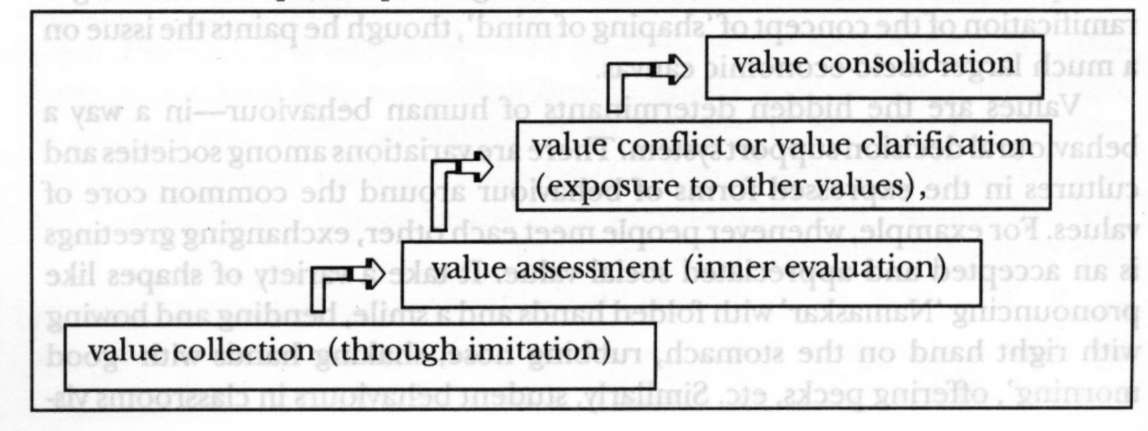
The human behaviour is determined by the consolidated values. It is the consolidated values that provides predictability of human behaviour; and indeed, the very foundation of the personality that has been described as the style of the man/woman. Value education is necessary to support the value consolidation from value conflicts. Let us take just one example. Article 51A of Indian Constitution charges every citizen to "renounce practices derogatory to dignity of women (Article 51A (e)"; in other words, upholding dignity of women is a fundamental duty of every Indian citizen. If we use Kurt Lewin's theory of Force-Field analysis, education offers a weak supportive force to this value compared to the powerful contra-force exerted by printed and electronic media depicting women as unequal and an object of greed and lust. Such examples can be multiplied, but may not be necessary. Value education purports to strengthen positive forces for directing social change to desirable direction and also strengthen the social fabric that holds the people in a society together.
Value Education is universal; it is necessary in all societies, irrespective of religious and political hues of the society. Under different titles value education is imparted in the industrialized capitalist economies in the west, in communist China, as well as in Islamic countries. In some countries, value education is based on religious theology. As Cheng-Kai Ming, the Chinese scholar-Vice-chancellor puts it, "in the western world, moral education is needed for individual development whereas in China we need value education for the development of our society". Indian thesis creates a meeting ground for both the goals when it states, for large hearted people, the whole world is a family (Udaracaritanantu vasudhaiva kutumbakam). It sees world as a family, but not unqualified; word is a family only to the large hearted people. First goal of value education is to create large-hearted people who are not self-centered, selfish and exploitative, emancipated and magnanimous. With them, create a family-like-society where people are emotionally inter-related, interdependent, concerned for one another expressed through affection, respect, love, and contributions towards mutual well being.
Thus, what can vary is the content of value education. The value education can be based on behavioural model with certain theoretical underpinnings. The theoretical or philosophical underpinnings anchor the behavioural model.
The raging controversy has largely emanated from the search for the source of theoretical underpinnings of value education that must be derived from the heritage of the society—cultural or religious. India being a multi-cultural and multi-religious society task is far more complicated. There are, however, certain artificialities built into the controversy. It largely emanates from the understanding of the nature and propensities of human being against the backdrop of the larger cosmos and cosmic realities. We will come back to this issue in a little while.
First division is between the atheists and the non-atheists, existence and concept of God as an anchoring point for determining nature of humans. Those who believe in existence of God are far too large compared to those who do not; even those who subscribe to political philosophies that profess 'religion as opium of the masses'—continue to be practicing Hindus, Muslims, Christians, Buddhists, and the like.
Second division arises with respect to schools of religious thoughts—from which religion to derive the inspiration from. Religions have two facets—the philosophical elements and practice elements. Inter-faith research indicates that all religious philosophies converge on to the point that humans are either incarnations of God or Her representatives on earth; hence human propensities are as high as God Herself or as good as one whom God trusts as Her representative on earth. Hence, at philosophical level, all religions are equal so far as this aspect is concerned. In the UN Convention on World Religion in 2000, Sri Sri Ravishankar, eminent Indian religious leader called upon people to 'love other religion', tolerance is not enough. Purpose of education is exacting the full potential within each human—'the best already in man' (woman). The theoretical underpinning of value education is informed not by religious practices but by religious philosophy and the understanding of human potential and realization of the potential (self-realization).
At an open analytical level, even the first division is resolvable. The ultimate goal of Marx's (and Engels') thesis is socialism where all are equal; from the standpoint of behaviourism, it is the highest form of civility in humans. Purpose of education is reaching that highest form of civility. In the religious philosophy too, Self-realization is the goal that leads to the same highest form of civility. Hence, in the ultimate analysis, the atheists and the non-atheists can find their meeting ground at the goals of education in general and value education in particular.
Nevertheless, keeping the theoretical underpinnings at the backburner for deriving inspiration, value education holds the potential of moving the society towards the goals it has set for itself through the Constitution, and the unwritten socio-cultural constitution that creates the identity of the society.
Given the steady deterioration in human values as indicated by financial corruption in all walks of life, unconcerned economic exploitation of poor and children, degradation of women (rape, dowry deaths, unequal wages, discriminatory educational opportunities, etc.), poor work ethics in organization and accountability, poor public behaviour (littering roads and public places, road rages, unauthorized occupation of public land, honking horns and blaring loud speakers, etc.) and many others, education in human values has become all the more necessary now than ever before. It is necessary at all stages of education. Its importance in school education is because that is where first and most significant shaping of mind takes place; higher education contributes the leaders and higher level workers to the organizations; they create organizational values and hence work culture and productivity.
The programme of Education in Human Values and Life Skills for Students in Higher Education can be designed around some practical live issues and must expand stepwise from self to larger global living. It must begin with an effort in understanding and managing self to learning to live together in the globalized world through family and community living, transition to work and organizational values, and responding to the fundamental duties as a citizen of an independent democratic nation, and leadership.
Introduction to Awarness Through the Body: Suzie
I take pleasure in having an opportunity to acquaint you with one of the activities of Sri Aurobindo International Institute of Educational Research, located in Auroville. The researchers who have developed it call it Awareness through the Body. This is a programme of exercises and activities and reflections which have been developed with the specific intention of awakening the consciousness of the child and of giving him or her especially the body, emotions, and mind. The ultimate aim of this activity is to indicate to the child how the inner being, and even the inmost being may be contacted so that it may take charge of the child's life and development.
There are many skills and qualities that are touched in the Awareness through the Body programme such as attention, observation, relaxation, use of the senses and breathing, collaboration with others, trust, responsibility for one's life and actions—but probably the key concept with which the work is done is the cultivation of the Witness attitude. This concept will be familiar to most of you as it originally emerged in Indian philosophy and is best known to the common man as saksibhava. The Witness is not directly defined for the students, but through carefully constructed, developmentally appropriate exercises and activities, accompanied by thought-provoking question, the students are led to discover their own awareness behind every activity and to take responsibility for the use of this awareness as it expresses itself in the outer personality (mind, life, body.)
To give a concrete example let us take the activities which are done using a simple tin plate and stick. Please refer to page six in the accompanying brochure where this activity is illustrated in a photograph. Probably many of you have played the game of balancing a plate on a stick. It can be played in many ways: while standing still or moving around the room, while lying on the floor—even while crossing a structured landscape that involves ups and downs and crossing objects at different levels. Normally such an exercise is conceived as purely a balancing activity—keep the plate on the stick at any cost. Using the Witness attitude, however, it becomes a field for self-exploration and self-discovery. The students are led to examine how they keep the plate balanced, to see what state of mind or heart influences the activity. In the course of the activity they will naturally explore the roles of breathing and concentration and relaxation; they will become acquainted with their own physical structure and its inter-relation with gravity, and they may become aware of tensions or fears in themselves that affect them. This process of self-examination becomes more important than actually balancing-even dropping the plate can be an opportunity to see why and how the disequilibrium occurred and how it can be prevented in the future if the child so desires. The activity can be varied according to the age and capacities of the children and can focus on the individual or his interaction in the group. Through such seemingly simple activities the child cultivates an awareness of himself, and his/her relation to others and to the world around him. He/she is helped to understand that there are tools which can be used to facilitate his inner development and the application of that development to his own life, in his/her own field of activities.
Through this kind of integrated programme children can be introduced at a very early age to the joy of exploring one's own being and of developing its many powers and capacities. The thirst for progress once awakened can be an invaluable aid in any search for life's deeper meanings.
An aluminium plate on top of a stick becomes a field of exploration for balance, concentration, relaxation, breathing, awareness of the physical structure and its inter-relation with gravity, perception of unnecessary tensions, awareness of the use of oneself, interaction between mind, emotion and body, and the interaction between the group and the individual.
Expansion of consciousness
'Awareness through the Body' aims to provide tools for children to expand their consciousness, discover their inner self, and eventually their psychic being, so that they can figure out by themselves how to steer their life, make out their own navigation charts, and create their own 'owner's manual'.
We want to give individuals the possibility of refitting and internalising the senses and using them in a more complete way, detached from judgment and preconceived ideas so that each individual becomes aware of his/her own perceptions with as little outside interference as possible.
"We think that the way to achieve this large goal is to discover and explore the body, and through the body awaken the consciousness of the entire being and all the parts that form it.
Exploring parts of the being
We address the physical body by working with the senses and through exercises that promote fluidity, space and expansion in joints and tissues of the body. By helping the children to internalise the senses we open access to all the richness of the child's inner world and to their subtle body.
We work the vital being through games and exercises that help to differentiate and control energy, and, with older groups, through exploration of emotions and attitudes.
We approach the mental being through attention, concentration, relaxation exercises, and debriefings on the exercises that have been done, although attention, concentration and relaxation are always part of whatever activity we do.
Witness attitude
Normally we live on the surface of our feelings, thoughts and emotions without being aware of the depths of our being. To become aware of the inner self we need to separate ourselves from the surface and become an impartial observer or witness who looks at all that happens as a spectator without active interest or preference, being neither pleased nor repulsed. By developing an awareness of the inner being in all parts and actions of our personality, our consciousness begins to become an instrument of our soul rather than remaining primarily in the domain of our physical body, mind and emotions.
Developing an awareness of the witness attitude—the observer within— stands central in all our work with Awareness through the Body. It is a never-ending process, a theme that resurfaces and grows. It is this witness attitude along with a deep sincerity that opens access to the psychic being.
Objectives
The key aim of Awareness through the Body is to help children discover themselves as described above. In the course of our work, we have identified objectives that serve as indicators so that both the teachers and the children can assess our progress. It is our aim that children will:
Become aware of the witness attitude and begin to cultivate it.
Understand the use of oneself, and develop acceptance of one's own limits and those of others.
Develop children's awareness of their physical structure, so individuals will be able to more effectively use themselves.
Enhance their concentration and focus, and their capacity for being present.
Learn how to explore, understand, and manage their emotions.
We have found through trial and error many themes and activities that are particularly useful in reaching our goal. By theme we mean: a set of interrelated exercises that help to explore an aspect of life or an aspect of the being; by activities we mean sets of interrelated exercises that open fields of exploration to several aspects of life, or several aspects of the being simultaneously. Examples of themes are: breathing, balance, relaxation, physical structure, subtle body, concentration, and sensory awareness. Examples of activities are Structures setting, Plates, Sticks, Flying clothes, Games, Form and Space. There is a constant flow and interaction between all.
Refine their senses, internalize them, and develop the kinesthetic sense.
Develop subjective sensorial landmarks.
Develop a heightened sense of respect, responsibility, trust, self-confidence, patience, concern and awareness for one's own and others' timing or pace.
Develop an awareness of the inner and outer space.
Become aware of breathing patterns, their affect on the various bodies, and how the breath can be used to effect change within the self.
Improve the children's capacity to adapt and be flexible.
Develop a sense of how to better collaborate with others.
Themes and activities
We have found through trial and error many themes and activities that are particularly useful in reaching our goal. By theme we mean: a set of interrelated exercises that help to explore an aspect of life or an aspect of the being; by activities we mean sets of interrelated exercises that open fields of exploration to several aspects of life, or several aspects of the being simultaneously. Examples of themes are: breathing, balance, relaxation, physical structure, subtle body, concentration, and sensory awareness. Examples of activities are Structures setting, Plates, Sticks, Flying clothes, Games, Form and Space. There is a constant flow and interaction between all.
Drag: Gautam Vohra
DRAG : NGO focuses on education, development, environment and more.
The Development Research and Action Group (DRAG) has been focusing on development, environment and heritage issues. 'Action' is the leitmotif of the group—action not from the top but side by side, and even a step behind the people so that its role is that of a catalyst. It is left to the people, the main actors, to develop their own strategies once they become aware of the root cause of their problems. 'Research' is initiated to formalize the field experience, which can be used by others—government organizations, NGOs, etc.
DRAG, which was registered in 1988 in Bombay, first began working among the Katkari and Thakkar adivasis in Pen tahsil, Maharashtra. The objective was to enable the adivasis to have greater control over their lives.
In 1992, DRAG established a base in Delhi, where it has been working on environment and heritage related issues. It has joined hands with other NGOs to protect the Delhi Ridge. It has also identified monuments in south-central Delhi which are lying in a state of abandon and neglect.
As a member of the Paani Morcha, DRAG has been active on the issue of the pollution of the Yamuna and the Ganga. A Ganga-Yamuna Yatra was organized in April 1994 which collected samples from the two rivers at various points to measure pollution levels. Since then the focus has been promoting and strengthening the use of traditional/alternative sources of water.
DRAG has set up a field base in Haryana from where it intends to launch the DRAG green campaign by distributing samplings from its nursery, and setting up demonstration plots of natural and organic farming to promote these and hence strengthen the sustainable agriculture movement.
In Delhi, DRAG's focus has been the urban poor, again with the objective of empowering them. Education has been the main area of its work, whether Adult Education in Trilokpuri or Mohan Garden or Non Formal Education (NFE) for children in Kusumpur Pahari. The Adult Education in Mohan Garden has led to the creation of mahila solidarity and the women have had plans of pressuring the civic authorities to provide their colony with basic amenities. In Kusumpur Pahari, the NFE led to DRAG's involvement with the mothers of the children who wanted a preventive health programme which among other things led to the waste management exercise.
In Mohan Garden, West Delhi, DRAG has purchased a 250 sq. yard plot to build a school cum community centre. It is essentially a colony of migrants, in the main from Haryana, Punjab, UP and Bihar. There are some from Himachal, and even from the southern states. In the adjoining colony are people who have fled the North-eastern states because of the unrest there. DRAG's survey revealed that a number of old time migrants to Delhi who have lived and worked here as gardeners, carpenters, petty traders for the last 30 odd years have also settled down in Mohan Garden since plots were being sold here.
The above residents are relatively well off and can afford the fees of the private schools in the areas, of which there are quite a few. DRAG will provide schooling to the children of the labouring class, those that get jobs for not more than 15 days a month. They can't pay the Rs. 200-300 that the private schools charge. For instance, there is a Kumbhar settlement near DRAG's plot and the children from it will attend DRAG's school since there is no free municipal or government school in the vicinity. The casual labour and other poor, who cannot pay the fees of private schools, comprise as much as 40-50 per cent of the population of Mohan Garden. DRAG has sought to secure a better deal for the deprived, whether they are in a rural area or urban. The strategy has been to conscientize them so that they can stand up for their rights. The method adopted is to set up people's groups so as to ascertain the needs of the marginalized and through the process of action-reflection-action strengthen the people's groups. The entry point in such an approach is often education (NFE, AE), which leads to the generation of awareness and thus the empowerment of the group.
Value-Oriented Education at Sri Sathya Sai Institute of Higher Learning: R. Kumar Bhaskar
ABSTRACT
Values are normative standards, by which human beings are influenced in the choice among alternative courses of action. Values form an important element of the personality of individuals, which influences their thoughts and behaviour in an unconscious manner. Value-oriented education is of immense importance in the present day world amidst the chaos and turbulence, which has become a rule than an exception. Sri Sathya Sai Educational institutions are operationalising the value-oriented education through integral system of education, and the present paper is a case study of the system of Value-Oriented education that is in vogue in Sri Sathya Sai Institute of Higher Learning. The purpose of the whole process is to produce students with knowledge, skills, abilities, character, commitment, and nationalism, who will prove assets for any organisation. Sri Sathya Sai Baba, the founder and Chancellor of the Institute has created the right organisational culture which makes value-orientation a way of life.
I. INTRODUCTION
Values are similar to attitudes but are more ingrained, permanent and stable in nature and influence attitudes. At a more concrete level, values are principles, which guide a person's desires, feelings, and action. Values mean different things to different people. It may be regarded as normative standards, by which human beings are influenced in the choice among alternative courses of action. A value can also be a general belief about some way of behaving or some end state that is applicable to the individual. Character applies to one's personal standards of behaviour. It encompasses an individual's honour, integrity, veracity, constancy, and moral fibre. It is based on an individual's internal values and the resulting judgements about what is right and wrong.
II. VALUES: CONCEPTUAL DIMENSION
Values guide actions andjudgements in many different situations and beyond people's immediate goals or more ultimate end states of existence. A value is an endearing belief that a specific mode of conducts or end states of existence is personally or socially preferable to an opposite or converse mode of conduct or end state of existence. (Wiener, Y., 1988). A value may be viewed as a conception, explicit or implicit, of what an individual, group or organisation regards as desirable and in terms of which a selection of the means and ends of actions is made from the available alternative modes. Throughout one's life the basic values may not change, but you may rearrange them in some sort of order or priority. Your priorities change as you mature and your needs and goals change. Some values—such as security, family relationships, and spiritual growth—will continue to have high priority all through a person's life, which are known as terminal values, representing goals you will strive to accomplish before you die. Other values will reflect the way you prefer to behave, which are known as instrumental values. (Rokeach, M., 1973). Instrumental values include those values that encourage work attitudes of renewal, optimism, growth, effective coping, perceptual restructuring, and change, which will increase the meaning of one's job. In Astariga Yoga, Patahjali elaborated various values in Yama: love, non-covetousness, harmlessness, continence, etc. and Niyama: purity, contentment, mortification, study of good literature, and devotion to God. (Prabhavananda, 1985) The sages and saints of India in the bygone ages suggested the significance of the five universal values, i.e. Truth, Righteous Conduct, Peace, Love, and Non-violence. NCERT in its publication entitled 'Documents on Social, Moral and Spiritual Values in Education' published in 1979 (Goyal, B.R., 1979) identified about eighty three values: Anti-untouchability, cooperation, courtesy, curiosity, justice, socialism, team work, tolerance, universal love, etc. Gokak (1982) classified and grouped these eighty-three values under the five basic human values: Satya (Truth), Dharma (Righteous Conduct), Santi(Peace), Prema (Love), and Ahirhsa(non-violence).
(See Table 1)
III. VALUES: PSYCHOLOGICAL BASIS
We are not born with an internal set of values. We learn to measure the worth of things and ideas by observation and testing. Individual values are formed early in life and are acquired from a variety of sources: educational system, mass media, social economic class, religious upbringing, prejudices and stereotypes, beliefs and opinions, home influence, and peer group. Values are so deep-seated in our personality that they are never actually "seen". What we "see" is the way in which values manifest themselves through our attitudes, opinions, and behaviours. (Warren H. Schmidt, and Barry Z. Posner, 1982). Personality, which contains the values of an individual, influences his/her behaviour. Personality usually refers to the distinctive patterns of behaviour (including thoughts and emotions) that characterize each individual's adaptation to the situations of his or her life. Two primary sources shape personality differences: heredity and environment, or nature and nurture. Some studies of twins suggest that as much as 50 to 55 percent of personality traits may be inherited, which has some interesting implications. Some personality traits seem to have a strong genetic component, whereas other traits seem to be largely learned from various sources: culture, family, group membership, and life experiences. Self-concept or self-image: a person's perceptions/feelings about himself or herself, which includes self-confidence, self-esteem, and self-worthlessness. It is a part of the sub-conscious mind of an individual, which continues to have a significant influence on human behaviour.
TABLE 1.FIVE BASIC HUMAN VALUES AND THEIR SUB-VALUES
TABLE 1 —— RIGHTEOUS —— CONDUCT —— PEACE —— LOVE —— NON-VIOLENCE
| Table 1 | Righteous Conduct | Peace | Love | Non-Violence |
|---|---|---|---|---|
| Truthfulness | Cleanliness | Abstinence | Sincerity | Kindness |
| Curiosity | Hygienic living | Freedom from | Kindness to | Courtesy |
| Quest for | Dignity of | the six sins | animals | Good manners |
| knowledge | Labour | Cultivation of | sympathy | Helpfulness |
| Spirit of | Proper | six virtues | Friendships | Fellow-feeling |
| enquiry | utilisation | Discipline | patriotism | Gentlemanliness |
| Study of | of time | Purity | Devotion | to hurt |
| oneself | Regularity | Endurance | Tolerance | Consideration |
| Discrimination | Punctuality | Integrity | Humanism | for others |
| Secularism | Self-help | Self-discipline | Readiness to | |
| Respect for all | Self-support | Self-respect | cooperate | |
| religions | Obedience | Awareness of | Appreciation of | |
| Universal, self | Duty and | dignity of | other's culture | |
| existent truth | loyalty | individual | Compassion | |
| to duty | Consideration | Universal love | ||
| Simple living | Meditation | Awareness of | ||
| Honesty | Peace | responsibility of | ||
| Prudence | citizenship | |||
| Respect for | Common good | |||
| others | National | |||
| Reverence | awareness | |||
| Service to | National unity | |||
| others | National | |||
| Self-confidence | Integrity | |||
| Self-reliance | Away from | |||
| Initiative | untouchability | |||
| Resourcefulness | and national | |||
| Courage | property | |||
| Leadership | Social service | |||
| Faithfulness | Social justice | |||
| Justice | Socialism | |||
| Teamwork | Solidarity | |||
| Team Spirit | ||||
| Equality | ||||
| Self-sacrifice |
Source: Gokak, V.K, Teacher's Handbook for the Course in the Human Values.
3.1. PERSONALITY STRUCTURE
Freud constructed a model of personality with three parts: the id (unconscious), the ego (conscious) and the super-ego (conscience). The instinctive drive (id) can be thought of as a sort of storehouse of biologically based motives and instinctual reactions for satisfying motives. Left to itself, the id would satisfy fundamental wants as they arose, without regard to the realities of life devoid of morals of any kind. The id, however, is usually bridled and managed by the ego. The ego consists of elaborate ways of behaving and thinking which constitute the executive function of the person. It keeps a person working for a living, getting along with people, and generally adjusting to the realities of life. The super-ego corresponds closely with what we commonly call conscience. It consists mainly of prohibitions learned from parents and parent-substitutes: teachers, neighbourhood, electronic media, films, and religion. The superego may condemn as wrong certain things, which the ego would otherwise do to satisfy the id. It also keeps a person striving toward the ideals-called the "ego ideals" which are usually acquired in childhood. (Morgan, C.T., et.al. 1979). Values predominantly lie in the superego. dimension, even though certain positive and negative recordings relating to selfhttp://motherandsriaurobindo.in/_StaticContent/SriAurobindoAshram/-09 E-Library/-03 Disciples/Kireet Joshi/-01 English/Philosophy of Value-Oriented Education/-image/self-concept also lie in the id dimension.
3.2. EGO-STATES
In addition to the Personality Structure approach, it will also be useful to understand the role of Transactional Analysis (TA) in the formation of values of an individual. TA maintains that everyone's personality is composed of three distinct ego states: PARENT, CHILD, AND ADULT—a consistent combination of thought-feelings and related behaviour. The Parent is a huge collection of recordings in the brain of unquestioned or imposed external events perceived by a person in his/her early years, a period which is designated roughly as the first five years of life. The most significant recordings are those provided by the example and pronouncements of his own real parents or parent substitutes. Everything the child saw his parents do and everything he heard them say is recorded in the Parent The data in the Parent was taken in and recorded straight without editing. The situation of the child, his dependency, and his inability to construct meanings with words made it impossible for him/her to modify, correct, or explain. Therefore, if the parents/parent substitutes set a good example, good things will be recorded in the Parent and if the parents/parent substitutes set a bad example, bad things will be recorded in the Parent. Another characteristic of the Parent is the fidelity of the recordings of inconsistency. Parents say one thing and another. It is not safe for the little child to question this inconsistency, and so he is confused. There are sources of Parent data other than the physical parents. A small boy/girl who sits before a TV set many hours is recording what he/she sees. The programmes he/she watches are all thus a 'taught' concept of life. Whether the Parent data is a burden or a boon depends on how appropriate it is to the present, on whether or not the Adult has updated it. Thus Parent Ego state is the storehouse of an individual's values and the parents and parent substitutes play a very important role in the formation of values of an individual. The family, the church, the school, television, and the peer group are identified as the five elements of moral crisis in the advanced countries (Yassin Shankar, 1992). The second ego state is Child, which is the recording of internal events, the responses of the little person to what he sees and hears. The Child is the major source of one's emotional responses in later years. It records joy, happiness, excitement associated with many childhood events. It also records terror, agony, and all the fearful emotions you have experienced as a child. At about ten months of age a remarkable thing begins to happen to the child. The ten month old has found he is able to do something, which grows from his own awareness and original thought. This self-actualisation is the beginning of the Adult. The Adult ego state is free from personal feelings and opinions. It functions like a computer, collecting and processing information from both the Child and the Parent. Adult data accumulates as result of the child's ability to find out for himself what is different about life from the 'taught concept' of life in his/her Parent and the 'felt concept' of life in his/her Child. Thus the Adult develops a 'thought concept' of life based on data gathering and data processing. (Thomas A. Harris, 1970).
IV. GENERAL SYSTEMS ENGINEERING AND
VALUE-ORIENTED EDUCATION:
Adopting Systems and general Systems engineering approach, the various
Literature And Value-Oriented Education
Some Talking Points
INDRA NATH CHOUDHURY
1.The industrialized society and the present day crisis in Values.
2.Values are relative and subjective and individuals should be left to themselves to determine their own value-system.
3.Educational institutions should confine themselves only to those studies where objective knowledge is discernible or determinable.
4.Self-centered liberalism leading to anti-judgment phobia.
5.Democracy cannot survive without an extra-political normative moral order and also by going beyond the material utility of life.
6.Value-oriented education as an inbuilt aspect of the course curricula and as co- or extra-curricular activities in educational institutions.
7.Is the whole question of value-oriented education of recent origin and has come in our agenda recendy because of certain political dispensation? A detailed study of the subject as elucidated by the various commissions since 1949 will help in the objective presentation of the facts.
8.Various core values: Values of peace, non-violence, freedom, truth, righteous conduct, love and scientific temper.
9.Religious education and rationalistic intuitionism. Views against it are based on the mode of implementation, i.e. of imposing Hindu view on Non-Hindus.
10.Mis-information regarding the use of Sanskrit terms in the National Curriculum Framework of Education, November 2000. There are many who think that terms, like Vasudhaiva Kutumbakam, Panthnira-peksha, Seva, etc. are religious based Sanskrit terminology.
11.Fundamentalist Hindu view is 'minoritarian' and nor 'majoritarian' Hindu view. It makes people suspicious of spiritual education and tradition: Man does not live by bread alone. He has over and above a physical dimension, a mental, an intellectual and spiritual dimension.
- A holistic approach to education by aiming at uniting science and humanism, ethics and aesthetics, material welfare and spiritual wel-
13.Globalization and the clout of popular culture and the emergence of a new scale of values. A subculture of youth. But those youth who are properly entrenched in their roots and traditions are in a position to make pragmatic reconstitution between the new values and the tradition. This is the major advantage of fostering values based on our heritage and composite culture. Because of this the impact is adoptive rather than substitutive.
14.The secret of teaching values: one's own example and mastery of knowledge. Value-based education should not be prescriptive but propositional.
15.Two ways of imparting value-based education:
a) Integrated approach
b) Indirect approach
Integrated approach:
Knowledge, sincerity, perfection and truth and peak of excellence.
Five Koshas: Annamaya, Pranamaya, Manomaya, Vijnanamaya and Anandamaya. The ultimate aim is the perception in bliss. The disappearance of ego.
Indirect approach:
Education in human values through literature done informally and in an indirect way making the whole thing implies. This approach can work in an institutional climate, without any compulsion and is helpful in the healthy moral influence and habits of the mind.
- The use of literature in fare.
a)Integrated approach
b)Indirect approach
(i)Morning Assembly
(ii)Thought for the day
(iii)Story-telling
(iv)Study of great books
(v)Dram
17.Should a writer be socially, morally, ethically committed for promoting highest aspiration and fostering the growth of values?
18.Creative process can only grow in freedom. The two terms for writer Manishi and Brahman. In Indian context any intellectual activity is an activity which gives you freedom but at the same time which makes one responsible to the society. Freedom cannot he unrestricted freedom. But a writer does everything implicitly.
19.Literary examples should be explained in a symbolic way with a particular strategy to enable critical examination of these literary references from the point of view of developing values.
20.Literature helps in realizing:
(i)Self is one of pure potentiality
(ii)Intension and desire are to be regulated with a sense of detachment
(III) Values like truth, righteous conduct, peace, love, non-violence, freedom and scientific temper may lead the student to realize the deeper self.
(iv) The value of serving and the law of giving.
Professor Kireet Joshi presented the following two stories at the Seminar. Narrating these stories in brief, he pointed out that these stories had certain qualities, which render them into a model of the kind of the stories that should be promoted for Value-Oriented Education.
Firstly, they are both written with consummate skill and art and the language is chaste, vivid and honest. Secondly, characters in the stories passed through experiences that evoke deep human interest. Thirdly, they impart to the readers some kind of dramatic participation in the development of emotions and attitudes that lead to ultimate sense of ennobling upliftment and liberating harmony.
Both the stories provide freshness that emerges from the experience of understanding which has the power to disperse clouds and apathy, conflict, and even tumult and storm of unhappiness and suffering. Lessons of life that emerge from these stories come to readers without prescription, but they whisper them inwardly in their hearts through vibrations of transforming power.
Professor Joshi pointed out that anthologies of stories that need to be prepared for Value-Oriented Education should be guided by the qualities that are so prominently present in these stories.
The Compliant Prodigal: Ramer Sumati
ARAT CHANDRA CHATOPADHYAYA
TRANSLATED FROM BENGALI BY DILIP KUMAR ROY
IN COLLABORATION WITH JOYCE CHADWICY
PRESENTED BY KIREET JOSHI
CHARACTERS
Shyamlal, a village elder
Narayani, his wife
Ramlal, his younger step-brother
Nrityakali (Netya), their maid
Bhola, their servant
Bhoga Bagdi, a fisherman
Govinda, the five year old son of Shyamlal and Narayani
Nilmoni Sarkar, a village doctor
Digambari, Narayani's widowed mother
Surodhuni, Narayani's younger sister
I
Randal's years were few but his genius for mischief incalculable. The villagers dreaded him. No one could possibly foresee when he would be up to his pranks again.
His older step brother, Shyamlal, was a village elder. Though not exactly a man of peace by temperament, life had early schooled him in toleration and he was loth to give severe punishment for light offences. He was employed in the village as the landlord's agent but he also looked after his own lands. Apart from a pond, a garden and rice-fields, he had a few low-caste tenants and some surplus cash to fall back upon.
Shyamlal's wife, Narayani, had come to her husband's a little over twelve years ago, before his widowed mother died, bequeathing to her daughter-in-law, just turned thirteen, her lisping infant Ram, with all the rest of a big humming household.
At the time this story begins there were bad fevers about, and Narayani was one of the victims. The villagers had to share the services of the quasi-qualified physician, Nilmoni Sarkar, whose fees, as a result, shot up from one to two rupees, and quinine powders grew more and more to resemble mouldering arrowroot or stale wheat-flour.
Seven days passed, but Narayani's fever never once flagged. Even Shyamlal began to feel anxious. And then Nrityakali, the maid of all work who had gone to fetch the doctor, came back complaining that the fellow had paid her scant courtesy, preferring—to all intents and purposes—an affluent patient who had wooed him with a fee of four solid rupees.
Shyamlal grew angry. "But I, too, could have given him four rupees!" he railed. "Which comes first, life or money? Go, fetch him, the heartless vulture!"
Narayani, who was within earshot, protested weakly from her bed, "Why worry so much? Let him come tomorrow; a day sooner or later can't make much difference."
Suddenly, Ram, who had been making a bird-cage under a guava-tree at the edge of the courtyard, looked up. "You stay at home, Netya!" he cried, "I'll see to it."
Narayani sat up in alarm and squeaked an instant appeal to her husband. "Do stop him!" Then louder, "Oh, Ram, let him be, I say, Ram! I beseech you; stay where you are, my pet! Why fall foul of people?"
But Ram paid no attention and was on the point of leaving, when Govinda, his five-year-old nephew, who had been loyally holding the sticks, demurred, "Won't you finish the cage, Uncle?"
"Loads of time," returned the uncle as he bounded off.
Narayani, on the verge of tears, now struck her forehead. "Why on earth didn'tyou stop him?" she squealed, addressing her husband, "Who knows what new mischief he'll brew?"
Her husband, unwilling to admit his helplessness, became angry. "What could I do?" he exploded, "Do you really think he would have listened to me when he ignored you?"
"But why didn'tyou catch hold of him, or do something—anything?" She began crying disconsolately, "Oh, how my poor head aches! I don't want to live—I don't, really—and all because of that impossible boy, I tell you. Netya, don't stand there gaping. Go and fetch Bhola; he must find Ram and cajole him to return. Bhola may not have gone out with the cows yet. Do run as fast as you can."
Thus adjured, the maid ran in search of the servant, Bhola.
II
Presently Ram appeared at the doctor's and found him presiding, over his dispensary—or, more exactly, at a rickety table in front of a mouldy cabinet from which he was busy doling out medicines to a group of eager patients, who watched him with respect. He cast a sidelong glance at the newcomer, and went on calmly as before. "Well", cut in Ram abruptly, unimpressed, "why on earth doesn't my sister's fever go?"
The physician gave an involuntary start but choosing to ignore the crazy boy, replied, with his eyes riveted on his scales, "What can I do? I send her medicines all right..."
"All wrong," corrected the other. "You don't call stale flour the right medicine for fever, do you?"
Nilmoni forgot his weights and scales and stared speechless, at the heckler. A boy of thirteen to criticize his medical omniscience! Recovering his presence of mind he rolled his red eyes and bellowed, 'Then why come for the rotten flour? And why on earth does your brother appeal to me like this on his bended knees?"
"My brother sends for you because there is no other doctor about," returned Ram, "otherwise he would not have bothered."
The rustic audience watched in thrilled consternation. Ram shot a look of contempt at them and went on, "You come of a low caste, that's why you know no better than to talk disrespectfully of my brother. My brother never bends his knees to anyone. As I was leaving my house my sister-in-law begged me to control myself, otherwise I would have knocked out every tooth in your head here and now. But I'll give you one more chance—the very last! Shily-shally no longer; come with real medicines, mind. If her fever doesn't come down by tonight—well, you see those nice mango-plants you have got over there? Tender and succulent, are they not? Yes, but one single stroke of an axe... you get me?" He went on, a little faster, "Not one plant shall survive, I tell you, after tonight. And tomorrow I'll call again and smash up all your blessed bottles and things." With this he vanished like a summer gale.
The healer of men, sat stupefied, his scales in his hand, till an old man thought fit to grunt, "My good doctor, sir," and continued, hesitantly, "I would, if I were you... well, for example, bring out my best medicines and—toe and line, go, don't you know? For nothing else will stop the hand of that limb of Satan. "The doctor jumped up and said, in a tone of finality, "Where I am going to is the police station. And you shall be my witness in the case."
"Witness!" cried his counsellor, aghast. "Has anyone ever heard the like? My ears are buzzing with quinine—how could I have heard what he said? Besides, what good would the police officer do, sir? Our high and mighty devil's disciple may be small in stature, but his gang of low-caste imps—how shall I put it? If they choose set our houses on fire and burn us to cinders—well, you may be sure no one from the police station will be about at the time, far less any one to lend a hand with a chance bucket of water. No, thank you, doctor, sir, we'll have nothing to do with it—not we, sir! We are all—to put it mildly—-just scared of the Holy Terror, don't you know? But," he smiled ingratiatingly, "if you won't heed my advice, will you have just one last look at my pulse? And tell me, doctor, couldn't I do with some bread tonight?"
The doctor's head buzzed. "Fools!" he fumed, "You won't be witnesses? Then get out of my sight. I shan't look at anybody's pulse again or dispense a drop of medicine even if you die like so many flies, and then we '11 see who saves you when you squirm and screech in your filthy beds!"
The old man took up his stick, sighed and tottered upto his feet. "It is not our fault, sir. He is the devil's own brat, haven't you noticed? So, for my part, I must make haste to report to him, or he may get it into his head that it's we who have been egging you on to lodge a complaint with the police. I have sown an acre with brinjal seeds and they are coming up a real treat, they are! Well, he might uproot all that during the night, don't you see? They never sleep at night, these grinning goblins, sir! So, hadn't you better be going, and put off the police station to some other fine day! Now is the time to get hold of a bottle of your best, and go—run like a mad wind to appease the dwarf demon." The old man left, closely followed by the rest.
Nilmoni heaved a sigh and muttered to himself the last word in human wisdom, the richest aphorism of worldly sagacity: "Never do good to others." Then he went indoors and opened his safe.
III
Narayani had been a fidget on her lonely bed a good hour, her eyes fixed anxiously on the flitting shadows outside, when Ram returned and gave the order to his little nephew, "Govinda, come on; hold the sticks again!"
"Ram, I want you here!" cried Narayani, in a temper. Ram passed a stick carefully through a twig and replied, "Later! I'm busy now."
"Come, this instant, I say!" she rapped out angrily.
Ram pulled a long face, put down the sticks, made his way into his sister-in-law's room and sat down on the edge of the four-poster, near her feet. "Did you find the doctor at home?" she asked.
"H'm"
"What did you tell him?"
"Nothing. Just asked him to come."
"Was that all?" She asked incredulously. "Come! Out with it!" Ram shook his head, "I won't tell you."
At this point Nrityakali sailed in and announced: "The doctor, in person!"
Instantly the landscape changed; the cross-questioner reverted to her status as invalid, and, throwing a coverlet over herself, dived deep into her pillows, her face to the wall; the maid stood to attention on the threshold, within call, and Ram flung out of the room before one could say knife. A moment later, the ruler of the house stepped in with a heavy tread, the medico close at his heels.
"My good daughter," said the latter after he had examined Narayani with meticulous care, "is it for us humans, to order a fever or whatever else off the premises? Your brother-in-law has given me an ultimatum: either your temperature goes down by tonight or he makes a bonfire of my house and possessions."
"D-don't take him so seriously," she faltered out dying of shame. "It's only his—his way of—talking."
The doctor shook his head ruefully. "But he has a ga—I mean a band of followers, who will do anything on earth at his bidding, they say; that's why I'm nervous. I can only dispense medicines—not life."
She made no answer, only brooded the more gloomily. For this opened up an old sore and she decided, more convinced than ever, that the enfant terrible was heading straight for the abyss. She only feared whether he could insist on her bearing his company all the way down the slope!
Nilmoni, that angel of patience and rectitude, went on explaining elaborately when, how often and in what manner his medicines should be administered (He had come equipped this time with his very best drugs.) When Shyamlal offered him four rupees for his pains, he threw up his hands.
"Lord of the just!" he exclaimed in an access of piety. "My fee is just one rupee and I dare not accept a pice more. I am a God-fearing person, are'nt I?" And he added ponderously, "Shyamlal! Money lasts for a day or two, but honour lives forever!" In his religious rapture he conveniently forgot that barely a few days ago he had felt no scruple in exacting a rupee twice over from these very clients! But Shyamlal—who was no fool and could put two and two together—kept his own counsel.
Narayani was soon well again and her world went on as before.
IV
About two months later, Narayani returned one morning after her usual bath in the river and setting her full pitcher, asked Nrityakali peremptorily to summon "that monkey of monkeys" at once. Everyone in the house knew who was meant by this sobriquet.
The maid began looking about. "Why, surely the young master was here a minute ago! Where can be have—ah, there he is making a kite!"
Narayani shouted angrily, "Come here, you little horror, come here at once! Must I take all your beatings for you?" Ram left the kite, and went to her, a picture of innocence, calmly extracting gum from a bel fruit, prodding it with a small twig.
Narayani frowned. "Why did you cut down that cucumber plant the good people over there had trained over their trellis?"
Ram, cool as a cucumber, said: "Did they see me cut it down?"
"They may not have, but I did, I may tell you."
Ram considered this for a few seconds, then changed his tactics. "Why did the insulting old hag call me names, I should like to know?" "Insulting?" Narayani retorted astonished now.
"What!"he stared."You call it stealing, if I just help myself to a cucumber— a trifle like that?"
Narayani, now in a blue fury, said, "A trifle, you say! You—you little wretch, if it is not stealing... Oh, do leave off twisting the truth as you do, you are surely old enough to know better! Stand there on one leg, you wicked owl, stand there, I say, till I tell you to go. And catch me letting you off so lightly next time!
In this house, Govinda, Ram's little nephew, was his uncle's playmate, valet and guide rolled into one. In other words, he had to be at his uncle's beck and call. All this time he had been waiting, holding his master's kite as directed. But curiously got the better of him when the rising hubbub inside the house reached him. He threw down the kite, came in and, breathless with interest, stood near his mother, watching keenly, missing nothing. Observing, Ram's hesitation, he stepped forward sympathetically to his aid, and said, "Uncle, do stand on one leg, it's very very easy, done like this, look!" and he demonstrated the posture, to be helpful. Ram slapped his cheek hard and then, making a half-turn, stood on one leg facing the wall. Narayani suppressed a smile and, picking up her own woebegone child, went into the kitchen. Returning a couple of minutes later, she saw the offender still standing on one leg, wiping his eyes vigorously with a corner of his dhoti. "That'll do, then, for this time," she said, wagging a finger, "but remember this in future, won'tyou?" Ram made as if he hadn't heard a word and stayed standing on one leg, wiping his eyes more energetically than ever. Narayani relented and, coming closer, pulled him coaxingly by the arm. He stood rigid and then violently pushed her away. She laughed and tried to give him a hug, whereupon he shook her away more violently still and dashed out of the room.
V
When Nrityakali came to call an hour later, she found him sulking in a deserted part of the outhouse, his back leaning against a post and his legs sprawling in front of him. She drew near gingerly and craning her neck forward asked, "Isn't it time you went to school, young master?" Then, after an expectant pause, "The mistress sent me round to remind you."
Ram maintained a glum silence, taking no notice of her. Nrityakali, taking her courage in both hands, ventured another step forward and shouted, "The mistress says you are to come in and have your bath and breakfast."
"Go away!" Ram snarled.
Nrityakali receded a few steps and said with a droop in her voice, "I am going. But have you heard what the mistress told me to tell you?"
"No," he growled. "And you may go and tell her—I shan't have my bath, shan't eat my breakfast, I shan't do a thing." He cleared his throat and added portentously, "So now you know."
"Well", she answered with a shrug, "I'll go and tell her."
She had already turned her back when Ram leapt up as though electrified and making a bee-line for the backyard pond, which had not been dredged for years, plunged straight into its reeking water and then returned to his post, lolling there with clothes and hair all dripping. Nrityakali ran back into the house to tell her mistress the latest.
Narayani rushed out, horrified. "What have you done, you crazy baboon? she cried, in a half-choked voice. "People are afraid of washing even their feet in that poisonous pond and you go deliberately and dive in! Why? To spite me? " She sent for some thick towels with which she wiped him dry. Then she dragged him into the bathroom to change his clothes. When she emerged, she led him into the kitchen where she served him his food on a plate. But Ram merely sat in front of it, gazing stubbornly into vacancy.
His meaning was not lost on the anxious women who was watching. She moved closer and, placing her hands on his head, said, "Dear boy, do eat by yourself now .... Tonight I promise to feed you with my own hands. But you see, I have not finished my cooking yet. Do get on with your breakfast alone, there's good boy." The pampered boy complied at last. Then he relented even more and, putting on his shirt, went off to school.
Nrityakali, having witnessed the entire scene, could not contain herself. "It's because of you, Mistress," she blurted out, "that he is getting into bad habits. Which mother on earth takes a big boy like that on her knee and spoonfeeds him? Why do you pander to him so, when he gets the sulks? Really, it's beyond me, that is all I can say."
Narayani forced a half-apologetic simple to her lips. "You see, Netya," she pleaded, "he has become a little—difficult, that is why I have to truckle to him at times. What I mean is, if I hadn't coaxed him, he would have just gone on sitting there, all humpred and hungry."
Nrityakali shook her head and laughed. "A lot you know about big boys and what their hunger makes them do. And a boy of his age."
'You people willkeep on harping on his age! Narayani interjected acidly. "But what about his judgement, I ask you? Wait until he has a little more sense, and then won't he himself be ashamed of these things? Can a grown-up possibly relish sitting on somebody else's knee and being fed or dandled?"
"I meant no offence, Mistress," the other said soothingly. "I only meant that a little firmness on your side would have done the trick. Besides, when—on your own showing—one has no sense even at the age of twelve or thirteen, don't you think something ought to be done about it?"
Narayani was stung to the quick. "All don't cut their wisdom teeth at the same age, Netya," she countered. "Some wake up a couple of years late. But", she added resentfully, "what I can't understand is—why you must all conspire to go on and on nagging like this!"
Nrityakali was upset. "O Mistress, surely you know that I meant it all for the best? I swear I told you what I did because, in the end, it is you yourself who will have to pay for it all—you who are making a rod for your own back. Our good neighbours all say it's because you don't see how you spoil him—"
"Oh, these neighbours," cut in Narayani, flustered. "How I wish to goodness they'd let me be—these priceless critics who notice only how I spoil him! What about the way I discipline him, I ask you—you who have at least a pair of eyes, if no brains, in your head? Tell me, would you have had me send him famished to school after having made him stand the whole morning on one leg—one who courts suicide, diving into that reeking pond? God alone knows if he is not in for malignant malaria now." She paused for breath, then added with a toss of her head: "But why must I go on putting up with reproaches from all sides?" Her voice choked her, and she wiped her eyes hastily with the hem of her sari.
Nrityakali was utterly at a loss. "But Mistress," she apologized, "why be so upset? You ought to know better than to think that I could wish to hurt you. Tongues do wag, and so I spoke—at any rate, just hinted—"
Narayani's eyes filled again but she had a firmer grip on herself this time. "God doesn't mould us all alike, Netya," she sighed. "And it's because he was born perhaps somewhat—intractable, that I put up with these naggings from all and sundry who don't understand. But why must they insinuate that it's I who spoil him?" Looking at Nrityakali full in the face she added with a challenge in her voice, "What would they have me do, pray? Do they expect me to hack him to pieces to be flung in to the river?" A scornful smile spread over her face. "If I did, they would come out to applaud, I suppose, in full chorus!" Without waiting for a reply she made straight for her bedroom.
The maid watched her go, discomfited, and sighed, in her turn. "Well! " she said to herself ruefully, and shaking her head, muttered, "but why can't she—who has such oceans of sense and mountains of patience—see what is plain as the nose on her face? Why flare up like a volcano the moment a remark is passed on the brat's ways? She went on grumbling, "Discipline my foot! The boy stands crying on one leg for half a minute and it's she who faints as if the bottom had dropped out of the world!"
VI
Ram did not relish dining in his elder brother's company. Tonight Narayani deliberately laid their plates side by side and sat watching nearby.
The moment Ram entered the room he came to a halt and said, "Oh no!
No! I won't—never. I see what you are up to But nothing will make me eat, sitting like that."
Narayani said dryly, "In that case, go straight to bed."
Her tone stopped Ram's grubling instantly, but he did not sit down to dinner, only stood where he was, waiting in glum silence. As soon as Shyamlal came into the kitchen, he left the room. The master of the house sat down to his meal slowly and quietly, brooding. "Where has Ram disappeared?" he remarked presently, for something to say. "Won't he have his dinner?"
"He will have his dinner with me," Narayani replied evasively.
No sooner had Shyamlal gone after the meal, when Ram appeared with a handful of ashes. "Catch me letting anybody have dinner!" he announced darkly. "How would it be now if I threw ashes on all the plates?"
Narayani met his challenges with a hard stare and answered, "You just try it! You shan't—a second time, I warn you!"
Ram paused, deflated for a moment, then went off, at a tangent, "But you did trick me into eating my breakfast this morning," he snivelled. "And now look, you are at it again, putting me off with a bluff!"
Narayani could not help an amused smile. "But why did not eat by yourself, may I ask?"
"Because you gave your word that tonight—"
"But you're big boy now. Aren't you ashamed of being spoon-fed by other people?"
Ramlal was genuinely astonished.
"Other people? What do you mean? You said—" Narayani had to unbend at last. " All right," she patted him, on the head. "Just go and throw away those ashes and wash your hands. I will give in for the once—but this is the last time, mind!" Ram was mollified at once.
Before the end of the meal Nrityakali found an excuse for passing the door and looking in on her way to the other verandah. Narayani's eyes met the maid's which were sparkling with derision. Stung, she looked helplessly at Ram and said, "Ram! Will you never behave yourself? The way you make people talk is getting simply unbearable."
Ram gulped down his mouthful indignantly. "What people?" he challenged. "Give me their names." Narayani heaved a sigh of despair. 'That's you, all over! I have to supply you, have I, with a long list of the culprits?"
VII
A few months later, things took an unexpected turn.
Narayani's widowed mother, Digambari, had lived in her own brother's house, with a daughter, Surodhuni, now nearly ten. This brother dying suddenly, Narayani sent for them, with her husband's permission. No sooner had Digambari been installed in the house, however, than she began changing all her daughter's arrangements, and she itched to ride roughshod over Ram as well. Between these two it was a case of hate at first sight.
It so happened that, one fatal morning, Ram brought in a banyan sapling two or three feet high and set about planting it in the middle of the courtyard. Digambari, telling her beads in the little open space in front of the kitchen, was a keen spectator. "Ram, whatever are your doing?" she asked testily.
Ram looked coolly at her. "When this tree grows bigger," he answered solemnly, "it will give us some lovely shade. My teacher says it's wonderful—the shade of the banyan tree! Govinda, go and fetch a can of water. Bhola, cut down a nice thick bamboo and bring it, quickly! We must put a fence round it, or our cow Kali will eat up my tree."
Digambari was in a sizzling temper that morning, "A banyan tree in the middle of the courtyard! I never heard of anything so absurd in my life."
Ram made as if he had not heard. Meanwhile Govinda had fetched a tiny potofwater. Ram tookitwith an indulgent smile. "Howfar do you suppose that will go towards watering a tree?"he said."Oh you stay here. I'll go myself and fetch a barrel."
VIII
When Ram had finished planting his shoot and had poured bucket after bucket of water over it, muddying the whole courtyard, Narayani appeared, returning from her bath. All this time Digambari had been fuming because Ram's unwanted act of benevolence from beginning to end had been performed directly under her nose. As soon as she saw her daughter she exploded:
"Look, Narayani, just look what your paragon has been doing! Planting a banyan tree in the centre of the courtyard, saying it will 'give us something lovely shade!' And look at that rouge Bhola—dragging in a whole bamboo grove to serve for fence!"
Narayani looked, Bhola was, indeed, towing in an enormous bundle of bamboos—and looking nearly as juvenile as his master, being actually of about the same age. Narayani rippled with laughter. With her mother's indignation and anxiety on the one hand and Ram's tomfoolery on the other, the whole affair appeared to her exquisitely comic. Next she assumed a serious tone and asked, "What will you do with a tree in the middle of the courtyard, Ram?"
Ram was amazed. "What will I do? Why, think what soothing shade we are going to have when the tree grows! Hah, Govinda don't point at it! And . . . and... when it grows big, I'll... well, for one thing, hang up a hammock there for Govinda. Bhola! the fence must be at least this high, or the incorrigible Kali will stretch out her neck and eat it up.... Give it to me, give me the axe, you can't manage it, you toddling baby!"
The bamboo cutting went on with a terrific clatter. Laughing once more, Narayani went away to put the pitcher of water she had brought in the kitchen.
Digambari was blue and green with rage. "Why didn't you stop him?" she asked her daughter angrily, "Does the tree really have to grow here?"
Narayani laughed. "Why take it all so seriously, Mother? Can a banyan tree as big as that draw enough sap here? Water alone can't keep it alive without deep-buried roots. It will just wither away—in a day or two."
But Digambari would not be appeased. "Wither away? But why wait for that? You ought to root the thing up and throw it away here and now."
"God in heaven!" interjected the other with a sharp intake of breath. "That can't be done!"
"What nonsense!" hissed her mother. "I ask you: does the house belong to that buffoon? And must he be allowed to go on planting trees in the middle of the courtyard whenever the fancy takes him? Are you a nonentity—my Givinda a mere cipher? Merciful heavens! All the crows and vultures on earth will nest in the tree and foul the place with their droppings and bones and I don't know what else! In that case, Narayani, I shall—I must—decline to go on living here!" She waited for a little and then rushed on, "Why must you be such a doormat for everybody? If it were my house I would make the child see once and for all what a pest he is. And I assure you he would not have to be told twice!"
Narayani saw into her mother's heart as in a crystal, and stood horrified for a full minute. Then she forced a smile. "What sense has he, Mother?" she pleaded. "Does any responsible person plant trees in the middle of a courtyard? Why not simply ignore the whole thing? In a day or two he will probably have thrown it away himself."
Digambari's nostrils quivered with anger. "Thrown it away himself? But why give him the choice? Why shouldn't we throw it away here and now?"
Narayani shuddered and cried out, "Oh, Mother, Mother, you mustn't— on no account, I tell you. You don't know him as yet. No one here would dream of doing such a thing, not even his own brother. Let the thing be—at least for today, I beseech you!"
Digambari gave a grunt of disgust. "Oh, all right, all right. You go and change your wet clothes," she said.
IX
Close, upon midday, Narayani was in her room, busy sewing a pillow-case, when Netya rushed in. "Mistress, we are in for it now! Your mother has torn out the young master's sapling and thrown it away! What won't he do when he gets back from school?"
Narayani dropped her sewing and ran out... Alas, it was but too true; the sapling was nowhere to be seen! She sought out her mother and asked where it was.
"There!" came the icy answer as Digambari pointed her finger at the dustbin.
. Narayani's heart skipped a beat. She drew near and saw that the branch had not only been uprooted but deliberately and cruelly twisted out of shape.
Gingerly she lifted it and flung it far out. Thereafter she retired, heart-sick, to her own room brooding.
The first thing Ram did, on returning from school, was to pay an eager visit to his new love. No sooner had he discovered his loss than he sprang up, bereaved, and yelled, "Sister! My darling banyan tree—!"
Narayani came out from the kitchen and beckoned to him.
"Come here," she said, "I have something very serious to tell you."
"I won't—till you tell me where my tree is."
"But I will tell you, I promise. Come along!" She went forward, caught hold of him by the hand and led him into her room. She seated him on her knee tenderly and said, accusingly, "O Ram! Ram! How could you plant a banyan tree on a Tuesday? Nobody does."
"Nobody?" asked Ram nervously, "Why, what happens?"
"You mean to say you don't know?" she answered reproachfully. "Why, the oldest daughter-in-law of the house dies, that's all."
Ram turned white as a sheet and could think of nothing by way of reply. Then he pulled himself together and said, "Oh, rubbish!"
"It isn't," insisted the other, gravely. "She can't help dying: it's written in large script in our sacred Vedas."
"Vedas?" he looked at her suspiciously. "Let me see the page."
Driven to a corner, she gave a startled cry, "What sort of a boy are you! Good people darn't even pronounce the letters VEDAS
Ram went to pieces completely. How could he betray his ignorance before a servant? He twined his arms round the neck of his monitress who was more than a mother to him and, his face, nestling in her bosom, said in deep embarassment, "Well, I too know, really—only I just happened to forget." Then after a brief pause, he asked anxiously, "Tell me, though: the oldest daughter-in-law doesn't come to harm, does she, if one throws the things away?"
Narayani pressed his head in her bosom and answered, "No, for then the evil is warded off, don't you see?" Her eyes grew moist.
"Ram," she added in a husky voice, "what will you do when I am dead?"
Ram caught his breath and raised his head instantly. "Don't be silly," he said angrily. 'You mustn't say such wicked things."
Narayani wiped her tears away unnoticed and said, "But I am getting old, my poppet, so one day I must die, mustn't I?"
It dawned on Ram in a flash that she was joking and he said, with a sudden guffaw of relief, "You—getting old?—you who haven't lost a single tooth! Why, you haven't got one grey hair on your head, Sister!"
"But you are forgetting: I'll have to drown myself before my hair turns grey. No, listen Ram," she added ominously, dropping her voice, "one day, when I go for my bath, I shall never never shall come back!"
"Never come back?" asked Ram, in real trepidation this time. "But why?"
"Because you hate my mother and are always at odds with her, that's why. But it'll be nothing to giggle at, I warn you, when I—when I won't be coming back!"
Although Ram could not quite made up his mind whether or not she was in earnest, he deemed it safer not to debate the point. "All right," he conceded. "I promise not to fall foul of her any more. But why must she go on nagging at me all the time in that loathsome nasal tone of hers?"
"But why mustyou mind if she does? After all she is my mother, isn't she?— You must love her as you love me. Come, promise, won't you?"
Ram buried his head in her bosom again. Thus had he grown, for thirteen long years, under her wings of purity and tenderness. How could he, at this late day, bring his tongue to utter any such infamous falsehood? He only snuggled against her the more in silence.
Narayani insisted coaxingly, "It won't do just to hide your face." She waited expectantly for a second or two, then added, "Come! Won't you promise?"
Suddenly the spell was broken by the shrill harsh voice of Digambari. "Oh, my eye! Is thatyou, my dear?" she asked sarcastically. "Evidently, you don't lack leisure to grow lachrymose over your pet foster-child. It is only when your own flesh and blood are in trouble that you behave as though there is nothing to worry about!"
Ram lifted his face at once. His eyes burned like a panther's. Pressing his face back into her bosom, Narayani placidly asked, "But what kind of trouble are they in, Mother, my own flesh and blood?"
"What kind of trouble?" exclaimed Digambari. "Well—er..." Narayani held her eyes with a fixed stare.. . . Unable to think up any convincing catastrophe, her mother beat a hasty retreat in order to invent some story at leisure.
Ram raised his head, struggling furiously. "I am going to throttle that ugly witch!" he hissed.
Narayani covered his mouth with her palm. "Hush! She is my mother. Have you forgotten so soon?"
d-dared, if you hadn't p-put him up to it? To call me a w-witch who should be thrown out! Oh, very well, very well, I am g-going! We are l-like millstones round your necks, d-don'1
Narayani held her mother's feet with both hands. "Forgive us this once, Mother," she said, "and wait, at least, till my husband is back; then do whatever is arranged between you." With this she led her indoors again, entreated her to be seated, pured water over her feet and dried them tenderly with the end of her sari. Then she fanned her gently, and wiped the tears from her eyes.
The temperature of Digambari's rage fell for the time being, but as soon as Shyamlal was called in to his midday meal, she began sobbing again audibly from her seat near the door. At first Shyamlal was at a loss to know what he should do; when he was told the whole story at last, he suddenly hoisted himself out of his seat and left in a huff. Narayani, knowing who was the real target of his anger, sighed helplessly and got up also. But Netya's straightforward nature could not let all this pass without a comment. "The fat's in the fire now and no mistake!" she shouted. "Surely your tears were in no danger of drying up at their source? You might at least have waited a few minutes before unleashing them!"
Digambari pulled a long face and stayed silent.
At noon Ram returned from his wanderings and, after a little hunting about, discovered Narayani lying down in her private room with little Govinda by her side. He drew the right conclusion from the all-too-familiar red signal, and began mumbling, "But I am so hungry!" Narayani made no answer. He pressed his cause a little louder: "What can I eat?"
Narayani did not stir. "I don't know," she murmured. "Leave me in peace."
"But I tell you—I'm hungry!" he importuned.
"And I tell you, I don't want to be bothered. Be off with you! There's Netya, go to her for food."
Ram went without further protest. He found Netya, and pouted. "Am I to starve, or what?" he said querulously. Evidently Netya had had her instructions, for she produced at once a cup of milk, with some puffed rice and four or five coconut cakes.
"Is that all?" he growled.
She raised her eyebrows and said sternly, "Look here, little Master! I'd be on my best behaviour for a change, if I were you! There is some trouble brewing, I warn you! The master has gone out without his dinner. The mistress is resting with Govinda without having had hers. If you provoke her once more and she leaves her bed, well, there'll be trouble in the offing for you, that's all I can say."
Chastened, Ram instantly drank some of the milk put the puffed rice and sweets into a satchel, and listlessly sauntered out to the edge of the pond, where he sat under a tree, brooding. He had lost his appetite altogether. But while absently eating some puffed rice, it suddenly occurred to him that had he only learnt magic like the sages of old, he could have promptly appeased his fasting sister's hunger even from this distance. Being, however, neither a sage nor a magician, he found it far from easy to decide what his next move should be. He certainly shied away from the idea of going back and imploring her to eat. Besides, since his elder brother had also gone off without eating, he knew that entreaty would be of little avail. Presently, he scattered what remained of his rice and sweets in the water and sighed. Then he got up and wandered about aimlessly. But his mind continually flew back to the tragic fact that sister had not touched food since morning. And the more he dwelt on the thought the less he liked it.
XII
Shyamlal, entering the room, frowned. "I am not going to put up with all this any more," he said, looking at his prostrate wife. "The boy is simply impossible!"
Narayani caught her breath; she was so taken aback that she could hardly believe her ears. "Who are you talking about?" she asked nervously.
Shyamlal made a wry face. "What a question! Ram, naturally. For the last four or five days your mother's been telling me how he has treated her. He is evidently set on insulting her at every turn. So I will get the property divided as soon as I can and let him fend for himself. I cannot sit by any longer and see things drifting to ruin. One must draw the line—somewhere."
Narayani was dazed. "Draw the line?" she echoed mechanically. "Are you suggesting that we ought to disown him?" As he did not reply she added, "But how can you even utter such an absurdity? He's only a child. How would giving him property teach him how to fend for himself?"
Shyamlal raised his eyebrows. "Only a child?" he said acidly. "He is a mature enough nuisance, at any rate. But I have had my fill of his vagaries." Then he added lamely, "He can find out for himself what to do with his property."
Narayani fixed him with a long stare. "Was it my helpful mother who put these ideas into your head?"
"Not exactly" he replied evasively. "What I mean is—well, surely one has eyes in one's head."
"One may have," she answered. "But the point is: who would he live with? He has no mother, no sister—not even a distant aunt to turn to. Who, for example, is going to cook a bowl of rice for him?"
"Well—er—that's none of my business," he faltered, driven into a corner.
But although his tongue disowned responsibility, his heart could not. After all, there is no answer to the unanswerable. Narayani tried to follow up her advantage, but her voice quavered. She bit her lip and then said, in a husky voice, "I had just turned thirteen—an age when most girls still play with dolls— when your mother died after putting me in charge of this household she had grown to love so much. She can judge from where she is how I have acquitted myself. You know I have borne and brought up children, done my duty to society and guests and run this household myself. At twenty-six I feel quite worldly-wise and middle-aged. If you try to interfere in my affairs now—I tell you I will just drown myself in the river. I dare say you'll then marry again, turn the orphan out and run your household to perfection—I won't be there to cry halt. But not till then shall you get your wicked way, I warn you!"
Shyamlal beat a dignified (if hasty) retreat as best as he could, manfully turning a blind eye to the fact that he stood a bit in awe of his wife.
XIII
"I'll tell you what, Ram: you are grown-up now and ought to go and live somewhere else. Couldn't you, my pet?"
Ram smiled, Ram beamed, Ram nodded with alacrity.
"Of course I could," he answered. 'You and I and Govinda—and of course Bhola must accompany us, Oh, tell me Sister: when—when shall we be starting?"
Narayani hung her head. What could she say in reply to this? But Ram could not let it go. "Do tell me, Sister: when are we going—when?" he repeated wistfully.
In answer she drew his head into her heaving bosom and said in a moved voice, "But couldn't you manage to live by yourself without your everlasting old sister?"
Ram shook his head with finality. Then he raised his head and turned his face away.
Narayani insisted, "But what is your answer ?"
"No!"
"No?"
"No-no-no!"
"But suppose this sister were to die?"
He laughed derisively. "As if such a thing could happen!"
Narayani smiled. "All right," she said. "One of these days perhaps, when
you've disobeyed me, you will see—and then you'll be sorry!"
"When have I ever disobyed you" asked Ram naively.
She gave a rueful smile. "Ask me rather when and where you have ever obeyed me!" Then, with a sigh, "Haven't I told you, for one thing—time and time again—to be good to my mother? But you pay no heed! Hush! You keep on taunting and defying her—you know. But." She wagged a menacing finger, "I tell you—and for the last time—do it once more and I go straight away wherever my feet take me."
"I will follow you."
"But how will you know? I will go without telling a soul." "And Govinda?"
"He will stay with you. You will have to bring him up."
Ram shook his head. "I won't!"
"But you will have to!" she insisted, laughing.
As soon as he saw her laugh he beamed. "I see," he laughed back, "you are just kidding me."
Narayani shock her head, her face serious once more. "I mean it," she said portentously. "You will know—when I am gone."
The wind was completely taken out of his sails now. His voice quavered. "But if I really—really and truly—always and every time do what you tell me, from now on?"
Her face lit up instantly and she gave him a rare smile. "In that case I will not go away and you won't have to bring up Govinda."
"Done!" he exclaimed rediantly, clapping his hands. "You just watch me, Sister—from this day on!"
XIV
Eight days had passed without a hitch. Not that Digambari, spoiling for a fight, did not try to rake up old grudges, but Ram did keep his head, loth to retaliate. For thought he had felt that Narayani was onlyjoking when she made her dark threats, he was still far from sure that his appraisal was right. Were the gods turning against him? In his bones he dimly felt some untoward fate on the way.
And now Digambari was giving a formal feast to some holy Brahmins in memory of her father, whose spirit, after having remained long in peace in home of his son and heir, had lately thought fit to begin haunting the house of his son-in-law. The visitation, it was true, had so far only appeared in the land of dreams; still, something had to be done by the wakeful about laying the ghost.
Ram was busy doing his sums when Bhola burst in with the news. "Young master, come and look! Bhoga Bagdi has just turned up with his nets to catch your Kartik and Ganesh."
These were two ancient whit fish (a kind of carp) which frolicked and pirouetted near the steps to the pond. They were not in the least afraid of human beings and, accordingly, proclaiming them creatures immeasurably more marvelous than ordinary fish, Ram had named them after gods: Kartik and Ganesh. There was not one good neighbour who had not been primed by Ram about the wonderful virtues of the pair, and few, if any, had missed visiting, inspecting and admiring them. Of course, no one but Ram their devotee, could adequately enlarge on their manifold merits, still less distinguish between the two. Even Bhola could not always tell them apart; no wonder, then, his ears were so often boxed by Ram; the expert. Narayani had often said, in jest, that some day Ram's Kartik and Ganesh, fried, would do honour to her funeral feast.
Far from feeling upset by Bhola's news, Ram went on with his work unperturbed, and said, "Just let them try! If they were caught, my glorious twins would simply burst the net and escape."
"Oh, but young Master," Bhola demurred, "these nets they are using now, are as strong as iron. Bhoga has borrowed them from a first-rate fisherman."
"All right," said Ram nonchalantly, putting his slate away. "Let's go and have a look."
But on reaching the pond, Ram's sang-froid was shaken and Bhola was horrified by the craft and subtlety of Bhoga's plot to entrap and unsuspecting
-was waiting for them even now with his uplifted net. Ram gave him an Bhoga turned blue with fear. "It's the master's orders," he mumbled, on the verge of tears. "We couldn't get fish anywhere else, young Master!"
Ram wrenched the net from his hands and flung it away. "Get out!" he hissed, and Bhoga, recognizing discretion as the better part of valour turned tail.
Ram returned to the house and, though a little flurried, dutifully sat down once more to his arithmetic. Had he not promised he would not be provoked into losing his temper again?
XV
Digambari had ended her prayers early so as to be ready for feast in good time, when Netya put in an appearance with her bombshell.
"They couldn't get any fish," she said. "The young master turned Bhoga Bagdi away."
Now Digambari had long had a covetous eye upon those fat rohit fish. It being hardly permissible to pry too far into a pious vegetarian's intentions regarding two such temptations, let us charitably concede that her desire had only been vicarious and that, for a long time, she had only harboured within her heart the intention of enhancing her reputation for good cooking by preparing them with her own hands and serving them up to the Brahmins on some special occasion. The previous day she had won her son-in-law's consent—without giving the slightest hint that her plan concerned Kartik and Ganesh—for the fisherman's strong nets to be fetched. She had also, with the promise of a solid tip of four annas, managed to get round the notorious tenant Bhoga Bagdi to use them. All morning she had been watching the delicious pair nosing round the steps of the pond while she sat there devoudy telling her beads with God's own cheer in her optimistic soul. What wonder that she should see red at finding her long-cherished dream ruined. Her nostrils quivered, her heart palpitated and clutching at the beads round her neck, she screeched, berserk with rage. "Oh, God, myjust God! I have not touched food or water since sunrise; if you are alive there in your Heaven meting out justice, hear me and before three nights are out, may your thunder and lightening strike the accursed boy dead!"
Narayani, peeling potatoes not far off, leapt up as though she had touched a live wire. "Mother!" she cried out, horrified.
It has been said that the word "mother" uttered by an offspring has an evocative power no language can convey. In any event, Narayani's exclamation had that profound power now. The mother's heart stood still for a second; and the daughter burst into tears.
For a time Narayani looked a picture
Scared out of his wits, Ram dropped his slate, jumped up and bolted without making the slightest attempt to clear himself. Left quite ignorant of the real state of affairs, Narayani pondered a little, then went back and sent for Bhoga Bagdi. It was she herself now who gave him authority.
Bhoga Bagdi collected his tackle again, and it seemed no time at all before he was carrying in on his shoulder an enormous rohit fish, which he threw down with a loud thump in the middle of the courtyard.
Narayani stared, an icy shiver running down her spine, "Bhoga" she gasped, hoarse with apprehension. "You didn't catch him near the steps, did you? I mean, it isn't Ram's Kartik or Ganesh by any chance, is it?"
The other, proud of his big catch, clicked his tongue. "That's right, Mistress," he said, with an ingratiating grin. "He's a whale of a size, surely!" Then pointing at Digambari, he added, "And the very catch the great lady asked for."
Narayani felt giddy. As for Nrityakali, though there had never been much love lost between her and Ram, she could not bridle her temper. "Well," she rasped out, "the biggest fool around here knows about young master's fishes and yet you had to go and—" she bit her tongue, and sighed. "Oh, how could you? Surely there are not so few fish in the world but you must have that one? And why a fish that weights half a maund for a bare dozen guests? Well, what's done is done, I suppose! But, for mercy's sake, do hide it away now—immediately. The young master may look in any minute."
Digambari made an ugly grimace. "Gods in heaven!" she cackled shrilly. "The way you folks wag your tongues one would think the entire house had toppled into the abyss! To think that all this fracas is made over a mere fish! 'Hide it away' indeed! Are we in Bedlam? I ask you. What about the good Brahmins we have invited?"
"There's loads of time," returned Netya. "Your Brahmins will not be here, anyway, before two or half-past. By then let the young master be sent off to school again or it'll be hell let loose for us all. Bhola! Oh, my dear life! The fellow was here a minute ago! He must have gone to tip off our young master—" she paused and then appealed to Narayani, "Mistress, of course you'll do what you think is going to help, but whatever it is, I would look sharp if I were you— that is all I can tell you."
Bhoga Bagdi, who had borrowed the net for the sake of the princely four-anna tip he had been promised, had an inkling by now of how matters stood. So he abandoned all hope of realizing his happy dream, took up the net and slunk away.
XVI
Meanwhile, Bhola, who always knew where to find Ram, had, at a run, reached the guava tree at the north end of the garden. There, lo, he saw the prodigal seated on a branch, his legs dangling, munching guavas—the very picture of bliss! Out of breath as he was, Bhola was still able to retail the news.
'Young Master, young Master!" he gasped. 'The worst, the very worst has happened! Come quick! Bhoga has caught your Kartik!"
The guava slipped from Ram's hand. "Have you lost your head, you dolt?" he said laughing. "Mad is a mongoose—aren't you?"
"No, young Master," Bhola protested. "I'm quite sane. Mistress ordered him to be caught and he is hiccoughing in the courtyard now, poor darling! Come and see for yourself."
Ram leapt off his perch and ran home like lightning. Halting in the courtyard, he stood petrified for an instant and then gave a piercing scream, "My pet! My Ganesh, adorable Ganesh!" Then flinging an angry look at Narayani, "O Sister, Sister! That you should have sanctioned such a thing! My Ganesh, my glorious Ganesh! Oh... Oh..." With this funeral moan he threw himself on the ground and, lying on his chest, flung his legs about like a half-decapitated buck. Even Digambari must have found it difficult to doubt the genuineness of his grief.
For the rest of the day he fasted like a bereaved bride. Not even Narayani with her blandishments could induce him to touch a morsel of food.
XVII
Night came, but it brought no peace. Digambari deeply veiled and crouching, went after a time to Shyamlal in his sitting-room. "Do ask Narayani to eat," she pleaded. "No one else can persuade her. And she has eaten nothing all day. She is—she is fasting, you see."
"Fasting?" he asked, surprised. "What on earth for?" Unable to produce any real tears, Digambari substituted a lachrymose drawl. "I confess," she moaned huskily, "I am very largely to blame. But how could I foresee that to catch a stray fish from the tank for the Brahmin's feast would spell the end of the world?" Unable to understand her Shyamlal summoned Netya.
'The 'stray fish'," explained Netya tersely, "Was the young master's Ganesh."
"Not one of Ram's famous twins?"
The maid nodded. No further clarification was needed. Shyamlal thought for a moment, then said. "I supposed Ram has eaten nothing either?" "Nothing, Master," the maid returned.
Shyamlal looked at his mother-in-law and said, 'Then whatever is the good of my asking her to eat? If Ram has not eaten, do you think she will agree to so much as sniff at a meal?"
Digambari was not to be daunted so easily. "If I had known what a fuss there would be," she drawled on, "of course, I wouldn't even have dreamt of feasting the Brahmins. But I suppose Narayani knows best why she chooses to behave as she does when it is she herself who ordered the fish to be caught! As for me, I never uttered a word—and everyone knows it, though I am the only to be blamed and made the scapegoat! Send us away, son! It is no use outstaying a welcome!" She caught her breath, and trailed on, "If my stars hadn't been crossed, would myjewel of a brother have been carried off and I left to live on insults and curses? But I am quite a destitute, son, so I implore you, with folded hands, to make some little provision for us. You will, I hope?"
Shyamlal was now thoroughly flustered but could think of nothing helpful to say. Narayani, who had stood within earshot and had overheard everything, tingled with shame at her mother's duplicity and play-acting. She sent back and knocked at Ram's bolted door. "My dear good brother, open the door, just for a minute!"
Ram, though wide-awake, made no reply.
"Do get up, Ram and open the door. There's a Darling."
"I won't," he snarled. "Go away. You are all my enemies, every one of you."
"All right, if you say so. But do open the door. Do, do, do!"
"I tell you: no, no, no!"
Shyamlal who had overheard the altercation from his room, said, when Narayani came, "Either you do something to stop these constant upsets, or I leave. This life is unbearable."
Narayani sat with bowed head, brooding in silent anguish.
XVIII
When, even after the passage of three days and nights, Ram still stayed in the doldrums, little by little Narayani's heart began once more to harden. On the fourth evening he did not return from school. When darkness fell, she became anxious as well as annoyed. It so happened that, at that very moment, Digambari—after bathing in the river and gleaning many interesting items of gossip there about the world at large; airing her mature verdict on a certain local "archfiend" and impressing on her audience the dire consequences of her daughter's fantastic disposition to shield him; attributing the premature greyness of her hair to her deep sympathy with the afflicted and lastly, after edifying her companions with a vivid but not truthful history of her soverign rule in her late brother's household—had just arrived at the peak of her eloquence, when she heard a rumour which sent a thrill of rapture coursing through her ample frame. She all but ran through the open streets to be the first to convey this delightful news to her daughter—her only fear being that after all it might prove to be too good to be true. Her voice rang out exultandy as she lumbered into the main courtyard. "Oh my dear! The disgrace! Have you heard the news?"
Narayani's heart skipped a beat. "No," she answered faindy. "What has happened?"
"What, after all, but the inevitable?" Digambari said triumphantly. 'They have dragged him down to the police station." And then, pontifically, "But I had forseen it, make no mistake! Humph! How else could it all end? No doubt they will keep him in jail now. Ah, the good God exists, Narani, and—and didn' 1
But before she could reveal this long-cherished knowledge, Narayani had swung round and cried out, "Netya! Netya! Oh, there you are! Listen, go at once—without a moment's delay—and find Bhola and send him instantly to— to wherever your young master may happen to be, you understand? Oh, for mercy's sake, don't keep staring like a fish! Run!" She stamped her foot. "I won't have you standing there gaping, there's not a moment to be lost. Run, run like the wind, Netya!" Completely nonplussed, Netya obeyed, in deep dismay.
Digambari, catching her daughter's eye', tried a new approach. "What has happened, Narani, is like this—" she began, this time not unsympathetically, but Narayani cut short her speech crossly. "Do go and change, Mother," she snapped. "Gossip can wait." And with this she turned away, unceremoniously.
Furious at being abrupdy left without anybody to discuss the thrilling news with, Digambari muttered, "What senseless spite! No wonder she has been taught a lesson." Unfortunately, however, even this profound philosophic reflection brought her little peace. For unable to discharge the delectable gossip seething within, she felt, indeed, fore and more like an over-inflated balloon ready to burst.
XIX
Briefly, what had happened was this. The eldest son of the local zemindar—the prize boy—attended the village school. That day, during the luncheon recess, Ram had an argument with him. The subject was as delicate as it was complicated and the debate instead of leading to an understanding, culminated in a fight. The zemindar's first-born had said that it was written in the scriptures that Kali, the Destroyer, was more powerful than Kali, the Preserver. "And the reason is," he said, "that Her tongue is both redder and longer." This Ram hotly challenged, contending that the destructive deity's tongue might be a trifle redder but it was by no means as long as the other's and, for that matter, not even nearly as thick (It must be noted that a few days earlier the people of the neighbourhood had contributed money for a fete in celebration of the glory of Kali, the Preserver, and the memory of Her mighty tongue was still present in Ram's mind). But the zemindar's son averse to a compromise on so important an issue, snapped his fingers at Ram and said contemptuously that the other Kali's tongue was "that small!" which was the beginning of the grisly end, because Ram happened to be Ram.
"Shut up," he blared in anger. "It's damn sight longer than your blessed head. How on earth could she ever protect the tallest of men, I say, with a tongue so tiny? And isn' t it because she protects the world that she is called Kali, the Preserver? " So words ran high till at last they came to blows. The zemindar's son, being the weaker of the two, of course got the worst of it; indeed, blood was soon flowing freely from his snub-nose. Nothing so horrific has ever occurred in the annals of the little school! "Red blood pouring down from the snub-nose of the boy to whose father the school belongs—fancy that!" cried the boys in shocked chorus. Naturally, the horrified headmaster had to close the school and improvise a tribunal.
But the delinquent had absconded before the judges could foregather.
XX
When, a little later, Shyamlal returned, his face wore a mask of impenetrable gloom. Standing in the courtyard, he looked round and groaned:
"Are you there, Narayani?" he said, looking into the kitchen. "I want to speak to you... It looks to me as though we will have to leave now bag and baggage. I must say I am sorry. I have worked hard in this place and reaped the reward of my labours, such as they are. But now we are in for it—oh where are you? I am calling—"
Narayani came out of the prayer-room, but did not move forward. Leaning against the doorpost for support, she asked in a husky voice, "Is he in police custody?"
Shyamlal heaved a grateful sigh. "He has been let off lighdy with a reprimand. Our zemindar is veritable saint—the soul of forgiveness! But he isn't the only one to be reckoned with, and life with the rest will soon be next to impossible if our stormy petrel goes on like this, making trouble day after day." As Narayani made no answer, he asked, after a pause, "Where is he now?"
"How can I say?" Narayani answered drily. "Must be lying low somewhere. He isn't home yet."
Shyamlal said angrily, "Well, whether he scamp lies low or high, it's his own affair from now on. From today I wash my hands of him." Then more emphatically, "I had to be more indulgent than—er—perhaps I ought to have been, because—well—I mean—because he, being my step brother, I just had to do my best to give the lie to uncharitable criticisms of neighbours. Yes, yes that's why I have tolerated the intolerable for so long. But a line has to be drawn somewhere; I cannot afford to condone him any more. Henceforward we have to look at our own side of the question, if only to stave off disaster."
Here Digambari, who had been eavesdropping from the kitchen, butted in with, "And one must also sometimes think of one's own flesh and blood, mustn't one?"
Shyamlal took the cue. "One certainly must. Well then, that's final. Tomorrow I will invite five men of standing and have the property divided. Once and for all, Narayani, I won't have try to reform him any longer with blandishments, advice or 'persuasion". From now on he can do what he likes, for all we care." His voice hardened. "Oh, the young ruffian, to manhandle the son of the most honoured man of the district!"
Digambari's joy knew no bounds. "Ruffian is the night epithet!" she crowed. "That is why I often ask myself how Narayani can imagine she does any good by trying to tame him. The very sight of her bandying words with him fills me with dismay. And who," she raced on, "has contrived as yet to make, as the saying is, 'a silk purse out of a sow's ear'? Is the swine who goes on, day after day, pitching into me—me, mind you—likely to spare my daughter? For my own part, I prefer a little retiring self-respect. That is why I keep telling myself: 'Find a shelter elsewhere, my shy soul, and beware of insults from the rag-tag and bobtail'!"
Shyamlal hummed and hawed, realizing that Digambari had overshot the mark. "In any event," he said—looking simultaneously nowhere and everywhere—"there is surely no need to have anything to do with him once we are rid of his presence. After that leave him alone, I say."
Silent and motionless, like an image of marble, Narayani listened to the duologue. She turned round and, with a sigh, resumed her household chores. Nothing ever made her neglect what her exacting standards prescribed as her duty.
XXI
An hour or so later, Netya came in and, bending close to Naryani, whispered, "Mistress, the young master's back."
Without a word, Narayani rose and made straight for Ram's room. He was seated on his bed, brooding, when he heard the door creak. He started and, looking up, saw her, with a strong cane in her hand, lock the door. His face became deathly pale. In a moment he had jumped over the bed and stood still on the other side.
Narayani pointed her cane at him.
"Come here!" she commanded in a quavering voice.
Ram folded his hands.
"Let me off, Sister!" he supplicated. "Just this once! I promise I'll never do it again."
But the iron had entered into Narayani's soul.
"If you come now," she said slowly, "I may let you off somewhat lightly. But if you don't, I swear I will go on until I have broken this cane over your back." He stood still, goggling at her, numb with terror.
"I p-promise, Sister,"he stammered out, "it will—n-never happen ag-again. I s-swear in the n-name of—"
Before he could finish she had leant over the bed and brought the cane down on his back, after which whack followed whack, as relentlessly as blows of fate. Reaching a door on the other side of the room he tried to escape, but found it locked from the outside. Helpless, he ran all round the room, seeking respite from the mounting pain till, at last, he fell prone at her feet and screamed. Meanwhile Netya had rushed down the back corridor and was looking at the window. "Oh, Mistress, let him go!" she pleaded, in tears. "I beg your forgiveness for the young master! Do have mercy, this once!"
But Digambari swooped down on her from nowhere. "You filly's filth!" she said, gnashing her teeth. "Why must you interfere? It's none of your business."
Shyamlal darted out of his room. "What on earth are you up to?" he shouted, in dismay. "Are you going to beat the breath out of his body?"
Ignoring him, Narayani dropped her whip. Ram stared at her, as though hypnotized.
"You'll remember that, won'tyou?" she muttered, wagging a finger at him.
XXII
A whole day passed without any untoward incident. But the day after, when Ram was bending over his dish of rice, Digambari, watching from her place near the doorstep, began suddenly:
"Why, I wonder," she said, as though thinking aloud, "must one soil one's hand with beating a ne'er-do-well whom even his own brother abhors?"
Netya, wiping the platters near by, made a wry face. The merciless beating had made her thoroughly sick and put a raw edge to her nerves. She tossed her head defiantly and held the other's eyes.
"I must say," she said hotly, "you are a queer one! You know perfectly well who put the idea into the mistress's head."
"What do you mean, you impudent hussy?" said Digambari fiercely.
But the maid didn't flinch. 'You know full well what I mean," she said. "And the whole household knows who always starts the mischief, keeps on nagging or telling tales about the young master to the only one who can lay hands on him."
Ram raised his eyes and made a grimace. "She knows all right, Netya!" he echoed and then, aping Digambari's nasal voice, "and she knows something else, too: she knows she has come to eat us all up alive—one and all—till nothing is left—the old ogress!"
Digambari gave a hideous scream. "Narani! Narani! Come and listen to your reformed brother-in-law!"
Narayani, who was going to the river for the bath, paused at the doorstep. "Netya!" she said with a weary sigh. "I'll have no rest till I die. This can't—it simply can't—go on any more." She flashed an angry glance at Ram. "You shameless owl! Aren't the blisters I made on your back still raw? And yet, it seems, you have learnt nothing!"
Ram sullenly began eating again.
XXIII
There was a guava tree at one end of the quadrangle facing the kitchen. After his midday meal Ram suddenly decided that this was more attractive than the school-house and, climbing it, he began indiscriminately picking ripe and unripe fruits. He nibbled some, threw away the rest after a single bite, quickly starting on another—and all this under the serpent gaze of Digambari whose very vitals burned with indignation while she watched the miscreant. She thought it wiser, however, to bide her time till her daughter should return from the river. But, in the end, exasperation got the better of her.
'Thanks to you, my dear," she railed, "ripe guavas come our way but seldom. What is the point, though of wasting even the green ones?"
In his best moods Ram hated her caustic tongue for every nasal syllable it shaped but now that Netya had put him wise to what was going on behind the scenes, and Digambari's role as the arch-informer, all he desired was to get even with his tormentor. He curled his lips in contempt and shouted back, "It's quite simple: I do as I like. Understand, ugly witch?"
Digambari loathed this above all epithets. "Is that so? You do as you like!" she snarled. "Well, when my daughter is back, we will see who gets his way." She spat on the ground, adding venomously, "But was there ever a more shameless cur? Two days ago his hide was fairly flayed off, yet there he grins and gorges as usual as though he were everyone's darling!"
"While she goes on hissing and stinging, as usual—the treacherous viper!" parried the other from his point of vantage. The shaft went home. Digambari went red with rage. "You—you—pig's pollution! Get down! Come out of the tree, I say—this moment—"
"Why?" he flashed back, grimacing. "Does the tree belong to your scarecrow of a father, you shark's spittle?"
"You... you you," she foamed at the mouth, "how dare you insult my dead father's hallowed name?" She turned to Netya who had just arrived from the house, 'You hear, Netya? You are my witness. I—I—" but before she could think of a sufficiently forceful conclusion to her indictment, Narayani had entered the courtyard. The tail end of the altercation must have reached her ears and made her hurry—for she was evidently a little out of breath—but she forgot her deep alarm for a moment in sheer astonishment. "What?" she exclaimed, starting up at the shaking guava tree. "How do you come to be here instead of being at school?"
Ram had been sadly let down by fate. His original plan had been to bolt as soon as Narayani's figure appeared over the fence skirting the yard, but alas, he had become too engrossed in his wordy duel to keep an alert enough watch. No wonder his juvenile presence of mind deserted him suddenly, under the stare of the one person on earth whom he feared. "I—I—I am eating guavas," he faltered out.
"That I can see very well," Narayani said sternly. "What I don't see is why you should be monkeying about up there instead of going to school."
"The f—fact is I—I had a—terrible belly-ache," he pleaded, lamely.
"No wonder you are gorging yourself with guavas after a full meal!"
By this time Digambari, having recovered ambled up to her daughter. "Narani," she said, "he has been calling your grandfather names. He dubbed him a 'scarecrow'!"
Narayani focused her glance on Ram. "Did you say that?"
"No-no, Sister, I d-didn't," Ram stammered.
"You liar!" screamed Digambari. "Netya's my witness. You did." And contorting her face to mimic his accent, she went on in her strident nasal tone, "When blows are falling, one squirms and shrieks. "Oh, Sister, I will never never do it again! I p-promise!". One bleats when in trouble, and barks when let off. Eh, loathsome mongrel?"
It took Ram on the raw. He was holding a substantial green guava. Suddenly he took aim and hurled it straight at his heckler. But it whizzed past the target and caught Narayani over her right eyebrow. In a moment everything went black in front of her eyes and she collapsed in a dead faint. Digambari screamed. Netya dropped her work and began running hither and thither aimlessly; and Ram, unnerved, scrambled out of his tree and, the next moment, was nowhere to be seen.
XXIV
Shyamlal, on his return found the house silent. He felt catastrophe in his very bones, and then—he" saw! . . .
His wife lay in bed, a picture of prostration! Her right eyebrow was so swollen that its protuberance overhung the seemingly shrunken eye. Netya, who had put a wet rag on the wound, was fanning her briskly. It was she who explained what had happened.
The master of the house lost his usual self-control. He approached the bed with a somber scowl, examined the wound, and then in a hard, solemn voice addressed the limp figure of his wife, "I tell you on sacred oath today: If ever again you give him food, if ever again you speak to him, if ever again you have anything to do with him, no matter for what reason, may God split my head!"
Narayani shuddered and cried out, "Hush! You must not say such things— no, not even think them. Such thoughts are prompted by—by the devil."
But Shyamlal continued unheeding. "If you take no notice of my oath then I tell you, Narayani, you will soon look upon my dead body."
And without waiting for her answer, he went off to fetch the doctor himself.
XXV
Meanwhile Ram, going round and round the mango groves, trudging from river banks to private ponds and footpaths and, in the end, finding everything growing dark under the eye of the blazing sun, was busily conjuring up thoughts of impossible remedies. Finally, just after nightfall, the surreptitiously crept back into the house.
He could hardly believe his eyes: the house had been bisected by an improvised partition of split bamboos running more or less down the middle of the courtyard! He tried to dislodge it—but it had been solidly built and stood almost as immovable as a brick wall.
There was a light in the kitchen. He peeped stealthily in and saw that the same arrangement had been made there. A mass of brass and copper utensils lay on the floor. No one was in the room. Although be could not fully grasp the situation, there was something in the air that made his heart sin!, as when one deduces a burning corpse from the sight of a funeral pyre.
He made his way into his own room and sat listening for a sound or movement from the other half of the house. He had forgotten that he had come in ravenous for food. It was perhaps nine o'clock when he went round to the back on tiptoe and knocked softly at the outer door. Netya opened it and then, ominously, shuffled aside. He asked where Narayani was.
"In bed," she answered laconically.
Ram could hear his own heart-beats. He pondered, took a couple of steps forward, then went back, came forward and again retreated until, at last, growing desperate, he plunged headlong into her room where a sole candle flickered, casting more shadows than light.
There, in front, he could see her in bed lying on one side, her face averted; Digambari and her younger daughter talked in whispers, seated on a mat on the floor; little Govinda was playing near them. He ran towards Ram in great joy and, hanging playfully on his arm, said, "Uncle, that half is yours and this is ours. Father says he will break your legs if you come into our half."
Ram ignored him and edged up to the bed. As he gently sat down on it near Narayani's feet, she withdrew them. Deeply hurt, he waited, saying nothing. Digambari nudged her younger daughter, "Go on, Suro, tell him."
"You see," the girl began at once with her ready volubility, "it's quite true. Brother-in-law says you are not to step into this side of the house and tomorrow the—all the—what, Mother?"
"Property and things," prom ted Digambari.
"Yes, property and things are going to be divided and—and—what else, Mother?"
Digambari frowned. "You silly girl! The oath, the oath!"
Surodhuni swept on delightedly as she had been coached. 'Yes, brother-in-law took a fearful oath in the name of God!—Sister must not give you food, she must not speak to you—never, never, never again—and—brother-in-law said—"
Narayani cut in irritably, "That will do. You go to bed now."
But Digambari could not leave this heart-warming theme. "It's perfectly true," she improvised on her own, judicially. "Since you will run amuck, murdering good folk, right and left, what on earth are they to do but take oaths? Whatever some people may say, I for one can't blame him. Anyway, you are not to come here any more. You are not to speak to her and you are not to have your meals with us. She must respect her husband' s oath, come what may."
Surodhuni butted in with, "What about my food Mother? Come—"
"Wait, girl!" snapped the other. So long as her pet abomination was about, could she afford to be away even for a split second? Certainly not—not even if the house itself were on fire!
Ram sat motionless, dumb and dispirited, his tears choked back, feeling ready to burst under the unbearable pressure. Digambari's nasal mimicry, this morning, of his agony of two days ago made any more tears impossible and, for once, he dared not even say, "Sister! I will never do it again!" How often had that simple cry had his saving in the past! And who could know its magic power better? For all that, he just could not utter it now, however much the desire stifled him. He sat on without a word, not knowing what to do or say next.
Suddenly Narayani, unable to bear the tension any longer, stirred in her bed. "Suro!" she said "Ask him to go."
Conquering his desire to cry, Ram said, "Ask him to go, indeed! As if it isn't hours and hours now since I've had anything to eat! I'm simply dying of hunger."
A slight shiver shook Narayani's limp frame as she answered him in the third person. "Why didn't he kill me outright?" she said. "For then, surely, he might have gone on glutting himself!" A sigh escaped her the next moment as she added, "Let him leave me in peace and go to Netya."
"I won' t go to Netya. I won' t go to anybody. I won' t eat at all. I will go to bed, starving." With this parting shot Ram left, shaking the whole house with his thumping tread, and flung himself down on the bed in his new living-room.
A few minutes later Netya brought him some food on a brass plate and called, "Come along, young Master! Get up! Here's some food for you."
Ram sprang up in fury. "Clear out at once," he yelled. "I hate the whole pack of you."
The other vanished in fear, leaving her platter on the floor. This, with a tumbler of water, Ram hurled away, with a deafening clatter, into the courtyard.
XXVI
"What do I care about oaths? Tut tut! After all, what is an oath? And then who is he to take oaths? What right has he over me? Is he my own brother? Heavens, no! He's only a step-brother—less than nothing at all! And what have I to do with oaths, anyway? Besides, I only aimed at the old witch, but it hit Sister by mistake. Why then take a foul oath about it?"
No one made any answer. No voice contradicted. He resumed his monologue in a different key.
"All right! What does it matter? In a sense, I'm rather glad. And I don't care a row of pins if she doesn't speak to me or give me my meals! Can't I cook for myself? I will live like a prince! I will get rice, lentils, juicy vegetables and fat fish and eat them all by myself. And I will eat as much as I like. Gorgeous!"
Still no answer! He then went into the kitchen and with an enormous and deliberate clatter began collecting his dishes and pots and cooking. Then after shouting to Bhola and wash the rice and cut up the vegetables, he announced with loud dignity, "Don'tforget, Bhola, you are my servant. You are not to tread on so much as the shadow of the other side of the house, and if any one from there comes fraying into our half, maim him for life, you understand?"
Narayani, seated on the verandah, missed nothing of all this. Every now and then, Digambari peeped inquisitively through chinks in the partition. Presently she edged up to her elder daughter and whispered, 'The 'cooking for a prince', it seems is a pan of rice to be boiled in a spoonful of water! Cooking for himself, he has measured out enough for a party often at least, and nearly dry rice on his roaring fire! What a smell there'll be presently! And he boasts of his fine cooking!" she chortled, gloating, and raced, "Unfortunately, great cooks are born not made, my precious prince! Just so much water, no more, and the rice cooks itself—when I am cooking! Oh, I can challenge you to a contest!"
Narayani, heart-sick, turned away, gazing vacantly at the cruel fence. So near—yet so far away!... It was Netya, standing within earshot, who flashed back, "How you do chatter! How can you expect a boy who has never so much as poured himself a glass of water to turn into a chef overnight!" She had worked in the house for over ten years, and her loyal if simple soul revolted at what seemed to her the utter unnaturalness of this punishment.
Meanwhile Surodhuni, following her mother's example, had also been peeping furtively through the partition slits. About an hour later, she ran to her sister and pulled her by the arm.
"Sister!" she cried. "Do come and have a look! He's simply gobbling up uncooked rice! And fancy he's got nothing to eat it with! Tell me, sister, won't he have a colic pain after eating raw rice like that?"
Pushing the girl away, Narayani threw herself on her bed. Who could know better than she how hungry he must have been to bring himself to devour uncooked rice!
XXVII
Then Shyamlal had left after the midday meal, Digambari began insisting again, "Do eat a little, Narani. It's only the inflammation which makes you feverish. There's no harm in eating, now, I tell you. I am your mother, aren't I?"
The other wrapped herself up more tightly in her coverlet and said wearily, "Oh, don't bother me, Mother! Go and have your own meal."
'Tell me then, would you rather have some bread?" Digambari insisted. Narayani shook her head firmly.
"Well, if that is not perversity!" the other acclaimed, deeply aggrieved. "You've touched nothing since yesterday morning. It won't do to fast like this!"
Narayani still made no answer. Netya, observing, came to her rescue. "You are protesting in vain," she cut in sharply. "Even if you stand there insisting; you are blue in the face, you won't get her to it? Besides, she is feverish. Why not let her alone?"
Digambari, piqued, went away mumbling, "Who is not feverish after an injury? But nobody starves two days on that account. At any rate, / don't."
In the afternoon, Narayani sat in the kitchen-varandah again. Whenever her eyes met Netya's she looked as if she wanted to say something—but did not know how.
XXVIII
Ram, on returning from school, washed his face and hands and then went to a shop nearby to buy some puffed rice. As he ate this, he tossed his head.
"Well," he spoke loudly, addressing the partition wall, "I don't seem any the worse for their malice, do I?" Then defiantly, "See, I had my rice and went to school and now I am back again and eating. What could possibly be better?" He knew that ears were registering all this over the wall, but when once again no one paid any heed, he became seriously annoyed. "This side of the boundary is mine, I tell you!" he cried in a loud voice. "And if Netya or anyone else trespasses—I'll break her leg and neck, I warn all!"
Even this hit no target, nor was it even original since, in the course of his misery, he had voiced this threat already in the morning, and more than once. Nevertheless, he waited hopefully for a few minutes in case somebody had been impressed by his threats. But apparently, nobody had. At last as the shadows lengthened over the landscape, he lit his lantern and went into the kitchen...
"Where is the firewood?" his angry voice rang out. "How can I cook without fuel? Where is my grinding stone? How do they expect me to grind my spices if I don't have it?"
A response came at last. Netya shouted out to him, "Young Master! The mistress promises to buy you a new grinding stone tomorrow morning."
"I don't want a new one", he flung back at her petulantly, and began to whimper. Then he came out of his kitchen to vindicate himself. "Why did they catch my Ganesh? Why did the old witch pitch into me with her beastly nasal whine? I simply paid her back in her own coin...yes, just cursed her... and I'd do it again." He paused, pondered and wondered about the worst possible fate that could overtake a portal. The inspiration came. "When she dies, the old hag", he declared prophetically, "she shall haunt the cemeteries, a hungry ogress!"
Digambari's eyes rolled. "Did you hear that, Narani? What did I tell you? A fiend in flesh and blood, I call him!"
Narayani went on gazing into space with unseeing eyes...
XXIX
Early next morning, Ram's attitude changed somewhat. Two whole days had passed and Narayani had not called him, scolded him, or given him food not once! Never had he considered this as even distantly possible. Today he was really frightened. He sat in the kitchen doorway making all sorts of excuses for himself. Once he said that he had thrown the guava at a cat; then, that it had slipped from his hand by mistake; next, that he had thrown the unripe guavas at random for fun—and so on. Then, going off on another tack, he said he had never sworn at anybody in his whole life except once, at Bhola. All to no purpose: no one answered from the other side of the wall, no one challenged his statements, no one even noticed. At last, after a bitter struggle, he threw dignity to the four winds and promised he would never do it again. Still no one responded. He sobbed, and no one heard.
Then, he started thinking and thinking hard. What could he do to regain Narayani's affection? Had she really irrevocably disowned him? If so, where was he to eat, how live, with whom? He could find no solution. He lost heart and sat brooding, made no pretence, even, of cooking, did not go to school, but bolted himself in his room and lay flat on the floor without a flicker of hope.
XXX
Narayani's fever, in the meantime, had greatly increased and she had a splitting headache, due partly to fever and partly to restless nights broken with fits of silent weeping. At midday, Digambari brought her a cup of milk.
'You must drink it," she pleaded. "I simply can't stand by and see you die of starvation."
This time Narayani made no protest. She took the cup, drank a little of the milk and then turned on her side again, averting her face from her tormentress. Refusal would have meant starting a new argument all over again, which by this time, she had grown to abhor.
XXXI
It was close upon nine at night when Netya went on tiptoe to her mistress, her eyes dark with apprehension.
"Mistress", she whispered, "I can't hear a sound, on the other side. And somehow—I don't like the look of it. It's late now, you know."
Narayani started up and burst into tears. "Dear Netya, do go—go, for heaven's sake, and find out what he's doing. He must be in his room—or somewhere about."
The maid's eyes, too, were moist with tears. She wiped them away with her hand and answered, "I haven't the courage, Mistress, but I'll do my best."
With a lantern in her hand she stepped out furtively. She did not go direcdy to Ram. She walked gingerly to the far end of the vaerandah where Bhola lay on his cot fast asleep, and tapped him gently on the arm. He started up.
"Who's there—?"
"Sh-h", shushed Netya. "The mistress has sent me to enquire..." Bhola got up. "He is in his room all right", he whispered sympathetically. "He is asleep... but he looks all in, my poor master!"
When Netya reported this, Narayani silently folded her two hands in prayer, touched the ground with her forehead and lay down again, but not to sleep. She only prayed and—wept.
XXXII
"Haven't you got fever, Narani?" she asked, harshly.
"No", came the curt reply.j
"But didn't you fast for the last three days?" She persisted. "What can be the meaning of all this—to get up so early, bathe and set about—God knows what?"
"I'm just cooking", Narayani answered, placidly.
"I can see that for myself, having a pair of eyes in my head. What I don't see is the motive. Is it that you don't want to eat any food cooked by me?" The other, ignoring this, went on calmly with her work.
XXXIII
Almost the whole of the previous day Ram had been wondering how much he had actually hurt his sister-in-law, and had tried to find out by repeatedly striking his forehead with an upripe guava. In the night he began asking himself how he could not only undo the consequences of the deed, but atone for the deed itself, or, at any rate, make a repetition of it impossible. He had a sudden brain-wave: a few days ago, she had asked him not to stay there. That's gave him a clue and around midnight, the lonely boy decided, that if he went away, she would be happy, at long last.
His mother's relatives lived in a small village near Tarakeswar. He did not know the exact address but he could easily find out. He tied up a few articles in to a bundle and sat waiting for daybreak.
Narayani had just finished her cooking and was neatly arranging food on a plate when Bhola crept furtively up to the door.
"Mistress," he whispered from the threshold. Narayani gave a violent start.
"Oh, is it you, Bhola?" she said in a quivering voice. "What is it?" Her heart pounded away against her ribs. For some days now Bhola had been out to the field grazing the cows. What did his sudden appearance mean? Had anything happened to Ram? Her face went deathly pale...
Bhola bowed his head before her searching gaze. "I have a message for you", he said in a low, melancholy voice, peering about him suspiciously.
"Message"? She asked, mystified.
He noticed and added, "And very private."
Sick with anxiety, she dropped everything and went up to him. "Private?" "Yes, if you will give just two rupees, then what you're been hoping for will happen."
Her heart skipped a beat. "Happen?" She asked mystified. "What will happen" And two rupees? Who is to have them?"
Bhola was surprised. "Didn't you lately ask the master to go away"? Then more confidentially, "Well, he is ready to do your bidding. So if you can't give him the two rupees he needs for the journey, you can surely spare him one, can't you?"
Narayani's heart, thumping, nearly choked her. 'The journey? But where is he?"
"He's waiting over there under the guava tree," Bhola answered, "His mother's relatives, he says, live somewhere by the Lord's temple—atTarakeswar."
"Oh, Bhola!" she cried out, forgetting all caution. "He mustn't, on any account do that! Go at once! Fetch him! Yes, yes, right here—what are you afraid of? Run, run and bring him to me. Say anything. Say I must see him—this instant."
Bhola fitted quietly away, Narayani stood petrified, like a statue, waiting. When, directly afterwards, Ram came up timidly with his little bundle dangling over his shoulder, she smuggled him into the kitchen without a word. But Digambari, who had smelt something and had been on the qui vive, followed. The moment, however, that she spotted her Enemy Number One in her daughter's lap again, with the beautifully arranged plate of food set in front of him, she felt giddy and clutched at the door-post. What she saw when she opened her eyes was not pleasant to her. Ram, whose face was not visible was ensconced in the tender bosom of the one woman who had sheltered him all along against everything but she saw the other's tears falling thickly on his head and thence coursing down his bare back.
Digambari lost her head completely. Her eyes emitted sparks of hatred, her breath came in short gasps, her lips quivered.
"Now, everything's explained," she hissed, with a sharp intake of breath. 'The meaning of the early start, the elaborate cooking—everything! Very touching and perfect, I'm sure! Only, there's just one fly in the ointment: my son-in-law's solemn oath. But I suppose you have very conveniently forgotten that?"
Narayani's eyes met her mother's. "Why should you think I have forgotten?" she answered in an inruffled voice. "I have not disobeyed him. For three days I have taken no food nor given him any."
Digambari frowned. "And now? What, may I ask in the name of good sense, are you doing? Did you get his permission for this great banquet?"
Narayani's lips trembled but, pulling herself together, she answered suavely, "I have." She paused and then added, "Now you know."
Digambari gave an incredulous grunt. "I was not born yesterday, Narani!" she rasped out, her face avidwith rage "Are you really trying to tell me you got authority on the sly to feed this blasted baboon and that I have heard nothing about it?"
Narayani's voice rang out crisp and clear.
"How can an outsider hear or understand, Mother, when and how one gets authority from the One Who dwells within?" Then, dropping her voice, she added, with a hint of irony, "Mother, anyone with a tongue in his head can take on oath". She lifted Ram's head, nestling tenderly in her bosom, kissed his forehead, then resumed, "But the One Who presides within you—if you fail to cherish Him through a motherless child, He gives in your keeping then you can never know how to cherish any other. It's He Who gives permission and He alone knows how or why. So you need hardly lose your sleep, questioning—and for mercy's sake, Mother, do leave us alone—leave us in peace, I implore you! I must give him his food now. He hasn' t had any for three lonely days, my poor, wounded nestling!"
Digambari stood like one transfixed. Her desiccated lips were parted but no sound issued. Then, suddenly, she came to and—spat.
"Well, if that's your attitude", she exploded, "I'll pack off at once—at once, mark my words! You can't possibly live cheek byjow! with someone whose very shadow you loathe."
Narayani spoke in a very firm accent.
'You never spoke a truer word, Mother," she smiled ruefully. "And, perhaps for the first time in my life, I see eye to eye with you. Also, I am glad on your account, that you have at least made it a bit easier for me by suggesting the way out yourself. I mean, I fully agree that this is not the place for you." She brushed away her tears and added, "My little poppet has dwindled to half his size under your venomous hate. He maybe—oh, call him anythingyou like, but I simply will not have him bullied under my roof. Pack up today and go tomorrow. I will make you a monthly allowance, I promise. You will not want for anything that I can provide. But you must go—and the sooner the better for everyone."
Next PageSri Aurobindo and The Mother Synthesis of Yoga Philosophy of Sri Aurobindo Te
Digambari stared for a few seconds with unseeing eyes. Then she gave an involuntary shiver, turned her back upon the scene and lumbered, out of the room, swaying like a sleepwalker.
Snuggling up to his one and only refuge upon earth, Ram smiled, his eyes glistening with unshed tears.
"Let her stay, Sister", he pleaded, his voice hardly above a whisper. "Give me one more chance. I will behave myself, I promise and—you will see I won't let you down again—ever."
She tilted his face up and, touching his brow with her lips, answered, "Well, we'll see about that!" Then, smiling through her tears, "You must eat. Come along, my starveling! Fall to!"
A Cap For Steve-Morely Callaghan: Kireet Joshi
Callaghan's overpublicized friendship with Hemingway and his links with the between the wars expatriate group have not worked entirely to his advantage. It is in the light of this background that he has been too often viewed. He is not a second-order Hemingway but an authentic Canadian voice. Like Hemingway.he tends to handle seamy characters in lowlife situations. But that's a poor reason for refusing to judge him on his own terms.
A quite, uninsistent writer in the mainstream realistic tradition, he is not really much influenced by the Hemingway techniques of condensation and omission. Perhaps his major achievement lies in his effect on Canadian literature. He helped to redirect its rather uncertain course. He brought to life, particularly for American readers, a whole city, Toronto. To him the brilliant post-Callaghan group of Canadians—Robertson Davies, Moradecai Richler, Alice Munro, Margaret Atwood—owe much. "A Cap for Steve " is a simple story about simple people. It deals, however, with large themes: boyhood, paternity, trust, loyality, and the traps in which ordinary lives may be caught. Its unforced "happy" ending moves us. It is honest.
DAVE DIAMOND, a poor man, a carpenter's assistant, was a small, wiry, quicktempered individual who had learned how to make every dollar count in his home. His wife, Anna, had been sick a lot, and his twelve-year-old son, Steve, had to be kept in school. Steve, a big-eyed, shy kid, ought to have known the value of money as well as Dave did. It had been ground into him.
But the boy was crazy about baseball, and after school, when he could have been working as a delivery boy or selling papers, he played bail with the kids. His failure to appreciate that the family needed a few extra dollars disgusted Dave. Around the house he wouldn't let Steve talk about baseball, and he scowled when he saw him hurrying off with his glove after dinner.
When the Phillies came to town to play an exhibition game with the home team and Steve pleaded to be taken to the ball park, Dave, of course, was outraged. Steve knew they couldn't afford it. But he had got his mother on his side. Finally Dave made a bargain with them. He said that if Steve came home after school and worked hard helping to make some kitchen shelves he would take him that night to the ball park.
Steve worked hard, but Dave was still resentful. They had to coax him to put on his good suit. When they started out Steve held aloof, feeling guilty, and they walked down the street like strangers; then Dave glanced at Steve's face and, half-ashamed, took his arm more cheerfully.
As the game went on, Dave had to listen to Steve's recitation of the batting average of every Philly that stepped up to the plate; the time the boy must have wasted learning these averages began to appal him. He showed it so plainly that Steve felt guilty again and was silent.
After the game Dave let Steve drag him onto the field to keep him company while he tried to get some autographs from the Philly players, who were being hemmed in by gangs of kids blocking the way to the club-house. But Steve, who was shy, let the other kids block him off from the players. Steve would push his way in, get blocked out, and come back to stand mournfully beside Dave. And Dave grew impatient. He was wasting valuable time. He wanted to get home; Steve knew it and was worried.
Then the big, blond Philly outfielder, Eddie Condon, who had been held up by a gang of kids tugging at his arm and thrusting their score cards at him, broke loose and made a run for the club-house. He wasjostled, and his blue cap with the red peak, tilted far back on his head, fell off. It fell at Steve's feet, and Steve stooped quickly and grabbed it. 'Okay, son," the outfielder called, turning back. But Steve, holding the hat in both.hands, only stared at him.
"Give him his cap, Steve," Dave said, smiling apologetically at the big outfielder who towered over them. But Steve drew the hat closer to his chest. In an awed trance he looked up at big Eddie Condon. It was an embarrassing moment. All the other kids were watching. Some shouted. "Give him his cap."
"My cap, son," Eddie Condon said, his hand out.
"Hey, Steve," Dave said, and he gave him a shake. But he had tojerk the cap out of Steve's hands.
"Here you are," he said.
The outfielder, noticing Steve's white, worshipping face and pleading eyes, grinned and then shrugged. "Aw, let him keep it," he said.
"No, Mister Condon, you don't need to do that," Steve protested.
"It's happened before. Forget it," Eddie Condon said, and he trotted away to the club-house.
Dave handed the cap to Steve; envious kids circled around them and Steve said, "He said I could keep it, Dad. You heard him, didn't you?"
"Yeah, I heard him," Dave admitted. The wonder in Steve's face made him smile. He took the boy by the arm and they hurried off the field.
On the way home Dave couldn't get him to talk about the game; he couldn't get him to take his eyes off the cap. Steve could hardly believe in his own happiness. "See," he said suddenly, and he showed Dave that Eddie Condon's name was printed on the sweat-band. Then he went on dreaming. Finally he put the cap on his head and turned to Dave with a slow, proud smile. The cap was away too big for him; it fell down over his ears. "Never mind," Dave said. 'You can get your mother to take a tuck in the back."
When they got home Dave was tired and his wife didn't understand the cap's importance, and they couldn't get Steve to go to bed. He swaggered around wearing the cap and looking in the mirror every ten minutes. He took the cap to bed with him.
Dave and his wife had a cup of coffee in the kitchen, and Dave told her again how they had got the cap. They agreed that their boy must have an attractive quality that showed in his face, and that Eddie Condon must have been drawn to him—why else would he have singled Steve out from all the kids?
But Dave got tired of the fuss Steve made over that cap and of the way he wore it from the time he got up in the morning until the time he went to bed. Some kid was always coming in, wanting to try on the cap. It was childish, Dave said, for Steve to go around assuming that the cap made him important in the neighbourhood, and to keep telling them how he had become a leader in the park a few blocks away where he played ball in the evenings. And Dave wouldn' t stand for Steve's keeping the cap on while he was eating. He was always scolding his wife for accepting Steve's explanation that he'd forgotten he had it on. Just the same, it was remarkable what a little thing like a ball cap could do for a kid, Dave admitted to his wife as he smiled to himself.
One night Steve was late coming home from the park. Dave didn't realize how late it was until he put down his newspaper and watched his wife at the window. Her restlessness got on his nerves. "See what comes from encouraging the boy to hang around with those park loafers," he said. "I don't encourage him," she protested. "You do," he insisted irritably, for he was really worried now. A gang hung around the park until midnight. It was a bad park. It was true that on one side there was a good district with fine, expensive apartment houses, but the kids from that neighbourhood left the park to the kids from the poorer homes. When his wife went out and walked down to the corner it was his turn to wait and worry and watch at the open window. Each waiting moment tortured him. At last he heard his wife's voice and Steve's voice, and he relaxed and sighed; then he remembered his duty and rushed angrily to meet them.
"I'll fix you, Steve, once and for all," he said. "I'll show you you can't start coming into the house at midnight."
"Hold your horses, Dave," his wife said. "Can't you see the state he's in?" Steve looked utterly exhausted and beaten.
"What's the matter?" Dave asked quickly.
"I lost my cap," Steve whispered; he walked past his father and threw himself on the couch in the living-room and lay with his face hidden. "Now, don't scold him, Dave," his wife said.
"Scold him. Who's scolding him?" Dave asked, indignantly. "It's his cap, not mine. If it's not worth his while to hang on to it, why should I scold him?" But he was implying resentfully that he alone recognized the cap's value.
"So you are scolding him," his wife said. "It's his cap. Not yours. What happened, Steve?"
Steve told them he had been playing ball and he found that when he ran the bases the cap fell off; it was still too big despite the tuck his mother had taken in the band. So the next time he came to bat he tucked the cap in his hip pocket. Someone had lifted it, he was sure.
"And he didn't even know whether it was still in his pocket," Dave said sarcastically.
"I wasn't careless, Dad," Steve said. For the last three hours he had been wandering around to the homes of the kids who had been in the park at the time; he wanted to go on, but he was too tired. Dave knew the boy was apologizing to him, but he didn't know why it made him angry.
"If he didn't hang on to it, it's not worth worrying about now," he said, and he sounded offended.
After that night they knew that Steve didn't go to the park to play ball; he went to look for the cap. It irritated Dave to see him sit around listlessly, or walk in circles, trying to force his memory to find a particular incident which would suddenly recall to him the moment when the cap had been taken. It was no attitude for a growing, healthy boy to take, Dave complained. He told Steve firmly once and for all that he didn't want to hear any more about the cap.
One night, two weeks later, Dave was walking home with Steve from the shoemaker's. It was a hot night. When they passed an ice-cream parlour Steve slowed down. "I guess I couldn't have a soda, could I?" Steve said. "Nothing doing," Dave said firmly. "Come on now, "he added as Steve hung back, looking in the window.
"Dad, look!" Steve cried suddenly, pointing at the window. "My cap! There's my cap! He's coming out!"
A well-dressed boy was leaving the ice-cream parlour; he had on a blue ball cap with a red peak, just like Steve's cap. "Hey, you!" Steve cried, and he rushed at the boy, his small face fierce and his eyes wild. Before the boy could back away Steve had snatched the cap from his head, 'That's my cap!" he shouted.
"What's this?" the bigger boy said. "Hey, give me my cap or I'll give you a poke on the nose."
Dave was surprised that his own shy boy did not back away. He watched him clutch the cap in his left hand, half crying with excitement as he put his head down and drew back his right fist: he was willing to fight. And Dave was proud of him.
"Wait, now," Dave said. 'Take it easy, son," he said to the other boy, who refused to back away.
"My boy says it's his cap," Dave said. "Well, he's crazy. It's my cap."
"I was with him when he got this cap. When the Phillies played here. It's a Philly cap."
"Eddie Condon gave it to me," Steve said. "And you stole it from me, you jerk."
"Don't call me a jerk, you little squirt. I never saw you before in my life." "Look," Steve said, pointing to the printing on the cap's sweatband. "It's Eddie Condon's cap. See? See, Dad?"
"Yeah. You're right, Son. Ever see this boy before, Steve?" "No," Steve said reluctantly.
The other boy realized he might lose the cap. "I bought it from a guy," he said. "I paid him. My father knows I paid him." He said he got the cap at the ball park. He groped for some magically impressive words and suddenly found them. 'You'll have to speak to my father," he said.
"Sure, I'll speak to your father," Dave said. "What's your name? Where do you live?"
"My name's Hudson. I live about ten minutes away on the other side of the park." The boy appraised Dave, who wasn't any bigger than he was and who wore a faded blue windbreaker and no tie. "My father is a lawyer," he said boldly. "He wouldn't let me keep the cap if he didn't think I should."
"Is that a fact?" Dave asked belligerently. "Well, we'll see. Come on. Let's go." And he got between the two boys and they walked along the street. They didn't talk to each other. Dave knew the Hudson boy was waiting to get to the protection of his home, and Steve knew it, too, and he looked up apprehensively at Dave. And Dave, reaching for his hand, squeezed it encouragingly and strode along, cocky and belligerent, knowing that Steve relied on him.
The Hudson boy lived in that row of fine apartment houses on the other side of the park. At the entrance to one of these houses. Dave tried not to hang back and show he was impressed, because he could feel Steve hanging back. When they got into the small elevator Dave didn't know why he took off his hat. In the carpeted hall on the fourth floor the Hudson boy said, 'Just a minute," and entered his own apartment. Dave and Steve were left alone in the corridor, knowing that the other boy was preparing his father for the encounter. Steve looked anxiously at his father, and Dave said, "Don't worry, son," and he added resolutely, "No one's putting anything over on us."
A tall balding man in a brown velvet smoking-jacket suddenly opened the door. Dave had never seen a man wearing one of thosejackets, although he had seen them in department-store windows. "Good evening," he said, making a deprecatory gesture at the cap Steve still clutched tighdy in his left hand. "My boy didn't get your name. My name is Hudson."
"Mine's Diamond."
"Come on in," Mr. Hudson said, putting out his hand and laughing good-naturedly. He led Dave and Steve into his living-room. "What's this about that cap?" he asked. 'The way kids can get excited about a cap. Well, it's understandable, isn't it?"
"So it is," Dave said, moving closer to Steve, who was awed by the broadloom rug and the fine furniture. He wanted to show Steve he was at ease himself, and he wished Mr. Hudson wouldn't be so polite. That meant Dave had to be polite and affable, too, and it was hard to manage when he was standing in the middle of the floor in his old windbreaker.
"Sit down, Mr. Diamond," Mr. Hudson said. Dave took Steve's arm and sat him down beside him on the chesterfield. The Hudson boy watched his father. And Dave looked at Steve and saw that he wouldn't face Mr. Hudson or the other boy; he kept looking up at Dave, putting all his faith in him.
"Well, Mr. Diamond, from what I gathered from my boy, you're able to prove this cap belonged to your boy."
'That's a fact," Dave said.
"Mr. Diamond, you'll have to believe my boy bought that cap from some kid in good faith."
"I don't doubt it," Dave said. "But no kid can sell something that doesn't belong to him. You know that's a fact, Mr. Hudson."
"Yes, that's a fact," Mr. Hudson agreed. "But that cap means a lot to my boy, Mr. Diamond."
"It means a lot to my boy, too, Mr. Hudson."
"Sure it does. But supposing we called in a policeman. You knowwhat he'd say? He'd ask you if you were willing to pay my boy what he paid for the cap. That's usually the way it works out," Mr. Hudson said, friendly and smiling, as he eyed Dave shrewdly.
"But that's not right. It's not justice," Dave protested. "Not when it's my boy's cap."
"I know it isn't right. But that's what they do."
"All right. What did you say your boy paid for the cap?" Dave said reluctantly.
'Two dollars."
"Two dollars!" Dave repeated. Mr. Hudson's smile was still kindly, but his eyes were shrewd, and Dave knew the lawyer was counting on his not having the two dollars; Mr. Hudson thought he had Dave sized up; he had looked at him and decided he was broke. Dave's pride was hurt, and he turned to Steve. What he saw in Steve's face was more powerful than the hurt to his pride: it was the memory of how difficult it had been to get an extra nickel, the talk he heard about the cost of food, the worry in his mother's face as she tried to make ends meet, and the bewildered embarrassment that he was here in a rich man's home, forcing his father to confess that he couldn't afford to spend two dollars. Then Dave grew angry and reckless. "I'll give you the two dollars, he said.
Steve looked at the Hudson boy and grinned brightly. The Hudson boy watched his father.
"I suppose that's fair enough," Mr. Hudson said. "A cap like this can be worth a lot to a kid. You know how it is. Your boy might want to sell—I mean be satisfied. Would he take five dollars for it?"
"Five dollars?" Dave repeated—"Is it worth five dollars, Steve?" he asked uncertainly.
Steve shook his head and looked frightened.
"No, thanks, Mr. Hudson," Dave said firmly.
"I'll tell you what I'll do," Mr. Hudson said. "I'll give you ten dollars. The cap has a sentimental value for my boy, a Philly cap, a big-leaguer's cap. It's only worth about a buck and a half really," he added. But Dave shook his head again. Mr. Hudson frowned. He looked at his own boy in indulgent concern, but now he was embarrassed. "I'll tell you what I'll do," he said. "This cap—well, it's worth as much as a day at the circus to my boy. Your boy should be recompensed. I want to be fair. Here's twenty dollars," and he held out two ten-dollar bills to Dave.
That much money for a cap, Dave thought, and his eyes brightened. But he knew what the cap had meant to Steve; to deprive him of it now that it was within his reach would be unbearable. All the things he needed in his life gathered around him; his wife was there, saying he couldn't afford to reject the offer, he had no right to do it; and he turned to Steve to see if Steve thought it wonderful that the cap could bring them twenty dollars. "What do you say, Steve?" he asked uneasily.
"I don't know," Steve said. He was in a trance. When Dave smiled, Steve smiled too, and Dave believed that Steve was as impressed as he was, only more bewildered, and may be even more aware that they could not possibly turn away that much money for a ball cap.
"Well, here you are," Mr. Hudson said, and he put the two bills in Steve's hand. "It's a lot of money. But I guess you had a right to expect as much."
With a dazed, fixed smile Steve handed the money slowly to his father, and his face was white.
Laughing jovially, Mr. Hudson led them to the door. His own boy followed a few paces behind.
In the elevator Dave took the bills out of his pocket. "See, Steve," he whispered eagerly. 'That windbreaker you wanted! And ten dollars for your bank! Won't Mother be surprised?"
"Yeah," Steve whispered, the little smile still on his face. But Dave had to turn away quickly so their eyes wouldn't meet, for he saw that it was a scared smile.
Outside, Dave said, "Here, you carry the money home, Steve. You show it to your mother."
"No, you keep it," Steve said, and then there was nothing to say. They walked in silence.
"It's a lot of money," Dave said finally. When Steve didn't answer him, he added angrily, "I turned to you, Steve. I asked You, didn't I?"
'That man knew how much his boy wanted that cap," Steve said.
"Sure. But he recognized how much it was worth to us."
"No, you let him take it away from us," Steve blurted. 'That's unfair," Dave said. "Don't dare say that to me."
"I don't want to be like you," Steve muttered, and he darted across the road and walked along on the other side of the street.
"It's unfair," Dave said angrily, only now he didn't mean that Steve was unfair, he meant that what had happened in the prosperous Hudson home was unfair, and he didn't know quite why. He had been trapped, not just by Mr. Hudson, but by his own life. Across the road Steve was hurrying along with his head down, wanting to be alone. They walked most of the way home on opposite sides of the street, until Dave could stand it no longer. "Steve," he called, crossing the street. "It was very unfair. I mean, for you to say..." but Steve started to run. Dave walked as fast as he could and Steve was getting beyond him, and he felt enraged and suddenly he yelled, 'Steve!" and he started to chase his son. He wanted to get hold of Steve and pound him, and he didn't know why. He gained on him, he gasped for breath and he almost got him by the shoulder. Turning, Steve saw his father's face in the street light and was terrified; he circled away, got to the house, and rushed in, yelling 'Mother!"
"Son, Son!" she cried, rushing from the kitchen. As soon as she threw her arms around Steve, shielding him, Dave's anger left him and he felt stupid. He walked past them into the kitchen.
"What happened?" she asked anxiously. "Have you both gone crazy? What did you do, Steve?"
"Nothing," he said sullenly.
"What did your father do?"
"We found the boy with my ball cap, and he let the boy's father take it from us."
"No, no," Dave protested. "Nobody pushed us around. The man didn't put anything over us." He felt tired and his face was burning. He told what had happened; then he slowly took the two ten-dollar bills out of his wallet and tossed them on the table and looked up guiltily at his wife.
It hurt him that she didn't pick up the money, and that she didn't rebuke him. 'It is a lot of money, Son," she said slowly. 'Your father was only trying to do what he knew was right, and it'll work out, and you'll understand." She was soothing Steve, but Dave knew she felt that she needed to be gentle with him, too, and he was ashamed.
When she went with Steve to his bedroom, Dave sat by himself. His son had contempt for him, he thought. His son, for the first time, had seen how easy it was for another man to handle him, and he had judged him and had wanted to walk alone on the other side of the street. He looked at the money and he hated the sight of it.
His wife returned to the kitchen, made a cup of tea, talked soothingly, and said it was incredible that he had forced the Hudson man to pay him twenty dollars for the cap, but all Dave could think of was Steve was scared of me.
Finally, he got up and went into Steve's room. The room was in darkness, but he could see the outline of Steve' s body on the bed, and he sat down beside him and whispered, "look, Son, it was a mistake, I know why. People like us—in circumstances where money can scare us. No, no," he said, feeling ashamed and shaking his head apologetically; he was taking the wrong way of showing the boy they were together; he was covering up his own failure. For the failure had been his, and it had come out of being so separated from his son that he had been blind to what was beyond the price in a boy's life. He longed now to show Steve he could be with him from day to day. His hand went out hesitandy to Steve's shoulder. "Steve, look," he said eagerly. 'The trouble was I didn't realize how much I enjoyed it that night at the ball park. If I had watched you playing for your own team—the kids around here say you could be a great pitcher. We could take that money and buy a new pitcher's glove for you, and a catcher's mitt. "Steve, Steve, are you listening? I could catch you, work with you in the lane. May be I could be your coach . . . watch you become a great pitcher." In the half-darkness he could see the boy's pale face turn to him.
Steve, who had never heard his father talk like this, was shy and wondering. All he knew was that his father, for the first time, wanted to be with him in his hopes and adventures. He said, "I guess you do know how important that cap was." His hand went out to his father's arm. "With that man the cap was—well it wasjust something he could buy, eh Dad?" Dave gripped his son's hand hard. The wonderful generosity; of childhood—the price a boy was willing to pay to be able to count on his father's admiration and approval—made him feel humble, then strangely exalted.
Parrot's Training Rabindranath Tagore: Sisir Kumar Das
There are four essentials that we must not forget while restructuring or reforming the educational system. Firstly, we must recognise that the child and its latent potentialities and its quiet yet perseverant soul are to be subserved; we must not build a system that would suffocate or smother that little child, that little prince.
This essential point is brought out forcefully by Rabindra Nath Tagore in his short story 'The Parrot's Training". It is so instructive that we may recount it in full.
Once upon a time there was a bird. It was ignorant. It sang all right, but never recited scriptures. It hopped pretty frequently, but lacked manners. Said the Raja to himself: "Ignorance is costly in the long run. For fools consume as much food as their betters, and yet give nothing in return." He called his nephews to his presence and told them that the bird must have a sound schooling.
The pundits were summoned, and at once went to the root of the matter.
They decided that the ignorance of birds was due to their natural habit of living in poor nests. Therefore, according to the pundits, the first thing necessary for this bird's education was a suitable cage.
The pundits had their rewards and went home happy.
A golden cage was built with gorgeous decorations. Crowds came to see it
from all parts of the world.
"Culture, captured and caged!" exclaimed some, in a rapture of ecstasy, and burst into tears.
Others remarked: "Even if culture be missed, the cage will remain, to the end, a substantial fact. How fortunate for the bird!"
The goldsmith filled his bag with money and lost no time in sailing homewards.
The pundit sat down to educate the bird. With proper deliberation he took his pinch of snuff, as he said: 'Textbooks can never be too many for our purpose!"
The nephews brought together an enormous crowd of scribes. They copied from books, and copied from copies, till the manuscripts were piled up to an unreachable height.
Men murmured in amazement: "Oh, the tower of culture, egregiously high! The end of it lost in the clouds!"
The scribes, with light hearts, hurried home, their pockets heavily laden. The nephews were furiously busy keeping the cage in proper trim. As their constant scrubbing and polishing went on, the people said with satisfaction: 'This is progress indeed!"
Men were employed in large numbers, and supervisors were still more numerous. These, with their cousins of all different degrees of distance, built a palace for themselves and lived there happily ever after. Whatever may be its other deficiencies, the world is never in want of faultfinders; and they went about saying that every creature remotely connected with the cage flourished beyond words, excepting only the bird. When this remark reached the Raja's ears, he summoned his nephews before him and said: "My dear nephews, what is this that we hear?" The nephews said in answer: "Sire, let the testimony of the goldsmiths and the pundits, the scribes and the supervisors, be taken, if the truth is to be known. Food is scarce with the fault-finders, and that is why their tongues have gained in sharpness."
The explanation was so luminously satisfactory that the Raja decorated each one of his nephews with his own rare jewels.
The Raja at length, being desirous of seeing with his own eyes how his Education Department busied itself with the little bird, made his appearance one day at the great Hall of Learning
From the gate rose the sounds of conch-shells and gongs, horns, bugles and trumpets, cymbals, drums and kettle-drums, tomtoms, tambourines, flutes, fifes, barrel-organs and bagpipes. The pundits began chanting mantras with their topmost voices, while the goldsmiths, scribes, supervisors, and their numberless cousins of all different degrees of distance, loudly raised a round of cheers.
The nephews smiled and said: "Sire, what do you think of it all?" The Raja said: "It does seem so fearfully like a sound principle of Education!" Mightily pleased, the Raja was about to remount his elephant, when the fault-finder, from behind some bush, cried out: "Maharaja, have you seen the bird?" "Indeed, I have not!" exclaimed the Raja, "I completely forgot about the bird."
Turning back, he asked the pundits about the method they followed in instructing the bird.
It was shown to him. He was immensely impressed. The method was so stupendous that the bird looked ridiculously unimportant in comparison. The Raja was satisfied that there was no flaw in the arrangements. As for any complaint from the bird itself, that simply could not be expected. Its throat was so completely choked with the leaves from the books that it could neither whistle nor whisper. It sent a thrill through one's body to watch the process.
This time, while remounting his elephant, the Raja ordered his State Earpuller to give a thorough good pull at both the ears of the fault-finder. The bird thus crawled on, duly and properly, to the safest verge of insanity. In fact, its progress was satisfactory in the extreme. Nevertheless, nature occasionally triumphed over training, and when the morning light peeped into the bird's cage it sometimes fluttered its wings in a reprehensible manner. And, though it is hard to believe, it pitifully pecked at its bars with its feeble beak.
"What impertinence!" growled the kotwal.
The blacksmith, with his forge and hammer, took his place in the Raja's
Department of Education. Oh, what resounding blows! The iron chain was
soon completed, and the bird's wings were clipped.
The Raja's brothers-in-law looked black, and shook their heads, saying:
'These birds not only lack good sense, but also gratitude!"
With textbook in one hand and the baton in the other, the pundits gave the poor bird what may fitly be called lessons!
The kotwal was honoured with a title for his watchfulness and the blacksmith for his skill in forging chains. The bird died.
Nobody had the least notion how long ago this had happened. The faultfinder was the first man to spread the rumour.
The Raja called his nephews and asked them: "My dear nephews, what is this that we hear?"
The nephews said: "Sire, the bird's education has been completed."
"Does it hop?" the Raja enquired.
"Never!" said the nephews.
"Does it fly?"
"No."
Outside the window, the murmar of the spring breeze amongst the newly budded asoka leaves made the April morning wistful." The second essential point to be noted is that the child is like a closed bud that grows slowly or swiftly and opens.
Collected Stories: Anjali Jaipuria
A big, tough Samurai once went to see a little monk. "Monk," he said, in a voice accustomed to instant obedience, "teach methodology about heaven and hell!"
The monk looked up at this mighty warrior and replied with utter disdain, 'Teach you about heaven and hell? I couldn't teach you about anything. You're dirty. You smell. Your blade is rusty. You're a disgrace, an embarrassment to the Samurai class. Get out of my sight. I can't stand you."
The Samurai was furious. He shook, got all red in the face, was speechless with rage. He pulled out his sword and raised it above him, preparing to slay the monk.
'That's hell," said the monk softly.
The Samurai was overwhelmed. The compassion and surrender of this little man who had offered his life to give this teaching to show him hell! He slowly put down his sword, filled with gratitude, and suddenly peaceful. "And that's heaven," said the monk softly.
Zen
A man found an eagle's egg and put it in the nest of a backyard hen. The eaglet hatched with the brood of chicks and grew up with them.
All his life the eagle did what the backyard chickens did, thinking he was a backyard chicken. He scratched the earth for worms and insects. He clucked and cackled. And he would thrash his wings and fly a few feet into the air.
Years passed and the eagle grew very old. One day he saw a magnificent bird far above him in the cloudless sky. It glided in graceful majesty among the powerful wind currents, with scarcely a beat of its strong golden wings. The old eagle looked up in awe. "Who's that?" he asked.
'That's the eagle, the king of the birds," said his neighbour, "He belongs to the sky. We belong to the earth—we're chickens." So the eagle lived and died a chicken, for that's what he thought he was.
Traditional
A Zen master was invited to a great Catholic monastery to give instructions in Zen practice. He exhorted the monks there to meditate and try to solve their koan or Zen question with great energy and zeal. He told them that if they could practice with full-hearted effort, true understanding would come to them. One old monk raised his hand. "Master," he said, "our way of prayer is different than this. We have been meditating and praying in the simplest fashion without effort, waiting instead" to be illuminated by the grace of God. In Zen is there anything like this illuminating grace that comes to one uninvited?" he asked. The Zen master looked back and laughed. "In Zen," he said, "we believe that God has already done his share."
Zen
A young man who had a bitter disappointment in life went to a remote monastery and said to the abbot: "I am disillusioned with life and wish to attain enlightenment to be freed from these sufferings. But I have no capacity for sticking long at anything. I could never do long years of meditation and study and austerity; I should relapse and be drawn back to the world again, painful though I know it to be. Is there any short way for people like me?" 'There is," said the abbot, "if you are really determined. Tell me, what have you studied, what have you concentrated on most in your life?" "Why, nothing really. We were rich, and I did not have to work. I suppose the thing I was really interested in was chess. I spent most of my time at that."
The abbot thought for a moment, and then said to his attendant: "Call such-and-such a monk, and tell him to bring a chessboard and men." The monk came with the board and the abbot set up the men. He sent for a sword and showed it to the two. "O monk," he said, "you have vowed obedience to me as your abbot, and now I require it of you. You will play a game of chess with this youth, and if you lose I shall cut off your head with this sword. But I promise that you will be reborn in paradise. If you win, I shall cut off the head of this man; chess is the only thing he has ever tried hard at, and if he loses he deserves to lose his head also." They looked at the abbot's face and saw that he meant it; he would cut off the head of the loser.
They began to play. With the opening moves the youth felt the sweat trickling down to his heels as he played for his life. The chessboard became the whole world; he was entirely concentrated on it. At first he had somewhat the worst of it, but then the other made an inferior move and he seized his chance to launch a strong attack. As his opponent's position crumbled, he looked covertly at him. He saw a face of intelligence and sincerity, worn with years of austerity and effort. He thought of his own worthless life, and a wave of compassion came over him. He deliberately made a blunder and then another blunder, ruining his position and leaving himself defenceless.
The abbot suddenly leant forward and upset the board. The two contestants sat stupefied. "There is no winner and no loser," said the abbot slowly, "there is no head to fall here. Only two things are required," and he turned to the young man, "complete concentration and compassion. You have today learnt them both. You were completely concentrated on the game, but then in that concentration you could feel compassion and sacrifice your life for it. Now stay here a few months and pursue our training in this spirit and your enlightenment is sure." He did so and got it.
Zen
Two disciples of an old rabbi were arguing about the true path to God. One said that the path was built on effort and energy. 'You must give yourself totally and fully with all your effort to follow the way of the Law. To pray, to pay attention, to live righdy." The second disciple disagreed. "It is not effort at all. That is only based on ego. It is pure surrender. To follow the way to God, to awaken, is to let go of all things and live the teaching. 'Not may will but thine,"
As they could not agree on who was right they went to see the master. He listened as the first disciple praised the pathof wholehearted effort and when asked by this disciple, "Is this the true path?" and the master replied, 'You're right." The second disciple was quite upset and responded eloquently the path of surrender and letting go. When he had finished he said, "Is this not the true path?" and the master replied "You're right." A third student who was sitting there said, "But master, they can't both be right," and the master smiled and said, 'You're right too!"
Chassid
HASAN OF BASRA
Hasan of Basra relates:
"I had convinced myself that I was a man of humility and less than humble in my thoughts and conduct to others.
Then one day I was standing on the bank of a river when I saw a man sitting there. Besides him was a woman and before them was a wine-flask.
"I thought, 'If only I could reform this man and make him like I am instead of the degenerate creature which he is!"'
"At the moment I saw a boat in the river, beginning to sink. The other man at once threw himself into the water where seven people were struggling, and brought six of them safely to the bank."
'Then the man came up to me, and said:
"Hasan, if you are a better man than me, in the Name of God save that other man, the last remaining one."
"I found that I could not even save one man, and he was drowned."
"Now this man said to me: 'This woman here is my mother. This wine-fiask has only water in it. This is how you judge, and this is what you are like.'
"I threw myself at his feet and cried out; 'As you have saved six out of these seven in peril, save me from drowning in pride disguised as merit!"
'The stranger said: 'I pray that God may fulfil your aim.'
THE MIRACLE
Imam Ali, according to the Durud'-i-Qasimi, admitted a barbarian stranger to his presence, in spite of the trepidation of those around him. Less than fifteen minutes had passed before that Imam said to his companions:
'This man will become a saint when he leaves this house, and his powers will seldom be excelled."
Since Hadrat Ali had done no more than raise his right hand over the newcomer's head, his disciples asked one another why they could not receive a similar blessing, so that they could instantly be transformed in a like manner.
Ali said:
'This man had humility. As a consequence I was able to impart Baraka to him. Failure to exercise humility has made you difficult to act upon, because you are your own barrier. If you want proof of this arrogance, here it is: the humble man would assume that he could not learn without great effort and much time. Consequently he will learn easily and quickly. The arrogant imagine that they are ready, and agitate for the Baraka, refusing to entertain even the thought that they are unworthy. To be unworthy is one thing; to fail to realize that it is possible is another, and worse. Even worse is to imagine that one is humble or trying to be sincere when one is not. Worst of all is to think nothing until one sees someone—such as the barbarian stranger—to whom one feels so superior that one's actions become uncontrolled."
In the last century, a tourist from the States visited the famous Polish rabbi Hafez Hayyim. He was astonished to see that the rabbi's home was only a simple room filled with books. The only furniture was a table and a bench. "Rabbi, where is your furniture?" asked the tourist. "Where is yours?" replied Hafez. "Mine? But I'm only a visitor here." "So am I," said the rabbi.
Chassid
It is said that soon after his enlightenment, the Buddha passed a man on the road who was struck by the extraordinary radiance and peacefulness of his presence. The man stopped and asked, "My friend, what are you? Are you a celestial being or a god?"
"No," said the Buddha.
"Well, then, are you some kind of magician or wizard?"
Again the Buddha answered, "No".
"Are you a man?" "No".
"Well, my friend, what then are you?"
The Buddha replied, "I am awake."
Buddhist
PRESENTS
A Sufi Master once announced that he was reviving the ceremony of the gifts in which, once a year, offerings were brought to the shrine of some celebrated teacher.
People of all ranks came from miles around to give their presents and to hear, if it were possible, something of the teaching of the Master.
The Sufi ordered the gifts to be placed in the middle of the floor of his audience—hall, with all the donors in a circle around them. He then stepped into the centre of the circle.
He picked up the gifts one by one. Those which had a name on them he returned to the giver. "The rest", he said, "are accepted".
"You have all come to receive a teaching, and here it is. You may now learn the difference between the lower conduct and the higher conduct.
'The lower conduct is what is taught to children, and it is an essential part of their preparation. It is to take pleasure in giving and receiving. But the higher conduct is to give without attaching, in words or thought, any obligation. Rise, therefore, to the second conduct, from the lesser to the greater.
"Whoever continues to take his refreshment from the lesser will not rise. You cannot receive payment in satisfaction on the lower level as well. That is the meaning of the teaching of restraint. Detach from lesser pleasures, such as thinking that you have done good, and realize greater attainment—that of really having done something useful."
Sufi
Nasrudin was now an old man looking back on his life. He sat with his friends in the tea shop telling his story:
"When I was young I was fiery—I wanted to awaken everyone. I prayed to Allah to give me the strength to change the world."
"In mid-life I awoke one day and realized my life was half over and I had changed no one. So I prayed to Allah to give me the strength to change those close around me, who so much needed it."
"Alas, now I am old and my prayer is simpler. 'Allah,' I ask, 'please give me the strength to at least change myself."
A modern master described how the Buddha had encouraged his monks by stating that those who practiced diligently would surely be enlightened in seven days or, if not in seven days, then in seven months or seven years. A young American monk heard this and asked if it was still true. The master, Achaan Chah promised that if the young monk was continuously mindful without break for only seven days, he would be enlightened.
Excitedly the young monk started his seven days, only to be lost in forgetfulness ten minutes later. Coming back to himself, he again started his seven days, only to become lost once more in mindless thought—perhaps about what he would do after his enlightenment. Again and again he began his seven days, and again and again he lost his continuity of mindfulness. A week later, he was not enlightened but had become very much aware of his habitual fantasies and wandering of mind—a most instructive way to begin his practice on the Path to real awakening.
Buddhist
Two monks journeying home came to the banks of a fast-flowing river, where they met a young woman unable to cross the current alone. One of the monks picked her up in his arms and set her safely on her feet on the other side and the two monks continued on their travels. The monk who had crossed the river alone could finally restrain himself no longer and began to rebuke his brother, "Do you not know it is against our rules to touch a young woman? You have broken the holy vows."
The other monk answered, "Brother! I left that young woman on the banks of the river. Are you still carrying her?"
Zen
LUXURY AND SIMPLICITY
The ancient Sufi Junaid taught by demonstration, through a method in which he actually lived the part which he was trying to illustrate. This is an example:
Once he was found by a number of seekers, sitting surrounded by every imaginable luxury.
These people left his presence and sought the house of a most austere and ascetic holy man, whose surroundings were so plain that he had nothing but a mat and a jug of water.
The spokesman of the seekers said: 'Your simple manners and austere environment are much more to our liking than the garish and shocking excesses of Junaid, who seems to have turned his back upon the Path of Truth."
The ascetic heaved a great sigh and started to weep.
"My dear friends, shallowly infected by the outward signs which beet man at every turn," he said, "know this, and cease to be unfortunates! The great Junaid is surrounded at this moment by luxury because he is impervious to luxury; and I am surrounded by simplicity because I am impervious to simplicity."
Sufi
MERCHANT OF SECRETS
A mystical master, as soon as he attained the secret knowledge of the Inner Truth which few people find, settled in Basra.
There he started a business and over the years his affairs prospered.
A dervish who had known him in former years and yet was himself still on the road of the seekers called upon him one day.
"How sad to see that you have abandoned the Search and the Mystic Way", said the dervish. The merchant-sage smiled, but said nothing on this subject.
The dervish passed on his way, and often afterwards spoke in his lectures of the one-time Sufi who had settled for the lower aim of commerce, being, it seemed, lacking in the necessary resolution to complete the journey.
But this wanderer at length fell in with Khidr, the secret Guide, and begged him to direct him to the Sage of the Epoch from whom he could obtain enlightenment.
Khidr said: "Go and sit at the feet of such-and-such a merchant, performing whatever menial task he needs done."
The dervish was amazed. "But how can he be one of the Elect, let alone the Great Teacher of the Age?" he stammered.
"Because", said Khidr, "when he gained illumination he also achieved objective knowledge of the world. He saw clearly for the first time that saintly behaviour attracts the greedy posing as the spiritual, and repels the sincere who have no taste for outwardness. I showed him how religious teachers may be drowned by their followers. So he teaches in secret, and looks, to the superficial, like a mere merchant."
A TOUCH OF TENDERNESS
The Rhodes were not rich—few farmers were in 1960. They could just pay their bills and keep their son David decently clothed to attend school in Twin Banks, three miles away.
When it came to buying him a jacket, though, a woolly red-checked Mackinaw jacket like the ones that loggers wear, Dad simply said no.
David took itin good part. Dad hadn'tforbidden the coat, only the money. So he hit on the idea of selling his bicycle.
David had the mail order all written out, ready to mail as soon as the bike was sold.
The last day of school, David came rushing into the house, wild and furious. 'That little sneak has stolen my bike!" he shouted.
He was breathing hard. "After school we went out, and the bike was gone. One of the boys said he had seen the Hadely kid wheeling a bike like mine. He was probably on his way to sell it."
"Now", he continued, looking Dad straight in the eye, "I know what you'll say about turning the other cheek, and, I've always done things your way. But I want my bike back, and I'm going to teach that little thief a lesson."
Dad set down his coffee cup and gave David look for look. "I hope you want me on your side. You won't need me when you corner the boy, but there may be a father who won't approve of your actions. I think I should be on hand."
David calmed down. Now he was feeling better about it. Dad was not going to argue or preach. "We'll do things my way. Do you agree to that?" David asked.
Dad saluted. "Every step!"
The belligerence went out of David, and part of the fury. "Now, Dad," he said, "there's no point in doing anything until the morning. Meanwhile I'd better change clothes if I'm going to help with the haying."
When David went to bed that night, he was calm in his mind, so he could think over his plans for tomorrow. First of all, he would not call in the law. The boy was only about eleven, and a kid of that age couldn't stand being shut up with bars at the windows.
Well, then, what should he do? First, of course, the money must be taken from the kid. That was only justice. It was not punishment. Then David would turn the boy over his knee and whale the daylights out of him. Meanwhile, Dad would stand off the father, if there was one. Then they'd just go on home.
Somehow, though, this didn't sound like Dad. David remembered the time a tramp had stolen Dad's woolen trousers off the line.
Next day there'd been a call to say the man had been caught.
Then what had Dad done, but get the man let off in his care. He had brought him home, cleaned him up, and given him a big meal. Then Dad gave him the stolen trousers, even putting money in the pockets to last until the man got a job.
David tried to imagine himself going to the Hadley boy with the bicycle pump and the tool kit, saying, "Here, kid. These go with the bike." No, he wasn't up to that. He wanted his money and the pleasure—or perhaps it was a duty—of teaching the kid a lesson.
The next day Dad hitched up Prince, and they rode off through the freshness of the June morning.
In town, Dad stopped before Duncan's store and went around to help Mom out. "I'll find out more about the Hadleys while I'm here."
Mom gave David a loving smile. "Take your time. I'll visit here until you and Dad come back."
Dad returned soon, looking grave. "They certainly do have a bad record," he said. "Ever since Mr. Hadley disappeared this spring, things are continually being stolen around town—chickens, garden truck, and so on."
"And school lunches," David said tightly, "and my bicycle".
They turned down a side street and stopped before the shack at the edge of the Dooley orchard. Trampled grass led to the broken steps.
A girl of seven or so answered David's knock. "Are you the doctor?" She asked anxiously.
Dad asked, "Is someone ill?"
"It's Ma", the child said, moving back so they could come in.
A voice called from the bedroom. "Whoever it is, come here."
David stepped back, abandoning leadership. He looked about while Dad went into the bedroom.
There was no furniture except a rusty stove and a packing case. Two small twin boys were using the box as a table as they scraped at a dish of mush between them.
Dad came out rapidly and said, "David, this woman is sick. Get Dr. Mumford right away. Then go to the store and get your mother."
David ran. Dr. Mumford's office was on the main street. The doctor, a stocky man with bright eyes, was out the door with his bag before David finished speaking.
David went on to the store. Mom was chatting with Mrs. Haines, the preacher's wife.
"Dad needs you at the Hadleys', quick," David said, "Dr. Mumford has already gone."
Mom looked at Mrs. Haines and said, "We'd better round up some of the others to help. We may have to stay the night."
Mrs. Haines stopped at home to gather food and furnishings. Meanwhile, Mom passed the word among what seemed to be a whole group of families who stood by one another in emergencies. Marveling, David listened to the arrangements. Here was an adult kind of helpfulness he had never noticed, though it must have gone on around him for years. Then they nipped along to the shack.
Mom hurried in and came out almost instantly. "David, I'll be busy here for quite a while. Can you take the children away?" "Where to?" he asked.
"To our house. I'm sorry, but this is an emergency, and there's no time to arrange anything else." She vanished inside the shack.
David approached the little girl cautiously. "Mom says to take you and the twins home with me."
"O.K., but they'll be hungry in a little while," she said.
The twins came scampering with happy grins and swarmed up behind old Prince. David took the back road, hoping not to be seen with these ragged creatures.
At home, David unloaded them in the yard and put Prince into the pasture. When he came back, the little group was standing huddled together, staring about at the flowers, the busy chickens, the barn and stables. They looked completely abandoned and unprotected.
"Which is Earle and which is Merle?" David asked, with a stirring of pity. Sally pointed to the twin with the broader face and more turned-up nose, "He's Merle."
"I'm Earle", he said giggling. She smiled anxiously at David. "They do that all the time to mix us up. But I can tell."
David squared away at his job, somewhat distastefully. "Get up at the picnic table. I'll bring you something to eat."
He loaded a tray with bread, spread with butter and jam, leftover ham, cupcakes, and glasses of milk.
Then, leaving them to make the best of it, he changed into his overalls and set out the wash tub in the woodshed. He hunted through Mom's storeroom for odds and ends of old clothes that they could wear while their rags were being washed.
Back at the table, the Hadleys hadn't left a crumb, and their eyes were fixed on his face expectantly.
"That's all the food for now," he said firmly. "Sally, you wash in the shed. I'll scrub the twins."
The water in the horse trough was warm. He peeled off the ragged overalls, and the twins climbed in, splashing each other and David.
He soaped and scrubbed them, marveling that the dirt came off and left them as pink and clean as if they had never been dirty.
He could count the bones in their little bodies, and he toweled them, frowning heavily. No calf, nor pig, not even the barn kittens, ever showed their bones like this on Dad's farm. He felt a quick rush of tenderness that was like a pain. By the time he had two of his old shirts wrapped around them, David had lost all his indifference.
Sally came out shyly, with a shirt of Dad's bundled around her thin body, and hung her own clothes on a bush behind the house.
"What shall we do now?" asked David, teasing the twins.
"Eat!" said Merle. He was the bolder one. Already David could tell them apart. Laughing, he went into the kitchen to get more food.
Now he sat with them, not eating, but taking an odd delight in watching them eat. Sally made sure the boys had plenty before serving herself. She was anxious over the way they stuffed the food in.
"We haven't taught them any manners," she explained. "All we had was mush, and sometimes milk or stuff my brother brought home. You can't learn manners without dishes and things to eat."
"They're fine," said David, annoyed that she should find fault with them.
Where it came to the last cup-cake, Earle murmured. 'That's his." Merle told David " It's yours." So David ate the cupcake, and they watched every bite.
Then he told the boys to go play while he and Sally cleaned up.
In the kitchen, Sally gazed longingly at the clean floor and the bright rug, the tablecloth on the table, the flowers in the window.
"It's beautiful," she said in a hushed voice. "May be when we get to Grandma's, we'll have a flower in the window, and everything."
Then they went outside and she talked about Grandma and Grandpa, back in Indiana, who had sent money for everybody to come home to them. But when Pa disappeared, Ma had to use some of the money.
Now Lester, the eleven-year-old brother, was trying to get more so they could go on the train. At Grandma's there'd be lots of milk and baby chicks and vegetables in the garden, and beds for everybody.
She worried beyond her years. Then suddenly, she was asleep.
The twins were asleep too, nestled together in one little heap. David looked down at them with a queer pain in his middle. What had Lester been up against, with no money or food of these kids?
Looking up, David noticed a movement in the grass near the barn. He circled back around the stable and leaped on to a thin figure worming its way through the grass. It was Lester Hadley. David gripped him by the shoulder and propelled him to the back porch.
"I hate you!" the boy snarled, and hid his face in his arms.
"I suppose they told you the kids were here, and you were scared to come in the front way," David said. "That's the trouble with stealing and sneaking around. Soon you can't face decent people, and you've got to be running away and hiding. Why didn't you ask someone for food for the kids?"
Lester wasn't going to answer. David paced about uncertainly trying to think how to make him understand. He must make the boy admit his guilt, so he could be forgiven and start over. How can you forgive anybody if he just sits there, hiding his face and hating you?
Then he heard a rig coming up the lane. Mom was home. She would put everything right. David would watch Mom and learn how to do it.
It was Preacher Haines's rig, pausing to let Mom down.
She gave David an affectionate look and said, 'You've been wonderful." Then, hugging Sally to her, she announced, "Mrs. Hadley is out of danger." Without changing her tone, she went on, "Lester, you have had a hard job laid on you. I don't say you did everything right, but you did your best, and we'll say no more about it. We're arranging about the train fare, so you won't need David's money."
"Now," she said, springing up briskly, "Is anybody hungry?"
The twins heard, clear across the yard, and came running.
Mom laughed, "Sally, dress the twins, will you dear? David, you and Lester start the chores. Lester! Chop some wood for the stove but be careful of your clean overalls. Now, hop along, everybody. I'll have supper ready in no time at all."
Lester dived for the woodshed. Behind him on the porch lay a little bundle of money. Mom jerked her head to David, meaning for him to take it and say nothing.
He went upstairs slowly, pondering. First, Mom had told Lester about his mother, as if he had a right to know. Then she'd said he had done wrong, but it would be different next time. And she had restored his dignity by mentioning his clean overalls.
All the while, she had sounded as if she liked Lester. He belonged here along with David, with a right to eat supper and be given chores. So that was how it was done!
He came down, the mail-order catalog in his hand, and found Lester at the wash stand.
"Lester", David said politely, "you got two dollars more for the bike than I was going to sell it for. I thought may be we'd buy some stuff for the twins to wear on the train. What do you think?"
By the time Mom came to call them to supper. Lester, the twins, and Sally were piled around David, studying the catalog. Two dollars hadn't gone very far, so David was throwing in the Mackinaw.
Catching Mom's eye, David got pink. "This isn't duty, it's fun."
"Certainly," she said, over their heads, "That's the real secret. Now you belong to the brotherhood. Welcome, brother! Now, bring your brood in to supper."
Grinning, and feeling six feet tall, David herded them in.
[Though Yajnavalkya seems by far to be the most dominant personality in the Brhadaaranyaka Upanisad, Aruni's power of exposition in the Chandogya is very refreshing. He is easily the most brilliant rishi in the latter Upanisad. By a number of homely illustrations he conveys to his son the subtle knowledge of the Atman and impresses upon him the fact that, in essence, he too is the Atman. "That thou art" is the burden of his talk. The affectionate father repeats it at the end of each of his illustrations and through this pregnant phrase he preaches the gospel of the one God, transcendant and immanent in all things.]
"No idiot has yet been born in our line nor has any in our family neglected the study of the Vedas. So, young soul, go to a gurukula, be a brahmachdri and learn the Vedas." The sage Uddalaka Aruni thus addressed his young son Svetaketu when he attained the proper age to go to a preceptor for study.
The dutiful son obeyed his father. After studying all the Vedas for twelve long years at the feet of his guru, he came home. When the father saw him, he could at once perceive that his son had become a man of learning but that he had missed spiritual training and teaching. Instead of humility he had developed conceit and instead of peace, there was turmoil in his mind.
One day the father said to him, "Dear child, did you not ask your guru to teach you that mystic wisdom which is the key to all other knowledge, to all other thought, and that wisdom which unfolds the Unknown to man?"
Svetaketu was not a little surprised when, he was thus accosted by his father. He instinctively felt that something was lacking in his own education. So he said to his father, "Dear father, what is that wondrous knowledge that you speak of? Do teach me that yourself. Obviously my guru did not know the knowledge you refer to, otherwise he would not have failed to impart it to me."
"Dear child, it is something like this. You know that these earthen pots and toys are made of clay. Once you understand the essential nature of the clay of which these are all made, you know and understand all these things also. Then all these are mere forms and names of forms, which the clay has assumed. The essence of them all, the thing that matters is the clay. So too if you understand the nature of a particular metal, everything that is made of that metal is known to you. The various things that are made of that metal are then mere names and forms. What matters is the metal and its nature. Take the various things made of steel such as a sword, a razor, a knife, a needle. When you know the nature of steel, all these are but names and forms, which that steel assumes. What matters is the steel and your knowledge of it. That is the essential truth. All else is mere verbiage. So you should get to know the essence of things, the one thing that underlies this vast and multitudinous mass of name and form.
"In the beginning of things there was pure Being, one without a second. It willed that it should become many. Then it manifested itself in many forms, such as light, liquid, solid and so on. This rich variety of things came into existence by permutation and combination of these forms. Then life appeared, and among the living beings, man with his varied powers and functions."
After listening to all this the son said, "Father, all this is very interesting. Excuse me for a question. Where does a man go when he sleeps?"
Uddalaka replied, "When a man sleeps he becomes for the time being one with the Spirit or one with the one eternal Being. He is merged in himself as it were. A man's mind is like a beast tied to a peg by a long rope. It turns round and round the peg but cannot get away. So too does the mind turn round the prana or the vital power in the body but cannot leave the body. When a man is about to die, his power of speech is merged in his mind, his mind is absorbed in the prana, the prana is again in its turn merged in light and this light merges in the power beyond That power is subtle. It pervades the universe. That is the Truth. That is the Spirit. That thou art, O Svetaketu!"
The son again said, "I am not fully satisfied. Tell me more of this great wisdom, so that I can understand."
"Dear child, bees bring tiny particles or droplets of honey from various flowers and store it in the hive. Once in the hive, do the droplets know from which flower they came? Need they know it? So too all these beings when they merge in the ocean of Being, they know not whence they came. They lose all individuality. Whether it is a lion, a tiger, a mouse or a worm before merging, all become one when they have once merged in the ocean of consciousness. That in which all these merge is the One Being. That is subtle. It pervades everything. It is the Spirit or Atman or Pure Consciousness. That thou art, O Svetaketu!
"Dear child, various rivers from the four quarters flow into the vast seas. They all become one with the seas. Can you then make out the waters of the various rivers? No. So is the case with these various beings when they merge in the One Being. That thou art, O Svetaketu!
"If you strike a tree at the root, or in the middle or at the top, some sap oozes out but the tree still lives. If you cut off a branch here and there from the tree, that branch fades and dies away but the tree still lives on. Thus that which is deprived of its life dies but life itself does not die. The power by which life lives eternally is the Spirit. That thou art, O Svetaketu!"
Svetaketu listened to all this very attentively but he was still at a loss to know as to how to comprehend the intangible Atman. So he asked his father, "How to know this subtle thing, dear father? Tell me that."
Then Uddalaka thought of a simple device. He pointed out to a big banian tree nearby and asked his son to bring a ripe fruit from that tree. When he brought the small red berry-like fruit, he told his son, "Split it into two, dear child."
"Here you are. I have split it into two." "What do you find there?"
"Innumerable tiny seeds of course, and what else can these be?"
"Well, take one of those tiny seeds and split it again." "Yes, here it is. I have split a seed."
"What do you find there?"
"Why, nothing at all."
"O dear child! This big tree cannot come out of nothing. Only you cannot see that subtle some thing in the seed from which springs forth this mighty tree. That is the power that is the spirit unseen, which pervades everywhere and everything. Have faith. It is that spirit which is at the root of all existence. That thou art, O Svetaketu!"
'This is something very baffling, father. But how on earth can I realize it, even if I merely know it?"
Uddalaka said, 'Just do one thing. Take a few crystals of salt and put them into a bowl of water while you go to sleep and bring it on to me in the morning."
The obedient son did as he was told and on the next morning took the bowl to his father.
The father said, "Dear son, take out the salt please." Svetaketu felt exasperated and said, "Father, what do you mean? How is it possible to take out that salt?"
"All right. Then just taste the water on the surface. How does it taste?"
"It is saltish and is bound to be so."
'Take the water in the middle and at the bottom and tell me how it tastes." "Well, that too is saltish and is hound to be so."
"My dear child, do understand now that the Spirit I spoke of pervades all existence like the salt in this water in the bowl. That is the Subtle Spirit. That thou art, dear Svetaketu!"
"Dear father, how to go about all this? It looks so simple and yet is so very difficult."
Uddalaka said, "Now I shall tell you how to go about trying to realize the Spirit. Suppose we blindfold a man and lead him into an unknown forest away from his usual residence. What would he do? How would he try to find his home? As soon as he is left to himself, he wouldjust remove the cover from his eyes. Then he would wander about inquiring for the region from which he was taken away. He would go from village to village and ultimately he would come across someone who would lead him in the right direction. Thus would he reach his home. That is the way to find out the spiritual home from which we have all strayed into the wilderness. The Spirit is the one reality towards which we have all to direct our steps. That thou art, O Svetaketu!"
Thus spake Uddalaka Aruni in the Chdndogya Upanisad.
THE BOY WHO THREW THE GAME AWAY
There were just four minutes left in the season's final football game and Springdale High School's Bears were trailing the Wearham Lions 3 to 0. The Bears had the ball on the wearham eighteen-yard line when Jack Major, their captain, called time out.
"We've got to get this touch-down," he told his team, "Our first chance in five years at the county championship is slipping through our fingers."
"Harmon Phipps isjust too good for us," said halfback Glenn Wheeler. "We hold them scoreless for fifty minutes, then whaml He boots a thirty-yard field goal for the Lions, and we're sunk."
"That's no way to talk," said Jack. "You're as good a player as Phipps is. After all, you're tied with him for the outstanding player award. The Bears can win this game, and you can win that award if we just make the touchdown we need in the next four minutes."
The referee's whistle shrilled. The Springdale Bears snapped into their huddle. " We've got two yards to go for a first down," said Jack, "Let's give 'em the fake through centre and a pass to Glenn."
The Bear linemen trotted into position and faced the crouching Lions. As the ball was flipped, Glenn sidestepped wide to his left and drove for the end zone. He saw Jack fall back and fire the ball hard and flat.
In the end zone, Glenn leaped and reached high. The spinning ball was snatched from his finger-tips. Phipps had intercepted for the Lions and was on his way!
A crowd of Springdale players closed in on Phipps. He was buried in the pile-up on his own twenty-yard line, but now the Lions were on the march.
"That was my last play for the Bears," sad Glenn as he trotted back into position, " Some way to end my last game for Springdale!"
"The game isn't over yet", muttered Jack, crouching to meet the Lions' attack.
Not quite. There were still two minutes to go. Glenn noted that a deadly silence had fallen on the stands. The Bears dug in, hope fading, but still determined to fight to the last bitter second.
The Wearham centre snapped the ball. Their quarterback faked a line buck and handed off to Phipps. Phipps snaked away from an off-balance tackier and crossed the twenty-yard stripe.
Good blocking took him to the twenty-five. Then Jack Major came flying at him out of nowhere and tackled him cleanly at the knees. Phipps went down hard, and the ball got away from him. Glenn threw himself on it, and every player in leaping distance piled on top of him. But he held tight, and when the official untangled the heap, he pointed at the Lions' goal line.
Springdale's ball again. But the Bears had just fourty seconds to score or lose the championship.
Wearham's linemen dug in. All they had to do was stop this play and the championship was theirs.
The ball was snapped. Glenn faded back. Jack whirled, faked a pass, and flipped the ball to him. Glenn took it on the Wearham thirty-one. The Lions were caught off-balance, and Glenn started to run. Then the Wearham backfield closed in and Glenn saw big Harmon Phipps galloping towards him.
Glenn gave ground toward the left side line. Though his pounding feet were moving with tremendous speed. Phipps was faster than he'd expected. Between a last-second touchdown and defeat, there was now only the one onrushing fullback.
Glenn tight-roped along the edge of the field. The goal line flag was just feet away. Phipps threw himself at Glenn, his arms reaching like steel bars. Glenn leaped over the diving fullback, but Phipps' hand slapped his heel.
Glenn stumbled, caught himself, and swept across the goal line. A great shout rose from the stands. The referee dashed into the end zone, signaling a touchdown.
Walking back from the end zone with the ball, Glenn found his mind spinning. This was unbelievable! Only he alone, of all the people there, seemed to realize that the touchdown was no good. When he'd leaped over Phipps, the slap on his heel had made him step just an inch or two out of bounds. But it seemed that no one had noticed—not Harmon Phipps, not the referee, not the field judge.
Should he say nothing and take the honors for an illegal touchdown that would make a hero of him? Or should he tell on himself and lose the championship for the team and the outstanding player award?
As he gave the referee the ball a dozen hands slapped his back.
"Man, what a run!" cried Jack, "You've put the team on top."
He had everything to gain by saying nothing. After all, the referee was the final judge, and he had already called it a touchdown.
A tremendous roar came from the stands, 'Yea, Wheeler!"
Jack looked at him strangely. "What's wrong, Glenn? You should be the happiest fellow here."
Glenn metjack's eyes, then found his own glance dropping to the ground. So this was how it was going to be. He wouldn't be able to look a teammate in the eye.
Glenn's mind was made up. He turned back to the referee. 'That touchdown was no good, Sir. I stepped out of bounds." "Glenn!"Jack gasped.
The referee called another official. "The boy says he went out of bounds before he scored."
A hush fell on the field. Both teams gathered around the referee.
The head official made up his mind. He walked to the five-yard line, placed the ball, and signalled that the touchdown was no good.
A great, sick groan came form the Springdale backers. The Bears gathered in a quick huddle. Ten seconds. They ran into position. Three seconds... two... one...
The crack of the timekeeper's gun signalled the end of the game, and Springdale had lost the championship. The defeated Springdale team walked off the field, pushing through the stunned crowd.
"I can't believe it yet," said tackle Sam Wilson to Glenn in the locker room, "You threw away your chance for the outstanding player award, too. I can't believe it."
The rest of the team were silent. Glenn took his shower, then dressed without a word to anyone.
"What's the matter with everybody?" he asked Jack as they left the school, "The team acts as if I just gave the game away. As far as I'm concerned, we never had the six points in the first place."
"I guess you're right," Jack said, "But that was a tough game to lose. Let's forget it and go get a soda."
At the Milk House, the gang was making plenty of noise. But when Glenn and Jack stepped into the room, an uneasy quiet setde over the place. Glenn waved at red-haired Nancy Harris, but she seemed to look right through him.
"You see?" Glenn said to Jack. "She tracked me down at home last Saturday to get a write-up for the school paper. Now she doesn't even see me."
They sat at the counter and ordered chocolate sodas.
'You're being too hard on everybody," said Jack, "We've never come up against anything like this before. Either we won or we lost, but we never—"
"Never just gave the game to the other team. Isn't that what you mean?" Glenn said.
"No, not exactly."
"Come on, Jack. Either you think I was right or you think I was wrong. Which is it?"
"Don't force me to make up my mind right now."
"You mean you have any doubts? I thought you were the best friend I had, Jack. I was sure you would stand behind me."
Glenn put down his glass and walked out before Jack could see the trouble he was having trying to swallow the lump in his throat.
The only person willing to talk about the game was his own father.
"If you think you were right, Glenn, you did the only thing you could. That's all there is to it."
"But that isn't all, Dad. How about everybody else? I didn't think of how they'd feel."
"I don't think it really matters how they fell, does it? You were sticking to rules that were set down to keep a sport from becoming a disorganized scramble."
"Thai doesri X. make . awy easvex Vo face the orv Yve xe-arcv."
Glenn's father shook his head. "It's never easy to face people when you've done something they don't agree with."
"They do have a point," Glenn said, "I overrode the referee, and he has the final say."
"But you pointed out that you had broken a rule. Wouldn't you report a robbery to the police?"
Glenn slid into a living-room chair. "This was not a robbery, Dad. It wasjust a game."
Before his father could reply, the phone rang. Glenn answered.
"Glenn? This is Nancy."
"Oh, I didn't think you would bother calling after the way you looked right through me before."
There was a moment of hurt silence at the other end. "I just couldn't face you, Glenn. Not after what the newspaper editors did after the game. You won't have to bring your picture next week."
"Are you killing the story?"
"It isn't killing the story that's so dreadful," said Nancy, "It's killing it when you did what you thought was right."
"Do you think I was right?" "Yes," replied Nancy firmly, 'Yes, I do."
Glenn's voice was softer when he spoke again, "I'm sorry I underrated you this afternoon. Nancy, A thing like this shows a fellow who's on whose side."
"Don't talk like that, Glenn. You haven't given people a chance to think things over."
"Nobody's given me a chance except you and Dad. Look at your editors. It didn't take them long to drop the Glenn Wheeler story."
"Forget them. They don't know real news when it happens right in front of them. I'll see you later at the banquet, Glenn. Good-bye." She hung up before he could say he wasn't going. Not this year!
As Glenn walked back into the living room, his father looked up.
'Time for you and me to dress for the victory dinner, son."
"I'm not going."
'Just because Springdale didn'twin? That's ridiculous. You knowwe always have the banquet for both teams, no matter who wins the championship." He paused. "I know this is something you'll have to work out for yourself, Glenn. But you won't help things by not facing up to them." He stood up. "I'll go get ready now. Guess I'll have to go to the banquet by myself."
Jack Major found Glenn still sitting in the living-room chair at six thirty. 'Your dad said you were here, Glenn. What's up?"
"Nothing, Go on, you're going to be late for the banquet."
"It's already started. Come on, boy. Let's get going."
'You've certainly changed your tune since this afternoon, Jack."
The tall quarterback leaned against the living-room doorway, "I should not have said anything right after the game. I should've kept quiet like most of the other fellows. We didn't know exactly what we thought then."
"Do you now?"
Get your good suit on," Jack said, "We have a party to go to."
The Wearham Lions were returning to their seats after accepting the championship trophy when Jack and Glenn slid into their seats.
Two tables away, Harmon Phipps grinned at Glenn and waved.
"What's that supposed to mean?"Glenn asked Jack,'That he's glad I won the game for him? "
Dr. Shields, chairman of the county awards committee, rose to his feet. "Now we come to the outstanding player award trophy," be began: "I want to tell all of you that this year we had a mighty hard time deciding. We had to consider two boys so close in ratings that untill this afternoon we were deadlocked. But today's game decided it for us."
Glenn studied his spoon gloomily. He'd hoped that Dr. Shields would simply award Phipps the trophy and not make any painful remarks about the game.
He glanced up. Across the big room, Nancy smiled at him.
But he already knew how Nancy felt. What about the other people of Springdale? How did they feel about the boy who had thrown away their championship?
'Today something happened," Dr. Shields went on, "that proves our boys still care about sportsmanship, no matter how great their will to win. Today a boy chose to lose the championship rather than win it in a questionable manner."
This wasn't what Glenn had expected to hear. This didn't sound at all like a speech for Harmon Phipps. Suddenly he realized that everyone was looking at him.
Dr. Shields lifted the glittering black-and-gold trophy. "I take special pride in presenting this award to the county's outstanding football player and a fine sportsman—Glenn Wheeler."
It wasn't just applause that broke over the ballroom. It was an out-and-out uproar. And there were many besides Glenn who knew that the shouts of approval, meant more than any cheer heard at the football field that afternoon.
The Genius of India Presented by National Open School
(TEXT OF THE VIDEO PREPARED BY AUROVILLE PRESENTED AT THE NATIONAL SEMINAR ON PHILOSOPHY OF VALUE-ORIENTED EDUCATION)
We do not belong to the past dawns but to the noons of the future.
India will certainly keep her essential spirit, will keep her characteristic soul, but there is likely to be a great change of the body...
Her characteristic soul?
Spirituality is... the master-key of the Indian mind; the sense of the infinite is native to it. India saw from the beginning,... that the physical does not get its full sense until it stands in right relation to the supraphysical; she saw that the complexity of the universe could not be explained in the present terms of man or seen by his superficial sight, that there were other powers behind, other powers within man himself of which he is normally unaware, that he is conscious only of a small part of himself, that the invisible always surrounds the visible, the suprasensible the sensible, even as infinity always surrounds the finite. She saw too that man has the power of exceeding himself, of becoming himself more entirely and profoundly that he is...
She saw the myriad gods beyond man, God beyond the gods, and beyond God his own ineffable eternity; she saw that there were ranges of life beyond our life, ranges of mind beyond our present mind and above these she saw the splendours of the spirit.
Then with that calm audacity of her intuition which knew no fear or littleness and shrank from no act whether of spiritual or intellectual, ethical or vital courage, she declared that there was none of these things which man could not attain if he trained his will and knowledge;
He could conquer these ranges of mind, become the spirit, become a god, become one with God, become the ineffable Brahman. And with the logical practicality and sense of science and organised method which distinguished her mentality, she set forth immediately to find out the way.
India of the ages...
Spirituality is indeed the master-key of the Indian mind... But that was not and could not be her whole mentality... When we look at the past of India, what strikes us next is her stupendous vitality, her inexhaustible power of life and joy of life, her almost unimaginably prolific creativeness. For three thousand years at least, it is indeed much longer—she has been creating abundantly and incessantly, lavishly, with an inexhaustible manysidedness, republics and kingdoms and empires, philosophies and cosmogonies and sciences and creeds and arts and poems and all kinds of monuments, palaces and temples and public works, communities and societies and religious orders, laws and codes and rituals, physical sciences, psychic sciences, systems of Yoga, systems of politics and administration, arts spiritual, arts worldly, trades, industries, fine crafts—the list is endless and in each item there is almost a plethora of activity. She creates and creates and is not satisfied and is not tired; she will not have an end of it, seems hardly to need a space for rest, a time for inertia and lying fallow.
... she creates and creates...
European critics complain that in her ancient architecture, sculpture and art there is no reticence, no holding back of riches, no blank spaces, that she labours to fill every rift with ore, occupy every inch with plenty. Well, but defect or no, that is the necessity of her superabundance of life, of the teeming of the infinite within her. She lavishes her riches because she must, as the Infinite fills every inch of space with the stirring of life and energy because it is the Infinite.
India of the ages...
India of the ages is not dead...
All that was in India's past is still dormant, it is not destroyed; it is waiting there to assume new forms...
The third power of the ancient Indian spirit was a strong intellectuality, at once austere and rich, robust and minute, powerful and delicate, massive in principle and curious in detail. Its chief impulse was that of order and arrangement, but an order founded upon a seeking for the inner law and truth of things and having in view always the possibility of conscientious practice. India has been pre-eminently the land of the Dharma and the Shastra. She searched for the inner truth and law of each human or cosmic activity, its Dharma; that found, she laboured to cast into elaborate form and detailed law of arrangement its application in fact and rule of life.
The European eye is struck in Indian spiritual thought by the Buddhistic and illusionist denial of life. But... in itself that was simply one result, in one direction, of a tendency of the Indian mind which is common to all its activities, the impulse to follow each motive, each specialisation of motive even, spiritual, intellectual, ethical, vital, to its extreme point and to sound its utmost possibility. ... It knew that without a "fine excess" we cannot break down the limits which the dull temper of the normal mind opposes to knowledge and thought and experience, and it had in seeking this point a boundless courage and yet a sure tread.
Yet it is notable that this pursuit of the most opposite extremes never resulted in disorder.... In every extreme the Indian spirit seeks for a law in that extreme and a rule, measure and structure in its application.
Besides, this sounding of extremes is balanced by a still more ingrained characteristic, the synthetical tendency, so that having pushed each motive to its farthest possibility the Indian mind returns always towards some fusion of the knowledge it has gained and to a resulting harmony and balance in action and institution.
India of the ages...
Mother Durga! Rider on the lion, trident in hand, thy body of beauty armour-clad, Mother, giver of victory, India awaits thee, eager to see the gracious form of thine. Listen, O Mother, descend upon earth, make thyself manifest in this land of India.
O Mother, India awaits thee...
The mass of Indian action is still at the moment proceeding under the impress of the European motive and method and, because there is a spirit within us to which they are foreign, the action is poor in will, feeble in form and ineffective in results, for it does not come from the roots of our being. Only in a few directions is there some clear light of self-knowledge. It is when a greater light prevails and becomes general that we shall be able to speak, not only in prospect but in fact, of the renaissance of India.
India of the ages is not dead nor has she spoken her last creative word; she lives and has still something to do for herself and the human peoples. And that which must seek now to awake is not an anglicised oriental people, docile pupil of the West and doomed to repeat the cycle of the Occident's success and failure, but still the ancient, immemorable Shakti recovering her deepest self, lifting her head higher towards the supreme source of light and strength and turning to discover the complete meaning and a vaster form of her Dharma.
We do not belong to the past dawns but to the noons of the future.
The Indian Renaissance
The recovery of the old spiritual knowledge and experience in all its splendour, depth and fullness is its first, most essential work.
The flowing of this spirituality into new forms of philosophy, literature, art, science and critical knowledge is the second.
An original dealing with modern problems in the light of Indian spirit and the endeavour to formulate a greater synthesis of a spiritualised society is the third and most difficult.
Its success on these three lines will be the measure of its help to the future of humanity.
—Sri Aurobindo
Annexure I
Need for Philosophy of Value - Oriented Education
Need for Philosophy of Value - Oriented Education - I
At the outset, the need for value-oriented education requires clarification.
VALUE-ORIENTED EDUCATION INHERENT IN THE CONCEPT OF EDUCATION
There are at least three fundamental assumptions of the educational process:
a.There is, first, the pursuit of man to know himself and the Universe and to relate himself with the Universe as harmoniously as possible. This pursuit constitutes the very theme of human culture. And education derives its fundamental thrust from the cultural setting at a given point of time.
b.Secondly, there is a process of transmission of the accumulated results of the past to the growing generation so as to enable it to carry forward the cultural heritage and to build the gates and the paths of the future. c.And thirdly, there is in the process of transmission, a deliberate attempt to accelerate as far as possible the process of human progress.
In its very nature, education is a normative endeavour. Being at once a product or instrument of culture, education tends to promote the highest aims of culture. Hence, education tends to be a process of training whereby individuals in the society are enabled to embody progressively those values, which we in our highest thought and aspiration come to regard as something most desirable. It is in this context that education encourages and fosters the arts and sciences as well as technologies whereby man and the Universe can he ideally interrelated. At the same time, the idea of human progress is built up, and education endeavours to discover and apply efficient means of the right rhythm of acceleration of individual and social progress as also of human progress in general.
Education is thus in its nature value-oriented.
Today's conditions necessitating value-oriented education.
The conditions through which human culture is passing today provide additional reasons for value-oriented education:
a. An increasing number of people of thought and action feel that humanity has been gripped by serious maladies and that these maladies are the result of our disequilibrium between the ideals that mankind is labouring to realise during the recent centuries and the disconcerting actualities which refuse obstinately to change. With the passing of every decade, humanity seems to feel more and more acutely that the realisation of its ideals has become imperative, while at the same time, it seems almost impossible to accomplish this realization. It is, therefore, felt that humanity is passing through an acute crisis.
b.A huge structure is being built up with an increasing insistence on efficiency needed for industrialised society, leaving practically no room for the growth of profounder wisdom which can rightly guide human progress in the critical times through which we are passing today.
c.As never before, humanity is able to envisage several alternative possibilities of the imminent future. As never before, it is felt that human volition can play a decisive role in selecting, planning, designing and actualizing these possibilities. As never before, humanity is convinced that the most desirable course for the human race is to strive with fixed determination for human unity, global peace and for the advancing of the three great ideals of progress, namely, liberty, equality, and fraternity. As never before, there has been an increasing perception that the most effective means for achieving these desirable objectives is value-oriented education. d.This feeling is reinforced by the fact that while under the pressure of technological development, the world is shrinking and we are dreaming of the possibility of a planetary civilization, for which we have not yet secured a corresponding psychological development, which could enable human consciousness to sustain such a planetary civilization. On the contrary, there is a growing preponderance of those impulses, which can thrive only in ignorance, fragmentation, discord and violence.
e. In India, there is a feeling that the country is sinking under the weight of problems such as those of terrorism, corruption, and plutocracy, and it is realised that solutions need to be sought at a level that is far deeper than the level at which we are now thinking and acting and that special attention has to be paid to the promotion of values that can counteract the increasing destruction of the country and its culture.
Against this background, both from the global point of view and from the Indian point of view, we need to develop and practice value-oriented education.
Need for Philosophy of Value - Oriented Education - II
But what is the meaning of values?
a.As understood in the context of educational philosophy, values refer to those desirable ideals and goals which are intrinsic in themselves and which, when achieved or attempted, evoke a deep sense of fulfillment to one or many or all parts of what we consider to be the highest elements of our nature.
b.In a sense, the word "value" is basically indefinable, since it denotes a fundamental category and it is itself the highest genus of that category.
c.There is a common understanding that truth, beauty and goodness (satyam, shivam, sundaram) can be conceived as the supreme values of life. They are intrinsic in character and they are ends-in-themselves. Even if there are wide differences as to what is meant by these three terms, there is an agreement that they are the most desirable ideals and mere orientation towards them inspires development of those states of our being and becoming in, which we can hope to find some kind of ultimate fulfillment.
Need for Philosophy of Value - Oriented Education - III
BASIC ISSUES
a.There is a view that values are relative and subjective in character. It is, therefore, argued that individuals should be left to themselves to determine their own value systems and that educational institutions should confine themselves only to those domains where objective knowledge is discernible or determinable.
b.There is also a view that value systems stem from religious beliefs, and since these beliefs are dogmatic in character, they conflict with the demand of reason, and hence, they have no place in education, where one of the chief objectives is to cultivate among students pursuit of rational and scientific temper.
c.According to some educationists, values, even if they are determinable, cannot be taught and for this reason also, it is argued that there is no rationale to bring value-oriented education within the purview of schools and universities.
d.On the other hand, there is a view that value systems have determined the orientation of civilizations, and these value systems should be emphasised in the educational system. It is also argued that there should he a rigorous enquiry into those values, which transcend relativity and subjectivity. It is also argued that many religions and moral systems advocate certain common values and that these common values, when identified, could be recommended for any education system in its value-oriented programme. It is also argued that there is a common agreement in the world in respect of tights and responsibilities, and many of them are even incorporated in constitutions and legal systems. All these are value-oriented and these values should constitute the core of value-oriented education.
e.A recent and disturbing increase in the trend of drug addiction among youth tends to reiterate the necessity of education that promotes the values of self-control, discipline and right habits of thought and conduct among youth.
Need for Philosophy of Value - Oriented Education - IV
THE QUESTION OF THE RELATIVITY AND SUBJECTIVITY OF VALUES
If we examine the history of value systems, we find that there have developed several standards of conduct, which can be arranged in an ascending scale or ladder.
a.The first is personal need, preference and desire. There is no doubt that the standards, of conduct based on what the individual feels to be his own needs, whether these are constrictive or derived from desire or instinct or egoistic pressure, it is bound to be relative and subjective. The individual would then be the measure of all things, and what is good for one individual is good for him and what is good for another is good for that other. Might would be right; and there could be no place for any impartial or universal law of action. When man is primitive, historically or psychologically, he tends to be individualistic and egoistic and tends to create standards of action or conduct, which result in self-seeking and self-aggrandisement.
b.But no individual can live in isolation, and no individual can be allowed by the very fact of his social existence, to impose upon others what an individual considers to be his good, based upon his personal need, preference or desire. Every social group tends to create its own standards of conduct and to impose it upon its individual members.
c.In erecting the group's standards, there are several stands of consideration. At the highest level of these strands is what may be called objective utilitarianism. According to it, an action is to be judged by the consequences it produces, and if the consequences are pleasant for the largest number in the society, then that action is judged to be better than any other action. d.There is also another form of objective utilitarianism, according to which an action is judged to be good not merely by reference to the pleasure that it produces but also by the degree to which it promotes both knowledge and character. According to this view, there is a hierarchy, and the value to be attached to knowledge is greater than the value to be attached to pleasure, and the value to be attached to character is greater than the value to be attached to knowledge. It maintains that an objective calculus can be created in every social group on the basis of these criteria and social law can be framed on the basis of this calculus.
e.It is argued that objective utilitarianism forms a higher step in the ladder of evolution of value-systems, and that the standards and prescriptions it proposes cannot be termed to be as relative or subjective as those created merely by personal need, preference of desire.
f.However, it is still subject to criticism in that it is not able to resolve the conflict between the social good and the individual good.
g.A higher law of morality seems to prescribe what maybe called intrinsic good or intrinsic right without reference to consequences. Indeed, at a higher level of development of civilisation and culture, we find a law of conduct emerging from the moral intention and will, and moral will is considered good because it is goodwill. Here goodwill is recognised to be goodwill intrinsically, merely by reference to intention and motive and not by reference to what issues in the form of actual action and its consequences.
h.In one of the forms of this view, which can be termed as rationalistic and objective intuitionism, an objective criterion is attempted to be laid down by which the intrinsic Tightness can be adjudged. It points out that an action can be adjudged to be right if it can be willed universally without self-contradiction.
i. It is at this level of a value-system that we attain to the concept of absoluteness and objective of the good and the right, and we have the concept of love, justice, right reason, or of the categorical imperative.
j. From a certain point of view, the answers given by rationalistic intui-tionism, may meet the criticism that morality is relative and subjective. Shastras of Dharmas have often been erected at higher levels of culture, and they have been thought to be objective and universallyjustified on the grounds of right reason.
k. But we find that even in arriving at the standards of absolute love, absolute justice, absolute right reason, we are not able to resolve the state of disequilibrium. Right reason dispassionatley considering facts of nature and human relations in search of a satisfying norm or rule is unable to rest without modification either in the reign of absolute justice or in the reign of absolute love.
Man's absolute justice easily turns out in practice to be a sovereign injustice. Again, justice often demands what love abhors. It is, therefore, difficult to find an absolute and objective agreement where a given particular action can really be adjudged to be right, where love and justice can meet together in harmony and where absolute right reason can unalterably indicate in actual situations of life what is conceived to he absolute justice or absolute love.
- A distinction needs to be made between the human thrust towards the values of the right reason, absolute love and absolute justice, on the one hand, and various manifestations of this thrust in the form of certain specific and particular actions, on the other. While it is true that there can be differences of opinion as to whether certain specific actions are absolutely good—or not—and here relativity and subjectivity do enter—there is still no doubt that goodwill is independent of personal need, desire or preference; the judgement of goodness of goodwill is free from relativity or subjectivity. In other words, there is in the human consciousness the possibility of the development of goodwill that can be considered to be objectively good.
m. This discussion has important consequences for value-education. If value-education proposes to prescribe any particular specific action or any particular value-system by any specific and preferred criteria, then the criticism against subjectivity and relativity in regard to the same would stand with considerable force. But if the proposal is to promote thrust and aspiration towards goodwill, then the case for value-education can be set on a sound and strong footing.
n. This would mean that it is preferable to propose value-oriented education rather than value-education. For value-education is likely to end up with the prescription of do's and don'ts, and this prescription will have a weak ground. But if our aim is to provide in education conditions for the promotion of the growth of aspiration towards goodwill and cultivation of goodwill, and if an attempt is to provide to each individual the inspiration and means to transcend his own limited needs and preferences and egoism, so that in his own personality, subjectivity is progressively attempted to he transcended, then such education can he defended both philosophically and pedagogically. Such education can he properly called value-oriented education.
o. Value-oriented education should then he defined as a progressive and exploratory process of development, which promotes unconditional pursuit towards goodwill. This education leaves each individual free to determine the contents of the good and the right, provided they are motivated by goodwill.
p. Not value-education but value-oriented education, not prescription but exploration—this is the conclusion to which we seem to arrive, when we consider the domain of values and its study and practice through processes of education.
Need for Philosophy of Value - Oriented Education - V
VALUES PRESCRIBED BY RELIGIONS AND MORAL SYSTEMS
a. In view of the above analysis, it appears that there is no need to labour unduly on preparing lists of values and to enter into controversies as to which values should be advocated, whether they should belong to one specific religion or the other, or of one particular moral system or the other, or of one particular culture or another. Value-oriented education is to be a process of development of goodwill, and its method would be that of an exploration of the realm of values, and, again, what is to be emphasised is to orient the students to the dimension of values rather than to the prescription of do's and don'ts of any set of values. If properly explored, this would lead to the exploration of various other sets of values, so that each student would then be free to determine for himself or herself what values one should adopt as a result of a sincere exploration of the realm of values.
b.Under the guidance of this general and overarching spirit of value-oriented education, we may take the Socratic view that Virtue is Unity and that no virtue can be fully practised unless in the course of practice, all virtues are embraced. There is no harm in preparing lists of virtues, and we may even contemplate hierarchy or relationships among virtues. But all this can be encouraged as a part of exploration, allowing every student to arrive at his or her own conclusions.
c.Indeed, it is very useful to explore and compare one set of realms with other sets of values.
d.In the process of exploration, it is certainly salutary to emphasise those values, which foster unity and harmony, integration and integrity of the nation and human unity and peace. Inevitably, those values, which have been laid down as binding under constitutional law as rights or duties will also come to be emphasised and cultivated as a part of citizenship. Also, in our own times, there are universal declarations of rights and responsibilities and these also have to be underlined and cultivated amongst students. In the process of education, however, examination of these values and even a critical examination has to be fostered and has to be considered as a part of the pursuit of value dimension.
Need for Philosophy of Value - Oriented Education - VI
INTEGRAL VALUE-ORIENTED EDUCATION
a.A very important concept that has become predominant in recent educational thought is that of integral education. At the international level, this concept came to be centrally highlighted by UNESCO through its famous report "Learning to Be", which laid down "that the aim of development is complete fulfillment of the human being, in all the richness of personality, complexity of form of expression and various commitments." b.It is increasingly realised that in the contemporary world, the humanist and the technologist are finding themselves in grater and greater need of each other and the scientist and the mystic are getting ready to embrace each other.
c. It is being acknowledged that human personality is complex and" that each major element of the personality needs to be integrated with the totality in a harmonious manner. In other words, the physical, the vital; the mental, the psychic and spiritual do not stand in juxtaposition, but they have among them a constitutional relationship. The physical and the vital can, to a great extent, be controlled and guided by the mental, and to a certain stage of development the mind can act as a leader. But the leadership of the mind is rather restricted and often fails and fails disastrously in controlling or leading the vital and the physical. Reason is opposed by Unreason, and conflict between the two, as seen today, is extremely grave. Moreover, as the rational, ethical, and aesthetic powers of the mind begin to develop, they begin to collide among themselves. It is, therefore, being recognised that the psychic and the spiritual powers of the human personality need to be brought forward so as to establish the true integration of all the powers of the being.
d. In our present system of education, we are too occupied with mental development, and we give preponderant importance to those qualities, which are relevant to subject-oriented, book-oriented and examination-oriented systems. In contrast, the concept of integral education implies a simultaneous integrated process of the development of the qualities and values relevant to physical education, vital education, mental education, psychic and spiritual education.
e. In the domain of physical education, the values that are implied are those of health, strength, plasticity, grace and beauty. In the domain of emotional education or vital education, the values that are pursued are those of illumination, heroism, and harmony. In the domain of the rational development, the values that are to be sought after are those of utmost impartiality, dispassionate search after truth, calm and silence and widest possible synthesis. The values pertaining to aesthetic development would be those of vision of beauty and creative joy of the deepest possible be those of beauty and creative joy of the deepest possible aesthetic experience and expression. Values that the moral being ought to seek are those of sincere goodwill and obedience to whatever one conceives to be the highest. In psychic education, the values to be sought after are those of the aim of life, the highest development of the individuality free from egoism and knowledge that guides the inmost and harmonious relationship between the individual and the cosmic, and fulfillment in the light of the supreme discoveries of the ultimate reality, whatever it may be. The values of the spiritual domain are those of highest unity and oneness and pursuit of perfection of all parts of the being and of instruments of personality.
f.Integral value-oriented education is a matter of research, and the results of this research indicate the need to simultaneously develop knowledge, will, harmony and skill, and that this development should be for each individual a system of natural organisation of the highest processes and movements of which he or she is capable.
g.It may be observed that integral value-oriented education could be pursued independently of any particular, moral or religious doctrine or any particular spiritual discipline. Whether one belongs to one religion or the other of to no religion, one can pursue this integral process through a process of exploration, even experimentally and experientially.
Need for Philosophy of Value - Oriented Education - VII
MORALITY AND SPIRITUALITY
a. In any sound philosophy of value-oriented education, an effort should be made to arrive at clear conceptions of morality and spirituality, since both are distinct and yet related, and since both need to be distinguished from religion. Again, this matter is very important in the context of the Indian system of education, since the Indian Constitution clearly states that "No religious instruction shall be provided in educational institutions wholly maintained out of the State Funds", and that "No person attending any educational institution recognised by the State and receiving aid out of State Funds shall be required to take part in any religious instruction that may be imparted in such institutions or to attend any religious worship that may be conducted in such institutions or in premises attached thereto unless such person or, if such a person is a minor, his guardian has given his consent thereto."
b. As far as the distinction between morality and spirituality is concerned, it may be said that much depends upon what we intend to include in our definition of the word "morality" or in the word "spirituality". In Indian thought, a distinction between morality and spirituality has been clearly made and we have two definite terms, naitik and adhyatmik each having its own specific and distinguishing connotation.
c.The word "morality" connotes a pursuit of the control and mastery over impulses and desires under the guidance and supervening inspiration of a standard of conduct formulated by thought in consideration of man's station and duties in the society or in consideration of any discovered or prescribed intrinsic law of an idea'. Morality is often conceived as a preparation for spirituality. Spirituality, on the other hand, begins when one seeks whatever one conceives to be the ultimate and the absolute for its own sake unconditionally and without any reservation whatsoever. Moreover, while morality is often limited to, the domain of duties, spirituality is fundamentally a search of the knowledge that liberates (sa vidyaya vimuktaye). As it is declared, the true knowledge is not intellectual knowledge but spiritual knowledge. d.Both the moral and the spiritual are to be distinguished from what is called "religious" when we speak of religious instruction. Religion, which can be called sampradaya has the following distinguishing features:
i.Specific religious dogma regarding the nature of Reality, laid down in scripture or by a traditional founder, prophet or incarnation;
ii.Every specific religion has, as its essential ingredient, certain prescribed acts, rituals and ceremonies;
iii.A religious authority to which religious matters are referred and the decision of which is final.
e.Both moral and spiritual values can be practiced irrespective of whether one believes in one religion or another or whether one believes irnio religion. Both morality and spirituality can be independent of the rituals or ceremonies and of any acts specifically prescribed by any particular religion. Furthermore, both of them are independent of any authority except that of one's own free judgement and direct spiritual experience.
f.It is also useful to distinguish religion from what in India is called "dharma". Dharma is not any religious creed or dogma nor system of rituals, but a deeper law of the harmonious and interdependent growth of the deepest aspirations of the collectivity and of the individuals that constitute the collectivity. Dharma can be regarded as an ordered system of moral and spiritual values.
g.Spirituality proceeds directly by change of consciousness, change from the ordinary consciousness to a greater consciousness in which one finds one's true unegoistic being and comes first into direct and living contact and then into union with the Spirit. In spirituality, this change of consciousness is the one thing that matters, nothing else. Spirituality not only aims at the total change of consciousness, but its method is that of a gradual and increasing change of consciousness. In other words, spirituality is an exploration of consciousness through progressive change of consciousness.
h.In spiritual consciousness, and in the knowledge that it delivers, there is the fulfillment of the highest that morality and religion in the their deepest core seek and succeed only when they cease to be limited within their specific boundaries. It replaces the moral law by a progressive law of self-perfection spontaneously expressing itself through the individual nature. In this operation, no more is the imposition of a rule or an imperative on the nature of an individual. The spiritual law respects the individual nature, modifies it and perfects it, and in this sense, it is unique for each individual and can be known and made operative only during the course of the change of consciousness. In its progressive movement, it may, if necessary, provide a short of long period of governance by a moral law, but always as a provisional device and always looking for going beyond into a plane of spontaneous expression of the Right and the Good. To spiritual consciousness, moral virtue is not valuable in itself, but only as an expression of a complex of certain qualities, which are, for the time being, for the given individual, necessary and useful in an upward journey. For the spiritual consciousness, what is commonly called vice has, too, behind it a complex of certain qualities, which have a certain utility m the economy of Nature, and can, therefore, be converted by placing them in their right place, as a complement to what lies in consciousness behind what are commonly called virtues.
i.Spirituality is not confined merely to the aspect of conduct; it includes all works and strives by the method of a progressive change of consciousness for the perfect harmonisation of all the aspects of works; and through this striving it realises also the unity of works with the highest knowledge and the deepest Love.
J. For spiritual consciousness, that which is commonly called agnosticism, scepticism, atheism, positivism or free thinking has behind it a concern and a demand for a direct knowledge, which, when rightly understood, recognised, respected and fulfilled, becomes a powerful element of spirituality.
K. For spirituality always looks behind the form to essence and to the living consciousness; and in doing so, it brings to the surface that which lies behind, and its action is therefore of a new creation. Spirituality transcends the forms and methods of morality and religion and recreates its own living and progressive forms.
I. In the words of Sri Aurobindo:
"Spirituality is in its essence an awakening to the inner reality of our being, to a spirit, self, soul, which is other than our mind, life, and body, an inner aspiration to know, tofeel, to be that, to enter into contact with the greater Reality beyond and pervading the universe which inhabits also our own being, to be in communion with. It and union with It and a turning, a conversion, a transformation of our whole being as a result of the aspiration, the contact, the union, a growth or waking into a new becoming or new being, a new self, a new nature."
Need for Philosophy of Value - Oriented Education - VIII
VALUES OF INDIAN CULTURE
a. It is natural that Indian education underlines the importance of what can be called Indian values.
b. In Indian thought, a distinction has been made between the ego and the self. According to Indian thought, whereas egoistic personality is ridden with self-contradiction and internal conflict, a true selfhood is free from this contradiction and conflicts. And true self is the integrating centre in which physical, vital, mental and other personalities are harmonised. Pursuit of self-realisation is held out in Indian educational thought as one of the supreme spiritual values.
c. There are, indeed, certain other values which are uniquely Indian, in the sense that even though these values may be shared by India in common with other countries, they are pursued in India either with a certain special zeal and dedication or pursued with a certain speciality or completeness. For example, the value that we attach to the ideal of tolerance is something special in India. In fact, the word tolerance itself is not adequate to convey the intended meaning. In the ordinary idea of tolerance, there is still a feeling that our own preferred idea is somewhat superior to the other contending ideas. On the other hand, what is peculiarly Indian is the sentiment and the recognition that various principal contending ideas are all equally legitimate ideas and that superiority lies not in holding one idea as some preferred idea but in trying to find such a synthesis that each idea finds its own highest fulfillment in it. What is uniquely Indian is that the value and ideal of synthesis has been pursued throughout the long history of Indian culture as the most desirable goal—and that too repeatedly and with very special insistence.
d.Along with the basic idea of synthesis, there is also the accompanying idea of unity, mutuality and oneness in diversity.
e.Similarly, what is meant by secularism in the Indian context is uniquely Indian. According to the Western idea, secularism means a tendency or a system of beliefs, which rejects all forms of religious faith or worship. It means something that pertains to the present world or to things, which are not spiritual or sacred. In the Indian context, however, secularism means comprehensiveness in which all religions receive equal protection, treatment and respect, and in which there is place for every one whether he belongs to one religion or another or to no religion. Again, Indian secularism encourages us to approach everything, whether material or spiritual, with a sense of sacredness. In Indian secularism, there is freedom for the propagation of each religion without hindrance or bar and there is also the freedom to promote and propagate synthesis of religions. At the same time, Indian secularism insists on the promotion of moral and spiritual values, which are common to all religions and to no religion as also on the promotion of a synthesis of science and spirituality. Secularism so defined and understood is, thus, a very special value that is uniquely Indian.
f.There are several other Indian values, which require a special mention and which should find their right place in our educational system. The sense of joy that is behind various festivals in India, which are shared by people of the country is something, which can be understood only when one enters into the heart and soul of Indian culture. The Indian idea of the rhythm of life and the law of harmony, expressed by the word "Dharma" is also uniquely Indian. Again, the value that we attach to the pursuit of knowledge to the pursuit of purity, to the pursuit of wisdom is something unique, in the sense that these things are valued most and they are cherished most, and on the call of which we are inspired to renounce everything. We feel that all this and many other values, which are uniquely, Indian should be encouraged and fostered.
g. It is noteworthy that the great Indian values, some of which we have mentioned above, became dynamically vibrant during the period of India's struggle for freedom. In fact, this period was marked by the rise of great men and women who embodied these values and enriched them. Again, it was during this period that these values guided and shaped great movements and events. Thus a study of our nationalist movement provides a perennial source of inspiration, and it should be a part of a programme of value-oriented education.
Suggestions Solicited For Teaching - Learning Material
TOPICS
I. Stories, fairy tales, legends, myths, plays, poems, anecdotes, biographical or autobiographical episodes to illustrate:
i.The ideal of Truth: to speak the truth whatever the consequences; Truth in Thought; Truth in feeling; Truth in Action; Truth alone succeeds;
ii. Aspiration for Perfection: Whatever you do, do it as perfectly as you can;
Hi. Dream of the New World: Where truth alone prevails, where beauty and goodness pervade;
iv.Healthy mind in a healthy body;
v.To see the invisible and to hear the inaudible;
vi.The body as a temple of the Spirit;
vii.To work with the body is indispensable for the true knowledge and experiences;
viii.Concentration is the key to all progress;
ix.Quest of self-knowledge: stories of Shevataketu, Nachiketas, etc.
x.Goodwill at any cost;
xi.Fearlessness;
xii.Friendship;
xiii.Distinction between appearance and reality;
xiv.Intelligence in animals and birds;
xv.Consciousness in matter;
xvi.Sincerity;
xvii.Introspection;
XVIII. Story of Arjuna at the beginning of the Mahabharata was to illustrate distinction between thought, will, emotion, impulse, sensation, perception, and functions of the body;
XIX. Pursuit of beauty;
XX. Pursuit of goodness;
XXI. Meaning of perfection;
XXII. Harmony of thought, word, feeling and action;
XXIII. Joy of company of Nature;
XXIV. Jot of poetry;
XXV. Joy of music;
XXVI. Joy of clarity of thought;
XXVIII. Power of will;
XXIX. Joy of Mathematics;
XXX. Learning from History; Yogic mastery over body, life and mind;
XXXI. Work, not to come first but to do one's very best;
XXXII. Do not criticise anybody unless you can do better than the one you want to criticise;
XXXIII. Cultivate in youself those qualities which you want others to cultivate;
XXXIV. Perception of one's defects with a sense of humour and without depression;
XXXV. To learn to speak only what is necessary;
XXXVI. Perils of laziness;
XXXVII.Changing and transformation of human nature;
XXXVIII.Human limitations;
XXXIX. Human helplessness;
XL. Dedicated community service;
XLI. Perseverance;
XLII. Equality (samatva) in success and failure.
II.Lists of noble aspirations and thoughts:
i.Subhasitani;
ii.Important proverbs and sayings;
iii.Thought for today: A list;
iv.Memorable lines of poetry;
III.Great Biographies:
i.Rama;
ii.Sri Krishna;
iii.Vasishtha;
iv.Vishvamitra;
v.Valmiki;
vi.Vyasa;
vii.Buddha;
viii.Mahavira;
ix.Moses;
x.Jesus Christ;
xi.Thiruvalluvar;
xii.Prophet Mohammed;
xiii.Guru Nanak;
xiv.Sri Chaitanya;
xv.Mira;
xvi.Ramakrishna;
xvii.Swami Vivekananda;
xviii.Sri Aurobindo.
IV.Exercises for the Development of Sense of Wonder:
i.Examples form Astronomy: distance, vastness, galaxies, expanding universe;
ii.Examples from Physics: What is matter behind what we see and touch?
iii.Examples from Chemistry: What is water? Is it mere oxygen hydrogen or something more?
iv.Caterpillar and its mutation into butterfly;
v.Magic of words;
vi.Process of understanding;
vii.Mystery of the human body;
viii.Mystery of consciousness;
ix.Wonder of mental silence;
x.Wonder of rhythm;
xi.Wonder of Nature's beauty;
xii.Architectural wonders of the world;
xiii.Wonder and power of smile;
xiv.Wonder of flowers;
xv.Wonder of twinkling stars;
xvi.Wonder of time;
xvii.Wonder of space;
xviii.Wonder that is God.
National Seminar On Philosophy of Value - Oriented Eduction
18-20 January, 2002
HIGHLIGHTS OF THE PRESENTATIONS AND SUGGESTIONS GIVEN IN THE
PRE-SEMINAR DISCUSSION HELD ON 5 JANUARY, 2001
I.Inauguration
1.1The Pre-Seminar Discussion on Philosophy of Value-Oriented Education was organized in the Conference Room of the Indian Council of Philosophical Research (ICPR). Participants deliberated on several issues related to the theme of the Seminar.
1.2The Pre-Seminar discussion was presided over by Shri Kireet Joshi, Chairman, ICPR. A list of participants is at Annexure I.
1.3The following papers were circulated to the participants:
(i)Literature and Value-Oriented Education. Some Talking Points— Section IV.
(ii)A List of Topics (in the context of Education in Human Values)— Annexure III.
1.4 Highlights of presentations and suggestions given in the Seminar are as follows.
II.Concept and Scope of Education in Human Values
2.1The concept 'value' may be described as an emotional attitude which motivates a person direcdy or indirectly to act in most desirable manner preferred by him/her. Value is a norm, an abiding standard.
Values are needed for peaceful co-existence and progress.
2.2The scope of the 'Value-Based Education' needs to be decided in the first instance. Such steps will facilitate preparation of relevant and need-based materials on Education in Human Values.
2.3 Efforts need to be made to make a list of desirable values. In order to formulate strategies for planning and operationalization of programmes for Education in Human Values, in the first instance the values may be classified appropriately according to the objectives of the programme. For Example,
(i)Personal and social values;
(ii)Values to be inculcated at different stages of education (elementary, secondary and college education/higher education);
(iii)Values to be inculcated among teachers and other functionaries in Education Department and other concerned Departments.
III. Development of Framework and Materials
3.1India is a multi-religious, multi-cultural country. After independence, various Education Commissions and Committees have given recommendations about education in human values. The Preamble to the Constitution, the fundamental duties enshrined in the Constitution and core values mentioned in the National Policy on Education (NPE) 1986 depict significant values. The recommendations of these commissions and committees etc., need to be analysed and synthesized in order to prepare and operationalize a Framework for Value-Oriented Education. The literature in different languages is a rich repository of Value-Oriented education material. A forum comprising educationists, literary persons, historians, artists, parents, etc. need to be created for developing the proposed Framework for Value-Oriented education.
3.2The values enshrined in the Constitution of India (Preamble, Fundamental duties, etc.) and universal values such as truth, righteous conduct, peace, love and non-violence need to be inculcated in the citizens meticulously, particularly for peaceful co-existence and progress.
3.3The material for Education in Human Values could be drawn carefully from the books of various religions as also from the rich literature available in different languages of the world. Values should be religion-free—is a misnomer.
3.4Several legendary books of Indian Literature like Upnishadas, Yoga Sutras, Buddhist texts, Charak Samhita, Shrimad Bhagvad Gita, etc.
have mentioned the desirable values and methods of their inculcation in human persons. These texts may, inter alia, be appropriately used for planning and operationalization of the programmes of Education in Human Values.
3.5Certain significant values like 'punctuality' and 'truth' need to be inculcated in the people. Merely mentioning such values through printed material may not have the desired effect. Practical tips need to be provided to teachers and students in this regard.
3.6Human Values know nothing of the sort such as caste, colour and creed. There is no need to politicize the programmes of Education in Human Values because such steps will be detrimental to the cause of national integration and world brotherhood.
3.7While 'Dignity of labour' is a value, discrimination in assigning tasks to boys and girls need to be avoided (e.g., girls to clean classrooms, utensils, etc.)
3.8Religion is deeply rooted in the inner psyche of human persons. It is most important cohesive force for the society. It is a significant issue for consideration as to how education about religions, particularly in the context of Education in Human Values, needs to be given to students. While taking care that sectarian education may not be given to students, it needs to be ensured that education about religions may be given to students in proper perspective.
3.9The goal of education is to shape the student as a good human being and as a useful member of the society. In this process, the student acquires knowledge, understanding and skills leading to habit/behaviour formation. Education should enable the student to acquire/ imbibe socially approved behaviour patterns/values.
3.10In the context of making a Framework for Education in Human Values, it may be ensured that such a framework may not simply include values of middle class people. The education of tribals, slum dwellers and other disadvantaged sections of the society should not be lost sight of. The values in the context of such clientele may inter alia include (i) getting them literate and (ii) developing in them the skills for survival. The globalization is inter alia damaging 'diversity'. The folklores, stories, etc., available in tribal cultures need to be preserved and used in the programmes meant for Education in Human Values.
IV.Implementation of the Programmes on Education in Human Values
4.1The personality of the teacher influences the students immensely. Besides parents, the teacher is the Role Model for students. In order to make the teacher a good role model, appropriate inputs for education in human values need to be provided through pre-service training and recurrent in-service training. The teachers may be required to de-learn obsolete values and re-learn good values. Among other things, the teachers should not indulge in habits such as smoking and drinking liquor.
4.2Besides the teacher (as a role model), good stories, anecdotes, etc., exert powerful influence on the students. The curricular and co-curricular educational materials may inter alia include good stories from which the students may draw and imbibe good values.
4.3The organizations responsible for the programmes of Education in Human Values must decide their target groups and take appropriate steps to convey to them effectively the desired messages. The progress of the programmes needs to be monitored and evaluated from time to time.
4.4Value oriented education need not be prescriptive. The student may be given liberty to analyse the materials related to value education and draw meanings out of these.
4.5Both print and non-print media need to be used in the context of the meticulously planned programme for education in human values.
4.6The influence of media by way of assault of dominant culture on the culture of small communities is discernible on the students and general public. The educational programmes, coupled with programmes of education in human values, should enable the citizens to live together peacefully.
V.Monitoring of Implementation
5.1 The success of educational programmes needs to be evaluated meticulously. The criteria for success may not simply include indicators such as acquisition of'information', 'knowledge' and 'skills' but also to see that the target groups become 'good human beings'. Such steps will arrest the trend of fragmentation of societies.
VI. General Observations, Comments and Suggestions
6.1The NCERT has developed a lot of print and non-print exemplar and resource material in the context of Education in Human Values. This organization has also developed material on value education for pre-service and in-service education of teachers. The materials related to education in human values developed by the NCERT, the National Open School (NOS) and certain other organizations need to be used meticulously in the context of operationliztion of the programme of Education in Human Values.
Among other things, the NCERT has developed the following in the context of the programmes of Education in Human Values.
(i)Annotated Bibliography of works of about 300 NGOs;
(ii)Directory of Institutions working for Value Education;
These have been put on the website of the NCERT.
The NCERT brings out a half yearly Journal of Value Education.
6.2The Parent-Teacher Associations (PTAs) could be used as potential forums for discussion on matters/issues related to meaningful education, including education in human values. However, it has been observed that such forums are generally utilized for discussion on matters related to Board's examinations (e.g., solving problems with CBSE etc.)
6.3The universities and apex educational organizations may set up departments for Comparative Education in Religions.
6.4Instead of emphasizing 'unity in diversity', we may accept 'diversity in unity'.
6.5Some political decisions/initiatives of some state governments (e.g. supply of good quality liquor for poor people at low/subsidised price) may not be in consonance with the programmes related to Education in Human Values.
6.6Marriages in the same community are preferred in certain communities. Such practices are not desirable from the medical/genetic point of view.
VII. Suggested Issues for the Seminar
7.1 Some issues suggested for discussion/consideration in the Seminar on the Philosophy of Value-Oriented Education are as follows;
Teacher as a Role Model for inculcation of values in students;
Preparation of specific material of education in human values or it may be suitably weaved in the textual material;
Methodology for planning and operationlization of the programme of Education in Human Values;
-Delineation of values (home, media, teacher);
-Print and non-print material for awareness generation in the context of Education in Human Values.
VIII. Concluding Session
8.1 At the request of the Chairperson, Dr. Indra Nath Choudhury presented an overview of the pre-seminar deliberations.
8.2 The programme ended with a vote of thanks to the Chair.
List of Participants in Pre-Seminar On Value - Oriented Education (National Seminar)
HELD ON 5TH JANUARY, 2002
1.Professor Indra Nath Choudhury
2.Shri Kadir Zaman
3.Professor R.M. Kalra
4.Shri N.K. Ambasht
5.Shri Chitwan Jaipuria
6.Ms. Anajali Jaipuria
7.Professor D.K. Bhattacharya
8.Dr. M.C.Jain
9.Dr.J.D. Sharma
10.Ms. Sushil Kaur
11.Dr. Prakash Pattanaik
12.Dr. Ravi Prakash Tekchandani
13.Dr. Shashi Prabha Kumar
14.Mrs. Sarita Saraf
15.Shri Gauri Saraf
16.Professor D.N. Panigrahi
17.Shri M. Venkateswaran
18.Shri S.L.Jain
19.Dr. Gautam Vohra
20.Professor Kapil Kapoor
21.Dr. Chandra Mohan
22.Dr. Kavita Sharma
23.Professor Rajendra Dengle
24.Dr. Bharati B. Jhaveri
25.Professor Sisir Kumar Das
26.Professor Vimala Veeraraghavan
27.Shri Sushil Kumar
28.Dr. Nirmal Kumar
29.Ms. Neelam IC Gulati
30.Dr. Arun Mishra
31.Professor Raghunath Sharma
32.Dr. Mercy Helan
33.Professor R.C. Pradhan
34.Professor Kireet Joshi
Annexure II
A Brief Report of the Proceedings of the Seminar
As per programme, the inaugural address was to be delivered by Professor Murli Manohar Joshi, Hon'ble Union Minister of Human Resource Development, Science and Technology and Ocean Development. Due to some important work, the Hon'ble Minister could not attend the inaugural session. In a communication sent to ICPR, the Hon'ble Minister requested Professor Kireet Joshi, Chairperson, ICPR to read the inaugural address on his behalf.
Professor D. P. Chattopadhyaya, Chairman, Centre for Studies in Civilizations (CSC) chaired the inaugural session.
The programme began with ' Vande Matararri and ' Saraswati Vandana' presented by teachers and students from the Doon School, Ashok Vihar, Delhi.
Professor R.C. Pradhan, Member-Secretary, ICPR welcomed the Chief Guest and the delegates to the seminar.
The Chairman, professor D.P. Chattopadhyaya, requested Professor Kireet Joshi to read out the inaugural address of Professor Murli Manohar Joshi, Hon'ble Union Minister of Human Resource Development. Thereafter Professor Joshi read out the inaugural address.
HIGHLIGHT OF THE INAUGURAL ADDRESS
The address begins with the pregnant paradox stated in the Kenopanisad, which is directly relevant to all philosophers, scientists, educationists and other seekers of knowledge:
yasyamatam tasya matam matam yasya na veda sah/
avijhatam vijanatam vijnatamavijanatam//
—Kenopanisad 2.3
'He by whom, It is not thought out, has the thought of It; he by whom, It is thought out, knows, It not. It is unknown to the discernment of those who discern of It, by those who seek not to discern of It, it is discerned'.
This paradoxical statement deserves deep reflection and contemplation, since it contains the secret of the culminating point of the ontology of Being, epistemology of Object, and axiology of Value, which are the essential subjects of the extremely important Seminar.
Highlights of the address of the Hon'ble Union Minister are as follows:
Education is intrinsically and by definition Value-Oriented. To speak, therefore, of Value-Oriented Education is, in a sense, tautologous. In fact, education is a subset of a larger setting of culture, and culture consists of cultivation of faculties and powers pertaining to reason, ethics and aesthetics in the light of the pursuit of Values of Truth, Beauty and Goodness (satyam, shivam, sundaram). Culture also consists of infusing the influences of this pursuit into physical and vital impulses, so as to refine them and sublimate them to the highest possible degrees, and to transmit the resultant fund of experience through various modes of expression, including those of poetry, music, dance, drama, art, architecture, and craft. The basic thrust of culture and education is inevitably Value-Oriented.
Since the 18th century, and even before that, there came about the decline of intellectual activity and freedom, the waning of great ideals, the loss of the gust of life, and, even in the moral and spiritual life, the rise of excessive ritualism. Public life began to become more and more irreligious, egoistic, and self-seeking. This entire process became accentuated by three factors, which can be summed up in terms of influences emerging from Macaulay, Materialism and Mercantile barbarism. Macaulay had explicitly stated the purpose of the education system that was introduced under his initiative by the British in India, namely, to create a class Indian blood and colour but English in taste, in opinion, in morals and intellect' who would be interpreters between the British and the teeming millions that they ruled. Unfortunately, the scheme of education that was introduced has even now continued to persist with peripheral modifications.
-It eliminated the study of poetry music and art, which constitutes perfect education of the soul;
-It eliminated the study of philosophy, dharma and spiritual knowledge—three elements, which are the supreme components of the Indian heritage;
-While it introduced some elements of world history and world geography and modern science, it presented the dominant British view of history and disturbed the Indian view of science, which always looked upon scientific inquiry as a part of the holistic quest in which Science, Philosophy and Yoga had a sound system of interrelationship;
-It omitted altogether physical education and skills of art and crafts and others related to science of living, which were kept alive in India through the ages;
-What has been lost in terms of pedagogy and richness of contents of knowledge and skills has still not been remedied, and urgent steps are necessary to review the entire scheme so that we can provide to our students a genuine national system of education, which is at the same time open to the benefits of modern knowledge and modern ideals of progress towards Liberty, Equality and Fraternity.
Macaulayan scheme of education does not provide the kind of scientific rigour, which is manifested in the Indian history of scientific knowledge; nor does it promote that avenue of inquiry by which the limitations of materialism can be understood and overcome.
The issues that confront us relate not only to promote education widely and universally, but also what kind of education, so that India can recover her true spirit and it is empowered to stand out in the world as a leader of the future, in spirituality and science, in philosophy and art and in all fields of professions and occupations so as to be opulent and prosperous capable of fostering universal culture of peace, harmony and world-unity. For this aim to be fulfilled, we need to liberate our educational system from the Macaulayan mould, we need to deal with materialism both scientifically and philosophically, as also morally and spiritually, and we need to combat forces of barbarism, ignorance and division so as to inspire among the youth a burning quest for wisdom and courage, for excellence in works and skills, and for universality and all that contributes to individual and collective perfection.
One of the best means of achieving these goals is the task that we have begun earnestly during the last few years—the task of Value-Oriented Education.
We must first take into account the fact that during the freedom struggle, five greatest leaders of modern India, who were also educationists, challenged the British system of education and developed powerful philosophies of education so as to provide to the students not only the lessons of the Indian heritage but also to prepare them for the future greatness of India.
-Maharshi Dayananda Saraswati inspired the Gurukula system of education and underlined the great role of the teacher in uplifting the talent and character of the pupil.
-Swami Vivekananda spoke of man-making education. Accepting Vedantic knowledge as the base, and acknowledging the truth of every religion and a synthesis of yoga, he opened the gates of the future before the youths, filling them with a new spirit of inspiration, heroism and dynamic action.
-Mahatma Gandhi emphasized the training of the Hand, Heart and Head, overarched by the values of Truth, Non-Violence, Self-Control, Non-Covetousness and Renunciation, as also equal respect towards all religions and life of simplicity that aims at reconstruction and reform of rural, social, and political organization based on equality, empowerment of the weak and the oppressed, decentralization and brotherhood.
-Gurudev Rabindra Nath Tagore established at Shantiniketan an experimental institution for a new aim and mode of education where the beauty and sublimity of Nature can serve as a living partner of teaching and learning and where the values of poetry, music and art can vibrate in the rhythms of life of the development of personality and mingling of cultures of Asia and of the world that would promote internationalism and world-citizenship, and universal fraternity that transcends all divisions of race and religion in the Religion of Man. And there arose also the Nationalist call of 'Vande Mataram' that gave birth to the movement of the National System of Education with the aim of recreating the ancient Indian Spirit that was at once spiritual, intellectual, scientific, artistic and productive.
-Sri Aurobindo formulated the philosophy of education to embody the light and power of the Synthesis of Yoga and a programme of integral transformation of human life on the earth that would lead the evolution of Nature into the birth of a new humanity and super-humanity.
Besides these bold initiatives and experiments, we have here a great fund of educational research that can guide us in the tasks of value-oriented education and of the entire transformation of our educational systems.
We have also a favourable climate being created by some of the progressive experiments in the West, such as those promoted by Pestalozzi, Montessori, Bertrand Russell and others; the trend is towards child-centered education, and the basic idea is that the individual is not merely a social unit, but a soul, a being, who has to fulfil his own individual truth and law as well as his natural or his assigned part in the truth and law of the collective existence.
The UNESCO's Reports: 'Learning to Be' brought out in 1971 and 'Learning: Treasure Within' brought out in 1996 have underlined education for values of international understanding, peace and integral development of personality. Emphasis on Complete Education for the Complete Human Being and on four pillars of learning, viz., Learning to Know, Learning to Do, Learning to Live with Others, and Learning to Be points to the need for a radical paradigm shift impelling all-round reforms in aims, contents and methods of education, as also of the system of examination, evaluation and certification.
In the wide sweep of values, which are incontrovertibly admitted universally are those contained in the Declaration of Human Rights as also those in the Declaration of Human Responsibilities. Nearer home, we have also a remarkable and unique declaration in our own Constitution under Article 51A of Fundamental Duties, which if implemented in full—as we have resolved to do—we shall have secure guidance as to what values we have to promote in our educational system, so that all citizens can be empowered to fulfil their duties.
Contemporary explosion of information and increasing spread of sophisticated information technology have brought forth deeper issues of education and educational methodology, in the context of which value-oriented education assumes wider dimensions. Not only open system of education can now become very effective, but it will also open new channels of communication of the message of value-oriented education, since they can be at once adapted to the needs of the individual and of groups and masses.
At the stage at which we stand today, the recent advances in the field of knowledge provide us sounder foundations for the philosophy of value and philosophy of Value-Oriented Education. Already great scientists and philosophers of science have begun to acknowledge the need to bridge the gulf between science and value, just as there is a
need to bridge the gulf between art and value. It is recognized that the development of science should be supplemented by enormous development of the value of human kindness.
The programme of Value-Oriented Education should emphasize the relationship between Science and Value. In our presentation of values, we do not need to be prescriptive; we should encourage methods of explorations. As we explore deeper and deeper, we shall find that there are values, which are relative and subjective; but we shall also find that there is in us dimension of value and that this is an undeniable objective fact.
The Chairman invited Professor Rajendra Prasad to deliver the Keynote Address. In his address, Professor Prasad presented a modest proposal for restoring education its natural role of value education. Highlights of the address of Professor Rajendra Prasad are as follows:
Any educational process essentially leads to the inculcation of some values or disvalues by the educatee who goes through it. If the educatee is cooperative and participative in the process and the conductors of the process conduct it with the seriousness and sincerity the norms set for it require, the process will be a success and will instill in the educatee some of the basic values he needs in order to live well as a person and as a member of his society. On the other hand, for some reason or the other, if the educatee is non-cooperative or non-participative in the process, or the process is ill conducted, it will be failure. It will then instill in the educatee, and through him in the larger society he belongs to, a number of highly pernicious disvalues.
Both formal, and informal education (imparted in an individual's family and social setting) is value inculcating. The two are very closely related to each other. Each one of them can be supportive or obstructive of the others, depending on its own and the other's characters. This will require toning up the functioning of formal institutions as well as changing the values-attitudes of a large number of parents, guardians, and many others. That would amount to preparing the social or societal background, or ground, for the proper appreciation of the value of value-inculcating role of education and for enabling the latter to perform the role in the manner it can when left to flower up in a natural way.
In order to see how a set of values is ingrained in the very process of educational practice conducted in a formally organized institution, say, a school, we need to have a comprehensive view of its major components, viz., (i) objectives, (ii) content, (iii) recipients, (iv) social reality, (v) method, (vi) infrastructure, and (vii) achievement of objectives through normal routine. Some significant strategies to achieve these objectives include:
Let the educatee imbibe the education offered to him and develop his natural potentialities in a free and tensionless but constructive and disciplined manner.
The subject matter has to be chosen with an eye on the objectives. But there has to be some flexibility in selecting the various components of the subject-matter in order to suit the socio-cultural and environmental background and imbibing potentialities of the educatee participating in the process.
The content of any educational programme needs to be selected and presented in such a manner that the educatee turns out to be a bright, well-shaped object of great beauty.
Since the recipients are individuals with a socio-cultural background, the social (including cultural) reality in which they live, or are likely to live after getting their education, have to be seriously taken note of
in planning an educational programme.
-While designing teaching-learning strategies, the teacher should treat the educatee as respectable, responsive individual having his self-dignity and such stock of potentialities waiting to be helped to flower up.
-The infrastructure of any educational programme includes the resources, human and material, necessary to enable the programme to be conducted satisfactorily and successfully.
-A school has to run according to a discipline applicable to all concerned. If the discipline is enforced in a fair manner and is generally observed, even resentment against injustice is not likely to assume an ugly
form. Moreover, observance of discipline generates a habit of rule-following which is a necessary condition of civilized life.
-Values such as punctuality, equality, sense of justice, awareness of rights, respect for discipline, expression of resentment against injustice in a disciplined manner, interest in the pursuit of knowledge, etc., are ingrained in the very nature of an educational practice conducted in a normal, routine manner, provided, of course, that each segment of it performs its routine honestly and tothe best of its ability. The latter is a big proviso but it is a proviso for any practice.
Professor Rajendra Prasad concluded his keynote address with the following words of the Mother of Sri Aurobindo Ashram:
Do not pretend - be
Do not promise - act
Do not dream - realize
A moment's consideration would show that values, which stem from secular sources like the Constitution of a country or the Renaissance or the French Revolution or the Communist Revolution or the Internet Revolution are transient and temporary, and change with the times. The only values that have stood the test of time and are held dear by most people around the world are the ones that emanate from the great spiritual traditions.
It is important that value education be seen in its real form as the vehicle by which the rich spiritual traditions of humanity are restated, reinterpreted and reformulated for each succeeding generation of human beings. Value education cannot be secular alone. It has to be spiritual in the larger sense of the word that encompasses both the sacred and the secular.
The Theory of Everything, which scientists seek in vain, can never be grasped by natural scientists working alone. Philosophy has to wear the mantle of holistic, integrated thinking and give to a benighted world a modern, universally acceptable philosophy of living.
If right thinking people, professing different faiths sit together in an atmosphere of mutual trust, with the one-point agenda that they have to write down a common spiritual code for humanity based on the original teachings of all the great world teachers, the task is not unachievable.
In his address, Shri Siraj Hussain, Vice-Chancellor, Jamia Hamdard reflected on 'Value of Education in Universities', particularly highlighting the experience of the Jamia Hamdard. Highlights of the presentation of Shri Siraj Hussain are as follows:
It is a tribute to the accommodating spirit of Indian ethos that Islam that came from Arabia did not remain a 'foreign' religion and developed a unique Indian flavour, which may not appeal to some puritans but inspires common Indian Muslims immensely. This unique intermingling of Hinduism and Islam led to the development of Bhaktii and Tasawwuf, which have affected the hearts and minds of millions of Indians in the last few centuries. This intermingling has also been reflected in art and architecture, music and paintings, poetry and philosophy and in almost all walks of human life.'
Introduction of value education as a subject in universities and institutions of higher education has been a subject of intense debate in the last two years. Several institutions have already initiated modules on value education.
Jamia Hamdard has also initiated a course on value education. Since Jamia Hamdard offers mainly professional courses and its students are very busy in attending theory and practical classes, it decided to follow the seminar mode for value education. In these seminars, the university invites eminent personalities for lectures and interaction with the students.
Jamia Hamdard realizes the importance of dialogue between students of different faiths. It understands the desirability of continuous effort to gain knowledge about each other's faith and philosophy of life. The University wants its students to realize that there is a common thread that joins different beads representing different religions.
The most important value in ancient India, in the words of Professor Humayun Kabir, was 'liberation of individual from bondage of evil.' It was believed that education will achieve freedom from ignorance. Since evil was thought to originate from ignorance, it was rightly believed that education will ensure man's emancipation from it. Intense questioning of teachers on all aspects of human life was the high point of educational methodology. Nothing was sacrosanct; everything could be questioned. It is a pity that this freedom to acquire knowledge and ask questions was not available to all sections of society; and over a period of time, learning by submission to authority became the dominant norm. Also acquisition of knowledge was denied to large sections of population whose intellectual deterioration was thus a forgone conclusion. It is only in the modern age, specially after the country's independence that these sections of our population have taken to acquiring knowledge and it is our earnest hope that this will lead to their educational renaissance.
In the ongoing debate on the desirability of introducing value education in universities, and professional institutions, it may be stated that there's a broad consensus about the need of imparting common moral values to our young generations, so as to enable our young men and castiest, communal, regional and linguistic barriers which have been the bane of Indian society for a long time.
There is also a near consensus for a comprehensive approach to value education rather than a fragmented approach under which a variety of topics are discussed without a common thread joining them.
The universality of values should become a source of strength for mankind. Also this should become a part and parcel of higher education as well as guiding principle for our life and a beacon for our youth so that they become capable of creating a balance between materialism and spirituality.
Professor D.P. Chattopadhyaya thanked the speakers of the inaugural session for their thought provoking presentations.
While giving Chairperson's remarks, Professor Chattopadhyaya highlighted the following:
Learning and education are a journey from the darkness to light, from the ephemeral to the durable, from the perishable to the imperishable. Learning is elucidative, evocative and inspirational.Education is enlightenment, attainment and accomplishment. Education is edification, much more than erudition. Learning is a delightful adventure into the world of ideas and ideals. Learning is an elevating process of self-transformation. The learned is enlightened in thought and action, in attitude and disposition, full of love for all, every thing and being of this seamless universe.
Mulya, which is ordinarily said to be value in English language, is, literally speaking, what is to be obtained from mula, root, or source. Broadly speaking, while Science, in general, or Physics, in particular, is concerned with the world of things, Ethics (dharma) is, linguistically trace able to Greek ethikos (time-tested) custom, Sanskrit svadha essential indwelling or self) and concerned with beings. But thing/being discourse in English language smacks of a kind of dualism, as if suggesting that the world of thing is perhaps devoid of value. But if one enters into the heart of discourse via the Sanskrit-rooted languages, one easily realizes that this dualism is false and that the root (mula) of both thing and being is identical.
The theory of moral education is teleological or purpose-oriented and spontaneous, i.e., characterized by a process, which is internally impelled and without external compulsion. Human beings become learners and can continue to learn due to their very native inclinations and motivations (vrttis and pravrttis). They do not need external or unnatural intervention from without. This spontaneous theory of learning emphasizes the necessity of allowing all learners, in general, and children, in particular, to follow their own natural light or tendency. Negatively speaking, this view strongly discourages unnecessary or excessive institutional intervention in the process of learning. Too much of rules and regulations, social do's and don'ts, tend to impede, rather than encourage, the natural educational development of the children.
Neither innate universalism nor institutional guidance in isolation seems to be able to provide necessary and sufficient conditions for ideal education or learning. But their combined contribution, it is argued, can possibly ensure the best way of learning.
The received approach of value-education both in India and the west has been influenced by the consideration of desacar and lokariti, customs and uses of the country, and the norms and the virtues accepted by the people. In the Western tradition there are two main types of approach to values in general, and value-education, in particular. While one tradition is basically concerned with different norms or ideals of moral action, the other attaches more importance to the virtues of human life and the ways in which those virtues can be attained.
Virtues cannot be attained without following some rules and regulations, which are basically normative.in character. The moral question of the relation between ends and means comes up here. Can end, morally speaking, justify means? The limits of pragmatism are to be recalled.
The highest recognized values are satyam, sivam and sundaram. Satya stands for true, real, actual and genuine, sincere, honest, truthful, faithful, virtuous, good, successful, valid and their cognates. Clearly these nominal or abjectival forms of satya are value-impregnated. Siva means the Good in whom all things he. It connotes auspicious, propitious, gracious, favourable, benign, kind, benevolent, friendly, dear, happy and fortunate. Sundara connotes beautiful, handsome, lovely, charming, agreeable and noble.
The highest values are not the only human values. There are many other secondary and tertiary values, which are reviewable under the above values. Dhana (deserved money, property or prize), yasa (honour, glory and renown), mana or sammana, fame, and khyati (opinion, view, declaration and assertion) are among the worldly values.
Other very important human values are (i) knowledge, (ii) right conduct, (iii) goodwill, (iv) sacrifice, (v) self-effacement and (vi) self-control. All these values have two sides, substantive and instrumental. Value-in-use or value-in-exchange, generally speaking, pre-suppose the existence of values in their own right.
Values in Education and Learning. Learning is itself a value. Learning is the process of acquiring knowledge, skill, valued dispositions etc., from the learner's point of view. Education is the word often used from the teacher's or educator's standpoint. Rightly speaking, one cannot be good teacher or educator unless one oneself is a perpetual learner. Openness to learning, learning new things, new ideas, etc., is a sign of good teacher. If the teacher always arrogates to himself the position or status of a teacher forgetting that he is also, perhaps more so, a learner, he cannot attain highest excellence in his practice.
The best way of both teaching and learning is to be intimately familiar with the lives of great teachers, researchers and learners. Those who prove good learners in their life time prove to be great teachers of the humankind.
Introducing themselves as learners, the good teachers succeed in presenting convincingly to the students the life stories of great persons in their concreteness. The method of teaching by citing examples turns out to be very efficacious.
While concluding his address, Professor D.P. Chattopadhyaya mentioned about some great souls who influenced immensely their disciples or general public. These inter alia include Nachiketa, Aristotle, Sant Gyaneswar, John Stuart Mill and Gandhiji.
Professor D.P.Chattopadhyaya requested Professor Kireetjoshi to speak a few words about the structure of the National Seminar on Philosophy of Value-Oriented Education.
Professor Kireet Joshi informed that first day of the seminar was to be devoted to the Educational Philosophies. The second day of the seminar would be devoted to the practices related to philosophy of Value-Oriented Education in various parts of the country. The third day of the seminar would be devoted to a new theme under which contribution of literature to Value-Oriented Education would be deliberated. The contribution of literature, such as stories, dramas and poems with regard to inculcation of values is immense. Inspiring passages from the literature impress the hearts of learners very much.
Professor Kireetjoshi mentioned that Upanisads could be termed a highly value-oriented literature. He also mentioned that the book titled 'Nai Nai Kahaniyan, brought out by NCERT depicts good human values. It would be beneficial to collect the fund of knowledge from the great literature available in India and elsewhere.
Professor D. P. Chattopadhyaya released the following books published by the Indian Institute of Advanced Studies, Shimla:
Where Morals and Mountain Gods Meet: Society and Culture in Himachal Pradesh, edited by Laxman S. Thakur.
Basic Objects: Case Studies in Theoretical Primitives, edited by Monima Chadha and Ajay K. Raina.
India's Tibetan Connection: Retrospect and Prospect by L. L. Mehrotra. Journal: Summer Hills: II AS Review, Winter Issue.
18 January,2002
SESSION 1
Theme : Macaulay's Minutes, English Education and its Impact
Chairperson: Shri D.K Manavalan
Speaker: Shri R.C. Tripathi
The paper describes precisely how the colonial value system was imposed on Indians through the education system. But was initiated and developed in the light of Macaulay's minutes on education. Through the medium of English language, education was provided to select few who were expected to imitate and imbibe the values of their colonial masters and percolate them down below. They were to be interpreters of western culture in India.
According to Macaulay, western knowledge was superior to Indian traditional learning in terms of its content and cultural context.
With a view to creating a social class which would be loyal to British rule, the promoters of western learning decried India's traditional sources of knowledge declaring that a single shelf of books of a western library was enough to drown the entire knowledge contained in Sanskrit and Arabic. Such a denunciation of the cultural, liberal and philosophical heritage of India was destined to create a sense of inferiority and lack of self-respect among Indians so that they would look at the British rulers with fear and awe.
The paper inter alia includes in its Annexure Macaulay's Minutes (February 1935), and extracts from the Charter Act of 1813.
Highlights of deliberations, observations and suggestions
The encouragement of western value system through government's educational policy weakened the sources of traditional learning since they were devoid of state patronage and consequently starved of funds.
The traditional value system and wisdom were lost in the mire of western impact. The social and cultural system of India was adversely affected since the foreign source of knowledge through foreign language could not promote originality and creativity among the learners. Only education through the mother tongue of Indians could lead to promotion of desirable aims and objects of learning having potential to create rational, spiritual and patriotic Indians and their all round development.
- The ills of Macaulay's system of education should be discarded without discarding English and our own value-system should be imparted in our language.
The Chairman expressed his views that Hindi as well as regional languages of India needed to be prompted. Hindi may be learned by non-Hindi people and regional languages may be learned by the Hindi knowing people.
Sessions II, II
Theme: Educational Philosophies of the leaders of the
Renascent India.
Session II
Chairperson: Professor R.C. Pradhan
Session III
Chairperson: Shri K.S. Sarma
papers presented in sessions ii, iii
Paper I: Educational Philosophy of Maharashi Dayanand Saraswati
Speaker: Professor Jaidev Vedalankar
Paper II: Educational Philosophy of Swami Vivekananda
Speaker: Shri Sunil Kumar
Paper III: Gandhian Values in Education
Speaker: Professor Ramjee Singh
Paper IV: Educational Philosophy of Gurudev Rabindranath Tagore
Speaker: Professor Sisir Kumar Das
Paper V: Educational Philosophy of Sri Aurobindo
Speaker: Ms. Deepti
19 January, 2002
Session IV
Theme: Mission of Value-Oriented Education
Chairperson: Professor Hari Gautam
Chairman, University Grants Commission
Professor Kireetjoshi, Chairman, ICPR welcomed Professor Hari Gautam and the speakers of the session. Professor Joshi lauded the reforms being undertaken by Professor Hari Gautam in the field of higher education that are based on his experience and vision about the system. He introduced the other speakers also who are holding significant positions in the education system of India.
In his opening remarks, Professor Hari Gautam emphasized the need of education in human values, particularly at the present juncture when the society was passing through the crisis of values. He hoped that the seminar would provide appropriate suggestions for a framework for implementing value-oriented education. The Chairman invited the speakers to present their views:
HIGHLIGHTS OF PRESENTATIONS
Paper VI: Value Education Initiatives of NCERT and its Future Vision
Speaker: Professor J.S. Rajput
During last forty years, NCERT and its constituent units have contributed in promoting quality and standard of school education in the country. It has helped in building capacity of state-level resource institutions and developed partnership and linkages with state departments of education, state level resource institutions through inputs like development of curriculum and instructional materials, training, research, survey, extension, innovation, experimentation, documentation and dissemination.
Promotion of value-oriented education system is one of the important tasks of NCERT. The National Curriculum Framework for School Education (2000) has highlighted the core values. It has also outlined approach to value education interventions in support of value education and need to internalize the components of value inculcation in the detailed curriculum at different stages.
Setting up of the National Resource Centre of Value Education and the Reference Library, networking with Institutions/NGO's, launching of the Journal of Value Education, revival of Community Singing programme and Institutional Appraisal and coordination of Value Education activities of prominent NGO's are some of the significant initiatives of the NCERT.
Teacher Training initiatives include integration of value education issues in in-service and pre-service teacher education programmes at all levels.
Research initiatives in the area of value education include promotion of sponsored research in the area of value education.
The NCERT has visualized its programme of Education in Human Values as per the spirit of the Constitution of India, the National Policy on Education, recommendations of various Commissions/Committees on Education, the National Curriculum Framework, the Fundamental Duties enshrined in the constitution, and the Human Rights enunciated by the United Nations.
Children must be made aware of all the religions. Value education is being integrated in the instructional materials and the teacher training programmes.
The event of 11 September, 2001 (when terrorists blew up the World Trade Centre twin towers in USA) has changed the world scenario. The need for peaceful co-existence is now being felt intensely. The world is moving to become a global village.
- Under the value education programme, the NCERT is working on the promise that every teacher is a carrier of values.
PaperVII: Value Orientation in Teacher Education
Speaker: Professor A.N. Maheshwari
In spite of the recommendations of the several commissions on education that education in human values should be made an integral part of the curriculum, it is hardly visible in the State's schools, perhaps, because of lurking suspicion that value education might be used for religious education.
India is multi-religious country and comprises of multicultural societies. The constitution of the Republic of India is based on the concept of secularism. Therefore, it is imperative to distinguish value education from religious education or even education about religions.
If the teacher is personally committed to the values and practises them in his/her own life, it is a foregone conclusion that his/her students will imbibe the values for which teacher stands. Therefore, if values have to be nurtured in children it would be crucial that their teachers function as role models.
For helping teachers in internalising values that should be developed in children through the schooling process, making education in human values an integral part of the curriculum of teacher education will be necessary.
What is now required is to use the instrument of pre-service teacher education for ensuring that entrant teachers understand holistically the concept of education in human values, and are able to use direct and indirect techniques in formal and informal education for the development of values through the schooling process.
There are two challenges that may have to be faced while providing value orientation to teacher education—stability and change. Stability demands preservation of culture and change demands technology. The National Council for Teacher Education (NCTE) is developing resource material on indigenous thoughts on education and promotion of use of information and communication technologies in school education through teachers.
The NCTE has been conducting orientation programmes on education in human values for teacher educators and repackaging electronically the contributions of the experts and those of the participants. The outcomes of its programmes are distributed to each of its recognized institutions on multimedia CD-ROMs and through the World Wide Web of the Internet.
Paper VIII: Value Education in Schools: Concerns and Emerging Perspectives
Speaker: Shri Ashok Ganguly
- The stress should on all-round development of mind, body and soul. There should be perfect synchronization of academic excellence, physical excellence and human excellence. The first step to begin with is naturally through schools. It is necessary that every child be allowed to grow in self-reliance and self-purification. The Central Board of Secondary Education (CBSE) has always consideredvalue education as a priority area, which should be fine-tuned with various aspects of learning both directly and indirectly. The Board has always facilitated the schools to implement value education in all the activities—scholastic as well as co-scholastic. The curricular approach provided needed inputs for bringing out the values both directly and as a part of hidden curriculum. Emphasis was laid on various activities, which could facilitate the learner to access these values with ease and facility. These activities include:
i.Dramatics and Mono Acting
ii.Music and Dance
iii.Fine Arts and Liberal Arts
iv.Group Work and Discussions
v.Assembly Activities
vi.Co-scholastic Activities
vii.Physical Education and Sports
viii.Yoga and Meditation
The Central Board of Secondary Education wants to ensure implementation of Value Education programme through interdisciplinary approach across all curricular areas.
The Board has introduced the system of Continuous and Comprehensive Evaluation from March 2000 in which all the students at the secondary level would carry the Certificate issued by the school in a format designed by the Board along with the documents issued by it for the public examinations. The focus is not to evaluate the child only in cognitive domain but it must also include the affective domain.
Paper IX: Value Education: A Sociological Perspective
Speaker: Professor N.K. Ambasht
Value may be defined as a ' set of socially approved behaviours, whether practised or cherished' Values can be of different dimensions and are referential to the context.
Much of the Universal values emanate from two major sources— common features of all religions, such as love, universal brotherhood etc., and various charters of world bodies like the United Nations such as Charter of Human Rights to which almost all nations are signatories.
In countries, like India, where various religious groups, communities, linguistic groups, tribes, geographical variations abound, values are varied and at times conflicting. The resolution of such conflicts is a matter of concern to the country at large. The conflicts arising out of contradictory values often lead to tensions.
Values get intrinsically intertwined with education and the two cannot be separated. If we accept that it is education that shapes a man, then it becomes an attendant corollary that education inculcates values. The genesis of values, since it involves the codes of behaviour patterns, is often religion oriented as the religions necessarily concern themselves with code of behaviour and conduct.
Education in single religion societies has to face lesser challenges than in multi-religious societies. The task is complicated by lack of understanding of these sociological factors that should go into the curriculum designing, planning and transaction processes. Simple inclusion of certain information in the textual materials is not sufficient to inculcate values. Transactional processes assume greater importance as values need to be practised again and again so as to become a part of spontaneous response system to a given stimulus or set of stimuli. That is why it is often said that values cannot be taught but are caught.
In the curriculum objectives, values are the ultimate end of all educational endeavours. As such the role of education can be considered at two levels: 'conscientisation' level and 'assimilation into practice' level. Any material that is not related to the culture of learners is not suitable as it does not take the socio-cultural experiences of the child into account.
Religion, being a source of socially approved norms of behaviour, should be acknowledged as a storehouse of resource for educational materials, both textual as well as behavioural.
The secret of teaching values is to inspire and kindle quest among students by means of ones examples and mastery of knowledge. It is by embodying within us ourselves that we can radiate values to our students. Value orientation should not be conceived as an encounter of series of do's and don'ts.
The teacher makes the maximum imprint on the personality of the child after the parents. It follows that any effort to inculcate values among the children must follow the path via (a) parents, and (b) teachers.
The task of value inculcation must begin with the behaviour modification of the teacher. The teacher must be the embodiment of all the values that we want to inculcate and perpetuate among the young learners.
Suggested Framework for Education in Human Values
i.Make teacher education, particularly primary teacher training programme a five-year programme.
ii.Make it a kind of indoctrination programme that develops a version to all socially undesirable behaviours.
iii.Make such programmes that lead to delearning of the values acquired earlier-cleaning of the slate process.
iv.Develop rigourous behaviour modification programme, full of practice, observation, and correctional activities in stimulus-response situations.
v.Empower them to withstand the undesirable temptations or behaviours.
vi.Make teaching a very paying profession so that usual temptations can be withstood and that she is able to maintain reasonably good and descent standard of living.
vii.Such programmes need to be recurrent in nature.
Paper X: The Emergence of Value Education in the Institutes of Higher Learning
Speaker: Professor B.P. Khandelwal
- Values which formed an integral part of India's rich heritage have been receding into the dark. Every need is felt to revive the most significant value patterns that are indispensable part of our lives. The attractions of the western world have been changing the ideologies of our children. They are not aware of the richness of inherited traditions of our country, which stand on the strong foundations of values our ancestral possessed.
The world value as understood in the context of educational philosophy refers to those desirable ideals and goals that are intrinsic to themselves and, which when achieved or attempted evoke a deep sense of fulfillment.
In the words of Sri Satya Sai Baba, 'Education is for man-making, nation building and promotion of peaceful world order'. The man making includes a five fold aspects of personality growth which are at the mental, physical, emotional, psychic and spiritual levels; and include the human values of truth, righteous conduct, peace, love and nonviolence.
The first objective of higher education should be to turn out integrated personalities with noble ideals. The university campus should stress on
This calls for an effective designing, programming and implementation of value education characteristics entwined into the learning processes taking place in the college and university campus.
The execution of value orientation in higher education requires a well chalked out planned actions and strategies. These are as follows:
i.Organizational arrangement for Planning and Monitoring.
ii.Intertwining of Value Education in Co-Curricular Activities: Formal or Informal, Direct or Indirect Courses.
iii.Encouraging Development Empirical Research.
Paper XI: Concept and Objectives of Value Education
Speaker: Dr. A.R. Seetharam
Value Education, as it is generally used, refers to a wide gamut of learning and activities ranging from training in physical health, mental hygiene, etiquette and manners, appropriate social behaviour, civic rights and duties to aesthetic and even religious training.
A civilized individual must possess certain minimum social skills. He has to establish decent relationship with people with whom he may come across for a short while or for a long duration.
Planners of value education curriculum then are faced with the problems of identifying values and character traits that will best equip the individual to take to his place in. modern society. The objectives of value education should be such that the curriculum should recognize the tensions that are brought about by the conflicts between tradition and change.
Value education programmes for separate religious groups may lead to religious, cultural, social and political prejudice that in pluralist societies may disrupt national unity. In countries with a secular education system, the government should consider the contribution, which religions can make in developing an effective value education programme. It is believed that a good value education programme can be developed without relying on religion. At the same time, common teachings of all religions can be used to reinforce values and also teach religious tolerance and understanding to children.
It should be an important objective of value education to make children aware of the fact that the whole world is now a community of interdependent nations and survival and well-being of the people of the world depends on mutual co-operation.
To be educated in the real sense of the term is to be able to think right, to feel the right kind of emotions and to act in the desirable manner. Objectives of value education should therefore be concerned with all the three phases of personality development as they relate to the right kind of behaviour.
Value education cannot be circumscribed by text-book material but should be left to the initiative and inspiration of the teachers. However, there are a few ways in which value education can be imported.
Social and ethical values, examples from day-to-day situations, extracts from sayings of great men, incidents and problems, which develop value judgement among pupils, dramas, dialogues, simple poems (Kavya Vachana) and scriptures from world religions could form the major part of the content along with the biographies of great men.
Personal, neighbourly and community values should be taught in the classroom and thoroughly discussed with the students.
A variety of learning resources can be used for value education ranging from biographies, scriptures, proverbs, hymns and sayings of great men to current social and political events, stories from religion and mythology, moral dilemmas and schools events.
Yoga and other activities that develop self-discipline among students could be included.
Group activities like cleaning the school camps, visiting slums, service campus, visits to hospitals, visits to places of worship of different faiths should form part of content in value education. Discourses on the lives of spiritual leaders can bring out values like self-sacrifice, collective happiness, love for truth and ultimate values of life for which the great leaders lived.
'Personality Development Retreat' could be held to enable the students develop self-control, punctuality, sharing and caring respect for other faiths, cooperation and the values of silence (inner peace).
Prayer, meditation and' Shramadan' could form part of the content of value education. They can help the students cultivate inner poise and an attitudinal shift, and develop the quality of 'dignity of labour'.
Observing 'Jayantis' i.e., birthdays of great national and spiritual leaders and organizing youth organizations for character development like Balaka Sangha and Taruna Sangha can go a long way in inculcation of values in students.
Highlights of Observations and Suggestions
Universal values need to be taught.
Parents need to be motivated to ensure value inculcation in their children.
Several programmes shown through TV are prejudicial to the cause of inculcation of values in the society. Such programmes may not be allowed to be telecast.
The teacher should be a role model for the students. This will put the teacher at high esteem in the society.
Education in Human Values need to be woven judiciously in the curriculum at all stages of education.
As suggested by the Chairman, National Open School, the period of pre-service teacher education may be increased to five years. The Teacher Education Curriculum may inter alia include
appropriate inputs for education in human values. Education in Human Values may also be taken care of in the in-service teacher education programmes.
A code of conduct may be prepared for the teachers and other educational personnel. The code of conduct may be implemented meticulously.
The process of selection of teachers may be streamlined. The teachers of good moral character may be selected in the interest of the students in particular and the society in general.
Teachers may be asked to visualize and implement some activities related to promotion of human values in / students. The Principals/ Headmasters may also monitor such programmes.
One of the reasons of erosion in human values may be attributed to unnecessary political interference in education.
The Chairman, Professor Hari Gautam, requested Professor Kireet Joshi to give his comments and suggestions.
Professor Kireet Joshi gave the following observations and suggestions:
i.In a way the destiny of the nation is in the hands of apex organizations. These organizations may plan and implement meticulously the educational programmes, which may inter alia give appropriate inputs related to value-oriented education both in theory as well as in practice.
ii.Keeping in view the importance of Value-Oriented Education, a high level task force on Value-Oriented Education may be set-up under the Chairmanship of the Chairman UGC. The task force may be for a duration of at least 5 years. The task force may visualize and operationalize a comprehensive framework for education in human values. This may be a multi-pronged programme meant for students and other people.
iii.The modus operandi for Value-Oriented Education inter alia includes identification of values to be reflected in the curricula and teaching learning strategies, training of educational personnel and other concerned officials.
iv. The programme of Value-Oriented Education may inter alia include contribution of literature.
v. The voluntary organizations doing good work in Value-Oriented Education may also be included in the programmes planned by the apex and other educational organizations.
While giving the Chairperson's remarks, Professor Hari Gautam, Chairman, UGC gave the following observations and suggestions:
i.Today there is crisis of values. There is an urgent need for preparation and operationalization of comprehensive programme of Value-Oriented Education.
ii.India is the only country in the world, which has declared itself secular in its constitution.
iii.Keeping in view the erosion in human values in the society, we may make all out efforts for promotion of Indian ethos and culture.
iv.It is desirable that leaders of the nation may be conscious of their duties.
v.A sort of crusade or revolution is needed for vitalizing the programme of value-oriented education. Although it is an extremely difficult task, yet it has to be implemented by all means. A multi-pronged action is needed at this juncture in this regard.
Professor Hari Gautam commended the work done by Professor Kireet Joshi in the field of Value-Oriented Education and requested him to provide leadership to meet the challenge of crisis in values.
19 January, 2002
Session: V
Theme: Innovative Practices in respect of Value-Oriented Education
In the context of Value-Oriented Education, the Chairperson, Professor R.M. Kalra, quoted the great scientist Einstein, 'Don't ask for meaning of a word but look for its usage.' A sage philosopher said, 'Don't ask for values of a person but look for his action.' Generally there is a hiatus between what we say and what we do. The values should be an integral part of one's personality and it should influence his/her actions.
The schools are potential institutions for inculcation of desirable values in students. However, it is a matter for consideration as to how best the values could be transmitted/inculcated.
With these observations, the Chairpersons invited the speakers one by one to make their presentations.
Highlights of Presentations
Speaker: Shri M.L. Khanna, Secretary,
DAV Colleges Managing Committee
Character building is the highest objective of the DAV institutions.
Ancient system of education in India imparted knowledge through scriptures. However, Macaulay's system of education destroyed that system. It is unfortunate that the system of education of Macaulay is
still continuing in some form or other.
Social and moral values are considerably eroded in India leading to an era of corruption and disruption of the rule of law.
In free India, the ancient roots of Indian culture and educational system need/ to be revitalized.
Every Indian must be good and patriotic citizen apart from being a good man of character. The DAV institutions are endeavouring to promote this noble objective.
Theme: A Framework for Value Education of Scientists and Engineers
Speaker: Professor P.L. Dhar
The scientific and technical education imparted in India is not giving emphasis on education in human values.
There is a need to balance the scientific learning by moral teachings and value-based education.
The inadequacy of scientific education is accentuated owing to the belief that value education is considered as sectarian in the secular state. It is a mistaken idea.
Value education is considered to curtail the freedom of choice to the pupil. Therefore it was suggested and experimented that the 'laws of Nature' as applicable for the subjective world of man should be
taught just as 'the laws of Science' are taught to pupils through experiments.
Values should permeate all the subjects appropriately. The role of the teacher is significant in the endeavour.
Values Oriented Education is inter alia sought to be propagated through workshops and through demonstrating them in practice.
Speaker: Professor Ms. Suzie
Sri Aurobindo International Institute of
Educational Research, Auroville.
- Values could be transmitted through simple activities, exercises and contact with the environment in which the child grows. The teacher's task is to observe the child in various situations. The child may be given freedom to find and discover the values. She described in detail the programme evolved in Auroville that aims at awakening higher studies of consciousness through exercises of body-awareness.
Speaker: Shri S.L.Jain, Principal
Mahavir Senior Model School
In his presentation, Shri S.L.Jain gave several examples as to how the institution has been endeavouring to reach the inner self of the child.
A list of values like values of leadership, oneness, compassion, self-reliance, perfection, family norms, non-violence, patience, social action etc. has been prepared. Pupils meet teachers after school hours to gain an insight into them through various activities. In the classes too, such values are highlighted.
Activities are simple, like watching birds and animals, appreciating wildlife; visit to blind schools, reading poetry, painting competitions on various issues and values.
Respect for all religions is emphasized through practical demonstration.
Speaker: Professor Gautam Vohra
- Action at grass root level is the most important way of inculcating values and performing worthwhile tasks. For instance, concern for the poor is shown through programme such as:
working in the slum areas. The children of these areas are shown through demonstration how to clean and preserve the environment,
removing regional imbalance by launching various development programmes,
promotion of literacy programme in slum areas through non-formal education for children, and
functional literacy programmes for adults.
Adoption of organic gardening for production of vegetables and food grains. (Used chemical fertilizers destroys fertility of the soil.)
It is essential to have a perpetual discourse on science, religion and development.
Speaker: Professor Lele
Role of basic values of human and society highlighting self-discipline, respect for others, patience, simplicity, compassion etc. are some of the values, which need to be inculcated in the children.
Speaker: Shri D.V. Batra
There is a need for refresher course for parents also. If parents could not teach their own children values, we may not expect others to teach them. Values are within us and they must be discovered.
During the discussion, the following observations/suggestions were made:
There is a need to put a check on the activities of institutions/ organizations propagating ideas that are prejudicial to the cause of national integration.
The Chairperson emphasized that value conflicts in the minds of children need to be avoided through innovative means.
Session VI
Theme: Innovative Practices in respect of Value-Oriented Education
Chairperson: Shri M.M. Luther
Paper XII: Value-Oriented Education at Sri Satya Sai Institute of Higher Learning
Speaker: Professor C. Kumar Bhaskar
The objectives of Value-Oriented Education in Sri Satya Sai Institute of Higher Learning are: (i) to help the students cultivate self knowledge, and self confidence, so that each one can learn self sacrifice and self realization; (ii) to make spiritual uplift, self discovery and social service as the end of education through love and detachment; (iii) to emphasize on giving and forgiving and not on getting and forgetting; (iv) to encourage service, especially among the illiterate and the needy in the villages around; (v) to highlight the responsibilities of youth, rather than rights: for, the right is earned only by the proper discharge of the responsibility; (vi) to inculcate in students detachment, loving service, fraternity, humility, sincerity, fortitude, self reliance, independence, fearlessness, and respect for their culture; (vii) to develop in the students: Love All—Serve All and Hurt. Never—Help Ever Mentality; (viii) to make students internalize the mental outlook that education is for life and not for living wherein the end of education is character; and (ix) to shape the students into responsible citizens and impel/ motivate them to subordinate their individual interest before the national interest.
The distinctive features of the Sri Satya Sai Institute of Higher Learning are: (i) residential character of the institute with students and faculty staying in the campuses; (ii) an open admission policy enabling students from all over the country to seek admission to various courses, irrespective of income, class, creed, religion or region, making it truly national character; (iii) free education for all, who are selected on the basis of merit, though a very comprehensive testing weighted to intellectual attainments and initiative insight; (iv) integrated courses of five years duration in order to promote talent; (v) very favourable average teacher-pupil ratio for closure rapport between students and faculty; (vi) maximum number of working days, fuller utilization of vacation, national holidays and important festivals for educational purpose and extension work; and (vii) Sri Satya Sai Schools and other institutions belonging to the Sai organizations functioning as major feeder points to the institute which enables the institute to have inputs with the conducive attitude towards learning and discipline at higher education.
Critical inquiry approach, total atmosphere approach and the integrated approach is adopted for value clarification.
Community living, Satwic-vegetarian nutritious food eating self reliance activities, chanting of Vedas, moral awareness classes, village social work and social services are the key and salient features of educational practices in the institute.
Paper XIII: Value Education in the Sri Aurobindo Ashram
(Delhi Branch)
Speaker: Shri Partho
The Mirambika School is an attempt at practically realizing Sri Aurobindo's and the Mother's vision of integral education—an education that would systematically and simultaneously develop the body and its inherent capacities; the vital or emotional being and its inherent powers; the mind and its cognitive faculties; and the psychic and spiritual capacities inherent in every child.
The learning process in Mirambika is considered to be an integral one, not only as an objective but also in its methodology. It would not breakup learning and teaching as separate processes. It would not divide the ideal from the practical. It would not teach a system of values and not be able to implement the same in detail. It would not divide the school from home and play field. And only such integrity would be able to resolve the crisis of values our society confronts today.
Mirambika breaks many traditional systems of education. Mirambika does not follow any syllabus, no prescribed text books, does not conduct classes according to subjects and periods, no class room, and no insistence on formal discipline. Simultaneously it encourages inquiry, dialogue and debate and fosters honesty and trust in the children.
The pedagogy of the school is that children learn at their own pace and in small groups, choose their own projects and do their own research. They make their own schedules and have to meet deadlines.
Mother's International School is under the constraints of a conventional system: there are thirtysix students to a class room, the pedagogy is syllabus and subject based. Inspite of these constraints the school makes a genuine attempt to blend the vision of Sri Aurobindo's education to conventional schooling and providing the students a valuable experience.
The inculcation of values begins at the time of admission itself. A suggested list of readings is given to all perspective parents to acquaint them with Sri Aurobindo's and the Mother's philosophy of education. Once the children are admitted, the parents are encouraged to give sometime to the school and the Ashram by giving at least a couple of hours of voluntary service. This is a very important step towards inculcation of values. Sharing of a common value system between the school and the home helps the children to assimilate the values better and deeper.
The children from the early years grow up in an environment free from the stresses of competition. Though competitive activities do take place, there are many activities, which are of a co-operative nature. Students are equally enthusiastic for both kinds of activities. As a continuation of this, students in this school are also encouraged to develop other aspects of their personality so that an exclusive focus on academics is avoided.
Other salient features are: encouraging Value-Oriented Education by providing them a range of skills and services based activities; Mandatory working for thirty hours with the under privileged (for Senior Secondary students), avoiding hierarchical structure and encouraging free association of teachers with students, creating a spiritual culture through meditation, devotional songs, reciting and re'ading inspirational passages from various texts and listening to several distinguished speakers discussing subjects related to cultural, social and spiritual values, promoting environmental consciousness and work values and conducting value education camps and workshops in the Ashram.
Paper XIV: Innovative Practices in Value»Oriented Education:
National Open schools Endeavour
Speaker: Shri I.S. Asthana
The National Open School tries to implement the views expressed by Swami Vivekananda on education. Swamiji said 'the education which does not help the common mass of people to equip themselves for the struggle of life which does not bring out strength of character, a spirit of philanthropy and the courage of a lion—is it worth the name?'
NOS is promoting Adult Education on a wider scale. A course on' Good Parenting' is being developed. The basic objective of the course is to make the parents aware about nurturing the child with positive human values and good health.
NOS developed material for promoting values among the teachers. Some of the titles of the material are Education in Human Values— Manual for Teachers (Part I) and Manaviya Mulya Vikas: Vyavaharik Acharan (in Hindi).
NOS has developed and is in the process of developing wide range of study materials in the area of value education for learners. Some of the enrichment materials developed by NOS are:
i.Bhartiya Sanskriti (3 parts)
ii.Mein Kaisa Banu
iii.Monographs about Great Men of India
Some of the materials under process are:
i.Education for life (life enrichment course)
ii.Yoga—a certificate course (both vocational and life enrichment course)
NOS has also developed many audio-video programmes on value education. Some of the programmes are 'Genius of India', 'Culture and Heritage of India' and 'Religions of India' (video programmes). All the video programmes are currently being telecast through the TV Channel 'Gyan Darshan'.
NOS has entered an agreement with Maharshi Mahesh Yogi's organization to telecast all its programmes on Maharshi Channel in 157 countries.
In NOS, values are inherent in all programmes. Simultaneously sovereignty of the child is the basic principles in open schooling. Keeping these principles in view, an innovative experiment 'On-Demand Examination' is being currently implemented. The rationale behind this scheme is to free the child from tyranny and oppression of examinations.
Paper XV: Value Based Programmes of Study on HTV and Family Education
Speaker: Professor Gracious Thomas
The Indira Gandhi National Open University (IGNOU) has developed and launched a value based programme of study on 'HIV and Family Education' with accurate and complete information on the sensitive issues. The course tried to provide an academically sound and socially acceptable programme of study keeping in view the socio-cultural and religious diversity of this great nation.
The course tries to address various problems such as teenage programmes, mental and emotional disorders among adolescents, sexual violence, substance abuse including injecting drugs, suicides, rape, eve teasing, family disorganization, divorce, single parenthood, child abuse including incest, spouse abuse, wife swapping, unabated spread of Sexually Transmitted Diseases (STDs) and the HIV/AIDS pandemic.
The course tries to emphasize the role of parents and home in providing this value-based HIV and Family Education Programme. This value-based sex education should teach the learners the moral principle that it is never appropriate to risk with one's own another person's physical, emotional or spiritual welfare.
This course purposefully directs learners to a standard of behaviour, which is not only achievable but also leads to the healthiest outcomes. While culture, merging social circumstances and peers may extend more influence today than ever before, our young people are still capable of developing the values and skills necessary to resist high risk behaviours.
Paper XVI: Implementation of National Programme for
Strengthening Value Education by the National Resource Centre for Value Education (NRCVE), NCERT
Speaker: Professor D.K. Bhattacharya
NCERT has developed exemplar/prototype instructional materials/ resource support materials in the area of Value-Oriented Education for students, teachers and teacher educators, curriculum planners and textbooks writers.
Some of publications are biographies of national leaders like Dr. B.R. Ambedkar, Mahatma Gandhi, Pandit Jawaharlal Nehru, Subhash Chandra Bose and Govind Ballabh Pant. Supplementary reading materials for school children titled Nai Nai Kahaniyan contains value-based stories.
The NCERT has produced recorded cassettes of fifteen community songs in twelve different languages.
NCERT has developed source books/guide books for teachers, teacher educators, curriculum planners and textbook writers. It has conducted a number of seminars, workshops and sensitization programmes at national and state levels on value education.
- The national programme for strengthening value-Education approved under the Grants-in-Aid Scheme in Value-Education of the Department of Education, MHRD, Government of India, will be launched during 2002-2003 by National Resource Centre for Value Education (NRCVE). The important dimension of the programme are:
i.Development of a broad based decentralized management structure with networking and linkages for implementation of the programme at state, district and grass root levels and its monitoring.
ii.Development of strategies for massive awareness generation / sensitization programme.
iii.Development of strategies for material development relevant to school system and teacher education system.
iv.Development of strategies/designs for teachers training for incorporation into pre-service and in-service modes.
v.Promotion and funding of Research in the area of value education.
vi.Evolving minimum standards in respect of a Framework for Value-Oriented Education.
Paper XVII: Philosophy of Value-Oriented Education
Speaker: Professor Man Mohan Luther
The objective of education is life-building, man-making and character-making. Any system of education, in order to be effective must, however, be firmly rooted in ethnic culture, heritage and socioeconomic environment.
Today world is facing unprecedented socio-political challenges. Values earlier considered essential by all societies have been eroded. This calls for a new approach and a new vision of education.
'Values refer to the form that we give to our choice in weaving the fabric of life.' Human behaviour is governed by values, which are an integral part of any culture. Achievements of any society are influenced by the values that it holds. Different values within a society are closely linked with its socio-cultural set up which changes from time to time.
Value-Oriented Education implies inculcation of values through every activity of educational institutions, curricular as well as extra-curricular. It's aim is to encourage students to explore and discover their immense potential and apply values and ethics to every aspect of their lives. It must, on one hand, make students good citizens and, on the other, help them to achieve optimum and harmonious growth and fulfillment of their physical, vital, mental, moral, aesthetic, spiritual and social potential.
Universally acceptable human values, essentially secular and multicultural, free from controversy must form an integral component of the entire educational system, we need to deliberately and consciously shift emphasis in our educational system from information to knowledge and ultimately to wisdom. It requires an educational model, which is responsive and comprehensive, covering all aspects and all stages of education, and having unequivocal orientation towards values and ethics relevant to our tradition and culture.
Spiritual education, yoga and meditation should be the part and parcel of Value-Oriented Education. The roles of Gurus and the parents are very important in imparting value-based education. Information technology should be fully used for imparting Value-Oriented Education.
There is an urgent need for undertaking research in the following areas:
i.Continual assessment of the role of education in the rapidly changing social set up;
ii.Evolution of pragmatic plans for dedicated orientation towards values and ethics in the educational system;
iii.Designing and development of tools and infrastructure to build-up and sustain a suitable environment for value education in our educational institution;
iv.Evolution and continual upgrading of suitable educational models, by defining their parameters, particularly the relationship between skills, knowledge values and wisdom; and
v.An effective monitoring and evaluation system to evaluate results of action needs to be planned and organized.
Date: 20 January, 2002
Sessions VII
Theme: Contribution of Literature to Value-Oriented Education
Chairperson: Professor I. N. Choudhury
Professor Kireet Joshi, Chairman, ICPR, released the book, Jharokha, authored by Smt. Sheela Singh.
Professor Joshi informed that the session was designed with the following motives:
i.There is a growing feeling that stories are powerful vehicles for Value-Oriented Education.
ii.Good stories need to be selected and propagated.
He referred to the NCERT's publication titled Nai Nai Kahaniyan as a good collection of stories. Professor Joshi appreciated Mrs. Manorama Jafa who edited this book, a copy of which was given to each participant as a complimentary copy by the NCERT. He requested the delegates to give the name of at least one good story/story book. The ICPR proposes to organize a Seminar on the role of stories for Value-Oriented Education.
While appreciating the theme of the session, Professor I.N. Choudhury congratulated Professor Kireet Joshi for allocation of a fill day of the seminar for presentations and discussion on 'Contribution of Literature to Value-Oriented Education'. Good literature has potential to kindle interest in readers. Such literature provides inspiration and happiness.
Professor Joshi narrated the following two very touching stories:
i.The Compliant Prodigal (by Sharat Chandra Chattopadhyaya), and
ii.A Cap for Steve (An American story),
Professor I.N. Choudhury invited the speakers of the session to present their papers.
Highlights of the Presentations:
Paper XVIII: Value-Oriented Education: Contribution of Writers
Speaker: Ms. Manorama Jafa
Children's books are valuable for the conscious promotion of a value system and for developing a more humane society. Literature for children is the most important segment of literature as it moulds the character of the future citizens.
A children's literature writer is required to know what children like, what they don't like and what literature should be given to them. There is a need for developing the potential of writers.
We need to find artists and publishers and developing good distribution network so that good books may reach children. The role of parents and teachers in promoting reading habits and a network of libraries is very important. Media can play a very significant role to bring to attention what significant publications are being brought out. Due recognition may be given to the authors of children's literature.
During her presentation, Ms. ManaromaJafa narrated briefly three stories titled: (i) Lalooand Piloo, (ii) Cheenu and Meenu (two sisters), and (iii) Gugu ki Bulbul. Such appealing stories touch the core of the heat of children. She advocated that children should have access to best children's literature.
Paper XIX: Elaboration of teaching-learning-Material at Sri
Aurobindo International Institute of Educational
Research, Auroville: The Aims of Life and The
Good Teacher and the Good Pupil.
Speaker: Professor Alain Bernard
India's ancient wisdom and value system are great heritage for mankind.
Humanity is one. The ideas and ideals of Sri Aurobindo are reflected in the institute. Evolution of mankind and its constant search for God, light, freedom, immortality are subjects of foul interest in the Institute.
Auroville is meant to be a living laboratory. The organization strives for practical research in the ways by which it could create a new society, a society that will be governed by the power of the inner soul.
In Auroville's framework, the most essential question in the study of values is not to prescribe but explore. This exploration is first to be centred around what is life and What is the aim of life.
Auroville has produced two books titled (i) The Aim of Life, and (ii) The Good Teacher and the Good Pupil. The four aims of life have been illustrated with the help of contents from the following books:
Aim —— Book(i) Integral aim of life — Isha Upanishad and the drama written by the Mother Ascent to Truth
(ii) Cosmic terrestrial aim of life — Essay on Philosophy of Life in the Discovery of India by Jawaharlal Nehru Nehru
(iii) Materialistic terrestrial aim of life — A Free Man's Worship by Bertrand Russell
(iv) Scientific terrestrial aim of life — The World as I See It by Einstein
(v) Supra terrestrial aim of life — Bible
(vi) Supra-cosmic aim of life Dhammapada and Vivekacudamani by Samkaracharya
In the book, The Good Teacher and the Good Pupil, the authors have taken examples of good teachers and good pupils both from East and West so as to have ultimately a harmonious and universal philosophy of life. This also implies a philosophy of child-centred education, philosophy of life-long education and philosophy of constant youth and freshness... . A good teacher knows that example is more important than instruction, and he strives not only to keep his ideals in front of him but also to progressively embody them. The example expected from the teacher is not merely his outward behaviour, but his inner life, his aims and sincerity with which he pushes these aims.... A good pupil realizes that both body and mind should be developed vigorously and rigorously.
Today educational systems almost everywhere are: utilitarian in character, promoting an examination-oriented education. Their goals are limited and have no intrinsic relationship with the ideal process and ends of genuine teaching-learning.
A question arises as to what system of education could encourage the flowering of good teachers and good pupils. The following suggestions are given as a modest attempt to this question:
i.Lectures should have much more modest place than they have today. A great role should be assigned to self-learning and to work on individual and collective projects.
ii.Programme of study should be much more flexible.
iii. The examination system must be thoroughly revised. Texts should be designed to stimulate the pupils to make further progress.
Paper XX: Introduction to Auroville's Proposed
Value-Oriented Education Programme
Speaker: Professor Donald Kelman
Realizing that the heart of education is not merely basic skills of reading, writing and arithmetic, but more importantly the Value-Oriented Education, Auroville planned to develop afresh the curricula encompassing it from class 1st to 12th standard. The focus would inter alia be on 'To Know Oneself and to Control Oneself. Among other things the curricula may include exercises in aesthetic expression, including poetry, graphic arts, music etc., interwoven throughout twelve years of schooling.
In order to realize Truth, Beauty and Goodness through the academic approach, stories, historical biographies, phenomena of science, and phenomena of consciousness need to be carefully chosen and employed throughout the twelve years curriculum. As a follow-up to academic study and aesthetic expression, the students would also be directed to opportunities where life as it actually occurs around them would be observed. Given these opportunities, they would encounter and discover reflections in the real world of what had been found during study so that the words and images read, viewed and discussed in the classroom would become a living reality for the students.
Auroville will provide a living laboratory so that success will not be theoretical but actual.
Speaker: Shri Kaadir Zaman
- Education is the first step to civilize man. Therefore when we plan value orientation in education, the system needs to be approved by every segment of the social order within, which a community lives. When the value is not universal but determined by an individual or the vested interest, we do not seek a definition of such value nor have we to classify values and put them into various compartments identifiable with a particular social group. It is enough to say that such and such value is not acceptable because it has a vested interest. But if the community agrees upon a value 'good for all', then we should go by the historical situation and accept what is good for all at that particular moment of history.
Almost thirtyeight years after independence the Government of India realized that our society had remained static and it development and change. Then in 1986 our National Policy on Education talked of the essential, universal and eternal values. With the change in terminology, a shift in the concept of value education is noticed in the year 1992 when our government focussed attention on 'nurturing a sense of pride in being an Indian, patriotism and nationalism tempered with the spirit of vasudhaiva kutumbakam'.
- India is a country known for ages for its multiplicity of tribes, clans, castes and sects and communities and is also divided into several economic classes. The manners of its citizens, their habits, their perceptions and their values are all varied. The concept of patriotism may be commonly sought but the concept of sense of pride of nationalism and of vasudhaiva kutumbakam may not be grasped or embraced by all its citizens. Tagore writes 'Life finds its truth and beauty not in any exaggeration of sameness but in harmony'.
Discipline, of course, is a sine-qua-non of a healthy and progressing society but obedience and submission are rather misleading terms and can be construed differently by different levels and categories. Values should not be imposed from the above. They should be experienced, explored and developed by the individual himself keeping in view the historical situation of the society within which he exists.
No discrimination be made as to the standard of education between the poor and the rich, girl or the boy belonging to any caste, creed or religion.
Morning classes should start with songs and prayers acceptable to all.
Folk songs, folk stories, plays and folk music be introduced wherever possible.
At least one period be allotted for physical training.
History lessons should be based on facts and should not be twisted to suit an ideology of an individual or a social group. Lessons may include fairy tales but should not be mired in superstition. Use of terms with which people are not familiar be avoided.
- Minorities and religious institutions are used as instruments of money-spinning and favouritism. Endowments by minority groups be restricted to social, cultural and educational purposes and they should not be the breeding grounds of political activity.
Paper XXI: School Curriculum for Global Peace
Speaker: Shri Steven Paul Rudolph
It is time for us to take action for providing novel educational methods that promote world peace. Far too much has been said, and too little has been done practically to provide students and teachers tangible experiences that promote global peace and harmony. The antiquated syllabi followed by most schools and the limited benefit afforded by talk-and-chalk methodologies must give way to a new type of education that is less instructive and more constructive in its orientation.
A peaceful person is one who is realized. And this realization comes about through learning. Learning occurs through a building process, where each individual constructs his or her unique understanding of the world based upon information input in connection with one's environment and experiences. If provided with the proper environment and experiences (as expert gardeners provide to their plants), learners will maximize their full potential towards becoming rational, pious, and peace-loving individuals.
Jiva Institute is a non-profit research and development organization founded in 1992. It is working to create a healthy, wealthy and fearless society. As per National Curriculum Framework (2000), the NCERT has called on non-government organizations (NGOs) to come forward with solutions to the educational dilemma that India face today.
Jiva Institute has tackled the challenges to develop a new curriculum in three ways: (i) enhancing the existing NCERT Curriculum, (ii) creating teaching and learning materials and methodologies for teaching value and peace-based curriculum, and (iii) developing a teacher training programme that helps teachers and school administrators create environments conducive to value and peace-based learning.
Topic: Literature and Value-Oriented Education
Speaker: Professor Rajendra Dengle
Some basic questions include:
i. What reality we are talking about?
ii. Which reality do we appreciate most?
iii. What is most important for mankind?
European literature is concerned with depicting social realism. Literature in their view is reflection of human persons as they are.
Literature in Europe is critical and creative and it communicates and interacts with persons in the society.
Value system must reflect in a person's behaviour. It must come from within.
Professor Dengle recited Hindi version of two poems in German.
Speaker: Smt. Sheela Singh (Author in Punjabi)
Smt. Sheela Singh recited some of her poems in Punjabi. These poems depict/emphasize the following:
Importance of time management
Universal brotherhood
Preservation of environment
Topic: A Tribal Literature: Constructing the Value-Oriented Education
Speaker: Dr. Prakash Pattnaik
Highlighted aspects of tribal literature of Orissa (with illustrations from folk literature and tribal lore of Orissa with a view to explore possibility of their inclusion in Value-Oriented Education programme).
The samples of folk literature include (i) the legend of Sibu Santara, (ii) Rangabati, (iii) Fool, (iv) Creative Trees, and (v) Mu Heih.
The stories (folk tales, legends and myths) could be used as samples of folk or tribal literature of Orissa—possibilities of using such material for Value-Oriented Education need to be explored.
Speaker: Dr. Ravi Tekchandani
Value-based education may emphasize (i) the value of truth, (ii) elimination of negative attributes in human person (like anger and
Values should transform the consciousness and right conduct.
Negative elements like suspicion raised by 'Manthara' led to disaster in 'Ramayana'.
An interesting story Leela Chanesar from Sindhi literature was read out by the speaker.
Session VIII
Theme: Contributions of Literature to Value-Oriented Education
Chairperson: Professor Kapil Kapoor
Speakers: Professor R.P. Sharma
Shri M. Venkateswaran
Professor Chandra Mohan
Dr. Kavita Sharma
Ms. Amita Mehra
Brig. Kapoor,
Highlights of deliberations and discussion:
Till now the basic quest is for knowledge. There should be a paradigm shift from noetic approach to axiological approach. This means that education should try to develop feelings rather then simply making intellectual accomplishment.
The central theme of education is man-making. But till now the emphasis is on developing reasoning capacity, which is claimed as value free. Education without value is redundant. The need of the hour is to bring value in the entire system of education of reasoning which is value neutral.
Indian literature is fairly eloquent about values. The essence of our great ancient traditional literature is simplicity and sensitivity. There is a need for practising values in one's own life. Until and unless values are practised, they cannot bring change. The following Chinese saying is quite apt and relevant even today. It says:
'When I hear, I forget
When I see, I remember
When I do, I understand'
The literature of India has always been a torch bearer and has shaped the destiny of the people. Presently the challenge before us is as to how this literature could be harnessed to inject values in our lives.
India has the God-centred existence. This is being disturbed by materialistic aspiration (LPG—Liberation, Privatization and Globalization) and hypocritic behaviour. There is a need to restore God-centred existence by re-discovering the values of great saints.
There is a need for identifying universal values. These values are to be promoted among students.
According to Plato, education of mind is prior to training of body. This is very relevant even in today's society.
There are two major aims of education. One is individual development and the other is collective development. Over emphasis on individual's education will lead to disharmony. The collective education will make the person a good individual and a useful member of the society.
The process of social engineering in our country is not effective so far. There is a need to realize the inter-connectedness of society. To achieve this, a mix blending between thinking and acting on one hand and science and technology on the other hand is needed.
There is a need to see the things in totality. Education must try to raise the consciousness of human persons. To achieve this, Bertrand Russell proposed combination of thinking, willing and feeling. This suggestion is relevant even today.
Everybody has a core within. Despite abundance of knowledge, we are unable to Practise it due to lack of inspiration.
There is a vacuum at the higher level of education of India in terms of self-development and integral education in the field of education.
Twelve core values have been earmarked for Defence personnel. These include: professional competence and sound knowledge of competence, capacity to impart knowledge to students, sincerity, loyalty, integrity, courage and conviction, team spirit, boldness of action, punctuality. It will be in the fitness of things if these values are cherished and practised by each citizen of India.
India has a rich fund of literature. The basic purpose of literature is to mediate between Dharma Shastra and life. If we trace chronologically then there was a shift of emphasis in literature from pursuit of knowledge to Bhakti and then to action.
Valedictory Session
Chairperson: Professor Kireet Joshi
Chief Guest: Shri T.N. Chaturvedi
Member Parliament (Rajya Sabha)
and Member, Executive Board, UNESCO
Professor R.M. Kalra welcomed the Chairperson and to chief guest. He gave an overview of the proceedings of the Seminar during 18th to 20th January, 2002.
Views of the Participants
Shri Suraj Prakash, Principal, CRPF School (and President National Progressive Schools) lauded the efforts made by Professor Kireetjoshi to bring a galaxy of philosophers, educationists, NGOs, teachers etc., at one platform. This forum provided a very good opportunity for exchange of ideas and information on several aspects of philosophy of Value-Oriented Education. Shri Suraj Prakash made an appeal that the delegates attending the Seminar may find time as per their convenience and interact frequently with Principals, teachers and students. In the context of Value-Oriented Education, a comprehensive programme needs to be planned and operationalized meticulously.
Professor Chandra Mohan, Secretary General, Comparative Literature Association of India stated that on all accounts the Seminar on Philosophy of Value-Oriented Education was a perfect seminar. The Seminar deliberated on vast range of themes such as educational philosophies of the leaders of the renascent India, vision of Value-Oriented Education of the heads of apex organizations in education, innovative practices in the context of Value-Oriented Education and contribution of literature to Value-Oriented Education. Professor Chandra Mohan appreciated the tireless efforts of Professor Kireetjoshi, Chairman, ICPR, for the last several years to the cause of Value-Oriented Education. The present Seminar benefited all due to the exchange of ideas and experiences of institutions/organizations and their future vision.
While mentioning that it was a very successful seminar, Professor (Ms.) Deepti appreciated the efforts being made by Professor Kireetjoshi to bring a sort of revolution in area of Value-Oriented Education. These efforts will benefit immensely the new generation. Professor Deepti expressed her view that spirituality should not remain confined to 'Ashrams' only.
While appreciating the outcomes of the Seminar, Shri Bhardwaj suggested that value-oriented programme of institutions/organizations could draw useful material/guidelines from our scriptures like Shrimad Bhagwad Gita, Upanishads, Yoga Darshan and UNESCO's documents 'Learning To Be' and 'Learning the Treasure Within'. He suggested that the Seminar may recommend that Education may be controlled by Educationists and not by bureaucrats (IAS Officers etc.)
Professor I.N. Choudhury appreciated the tasks accomplished during the three-day deliberations in the seminar.
Shri Chaturvedi, Wing Commander (Retd.), advocated that the programme of Value-Oriented Education may be organized in such a manner that it may touch the core heart of the people. Shri Chaturvedi mentioned about his effort to motivate people to plant trees and preserve them. The people are told about usefulness of trees for health as also from the standpoint of religion.
Professor R.M. Kalra requested the Chief Guest, Shri T.N. Chaturvedi to deliver the valedictory address.
Shri T.N. Chaturvedi stated that from the Seminar papers and overview of deliberations of the Seminar given by Professor R.M. Kalra and some of the delegates, he felt extremely happy about outcomes of the Seminar. He appreciated the effort made by Professor Kireet Joshi in organizing the Seminar at thisjuncture. The Seminar provided a good forum for exchange of ideas and information. He mentioned that in ancient period there was no control of government in the field of education. It would be in the fitness of things if education could be made self-regulatory. Highlights of observations/ suggestions given by the Chief Guest, Shri T.N. Chaturvedi, are as follows:
It is high time now that a well thought plan for Value-Oriented Education may be prepared and operationalized meticulously. The task is gigantic and sustained efforts at various levels are needed for success of the programme.
The address of Professor Murli Manohar Joshi on the inaugural day provided significant suggestions for promotion of the programme of Value-Oriented Education. These suggestions could be useful while preparing the framework for Value-Oriented Education.
Values are sum total of ways of living of people. In each society, culture/ values are transmitted from one generation to another.
Values influence behaviour patterns of people and provide standards of judgment. There is a need to bridge gap between what one professes and how he/she acts.
The educational philosophies of Maharishi Dayananda Saraswati, SwamiVivekananda, Mahatma Gandhi, GurudevRabindraNathTagore and Sri Aurobindo influenced greatly the education system of India. Besides these stalwarts of the Renascent India, certain other great souls like Sadhu Vaswani, Krishnamurti and organizations like Bharatiya Vidya Bhawan have been contributing immensely to the cause of Value-Oriented Education.
- Several Commissions and Committees after Independence have given very significant recommendations about education in human values. Even the Sargent Commission (1944) had recommended value-based education. Article 51A in the Constitution of India about Fundamental Duties inter alia needs to be kept in view while preparing a detailed framework for Value-Oriented Education.
Chairman's Address
Professor Kireet Joshi profoundly thanked Shri T.N. Chaturvedi for delivering the valedictory address and sharing with the delegates his ideas and experiences about Value-Oriented Education. Professor Kireetjoshi pointed out that two significant points were raised during the seminar:
i.Values should be taught not as a separate subject but may be woven into the study materials of various subjects.
ii.An important question is as to why good innovations are not infused widely into the system, since it is seen that many good innovations in school education could not make significant dent in the education system.
Professor Kireetjoshi observed as follows:
i.Due to Macaulay's system of education, which is still prevalent in one way or the other, we could not go beyond certain subjects in the curriculum viz. English, Mathematics, Science, History, Geography. This scheme eliminated subjects like poetry, drama, music etc., from the curriculum and proved detrimental to the cause of Value-Oriented Education and marred initiatives and aesthetic sense of students.
ii.Innovations in education are successful up to Class VIII i.e., the pre-Board stage. From Matriculation onwards, the examination oriented education system is detrimental to the cause of innovations in education. iii.The remedy lies in adoption of the principles of Swadhyaya i.e., self study and quest for knowledge.
iv.The values propounded by the educational philosophies of the leaders of the Renascent India are very significant and need to be taken care of while planning and operationalization of the programmes of Value-Oriented Education. This will inter alia liberate education from the system propounded by Macaulay
Professor Kireet Joshi gave an overview of some significant recommendations that emerged from the Seminar and highlighted:
The suggestion of setting setting up of a high power Committee for Education under the Chairmanship of the Chairman UGC, which may look after various aspects of Value-Oriented Education i.e. planning, implementation and monitoring of the programme. After the address of Professor Kireet Joshi, the delegates agreed with the recommendations of the Seminar through voice vote.
At the close of the Seminar, Professor R.C. Pradhan proposed a vote of thanks.
RECOMMENDATIONS OF THE SEMINAR
1.A detailed framework for Value-Oriented Education in the country may be prepared and operationalized. The Framework may inter alia include:
Elaboration of the scope of Value-based education.
Clientele to be covered with clear demarcation of role and functions of the apex organization at school education and higher education levels.
Plan for cooperation, coordination and networking among various organizations.
Plan for effective monitoring of the programme and also periodic evaluation.
2.The Government of India, Ministry of Human Resource Development, may set up a high level Task Force for planning, implementation and monitoring of the programme of Value-Oriented Education.
The Task Force may be headed by the Chairman, UGC.
3.Development of Framework and Materials:
Efforts need to be made to make a list of desirable values. In order to formulate strategies for planning and operationalization of programmes for Education in Human Values, in the first instance the values may be classified appropriately according to the objectives of the programme.
For example,
Personal and social values.'
Values to be inculcated at different stages of education (elementary, secondary and college education/higher education).
Values to be inculcated among teachers and other functionaries in Education Department and other concerned Departments.
India is a multi-religious, multi-cultural country. After Independence, various Education Commissions and Committees have given recommendations about education in human values. The preamble to the constitution, the fundamental duties enshrined in the constitution and core values mentioned in the National Policy on Education (NPE) 1986 depict significant values. The recommendations of these commissions and committees etc., need to be analyzed and synthesized in order to prepare and operationalize a Framework for Value-Oriented Education. The literature in different languages is a rich repository of Value-Oriented Education material. A forum comprising of educationists, literacy persons, historians, artists, parents, etc. need to be created for developing the proposed Framework for Value-Oriented Education.
The values enshrined in Constitution of India (preamble, fundamental duties etc.) and universal values such as truth, righteous conduct, peace, love and non-violence need to be inculcated in the citizens meticulously, particularly for peaceful co-existence and progress.
3.2Religion is deeply rooted in the inner psyche of human persons. It is religion most important cohesive force, for the society. It is a significant issue for consideration as to how education about religions, particularly in the context of education in human values, needs to be given to students. While taking care that sectarian education may not be given to students, it needs to be ensured that education about religions may be given to students in proper perspective.
3.3The material for Education in Human Values could be drawn carefully from the books of various religions and also from the rich literature available in different languages of the world.
3.4Several books of Indian Literature like Upanishads, Yoga Sutras, Buddhist texts, Charakasamhita, Shrimad Bhagavad Gita etc., have mentioned the desirable values and methods of their inculcation in human persons. These texts may inter alia be appropriately used for planning and operationalization of the programmes of Education in Human Values.
3.5Certain significant values like 'punctuality', 'truth' need to be imbibed in the people. Merely mentioning such values through printed material may not have the desired effect. Practical tips need to be provided to teachers and students in this regard.
3.6Human values transcend caste, colour and creed.
3.7The goal of education is to shape the students as a good human being and as a useful member of the society.
3.8The folk lore, stories etc., available in tribal cultures need to be preserved and used in the programmes meant for education in human values.
4.Implementation of the Programmes of Education in Human Values:
4.1The personality of teacher influences the students immensely. Besides parents, the teacher is the Role Model for students. In order to make the teacher a good role model, appropriate inputs for education in human values needs to be provided through pre-service training and recurrent in-service training.
4.2Besides the teacher (as a role model), stories anecdotes etc., exert powerful influence on the student. The curricular and co-curricular educational materials may inter alia include good stories from which the students may draw and imbibe good values.
4.3The organizations responsible for the programmes of Education in Human Values must decide their target groups and take appropriate steps to convey to them effectively the desired messages. The progress of the programmes needs to be monitored and evaluated from time to time.
4.4Value-Oriented Education need not be prescriptive. The student may be given liberty to analyze and explore the materials related to value education and draw meanings out of these.
4.5Both print and non-print media need to be used in the context of the meticulously planned programme for education in human values.
4.6The influence of media by way of assault of dominant culture on the culture of small communities is discernible on the students and general public. The educational programmes, coupled with programmes of education in human values, should enable the citizens to live together peacefully.
5.Monitoring of Implementation:
5.1 The success of educational programmes needs to be evaluated meticulously. The criteria for success may not simply include indicators such as acquisition of information', 'knowledge', and 'skills' but also to see that the target groups become 'good human beings'. Such steps will arrest the trend of fragmentation of societies.
6. Training of Personnel:
6.1In the pre-service and in-service teacher education programmes, there should be a conscious effort to include print and non-print material related to human values. A sensitization module on Human Values may be made an integral part of all teacher education programmes organized at different levels.
Annexure III
Indian Council of Philosophical Research
18-20 January, 2002
REPORT OF RAPID SURVEY OF REACTIONS AND SUGGESTIONS OF PARTICIPANTS
Professor R.M. Kalra(Honorary Adviser)
Dr. J.D. Sharma(Research Associate)
INDIAN COUNCIL OF PHILOSOPHICAL RESEARCH
Darshan Bhawan
36, Tughlakabad Institutional Area
New Delhi -110062
I Introduction
1.1The Indian Council of Philosophical Research (ICPR) organized at New Delhi a three day National Seminar from 18 to 20 January, 2002 on "Philosophy of Value-Oriented Education: Theory and Practice".
1.2A Pre-Seminar Discussion on "Philosophy of Value-Oriented Education" was also organized on 5m January, 2002. Participants deliberated on several issues related to the theme of the Seminar. The deliberations of the pre-seminar and suggestions of the participants proved useful to chalk out the programme for the Seminar. A copy of the "Highlight of the Presentations and Suggestions given in the Pre-Seminar Discussion" is included in the report of the Seminar.
1.3The National Seminar on the Philosophy of Value-Oriented Education deliberated on the following major themes/topics:
Macaulay, English Education and its Impact
Educational Philosophies of the Leaders of the Ranascent India
- Vision of Value-Oriented Education
Innovative Practices in Respect of Value-Oriented Education Oriented Education
Contributions of Literature to Value-Oriented Education
II Participants
2.1A copy of the programme of the seminar is included in the Report of the Seminar.
The Seminar was organized atjamia Hamdard (University), New Delhi 110062
2.2About 300 participants attended the Seminar. The participants included eminent philosophers, educationists, University/College/School teachers, representatives from several NGOs, literacy figures, retired persons and several other individuals. Among others, the Seminar was attended by the Chairmen/Directors of apex educational organizations like:
University Grants Commission (UGC)
National Council of Educational Research and Training (NCERT)
National Council for Teacher Education (NCTE)
National Institute of Educational Planning and Administration (NIEPA)
National Open School (NOS)
Navodaya Vidyalaya Samiti (NVS)
These organization are stake holders in the field of education in the country.
2.3 Professor Murli Manohar Joshi, Hon'ble Minister of Human Resource Development, Science and Technology and Ocean Development gave inaugural address. The inaugural session was also addressed by:
Professor Kireet Joshi, Chairman, ICPR
Professor Rajendra Prasad
Shri M.K Kaw, Former Secretary, MHRD, Government of India
Shri Siraj Hussain, Vice-Chancellor, Jamia Hamdard
Professor D.P. Chattopadhyaya, Chairman, Centre for Studies in Civilizations
The Valedictory Address was delivered by Shri T.N. Chaturvedi, Former Auditor and Comptroller General of India, and a Rajya Sabha Member.
III Recommendations of the Seminar
3.1 The National Seminar on the Philosophy of Value-Oriented Education proposed several recommendations which are included in the main Report of the Seminar.
IV Feedback about the Seminar
4.1 During deliberations of the seminar and during tea-break and lunch, certain observations, comments and suggestions about organizational aspects and other matters related to the Seminar were given. The Faculty of IPCR noted the observations and suggestions etc., for keeping these in view in organizing future programmes (seminars, workshops, meetings, etc.) on Value Education. However, as a follow up of the Seminar, the ICPR felt that a rapid survey of reaction and suggestions of the participants may be made so as to obtain pinpointed well expressed comments and suggestions. For this purpose, a brief Questionnaire was drafted and sent on 4.2.2002 to the participants under the signature of the Chairman ICPR. The Questionnaire is as follows:
4.2 Feed Back/Follow up of Seminar on Value-Oriented Education
1.Have you participated in "Seminar on Philosophy of Value Oriented Education" conducted by ICPR?
Yes ()
No( )
If yes, for how many days?
l.()
2-( )
3.( )
2.Do you think that this type of Seminar will be helpful in providing Quality Education, especially in the school system?
Yes ( )
No( )
3.If yes, give views about implementation of the Value Education in the education system?
4.What do you think about the organization of this Seminar?
Excellent ( )
Very Good ( )
Good ( )
Moderate ( )
Not Satisfactory ( )
5.Give suggestion for improvement, if any
Name:
Address:
4.3 The Chairman, ICPR, requested the participants to send their observations and suggestions to Professor R.M. Kalra, Honorary Adviser to the Seminar on "Philosophy of Value-Oriented Education" and Visiting Professor (Education) USA and Canada. By 28th February, 2002, responses to the questionnaire were received from seventysix participants which included (i) Philosophers/eminent educationists, (ii) Heads and faculty of apex autonomous educational organizations, (iii) Managers and teachers of Universities, Colleges, and Schools, (iv) representatives from NGOs, and (v) individuals.
V Analysis of Feedback
5.1Numeriacal analysis about two aspects, viz. (i) Attendance and (ii)Rating of the Seminar is given below:
5.2Statement showing attendance and Feedback about Rating of the Seminar
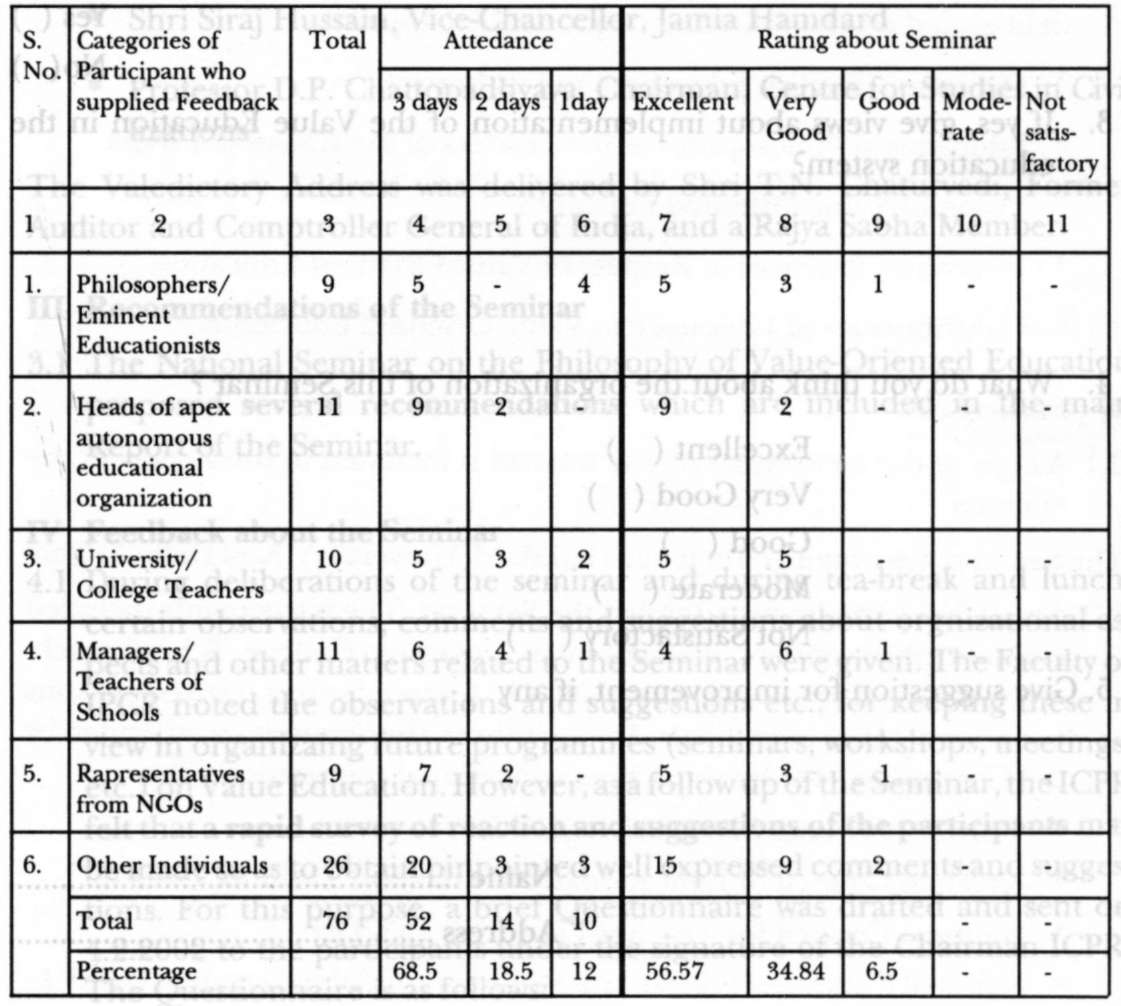
The feedback from the Rapid Survey revealed the 57% participants rated the Seminar as excellent, 37% participants rated the Seminar as Very Good, and 6% participants rated the Seminar as Good. 69% participants attended the Seminar for all three days, 19% participants attended the Seminar for two days and 12% participants attended the Seminar for one day only.
A: General Comments/Suggestions about Organizational Aspects of the Seminar
- The IPCR may organize a follow up workshop for discussion on recommendations of the Seminar on Value Education organized by it from 18 to 20 January, 2002 with a view to developing a "Plan of Action". Concerted efforts are needed to operationalize the Value Education programme. Among other things, teams of experts may be formed for advising and assisting in planning and implementation of Value Education Pro-
2.The papers presented in the IPCR Seminar (18-20 January, 2002) may be compiled and published in a book form. Valuable suggestions given in the papers presented in the Seminar may be shifted for taking appropriate follow up action.
3.The IPCR Seminar schedule(18-20 January, 2002)was very tight.
4.The time for ceremonial function during seminars on Value-Education may be reduced.
5.Ensure that voice of speakers is audible to audience through the public address system in each block of seats in the Conference Hall.
6.The participants for the Seminar may also include:
Stake holders in planning and implementation of Value-Education programmes in the education system
Actual implementers
Some representations of teachers, parents and students
People from diverse sections of society
Eminent literary figures
7.One of the sessions of the seminar on Value Education may be earmarked for students.
8.The Seminars on Value Education may inter alia deliberate on a significant issue, viz. how to integrate the Value Education programme in the examination-oriented system of education, without adding workload on students and teachers.
9.In the Seminar on Value Education organized by IPCR:
(i)Interactive goals were clear but there was a scope of improvement
(ii)Participation of audience was coordinated quantitatively
(iii)It could have been a seminar-cum-workshop
10.Adequate time may be allocated for group discussions on issues to planning, implementation and monitoring of Value Education programme. The recommendations of groups may be presented and discussed in plenary sessions. Strategies for introduction, implementation of programmes in Value Education in schools, colleges and under alternative education system may be deliberated specially.
11.Each speaker should suggest action points for operationalization of Value-Education Programme.
12.The Seminars on Value Education may be organized in different parts of the country. The Seminars may be organized in collaboration with apex educational organisations at national and state level like UGC,
NCERT, NIEPA, NOS, CBSE, NVS, SCERT.
13.Relevant material on Value Education may be distributed in the seminars on Value Education.
14.Good practices in Value Education may be highlighted in the seminars on Value Education instead of mentioning theoretical aspects only.
15.In the Seminars on Value Education deliberations may inter alia be made on the essential and eternal Values.
16.In the Seminars on Value Education emphasis should be laid on the significance of spiritual consciousness to be inculcated in students, teachers and parents; Inner growth is essential for real integral education.
B. Specific suggestions regarding Value Education Programme
I Planning of Value Education Programme
1.1Value Education may be made an integral part of educational process.
1.2Value Education may be an integral part of the curriculum but not an independent subject.
Another View: Introduce a paper on Value Education at the school stage which my be compulsory.
1.3A holistic approach is needed for planning and implementation of Value-Education Programme. In this endeavor, personnel related to formal schooling, NGOs and Media may work in a coordinated manner, pursuing a common agenda.
1.4Diversity of humanity requires several approaches in respect of Education in Human Values. What stimulates one may bore another. Appropriate practical research is essential to make the Value Education Programme truly effective.
1.5Moral and Spiritual teaching be made compulsory.
1.6A list of values may be prepared through general consensus.
1.7Emphasis in the education system may be given on values such as:
Nationalism/national integration
Patriotism
Satya
Dharma
Daya
Dana
Self Study
Respect for parents, teachers, classmates
Values enshrined in the Constitution such as equality, justice, freedom, peace.
1.8Create balance between national goals/societal concerns and individual goals/concerns.
1.9Reconcile mismatch between values in home and values in school.
1.10Introduce skill-based value education courses/programmes in value education.
1.11The programme of Education in Human Values at college level may be slightly different from such programme at school level.
1.12Define/decide values which can be implemented in schools.
II Materials on Value Education
2.1 Efforts may be made to develop a comprehensive package on Value Education. A core group may be assigned the task of preparation of draft oudines/framework for preparation of a comprehensive package on Value Education.
2.2A panel of inter-religious people may be formed to compile from existing inspirational scripture the essence of each religion/sect on fundamental issues such as:
Who am I?
Purpose of life.
How human beings are interconnected?
Concept of oneness of all.
Harmony of religions
2.3Values may be culled out from traditional texts in the context of programmes on Education in Human Values.
2.4Highlight educational philosophies of Indian thinkers (from ancient to modern period) in so far as these relate to education in human values with particular reference to:
development of textual material
teaching/learning strategies
pupil evaluation
2.5The textual material and teaching/learning strategies may reflect on:
(i)What is value?
(ii)How value system changes or remains constant with change of time?
(iii)Relation of values in the society.
2.6Textual materials/books may inter alia include:
(i) brief biographies of great personalities, and (ii) stories with inspiring message etc.
2.7The existing textual materials may be examined from the standpoint of education in human values. Tools for evaluation of values in textual materials may be developed and used.
2.8Values may be woven implicitly in textual material of different subjects like language, arts, science and mathematics. Specific material on value education may not be prescribed in the curriculum.
2.9Existing material on value education may be adopted or suitably adapted in the context of operationalization of Value Education Programme.
2.10Provide teaching/learning material that may stir the souls of children.
2.11Flood the schools and colleges with value based literature.
III Teachmg/Learning Strategies
3.1Metholdology for implementation of the programme of Value Education may be devised before actual implementation (for better pedagogical utility)
3.2Co-curricular activities play significant role in value education. Inculcate values through:
Stories
Poetry
Anecdotes
Playfield activities
Literary classes
Scouts and Guides programme (to instill values such
as caring, painting, music, dance, etc.)
Cooperative learning
Activities in morning assembly
Care of environment
3.3Values can be conveyed effectively through stories, plays, quizzes, songs, dances, paintings, sports, etc.
3.4An action-oriented approach is needed for full participation of (i) teachers, (ii)parents and (iii) community in planning and operationalization of Value-Oriented Programmes.
3.5Implementation of Value Education Programme requires very close cooperation between school and home.
3.6The teachers and other educationists may practise values which may be caught by the students. The role of the teacher in this regard should be constructive and proactive.
3.7Efforts may be made to ensure that teachers act as role models for students.
Parents may also play their role in responsible manner in the interest of inclucation of human values in children. Schools and colleges may interact with parents in this regard.
3.8Each teacher may devote some time to relate value education with the concerned subjects.
3.9Involve children in soul redeeming activities like promoting literacy.
3.10Develop power of concentration through Yogic Exercises.
3.11Ensure positive media intervention in the context of implementation of Programme of Value Education.
3.12Dovetail the Value Education Programme with cultural programme in schools.
3.13The schools may organize talks on Value Education by specialists. Documentary films reflecting values may be shown periodically to students, teachers and parents.
3.14Earmark a period/time of about twenty minutes in school time table for silence/meditation and studying the lives of great personalities, saints, their ideas/teachings. Such programmes may help acquiring desirable values and controlling the mind.
3.15Provide chances to children to live in the company of cultured and well mannered persons/teachers.
IV Training of Personnel
4.1Ensure quality in teacher education programme and eventually in the teacher educators who are to serve as true harbingers of change.
4.2Make suitable provision for providing recurrent in-service training of teachers.
4.3Make suitable provision for providing recurrent in-service training of teachers in value education.
4.4Organize orientation programmes/camps of teachers and students in which Value Education may be the main agenda.
The orientation/awareness programme may inter alia include themes such as "Power of Attitude" and "Science of Living". Such material has been developed by "Gnostic Centre".
4.5 Teachers, students and other concerned personnel may be sensitised about matters related to values such as (i) purpose of life, (ii) fearlessness, (iii) wisdom, and (iv) peace.
V Framework for Value Education Programme
5.1A task force under the Chairmanship of the Chairman, UGC may develop a comprehensive framework for the Value Education Programme. This task force may inter alia include the Director, NCERT, the Director NIEPA, and some experienced/dynamic persons from school sector, etc.
5.2A Committee of experts may be formed that may guide the schools about implementation strategies for Value Education Programme.
5.3Some Nodal Agency/Nodal Agencies may coordinate the efforts of various organisation in Value Education.
5.4ICPR may set up a Value Education Research Centre.
5.5ICPR may disseminate widely the recommendations of its Seminar on the "Philosophy of Value-Oriented Education". The Education Departments and educational institutions may be persuaded to adopt/adapt the recommendation and taking suitable follow up action.
5.6Forums need to be provided for exchange of ideas and focussed decision on implementation strategies.
5.7Involve more women teachers, particularly at the primary stage.
5.8Prepare an army of volunteers for implementation of the Programme of Value Education.
5.9Explicit political will is necessary for a Programme of Education in Human Values.
VI. General Suggestion about improvement of Quality of Education
6.1A significant aim of education should be the character building. Education may go beyond words to include experience and action. Education should teach how to live.
6.2Ensure:
(i)Child-centred value education
(ii)Women-centred family values
(iii)Values at work-place (diligence as nucleus)
(iv)Civilization and culture-centred social values
(v)Spirit-centred global values
(vi)Interface between East and West on values
(vii)Inculcation of universal values
6.3We may accept the good things that the English brought, provided we develop our own spirit, our own intellectual vigour and vital capacities.
6.4Vocational Education component may be strengthened in textual material. Suitable guidelines may be prepared in this regard.
Annexure IV
The Resolution Adopted Unanimously at the Conclusion of the Seminar
The National Seminar organized by the Indian Council of Philosophical Research on "Philosophy of Value-Oriented Education" was inaugurated by the Inaugural Address of the Hon'ble Minister of Human Resource Development on January 18, 2002. The Valedictory Address was delivered by Shri T.N. Chaturvedi, Member of Parliament and Member of the Executive Board of UNESCO on January 20, 2002.
The Seminar was held at the Jamia Hamdard at New Delhi. During the course of the Seminar, eminent philosophers, educationists, education administrators, and teachers from various parts of India participated and discussed various issues connected with the Philosophy of Value-Oriented Education, innovative practices being experimented upon in different parts of the country, and the contributions that literature can make to the promotion of Value-Oriented Education.
As a result of this wide-ranging participation and discussion, it was felt that there is a need in our country to set up a number of task forces under the active guidance of a Coordinating Committee. Considering that this Committee should be high-powered and should have autonomous character, it was felt that the Committee should be set up under the auspices of the University Grants Commission (UGC), which is the' highest educational body with statutory autonomy.
It was, therefore, unanimously recommended as follows:
Considering the importance of Value-Oriented Education as a means of creating a new climate in the country that would be conducive to the promotion of the highest ideals and values it is recommended that the UGC may take the necessary steps to constitute a number of task forces under the continuous guidance and supervision of the Coordinating Committee under the Chairmanship of Dr. Hari Gautam, who is at present the Chairman of the UGC, who will also nominate suitable personalities, including the heads of the NCERT, NIEPA, NCTE, CBSE, ISCE and other educational bodies as also eminent educationists. This Committee will ensure the fulfilment of the following urgent needs:
Continual assessment of the normative role of education in the rapidly changing societal set-up;
Evolution of programmes of value-oriented education and their implementation with particular reference to values cherished as a part of the Indian heritage and those contained in the Declaration of Human
Rights and Declaration of the Human Responsibilities, as also those enunciated in the Fundamental Duties in the Constitution of India and the highest value of Goodwill for the Highest Good of All;
Design and development of tools and infrastructure to build up and sustain a suitable environment for value education in our educational institutions;
Evolution and continual upgrading of suitable educational models, by defining their parameters, particularly the relationship between skills, knowledge, wisdom and values; and
An effective monitoring system to evaluate results of plans of action.
This Seminar also expresses its appreciation of the work initiated by the Indian Council of Philosophical Research in regard to the Philosophy of Value-Oriented Education, and it recommends that the Council organizes a series of Seminars, Workshops and Conferences and also extends financial assistance to the publication of literature and teaching/learning material with the aim to promote higher levels of thought and practice of Value-Oriented Education.
Annexure V
List of ChairPersons
LIST OF CHAIRPERSONS
1.PROFESSOR D. P. CHATTOPADHYAYA, Chairman, Centre for Studies in Civilization
2.SHRI D.K. MANAVALAN, Former, Secretary to the Government of India, Ministry of Social Justice & Empowerment
3.PROFESSOR RC. PRADHAN, Member-Secretary, ICPR
4.SHRI K.S. SHARMA, Additional Secretary, Department of Education, Ministry of HRD
5.DR. HARIGAUTAM, Chairman, University Grants Commission
6.PROFESSOR R.M. KALRA, Honorary Adviser, National Seminar on Value-Oriented Education, and Visiting Professor, USA & Canada
7.SHRI M.M. LUTHER, Author and Expert in Managment and Values
8.PROFESSOR I.N. CHOUDHURY, Former Secretary, SahityaAkademi, New Delhi, and Director, The Nehru Centre, London
9.PROFESSOR KAPIL KAPOOR, Rector, Jawaharlal Nehru University
10.PROFESSOR KIREETJOSHI, Chairman, ICPR
LIST OF RAPPORTEURS
1.PROFESSOR D.N. PANIGRAHI, Former Professor, NCERT
2.DR. J.D. SHARMA, Senior Executive Officer, National Open School
3.DR. S.K. MOHAPATRA, Senior Executive Officer, National Open School
LIST OF MEMBERS OF THE SEMINAR ORGANIZING COMMITTEE
1.Director of the Seminar: Professor Kireet Joshi
2.Organizing Secretary: Professor R. C. Pradhan
3.Honorary Adviser: Professor R. M. Kalra
4.Programme Coordinator: Dr. Mercy Helen
5.Finance and Accounts Committee: 1.Shri Sreekumaran 2.Shri L.C. Gyanan
6.Reporting Committee: 1.Professor D.N. Panigrahi 2.Dr. J.D. Sharma 3.Dr. S.K. Mohapatra
SEMINAR EDITORIAL TEAM
Chairman: PROFESSOR KIREET JOSHIICPR
Member-Secretary: PROFESSOR R.C. PRADHANICPR
Honorary Advisor: PROFESSOR R.M. KALRAof the Seminar
Programme Co-ordinator: DR. MERCY HELENICPR
Rapporteur: PROFESSOR D.N. PANIGRAHI; DR.J.D. SHARMA; DR. S. K. MOHAPATRA
LIST OF PARTICIPANTS
1 Agarwal, Promila
Darbari Lai DAV Model School
Shalimar Bagh, Delhi
2 Aggarwal, T. R.
Kulachi Hansraj Model School
New Delhi
3 Ambasht, N. K.
Chairman, National Open School
B-31B Kailash Colony, New Delhi
4 Anand, A.K.
Consultant
PHISPC
36, Tughlakabad Institutional Area
New Delhi -110062
5 Anuradha
(The Gnostic Centre)
c/o H- 401, Som Vihar Apt.
Sangam Marg
New Delhi - 110022
6 Aravindakshan, P.
5/395 Viram Khand
Gomti Nagar
Lucknow - 304 304
7 Arya, Raj Kumar
Joint Director (Media)
National Open School
A-38, Kailash Colony
New Delhi - 110048
8 Asthana, I.S.
National Open School
A-38, Kailash Colony
New Delhi-110048
9 Awasthi, Shalini
282, Type IV
Laxmi Bai Nagar, New Delhi
20.Bhardwaj, R.S.
K-30 Green Park Main
New Delhi -110016
21.Bharti.Vijay
Sri Aurobindo Ashram (Delhi Branch)
Sri Aurobindo Marg
New Delhi -110016
- Bhaskar, R. Kumar
Sri Satya Sai Institute of Higher Learning
Prasanti Nilayam
Puttapurthy 515 134
s29.Chand, Puran
Head, Publication Department
NCERT
Sri Aurobindo Marg
New Delhi -110016
- Chandel, Bhuvan
Department of Philosophy
Punjab University
Chandigarh -160014
31.Chandra, Sansar
B-32 Tara Crescent
Qutab Institutional Area
New Delhi -110016
- Chandra, Sharad
406, Sector-7
Noida, U.P.
33.Chatterjee, Debashish
Head, IIM, Prabandh Nagar
Sitapur Road
Lucknow
34.Chattopadhyaya, D.P.
25 Park Mansion
57-A Park Street,
Kolkata- 700016
- Chaturvedi, A.K.
Under Secretary
Dept. of Secondary and Higher Education
Ministry of H.R.D. Shastri Bhawan New Delhi - 110001
- Chaturvedi, Dharad
9/201 Cariappa Vihar
New Delhi -110010
- Chaturvedi, Sharad (Wing Commander)
265 Desh Bandhu Apartments
Kalkaji, New Delhi-110019
38.Chaturvedi, T.N.
Member of Parliament
19, Gurudwara Rakab Ganj
New Delhi -110001
39.Cedric M. Kenny
C/o Promilla Modi
5, Eastern Avenue
Maharani Bagh, New Delhi -110065
40.Choudhury, I.N.
183, Tagore Park, Delhi -110009
41.Das, Sisir Kumar
B-II-101 Paradise Apartments
- Dhall, G.D.
K-171.LIC Colony
Pashchim Vihar, New Delhi -110087
49.Dhar, P.L.
National Resource Centre for Value Education
in Engineering,
IIT, Delhi,
Hauz Khas, New Delhi -110016
50.Dhingra, R.D.
Vice-Principal
Ari-Force Kendriya Vidyalaya
M.B. Road, Tughalakabad
57.Garg, Harish
St. Margaret Sr. Sec. School D-Block, Prashant Vihar
Rohini, Delhi
58.Gautam, Hari
Chairman, UGC
Bahadurshah Zafar Marg
New Delhi-110002
59.Gautam, V.K
Principal
Kendriya Vidyalaya
Gole Market, New Delhi -110001
67.Gulati, Neelam K.
TU 78 Vishakha Enclave
Pitampura Res. Scheme New Delhi
68.Gupta, Bharat
J- 53 Ashok Vihar Phase-I
New Delhi -110052
69.Gupta, R.R.
Principal
Gyan Mandir Public School
Naraina, New Delhi -110028
70 Gupta, Renu
A-27, New Rajendra Nagar
New Delhi -110060
- Gupta, S.M.
A-27 New Rajendra Nagar
New Delhi - 110060
72.Gupta, T.R.
Secretary
DAV College Managing Committee
Chitragupta Marg, Pahar Ganj
New Delhi -110055
73.Hussain, Siraj
Vice-Chancellor
Jamia Hamdard University
M.B. Road, New Delhi -110062
74.Ishtiaqali
Photo Division, Ministry of I&B
CGO Complex Lodi Road
New Delhi - 110003
75.Jaffa, Manorama
Secretary-General
IWIC, Nehru House
4 Bahadurshah Zafar Marg
New Delhi - 110002
76.Jafri, S.W.H.
Lecturer
Department of Islamic Studies
Hamdard University
New Delhi -110062
77.Jain, A.P.
U-10 Green Park Extn.
New Delhi-110016
78.Jain, M.G
Reader, DEPEFE
NCERT
Sri Aurobindo Marg
New Delhi-110016
79.Jain, M.P.
H-10 Green Park, New Delhi -110016
80.Jain, Rama
D-82 Preet Vihar, Delhi -110092
81.Jain S.L.
Principal, Mahavir Sr. Model School
Rana Pratap Bagh, Delhi -110033
82.Jain, Sushma
Head, Department of Japanese
School of Languages
Jawaharlal Nehru University
New Delhi -110067
83.Jaipuria, Anjali
A-9/24Vasant Vihar
New Delhi -110057
84.Jaipuria, Suniti
A-9/24 Vasant Vihar, New Delhi -110057
85.Jha, Braj Bhushan
86.Jhaveri, Bharati
38/11 ProvynRoad
Opp. Law Faculty
Delhi-110007
87.Jhingran, Saral
136-C DDA MIG Flats
Rajouri Garden, New Delhi
88.Jhunjhunwala, Bharat
732 Modern Society,
Sector 15, Rohini, Delhi -110085
89.Joshi, Kireet
Chairman
Indian Council of Philosophical Research
36 Tughlakabad Institutional Area
New Delhi -110062
90.Jyoti, D.D.
NG148, Kot Kishan Chand
Jalandhar City, Jalandhar
91.Jyoti, Jeevan
AG. DAV School
Mukherjee Nagar, Delhi -110009
- Jyoti, Krishna
Shiv Jyoti Public School
Deen Dayal Upadhyaya Nagar
Jalandhar, Punjab
- Kabra, Mandakani
R-30 G.K -I
New Delhi -110048
- Kakoti, U.
National Open School
B-31-B Kailash Colony
New Delhi-110048
- Kalra, Bankim Mohan
Auroville's Future
Bharat Nivas
Auroville-605101
- Kalra, Rajinder M.
S-82 Greater Kailash-II
New Delhi -110048
- Kapoor, Kapil
Rector, Jawaharlal Nehru University
New Delhi - 110067
- Kapoor, R.N.
Kulachi Hansraj Model School
New Delhi
- Kapur, Promilla
K-37-A Green Park, New Delhi -110016
100.Kapur, Teg Bahadur
K-37 - A Green Park. New Delhi -110016
101.Kaushal, C.L.
K-56, Green Park Main, New Delhi -110016
102.Kaw, M.K.
Former Secretary, Dept. of Education
C-II/103, Moti Bagh-I, New Delhi -110021
103.Kelman, Donald
Sri Aurobindo International Institute of
Educational Research
Auroville 605 101 (Tamil Nadu)
104.Khandelwal, B.P.
Director, NIEPA
Sri Aurobindo Marg, New Delhi -110016
105.Khanna, M.L.
Vice-President
DAV College Managing Committee
Chitragupta Marg
Pahar Ganj, New Delhi -110055
106.Khosla, Yogesh
Principal, MHDAV Centenary Public School
Akhnoor
Jammu and Kashmir
107.Kohli Adarsh
Principal, D.L.D.AV. Public School
Shalimar Bagh
Delhi-110052
108.Kumar, Kiran
Sanskrit department
Delhi University, Delhi -110007
109.Kumar, Pushpendra
A-2/146 Sector 5
Rohini, Delhi -110085
110.Kumar, Renu
Blue Bells School
Kailash Colony
New Delhi-110048
111.Kumar, Shashi Prabha
Associate Professor
Department of Sanskrit
Jawaharlal Nehru University
New Delhi -110067
112.Kumar, Sunil
Coordinator, Value education
Ramakrishana Mission Ashram
Pahar Ganj
New Delhi -110055
113.Kumar, Sushil
Principal, Maulana Azad Medical College
New Delhi-110002
114.Lai Mohan
Honorary Advisor
DAV College Managing Committee
Chitragupta Marg, Pahar Ganj
New Delhi-110055
115.Lehri, G.K
Dean (Academic)
NCERT
Sri Aurobindo Marg
New Delhi -110016
116.Lele, Madhukar P.
Kendriya Jeevan Vigyan Academy
Chhatarpur Marg
New Delhi-110030
117.Luther, M.M.
27, Silver Oaks Apartments
DLF Qutab Enclave, Phase -I
Gurgaon - 122002, Haryana
118.Luther, Usha
27, Silver Oaks Apartments
DLF Qutab Enclave, Phase -I
Gurgaon - 122002 (Haryana)
119.Madan, V.D.
N-23D, Saket
New Delhi 110024
120.Mahajan, Baldev
D-72 Defence Colony
New Delhi-110017
121.Maheshwari, A.N.
Chairman, NCTE
I.G. Stadium, LP. Estate
New Delhi -110002
122.Maheshwari, S.C.
G263 Surajmal Vihar
Delhi-110092
123.Malhotra, Neera
Teacher
DAV Public School
New Delhi
124.Malhotra, Pramod
Dilshad Garden, New Delhi
125.Manavalan, D.K.
IAS (Retd.) Executive Director, AFPRO
25/1-A, Institutional Area,
Pankha Road, D-Block Janakpuri
New Delhi-110058
126.Manoharan, C.
Principal,
St. Thomas School
Mandir Marg
- Marea, P.L.
Kulachi Hansraj Model School
Ashok Vihar
New Delhi-110052
128.Mathews, K
Head, Department of African Studies
University of
Delhi Delhi-110007
129.Mehra, Amita
C/o Gnostic Centre
H-401 Som Vihar Apartments
Sangam Marg New Delhi-110022
- Merchant, A.K.
Vice-chairman
National Spiritual Assembly of Baha' is of
India
6 Canning Lane
New Delhi -110001
131.Mishra, Arun
C-l/69 Sector 55
NOIDA
132.Modi, Pramila
5, Eastern Avenue
Maharani Bagh, New Delhi
133.Mohan, Chandra
EG-106, Inder Puri
New Delhi -110012
- Mohapatra, Subhankar
Tutor, Academic Department
National Open School
B-31-B, Kailash Colony
New Delhi-110048
- Mukhopadhyaya, A.K.
Department of Laboratory Medicine
AIIMS, Post Box 4938
New Delhi- 110029
136.Munjal, S.K
Principal, St. Margaret School
Prashant Vihar, Delhi -110085
137.Narayan, Trilok
C/o Captain (Retd.) Jit Singh
C-112/1 (First Floor)
Ganesh Nagar, P.O.: Tilak Nagar
New Delhi -110018
138.Nayar, Shobana
A-12, Tara Apartments
Kalkajee
New Delhi -110019
Negi, GS.
Principal,
Bharatiya Vidya Bhawan
K.G. Marg, New Delhi -110001
140.Odell, Suzie
Sri Aurobindo international Institute of
Educational Research
Auroville 605 101 (Tamil Nadu)
141.Pabby, D.K.
142.Pandit, Asha
776 Sector 7-C
Faridabad-121006
143.Pandit, Vinay
Retd. Principal, Govt. College, Panchkula
776, Sector - 7C
Faridabad-121006
144.Panigrahi, D.N.
S- 289, Greater Kailash - II
New Delhi -110048
145.Partho
Principal, Blue Mountain School
Ooty (Tamil Nadu)
146.Patnaik, Prakash
Head, Oriya Department of Modern Indian
Languages 8c Literature Studies
Faculty of Arts
University of
Delhi Delhi -110007
147.Pillai, N.N.
Principal, Sardar Patel College of
Communication & Management
Bharatiya Vidya Bhavan
K.G. Marg
New Delhi - 110001
148.Pradhan, R.C.
Member-Secretary
Indian Council of Philosophical Research
36, Tughlakabad Institutional Area
New Delhi- 110062
149.Prakash, Suraj
Principal, CRPF Public School
Sector XIV, Rohini
Delhi
150.Prasad, Rajendra
Opposite Stadium Main Gate
Prem Chand Path
Rajendra Nagar
Patna 800016
151.Rajput, J.S.
Director, NCERT
Sri Aurobindo Marg
New Delhi -110016
- Rakesh
Vraja Academy
C/o. 5/3482-A Rehgarpura
Karol Bagh
New Delhi- 110005
153.Ramakrishnan, Santa
Head, Department of French School of
Languages
Jawaharlal Nehru University
New Delhi -110067
154.Ramteke, P.M.
Assistant Director, ICSSR
P.O. Box 10528
Aruna Asaf Ali Marg
New Delhi-110067
155.Rana, Manish
Dean Emeritus
Sushant School of Art and Architecture
Sector 55
Gurgaon-122003
- Rao, Srinivasa
Editor, National Open School A-38, Kailash Colony New
Delhi -110048
157.Rastogi, KG.
E -923 Saraswati Vihar
New Delhi- 110034
158.RathiRekha
29 Sadhana Enclave
New Delhi 110017
159.Ravindran
Head,
Tamil Department of Modern Indian
Languages and Literature Studies
Faculty of Arts
University of Delhi
Delhi - 110007
160.Roy, Sudipta Dutta
164 SFS Flats
Hauz Khas, New Delhi -110016
161.Rudolf, Stephen
Sector-21 B,
Faridabad, Haryana -121001
162.Sandhir, S.K.
Former Director, SCERT Gurgaon
707 Sector 21-A
Faridabad
163.Saraf, Urmila
H-21 Maharani Bagh
New Delhi-110065
164.Sarkar, Tripti
61 Aravalli, DDA Flats
Alakananda, New Delhi -110019
165.Seetha Ram, A.R.
Principal, B.Ed. School
Ramakrishna Institute of Moral & Spiritual
Education
Yadavagiri,
Mysore - 570020
166.Sengupta, A.K.
Senior Addl. P.I.O.
P.I.B., Ministry ofl&B
Shastri Bhavan, New Delhi -110001
167.Sethi, Rashmi
D-887, New Friends Colony
New Delhi -110065
168.Sharda, Vibha
Principal, Shivjyoti Public School
Deen Dayal Upadhyaya Nagar
Jalandhar, Punjab
169.Sharma, A.C.
Reader (Retd.) NCERT
3-C/DDA MIT Flats
Rajouri Garden
New Delhi
170.Sharma, D.P.
Principal, Bhavan's Sawan Public School
Bhatti Mines Road, Chattarpur
New Delhi -110030
171.Sharma, H.L.
National Open School
B-31-B Kailash Colony
New Delhi-110048
172.SharmaJ.D.
Senior Executive Officer
National Open School
B-35 Kailash Colony
New Delhi-110048
173.Sharma, KS.
Additional Secretary
Ministry of HRD
Shastri Bhawan
New Delhi -110001
174.Sharma, Kavita
Principal, Hindu College
University of Delhi
Delhi-110007
175.Sharma, R.B.
Flat 1177 Sector 37
NOIDA
176.Sharma, R.P.
Rohini, Delhi
177.Sharma, Raghunath
School of Correspondence Courses
Delhi University
Delhi -110007
178.Sharma, S.D.
Lok Sewak Sangh
Lajpat Bhawan, Lajpat Nagar -IV
New Delhi-110024
- Sharma, Shashi Shekhar
Director (Finance)
I.F.D. Division
Dept. of Education
Ministry of H.R.D.
Shastri Bhawan
New Delhi -110001
- Sharma, Sima
11-B Vijay Mandal Enclave
(near Sri Autobindo Ashram)
New Delhi -110016
- Sharma, T.R.
218Vaishali
Pitampura
Delhi - 110034
- Shastri, Kutumba V.
Director, Rashtriya Sanskrit Sansthan
56-57, Institutional Area, Janakpuri
New Delhi-110058
183.Shekhar R.C.
Principal, Gyan Bharati Public School
Saket, New Delhi-110017
184.Siddique, A.N.
Education Officer
K.V.S. Headquarters
Katwaria Sarai, New Mehrauli Road
New Delhi -110067
- Singh, Ajit
National Open School
B-310B Kailash Colony
New Delhi -110016
- Singh, Mithilesh K
Research Associate
Educational Policy Unit, NIEPA
17-B Sri Aurobindo Marg
New Delhi -110016
187.Singh, R.P.
Associate Professor
Department of Philosophy
Jawaharlal Nehru University
New Delhi-110067
188.Singh, Rachna
C/o. Professor S.P. Singh
Fellow, MSRWO
36 Tughlakabad Institutional Area
New Delhi -110062
189.Singh, Rajinder
Director, Sports Authority of India
117 Sharda Niketan
Delhi
190.Singh, Ramjee
Bhikhanpur
Bhagalpur-812001 (Bihar)
191.Singh, S.P.
C/o. Professor S.P. Singh
Fellow, MSRWP
36 Tughlakabad Institutional Area
New Delhi -110062
- Singh, Sheela
M-265 Greater Kailash - II
New Delhi
193.Sondhi, V.
Assistant Director, ICSSR
Aruna Asaf Ali Marg
New Delhi - 110067
194.Tandon, Rajni
17 Link Road
Jangpura Extension
New Delhi
- Tekchandani, Ravi
Head, Sindhi
Department of Modern Indian Languages &
Literature Studies
University of Delhi, Delhi -110007
196.Thakur, Anoop
Executive Assistant
National Open School
A-38, Kailash Colony
New Delhi -110048
197.Theryll, George
Rector, Principal
Don Bosco School
Alakananda, Kalkaji
New Delhi -110019
198.Thomas, Gracious
SOCE, IGNOU
Maidan Garhi, New Delhi -110068
199.Tripathi, R.C.
AB-93 Shahjahan Road
New Delhi-110001
200.Trivedi, Shashikala
D-144, Defence Colony
New Delhi- 110024
- Upadhyaya, Vacaspati
Vice-Chancellor
Sri Lai Bahadur Shastri Rastriya Sanskrit
Vidyapeetha
Katwaria Sarai
New Delhi - 110067
- Upadhyaya, Vinod Kumar
Cameraman, National Open School
A-38, Kailash Colony
New Delhi -110048
203.Vaidik, Vedawati
A-19, Press Enclave, Saket
New Delhi -110017
204.Vashisth, K.K
Head Department of Elementary Education
NCERT
Sri Aurobindo Marg
New Delhi-110048
205.Vedalankar, Jaidev
Department of Philosophy
Gurukul Kangri Vishwavidyalaya
Haridwar
206.Veeraraghavan, J.
G-15/3DLF Phase-I
DLF City
Gurgaon, Haryana
207.Veeraraghavan, Vimala
G-15/3 DLF Phase -1
DLF City, Gurgaon - (Haryana)
208.Venkateshwaran, M.
D-l/96 SatyaMarg
Chanakyapuri
New Delhi- 110021
209.Verma, Anita
Reader, Sri Venkateswara College
University of Delhi (South Campus)
New Delhi
210.Vij, D.R.
36, Tagore Park
Jalandhar 144008
211.Vohra, Gautam
75 Paschimi Marg
Vasant Vihar
New Delhi - 110057
212.Walters, Madhuri
Tutor, Jamia Hamdard University
Hamdard Nagar,
New Delhi -110062
213.Williams, J.
Controller of Examinations
National Open School
B-31-B Kailash Colony
New Delhi-110048
214.Zaman, Kadir
16-10-49 Malakpet
Hyderabad - 500036
LIST OF CONTRIBUTORS TO THE NATIONAL SEMINAR ON PHILOSOPHY OF VALUE-ORIENTED EDUCATION
Professor Murli Manoharjoshi, Hon'ble Union Minister of Human Resource Development, Science and Technology, and Ocean Development, New Delhi.
Professor Rajendra Prasad, Former Professor of Philosophy, IIT, Kanpur. Professor D.P. Chattopadhyaya, Chairman, Centre for Studies in Civilizations, New Delhi.
Professor Kireet Joshi, Chairman, Indian Council of Philosophical Research, New Delhi.
Shri M.K. Kaw, Former Secretary, Department of Secondary and Higher Education, Ministry of HRD, New Delhi.
Shri Siraj Hussain, Vice-Chancellor, Jamia Hamdard, New Delhi.
Professor N.K. Ambasht, Chairman, National Open School, New Delhi.
Ms. Anuradha, Gnostic Centre, Delhi. Professor I.S. Asthana, National Open School, New Delhi.
Professor Alain Bernard, Sri Aurobindo International Institute of Educational Research, Auroville.
Professor R. Kumar Bhaskar, Sri Sathya Sai Institute of Higher Learning, Puttaparthi (A.P.).
Professor D.K. Bhattacharya, NCERT, New Delhi.
Professor I.N. Choudhuri, Former Secretary, Sahitya Akademi, New Delhi and
Director, The Nehru Centre, London. Dr. Ishtiaque Danish, Head, Department of Islamic Studies, Jamia Hamdard, New Delhi.
Professor (Ms.) Deepti, Sri Aurobindo International Institute of Educational Research, Auroville.
Professor P.L. Dhar, Head, National Resource Centre for Value Education, IIT Delhi, New Delhi.
Shri Ashok Ganguly, Chairman, CBSE, New Delhi.
Professor Hari Gautam, Chairman, University Grants Commission, New Delhi.
Smt. Manorama Jafa, Secretary-General, Association of Writers and Illustrators, New Delhi.
Smt. Anjali Jaipuria, Managing Trustee, The Mother's Institute of Research, New Delhi.
Dr. Bharati Jhaveri, Department of Gujarati, University of Delhi, Delhi.
Smt. Sushil Kaur, Author in Punjabi, New Delhi.
Professor Donald Kelman, Sri Aurobindo International Institute of Educational Research, Auroville.
Professor B.P. Khandelwal, Director, NIEPA, New Delhi.
Shri M.L. Khanna, General Secretary, DAV College Managing Committee, New Delhi.
Shri Sunil Kumar, Ramakrishna Mission, New Delhi.
Shri M.M. Luther, Author and Expert in Management and Values, Gurgaon. Professor
A.N. Maheshwari, Chairman, NCTE, New Delhi.
Shri A.K. Merchant, Vice-Chairman, National Spiritual Assembly of the Bahai's of India, New Delhi.
Shri Partho, Principal, Blue Mountain School, Ooty.
Dr. Prakash Pattanaik, Department of Oriya Language, University of Delhi.
Professor J.S. Rajput, Director, NCERT, New Delhi.
Shri Stephen Rudolf, Jiva Institute, Faridabad.
Professor A.R. Seetharam, Principal, Ramakrishna Institute of Moral and Spiritual Education, Mysore.
Dr. Kavita Sharma, Principal, Hindu College, University of Delhi, Delhi.
Professor Ramjee Singh, Former Vice-Chancellor, Jain Vishwa Bharati, Ladnoo.
Professor (Ms.)Suzie, Sti Aurobindo International Institute of Educational Research, Auroville.
Dr. Ravi Tekchandani, Department of Sindhi Language, University of Delhi, Delhi.
Professor Gracious Thomas, IGNOU, New Delhi.
Shri R.C. Tripathi, Secretary General, Rajya Sabha, New Delhi.
Professor Jaidev Vedalankar, Department of Philosophy, Gurukul Kangri
Vishwavidyalaya, Hardwar.
Dr. D.R . Vij, Jalandhar.
Professor Gautam Vohra, President, Development Research and Action Group, New Delhi.
Shri Kadir Zaman, Author in Urdu, Hyderabad.
भारतीय दारनिक्श अनुसंधानपरिषद्
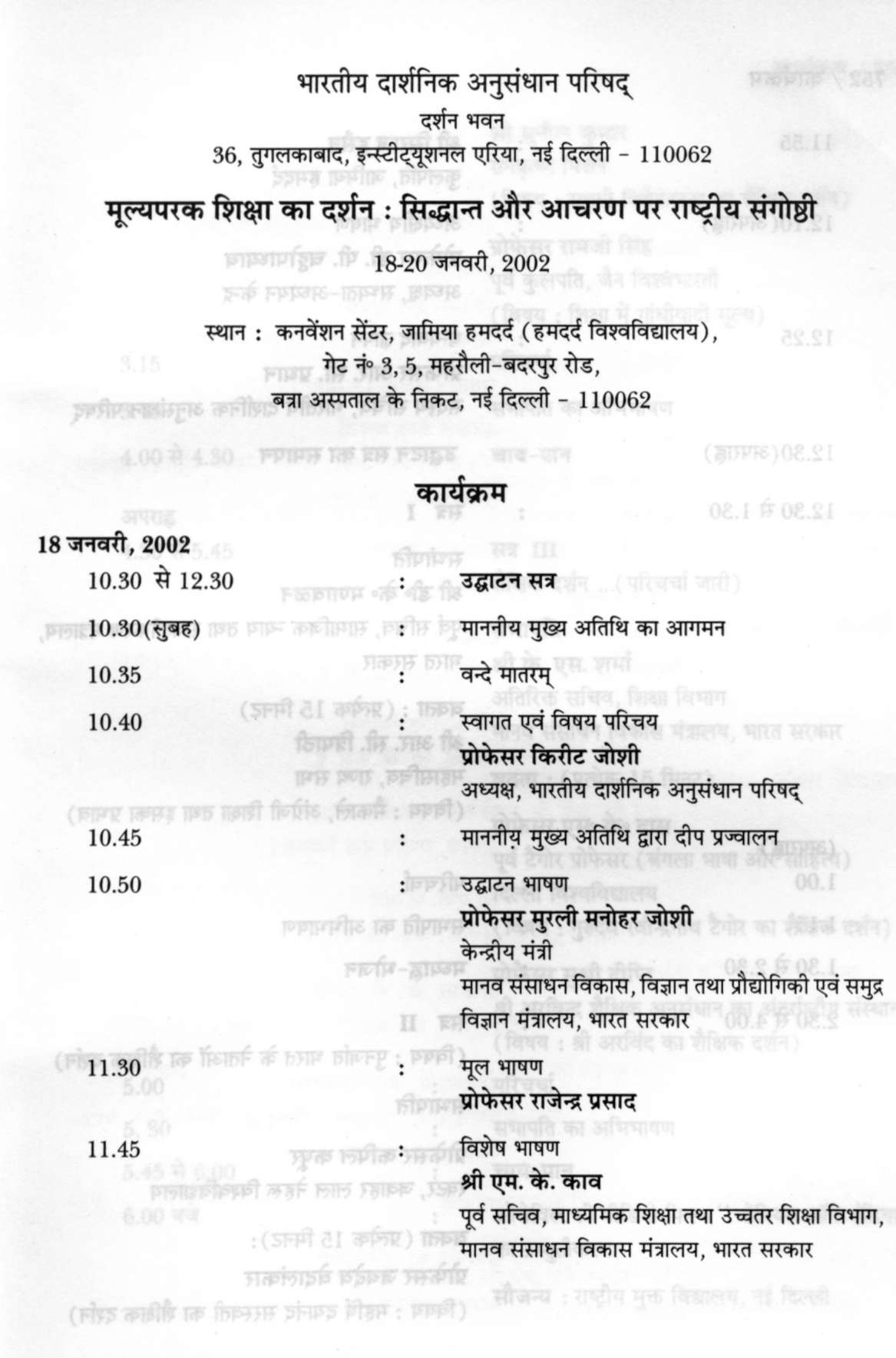
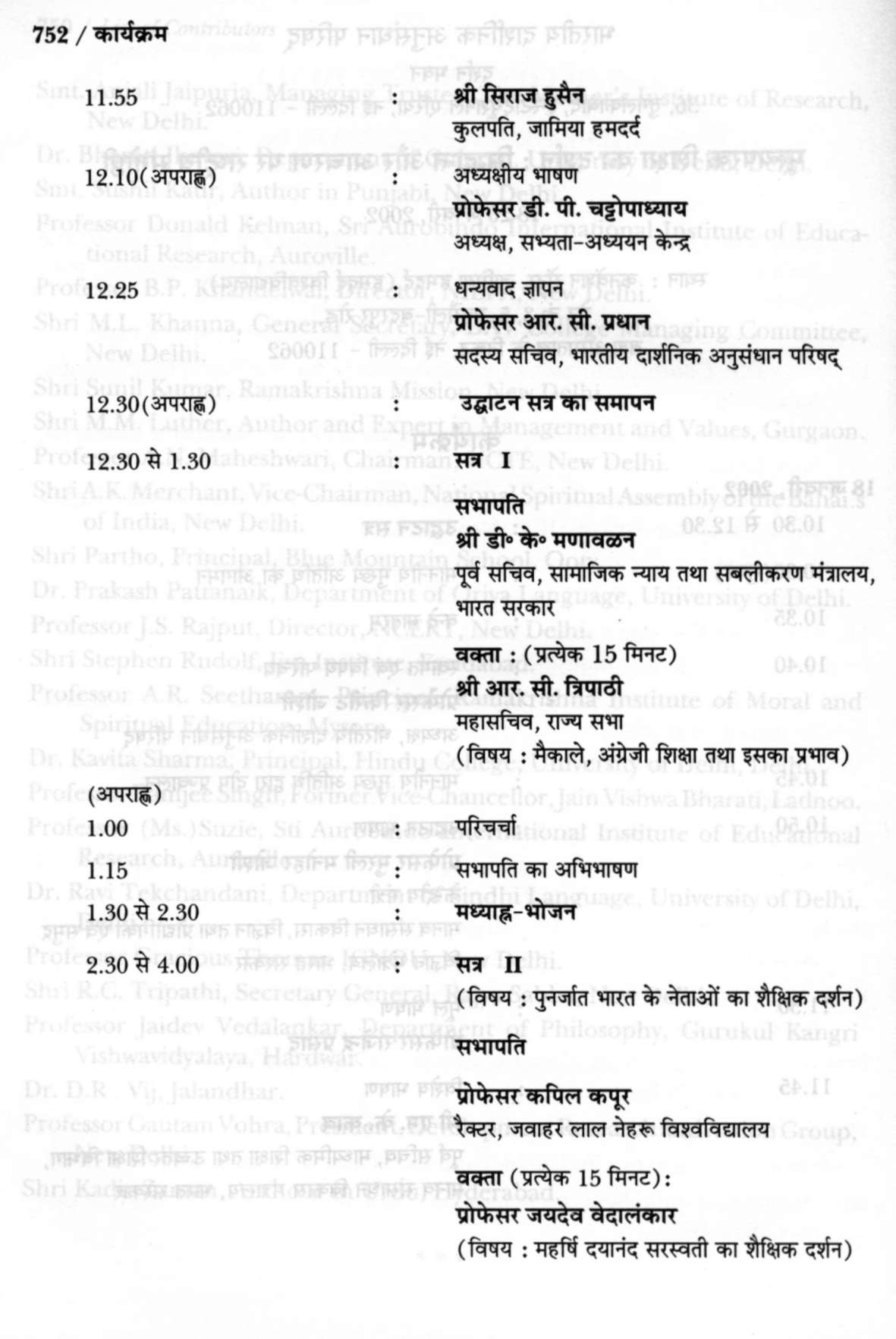
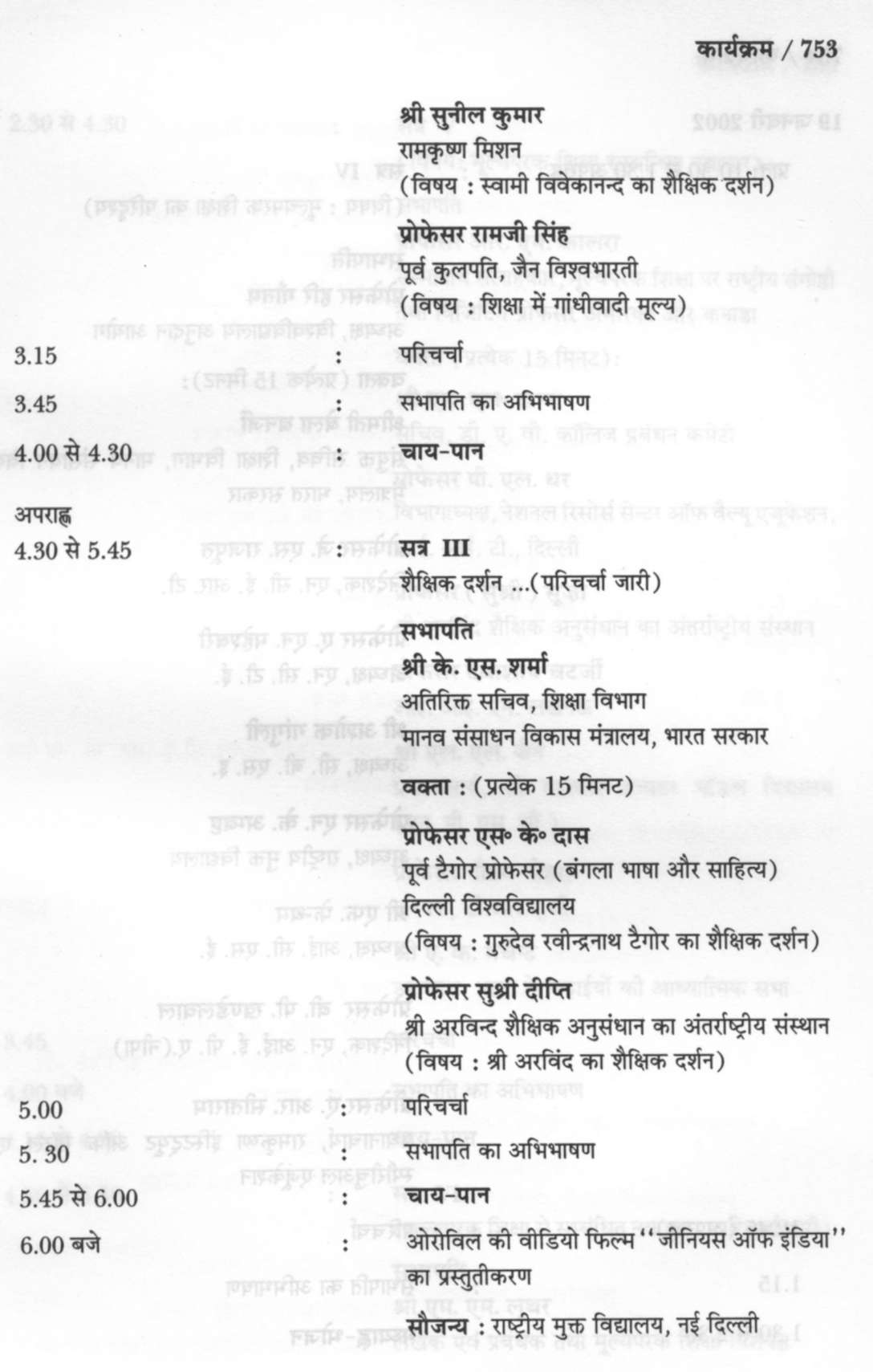
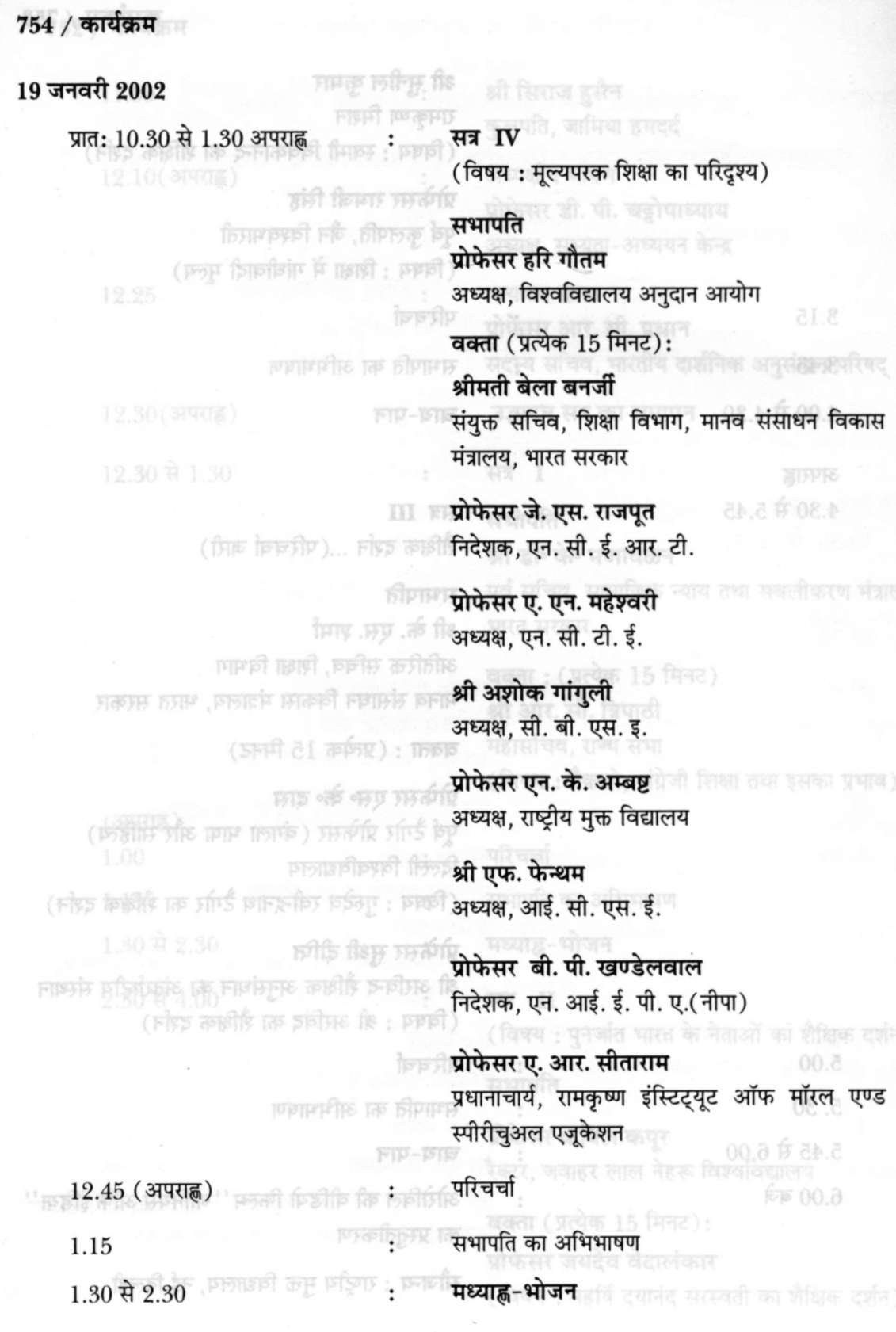
INDIAN COUNCIL OF PHILOSOPHICAL RESEARCH
Darshan Bhawan,
36 Tughalakabad Institutional Area, New Delhi -110062
National Seminar on Philosophy of Value-Oriented Education: Theory and Practice
January 18-20, 2002
Venue: Convention Centre, Jamia Hamdard
(Hamdard University), Gate No. 3&5
Near Batra Hospital, New Delhi -110062
PROGRAMME
January 18, 2002
10.30 a.m. to 1.15 p.m. : Inaugural Session
10.30 a.m. : Arrival of the Hon'ble Chief Guest
10.35 a.m. : Vande Mataram
10.40 a.m. : Welcome and Introduction by Professor KireetJoshi, Chairman, ICPR
10.45 a.m. : Lighting the Lamp by the Hon'ble Chief Guest
10.50 a.m: Inaugural Address by Professor Murli Manohar Joshi, Hon'ble Union Minister of Human ResourceDevelopment, Science & Technology, and Oceanography
11.30 a.m. : Keynote Address by Professor Rajendra Prasad11.45 a.m. : Address by Shri M.K. Kaw, FormerSecretary, Department of Secondary and Higher Education Ministry of HRD, Government of India
11.55 a.m. : Address by Shri Siraj Hussain, Vice-Chancellor, lamia Hamdard
12.10 p.m. : Presidential Address byProfessor D.P. Chattopadhyaya, Chairman, Centre for Studies in Civilizations
12.25 p.m. : Vote of Thanks byProfessor R.C. Pradhan, Member-Secretary, ICPR
12.30 p.m: Closure of the Inaugural Session
12.30 p.m to 1.30 p.m. :
Session IChairperson: Shri D.K. Manvalan, Former, Secretary to the Government of India, Ministry of Social Justice & EmpowermentSpeaker: Shri R.C. TripathiSecretary-General, Rajya Sabha:Macaulay, English Education and its Impact
1.00 p.m.: : Open Discussion
1.15 p.m: Chairperson's Address
1.30 p.m. to 2.30 p.m. : LUNCH BREAK
Session II
Topic: Educational Philosophies of the Leaders of the Renascent IndiaChairperson: Professor Kapil Kapoor Rector, Jawaharlal Nehru UniversitySpeakers (15 minutes each):Professor Jaidew Vedalankar on"Educational Philosophy of Maharshi Dayananda Saraswati"Shri Sunil Kumar (Ramakrisha Mission) on "Educational philosophy of Swami Vivekananda"
Professor Ramjee Singh, Former Vice-Chancellor, Jain Vishwa Bharati, on: "Gandhian Values in Education"
3.15 p.m. : Open Discussion
3.45 p.m. : Chairperson's Address
4.00 p.m. to 4.30 p.m. : TEA BREAK
4.30 p.m. to 5.45 p.m. : Session IIITopic: Educational Philosophies(contd.)Chairperson : Shri K.S. Sharma, Additional Secretary,- Department of Education, Ministry of HRDSpeakers (15 minutes each):Professor S.K. Das, Former Tagore Professor of Bengali Language and Literature, University of Delhi, on"Educational Philosophy of GurudevRabindra Nath Tagore"Professor (Ms.) Deepti, Sri AurobindoInternational Institute of EducationalResearch, on "Educational Philosophy of Sri Aurobindo"
5.00 p.m. : Open Discussion
5.30 p.m. : Chairperson's Address
5.45 p.m. to 6.00 p.m. : TEA BREAK
6.00 p.m. : Evening Programme on Auroville's presentation of "Genius on India"(A Video film), Courtesy: Chairman, National Open School.
January 19, 2002
10.30 a.m. to 1.30 p.m.
Session IVTopic: Vision of Value-OrientedEducationChairperson: Professor Hari Gautam, Chairman; University Grants Commission
Speakers (15 minutes each): Mrs. Bela Banerjee, Joint Secretary, Department of EducationProfessor J. S. Rajput, Director, NCERTProfessor A.N. MaheshwariChairman, NCTEShri Ashok GangulyChairman, CBSEProfessor N.K. Ambasht, Chairman, National Open SchoolShri F. Fanthom, Chairman, ICSEProfessor B.P. KhandelwalDirector, NIEPAProfessor A.R. Seetha RamPrincipal, Ramakrishna Institute of Moral and Spiritual Education
12.45 p.m. : Open Discussion
1.15 p.m. : Chairperson's Address
1.30 p.m. to 2.30 p.m. : LUNCH BREAK 2.30 p.m. to 4.30 p. m: Session V
Topic: Innovative Practices in respect of Value-Oriented EducationChairperson: Professor R.M. Kalra,Honorary Adviser, National Seminar on Value-Oriented Education, andVisiting Professor, USA & CanadaSpeakers (15 minutes each):Shri M.L. Khanna, Secretary, DAV College Managing CommitteeProfessor P.L. Dhar, Head, NationalResource Centre for Value-Education, IIT, Delhi.Professor Ms. Suzie, Sri AurobindoInternational Institute of Educational ResearchProfessor Debashish Chatterjee, IIM, LucknowShri S.L. Jain, Principal, Mahavir SeniorModel School (NPSC)Professor Gautam Vohra, Chairman, DRAGShri A.K. Merchant, Vice-Chairman, National Spiritual Assembly of the Bahai's of India
3.45 p.m. : Open Discussion
4.00 p.m: Chairperson's Address
4.15 p.m. to 4.30 p.m. : TEABREAK 4.30 p.m. to 6.30 p.m. :
Session VITopic: Innovative Practices (Contd.)Chairperson: Shri M.M. Luther, Author and Expert in Management and ValuesSpeakers (15 minutes each):Professor Kumar Bhaskar, Sri Sathya Sai Institute of Higher LearningShri Partho, Principal, Blue Mountain School, OotyProfessor I.S. Asthana, National Open School,Professor Gracious Thomas, IGNOUProfessor D.K. Bhattacharya, NCERT
6.00 p.m. : Open Discussion
6.15 p.m: Chairperson's Address
6.30 p.m. : TEA BREAK
6.45p.m: Audio-Visual Presentation by NCERT on Value-Oriented Education
January 20, 2002
10.30 a.m. to 1.30 p.m:
Session - VII
Topic: Contributions of Literature toValue-Oriented EducationChairperson: Professor I.N. ChoudhuryFormer, Secretary, Sahitya Akademi, New Delhi and Director, The Nehru Centre, LondonRelease of the book "Jharokha"authored by Smt. Sheela Singh, Author in Punjabi
Speakers (10 minutes each):Professor Kireetjoshi, Chairman, ICPRProfessor Suraykant Bali, Former Editor, Nav Bharat TimesSmt. Manorama Jafa, Secretary-General, Association of Writers and IllustratorsProfessor Alain Bernard, Sri AurobindoInternational Institute of Educational ResearchProfessor Donald Kelman, Sri AurobindoInternational Institute of Educational ResearchShri Kadir Zaman, Author in UrduSmt. Ajnali Jaipuria, Managing Trustee, The Mother's institute of ResearchDr. Shashi Prabha Kumar, AssociateProfessor, Centre for Sanskrit Studies, Jawaharlal Nehru University
Shri Stephen Rudolf, Jiva Institute, FaridabadDr. Bharati Jhaveri, Reader, Department of Gujarati, University of DelhiProfessor Rajendra Dengle, Department of German Language and Literature, Jawaharlal Nehru UniversitySmt. Sheela Singh, Author in PunjabiDr. Prakash Pattnaik, Department ofOriya, University of DelhiDr. Ravi Tekchandani, Department ofSindhi, University of Delhi
12.30 p.m. : Open Discussion
1.00 p.m: Chairperson's Address
1.30 p.m. to 2.30 p.m: LUNCH BREAK 2.30 p.m. to 4.00 p.m:
Session VIIIContributions of Literature (Contd.)Chairperson: Professor R.C. Pradhan, Member-Secretary, ICPRSpeakers (15 minutes each):Professor R.P. Sharma, Former Dean, Department of Education, University of DelhiShri M. Venkateswaran, Former AdditionalSecretary (Expenditure), Government of India.Professor Chandra Mohan, Secretary-General, Comparative Literature Association of IndiaDr. Kavita Sharma, Principal, Hindu CollegeMs. Amita Mehra, Chairperson, Gnostic Centre, Delhi
3.30 p.m. : Open Discussion
3.45 p.m: Chairperson's Address
4.00 p.m. to 4.30 p.m: TEA BREAK
4.30 to 6.00 p.m. :
Valedictory SessionChairperson: Professor Kireet Joshi,Chairman ICPRWelcome & Report by Professor R.M. Kalra, Honorary Adviser, National Seminar on Value-Oriented Education and Visiting Professor, USA & CanadaComments on the Seminar( 5 minutes each):Smt. Suraj Prakash, Principal, CRPF School,(President, National Progressive Schools)Professor Chandra Mohan, Secretary-General, Comparative LiteratureAssociation of India.Professor (Ms.) Deepti, Sri AurobindoInternational Institute of Educational Research
Valedictory Address:Shri T.N. Chaturvedi, Member of Parliament(Rajya Sabha), Member of theExecutive Board, UNESCO (Paris)Chairman's Address:Professor Koreet Joshi, Chairman, ICPRVote of thanksProfessor R.C. Pradhan,Member-Secretary, ICPR
Notes
India the Mother, A Selection from Mother's Words (Institut de Recherches Evolutives, Paris & Mira Aditi, Mysore), p. 119
↩Sri Aurobindo, The Life Devme, p. 1054
↩Sri Aurobindo, The Human Cycle, p.26-27
↩Sri Aurobindo, Preface to National Education.
↩Sri Aurobindo, The Renaissance in India.
↩Sri Aurobindo, Preface to National Education (1920).
↩Sri Aurobindo, The Human Mind—A National System of Education (1910)
↩The Mother, CWM, Vol. 12 p.251
↩Sri Aurobindo, 1920 Letter to Barin, Original Bengali, Archives and Research.
↩Sri Aurobindo, Archives and Research, April 1981, p.1-6.
↩Sri Aurobindo, Essay—National Value of Art.
↩Sri Aurobindo, The Renaissance in India,
↩Sri Aurobindo, "Perfection of the Body" in Bulletin of Physical Education, 1949.
↩Sri Aurobindo, "Perfection of the Body" in Bulletin of Physical Education, 1948.
↩Sri Aurobindo, The Synthesis of Yoga, p.722.
↩The Mother, On Education, Vol. 12 p. 93.
↩The Mother, Vol. 12 p. 234.
↩The Mother, Vol. 12 p. 235.
↩Faruqi, I. R., Al-Tawhid: Its Implications for Thought and Life
↩The agreement is only up to this point. Islam does not subscribe to the Christian concept of man's original sin and salvation through the crusifixcation of Christ etc. Nor does it share the Jewish perception of their being chosen people of God. The Islamic belief is that man will he rewarded or punished according to the merit or demerit of his action.
↩For AI-Ghazali's moral philosophy see Muhammad, Umaruddin, The Ethical Philosophy of Al-Ghazali (second reprint), Shaykh Muhammad Ashraf, Lahore, 1977; for Ibn Miskawayh's moral Philosophy see Abdul Haq, Ansari, The Ethical philosophy of Ibn Miskawaih, AMU press, 1969; and for Maududi's views on Islamic ethics see his work Ethical viewpoint of islam (tr. Khursheed Ahmad), Markazi Maktaba Islami, Delhi,1996.
↩Momin, A. R., Islam and the Promotion of Knowledge, Institute of Objective Studies, New Delhi, 2001, p.160.
↩As quoted in Islam and the Promotion of Knowledge, Institute of Objective Studies, New Delhi, 2001; pp-61.
↩Umaruddin, op-cit., p.189.
↩Prof. Marmar Mukhopadhyay is Senior Fellow in National Institute of Educational Planning and Administration (NIEPA), New Delhi-110 016
↩The note on Family Life has been contributed by prof. Karuna Chanana, Zakir Hussain centre for Educational studies, Jawaharlal Nehru university, New Delhi-110 016.
↩The note on Learning to Live Together has been contributed by prof. jaya Indiresan.
↩Drafted by Prof. Marmar Mukhopadhyay, National Institute of Educational Planning and Administration, New Delhi-110 016
↩