THE WRITTEN WORD
Philosophy of Supermind and Contemporary Crisis
Paragraph references are specific to this digital edition.
Sri Aurobindo His Life and Work
Sri Aurobindo His Life and Work: Introduction
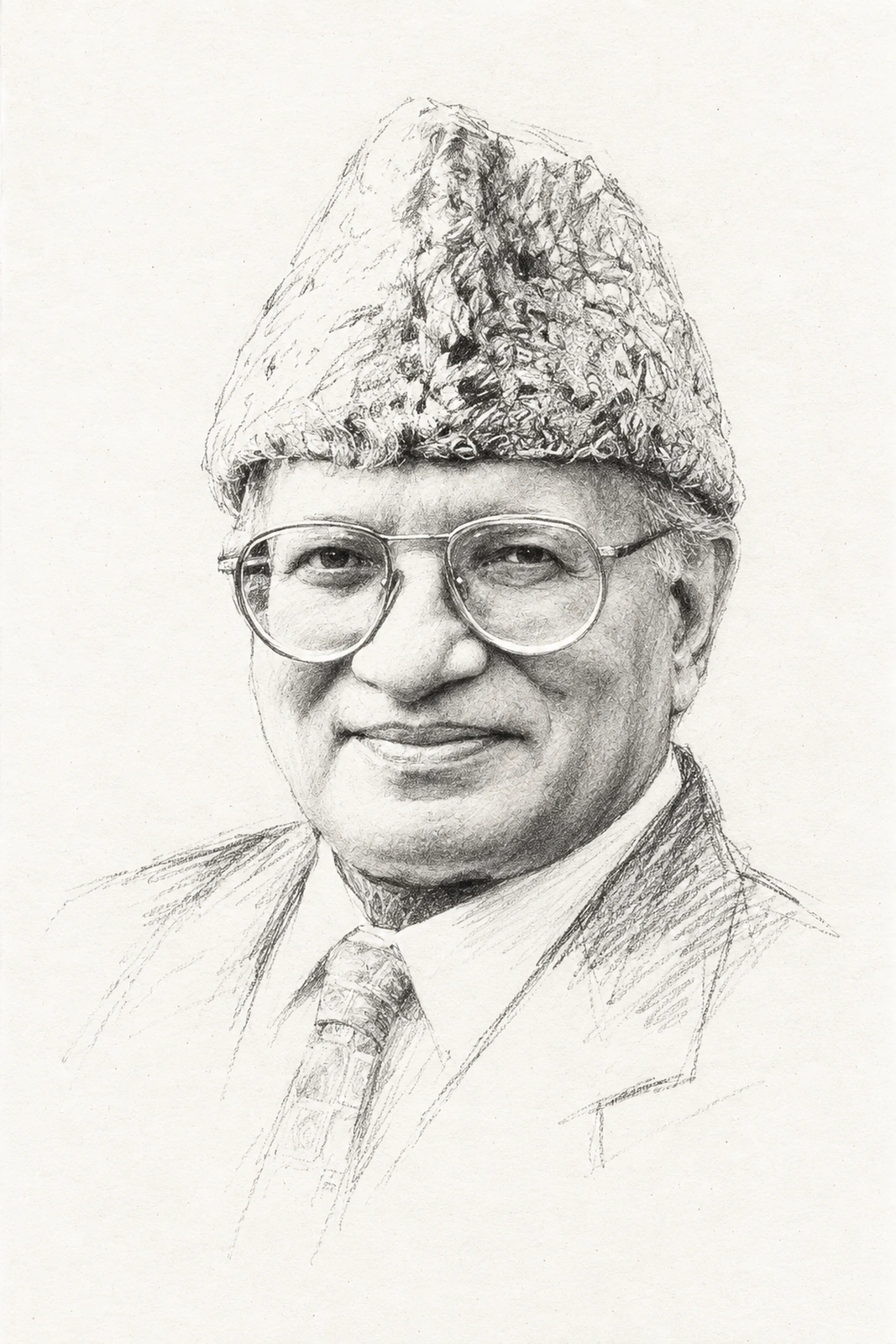
Sri Aurobindo was born on the 15th August 1872 at Calcutta. At an early age of seven, he was taken along with his elder brothers to England for education, since his father wanted him to have no Indian influence in the shaping of his outlook and personality. And yet, even though Sri Aurobindo assimilated in himself richly the best of the European culture, he returned to India in 1893 with a burning aspiration to work for the liberation of India from foreign rule. While in England, Sri Aurobindo passed the I.C.S. Examination, and yet he felt no call for it; so he got himself disqualified by remaining absent from the riding test. The Gaekwar of Baroda happened to be there at that time, and Sri Aurobindo accepted the proposal to be his Personal Secretary, and returned to India.
Soon thereafter, however, Sri Aurobindo switched over to the Baroda College as Professor of French and then of English, and when in 1906, he left for Bengal, he was the acting Principal of the College. It was during the Baroda period that Sri Aurobindo assimilated in himself the spirit and culture of India and prepared himself for his future political and spiritual work. Indeed, his political work had already begun in Baroda, but it was behind the scenes, largely of the nature of a preparation for an armed revolution for the liberation of India.
Sri Aurobindo was the first among the Indian leaders to declare and work for the aim of complete Independence of India. In 1905, Bengal was divided, and Sri Aurobindo left Baroda and, invited by the nationalistic leaders, he joined at Calcutta the newly started National College as its first Principal. It was here that Sri Aurobindo, while working secretly for the revolution, chalked out also a plan of outer action. This plan consisted of the programme of passive Resistance, Boycott and Swadeshi, which was later adopted as the policy of the struggle for freedom. It was here again that Sri Aurobindo wrote powerfully and boldly for Bande Mataram, and later for Karma Yogin; through his writings, he electrified the nation and surcharged the people with a new energy which ultimately led the nation to her freedom. It was, therefore, significant that when India attained her liberation in 1947, it was on the 15th August, the birthday of Sri Aurobindo.
The pioneering work that Sri Aurobindo did for the liberation of India was evidently a part of his larger work for the entire humanity and for the whole earth. For him, the liberation of India was an indispensable part of the new world-order. Moreover, the practice of Yoga, which he had started in 1902, led him, even while in the thick of intense political and literary activity, to major realisations of the Brahmic Silence, Nirvana, and also of the universal dynamic Presence of the Divine. And, in 1908, when he was in Alipore jail during his trial under the charge of sedition, he received through numerous experiences and realisations the assurance of the liberation of the country and also the knowledge of the initial lines on which his own future work was to proceed. For he saw that even in the field of Yoga something was still lacking, something radical that alone would help resolve the problems of the world and would lead mankind to its next evolutionary stage. And so, in 1910, soon after his acquittal from the jail, he withdrew to Pondicherry to concentrate upon this new research work, to hew a new path. It has been a most dynamic work with the entire earth as its central field. It was in the course of this work that Sri Aurobindo declared that the Suprpamental is the Truth and that its advent on the earth is inevitable. To bring down the supramental consciousness and power on the earth has been the central work of Sri Aurobindo.
Sri Aurobindo has explained the nature of this work, the nature of the Supermind, the necessity of its descent, the process of this descent and the dynamic consequences of this descent or the solutions of the problems of mankind, in his voluminous writings most of which were written serially in the philosophical monthly, Arya, which was started in 1914, immediately after the first arrival of The Mother from France to Pondicherry. Some of the most important of these and other writings are: The Life Divine, The Synthesis of Yoga, The Ideal of Human Unity, The Human Cycle, The Foundations of Indian Culture, Essays on the Gita, On the Veda, The Upanishads, The Future Poetry, The Supramental Manifestation upon Earth, and the epic Savitri.
When Sri Aurobindo withdrew in 1926 into his room for concentrating in the required way on the 'Supramental Yoga', Mother organised and developed his Ashram. In 1943, a school for the education of children was founded, and after the passing of Sri Aurobindo in 1950, Mother developed that school into an International University Centre, where numerous original and bold experiments of education were carried out under her guidance. This educational work was a part of Supramental Yoga, and we have rare insights into education and yoga in the volumes entitled Questions and Answers, which contain conversations of the Mother that took place in her classes. In 1958, Mother withdrew to her room in order to come to terms with the research in the problems related to the supramental transformation of the physical consciousness at the cellular level. In 1968, Mother founded Auroville, an International city as a collective field for the material and spiritual researches required for realising human unity as a part of the supramental action on the earth.
Mother's exploration into the body-consciousness and her discovery of a 'cellular mind' capable of restructuring the nature of the body is contained in a document of more than 6000 pages, published in 13 volumes. This is L'Agenda de Mère (Mother's Agenda), an account of her extraordinary exploration narrated by the Mother to Satprem1 covering a period of more than twenty years, during which Mother slowly uncovered the 'Great Passage' to the next species by the supramental transformation of the physical consciousness and fulfilled the work that Sri Aurobindo had given to her.
Satprem was born in Paris in 1923. After intense experiences in concentration camps and adventures in Guyana, Brazil and Africa, he came to India in 1953, became a Sanyasi and practised Tantrism. Then he left these paths to serve Mother and embarked upon the Integral Yoga of Sri Aurobindo. For 19 years, he lived near the Mother and became her confidant and her witness. He recorded innumerable personal conversations that form Mother's Agenda. He has written a biography of Sri Aurobindo under the title, Sri Aurobindo or the Adventure of Consciousness. He has also written a biography of the Mother in three volumes, under the titles: Mother or the Divine Materialism; Mother or the New Species; and, Mother or the Mutation of Death.
Philosophy and Yoga of Sri Aurobindo
Philosophy and Yoga of Sri Aurobindo - I
Sri Aurobindo has significantly been described as adventure of consciousness. Even in his quest of India's freedom, during the first decade of the last century, he departed courageously from the orthodox and conservative path of the Moderates and infused in the country a new electric force of Nationalism. He chalked out a new path of Swadeshi, boycott, passive resistance, and national education, — the path that ultimately came to be adopted as the national programme during the subsequent period of the struggle. He even ventured to search for a spiritual force that could be applied to the political struggle so as to liberate the country from slavery to the British rule and attain freedom in its totality. In his search for this force, he turned to Yoga and initiated momentous experiments, as a result of which he arrived at the conclusion that Yoga was itself in need of breaking its boundaries so that whatever power it was capable of delivering to humanity would become irresistible in its impact and in the production of results which would secure, not only for India, but also for the entire earth, unshakeable foundations for a new world of freedom and unity.
The life and work of Sri Aurobindo are a living testimony of his victorious opening of the gates of a new power, and by means of summarising in himself the luminous results of all the best of the past systems of Yoga as also by developing a new Yoga, he came to build up new knowledge that humanity needs for its future development and fulfilment. It has, therefore, been rightly said that Sri Aurobindo does not belong to the past nor to history but to the future that is realising itself.
If we make a serious study of Sri Aurobindo, we shall find ourselves to be a participant of that adventure of consciousness which invites us to collaborate with that wide-ranging Yoga that can liberate us from the fetters of dogmas and preconceptions and inspire us to realise the highest and the best not only for ourselves but also for the entire humanity.
In 1908-9, Sri Aurobindo wrote a poem entitled 'Invitation', and it seems appropriate to read this poem and ask ourselves if we are ready to respond to it:
Invitation
With wind and the weather beating round me Up to the hill and the moorland I go. Who will come with me? Who will climb with me? Wade through the brook and tramp through the snow?
Not in the petty circle of cities Cramped by your doors and your walls I dwell; Over me God is blue in the welkin, Against me the wind and the storm rebel.
I sport with solitude here in my regions, Of misadventure have made me a friend. Who would live largely? Who would live freely? Here to the wind-swept uplands ascend.
I am the lord of tempest and mountain, I am the Spirit of freedom and pride. Stark must he be and a kinsman to danger Who shares my kingdom and walks at my side.
Sri Aurobindo, Collected Poems: Invitation
Philosophy and Yoga of Sri Aurobindo - II
There are many ways of approaching Sri Aurobindo, but the light that we can gain from him will depend upon the height and breadth of our own quest. It is only when we cease to be occupied with our egoistic interests, which oblige us to keep ourselves in the centre of the world, and ask most comprehensive questions in their profundity relating to the world and its future possibilities and the role that we are required to play, as also how we should prepare ourselves to fulfil that role, that we shall find the relevance of Sri Aurobindo. It is only then that we shall find ourselves truly equipped to study Sri Aurobindo and the supramental consciousness that he has discovered and brought down on the earth.
The journey to which Sri Aurobindo invites us involves a most difficult endeavour. Even when the goal becomes clearer, the paths will still require to be traversed which will impel revolutionary processes of progression; this effort will turn us increasingly and decisively into a process of Yoga that is as comprehensive as life and as integral as the totality of existence. This Yoga rises to the highest but also brings down the power of the highest into the lowest terms of consciousness. This Yoga aims at the conquest of the higher and higher pinnacles of consciousness and, crossing beyond mind and overmind, it lifts us to the supermind. But this Yoga is not merely of the ascent but also of the descent, and it aims at the manifestation of the supramental light and power right into matter and even in the inconscient so as to transform them for purposes of the creation of divine life on the earth.
This Yoga has rightly been called the supramental Yoga; it rests on the discovery of the supermind and of special methods by which the supermind can be made to permeate Matter and the human body so as to awaken and transform the cells of the body, which might result in the evolutionary mutation and in the generation of the new supramental species that would change the mode of life of struggling humanity and mould it into new forms of increasing luminosity and unity. This Yoga is new as compared to the old systems of Yoga and Sri Aurobindo has brought out this novelty in the following words:
It is new as compared with the old Yogas
(1) Because it aims not at a departure out of world and life into a Heaven or a Nirvana, but at a change of life and existence, not as something subordinate or incidental, but as a distinct and central object. If there is a descent in other Yogas, yet it is only an incident on the way or resulting from the ascent—the ascent is the real thing. Here the ascent is the first step, but it is a means for the descent. It is the descent of the new consciousness attained by the ascent that is the stamp and seal of the sadhana. Even Tantra and Vaishnavism end in the release from life; here the object is the fulfilment of life.
(2) Because the object sought after is not an individual achievement of divine realisation for the sake of the individual, but something to be gained for the earth consciousness here, a cosmic not a supra-cosmic achievement. The thing to be gained also is the bringing in of a Power of consciousness (the supramental) not yet active directly in earth-nature, even in the spiritual life, but yet to be organised and made directly active.
(3) Because a method has been preconised for achieving this purpose which is as total and integral as the aim set before it, viz., the total and integral change of the consciousness and nature, taking up old methods but only as a part action and present aid to others that are distinctive. I have not found this method as a whole or anything like it proposed or realised in the old Yogas. If I had I should not have wasted my time in hewing out paths and in thirty years of search and inner creation when I could have hastened home safely to my goal in an easy canter over paths already blazed out, laid down, perfectly mapped, macadamised, made secure and public.
Sri Aurobindo, Letters on Himself and the Ashram: Transformation
Our yoga is not a retreating of old walks, but a spiritual adventure.
We must note, however, the contributions of the past systems of Yoga which have been assimilated in this new supramental or integral Yoga. The discovery of the supermind was already made by the Vedic Rishis, and even though Sri Aurobindo discovered the supermind without any previous knowledge of it, since he was at that time unacquainted with the Veda, he later found the confirmation of his discovery in the hymns of the Rigveda. This confirmation has thrown a new light on the Veda, and the Yoga of the Veda, as we now discover it, can be regarded as a most momentous system of the loftiest realisations which were attained by our ancient forefathers. It is for this reason that Sri Aurobindo wrote two volumes entitled The Secret of the Veda and Hymns to the Mystic Fire, and he declared that the recovery of the knowledge contained in the Veda is indispensable if the world has to find the solution to its present problems and arrive at the next step of its progress.
Sri Aurobindo points out that the Veda is not a closed book; for the Veda itself speaks of continuous development and declares that as one climbs from one peak to a higher peak, new fields of knowledge open before us. In elucidating this undogmatic and open attitude towards fresh experience and experimentation, Sri Aurobindo has provided us illuminating insights as to how Vedic Yoga has developed through the long history of India a number of systems of Yoga, as also how there have been periods of specialisation and also periods of synthesis. And his own synthesis of Yoga is an integration of the past systems and the new methods that he himself has discovered and perfected.
This new synthesis embraces within its wide embrace the truth of the Vedic synthesis of the psychological being of man in its highest flights and widest ranging of divine knowledge, power, joy and glory which had its crowning experience of the transcendental and blissful reality in whose unity the increasing soul of man and the eternal divine fullness of the cosmic can be made perfect and fulfil themselves. It includes also the high and profound synthesis of the Upanishadic spiritual knowledge. It places the Bhagavadgita's synthesis of the triple path of love, knowledge and works as something central in its processes. It also acknowledges the synthesis of the Tantra and utilises the methods of tantric Yoga for purposes of its new aims. It also acknowledges the Tantric idea of the divine perfectibility of man, which was possessed by the Vedic Rishis but was thrown into the background by the intermediate ages. It also includes the aims of the Hatha Yoga and the Raja Yoga although not their detailed processes. But the supramental Yoga does not limit itself within the limits of specialised systems of Yoga or even the previous systems of synthesis. Explaining the need to go beyond and to develop a new synthesis of Yoga, Sri Aurobindo states:
We of the coming day stand at the head of a new age of development which must lead to such a new and larger synthesis. We are not called upon to be orthodox Vedantins of any of the three schools or Tantrics or to adhere to one of the theistic religions of the past or to entrench ourselves within the four corners of the teaching of the Gita. That would be to limit ourselves and to attempt to create our spiritual life out of the being, knowledge and nature of others, of the men of the past, instead of building it out of our own being and potentialities. We do not belong to the past dawns, but to the noons of the future.2
In developing the new synthesis, Sri Aurobindo had also in his view the challenges of the contemporary times and the insuperable difficulties which they present to the human mind at its present critical stage. Sri Aurobindo had made a detailed study of human history as also of the evolutionary processes, and not only as we find them in the light of modern theories of Darwin, Bergson, Samuel Alexander, Whitehead, Teilhard de Chardin and others but more importantly in the light of Indian knowledge of spiritual forces working behind the external developments of forms that emerge through the evolutionary movement; and he had come to the conclusion that the present crisis of humanity is not an ordinary crisis, which can be explained in terms of social, political, economic or ideological developments. He pointed out that the present crisis is an evolutionary crisis and the human species cannot expect to be delivered except through radical means which can transmute the Mind, which is today the leader of human evolution, into the supermind which can thenceforth lead the future and develop divine life on the earth and can also solve the problems that humanity is struggling to solve but which it is incapable to do. The supramental Yoga has, therefore, been presented by Sri Aurobindo as a practical means by which humanity can be helped and lifted up on the path not only of its survival but also of its arrival and its fulfilment.
Sri Aurobindo, Essays on the Gita: Our Demand and Need from the Gita ↩
Philosophy and Yoga of Sri Aurobindo - III
The central theme in Sri Aurobindo is that of the contemporary evolutionary crisis of humanity, of the perception that man is a transitional being and that he is a 'thinking and living laboratory in whom and with whose conscious co-operation she (Nature) wills to work out the superman, the god.'1 His magnum opus, The Life Divine, which has been regarded as the greatest philosophical work of our times, is not a mere intellectual building of an edifice of thought, actuated by intellectual curiosity or intellectual grappling with epistemological, cosmological, ontological, or axiological questions. Although it is entirely philosophical in rigour and method, it is an unprecedented presentation to the contemporary intellectuality of all the essential psychological and physical facts of existence and their relations to a discovered ultimate reality in order to arrive at the profoundest solution that can be successfully applied to heal the maladies of the contemporary crisis. Philosophy, according to Sri Aurobindo, "can be conclusive only if the perception of things on which it rests is both a true and whole seeing."2 And the true and whole seeing that we find in Sri Aurobindo's philosophy was a result of his attainment of the integral supramental knowledge which, in turn, was inspired by deepest concern to find remedy of the quintessential problems that have been arising in the course of human history and which have now reached the critical point of their acme.
The philosophy of The Life Divine is the philosophy of complete affirmation; it perceives the truth behind each system of philosophy but rejects its exclusiveness; it is thus a denial of all denials. It denies the materialist denial of the Spirit, even while it affirms the reality of Matter; it denies the denial of the ascetic even while it affirms the reality of the Spirit; it reconciles the insistent demands of Matter, Life, Mind and Supermind in an integral harmony. In the affirmation of the Reality of the One without a second, it finds the origin of the many and all. In the One Existent, sat, it finds the sound basis for Conscious-Force (Chit) and also in their union the inalienable delight (ananda). If it finds the rational assurance that God exists not only on the basis of essential truths that lie behind the rationalistic, ontological, cosmological and teleological arguments, but also on other grounds that explain even such difficult phenomena as those of the ignorance, error, falsehood and evil, it also provides rational assurance that "Life is neither an inexplicable dream nor an impossible evil that has yet become a dolorous fact, but a mighty pulsation of the divine All-Existence."3 And these assurances are again confirmed in direct spiritual and supramental experiences.
All-comprehensive integrality is the basic characteristic of the philosophy of Sri Aurobindo. It is the philosophy of integral Monism that reconciles the supra-cosmic, supra-terrestrial and cosmic views of existence. In the history of Indian philosophy, the one system that comes closest to it is that of the Gita as expounded by Sri Aurobindo in his Essays on the Gita; and we must remember that the Gita is the digest of the Upanishads, which are themselves the culmination of the synthesis of knowledge contained in the Veda. The integral Monism of Sri Aurobindo is not pure Monism, although it sees in one unchanging, pure, eternal Self the foundation of all cosmic existence; nor is it qualified Monism although it places in the One his eternal supreme Prakriti manifested in the form of the Jiva and lays a great stress on dwelling in God rather than dissolution as the supreme state of spiritual consciousness. It avoids every rigid determinism as would injure its universal comprehensiveness.4
Sri Aurobindo, in a brief summary statement, describes the ultimate Reality as follows:
There is then a supreme Reality eternal, absolute and infinite. Because it is absolute and infinite, it is in its essence indeterminable. It is indefinable and inconceivable by finite and defining Mind; it is ineffable by a mind-created speech; it is describable neither by our negations, neti neti, — for we cannot limit it by saying it is not this, it is not that, — nor by our affirmations, for we can not fix it by saying it is this, it is that, iti iti. And yet, though in this way unknowable to us, it is not altogether and in every way unknowable; it is self-evident to itself and, although inexpressible, yet self-evident to a knowledge by identity of which the spiritual being in us must be capable; for that spiritual being is in its essence and its original and intimate reality not other than this Supreme Existence.5
Sri Aurobindo's philosophy has been rightly described as a philosophy of the Real-Idea. It is idealism that is realistic, and it is realism that is idealistic. As Sri Aurobindo explains, the creative force that generates the world and its forms is not the fictional Idea, having no essential relation in real Truth of existence. This philosophy "sees the creative Idea as Real-Idea, that is to say, a power of Conscious-Force expressive of real being, born out of real being and partaking of its nature and neither a child of the Void nor a weaver of fictions. It is conscious Reality throwing itself into mutable forms of its own imperishable and immutable substance. The world is therefore not a figment of conception in the universal Mind, but a conscious birth of that which is beyond Mind into forms of itself."6
That which is beyond Mind is, according to Sri Aurobindo, Supermind, — a supreme Truth-Consciousness, an expressive term, which Sri Aurobindo has taken from the Rigveda, which describes the Supermind as rta-chit, the consciousness of essential truth of being (satyam), of ordered truth of active being (rtam) and the vast self-awarness (brhad) in which alone this consciousness is possible. According to Sri Aurobindo, because the supermind is the basis of the manifestation of the world, we have rational assurance that supermind can manifest in the world and that the supramental whole seeing can come into the forefront and resolve the problems that the mind, the faculty of discursive reasoning and dividing consciousness, creates in the course of its development. For the world is not an illusion and a meaningless unreality but evolving manifestation of the self-existent and conscious being through the comprehensive determining supramental consciousness. This is the argument which Sri Aurobindo presents in the very first chapter of The Life Divine. Let us refer to this argument that he presents, since the rest of the book can, in a certain sense, be considered as an elucidation of this argument and its consequences for our life in the world at the present stage of evolution:
For all problems of existence are essentially problems of harmony. They arise from the perception of an unsolved discord and the instinct of an undiscovered agreement or unity. To rest content with an unsolved discord is possible for the practical and more animal part of man, but impossible for his fully awakened mind, and usually even his practical parts only escape from the general necessity either by shutting out the problem or by accepting a rough, utilitarian and unillumined compromise. For essentially, all Nature seeks a harmony, life and matter in their own sphere as much as mind in the arrangement of its perceptions. The greater the apparent disorder of the materials offered or the apparent disparateness, even to irreconcilable opposition, of the elements that have to be utilised, the stronger is the spur, and it drives towards a more subtle and puissant order than can normally be the result of a less difficult endeavour. The accordance of active Life with a material of form in which the condition of activity itself seems to be inertia, is one problem of opposites that Nature has solved and seeks always to solve better with greater complexities; for its perfect solution would be the material immortality of a fully organised mind-supporting animal body. The accordance of conscious mind and conscious will with a form and a life in themselves not overtly self-conscious and capable at best of a mechanical or sub-conscious will is another problem of opposites in which she has produced astonishing results and aims always at higher marvels; for there her ultimate miracle would be an animal consciousness no longer seeking but possessed of Truth and Light, with the practical omnipotence which would result from the possession of a direct and perfected knowledge. Not only, then, is the upward impulse of man towards the accordance of yet higher opposites rational in itself, but it is the only logical completion of a rule and an effort that seem to be a fundamental method of Nature and the very sense of her universal strivings.7
Sri Aurobindo's magnum opus, The Life Divine is companioned by another magnum opus, The Synthesis of Yoga. If The Life Divine is primarily philosophical, The Synthesis of Yoga is primarily scientific. What is established in The Life Divine as philosophically conclusive, is proposed to be realised in actual experience and realisation through the scientific methodology which is described in The Synthesis of Yoga. If the concern of The Life Divine is to prove to the intellect of modern humanity the possibility and inevitability of the supramental manifestation on the earth, The Synthesis of Yoga shows to the mind, heart and spirit of humanity those methods by which the individual and collectivity can arrive at that manifestation.
A significant message of The Synthesis of Yoga is that Yoga should be distinguished clearly from philosophy and religion with which it is likely to be confused. According to Sri Aurobindo, the age of philosophy and religion is over, and the new age will insist on the deepest, widest and highest realisations that can be attained by the methods of Yoga. For although philosophy aims at discovering the highest reality, its methods are those of critical rational thought, which can only conceive but not realise; and although religion aims at connecting the individual with the highest reality, its methods are predominantly those of credal belief, rituals, ceremonies and prescribed acts embodied in various routines of life and social institutions, — the methods that conflict with the modern insistence on undogmatic experiential demands of the search and realisation of realities. Both these, — philosophy and religion, — have now been found to be inadequate as means to the goal that contemporary humanity needs to arrive at. In contrast to these, Sri Aurobindo explains the meaning of Yoga in the following words:
>[Yoga is] a methodised effort towards self-perfection by the expression of the secret potentialities latent in the being and—highest condition of victory in that effort—a union of the human individual with the universal and transcendent Existence we see partially expressed in man and in the Cosmos. >Sri Aurobindo, The Synthesis of Yoga - I: Life and Yoga
According to Sri Aurobindo, what we need today is the practice of meticulous methods that can bring about radical change of consciousness by means of psychological transmutation of faculties and powers of our being.
The word Yoga is often confined merely to Hatha Yoga or Raja Yoga, but these are only two specialised systems, and what is proposed by Sri Aurobindo is to bring about synthesis not only of these two but all the other systems of Yoga. Since the crisis through which we are passing today is many-sided, the solution should be many-sided and nothing short of a synthesis of different systems of Yoga would give the needed remedy. As Sri Aurobindo explains, an undiscriminating combination in block would not be a synthesis, but a confusion; nor would successive practice of each of them in turn be easy in the short span of our human life. Sri Aurobindo, therefore, effects synthesis by neglecting the forms and outsides of the Yogic disciplines and seizes rather on some central principle common to all which would include and utilise in the right place and proportion their particular principles. It also seizes on some central dynamic force, which is the common secret of their divergent methods and capable, therefore, of organising a natural selection and combination of their varied energies and different utilities. That one common principle and force is the principle and force of concentration, and Sri Aurobindo's The Synthesis of Yoga is based upon integral concentration of our entire conscious being on concentrated relation and contact with the Divine so that the Divine may transform our entire being into His. In psychological terms, this method translates itself into the progressive surrender of the ego with its whole field and all its apparatus to the Beyond-ego with its vast and incalculable but always inevitable workings.
Sri Aurobindo points out that there are three outstanding features of the action of the highest when it works integrally on the lower nature. In the first place, it does not act according to a fixed system and succession as in the specialised methods of Yoga, but with a sort of free, scattered and yet gradually intensive and purposeful working determined in such a way that, in a sense, each individual in this path has his or her own method of Yoga. And yet, there are certain broad lines of working common to all which can be used to construct, not indeed a routine system, but yet some kind of scientific method of the synthetic Yoga. Secondly, the process being integral, it accepts all life in order that all life is transformed. In this process, our nature such as it stands organised by our past evolution and without rejecting anything essential is brought under the force of tapasya so that all undergoes a divine change. Thirdly, the divine Power in us uses all life as the means of this integral Yoga. In this process, all life is perceived as Yoga of Nature, seeking to manifest God within itself, but the distinguishing mark of the integral Yoga is the self-awareness with which the movements which are loosely combined in our ordinary nature are gathered up and concentrated for purposes of integral transformation. The integral method of the synthesis of Yoga produces integral results. There is, first, an integral realisation of Divine Being; and there is also an integral liberation, mukti, not only sayujya mukti in which the individual being attains unbroken contact in all its parts with the Divine, not only salokya mukti by which the whole conscious existence dwells in the state of Sachchidananda, but also sadharmya mukti, in which the divine nature is acquired by the transformation of the lower being. Transformation is the keyword of the Integral Yoga of Sri Aurobindo. Sri Aurobindo explains this as follows:
By transformation I do not mean some change of the nature – I do not mean, for instance, sainthood or ethical perfection or yogic siddhis (like the Tantric's) or a transcendental (cinmaya) body. I use transformation in a special sense, a change of consciousness radical and complete and of a certain specific kind which is so conceived as to bring about a strong and assured step forward in the spiritual evolution of the being of a greater and higher kind and of a larger sweep and completeness than what took place when a mentalised being first appeared in a vital and material animal world. If anything short of that takes place or at least if a real beginning is not made on that basis, a fundamental progress towards this fulfilment, then my object is not accomplished. A partial realisation, something mixed and inconclusive, does not meet the demand I make on life and Yoga.9
The complete process of transformation is described by Sri Aurobindo as triple, — psychic transformation, spiritual transformation, and supramental transformation. In the words of Sri Aurobindo: "… there must first be the psychic change, the conversion of our whole present nature into a soul-instrumentation; on that or along with that there must be the spiritual change, the descent of a higher Light, Knowledge, Power, Force, Bliss, Purity into the whole being, even into the lowest recesses of life and body, even into the darkness of our subconscience; last, there must supervene the supramental transmutation, — there must take place as a crowning movement the ascent into the Supermind and the transforming descent of the Supramental Consciousness into our entire being and nature."10
For a fuller understanding of the synthesis of Yoga, we need to study three big volumes containing Sri Aurobindo's letters on Yoga, which throw illumining light not only on the principles of the Integral Yoga but also on multitudes of difficulties that are encountered during the process of Yoga, as also on experiences and realisations. But, above all, we need to study Savitri, that great epic of the adventure of the Spirit, which accomplishes great conquest of death by the power of the light of the supermind. For it is through Savitri that one gains a ready access to the concreteness of psychic, spiritual and supramental experiences as also their impact on all parts and planes of the being through the magic of the rhythmic word and vision in their highest intensities. To study Savitri is to enter into the realm of experiences and into a veritable process of Yogic transformation.
Philosophy and Yoga of Sri Aurobindo - IV
It is not expected that this great and difficult task of supramental transformation can be effected by the whole of humanity, although, according to Sri Aurobindo, the time has come for the generalisation of Yoga in humanity. The necessity of spiritual change is imperative, and the future of humanity will depend, according to Sri Aurobindo, upon the response that humanity will give to this necessity. In his book The Human Cycle, Sri Aurobindo has expounded the psychology of social development and shown how human society has not only crossed over the infra-rational age of human development but has also traversed a long path on the curve of the rational age and stands today at the end of the curve of the Reason. Speaking of the modern society, Sri Aurobindo points out that it has discovered a new principle of survival, the principle of progress, which aims at more knowledge, more equipment, convenience and comfort, more enjoyment, a greater complexity of the social economy, more and more cumbersomely opulent life. He further points out that these things must, however, lead in the end to the increasing failure to find the secret of constant self-renewal. He, therefore, concludes: "Only in its new turn inwards, towards a greater subjectivity now only beginning, is there a better hope; for by that turning it may discover that the real truth of man is to be found in his soul."1
Whether humanity will respond to the need of this new turn will depend upon its increasing perception of the necessity of spiritual transformation. Sri Aurobindo points out that a change from the vital and mental to the spiritual order of life must necessarily be accomplished in the individual and in a greater number of individuals before it can come to have an effective hold upon community. What is necessary is that the common human mind begins to admit the ideas proper to the higher order that is in the end to be, and the heart of man begins to be stirred by aspirations born of these ideas. Sri Aurobindo concludes that if this condition is fulfilled then there is hope of some advance in the not distant future.
In his book The Ideal of Human Unity, Sri Aurobindo refers to two important developments which indicate a prospect of the coming change in humanity. The first of these is internationalism, the idea of humanity as a single race of beings with a common life and a common general interest. Sri Aurobindo identifies those tendencies in human life at present which are favourable to the progress of the international idea. In his own words:
The strongest of these favourable forces is the constant drawing closer of the knots of international life, the multiplication of points of contact and threads of communication and an increasing community in thought, in science and in knowledge. Science especially has been a great force in its direction; for science is a thing common to all men in its conclusions, open to all in its methods, available to all in its results: it is international in its very nature; … Science also has created that closer contact of every part of the world with every other part, out of which some sort of international mind is growing… The growth of knowledge is interesting the peoples in each other's art, culture, religion, ideas and is breaking down at many points the prejudice, arrogance and exclusiveness of the old nationalistic sentiment… Religion… is beginning to realise, a little dimly and ineffectively as yet, that spirituality is after all its own chief business and true aim and that it is also the common element and the common bond of all religions. As these influences grow and come more and more consciously to co-operate with each other, it might be hoped that the necessary psychological modification will quietly, gradually, but still irresistibly and at last with an increasing force of rapidity, take place which can prepare a real and fundamental change in the life of humanity.2
But internationalism, according to Sri Aurobindo, is not enough; there is a need of a religion of humanity or an equivalent sentiment which recognises a single soul in humanity of which each human being and each people is an incarnation and soul form. This religion has already expressed itself in the philosophy of humanitarianism, which itself is a most prominent emotional result of the Age of Reason. Philanthropy, social service and other kindred activities have been its outward expressions; and democracy, socialism and pacifism are to a great extent its by-products or at least owe much of their vigour to its inner presence. But Sri Aurobindo points out that the purely intellectual and sentimental religion of humanity is not sufficient to bring about the needed great change in human psychology. For at its highest, it can only erect three great ideals of progress, — liberty, equality and fraternity, but in application of these ideals, it would still be obliged to resort to the external machinery of society, and ego would act as the centre of this machinery. As a result, as Sri Aurobindo points out, when the ego attains liberty, it arrives at competitive individualism; when it asserts equality, it arrives first at strife and then at an attempt to ignore the variations of nature, and it constructs an artificial and machine-made society; when the ego asserts fraternity, it speaks of something contrary to its nature; all that the ego knows is association for the pursuit of common egoistic ends and the utmost that it can arrive at is a closer organisation for the equal distribution of labour, production, consumption and enjoyment. If, therefore, the gospel of the idea of humanism is to be fulfilled, we have to realise that brotherhood is the real key and that the brotherhood exists only in the soul and by the soul. Therefore, Sri Aurobindo concludes, the religion of humanity must be a spiritual religion of humanity, not an institutional religion, not an intellectual religion, not a sentimental religion. That humanity is pressing forward towards this spiritual religion of humanity is of great significance for all of us who are keen to find the solution to the contemporary crisis. And it is here that Sri Aurobindo's perception of the significance of the contemporary crisis and his philosophy and yoga of supramental transformation come to us as the needed light and guidance.
At the same time, we may note what Sri Aurobindo has stated about the first step towards the supramental manifestation. In this context, we may cite the following remarks that Sri Aurobindo had made in his Letters on Yoga:
The whole of humanity cannot be changed at once. What has to be done is to bring the Higher Consciousness down into the earth-consciousness and establish it there as a constant realised force. Just as mind and life have been established and embodied in Matter, so to establish and embody the supramental Force.
It would not be possible to change all that in a moment – we have always said that the whole of humanity will not change the moment there is the Descent. But what can be done is to establish the higher principle in the earth-consciousness in such a way that it will remain and go on strengthening and spreading itself in the earth-life. That is how a new principle in the evolution must necessarily work.
It is first through the individuals that it [the supramental consciousness] becomes part of the earth-consciousness and afterwards it spreads from the first centres and takes up more and more of the global consciousness till it becomes an established force there.3
Sri Aurobindo's Philosophy of Indian Nationalism and Internationalism
Sri Aurobindo's Philosophy of Indian Nationalism and Internationalism - I
A MOST luminous and revelatory exposition of philosophy of nationalism and of Indian nationalism is to be found in the writings of Sri Aurobindo. In fact, Sri Aurobindo's own life is a flaming example of Indian nationalism, not only in its uniqueness but also in its universality. If we study the history of Indian nationalism, we shall find that he stands out as the most heroic nationalist who formulated in the most inspiring terms the true aim of Indian nationalism, during the early period of nationalist struggle and accomplished the task of fixing it in the national consciousness within a short period of two years (1906-8) through blazing pages of the Bande Mataram. This miracle can be regarded as an unparalleled achievement in the entire world history of nationalism.
The greatest thing done in those years was the creation of a new spirit in the country, a new electric current that awakened the people to the true meaning of nationalism and filled them with enthusiasm that created waves after waves all over the country. Repression and depression could not silence the stir of this enthusiasm. After each wave of repression and depression, it renewed the thread of the life of movement for liberation and kept it recognisably one throughout nearly fifty years of its struggle. The cry of Bande Mataram rang on all sides, and people felt it glorious to be alive and dare and act together and hope. The old apathy and timidity was broken and a force was created which nothing could destroy, and it carried India to the beginning of a complete victory.
It must be remembered that the climate under which the message of the Bande Mataram had to combat with its adversary forces was entirely unfavourable. The British Government had detected in Sri Aurobindo "the most dangerous man" and had perceived the rising tide of nationalist movement with utmost severity and with harshest measures of repression. Within the country itself, there was the rising tide of the Moderate Party and its leaders who had belief in British justice and benefits from the foreign government in India, faith in British law courts and in the adequacy of the education given in schools and universities in India. They had assumed that the philosophy of nationalism was impracticable and they had stigmatised this philosophy as a philosophy of extremism. These leaders had ambiguous attitude towards the demand of complete independence of India. Many of them preached the gospel of faith in the British and in the British rule. Even those among them whose heart rebelled against the servile doctrine were intellectually so much dominated by the British influence that they could not embrace the philosophy of nationalism with their whole heart and tried to arrive at a compromise between subjection and independence. They discovered an intermediate path in which the blessings of freedom could be harmoniously wedded with the blessings of subjection! They spoke, therefore, of colonial self-government. Some of these leaders were emotionally nationalists and yet intellectually loyalists. There was a view that disunion and weakness are ingrained characteristics of the Indian people and outside power was necessary in order to arbitrate, to keep the peace and to protect the country from the menace of the mightier nations. They also advocated that a healthy development was possible at the time only under foreign domination and that such development must be first effected before we could begin to dream of freedom or even of becoming a nation. In the view of the Moderate Party, the philosophy of Indian nationalism as advocated by nationalist leaders like Bal Gangadhar Tilak, Bepin Chandra Pal, Lala Lajpat Rai, Sri Aurobindo and others was untenable and was even an avoidable menace.
There was a view among journalists such as that of Mr. N.N. Ghose of the Indian Nation that because there is diversity of race in India, because there is diversity of religion in India, and because there is diversity of language in India, the essential conditions of a nationality were absent and there was no possibility of creating a nationality in our country. As this perilous contention is crucial to the understanding of the notion of nation, of nationality and of nationalism, it may be useful to refer to the article Sri Aurobindo wrote in Bande Mataram (August 17, 1907) in which he answered it effectively. He argued that every nationality has been formed in spite of diversity of race or religion or language, and not unoften in spite of the coexistence of all these diversities. He pointed out that the English nation has been built not only out of various races but keep to this day their distinct individuality and that one of them clings to its language tenaciously. He referred to the striking example of Switzerland where distinct racial streams speaking three different languages and, later, professing different religions coalesced into and persists as one nation without sacrificing a single of those diversities. He referred to France where three different languages are spoken; he pointed that in America, the candidates for White House addressed the nation in fourteen languages; he referred to Austria, a congeries of races and languages, and he referred to acute divisions in Russia.
Sri Aurobindo maintained that the contention that unity in race, religion or language is essential to nationality will not bear examination. He acknowledged that such elements of unity are very helpful to the growth of nationality, but they are not essential and will not even of themselves assure its growth. Referring to the example of the Roman Empire, he pointed out that even though it created a common language, a common religion and life, and did its best to crush out racial diversities under the heavy weight of its uniform system, failed to make one great nation.
What, then, Sri Aurobindo asked, are the essential elements of nationality? And he answered:
We answer that there are certain essential conditions, geographical unity, a common past, a powerful common interest impelling towards unity and certain favourable political conditions which enable the impulse to realise itself in an organised government expressing the nationality and perpetuating its single and united existence. This may be provided by a part of the nation, a race or community, uniting the others under its leadership or domination, or by an united resistance to a common pressure from outside or within. A common enthusiasm coalescing with a common interest is the most powerful fosterer of nationality. We believe that the necessary elements are present in India, we believe that the time has come and that by a common resistance to a common pressure in the shape of the boycott, inspired by a common enthusiasm and ideal, that united nationality for which the whole history of India has been a preparation, will be speedily and mightily accomplished.1
In these brief but compelling lines we have a quintessential answer to the question as to what is a nation, what is nationality and what is nationalism. In the light of this affirmation it becomes clear that a nation or what may be called the soul of nation may exist and yet it may not be visible; it may take birth, but it may take long for it to create and develop; it may develop in many directions, but not yet integrally; it may be recognised by some or many in the country but not necessarily by masses of people; it may rest on a geographical unity, and yet it can become fragmented or disrupted or divided for short or long periods; it may attain even political unity as also geographical unity and yet its centrifugal and centripetal forces may not be in harmony with each other or in a balanced state of equilibrium. There may be rise and fall in the self-awareness of nationalism, new questions may arise that may disturb the manifestation of the soul of the nation. And yet, the seer of the soul of the nation will always recognise it and work for its manifestation.
Philosophy of Indian nationalism is also the philosophy of patriotism. In view of this philosophy, patriotism is not limited to the love of the land of the country, janmabhumi, but it is also love for the people of the land. This philosophy goes even further and inspires love of the values of the culture that have been nourished and promoted through a long history of five thousand years and more. And beyond the values of this great culture, patriotism is in its heart illumined worship of the smiling and beneficent and strong and powerful Shakti, which we call Mother India, Bharat Mata. As Sri Aurobindo wrote, a nation is not a piece of earth, nor a figure of spirit, nor a fiction of mind, it is a mighty Shakti composed of the Shaktis of all the millions of units that make up the nation. He further pointed out that the nation is veritably a soul, which is immortal and even when geographically fragmented or divided, it has the power to reunite itself as one unity in diversity.
Indian nationalism has been a source of a great recovery and reassertion of those qualities of Dharma which have been the force of upliftment of millions of peoples of this country. That philosophy inspired thousands of martyrs, great and gallant Chidambarams, brave Padmanabhas, intrepid Shivas who defied the threats of exile and imprisonment. The force of patriotism, of the value of self-sacrifice, of the value of worship of Mother India, — this patriotism and its values live with us and we stand in the need to remember them, to collect them together and to pour them into a new system of education that we are striving today to construct. In an inspired article (March 11, 1908 of Bande Mataram) Sri Aurobindo gave expression to the voices of the martyrs from their cells which cry out to us and give us an imperishable message which we can incorporate in our studies that aim at value-oriented education:
Work, but aspire, so that your work may be true to the call you have heard and which we have obeyed; labour for great things first and the small will come of themselves. Cherish the might of the spirit, the nobility of the ideal, the grandeur of the dream; the spirit will create the material it needs, the ideal will bring the real to its body and self-expression, the dream is the stuff out of which the waking world will be created. It was the strength of the spirit which stood with us before the alien tribunal, it was the force of the ideal which led us to the altar of sacrifice, it is the splendour of the dream which supports us through the dreary months and years of our martyrdom. For these are the truth and the divinity within the movement.2
Sri Aurobindo's Philosophy of Indian Nationalism and Internationalism - II
The theme of Indian nationalism occupied Sri Aurobindo throughout his life, and he wrote on this subject even when he had left in 1910 active participation in the political activity on account of his total occupation with the future of India and the world and with the integral yoga that he was developing and perfecting as an aid to the solution of the evolutionary crisis of humanity. This theme was developed by him in four of his books that he wrote during 1914 and 1921, namely, The Life Divine, The Foundations of Indian Culture, The Ideal of Human Unity and The Human Cycle. In these books, we find illuminating analysis and exposition uncomparable in depth and context with any other analysis and exposition of what may be called the philosophical foundations of nationalism and Indian nationalism. These foundations, as we discern them in Sri Aurobindo's writings, are those relating to the philosophy of the individual and the aggregate, philosophy of the national aggregate and national unity, philosophy of nationality and nation-state, and philosophy of nationalism, internationalism, and universality.
The philosophy of the individual and the aggregate underlines an inevitable interconnection between the human being and humanity, which is the largest aggregate for human beings. But this interconnection is mediated by the individual's membership of various groups of smaller or larger dimensions. And, at an important stage of development, the formation of nations is initiated, and the resultant formation of national unity follows three stages. There is, first, some kind of looser yet sufficiently compelling order of society and common type of civilisation to serve as a framework within which the edifice of the nation can arise. The next stage is marked by a period of stringent organisation directed towards unity and centrality of control and perhaps a general levelling and uniformity under that central direction. Finally, there comes about a period of free internal development, which because of the gains of second stage of development, would no longer bring with it the peril of disorder, disruption, arrest of the secure growth and formation of the organism. The first stage depends upon the past history and present conditions of the elements that have to be welded into a national unity. Although the spirit, form and equipoise worked out differently in different parts of the world, the motive force that everywhere was the necessity of a large effective form and common social life marked by fixity of status through which individual and common interests might be brought under the yoke of a sufficient religious, political and economic unity. The institution of a fixed social hierarchy seems to have been a necessary stage for the first tendencies of national formation. But in the second stage, there comes about the modification of the social structure so as to make room for a powerful and feasible centre of political and administrative unity. This stage is marked by a strong tendency towards the abrogation of liberties, and we can see here the historical importance of a powerful kingship in the evolution of the nation-type, as it actually developed in the medieval times. The monarchical state concentrated, in its own activities, the whole national life. But the powerful structure and closely-knit order of things were tolerated so long as the nation felt consciously or subconsciously its needs and justification.
However, once when that need was fulfilled, conventions developed during the second stage came to be questioned with the growth of self-consciousness among the common masses of the people. This questioning could no longer be suppressed or permanently resisted. Hence, there came about the collapse of the old world and the birth of a new age.
As Sri Aurobindo points out, the nation-unit is not formed and does not exist merely for the sake of existing; its purpose is to provide a larger mould of human aggregation in which the race, and not only classes and individuals, may move towards its full human development. A stage must therefore come when in all directions, men and women have to come into their own, realise the dignity and freedom of humanhood within them and give play to their utmost capacity.
As a result, the ideals of liberty, equality and fraternity came to be formulated and the nation-unit is launched on a new path of maturity. Freedom of the nation and battle for freedom, equality and justice marks the third stage of development. Looking towards the future of this third stage, Sri Aurobindo states:
Perhaps liberty and equality, liberty and authority, liberty and organised efficiency can never be quite satisfactorily reconciled so long as man individual and aggregate lives by egoism, so long as he cannot undergo a great spiritual and psychological change and rise beyond mere communal association to that third ideal which some vague inner sense made the revolutionary thinkers of France add to their watchwords of liberty and equality, — the greatest of all the three, though till now only an empty word on man's lips, the ideal of fraternity or, less sentimentally and more truly expressed, an inner oneness. That no mechanism social, political, religious has ever created or can create; it must take birth in the soul and rise from hidden and divine depths within.1
This is the stage which is marked by what Sri Aurobindo calls the discovery of the nation-soul, and with this discovery there arises the question of relationship among nation-souls and their relationship with the universal-soul. And this question is centrally related to the question of internationalism and universality.
Sri Aurobindo's Philosophy of Indian Nationalism and Internationalism - III
It is against this background that we can profitably study the development of India as a nation and its nationalism. The evolution of India, according to Sri Aurobindo, gives evidence that the essential nation-unit was already existent presiding over the geographical boundaries ranging from the Himalayas up to the Southern Indian Ocean perceived as Rashtra even by the early Rishis of the Rigveda.1 There was indissoluble national vitality necessitating the inevitable and ultimate emergence of the organised nation. Nation-unit is basically an expression of a natural psychological unity or of the nation-soul. In the striking example of India's development, what is remarkable to observe, however, is the operation of centrifugal forces, the character of which was strong, numerous, complex, and obstinate. And yet the centripetal tendency can also be seen right from the earliest times of which we have records and are typified in the ideal of Samrāt, Chakravarty Rājā and the military and political use of the ashwamedha and rājsūya sacrifices.Ramayana and Mahabharata, the two great national epics, illustrate this theme. Mahabharata recounts the establishment of a unifying dharmarājya or imperial reign of justice. Ramayana starts with an idealised description of such a rule pictured as one existing in the ancient and sacred past of the country. Subsequent political history of India is marked by a succession of empires, indigenous and foreign, each of them destroyed by centrifugal forces, but each bringing the centripetal tendency nearer to its triumphant emergence. Sri Aurobindo points out that it is a significant circumstance that the more foreign the rule, the greater has been its force for the unification of the subject people. In the words of Sri Aurobindo:
यस्येमे हिमवन्तो महित्वा यस्य समुद्रं रसया सहाहुः।यस्येमाः प्रदिशो यस्य बाहू कस्मै देवाय हविषा विधेम।।
(Under whose greatness on the one side are the snow peaks of the Himalayas and on the other is the sea with the river-waters, whose both arms are these directions, whom else can we offer our oblations?)
In this instance, we see that the conversion of the psychological unity on which nationhood is based into the external organised unity by which it is perfectly realised, has taken a period of more than two thousand years and is not yet complete. And yet, since the essentiality of the thing was there, not even the most formidable difficulties and delays, not even the most persistent incapacity for union in the people, not even the most disintegrating shocks from outside have prevailed against the obstinate subconscious necessity. And this is only the extreme illustration of a general law.2
Commenting on the emergence of the nationalist movement in India in the early part of the twentieth century, Sri Aurobindo points out that it was a part of a world-wide movement where nations were seen feeling for their source, trying to find them, seriously endeavouring to act from the new sense and make it consciously operative in the common life and action. This tendency was most powerful in new nations or in those struggling to realise themselves in spite of political subjection or defeat. The reason that Sri Aurobindo assigns for this phenomenon is that it is these nations that needed more to feel the difference between themselves and others so that they could assert and justify their individuality as against the powerful super-life which tended to absorb or efface it. And, Sri Aurobindo continues, precisely because their objective life was feeble and it was difficult to affirm it by its own strength in the diverse circumstances, there was more chance of their seeking for their individuality and its forces of self-assertion in that which was subjective and psychological or at least in that which was of subjective or psychological significance. In the words of Sri Aurobindo:
The movement of 1905 in Bengal pursued a quite new conception of the nation not merely as a country, but a soul, a psychological, almost a spiritual being and, even when acting from economical and political motives, it sought to dynamise them by this subjective conception. …" 3
Sri Aurobindo's Philosophy of Indian Nationalism and Internationalism - IV
The basic ontological foundation of the philosophy of the individual and the aggregate and of nationality and national unity as also of internationalism is to be found in Sri Aurobindo's concept of the reality of the individual spirit and that of the cosmic spirit. According to Sri Aurobindo, the individual is not merely an ephemeral physical creature, a form of mind and body that aggregates and dissolves, but a being, a living power of eternal Truth, a self-manifesting spirit. It is for this reason that Sri Aurobindo points out that the primal law and purpose of the individual life is to seek its own self-development, to find itself, to discover within itself the law and power of its own being and to fulfil it.
In the same way, society, community or nation is also a being, a living power of the eternal Truth, a self-manifestation of the cosmic Spirit, and it is there to express and fulfil in its own way and to the degree of its capacities the special truth and power and meaning of the cosmic Spirit that is within it. It is for this reason, Sri Aurobindo observes, that the primal law and a purpose of the society, community or nation is to seek its own self-fulfilment; it strives rightly to find itself, to become aware within itself of the law and power of its own being and fulfil it as perfectly as possible, to realise all its potentialities, to live its own self-revealing life. The interrelationship between the individual and the nation can therefore be harmonised when there is a surge and discovery both of the individual and of the nation as also of the nations of their inner souls and the process of finding in these souls the secret of their true development and their drift towards progressive perfection.
Sri Aurobindo sees in the heart of the nationalist movement of India and in the attainment of freedom for India a great possibility of opening a new age in which India can, because of its treasures of spiritual knowledge, discover further secrets whereby Spirit and Matter can be synthesised, and the luminous knowledge of the spirit can illumine and transform the physical life of the earth. India has also the possibility of becoming a pioneering partner in the task of formulating new forms of the largest aggregate in which each nation can relate itself with other nations and bring about a harmonious world-unity in which ideals of liberty, equality and fraternity can find their progressive harmony and fulfilment.
Sri Aurobindo's Philosophy of Indian Nationalism and Internationalism - V
There is today much contest in respect of the concept of nation and nationalism, and it is even sometimes suggested that in the coming days of internationalism, globalisation and larger aggregation in the formation of a possible world union, nations and nationalities will be overpassed and the world will enter into post-national stage of existence. This debate and conclusion need to be considered seriously in the light of the real truth of the philosophical foundation of nationalism, Indian nationalism and its possible future.
Sri Aurobindo makes an important distinction between political unity and real unity, and pointing out the fact that the world history shows that there was in the ancient cycle of development a wide pre-national empire building, which is in contrast to modern cycle of nation-building. In other words, empires have been created in the past, indicating the tendency to overshoot nation-units even before they attain any maturity or stability, and that this shows that nation is not a final unit of aggregation. But at the same time, Sri Aurobindo points out that although empires have exhibited political unity, they have not shown to have in them the force of real unity. He states:
Empires exist, but they are as yet only political and not real units; they have no life from within and owe their continuance to a force imposed on their constituent elements or else to a political convenience felt or acquiesced in by the constituents and favoured by the world outside. … If the political convenience of an empire of this kind ceases, if the constituent elements no longer acquiesce and are drawn more powerfully by a centrifugal force, if at the same time the world outside no longer favours the combination, then force alone remains as the one agent of an artificial unity.1
Empires are, according to Sri Aurobindo, perishable political unities, in contrast to the nation, a real unity, which is immortal and which will remain so until a greater living unit can be found into which nation idea can merge in obedience to a superior attraction.
Again, dwelling upon the distinction between political unity and real unity, Sri Aurobindo states that this distinction must be made because "it is of the greatest utility to a true and profound political science and involves the most important consequences. When an empire like Austria, a non-national empire, is broken to pieces, it perishes for good; there is no innate tendency to recover the outward unity, because there is no real inner oneness; there is only a politically manufactured aggregate. On the other hand, a real national unity broken up by circumstances will always preserve a tendency to recover and reassert its oneness."2
Sri Aurobindo has given the example of the Greek Empire which has gone the way of all empires, but the Greek nation after many centuries of political non-existence, again possesses its separate body, because it has preserved its separate ego and therefore really existed under the covering rule of the Turk. Similar is the example of Italy and in the example of Germany. In all these cases, as was in many others, the unification of Saxon England, medieval France, the formation of the United States of America, Sri Aurobindo points out that there was a real unity, a psychological distinct unit which tended at first ignorantly by the subconscious necessity of its being and afterwards with a sudden or gradual awakening to the sense of political oneness, towards an inevitable external unification. It is, Sri Aurobindo concludes, a distinct group-soul which is driven by inward necessity and uses outward circumstances to constitute for itself an organised body.
Just as the individual is an ontological Spirit, and therefore it can never be reduced to become a mere cog in a machine, even so nation is a living spirit and soul, and therefore it can never permanently be reduced to a status of a mere province of larger and largest aggregates. At the same time, Sri Aurobindo underlines the fact that humanity is turning today towards world unity, and the central problem for the human endeavour in this connection will be as to how the nation will adjust itself to the pressure of the forces that are today creating phenomena which are global, world-wide and planetary in character.
In this connection, Sri Aurobindo makes a distinction between national ego and national soul, corresponding to the distinction in regard to the individual life where the superficial ego is seen to be distinct from the true individual soul. The mark of egoism, according to Sri Aurobindo, is its superficiality and its ignorant attempt to arrive at superficial unity whether that ego is individual or national. The mark of the ego is its sense of division from all the rest, its pretension to be entirely independent in a poise of superiority over all the others. Corresponding to this ego, Sri Aurobindo points out, there is no real reality. There is no ontological superficial reality, there is no independent divided entity which is superior to all the rest. The true individual, on the other hand, has indeed distinctiveness, but is not divided rom the others. The true individual and the true nation-soul are characterised by mutuality, interdependence and inner oneness that manifests in diversity. Based upon this philosophical foundation, Sri Aurobindo perceives the future of nations as entities seeking and finding their inner souls by virtue of which they will remain free but mutually interdependent, and this, in turn, will provide the form of world unity that is supportive and not destructive of the nations. Sri Aurobindo speaks of a world union of free nations, each having status of equality, and all contributing through their distinctive capacities to the fund of richness and variety at the global level.
Sri Aurobindo formulates therefore an ideal law of social development in which the truths of the individual, of the nations and of humanity are all reconciled and synthesised. This is the law as he has formulated:
Thus the law for the individual is to perfect his individuality by free development from within, but to respect and to aid and be aided by the same free development in others. His law is to harmonise his life with the life of the social aggregate and to pour himself out as a force for growth and perfection on humanity. The law for the community or nation is equally to perfect its corporate existence by a free development from within, aiding and taking full advantage of that of the individual, but to respect and to aid and be aided by the same free development of other communities and nations. Its law is to harmonise its life with that of the human aggregate and to pour itself out as a force for growth and perfection on humanity. The law for humanity is to pursue its upward evolution towards the finding and expression of the Divine in the type of mankind, taking full advantage of the free development and gains of all individuals and nations and groupings of men, to work towards the day when mankind may be really and not only ideally one divine family, but even then, when it has succeeded in unifying itself, to respect, aid and be aided by the free growth and activity of its individuals and constituent aggregates.3
Sri Aurobindo's Philosophy of Indian Nationalism and Internationalism - VI
It can be said that the fulfilment of this ideal law of social or national development is the task that still remains to be fulfilled. In this task, Indian nationalism can play a leading role. But before that task can be fulfilled, there are still some others which need to be initiated and developed. Sri Aurobindo has spoken of three aims that free India should concentrate upon. In the first place, a great effort must be made for the recovery of the old spiritual knowledge and experience in all its splendour, depths and fullness. Sri Aurobindo considers this to be the most essential work. Secondly, an endeavour must be made for the flowing of this spirituality into new forms of philosophy, literature, art, science and critical knowledge. The third aim that should be pursued should consist of an original dealing with modern problems in the light of Indian spirit, and the goal should be to formulate a greater synthesis of a spiritualised society. According to Sri Aurobindo, India's success on these three lines will be the measure of its help to the future of humanity.
Sri Aurobindo's Philosophy of Human Development of Contemporary Crisis
Sri Aurobindo's Philosophy of Human Development of Contemporary Crisis - I
Human history may, in a sense, be perceived as a multi-layered and complex struggle to harmonise the claims of the individual and those of the collectivity. The development of this struggle seems to be cyclic or spiral rather than linear in character. This has also to be seen in terms of the evolution of the human species and the laws of that evolution. For these laws follow the curve of the development of the faculties of the body, life and mind in which the concern for the physical base and infusion in it of the developing and developed powers of life and mind in a very zigzag swinging curve of advance appears to be predominant. There are, what we may call, the laws of ascent and integration, as a result of which the relationships between the individual and the collectivity are being built up in such a way that as soon as lower elements of achievement reach a point of maturity they tend to higher grades of achievement in a gradual manner so as to Iinterweave the lower and the higher in a complex series of harmony of conflicting claims. If we study these laws, we find that evolution is a continuous process and humanity is one of the crucial links in the process that seems to lead it to levels of progression that in turn lead the development of the mind to that which lies beyond the mind and even higher grades of consciousness which are appropriate to the spirit, and its wider, deeper and higher domains.
The evolutionary study of humanity has its origin in our times in the Darwinian theory, but it has found developments in the writings of philosophers like Bergson, Alexander, Smutts, Whitehead and Teilhard de Chardin. But the most elaborate and comprehensive study is to be found in the writings of Sri Aurobindo, particularly, in his The Life Divine, The Synthesis of Yoga, The Human Cycle and The Ideal of Human Unity. In one of the important passages, Sri Aurobindo states:
The animal is a living laboratory in which Nature has, it is said, worked out man. Man himself may well be a thinking and living laboratory in whom and with whose conscious cooperation she wills to work out the superman, the god. Or shall we not say, rather, to manifest God? For if evolution is the progressive manifestation by Nature of that which slept or worked in her, involved, it is also the overt realisation of that which she secretly is. We cannot, then, bid her pause at a given stage of her evolution, nor have we the right to condemn with the religionist as perverse and presumptuous or with the rationalist as a disease or hallucination any intention she may evince or effort she may make to go beyond. If it be true that Spirit is involved in Matter and apparent Nature is secret God, then the manifestation of the divine in himself and the realisation of God within and without are the highest and most legitimate aim possible to man upon earth.1
According to Sri Aurobindo, the evolution of human being in regard to the development of human faculties and those that are beyond human limitations is conducted, firstly, by a conscious effort of the human mind, and it is not confined to unconscious progression of Nature. Secondly, this evolution takes into account the sense of freedom that emerges along with the development of self-consciousness, and with the process of rational and normative consciousness. The evolutionary process is, therefore, marked by alternative possibilities which can even be perilous, as in any great adventure. Evolution, as conceived by Sri Aurobindo, is a great adventure of consciousness, in which operation of free will is a necessary component.
It is against this background that the conflict between the individual and the collectivity needs to be understood.
Human history may be considered as a long story of the sway of developing consciousness between three preoccupations of human idealism, — the complete single development of the human being himself, the perfectibility of the individual, a full development of the collective being, the perfectibility of the society, and, more pragmatically restricted, the perfect or best possible relation of individual with individual and society or of community with community. Hence, we find in history that sometimes an exclusive or dominant emphasis is laid on the individual, sometimes on the collectivity and society, sometimes on a right and balanced relations between the individual and the collective human whole. According to one ideal, freedom and growth of perfection of the individual is to be held up as a true objective of our existence. This ideal is sometimes conceived as that of a mere free self-expression of the personal being or as self-governed whole of complete mind, fine and ample life and perfect body, or a spiritual perfection and liberation. In the perspective of this view, society is conceived only as a field of activity and growth for the individual mind and serves best its function when it gives as far as possible a wide room, ample means, a sufficient freedom or guidance of development to his thought, his action, his growth, his possibility of fullness of being. The opposite ideal gives the collective life the first or sole importance; the existence, the growth of the race is of the highest value in this view; the individual is expected to live for the society or for mankind or even, he is considered only a cell of the society, and he has no other use or purpose of birth, no other meaning of his presence in Nature, no other foundation. Or, it is sometimes held that the nation, the society, the community is a collective being, revealing its soul in its culture, power of life, ideals, institutions, or its ways of self-expression. In this context, the individual life has to cast itself in the social mould, serving the power of its life, consent only to exist as an instrument for the maintenance and efficient existence of the society. In a third ideal, the perfection of man lies in his ethical and social relations with other human beings, his social being and his love for society, for others, for his utility to the race. In this view, society exists for the service of all, to give them their right framework of relations, education, training, economical opportunity, right frame of life.
Sri Aurobindo points out that in the ancient cultures, the greatest emphasis was laid on the community and fitting of the individual into the community. Even then, however, there grew up an ideal of a perfect individual and it is found that the idea of the spiritual individual was dominant in ancient India, although the society was of extreme importance and the individual had to pass first to the social states of the physical, vital, mental being with satisfaction of interest, desire, pursuit of knowledge and right living – kama, artha and dharma – before he could reach fitness for the truer state of free spiritual existence (moksha). In contrast to this, Sri Aurobindo finds that in recent times the whole stress has fallen on the life of the race, to search for a perfect society, and the right organisation and scientific mechanisation of the life of mankind as a whole. Under this circumstance, the individual now tends to be regarded only as a member of the collectivity, a unit of the race whose existence must be subordinated to the common aims and total interest of the organised society, and much less or not at all as a mental or spiritual being with his own right and power of existence. Again, under the same circumstances, the modern State erects its godhead and demands his obedience, subjugation, and self-immolation. The individual is then required to affirm, against this exorbitant claim, the rights of his ideals, his ideas, his personality.
The conflict between the individual and the collectivity seems at this stage to have reached, according to Sri Aurobindo, the stage of an acute conflict of standards, which presses us towards a search for a unifying and harmonising knowledge, and even integrality of knowledge. The individual, in Sri Aurobindo's view, is the key of the evolutionary movement; for it is the individual who finds himself and becomes conscious of the Reality and its relationship with the collectivity. According to this vision, the individual does not owe his allegiance, either to the State which is a machine or to the community which is part of life and not the whole of life; his allegiance, to use Sri Aurobindo's own words, "must be to the Truth, the Self, the Spirit, the Divine which is in him and in all; not to subordinate or lose himself in the mass, but to find and express that truth of being in himself and help the community and humanity in its seeking for its own truth and fullness of being must be his real object of existence."2
Indeed, Sri Aurobindo acknowledges that so long as human being is undeveloped, he has to subordinate in many ways his undeveloped self to whatever is greater than it. As he develops, he moves towards spiritual freedom, but this freedom is not something entirely separate from all existence. As he moves towards the spiritual freedom, he moves also towards spiritual oneness. In the words of Sri Aurobindo:
The spiritually realised, the liberated man is preoccupied, says the Gita, with the good of all beings; Buddha discovering the way of Nirvana must turn back to open that way to those who are still under the delusion of their constructive instead of their real being – or non-being; Vivekananda, drawn by the Absolute, feels also the call of the disguised Godhead in humanity and most the call of the fallen and the suffering, the call of the self to the self in the obscure body of the universe. For the awakened individual the realisation of his truth of being and his inner liberation and perfection must be his primary seeking, — first, because that is the call of the Spirit within him, but also because it is only by liberation and perfection and realisation of the truth of being that man can arrive at truth of living. A perfected community also can exist only by the perfection of its individuals, and perfection can come only by the discovery and affirmation in life by each of his own spiritual being and the discovery by all of their spiritual unity and a resultant life-unity. There can be no real perfection for us except by our inner self and truth of spiritual existence taking up all truth of the instrumental existence into itself and giving to it oneness, integration, harmony. As our only real freedom is the discovery and disengagement of the spiritual Reality within us, so our only means of true perfection is the sovereignty and self-effectuation of the spiritual Reality in all the elements of our nature.3
In the light of this larger vision, when Sri Aurobindo examines, in his book The Ideal of Human Unity, interesting periods of human life, he finds that the scenes in which life was most richly lived and has left behind it the most precious fruits are to be seen in those periods, and in those countries in which humanity was able to organise itself in small independent centres, but infused into a single unity. Sri Aurobindo marks out particularly three such moments in human history to which modern Europe owes two-third of its civilisation. The first of these moments is to be found in the religious life of tribes in Israel; the second moment was that of many-sided life of the small Greek city states; and the third was the smaller, though more restricted artistic and intellectual life of medieval Italy. Similarly, as far as Asia is concerned, no age was so rich in energy, so well worth living in, so productive of the best and the most enduring fruits as the heroic period of India when she was divided into small kingdoms, many of them no larger than a modern district. The second best period of India, according to Sri Aurobindo, came afterwards in larger, but still comparatively small, nations and kingdoms like those of Pallavas, Chalukyas, Pandyas, Cholas and Cheras.
Again, Sri Aurobindo finds that even when there developed the organisation of nations, kingdoms and empires, it was groupments of smaller nations which have had the most intense life and not the huge States and colossal empires. His conclusion is that collective life, when it diffuses itself in very vast spaces, seems to lose intensity and productiveness. As illustrations, he points out that Europe has lived in England, France, Netherlands, Spain, Italy, the small states of Germany, — not in the huge mass of the Holy Roman or the Russian Empire. He also notices that in the organisation of nations and kingdoms, those which have had the most vigorous life have gained it by a sort of artificial concentration of the vitality into some head, centre or capital, London, Paris, Rome. Sri Aurobindo sees in these examples the basic argument in favour of decentralisation and this favourable argument derives a special force from the fact that it is in the climate of decentralisation that the individual gains greater freedom from his subordination to the group or the community. On the other hand, in such examples as that of the Roman Empire, Sri Aurobindo finds that the individual freedom is greatly subordinated to the needs of the forces of centralisation which tend towards uniformity rather than towards freedom and diversity. Considering, however, that there is today a turn towards the formation of the larger human aggregate encompassing the whole world, Sri Aurobindo analyses the example of the Roman Empire from the point of view of the theme of freedom and the conditions under which the individual can attain through freedom his self-realisation and fullness. That Empire provides a historical illustration of advantages of organisation, peace, widespread security, order, and material well-being. But the disadvantages arose from its tendency to centralise, to impose union, and as a result the individual, the city, the region had to sacrifice their independent life and they became mechanical parts – a machine. As Sri Aurobindo remarks, the organisation was great and admirable, but the individual dwindled and life lost its colour, richness, variety, freedom, and victorious impulse towards creation. Eventually, therefore, the Roman Empire declined and failed; the huge mechanism of centralisation and union brought about smallness and feebleness of the individual; mechanisation prevailed and the Empire lost even its conservative vitality and died of an increasing stagnation.
The problems of the individual and the collectivity, of centralisation and decentralisation, of freedom and diversity and consequent richness and vigour of life without which community cannot prolong its health and cohesion, — these problems are extremely important, and Sri Aurobindo formulates an ideal law of social development that needs to be applied, if the world is to be united and which is yet to provide to the individual the needed freedom for his growth, self-discovery, self-realisation and self-perfection. Sri Aurobindo states this law in the following words:
Thus the law for the individual is to perfect his individuality by free development from within, but to respect and to aid and be aided by the same free development in others. His law is to harmonise his life with the life of the social aggregate and to pour himself out as a force for growth and perfection on humanity. The law for the community or nation is equally to perfect its corporate existence by a free development from within, aiding and taking full advantage of that of the individual, but to respect and to aid and be aided by the same free development of other communities and nations. Its law is to harmonise its life with that of the human aggregate and to pour itself out as a force for growth and perfection on humanity. The law for humanity is to pursue its upward evolution towards the finding and expression of the Divine in the type of mankind, taking full advantage of the free development and gains of all individuals and nations and groupings of men, to work towards the day when mankind may be really and not only ideally one divine family, but even then, when it has succeeded in unifying itself, to respect, aid and be aided by the free growth and activity of its individuals and constituent aggregates.4
Sri Aurobindo acknowledges that this ideal law has never become operative in the imperfect states through which humankind has so far travelled, and it may be very long before that law can be attained. But Sri Aurobindo maintains that the present is the stage of what he calls the subjective age of humanity, when knowledge is increasing and diffusing itself with an unprecedented rapidity, when individuals, societies and nations are attempting to discover their potentialities and their inner subjective states and selves, when capacity is generating itself, when men and nations are drawn close together, and this is the time when we can justifiably develop a conscious hope to arrive at a conscious discovery of that ideal law of social development and its conscious application. He finds that the present moment is opportune for an upward march, particularly when people of the entire globe are getting united, although partially and in an inextricable entanglement of chaotic unity. For this is the moment where we are being compelled to know each other and impelled to know more profoundly ourselves, humankind, and the world, and when the idea of self-realisation for ourselves and nations is coming consciously to the upper and outer surface. This is the time, according to Sri Aurobindo, for the human being in particular to know himself, to find the ideal law of his being and his development and to hold that law before him and to find out gradually the way by which it can become a more and more moulding principle of the individual and social existence.
Sri Aurobindo's Philosophy of Human Development of Contemporary Crisis - II
At the same time, Sri Aurobindo regards the present moment of human history as a moment of acute crisis. For the process of self-realisation, both for the individual and the collectivity is always difficult and it is marked by an acute struggle of groping in the darkness and in the welter of conflicts and uncertain alternatives. In his analysis of the psychology of the process of maturation of self-finding, Sri Aurobindo examines the psychology of barbarism, philistinism, and of the rational, ethical and aesthetic culture, and examines also the means by which the society manages to arrive at some kind of cohesion at different stages of development, namely, through symbolism and later by typal thought, conventional thought and, still later, by subjective self-awakening both of the individual and collectivity. In the subjective age, which is marked by preponderance of Reason as also by a revolt against conventions, customs and traditions, Sri Aurobindo perceives the possibility of a true flowering of the inner spirit, which can harmonise the individual good, and the social good and in the context of which a form of world unity could be invented whereby human beings of the entire globe can live together in durable peace and progressive harmony as in one united family. In this context, Sri Aurobindo finds the three great ideals that were put forward explicitly and forcefully during the French Revolution to be most significant, namely the ideals of liberty, equality and fraternity. He finds that these three ideals served the purpose of motivating the great experiments that humankind conducted during the curve of the Rational Age, the Age which was ushered in by Renaissance in Europe, the age through which humankind is at present passing, and which has now reached a kind of an end and which has the possibility of opening the gates of a beginning of a new age, which he calls the Spiritual Age. It is when Reason explores its possibilities and brings into operation its capabilities that the human race can arrive at a critical point of its self-realisation and self-perfection. For it is then, as it has now become clearer, that it is found that the role of Reason is not to govern but to become a medium and an intermediate power that can lift human life from the levels of blind impulse to the realms of light of the Spirit. For the real governor can be only that light and knowledge, which is integral and which unites the individual with the universal without requiring the individual to be abolished and which shows both to the individual and to the universal that their source is in the same transcendental that is the foundation of oneness and unity of existence.
The age of Reason, according to Sri Aurobindo, has shown that when the ideal of liberty is emphasised and sought to be implemented, the ideal of equality is required to be sacrificed; and when the ideal of equality is emphasised and sought to be implemented, the ideal of liberty is required to be strangulated. Towards the end of the Age of Reason, there emerges therefore the ideal of anarchism and the question arises whether anarchist thought can any more successfully find a satisfying social principle. Sri Aurobindo points out that the anarchist thought, although it is not yet formed in its assured form, cannot develop any appropriate basis or form of harmony as long as it relies on the powers of the intellect. He points out that a rational satisfaction cannot give to humanity safety from the pull from below nor deliver it from the attraction from above. It is true that the more the outer law is replaced by the inner law, the nearer will man be to his natural perfection, and the perfect State must be one in which governmental compulsion is abolished and man is able to live with his fellowmen by free agreement and cooperation. But this can truly be secured by a power greater than that of reason. According to Sri Aurobindo, it is not intellectual anarchism but a spiritual or spiritualised anarchism that will bring us nearer to the solution or at least touch something of it from afar. In the words of Sri Aurobindo:
It is a spiritual, an inner freedom that can alone create a perfect human order. It is a spiritual, a greater than the rational enlightenment that can alone illumine the vital nature of man and impose harmony on its self-seekings, antagonisms and discords. A deeper brotherhood, a yet unfound law of love is the only sure foundation possible for a perfect social evolution, no other can replace it. But this brotherhood and love will not proceed by the vital instincts or the reason where they can be met, baffled or deflected by opposite reasonings and other discordant instincts. Nor will it found itself in the natural heart of man where there are plenty of other passions to combat it. It is in the soul that it must find its roots; the love which is founded upon a deeper truth of our being, the brotherhood or, let us say, —for this is another feeling than any vital or mental sense of brotherhood, a calmer more durable motive-force, —the spiritual comradeship which is the expression of an inner realisation of oneness. For so only can egoism disappear and the true individualism of the unique godhead in each man found itself on the true communism of the equal godhead in the race; for the Spirit, the inmost Self, the universal Godhead in every being is that whose very nature of diverse oneness it is to realise the perfection of its individual life and nature in the existence of all, in the universal life and nature.5
According to Sri Aurobindo, the present stage of human development can become a gate for the arrival of a spiritual age in which the ideal of brotherhood can come to be practised and it is only in that condition that a new form of human unity can be forged in which the individual and the collectivity, even on a global scale or organisation, can come to be harmonised. In the meantime, however, the transition from the end of the curve of Reason to the advent and progress of the spiritual age is a stage of crisis, which needs to be examined in a greater depth, since it is the crisis which has become accentuated today by the latest developments with which we are besieged today.
Sri Aurobindo's Philosophy of Human Development of Contemporary Crisis - III
Sri Aurobindo considers the present stage of crisis as an evolutionary crisis in which human will is called upon to make a free choice. This is the crisis where evolution of human Reason is required to make a choice under the pressure that impels the creation of a life of universalised rule of economic barbarism. At the same time, Reason is increasingly obliged also to exercise its role in lifting up humanity to create a life of unity, mutuality and harmony born of a deeper and wider truth of our being. For there are three forces that work today upon humanity. On the one hand, there is a force that is striving to assert the barbarism within the civilised man. For it is possible to utilise the present scientific and technical knowledge to create an order of existence in which physical and vital wants of the human being can greatly, if not fully be satisfied, and this order of existence can be maintained by mechanical devices and application of the power of machines that can imprison the human spirit. There is also a second alternative in which human reason can continue to spin into larger or narrower circles propounding great dreams but never fulfilling them. And there is a third alternative in which the human being consents to rise to the higher levels than those of the Reason and consents to be spiritualised. The question, therefore, is whether the human being will choose to remain arrested in some kind of intermediary typal perfection like earlier animal kinds, or whether he will consent to rise to a higher level of evolution. The necessity to make the choice has created a state of a crisis, since the choice to pursue a higher level is not only difficult but appears at first sight to be almost impossible. Sri Aurobindo describes this crisis as follows:
At present mankind is undergoing an evolutionary crisis in which is concealed a choice of its destiny; for a stage has been reached in which the human mind has achieved in certain directions an enormous development while in others it stands arrested and bewildered and can no longer find its way. A structure of the external life has been raised up by man's ever-active mind and life-will, a structure of an unmanageable hugeness and complexity, for the service of his mental, vital, physical claims and urges, a complex political, social, administrative, economic, cultural machinery, an organised collective means for his intellectual, sensational, aesthetic and material satisfaction. Man has created a system of civilisation which has become too big for his limited mental capacity and under-standing and his still more limited spiritual and moral capacity to utilise and manage, a too dangerous servant of his blundering ego and its appetites. … A greater whole-being, whole-knowledge, whole-power is needed to weld all into a greater unity of whole-life.6
Sri Aurobindo's Philosophy of Human Development of Contemporary Crisis - IV
As a part of this crisis, and as an aid to the higher choice that can be made by humanity, Sri Aurobindo perceives two important phenomena of the modern world which present a great sign of hope. These two phenomena are those of internationalism and religion of humanity. But these two phenomena need to be understood in their inner implications. For internationalism seems to oppose the truth and force of nationalism, and this opposition can be fatal to a harmonious transition to a new world of harmony. There is today a sentiment helped and stimulated by the trend of forces that favours the creation of an international world organisation that may ultimately result in a possible form of unification. This sentiment is a cosmopolitan and international sentiment. At one stage, it came to be presented concretely in the conception of the League of Nations. As Sri Aurobindo points out, this conception was not well inspired in its form or destined to have a considerable longevity or a supremely successful career. But the very fact that this idea was presented and even manifested in a concrete form, even though for a short term, was in itself an event of capital importance and meant the ushering in of a new era in world history. Sri Aurobindo points out that even though it failed, it could not be allowed to remain without a sequel. Accordingly, the League of Nations was replaced by the United Nations Organisation which now stands in the forefront of the world and struggles towards some kind of secure permanence and success in the great far reaching endeavour on which depends the world's future. Emphasising the importance of the United Nations Organisation, Sri Aurobindo wrote in 1949 (in a Postscript Chapter to his The Ideal of Human Unity) the following:
This is the capital event, the crucial and decisive outcome of the world-wide tendencies which Nature has set in motion for her destined purpose. In spite of the constant shortcomings of human effort and its stumbling mentality, in spite of adverse possibilities that may baulk or delay for a time the success of this great adventure, it is in this event that lies the determination of what must be. All the catastrophes that have attended this course of events and seem to arise of purpose in order to prevent the working out of her intention have not prevented, and even further catastrophes will not prevent, the successful emergence and development of an enterprise which has become a necessity for the progress and perhaps the very existence of the race.7
Following the idea of the United Nations Organisation, Sri Aurobindo foresees the development of a World-State without exclusions and on a principle of equality into which consideration of size and strength would not enter. Indeed, Sri Aurobindo raises the question of the freedom of the individual and of the nations in the context of the emergence of the World-State. And in this context, Sri Aurobindo considers it necessary that a profounder spiritual ideal of the individual and of the nation should emerge and vivify the world organisation in such a way that the spirit of the individual and the spirit of the nation, the freedom of the individual and the freedom of the nation are not only maintained but respected and perfected. Sri Aurobindo, therefore, speaks of a union of free people which could open the prospect of a sound and lasting order.
In this context, the emergence of religion of humanity is of a greater significance, although he finds its present intellectual form hardly sufficient. Sri Aurobindo, therefore, advocates the emergence of a spiritual religion of humanity and explains that he does not mean by it what is called universal religion, a system, a creed of intellectual principle and dogma and outward rite. For Sri Aurobindo emphasises the growth of the realisation that there is a secret spirit, a divine Reality, in which we are one, that humanity is its highest representation in the world, that the human being is the means by which it will progressively reveal itself here. There must be, according to Sri Aurobindo, the realisation by the individual that only in the life of his fellowmen is his own life complete. There must be, he adds, the realisation by the race that only on the free and fullness of the individual can its own perfection and happiness be founded. Finally, Sri Aurobindo points out the need of the discipline and the way by which each individual can be developed in accordance with his or her line of development towards integrality and all-embracing perfection. In defining the spiritual religion of humanity in which the ideals of liberty, equality and fraternity can be harmonised, Sri Aurobindo states:
Yet is brotherhood the real key to the triple gospel of the idea of humanity. The union of liberty and equality can only be achieved by the power of human brotherhood and it cannot be founded on anything else. But brotherhood exists only in the soul and by the soul; it can exist by nothing else. For this brotherhood is not a matter either of physical kinship or of vital association or of intellectual agreement. When the soul claims freedom, it is the freedom of its self-development, the self-development of the divine in man in all his being. When it claims equality, what it is claiming is that freedom equally for all and the recognition of the same soul, the same godhead in all human beings. When it strives for brotherhood, it is founding that equal freedom of self-development on a common aim, a common life, a unity of mind and feeling founded upon the recognition of this inner spiritual unity. These three things are in fact the nature of the soul; for freedom, equality, unity are the eternal attributes of the Spirit. It is the practical recognition of this truth, it is the awakening of the soul in man and the attempt to get him to live from his soul and not from his ego which is the inner meaning of religion, and it is that to which the religion of humanity also must arrive before it can fulfil itself in the life of the race.8
In spite of the difficulties and critical trials through which humanity may be required to pass, Sri Aurobindo underlines the need of understanding the inevitability of the spiritual solution. Indeed, in presenting this solution, Sri Aurobindo is aware that it may be objected that it puts off the consummation of a better human society to a far off date in the future evolution of the race. But Sri Aurobindo affirms forcefully:
… if this is not the solution, then there is no solution; if this is not the way, then there is no way for the human kind. Then the terrestrial evolution must pass beyond man as it has passed beyond the animal and a greater race must come that will be capable of the spiritual change, a form of life must be born that is nearer to the divine. After all there is no logical necessity for the conclusion that the change cannot begin at all because its perfection is not immediately possible. A decisive turn of mankind to the spiritual ideal, the beginning of a constant ascent and guidance towards the heights may not be altogether impossible, even if the summits are attainable at first only by the pioneer few and far-off to the tread of the race. And that beginning may mean the descent of an influence that will alter at once the whole life of mankind in its orientation and enlarge for ever, as did the development of his reason and more than any development of the reason, its potentialities and all its structure.8
According to Sri Aurobindo, the world is a mutable world and uncertainties and dangers cannot be avoided. But he places before us a vision of the way in which a World-Union could come into being that would ensure the freedom and perfection of the individual, and the freedom of nationalities could be ensured in a world federation. Perils are on the way, but Sri Aurobindo maintains that the ideal of human unity will no more remain an unfulfilled ideal but an accomplished fact and its preservation come into charge of the united human peoples. Much will depend, according to Sri Aurobindo, on the intellectual and moral capacity of humanity to carry out what is evidently the one thing needful, namely, a concentrated effort at the spiritual change that can sustain a global and untied human family.
Educational Philosophy of Sri Aurobindo
Educational Philosophy of Sri Aurobindo - I
In "A National System of Education", Sri Aurobindo points out that the question is not between modernism and antiquity, but between an imported civilisation and the greater possibilities of the Indian mind and nature, not between the present and the past, but between the present and the future. He pointed out that "the living spirit of the demand for national education no more requires a return to the astronomy and mathematics of Bhaskara or the forms of the system of Nalanda than the living spirit of Swadheshi, a return from railway and motor traction to the ancient chariot and the bullock-cart."1 He, therefore, spoke not of a return to the 5th century but an initiation of the centuries to come, not a reversion but a break forward away from a present artificial falsity to India's own greater innate potentialities, which are demanded by the soul of India.
The major question, he pointed out, is not merely what science we learn, but what we shall do with our science and how too, acquiring the scientific mind and recovering the habit of scientific discovery, we shall relate it to other powers of the human mind and scientific knowledge to other knowledge more intimate to other and not less light-giving and power-giving parts of our intelligence and nature. Again, he pointed out the question is not what language, Sanskrit or another, should be acquired by whatever method is most natural, efficient and stimulating to the mind, but the vital question is how we are to learn and make use of Sanskrit and the indigenous languages so as to get the heart and intimate sense of our own culture and establish a vivid continuity between the still living power of our past and the yet uncreated power of our future, and how we are to learn and use English or any other foreign tongue so as to know helpfully the life, ideas and culture of other countries and establish our right relations with the world around us. He argued that the aim and principle of a true national education is not to ignore modern truth and knowledge, but to take our foundation on India's own being, own mind, and own spirit.
As against the idea that the modern European civilisation is a thing that we have to acquire and fit ourselves for, and so only can we live and prosper, and it is this that our education must do for us, he argued that the idea of national education challenges the sufficiency of that assumption. He pointed out that India would do better, taking over whatever new knowledge or just ideas Europe has to offer, to assimilate them to its own knowledge and culture, its own native temperament and spirit, mind and social genius and create there-from the civilisation of the future.
According to Sri Aurobindo, there is within the universal mind and soul of humanity the mind and soul of the individual with its infinite variation, its commonness and its uniqueness and between them there stands an intermediate power, the mind of a nation, the soul of the people. In his concept of a national system of education, Sri Aurobindo aimed at taking account of all these three elements so that national education would not be a machine-made fabric, but a true building or a living evocation of the powers of the mind and spirit of the human being.
Considering that India has seen always in the human being a soul, a portion of the divinity enwrapped in the mind and body, a conscious manifestation in Nature of the universal self and spirit, he concluded that the one central object of the national system of education should be the growth of the soul and its powers and possibilities as also the preservation, strengthening and enrichment of the nation-soul and the normative needs of its ascending movements. Not limited to these two, Sri Aurobindo put forth in its aim also the raising of both the individual soul and the national soul into the powers of the life and the ascending mind and the soul of humanity. He added "at no time will it lose sight of man's highest object, the awakening and development of his spiritual being."2
Educational Philosophy of Sri Aurobindo - II
Sri Aurobindo speaks of three principles of teaching, and when implemented, they provide a sound basis of a system of natural organisation of the highest processes and the movements of which the human nature is capable. They also form the basis of the theory and practice of integral education, which has been propounded in detail in Sri Aurobindo's book, "The Synthesis of Yoga" and the Mother's book "On Education".
In brief, the three principles of teaching are as follows in Sri Aurobindo's own words: "The first principle of true teaching is that nothing can be taught. The teacher is not an instructor or task-master, he is a helper and a guide. His business is to suggest and not to impose. …The second principle is that the mind has to be consulted in its own growth. The idea of hammering the child into the shape desired by the parent or teacher is a barbarous and ignorant superstition. It is he himself who must be induced to expand in accordance with his own nature. … The chief aim of education should be to help the growing soul to draw out that in itself which is best and make it perfect for a noble use. … The third principle of education is to work from the near to the far, from that which is to that which shall be. … A free and natural growth is the condition of genuine development. …"1
There are, according to Sri Aurobindo, three instruments of the teacher: instruction, example, and influence. The good teacher will seek to awaken much more than to instruct; he will aim at the growth of the faculties and the experiences by a natural process and free expansion. He will not impose his opinions on the passive acceptance of the receptive mind; he will throw in only what is productive and sure as a seed, which will grow under the benign fostering within. He will know that the example is more powerful than instruction. Actually, the example is not that of the outward acts but of the inner motivation of life and the inner states and inner activities. Finally, he will also acknowledge that influence is more important than example. For influence proceeds from the power or contact of the teacher with his pupil, from the nearness of his soul to the soul of another, infusing into the pupil, even though in silence, all that which the teacher himself is or possesses. The good teacher is himself a constant student. He is a child leading children, and a light kindling other lights, a vessel and a channel.
Sri Aurobindo's concept of integral education finds its full relevance in the context of what Sri Aurobindo has called the Evolutionary Crisis, a crisis that occurs in a species at a time when some kind of mutation is imminent.
According to Sri Aurobindo, one favourable factor, which is likely to help contemporary humanity, is the contemporary dissatisfaction that has arisen with materialism, on the one hand, and on the other hand, with asceticism, which has been negating the meaning and purposefulness of the material world. After centuries of experiments, materialism is gradually giving way to the pressures of new discoveries, which require exploration of the psychical and spiritual domains. Similarly, centuries of experiments in the spiritual fields have shown that the neglect of material life and neglect of collective welfare result in poverty or bankruptcy and even in economic and political slavery. As Sri Aurobindo pointed out:
It is therefore of good augury that after many experiments and verbal solutions we should now find ourselves standing today in the presence of the two that have alone borne for long the most rigorous tests of experience, the two extremes. … In Europe and in India, respectively, the negation of the materialist and the refusal of the ascetic have sought to assert themselves as the sole truth and to dominate the conception of Life. In India, if the result has been a great heaping up of the treasures of the Spirit, — or of some of them, — it has also been a great bankruptcy of Life; in Europe, the fullness of riches and the triumphant mastery of this world's powers and possessions have progressed towards an equal bankruptcy in the things of the Spirit. … Therefore the time grows ripe and the tendency of the world moves towards a new and comprehensive affirmation in thought and in inner and outer experience and to its corollary, a new and rich self-fulfilment in an integral human existence for the individual and for the race.2
The knowledge of the secrets of the process of integral education is largely contained in the Veda and Upanishads, and what we find missing there has been the special subject of study and experimentation in Sri Aurobindo. It is in the light of all this that we can speak today with great assurance of the concept and practice of integral education and of the synthesis of the ancient secrets of the reign of Spirit over mind, life and the body and the modern secrets of utilisation of the life in perfecting the instrumentality of the body, life and mind.
Integral education would not only aim at the integral development of personality, but it would also embrace all knowledge in its scope. It would pursue physical and psychical sciences, not merely to know the world and Nature in her processes and to use them for material human needs, but to know through them the Spirit in the world and the ways of the Spirit in its appearances. It would study ethics in order, not only to search for the good as the mind sees it, but also to perceive the supra-ethical Good. Similarly, it would pursue Art not merely to present images of the subjective and the objective world, but to see them with significant and creative vision that goes behind their appearances and to reveal the supra-rational Truth and Beauty. It would encourage the study of humanities, not in order to foster a society as a background for a few luminous spiritual figures so that the many necessarily remain for ever on the lower ranges of life, but to inspire the regeneration of the total life of the earth and to encourage voluntary optimism for that regeneration in spite of all previous failures. Finally, it would encourage unity of knowledge and harmony of knowledge, and it would strive to foster the spirit of universality and oneness.
An important characteristic of integral education is its insistence on simultaneous development of Knowledge, Will, Harmony, and Skill as also various parts of the being to the extent possible from the earliest stages of education. And since each individual child is unique in the composition of its qualities and characteristics, its capacities and propensities, integral education in its practice tends to become increasingly individualised. Again, for this very reason, the methods of education become increasingly dynamic, involving active participation of the child in its own growth.
Educational Philosophy of Sri Aurobindo - III
An unprecedented kind of experiment in education was launched by Sri Aurobindo and the Mother, when in 1943, a school came to be established at the Sri Aurobindo Ashram at Pondicherry in South India. It was expanded into Sri Aurobindo International Centre of Education in due course, and the writings of Sri Aurobindo and the Mother on education have influenced greatly the innovative processes of education in the country, and they have also received wide attention from the world at large. Mention may be made of the Mother's small but great book on education as also to a series of "Conversations" and "Questions and Answers" which have been published by the Sri Aurobindo Ashram.1
In 1968, she founded Auroville a few miles form Pondicherry, as a "Laboratory of the New Evolution". Auroville has conducted various experiments in education, inspired and initiated by the Mother and published two important volumes of Educational research under the titles "The Aim of Life" and "The Good Teacher and The Good Pupil" which have received countrywide attention in India.
-
The Mother (Madame Mirra Alfassa) was born in Paris on February 21, 1878. In her early years, spontaneous experiences took on ranges out of her body, into the earth's past, and without her understanding, led her to the discovery of "past lives". She made thorough studies in piano, painting and higher mathematics. At the age of 26, she had several dreams of Sri Aurobindo – of whom she had never heard before. She later became acquainted with Max Theon, an enigmatic character with extraordinary occult powers, who for the first time gave a coherent explanation of her experiences and taught her occultism during her two long visits to his estate in Algeria. In 1914, she came from France to India, and met Sri Aurobindo for the first time on March 29. She realised that her work was identical with the work of Sri Aurobindo. She spent one year in Pondicherry and then four years in Japan and returned to Sri Aurobindo for good in 1920 via China. She organised and developed the Ashram as also its International Centre for Education. After Sri Aurobindo's passing in 1950, she guided experiments in education and invented new methods and new ways of education as also flexible structures in order to give a concrete shape to Sri Aurobindo's concept of integral education. In 1958, she entered upon the "Yoga of the Cells" which led her to the discovery of "a cellular mind" capable of reconstructing the nature of the body. From 1958 to 1973, she slowly uncovered the "Great Passage" to the next species and a new mode of life in Matter. An authentic and scientifically scrupulous account of this Passage is to be found in "Mother's Agenda" in 13 Volumes, which was published by Institut de Recherches Evolutives in France. ↩
Educational Philosophy of Sri Aurobindo - IV
Principles and methods of education advocated by Sri Aurobindo and the Mother have a profound bearing on psychic and spiritual education. These two domains bring into the picture all that is central to value-oriented education, and to higher and profounder elements of human psychology. Sri Aurobindo and the Mother have advocated new methods that are free from those of dogmas, rituals, ceremonies, prescribed acts. Spirituality, according to Sri Aurobindo and the Mother, is a vast domain of the inmost soul, of the immobile silence, of the higher objects of the higher psychological exploration. The justification for psychic and spiritual education rests upon three important considerations: (a) education should provide to the individual a steady exploration of something that is inmost in the psychological complexity of human consciousness; (b) the most important human question of human life is to consider the aim of human life and the aim of one's own life and one's own position and role in the society; and this question can best be answered only when the psychic and spiritual domains are explored and when one is enabled to develop psychic and spiritual faculties of knowledge; and (c) the contemporary crisis of humanity has arisen because of the disbalancement between the material advancement on the one hand and inadequate spiritual progression, on the other. If, therefore, this crisis has to be met, development of psychic and spiritual consciousness should be fostered. Unfortunately, spiritual consciousness is often conceived as a denial of material life and concerns of collective life. In Sri Aurobindo's and the Mother's view, however, there is no fundamental opposition between Matter and Spirit. True integrality, according to them, implies rejection of no element in human personality and no denial of anything that can contribute to the full flowering of faculties of personality.
Again, according to Sri Aurobindo and the Mother, psychic and spiritual development cannot be effected without effecting high level development of the body, life and mind, and that the perfection of the body, life and mind can be attained only when the powers of psychic and spiritual consciousness are bestowed upon the instruments of the body, life and mind.
At an important stage of experimentation, the Mother gave the message that while India has or rather had spiritual knowledge but neglected Matter, the West has knowledge of Matter but has neglected the Spirit, — as a consequence of which both India and the West are suffering, and the solution would be to develop integral education, which would restore the development of matter under the guidance and authority of the Spirit.
Educational Philosophy of Sri Aurobindo - V
There is a distinction between psychic consciousness and spiritual consciousness, as there is a distinction between spiritual consciousness and supramental consciousness. As the Mother pointed out:
…the psychic life is immortal life, endless time, limitless space, ever-progressive change, unbroken continuity in the universe of forms. The spiritual consciousness, on the other hand, means to live the infinite and the eternal; to be projected beyond all creation, beyond time and space. To become conscious of your psychic being and to live a psychic life you must abolish all egoism; but to live a spiritual life, you must no longer have an ego.1
As far as the supramental education is concerned, the Mother pointed out that:
…the supramental education will result no longer in a progressive formation of human nature and an increasing development of its latent faculties, but in a transformation of the nature itself, a transfiguration of the being in its entirety, a new ascent of the species above and beyond man towards superman, leading in the end to the appearance of a divine race upon earth.2
If these three aspects of higher education are to be conducted properly, one must take great care to ensure that methods of religion are not introduced. Religion implies normally the methods of belief or dogma, performance of rituals and ceremonies, and prescriptions of certain specific acts, which are considered to be religious as distinguished from profane.
Educational Philosophy of Sri Aurobindo - VI
A constant insistence of Sri Aurobindo and the Mother has been on detailed perfection of the human mind, life and body. We may, therefore, turn to the three domains of mental education, vital education, and physical education as expounded and experimented upon at Sri Aurobindo Ashram at Pondicherry and subsequently at the Sri Aurobindo International Institute of Educational Research at Auroville.
Mental Education
In regard to mental education, the processes and methods can best be determined by understanding the mind. Mind is concerned largely with the activities of understanding, and all understanding is a discovery of a centre around which the ideas or things in question are held together.
Mental education is a process of training the mind of students to arrive at such central conceptions around which the widest and most complex and subtle ideas can be assimilated and integrated.
It is again found that even these central conceptions point still to a beyond, to their own essential meaning, which can be glimpsed and conceived by the mind, but which cannot be held and possessed fully in experience by the mind. This point marks the climax of the mental development as also a clear sign of the limitations of the mind. Having reached there its office is to fall into contemplation of silence and to open to the higher realms of experience, to receive clearly and precisely the intuitions and inspirations from those higher realms, and to give creative expression to them.
To train the mind on these lines, there are five phases of the programme:
Development of the power of concentration and attention;
Development of the capacities of expansion, wideness, complexity and richness;
Organisation of ideas round a central or a higher ideal or a supremely luminous idea that will serve as a guide in life;
Thought control, rejection of undesirable thoughts so that one may, in the end, think only what one wants and when one wants;
Development of mental silence, perfect calm and a more and more total receptivity to inspirations coming from the higher regions of the being.
Multiplicity of ideas, richness of ideas, totality of points of view – these should be made to grow by a developed power of observation and concentration and by a wideness of interest. Care should be taken to see that the central ideas are not imposed upon the growing mind – that would be the dogmatic method, which tends to atrophy the mind. The mind should grow towards central ideas which should come as a discovery of the mind made through rigorous exercise of the rational faculty.
Stress should fall not only on understanding but also on criticism and control of ideas; not only of comprehension, synthesis, creativity, judgement, imagination, memory and observation, but also on critical functions of comparison, reasoning, inference and conclusion. Both these aspects of human reason are essential to the completeness of the mental training.
One of the best methods is to create an atmosphere in which massive and powerful ideas are constantly thrown as a stimulation and challenge impelling the students to arrive at them or strive to grasp and assimilate them.
Thinkers alone can produce thinkers; and unless teachers are constantly in the process of building up great thoughts and ideas, it is futile to expect a sound or vigorous mental education.
An atmosphere vibrant at once with ideation and silence, an atmosphere surcharged with synthetic thoughts and most integral aspirations and an atmosphere filled with the widest realisation and a harmonious unity – such an atmosphere is indispensable for perfect mental education.
A constant attempt should be made to present each topic to the student in a challenging way so as to stimulate him and create his interest in the topic. To find new and imaginative methods, to compile materials from various sources, to introduce new concepts and new interpretations in various subjects, to develop new subjects, and above all, to attend in detail to all the psychological faculties and their development in such a way that the mental education does not veil the soul – this, in brief, should be the endeavour and its spirit.
VITAL EDUCATION
Vital education aims at training the life-force (that normally vibrates in emotions, desires and impulses) in three directions: to discover its real function and to replace its egoistic and ignorant tendency so as to become the master by willingness and capacity to serve higher principles of the psychological constitution; to subtilise and sublimate its sensitivity which expresses itself through sensuous and aesthetic activities; and to resolve and transcend the dualities and contradictions in the character constituted by the vital seekings, and to achieve the trans-formation of the character.
The usual methods of dealing with the vital have been in the past those of coercion, suppression, abstinence and asceticism. But these methods do not give lasting results. Besides, they only help in drying up the drive and dynamism of the life-force; and thus the collaboration of the life-force in self-fulfilment is eliminated.
The right training of the vital then is much more subtle and much more difficult, needing endurance, endless persistence and an inflexible will. For what is to be aimed at is not the negation of life but the fulfilment of life by its transformation.
First, the powers of the senses have to be developed, subtilised and enriched. Next, there are inner and latent senses which are to be discovered and similarly developed. Third, the seekings of these senses have to be trained to reject grossness and coarseness and to enjoy the finer tastes and higher aesthetic experiences. Finally, there has to be a deeper and piercing observation of the desires, passions, ambitions, lusts, etc., their risings, revolts and contradictions, and an attempt by various methods to separate out in each movement the elements that contribute to the concord and harmony from those tending in the opposite direction, and to eliminate the latter from the very nature and fibre of our psychological constitution.
The effective methods of this last aspect are:
To instil in the child, as soon as possible, the will towards progress and perfection;
Rational arguments, sentiment and goodwill, or appeal to the sense of dignity and self-respect according to the nature of the child in question;
To insist on the idea that the will can be developed, and that no defeat should be taken as final;
To demand from the will the maximum effort, for the will is strengthened by effort;
Above all, the example of the educator shown constantly and sincerely.
But still the direction in which the effort has to be made can be known only by the training of the mind and by the opening of the secret knowledge that is within our psychic being. To develop therefore in the vital the habit to open to this light and to act in that light would be to place the vital in its proper place as a will-force executing the inner and higher knowledge.
Vital education is greatly aided by stress on different kinds of fine arts and crafts. Sri Aurobindo has written at length on the contribution that Art can make to the integral education in his important book, "The National Value of Art". He has pointed out that the first and the lowest use of Art is purely aesthetic, the second is the intellectual and the third and the highest is the spiritual. He has even stated that music, art and poetry are a perfect education for the soul; they make and keep its movements purified, deep and harmonious. He has added, "These, therefore, are agents which cannot profitably be neglected by humanity on its onward march or degraded to the mere satisfaction of sensuous pleasure which will disintegrate rather than build the character. They are, when properly used, great educating, edifying and civilising forces."1
A great lesson in vital education is to develop the will of the individual and to encourage the exercise of the will in which what is valued most is not the result but application and doing one's best.
PHYSICAL EDUCATION
On the subject of physical education, it must be mentioned that the physical is our base, and even the highest spiritual values are to be expressed through the life that is embodied here. Sariram adyam khalu dharmasadhanam, says the old Sanskrit adage, — the body is the means of fulfilment of dharma, while dharma means every ideal which we can propose to ourselves and the law of its working out and its action.
Of all the domains of education, physical is the one most completely governed by method, order, discipline and procedure. All education of the body must be rigorous, detailed and methodical.
The education of the body has three principal aspects: control and discipline of functions of the body; a total methodical and harmonious development of all the parts and movements of the body; rectification of defects and deformities, if there are any.
Physical education must be based upon knowledge of the human body, its structure and its functions. And the formation of the habits of the body must be in consonance with that knowledge.
The child should be taught right from the early stage the right positions, postures and movements.
A similar training should be with regard to the choice of food. The child should develop the taste that is simple and healthy, substantial and appetising. He must avoid all that merely stuffs and causes heaviness; particularly, he must be taught to eat according to his hunger and not make food a means to satisfy his greed and gluttony.
The child should also be taught the taste for cleanliness and hygienic habits. It is important to impress upon the child that he is not more interesting by being ill, rather the contrary. Children should be taught that to be ill is a sign of failing and inferiority, not of virtue and sacrifice.
to the other claims of development will demand from the teacher a very deep insight into the inner psychological workings of the formation of the personality and his sympathetic understanding of the psychological differences among various children.
It may also be noted that there are children who are deeply interested in activities of self-sacrifice or of purifying their base emotions, or of the worship of the noblest ideals of life. Sometimes they may show no interest in studies or in arts or in crafts and often teachers complain of their dullness or their lack of concentration in studies. But a good teacher should ask himself if the child in question is not inwardly engaged in what may be called activities of "purification".
There could also be children like Yuddhishthira who would not claim that they have learnt a lesson unless they have succeeded in practising it in their daily life. These are indeed noble children and the teacher should be able to appreciate their nobility and encourage it so as to lead it to its perfection.
During the course of educational process, students often come up with some very fundamental questions but they often remain unanswered. Why, for example, should one learn mathematics? What does really history teach us? What is the relationship between language and mathematics? What is the aim of life? There should be freedom to raise these questions and also enough time and readiness to answer them, even though they may not be a part of any prescribed syllabus.
Another important point that should be noted is that a great care should be taken to get the development of the child in such a way that in spite of the growth of knowledge, the student does not lose freshness and sense of wonder and mystery. This indeed is the most difficult part of the work of the teacher.
If we make a deep study of the experiments in education guided and conducted under the inspiration of Sri Aurobindo and the Mother, it may be said that there are three important features that come to the forefront and which may help us to define what may be called "New Education":
I) Learning by practice;
II) Search for meaning and unity of knowledge; and
III) Unending education and perpetual youth.
New education insists on the development of the mind, life and body; it aims at development of these instruments for the discovery of the inner psychic being; it proposes to utilise mental, vital, physical perfection as instruments of the perfect manifestation of the inner and higher realities. The effort is to make the body supple, strong, agile and beautiful; the vital is to be trained to become dynamic, disciplined, obedient and effective; the mind has to be cultivated to be intelligent, observant, concentrated, free, rich and complex. But at every stage the paramount importance is to be given to the needs of the psychic and spiritual growth. As the Mother writes:
The will for the great discovery should be always there above you, above what you do and what you are, like a huge bird of light dominating all the movements of your being.2
The Human Aspiration
The earliest preoccupation of man in his awakened thoughts and, as it seems, his inevitable and ultimate preoccupation, — for it survives the longest periods of scepticism and returns after every banishment, — is also the highest which his thought can envisage. It manifests itself in the divination of Godhead, the impulse towards perfection, the search after pure Truth and unmixed Bliss, the sense of a secret immortality. The ancient dawns of human knowledge have left us their witness to this constant aspiration; today we see a humanity satiated but not satisfied by victorious analysis of the externalities of Nature preparing to return to its primeval longings. The earliest formula of Wisdom promises to be its last, — God, Light, Freedom, Immortality.
These persistent ideals of the race are at once the contradiction of its normal experience and the affirmation of higher and deeper experiences which are abnormal to humanity and only to be attained, in their organised entirety, by a revolutionary individual effort or an evolutionary general progression. To know, possess and be the divine being in an animal and egoistic consciousness, to convert our twilit or obscure physical mentality into the plenary supramental illumination, to build peace and a self-existent bliss where there is only a stress of transitory satisfactions besieged by physical pain and emotional suffering, to establish an infinite freedom in a world which presents itself as a group of mechanical necessities, to discover and realise the immortal life in a body subjected to death and constant mutation, — this is offered to us as the manifestation of God in Matter and the goal of Nature in her terrestrial evolution. To the ordinary material intellect which takes its present organisation of consciousness for the limit of its possibilities, the direct contradiction of the unrealised ideals with the realised fact is a final argument against their validity. But if we take a more deliberate view of the world's workings, that direct opposition appears rather as part of Nature's profoundest method and the seal of her completest sanction.
For all problems of existence are essentially problems of harmony. They arise from the perception of an unsolved discord and the instinct of an undiscovered agreement or unity. To rest content with an unsolved discord is possible for the practical and more animal part of man, but impossible for his fully awakened mind, and usually even his practical parts only escape from the general necessity either by shutting out the problem or by accepting a rough, utilitarian and unillumined compromise. For essentially, all Nature seeks a harmony, life and matter in their own sphere as much as mind in the arrangement of its perceptions. The greater the apparent disorder of the materials offered or the apparent disparateness, even to irreconcilable opposition, of the elements that have to be utilised, the stronger is the spur, and it drives towards a more subtle and puissant order than can normally be the result of a less difficult endeavour. The accordance of active Life with a material of form in which the condition of activity itself seems to be inertia, is one problem of opposites that Nature has solved and seeks always to solve better with greater complexities; for its perfect solution would be the material immortality of a fully organised mind-supporting animal body. The accordance of conscious mind and conscious will with a form and a life in themselves not overtly self-conscious and capable at best of a mechanical or sub-conscious will is another problem of opposites in which she has produced astonishing results and aims always at higher marvels; for there her ultimate miracle would be an animal consciousness no longer seeking but possessed of Truth and Light, with the practical omnipotence which would result from the possession of a direct and perfected knowledge. Not only, then, is the upward impulse of man towards the accordance of yet higher opposites rational in itself, but it is the only logical completion of a rule and an effort that seem to be a fundamental method of Nature and the very sense of her universal strivings.
We speak of the evolution of Life in Matter, the evolution of Mind in Matter; but evolution is a word which merely states the phenomenon without explaining it. For there seems to be no reason why Life should evolve out of material elements or Mind out of living form, unless we accept the Vedantic solution that Life is already involved in Matter and Mind in Life because in essence Matter is a form of veiled Life, Life a form of veiled Consciousness. And then there seems to be little objection to a farther step in the series and the admission that mental consciousness may itself be only a form and a veil of higher states which are beyond Mind. In that case, the unconquerable impulse of man towards God, Light, Bliss, Freedom, Immortality presents itself in its right place in the chain as simply the imperative impulse by which Nature is seeking to evolve beyond Mind, and appears to be as natural, true and just as the impulse towards Life which she has planted in certain forms of Matter or the impulse towards Mind which she has planted in certain forms of Life. As there, so here, the impulse exists more or less obscurely in her different vessels with an ever-ascending series in the power of its will-to-be; as there, so here, it is gradually evolving and bound fully to evolve the necessary organs and faculties. As the impulse towards Mind ranges from the more sensitive reactions of Life in the metal and the plant up to its full organisation in man, so in man himself there is the same ascending series, the preparation, if nothing more, of a higher and divine life. The animal is a living laboratory in which Nature has, it is said, worked out man. Man himself may well be a thinking and living laboratory in whom and with whose conscious co-operation she wills to work out the superman, the god. Or shall we not say, rather, to manifest God? For if evolution is the progressive manifestation by Nature of that which slept or worked in her, involved, it is also the overt realisation of that which she secretly is. We cannot, then, bid her pause at a given stage of her evolution, nor have we the right to condemn with the religionist as perverse and presumptuous or with the rationalist as a disease or hallucination any intention she may evince or effort she may make to go beyond. If it be true that Spirit is involved in Matter and apparent Nature is secret God, then the manifestation of the divine in himself and the realisation of God within and without are the highest and most legitimate aim possible to man upon earth.
Thus the eternal paradox and eternal truth of a divine life in an animal body, an immortal aspiration or reality inhabiting a mortal tenement, a single and universal consciousness representing itself in limited minds and divided egos, a transcendent, indefinable, timeless and spaceless Being who alone renders time and space and cosmos possible, and in all these the higher truth realisable by the lower term, justify themselves to the deliberate reason as well as to the persistent instinct or intuition of mankind. Attempts are sometimes made to have done finally with questionings which have so often been declared insoluble by logical thought and to persuade men to limit their mental activities to the practical and immediate problems of their material existence in the universe; but such evasions are never permanent in their effect. Mankind returns from them with a more vehement impulse of inquiry or a more violent hunger for an immediate solution. By that hunger mysticism profits and new religions arise to replace the old that have been destroyed or stripped of significance by a scepticism which itself could not satisfy because, although its business was inquiry, it was unwilling sufficiently to inquire. The attempt to deny or stifle a truth because it is yet obscure in its outward workings and too often represented by obscurantist superstition or a crude faith, is itself a kind of obscurantism. The will to escape from a cosmic necessity because it is arduous, difficult to justify by immediate tangible results, slow in regulating its operations, must turn out eventually to have been no acceptance of the truth of Nature but a revolt against the secret, mightier will of the great Mother. It is better and more rational to accept what she will not allow us as a race to reject and lift it from the sphere of blind instinct, obscure intuition and random aspiration into the light of reason and an instructed and consciously self-guiding will. And if there is any higher light of illumined intuition or self-revealing truth which is now in man either obstructed and inoperative or works with intermittent glancings as if from behind a veil or with occasional displays as of the northern lights in our material skies, then there also we need not fear to aspire. For it is likely that such is the next higher state of consciousness of which Mind is only a form and veil, and through the splendours of that light may lie the path of our progressive self-enlargement into whatever highest state is humanity's ultimate resting-place.
A Message To America
I have been asked to send on this occasion of the fifteenth August a message to the West, but what I have to say might be delivered equally as a message to the East. It has been customary to dwell on the division and difference between these two sections of the human family and even oppose them to each other; but, for myself I would rather be disposed to dwell on oneness and unity than on division and difference. East and West have the same human nature, a common human destiny, the same aspiration after a greater perfection, the same seeking after something higher than itself, something towards which inwardly and even outwardly we move. There has been a tendency in some minds to dwell on the spirituality or mysticism of the East and the materialism of the West; but the West has had no less than the East its spiritual seekings and, though not in such profusion, its saints and sages and mystics, the East has had its materialistic tendencies, its material splendours, its similar or identical dealings with life and Matter and the world in which we live. East and West have always met and mixed more or less closely, they have powerfully influenced each other and at the present day are under an increasing compulsion of Nature and Fate to do so more than ever before.
There is a common hope, a common destiny, both spiritual and material, for which both are needed as co-workers. It is no longer towards division and difference that we should turn our minds, but on unity, union, even oneness necessary for the pursuit and realisation of a common ideal, the destined goal, the fulfillment towards which Nature in her beginning obscurely set out and must in an increasing light of knowledge replacing her first ignorance constantly persevere.
But what shall be that ideal and that goal? That depends on our conception of the realities of life and the supreme Reality.
Here we have to take into account that there has been, not any absolute difference but an increasing divergence between the tendencies of the East and the West. The highest truth is truth of the Spirit; a Spirit supreme above the world and yet immanent in the world and in all that exists, sustaining and leading all towards whatever is the aim and goal and the fulfillment of Nature since her obscure inconscient beginnings through the growth of consciousness is the one aspect of existence which gives a clue to the secret of our being and a meaning to the world. The East has always and increasingly put the highest emphasis on the supreme truth of the Spirit; it has, even in its extreme philosophies, put the world away as an illusion and regarded the Spirit as the sole reality. The West has concentrated more and more increasingly on the world, on the dealings of mind and life with our material existence, on our mastery over it, on the perfection of mind and life and some fulfillment of the human being here: latterly this has gone so far as the denial of the Spirit and even the enthronement of Matter as the sole reality. Spiritual perfection as the sole ideal on one side, on the other, the perfectibility of the race, the perfect society, a perfect development of the human mind and life and man's material existence have become the largest dream of the future. Yet both are truths and can be regarded as part of the intention of the Spirit in world-nature; they are not incompatible with each other: rather their divergence has to be healed and both have to be included and reconciled in our view of the future.
The Science of the West has discovered evolution as the secret of life and its process in this material world; but it has laid more stress on the growth of form and species than on the growth of consciousness: even, consciousness has been regarded as an incident and not the whole secret of the meaning of the evolution. An evolution has been admitted by certain minds in the East, certain philosophies and Scriptures, but there its sense has been the growth of the soul through developing or successive forms and many lives of the individual to its own highest reality. For if there is a conscious being in the form, that being can hardly be a temporary phenomenon of consciousness; it must be a soul fulfilling itself and this fulfillment can only take place if there is a return of the soul to earth in many successive lives, in many successive bodies.
The process of evolution has been the development from and in inconscient Matter of a subconscient and then a conscious Life, of conscious mind first in animal life and then fully in conscious and thinking man, the highest present achievement of evolutionary Nature. The achievement of mental being is at present her highest and tends to be regarded as her final work; but it is possible to conceive a still further step of the evolution: Nature may have in view beyond the imperfect mind of man a consciousness that passes out of the mind's ignorance and possesses truth as its inherent right and nature. There is a Truth-Consciousness as it is called in the Veda, a Supermind, as I have termed it, possessing Knowledge, not having to seek after it and constantly miss it. In one of the Upanishads a being of knowledge is stated to be the next step above the mental being; into that the soul has to rise and through it to attain the perfect bliss of spiritual existence. If that could be achieved as the next evolutionary step of Nature here, then she would be fulfilled and we could conceive of the perfection of life even here, its attainment of a full spiritual living even in this body or it may be in a perfected body. We could even speak of a divine life on earth; our human dream of perfectibility would be accomplished and at the same time the aspiration to a heaven on earth common to several religions and spiritual seers and thinkers.
The ascent of the human soul to the supreme Spirit is that soul's highest aim and necessity, for that is the supreme reality; but there can be too the descent of the Spirit and its powers into the world and that would justify the existence of the material world also, give a meaning, a divine purpose to the creation and solve its riddle. East and West could be reconciled in the pursuit of the highest and largest ideal, Spirit embrace Matter and Matter find its own true reality and the hidden Reality in all things in the Spirit.
Characteristics Of The Integral Yoga
The passage from the lower to the higher is the aim of Yoga; and this passage may effect itself by the rejection of the lower and escape into the higher, — the ordinary viewpoint, — or by the transformation of the lower and its elevation to the higher Nature. It is this, rather, that must be the aim of an integral Yoga.
But in either case it is always through something in the lower that we must rise into the higher existence, and the schools of Yoga each select their own point of departure or their own gate of escape. They specialise certain activities of the lower Prakriti and turn them towards the Divine. But the normal action of Nature in us is an integral movement in which the full complexity of all our elements is affected by and affects all our environments. The whole of life is the Yoga of Nature. The Yoga that we seek must also be an integral action of Nature, and the whole difference between the Yogin and the natural man will be this, that the Yogin seeks to substitute in himself for the integral action of the lower Nature working in and by ego and division the integral action of the higher Nature working in and by God and unity. If indeed our aim be only an escape from the world to God, synthesis is unnecessary and a waste of time; for then our sole practical aim must be to find out one path out of the thousand that lead to God, one shortest possible of short cuts, and not to linger exploring different paths that end in the same goal. But if our aim be a transformation of our integral being into the terms of God-existence, it is then that a synthesis becomes necessary.
The method we have to pursue, then, is to put our whole conscious being into relation and contact with the Divine and to call Him in to transform our entire being into His, so that in a sense God Himself, the real Person in us, becomes the Sadhaka of the Sadhana9 as well as the Master of the Yoga by whom the lower personality is used as the centre of a divine transfiguration and the instrument of its own perfection. In effect, the pressure of the Tapas, the force of consciousness in us dwelling in the Idea of the divine Nature upon that which we are in our entirety, produces its own realisation. The divine and all-knowing and all-effecting descends upon the limited and obscure, progressively illumines and energises the whole lower nature and substitutes its own action for all the terms of the inferior human light and mortal activity.
In psychological fact this method translates itself into the progressive surrender of the ego with its whole field and all its apparatus to the Beyond-ego with its vast and incalculable but always inevitable workings. Certainly, this is no short cut or easy Sadhana. It requires a colossal faith, an absolute courage and above all an unflinching patience. For it implies three stages of which only the last can be wholly blissful or rapid, — the attempt of the ego to enter into contact with the Divine, the wide, full and therefore laborious preparation of the whole lower Nature by the divine working to receive and become the higher Nature, and the eventual transformation. In fact, however, the divine Strength, often unobserved and behind the veil, substitutes itself for our weakness and supports us through all our failings of faith, courage and patience. It "makes the blind to see and the lame to stride over the hills." The intellect becomes aware of a Law that beneficently insists and a succour that upholds; the heart speaks of a Master of all things and Friend of man or a universal Mother who upholds through all stumblings. Therefore this path is at once the most difficult imaginable and yet, in comparison with the magnitude of its effort and object, the most easy and sure of all.
There are three outstanding features of this action of the higher when it works integrally on the lower nature. In the first place, it does not act according to a fixed system and succession as in the specialised methods of Yoga, but with a sort of free, scattered and yet gradually intensive and purposeful working determined by the temperament of the individual in whom it operates, the helpful materials which his nature offers and the obstacles which it presents to purification and perfection. In a sense, therefore, each man in this path has his own method of Yoga. Yet are there certain broad lines of working common to all which enable us to construct not indeed a routine system, but yet some kind of Shastra or scientific method of the synthetic Yoga.
Secondly, the process, being integral, accepts our nature such as it stands organised by our past evolution and without rejecting anything essential compels all to undergo a divine change. Everything in us is seized by the hands of a mighty Artificer and transformed into a clear image of that which it now seeks confusedly to present. In that ever-progressive experience we begin to perceive how this lower manifestation is constituted and that everything in it, however seemingly deformed or petty or vile, is the more or less distorted or imperfect figure of some element or action in the harmony of the divine Nature. We begin to understand what the Vedic Rishis meant when they spoke of the human forefathers fashioning the gods as a smith forges the crude material in his smithy.
Thirdly, the divine Power in us uses all life as the means of this integral Yoga. Every experience and outer contact with our world-environment, however trifling or however disastrous, is used for the work, and every inner experience, even to the most repellent suffering or the most humiliating fall, becomes a step on the path to perfection. And we recognise in ourselves with opened eyes the method of God in the world, His purpose of light in the obscure, of might in the weak and fallen, of delight in what is grievous and miserable. We see the divine method to be the same in the lower and in the higher working; only in the one it is pursued tardily and obscurely through the subconscious in Nature, in the other it becomes swift and self-conscious and the instrument confesses the hand of the Master. All life is a Yoga of Nature seeking to manifest God within itself. Yoga marks the stage at which this effort becomes capable of self-awareness and therefore of right completion in the individual. It is a gathering up and concentration of the movements dispersed and loosely combined in the lower evolution.
An integral method and an integral result. First, an integral realisation of Divine Being; not only a realisation of the One in its indistinguishable unity, but also in its multitude of aspects which are also necessary to the complete knowledge of it by the relative consciousness; not only realisation of unity in the Self, but of unity in the infinite diversity of activities, worlds and creatures.
Therefore, also, an integral liberation. Not only the freedom born of unbroken contact of the individual being in all its parts with the Divine, sāyujyamukti, by which it becomes free even in its separation, even in the duality; not only the sālokyamukti by which the whole conscious existence dwells in the same status of being as the Divine, in the state of Sachchidananda; but also the acquisition of the divine nature by the transformation of this lower being into the human image of the divine, sadharmyamukti, and the complete and final release of all, the liberation of the consciousness from the transitory mould of the ego and its unification with the One Being, universal both in world and the individual and transcendentally one both in the world and beyond all universe.
By this integral realisation and liberation, the perfect harmony of the results of Knowledge, Love and Works. For there is attained the complete release from ego and identification in being with the One in all and beyond all. But since the attaining consciousness is not limited by its attainment, we win also the unity in Beatitude and the harmonised diversity in Love, so that all relations of the play remain possible to us even while we retain on the heights of our being the eternal oneness with the Beloved. And by a similar wideness, being capable of a freedom in spirit that embraces life and does not depend upon withdrawal from life, we are able to become without egoism, bondage or reaction the channel in our mind and body for a divine action poured out freely upon the world.
The divine existence is of the nature not only of freedom, but of purity, beatitude and perfection. An integral purity which shall enable, on the one hand, the perfect reflection of the divine Being in ourselves and on the other the perfect outpouring of its Truth and Law in us in the terms of life and through the right functioning of the complex instrument we are in our outer parts, is the condition of an integral liberty. Its result is an integral beatitude, in which there becomes possible at once the Ananda of all that is in the world seen as symbols of the Divine and the Ananda of that which is not-world. And it prepares the integral perfection of our humanity as a type of the Divine in the conditions of the human manifestation, a perfection founded on a certain free universality of being, of love and joy, of play of knowledge and of play of will in power and will in unegoistic action. This integrality also can be attained by the integral Yoga.
Perfection includes perfection of mind and body, so that the highest results of Raja Yoga and Hathayoga should be contained in the widest formula of the synthesis finally to be effected by mankind. At any rate a full development of the general mental and physical faculties and experiences attainable by humanity through Yoga must be included in the scope of the integral method. Nor would these have any raison d'eter unless employed for an integral mental and physical life. Such a mental and physical life would be in its nature a translation of the spiritual existence into its right mental and physical values. Thus we would arrive at a synthesis of the three degrees of Nature and of the three modes of human existence which she has evolved or is evolving. We would include in the scope of our liberated being and perfected modes of activity the material life, our base, and the mental life, our intermediate instrument.
Nor would the integrality to which we aspire be real or even possible, if it were confined to the individual. Since our divine perfection embraces the realisation of ourselves in being, in life and in love through others as well as through ourselves, the extension of our liberty and of its results in others would be the inevitable outcome as well as the broadest utility of our liberation and perfection. And the constant and inherent attempt of such an extension would be towards its increasing and ultimately complete generalisation in mankind.
The divinising of the normal material life of man and of his great secular attempt of mental and moral self-culture in the individual and the race by this integralisation of a widely perfect spiritual existence would thus be the crown alike of our individual and of our common effort. Such a consummation being no other than the kingdom of heaven within reproduced in the kingdom of heaven without, would be also the true fulfilment of the great dream cherished in different terms by the world's religions.
The widest synthesis of perfection possible to thought is the sole effort entirely worthy of those whose dedicated vision perceives that God dwells concealed in humanity.
Concept Of Perfection In Integral yoga
WHEN the self is purified of the wrong and confused action of the instrumental Nature and liberated into its self-existent being, consciousness, power and bliss and the Nature itself liberated from the tangle of this lower action of the struggling gunas and the dualities into the high truth of the divine calm and the divine action, then spiritual perfection becomes possible. Purification and freedom are the indispensable antecedents of perfection. A spiritual self-perfection can only mean a growing into oneness with the nature of divine being, and therefore according to our conception of divine being will be the aim, effort and method of our seeking after this perfection. To the Mayavadin the highest or rather the only real truth of being is the impassive, impersonal, self-aware Absolute and therefore to grow into an impassive calm, impersonality and pure self-awareness of spirit is his idea of perfection and a rejection of cosmic and individual being and a settling into silent self-knowledge is his way. To the Buddhist for whom the highest truth is a negation of being, a recognition of the impermanence and sorrow of being and the disastrous nullity of desire and a dissolution of egoism, of the upholding associations of the Idea and the successions of Karma are the perfect way. Other ideas of the Highest are less negative; each according to its own idea leads towards some likeness to the Divine, sādŗśya, and each finds its own way, such as the love and worship of the Bhakta and the growing into the likeness of the Divine by love. But for the integral Yoga perfection will mean a divine spirit and a divine nature which will admit of a divine relation and action in the world; it will mean also in its entirety a divinising of the whole nature, a rejection of all its wrong knots of being and action, but no rejection of any part of our being or of any field of our action. The approach to perfection must be therefore a large and complex movement and its results and workings will have an infinite and varied scope. We must fix in order to find a clue and method on certain essential and fundamental elements and requisites of perfection, siddhi; for if these are secured, all the rest will be found to be only their natural development or particular working. We may cast these elements into six divisions, interdependent on each other to a great extent but still in a certain way naturally successive in their order of attainment. The movement will start from a basic equality of the soul and mount to an ideal action of the Divine through our perfected being in the largeness of the Brahmic unity.
The first necessity is some fundamental poise of the soul both in its essential and its natural being regarding and meeting the things, impacts and workings of Nature. This poise we shall arrive at by growing into a perfect equality, samatā. The self, spirit or Brahman is one in all and therefore one to all; it is, as is said in the Gita which has developed fully this idea of equality and indicated its experience on at least one side of equality, the equal Brahman, samam brahma; the Gita even goes so far in one passage as to identity equality and yoga, samatvam yoga ucyate. This is to say, equality is the sign of unity with the Brahman, of becoming Brahman, of growing into an undisturbed spiritual poise of being in the Infinite. Its importance can hardly be exaggerated; for it is the sign our having passed beyond the egoistic determinations of our nature, of our having conquered our enslaved response to the dualities, of our having transcended the shifting turmoil of the gunas, of our having entered into the calm and peace of liberation. Equality is a term of consciousness which brings into the whole of our being and nature the eternal tranquillity of the Infinite. Moreover, it is the condition of a securely and perfectly divine action; the security and largeness of the cosmic action of the Infinite is based upon and never breaks down or forfeits its eternal tranquillity. That too must be the character of the perfect spiritual action; to be equal and one to all things in spirit, understanding, mind, heart and natural consciousness, — even in the most physical consciousness, — and to make all their workings, whatever their outward adaptation to the thing to be done, always and imminuably full of the divine equality and calm must be its inmost principle. That may be said to be the passive or basic, the fundamental and receptive side of equality, but there is also an active and possessive side, an equal bliss which can only come when the peace of equality is founded and which is the beatific flower of its fullness.
The next necessity of perfection is to raise all the active parts of the human nature to that highest condition and working pitch of their power and capacity, śakti, at which they become capable of being divinised into true instruments of the free, perfect, spiritual and divine action. For practical purposes we may take the understanding, the heart, the Prana and the body as the four members of our nature which have thus to be prepared, and we have to find the constituent terms of their perfection. Also there is the dynamical force in us (vīrya) of the temperament, character and soul nature, svabhāva, which makes the power of our members effective in action and gives them their type and direction; this has to be freed from its limitations, enlarged, rounded so that the whole manhood in us may become the basis of a divine manhood, when the Purusha, the real Man in us, the divine Soul, shall act fully in this human instrument and shine fully through this human vessel. To divinise the perfected nature we have to call in the divine Power or Shakti to replace our limited human energy so that this may be shaped into the image of and filled with the force of a greater infinite engery, daivī prakŗti, bhāgavatī śakti. This perfection will grow in the measure in which we can surrender ourselves, first, to the guidance and then to the direct action of that Power and of the Master of our being and our works to whom it belongs, and for this purpose faith is the essential, faith is the great motor-power of our being in our aspirations to perfection, — here, a faith in God and the Shakti which shall begin in the heart and understanding, but shall take possession of all our nature, all its consciousness, all its dynamic motive-force. These four things are the essentials of this second element of perfection, the full powers of the members of the instrumental nature, the perfected dynamics of the soul nature, the assumption of them into the action of the divine Power, and a perfect faith in all our members to call and support that assumption, śakti, vīrya, daivī prakŗti, śraddhā.
But so long as this development takes place only on the highest level of our normal nature, we may have a reflected and limited image of perfection translated into the lower terms of the soul in mind, life and body, but not the possession of the divine perfection in the highest terms possible to us of the divine Idea and its Power. That is to be found beyond these lower principles in the supramental gnosis; therefore the next step of perfection will be the evolution of the mental into the gnostic being. This evolution is effected by a breaking beyond the mental limitation, a stride upward into the next higher plane or region of our being hidden from us at present by the shining lid of the mental reflections and a conversion of all that we are into the terms of this greater consciousness. In the gnosis itself, vijñāna, there are several gradations which open at their highest into the full and infinite Ananda. The gnosis once effectively called into action will progressively take up all the terms of intelligence, will, sense-mind, heart, the vital and sensational being and translate them by a luminous and harmonising conversion into a unity of the truth, power and delight of a divine existence. It will lift into that light and force and covert into their own highest sense our whole intellectual, volitional, dynamic, ethical, aesthetic, sensational, vital and physical being. It has the power also of overcoming physical limitations and developing a more perfect and divinely instrumental body. Its light opens up the fields of the super-conscient and darts its rays and pours its luminous flood into the subconscient and enlightens its obscure hints and withheld secrets. It admits us to a greater light of the Infinite than is reflected in the paler luminosity even of the highest mentality. While it perfects the individual soul and nature in the sense of a diviner existence and makes a full harmony of the diversities of our being, it founds all its action upon the Unity from which it proceeds and takes up everything into that Unity. Personality and impersonality, the two eternal aspects of existence, are made one by its action in the spiritual being and Nature body of the Purushottama.
The gnostic perfection, spiritual in its nature, is to be accomplished here in the body and takes life in the physical world as one of its fields, even though the gnosis opens to us possession of planes and worlds beyond the material universe. The physical body is therefore a basis of action, pratişţhā, which cannot be despised, neglected or excluded from the spiritual evolution: a perfection of the body as the outer instrument of a complete divine living on earth will be necessarily a part of the gnostic conversion. The change will be effected by bringing in the law of the gnostic Purusha, vijñānamaya puruşa, and of that into which it opens, the Anandamaya, into the physical consciousness and its members. Pushed to its highest conclusion this movement brings in a spiritualising and illumination of the whole physical consciousness and a divinising of the law of the body. For behind the gross physical sheath of this materially visible and sensible frame there is subliminally supporting it and discoverable by a finer subtle consciousness a subtle body of the mental being and spiritual or causal body of the Gnostic and bliss soul in which all the perfection of a spiritual embodiment is to be found, a yet unmanifested divine law of the body. Most of the physical siddhis acquired by certain Yogins are brought about by some opening up of the law of the subtle or a calling down of something of the law of the spiritual body. The ordinary method is the opening up of the Chakras by the physical processes of Hathayoga (of which something is also included in the Rajayoga) or by the methods of the Tantric discipline. But while these may be optionally used at certain stages by the integral Yoga, they are not indispensable; for here the reliance is on the power of the higher being to change the lower existence, a working is chosen mainly from above downward and not the opposite way, and therefore the development of the superior power of the gnosis will be awaited as the instrumentative change in this part of the Yoga.
There will remain, because it will then only be entirely possible, the perfect action and enjoyment of being on the gnostic basis. The Purusha enters into cosmic manifestation for the variations of his infinite existence, for knowledge, action and enjoyment; the gnosis brings the fullness of spiritual knowledge and it will found on that the divine action and cast the enjoyment of world and being into the law of the truth, the freedom and the perfection of the spirit. But neither action nor enjoyment will be the lower action of the gunas and consequent egoistic enjoyment mostly of the satisfaction of rajasic desire which is our present way of living. Whatever desire will remain, if that name be given, will be the divine desire, the will to delight of the Purusha enjoying in his freedom and perfection the action of the perfected Prakriti and all her members. The Prakriti will take up the whole nature into the law of her higher divine truth and act in that law offering up the universal enjoyment of her action and being to the Anandamaya Ishwara, the Lord of existence and works and Spirit of bliss, who presides over and governs her workings. The individual soul will be the channel of this action and offering, and it will enjoy at once its oneness with the Ishwara and its oneness with the Prakriti and will enjoy all relations with Infinite and finite, with God and the universe and beings in the universe in the highest terms of the union of the universal Purusha and Prakriti.
All the gnostic evolution opens up into the divine principle of Ananda, which is the foundation of the fullness of spiritual being, consciousness and bliss of Sachchidananda or eternal Brahman. Possessed at first by reflection in the mental experience, it will be possessed afterwards with a greater fullness and directness in the massed and luminous consciousness, cidghana, which comes by the gnosis. The Siddha or perfected soul will live in union with the Purushottama in this Brahmic consciousness, he will be conscious in the Brahman that is the All, sarvam brahma, in the Brahman infinite in being and infinite in quality, anantam brahma, in Brahman as self-existent consciousness and universal knowledge, jñānam brahma, in Brahman as the self-existent bliss and its universal delight of being, ānandam brahma. He will experience all the universe as the manifestation of the One, all quality and action as the play of his universal and infinite energy, all knowledge and conscious experience as the out-flowing of that consciousness, and all in the terms of that one Ananda. His physical being will be one with all material Nature, his vital being with the life of the universe, his mind with the cosmic mind, his spiritual knowledge and will with the divine knowledge and will both in itself and as its pours itself through these channels, his spirit with the one spirit in all beings. All the variety of cosmic existence will be changed to him in that unity and revealed in the secret of its spiritual significance. For in this spiritual bliss and being he will be one with That which is the origin and continent and inhabitant and spirit and constituting power of all existence. This will be the highest reach of self-perfection.
Mind, Overmind, And Supermind
It is only when we follow the yogic process of quieting the mind itself that a profounder result of our self-observation becomes possible. For first we discover that mind is a subtle substance, a general determinate — or generic indeterminate — which mental energy when it operates throws into forms or particular determinations of itself, thoughts, concepts, percepts, mental sentiments, activities of will and reactions of feeling, but which, when the energy is quiescent, can live either in an inert torpor or in an immobile silence and peace of self-existence. Next we see that the determinations of our mind do not all proceed from itself; for waves and currents of mental energy enter into it from outside: these take form in it or appear already formed from some universal Mind or from other minds and are accepted by us as our own thinking. We can perceive also an occult or subliminal mind in ourselves from which thoughts and perceptions and will-impulses and mental feelings arise; we can perceive too higher planes of consciousness from which a superior mind energy works through us or upon us. Finally we discover that that which observes all this is a mental being supporting the mind substance and mind energy; without this presence, their upholder and source of sanctions, they could not exist or operate. This mental being or Purusha first appears as a silent witness and, if that were all, we would have to accept the determinations of mind as a phenomenal activity imposed upon the being by Nature, by Prakriti, or else as a creation presented to it by Prakriti, a world of thought which Nature constructs and offers to the observing Purusha. But afterwards we find that the Purusha, the mental being, can depart from its posture of a silent or accepting Witness; it can become the source of reactions, accept, reject, even rule and regulate, become the giver of the command, the knower. A knowledge also arises that this mind-substance manifests the mental being, is its own expressive substance and the mental energy is its own consciousness-force, so that it is reasonable to conclude that all mind determinations arise from the being of the Purusha. But this conclusion is complicated by the fact that from another viewpoint our personal mind seems to be little more than a formation of universal Mind, an engine for the reception, modification, propagation of cosmic thought-waves, idea-currents, will-suggestions, waves of feeling, sense-suggestions, form-suggestions. It has no doubt its own already realised expression, predispositions, propensities, personal temperament and nature; what comes from the universal can only find a place there if it is accepted and assimilated into the self-expression of the individual mental being, the personal Prakriti of the Purusha. But still, in view of these complexities, the question remains entire whether all this evolution and action is a phenomenal creation by some universal Energy presented to the mental being or an activity imposed by Mind-Energy on the Purusha's indeterminate, perhaps indeterminable existence, or whether the whole is something predetermined by some dynamic truth of Self within and only manifested on the mind surface. To know that we would have to touch or to enter into a cosmic state of being and consciousness to which the totality of things and their integral principle would be better manifest than to our limited mind experience.
Overmind consciousness is such a state or principle beyond individual mind, beyond even universal mind in the Ignorance; it carries in itself a first direct and masterful cognition of cosmic truth: here then we might hope to understand something of the original working of things, get some insight into the fundamental movements of cosmic Nature. One thing indeed becomes clear; it is self-evident here that both the individual and the cosmos come from a transcendent Reality which takes form in them: the mind and life of the individual being, its self in nature must therefore be a partial self-expression of the cosmic Being and, both through that and directly, a self-expression of the transcendent Reality, — a conditional and half-veiled expression it may be, but still that is its significance. But also we see that what the expression shall be is also determined by the individual himself: only what he can in his nature receive, assimilate, formulate, his portion of the cosmic being or of the Reality, can find shape in his mind and life and physical parts; something that derives from Reality, something that is in the cosmos he expresses, but in the terms of his own self-expression, in the terms of his own nature. But the original question set out for us by the phenomenon of the universe is not solved by the overmind knowledge, — the question, in this case, whether the building of thought, experience, world of perceptions of the mental Person, the mind Purusha, is truly a self-expression, a self-determination proceeding from some truth of his own spiritual being, a manifestation of that truth's dynamic possibilities, or whether it is not rather a creation or construction presented to him by Nature, by Prakriti, and only in the sense of being individualised in his personal formation of that Nature can it be said to be his own or dependent on him; or, again, it might be a play of a cosmic Imagination, a fantasia of the Infinite imposed on the blank indeterminable of his own eternal pure existence. These are the three views of creation that seem to have an equal chance of being right, and mind is incapable of definitely deciding between them; for each view is armed with its own mental logic and its appeal to intuition and experience. Overmind seems to add to the perplexity, for the overmental view of things allows each possibility to formulate itself in its own independent right and realise its own existence in cognition, in dynamic self-presentation, in substantiating experience.
In Overmind, in all the higher ranges of the mind, we find recurring the dichotomy of a pure silent self without feature or qualities or relations, self-existent, self-poised, self-sufficient, and the mighty dynamis of a determinative knowledge-power, of a creative consciousness and force which precipitates itself into the forms of the universe. This opposition which is yet a collocation, as if these two were correlatives or complementaries, although apparent contradictions of each other, sublimates itself into the co-existence of an impersonal Brahman without qualities, a fundamental divine Reality free from all relations or determinates, and a Brahman with infinite qualities, a fundamental divine Reality who is the source and container and master of all relations and determinations — Nirguna, Saguna. If we pursue the Nirguna into a farthest possible self-experience, we arrive at a supreme Absolute void of all relations and determinations, the ineffable first and last word of existence. If we enter through the Saguna into some ultimate possible of experience, we arrive at a divine Absolute, a personal supreme and omnipresent Godhead, transcendent as well as universal, an infinite Master of all relations and determinations who can uphold in his being a million universes and pervade each with a single ray of his self-light and a single degree of his ineffable existence. The overmind consciousness maintains equally these two truths of the Eternal which face the mind as mutually exclusive alternatives; it admits both as supreme aspects of one Reality: somewhere, then, behind them there must be a still greater Transcendence which originates them or upholds them both in its supreme Eternity. But what can that be of which such opposites are equal truths, unless it be an original indeterminable Mystery of which any knowledge, any understanding by the mind is impossible? We can know it indeed to some degree, in some kind of experience or realisation, by its aspects, powers, constant series of fundamental negatives and positives through which we have to pursue it, independently in either or integrally in both together; but in the last resort it seems to escape even from the highest mentality and remain unknowable.
But if the supreme Absolute is indeed a pure Indeterminable, then no creation, no manifestation, no universe is possible. And yet the universe exists. What then is it that creates this contradiction, is able to effect the impossible, bring this insoluble riddle of self-division into existence? A Power of some kind it must be, and since the Absolute is the sole reality, the one origin of all things, this Power must proceed from it, must have some relation with it, a connection, a dependence. For if it is quite other than the supreme Reality, a cosmic Imagination imposing its determinations on the eternal blank of the Indeterminable, then the sole existence of an absolute Parabrahman is no longer admissible; there is then a dualism at the source of things, — not substantially different from the Sankhya dualism of Soul and Nature. If it is a Power, the sole Power indeed, of the Absolute, we have this logical impossibility that the existence of the Supreme Being and the Power of his existence are entirely opposite to each other, two supreme contradictories; for Brahman is free from all possibility of relations and determinations, but Maya is a creative Imagination imposing these very things upon it, an originator of relations and determinations of which Brahman must necessarily be the supporter and witness, — to the logical reason and inadmissible formula. If it is accepted, it can only be as a suprarational mystery, something neither real nor unreal, inexplicable in its nature, anirvacaniya. But the difficulties are so great that it can be accepted only if it imposes itself irresistibly as the inevitable ultimate, the end and summit of metaphysical inquiry and spiritual experience. For even if all things are illusory creations, they must have atleast a subjective existence and they can exist nowhere except in the consciousness of the Sole Existence; they are then subjective determinations of the Indeterminable. If, on the contrary, the determinations of this Power are real creations, out of what are they determined, what is their substance? It is not possible that they are made out of a Nothing, a Non-Existence other than the Absolute; for that will erect a new dualism, a great positive Zero over against the greater indeterminable x we have supposed to be the one Reality. It is evident therefore that the Reality cannot be a rigid Indeterminable. Whatever is created must be of it and in it, and what is of the substance of the utterly Real must itself be real: a vast baseless negation of reality purporting to be real cannot be the sole outcome of the eternal Truth, the Infinite Existence. It is perfectly understandable that the Absolute is and must be indeterminable in the sense that it cannot be limited by any determination or any sum of possible determinations, but not in the sense that it is incapable of self-determination. The Supreme Existence cannot be incapable of creating true self-determinations of its being, incapable of upholding a real self-creation or manifestation in its self-existent infinite.
Overmind, then, gives us no final and positive solution; it is in a supramental cognition beyond it that we are left to seek for an answer. A supramental Truth-Consciousness is at once the self-awareness of the Infinite and Eternal and a power of self-determination inherent in that self-awareness; the first is its foundation and status, the second is its power of being, the dynamis of its self-existence. All that a timeless eternity of self-awareness sees in itself as truth of being, the conscious power of its being manifests in Time-eternity. To Supermind therefore the Supreme is not a rigid Indeterminable, an all-negating Absolute; an infinite of being complete to itself in its own immutable purity of existence, its sole power a pure consciousness able only to dwell on the being's changeless eternity, on the immobile delight of its sheer self-existence, is not the whole Reality. The Infinite of Being must also be an Infinite of Power; containing in itself an eternal repose and quiescence, it must also be capable of an eternal action and creation: but this too must be an action in itself, a creation out of its own self eternal and infinite, since there could be nothing else out of which it could create; any basis of creation seeming to be other than itself must be still really in itself and of itself and could not be something foreign to its existence. An infinite Power cannot be solely a Force resting in a pure inactive sameness, an immutable quiescence; it must have in it endless powers of its being and energy: an infinite Consciousness must hold within it endless truths of its own self-awareness. These in action would appear to our cognition as aspects of its being, to our spiritual sense as powers and movements of its dynamis, to our aesthesis as instruments and formulations of its delight of existence. Creation would then be a self-manifestation: it would be an ordered deploying of the infinite possibilities of the Infinite. But every possibility implies a truth of being behind it, a reality in the Existent; for without that supporting truth there could not be any possibles. In manifestation a fundamental reality of the Existent would appear to our cognition as a fundamental spiritual aspect of the Divine Absolute; out of it would emerge all its possible manifestations, its innate dynamisms: these again must create or rather bring out of a non-manifest latency their own significant forms, expressive powers, native processes; their own being would develop their own becoming, svarupa, svabhava. This then would be the complete process of creation: but in our mind we do not see the complete process, we see only possibilities that determine themselves into actualities and, though we infer or conjecture, we are not sure of a necessity, a predetermining truth, an imperative behind them which capacitates the possibilities, decides the actualities. Our mind is an observer of actuals, an inventor or discoverer of possibilities, but not a seer of the occult imperatives that necessitate the movements and forms of a creation: for in the front of universal existence there are only forces determining results by some balance of the meeting of their powers; the original Determinant or determinants, if it or they exist, are veiled from us by our ignorance. But to the supramental Truth-Consciousness these imperatives would be apparent, would be the very stuff of its seeing and experience: in the supramental creative process the imperatives, the nexus of possibilities, the resultant actualities would be a single whole, an indivisible movement; the possibilities and actualities would carry in themselves the inevitability of their originating imperative, — all their results, all their creation would be the body of the Truth which they manifest in predetermined significant forms and powers of the All-Existence.
Our fundamental cognition of the Absolute, our substantial spiritual experience of it is the intuition or the direct experience of an infinite and eternal Existence, an infinite and eternal Consciousness, an infinite and eternal Delight of Existence. In overmental and mental cognition it is possible to make discrete and even to separate this original unity into three self-existent aspects: for we can experience a pure causeless eternal Bliss so intense that we are that alone; existence, consciousness seem to be swallowed up in it, no longer ostensibly in presence; a similar experience of pure and absolute consciousness and a similar exclusive identity with it is possible, and there can be too a like identifying experience of pure and absolute existence. But to a supermind cognition these three are always an inseparable Trinity, even though one can stand in front of the others and manifest its own spiritual determinates; for each has its primal aspects or its inherent self-formations, but all of these together are original to the triune Absolute. Love, Joy and Beauty are the fundamental determinates of the Divine Delight of Existence, and we can see at once that these are of the very stuff and nature of that Delight: they are not alien impositions on the being of the Absolute or creations supported by it but outside it; they are truths of its being, native to its consciousness, powers of its force of existence. So too is it with the fundamental determinates of the absolute consciousness, — knowledge and will; they are truths and powers of the original Consciousness-Force and are inherent in its very nature. This authenticity becomes still more evident when we regard the fundamental spiritual determinates of the absolute Existence; they are its triune powers, necessary first postulates for all its self-creation or manifestation, — Self, the Divine, the Conscious Being; Atman, Ishwara, Purusha.
If we pursue the process of self-manifestation farther, we shall see that each of these aspects or powers reposes in its first action on a triad or trinity; for Knowledge inevitably takes its stand in a trinity of the Knower, the Known and Knowledge; Love finds itself in a trinity of the Lover, the Beloved and Love; Will is self-fulfilled in a trinity of the Lord of the Will, the object of the Will and the executive Force; Joy has its original and utter gladness in a trinity of the Enjoyer, the Enjoyed and the Delight that unites them; Self as inevitably appears and founds its manifestation in a trinity of Self as subject, Self as object and self-awareness holding together Self as subject-object. These and other primal powers and aspects assume their status among the fundamental spiritual self-determinations of the Infinite; all others are determinates of the fundamental spiritual determinates, significant relations, significant powers, significant forms of being, consciousness, force, delight, — energies, conditions, ways, lines of the truth-process of the Consciousness-Force of the Eternal, imperatives, possibilities, actualities of its manifestation. All this deploying of powers and possibilities and their inherent consequences is held together by supermind cognition in an intimate oneness; it keeps them founded consciously on the original Truth and maintained in the harmony of the truths they manifest and are in their nature. There is here no imposition of imaginations, no arbitrary creation, neither is there any division, fragmentation, irreconcilable contrariety or disparateness. But in Mind of Ignorance these phenomena appear; for there a limited consciousness sees and deals with everything as if all were separate objects of cognition or separate existences and it seeks so to know, possess and enjoy them and gets mastery over them or suffers their mastery: but, behind its ignorance, what the soul in it is seeking for is the Reality, the Truth, the Consciousness, the Power, the Delight by which they exist; the mind has to learn to awaken to this true seeking and true knowledge veiled within itself, to the Reality from which all things hold their truth, to the Consciousness of which all consciousness are entities, to the Power from which all get what force of being they have within them, to the Delight of which all delights are partial figures. This limitation of consciousness and this awakening to the integrality of consciousness are also a process of self-manifestation, are a self-determination of the Spirit; even when contrary to the Truth in their appearances, the things of the limited consciousness have in their deeper sense and reality a divine significance; they too bring out a truth or a possibility of the Infinite. Of some such nature, as far as it can be expressed in mental formulas, would be the supramental cognition of things which sees the one Truth everywhere and would so arrange its account to us of our existence, its report of the secret of creation and the significance of the universe.
At the same time indeterminability is also a necessary element in our conception of the Absolute and in our spiritual experience: this is the other side of the supramental regard on being and on things. The Absolute is not limitable or definable by any one determination or by any sum of determinations; on the other side, it is not bound down to an indeterminable vacancy of pure existence. On the contrary, it is the source of all determinations: its indeterminability is the natural, the necessary condition both of its infinity of being and its infinity of power of being; it can be infinitely all things because it is no thing in particular and exceeds any definable totality. It is this essential indeterminability of the Absolute that translates itself into our consciousness through the fundamental negating positives of our spiritual experience, the immobile immutable Self, the Nirguna Brahman, the Eternal without qualities, the pure featureless One Existence, the Impersonal, the Silence void of activities, the Non-being, the Ineffable and the Unknowable. On the other side it is the essence and source of all determinations, and this dynamic essentiality manifests to us through the fundamental affirming positives in which the Absolute equally meets us; for it is the Self that becomes all things, the Saguna Brahman, the Eternal with infinite qualities, the One who is the Many, the infinite Person who is the source and foundation of all persons and personalities, the Lord of creation, the Word, the Master of all works and action; it is that which being known all is known: these affirmatives correspond to those negatives. For it is not possible in a supramental cognition to split asunder the two sides of the One Existence, — even to speak of them as sides is excessive, for they are in each other, their co-existence or one-existence is eternal and their powers sustaining each other found the self-manifestation of the Infinite.
But neither is the separate cognition of them entirely an illusion or a complete error of the Ignorance; this too has its validity for spiritual experience. For these primary aspects of the Absolute are fundamental spiritual determinates or indeterminates answering at this spiritual end or beginning to the general determinates or generic indeterminates of the material end or inconscient beginning of the descending and ascending Manifestation. Those that seem to us negative carry in them the freedom of the Infinite from limitation by its own determinations; their realisation disengages the spirit within, liberates us and enables us to participate in this supremacy: thus, when once we pass into or through the experience of immutable self, we are no longer bound and limited in the inner status of our being by the determinations and creations of Nature. On the other, the dynamic side, this original freedom enables the Consciousness to create a world of determinations without being bound by it: it enables it also to withdraw from what it has created and recreate in a higher truth-formula. It is on this freedom that is based the spirit's power of infinite variation of the truth-possibilities of existence and also its capacity to create, without tying itself to its workings, any and every form of Necessity or system of order: the individual being too by experience of these negating absolutes can participate in that dynamic liberty, can pass from one order of self-formulation to a higher order. At the stage when from the mental it has to move towards its supramental status, one most liberatingly helpful, if not indispensable experience that may intervene is the entry into a total Nirvana of mentality and mental ego, a passage into the silence of the Spirit. In any case, a realisation of the pure Self must always precede the transition to that mediating eminence of the consciousness from which a clear vision of the ascending and descending stairs of manifested existence is commanded and the possession of the free power of ascent and descent becomes a spiritual prerogative. An independent completeness of identity with each of the primal aspects and powers — not narrowing as in the mind into a sole engrossing experience seeming to be final and integral, for that would be incompatible with the realisation of the unity of all aspects and powers of existence — is a capacity inherent in consciousness in the Infinite; that indeed is the base and justification of the overmind cognition and its will to carry each aspect, each power, each possibility to its independent fullness. But the Supermind keeps always and in every status or condition the spiritual realisation of the Unity of all; the intimate presence of that unity is there even within the completest grasp of each thing, each state given its whole delight of itself, power and value: there is thus no losing sight of the affirmative aspects even when there is the full acceptance of the truth of the negative. The Overmind keeps still the sense of this underlying Unity; that is for it the secure base of the independent experience. In Mind the knowledge of the unity of all aspects is lost on the surface, the consciousness is plunged into engrossing, exclusive separate affirmations; but there too, even in the Mind's ignorance, the total reality still remains behind the exclusive absorption and can be recovered in the form of a profound mental intuition or else in the idea or sentiment of an underlying truth of integral oneness; in the spiritual mind this can develop into an ever-present experience.
All aspects of the omnipresent Reality have their fundamental truth in the Supreme Existence. Thus even the aspect or power of Inconscience, which seems to be an opposite, a negation of the eternal Reality, yet corresponds to a Truth held in itself by the self-aware and all-conscious Infinite. It is, when we look closely at it, the Infinite's power of plunging the consciousness into a trance of self-involution, a self-oblivion of the Spirit veiled in its own abysses where nothing is manifest but all inconceivably is and can emerge from that ineffable latency. In the heights of Spirit this state of cosmic or infinite trance-sleep appears to our cognition as a luminous uttermost Superconscience: at the other end of being it offers itself to cognition as the Spirit's potency of presenting to itself the opposites of its own truths of being, — an abyss of non-existence, a profound Night of in conscience, a fathomless swoon of insensibility from which yet all forms of being, consciousness and delight of existence can manifest themselves, — but they appear in limited terms, in slowly emerging and increasing self-formulations, even in contrary terms of themselves; it is the play of a secret all-being, all-delight, all-knowledge, but it observes the rules of its own self-oblivion, self-opposition, self-limitation until it is ready to surpass it. This is the Inconscience and Ignorance that we see at work in the material universe. It is not a denial, it is one term, one formula of the infinite and eternal Existence.
It is important to observe here the sense that is acquired in such a total cognition of cosmic being by the phenomenon of the Ignorance, its assigned place in the spiritual economy of the universe. If all that we experience were an imposition, an unreal creation in the Absolute, both cosmic and individual existence would be in their very nature an Ignorance; the sole real knowledge would be the indeterminable self-awareness of the Absolute. If all were the erection of a temporal and phenomenal creation over against the reality of the witnessing timeless Eternal and if the creation were not a manifestation of the Reality but an arbitrary self-effective cosmic construction, that too would be a sort of imposition. Our knowledge of the creation would be the knowledge of a temporary structure of evanescent consciousness and being, a dubious Becoming that passes across the vision of the Eternal, not a knowledge of Reality; that too would be an Ignorance. But if all is a manifestation of the Reality and itself real by the constituting immanence, the substantiating essence and presence of the Reality, then the awareness of individual being and world-being would be in its spiritual origin and nature a play of the infinite self-knowledge and all-knowledge: ignorance could be only a subordinate movement, a suppressed or restricted cognition or a partial and imperfect evolving knowledge with the true and total self-awareness and all-awareness concealed both in it and behind it. It would be a temporary phenomenon, not the cause and essence of cosmic existence; its inevitable consummation would be a return of the spirit, not out of the cosmos to a sole supracosmic self-awareness, but even in the cosmos itself to an integral self-knowledge and all-knowledge.
It might be objected that the supramental cognition is, after all, not the final truth of things. Beyond the supramental plane of consciousness which is an intermediate step from overmind and mind to the complete experience of Sachchidananda, are the greatest heights of the manifested Spirit: here surely existence would not at all be based on the determination of the One in multiplicity, it would manifest solely and simply a pure identity in oneness. But the supramental Truth-Consciousness would not be absent from these planes, for it is an inherent power of Sachchidananda: the difference would be that the determinations would not be demarcations, they would be plastic, interfused, each a boundless finite. For there all is in each and each is in all radically and integrally, — there would be to the utmost a fundamenta l awareness of identity, a mutual inclusion and interpenetration of consciousness: knowledge as we envisage it would not exist, because it would not be needed, since all would be direct action of consciousness in being itself, identical, intimate, intrinsically self-aware and all-aware. But still relations of consciousness, relations of mutual delight of existence, relations of self-power of being with self-power of being would not be excluded; these highest spiritual planes would not be a field of blank indeterminability, a vacancy of pure existence.
It might be said again that, even so, in Sachchidananda itself at least, above all worlds of manifestation, there could be nothing but the self-awareness of pure existence and consciousness and a pure delight of existence. Or, indeed, this triune being itself might well be only a trinity of original spiritual self-determinations of the Infinite; these too, like all determinations, would cease to exist in the ineffable Absolute. But our position is that these must be inherent truths of the supreme being; their utmost reality must be pre-existent in the Absolute even if they are ineffably other there than what they are in the spiritual mind's highest possible experience. The Absolute is not a mystery of infinite blankness nor a supreme sum of negations; nothing can manifest that is not justified by some self-power of the original and omnipresent Reality.
Spiritual Religion Of Humanity
A spiritual religion of humanity is the hope of the future. By this is not meant what is ordinarily called a universal religion, a system, a thing of creed and intellectual belief and dogma and outward rite. Mankind has tried unity by that means; it has failed and deserved to fail, because there can be no universal religious system, one in mental creed and vital form. The inner spirit is indeed one, but more than any other the spiritual life insists on freedom and variation in its self-expression and means of development. A religion of humanity means the growing realisation that there is a secret Spirit, a divine Reality, in which we are all one, that humanity is it highest present vehicle on earth, that the human race and the human being are the means by which it will progressively reveal itself here. It implies a growing attempt to live out this knowledge and bring about a kingdom of this divine Spirit upon earth. By its growth within us oneness with our fellow-men will become the leading principle of all our life, not merely a principle of co-operation but a deeper brotherhood, a real and an inner sense of unity and equality and common life. There must be the realisation by the individual that only in the life of his fellow-men is his own life complete. There must be the realisation by the race that only on the free and full life of the individual can it own perfection and permanent happiness be founded. There must be too a discipline and away of salvation in accordance with this religion, that is to say, a means by which it can be developed by each man within himself, so that it may be developed in the life of the race. To go into all that this implies would be too large a subject to be entered upon here; it is enough to point out that in this direction lies the eventual road. No doubt, if this is only an idea like the rest, it will go the way of all ideas. But if it is at all a truth of our being, then it must be the truth to which all is moving and in it must be found the means of a fundamental, an inner, a complete, a real human unity which would be the one secure base of a unification of human life. A spiritual oneness which would create a psychological oneness not dependent upon any intellectual or outward uniformity and compel a oneness of life not bound up with its mechanical means of unification, but ready always to enrich its secure unity by a free inner variation and a freely varied outer self-expression, this would be the basis for a higher type of human existence.
Could such a realisation develop rapidly in mankind, we might then solve the problem of unification in a deeper and truer way from the inner truth to the outer forms. Until then, the attempt to bring it about by mechanical means must proceed. But the higher hope of humanity lies in the growing number of men who will realise this truth and seek to develop it in themselves, so that when the mind of man is ready to escape from its mechanical bent, — perhaps when it finds that its mechanical solutions are all temporary and disappointing, — the truth of the Spirit may step in and lead humanity to the path of its highest possible happiness and perfection.
Supermind In The Evolution
A New humanity would then be a race of mental beings on the earth and in the earthly body but delivered from its present conditions in the reign of the cosmic Ignorance so far as to be possessed of a perfected mind, a mind of light which could even be a subordinate action of the supermind or Truth-Consciousness and in any case capable of the full possibilities of mind acting as a recipient of that truth and at least a secondary action of it in thought and life. It could even be a part of what could be described as a divine life upon earth and at least the beginnings of an evolution in the Knowledge and no longer entirely or predominantly in the Ignorance. How far this would go, whether it would eventually embrace the whole of humanity or only an advanced portion of it, would depend upon the intention in the evolution itself, on the intention in whatever cosmic or transcendent Will is guiding the movements of the universe. We have supposed not only the descent of the supermind upon the earth but its embodiment in a supramental race with all its natural consequences and a new total action in which the new humanity would find its complete development and its assured place in the new order.
But it is clear that all this could only come as a result of the evolution which is already taking place upon earth extending far beyond its present bounds and passing into a radically new movement governed by a new principle in which mind and man would be subordinate elements and no longer mind the utmost achievement or man the head or leader. The evolution we see around us at present is not of that kind and, it might be said, shows few signs of such a possibility, so few that the reason, at present our only sure guide, has no right to hazard belief in it. Earth, the earth we see, with its life deeply immersed and founded in inconscience and ignorance, is not built for such a development or capable of holding such an advent; its materiality and limitations condemn it to be permanently the field of a far inferior order. It may be said too that for such an order there must be a place somewhere and even if supermind is not a mere unwarranted speculation and is a concrete reality, there is no need and no place for its embodying itself here. Mind as marking the full play of the knowledge possible to the ignorance must have its field somewhere and to keep the earth as its natural field would best serve the economy of cosmic Nature. A materialistic philosophy would admit of no possibility of a divine life in Matter; but even a philosophy admitting a soul or spirit or a spiritual terminus of the evolutionary movement here could very well deny the capacity of earth for a divine life: a divine existence could only be achieved by a departure from earth and the body. Even if cosmic existence is not an illusion or Maya, a divine or a completely spiritual being is likely to be possible only in another less material world or only in the pure spirit. At any rate, to the normal human reason the odds seem to be heavily against any early materialisation on earth of anything divine.
Again, if too strong a stress is laid on the present or apparent character of the evolution here as it is presented to us by physical science, it might be urged that there is no warrant for expecting any emergence of a principle higher than human mind or of any such thing as super human beings in a world of Matter. Consciousness is itself dependent upon Matter and material agencies for its birth and its operations and an infallible Truth-consciousness such as we suppose supermind to be, would a contradiction of these conditions and must be dismissed as a chimera. Fundamentally, physical science regards evolution as a development of forms and vital activities; the development of a larger and more capable consciousness is a subordinate result of the development of life and form and not a major or essential characteristic or circumstance and it cannot go beyond limits determined by the material origin of mind and life. Mind has shown itself capable of many extraordinary achievements, but independence of the material organ or of physical conditions or a capability for any such thing as a power of direct and absolute knowledge not acquired by material means would be beyond the conditions imposed by Nature. At a certain point therefore the evolution of consciousness can go no further. Even if a something definite and independent which we call a soul exists, it is limited by its natural conditions here where Matter is the basis, physical life the condition, mind the highest possible instrument; there is no possibility of an action of consciousness apart from the body or surpassing this physical, vital or mental Nature. This fixes the limits of our evolution here.
It might be suggested also that until something clearly recognisable like supermind manifests itself with some definiteness and fullness or until it descends and takes possession of our earth-consciousness, we cannot be certain that it exists; till then mind holds the place as a general arbiter or field of reference for all knowledge and mind is incapable of any certain or absolute knowledge; it has to doubt all, to test all and yet to achieve all, but cannot be secure in its knowledge or its achievement. That, incidentally, establishes the necessity of such a principle as the supermind or Truth-Consciousness in any intelligible universe, for without it there is no issue, no goal for either life or knowledge. Consciousness cannot achieve its own entire meaning, its own supreme result without it; it will end in an inconsequence or a fiasco. To become aware of its own truth and all truth is the very aim of its existence and it cannot do so, so long as it has to tend towards truth, towards knowledge in ignorance and through the ignorance: it must develop or it must reach a power of itself whose very nature is to know, to see, to possess in its own power. This is what we call supermind and, once it is admitted, all the rest becomes intelligible. But till then we are in doubt and it may be contended that even if supermind is admitted as a reality, there can be no certainty of its advent and reign: till then all effort towards it may end in failure. It is not enough that the supermind should be actually there above us, its descent a possibility or a future intention in Nature. We have no certainty of the reality of this descent until it becomes an objectivised fact in our earthly being. Light has often tried to descend upon the earth, but the Light remains unfulfilled and incomplete; man may reject the Light, the world is still full of darkness and the advent seems to be little more than a chance; this doubt is to some extent justified by the actualities of the past and still existing possibilities of the future. Its power to stand would disappear only if supermind is once admitted as a consequent part of the order of the universe. If the evolution tends from Matter to Supermind, it must also tend to bring down Supermind into Matter and the consequences are inevitable.
The whole trouble of this incertitude arises from the fact that we do not look straight at the whole truth of the world as it is and draw from it the right conclusion as to what the world must be and cannot fail to be. This world is, no doubt, based ostensibly upon Matter, but its summit is Spirit and the ascent towards Spirit must be the aim and justification of its existence and the pointer to its meaning and purpose. But the natural conclusion to be drawn from the supremacy and summit existence of Spirit is clouded by a false or imperfect idea of spirituality which has been constructed by intellect in its ignorance and even by its too hasty and one-sided grasp at knowledge. The Spirit has been thought of not as something all-pervading and the secret essence of our being, but as something only looking down on us from the heights and drawing us only towards the heights and away from the rest of existence. So we get the idea of our cosmic and individual being as a great illusion, and departure from it and extinction in our consciousness of both individual and cosmos as the only hope, the sole release. Or we build up the idea of the earth as a world of ignorance, suffering and trial and our only future and escape into heavens beyond; there is no divine prospect for us here, no fulfillment possible even with the utmost evolution on earth in the body, no victorious transformation, no supreme object to be worked out in terrestrial existence. But if supermind exists, if it descends, it if becomes the ruling principle, all that seems impossible to mind becomes not only possible but inevitable. If we look closely, we shall see that there is straining of mind and life on their heights toward their own perfection, towards some divine fulfillment, towards their own absolute. That and not only something beyond and elsewhere is the true sign, the meaning of this constant evolution and the labour of continual birth and rebirth and the spiral ascent of Nature. But it is only by the descent of supermind and the fulfillment of mind and life by their self-exceeding that this secret intention in things, this hidden meaning of Spirit and Nature can become utterly overt and in its totality realisable. This is the evolutionary aspect and significance of supermind, but in truth it is an eternal principle existing covertly even in the material universe, the secret supporter of all creation, it is that which makes the emergence of consciousness possible and certain in an apparently inconscient world and compels a climb in Nature towards a supreme spiritual Reality. It is, in fact, an already and always existent plane of being, the nexus of Spirit and Matter, holding in its truth and reality and making certain the whole meaning and aim of the universe.
If we disregard our present ideas of evolution, all changes, — if we can regard consciousness and not life and form as the fundamental and essential evolutionary principle and its emergence and full development of its possibilities as the object of the evolutionary urge. The inconscience of Matter cannot be an insuperable obstacle; for in this inconscience can be detected an involved consciousness which has to evolve; life and mind are steps and instruments of that evolution; the purposeful drive and workings of the inconscient material Energy are precisely such as we can attribute to the presence of an involved consciousness automatic, not using thought like the mind but guided by something like an inherent material instinct practically infallible in all its steps, not yet cognitive but miraculously creative. The entirely and inherently enlightened Truth-Consciousness we attribute to Supermind would be the same reality appearing at an ultimate stage of the evolution, finally evolved and no longer wholly involved as in Matter or partly and imperfectly evolved and therefore capable of imperfection and error as in life and mind, now possessed of its own natural fullness and perfection, luminously automatic, infallible. All the objections to a complete evolutionary possibility then fall away; it would, on the contrary, be the inevitable consequence contained not only in Nature as a whole but even in material Nature.
In this vision of things the universe will reveal itself in its unity and totality as a manifestation of a single Being, Nature as its power of manifestation, evolution as its process of gradual self-revelation here in Matter. We would see the divine series of the worlds as a ladder of ascent from Matter to supreme Spirit; there would reveal itself the possibility, the prospect of a supreme manifestation by the conscious and no longer a veiled and enigmatic descent of the Spirit and its powers in their fullness even into this lowest world of Matter. The riddle of the universe need be no longer a riddle; the dubious mystery of things would put off its enigma, its constant ambiguity, the tangled writings would become legible and intelligible. In this revelation, supermind would take its natural place and no longer be a matter of doubt or questioning to an intelligence bewildered by the complexity of the world; it would appear as the inevitable consequence of the nature of mind, life and Matter, the fulfillment of their meaning, their inherent principle and tendencies, the necessary perfection of their imperfection, the summit to which all are climbing, the consummation of divine existence, consciousness and bliss to which it is leading, the last result of the birth of things and supreme goal of this progressive manifestation which we see here in life.
The full emergence of supermind may be accomplished by a sovereign manifestation, a descent into earth-consciousness and a rapid assumption of its powers and disclosing of its forms and the creation of a supramental race and a supramental life: this must indeed be the full result of its action in Nature. But this has not been the habit of evolutionary Nature in the past upon earth and it may well be that this supramental evolution also will fix its own periods, though it cannot be at all a similar development to that of which earth has hitherto been the witness. But once it has begun, all must unavoidably and perfectly manifest and all parts of Nature must tend towards a greatest possible luminousness and perfection. It is this certainty that authorises us to believe that mind and humanity also will tend towards the realisation that will be far beyond our present dreams of perfection. A mind of light will replace the present confusion and trouble of this earthly ignorance; it is likely that even those parts of humanity which cannot reach it will yet to aware of its possibility and consciously tend towards it; not only so, but the life of humanity will be enlightened, uplifted, governed, harmonised by this luminous principle and even the body become something much less powerless, obscure and animal in its propensities and capable instead of a new and harmonised perfection. It is this possibility that we have to look at and that would mean a new humanity uplifted into Light, capable of a spiritualised being and action, open to governance by some light of the Truth-Consciousness, capable even on the mental level and in its own order of something that might be called the beginning of a divinised life.
Man and the Supermind
MAN IS a transitional being, he is not final; for in him and high beyond him ascend the radiant degrees which climb to a divine supermanhood.
The step from man towards superman is the next approaching achievement in the earth's evolution. There lies our destiny and the liberating key to our aspiring, but troubled and limited human existence — inevitable because it is at once the intention of the inner Spirit and the logic of Nature's process.
The appearance of a human possibility in a material and animal world was the first glint of a coming divine Light, — the first far-off intimation of a godhead to be born out of Matter. The appearance of the superman in the human world will be the fulfilment of that distant shining promise.
The difference between man and superman will be the difference between mind and a consciousness as far beyond it as thinking mind is beyond the consciousness of plant and animal; the differentiating essence of man is mind, the differentiating essence of superman will be supermind or a divine gnosis.
Man is a mind imprisoned, obscured and circumscribed in a precarious and imperfect living but imperfectly conscious body. The superman will be a supramental spirit which will envelop and freely use a conscious body, plastic to spiritual forces. His physical frame will be a firm support and an adequate radiant instrument for the spirit's divine play and work in Matter.
Mind, even free and in its own unmixed and unhampered element, is not the highest possibility of consciousness; for mind is not in possession of Truth, but only a minor vessel or an instrument and here an ignorant seeker plucking eagerly at a mass of falsehoods and half-truths for the unsatisfying pabulum of its hunger. Beyond mind is a supramental or gnostic power of consciousness that is in eternal possession of Truth; all its motion and feeling and sense and outcome are instinct and luminous with the inmost reality of things and express nothing else.
Supermind or gnosis is in its original nature at once and in the same movement an infinite wisdom and an infinite will. At its source it is the dynamic consciousness of the divine Knower and Creator.
When in the process of unfolding of an always greater force of the one Existence, some delegation of this power shall descend into our limited human nature, then and then only can man exceed himself and know divinely and divinely act and create; he will have become at last a conscious portion of the Eternal. The superman will be born, not a magnified mental being, but a supramental power descended here into a new life of the transformed terrestrial body. A gnostic supermanhood is the next distinct and triumphant victory to be won by the spirit descended into earthly nature.
The disk of a secret sun of Power and Joy and Knowledge is emerging out of the material consciousness in which our mind works as a chained slave or a baffled and impotent demiurge; supermind will be the formed body of that radiant effulgence.
Superman is not man climbed to his own natural zenith, not a superior degree of human greatness, knowledge, power, intelligence, will, character, genius, dynamic force, saintliness, love, purity or perfection. Supermind is something beyond mental man and his limits, a greater consciousness than the highest consciousness proper to human nature.
Man is a being from the mental worlds whose mentality works here involved, obscure and degraded in a physical brain, shut off from its own divinest powers and impotent to change life beyond certain narrow and precarious limits. Even in the highest of his kind it is baulked of its luminous possibilities of supreme force and freedom by this dependence. Most often and in most men it is only a servitor, a purveyor of amusements, a caterer of needs and interests to the life and the body. But the superman will be a gnostic king of Nature; supermind in him even in its evolutionary beginnings will appear as a ray of the eternal omniscience and omnipotence. Sovereign and irresistible it will lay hands on the mental and physical instruments, and, standing above and yet penetrating and possessing our lower already manifested parts, it will transform mind, life and body into its own divine and luminous nature.
Man in himself is hardly better than an ambitious nothing. He is a narrowness that reaches towards ungrasped widenesses, a littleness straining towards grandeurs which are beyond him, a dwarf enamoured of the heights. His mind is a darkened ray in the splendours of the universal Mind. His life is a striving exulting and suffering wave, an eager passion-tossed and sorrow-stricken or a blindly and dully toiling petty moment of the universal Life. His body is a labouring perishable speck in the material universe. An immortal soul is somewhere hidden within him and gives out from time to time some sparks of its presence, and an eternal spirit is above and overshadows with its wings and upholds with its power this soul continuity in his nature. But that greater spirit is obstructed from descent by the hard lid of his constructed personality and this inner radiant soul is wrapped, stifled and oppressed in dense outer coatings. In all but a few it is seldom active, in many hardly perceptible. The soul and spirit in man seem rather to exist above and behind his formed nature than to be a part of its visible reality; subliminal in his inner being or superconscient above in some unreached status, they are in his outer consciousness possibilities rather than things realised and present. The spirit is in course of birth rather than born in Matter.
This imperfect being with his hampered, confused, ill-ordered and mostly ineffective consciousness cannot be the end and highest height of the mysterious upward surge of Nature. There is something more that has yet to be brought down from above and is now seen only by broken glimpses through sudden rifts in the giant wall of our limitations. Or else there is something yet to be evolved from below, sleeping under the veil of man's mental consciousness or half visible by flashes, as life once slept in the stone and metal, mind in the plant and reason in the cave of animal memory underlying its imperfect apparatus of emotion and sense-device and instinct. Something there is in us yet unexpressed that has to be delivered by an enveloping illumination from above. A godhead is imprisoned in our depths, one in its being with a greater godhead ready to descend from superhuman summits. In that descent and awakened joining is the secret of our future.
Man's greatness is not in what he is but in what he makes possible. His glory is that he is the closed place and secret workshop of a living labour in which supermanhood is made ready by a divine Craftsman.
But he is admitted to a yet greater greatness and it is this that, unlike the lower creation, he is allowed to be partly the conscious artisan of his divine change. His free assent, his consecrated will and participation are needed that into his body may descend the glory that will replace him. His aspiration is earth's call to the supramental Creator.
If earth calls and the Supreme answers, the hour can be even now for that immense and glorious transformation10.
The Divine Superman
THE IDEAL of the Superman has been brought recently into much notice, some not very fruitful discussion and a good deal of obloquy. It is apt to be resented by average humanity because men are told or have a lurking consciousness that here is a claim of the few to ascend to heights of which the many are not capable, to concentrate moral and spiritual privileges and enjoy a domination, powers and immunities hurtful to a diffused dignity and freedom in mankind. So considered, supermanhood is nothing more important than a deification of the rate or solitary ego that has out-topped others in the force of our common human qualities. But this presentation is narrow and a travesty. The gospel of true supermanhood gives us a generous ideal for the progressive human race and should not be turned into a arrogant claim for a class or individuals. It is a call to man to do what no species has yet done or aspired to do in terrestrial history, evolve itself consciously into the next superior type already half foreseen by the continual cyclic development of the world-idea in Nature's fruitful musings. And when we so envisage it, this conception ranks surely as one of the most potent seeds that can be cast by thought into the soil of our human growth.
Nietzsche first cast it, the mystic of Will-worship, the troubled, profound, half-luminous Hellenising Slav with his strange clarities, his violent half-ideas, his rare gleaming intuitions that came marked with the stamp of an absolute truth and sovereignty of light. But Nietzsche was an apostle who never entirely understood his own message. His prophetic style was like that of the Delphic oracles which spoke constantly the word of the Truth but turned it into untruth in the mind of the hearer. Not always indeed; for sometimes he rose beyond his personal temperament and individual mind, his European inheritance and environment, his revolt against the Christ-idea, his war against current moral values and spoke out the Word as he had heard it, the Truth as he had seen it, bare, luminous, impersonal and therefore flawless and imperishable. But for the most part, this message that had come to his inner hearing vibrating out of a distant infinite like a strain caught from the lyre of far-off Gods, did get, in his effort to appropriate and make it nearer to him, mixed up with a somewhat turbulent surge of collateral ideas that drowned much of the pure original note.
Especially, in his concept of the Superman he never cleared his mind of a preliminary confusion. For if a sort of human godhead is the goal to which the race must advance, the first difficulty is that we have to decide to which of two very different types of divinity the idea in us should owe allegiance. For the deity within may confront us either with the clear, joyous and radiant countenance of the God or the stern convulsed visage of the Titan. Nietzsche hymned the Olympian, but presented him with the aspect of the Asura. His hostile pre-occupation with the Christ-idea of the crucified God and its consequences was perhaps responsible for this distortion as much as his subjection to the imperfect ideas of the Greeks. He presents to us a superman who fiercely and arrogantly repels the burden of sorrow and service, not one who arises victorious over mortality and suffering, his ascension vibrant with the triumph-song of a liberated humanity. To lose the link of Nature's moral evolution is a capital fault in the apostle of supermanhood; for only out of the unavoidable line of the evolution can that emerge in the bosom of a humanity long tested, ripened and purified by the fire of egoistic altruistic suffering.
God and Titan, Deva and Asura, are indeed close kin in their differences; nor could either have been spared in the evolution. Yet do they inhabit opposite poles of a common existence and common nature. The one descends from the light and the infinity, satisfied, to the play; the other ascends from the obscurity and the vagueness, angry, to the struggle. All the acts of the God derive from the universal and tend to the universal. He was born out of a victorious harmony. His qualities join pure and gracious hands and link themselves together naturally and with delight as in the pastoral round of Brindavan, divine Krishna dominating and holding together its perfect circles. To evolve in the sense of the God is to grow in intuition, in light, in joy, in love, in happy mastery; to serve by rule and to rule by service; to be able to be bold and swift and even violent without hurt or wickedness and mild and kindly and even self-indulgent without laxity or vice or weakness; to make a bright and happy whole in oneself and, by sympathy, with mankind and all creatures. And in the end it is to evolve a large impersonal personality and to heighten sympathy into constant experience of world-oneness. For such are the Gods, conscious always of their universality and therefore divine.
Certainly, power is included. To be the divine man is to be self-ruler and world-ruler, but in another than the external sense. This is a rule that depends upon a secret sympathy and oneness which knows the law of another's being and of the world's being and helps or, if need be, compels it to realise its own greatest possibilities, but by a divine and essentially an inner compulsion. It is to take all qualities, energies, joys, sorrows, thoughts, knowledge, hopes, aims of the world around us into ourselves and return them enriched and transmuted in a sublime commerce and exploitation. Such an empire asks for no vulgar ostentation or golden trappings. The gods work oftenest veiled by light or by the storm-drift; they do not disdain to live among men even in the garb of the herdsman or the artisan; they do no shrink from the cross and the crown of thorns either in their inner evolution or their outward fortunes. For they know that the ego must be crucified and how shall men consent to this if God and the gods have not shown them the way? To take all that is essential in the human being and uplift it its most absolute term so that it may become an element of light, joy, power for oneself and others, this is divinity. This, too, should be the drift of supermanhood.
But the Titan will have nothing of all this; it is too great and subtle for his comprehension. His instincts call for a visible, tangible mastery and a sensational domination. How shall he feel sure of his empire unless he can feel something writhing helpless under his heel, — if in agony, so much the better? What is exploitation to him, unless it diminishes the exploited? To be able to coerce, exact, slay, overtly, irresistibly, — it is this that fills him with the sense of glory and dominion. For he is the son of division and the strong flowering of the Ego. To feel the comparative limitation of others is necessary to him that he may imagine himself immeasurable; for he has not the real self-existent sense of infinity which no outward circumstance can abrogate. Contrast, division, negation of the wills and lives of others are essential to his self-development and self-assertion. The Titan would unify by devouring, not by harmonising; he must conquer and trample what is not himself either out of existence or into the subservience so that his own image may stand out stamped upon all things and dominating all his environment.
In Nature, since it started from division and egoism, the Titan has to come first; he is here in us as the elder god, the first ruler of man's heaven and earth. Then arrives the God and delivers and harmonises. Thus the old legend tells us that the Deva and the Asura laboured together to churn the ocean of life for the supreme draught of immortality, but, once it had been won, Vishnu kept it for the God and defrauded the fiercer and more violent worker. And this seems unjust; for the Asura has the heavier and less grateful portion of the burden. He begins and leads; he goes his way hewing, shaping, planting: the God follows, amends, concludes, reaps. He prepares fiercely and with anguish against a thousand obstacles the force that we shall use: the other enjoys the victory and the delight. And therefore to the great God Shiva the stained and stormy Titan is very dear, — Shiva who took for himself the fierce, dark and bitter poison first churned up from the sea of life and left to others the nectar. But the choice that Shiva made with knowledge and from love, the Titans made from darkness and passion, — desirous really of something very different and deceived by their stormy egoism. Therefore, the award of Vishnu stands, to the God shall fall the crown and the immortality and not, unless he divinise himself, to the proud and strenuous Asura.
For what is supermanhood but a certain divine and harmonious absolute of all that is essential in man? He is made in God's image, but there is this difference between the divine Reality and its human representative that everything which in the one is unlimited, spontaneous, absolute, harmonious, self-possessed becomes in the other limited, relative, laboured, discordant, deformed, possessed by struggle, kept by sub-servience to one's possessions, lost by the transience and insecurity which come from wrong holding. But in this constant imperfection there is always a craving and an aspiration towards perfection. Man, limited, yearns to the Infinite; relative, is attracted in all things towards their absolute; artificial in nature, drives towards a higher ease, mastery and naturalness that must for ever be denied to her inconscient forces and half-conscient animals; full of discords, he insists upon harmony; possessed by Nature and to her enslaved, is yet convinced of his mission to possess and master her. What he aspires to is the sign of what he may be. He has to pass by a sort of transmutation of the earthly metal he now is out flawed manhood into some higher symbol. For Man is Nature's great term of transition in which she grows conscious of her aim; in him she looks up from the animal with open eyes towards her divine ideal.
But God is complex, not simple; and the temptation of the human intellect is to make a short cut to the divine nature by the exclusive worship of one of its principles. Knowledge, Love whose secret word is Delight, Power and Unity are some of the Names of God. But though they are all divine, yet to follow any of them exclusively is to invite, after the first energy is over, His departure from us and denial; for even unity, exclusively pursued, ceases to be a true oneness. Yet this error we perpetually commit. Is it Love, in whose temple we adore? Then we shut its gate upon Power as a child of the world and the devil and bid Knowledge carry elsewhere her lack of sweetness and remoteness from the heart's fervour. We erect an ideal of Power and would pass all else through the fire of Moloch before its somber and formidable image, expelling Love with scorn as a nurse of weaklings and degrading Knowledge to the position of a squire or even a groom of Force. Or we cultivate Knowledge with a severe aloofness and austerity to find at last the lotus of the heart dulled and fading, — happy if its more divine faculties are not already atrophied, — and ourselves standing impotent with our science while the thunders of Rudra crash through and devastate the world we have organised so well by our victorious and clear-minded efficiency. Or we run after a vague and mechanical zero we call unity and when we have sterilised our secret roots and dried up the wells of Life within us, discover, unwise unifiers, that we have achieved death and not a greater existence. And all this happens because we will not recognise the complexity of the riddle we are set here to solve. It is a great and divine riddle, but it is no knot of Gordius, nor is its all-wise Author a dead King that he should suffer us to mock his intention and cut through to our will with the fierce impatience of the hasty mortal conqueror.
None of these oppositions is more constant than that of Power and Love. Yet neither of these deities can be safely neglected. What can be more divine than Love? But followed exclusively it is impotent to solve the world's discords. The worshipped Avatar of love and the tender saint of saints leave behind them a divine but unfollowed example, a luminous and imperishable but ineffective memory. They have added an element to the potentialities of the heart, but the race cannot utilise if effectively for life because it has not been harmonised with the rest of the qualities that are essential to our fullness. Shall we therefore turn round and give ourselves to Power with its iron hands of action and its hard and clear practical intellect? The men of power may say that they have done a more tangible work for their race than the souls of Love, but it is a vain advantage. For they have not even tried to raise us beyond our imperfect humanity. They have erected a temporary form or given a secular impetus. An empire has been created, an age or a century organised, but the level of humanity has not been raised nearer to the secret of a Caesar or a Napoleon. Love fails because it hastily rejects the material of the world's discords or only tramples them underfoot in an unusual ecstasy; Power, because it seeks only to organise an external arrangement. The world's discords have to be understood, seized, transmuted. Love must call Power and Knowledge into the temple and seat them beside her in a unified equality; Power must bow its neck to the yoke of Light and Love before it can do any real good to the race.
Unity is the secret, a complex, understanding and embracing unity. When the full heart of Love is tranquillised by knowledge into a calm ecstasy and vibrates with strength, when the strong hands of Power labour for the world in a radiant fullness of joy and light, when the luminous brain of knowledge accepts and transforms the heart's obscure inspirations and lends itself to the workings of the high-seated Will, when all these gods are founded together on a soul of sacrifice that lives in unity with all the world and accepts all things to transmute them, then is the condition of man's integral self-transcendence. This and not a haughty, strong and brilliant egoistic self-culture enthroning itself upon an enslaved humanity is the divine way of supermanhood11.
A life of gnostic beings carrying the evolution to a higher supramental status might fitly be characterised as a divine life; for it would be a life in the Divine, a life of the beginnings of a spiritual divine light and power and joy manifested in material Nature. That might be described, since it surpasses the mental human level, as a life of spiritual and supramental supermanhood. But this must not be confused with past and present ideas of supermanhood; for supermanhood in the mental idea consists of an overtopping of the normal human level, not in kind but in degree of the same kind, by an enlarged personality, a magnified and exaggerated ego, an increased power of mind, an increased power of vital force, a refined or dense and massive exaggeration of the forces of the human Ignorance; it carries also, commonly implied in it, the idea of a forceful domination over humanity by the superman. That would mean a supermanhood of the Nietzschean type; it might be at its worst the reign of the "blonde beast" or the dark beast or of any and every beast, a return to barbaric strength and ruthlessness and force: but this would be no evolution, it would be a reversion to an old strenuous barbarism. Or it might signify the emergence of the Rakshasa or Asura out of a tense effort of humanity to surpass and transcend itself, but in the wrong direction. A violent and turbulent exaggerated vital ego satisfying itself with a supreme tyrannous or anarchic strength of self-fulfilment would be the type of a Rakshasic supermanhood: but the giant, the ogre or devourer of the world, the Rakshasa, though he still survives, belongs in spirit to the past; a larger emergence of that type would be also a retrograde evolution. A mighty exhibition of an overpowering force, a self-possessed, self-held, even, it may be, an ascetically self-restrained mind-capacity and life-power, strong, calm or cold or formidable in collected vehemence, subtle, dominating, a sublimation at once of the mental and vital ego, is the type of the Asura. But earth has had enough of this kind in her past and its repetition can only prolong the old lines; she can get no true profit for her future, no power of self-exceeding, from the Titan, the Asura: even a great or supernormal power in it could only carry her on larger circles of her old orbit. But what has to emerge is something much more difficult and much more simple; it is a self-realised being, a building of the spiritual self, an intensity and urge of the soul and the deliverance and sovereignty of its light and power and beauty, — not an egoistic supermanhood seizing on a mental and vital domination over humanity, but the sovereignty of the Spirit over its own instruments, its possession of itself and its possession of life in the power of the spirit, a new consciousness in which humanity itself shall find its own self-exceeding and self-fulfilment by the revelation of the divinity that is striving for birth within it. This is the sole true supermanhood and the one real possibility of a step forward in evolutionary Nature12.
This is thy work and the aim of the being and that for which thou art here, to become the divine superman and a perfect vessel of the Godhead. All else that thou hast to do, is only a making thyself ready or a joy by the way or a fall from thy purpose. But the goal is this and the purpose is this and not in power of the way and the joy by the way but in the joy of the goal is the greatness and the delight of thy being. The joy of the way is because that which is drawing thee is also with thee on thy path and the power to climb was given thee that thou mightest mount to thy own summits.
If thou hast a duty, this is thy duty; if thou ask what shall be thy aim, let this be thy aim; if thou demand pleasure, there is no greater joy, for all other joy is broken or limited, the joy of a dream or the joy of a sleep or the joy of self-forgetting. But this is the joy of the whole being. For if thou say what is my being, this is thy being, the Divine, and all else is only its broken or its perverse appearance. If thou seek the Truth, this is the Truth. Place it before thee and in all things be faithful to it.
It has been well said by one who saw but through a veil and mistook the veil for the face, that thy aim is to become thyself; and he said well again that the nature of man is to transcend himself. This is indeed his nature and that is indeed the divine aim of his self-transcending.
What then is the self that thou hast to transcend and what is the self that thou hast to become? For it is here that thou shouldst make no error; for this error, not to know thyself, is the fountain of all thy grief and the cause of all thy stumbling.
That which thou hast to transcend is the self that thou appearest to be, and that is man as thou knowest him, the apparent Purusha. And what is this man? He is a mental being enslaved to life and matter; and where he is not enslaved to life and matter, he is the slave of his mind. But this is a great and heavy servitude; for to be the slave of mind is to be the slave of the false, the limited and the apparent. The self that thou hast to become, is the self that thou art within behind the veil of mind and life and matter. It is to be the spiritual, the divine, the superman, the real Purusha. For that which is above the mental being, is the superman. It is to be the master of thy mind, thy life and thy body; it is to be a king over Nature of whom thou art now the tool, lifted above her who now has thee under her feet. It is to be free and not a slave, to be one and not divided, to be immortal and not obscured by death, to be full of light and not darkened, to be full of bliss and not the sport of grief and suffering, to be uplifted into power and not cast down into weakness. It is to live in the Infinite and possess the finite. It is to live in God and be one with him in his being. To become thyself is to be this and all that flows from it.
Be free in thyself, and therefore free in thy mind, free in thy life and thy body. For the Spirit is freedom.
Be one with God and all beings; live in thyself and not in thy little ego. For the Spirit is unity.
Be thyself, immortal, and put not thy faith in death; for death is not of thyself, but of thy body. For the Spirit is immortality.
To be immortal is to be infinite in being and consciousness and bliss; for the Spirit is infinite and that which is finite lives only by his infinity.
These things thou art, therefore thou canst become all these; but if thou wert not these things, then thou couldst never become them. What is within thee, that alone can be revealed in thy being. Thou appearest indeed to be other than this, but wherefore shouldst thou enslave thyself to appearances?
Rather arise, transcend thyself, become thyself. Thou art man and the whole nature of man is to become more than himself. He was the man-animal, he has become more than the animal man. He is the thinker, the craftsman, the seeker after beauty. He shall be more than the thinker, he shall be the seer of knowledge; he shall be more than the craftsman, he shall be the creator and master of his creation; he shall be more than the seeker of beauty, for he shall enjoy all beauty and all delight. Physical, he seeks for his immortal substance; vital he seeks after immortal life and the infinite power of his being; mental and partial in knowledge, he seeks after the whole light and the utter vision.
To possess these is to become the superman; for [it] is to rise out of mind into the supermind. Call it the divine mind or Knowledge or the supermind; it is the power and light of the divine will and the divine consciousness. By the supermind the Spirit saw and created himself in the worlds, by that he lives in them and governs them. By that he is Swarat Samrat, self-ruler and all-ruler.
Supermind is superman; therefore to rise beyond mind is the condition.
To be the superman is to live the divine life, to be a god; for the gods are the powers of God. Be a power of God in humanity.
To live in the divine Being and let the consciousness and bliss, the will and knowledge of the Spirit possess thee and play with thee and through thee, this is the meaning.
This is the transfiguration of thyself on the mountain. It is to discover God in thyself and reveal him to thyself in all things. Live in his being, shine with his light, act with his power, rejoice with his bliss. Be that Fire and that Sun and that Ocean. Be that joy and that greatness and that beauty.
When thou hast done this even in part, thou hast attained to the first steps of supermanhood13.
Message on the 15th August
AUGUST 15th, 1947 is the birthday of free India. It marks for her the end of an old era, the beginning of a new age. But we can also make it by our life and acts as a free nation an important date in a new age opening for the whole world, for the political, social, cultural and spiritual future of humanity.
August 15th is my own birthday and it is naturally gratifying to me that it should have assumed this vast significance. I take this coincidence, not as a fortuitous accident, but as the sanction and seal of the Divine Force that guides my steps on the work with which I began life, the beginning of its full fruition. Indeed, on this day I can watch almost all the world-movements which I hoped to see fulfilled in my lifetime, though then they looked like impracticable dreams, arriving at fruition or on their way to achievement. In all these movements free India may well play a large part and take a leading position.
The first of these dreams was a revolutionary movement which would create a free and united India. India today is free but she has not achieved unity. At one moment it almost seemed as if in the very act of liberation she would fall back into the chaos of separate States which preceded the British conquest. But fortunately it now seems probable that this danger will be averted and a large and powerful, though not yet a complete union will be established. Also, the wisely drastic policy of the Constituent Assembly has made it probable that the problem of the depressed classes will be solved without schism or fissure. But the old communal division into Hindus and Muslims seems now to have hardened into a permanent political division of the country. It is to be hoped that this settled fact will not be accepted as settled for ever or as anything more than a temporary expedient. For if it lasts, India may be seriously weakened, even crippled: civil strife may remain always possible, possible even a new invasion and foreign conquest. India's internal development and prosperity may be impeded, her position among the nations weakened, her destiny impaired or even frustrated. This must not be; the partition must go. Let us hope that that may come about naturally, by an increasing recognition of the necessity not only of peace and concord but of common action, by the practice of common action and the creation of means for that purpose. In this way unity may finally come about under whatever form – the exact form may have a pragmatic but not a fundamental importance. But by whatever means, in whatever way, the division must go; unity must and will be achieved, for it is necessary for the greatness of India's future.
Another dream was for the resurgence and liberation of the peoples of Asia and her return to her great role in the progress of human civilisation. Asia has arisen; large parts are now quite free or are at this moment being liberated: its other still subject or partly subject parts are moving through whatever struggles towards freedom. Only a little has to be done and that will be done today or tomorrow. There India has her part to play and has begun to play it with an energy and ability which already indicate the measure of her possibilities and the place she can take in the council of the nations.
The third dream was a world-union forming the outer basis of a fairer, brighter and nobler life for all mankind. That unification of the human world is under way; there is an imperfect initiation organised but struggling against tremendous difficulties. But the momentum is there and it must inevitably increase and conquer. Here too India has begun to play a prominent part and, if she can develop that larger statesmanship which is not limited by the present facts and immediate possibilities but looks into the future and brings it nearer, her presence may make all the difference between a slow and timid and a bold and swift development. A catastrophe may intervene and interrupt or destroy what is being done, but even then the final result is sure. For unification is a necessity of Nature, an inevitable movement. Its necessity for the nations is also clear, for without it the freedom of the small nations may be at any moment in peril and the life even of the large and powerful nations insecure. The unification is therefore to the interests of all, and only human imbecility and stupid selfishness can prevent it; but these cannot stand forever against the necessity of Nature and the Divine Will. But an outward basis is not enough; there must grow up an international spirit and outlook, international forms and institutions must appear, perhaps such developments as dual or multilateral citizenship, willed interchange or voluntary fusion of cultures. Nationalism will have fulfilled itself and lost its militancy and would no longer find these things incompatible with self-preservation and the integrality of its outlook. A new spirit of oneness will take hold of the human race.
Another dream, the spiritual gift of India to the world has already begun. India's spirituality is entering Europe and America in an ever increasing measure. That movement will grow; amid the disasters of the time more and more eyes are turning towards her with hope and there is even an increasing resort not only to her teachings, but to her psychic and spiritual practice.
The final dream was a step in evolution which would raise man to a higher and larger consciousness and begin the solution of the problems which have perplexed and vexed him since he first began to think and to dream of individual perfection and a perfect society. This is still a personal hope and an idea, an ideal which has begun to take hold both in India and in the West on forward-looking minds. The difficulties in the way are more formidable than in any other field of endeavour, but difficulties were made to be overcome and if the Supreme Will is there, they will be overcome. Here too, if this evolution is to take place, since it must proceed through a growth of the spirit and the inner consciousness, the initiative can come from India and, although the scope must be universal, the central movement may be hers.
Such is the content which I put into this date of India's liberation; whether or how far this hope will be justified depends upon the new and free India.14
The End Of The Curve Of Reason
The rational collectivist idea of society has at first sight a powerful attraction. There is behind it a great truth, that every society represents a collective being and in it and by it the individual lives and he owes to it all that he can give it. More, it is only a certain relation to the society, a certain harmony with this greater collective self that he can find the complete use for his many developed or developing powers and activities. Since it is a collective being, it must, one would naturally suppose, have a discoverable collective reason and will which should find more and more its right expression and right working if it is given a conscious and effective means of organised self-expression and execution. And this collective will and intelligence, since it is according to the original idea that of all in a perfect equality, might naturally be trusted to seek out and work out its own good where the ruling individual and class would always be liable to misuse their power for quite other ends. The right organisation of social life on a basis of equality and comradeship ought to give each man his proper place in society, his full training and development for the common ends, his due share of work, leisure and reward, the right value of his life in relation to the collective being, society. Moreover, it would be a place, share, value regulated by the individual and collective good and not an exaggerated or a depressed value brought to him fortuitously by birth or fortune, purchased by wealth or won by a painful and wasteful struggle. And certainly the external efficiency of the community, the measured, ordered and economical working of its life, its power for production and general well-being must enormously increase, as even the quite imperfect development of collective action in the recent past has shown, in a well-organised and concentrated State.
If it be objected that to bring about this result in its completeness the liberty of the individual will have to be destroyed or reduced to an almost vanishing quantity, it might be answered that the right of the individual to any kind of egoistic freedom as against the State which represents the mind, the will, the good and interest of the whole community, sarvam brahma, is a dangerous fiction, a baneful myth. Individual liberty of life and action, — even if liberty of thought and speech is for a time conceded, though this too can hardly remain unimpaired when once the socialistic State has laid its grip firmly on the individual, — may well mean in practice an undue freedom given to his infrarational parts of nature, and is not that precisely the thing in him that has to be thoroughly controlled, if not entirely suppressed, if he is to become a reasonable being leading a reasonable life? This control can be most wisely and effectively carried out by the collective reason and will of the State which is larger, better, more enlightened than the individual's; for its profits, as the average individual cannot do, by all the available wisdom and aspiration in the society. Indeed, the enlightened individual may well come to regard this collective reason and will as his own larger mind, will and conscience and find in a happy obedience to it a strong delivery from his own smaller and lesser rational self and therefore a moral real freedom than any now claimed by his little separate ego. It used already to be argued that the disciplined German obeying the least gesture of the policeman, the State official, the military officer was really the freest, happiest and most moral individual in all Europe and therefore in the whole world. The same reasoning in a heightened form might perhaps be applied to the drilled felicities of Fascist Italy and Nazi Germany. The State, educating and governing the individual, undertakes to intellectualise, ethicise, practicalise and generally perfect him and to see to it that he remains, whether he will or no, always and in all things — strictly on the lines approved by the State — intellectual, ethical, practical and thoroughly perfect.
The pity of it is that this excellent theory, quite as much as the individualist theory that ran before it, is sure to stumble over a discrepancy between its set ideas and the actual facts of human nature; for it ignores the complexity of man's being and all that that complexity means. And especially it ignores the soul of man and its supreme need of freedom, of the control also of his lower members, no doubt, — for that is part of the total freedom towards which he is struggling, — but of a growing self-control, not a mechanical regulation by the mind and will of others. Obedience too is a part of its perfection, but a free and natural obedience to a true guiding power and not to a mechanised government and rule. The collective being is a fact; all mankind may be regarded as a collective being: but this being is a soul and life, not merely a mind or a body. Each society develops into a sort of sub-soul or group-soul of this humanity and develops also a general temperament, character, type of mind, evolves governing ideas and tendencies that shape its life and its institutions. But the society has no discoverable common reason and will belonging alike to all its members; for the group-soul rather works out its tendencies by a diversity of opinions, a diversity of wills, a diversity of life, and the vitality of the group-life depends largely upon the working of this diversity, its continuity, its richness. Since that is so, government by the organised State must mean always government by a number of individuals, — whether that number be in theory the minority or the majority makes in the end little fundamental difference. For even when it is the majority that nominally governs, in fact it is always the reason and will of a comparatively few effective men — and not really any common reason and will of all — that rules and regulates things with the consent of the half-hypnotised mass.15 There is no reason to suppose that the immediate socialistion of the State would at all alter, the mass of men not being yet thoroughly rationalised and developed minds, this practical necessity of State government.
In the old infrarational societies, at least in their inception, what governed was not the State, but the group-soul itself evolving its life organised into customary institutions and self-regulations to which all had to conform; for the rulers were only its executors and instruments. This entailed indeed a great subjection of the individual to the society, but it was not felt, because the individualistic idea was yet unborn and such diversities as arose were naturally provided for in one way or another, — in some cases by a remarkable latitude of social variation which government by the State tends more and more to suppress. As State government develops, we have a real suppression or oppression of the minority by the majority or the majority by the minority, of the individual by the collectivity, finally, of all by the relentless mechanism of the State. Democratic liberty tried to minimise this suppression; it left a free play for the individual and restricted as much as might be the role of the State. Collectivism goes exactly to the opposite extreme; it will leave no sufficient elbow-room to the individual free-will, and the more it rationalises the individual by universal education of a highly developed kind, the more this suppression will be felt, — unless indeed all freedom of thought is negated and the minds of all are forced into a single standardised way of thinking.
Man needs freedom of thought and life and action in order that he may grow, otherwise he will remain fixed where he was, a stunted and static being. If his individual mind and reason are ill-developed, he may consent to grow, as does the infrarational mind, in the group-soul, in the herd, in the mass, with that subtle half-conscient general evolution common to all in the lower process of Nature. As he develops individual reason and will, he needs and society must give him room for an increasing play of individual freedom and variation, at least so far as that does not develop itself to the avoidable harm of others and of society as a whole. Given a full development and free play of the individual mind, the need of freedom will grow with the immense variation which this development must bring with it, and if only a free play in thought and reason is allowed, but the free play of the intelligent will in life is inhibited by the excessive regulation of the life, then an intolerable contradiction and falsity will be created. Men may bear it for a time in consideration of the great and visible new benefits of order, economic development, means of efficiency and the scientific satisfaction of the reason which the collectivist arrangement of society will bring; but when its benefits become a matter of course and its defect becomes more and more realised and prominent, dissatisfaction and revolt are sure to set in the clearest and most vigorous minds of the society and propagate themselves throughout the mass. This intellectual and vital dissatisfaction may very well take under such circumstances the form of anarchistic thought, because that thought appeals precisely to this need of free variation in the internal life and its outward expression which will be the source of revolt, and anarchistic thought must be necessarily subversive of the socialistic order. The State can only combat it by an education adapted to its fixed forms of life, an education that will seek to drill the citizen in a fixed set of ideas, aptitudes, propensities as was done in the old infrarational order of things and by the suppression of freedom of speech and thinking so as to train and compel all to be of one mind, one sentiment, one opinion, one feeling; but this remedy will be in a rational society self-contradictory, ineffective, or if effective, then worse than the evil it seeks to combat. On the other hand, if from the first freedom of thought is denied, that means the end of the Age of Reason and of the ideal of a rational society. Man the mental being disallowed the use — except in a narrow fixed groove — of his mind and mental will, will stop short in his growth and be even as the animal and as the insect a stationary species.
This is the central defect through which a socialistic State is bound to be convicted of insufficiency and condemned to pass away before the growth of a new ideal. Already the pressure of the State organisation on the life of the individual has reached a point at which it is ceasing to be tolerable. If it continues to be what it is now, a government of the life of the individual by the comparatively few and not, as it pretends, by a common will and reason, if that is to say, it becomes patently undemocratic or remains pseudo-democratic, then it will be this falsity through which anarchistic thought will attack its existence. But the innermost difficulty would not disappear even if the Socialistic State became really democratic, the expression of the free reasoned will of the majority in agreement. Any true development of that kind would be difficult indeed and has the appearance of a chimera; for collectivism pretends to regulate life not only in its few fundamental principles and its main lines, as every organised society must tend to do, but in its details, it aims at a thoroughgoing scientific regulation, and an agreement of the free reasoned will of millions in all the lines and most of the details of life is a contradiction in terms. Whatever the perfection of the organised State, the suppression or oppression of individual freedom by the will of the majority or of a minority would still be there as a cardinal defect vitiating its very principle. And there would be something infinitely worse. For a thoroughgoing scientific regulation of life can only be brought about by a thoroughgoing mechanisation of life. This tendency to mechanisation is the inherent defect of the State idea and its practice. Already that is the defect upon which both intellectual anarchistic thought and the insight of the spiritual thinker have begun to lay stress, and it must immensely increase as the State idea rounds itself into a greater completeness in practice. It is indeed the inherent defect of reason when it turns to govern life and labours by quelling its natural tendencies to put it into some kind of rational order.
Life differs from the mechanical order of the physical universe with which the reason has been able to deal victoriously just because it is mechanical and runs immutably in the groove of fixed cosmic habits. Life, on the contrary, is a mobile, progressive and evolving force, — a force that is the increasing expression of an infinite soul in creatures and, as it progresses, becomes more and more aware of its own subtle variations, needs, diversities. The progress of Life involves the development and interlocking of an immense number of things that are in conflict with each other and seem often to be absolute oppositions and contraries. To find amid these oppositions some principle or standing-ground of unity, some workable lever of reconciliation which will make possible a larger and better development on a basis of harmony and not of conflict and struggle, must be increasingly the common aim of humanity in its active life-evolution, if it at all means to rise out of life's more confused, painful and obscure movement, out of the compromises made by Nature with the ignorance of the Life-mind and the nescience of Matter. This can only be done truly and satisfactorily when the soul discovers itself in its highest and completest spiritual reality and effects a progressive upward transformation of its life-values into those of the spirit; for there they will all find their spiritual truth and in that truth their standing-ground of mutual recognition and reconciliation. The spiritual is the one truth of which all others are the veiled aspects, the brilliant disguises or the dark disfigurements and in which they can find their own right form and true relation to each other. This is a work the reason cannot do. The business of the reason is intermediate: it is to observe and understand this life by the intelligence and discover for it the direction in which it is going and the laws of its self-development on the way. In order that it may do its office, it is obliged to adopt temporarily fixed viewpoints none of which is more than partially true and to create system none of which can really stand as the final expression of the integral truth of things. The integral truth of things is truth not of the reason but of the spirit.
In the realm of thought that does not matter; for as there the reason does not drive at practice, it is able with impunity to allow the most opposite viewpoints and systems to exist side by side, to compare them, seek for reconciliations, synthetise in the most various ways, change constantly, enlarge, elevate; it is free to act without thinking at every point of immediate practical consequences. But when the reason seeks to govern life, it is obliged to fix it viewpoint, to crystallise its system; every change becomes or at least seems a thing doubtful, difficult and perilous, all the consequences of which cannot be foreseen, while the conflict of viewpoints, principles, systems lead to strife and revolution and not to basis of harmonious development. The reason mechanises in order to arrive at fixity of conduct and practice amid the fluidity of things; but while mechanism is a sufficient principle in dealing with physical forces, because it is in harmony with the law or Dharma of physical Nature, it can never truly succeed in dealing with conscious life, because there it is contrary to the law of life, its highest Dharma. While, then, the attempt at a rational ordering of society is an advance upon the comparative immobility and slow subconscient or half-conscient evolution of infrarational societies and the confusedly mixed movement of semi-rational societies, it can never arrive at perfection by its own methods, because reason is neither the first principle of life, nor can be its last, supreme and sufficient principle.
The question remains whether anarchistic thought supervening upon the collectivistic can any more successfully find a satisfying social principle. For if it gets rid of mechanism, the one practical means of a rationalising organisation of life, on what will it build and with what can it create? It may be contended as against the anarchistic objection that the collectivist period is, if not the last and best, at least a necessary stage in social progress. For the vice of individualism is that in insisting upon the free development and self-expression of the life and the mind or the life-soul in the individual, it tends to exaggerate the egoism of the mental and vital being and prevent the recognition of unity with others on which alone a complete self-development and a harmless freedom can be founded. Collectivism at least insists upon that unity by entirely subordinating the life of the isolated ego to the life of the greater group-ego, and its office may be thus to stamp upon the mentality and life-habits of the individual the necessity of unifying his life with the life of others. Afterwards, when again the individual asserts his freedom, as some days he must, he may have learned to do it on the basis of this unity and not on the basis of his separate egoistic life. This may well be the intention of Nature in human society in its movement towards a collectivist principle of social living. Collectivism may itself in the end realise this aim if it can modify its own dominant principle far enough to allow for a free individual development on the basis of unity and a closely harmonised common existence. But to do that it must first spiritualise itself and transform the very soul of its inspiring principle: it cannot do it on the basis of the logical reason and mechanically scientific ordering of life.
Anarchistic thought, although it has not yet found any sure form, cannot but develop in proportion as the pressure of society on the individual increases, since there is something in that pressure which unduly oppresses a necessary element of human perfection. We need not attach much importance to the grosser vitalistic or violent anarchism which seeks forcibly to react against the social principle or claims the right of man to "live his own life" in the egoistic or crudely vitalistic sense. But there is a higher, an intellectual anarchistic thought which in its aim and formula recovers and carries to its furthest logical conclusions a very real truth of nature and of the divine in man. In its revolt against the opposite exaggeration of the social principle, we find it declaring that all government of man by man by the power of compulsion is an evil, a violation, a suppression or deformation of a natural principle of good which would otherwise grow and prevail for the perfection of the human race. Even the social principle in itself is questioned and held liable for a sort of fall in man from a natural to an unnatural and artificial principle of living.
The exaggeration and inherent weakness of this exclusive idea are sufficiently evident. Man does not actually live as an isolated being, nor can he grow by an isolated freedom. He grows by his relations with others and his freedom must exercise itself in a progressive self-harmonising with the freedom of his fellow-beings. The social principle therefore, apart from the forms it has taken, would be perfectly justified, if by nothing else, than by the need of society as a field of relations which afford to the individual his occasion for growing towards a greater perfection. We have indeed the old dogma that man was originally innocent and perfect; the conception of the first ideal state of mankind as a harmonious felicity of free and natural living in which no social law or compulsion existed because none was needed, is as old as the Mahabharata. But even this theory has to recognise a downward lapse of man from his natural perfection. The fall was not brought about by the introduction of the social principle in the arrangement of his life, but rather the social principle and the governmental method of compulsion had to be introduced as a result of the fall. If, on the contrary, we regard the evolution of man not as a fall from perfection but a gradual ascent, a growth out of the infrarational status of his being, it is clear that only by a social compulsion on the vital and physical instincts of his infrarational egoism, a subjection to the needs and laws of the social life, could this growth have been brought about on a large scale. For in their first crudeness the infrarational instincts do not correct themselves quite voluntarily without the pressure of need and compulsion, but only by the erection of a law other than their own which teaches them finally to erect a yet greater law within for their own correction and purification. The principle of social compulsion may not have been always or perhaps ever used quite wisely, — it is a law of man's imperfection, imperfect in itself, and must always be imperfect in its method and result; but in the earlier stages of his evolution it was clearly inevitable, and until man has grown out of the causes of its necessity, he cannot be really ready for the anarchistic principle of living.
But it is at the same time clear that the more the outer law is replaced by an inner law, the nearer man will draw to his true and natural perfection. And the perfect social State must be one in which governmental compulsion is abolished and man is able to live with his fellowman by free agreement and co-operation. But by what means is he to be made ready for this great and difficult consummation? Intellectual anarchism relies on two powers in the human being of which the first is the enlightenment of his reason; the mind of man, enlightened, will claim freedom for itself, but will equally recognise the same right in others. A just equation will of itself emerge on the ground of a true, self-found and unperverted human nature. This might conceivably be sufficient, although hardly without a considerable change and progress in man's mental powers, if the life of the individual could be lived in a predominant isolation with only a small number of points of necessary contact with the lives of the others. Actually, our existence is closely knit with the existences around us and there is a common life, a common work, a common effort and aspiration without which humanity cannot grow to its full height and wideness. To ensure co-ordination and prevent clash and conflict in this constant contact another power is needed than the enlightened intellect. Anarchistic thought finds this power in a natural human sympathy which, if it is given free play under the right conditions, can be relied upon to ensure natural co-operation: the appeal is to what the American poet calls the love of comrades, to the principle of fraternity, the third and most neglected term of the famous revolutionary formula. A free equality founded upon spontaneous co-operation, not on governmental force and social compulsion, is the highest anarchistic ideal.
This would seem to lead us either towards a free co-operative communism, a unified life where the labour and property of all is there for the benefit of all, or else to what may better be called communalism, the free consent of the individual to live in a society where the just freedom of his individuality will be recognised, but the surplus of his labour and acquisitions will be used or given by him without demur for the common good under a natural co-operative impulse. The severest school of anarchism rejects all compromise with communism. It is difficult to see how a Stateless Communism which is supposed to be the final goal of the Russian ideal can operate on the large and complex scale necessitated by modern life. And indeed it is not clear how even a free communalism could be established or maintained without some kind of governmental force and social compulsion or how it could fail to fall away in the end either on one side into a rigorous collectivism or on the other to struggle, anarchy and disruption. For the logical mind in building its social idea takes no sufficient account of the infrarational element in man, the vital egoism to which the most active and effective part of his nature is bound: that is his most constant motive and it defeats in the end all the calculations of the idealising reason, undoes its elaborate systems or accepts only the little that it can assimilate to its own need and purpose. If that strong element, that ego-force in him, is too much overshadowed, cowed and depressed, too much rationalised, too much denied an outlet, then the life of man becomes artificial, top-heavy, poor in the sap of vitality, mechanical, uncreative. And on the other hand, if it is not suppressed, it tends in the end to assert itself and derange the plans of the rational side of man, because it contains in itself powers whose right satisfaction or whose final way of transformation reason cannot discover. If reason were the secret, highest law of the universe or if man the mental being were limited by mentality, it might be possible for him by the power of the reason to evolve out of the dominance of infrarational Nature which he inherits from the animal. He could then live securely in his best human self as a perfected rational and sympathetic being, balanced and well-ordered in all parts, the sattwic man of Indian philosophy; that would be his summit of possibility, his consummation. But his nature is rather transitional; the rational being is only a middle term of Nature's evolution. A rational satisfaction cannot give him safety from the pull from below nor deliver him from the attraction from above. If it were not so, the ideal of intellectual Anarchism might be more feasible as well as acceptable as a theory of what human life might be in its reasonable perfection; but, man being what he is, we are compelled in the end to aim higher and go farther.
A spiritual or spiritualised anarchism might appear to come nearer to the real solution or at least touch something of it from afar. As it expresses itself at the present day, there is much in it that is exaggerated and imperfect. Its seers seem often to preach an impossible self-abnegation of the vital life and an asceticism which instead of purifying and transforming the vital being, seeks to suppress and even kill it; life itself is impoverished or dried up by this severe austerity in its very springs. Carried away by a high-reaching spirit of revolt, these prophets denounce civilisation as a failure because of its vitalistic exaggerations, but set up an opposite exaggeration which might well cure civilisation of some of its crying faults and uglinesses, but would deprive us also of many real and valuable gains. But apart from these excesses of a too logical thought and a one-sided impulsion, apart from the inability of any "ism" to express the truth of the spirit which exceeds all such compartments, we seem here to be near to the real way out, to the discovery of the saving motive-force. The solution lies not in the reason but in the soul of man, in its spiritual tendencies. It is a spiritual, an inner freedom that can alone create a perfect human order. It is a spiritual, a greater than the rational enlightenment that can alone illumine the vital nature of man and impose harmony on its self-seekings, antagonisms and discords. A deeper brotherhood, a yet unfound law of love is the only sure foundation possible for a perfect social evolution, no other can replace it. But this brotherhood and love will not proceed by the vital instincts or the reason where they can be met, baffled or deflected by opposite reasonings and other discordant instincts. Nor will it found itself in the natural heart of man where there are plenty of other passions to combat it. It is in the soul that it must find its roots; the love which is founded upon a deeper truth of our being, the brotherhood or, let us say, — for this is another feeling than any vital or mental sense of brotherhood, a calmer more durable motive-force, — the spiritual comradeship which is the expression of an inner realisation of oneness. For so only can egoism disappear and the true individualism of the unique godhead in each man found itself on the true communism of the equal godhead in the race; for the Spirit, the inmost Self, the universal Godhead in every being is that whose very nature of diverse oneness it is to realise the perfection of its individual life and nature in the existence of all, in the universal life and nature.
This is a solution to which it may be objected that it puts off the consummation of a better human society to a far-off date in the future evolution of the race. For it means that no machinery invented by the reason can perfect either the individual or the collective man; an inner change is needed in human nature, a change too difficult to be ever effected except by the few. This is not certain; but in any case, if this is not the solution, then there is no solution; if this is not the way, then there is no way for the human kind. Then the terrestrial evolution must pass beyond man as it has passed beyond the animal and a greater race must come that will be capable of the spiritual change, a form of life must be born that is nearer to the divine. After all there is no logical necessity for the conclusion that the change cannot begin at all because its perfection is not immediately possible. A decisive turn of mankind to the spiritual ideal, the beginning of a constant ascent and guidance towards the heights may not be altogether impossible, even if the summits are attainable at first only by the pioneer few and far-off to the tread of the race. And that beginning may mean the descent of an influence that will alter at once the whole life of mankind in its orientation and enlarge for ever, as did the development of his reason and more than any development of the reason, its potentialities and all its structure.
Transition From Mind To Supermind
It is not to be supposed that the circumstances and the lines of the transition would be the same for all, for here we enter into the domain of the Infinite: but, since there is behind all of them the unity of a fundamental truth, the scrutiny of a given line of ascent may be expected to throw light on the principle of all ascending possibilities; such as scrutiny of one line is all that can be attempted. This line is, as all must be, governed by the natural configuration of the stair of ascent: there are in it many steps, for it is an incessant gradation and there is no gap anywhere: but, from the point of view of the ascent of consciousness from our mind upwards through a rising series of dynamic powers by which it can sublimate itself the gradation can be resolved into a stairway of four main ascents, each with its high level of fulfilment. These gradations may be summarily described as a series of sublimations of the consciousness through Higher Mind, Illumined Mind and Intuition into Overmind and beyond it; there is a succession of self-transmutations at the summit of which lies the Supermind or Divine Gnosis. All these degrees are gnostic in their principle and power; for even at the first we begin to pass from a consciousness based on an original Inconscience and acting in a general Ignorance or in a mixed Knowledge-Ignorance to a consciousness based on a secret self-existent Knowledge and first acted upon and inspired by that light and power and then itself changed into that substance and using entirely this new instrumentation. In themselves these grades are grades of energy-substance of the Spirit: for it must not be supposed, because we distinguish them according to their leading character, means and potency of knowledge, that they are merely a method or way of knowing or a faculty or power of cognition; they are domains of being, grades of the substance and energy of the spiritual being, fields of existence which are each a level of the universal Consciousness-Force constituting and organising itself into a higher status. When the powers of any grade descend completely into us, it is not only our thought and knowledge that are affected, — the substance and very grain of our being and consciousness, all its states and activities are touched and penetrated and can be remoulded and wholly transmuted. Each stage of this ascent is therefore a general, if not a total, conversion of the being into a new light and power of a greater existence.
The gradation itself depends fundamentally upon a higher or lower substance, potency, intensity of vibrations of the being, of its self-awareness, of its delight of existence, of its force of existence. Consciousness, as we descend the scale, becomes more and more diminished and diluted, — dense indeed by its coarser crudity, but while that crudity of consistence compacts the stuff of Ignorance, it admits less and less the substance of light; it becomes thin in pure substance of consciousness and reduced in power of consciousness, thin in light, thin and weak in capacity of delight; it has to resort to a grosser thickness of its diminished stuff and to a strenuous output of its obscurer force to arrive at anything, but this strenuousness of effort and labour is a sign not of strength but of weakness. As we ascend, on the contrary, a finer but far stronger and more truly and spiritually concrete substance emerges, a greater luminosity and potent stuff of consciousness, a subtler, sweeter, purer and more powerfully ecstatic energy of delight. In the descent of these higher grades upon us it is this greater light, force, essence of being and consciousness, energy of delight that enter into mind, life, body, change and repair their diminished and diluted and incapable substance, convert it into its own higher and stronger dynamis of Spirit and intrinsic form and force of reality. This can happen because all is fundamentally the same substance, the same consciousness, the same force, but in different forms and powers and degrees of itself: a taking up of the lower by the higher is therefore a possible and, but for our second nature of inconscience, a spiritually natural movement; what was put forth from the superior status is enveloped and taken up into its own greater being and essence.
Our first decisive step out of our human intelligence, our normal mentality, is an ascent into a higher Mind, a mind no longer of mingled light and obscurity or half-light, but a large clarity of the Spirit. Its basic substance is a unitarian sense of being with a powerful multiple dynamisation capable of the formation of multitude of aspects of knowledge, ways of action, forms and significances of becoming, of all of which there is a spontaneous inherent knowledge. It is therefore a power that has proceeded from the Overmind, — but with the Supermind as its ulterior origin, — as all these greater powers have proceeded: but its special character, its activity of consciousness are dominated by Thought; it is a luminous thought-mind, a mind of Spirit-born conceptual knowledge. An all-awareness emerging from the original identity, carrying the truths the identity held in itself, conceiving swiftly, victoriously, multitudinously, formulating and by self-power of the Idea effectually realising its conceptions, is the character of this greater mind of knowledge. This kind of cognition is the last that emerges from the original spiritual identity before the initiation of a separative knowledge, base of the Ignorance; it is therefore the first that meets us when we rise from conceptive and ratiocinative mind, our best-organised knowledge-power of the Ignorance, into the realms of the Spirit; it is, indeed, the spiritual parent of our conceptive mental ideation, and it is natural that this leading power of our mentality should, when it goes beyond itself, pass into its immediate source.
But here in this greater Thought there is no need of a seeking and self-critical ratiocination, no logical motion step by step towards a conclusion, no mechanism of express or implied deductions and inferences, no building or deliberate concatenation of idea with idea in order to arrive at an ordered sum or outcome of knowledge; for this limping action of our reason is a movement of Ignorance searching for knowledge, obliged to safeguard its steps against error, to erect a selective mental structure for its temporary shelter and to base it on foundations already laid and carefully laid but never firm, because it is not supported on a soil of native awareness but imposed on an original soil of nescience. There is not here, either, that other way or our mind at its keenest and swiftest, a rapid hazardous divination and insight, a play of the searchlight of intelligence probing into the little known or the unknown. This higher consciousness is a Knowledge formulating itself on a basis of self-existent all-awareness and manifesting some part of its integrality, a harmony of its significances put into thought-form. It can freely express itself in single ideas, but its most characteristic movement is a mass ideation, a system or totality of truth-seeing at a single view; the relations of idea with idea, of truth with truth are not established by logic but pre-exist and emerge already self-seen in the integral whole. There is an initiation into forms of an ever-present but till now inactive knowledge, not a system of conclusions from premises or data; this thought is a self-revelation of eternal Wisdom, not an acquired knowledge. Large aspects of truth come into view in which the ascending Mind, if it chooses, can dwell with satisfaction and, after its former manner, live in them as in a structure; but if progress is to be made, these structures can constantly expand into a larger structure or several of them combine themselves into a provisional greater whole on the way to a yet unachieved integrality. In the end there is a great totality of truth known and experienced but still a totality capable of infinite enlargement because there is no end to the aspects of knowledge, nastyanto vistarasya me.
This is the Higher Mind in its aspect of cognition; but there is also the aspect of will, of dynamic effectuation of the Truth: here we find that this greater more brilliant Mind works always on the rest of the being, the mental will, the heart and its feelings, the life, the body, through the power of thought, through the idea-force. It seeks to purify through knowledge, to deliver through knowledge, to create by the innate power of knowledge. The idea is put into the heart or the life as a force to be accepted and worked out; the heart and life become conscious of the idea and respond to its dynamism and their substance begins to modify itself in that sense, so that the feelings and actions become the vibrations of this higher wisdom, are informed with it, filled with the emotion and the sense of it: the will and the life impulses are similarly charged with its power and its urge of self-effectuation; even in the body the idea works so that, for example, the potent thought and will of health replaces its faith in illness and its consent to illness, or the idea16 of strength calls in the substance, power, motion, vibration of strength; the idea generates the force and form proper to the idea and imposes it on our substance of Mind, Life or Matter. It is in this way that the first working proceeds; it charges the whole being with a new and superior consciousness, lays a foundation of change, prepares it for a superior truth of existence.
It has here to be emphasised, in order to obviate a natural misconception which can easily arise when the superior power of the higher forces is first perceived or experienced, that these higher forces are not in their descent immediately all-powerful as they would naturally be in their own plane of action and in their own medium. In the evolution in Matter they have to enter into a foreign and inferior medium and work upon it; they encounter there the incapacities of our mind and life and body, meet with the unreceptiveness or blind refusal of the Ignorance, experience the negation and obstruction of the Inconscience. On their own level they work upon a basis of luminous consciousness and luminous substance of being and are automatically effective; but here they have to encounter an already and strongly formed foundation of Nescience, — not only the complete nescience of Matter, but the modified nescience of mind and heart and life. Thus the higher Idea descending into the developed mental intelligence has even there to overcome the barrage of a mass or system of formed ideas which belong to the Knowledge-Ignorance and the will to persistence and self-realisation of these ideas; for all ideas are forces and have a formative or self-effective faculty greater or less according to the conditions, — even reducible to nil in practice when they have to deal with inconscient Matter, but still potential. There is thus ready-formed a power of resistance which opposes or minimises the effects of the descending Light, a resistance which may amount to a refusal, a rejection of the Light, or take the shape of an attempt to impair, subdue, ingeniously modify or adapt or perversely deform the light in order to suit it to the preconceived ideas of the Ignorance. If the preconceived or already formed ideas are dismissed and deprived of their right to persistence, they have still the right of recurrence, from outside, from their prevalence in universal Mind, or they may retire downwards into the vital, physical or subconscient parts and from thence resurge at the least opportunity to repossess their lost domain: for evolutionary Nature has to give this right of persistence to things once established by her in order to bring a sufficient steadiness and solidity to her steps. It is, moreover, the nature and claim of any Force in the manifestation to be, to survive, to effectuate itself wherever possible and as long as possible, and it is therefore that in a world of Ignorance all is achieved not only through a complexus but through a collision and struggle and intermixture of Forces. But for this highest evolution it is essential that all mixture of Ignorance with Knowledge should be abolished; and action and evolution through strife of forces must be replaced by an action and evolution through a harmony of forces: but this stage can only be reached by a last strife and an overcoming of the powers of Ignorance by the powers of Light and Knowledge. In the lower levels of the being, in the heart and life and body, the same phenomenon recurs and on a more intense scale; for here it is not ideas that have to be met but emotions, desires, impulses, sensations, vital needs and habits of the lower Nature; these, since they are less conscious than ideas, are blinder in their response and are more obstinately self–assertive; all have the same or a greater power of resistance and recurrence, or take refuge in the circumconscient universal Nature or in our own lower levels or in a seed-state in the subconscient and from there have the power of new invasion or resurgence. This power of persistence, recurrence, resistance of established things in Nature is always the great obstacle which the evolutionary Force has to meet, which it has indeed itself created in order to prevent a too rapid transmutation even when that transmutation is its own eventual intention in things.
This obstacle will be there, — even though it may progressively diminish, — at each stage of this greater ascent. In order to allow at all to the higher Light an adequate entry and force of working, it is necessary to acquire a power for quietude of the nature, to compose, tranquillise, impress a controlled passivity or even an entire silence on mind and heart, life and body: but even so a continued opposition, overt and felt in the Force of the universal Ignorance or subliminal and obscure in the substance-energy of the individual's make of mind, his form of Life, his body of Matter, on occult resistance or a revolt or reaffirmation of the controlled or suppressed energies of the ignorant nature, is always possible and, if anything in the being consents to them, they can resume dominance. A previously established psychic control is very desirable as that creates a general responsiveness and inhibits the revolt of the lower parts against the Light or their consent to the claims of the Ignorance. A preliminary spiritual transformation will also reduce the hold of the Ignorance; but neither of these influences altogether eliminates its obstruction and limitation: for these preliminary changes do not bring the integral consciousness and knowledge; the original basis of Nescience proper to the Inconscient will still be there needing at every turn to be changed, enlightened, diminished in its extent and in its force of reaction. The power of the spiritual Higher Mind and its idea-force, modified and diminished as it must be by its entrance into our mentality, is not sufficient to sweep out all these obstacles and create the gnostic being, but it can make a first change, a modification that will capacitate a higher ascent and a more powerful descent and further prepare an integration of the being in a greater Force of consciousness and knowledge.
This greater Force is that of the Illumined Mind, a Mind no longer of higher Thought, but of spiritual light. Here the clarity of the spiritual intelligence, its tranquil daylight, gives place or subordinates itself to an intense lustre, a splendour and illumination of the Spirit: a play of lightnings of spiritual truth and power breaks from above into the consciousness and adds to the calm and wide enlightenment and the vast descent of peace which characterise or accompany the action of the larger conceptual-spiritual principle, a fiery ardour of realisation and a rapturous ecstasy of knowledge. A downpour of inwardly visible Light very usually envelopes this action; for it must be noted that, contrary to our ordinary conceptions, light is not primarily a material creation and the sense or vision of light accompanying the inner illumination is not merely a subjective visual image or a symbolic phenomenon: light is primarily a spiritual manifestation of the Divine Reality illuminative and creative; material light is a subsequent representation or conversion of it into Matter for the purposes of the material Energy. There is also in this descent the arrival of a greater dynamic, a golden drive, a luminous "enthousiasmos" of inner force and power which replaces the comparatively slow and deliberate process of the Higher Mind by a swift, sometimes a vehement, almost a violent impetus of rapid transformation.
The Illumined Mind does not work primarily by thought, but by vision; thought is here only a subordinate movement expressive of sight. The human mind, which relies mainly on thought, conceives that to be the highest or the main process of knowledge, but in the spiritual order thought is a secondary and a not indispensable process. In its form of verbal thought, it can almost be described as a concession made by Knowledge to the Ignorance, because that Ignorance is incapable of making truth wholly lucid and intelligible to itself in all its extent and manifold implications except through the clarifying precision of significant sounds; it cannot do without this device to give to ideas an exact outline and an expressive body. But it is evident that this is a device, a machinery; thought in itself, in its origin on the higher levels of consciousness, is a perception, a cognitive seizing of the object or of some truth of things which is a powerful but still a minor and secondary result of spiritual vision, a comparatively external and superficial regard of the self upon the self, the subject upon itself or something of itself as object: for all there is a diversity and multiplicity of the self. In mind there is a surface response of perception to the contact of an observed or discovered object, fact or truth and a consequent conceptual formulation of it; but in the spiritual light there is a deeper perceptive response from the very substance of consciousness and a comprehending formulation in that substance, an exact figure of revelatory ideograph in the stuff of the being, — nothing more, no verbal representation is needed for the precision and completeness of this thought-knowledge. Thought creates a representative image of Truth; it offers that to the mind as a means of holding Truth and making it an object of knowledge; but the body itself of Truth is caught and exactly held in the sunlight of a deeper spiritual sight to which the representative figure created by thought is secondary and derivative, powerful for communication of knowledge, but not indispensable for reception or possession of knowledge.
A consciousness that proceeds by sight, the consciousness of the seer, is a greater power for knowledge than the consciousness of the thinker. The perceptual power of the inner sight is greater and more direct than the perceptual power of thought: it is a spiritual sense that seizes something of the substance of Truth and not only her figure; but it outlines the figure also and at the same time catches the significance of the figure, and it can embody her with a finer and bolder revealing outline and a larger comprehension and power of totality than thought-conception can manage. As the Higher Mind brings a greater consciousness into the being through the spiritual idea and its power of truth, so the Illumined Mind being in a still greater consciousness through a Truth-sight and Truth-light and its seeing and seizing power. It can effect a more powerful and dynamic integration; it illumines the thought-mind with a direct inner vision and inspiration, brings a spiritual sight into the heart and a spiritual light and energy into its feeling and emotion, imparts to the life-force a spiritual urge, a truth inspiration that dynamises the action and exalts the life movements; it infuses into the sense a direct and total power of spiritual sensation so that our vital and physical being can contact and meet concretely, quite as intensely as the mind and emotion can conceive and perceive and feel, the Divine in all things; it throws on the physical mind a transforming light that breaks its limitations, its conservative inertia, replaces its narrow thought-power and its doubts by sight and pours luminosity and consciousness into the very cells of the body. In the transformation by the Higher Mind the spiritual sage and thinker would find his total and dynamic fulfilment; in the transformation by the Illumined Mind there would be a similar fulfilment for the seer, the illumined mystic, those in whom the soul lives in vision and in a direct sense and experience: for it is from these higher sources that they receive their light and to rise into that light and live there would be their ascension to their native empire.
But these two stages of the ascent enjoy their authority and can get their own united completeness only by a reference to a third level; for it is from the higher summits where dwells the intuitional being that they derive the knowledge which they turn into thought or sight and bring down to us for the mind's transmutation. Intuition is a power of consciousness nearer and more intimate to the original knowledge by identity; for it is always something that leaps out direct from a concealed identity. It is when the consciousness of the subject meets with the consciousness in the object, penetrates it and sees, feels or vibrates with the truth of what it contacts, that the intuition leaps out like a spark or lightning-flash from the shock of the meeting; or when the consciousness, even without any such meeting, looks into itself and feels directly and intimately the truth or the truths that are there or so contacts the hidden forces behind appearances, then also there is the outbreak of an intuitive light; or, again, when the consciousness meets the Supreme Reality or the spiritual reality of things and beings and has a contractual union with it, then the spark, the flash or the blaze of intimate truth-perception is lit in its depths. This close perception is more than sight, more than conception: it is the result of a penetrating and revealing touch which carries in it sight and conception as part of itself or as its natural consequence. A concealed or slumbering identity, not yet recovering itself, still remembers or conveys by the intuition its own contents and the intimacy of its self-feeling and self-vision of things, its light of truth, its overwhelming and automatic certitude.
In the human mind the intuition is even such a truth-remembrance or truth-conveyance, or such a revealing flash or blaze breaking into a great mass of ignorance or through a veil of nescience: but we have seen that it is subject there to an invading mixture or a mental coating or an interception and substitution; there is too a manifold possibility of misinterpretation which comes in the way of the purity and fullness of its action. Moreover, there are seeming intuitions on all levels of the being which are communications rather than intuitions, and these have a very various provenance, value and character. The infrarational "mystic", so-styled, — for to be a true mystic it is not sufficient to reject reason and rely on sources of thought or action of which one has no understanding, — is often inspired by such communications on the vital level from a dark and dangerous source. In these circumstances we are driven to rely mainly on the reason and are disposed even to control the suggestions of the intuition, — or the pseudo-intuition, which is the more frequent phenomenon, — by the observing and discriminating intelligence; for we feel in our intellectual part that we cannot be sure otherwise what is the true thing and what the mixed or adulterated article or false substitute. But this largely discounts for us the utility of the intuition: for the reason is not in this field a reliable arbiter, since its methods are different, tentative, uncertain, an intellectual seeking; even though it itself really relies on a camouflaged intuition for its conclusions, — for without that help it could not choose its course or arrive at any assured finding, — it hides this dependence from itself under the process of a reasoned conclusion or a verified conjecture. An intuition passed in judicial review by the reason ceases to be an intuition and can only have the authority of the reason for which there is no inner source of direct certitude. But even if the mind became predominantly an intuitive mind reliant upon its portion of the higher faculty, the co-ordination of its cognitions and its separated activities, — for in mind these would always be apt to appear as a series of imperfectly connected flashes, — would remain difficult so long as this new mentality has not a conscious liaison with its suprarational source or a self uplifting access to a higher plane of consciousness in which an intuitive action is pure and native.
Intuition is always an edge or ray or outleap of a superior light; it is in us a projecting blade, edge or point of a far-off Supermind light entering into and modified by some intermediate truth-mind substance above us and, so modified, again entering into and very much blinded by our ordinary or ignorant mind-substance; but on that higher level to which it is native its light is unmixed and therefore entirely and purely veridical, and its rays are not separated but connected or massed together in a play of waves of what might almost be called in the Sanskrit poetic figure a sea or mass of "stable lightnings". When this original or native Intuition begins to descend into us in answer to an ascension of our consciousness to its level or as a result of our finding of a clear way of communication with it, it may continue to come as a play of lightning-flashes, isolated or in constant action; but at this stage the judgement of reason becomes quite inapplicable, it can only act as an observer registrar understanding or recording the more luminous intimations, judgements and discriminations of the higher power. To complete or verify an isolated intuition or discriminate its nature, its application, its limitations, the receiving consciousness must rely on another completing intuition or be able to call down a massed intuition capable of putting all in place. For once the process of the change has begun, a complete transmutation of the stuff and activities of the mind into the substance, form and power of Intuition is imperative; until then, so long as the process of consciousness depends upon the lower intelligence serving or helping out or using the intuition, the result can only be a survival of the mixed Knowledge-Ignorance uplifted or relieved by a higher light and force acting in its parts of Knowledge.
Intuition has a fourfold power. A power of revelatory truth-seeing, a power of inspiration or truth-hearing, a power of truth-touch or immediate seizing of significance, which is akin to the ordinary nature of its intervention in our mental intelligence, a power of true and automatic discrimination of the orderly and exact relation of truth to truth, — these are the fourfold potencies of Intuition. Intuition can therefore perform all the action of reason, — including the function of logical intelligence, which is to work out the right relation of things and the right relation of idea with idea, — but by its own superior process and with steps that do not fail or falter. It takes up also and transforms into its own substance not only the mind of thought, but the heart and life and the sense and physical consciousness: already all these have their own peculiar powers of intuition derivative from the hidden Light; the pure power descending from above can assume them all into itself and impart to these deeper heart-perceptions and life-perceptions and the divinations of the body a greater integrality and perfection. It can thus change the whole consciousness into the stuff of Intuition; for it brings its own greater radiant movement into the will, into the feelings and emotions, the life-impulses, the action of sense and sensation, the very workings of the body-consciousness; it recasts them in the light and power of truth and illumines their knowledge and their ignorance. A certain integration can thus take place, but whether it is a total integration must depend on the extent to which the new light is able to take up the subconscient and penetrate the fundamental Inconsience. Here the intuitive light and power may be hampered in its task because it is the edge of a delegated and modified Supermind, but does not bring in the whole mass or body of the identity-knowledge. The basis of Inconscience in our nature is too vast, deep and solid to be altogether penetrated, turned into light, transformed by an inferior power of the Truth-nature.
The next step of the ascent brings us to the Overmind; the intuitional change can only be an introduction to this higher spiritual overture. But we have seen that the Overmind, even when it is selective and not total in its action, is still a power of cosmic consciousness, a principle of global knowledge which carries in it a delegated light from the supramental Gnosis. It is, therefore, only by an opening into the cosmic consciousness that the overmind ascent and descent can be made wholly possible: a high and intense individual opening upwards is not sufficient, — to that vertical ascent towards summit Light there must be added a vast horizontal expansion of the consciousness into some totality of the Spirit. At the least, the inner being must already have replaced by its deeper and wider awareness the surface mind and its limited outlook and learned to live in a large universality; for otherwise the overmind view of things and the overmind dynamism will have no room to move in and effectuate its dynamic operations. When the Overmind descends, the predominance of the centralising ego-sense is entirely subordinated, lost in largeness of being and finally abolished; a wide cosmic perception and feeling of a boundless universal self and movement replaces it: many motions that were formerly egocentric may still continue, but they occur as currents or ripples in the cosmic wideness. Thought, for the most part, no longer seems to originate individually in the body or the person but manifests from above or comes in upon the cosmic mind-waves: all inner individual sight or intelligence of things is now a revelation or illumination of what is seen or comprehended, but the source of the revelation is not in one's separate self but in the universal knowledge; the feelings, emotions, sensations are similarly felt as waves from the same cosmic immensity breaking upon the subtle and the gross body and responded to in kind by the individual centre of the universality; for the body is only a small support or even less, a point of relation, for the action of a vast cosmic instrumentation. In this boundless largeness, not only the separate ego but all sense of individuality, even of a subordinated or instrumental individuality may entirely disappear; the cosmic existence, the cosmic consciousness, the cosmic delight, the play of cosmic forces are alone left: if the delight or the centre of Force is felt in what was the personal mind, life or body, it is not with a sense of personality but as a field of manifestation, and this sense of the delight or of the action of Force is not confined to the person or the body but can be felt at all points in an unlimited consciousness of unity which pervades everywhere.
But there can be many formulations of overmind consciousness and experience; for the Overmind has a great plasticity and is a field of multiple possibilities. In place of an uncentred and unplaced diffusion there may be the sense of the universe in oneself or as oneself: but there too this self is not the ego; it is an extension of a free and pure essential self-consciousness or it is an identification with the All, — the extension or the identification constituting a cosmic being, a universal individual. In one state of the cosmic consciousness there is an individual included in the cosmos but identifying himself with all in it, with the things and beings, with the thought and sense, the joy and grief of other; in another state there is an inclusion of beings in oneself and a reality of their life as part of one's own being. Often there is no rule or governance of the immense movement, but a free play of universal Nature to which what was the personal being responds with a passive acceptance or a dynamic identity, while yet the spirit remains free and undisturbed by any bondage to the reactions of this passivity or this universal and impersonal identification and sympathy. But with a strong influence or full action of the Overmind a very integral sense of governance, a complete supporting or overruling presence and direction of the cosmic Self or the Ishwara can come in and become normal; or a special centre may be revealed or created overtopping and dominating the physical instrument, individual in fact of existence, but impersonal in feeling and recognised by a free cognition as something instrumental to the action of a Transcendent and Universal Being. In the transition towards the Supermind this centralising action tends towards the discovery of a true individual replacing the dead ego, a being who is in his essence one with the supreme Self, one with the universe in extension and yet a cosmic centre and circumference of the specialised action of the Infinite.
These are the general first results and create the normal foundation of the overmind consciousness in the evolved spiritual being, but its varieties and developments are innumerable. The consciousness that thus acts is experienced as a consciousness of Light and Truth, a power, force, action full of Light and Truth, an aesthesis and sensation of beauty and delight universal and multitudinous in detail, an illumination in the whole and in all things, in the one movement and all movements, with a constant extension and play of possibilities which is infinite, even in its multitude of determinations endless and indeterminable. If the power of an ordering overmind Gnosis intervenes, then there is a cosmic structure of the consciousness and action, but this is not like the rigid mental structures; it is plastic, organic, something that can grow and develop and stretch into the infinite. All spiritual experiences are taken up and become habitual and normal to the new nature; all essential experiences belonging to the mind, life, body are taken up and spiritualised, transmuted and felt as forms of the consciousness, delight, power of the infinite existence. Intuition, illumined sight and thought enlarge themselves; their substance assumes a greater substantiality, mass, energy, their movement is more comprehensive, global, many-faceted, more wide and potent in its truth-force: the whole nature, knowledge, aesthesis, sympathy, feeling, dynamism become more catholic, all-understanding, all-embracing, cosmic, infinite.
The overmind change is the final consummating movement of the dynamic spiritual transformation; it is the highest possible status-dynamis of the Spirit in the spiritual-mind plane. It takes up all that is in the three steps below it and raises their characteristic workings to their highest and largest power, adding to them a universal wideness of consciousness and force, a harmonious concert of knowledge, a more manifold delight of being. But there are certain reasons arising from its own characteristic status and power that prevent it from being the final possibility of the spiritual evolution. It is a power, though the highest power, of the lower hemisphere; although its basis is a cosmic unity, its action is an action of division and interaction, an action taking its stand on the play of the multiplicity. Its play is, like that of all Mind, a play of possibilities; although it acts not in the Ignorance but with the knowledge of the truth of these possibilities, yet it works them out through their own independent evolution of their powers. It acts in each cosmic formula according to the fundamental meaning of that formula and is not a power for a dynamic transcendence. Here in earth-life it has to work upon a cosmic formula whose basis is the entire nescience which results from the separation of Mind, Life and Matter from their own source and supreme origin. Overmind can bridge that division up to the point at which separative Mind enters into Overmind and becomes a part of its action; it can unite individual mind with cosmic mind on its highest plane, equate individual self with cosmic self and give to the nature an action of universality; but it cannot lead Mind beyond itself, and in this world of original Inconscience it cannot dynamise the Transcendence: for it is the Supermind alone that is the supreme self-determining truth-action and the direct power of manifestation of that Transcendence. If then the action of evolutionary Nature ended here, the Overmind, having carried the consciousness to the point of a vast illumined universality and an organised play of this wide and potent spiritual awareness of utter existence, force-consciousness and delight, could only go farther by an opening of the gates of the Spirit into the upper hemisphere and a will to enable the soul to depart out of its cosmic formation into Transcendence.
In the terrestrial evolution itself the overmind descent would not be able to transform wholly the Inconscience; all that it could do would be to transform in each man it touched the whole conscious being, inner and outer, personal and universally impersonal, into its own stuff and impose that upon the Ignorance illumining it into cosmic truth and knowledge. But a basis of Nescience would remain; it would be as if a sun and its system were to shine out in an original darkness of Space and illumine everything as far as its rays could reach so that all that dwelt in the light would feel as if no darkness were there at all in their experience of existence. But outside that sphere or expanse of experience the original darkness would still be there and, since all things are possible in an overmind structure, could reinvade the island of light created within its empire. Moreover, since Overmind deals with different possibilities, its natural action would be to develop the separate possibility of one or more or numerous dynamic spiritual formulations to their utmost or combine or harmonise several possibilities together; but this would be a creation or a number of creations in the original terrestrial creation, each complete in its separate existence. The evolved spiritual individual would be there, there might evolve also a spiritual community or communities in the same world as mental man and the vital being of the animal, but each working out its independent existence in a loose relation within the terrestrial formula. The supreme power of the principle of unity taking all diversities into itself and controlling them as parts of the unity, which must be the law of the new evolutionary consciousness, would not as yet be there. Also by this much evolution there could be no security against the downward pull or gravitation of the Inconscience which dissolves all the formations that life and mind build in it, swallows all things that arise out of it or are imposed upon it and disintegrates them into their original matter. The liberation from this pull of the Inconscience and a secured basis for a continuous divine or gnostic evolution would only be achieved by a descent of the Supermind into the terrestrial formula, bringing into it the supreme law and light and dynamis of the Spirit and penetrating with it and transforming the inconscience of the material basis. A last transition from Overmind to Supermind and a descent of Supermind must therefore intervene at this stage of evolutionary Nature.
Overmind and its delegated powers, taking up and penetrating mind and the life and body dependent upon mind, would subject all to a greatening process; at each step of this process a greater power and a higher intensity of gnosis less and less mixed with the loose, diffused, diminishing and diluting stuff of mind could establish itself: but all gnosis is in its origin power of Supermind, so that this would mean a greater and greater influx of a half-veiled and indirect supramental light and power into the nature. This would continue until the point was reached at which Overmind would begin itself to be transformed into Supermind; the supramental consciousness and force would take up the transformation directly into its own hands, reveal to the terrestrial mind, life, bodily being their own spiritual truth and divinity and, finally, pour into the whole nature the perfect knowledge, power, significance of the supramental existence. The soul would pass beyond the borders of the Ignorance and cross its original line of departure from the supreme Knowledge: it would enter into the integrality of the supramental gnosis; the descent of the Gnostic Light would effectuate a complete transformation of the Ignorance.
This or something more largely planned on these lines might be regarded as the schematic, logical or ideal account of the spiritual transformation, a structural map of the ascent to the supramental summit, looked at as a succession of separate steps, each accomplished before the passage to the next commences. It would be as if the soul, putting forth an organised natural individuality, were a traveler mounting the degrees of consciousness cut out in universal Nature, each ascent carrying it totally as a definite integer, as a separate body of conscious being, from one state of its existence to the next in order. This is so far correct that a sufficient integration of one status has to be complete before an ascent to the next higher station can be entirely secure: this clear succession might also be the course followed by a few even in the early stages of this evolution, and it might become too a normal process after the whole stair-flight of the evolution had been built and made safe. But evolutionary Nature is not a logical series of separate segments; it is a totality of ascending powers of being which interpenetrate and dovetail and exercise in their action on each other a power of mutual modification. When the higher descends into the lower consciousness, it alters the lower but is also modified and diminished by it; when the lower ascends, it is sublimated but at the same time qualifies the sublimating substance and power. This interaction creates an abundant number of different intermediate and interlocked degrees of the force and consciousness of being, but it also makes it difficult to bring about a complete integration of all the powers under the full control of any one power. For this reason there is not actually a series of simple clear-cut and successive stages in the individual's evolution; there is instead a complexity and a partly determinate, partly confused comprehensiveness of the movement. The soul may still be described as a traveller and climber who presses towards his high goal by step on step, each of which he has to build up as an integer but most frequently redescend in order to rebuild and make sure of the supporting stair so that it may not crumble beneath him: but the evolution of the whole consciousness has rather the movement of an ascending ocean of Nature; it can be compared to a tide or a mounting flux, the leading fringe of which touches the higher degrees of a cliff or hill while the rest is still below. At each stage the higher parts of the nature may be provisionally but incompletely organised in the new consciousness while the lower are in a state of flux or formation, partly moving in the old way though influenced and beginning to change, partly belonging to the new kind but still imperfectly achieved and not yet firm in the change. Another image might be that of an army advancing in columns which annexes new ground, while the main body is still behind in a territory overrun but too large to be effectively occupied, so that there has to be a frequent halt and partial return to the traversed areas for consolidation and assurance of the hold on the occupied country and assimilation of its people. A rapid conquest might be possible, but it would be of the nature of an encampment or a domination established in a foreign country; it would not be the assumption, total assimilation, integration needed for the entire supramental change.
A transformation of human nature can only be achieved when the substance of the being is so steeped in the spiritual principle that all its movements are a spontaneous dynamism and a harmonised process of the Spirit. But even when the higher powers and their intensities enter into the substance of the Inconscience, they are met by this blind opposing Necessity and are subjected to this circumscribing and diminishing law of the nescient substance. It opposes them with its strong titles of an established and inexorable Law, meets always the claim of life with the law of death, the demand of Light with the need of a relief of shadow and a background of darkness, the sovereignty and freedom and dynamism of the Spirit with its own force of adjustment by limitation, demarcation by incapacity, foundation of energy on the repose of an original Inertia. There is an occult truth behind its negations which only the Supermind with its reconciliation of contraries in the original Reality can take up and so discover the pragmatic solution of the enigma. Only the supramental Force can entirely overcome this difficulty of the fundamental Nescience; for with it enters an opposite and luminous imperative Necessity which underlies all things and is the original and final self-determining truth-force of the self-existent Infinite. This greater luminous spiritual Necessity and its sovereign imperative alone can displace or entirely penetrate, transform into itself and so replace the blind Ananke of the Inconscience.
A supramental change of the whole substance of the being and therefore necessarily of all its characters, powers, movements takes place when the involved Supermind in Nature emerges to meet and join with the supramental light and power descending from Supernature. The individual must be the instrument and first field of the transformation; but an isolated individual transformation is not enough and may not be wholly feasible. Even when achieved, the individual change will have a permanent and cosmic significance only if the individual becomes a centre and a sign for the establishment of the supramental Consciousness-Force as an overtly operative power in the terrestrial workings of Nature, — in the same way in which thinking Mind has been established through the human evolution as an overtly operative power in Life and Matter. This would mean the appearance in the evolution of a gnostic being or Purusha and a gnostic Prakriti, a gnostic Nature. There must be an emergent supramental Consciousness-Force liberated and active within the terrestrial whole and an organised supramental instrumentation of the Spirit in the life and the body, — for the body-consciousness also must become sufficiently awake to be a fit instrument of the workings of the new supramental Force and its new order. Till then any intermediate change could be only partial or insecure; an overmind or intuitive instrumentation of Nature could be developed, but it would be a luminous formation imposed on a fundamental and environmental Inconscience. A supramental principle and its cosmic operation once established permanently on its own basis, the intervening powers of Overmind and spiritual Mind could found themselves securely upon it and reach their own perfection; they would become in the earth-existence a hierarchy of states of consciousness rising out of Mind and physical life to the supreme spiritual level. Mind and mental humanity would remain as one step in the spiritual evolution; but other degrees above it would be there formed and accessible by which the embodied mental being, as it became ready, could climb into the gnosis and change into an embodied supramental and spiritual being. On this basis the principle of a divine life in terrestrial Nature would be manifested; even the world of ignorance and inconscience might discover its own submerged secret and begin to realise in each lower degree its divine significance.
Cosmic Consciousness Transcendence And Omnipresent Reality
The Possibility of a cosmic consciousness in humanity is coming slowly to be admitted in modern Psychology, like the possibility of more elastic instruments of knowledge, although still classified, even when its value and power are admitted, as a hallucination. In the psychology of the East it has always been recognised as a reality and the aim of our subjective progress. The essence of the passage over to this goal is the exceeding of the limits imposed on us by the ego-sense and at least a partaking, at most an identification with the self-knowledge which broods secret in all life and in all that seems to us inanimate.
Entering into that Consciousness, we may continue to dwell, like It, upon universal existence. Then we become aware — for all our terms of consciousness and even our sensational experience begin to change, — of Matter as one existence and of bodies as its formations in which the one existence separates itself physically in the single body from itself in all others and again by physical means establishes communication between these multitudinous points of its being. Mind we experience similarly, and Life also, as the same existence one in its multiplicity, separating and reuniting itself in each domain by means appropriate to that movement. And, if we choose, we can proceed farther and, after passing through many linking stages, become aware of a supermind whose universal operation is the key to all lesser activities. Nor do we become merely conscious of this cosmic existence, but likewise conscious in it, receiving it in sensation, but also entering into it in awareness. In it we live as we lived before in the ego-sense, active, more and more in contact, even unified more and more with other minds, other lives, other bodies than the organism we call ourselves, producing effects not only on our own moral and mental being and on the subjective being of others, but even on the physical world and its events by means nearer to the divine than those possible to our egoistic capacity.
Real then to the man who has had contact with it or lives in it, is this cosmic consciousness, with a greater than the physical reality; real in itself, real in its effects and works. And as it is thus real to the world which is its own total expression, so is the world real to it; but not as an independent existence. For in that higher and less hampered experience we perceive that consciousness and being are not different from each other, but all being is a supreme consciousness, all consciousness is self-existence, eternal in itself, real in its works and neither a dream nor an evolution. The world is real precisely because it exists only in consciousness; for it is a Conscious Energy one with Being that creates it. It is the existence of material form in its own right apart from the self-illumined energy which assumes the form, that would be a contradiction of the truth of things, a phantasmagoria, a nightmare, an impossible falsehood.
But this conscious Being which is the truth of the infinite supermind, is more than the universe and lives independently in Its own inexpressible infinity as well as in the cosmic harmonies. World lives by That; That does not live by the world. And as we can enter into the cosmic consciousness and be one with all cosmic existence, so we can enter into the world-transcending consciousness and become superior to all cosmic existence. And then arises the question which first occurred to us, whether this transcendence is necessarily also a rejection. What relation has this universe to the Beyond?
For at the gates of the Transcendent stands that mere and perfect Spirit described in the Upanishads, luminous, pure, sustaining the world but inactive in it, without sinews of energy, without flaw of duality, without scar of division, unique, identical, free from all appearance of relation and of multiplicity, — the pure Self of the Adwaitins17, the inactive Brahman, the transcendent Silence. And the mind when it passes those gates suddenly, without intermediate transitions, receives a sense of the unreality of the world and the sole reality of the Silence which is one of the most powerful and convincing experiences of which the human mind is capable. Here, in the perception of this pure Self or of the Non-Being behind it, we have the starting-point for a second negation, — parallel at the other pole to the materialistic, but more complete, more final, more perilous in its effects on the individuals or collectivities that hear its potent call to the wilderness, — the refusal of the ascetic.
It is this revolt of Spirit against Matter that for two thousand years, since Buddhism disturbed the balance of the old Aryan world, has dominated increasingly the Indian mind. Not that the sense of the cosmic illusion is the whole of Indian thought; there are other philosophical statements, other religious aspirations. Nor has some attempt at an adjustment between the two terms been wanting even from the most extreme philosophies. But all have lived in the shadow of the great Refusal and the final end of life for all is the garb of the ascetic. The general conception of existence has been permeated with the Buddhistic theory of the chain of Karma and with the consequent antinomy of bondage and liberation, bondage by birth, liberation by cessation from birth. Therefore all voices are joined in one great consensus that not in this world of the dualities can there be our kingdom of heaven, but beyond, whether in the joys of the eternal Vrindavan18 or the high beatitude of Brahmaloka19, beyond all manifestations in some ineffable Nirvana20 or where all separate experience is lost in the featureless unity of the indefinable Existence. And through many centuries a great army of shining witnesses, saints and teachers, names sacred to Indian memory and dominant in Indian imagination, have borne always the same witness and swelled always the same lofty and distant appeal, —renunciation the sole path of knowledge, acceptation of physical life the act of the ignorant, cessation from birth the right use of human birth, the call of the Spirit, the recoil from Matter.
For an age out of sympathy with the ascetic spirit — and throughout all the rest of the world the hour of the Anchorite may seem to have passed or to be passing — it is easy to attribute this great trend to the failing of vital energy in an ancient race tired out by its burden, its once vast share in the common advance, exhausted by its many-sided contribution to the sum of human effort and human knowledge. But we have seen that it corresponds to a truth of existence, a state of conscious realisation which stands at the very summit of our possibility. In practice also the ascetic spirit is an indispensable element in human perfection and even its separate affirmation cannot be avoided so long as the race has not at the other end liberated its intellect and its vital habits from subjection to an always insistent animalism.
We seek indeed a larger and completer affirmation. We perceive that in the Indian ascetic ideal the great Vedantic formula, "One without a second", has not been read sufficiently in the light of that other formula equally imperative, "All this is the Brahman". The passionate aspiration of man upward to the Divine has not been sufficiently related to the descending movement of the Divine leaning downward to embrace eternally Its manifestation. Its meaning in Matter has not been so well understood as Its truth in the Spirit. The Reality which the Sannyasin seeks has been grasped in its full height, but not, as by the ancient Vedantins, in its full extent and comprehensiveness. But in our completer affirmation we must not minimise the part of the pure spiritual impulse. As we have seen how greatly Materialism has served the ends of the Divine, so we must acknowledge the still greater service rendered by Asceticism to Life. We shall preserve the truths of material Science and its real utilities in the final harmony, even if many or even if all of its existing forms have to be broken or left aside. An even greater scruple of right preservation must guide us in our dealing with the legacy, however actually diminished or depreciated, of the Aryan past.
Since, then, we admit both the claim of the pure Spirit to manifest in us its absolute freedom and the claim of universal Matter to be the mould and condition of our manifestation, we have to find a truth that can entirely reconcile these antagonists and can give to both their due portion in Life and their due justification in Thought, amercing neither of its rights, denying in neither the sovereign truth from which even its errors, even the exclusiveness of its exaggerations draw so constant a strength. For wherever there is an extreme statement that makes such a powerful appeal to the human mind, we may be sure that we are standing in the presence of no mere error, superstition or hallucination, but of some sovereign fact disguised which demands our fealty and will avenge itself if denied or excluded. Herein lies the difficulty of a satisfying solution and the source of that lack of finality which pursues all mere compromises between Spirit and Matter. A compromise is a bargain, a transaction of interests between two conflicting powers; it is not a true reconciliation. True reconciliation proceeds always by a mutual comprehension leading to some sort of intimate oneness. It is therefore through the utmost possible unification of Spirit and Matter that we shall best arrive at their reconciling truth and so at some strongest foundation for a reconciling practice in the inner life of the individual and his outer existence.
We have found already in the cosmic consciousness a meeting-place where Matter becomes real to Spirit, Spirit becomes real to Matter. For in the cosmic consciousness Mind and Life are intermediaries and no longer, as they seem in the ordinary egoistic mentality, agents of separation, fomenters of an artificial quarrel between the positive and negative principles of the same unknowable Reality. Attaining to the cosmic consciousness Mind, illuminated by a knowledge that perceives at once the truth of Unity and the truth of Multiplicity and seizes on the formulae of their interaction, finds its own discords at once explained and reconciled by the divine Harmony; satisfied, it consents to become the agent of that supreme union between God and Life towards which we tend. Matter reveals itself to the realising thought and to the subtilised senses as the figure and body of Spirit, — Spirit in its self-formative extension. Spirit reveals itself through the same consenting agents as the soul, the truth, the essence of Matter. Both admit and confess each other as divine, real and essentially one. Mind and Life are disclosed in that illumination as at once figures and instruments of the supreme Conscious Being by which It extends and houses Itself in material form and in that form unveils Itself to Its multiple centres of consciousness. Mind attains its self-fulfilment when it becomes a pure mirror of the Truth of Being which expresses itself in the symbols of the universe; Life, when it consciously lends its energies to the perfect self-figuration of the Divine in ever-new forms and activities of the universal existence.
In the light of this conception we can perceive the possibility of a divine life for man in the world which will at once justify Science by disclosing a living sense and intelligible aim for the cosmic and the terrestrial evolution and realise by the transfiguration of the human soul into the divine the great ideal dream of all high religions.
But what then of that silent Self, inactive, pure, self-existent, self-enjoying, which presented itself to us as the abiding justification of the ascetic? Here also harmony and not irreconcilable opposition must be the illuminative truth. The silent and the active Brahman are not different, opposite and irreconcilable entities, the one denying, the other affirming a cosmic illusion; they are one Brahman in two aspects, positive and negative, and each is necessary to the other. It is out of this Silence that the Word which creates the worlds forever proceeds; for the Word expresses that which is self-hidden in the Silence. It is an eternal passivity which makes possible the perfect freedom and omnipotence of an eternal divine activity in innumerable cosmic systems. For the becomings of that activity derive their energies and their illimitable potency of variation and harmony from the impartial support of the immutable Being, its consent to this infinite fecundity of its own dynamic Nature.
Man, too, becomes perfect only when he has found within himself that absolute calm and passivity of the Brahman and supports by it with the same divine tolerance and the same divine bliss a free and inexhaustible activity. Those who have thus possessed the Calm within can perceive always welling out from its silence the perennial supply of the energies that work in the universe. It is not, therefore, the truth of the Silence to say that it is in its nature a rejection of the cosmic activity. The apparent incompatibility of the two states is an error of the limited Mind which, accustomed to trenchant oppositions of affirmation and denial and passing suddenly from one pole to the other, is unable to conceive of a comprehensive consciousness vast and strong enough to include both in a simultaneous embrace. The Silence does not reject the world; it sustains it. Or rather it supports with an equal impartiality the activity and the withdrawal from the activity and approves also the reconciliation by which the soul remains free and still even while it lends itself to all action.
But, still, there is the absolute withdrawal, there is the Non-Being. Out of the Non-Being, says the ancient Scripture, Being appeared.21 Then into the Non-Being, Being it must surely sink again. If the infinite indiscriminate Existence permits all possibilities of discrimination and multiple realisation, does not the Non-Being at least, as primal state and sole constant reality, negate and reject all possibility of a real universe? The Nihil of certain Buddhist schools would then be the true ascetic solution; the Self, like the ego, would be only an ideative formation by an illusory phenomenal consciousness.
But again we find that we are being misled by words, deceived by the trenchant oppositions of our limited mentality with its fond reliance on verbal distinctions as if they perfectly represented ultimate truths and its rendering of our supramental experiences in the sense of those intolerant distinctions. Non-Being is only a word. When we examine the fact it represents, we can no longer be sure that absolute non-existence has any better chance than the infinite Self of being more than an ideative formation of the mind. We really mean by this Nothing something beyond the last term to which we can reduce our purest conception and our most abstract or subtle experience of actual being as we know or conceive it while in this universe. This Nothing then is merely a something beyond positive conception. We erect a fiction of nothingness in order to overpass, by the method of total exclusion, all that we can know and consciously are. Actually when we examine closely the Nihil of certain philosophies, we begin to perceive that it is a zero which is All or an indefinable Infinite which appears to the mind a blank, because mind grasps only finite constructions, but is in fact the only true Existence.22
And when we say that out of Non-Being Being appeared, we perceive that we are speaking in terms of Time about that which is beyond Time. For what was that portentous date in the history of eternal Nothing on which Being was born out of it or when will come that other date equally formidable on which an unreal all will relapse into the perpetual void? Sat and Asat, if they have both to be affirmed, must be conceived as if they obtained simultaneously. They permit each other even though they refuse to mingle. Both, since we must speak in terms of Time, are eternal. And who shall persuade eternal Being that it does not really exist and only eternal Non-Being is? In such a negation of all experience how shall we find the solution that explains all experience?
Pure Being is the affirmation by the Unknowable of Itself as the free base of all cosmic existence. We give the name of Non-Being to a contrary affirmation of Its freedom from all cosmic existence, — freedom, that is to say, from all positive terms of actual existence which consciousness in the universe can formulate to itself, even from the most abstract, even from the most transcendent. It does not deny them as a real expression of Itself, but It denies Its limitation by all expression or any expression whatsoever. The Non-Being permits the Being, even as the Silence permits the Activity. By this simultaneous negation and affirmation, not mutually destructive, but complementary to each other like all contraries, the simultaneous awareness of conscious Self-being as a reality and the Unknowable beyond as the same Reality becomes realisable to the awakened human soul. Thus was it possible for the Buddha to attain the state of Nirvana and yet act puissantly in the world, impersonal in his inner consciousness, in his action the most powerful personality that we know of as having lived and produced results upon earth.
When we ponder on these things, we begin to perceive how feeble in their self-assertive violence and how confusing in their misleading distinctness are the words that we use. We begin also to perceive that the limitations we impose on the Brahman arise from a narrowness of experience in the individual mind which concentrates itself on one aspect of the Unknowable and proceeds forthwith to deny or disparage all the rest. We tend always to translate too rigidly what we can conceive or know of the Absolute into the terms of our own particular relativity. We affirm the One and Identical by passionately discriminating and asserting the egoism of our own opinions and partial experiences against the opinions and partial experiences of others. It is wiser to wait, to learn, to grow, and, since we are obliged for the sake of our self-perfection to speak of these things which no human speech can express, to search for the widest, the most flexible, the most catholic affirmation possible and found on it the largest and most comprehensive harmony.
We recognise, then, that it is possible for the consciousness in the individual to enter into a state in which relative existence appears to be dissolved and even Self seems to be an inadequate conception. It is possible to pass into a Silence beyond the Silence. But this is not the whole of our ultimate experience, nor the single and all-excluding truth. For we find that this Nirvana, this self-extinction, while it gives an absolute peace and freedom to the soul within is yet consistent in practice with a desireless but effective action without. This possibility of an entire motionless impersonality and void Calm within doing outwardly the works of the eternal verities, Love, Truth and Righteousness, was perhaps the real gist of the Buddha's teaching, — this superiority to ego and to the chain of personal workings and to the identification with mutable form and idea, not the petty ideal of an escape from the trouble and suffering of the physical birth. In any case, as the perfect man would combine in himself the silence and the activity, so also would the completely conscious soul reach back to the absolute freedom of the Non-Being without therefore losing its hold on Existence and the universe. It would thus reproduce in itself perpetually the eternal miracle of the divine Existence, in the universe, yet always beyond it and even, as it were, beyond itself. The opposite experience could only be a concentration of mentality in the individual upon Non-existence with the result of an oblivion and personal withdrawal from a cosmic activity still and always proceeding in the consciousness of the Eternal Being.
Thus, after reconciling Spirit and Matter in the cosmic consciousness, we perceive the reconciliation, in the transcendental consciousness, of the final assertion of all and its negation. We discover that all affirmations are assertions of status or activity in the Unknowable; all the corresponding negations are assertions of Its freedom both from and in that status or activity. The Unknowable is Something to us supreme, wonderful and ineffable which continually formulates Itself to our consciousness and continually escapes from the formulation It has made. This it does not as some malicious spirit or freakish magician leading us from falsehood to greater falsehood and so to a final negation of all things, but as even here the Wise beyond our wisdom guiding us from reality to ever profounder and vaster reality until we find the profoundest and vastest of which we are capable. An omnipresent reality is the Brahman, not an omnipresent cause of persistent illusions.
If we thus accept a positive basis for our harmony — and on what other can harmony be founded? — the various conceptual formulations of the Unknowable, each of them representing a truth beyond conception, must be understood as far as possible in their relation to each other and in their effect upon life, not separately, not exclusively, not so affirmed as to destroy or unduly diminish all other affirmations. The real Monism, the true Adwaita, is that which admits all things as the one Brahman and does not seek to bisect Its existence into two incompatible entities, an eternal Truth and an eternal Falsehood, Brahman and not-Brahman, Self and not-Self, a real Self and an unreal yet perpetual Maya. If it be true that the Self alone exists, it must be also true that all is the Self. And if this Self, God or Brahman is no helpless state, no bounded power, no limited personality, but the self-conscient All, there must be some good and inherent reason in it for the manifestation, to discover which we must proceed on the hypothesis of some potency, some wisdom, some truth of being in all that is manifested. The discord and apparent evil of the world must in their sphere be admitted, but not accepted as our conquerors. The deepest instinct of humanity seeks always and seeks wisely wisdom as the last word of the universal manifestation, not an eternal mockery and illusion, — a secret and finally triumphant good, not an all–creative and invincible evil, — an ultimate victory and fulfilment, not the disappointed recoil of the soul from its great adventure.
For we cannot suppose that the sole Entity is compelled by something outside or other than Itself, since no such thing exists. Nor can we suppose that It submits unwillingly to something partial within Itself which is hostile to its whole Being, denied by It and yet too strong for It; for this would be only to erect in other language the same contradiction of an All and something other than the All. Even if we say that the universe exists merely because the Self in its absolute impartiality tolerates all things alike, viewing with indifference all actualities and all possibilities, yet is there something that wills the manifestation and supports it, and this cannot be something other than the All. Brahman is indivisible in all things and whatever is willed in the world has been ultimately willed by the Brahman. It is only our relative consciousness, alarmed or baffled by the phenomena of evil, ignorance and pain in the cosmos, that seeks to deliver the Brahman from responsibility for Itself and its workings by erecting some opposite principle, Maya or Mara, conscious Devil or self existent principle of evil. There is one Lord and Self and the many are only His representations and becomings.
If then the world is a dream or an illusion or a mistake, it is a dream originated and willed by the Self in its totality and not only originated and willed, but supported and perpetually entertained. Moreover, it is a dream existing in a Reality and the stuff of which it is made is that Reality, for Brahman must be the material of the world as well as its base and continent. If the gold of which the vessel is made is real, how shall we suppose that the vessel itself is a mirage? We see that these words, dream, illusion, are tricks of speech, habits of our relative consciousness; they represent a certain truth, even a great truth, but they also misrepresent it. Just as Non-Being turns out to be other than mere nullity, so the cosmic Dream turns out to be other than mere phantasm and hallucination of the mind. Phenomenon is not phantasm; phenomenon is the substantial form of a Truth.
We start, then, with the conception of an omnipresent Reality of which neither the Non-Being at the one end nor the universe at the other are negations that annul; they are rather different states of the Reality, obverse and reverse affirmations. The highest experience of this Reality in the universe shows it to be not only a conscious Existence, but a supreme Intelligence and Force and a self-existent Bliss; and beyond the universe it is still some other unknowable existence, some utter and ineffable Bliss. Therefore we are justified in supposing that even the dualities of the universe, when interpreted not as now by our sensational and partial conceptions, but by our liberated intelligence and experience, will be also resolved into those highest terms. While we still labour under the stress of the dualities, this perception must no doubt constantly support itself on an act of faith, but a faith which the highest Reason, the widest and most patient reflection do not deny, but rather affirm. This creed is given, indeed, to humanity to support it on its journey, until it arrives at a stage of development when faith will be turned into knowledge and perfect experience and Wisdom will be justified of her works.
A Postscript Chapter
AT THE time when this book was being brought to its close, the first attempt at the foundation of some initial hesitating beginning of the new world-order, which both governments and peoples had begun to envisage as a permanent necessity if there was to be any order in the world at all, was under debate and consideration but had not yet been given a concrete and practical form; but this had to come and eventually a momentous beginning was made. It took the name and appearance of what was called a League of Nations. It was not happy in its conception, well-inspired in its formation or destined to any considerable longevity or a supremely successful career. But that such an organised endeavour should be launched at all and proceed on its way for some time without an early breakdown was in itself an event of capital importance and meant the initiation of a new era in world history; especially, it was an initiative which, even if it failed, could not be allowed to remain without a sequel but had to be taken up again until a successful solution has safeguarded the future of mankind, not only against continued disorder and lethal peril but against destructive possibilities which could easily prepare the collapse of civilisation and perhaps eventually something even that could be described as the suicide of the human race. Accordingly, the League of Nations disappeared but was replaced by the United Nations Organisation which now stands in the forefront of the world and struggles towards some kind of secure permanence and success in the great and far-reaching endeavour on which depends the world's future.
This is the capital event, the crucial and decisive outcome of the world-wide tendencies which Nature has set in motion for her destined purpose. In spite of the constant shortcomings of human effort and its stumbling mentality, in spite of adverse possibilities that may baulk or delay for a time the success of this great adventure, it is in this event that lies the determination of what must be. All the catastrophes that have attended this course of events and seem to arise of purpose in order to prevent the working out her intention have not prevented, and even further catastrophes will not prevent, the successful emergence and development of an enterprise which has become a necessity for the progress and perhaps the very existence of the race. Two stupendous and world-devastating wars have swept over the globe and have been accompanied or followed by revolutions with far-reaching consequences which have altered the political map of the earth and the international balance, the once fairly stable equilibrium of five continents, and changed the whole future. A third still more disastrous war with a prospect of the use of weapons and other scientific means of destruction far more fatal and of wider reach than any ever yet invented, weapons whose far-spread use might bring down civilisation, with a crash and whose effects might tend towards something like extermination on a large scale, looms in prospect; the constant apprehension of its weighs upon the mind of the nations and stimulates them towards further preparations for war and creates an atmosphere of prolonged antagonism, if not yet of conflict, extending to what is called "cold war" even in times of peace. But the two wars that have come and gone have not prevented the formation of the first and second considerable efforts towards the beginning of an attempt at union and the practical formation of a concrete body, an organised instrument with that object: rather they have caused and hastened this new creation. The League of Nations came into being as a direct consequence of the first war, the U.N.O. similarly as a consequence of the second world-wide conflict. If the third war which is regarded by many if not by most as inevitable does come, it is likely to precipitate as inevitably a further step and perhaps the final outcome of this great world-endeavour. Nature uses such means, apparently opposed and dangerous to her intended purpose, to bring about the fruition of that purpose. As in the practice of the spiritual science and art of Yoga one has to raise up the psychological possibilities which are there in the nature and stand in the way of its spiritual perfection and fulfilment so as to eliminate them, even, it may be, the sleeping possibilities which might arise in the future to break the work that has been done, so too Nature acts with the world-forces that meet her on her way, not only calling up those which will assist her but raising too, so as to finish with them, those that she knows to be the normal or even the unavoidable obstacles which cannot but start up to impede her secret will. This one has often seen in the history of mankind; one sees it exampled today with an enormous force commensurable with the magnitude of the thing that has to be done. But always these resistances turn out to have assisted by the resistance much more than they have impeded the intention of the great Creatrix and her Mover.
We may then look with a legitimate optimism on what has been hitherto achieved and on the prospects of further achievement in the future. This optimism need not and should not blind us to undesirable features, perilous tendencies and the possibilities of serious interruptions in the work and even disorders in the human world that might possibly subvert the work done. As regards the actual conditions of the moment it may even be admitted that most men nowadays look with dissatisfaction on the defects of the United Nations Organisation and its blunders and the malignancies that endanger its existence and many feel a growing pessimism and regard with doubt the possibility of its final success. This pessimism it is unnecessary and unwise to share; for such a psychology tends to bring about, to make possible the results which it predicts but which need not at all ensure. At the same time, we must not ignore the danger. The leaders of the nations, who have the will to succeed and who will be held responsible by posterity for any avoidable failure, must be on guard against unwise policies or fatal errors; the deficiencies that exist in the organisation or its constitution have to be quickly remedied or slowly and cautiously eliminated; if there are obstinate oppositions to necessary change, they have somehow to be overcome or circumvented without breaking the institution; progress towards its perfection, even if it cannot be easily or swiftly made, must yet be undertaken and the frustration of the world's hope prevented at any cost. There is no other way for mankind than this, unless indeed a greater way is laid open to it by the Power that guides through some delivering turn or change in human will or human nature or some sudden evolutionary progress, a not easily foreseeable leap, saltus, which will make another and greater solution of our human destiny feasible.
In the first idea and form of a beginning of world-union which took the shape of the League of Nations, although there were errors in the structure such as the insistence on unanimity which tended to sterilise, to limit or to obstruct the practical action and effectuality of the League, the main defect was inherent in its conception and in its general build, and that again arose naturally and as a direct consequence from the condition of the world at that time. The League of Nations was in fact an oligarchy of big Powers each drawing behind it a retinue of small States and using the general body so far as possible for the furtherance of its own policy much more than for the general interest and the good of the world at large. This character came out most in the political sphere, and the manoeuvres and discords, accommodations and compromises inevitable in this condition of things did not help to make the action of the League beneficial or effective as it purposed or set out to be. The absence of America and the position of Russia had helped to make the final ill-success of this first venture a natural consequence, if not indeed unavoidable. In the constitution of the U.N.O. an attempt was made, in principle at least, to escape from these errors; but the attempt was not thorough-going and not altogether successful. A strong surviving element of oligarchy remained in the preponderant place assigned to the five great Powers in the Security Council and was clinched by the device of the veto; these were concessions to a sense of realism and the necessity of recognising the actual condition of things and the results of the second great war and could not perhaps have been avoided, but they have done more to create trouble, hamper the action and diminish the success of the new institution than anything else in its make-up or the way of action forced upon it by the world situation or the difficulties of a combined working inherent in its very structure. A too hasty or radical endeavour to get rid of these defects might lead to a crash of the whole edifice; to leave them unmodified prolongs a malaise, an absence of harmony and smooth working and a consequent discredit and a sense of limited and abortive action, cause of the widespread feeling of futility and the regard of doubt the world at large has begun to cast on this great and necessary institution which was founded with such high hopes and without which world conditions would be infinitely worse and more dangerous, even perhaps irremediable. A third attempt, the substitution of a differently constituted body, could only come if this institution collapsed as the result of a new catastrophe: if certain dubious portents fulfil their menace, it might emerge into being and might even this time be more successful because of an increased and a more general determination not to allow such a calamity to occur again; but it would be after a third cataclysmal struggle which might shake to its foundations the international structure now holding together after two upheavals with so much difficulty and unease. Yet, even in such a contingency, the intention in the working of Nature is likely to overcome the obstacles she has herself raised up and they may be got rid of once and for all. But for that it will be necessary to build, eventually at least, a true World-State without exclusions and on a principle of equality into which considerations of size and strength will not enter. These may be left to exercise whatever influence is natural to them in a well-ordered harmony of the world's peoples safeguarded by the law of a new international order. A sure justice, a fundamental equality and combination of rights and interests must be the law of this World-State and the basis of its entire edifice.
The real danger at the present second stage of the progress towards unity lies not in any faults, however serious, in the building of the United Nations Assembly but in the division of the peoples into two camps which tend to be natural opponents and might at any moment become declared enemies irreconcilable and even their common existence incompatible. This is because the so-called Communism of Bolshevist Russia came to birth as the result, not of a rapid evolution, but of an unprecedentedly fierce and prolonged revolution sanguinary in the extreme and created an autocratic and intolerant State system founded upon a war of classes in which all others except the proletariat were crushed out of existence, "liquidated," upon a "dictatorship of the proletariat" or rather of a narrow but all-powerful party system acting in its name, a Police State, and a mortal struggle with the outside world: the fierceness of this struggle generated in the minds of the organisers of the new State a fixed idea of the necessity not only of survival but of continued struggle and the spread of its domination until the new order had destroyed the old or evicted it, if not from the whole earth, yet from the greater part of it and the imposition of a new political and social gospel or its general acceptance by the world's peoples. But this condition of things might change, lose its acrimony and full consequence, as it has done to some degree, with the arrival of security and the cessation of the first ferocity, bitterness and exasperation of the conflict; the most intolerant and oppressive elements of the new order might have been moderated and the sense of incompatibility or inability to live together or side by side would then have disappeared and a more secure modus vivendi been made possible. If much of the unease, the sense of inevitable struggle, the difficulty of mutual toleration and economic accommodation still exists, it is rather because the idea of using the ideological struggle as a means for world domination is there and keeps the nations in a position of mutual apprehension and preparation for armed defence and attack than because the coexistence of the two ideologies is impossible. If this element is eliminated, a world in which these two ideologies could live together, arrive at an economic interchange, draw closer together, need not be at all out of the question; for the world is moving towards a greater development of the principle of State control over the life of the community, and a congeries of socialistic States on the one hand, and on the other, of States co-ordinating and controlling a modified Capitalism might well come to exist side by side and develop friendly relations with each other. Even a World-State in which both could keep their own institutions and sit in a common assembly might come into being and a single world-union of this foundation would not be impossible. This development is indeed the final outcome which the foundation of the U.N.O. presupposes; for the present organisation cannot be itself final, it is only an imperfect beginning useful and necessary as a primary nucleus of that larger institution in which all the peoples of the earth can meet each other in a single international unity: the creation of a World-State is, in a movement of this kind, the one logical and inevitable ultimate outcome.
This view of the future may under present circumstances be stigmatised as a too facile optimism, but this turn of things is quite as possible as the more disastrous turn expected by the pessimists, since the cataclysm and crash of civilisation sometimes predicted by them need not at all be the result of a new war. Mankind has a habit of surviving the worst catastrophes created by its own errors or by the violent turns of Nature and it must be so if there is any meaning in its existence, if its long history and continuous survival is not the accident of a fortuitously self-organising Chance, which it must be in a purely materialistic view of the nature of the world. If man is intended to survive and carry forward the evolution of which he is at present the head and, to some extent, a half-conscious leader of its march, he must come out of his present chaotic international life and arrive at a beginning of organised united action; some kind of World-State, unitary or federal, or a confederacy or a coalition he must arrive at in the end; no smaller or looser expedient would adequately serve the purpose. In that case, the general thesis advanced in this book would stand justified and we can foreshadow with some confidence the main line of advance which the course of events is likely to take, at least the main trend of the future history of the human peoples.
The question now put by evolving Nature to mankind is whether its existing international system, if system it can be called, a sort of provisional order maintained with constant evolutionary or revolutionary changes, cannot be replaced by a willed and thought-out fixed arrangement, a true system, eventually a real unity serving all the common interests of the earth's peoples. An original welter and chaos with its jumble of forces forming, wherever it could, larger or smaller masses of civilisation and order which were in danger of crumbling or being shaken to pieces by attacks from the outer chaos was the first attempt at cosmos successfully arrived at by the genious of humanity. This was finally replaced by something like an international system with the elements of what could be called international law or fixed habits of intercommunication and interchange which allowed the nations to live together in spite of antagonisms and conflicts, a security alternating with precariousness and peril and permitting of too many ugly features, however local, of oppression, bloodshed, revolt and disorder, not to speak of wars which sometimes devastated large areas of the globe. The indwelling deity who presides over the destiny of the race has raised in man's mind and heart the idea, the hope of a new order which will replace the old unsatisfactory order, and substitute for it conditions of the world's life which will in the end have a reasonable chance of establishing permanent peace and well-being. This would for the first time turn into an assured fact the ideal of human unity which, cherished by a few, seemed for so long a noble chimera; then might be created a firm ground of peace and harmony and even a free room for the realisation of the highest human dreams, for the perfectibility of the race, a perfect society, a higher upward evolution of the human soul and human nature. It is for the men of our day and, at the most, of tomorrow to give the answer. For, too long a postponement or too continued a failure will open the way to a series of increasing catastrophes which might create a too prolonged and disastrous confusion and chaos and render a solution too difficult or impossible; it might even end in something like an irremediable crash not only of the present world-civilisation but of all civilisation. A new, a difficult and uncertain beginning might have to be made in the midst of the chaos and ruin after perhaps an extermination on a large scale, and a more successful creation could be predicted only if a way was found to develop a better humanity or perhaps a greater, a superhuman race.
The central question is whether the nation, the largest natural unit which humanity has been able to create and maintain for its collective living, is also its last and ultimate unit or whether a greater aggregate can be formed which will englobe many and even most nations and finally all in its united totality. The impulse to build more largely, the push towards the creation of considerable and even very vast supranational aggregates has not been wanting; it has even been a permanent feature in the life-instincts of the race. But the form it took was the desire of a strong nation for mastery over others, permanent possession of their territories, subjugation of their peoples, exploitation of their resources: there was also an attempt at quasi-assimilation, an imposition of the culture of a dominant race and, in general, a system of absorption wholesale or as complete as possible. The Roman Empire was the classic example of this kind of endeavour and the Greaco-Roman unity of a single way of life and culture in a vast framework of political and administrative unity was the nearest approach within the geographical limits reached by this civilisation to something one might regard as a first figure or an incomplete suggestion of a figure of human unity. Other similar attempts have been made though not on so large a scale and with a less consummate ability throughout the course of history, but nothing has endured for more than a small number of centuries. The method used was fundamentally unsound inasmuch as it contradicted other life-instincts which were necessary to the vitality and healthy evolution of mankind and the denial of which must end in some kind of stagnation and arrested progress. The imperial aggregate could not acquire the unconquerable vitality and power of survival of the nation-unit. The only enduring empire-units have been in reality large nation-units which took that name like Germany and China and those were not forms of the supranational State and need not be reckoned in the history of the formation of the imperial aggregate. So, although the tendency to the creation of empire testifies to an urge in Nature towards larger unities of human life, — and we can see concealed in it a will to unite the disparate masses of humanity on a larger scale into a single coalescing or combined life-unit, — it must be regarded as an unsuccessful formation without a sequel and unserviceable for any further progress in this direction. In actual fact a new attempt of world-wide domination could succeed only by a new instrumentation or under novel circumstances in englobing all the nations of the earth or persuading or forcing them into some kind of union. An ideology, a successful combination of peoples with one aim and a powerful head like Communist Russia, might have a temporary success in bringing about such an objective. But such an outcome, not very desirable in itself, would not be likely to ensure the creation of an enduring World-State. There would be tendencies, resistances, urges towards other developments which would sooner or later bring about its collapse or some revolutionary change which would mean its disappearance. Finally, any such stage would have to be overpassed; only the formation of a true World-State, either of a unitary but still elastic kind, — for a rigidly unitary State might bring about stagnation and decay of the springs of life, — or a union of free peoples could open the prospect of a sound and lasting world-order.
It is not necessary to repeat or review, except in certain directions, the considerations and conclusions set forward in this book with regard to the means and methods or the lines of divergence or successive development which the actual realisation of human unity may take. But still on some sides possibilities have arisen which call for some modification of what has been written or the conclusions arrived at in these chapters. It had been concluded, for instance, that there was no likelihood of the conquest and unification of the world by a single dominant people or empire. This is no longer altogether so certain, for we have just had to admit the possibility of such an attempt under certain circumstances. A dominant Power may be able to group round itself strong allies subordinated to it but still considerable in strength and resources and throw them into a world struggle with other Powers and peoples. This possibility would be increased if the dominating Power managed to procure, even if only for the time being, a monopoly of an overwhelming superiority in the use of some of the tremendous means of aggressive military action which Science has set out to discover and effectively utilise. The terror of destruction and even of large-scale extermination created by these ominous discoveries may bring about a will in the governments and peoples to ban and prevent the military use of these inventions, but, so long as the nature of mankind has not changed, this prevention must remain uncertain and precarious and an unscrupulous ambition may even get by it a chance of secrecy and surprise and the utilisation of a decisive moment which might conceivably give it victory and it might risk the tremendous chance. It may be argued that the history of the last war runs counter to this possibility, for in conditions not quite realising but approximating to such combination of circumstances the aggressive Powers failed in their attempt and underwent the disastrous consequences of a terrible defeat. But after all, they came for a time within a hair's breadth of success and there might not be the same good fortune for the world in some later and more sagaciously conducted and organised adventure. At least, the possibility has to be noted and guarded against by those who have the power of prevention and the welfare of the race in their change.
One of the possibilities suggested at that time was the growth of continental agglomerates, a united Europe, some kind of a combine of the peoples of the American continent under the leadership of the United States, even possibly in the resurgence of Asia and its drive towards independence from the dominance of the European peoples a drawing together for self-defensive combination of the nations of this continent; such an eventuality of large continental combinations might even be a stage in the final formation of a world-union. This possibility has tended to take shape to a certain extent with a celerity that could not then be anticipated. In the two American continents it has actually assumed a predominating and practical form, though not in its totality. The idea of a United States of Europe has also actually taken shape and is assuming a formal existence, but is not yet able to develop into a completed and fully realised possibility because of the antagonism based on conflicting ideologies which cuts off from each other Russia and her satellites behind their iron curtain and Western Europe. This separation has gone so far that it is difficult to envisage its cessation at any foreseeable time in a predictable future. Under other circumstances a tendency towards such combinations might have created the apprehension of huge continental clashes such as the collision, at one time imagined as possible, between a resurgent Asia and the Occident. The acceptance by Europe and America of the Asiatic resurgence and the eventual total liberation of the Oriental peoples, as also the downfall of Japan which figured at one time and indeed actually presented itself to the world as the liberator and leader of a free Asia against the domination of the West, have removed this dangerous possibility. Here again, as elsewhere, the actual danger presents itself rather as a clash between two opposing ideologies, one led by Russia and Red China and trying to impose the Communistic extreme partly by military and partly by forceful political means on a reluctant or at least an infected but not altogether willing Asia and Europe, and on the other side a combination of peoples, partly capitalist, partly moderate socialist who still cling with some attachment to the idea of liberty, — to freedom of thought and some remnant of the free life of the individual. In America there seems to be a push, especially in the Latin peoples, towards a rather intolerant completeness of the Americanisation of the whole continent and the adjacent islands, a sort of extended Monroe Doctrine, which might create friction with the European Powers still holding possessions in the northern part of the continent. But this could only generate minor difficulties and disagreements and not the possibility of any serious collision, a case perhaps for arbitration or arrangement by the U.N.O., not any more serious consequence. In Asia a more perilous situation has arisen, standing sharply across the way to any possibility of a continental unity of the peoples of this part of the world, in the emergence of Communist China. This creates a gigantic bloc which could easily englobe the whole of Northern Asia in a combination between two enormous Communist Powers, Russia and China, and would overshadow with a threat of absorption South-Western Asia and Tibet and might be pushed to overrun all up to the whole frontier of India, menacing her security and that of Western Asia with the possibility of an invasion and an overrunning and subjection by penetration or even by overwhelming military force to an unwanted ideology, political and social institutions and dominance of this militant mass of Communism whose push might easily prove irresistible. In any case, the continent would be divided between two huge blocs which might enter into active mutual opposition and the possibility of a stupendous world-conflict would arise dwarfing anything previously experienced: the possibility of any world-union might even without any actual outbreak of hostilities be indefinitely postponed by the incompatibility of interests and ideologies on a scale which would render their inclusion in a single body hardly realisable. The possibility of a coming into being of three or four continental unions, which might subsequently coalesce into a single unity, would then be very remote and, except after a world-shaking struggle, hardly feasible.
At one time it was possible to regard as an eventual possibility the extension of Socialism to all the nations; an international unity could then have been created by its innate tendencies which turned naturally towards an overcoming of the dividing force of the national-idea with its separatism and its turn towards competitions and rivalries often culminating in open strife; this could have been regarded as the natural road and could have turned in fact into the eventual way towards world-union. But, in the first place, Socialism has under certain stresses proved to be by no means immune against infection by the dividing national spirit and its international tendency might not survive its coming into power in separate national States and a resulting inheritance of competing national interests and necessities: the old spirit might very well survive in the new socialist bodies. But also there might not be or not for a long time to come an inevitable tide of the spread of Socialism to all the peoples of the earth: other forces might arise which would dispute what seemed at one time and perhaps still seems the most likely outcome of existing world tendencies; the conflict between Communism and the less extreme socialistic idea which still respects the principle of liberty, even though a restricted liberty, and the freedom of conscience, of thought, of personality of the individual, if this difference perpetuated itself, might create a serious difficulty in the formation of a World-State. It would not be easy to build a constitution, a harmonised State-law and practice in which any modicum of genuine freedom for the individual or any continued existence of him except as a cell in the working of a rigidly determined automatism of the body of the collectivist State or a part of a machine would be possible or conceivable. It is not that the principle of Communism necessitates any such results or that its system must lead to a termite civilisation or the suppression of the individual; it could well be, on the contrary, a means at once of the fulfilment of the individual and the perfect harmony of a collective being. The already developed systems which go by the name are not really Communism but constructions of an inordinately rigid State Socialism. But Socialism itself might well develop away from the Marxist groove and evolve less rigid modes; a co-operative Socialism, for instance, without any bureaucratic rigour of a coercive administration, of a Police State, might one day come into existence, but the generalisation of Socialism throughout the world is not under existing circumstances easily foreseeable, hardly even a predominant possibility: in spite of certain possibilities or tendencies created by recent events in the Far East, a division of the earth between the two systems, capitalistic and socialistic, seems for the present a more likely issue. In America the attachment to individualism and the capitalistic system of society and strong antagonism not only to Communism but to even a moderate Socialism remains complete and one can foresee little possibility of any abatement in its intensity. The extreme success of Communism creeping over the continents of the Old World, which we have had to envisage as a possibility, is yet, if we consider existing circumstances and the balance of opposing Powers, highly improbable and, even if it occurred, some accommodation would still be necessary, unless one of the two forces gained an overwhelming eventual victory over its opponent. A successful accommodation would demand the creation of a body in which all questions of possible dispute could be solved as they arose without any breaking out of open conflict, and this would be a successor of the League of Nations and the U.N.O. and move in the same direction. As Russia and America, in spite of the constant opposition of policy and ideology, have avoided so far any step that would make the preservation of the U.N.O. too difficult or impossible, this third body would be preserved by the same necessity or imperative utility of its continued existence. The same forces would work in the same direction and a creation of an effective world-union would still be possible; in the end the mass of general needs of the race and its need of self-preservation could well be relied on to make it inevitable.
There is nothing then in the development of events since the establishment of the United Nations Organisation, in the sequel to the great initiation at San Francisco of the decisive step towards the creation of a world-body which might end in the establishment of a true world-unity, that need discourage us in the expectation of an ultimate success of this great enterprise. There are dangers and difficulties, there can be an apprehension of conflicts, even of colossal conflicts that might jeopardise the future, but total failure need not be envisaged unless we are disposed to predict the failure of the race. The thesis we have undertaken to establish of the drive of Nature towards larger agglomerations and the final establishment of the largest of all and the ultimate union of the world's peoples still remains unaltered: this is evidently the line which the future of the human race demands and which conflicts and perturbations, however immense, may delay, even as they may modify greatly the forms it now promises to take, but are not likely to prevent; for a general destruction would be the only alternative destiny of mankind. But such a destruction, whatever the catastrophic possibilities balancing the almost certain beneficial results, hardly limitable in their extent, of the recent discoveries and inventions of Science, has every chance of being as chimerical as an early expectation of final peace and felicity or a perfected society of the human peoples. We may rely, if on nothing else, on the evolutionary urge and, if so no other greater hidden Power, on the manifest working and drift or intention in the World-Energy we call Nature to carry mankind at least as far as the necessary next step to be taken, a self-preserving next step: for the necessity is there, at least some general recognition of it has been achieved and of the thing to which it must eventually lead the idea has been born and the body of it is already calling for its creation. We have indicated in this book the conditions, possibilities, forms which this new creation may take and those which seem to be most desirable without dogmatising or giving prominence to personal opinion; an impartial consideration of the forces that work and the results that are likely to ensue was the object of this study. The rest will depend on the intellectual and moral capacity of humanity to carry out what is evidently now the one thing needful.
We conclude then that in the conditions of the world at present, even taking into consideration its most disparaging features and dangerous possibilities, there is nothing that need alter the view we have taken of the necessity and inevitability of some kind of world-union; the drive of Nature, the compulsion of circumstances and the present and future need of mankind make it inevitable. The general conclusions we have arrived at will stand and the consideration of the modalities and possible forms or lines of alternative or successive development it may take. The ultimate result must be the formation of a World-State and the most desirable form of it would be a federation of free nationalities in which all subjection or forced inequality and subordination of one to another would have disappeared and, though some might preserve a greater natural influence, all would have an equal status. A confederacy would give the greatest freedom to the nations constituting the World-State, but this might give too much room for fissiparous or centrifugal tendencies to operate; a federal order would then be the most desirable. All else would be determined by the course of events and by general agreement or the shape given by the ideas and necessities that may grow up in the future. A world-union of this kind would have the greatest chances of long survival or permanent existence. This is a mutable world and uncertainties and dangers might assail or trouble for a time; the formed structure might be subjected to revolutionary tendencies as new ideas and forces emerged and produced their effect on the general mind of humanity, but the essential step would have been taken and the future of the race assured or at least the present era overpassed in which it is threatened and disturbed by unsolved needs and difficulties, precarious conditions, immense upheavals, huge and sanguinary world-wide conflicts and the threat of others to come. The ideal of human unity would be no longer an unfulfilled ideal but an accomplished fact and its preservation given into the charge of the united human peoples. Its future destiny would lie on the knees of the gods and, if the gods have a use for the continued existence of the race, may be left to lie there safe.
Civilisation And Barbarism
onCE we have determined that this rule of perfect individuality and perfect reciprocity is the ideal law for the individual, the community and the race and that a perfect union and even oneness in a free diversity is its goal, we have to try to see more clearly what we mean when we say that self-realisation is the sense, secret or overt, of individual and of social development As yet we have not to deal with the race, with mankind as a unity; the nation is still our largest compact and living unit. And it is best to begin with the individual, both because of his nature we have a completer and nearer knowledge and experience than of the aggregate soul and life and because the society or nation is, even in its greater complexity, a larger, a composite individual, the collective Man. What we find valid of the former is therefore likely to be valid in its general principle of the larger entity. Moreover, the development of the free individual is, we have said, the first condition for the development of the perfect society. From the individual, therefore, we have to start; he is our index and our foundation.
The Self of man is a thing hidden and occult; it is not his body, it is not his life, it is not, — even though he is in the scale of evolution the mental being, the Manu, — his mind. Therefore neither the fullness of his physical, nor of his vital, nor of his mental nature can be either the last term or the true standard of his self-realisation; they are means of manifestation, subordinate indications, foundations of his self-finding, values, practical currency of his self, what you will, but not the thing itself which he secretly is and is obscurely groping or trying overtly and self-consciously to become. Man has not possessed as a race this truth about himself, does not now possess it except in the vision and self-experience of the few in whose footsteps the race is unable to follow, though it may adore them as Avatars, seers, saints or prophets. For the Oversoul who is the master of our evolution, has his own large steps of Time, his own great eras, tracts of slow and courses of rapid expansion, which the strong, semi-divine individual may overleap, but not the still half-animal race. The course of evolution proceeding from the vegetable to the animal, from the animal to the man, starts in the latter from the subhuman; he has to take up into him the animal and even the mineral and vegetable: they constitute his physical nature, they dominate his vitality, they have their hold upon his mentality. His proneness to many kinds of inertia, his readiness to vegetate, his attachment to the soil and clinging to his roots, to safe anchorages of all kinds, and on the other hand his nomadic and predatory impulses, his blind servility to custom and the rule of the pack, his mob-movements and openness to subconscious suggestions from the group-soul, his subjection to the yoke of rage and fear, his need of punishment and reliance on punishment, his inability to think and act for himself, his incapacity for true freedom, his distrust of novelty, his slowness to seize intelligently and assimilate, his downward propensity and earthward gaze, his vital and physical subjection to his heredity, all these and more are his heritage from the subhuman origins of his life and body and physical mind. It is because of this heritage that he finds self-exceeding the most difficult of lessons and the most painful of endeavours. Yet it is by the exceeding of the lower self that Nature accomplishes the great strides of her evolutionary process. To learn by what he has been, but also to know and increase to what he can be, is the task that is set for the mental being.
The time is passing away, permanently — let us hope — for this cycle of civilisation, when the entire identification of the self with the body and the physical life was possible for the general consciousness of the race. That is the primary characteristic of complete barbarism. To take the body and the physical life as the one thing important, to judge manhood by the physical strength, development and prowess, to be at the mercy of the instincts which rise out of the physical inconscient, to despise knowledge as a weakness and inferiority or look on it as a peculiarity and no necessary part of the conception of manhood, this is the mentality of the barbarian. It tends to reappear in the human being in the atavistic period of boyhood, — when, be it noted, the development of the body is of the greatest importance, — but to the adult man in civilised humanity it is ceasing to be possible. For, in the first place, by the stress of modern life even the vital attitude of the race is changing. Man is ceasing to be so much of a physical and becoming much more of a vital and economic animal. Not that he excludes or is intended to exclude the body and its development or the right maintenance of and respect for the animal being and its excellences from his idea of life; the excellence of the body, its health, its soundness, its vigour and harmonious development are necessary to a perfect manhood and are occupying attention in a better and more intelligent way than before. But the first rank in importance can no longer be given to the body, much less that entire predominance assigned to it in the mentality of the barbarian.
Moreover, although man has not yet really heard and understood the message of the sages, "know thyself", he has accepted the message of the thinker, "educate thyself", and, what is more, he has understood that the possession of education imposes on him the duty of imparting his knowledge to others. The idea of the necessity of general education means the recognition by the race that the mind and not the life and the body are the man and that without the development of the mind he does not possess his true manhood. The idea of education is still primarily that of intelligence and mental capacity and knowledge of the world and things, but secondarily also of moral training and, though as yet very imperfectly, of the development of the aesthetic faculties. The intelligent thinking being moralised, controlling his instincts and emotions by his will and his reason, acquainted with all that he should know of the world and his past, capable of organising intelligently by that knowledge his social and economic life, ordering rightly his bodily habits and physical being, this is the conception that now governs civilised humanity. It is, in essence, a return to and a larger development of the old Hellenic ideal, with a greater stress on capacity and utility and a very diminished stress on beauty and refinement. We may suppose, however, that this is only a passing phase; the lost elements are bound to recover their importance as soon as the commercial period of modern progress has been overpassed, and with that recovery, not yet in sight but inevitable, we shall have all the proper elements for the development of man as a mental being.
The old Hellenic or Graeco-Roman civilisation perished, among other reasons, because it is only imperfectly generalised culture in its own society and was surrounded by huge masses of humanity who were still possessed by the barbarian habit of mind. Civilisation can never be safe so long as, confining the cultured mentality to a small minority, it nourishes in its bosom a tremendous mass of ignorance, a multitude, a proletariate. Either knowledge must enlarge itself from above or be always in danger of submergence by the ignorant night from below. Still more must it be unsafe, if it allows enormous numbers of men to exist outside its pale uninformed by its light, full of the natural vigour of the barbarian, who may at any moment seize upon the physical weapons of the civilised without undergoing an intellectual transformation by their culture. The Graeco-Roman culture perished from within and from without, from without by the floods of Teutonic barbarism, from within by the loss of its vitality. It gave the proletariate some measure of comfort and amusement, but did not raise it into the light. When light came to the masses, it was from outside in the form of the Christian religion which arrived as an enemy of the old culture. Appealing to the poor, the oppressed and the ignorant, it sought to capture the soul and the ethical being, but cared little or not at all for the thinking mind, content that that should remain in darkness if the heart could be brought to feel religious truth. When the barbarians captured the Western world, it was in the same way content to Christianise them, but made it no part of its function to intellectualise. Distrustful even of the free play of intelligence, Christian ecclesiasticism and monasticism became anti-intellectual and it was left to the Arabs to reintroduce the beginnings of scientific and philosophical knowledge into a semi-barbarous Christendom and to the half pagan spirit of the Renaissance and a long struggle between religion and science to complete the return of a free intellectual culture in the re-emerging mind of Europe. Knowledge must be aggressive, if it wishes to survive and perpetuate itself; to leave an extensive ignorance either below or around it, is to expose humanity to the perpetual danger of a barbaric relapse.
The modern world does not leave room for a repetition of the danger in the old form or on the old scale. Science is there to prevent it. It has equipped culture with the means of self-perpetuation. It has armed the civilised races with weapons of organisation and aggression and self-defence which cannot be successfully utilised by any barbarous people, unless it ceases to be uncivilised and acquires the knowledge which Science alone can give. It has learned too that ignorance is an enemy it cannot afford to despise and has set out to remove it wherever it is found. The ideal of general education, at least to the extent of some information of the mind and the training of capacity, owes to it, if not its birth, at least much of its practical possibility. It has propagated itself everywhere with an irresistible force and driven the desire for increasing knowledge into the mentality of three continents. It has made general education the indispensable condition of national strength and efficiency and therefore imposed the desire of it not only on every free people, but on every nation that desires to be free and to survive, so that the universalisation of knowledge and intellectual activity in the human race is now only a question of Time; for it is only certain political and economic obstacles that stand in its way and these the thought and tendencies of the age are already labouring to overcome. And, in sum, Science has already enlarged for good the intellectual horizons of the race and raised, sharpened and intensified powerfully the general intellectual capacity of mankind.
It is true that the first tendencies of Science have been materialistic and its indubitable triumphs have been confined to the knowledge of the physical universe and the body and the physical life. But this materialism is a very different thing from the old identification of the self with the body. Whatever its apparent tendencies, it has been really an assertion of man the mental being and of the supremacy of intelligence. Science in its very nature is knowledge, is intellectuality, and its whole work has been that of the Mind turning its gaze upon its vital and physical frame and environment to know and conquer and dominate Life and Matter. The scientist is Man the thinker mastering the forces of material Nature by knowing them. Life and Matter are after all our standing-ground, our lower basis and to know their processes and their own proper possibilities and the opportunities they give to the human being is part of the knowledge necessary for transcending them. Life and the body have to be exceeded, but they have also to be utilised and perfected. Neither the laws nor the possibilities of physical Nature can be entirely known unless we know also the laws and possibilities of supraphysical Nature; therefore the development of new and the recovery of old mental and psychic sciences have to follow upon the perfection of our physical knowledge, and that new era is already beginning to open upon us. But the perfection of the physical sciences was a prior necessity and had to be the first field for the training of the mind of man in his new endeavour to know Nature and possess his world.
Even in its negative work the materialism of Science had a task to perform which will be useful in the end to the human mind in its exceeding of materialism. But Science in its heyday of triumphant Materialism despised and cast aside Philosophy; its predominance discouraged by its positive and pragmatic turn the spirit of poetry and art and pushed them from their position of leadership in the front of culture; poetry entered into an era of decline and decadence, adopted the form and rhythm of a versified prose and lost its appeal and the support of all but a very limited audience, painting followed the curve of Cubist extravagance and espoused monstrosities of shape and suggestion; the ideal receded and visible matter of fact was enthroned in its place and encouraged an ugly realism and utilitarianism; in its war against religious obscurantism Science almost succeeded in slaying religion and the religious spirit. But philosophy had become too much a thing of abstractions, a seeking for abstract truths in a world of ideas and words rather than what it should be, a discovery of the real reality of things by which human existence can learn its law and aim and the principle of its perfection. Poetry and art had become too much cultured pursuits to be ranked among the elegances and ornaments of life, concerned with beauty of words and forms and imaginations, rather than a concrete seeing and significant presentation of truth and beauty and of the living idea and the secret divinity in things concealed by the sensible appearances of the universe. Religion itself had become fixed in dogmas and ceremonies, sects and churches and had lost for the most part, except for a few individuals, direct contact with the living founts of spirituality. A period of negation was necessary. They had to be driven back and in upon themselves, nearer to their own eternal sources. Now that the stress of negation is past and they are raising their heads, we see them seeking for their own truth, reviving by virtue of a return upon themselves and a new self-discovery. They have learned or are learning from the example of Science that Truth is the secret of life and power and that by finding the truth proper to themselves they must become the ministers of human existence.
But if Science has thus prepared us for an age of wider and deeper culture and if in spite of and even partly by its materialism it has rendered impossible the return of the true materialism, that of the barbarian mentality, it has encouraged more or less indirectly both by its attitude to life and its discoveries another kind of barbarism, — for it can be called by no other name, — that of the industrial, the commercial, the economic age which is now progressing to its culmination and its close. This economic barbarism is essentially that of the vital man who mistakes the vital being for the self and accepts its satisfaction as the first aim of life. The characteristic of Life is desire and the instinct of possession. Just as the physical barbarian makes the excellence of the body and the development of physical force, health and prowess his standard and aim, so the vitalistic or economic barbarian makes the satisfaction of wants and desires and the accumulation of possessions his standard and aim. His ideal man is not the cultured or noble or thoughtful or moral or religious, but the successful man. To arrive, to succeed, to produce, to accumulate, to possess is his existence. The accumulation of wealth and more wealth, the adding of possessions to possessions, opulence, show, pleasure, a cumbrous inartistic luxury, a plethora of conveniences, life devoid of beauty and nobility, religion vulgarised or coldly formalised, politics and government turned into a trade and profession, enjoyment itself made a business, this is commercialism. To the natural unredeemed economic man beauty is a thing otiose or a nuisance, art and poetry a frivolity or an ostentation and a means of advertisement. His idea of civilisation is comfort, his idea of morals social respectability, his idea of politics the encouragement of industry, the opening of markets, exploitation and trade following the flag, his idea of religion at best a pietistic formalism or the satisfaction of certain vitalistic emotions. He values education for its utility in fitting a man for success in a competitive or, it may be, a socialised industrial existence, science for the useful inventions and knowledge, the comforts, conveniences, machinery of production with which it arms him, its power for organisation, regulation, stimulus to production. The opulent plutocrat and the successful mammoth capitalist and organiser of industry are the supermen of the commercial age and the true, if often occult rulers of its society.
The essential barbarism of all this is its pursuit of vital success, satisfaction, productiveness, accumulation, possession, enjoyment, comfort, convenience for their own sake. The vital part of the being is an element in the integral human existence as much as the physical part; it has its place but must not exceed its place. A full and well-appointed life is desirable for man living in society, but on condition that it is also a true and beautiful life. Neither the life nor the body exist for their own sake, but as vehicle and instrument of a good higher than their own. They must be subordinated to the superior needs of the mental being, chastened and purified by a greater law of truth, good and beauty before they can take their proper place in the integrality of human perfection. Therefore in a commercial age with its ideal, vulgar and barbarous, of success, vitalistic satisfaction, productiveness and possession the soul of man may linger a while for certain gains and experiences, but cannot permanently rest. If it is persisted too long, Life would become clogged and perish of its own plethora or burst in its straining to a gross expansion. Like the too massive Titan it will collapse by its own mass, mole ruet sua.
Contemporary Crisis
our nature is complex and we have to find a key to some perfect unity and fullness of its complexity. Its first evolutionary basis is the material life: Nature began with that and man also has to begin with it; he has first to affirm his material and vital existence. But if he stops there, there can be for him no evolution; his next and greater preoccupation must be to find himself as a mental being in a material life, — both individual and social, — as perfected as possible. This was the direction which the Hellenic idea gave to European civilisation, and the Roman reinforced, — or weakened, — it with the ideal of organised power: the cult of reason, the interpretation of life by an intellectual thought critical, utilitarian, organising and constructive, the government of life by Science are the last outcome of this inspiration. But in ancient times the higher creative and dynamic element was the pursuit of an ideal truth, good and beauty and the moulding of mind, life and body into perfection and harmony by this ideal. Beyond and above this preoccupation, as soon as mind is sufficiently developed, there awakes in man the spiritual preoccupation, the discovery of a self and inmost truth of being and the release of man's mind and life into the truth of the Spirit, its perfection by the power of the Spirit, the solidarity, unity, mutuality of all beings in the Spirit. This was the Eastern ideal carried by Buddhism and other ancient disciplines to the coasts of Asia and Egypt and from there poured by Christianity into Europe. But these motives, burning for a time like dim torchlights in the confusion and darkness created by the barbaric flood that had submerged the old civilisations, have been abandoned by the modern spirit which has found another light, the light of Science. What the modern spirit has sought for is the economic social ultimate, — an ideal material organisation of civilisation and comfort, the use of reason and science and education for the generalisation of a utilitarian rationality which will make the individual a perfected social being in a perfected economic society. What remained from the spiritual ideal was, — for a time, — a mentalised and moralised humanitarianism relieved of all religious colouring and a social ethicism which was deemed all-sufficient to take the place of religious and individual ethic. It was so far that the race had reached when it found itself hurried forward by its own momentum into a subjective chaos and a chaos of its life in which all received values were overthrown and all firm ground seemed to disappear from its social organisation, its conduct and its culture.
For this ideal, this conscious stress on the material and economic life was in fact a civilised reversion to the first state of man, his early barbaric state and its preoccupation with life and matter, a spiritual retrogression with the resources of the mind of a developed humanity and a fully evolved Science at its disposal. As an element in the total complexity of human life this stress on a perfected economic and material existence has its place in the whole: as a sole or predominant stress it is for humanity itself, for the evolution itself full of danger. The first danger is a resurgence of the old vital and material primitive barbarian in a civilised form; the means Science has put at our disposal eliminates the peril of the subversion and destruction of an effete civilisation by stronger primitive peoples, but it is the resurgence of the barbarian in ourselves, in civilised man, that is the peril, and this we see all around us. For that is bound to come if there is no high and strenuous mental and moral ideal controlling and uplifting the vital and physical man in us and no spiritual ideal liberating him from himself into his inner being. Even if this relapse is escaped, there is another danger, — for a cessation of the evolutionary urge, a crystallisation into a stable comfortable mechanised social living without ideal or outlook is another possible outcome. Reason by itself cannot long maintain the race in its progress; it can do so only if it is a mediator between the life and body and something higher and greater within him; for it is the inner spiritual necessity, the push from what is there yet unrealised within him that maintains in him, once he has attained to mind, the evolutionary stress, the spiritual nisus. That renounced, he must either relapse and begin all over again or disappear like other forms of life before him as an evolutionary failure, through incapacity to maintain or to serve the evolutionary urge. At the best he will remain arrested in some kind of mediary typal perfection, like other animal kinds, while Nature pursues her way beyond him to a greater creation.
At present mankind is undergoing an evolutionary crisis in which is concealed a choice of its destiny; for a stage has been reached in which the human mind has achieved in certain directions an enormous development while in others it stands arrested and bewildered and can no longer find its way. A structure of the external life has been raised up by man's ever-active mind and life-will, a structure of an unmanageable hugeness and complexity, for the service of his mental, vital, physical claims and urges, a complex political, social, administrative, economic, cultural machinery, an organised collective means for his intellectual, sensational, aesthetic and material satisfaction. Man has created a system of civilisation which has become too big for his limited mental capacity and understanding and his still more limited spiritual and moral capacity to utilise and manage, a too dangerous servant of his blundering ego and its appetites. For no greater seeing mind, no intuitive soul of knowledge has yet come to his surface of consciousness which could make this basic fullness of life a condition for the free growth of something that exceeded it. This new fullness of the means of life might be, by its power for a release from the incessant unsatisfied stress of his economic and physical needs, an opportunity for the full pursuit of other and greater aims surpassing the material existence, for the discovery of a higher truth and good and beauty, for the discovery of a greater and diviner spirit which would intervene and use life for a higher perfection of the being: but it is being used instead for the multiplication of new wants and an aggressive expansion of the collective ego. At the same time Science has put at his disposal many potencies of the universal Force and has made the life of humanity materially one; but what uses this universal Force is a little human individual or communal ego with nothing universal in its light of knowledge or its movements, no inner sense or power which would create in this physical drawing together of the human world a true life-unity, a mental unity or a spiritual oneness. All that is there is a chaos of clashing mental ideas, urges of individual and collective physical want and need, vital claims and desires, impulses of an ignorant life-push, hungers and calls for life satisfaction of individuals, classes, nations, a rich fungus of political and social and economic nostrums and notions, a hustling medley of slogans and panaceas for which men are ready to oppress and be oppressed, to kill and be killed, to impose them somehow or other by the immense and too formidable means placed at his disposal, in the belief that this is his way out to something ideal. The evolution of human mind and life must necessarily lead towards an increasing universality; but on a basis of ego and segmenting and dividing mind this opening to the universal can only create a vast pullulation of unaccorded ideas and impulses, a surge of enormous powers and desires, a chaotic mass of unassimilated and intermixed mental, vital and physical material of a larger existence which, because it is not taken up by a creative harmonising light of the Spirit, must welter in a universalised confusion and discord out of which it is impossible to build a greater harmonic life. Man has harmonised life in the past by organised ideation and limitation; he has created societies based on fixed ideas or fixed customs, a fixed cultural system or an organic life-system, each with its own order; the throwing of all these into the melting-pot of a more and more intermingling life and a pouring in of ever new ideas and motives and facts and possibilities call for a new, a greater consciousness to meet and master the increasing potentialities of existence and harmonise them. Reason and Science can only help by standardising, by fixing everything into an artificially arranged and mechanised unity of material life. A greater whole-being, whole-knowledge, whole-power is needed to weld all into a greater unity of whole-life.
A life of unity, mutuality and harmony born of a deeper and wider truth of our being is the only truth of life that can successfully replace the imperfect mental constructions of the past which were a combination of association and regulated conflict, an accommodation of egos and interests grouped or dovetailed into each other to form a society, a consolidation by common general life-motives, a unification by need and the pressure of struggle with outside forces. It is such a change and such a reshaping of life for which humanity is blindly beginning to seek, now more and more with a sense that its very existence depends upon finding the way. The evolution of Mind working upon Life has developed an organisation of the activity of Mind and use of Matter which can no longer be supported by human capacity without an inner change. An accommodation of the egocentric human individuality, separative even in association, to a system of living which demands unity, perfect mutuality, harmony, is imperative. But because the burden which is being laid on mankind is too great for the present littleness of the human personality and its petty mind and small life-instincts, because it cannot operate the needed change, because it is using this new apparatus and organisation to serve the old infraspiritual and infrarational life-self of humanity, the destiny of the race seems to be heading dangerously, as if impatiently and in spite of itself, under the drive of the vital ego seized by colossal forces which are on the same scale as the huge mechanical organisation of life and scientific knowledge which it has evolved, a scale too large for its reason and will to handle, into a prolonged confusion and perilous crisis and darkness of violent shifting incertitude. Even if this turns out to be a passing phase or appearance and a tolerable structural accommodation is found which will enable mankind to proceed less catastrophically on its uncertain journey, this can only be a respite. For the problem is fundamental and in putting it evolutionary Nature in man is confronting herself with a critical choice which must one day be solved in the true sense if the race is to arrive or even to survive. The evolutionary nisus is pushing towards a development of the cosmic Force in terrestrial life which needs a larger mental and vital being to support it, a wider Mind, a greater wider more conscious unanimised Life-Soul, Anima, and that again needs an unveiling of the supporting Soul and spiritual Self within to maintain it.
On Materialism
On Materialism - I
The materialist has an easier field; it is possible for him by denying Spirit to arrive at a more readily convincing simplicity of statement, a real Monism, the Monism of Matter or else of Force. But in this rigidity of statement it is impossible for him to persist permanently.
Sri Aurobindo, The Life Divine - I: The Two Negations: The Materialist Denial
The denial of the materialist although more insistent and immediately successful, more facile in its appeal to the generality of mankind, is yet less enduring, less effective finally than the absorbing and perilous refusal of the ascetic. For it carries within itself its own cure. Its most powerful element is the Agnosticism which, admitting the Unknowable behind all manifestation, extends the limits of the unknowable until it comprehends all that is merely unknown. Its premiss is that the physical senses are our sole means of Knowledge and that Reason, therefore, even in its most extended and vigorous flights, cannot escape beyond their domain; it must deal always and solely with the facts which they provide or suggest; and the suggestions themselves must always be kept tied to their origins; we cannot go beyond, we cannot use them as a bridge leading us into a domain where more powerful and less limited faculties come into play and another kind of inquiry has to be instituted.
A premiss so arbitrary pronounces on itself its own sentence of insufficiency. It can only be maintained by ignoring or explaining away all that vast field of evidence and experience which contradicts it, denying or disparaging noble and useful faculties, active consciously or obscurely or at worst latent in all human beings, and refusing to investigate supraphysical phenomena except as manifested in relation to matter and its movements and conceived as a subordinate activity of material forces. As soon as we begin to investigate the operations of mind and of supermind, in themselves and without the prejudgment that is determined from the beginning to see in them only a subordinate term of Matter, we come into contact with a mass of phenomena which escape entirely from the rigid hold, the limiting dogmatism of the materialist formula. And the moment we recognise, as our enlarging experience compels us to recognise, that there are in the universe knowable realities beyond the range of the senses and in man powers and faculties which determine rather than are determined by the material organs through which they hold themselves in touch with the world of the senses,—that outer shell of our true and complete existence,—the premiss of materialistic Agnosticism disappears. We are ready for a large statement and an ever-developing inquiry.
Sri Aurobindo, The Life Divine - I: The Two Negations: The Materialist Denial
The world of Matter is affirmed by the experience of the physical senses which, because they are themselves unable to perceive anything immaterial or not organised as gross Matter, would persuade us that the suprasensible is the unreal. This vulgar or rustic error of our corporeal organs does not gain in validity by being promoted into the domain of philosophical reasoning. Obviously, their pretension is unfounded. Even in the world of Matter there are existences of which the physical senses are incapable of taking cognisance. Yet the denial of the suprasensible as necessarily an illusion or a hallucination depends on this constant sensuous association of the real with the materially perceptible, which is itself a hallucination. Assuming throughout what it seeks to establish, it has the vice of the argument in a circle and can have no validity for an impartial reasoning.
Not only are there physical realities which are suprasensible, but, if evidence and experience are at all a test of truth, there are also senses which are supraphysical and can not only take cognisance of the realities of the material world without the aid of the corporeal sense-organs, but can bring us into contact with other realities, supraphysical and belonging to another world—included, that is to say, in an organisation of conscious experiences that are dependent on some other principle than the gross Matter of which our suns and earths seem to be made.
Constantly asserted by human experience and belief since the origins of thought, this truth, now that the necessity of an exclusive preoccupation with the secrets of the material world no longer exists, begins to be justified by new-born forms of scientific research. The increasing evidences, of which only the most obvious and outward are established under the name of telepathy with its cognate phenomena, cannot long be resisted except by minds shut up in the brilliant shell of the past, by intellects limited in spite of their acuteness through the limitation of their field of experience and inquiry, or by those who confuse enlightenment and reason with the faithful repetition of the formulas left to us from a bygone century and the jealous conservation of dead or dying intellectual dogmas.
It is true that the glimpse of supraphysical realities acquired by methodical research has been imperfect and is yet ill-affirmed; for the methods used are still crude and defective. But these rediscovered subtle senses have at least been found to be true witnesses to physical facts beyond the range of the corporeal organs. There is no justification, then, for scouting them as false witnesses when they testify to supraphysical facts beyond the domain of the material organisation of consciousness. Like all evidence, like the evidence of the physical senses themselves, their testimony has to be controlled, scrutinised and arranged by the reason, rightly translated and rightly related, and their field, laws and processes determined. But the truth of great ranges of experience whose objects exist in a more subtle substance and are perceived by more subtle instruments than those of gross physical Matter, claims in the end the same validity as the truth of the material universe. The worlds beyond exist: they have their universal rhythm, their grand lines and formations, their self-existent laws and mighty energies, their just and luminous means of knowledge. And here on our physical existence and in our physical body they exercise their influences; here also they organise their means of manifestation and commission their messengers and their witnesses.
Sri Aurobindo, The Life Divine - I: The Two Negations: The Refusal of the Ascetic
On Materialism - II
So long as we confine ourselves to sense-evidence and the physical consciousness, we can conceive nothing and know nothing except the material world and its phenomena. But certain faculties in us enable our mentality to arrive at conceptions which we may indeed deduce by ratiocination or by imaginative variation from the facts of the physical world as we see them, but which are not warranted by any purely physical data or any physical experience. The first of these instruments is the pure reason.
Human reason has a double action, mixed or dependent, pure or sovereign. Reason accepts a mixed action when it confines itself to the circle of our sensible experience, admits its law as the final truth and concerns itself only with the study of phenomenon, that is to say, with the appearances of things in their relations, processes and utilities. This rational action is incapable of knowing what is, it only knows what appears to be, it has no plummet by which it can sound the depths of being, it can only survey the field of becoming. Reason, on the other hand, asserts its pure action, when accepting our sensible experiences as a starting-point but refusing to be limited by them it goes behind, judges, works in its own right and strives to arrive at general and unalterable concepts which attach themselves not to the appearances of things, but to that which stands behind their appearances. It may arrive at its result by direct judgment passing immediately from the appearance to that which stands behind it and in that case the concept arrived at may seem to be a result of the sensible experience and dependent upon it though it is really a perception of reason working in its own right. But the perceptions of the pure reason may also—and this is their more characteristic action—use the experience from which they start as a mere excuse and leave it far behind before they arrive at their result, so far that the result may seem the direct contrary of that which our sensible experience wishes to dictate to us. This movement is legitimate and indispensable, because our normal experience not only covers only a small part of universal fact, but even in the limits of its own field uses instruments that are defective and gives us false weights and measures. It must be exceeded, put away to a distance and its insistences often denied if we are to arrive at more adequate conceptions of the truth of things. To correct the errors of the sense-mind by the use of reason is one of the most valuable powers developed by man and the chief cause of his superiority among terrestrial beings.
The complete use of pure reason brings us finally from physical to metaphysical knowledge. But the concepts of metaphysical knowledge do not in themselves fully satisfy the demand of our integral being. They are indeed entirely satisfactory to the pure reason itself, because they are the very stuff of its own existence. But our nature sees things through two eyes always, for it views them doubly as idea and as fact and therefore every concept is incomplete for us and to a part of our nature almost unreal until it becomes an experience. But the truths which are now in question, are of an order not subject to our normal experience. They are, in their nature, “beyond the perception of the senses but seizable by the perception of the reason.” Therefore, some other faculty of experience is necessary by which the demand of our nature can be fulfilled and this can only come, since we are dealing with the supraphysical, by an extension of psychological experience.
In a sense all our experience is psychological since even what we receive by the senses, has no meaning or value to us till it is translated into the terms of the sense-mind, the Manas of Indian philosophical terminology. Manas, say our philosophers, is the sixth sense. But we may even say that it is the only sense and that the others, vision, hearing, touch, smell, taste are merely specialisations of the sense-mind which, although it normally uses the sense-organs for the basis of its experience, yet exceeds them and is capable of a direct experience proper to its own inherent action. As a result psychological experience, like the cognitions of the reason, is capable in man of a double action, mixed or dependent, pure or sovereign. Its mixed action takes place usually when the mind seeks to become aware of the external world, the object; the pure action when it seeks to become aware of itself, the subject. In the former activity, it is dependent on the senses and forms its perceptions in accordance with their evidence; in the latter it acts in itself and is aware of things directly by a sort of identity with them. We are thus aware of our emotions; we are aware of anger, as has been acutely said, because we become anger. We are thus aware also of our own existence; and here the nature of experience as knowledge by identity becomes apparent. In reality, all experience is in its secret nature knowledge by identity; but its true character is hidden from us because we have separated ourselves from the rest of the world by exclusion, by the distinction of ourself as subject and everything else as object, and we are compelled to develop processes and organs by which we may again enter into communion with all that we have excluded. We have to replace direct knowledge through conscious identity by an indirect knowledge which appears to be caused by physical contact and mental sympathy. This limitation is a fundamental creation of the ego and an instance of the manner in which it has proceeded throughout, starting from an original falsehood and covering over the true truth of things by contingent falsehoods which become for us practical truths of relation.
From this nature of mental and sense knowledge as it is at present organised in us, it follows that there is no inevitable necessity in our existing limitations. They are the result of an evolution in which mind has accustomed itself to depend upon certain physiological functionings and their reactions as its normal means of entering into relation with the material universe. Therefore, although it is the rule that when we seek to become aware of the external world, we have to do so indirectly through the sense-organs and can experience only so much of the truth about things and men as the senses convey to us, yet this rule is merely the regularity of a dominant habit. It is possible for the mind—and it would be natural for it, if it could be persuaded to liberate itself from its consent to the domination of matter,—to take direct cognisance of the objects of sense without the aid of the sense-organs. This is what happens in experiments of hypnosis and cognate psychological phenomena. Because our waking consciousness is determined and limited by the balance between mind and matter worked out by life in its evolution, this direct cognisance is usually impossible in our ordinary waking state and has therefore to be brought about by throwing the waking mind into a state of sleep which liberates the true or subliminal mind. Mind is then able to assert its true character as the one and all-sufficient sense and free to apply to the objects of sense its pure and sovereign instead of its mixed and dependent action. Nor is this extension of faculty really impossible but only more difficult in our waking state,—as is known to all who have been able to go far enough in certain paths of psychological experiment.
The sovereign action of the sense-mind can be employed to develop other senses besides the five which we ordinarily use. For instance, it is possible to develop the power of appreciating accurately without physical means the weight of an object which we hold in our hands. Here the sense of contact and pressure is merely used as a starting-point, just as the data of sense-experience are used by the pure reason, but it is not really the sense of touch which gives the measure of the weight to the mind; that finds the right value through its own independent perception and uses the touch only in order to enter into relation with the object. And as with the pure reason, so with the sense-mind, the sense-experience can be used as a mere first point from which it proceeds to a knowledge that has nothing to do with the sense-organs and often contradicts their evidence. Nor is the extension of faculty confined only to outsides and superficies. It is possible, once we have entered by any of the senses into relation with an external object, so to apply the Manas as to become aware of the contents of the object, for example, to receive or to perceive the thoughts or feelings of others without aid from their utterance, gesture, action or facial expressions and even in contradiction of these always partial and often misleading data. Finally, by an utilisation of the inner senses,—that is to say, of the sense-powers, in themselves, in their purely mental or subtle activity as distinguished from the physical which is only a selection for the purposes of outward life from their total and general action,—we are able to take cognition of sense-experiences, of appearances and images of things other than those which belong to the organisation of our material environment. All these extensions of faculty, though received with hesitation and incredulity by the physical mind because they are abnormal to the habitual scheme of our ordinary life and experience, difficult to set in action, still more difficult to systematise so as to be able to make of them an orderly and serviceable set of instruments, must yet be admitted, since they are the invariable result of any attempt to enlarge the field of our superficially active consciousness whether by some kind of untaught effort and casual ill-ordered effect or by a scientific and well-regulated practice.
None of them, however, leads to the aim we have in view, the psychological experience of those truths that are “beyond perception by the sense but seizable by the perceptions of the reason”, buddhigrāhyam atīndriyam. They give us only a larger field of phenomena and more effective means for the observation of phenomena. The truth of things always escapes beyond the sense. Yet is it a sound rule inherent in the very constitution of universal existence that where there are truths attainable by the reason, there must be somewhere in the organism possessed of that reason a means of arriving at or verifying them by experience. The one means we have left in our mentality is an extension of that form of knowledge by identity which gives us the awareness of our own existence. It is really upon a self-awareness more or less conscient, more or less present to our conception that the knowledge of the contents of our self is based. Or to put it in a more general formula, the knowledge of the contents is contained in the knowledge of the continent. If then we can extend our faculty of mental self-awareness to awareness of the Self beyond and outside us, Atman or Brahman of the Upanishads, we may become possessors in experience of the truths which form the contents of the Atman or Brahman in the universe. It is on this possibility that Indian Vedanta has based itself. It has sought through knowledge of the Self the knowledge of the universe.
But always mental experience and the concepts of the reason have been held by it to be even at their highest a reflection in mental identifications and not the supreme self-existent identity. We have to go beyond the mind and the reason. The reason active in our waking consciousness is only a mediator between the subconscient All that we come from in our evolution upwards and the superconscient All towards which we are impelled by that evolution. The subconscient and the superconscient are two different formulations of the same All. The master-word of the subconscient is Life, the master-word of the superconscient is Light. In the subconscient knowledge or consciousness is involved in action, for action is the essence of Life. In the superconscient action re-enters into Light and no longer contains involved knowledge but is itself contained in a supreme consciousness. Intuitional knowledge is that which is common between them and the foundation of intuitional knowledge is conscious or effective identity between that which knows and that which is known; it is that state of common self-existence in which the knower and the known are one through knowledge. But in the subconscient the intuition manifests itself in the action, in effectivity, and the knowledge or conscious identity is either entirely or more or less concealed in the action. In the superconscient, on the contrary, Light being the law and the principle, the intuition manifests itself in its true nature as knowledge emerging out of conscious identity, and effectivity of action is rather the accompaniment or necessary consequent and no longer masks as the primary fact. Between these two states reason and mind act as intermediaries which enable the being to liberate knowledge out of its imprisonment in the act and prepare it to resume its essential primacy. When the self-awareness in the mind applied both to continent and content, to own-self and other-self, exalts itself into the luminous self-manifest identity, the reason also converts itself into the form of the self-luminous intuitional knowledge. This is the highest possible state of our knowledge when mind fulfils itself in the supramental.
Such is the scheme of the human understanding upon which the conclusions of the most ancient Vedanta were built. To develop the results arrived at on this foundation by the ancient sages is not my object, but it is necessary to pass briefly in review some of their principal conclusions so far as they affect the problem of the divine Life with which alone we are at present concerned. For it is in those ideas that we shall find the best previous foundation of that which we seek now to rebuild and although, as with all knowledge, old expression has to be replaced to a certain extent by new expression suited to a later mentality and old light has to merge itself into new light as dawn succeeds dawn, yet it is with the old treasure as our initial capital or so much of it as we can recover that we shall most advantageously proceed to accumulate the largest gains in our new commerce with the ever-changeless and ever-changing Infinite.
Sad Brahman, Existence pure, indefinable, infinite, absolute, is the last concept at which Vedantic analysis arrives in its view of the universe, the fundamental Reality which Vedantic experience discovers behind all the movement and formation which constitute the apparent reality. It is obvious that when we posit this conception, we go entirely beyond what our ordinary consciousness, our normal experience contains or warrants. The senses and sense-mind know nothing whatever about any pure or absolute existence. All that our sense-experience tells us of, is form and movement. Forms exist, but with an existence that is not pure, rather always mixed, combined, aggregated, relative. When we go within ourselves, we may get rid of precise form, but we cannot get rid of movement, of change. Motion of Matter in Space, motion of change in Time seem to be the condition of existence. We may say indeed, if we like, that this is existence and that the idea of existence in itself corresponds to no discoverable reality. At the most in the phenomenon of self-awareness or behind it, we get sometimes a glimpse of something immovable and immutable, something that we vaguely perceive or imagine that we are beyond all life and death, beyond all change and formation and action. Here is the one door in us that sometimes swings open upon the splendour of a truth beyond and, before it shuts again, allows a ray to touch us,—a luminous intimation which, if we have the strength and firmness, we may hold to in our faith and make a starting-point for another play of consciousness than that of the sense-mind, for the play of Intuition.
For if we examine carefully, we shall find that Intuition is our first teacher. Intuition always stands veiled behind our mental operations. Intuition brings to man those brilliant messages from the Unknown which are the beginning of his higher knowledge. Reason only comes in afterwards to see what profit it can have of the shining harvest. Intuition gives us that idea of something behind and beyond all that we know and seem to be which pursues man always in contradiction of his lower reason and all his normal experience and impels him to formulate that formless perception in the more positive ideas of God, Immortality, Heaven and the rest by which we strive to express it to the mind. For Intuition is as strong as Nature herself from whose very soul it has sprung and cares nothing for the contradictions of reason or the denials of experience. It knows what is because it is, because itself it is of that and has come from that, and will not yield it to the judgment of what merely becomes and appears. What the Intuition tells us of, is not so much Existence as the Existent, for it proceeds from that one point of light in us which gives it its advantage, that sometimes opened door in our own self-awareness. Ancient Vedanta seized this message of the Intuition and formulated it in the three great declarations of the Upanishads, “I am He”, “Thou art That, O Swetaketu”, “All this is the Brahman; this Self is the Brahman”.
Sri Aurobindo, The Life Divine - I: The Methods of Vedantic Knowledge
On Materialism - III
Materialism indeed insists that, whatever the extension of consciousness, it is a material phenomenon inseparable from our physical organs and not their utiliser but their result. This orthodox contention, however, is no longer able to hold the field against the tide of increasing knowledge. Its explanations are becoming more and more inadequate and strained. It is becoming always clearer that not only does the capacity of our total consciousness far exceed that of our organs, the senses, the nerves, the brain, but that even for our ordinary thought and consciousness these organs are only their habitual instruments and not their generators. Consciousness uses the brain which its upward strivings have produced, brain has not produced nor does it use the consciousness. There are even abnormal instances which go to prove that our organs are not entirely indispensable instruments,—that the heart-beats are not absolutely essential to life, any more than is breathing, nor the organised brain-cells to thought. Our physical organism no more causes or explains thought and consciousness than the construction of an engine causes or explains the motive-power of steam or electricity. The force is anterior, not the physical instrument.
Momentous logical consequences follow. In the first place we may ask whether, since even mental consciousness exists where we see inanimation and inertia, it is not possible that even in material objects a universal subconscient mind is present although unable to act or communicate itself to its surfaces for want of organs. Is the material state an emptiness of consciousness, or is it not rather only a sleep of consciousness—even though from the point of view of evolution an original and not an intermediate sleep? And by sleep the human example teaches us that we mean not a suspension of consciousness, but its gathering inward away from conscious physical response to the impacts of external things. And is not this what all existence is that has not yet developed means of outward communication with the external physical world? Is there not a Conscious Soul, a Purusha who wakes for ever even in all that sleeps?
We may go farther. When we speak of subconscious mind, we should mean by the phrase a thing not different from the outer mentality, but only acting below the surface, unknown to the waking man, in the same sense if perhaps with a deeper plunge and a larger scope. But the phenomena of the subliminal self far exceed the limits of any such definition. It includes an action not only immensely superior in capacity, but quite different in kind from what we know as mentality in our waking self. We have therefore a right to suppose that there is a superconscient in us as well as a subconscient, a range of conscious faculties and therefore an organisation of consciousness which rise high above that psychological stratum to which we give the name of mentality. And since the subliminal self in us thus rises in superconscience above mentality, may it not also sink in subconscience below mentality? Are there not in us and in the world forms of consciousness which are submental, to which we can give the name of vital and physical consciousness? If so, we must suppose in the plant and the metal also a force to which we can give the name of consciousness although it is not the human or animal mentality for which we have hitherto preserved the monopoly of that description.
Not only is this probable but, if we will consider things dispassionately, it is certain. In ourselves there is such a vital consciousness which acts in the cells of the body and the automatic vital functions so that we go through purposeful movements and obey attractions and repulsions to which our mind is a stranger. In animals this vital consciousness is an even more important factor. In plants it is intuitively evident. The seekings and shrinkings of the plant, its pleasure and pain, its sleep and its wakefulness and all that strange life whose truth an Indian scientist has brought to light by rigidly scientific methods, are all movements of consciousness, but, as far as we can see, not of mentality. There is then a sub-mental, a vital consciousness which has precisely the same initial reactions as the mental, but is different in the constitution of its self-experience, even as that which is superconscient is in the constitution of its self-experience different from the mental being.
Does the range of what we can call consciousness cease with the plant, with that in which we recognise the existence of a sub-animal life? If so, we must then suppose that there is a force of life and consciousness originally alien to Matter which has yet entered into and occupied Matter,—perhaps from another world.23 For whence, otherwise, can it have come? The ancient thinkers believed in the existence of such other worlds, which perhaps sustain life and consciousness in ours or even call it out by their pressure, but do not create it by their entry. Nothing can evolve out of Matter which is not therein already contained.
But there is no reason to suppose that the gamut of life and consciousness fails and stops short in that which seems to us purely material. The development of recent research and thought seems to point to a sort of obscure beginning of life and perhaps a sort of inert or suppressed consciousness in the metal and in the earth and in other “inanimate” forms, or at least the first stuff of what becomes consciousness in us may be there. Only while in the plant we can dimly recognise and conceive the thing that I have called vital consciousness, the consciousness of Matter, of the inert form, is difficult indeed for us to understand or imagine, and what we find it difficult to understand or imagine we consider it our right to deny. Nevertheless, when one has pursued consciousness so far into the depths, it becomes incredible that there should be this sudden gulf in Nature. Thought has a right to suppose a unity where that unity is confessed by all other classes of phenomena and in one class only, not denied, but merely more concealed than in others. And if we suppose the unity to be unbroken, we then arrive at the existence of consciousness in all forms of the Force which is at work in the world. Even if there be no conscient or superconscient Purusha inhabiting all forms, yet is there in those forms a conscious force of being of which even their outer parts overtly or inertly partake.
Necessarily, in such a view, the word consciousness changes its meaning. It is no longer synonymous with mentality but indicates a self-aware force of existence of which mentality is a middle term; below mentality it sinks into vital and material movements which are for us subconscient; above, it rises into the supramental which is for us the superconscient. But in all it is one and the same thing organising itself differently. This is, once more, the Indian conception of Chit which, as energy, creates the worlds. Essentially, we arrive at that unity which materialistic Science perceives from the other end when it asserts that Mind cannot be another force than Matter, but must be merely development and outcome of material energy. Indian thought at its deepest affirms on the other hand that Mind and Matter are rather different grades of the same energy, different organisations of one conscious Force of Existence.
But what right have we to assume consciousness as the just description for this Force? For consciousness implies some kind of intelligence, purposefulness, self-knowledge, even though they may not take the forms habitual to our mentality. Even from this point of view everything supports rather than contradicts the idea of a universal conscious Force. We see, for instance, in the animal, operations of a perfect purposefulness and an exact, indeed a scientifically minute knowledge which are quite beyond the capacities of the animal mentality and which man himself can only acquire by long culture and education and even then uses with a much less sure rapidity. We are entitled to see in this general fact the proof of a conscious Force at work in the animal and the insect which is more intelligent, more purposeful, more aware of its intention, its ends, its means, its conditions than the highest mentality yet manifested in any individual form on earth. And in the operations of inanimate Nature we find the same pervading characteristic of a supreme hidden intelligence, “hidden in the modes of its own workings”.
The only argument against a conscious and intelligent source for this purposeful work, this work of intelligence, of selection, adaptation and seeking is that large element in Nature’s operations to which we give the name of waste. But obviously this is an objection based on the limitations of our human intellect which seeks to impose its own particular rationality, good enough for limited human ends, on the general operations of the World-Force. We see only part of Nature’s purpose and all that does not subserve that part we call waste. Yet even our own human action is full of an apparent waste, so appearing from the individual point of view, which yet, we may be sure, subserves well enough the large and universal purpose of things. That part of her intention which we can detect, Nature gets done surely enough in spite of, perhaps really by virtue of her apparent waste. We may well trust to her in the rest which we do not yet detect.
For the rest, it is impossible to ignore the drive of set purpose, the guidance of apparent blind tendency, the sure eventual or immediate coming to the target sought, which characterise the operations of World-Force in the animal, in the plant, in inanimate things. So long as Matter was Alpha and Omega to the scientific mind, the reluctance to admit intelligence as the mother of intelligence was an honest scruple. But now it is no more than an outworn paradox to affirm the emergence of human consciousness, intelligence and mastery out of an unintelligent, blindly driving unconsciousness in which no form or substance of them previously existed. Man’s consciousness can be nothing else than a form of Nature’s consciousness. It is there in other involved forms below Mind, it emerges in Mind, it shall ascend into yet superior forms beyond Mind. For the Force that builds the worlds is a conscious Force, the Existence which manifests itself in them is conscious Being and a perfect emergence of its potentialities in form is the sole object which we can rationally conceive for its manifestation of this world of forms.
Sri Aurobindo, The Life Divine - I: Conscious Force
On Materialism - IV
In the infinite consciousness of a self-aware infinite Existence knowledge must be everywhere implicit or operative in the very grain of its action; but we see here at the beginning of things, apparent as the base or the nature of the creative world-energy, an Inconscience, a total Nescience. This is the stock with which the material universe commences: consciousness and knowledge emerge at first in obscure infinitesimal movements, at points, in little quanta which associate themselves together; there is a tardy and difficult evolution, a slowly increasing organisation and ameliorated mechanism of the workings of consciousness, more and more gains are written on the blank slate of the Nescience. But still these have the appearance of gathered acquisitions and constructions of a seeking Ignorance which tries to know, to understand, to discover, to change slowly and strugglingly into knowledge. As Life here establishes and maintains its operations with difficulty on a foundation and in an environment of general Death, first in infinitesimal points of life, in quanta of life-form and life-energy, in increasing aggregates that create more and more complex organisms, an intricate life-machinery, Consciousness also establishes and maintains a growing but precarious light in the darkness of an original Nescience and a universal Ignorance.
Moreover the knowledge gained is of phenomena, not of the reality of things or of the foundations of existence. Wherever our consciousness meets what seems to be a foundation, that foundation wears the appearance of a blank,—when it is not a void,—an original state which is featureless and a multitude of consequences which are not inherent in the origin and which nothing in it seems to justify or visibly to necessitate; there is a mass of superstructure which has no clear native relation to the fundamental existence. The first aspect of cosmic existence is an Infinite which is to our perception an indeterminate, if not indeterminable. In this Infinite the universe itself, whether in its aspect of Energy or its aspect of structure, appears as an indeterminate determination, a “boundless finite”,—paradoxical but necessary expressions which would seem to indicate that we are face to face with a suprarational mystery as the base of things; in that universe arise—from where?—a vast number and variety of general and particular determinates which do not appear to be warranted by anything perceptible in the nature of the Infinite, but seem to be imposed—or, it may be, self-imposed—upon it. We give to the Energy which produces them the name of Nature, but the word conveys no meaning unless it is that the nature of things is what it is by virtue of a Force which arranges them according to an inherent Truth in them; but the nature of that Truth itself, the reason why these determinates are what they are is nowhere visible. It has been possible indeed for human Science to detect the process or many processes of material things, but this knowledge does not throw any light on the major question; we do not know even the rationale of the original cosmic processes, for the results do not present themselves as their necessary but only their pragmatic and actual consequence. In the end we do not know how these determinates came into or out of the original Indeterminate or Indeterminable on which they stand forth as on a blank and flat background in the riddle of their ordered occurrence. At the origin of things we are faced with an Infinite containing a mass of unexplained finites, an Indivisible full of endless divisions, an Immutable teeming with mutations and differentiae. A cosmic paradox is the beginning of all things, a paradox without any key to its significance.
It is possible indeed to question the need of positing an Infinite which contains our formed universe, although this conception is imperatively demanded by our mind as a necessary basis to its conceptions,—for it is unable to fix or assign a limit whether in Space or Time or essential existence beyond which there is nothing or before or after which there is nothing,—although too the alternative is a Void or Nihil which can be only an abyss of the Infinite into which we refuse to look; an infinite mystic zero of Non-Existence would replace an infinite x as a necessary postulate, a basis for our seeing of all that is to us existence. But even if we refuse to recognise anything as real except the limitless expanding finite of the material universe and its teeming determinations, the enigma remains the same. Infinite existence, infinite non-being or boundless finite, all are to us original indeterminates or indeterminables; we can assign to them no distinct characters or features, nothing which would predetermine their determinations. To describe the fundamental character of the universe as Space or Time or Space-Time does not help us; for even if these are not abstractions of our intelligence which we impose by our mental view on the cosmos, the mind’s necessary perspective of its picture, these too are indeterminates and carry in themselves no clue to the origin of the determinations that take place in them; there is still no explanation of the strange process by which things are determined or of their powers, qualities and properties, no revelation of their true nature, origin and significance.
Actually to our Science this infinite or indeterminate Existence reveals itself as an Energy, known not by itself but by its works, which throws up in its motion waves of energism and in them a multitude of infinitesimals; these, grouping themselves to form larger infinitesimals, become a basis for all the creations of the Energy, even those farthest away from the material basis, for the emergence of a world of organised Matter, for the emergence of Life, for the emergence of Consciousness, for all the still unexplained activities of evolutionary Nature. On the original process are erected a multitude of processes which we can observe, follow, can take advantage of many of them, utilise; but they are none of them, fundamentally, explicable. We know now that different groupings and a varying number of electric infinitesimals can produce or serve as the constituent occasion—miscalled the cause, for here there seems to be only a necessary antecedent condition—for the appearance of larger atomic infinitesimals of different natures, qualities, powers; but we fail to discover how these different dispositions can come to constitute these different atoms,—how the differentiae in the constituent occasion or cause necessitate the differentiae in the constituted outcome or result. We know also that certain combinations of certain invisible atomic infinitesimals produce or occasion new and visible determinations quite different in nature, quality and power from the constituent infinitesimals; but we fail to discover, for instance, how a fixed formula for the combination of oxygen and hydrogen comes to determine the appearance of water which is evidently something more than a combination of gases, a new creation, a new form of substance, a material manifestation of a quite new character. We see that a seed develops into a tree, we follow the line of the process of production and we utilise it; but we do not discover how a tree can grow out of a seed, how the life and form of the tree come to be implied in the substance or energy of the seed or, if that be rather the fact, how the seed can develop into a tree. We know that genes and chromosomes are the cause of hereditary transmissions, not only of physical but of psychological variations; but we do not discover how psychological characteristics can be contained and transmitted in this inconscient material vehicle. We do not see or know, but it is expounded to us as a cogent account of Nature-process, that a play of electrons, of atoms and their resultant molecules, of cells, glands, chemical secretions and physiological processes manages by their activity on the nerves and brain of a Shakespeare or a Plato to produce or could be perhaps the dynamic occasion for the production of a Hamlet or a Symposium or a Republic; but we fail to discover or appreciate how such material movements could have composed or necessitated the composition of these highest points of thought and literature: the divergence here of the determinants and the determination becomes so wide that we are no longer able to follow the process, much less understand or utilise. These formulae of Science may be pragmatically correct and infallible, they may govern the practical how of Nature’s processes, but they do not disclose the intrinsic how or why; rather they have the air of the formulae of a cosmic Magician, precise, irresistible, automatically successful each in its field, but their rationale is fundamentally unintelligible.
There is more to perplex us; for we see the original indeterminate Energy throwing out general determinates of itself,—we might equally in their relation to the variety of their products call them generic indeterminates,—with their appropriate states of substance and determined forms of that substance: the latter are numerous, sometimes innumerable variations on the substance-energy which is their base: but none of these variations seems to be predetermined by anything in the nature of the general indeterminate. An electric Energy produces positive, negative, neutral forms of itself, forms that are at once waves and particles; a gaseous state of energy-substance produces a considerable number of different gases; a solid state of energy substance from which results the earth principle develops into different forms of earth and rock of many kinds and numerous minerals and metals; a life principle produces its vegetable kingdom teeming with a countless foison of quite different plants, trees, flowers; a principle of animal life produces an enormous variety of genus, species, individual variations: so it proceeds into human life and mind and its mind-types towards the still unwritten end or perhaps the yet occult sequel of that unfinished evolutionary chapter. Throughout there is the constant rule of a general sameness in the original determinate and, subject to this substantial sameness of basic substance and nature, a profuse variation in the generic and individual determinates; an identical law obtains of sameness or similarity in the genus or species with numerous variations often meticulously minute in the individual. But we do not find anything in any general or generic determinate necessitating the variant determinations that result from it. A necessity of immutable sameness at the base, of free and unaccountable variations on the surface seems to be the law; but who or what necessitates or determines? What is the rationale of the determination, what is its original truth or its significance? What compels or impels this exuberant play of varying possibilities which seem to have no aim or meaning unless it be the beauty or delight of creation? A Mind, a seeking and curious inventive Thought, a hidden determining Will might be there, but there is no trace of it in the first and fundamental appearance of material Nature.
A first possible explanation points to a self-organising dynamic Chance that is at work,—a paradox necessitated by the appearance of inevitable order on one side, of unaccountable freak and fantasy on the other side of the cosmic phenomenon we call Nature. An inconscient and inconsequent Force, we may say, that acts at random and creates this or that by a general chance without any determining principle,—determinations coming in only as the result of a persistent repetition of the same rhythm of action and succeeding because only this repetitive rhythm could succeed in keeping things in being,—this is the energy of Nature. But this implies that somewhere in the origin of things there is a boundless Possibility or a womb of innumerable possibilities that are manifested out of it by the original Energy,—an incalculable Inconscient which we find some embarrassment in calling either an Existence or a Non-Existence; for without some such origin and basis the appearance and the action of the Energy is unintelligible. Yet an opposite aspect of the nature of the cosmic phenomenon as we see it appears to forbid the theory of a random action generating a persistent order. There is too much of an iron insistence on order, on a law basing the possibilities. One would be justified rather in supposing that there is an inherent imperative Truth of things unseen by us, but a Truth capable of manifold manifestation, throwing out a multitude of possibilities and variants of itself which the creative Energy by its action turns into so many realised actualities. This brings us to a second explanation—a mechanical necessity in things, its workings recognisable by us as so many mechanical laws of Nature;—the necessity, we might say, of some such secret inherent Truth of things as we have supposed, governing automatically the processes we observe in action in the universe. But a theory of mechanical Necessity by itself does not elucidate the free play of the endless unaccountable variations which are visible in the evolution: there must be behind the Necessity or in it a law of unity associated with a coexistent but dependent law of multiplicity, both insisting on manifestation; but the unity of what, the multiplicity of what? Mechanical Necessity can give no answer. Again the emergence of consciousness out of the Inconscient is a stumbling-block in the way of this theory; for it is a phenomenon which can have no place in an all-pervading truth of inconscient mechanical Necessity. If there is a necessity which compels the emergence, it can be only this, that there is already a consciousness concealed in the Inconscient, waiting for evolution and when all is ready breaking out from its prison of apparent Nescience. We may indeed get rid of the difficulty of the imperative order of things by supposing that it does not exist, that determinism in Nature is imposed on it by our thought which needs such an imperative order to enable it to deal with its surroundings, but in reality there is no such thing; there is only a Force experimenting in a random action of infinitesimals which build up in their general results different determinations by a repetitive persistence operative in the sum of their action; thus we go back from Necessity to Chance as the basis of our existence. But what then is this Mind, this Consciousness which differs so radically from the Energy that produced it that for its action it has to impose its idea and need of order on the world she has made and in which it is obliged to live? There would then be the double contradiction of consciousness emerging from a fundamental Inconscience and of a Mind of order and reason manifesting as the brilliant final consequence of a world created by inconscient Chance. These things may be possible, but they need a better explanation than any yet given before we can accord to them our acceptance.
This opens the way for other explanations which make Consciousness the creator of this world out of an apparent original Inconscience. A Mind, a Will seems to have imagined and organised the universe, but it has veiled itself behind its creation; its first erection has been this screen of an inconscient Energy and a material form of substance, at once a disguise of its presence and a plastic creative basis on which it could work as an artisan uses for his production of forms and patterns a dumb and obedient material. All these things we see around us are then the thoughts of an extra-cosmic Divinity, a Being with an omnipotent and omniscient Mind and Will, who is responsible for the mathematical law of the physical universe, for its artistry of beauty, for its strange play of samenesses and variations, of concordances and discords, of combining and intermingling opposites, for the drama of consciousness struggling to exist and seeking to affirm itself in an inconscient universal order. The fact that this Divinity is invisible to us, undiscoverable by our mind and senses, offers no difficulty, since self-evidence or direct sign of an extra-cosmic Creator could not be expected in a cosmos which is void of his presence: the patent signals everywhere of the works of an Intelligence, of law, design, formula, adaptation of means to end, constant and inexhaustible invention, fantasy even but restrained by an ordering Reason might be considered sufficient proof of this origin of things. Or if this Creator is not entirely supracosmic, but is also immanent in his works, even then there need be no other sign of him,—except indeed to some consciousness evolving in this inconscient world, but only when its evolution reached a point at which it could become aware of the indwelling Presence. The intervention of this evolving consciousness would not be a difficulty, since there would be no contradiction of the basic nature of things in its appearance; an omnipotent Mind could easily infuse something of itself into its creatures. One difficulty remains; it is the arbitrary nature of the creation, the incomprehensibility of its purpose, the crude meaninglessness of its law of unnecessary ignorance, strife and suffering, its ending without a denouement or issue. A play? But why this stamp of so many undivine elements and characters in the play of One whose nature must be supposed to be divine? To the suggestion that what we see worked out in the world is the thoughts of God, the retort can be made that God could well have had better thoughts and the best thought of all would have been to refrain from the creation of an unhappy and unintelligible universe. All theistic explanations of existence starting from an extra-cosmic Deity stumble over this difficulty and can only evade it; it would disappear only if the Creator were, even though exceeding the creation, yet immanent in it, himself in some sort both the player and the play, an Infinite casting infinite possibilities into the form of an evolutionary cosmic order.
On that hypothesis, there must be behind the action of the material Energy a secret involved Consciousness, cosmic, infinite, building up through the action of that frontal Energy its means of an evolutionary manifestation, a creation out of itself in the boundless finite of the material universe. The apparent inconscience of the material Energy would be an indispensable condition for the structure of the material world-substance in which this Consciousness intends to involve itself so that it may grow by evolution out of its apparent opposite; for without some such device a complete involution would be impossible. If there is such a creation by the Infinite out of itself, it must be the manifestation, in a material disguise, of truths or powers of its own being: the forms or vehicles of these truths or powers would be the basic general or fundamental determinates we see in Nature; the particular determinates, which otherwise are unaccountable variations that have emerged from the vague general stuff in which they originate, would be the appropriate forms or vehicles of the possibilities that the truths or powers residing in these fundamentals bore within them. The principle of free variation of possibilities natural to an infinite Consciousness would be the explanation of the aspect of inconscient Chance of which we are aware in the workings of Nature,—inconscient only in appearance and so appearing because of the complete involution in Matter, because of the veil with which the secret Consciousness has disguised its presence. The principle of truths, real powers of the Infinite imperatively fulfilling themselves would be the explanation of the opposite aspect of a mechanical Necessity which we see in Nature,—mechanical in appearance only and so appearing because of the same veil of Inconscience. It would then be perfectly intelligible why the Inconscient does its works with a constant principle of mathematical architecture, of design, of effective arrangement of numbers, of adaptation of means to ends, of inexhaustible device and invention, one might almost say, a constant experimental skill and an automatism of purpose. The appearance of consciousness out of an apparent Inconscience would also be no longer inexplicable.
All the unexplained processes of Nature would find their meaning and their place if this hypothesis proved to be tenable. Energy seems to create substance, but, in reality, as existence is inherent in Consciousness-Force, so also substance would be inherent in Energy,—the Energy a manifestation of the Force, substance a manifestation of the secret Existence. But as it is a spiritual substance, it would not be apprehended by the material sense until it is given by Energy the forms of Matter seizable by that sense. One begins to understand also how arrangement of design, quantity and number can be a base for the manifestation of quality and property; for design, quantity and number are powers of existence-substance, quality and property are powers of the consciousness and its force that reside in the existence; they can then be made manifest and operative by a rhythm and process of substance. The growth of the tree out of the seed would be accounted for, like all other similar phenomena, by the indwelling presence of what we have called the Real-Idea; the Infinite’s self-perception of the significant form, the living body of its power of existence that has to emerge from its own self-compression in energy-substance, would be carried internally in the form of the seed, carried in the occult consciousness involved in that form, and would naturally evolve out of it. There would be no difficulty either in understanding on this principle how infinitesimals of a material character like the gene and the chromosome can carry in them psychological elements to be transmitted to the physical form that has to emerge from the human seed; it would be at bottom on the same principle in the objectivity of Matter as that which we find in our subjective experience,—for we see that the subconscient physical carries in it a mental psychological content, impressions of past events, habits, fixed mental and vital formations, fixed forms of character, and sends them up by an occult process to the waking consciousness, thus originating or influencing many activities of our nature.
On the same basis there would be no difficulty in under standing why the physiological functionings of the body help to determine the mind’s psychological actions: for the body is not mere unconscious Matter; it is a structure of a secretly conscious Energy that has taken form in it. Itself occultly conscious, it is, at the same time, the vehicle of expression of an overt Consciousness that has emerged and is self-aware in our physical energy substance. The body’s functionings are a necessary machinery or instrumentation for the movements of this mental Inhabitant; it is only by setting the corporeal instrument in motion that the Conscious Being emerging, evolving in it can transmit its mind formations, will formations and turn them into a physical manifestation of itself in Matter. The capacity, the processes of the instrument must to a certain extent reshape the mind formations in their transition from mental shape into physical expression; its workings are necessary and must exercise their influence before that expression can become actual. The bodily instrument may even in some directions dominate its user; it may too by a force of habit suggest or create involuntary reactions of the consciousness inhabiting it before the waking Mind and Will can control or interfere. All this is possible because the body has a “subconscient” consciousness of its own which counts in our total self-expression; even, if we look at this outer instrumentation only, we can conclude that body determines mind, but this is only a minor truth and the major Truth is that mind determines body. In this view a still deeper Truth becomes conceivable; a spiritual entity ensouling the substance that veils it is the original determinant of both mind and body. On the other side, in the opposite order of process,—that by which the mind can transmit its ideas and commands to the body, can train it to be an instrument for new action, can even so impress it with its habitual demands or orders that the physical instinct carries them out automatically even when the mind is no longer consciously willing them, those also more unusual but well at tested by which to an extraordinary and hardly limitable extent the mind can learn to determine the reactions of the body even to the overriding of its normal law or conditions of action,—these and other otherwise unaccountable aspects of the relation between these two elements of our being become easily understandable: for it is the secret consciousness in the living matter that receives from its greater companion; it is this in the body that in its own involved and occult fashion perceives or feels the demand on it and obeys the emerged or evolved consciousness which presides over the body. Finally, the conception of a divine Mind and Will creating the cosmos becomes justifiable, while at the same time the perplexing elements in it which our reasoning mentality refuses to ascribe to an arbitrary fiat of the Creator, and their explanation as inevitable phenomena of a Consciousness emerging with difficulty out of its opposite—but with the mission to override these contrary phenomena and manifest by a slow and difficult evolution its greater reality and true nature.
Sri Aurobindo, The Life Divine - I: Indeterminates, Cosmic Determinations and the Indeterminable
On Materialism - V
It is a fact that mankind almost from the beginning of its existence or so far back as history or tradition can go, has believed in the existence of other worlds and in the possibility of communication between their powers and beings and the human race. In the last rationalistic period of human thought from which we are emerging, this belief has been swept aside as an age-long superstition; all evidence or intimations of its truth have been rejected a priori as fundamentally false and undeserving of inquiry because incompatible with the axiomatic truth that only Matter and the material world and its experiences are real; all other experience purporting to be real must be either a hallucination or an imposture or a subjective result of superstitious credulity and imagination or else, if a fact, then other than what it purported to be and explicable by a physical cause: no evidence could be accepted of such a fact unless it is objective and physical in its character; even if the fact be very apparently supraphysical, it cannot be accepted as such unless it is totally unexplainable by any other imaginable hypothesis or conceivable conjecture.
It should be evident that this demand for physically valid proof of a supraphysical fact is irrational and illogical; it is an irrelevant attitude of the physical mind which assumes that only the objective and physical is fundamentally real and puts aside all else as merely subjective. A supraphysical fact may impinge on the physical world and produce physical results; it may even produce an effect on our physical senses and become manifest to them, but that cannot be its invariable action and most normal character or process. Ordinarily, it must produce a direct effect or a tangible impression on our mind and our life-being, which are the parts of us that are of the same order as itself, and can only indirectly and through them, if at all, influence the physical world and physical life. If it objectivises itself, it must be to a subtler sense in us and only derivatively to the out ward physical sense. This derivative objectivisation is certainly possible; if there is an association of the action of the subtle body and its sense-organisation with the action of the material body and its physical organs, then the supraphysical can become outwardly sensible to us. This is what happens, for example, with the faculty called second sight; it is the process of all those psychic phenomena which seem to be seen and heard by the outer senses and are not sensed inwardly through representative or interpretative or symbolic images which bear the stamp of an inner experience or have an evident character of formations in a subtle substance. There can, then, be various kinds of evidence of the existence of other planes of being and communication with them; objectivisation to the outer sense, subtle-sense contacts, mind contacts, life contacts, contacts through the subliminal in special states of consciousness exceeding our ordinary range. Our physical mind is not the whole of us nor, even though it dominates almost the whole of our surface consciousness, the best or greatest part of us; reality cannot be restricted to a sole field of this narrowness or to the dimensions known within its rigid circle.
If it be said that subjective experience or subtle-sense images can easily be deceptive, since we have no recognised method or standard of verification and a too great tendency to admit the extraordinary and miraculous or supernatural at its face value, this may be admitted: but error is not the prerogative of the inner subjective or subliminal parts of us, it is also an appanage of the physical mind and its objective methods and standards, and such liability to error cannot be a reason for shutting out a large and important domain of experience; it is a reason rather for scrutinising it and finding out in it its own true standards and its characteristic, appropriate and valid means of verification. Our subjective being is the basis of our objective experience, and it is not probable that only its physical objectivisations are true and the rest unreliable. The subliminal consciousness, when rightly interrogated, is a witness to truth and its testimony is confirmed again and again even in the physical and the objective field; that testimony cannot, then, be disregarded when it calls our attention to things within us or to things that belong to planes or worlds of a supraphysical experience. At the same time belief by itself is not evidence of reality; it must base itself on some thing more valid before one can accept it. It is evident that the beliefs of the past are not a sufficient basis for knowledge, even though they cannot be entirely neglected: for a belief is a mental construction and may be a wrong building; it may often answer to some inner intimation and then it has a value, but, as often as not, it disfigures the intimation, usually by a translation into terms familiar to our physical and objective experience, such as that which converted the hierarchy of the planes into a physical hierarchy or geographical space-extension, turned the rarer heights of subtle substance into material heights and placed the abodes of the gods on the summits of physical mountains. All truth supraphysical or physical must be founded not on mental belief alone, but on experience,—but in each case experience must be of the kind, physical, subliminal or spiritual, which is appropriate to the order of the truths into which we are empowered to enter; their validity and significance must be scrutinised, but according to their own law and by a consciousness which can enter into them and not according to the law of another domain or by a consciousness which is capable only of truths of another order; so alone can we be sure of our steps and enlarge firmly our sphere of knowledge.
Sri Aurobindo, The Life Divine - II: The Order of the Worlds
On Materialism - VI
But, first, it is well that we should recognise the enormous, the indispensable utility of the very brief period of rationalistic Materialism through which humanity has been passing. For that vast field of evidence and experience which now begins to reopen its gates to us, can only be safely entered when the intellect has been severely trained to a clear austerity; seized on by unripe minds, it lends itself to the most perilous distortions and misleading imaginations and actually in the past encrusted a real nucleus of truth with such an accretion of perverting superstitions and irrationalising dogmas that all advance in true knowledge was rendered impossible. It became necessary for a time to make a clean sweep at once of the truth and its disguise in order that the road might be clear for a new departure and a surer advance. The rationalistic tendency of Materialism has done mankind this great service.
For the faculties that transcend the senses, by the very fact of their being immeshed in Matter, missioned to work in a physical body, put in harness to draw one car along with the emotional desires and nervous impulses, are exposed to a mixed functioning in which they are in danger of illuminating confusion rather than clarifying truth. Especially is this mixed functioning dangerous when men with unchastened minds and unpurified sensibilities attempt to rise into the higher domains of spiritual experience. In what regions of unsubstantial cloud and semi-brilliant fog or a murk visited by flashes which blind more than they enlighten, do they not lose themselves by that rash and premature adventure! An adventure necessary indeed in the way in which Nature chooses to effect her advance,—for she amuses herself as she works,—but still, for the Reason, rash and premature.
It is necessary, therefore, that advancing Knowledge should base herself on a clear, pure and disciplined intellect. It is necessary, too, that she should correct her errors sometimes by a return to the restraint of sensible fact, the concrete realities of the physical world. The touch of Earth is always reinvigorating to the son of Earth, even when he seeks a supraphysical Knowledge. It may even be said that the supraphysical can only be really mastered in its fullness—to its heights we can always reach—when we keep our feet firmly on the physical. “Earth is His footing,” says the Upanishad whenever it images the Self that manifests in the universe. And it is certainly the fact that the wider we extend and the surer we make our knowledge of the physical world, the wider and surer becomes our foundation for the higher knowledge, even for the highest, even for the Brahmavidya.
In emerging, therefore, out of the materialistic period of human Knowledge we must be careful that we do not rashly condemn what we are leaving or throw away even one tittle of its gains, before we can summon perceptions and powers that are well grasped and secure, to occupy their place. Rather we shall observe with respect and wonder the work that Atheism has done for the Divine and admire the services that Agnosticism has rendered in preparing the illimitable increase of knowledge. In our world error is continually the handmaid and pathfinder of Truth; for error is really a half-truth that stumbles because of its limitations; often it is Truth that wears a disguise in order to arrive unobserved near to its goal. Well, if it could always be, as it has been in the great period we are leaving, the faithful handmaid, severe, conscientious, clean-handed, luminous within its limits, a half-truth and not a reckless and presumptuous aberration.
A certain kind of Agnosticism is the final truth of all knowledge. For when we come to the end of whatever path, the universe appears as only a symbol or an appearance of an unknowable Reality which translates itself here into different systems of values, physical values, vital and sensational values, intellectual, ideal and spiritual values. The more That becomes real to us, the more it is seen to be always beyond defining thought and beyond formulating expression. “Mind attains not there, nor speech.” And yet as it is possible to exaggerate, with the Illusionists, the unreality of the appearance, so it is possible to exaggerate the unknowableness of the Unknowable. When we speak of It as unknowable, we mean, really, that It escapes the grasp of our thought and speech, instruments which proceed always by the sense of difference and express by the way of definition; but if not knowable by thought, It is attainable by a supreme effort of consciousness. There is even a kind of Knowledge which is one with Identity and by which, in a sense, It can be known. Certainly, that Knowledge cannot be reproduced successfully in the terms of thought and speech, but when we have attained to it, the result is a revaluation of That in the symbols of our cosmic consciousness, not only in one but in all the ranges of symbols, which results in a revolution of our internal being and, through the internal, of our external life. Moreover, there is also a kind of Knowledge through which That does reveal itself by all these names and forms of phenomenal existence which to the ordinary intelligence only conceal It. It is this higher but not highest process of Knowledge to which we can attain by passing the limits of the materialistic formula and scrutinising Life, Mind and Supermind in the phenomena that are characteristic of them and not merely in those subordinate movements by which they link themselves to Matter.
The Unknown is not the Unknowable; it need not remain the unknown for us, unless we choose ignorance or persist in our first limitations. For to all things that are not unknowable, all things in the universe, there correspond in that universe faculties which can take cognisance of them, and in man, the microcosm, these faculties are always existent and at a certain stage capable of development. We may choose not to develop them; where they are partially developed, we may discourage and impose on them a kind of atrophy. But, fundamentally, all possible knowledge is knowledge within the power of humanity. And since in man there is the inalienable impulse of Nature towards self-realisation, no struggle of the intellect to limit the action of our capacities within a determined area can for ever prevail. When we have proved Matter and realised its secret capacities, the very knowledge which has found its convenience in that temporary limitation, must cry to us, like the Vedic Restrainers, “Forth now and push forward also in other fields.”
If modern Materialism were simply an unintelligent acquiescence in the material life, the advance might be indefinitely delayed. But since its very soul is the search for Knowledge, it will be unable to cry a halt; as it reaches the barriers of sense-knowledge and of the reasoning from sense-knowledge, its very rush will carry it beyond and the rapidity and sureness with which it has embraced the visible universe is only an earnest of the energy and success which we may hope to see repeated in the conquest of what lies beyond, once the stride is taken that crosses the barrier. We see already that advance in its obscure beginnings.
Not only in the one final conception, but in the great line of its general results Knowledge, by whatever path it is followed, tends to become one. Nothing can be more remarkable and suggestive than the extent to which modern Science confirms in the domain of Matter the conceptions and even the very formulae of language which were arrived at, by a very different method, in the Vedanta,—the original Vedanta, not of the schools of metaphysical philosophy, but of the Upanishads. And these, on the other hand, often reveal their full significance, their richer contents only when they are viewed in the new light shed by the discoveries of modern Science,—for instance, that Vedantic expression which describes things in the Cosmos as one seed arranged by the universal Energy in multitudinous forms. Significant, especially, is the drive of Science towards a Monism which is consistent with multiplicity, towards the Vedic idea of the one essence with its many becomings. Even if the dualistic appearance of Matter and Force be insisted on, it does not really stand in the way of this Monism. For it will be evident that essential Matter is a thing non-existent to the senses and only, like the Pradhana of the Sankhyas, a conceptual form of substance; and in fact the point is increasingly reached where only an arbitrary distinction in thought divides form of substance from form of energy.
Matter expresses itself eventually as a formulation of some unknown Force. Life, too, that yet unfathomed mystery, begins to reveal itself as an obscure energy of sensibility imprisoned in its material formulation; and when the dividing ignorance is cured which gives us the sense of a gulf between Life and Matter, it is difficult to suppose that Mind, Life and Matter will be found to be anything else than one Energy triply formulated, the triple world of the Vedic seers. Nor will the conception then be able to endure of a brute material Force as the mother of Mind. The Energy that creates the world can be nothing else than a Will, and Will is only consciousness applying itself to a work and a result.
What is that work and result, if not a self-involution of Consciousness in form and a self-evolution out of form so as to actualise some mighty possibility in the universe which it has created? And what is its will in Man if not a will to unending Life, to unbounded Knowledge, to unfettered Power? Science itself begins to dream of the physical conquest of death, expresses an insatiable thirst for knowledge, is working out something like a terrestrial omnipotence for humanity. Space and Time are contracting to the vanishing-point in its works, and it strives in a hundred ways to make man the master of circumstance and so lighten the fetters of causality. The idea of limit, of the impossible begins to grow a little shadowy and it appears instead that whatever man constantly wills, he must in the end be able to do; for the consciousness in the race eventually finds the means. It is not in the individual that this omnipotence expresses itself, but the collective Will of mankind that works out with the individual as a means. And yet when we look more deeply, it is not any conscious Will of the collectivity, but a superconscious Might that uses the individual as a centre and means, the collectivity as a condition and field. What is this but the God in man, the infinite Identity, the multitudinous Unity, the Omniscient, the Omnipotent, who having made man in His own image, with the ego as a centre of working, with the race, the collective Narayana, the viśvamānava as the mould and circumscription, seeks to express in them some image of the unity, omniscience, omnipotence which are the self-conception of the Divine? “That which is immortal in mortals is a God and established inwardly as an energy working out in our divine powers.” It is this vast cosmic impulse which the modern world, without quite knowing its own aim, yet serves in all its activities and labours subconsciously to fulfil.
But there is always a limit and an encumbrance,—the limit of the material field in the Knowledge, the encumbrance of the material machinery in the Power. But here also the latest trend is highly significant of a freer future. As the outposts of scientific Knowledge come more and more to be set on the borders that divide the material from the immaterial, so also the highest achievements of practical Science are those which tend to simplify and reduce to the vanishing-point the machinery by which the greatest effects are produced. Wireless telegraphy is Nature’s exterior sign and pretext for a new orientation. The sensible physical means for the intermediate transmission of the physical force is removed; it is only preserved at the points of impulsion and reception. Eventually even these must disappear; for when the laws and forces of the supraphysical are studied with the right starting-point, the means will infallibly be found for Mind directly to seize on the physical energy and speed it accurately upon its errand. There, once we bring ourselves to recognise it, lie the gates that open upon the enormous vistas of the future.
Yet even if we had full knowledge and control of the worlds immediately above Matter, there would still be a limitation and still a beyond. The last knot of our bondage is at that point where the external draws into oneness with the internal, the machinery of ego itself becomes subtilised to the vanishing-point and the law of our action is at last unity embracing and possessing multiplicity and no longer, as now, multiplicity struggling towards some figure of unity. There is the central throne of cosmic Knowledge looking out on her widest dominion; there the empire of oneself with the empire of one’s world; there the life in the eternally consummate Being and the realisation of His divine nature in our human existence.
Sri Aurobindo, The Life Divine - I: The Two Negations: The Materialist Denial
Suggested Solutions and their Inadequacy
A rational and scientific formula of the vitalistic and materialistic human being and his life, a search for a perfected economic society and the democratic cultus of the average man are all that the modern mind presents us in this crisis as a light for its solution. Whatever the truth supporting these ideas, this is clearly not enough to meet the need of a humanity which is missioned to evolve beyond itself or, at any rate, if it is to live, must evolve far beyond anything that it at present is. A life instinct in the race and in the average man himself has felt the inadequacy and has been driving towards a reversal of values or a discovery of new values and a transfer of life to a new foundation. This has taken the form of an attempt to find a simple and ready-made basis of unity, mutuality, harmony for the common life, to enforce it by a suppression of the competitive clash of egos and so to arrive at a life of identity for the community in place of a life of difference. But to realise these desirable ends the means adopted have been the forcible and successful materialisation of a few restricted ideas or slogans enthroned to the exclusion of all other thought, the suppression of the mind of the individual, a mechanised compression of the elements of life, a mechanised unity and drive of the life-force, a coercion of man by the State, the substitution of the communal for the individual ego. The communal ego is idealised as the soul of the nation, the race, the community; but this is a colossal and may turn out to be a fatal error. A forced and imposed unanimity of mind, life, action raised to their highest tension under the drive of something which is thought to be greater, the collective soul, the collective life, is the formula found. But this obscure collective being is not the soul or self of the community; it is a life-force that rises from the subconscient and, if denied the light of guidance by the reason, can be driven only by dark massive forces which are powerful but dangerous for the race because they are alien to the conscious evolution of which man is the trustee and bearer. It is not in this direction that evolutionary Nature has pointed mankind; this is a reversion towards something that she had left behind her.
Another solution that is attempted reposes still on the materialistic reason and a unified organisation of the economic life of the race; but the method that is being employed is the same, a forced compression and imposed unanimity of mind and life and a mechanical organisation of the communal existence. A unanimity of this kind can only be maintained by a compression of all freedom of thought and life, and that must bring about either the efficient stability of a termite civilisation or a drying up of the springs of life and a swift or slow decadence. It is through the growth of consciousness that the collective soul and its life can become aware of itself and develop; the free play of mind and life is essential for the growth of consciousness: for mind and life are the soul’s only instrumentation until a higher instrumentation develops; they must not be inhibited in their action or rendered rigid, unplastic and unprogressive. The difficulties or disorders engendered by the growth of the individual mind and life cannot be healthily removed by the suppression of the individual; the true cure can only be achieved by his progression to a greater consciousness in which he is fulfilled and perfected.
An alternative solution is the development of an enlightened reason and will of the normal man consenting to a new socialised life in which he will subordinate his ego for the sake of the right arrangement of the life of the community. If we inquire how this radical change is to be brought about, two agencies seem to be suggested, the agency of a greater and better mental knowledge, right ideas, right information, right training of the social and civic individual and the agency of a new social machinery which will solve everything by the magic of the social machine cutting humanity into a better pattern. But it has not been found in experience, whatever might have once been hoped, that education and intellectual training by itself can change man; it only provides the human individual and collective ego with better information and a more efficient machinery for its self affirmation, but leaves it the same unchanged human ego. Nor can human mind and life be cut into perfection—even into what is thought to be perfection, a constructed substitute,—by any kind of social machinery; matter can be so cut, thought can be so cut, but in our human existence matter and thought are only instruments for the soul and the life-force. Machinery cannot form the soul and life-force into standardised shapes; it can at best coerce them, make soul and mind inert and stationary and regulate the life’s outward action; but if this is to be effectively done, coercion and compression of the mind and life are indispensable and that again spells either unprogressive stability or decadence. The reasoning mind with its logical practicality has no other way of getting the better of Nature’s ambiguous and complex movements than a regulation and mechanisation of mind and life. If that is done, the soul of humanity will either have to recover its freedom and growth by a revolt and a destruction of the machine into whose grip it has been cast or escape by a withdrawal into itself and a rejection of life. Man’s true way out is to discover his soul and its self-force and instrumentation and replace by it both the mechanisation of mind and the ignorance and disorder of life-nature. But there would be little room and freedom for such a movement of self-discovery and self-effectuation in a closely regulated and mechanised social existence.
There is the possibility that in the swing back from a mechanistic idea of life and society the human mind may seek refuge in a return to the religious idea and a society governed or sanctioned by religion. But organised religion, though it can provide a means of inner uplift for the individual and preserve in it or behind it a way for his opening to spiritual experience, has not changed human life and society; it could not do so because, in governing society, it had to compromise with the lower parts of life and could not insist on the inner change of the whole being; it could insist only on a credal adherence, a formal acceptance of its ethical standards and a conformity to institution, ceremony and ritual. Religion so conceived can give a religio-ethical colour or surface tinge,—sometimes, if it maintains a strong kernel of inner experience, it can generalise to some extent an incomplete spiritual tendency; but it does not transform the race, it cannot create a new principle of the human existence. A total spiritual direction given to the whole life and the whole nature can alone lift humanity beyond itself. Another possible conception akin to the religious solution is the guidance of society by men of spiritual attainment, the brotherhood or unity of all in the faith or in the discipline, the spiritualisation of life and society by the taking up of the old machinery of life into such a unification or inventing a new machinery. This too has been attempted before without success; it was the original founding idea of more than one religion: but the human ego and vital nature were too strong for a religious idea working on the mind and by the mind to overcome its resistance. It is only the full emergence of the soul, the full descent of the native light and power of the Spirit and the consequent replacement or transformation and uplifting of our insufficient mental and vital nature by a spiritual and supramental supernature that can effect this evolutionary miracle.
At first sight this insistence on a radical change of nature might seem to put off all the hope of humanity to a distant evolutionary future; for the transcendence of our normal human nature, a transcendence of our mental, vital and physical being, has the appearance of an endeavour too high and difficult and at present, for man as he is, impossible. Even if it were so, it would still remain the sole possibility for the transmutation of life; for to hope for a true change of human life without a change of human nature is an irrational and unspiritual proposition; it is to ask for something unnatural and unreal, an impossible miracle. But what is demanded by this change is not something altogether distant, alien to our existence and radically impossible; for what has to be developed is there in our being and not something outside it: what evolutionary Nature presses for, is an awakening to the knowledge of self, the discovery of self, the manifestation of the self and spirit within us and the release of its self-knowledge, its self-power, its native self-instrumentation. It is, besides, a step for which the whole of evolution has been a preparation and which is brought closer at each crisis of human destiny when the mental and vital evolution of the being touches a point where intellect and vital force reach some acme of tension and there is a need either for them to collapse, to sink back into a torpor of defeat or a repose of unprogressive quiescence or to rend their way through the veil against which they are straining. What is necessary is that there should be a turn in humanity felt by some or many towards the vision of this change, a feeling of its imperative need, the sense of its possibility, the will to make it possible in themselves and to find the way. That trend is not absent and it must increase with the tension of the crisis in human world-destiny; the need of an escape or a solution, the feeling that there is no other solution than the spiritual cannot but grow and become more imperative under the urgency of critical circumstance. To that call in the being there must always be some answer in the Divine Reality and in Nature.
Sri Aurobindo, The Life Divine - II: The Divine Life
The Advent and Progress of the Spiritual Age
A society that lives not by its men but by its institutions, is not a collective soul, but a machine; its life becomes a mechanical product and ceases to be a living growth. Therefore the coming of a spiritual age must be preceded by the appearance of an increasing number of individuals who are no longer satisfied with the normal intellectual, vital and physical existence of man, but perceive that a greater evolution is the real goal of humanity and attempt to effect it in themselves, to lead others to it and to make it the recognised goal of the race. In proportion as they succeed and to the degree to which they carry this evolution, the yet unrealised potentiality which they represent will become an actual possibility of the future.
A great access of spirituality in the past has ordinarily had for its result the coming of a new religion of a special type and its endeavour to impose itself upon mankind as a new universal order. This, however, was always not only a premature but a wrong crystallisation which prevented rather than helped any deep and serious achievement. The aim of a spiritual age of mankind must indeed be one with the essential aim of subjective religions, a new birth, a new consciousness, an upward evolution of the human being, a descent of the spirit into our members, a spiritual reorganisation of our life; but if it limits itself by the old familiar apparatus and the imperfect means of a religious movement, it is likely to register another failure. A religious movement brings usually a wave of spiritual excitement and aspiration that communicates itself to a large number of individuals and there is as a result a temporary uplifting and an effective formation, partly spiritual, partly ethical, partly dogmatic in its nature. But the wave after a generation or two or at most a few generations begins to subside; the formation remains. If there has been a very powerful movement with a great spiritual personality as its source, it may leave behind a central influence and an inner discipline which may well be the starting-point of fresh waves; but these will be constantly less powerful and enduring in proportion as the movement gets farther and farther away from its source. For meanwhile in order to bind together the faithful and at the same time to mark them off from the unregenerated outer world, there will have grown up a religious order, a Church, a hierarchy, a fixed and unprogressive type of ethical living, a set of crystallised dogmas, ostentatious ceremonials, sanctified superstitions, an elaborate machinery for the salvation of mankind. As a result spirituality is increasingly subordinated to intellectual belief, to outward forms of conduct and to external ritual, the higher to the lower motives, the one thing essential to aids and instruments and accidents. The first spontaneous and potent attempt to convert the whole life into spiritual living yields up its place to a set system of belief and ethics touched by spiritual emotion; but finally even that saving element is dominated by the outward machinery, the sheltering structure becomes a tomb. The Church takes the place of the spirit and a formal subscription to its creed, rituals and order is the thing universally demanded; spiritual living is only practised by the few within the limits prescribed by their fixed creed and order. The majority neglect even that narrow effort and are contented to replace by a careful or negligent piety the call to a deeper life. In the end it is found that the spirit in the religion has become a thin stream choked by sands; at the most brief occasional floodings of its dry bed of conventions still prevent it from becoming a memory in the dead chapters of Time.
The ambition of a particular religious belief and form to universalise and impose itself is contrary to the variety of human nature and to at least one essential character of the Spirit. For the nature of the Spirit is a spacious inner freedom and a large unity into which each man must be allowed to grow according to his own nature. Again—and this is yet another source of inevitable failure—the usual tendency of these credal religions is to turn towards an after-world and to make the regeneration of the earthly life a secondary motive; this tendency grows in proportion as the original hope of a present universal regeneration of mankind becomes more and more feeble. Therefore while many new spiritual waves with their strong special motives and disciplines must necessarily be the forerunners of a spiritual age, yet their claims must be subordinated in the general mind of the race and of its spiritual leaders to the recognition that all motives and disciplines are valid and yet none entirely valid since they are means and not the one thing to be done. The one thing essential must take precedence, the conversion of the whole life of the human being to the lead of the spirit. The ascent of man into heaven is not the key, but rather his ascent here into the spirit and the descent also of the spirit into his normal humanity and the transformation of this earthly nature. For that and not some post mortem salvation is the real new birth for which humanity waits as the crowning movement of its long obscure and painful course.
Therefore the individuals who will most help the future of humanity in the new age will be those who will recognise a spiritual evolution as the destiny and therefore the great need of the human being. Even as the animal man has been largely converted into a mentalised and at the top a highly mentalised humanity, so too now or in the future an evolution or conversion—it does not greatly matter which figure we use or what theory we adopt to support it—of the present type of humanity into a spiritualised humanity is the need of the race and surely the intention of Nature; that evolution or conversion will be their ideal and endeavour. They will be comparatively indifferent to particular belief and form and leave men to resort to the beliefs and forms to which they are naturally drawn. They will only hold as essential the faith in this spiritual conversion, the attempt to live it out and whatever knowledge—the form of opinion into which it is thrown does not so much matter—can be converted into this living. They will especially not make the mistake of thinking that this change can be effected by machinery and outward institutions; they will know and never forget that it has to be lived out by each man inwardly or it can never be made a reality for the kind. They will adopt in its heart of meaning the inward view of the East which bids man seek the secret of his destiny and salvation within; but also they will accept, though with a different turn given to it, the importance which the West rightly attaches to life and to the making the best we know and can attain the general rule of all life. They will not make society a shadowy background to a few luminous spiritual figures or a rigidly fenced and earth-bound root for the growth of a comparatively rare and sterile flower of ascetic spirituality. They will not accept the theory that the many must necessarily remain for ever on the lower ranges of life and only a few climb into the free air and the light, but will start from the standpoint of the great spirits who have striven to regenerate the life of the earth and held that faith in spite of all previous failure. Failures must be originally numerous in everything great and difficult, but the time comes when the experience of past failures can be profitably used and the gate that so long resisted opens. In this as in all great human aspirations and endeavours, an a priori declaration of impossibility is a sign of ignorance and weakness, and the motto of the aspirant’s endeavour must be the solvitur ambulando of the discoverer. For by the doing the difficulty will be solved. A true beginning has to be made; the rest is a work for Time in its sudden achievements or its long patient labour.
The thing to be done is as large as human life, and therefore the individuals who lead the way will take all human life for their province. These pioneers will consider nothing as alien to them, nothing as outside their scope. For every part of human life has to be taken up by the spiritual,—not only the intellectual, the aesthetic, the ethical, but the dynamic, the vital, the physical; therefore for none of these things or the activities that spring from them will they have contempt or aversion, however they may insist on a change of the spirit and a transmutation of the form. In each power of our nature they will seek for its own proper means of conversion; knowing that the Divine is concealed in all, they will hold that all can be made the spirit’s means of self-finding and all can be converted into its instruments of divine living. And they will see that the great necessity is the conversion of the normal into the spiritual mind and the opening of that mind again into its own higher reaches and more and more integral movement. For before the decisive change can be made, the stumbling intellectual reason has to be converted into the precise and luminous intuitive, until that again can rise into higher ranges to overmind and supermind or gnosis. The uncertain and stumbling mental will has to rise towards the sure intuitive and into a higher divine and gnostic will, the psychic sweetness, fire and light of the soul behind the heart, hṛdaye guhāyām, has to alchemise our crude emotions and the hard egoisms and clamant desires of our vital nature. All our other members have to pass through a similar conversion under the compelling force and light from above. The leaders of the spiritual march will start from and use the knowledge and the means that past effort has developed in this direction, but they will not take them as they are without any deep necessary change or limit themselves by what is now known or cleave only to fixed and stereotyped systems or given groupings of results, but will follow the method of the Spirit in Nature. A constant rediscovery and new formulation and larger synthesis in the mind, a mighty remoulding in its deeper parts because of a greater enlarging Truth not discovered or not well fixed before, is that Spirit’s way with our past achievement when he moves to the greatnesses of the future.
This endeavour will be a supreme and difficult labour even for the individual, but much more for the race. It may well be that, once started, it may not advance rapidly even to its first decisive stage; it may be that it will take long centuries of effort to come into some kind of permanent birth. But that is not altogether inevitable, for the principle of such changes in Nature seems to be a long obscure preparation followed by a swift gathering up and precipitation of the elements into the new birth, a rapid conversion, a transformation that in its luminous moment figures like a miracle. Even when the first decisive change is reached, it is certain that all humanity will not be able to rise to that level. There cannot fail to be a division into those who are able to live on the spiritual level and those who are only able to live in the light that descends from it into the mental level. And below these too there might still be a great mass influenced from above but not yet ready for the light. But even that would be a transformation and a beginning far beyond anything yet attained. This hierarchy would not mean as in our present vital living an egoistic domination of the undeveloped by the more developed, but a guidance of the younger by the elder brothers of the race and a constant working to lift them up to a greater spiritual level and wider horizons. And for the leaders too this ascent to the first spiritual levels would not be the end of the divine march, a culmination that left nothing more to be achieved on earth. For there would be still yet higher levels within the supramental realm, as the old Vedic poets knew when they spoke of the spiritual life as a constant ascent,—
$ brahmāṇas tvā śatakrato $ ud vaṁśam iva yemire; $ yat sānoḥ sānum āruhat, $ bhūri aspaṣṭa kartvam,—
The priests of the word climb thee like a ladder, O hundred-powered. As one ascends from peak to peak, there is made clear the much that has still to be done.
But once the foundation has been secured, the rest develops by a progressive self-unfolding and the soul is sure of its way. As again it is phrased by the ancient Vedic singers,—
$ abhyavasthāḥ pra jāyante, $ pra vavrer vavriś ciketa; $ upasthe mātur vi caṣṭe,
State is born upon state; covering after covering becomes conscious of knowledge; in the lap of the Mother the soul sees.
This at least is the highest hope, the possible destiny that opens out before the human view, and it is a possibility which the progress of the human mind seems on the way to redevelop. If the light that is being born increases, if the number of individuals who seek to realise the possibility in themselves and in the world grows large and they get nearer the right way, then the Spirit who is here in man, now a concealed divinity, a developing light and power, will descend more fully as the Avatar of a yet unseen and unguessed Godhead from above into the soul of mankind and into the great individualities in whom the light and power are the strongest. There will then be fulfilled the change that will prepare the transition of human life from its present limits into those larger and purer horizons; the earthly evolution will have taken its grand impetus upward and accomplished the revealing step in a divine progression of which the birth of thinking and aspiring man from the animal nature was only an obscure preparation and a far-off promise.
Sri Aurobindo, The Human Cycle: The Advent and Progress of the Spiritual Age
The Peril of the World-State
The State principle leads necessarily to uniformity, regulation, mechanisation; its inevitable end is socialism. There is nothing fortuitous, no room for chance in political and social development, and the emergence of socialism was no accident or a thing that might or might not have been, but the inevitable result contained in the very seed of the State idea. It was inevitable from the moment that idea began to be hammered out in practice. The work of the Alfreds and Charlemagnes and other premature national or imperial unifiers contained this as a sure result, for men work almost always without knowing for what they have worked. But in modern times the signs are so clear that we need not be deceived or imagine, when we begin to lay a mechanical base for world-unification, that the result contained in the very effort will not insist on developing, however far-off it may seem at present from any immediate or even any distant possibilities. A strict unification, a vast uniformity, a regulated socialisation of united mankind will be the predestined fruit of our labour.
This result can only be avoided if an opposite force interposes and puts in its veto, as happened in Asia where the State idea, although strongly affirmed within its limits, could never go in its realisation beyond a certain point, because the fundamental principle of the national life was opposed to its full intolerant development. The races of Asia, even the most organised, have always been peoples rather than nations in the modern sense. Or they were nations only in the sense of having a common soul-life, a common culture, a common social organisation, a common political head, but not nation-States. The State machine existed only for a restricted and superficial action; the real life of the people was determined by other powers with which it could not meddle. Its principal function was to preserve and protect the national culture and to maintain sufficient political, social and administrative order—as far as possible an immutable order—for the real life of the people to function undisturbed in its own way and according to its own innate tendencies. Some such unity for the human race is possible in the place of an organised World-State, if the nations of mankind succeed in preserving their developed instinct of nationalism intact and strong enough to resist the domination of the State idea. The result would then be not a single nation of mankind and a World-State, but a single human people with a free association of its nation-units. Or, it may be, the nation as we know it might disappear, but there would be some other new kind of group-units, assured by some sufficient machinery of international order in the peaceful and natural functioning of their social, economic and cultural relations.
Which then of these two major possibilities would be preferable? To answer that question we have to ask ourselves, what would be the account of gain and loss for the life of the human race which would result from the creation of a unified World-State. In all probability the results would be, with all allowance for the great difference between then and now, very much the same in essence as those which we observe in the ancient Roman Empire. On the credit side, we should have first one enormous gain, the assured peace of the world. It might not be absolutely secure against internal shocks and disturbances but, supposing certain outstanding questions to be settled with some approach to permanence, it would eliminate even such occasional violences of civil strife as disturbed the old Roman imperial economy and, whatever perturbations there might still be, need not disturb the settled fabric of civilisation so as to cast all again into the throes of a great radical and violent change. Peace assured, there would be an unparalleled development of ease and well-being. A great number of outstanding problems would be solved by the united intelligence of mankind working no longer in fragments but as one. The vital life of the race would settle down into an assured rational order comfortable, well-regulated, well-informed, with a satisfactory machinery for meeting all difficulties, exigencies and problems with the least possible friction, disturbance and mere uncertainty of adventure and peril. At first, there would be a great cultural and intellectual efflorescence. Science would organise itself for the betterment of human life and the increase of knowledge and mechanical efficiency. The various cultures of the world—those that still exist as separate realities—would not only exchange ideas more intimately, but would throw their gains into one common fund, and new motives and forms would arise for a time in thought and literature and Art. Men would meet each other much more closely and completely than before, develop a greater mutual understanding rid of many accidental motives of strife, hatred and repugnance which now exist, and arrive, if not at brotherhood,—which cannot come by mere political, social and cultural union,—yet at some imitation of it, a sufficiently kindly association and interchange. There would be an unprecedented splendour, ease and amenity in this development of human life, and no doubt some chief poet of the age, writing in the common or official tongue—shall we say, Esperanto?—would sing confidently of the approach of the golden age or even proclaim its actual arrival and eternal duration. But after a time, there would be a dying down of force, a static condition of the human mind and human life, then stagnation, decay, disintegration. The soul of man would begin to wither in the midst of his acquisitions.
This result would come about for the same essential reasons as in the Roman example. The conditions of a vigorous life would be lost, liberty, mobile variation and the shock upon each other of freely developing differentiated lives. It may be said that this will not happen, because the World-State will be a free democratic State, not a liberty-stifling empire or autocracy, and because liberty and progress are the very principle of modern life and no development would be tolerated which went contrary to that principle. But in all this, there is not really the security that seems to be offered. For what is now, need not endure under quite different circumstances and the idea that it will is a strange mirage thrown from the actualities of the present on the possibly quite different actualities of the future. Democracy is by no means a sure preservative of liberty; on the contrary, we see today the democratic system of government march steadily towards such an organised annihilation of individual liberty as could not have been dreamed of in the old aristocratic and monarchical systems. It may be that from the more violent and brutal forms of despotic oppression which were associated with those systems, democracy has indeed delivered those nations which have been fortunate enough to achieve liberal forms of government, and that is no doubt a great gain. It revives now only in periods of revolution and excitement, often in the form of mob tyranny or a savage revolutionary or reactionary repression. But there is a deprivation of liberty which is more respectable in appearance, more subtle and systematised, more mild in its method because it has a greater force at its back, but for that very reason more effective and pervading. The tyranny of the majority has become a familiar phrase and its deadening effects have been depicted with a great force of resentment by certain of the modern intellectuals24; but what the future promises us is something more formidable still, the tyranny of the whole, of the self-hypnotised mass over its constituent groups and units. 25
This is a very remarkable development, the more so as in the origins of the democratic movement individual freedom was the ideal which it set in front both in ancient and modern times. The Greeks associated democracy with two main ideas, first, an effective and personal share by each citizen in the actual government, legislation, administration of the community, secondly, a great freedom of individual temperament and action. But neither of these characteristics can flourish in the modern type of democracy, although in the United States of America there was at one time a tendency to a certain extent in this direction. In large States, the personal share of each citizen in the government cannot be effective; he can only have an equal share—illusory for the individual although effective in the mass—in the periodical choice of his legislators and administrators. Even if these have not practically to be elected from a class which is not the whole or even the majority of the community, at present almost everywhere the middle class, still these legislators and administrators do not really represent their electors. The Power they represent is another, a formless and bodiless entity, which has taken the place of monarch and aristocracy, that impersonal group-being which assumes some sort of outward form and body and conscious action in the huge mechanism of the modern State. Against this power the individual is much more helpless than he was against old oppressions. When he feels its pressure grinding him into its uniform moulds, he has no resource except either an impotent anarchism or else a retreat, still to some extent possible, into the freedom of his soul or the freedom of his intellectual being.
For this is one gain of modern democracy which ancient liberty did not realise to the same extent and which has not yet been renounced, a full freedom of speech and thought. And as long as this freedom endures, the fear of a static condition of humanity and subsequent stagnation might seem to be groundless,—especially when it is accompanied by universal education which provides the largest possible human field for producing an effectuating force. Freedom of thought and speech—the two necessarily go together, since there can be no real freedom of thought where a padlock is put upon freedom of speech—is not indeed complete without freedom of association; for free speech means free propagandism and propagandism only becomes effective by association for the realisation of its objects. This third liberty also exists with more or less of qualifying limitations or prudent safeguards in all democratic States. But it is a question whether these great fundamental liberties have been won by the race with an entire security,—apart from their occasional suspensions even in free nations and the considerable restrictions with which they are hedged in subject countries. It is possible that the future has certain surprises for us in this direction. 26 Freedom of thought would be the last human liberty directly attacked by the all-regulating State, which will first seek to regulate the whole life of the individual in the type approved by the communal mind or by its rulers. But when it sees how all-important is the thought in shaping the life, it will be led to take hold of that too by forming the thought of the individual through State education and by training him to the acceptance of the approved communal, ethical, social, cultural, religious ideas, as was done in many ancient forms of education. Only if it finds this weapon ineffective, is it likely to limit freedom of thought directly on the plea of danger to the State and to civilisation. Already we see the right of the State to interfere with individual thought announced here and there in a most ominous manner. One would have imagined religious liberty at least was assured to mankind, but recently we have seen an exponent of “new thought” advancing positively the doctrine that the State is under no obligation to recognise the religious liberty of the individual and that even if it grants freedom of religious thought, it can only be conceded as a matter of expediency, not of right. There is no obligation, it is contended, to allow freedom of cult; and indeed this seems logical; for if the State has the right to regulate the whole life of the individual, it must surely have the right to regulate his religion, which is so important a part of his life, and his thought, which has so powerful an effect upon his life. 27
Supposing an all-regulating socialistic World-State to be established, freedom of thought under such a regime would necessarily mean a criticism not only of the details, but of the very principles of the existing state of things. This criticism, if it is to look not to the dead past but to the future, could only take one direction, the direction of anarchism, whether of the spiritual Tolstoyan kind or else the intellectual anarchism which is now the creed of a small minority but still a growing force in many European countries. It would declare the free development of the individual as its gospel and denounce government as an evil and no longer at all a necessary evil. It would affirm the full and free religious, ethical, intellectual and temperamental growth of the individual from within as the true ideal of human life and all else as things not worth having at the price of the renunciation of this ideal, a renunciation which it would describe as the loss of his soul. It would preach as the ideal of society a free association or brotherhood of individuals without government or any kind of compulsion.
What would the World-State do with this kind of free thought? It might tolerate it so long as it did not translate itself into individual and associated action; but the moment it spread or turned towards a practical self-affirmation in life, the whole principle of the State and its existence would be attacked and its very base would be sapped and undermined and in imminent danger. To stop the destruction at its root or else consent to its own subversion would be the only alternatives before the established Power. But even before any such necessity arises, the principle of regulation of all things by the State would have extended itself to the regulation of the mental as well as the physical life of man by the communal mind, which was the ideal of former civilisations. A static order of society would be the necessary consequence, since without the freedom of the individual a society cannot remain progressive. It must settle into the rut or the groove of a regulated perfection or of something to which it gives that name because of the rationality of system and symmetrical idea of order which it embodies. The communal mass is always conservative and static in its consciousness and only moves slowly in the tardy process of subconscient Nature. The free individual is the conscious progressive: it is only when he is able to impart his own creative and mobile consciousness to the mass that a progressive society becomes possible.
Sri Aurobindo, The Human Cycle: The Peril of the World-State
Unity in Diversity, Law and Liberty
The social evolution of the human race is necessarily a development of the relations between three constant factors, individuals, communities of various sorts and mankind. Each seeks its own fulfilment and satisfaction, but each is compelled to develop them not independently but in relation to the others. The first natural aim of the individual must be his own inner growth and fullness and its expression in his outer life; but this he can only accomplish through his relations with other individuals, to the various kinds of community religious, social, cultural and political to which he belongs and to the idea and need of humanity at large. The community must seek its own fulfilment, but, whatever its strength of mass consciousness and collective organisation, can accomplish its growth only through its individuals under the stress of the circumstances set for it by its environment and subject to the conditions imposed by its relations to other communities and individuals and to humanity at large. Mankind as a whole has at present no consciously organised common life; it has only an inchoate organisation determined much more by circumstances than by human intelligence and will. And yet the idea and the fact of our common human existence, nature, destiny has always exercised its strong influence on human thought and action. One of the chief preoccupations of ethics and religion has been the obligations of man to mankind. The pressure of the large movements and fluctuations of the race has always affected the destinies of its separate communities, and there has been a constant return-pressure of separate communities social, cultural, political, religious to expand and include, if it might be, the totality of the race. And if or when the whole of humanity arrives at an organised common life and seeks a common fulfilment and satisfaction, it can only do it by means of the relation of this whole to its parts and by the aid of the expanding life of individual human beings and of the communities whose progress constitutes the larger terms of the life of the race.
Nature works always through these three terms and none of them can be abolished. She starts from the visible manifestation of the one and the many, from the totality and its constituent units and creates intermediary unities between the two without which there can be no full development either of the totality or of the units. In the life-type itself she creates always the three terms of genus, species and individual. But while in the animal life she is satisfied to separate rigidly and group summarily, in the human she strives, on the contrary, to override the divisions she has made and lead the whole kind to the sense of unity and the realisation of oneness. Man’s communities are formed not so much by the instinctive herding together of a number of individuals of the same genus or species as by local association, community of interests and community of ideas; and these limits tend always to be overcome in the widening of human thoughts and sympathies brought about by the closer intermingling of races, nations, interests, ideas, cultures. Still, if overcome in their separatism, they are not abolished in their fact, because they repose on an essential principle of Nature,—diversity in unity. Therefore it would seem that the ideal or ultimate aim of Nature must be to develop the individual and all individuals to their full capacity, to develop the community and all communities to the full expression of that many-sided existence and potentiality which their differences were created to express, and to evolve the united life of mankind to its full common capacity and satisfaction, not by suppression of the fullness of life of the individual or the smaller commonalty, but by full advantage taken of the diversity which they develop. This would seem the soundest way to increase the total riches of mankind and throw them into a fund of common possession and enjoyment.
The united progress of mankind would thus be realised by a general principle of interchange and assimilation between individual and individual and again between individual and community, between community and community and again between the smaller commonalty and the totality of mankind, between the common life and consciousness of mankind and its freely developing communal and individual constituents. As a matter of fact, although this interchange is what Nature even now contrives to bring about to a certain extent, life is far from being governed by such a principle of free and harmonious mutuality. There is a struggle, an opposition of ideas, impulses and interests, an attempt of each to profit by various kinds of war on the others, by a kind of intellectual, vital, physical robbery and theft or even by the suppression, devouring, digestion of its fellows rather than by a free and rich interchange. This is the aspect of life which humanity in its highest thought and aspiration knows that it has to transcend, but has either not yet discovered the right means or else has not had the force to apply it. It now endeavours instead to get rid of strife and the disorders of growth by a strong subordination or servitude of the life of the individual to the life of the community and, logically, it will be led to the attempt to get rid of strife between communities by a strong subordination or servitude of the life of the community to the united and organised life of the human race. To remove freedom in order to get rid of disorder, strife and waste, to remove diversity in order to get rid of separatism and jarring complexities is the impulse of order and regimentation by which the arbitrary rigidity of the intellectual reason seeks to substitute its straight line for the difficult curves of the process of Nature.
But freedom is as necessary to life as law and regime; diversity is as necessary as unity to our true completeness. Existence is one only in its essence and totality, in its play it is necessarily multiform. Absolute uniformity would mean the cessation of life, while on the other hand the vigour of the pulse of life may be measured by the richness of the diversities which it creates. At the same time, while diversity is essential for power and fruitfulness of life, unity is necessary for its order, arrangement and stability. Unity we must create, but not necessarily uniformity. If man could realise a perfect spiritual unity, no sort of uniformity would be necessary; for the utmost play of diversity would be securely possible on that foundation. If again he could realise a secure, clear, firmly-held unity in the principle, a rich, even an unlimited diversity in its application might be possible without any fear of disorder, confusion or strife. Because he cannot do either of these things he is tempted always to substitute uniformity for real unity. While the life-power in man demands diversity, his reason favours uniformity. It prefers it because uniformity gives him a strong and ready illusion of unity in place of the real oneness at which it is so much more difficult to arrive. It prefers it, secondly, because uniformity makes easy for him the otherwise difficult business of law, order and regimentation. It prefers it too because the impulse of the mind in man is to make every considerable diversity an excuse for strife and separation and therefore uniformity seems to him the one secure and easy way to unification. Moreover, uniformity in any one direction or department of life helps him to economise his energies for development in other directions. If he can standardise his economic existence and escape from its problems, he is likely to have more leisure and room to attend to his intellectual and cultural growth. Or again, if he standardises his whole social existence and rejects its farther possible problems, he is likely to have peace and a free mind to attend more energetically to his spiritual development. Even here, however, the complex unity of existence asserts its truth: in the end man’s total intellectual and cultural growth suffers by social immobility,—by any restriction or poverty of his economic life; the spiritual existence of the race, if it attains to remote heights, weakens at last in its richness and continued sources of vivacity when it depends on a too standardised and regimented society; the inertia from below rises and touches even the summits.
Owing to the defects of our mentality uniformity has to a certain extent to be admitted and sought after; still the real aim of Nature is a true unity supporting a rich diversity. Her secret is clear enough from the fact that though she moulds on one general plan, she insists always on an infinite variation. The plan of the human form is one, yet no two human beings are precisely alike in their physical characteristics. Human nature is one in its constituents and its grand lines, but no two human beings are precisely alike in their temperament, characteristics and psychological substance. All life is one in its essential plan and principle; even the plant is a recognisable brother of the animal; but the unity of life admits and encourages an infinite variety of types. The natural variation of human communities from each other proceeds on the same plan as the variation of individuals; each develops its own character, variant principle, natural law. This variation and fundamental following of its own separate law is necessary to its life, but it is equally necessary to the healthy total life of mankind. For the principle of variation does not prevent free interchange, does not oppose the enrichment of all from a common stock and of the common stock by all which we have seen to be the ideal principle of existence; on the contrary, without a secure variation such interchange and mutual assimilation would be out of the question. Therefore we see that in this harmony between our unity and our diversity lies the secret of life; Nature insists equally in all her works upon unity and upon variation. We shall find that a real spiritual and psychological unity can allow a free diversity and dispense with all but the minimum of uniformity which is sufficient to embody the community of nature and of essential principle. Until we can arrive at that perfection, the method of uniformity has to be applied, but we must not over-apply it on peril of discouraging life in the very sources of its power, richness and sane natural self-unfolding.
The quarrel between law and liberty stands on the same ground and moves to the same solution. The diversity, the variation must be a free variation. Nature does not manufacture, does not impose a pattern or a rule from outside; she impels life to grow from within and to assert its own natural law and development modified only by its commerce with its environment. All liberty, individual, national, religious, social, ethical, takes its ground upon this fundamental principle of our existence. By liberty we mean the freedom to obey the law of our being, to grow to our natural self-fulfilment, to find out naturally and freely our harmony with our environment. The dangers and disadvantages of liberty, the disorder, strife, waste and confusion to which its wrong use leads are indeed obvious. But they arise from the absence or defect of the sense of unity between individual and individual, between community and community, which pushes them to assert themselves at the expense of each other instead of growing by mutual help and interchange and to assert freedom for themselves in the very act of encroaching on the free development of their fellows. If a real, a spiritual and psychological unity were effectuated, liberty would have no perils and disadvantages; for free individuals enamoured of unity would be compelled by themselves, by their own need, to accommodate perfectly their own growth with the growth of their fellows and would not feel themselves complete except in the free growth of others. Because of our present imperfection and the ignorance of our mind and will, law and regimentation have to be called in to restrain and to compel from outside. The facile advantages of a strong law and compulsion are obvious, but equally great are the disadvantages. Such perfection as it succeeds in creating tends to be mechanical and even the order it imposes turns out to be artificial and liable to break down if the yoke is loosened or the restraining grasp withdrawn. Carried too far, an imposed order discourages the principle of natural growth which is the true method of life and may even slay the capacity for real growth. We repress and over-standardise life at our peril; by over-regimentation we crush Nature’s initiative and habit of intuitive self-adaptation. Dwarfed or robbed of elasticity, the devitalised individuality, even while it seems outwardly fair and symmetrical, perishes from within. Better anarchy than the long continuance of a law which is not our own or which our real nature cannot assimilate. And all repressive or preventive law is only a makeshift, a substitute for the true law which must develop from within and be not a check on liberty, but its outward image and visible expression. Human society progresses really and vitally in proportion as law becomes the child of freedom; it will reach its perfection when, man having learned to know and become spiritually one with his fellow-man, the spontaneous law of his society exists only as the outward mould of his self-governed inner liberty.
Sri Aurobindo, The Human Cycle: Nature's Law in Our Progress - Unity in Diversity, Law and Liberty
Philosophy of the Supermind or Truth Consciousness
The philosophies which recognise Mind alone as the creator of the worlds or accept an original principle with Mind as the only mediator between it and the forms of the universe, may be divided into the purely noumenal and the idealistic. The purely noumenal recognise in the cosmos only the work of Mind, Thought, Idea: but Idea may be purely arbitrary and have no essential relation to any real Truth of existence; such Truth, if it exists, may be regarded as a mere Absolute aloof from all relations and irreconcilable with a world of relations. The idealistic interpretation supposes a relation between the Truth behind and the conceptive phenomenon in front, a relation which is not merely that of an antinomy and opposition. The view I am presenting goes farther in idealism; it sees the creative Idea as Real-Idea, that is to say, a power of Conscious Force expressive of real being, born out of real being and partaking of its nature and neither a child of the Void nor a weaver of fictions. It is conscious Reality throwing itself into mutable forms of its own imperishable and immutable substance. The world is therefore not a figment of conception in the universal Mind, but a conscious birth of that which is beyond Mind into forms of itself. A Truth of conscious being supports these forms and expresses itself in them, and the knowledge corresponding to the truth thus expressed reigns as a supramental Truth-consciousness organising real ideas in a perfect harmony before they are cast into the mental-vital-material mould. Mind, Life and Body are an inferior consciousness and a partial expression which strives to arrive in the mould of a various evolution at that superior expression of itself already existent to the Beyond-Mind. That which is in the Beyond-Mind is the ideal which in its own conditions it is labouring to realise.
From our ascending point of view we may say that the Real is behind all that exists; it expresses itself intermediately in an Ideal which is a harmonised truth of itself; the Ideal throws out a phenomenal reality of variable conscious-being which, inevitably drawn towards its own essential Reality, tries at last to recover it entirely whether by a violent leap or normally through the Ideal which put it forth. It is this that explains the imperfect reality of human existence as seen by the Mind, the instinctive aspiration in the mental being towards a perfectibility ever beyond itself, towards the concealed harmony of the Ideal, and the supreme surge of the spirit beyond the ideal to the transcendental. The very facts of our consciousness, its constitution and its necessity presuppose such a triple order; they negate the dual and irreconcilable antithesis of a mere Absolute to a mere relativity.
Mind is not sufficient to explain existence in the universe. Infinite Consciousness must first translate itself into infinite faculty of Knowledge or, as we call it from our point of view, omniscience. But Mind is not a faculty of knowledge nor an instrument of omniscience; it is a faculty for the seeking of knowledge, for expressing as much as it can gain of it in certain forms of a relative thought and for using it towards certain capacities of action. Even when it finds, it does not possess; it only keeps a certain fund of current coin of Truth—not Truth itself—in the bank of Memory to draw upon according to its needs. For Mind is that which does not know, which tries to know and which never knows except as in a glass darkly. It is the power which interprets truth of universal existence for the practical uses of a certain order of things; it is not the power which knows and guides that existence and therefore it cannot be the power which created or manifested it.
But if we suppose an infinite Mind which would be free from our limitations, that at least might well be the creator of the universe? But such a Mind would be something quite different from the definition of mind as we know it: it would be something beyond mentality; it would be the supramental Truth. An infinite Mind constituted in the terms of mentality as we know it could only create an infinite chaos, a vast clash of chance, accident, vicissitude wandering towards an indeterminate end after which it would be always tentatively groping and aspiring. An infinite, omniscient, omnipotent Mind would not be mind at all, but supramental knowledge.
Mind, as we know it, is a reflective mirror which receives presentations or images of a pre-existent Truth or Fact, either external to or at least vaster than itself. It represents to itself from moment to moment the phenomenon that is or has been. It possesses also the faculty of constructing in itself possible images other than those of the actual fact presented to it; that is to say, it represents to itself not only phenomenon that has been but also phenomenon that may be: it cannot, be it noted, represent to itself phenomenon that assuredly will be, except when it is an assured repetition of what is or has been. It has, finally, the faculty of forecasting new modifications which it seeks to construct out of the meeting of what has been and what may be, out of the fulfilled possibility and the unfulfilled, something that it sometimes succeeds in constructing more or less exactly, sometimes fails to realise, but usually finds cast into other forms than it forecasted and turned to other ends than it desired or intended.
An infinite Mind of this character might possibly construct an accidental cosmos of conflicting possibilities and it might shape it into something shifting, something always transient, something ever uncertain in its drift, neither real nor unreal, possessed of no definite end or aim but only an endless succession of momentary aims leading—since there is no superior directing power of knowledge—eventually nowhither. Nihilism or Illusionism or some kindred philosophy is the only logical conclusion of such a pure noumenalism. The cosmos so constructed would be a presentation or reflection of something not itself, but always and to the end a false presentation, a distorted reflection; all cosmic existence would be a Mind struggling to work out fully its imaginations, but not succeeding, because they have no imperative basis of self-truth; overpowered and carried forward by the stream of its own past energies, it would be borne onward indeterminately for ever without issue unless or until it can either slay itself or fall into an eternal stillness. That traced to its roots is Nihilism and Illusionism and it is the only wisdom if we suppose that our human mentality or anything at all like it represents the highest cosmic force and the original conception at work in the universe.
But the moment we find in the original power of knowledge a higher force than that which is represented by our human mentality, this conception of the universe becomes insufficient and therefore invalid. It has its truth but it is not the whole truth. It is law of the immediate appearance of the universe, but not of its original truth and ultimate fact. For we perceive behind the action of Mind, Life and Body, something that is not embraced in the stream of Force but embraces and controls it; something that is not born into a world which it seeks to interpret, but has created in its being a world of which it has the omniscience; something that does not labour perpetually to form something else out of itself while it drifts in the overmastering surge of past energies it can no longer control, but has already in its consciousness a perfect Form of itself and is here gradually unfolding it. The world expresses a foreseen Truth, obeys a predetermining Will, realises an original formative self-vision,—it is the growing image of a divine creation.
So long as we work only through the mentality governed by appearances, this something beyond and behind and yet always immanent can be only an inference or a presence vaguely felt. We perceive a law of cyclic progress and infer an ever-increasing perfection of somewhat that is somewhere foreknown. For everywhere we see Law founded in self-being and, when we penetrate within into the rationale of its process, we find that Law is the expression of an innate knowledge, a knowledge inherent in the existence which is expressing itself and implied in the force that expresses it; and Law developed by Knowledge so as to allow of progression implies a divinely seen goal towards which the motion is directed. We see too that our reason seeks to emerge out of and dominate the helpless drift of our mentality and we arrive at the perception that Reason is only a messenger, a representative or a shadow of a greater consciousness beyond itself which does not need to reason because it is all and knows all that it is. And we can then pass to the inference that this source of Reason is identical with the Knowledge that acts as Law in the world. This Knowledge determines its own law sovereignly because it knows what has been, is and will be and it knows because it is eternally, and infinitely cognises itself. Being that is infinite consciousness, infinite consciousness that is omnipotent force, when it makes a world—that is to say, a harmony of itself—its object of consciousness, becomes seizable by our thought as a cosmic existence that knows its own truth and realises in forms that which it knows.
But it is only when we cease to reason and go deep into ourselves, into that secrecy where the activity of mind is stilled, that this other consciousness becomes really manifest to us—however imperfectly owing to our long habit of mental reaction and mental limitation. Then we can know surely in an increasing illumination that which we had uncertainly conceived by the pale and flickering light of Reason. Knowledge waits seated beyond mind and intellectual reasoning, throned in the luminous vast of illimitable self-vision.
Sri Aurobindo, The Life Divine - I: The Divine Maya
Supermind is the vast self-extension of the Brahman that contains and develops. By the Idea it develops the triune principle of existence, consciousness and bliss out of their indivisible unity. It differentiates them, but it does not divide. It establishes a Trinity, not arriving like the Mind from the three to the One, but manifesting the three out of the One—for it manifests and develops—and yet maintaining them in the unity—for it knows and contains. By the differentiation it is able to bring forward one or other of them as the effective Deity which contains the others involved or explicit in itself and this process it makes the foundation of all other differentiations. And it acts by the same operation on all the principles and possibilities which it evolves out of this all-constituent trinity. It possesses the power of development, of evolution, of making explicit, and that power carries with it the other power of involution, of envelopment, of making implicit. In a sense, the whole of creation may be said to be a movement between two involutions, Spirit in which all is involved and out of which all evolves downward to the other pole of Matter, Matter in which also all is involved and out of which all evolves upward to the other pole of Spirit.
Thus the whole process of differentiation by the Real-Idea creative of the universe is a putting forward of principles, forces, forms which contain for the comprehending consciousness all the rest of existence within them and front the apprehending consciousness with all the rest of existence implicit behind them. Therefore all is in each as well as each in all. Therefore every seed of things implies in itself all the infinity of various possibilities, but is kept to one law of process and result by the Will, that is to say, by the Knowledge-Force of the Conscious-Being who is manifesting himself and who, sure of the Idea in himself, predetermines by it his own forms and movements. The seed is the Truth of its own being which this Self-Existence sees in itself, the resultant of that seed of self-vision is the Truth of self-action, the natural law of development, formation and functioning which follows inevitably upon the self-vision and keeps to the processes involved in the original Truth. All Nature is simply, then, the Seer-Will, the Knowledge-Force of the Conscious-Being at work to evolve in force and form all the inevitable truth of the Idea into which it has originally thrown itself.
This conception of the Idea points us to the essential contrast between our mental consciousness and the Truth-consciousness. We regard thought as a thing separate from existence, abstract, unsubstantial, different from reality, something which appears one knows not whence and detaches itself from objective reality in order to observe, understand and judge it; for so it seems and therefore is to our all-dividing, all-analysing mentality. The first business of Mind is to render “discrete”, to make fissures much more than to discern, and so it has made this paralysing fissure between thought and reality. But in Supermind all being is consciousness, all consciousness is of being, and the idea, a pregnant vibration of consciousness, is equally a vibration of being pregnant of itself; it is an initial coming out, in creative self-knowledge, of that which lay concentrated in uncreative self-awareness. It comes out as Idea that is a reality, and it is that reality of the Idea which evolves itself, always by its own power and consciousness of itself, always self-conscious, always self-developing by the will inherent in the Idea, always self-realising by the knowledge ingrained in its every impulsion. This is the truth of all creation, of all evolution.
In Supermind being, consciousness of knowledge and consciousness of will are not divided as they seem to be in our mental operations; they are a trinity, one movement with three effective aspects. Each has its own effect. Being gives the effect of substance, consciousness the effect of knowledge, of the self-guiding and shaping idea, of comprehension and apprehension; will gives the effect of self-fulfilling force. But the idea is only the light of the reality illumining itself; it is not mental thought nor imagination, but effective self-awareness. It is Real-Idea.
In Supermind knowledge in the Idea is not divorced from will in the Idea, but one with it—just as it is not different from being or substance, but is one with the being, luminous power of the substance. As the power of burning light is not different from the substance of the fire, so the power of the Idea is not different from the substance of the Being which works itself out in the Idea and its development. In our mentality all are different. We have an idea and a will according to the idea or an impulsion of will and an idea detaching itself from it; but we differentiate effectually the idea from the will and both from ourselves. I am; the idea is a mysterious abstraction that appears in me, the will is another mystery, a force nearer to concreteness, though not concrete, but always something that is not myself, something that I have or get or am seized with, but am not. I make a gulf also between my will, its means and the effect, for these I regard as concrete realities outside and other than myself. Therefore neither myself nor the idea nor the will in me are self-effective. The idea may fall away from me, the will may fail, the means may be lacking, I myself by any or all of these lacunae may remain unfulfilled.
But in the Supermind there is no such paralysing division, because knowledge is not self-divided, force is not self-divided, being is not self-divided as in the mind; they are neither broken in themselves, nor divorced from each other. For the Supermind is the Vast; it starts from unity, not division, it is primarily comprehensive, differentiation is only its secondary act. Therefore whatever be the truth of being expressed, the idea corresponds to it exactly, the will-force to the idea,—force being only power of the consciousness,—and the result to the will. Nor does the idea clash with other ideas, the will or force with other will or force as in man and his world; for there is one vast Consciousness which contains and relates all ideas in itself as its own ideas, one vast Will which contains and relates all energies in itself as its own energies. It holds back this, advances that other, but according to its own preconceiving Idea-Will.
This is the justification of the current religious notions of the omnipresence, omniscience and omnipotence of the Divine Being. Far from being an irrational imagination they are perfectly rational and in no way contradict either the logic of a comprehensive philosophy or the indications of observation and experience. The error is to make an unbridgeable gulf between God and man, Brahman and the world. That error elevates an actual and practical differentiation in being, consciousness and force into an essential division. But this aspect of the question we shall touch upon afterwards. At present we have arrived at an affirmation and some conception of the divine and creative Supermind in which all is one in being, consciousness, will and delight, yet with an infinite capacity of differentiation that deploys but does not destroy the unity,—in which Truth is the substance and Truth rises in the Idea and Truth comes out in the form and there is one truth of knowledge and will, one truth of self-fulfilment and therefore of delight; for all self-fulfilment is satisfaction of being. Therefore, always, in all mutations and combinations a self-existent and inalienable harmony.
Sri Aurobindo, The Life Divine - I: The Supermind as Creator
We have started with the assertion of all existence as one Being whose essential nature is Consciousness, one Consciousness whose active nature is Force or Will; and this Being is Delight, this Consciousness is Delight, this Force or Will is Delight. Eternal and inalienable Bliss of Existence, Bliss of Consciousness, Bliss of Force or Will whether concentrated in itself and at rest or active and creative, this is God and this is ourselves in our essential, our non-phenomenal being. Concentrated in itself, it possesses or rather is the essential, eternal, inalienable Bliss; active and creative, it possesses or rather becomes the delight of the play of existence, the play of consciousness, the play of force and will. That play is the universe and that delight is the sole cause, motive and object of cosmic existence. The Divine Consciousness possesses that play and delight eternally and inalienably; our essential being, our real self which is concealed from us by the false self or mental ego, also enjoys that play and delight eternally and inalienably and cannot indeed do otherwise since it is one in being with the Divine Consciousness. If we aspire therefore to a divine life, we cannot attain to it by any other way than by unveiling this veiled self in us, by mounting from our present status in the false self or mental ego to a higher status in the true self, the Atman, by entering into that unity with the Divine Consciousness which something superconscient in us always enjoys,—otherwise we could not exist,—but which our conscious mentality has forfeited.
But when we thus assert this unity of Sachchidananda on the one hand and this divided mentality on the other, we posit two opposite entities one of which must be false if the other is to be held as true, one of which must be abolished if the other is to be enjoyed. Yet it is in the mind and its form of life and body that we exist on earth and, if we must abolish the consciousness of mind, life and body in order to reach the one Existence, Consciousness and Bliss, then a divine life here is impossible. We must abandon cosmic existence utterly as an illusion in order to enjoy or re-become the Transcendent. From this solution there is no escape unless there be an intermediate link between the two which can explain them to each other and establish between them such a relation as will make it possible for us to realise the one Existence, Consciousness, Delight in the mould of the mind, life and body.
The intermediate link exists. We call it the Supermind or the Truth-Consciousness, because it is a principle superior to mentality and exists, acts and proceeds in the fundamental truth and unity of things and not like the mind in their appearances and phenomenal divisions. The existence of the supermind is a logical necessity arising directly from the position with which we have started. For in itself Sachchidananda must be a spaceless and timeless absolute of conscious existence that is bliss; but the world is, on the contrary, an extension in Time and Space and a movement, a working out, a development of relations and possibilities by causality—or what so appears to us—in Time and Space. The true name of this Causality is Divine Law and the essence of that Law is an inevitable self-development of the truth of the thing that is, as Idea, in the very essence of what is developed; it is a previously fixed determination of relative movements out of the stuff of infinite possibility. That which thus develops all things must be a Knowledge-Will or Conscious-Force; for all manifestation of universe is a play of the Conscious-Force which is the essential nature of existence. But the developing Knowledge-Will cannot be mental; for mind does not know, possess or govern this Law, but is governed by it, is one of its results, moves in the phenomena of the self-development and not at its root, observes as divided things the results of the development and strives in vain to arrive at their source and reality. Moreover this Knowledge-Will which develops all must be in possession of the unity of things and must out of it manifest their multiplicity; but mind is not in possession of that unity, it has only an imperfect possession of a part of the multiplicity.
Therefore there must be a principle superior to the Mind which satisfies the conditions in which Mind fails. No doubt, it is Sachchidananda itself that is this principle, but Sachchidananda not resting in its pure infinite invariable consciousness, but proceeding out of this primal poise, or rather upon it as a base and in it as a continent, into a movement which is its form of Energy and instrument of cosmic creation. Consciousness and Force are the twin essential aspects of the pure Power of existence; Knowledge and Will must therefore be the form which that Power takes in creating a world of relations in the extension of Time and Space. This Knowledge and this Will must be one, infinite, all-embracing, all-possessing, all-forming, holding eternally in itself that which it casts into movement and form. The Supermind then is Being moving out into a determinative self-knowledge which perceives certain truths of itself and wills to realise them in a temporal and spatial extension of its own timeless and spaceless existence. Whatever is in its own being, takes form as self-knowledge, as Truth-Consciousness, as Real-Idea, and, that self-knowledge being also self-force, fulfils or realises itself inevitably in Time and Space.
This, then, is the nature of the Divine Consciousness which creates in itself all things by a movement of its conscious-force and governs their development through a self-evolution by inherent knowledge-will of the truth of existence or real-idea which has formed them. The Being that is thus conscient is what we call God; and He must obviously be omnipresent, omniscient, omnipotent. Omnipresent, for all forms are forms of His conscious being created by its force of movement in its own extension as Space and Time; omniscient, for all things exist in His conscious-being, are formed by it and possessed by it; omnipotent, for this all-possessing consciousness is also an all-possessing Force and all-informing Will. And this Will and Knowledge are not at war with each other as our will and knowledge are capable of being at war with each other, because they are not different but are one movement of the same being. Nor can they be contradicted by any other will, force or consciousness from outside or within; for there is no consciousness or force external to the One, and all energies and formations of knowledge within are not other than it, but are merely play of the one all-determining Will and the one all-harmonising Knowledge. What we see as a clash of wills and forces, because we dwell in the particular and divided and cannot see the whole, the Supermind envisages as the conspiring elements of a predetermined harmony which is always present to it because the totality of things is eternally subject to its gaze.
Sri Aurobindo, The Life Divine - I: The Triple Status of Supermind
A Vision of Spiritual Society
It is this kingdom of God within, the result of the finding of God not in a distant heaven but within ourselves, of which the state of society in an age of the Truth, a spiritual age, would be the result and the external figure.
Therefore a society which was even initially spiritualised would make the revealing and finding of the divine Self in man the supreme, even the guiding aim of all its activities, its education, its knowledge, its science, its ethics, its art, its economical and political structure. As it was to some imperfect extent in the ancient Vedic times with the cultural education of the higher classes, so it would be then with all education. It would embrace all knowledge in its scope, but would make the whole trend and aim and the permeating spirit not mere worldly efficiency, though that efficiency would not be neglected, but this self-developing and self-finding and all else as its powers. It would pursue the physical and psychic sciences not in order merely to know the world and Nature in her processes and to use them for material human ends, but still more to know through and in and under and over all things the Divine in the world and the ways of the Spirit in its masks and behind them. It would make it the aim of ethics not to establish a rule of action whether supplementary to the social law or partially corrective of it, the social law that is after all only the rule, often clumsy and ignorant, of the biped pack, the human herd, but to develop the divine nature in the human being. It would make it the aim of Art not merely to present images of the subjective and objective world, but to see them with the significant and creative vision that goes behind their appearances and to reveal the Truth and Beauty of which things visible to us and invisible are the forms, the masks or the symbols and significant figures.
A spiritualised society would treat in its sociology the individual, from the saint to the criminal, not as units of a social problem to be passed through some skilfully devised machinery and either flattened into the social mould or crushed out of it, but as souls suffering and entangled in a net and to be rescued, souls growing and to be encouraged to grow, souls grown and from whom help and power can be drawn by the lesser spirits who are not yet adult. The aim of its economics would be not to create a huge engine of production, whether of the competitive or the cooperative kind, but to give to men—not only to some but to all men each in his highest possible measure—the joy of work according to their own nature and free leisure to grow inwardly, as well as a simply rich and beautiful life for all. In its politics it would not regard the nations within the scope of their own internal life as enormous State machines regulated and armoured with man living for the sake of the machine and worshipping it as his God and his larger self, content at the first call to kill others upon its altar and to bleed there himself so that the machine may remain intact and powerful and be made ever larger, more complex, more cumbrous, more mechanically efficient and entire. Neither would it be content to maintain these nations or States in their mutual relations as noxious engines meant to discharge poisonous gas upon each other in peace and to rush in times of clash upon each other’s armed hosts and unarmed millions, full of belching shot and men missioned to murder like war-planes or hostile tanks in a modern battlefield. It would regard the peoples as group-souls, the Divinity concealed and to be self-discovered in its human collectivities, group-souls meant like the individual to grow according to their own nature and by that growth to help each other, to help the whole race in the one common work of humanity. And that work would be to find the divine Self in the individual and the collectivity and to realise spiritually, mentally, vitally, materially its greatest, largest, richest and deepest possibilities in the inner life of all and their outer action and nature.
For it is into the Divine within them that men and mankind have to grow; it is not an external idea or rule that has to be imposed on them from without. Therefore the law of a growing inner freedom is that which will be most honoured in the spiritual age of mankind. True it is that so long as man has not come within measurable distance of self-knowledge and has not set his face towards it, he cannot escape from the law of external compulsion and all his efforts to do so must be vain. He is and always must be, so long as that lasts, the slave of others, the slave of his family, his caste, his clan, his Church, his society, his nation; and he cannot but be that and they too cannot help throwing their crude and mechanical compulsion on him, because he and they are the slaves of their own ego, of their own lower nature. We must feel and obey the compulsion of the Spirit if we would establish our inner right to escape other compulsion: we must make our lower nature the willing slave, the conscious and illumined instrument or the ennobled but still self-subjected portion, consort or partner of the divine Being within us, for it is that subjection which is the condition of our freedom, since spiritual freedom is not the egoistic assertion of our separate mind and life but obedience to the Divine Truth in ourself and our members and in all around us. But we have, even so, to remark that God respects the freedom of the natural members of our being and that he gives them room to grow in their own nature so that by natural growth and not by self-extinction they may find the Divine in themselves. The subjection which they finally accept, complete and absolute, must be a willing subjection of recognition and aspiration to their own source of light and power and their highest being. Therefore even in the unregenerated state we find that the healthiest, the truest, the most living growth and action is that which arises in the largest possible freedom and that all excess of compulsion is either the law of a gradual atrophy or a tyranny varied or cured by outbreaks of rabid disorder. And as soon as man comes to know his spiritual self, he does by that discovery, often even by the very seeking for it, as ancient thought and religion saw, escape from the outer law and enter into the law of freedom.
A spiritual age of mankind will perceive this truth. It will not try to make man perfect by machinery or keep him straight by tying up all his limbs. It will not present to the member of the society his higher self in the person of the policeman, the official and the corporal, nor, let us say, in the form of a socialistic bureaucracy or a Labour Soviet. Its aim will be to diminish as soon and as far as possible the need of the element of external compulsion in human life by awakening the inner divine compulsion of the spirit within and all the preliminary means it will use will have that for its aim. In the end it will employ chiefly if not solely the spiritual compulsion which even the spiritual individual can exercise on those around him,—and how much more should a spiritual society be able to do it,—that which awakens within us in spite of all inner resistance and outer denial the compulsion of the Light, the desire and the power to grow through one’s own nature into the Divine. For the perfectly spiritualised society will be one in which, as is dreamed by the spiritual anarchist, all men will be deeply free, and it will be so because the preliminary condition will have been satisfied. In that state each man will be not a law to himself, but the law, the divine Law, because he will be a soul living in the Divine Reality and not an ego living mainly if not entirely for its own interest and purpose. His life will be led by the law of his own divine nature liberated from the ego.
Nor will that mean a breaking up of all human society into the isolated action of individuals; for the third word of the Spirit is unity. The spiritual life is the flower not of a featureless but a conscious and diversified oneness. Each man has to grow into the Divine Reality within himself through his own individual being, therefore is a certain growing measure of freedom a necessity of the being as it develops and perfect freedom the sign and the condition of the perfect life. But also, the Divine whom he thus sees in himself, he sees equally in all others and as the same Spirit in all. Therefore too is a growing inner unity with others a necessity of his being and perfect unity the sign and condition of the perfect life. Not only to see and find the Divine in oneself, but to see and find the Divine in all, not only to seek one’s own individual liberation or perfection, but to seek the liberation and perfection of others is the complete law of the spiritual being. If the divinity sought were a separate godhead within oneself and not the one Divine, or if one sought God for oneself alone, then indeed the result might be a grandiose egoism, the Olympian egoism of a Goethe or the Titanic egoism imagined by Nietzsche, or it might be the isolated self-knowledge or asceticism of the ivory tower or the Stylites pillar. But he who sees God in all, will serve freely God in all with the service of love. He will, that is to say, seek not only his own freedom, but the freedom of all, not only his own perfection, but the perfection of all. He will not feel his individuality perfect except in the largest universality, nor his own life to be full life except as it is one with the universal life. He will not live either for himself or for the State and society, for the individual ego or the collective ego, but for something much greater, for God in himself and for the Divine in the universe.
The spiritual age will be ready to set in when the common mind of man begins to be alive to these truths and to be moved or desire to be moved by this triple or triune Spirit. That will mean the turning of the cycle of social development which we have been considering out of its incomplete repetitions on a new upward line towards its goal. For having set out, according to our supposition, with a symbolic age, an age in which man felt a great Reality behind all life which he sought through symbols, it will reach an age in which it will begin to live in that Reality, not through the symbol, not by the power of the type or of the convention or of the individual reason and intellectual will, but in our own highest nature which will be the nature of that Reality fulfilled in the conditions—not necessarily the same as now—of terrestrial existence. This is what the religions have seen with a more or less adequate intuition, but most often as in a glass darkly, that which they called the kingdom of God on earth,—his kingdom within in man’s spirit and therefore, for the one is the material result of the effectivity of the other, his kingdom without in the life of the peoples.
Sri Aurobindo, The Human Cycle: Conditions for the Coming of a Spiritual Age
Civilisation And Culture
Nature starts from Matter, develops out of it its hidden Life, releases out of involution in life all the crude material of Mind and, when she is ready, turns Mind upon itself and upon Life and Matter in a great mental effort to understand all three in their phenomena, their obvious action, their secret laws, their normal and abnormal possibilities and powers so that they may be turned to the richest account, used in the best and most harmonious way, elevated to their highest as well as extended to their widest potential aims by the action of that faculty which man alone of terrestrial creatures clearly possesses, the intelligent will. It is only in this fourth stage of her progress that she arrives at humanity. The atoms and the elements organise brute Matter, the plant develops the living being, the animal prepares and brings to a certain kind of mechanical organisation the crude material of Mind, but the last work of all, the knowledge and control of all these things and self-knowledge and self-control,—that has been reserved for Man, Nature’s mental being. That he may better do the work she has given him, she compels him to repeat physically and to some extent mentally stages of her animal evolution and, even when he is in possession of his mental being, she induces him continually to dwell with an interest and even a kind of absorption upon Matter and Life and his own body and vital existence. This is necessary to the largeness of her purpose in him. His first natural absorption in the body and the life is narrow and unintelligent; as his intelligence and mental force increase, he disengages himself to some extent, is able to mount higher, but is still tied to his vital and material roots by need and desire and has to return upon them with a larger curiosity, a greater power of utilisation, a more and more highly mental and, in the end, a more and more spiritual aim in the return. For his cycles are circles of a growing, but still imperfect harmony and synthesis, and she brings him back violently to her original principles, sometimes even to something like her earlier conditions so that he may start afresh on a larger curve of progress and self-fulfilment.
It would seem at first sight that since man is pre-eminently the mental being, the development of the mental faculties and the richness of the mental life should be his highest aim,—his preoccupying aim, even, as soon as he has got rid of the obsession of the life and body and provided for the indispensable satisfaction of the gross needs which our physical and animal nature imposes on us. Knowledge, science, art, thought, ethics, philosophy, religion, this is man’s real business, these are his true affairs. To be is for him not merely to be born, grow up, marry, get his livelihood, support a family and then die,—the vital and physical life, a human edition of the animal round, a human enlargement of the little animal sector and arc of the divine circle; rather to become and grow mentally and live with knowledge and power within himself as well as from within outward is his manhood. But there is here a double motive of Nature, an insistent duality in her human purpose. Man is here to learn from her how to control and create; but she evidently means him not only to control, create and constantly re-create in new and better forms himself, his own inner existence, his mentality, but also to control and re-create correspondingly his environment. He has to turn Mind not only on itself, but on Life and Matter and the material existence; that is very clear not only from the law and nature of the terrestrial evolution, but from his own past and present history. And there comes from the observation of these conditions and of his highest aspirations and impulses the question whether he is not intended, not only to expand inwardly and outwardly, but to grow upward, wonderfully exceeding himself as he has wonderfully exceeded his animal beginnings, into something more than mental, more than human, into a being spiritual and divine. Even if he cannot do that, yet he may have to open his mind to what is beyond it and to govern his life more and more by the light and power that he receives from something greater than himself. Man’s consciousness of the divine within himself and the world is the supreme fact of his existence and to grow into that may very well be the intention of his nature. In any case the fullness of Life is his evident object, the widest life and the highest life possible to him, whether that be a complete humanity or a new and divine race. We must recognise both his need of integrality and his impulse of self-exceeding if we would fix rightly the meaning of his individual existence and the perfect aim and norm of his society.
The pursuit of the mental life for its own sake is what we ordinarily mean by culture; but the word is still a little equivocal and capable of a wider or a narrower sense according to our ideas and predilections. For our mental existence is a very complex matter and is made up of many elements. First, we have its lower and fundamental stratum, which is in the scale of evolution nearest to the vital. And we have in that stratum two sides, the mental life of the senses, sensations and emotions in which the subjective purpose of Nature predominates although with the objective as its occasion, and the active or dynamic life of the mental being concerned with the organs of action and the field of conduct in which her objective purpose predominates although with the subjective as its occasion. We have next in the scale, more sublimated, on one side the moral being and its ethical life, on the other the aesthetic; each of them attempts to possess and dominate the fundamental mind stratum and turn its experiences and activities to its own benefit, one for the culture and worship of Right, the other for the culture and worship of Beauty. And we have, above all these, taking advantage of them, helping, forming, trying often to govern them entirely, the intellectual being. Man’s highest accomplished range is the life of the reason or ordered and harmonised intelligence with its dynamic power of intelligent will, the buddhi, which is or should be the driver of man’s chariot.
But the intelligence of man is not composed entirely and exclusively of the rational intellect and the rational will; there enters into it a deeper, more intuitive, more splendid and powerful, but much less clear, much less developed and as yet hardly at all self-possessing light and force for which we have not even a name. But, at any rate, its character is to drive at a kind of illumination,—not the dry light of the reason, nor the moist and suffused light of the heart, but a lightning and a solar splendour. It may indeed subordinate itself and merely help the reason and heart with its flashes; but there is another urge in it, its natural urge, which exceeds the reason. It tries to illuminate the intellectual being, to illuminate the ethical and aesthetic, to illuminate the emotional and the active, to illuminate even the senses and the sensations. It offers in words of revelation, it unveils as if by lightning flashes, it shows in a sort of mystic or psychic glamour or brings out into a settled but for mental man almost a supernatural light a Truth greater and truer than the knowledge given by Reason and Science, a Right larger and more divine than the moralist’s scheme of virtues, a Beauty more profound, universal and entrancing than the sensuous or imaginative beauty worshipped by the artist, a joy and divine sensibility which leaves the ordinary emotions poor and pallid, a Sense beyond the senses and sensations, the possibility of a diviner Life and action which man’s ordinary conduct of life hides away from his impulses and from his vision. Very various, very fragmentary, often very confused and misleading are its effects upon all the lower members from the reason downward, but this in the end is what it is driving at in the midst of a hundred deformations. It is caught and killed or at least diminished and stifled in formal creeds and pious observances; it is unmercifully traded in and turned into poor and base coin by the vulgarity of conventional religions; but it is still the light of which the religious spirit and the spirituality of man is in pursuit and some pale glow of it lingers even in their worst degradations.
This very complexity of his mental being, with the absence of any one principle which can safely dominate the others, the absence of any sure and certain light which can guide and fix in their vacillations the reason and the intelligent will, is man’s great embarrassment and stumbling-block. All the hostile distinctions, oppositions, antagonisms, struggles, conversions, reversions, perversions of his mentality, all the chaotic war of ideas and impulses and tendencies which perplex his efforts, have arisen from the natural misunderstandings and conflicting claims of his many members. His reason is a judge who gives conflicting verdicts and is bribed and influenced by the suitors; his intelligent will is an administrator harassed by the conflicts of the different estates of his realm and by the sense of his own partiality and final incompetence. Still in the midst of it all he has formed certain large ideas of culture and the mental life, and his conflicting notions about them follow certain definite lines determined by the divisions of his nature and shaped into a general system of curves by his many attempts to arrive either at an exclusive standard or an integral harmony.
We have first the distinction between civilisation and barbarism. In its ordinary, popular sense civilisation means the state of civil society, governed, policed, organised, educated, possessed of knowledge and appliances as opposed to that which has not or is not supposed to have these advantages. In a certain sense the Red Indian, the Basuto, the Fiji islander had their civilisation; they possessed a rigorously, if simply organised society, a social law, some ethical ideas, a religion, a kind of training, a good many virtues in some of which, it is said, civilisation is sadly lacking; but we are agreed to call them savages and barbarians, mainly it seems, because of their crude and limited knowledge, the primitive rudeness of their appliances and the bare simplicity of their social organisation. In the more developed states of society we have such epithets as semi-civilised and semi-barbarous which are applied by different types of civilisation to each other,—the one which is for a time dominant and physically successful has naturally the loudest and most self-confident say in the matter. Formerly men were more straightforward and simpleminded and frankly expressed their standpoint by stigmatising all peoples different in general culture from themselves as barbarians or Mlechchhas. The word civilisation so used comes to have a merely relative significance or hardly any fixed sense at all. We must therefore get rid in it of all that is temporary or accidental and fix it upon this distinction that barbarism is the state of society in which man is almost entirely preoccupied with his life and body, his economic and physical existence,—at first with their sufficient maintenance, not as yet their greater or richer well-being,—and has few means and little inclination to develop his mentality, while civilisation is the more evolved state of society in which to a sufficient social and economic organisation is added the activity of the mental life in most if not all of its parts; for sometimes some of these parts are left aside or discouraged or temporarily atrophied by their inactivity, yet the society may be very obviously civilised and even highly civilised. This conception will bring in all the civilisations historic and prehistoric and put aside all the barbarism, whether of Africa or Europe or Asia, Hun or Goth or Vandal or Turcoman. It is obvious that in a state of barbarism the rude beginnings of civilisation may exist; it is obvious too that in a civilised society a great mass of barbarism or numerous relics of it may exist. In that sense all societies are semi-civilised. How much of our present-day civilisation will be looked back upon with wonder and disgust by a more developed humanity as the superstitions and atrocities of an imperfectly civilised era! But the main point is this that in any society which we can call civilised the mentality of man must be active, the mental pursuits developed and the regulation and improvement of his life by the mental being a clearly self-conscious concept in his better mind.
But in a civilised society there is still the distinction between the partially, crudely, conventionally civilised and the cultured. It would seem therefore that the mere participation in the ordinary benefits of civilisation is not enough to raise a man into the mental life proper; a farther development, a higher elevation is needed. The last generation drew emphatically the distinction between the cultured man and the Philistine and got a fairly clear idea of what was meant by it. Roughly, the Philistine was for them the man who lives outwardly the civilised life, possesses all its paraphernalia, has and mouths the current stock of opinions, prejudices, conventions, sentiments, but is impervious to ideas, exercises no free intelligence, is innocent of beauty and art, vulgarises everything that he touches, religion, ethics, literature, life. The Philistine is in fact the modern civilised barbarian; he is often the half-civilised physical and vital barbarian by his unintelligent attachment to the life of the body, the life of the vital needs and impulses and the ideal of the merely domestic and economic human animal; but essentially and commonly he is the mental barbarian, the average sensational man. That is to say, his mental life is that of the lower substratum of the mind, the life of the senses, the life of the sensations, the life of the emotions, the life of practical conduct—the first status of the mental being. In all these he may be very active, very vigorous, but he does not govern them by a higher light or seek to uplift them to a freer and nobler eminence; rather he pulls the higher faculties down to the level of his senses, his sensations, his unenlightened and unchastened emotions, his gross utilitarian practicality. His aesthetic side is little developed; either he cares nothing for beauty or has the crudest aesthetic tastes which help to lower and vulgarise the general standard of aesthetic creation and the aesthetic sense. He is often strong about morals, far more particular usually about moral conduct than the man of culture, but his moral being is as crude and undeveloped as the rest of him; it is conventional, unchastened, unintelligent, a mass of likes and dislikes, prejudices and current opinions, attachment to social conventions and respectabilities and an obscure dislike—rooted in the mind of sensations and not in the intelligence—of any open defiance or departure from the generally accepted standard of conduct. His ethical bent is a habit of the sensemind; it is the morality of the average sensational man. He has a reason and the appearance of an intelligent will, but they are not his own, they are part of the group-mind, received from his environment; or so far as they are his own, merely a practical, sensational, emotional reason and will, a mechanical repetition of habitual notions and rules of conduct, not a play of real thought and intelligent determination. His use of them no more makes him a developed mental being than the daily movement to and from his place of business makes the average Londoner a developed physical being or his quotidian contributions to the economic life of the country make the bank-clerk a developed economic man. He is not mentally active, but mentally reactive,—a very different matter.
The Philistine is not dead,—quite the contrary, he abounds,—but he no longer reigns. The sons of Culture have not exactly conquered, but they have got rid of the old Goliath and replaced him by a new giant. This is the sensational man who has got awakened to the necessity at least of some intelligent use of the higher faculties and is trying to be mentally active. He has been whipped and censured and educated into that activity and he lives besides in a maelstrom of new information, new intellectual fashions, new ideas and new movements to which he can no longer be obstinately impervious. He is open to new ideas, he can catch at them and hurl them about in a rather confused fashion; he can understand or misunderstand ideals, organise to get them carried out and even, it would appear, fight and die for them. He knows he has to think about ethical problems, social problems, problems of science and religion, to welcome new political developments, to look with as understanding an eye as he can attain to at all the new movements of thought and inquiry and action that chase each other across the modern field or clash upon it. He is a reader of poetry as well as a devourer of fiction and periodical literature,—you will find in him perhaps a student of Tagore or an admirer of Whitman; he has perhaps no very clear ideas about beauty and aesthetics, but he has heard that Art is a not altogether unimportant part of life. The shadow of this new colossus is everywhere. He is the great reading public; the newspapers and weekly and monthly reviews are his; fiction and poetry and art are his mental caterers, the theatre and the cinema and the radio exist for him: Science hastens to bring her knowledge and discoveries to his doors and equip his life with endless machinery; politics are shaped in his image. It is he who opposed and then brought about the enfranchisement of women, who has been evolving syndicalism, anarchism, the war of classes, the uprising of labour, waging what we are told are wars of ideas or of cultures,—a ferocious type of conflict made in the very image of this new barbarism,—or bringing about in a few days Russian revolutions which the century-long efforts and sufferings of the intelligentsia failed to achieve. It is his coming which has been the precipitative agent for the reshaping of the modern world. If a Lenin, a Mussolini, a Hitler have achieved their rapid and almost stupefying success, it was because this driving force, this responsive quick-acting mass was there to carry them to victory—a force lacking to their less fortunate predecessors.
The first results of this momentous change have been inspiriting to our desire of movement, but a little disconcerting to the thinker and to the lover of a high and fine culture; for if it has to some extent democratised culture or the semblance of culture, it does not seem at first sight to have elevated or strengthened it by this large accession of the half-redeemed from below. Nor does the world seem to be guided any more directly by the reason and intelligent will of her best minds than before. Commercialism is still the heart of modern civilisation; a sensational activism is still its driving force. Modern education has not in the mass redeemed the sensational man; it has only made necessary to him things to which he was not formerly accustomed, mental activity and occupations, intellectual and even aesthetic sensations, emotions of idealism. He still lives in the vital substratum, but he wants it stimulated from above. He requires an army of writers to keep him mentally occupied and provide some sort of intellectual pabulum for him; he has a thirst for general information of all kinds which he does not care or has not time to coordinate or assimilate, for popularised scientific knowledge, for such new ideas as he can catch, provided they are put before him with force or brilliance, for mental sensations and excitation of many kinds, for ideals which he likes to think of as actuating his conduct and which do give it sometimes a certain colour. It is still the activism and sensationalism of the crude mental being, but much more open and free. And the cultured, the intelligentsia find that they can get a hearing from him such as they never had from the pure Philistine, provided they can first stimulate or amuse him; their ideas have now a chance of getting executed such as they never had before. The result has been to cheapen thought and art and literature, to make talent and even genius run in the grooves of popular success, to put the writer and thinker and scientist very much in a position like that of the cultured Greek slave in a Roman household where he has to work for, please, amuse and instruct his master while keeping a careful eye on his tastes and preferences and repeating trickily the manner and the points that have caught his fancy. The higher mental life, in a word, has been democratised, sensationalised, activised with both good and bad results. Through it all the eye of faith can see perhaps that a yet crude but an enormous change has begun. Thought and Knowledge, if not yet Beauty, can get a hearing and even produce rapidly some large, vague, yet in the end effective will for their results; the mass of culture and of men who think and strive seriously to appreciate and to know has enormously increased behind all this surface veil of sensationalism, and even the sensational man has begun to undergo a process of transformation. Especially, new methods of education, new principles of society are beginning to come into the range of practical possibility which will create perhaps one day that as yet unknown phenomenon, a race of men—not only a class—who have to some extent found and developed their mental selves, a cultured humanity.
Sri Aurobindo, The Human Cycle: Civilisation and Culture
Limitations of the Reason as Governor of Life
The individual and social progress of man has been thus a double movement of self-illumination and self-harmonising with the intelligence and the intelligent will as the intermediaries between his soul and its works. He has had to bring out numberless possibilities of self-understanding, self-mastery, self-formation out of his first crude life of instincts and impulses; he has been constantly impelled to convert that lower animal or half-animal existence with its imperfect self-conscience into the stuff of intelligent being, instincts into ideas, impulses into ordered movements of an intelligent will. But as he has to proceed out of ignorance into knowledge by a slow labour of self-recognition and mastery of his surroundings and his material and as his intelligence is incapable of seizing comprehensively the whole of himself in knowledge, unable to work out comprehensively the mass of his possibilities in action, he has had to proceed piecemeal, by partial experiments, by creation of different types, by a constant swinging backward and forward between the various possibilities before him and the different elements he has to harmonise.
It is not only that he has to contrive continually some new harmony between the various elements of his being, physical, vitalistic, practical and dynamic, aesthetic, emotional and hedonistic, ethical, intellectual, but each of them again has to arrive at some order of its own disparate materials. In his ethics he is divided by different moral tendencies, justice and charity, self-help and altruism, self-increase and self-abnegation, the tendencies of strength and the tendencies of love, the moral rule of activism and the moral rule of quietism. His emotions are necessary to his development and their indulgence essential to the outflowering of his rich humanity; yet is he constantly called upon to coerce and deny them, nor is there any sure rule to guide him in the perplexity of this twofold need. His hedonistic impulse is called many ways by different fields, objects, ideals of self-satisfaction. His aesthetic enjoyment, his aesthetic creation forms for itself under the stress of the intelligence different laws and forms; each seeks to impose itself as the best and the standard, yet each, if its claim were allowed, would by its unjust victory impoverish and imprison his faculty and his felicity in its exercise. His politics and society are a series of adventures and experiments among various possibilities of autocracy, monarchism, military aristocracy, mercantile oligarchy, open or veiled plutocracy, pseudo-democracy of various kinds, bourgeois or proletarian, individualistic or collectivist or bureaucratic, socialism awaiting him, anarchism looming beyond it; and all these correspond to some truth of his social being, some need of his complex social nature, some instinct or force in it which demands that form for its effectuation. Mankind works out these difficulties under the stress of the spirit within it by throwing out a constant variation of types, types of character and temperament, types of practical activity, aesthetic creation, polity, society, ethical order, intellectual system, which vary from the pure to the mixed, from the simple harmony to the complex; each and all of these are so many experiments of individual and collective self-formation in the light of a progressive and increasing knowledge. That knowledge is governed by a number of conflicting ideas and ideals around which these experiments group themselves: each of them is gradually pushed as far as possible in its purity and again mixed and combined as much as possible with others so that there may be a more complex form and an enriched action. Each type has to be broken in turn to yield place to new types and each combination has to give way to the possibility of a new combination. Through it all there is growing an accumulating stock of self-experience and self-actualisation of which the ordinary man accepts some current formulation conventionally as if it were an absolute law and truth,—often enough he even thinks it to be that,—but which the more developed human being seeks always either to break or to enlarge and make more profound or subtle in order to increase or make room for an increase of human capacity, perfectibility, happiness.
This view of human life and of the process of our development, to which subjectivism readily leads us, gives us a truer vision of the place of the intellect in the human movement. We have seen that the intellect has a double working, dispassionate and interested, self-centred or subservient to movements not its own. The one is a disinterested pursuit of truth for the sake of Truth and of knowledge for the sake of Knowledge without any ulterior motive, with every consideration put away except the rule of keeping the eye on the object, on the fact under enquiry and finding out its truth, its process, its law. The other is coloured by the passion for practice, the desire to govern life by the truth discovered or the fascination of an idea which we labour to establish as the sovereign law of our life and action. We have seen indeed that this is the superiority of reason over the other faculties of man that it is not confined to a separate absorbed action of its own, but plays upon all the others, discovers their law and truth, makes its discoveries serviceable to them and even in pursuing its own bent and end serves also their ends and arrives at a catholic utility. Man in fact does not live for knowledge alone; life in its widest sense is his principal preoccupation and he seeks knowledge for its utility to life much more than for the pure pleasure of acquiring knowledge. But it is precisely in this putting of knowledge at the service of life that the human intellect falls into that confusion and imperfection which pursues all human action. So long as we pursue knowledge for its own sake, there is nothing to be said: the reason is performing its natural function; it is exercising securely its highest right. In the work of the philosopher, the scientist, the savant labouring to add something to the stock of our ascertainable knowledge, there is as perfect a purity and satisfaction as in that of the poet and artist creating forms of beauty for the aesthetic delight of the race. Whatever individual error and limitation there may be, does not matter; for the collective and progressive knowledge of the race has gained the truth that has been discovered and may be trusted in time to get rid of the error. It is when it tries to apply ideas to life that the human intellect stumbles and finds itself at fault.
Ordinarily, this is because in concerning itself with action the intelligence of man becomes at once partial and passionate and makes itself the servant of something other than the pure truth. But even if the intellect keeps itself as impartial and disinterested as possible,—and altogether impartial, altogether disinterested the human intellect cannot be unless it is content to arrive at an entire divorce from practice or a sort of large but ineffective tolerantism, eclecticism or sceptical curiosity,—still the truths it discovers or the ideas it promulgates become, the moment they are applied to life, the plaything of forces over which the reason has little control. Science pursuing its cold and even way has made discoveries which have served on one side a practical humanitarianism, on the other supplied monstrous weapons to egoism and mutual destruction; it has made possible a gigantic efficiency of organisation which has been used on one side for the economic and social amelioration of the nations and on the other for turning each into a colossal battering-ram of aggression, ruin and slaughter. It has given rise on the one side to a large rationalistic and altruistic humanitarianism, on the other it has justified a godless egoism, vitalism, vulgar will to power and success. It has drawn mankind together and given it a new hope and at the same time crushed it with the burden of a monstrous commercialism. Nor is this due, as is so often asserted, to its divorce from religion or to any lack of idealism. Idealistic philosophy has been equally at the service of the powers of good and evil and provided an intellectual conviction both for reaction and for progress. Organised religion itself has often enough in the past hounded men to crime and massacre and justified obscurantism and oppression.
The truth is that upon which we are now insisting, that reason is in its nature an imperfect light with a large but still restricted mission and that once it applies itself to life and action it becomes subject to what it studies and the servant and counsellor of the forces in whose obscure and ill-understood struggle it intervenes. It can in its nature be used and has always been used to justify any idea, theory of life, system of society or government, ideal of individual or collective action to which the will of man attaches itself for the moment or through the centuries. In philosophy it gives equally good reasons for monism and pluralism or for any halting-place between them, for the belief in Being or for the belief in Becoming, for optimism and pessimism, for activism and quietism. It can justify the most mystic religionism and the most positive atheism, get rid of God or see nothing else. In aesthetics it supplies the basis equally for classicism and romanticism, for an idealistic, religious or mystic theory of art or for the most earthy realism. It can with equal power base austerely a strict and narrow moralism or prove triumphantly the thesis of the antinomian. It has been the sufficient and convincing prophet of every kind of autocracy or oligarchy and of every species of democracy; it supplies excellent and satisfying reasons for competitive individualism and equally excellent and satisfying reasons for communism or against communism and for State socialism or for one variety of socialism against another. It can place itself with equal effectivity at the service of utilitarianism, economism, hedonism, aestheticism, sensualism, ethicism, idealism or any other essential need or activity of man and build around it a philosophy, a political and social system, a theory of conduct and life. Ask it not to lean to one idea alone, but to make an eclectic combination or a synthetic harmony and it will satisfy you; only, there being any number of possible combinations or harmonies, it will equally well justify the one or the other and set up or throw down any one of them according as the spirit in man is attracted to or withdraws from it. For it is really that which decides and the reason is only a brilliant servant and minister of this veiled and secret sovereign.
This truth is hidden from the rationalist because he is supported by two constant articles of faith, first that his own reason is right and the reason of others who differ from him is wrong, and secondly that whatever may be the present deficiencies of the human intellect, the collective human reason will eventually arrive at purity and be able to found human thought and life securely on a clear rational basis entirely satisfying to the intelligence. His first article of faith is no doubt the common expression of our egoism and arrogant fallibility, but it is also something more; it expresses this truth that it is the legitimate function of the reason to justify to man his action and his hope and the faith that is in him and to give him that idea and knowledge, however restricted, and that dynamic conviction, however narrow and intolerant, which he needs in order that he may live, act and grow in the highest light available to him. The reason cannot grasp all truth in its embrace because truth is too infinite for it; but still it does grasp the something of it which we immediately need, and its insufficiency does not detract from the value of its work, but is rather the measure of its value. For man is not intended to grasp the whole truth of his being at once, but to move towards it through a succession of experiences and a constant, though not by any means a perfectly continuous self-enlargement. The first business of reason then is to justify and enlighten to him his various experiences and to give him faith and conviction in holding on to his self-enlargings. It justifies to him now this, now that, the experience of the moment, the receding light of the past, the half-seen vision of the future. Its inconstancy, its divisibility against itself, its power of sustaining opposite views are the whole secret of its value. It would not do indeed for it to support too conflicting views in the same individual, except at moments of awakening and transition, but in the collective body of men and in the successions of Time that is its whole business. For so man moves towards the infinity of the Truth by the experience of its variety; so his reason helps him to build, change, destroy what he has built and prepare a new construction, in a word, to progress, grow, enlarge himself in his self-knowledge and world-knowledge and their works.
The second article of faith of the believer in reason is also an error and yet contains a truth. The reason cannot arrive at any final truth because it can neither get to the root of things nor embrace the totality of their secrets; it deals with the finite, the separate, the limited aggregate, and has no measure for the all and the infinite. Nor can reason found a perfect life for man or a perfect society. A purely rational human life would be a life baulked and deprived of its most powerful dynamic sources; it would be a substitution of the minister for the sovereign. A purely rational society could not come into being and, if it could be born, either could not live or would sterilise and petrify human existence. The root powers of human life, its intimate causes are below, irrational, and they are above, suprarational. But this is true that by constant enlargement, purification, openness the reason of man is bound to arrive at an intelligent sense even of that which is hidden from it, a power of passive, yet sympathetic reflection of the Light that surpasses it. Its limit is reached, its function is finished when it can say to man, “There is a Soul, a Self, a God in the world and in man who works concealed and all is his self-concealing and gradual self-unfolding. His minister I have been, slowly to unseal your eyes, remove the thick integuments of your vision until there is only my own luminous veil between you and him. Remove that and make the soul of man one in fact and nature with this Divine; then you will know yourself, discover the highest and widest law of your being, become the possessors or at least the receivers and instruments of a higher will and knowledge than mine and lay hold at last on the true secret and the whole sense of a human and yet divine living.”
Sri Aurobindo, The Human Cycle: The Office and Limitations of the Reason
Religion as the Law of Life
Since the infinite, the absolute and transcendent, the universal, the One is the secret summit of existence and to reach the spiritual consciousness and the Divine the ultimate goal and aim of our being and therefore of the whole development of the individual and the collectivity in all its parts and all its activities, reason cannot be the last and highest guide; culture, as it is understood ordinarily, cannot be the directing light or find out the regulating and harmonising principle of all our life and action. For reason stops short of the Divine and only compromises with the problems of life, and culture in order to attain the Transcendent and Infinite must become spiritual culture, something much more than an intellectual, aesthetic, ethical and practical training. Where then are we to find the directing light and the regulating and harmonising principle? The first answer which will suggest itself, the answer constantly given by the Asiatic mind, is that we shall find it directly and immediately in religion. And this seems a reasonable and at first sight a satisfying solution; for religion is that instinct, idea, activity, discipline in man which aims directly at the Divine, while all the rest seem to aim at it only indirectly and reach it with difficulty after much wandering and stumbling in the pursuit of the outward and imperfect appearances of things. To make all life religion and to govern all activities by the religious idea would seem to be the right way to the development of the ideal individual and ideal society and the lifting of the whole life of man into the Divine.
A certain pre-eminence of religion, the overshadowing or at least the colouring of life, an overtopping of all the other instincts and fundamental ideas by the religious instinct and the religious idea is, we may note, not peculiar to Asiatic civilisations, but has always been more or less the normal state of the human mind and of human societies, or if not quite that, yet a notable and prominent part of their complex tendencies, except in certain comparatively brief periods of their history, in one of which we find ourselves today and are half turning indeed to emerge from it but have not yet emerged. We must suppose then that in this leading, this predominant part assigned to religion by the normal human collectivity there is some great need and truth of our natural being to which we must always after however long an infidelity return. On the other hand, we must recognise the fact that in a time of great activity, of high aspiration, of deep sowing, of rich fruit-bearing, such as the modern age with all its faults and errors has been, a time especially when humanity got rid of much that was cruel, evil, ignorant, dark, odious, not by the power of religion, but by the power of the awakened intelligence and of human idealism and sympathy, this predominance of religion has been violently attacked and rejected by that portion of humanity which was for that time the standard bearer of thought and progress, Europe after the Renascence, modern Europe.
This revolt in its extreme form tried to destroy religion altogether, boasted indeed of having killed the religious instinct in man,—a vain and ignorant boast, as we now see, for the religious instinct in man is most of all the one instinct in him that cannot be killed, it only changes its form. In its more moderate movements the revolt put religion aside into a corner of the soul by itself and banished its intermiscence in the intellectual, aesthetic, practical life and even in the ethical; and it did this on the ground that the intermiscence of religion in science, thought, politics, society, life in general had been and must be a force for retardation, superstition, oppressive ignorance. The religionist may say that this accusation was an error and an atheistic perversity, or he may say that a religious retardation, a pious ignorance, a contented static condition or even an orderly stagnation full of holy thoughts of the Beyond is much better than a continuous endeavour after greater knowledge, greater mastery, more happiness, joy, light upon this transient earth. But the catholic thinker cannot accept such a plea; he is obliged to see that so long as man has not realised the divine and the ideal in his life,—and it may well be even when he has realised it, since the divine is the infinite,—progress and not unmoving status is the necessary and desirable law of his life,—not indeed any breathless rush after novelties, but a constant motion towards a greater and greater truth of the spirit, the thought and the life not only in the individual, but in the collectivity, in the communal endeavour, in the turn, ideals, temperament, make of the society, in its strivings towards perfection. And he is obliged too to see that the indictment against religion, not in its conclusion, but in its premiss had something, had even much to justify it,—not that religion in itself must be, but that historically and as a matter of fact the accredited religions and their hierarchs and exponents have too often been a force for retardation, have too often thrown their weight on the side of darkness, oppression and ignorance, and that it has needed a denial, a revolt of the oppressed human mind and heart to correct these errors and set religion right. And why should this have been if religion is the true and sufficient guide and regulator of all human activities and the whole of human life?
We need not follow the rationalistic or atheistic mind through all its aggressive indictment of religion. We need not for instance lay a too excessive stress on the superstitions, aberrations, violences, crimes even, which Churches and cults and creeds have favoured, admitted, sanctioned, supported or exploited for their own benefit, the mere hostile enumeration of which might lead one to echo the cry of the atheistic Roman poet, “To such a mass of ills could religion persuade mankind.” As well might one cite the crimes and errors which have been committed in the name of liberty or of order as a sufficient condemnation of the ideal of liberty or the ideal of social order. But we have to note the fact that such a thing was possible and to find its explanation. We cannot ignore for instance the bloodstained and fiery track which formal external Christianity has left furrowed across the mediaeval history of Europe almost from the days of Constantine, its first hour of secular triumph, down to very recent times, or the sanguinary comment which such an institution as the Inquisition affords on the claim of religion to be the directing light and regulating power in ethics and society, or religious wars and wide-spread State persecutions on its claim to guide the political life of mankind. But we must observe the root of this evil, which is not in true religion itself, but in its infrarational parts, not in spiritual faith and aspiration, but in our ignorant human confusion of religion with a particular creed, sect, cult, religious society or Church. So strong is the human tendency to this error that even the old tolerant Paganism slew Socrates in the name of religion and morality, feebly persecuted non-national faiths like the cult of Isis or the cult of Mithra and more vigorously what it conceived to be the subversive and anti-social religion of the early Christians; and even in still more fundamentally tolerant Hinduism with all its spiritual broadness and enlightenment it led at one time to the milder mutual hatred and occasional though brief-lived persecution of Buddhist, Jain, Shaiva, Vaishnava.
The whole root of the historic insufficiency of religion as a guide and control of human society lies there. Churches and creeds have, for example, stood violently in the way of philosophy and science, burned a Giordano Bruno, imprisoned a Galileo, and so generally misconducted themselves in this matter that philosophy and science had in self-defence to turn upon Religion and rend her to pieces in order to get a free field for their legitimate development; and this because men in the passion and darkness of their vital nature had chosen to think that religion was bound up with certain fixed intellectual conceptions about God and the world which could not stand scrutiny, and therefore scrutiny had to be put down by fire and sword; scientific and philosophical truth had to be denied in order that religious error might survive. We see too that a narrow religious spirit often oppresses and impoverishes the joy and beauty of life, either from an intolerant asceticism or, as the Puritans attempted it, because they could not see that religious austerity is not the whole of religion, though it may be an important side of it, is not the sole ethico-religious approach to God, since love, charity, gentleness, tolerance, kindliness are also and even more divine, and they forgot or never knew that God is love and beauty as well as purity. In politics religion has often thrown itself on the side of power and resisted the coming of larger political ideals, because it was itself, in the form of a Church, supported by power and because it confused religion with the Church, or because it stood for a false theocracy, forgetting that true theocracy is the kingdom of God in man and not the kingdom of a Pope, a priesthood or a sacerdotal class. So too it has often supported a rigid and outworn social system, because it thought its own life bound up with social forms with which it happened to have been associated during a long portion of its own history and erroneously concluded that even a necessary change there would be a violation of religion and a danger to its existence. As if so mighty and inward a power as the religious spirit in man could be destroyed by anything so small as the change of a social form or so outward as a social readjustment! This error in its many shapes has been the great weakness of religion as practised in the past and the opportunity and justification for the revolt of the intelligence, the aesthetic sense, the social and political idealism, even the ethical spirit of the human being against what should have been its own highest tendency and law.
Here then lies one secret of the divergence between the ancient and the modern, the Eastern and Western ideal, and here also one clue to their reconciliation. Both rest upon a certain strong justification and their quarrel is due to a misunderstanding. It is true in a sense that religion should be the dominant thing in life, its light and law, but religion as it should be and is in its inner nature, its fundamental law of being, a seeking after God, the cult of spirituality, the opening of the deepest life of the soul to the indwelling Godhead, the eternal Omnipresence. On the other hand, it is true that religion when it identifies itself only with a creed, a cult, a Church, a system of ceremonial forms, may well become a retarding force and there may therefore arise a necessity for the human spirit to reject its control over the varied activities of life. There are two aspects of religion, true religion and religionism. True religion is spiritual religion, that which seeks to live in the spirit, in what is beyond the intellect, beyond the aesthetic and ethical and practical being of man, and to inform and govern these members of our being by the higher light and law of the spirit. Religionism, on the contrary, entrenches itself in some narrow pietistic exaltation of the lower members or lays exclusive stress on intellectual dogmas, forms and ceremonies, on some fixed and rigid moral code, on some religio-political or religio-social system. Not that these things are altogether negligible or that they must be unworthy or unnecessary or that a spiritual religion need disdain the aid of forms, ceremonies, creeds or systems. On the contrary, they are needed by man because the lower members have to be exalted and raised before they can be fully spiritualised, before they can directly feel the spirit and obey its law. An intellectual formula is often needed by the thinking and reasoning mind, a form or ceremony by the aesthetic temperament or other parts of the infrarational being, a set moral code by man’s vital nature in their turn towards the inner life. But these things are aids and supports, not the essence; precisely because they belong to the rational and infrarational parts, they can be nothing more and, if too blindly insisted on, may even hamper the suprarational light. Such as they are, they have to be offered to man and used by him, but not to be imposed on him as his sole law by a forced and inflexible domination. In the use of them toleration and free permission of variation is the first rule which should be observed. The spiritual essence of religion is alone the one thing supremely needful, the thing to which we have always to hold and subordinate to it every other element or motive.
But here comes in an ambiguity which brings in a deeper source of divergence. For by spirituality religion seems often to mean something remote from earthly life, different from it, hostile to it. It seems to condemn the pursuit of earthly aims as a trend opposed to the turn to a spiritual life and the hopes of man on earth as an illusion or a vanity incompatible with the hope of man in heaven. The spirit then becomes something aloof which man can only reach by throwing away the life of his lower members. Either he must abandon this nether life after a certain point, when it has served its purpose, or must persistently discourage, mortify and kill it. If that be the true sense of religion, then obviously religion has no positive message for human society in the proper field of social effort, hope and aspiration or for the individual in any of the lower members of his being. For each principle of our nature seeks naturally for perfection in its own sphere and, if it is to obey a higher power, it must be because that power gives it a greater perfection and a fuller satisfaction even in its own field. But if perfectibility is denied to it and therefore the aspiration to perfection taken away by the spiritual urge, then it must either lose faith in itself and the power to pursue the natural expansion of its energies and activities or it must reject the call of the spirit in order to follow its own bend and law, dharma. This quarrel between earth and heaven, between the spirit and its members becomes still more sterilising if spirituality takes the form of a religion of sorrow and suffering and austere mortification and the gospel of the vanity of things; in its exaggeration it leads to such nightmares of the soul as that terrible gloom and hopelessness of the Middle Ages in their worst moment when the one hope of mankind seemed to be in the approaching and expected end of the world, an inevitable and desirable Pralaya. But even in less pronounced and intolerant forms of this pessimistic attitude with regard to the world, it becomes a force for the discouragement of life and cannot, therefore, be a true law and guide for life. All pessimism is to that extent a denial of the Spirit, of its fullness and power, an impatience with the ways of God in the world, an insufficient faith in the divine Wisdom and Will that created the world and for ever guide it. It admits a wrong notion about that supreme Wisdom and Power and therefore cannot itself be the supreme wisdom and power of the spirit to which the world can look for guidance and for the uplifting of its whole life towards the Divine.
The Western recoil from religion, that minimising of its claim and insistence by which Europe progressed from the mediaeval religious attitude through the Renascence and the Reformation to the modern rationalistic attitude, that making of the ordinary earthly life our one preoccupation, that labour to fulfil ourselves by the law of the lower members, divorced from all spiritual seeking, was an opposite error, the contrary ignorant extreme, the blind swing of the pendulum from a wrong affirmation to a wrong negation. It is an error because perfection cannot be found in such a limitation and restriction; for it denies the complete law of human existence, its deepest urge, its most secret impulse. Only by the light and power of the highest can the lower be perfectly guided, uplifted and accomplished. The lower life of man is in form undivine, though in it there is the secret of the divine, and it can only be divinised by finding the higher law and the spiritual illumination. On the other hand, the impatience which condemns or despairs of life or discourages its growth because it is at present undivine and is not in harmony with the spiritual life, is an equal ignorance, andhaṁ tamaḥ. The world-shunning monk, the mere ascetic may indeed well find by this turn his own individual and peculiar salvation, the spiritual recompense of his renunciation and Tapasya, as the materialist may find by his own exclusive method the appropriate rewards of his energy and concentrated seeking; but neither can be the true guide of mankind and its law-giver. The monastic attitude implies a fear, an aversion, a distrust of life and its aspirations, and one cannot wisely guide that with which one is entirely out of sympathy, that which one wishes to minimise and discourage. The sheer ascetic spirit, if it directed life and human society, could only prepare it to be a means for denying itself and getting away from its own motives. An ascetic guidance might tolerate the lower activities, but only with a view to persuade them in the end to minimise and finally cease from their own action. But a spirituality which draws back from life to envelop it without being dominated by it does not labour under this disability. The spiritual man who can guide human life towards its perfection is typified in the ancient Indian idea of the Rishi, one who has lived fully the life of man and found the word of the supra-intellectual, supramental, spiritual truth. He has risen above these lower limitations and can view all things from above, but also he is in sympathy with their effort and can view them from within; he has the complete inner knowledge and the higher surpassing knowledge. Therefore he can guide the world humanly as God guides it divinely, because like the Divine he is in the life of the world and yet above it.
In spirituality, then, understood in this sense, we must seek for the directing light and the harmonising law, and in religion only in proportion as it identifies itself with this spirituality. So long as it falls short of this, it is one human activity and power among others, and, even if it be considered the most important and the most powerful, it cannot wholly guide the others. If it seeks always to fix them into the limits of a creed, an unchangeable law, a particular system, it must be prepared to see them revolting from its control; for although they may accept this impress for a time and greatly profit by it, in the end they must move by the law of their being towards a freer activity and an untrammelled movement. Spirituality respects the freedom of the human soul, because it is itself fulfilled by freedom; and the deepest meaning of freedom is the power to expand and grow towards perfection by the law of one’s own nature, dharma. This liberty it will give to all the fundamental parts of our being. It will give that freedom to philosophy and science which ancient Indian religion gave,—freedom even to deny the spirit, if they will,—as a result of which philosophy and science never felt in ancient India any necessity of divorcing themselves from religion, but grew rather into it and under its light. It will give the same freedom to man’s seeking for political and social perfection and to all his other powers and aspirations. Only it will be vigilant to illuminate them so that they may grow into the light and law of the spirit, not by suppression and restriction, but by a self-searching, self-controlled expansion and a many-sided finding of their greatest, highest and deepest potentialities. For all these are potentialities of the spirit.
Sri Aurobindo, The Human Cycle: Religion as the Law of Life
Supermind and Humanity
What then would be the consequence for humanity of the descent of Supermind into our earthly existence, its consequence for this race born into a world of ignorance and inconscience but capable of an upward evolution of its consciousness and an ascent into the light and power and bliss of a spiritual being and spiritual nature? The descent into the earth-life of so supreme a creative power as the Supermind and its truth-consciousness could not be merely a new feature or factor added to that life or put in its front but without any other importance or only a restricted importance carrying with it no results profoundly affecting the rest of earth-nature. Especially it could not fail to exercise an immense influence on mankind as a whole, even a radical change in the aspect and prospect of its existence here, even if this power had no other capital result on the material world in which it had come down to intervene. One cannot but conclude that the influence, the change made would be far-reaching, even enormous: it would not only establish the Supermind and a supramental race of beings upon the earth, it could bring about an uplifting and transforming change in mind itself and, as an inevitable consequence, in the consciousness of man, the mental being, and would equally bring about a radical and transforming change in the principles and forms of his living, his ways of action and the whole build and tenor of his life. It would certainly open to man the access to the supramental consciousness and the supramental life; for we must suppose that it is by such a transformation that a race of supramental beings would be created, even as the human race itself has arisen by a less radical but still a considerable uplifting and enlargement of consciousness and conversion of the body’s instrumentation and its indwelling and evolving mental and spiritual capacities and powers out of a first animal state. But even without any such complete transformation, the truth-principle might so far replace the principle we see here of an original ignorance seeking for knowledge and arriving only at a partial knowledge that the human mind could become a power of light, of knowledge finding itself, not the denizen of a half-way twilight or a servant and helper of the ignorance, a purveyor of mingled truth and error. Mind might even become in man, what it is in its fundamental origin, a subordinate, limited and special action of the Supermind, a sufficiently luminous receptacle of truth, and at least all falsity in its works might cease.
It could at once be objected that this would alter the whole evolutionary order and its balance and leave an incurable gap in its completeness: there would be an unbridged gulf between man and the animal and no way for the evolutionary nisus to journey over it in the progress of the consciousness from animality to divinity; for some kind of divinity would be involved in the suggested metamorphosis. It might be contended that the true process of evolution is to add a new principle, degree or stage to the already existing order and not to make any alteration in any previously established feature. Man came into being but the animal remained the animal and made no progress towards a half-humanity: all slight modifications of consciousness, capacities or habits in domestic animals produced by the association with man or by his training of them are only slight alterations of the animal intelligence. Still less can the plant move towards animal consciousness or brute Matter become in the slightest degree, even subconsciously or half subconsciously, aware of itself or responsive or reactive. The fundamental distinctions remain and must remain unaltered in the cosmic order. But this objection presumes that the new humanity must be all of one level; there may well be gradations of consciousness in it which would bridge the distance between its least developed elements and the higher animals who, although they cannot pass into a semi-human kind, might still progress towards a higher animal intelligence: for certain experiments show that these are not all entirely unprogressive. These gradations would serve the purpose of the transition quite as well as the least developed humans in the present scale without leaving a gap so wide as to disturb the evolutionary order of the universe. A considerable saltus can, as it is, be observed separating the different orders, Matter and the plant, the plant and the lower animals, one species of animals and another, as well as that always existing and large enough between the highest animal and man. There would therefore be no incurable breach in the evolutionary order, no such distance between human mind and animal mind, between the new type of human being and the old animal level as could not be overleaped or would create an unbridgeable gulf for the most developed animal soul in its passage to the least developed type of the new humanity. A leap, a saltus, there would be, as there is now; but it would not be between animality and divinity, from animal mind to Supermind: it would be between a most highly developed animal mind turning towards human possibilities—for without that the passage from animal to man could not be achieved—and a human mind waking to the possibility, not yet the full achievement, of its own higher yet unattained capacities.
One result of the intervention of Supermind in the earth-nature, the descent of the supreme creative Truth-Power, might well be a change in the law of evolution, its method and its arrangement: a larger element of the principle of evolution through knowledge might enter into the forces of the material universe. This might extend itself from a first beginning in the new creation and produce increasing effects in the order which is now wholly an evolution in the ignorance, and indeed starts from the complete nescience of the Inconscient and proceeds towards what can be regarded even in its highest attainment of knowledge as a lesser ignorance, since it is more a representation than a direct and complete possession of knowledge. If man began to develop the powers and means of a higher knowledge in something like fullness, if the developing animal opened the door of his mentality to beginnings of conscious thought and even a rudimentary reason,—at his highest he is not so irrevocably far from that even now,—if the plant developed its first subconscient reactions and attained to some kind of primary nervous sensitiveness, if Matter, which is a blind form of the Spirit, were to become more alive with the hidden power within it and to offer more readily the secret sense of things, the occult realities it covers, as for instance, the record of the past it always preserves even in its dumb inconscience or the working of its involved forces and invisible movements revealing veiled powers in material nature to a subtler generalised perception of the new human intelligence, this would be an immense change promising greater changes in the future, but it would mean only an uplifting and not a disturbance of the universal order. Evolution would itself evolve, but it would not be perturbed or founder.
It is difficult for us to conceive in theory or admit as a practical possibility the transformation of the human mentality I have suggested as a change that would naturally take place under the lead of the supramental Truth-consciousness, because our notions about mind are rooted in an experience of human mentality in a world which starts from inconscience and proceeds through a first almost complete nescience and a slowly lessening ignorance towards a high degree but always incomplete scope and imperfect method of only partially equipped knowledge which does not serve fully the needs of a consciousness always pushing towards its own still immeasurably distant absolute. The visible imperfections and limitations of mind in the present stage of its evolution here we take as part of its very nature; but in fact the boundaries in which it is still penned are only temporary limits and measures of its still incomplete evolutionary advance; its defects of methods and means are faults of its immaturity and not proper to the constitution of its being; its achievement, although extraordinary under the hampering conditions of the mental being weighed down by its instrumentation in an earthly body, is far below and not beyond what will be possible to it in its illumined future. For mind is not in its very nature an inventor of errors, a father of lies bound down to a capacity of falsehood, wedded to its own mistakes and the leader of a stumbling life as it too largely is at present owing to our human shortcomings: it is in its origin a principle of light, an instrument put forth from the Supermind and, though set to work within limits and even set to create limits, yet the limits are luminous borders for a special working, voluntary and purposive bounds, a surface of the finite ever extending itself under the eye of infinity. It is this character of Mind that will reveal itself under the touch of Supermind and make human mentality an adjunct and a minor instrumentation of the supramental knowledge. It will even be possible for the mind no longer limited by the intellect to become capable of a sort of mental gnosis, a luminous reproduction of the Truth in a diminished working, extending the power of the Light not only to its own but to lower levels of consciousness in their climb towards self-transcendence. Overmind, Intuition, Illumined Mind and what I have called Higher Mind, these and other levels of a spiritualised and liberated mentality, will be able to reflect in the uplifted human mind and its purified and exalted feeling and force of life and action something of their powers and prepare the ascent of the soul to their own plateaus and peaks of an ascending existence. This is essentially the change which can be contemplated as a result of the new evolutionary order, and it would mean a considerable extension of the evolutionary field itself and will answer the question as to the result on humanity of the advent of Supermind into the earth-nature.
If mind in its origin from Supermind is itself a power of Supermind, a principle of Light and a power of Light or a force for Knowledge specialised in its action for a subordinate purpose, yet it assumes a different aspect when in the working out of this purpose it separates itself more and more from the supramental light, from the immediate power and supporting illumination of the supramental principle. It is as it departs more and more in this direction from its own highest truth that it becomes a creator or parent of ignorance and is or seems to be the highest power in a world of ignorance; it becomes itself subject to ignorance and seems only to arrive at a partial and imperfect knowledge. The reason of this decline is that it is used by the Supermind principally for the work of differentiation which is necessary if there is to be a creation and a universe. In the Supermind itself, in all its creation there is this differentiating power, the manifestation of the One in the Many and the Many in the One; but the One is never forgotten or lost in its multiplicity which always consciously depends upon and never takes precedence over the eternal oneness. In the mind, on the contrary, the differentiation, the multiplicity does take precedence and the conscious sense of the universal oneness is lost and the separated unit seems to exist for itself and by itself as a sufficient self-conscious integer or in inanimate objects as the inconscient integer.
It should be noted, however, that a world or plane of mind need not be a reign of ignorance where falsity, error or nescience must have a place; it may be only a voluntary self-limitation of knowledge. It could be a world where all possibilities capable of being determined by mind could manifest themselves in the successions of Time and find a true form and field of their action, the expressive figure of themselves, their capacity of self-development, self-realisation of a kind, self-discovery. This is actually what we meet when we follow in psychic experience the line of descent by which the involution takes place which ends in Matter and the creation of the material universe. What we see here is not the planes or worlds of the descent in which mind and life can keep something of their truth and something of the light of the spirit, something of their true and real being; here we see an original inconscience and a struggle of life and mind and spirit to evolve out of the material inconscience and in a resultant ignorance to find themselves and grow towards their full capacity and highest existence. If mind succeeds in that endeavour there is no reason why it should not recover its true character and be once more a principle and power of Light and even in its own way aid in the workings of a true and complete knowledge. At its highest it might pass out of its limitations into the supramental truth and become part and function of the supramental knowledge or at the least serve for a minor work of differentiation in the consensus of that knowledge: in the lower degree below Supermind it might be a mental gnosis, a spiritual or spiritualised perception, feeling, activity, sense which could do the works of knowledge and not of ignorance. Even at a still lower level it could be an increasingly luminous passage leading from light to light, from truth to truth and no longer a circling in the mazes of half-truth and half-nescience. This would not be possible in a world where untransformed mind or human mind burdened with its hampering disabilities, as it now is, will still be the leader or the evolution’s highest achievement, but with Supermind for the leading and dominant power this might well happen, and might even be regarded as one result and an almost inevitable result of its descent into the human world and its touch on the mind of humanity.
How far this would go, whether the whole of humanity would be touched or only a part of it ready for the change, would depend on what was intended or possible in the continued order of the universe. If the old evolutionary principle and order must be preserved, then only a section of the race would pass onward, the rest would keep the old human position, level and function in the ascending order. But even so there must be a passage or bridge between the two levels or orders of being by which the evolution would make its transition from one to the other; the mind would there be capable of contact with and modification by the supramental truth and thus would be the means of the soul’s passing on upward: there must be a status of mind capable of receiving and growing in the Light towards Supermind though not reaching it; through that, as even now happens in a lesser degree through a dimmer medium, the lustre of a greater truth would send down its rays for the liberation and uplift of the soul in the ignorance. Supermind is here veiled behind a curtain and, though not organised for its own characteristic action, it is the true cause of all creation here, the power for the growth of truth and knowledge and the ascension of the soul towards the hidden Reality. But in a world where Supermind has made its appearance, it could hardly be a separate factor isolated from the rest, it would inevitably not only create superman but change and uplift man. A total change of the mental principle, such as has been suggested, cannot be ruled out as impossible.
Mind as we know it, as a power of consciousness quite distinct from Supermind, no longer a power devolved from it, connected with it and dependent upon it, but practically divorced from its luminous origin, is marked by several characteristics which we conceive to be the very signs of its nature: but some of these belong to Supermind also and the difference is in the way and scope of their action, not in their stuff or in their principle. The difference is that mind is not a power of whole knowledge and only when it begins to pass beyond itself a power of direct knowledge: it receives rays of the truth but does not live in the sun; it sees as through glasses and its knowledge is coloured by its instruments, it cannot see with the naked eye or look straight at the sun. It is not possible for mind to take its stand in the solar centre or anywhere in the radiant body or even on the shining circumference of the orb of perfect truth and acquire or share in its privilege of infallible or absolute knowledge. It would be only if it had already drawn near to the light of Supermind that it could live anywhere near this sun in the full splendour of its rays, in something of the full and direct blaze of Truth, and the human mind even at its highest is far from that; it can only live at most in a limited circle, in some narrow beginnings of a pure insight, a direct vision and it would take long for it, even in surpassing itself, to reach to an imitative and fragmentary reflection of a dream of the limited omniscience and omnipotence which is the privilege of a delegated divinity, of the god, of a demiurge. It is a power for creation, but either tentative and uncertain and succeeding by good chance or the favour of circumstance or else, if assured by some force of practical ability or genius, subject to flaw or pent within unescapable limits. Its highest knowledge is often abstract, lacking in a concrete grasp; it has to use expedients and unsure means of arrival, to rely upon reasoning, argumentation and debate, inferences, divinations, set methods of inductive or deductive logic, succeeding only if it is given correct and complete data and even then liable to reach on the same data different results and varying consequences; it has to use means and accept results of a method which is hazardous even when making a claim to certitude and of which there would be no need if it had a direct or a supra-intellectual knowledge. It is not necessary to push the description further; all this is the very nature of our terrestrial ignorance and its shadow hangs on even to the thought and vision of the sage and the seer and can be escaped only if the principle of a truth-conscious supramental knowledge descends and takes up the governance of the earth-nature.
It should be noted, however, that even at the bottom of the involutionary descent, in the blind eclipse of consciousness in Matter, in the very field of the working of the Inconscient there are signs of the labour of an infallible force, the drive of a secret consciousness and its promptings, as if the Inconscient itself were secretly informed or impelled by a Power with a direct and absolute knowledge; its acts of creation are infinitely surer than the workings of our human consciousness at its best or the normal workings of the Life-power. Matter, or rather the Energy in Matter seems to have a more certain knowledge, a more infallible operation of its own and its mechanism once set going can be trusted for the most part to do its work accurately and well. It is so that man is able, taking hold of a material energy, to mechanise it for his own ends and trust it under proper conditions to do for him his work. The self-creating life-power, amazingly abundant in its invention and fantasy, yet seems to be more capable of flaw, aberration and failure; it is as if its greater consciousness carried in it a greater capacity for error. Yet it is sure enough ordinarily in its workings: but as consciousness increases in the forms and operations of life, and most when mind enters in, disturbances also increase as if the increase of consciousness brought with it not only richer possibilities but more possibilities of stumbling, error, flaw and failure. In mind, in man, we seem to reach the height of this antinomy, the greatest, highest, widest reach and achievements of consciousness, the greatest amount of uncertainty, defect, failure and error. This, we may conjecture, may be because in inconscient Nature there is a truth of energy at work which follows infallibly its own law, an energy which can walk blindfold without stumbling because the automatic law of the truth is within it, operating surely without swerving or mistake when there is no external intervention or interference. But in all normally automatic processes of existence there is this law: even the body has an unexpressed knowledge of its own, a just instinct in its action within certain limits and this when not interfered with by life’s desires and mind’s errors can work with a certain accuracy and sureness. But Supermind alone has the truth-consciousness in full and, if this comes down and intervenes, mind, life and body too can attain to the full power of the truth in them and their full possibility of perfection. This, no doubt, would not take place at once, but an evolutionary progress towards it could begin and grow with increasing rapidity towards its fullness. All men might not reach that fullness till a later time, but still the human mind could come to stand perfected in the Light and a new humanity take its place as part of the new order.
This is the possibility we have to examine. If it is destined to fulfil itself, if man is not doomed to remain always as a vassal of the Ignorance, the disabilities of the human mind on which we have dwelt are not such as must remain irredeemably in possession and binding for ever. It could develop higher means and instrumentalities, pass over the last borders of the Ignorance into a higher knowledge, grow too strong to be held back by the animal nature. There would be a liberated mind escaping from ignorance into light, aware of its affiliation to Supermind, a natural agent of Supermind and capable of bringing down the supramental influence into the lower reaches of being, a creator in the light, a discoverer in the depths, an illuminant in the darkness, helping perhaps to penetrate even the Inconscient with the rays of a secret Superconscience. There would be a new mental being not only capable of standing enlightened in the radiance of the Supermind but able to climb consciously towards it and into it, training life and body to reflect and hold something of the supramental light, power and bliss, aspiring to release the secret divinity into self-finding and self-fulfilment and self-poise, aspiring towards the ascension to the divine consciousness, able to receive and bear the descent of the divine light and power, fitting itself to be a vessel of the divine Life.
Sri Aurobindo, Essays in Philosophy and Yoga: Supermind and Humanity
The Conditions of a Free-World Union
A free world-union must in its very nature be a complex unity based on a diversity and that diversity must be based on free self-determination. A mechanical unitarian system would regard in its idea the geographical groupings of men as so many conveniences for provincial division, for the convenience of administration, much in the same spirit as the French Revolution reconstituted France with an entire disregard of old natural and historic divisions. It would regard mankind as one single nation and it would try to efface the old separative national spirit altogether; it would arrange its system probably by continents and subdivide the continents by convenient geographical demarcations. In this other quite opposite idea, the geographical, the physical principle of union would be subordinated to a psychological principle; for not a mechanical division, but a living diversity would be its object. If this object is to be secured, the peoples of humanity must be allowed to group themselves according to their free-will and their natural affinities; no constraint or force could be allowed to compel an unwilling nation or distinct grouping of peoples to enter into another system or join itself or remain joined to it for the convenience, aggrandisement or political necessity of another people or even for the general convenience, in disregard of its own wishes. Nations or countries widely divided from each other geographically like England and Canada or England and Australia might cohere together. Nations closely grouped locally might choose to stand apart, like England and Ireland or like Finland and Russia. Unity would be the largest principle of life, but freedom would be its foundation-stone.28
In a world built on the present political and commercial basis this system of groupings might present often insuperable difficulties or serious disadvantages; but in the condition of things in which alone a free world-union would be possible, these difficulties and disadvantages would cease to operate. Military necessity of forced union for strength of defence or for power of aggression would be non-existent, because war would no longer be possible; force as the arbiter of international differences and a free world-union are two quite incompatible ideas and practically could not coexist. The political necessity would also disappear; for it is largely made up of that very spirit of conflict and the consequent insecure conditions of international life apportioning predominance in the world to the physically and organically strongest nations out of which the military necessity arose. In a free world-union determining its affairs and settling its differences by agreement or, where agreement failed, by arbitration, the only political advantage of including large masses of men not otherwise allied to each other in a single State would be the greater influence arising from mass and population. But this influence could not work if the inclusion were against the will of the nations brought together in the State; for then it would rather be a source of weakness and disunion in the State's international action—unless indeed it were allowed in the international system to weigh by its bulk and population without regard to the will and opinion of the peoples constituting it. Thus the population of Finland and Poland might swell the number of voices which a united Russia could count in the council of the nations, but the will, sentiment and opinions of the Finns and Poles be given no means of expression in that mechanical and unreal unity.29 But this would be contrary to the modern sense of justice and reason and incompatible with the principle of freedom which could alone ensure a sound and peaceful basis for the world-arrangement. Thus the elimination of war and the settlement of differences by peaceful means would remove the military necessity for forced unions, while the right of every people to a free voice and status in the world would remove its political necessity and advantage. The elimination of war and the recognition of the equal rights of all peoples are intimately bound up with each other. That interdependence, admitted for a moment, even though imperfectly, during the European conflict, will have to be permanently accepted if there is to be any unification of the race.
The economic question remains, and it is the sole important problem of a vital and physical order which might possibly present in this kind of world-arrangement any serious difficulties, or in which the advantages of a unitarian system might really outweigh those of this more complex unity. In either, however, the forcible economic exploitation of one nation by another, which is so large a part of the present economic order, would necessarily be abolished. There would remain the possibility of a sort of peaceful economic struggle, a separativeness, a building up of artificial barriers,—a phenomenon which has been a striking and more and more prominent feature of the present commercial civilisation. But it is likely that once the element of struggle were removed from the political field, the stress of the same struggle in the economic field would greatly decrease. The advantages of self-sufficiency and predominance, to which political rivalry and struggle and the possibility of hostile relations now give an enormous importance, would lose much of their stringency and the advantages of a freer give and take would become more easily visible. It is obvious, for example, that an independent Finland would profit much more by encouraging the passage of Russian commerce through Finnish ports or an Italian Trieste by encouraging the passage of the commerce of the present Austrian provinces than by setting up a barrier between itself and its natural feeders. An Ireland politically or administratively independent, able to develop its agricultural and technical education and intensification of productiveness, would find a greater advantage in sharing the movement of the commerce of Great Britain than in isolating itself, even as Great Britain would profit more by an agreement with such an Ireland than by keeping her a poor and starving helot on her estate. Throughout the world, the idea and fact of union once definitely prevailing, unity of interests would be more clearly seen and the greater advantage of agreement and mutual participation in a naturally harmonised life over the feverish artificial prosperity created by a stressing of separative barriers. That stressing is inevitable in an order of struggle and international competition; it would be seen to be prejudicial in an order of peace and union which would make for mutual accommodation. The principle of a free world-union being that of the settlement of common affairs by common agreement, this could not be confined to the removal of political differences and the arrangement of political relations alone, but must naturally extend to economic differences and economic relations as well. To the removal of war and the recognition of the right of self-determination of the peoples the arrangement of the economic life of the world in its new order by mutual and common agreement would have to be added as the third condition of a free union.
There remains the psychological question of the advantage to the soul of humanity, to its culture, to its intellectual, moral, aesthetic, spiritual growth. At present, the first great need of the psychological life of humanity is the growth towards a greater unity; but its need is that of a living unity, not in the externals of civilisation, in dress, manners, habits of life, details of political, social and economic order, not a uniformity, which is the unity towards which the mechanical age of civilisation has been driving, but a free development everywhere with a constant friendly interchange, a close understanding, a feeling of our common humanity, its great common ideals and the truths towards which it is driving and a certain unity and correlation of effort in the united human advance. At present it may seem that this is better helped and advanced by many different nations and cultures living together in one political State-union than by their political separateness. Temporarily, this may be true to a certain extent, but let us see within what limits.
The old psychological argument for the forcible inclusion of a subject nation by a dominant people was the right or advantage of imposing a superior civilisation upon one that was inferior or upon a barbarous race. Thus the Welsh and Irish people used to be told that their subjugation was a great blessing to their countries, their languages petty patois which ought to disappear as soon as possible, and in embracing English speech, English institutions, English ideas lay their sole road to civilisation, culture and prosperity. The British domination in India was justified by the priceless gift of British civilisation and British ideals, to say nothing of the one and only true religion, Christianity, to a heathen, orientally benighted and semi-barbarous nation. All this is now an exploded myth. We can see clearly enough that the long suppression of the Celtic spirit and Celtic culture, superior in spirituality if inferior in certain practical directions to the Latin and Teutonic, was a loss not only to the Celtic peoples, but to the world. India has vehemently rejected the pretensions to superiority of British civilisation, culture and religion, while still admitting, not so much the British, as the modern ideals and methods in politics and in the trend to a greater social equality; and it is becoming clear now, even to the more well-informed European minds that the Anglicisation of India would have been a wrong not only to India itself but to humanity.
Still it may be said that, if the old principle of the association was wrong, yet the association itself leads eventually to a good result. If Ireland has lost for the most part its old national speech and Wales has ceased to have a living literature, yet as a large compensation the Celtic spirit is now reviving and putting its stamp on the English tongue spoken by millions throughout the world, and the inclusion of the Celtic countries in the British Empire may lead to the development of an Anglo-Celtic life and culture better for the world than the separate development of the two elements. India by the partial possession of the English language has been able to link herself to the life of the modern world and to reshape her literature, life and culture on a larger basis and, now that she is reviving her own spirit and ideals in a new mould, is producing an effect on the thought of the West; a perpetual union of the two countries and a constant mutual interaction of their culture by this close association would be more advantageous to them and to the world than their cultural isolation from each other in a separate existence.
There is a temporary apparent truth in this idea, though it is not the whole truth of the position, and we have given it full weight in considering the claims of the imperialistic solution or line of advance on the way to unity. But even the elements of truth in it can only be admitted, provided a free and equal union replaces the present abnormal, irritating and falsifying relations. Moreover, these advantages could only be valuable as a stage towards a greater unity in which this close association would no longer be of the same importance. For the final end is a common world-culture in which each national culture should be, not merged into or fused with some other culture differing from it in principle or temperament, but evolved to its full power and could then profit to that end by all the others as well as give its gains and influences to them, all serving by their separateness and their interaction the common aim and idea of human perfection. This would best be served, not by separateness and isolation, of which there would be no danger, but yet by a certain distinctness and independence of life not subordinated to the mechanising force of an artificial unity. Even within the independent nation itself, there might be with advantage a tendency towards greater local freedom of development and variation, a sort of return to the vivid local and regional life of ancient Greece and India and mediaeval Italy; for the disadvantages of strife, political weakness and precariousness of the nation's independence would no longer exist in a condition of things from which the old terms of physical conflict had been excluded, while all the cultural and psychological advantages might be recovered. A world secure of its peace and freedom might freely devote itself to the intensification of its real human powers of life by the full encouragement and flowering of the individual, local, regional, national mind and power in the firm frame of a united humanity.
What precise form the framework might take, it is impossible to forecast and useless to speculate; only certain now current ideas would have to be modified or abandoned. The idea of a world-parliament is attractive at first sight, because the parliamentary form is that to which our minds are accustomed; but an assembly of the present unitarian national type could not be the proper instrument of a free world-union of this large and complex kind; it could only be the instrument of a unitarian World-State. The idea of a world-federation, if by that be understood the Germanic or American form, would be equally inappropriate to the greater diversity and freedom of national development which this type of world-union would hold as one of its cardinal principles. Rather some kind of confederation of the peoples for common human ends, for the removal of all causes of strife and difference, for interrelation and the regulation of mutual aid and interchange, yet leaving to each unit a full internal freedom and power of self-determination, would be the right principle of this unity.
But, since this is a much looser unity, what would prevent the spirit of separativeness and the causes of clash and difference from surviving in so powerful a form as to endanger the endurance of the larger principle of oneness,—even if that spirit and those causes at all allowed it to reach some kind of sufficient fulfilment? The unitarian ideal, on the contrary, seeks to efface these opposite tendencies in their forms and even in their root cause and by so doing would seem to ensure an enduring union. But it may be pointed out in answer that, if it is by political ideas and machinery, under the pressure of the political and economic spirit that the unity is brought about, that is to say, by the idea and experience of the material advantages, conveniences, well-being secured by unification, then the unitarian system also could not be sure of durability. For in the constant mutability of the human mind and earthly circumstances, as long as life is active, new ideas and changes are inevitable. The suppressed desire to recover the lost element of variability, separateness, independent living might well take advantage of them for what would then be considered as a wholesome and necessary reaction. The lifeless unity accomplished would dissolve from the pressure of the need of life within, as the Roman unity dissolved by its lifelessness in helpless response to a pressure from without, and once again local, regional, national egoism would reconstitute for itself fresh forms and new centres.
On the other hand, in a free world-union, though originally starting from the national basis, the national idea might be expected to undergo a radical transformation; it might even disappear into a new and less strenuously compact form and idea of group-aggregation which would not be separative in spirit, yet would preserve the necessary element of independence and variation needed by both individual and grouping for their full satisfaction and their healthy existence. Moreover, by emphasising the psychological quite as much as the political and mechanical idea and basis, it would give a freer and less artificial form and opportunity for the secure development of the necessary intellectual and psychological change; for such an inner change could alone give some chance of durability to the unification. That change would be the growth of the living idea or religion of humanity; for only so could there come the psychological modification of life and feeling and outlook which would accustom both individual and group to live in their common humanity first and most, subduing their individual and group egoism, yet losing nothing of their individual or group power to develop and express in its own way the divinity in man which, once the race was assured of its material existence, would emerge as the true object of human existence.
Sri Aurobindo, The Human Cycle: The Conditions of a Free World-Union
The Turn towards Unity
The surfaces of life are easy to understand; their laws, characteristic movements, practical utilities are ready to our hand and we can seize on them and turn them to account with a sufficient facility and rapidity. But they do not carry us very far. They suffice for an active superficial life from day to day, but they do not solve the great problems of existence. On the other hand, the knowledge of life’s profundities, its potent secrets, its great, hidden, all-determining laws is exceedingly difficult to us. We have found no plummet that can fathom these depths; they seem to us a vague, indeterminate movement, a profound obscurity from which the mind recoils willingly to play with the fret and foam and facile radiances of the surface. Yet it is these depths and their unseen forces that we ought to know if we would understand existence; on the surface we get only Nature’s secondary rules and practical bye-laws which help us to tide over the difficulties of the moment and to organise empirically without understanding them her continual transitions.
Nothing is more obscure to humanity or less seized by its understanding, whether in the power that moves it or the sense of the aim towards which it moves, than its own communal and collective life. Sociology does not help us, for it only gives us the general story of the past and the external conditions under which communities have survived. History teaches us nothing; it is a confused torrent of events and personalities or a kaleidoscope of changing institutions. We do not seize the real sense of all this change and this continual streaming forward of human life in the channels of Time. What we do seize are current or recurrent phenomena, facile generalisations, partial ideas. We talk of democracy, aristocracy and autocracy, collectivism and individualism, imperialism and nationalism, the State and the commune, capitalism and labour; we advance hasty generalisations and make absolute systems which are positively announced today only to be abandoned perforce tomorrow; we espouse causes and ardent enthusiasms whose triumph turns to an early disillusionment and then forsake them for others, perhaps for those that we have taken so much trouble to destroy. For a whole century mankind thirsts and battles after liberty and earns it with a bitter expense of toil, tears and blood; the century that enjoys without having fought for it turns away as from a puerile illusion and is ready to renounce the depreciated gain as the price of some new good. And all this happens because our whole thought and action with regard to our collective life is shallow and empirical; it does not seek for, it does not base itself on a firm, profound and complete knowledge. The moral is not the vanity of human life, of its ardours and enthusiasms and of the ideals it pursues, but the necessity of a wiser, larger, more patient search after its true law and aim.
Today the ideal of human unity is more or less vaguely making its way to the front of our consciousness. The emergence of an ideal in human thought is always the sign of an intention in Nature, but not always of an intention to accomplish; sometimes it indicates only an attempt which is predestined to temporary failure. For Nature is slow and patient in her methods. She takes up ideas and half carries them out, then drops them by the wayside to resume them in some future era with a better combination. She tempts humanity, her thinking instrument, and tests how far it is ready for the harmony she has imagined; she allows and incites man to attempt and fail, so that he may learn and succeed better another time. Still the ideal, having once made its way to the front of thought, must certainly be attempted, and this ideal of human unity is likely to figure largely among the determining forces of the future; for the intellectual and material circumstances of the age have prepared and almost impose it, especially the scientific discoveries which have made our earth so small that its vastest kingdoms seem now no more than the provinces of a single country.
But this very commodity of the material circumstances may bring about the failure of the ideal; for when material circumstances favour a great change, but the heart and mind of the race are not really ready—especially the heart—failure may be predicted, unless indeed men are wise in time and accept the inner change along with the external readjustment. But at present the human intellect has been so much mechanised by physical Science that it is likely to attempt the revolution it is beginning to envisage principally or solely through mechanical means, through social and political adjustments. Now it is not by social and political devices, or at any rate not by these chiefly or only, that the unity of the human race can be enduringly or fruitfully accomplished.
It must be remembered that a greater social or political unity is not necessarily a boon in itself; it is only worth pursuing in so far as it provides a means and a framework for a better, richer, more happy and puissant individual and collective life. But hitherto the experience of mankind has not favoured the view that huge aggregations, closely united and strictly organised, are favourable to a rich and puissant human life. It would seem rather that collective life is more at ease with itself, more genial, varied, fruitful when it can concentrate itself in small spaces and simpler organisms.
If we consider the past of humanity so far as it is known to us, we find that the interesting periods of human life, the scenes in which it has been most richly lived and has left behind it the most precious fruits, were precisely those ages and countries in which humanity was able to organise itself in little independent centres acting intimately upon each other but not fused into a single unity. Modern Europe owes two-thirds of its civilisation to three such supreme moments of human history, the religious life of the congeries of tribes which called itself Israel and, subsequently, of the little nation of the Jews, the many-sided life of the small Greek city states, the similar, though more restricted artistic and intellectual life of mediaeval Italy. Nor was any age in Asia so rich in energy, so well worth living in, so productive of the best and most enduring fruits as that heroic period of India when she was divided into small kingdoms, many of them no larger than a modern district. Her most wonderful activities, her most vigorous and enduring work, that which, if we had to make a choice, we should keep at the sacrifice of all else, belonged to that period; the second best came afterwards in larger, but still comparatively small nations and kingdoms like those of the Pallavas, Chalukyas, Pandyas, Cholas and Cheras. In comparison she received little from the greater empires that rose and fell within her borders, the Moghul, the Gupta or the Maurya—little indeed except political and administrative organisation, some fine art and literature and a certain amount of lasting work in other kinds, not always of the best quality. Their impulse was rather towards elaborate organisation than original, stimulating and creative.
Nevertheless, in this regime of the small city state or of regional cultures there was always a defect which compelled a tendency towards large organisations. The defect was a characteristic of impermanence, often of disorder, especially of defencelessness against the onslaught of larger organisations, even of an insufficient capacity for widespread material well-being. Therefore this earlier form of collective life tended to disappear and give place to the organisation of nations, kingdoms and empires.
And here we notice, first, that it is the groupments of smaller nations which have had the most intense life and not the huge States and colossal empires. Collective life diffusing itself in too vast spaces seems to lose intensity and productiveness. Europe has lived in England, France, the Netherlands, Spain, Italy, the small States of Germany—all her later civilisation and progress evolved itself there, not in the huge mass of the Holy Roman or the Russian Empire. We see a similar phenomenon in the social and political field when we compare the intense life and activity of Europe in its many nations acting richly upon each other, rapidly progressing by quick creative steps and sometimes by bounds, with the great masses of Asia, her long periods of immobility in which wars and revolutions seem to be small, temporary and usually unproductive episodes, her centuries of religious, philosophic and artistic reveries, her tendency towards an increasing isolation and a final stagnancy of the outward life.
Secondly, we note that in this organisation of nations and kingdoms those which have had the most vigorous life have gained it by a sort of artificial concentration of the vitality into some head, centre or capital, London, Paris, Rome. By this device Nature, while acquiring the benefits of a larger organisation and more perfect unity, preserves to some extent that equally precious power of fruitful concentration in a small space and into a closely packed activity which she had possessed in her more primitive system of the city state or petty kingdom. But this advantage was purchased by the condemnation of the rest of the organisation, the district, the provincial town, the village to a dull, petty and somnolent life in strange contrast with the vital intensity of the urbs or metropolis.
The Roman Empire is the historic example of an organisation of unity which transcended the limits of the nation, and its advantages and disadvantages are there perfectly typified. The advantages are admirable organisation, peace, widespread security, order and material well-being; the disadvantage is that the individual, the city, the region sacrifice their independent life and become mechanical parts of a machine; life loses its colour, richness, variety, freedom and victorious impulse towards creation. The organisation is great and admirable, but the individual dwindles and is overpowered and overshadowed; and eventually by the smallness and feebleness of the individual the huge organism inevitably and slowly loses even its great conservative vitality and dies of an increasing stagnation. Even while outwardly whole and untouched, the structure has become rotten and begins to crack and dissolve at the first shock from outside. Such organisations, such periods are immensely useful for conservation, even as the Roman Empire served to consolidate the gains of the rich centuries that preceded it. But they arrest life and growth.
We see, then, what is likely to happen if there were a social, administrative and political unification of mankind, such as some have begun to dream of nowadays. A tremendous organisation would be needed under which both individual and regional life would be crushed, dwarfed, deprived of their necessary freedom like a plant without rain and wind and sunlight, and this would mean for humanity, after perhaps one first outburst of satisfied and joyous activity, a long period of mere conservation, increasing stagnancy and ultimately decay.
Yet the unity of mankind is evidently a part of Nature’s eventual scheme and must come about. Only it must be under other conditions and with safeguards which will keep the race intact in the roots of its vitality, richly diverse in its oneness.
Sri Aurobindo, The Human Cycle: The Turn towards Unity: Its Necessity and Dangers
Notes
Sri Aurobindo, The Life Divine, Centenary Edition, Volume 19, pp. 3–4.
↩Ibid., p. 1051.
↩Ibid., pp. 1050–51.
↩Sri Aurobindo, The Human Cycle, Centenary Edition, Volume 15, pp. 63–64.
↩Ibid., pp. 206–07.
↩Sri Aurobindo, The Life Divine, Centenary Edition, Volume 19, pp. 1053–55.
↩Sri Aurobindo, The Ideal of Human Unity, Centenary Edition, Volume 15, pp. 556–57.
↩Ibid., p. 207.
↩Sādhanā, the practice by which perfection, siddhi, is attained; sādhaka, the Yogin who seeks by that practice the Siddhi.
↩[Sri Aurobindo: Essays Divine and Human, 1994 Edition, pp.165-168.](http://incarnateword.in/sabcl/17/man-a-transitional-being
↩Sri Aurobindo: The Supramental Manifestation, Centenary Edition, Volume 16, pp.275-281.
↩Sri Aurobindo: The Life Divine, Centenary Edition, Volume 19, p.1067.
↩Sri Aurobindo: Essays Divine and Human, 1994 Edition, pp.158-160.
↩Sri Aurobindo: On Himself, Centenary Edition, Volume 26, pp. 404-406.
↩This truth has come out with a startling force of self-demonstration in Communist Russia and National Socialist Germany, — not to speak of other countries. The vehement reassertion of humanity's need of a King crowned or uncrowned, — Dictator, Leader, Duce or Fuhrer — and a ruling and administering oligarchy has been the last outcome of a century and a half of democracy as it has been too the first astonishing result of the supposed rise of the proletariate to power.
↩The word expressing the idea has the same power if it is surcharged with the spiritual force; that is the rationale of the Indian use of the mantra.
↩The Vedantic Monists.
↩Goloka, the Vaishnava heaven of eternal Beauty and Bliss.
↩The highest state of pure existence, consciousness and beatitude attainable by the soul without complete extinction in the Indefinable.
↩Extinction, not necessarily of all being, but of being as we know it; extinction of ego, desire and egoistic action and mentality.
↩In the beginning all this was the Non-Being. It was thence that Being was born.— Taittiriya Upanishad. II.7.
↩Another Upanishad rejects the birth of being out of Non-Being as an impossibility; Being, it says, can only be born from Being. But if we take Non-Being in the sense, not of an inexistent Nihil but of an x which exceeds our idea or experience of existence, — a sense applicable to the Absolute Brahman of the Adwaita as well as the Void or Zero of the Buddhists, — the impossibility disappears, for That may very well be the source of being, whether by a conceptual or formative Maya or a manifestation or creation out of itself.
↩The curious speculation is now current that Life entered earth not from another world, but from another planet. To the thinker that would explain nothing. The essential question is how Life comes into Matter at all and not how it enters into the matter of a particular planet.
↩E.g. Ibsen in his drama, "An Enemy of the People".
↩There was first seen the drastic beginning of this phenomenon in Fascist Italy and Soviet Russia. At the time of writing this development could be seen only in speculative prevision. It assumed afterwards the proportions of a growing fact and we can now see its full and formidable body.
↩A surprise no longer, but more and more an accomplished fact. At this moment freedom of speech and thought exists no longer in Russia; it was entirely suspended for a time in Germany and Southern Europe.
↩It was an error of prevision to suppose that the State would hesitate for a time to suppress freedom of thought altogether. It has been done at once and decisively by Bolshevist Russia and the totalitarian States. Religious liberty is not yet utterly destroyed, but is being slowly ground out in Russia, as it was in Germany, by State pressure.
↩Necessarily to every principle there must be in application a reasonable limit; otherwise fantastic and impracticable absurdities might take the place of a living truth.
↩The inclusion of India in the League of Nations has evidently been an arrangement of this type.
↩