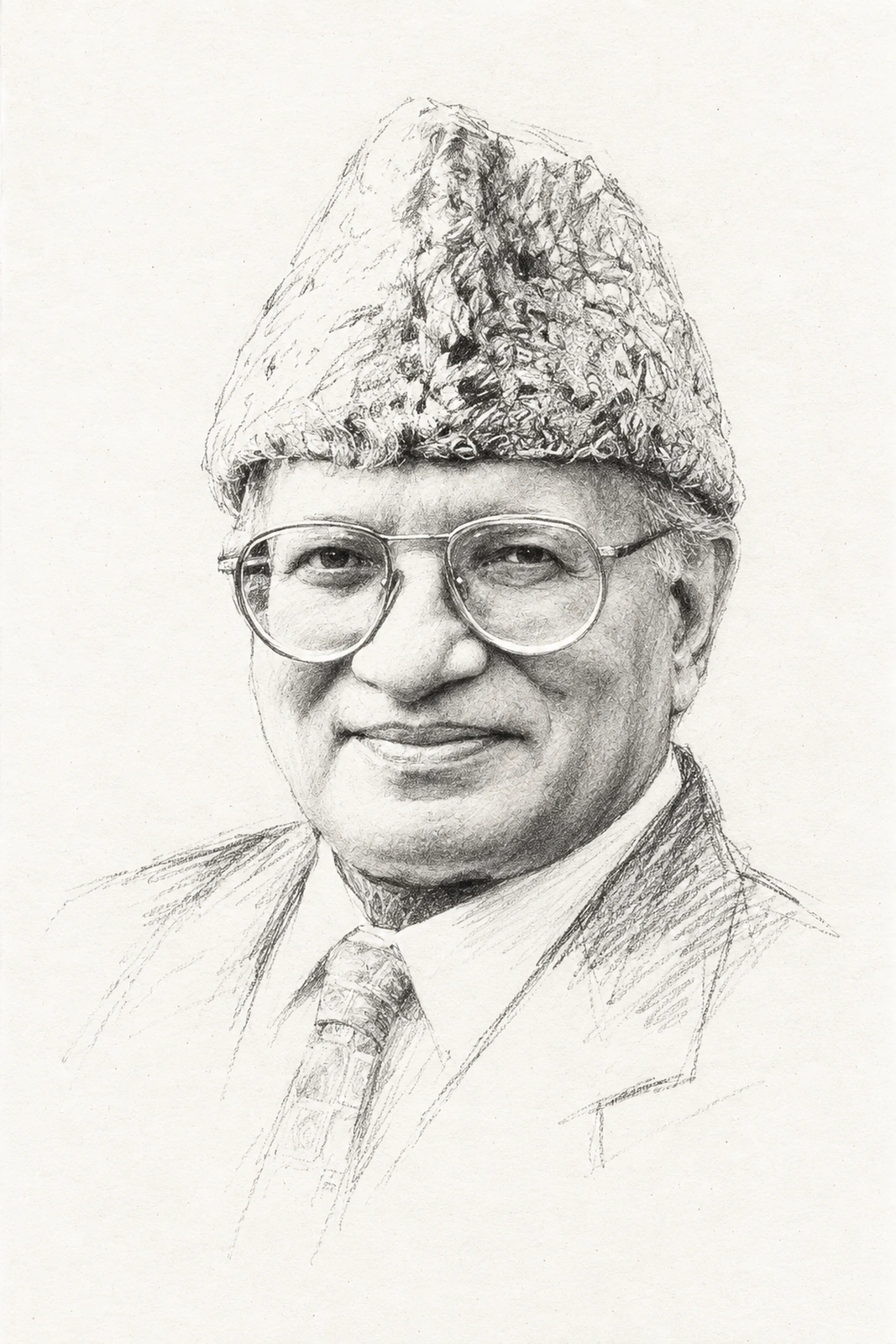
THE WRITTEN WORD
On Education—Articles
Paragraph references are specific to this digital edition.
Concept of an Adarśa Veda Vidyalaya
It is a matter of historical fact that education in India started with study of the Veda and continued to flourish for aeons and produced geniuses of such a high quality and in such a large number as has scarcely been done elsewhere in the world even until now. Upanishadic sages like Yajñavalkya, Uddalaka Aruni, Satyakama Jabala, Aśvapati Kaikeya, linguists like Audumbarayana and Yāska, grammarians like Panini, Katyayana and Patañjali, philosophers like Gautama, Kapila, Kanāda, Patañjali, Jaimini and Badarayana, statesmen like Kautilya, astronomers like Brahmagupta, Varahamihira, etc., etc. are obviously products of educational institutions imparting primarily instruction in the Vedas. The most eminent position the famous Gayatri mantra has been accorded in the midst of legions of them is indicator of the fact how much concerned the Vedic teacher has been about the stimulation of the hidden core of the intellect of the student so as to bring it to the fore and develop it to the highest possible extent. The thrust of that educational system is very well borne out by the famous Upanishadic prayer: Lead me from untruth to truth; lead me from darkness to light; and lead me from death to immortality. What a wonderful system, and how wonderful the objective the system set before it to achieve! How radically different it is from the system of education in operation today having little to offer to the development of the genius and his real humanity!
This, however, is not to suggest to make a retrograde movement and to substitute the present one by the past Vedic one, since it would amount to callous negation of what mankind has achieved particularly in the modern age of explosion in diverse disciplines of human understanding. Problems of man can get resolved neither by exclusive devotion to spirituality nor by indulgence in the gross physical but by a balance between the spiritual and the physical, as has been pointed out in the Iśa Upanishad:
विद्यां चाविद्यां च यस्तद्वेदोभयं सह। अविद्यया मृत्युं तीर्त्वा विद्या ऽ मृतमश्नुते।।
“One who is conversant in spirituality and the worldly things both, he crosses over death by knowledge of the worldly and attains to immortality by means of spirituality.”
To render the content of the modern education in the Vedic terminology, it has its concentration on the manomaya kosha with partial extension to the vijnanamaya kosha and seeks thereby to cater to the needs of the annamaya kosha and pranamaya kosa. But this is just the groundwork of the creation known as man, leaving completely unattended to the rest of him bearing out the real manhood in him. That remaining part of him comprises the crux of the vijnanamaya and the anandamaya which is the exclusive preserve of the Veda.
In view of these hard facts of the educational psychology, it is imperative in this great country on at least experimental basis to create certain centres at which Veda, as an alternative source of knowledge be given the prime place in the curricula followed by the educational institution concerned, in the same way as science/social science is given the prime place in our centres of learning today.
As effective learning in any basic discipline of knowledge such as language and mathematics has got to start from the very beginning of the process of the educational process, the contemplated Vedic Vidyalaya cannot afford to pick up students anywhere from the middle and seek to inculcate in them so subtle and precious a thing as Vedic knowledge when their mind has already been preoccupied with things uncongenial to it.
The Vidyalaya is proposed to be started at the first instance at Ujjain under the aegis of the Maharshi Sandipani Rashtriya Veda Vidya Pratishthan, the premier custodian of the Vedic learning, scholarship and knowledge in the country. It is supposed to have an intake of 50 students admitted to it in class one at the age of 5 each year and see that all of them go on getting promoted each year up to class 12 when they have completed the seventeenth year of their lives. The students will have to be drawn from the whole of the country and selected on the basis of their potential in this new area of knowledge. In case of desertion anywhere in the middle, but no later than class six, the vacancy may be filled by allowing fresh admissions at that stage as per the same criterion of the merit and potential which may be evaluated in terms of the learning of the student particularly in the Veda.
The courses of study will be so designed as to give 50% weightage to the Veda and the rest 50% to other subjects useful in making the child grow into a perfect human being with adequate manual skill, intellectual power, social awareness and moral strength and spiritual elevation.
Training in Yoga will be a necessary part of the curriculum. Needless to point out, it has come to be recognised almost universally in the modern age as the best means to the maximum development of the human personality in all respects, physical, intellectual, moral and spiritual. Interestingly enough, it is Yoga which forms the be-all and end-all of the Vedic ethos. As a matter of fact, the way of the Vedic seers came to get to the reservoir of the knowledge embedded in the Vedas, has come to be recognised as Yoga. As such, Yoga is not only the most efficient way to human development but is also the best and perhaps the sole key to the understanding of the secret of the Veda.
Taking all these points into consideration, the outline of the curriculum of the 12 years of study will be tentatively as follows:
Class I
Knowledge of the alphabet both Devanāgari and English;
Knowledge of the numerals 1-100 and above; some idea of the tables;
The ideal of truth: To speak the truth, whatever the consequences;
Aspiration for perfection: whatever you do, do it as perfectly as you can;
Dream of the New World: Where truth alone prevails, where beauty and goodness pervade;
Practice of recitation of some Vedic mantras, including the Gayatri, on traditional lines;
Learning of Sanskrit through the conversational method;
Practise of a few Āsanas.
Class II
Teaching of some elementary text book to be so prepared as to stimulate in the child social awareness, moral uprightness, and sense of curiosity for the understanding of things around him;
Exercises in remembering and repeating noble aspirations and thoughts;
Exercises in observations and accurate description (leaves, plants, flowers, minerals, scenes, animals, figures, human body, artistic pictures, musical pieces, buildings, objects, events.)
Art of bathing, art of cleaning the teeth, art of dressing, art of sitting, and standing in right postures;
Exercises in the control of senses: control in regulating calls of nature, thirst, and appetite;
Control in speech; control in behaviour, control in movement and action.
Elementary knowledge of the processes of addition and deduction;
Practice of recitation of some more mantras;
Furtherance in the learning of Sanskrit through the conversational method;
Practice of a few more Āsanas.
Class III
Teaching of a little higher order of text book intended to generate social awareness, etc. as in the earlier class;
Development of sense of wonder: (a) Examples from astronomy: distance, vastness, galaxies, expanding universe; (b) examples from physics: what is matter behind what we see and touch; (c) examples from chemistry: what is water? Is it mere oxygen and hydrogen or something more? Examples from other sciences: caterpillar and butterfly, language and understanding, outer man and inner man.
Elementary knowledge of the processes of addition, subtraction, and multiplication;
Training of the senses and their powers.
Practice of recitation of some more mantras and understanding of the meaning of a few selected ones out of them;
Continuance in the learning of Sanskrit through the conversational method; memorisation of the Maheśvara Sutras; some understanding of the rules of Sandhi;
Furtherance in the practice of Āsanas; initiation in meditation.
Class IV
Teaching of a little upgraded order of texts intended to generate social awareness, etc.
Furtherance in the knowledge of mathematics;
Furtherance in memorisation and recitation of mantras as also understanding of their meaning;
Advancement in the learning of Sanskrit, English and Hindi;
Practice of concentration every activity;
Practice of quietude and silence in “Rooms of Silence.”
Advancement in the practice of Āsanas and meditation.
Class V
Teaching in social studies, mathematics and science as befitting the student of this age group;
Teaching of English, Hindi and Sanskrit;
Advancement in the memorisation, recitation and understanding of the meaning of Vedic mantras;
Initiation in the Vedic ethos through stories;
Understanding of the relationship between science and values through explanation of the processes of emergence of matter, emergence of life in matter, emergence of mind in life and of the possibilities of further evolution of man;
Development of value-consciousness through the stories of Buddha, Mahavira, Naciketas, Svetaketu, etc.;
Furtherance in the practice of Yoga.
Class VI
Advancement in the courses of social studies, mathematics and science;
Upgradation in the teaching of Sanskrit, Hindi and English;
Broadening of the area of memorisation, recitation and understanding of the meaning of Vedic mantras;
Initiation in the Vedic thought;
Lessons in the relationship between science and values through inculcation of the understanding of animal psychology, grades of human behaviour, ideals of human life and modes of man’s creativity;
Lessons in human psychology particularly on the yogic lines;
Upgradation in the practice of Yoga.
Class VII
Upgradation in the learning of Sanskrit, Hindi, English, social studies, mathematics and science;
Broadening of the area of memorisation through division of students in groups, say five in number, each taking up a different set of additional mantras for memorisation and recitation, in particular. This process will reduce the burden of memorisation on students and at the same time would help in bringing larger and larger portion of the Vedic texts under the purview of memorisation fulfilling thus the necessity of keeping all the primary Vedic texts under the purview of recitation on traditional lines;
Upgradation in the understanding of the meaning of the Vedic mantras;
Upgradation in the understanding of the Vedic thought;
Stimulation for works of labour and community with an inner motive of dedication;
Promotion in the practice of Yoga; creating awareness in the student in regard to the relationship between Yoga and Veda.
Class VIII
Upgradation in the learning of Sanskrit, Hindi, English, social studies and science;
Introduction of the Vedic mathematics along with the modern one;
Introduction of Ayurveda and Gāndharvaveda;
Teaching in Śiksā, Nighantu and Nirukta;
Introduction to problems of Vedic Interpretation;
Inculcation of the understanding of value-oriented concept of the body on the Vedic as well as scientific lines;
Upgradation in the practice of Yoga.
Class IX
Upgradation in the learning of Sanskrit, Hindi, English, Social Studies, Science and Mathematics including the Vedic;
Introduction to a comparative study of the Vedic and modern scientific thought;
Introduction of Dhanurveda and Sthapatyaveda besides advancement in Ayurveda and Gandharvaveda;
Furtherance in the learning of Śiksā, Nighantu and Nirukta;
Introduction to Vedic Symbolism;
Introduction to Kalpa and Jyotisa;
Upgradation in the value-consciousness through lessons in Yoga, science, history and lives of Vedic seers, Upanisadic sages and modern scientists;
Intensification in the practice of Yoga.
Class X
Upgradation in the learning of Sanskrit, Hindi, English, Social Studies, Science and Mathematics;
Introduction to the problem of reconstruction of the Vedic thought;
Upgradation in the learning of the Upavedas;
Expansion in the learning of the Vedic grammar, Śiksā and Nirukta;
Developing the skill of translating Vedic texts into Hindi, English and regional languages of India;
Consolidation in the learning of Kalpa and Jyotisa;
Lessons in Yogic consciousness vis-à-vis scientific findings in this regard;
Intensification in the practice of Yoga.
Class XI
Upgradation in the learning of Sanskrit, Hindi, English, Social Studies, Science and Mathematics;
Consolidation of the task of reconstruction of the Vedic thought;
Consolidation in the learning of the Upavedas;
Assessment of Śikşā and Nirukta in the light of the laws of modern linguistics;
Comparative study of Jyotisa and modern astronomy;
Introduction to the problem of application of the Vedic knowledge to problems of the contemporary world;
Lessons in ancient Indian sciences and Yoga; Yoga and modern psychology;
Intensification in the practice of Yoga.
Class XII
Upgradation in the learning of Sanskrit, Hindi, English, Social Studies, Science and Mathematics;
Finishing touch to the task of reconstruction of the Vedic thought from various viewpoints, i.e., scientific, psychological, and philosophical;
Upgradation in the learning and practice of the Upavedas;
Maturation of the skill of translation of Vedic texts;
Advancement in the learning and practice of Kalpa and Jyotiśa;
Audio-visual recording of recitation of Vedic texts on traditional lines;
Lessons in Yoga as an exploration of existence by the enlargement of consciousness and unfoldment of the dimensions of human personality;
Further advancement in the practice of Yoga.
The entire Vedic teaching and learning of the Vidyalaya will have to be conducted meticulously with a view to developing the interest of the child in bringing his learning to practical application in life resulting in the inculcation of higher sense in him besides enhancing his intellectual power. Veda being the richest treasure of such higher intuitive and spiritual knowledge, thorough acquaintance of the student with it is expected to instil such sense and capacity in him during his stay in the Vidyalaya for as many as twelve years. Needless to point out that the student would be required to cover a long range of courses besides the Veda, but by virtue of his brilliance, as he is expected to possess on account of being a select one, he is sure to come up to the expected level.
In this scheme of education, the student will not be made to suffer the unnecessary ordeal of examination. All assessments will be internal not only to see how much the student has learnt but also and more importantly to find out how much of his learning he has really digested and is capable of making creative use of in his life.
There will be as much flexibility in selection of courses of study at all stages as possible in order to enable the student to choose a particular course as per his interest and develop his intellectual capacity and skill in the same to the fullest possible extent.
As regards the question of the future prospect of the alumnus of the Vidyalaya, there will be several ways out available to him. In the least by virtue of his meticulous training in subjects like languages, social studies, sciences and mathematics, he is expected to get entry to any institution of his choice offering graduation and post-graduation in them. He is very likely to excel there on account of the power of concentration he would have developed through his rigorous training in Yoga as also through the inculcation of the Vedic knowledge and ethos. But more importantly, the proposed Vidyalaya itself may be allowed to grow into a graduate and post-graduate institution and thus be able to cater to the requirement of the student for an advance course in the discipline of his choice and enable him thus eventually to turn into an intellectual, moral and spiritual luminary in the society which the latter is badly in need of today and perhaps will remain so more or less for all time to come.
It also needs to be mentioned that the proposed Vidyalaya is supposed to be established and run at Ujjain in the premises of the Veda Vidya Pratisthan at the first instance on the experimental basis. On finding the results coming out on expected lines, this type of Vidyalaya may very well be started at other places in the country also so as to make people at large be benefited by it.
Lastly, to sum up the significance of the whole programme, if we are willing to care at least as much for our deep psychological and spiritual potentialities as for our senses, sense-mind and intellect, establishment of such a Vidyalaya is a dire necessity particularly at the dawn of the new millennium auguring a new lease of life to humanity.
Convocation Address March 2005
May I begin by congratulating all the students and scholars who have received their awards, their certificates and the prizes? It is customary to mark this occasion with a ceremony as also a few words of greetings and reflections that may serve as counsel for the future. In this way, Convocation makes an imprint of a landmark in the lives of all the participants. May I wish that this landmark continues to serve as a reservoir from which you will constantly derive inspiration for a noble and fruitful life.
In our tradition, the great words of the Taittiriya Upanishad uttered by the teacher to the pupil are remembered and repeated on this occasion. These words are simple but packed with power and unfailing force of guidance. The very first two short sentences of the relevant Chapter summarise everything that we ought to follow in our life. Satyam vada, dharmam chara – speak truth, walk in the way of the law of thy path of ascent. A little later, it is said:
“Thou shalt not be negligent of truth; thou shalt not be negligent of thy duty, thou shalt not be negligent of welfare; thou shalt not be negligent towards thy increase and thy thriving; thou shalt not be negligent of study and teaching of the books of wisdom.”
Sri Aurobindo, Kena and Other Upanishads: Taittiriya Upanishad
In a further elucidation, it says: “The works that are without blame before the people, thou shalt do these with diligence and no others. The deeds that we have done that are good and righteous, thou shalt practise with commitment and devotion and no others.” Finally, it addresses itself to a situation where one is besieged by doubt, perplexity, anxiety, or indecision. It counsels as follows:
Moreover, it thou doubt of thy course or of thy action, then to whatsoever leaders of wisdom be there who are careful thinkers, devout, not moved by others, lovers of virtue, not severe or cruel, even as they do in that thing, so do thou. It concludes:
एष आदेशः । एष उपदेशः। एषःवेदौपनिषत्। एतदनुशासनम्। एवमुपासितव्यम्। एवमु चैतदुपास्यम्।।
This is the law and the teaching. These are Commandments. In such wise shalt thou practise the law of thy life, verily in such wise do ever with commitment and devotion.
These words of counsel come to all of us at this Convocation as a boon of our great heritage, and let us receive them with determination to put them into practice. Basically, it is a call for each one of us to make experiments with truth – a task which need not be left only to the great souls but which has to be undertaken by each one of us in a true spirit of equality; for this is the path where everyone has an equal right of entry and fulfilment.
But what is truth? And what is truth-speaking? In answer, we may say that truth and truth-consciousness are closely interrelated. Truth is an expression of the reality and unless one gets into contact with reality, one cannot be qualified to express it. As one begins to experiment with the truth, one begins to make a distinction between facts as we see them and the larger reality as it is in itself. We are, therefore, obliged to correct our perception of facts, unify them in larger and larger context until the finite unites itself with the infinite. The infinite consciousness alone is at its highest the truth-consciousness. Truth speaking is the indispensable condition of the development of truth-consciousness; and none can speak the truth without developing ever-increasing truth-consciousness. That is why, the earliest formula of wisdom that we find recorded in the Veda is that of satyam, ritam, brihat, - the truth, the right and the vast. Without vastness, there is no expression of truth and without expression of truth, there is no right action.
Right action, ritam, is the origin of the Indian concept of dharma. This concept underlines the principle of the right action as the unifying thread which sustains the world and which uplifts the world constantly to higher and higher modes of thought and will-force. Dharma is both positive and normative; it sustains every object by virtue of its inherent qualities and interrelationships, but it also stimulates a path of norms, of ascent, a path of interchange between the individual and the cosmic, and traces an upward movement towards higher and higher goals. The highest prayer of dharma is contained in the Brihadaranyaka Upanishad: asato mā sad gamaya, tamaso mā jyotir gamaya, mrityor mā amritam gamaya, ‒ lead me from the unreal to the real, lead me from the darkness to light, lead me from death to immortality.
This ancient message of the Veda and the Upanishad has to be linked with the problems of today which are centred on what Sri Aurobindo has called “the evolutionary crisis”. We are all involved in evolution, and we cannot escape it. In this evolutionary movement, we have reached a critical point: for we have developed greatly our mind but are lagging behind in morality and spirituality; we have developed huge structures of organisation, but we have lagged behind in developing vision and wisdom which alone can control that hugeness; we have developed machines and instruments that facilitate productivity, entertainment and enjoyment, but we have not learned how to establish the sovereignty of our spirit over the machine; we have utilised our knowledge to build the paths of pollution – both environmental and internal, ‒ and even of death, but we have not taken care to tap those resources by which the child and the youth can be enabled to ascend on the higher path of life and perpetual youth. The crisis becomes more and more acute with every passing day; for evolution does not tolerate our inability or our excuses for delay or inertia. The message of this crisis is that one must build the passage from the mind to the supermind and build on the earth that ideal world which children and youth should cherish, ‒ where the world will give them the necessary work and leisure by which they can grow from within the secret potentialities of fulfilment, ‒ a world which will not deny them the real and effective equality; and a world that will tie us all in the bonds that do not bind but liberate and uplift, ‒ the bonds of true fraternity.
Let me come to the final point both biologically and psychologically, we are so constituted that our natural occupation has to be that of students and teachers. And highest considerations impose upon us the need to become good students and good teachers. The labour that your teachers have put in for your development and for your education will be truly rewarded if you do not ever cease to be good students’ and if you transmit as good teachers your education to others whose responsibilities you will be required to shoulder. Every good teacher continues to learn more and more and every good student continues to create greater and greater opportunities for their teachers to teach them more and more integrally. It is my earnest wish that you will strive to become and remain for ever good students and good teachers – not necessarily in what are now called schools and colleges, but more importantly in the School of Life.
Let me conclude by presenting to you a powerful message that Sri Aurobindo has given to the young people of India:
“Our call is to young India. It is the young who must be the builders of the new world, - not those who accept the competitive individualism, the capitalism or the materialistic communism of the West as India’s future ideal, nor those who are enslaved to old religious formulas and cannot believe in the acceptance and transformation of life by the spirit, but all who are free in mind and heart to accept a completer truth and labour for a greater ideal. They must be men who will dedicate themselves not to the past or the present but to the future. They will need to consecrate their lives to an exceeding of their lower self, to the realisation of God in themselves and in all human beings and to a whole-minded and indefatigable labour for the nation and for humanity. This ideal can be as yet only a little seed and the life that embodies it a small nucleus, but it is our fixed hope that the seed will grow into a great tree and the nucleus be the heart of an ever-extending formation. It is with a confident trust in the spirit that inspires us that we take our place among the standard-bearers of the new humanity that is struggling to be born amidst the chaos of a world in dissolution, and of the future India, the greater India of the rebirth that is to rejuvenate the mighty outworn body of the ancient Mother.”
Sri Aurobindo, Essays in Philosophy and Yoga: Ourselves
Meaning of Education for the Complete Person: Its Central Issues
Two reports of UNESCO, ‘Learning to be’ and ‘Learning: Treasure Within’, have underlined the importance of complete education for the complete person. And yet, there is a debate as to whether education should not be limited to some narrower goals, considering that ours is the age of increasing super-specialization and also because education is pursued with the aim of securing jobs in the market. Job-oriented education is being often demanded and we need to confront this demand, both philosophically and practically.
Education is a sub-sector of the social framework in which the greater aims of civilization are nourished and promoted. In this context, we cannot ignore the fact that today the entire world is moving towards a global civilization, the fundamental need of which is global peace and a global order that would fulfil the highest aims of liberty, equality and fraternity. It is these higher aims that necessitate education for the complete person, for incomplete individuals are at war with themselves and they can never become the bridges of peace and advocates of freedom that aim at harmony. The aims of specialized education and job-oriented education have, therefore, to be fulfilled within the larger framework that is concerned with the highest needs of human civilization.
The key idea that would answer the question regarding ‘what we should aim in education’ is that of the relationship between personality and profession or job that each individual is required to perform. The essential point is that the secret of profession lies in personality and that if education aims at shaping personality in the right terms, it will necessarily involve preparing the personality for the profession which is to be a flower of the individual’s being and abilities.
Necessarily, we need to look more deeply into the nature of personality and how the development of personality includes automatic preparation for profession. In the very brief scope of this short note, it can be said that there are broadly four aspects of personality: the aspect of pursuit of knowledge, the aspect of the pursuit of courage and adventure, the aspect of the pursuit of co-operation and mutuality, and the aspect of the pursuit of skill and perfection in work. Each individual has these four aspects, but they are not equally developed and the proportions of these aspects are asymmetrical. The task of education is to take into account this basic fact and develop each individual individually, so that each individual is enabled to develop all the four aspects of personality in such a manner that within a certain period of growth, during which the individual is under the charge of the educational system, is made aware of these four aspects of personality and is given an opportunity to bring about some symmetry and harmonization. If this line of growth is promoted in the educational system, it will be found that each individual will derive from the educational system the required nourishment of different potentialities and their connections with the aspect of the pursuit of skill and perfection in work.
Indeed, this will imply a big revolution in the educational system. It will firstly require educators and teachers to understand more and more perfectly the meaning of the complete person and the different aspects that constitute the complete person. Secondly, it will imply individual-oriented or child-oriented education.
Thirdly, it will imply the development of an educational system that nourishes the atmosphere where the four pursuits of personality are encouraged; fifthly, it will imply the possibility where each individual can be aided to discover the right processes of development that would culminate in the flowering of those capacities which can at the same time stimulate the faculties of skill. Finally, it will imply education that will permit freedom for each individual to explore various alternatives and experimentation for each individual to arrive at a proper equation between the development of her personality and the skills for the profession which is inherent in the composition of his/ her personality.
The conclusion is that education for the complete person is the indispensable first premise; but the concept of complete person should be properly analysed and the system of education should be so organised that each individual is able to find the right road and the right individual road towards her education of complete personality on a life-long basis. Within this wide framework, the educational system should ensure that each individual, at every terminal point, should get the required help and encouragement to develop his/ her personality as comprehensively as possible, provided that the interests of the development of skills for appropriate work or profession are also sub-served. Personality that does not flower in profession is barren, and the profession that does not throb with personality lacks creativity.
Illumined Seers, Poets and Leaders of India
(Indian council of philosophical research)
I feel sincerely grateful that this Consultation Seminar has come to be organised and that so many eminent educationists, thinkers and scholars have assembled here to give us the benefit of their advice relating to the purpose of this Seminar. As you know, Indian Council of Philosophical Research has undertaken a major programme of developing in our country the theme of Philosophy of Value-oriented Education. We have had a major conference on this subject two years ago and we have published a volume containing the proceedings of that conference. Thereafter, we had seminars relating to art, poetics, nationalism, and other similar subjects. These seminars were focussed on what may be called an attempt to develop materials that will be relevant to applied philosophy of value-oriented education. And in this domain, we have been feeling that nothing can stimulate value-oriented education as the study of inspiring biographies, autobiographies and accounts of great events which gave us insights into the greatness of the characters who shaped those events. In this connection, we are making an effort to study the situation that obtains in our country in regard to the literature that is available in connection with biographies, autobiographies and great events for the younger generation in the country. In this search, some information has been collected, but it is just a fringe. Hence, we thought of organising this national consultation seminar so that the participants, who have wide knowledge and experience in this field can give us the information and also advice as to how and with whose help we can promote the task of writing monographs on themes relating to those great men and women who have shaped our country and enriched India’s great heritage.
This seminar is not merely to collect or exchange information, but also to contemplate on certain concepts in regard to which we need greater clarity. Why, for instance, have we spoken of illumination? And the related question is: What is illumination?
The reason as to why we have spoken of illumined seers in our seminar is that nothing is as purifying as knowledge, and nothing inspires purity as accounts of those who have pursued knowledge and enriched the store of knowledge. Illumination is, we might say, one of those uplifting forces that can liberate us from the slavery to impulses, passions and a number of emotions which keep us tied down to narrow and injurious interests. Along with illumination, there are also two other forces which serve the same or similar purpose. These are the uplifting forces and examples of heroism and harmony. Even to hear of heroism inspires the development of the qualities of courage, fearlessness and self-sacrifice. Similarly, there is nothing as satisfying as the experience of harmony in the collective life. And there have been a number of leaders in our country who have given examples through their own life to show how they have cultivated greater and greater integration of harmony in their own nature and how they have laboured selflessly to create harmony in the society.
As we know, there are biographies and biographies, there are autobiographies and autobiographies, and there are various accounts of events and anecdotes, and of men and women who have played a major role in creating or shaping important events. If, however, we have to do a real service to students and teachers, we have to develop in the country a cultivated sense of discrimination so that the kind of the studies of leaders that we offer to them bears a certain high quality and certain sublimity of inspiration. This is not merely a question of quality and style but also of the height and greatness of the substance of the themes that are presented. It is, therefore, necessary that there should be forums where discussions are held on these aspects of literature, and it is in this context that I should like to devote this Inaugural Address and reflect on three terms which I have just mentioned, namely, illumination, heroism and harmony. These reflections are only elementary, and I should like philosophers and educationists to come forward to provide maturer reflections so that we can speak of these three uplifting forces to our students and teachers more meaningfully, and thereby enable them to discriminate in the literature presented to them which constitute the quintessential ingredients of these three uplifting forces.
The first question is as to what we mean by illumination. I believe that all of us have had varying degrees of experience in which we have felt some kind of inner joy that bursts upon us on account of clarity that dawns upon us. This clarity may be regarded as an indispensable element in which the object of inquiry shines out in our consciousness as understood or even comprehended. But clarities are of varying degrees and of various kinds. At higher levels of clarities, we feel that something essential is understood or else the significance of substance and life-movements are seized, understood and comprehended. There are still other clarities in which we feel that our inner eyes have been opened, and the resultant experience is not only of seizing, understanding or comprehending but even of holding and possessing in our own being the meaning and value and even the widening scope of the subject in question. At still deeper levels, we feel the opening of wide horizons or feel as though we have climbed high altitudes or else touched and experienced the depths and depths of meaning and value. In one of the bold images of the Veda, we have the description of Vishnu as the eye that is spread over the whole sky. In all these higher experiences of clarities, we experience some kind of ignition of inner light. We might say that illumination is basically the experience of ignition of inner light in which meaning and value of substance and life-movements are seized, understood, comprehended, held and possessed. And this illumination imparts to us a great sense of repose, intense peace of harmony of being. And often this illumination goes farther and it stimulates and inspires guided action and application. At still higher levels, illumination bursts forth in creativity of higher and higher orders which culminates in joy, delight and even ecstasy.
Illumination is a great door that opens out upon wisdom. For wisdom is the ripe fruit of the splendour and glory of synthesis and harmony, and this ripeness imparts to our consciousness a state of intense inwardness, penetrating insights into subjects, objects, situations, and events. We may even say that wisdom, too, has varying degrees of globality and transcendences, which from their higher heights can look upon the movements of life with a certain mastery and capacity to deal with needed restraint and optimum expenditure of energy. Wisdom is also the capacity to discover the meanings of hints and clues even in unsuspected corners, and it can strike plummets into those depths from where new knowledge can spring forth. Wisdom thus reveals unsuspected secrets, and wisdom becomes a source in our personality for the development of unimagined skills of art and craft and creativity and effectivity.
India has had the fortune of having produced a number of illumined seers, ‒ some of them of the highest order. We have with us great names of Vasistha and Vishwamitra, of Vāmadeva and Atri, we also know some of the names that shine out of the Upanishads – Yājñavalkya and Janaka, Sanatkumara and Nārada, and we have also the great names of Vālmiki and Vyāsa and even in modern times, we have Sri Ramakrishna and Sri Aurobindo, ‒ and they all provide to us some glimpses into the operations of intuition, revelation, inspiration and illumination. How wonderful it would be if some of the accomplished authors of India undertake a task of producing a monograph on these illumined seers written in chaste and chiselled language and written with insight and intimate sympathy, so that our students and teachers come to learn some authentic account of these great illumined seers. It is true that we do not have any biographical or historically accurate information regarding many of these seers. But still we do have authentic texts of their writings, of their compositions, of their poems which can provide some kind of inner understanding of the profundity and vastness of their vision and of their creative abilities. They constitute a precious heritage of our country, and we should enable our students to come into intimate contact with this heritage through the understanding of great heights of illumination which these seers had reached.
Coming to the subject of heroism, we may ask as to what exactly are the ingredients of this great force that has been greatly exemplified throughout the long period of five thousand years of Indian history. We normally attribute the concept of heroism with the qualities that come into play in battlefield. We do not normally take into account the courage and heroism of thinkers who are able to think boldly and with the spirit of innovation. We do not normally think of heroism that is involved in great adventures, ‒ adventures of discovery and invention, adventures of developing new forms of art, literature, or adventures that prepare new paths which are greatly opposed by contemporaries and they nonetheless lead people to the achievements which are at one time unimagined or undreamt. We may define heroism as inspired force of self-giving and sacrifice in will that is applied to the quest, realisation and triumph of meaning and value against the resistance of limitations and obstacles by means of courage, battle and adventure. Just as illumination is concerned with the cognitive faculty, even so heroism is centrally connected with the faculty of volition. There is, indeed, a close connection between the faculty of cognition and the faculty of volition, just as there is close connection of these faculties with the faculty of affection. The greater the illumination the greater is heroism, the greater the heroism; the greater is the possibility of arriving at higher altitudes of illumination. And the greater heights in heroism and illumination prepare a more fertile soil for experience and expression of harmony.
There are degrees and heights of heroism which can be determined by the intensity, persistence and vastness of sacrifice. Again, heroism attains highest states of greatness of refinement when it is guided by the highest wisdom and inspired by the sense of service to the ends of justice and harmony, and when the related tasks are executed with consummate skills. India has been a land of heroes, and heroines of varying degrees and even of the highest degrees and of the highest kind. When we speak of Rama as a hero, we do not think merely of a leader or a king who showed exemplary strength and skill and courage but we worship him because he showed exemplary equanimity under all circumstances, most of which were highly adverse. We also think of him as the one who combined virtues in such a harmonious order where his entire character is imaged as a full-blown lotus where every petal beautifully blended with other petals, imparting inexpressible charm and beauty of the highest order. But this is only one of the examples of heroism in India and we have hundreds and thousands. Unfortunately, our literature of heroic leaders is not as ample as it ought to have been. Take, for example, the central hero of the Mahabharata, namely, Arjuna. My own reading is very limited, and I have no right to complain, but I must confess that I have not found any monograph of Arjuna. I would be greatly happy if the learned authors assembled here could give me one or two examples of well written and inspiring accounts devoted centrally to Arjuna. This is only a stray example that I have taken. But I should like to suggest that we should be able to make a list of heroic personalities that India has had and demand from the authors to give to our students and teachers well written, well chiselled and inspiring accounts of these heroic personalities.
Finally, we may come to the subject of harmony. This is the word which is very difficult to define. Harmony is particularly related to the aspect of ananda, which is ontologically related to sat and chit and their unity. Sat may be regarded as an appropriate object of the process of illumination, and chit or chit-shakti can be regarded as an appropriate object of will-force that is the essential ingredient of heroism. And harmony can be regarded as an appropriate object and appropriate expression of ananda. Harmony is basically a matter of creativity, and harmony is best expressed in poetry and in art, and in literature, architecture, and various other plastic and performing arts. But harmony need not be limited only to artistic creativity which is manifested in familiar domains. Harmony can also be in the development of virtues, in the development of relationships and in the development of uniting various forces and expressions of matter, life, mind and spirit. The saints of India, many of whom have not been poets or composers, ‒ but their very personality vibrated with the beauty and charm and gentleness that can be engendered only by a deep integration and harmony of faculties and powers. Fundamentally, harmony is synthesis, harmony is equilibrium, harmony is perfection. It may be said that harmony is a progressive state and action of synthesis and equilibrium generated by creative forces of joy and beauty and delight that combines and unites knowledge and peace and stability with will and action and growth and development. Without harmony, we may venture to suggest, there is no perfection, even though there could be maximisation of one or more elements of our nature. Finally, it may be said that when illumination and heroism join and engender relationships of mutuality and unity, each is perfected by the other and the creativity is endless.
Monographs on the theme of harmony are conspicuously small in number in our country. Again, I would like to be enlightened by the authors and scholars who are here, and I should like to learn of the books and monographs that are available in our country which illustrate the theme of harmony in its various aspects.
In the end, let me make a fervent appeal to the scholars and authors assembled here to be continuously associated with our Council of Philosophical Research and provide to this Council information and instruction that can enable this Council to contribute significantly to the presentation of the very best writings, compositions and monographs that illustrate illumined seers, poets and leaders of India, and the information regarding which will be transmitted for the use of students and teachers of the country.
Indian Psychology
(National council of educational research and training)
Indian Psychology and Education
If there is one science which has been developing in India uninterruptedly from the Vedic times to the present day, and if this development has been both comprehensive and subtle in heights and profundities and if because of its ever-progressiveness, it is far more advanced than the advances made in that field in any part of the world, then that science is the science of psychology. Already in the Veda we find the record of the discovery of the loftiest states of consciousness and also of the surface levels and deeper levels of human consciousness along with unmistakable awareness of what we call today Depth Psychology or the Psychology of the Subconscious and Unconscious. Subtle distinction of different constituents of consciousness are clearly discernible in the Veda and we have distinctions between citta, medhā, manas, mati, and dhī as also the distinctions of higher faculties of knowledge, ‒ mahi, Ila, Saraswati, Sarama, and Dakshinā (faculties of vastness, revelation, inspiration, intuition, and discrimination). And what is most important is that there is in this system cogent and detailed exposition of the processes by which one can rise from ordinary states of consciousness to the highest levels of consciousness such as those of rita-chit, truth-consciousness, supported and guarded by the powers of wideness, friendliness, austere will and joy that springs from universality (powers of Varuņa, Mitra, Āryaman and Bhaga). And in this process of ascent, we have a detailed description of the role played by the powers of illumined will, illumined intelligence, and the powers of subtleties of the physical, vital and mental consciousness. Veritably, the Veda is the earliest existing book of a comprehensive and profound system of psychology of the world. And, fortunately, Indian history of psychology shows how the truths of psychology were continuously developed, and from the Veda to Sri Aurobindo, we have a record both of confirmation and constant development of the psychological knowledge of human aspiration and means of fulfilment of that aspiration. It is noteworthy that Integral Psychology of Sri Aurobindo is today being studied in different parts of the world with increasing receptivity, and one or two psychological systems of the West today have clearly acknowledged the debt they owe to Sri Aurobindo.
It is against this background that it is appropriate that we raise today three important questions: firstly, what is Indian psychology or rather what is the universal psychological knowledge that has developed in India and what are its contents? Secondly, the question is what is the importance of the study of this psychology as a part of the total scheme of knowledge in India into which we need to initiate our students in the country? And thirdly, what are those elements of this psychological knowledge that we can fruitfully incorporate in our school curriculum?
I must congratulate Professor Rajput for creating the occasion for raising these three questions and for having invited psychologists and educationists of the country in a major national effort to seek answers to these questions. Although this is for the first time that the effort has been attempted, we find that this effort has been quite fruitful, and if it will be supplemented by subsequent seminars and workshops, we shall arrive at positive contributions on the basis of which a new curriculum can emerge, ‒ a curriculum that would reflect not only the genius of India more adequately but which would also aid our students in their personal growth and in shaping their own personalities more integrally and more luminously.
Very often, courses in psychology devote a good deal of time to the relationship between physiology and psychology and to the systems of structuralism and functionalism. A large space is devoted behaviouristic psychology, the premises of which are confined to the processes of stimuli and responses. In recent times, Gestalt psychology with its emphasis upon unifying consciousness and operation of intuition is being proposed. But since the time when Freud and subsequently Jung made an impact on the psychological field, much attention is being paid to the subconscious and the unconscious, individual and collective, and the study of Eros and Thanatos have gained importance and are being shown as fundamental drives that shape human personality. Lately, personalistic psychology has emerged and wider horizons are being explored. But in these courses of psychological studies the truths of psychology discovered by the long Indian tradition hardly figure, and we do not have as yet adequate teaching-learning material that incorporates insights and lessons of Indian psychology.
This situation must change.
One of the most important lessons of Indian psychology is that what goes in the name of psychoanalysis or psychiatry is a mere abc of psychology, and more importantly, that it is dangerous to deal with the inconscient and the subconscient without attaining a good deal of mastery and harmony in the waking consciousness and in the super-consciousness. It is clear in the light of Indian psychology that the roots of human personality are not in the subconscient or inconscient but in what may be called the subliminal, psychic and spiritual levels of consciousness. Hence, to teach students to be confined to the subconscient and the inconscient is to give them a wrong clue and to limit the possibilities of development to a very narrow and distorted process.
The most interesting part of Indian psychology is related to the analysis of personality and the concept of perfection of personality. To state it briefly, Indian psychology presents us three concepts which are relevant to the development of personality, ‒ the concept of sattwa, rajas and tamas in the context of the construction of personality which can be largely effected through the development of prakriti, the power of executive energy as ordinarily explained in the psychology of the Sankhya. The second is the concept of five levels of personality, the personality fixed in the physicality of the human composition, annamaya, personality fixed in the vital sheath of human composition, prāņamaya, thirdly, the personality fixed in the mental energy of rationality, ethicality and aesthesis, manomaya, fourthly, the personality that blossoms in the fullness of comprehensive supramental consciousness, vijñānamaya, and the personality that enters into the supreme regions of consciousness, the key of which is in the spontaneous ocean of delight, ānandamaya.
These five levels of personality have each behind them the status of consciousness that originates them and sustains them, the status of what has been called the status of purusha, known not only in the Samkhya but in the more ancient system of Taittiriya Upanishad and even in the still more ancient system of Rigveda. The third analysis of personality is at a much deeper and profounder level, and it is related to the concept of what Sri Aurobindo has called chaitya purusha. This chaitya purusha is described in the Kathopanishad as the being that is no bigger than a thumb (angushthamatram) or what is described symbolically as madhvadah, the eater of honey. It is not the static purusha of the Sankhya, but a portion of the kshara purusha, the nature of which is triguņātita, that which transcends the limitation of aparā prakriti of tamas, rajas and sattwa, but which partakes of the Parā Prakriti. The real maker of personality is this chaitya purusha; when it interacts with the prakriti, the prakriti of sattwa, rajas and tamas or the aparā prakriti, it puts forth in a progressive manner what may be called four soul-forces, the soul-force derived from parā prakriti manifesting the personality of knowledge, the soul-force manifesting the personality of heroism, and the soul-force manifesting the personality of harmony and the soul-force manifesting skill, dexterity and perfection.
We all consider the development of personality or integral personality to be one of the highest aims of education. Educationists, teachers and students are constantly in search of the knowledge by which personality can be rightly developed and integrated. We need to have, first, the psychological knowledge of the various intricacies of the notion of personality, different kinds of personality, and various levels of personality, as also of conflicts of personalities within oneself and which need to have proper remedies through the processes of harmonisation of personality. Where shall we find this knowledge?
Fortunately, the Indian tradition of psychology has developed this knowledge, knowledge which is repeatable and verifiable, and a knowledge which can be practised, knowledge on the basis of which true guidance can emerge.
If, therefore, a curriculum of Indian psychology has to be developed, my own suggestion would be to focus on the psychology of development of personality and to relate other elements of psychology around this basic issue. This is not a place for giving a blueprint of the curriculum. But it would be instructive to observe that the latest Report of UNESCO speaks of learning and emphasises on the utilisation of the treasure that is within us. Interestingly, again, it speaks of four pillars of learning, the pillar of knowledge, the pillar of living together or the pillar of harmony, the pillar of doing and working or the pillar of skill and dexterity, and the pillar of being, that which endows the individual with a true self-possession and self-mastery. These four pillars are not entirely different from the four soul-forces to which we made reference earlier. The only pillar that is missing in the analysis of the UNESCO’s Report is the pillar of heroism. In any case, it is instructive that when we come to analyse the inmost process of learning and development of personality, we seem to come nearer to the Indian insights. Swami Vivekananda speaks of man-making education, and what is that education if not the education that develops personality, a complete personality and personality of perfection? He also spoke of every individual as potentially divine, and what is that potentially divine if not the dynamic soul and its soul-force?
One of the most important questions is to conceive of an ideal of perfection or a perfect personality. I can only refer to the concept of sthithaprajña in the Bhagavadgita or we have the luminous example of the Buddha who was seated in utter calm in his inner consciousness and yet dynamically engaged in the works of verity and producing results so extraordinary that we speak of him as the greatest personality that ever walked on the earth. And if we want a fuller elucidation of the concept of perfect personality, I can do no more than presenting the following from Sri Aurobindo:
“When the full heart of Love is tranquillised by knowledge into a calm ecstasy and vibrates with strength, when the strong hands of Power labour for the world in a radiant fullness of joy and light, when the luminous brain of knowledge accepts and transforms the heart’s obscure inspirations and lends itself to the workings of the high-seated Will, when all these gods are founded together on a soul of sacrifice that lives in unity with all the world and accepts all things to transmute them, then is the condition of man’s integral self-transcendence. This and not a haughty, strong and brilliant egoistic self-culture enthroning itself upon an enslaved humanity is the divine way of supermanhood” 1.
The Invisible University
What is the prime need of our civilization today?
During the last fifty years, the world has moved in a direction where productivity can be increased and employment opportunities can be multiplied. There is, indeed, a problem of scarcity and we know that resources are never unlimited. But with the advancement of science, inventions are continuing. It is not impossible to foresee a great breakthrough in the utilisation of solar energy in a way that would replace many other forms of energy available today. There would be, at the same time, a great breakthrough in the invention of machines that would make seawater potable, a need which is almost a crisis today. These are only two small examples to indicate a possible graph of future development. If we analyse this scenario in the context of employment opportunities in the coming world, we have to reckon the fact of globalisation under the impress of which markets of all kinds will open up greatly, and even poverty can be reduced all over the world almost to a vanishing point. To equip individuals with capacity to produce, to market and to consume has now become a foreseeable reality.
Therefore, the most advanced thinking in the world today has turned to the deeper questions of creating a mankind that is not only more productive but also more humane, more cultured, more compassionate. It is now being recognized that human relationships are extremely important, that human beings need to understand each other more and more humanely and more and more sympathetically. It is being acknowledged that happiness is now at the gates of human relationships, and that the better one understands and practises the art of harmonious relationships, the greater will be the fund of happiness in the world.
As yet, our education systems do not recognize this emerging need of mankind. Educational systems are still geared to the production of efficient and productive human beings. Indeed, the world does need productive and efficient human beings, but looking to the future,—an educator has to look at the future more and more boldly and clairvoyantly,—the increasing need is to produce human beings who care for each other, who know how to live together, who feel responsible and who can relate themselves with others in wider and wider contexts and who can sacrifice their egoistic needs and ambitions for the welfare of larger sectors of humanity.
Therefore, there is a need to change the directions of education and to add a new dimension.
How can this change be affected? Much can be written on this subject, but if a brief answer is to be given, it can be said that this change can be affected by the combination of three factors:
We have to identify and encourage those children who want to learn and develop their faculties, and who have this motivation burning in their own hearts;
We have to provide to them teaching/learning materials which cater specially to answer their need to learn and their need to develop their faculties, and to provide through these materials the art and science of relationships, of a sense of the need to sacrifice and to develop bonds deeper than what outer conventions of today allow;
We need to develop and train teachers who can serve the needs of looking after these children and who can create and utilize new teaching/learning materials. A great future of humanity—a humanity of harmony and unity – can then be hopefully visualized. And this—the creation of that new humanity—is a prime need of our civilization today.
How can we contribute to the fulfilment of this need? Nobody can contribute so greatly that something magnificent and overwhelming can be produced within a short period. Even those educationists who are capable, who have vision, and who are creative, can move forward only modestly. Others who understand the task of the future and want to help can also make only modest contributions. For a long time, the tasks have to be intangible, may not even be seen to have any impact. But maybe, they can make financial contributions, they can contribute by way of intellectual co-operation, they can contribute by organising relevant activities and programmes.
Indeed, the work is vast and enormous financial resources would be needed to support these activities and programmes. Creative visionaries, educationists and teachers need to be brought together, and some of them have to be sustained even financially. Facilities have to be created to enable them to prepare new Teaching/Learning materials, and these materials have to be in many forms – books, worksheets, slides, documentaries, films, audio tapes and many other kinds of books which are hardly visualized today. These materials will have to be transmitted to students who want to learn and who want to develop their faculties and who want to learn the art of relationships and the art of life. And gradually, the circles of these children have to be expanded.
There has to be a new type of organisation, a new type of university,—a university that encourages learning for the sake of learning – not for passing examinations or for getting certificates. Even the word university is too big. To begin with—a small centre, a modest centre, a modest collection of talented people who can produce new types of material for the children. This can be the minimum programme and it can be developed further for a larger expansion and larger services.
This is what we would like to initiate and accomplish. A modest beginning, modest funding, modest work,—but solid work, creative work, dedicated work.
What are the constituent ingredients of Value?
Value may be conceived as an object, subjective or objective, the possession of which imparts to us a sense of fulfilment and therefore something we prize and cherish.
A value, understood, in the above sense, may be already possessed by us and which is maintained by us and what is naturally pursued by us for continuous maintenance or for a greater maximisation. In that context, value is an object that is desired and which is also pursued as something desirable on the ground that it is desired. Value is thus both positive and normative. The hedonist maintains that pleasure is desired, and thus he underlines psychological hedonism. But on that very ground, he argues that pleasure is desirable and should be normatively pursued.
But when the desirable is sought to be derived from what is desired, there is a possibility of committing what is called “naturalistic fallacy”, since there are a number of things which are desired but are not considered to be desirable. And this introduces in the concept of value several considerations which are not naturalistic but normative in character, and in the light of which value is conceived to be a normative concept.
These normative considerations emerge from two important facts. There is, first, the fact that no individual exists or can exist all by himself independent of the collectivity. And this calls upon every individual to relate with the collectivity in a way that is not positively natural but which is normative, requiring efforts that are not experienced to be necessarily spontaneous or pleasant.
At the minimum level, the individual is seen to be demanding from the others what they expect and demand from him. And this demand is the starting point of what can properly be called “ethical”, which may be pleasant but can, and often is, unpleasant or neutral in respect of pleasant and painful, or else something quite other than what can fall under the category of “pleasure”. And this is where hedonism, psychological or ethical, is required to expand the notion of value and include in it some new ingredients.
The second fact is that pleasure which is at the rudimentary level felt to be identical with sensational in character begins to be perceived as having varied gradations both in degree and in kind, depending upon what objects other than pleasure are sought to be pursued, cultivated and experienced. Even the word pleasure comes to be seen to be a restriction, and the notion of happiness comes to be conceived so as to admit the pursuit of objects which begin to demand our attention as worthy of attainment, even though they do not belong to the category of pleasure or even of happiness.
These two facts impose a process of ascent towards values that are intrinsically objects of worth and where they can be called good in themselves or a law, a normative law,—a law other than the law of the processes—that we find operating in our present ordinary existence.
Value, properly speaking, is what ought to be seen, practised and attained, and it is what is necessitated by the process of ascent from our naturalistic situation towards what comes to be conceived a higher stage where the individual and the collectivity find some attainable but not yet attained equilibrium or harmony, and which involves the pursuit of objects that fall outside the category of pleasure or happiness, even though these objects may include happiness or sense of fulfilment.
Philosophy and Science of Value Education in the Context of Modern India
Philosophy and Science of Value Education in the Context of Modern India - I
There are at least three fundamental assumptions of the educational process:
a) There is, first, the pursuit of man to know himself and the Universe and to relate himself with the Universe as harmoniously as possible. This pursuit constitutes the very theme of human culture. And education derives its fundamental thrust from the cultural setting at a given point of time.
b) Secondly, there is a process of transmission of the accumulated results of the past to the growing generation so as to enable it to carry forward the cultural heritage and to build the gates and the paths of the future.
c) And thirdly, there is in the process of transmission, a deliberate attempt to accelerate as far as possible the process of human progress.
In its very nature, education is a normative endeavour. Being at once a product and instrument of culture, education tends to promote the highest aims of culture. Hence, education tends to be a process of training whereby individuals in the society are enabled to embody progressively those values, which we in our highest thought and aspiration come to regard as something most desirable. It is in this context that education encourages and fosters the arts and sciences as well as technologies whereby man and the Universe can be ideally interrelated. At the same time, the idea of human progress is built up, and education endeavours to discover and apply efficient means of the right rhythm of acceleration of individual and social progress as also of human progress in general.
Against these basic assumptions of education, we have to take into account contemporary situation through which the world in general and India in particular are passing:
a) An increasing number of people of thought and action feel that humanity has been gripped by serious maladies and that these maladies are the result of our disequilibrium between the ideals that mankind is labouring to realise during the recent centuries and the disconcerting actualities which refuse obstinately to change. With the passing of every decade, humanity seems to feel more and more acutely that the realisation of its ideals has become imperative, while at the same time, it seems almost impossible to accomplish this realisation. It is, therefore, felt that humanity is passing through an acute crisis.
b) A huge structure is being built up with an increasing insistence on efficiency needed for industrialised society, leaving practically no room for the growth of profounder wisdom which can rightly guide human progress in the critical times through which we are passing today.
c) As never before, humanity is able to envisage several alternative possibilities of the imminent future. As never before, it is felt that human volition can play a decisive role in selecting, planning, designing and actualising these possibilities. As never before, humanity is convinced that the most desirable course for the human race is to strive with fixed determination for human unity, global peace and for the advancing of the three great ideals of progress, namely, liberty, equality and fraternity. As never before, there has been an increasing perception that the most effective means for achieving these desirable objectives is value-oriented education.
d) This feeling is reinforced by the fact that while under the pressure of technological development, the world is shrinking and we are dreaming of the possibility of a planetary civilisation, we have not yet secured a corresponding psychological development, which could enable human consciousness to sustain such a planetary civilisation. On the contrary, there is a growing preponderance of those impulses, which can thrive only in ignorance, fragmentation, discord and violence.
e) In India, there is a feeling that the country is sinking under the weight of problems such as those of terrorism, corruption, and plutocracy, and it is realised that solutions need to be sought at a level that is far deeper than the level at which we are now thinking and acting and that special attention has to be paid to the promotion of values that can counteract the increasing deterioration of the country and its culture. Against this background, both from the global point of view and from the Indian point of view, we need to develop and practise value-oriented education.
Philosophy and Science of Value Education in the Context of Modern India - II
There are four domains in respect of which educational processes need to be determined. These four domains are: (i) natural science and technology; (ii) arts and crafts; (iii) human sciences; (iv) philosophy, culture and value. As far as the processes of the education in regard to natural science and technology is concerned, there is no great or serious debate, except that there is an increasing feeling that science education should become more and more integrated with other domains in the interest of education for integral development of personality and also in the interest of the contemporary need to blend science with values. As far as the other three domains are concerned, there is as yet no definite or sound pedagogy, and philosophy and science of education in these three domains are ridden with powerful debates.
In particular, the debate is most acute as far as education for values is concerned. This debate is not only centred on the determination of the meaning of values but also on the following four issues:
a) There is a view that values are relative and subjective in character. It is, therefore, argued that individuals should be left to themselves to determine their own value systems and that educational institutions should confine themselves only to those domains where objective knowledge is discernible or determinable.
b) There is also a view that value systems stem from religious beliefs, and since these beliefs are dogmatic in character, they conflict with the demand of reason, and hence, they have no place in education, where one of the chief objectives is to cultivate among students the pursuit of rational and scientific temper.
c) According to some educationists, values, even if they are determinable, cannot be taught and for this reason also, it is argued that there is no rationale to bring value-oriented education within the purview of schools and universities.
d) On the other hand, there is a view that value systems have determined the orientation of civilisations, and these value systems should be emphasised in the educational system. It is also argued that there should be a rigorous inquiry into those values, which transcend relativity and subjectivity. It is also argued that many religions and moral systems advocate certain common values and that these common values, when identified, could be recommended for any education system in its value-oriented programme. It is also argued that there is a common agreement in the world in respect of rights and responsibilities, and many of them are even incorporated in constitutions and legal systems. All these are value-oriented and these values should constitute the core of value-oriented education.
The most serious question is related to the contention that values are relative and subjective, and this contention needs to be examined in depth for which there is no space here. But this subject can briefly be examined in the context of history of value-system. We find that in the course of history, there have developed several standards of conduct, and each one of them claims to be imperative or advocates that it is preferable to the others. But if we take a synoptic view of the history of value systems, we may be able to arrange various major standards of conduct in an ascending ladder of scale.
a) The first is personal need, preference and desire. There is no doubt that the standards of conduct based on what the individual feels to be his own needs, whether these are constrictive or derived from desire or instinct or egoistic pressure, it is bound to be relative and subjective. The individual would then be the measure of all things, and what is good for one individual is good for him and what is good for another is good for that other. Might would be right; and there could be no place for any impartial or universal law of action. When man is primitive, historically or psychologically, he tends to be individualistic and egoistic and tends to create standards of action or conflict, which result in self-seeking and self-aggrandisement.
b) But no individual can live in isolation, and no individual can be allowed by the very fact of his social existence, to impose upon others what an individual considers to be his good, based upon his personal need, preference or desire. Every social group tends to create its own standards of conduct and impose it upon its individual members.
c) In erecting the group’s standards, there are several strands of consideration. At the highest level of these strands is what may be called objective utilitarianism. According to it, an action is to be judged by the consequences it produces, and if the consequences are pleasant for the largest number in the society, then that action is judged to be better than any other action.
d) There is also another form of objective utilitarianism, according to which an action is judged to be good not merely by reference to the pleasure that it produces but also by the degree to which it promotes both knowledge and character. According to this view, there is a hierarchy, and the value to be attached to knowledge is greater than the value to be attached to pleasure, and the value to be attached to character is greater than the value to be attached to knowledge. It maintains that an objective calculus can be created in every social group on the basis of these criteria and social law can be framed on the basis of this calculus.
e) It is argued that objective utilitarianism forms a higher step in the ladder of evolution of value-systems, and that the standards and prescriptions it proposes cannot be termed to be as relative or subjective as those created merely by personal need, preference or desire.
f) However, it is still subject to criticism in that it is not able to resolve the conflict between the social good and the individual good.
g) A higher law of morality seems to prescribe what may be called intrinsic good or intrinsic right without reference to consequences. Indeed, at a higher level of development of civilisation and culture, we find a law of conduct emerging from the moral intention and will, and moral will is considered good because it is goodwill. Here goodwill is recognised to be goodwill intrinsically, merely by reference to intention and motive and not by reference to what issues in the form of actual action and its consequences.
h) In one of the forms of this view, which can be termed as rationalistic and objective intuitionism, an objective criterion is attempted to be laid down by which the intrinsic rightness can be adjudged. It points out that an action can be adjudged to be right if it can be willed universally without self-contradiction.
i) It is at this level of a value-system that we attain to the concept of absoluteness and objectivity of the good and the right, and we have the concept of love, justice, right reason, or of the categorical imperative.
j) From a certain point of view, the answers given by rationalistic intuitionism, may meet the criticism that morality is relative and subjective. Shastras of Dharmas have often been erected at higher levels of culture, and they have been thought to be objective and universally justified on the grounds of right reason.
k) But we find that even in arriving at the standards of absolute love, absolute justice, absolute right reason, we are not able to resolve the state of dis-equilibrium. Right reason dispassionately considering facts of nature and human relations in search of satisfying norm or rule is unable to rest without modification either in the reign of absolute justice or in the reign of absolute love.
Man’s absolute justice easily turns out in practice to be a sovereign injustice. Again, justice often demands what love abhors. It is, therefore, difficult to find an absolute and objective agreement where a given particular action can really be adjudged to be right, where love and justice can meet together in harmony and where absolute right reason can unalterably indicate in actual situations of life what is conceived to be absolute justice or absolute love.
l) A distinction needs to be made between the human thrust towards the values of the right reason, absolute love and absolute justice, on the one hand, and various manifestations of this thrust in the form of certain specific and particular actions, on the other. While it is true that there can be differences of opinion as to whether certain specific actions are absolutely good – or not – and here relativity and subjectivity do enter – there is still no doubt that good will is independent of personal need, desire or preference; the judgement of goodness of goodwill is free from relativity or subjectivity. In other words, there is in the human consciousness the possibility of the development of goodwill that can be considered to be objectively good.
m) We may also add that human psychology is incontrovertibly threefold: it is cognitive, conative and affective; at the same time it is incontrovertible that each of these three aspects tends towards three normative standards,—namely, truth, beauty and goodness. These three standards are legitimately conceived to be incontrovertible values, if by the word values we mean those desirable ideals and goals which are intrinsic in themselves and which, when achieved or attempted, evoke a deep sense of fulfilment to one or many or all parts of what we consider to be highest elements of our nature. Truth, beauty and goodness are intrinsic in character and they are ends-in-themselves. Even if there are wide differences as to what is meant by these three terms, there is an agreement that they are the most desirable ideals and mere orientation towards them inspires development of those states of our being and becoming in which we can hope to find some kind of ultimate fulfilment.
n) Sociological, economic and political progress of humanity, it is generally agreed, has arrived at a conclusion that whatever be the contents of liberty, equality and fraternity, these are the three values which should be pursued for arriving at a state of social, economic and political fulfilment.
Philosophy and Science of Value Education in the Context of Modern India - III
The above discussion has important consequences for value-education. These can be summarised as follows:
a) In view of the above analysis, it appears that there is no need to labour unduly on preparing lists of values and to enter into controversies as to which values should be advocated, whether they should belong to one specific religion or the other, or of one particular moral system or the other, or of one particular culture or another. Value-oriented education is to be a process of development of goodwill, truth, beauty and goodness as also liberty, equality and fraternity, and the method would be that of an exploration of the realm of values, and, again, what is to be emphasised is to orient the students to the dimensions of values rather than to the prescription of do’s and don’ts of any set of values. If properly explored, this would lead to the exploration of various other sets of values, so that each student would then be free to determine for himself or herself what values one should adopt as a result of a sincere exploration of the realm of values.
b) Under the guidance of this general and overarching spirit of value-oriented education, we may take the Socratic view that Virtue is Unity and that no virtue can be fully practised unless in the course of practice, all virtues are embraced. There is no harm in preparing lists of virtues, in this context, and we may even contemplate hierarchy or relationships among virtues. But all this can be encouraged as a part of exploration, allowing every student to arrive at his or her own conclusions.
c) Indeed, it is very useful to explore and compare one set of realms with other sets of values.
d) In the process of exploration, it is certainly salutary to emphasise those values, which foster unity and harmony, integration and integrity of the nation and human unity and peace. Inevitably, those values, which have been laid down as binding under constitutional law as rights or duties will also come to be emphasised and cultivated as a part of citizenship. Also, in our own times, there are universal declarations of rights and responsibilities and these also have to be underlined and cultivated amongst students. In the process of education, however, examination of these values and even a critical examination has to be fostered and has to be considered as a part of the pursuit of value dimension.
Philosophy and Science of Value Education in the Context of Modern India - IV
A very important concept that has become predominant in recent educational thought is that of integral education. At the international level, this concept came to be centrally highlighted by UNESCO through its famous report “Learning to Be”, which laid down “that the aim of development is complete fulfilment of the human being, in all the richness of personality, complexity of form of expression and various commitments.”
It is increasingly realised that in the contemporary world, the humanist and the technologist are finding themselves in greater and greater need of each other and the scientist and the mystic are getting ready to embrace each other.
It is being acknowledged that human personality is complex and that each major element of the personality needs to be integrated with the totality in a harmonious manner. In other words, the physical, the vital, the mental, the psychic and spiritual do not stand in juxtaposition, but they have among them a constitutional relationship. The physical and the vital can, to a great extent, be controlled and guided by the mental, and to a certain stage of development the mind can act as a leader. But the leadership of the mind is rather restricted and often fails and fails disastrously in controlling or leading the vital and the physical. Reason is opposed by Unreason, and conflict between the two, as seen today, is extremely grave. Moreover, as the rational, ethical, and aesthetic powers of the mind begin to develop, they begin to collide among themselves. It is, therefore, being recognised that the psychic and the spiritual powers of the human personality need to be brought forward so as to establish the true integration of all the powers of the being.
In our present system of education, we are too occupied with mental development, and we give preponderant importance to those qualities, which are relevant to subject-oriented and examination-oriented systems. In contrast, the concept of integral education implies a simultaneous integrated process of the development of the qualities and values relevant to physical education, vital education, mental education, psychic and spiritual education.
Philosophy and Science of Value Education in the Context of Modern India - V
In any sound philosophy of value-oriented education, an effort should be made to arrive at clear conceptions of morality and spirituality, since both are distinct and yet related, and since both need to be distinguished from religion. Again, this matter is very important in the context of the Indian system of education, since the Indian Constitution clearly states that “No religious instruction shall be provided in educational institutions wholly maintained out of the State Funds”, and that “No person attending any educational institution recognised by the State and receiving aid out of State Funds shall be required to take part in any religious instruction that may be imparted in such institutions or to attend any religious worship that may be conducted in such institutions or in premises attached thereto unless such person or, if such a person is a minor, his guardian has given his consent thereto.”
As far as the distinction between morality and spirituality is concerned, it may be said that much depends upon what we intend to include in our definition of the word “morality” or in the word “spirituality”. In Indian thought, a distinction between morality and spirituality has been clearly made and we have two definite terms, naitik and adhyatmik each having its own specific and distinguishing connotation.
The word “morality” connotes a pursuit of the control and mastery over impulses and desires under the guidance and supervening inspiration of a standard of conduct formulated by thought in consideration of man’s station and duties in the society or in consideration of any discovered or prescribed intrinsic law of an idea. Morality is often conceived as a preparation of spirituality. Spirituality, on the other hand, begins when one seeks whatever one conceives to be the ultimate and the absolute for its own sake unconditionally and without any reservation whatsoever. Moreover, while morality is often limited to the domain of duties, spirituality is fundamentally a search of the knowledge that liberates (sā vidyā yā vimuktaye). As it is declared, true knowledge is not intellectual knowledge but spiritual knowledge.
Both the moral and the spiritual are to be distinguished from what is called “religious” when we speak of religious instruction. Religion has the following distinguishing features:
Specific religious dogma regarding the nature of Reality, laid down in scripture or by traditional founder, prophet or incarnation;
Every specific religion has, as its essential ingredients, certain prescribed acts, rituals and ceremonies;
A religious authority to which religious matters are referred and the decision of which is final.
Both moral and spiritual values can be practised irrespective of whether one believes in one religion or another or whether one believes in no religion. Both morality and spirituality can be independent of the rituals or ceremonies and of any acts specifically prescribed by any particular religion. Furthermore, both of them are independent of any authority expect that of one’s own free judgement and direct spiritual experience.
It is also useful to distinguish religion from what in India is called dharma. Dharma is not any religious creed or dogma nor a system of rituals, but a deeper law of the harmonious and interdependent growth of the deepest aspirations of the collectivity and of the individuals that constitute the collectivity. Dharma can be regarded as an ordered system of moral and spiritual values.
Spirituality proceeds directly by change of consciousness, change from the ordinary consciousness to a greater consciousness in which one finds one’s true unegoistic being and comes first into direct and living contact and then into union with the Spirit. In spirituality, this change of consciousness is the one thing that matters, nothing else. Spirituality not only aims at the total change of consciousness, but its method is that of a gradual and increasing change of consciousness. In other words, spirituality is an exploration of consciousness through a progressive change of consciousness.
In spiritual consciousness, and in the knowledge that it delivers, there is the fulfilment of the highest that morality and religion in their deepest core seek and succeed only when they cease to be limited within their specific boundaries. It replaces the moral law by a progressive law of self-perfection spontaneously expressing itself through the individual nature. In this operation, no more is the imposition of a rule or an imperative on the nature of an individual. The spiritual law respects the individual nature, modifies it and perfects it, and in this sense, it is unique for each individual and can be known and made operative only during the course of the change of consciousness. In its progressive movement, it may, if necessary, provide a short or long period of governance by a moral law, but always as a provisional device and always looking for going beyond into a plane of spontaneous expression of the Right and the Good. To spiritual consciousness, moral virtue is not valuable in itself, but only as an expression of a complex of certain qualities, which are, for the time being, for the given individual, necessary and useful in an upward journey. For the spiritual consciousness, what is commonly called vice has, too, behind it a complex of certain qualities, which have a certain utility in the economy of Nature, and can, therefore, be converted by placing them in their right place, as a complement to what lies in consciousness behind what are commonly called virtues.
Spirituality is not confined merely to the aspect of conduct; it includes all works and strives by the method of a progressive change of consciousness for the perfect harmonisation of all the aspects of works; and through this striving it realises also the unity of works with the highest Knowledge and the deepest Love.
For spiritual consciousness, that which is commonly called agnosticism, scepticism, atheism, positivism or free thinking has behind it a concern and a demand for a direct knowledge, which, when rightly understood, recognised, respected and fulfilled, becomes a powerful element of spirituality.
For spirituality always looks behind the form to the essence and to the living consciousness; and in doing so, it brings to the surface that which lies behind, and its action is therefore of a new creation. Spirituality transcends the forms and methods of morality and religion and recreates its own living and progressive forms.
In the words of Sri Aurobindo:
Spirituality is in its essence an awakening to the inner reality of our being, to a spirit, self, soul which is other than our mind, life and body, an inner aspiration to know, to feel, to be that, to enter into contact with the greater Reality beyond and pervading the universe which inhabits also our own being, to be in communion with It and union with It, and a turning, a conversion, a transformation of our whole being as a result of the aspiration, the contact, the union, a growth or waking into a new becoming or new being, a new self, a new nature.
Sri Aurobindo, The Life Divine - II: The Evolution of the Spiritual Man
Philosophy and Science of Value Education in the Context of Modern India - VI
It is natural that Indian education underlines the importance of what can be called Indian values.
In Indian thought, a distinction has been made between the ego and the self. According to Indian thought, egoistic personality is ridden with self-contradiction and conflicts and true self is the integrating centre in which physical, vital, mental and other personalities are harmonised. Pursuit of self-realisation is held out in Indian educational thought as one of the supreme spiritual values.
There are, indeed, certain other values which are uniquely Indian, in the sense that even though these values may be commonly shared by India and other countries, they are pursued in India either with a certain special zeal and dedication or pursued with a certain speciality or completeness. For example, the value that we attach to the ideal of tolerance is something special in India. In fact, the word tolerance itself is not adequate to convey the intended meaning. In the ordinary idea of tolerance, there is still a feeling that our own preferred idea is somewhat superior to the other contending ideas. On the other hand, what is peculiarly Indian is the sentiment and the recognition that various principal contending ideas are all legitimate ideas in varying degrees and that superiority lies not in holding one idea as some preferred idea but in trying to find such a synthesis that each idea finds its own highest fulfilment in it. What is uniquely Indian is that the value and ideal of synthesis has been pursued throughout the long history of Indian culture as the most desirable goal – and that too repeatedly and with very special insistence.
Along with the basic idea of synthesis, there is also the accompanying idea of unity, mutuality and oneness in diversity.
Similarly, what is meant by secularism in the Indian context is uniquely Indian. According to the Western idea, secularism means a tendency or a system of beliefs, which rejects all forms of religious faith or worship. It means something that pertains to the present world or to things, which are not spiritual or sacred. In the Indian context, however, secularism means comprehensiveness in which all religions receive equal protection, treatment and respect, and in which there is place for everyone whether he belongs to one religion or another or to no religion. Again, Indian secularism encourages us to approach everything, whether material or spiritual, with a sense of sacredness. In Indian secularism, there is freedom for the propagation of each religion without hindrance or bar and there is also the freedom to promote and propagate synthesis of religions. At the same time, Indian secularism insists on the promotion of moral and spiritual values, which are common to all religions and to no religion as also on the pro-motion of a synthesis of science and spirituality. Secularism so defined and understood is, thus, a very special value that is uniquely Indian.
There are several other Indian values, which require a special mention and which should find their right place in our educational system. The sense of joy that is behind various festivals in India, which are shared by the people of the country is something which can be understood only when one enters into the heart and soul of Indian culture. The Indian idea of the rhythm of life and the law of harmony, expressed by the word Dharma is also uniquely Indian. Again, the value that we attach to pursuit of knowledge, to the pursuit of purity, to the pursuit of wisdom is something unique, in the sense that these things are valued most and they are cherished most, and on the call of which we are inspired to renounce everything. We feel that all this and many other values, which are uniquely Indian, should be encouraged and fostered.
Philosophy and Science of Value Education in the Context of Modern India - VII
We may now come to what may be called the science of value-oriented education.
This is an extremely difficult domain, since a great deal of experimentation needs to be conducted before value education can truly be promoted to that level of definiteness which should normally be expected at the level of scientific rigour. There is, indeed, a view that both in the context of the long tradition of pursuit of values in our country as also in view of the latest experiments which have been conducted during the last two hundred years in different parts of the world as also in India, we have accumulated a large measure of insight and knowledge in the light of which we can formulate what can strictly can be called science of value-oriented education. In India, there is a further view that values which are philosophically conceived can actually be known scientifically through the methods of yoga. These views are extremely important and deserve to be seriously studied. It is my personal view that yoga is a valid means of attainment of knowledge of values and experience or realisation of values. In this light, the concept of what is called the science of living and therefore of the concept of science of value-oriented education can be sustained. However, at the present stage of pluralism in India and in the world at large, the educational system needs to debate the contentions regarding yogic knowledge and its validation so as to arrive at some more generalised acceptance. In the meantime, therefore, the contention regarding yogic knowledge should be taken as an issue in the field of value-education, and encourage more and more sincerely and thoroughly philosophical pursuit of values and adopt philosophical methods for value-oriented education. It may also be added that as a matter of policy, the view that yogic knowledge provides sound basis of science of value-education should be fostered in the same way in which all proposals of scientific research are encouraged and supported. It may also be added that a great deal of experimentation is required in the field of methodology of application of yogic pursuit of values. For this purpose also, those who are qualified to conduct scientific research in yogic knowledge and application of yogic knowledge to the methodology of value-oriented education should also be supported. Finally, corresponding to pluralism in society, education should develop pluralistic methods of teaching and learning. Experimentation in developing pluralistic methods should receive high priority. Only through these pluralistic methods, value-oriented education can flourish, since only then philosophical methods and scientific methods can both be experimented upon adequately and more and more fruitfully.
Prenatal Education in Ancient India
The mystery of life was more vivid to the men of ancient times than it is to us, and when we read the records of the remote past we are struck by these questions that they put to nature and the answers they received from her. With all credit given to our modern theories of education and experiments in the field, nonetheless our educational insights seem puerile compared with those which the ancients developed. For instance, to speak of prenatal education in the context of our sophisticated mental attitudes is to invite a shrug of indifference. For we are not stirred numinously by the wonder and mystery that the infant represents and so we are not inspired to inquire what this little being is and whether it may not have had a mysterious and wonderful past in the womb of its mother. The ancients, however, not only inquired into this question but arrived at some remarkable conclusions. Unfortunately the ancient literature is so symbolic that it is very difficult to arrive at a precise idea of its meaning and import. But it is fairly certain that they considered the prenatal stage a very important one. They know that a great activity goes on with the formation of the body, and that this activity is not merely physical but also psychological.
In India there was a tradition that a couple desiring to have a child should perform a sacrifice and invite the gods (which are symbolic of psychological powers and functions) to preside over the mating and the formation of the body of the child to be. It was also prescribed that the period of pregnancy should be marked by a phase of retirement from the routine of ordinary life and should be devoted to noble thoughts and aspirations. It was held that the thought, feeling and action of the mother during this period had a profound influence upon the psychological formation of the child in embryo. Indian epics and Puranas present us with numerous stories giving evidence of the Indian psychology of prenatal education. Especially interesting in this respect is the famous story of Abhimanyu in the Mahabharata. It is said that once upon a time Sri Krishna paid a visit to his sister, Subhadra, who was married to Arjuna. Subhadra was naturally very happy and during his visit fell into a long chat with him. Late that night she requested him to tell her a story. Sri Krishna, the Lord incarnate, knew all the past, present and future, and on this particular occasion chose to narrate a story of something that was to happen in the near future ‒ the story of Kurukshetra, the battle between the Kauravas and the Pandavas. Subhadra became very much interested in this story, as she was herself the wife of Arjuna, that most distinguished among the Pandavas. The story was long and Subhadra began to feel drowsy, but presently Sri Krishna came to the most important part of the story. He said that the victory in the battle would depend upon a knowledge of the strategic positions of the armies of the Kauravas. These strategic positions would be seven, he said, but they would remain a complete secret to all except a chosen few among the Kauravas. "But surely you know this secret," said Subhadra, "and will you not tell me?" Sri Krishna smiled and started the narration. He described the first strategy, then the second and third. By then Subhadra felt very sleepy indeed, but the story was so interesting that she tried her best to keep awake. And thus she went through the narration of the fourth, fifth and sixth strategies. Now only the last remained, but as he was about to explain it to Sri Krishna found that Subhadra had fallen into a deep sleep. And so he stopped and prepared to leave her chamber. Suddenly, however, he heard a voice: "Why, uncle, have you stopped? Please tell me of the seventh strategy, won't you? Sri Krishna was startled. What was this voice? Subhadra was fast asleep. Was there somebody else listening to the secrets that he was revealing? In an instant he understood, Subhadra was not alone; a child was in formation in her womb. And in another instant he knew the destiny of this child, and so refrained from revealing anything more. Subhadra's child was none other than Abhimanyu, who was destined to play a decisive role in the battle of the Mahabharata. When this battle began, he was barely sixteen years old and had just married the beautiful princess Uttara. In the early hours of a certain morning Uttara had a dreadful dream in which she saw her husband being killed in battle. She was terribly frightened and resolved not to permit Abhimanyu to go to the battlefield. But that was not to be. The Kauravas had formed their armies into seven strategic positions, and the Pandavas were at a loss as to how to make any headway against them for it seemed certain that they would triumph.
Then the Pandavas summoned all their allies in order to launch full-scale war against their enemy. Abhimanyu too was called, and he rushed to the battlefield with all the enthusiasm of the Kshatriya Youth, ignoring the protests and wailings of Uttara. Among all the Pandavas and their allies, Abhimanyu was the only one who knew of the strategies of the Kauravas; he had learnt of them before his birth, from Sri Krishna himself. With this knowledge he went from position to position and from strategy to strategy without any difficulty. The Kauravas were amazed and shocked. This young lad of sixteen was proving the equal of all their assembled armies. Through Abhimanyu the final victory was imminent. But the last strategy remained unknown. His uncle had not obliged him when he had asked for this knowledge also. Thus he was trapped in the Kauravas' seventh formation and killed. What is important for us, for our present purpose, is what this story suggests about prenatal education. The ancients clearly knew that child in embryo could be quite conscious, that it could learn, and that the education received during this period could be of the utmost importance. This knowledge has been lost to us, but will it remain lost forever? It is impossible to come to an understanding of it by any external methods of study or scrutiny of ancient records. The ancients themselves, it seems, had some inner or occult method by which they unravelled the mystery of passing on knowledge to the unborn. We too need to develop these methods, to unravel this mystery; then we can look forward to massive insights in education and new grounds of perpetual education, not merely life-long but from pre-birth through life and on into life after life.
Science and Inner Frontiers of Knowledge
Science is itself an inner frontier of knowledge, since it takes us beyond “appearance” and gives us incontrovertible proof of reality or realities that are active and produce effective consequences. The remarkable phenomenon of recent advances in the core science is the discovery of the non-computable, the mystery of which invites us to fathom deeper and much beyond our present frontiers. Will these interior frontiers give us “knowledge”? Will that knowledge merit the title of “science”? Or will it be beyond science?
If knowledge is not a mere string of ideas or even a system of ideas or abstractions, if knowledge consists of possession in our own consciousness of the object of knowledge through experience, repeatable experience and verifiable experience that is capable of producing consequences or experiences, equally repeatable and verifiable, -- if this is the heart of science, then the same claim can be justifiably made of a body of knowledge that is called Yoga. The speciality of yoga is that it opens before us inner and higher frontiers of knowledge, and it aids us in producing results that can unite the various vistas of knowledge that can be employed for the highest possible fulfilment of humanity.
Yoga is veritably an exploration of consciousness through consciousness, and it has so developed through a historical course of development that it is today a methodized effort by which inmost and highest faculties of knowledge can be developed and perfected and by which the individual can universalise itself and can also identify itself with the transcendental which can be experienced as the source, origin and constituent of what we call subjective and objective cosmos and its operations. In the realm of experience that is covered in yoga, it is claimed, all domains of experience that lie behind what we call science, philosophy, art and technology can be covered in a manner that is appropriate to their intensities and highest certainties.
The basic discovery of yoga lies in the ascertainment of the object of knowledge, status of knowledge and subject of knowledge. The object of knowledge in yoga is the entire cosmos as also that which lies behind the cosmos; the status of knowledge is that inner vision and experience that brings the unity and identity of the subject and the object of knowledge. And the subject of knowledge is not merely the instrument of sense-experience nor even egoistic consciousness which unifies states of perception, thoughts and feelings, but that which widens itself into universal individuality that is capable of union with the Transcendental which is at the origin of the universe.
Yoga claims that it is a progressive process of discovery and it travels into inner and inmost and also wider and widest as also to higher and highest frontiers of knowledge and that its methods are rigorous, and although there is a great possibility of error and misjudgment, which are inherent in the processes of expansion of subjective consciousness, it has developed and it can develop vigorous tests of subjectivity and objectivity and arrive at intense certitudes.
Considering that consciousness is now being acknowledged to be an indispensable element for scientific inquiry, even in the realm of what we call matter, fresh investigations are bound to be initiated and developed in the coming decades, and yoga will, in that context will need to be revisited and developed into newer domains and applications.
Education for Human Unity
Research in the new perspectives of education has resulted in numerous programs, curricula, and tools, some of which are presented below:
(a) Child-centred Education:
- Innovative assessment tools including the portfolio method and students’ self-assessment.
- “Free Progress” education whereby students are involved meaningfully in choices about their own education.
- Programs to increase children’s awareness of themselves, and initiate the process of developing and integrating the different parts of their being.
- Disciplinary processes that are accepted voluntarily by all and not imposed arbitrarily.
- Interdisciplinary team approaches to education so that all teachers become aware of individual children’s strengths and weaknesses.
(b) Integral Education:
- Education of the moral, aesthetic, emotional, psychic and spiritual parts apart from the physical and mental.
- Development of all the senses so that their reception of stimuli is exact and precise in a scientific way without influence of emotive preference.
(c) New Contents of Education:
- Multidisciplinary thematic and project work to effectively engage children and help them to understand how to integrate the various strands of the educational process.
- Manual skills as a necessary part of education to provide children with practical skills, an understanding of work ethics, and practical contexts for integrating their classroom knowledge.
- An all rounded approach to physical education in which values such as team spirit, leadership, and perseverance are as critical as physical achievement.
- Drama as a significant tool of developing and training the emotional parts of the personality.
(d) Education for Human Unity:
- Approaches for conducting classes composed of a multicultural, multilingual student body.
- Language programs that emphasise Sanskrit, Tamil, French, and English.
- Exposure to world heritage.
- Curricula that integrate world cultural experiences so that individuals begin to understand how diversity can lead to a more enlightened unity.
- Exposure to the development of international design of living and intermingling of rural and urban cultures.
Auroville is meant “to be the first realisation of human unity based on the teaching of Sri Aurobindo.” Auroville’s Charter states that it will be “a site for unending education.” Over the last 17 years, through SAIIER, Auroville has strived to realise this vision. Auroville’s commitment and its past history now position it to make evermore significant contributions to the world at large toward the manifestation of human unity. As this theme is vast and is also being pursued in several other international universities, it is felt that in Auroville this theme should be focussed on special subjects found in the works of Sri Aurobindo and the Mother. Having diagnosed the present global crisis as an evolutionary problem, Sri Aurobindo and the Mother have developed a vast fund of knowledge concerning the integral development of humanity. With this knowledge, humanity can consciously evolve and overcome its limitations. This evolution could bring humanity into a universal consciousness. Possessed with holistic powers of action, unprecedented processes of harmony, peace, human unity and evolution would result.
The experiential as well as experimental methods of research elaborated by Auroville in various aspects of human life towards a synthetic organisation of a spiritualised society aims to spark this evolutionary process, and integrate it into the educational experience of the world and the future development of humanity.
Explorations:
Last School
The aim of Last School is to firmly establish an integral, value-oriented, child-centred education early in children’s development. This initial focus is critical to ensuring that children can most effectively assimilate concepts that lead to human unity. For example, the discovery of the inner and outer being and the witness attitude provide children with some of their first tools in developing themselves as complete beings. It is only by completing ourselves that we can begin to understand each other and create human unity. Last School will develop techniques and curricula to integrate traditional subjects such as reading, writing, mathematics, sciences, computer, environmental and social studies with integral, child-centred, value-oriented learning. Integral assessment tools will be developed to examine both children’s progress and the overall programs. For example no grades will be given. Instead methods for children to evaluate their own learning and personal progress will be created, as well as formats for individual student/teacher and parent/ teacher discussions. Effective techniques, curricula, and assessment tools will be documented and handed over to the outreach, teacher training, and learning materials departments for dissemination.
After School I, II & III
The aim of After School I, II & III is to establish a method and a favourable environment to awaken the soul and spirit in humanity. This will be accomplished through child-centred, value-oriented educational approaches including Free Progress where key concepts will be spacious freedom and large unity as expressed by Sri Aurobindo, “for the nature of the Spirit is a spacious freedom and a large unity into which each man must be allowed to grow according to his own nature.”
The function of After School is to operate a progressive de-schooling out of the first structured frame of Last School, so that students have the space and help to find themselves and choose by themselves what they want to develop. After School consists of three stages. In the first stage, focus is on the rooting of faculties to be developed. In the second stage, students are exposed to a multitude of demonstrations to awaken their interest and awareness about both themselves and the world. The third stage consists of free exploration to allow students to find their true centres of interest and pace of progress.
After School is a preparatory phase leading to Super School.
The three stages of After School will include programmes of studies in sciences, humanistic studies, languages, fine art, hobbies, crafts and technologies,—all of them well-oriented towards values of the rational, aesthetic, and spiritual pursuits, and all contributing towards the understanding of peace and human unity.
Super School
Super School will be focussed on higher knowledge and action, and will endeavour to emulate a quest of frontiers of knowledge, develop courses of applied philosophy and broad canvas of subjects that are theoretical, practical and technical.
Secondly, teachers and students will employ new methodologies that will aim at accelerating the rate of progression. As a result, it is expected that the discoveries of the past will be assimilated as quickly as possible, and students will be enabled to spring forward towards new discoveries in various fields of general interest and also of specialisation. Already, a new course of Applied Philosophy and Yoga has commenced. Thirty courses of general knowledge are being planned, and a number of students have already chosen fields of specialisation in art, music, and certain other areas of technical skill which are available in Auroville,—such as ecology, water harvesting, architecture, planning, management, and several crafts and technologies.
Thirdly, it is proposed to prepare students to study by themselves and develop what Mother has called “No School” (This Programme is presented under CIRHU).
“No School” Programme
No School will cater to the needs of research in higher education in various fields where students are mature enough to conduct their education on their own. It will highlight the methodology – for the benefit of the students as well as the teachers – of self-education, free from all mechanical processes of schooling and prefixed curriculum, timetables and teacher-dominated classrooms. The aim of this programme is an integral development of the personality and its method consists in a “Free Progress” approach, which allows the students to discover and master knowledge from their own inner needs and aspirations.
It is, therefore, envisaged to develop a programme that will provide a psychological, spiritual and material environment in which the students will have the possibility to choose whatever studies they want to engage in out of the wealth of knowledge that will be made available by CIRHU and the other Faculties. Similarly, depending upon their availability and the needs of the students, the teachers will be free to organise their research and the transmission of the results of this research to the students in a way that is individually suited to them.
In order to initiate the programme, it is envisaged that the coordination of the first phase will be taken up by the Exchange Programme team.
Good Teacher and Good Pupil
Good Teacher and Good Pupil - I
In all processes of teaching and learning, the role of the teacher is indispensable. This is also true in regard to the value-oriented education. The teacher has three instruments: instruction, example and influence. Instruction consists of conversations, talks, lectures and various other forms of oral or written processes of transmission from the teacher to the pupil with or without the help of textbooks, reference books, supplementary books, workbooks, or other instructional material, including audio-visual material. Example is more important than instruction, and it consists not only of the external behaviour of the teacher but much more importantly of the personality and character of the teacher, as also richness of his knowledge and wisdom and skills of communication and the depth and manner of building up of relationship with pupils and others. Values are best transmitted when they have been greatly internalised in the teacher’s own personality. The pupil receives readily what he or she admires in the teacher, and the value of the atmosphere that is created by the teacher’s own intellectual, ethical, aesthetic and spiritual qualities is immeasurable. The teacher’s capacity to build bonds of trust with the pupils can be regarded as the one single factor responsible for effective and fruitful transmission of the right attitudes and right orientations which are fundamental bases of value-oriented education. Influence is even more important than example, provided that it does not proceed from status and position that the teacher occupies in his relationship with the pupil. Influence is a subtle vibration that emerges from the nearness that the pupil feels to his teacher in the form of a friend, philosopher and a guide. All these three instruments of the teacher have to be utilised and they have to be combined in varying degrees, depending upon the nature of the subject that the teacher, is teaching as also on the receptivity and enthusiasm of the pupil.
Instruction even though it should play a relatively a subordinate role in value-oriented education, is perhaps the most difficult instrument for the teacher to handle. A great care has to be taken by the teacher that instruction does not degenerate into a series of exhortations or into a process of preaching. A process of instruction can easily turn into a process of indoctrination, unless the teacher is extremely careful to encourage among students a process of exploration, a process of questioning and a process of an impartial quest of the knowledge and practice of values.
Wise teachers acquire a capacity to instruct without instructing. Sometimes even a gesture is enough to give a meaningful lesson. Among Zen teachers, in particular, we find a remarkably developed art which consists of providing an impetus to psychological exploration leading to experience and illumination. If a philosophy is a process of intellectual “understanding”, Zen may be regarded as a process of experiential “over-standing”. Zen masters maintain that the grasp of values is greatly promoted by creating in the mind of the pupil a state of freshness or a state of awakening. They aim at “new awareness”. In their method of instruction, they utilise an anecdote, a statement or a question, which stimulates a dialogue. They make use of riddles or witty remarks such as “when both hands are clapped a sound is produced: listen to the sound of one hand”. The objective is often to doubt and pushing it to its farthest limits.
In the Sufi methods of instruction, too, we find similar methods of instruction. The methods of teachers vary according to different people who are addressed. But they are, as pointed out by Seyyad Hossein Nasr, “Like the new day, which is the same as the day before, yet fresh and inspiring.” Sufism has raised considerable Arabic and Persian literature to the level of didactic literature, which is worth studying, particularly for those teachers who want to instruct and yet want to avoid indoctrination. One of the wise sayings of the Sufi teaching is: “Teachers talk about teaching. Real teachers study their pupils as well. Most of all, teachers should be studied.”2
It would be interesting for an instructor in value-oriented education, to study the message that Moliere, the French dramatist, presents through his play Le Bourgeois Gentilhomme. There is a strong element of force in it and the message of the play is that one cannot become a gentleman merely by appointing a number of instructors and receiving their teachings in a manner that has no essential principles of sound teaching. The play ends with M. Jourdain, the principal character remaining unchanged. At the end of the play, he is even more foolish than ever! This play portrays Moliere, the author, as a teacher who does not sermonise, but he makes us laugh and involves us deeply into the message that he wants to deliver. When we have read the play, we feel instructed in the real art of instruction.
Rousseau unfolded in his Emile a revolution in education, and he pleaded that the best way to instructing the pupil and developing him into a virtuous individual is to hold his hand and to encourage him to love nature and the outdoors, and develop habits of simplicity. He said: “Encourage the child’s liking for activity. Let him run and jump to his heart’s content. Let him learn by action rather than by books or even by teaching; let him do things himself; just give him materials and tools. The clever teacher will arrange problems and tasks and will let his pupil learn by hitting a thumb and stubbing his toe.” He added, “Pupil will need moral education; without it he will be dangerous and miserable. But don’t preach. If you want your pupil to learn justice and kindness, be yourself just and kind, and he will imitate you.”3
Pestalozzi developed a subtle method of instruction, and his experiment with his pupils was guided by two principles: security and genuine affection. Describing the progress of his method of instruction, he wrote in a letter to a friend: “Imagine how it stirs my heart when along side the great intellectual progress I see love, profound goodwill, an interest developing with an equal rapidity in children who a few weeks ago were complete strangers.”4
And what was the secret of his method of instruction? It was the winning the confidence of the pupil. As he had said: “My hands lay in theirs; my eyes rested on theirs. My tears flowed with theirs and smile accompanied theirs. … Their soup was my soup, their drink my drink. … If they were healthy, I stood in their midst, if they were ill I was at their side. In the evening I was the last to go to bed, in the morning I was the first to get up.”5
We can multiply a number of examples where value-oriented education can be guided and aided by innovative methods of instruction, the inspiring force of which continues to flow when the teacher intertwines his own life with the life of his pupils. We have illuminating lessons in this regard in the writings of Montessori, Bertrand Russell and Paulo Freire, and others.
Good Teacher and Good Pupil - II
Our stress in value-oriented education ought to fall on the awakening and nourishment of the normative thrust towards three overarching values of truth, beauty and goodness. These values are interdependent, although often they are pursued each in some exclusive fashion, and normally the value of goodness is so stressed that the values of truth and beauty receive only marginal attention. In order to correct this exclusiveness, we should organise methods of explorations of art, music and poetry, explorations of science and philosophy, and explorations of history, biographies, autobiographies and accounts of great events. Stories play a great role, provided that they relate to deep human interest. Passages of literature which transmit great thoughts and which uncover vast horizons of knowledge can also be utilised for purposes of value-oriented education.
To provide the atmosphere of joy, love and beauty which inspires the development of aesthetic sense is of infinite value. Aesthetic activities raise and purify conduct by instilling a distaste for the coarse desires and passions of the savage; they help in restraining both feeling and action by a striving after the decent, the beautiful, the fit and seemly, which received its highest expression in the manners of cultivated European society, the elaborate ceremonious life of the Confucian, and the careful behaviour and etiquette of Hinduism.
It is instructive to observe that even on a higher plane, the sense of virtue is very largely aesthetic. We can see largeness of this element if we study the ideas of the Greeks, who never got beyond the aesthetic sense of morality. There were four gradations in the Greek ethical thought – the euprepēs, that which is outwardly decorous, the dikaion, that which is in accordance with the law and custom; thirdly, the agathon, the good based partly on the just and the lawful, and reaching towards the purely beautiful; then final and supreme, the kalon, that which is purely beautiful, the supreme standard. It is also instructive to note that Aristotle in his moral system puts forward a classification of the parts of conduct by a purely aesthetic standards, the excess, defect and golden, in other words correct and beautiful and mean of qualities. And from this we can learn that the good must not be subordinated to the aesthetic sense, but it must at the same time be beautiful and delightful. Art and poetry, in their most energetic forms, provide a field in which pressing claims of the animal can be excluded and the emotions, working disinterestedly for the satisfaction of the heart and imagination can do the work of catharsis, emotional purification, of which Aristotle spoke. In value-oriented education, a great role should be assigned to art, poetry and music. We may remember that Plato in his Republic has dwelt with extraordinary emphasis on the importance of music in education. He points out that as is the music to which people is accustomed, so is the character of the people.
Even in the pursuit of truth, art is a great help. For art is not an expression merely of form, skill or style; it emerges from a depth of experience, and it is accompanied by a vision that transcends appearances and seizes some aspect of truth that escapes the positive instruments of science or critical instruments of philosophy. Even spiritual truth can be seized through artistic experience and expressed through its creative expression. Indeed, spirituality is a wider thing than formal religion, and there is a profound view that it is in the service of spirituality that Art reaches its highest expression. In that sense, value-oriented education should aim at fostering not only the perception but even the experience of eternal truth, and here art must be given its legitimate place. The supreme utility of art in value-oriented education is underlined by Sri Aurobindo, “To suggest the strength and virile unconquerable force of the divine Nature in man and in the outside world, its energy, its calm, its powerful inspiration, its august enthusiasm, its wildness, greatness, attractiveness, to breathe that into man’s soul and gradually mould the finite into the image of the Infinite… is its loftiest function, its fullest consummation, its most perfect privilege.”6
Good Teacher and Good Pupil - III
Among many methods and instruments of teaching-learning process in value-oriented education, an important role needs to be assigned to literature. Literature has many aspects and forms, but all of them are expressions of creativity and the distinguishing features are those of form of artistic quality and content of experience which penetrates appearance at a minimum deeper level from which adequate images of the experience begin to emerge. Basically, literature is a vehicle of creative experience in which a vision is captured and expressed in a form that is evocative of a sense of harmony and varying degrees of inner delight. Basically, again, literature is a vehicle of perception and not of prescription, and for that reason, in value-oriented education, which aims at exploration and which aims at avoiding indoctrination, literature offers itself as a powerful tool.
This does not, however, mean that literature is all delight and nothing else, that literature should not be or cannot be didactic. But what does follow is that literature does not degenerate into preaching, even when the experience expressed through literature imparts normative lessons of various kinds. In a sense, it may be contended that every experience that penetrates the world of things, humans and relationships carries with it some kind of a message or a lesson. There is a sense in saying that one can find books in brooks and sermons in stones, depending on the level at which brooks and stones are experienced. One touches fire and experiences the sensation of burning; it is impossible not to derive a lesson that one not ought to touch fire, if one wants to avoid sensation of burning. Didacticism and delight are not necessarily opposed to each other,, as is sometimes contended. Even nonsense verses impart to human intelligence a lesson in meaning, not directly but by implication. Even those who maintain that there is no meaning in the world or its experience can convey their theory only to the intelligence which can make a distinction between sense and nonsense.
Why have some of the greatest literary masters expressed themselves through poetry, or drama or fiction or through biographical or autobiographical pen-portraits? Is it simply as an outburst of creative delight? Are they not aware that their creations carry a meaning or evocative lesson which can contribute to the enrichment of the normative thrust towards truth, beauty or goodness? And do we turn to literature only for delight and refuse to receive from it an experience or lesson that would add to our understanding and experience of truth, beauty or goodness? All good and great literature, we may contend, has something to teach, and we must make proper use of it in exploring normative values. Why have people written tragedies, and why have people turned to tragedies and read them or witnessed them on stage? Surely, as Aristotle points out, there is a process of purification of emotions, catharsis, when one witnesses a tragedy. In India, it is called chitta-shuddhi, purification of the stuff of consciousness and its currents in nerves and inner recesses of our emotional, rational and aesthetic being. When one witnesses dramas of Sophocles or of Shakespeare, one feels grateful to them as one feel grateful to great teachers who held out to us a message and inspiration to live more truly, more nobly and more beautifully. One witnesses Othello strangulating Desdemona, and one feels the emotion of jealousy evaporating from our consciousness, -- an experience that cannot be equalled even by hundred preachings that counsel us to conquer that deplorable instinct that has been destructive of happiness in the world. When one witnesses King Lear, one feel disillusioned about possessiveness and attachments. Indecisiveness of Hamlet, leading to series of murders and tragedies, when witnessed or studied in depth, purges us of that weakening element of doubt which often leads us to the question that Hamlet raised in his famous soliloquy, “To be or not to be”. One reads or witnesses Macbeth and Lady Macbeth plotting and executing the murder of Duncan, and this liberates us from that excessive and misguided ambition that opens the door to complete ruination, not only of the object of the ambition but of all that is precious in life.
Poetry is one of the most powerful instruments of value-oriented education. Great poets are also great teachers of humanity, and we should bring the study of the poets as a part of the methods promoting value-oriented education. To read Wordsworth is to find in Nature an invisible Presence, an omnipresent Spirit that can bring home to us the lesson of pantheism much more vividly than the exposition of pantheism that one reads in Ethics of Spinoza. We may read Shelley, and we begin to feel spiritual realities much more radiantly than what we find in ordinary accounts of occultism and religion. We may read Bryon and we experience the truth of a high spiritual and intellectual beauty, which has a hold on the subtle beauty of sensible things, and we feel uplifted by the music of his poetry, its delicacies and imaginative opulence and enthusiasm. We read Keats and we feel delighted with his art in word and rhythm; but more than anything else, we begin to worship with him the images of divine beauty and we feel inspired to see Truth through that beauty. A close study of Keats imparts a vivid experience of sensuous beauty, intellectual beauty and ideal beauty, and in this experience we begin to philosophise in the way that Plato inspires us philosophise through his poetic prose in his supreme work, The Republic.
English poetry can be studied to rise from one level to the higher or from one level to a deeper level or from one level to a new level, and we find liberated into multiplicity of experiences, multiplicity of moods and multiplicity of colours of life that impart to us a rainbow experience of life evoking in us some kind of integration in our own personality, and the experience of learning to be.
Literature has many aspects and many forms, and each of them contributes centrally to the enrichment of the depth of experience and message for normative pursuit of life. Apart from poetry and drama, there are fables, parables and allegories; there are ballads and sagas and novels and epics and satires and various kinds of non-fictional prose and biographical literature.
Fortunately, English literature has given a very important place to children, different kinds of children’s literature have appeared and flourished. Earlier Robinson Crusoe or Gulliver’s Travels were not meant for children but were seized upon by the young. After Rousseau discovered the child, and a number of gifted authors lent their genius to the nourishment of children’s imaginations and their character. The list of these authors is long, but Alice’s adventures in Wonderland, which delighted all and instructed all in many ways without aiming to instruct, opened the Golden Age of English children’s literature. And when we come to contemporary times, there is such a profusion of children’s literature that one may find it difficult to arrive at a balanced judgement of the direction and drift of this literature. Indeed, the old moral tale has been replaced by subtle form of didactic literature preaching racial, class and international understanding. The standard adventure stories still continue to appear, and we have now also science fiction, although yet nothing comparable to Jules Verne. There is boom in biographical series, popularised histories, junior encyclopaedias, beginner’s books, teenage novels, and historical novels.
Much more can be argued in favour of literature as a vehicle for value-oriented education. As a matter of fact, with the increasing recognition of values in education, it will be increasingly recognised that not textbook teaching but freestyle swimming in the realm of literature is the most potent instrument to awaken and foster the normative thrust among students of all ages towards the great values of truth, beauty and goodness.
Value-Oriented Education
Value-Oriented Education. (Ncert) 20.8.02 - I
Introduction
Permit me to begin with the recent survey that is being conducted by the International Forum for Indian Heritage, which has issued a questionnaire to a number of Indian schools so as to elicit responses from students in regard to their experience of our current educational system. I had recently an occasion to study a few illustrative samples of answers that have been received from students from different parts of the country. Three general remarks are common: (i) the present system of education is not at all inspiring; (ii) it does not contribute to the all-round development of personality; (iii) there is keenness to study Indian heritage. I am sure that when this survey will be completed and results are brought out, educationists in our country and NCERT in particular, will have valuable material for reflection and action.
Cry of the National Soul
There is, unmistakably, a cry among our students to bring about a radical change in our system of education, so as to make it more meaningful, more purposive, more value-oriented, more skill-oriented, more interesting and less burdensome. There is a cry of the soul of India, it appears, which wants to communicate itself with the coming generations so that its wisdom and its value-system can be nourished, strengthened and developed further in the light of the needs of the critical conditions through which humanity as a whole is passing today. This is not a new cry; this cry was reflected throughout the freedom struggle, when the greatest educationists of India proposed and inspired experiments in education so as to combat the Macaulayan system of education which had come to be imposed under assumptions which were entirely antagonistic to the national system of values and national system of education. What is, however, new at present is the cry of the students, and we need to discern in it a deep call to educationists to undertake a fresh journey of research,—research in objectives of education, research in contents of education and research in methods of education.
It is against this background that the programme of the NCERT for a national consultation of value-education in Indian schools needs to be welcomed. It gives us a very important opportunity to pool together experiences that have been gained by a number of institutions through their efforts of implementing value-education and to derive from them practical strategies of moving forward in the right direction through a well-planned programme of action and implementation.
NCERT’s Approach to Value-Education
NCERT has looked upon the programme of value-education, not as an exercise in adding an extra subject in the curriculum but as an important innovation that can be woven into the entire curriculum, so that the process of teaching and learning acquires a new meaning and purpose and imparts to the educational process a force of inspiration and a new quest.
It must, however, be admitted that although the concept of value education came to be advocated in explicit terms since the last two decades, it is only recently that we find the beginning of serious action so as to provide centrality to value-education. And as we reflect upon the present stage, we find that we need today much profounder research and develop much more effective strategies. And it seems inevitable that if we are allowed to go up to the logical conclusion of this effort, we shall be obliged to arrive at a radical formulation of the entire school curriculum, which will be in consonance with what students of our country are demanding implicitly or explicitly.
Value-Oriented Education. (Ncert) 20.8.02 - II
Value-Oriented education: Process of Exploration, not of Prescription
For philosophical reasons, I prefer the phrase Value-oriented Education instead of value-education. For the term value-education seems to imply as though we have a list of do’s and don’ts which have to be prescribed and which have to be obeyed. Indeed, there is no doubt that there are values which can be listed and regarding which there could be a national consensus. Our own Constitution, in its very Preamble, speaks of liberty, equality, and fraternity; Article 51-A speaks of Fundamental Duties, which have been sufficiently enumerated; UNESCO has also underlined the values of international understanding and world peace; it has also recently spoken of pillars of learning so as to emphasise the values of knowledge, of action, of living together, and attaining integral selfhood. There has been also throughout the ages acknowledgement of three values of Truth, Beauty and Goodness. Nonetheless, the argument that values are relative and subjective and that they are not founded in any ascertainable stuff of knowledge has a good deal of force and needs to be taken into account while formulating a sound pedagogy of education. Many of us, who have been gaining experiences in school education in India, feel the need to propose value-education as a process of exploration rather than as a process of prescription; they admit that even though a number of values can be enumerated, value-judgements require a profounder analysis so as to arrive at some kind of objectivity. We find that what is most important in education is to draw the attention of our students to what may be called the dimension of value, which is universally present in all human beings, despite varied formulations of that dimension and varied expressions of that dimension. And this task can best be performed if the dimension of values is presented as a subject of exploration, a subject of discovery, a subject in regard to which one has to arrive at one’s own conclusion and one’s own satisfaction in regard to the criteria of objectivity and veracity. In this context, therefore, it would be much more sound if we are to employ the expression value-oriented education instead of value-education.
This is only a preliminary remark.
Value-Oriented Education. (Ncert) 20.8.02 - III
Let us now turn to some of the most serious concerns.
Three Foundations of Value-oriented Education: Strategies to Foster Them
There are, it seems, three important grounds on which a sound process of value-oriented education can be established. There is, first, the process of widening of consciousness; secondly, there is a process of deepening of consciousness; and, thirdly, there is a process of heightening of consciousness. Pedagogically, we have to find out by what physical or subtle environment and by what facilities and equipment, we can foster these three processes. All the three processes are rooted in the development of what is called concentration. As we all know, Swami Vivekananda laid such a stress on concentration that he made a remark that if he knew earlier in his life the value of concentration he would have devoted his time to concentration rather than to reading a number of subjects. He pointed out that concentration is the real key to knowledge, and that one who is capable of concentration can command any knowledge through the process of concentration. Swami Vivekananda’s remarks are based on pure psychology and applied psychology, and it is independent of any ideological bias. We can, therefore, safely propose that a proper environment should be created in schools in which concentration can properly be fostered.
Again, Swami Vivekananda suggested that one of the best aids could be to keep one place apart, where silence can constantly be preserved and maintained. Proper environment is thus created in that place where as soon as one enters into it, one is invaded by silence and one is enabled to attain the state of concentration with much ease and facility. Drawing a clue from this suggestion, which can be corroborated by numerous other leaders of the practices of prayer and meditation, it may be recommended that every school should have a Room of Silence, where any student can freely go for practising concentration and for experiencing states of quietude, calm, tranquillity, silence and peace. A facility of such a Room of Silence has been found in practice to be very useful, and students have greatly been benefited, not only in gaining the experience of silence but also in receiving sense of freshness, inspiration, discipline and internal and external harmony.
Widening of Consciousness: Values through Astronomy, Geography and Mathematics
On the basis of the process of silence and concentration, it is easier to develop the process of widening, deepening and heightening of consciousness. But still some other facilities, too, can be recommended.
First is related to the development of what may be called an elementary laboratory of astronomy. There is no greater method of widening our consciousness, at least at the elementary stages, than the observation of the sky and the horizon beyond the horizon. Astronomy has brought to us astonishing sense of wideness of the universe and even of the expanding universe. The idea of galaxies, and galaxies beyond galaxies, of distances and light years, and of amazing phenomena of planets, and stars. We may also recall that one of the greatest secrets of ancient Indian education was its stress on the study of astronomy right from early stages of the curriculum. Study of jyotisha was considered to be an important ingredient in the process of widening of the consciousness as also of imparting to children direct experiences of the scientific processes of observation, experimentation and verification. Perception of wideness was itself regarded as a value, since it is in wideness that human consciousness finds one of value-satisfactions in terms of vision, understanding, and locating one’s own place in the totality and vastness of the universe.
Incidentally, it may also be recalled that the study of mathematics in our ancient Indian system was rooted in the study of astronomy. And mathematics was thus understood more easily in its rationale and utility by students. In the present Scheme, in contrast, astronomy has hardly any place in our school curriculum. As a result, we know how much difficulty we encounter when we are required to explain the rationale of the study of mathematics. Similarly, in the system of ancient India, geography was taught as a part of astronomy, and a great emphasis was laid, at the elementary stages, on earth’s geography in relation to the vastness of the universe. This is, again, in contrast to the kind of geography that is being taught in our schools under our present scheme; our emphasis on geography in the curriculum is marginal; it is largely taught as a dispensable appendix to history or at best as a subject of minor importance. That astronomy, mathematics and geography have intimate connections among themselves is greatly lost in our present scheme of education. That these three sciences can be a direct help in widening of our consciousness has been lost sight of, and if we want to liberate ourselves from the present limitations, we should recommend that in every school we should have a combined laboratory of astronomy, mathematics and geography, through which lessons of widening of consciousness can be taught and mastered.
Deepening of Consciousness: Values through Languages, Poetry and Art
Next is the process of deepening of consciousness. The most important method of this process is that of introspection, which can lead us to the depth of ourselves. To know oneself and to control oneself is the surest basis of science of living and of the profoundest studies to which we can be led in our exploration of values. This nourishes states of consciousness and virtues which are in themselves stabilised states of values.
Again, in our ancient pedagogy, the central emphasis of education was laid on introspection. This emphasis was completely knocked off the scheme that we have at present, for that scheme has no access to the profundities of the studies of consciousness which were so greatly valued in our culture. We may recall Kathopanishad, where Naciketas is told that shreyas, the good, is to be preferred to preyas, pleasure, and that we have to turn our senses inward, even when by impulsion they normally turn outward. Shreyas, the process of value-oriented education, was thus founded on introspection and on the discovery of that which lies in the depths of our being,—depths that Kathopanishad describes poetically as the depths of the cave of the heart.
We have seen that the Room of Silence can be a powerful instrument of fostering the process of concentration, but it can also be used as a facility for students to develop introspection and enter into the depths of the inner being.
There is also another dimension of the process of deepening of consciousness, and that is the dimension of poetic or artistic experience and its corresponding values. In all poetry and art, our consciousness plunges into the depth of the experience of the object, and by dwelling in the depth there is gained the aesthetic experience in which the object vibrates in the form of an image which has in its wings the power of expression through which is manifested a rhythmic word or a significant form which symbolises inner meaning and value.
There is a great need to combine the scientific pursuit of the value of truth and aesthetic pursuit of the value of beauty, and one of the best means of doing so would be to provide facilities in which language, art of recitation, art of singing and art of painting are synchronised. Again, it is to be noted that in the ancient pedagogy, children were taught language at a deep level through poetry and recitation in which tone and pitch were given particular attention, and clarity of pronunciation was specially emphasised. Chanting and singing were employed in the learning of language, and while on the one hand, the scientific study of language reached its climax in mastery of the science of grammar, the artistic study of language through poetry that could be chanted and sung had its climax in higher realms of aesthetic experience. Science and art when fused into each other, the values of truth and beauty are experienced in their harmony. In our present scheme of education, teaching and learning of languages is highly artificial, and they are so perfunctory that our knowledge in this domain remains practically barren. In our experience of school education, we find a number of children who show interest in writing poetry, but our curriculum has little room for nourishing budding poets. On the other hand, science of grammar is taught in such an unscientific manner that one rarely arrives at the roots of the secrets of grammar. These are the problems that we have to confront, if we want to integrate the processes of learning languages and the processes of value-oriented education. We must provide facilities for learning languages where grammar and poetry can be harmonised and where poetry and song can be harmonised and where poetry, song and drama can be harmonised and where deepening of consciousness can be so nourished that poetry and art can flourish harmoniously in the development of the personality of the student.
Heightening of Consciousness: Values through Methods of Demonstration, Dramas & Exhibitions
Next is the question of heightening of the consciousness. At the lowest level, consciousness is heightened through imagination and through multiple experiences of mystery and wonder. Facilities by which this task can be facilitated pertain to the realm of demonstrations, dramas and exhibitions. Unfortunately, we have not yet developed mature pedagogy through which quest of science is excited through demonstration, in which the quest of heroism is excited through drama, and in which quest for illumination is excited through exhibitions. That there are peaks and peaks of achievements, and that there are heights beyond heights is to be presented to the students through methods and instruments which our pedagogy must furnish to our schools. This is the great and difficult task, but if we are in search of strategies by which value education can be properly implemented, then this pedagogy must be developed.
In this context, we may recall the profound depth of Natyashastra, the purpose of which was to impart to students imaginative experiences of heightened imaginations and higher vistas of experience through dramas, which were not merely a play of dialogues, but which were a powerful portrayal of the growth of personality and its power of action and its resultant effect in life’s destiny. These profound ideas of pedagogical instruments which were available in our indigenous system of education do not exist in our system. As a result, in our educational system there is great poverty, poverty of a quest to reach higher heights. We must remedy this great deficiency.
Value-Oriented Education. (Ncert) 20.8.02 - IV
We may now come to another major concern in the field of value-oriented education.
Values of Indian Culture: Question of National System of Education
This is related to the exploration and study of the values of Indian culture. The first question here is as to what are these values, and our second question is as to how we can deal with them in our programmes of value-oriented education. These questions are also related to the development of what may properly be called the national system of education. For the system of education that we can properly call national should aim at imparting to the coming generations the arts and sciences and values that relate to the accumulated experience in national history of the relationship between the human beings and the universe and the normative harmony attained in building up this relationship. A national system not only has its eyes on deriving lessons of the past but also on determining the paths of the future. A national system, even while underlying its past glory, must prepare the younger generations to arrive at greater glories in the future. It is a mistaken view that national education in science should teach only what was known to Bhaskara, Aryabhatta and Varahamihira and reject modern truth of modern science because they come from Europe. National system should keep us abreast of the march of the truth and knowledge, fit ourselves for existence under actual circumstances, and our education must, therefore, be in form and substance as advanced as it can be, even when it is well founded on the lessons of the past and our national history. As Sri Aurobindo has pointed out, “We do not belong to the dawns of the past but to the noons of the future.”
But having clarified this point, we should affirm that the major question for the national system of education is not merely of what we should learn, but what we should do with our past fund of knowledge and how we shall relate powers of the human mind and the peculiar cast of the Indian mind, its psychological tradition, its ancestral capacity, and deal with our culture and values which are of supreme importance. And it is these elements that we should explore and study and ensure that our system of education underlines those elements.
Four Central Values of Indian Culture: Need for Research
There are, we might say, four important realms of values which are central to Indian culture. These are values of spiritual quest, values of robust and critical intellectuality, values of ethical and aesthetic expression of life-force, and values of physical strength, health and perfection.
Our educational system must provide for an exploration and recovery of these values, even though they are greatly blunted in many ways today. They should be brought forward, chiselled to their finest possibilities and harmonised in the manner that is proper to the genius of India.
May I suggest that this work has only recently started, but we need to develop this task much more earnestly and with an overarching importance.
Values of Physical Culture
Shariram adhyam khalu dharma sādhanam – such is the Sanskrit adage, which declares that healthy body is the instrument of dharma, and dharma does not mean religion but the law of the growth and development of life towards its normative ideals. In the light of this statement, it is not enough to give some place to physical education, but we have to go farther and relate the values of physical excellence with the ideals of life.
Ethical, Aesthetic and Scientific Values: Their Synthesis
Indian temperament is highly ethical and aesthetic; it is highly scientific, too. The history of Indian culture shows us that it had attained a fine blending of the aesthetic, ethical and scientific values, and this synthesis was over-topped by values inherent in philosophical inquiry. Unfortunately, this entire realm of harmonising ethical, aesthetic, scientific and philosophical values is totally absent in our present scheme. Dharma is not a subject in our curriculum; aesthetics is not a subject in our curriculum; philosophy is not a subject of our school curriculum. How are we then to deal with the dimensions of values in respect of these subjects? And how are we to raise the question of synthesising the relevant values to the values of scientific inquiry? And we may note that in the field of science, our curriculum is limited within narrow bounds, and we are not able to bring into our curriculum the grandeur of astronomy, the intimate knowledge of ecology, and the meticulous system of health and cure. Following the system that we have inherited from the British, we continue to rotate within the narrow boundaries of an ill-conceived scheme of education. We need larger canvas, and less burdensome approach so that value-oriented education can become a gate of national resurgence.
Spiritual Values
And lastly, we may ask where is the place here in this curriculum for the quest of values that are inherent in spirituality? In which subject of our curriculum shall we integrate the quest of spiritual values? In this field, we have, in fact, perplexing questions and controversies. And these keep us in a bondage simply because we are not able to state clearly that spirituality is quite different from religion and that spiritual education is independent of religious education. The one theme of supreme importance in the spiritual quest of India has been the quest of spiritual immortality, and this quest has been effected, not by means of dogmas, ceremonies, rituals, or any religious infrastructure or super-structure. This quest has been effected in India through exploration of consciousness, by sounding the potentialities and profundities of consciousness, by developing and practising psychological methods of self-control and self-mastery and self-knowledge that transcends the narrow bounds of egoism and egoistic consciousness. But Science of Consciousness or Yoga is not a subject of curriculum, except that in a perfunctory manner we have begun to give lip service to some yogic asanas. In order that we are able to foster in our country the quest of spiritual values, we need to make a conscious and central effort, an effort which takes into account the long history of Yoga in India. This is the task which confronts NCERT and of institutions of research that are related to school education and university education. This is a great task, but if value-oriented education is to succeed in fullness, this task should be undertaken and fulfilled.
Value-Oriented Education. (Ncert) 20.8.02 - V
Problem of Teaching-Learning Material: Suggestions
One of the most important problems that we have to solve as rapidly as possible and also on a continuing basis is related to the dearth of teaching-learning material that can aid us in our programmes of value-oriented education. None of our textbooks are written with a view to promote value-oriented education. What is being done at present is to insert a few pages that may highlight a few relevant ideas that may be relevant to the values that are inherent in the subject in question. Apart from this, very few supplementary books are available. Unfortunately, pedagogy of value-oriented education is still at a very elementary level. And yet, this subject is so important that if it is not developed adequately, we shall run the risk of damaging the very cause of value-oriented education.
It has been argued that values cannot be taught. This is, however, not entirely valid. But it is true that values are best fostered, not merely by listening to discourses or lectures, but mainly by example and influence as also by disciplined practice. Example of a living teacher has the greatest power, when the teacher himself is value-oriented. But examples can also be imparted through biographies, stories, and inspiring passages of literature. It is this kind of literature that we need to develop by planning a well-conceived programme of production of monographs, booklets, slides and other audio-visual material, which would be suited for various stages of school education and for teachers. To begin with, two series can be initiated, a series of biographies and a series of good and inspiring stories. In addition, NCERT may also think of bringing out albums of reproductions of famous paintings that bring out values inherent in our tradition of art; similar albums can be related to examples of Indian sculpture and Indian architecture. Albums relating to Indian music which can explain to our students the essential motive of Indian tradition of music should also be brought out. Selected pieces of music should also help students in harmonising their emotions and in sublimating them into higher states of consciousness. These albums should be made available to teachers, students and schools in the country, and since we have different languages in different parts of the country, the linguistic dimension should also be kept in view.
It may also be suggested that the NCERT convenes at regular periods consultation meetings with authors, story-writers, and experts in the fields of literature, art, music, dance, drama, architecture, in order to elicit from them suggestions as to what materials are available in the country and elsewhere which can be useful for various aspects of value-oriented education. Those who are willing can be commissioned to produce new relevant materials in their own fields, and selected material can be brought out under the auspices of the NCERT. Similar consultation meetings with scientists should be organised for purposes of publishing relevant materials that relate to science and values.
NCERT may also think of playing leadership role in suggesting to schools in the country what kind of dramas should be staged in their annual day programmes, and NCERT may also provide specific suggestions as to which particular dramas could be recommended. For this purpose, NCERT may establish special relationship with institutions like Sahitya Akademi.
Similar programmes can be undertaken by NCERT also in respect of providing suggestions to schools in respect of good exhibitions that could be organised annually or more often in the schools in the country. NCERT may also think of bringing out materials which can be used in exhibitions in schools. For this purpose, a list of appropriate subjects be prepared, and ideas be given to schools which may stimulate them to organise exhibitions on certain subjects which are directly relevant to the promotion of exploration of values.
Value-Oriented Education. (Ncert) 20.8.02 - VI
Teachers’ Training Programme: Suggestions
It is needless to emphasise that none of programmes of value-oriented education can succeed without enthusiastic support and participation of teachers. And this is impossible without an appropriate programme of training teachers. In the first place this implies that teachers’ training programmes should have such an integrated course that in each aspect value-orientation receives proper attention and treatment. Secondly, considering the fact that value-oriented education is necessarily concerned with the total personality of the student, teachers’ training programme should develop a course of integral education which underlines the science and art of education in values related to different aspects of human personality – physical, vital, mental, ethical, aesthetic, scientific, philosophical and spiritual.
Obviously, the present programme of teachers’ training is far too inadequate to fulfil the demands that we need to place on our teachers. Considering all aspects of the problem, there does not seem to be an alternative to the proposal to develop a programme of training extending over a period of three years for all those who want to opt for a career in teaching after they have completed class twelve. This is what we should require for teachers of elementary education. For teachers at the higher levels, we should propose an integrated course of five years of training after the completion of class twelve. Justification for this proposal lies in the fact that value-orientation of teachers requires sufficient time not only to understand philosophy of value-orientated education, but also to practise it through physical culture, dynamic activities, practices of syntheses of science, aesthetics, philosophy, as also the understanding and practice of spiritual values of unity, mutuality and oneness and universality. Teachers will also have to be trained in the science and art of integral education which is a very difficult task of integrating different parts of the being through their proper development, refinement, and harmonisation arrived at by a process of freedom that can generate self-discipline.
It is a matter of satisfaction that the Ministry of Human Resource Development has recently set up a Higher Powered Committee to look into the problems of teachers’ training programme, and one may expect radical propositions and recommendations from this Committee.
We seem to be on the right road, and we can expect that one of the most important strategies that we need for implementation of value-oriented education will soon be developed and implemented through new programmes of teachers’ training.
One of the important things that we should ensure is that teachers should have good proficiency in recounting inspiring stories and biographies, and they should have the possibility of illustrating various virtues and values, so that at the appropriate moment right illustration or story is given to students. At the minimum, they should have a stock of at least hundred stories and sufficient teaching-learning material that can kindle illuminative understanding among students and inspire heroism and impart to students skills of living together and harmony among all sections of people as well as in their internal being.
Value-Oriented Education. (Ncert) 20.8.02 - VII
Concluding Note
To sum up, the suggestions that been made here include the following:
a) Education that is oriented towards dimension of values should employ the methods of exploration and discovery of the value-dimension and its expression through internal and external activities of life. It is better to use the expression value-oriented education rather than value-education.
b) There are three foundations of value-oriented education, and they need to be supported by the development of capacities for concentration.
I) Widening of consciousness can be promoted through the help of a joint laboratory for astronomy, geography and mathematics; II) Deepening of consciousness as also the process of concentration can be aided through introspection and through the aid of Room of Silence which should be set up in schools in the country.
Exercises in poetry, art and music can be promoted through study of languages and language laboratories in the schools should provide facilities for an integrated development of values that can be imparted through language, music, art and poetry.
c) Heightening of consciousness can be aided through demonstrations, dramas and exhibitions. Quest for the higher heights should be emphasised in programmes of value-oriented education.
d) Need to underline the values of Indian culture.
Exploration should be conducted in Indian system of values and the same should be fostered through a true national system of education.
e) Four fundamentals of Indian values are:
I) Physical health as an instrument for the development and realisation of ideals of perfection; II) Robust intellectuality and critical inquiry: values of scientific thought and philosophical thought; III) Restraint and refinement of life-force through ethics and aesthetics; and IV) Synthesis of values of scientific thought, philosophical thought, ethical practice and aesthetic creative expression,−all guided by values of spiritual quest for immortality through the scientific process of exploration of the highest levels of consciousness.
f) Need to enlarge the canvas of the present value-oriented education so as to integrate the value-orientation not only through language, mathematics, history, geography and natural sciences but also through astronomy, poetry, art, music, dance, drama, study of dharma (as distinguished from religion), philosophy and yoga.
g) Need to reframe the curriculum in such a way that the canvas is wider but approach is less burdensome so that the load of teaching-learning material is drastically reduced.
h) Value-oriented education should promote development of skills of various kinds,−those of art and craft as also of harmonious relationship with nature and among all creation.
i) Need to undertake a large programme of production of teaching-learning material for value-oriented education. In particular a programme should be undertaken to produce monographs, booklets, and other audio-visual materials as also albums related to:
I) Biographies; II) Good and inspiring stories; III) Fine Arts.
Institution of programmes of consultation with experts in the field of literature, fine arts, crafts, scientists and others on a regular basis.
Institution of programmes to suggest to schools dramas to be staged for their annual day celebrations and also suggestions for holding important exhibitions.
j) Development of new programmes of training of teachers so as to generate enthusiasm amongst teachers for value-oriented integral education.
As can be seen, much work awaits us, and this work should not be confined only to NCERT. This is the task to be shared by many institutions and also by individuals who can make their own contributions. This is a national task, and has to be shouldered on a national scale. In due course, many new ideas will emerge and increasing number of participants will have to come forward. I feel confident that, considering the initiatives that have been taken during the last few years by NCERT, the work that we envisage will receive due attention and effective steps will be taken for implementation.
Values—Western Philosophy
Values—Western Philosophy - I
Utilitarianism as expounded by Mill departs from unmixed hedonism in two respects. First of all, Mill’s Utilitarianism admits the importance of the relationship between the individual and the collectivity introduces altruism, and prescribes value in such a manner that maximum number of people can share maximum pleasure. This concern for collectivity may, in practice, collide with individual pleasure and may oblige the individual to sacrifice his own personal pleasure. Secondly, Mill recognises different kinds of pleasures and that one ought to cultivate higher pleasures. This admission on the part of Mill dilutes the hedonistic position that the only thing that is desirable is pleasure. For if pleasures constitute a hierarchy, the difference between the lower and the higher pleasures implies that there is something else than pleasure which makes a superior quality superior. In other words, it would appear impossible to hold that pleasure is the only thing which is desirable, and yet to maintain that pleasures can differ in quality.
Rashdall
The formulation of Rashdall, who has called his ethical theory “Ideal Utilitarianism”, combines the utilitarian principle that ethics must be teleological with a non-hedonistic view of the ethical end. According to this view, “actions are right or wrong according to whether they tend to produce for all mankind an ideal end or good, which includes, but is not limited to pleasure.”7
In fact, Rashdall speaks of three axioms of Prudence, Benevolence, and Equity, which are assumed in moral judgments. According to him, it is self-evident that that one ought to promote one’s own greatest good when it does not collide with the greater good of another, that one ought to prefer a greater good on the whole to a lesser, and that one ought to regard the good of one man as of equal intrinsic value with the like good of another one else. It will be seen that although in this theory pleasure is a value, it is explicitly recognised that it is not the only value and that there are other values where the relationship between the individual and the collectivity come to play a decisive role, and the resultant value system recognises the principle of justice.
Rashdall also recognises that a great value should be attached to what he calls Rational Benevolence or Love. He maintains that all virtues could be explained as ultimately resolvable into the virtue of Benevolence. He even goes farther to point out that it is rational to encourage the cultivation of an exercise of such values as loyalty, courage and others even in the ways which cannot always be shown to produce a net gain in pleasures on the whole. In a farther development of his theory, Rashdall acknowledges a general principle that a higher value should be attributed to the exercise and cultivation of the higher faculties than to the indulgence of the merely animal and sensual part of our nature. He points out that knowledge, culture, enjoyment of beauty, intellectual activity of all kinds, and the emotions connected with these things have a higher value than the pleasures arising from the gratifications of the mere animal propensities.
Bertrand Russell
Perhaps the most reputed work in a relatively recent period in hedonism is that of Bertrand Russell entitled “The Conquest of Happiness”. Russell does not speak merely of pleasure as a value; he prefers the word happiness, and he includes in his analysis of happiness most of what professional moralists declare to be ethical virtues.
Russell has analysed in detail the causes of unhappiness, which include not only pessimistic view of life but also such factors as excessive emphasis upon competitive success, boredom and excitement, fatigue, envy, sense of sin, persecution mania, and fear of public opinion. On the positive side, he acknowledges that the pleasure that does no harm to other people is to be valued, but he adds, however, that fundamental happiness depends upon what may be called a friendly interest in persons and things. Among other factors that lead to happiness, he includes zest, health, super-abundant energy, and work that one finds interesting on its own account. In regard to the happiness that comes form the Family, he counsels parents to have respect for the personality of the child that arises from a kind of mystical conviction to such a degree that possessiveness and oppression become utterly impossible. To quote his own words:
“The love that has been purged by gentleness of all tendency towards tyranny can give a joy more exquisite, more tender, more capable of transmuting the base metal of daily life into the pure gold of mystic ecstasy, than in emotion that is possible to man still fighting and struggling to maintain his ascendancy in this slippery world.”8
One of the most important elements in the conquest of happiness, according to Bertrand Russell, is the habit of viewing life as a whole, as an essential part of both wisdom and true morality, and he recommends that it is one of the things which ought to be encouraged in education.
One of his best counsels is that one should realise that one is not an isolated individual but one of the great army of those who have led the mankind towards a civilised existence. He points out that if one happens to attain to this outlook, a certain deep happiness will never leave him or her, whatever his or her personal fate may be.
In a statement, which could have been written by any stoic or non-hedonist philosopher, Russell declares:
“The happy man is the man whose personality is neither divided against itself nor pitted against the world. Such a man feels himself as the citizen of the universe enjoying freely the spectacle that it offers and the joy that it affords, untroubled by the thought of death because he feels himself not really separate from those who will come after him. It is in such a profound instinctive union with the stream of life that the greatest joy is to be found.”9
It will be seen that Russell’s account of the conquest of happiness advises actions and attitudes that we find advocated by stoicism and ethical systems that prescribe duty for duty’s sake and other ethical and spiritual values. Hedonism, utilitarianism and disinterested ethicism join here together in his thought which, consequently leads us nearer to the clearer perception of the meaning and practice of value.
Immanuel Kant
But in spite of such noble and disinterested view of happiness that is prescribed by Russell, the moralists like Immanuel Kant may still feel dissatisfied, for there is, as we see in the moral philosophy of Kant, a discovery of a dimension that is felt to be missing in the hedonist or Utilitarian philosophy. It true that utilitarianism makes a distinction between the lower and higher pleasures, and that it also prescribes the control of animal passions or impulses in an effort to enter into a higher dimension of life. But Kant, in his analysis of the epistemological apparatus of human consciousness, points out that our entire experience, which remains confined to Space and Time and to other categories of consciousness, is circumscribed within the limits of empirical laws. A man’s everyday personality is, therefore, a member of the world of things as they appear and is, therefore, to that extent not entirely real. There is, Kant held, another self, which can be called the “Transcendent Self” by virtue of which man participates in the world of things as they are. And it is the transcendental self which is the source of moral experience. According to Kant, there in us an imperative, which is distinguishable from wishes and desires, and that imperative is not hypothetical but categorical. The true moral will enables us to escape from the world of appearances and establish contact with the reality. Kant also points out that the moral will is a source of the conception of “ought”.
According to Kant, the consciousness of “ought” is a unique fact, a fact of a kind which is not to be found anywhere in the world of things as they appear. This sense of “ought” is indifferent to circumstances and takes no account of likes and dislikes, and the perception of the dimension of “ought” is the perception of value, which is an end in itself. Value, according to Kant, is a categorical imperative which gives us the possibility of liberating ourselves from what we are empirically and we feel ourselves free to belong to the real world, which is the world of ends in themselves. The Will that is involved in the categorical imperative is free will.
We are, according to Kant, free to follow the categorical imperative, not desiring any consequences, not desiring pleasures or happiness, but the experience of freedom to rise to the real reality of our true self.
Kant has given three formulations by applying which one can recognise the categorical imperative: First, is a famous precept “Act only according to the maxim which you can at the same time will to be universal law”; the second formulation declares, “Act so that you treat humanity, in your own person and in the person of everyone else, always as an end as well a means, never merely as a means”; and the third maxim is: “Act as a member of the world of ends”. It is, however, pointed out these formulations give us only the form and no content, and that that the application of these formulations of the categorical imperative oblige us to judge an action not as an end itself but in terms of its consequences. For, it is asked, how does on know if an act is universalizable? Can it be known directly or intuitively, without the consideration of the consequences? Thus it is argued that although Kant is anti-utilitarian, his criterion as to whether an action is an end itself imposes upon us the necessity to employ the method of utilitarianism. In any case, it is urged that Kant fails to provide real guide to the determination of the right action or of duty. Moreover, it is argued that in actual practice, categorical imperatives regarding duty, love, justice and others often collide among themselves, leaving us in a state of disequilibrium,—a sign that the categorical imperative presented by Kant needs to be transcended to a still higher level of consciousness where conflicts of love and duty, of duty and justice, of justice and love can be resolved.
Nevertheless, what is most valuable in Kant is the recognition of deeper dimensions in human personality and the perception of a categorical imperative that is not motivated by impulses and desires. In our search for the meaning of value, this discovery of Kant is of crucial importance. In fact, it explains why stoicism emphasises the virtue of endurance, which transcends the seeking of pleasure. It explains why heroism lies in self-sacrifice, which brings no pleasure or happiness in ordinary terms, although, by stretching the meaning of happiness, one would say that self-sacrifice provides a ground for inner fulfilment and therefore of a higher kind of happiness. But admittedly, that kind of fulfilment cannot be judged entirely in terms of hedonism or utilitarianism.
Values—Western Philosophy - II
Reflections
After the survey of the main ethical theories, we are in a better position to answer the question: “What is value?
Are value and pleasure interchangeable? Is value purely an individualistic notion? Is it purely a notion connected with collectivity? Is value what the utilitarian thinks it to be? Or is it what intuitionism holds it to be? Is value to be identical with an act, having nothing to do with motive or consequences? Is value merely a matter of motive? Is value to be judged in terms of character? Is value to be judged in terms of knowledge? Is value essentially related to freedom?” As we have seen, there are different answers to these questions, and one might almost feel frustrated and declare that values are always relative and even subjective, that the question of value should be left to each individual to decide for oneself, and that one cannot feel confident in holding out any theory of education that aims at providing the knowledge of values and in providing conditions in which values can be cultivated.
But if we examine the situation more closely, we shall find that, although it is complex, it does provide us certain incontrovertible insights and clues for a purposive and effective pursuit of values and guidance for value-education.
It will be observed that our brief study did not aim at determining lists or sets of values, but at determining quintessential conditions, features and meaning of value. For the same reason, our approach to various theories of value has been to underline their main contentions, and our critical remarks have been kept to bare minimum.
It seems that there is a general agreement that:
There is in the human psychology a normative dimension and that this dimension impels everyone to exceed what is natural, and that it is only when one succeeds in exceeding one’s present status of being and consciousness that “value” is contacted or experienced or embodied.
It is only when “value” is experienced or realised that there is the sense of pleasure, happiness, or fulfilment.
“Value” can be perceived as that which is or ought to be prized or cherished, and that “value” is the good, an end in itself.
“Value” is the source of the concept of “ought”, and the study of the concept of “ought” is itself a valuable subject worthy of pursuit in the quest of knowledge.
There are a number of virtues and values that can be listed, either as instrumental values or intrinsical values, but all of them are values because they are seen as objects or processes worthy of normative pursuits.
The perception of value arises in the context of our awareness of the existing state of imperfection or inadequacy or disharmony, and in that of the perception that these are imperfections and inadequacies or disharmonies ought to be and can be remedied or transcended.
The contention that ethical theories are in sharp conflict with each other is not borne out by a close study of these theories. The distinction made by Mill in his theory of utilitarianism between lower and higher pleasures introduces an element that is so important in theories of intuitionism. In Rashdall and Russell, there is a clear acknowledgement of moral elements in their theories and they come quite close to the stoic attitude and to the theory of conscience and virtue and of the categorical imperative. Bertrand Russell states at the end of his book, “The Conquest of Happiness”:
“I have written in this book as a hedonist, that is to say, as one who regards happiness as the good, but the acts to be recommended from the point of view of the hedonist are on the whole the same as those to be recommended by the sane moralist.”10
On the other hand, although intuitionist or virtue theories do not prescribe pleasure as a value, the concept of happiness or fulfilment as a value is inherently present in them. Kant’s postulation of God, Freedom and Immortality is a testimony to his acknowledgement that Justice demands that the acts of the categorical imperative should be rewarded with happiness, even when they are not motivated by the desire for happiness.
It may also be suggested that the different theories regarding value can be arranged in an ascending scale or ladder. At the lowest level, values are determined in terms of personal need, preference or desire; in the middle of the ladder, greater importance is given to collective needs and collective imperatives; and at the summit, there is a perception of a higher law of morality arising from the categorical imperative which expresses itself in goodwill. It is, however, found that even at this level of the summit there remains a disequilibrium. It is found that even when the categorical imperative prescribes absolute justice, absolute love, absolute right, and other values in terms of absoluteness, we have not yet reached that state of equilibrium where love and justice can meet together in harmony and where absolute right reason can unalterably indicate in actual situations of life what is conceived to be absolute justice or absolute love.
And yet, despite this limitation at the summit level, which still points to a higher level, we can legitimately make a distinction between the human thrust towards the value of right reason, absolute love and absolute justice, on the one hand, and various manifestations of this thrust in the form of certain specific and particular actions, on the other. Based on this distinction, we would be led to suggest that the essentiality of the pursuit of value lies in our thrust, and only subordinately in its manifestations,—although there, too, progressive effort should be made to harmonise the conflicting deliverances of the categorical imperative.
It may be useful to bring out the fact that normative considerations that involve the pursuits of value emerge from two important facts. There is, first, the fact that no individual exists or can exist all by himself independent of the collectivity. And this fact calls upon every individual to relate himself or herself with the collectivity in a way that is not positively natural but normative, requiring efforts that are not experienced to be necessarily spontaneous or pleasant. At the minimum level, the individual is seen to be demanding from the others what they expect and demand from him. The maxim that asks one to do unto others what one demands from others to do unto oneself is an expression of this starting-point of what can properly be called “ethical”. At the highest level of the growing relationship between the individual and the collectivity three interdependent values seem to emerge, namely, liberty, equality and fraternity which have come to be acknowledged in the contemporary world as the ideals of civilisation.
The second fact is that every human being has an inherent urge to attain greater, and greater freedom from the necessities of impulses and suffocating circumstances, and this implies a journey of normative life that discloses higher and higher values, culminating into the quest of three values, which have been clearly underlined in the ethical and spiritual philosophy of Socrates and Plato, viz., Truth, Beauty and Goodness, a quest of which demands the increasing in synthesis of knowledge, goodwill and harmony. Increasing freedom and self-discipline are found to be the special features of this quest.
It may be suggested that the thrust towards truth, beauty and goodness as also towards liberty, equality and fraternity can be increasingly refined and freed from selfishness by pointing them constantly towards what can progressively be perceived to be free from subjectivity and relativity. The result would be that one can affirm that there is in human consciousness the possibility of the development of goodwill, impartial quest for knowledge, and pursuit of value that demands nothing in return. All these things are possible as we can testify from moral and spiritual experience of humankind, because there is, as Socrates and Plato pointed out, an objective world of the truth, beauty and goodness, harmonised in the supreme Good.
Values—Western Philosophy - III
The Concept of Value and Value-Oriented Education
In the light of the above discussion, certain important consequences follow for what may be called value-education. If value-education proposes to prescribe any particular specific action or particular value system by any specific or preferred criteria, then the criticism against such a proposal would stand with considerable force. But if the proposal is to promote thrust and aspiration towards the value or combination of highest values of truth, beauty and goodness, and of liberty, equality and fraternity, then, the case for value-education can be said to be on a sound and strong footing.
This would mean that it is preferable to propose value-oriented education rather than value-education. For value-education is likely to end up with the prescription of do’s and don’ts, and this prescription will have a weak ground. But if our aim is to provide any educational conditions for the promotion of the growth of aspiration towards truth, beauty and goodness, towards cultivation of goodwill, towards liberty, equality and fraternity, and if an attempt is to provide to each individual the inspiration and means to transcend his own limited needs and preferences and egoism, so that his own personality and subjectivity are progressively attempted to be transcended, then such an education can be defended both philosophically and pedagogically.
Value-oriented education may then be defined as a progressive and exploratory process of development, which permits continuous pursuit towards the dimension of value, and towards those specific values which have been identified above in broad general terms. This education leaves each individual free to determine the contents of the good and the right, on the basis of his or her exploration and sustained support received in the educational process directed towards the nourishment of the normative thrust.
Not value-education but value-oriented education, not prescription but exploration – this is the conclusion to which we seem to arrive while considering the domain of value and its study and practice through the process of education.
Values—Western Philosophy - IV
The Concept of Value and Contemporary Civilisation
Our analysis of the concept of value discloses also those sets of values, which if pursued in the context of the contemporary systems of culture, would contribute to the solution of the crisis through which humanity is passing today. For as, we have seen earlier, there are pulls of downward gravitation to the life and system of sensational and vital satisfaction and counter-pulls that strive to lift humanity upward to the goal of higher fulfilment. The result is, on account of enormous development of externalities of life and hugeness of structures of organisation, upward movement has become extremely difficult. The world is drawing towards globality and unity on the planetary level, and yet human consciousness has remained circumscribed within the narrow boundaries of egoism and competitive envy and mistrust. Unprecedented development of science and technology, despite its salutary boons, stands in need of supplementation of pursuit of higher values, values of higher levels of utilitarianism or intuitionism or stoicism or of all of them which can easily be blended and explored.
Against this background, it is rightly recognised that the present crisis is the crisis of the conflict between values and development, and that it can be resolved only if we adopt the path of value-oriented development. Once again, what is true of value-oriented education is also true of development that has to be guided by the thrust towards these perennial values that Socrates and Plato discovered, viz., Truth, Beauty and Goodness, and those equally perennial values that were, however, relatively recently formulated with striking force by the French Revolution, viz., Liberty, Equality and Fraternity.
The subject of value is today directly relevant to the imperative needs of the contemporary human civilisation.
Hence, also, the importance of the theme of the discovery of the meaning of value that we have dealt with in the essay, although briefly and in some large and broad terms.
Education in Human Values Programme
Suggested List of Topics
I) Stories, fairy tales, legends, myths, plays, poems, anecdotes, biographical or autobiographical episodes to illustrate:
The ideal of Truth: to speak the truth whatever the consequences; Truth in Thought; Truth in feeling; Truth in Action; Truth alone succeeds;
Aspiration for Perfection: Whatever you do, do it as perfectly as you can;
Dream of the New World: Where truth alone prevails, where beauty and goodness pervade;
Healthy mind in a healthy body;
To see the invisible and to hear the inaudible;
The body as a temple of the Spirit;
To work with the body is indispensable for the true knowledge and experiences;
Concentration is the key to all progress;
Quest of self-knowledge: stories of Shevataketu, Nachiketas, etc.
Goodwill at any cost;
Fearlessness;
Friendship;
Distinction between appearance and reality;
Intelligence in animals and birds;
Consciousness in matter;
Sincerity;
Introspection;
Story of Arjuna at the beginning of the Mahabharata war to illustrate distinction between thought, will, emotion, impulse, sensation, perception, and functions of the body;
Pursuit of beauty;
Pursuit of goodness;
Meaning of Perfection;
Harmony of thought, word, feeling, and action;
Joy of company of Nature;
Joy of poetry;
Joy of music;
Joy of clarity of thought;
Power of will;
Joy of Mathematics;
Learning from History;
Yogic mastery over body, life and mind;
Work, not to come first but to do one’s very best;
Do not criticise anybody unless you can do better than the one you want to criticise;
Cultivate in yourself those qualities which you want others to cultivate;
Perception of one’s defects with a sense of humour and without depression;
To learn to speak only what is necessary;
Perils of laziness;
Changing and transformation of human nature;
Human limitations;
Human helplessness;
Dedicated community service;
Perseverance;
Equality (samatvam) in success and failure.
II) Lists of noble aspirations and thoughts:
- Subhasitani;
- Important proverbs and sayings;
- Thought for today: A list;
- Memorable quotations;
- Memorable lines of poetry;
III) Great Biographies:
- Rama;
- Sri Krishna;
- Vasishtha;
- Vishvamitra;
- Valmiki;
- Vyasa;
- Buddha;
- Mahavira;
- Moses;
- Jesus Christ;
- Thiruvalluvar;
- Prophet Mohammed;
- Guru Nanak;
- Sri Chaitanya;
- Mira;
- Ramakrishna;
- Swami Vivekananda;
- Sri Aurobindo.
IV) Exercises for the Development of Sense of Wonder:
Examples from Astronomy: distance, vastness, galaxies, expanding universe;
Examples from Physics: What is matter behind what we see and touch?
Examples from Chemistry: What is water? Is it mere oxygen or hydrogen or something more?
Caterpillar and its mutation into butterfly;
Magic of words;
Process of understanding;
Mystery of the human body;
Mystery of consciousness;
Wonder of mental silence;
Wonder of rhythm;
Wonder of Nature’s beauty;
Architectural wonders of the world;
Wonder and power of smile;
Wonder of flowers;
Wonder of twinkling stars;
Wonder of time;
Wonder of space;
Wonder that is God.
Exercises for observation and accurate descriptions: Leaves, plants, flowers, minerals, scenes, animals, figures, human body, artistic pictures, musical pieces, buildings, objects, events;
Exercises for the Development of memory;
Exercises for the development of five senses of knowledge and five senses of action;
Exercises of concentration;
Art of Relaxation;
Art of Sleeping;
Exercises of self-control;
Exercises of subtlety of thought and imagination;
Exercises of meditation;
Exercises of Contemplation;
Exercises of witnessing consciousness;
Exercises of introspection;
Exercises of recitation and dramatic oratory;
Exercises of scientific thought;
Exercises of philosophical thought;
Exercises of moral judgement;
Exercises of aesthetic judgement;
Sustained exercises of clear thought;
Exercises of sustained enthusiasm.
XXV.
- Art of bathing, art of cleaning the teeth;
- Art of dressing;
- Art of sitting and writing in right posture;
- Art of story telling;
- Art of appreciation of poetry;
- Art of appreciation of music;
- Art of appreciation of painting;
- Art and science of living;
- Art of creative expression.
XXVI. Learning by practising:
- Art and science of practicing concentration in every activity; concentration is key to all progress;
- Art and Science of practising quietude and silence;
- Practising truthfulness;
- Practising fulfilment of promises;
- Practising dedication: dedication in works of labour and community service;
- Practising sincerity in thought, will, and action;
- Practising regularity and punctuality;
- Practising perseverance;
- Practice of reviewing daily before retiring one’s actions, thoughts, feelings in relation to aim of life;
- Practising exercises of synthesis and conflict resolution;
- Practising endurance;
- Practising wideness of awareness: awareness of the body, thought movement, awareness of other psychological states of impulses, emotions, inclinations, propensities of action and awareness of surroundings, and presence of universe;
- Practising right attitude towards time: to do everything as quickly and as perfectly as possible;
- Practising equanimity in order to transcend likes, dislikes, preferences, success, failure, praise, blame;
XXVII. Learning by doing:
- Learning to swim;
- Learning to sing;
- Learning to be rhythmic;
- Learning to express;
- Learning the art of cleanliness, including sweeping, washing, dusting;
- Learning to cook;
- Learning the art of first aid and self-defence;
- Learning to paint;
- Learning of crafts;
- Learning to do gardening;
- Learning to travel: including cycling, safe driving and rules and regulations of traffic;
- Learning to write clearly and beautifully including calligraphy;
- Learning to participate harmoniously;
- Learning the art of self-control, purification of emotions, and mastery over impulses;
- Learning art of poetry.
XXVIII. Learning to know:
- Learning to learn: use of alphabets, use of mental calculation, use of books, use of television, use of computers, use of libraries;
- Art of storing and retrieval;
- Art of classification;
Learning to Discriminate:
- Distinction of colours; sounds, fragrances, tastes and tactile sensations;
- Distinction between health and strength and agility;
- Distinction between instinct, desire, ambition, preferences, thought, will, imagination, and perception of beauty;
- Distinction between appearance and reality (examples from science, history, literature and philosophy);
- Distinction between insensitivity, intelligence, sensitivity and conception, emotion and volition;
- Distinction between meditation, contemplation and concentration;
- Distinction between lower and higher in thought, feeling and action;
- Distinction between the inorganic and the organic, between plants and animals, between beasts and human beings;
- Distinction between barbarism, civilisation and culture;
- Distinction between science and art;
- Distinction between scientific thought and philosophical thought;
- Distinction between art and technology;
- Relationship between knowledge and action;
- Relationship between ideal and practice;
- Relationship between dedication and heroism;
- Distinction between instinct and intuition;
- Distinction between intuition and inspiration;
- Distinction between intuition and revelation;
- Distinction between desire and aspiration;
- Distinction between rationality and morality;
- Distinction between morality and religion;
- Distinction between religion and spirituality;
- Distinction between religion and yoga;
- Distinction between the physical, the vital, the mental, the psychic, the spiritual and the supramental;
- Degrees and varieties of illumination, wisdom, heroism, and harmony;
- Distinction between fact and value; Distinction between truth, beauty and goodness.
Main domains of knowledge:
- Humanities;
- Sciences;
- Fine Arts and Crafts; and
- Technologies
Interdisciplinary knowledge:
- Interrelationship between history and geography;
- Interrelationship between astronomy, astrophysics and earth sciences;
- Relationship between biology and biochemistry;
- Relationship between biology and psychology;
- Science of evolution;
- Science of environment and ecology;
- History as an interdisciplinary study;
- Philosophy as an interdisciplinary study;
- Study of human being and the question of human progress.
- Bridging Matter, Life, mind and Supermind;
- Experiments of J.C. Bose;
- Recent findings of physicists like Louise de Broglie, Erwin Schrodinger, David Bohm;
- Findings of Quantum Mechanics;
- Michael Talbot’s concept of sub-atomic: particle as “Omni Objective”;
- Philosophical thought of Bergson: Élan Vitale;
- Alexander’s concept of Space, Time and Deity;
- Whitehead’s concept of Ingression and Ideal Order;
- Chardin’s concept of Omega Summits of Consciousness;
- Sri Aurobindo’s concept of Supermind.
Knowledge of Values:
- The meaning of an Ideal;
- Ideals of Truth, Beauty, and Goodness;
- Ideals of Perfection;
- Ideals of Liberty, Equality and Fraternity;
- Concept of the aim of life: supra-cosmic, supra-terrestrial, cosmic-terrestrial and integral;
- Self-knowledge, world-knowledge and God-knowledge;
- Proofs of existence of God;
- Deism, Pantheism, Theism, Monism;
Affirmations of spiritual experiences: varieties of spiritual experience;
Yogic Knowledge:
- Standards of conduct: Hedonism, Utilitarianism, Intuitionism;
- Idea of the categorical imperative;
- The idea of Dharma, beyond Dharma and Spiritual Freedom;
- Yoga as Science par excellence: Materialism, Science and Yoga;
- Integral Yoga and synthesis of yogic systems and synthesis of science and spirituality;
- Yogic experiences of the witness self; experience of psychic being,
- Experience of second birth;
- Experience of silence and of Nirvana;
- Experience of the Cosmic consciousness;
- Integral experience of divine status of immobility and status of divine dynamism;
- Nature of the Supermind;
- Supermind and transformation of human nature.
Works of Knowledge:
- Works of love;
- Works of life-force;
- Works of transforming earth life into divine life.
Knowledge of the process of Self-Education:
- Aspiration on the part of the pupil and helping hand of the teacher;
- Secret of learning and secret of teaching;
Learning to be:
- Art and science of introspection;
- Inquiry into the question: “What am I?” Story of Svetaketu and Nachiketas;
- Adventures in the quest of truth, and in the quest of heroism;
- Adventures of excellence of the human body;
- Adventures of self-exceeding: to work at one’s limitations in order to cross them;
- Constant observations and questioning: “Where have I reached in my progress?” “What are my defects?” “How to face defects with depression?” “What should I do to overcome my defects?”
- Preparation of programme of self-discipline: “Am I lazy?” “How to remove idleness?” “How to organise my life and activities?”
Development of Personality:
- Discovery of the real person behind and above one’s physical personality, vital personality, intellectual personality, ethical personality and aesthetic personality;
- Harmonising conflict of inner personalities by the power of wisdom, courage, harmony, and skills.
Concept and development of Integral Personality: To be is to be integrally.
Miscellaneous Aids:
- Development of sense of mystery and wonder;
- Development of sense of sacredness;
- Development of the sense of reverence;
- Study of personalities: Vasishtha, Vishwamitra, Rama, Sri Krishna, Buddha, Mahavira, Moses, Jesus Christ, Prophet Mohammed, Guru Nanak, Sri Chaitanya, Mirabai, Sri Ramakrishna, Swami Vivekananda and Sri Aurobindo.
- Stories of Illumination, Heroism, and Harmony;
- Singing of music: selected Ragas (Indian) and Harmonies (Western);
- Examples of poetic excellence: regional poetry, Sanskrit poetry, English poetry;
- Stories of Bodhisattva from the Jatakas;
- Parables (Indian and Western);
- “Powers of the mind” – from Swami Vivekananda;
- Account of Rabindranath Tagore’s experience of his opening of poetic expression;
- Description of sthitaprajna as given in the Gita;
- The Sermon on the Mount from the New Testament;
- Study of passages from Plato: Apology and simile of the Cave in The Republic;
- Study of Ishopanishad;
- Contemplation and the concept of “universals”;
- The vow of the Buddha on the threshold of Nirvana;
- Selected psalms;
- Islamic prayers;
- Selected portion from Tulasidasa;
- Songs of Mirabai, Surdas, Tukaram, Ramprasad and Alwars;
Prayer of Swami Vivekananda.
Notes
Sri Aurobindo, Essays in Philosophy and Yoga: The Superman
↩Musa Qazim, quoted in Idries Shah, The Way of the Sufi (E.P. Dutton, 1970), p. 221
↩Will Durant: Rousseau and Revolution, The Story of Civilization, Vol. 10, (New York: Simon and Schuster, 1967), p. 179
↩Michael Hefford, Pestolozzi: His Thought And Its Relevant Today (London: Matheon, 1967), p. 24
↩Michael Hefford, Pestolozzi: His Thought And Its Relevant Today (London: Matheon, 1967), p. 20
↩Sri Aurobindo, Early Cultural Writings: The National Value of Art
↩Rashdall, Theory of Good and Evil, p. 184.
↩Rashdall, Theory of Good and Evil, pp. 156-157.
↩Rashdall, Theory of Good and Evil, p. 191.
↩Bertrand Russell: The Conquest of Happiness, Urwin Paperbacks, 1975, p. 190.
↩