THE WRITTEN WORD
Napoleon - Poet on a Throne
Paragraph references are specific to this digital edition.
Preface
The task of preparing teaching-learning material for value-oriented education is enormous. There is, first, the idea that value-oriented education should be exploratory rather than prescriptive, and that the teaching-learning material should provide to the learners a growing experience of exploration.
Secondly, it is rightly contended that the proper inspiration to turn to value-orientation is provided by biographies, autobiographical accounts, personal anecdotes, epistles, short poems, stories of humour, stories of human interest, brief passages filled with pregnant meanings, reflective short essays written in well-chiselled language, plays, powerful accounts of historical events, statements of personal experiences of values in actual situations of life, and similar other statements of scientific, philosophical, artistic and literary expression.
Thirdly, we may take into account the contemporary fact that the entire world is moving rapidly towards the synthesis of the East and the West, and in that context, it seems obvious that our teaching-learning material should foster the gradual familiarisation of students with global themes of universal significance as also those that underline the importance of diversity in unity. This implies that the material should bring the students nearer to their cultural heritage, but also to the highest that is available in the cultural experiences of the world at large.
Fourthly, an attempt should be made to select from Indian and world history such examples that could illustrate the theme of the upward progress of humankind. The selected research material could be multi-sided, and it should be presented in such a way that teachers can make use of it in the manner and in the context that they need in specific situations that might obtain or that can be created in respect of the students.
The research teams at the Sri Aurobindo International Institute of Educational Research (SAIIER) have attempted the creation of the relevant teaching-learning material, and they have decided to present the same in the form of monographs.
It appears that there are three major powers that uplift life to higher and higher normative levels, and the value of these powers, if well illustrated, could be effectively conveyed to the learners for their upliftment. These powers are those of illumination, heroism and harmony.
It may be useful to explore the meanings of these terms - illumination, heroism and harmony - since the aim of these monographs is to provide material for a study of what is sought to be conveyed through these three terms. We offer here exploratory statements in regard to these three terms.
Illumination is that ignition of inner light in which meaning and value of substance and life-movement are seized, understood, comprehended, held, and possessed, stimulating and inspiring guided action and application and creativity culminating in joy, delight, even ecstasy. The width, depth and height of the light and vision determine the degrees of illumination, and when they reach the splendour and glory of synthesis and harmony, illumination ripens into wisdom. Wisdom, too, has varying degrees that can uncover powers of knowledge and action, which reveal unsuspected secrets and unimagined skills of art and craft of creativity and effectiveness.
Heroism is, essentially, inspired force and self-giving and sacrifice in the operations of will that is applied to the quest, realisation and triumph of meaning and value against the resistance of limitations and obstacles by means of courage, battle and adventure. There are degrees and heights of heroism determined by the intensity, persistence and vastness of sacrifice. Heroism attains the highest states of greatness and refinement when it is guided by the highest wisdom and inspired by the sense of service to the ends of justice and harmony, as well as when tasks are executed with consummate skill.
Harmony is a progressive state and action of synthesis and equilibrium generated by the creative force of joy and beauty and delight that combines and unites knowledge and peace and stability with will and action and growth and development. Without harmony, there is no perfection, even though there could be maximisation of one or more elements of our nature. When illumination and heroism join and engender relations of mutuality and unity, each is perfected by the other and creativity is endless.
Napoleon was an extraordinary man, who highly valued intellectual abilities and the discovery of new knowledge. Heroism filled his entire being replete with tireless energy and courage. He endeavoured, ahead of its time as the true visionary that he was, to build the unity of Europe. He even dreamed of uniting the world in the cradle of harmony and justice. But he suffered also from excessive ambition and came to overreach, unable to accept limits to his power and dreams. Thus he had to suffer defeat at the end but nevertheless the central revolutionary ideas of Liberty, Equality and Fraternity, which he largely contributed to incarnate to some extent in practical laws, were propagated throughout Europe during the few years that his epic adventure lasted.
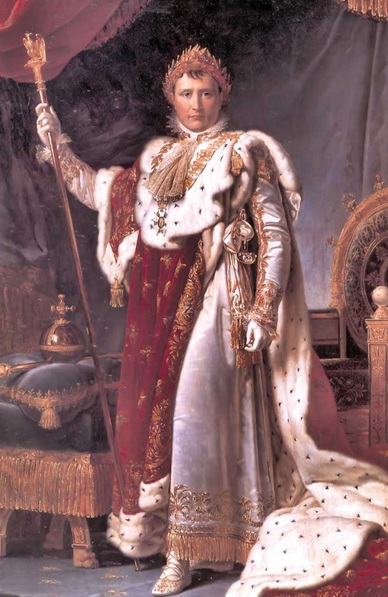
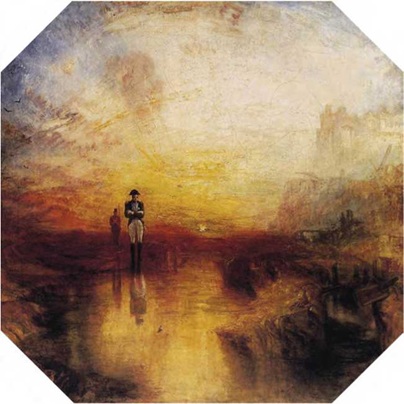
(These two pictures have been placed side by side as to illustrate the two extremes of Napoleon’s fate.)
On the left, the painting by Frangois Gerard describes Napoleon as Emperor of the French in the costume he wore during the coronation ceremony.
On the right, the painting by the great British painter Turner, “The Exile and the Rock Limpet” shows Napoleon in exile on the island of St Helena. The solitary figure contemplates a tiny sea shell, while the red palette recalls the trauma of battle.
An Extraordinary Man in a Hurry
Napoleon Bonaparte was born in Ajaccio, Corsica on August 15, 1769. He went to a military school and military academy in France. He was just 20 when the French Revolution started. At 24, he was made a brigadier general by the revolutionaries after his success in the conquest of Toulon1. In 1795, another success in suppressing a royalist riot against the Assembly in Paris gave him the post of Commander of the Interior. At 27, he was given the command of an army to invade northern Italy. His campaign of 1796-97 was a huge success and he came back to Paris as a hero.
He then conceived of an expedition to Egypt, as both a military campaign and a scientific endeavour. He left on May 19, 1798. The Egyptian campaign, despite its mixed results, was an early demonstration of the scope and vision of Bonaparte who already dreamed of large conquests — up to India — which could not materialize at the time due to severe material limitations.
Secretly, in August 1799, he sailed back to France after hearing disquieting news of the political situation back home. He took part in a conspiracy leading to a Coup on November 9 in which military force was used to establish a new regime called the Consulate. Bonaparte outmanoeuvred his co-conspirators and established himself as the sole real power with the title of First Consul. He was just 30!
Bonaparte plunged into the work of administering France with extraordinary energy. One major work he accomplished with the help of a few legal luminaries was to recast the entire body of laws into what would be known for ever as the Napoleon Code, still the basis of modern France legal system as well as those of many countries. A plebiscite made him First Consul for life in 1802, and in 1804 at the age of 35 he crowned himself Emperor of the French.
Apart from administering France and the Empire, he had to lead several successful military campaigns against various coalitions of European powers2. First as General, then First Consul, then Emperor, he defeated five coalitions from 1796 to 1809. Early 1812, the French Empire was larger than ever and, besides, Napoleon was controlling vast expanses of Europe as their “Protector”.
In June 1812 Napoleon invaded Russia. He reached Moscow in September, but after one month he had to order retreat. It resulted in the loss of a large part of his “Great Army”, harassed by Cossacks and decimated by a particularly severe winter. In 1813 and 1814, despite prodigies of energy and display of military genius, particularly in the celebrated Campaign of France, Napoleon, largely outnumbered by the allies of the Sixth Coalition, was compelled to abdicate in April 1814. He was then exiled as the ruler of Elba, a very small island below Italy.
Hardly a year later, amazingly, he managed to come back and re-establish himself as Emperor. But the Allies rejected his peace offers and launched the Seventh coalition against him. Napoleon was finally defeated at Waterloo on June 18, 1815. He was then exiled to St Helena, a rocky inhospitable island far in the South Atlantic where he died in May 1821. He was not yet 52!
Introduction
In spite of all the libels, I have no fear whatever about my fame. Posterity will do me justice. The truth will be known; and the good I have done will be compared with the faults I have committed. I am not uneasy as to the result. Had I succeeded, I would have died with the reputation of the greatest man that ever existed. As it is, although I have failed, I shall be considered as an extraordinary man: my elevation was unparalleled, because unaccompanied by crime. I have fought fifty pitched battles, almost all of which I have won. I have framed and carried into effect a code of laws that will bear my name to the most distant posterity. I raised myself from nothing to be the most powerful monarch in the world. Europe was at my feet. I have always been of opinion that the sovereignty lay in the people. In fact, the imperial government was a kind of republic. Called to the head of it by the voice of the nation, my maxim was, la carrière est ouverte aux talents [the career is opened to talents] without distinction of birth or fortune, and this system of equality is the reason that your oligarchy hates me so much.
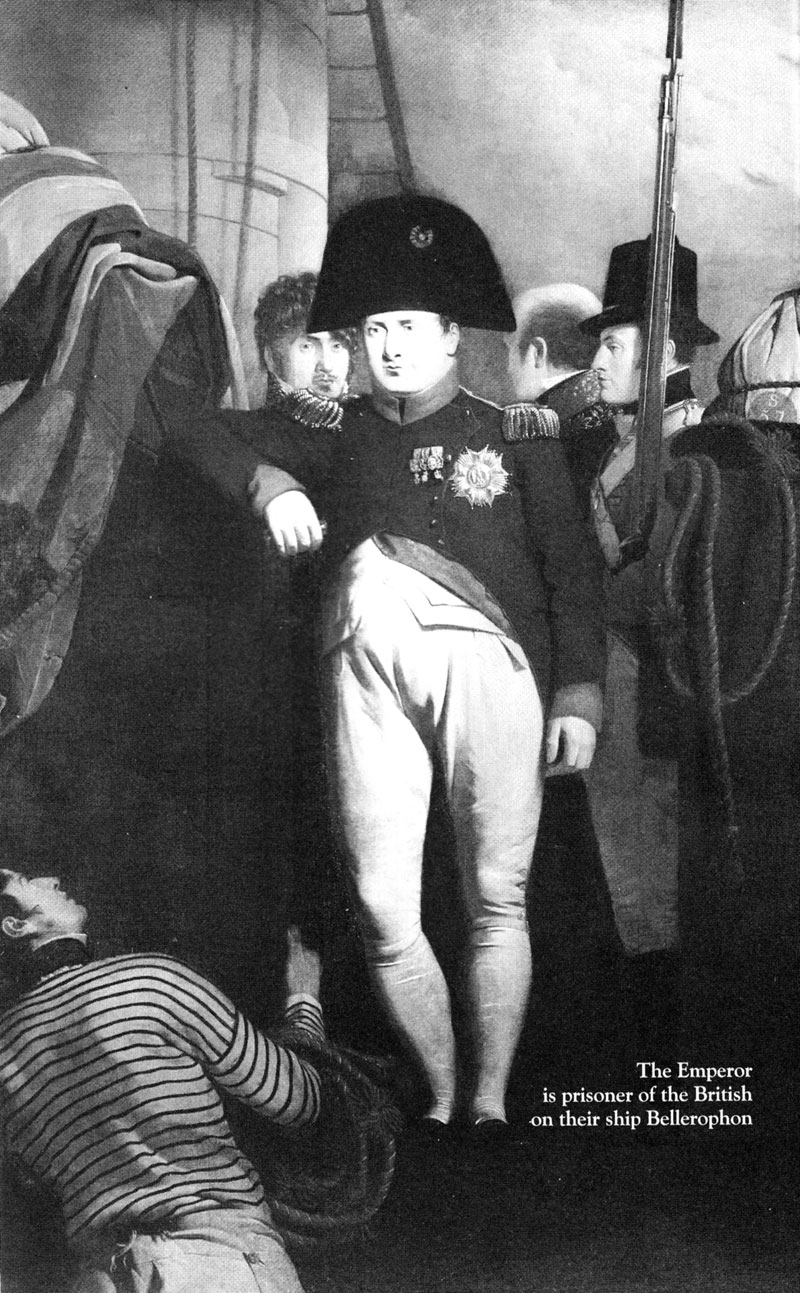
Thus napoleon spoke while reflecting upon his amazing career. That was in St Helena where an ungenerous British government had sent the ex-emperor. Napoleon had placed himself under the protection of England in the following words:
(To the Prince Regent of England.) Your Royal Highness
Exposed to the factions that divide my country and to the enmity of the powers of Europe, I have closed my political career, and I come ... to claim hospitality at the hearth of the British people. I place myself under the protection of their laws, which I demand from Your Royal Highness, as from the most powerful, the most constant, and the most generous of my foes.
But the allied sovereigns and particularly the British had had enough. They did not want to risk a repeat of the Elba island adventure, where Napoleon had been first sent as a ruler of that mini-state, which he then left after only a few months to reclaim his lost empire. This time they wanted to make sure that Napoleon would not rise again.
Napoleon vehemently protested,
August 4th, on board H. M. S. Bellerophon:
I solemnly protest here, in the face of heaven and of men, against the violation of my most sacred rights, in disposing of my person and of my liberty by force. I came on board the Bellerophon freely; I am not the prisoner, I am the guest of England. From the instant I boarded the Bellerophon I was at the hearth of the British people. I appeal to History! It will place on record that an enemy who during twenty years waged war against the British people came freely in his misfortune to seek a refuge under their laws; and what more striking proof could he display of his esteem and of his trust? And how did England reply to such magnanimity? She pretended to hold out the hand of hospitality to her enemy, and when he had placed himself in her power, she slew him!
For the next six years Napoleon was to live in that isolated rocky island in the middle of the South Atlantic Ocean, with a very difficult climate, a fact which surely contributed to his early death in 1821. Besides having to live in very rudimentary facilities, Napoleon had to suffer the meanness of the British Governor of St Helena who never missed any occasion to make the life of his illustrious prisoner more miserable. Napoleon saw that this persecution at the hands of the British would add to his legend:
January 1st, 1817. To bear misfortune was the only thing wanting to my fame. I have worn the imperial crown of France, the iron crown of Italy; England has now given me a greater and more glorious one, — for it is that worn by the Saviour of the world, — the crown of thorns.
Thus it was how this most extraordinary career was to end. When he was exiled, Napoleon was still quite young, not yet fifty. Given his prodigious energy and drive, if he would have been allowed by destiny to remain in power, he could have yet added more accomplishments to the Napoleonian epopee. We have to acknowledge that it is the Revolution that made this epopee possible. Napoleon is a product of the exceptional period of the French revolution. He himself was quite aware that, even with the same extraordinary abilities, he would probably not have the same opportunities that he was able to seize to rise so quickly to exceptional heights. The French army had lost many of its officers who, being from the nobility, had emigrated to escape the rigors of the revolution. Being supremely confident and competent, Napoleon, still in his early twenties, rose to the rank of general, something which could not have happened before the Revolution.
From that moment his truly remarkable talents took him in no time to the top of France and then to the domination of a large part of Europe.
But even this was not necessarily enough for him. Seeing no limits to his possible accomplishments, he even dreamed of a world empire.
Did not you yourself say to me: ‘You let your genius have its way, because it does not know the word impossible.’ How can I help it if a great power drives me on to become dictator of the world? You and the others, who criticise me to-day and would like me to become a good-natured ruler — have not you all been accessories?
I have not yet fulfilled my mission, and I mean to end what I have begun. We need a European legal code, a European court of appeal, a unified coinage, a common system of weights and measures. The same law must run throughout Europe. I shall fuse all the nations into one. ….This, my lord duke, is the only solution that pleases me. ...” (1812: Napoleon to his minister Fouche before the invasion of Russia).
This extreme ambition which saw no limits to what it can accomplish contained in itself the seeds of destruction. The invasion of Russia is a good example. If Napoleon had not embarked in this ill-conceived venture, France would not have lost so much of its Great Army and it is possible that the Empire would have lasted for a much longer time.
But, as Sri Aurobindo, the great sage and yogi, remarked, it is truly difficult to understand such extraordinary personalities. Here is what he wrote about Alexander and Napoleon:
But Alexander of Macedon and Napoleon Buonaparte were poets on a throne, and the part they played in history was not that of incompetents and weaklings. There are times when Nature gifts the poetic temperament with a peculiar grasp of the conditions of action and an irresistible tendency to create their poems not in ink and on paper, but in living characters and on the great canvas of the world; such men become portents and wonders, whom posterity admires or hates but can only imperfectly understand.
This insight from Sri Aurobindo and the expression that he uses to describe Napoleon’s fundamental nature, “Poet on a throne”, is indeed very illuminating. For it captures in a few words what is supremely important and radical in Napoleon’s temperament, the visionary urge.3 This was the basic force driving his superabundant energies. Already during the somewhat ill-fated Egyptian expedition he was dreaming of reaching India both for practical reasons — to get at the British enemy — and for the chance of building some new empire that he was dreaming of. It could not materialize at the time but the preoccupation with India remained with him all along. He also dreamed of united Europe and did try to bring it about repeatedly. One could find of course many reasons why it could not work — historians are still debating on this point — but one which is probably crucial is that, as Sri Aurobindo said, it was difficult to understand him and his grand schemes.
The visionary elan was supported by a superhuman energy: Napoleon was extremely demanding for his close collaborators who struggled to follow the fiery rhythm of his work. During the Consulate, after having spent the day governing, he would come towards the end of the afternoon to the Council of State where he had assembled experts in various fields and work with them through the night on different matters. This was how the famous Code Napoleon — a recasting of all the legal system of France to incorporate the progressive ideas of the Revolution — was elaborated. Often one or the other of the experts would show signs of utter fatigue only to be shaken awake by Napoleon.
“In these sittings,” says Roederer, “the First Consul manifested those remarkable powers of attention and precise analysis which enabled him for ten hours at a stretch to devote himself to one object or to several, without ever allowing himself to be distracted by memory or by errant thoughts.” ..
Not only are thirty-seven laws discussed at this table; furthermore, the Consul propounds question after question concerning other matters. How is bread made? How shall we make new money? How shall we establish security? He makes all his ministers send detailed reports, and this is great tax upon their energies. But he affects not to notice that they are overworked, and when they get home they often find letters from him requiring an immediate answer. One of his collaborators writes: “Ruling, administering, negotiating with that orderly intelligence of his, he gets through eighteen hours’ work every day. In three years he has ruled more than the kings ruled in a century.”
He did not like sycophants. After the long hours of work with the Council of State when he was First Consul he would often invite to dinner the person with whom he had argued the most during the frequent debates around their work.
When he noticed that the councilors were simply echoing whatever he said, he was quick to call them to order: “You are not here, gentlemen, to agree with me, but to express your own views. If you do that, I can compare them with mine, and decide which is better.”
The energy of Napoleon seemed to have the ability to spread much beyond his physical presence. At the beginning of the Consulate, as First Consul, Napoleon practically became like a dictator; it then looked as if a mass contagion of this new energy happened simultaneously in all the nooks and corners of France:
Within a fortnight after the coup d’etat, he had arranged for the establishment of tax-collecting offices in all the departments, for, as he put it: “Security and property are only to be found in a country which is not subject to yearly changes in the rate of taxation.” Two months later, the Bank of France came into being; next year, there were new boards to supervise taxation, the registration of landed property, and forestry. Whereas his predecessors had simply squandered the State domains, he used what was left of them to defray repayment of national debt. .. he continued the process of debt cancellation, renovated the Chambers of Commerce, regulated the Stock Exchange, put an end to speculation in the depreciated currency, stopped the frauds of the army contractors and other war profiteers, and by these and similar measures restored manufacturing industry whose productivity had sunk to a quarter or half of its former level.
What was his magical spell?
At the head of affairs was himself, a man of indomitable energy, and incorruptible. Men of the same stamp, energetic, diligent, and bold, were put in charge of the ministries, the departments and the prefectures. Favouritism was done away with; sinecures were abolished. Preferment was obtainable only by the efficient, and to them it came regardless of birth or party. All officials, down to the mayors, were appointed from above, and paid from above — “a hierarchy, all First Consuls in miniature,” to quote his own words.
On 29th. May 1816, in St Helena, he was remembering so many of these gigantic undertakings, which he called his “treasures” as they were the results of his continuous efforts, whether during rare peace times or even during wars, to upgrade and embellish the infrastructure not only of France but of a large part of Europe:
You want to know the treasures of Napoleon? They are enormous, it is true, but in full view. Here they are: the splendid harbour of Antwerp, that of Flushing, capable of holding the largest fleets; the docks and dykes of Dunkirk, of Le Havre, of Nice; the gigantic harbour of Cherbourg; the harbour works at Venice; the great roads from Antwerp to Amsterdam, from Mainz to Metz, from Bordeaux to Bayonne; the passes of the Simplon, of Mont Cenis, of Mont Genevre, of the Corniche, that give four openings through the Alps; in that alone you might reckon 800 millions. The roads from the Pyrenees to the Alps, from Parma to Spezzia, from Savona to Piedmont; the bridges of Jena, of Austerlitz, of the Arts, of Sevres, of Tours, of Lyons, of Turin, of the Isere, of the Durance, of Bordeaux, of Rouen; the canal from the Rhine to the Rhone, joining the waters of Holland to the Mediterranean; the canal that joins the Scheldt and the Somme, connecting Amsterdam and Paris; that which joins the Ranee and the Vilaine; the canal of Aries, of Pavia, of the Rhine; the draining of the marshes of Bourgoing, of the Cotentin, of Rochefort; the rebuilding of most of the churches pulled down during the Revolution, the building of new ones; the construction of many industrial establishments for putting an end to pauperism; the construction of the Louvre, of the public granaries, of the Bank, of the canal of the Ourcq; the water system of the city of Paris, the numerous sewers, the quays, the embellishments and monuments of that great city; the public improvements of Rome; the reestablishment of the manufactories of Lyons. Fifty millions spent on repairing and improving the Crown residences; sixty millions’ worth of furniture placed in the palaces of France and Holland, at Turin, at Rome; sixty millions worth of Crown diamonds, all of it the money of Napoleon; even the Regent, the only missing one of the old diamonds of the Crown of France, purchased from Berlin Jews with whom it was pledged for three millions; the Napoleon Museum, valued at more than 400 millions.
These are monuments to confound calumny! History will relate that all this was accomplished in the midst of continuous wars, without raising a loan, and with the public debt actually decreasing day by day.
We have already alluded to the remarkable intellectual capacities of Napoleon, his clarity of mind and precision, his unfailing attention and power of precise analysis, his utter concentration and moreover his exceptional endurance, able as he was to work long hours without faltering when most around him were getting exhausted. He also had the advantage of a prodigious memory:
His unfailing memory was the artillery wherewith he defended the fortress of his brain. Segur, returning from an official inspection of the fortifications on the north coast, sends in a report. “I have read your report,” says the First Consul. “It is accurate, but you have forgotten two of the four guns in Ostend. They are on the high road behind the town.” Segur is astonished to find that Napoleon is right. His report deals with thousands of guns, scattered all over the place, but the chief pounces on the omission of two.
Supreme intellectual energy but also physical energy: in this time of slow travel with horses, he could cover large distances better than anyone, often working continuously while travelling and yet hardy rest after arriving, plunging immediately in the business to be attended to. His way of relaxing was to take long baths. He apparently had a slow beating heart — as often have top athletes — and he himself said that the slow circulation of his blood was fortunate as it was counterbalancing the restlessness in his nerves “which otherwise would have made me mad.”
Napoleon also had one ability which must have been most useful for a man nearly constantly on the move: he was able to sleep nearly at will. While sitting, if he felt the need, he could take a nap of a few minutes which refreshed him to continue his incessant work. Legend had it that he could even sleep on horseback but it is difficult to see how he would have been able to maintain a rider’s posture! But this sleeping capacity must have been precious while travelling as he was so frequently doing in his special carriage:
But he speeds away again, and crosses Germany. Napoleon’s carriage is outwardly plain, but within it is comfortably built. The Emperor can sleep in it; by day he can govern from it, just as well as from the Tuileries or from a tent. He is the first to overcome the friction which brings movement to a standstill; and, though he does not travel as fast as we do nowadays, he travels faster than any man ever travelled before. Five days take him from Dresden to Paris. In a number of lock-up drawers within the carriage, he collects reports, dispatches, memoranda; a lantern hanging from the roof lights up the interior; in front of him hangs a list of the different places he must pass through, including where relays of horses are awaiting him. Should a courier reach him, Berthier, or another official who happens to be at hand, must take down the more pressing orders, while the carriage goes jolting on its way. Before long, orderlies are to be seen flying off in every direction.
This exceptional man, very conscious of his personal genius, was also able to be quite simple. He had a special relationship to his troops and soldiers called him affectionately their “petit caporal” (small corporal) as they were aware that he did care for their well-being even in the rigors of war. He could sit with them in bivouacs, eating the same food as them and discussing with them on various topics. The basic simplicity of his nature manifested even at the supreme moment of his career, during and after the ceremonies of his coronation as Emperor. On that day, he first did a gesture of amazing self-confidence:
Then, when the appointed instant has come, and all are expecting this man who has never bowed the knee to any one, to kneel before the Holy Father, Napoleon, to the amazement of the congregation, seizes the crown, turns his back on the pope and the altar, and standing upright as always, crowns himself in the sight of France. Then he crowns his kneeling wife.
Semblance never holds his attention, which always reaches out to the core of reality. Thus he is not bewildered even in this amazing hour. When he wants to whisper something to his uncle, who stands just in front of him during Mass, he gives the cardinal a gentle dig in the back with his scepter. As soon as all is over, and, alone with Josephine, he goes in to dinner, he says with a sigh of relief: “Thank God we’re through with it! A day on the battlefield would have pleased me better!” At their little dinner he tells her to keep on her crown as if he and she were poet and actress, for, he says, she is charming, his little Creole woman as empress. Thus, in the most natural way in the world, he unmasks the whole masquerade, and we are at ease once more as we see the son of the revolution laughing his own empire to scorn.
In fact, despite the unavoidable ruthlessness in a man waging relentless wars in which hundreds of thousand if not millions men perished or were wounded, there was a gentle side of Napoleon. He had a preoccupation with justice and it was one of the reasons which made him reluctant to divorce Josephine for matters of State. He, the strongman feared by so many foes, was strangely weak with his family, often to his own disadvantage:
My force of character has often been praised; yet for my own family I was nothing but a mollycoddle, and they knew it. The first storm over, their perseverance, their obstinacy, always carried the day; and, from sheer lassitude, they did what they liked with me. I made some great errors there. I did not have the luck Gengis Khan had with his four sons, who knew no emulation save that of serving him well. When I created a king, he at once considered himself by the grace of God. A delusion seized all of them that they were adored, preferred to me. (In St Helena, May 24th 1816)
So was Napoleon, a man uniquely gifted, visionary, epic dreamer, with an iron will yet showing himself at times to be strangely vulnerable like in his relationship to the frivolous and sometimes unfaithful Josephine, whom he passionately loved to the point of being at times quite distracted during some difficult campaigns such as those of Egypt and Italy when he was yet only General Bonaparte. It is also remarkable to see that this man so endowed with a military genius which made him win most of his battles was at the same time acutely aware of the limitations of military force:
“Do you know what amazes me more than any else? The impotence of force to organise anything. There are only two powers in the world: the spirit and the sword. In the long run, the sword will always be conquered by the spirit.”
He was quite aware that the supreme power that he had been able to acquire was subject to fatality and nature’s whims, as happened when “General Winter” defeated his Great Army in Russia. With all these contradictory aspects of his personality, Napoleon continues to hold a real fascination for the peoples of the world. He is one of the human beings most written about in History. We hope that the few texts we are presenting in this monograph will help the reader to know a little more about this multi-faceted genius.
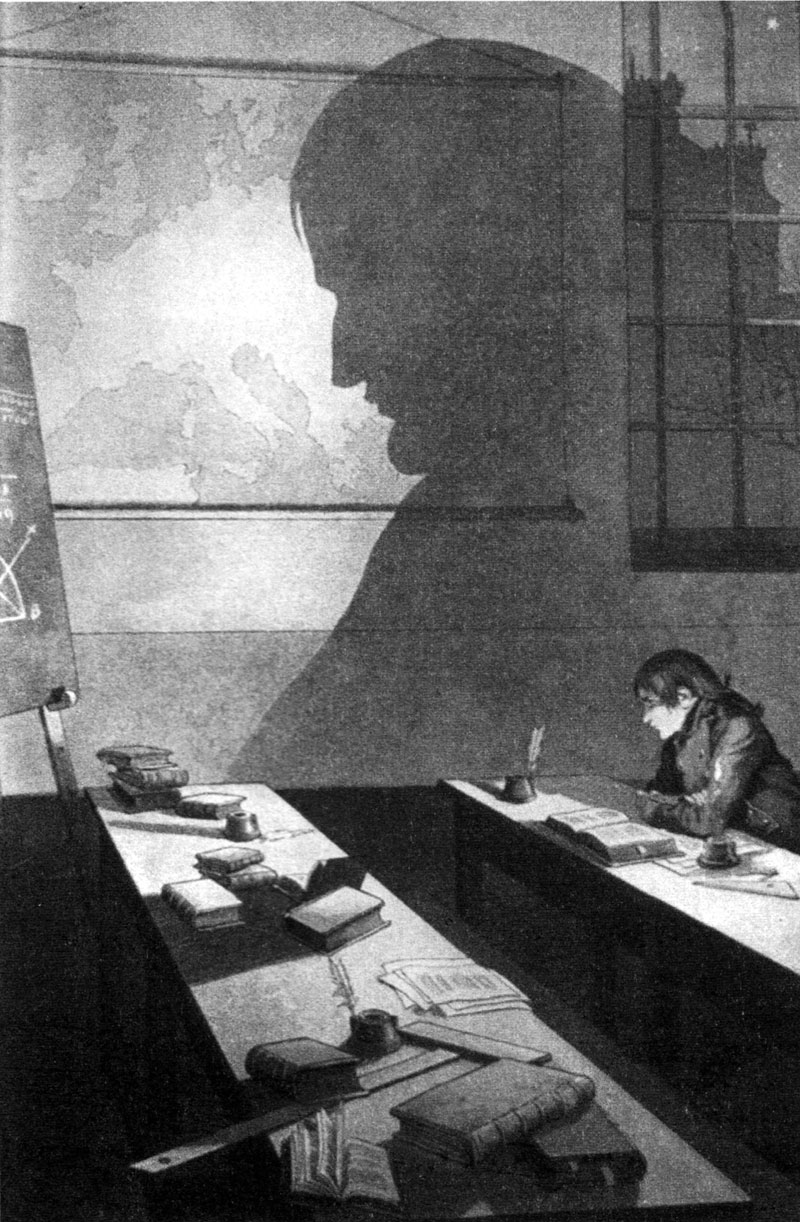
(This drawing represents the young Bonaparte on the school benches. His shadow reflects the greatness of the adult and suggests the idea of a unique destiny.)
Napoleon Our Last Great Man
“Napoleon... our last Great Man!”
— Carlyle
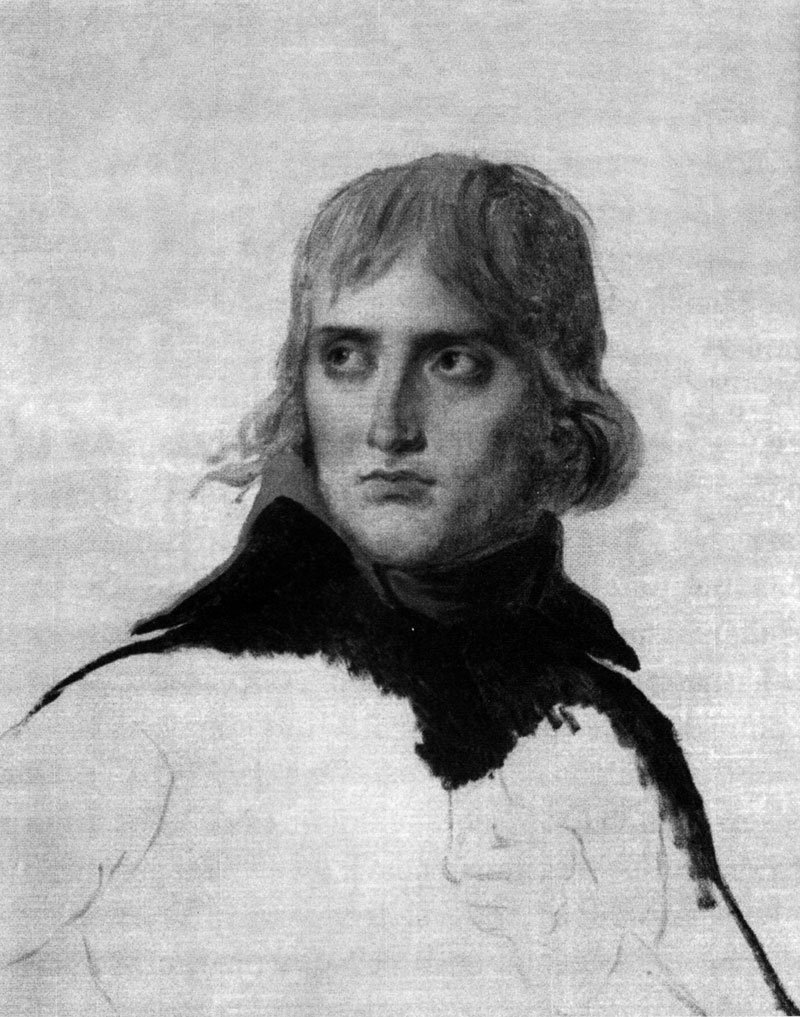
(The General Bonaparte, by French painter Jacques-Louis David)
Book I - The Man
He was known in France not as General, or Consul, or even Emperor, or even by his name, but simply as ‘The Man.’
— Lord Roseberry
Why does Napoleon fascinate us, why does his name lend scope to the imagination? Because he is so multifarious, so bountiful in mind and action; so salient, so luminous, so inexhaustible. Having accomplished so much, nothing seems beyond the compass of his possibilities; the world when face to face with him seems to contract, seems under the spell of his titanic intellect.
He is everywhere. Europe all dotted with his victories is his manoeuvre camp. His activity is never localised; he enters all the capitals of Europe and thence dictates to kings and emperors. He fights his battles in all lands, finds no obstacle in man or nature to his onward march. At his behest mountains shrink and rivers roll back their waters, as it were. He scales the Alps with his artillery, leads his army across the desert, bridges the Danube in the face of the enemy. Palaces are his headquarters, his high tribunals; Schoenbrunn, Sanssouci, the Kremlin, so many resting-places, where only God’s anointed rest.
We see him as in a dream mesmerising the kingdoms of the earth into submission.
From the obscurity of lieutenancy he rose, as by magic, to the dizziest heights of human power, raising France from a state of political chaos and unrest to the proud position of arbitress of Europe.
His rapid rise to power, through obscurity and poverty, is unprecedented.
He is General of Artillery at 24, and Lord of Italy at 27. It seems but the transition of a day from the miseries of penury, when we see him in the bare, cheerless little room at Auxonne, a solitary figure, poring over his treasured books, his eager, encyclopaedic mind feasting voraciously on the history of antiquity, to the semi-regal splendour of Montebello and Passeriano.
We wonder if at times, in the solitude of his humble sanctum, before Fortune had lavished upon him her smiles and favours, did visions of future renown and supremacy in Europe haunt the secret recesses of his impenetrable soul? Or, did he foresee (when in command of the artillery of the Army of Italy, two years before his wonderful campaign of 1796-7), when for the first time he beheld the Alpine regions of Italy, that eleven years later the crown of the Lombard kings, united with the diadem of Imperial France, would encircle his brow?
He sails for the Orient. In the Plain of Embabeh, where the immutable pyramids point to the sky, he evokes the Spirit of the Ages as witness of an army’s heroism. He fords the Red Sea — marches into Syria for the conquest of the East, a dream, alas! never realised in its entirety. Before the walls of Acre he is brought to bay, his first reverse, that shatters all his hopes of an Asiatic Empire. He retreats into Egypt, sets sail for France, where he is hailed as a deliverer. He overthrows the Government — is proclaimed First Consul. Like a thunderbolt he falls upon the Austrians from the snowy defiles of the Great Saint Bernard, and on the field of Marengo wrests Italy from Austria’s grasp.
Yet the Consulship fails to cloy the world-embracing ambition of this enigmatical genius; he now aspires to still higher flights of Omnipotence, and with the sang-froid of the conqueror we see him place the Imperial Diadem upon his brow, thus reviving, over the embers of the Revolution, Charlemagne’s Empire of the West.
Now begins a succession of wars on a stupendous scale — a cataclysm, that overwhelms the impotent monarchies of Europe, whose tide rolls with unbridled fury from the Guadalquivir to the Dnieper.
He, like the genius of arbitrary war, impels its frenzied course; we see the world upheaved, we hear the crash of falling empires, the resonance of the blows dealt by the Titan at coalesced Europe — Ulm, Austerlitz, Jena, Friedland, Wagram, Borodino, Dresden, were the felling blows under which the universe oscillated.
Then comes his fall, imprisonment and agonising death on the isle, immured in the wastes of the Atlantic; the whole is replete with the grandeur of the tragedy that belongs to Greek mythology. His overthrow, that cost the world such a terrible effort, seems rather to enhance than lessen his greatness, for, if ever human might was tested to the utmost limit of its capabilities, then it assuredly was when Christendom banded itself in a crusade for his undoing.
We have the harrowing story of his martyrdom and torture on the rock. Despite the lurid colouring which so hideously depicts his captivity and lingering death under the relentless tyranny of his despicable jailors, he seems, there in Saint Helena, in the lowering evening of his momentous life, if anything, perhaps greater than at any other period of his astounding career — his captors, beside him, appear like pigmies guarding a giant, scarce discernible in the empyreal blaze of his personality and genius.
Napoleon is so modern; he is so near to us; his greatness reaches out to us and affects us potently; the vigour of his personality still casts its spell upon us. It is not so long since his legions marched and counter-marched through Europe, since every hamlet from Calabria to Lithuania saw the watchfire of a French bivouac, since every goatherd from the Brocken to Mulhacen heard the measured beat of French drums, since the blare of French bugles echoed in every valley from Andalusia to Moravia, since his victorious banner waved over every capital between Moscow and Lisbon, since his artillery thundered at Borodino and Leipzig, since his cavalry charged on the Pratzenberg and over the field of Waterloo.
The great interest manifested in everything Napoleon ever did, be it for good or for evil, is due to his modern-ness combined with his prepollent genius — besides, he was a century ahead of the times. Is it therefore surprising that his wrongdoings loom forth with a sinister imminence, just as his extraordinary exploits still bewilder the intellect, that we are apt, owing to their flagrancy, to forget his many acts of magnanimity or the beneficence to the world of some of his apparently most despotic deeds? We forget that if he conquered Italy it was only to infuse among her people a spirit of unity that eventually germinated into a liberty loving and united Italy, for in a great measure to Napoleon is due the unification of Italy; that if he conquered Egypt it was only to lay the corner-stone of her prosperity; that if he conquered Germany it was only to sweep from her face the cobwebs of mediaeval institutions with his immortal Code, and by the weight of his depotism to unite all Germans into that mighty confederation of states, the present German Empire; that if he twice subjugated Austria he yet spared her from annihilation; that if he utterly shattered Prussia he yet allowed Frederick William to occupy the throne of the victor of Rosbach; that if he misled the Poles in their hope of an autonomous government and shed their life-blood on many a battlefield, it was only to emancipate them from the hated yoke of Prussia and in the Grand Duchy of Warsaw to give them a foretaste of a regenerated independence.
Book II - Napoleon and the Orient
The East only wants a man. The master of Egypt is the master of India.
— Napoleon
Perhaps no epoch in Napoleon’s life is so intensely interesting or furnishes such an opportunity to analyse his character, philosophy, and religious opinions than that of his Egyptian expedition, for he is there under the seductive influence of the Orient, that ever since early days had deeply fascinated him and affected his imagination. What we here find, which is truly unique in the history of human nature, not without a tinge of the uncanny, and which the profoundest psychologist would study in vain for a solution, is the contact of the most stupendous intellectual riddle of modern times with the mysteries of the unsolvable East.
To what a degree he was influenced by the Orient is clearly shown in his conversations with Gourgaud, years later, in Saint Helena, when he expatiates largely on Mohammedanism, placing it above Christianity, as being simpler and to him more convincing, seeing that it took considerably less time to propagate than the latter.
The Sheiks, moreover, seem to have made a deep impression upon him when they declared the followers of Christ to be little better than pagans in worshiping three deities.
At the same time he professes himself a materialist, at least he affirms as much to Gourgaud and denies the Divinity of Christ, and yet he declares that he believes in a God. “Everything,” he says, “proclaims the existence of a God. That cannot be questioned.” Still he cannot reconcile himself to religion. All religions, he avers, are the invention of men. Why should there be so many? If the Christian religion is the true one, why has it not always existed? What, he asks, has become of all the virtuous men who have existed before its foundation? His own existence is beyond his comprehension, for he compares himself to a watch with all its works in motion but which is yet unconscious of its existence. He attributes all religious dissensions to the fraud and falsehood of the priests, and his own scepticism with regard to religion in a great measure to their iniquity and rapacity. ... The admission, Je suis Catholique parce que mon pere I’etait et parce que cetait la religion de la France (I am a Catholic because my father was Catholic and because it was France’s religion) is nothing less than an avowal that choice had little to do with the fact that he was a Roman Catholic. This absence of a sense of religion in his incomprehensible nature is imputable to the man’s extraordinary force of character, the illimitable power he exercised over human destiny, and to his vast superiority over all other men. The bloodstained fields of sixty battles, with their myriads of dead and dying, exhibited to him life in its darkest and most hideous form, and, naturally enough, made him a sceptic and pessimist. At Saint Helena he affirmed to Gourgaud that war and the continuous sight of the dead made him a materialist, that everything is matter and death ends all. His superhuman faculties, that raised him so immeasurably above the rest of mankind, his pre-eminence in war and statecraft, and in whatever conduced to accelerate the understanding, tended to alienate him from humanity and likewise from all religious affinities. That he estimated his greatness to be paramount to that of any human being in existence is attested by his assertion that he was different to other men; morality — political, social, or otherwise — and the everyday principles of life were, he declared, very well for ordinary mortals, but could not be aptly applied to him. Viewing them in reference to himself, to his mind they conveyed no meaning except in the abstract. Scruples he set aside, conscience he discarded, and set himself above humanity. Had he been religious, would he have debased the Pope, degraded him in the eyes of the world, stripped him of all temporal power and cast him into abject captivity? He truly remarked that had he been religious he could never have achieved what he did — and this is undoubtedly true.
Yet the composition of this perplexing human problem is not wholly devoid of superstition akin to Deism; for what motive is it that prompts him on the ship l’Orient, during his journey to Egypt, to designate to the savants who accompanied him the star- strewn firmament of night, and ask, “But, Messieurs, who made all that?” in refutation of their assertion that all is matter, and of the non-existence of a Divine Ruler, if it be not a conviction in him of the presence of an All-provident Being?
Of all Napoleon’s astounding undertakings, both of a civil and military character, this Eastern expedition in many respects takes precedence as being so full of striking contrasts and dramatic effect, where we see the diverse phases of his resplendent mind in full play, brilliantly illumined by the light of his originality.
The marvellous facility with which he assimilates his intensely modern and practical individuality with the languor of the elusive Orient is as remarkable as the ingenuity and diversity of his complex nature.
At one time he discourses with the Muftis or Imams of Cairo with a fervency that would have done credit to an Eastern zealot; at another he announces himself and his followers to be faithful Mohammedans, for he says, addressing the Egyptians, “Are we not true Moslems? Is it not we that overthrew the Pope and destroyed the Knights of Malta, who bade Christendom wage war against you?” Then he stands in the light of a liberator — had he not come to deliver them from the oppression of the detested Mameluke?
By similar promulgations he endeavoured (on the whole with remarkable success) to reconcile the Egyptians to the foreign invasion. The grandiloquence of their wording illustrates how fully he appreciated the impressionable temperament of the Oriental, so prone to be influenced by a display of personal or rhetorical extravagance and susceptible to whatever has a proclivity to stimulate the imagination.
As a prelude to the battle which he is about to wage at the foot of the Pyramids against the chivalry of the East, he infuses additional enthusiasm into his legions with the stirring but somewhat dramatic address, “Soldiers, from the summit of these ancient monuments forty centuries look down upon you” — words well befitting the situation and circumstances, and calculated to appeal effectively to the highest ideals of a heroic soldiery, and impart to them a superabundance of militant animation. Never did Napoleon’s genius shine with a brighter lustre, in the midst of adversity, than during this sojourn in the East. The disaster of the Nile, where his fleet was all but annihilated, far from depressing his indomitable spirit, or reducing his energy, only tended to accelerate the vigour of his resourceful mind and acted as a powerful lever to his inherent propensity for administration and invention.
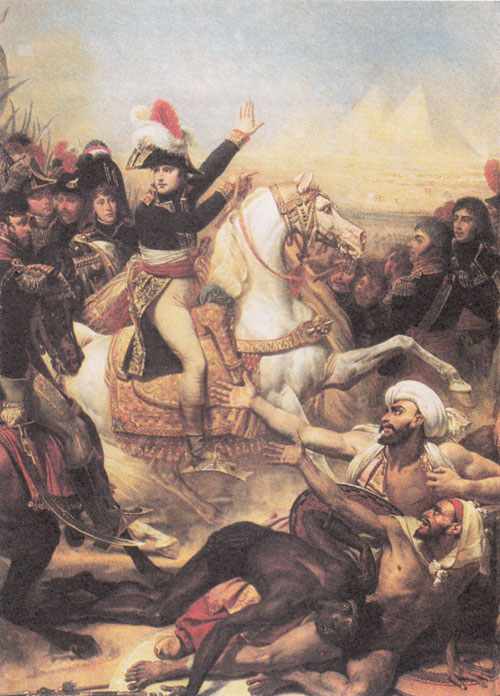
(Napoleon encouraging his troops, “Soldiers, from the summit of these pyramids forty centuries look down upon you”.)
(The Battle of the Pyramids)
Cut off from France and all intercourse with Europe, with the British fleet triumphant in the Mediterranean, he, with a soul serene and undaunted, turned his attention to the development of the arts of peace and progress, to husbandry, science, astronomy, and to topographical surveys of the country, the Delta and the Nile. The archaeological wonders of Memphis now met for the first time the profane gaze of Western civilisation. Corn, rice, and vine were cultivated, bakeries, foundries, and workshops were constructed, and buildings erected for the manufacture of gunpowder. These manifold undertakings were carried out with a celerity rarely if ever equalled, considering the scanty resources at his disposal. Perceiving the great swiftness and power of endurance of the camel and its natural immunity from the rigorous heat of the climate, he, with his innate propensity for improvement, innovated a special camel corps, attached to his army — the first corps of its kind in Egypt — principally for the purpose of harassing the enemy in the open desert and the transmission of intelligence. Last, but not least, he founded at Cairo the Institute of Egypt, a society composed of physicists, with Monge as president, whose aim was the propounding and advancement of scientific knowledge.
Thus Egypt, under his enlightened and vigorous rule, saw herself emancipated from the trammels of semi-barbarism that for centuries had kept her former intellectual splendour in subjection, and beheld in him the restorer of her most glorious era (when she centred in herself the learning and culture of civilisation4), resuscitated, as it were, from an age of ignorance, and henceforth to be distinguished as the Renaissance in Egypt.
Egypt, after Napoleon’s exit, relapsed into a state of lethargy, from which she was not to be roused until the genius of Mehemet Ali once more drew upon herself the attention of the world, recalling the exploits of a far rarer and brighter luminary.
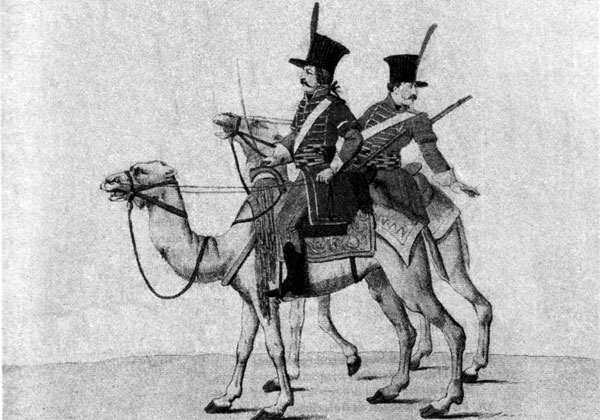
(French camel corps)
Book III - Napoleon and the West
I wished that the title of Frenchman should be the best and most desirable on earth, and that the French nation should be justly entitled ‘The Great Nation.’
— Napoleon
In consequence of important tidings regarding the critical situation in France, the loss of Italy and the threatening attitude of a formidable coalition, Napoleon resolved, in the midst of these herculean toils, to leave the ambiguous Orient and return to the country of his adoption, now well-nigh distracted by civil dissension, his most cherished aspiration — an Empire rivalling that of Alexander, and extending from the solitudes of the Lybian desert to the sacred Ganges — having, from the day he raised the siege of Acre, proved but a chimera of the land of dreams.
So, in the summer of 1799, accompanied by Lannes, Murat, Duroc, and others of his devoted companions in arms, he embarks for Provence, propitious and promise-laden winds blowing this daring spirit over the “Midland Sea” to the coast of Europe, which were long he was to confound and subjugate.
Landing at Frejus, on the Provence coast, October 9, 1799, he is greeted there with every demonstration of enthusiasm as the conqueror of the East.
Within the space of a month from the date of his touching French soil, he is absolute master of France.
Once in Paris, in the vortex of political hysteria, with his characteristic daring and alacrity, he assails the Constitution — the Directory, at the auspicious moment, having in the interim, with consummate artifice, matured his plans for his elevation to supreme power.
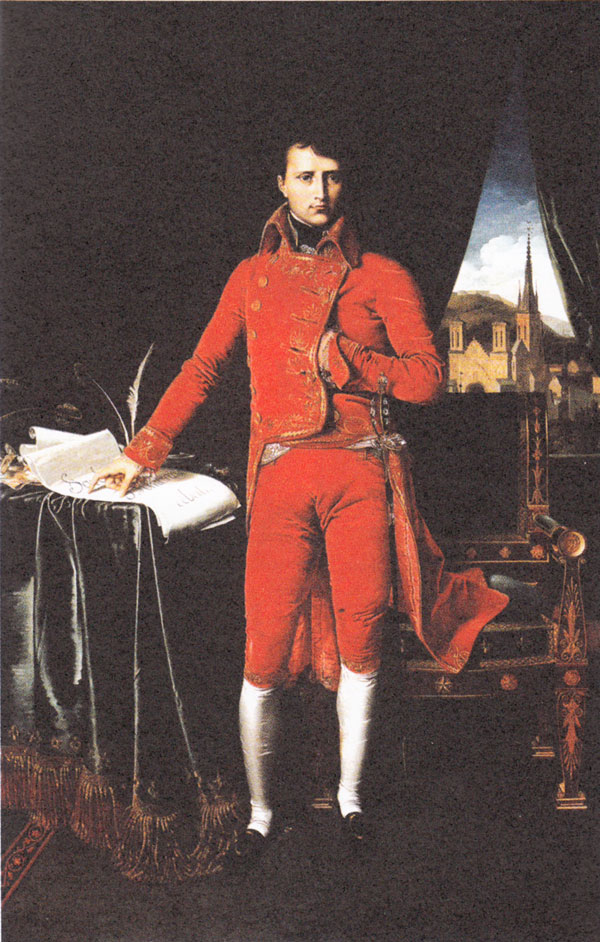
(Portrait of Napoleon Bonaparte as First Consul, by Ingres)
Backed by his coadjutors, his brother Lucien, Sieyes, Barras, and Ducos, he annuls or, to be more accurate, dispels, with his grenadiers, the Council of Five Hundred, assembled at St. Cloud, and shapes a new Government, drawn upon republican lines, the legislative authority being vested in three magistrates or consuls, he subsequently taking precedence with the title of First Consul, with administrative prerogatives as entire as those of any dictator.
We may here pause awhile to cast a retrospective glance upon the remarkable manner in which fortune or chance, or whatever it be, befriended Napoleon on his journey from Egypt, and to indicate how mightily an event, had it come to pass, would have affected the whole trend of modern thought.
This hypothetical event, that might as likely as not have been an accomplished fact, was his capture by the British in the Mediterranean. Had Nelson, after the battle of the Nile, kept in the proximity of Egypt instead of being lured to Naples and succumbing there to Circean wiles, and had Sir Sydney Smith not been detained at Cyprus, whither he betook himself to refit, the history of the next hundred years would have had a different significance. The intellect of manhood would not have been dazed by such a rapid succession of extraordinary events, the modern world would never have known such overbearing military might, nor could it have conceived the art of war carried to such a pitch of colossal extravagance. The nations of Europe would never have been welded into a conglomeration of vassal states with him as suzerain, nor would we have witnessed the unprecedented sight of one man dictating to a continent with all its potentates from the Straits of Messina and Gibraltar to the Niemen ancillary to his will.
The unity of Germany and Italy would undoubtedly have been deferred to a much later date but for his wars that kindled, in the former country more especially, the flame of patriotism, that amalgamated all Germans in a common cause — the liberation of the Fatherland.
Many a feudal law valid then in Europe might have remained in vogue much longer but for his Code that enlarged the horizon of legislative administration, yielding an ampler scope for the diffusion of a more rational system of legal dispensation.
But for the vicissitudes of life and the frailty of human nature, the advancement of mankind would assuredly have been deferred by at least ten decades, for it is preposterous to imagine a mental force as cogent as Napoleon’s, as his substitute, assuming he had never existed.
During Napoleon’s absence in Egypt Italy had been lost to France, the allies under Suwarrow having driven the French from all his recent conquests, Massena, invested in Genoa, alone presenting a defiant attitude to the victors. He found the army demoralised — the results of his late achievements entirely undone.
With his advent, however, the whole position is transformed into one of triumphal sublimity. The Alps are no longer Nature’s insurmountable barriers, but a high-road leading the French to glory and conquest.
The breast of every Gallic warrior throbs in unison, a pulsation born of the fire of martial frenzy as they behold their mighty leader, like Mars incarnate, guiding them over the mountain desolations to gather fresh laurels, to bedeck their battle-furrowed brows in fields consecrated by the blood of heroes, their former companions in glory.
By his victory at Marengo Napoleon reconquers the whole of Italy. Although not to be compared, as far as the number of combatants is concerned, with his other gigantic victories, still, in its abiding results, Marengo was perhaps the most potent of all his mighty triumphs, its effects lasting thirteen years. It is moreover distinguishable as being the only great victory he all but lost, that closed with signal success and brought him the longest term of peace.
The plan of this campaign is the most daring, not to say original, in the annals of modern warfare, its strategy the most subtle. The audacity of attacking the enemy from the declivities of the Alps, the impregnable bulwarks of Italy, is as amazing as the master-mind that conceived it. The undertaking was strenuous to a degree and taxed the endurance of his heroic army to the utmost. The artillery, cavalry, and ammunition were conveyed over the wilderness of ice and snow and the dizzy brink of precipices, with a celerity that seems to pertain rather to the domain of legendary lore than to the solemn reality of authentic history.
Some writers are inclined to reckon Hannibal’s passage of the Alps as a greater feat than that performed by the consular army of France that culminated in Marengo, and ascribe to it a greater share of glory, their plea in favour of the Carthaginians being that they were harassed on their march by hostile tribes of Gauls and encumbered by elephants. Albeit our last design is to depreciate the mighty exploit of the greatest military genius of antiquity, nevertheless, the achievement executed by the French army in 1800, if it does not surpass, certainly equals that of the Carthaginian hero. Despite the casualties among his soldiers, the difficulties to Hannibal’s march over Mount Genevre (presuming this to have been the route taken by him in his invasion of Italy) were not so immeasurably greater than those which Bonaparte had to contend against in his passage of the Great Saint Bernard, as some writers postulate. In any case a comparison between Hannibal’s achievement and Bonaparte’s, performed 2,000 years later, seems unreasonable — a just one impossible. Both exploits were marvellous feats which only such men as these were capable of executing — both equally extraordinary for their respective ages.
The peace of Luneville, that followed Marengo, gave Napoleon leisure to concern himself with the internal affairs of France. We now see him applying his vigorous intellect to questions concerning the Church, its re-establishment in France, and the renewal of salutatory understandings with the Holy See. It is highly improbable that the Concordat was the product of feelings of a religious nature in him, but rather the outcrop of legislative ideas compatible with the welfare and domestic stability of France. The Organic Articles which he subsequently affixed as a corollary to the Concordat, without sanction from the Pontiff, sufficiently prove how little he dreaded the prerogatives of the Court of Rome and how drastic were his measures towards the liberties of the clergy.
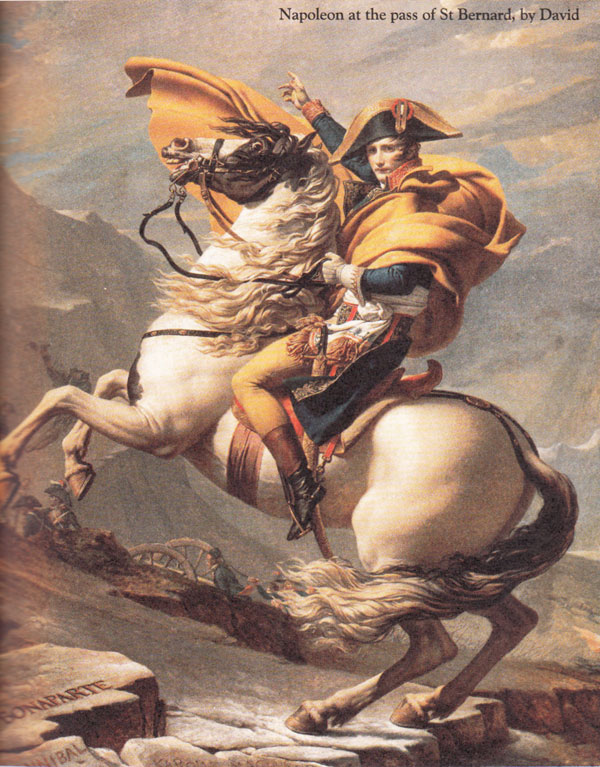
(Napoleon at the pass of St Bernard, by David)
Whatever Napoleon’s shortcomings may have been — and we fear he was as far removed from impeccancy as the rest of humanity (was he not after all but mortal like ordinary men?) — dissimulation in religious matters can scarcely be reckoned as a failing of his. There is no instance in the whole course of his career in which he admitted holding religious convictions, whereas there are many which prove that his views were anything but consistent with dogmatical faith. He who had reopened the churches in France, restored to her ancient religion, and by the Concordat brought France once more in touch with the Holy See, might well be supposed to harbour strong feelings of religion, but from the outset Napoleon never attempted to dissemble his opinions with regard to spiritual matters as he might well have done had he been a hypocrite, for at Malmaison (Josephine’s beautiful country seat near Rueil), at the time when the Concordat was but newly instituted, he averred to Volney the Orientalist and others, during a discussion on the ecclesiastical concerns of France, that he believed not in Christianity, that in re-establishing the Church in France he acted not so much in conformity with his own wishes as with those of the French people. If this be not candour, what then is? Had he wished to pose as a good Catholic, as a sincere Christian, to simulate a belief negative in him, surely nothing would have been easier. The motives that incited him in re-establishing the Church in France were purely of a political nature. He no doubt deemed that a religion of some sort was more compatible with legislative stability than the irreverent doctrine of the Revolution, and therefore chose the Roman Catholic faith as the religion of France, in preference to the Protestant, as being in the first place her pristine faith, and secondly less subject to sectarian dissensions than the Protestant, and in consequence the more readily controlled by the ruling will, namely, his will. [...]
Although, in moments of dejection, Napoleon frequently condemned his pact with the Holy See — to wit, the institution of the Concordat, which really meant regret for the revival of Christianity in France — he nevertheless held religion to be so essential to her welfare, that at Saint Helena he asserted that religion was such a necessity to France that had there been no Pope, one ought to have been created if only for the sake of the Concordat. Strange, incomprehensible being! The thing he rejected as regarded himself he yet deemed of vital moment to the interests of mankind. Still more, he could even appreciate the full significance of religion in connection with others. The tolling of the church bells of Rueil moved his imperturbable soul deeply. If this call to divine worship could so affect him, how much more, he declared, would it not appeal to the truly devout? [...]
The liberality of Napoleon’s all-providing genius is forcibly characterised by his formation of an Order for military and civil merit — the Legion of Honour, thereby inciting the abilities of the civil classes as well as those of the military, and consequently widening the range of human capability and stimulating its aspirations.
Education likewise received the impress of his strenuous personality and benefited largely from his organising genius, although its centralisation in the University of France, and the military-like system of its administration, were undoubtedly hurtful to a thorough development of primordial talent, that, after all, only fructifies fully in an atmosphere of entire freedom.
We have already alluded to the Code, that colossal monument of legal ramifications and its beneficent influence to Germany. How arduous was its adjustment from a chaotic mass of legal tangle into a practical instrument of law may be imagined, when we take into account that besides State administration it embraced family, matrimonial and divorce regulations, and division of property. It was adopted by Italy in 1806, and subsequently, in part, by several of the South American States. Napoleon instituted it in Holland and North Germany; its influence has been felt in Prussia, Central and Southern Germany, Switzerland, and Spain. This stupendous legal fabric shows the magnitude of the area of Napoleon’s mental comprehension and his astonishing grasp of administrative detail.
On August 1, 1802, Napoleon is appointed Consul for life. How universal was his popularity and firm his hold on the imagination of the French people is amply substantiated by the overwhelming majority of votes in favour of his life tenure of the Consulship.
The Consulship for life foreshadowed the splendour of the empire that was to emulate, in the modern age, that of Charlemagne. Proclaimed Emperor, he places with his own hands the Imperial crown, which he had won with his invincible sword, upon his brow. Shortly afterwards, in the cathedral of Milan, he crowns himself King of Italy with the iron circlet of the Lombard kings. Thus, we behold him, who ten years previous was unknown to fame, the ruler of an empire almost as vast as that of the Carlovingian hero.
A few observations in connection with the rites attending Napoleon’s coronation may perchance clarify his motives for an apparent ostentatious exhibition of exuberant magnificence at the ceremony that some writers attribute to an immodest spirit of audacious effrontery, actuated from the instincts of the vulgarian, but which, to those who have attempted the analysis of his occult character, would seem to pertain rather to his boundless ambition and to a yearning that ever goaded him into accomplishing deeds unsurpassed in magnitude in former and perhaps future ages. His enjoinment to the Pontiff to repair to Paris to lend additional solemnity by his presence to the functions of his coronation, was a procedure instigated more from a sense to accomplish an historical precedent and to demonstrate to the world a pre-eminence that even surpassed that of Charlemagne, than from motives emanating from the intuitions of the parvenu or tumid vulgarity.
His injunction to Pius VII to attend his coronation, and the presence of the Head of the Catholic Church in Paris, on a mission derogatory to the confirmed principles of the Holy See — a mission preternatural in history — and his supercilious demeanour towards the Pontiff in repudiating from his hands the diadem of the West, thus disdaining the prerogatives of the Church in such observances, was a manifestation that besides his hankering to outstrip all past renown, he likewise disowned, as far as his own person was concerned, the spiritual control wielded heretofore by the successors of St. Peter, placing the Church in subservience to his ambition and glory.
Book IV - Napoleon and Europe
With 800,000 men I can oblige all Europe to do my bidding.
— Napoleon to Fouché
The autumn and winter of 1805 is noteworthy in history as having witnessed possibly the most brilliant and rapid military evolutions to be recorded in the annals of modern warfare. A mighty coalition is stricken down by the death-dealing blow of Austerlitz, that likewise presaged the dissolution of the remnants of the Holy Roman Empire; the proud House of Austria lies prostrate at Napoleon’s feet; the arrogant host of the Czar is hurled back discomfited into Russia; and the whole of Germany submits to the dictates of the modern Caesar. This succession of stupendous events was accomplished within the amazingly short space of less than three months! With his magnificent army, that from Boulogne had cast its ominous war cloud upon the coast of Britain, Napoleon marches with incredible celerity against the enemy and deals the first staggering blow at Ulm, one day before the disaster of Trafalgar, which, however, is completely eclipsed by his overwhelming triumph in Moravia, he becoming thereby arbiter of Europe, a state of pre-eminence never (at least in modern history) until then attained by mortal. Was ever rise to dizzy heights of power as astounding and bewildering as his, or a preponderance of mental vigour equal to that which was concentrated in the mind of this prodigious enigma of the human race? Eleven short years sufficed to raise him from comparative obscurity and indigence to an apotheosis of power and supremacy which is without a parallel throughout the whole course of modern history.
Within this same space of time Napoleon’s physical conformation underwent as remarkable a transition as that which took place in his destiny, whose star now soared resplendent in its ever-ascending course towards its zenith.
From a spareness of build that almost verged upon atrophy — for which he was remarkable in early youth as we know him throughout his glorious Italian campaign, and as he is delineated in our conception of him even after Marengo — his figure had now assumed more ample proportions, which in after-life developed into a state of plethora; but the beauty of the face, Caesarean in semblance, except for a greater fullness, scarcely underwent any change. The clear-cut features, as though chiselled in marble, were the same. To the expression of almost superhuman energy was added one of intense thought. The unreadable grey eyes, yet piercing, were full of the melancholy of insatiable desire, that lent an additional interest to the grandeur of the countenance. The forehead, lofty and smooth as a sphere, seemed the receptacle of the intellectual virility of a world. Such was the aspect (crudely as it is here portrayed), near the meridian of his marvellous career, of the world’s greatest human phenomenon.
By the treaty of Pressburg, ratified about three weeks after Austerlitz, Napoleon raised the Electors of Bavaria and Wurttemberg to the dignity of kings. To his kingdom of Italy he joined Venice, Istria, and Dalmatia. The Tyrol and Vorarlberg were transferred to Bavaria. Baden, sublimated to a grand duchy, was enriched by a part of Swabia, the remainder being apportioned between Bavaria and Wurtemberg. Finally, by a secret article, Austria was forced to pay a war indemnity of 5,600,000 British Pounds to France. By a separate treaty, signed at Vienna, Prussia gained Hanover as a compensation for the loss of Anspach and Bayreuth. In the ensuing year the Emperor Francis II resigned his sovereignty over Germany, restricting himself to his Austrian dominions. North and South Germany were now erected by Bonaparte into a confederation of states, designated the Confederation of the Rhine, under his suzerainty. Thus vanished forever the crumbling edifice that formerly constituted the Holy Roman Empire, and thus was the power of Fortune’s “favourite child” consolidated over the whole of Germany.
Early in 1806, Naples fell under Napoleon’s power. In the autumn of the preceding year an Anglo-Russian force landed at Naples, meeting with a cordial welcome from Ferdinand and Caroline. This breach of neutrality on the part of the king and his consort cost them their crown. To chastise the royal delinquents, Joseph Bonaparte invaded Naples. Ferdinand and Caroline escaped to Palermo, and the allied troops re-embarked for Malta and Corfu. The conquest of Naples was a light matter. Joseph, master of the entire kingdom, was now proclaimed King of Naples by a decree of Napoleon. Thus ceased to reign the Neapolitan house of Bourbon for having incurred the reprobation of the Suzerain Lord of Europe.
High as the star of Napoleon’s fortune had soared, and dazzlingly as it shone, it was yet to mount to a still higher altitude, and scintillate with even greater brilliancy.
On October 14, 1806, he annihilates the Prussian army, the pride of the nation, near Jena, and vanquished Prussia lies crushed and bleeding, seemingly unto death, beneath the wheels of his car of conquest. Erfurt, Spandau, Magdeburg, and every fortress in the hapless kingdom open their gates to the victor.
On October 27th, at the head of his chosen veterans, surrounded by a brilliant retinue, Napoleon enters Berlin in triumph. The gaze of the vast multitude that witnessed his entry into the capital was intently fixed upon the mighty conqueror. To it the victor of Jena must have appeared invested in the glory of his innumerable victories.
What the sentiments of the Great Captain were, as he passed through the spell-bound throng, like the embodiment of Fate, is impossible to conjecture. Was his imperturbable soul elated by his overwhelming triumph over Germanic force, or did he accept it with the equanimity of the fatalist as coinciding with the even march of his destiny?
It was during Napoleon’s sojourn at Berlin that he hurled his anathema against Britain in the form of the Berlin Decrees, issued at Berlin, November 21, 1806, a prelude to the Continental System, that eventually enforced the closure of every port on the Continent of Europe from St. Petersburg to Cattaro against English commerce. Was an interdiction throughout the annals of history to be compared to this prodigious erection of formidable hostility? That mortal ever had it in his power to band the energies and resources of the civilised world, and marshal its entire battalions under his banner in the interests of his ambition, seems the hallucination of the wildest fantasy, and makes his greatness appear scarcely human in its illimitable immensity.
Napoleon’s campaign in Poland in many instances bears a marked similarity to his Oriental expedition, inasmuch as here he is dealing with a people not merely of Oriental stock, but with national characteristics more consistent with the East than the West, and acted forcibly upon their imagination as previously he operated upon the impressibility of the Egyptians. The Poles received the Overlord of Europe with every evidence of enthusiasm, not devoid, however, of an element of awe, begotten from hopes of independence at his hands, and addressed him in terms of fanatical adulation, verging upon veneration, as the restorer of their national enfranchisement, more in keeping with the grandiloquence of Oriental than of Western phraseology.
Despite his ambiguous answers to deputations relative to Polish independence, he kept the hope of ultimate deliverance from a hated bondage alive by counselling the Poles to prove themselves in the interim deserving of independence, that perchance their hopes would be consummated in the near future. Meanwhile he drafted into his ranks numbers of Poland’s bravest sons, their valour subsequently being amply displayed in many a well-contested battle waged in the interests of his glory. True, they saw, later on, the dim reflection of a resuscitated Poland in the Grand Duchy of Warsaw, under the rule, if not of one of their nationality, at least of that of a friendly sovereign (a descendant of one of their former kings), Frederick Augustus, King of Saxony. Beyond this mere shadow of independence their prowess brought them little else. As in Egypt, his addresses and promulgations were designed to engage the sympathy of the Poles in his projects and subsequent enterprises. Whether he entertained restoring Polish independence at some future date is open to conjecture. A powerful state beyond the Oder, at the threshold of Russia, imbued with feelings of gratitude for its benefactor would, in all probability, have assured his power in Eastern Europe and later, in 1812, helped to stem the Russian advance and seriously weakened the coalition of the nations.
A tinge of the Orient was cast over this campaign by the interchange of diplomatic relations between the Conqueror of Europe and the Persian Court. A special embassy from the Shah repaired to the beautiful castle of Finkenstein, contiguous to the Vistula, when, after the stubborn fight of Eylau, the Great Captain spent the spring of 1807 in negotiating upon the momentous question that had now become an idiosyncrasy with him, that ever haunted him, whose baneful influence subsequently lured him on to the holocaust of Moscow — the conquest of India.
Even now, nearly 1,000 miles from Paris, after fighting one of the most murderous battles in modern history against an enemy, although technically beaten, till formidable and full of undiminished tenacity. Napoleon’s thoughts ranged far from his immediate base of action to that remote peninsula of gem-like cities, glittering pagodas and enchanted groves, the Mecca of conquerors — India, whose conquest was the quintessence of his unquenchable ambition.
The projects devised at Finkenstein resulted in paving the way to a prospective alliance between Napoleon and the Shah. General Gardane, accompanied by a number of officers, was despatched to the East to inspect the most direct route from the Levant to Delhi, subsequently to examine the harbours on the Persian seaboard, and further commissioned to betake himself to Teheran to concert with the Persian Court the preliminary conditions for the levying of an army, to be joined later by French contingents, for the vast project, commensurate with his ambition — the invasion of India.
Such an enterprise to one of less genius and self-reliance would have seemed more than quixotic, more like the extravagance of a madman’s dream; but to Napoleon, who had drained the cup of unremitted success, before whose ever victorious march and irresistible onslaughts the mightiest empires had swayed to their very base, to him this Utopian dream seemed entirely feasible and offered no apparent obstacle to his authoritative and imperious will. These vast designs, however, were never to be consummated, the smoke-soiled walls of Moscow and winter’s besetting snows relegating them to the region of vain dreams and frustrated hopes.
Napoleon’s tenacity is made obvious in this campaign, the completeness of his tremendous victories up to Eylau allowing no exigency for a display of his irrepressible doggedness. At Eylau he defied the grim precursor of defeat and gained the battle by sheer strength of will; he won it by a mere margin, his indomitable determination barely saving it from being a drawn battle, or maybe something more calamitous. If his tenacity was unbounded at the battle, it was unrivalled after. Few generals sweltering from the stunning blows of a contest so costly in human blood and so sterile in results, would have had the daring to hold to their positions and maintain an attitude of such bold defiance and self-possession as he after Eylau. When one takes into account the immense distance that severed him from his main supports, France, his tenacity seems the audacity of wanton recklessness, and certainly equals, if it does not surpass, that of Frederick the Great, who, at no time of his fluctuating military career, found himself so far removed from his main resources. True, the great Corsican had to all purposes the whole of Europe at his beck and call, and the manhood of a continent to draw upon to fill up the wide breaches inflicted upon his ranks on the snow-covered plain of Eylau, whereas the resources available to Frederick at the best were, in comparison, paltry and insignificant. Yet, however great be the disparity that exists between these two great sons of Mars with regard to the proportion of their respective resources, the tenacity of the victor of Eylau is not thereby invalidated one iota. From a pinnacle whose footing was still precarious, he, unruffled and adamant, hurled a challenge at the confounded and awestruck world that was not, however, accepted until the ensuing summer, when Friedland’s far-echoing guns and the Alle’s brownish waters vindicated his daring attitude after Eylau and a continent remained to him as the spoil of victory.
Friedland placed Napoleon on a pinnacle of unbounded power heretofore never reached by mortal since Caesar’s time. If his power was stupendous after Austerlitz, it was well-nigh complete after Friedland, for in truth he was now master of the civilised world. Germany, Prussia, Austria, and Italy he had conquered. Spain was but a puppet in his hand, and the Colossus of the East, if not reduced to Prussia’s and Austria’s low estate, that were suppliant at his feet, had now been brought to bay and compelled to accede to his conditions. Few victories have been so fraught with dazzling results or opened such a vista of usurpatory expansiveness, so replete with allurements for human possibilities. True, its results were but transient, yet it is doubtful if any victory has at any time bequeathed to any one such an excess of individual ascendancy over the destinies of mankind. Marengo and Austerlitz, if viewed from a strictly ulterior standpoint, were perhaps greater victories, but the immediate results of Friedland were indisputably more sweeping and world-embracing; his heel was now firm set on the neck of Europe, and his formidable structure, the Continental System, erected for Britain’s commercial ruin, was before long to begird nearly the entire Continent. The completion of this prodigious dam, raised to stem the influx of British trade into the Continent, was made possible by the treaty of Tilsit, the crowning result of Friedland — the main rivet to his preponderant power in Europe.
Tilsit! This word alone expresses in its fullest significance victory, aspirations fulfilled, labour’s aims attained, and world dominion.
On a raft rocked by the waters of the Niemen, upon whose banks the town of Tilsit stands, the Conqueror and Alexander I, Czar of All the Russias, met, with every outward evidence of amity, to treat upon projects touching the future destiny of Europe. The conferences that ensued were held in a neutralised part of Tilsit. The victor of Friedland, with an imperiousness begot from an elevation of power hardly conceivable, laid down the law that for five years stupefied the intellect and paralysed the energies of mankind.
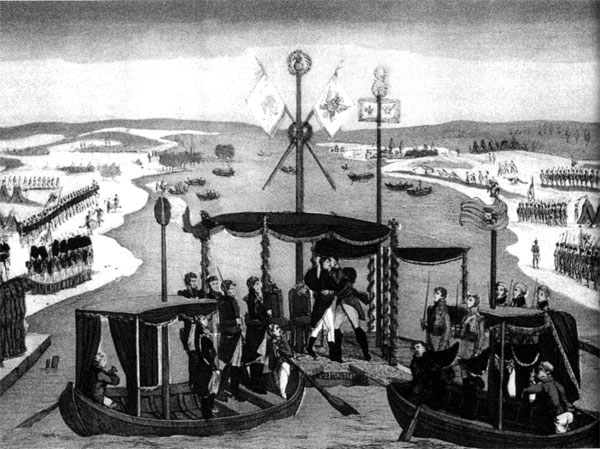
(Encounter between Napoleon and the Czar at Tilsit (1807) on a raft in the middle of the Niemen river.)
Alexander, dazzled and completely overruled by Napoleon’s genius, was happy to comply with his terms; an alliance, offensive and defensive, between the Empires of the West and East, the recognition by the Czar of Joseph Bonaparte as King of Spain, Jerome of Westphalia, and Louis of Holland, the creation of the Grand Duchy of Warsaw, and the enforcement of the Continental System throughout the Czar’s dominions (in the event of Britain’s refusal to accept Russia’s mediation), being the fundamental articles of the treaty, ratified July 7, 1807. England having refused to negotiate, the Czar on the 8th of November of the same year adopted the Continental System.
The creation of the Grand Duchy of Warsaw, erected as a buffer state between the Empires of the West and East, carved out of the Polish provinces acquired by Prussia in the partitions of 1793-5 and conferred upon Frederick Augustus, King of Saxony, who after Jena had been raised by Bonaparte to the dignity of king, stimulated the chivalric spirit of the Poles in his cause. This modicum of independence, equivocal as it was, being a promise of eventual complete autonomy, no wonder the Poles greeted Tilsit as the luminary of the dawn of a revived independence and viewed Napoleon in the light of a liberator.
Such a power as Napoleon now wielded bewilders the mind. When we consider that fifteen years antecedently the name of him who now dictated to Europe, whose word was law to kings, was unknown to the world, the rapidity of his rise to the topmost pinnacle of fame and pre-eminence astounds the intellect. Reviewing his career up to Tilsit, we first behold the lean, uncouth, keen-featured youth, in garrison at Valence, becoming General of Artillery, then, at an age when few have as yet obtained their captaincy, General in Chief of the army of Italy. From general and conqueror we see him ruler of France and controller of her destinies, and later Emperor of the West, Suzerain Lord of Europe. The phases of his extraordinary career follow one another in such rapid succession that the mind is perplexed thereby, their undeviating march towards a higher goal reminding us of the laws that regulate the principles of evolution. Had he been born in the purple with a kingdom as a heritage, his rise to such vast power, even then, would have appeared phenomenal, but he had to win his way from the first rung of the ladder, and had he accomplished naught else than dominating France, his genius would have been egregious. But when, in addition, we behold him, who erstwhile had been but a simple lieutenant in the regiment of La Fere, mastering a continent, bestowing kingdoms on his Paladins, and raising his kindred to the level of Europe’s proudest dynasties, then his greatness is immeasurable and baffles the understanding. [...]
Napoleon’s mental vitality is truly astounding; his activity is ever at par and never flags. One would have thought after a campaign of near a year’s duration, whose tide had surged from one extremity of Europe to the other, involving the destruction of Prussia and the defeat of Russia, that even his indefatigable spirit would have sought respite, if but for a spell, from the arduous strain of war. But, nay, this restless, overweening soul, urged on by his inexorable resolution to bring about the destruction of Britain through the Continental System, must needs again embark in fresh and remote adventures. During his return journey from Tilsit he sends the Prince Regent of Portugal the alternative of joining the Continental System and seizing all British subjects and their property or the consequences of a war with him. To intimidate that kingdom he assembles an army corps at Bayonne, in readiness for eventualities. Although the Prince Regent acceded to all Napoleon’s demands (save that regarding the apprehension of British subjects and the confiscation of their property) he declared war against Portugal and ordered an army, under the command of Junot, to march upon Lisbon. Spain being virtually a vassal of the Conqueror, was eager to join her legions to those of the invaders, which were advancing by forced marches through the northern provinces of Spain upon Portugal. Two days before the entry of the French into Lisbon the Prince Regent, the Queen and Royal Household made good their escape on a British squadron to Brazil, abandoning the kingdom to the French.
Napoleon’s attention was next directed to the Pope. Pius VII refusing to break with Britain by adopting the Continental System, he seized the Papal lands bordering upon the Adriatic, joining them to his kingdom of Italy. Napoleon’s power in the Italian peninsula now extended from the Alps to the uttermost point of Calabria.
The disorders of Spain and her distracted condition gave Napoleon a motive for interposing in the affairs of that unhappy land and ultimately of arrogating to himself the crown of Spain and the Indies. Already the north and west of the peninsula were in his grasp, large bodies of troops having crossed the Pyrenees, which, under the pretext of keeping communications open with Junot’s forces in Portugal, had introduced themselves into nearly every important fortress of the north and west. The advance of Murat upon Madrid, and the report of a contemplated annexation of the northern provinces to France and the deposition of the Spanish Bourbons by Bonaparte, induced the Royal Household to prepare for flight to America, which was, however, frustrated by the sailing of a French squadron to Cadiz, to intercept them, and the coup d’etat of Aranjuez, which terminated in the abdication of the aged king, Charles IV, in favour of his son Ferdinand, Prince of Asturias, who, disgusted with the shameful relations of the Queen, Maria Louisa of Naples, his mother, with her minion, the hated Godoy, the Prince of the Peace, had not merely connived at, but had been the prime instigator of, the insurrection of Aranjuez. The events that followed — the entry of Murat into Madrid, the wholesale abduction of the Royal Family to Bayonne, their subsequent banishment into ignominious exile, the surrender of the crown of Spain into the Conqueror’s hands and his nomination of his brother Joseph, then King of Naples, to the vacant throne — are for sordidness unique in history. Without the firing of a shot the Royal House of Spain and the Indies had ceased to reign. These arbitrary proceedings on Napoleon’s part were unworthy of so rare a genius. As in everything he ever undertook, he here displayed consummate ability, tarnished, alas! by a duplicity and insidiousness hardly consistent with the majesty of his other bewildering exploits, alien to his bold, assertive nature. [...]
The Orient was like an alluring vision ever before Napoleon’s eyes. By the conquest of India, conjoined with the Continental System, he hoped eventually to bring Britain to her knees. The subjugation of India meant to him not merely his most cherished hope realised, but, moreover, the death-blow to the only Power that as yet he had failed to conquer or humble, and that still presumed to defy him. The amicable feelings engendered between himself and Alexander I at Tilsit had lost much of their primeval zeal by his emphatic refusal to withdraw his forces from Silesia until Alexander had reciprocally recalled his from the Danubian Provinces. The Autocrat of the East, taking umbrage at what he viewed as a menace, Bonaparte, to dispel the cloud that now dimmed their waning friendship, modified his attitude towards him and wrote him a letter full of dazzling allurements, wherein his proposal of a Franco-Russian expedition for an invasion of India was calculated to impress the imaginative susceptibilities of the Muscovite ruler and memorise the concordant note of Tilsit. Despite the terrible wounds sustained at Austerlitz, which nearly three years had scarcely healed, and her crippled condition, Austria had secretly, but steadily, prepared her armaments for a desperate blow for liberty. This intelligence, combined with the miscarriage of his plans in Spain, the stubborn resistance of the Spaniards, who refused to acknowledge Joseph Bonaparte for their king, and which for the nonce demanded his urgent attention, made him desirous for a closer unity with the Czar. For this purpose, and to gain his assurance of checking Austria in any hostile move she might undertake against him while his hands were full with the Spanish imbroglio, he proposed a meeting between himself and Alexander for the guaranty of the latter’s support in his Spanish projects and the holding of Austria in check.
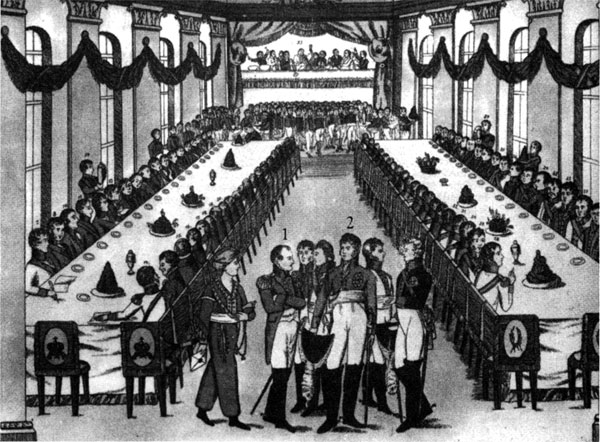
(Congress of Erfurt, September 1808. Napoleon (1) and Alexander (2) in the midst of the “Court of Kings”)
Erfurt, the capital of Thuringia, was designated as the meeting place between the Emperors of the West and East. In this ancient city the destiny of nations was to be decided; there to receive the Suzerain Lord of Europe, to manifest their fealty to him, to lend additional exuberance to the scenic effect were his vassals the kings, princes, and margraves of the Rhenish Confederation in gorgeous galaxy. Of this brilliant constellation of crowned heads Napoleon was the cynosure, the irradiating point, the luminary round which they with their followers seemed to rotate, as the planets with their attendant satellites revolve around the sun. There in the blaze of the pageantry of Erfurt, in this parade of kings, where seventy independent princes waited attendance upon him, he was the pivot of the world’s political system, its centre of gravity, so to speak, to whom all the pomp, all the intellect of humanity seemed irresistibly attracted.
Bonaparte took up his abode in the palace of Count d’Alberg, Prince Primate of the Confederation of the Rhine. The two Emperors, surrounded by a glittering retinue, outwardly manifested as at Tilsit every evidence of friendship. Although to the superficial eye the sun of Erfurt shone with a splendour equal to that of Tilsit, although the chase, the theatre and receptions saw the two Emperors apparently united as formerly by the bonds of concord and good-will, yet to the keen observer a speck was discernible upon the luminary’s disc which indicated that a discordant note has been struck in the air of Tilsit. Alexander was provoked that the conqueror still retained his hold upon Silesia, and regarded the occupation of the fortresses of Kustrim, Stettin, and Glogau, on the Oder, by French troops as a menace to the security of Russia; moreover, he emphatically refused to coerce Austria. This obdurate attitude towards his ally was emphasised by the prorogation of his Oriental projects, which, ever since the ecstatic days of Tilsit, had fired his imagination, the golden visions then opened to his gaze having so far proved but idle and illusory dreams, Bonaparte assigning their execution to a future period when events should declare themselves mature for the carrying into effect of his own ambitious designs. In fact, the interviews between the two Emperors were vitiated by cavil and discord. On one occasion Bonaparte lost his temper at the Czar’s pertinacious refusal to browbeat Austria, already sufficiently reduced in political estate. A display of anger in any being is an exhibition one would prefer not witness, for then even the most impotent of mortals is at his worst, in the most ominous, not to say formidable, phase which physically and mentally the human composition can assume. What, therefore, must have been the impression upon the senses of the most consummate of mental organisations the modern world has ever known, who even in his calmest moments inspired others with awe — the enslaver of Europe, the trampler of thrones, the extirpator of dynasties, the king of kings, mastered by the fury of ungovernable ire? Here Napoleon’s imperious nature is revealed; he could not brook opposition to his inflexible will; his uninterrupted triumphs over man were mainly responsible for this aversion to any but his own views. This exhibition of wrath failed to intimidate the inexorable Autocrat of the East or to ruffle his equanimity, and the utmost Bonaparte succeeded in exacting from him was a promise of his support against Austria in the event of his being attacked by that Power, and his recognition of Joseph Bonaparte as King of Spain. On his side, Napoleon unwillingly consented to lower the war indemnity upon Prussia to 4,800,000 Pounds, and allowed the Czar a free hand in Finland and the Danubian Provinces, with the stipulation, however, that the integrity of Turkey should remain intact, but, as a reprisal to Alexander for not acquiescing with his hostile designs against Austria, he stubbornly refused to withdraw his forces from the line of the Oder.
Such, in brief, were the results of the interview of Erfurt, which, for metaphysical reasons and dramatic effect, stands conspicuous in the annals of history. Never before were the destinies of the human race so dependent upon the whim of a single human being. To the philosopher, psychologist, and alchemist this stage in Bonaparte’s wondrous and inexplicable career will ever yield material of all-absorbing interest.
The influence of Napoleon’s genius was not merely efficacious in a political sense, but moreover cast its hypnotic spell over the literary mind of Germany. Both Goethe and Wieland were completely captivated by the magic of mental faculties well-nigh superhuman in their intellectual energy. That Goethe, the most supreme intellect of the age next to Napoleon, should not merely have succumbed to his genius but tacitly believed in his moral, doctrinal, and remedial signification (remedial as far as Germany in particular was concerned) is a psychological coincidence, probably without a simile throughout the history of human nature. It may seem dissonant, nay, inconceivable, that a true patriot, dwelling in the midst of his country’s humiliation, who beheld it in the throes of agony and defeat, and witnessed its national spirit trodden down by the weight of exotic oppression, could for an instant contemplate the author thereof with a benign eye and yield irredeemably to his influence; but when in Goethe we behold not merely a prodigious intellect but furthermore one of the world’s greatest poets, this inordinate infatuation seems more than paradoxical, so abstruse is it (at least from a superficial standpoint), and for that very reason is it of still more profound interest on account of its apparent inexplicability; for from one point of view this infatuation (after all, by what other appellation can this total submissiveness of mind to Bonaparte be called?) is undoubtedly inexplicable. It is difficult, nay, well-nigh impossible, to conceive the poetic temperament captivated by the personality of the suppressor of national spirit to the degree that Goethe was. It is not easy to picture a Dante, a Shelley, a Byron, a Keats, or any other poet for that matter, passively accepting the obliteration of his country’s national spirit as a philosophical, moral, and political necessity and inclining before the intellectual force of the oppressor; however, from a psychological aspect, the influence that Bonaparte exercised over Goethe is sufficiently intelligible.
Discerning further than most of his contemporaries, the great poet saw, prophet-like, the moral indispensableness to Germany of the Napoleonic regime and was convinced of its seeming irresistibility and therefore resigned himself to the inevitable; and later the loud tocsin of the war of liberation, when an embattled world had risen against the erstwhile master of Europe, scarcely roused him from the quiescence of his literary meditations. Besides, there can be little doubt that the magnificence of the pageant of Erfurt must have impressed the wild imagination of the creator of “Faust” and strengthened his belief in the infallibility of the mighty Conqueror. However, allowance must be made for Bonaparte’s extraordinary personal charm that entirely captivated whoever came in immediate contact with him. Even his bitterest enemies succumbed to the hypnotic power of his individuality. Alexander, at Tilsit (with sword still imbued with the blood of Friedland), was completely overpowered by his genius, and even Englishmen felt its influence, Fox and Lord Holland, among others, yielding to its potent spell. The crew of the Bellerophon, that bore the subverter of empires to the horrors of an exile that has forever sullied the page of England’s glorious history, succumbed to the magnetic force of his personality. Would his sufferings on that desolate rock, circummured by the billows of the Southern Ocean, have been mollified had some of the wiseacres in the British Government come within the orbit of his strenuous personality?
From the splendour of Erfurt, the sycophancy of kings, the adulation of poets. Napoleon marches southwards for the conquest of Spain, where the talismanic power of his presence alone could restore lustre to his eagles. With the exception of the defence of the Somosierra Pass, his advance through the rugged mountains of Navarre and Castile met with little opposition, the storming of this strong position, which defended the approach to Madrid, and Lannes’ victory at Tudela being the only brilliant passage of arms in this campaign. At the storming of the Somosierra the Polish contingent in Napoleon’s service contributed largely towards assuring the victory; supported by infantry and cavalry of the Guard, they carried the defile, driving the defenders in utter rout before them. On December 4, 1808, Madrid opened her gates to the Conqueror. The ardour with which the Poles fought and the reckless daring they displayed sufficiently emphasises their devotion to Napoleon, stimulated to the highest pitch by the hope that their superb heroism would ere long earn them their country’s complete independence. Napoleon’s procrastination with regard to the restitution of Polish independence is strangely unintelligible. The independence of Poland might have, if not averted, at least greatly mitigated, the disastrous consequences of the Russian campaign of 1812, and perhaps protracted his fall indefinitely.
Decidedly the Fates seem to have been adverse to Napoleon as far as Britain was concerned, for if ever a chance of inflicting a crushing blow to British arms lay within his reach, it was during this campaign. Just when he seemed about overwhelming Sir John Moore (after a hot pursuit through Castile and Leon) at Astorga, serious news of the aggressive attitude of Austria made him relinquish the pursuit and hasten back to France to open the wonderful campaign of 1809, terminating in his second conquest of Austria. A victory over his most persistent and implacable enemy, invulnerable in her ocean realm, would have completed his crown of glory. He who had lorded it over so many nations, over Austrians, Turks, Italians, Prussians, Spaniards, Poles, Swiss, Dutch, Germans, and Russians, was denied ever to triumph over Britons, for a reason obvious enough, forasmuch as (without reckoning the siege of Toulon) since his reverse at Acre he but once found himself face to face with the red coats — on the fatal field of Waterloo. However much Moore’s escape must have galled Napoleon, he yet had the satisfaction of beholding for the first and only time a British army in full retreat before his ever victorious eagles.
On April 11, 1809, Bonaparte left Paris to anticipate the Austrian onslaught in the plains of Bavaria. He reached the scene of hostilities in time to extricate his widely separated outposts from imminent peril, the Archduke Charles (his former opponent in Italy) having advanced in superior force and threatened the French positions extending from Ratisbon to the vicinage of Augsburg. By a series of masterly tactics Bonaparte brought his dispersed divisions together, and after defeating the Archduke in several engagements completely overthrew him at Eckmuhl; three weeks later Napoleon’s headquarters were at Schoenbrunn.
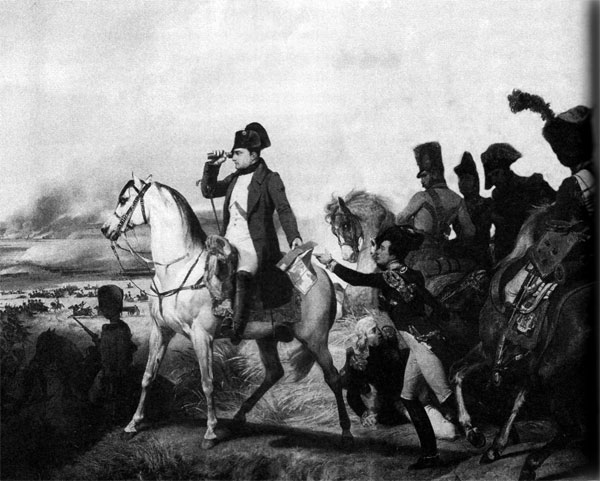
(The battle of Wagram, by Horace Vernet)
These operations, ending in Napoleon’s second occupation of Vienna, are among the most sublime in the history of warfare. Never was his genius as a strategist more brilliant or convincing. The celerity with which he executed those intricate evolutions culminating in Eckmuhl is well-nigh incredible. In less than a month from the outbreak of hostilities by his superhuman genius he had cleared Southern Germany of the enemy and virtually reconquered Austria.
Before Austria’s final overthrow at Wagram Napoleon’s pertinacity was put to a severe test, and, but for his iron will, his star might not have set at Waterloo, and Moscow’s flame vesture might not have been Europe’s beacon of liberty, won over the bones of half a million of men. At Aspern and Essling he met with a check which, but for his indomitable tenacity and Austria’s inexplicable inertia, might have involved him in an irretrievable disaster, and maybe hastened the mighty tragedy of his titanic headlong fall.
How severe was the check Napoleon received on the Danube may be judged by the lapse of time intervening between his defeat (for defeated he unquestionably was) at Aspern and Essling and his mighty triumph on the plain of Wagram — an interval of six weeks — an eternity to this condenser of time, who in 1799 amalgamated, within the space of a month, the overthrow of the Directory and his elevation to the Consulship, who in the following year, in even less time, reconquered Italy in one campaign, and in 1806, at Jena, shattered the might of Prussia in a day — achievements each of which would have sufficed to accredit his name to the realm of immortality.
Aspern was Napoleon’s first defeat in the open field during thirteen years of triumphs, Caldiero and Acre being eliminated, as the former can scarcely be called a defeat and the latter was not a battle at all. He had not won twenty-five victories over nearly every nation of the Old World without having come to consider himself invincible, hence it is not surprising he refused to accept Aspern as a defeat or his compact with victory broken. This confidence in his “star,” in his invulnerability, endued him with the apathy and arrogance, so to speak, of the subverter of empires, which, when confronted (as at Eylau and now at Aspern) by a task that demanded all his superhuman energies and resolution to overcome, evolved itself into undeterred, unflinching tenacity.
Napoleon’s strategic genius has never been questioned; by nearly every one he is deemed the greatest exponent of the art of war in the modern world. In the grandeur of his military conceptions — in the astounding results of his overwhelming victories, in the vastness of the area of his evolutions (with perhaps the exception of Alexander), he is without an equal; yet, because of Leipzig, where he was outnumbered by two to one and, moreover, betrayed — because of Waterloo, where he was in his decline, a foundering ship — his tenacity by some is held in depreciation. In the catastrophic results of these stupendous defeats they seem to ignore his self-control at Marengo, when all seemed lost — his dogged pertinacity at Eylau, where he was an ace from defeat — his undaunted attitude after Aspern, where he was actually defeated — his irrepressible resolution to attain his goal after the butchery of Borodino — his illusory hopes amidst the flames of immolated Moscow — his persistency after such barren victories as Lutzen, Bautzen, and Dresden — his suicidal obduracy during the negotiations of Chatillon — his sisyphean, yet glorious struggle in 1814 against the coalesced armies of embattled Europe. Leipzig, terrible as were its consequences, did not deter him from defying the retributive host of the Allies advancing to overwhelm him, and even Waterloo failed to reduce his intrepidity; for on his return to Paris, after the fatal June 18, 1815, he was still full of confidence as to the final issue, and without doubt, had France stood by him at that crucial hour, would have struck a last blow to retrieve his lost supremacy.
Napoleon’s position after Aspern was yet more critical than after Eylau; not only was he defeated, but his prestige was at stake.
Aspern revived the hopes of agonising Europe; at last Napoleon was found to be vulnerable like ordinary mortals — any wonder he mustered up the sum total of his resolution for a telling blow, and under the aegis of his “star” felt confident of the final issue? Meanwhile the terrible losses in his ranks, sustained at Aspern, were made good by reinforcements drawn from France, Germany, and Italy, so that before long the Conqueror, with forces numerically superior to those of the enemy, was ready to deal the blow that was to close this memorable campaign. By means of bridges of boats his whole army crossed from the island of Lobau (where he had retired after Aspern) to the left bank of the Danube, outflanking the Austrian earthworks. The crossing was effected in safety in the early morning of July 5, 1809, despite a storm that forewarned the titanic struggle waged on the following day under the spires of Vienna. On July 6th the fate of the Austrian Empire, of Europe, was confirmed at Wagram, and Napoleon’s supremacy over the Continent reasserted. For the ensuing three years Europe endured the incubus of his colossal power. Had Austria taken full advantage of her opportunity, of Napoleon’s precarious situation after Aspern, had she evinced some of his indomitable resolution, and had he been imbued with less, the world might have been spared the desolating wars of 1812-13-14-15. This, in many respects the most glorious of Napoleon’s immortal campaigns, affords an admirable opportunity for an analysis of his marvellous endowments in the science of war. Here all the phases consonant with military genius in its most transcendent form — daring initiative, mathematical precision, celerity, remorseless tenacity — are saliently displayed, pervaded by a solemn majesty that invests this campaign with an interest that holds the mind enthralled. This interest is attributable to two reasons: Firstly, Napoleon was now in his prime, and had all but reached the culminating point, the apex of his power; his military genius was at its solstice. The operations that preceded the battle of Eckmuhl were in his opinion the most dexterous of his incomparable military career (could anyone be more competent to judge of his own achievements than he?). Secondly, this is the last campaign terminating auspiciously for himself — the last of that succession of world-subduing wars, the last in which Fortune kept true to him. Thenceforth she abandoned her favourite forever, and all his succeeding wars, despite his superhuman efforts and unimpaired genius, closed as fatally as his previous ones had proved overwhelmingly successful. [...]
The treaty of Schoenbrunn, that deprived Austria of 45,000 square miles of territory, and nearly four millions of people, closed the war of 1809, and was signed at Schoenbrunn, October 14th of the same year. By this treaty Austria ceded to the Confederation of the Rhine Salzburg and part of Upper Austria; to the Grand Duchy of Warsaw, Cracow and Western Galicia; to Russia part of Eastern Galicia; to the French Empire Trieste, Carniola, Friuli, and parts of Dalmatia and Croatia, which (subsequently enlarged by the addition of Ragusa, Istria, and Cattaro) together now formed the Illyrian Provinces. The Tyrol was apportioned between Bavaria, the Illyrian Provinces, and the kingdom of Italy; besides she recognised Joseph Bonaparte as King of Spain, agreed to pay an indemnity of 3,400,000 Pounds, reduced her army to 150,000 men, and guaranteed to exclude all British products. Crushing as these conditions were, those Bonaparte imposed upon Prussia at Tilsit were yet more intolerable. If he tore from Austria some of her fairest provinces, he practically dislimbed Prussia; if he taxed Austria with an indemnity of 3,400,000 Pounds, he ground Prussia down with one of close upon 5,000,000 Pounds; if he cut down Austria’s army to 150,000 men, he reduced Frederick’s proud legions to 42,000 men. Moreover, every fortress in the Prussian monarchy had been converted into a French garrison. The terms Napoleon meted out to Austria at Schoenbrunn were, short of absolute conquest, as galling as any ever prescribed by victor to vanquished. In the case of Prussia entire conquest would have been immeasurably more merciful, and yet the fact that Napoleon conceded to Prussia and Austria their independence, that he spared them from annihilation — that he granted the Houses of Brandenburg and Hapsburg even a valetudinarian reign — shows that, stupendous as his power was, he yet eschewed exerting it to its utmost limit; for, after Austerlitz, and again after Wagram, what could have precluded him from dethroning Francis II, or, after Tilsit, from overthrowing the unstable throne of Frederick’s successor?
That Napoleon was grasping and unprincipled (what conqueror in the true sense of the word can fail being this?) is undeniably true, but that he might easily have been considerably more so is equally true, and this fact has hardly ever been acknowledged by even unbiased writers, for to nine-tenths of humanity Bonaparte is the acme of unlicensed rapacity and despotism — the very soul of all that is iniquitous. To them the conqueror of Italy, of Germany, of Austria, of Prussia, of Poland, of Spain, of Portugal, the suppressor of Dutch independence, the jailer of the Pope, the master of three-fourths of Europe, had in truth quaffed the cup of success to the very end; what more could he desire? [...]
Although we are not endeavouring to minimise Napoleon’s inordinate ambition, yet it is a remarkable fact, and indeed a paradox, that in none of his wars, with the exception of the Spanish, and perhaps the Russian war of 1812, was he, the mightiest of all conquerors, really the aggressor. Even those who cannot find a single good point in Napoleon’s character, who have endeavoured to sully his memory with the blackest accusations, who have charged him with the turpitudes of a Tiberius, of a Nero, of a Borgia, must own this. In the Austerlitz campaign it was Russia and Austria, bribed by English gold, that were the aggressors. In the Jena campaign it was Prussia that first declared war. Napoleon entered upon the Polish war to repel the advancing Russians, the champions of stricken Prussia. In the campaign of Wagram it was Austria that again was the aggressor by invading Bavaria, a member of the Rhenish Confederation and therefore virtually a part of Napoleon’s empire. In 1813-14-15 Napoleon had to fight against the banded world for his very existence.
In his first Italian war of 1796-7 he was only executing the mandates of the Directory. The campaign of Marengo was really a war of restitution, for at Marengo Napoleon merely restored to France his conquests of three years anteriorly and reasserted her supremacy in Italy. Although so rarely the agressor, yet Napoleon took every advantage of his overwhelming successes, for every war extended the limits of his Empire, as it fired his ambition, until nothing seemed insuperable to him, nothing beyond his possibilities. His whole career of conquest, his astounding exploits and superhuman efforts are succinctly summed up in his own words — “Les circonstances en me suscitant des guerres m’ont fourni les moyens d’agrandir mon empire et je ne les ai pas negligees.” (By bringing out wars circumstances have given me the means to enlarge my empire and I did not neglect them).
That Napoleon was despotic, that many of his measures were even tyrannical, is undoubtedly true, but at the same time his despotism was not a legitimate despotism transmitted from a generation of tyrants and sanctioned by all the laws of society and equity. Napoleon’s despotism was not that of a Henry VIII, of a Charles V, or of a Louis XIV. Whereas Henry, Charles, and Louis wielded a despotism derived exclusively from the divine right of kings, that which Bonaparte exercised was an individual despotism exerted against the old dynastic institutions of Europe and vindicative of the rights of the people; for did he not spring from the people? Napoleon’s name, instead of being execrated by the great mass of humanity, should be blessed, for he is the avenger of humanity, the subverter of the arbitrary prerogatives of legitimate kingship. Napoleon is the greatest example of the complete triumph of the rights of the people over kingcraft that the world has yet seen. This man, who rose from nothing — this self-made king, despot that he was, tyrant that he was, stands forth as the champion of the unshackled freedom of the human will. At Marengo, at Austerlitz, at Jena, at Friedland, at Wagram, he fought (although unbeknown to himself) as much for the rights of the people as for his own glory and ambition. Napoleon’s career is a testimony that life, even to the humblest of mankind, is not without hope. Bonaparte was not Emperor of France but Emperor of the French, he was the people’s Emperor — they made him such; he was the man of their choice. This great king-maker made his kings out of clay. The crowns of Spain, Holland, and Westphalia he bestowed upon his brothers Joseph, Louis, and Jerome. Eugene Beauharnais, his stepson, he made Viceroy of Italy. Murat, the inn-keeper’s son, he seated upon the throne of Naples. He exalted the people, upon them he lavished titles, gifts, and honours. Fame and glory were within the reach of the meanest of his subjects; ability and bravery in the humblest subaltern were sufficient credentials to a marshal’s baton, a dukedom, or a principality — were not his marshals sprung from the people? His munificence was not restricted to the lowly but extended to the great, he even exalted the great — his German vassals, the Electors of Bavaria, Wurtemberg, and Saxony he raised to the dignity of kings. That Napoleon ruled France with a grip of iron is true, but that he was a despot in the sense that Charles V was a despot is false. He who calls the man who instituted the Code, who stamped down the bigotry, who gave all men, even the very humblest, equal rights, who threw open all the avenues of distinction to all men — he, we repeat, who calls this man who did all this a tyrant is stupid. To call Napoleon a usurper is fatuous; he had no hand in the overthrow of the Bourbons; when he entered the arena of events the crown of France was lying in the mire, the French people picked it out of the mire and placed it upon his brow, upon the head of him whose incomparable exploits had earned it for him. Napoleon was no more a usurper than were William III or Bernadotte usurpers.
Surely since Napoleon’s advent the old order of things in Europe had been sufficiently convulsed, the world had been treated to sufficient surprises, and dumfounded, it beheld the work of centuries compressed within the space of little more than a decade. Since first he unsheathed his conquering sword in the plain of Piedmont, what mighty changes had metamorphosed the face of Europe! Venice, the former mistress of the Adriatic, is struck down by the victor of Ancona and Rivoli, never to rise again, and later to be incorporated in his kingdom of Italy — the chrysalis of Italian unity. The Conqueror of Italy and the East becomes ruler of France, Emperor of the West, the Holy Roman Empire crumbles under the shock of Austerlitz, and out of its fragments the arbiter of Europe shapes an assemblage of states under his jurisdiction — the Confederation of the Rhine. Five states are raised to kingdoms — Bavaria, Wurtemberg, Saxony, Holland, and Westphalia — the crowns of the last two being conferred upon his brothers Louis and Jerome, that of Holland upon Louis, of Westphalia upon Jerome. The Royal Houses of Spain, Portugal, and Naples are bereft of their thrones, which are assigned, the former to Joseph Bonaparte, the latter to Joachim Murat; the House of Braganza is driven from Portugal. On the Vistula the Grand Duchy of Warsaw suggests the future independence of Poland, and, to crown all, the Continental System encircles Europe from the shores of the Baltic to the Adriatic. Yet an event was to follow these that demonstrates how far Napoleon’s ambition dare carry him. It was not enough that he had trampled every state in Europe, humbled all her potentates, imprisoned the Royal House of Spain and the Indies, proscribed those of Portugal and Naples. The Holy See, that for centuries had proudly dictated to emperors and kings, was now to bow before his irresistible power. At Vienna, about two months before Wagram, Napoleon issued a decree declaring the temporal power of the Pope at an end, which annexed Rome, with the residue of the Papal States, to his Empire, constituting Rome the second city of France. In the following year Pius VII was conveyed a prisoner to Savona, and later ostracised to Fontainebleau, where he spent the remaining two years of his captivity. Thus at one blow was the temporal power of the Pope expunged, to remain virtually in abeyance for the next five years, during which time one might well affirm that the Papacy had ceased to be. Never had the Court of Rome sunk so low. [...]
It seems anomalous that he who had re-established the Church in France, the author of the Concordat, should have brought such detriment upon the head of him by whose hands he had been anointed Emperor of the West. Harsh though Napoleon’s treatment of the Pope may have been, we must bear in mind that in no wise can he ever have felt beholden to Pius VII, or to the Vatican for that matter, for at Paris the Pontiff officiated at his coronation more or less under duress, and it is very much to be doubted, had circumstances been otherwise than what they were, had the Pope been a free agent, if such acquiescence to Napoleon’s mandates would have been manifested by the head of the Catholic world, if even the Concordat, with its stringent “ Organic Articles,” would have been accepted by Rome. Indeed, it was Pius’ refusal to adopt the Continental System that led to Napoleon’s seizure of his Adriatic provinces in 1808, to the ultimate Empire, and to his confinement at Fontainebleau.
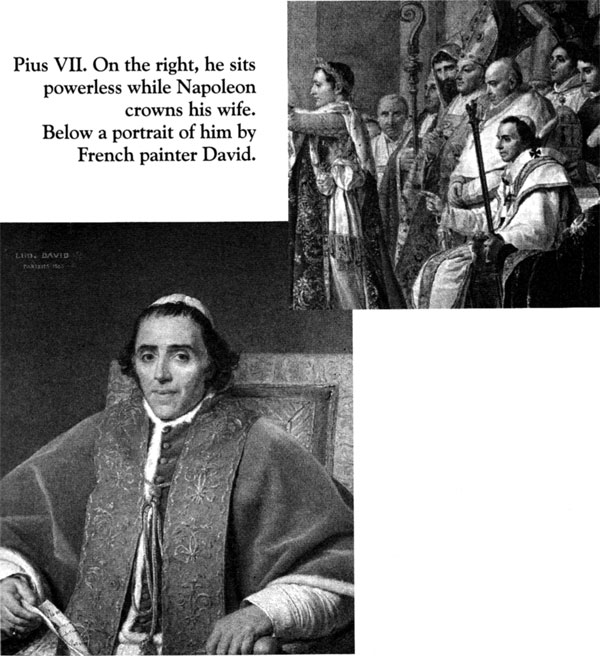
(Pius VII. On the right, he sits powerless while Napoleon crowns his wife. Below a portrait of him by French painter David.)
The seizure of the Papal States and of Rome, the Pope’s detention in France, were, after all, procedures not a lot more arbitrary than the invasion of Portugal, the conquest of Naples and Spain, the deposition of the House of Braganza and of the Neapolitan Bourbons, or the guileful subversion of the Royal House of Spain. Napoleon’s contempt for legitimate rights was supreme; he wished to be paramount throughout the length and breadth of Italy and in Rome above all; being master of so many realms, why should he not likewise be master of the cradle of dominion — the city of the Caesars? Had the Grand Seignior ruled in Rome, he would have dethroned him with as little compunction as he did the Pope. The annexation of Rome to his Empire, therefore, was an event that indubitably would have come to pass irrespective of all the Popes that ever were. [...]
After the treaty of Schoenbrunn (with the exception of the Spanish Peninsula) the Continent lay inert at the feet of Napoleon; surely now was the time to quash the Spanish resistance and drive the red-coats into the sea! Had Napoleon marched into Spain at the head of his seasoned troops, the veterans of Eckmul and Wagram, had he in person consummated the work interrupted by the war of 1809, in lieu of entrusting the military operations in Spain to his disunited generals, the roll of British glory would not have been swelled by many victories.
It seems incredible that two years — two years of incessant warfare — should have elapsed without Napoleon once setting foot upon Spanish soil. This abstention from the scene of operations is all the more extraordinary as his armies, commanded by some of his most competent generals, Massena being of the number, had suffered a succession of crushing defeats. There is little doubt that Napoleon underrated both the national movement in Spain and the generalship of the British commanders, Wellington not excepted, which accounts for his optimism as regarded the final result of the war, and his inordinate reliance on the efficiency of his subordinates to cope with the situation. He can hardly be blamed for his poor opinion of the military capacity of his enemies when compared with his unrivalled mastery of the science of war. Whoever had ventured so far to cross swords with him had, all in turn, succumbed to his superior genius; hence his contempt for the Sepoy General (as he disdainfully dubbed Wellington) is not to be wondered at; yet, however much he may have despised the military skill of the “Iron Duke,” his blind confidence in his marshals to eventually succeed in clearing the Peninsula of the British was, in the face of events, both misplaced and unwarranted. He must have seen that where such a strategist as Massena had failed, his presence was indispensable. Had he, instead of recalling Massena, joined him on the Portuguese frontier, after the latter’s defeat at Fuentes d’Onoro, the operations in the Peninsula would have assumed a very different character.
The events that transpired from the treaty of Schoenbrunn to the close of 1810, Napoleon’s divorce of Josephine and marriage with Marie-Louise, his annexation of Holland, the Hans Towns, Oldenburg, and Hanoverian sea-board, and the consolidation of the Continental System, were certainly of sufficient weight to detain him in France; but therefrom to the close of 1811 there was naught to justify his non-appearance beyond the Pyrenees. During this time no events occurred outside Spain that deserved as much of his attention as did those that were then transpiring on the border of Spain and Portugal, although it is true that his relations with Russia during 1811 were anything but amicable, and indeed in the summer of that year they well-nigh reached a climax. Yet, despite even the ominous clouds that then loomed darkly on his Eastern horizon, he can hardly be exonerated for his apparent laxity with respect to the state of affairs south of the Ebro. Indeed, the storm that was fast brewing beyond the Niemen should have been, if anything, an incitement to him to bring affairs in the Peninsula to a prompt conclusion.
Undoubtedly, the Russian war of 1812 was a fatal mistake, nay, an act of sheer folly. To enter upon a war whose goal lay 1,500 miles away on the confines of civilisation, and that synchronised with the severe defeats of his marshals in the Peninsula by the Anglo-Spanish armies under Wellington, was, to say the least, suicidal policy on Napoleon’s part. But to Napoleon was this war a mistake, whose disastrous results he certainly could never have foreseen? If ever mortal felt fully assured of success, or was justly entitled in feeling so, it was Napoleon when he embarked upon this war with nearly the whole of Europe marching in his train. Such a display of military might as he was now prepared to hurl upon Russia had never yet been seen by the modern world. The mighty army, numbering over half a million of men, which he was about to lead into Russia, represented well-nigh the sum total of the embattled might of Christendom. In the summer of 1812 every legion between the Pyrenees, the Straits of Messina, and the Niemen was ranged under his banner in the grandest military pageant history has ever seen. Is it therefore surprising if, at the head of such a host, he felt invincible, felt himself, fatalist that he was, the controller of his own destiny? Moscow taken meant to him the destruction of Russia, Russia destroyed meant the conquest of Asia. To drive the British into the sea, to reduce Spain and Portugal to submission, would then be but child’s play; and from Moscow he would march upon India, like a second Alexander, there to effect the ruin of England. This may seem hyperbolic, but to Napoleon, who as yet (with the exception of his Syrian campaign) had never failed in any venture he had ever undertaken, all this seemed well within the purview of possibility. To him who in the course of nine short years had brought the greater part of Europe under his sway, who held all her kings in leash, the conquest of Russia must have seemed assured, her fate decreed — how could he fail to succeed — he, the lord of all the cohorts of Western, Southern, and Central Europe? There is no doubt that Napoleon reckoned upon bringing the Russian war to a triumphant conclusion by the autumn of 1812. The overthrow of Russia would have enabled him in the beginning of 1813 to consummate the conquest of Spain and Portugal, begun nearly four years anteriorly. And then he could turn to the East, whose golden portals would be open to him, beyond which would stretch the road that would lead him to the conquest of India, to the conquest of England, for through India would he achieve her fall. But Bonaparte and the Fates were now no longer in accord — they ordained otherwise. Had Moscow not been sacrificed, unquestionably these dreams, bewildering in their extravagance, might have been fulfilled; a city’s ruin sufficed to shatter them and overthrow the dreamer — her doom was essential to the deliverance of a world.
To assert that Napoleon’s conquests, that his stupendous wars, were inspired mainly on account of England, on account of his firm resolution to achieve her downfall through the Continent, is an erroneous assumption, but this does not imply that his conquests were not to a considerable extent provoked by his animosity towards Britain. Was not his Egyptian expedition in a measure a hit point blank at England? Once master of Egypt, was he not in possession of the key to India? Were not the treaties of Tilsit and Schoenbrunn followed by the enforcement of his “System” throughout Europe? Was not Britain’s very existence menaced, her doom promulgated to the world by the Berlin and Milan Decrees? It is certain, therefore, that his rancour towards his great enemy spurred him on his quite infernal course of conquest, and doubtless his dream of ruining England through the Continental System tended to accelerate the ardour of his devouring ambition.
Indirectly the Russian war of 1812 originated really on account of England. Without the Continental System this disastrous war might never have been, Napoleon’s “System” being mainly the cause of his breach with the Czar. However much Napoleon’s wars may have been incited by his hatred of “perfidious Albion,” it would be puerile to assert that he subjugated the Continent solely because of her. To affirm this would that he conquered Europe, enslaved her, to achieve the ruin of one nation — a ridiculous hypothesis. Is it conceivable that but for England Napoleon would never have been numbered among the world’s mightiest conquerors? Is it easy to conceive him, whose ambition perhaps even surpassed Alexander’s, with aspirations limited to those of Hannibal? ... Napoleon’s views embraced a prospect infinitely vaster, by far more dazzling and seducing than the mere conquest of England, mighty and invincible as England was. From earliest manhood the realm of dominion stretched alluringly before him. The shades of his antecessors in glory, the heroes of past ages, were ever before his vision. The spirit to govern, to command to others, even in boyhood, was deeply radicated in his strenuous nature. He was born to rule, to prevail over mankind, to dictate to the world was his birthright. Long before he hurled his gage of combat at the feet of Britain this had been made manifest. We see him in Italy, in the glory of his first conquests, winning his brilliant victories, creating states, ratifying treaties, organising Italy, not as the amenable lieutenant of France, but at his own initiative, as conqueror, as dictator of Italy. At Tolentino he humbles the Pope; at Campo Formio he brings Austria to terms, at a blow he overthrows Venice. Behold him, during the negotiations of Campo Formio, at the beautiful palace of Montebello, near Milan, surrounded by almost regal pomp! All the prerogatives of sovereignty are his. The festivities, the throng of obeisant courtiers and officials there portend the splendour of the pageants of Tilsit, of Erfurt, and Dresden. Then in the East he figures not merely as conqueror, but as Sultan, as supreme master of Egypt. The mastery of the East was of much greater moment to him than the ruin of England. To conquer India so as to dominate the East was to him an infinitely more alluring dream than the conquest of India for the mere destruction of Britain. The suzerainty of the East he rated far above the conquest of Europe. Arbela, in his opinion, was an infinitely greater victory than Austerlitz. Had he taken Acre, he said, the whole face of the East, perhaps of the world, would have been changed. From Acre he would have followed Alexander’s steps and founded an empire rivalling that of the Macedonian hero. Not till he had subjugated the East would he march upon the West, he would bring Europe under the tutelage of the East. This shows how infinite his views were and what an extraordinary hold the Orient had upon his imagination.
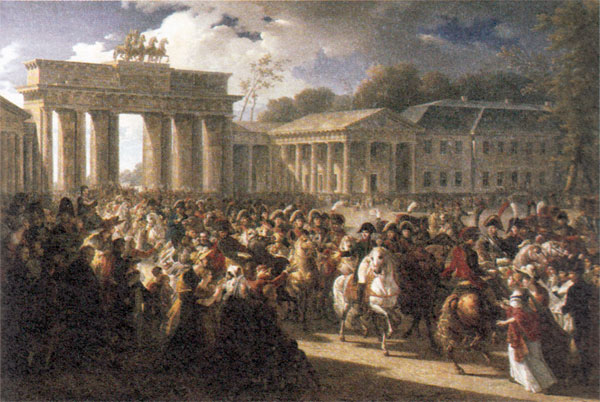
(Triumphant entry into Berlin)
It is therefore clear that the motives that urged Napoleon into subjugating the Continent emanated, not so much by reason of feelings of enmity towards any one nation more than another, as from the desire that grew in proportion as his power expanded, of attaining to universal dominion, for there is little doubt that ever since the dazzling days of Tilsit he aspired to the dictatorship of the world. Anyone but Napoleon entertaining such a scheme — a project so utterly impossible, so extravagant and chimerical, would be looked upon as nothing less than a raving madman. But to Napoleon, to whom, so far, nothing had seemed insuperable, who probably of all mortals has attained the nearest to omnipotence, the mastery of the world cannot have seemed such an impossible achievement, for only two nations lay between himself and universal dominion — Russia and England. With the conquest of the former Asia would be at his feet, the destruction of the latter would ensure him the empire of the seas, and then would not the world be his? That Napoleon aspired to universal dominion is attested by his own words when he declared to Fouche, on the eve of the Russian war of 1812, “The great power I have already attained forces me to assume a universal dictatorship ... There must be one code, one court of appeal, and one coinage for all Europe. Europe must form one great nation and Paris must be the capital of the world!” These vapourings of an idle visionary or of a besotted braggart, but revealed Napoleon’s whole ulterior policy and the goal to which his unbridled ambition was impelling him. Can there be a scintilla of doubt as to the bent of his designs after such an utterance? It is well, perhaps, for mankind that Napoleon met his Nemesis at Moscow, for as it was, the weight of this one man upon the world was more than it could well bear — was contrary to the laws of nature, and to the age he lived in. More power than he already possessed would have been monstrous, fatal to the intellectual progress of the human race.
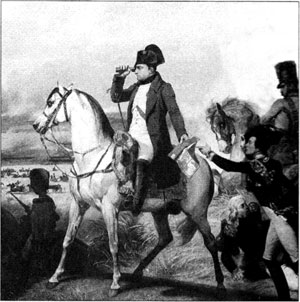
Book V - Dresden: the Zenith
The excessive weight of this man in human destiny disturbed the equilibrium.
This individual counted of himself alone, more than the universe besides.
These plethoras of all human vitality concentrated in a single head, the world mounting to the brain of one man, would be fatal to civilisation if they should endure.
— Victor Hugo.
We now touch upon the most extraordinary period in Napoleon’s momentous career, perhaps the most extraordinary throughout the whole course of human story, namely, the pageant of Dresden, when Napoleon’s “star” had in truth reached its very zenith — when, during the latter half of May, 1812, surrounded by nearly every potentate of Europe, he posed as virtual Emperor of Europe — the highest pinnacle of human power which authentic history has to offer us. This passage in Bonaparte’s epopee reads more like a bit of the wildest extravagance of exaggerated romance than a historical truism, the nearest approach to this state of human pre-eminence being Alexander after Arbela and Caesar after his victory at Munda — master of the Roman world, these two being the only great figures in history that in any way can be compared with Napoleon, Cyrus being too remote a prodigy for comparison. Many names besides Napoleon’s are symbolical of great power and supremacy over mankind — Alexander, Caesar, Alaric, Attila, Theodoric, Charlemagne, Tamerlane, Charles V, are these. These great men — these Titans of history, all wielded abnormal power, but great as was their power and potential as was their influence over the destiny of the human race, Napoleon’s was even greater and his influence over the world still more potential.
Human genius in its highest state of exultation, the highest point which man has ever attained through the intellect, is to be found in Napoleon at Dresden. There in the blaze of the assembled sovereigns of Christendom, from the dizzy summit of his power, he beheld the world suppliant at his feet. At Dresden, Napoleon was in truth the king of kings, for every crowned head, from the Carpathians to the Rhine, had congregated there to pay him homage as his vassals. The Emperor of Austria, the Kings of Prussia, Saxony, Naples, Wurtemberg, and Westphalia, and a host of lesser satellites, were gathered there to obey the behest of the man who erstwhile had been but a mere subaltern in the French army and who now was the arbiter of the civilised world. That mortal ever rose to such an amazing height of power seems inconceivable, and had Bonaparte never existed, such a state of human pre-eminence would never have been deemed possible, if even conceived. An altitude of power as bewildering as that which Napoleon attained has scarcely been devised by the most fantastic imagination. Even the wildest vagaries of Oriental fable or Western fairy lore have not endued their heroes with more power than Napoleon wielded. The genii of the Arabian Nights never conceded an iota of the supremacy to which he had reached. We fully agree with Whately in his affirmation that Napoleon’s career is a miracle. We even go further than Whately and say that Napoleon is a miracle — the miracle of the modern age, if miracles there be. A study of his career seems almost to reconcile us, in spite of ourselves, to the miraculous.
Among all the giants of history, in one respect especially, Napoleon is unique. Most of the world’s Titans were either the sons of kings or scions of royal houses, or lineally affined to illustrious families. Alexander was the son of Philip, King of Macedonia; Theodoric, of Theodomir, King of the Ostrogoths; Charlemagne of the powerful Peppin, King of the Franks; Charles V was the grandson of the Emperor Maximilian, and Ferdinand the Catholic, king of Spain. Hannibal was the son of Hamilcar Barca, next to himself the greatest of Carthage’s soldiers. Caesar was of patrician birth. Both Alaric and Attila were potent rulers before entering upon their careers of conquest. Moreover, with the exception of Hannibal, who died by suicide, in exile, and Charles V, who abdicated voluntarily when at the height of his renown, they all died in the meridian of their power and glory. But with Napoleon it was otherwise. His father, Charles Bonaparte, although of good birth and even of noble descent, was only an impecunious lawyer of Corsica, unknown outside his native isle, and but for his illustrious son, the name of Bonaparte would not be to this day the shibboleth of a dynasty. Therefore, Napoleon’s greatness seems all the greater by the comparative obscurity of his origin, which, when compared with that of the great predecessors, raises him, at least in our estimation, immeasurably above them all. He had to begin at the very root of things. If anyone truly earned his spurs it was he. Everything from his first commission to his throne and bewildering altitude of power he owed solely to himself — to his matchless genius. [...]
Napoleon, at Dresden, during the latter half of May, 1812, is significative of the most exalted state which man has perhaps ever attained. There, in the very heart of Europe, with empires as a footstool — with a supplicating humanity inert at his feet, he was the manifestation of human might in its most stupendous and strenuous form. Despite the magnificence by which he was environed — despite the apparent inviolableness of his position at Dresden, there is something ominous in the very exuberance of his power, for, strange inconsistency of Fate, was not the pageant of Dresden predictive of his impending portentous fall? Who that saw him then with kings as his retainers would have foretold that five months later his knell of doom would be sounded at Moscow? It is well-nigh impossible to appreciate the full import of Napoleon’s power at this period of his career; however, a glance in retrospection may, perhaps, give us an idea of the prodigious power to which he had reached.
In the year 1795, seventeen years before the pageant of Dresden, there was living in Paris, in the greatest obscurity and straitened circumstances, a young man whose prospects seemed about as lugubrious as they could well be. By birth he was a Corsican, by calling an artillery officer, and despite his youth — he was only twenty-five years of age — had already distinguished himself in active service as a commandant of artillery. Having incurred the displeasure of the military authorities he had been obliged to resign his command and had come to Paris to solicit employment. An interview which he had with Aubry, the President of the Military Committee, had only conduced to render his position all the more desperate. Aubry, piqued at the young soldier’s peremptory refusal to abandon the artillery and accept the command of a brigade of infantry in the Vandean War, caused his name to be struck off the register of general officers in employment.
Could any one’s future offer a more hopeless prospect? His career, his hopes of future distinction (for his was an ardent, ambitious, even imaginative nature) seemed blighted forever. That he had well-nigh succumbed to the stress of ill-fortune and thrown up the sponge in despair is clear enough, for, in his anguish of mind, he was on the verge of committing suicide and was only saved by the timely intervention of a friend. His ambition and day-dreams also seem to have degenerated with the continuous growth of his adversities — to have sunk to the prosaic level of those of a “petit bourgeois” for, with the resignation of a philosopher, he declared that life might be fairly tolerable if he could only afford to have a small house in the street where he lived, and to keep a cabriolet. The marriage of his elder brother with the daughter of a rich banker of Marseilles elicited from him a cry of reproof against the vagaries of fortune. Half in bitterness, half in pitying scorn would he often say, “How fortunate is that fool Joseph!” Yet, in spite of the overwhelming weight of his misfortunes, he was not utterly resigned to his bitter lot. His inordinate ambition made him recalcitrate against the obduracy of his cruel fate and the banalities of his existence. Even the baleful clouds that darkened his life were lit up by the radiance of his vivid imagination. In this dismal hour of his life his thoughts turned longingly towards the East. If in France he was unable to obtain distinction, then he would hither to the East, and win his laurels there — the East which, to use his aphorism of later years, “only awaits a man”. With the sanguineness of the dreamer he addressed a petition to the French Government, proposing that he, with a few artillery officers, be sent to Turkey to organise the Turkish artillery. For weeks the young commandant lived in the ferment of the wildest enthusiasm. The portals of renown seemed already open to him. We can picture him with his slim figure, pale, intelligent face and keen grey eyes, animated by the fire of enthusiasm, in his threadbare uniform, dreaming over his future renown and glory. We can almost hear him as he says in a transport of exultation, “How strange it would be if a little Corsican soldier became King of Jerusalem!” This dream, which to him seemed replete with a glorious promise, was never to be, his petition to the French Government remaining unanswered. His bumper of woe seemed, in truth, filled to overflowing — the Fates as relentless as ever. Little did he guess what the future held in store for him, little did he dream of the splendour that awaited him beyond the sullen horizon of his life’s purview! There, reserved for him, was a destiny incomparably more glorious than that of a Godfroi de Bouillon, than a Saladin or even of a Tamerlane. It was not the East, however, he was to dominate, but the West, there to found an empire that would eclipse that of Charles the Great.
Seventeen years have rolled by — seventeen years of incessant warfare. A supreme genius now bursts upon the world. Conqueror of Italy and the East, he now controls the destiny of France. In his person is revived the Roman magisterial dignity of Consul, and as First Consul of the French Republic France is supreme in the West. Before long we see France discarding republicanism and assuming the Imperial Eagle and the insignia of autocracy. Her great dictator, invested with the Imperial dignity, is now Emperor of France, King of Italy, Lord of the West, and dictates to an empire whose confines stretch from the head-waters of the Tiber to the Zuider-Zee — an empire almost as extensive as that of Charlemagne. The floodgates of war now sunder open. From France’s frontiers bursts with unbridled fury the angry tide of war. Before its mad onslaught empires and kingdoms are overthrown — thrones fall; dynasties are extirpated. From the debris of nations new kingdoms are created. The tricolour waves exultantly over every capital in Europe — over Vienna, Berlin, Warsaw, Lisbon, Madrid, Rome, Florence, Naples, Munich, Milan, Venice, and Dresden. This tremendous upheaval in the political and social order of things is the work of a single individual. The Emperor of the West becomes Suzerain Lord of Europe, the subverter of dynasties, the creator of kings, the custodian of the Pope — the king of kings. At Austerlitz he dictates to an emperor; at Tilsit he remodels Europe, and his word is law to a continent, a king is his vassal, and the powerful autocrat of the East his sycophant; at Erfurt he is king of kings and at Dresden, the culminating point of his career, he is virtual Emperor of Europe. It is scarce conceivable that the man at Dresden in 1812, domineering over Europe and the obscure, impecunious young general of artillery, who seventeen years anteriorly, with blighted hopes, was a vagrant in Paris, were the same person — that the man of Dresden and the solitary denizen of the Rue Chanterine were both Napoleon — Napoleon at the zenith of his career and during the dismal hours of his youth. Has there ever been, throughout the whole course of history, such a transformation as this in the career of any other human being?
If one considers the bewildering height of Napoleon’s power at Dresden, and even before then, the rapidity of his rise to the topmost pinnacle of supremacy is truly astounding. From the day his “star” first shone forth in its nascent brilliancy over the heights of Montenotte to the day of Dresden, when at its very zenith it scintillated in all its lucent splendour, was an interval of but sixteen years, and yet within this brief space of time were concentrated the vicissitudes, the changes of centuries. Within this lapse of time the face of Europe, of the civilised world, was utterly metamorphosed. The pageant of Dresden was the reward of Herculean toil unremitted during sixteen years — the goal attained, the outcome of twenty-two triumphs and the overthrow of a continent. [...] With regard to Napoleon it was very different. What was the political state of Europe at the close of the eighteenth century, when
Bonaparte was winning his first laurels in Italy and the East? At that time there were four great Powers in Europe besides France — England, Austria, Prussia, and Russia. England, with her vast colonial empire ministering to her wealth, with her invincible navy sweeping the seas, was the emporium of the world. She was France’s most redoubtable enemy. She had wrested Canada from her, driven the French from India, and but recently from Malta, and practically annihilated the French navy.[...] Austria was supreme in Central Europe. In the Netherlands and on the Rhine she had but recently been victorious over France. While Bonaparte, in Italy, was astounding the world by his innovations in the science of war, the Archduke Charles was victorious over Jourdan at Wetzlar and Wurzburg and in the valley of the Po; he contended with Bonaparte for the supremacy in Italy. Prussia had but recently been greatly enlarged by her share of dismembered Poland. She was basking in the glory of Frederick’s victories. Less than fifty years ago had she not humbled France at Rosbach? She was still under the spell of the glamour of that great day. She felt secure in her splendid army; and with just cause, for the Prussian army was reckoned perhaps the most perfectly disciplined army in the world. Russia, the colossal empire of Eastern Europe, was, next to France, perhaps the leading Power on the Continent of Europe. Her armies under Suwarrow, the greatest military genius of the time next to Napoleon, had triumphed over the Turks and the Poles. While Bonaparte was subjugating the Orient he extruded the French from Italy. The military skill of France’s most able generals was of no avail against his superior genius. Russia it was that really overthrew Napoleon; the charred walls of Moscow, the snow-clad plains of Lithuania were more efficient towards the liberation of Europe than the united armies of Christendom.
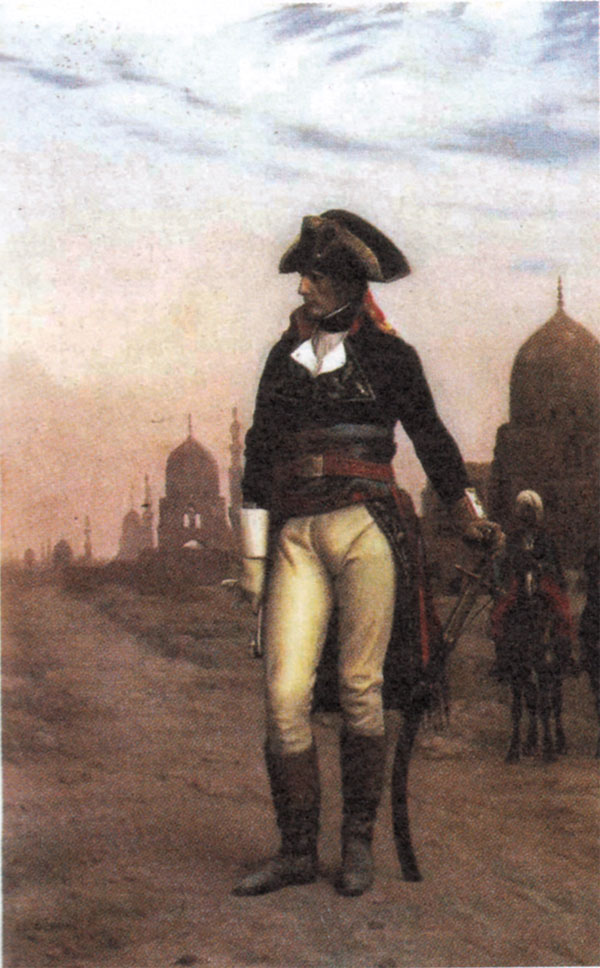
(Napoleon in Egypt by painter Gerome)
Such was the political state of Europe at the close of the eighteenth century and at the dawn of the nineteenth, and these were the Powers Napoleon had to grapple with for the mastery of the world. Of the four great nations whose overthrow was essential for the gratification of his ambition England alone escaped the lion’s claws. During nineteen years of incessant warfare she remained unscathed, invulnerable under the aegis of her invincible navy. In 1797 Austria was at Napoleon’s mercy; in 1800 he ejected her from Italy; in 1805 she lay prostrate at his feet. In 1806 he annihilated Prussia and defeated Russia. In 1809, for the second time, he overthrew Austria. The supremacy of Dresden, the suzerainty of Europe was the recompense of these stupendous achievements. The vast power which Napoleon enjoyed at Dresden is the greatest reward of human endeavour the world has to offer us, only acquired by exploits as astounding as those he achieved. No human power, short of universal dominion, could be greater than that which Napoleon exercised from 1810 to 1812, culminating in the pageant of Dresden. Had he overthrown Russia in 1812 and conquered England without doubt the world would have been at his feet. It was at Dresden, at the hour of his greatest prosperity, that Fortune, his faithful handmaiden for sixteen years, forsook him. She could no longer meet his demands. To no other mortal had she ever conceded so much. The pageant of Dresden is the uttermost limit of human transcendence on record throughout the history of the human race.
Taken from: Napoleon Our Last Great Man By Elystan M. Beardsley, 1907 Sisley’s Ltd. Makers of Beautiful Books, London
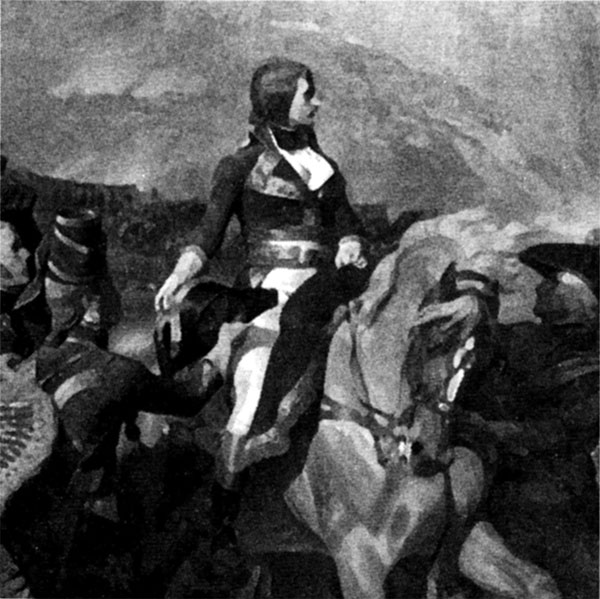
Relentless Energy Grandiose Dreams
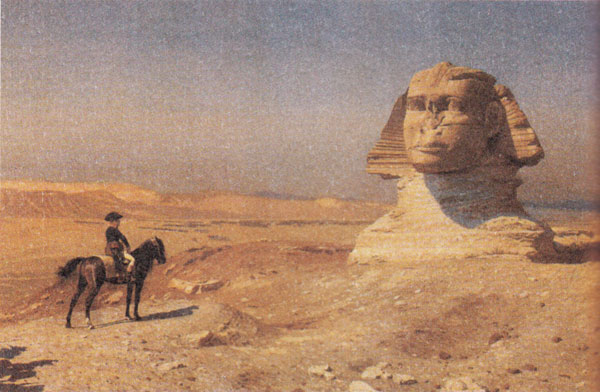
(Napoleon before the Sphinx, by Jean Leon Gerome)
1) Adventures and dreams in Egypt
In the army, many of the officers belonging to the nobility had left France at the beginning of the Revolution. As a result, capable soldiers rose quickly. At 24 Napoleon became brigadier general. In 1793 he helped to reconquer Toulon, - a rebel town - and he suppressed a royalist riot against the Convention in 1795. In 1797 he was given the command of an army preparing to invade Lombardy in northern Italy. The Italian campaign was a great success. It removed Austria from the war, gave France control of northern Italy, and established Napoleon's reputation as an outstanding general. Then Bonaparte proposed to the Directors5 to take an army by sea to Egypt, where he hoped to sever England's lifeline to India. The Directors easily accepted, rather happy to send far away a too successful general....
... the general writes to ... the Directors a long report, which begins as follows: "Even with our best efforts, it will take us several years to get the upper hand at sea. The invasion of England would be a desperate venture; it will only be possible if we take the islanders by surprise. ... We shall need long nights, so it must be in winter. Consequently we cannot make the attempt till next year. Before then, it is likely enough that hindrances will have arisen on the Continent. Perhaps the great moment has been lost forever."
After this amazingly perspicacious renunciation of his scheme for the invasion of England, he goes on to formulate a yet more amazing plan for achieving the same end by other means. Substantially, he proposes eight naval campaigns, ranging from Spain to Holland, all the political conditions and consequences being carefully considered. If, however, ships and money are not forthcoming, the next best expedient will be to attack English commerce, beginning in Egypt, whence Bonaparte could get back to direct further operations against England.
Enough for the Directors to hear the word Egypt, and they are ready to agree to this last plan. He shall have the command there, and all the help they can give. So dangerous a man as this - the farther away he is, the better! Best of all would be, to make an end of him!
The Egyptian plan is not new; it has been mooted at intervals for years. Talleyrand had brought it forward in connection with Bonaparte's letter, though his comment had been: "The leader of this campaign would not need to be a man of exceptional military talent." Was this remark prompted by a wish to keep Bonaparte in France, or was it nothing more than a spiteful innuendo? However that may be, the talented commander, when he read the words at a much later date, wrote in the margin: "Crazy!" But we anticipate. He drafted the terms of his own nomination as chief of the Army in the East: plenipotentiary powers; a commission to take Malta and Egypt, to drive the English from the Red Sea, to cut a canal trough the Isthmus of Suez in order that France may be secure in the possession of the Red Sea.
With feverish energy he now devotes himself to preparations for the new undertaking. He has long been familiar with all the essentials of the problem. The Mediterranean is his home. In childhood, he was wont to contemplate the Moor's head on the scutcheon of Corsica, sailing ships from Africa often visited the island; not long ago, he had deprived Genoa and Venice of their fleets, he was already in touch with Tunisians and Greeks, with Albanians and Bosnians. Over all these machinations brooded the spirit of Alexander, who had chosen Egypt as the centre of his world empire.
For the first time, during these weeks of waiting, do the elements of Bonaparte's nature become formally compacted within him. What has been no more than a scheme of the unbridled imagination, the plan of one who aspires to resemble the most splendid exemplars of the ancient world, is now dissected, pondered, weighed in the calculating brain; it is refashioned, reconsidered; by degrees it is adapted to the actual possibilities of the situation. When preparing his Egyptian campaign, Bonaparte attempts, in the grand style, to unite the calculator with the dreamer, while it escapes his notice that there is an incalculable residue. His imagination, nourished upon dreams of the heroic age, blinds him to the fact that we are no longer living in the days of classical antiquity, that caliph and conqueror can no longer command millions of unthinking slaves, that even in distant Africa the peoples are awakening. Bonaparte is making ready for a titanic and insoluble conflict; and the more deeply he becomes involved in it, the more defiantly will he continue his vain attempts to solve it.
This man of genius, born two thousand years too late, is already spinning the threads of his own doom. With the hand of a demigod, he is sketching the outlines of his own fate.
"I am going to the East," he writes to his brother, "with all the means to ensure success. Should France need me, ... should war break out and take an unfavourable turn, I shall come home, and public opinion will be more solidly on my side than it is now. But if the fortune of war should favour the republic, if another commander like myself should appear upon the scene, I shall, perhaps, by staying in the East, do the world more service than he can." When Bourrienne asks how long they are to be away. Bonaparte answers: "Six months or six years."
At the last moment, fate wants to give him another warning. In Rastatt, Austria refuses to cede the left bank of the Rhine; in Vienna, Bernadotte, who is French envoy there, is so provocative that a new war already seems imminent. Would it not be better to stay in Europe? But the Directors speed the departure, saying that matters have now gone too far to withdraw. In May, exactly two years after Napoleon's entry into Milan, four hundred ships set sail from Toulon. Josephine waves farewell to her husband, and (doubtless with more concern) to Eugene. Not until the whole mighty apparatus has been set in motion at the master's nod, does he disclose to his subordinates the goal of the voyage. All are on deck, watching the gradual disappearance of the European coast; but Napoleon, on the "Orient," standing beside the mainmast among the eight-pounders, is not, like the others, looking back at Europe. His gaze is directed towards the south-east.
At the same hour, Nelson and three other British admirals standing on the decks of their ships, are searching the seas with telescopes for a sign of the hated enemy, who is, it is supposed, about to sail for Sicily. Where is he to be found? Yesterday, Nelson's fleet was scattered by a storm. Days pass before the ships can get together again, and the very storm which had detained Bonaparte for twenty-four hours in Toulon, saves the French. They reach Malta before the English fleet, and seize the important island by a coup de main. By the time the cat arrives, the mouse is gone. Under all sail, Nelson presses on to Egypt, but finds no one there, for he has outstripped the enemy. He tries the Syrian coast. Nothing! Back to Sicily. No one! "The Devil has the devil's own luck," says Nelson, cursing himself and the foe.
The French fleet is four weeks on the voyage, and Napoleon who is a bad sailor, spends most of the time in bed. Is not this symbolic? Will the seasick general ever win the command of the sea? He is restless lying down, and, to pass the weary hours, he makes Bourrienne read aloud to him
For on board this fleet there are not only two thousand guns. A whole university is sailing to the East. Astronomers, geometricians, mineralogists, chemists, antiquarians, bridge-builders, road engineers, orientalists, political economists, painters, poets - one hundred and seventy-five learned civilians, with hundreds of boxes full of apparatus and books. Everything in this land of ancient story is to be meticulously studied. For France, Bonaparte is to win a colony, and for himself an African reputation. The soldiers have bluntly nicknamed these learned passengers, collectively, "the donkeys." But Bonaparte prizes them, and his wrath breaks loose on any of his officers who grumble at the presence of so many "idlers." He has chosen his experts with the utmost care, and has thought out every detail of what they are to do. He has brought a font of Arabic type, extracted with great difficulty from the State printing house. He has taken especial pains in the choice of books for the library with which the flagship is freighted for the voyage to Egypt. Novels are good for officers; and when he finds them reading novels, he laughs good humouredly. For himself, he has only Werther and Ossian, works of passion, his inseparable companions. On this journey, however, he seldom reads them.
What does Bourrienne read aloud to the chief? Travels in Egypt which have been collected from various quarters, from Rome and elsewhere; Plutarch; Homer; Arrian's account of Alexander's campaigns; the Koran, which, logically enough, is housed among the political works, beside the Bible and Montesquieu.
After dinner, he is fond of holding sessions of "the Institute." He uses the name jestingly, and yet in the discussions he takes it seriously enough. He propounds a subject for debate, and nominates the champions. Mathematics and religion are his favourite topics on these occasions, for he has always been both calculator and dreamer. There sits the famous Monge, a man with a crooked nose, a receding forehead, and a massive chin; Napoleon has admired him for years, and thinks more of him than of any of the others. Beside Monge is Desaix, whom Bonaparte has just summoned from the Army of the Rhine; he has a thick nose and thick lips, it is a somewhat negroid but kindly face, and the strategist rivals the mathematician in the shrewdness of his eyes. Look at Kleber, a man of fearless countenance, full of courage and resolution; beside him, Laplace, who peers earnestly at the company from beneath his eye-shade; next is Berthollet, with a head like a ram. Kleber grumbles at geometry; but when one of the professors wishes to take up the cudgels on behalf of the things of the spirit, Bonaparte signs to him not to waste breath, and points with a smile to Berthier, who has fallen asleep in the corner over the Sorrows of Werther.
The weather is getting much warmer. Napoleon, wishing to breathe the night air, lies on deck till a late hour. His intimates are sitting round him in a circle, and discussion turns on the planets, on the question whether they are inhabited. Pros and cons are voiced by the disputants. This leads to the problem of the creation. The sons of the revolution, disciples of Voltaire, be they generals or be they professors, are agreed upon one point, that the universe and its origin are rationally explicable in terms of natural science, without reference to the idea of God. Napoleon lies there, listening in silence. Then, pointing to the stars, he interjects: "You may say what you like, but who made all those?"
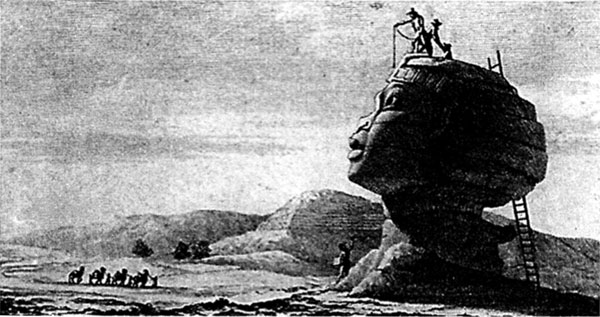
Vivant Denon, archeologist and artist, was one of the 175 scholars who accompanied Napoleon on his campaign. Vivant Denon made numerous sketches of ancient Egyptian monuments. Here he is seen climbing on the Sphinx to take its measurements.
Bonaparte rides slowly across the desert sands to look upon the face of the Sphinx. The eyes of stone and the eyes of steel meet. Like the Sphinx, he knows how to be silent, but we can guess his thoughts.
"Alexander stood here. Caesar stood here. They lived two thousand years after this image was sculptured, as I live two thousand years after them. Immeasurable empires, consecrated to the sun, extended around the Nile. Millions obeyed the will of one. What the ruler dreamed, was fashioned by his slaves with their myriad hands. Everything was possible to him. The king was the son of the gods. All obeyed him as the descendant of the original conqueror. Because that first conqueror named himself king, and son of the gods, all believe him. Here, in the East, it is possible to say to human beings, 'I am your god' and all believe. Europe is a mole-hill."
Soon, not many miles away, Napoleon makes ready for battle. Eight thousand Mamelukes, the best cavalry in the world, are ready to crush the invader. He rides up and down in front of his troops, points to the pyramids in the distance, and exclaims: "Soldiers, forty centuries are looking down on you." The Mamelukes charge the French, but are driven back by artillery fire; their camp is soon in Bonaparte's hands; they flee to the Nile, crossing the river in boats and by swimming; since it is notorious that they always have gold with them, the fight continues for hours on the bank and in the water until the victors have secured some of the treasure.
In Cairo, he knows how to win the support of the pashas and the sheiks. He gives out that he loves, and venerates the Turks and the sultan. He is only attacking Mamelukes, who are their enemies likewise. Periphrases, bowings and scrapings, elaborate metaphors - these come natural to him, the man of the Mediterranean who is half an oriental. They are devices for lying even more circumstantially than do the diplomats of Europe with their speedier and directer methods. Here he is following the oriental custom. While still on board the "Orient," he had dictated to his interpreters a letter to the pasha of Egypt. It began as follows:
"Thou who shouldst be supreme over all the beys, but hast, as I know, neither power nor prestige in Cairo, thou wilt welcome my coming. Assuredly thou knowest that I have it not in mind to do anything against the Koran or against the sultan. Come, therefore, to my help, and join with me in cursing the godless race of beys!"
To approximate his own creed to the faith of Allah, he begins, like a conjuror, to juggle with the Trinity. First of all he explains that he has conquered the pope and the Maltese and that for him the Koran is the word of God just as much as the Bible. But, at a later date, when the forces sent to dislodge his own are being disembarked, he argues as follows: "Allah is Allah, and Mohammed is his prophet. To the divan of Cairo, chosen from among the ablest, most learned, and most enlightened of men! The blessing of the Prophet be upon you!" He goes on to say that he has allowed these men to be landed in order that he may kill them all at one blow, "which will be a glorious sight for Cairo." There were Russians on board the invader's ships. "The Russians hate all who, like you and myself, believe in one God, for, in their own legends, they speak of three gods. They will learn, soon enough, that there is but one God, the father of victory, who graciously fights on the side of the good."
Out of this potpourri of the religious, which ends on a more pagan note than he seems to be aware, he subsequently extracts unchristian France as a political instrument, saying that the religion of France is especially akin to Mohammedanism. He is continually appealing to the Koran as the basis of his thought. The holy book which he has included in the political section of his travelling library, shall be made to do him good service. When he dismisses a dangerous cadi in Cairo, he finds a justification for his action in the Koran: "All that is good comes from God; he gives us victory ... Whatever I undertake must succeed. All those whom I call my friends, thrive. But anyone who helps my enemies, perishes."
If he had but had the luck to have been born here in Egypt four thousand years ago, he would have gained the victory by the power of suggestion alone. But nowadays even these brown fellows are sceptical! He despises them, while showering them with superlatives; but, at the same time, he threatens to punish with the utmost rigour any of his soldiers who injures a native. The first order of the day to the Army in the East runs: "The peoples with whom we are now in contact do not treat their women as we treat ours. Nevertheless, anyone who harms a woman is looked upon as a monster here as in Europe. Looting enriches very few, dishonours all, destroys the sources of aid, and makes us hated by those with whom it is to our interest that we should be friends." No one is to enter a mosque, and groups must not even assemble round the doors. By cajolery and threats, by tolerance and intrigue, by Allah and the sword, by all the methods of the oriental, Bonaparte secures an authoritative position within a few weeks.
At length he can regard himself as master in the East. Is he any the happier for that?
Napoleon receives news that his wife is unfaithful to him. This makes him very despondent...
A blow quickened him back to life.
Returning from a ride in the desert, he entered Marmont's tent to find that all his associates were greatly perturbed. What had happened? The French fleet had been destroyed. The day before, there had been a sea-fight in Aboukir Bay, and only four ships had escaped. All the rest had been sunk or captured by Nelson.
The officers stood in gloomy silence. The grenadier on sentry duty in front of the tent understood, everyone understood, the meaning of this reverse. Napoleon's face paled, but he recovered his composure instantly, realising that it was his business to restore the morale of the others. After a brief pause, he was ready with encouraging words: "So we are cut off in Egypt. Good. We must keep our heads above the stormy waters; the sea will soon be smooth once more - Perhaps we are predestined to change the face of the East. Here we must remain, or achieve a grandeur like that of the ancients!"
A terrible reverse! What will Paris say? He is not admiral of the fleet, and was not present at the battle of the Nile, but the disaster will certainly affect his prestige. How are we to get home again? On Turkish ships? But will the sultan remain neutral any longer? He has been wavering between Russia and France, and will be likely, now, to turn against the French. England, too. The fleet annihilated; thirteen battleships gone. How many years will it be before we can again face England on the high seas? A decade, perhaps. Allah is Allah, but behind what cloud was my star hidden? No, not my star! For, when he reports the defeat, he conceals nothing, but is careful to explain in his official dispatches that for-tune had delayed Nelson's return until the French had been able to secure their footing in Egypt. Weeks of uncertainty. This is a new phase in Bonaparte's life. He must remain inactive, while he waits for news that will throw light upon the state of affairs in Europe. If England keeps good watch, perhaps no letter will be able to cross the seas. For the first time in his career, he begins to wonder how he can kill time. The administration of a whole army, the suppression of disturbances, the rehabilitation of crumbling fortresses — these are no more than variants of idleness. The hours hang heavily, and he becomes more nervous, more fanciful than of yore. Bourrienne tries to tranquillise the commander's mind, saying: "Let us wait till we hear what the Directory proposes to do!" "The Directory? A dung-heap! The Directors hate me, and will leave me here to rot!" If he could only ride! But it is too hot at any rate to ride in uniform, and an attempt to wear Arab clothing has been abandoned. Sometimes he goes for a ride, in spite of the heat. When, on his return, he finds that no dispatches have come, he grows meditative: "Do you know what I have been thinking, Bourrienne? If I ever see France again, my greatest ambition will be to conduct a campaign on the Bavarian lowland. There I could win a great battle, and take vengeance for Blenheim. Then I should retire to my country seat and lead a quiet life, perfectly contented." The fire still glows; the kettle goes on simmering! In the plain of the Po, his restless spirit was yearning for the East; having made his way to Egypt, he craves for Bavaria; and always he thinks in terms of battles.
Now, when his future is so uncertain, when he is perhaps cut off from all chance of returning home, and when there is no longer a strong tie of personal affection to bind him to distant Europe, he opens negotiations with the shah of Persia and Tippoo Sahib, England's enemies: asking the former for a right of way to India; and offering the latter an alliance, and deliverance from "The iron yoke of England." The prospect of following in Alexander's foot-steps looms nearer. But when he comes to practical calculations he begins to doubt the possibility: "Only if fifteen thousand men can be left here, and I have another thirty thousand at my disposal, shall I be able to venture a march on India."
Although all remains in the realm of fancy, such imaginative excursions fill Bonaparte's happiest hours; he luxuriates in these vast plans. Four years later, he declares: "In Egypt alone did I feel free from the trammels of civilisation; and there I seemed to have the means of realising all my dreams. I pictured myself on the road to Asia, the founder of a new religion, mounted on an elephant, wearing a turban, and holding a new Koran which contained my own message. My plan was to weld the experiences of two worlds, to force history into my service, to attack the English power in India, and, through my conquests there, to reopen communications with Europe."
Are these the visions of a poet? Or is it that the conqueror and the poet are close kin? In Egypt, he has a romantic name for himself, "Sultan EI Kebir"— he is, in truth, always the sultan, more or less. El Kebir is his third name, as visionary as the whole campaign.[...]
In the Institute, the commander-in-chief sits as an equal among equals. He never tries, in argument there, to gain a victory by rank instead of reason. Yet many of the questions that are discussed relate to army matters of immediate practical importance, such as the filtering of Nile water, the erection of windmills, the search for ingredients needed to make gunpowder. On one occasion, Napoleon grew heated. Berthollet said quietly: "You are wrong, my friend, for you have lost your temper." A naval surgeon supported Berthollet. "You men of science are as thick as thieves," exclaimed Bonaparte. "Chemistry plays the cook for medicine, and plays the assassin for science!" The surgeon's answer came pat: "But how, Citizen-General, would you define the conqueror's art?" Within the republic of learning, this equality pleased the dictator, whom elsewhere hardly anyone now ventured to contradict.
For weeks in succession, the orders of the day ended with the words: "No news from France." Everything was at a standstill; widespread uncertainty prevailed. Amid the general inertia, the travelling university was an exception; the savants were hard at work, studying, advising, ever ready to help in the second line. As far as they were concerned, this time of waiting was a great opportunity for research. A thorough investigation of the country and its resources was in progress; the fishes of the Nile and the minerals of the Red Sea, the flora of the Delta and the constituents of the desert sand — all were now for the first time being elaborately scrutinised. The exploitation of the natron lakes and the Nile mud was under consideration. The physicians of the expedition were enquiring into the causes of oriental plague; and of trachoma, the terrible form of ophthalmia which is so frequent a cause of blindness in Egypt. A dictionary and a grammar were printed; some of the buried temples of Upper Egypt were disinterred; the Wells of Moses were discovered. One day, an engineer officer came back from Rosetta bringing with him a granite slab on which there was a polyglot inscription, chiselled in Greek and in two variants of the ancient Egyptian picture-writing. The riddle of the hieroglyphs had been unriddled.6
What especially interested the commander, however, was the possibility of cutting a canal through the Isthmus of Suez. He made long journeys in the desert, always exposed to the danger of Bedouin raids; traced the line of the ancient canal; planned the course of a new channel. All his speculations were confirmed half a century later by Lesseps. Not like an adventurer whose schemes have miscarried, but in the spirit of a conqueror, he designed to separate the continents and link the seas.
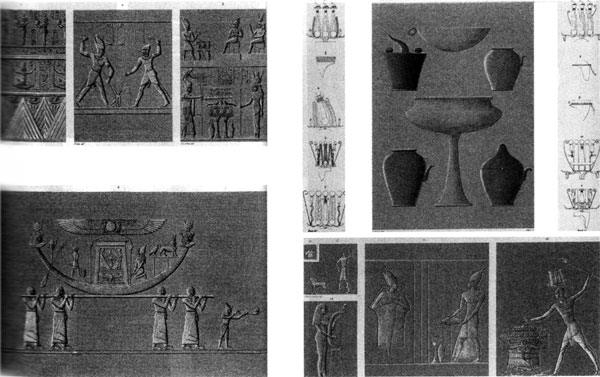
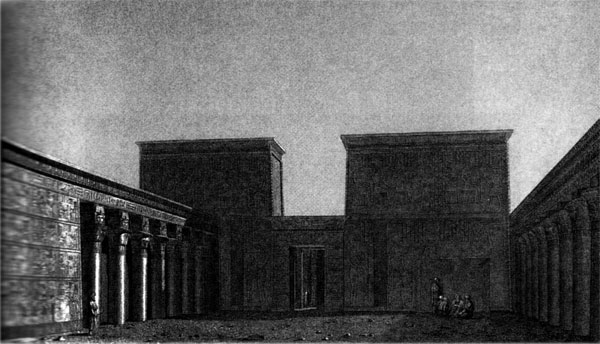
Napoleon ordered the Imperial Press to work on the publication of the cultural and scientific studies brought back by the scholars of the expedition. Four hundred engravers worked for more than twenty years on this "Description of Egypt", which included not only ancient monuments but also a documentation on life in modern Egypt along with a practical encyclopedia on its flora and fauna. More than 3000 illustrations, some of which were more than one meter long. This book gave birth to the science of Egyptology by revealing the wonders of a forgotten civilisation. We reproduce here some pages of that book: Below, a sketch of the temple in the island of Philae. On top left, sketches of sculptures on its porticoe, and on top right details of sacred vases, symbolic headgears and sculptures.
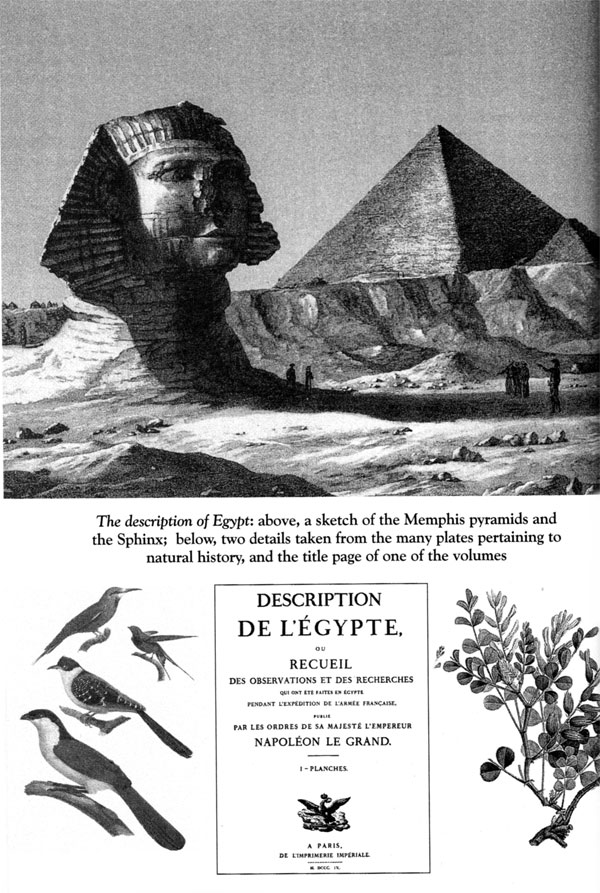
Now at length! Some merchants on small vessels have man-aged to slip through the English lines. From them, Napoleon learns that the destruction of the French fleet off Aboukir has brought about a general transformation. The sultan has entered into an alliance with Russia, and the two powers have declared war on France. Achmed, the Turkish commander, is marching on Egypt through Syria. The malcontents in Cairo, encouraged by these tidings, rise in revolt. The insurrection is quelled by artillery fire, and the heads of the rebels are exposed on pikes as a warning. "This will have a salutary effect. Clemency is no good here."
On the whole, the commander is more relieved than alarmed. If the Turks are marching southwards, so much the better; at length he will have a chance of beating them in open fight.
From most of his close associates he conceals his deeper cause for anxiety. When he left France to occupy Egypt, his aim was to secure a position that would help him in his scheme for the conquest of India. "With ships, we can cross the seas; with camels we can cross the desert." He had allowed fifteen months for the conquest of Egypt and the consolidation of his power there, and for the preparation and equipment of his forces for the Indian campaign. That would need forty thousand men, as many camels, and one hundred and twenty field guns. He had asked for extensive reinforcements; ships, guns, and men. These were to support his land army by sea.
The battle of the Nile had frustrated his fine schemes. The English were blockading the coast; the sultan had become his enemy; Egyptian sentiment was now hostile. But it was Napoleon's way to adapt his plans to changing circumstances, and it seemed to him that he could derive advantage from the turn of events. The Turks and the English are going to make a joint landing? That threatens our very existence here? Well, then, let us attack to escape destruction! Seize all the magazines and ports from the Turks, arm the Syrian Christians, stir up the Druses! If we were to take the fortress of Acre, opinion in Cairo would veer round to our side. By June, we shall be in Damascus; shall thrust outposts forward into the Taurus; march eastward with 26,000 Frenchmen, 6,000 Mamelukes, and 18,000 Druses. Desaix will come direct from Egypt. The sultan will find it expedient to keep quiet. The shah of Persia has already agreed to our marching by way of Bassora and Shiraz. By March, if Allah favours us, we shall reach the Indus.
Once more, Bonaparte fashions a splendid dream out of pressing embarrassments. He sets out for Syria.
There are practically no roads. Sometimes he rides as many as forty-five miles in fifteen hours, invariably by night, without water, and almost always with the vanguard. When Jaffa falls, three thousand Turkish soldiers surrender. What on earth is he to do with them? Keep them prisoner? His own men are on short commons; and, besides. He would then have to spare thousands of Frenchmen to guard the Turks. Send them home? He has no ships. Exchange them? The Turks have no prisoners. Set them free? Then they will reinforce Acre, the next stronghold. What on earth is he to do? Council of war!
All are in favour of killing the prisoners. Only a few days before, the Turks killed one of our envoys! Our own troops would be infuriated if they were to go hungrier still because of these fellows. Bonaparte wavers, thinks matters over for three days, and finally agrees. The prisoners are marched down to the sea and slaughtered. Subsequent military critics, especially the Germans, have-agreed that there was no choice.
Acre lies before us. There we shall find stores of new weapons. Then onwards toward the North! The great dream renews it-self during these weeks. Now that Turkey has declared war, he is completely isolated, and forced into a life-and-death struggle. Everything is possible, for needs must when the devil drives. But he is not quite easy in his mind about the Indian scheme, for he mentions an alternative plan to one of his officers: "After I have seized Acre, I shall march upon Damascus and Aleppo, augmenting my army as I go, for I shall announce to the people the overthrow of the tyrannous pashas. Then, with overwhelming forces, I shall take Constantinople, make an end of Turkey, and found a new and great empire. This will bring me immortal fame. Perhaps I shall then make my way home through Adrianople or Vienna after annihilating the house of Habsburg."
Always the same visions, magnified now, when the situation grows desperate.
He reaches Acre. Not a big fortress, but well supplied with modem weapons, and defended by English officers and artillerists. Three successive attempts to storm the place are fruitless. English battleships arrive to support the besieged, and threaten the besiegers.
At last, after eight months, he has direct news from Paris! It is little to his taste. Talleyrand has not gone to Constantinople to treat with the sultan. Is the rogue hedging? The French Republic is at war with Naples and Sardinia. Moreau and Augereau, Bonaparte's rivals have high command. Why, in God's name, do we squat here on the burning sands, inactive? Storm the place! Are our schemes to be wrecked against these miserable walls?
Who is in charge of the defence? Phelippeaux is there, a skilled engineer, one of Napoleon's old comrades at the Cadets' School in Paris, afterwards an émigré who had entered the English service!
Why can they not take the place by storm? Bonaparte has no patience for a slow siege, for starving his enemy into surrender. The whole idea is foreign to his impetuous temperament. A fortress, like a woman, must be taken by storm, or not at all. He cannot beg, serve, or woo; and he cannot wait. Now time presses, and to wait is out of the question. Storm! The soldiers begin to murmur. Even among the officers there are mutterings which are the heralds of mutiny. "Let us have Kleber for our leader; he is humane and gentle."
Bonaparte sits in his tent, thinking matters over. A terrible hour! Is England to be ever invincible, even on land, even here in the East? Is the siege to drag on for months? Impossible! Europe is full of the clash of arms. Turn back, without having won a victory? An unprecedented experience, an entirely new feeling; but there is no choice. The enterprise must be abandoned. Back to Egypt! It is only half the truth to say that Acre barred his march upon India. Who can tell whether, if the fortress had been taken, he would have pressed on towards the Indus notwithstanding the ominous news from Paris. We should have to reckon with incalculable feelings here. Every coincidence is symbolical. Before Acre and on the Po, France is at war with the same monarchical coalition. None but the son of the revolution can save the situation. Contrary to his usual custom, he does not ride in the van, but for hours after the columns have started southward, till nightfall indeed, he stays behind on an elevation to contemplate the stubborn fortress, his mind filled with a sort of ferocious melancholy.
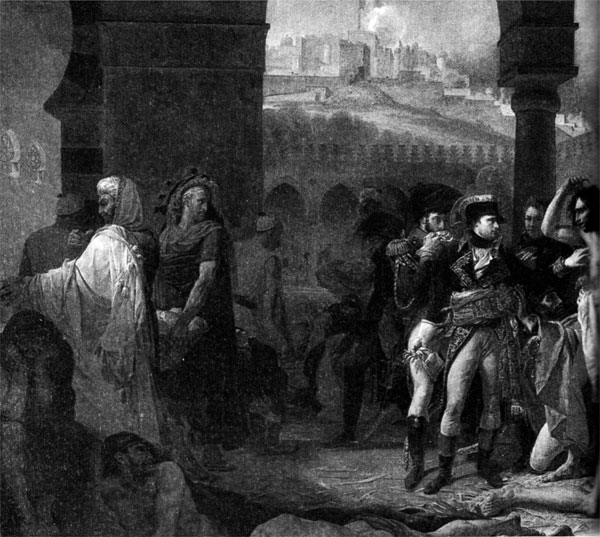
(Napoleon visiting the plague affected people in Jaffa)
A ghastly retreat. No roads, no water, the plague as rearguard. Is Bonaparte's career to be ruined by the desert and the black death? Calm of aspect, he visits the sick in hospital, and encourages them wherever possible. The doctor points to fifty cases as hopeless. They must be put out of their misery, thinks Bonaparte; their path to death must be smoothed. With a royal assumption of responsibility, he orders a lethal dose of opium. The doctor demurs. It remains uncertain whether someone else carried out the order. "In such circumstances," he says later, "I would have had my own son poisoned."
Two thousand sick men and six thousand who are still in health make their way slowly through the desert. Every four of the healthy have to carry a comrade who is too ill to walk, for there are not enough horses to bear the sick and the maimed. The staff officers are all marching with the rest. This is by Napoleon's command. An equerry asks him which horse he will ride. "Did you not hear the order?" retorts the commander, striking the man with his whip. "Everyone on foot!"
At length the retreating army reaches Cairo. By entering with a triumphal display of captured colours, and by proclamations and marches, he makes a vain attempt to delude the people of Egypt.
What is Paris saying? What shall he tell Paris? We did not occupy Acre because the plague was raging there! That was why we withdrew from the siege! In the Institute, a committee is appointed to substantiate this tale. A doctor stands up, and, in the presence of a hundred savants, refuses to attach his name to this fiction. The commander yields with a wry face, but bears no grudge against the stalwart whom he promotes more than once in years to come.
The Turks now arrive by sea, intending to make an end of the French. Once more, the whole existence of the expeditionary force is at stake. The enemy is to land in Aboukir Bay, just a year after the battle of the Nile. He lets them land, and then inflicts a crushing defeat on them, though their army outnumbers his by two to one. After the battle, Kleber meets him, and embracing him, says: "General, you are as great as the world, but the world is too small for you!" Bonaparte writes to Cairo: "You will have heard of the battle on the shores of Aboukir Bay, one of the finest I have ever seen! Of the army the enemy had landed, not a man escaped." At this time he notices among the Mamelukes who have entered his service a tall, handsome fellow with blue eyes, a Georgian named Rustam who has five times been sold as a slave. Fidelity is written on his countenance. Napoleon gives him a sword with an encased hilt and scabbard, and makes him his body-servant. For fifteen years, Rustam sleeps outside his master's door. After the victory at Aboukir, Napoleon enters into a parley with the admiral of the blockading fleet. Ostensibly he wishes to discuss an exchange of prisoners with the English. Really he is hungering for news; newspapers are worth more than kings crowns. Someone manages to get hold of what he covets, and an adjutant brings them into his tent. The commander is asleep. "Here are newspapers, General. Bad news." He sits up. "What's happened?"
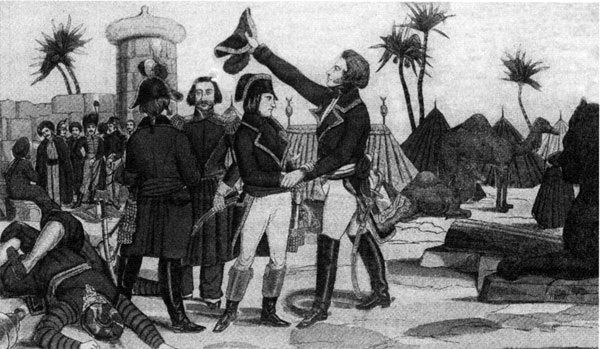
(After the victory on the Turks, Kleber greets Napoleon: "General you are as great as the world!")
"Scherer has been beaten. We have lost nearly the whole of Italy." Napoleon jumps out of bed, seizes the papers, and goes on reading them all through the night, with an occasional pause for an outburst of wrath. At dawn he send for his admiral-in-Chief, is closeted with the seaman for a couple of hours, and then sets out for Cairo. "I have made up my mind to return to France," he says behind shut doors to the faithful Marmont. "You will come with me. Our armies in Europe have been defeated. God knows where the enemy will have got to by now Italy is lost. What are they about, these incompetent idiots at the head of affairs? Stupidity and corruption! I have borne the whole burden single-handed, and by my victories have propped up a government which could never have maintained itself but for me. As soon as I leave, everything col-lapses. If I start at once, I shall get to Paris almost as soon as the news of my latest victory. My presence will restore confidence to the troops, and will reanimate the citizens with hopes for a happier future." "My future," he thinks, as soon as Marmont has gone. "People will say I have abandoned the army in Egypt. It will get along all right under Kleber. I came here to found a colony. It is founded, and the Turks have been beaten. Help can only come from France, and no one but myself can send it. I have nothing more to gain here, but everything to win on the battle-fields of Europe. Thirty years! How many days before I can get away? The admiral says it is a bad wind for Toulon, and that English warships swarm in the Mediterranean. I am afraid I can't get to Paris in an air-balloon! But Paris is the heart of the world. I must risk the sea passage."
Taken from Napoleon by Emil Ludwig, pp. 107-27
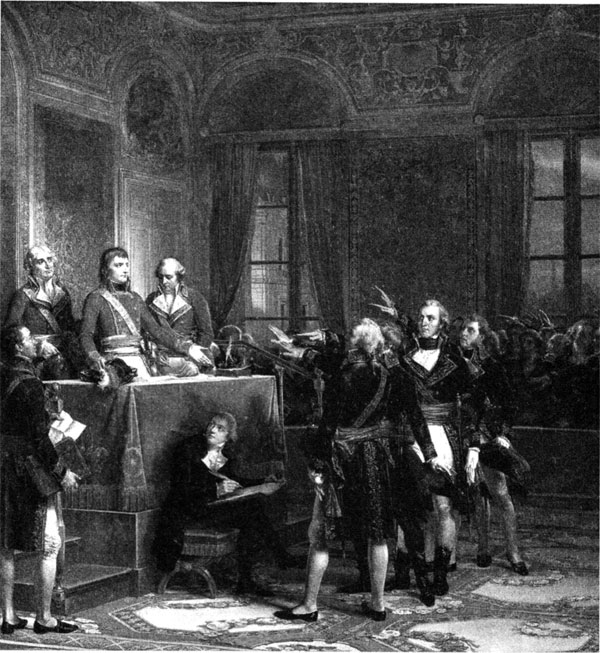
Installation of the Council of State, 25 December 1799. On either side of Bonaparte are the two other consuls Cambaceres and Lebrun. The First Consul administers oath of office to the "Presidents of section". Not willing to break openly with the Revolution, Bonaparte, once First Consul, started restoring order by re-establishing the power of the State. The Constitution of 1799 uses a vocabulary reminiscent of the ancient Rome (consuls, senate, etc.), but instals a strong executive. The Council of State will be at the same time the great council of the government, next to the executive and even the legislative, clarifying and preparing decisions, and the supreme administrative tribunal of France.
2) Napoleon, administrator extraordinaire
Despite the mitigated results in Egypt — carefully and cleverly presented through monitored dispatches — Napoleon, having managed to land safely at Frejus, is well received. In a few weeks, as a result of a conspiracy with the most influent Director leading to the coup d'etat of 18 Brumaire (9 November 1799), Napoleon becomes First Consul with the real power in a triumvirate called the Consulate. He then sets to work at a frenetic if orderly pace...
About twenty men are seated round a large oval table. Some are quite young, some middle-aged, some elderly. They are plainly dressed, in accordance with the fashion of 1800, when wigs were no longer worn, and lace was out of date; three of them that are in uniform are not resplendent with gold braid, and they wear no orders. Some have the bold, self-confident look of the man of action; others, the thoughtful mien of the savant. From town and from countryside, from office and from laboratory, they come, but are unified by a common experience and a common aim. For ten years, they have been living through a revolutionary epoch; they meet to bring that epoch to a close. Around them is the chill splendour of the Tuileries, the palace of the last Bourbon kings. The golds and the reds of the rich carpets and the silken hangings are out of keeping with their bourgeois circumstantiality; the silvery sheen of the candles, reflected in rainbow tints from the myriad facets of the candelabra, recalls an era that scintillated with light and glowed with colour. [...] The Consul's own mood was no less haphazard as he looked round with childlike curiosity. "Well, here we are in the Tuileries," he said to one of his friends; "let's see to it that we stay here!" Several of those now seated at the oval table, had waited here of old — wearing powdered wigs, lace jabots, and pumps — tremulous with eagerness to learn whether His Majesty would receive them, and when. Some of them had sat at a similar table in the Luxembourg. There had been no stability about those deliberations. Laws had come and gone, urgency orders and exceptional provisions; transitional decrees had pushed foregoing decrees out of the way; three constitutions had risen and set, had shot up into the air swiftly and brilliantly like rockets, to vanish like these and to fall like rocket-sticks. The whole decade during which the new ideas had been trying to realise themselves in the concrete, had passed swiftly over Paris like a single night, amid a confusion of flashing lights and rumbling drums. The city had been like an armed camp with no fighting fronts and no battles, but perturbed by the to-and-fro march of armed political parties, deafened by the noisy wrangling between the old order and the new wishes, dazzled by the glare of venturesome ideas, confused by the clamour of disappointed hopes and the clash of warring ambitions — a titanic bacchanal of liberty, equality, and cozenage. Surveying the medley, looking down from the skies, were the shades of the two men whose books had set the whole in motion: Rousseau, with eyes of disgust; Voltaire, with a mocking smile. But suddenly the tumult had been stilled. That little man at the head of the table had stilled it, the little general in the well-worn green uniform. Now that he, presiding over the Council of State, is in fact presiding over the State, the parties have withdrawn into their caves, satisfied or rancorous, but at any rate silenced. France, weakened by clubs and corruption, by the Terror and the demagogues, is turning back (like an adventuress weary of errant amours) to the arms of the strong man who can master her.
Enough, now, for Bonaparte that he should aspire to fulfil this masterful lover's role. No longer did he need to fight for the position. The man for whom France was longing, must be a man of order; must be one who had never before held power, who belonged to no party, and who none the less enjoyed popular favour. He must, therefore, be a soldier and a conqueror. Moreau lacked the self-confidence and adroitness needed to make him a successful rival; the other great generals were dead or overshadowed; there were no civilian competitors. After Bonaparte's outstanding military successes, it was easy for him to win supreme power in the State. He would have won it without a struggle had he not been so stubborn in his desire to observe constitutional formalities.
The attempt to be strictly constitutional had been a ludicrous failure, and had imposed artificial obstacles in his path. Yet this very fact was a token and a guarantee of his political talents. He was a man with a firm grip on the sword-hilt, but he was also a man who clearly understood the limits of the power of the sword. "Do you know," he said in those days, "what amazes me more than all else? The impotence of force to organise anything. There are only two powers in the world: the spirit and the sword. In the long run, the sword will always be conquered by the spirit." Napoleon was the greatest military commander of his day, but neither now nor later was it his habit to strike the table with mailed fist; neither in Paris at this juncture nor elsewhere when negotiating a truce or a peace or an alliance. He was a political genius, who prized the sword, indeed, but prized it only as one of the two powers. His ear was never deafened by the clash of arms. As now, so for fifteen years to come, he is ever on the watch for indications of public opinion; always listening to the voice of the people, a voice which defies calculation; a voice which, Napoleon, a man of figures, vainly tries to calculate. Precisely because of his failure to do this, the attempt to reckon with public opinion is always alluring to the imaginative side of his nature.
Because Bonaparte believes in the power of the spirit more than in the power of the sword, he strives for order and peace more resolutely than for war and conquest. The history of the next ten years will prove it.
For him, order denotes equality, but not liberty. He adopts into his dictatorship the former of these two gods of the revolution. Except for a few vacillations, he will cherish equality to the end, despite appearances to the contrary. But liberty? What is liberty? "Both the savage and the civilised man need a lord and master, a magician, who will hold the imagination in check, impose strict discipline, bind man in chains, so that he may not bite out of season; one who will thrash him, and lead him to the chase. Obedience is man's destiny; he deserves nothing better, and he has no rights!" These threatening words of the misanthropist dis-close no more than half of his secret thoughts. Through all the phases of his rule, he is ever in search of the efficient man, and to such a man he grants power over thousands; just as he himself, through energy and diligence, through natural and acquired superiority, has won to power over millions. In spite of all, he is the -son of the revolution; and in this sense he will remain the son of the revolution, whatever forms his power may assume.
In part, that is the explanation of the mysterious influence he wields. The wider his domain extends, the more plainly do all realise that they are living in a system which promises to every efficient man the gratification of his wishes, and guarantees to every efficient man place and power and wealth; which does these things because the Master has himself risen out of the crowd. He shows this, now, in his very first step. Sieyes has drafted a constitution. There is to be a grand elector, a president who can only represent and sign his name. With soldierly curtness, Bonaparte puts his pen through the item. "Away with this fat hog!" Instead, there is to be a First Consul, with plenary powers, and plenty of work. He is to be war lord and also director of foreign policy; — he is to appoint all ministers and envoys, councillors of State and prefects, officers and judges. Thirty nominated senators are to elect their colleagues; but neither the Senate nor the Legislative Assembly nor the Tribunate is to have any power to initiate legislation. These bodies are merely brought into existence to give politicians a platform for their orations, and to provide senators with high salaries and opportunities for a resplendent life.
Although everything was dependent upon the will of one man, that one man insisted that those dependent on him should themselves be men, and not mere names. Neither birth nor pretentiousness nor prominence in a political party could lead to the front in the army or in civil life. Nothing but energy and capacity could ensure promotion. Such was the principle upon which Napoleon chose the members of the Council of State.
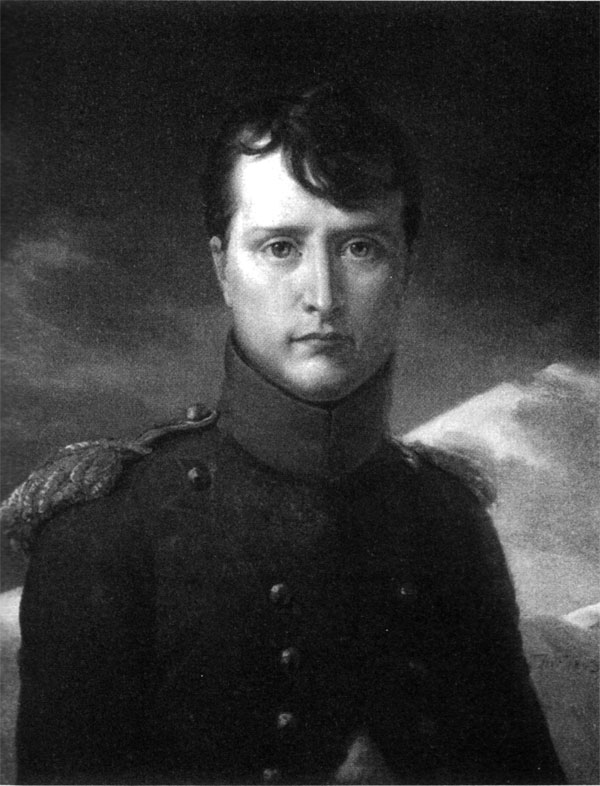
(Bonaparte First Consul, Gérard)
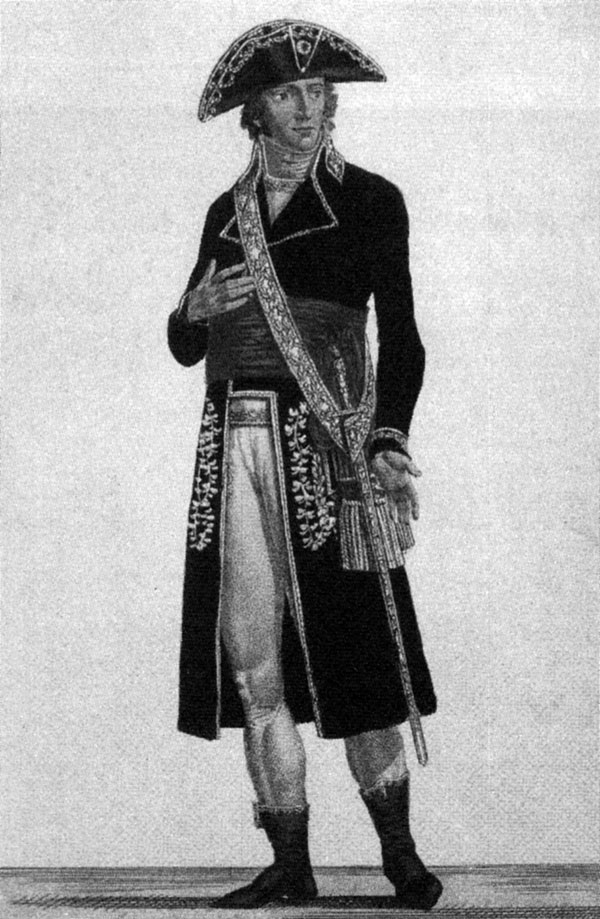
(A prefect - The French "departements" are administered by a prefect, who represents the executive power.)
This last was a round table of experts, selected by the dictator on his own initiative. Among them was Laplace, whom, to honour the Institute, Napoleon had also appointed Minister for Home Affairs — an appointment the great mathematician held for a time, until he turned back from the mechanics of the State to the mechanics of the heavens. There, too, was Roederer, official and journalist, the most independent man to be encountered by Napoleon during twenty years, and the most valuable recorder of conversations. Tronchet, also, one of the finest jurists of the age, was there. In the council chamber, all alike were citizens, and addressed one another by that plain title. Royalists and Jacobins sat there side by side, under a regime of equality, since reason was enthroned.
When the minutes of the sittings are shown to the citizen-consul, he says: "It is essential to give a full and accurate report of the opinions expressed by legal luminaries, for their words are weighty; but what we soldiers and moneyed men think is of little account. In the heat of the moment I have often said things which an instant afterwards I saw to have been unjust. I do not wish to seem better than I am." When he noticed that the councillors were simply echoing whatever he said, he was quick to call them to order: "You are not here, gentlemen, to agree with me, but to express your own views. If you do that, I can compare them with mine, and decide which is better."
The sittings, often enough, do not begin before nine in the evening, for up till then the Consul has been dealing with the urgent affairs of the day. They may last till five o'clock in the morning. The councillors get very tired during the small hours. Perhaps the Minister for War goes to sleep. Napoleon shakes them up, ex-claiming: "Do let's keep awake, citizens! It's only two o'clock. We must earn our salaries." He, who presides, is indeed one of the youngest of the company, being now thirty. But in three campaigns he has learned how to watch over the interests of hundreds of thousands. Was not the management of an army which set out from the Alps, crossed the sea, and marched far into the desert — was not this the best school for the study of State administration? There, too, he had to think of money and bread, of rights and laws, of rewards and punishments, of rest and obedience and order.
During the very first night after the coup d'etat, he had appointed two committees to draft a legal code; this was the first act of his dictatorship! The prevailing chaos had been the outcome of a lack of law. Down to the outbreak of the revolution, there had been no unified legal system in France. The revolution brought the promise of such a system; but even now, after eleven years, the promise was unfulfilled. That first summer, three great lawyers were set to work; four months and a draft of the Civil Code, subsequently rechristened the Code Napoleon, was ready; then the draft was discussed in the Council of State. In eighteen months the laws were voted. They passed into effect in 1804.
After more than two centuries, this Code is still the law of France; it was adopted in many of the lands conquered by Napoleon, having great influence on the legislation of Central and southern Germany, Prussia, Switzerland, and Spain; and its influence spread still farther afield, to Central America and South America. All that is new and morally decisive in the Code Napoleon is revolutionary law. The law-book which the Dictator discussed in all its details for many months, the law-book, many of whose most contentious points were the direct outcome of his decisions, borrowed the fixed principles of reason that had been sketched in the first days of the revolution. Experienced and dis-passionate minds, under Napoleon's guidance, worked them up, purified them, and made them into a new system of the rights of man. In this system, there was no longer a hereditary nobility; all children had an equal share in inheritance; all parents became legally responsible for the maintenance of their children; Jews became equal with Christians before the law; civil marriage was open to all, and was dissoluble.[...]
"In these sittings," says Roederer, "the First Consul manifested those remarkable powers of attention and precise analysis which enabled him for ten hours at a stretch to devote himself to one object or to several, without ever allowing himself to be distracted by memory or by errant thoughts.
"Bonaparte is filled with respect for the logicality and mental energy of the octogenarian Tronchet; and the old lawyer responds with admiration for the analytical faculty and the sense of justice of the young Consul, who, in the case of every ordinance, asks: "Is it just?" and "Is it useful?" He is never tired of enquiring how predecessors have solved the problems under consideration, paying special attention to Roman law and to the legal institutions of Frederick the Great.
Not only are thirty-seven laws discussed at this table; further-more, the Consul propounds question after question concerning other matters. How is bread made? How shall we make new money? How shall we establish security? He makes all his ministers send detailed reports, and this is great tax upon their energies. But he affects not to notice that they are overworked, and when they get home they often find letters from him requiring an immediate answer. One of his collaborators writes: "Ruling, administering, negotiating with that orderly intelligence of his, he gets through eighteen hours' work every day. In three years he has ruled more than the kings ruled in a century" He spoke to every expert in the phraseology of the craft, so that none of them could ever plead in excuse that his questions had not been understood. Even the most hidebound royalists were amazed at the technical accuracy of his enquiries.
His unfailing memory was the artillery wherewith he defended the fortress of his brain. Segur, returning from an official inspection of the fortifications on the north coast, sends in a report. "I have read your report," says the First Consul. "It is accurate, but you have forgotten two of the four guns in Ostend. They are on the high road behind the town." Segur is astonished to find that Napoleon is right. His report deals with thousands of guns, scattered all over the place, but the chief pounces on the omission of two.
By slow degrees, the huge machine (which for ten years has been standing still or moving backwards) is set in regular motion once more. Throughout the last decade, all the reports from the provinces have been full of complaints regarding the lack of public safety, sanitation, and order; the louis-d'or used to exchange for twenty-four francs, but now the ratio is one to eight thousand; the Directory's attempt to stabilise the franc has been an utter failure; the newly enriched have bought up the State domains, the Church lands, and the seigniorial estates. No one is paying taxes. What is the new dictator going to do about it all?
Within a fortnight after the coup d'etat, he had arranged for the establishment of tax-collecting offices in all the departments, for, as he put it: "Security and property are only to be found in a country which is not subject to yearly changes in the rate of taxation." Two months later, the Bank of France came into being; next year, there were new boards to supervise taxation, the registration of landed property, and forestry. Whereas his predecessors had simply squandered the State domains, he used what was left of them to defray repayment of national debt. ... he continued the process of debt cancellation, renovated the Chambers of Commerce, regulated the Stock Exchange, put an end to speculation in the depreciated currency, stopped the frauds of the army contractors and other war profiteers, and by these and similar measures restored manufacturing industry whose productivity had sunk to a quarter or half of its former level.
What was his magical spell?
At the head of affairs was himself, a man of indomitable energy, and incorruptible. Men of the same stamp, energetic, diligent, and bold, were put in charge of the ministries, the departments and the prefectures. Favouritism was done away with; sinecures were abolished. Preferment was obtainable only by the efficient, and to them it came regardless of birth or party. All officials, down to the mayors, were appointed from above, and paid from above —"a hierarchy, all First Consuls in miniature," to quote his own words.
There was no political opposition. "No reaction is possible", he prophesied. "I have not relied upon the credit or upon the strength of a party, and am therefore indebted to no one. The men of intelligence who, a little while ago, were perpetrating crimes, are now being used by me to upbuild a new social edifice. There are excellent workmen among them, but the trouble is that they would all like to be master builders. Typically French, that trait; everyone thinks himself competent to rule the country" Being careful to satisfy all parties, he gives the two most coveted portfolios to two rogues, mutually hostile, but both men of remarkable ability. Having done this, he is able to say: "What revolutionist can fail to have confidence in the social system when Fouche, the Jacobin, is Minister of Police. What nobleman would be unwilling to live under Talleyrand as Minister for Foreign Affairs? I have one of them on my right, and the other on my left. I open a wide road, in which all can find room."
To all the prefects and all the generals the order went forth: "No more clubs; no more parties. Tell the National Guardsmen and the citizens whenever you can, if a few ambitious fellows still feel the need to hate, that the rudder of State is now in strong hands, accustomed to overcome obstacles." A few weeks after the coup d'etat, he issued a great proclamation, commending the new constitution to the people. It closed with the simple and lofty words: "Citizens, the revolution has returned to the principles with which it began. It is at an end."
Taken from Napoleon by Emil Ludwig, pp. 153-64
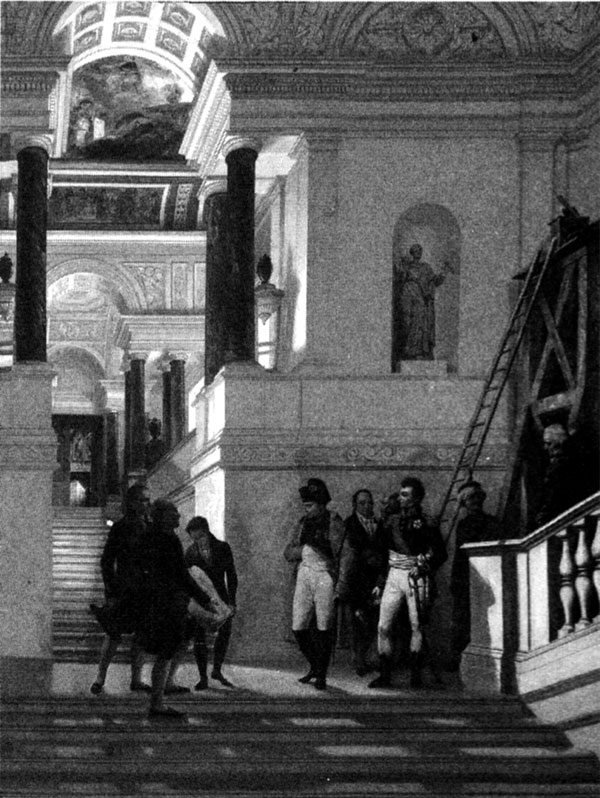
(Napoleon visiting the new spaces of the Louvre museum. Since the French Revolution, the palace was used as a museum, to display the nation's master-pieces. Following the Egyptian campaign, Napoleon appointed the museum's first director, Dominique Vivant Denon, who was seen earlier measuring the Sphinx (p 100). The size of the collection increased under Napoleon.)
3) Napoleon crowns himself Emperor
In May 1804 the Senate proclaimed Napoleon Emperor of the French after a referendum in 1802 gave a very large approval for a tenure for life to the First Consul. The coronation took place in a majestic ceremony to which Napoleon compelled the Pope to come. Unexpectedly, despite the presence of the Pope, he crowned himself...
Meanwhile, Letizia's protector the pope has become more compliant, and is already on the way to Paris. What else could the Holy Father do? The man of might had summoned him, and the Emperor must be kept in a good humour. Besides, he who is to be crowned is an Italian. As one of the cardinals had put it, in the decisive conclave: "After all, we have this satisfaction, that we are taking vengeance on the Gauls by setting an Italian family to rule over these barbarians." Napoleon is still regarded as a foreigner in France! But why does he not go to Rome for his coronation? Why is he not content to be anointed in Rome, as Charlemagne had been, and all the emperors of the west since Charlemagne's day? What does he want a pope for at all?
In this matter, once more, he is trying to harmonise the new with the old. At first he is silent about details, and merely asks the pope "to give the highest religious consecration to the anointing and crowning of the first Emperor of the French." For weeks, letters have been exchanged between Rome and Paris, but the exact nature of the ceremony still remains obscure. Pius VII is in an uneasy frame of mind as he draws near to Paris, and his spirit is by no means one of benediction. Never before has a pope been summoned in this way, much as a great physician is summoned. When the Emperor meets the pope at the gate of the city, the Holy Father does not fail to note that Napoleon neither kneels to receive a blessing nor kisses hands in token of fealty. Paris is a town where people's faith is unstable and where popes are held in little honour. The visitor is chilled. [...]

(The coronation ceremony, by the French painter David (detail))
On December 2, 1804, in Notre Dame, an abundance of precious stones reflects the light of a myriad candles, so that the place looks more like a banqueting hall than a church. Everything has been prepared for weeks beforehand. A skillful museum director has even produced a honorable imitation of Charlemagne's sceptre. Ancient parchments from the days of the Roi Soleil had been consulted, to ensure that the crowning of this revolutionist should vie in every respect with that of the legitimate monarchs of France. Segur had studied the etiquette of the occasion with the utmost care; Isabey had rehearsed the whole affair with an array of dolls; the old palace, Paris, France, were in a fever.
The Emperor is in a pleasant humour. Early in the morning he makes sure that Josephine's crown is a good fit. The great procession drives to the cathedral. Napoleon, robed in an antique imperial mantle, strides to the high altar leading the empress by the hand. Josephine's charm helps to divest the great moment of a certain sense of embarrassment. Surrounded by attendant cardinals, the pope is seated, waiting. The organ peals forth.
Then, when the appointed instant has come, and all are expecting this man who has never bowed the knee to any one, to kneel before the Holy Father, Napoleon, to the amazement of the congregation, seizes the crown, turns his back on the pope and the altar, and standing upright as always, crowns himself in the sight of France. Then he crowns his kneeling wife.
None but the pope had known his intentions. Informed at the eleventh hour, Pius had lacked courage to threaten immediate departure. Now, all he could do was to anoint and bless the two sinners. Moreover, the crown on the Emperor's head is not a Christian crown at all, but a small pagan circlet of golden laurel leaves. All who describe the occasion agree in saying that the Emperor was pale but handsome. He resembled Emperor Augustus; and from now onwards, as if by some mystical power, his features grew more and more like those of the first emperor of Rome.
Thus, in this symbolical hour, Napoleon reduces to mockery the legitimate formalities he is affecting to copy. Furthermore he makes a laughing-stock of the pope, who will not forget the slight. In an instant the cloud of Bourbon reminiscence has been scattered, the flavour of imitation and parody has vanished; and on the steps of a temple there stands a soldier, a Roman imperator, whom a dozen years before this day no one had ever heard of, who since then has performed no miracles but only done deeds, and has now crowned himself with the golden laurels of these deeds. But his mantle is broidered with golden bees, the emblem of activity.
Several incidents show that he has not, throughout this day of his coronation, wholly surrendered to the mood of a man who has made his own destiny.
When he was seated on the throne, crown on head, with the pope in front of him, he said a low aside to his brother: "Joseph, if only Father could see this!" The remark, poignant at such an hour in the mouth of a man who was never wont to speak of his father, is fundamentally natural. The perfect simplicity, the unsophisticated innocence, of his course of action, lead his mind back to his origin. Memories of family feuds on the island, of the pride and ambition of the Corsican clans, direct his thoughts towards the stock from which he has sprung.
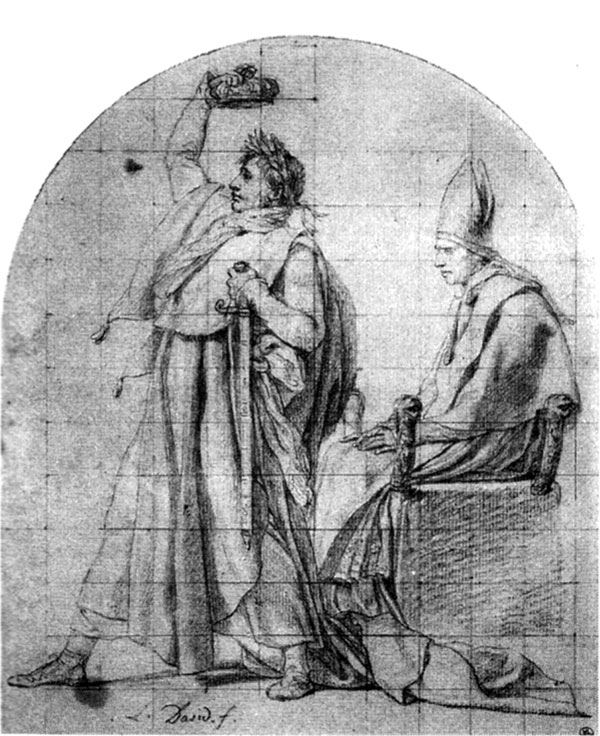
Semblance never holds his attention, which always reaches out to the core of reality. Thus he is not bewildered even in this amazing hour. When he wants to whisper something to his uncle, who stands just in front of him during Mass, he gives the cardinal a gentle dig in the back with his scepter. As soon as all is over, and, alone with Josephine, he goes in to dinner, he says with a sigh of relief: "Thank God we're through with it! A day on the battle-field would have pleased me better!" At their little dinner he tells her to keep on her crown as if he and she were poet and actress, for, he says, she is charming, his little Creole woman as empress. Thus, in the most natural way in the world, he unmasks the whole masquerade, and we are at ease once more as we see the son of the revolution laughing his own empire to scorn.
The freedom of spirit shown by the foregoing petty details is splendidly illuminated by an admission he made the same evening, when, to a confidant, he summed up the whole matter with sceptical emotion: "No, Decres, I have come into the world too late. There is nothing great left for me to do. I do not deny that I have had a fine career, but what a difference between me and the heroes of antiquity. Look at Alexander, for instance. After he has conquered Asia, he declares himself to be the son of Jupiter, and the whole East believes him, save only his mother and Aristotle and a handful of Athenian pedants. But if I, nowadays, were to declare myself the son of the Father Eternal, every fishwife would laugh in my face. There is nothing great left for me to do."

(The Coronation ceremony, by the French painter David (detail))
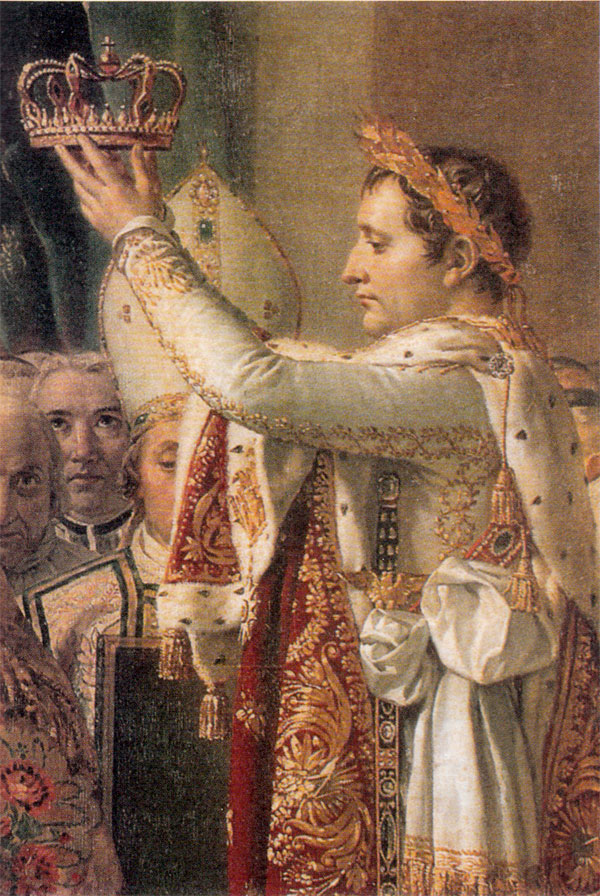
(The Coronation ceremony, by the French painter David (detail))
This was said a few hours after he had crowned himself emperor; said quite simply and quite truthfully. Is it not plain why the East has always allured him, and will continue to allure him? By nature he is endowed with immense powers, and is overburdened by their incredible weight. Nothing can be adequate to his aspirations, now that he has learned how readily people obey the man who can command obedience by his skill and by his deeds. He is strong in his own strength; what does Voltaire's enlightenment, what does Rousseau, matter to him? How can he wish to establish democracy, to install popular government, when he knows the weakness of the popular instincts, and all the corruptness of the leaders of the people? To expand his sway, to spread his name widely and even more widely, to leave more record of himself in the book of universal history than that half page of which he spoke a few years ago, to sacrifice life itself to the little golden circlet on his head, to do these things without enjoyment and without leisure and without pause — this is all that life now offers.
When, during these days, the sketch for an imperial seal is laid before him, and he sees a resting lion, he draws his pen across the picture, and writes in the margin: "A flying eagle."
Taken from Napoleon by Emil Ludwig, pp. 210-14
4) After a failure, a memorable victory
The Allies were not reconciled to the French Empire — inheritor of a Revolution which had committed the ultimate crime of depositing and executing a King! Whether Napoleon really wanted peace, given his own instincts and dreams of conquests, is unclear but he did not have a choice most of the time as the hostility of the enemies of France, particularly England, was relentless. In 1805 he made preparations to invade England which he had to abandon as the armies of the Russian and the Austrian emperors were assembling in central Europe to attack. Instead of waiting for the assault, Napoleon marched an army deep into central Europe and took the Austrian and Russian generals by surprise. He defeated them at Ulm and then had his most memorable victory at Austerlitz on December 2, 1805, exactly a year after his coronation.
Napoleon failed to conquer England because this was the one matter in which he was not confident of victory. Failure was inevitable because here, and here only, his sell-confidence was at fault; because his belief in his own powers was weakened by his want of expert knowledge and by the inaccessibility of the foe. By land! Yes, if he could only get at this island by land! The thought brings back to his mind the scheme of five years ago, when he had planned an attack on India by way of Herat. But for such a scheme, quiet and time are needed.
His first aim is to keep peace, to bring about which he has worked with his best powers for years. Immediately after the coronation, he writes in this sense to six monarchs, addressing each in a style appropriate to his correspondent’s character, thinking out the effect of every detail, and considering even the exact working of his signature. Note, for instance, how he writes to the shah:
“My reputation reaches so far, that you cannot fail to know who I am and what I have done; how I have made France supreme among the nations of the West; and how great an interest I take in the rulers of the East. … Orientals are full of courage and spirit, but their ignorance of certain arts and their neglect of military discipline put them at a disadvantage in war when they are faced by soldiers from the North. … Write me your wishes, and we will renew friendly and commercial relationships. … Written in my Imperial Palace of the Tuileries ... in the first year of my reign. Napoleon.” But, in the heading, the document sets forth a title which never existed, a title which Napoleon obviously uses to show the ruler of Persia that the writer is the general who made himself famous in the Egyptian campaign. The document purports to come from “Bonaparte, Emperor of the French.”
On his table, as he signs the letter to the shah, lies a letter to George III, though England and France are at war. It is penned with wonderful art, and is both moving and politic: “Does not all the blood that is being shed without apparent advantage to anyone, touch the consciences of the governments? I am not ashamed to take the first step. It seems to me I have shown the world that I have no dread of war and its caprices. My heart, indeed, longs for peace; but war has never dimmed my fame. I implore Your Majesty not to deprive yourself of the good fortune of restoring peace to the world! Do not leave this precious task to your children. Never was there a more favourable opportunity of stilling angry passions. If this chance be missed, what will be the outcome of the war? During the last ten years, Your Majesty has won more territory and more treasure than all Europe possesses. What further could you expect from the war?”
How could the writer fail to smile at the realisation that the last argument could with equal force be turned against himself? The appeal is fruitless, for neither England nor the rulers on the mainland will tolerate the new power of France or its upstart emperor. A fourth coalition of the princes against the republic is imminent.
During the years of peace, he has been tolerably well content. His intimates at Malmaison have often described him as cheerful.
Now he must take up arms once more, and resign himself to the knowledge that “it lies in the nature of things to continue this struggle between the past and the future, for the enduring coalition of our enemies makes it essential to attack them if we are to escape annihilation.” There is the simple truth, spoken without exaggeration and without bitterness. If he did not create this nature of things, at any rate he stabilised it. Even though the first wars of France in the revolutionary epoch were purely defensive, the subsequent campaigns became offensive, and were transformed into wars of conquest by the impetus of the people’s army and the outstanding genius of its commander.
Nevertheless, when he is thus challenged by opponents whom he has twice defeated, can we wonder that concrete plans which have hitherto followed his soaring imagination at a respectful distance, should now, likewise, begin to outsoar the boundaries of reason? In the opening years of the nineteenth century and here in the West, the Emperor might have kept the peace for another decade, that in the end he might measure his strength against England’s in Asia. But when Europe’s persistent desire for revenge upon revolutionary France spurs him into action, he conceives the great plan of a unified European realm. Now for the second time (and for the last time down to our own days) a great and saving work will be attempted, and the attempt will fail.
Thus it is that Napoleon’s crowning political thought issues out of a personal defensive necessity. Now, when a new coalition is being formed, and formed against him, his ideal takes a fresh shape. For years his inward gaze has been concentrated on Alexander; now, instead, he sees the figure of Charlemagne. He goes to Aix-Ia-Chapelle, for a ceremonial visit to the tomb of the great Frankish emperor. “There will be no peace, in Europe,” he says at this time to his trusted companions, “until the whole continent is under one suzerain, an emperor whose chief officers are kings, whose generals have become monarchs…..Would you tell me that this plan is but an imitation of the old imperial constitution? Well, there is nothing new under the sun!”
This gradual transformation of his ideal, and the sustenance of the new ideal by the historical imagination has immeasurable consequences. Precisely because the adoption of the Carlovingian scheme involves for him a renunciation, he storms forward in pursuit of it as if he were fighting for a province. The haste with which he tries to reconstruct the empire of Charlemagne is new, is symptomatic of a fever which will drive him towards new goals before he has reached the old ones.
Since the spring, his army has been assembled in Boulogne in readiness for the repeatedly postponed landing in England. But in the autumn, when the menace of a fresh Austrian attack becomes a certainty, with a change of plans which is decided on in a couple of days and is carried out in a fortnight, he directs all his forces eastward, and is across the Rhine in advance of the news of his first movement. Just before leaving the coast, he dictates to Daru the whole scheme of the attack on Austria, “the order and length of the marches, the meeting places of the columns, the attacks by storm, the movements and the blunders of the enemy — all this two months before the events, and at a distance of six or seven hundred miles from the scene of action.”
Austria had good reason for taking up arms once more. On the knob of the new king of Italy’s sceptre, the lion of Venice was graven. This, and the seizure of Genoa, were urgent warnings to the Habsburg ruler not to venture across the Alps a third time. Francis must be content to fight the matter out on German soil. England was liberal with proffers of money; and the inexhaustible forces of Russia were again available for the coalition, as they had been when it was victorious during Bonaparte’s absence in Egypt. The new tsar was determined to overcome Europe’s old prejudice against Russia, and, with an exchange of roles, to draw his sword against the tyrant of the West. The secret of Napoleon’s fighting technique had been learned, and this time the engineer should be hoist with his own petard.
But the soldier of genius can evolve new methods of victory. By forced marches he encircles the Austrians before they realise what is afoot, encloses them in an iron ring at Ulm, and compels the capitulation of an army which has not even a chance to fire a shot. “I have attained my end, and have annihilated the Austrian army by simple marches. Now I shall turn against the Russians. They are lost.”
The habit of success is making him thrifty of his words. “I had a rough time of it, rougher than necessary,” he writes to Josephine; “wet through day after day for a week, and my feet very cold.” Among the gold-bedizened marshals, who are for the first time parading their splendours on foreign-soil, stands Napoleon to receive the capitulation of Ulm. He wears the uniform of a private soldier, a mantle weather-worn at elbows and skirt, a hat without a cockade. His arms are locked behind. Of the imperial purple there is no sign. Once more, as on the evening after Marengo, he offers peace, sends an admonitory letter to the defeated Austrian emperor, writing as usual with the frankness which is so annoying to the diplomats of Europe: “You will understand that it is only right and proper if I take advantage of my good luck to impose, as condition of peace, that you should give me guarantees against a fourth coalition with England. ... Nothing would make me happier than to combine the tranquility of my people with your friendship, upon which I venture to make a claim, despite the number and strength of my enemies in your entourage.” At the same time, he marches on Vienna.
Then, while he is advancing at topmost speed, comes a blow. He learns that two days after his victory on land had come the sea-fight at Trafalgar, when England had almost annihilated the French fleet. Eighteen ships have been lost; Nelson is dead; the French admiral is a prisoner. Is this another disastrous hour, like the one when the news of Aboukir reached him in the desert? Courage! Then the situation was a hundredfold more difficult. We are not now cut off from Paris by the sea; we need no ships. With redoubled speed he marches on Vienna, which the enemy surrenders without a blow.
But the tidings of Trafalgar have renewed Francis’ fixity of purpose, and have made Alexander firmer than ever. Both try to win over Prussia, which hesitates, and protracts negotiations. Napoleon vainly tempts the tsar with the promise of Turkey. In Brunn there is a great game of hide-and-seek, in which each power tries to keep the others in suspense and is disavowed by its own plenipotentiaries. The Emperor is the only ruler who improvises a political idea. Two days before the decisive battle, for which preparations are already being made, he writes to Talleyrand, who is negotiating in Brunn:
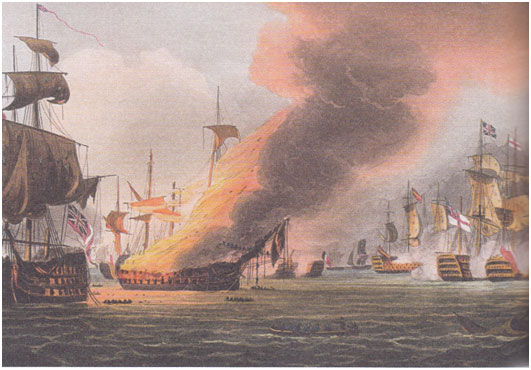
(A defeat: the battle of Trafalgar (October 21, 1805) in which almost all the French fleet was lost...)
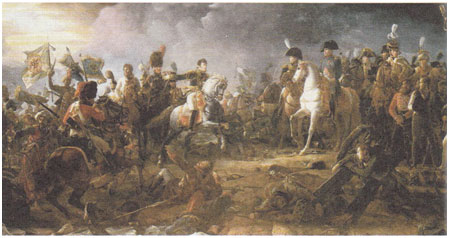
(And a victory less than two months later (December 2): the battle of Austerlitz, also called the Battle of the Three Emperors, in which Napoleon defeated a Russo-Austrian army. In this painting by Gerard, we see the General Rapp bringing to Napoleon the flags and cannons taken from the enemy as well as a Russian prince with Russian prisoners.)
“I should have no serious objection to handing over Venice to the elector of Salzburg, and Salzburg to the house of Austria. I shall take Verona ... for the kingdom of Italy. ... The elector can call himself king of Venice if he has a fancy that way.
“The electorate of Bavaria would become a monarchy….. I will give back the artillery, the magazines, and the fortresses, and they must pay me five millions….. To-morrow, I think we shall have a pretty big battle with the Russians. I have done my utmost to avoid it, for it is only useless bloodshed. I have exchanged a few letters with the tsar, and learn from what he writes that he is a good fellow, with bad counselors….. Write to Paris, but don’t say anything about the battle, for that would make my wife anxious. You don’t need to worry. I am in a very strong position here, and my only regret is for the almost needless bloodshed which the battle will cost….. You write home for me; I have been in camp among my grenadiers for the last four days, and have to write on my knees, so I can’t manage many letters.”
Such is the Emperor’s mood just before the most famous of his victories. While he is studying his maps, noting the name of every Moravian village, the width of every stream, and the condition of every road, and while he does his best to keep himself warm by the camp-fire, he is thinking of the ministers in Paris who are awaiting his commands, and of his wife who may be anxious. In the same half hour, he drafts a new programme for the partition of four or five States, talks of new crowns, of war indemnities, and of handing over fortresses. Twice his laments for the useless bloodshed light up the written page like the rising sun of one of these December days. Need we be surprised that such a man conquers the legitimate princes, who at this moment are dining in their palaces?
In the evening, when he learned the enemy’s movements, he clapped his hands, and “trembling with joy” (the words are his adjutant’s), said: “They are walking into the trap! They are delivering themselves into my hands! By tomorrow evening their army will be annihilated!”
Then he sits down with his staff to supper in a peasant’s hut, and, an unusual thing with him, remains at table for some time after his meal, emotioned and musing. He goes on to speak at considerable length concerning the nature of tragedy. From this, he passes to Egypt: “If I had taken Acre, I should have donned a turban, have clad my soldiers in wide Turkish trousers. But only in the utmost need should I have exposed my Frenchmen to serious danger; I should have made of them a corps of immortals, the Holy Battalion. I should have fought the war with the Turks to a finish by the use of Arab, Greek, and Armenian levies. I should have become Emperor of the East, and should have made my way back to Paris through Constantinople.” The concluding words, so one who heard the soliloquy tells us, were accompanied with a smile, as if to show his awareness that he was being carried away by a rapturous dream.
But is not the scene we are describing a dream? Must we really and truly believe that about two centuries ago, a mortal man, the understudy of a demigod, stormed across modern Europe and remoulded it in accordance with his will? Did it not all happen in the Homeric age, when two princes in single combat would settle the fate of generations? Or, perhaps, he is a character in a fairy-tale, this man in the middle thirties, a little fellow, seated in a wattle-and-dab hut, on an unknown plain. He wears a greasy coat, a clammy shirt; stuffs potatoes and onions in his hungry mouth. Next day, by this one battle, he will renew the glories of Charlemagne, dead a thousand years since. Now, overnight, his unbridled imagination runs across Asiatic deserts, where a stone-heap successfully resisted him; dwells on that old frustrated plan; while his errant thoughts follow the wraith of the Macedonian to the Ganges.
Day dawns. A year ago, on the altar steps in Notre Dame, he had crowned himself with the circlet of golden laurels. In a fervent proclamation, he reminds his soldiers of that day and concludes with the promise that for this once he will keep out of the firing line.
Never before has history recorded such words uttered by a commander. They have always been eager to declare their determination to defy death in the forefront of the battle. Napoleon, whose grenadiers have seen him in twenty fights and regard him as a heaven born leader, can venture to tell his men that he will reward their valour by being careful of his own safety.
Then the Emperor defeats both his enemies, and makes famous for a thousand years an out-of-the-way spot of which no one had ever heard before — the plain of Austerlitz.
“Soldiers”, he says next day to the victors, “I am pleased with you. … Name your children after me, and if one of them should prove worthy of us, I will make him my own son and appoint him my successor!” That is the emotional note he keeps for the army. To his wife, he writes as simply as possible: “I have beaten the Russian and Austrian armies. Rather tired, after a week in the open, when the nights have been chilly. To-night I shall sleep in a bed, in Prince Kaunitz’ fine castle. I’m wearing a clean shirt, the first time for a week. ... I hope to get two or three hours’ sleep.”
Quite a simple matter, these momentous happenings! It is but a new song in the rhapsody when, a day later, Emperor Francis comes to Count Kaunitz’ castle, to beg for an interview with the little Corsican lieutenant. But the bird has flown. When the two men meet at length, it is in a windmill. Napoleon greets his brother emperor courteously, saying: “I regret, Sire, that I must receive you here, in the only palace I have entered for two months.” What self-confidence in the soldier interviewing the man born in the purple; what subtle mockery in the mouth of one who knows that in his distant capital, at news of his splendid victory, flags will soon wave and songs resound.
But the distinguished guest, a man of sound sense and good breeding, knows how to parry the thrust: “Your present quarters are so profitable to you, Sire, that I think they cannot fail to please you.” Both smile; and unobtrusively they eye one another up and down, for, though they have fought for a decade, they have never met. Of the same age, they had both reached power at twenty-six or thereabouts, though in such different ways; and neither of them can foresee how close Napoleon’s will-to-peace is one day to bring them, or how widely Francis’ will-to-revenge will ultimately sever them.
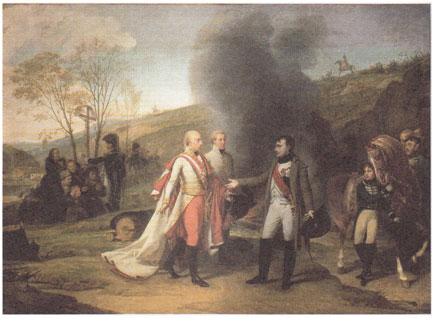
(Encounter between Napoleon and the Austrian Emperor after the battle of Austerlitz, by Antoine-Jean Gros.)
“Yesterday I had the German emperor in camp with me and we had two hours’ talk. ... He threw himself on my generosity...”
“Yesterday I had the German emperor in camp with me and we had two hours’ talk. .. He threw himself on my generosity. But I took good care of myself, as I am used to doing. . We have agreed to make peace promptly. … The battle of Austerlitz is the finest of all I have fought. We have taken forty-five regimental colours, more than one. hundred and fifty guns, the flag of the Russian guard, twenty generals, and thirty thousand prisoners in all. More than twenty thousand killed — a ghastly sight!” Did the jubilant outburst of a conqueror ever come to a stranger close? He luxuriates in the figures of his gains, and then, suddenly, the corpses of the dead rise before his eyes! Henceforward, such references become frequent; he writes in simple and heartfelt words about bloodshed.
In the peace negotiations, the minister has a contest with his master. The day after Austerlitz, Talleyrand writes to the Emperor: “How easy would it be, now, to destroy the Habsburgs once for all. But it would suit our book better to strengthen them, to give them a fixed place in France’s system!” Napoleon, however, enforces the peace of Pressburg, in which the old German empire is shattered into fragments, while Austria vanishes from Germany and Italy. What is in the conqueror’s mind?
Europe! A league of States under French hegemony. Russia is Asia; England is detached, an island. The Continent must be unified, must consist of middle-sized and small powers overshadowed by the eagles of France, and democratically ranged side by side. Now, after Austerlitz, the new thought takes shape. The victory has put it within his power to realise the greatest aim of a European, the unification of Europe.
He did not set out towards this goal. It was a gradual growth, the fruit of circumstances. He did not deliberately provoke the wars that were fought when the new idea was in its inception. Since Marengo, his chief wish has been for peace. At that time, Austria had been loath to make peace. The Austrian renewal of the attack was a logical outcome of legitimist theory, for Habsburg and the revolution could not jointly rule Europe. Austerlitz had settled the dispute once more. Now it had become possible to reunite Charlemagne’s resurrected Europe. But neither the kings and emperors (who were only beaten, not convinced), nor he himself (who had gained all by the sword and not by persuasion), could march along the way of the spirit towards the unification of Europe. The determinisms of his own past left Napoleon no option but to create his United States of Europe by force. Not till ten years later did he come to see that he had been seeking to achieve a great end by false means.
When he came to understand this, it was too late; he was impotent, in the great epilogue of his exile.
Taken from Napoleon by Emil Ludwig, pp. 219-28
(The Continental System (or Continental Blockade) meant that manufactured products from Great Britain were banned from the Empire. When discovered, they were publicly burnt, as in this image. The scene takes place in Hamburg.)
5) Administration on wheels
Napoleon is again obliged to wage war against the allies which were hoping to profit from his difficulties in Spain which he did not manage to pacify after the initial invasion in 1808. From Spain, he first rushes to Paris where there are rumours of conspiracy. He deals with that and then departs with an army to Bavaria. The short text below shows the manner in which Napoleon was travelling, always working, never losing a minute...
But he speeds away again, and crosses Germany. Napoleon’s carriage is outwardly plain, but within it is comfortably built. The Emperor can sleep in it; by day he can govern from it, just as well as from the Tuileries or from a tent. He is the first to overcome the friction which brings movement to a standstill; and, though he does not travel as fast as we do nowadays, he travels faster than any man ever travelled before. Five days take him from Dresden to Paris. In a number of lock-up drawers within the carriage, he collects reports, dispatches, memoranda; a lantern hanging from the roof lights up the interior; in front of him hangs a list of the different places he must pass through, including where relays of horses are awaiting him. Should a courier reach him, Berthier, or another official who happens to be at hand, must take down the more pressing orders, while the carriage goes jolting on its way. Before long, orderlies are to be seen flying off in every direction.
On the box seat, the Mameluke is enthroned in solitary grandeur. Two postilions whip up the six horses. The carriage is surrounded by a crowd of equerries, pages, and light cavalrymen; when the procession sets forward, the road is all too narrow to accommodate it, eddies of dust and heat envelop it, night and fog encompass it. The peasants stand aside to let the tornado pass; they are agape with wonderment and firmly believe that the devil is hiding inside the great Napoleon. He leaves behind him a trail like that of a paper-chase: for he throws out of the windows of the carriage, not only all the envelopes and other useless paper, but all the reports he does not wish to file (torn into tiny fragments); all the newspapers he has read; and, finally, books, which he glances at when he has a moment to spare, and then consigns to their fate in the mud of the highway.
Wherever he gets out of his carriage, a hot bath is ready for him. Then, at two in the morning, he will dictate till four, snatch three hours’ sleep, and start off again at seven. At his halts, four light cavalrymen surround him in a square, and follow him in all his movements, if, for instance, in the daytime he studies the country through his small telescope. Should he need the large telescope, he uses the shoulder of the page in waiting as a rest. Whether his halt be short or long, in wartime the map is always ready to his hand, in carriage or tent, in camp and by the watch-fire. Any member of his escort who fails to show him in the map the precise point where the halt has been made, the area he now wishes to study, receives a volley of abuse — be it Berthier himself, Prince of Neuchatel. Through all countries, for the whole duration of his life, the map follows him, pierced with coloured pins, illuminated at night by twenty or thirty candles, and with a pair of compasses lying on it. This is his altar, before which he offers up his prayers. It is the real home of the man who has no home.
Taken from Napoleon by Emil Ludwig, pp. 311-12
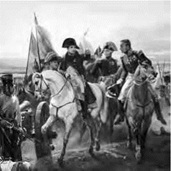
6) Napoleon dreams on
The hostilities continue, with England as implacable as ever. Since 1806 Napoleon has erected a formidable Continental System covering nearly the whole of Europeans ports to block English commerce, thereby only increasing England’s determination against him. The Continental System is detrimental to economic activity, therefore rather unpopular in many countries. Napoleon sees that nothing has really been settled by the treaty of Tilsit and wonders about war or peace with Russia and also dreams on...
“Kindly inform me why the price of salt in the neighbourhood of Strasburg has risen one sou.”
Closely following upon the heels of this enquiry to the Ministry for War, comes a command to the Admiralty: two entire fleets are to be constructed in the course of the next three years, one Atlantic fleet and one Mediterranean fleet; the latter against Sicily and Egypt, the former against Ireland. As soon as the Spanish affair is in better case, preparations are to be made for an expedition to the Cape in 1812. An army of from sixty to eighty thousand men is to be got ready for an attack on Surinam and Martinique. “Having eluded the enemy cruisers,” the expeditionary forces are to share out the two hemispheres.
We see how closely at this date, when imaginative fantasies threaten to develop into adventures, the exact observations of the father of his country are allied to the rhapsodical plans of the world conqueror. For that is what Napoleon now attempts: he is actually trying to realise his old dream of world conquest.
“You want to know whether we are going? We shall have done with Europe; then, as robbers of robbers less bold than ourselves, we shall march to the attack, seize India, over which they have made themselves masters. … I must take India ... in the rear, if I am to strike successfully at England. … Just imagine Moscow occupied, the tsar conciliated or killed by his people, perhaps a new, dependent throne,— and tell me whether an army of Frenchmen, reinforced by auxiliary troops from Tiflis, cannot press forward to the Ganges, and thence, at a touch, destroy the whole structure of English commerce! ... At one blow, France would have established the independence of the West and the freedom of the seas!” A witness reports that while he was voicing these ideas “his eyes shone with a wonderful light, and he went on to point out the reasons for the adventure, all the difficulties it entailed, the means of achievement, and the prospects of success.”
Shall the tsar be conciliated or killed? That is the question which troubles the Emperor the whole year round. Calculations and presentiments make him desire to have Alexander as his friend rather than his enemy. Napoleon has nothing to gain by a defeat of Russia. On the contrary! He dreads being forced into this war, and endeavours, as on former occasions, to avoid it; though only if the tsar, as previously agreed, shall participate in the great final struggle as an ally. Napoleon keeps the tsar under observation, and perceives that suggestions are having less and less effect upon Alexander. He therefore writes to a prince of the Confederation of the Rhine in these amazing terms: “This war will break out in spite of the tsar, in spite of me, and in spite of the interests of the two empires.”
Never before had the Emperor or the Consul declared, in such words, that war was unavoidable. Precisely because all rational need for the campaign was lacking this time, he found it necessary to proclaim the war with the tsar to be the work of fate. At the very first handclasp, in the peace tent on the Memel, the seed of this war was sown. During the days of intimacy which followed, when the encounter blossomed into friendship, that seed invisibly took root and grew. In later days, Talleyrand’s treacherous diplomacy cherished its growth; and when, at Erfurt, the emperors embraced, they could already feel between them the coils of the snake. That they did not become related by marriage was neither an accident nor the outcome of a conscious desire: it was consequent upon the mistrust which had invaded the tsar’s mind, a mistrust of which he could not rid himself and which was to prove well founded. Two men wishing to divide Europe between them could not see with complacency the half in a rival’s hands. Their intentions were honourable at the outset; but they were impossible of fulfillment. The day of contest must inevitably come at last. “He alone is still weighing upon the pinnacle of my edifice. My rival is young; daily his strength is waxing, daily mine is waning.” This gloomy recognition spurs him ever onward.
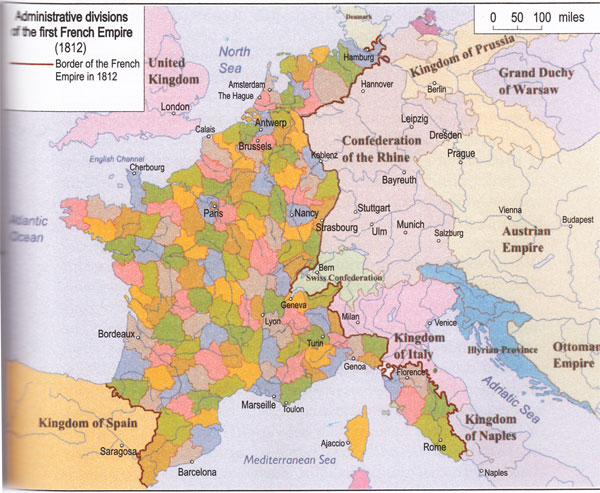
(Besides the Empire, Napoleon also controls the Confederation of the Rhine, the Kingdom of Italy, the Kingdom of Naples, the Kingdom of Spain and the Grand Duchy of Warsaw.)
It is useless to try to interpret such decrees of destiny as the outcome of political causes.
Somewhat earlier, the Emperor has asked the tsar to lay an embargo on all neutral ships, as he himself has done, and thus give England the death blow. The tsar cannot agree to this, for it would fatally injure his own sea-borne trade; he will only continue, as before, to confiscate all the prohibited goods he discovers, but he needs colonial wares from the neutrals. Being unable to stop this leak in the East, the Emperor has to exercise redoubled care on the German coast, and he therefore annexes the mouths of the Weser and the Elbe with the Hansa towns and part of Hanover. “Circumstances demand these new guarantees against England.” Oldenburg is swallowed up with the rest, though the heir to this duchy has married Alexander’s sister.
The Emperor’s high-handed proceedings were a logical outcome of his policy, but they were necessarily an offence to the tsar. Alexander regarded them as a breach of the treaty of Tilsit, in which the integrity of Oldenburg had been guaranteed. He issued a circular to the powers protesting against this insult to his house, a remonstrance almost equivalent to a declaration of war. In this document he enquired what could be the use of alliances unless the treaties in which they were incorporated were strictly observed, so that the cabinets of Europe could not but smile at the concluding words of the circular, in which he described the alliance between Russia and France as permanent. His next step was a ukase in which he threw Russia open to colonial goods, while imposing prohibitive import duties on wine and silk, the products of French industry.
The maps lie spread on the tables in St. Petersburg and Paris. Where can either power best harass the other? The tsar proposes to make peace with Turkey. The Emperor incites Austria to seize Serbia, to advance towards Moldavia and Wallachia, promising not to interfere; this will keep Alexander busy. Metternich nods assent, but does not move. “What about Poland?” thinks Alexander. “Has not Napoleon already enlarged the duchy of Warsaw by the addition of Galicia? It there any guarantee that he will not reestablish the kingdom of Poland?” Caulaincourt, French ambassador in Russia, who admires the tsar and wants peace, gives the desired guarantees. But the Emperor would only agree to a secret ratification. If the differences between France and Russia should culminate in war, he will need Poland for his operations against the tsar; Polish hopes must, therefore, be fostered. Penetrating this design, Alexander demands an open treaty, which shall put an end to Polish expectations.
When Massena is defeated in Spain, the Emperor entertains fresh doubts. Caulaincourt, who is back in Paris, does his utmost to intensify these misgivings, dilates on the tsar’s will to peace, and ventures far in his defence of Alexander. The Emperor leads him on; hears all he has to say; asks a thousand questions concerning the tsar and the court, Alexander’s piety, the nobles, and the peasants; takes Caulaincourt by the ear, a sign of affability.
“You must be in love with him!”
“I am in love with peace.”
“So am I. But I will not allow anyone to dictate to me. Evacuate Danzig, forsooth! Next I shall have to ask Alexander’s permission before I can hold a review in Mainz. You are a fool. I am an old fox, and know the people with whom I am dealing…. We must deprive this Russian colossus and his hordes of the power to inundate the south once more….. I shall advance northwards, and re-establish there the old boundaries of Europe.”
Quite unsubstantial reasons, masks, mere pretexts. Warningly Caulaincourt quotes Alexander’s words: “I shall learn from his own teachings, which are those of a master. Our climate will make war for us. The French are not inured to it as we are. Miracles only happen when the Emperor is present, and he cannot be everywhere.” Napoleon is greatly moved by these words; he tramps restlessly up and down the room; the conversation lasts for hours. Since he cannot refute Caulaincourt’s arguments, he makes vague answers behind which his titanic wishes loom.
“A well-fought battle will put an end to the fine resolves of your friend Alexander….. He is false, ambitious, and weak; he has the character of a Greek. Believe me, it is he, not I, who wants this war, for he cherishes a hidden design…. He is out of humour because I did not take his sister.” When Caulaincourt gives proofs to the contrary, Napoleon says: “I have forgotten the details”— Forgotten! This is a new word in the Emperor’s mouth. He knows his position to be weak; himself a man of facts, he now brushes away those which he finds inconvenient.
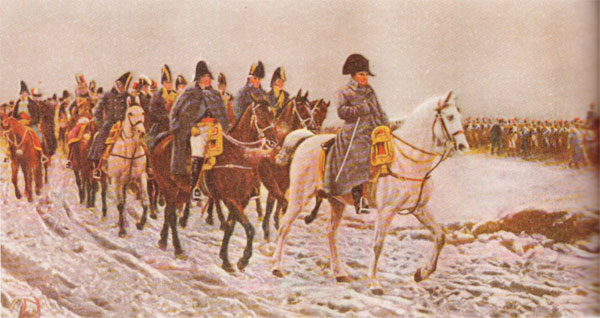
(The brilliant and desperate campaign of France, 1814)
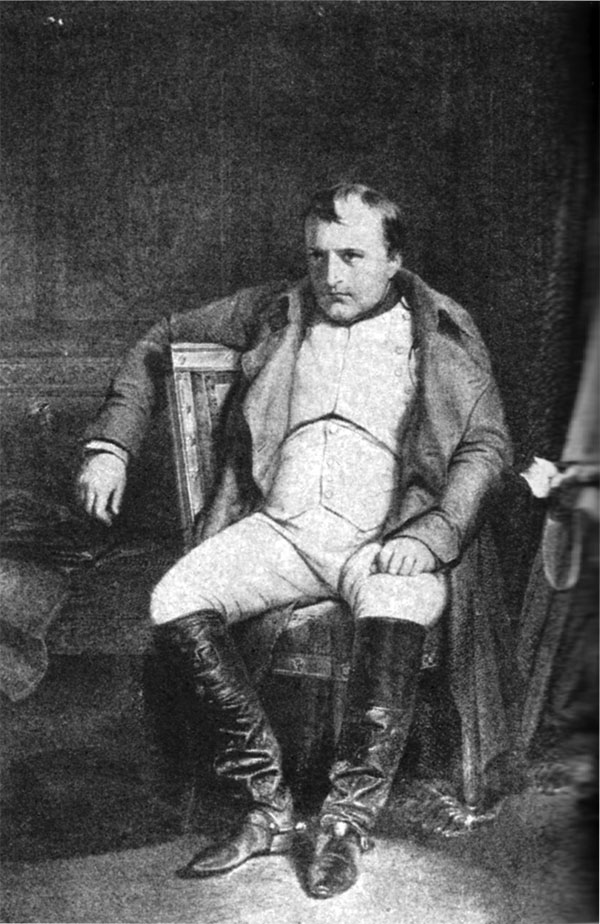
(The Emperor the evening after his abdication, April 11, 1814)
He sends a more resolute envoy to the tsar. When a proposal comes from St. Petersburg that Warsaw shall be exchanged for Oldenburg, the Emperor says threateningly to the Russian ambassador, raising his voice so that everyone in the room may hear: “Not one Polish village!”
But these political incidents and discussions are merely the forms of destiny. Schemes flash like lightning through his brain; his soul is devoured by wishes: and he will rather reveal these things to a dangerous enemy like Fouche than to a shrewd adherent like Caulaincourt. He cannot rid himself of the ex-Jacobin and ex-cleric. Last year, he had cashiered the Minister of Police, for Fouche was obviously intriguing with England. But Napoleon was as lenient as he had been at the time of the conspiracy which had brought him back hot foot from Astorga. Instead of banishing the man, the Emperor had appointed him senator — at the same time writing to him words which give a glimpse into the inferno of these struggles between the monarch and the spy: “Although I do not doubt your devotion, I find it necessary to have you watched all the time. This is a fatiguing necessity, and I should not be called upon to do anything of the kind.”
But though he dismisses Fouche from his ministerial post and has the watcher watched, Napoleon cannot get on without him, and talks to him about the most private matters.
“Since my marriage, people fancy that the lion is asleep. They will soon learn whether I am asleep. I need eight hundred thousand men, and have them; I shall tow all Europe in my wake. Europe is nothing more than an old woman, and with my eight hundred thousand men I can make her do whatever I please…. Did not you yourself say to me: ‘You let your genius have its way, because it does not know the word impossible.’ How can I help it if a great power drives me on to become dictator of the world? You and the others, who criticise me to-day and would like me to become a good-natured ruler — have not you all been accessories? I have not yet fulfilled my mission, and I mean to end what I have begun. We need a European legal code, a European court of appeal, a unified coinage, a common system of weights and measures. The same law must run throughout Europe. I shall fuse all the nations into one….This, my lord duke, is the only solution that pleases me……” Having said this, he suddenly sends Fouche from the room.
Here we have it plainly disclosed, Napoleon’s vision of the United States of Europe. The plan is recorded by one who, in his memoirs, would fain have discredited the Emperor — this plan with its extremely rational deductions and its daimonic inspiration. Europe is no longer a “mole-hill” as it was in the days of Milan and Rivoli, when he was nothing more than General Bonaparte, and when to the young man of genius all possible adversaries seemed too petty. Fifteen years later, Europe has become a plastic material; and Bonaparte is the emperor, the legislator, the great orderer, the enemy of the anarchy out of which he sprang, the modeller who would mould the clay into a splendid whole. Throughout the intervening years he has been marching along a predestined path; now he displays before us, in this statement of his aims, the productive consequences towards which he has been moving along that road of force through ever new hecatombs of slaughter. Behind him lie Charlemagne’s visions of a united Europe; in front of him glide new forms; and Caesar, half way towards the realisation of his dream, is well aware that the spirit will ultimately overpower the sword. He has himself said this; and what he is now striving to establish by force with the aid of eight hundred thousand men, will someday come into existence as a voluntary amalgamation based upon reason and necessity. All the nations will fuse into one.
This, my lord duke, is the only solution that pleases me.
Taken from Napoleon by Emil Ludwig, pp. 345-51
7) Emperor of a mini-empire
Finally it had to be war and Napoleon invades Russia in 1812. The outcome was disaster, most of the Great Army disappeared during a very harrowing retreat due to guerrillas tactics of Russian soldiers but mostly from the rigours of the Russian winter. Despite a brilliant campaign to defend France from invasion in 1813-14, Napoleon was ultimately defeated and had to abdicate. He was then sent to the island of Elba as its ruler, a minuscule speck of an island in the Mediterranean, very close to his native and much bigger island, Corsica. What is amazing is that Napoleon took very seriously his role of ruler of that miniature kingdom...
How big Corsica is! How high her mountains! Bastia is an admirable harbour; its fortifications can be seen through a spyglass. If taken from the eastern side. …
When the ruler of Elba rides among the hills of his new home, the silhouette of his old home lies spread before him; everything looms larger across the water. Forty times bigger, ten times as many inhabitants; he has all the figures, to a unit, in his head. Elba is nothing more than a mole-hill.
On the clear May morning when he landed, he was welcomed by a deputation of peasants and petty burghers in Porto Ferrajo. Timidly they had paid their compliments to the man who was to reign over them. But their astonishment was great when, instead of inviting them to a banquet, he leapt into the saddle and rode off to inspect the fortifications. On the morrow, orders began to fly about the sleepy little isle: Pianosa was to have two more batteries; the mole must be lengthened; the roads improved. When first the four hundred grenadiers appeared in the land, the natives looked at them askance as men of a foreign race. Soon, however, the forces were increased by the creation of a foreign battalion, and a National Guard. Napoleon once more has an army of over a thousand men; soon he has a small flotilla likewise. What for? Just for him to see after and take care of. He has a Council of State; Bertrand and Drouot (the generals who have accompanied him into exile) and a dozen inhabitants of the island, are members; and, together with Napoleon who presides over the assembly, they discuss improvements in the iron mines and the salt pits. Have you no mulberry culture here? The silkworms bring in good money over there in Lyons; and if the French government imposes a tariff upon our produce, we can easily sell to Italy.
Save! We are so poor, and France makes no move to pay the promised allowance. The white house is smaller than the one in Ajaccio, and very much simpler; but there is no money for building additional accommodation; and when the “grand marshal” Bertrand draws up a list of mattresses and other bedgear, his master underlines the mistakes — for he has every detail of his establishment by heart.
Is this indefatigable man never to realise what a parody is his administration over the tiny island, the diminutive army, the small household? Never! Here in Elba, where in the best of spirits and health he throws himself whole-heartedly into his undertakings, he comes to realise that it was not the masses that had allured him. To order, to build, to press his finger into the wax of humanity, these things he must do, urged onward by the impulse of his artist’s soul. But, since humanity is not as wax, and since his constructions can never be finished and are always vibrant with life; since the opposition of material forces also takes a hand in the game, even when matter seems to have been conquered — he can only fulfil his mission by coercing and conquering the human spirit, by issuing orders and bringing suggestions to bear, by constant vigilance and constant upbuilding; in a word, by ruling. He has never been a dilettante or a parvenu; and, this being so, he drives the little wheel to-day with just as much precision and earnestness as he had driven the earth’s sphere in former days.
But soon, when most of his enterprises are in good going order, he feels he is becoming lazy, even when he is studying mathematics. This causes him to reconsider his position.
“It is by no means difficult to accustom oneself to a life of meditation,” he writes, “if one possesses within oneself the necessary reserves. I work hard in my study; when I emerge I have the delightful spectacle of my old grenadiers in front of me….. Born kings must suffer terribly when they are dethroned, for pomp and etiquette are the very marrow of their lives. For my part, I have always been a soldier, and a king only by chance, so that these things have been nothing but a burden to me, whereas wars and camps come naturally. Out of my great past, I regret naught but my soldiers. After all my treasures and my crowns, my most cherished possessions are the couple of French uniforms they have allowed me to keep”
These are the words of an unpretentious king. Do people not believe him? And does Europe laugh when, in his kingdom of Lilliput, he preserves the forms of kingship? Does Europe begin to suspect a secret in the island? The innate dignity, whereby long ago the young general had wrung respect from the bearers of inherited rank, to-day is still able to hold satirical visitors in check. Every one admires the natural simplicity of the lonely man who, despite the exiguity of his dwelling, still holds to the title of “Majesty.” He lives in his island sans palace or fittings, sans court or ministers, only surrounded with the aureole of his deeds.
This return home brings solace to his heart — for Elba is Italy. The peasant speaks to him in the language Napoleon had learned at Letizia’s knee. The Mediterranean amid whose waters he was born and reared, the islands with their quiet shores, do they not all of them bring back memories of youthful days? Stone-pines, fig trees, and crags; the white houses among the vineyards; the sails, and the fishermen’s nets; pride of clan, and the head-kerchief worn at church; all these things seem to take him gently by the hand and lead him back to the dreams of childhood. Now the storm-racked nerves relax, and at length know a spell of repose. In these wholesome months, the Emperor comes to look upon his career as a visionary flight into the land of childish imagination; and it is only when he contemplates the men of his old guard that he realises something did happen during the years that separate Corsica from Elba.
“The Emperor lives very contentedly on his island,” writes one who accompanied him there. “He seems to have forgotten the past. The management of his small household gives him occupation; he is now looking out for a suitable site to build his countryseat; we ride, and drive, and sail round the coasts as much as we please.”
Since he has plenty of time on his hands, and since thrift is essential, he examines everything to the minutest details. Just as, in the Tuileries, he himself drew up the list of his clothing, so now in Elba, he says to Bertrand: “My underlinen is in a lamentable state. Part of it has never been unpacked, and it has not been marked. Give orders that everything must be laid out in drawers and presses, and that no one is to be given anything belonging to our court without furnishing a receipt.”
There are not enough ordinary chairs. Have a sample sent from Pisa; they must not cost more than five francs apiece.”
Europe laughs when it hears of this. Posterity stands bewildered before such energetic renunciation.
Once only do we hear a gentle sigh. He has climbed to the top of a hill whence he can look over the whole of his realm. Surveying the prospect, he says: “One must acknowledge that the island is very small.” Like distant thunder, the fate of a man seems to rumble in these words; for an all too great imagination, confined within the narrow limits of Europe and cribbed within the circle of the folk intelligence of the nineteenth century, is doomed at the outset to be crushed.
Taken from Napoleon by Emil Ludwig, pp. 447-50
8) St Helena. Meditation on a prodigious destiny
After another amazing adventure in which Napoleon left secretly Elba, came back to France and ruled again for hundred days to be finally narrowly defeated at Waterloo. This time the allies, and particularly England, had had enough of Napoleon. They exiled him at St Helena, a barren island in the middle of the south Atlantic ocean, thousands of miles from Europe. He was kept a quasi-prisoner under the supervision of a mean-spirited governor who did his best to make the ex-Emperor’s life miserable. Napoleon had hoped for a chivalrous attitude from his English enemies under whose protection he put himself after the defeat. He was sadly mistaken. The governor of St Helena, under strict instructions which he followed with apparent relish and even adding his own brand of persecution, confined Napoleon in a small, unhealthy, dilapidated property which, together with the harsh climate, contributed to the rapid decline of the emperor’s health. This will be a period of reflection and elaboration of memoirs for Napoleon, who continued to dictate for quite a long time. Emil Ludwig used this last period of Napoleon’s life as a background for a general appraisal of his extraordinary personality...
The sea spreads out into the vast distance. It is like a mirror of steel. The man on the rock, hands clasped behind, stares across the watery plain. He is lonely, so lonely.
One looking at him from a distance would see a fat man with short legs, a man of uncertain age. He is wearing a green coat, decorated with the star of the Legion of Honour; silk stockings; three-cornered hat in his hands. The head is large; the brownish hair makes a bush at the back; there is no sign of whitening. The short neck springs from powerful shoulders. The features are as if hewn out of stone, with a yellowish tint, like the marble of an ancient statue that has been darkened in the course of the ages; no wrinkles, but the classical profile is somewhat marred by the heaviness of the chin. The only beautiful features are the nose and the teeth. These last are perfect, and he has never lost a tooth. His hands, too, are beautiful. All through his campaigns he was scrupulous in his care for them; and, when correcting the letters and dispatches he dictated, he generally used a pencil in order that he might avoid staining his fingers with ink.
The doctors have told us a good deal about his physical condition. “Pulse never more frequent than 62; bosom well padded, almost like a woman’s, and with very little hair; partes viriles exiguitates insignis sicut pueri.” He himself knows much about his body, he has studied his battle-field of his life in order that here, likewise, he may utilise his forces to the best advantage.
“I have never yet heard my own heart beating; it is almost as if I had none,” he says, half seriously. Moderation, he assures us, is the secret of his amazing faculty for work. “Nature has bestowed on me two valuable gifts: the capacity for sleeping whenever I want to; and the incapacity for committing excesses in drinking and eating However little a man may eat, he always eats too much. One can get ill from over-eating, but never from under-eating.” The alternation between campaigning and sedentary life enables him again and again to escape from the air of the study, and to fortify his constitution by long rides and drives. “Water, air, and cleanliness are my favourite medicines.”
With a body thus steeled, he can drive without stopping from Tilsit to Dresden, nearly five hundred miles, and be quite fresh at the journey’s end; can ride fifty miles from Vienna to Semmering, breakfast there, and be back at work in Schonbrunn the same evening; can gallop in five hours from Valladolid to Burgos, a distance of about eighty miles. After long rides and marches through Poland, he reaches Warsaw at midnight and receives the new authorities at seven next morning. These are the excesses he practises to restore the balance of his natural forces. After a long spell of sedentary life, he will start off on a ride of seven days, or will go out shooting for the whole day; after great exertions, he will keep his room for twenty-four hours. He believes that his energy has saved his life. He says to Metternich: “Sometimes death only comes from lack of energy. Yesterday, when I was thrown out of my carriage, I thought I was done for. But I had just time to say to myself that I would not die. Anyone else in my place would have been killed.”
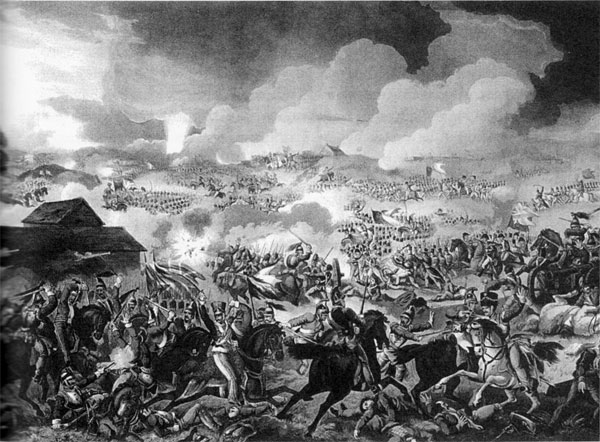
(The final battle and the ultimate defeat: Waterloo, June 18, 1815. Four months later Napoleon would begin his life of exile in St Helena.)
His muscles are powerful, but his nerves are sensitive. Accustomed to command, he cannot endure anything in the nature of compulsion. If his coat is at all tight, he tears it off; the same with shoes that pinch him in the slightest. On these occasions, he will box his servants’ ears. If he has to wear court dress, they watch out while they help him on with his coat. When his mind is busy (when is it not?) he will push away his breakfast, jump up from his chair, and stride about, talking, issuing orders. His hand writing is nothing more than a series of violent contractions of the hand which cannot keep up with the furious pace of his thoughts; a sort of involuntary shorthand, which in places has not been deciphered after a hundred years of study. He cannot endure the smell of paint or size; he always masks unpleasant odours by using eau-de-Cologne. If his nerves are utterly exhausted, he soothes them in a hot bath. When the war with England broke out, he worked continuously, with four secretaries, for three days and three nights, and then spent six hours in his bath dictating dispatches. This nervous irritability is the antithesis of his slow circulation. He thinks that, the constitution of his nerves being what it is, he would be in danger of going mad, “if it were not that my blood works so slowly.”
But there is no evidence at all that his nervousness ever rose to the pitch of convulsions, that he suffered from epilepsy. This illness usually begins in childhood, and none of his school mates have reported that he had fits. Never was anyone’s life more closely watched than Napoleon’s; and the documents upon which the assertion that he was an epileptic is based are scanty, confused, and untrustworthy.
As long as his body remained healthy, he was able to endure all the tensions and shocks to which he was exposed. It was when he was approaching forty that he began to show the first symptoms of a stomach trouble which was in those days summarily diagnosed as cancerous. Beyond question, the tendency to it was inherited. During the last three years of warfare, he was put out of action in decisive hours by paroxysms of gastric spasm. His courage and resolution were practically unimpaired; had it not been for these attacks, the history of his decline would have been different.
The soul which governed this body was driven forward by three fundamental powers:
Self-confidence, energy, imagination.
“I am not as other men; the laws of morality and convention cannot be applied to me.” In these cold words, he emphasises the “I” with which he began his first political writing in the days of his youth. They are a plain acknowledgment of a fact, by a man of thirty to whom nothing is more alien than vanity. “I alone, because of my position, know what government is,” he said when he was Consul. “I am persuaded that no one save myself could govern France at this moment. Were I to die, it would be a great misfortune for the nation.” He utters such words seldom, and only when he is with an intimate; but these sayings show with what scientific aloofness he could contemplate the phenomenon, Napoleon. When, during the Russian disaster, he was asked who in spite of all would defend him in France, he replied: “My name.”
His contemporaries and posterity have held this fundamental feeling to be ambition. That view is mistaken. Common ambition distinguishes itself from Napoleon’s self-confidence as a restless, climbing animal does from a bird of prey whose free flight, by a law of nature, assumes wider and wider circles as it swings heavenwards. Napoleon’s aspiration is neither restless nor envious: it is nothing but his natural disposition which, as Consul, he once charmingly explained to his friend Roederer:
“I have no ambition whatever; or if I have, then it is so inborn, so intimately knit up with my very life, that it is as the blood in my veins. It does not incite me to outstrip my associates….. I have never had to fight for or against it; it does not urge me to greater speed than is natural to me, it comes out only when circumstances and my ideas demand.”
Already in the days when he was a general, ideas and circumstances forced upon him the conviction that he was the man predestined to rebuild France. It is nothing other than the conviction of his mission which makes him say to Roederer: “Circumstances have changed. I am now one of those who found States, not one of those who ruin States.” Another time, he speaks of Corneille, but he means himself when he says: “Whence did this man acquire his antique greatness? From himself, from his soul? Very well. Do you know what that is called, my Lord Cardinal? It is called genius. Genius is a flame, which comes from heaven, but seldom finds a head ready to receive it. Corneille is a man whom the world has recognised.” When his interlocutor observed that the poet had not seen the flame, so how could he recognise it, the Emperor answered scornfully: “Precisely for that reason I consider he is a great man!”
He thus, indirectly by anticipation, announces his own genius to the world, just as Goethe had announced his own.
The will-to-power, not as an endeavour or even as a question, but, rather, as simplicity, dwells within him close at hand. He calls interest the key to ordinary deeds; the will to govern the intellect, he describes as the strongest of all the passions; and the artistic urge of genius, he depicts in the following words: “I love power, yes, I love it, but after the manner of an artist: as a fiddler loves his fiddle in order to conjure from it tone, chords, harmonies.”
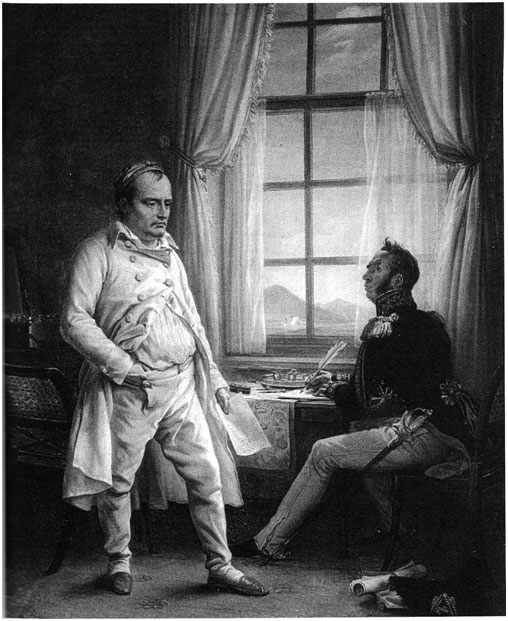
(Napoleon in St Helena, by Steuben. He is represented dictating his Memoirs to the General Gourgaud. Gourgaud who had been present at all the great battles of the Empire, remained three years in the island.)
That is why it is his nature to command. “Wherever I may be, I command, or else I keep silence.” He might have added: “I negotiate,” for he had spent a quarter of his time in negotiating. Even as a young general of twenty-seven, he aroused the respect of all who came in contact with him. He never learned to obey; but to command came to him naturally at the very outset, just as a calf stands and walks in the first hour of its life. Because this power of commanding comes so naturally, he never acquires the art of asking; because he can command as no other, he is denied the gift of being able to ask favours.
His self-confidence confers on him a natural dignity that amazes and angers the legitimist world, which believes dignity to be consonant only with heredity and culture. The friends of his youth stand embarrassed when they recognise him as their commander in the field and yet realise the solitude which his position as leader entails. All his companions-in-arms speak of him with spontaneous homage. One of his intimates writes: “When he speaks, everyone listens, for he speaks as an expert; if he is silent, his silence is respected; and no one would venture to say that he was silent because of ill humour. We all felt that between him and us there lived a great thought which was wholly occupying his mind and forbade familiar accost.” This statement is all the more surprising since it was made during a campaign, when tent life usually breaks down barriers. With absolute ingenuousness he once said, while playing and chatting with friends at Malmaison: “I have no sense of the ridiculous. Power is never ridiculous.”
An adept at analysis, the greatest psychologist of his epoch, he knows all about his own qualities, and is therefore able, by degrees, to elaborate these instincts into principles. “The goodness of a king,” he informs his brother Louis, King of Holland, “must always bear a regal stamp and must never be monkish. ... The love which a king inspires should invariably be a manly love, wedded to reverence, fear, and esteem. If people speak of him as ‘a good man,’ his rule is a failure.” This love and fear which he himself inspires has the greatest practical results.
Nevertheless, the dignity which holds people at a distance is not assumed, for a leading element in it is a bewildering naturalness, which grows with the years and with his successes. His unsophisticated and frank realism, the sterling simplicity of his character, shows itself in a hundred gestures and words, and in the freshness with which he repeatedly makes fun of his own ardency. He expresses this in a profound saying: “A truly great man will rise superior to the events which he himself has brought about.” The greatest successes, whose fateful origin and consequences he fully grasps, he sums up to his intimates in a schoolboy’s laugh. Many have reported this, for between the boisterous gaiety of a soldier and the most delicate curl of the lip are many shades of good humour; he possesses all.
On the eve of his coronation he exclaims: “Is the result not truly delightful, to be named brother by the kings?” Or he sends his ambassador to St. Petersburg with the words: “Our brother in Russia is fond of luxury and festivity. Very well, then, give him his fill of them!” Sometimes his simplicity of manner infringes etiquette, and the legitimists blanch: “When I was an insignificant lieutenant,” he begins once at table with the kings in Dresden. General consternation! Everyone gazes into his plate. Napoleon clears his throat: “When I had the honour of serving as lieutenant in the second artillery regiment at Valence ...” Or he is sitting with the tsar in Tilsit, and, since he is ever eager to learn, he asks offhandedly across the table: “How much does your tax on sugar bring in yearly?” We are told that this question places all present in a state of grave embarrassment. Why? Because, as a big man of business, he calls money by its name; whereas the kings never mention it by name, though they are glad enough to reap the harvest!
Since he was not vain, he knew when he had made mistakes. His whole life long he was in the habit of saying that next day he might lose a battle; he frequently consulted his friends and his experts, and was inspired with the feeling of God-given necessity. How well Napoleon could bear to be told the truth, we can learn from Marmont — who, when he praises, is one of the most trustworthy of witnesses, for he wrote his memoirs long after the Emperor had publicly stigmatised him as a traitor. “Napoleon had a strong sense of justice, and would readily forgive an improper word or other sign of anger in one who had good grounds for complaint, provided of course he was alone with the offender. ... He made kindly allowance for others’ weaknesses and could never resist the appeal of well-grounded sorrow. One who chose time and place, could say anything to him. He was always willing to listen to the truth. Though it did not invariably influence him, there was no danger in uttering it.”
He saw through the wiles of flatterers, and they gained nothing from him. Byzantine bombast, devoid of political value, infuriated him. “How could you depict the French eagle tearing the English leopard to pieces, at a time when I cannot safely send even a fishing-smack out to sea? Break up your moulds instantly, and never show me anything of the kind again!”
On the other hand, those who fearlessly speak the truth to him, impress him. He praises Chateaubriand, who has attacked him. In the days when he was Consul he was wont, after a sitting of the Council of State, to invite to dinner the man who had most vigorously opposed his wishes. In the Russian Campaign, a captive general tells him some home truths about the burning of Moscow. Napoleon dismisses the prisoner in a rage; but presently has him recalled, and shakes the Russian’s hand, saying: “You are a brave man!” Mehul plays a trick on the Emperor, producing his new opera as the work of an Italian composer, and thus earning approbation. Paisiello also plays a trick by introducing into one of his own compositions an aria by Cimarosa, a composer whose work Bonaparte cannot endure. The Consul applauds; and when afterwards told of the deception, he only laughs. [...]
After victories and successes, this historical feeling for his own personality becomes as objective as the attitude of the chess-player towards the pieces on his board. We seem to be contemplating a man whose fondness for the game is the only thing which makes him want to win; and who, as soon as he has won, can converse dispassionately with his defeated opponent about the mistakes they have made and the artifices to which they have had recourse. When he is talking to enemy generals whom he has taken prisoner or with whom he is negotiating, he will say: “You ought to have done this, that, or the other. There, you were in an advantageous position. That would have been an excellent move.”
Immediately after his victory at Wagram, he says to Count Bubna: “I am certain that you are damnably strong; for you can deliver shrewd blows. At what figure do you estimate my forces? ...You appear to be uncommonly well informed! Would you care to have a look at my army? ... No? Well, at least you had better study my position on this map. It was my own fault when I failed to win a victory at Aspern-Essling. I got the punishment I deserved.”
Only with regard to one matter does this detachment fail him — Waterloo. In St. Helena, an English surgeon ventured to say that people in England would be glad to hear his opinion of Wellington. The remark was followed by an embarrassing silence.
Fame is the supreme goal of his egotism; substantially, it is the only goal. All his energies are directed towards this end: his consciousness of his uniqueness; his historic sense; his sense of honour; his dignity; the boy’s dreams, the youth’s plans, the man’s deeds, the prisoner’s unrest. Posterity is the great confused picture which fills his imagination; and the desire of his heart would seem to be rather the Latin “gloria” which thinks of future generations, than the French “gloire” which sums itself in the smile of contemporaries. He is animated by a daimonic being’s eager wish for immortality although he knows that he must share the fate of all mortal men. “Better never to have lived, than to exist, and pass without leaving a trace.”
He modifies the coronation oath by swearing, not only to protect the realm and the happiness of France, but also to rule for the glory of his people. On one of the battle-fields of Henry IV in Normandy he has a column erected with the inscription. “Great men love the fame of those who resemble themselves.” Frederick’s sword is “more precious than all the treasures of the king of Prussia”; but it is not only when he is campaigning that his thoughts turn towards the future. When he is having houses built for the unemployed, his order to the minister to whom the task is entrusted ends with the phrase: “We must not pass out of the world without leaving traces that will commend us to the thoughts of posterity.” At the close of his career as Emperor, he refuses to make peace on terms that will involve the renunciation of territories upon whose conquest part of his fame depends; and towards the end of his life he utters a melancholy parable, darkly significant, lonely as his own destiny:
“The love for glory is like the bridge which Satan tried to build across chaos in order to make his way into paradise. Glory is a connecting link between past and future, from which an abyss separates him. I leave to my son nothing but my name.”
Energy is the second element in Napoleon’s make-up. How does this quality show itself?
First of all in calculation. Never a trace of the flash of genius; but, rather, continuous weighing, over-elaborating, discarding: “I have known myself to argue with myself over the thoughts concerning a battle, and have contradicted myself. …When I have drawn-up a plan of battle I am the most pusillanimous of men. I magnify the dangers and the incidents, am in a terrible state of excitement even when I seem cheerful; I am then like a girl who is going to have a baby.” This is the mood of an artist during the conception of his work. He once described these feelings to Roederer in even franker terms:
“I am always at work; I think a great deal. If I appeared to be ever ready and equal to any occasion, it is because I have thought over matters for long before I undertake to do the slightest thing; I have foreseen all eventualities. There exists no guardian angel who suddenly and mysteriously whispers in my ear what I have to do or to say. Everything is turned over in my mind, again and again, always, whether I am at table or at the theatre. At night, I wake up in order to work.”
This constant deliberation builds up something within him which he names “the spirit of things”: the precision, which penetrates all he touches; the thinking in numbers, to which he ascribes part of his success and for which he has to thank his mathematical training. There is nothing too small for this brain; for the sum total of millions of details is a plan whose scope is world embracing. If one of his officers writes to say that the Emperor’s instructions have been carried out, Napoleon waves this general statement aside and demands details. Nothing is so small but he wants to know all about it and judge its importance for himself. He writes to Eugene, who is in Italy:
“How is it possible that you are distributing three million seven hundred and forty-seven thousand rations of meat? ... I can calculate a similar gross total for dried vegetables, wine, salt, and spirits. But I want calculations according to corps. I am robbed of fifty per cent, even as much as seventy percent. … How can you allow them to calculate for one million three hundred and seventy-one thousand rations of hay? I should have to provide twelve thousand horses to eat it, not counting the Istrians and Dalmatians! You know I have only seven thousand….. The office charges are insane! Frs. 118,000 for four months! That equals Frs. 400,000 a year! Such a sum should suffice for the whole of Italy!”
This is but one example among many. Thousands of such letters, hailing from every corner of the military and civil administration, personally dictated, are to be found in the volumes of correspondence, and must sadly disappoint those who expect to find only ideas and temperament in the letters. He is the man who, in the midst of his wars in Italy, writes home that they must concoct a letter, nominally written by a German patriot and dealing with Austrian politics, and have it circulated throughout Germany; again, in the throes of a campaign, he has to write to Murat, King of Naples, detailing how the latter is to behave at balls or when he visits the theatre, whom he is to invite and whom to exclude from his invitations. While the preparations are being made for the Erfurt gathering, he suddenly remembers that someone must be there to introduce the actresses to the gallant grand dukes. He never demonstrates more forcibly the way he formulates destinies in figures than by the following incursion into social life: “Each household should have six children, seeing that, on the average, three are sure to die. Of the three who survive, two should replace the father and mother; the third will serve for an unforeseen emergency.”
His precision of thought goes to such grotesque lengths! A third means for expressing this energetic faculty is his tempo. “Activity! Speed!” he writes with his own hand at the foot of an order. The King of Prussia has depicted this peculiarity with especial felicity: “We need but see him ride: he always gives his horse rein, and never troubles about what may be happening in his rear!” But Napoleon negotiated better than he rode, for he never negotiated until after long reflection. “Not a moment must be lost,” is the slogan even when nothing presses for decision. The instinctive impetus of an overburdened but short life drives him forward; it seems as if he could not arrive quickly enough at the end of his career. He writes to Bernadotte, in the course of a campaign: “I have lost a whole day through you, and the fate of the world hangs upon one single day.”
The drive he imposes upon himself has its reaction upon those who serve him. He drives them, not only in the field, but also in circumstances which ordinary governments would take months to decide. He demands a treaty with Russia from Talleyrand, saying it is to be drawn up and ready in a couple of hours. To explain the reasons for his second marriage, he wants a circular letter sent to all his ambassadors and consuls; this is to be drafted “in the course of the day.” One night he is immersed in thoughts concerning the embellishment of Paris. Next morning he says to his Minister for Home Affairs: “I require that Paris shall have two million inhabitants by the end of ten years. I want to do something useful and great for the city. What do you suggest?”
“Provide the town with a good water-supply, Sire,” and the minister expounds a plan whereby the Ourcq water can be conveyed to Paris.
“Your proposal is good. Summon G. he must send five hundred men to La Vilette tomorrow, in order to start work on the canal.”
Another of his weapons is memory. “I always know my position. I cannot remember a single Alexandrine, but I never forget a figure relating to my military situation.” This is the productive memory. Although he pronounces them abominably, he retains the names of all the important places — important from his point of view — in all the countries where he has fought. The Postmaster General reports that the Emperor is able to mention, offhand, distances which he himself has to hunt up in works of reference. On his way back to Paris from the camp at Boulogne, Napoleon encounters a troop of soldiers who have lost their way, asks the number of their regiment, whence they set out, and when. He tells them their line of march! “Your battalion will be at H. this evening.” At this time, two hundred thousand men were on the march close at hand!
His technique is to arrange things in his head “as in a wardrobe.” He says: “When I wish to put any matter out of my mind, I close its drawer and open the drawer belonging to another. The contents of the drawers never get mixed, and they never worry me or weary me. Do I want to sleep? I close all the drawers, and then I am asleep.”
Among the numerous heraldic emblems which might have tickled the fancy of an upstart — stars, tutelary deities, saints, beasts of prey — he finds none to please him. He chooses the bee, thus emphasising once more his opinion that a man of talent who aspires and works unceasingly can achieve everything that can otherwise be achieved through what is vaguely spoken of as genius. He declares that genius is industry; meaning, of course, that genius is industry among other things. He says that work is his element, that for which he has been created. Had he left nothing behind him, had all his works perished, still his industry and his glory would have been an emblematic stimulus to the youth of countless generations after he had passed away.
Many witnesses testify to his amazing powers of continued work. Roederer, who was his close companion during the Consulate, writes as follows: “That which especially characterises him is the power and persistence of his attention. He can work for eighteen hours at a stretch, it may be at one piece of work, it may be at several in turn. I have never seen his mind flag. I have never seen his mind without a spring in it, not when he was physically tired, not when he was taking violent exercise, not even when he was angry. I have never seen him distracted from one affair by another, neglecting the matter in hand for one which he is about to work. Good or bad news from Egypt never interfered with his attention to the civil code, and the civil code never interfered with the steps it was necessary to take for the safety of Egypt. No one was ever more wholly immersed in what he was doing, nor did anyone ever make a better distribution of his time among all the things he had to do. Never was anyone more stubborn in rejecting the occupation or the thought which was not appropriate to the hour or the day; nor was anyone ever more adroit in seizing an occupation or a thought when the right moment had come.”
He robbed hundreds of his fellow workers of health and youth, because he demanded too much of them when he demanded from them what he exacted from himself. His private secretary would be sent for at a late hour, and would get to bed at four in the morning; at seven, the poor man would find new tasks ready for him, and would be told that they must be finished within two hours. When Napoleon and his secretary were together all day, one dictating and the other writing from dictation, at meal times the chief would order food for two and would share with his subordinate at a corner of the work-table, just as he would have shared with his adjutant on a boundary stone. During the Consulate he would sometimes begin a sitting with his ministers at six in the evening and keep it up till five next morning. In the three months at Schonbrunn, his official correspondence comprised four hundred and thirty-five letters occupying four hundred folio pages of print. This was only his political and administrative correspondence; in addition he wrote a great many private letters, and delivered innumerable orders by word of mouth.
These are the main forms of his energy. It is with their aid that he enters upon his duel with the world, availing himself of their interplay, and speaking of his genius as a talent for combination.
In his plans and orders, he is fond of the phrase “at the given moment.” He is not hampered by any principle, is always willing to modify his scheme to suit the weather of destiny, to adapt his combinations to the slightest modifications of the situation. This man of iron will had a most supple intelligence. While forcing all those with whom he came in contact to bend before his resolves, he himself showed a wonderful elasticity in compliance with the will of circumstances.
“The weakness of a captain who, instead of forcing his way into port, preferred to let himself be chased on the open sea — this, and some of the trifling defects of our frigates, were the reasons why I failed to change the face of the world. Had Acre fallen, we should have made our way to Aleppo by forced marches, have enlisted Christians, Druses, and Armenians; have speedily reached the Euphrates: thence I should have gone to India, and should have established new institutions, everywhere.”
Whether these vaticinations were historically tenable, may remain an open question; but his belief that he could have done what he describes, bears witness to his realism. In this world of figures and magnitudes, for Napoleon everything depends upon the individual behaviour of the individual man at his post. Since the failure of anyone individual may give the totality of circumstances a new trend, he is always ready to adapt the trend of his own intelligence to changing circumstances. But he does not himself attribute his successes to this, saying that they were due to his having been born at the right moment, and that under Louis X1V he would only have become a marshal like Turenne.
Napoleon’s energy is very little disturbed by the passions. His self-confidence and his sense of dignity made self-command easy to him, and, being habituated to surprise, he was always fully master of himself. “Since I am used to great events, they make no impression on me at the moment when they are reported; I feel the pain an hour later.” This sometimes makes him appear more stoical than he might wish people to believe him. When Hortense’s boy dies, he tells her to be composed, saying: “To live means to suffer; but the brave man is continually striving for self-mastery, and achieves it in the end.”
Nevertheless, he sometimes loses his temper. The fierceness of his passion is then proportional to his pride; the irritability of his nerves, and the impatience of his creative will — the will of one who needed a thousand hands to complete his work. The stories about his threatening an ambassador with his fist and similar outbursts of violence, are fabulous; but there is trustworthy evidence as to the terrible moment when Berthier had infuriated the First Consul by his tactlessness. Led on by Talleyrand as Mephistopheles, Berthier, in the Tuileries, had urged upon the Consul the need of assuming the title of king. Bonaparte’s anger flashed from his eyes, his lips twitched, he seized the offender by the throat, and pushed him back against the wall, shouting: “Who put you up to raising my bile in this way? You will pay for it, if you dare to do anything of the kind again!”
Even amid his anger, his faculty for combination is at work, and he realises that the notion cannot have originated in the good Berthier’s mind. In its psychical significance the scene is unique.
Often he is a rough, irritable soldier. Who furiously lifts a badly closing window off its hinges and hurls it into the street; lashes a groom with his whip; when dictating a letter, utters curses against the addressee, which his secretary suppresses …
More important are the occasions when he simulates anger to gain some political end. Occasionally he gives the show away afterwards. “You think I was in a rage?” he says in Warsaw. “You are making a mistake. While I have been here, my wrath has never exceeded bounds.” One day he is playing with his little nephew and gossiping with the court ladies, in the best of humours. The English ambassador is announced. Instantly his face changes like an actor’s, his features are convulsed, he turns pale, strides towards the Englishman and storms at him for a whole hour in the presence of numerous witnesses. He is genuinely angry with England and he is genuinely annoyed at being disturbed by this visit; but the wrathful mask, the scene he makes, the angry expressions he uses, are political expedients.
The frequency of such incidents made many people believe that Napoleon was a passionate man. Talleyrand has more insight: “He’s a perfect devil. He humbugs us all, even about his passions, for he knows how to act them, though they are really there!”
Self-command and coldness are so dominant in him that he never takes the vengeance that might seem appropriate to his irritable sense of honour and to the extent of his power. He never punished rivals or traitors unjustly. He only banished those whom he had good reason for wishing out of the way; and it was a point of chivalry with him to leave beaten enemies, great or small, unmolested.
Here is a scene with the Badenese envoy. The envoy asks compensation for the duke of Brunswick. The Emperor angrily refuses: not because the duke is supposed to have incited Prussia to make war against France; but because, long before this, during the first campaign against France in 1792, he had issued the famous manifesto of Coblenz in which he had said that in Paris he would not leave one stone standing on another. “What harm had this city done to him?” fiercely enquires the Emperor two decades later, the man who in those days had been Lieutenant Bonaparte. “This affront must be avenged!”
Napoleon’s energy is most conspicuous in his role of conqueror. But in this case it finds a more spiritual expression than one would be led to anticipate from a soldier. “I have seldom drawn my sword; I won my battles with my eyes, not with my weapons.” To gain a knowledge of his soul, it is not important to understand the new forms of his art of war; of importance is to understand the way in which his whole being vibrated before, during and after a fight. In this, too, he is wholly original.
Even courage, that fundamental virtue of the soldier, assumes in Napoleon a form peculiar to himself. During his youthful days, and again during the last campaigns he displayed so much personal courage that he can venture to say, “no soldier is proof against cowardice”; but such moments of panic fear must be utilised against the foe. What he believes himself almost alone to possess is “two o’clock-in-the morning courage”: courage in face of the unforeseen, the sudden courage which demands presence of mind and power of determination. But he despises the “chivalrous” courage of the duel, which he crushingly describes as “cannibal courage.” — “Since you have both fought at Marengo and Austerlitz you do not need to give any further proofs of your courage. Women are fickle, and so is good luck. Go back to your regiments and become comrades again.”
The commander of armies clearly recognises the line of demarcation between humaneness and coldness. The same man who, in his study, could exclaim to Metternich: “Such a man as I does not care a snap of the fingers for the lives of a million men”, will say on the field of battle: “If the kings of the world could contemplate such a sight as this, they would hanker less after wars and conquests.” Another time he writes to Josephine: “The earth is strewn with dead and bleeding men; this is the obverse of war; the heart is tortured at the sight of so many victims.” Calculation and feeling are at cross purposes in this case, and he excuses himself for the duties imposed by his own craft: “He who cannot look upon a battle-ground dry-eyed, allows many men to be killed purposelessly.” This is what he wants above all to avoid. For the great aim, Europe entrusts him with a million men: his lesser aim, the making of this trench or that bridge, must be thriftily achieved, for “he who heedlessly allows ten men to be killed where at most two need have died, is answerable for the lives of eight men.”
Since most of his wars are fought from political necessity, and are always conducted without hate, as soon as the fight is finished the foe ceases to exist. He writes from Schonbrunn: “I am appalled to learn that the eighteen thousand prisoners on the island of Lobau are suffering from hunger; this is inhuman and unpardonable. Have twenty thousand rations of bread sent there immediately; a similar amount of flour for the bake-houses.” But when, after the truce, soldiers are still being killed by the embittered Tyrolese, he is furious, and orders that “at least six of the larger villages are to be plundered and burned, so that the mountain folk may not soon forget the vengeance that has been exacted.”
War is for him an art, “the most noteworthy art, one which contains within itself all the other arts.” Like a true artist, he declares that, in the long run, this art cannot be taught: “You fancy that because you have read Jomini you are fitted to be a leader in war? ... I have fought in sixty fights, and I can assure you that I have learned nothing from any of them. Caesar used the same tactics in his last battle as he had used in his first.” In typical artist fashion, he contradicts himself in the definitions of those things in which he is a master. After the Spanish campaigns, he delivers the following lecture to one of his generals: “War is decided far more by the power of strategical calculation than by material forces.” At another time he will maintain that it is the superior numbers or the moral courage of the troops which constitutes the deciding factor. Sometimes he even goes so far as to say that inspiration decides an issue: “The result of a battle hangs on a thread and is mostly the outcome of a sudden thought. One approaches the enemy according to a prearranged plan, one comes to blows, one fights for a while, the critical moment draws near, a spark of inspiration flames up — and a small reserve division does the rest!”
More logically, but not less as the artist, he speaks of the decisive moment which, after a couple of engagements, one can find out for oneself without any difficulty. “Such moments are not more than quarter hours. ... In every battle a moment comes when the bravest of soldiers would like to turn tail: it needs but a trifle, but a plea, to put heart into him again.” This power of suggestion has won him many a victory for soldiers constitute the only mass to which he can speak with effect. The soldier understands him, because Napoleon is simple. The Emperor even describes war as “a simple art like everything that is beautiful.” By this contention he seems to uphold the idea that war is the highest of all arts. “The military profession is a freemasonry … and I am the grand master of its lodge.”
He draws this personal influence from the history of his own rise, which is known to every soldier. As a young general, he had learned to put up with his dependence on the civil authority; and as emperor he still commiserates his royal adversaries because their generals’ activities are frustrated by civilian control. On the other hand, he knows the dangers of amateurishness, and writes to Joseph: “When the king himself commands, the soldier does not feel commanded. The army applauds him as when a queen is riding by. If one is not oneself a general, one must give the generals full power of command.”
Because he is the only ruler in Europe who has risen from the ranks, from youth upwards he remains familiar with details, and always understands how things look to an officer on the fighting front. “There is nothing connected with the art of war which I cannot do with my own hand: power, siege engines, artillery.” But he does not concern himself with these details unless it is necessary, and laughs at the romantic anecdote in a book where he is said, one night, to have taken over the duties of a sentry who had gone to sleep at his post: “That is a civilian’s idea, the sort of thing a lawyer would think of, and was certainly not written by a soldier.”
But he is a stickler for equality in the army, and in this matter remains true to the Revolution until the very end of his career. No one is promoted unless his record in the service justifies the advancement. If Napoleon makes an exception in the case of his brothers, we must remember that after he has made them kings he continues to scold them as if they were subalterns. He writes to Jerome, commenting on a report from Silesia: “Besides, your letter is too clever for my taste. … What a man needs in war is precision, firmness, simplicity.” When Joseph plays the prince in Boulogne, and vies with Marshal Soult in the splendour of his receptions, Napoleon scolds him. “In the army, no one must put the commander in the shade. On review days, it is the general and not the prince who must give a dinner. At a review, a royal colonel is a colonel and nothing more. Discipline can tolerate no exceptions. The army is a whole. Its commander is everything. Keep to your own regiment.”
Nevertheless, a wounded commander-in-chief has become a private soldier. At Eylau, where there have been heavy losses, the Emperor forbids a famous surgeon to go out of his way in order to care for a wounded general: “Your business is to attend to all the wounded, and not to anyone in particular.” A German officer reports that after a fight Napoleon would often stand by the wounded and see that they were carefully lifted into the stretchers: “If this good fellow pulls through, there will be one victim the less.”
In all the memoirs, we read how in camp the Emperor would foregather with his men at the bivouac fire, ask whether their food was being properly cooked, and laugh at their replies. When they confided all their troubles to him, and often said “thou” to him, this was not the assumed good fellowship of a condescending monarch, but a genuinely paternal relationship. If he calls them “my children,” to them he is their “little corporal,” meaning the comrade who takes the responsibility. “I have received your letter, dear comrade,” he writes to a veteran grenadier who wishes to re-enter the service. “You need not speak to me of your deeds, for I know you to be the bravest grenadier in the army. It will be a pleasure to see you once more. The Minister for War will send you your orders.”
He never confides his plans to anyone; but when it is a question of rewarding merit, he calls in Everyman as adviser. After a fight, he often forms a circle, speaks to the officers, the non-commissioned officers, and the rankers individually, asking who were the most valiant, rewarding then and there, allotting eagles with his own hand. “The officers pointed out, the soldiers confirmed, the Emperor approved,” relates Segur as eyewitness.
It is true that Napoleon loves war, but as a fine art, just as he loves power. It is true that he laughs incredulously at a traveller who tells him a tale of a Chinese island where there are no weapons.
“What do you mean? But they must have weapons!”
“No, Sire.”
“Pikes, anyhow; or bows and arrows?” “Neither the one nor the other.”
“Daggers!”
“Not even daggers.”
“But how the devil do they fight there?”
“There has never been a war on the island.”
“What, no war?”
It sounds to the traveller as if the very existence of such people under the sun outrages the Emperor. The thought stirs a soldier’s bile!
All the same, he looked forward to the coming of peaceful days, not with an ardent desire for them perhaps, but with the seer’s vision. He showed his superiority to all the modern commanders against whom he fought, in that he, the greatest soldier of the new times, declared the primacy of the spirit over the sword. When Canova made a statue of him in which he was shown with a threatening mien, he said contemptuously: “Does the man think I achieved my conquests with blows of my fist?” But, more than this, he himself defined a commander as something above and beyond a soldier. When First Consul, he said in the Council of State:
“In what does the commander’s superiority consist? ‘In his mental qualities: insight, calculation, decision, eloquence, knowledge of men.’ But all these qualities are what make a man shine in civil life. … If bodily vigour and courage sufficed the commander, any brave private could be a leader of armies. Everywhere, crude force now yields ground to moral qualities. The man with the Bayonet bows before the man who possesses exceptional knowledge and understanding. … I knew perfectly well what I was about when, as the head of the army, I bore the title of Member of the Institute; and the youngest drummer understood what I meant.”
At a later date, he spoke more decisively.
“War is an anachronism. Someday, victories will be won without cannon and without bayonets. … Whoever troubles the peace of Europe, wants civil war.”
Remember that these are the words of Napoleon, the military commander.
His energy is concentrated on human beings. Very rarely does he come into conflict with natural forces; and whenever he does so, he is beaten. But, in general, all he has to do is to compel men to conquer, for him, the mountains and the miles. Human beings are the material in working with which the energy and the imagination of this artist are destined to become weary; them he must overcome if he is to do his work at all. No mortal ever conquered more men than did Napoleon. He subjugated, not only armies and peoples, but something more: individuals, and the best of these.
To achieve his goal, he followed the road of contempt; and used as his means, glory and money. Self-confidence and experience had convinced him that everyone acts only from self-interest; that some are driven to grasp at money through love of pleasure, or avarice, or clannishness; that others seek public recognition in order to gratify their vanity, their jealousy, or their ambition. Denying the force of ideal motives, Napoleon relied exclusively upon material means; and if the spur of ambition occasionally assumed the aspect of a desire for eternal glory, this occurred against his will, but the magic of his personality sometimes exercised a more puissant lure than the well-calculated material attractions offered by others. To quote Goethe: “Napoleon, who lived wholly for ideas was nevertheless unable to grasp the nature of ideal motives; he repudiated the ideal, denied that there was any such thing, at the very time when he himself was eagerly trying to realise the ideal.”
Yet to Napoleon the Mephistophelian conception or men was as alien as it was to Goethe. He said: “Most people bear within themselves the seeds of good and of evil, of courage and of cowardice. Thus is human nature created: upbringing and circumstance do the rest.” Since, for twenty years, he needed this human nature, daily and in quantities of a hundred at a time, the subtlest knowledge of it was a primary condition of his success. Among all the materials which Napoleon bent to his uses, the human heart was the most familiar.
“I am a great friend of analysis….. ‘Why’ and ‘How,’ are such useful questions, that they cannot be uttered too often.” Coldly and clearly as a nerve specialist, he controls all psychical symptoms, utilises every method for the attainment of such control, and trusts especially to physiognomy — for he knows his Lavater.
He is fond of reproving people. “According as they react, I discover the pitch of their souls. If I strike brass with a glove, it gives back no tone: but if I strike with a hammer, it rings out.” A person meeting Napoleon for the first time, is gripped by the magnetism of his glance.
By talking and questioning, he makes himself acquainted with the atlas of human types, an atlas he is ever enlarging. He questions so long that a stranger grows embarrassed, confused, and alarmed; he questions until his questions become ridiculous; but he must at all costs get the information be needs, even if he is not negotiating. In what way can the twenty minutes that a doctor sits at Napoleon’s table in St. Helena be put to the best use by the ex-Emperor?
“How many patients suffering from ailments affecting the liver had you on board? How many cases of dysentery? What is the fee for a consultation in England? What is the pension awarded to an army surgeon? ... What is death, or how would you define it? When does the soul quit the body? When does a body first receive a soul?”
Another means is monologue. One of his intimates declares that the right of the Emperor to hold forth in monologue was the only real pleasure his high estate awarded him! We have testimonies concerning other men of action: but who ever talked so much as Napoleon! Since he always faces the world alone, he must continually hold forth that he may convey his suggestions to the world. His conversations often lasted from five to eight hours, some of them ten or eleven hours; and during the greater part of them Napoleon took the floor. We must admit that this was more in accordance with the Italian manner than the Roman; Italian, too, were the rapidity of his utterance, and his foreign accent: but he gesticulated little; and only when much moved did he unclasp his hands — generally they were clasped behind his back, as if he wished to throw out his chest against the world.
Upon all who serve him, he lavishes money with oriental profusion. But as far as his personal expenditure is concerned, he is thrifty. During the Consulate he says: “A man who has been through so many wars will have acquired a little property whether he will or no. I have a private income of from Frs. 80,000 to Frs. 100,000, with a house in town and a country mansion. What more do I need? If I should get out of humour with France, or France with me, I should retire from public life without a qualm…. But every one round me is stealing; the ministers are weak. Some people must be laying by vast sums. … What is to be done about it? France is corrupt through and through. It has always been like that; as soon as a man becomes a minister, he builds himself a palace. … Do you know what they are trying to make me pay for my installation in the Tuileries? Two millions! ... It must be cut down to eight hundred thousand. I am surrounded by a pack of scoundrels.”
“Your great operations,” answers Roederer, “must cost you much more than these domestic defalcations.”
“All the more reason why I should watch over my personal expenditure.”
This conversation tells us how the head of the State, a man of thirty, regards money. He needs nothing for himself, and complains of the venality and profusion of those by whom he is surrounded; acknowledges that he has himself made money out of the wars; rails at the tradesmen who want to charge two millions for the equipment of a palace, when, as far as his own taste is concerned, he sees no reason for spending anything at all. Amid the frightful corruption which is a heritage of the revolution, he fights with the army contractors and war profiteers; but as soon as, by drastic punishments, he has succeeded in putting an end to this scandal, he assigns preposterous incomes to his marshals, some of whom receive more than a million francs a year. As Consul, he rids the State of the thieves who are making away with the national property; and then, as Emperor, he burdens this same State with extortionate salaries.
[...]
Imagination, the third element of his personality, is the driving force of his self-confidence and his energy. Continually at war with the calculating part of his nature, fantasy, in the end, brings this harbourer of opposites to destruction. The imaginative power, which links the poet to the statesman (enabling both unceasingly to dwell in the affective world of strangers as well as in their own), is also the source of his knowledge of men and his guide to the management of men. But always his energy interacts with other qualities. One who, for analytical purposes, would force the living whole of his character into the framework of a system, cannot avoid, from time to time, breaking threads that he may bind other threads together.
“I know not what I do, for everything depends on events. I have not a will of my own, but expect everything from their outcome. …The greater one is, the less can one have a will. One is always dependent upon events and circumstances.” Such words, casually introduced into a letter from husband to wife, express the distantly visible forms of his fantasy; for only the imaginative man, not tied to systems and principles, trusts himself to the movements of the moments, allows his spirit to roam freely, and discovers his course as he goes. In this sense, his whole career is improvisation, though in the converse way from that in which most people improvise. He calculated little things in advance with great precision, whereas his worldwide designs were originated, transformed, improvised, in accordance with circumstances and developments. “One who has become familiar with affairs, despises all theories, and makes use of them only like the geometricians, not in order to move forward in a straight line, but merely to keep heading in the same direction.”
This direction, this fundamental idea of the statesman, was, moreover, only possible in a man whose mind was simultaneously imaginative and mathematical. It is his most ardent vision and his coolest calculation; it is his political aim, his hope, his ambition: Europe. If this vision could be realised only by force of arms, that was because of the fierceness with which the first republic of Europe was again and again attacked by the European princes. We have seen how earnestly he strove for peace. No doubt he chose his means badly, his error being due to the time, the circumstances, and his own domineering character. But his mistakes as to method still leave undiminished the genius of the seer who looked forward towards an aim which was again to become an object of statesmanship a hundred years after his fall.
“There are in Europe more than thirty million Frenchmen, fifteen million Italians, thirty million Germans….. Out of each of these peoples, I wanted to make a united national whole…… That would have supplied the best chance of establishing a general unity of laws; a unity of principles and thoughts and feelings, of outlooks and interests…… Then it would have been possible to think of founding the United States of Europe after the model of the United States of America……. What perspectives of strength, greatness, and prosperity this opens up! ... For France, unity has been wrought; in Spain, it has proved unattainable; to establish the Italian nation, I should have needed twenty years; to make the Germans a nation, would have required still more patience, and all I could do was to simplify their monstrous constitution. At the same time, I wanted to pave the way for the unification of the great interests of Europe, just as I had unified the parties in France…… The transient mutterings of the peoples troubled me little; they would have been reconciled to me by the result…… Europe would soon have become one nation, and any who travelled in it would always have been in a common fatherland…. Sooner or later, this union will be brought about by the force of events. The first impetus has been given; and, after the fall and the disappearance of my system, it seems to me that the only way in which an equilibrium can be achieved in Europe is through a league of nations.”
Here there is no talk of a dictatorial welding together of different stocks, or of an enthusiastic fraternization. He speaks only of interests, and of a preliminary unification of these on a national and racial basis. The work of the nineteenth century was to inaugurate the preliminaries by the establishment of the nations. The twentieth century opens with the realisation of the Napoleonic idea.
The effects underlying his energy and his imagination are dominated by the clarity of his thought. Napoleon hated less, and loved more, than he would have been willing to admit. In this domain, we find the converse of what happens in the matter of his sympathies in war time, when a million men are coldly sacrificed, while one man wounded and bleeding touches him to the heart. Since his fantasy needs enormous masses, he is enraged when Joseph says: “I am the only person who cares for you.” Napoleon rejoins: “Nothing of the sort, I need five hundred million men to love me.” In these icy words glows the volcano which one of his school masters heard rumbling long ago,
Emotionally convinced of his mission to order the affairs of the nations, he deliberately rejects anything that may distract him from this aim, and nothing sustains him but his monomania. Even in the drama, he objects to the interweaving of love stories, saying: “Love is a passion which should only be the main theme of a tragedy, and never a subsidiary motif. … In the days of Racine, it was the whole content of a human life. That happens in a society where no great deeds are being done.”
If love becomes intrusive, he annuls it. “I have no time to be bothered with feelings and to repent them like other men…… There are two motives to action: self-interest and fear, believe me, love is a foolish blindness! ... I love no one, not even my brothers — Joseph a little, from force of habit, and because he is the elder. I am fond of Duroc, too; he is serious and resolute; I believe the man has never shed tears in his life! .. Let us leave sensibilities to women. Men should be firm of heart and strong of will, or else they should have nothing to do with war or governance.” Another time: “The only friend I have is Dam; he is unfeeling and cold; that suits me.” Last of all, in St. Helena: “A man of fifty has done with love. …I have an iron heart. I never really loved; perhaps Josephine, a little; but then I was only seven-and-twenty. I incline to the view of Gassion, who once said to me that he did not love life well enough to give it to another being.”
Always half ashamed of his feelings; ever ready to make excuses for them; “perhaps,” “a little.” Yet this is the same man who said: “I am the slave of my way of feeling and acting, for I value the heart much more than the head.” This very feeling is his fantasy.
One in whom egotism is supreme, will be more inclined to jealousy than to love. His first letters to Josephine show him devoured by jealousy. Years later, as Consul, when he is inspecting his new bridge in course of construction across the Seine, he has to step aside with his companions for a moment to let a carriage pass. In the carriage sits Hippolyte, his sometime rival. That was long ago; everything has been condoned; the man’s name is never mentioned in his presence. But now, at a chance encounter in the street, Bonaparte grows pale and confused, and takes a little while to recover composure.
From time to time, he shows an involuntary kindliness. On one of the Italian battle-fields, he sees a dog howling over the dead body of its master. “The poor beast seemed to be asking for an avenger, or begging help. I was profoundly moved by the dog’s suffering, and at that moment I should have been very much in the mood to grant quarter to an enemy. I understood why Achilles surrendered Hector’s body to the weeping Priam. Such is man; so little can he count upon his moods. Impassively I had sent my soldiers into the battle; dry-eyed I had watched them marching past in an advance where thousands of them would meet their fate; then I was shaken to the depths by the howling of a dog.”
Affectionate tones are to be heard in many of his letters. To Cambaceres: “I am so sorry to hear that you are not well. I hope it is only a passing trouble. If you did not take so much medicine, you would be better already … But anyhow, you must do your utmost to get well, if only because of my friendship for you.” To Corvisart: “Dear Doctor, I wish you would see to the arch-chancellor and to Lacepede: the former has been ailing for a week, and I am afraid he is in the hands of a quack; Lacepede’s wife has been ill for some time. Give them the benefit of your advice, and cure them as soon as you can. You will save the life of a man of note, and one who is very dear to me.”
Chenier, who has written against him for years, is assisted by him in poverty and given a secure position. Carnot, for ten years an enemy of the Emperor, is heavily in debt; Napoleon learns this, settles the debts, and refuses to hear of being given a note of hand; reckons up the pay which Carnot would have received as general in active service, makes this calculation the basis of a large pension; and when Carnot says he would like to do some work for his money, Napoleon commissions him to write a military treatise, lest his pensioner should have to undertake duties that might go against the grain.
During the Hundred Days, learning that some of the Bourbon princes are greatly distressed for lack of money, he sends them large sums anonymously. On one occasion his secretary is asleep, and he himself has nothing particular to do; he looks through a pile of begging letters, and writes in the margin of each the amount of an allowance which is to be given to the sender. Hundreds of officers whom, in fits of anger, he has sworn to have shot, remain at their posts — to forsake him in the end. When he orders Jerome to get a divorce, he is alarmed at his own harshness. After he has written to enforce his command with threats he sends a letter to his mother saying that she had better write to Jerome at once and get his sisters to write as well, “for if I have passed judgment on him, nothing can alter it, and his life will be spoiled.”
From his few friends, he demands blind devotion. Never is the self-centred nature of Napoleon more plainly shown than in the words the exile speaks to Montholon, from whom he has been temporarily estranged: “I love you like a son, for I believe that you love me only; otherwise you could not love me at all. According to my way of feeling, it is not in our nature to love several persons at once. People deceive themselves in these matters; they cannot even love all their children with the same intensity. For my part, at any rate, I want to be the supreme object of affection in the case of those whom I love and honour with my confidence. I cannot bear partings. They stab me to the heart, for my disposition is too sensitive; spiritual poison affects the body more powerfully than arsenic.”
Logically enough, he dislikes western views concerning the enlightenment of women. He always hankers after the East, and in this matter he is an oriental. “Nature intended women to be our slaves; and it is only because of our distorted outlooks that they venture to describe themselves as our rulers. … For one who can influence us in a good direction, there are a hundred who will only lead us into follies. …What a mad idea to demand equality for women! They are our property, we are not theirs; for they give us children, but we do not give them any. They belong to us, just as a tree which bears fruit belongs to the gardener. … In this difference, there is nothing degrading; everyone has his privileges, and everyone his duties. You, ladies, have beauty, attractiveness; but also dependence.”
Throughout life, the imagination of this creator was troubled by the thought of the Creator. This ruler of men was greatly disturbed that there should be no one who ruled all men. It was not that he ever regarded himself as divine; he laughed at all mystical interpretations of his own power: but there was one great power which remained incoercible — no matter whether it were called God, destiny, or death. How do self-confidence and fantasy escape from this snare?
First of all by the rejection of dogma. “My firm conviction is that Jesus. ... was put to death like any other fanatic who professed to be a prophet or a Messiah; there have been such persons at all times. For my part, I turn from the New Testament to the Old, and there I find one man of mark, Moses….. Besides, how could I accept a religion which would damn Socrates and Plato? ... I cannot believe that there is a god who punishes and rewards, for I see honest folk unlucky, and rogues lucky. Look at Talleyrand; he is sure to die in his bed! ... How could I have remained independent if I had been subject to the influence of a confessor to threaten me with the pains of hell? Think what powers a confessor who is a rascal can exercise! ...”
In this matter he is consistent; from childhood, when he would not go to Mass, until the end of his life, he rejected (for himself) all the religions. The man who, in his own life, would not recognise the existence of miracle, and ascribed everything that he was able to achieve to the working of the healthy human understanding, boldness, power of combination, knowledge of men, and imagination, could not possibly believe in the miracles recorded in the Bible. He was perfectly logical when he told one of his subordinates it was impossible that two million men could have quenched their thirst at the Wells of Moses.
Even more uncongenial to him is any dread of a great assize. He does not talk about morality; or at most, he does so with some political end in view. Only towards the last, on the island, he says once in an evening conversation with his intimates: “How happy should we be here if I could confide my troubles to God, and could expect from him happiness and salvation! Have I not a just claim to it? I, who have had so unusual a career, have never committed a crime, and need not fear to step before God’s judgment seat and await his sentence. Never has the thought of committing a murder entered my mind.”
For these reasons, he does not falter in the days of misfortune. Five years before the end, he expresses the hope that he will die without a confessor, but adds that no one can be certain what he will do in his last hours. In fact, this heart of steel was steadfast to the end.
Nevertheless, his ideas as to the nature of the creation developed, and just as the revolutionist became a legitimist, so the materialist became a theist. But these developments were not transformations; there was simply a broadening of the basis of his thought. Throughout life, he had a sense that things had come into existence by a natural process: “When out hunting, I had the deer cut open, and saw how like the beast’s internal organs were to those of a human being. Man is merely a more perfect creature than a dog or a tree. The plan is the first link in a chain whose last link is mankind”. …
Still more remarkable are his deductions concerning psychophysical processes. In a Christmas discourse at St. Helena, he expresses his doubts as follows: “How can anyone understand that God should sanction the caprices of a ruler who sends thousands of men into battle that they may die for him? …Where is the soul of a child; or that of a madman? ... What are electricity, galvanism, magnetism? In these lies the greet secret of nature. I am inclined to believe that man is a product of these fluids and of the atmosphere; the brain sucks them in and imparts life, and the soul is composed of them. After death, they return into the atmosphere, whence they are sucked up again by other brains.” After giving utterance to these Goethean motifs, he is alarmed at his own temerity. Breaking off suddenly, he says, as a soldier among soldiers: “Oh, well, my dear Gourgaud, when we are dead, we are simply dead.”
Side by side with this scepticism, there exists and expands a theism. To Laplace, who denies the existence of God, he says: “You should be more ready than anyone else to admit that God exists, for you, more than most, have seen the wonders of creation. If we cannot actually see God with our own eyes, this is because he did not wish our understanding to reach so far.” On another occasion: “We believe in God because everything around us testifies to his existence.” In St. Helena: “I have never doubted the existence of God, for even if my reason were incompetent to grasp him, still my inner feelings would convince me of his reality. My temperament has always been in harmony with this feeling.”
How shall such a spirit come to terms with destiny? Since his self-esteem makes it impossible for him to believe that any man can have beaten him, he is forced to ascribe his defeat to fate. But this sense of the workings of destiny is present in his mind before the final overthrow; it accompanies him throughout life, and appears to be an equivalent for the reverence, devotion, and faith by which other men live. With the aid of his belief in destiny, Napoleon wages a heroic struggle. In his strongest moments, he feels that he wears armour of proof: “I have a soul of marble. The lightnings were unable to destroy it, but broke on it in vain.” Once he expresses his defiance even more poetically: “Should the heavens fall down on us, we shall hold them off with the points of our lances!”
But these defiant moods are rare. In general, he is resigned to fate. There are hundreds of his sayings to bear witness to this. Here are three: “All that happens, is written; our hour is fixed, and no one can postpone it. ... No one can escape his fate.” To the duchess of Weimar: “Believe me, there is a providence which guides all, I am merely its instrument.” To Johannes von Muller: “Fundamentally, all things are linked together, and are subject to the unsearchable guidance of an unseen hand. I have only become great through the influence of my star.” In such tropes we see awareness of God and a sense of dependence welded into pride in his own mission. At these times, a prophetical effulgence seems to radiate from him, but is obscured again and again by the self-confidence of his iron energy. …
Apart from these trifles, in a life so packed with important happenings, we do not hear of a single day during twenty years on which he forms, postpones, or modifies a resolution on superstitious grounds. But he makes an adroit use of his “star” and his “destiny” for political or rhetorical purposes. Since he wishes to pose before Europe as the Man of Destiny, he tries to work upon suggestible minds like Alexander’s by such turns of phrase as the following: “It is wise and politic to do what fate commands, and to march on the road along which we are led by the irresistible course of events.” His mind is fond of playing with the kindred notions of destiny, circumstance, and chance; and while he regards destiny as involved in more or less obscurity, he believes himself able to calculate the chances of a coming battle with almost mathematical certainty. “In these matters one must be careful not to make a slip, for an overlooked fraction can modify the whole result. …To people of mediocre intelligence, chance will always remain a mystery; but to the clear-sighted, it becomes a reality.”
Sometimes he lumps them all together — talents, destiny, and power,— and shows himself an energetic fatalist when he says: “Against attempts on my life, I trust in my luck, my good genius, and my guards.”
In this virile spirit, he strides resolutely along betwixt life and death.
… “A man must wish to live, and must know how to die.” That is why, from youth upwards, he opposes suicide; first, in an essay then, in an order of the day; then, with the reiterated argument that suicide is cowardice, especially in hours of misfortune. A careful study of the documents shows that the story of his having attempted suicide just before the first abdication is apocryphal. The leading memoirs make no reference to the matter, and such accounts as we have are at second hand and untrustworthy. There is no doubt that during his last battles Napoleon deliberately sought a soldier’s death; but he never tried to poison himself.
Yet it was not only in those last days at Fontainebleau, and after Waterloo, that he suffered from tedium vitae. The weariness recorded in the diary of the lad of sixteen, and in the letter which the man of thirty wrote from Cairo to his brother, was little in evidence during the most energetic years of febrile activity. Those who trouble to ask whether persons of genius are happy, will have to agree that this man of genius, who was not fitted by nature for happiness, enjoyed during the climax of his career, hours of content, and even sublime moments. But there were periods of doubt:
“For the tranquillity of France,” says Bonaparte at Rousseau’s tomb, “it would have been better if this man had never lived.”
“Why, Citizen Consul?” “He paved the way for the revolution.”
“Surely you are not the man to deplore the revolution?”
“Time will show whether it would not have been better for the peace of the world if neither Rousseau nor I had lived.”
Gradually these doubts fade. But what he never loses is the sense of daemonic loneliness, which increases as his soaring flight leads him to chillier altitudes. “There are times when life is hard to bear.” Since the sea has always been unfriendly to him, there is only one place where he really feels at home — the desert, which to him is the image of the infinite. The desert is the sublime vacancy which expands before him when the myriad-faceted pictures of ordinary life sink from sight.
But never was Napoleon more perfectly freed from the tyranny of his thoughts, never was he happier, than when seated alone in his box at the theatre, watching a tragedy being enacted.
Nothing else could restore his inner peace of mind; for, since he loved less than most, he was doomed to a tragical loneliness, the price he had to pay for his egotism. “There is neither happiness nor unhappiness,” he said. “The life of a happy man is a picture showing black stars on a silver background. The life of an unhappy man is a picture showing silver stars on a black background.” But it is not these heroic images which best characterize the loneliness of a soul. Even more poignant voices reach us from the familiar arena of the daily struggle:
“Don’t you understand, Caulaincourt, what is going on here? The folk I have got together want to enjoy themselves; the poor devils don’t realise that a man has to fight before he can get the repose he longs for. What about myself? Have not I a palace, a wife, a child? Do I not weary myself to the utmost with every possible kind of tension? Do I not day by day give my life to my country?”
He gives his life to his work, for that is what he means when he talks of his country. A human note, gently plaintive, and fraught with the lofty irony of the finale, sounds when he says on the island:
“The whole time I was bearing the world on my shoulders. It is rather a tiring job!”
From Napoleon by Emil Ludwig, pp. 507-62 Jaico Publisher House, India, 1957 (the original, written in German, was first published in 1926 in Germany)
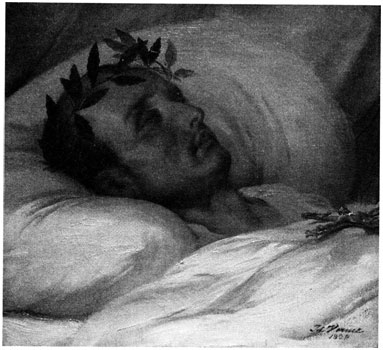
(Napoleon on his death bed, by Horace Vernet)
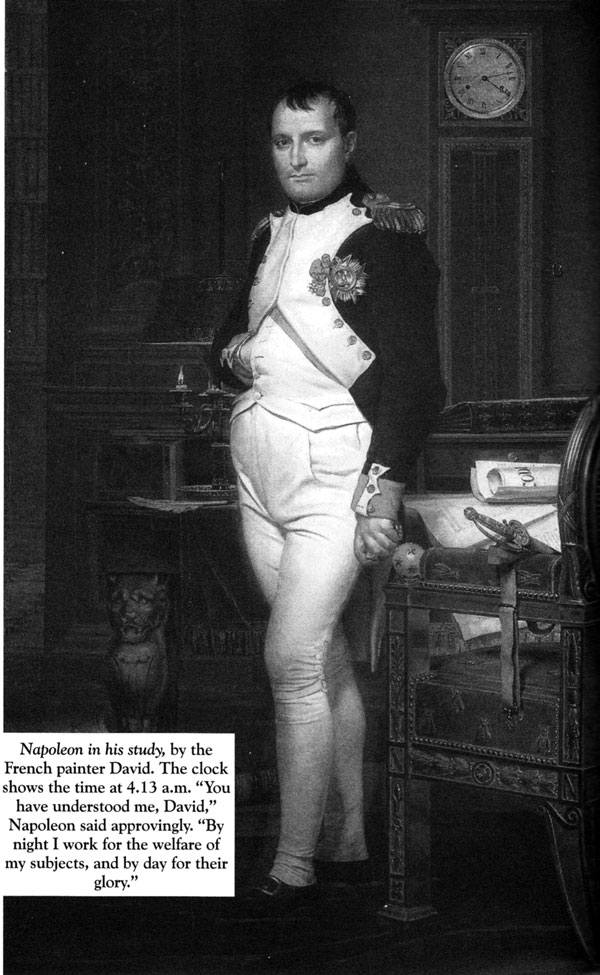
(Napoleon in his study, by the French painter David. The clock shows the time at 4.13 a.m. “You have understood me, David,” Napoleon said approvingly. “By night I work for the welfare of my subjects, and by day for their glory.”)
Napoleon in Council
This brief extract from a book written by John S.C. Abbott is particularly illustrative of the amazing pace and scope of Napoleon’s governance. The sheer magnitude of his intellectual labor encompassing so many subjects through the vast correspondence he left behind him is confounding. Such energy of the mind is a phenomenon as rare as it is nearly frightening.
The amount of intellectual labor which Napoleon performed seems actually superhuman. No other man has ever approached him in this respect. His correspondence, preserved in the archives of Paris, would amount to many hundred volumes. His genius illumines every subject upon which he treats. The whole expanse of human knowledge seemed familiar to him. He treats of war, government, legislation, education, finance, political economy, theology, philosophy, engineering — upon every subject which can interest the human mind, and he is alike great in all. Notwithstanding the constant and terrible wars through which his banded foes compelled him to struggle, and all the cares of an empire, which at times seemed to embrace the whole of Europe, during the twenty years of his reign he wrote or dictated more than the united works of Lope da Vega, Voltaire, and Sir Walter Scott, three of the most voluminous writers of Spain, France, and
England. His confidential correspondence with the Directory, during the two years from 1796 to 1798, which was published in Paris in 1819, amounts to seven large closely-printed volumes. The following letter will be read with interest, as a specimen of his correspondence with his ministers. It strikingly shows his lofty spirit, his noble ambition, his expanded views, his practical wisdom, and the blended familiarity and elevation of tone with which he addressed his ministers.
“Fontainebleau, Nov. 14, 1807. Monsieur Cretet, Minister of the Interior,—You have received the Imperial decree by which I have authorized [a loan of] 1,600,000 dollars to the city of Paris. I suppose that you are employed in taking measures which may bring these works to a speedy conclusion, and may augment the revenues of the city. In these works there are some which will not be very productive, but are merely for ornament. There are others, such as galleries over the markets, the slaughter-houses, etc., which will be very productive. But to make them so will require activity. The shops, for which I have granted you funds, are not yet commenced. I suppose you have taken up the funds destined for the fountains, and that you have employed them provisionally for the machine at Marly. Carry on the whole with spirit. This system of advancing money to the city of Paris, to augment its branches of revenue, is also intended to contribute to its embellishment. My intention is to extend it to other departments.
“I have many canals to make; that from Dijon to Paris; that from the Rhine to the Saone; and that from the Rhine to the Scheldt. These three canals can be carried on as vigorously as could be wished. My intention is, independently of the funds which are granted from the revenues of the state, to seek extraordinary funds for the three canals. For this purpose I should like to sell the canals of St. Quentin, the produce of which might be employed to expedite the works of the canal of Burgundy. In fact, I would sell even the canal of Languedoc, and apply the proceeds to the construction of the canal from the Rhine to the Saone. I suppose that the canal of St. Quentin might be sold for 1,600,000 dollars; that of Loing for as much; and the canal of Languedoc for more. There would then be 6,000,000 dollars procured immediately, which I should employ in carrying on the three great canals with all possible rapidity. I have the money. The state will lose nothing; on the contrary, it will gain; since if it loses the revenues of the canals of Loing, St. Quentin, and that of the South, it will gain the product of the canals of the Scheldt, Napoleon, and Burgundy. When these works are completed, if circumstances permit, I shall sell these, in order to make others. Thus, my object is to pursue a directly opposite course to that of England. In England, a charter would have been granted for constructing the canal of Quentin, and the work would have been left to capitalists. I have, on the contrary, begun by constructing the canal of St. Quentin. It has cost, I believe, 1,600,000 dollars; it will produce 100,000 dollars annually. I shall then lose nothing by selling it to a company for what it has cost me; since, with this money, I shall construct other canals. Make me, I beg of you, a report upon this subject, otherwise we shall die without seeing these canals navigated. In fact, it is six years since the canal of St. Quentin was begun, and it is not yet finished. Now, these canals are of much more importance. The expense of that of Burgundy is estimated at six millions. What can be expended from the general funds of the state does not exceed two hundred and fifty thousand yearly. The departments do not furnish more than 100,000 dollars. It would, then, require twenty years to finish this canal. What may not happen in this time? Wars and inefficient men will come, and the canals will remain unfinished. The canal from the Rhine to the Scheldt will also cost a large sum. The general funds of the state are not sufficient to carry them on as quickly as we could wish. The canal of Napoleon is in the same situation. Let me know how much it will be possible to expend yearly on each of these three canals. I suppose that, without injuring other works, we might allow to each, yearly, three or four millions; and that thus in five or six years we might see them all navigated. You will inform me how much the existing imposts will furnish for these three canals; how much I have granted for 1808; and the supplementary funds which I granted in 1806, for carrying on these works with the greatest activity. You will propose to me to sell the three canals already finished, and at what price it would be best to sell them. I take upon myself the charge of finding purchasers: then we shall have money in abundance. You must tell me, in your report, how much the three, which I wish speedily to finish, are estimated to cost, and compare it with the sums which the three old canals have cost that I wish to sell.
“You understand what I wish. My intention is to go beyond your report. Perhaps it will lead to opening a fund for public works, into which the proceeds of the navigation of the canals would be immediately thrown. We might thus grant to this the proceeds of the sale of the three canals, and of others besides, if there are any which can be sold. With this institution, we should change the face of the country.
“I have made the glory of my reign to consist in changing the surface of the territory of my Empire. The execution of these great works is as necessary to the interest of my people as to my own satisfaction. I attach equal importance and great glory to the suppression of mendicity. Funds are not wanting. But it seems to me that the work proceeds slowly, and meantime, years are passing away. We must not pass through this world without leaving traces which may commend our memory to posterity.
“I am going to be absent for a month. Be ready on the 15th December, to answer all these questions, which you will have examined in detail, that I may be able, by a general decree, to put the finishing blow to mendicity. You must find, before the 15th December, in the reserved funds, and the funds of the communes, the necessary means for the support of sixty or one hundred houses for the extirpation of beggary. The places where they shall he erected must be designated, and the regulations completed. Do not ask me for three or four months to obtain further instructions. You have young auditors, intelligent prefects, skillful engineers. Bring all into action, and do not sleep in the ordinary labors of the bureau. It is necessary, likewise, that, at the same time, all that relates to the administration of the public works, should be completed; so that, at the commencement of the fine season, France may present the spectacle of a country without a single beggar, and where all the population may be in action to embellish and render productive our immense territory.
“ You must also prepare for me all that is necessary respecting the measures to be taken for obtaining, from the draining of the marshes of Cotentin and Rochefort, money for supporting the fund for public works, and for finishing the drainings, or preparing others.
“The winter evenings are long; fill your portfolios, that we may be able, during the evenings of these three months, to discuss the means for attaining great results.” Napoleon
At a meeting of the Privy Council Napoleon appeared much incensed against one of his generals. He attacked him with great severity asserting that his principles and opinions tended to the entire subversion of the state. A member of the Council, who was a particular friend of the absent general, undertook his defense, stating that he lived quietly on his estate, without obtruding his opinions upon others, and that consequently they were productive of no ill effects. The Emperor vehemently commenced a reply, when suddenly he stopped short, and turning to the defender of the absent said, “But he is your friend, sir. You do right to defend him. I had forgotten it. Let us speak of something else.”
M. Daru was at one time Secretary of State. He was distinguished for his indefatigable application to business. Napoleon said of him that “he labored like an ox, while he displayed the courage of a lion.” On one occasion only were his energies ever known to fail. The Emperor called him at midnight to write from his dictation. M. Daru was so completely overcome by fatigue, that he could scarcely hold his pen. At last nature triumphed, and he fell asleep over his paper. After enjoying a sound nap, he awoke, and to his amazement perceived the Emperor, by his side, quietly engaged in writing. He saw, by the shortness of the candles, that he had slept for some time. As he sat for a moment overwhelmed with confusion, his eyes met those of the Emperor.
“Well, sir;” said Napoleon with rather an ironical smile, “you see that I have been doing your work, since you would not do it yourself. I suppose that you have eaten a hearty supper, and passed a pleasant evening. But business must not be neglected.”
“I pass a pleasant evening, Sire!” exclaimed M. Daru, “I have been for several nights closely engaged in work, without any sleep. Of this your Majesty now sees the consequence. I am exceedingly sorry for it.”
“Why did you not inform me of this?” said Napoleon, “I do not wish to kill you. Go to bed. Good-night M. Daru.” [...]
Napoleon introduced this year into the financial department, the most rigid system of accounts by double entry. The decree requiring this is in force to the present day. It has rendered the French system of accounts the most sure, the most accurate, and the most clear of any in Europe.
In one of the meetings of the Council, Napoleon proposed that long galleries, or rather streets, covered with glass, for pedestrians only, should be constructed, to shelter buyers and sellers from the vicissitudes of the weather. This was the origin of those brilliant Passages, where every visitor to Paris loiters away so many pleasant hours. Forty slaughter houses had deformed Paris, filling the air with pestilent odors and paining the eye with the revolting necessities of the shambles. At the suggestion of Napoleon they were all removed. Four large and peculiarly appropriate houses were constructed for these purposes outside of the city, and near the four principal entrances to the metropolis.
The generals and the soldiers who had endured such wasting fatigue, and who had achieved such Herculean enterprises for France, were most magnificently rewarded. Besides their regular pay, nearly four millions of dollars were expended in gifts, as an expression of gratitude. A handsome annuity was settled upon every wounded soldier. Napoleon seemed never weary in lavishing favors upon those, who, in fields of blood, had defended and established the independence of France.
He was magnificent in his provision for others. He was simple, frugal, economical in the highest degree, in everything which related to himself. With an eagle eye he guarded against the slightest misapplication of the public funds.
The adopted mother of Josephine having died at Martinique, he directed that the negroes and negresses who had served her, should be made free and placed in a condition of comfort for the rest of their lives. He ordered the number of Christian chapels to be increased to 30,000, that the benefits of divine service might be extended to every village in the empire. He endowed several theological seminaries to encourage suitable persons to enter the priesthood.
The nation insisted that the civic code, which had become the crowning glory of France, should be called the Code Napoleon.
“Assuredly,” says Thiers, “if ever title was merited, it was this. For that code was as much the work of Napoleon as were the victories of Austerlitz and of Jena. He had soldiers who lent him their arms. He had lawyers who lent him their knowledge. But to the force of his will, to the soundness of his judgment, was owing the completion of that great work.”
It will remain, through all time, a memorial which never can be sullied, of Napoleon’s genius and philanthropy. The Emperor wrote to all the princes under his influence urging them to introduce into their respective states this code of justice and of civil equality. It was thus established in large portions of Europe, conveying, wherever it went, perfect equality of rights, and putting an end to feudal tyranny.
In his intense desire to promote the grandeur of France, Napoleon appreciated, perhaps more highly than any other sovereign, the glory of intellectual achievements. Science, literature, arts, he encouraged in every possible way. He was the first general the world has ever known, who united with his army, a literary and scientific corps to extend the bounds of human knowledge. Under his fostering care Lagrange gave a new power to abstract calculation. Laplace, striding beyond the limits attained by Galileo, Kepler, and Newton, rendered his name as immortal as those celestial bodies whose movements he had calculated with such sublime precision. Cuvier exploring the mausoleums of past creations, revealed the wondrous history of our planet, when “the earth was without form and void, and darkness was upon the face of the deep.”
The world is destined to be as much astonished by the writings of Napoleon as it has been by his deeds. Neither Bourbon nor Orleanist has been willing to do justice to his fame. His letters, his proclamations, his bulletins, his instructions to his ministers, glow with the noblest eloquence of genius. They will soon be given to the world. And they will disperse much of that mist of calumny and detraction which have so long sullied his renown. No one can peruse the papers of this extraordinary man without admiring the majesty of his all comprehensive mind. The clearness, the precision, the fervor, the imperious demonstration, and the noble simplicity which are impressed upon all of his utterances, give him a place in the foremost ranks of science, of literature, and of eloquence.
“Singular destiny,” exclaims Thiers, after perusing volumes of manuscripts from his pen, “of that prodigious man, to be the greatest writer of his time, while he was its greatest captain, its greatest legislator, its greatest administrator.” [...]
The power of Napoleon was absolute. Circumstances, which he could not control, rendered it necessary that it should he so. It was essential that he should he invested with dictatorial authority to repel the foes handed against the independence of France. Every intelligent man in France recognized this necessity. That Napoleon devoted this absolute power to the glory of France, and not to his own selfish indulgence, no one can deny. He says, with his accustomed glow of eloquence:
“I had established a government the most compact, carrying on its operations with the utmost rapidity, and capable of the most nervous efforts. And, truly, nothing less was required to triumph over the immense difficulties with which we were surrounded, and to produce the marvels which we accomplished. The organization of the prefectures, their action and results, were alike admirable. The same impulse was given at the same instant to more than forty millions of men. By the aid of these centres of local activity the movement was as rapid at all the extremities as at the heart of the Empire. Strangers who visited us were astonished at this system.
They never failed to attribute the immense results which were attained, to that uniformity of action pervading so great a space. Each prefect, with the authority and local patronage with which he was invested, was in himself a little emperor. Nevertheless, as he enjoyed no force but from the central authority, owed all his lustre to official employment, and had no natural or hereditary connection with the territory over which his dominion extended, the system had all the advantages of the feudal government without any of its inconveniences. It was indispensable to clothe them with all that authority. I found myself made dictator by the force of circumstances. It was necessary, therefore, that all the minor springs should be entirely dependent on, and in complete harmony with the grand central moving power.”
The efficiency of this government no one can question. That France was driven to its adoption by the incessant attacks of its foes cannot be denied. That this alone enabled Napoleon for twenty years to triumph over the combined despots of Europe, in arms against him, is equally beyond a doubt. France in her peril surrendered herself to a dictator in whom she reposed confidence, and invested him with absolute power. Nobly did Napoleon requite the trust. He concentrated every energy of his body and every thought of his soul to the promotion of the welfare of France. Wherever he erred, it was in the path of a lofty and a generous ambition.
His power was as absolute as that of Alexander. But the Czar was the monarch of the nobles; Napoleon the chosen sovereign of the people. The centralization of power was, however, appalling. The Emperor selected the members of the Council of State, the Senate, and the Legislative Bodies. He appointed all the officers in the army and the navy. The whole police of France, all the magistrates, the judges of all the courts; all persons connected with the customs, the revenue and the excise; all the ministers of religion, the teachers in schools, academies and universities, the postmasters, and all persons concerned in the administration of roads, bridges, public buildings, canals, fortresses etc., were either directly or indirectly subject to the appointment of the Emperor.
One day Napoleon at St. Helena, was reading the infamous memoir of his life by Goldsmith. He found himself there accused of every crime which a demon could perpetrate. Calmly laying down the book he said:
“After all, let them abridge, suppress, and mutilate as much as they please, they will find it very difficult to throw me entirely into the shade. The historian of France cannot pass over the Empire. If he has any honesty he will not fail to render me my share of justice. His task will be easy. The facts speak of themselves. They shine like the sun.
“I closed the gulf of anarchy and cleared the chaos. I purified the Revolution, dignified nations, and established kings. I excited every kind of emulation, rewarded every kind of merit, and extended the limits of glory. This is at least something. And on what point can I be assailed on which an historian could not defend me? Can it be for my intentions? But even here I can find absolution. Can it be for my despotism? It may be demonstrated that the dictatorship was absolutely necessary. Will it be said that I restrained liberty? It can be proved that licentiousness, anarchy, and the greatest irregularities, still haunted the threshold of freedom. Shall I be accused of having been too fond of war? It can be shown that I always received the first attack. Will it be said that I aimed at universal monarchy? It can be proved that this was merely the result of fortuitous circumstances, and that our enemies led me step by step to this determination. Lastly shall I be blamed for my ambition? This passion I must doubtless be allowed to possess, and that in no small degree. But at the same time my ambition was of the highest and noblest kind that perhaps ever existed — that of establishing and consecrating the empire of reason, and the full exercise and complete enjoyment of all the human faculties. And here the historian will probably feel compelled to regret, that such ambition should not have been fulfilled and gratified. This is my whole history in a few words.” [...]
The 15th of August 1807, Napoleon was thirty-eight years of age. A brilliant party was assembled at the Tuileries. It was an evening of surpassing loveliness. All Paris, intoxicated with enthusiasm, thronged the spacious garden of the palace. With loud acclamations they called for their sovereign. He repeatedly appeared in the balcony, holding the Empress by the hand, and surrounded by a brilliant group. Spontaneous bursts of applause, from one hundred thousand voices, greeted him whenever he appeared. Taking the arm of his faithful friend Duroc, Napoleon, in disguise, left the palace and mingled with the groups crowding the garden. Everywhere he heard his name pronounced with gratitude and love. A little boy was shouting with transport, Vive l’Empereur. Napoleon caught the child in his arms. “Why do you shout in that manner?” said he. “My father and mother,” replied the child, “taught me to love and bless the Emperor.” Napoleon conversed with the parents. He found that they had fled from the horrors of civil war in Brittany and had found employment and competence in Paris. With glowing hearts they testified to the blessings which Napoleon had conferred upon France. The next day a present from the Emperor informed them to whom they had unbosomed their gratitude.
On the ensuing day Napoleon, accompanied by his marshals, and followed by an immense concourse of people, met the Council of State, the Senate and the Legislative Body. He thus addressed them:
“Gentlemen! Since your last session, new wars, new triumphs, new treaties of peace have changed the political state of Europe. All nations rejoice with one accord, to see the influence which England exercised over the Continent destroyed forever. In all that I have done, I have had in view solely the prosperity of my people, more dear in my eyes than my own glory. I am desirous for maritime peace. No resentment shall be allowed to interfere with this desire. But whatever be the issue which the decrees of Providence have allotted to the maritime war, my people shall find me ever the same, and I shall ever find my people worthy of me. Your conduct, when your Emperor was more than fifteen hundred miles away, has heightened my esteem. The proofs of attachment which you have given me, have excited my warmest emotions.
“I have contemplated various plans for simplifying and improving our institutions. I have created several imperial titles to give new lustre to distinguished subjects, to honor eminent services by eminent rewards, and to prevent the revival of any feudal title incompatible with our Constitution. My Minister of the Interior will inform you of the public works, which have been commenced or finished. But what remains to be done is of far greater importance. I intend that in all parts of my Empire, even in the smallest hamlet, the prosperity of the citizen and the value of land shall be augmented by the effect of the general system of improvement which I have conceived. Gentlemen! Your assistance will be necessary for me to arrive at this great result. I have a right to rely firmly upon it.”
This speech was heard with deep emotion and applauded with transport. After Napoleon had retired, the President of the Legislative Body gave utterance to the almost unanimous sentiment of France, in the following words:
“The picture set before our eyes seems to present the image of one of those pacific kings, exclusively engaged, in the internal administration of his dominion. And yet all these useful labors, all these wise projects, were ordered and conceived amid the din of arms on the furthest confines of conquered Prussia, and on the frontiers of threatened Russia. If it be true that, at the distance of five hundred leagues from the capital, amid the cares and the fatigues of war, a hero prepared so many benefits, how is he about to increase them by returning among us! The public welfare will wholly engage him, and his glory will be the more touching for it.
“He displaces, he contracts, he extends, the boundaries of empires. All are borne away by his ascendency. Well! This man, covered with so much glory, promises us still greater. Peaceable and disarmed, he will prove that this invincible force, which, as it runs, overturns thrones and empires, is beneath that truly royal wisdom, which preserves states by peace, which enriches them by agriculture and industry, adorns them with master-pieces of art, and founds them everlastingly on the two-fold support of morality and the laws.” [...]
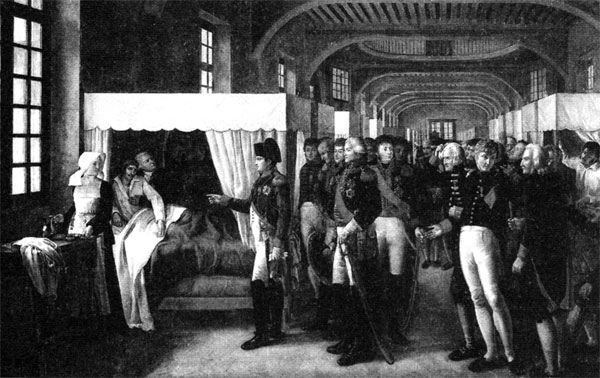
(Napoleon, accompanied by generals and doctors, visits the great military hospital “Les Invalides” in Paris)
At St Helena he said:
“It was the subject of my perpetual dreams, to render Paris the real capital of Europe. I sometimes wished it, for instance, to become a city with a population of two, three, or four millions, in a word, something fabulous, colossal, unexampled until our days, and with public establishments suitable to its population.
“Had Heaven but granted me twenty years, and a little more leisure, ancient Paris would have been sought for in vain. Not a trace of it would have been left. I should have changed the face of France. Archimedes promised everything, provided he was supplied with a resting place for his lever. I should have done as much, wherever I could have found a point of support for my energy, my perseverance, and my budgets. A world might be created with budgets. I should have displayed the difference between a Constitutional Emperor, and a King of France. The kings of France have never possessed any administrative or municipal institution. They have merely shown themselves great lords, who ruined their men of business.
“The nation itself has nothing in its character, but what is transitory and perishable. Everything is done for the gratification of the moment and of caprice; nothing for duration. That is our motto. And it is exemplified by our manners in France. Every one passes his life in doing and undoing. Nothing is ever left behind. Is it not unbecoming, that Paris should not possess even a French theatre, or an opera house, in any respect worthy of its high claims?
“I have often set myself against the feasts which the city of Paris wished to give me. They consisted of dinners, balls, artificial fire-works, at an expense of two or three hundred thousand dollars, the preparations for which obstructed the public for several days, and which afterward cost as much to take away as they had cost in their construction. I proved that with these idle expenses, they might have erected lasting and magnificent monuments.
“One must have gone through as much as I have, in order to be acquainted with all the difficulties of doing good. If the business related to chimneys, partitions, and furniture for some individuals in the imperial palaces, the work was quick and effectual. But if it were necessary to lengthen the garden of the Tuileries, to render some quarters wholesome, to clean some sewers, and to accomplish a task beneficial to the public, in which some particular person had no direct interest, I found it requisite to exert all the energy of my character, to write six, ten letters a day, and to get into a downright passion. It was in this way that I paid out as much as six millions of dollars in sewers, for which nobody was ever to thank me. I pulled down a property of six millions in houses in front of the Tuileries, for the purpose of forming the Carousel, and throwing open the Louvre. What I did is immense. What I had resolved to do, and what I projected, were still much more so.”
Some may suppose that the above account of Napoleon’s administrative labors, is the glowing eulogy of a friend. Read then the testimony of an English historian. Every page of Lockhart’s Life of Napoleon, bears the impress of his hostility to the mighty Emperor against whom England waged such unrelenting warfare. And yet Lockhart is constrained to witness to the following facts:
“Wherever the Emperor was, in the midst of his hottest campaigns, he examined the details of administration at home more closely perhaps than other sovereigns of not half so great an empire did during years of profoundest peace. His dearest amusement, when he had nothing else to do, was to solve problems in geometry or algebra. He carried this passion into every department of affairs. Having with his own eye detected some errors of importance in the public accounts shortly after his administration begun, there prevailed henceforth, in all the financial records of the state, such clearness and accuracy as are not often exemplified in those of a large private fortune. Nothing was below his attention, and he found time for everything. The humblest functionary discharged his duty under a lively sense of the Emperor’s personal superintendence. The omnipresence of his police, came in lieu, wherever politics were not touched upon, of the guarding powers of a free press, free senate, and public opinion. Except in political cases, the trial by jury was the right of every citizen. The Code Napoleon, that elaborate system of jurisprudence, in the formation of which the Emperor labored personally, along with the most eminent lawyers and enlightened men of the time, was a boon of inestimable value to France. ‘I shall go down to posterity,’ said he, with just pride, ‘with the code in my hand.’ It was the first uniform system of laws which the French monarchy had ever possessed; being drawn up by consummate skill and wisdom. It at this day forms the code not only of France, but of a great portion of Europe besides. Justice, as between man and man, was administered on sound and fixed principles and by unimpeached tribunals. … In the splendor of his victories, in the magnificence of his roads, bridges, aqueducts, and other monuments, in the general predominance to which the nation seemed to be raised through the genius of its chief, compensation was found for all financial burdens, consolation for all domestic calamities, and an equivalent for that liberty, in whose name the tyrant had achieved his first glories. But it must not be omitted that Napoleon, in every department of his government, made it his first rule to employ the men best fitted, in his mind, to do honor to his service by their talents and diligence….. He gratified the French nation by adorning the capital, and by displaying in the Tuileries a court as elaborately magnificent as that of Louis XIV himself. The old nobility returning from their exile, mingled in those proud halls with the heroes of the revolutionary campaigns, and over all the ceremonies of these stately festivities Josephine presided with the grace and elegance of one born to be a queen. In the midst of the pomp and splendor of a court, in the ante-chambers where kings jostled each other, Napoleon himself preserved the plain and unadorned simplicity of his original dress and manners. The great Emperor continued throughout to labor more diligently than any subaltern in office; Napoleon, as Emperor, had little time for social pleasures. His personal friends were few. His days were given to labor, and his nights to study. If he was not with his army in the field, he traversed the provinces, examining with his own eyes the minutest details of arrangement, and even from the centre of his camp, he was continually issuing edicts which showed the accuracy of his observation during those journeys, and his anxiety to promote, by any means consistent with his great purpose, the welfare of every French district, town, or even village.”
Such was Napoleon, as delineated by the pen of his enemies...
Taken from The History of Napoleon Bonaparte by John S C Abbott, Harper and Brothers, Publishers, New York 1874, Volume II, pp. 579-98
The French Revolution
I. Sri Aurobindo
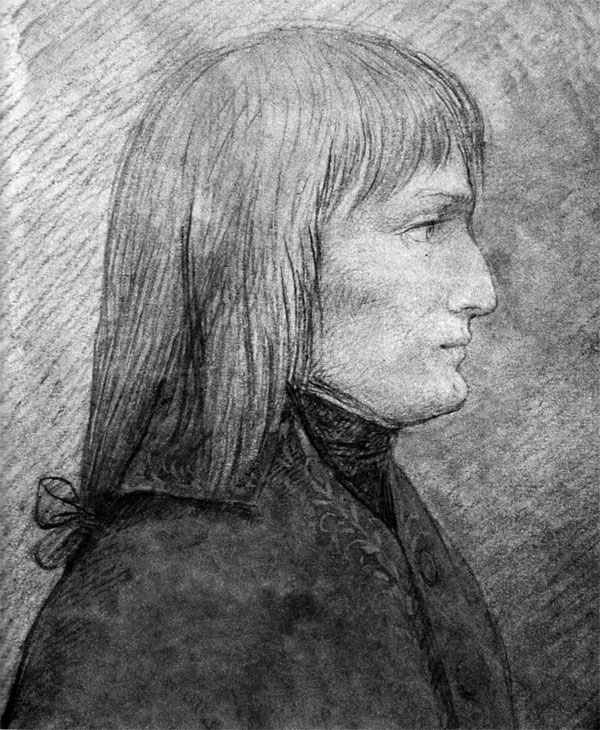
(Portrait of General Bonaparte during the campaign of Italy, by Giuseppe Longhi)
In this text, Sri Aurobindo, the great Indian sage and yogi, gives a deep commentary on the French Revolution and its prodigious inheritor, Napoleon.
The greatness of the French Revolution lies not in what it effected, but in what it thought and was. Its action was chiefly destructive. It prepared many things, it founded nothing. Even the constructive activity of Napoleon only built a halfway house in which the ideas of 1789 might rest until the world was fit to understand them better and really fulfil them. The ideas themselves were not new; they existed in Christianity and before Christianity they existed in Buddhism; but in 1789 they came out for the first time from the Church and the Book and sought to remodel government and society. It was an unsuccessful attempt, but even the failure changed the face of Europe. And this effect was chiefly due to the force, the enthusiasm, the sincerity with which the idea was seized upon and the thoroughness with which it was sought to be applied. The cause of the failure was the defect of knowledge, the excess of imagination. The basal ideas, the types, the things to be established were known; but there had been no experience of the ideas in practice. European society, till then, had been permeated, not with liberty, but with bondage and repression; not with equality, but with inequality and injustice; not with brotherhood, but with selfish force and violence. The world was not ready, nor is it even now ready for the fullness of the practice. It is the goal of humanity, and we are yet far off from the goal. But the time has come for an approximation being attempted. And the first necessity is the discipline of brotherhood, the organisation of brotherhood,— for without the spirit and habit of fraternity neither liberty nor equality can be maintained for more than a short season. The French were ignorant of this practical principle; they made liberty the basis, brotherhood the superstructure, founding the triangle upon its apex. For owing to the dominance of Greece and Rome in their imagination they were saturated with the idea of liberty and only formally admitted the Christian and Asiatic principle of brotherhood. They built according to their knowledge, but the triangle has to be reversed before it can stand permanently.
The action of the French Revolution was the vehement death-dance of Kali trampling blindly, furiously on the ruins She made, mad with pity for the world and therefore utterly pitiless. She called the Yatudhani in her to her aid and summoned up the Rakshasi. The Yatudhani is the delight of destruction, the fury of slaughter, Rudra in the Universal Being, Rudra, the bhuta, the criminal, the lord of the animal in man, the lord of the demoniac, Pashupati, Pramathanatha. The Rakshasi is the unbridled, licentious self-assertion of the ego which insists on the gratification of all its instincts good and bad and furiously shatters all opposition. It was the Yatudhani and the Rakshasi who sent their hoarse cry over France, adding to the luminous mantra, Liberty, Equality, Fraternity, the stern and terrible addition “or Death.” Death to the Asura, death to all who oppose God’s evolution, that was the meaning. With these two terrible Shaktis Kali did Her work. She veiled Her divine knowledge with the darkness of wrath and passion, She drank blood as wine, naked of tradition and convention She danced over all Europe and the whole continent was filled with the war cry and the carnage and rang with the hunkara and the attahasyam. It was only when She found that She was trampling on Mahadeva, God expressed in the principle of Nationalism, that She remembered Herself, flung aside Napoleon, the mighty Rakshasa, and settled down quietly to her work of perfecting nationality as the outer shell within which brotherhood may be securely and largely organised.
The Revolution was also great in its men filling them all with its vehemence, its passion, its fierce demand on the world, its colossal impetus. Through four of them chiefly it helped itself, through Mirabeau, Danton, Robespierre and Napoleon. Mirabeau initiated, Danton inspired, Robespierre slew, Napoleon fulfilled. The first three appeared for the moment, the man in the multitude, did their work and departed. The pace was swift and, if they had remained, they would have outstayed their utility and injured the future. It is always well for the man to go the moment his work is done and not to outstay the Mother’s welcome. They are fortunate who get that release or are wise enough, like Garibaldi, to take it. Not altogether happy is their lot who, like Napoleon or Mazzini, outstay the lease of their appointed greatness.
Mirabeau ruled the morning twilight, the sandhya of the new age. Aristocratic tribune of the people, unprincipled champion of principles, lordly democrat, — a man in whom reflection was turbulent, prudence itself bold, unflinching and reckless, the man was the meeting-place of two ages. He had the passions of the past, not its courtly restraint; the turbulence, genius, impetuosity of the future, not its steadying attachment to ideas. There is an honour of the aristocrat which has its root in manners and respects the sanctity of its own traditions; that is the honour of the Conservative. There is an honour of the democrat which has its root in ideas and respects the sanctity of its own principles; that is the honour of the Liberal. Mirabeau had neither. He was the pure egoist, the eternal Rakshasa. Not for the sake of justice and liberty did he love justice and liberty but for the sake of Mirabeau. Had his career been fortunate, the forms of the old regime wide enough to satisfy his ambitions and passions, the upheaval of 1789 might have found him on the other side. But because the heart and senses of Mirabeau were unsatisfied, the French Revolution triumphed. So it is that God prepares the man and the moment, using good and evil with a divine impartiality for His mighty ends. Without the man the moment is a lost opportunity; without the moment the man is a force inoperative. The meeting of the two changes the destinies of nations and the poise of the world is altered by what seems to the superficial an accident.
There are times when a single personality gathers up the temperament of an epoch or a movement and by simply existing ensures its fulfilment. It would be difficult to lay down the precise services which made the existence of Danton necessary for the success of the Revolution. There are certain things he did, and no man else could have done, which compelled destiny; there are certain things he said which made France mad with resolution and courage. These words, these doings ring through the ages. So live, so immortal are they that they seem to defy cataclysm itself and insist on surviving eternal oblivion. They are full of the omnipotence and immortality of the human soul and its lordship over fate. One feels that they will recur again in aeons unborn and worlds uncreated. The power from which they sprang, expressed itself rarely in deeds and only at supreme moments. The energy of Danton lay dormant, indolent, scattering itself in stupendous oratory, satisfied with feelings and phrases. But each time it stirred, it convulsed events and sent a shock of primal elemental force rushing through the consciousness of the French nation. While he lived, moved, spoke, felt, acted, the energy he did not himself use, communicated itself to the millions; the thoughts he did not utter, seized on minds which took them for their own; the actions he might have done better himself, were done worse by others. Danton was contented. Magnificent and ostentatious, he was singularly void of personal ambition. He was satisfied to see the Revolution triumph by his strength, but in the deeds of others. His fall removed the strength of victorious Terror from the movement within France, its impulse to destroy and conquer. For a little while the impetus gathered carried it on, then it faltered and paused. Every great flood of action needs a human soul for its centre, an embodied point of the Universal Personality from which to surge out upon others. Danton was such a point, such a centre. His daily thoughts, feelings, impulses gave an equilibrium to that rushing fury, a fixity to that pregnant chaos. He was the character of the Revolution personified, — its heart, while Robespierre was only its hand. History which, being European, lays much stress on events, a little on speech, but has never realised the importance of souls, cannot appreciate men like Danton. Only the eye of the seer can pick them out from the mass and trace to their source those immense vibrations.
One may well speak of the genius of Mirabeau, the genius of Danton; it is superfluous to speak of the genius of Napoleon. But one cannot well speak of the genius of Robespierre. He was empty of genius; his intellect was acute and well-informed but uninspired; his personality fails to impress. What was it then that gave him his immense force and influence? It was the belief in the man, his faith. He believed in the Revolution, he believed in certain ideas, he believed in himself as their spokesman and executor; he came to believe in his mission to slay the enemies of the idea and make an end. And whatever he believed, he believed implicitly, unfalteringly, invincibly and pursued it with a rigid fidelity. Mirabeau, Danton, Napoleon were all capable of permanent discouragement, could recognise that they were beaten, the hour unsuitable, fate hostile. Robespierre was not. He might recoil, he might hide his head in fear, but it was only to leap again, to save himself for the next opportunity. He had a tremendous force of sraddha. It is only such men, thoroughly conscientious and well-principled, who can slay without pity, without qualms, without resting, without turning. The Yatudhani seized on him for her purpose. The conscientious lawyer who refused a judgeship rather than sacrifice his principle by condemning a criminal to death, became the most colossal political executioner of his or any age. As we have said, if Danton was the character of the French Revolution personified when it went forth to slay, Robespierre was its hand. But, naturally, he could not recognise that limitation; he aspired to think, to construct, to rule, functions for which he was unfit. When Danton demanded that the Terror should cease and Mercy take its place, Robespierre ought to have heard in his demand the voice of the Revolution calling on him to stay his sanguinary course. But he was full of his own blind faith and would not hear. Danton died because he resisted the hand of Kali, but his mighty disembodied spirit triumphed and imposed his last thought on the country. The Terror ceased; Mercy took its place. Robespierre, however, has his place of honour in history; he was the man of conscience and principle among the four, the man who never turned from the path of what he understood to be virtue.
Napoleon took up into himself the functions of the others. As Mirabeau initiated destruction, he initiated construction and organisation and in the same self-contradictory spirit; he was the Rakshasa, the most gigantic egoist in history, the despot of liberty, the imperial protector of equality, the unprincipled organiser of great principles. Like Danton, he shaped events for a time by his thoughts and character. While Danton lived, politics moved to a licentious democracy, war to a heroism of patriotic defence. From the time he passed, the spirit of Napoleon shaped events and politics moved to the rule first of the civil, then of the military dictator, war to the organisation of republican conquest. Like Robespierre he was the executive hand of destruction and unlike Robespierre the executive hand of construction. The fury of Kali became in him self-centred, capable, full of organised thought and activity, but nonetheless impetuous, colossal, violent, devastating.
2. Napoleon
The name of Napoleon has been a battle-field for the prepossessions of all sorts of critics, and, according to their predilections, idiosyncrasies and political opinions, men have loved or hated, panegyrised or decried the Corsican. To blame Napoleon is like criticising Mont Blanc or throwing mud at Kanchenjunga. This phenomenon has to be understood and known, not blamed or praised. Admire we must, but as minds, not as moralists. It has not been sufficiently perceived by his panegyrists and critics that Bonaparte was not a man at all, he was a force. Only the nature of the force has to be considered. There are some men who are self-evidently superhuman, great spirits who are only using the human body. Europe calls them supermen, we call them vibhutis. They are manifestations of Nature, of divine power presided over by a spirit commissioned for the purpose, and that spirit is an emanation from the Almighty, who accepts human strength and weakness but is not bound by them. They are above morality and ordinarily without a conscience, acting according to their own nature. For they are not men developing upwards from the animal to the divine and struggling against their lower natures, but beings already fulfilled and satisfied with themselves. Even the holiest of them have a contempt for the ordinary law and custom and break them easily and without remorse, as Christ did on more than one occasion, drinking wine, breaking the Sabbath, consorting with publicans and harlots; as Buddha did when he abandoned his self-accepted duties as a husband, a citizen and a father; as Shankara did when he broke the holy law and trampled upon custom and achar to satisfy his dead mother. In our literature they are described as Gods or Siddhas or Titans or Giants. Valmiki depicts Ravana as a ten-headed giant, but it is easy to see that this was only the vision of him in the world of imaginations, the “astral plane”, and that in terms of humanity he was a vibhuti or superman and one of the same order of beings as Napoleon.
The Rakshasa is the supreme and thoroughgoing individualist, who believes life to be meant for his own untrammelled self-fulfilment and self-assertion. A necessary element in humanity, he is particularly useful in revolutions. As a pure type in man he is ordinarily a thing of the past; he comes now mixed with other elements. But Napoleon was a Rakshasa of the pure type, colossal in his force and attainment. He came into the world with a tremendous appetite for power and possession and, like Ravana, he tried to swallow the whole earth in order to glut his supernatural hunger. Whatever came in his way he took as his own, ideas, men, women, fame, honours, armies, kingdoms; and he was not scrupulous as to his right of possession. His nature was his right; its need his justification. The attitude maybe expressed in some such words as these, “Others may not have the right to do these things, but I am Napoleon.”
The Rakshasa is not an altruist. If by satisfying himself he can satisfy others, he is pleased, but he does not make that his motive. If he has to trample on others to satisfy himself, he does so without compunction. Is he not the strong man, the efficient ruler, the mighty one? The Rakshasa has Kama, he has no Prema. Napoleon knew not what love was; he had only the kindliness that goes with possession. He loved Josephine because she satisfied his nature, France because he possessed her, his mother because she was his and congenial, his soldiers because they were necessary to his glory. But the love did not go beyond his need of them. It was self-satisfaction and had no element in it of self-surrender. The Rakshasa slays all that opposes him and he is callous about the extent of the slaughter. But he is never cruel. Napoleon had no taint of Nero in him, but he flung away without a qualm whole armies as holocausts on the altar of his glory; he shot Hofer and murdered Enghien. What then is in the Rakshasa that makes him necessary? He is individuality, he is force, he is capacity; he is the second power of God, wrath, strength, grandeur, rushing impetuosity, overbearing courage, the avalanche, the thunderbolt; he is Balaram, he is Jehovah, he is Rudra. As such we may admire and study him.
But the Vibhuti, though he takes self-gratification and enjoyment on his way, never comes for self-gratification and enjoyment. He comes for work, to help man on his way, the world in its evolution. Napoleon was one of the mightiest of Vibhuties, one of the most dominant. There are some of them who hold themselves back, suppress the force in their personality in order to put it wholly into their work. Of such were Shakespeare, Washington, Victor Emmanuel. There are others like Alexander, Caesar, Napoleon, Goethe, who are as obviously superhuman in their personality as in the work they accomplish. Napoleon was the greatest in practical capacity of all moderns. In capacity, though not in character, he resembles Bhishma of the Mahabharat. He had the same sovran, irresistible, world-possessing grasp of war, politics, government, legislation, society; the same masterly handling of masses and amazing glut for details. He had the iron brain that nothing fatigues, the faultless memory that loses nothing, the clear insight that puts everything in its place with spontaneous accuracy. It was as if a man were to carry Caucasus on his shoulders and with that burden race successfully an express engine, yet note and forecast every step and never falter. To prove that anything in a human body could be capable of such work, is by itself a service to our progress for which we cannot be sufficiently grateful to Napoleon.
The work of Bonaparte was wholly admirable. It is true that he took freedom for a season from France, but France was not then fit for democratic freedom. She had to learn discipline for a while under the rule of the soldier of Revolution. He could not have done the work he did, hampered by an effervescent Parliament ebullient in victory, discouraged in defeat. He had to organise the French Revolution so far as earth could then bear it, and he had to do it in the short span of an ordinary lifetime. He had also to save it. The aggression of France upon Europe was necessary for self-defence, for Europe did not mean to tolerate the Revolution. She had to be taught that the Revolution meant not anarchy, but a reorganisation so much mightier than the old that a single country so re-organised could conquer united Europe. That task Napoleon did effectively. It has been said that his foreign policy failed, because he left France smaller than he found it. That is true. But it was not Napoleon’s mission to aggrandise France geographically. He did not come for France, but for humanity, and even in his failure he served God and prepared the future. The balance of Europe had to be disturbed in order to prepare new combinations and his gigantic operations disturbed it fatally. He roused the spirit of Nationalism in Italy, in Germany, in Poland, while he established the tendency towards the formation of great Empires; and it is the harmonized fulfilment of Nationalism and Empire that is the future. He compelled Europe to accept the necessity of reorganisation political and social.
The punya of overthrowing Napoleon was divided between England, Germany and Russia. He had to be overthrown, because, though he prepared the future and destroyed the past, he misused the present. To save the present from his violent hands was the work of his enemies, and this merit gave to these three countries a great immediate development and the possession of the nineteenth century. England and Germany went farthest because they acted most wholeheartedly and as nations, not as Governments. In Russia it was the Government that acted, but with the help of the people. On the other hand, the countries sympathetic to Napoleon, Italy, Ireland, Poland, or those which acted weakly or falsely, such as Spain and Austria, have declined, suffered, struggled and, even when partially successful, could not attain their fulfilment. But the punya is now exhausted. The future with which the victorious nations made a temporary compromise, the future which Napoleon saved and protected, demands possession, and those who can reorganise themselves most swiftly and perfectly under its pressure, will inherit the twentieth century; those who deny it, will perish. The first offer is made to the nations in present possession; it is withheld for a time from the others. That is the reason why Socialism is most insistent now in England, Germany and Russia; but in all these countries it is faced by an obstinate and unprincipled opposition. The early decades of the twentieth century will select the chosen nations of the future.
There remains the question of Nationalism and Empire; it is put to all these nations, but chiefly to England. It is put to her in Ireland, in Egypt, in India. She has the best opportunity of harmonising the conflicting claims of Nationalism and Empire. In fighting against Nationalism she is fighting against her own chance of a future, and her temporary victory over Indian Nationalism is the one thing her guardian spirits have most to fear. For the recoil will be as tremendous as the recoil that overthrew Napoleon. The delusion that the despotic possession of India is indispensable to her retention of Empire, may be her undoing. It is indispensable to her, if she meditates, like Napoleon, the conquest of Asia and of the world; it is not necessary to her imperial self-fulfilment, for even without India she would possess an Empire greater than the Roman. Her true position in India is that of a trustee and temporary guardian; her only wise and righteous policy the devolution of her trust upon her ward with a view to alliance, not ownership. The opportunity of which Napoleon dreamed, a great Indian Empire, has been conceded to her and not to Napoleon. But that opportunity is a two-edged weapon which, if misused, is likely to turn upon and slay the wielder.
Sri Aurobindo, Early Cultural Writings: Historical Impressions: Napoleon
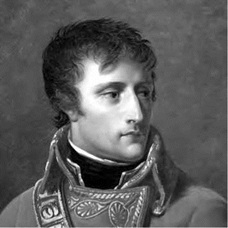
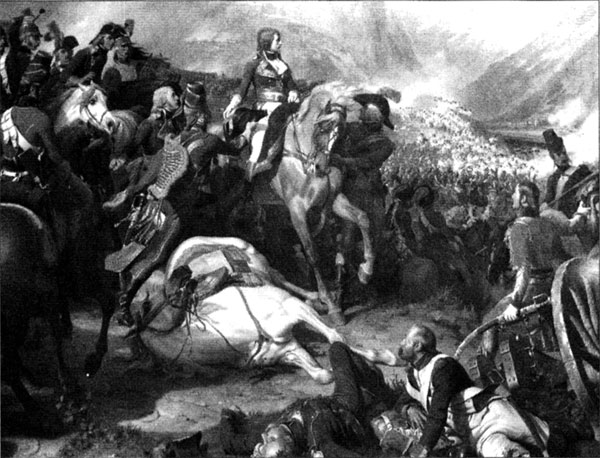
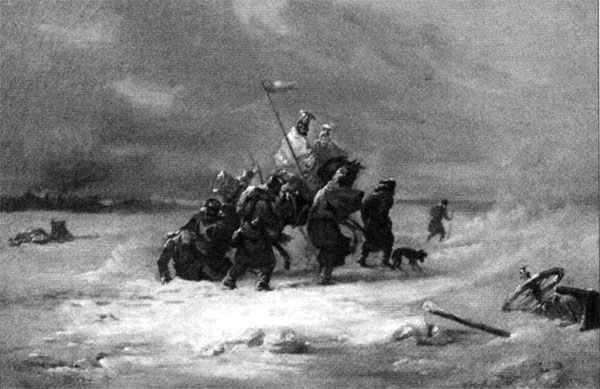
(Two contrasted episodes in Napoleon’s life. Above, the Battle of Rivoli in 1797 where Bonaparte defeated the Austrians, which led to French occupation of northern Italy. Below a scene of the retreat from Russia, in 1812.)
Appendix I
Brief history of the Napoleonic era (1799-1815)
By the end of 1799, when Napoleon became de facto the ruler of France, the country was yearning for peace and stability after the ten momentous years of the Revolution. In 1789 the King of France had to call an assembly known as the Estates General with representatives from all over the country to try to find a solution to the bankruptcy of public finances. Very soon the King lost control over the assembly which then called itself the National Assembly. Attempts to establish a constitutional monarchy failed and on August 10, 1792, the King was finally deposed, which led to the establishment of the first French Republic. Then followed a period of high intensity and public drama, including several months of “Terror” during which many people were executed. It was also a moment of great undertakings towards reorganisation and reform, particularly during the two years of existence of the assembly known as the Convention. But there were excesses, particularly during the Terror and it provoked a reaction in the summer of 1794 with the fall of Robespierre and the establishment late 1795 of a new government called the Directory. It is this government that Napoleon Bonaparte dismissed in a Coup d'etat known as the 18 Brumaire coup, towards the end of 1799. The following pages give a brief overview of Napoleon’s years in power, from 1799 till 1815.
Napoleon’s rise to power
Napoleon Bonaparte was born on the island of Corsica in 1769, shortly after the island had been annexed by France. The Bonapartes were members of the minor nobility of Corsica, and at the age of nine Napoleon was admitted to a military school in France. From that time on, he knew no other life than the army. When most of the aristocratic officer corps left France after the fall of the monarchy, Napoleon stayed on to serve the Republic. He rose to become a brigadier general in 1793 at the age of twenty-four. He helped to reconquer Toulon — one of the towns that rebelled against the Convention in 1793 — and he suppressed a royalist riot against the Convention in 1795. By 1797, when the Directory felt its power slipping, Barras, one of the Directors, realized that Napoleon’s support could be valuable. He sought Napoleon’s friendship first by introducing the young general to one of his cast-off mistresses, Josephine Beauharnais (whom Napoleon married), and then by giving him command of an army that was preparing for an invasion of Lombardy, a province in northern Italy that was then under the control of Austria.
The Italian campaign of 1797 was a success. It removed Austria from the war, it gave France control of northern Italy, and established Napoleon’s reputation as an outstanding general. After the defeat of the Austrians only England was still at war with France. In 1798 Bonaparte took an army by sea to Egypt, where he hoped to sever England’s lifeline to India. He easily defeated the Egyptians, but the English admiral Horatio Nelson sank the a French fleet near the mouth of the Nile.
Napoleon’s army, trapped in Egypt, was soon decimated by disease and dysentery. In the midst of this crisis, Napoleon heard that the Directory was in danger of falling and that some of the Directors wanted to create a military dictatorship. Leaving his army in Egypt, he made his way secretly back to France to offer his services to the conspirators.
The most important Director was the Abbe Sieyes, and it was with this former leader of the First French Revolution that Napoleon conspired. On November 9, 1799, he used military force to compel the legislators to abolish the Directory and substitute a new government in which a board of three consuls would have almost absolute power. The conspirators asked Napoleon to serve as one of the consuls. Apparently they hoped he would provide the personal popularity and military power needed to support a regime that would be dominated, behind the scenes, by the other two consuls. But when the new constitution was written — at Napoleon’s orders — the general emerged as First Consul and virtual dictator of France. When the French people were invited to endorse the constitution in a plebiscite, they voted overwhelmingly to accept it. To Frenchmen exhausted by years of revolution, terror, and economic instability, Napoleon seemed to be the guarantor both of the gains of the Revolution and of order.
Napoleon and domestic reform
Bonaparte was, above all, a military man, and his fortunes always hinged on military success or failure. Yet his domestic reforms were profound and enduring. If the French Revolution gave the country an ideology that, henceforth, would both inspire and divide Frenchmen, Napoleon gave France many of its characteristic institutions. Better than any eighteenth century monarch, Bonaparte fulfilled the philosophes’ dream of an enlightened despot.
Between 1799 and 1801 Napoleon led a series of successful campaigns against the coalition that England, Austria, and Russia had formed to defeat him. He wanted to win a favorable peace so that he could devote himself to consolidating his position in France. Hostilities ended in 1801 and did not break out again on any major scale until 1805. Napoleon used those four years to restore domestic concord and economic stability and to establish a network of administrative institutions that gave coherence and uniformity to the work of his government.
Perhaps Napoleon’s most characteristic contribution was the Code Napoleon. From the debris of the laws left by the several legal systems of the Old Regime and the succession of revolutionary governments, Napoleon’s advisers compiled a uniform legal code that is still the basis of French law. The Code maintained in theory the revolutionary concept of the equality of all men before the law, but it was in fact far less egalitarian than the laws of the revolutionary era. It emphasized, for instance, the authority of the state over the people, of business corporations over their employees, and of male heads of families over their wives and children. Property rights received particularly strong protection under the Code.
Other Napoleonic reforms followed a similar pattern. They often upheld in principle the ideals of the Enlightenment and the Revolution but served in practice to strengthen France’s new authoritarian state. Napoleon retained, for instance, the division of France into eighty-three uniformly administered departments. He used the departmental system, however, not to foster local responsibility, as had been intended, but to create a highly centralized administration controlled directly by the First Consul through field administrators called prefects. He also instituted a nationwide system of public schools that not only educated the young — an ideal of the philosophes — but imbued them with an exaggerated patriotism and devotion to their ruler.
In reforming France’s finances Napoleon followed the British and American examples by chartering a privately owned national bank to provide both a depository for government funds and a source of credit for French businessmen. With government deposits as security, the bank issued paper money as legal tender. Increased currency, a stable franc, and improved credit helped to improve France’s shaky economy. Napoleon also resolved that perennial problem of the Old Regime — taxation — by developing uniform taxes collected directly from each individual by paid officials.
Although Napoleon himself was far from religious, he understood better than his republican predecessors that domestic peace could not be achieved until the religious question had been settled. Accordingly, he concluded an agreement with Pope Pius VII, the Concordat of 1801, which regularized the situation created by the Revolution. Although the document recognized that the majority of Frenchmen were Roman Catholics, the Catholic Church was not to be the established church in France. Church properties confiscated during the Revolution were not to be restored. Moreover, the First Consul retained the right to appoint bishops. Through the Concordat of 1801, Napoleon regained the loyalty of French Catholics to the official government and at the same time won the gratitude of owners of former church properties.
Although Napoleon brought a form of enlightened despotism to France, he did so at the expense of much of the individual liberty that had been the first principle of the Enlightenment. The legislative institutions created by the Constitution of 1799 were a sham. Political opposition was punished by police action, and the press was strictly censored. Napoleon’s training was military, and too often his solution to political and even social problems was force. Nevertheless, his government in its early years was popular. He preserved the property of those who had gained from the Revolution. He satisfied the social ideal of the Revolution by maintaining equality before the law, equality in taxation, and careers open to all men of talent. In his own administration, he incorporated royalists, constitutionalists, and Jacobins. With such accomplishments to his credit, he easily won popular approval when he declared himself First Consul for life in 1802. And two years later, on December 2, 1804, the nation rejoiced when, in the presence of the pope, he crowned himself Emperor of the French.
The Napoleonic Empire
Napoleon did not create French imperialism; he inherited, indeed he had been an agent of a policy of aggressive expansion undertaken by the Convention and the Directory. A satellite republic had already been established in Holland in 1795, and during the victorious campaigns against Austria toward the end of the decade, French armies had brought revolutionary ideals and French power to Switzerland and parts of Italy. This burst of French expansion had come to an end when Napoleon signed separate peace treaties with Austria, in 1801, and England, in 1802. Large-scale hostilities were resumed only in 1805, but from that time until Napoleon’s ultimate defeat ten years later, France was almost constantly at war.
If Napoleon could have avoided war he might have established his empire as the dominant state in Europe. But his own insatiable ambition and the continuing enmity of England made war almost inevitable. England would have looked on France with suspicion in any case; the egalitarian ideas of the Revolution and the early Empire seemed dangerous to the English ruling classes. Napoleon gave the English government other reasons for opposing him by trying to extend his sphere of influence in Germany and Italy. England was determined to keep France from becoming the dominant political and economic power in Europe. French control of the Low Countries had already violated a basic rule of English foreign policy — namely, to keep these invasion bases and commercial centers out of the hands of a strong power. Finally, the British and their ablest statesman of the period, William Pitt the Younger, were convinced that Napoleon was using the peace to ready France for yet another war. Pitt soon was able to persuade other continental states that they must join England to restore the balance of power and resist the spread of French influence in central Europe.
Napoleon was just as ready for war as was England. He felt that his empire could never be secure and that his plans for Europe could never be achieved until England had been thoroughly defeated. The two states drifted into war in 1803, and other continental powers — Austria, Russia, and finally Prussia — joined England.
It was a difficult war for the two major contestants. Napoleon could not gain control of the sea, and without this control he could not subdue England. He made his greatest effort in 1805 when he concentrated his army at Boulogne and tried to pull the English fleet out of the Channel by an elaborate set of naval feints in the Atlantic. But the English were not deceived. While one fleet guarded England against invasion, another, under Nelson, caught the French and their allies off Cape Trafalgar and annihilated them (October 21, 1805). Napoleon was never again able to threaten England with invasion. The English, on the other hand, could not defeat the French on the Continent and were dependent on the armies of their allies.
By the fall of 1805 the armies of the Russian and Austrian emperors assembled in central Europe for a combined assault on Napoleon. Instead of waiting for the attack, Napoleon marched an army deep into central Europe and took the Austrian and Russian generals by surprise. He defeated the Austrian and Russian forces first at UIm, and then again in the most spectacular of all his victories, at Austerlitz, on December 2, 1805.
With Austria defeated and Russia in retreat, Napoleon followed up his victory with a complete reorganization of the German states. He helped end the Holy Roman Empire and eliminated many of the small German principalities. Out of these petty states he created a satellite system composed of fourteen larger states that were united in a Confederation of the Rhine; Napoleon served as protector of this German Confederation.
Prussia, which had not at first joined the coalition against Napoleon, entered the fray in 1806 and was soundly defeated at Jena in October of that year. King Frederick William III was forced to accept a humiliating peace and to become an ally of France. The following spring, Emperor Alexander I of Russia again sent an army against Napoleon, only to have it defeated at Friedland in June 1807. In three campaigns in three successive years, Napoleon had defeated the three strongest powers on the Continent and established his position as master of Europe. Russia was too large to occupy, but Napoleon had taught Emperor Alexander the futility of opposition. A few weeks after Friedland, Napoleon and Alexander held a dramatic meeting near Tilsit in eastern Prussia.
Alexander recognized Napoleon’s supremacy in the West, and Napoleon agreed not to intervene in Russia’s internal affairs or to prevent Alexander from extending Russian influence into the Ottoman-controlled Balkans.
Napoleonic Europe and the Continental System
Napoleon was now at the summit of his power. All Europe, save England, was to some degree under his rule (see map p. 151). France, Belgium, Germany west of the Rhine, and parts of Italy and Illyria constituted a French Empire ruled directly by Napoleon as emperor. Holland, Westphalia (a Napoleonic creation in Germany), and southern Italy were theoretically independent kingdoms, over which Napoleon placed three of his brothers as kings. Northern Italy was also a kingdom, with Napoleon himself as king. The Grand Duchy of Warsaw was carved out of Prussia’s Polish territories and given to France’s ally, the king of Saxony. In 1808, the Bourbon monarch of Spain was overthrown and replaced by Napoleon’s brother Joseph.
England alone resisted the tide of French expansion. From 1806 on, Napoleon tried to weaken England by wrecking English trade with the Continent. This so-called Continental System imposed heavy penalties on anyone trading with England and forbade the importation of English goods. Since England produced the cheapest manufactures and was a good market for food and raw materials, this ban put a heavy strain on the economies of the continental countries. England made the strain worse by blockading all countries that subscribed to the French system. The English blockade was harsh enough to drive Denmark into a close alliance with France and to help cause the War of 1812 with the United
States. But on the whole it caused less ill will than Napoleon’s decrees. It was simply impossible for the European economy to function properly without English trade.
Napoleon himself had to allow exceptions and grant special licenses, a procedure that irritated everyone who did not receive such favors. Smuggling became a highly organized and profitable business, and attempts to enforce French regulations strengthened the opposition to Napoleon everywhere. Most important of all, it led to a quarrel between Napoleon and Alexander of Russia.
Emperor Alexander had not been entirely happy with the results of his alliance with Napoleon. France had gained vast territories; Russia had acquired only Finland and Bessarabia. Napoleon’s creation of the Grand Duchy of Warsaw menaced Russia’s control of the Polish lands it had seized in the 1790s. But the great and overwhelming grievance of the Russians was the Continental System. Russia needed English markets for its grain, and Alexander would not and could not enforce the rules against trade with England. Napoleon, bent on the destruction of England, could not tolerate this breach in his system, which was already being weakened by the ill will of other rulers. He requested Alexander to stop the trade; when Alexander refused, Napoleon prepared to invade Russia.
The Weaknesses of the Napoleonic Empire
When Napoleon undertook his Russian campaign in June 1812, his hold on Europe and even on the French had begun to weaken. French expansion had at first been greeted with some enthusiasm by many of the inhabitants of the Low Countries, Germany, and Italy. Enlightenment ideas were strong in these regions, and the existing governments were unpopular. Thus, in the northern Netherlands there was opposition to the domination of the House of Orange and the urban oligarchy. In the Austrian Netherlands (Belgium), nationalist feelings had led to a revolt against Austrian rule as early as 1789. Italy was dominated by Spain and Austria; both growing nationalism and spread of the Enlightenment made the ideas of the French Revolution attractive to many Italians. In Germany the writings of the philosophes had been eagerly read, and there was general disgust with the archaic structure of the Holy Roman Empire and the stodgy governments of the petty principalities. French influence and French ideas were especially strong in the Rhineland. In short, there had been serious political unrest in much of Europe in the 1780s and 1790s, and the invading French armies had often been hailed as liberating forces. Napoleon took full advantage of this feeling. He was able to break the archaic political and social structures of many states. Within the Empire, the Code Napoleon was established, the privileges of the Church and aristocracies were abolished, and fetters on local industry and commerce were removed. Napoleon saw himself, in other words, as the “revolution on horseback” and sought to impose a new order on Europe — a new order that was enlightened, rational, and French.
This vision of Napoleon’s was, at best, only partially achieved, and even those who had most enthusiastically received the invading French armies soon perceived that imperialism was a more important component of the Napoleonic system than was liberation. The Continental System contributed to a general economic crisis in Europe that alienated the commercial and industrial interests. High taxes and conscription were imposed on the tributary states. And the French system was enforced by tight police surveillance. Napoleonic tutelage, even at its most benevolent, appeared incompatible with the libertarian and nationalistic ideals of the French Revolution.
Nationalism had helped the French in their wars in the Low Countries and Italy, but it now became a danger to them. Increasingly, Napoleon was beset by the growth of nationalistic feelings and national resistance to his rule. In Germany, Italy, and Spain, national awakening was intimately linked to the opposition to French hegemony. This opposition took many forms. In Italy and Germany cultural movements gained momentum that emphasized the common history, language, and literature shared by the fragmented parts of these countries. In Spain, resistance was expressed in a more violent manner when rebellions broke out in 1808 against the regime of Joseph Bonaparte. It was in Spain that Napoleon first confronted guerrilla warfare and first encountered serious failure. A Spanish victory at Baylen in 1808 was the initial break in the emperor’s record of invincibility. By 1813, the Spanish rebels, with the help of an English army under Wellington, had driven the French from Madrid and had organized a constitutional government that controlled more than half the country.
The appearance of a well-organized English army on the Continent was one indication that the balance of power in Europe was beginning to shift against Napoleon. There were other signs, the most important of which was the recovery of France’s nominal ally and potential enemy, Prussia. After the humiliating defeat of the Prussians at Jena, the process of reconstructing the kingdom was begun. Under Generals Gneisenau and Scharnhorst, the Prussian army was modernized and a form of universal military training for young men was introduced. To revitalize the country, another reformer, the Baron von Stein, persuaded the king to abolish serfdom and to grant a large measure of liberty to Prussian municipalities. Stein’s social legislation was limited in its effects, but the military reforms allowed Prussia to play a significant role in the final defeat of Napoleon.
At the same time that his enemies were strengthening themselves and challenging the French monopoly of force on the Continent, Napoleon began to lose his grip on the French people. French economic domination of Europe, which had been one of the goals of the Continental System, failed to materialize, and France, like the rest of the Continent, suffered from the economic crisis that marked the last years of Napoleon’s reign. Internally, the regime grew more repressive, and Napoleon became increasingly intolerant of criticism and even of his ministers’ advice. After his divorce from Josephine and his marriage to an Austrian princess, Marie Louise, Napoleon more and more took on the airs of an Old Regime monarch. In the end, those Frenchmen who had provided him with his magnificent and spirited army were exhausted by the burdens of empire.
The Invasion of Russia and the fall of Napoleon
In June 1812 Napoleon marched into Russia with six hundred thousand men, the largest army ever assembled up to that time. Only about a third were French. Most had been recruited in the German states or in other dependencies. Napoleon expected to deliver a fast and decisive blow, but the Russians, so greatly outnumbered, did not give battle. Instead they retreated, drawing Napoleon behind them. After one costly but inconclusive engagement at Borodino, Napoleon occupied Moscow in September and waited for Alexander to offer peace terms. But no message came.
After five weeks Napoleon realized that he could not keep so large a force in Russia through the winter, and on October 19 he began the long march westward. Almost immediately he encountered difficulties. Since the land through which he passed had already been burned by both armies, he lost thousands of men to disease and starvation. When the cold weather came, the weakened soldiers were no match for the elements. As the remnants of Napoleon’s army stumbled closer to the frontier, Polish and German soldiers deserted and headed homeward. When Napoleon reached the German border in December, he could not muster one hundred thousand men. If Austria or Prussia had chosen to launch an attack at this time, the war could have been ended. But the allies as yet had no clue to the vastness of the disaster.
Once in German territory, Napoleon fled in disguise to Paris and organized a new army that he marched toward the Russian border in the spring of 1813. But defeat had deflated the Napoleonic image, and Napoleon was badly beaten at Leipzig in October by the combined armies of Austria, Prussia, and Russia. Napoleon lost about two-fifths of his men and retreated back across the Rhine. Meanwhile, the British general Wellington defeated another French army in Spain and crossed the border into southern France. On March 31, 1814, the combined armies entered Paris, and one week later Napoleon abdicated. After some debate, the allies restored the Bourbons to the throne of France and then called a peace conference in Vienna to settle the fate of the rest of Europe.
Napoleon was exiled to the island of Elba, off the Italian coast. But he still had one battle to fight. In March 1815 he escaped and landed in the south of France. The army proved loyal to the deposed leader, and Napoleon was soon in control of France once again. But the allies were prepared. Napoleon was conclusively defeated at Waterloo on June 18, 1815, and three days later he abdicated for the second time. (The three months spanning Napoleon’s escape from Elba, resumption of power, and second abdication following his defeat at the battle of Waterloo are known as the Hundred Days.) The allies now exiled him to St. Helena, a small and remote island off the Atlantic coast near Africa. The era of the Revolution and Napoleon had ended.
The era had ended, but it could not be effaced. The allies could restore a Bourbon to the throne of France, but the new king, Louis XVIII, could not restore the Old Regime. He had to keep many of Napoleon’s officials. He had to preserve the Napoleonic administrative system and the Concordat with the Church. He had to accept both the revolutionary principle of equality under the law and the revolutionary land settlement. He had to grant a constitution to his people. It was a conservative constitution with a very limited electorate, but it meant that the king’s rule was not absolute. And throughout Europe the great ideas of the Revolution — liberty, equality, and nationalism — lived on, and with them the new and dangerous concept of revolution as a means of attaining social and political goals. These ideas were only partially recognized in some countries and totally suppressed in others, but they persisted everywhere — smoldering coals that were to burst into flame again and again during the nineteenth century.
The political balance of power in Europe had been permanently altered. No one could restore the petty states of Germany or the feeble republics of Italy. No one could ignore the claims of Russia to have, for the first time, a voice in the affairs of Western Europe. No one could fail to recognize the tremendous strides that England had made in industry and commerce during the wars. Conversely, for the first time in two centuries, France was no longer the richest and strongest European state. These were some of the new political facts with which the diplomats at Vienna had to deal.
From Joseph R. Strayer & Hans W. Gatzke, The Mainstream of Civilization, Harcourt Brace Jovanovich, N.Y. 1979, Ch. 23, “The French Revolution and Napoleon, pp. 536-543.
(Napoleon on the British ship HMS Northumberland taking him to St Helena)
Appendix II
The family of Napoleon
The Bonaparte family were from minor Italian nobility who held most of their property in the hill town of San Miniato near Florence, Italy. The Bonapartes came from a Tuscan stock of Lombard origin. The name derives from Italian, bona (buona) “good” and parte “solution” or “match” (a name bestowed as an expression of satisfaction at a newborn’s arrival).
A Francesco Bonaparte came to Corsica in 16th century when the island was in Genoese possession.
Napoleon I is the most prominent name associated with the Bonaparte family because he conquered much of the Western world during the early part of the 19th century. He became First Consul of France on 10 November 1799 with the help of his brother, Lucien Bonaparte, president of the Council of Five Hundred at Saint-Cloud. He was crowned Emperor of the French in 1804 and ruled from 1804-1814 and in 1815.
Following his conquest of most of Western Europe, Napoleon I made his elder brother Joseph (1768-1844) king first of Naples (1806-1808) and then of Spain (1808-1813), his third brother Louis (1778-1846) king of Holland (1806-1810) (subsequently forcing his abdication after his failure to subordinate Dutch interests to those of France) and his youngest brother Jerome (17841860) king of Westphalia, the short-lived realm created from some of the states of north-western Germany (1807-1813).
Napoleon’s son, Napoleon Frangois Charles Joseph (1811-
1832), was made king of Rome (1811-1814) and was later styled Napoleon II by loyalists of the dynasty. Charles Louis Napoleon (1808-1873), son of Louis Bonaparte, was president of France from 1848 to 1852 and emperor from 1852 to 1870, reigning as Napoleon III; his son, Eugene Bonaparte (1856-1879), styled the Prince Imperial, died fighting the Zulus in Natal, South Africa. With his death, the family lost much of its remaining political appeal, though claimants continue to assert their right to the imperial title.
Crowns held by the family
Emperors of the French —Napoleon I (1804-1814, 1815), also King of Italy (1805-1814) and Emperor of Elba (1814-1815) —Napoleon III (1852-1870)
Kings of Holland —Louis I (1806-1810) —Louis II (1810), also Grand Duke of Berg (1809-1813)
King of Naples —Joseph I (1806-1808)
King of Westphalia —Jerome I (1807-1813)
King of Spain —Joseph I (1808-1813)
Grand Duchess of Tuscany —Elisa Bonaparte (1809-1814)
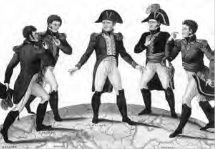
(Napoleon and his brothers)
Appendix III
La Marseillaise
“La Marseillaise”7 was written and composed by Claude Joseph Rouget de Lisle in 1792. The French National Convention adopted it as the Republic’s anthem in 1795. The name of the song is due to first being sung on the streets by volunteers from the city of Marseille.
The song is the first example of the “European march” anthemic style. The anthem’s evocative melody and lyrics have led to its widespread use as a song of revolution and its incorporation into many pieces of classical and popular music.
This song went all over Europe during the Napoleonic wars together with the tricolor flag of the Revolution. The Marseillaise remains to this day the national anthem of France. There are six couplets in the full song. We give below the first and last couplets, which are more commonly sung in various ceremonies together with the refrain.
La Marseillaise
Allons enfants de la Patrie, Arise, children of the Fatherland, Le jour de gloire est arrive! The day of glory has arrived! Contre nous de la tyrannie, Against us of tyranny L’étendard sanglant est levé, (bis) The bloody banner is raised, (repeat) Entendez-vous dans les campagnes Do you hear, in the countryside, Mugir ces feroces soldats? The roar of those ferocious soldiers? Ils viennent jusque dans nos bras They’re coming right into our arms Egorger nos fils et nos compagnes! To cut the throats of our sons and women
Aux armes, citoyens, To arms, citizens, Formez vos bataillons, Form your battalions, Marchons, marchons! Let’s march, let’s march! Qu’un sang impur Waters our furrows!
[…]
Amour sacre de la Patrie, Sacred love of the Fatherland, Conduis, soutiens nos bras vengeurs Lead, support our avenging arms Liberte, Liberte cherie, Liberty, cherished Liberty, Combats avec tes defenseurs! (bis) Fight with thy defenders! (repeat) Sous nos drapeaux que la victoire Under our flags, shall victory Accoure a tes males accents, Hurry to thy manly accents, Que tes ennemis expirants That thy expiring enemies, Voient ton triomphe et notre gloire! See thy triumph and our glory!
Aux armes, citoyens, To arms, citizens, Formez vos bataillons, Form your battalions, Marchons, marchons! Let’s march, let’s march! Qu’un sang impur That an impure blood Abreuve nos sillons! Waters our furrows!
Appendix IV
Brief Timeline of Napoleon’s Life (1769-1821)
During Napoleon’s life, what is known as the Napoleonic era began in 1799 with Napoleon Bonaparte’s Coup d’etat, which overthrew the Directory and established the French Consulate. It ended in 1815 a few days after his defeat at the Battle of Waterloo when he abdicated for the second time.
1769
August 15: Napoleon Bonaparte is born in Ajaccio, Corsica.
1785
October 28: Graduates from Ecole Militaire with the rank of second lieutenant in the artillery.
1793
December 22: For his courage and the skill he showed at an internal French battle at Toulon, Napoleon receives the rank of brigadier general (The Siege of Toulon (18 September - 18 December 1793) was an early Republican victory over a Royalist rebellion in the Southern French city of Toulon.)
1794
August 9-20: Napoleon is imprisoned for a few days under suspicion of being a Jacobin and a supporter of Robespierre —The Jacobin Club was the most famous political club of the French Revolution. At that time, the term was popularly applied to all supporters of revolutionary opinions. Maximilien Robespierre, (6 May 1758 - 28 July 1794) was a most influential figure in the French Revolution. He largely dominated the Committee of Public Safety and was instrumental in the period of the Revolution commonly known as the Reign of Terror, which ended with his arrest and execution in 1794.
1795
October: Royalist rising put down by Napoleon. — 13 Vendemiaire (5 October 1795 in the French Republican Calendar) is the name given to a battle between French Revolutionary troops and Royalist forces in the streets of Paris. The battle was largely responsible for the rapid advancement of Republican General Napoleon Bonaparte’s career. Barras, a prominent politician, helps Napoleon win promotion to Commander of the Interior.
October 15: At the home of Barras, Napoleon meets Rose de Beauharnais (Josephine).
November 2: The Directory, the new French Government, is established with five directors, including Barras.
1796
March 2: Napoleon is given command of the French army in Italy.
March 11: Italian campaign against Austria begins.
May 10: Battle of Lodi — The Battle of Lodi was fought on May 10, 1796 between French forces under General Napoleon Bonaparte and an Austrian rear guard at Lodi, Lombardy. The rear guard was defeated, but the main body of the Austrian Army had time to retreat.
November 17: Battle of Arcole — The Battle of Arcole saw a bold manoeuvre by Napoleon Bonaparte’s French Army of Italy to outflank the Austrian army and cut its line of retreat.
1797
January 14: Battle of Rivoli — The Battle of Rivoli (14-15 January 1797) was a key victory in the French campaign in Italy against Austria. Napoleon Bonaparte’s 23,000 Frenchmen defeated an attack of 28,000 Austrians, ending Austria’s fourth and final attempt to relieve the Siege of Mantua. Rivoli further demonstrated Napoleon’s brilliance and led to French occupation of northern Italy.
October 17: Treaty of Campo-Formio with Austria.
December 5: Napoleon returns to Paris as a hero.
1798
May 19: Napoleon begins his Egyptian campaign with an army of 38,000.
July 21: Wins Battle of the Pyramids against the Mamelukes in Egypt. — The Battle of the Pyramids, also known as the Battle of Embabeh, was fought on July 21, 1798 between the French army in Egypt under Napoleon, and local Mameluk forces. Napoleon named the battle after the Egyptian pyramids, although they were only faintly visible on the horizon when the battle took place.
July 24: Fall of Cairo.
August 1: Under the command of Admiral Nelson, the British fleet destroys the French navy in the Battle of the Nile. Napoleon’s army is cut off from supplies and communication.
1799
August 23: Receiving news of turmoil in France, Napoleon relinquishes command in Egypt and returns to Paris.
November 9-10: Napoleon overthrows the Directory. — The coup of 18 Brumaire was the Coup d'etat by which General Napoleon Bonaparte overthrew the French Directory, replacing it with the French Consulate.
December 12: Napoleon elected First Consul. During this period, Napoleon Bonaparte, as First Consul, established himself as the head of a more conservative, authoritarian, autocratic, and centralized republican government in France while not declaring himself head of state. Nevertheless, due to the long-lasting institutions established during these years, Robert B. Holtman has called the Consulate “one of the most important periods of all French history.”
1800
June 14: Battle of Marengo — The Battle of Marengo was fought on 14 June 1800 between French forces under Napoleon Bonaparte and Austrian forces near the city of Alessandria, in Piedmont, Italy. The French overcame the Austrian’s surprise attack near the end of the day, driving the Austrians out of Italy, and enhancing Napoleon’s political position in Paris as First Consul of France.
1801
February 9: Treaty with Austria signed at Luneville — The Treaty of Luneville was signed on 9 February 1801 between the French Republic and the Holy Roman Emperor Francis II. The Austrian army had been defeated by Napoleon at the Battle of Marengo on 14 June 1800 and then by Moreau at the Battle of Hohenlinden on 3 December. This treaty marked the end of the Second Coalition; after this treaty, Britain was the sole nation still at war with France. The Austrians re-entered the Napoleonic Wars in 1805.
July 15: Concordat of 1801 — The Concordat of 1801 was an agreement between Napoleon and Pope Pius VII, signed on 15 July 1801. It solidified the Roman Catholic Church as the majority church of France and brought back most of its civil status. While the Concordat restored some ties to the papacy, it was largely in favor of the state; the balance of church-state relations had tilted firmly in Napoleon’s favour.
December 24: Napoleon escapes an assassination attempt.
1802
March 25: Treaty of Amiens — The Treaty of Amiens temporarily ended hostilities between the French Republic and the United Kingdom during the French Revolutionary Wars. Together with the Treaty of Luneville (1801), the Treaty of Amiens marked the end of the Second Coalition, which had waged war against Revolutionary France since 1798.
May 1: Napoleon restructures the French educational system.
May 19: Legion of Honour established — The Legion of Honour is a French order established by Napoleon Bonaparte, First Consul, on 19 May 1802. The Order is still the highest decoration in France.
August 2: New constitution adopted, plebiscite confirms Napoleon as First Consul for life.
1804
March 21: Introduction of the Civil Code ( also known as Code Napoleon) — The French Napoleonic code (Code Civil) was enacted in 1804 after only a few years of preparation, but it was a child of the French Revolution, which is strongly reflected in its content. The French code has been the most influential in Europe because it was introduced in many countries under French occupation during the Napoleonic Wars.
May: Napoleon proclaimed Emperor by the Senate.
December 2: Napoleon crowns himself Emperor, in front of the Pope.
1805
October 19: Battle of Ulm — The Battle of Ulm (October 16-19, 1805) was a series of minor skirmishes, culminating in the surrender of an entire Austrian army near Ulm. The Ulm Campaign is considered one of the finest examples of a strategic turning movement in military history.
October 21: Battle of Trafalgar — The Battle of Trafalgar (21
October 1805) was a sea battle fought between the British Royal Navy and the combined fleets of the French Navy and Spanish Navy, during the War of the Third Coalition (August-December 1805). The Franco-Spanish fleet lost twenty-two ships, without a single British vessel being lost. But the British Lord Admiral Nelson was killed.
December 2: Battle of Austerlitz — The Battle of Austerlitz, also known as the Battle of the Three Emperors, was one of Napoleon’s greatest victories, where the French Empire effectively crushed the Third Coalition. On 2 December 1805 a French army, commanded by Emperor Napoleon I, decisively defeated a Russo-Austrian army, commanded by Tsar Alexander I and Francis II of the Holy Roman Empire, after nearly nine hours of difficult fighting. The battle took place near Austerlitz in Moravia, at that time in the Austrian Empire. The battle is often regarded as a tactical masterpiece.
1806
March 30: Napoleon names his brother, Joseph Bonaparte, king of Naples, and appoints other family members to various other posts. — Joseph Bonaparte (7 January 1768 - 28 July 1844) was the elder brother of Napoleon Bonaparte, who made him King of Naples and Sicily (1806-1808), and later King of Spain (1808-1813, as Jose I). After the fall of Napoleon, Joseph styled himself Comte de Survilliers.
July 12: Establishment of the Confederation of the Rhine, with Napoleon as ‘protector’. The Holy Roman Empire is abolished — The Holy Roman Empire, a realm that existed from the year 962 in Central Europe, was ruled by the Holy Roman Emperor. For much of its history the Empire consisted of hundreds of smaller sub-units, principalities, duchies, counties, Free Imperial Cities and other domains.
September 15: Prussia joins Britain and Russia against Napoleon
October 14: Battle of Jena — The twin battles of Jena and Auerstedt were fought on 14 October 1806 between the forces of Napoleon I of France and Frederick William III of Prussia. The decisive defeat suffered by the Prussian Army subjugated the Kingdom of Prussia to the French Empire until the Sixth Coalition was formed in 1812.
November 21: The Berlin Decree (1806), which initiated the Continental System was issued. — The decree forbade the import of British goods into European countries allied with or dependent upon France, and installed the Continental System in Europe. It eventually led to economic ruin for France, while little happened to the economy of Britain, which had control of the Atlantic Ocean trade.
1807
February 8: Battle of Eylau — The Battle of Eylau, 7 and 8 February 1807, was a bloody and inconclusive battle between Napoleon’s Grande Armee and a Russian army in East Prussia.
June 14: Battle of Friedland. — The Battle of Friedland (June 14, 1807) saw Napoleon’s French army decisively defeat the Russian army. Friedland effectively ended the War of the Fourth Coalition (1806-1807) against Napoleon.
June 25: Treaty of Tilsit signed between Russia and France. The Treaties of Tilsit were two agreements signed by Napoleon in the town of Tilsit in July, 1807 in the aftermath of his victory at Friedland. The first was signed on 7 July, between Tsar Alexander I of Russia and Napoleon, when they met on a raft in the middle of the Niemen River. The second was signed with Prussia on 9 July. The treaties ended the War of the Fourth Coalition at the expense of the Prussian king who had to cede territories to France.
1808
March 17: Imperial University established. — The University of France was a highly centralized educational state organization founded by Napoleon I in 1808 and given authority not only over the individual, previously independent, universities, but also over primary and secondary education. The former individual universities were henceforth to be known as “academies”, but each still retained a rector and local board of their own.
May 2: Spanish people rise up against France. Often referred to as Dos de Mayo Uprising: on the second of May (Spanish: Dos de Mayo), 1808, the people of Madrid rebelled against the occupation of the city by French troops, provoking a brutal repression by the French Imperial forces and triggering the Peninsular War.
July 7: Joseph crowned King of Spain, after Portugal revolts against the Continental System/Blockade Napoleon had put in place. Napoleon collected five armies to advance into Portugal and ‘bullied’ the Spanish royal family into resigning.
Peninsular War— The Peninsular War was a war between France and the allied powers of Spain, the United Kingdom, and Portugal for control of the Iberian Peninsula during the Napoleonic Wars. The war began when French and Spanish armies crossed Spain and invaded Portugal in 1807. Then, in 1808, France turned on its ally, Spain. The war lasted until the Sixth Coalition defeated Napoleon in 1814.
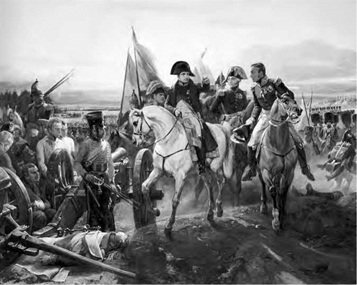
(Battle of Friedland, 1807)
1809
May 22: Battle of Aspern-Essling — In the Battle of Aspern-Essling (21-22 May 1809), Napoleon attempted a forced crossing of the Danube near Vienna, but the French and their allies were driven back by the Austrians. The battle was the first time Napoleon had been personally defeated in over a decade, but it was no more than a tactical victory for the Austrians, who failed to capitalise on their superior numbers and merely repulsed Napoleon, without defeating him.
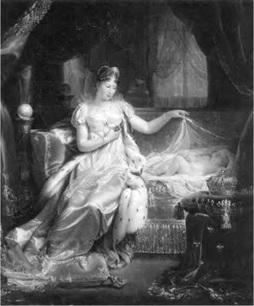
(Napoleon’s second wife, the empress Marie-Louise and their son, the king of Rome)
July 5-6: Battle of Wagram — The Battle of Wagram (July 5-6, 1809) was the most important military engagement of the War of the Fifth Coalition. The two-day struggle saw an Imperial French, German and Italian army defeat an army of the Austrian Empire. Success for Napoleon, Austria loses territory and must enforce the Continental System.
October 14: Treaty of Schonbrunn signed. — The Treaty of Schonbrunn was signed between France and Austria at the Schonbrunn Palace of Vienna on 14 October 1809. This treaty ended the Fifth Coalition. Austria had been defeated, and France imposed harsh peace terms.
December 15: Napoleon divorces Josephine who is not able to give him a son.
1810
April 2: Napoleon marries Marie-Louise, daughter of the Emperor of Austria.
1811
March 20: Napoleon’s son is born, referred to as the “King of Rome”.
1812
August 4-6: Battle of Smolensk — The Battle of Smolensk, the first major battle of the French invasion of Russia took place on August 16-18, 1812. Napoleon attacked Smolensk and captured two of the suburbs. During the night the Russians evacuated the burning city.
September 1: Moscow evacuated.
September 7: Battle of Borodino — The Battle of Borodino, fought on September 7, 1812, was the largest and bloodiest single-day action of the French invasion of Russia and all Napoleonic Wars, resulting in at least 70,000 casualties. The French Grande Armee attacked the Imperial Russian Army near the village of Borodino and eventually captured the main positions on the battlefield, but failed to destroy the Russian army. About a third of Napoleon’s soldiers were killed or wounded.
September 14: Napoleon arrives in Moscow to find the city abandoned and set alight by the inhabitants.
October 19: The Great Retreat of the French army begins. November: Crossing of the River Berezina.
December: Grande Armee expelled from Russia.
1813
May 2: Battle of Lützen — In the Battle of Lützen (May 2, 1813), Napoleon lured a combined Prussian and Russian force into a trap halting the advances of the Sixth Coalition after his devastating losses in Russia. After a day of heavy fighting, the combined Prussian and Russian force retreated, but without cavalry the French were unable to follow their defeated enemy.
May 20-21: Battle of Bautzen — In the Battle of Bautzen (20-21 May 1813) a combined Russian/Prussian army was pushed back by Napoleon, but escaped destruction, some sources claim, because Marshal Ney failed to block their retreat.
June 21: Battle of Vitoria — At the Battle of Vitoria (June 21, 1813) an allied British, Portuguese, and Spanish army broke the French army near Vitoria in Spain, leading to eventual allied victory in the Peninsular War.
August 15: Siege of Danzig — It lasted from January to December 1813 and ended in a Coalition victory.
August 26-27: Battle of Dresden — The Battle of Dresden was fought on 26-27 August 1813, resulting in a French victory against forces of the Sixth Coalition of Austrians, Russians and Prussians. However, Napoleon’s victory was not as complete as it could have been.
August 26: Battle of Katzbach — Taking place the same day as the Battle of Dresden, it resulted in a French defeat. This, coupled with the defeats at Kulm, four days later, and Dennewitz on 6 September, would more than negate Napoleon’s victory at Dresden.
October 16-19: Battle of Leipzig — The Battle of Leipzig or Battle of the Nations, on 16-19 October 1813, was fought by the coalition armies of Russia, Prussia, Austria and Sweden against the French army of Napoleon. Napoleon’s army also contained Polish and Italian troops as well as Germans. The battle involved over 600,000 soldiers, making it the largest battle in Europe prior to World War I. Defeated, Napoleon was compelled to return to France while the Allies hurried to keep their momentum, invading France early the next year.
1814
February 10-14: Six Days Campaign — The Six Days Campaign (10 February-14 February 1814) was a series of victories by the forces of Napoleon as the Sixth Coalition closed in on Paris. With an army of only 70,000, the Emperor was faced with at least half a million Allied troops advancing in several main armies.
The Six Days Campaign was fought from 10 February to 14 February during which time he inflicted four major defeats on Blucher’s army in Champaubert, Montmirail, Chateau- Thierry and Vauchamps. Later historians and enthusiasts claimed that the Six Days was the Emperor’s finest campaign. However, the Emperor’s victories were not significant enough to make any changes to the overall strategic picture, and Schwarzenberg’s larger army still threatened Paris, which eventually fell in late March.
March 30-31: Battle of Paris. — The French defeat led directly to the abdication of Napoleon I.
April 4: Napoleon abdicates and Louis XVIII, a Bourbon, the brother of the late Louis XVI, is restored to the French throne.
April 11: Treaty of Fontainebleau — The treaty was signed at Paris on 11 April by the plenipotentiaries of both sides, and ratified by Napoleon on 13 April. With this treaty, the allies ended Napoleon’s rule as emperor of France and sent him into exile on Elba. Napoleon agrees to exile in Elba, the allies agree to pay his family a pension.
May 4: Napoleon is exiled to Elba; his wife Marie-Louise and his son take refuge in Vienna.
1815
February 20: Napoleon escapes from Elba.
March 20: Napoleon arrives in Paris.
The Hundred Days — The Hundred Days marked the period between Napoleon’s return from exile on Elba to Paris on 20 March 1815 and the second restoration of King Louis XVIII on 8 July 1815 (a period of 111 days). This period saw the War of the Seventh Coalition ending with the Waterloo Campaign.
Napoleon returned while the Congress of Vienna was still sitting. On 13 March, seven days before Napoleon reached Paris, the powers at the Congress of Vienna declared him an outlaw; four days later the United Kingdom, Russia, Austria and Prussia, members of the Seventh Coalition, bound themselves to put 150,000 men each into the field to end his rule.
June 18: Battle of Waterloo — The Battle of Waterloo was fought on Sunday 18 June 1815 near Waterloo in present day Belgium. It was the culminating battle of the Waterloo Campaign and Napoleon’s last.
Two large forces under Wellington and von Blucher assembled close to the northeastern border of France. Napoleon chose to attack in the hope of destroying them before they could join in a coordinated invasion of France with other members of the Coalition. The decisive engagement of this three-day Waterloo Campaign (16-19 June 1815) occurred at the Battle of Waterloo. According to Wellington, the battle was “the nearest-run thing you ever saw in your life.”
The defeat at Waterloo put an end to Napoleon’s rule as Emperor of the French and marked the end of his Hundred Days’ return from exile.
June 28: Second restoration of the king Louis XVIII.
October 16: Arrival of Napoleon at Saint Helena, an island in the South Atlantic Ocean.
1821
May: Death of Napoleon at St Helena.
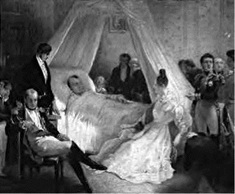
Notes
Where a royalist revolt was supported by the British.
↩They comprised mostly England, Austria, Prussia, Russia. These powers had fought against the French Republic and could not accept Napoleon whom they saw as an usurper. They were also afraid of the spread of revolutionary ideas.
↩Hence the title of this monograph.
↩During the reign of the Ptolemies, especially the reign of Ptolemy Philadelphus, who built the museum and founded the Library of Alexandria and encouraged literature.
↩The Directory: a body composed of five directors which was since 1795 the central government of France.
↩The Rosetta stone would later be confiscated by the British, but the French scholars sent copies to Paris, allowing Champollion twenty years later to decipher the hieroglyphs.
↩La Marseillaise or “the Song of Marseille” is the national anthem of France. The song was originally titled “Chant de guerre pour l’Armee du Rhin” (“War Song for the Army of the Rhine”).
↩