THE WRITTEN WORD
Nala and Damayanti
Paragraph references are specific to this digital edition.
Nala and Damayanti
Introduction
इतिहासम् इमं श्रुत्वा पुराणं शश्वद् उत्तमम् ।
पुत्रान् पौत्रान् पशूंश् चैव वेत्स्यते नृषु चाग्र्यताम् ।
अरोगः प्रीतिमांश् चैव भविष्यति न संशयः ।।
Whoever listens to that ancient and excellent story will get everything that his heart desires, there is no doubt about it.
A Lesson on Life
The story of Nala and Damayanti, as told in the Mahabharata, seems to begin and end like a fairy tale. Yet what happens in between is anything but a fairy tale — if we give to this word the meaning of something remote from real life. On the contrary, this is a universal story containing some of the deepest truths about life.
The story is about two human beings having immense qualities, placed in ideal circumstances: the king Nala and the princess Damayanti. It starts with a very pure love between them which is put to the test by the gods themselves, and then their marriage followed by a life of harmony and happiness. Then suddenly the smooth path is interrupted. A crack appears in this beautiful picture widens more and more.
An evil being named Kali enters the king, clouds his judgement and leads him to all kinds of disasters, including the loss of his kingdom, exile, the separation from his children, the abandoning of his wife in the forest, loneliness, suffering and servitude for both of them. Evil, doubt, pain, separation have appeared in the story of Nala and Damayanti, indeed as they often appear in our own life. For how many lives on this earth are not chequered lives? One rises, one falls; one gains, one loses. Rama is all set to be crowned King of Ayodhya and at that very moment he is sent into exile. Shakuntala awaits her marriage and then she is cursed by a Rishi and forgotten by her lover. Vishvamitra is about to reap the fruit of thousands of years of tapasya when he gets angry and loses everything in a second. Rare are the linear lives in which upheaval of some kind does not take place.
What does one need for going undefeated through all this? What makes some people sink and other people emerge stronger? And if it is true that the life of a man is a “search after pure Truth and unmixed Bliss”, what are the helps in this search? And if it is true that human life is susceptible to deviation, how can those deviating forces be conquered? Since it contains many secrets about these questions, the story of Nala and Damayanti is considered an invaluable lesson in human life.
There is nothing surprising in the fact that this story, like all those to be found in the ancient epics of India, contains great knowledge. The poets who wrote them did not intend merely to tell a tale in a beautiful or noble manner or to create an interesting poem, although they did this with great success. The Mahabharata and the Ramayana are itihasa, that is to say, they are “an ancient historical or legendary tradition turned to creative use as a significant mythus or tale expressive of some spiritual or religious or ethical or ideal meaning and thus formative of the mind of the people.” Valmiki and Vyasa indeed shaped the minds of the Indian people. They were architects and sculptors of life. Their epics contain a deep reflection on life, on human psychology, on society, politics and religion. If the Mahabharata has been spoken of as a fifth Veda, it is because it is only a great poem, it is only a great poem, it is also a body of knowledge.
धर्मे चार्थे च कामे च मोक्षे च भरतर्षभ। यदिहास्ति तदन्यत्र यन्नेहास्ति न तत् क्वचित् ।।
“Whatever is in this book, pertaining to the four human interests: dharma, personal gain, passion or liberation, is elsewhere [in the world]; whatever is not in the book does not exist anywhere [in the world].”1
The work of these epics was to popularise through stories the discoveries of the great minds and souls of India: “That which was for the cultured classes contained in Veda and Upanishad, shut into profound philosophical aphorism and treatise or inculcated in Dharmashastra and Arthashastra, was put here into creative and living figures, associated with familiar story and legend, fused into a vivid representation of life and thus made a near and living power that all could readily assimilate through the poetic word appealing at once to the soul and the imagination and the intelligence.”
The Vedic Rishis had spoken of life as a battle between the forces of light and the forces of darkness. They had said that there are forces that help you in this battle, and there are forces that obstruct you. They had said that life is a sacrifice, and that as you burn your imperfections in the fire of sacrifice, you move upwards, you progress from untruth to truth. They had spoken of Rita, the right law of action originating in the vast consciousness of truth, and from that concept had come the idea of dharma. Those Vedic notions are present in the Mahabharata, brought out from an inner plane to an outer plane (ideas, ethics, politics), although in the tale of Nala and Damayanti (which is probably a very old story), they still keep their ancient and inner significance.
Indeed this is how the story is presented to us in the Mahabharata: as an ancient tale containing secrets which can help men overwhelmed with doubt and sorrow; as an example pregnant with meaning; as a demonstration of the significance of life. From the story of Nala and Damayanti, it is said in the Mahabharata, Yudhishthira, like all men plunged in a great crisis, can draw benefit.
-
Adiparva, 2.20. ↩
Why the Story was told
“Never was there a more miserable man than me”, kept repeating Yudhishthira. He was a king, and he had lost his kingdom. He was the elder and the wisest brother; he was regarded as Dharmaraja, a model of moral rectitude, and now he was being accused of bringing misfortune upon himself and his family by not resisting the lure of gambling. Even his closest friends reproached him for-pledging his brothers, himself and even their wife, on the gambling board. Time and again that fateful scene would come back to his mind when, through his own fault, the proud Draupadi was dragged by her hair into the assembly hall and publicly humiliated, like no other woman had ever been. How could he sleep when he relived that moment, remembered his helplessness and the sarcasm of his enemies? He had been trapped by an expert in the art of cheating and made to play dice while he himself did not know the secret of this game . And what was in store for him now? He had gambled and lost; as per the agreement he had to live a life of exile in the forest along with his brothers and their wife. As if this was not enough, his dearest brother, the great Arjuna himself had left for a far-off region in the north in quest of the science of divine weapons. When would he return? Would he ever return? Yudhisthira felt so lonely. How much he missed the presence of the compassionate Arjuna! How unbearable to hear over and over the harsh words of his brother Bhima! And what should he answer when, impatient with what he saw as passivity, Bhima pressed him to break his word and take arms against their enemies? “You will gamble again anyway, this is certain.
Even after all that has happened, you will not be able to refuse the game!” taunted Bhima. It hurt so much! Sorrow and shame seared Yudhishthira's heart and dried his mouth. At night, unable to find rest, he kept tossing on his bed of torture and bitterly lamented over his misery. “No, indeed, never was there a more unfortunate man than me.”
But one day a great sage, one of those Rishis who lived in the forest-hermitages of ancient India, appeared where the brothers lived. They all welcomed him according to the tradition. After some time, Yudhishthira found him alone. He sat at his feet and bared his heart to him. His pain, his worries, his doubts, his helplessness, he all confided to the great Rishi. And he concluded with the one thing that seemed to him a certainty in his ocean of miseries, “Was there ever a king more miserable than me?”
“Yes, there was”, answered the Rishi gently. “Once upon a time there was a king who was more unfortunate than you. He was alone in the forest, separated from his wife, without brothers or friends, much more lonely than you are. He was not even able to reflect on dharma as you do, because his mind was clouded. If you want to listen to that ancient story, I will tell you about the king Nala who had to bear a greater ordeal than you and who triumphed over his miseries.”
This is how the story of Nala and Damayanti is introduced to us by the great poet Vyasa in the Vanaparva of the Mahabharata: as a tale of courage and endurance in the face of adversity; as an example of what fate can do to man and what man can do to fate; a lesson of hope given to a man who is very close to falling prey to despair. Through this story, the Rishi wants Yudhishthira to have a deeper understanding of the play of invisible forces in life. He reminds him that there are times in one's life when one can become a plaything in the hands of some of those forces, which are out to obstruct and destroy; but he shows him how, even in these circumstances, one can be protected and guided by some other forces, and how one can get free from one's fear and destructive sense of guilt by surpassing one's limitations and ignorance. For the central idea in the poem is that of the spirit of degeneracy, the genius of the iron age:
his evil being suddenly takes hold of a man who till that day had been an ideal of purity and loyalty, brings all kinds of calamities into his life, but eventually is over powered by a steadfast conjugal love. Nothing more tonic and refreshing for the soul than this tale of two capable minds struggling with hardships and difficulties. Nothing more strengthening than the tale of this two-headed hero whose aspiring and unconquerable spirit ultimately triumphs. Nothing more elevating that the story of this unwavering love, pure and strong enough to make a man and a woman pass through some of the worst crises one can ever meet in life, and emerge victorious.
“In the same way as Nala regained his kingdom, you also will meet good fortune again,” promised the Rishi to Yudhishthira after telling the story. “Considering that men's gains are always unstable, one should not be perturbed by success or failure.”
“The apprehension you have that you will be again invited by an expert in the game to play dice, that fear I will destroy.”
The lesson will not be lost on Yudhishthira: he will express his desire to learn from the Rishi Brihadeshwara the science of dice and also the science of horses, thereby taking the initiative in the battle of life and getting rid of his fear.
Damayanti
Damayanti, “the one who subdues, or conquers”, is the name of Nala's wife. And she does conquer; by the purity and sincerity of her love, the tremendous strength of her will-power, her deep insight into the complexities of life and knowledge of the right action, obstacles are removed, seemingly insurmountable difficult ties are surmounted, evil forces are defeated. There is a special quality to all her actions, a certain golden touch as it were. At each turn of the story Damayanti solves the inextricable, straightens what is bent, snatches victory from the jaws of defeat.
Her love for Nala is no ordinary love, it is a love of the soul as symbolised in the image of the swan, the golden-winged messenger through which the two lovers speak to each other. The truth of this love is so deep that it even won over the gods.
Here it may be interesting to ask ourselves the question: what made Damayanti choose Nala over the gods? Indra, Agni, Yama and Varuna had asked for Damayanti's hand. They had even used Nala as their emissary, and Nala, although a suitor himself, had faithfully helped them. Yet Damayanti chose Nala, a man, over the gods. Why? What does Nala have that the gods do not have? Here, a clue to the question is hidden in the beautiful image of the four gods seated along with Nala at the swayamvar ceremony. The gods have managed in such a way that the five beings seated side by side look exactly the same. Where is Nala? How is Damayanti going to recognize him and select him as her husband? Damayanti directly addresses the gods and the truth of her love is so compelling that it forces them, as it were, to show her who is Nala, thus accepting her choice. Suddenly she is able to perceive the differences between the five figures in front of her. The gods are not soiled by dust or sweat. Their garlands are unfading, their eyes unwinking. Their feet do not touch the ground. They cast no shadow. But Nala's feet stand on the ground, he has a shadow, his garland is fading, one can see sweat on his forehead and dust on his body, and his eyes blink. What does this symbolic language signify?
Gods are stable, immobile, always luminous, invariably harmonious. Time does not change them, struggle does not affect them. In a word, these gods belong to a static, non-evolutionary world. Nala's world, on the contrary, is the world of the earth, which his feet touch; it is an evolutionary world, not all glorious and harmonious, consisting of light and shadows, of sweat and dust, of struggle and impurity. A world where everything moves and changes, in the same way as his garland fades with the passing of time. Yet in that imperfection, there is an urge towards a higher and more many-sided perfection. This urge, this aspiration is the sign of the soul. Gods are not thirsty. The human soul is. It searches for truth, freedom, unmixed bliss. It is that thirst, that aspiration that leads the soul in its voyage towards greater and greater lights. And this is the experience Damayanti seeks: the travel of the soul towards greater and greater perfection. It is why she chooses Nala. Not for her a static and contented perfection. Her robust soul seeks the adventure and the struggle and an all embracing triumph.
It is this aspiration towards perfection, as manifested by her love for Nala, that guides Damayanti and leads her to victory. When, finding herself alone in the jungle, she cursed the evil being that robbed Nala of his senses, it is the purity of her love that made of her curse an effective weapon,, potent enough to ultimately strike at the evil force and deliver Nala from its influence. Kali himself will later confirm this,
“Indrasena's mother, Damayanti, cursed me in anger when she was abandoned by you. Therefore I have been suffering greatly.”
It can be observed that there is not the slightest taint of egoism in this love: Damayanti never ever feels sorry for herself, never indulges in self-pity: even alone in a wild and dangerous forest, even in the grasp of a huge python, she thinks only of Nala's suffering, she grieves only for Nala, she has compassion only for Nala.
And again it is this psychic love that finally would indicate to Damayanti more surely than any external sign that she was going to be reunited with Nala. Back in her father's home, one day she felt a sudden and tremendous joy; this is the language of the soul, making her understand more clearly than with any spoken word that, at last, she was going to meet her beloved.
According to the ancient Indian science of yoga and its knowledge of the subtle body, the centre of the will is located between the eyebrows. It is interesting to note that Damayanti is said to have a birth sign between the two eyebrows. Could this physical sign be a symbol of Damayanti's indomitable will? One is inclined to believe so, for Damayanti's will-power is indeed unshakable: either the gods' offer prior to the swayamvar, nor Nala's departure, nor her grief or her fear made her deviate for one second from her path, which is the path of total self-giving to Nala. Once she gave herself to Nala, — and that was even before she ever saw him, — she was ready to die rather than live without him. And once she was separated from Nala, she lived with only one aim, to find him again. When after her adventures she finally returns to her parents' house, the author does not describe her relief at being again reunited with her family and children, he does not linger on domestic scenes of happiness. There is no rest or respite for Damayanti. She is still the same woman Nala abandoned in the forest: she is clothed with only one garment; her hair is untied; she is covered with dust; and she thinks only of one thing: how to find Nala, how to let him know that she is waiting for him, how to make him come back to her. She respects her elders like any educated woman of the time and, before acting, she asks her parents for their permission, but her will is so strong, her intention is so clear that her parents cannot but let her act the way she has decided to. In this way, she is a totally free woman, and one can sense the empathy of Vyasa's “granite mind” with the formidable strength of this character.
More than her purity and sincerity, more than her will-power, what makes Damayanti an exceptional human being, is her deep understanding of human life coupled with her knowledge of the right action. She was a young girl whose universe till her marriage must have been confined within the walls of the palace, and yet she felt and acted as if she had lives and lives of experience behind her. Right from the beginning of the tragedy she had understood that Nala was not himself, that some dark force had taken hold of him and that he was a victim; it is why she never ever blamed Nala. She could perceive that his judgment was clouded, that he was mohita and unable to decide clearly and freely. Similarly, when they wandered in the forest, on her insistence Nala promised that he would not abandon her, but she knew that although he meant what he said, he would not be able to keep his word since he was not master of his mind anymore.
“I understand, O king, you could not leave me. But because of your mind which is pulled in another direction, you could very well abandon me.”
She did not put a name onto the hostile force, she did not know that it was an evil being called Kali, but she was aware of its presence.
Not only does she know the power of love and truth, as we have mentioned already when we noted that she forced the gods to accept her choice, not only does she know the power of dark forces such as the one which took possession of her husband, not only is she conscious of the battle between those contradictory pulls, but she is also desha-kaal-jnaa: (60.12) she knows how to act decisively at the right moment and at the right place. While Nala gambled and one by one lost all his possessions, she, foreseeing what was going to happen, acted swiftly and saved her children. Back in her father's capital, after more than three years of ordeal, she devised ways to find Nala and, once he was found, to make him come. The detailed instructions she gave to her envoys and each word of the message she wanted them to spread, the idea of the second swayamvar and the announcement made at such a short notice, the four tests she made Nala go through in order to be able to declare irrefutably that this ugly charioteer indeed was Nala, all her plans and the way she carried them out reveal the extraordinary gift of Damayanti: emotions never come in the way of action; she has a clear vision of what has to be done and she executes the action calmly, thoroughly, with an utmost care and with a great attention to detail.
Such is the character portrayed so powerfully and yet with such remarkable simplicity by Vyasa.
It would be tempting to declare that she is the main protagonist of the story, and that her role is even more important than that of Nala. But this would be unfair to the man Damayanti chose of her own will amongst gods. In fact, Nala and Damayanti were attacked by the same enemy, waged the same battle, although through different means, and they both won.
Nala
Nala's purity and truthfulness are equal to those of Damayanti. Lest we be inclined to think of Nala as a husband who betrays his wife, right at the beginning of the story we are shown how firm he is in his clinging to the truth: he promised the gods to help them and he will do it, whatever the consequences for himself. He is entirely transparent, and speaks nothing but the truth, be it in front of the gods or in front of Damayanti. In fact, he is so pure and sincere that Kali, after resolving to take possession of him, had to wait for twelve full years as he could not find any opening, any flaw that would allow him to sneak in. After twelve years, a minuscule fault was committed that gave Kali the opportunities he sought. From then onwards, Nala was not himself.
However, in his diminished condition with his mind confused and torn, the one thing that remained always present, albeit in the background, and acted as a protection was his love and respect for Damayanti. Like Yudhishthira, he was invited to stake his wife on the gambling board. Nala's only answer, recounts Vyasa, was to silently remove all his ornaments and walk out of the palace. Even when he agonised over the action to be taken, even at that moment when his mind was dola iva, pulled like a swing in two opposite directions, he never questioned the purity and fidelity of Damayanti and knew that those would be her protection.
In the concluding chapter of the story, Nala fully conscious of what happened to him, pointed out to Damayanti,
“That my kingdom was lost and that I abandoned you was all the work of Kali, it was not my doing.”
Kali, adds Nala, was burnt by Damayanti's curse “like fire burnt by fire”, and “was defeated by my endeavours and tapasya”
What were Nala's efforts to defeat Kali and overcome the deep crisis in which he had been plunged? It would be too long to list all of them but we would like to underline three stages in his tapasya that were crucial in his battle against darkness and which were all the more heroic because undertaken in the backdrop of extreme sorrow, overwhelming feeling of guilt and physical distress.
The first is the easiest to detect: the act of compassion towards another being. In the jungle, Nala succours the Karkotaka snake caught in a ring of fire. Due to a curse this cobra could not move. He is encircled by flames, cries for help and finally is saved by Nala who carries him to a safer place. Then a strange thing happens: in return for this kindness, Karkotaka bites Nala. This apparent act of ingratitude is in reality a great boon, as the serpent himself explains it to Nala. Firstly, the poison that has entered Nala will torment Kali so much that ultimately he will have to come out of him. Secondly, this bite has the immediate effect of transforming Nala's appearance. His beauty has disappeared. His face has become black. And this is for Nala's own good, as is clear from Karkotaka's utterance:
Then reassuring Nala, the cobra Karkotaka told him: 'I have made your form disappear so that no one can recognize you.'“
So it is clear from the text itself that Nala did not become ugly because of Kali's entering him. The change in Nala occurred much after this event, and it was effected by the snake with the specific purpose of helping him. In fact, this transformation is the beginning of the process of recovery. From that moment, “no one can recognize you”, said the snake. This leads us to the second stage in Nala's tapasya.
The second step in his tapasya is his period of Ajnaatavaas.On the advice of Karkotaka, Nala goes to Ayodhya. There, under the name of Bahuka, he proposes his services to the King Rituparna. He will look after the horses of the King. So here is Nala, unrecognisable, with a different face, in a foreign land, among strangers. It seems to us that these periods of retreat described by the Indian epics, when one hides in an unknown place under an assumed identity, symbolically indicate an inner movement of introspection, a time devoted to a deep inner quest and renewal. All energies are necessary, a great concentration is necessary, a dialogue with the innermost part of one's being is necessary. Space and time are required, solitude is a help. The last thing one needs is interference from others, howsoever good-intentioned they may be. Karkotaka has made sure that “no one can recognize” Nala; his living in a distant land makes it impossible for him to be confronted with past acquaintances. He is alone, facing his own life, engaged in a dialogue with his soul. And each evening he sings his love for his beloved: a single verse, a beautiful and simple shloka, repeated again and again, as a mantra, a cry from his heart:
“Where resteth she that roamed the wood
Hungry and parched and worn, but always true?
Doth she remember yet her faultful lord?
Ah, who is near her now?”
The third decisive step for Nala was the decision to learn the science of counting from King Rituparna. Both the King and Nala are on their way to the capital of Vidarbha. They have heard that a second swayamvar ceremony for Damayanti will take place shortly. On the way, Nala asks Rituparna to teach him the science of counting. As soon as he learnt it. Kali came out of him . This is also a symbol and one presumes that the science of counting indicates the quality of discrimination acquired by Nala. After all, samkhya (number) is the name of a branch of Indian yoga. The choice of the tree itself, whose leaves and fruits Nala is taught how to count, is significant since it is the Vibhitaka tree, “the tree which removes fear”, also called “the dice tree”, its fruits being used in the game of dice.1 By learning discrimination, by widening his consciousness Nala had gotten rid of his fear. The tale of Nala and Damayanti has the charm of a beautiful fairy tale and the fierce and stern power of an epic. While portraying the characteristics of Vyasa's poetry, Sri Aurobindo dwelt at length on the characteristics of two works which are not parts of the original Mahabharata and are yet by the same hand, Nala and Savitri. Says he: “Here we have the very morning of Vyasa's genius, when he was young and ardent, perhaps still under the immediate influence of Valmiki (one of the most pathetic touches in the Nala is borrowed straight out of the Ramayana), at any rate able, without ceasing to be finely restrained, to give some rein to his fancy. The Nala therefore has the delicate and unusual romantic grace of a young and severe classic who has permitted himself to go a-maying in the fields of romance. There is a remote charm of restraint in the midst of abandon, of vigilance in the play of fancy which is passing sweet and strange. ... This then is the rare charm of these two poems that we find there the soul of the pale and marble Rishi, the philosopher, the great statesman, the strong and stern poet of war and empire, when it was yet in its radiant morning, far from the turmoil of courts and cities and the roar of the battle-field and had not yet scaled the mountain tops of thought.”1
While this story contains the wonders and the touches of the miraculous that pertain to a fairy tale, it has for subject, like all Indian epics, a struggle between two ideal forces, universal and opposing. One can read the story as a parable which by means of very ancient symbols tells us the adventure and battles of man's inner being led from darkness to light by the sheer power of love.What Nala and Damayanti experienced at the very start of the story, the deep emotion that caught hold of them, as wonderful and fresh and miraculous as the blooming of a flower, as undeniable and compelling as the sunrise, was the promise of their attaining an even greater joy, widened, deepened and illumined by the fire of their aspiration
-
Sri Aurobindo, Notes on the Mahabharata, Vol III, Centenary Edition, Pondicherry, 1972, p 153-4. ↩
Nala and Damayanti
Once upon a time there was a king named Nala, who ruled over a people known as the Nishadas. Now this Nala was the. first of kings. In person he was strong and handsome, full of kingly honour, and gracious in his bearing. He loved archery and hunting, and all the sports of monarchs. And one special gift was his, in an extraordinary degree, the knowledge, namely, of the management of horses. Thus in beauty, in character, in fortune, and in power, there was scarcely in the whole world another king like Nala.
If there were one, it could only be Bhima, King of the Vidarbhas, a sovereign of heroic nature and great courage, deeply loved by all his subjects. Now Bhima had three sons and one daughter, the Princess Damayanti. And the fame of Damayand, for her mingling of beauty and sweetness, and royal grace and dignity, had gone throughout the world. Never had one so lovely been seen before. She was said to shine, even in the midst of the beauty of her handmaidens, like the bright lightning amidst the dark clouds. And the hearts of the very gods were filled with gladness whenever they looked upon this exquisite maiden.
It happened that constantly before Damayanti, the minstrels and heralds chanted the praises of Nala, and before Nala those of Damayanti, till the two began to dream of each other, with an attachment that was not born of sight. And Nala, conscious of the love that was awakening within him, began to pass much of his time in the gardens of his palace, alone. And it came to pass that one day he saw there a flock of wild swans with golden wings, and from amongst them he caught with his hands one. And the bird was much afraid, and said, "O King, slay me not! Release me, and I will go to Damayanti and so speak to her of thee, that she will desire to wed thee, and no other in the world!" Musing, and stroking the wings of the swan, Nala heard his words, and saying, "Ah, then do thou indeed even so!" opened his hands, and let him go free.
Then the swans flew up and away to the city of the Vidarbhas, and alighted in the palace gardens before Damayanti and her maidens. And all the beautiful girls scattered immediately, to run after the fleeing birds, trying each to catch one. But that after which Damayanti ran, led her away to a lonely place, and addressed her in human speech. "Peerless amongst men, O Damayanti!" it said, "is Nala, King of the Nishadas. Accept thou him! Wed thou with him! Ever happy and blessed is the union of the best with the best!" The Princess stood with head bowed and folded hands, as soon as she understood what the swan would say; but when he ended, she looked up with a smile and a sigh. "Dear bird!" she said, "speak thou even thus unto him also!"
And the handmaidens of Damayanti, from this time on, began to notice that she grew abstracted. She wandered much alone. She sighed and became pale, and in the midst of merriment, her thoughts would be far away. Then, delicately and indirectly, they represented the matter to Bhima, and he, reflecting that his daughter was now grown up, realised that her marriage ought to be arranged, and sent out messages all over the country, that on a certain day her Swayamvara would be held.
From every part, at this news, came the kings, attended by their bodyguards, and travelling in the utmost splendour, with horses and elephants and chariots. And all were received in due state by Bhima, and assigned royal quarters, pending the day of Damayanti's Swayamvara. And even amongst the gods did the news go forth, and Indra, and Agni, and Varuna, and Yama himself, the King of Death, set out from high heaven for the city of the Vidarbhas, each eager to win the hand of the Princess.
But as the proud gods went, they overtook a mortal wending his way on foot, and his beauty and greatness, of mind as well as body, were such that they immediately determined to leave their chariots in the skies, and tread the earth in the company of this man. Then, suddenly alighting before him — for the gods know all — they said, "Nala! thou art a man to be trusted. Wilt thou promise to carry a message for us?"
Nala, seeing four luminous beings appear before him, and hearing them ask him to be their messenger, answered immediately, "Yea! That will I!" and then, drawing nearer, he added, "But tell me first, who are ye who address me, and what is the message, further, that I should carry for you?" Said Indra, "We are the Immortals, come hither for the sake of Damayanti. Indra am I. Here at my side is Agni, God of Fire. There is Varuna, Lord of Waters. And next to him stands Yama, destroyer of the bodies of men. Do thou, on our behalf, appear before Damayanti, saying, 'The Guardians of the World are coming to thy Swayamvara. Choose thou, I pray thee, one of the gods for thy lord!'"
"But," said Nala, "I myself am come hither with the self-same object. How can a man plead with the woman whom he loves on behalf of others? Spare me, ye Gods! Send me not upon this errand!"
"Then why, O King!" answered the gods gravely, "didst thou first promise? Why, having promised, dost thou now seek to break thy word?"
Hearing this, Nala spoke again, saying, "But even if I went, how could I hope to enter the apartments of Damayanti? Is not the palace of Bhima well guarded?"
But Indra replied, "Leave that to us! If thou wilt go, thou shalt have the power to enter!" And saying "Then, O Gods, I obey your will!" Nala found himself, on the moment, in the presence of Damayanti, within the private apartment of the palace of Bhima.
Damayanti sat amongst her ladies. The next day was to be her Swayamvara, and feeling sure that Nala would attend it, the smiles had come back to her lips, and the colour to her cheeks. Her eyes were full of light, and the words she spoke were both witty and tender. Seeing his beloved thus for the first time, Nala felt how deep and overflowing was his love for her. Truly, her beauty was so great, that the very moon was put to shame by it. He had not thought, he had not heard, he could not even have imagined, anything so perfect. But his word was given, and given to the gods, and he controlled his own feeling.
This determination did not take even so much as that instant which it required for him to become visible to the assembled maidens. As he did so, they sprang to their feet in amazement, feeling no fear, but struck with wonder at the beauty of the spirit who appeared thus before them, and full of the question, "Who can it be?" Yet were they too shy to venture to speak to him. Only Damayanti came forward gently, and smilingly addressed the heroic vision, saying, "Who art thou? And how hast thou contrived to enter unperceived? Are not my apartments well guarded, and the King's orders severe?"
Hearing these words, the King answered, "My name, O Princess, is Nala. I have entered here undiscovered, by the power of the gods. I come as their messenger. Indra, Agni, Varuna, and Yama, all alike desire, O beauteous one! at the morrow's Swayamvara to be chosen by thee. As their messenger, I say, 'Choose thou one of them for thy lord!'"
Damayanti bowed as she heard the names of the gods. Then, with a smile, she turned herself to Nala. "Nay, O Hero!" she answered, "it is not the gods, but thee thyself whom I shall choose. Thy message reached me, borne hither by the swans.
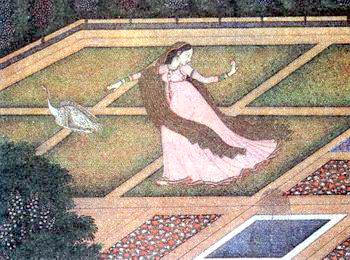 Damayanti and the swan
Thee have I accepted in my heart. For thee has the Swayamvara been called. Failing thee, I refuse to be won by any!"
"Nay," answered Nala, "in the presence of the gods, wouldst thou choose a man? Ah, for thine own sake, turn thy heart, I pray thee, to those high-souled lords, the creators of the worlds, unto the dust of whose feet I am not equal! Misguided is the mortal who setteth them at nought. Be warned, I beg of thee. Choose thou one of these heavenly beings. What woman would not be proud to be sought by the protectors of men? Truly, do I speak unto thee, as thy friend!"
Tears were by this time running down the cheeks of Damayanti. Trembling, and standing before Nala with folded hands, she answered, "I bow to the gods, but thee, O King, have I chosen for my lord!"
"Blessed one!" answered Nala gently. "Do even as thou wilt. How dare I, having given my word to another, turn the occasion to my own profit? Yet, if that had consisted with honour, I would have sought my will! Knowing this, do thou decide."
The face of Damayanti had changed as Nala spoke these words.
Under the tears were now smiles. For his secret was told. A moment she stood and thought, and then she raised her head. "I see a way, O Monarch,"she said, "by which no blame whatever can attach itself to thee. Come thou to the Swayamvara with the gods. Then, in their presence, shall I choose thee. And the choice will be mine alone. Thou shalt be without sin."
Nala realised nothing, save the promise that Damayanti on the morrow would give herself to him. With throbbing pulses, but a quiet manner, he bowed his head in farewell, and, immediately becoming once more invisible, returned to the presence of the gods, and told them all that had happened. "The maiden said to me, 'Let the gods, O Hero, come with thee to my Swayamvara. I shall, in their presence, choose thee. Yet shalt thou be without sin.'" And the gods accepted the report of their messenger, for he had been faithful to his trust.
The morning of the Swayamvara dawned brightly, and the kings entered the lofty portals of the amphitheatre, even as lions might enter into the mountain wilds. The scene was all magnificence. Amongst the great pillars sat each royal guest on a shining throne. Each bore his sceptre and turban of state. Each was surrounded by his own heralds and minstrels, and amongst the blaze of silks and banners and jewels shone the flowers and foliage that decorated the hall.
At the appointed hour, preceded by her trumpeters, and surrounded by her escort, the Princess Damayanti entered. And her loveliness was such that, to the assembled monarchs, she seemed to be surrounded with dazzling light. All drew in their breath, and remained almost without stirring, at the sight of such matchless beauty. One by one the names and achievements of each monarch were proclaimed. The heralds of the Princess would challenge, and those of each king in turn would reply, and Damayanti stood listening, ready to give the signal, when her choice should be made.
But when the name of Nala was called, and she raised her head and looked up, before stepping to his side, what was not the terror of Damayanti to find that there, sealed side by side on different thrones, all equally splendid, all equally noble, were no less than five Nalas, .and she had no means of distinguishing him whom she would choose?
The Princess looked and tried to choose. Then she hesitated, and stepped back. Then she tried again, but all to no purpose. She knew of course that this was a trick of the gods. Four of these five were Indra, Agni, Varuna, and Yama. One was Nala. But which one? She tried to remember the marks of the celestial beings, as they had been told to her in her childhood by old people. But none of these marks did she see on the persons before her, so exactly had they all reproduced the form of Nala. What must she do? At this supreme moment of her life she dared not make a mistake.
Pondering deeply in her own mind, it suddenly occurred to Damayanti that she should appeal for protection to the gods themselves! Immediately, bowing down unto them in mind and speech, and folding her hands reverently, she tremblingly addressed them:
"From that moment, O ye Gods, when I gave ear to the words of the wild swan, did I choose Nala, the King of the Nishadas, to be my lord. That I may "be true to this, let the gods now reveal him to me! [ In as much as neither in thought nor word have I ever yet wavered in that resolve, oh, that I may hereafter be true to it, let the gods now reveal him to me! And since, verily, it was the gods themselves who destined the King of the Nishadas to be my lord, let them now, that themselves may be true to themselves, reveal him to me! To Nala alone did I vow to give myself. That I may be true to this vow, let them now reveal him to me! I take refuge in the mercy of the exalted Guardians of the Worlds! Let them now resume their proper forms, that I may know my rightful lord!"
Touched by these pitiful words of Damayanti, and awed by her fixed resolve and her pure and womanly love, the gods immediately did what they could, in that public place, to grant her prayer, by taking back, without change of form, their divine marks. And straightaway she saw that they were not soiled by dust or sweat. Their garlands were unfading, their eyes unwinking. They cast no shadows. Nor did their feet touch the earth. And Nala stood revealed by his shadow and his fading garlands; the stains of dust and sweat; his standing on the ground, and his human eyes. And no sooner did Damayanti thus perceive the difference between him and the gods than she stepped forward eagerly to fulfil her troth.2 Stooping shyly, she caught in her left hand the hem of Nala's garment, and then raising herself proudly, she threw round his neck a wreath of beautiful flowers. And all present, seeing her thus choose the one human Nala for her husband, broke out into sudden exclamations, and the gods themselves cried, "Well done! Well done!"
And Nala stepped down from his high place, and said, "Since thou, O blessed one, hast chosen me, a mortal, front the midst of the Immortals, know me for a spouse to whom shall thy every wish be sacred. Truly do I promise thee, that as long as life lasts I shall remain thine and thine alone!" And so with mutual vows and homage, they both sought and received the protection of the gods. Then did all guests, royal and divine, depart; and the marriage of Nala and Damayanti was performed; and they went, in great happiness, to the city of the Nishadas.
Now as the gods were returning to their own regions, they met Kali, the King of Darkness, and Dwapara, Spirit of Twilight, coming to the earth. And when they asked where they were going, Kali replied, "To Damayanti's Swayamvara. My heart is fixed on wedding with that damsel." Hearing this, Indra smiled and answered, "But her Swayamvara is already ended. In our sight she hath chosen Nala for her husband." To this said Kali, that vilest of the celestials, in great wrath, "If, spurning the Immortals, Damayanti in their presence hath wedded with a mortal, then is it meet she should suffer a heavy doom!" But the gods answered; "Nay, with our sanction was it that Damayanti chose Nala. And what damsel is there who would not have done the same? Great and manly and learned, that tiger amongst men, that mortal who resembles one of the Divine Protectors, has truthfulness and forbearance and knowledge, and purity and self control, and perfect tranquillity of soul. Whoever, O Kali, wisheth to curse this Nala, will end in cursing and destroying himself by his own act!"
Having spoken thus solemnly, the gods turned, leaving Kali and Dwapara, and went to heaven. But when they had gone, Kali whispered to Dwapara, "I must be avenged! I must be avenged! I shall possess Nala, and deprive him of wife and kingdom. And thou, entering into the dice, shalt help me to do this!"
Yet was it twelve long years ere3 Kali, watching Nala, could find in his conduct any slightest flaw by which he might be able to enter in and possess him. At last, however, there came an evening when he performed his worship without having completed all his ablutions. Then, through this error, Kali took possession of Nala. Also he appeared before his brother, Pushkara, tempting him to challenge Nala to a game of dice. And Dwapara also, at the same time, placed himself in the hands of Pushkara as the principal die. Such was the beginning of that terrible gambling that lasted month after month, and ended by depriving Nala of all that he had.
Many times, in the course of that play, came Damayanti and the citizens and subjects of Nala, and begged him to desist. But he, maddened by the indwelling Kali, turned a deaf ear to his Queen, and grew only the more intent upon the dice. Till she, seeing that evil was about to come upon them, sent for the royal charioteer. "O charioteer," she said, "I seek thy protection. My mind misgiveth me. The King may come to grief.
Take thou therefore these my children, my son Indrasena and my daughter Indrasena, and carry them to my father's house. And when thou hast given them into the care of my kindred, do thou even as thou wilt." And when the royal councillors had been consulted, they found the bidding of the Queen to be good, and the children were sent to the care of Bhima.
And when the charioteer had gone, Pushkara won from Nala his kingdom and all else that was left to him. And laughing he said, "O King, what stake hast thou now? Damayanti alone remaineth. Let us play for her!" And Nala gazed at Pushkara in anguish, but spoke never a word.
Then, taking off all his ornaments, and covered only with a single garment, leaving behind him all his wealth, the King set out to leave the city. But Damayanti, clothing herself also in one long scarf, followed after him through the gates. And for three days and nights they wandered together, without food and without rest. For Pushkara had made a proclamation that any who gave help to Nala should be condemned to death; so that, partly for fear of the sentence, and partly lest they should bring further harm on their King himself, none of his subjects dared to offer them anything.
At last, on the fourth day, wandering in the forest seeking for roots and fruits, Nala saw some birds of golden colour, and thinking, "Here is food!" snatched off his one piece of clothing, and threw it over them to catch them. But lo! the birds rose upwards to the sky, bearing the garment with them! And then, looking down and beholding the once mighty lord of the Nishadas standing naked in the forest, his mind full of gloom, and his gaze rooted to the earth, the birds spoke mockingly, and said to him, "Oh thou of little wit, we are none other than the dice with which thou playedst. We followed thee to take away thy garment. For it pleased us not that thou shouldst take with thee even a single cloth!" Hearing these words, and realising his terrible plight, since he had, it was evident, mysterious beings for his foes, Nala turned himself to Damayanti, and said over and over again, "Yonder, my gentle one, is the road to thy father's kingdom. I have lost all, Damayanti. I am doomed and deprived of my senses. But I am thy lord. Listen to me. Yonder is the road to thy father's kingdom."
But Damayanti answered him with sobs. "O King, how could I go," she asked him, "leaving thee in the wild woods alone, deprived of all things, and worn with hunger and toil? Nay, nay, whenever, in these ill-starred days, thy heart may turn to the thought of thy former happiness, thou shalt find me near thee, to soothe thy weariness! Remember what the physicians say: 'In sorrow is there no physic equal to the wife!' Is it not true, O Nala, that which I say unto thee?"
"O my gentle Damayanti," answered Nala, "it is even as thou sayest. Truly there is no friend, no medicine, equal unto the wife. But I am not seeking to renounce thee. Why dost thou tremble so? I could forsake myself, beloved, but thee I could not forsake. Wherefore, my timid one, shouldst thou dread this?"
But on Damayanti lay the prevision of the wife, and she answered, "I know, O King, that thou wouldst not willingly desert me. Yet maddened and distracted, many things are possible. Why dost thou repeatedly point out to me the way to my father's home? Or if thou really desirest to place me with my kindred, then let us wend together to the country of the Vidarbhas. Thou shalt there be received with honour by the King, and, respected by all, shalt dwell happily in our home."
"Surely," answered Nala, "thy father's kingdom is to me even as my own. Yet could I not by any means go there at such a crisis. Once did I appear there in fortune, bringing glory upon thee. How could I go in this misery, causing thee shame?"
Talking together in this fashion, Damayanti had contrived to share her own clothing with her husband, and thus wandering slowly on together, they came to a shed reserved for travellers. Here they sat down on the bare earth to rest, and then, worn out with hunger and weariness and sorrow, both, unawares, fell fast asleep.
But Nala, whose mind was distraught by Kali, could not rest. As soon as Damayanti slept, he woke, and began to turn over in his mind all the disaster he had brought upon her. Reflecting on her devotion, he began to think that if only he were not with her, she would surely find her way to her father's kingdom. And out of the very honour in which he held her, it was unimaginable to him that she should be in danger on the way. Thinking thus, the question occurred to him, how could he cut their common garment without her being awakened by his act? And with this question in his mind; under the influence of Kali, he strode up and down the shed. At that very moment, he caught sight of a sword lying a step or two away, unsheathed. Seizing this, he cut the veil in half, and then, throwing the sword away, he turned and left Damayanti, in her sleep, alone.
Yet again and again, his heart failing him, did the King of the Nishadas return to the hut to look once more, and yet once more, at his sleeping wife. "Dragged away," says the chronicler, "by Kali, but drawn back by love," it seemed as if the mind of the wretched King were rent in twain,4 and one half fought against the other. "Alas! alas!" he lamented, "there sleepeth my beloved on the bare earth, like one forlorn! What will she do when she awaketh? How will she wander alone through the perils of these woods? May the Sun himself — thou blessed One! — and the Guardian Spirits, and the Stars and the Winds, be thy protectors, thy womanly honour being its own best guard!" And addressing thus his dear wife, peerless in beauty, Nala strove to go, being reft of his reason by Kali. Till at last, stupefied and bereft5 of his senses, Nala forsook his sleeping wife. In sorrow departed he, maddened and distraught, leaving her alone in that solitary forest.
The Adventures of Damayanti
We insert here a few original extracts from the adventures of Damayanti, starting from the moment when she finds herself alone in the jungle till the time when she goes back to her parents' home. The reader will find side by side the original Sanskrit and a translation.6
बृहदश्व उवाच ।
अपक्रान्ते नले राजन् दमयन्ती गतक्लमा ।
अबुध्यत वरारोहा संत्रस्ता विजने वने ।।
सापश्यमाना भर्तारं दुःखशोकसमन्विता ।
प्राक्रोशद् उच्चैः संत्रस्ता महाराजेति नैषधम् ।।
Brihadashva said
O King Yudhishthira! Nala had gone. Refreshed, the slender waisted Damayanti wakened, shuddering at the wood's silence. When she did not see her husband, afraid and anguished she cried aloud and called the King: "Maharaj!
हा नाथ हा महाराज हा स्वामिन्किं जहासि माम्। हा हतास्मि विनष्टास्मि भीतास्मि विजने वने॥३-६०-३॥
"Ha, lord! Ha, Maharaj! Ha, my prince! Why hast thou abandoned me? Ha, I am slain, I am doomed, I am frightened in this lonely forest.
ननु नाम महाराज धर्मज्ञः सत्यवागसि। कथमुक्त्वा तथासत्यं सुप्तामुत्सृज्य मां गतः॥३-६०-४॥
"Surely, O king thou wert true and just. How having spoken the truth couldst thou have abandoned me while I was sleeping in the forest?
कथमुत्सृज्य गन्तासि वश्यां भार्यामनुव्रताम्। विशेषतो ऽनपकृते परेणापकृते सति॥३-६०-५॥
"I am thy diligent and faithful wife. I have not done any wrong to thee. If any wrong was committed, it was by others, not by me. So how couldst thou leave me?
शक्ष्यसे ता गिरः सत्याः कर्तुं मयि नरेश्वर। यास्त्वया लोकपालानां संनिधौ कथिताः पुरा॥३-६०-६॥
"O king, the words that thou hast proclaimed in the presence of the gods [at the swayamvar ceremony], wilt thou be able to make them true to me?
"Death does not come to men except at the appointed time. This is the only reason why thy wife, although abandoned by thee, is still living for a moment.
पर्याप्तः परिहासो ऽयमेतावान्पुरुषर्षभ। भीताहमस्मि दुर्धर्ष दर्शयात्मानमीश्वर॥३-६०-७॥
"Enough with this jest! This is enough, o best of men! I am afraid, o unconquerable. Show thyself, my lord.
दृश्यसे दृश्यसे राजन्नेष तिष्ठसि नैषध। आवार्य गुल्मैरात्मानं किं मां न प्रतिभाषसे॥३-६०-८॥
"I saw thee, I saw thee! King, I saw thee there, Naishadha. Having hidden thyself with creepers, why dost thou not answer me?
नृशंसं बत राजेन्द्र यन्मामेवंगतामिह। विलपन्तीं समालिङ्ग्य नाश्वासयसि पार्थिव॥३-६०-९॥
"Lord of Kings, here I am weeping and crying, and thou dost not come to console me, o King, how cruel thou art!
न शोचाम्यहमात्मानं न चान्यदपि किंचन। कथं नु भवितास्येक इति त्वां नृप शोचिमि॥३-६०-१०॥
"I grieve not for me nor for anyone else. I weep only for thee, o king, how wilt thou be, all alone?
कथं नु राजंस्तृषितः क्षुधितः श्रमकर्शितः। सायाह्ने वृक्षमूलेषु मामपश्यन्भविष्यसि॥३-६०-११॥
"When thirsty and hungry, exhausted, at nightfall thou wilt not see me under the trees, how wilt thee feel?"
ततः सा तीव्रशोकार्ता प्रदीप्तेव च मन्युना। इतश्चेतश्च रुदती पर्यधावत दुःखिता॥३-६०-१२॥
Then overcome with pain, like one burnt by the fire of anger, sobbing, she runs here and there.
मुहुरुत्पतते बाला मुहुः पतति विह्वला। मुहुरालीयते भीता मुहुः क्रोशति रोदिति॥३-६०-१३॥
At times she springs forth, at times she sinks to the ground, mad with grief. At times, frightened she hides. At times she wails and sobs loudly.
सा तीव्रशोकसंतप्ता मुहुर्निःश्वस्य विह्वला। उवाच भैमी निष्क्रम्य रोदमाना पतिव्रता॥३-६०-१४॥
At times, beside herself with grief, seared with extreme pain, she sighs loudly. Weeping, the faithful daughter of Bhima said,
यस्याभिशापाद्दुःखार्तो दुःखं विन्दति नैषधः। तस्य भूतस्य तद्दुःखाद्दुःखमभ्यधिकं भवेत्॥३-६०-१५॥
“The creature by whose spell Nala had to experience pain after pain, let this creature suffer a greater pain than ours.
अपापचेतसं पापो य एवं कृतवान्नलम्। तस्माद्दुःखतरं प्राप्य जीवत्वसुखजीविकाम्॥३-६०-१६॥
"Let the evil being who has reduced the innocent king Nala to this state, live a miserable life and suffer a greater pain than he."
एवं तु विलपन्ती सा राज्ञो भार्या महात्मनः। अन्वेषति स्म भर्तारं वने श्वापदसेविते॥३-६०-१७॥ उन्मत्तवद्भीमसुता विलपन्ती ततस्ततः। हा हा राजन्निति मुहुरितश्चेतश्च धावति॥३-६०-१८॥
Thus Bhima's daughter mourned and sought her lord in this forest haunted with wild beasts. Like one possessed, she runs here and there, again and again crying, "Ha, ha, King!"
तां शुष्यमाणामत्यर्थं कुररीमिव वाशतीम्। करुणं बहु शोचन्तीं विलपन्तीं मुहुर्मुहुः॥३-६०-१९॥ सहसाभ्यागतां भैमीमभ्याशपरिवर्तिनीम्। जग्राहाजगरो ग्राहो महाकायः क्षुधान्वितः॥३-६०-२०॥
Like a bird she ceaselessly wails and her laments are heart rending. Suddenly a hungry python with a huge body seized her who was coming towards him.
सा ग्रस्यमाना ग्राहेण शोकेन च पराजिता। नात्मानं शोचति तथा यथा शोचति नैषधम्॥३-६०-२१॥
Even while being swallowed by the python and overwhelmed with horror, she did not grieve for herself as much as she grieved for the Naishada King.
हा नाथ मामिह वने ग्रस्यमानामनाथवत्। ग्राहेणानेन विपिने किमर्थं नाभिधावसि॥३-६०-२२॥
"Ah Prince, why dost thou not come rushing towards me? I am here in this lone wood captured by this snake as though I had no protector!
कथं भविष्यसि पुनर्मामनुस्मृत्य नैषध। पापान्मुक्तः पुनर्लब्ध्वा बुद्धिं चेतो धनानि च॥३-६०-२३॥
"Naishadha, [when I am dead] how will it be for thee when thee rememberest me again and again? Prabhu! How could thee abandon me today in this jungle?
श्रान्तस्य ते क्षुधार्तस्य परिग्लानस्य नैषध। कः श्रमं राजशार्दूल नाशयिष्यति मानद॥३-६०-२४॥
"Blameless Nala! When, [after this ordeal] thou hast regained thy senses, thy consciousness and thy wealth, thou wilt be tired, hungry and sad. Then who, my lion among kings, will wipe away thy weariness?"
तामकस्मान्मृगव्याधो विचरन्गहने वने। आक्रन्दतीमुपश्रुत्य जवेनाभिससार ह॥३-६०-२५॥ तां स दृष्ट्वा तथा ग्रस्तामुरगेणायतेक्षणाम्। त्वरमाणो मृगव्याधः समभिक्रम्य वेगितः॥३-६०-२६॥ मुखतः पातयामास शस्त्रेण निशितेन ह। निर्विचेष्टं भुजंगं तं विशस्य मृगजीवनः॥३-६०-२७॥ मोक्षयित्वा च तां व्याधः प्रक्षाल्य सलिलेन च। समाश्वास्य कृताहारामथ पप्रच्छ भारत॥३-६०-२८॥
At that time, some hunter who was roaming through the deep forest, heard her bewailing and approached rapidly. Seeing a woman with long eyes, caught by that snake, he came running. With a sharp weapon he tore the head of the snake. Having killed the animal who now was inert, the hunter freed Damayanti. She washed her body with water, he gave her many reassurances and after she had eaten something, he asked her,
कस्य त्वं मृगशावाक्षि कथं चाभ्यागता वनम्। कथं चेदं महत्कृच्छ्रं प्राप्तवत्यसि भामिनि॥३-६०-२९॥
"Who is thy husband, o thou with the fawn's eyes? How earnest thee in this jungle? And how hast thee been reduced to this miserable state, noble lady?"
दमयन्ती तथा तेन पृच्छ्यमाना विशां पते। सर्वमेतद्यथावृत्तमाचचक्षे ऽस्य भारत॥३-६०-३०॥
O, king Yudhishthira, [said Brihadashva] then Damayanti asked by him recounted all that had befallen her.
तामर्धवस्त्रसंवीतां पीनश्रोणिपयोधराम्। सुकुमारानवद्याङ्गीं पूर्णचन्द्रनिभाननाम्॥३-६०-३१॥ अरालपक्ष्मनयनां तथा मधुरभाषिणीम्। लक्षयित्वा मृगव्याधः कामस्य वशमेयिवान्॥३-६०-३२॥
Seeing her with half a cloth, of full hips and breasts, her whose body was without a blemish, whose face was glowing like the full moon, whose eyes were with curving lashes, and whose voice was melodious, the hunter fell to desire.
तामथ श्लक्ष्णया वाचा लुब्धको मृदुपुर्वया। सान्त्वयामास कामार्तस्तदबुध्यत भामिनी॥३-६०-३३॥
With sweet and tender words, this greedy man, tormented by lust, tried to console her. The noble lady understood.
दमयन्ती तु तं दुष्टमुपलभ्य पतिव्रता। तीव्ररोषसमाविष्टा प्रजज्वालेव मन्युना॥३-६०-३४॥
The faithful Damayanri perceived his evil intention and filled with a fierce anger burnt as it were with the fire of wrath.
स तु पापमतिः क्षुद्रः प्रधर्षयितुमातुरः। दुर्धर्षां तर्कयामास दीप्तामग्निशिखामिव॥३-६०-३५॥
Although this vile and wicked hunter was intending to take her by force, he did hesitate to touch her, bright as a flame, invincible.
दमयन्ती तु दुःखार्ता पतिराज्यविनाकृता। अतीतवाक्पथे काले शशापैनं रुषा किल॥३-६०-३६॥
But Darmayanti, albeit so desolate, abandoned by her lord, stripped of her kingdom, cursed him angrily, as the time for supplication was over.
यथाहं नैषधादन्यं मनसापि न चिन्तये। तथायं पततां क्षुद्रः परासुर्मृगजीवनः॥३-६०-३७॥
"If it is true that I have never given a thought to any man save the Naishadha king, then may this vile hunter fall dead!"
उक्तमात्रे तु वचने तया स मृगजीवनः। व्यसुः पपात मेदिन्यामग्निदग्ध इव द्रुमः॥३-६०-३८॥
Hardly had she spoken when the hunter fell to earth, stone dead, like a tree burned by a lightning bolt.
अरण्यराडयं श्रीमांश्चतुर्दंष्ट्रो महाहनुः।
Chapter 61
Leaving the spot and more than ever oppressed by grief, the queen went deeper still into the forest. Whom could she ask for tidings of her lord? When evening fell, she saw a tiger looking for its prey. She approached him:
शार्दूलो ऽभिमुखः प्रैति पृच्छाम्येनमशङ्किता॥३-६१-३०॥ भवान्मृगाणामधिपस्त्वमस्मिन्कानने प्रभुः।
"Here comes the king of the forest. His great jaws armed with four fold fangs. A tiger is approaching and stands face to face on my path. I shall go to him fearlessly: 'Sir, thou art the chief of the beasts and the master of this forest.
विदर्भराजतनयां दमयन्तीति विद्धि माम्॥३-६१-३१॥ निषधाधिपतेर्भार्यां नलस्यामित्रघातिनः।
'Know me to be Damayanti, the daughter of the king of Vidarbha, the wife of the king of Nishadha, the subduer of his foes.
पतिमन्वेषतीमेकां कृपणां शोककर्शिताम्। आश्वासय मृगेन्द्रेह यदि दृष्टस्त्वया नलः॥३-६१-३२॥
'I am alone in this jungle searching for my husband, miserable, sorrow stricken, o Lord of the beasts, if thou hast seen Nala, comfort me.
अथ वारण्यनृपते नलं यदि न शंससि। मामदस्व मृगश्रेष्ठ विशोकां कुरु दुःखिताम्॥३-६१-३३॥
'But if thou canst not speak about him, then king of the forest, devour me, savage lord, and set me free from this woe.'
श्रुत्वारण्ये विलपितं ममैष मृगराट्स्वयम्। यात्येतां मृष्टसलिलामापगां सागरंगमाम्॥३-६१-३४॥
"This tiger has heard me crying yet he does not comfort me. He directs his steps towards the river, full of sweet water, flowing towards the ocean."
Then Damayanti saw a great mountain that reared its crest high into the heavens. She asked the mountain if it had seen her husband. But the mountain did not answer a word.
For three whole nights and days she wandered, her feet leading her to the North. At last she saw stretched in front of her a beautiful grove inhabited by holy men, clad with bark. They lived in contemplation and had mastered their senses. Some lived only on water or air, some lived only on the leaves fallen from the trees. A ring of huts formed an ashram around which one could see different kinds of animals grazing peacefully. They welcomed Damayanti and asked her who she was. She told the holy men the tale of her life. The seers told her,
उदर्कस्तव कल्याणि कल्याणो भविता शुभे। वयं पश्याम तपसा क्षिप्रं द्रक्ष्यसि नैषधम्॥३-६१-८७॥
"Fair lady, your future will be bright. We can see by the power of our tapasya. Soon you will behold Naishadha.
निषधानामधिपतिं नलं रिपुनिघातिनम्। भैमि धर्मभृतां श्रेष्ठं द्रक्ष्यसे विगतज्वरम्॥३-६१-८८॥
"O! daughter of Bhima, thou wilt see Nala again, thou wilt see the king of the Nishadhas, the terror of his foes, the best among those firm in dharma, and he will be freed from troubles.
विमुक्तं सर्वपापेभ्यः सर्वरत्नसमन्वितम्। तदेव नगरश्रेष्ठं प्रशासन्तमरिंदमम्॥३-६१-८९॥ द्विषतां भयकर्तारं सुहृदां शोकनाशनम्। पतिं द्रक्ष्यसि कल्याणि कल्याणाभिजनं नृपम्॥३-६१-९०॥
"Thou wilt see your husband purged of all sins and covered with gems, thou wilt see him the subduer of his foes, ruling again over the same city,, giving fear to enemies and wiping out the pain of his friends, o fair lady, thou wilt see this king of a noble descent."
एवमुक्त्वा नलस्येष्टां महिषीं पार्थिवात्मजाम्। अन्तर्हितास्तापसास्ते साग्निहोत्राश्रमास्तदा॥३-६१-९१॥
Having said these words to the dear queen of Nala, daughter of a king, these ascetics disappeared from sight along with the ashram and holy fires.
सा दृष्ट्वा महदाश्चर्यं विस्मिता अभवत्तदा। दमयन्त्यनवद्याङ्गी वीरसेननृपस्नुषा॥३-६१-९२॥
Then seeing this great wonder Damayanti of perfect beauty, daughter in law of king Viresena, was amazed.
किं नु स्वप्नो मया दृष्टः को ऽयं विधिरिहाभवत्। क्व नु ते तापसाः सर्वे क्व तदाश्रममण्डलम्॥३-६१-९३॥
"Is it a dream that I saw? What kind of miracle took place? Where are all those ascetics? Where is the ashram?
क्व सा पुण्यजला रम्या नानाद्विजनिषेविता। नदी ते च नगा हृद्याः फलपुष्पोपशोभिताः॥३-६१-९४॥
"Where is that river with clear water inhabited by birds? Where are the charming trees covered with flowers and fruits?"
Damayanti continued her journey to the North searching for her husband. At first the gloom of the forest deepened, but afterwards, the trees grew farther apart and at last she came to the banks of a wide river on whose waters swam wild duck and geese and swans. She walked upstream a little way, till she saw that a company of merchants had camped by the river. She hastened to join them. Seeing her worn with grief and toil, covered with dust and clad in half a cloth, the merchants thought at first that she was an evil spirit of the woods. She explained who she was and that she was searching for her husband the king of Naishadas. The leader of the merchants told her that their caravan was going to the lands of Subahu, King of the Chedis, and that if she wished, they could take her along. The merchants and the queen journeyed several days together until they came to a large lake. They halted and camped close to its waters. The same night a herd of elephants came there to drink, and as the camp barred their way they rushed through it, trampling it under and goring with their tusks all who came in their way. Many of the merchants perished and some of those who escaped abused Damayanti as an evil spirit and the cause of their ill fortune. The queen fearing for her life left them and fled into the forest.
Chapter 62
अशोचत्तत्र वैदर्भी किं नु मे दुष्कृतं कृतम्। यो ऽपि मे निर्जने ऽरण्ये संप्राप्तो ऽयं जनार्णवः। हतो ऽयं हस्तियूथेन मन्दभाग्यान्ममैव तु॥३-६२-१२॥ प्राप्तव्यं सुचिरं दुःखं मया नूनमसंशयम्।
The princess of Vidarbha felt very sad and reflected, "What crime have I committed, that in this desolate forest I came across a group of people as large as the sea and they were killed by a herd of elephants? All this has been brought about by my ill luck. No doubt sorrow after sorrow I will have to bear.
नाप्राप्तकालो म्रियते श्रुतं वृद्धानुशासनम्॥३-६२-१३॥ यन्नाहमद्य मृदिता हस्तियूथेन दुःखिता।
"None dies before his time, this is the lore of ancient sages. This is why — even though I am so sad that I would be glad to die — I was not trampled upon by the elephants. न ह्यदैवकृतं किं चिन्नराणामिह विद्यते॥३-६२-१४॥ न च मे बालभावे ऽपि किंचिद्व्यपकृतं कृतम्। कर्मणा मनसा वाचा यदिदं दुःखमागतम्॥३-६२-१५॥
"Nothing, good or bad, happens to man unless by destiny. From my childhood I have not wrought any wrong in thought, word or deed which could bring me such grief.
मन्ये स्वयंवरकृते लोकपालाः समागताः। प्रत्याख्याता मया तत्र नलस्यार्थाय देवताः। नूनं तेषां प्रभावेन वियोगं प्राप्तवत्यहम्॥३-६२-१६॥ एवमादीनि दुःखानि सा विलप्य वराङ्गना।
"I think for the sake of Nala I rejected the gods who had come to my swayamvara. It is due to their influence that today I am experiencing the pain of separation." Thus the faithful and fair Damayanti poured out her grief.
हतशिष्टैः सह तदा ब्राह्मणेर्वेदपारगैः। अगच्छद्राजशार्दूल दुःखशोकपरायणा॥३-६२-१७॥ गच्छन्ती सा चिरात्कालात्पुरमासादयन्महत्। सायाह्ने चेदिराजस्य सुबाहोः सत्यवादिनः।
O Yudhishthira! [said Brihadashva] Then with certain brahmins saved from the massacre — men who had read the Vedas — she travelled, beautiful and sad like the moon crescent in autumn, and soon one evening she arrived in the capital of the King of Chedis, the just Subahu.
वस्त्रार्धकर्तसंवीता प्रविवेश पुरोत्तमम्॥३-६२-१८॥ तां विवर्णां कृशां दीनां मुक्तकेशीममार्जनाम्।
Clad with half a garment she entered the great city. She was mad with grief, emaciated and weak, her hair was loose, and she was unwashed.
उन्मत्तामिव गच्छन्तीं ददृशुः पुरवासिनः॥३-६२-१९॥ प्रविशन्तीं तु तां दृष्ट्वा चेदिराजपुरीं तदा। अनुजग्मुस्ततो बाला ग्रामिपुत्राः कुतूहलात्॥३-६२-२०॥ सा तैः परिवृतागच्छत्समीपं राजवेश्मनः।
The inhabitants of the city saw her walking like a mad woman. At that time village children saw her enter the capital and followed her with curiosity. Surrounded by them she approached the royal palace.
The queen mother of the Chedis was touched by the great beauty and nobility of Damayanti. She advised her daughter, Sunanda, to take this lady as her companion. Sunanda looked at Damayanti and loved her instantly. Damayanti made it very clear that the queens must protect her as she was the faithful wife of a man who, for no fault of his own, had left her. She would not bear to be wooed by any man.
Several years passed. The king Bhima had sent emissaries everywhere to try and find a trace of Damayanti and Nala. Finally a brahmin named Sudeva arrived in the city of the Chedi king and recognized Damayanti by the tiny mole between her eyebrows. A little later, Damayanti escorted by a strong band of horsemen returned with Sudeva to Vidarbha.
Let us now go back to the story as told by Sister Nivedita:
... Once more Damayanti was dwelling — but now with her children by her side — in her father's house. For Bhima had sent out messengers in all directions to seek for her, and by them had she been found and brought back to her own people: But always she wore but half a veil, never would she use ornaments, and even she waited sorrowfully for the coming again of her husband, Nala. For in all this time he had never been heard of.
Now it had happened to Nala that on finally leaving Damayanti he saw a mighty forest fire, and from its midst he heard the voice of some creature crying, "Come to my aid, O mighty Nala!"
Saying, "Fear not!" the King stepped at once within the circle of fire, and beheld an enormous snake lying there coiled up.
And the snake spoke, saying, "I have been cursed, O King, to remain here, unable to move, till one named Nala carry me hence. And only on that spot to which he shall carry me can I be made free from this curse. And now, O Nala, if thou wilt lift me in thy hands, I shall be thy friend and do to thee great good. Moreover, there is no snake equal unto me. I can make myself small and light in thy hands. I beseech thee to lift me and let us go hence!"Then that great snake made himself as small as the human thumb, and taking him in his hands, Nala carried him to a place outside the fire. But as he was about to place him on the ground, the snake bit him, and Nala perceived that as he was bitten, his form had been changed.
And the snake spoke, saying, "Nala, be comforted! I have deprived thee of thy beauty, that none may recognise thee. And he who has wronged and betrayed thee shall dwell in thee from this time in uttermost torture. Henceforth art thou in peace, and that evil one in torment from my venom. But go thou now to Ayodhya, and present thyself before the king there, who is skilled in gambling. Offer him thy services as a charioteer. Give to him thy skill with horses, in exchange for his knowledge of dice. When thou dost understand the dice, thy wife and children will be thine once more. And finally, O King, when thou desirest to regain thy proper form, think of me and wear these garments." And saying these words that lord of Nagas gave unto Nala two pieces of enchanted clothing, and immediately became invisible.
And Nala made his way to Ayodhya, and entered the service of Rituparna the King, receiving great honour as the Master of the Horse. And all the stables and their attendants were placed under him; for Rituparna desired nothing so much as that his steeds should be fleet.
But night after night the fellow officers of the charioteer — who was known in the palace of Ayodhya as Vahuka — would hear him alone, groaning and weeping, and listening they distinctly heard the words: "Alas! where layeth she now her head, a hungered and a thirst, helpless and worn with toil, thinking ever of him who was unworthy? Where dwelleth she now? On whose bidding doth she wait?" And once, when they begged him to tell them who it was that he thus lamented, he told them in veiled words his whole story. "A certain person," he said, "had a beautiful wife, but little sense. The wretch was false. He kept not his promises. Fate came upon him, and they were separated. Without her, he wandered ever to and fro oppressed with woe, and now, burning with grief, he resteth not by day nor night. At last he has found a refuge, but each hour that passes only reminds him of her. When calamity had overtaken this man, his wife followed him into the wild woods. He repaid her by deserting her there! Abandoned by him, lost in the forest, fainting with hunger and thirst, ever exposed to the perils of the wilderness, her very life was put by him in danger. Yea, my friends, it was by him — by him that she was thus deserted, by him, that very man, so foolish and ill fated, that she was left thus alone in the great and terrible forest, surrounded on every side by beasts of prey — by him, by him!"
With his mind dwelling thus on Damayanti, did Vahuka the charioteer live in the palace of Rituparna. And Damayanti, sheltered once more in her father's house, had one thought, and one only, and that was the possibility of recovering Nala. Now it was the custom amongst the Vidarbhas to send out Brahmins periodically, who, bearing the King's orders, wandered from town to town and from country to country, telling stories to the people from the holy books, and giving religious instruction wherever it was needed. It had indeed been by the aid of these strolling teachers that Damayanti herself had been discovered, when she was acting as lady in waiting to a foreign princess. Now, therefore, it was decided that she should give them their directions, and try by their means to trace out her long lost husband. They came to her therefore for instructions, and she gave them a song which they were to sing in all the assemblies that they should come to in every realm.
"Whither, beloved Gambler, whither art thou gone, Cutting off one half my veil, Abandoning me, thy devoted wife, Asleep in the forest?
Ever do I await thee, As thou wouldst desire me, Wearing but half a veil, Enwrapt in sorrow
Relent, O King O Hero! Relent and return thee, To her who weepeth incessantly For thy departure!"
"Crying thus, add to the part your own words," she said to the Brahmins, "that his pity be awakened. Fanned by the wind, the fire consumeth the forest!"
Again -
"Surely a wife should be protectedAnd maintained by her husband.Strange that, noble as thou art, Thou neglectest both these duties!
Wise thou wast, and famous, High-born and full of kindness.Why didst thou then deal to me this blow?
Alas, the fa tilt was mine! My good fortune had departed from me! Yet even so, thou greatest, thou noblestAmongst men, even so, have pity, Be merciful to me!"
"If, after ye have sung in this wise," said Damayanti to the Brahmins, "any should chance to speak with you, oh, bring me word of him! I must know who he is, and where he dwelleth. But take ye great heed that none may guess the words ye speak to be at my bidding, nor that ye will afterwards return to me. And do not fail, I beseech ye, to seek out all that is to be known regarding that man who shall answer to your song!"
Having received these orders, the Brahmins set out in all directions to do the bidding of Damayanti. And their quest led them far and near, through cities and villages, into strange kingdoms, amongst forests, hermitages, and monasteries, and from one camp of roving cowherds to another. And wherever they went they sang the songs and played the part that Damayanti had laid upon them, seeking in every place, if by any means they might bring back to her news of Nala.
And when a long time had passed away, one of these Brahmins returned to Damayanti, and said to her, "O Dama yanti, seeking Nala, the king of the Nishadas, I came to the city of Ayodhya, and appeared before Rituparna. But though I repeatedly sang thy songs, neither that King nor any of his courtiers answered anything. Then, when I had been dismissed by the monarch, I was accosted by one of his servants, Vahuka the charioteer. And Vahuka is of uncomely7" looks and figure, and possessed of very short arms. But he is skillful in the management of horses, and is also acquainted with the art of cookery.
"And this Vahuka, with many sighs and some tears, came up to me and asked about my welfare. And then he said, 'She should not be angry with one whose garment was carried off by birds, when he was trying to procure food for both! The honour of a woman is its own best guard. Let her not be angered against one who is consumed with grief. Noble women are ever faithful, ever true to their own lords, an this Brahmin, Sudeva, and said, "Go straight as a bird, Sudeva, to the city of Ayodhya and tell Rituparna the King that Bhima's daughter, Damayanti, will once more hold a Swayamvara. Kings and princes from all parts are coming to it. Knowing not whether the heroic Nala lives or not, it is decided that she is again.. to choose a husband. Tomorrow at sunrise, say thou, when thou seest him, the ceremony will take place." And Sudeva, bowing before the Queen mother and her daughter, left the royal presence, and proceeded to Ayodhya.
When Rituparna heard the news, he sent immediately for Vahuka, the charioteer. If he desired in one day to reach the city of the Vidarbhas, there was only one driver in the world who could enable him to do so. "Exert thyself, O Vahuka!" he exclaimed. "Damayanti, daughter of Bhima, holds tomorrow a second Swayamvara, and I desire to reach the city this very day!"
Hearing these words Nala felt as if his heart would break. "What!" he thought to himself, "is this the madness of sorrow? Or is it perhaps a punishment for me? Ah, cruel is this deed that she would do! It may be that, urged by my own folly, the stainless Princess cares for me no longer. Yet I can not believe that she, my wife, and the mother of my children, could possibly dream of wedding any other. In any case, however, there is but one thing to be done. By going there I shall do the will of Rituparna, and also satisfy myself." Having thus reflected, Vahuka answered the King, saying, "O Monarch, I bow to thy behest.8 Thou shalt reach the city of the Vidarbhas in a single day."
Wonderful and eventful was the driving of Vahuka the charioteer that day. Never had Rituparna, or the servant who attended him, seen such skill. The servant indeed remembered, as he watched it, the fame of Nala. But he turned his eyes upon the driver, and seeing his want of beauty, decided that this could hardly be he, even though he should be disguised and living as a servant, in consequence of misfortune. Every now and men the chariot would rise into the sky, and course along with the fleetness of the wind. Like a bird would it cross rivers and mountains, woods and lakes. In a few seconds it would speed over as many miles. And Rituparna knew not how to express his delight in the skill of his charioteer. Words could not speak his anxiety to reach the city of the Vidarbhas before nightfall; and more and more, as the hours went on, did he become convinced that only with the help of Vahuka was this possible. But about noon the two became involved in a dispute about the number of leaves and fruits on a certain tree. Rituparna, who was a great mathematician, said there were so many and officer insisted on stopping the car, cutting down the tree and counting, to see if the King's words were true! Rituparna was in despair. He could not go on without Vahuka and vahuka was intent on verifying the numbers. However the charioteer was sufficiently amazed and respectful to the King's Knowledge when he had counted the fruits and found them to be correct. Then, in order to coax him onwards, Rituparna said "Come on, Vahuka, and in exchange for the knowledge of horses, I will give thee my knowledge of dice. For I understand every secret of the gaming table." This was the very moment for which Nala had waited and served so long! However, he preserved his composure, and immediately the King imparted to him his knowledge. And lo! As he did so, Kali, the spirit of darkness, came forth, invisible to others, from within Nala, and he felt himself suddenly to be released from all weakness and blindness, and to have again all his old time energy and power. And radiant with renewal of strength, the charioteer mounted once more on the chariot, and taking the reins in his hands, drove swiftly to the city of the Vidarbhas.
As Rituparna, towards evening, entered the city, the sound of the driving of his chariot fell on the ears of Damayanti in the palace, and she remembered, with a thrill, the touch of Nala on a horse's reins. But, mounting to one of the terraces, she looked out, and could see only one who drove like Nala, but none who had his face and form. "Ah!" she sighed, "if he does not come to me today, tomorrow I enter the funeral fire! I can bear no longer this life of sorrow!"
The King of Ayodhya meanwhile, hastening to call on 'Bhima, began to think there must have been some mistake. He saw no other kings and princes with their chariots. He heard no word of any Swayamvara. He therefore said that he had come merely to pay his respects. This, thought the King of the Vidarbhas, was a little strange. A man would not usually come so far and in such hot haste, in a single day, merely for a passing visit of courtesy. However, feeling sure that the reason would reveal itself later, he proceeded to offer Rituparna the attentions due to his rank and importance.
Nala, however, had no eyes for anything about him. Buried in thought, he gave orders for the disposal of the horses, and having seen them duly carried out, sat down with arms folded and head bent. At the sound of a woman's voice he looked up. A maid sent from within the palace was asking him, in the name of Damayanti, why and for what purpose had he and Rituparna come. "We came," answered the charioteer bitterly, "because the King heard that the Princess of the Vidarbhas would for a second time hold a Swayamvara!" "And who art thou?" again asked the maiden. "Who an thou?. And who yon servant yonder? Might either of ye by chance have heard aught of Nala? It may even be that thou knowest whither King Nala is gone!"
"Nay, nay!" answered Vahuka. "That King in his calamity wanders about the world, disguised, and despoiled even of his beauty. Nala's self only knoweth Nala, and she also that is his second self. Nala never discovereth his secret to any!"
"And yet," replied the maid, "we sent a Brahmin to Ayodhya, and when he sang —
Ah, beloved Gambler, whither art thou gone, Taking with thee half my veil, And leaving me, who loved thee, Sleeping in the woods? Speak thou, great King, the words I long to hear, For I who am without stain pant to hear them!'
when he sang thus, thou didst make some reply. Repeat thy words now, I beseech thee. My mistress longeth again to hear those words!"
At this Nala answered in a voice half choked: "She ought not to be angry with one whose garment was carried off by birds, when he was trying to procure food for both! The honour of a woman is its own best guard. Let her not be angered against one who is consumed with grief. Noble women are ever faithful, ever true to their own lords, and, whether treated well or ill, they will forgive one who is deprived of every joy!" As he ended, the King could no longer restrain himself, but bury his head in his arms, gave way to his sorrow; and the girl, seeing this, stole away silently to tell all to the Princess.
News was brought also to Damayanti of the greatness and power of Rituparna's charioteer. It was told her how on coming to a low doorway he would not stoop down, but the passage itself would grow higher in his presence, that he might easily enter it. Vessels at his will filled themselves with water. He needed not to strike to obtain fire, for on holding a handful of grass in the sun, it would of its own accord burst into flame in his hand. Hearing these and other things, Damayanti became sure that the charioteer Vahuka was no other than Nala, her husband. Yet, that she might put him to one more test, she sent her maid, with her two children, to wander near him. On seeing them, Nala took them into his arms and embraced them, with tears. Then, realising how strange this must seem, he turned to the waiting woman and said apologetically — "They are so like my own! But do not thou, maid en, come this way again. We are strangers here from a far land. We are unknown, and I would fain be alone."
And now, having heard this, Damayanti could wait no longer, but sent for the permission of her father and mother, and had Nala brought to her own apartments. Coming thus into her presence, and seeing her clad just as he had left her, wearing only half her veil, the seeming charioteer was shaken with grief. And Damayanti, feeling sure that he was Nala, and seeing him as a servant, whose wont it was to be a king, could scarcely restrain her tears. But she composed herself, and said quietly, "Well, Vahuka, did you ever hear of a good man who went away and. left a devoted wife, sleeping alone, in the forest? Ah, what was the fault that Nala found in me, that he should so have left me, helpless and alone? Did I not choose him once in preference to the very gods themselves? And did he not, in their presence, and in that of the fire, take me by the hand, and say, 'Verily, I shall be ever thine'? Where was that promise, do you think, when he left me thus?"
And Nala answered, "In truth, it was not my fault. It was the act of Kali, who hath now left me, and for that only, have I come hither! But, Damayanti, was there ever a true woman who, like thee, could choose a second husband? At this moment have the messengers of thy father gone out over the whole world, crying, 'Bhima's daughter will choose again a husband who shall be worthy of her.' For this it is that Rituparna is come hither!"
Then Damayanti, trembling and frighted, folded her hands before Nala, and said, "O dear and blessed Lord, suspect me not of evil! This was but my scheme to bring thee hither. Excepting thee, there was none in the whole world who could drive here quickly enough. Let the gods before whom I chose thee, let the sun and the moon and the air, tell thee truly that every thought of mine has been for thee!" And at the words, flowers fell from the sky, and a voice said, "Verily Damayanti is full of faith and honour! Damayanti is without stain!"Then was the heart of Nala at peace within him. And he remembered his change of form, and drawing forth the enchanted garments, he put them on, keeping his mind fixed on the great Naga. And when Damayanri saw Nala again in his own form, she made salutation to him as her husband, and began to weep. Then were their children brought to them, and the Queen mother gave her blessing, and hour after hour passed in recounting the sorrows of their separation.
The next day were Nala and Damayanti received together in royal audience by Bhima. And in due time, Kali being now gone out from him, Nala made his way to his own kingdom of the Nishadas and recovered his throne, and then, returning for his Queen, Damayanti, and their children, he took them all back to their own home, and they lived there happily together ever after.
Sister Nivedita Cradle Tales of Hinduism Advaita Ashrama 5 Dehi Entally Road. Calcutta 700 014
Notes
Vyasa
“Of the Munis I am Vyasa” (Bhagavad Gita 10.37)
First among the Munis: such was the place given to the Rishi Vyasa by ancient India.
The name of Vyasa is common to many old authors and compilers, but it is especially applied to Veda-Vyasa or Krishna Dwaipayana. He was the son of Rishi Parashara and Satyavati. From his complexion (dark) he received the name Krishna, and from his birthplace (an island, dvip, in the Yamuna), the name Dwaipayana. He was a Rishi himself and is traditionally cited as the author of the Mahabharata and many other works, but he is best known as the compiler of the Vedas (Veda-Vyasa means “the one who arranged the Vedas”).
No one knows exactly how many verses the Mahabharata originally contained. Some speak of 4400 verses, some others of 8800, still some others of 26400. What is certain is that over a period of time, the number of verses increased tremendously, many times its original size, and the epic as it is known today (110000 shlokas —or, as some people prefer to count, 220000 lines) contains a great number of later interpolations. Dayananda Saraswati remarked that it resembles a camel to whose burden people kept adding.1 Thus the epic is seven-fold greater in bulk than the Iliad and Odyssey taken together.
Vyasa is said to have taught the poem to one of his pupils, Vaishampayana. Vaishampayana, in his turn, recited the epic to Janamejaya, grand-son of Abhimanyu.
It would be hazardous to assign a date to Vyasa's birth or to the. composing of the Mahabharata. According to Indian tradition the events described in the epic, the great war fought between the Kauravas and the Pandavas, took place around 3100 BC (the beginning of the Kali age, which is mentioned in the epic: praaptam kaliyugam viddhi). But the date at which the epic was composed varies considerably according to the critics. What can be said with certainty is that the Mahabharata belongs to the second period of the ancient history of India. After the Vedic age, also called the age of intuition, this period begins with the birth of the Buddha to the fall of the Mauryan empire. It marks the transition from the age of intuition to the age of reason. It is during this period that the great epic literature, the great philosophical systems, the codes of ethics, the codes of statecraft as well as the sciences and arts began to develop.
-
Dayananda Saraswati, Satyarthaprakash. ↩
Nalopakhyanam
The story of Nala is supposed to be very ancient. It is said that the name of Nala, king of Nishada, goes back to Vedic antiquity. As Edwin Arnold (a poet who gave a rendition of Nalopakhyanam in verse) said: “I believe certain portions of the mighty poem which here appear, and many other episodes, to be of far greater antiquity than has been ascribed to the Mahabharata generally. Doubtless the 'two hundred and twenty thousand lines' of the entire compilation contain in many places little and large additions and corrections, ... and he who ever so slightly explores this poetical ocean will, indeed, perceive defects, excrescences, differences, and breaks of artistic style or structure. But in the simpler and nobler sections the Sanskrit verse (ofttimes as musical and highly wrought as Homer's own Greek) bears, as I think, testimony... to an origin anterior to writing, anterior to Puranic theology, anterior to Homer, perhaps even to Moses.”
This story was told and retold many times after the composing of the original Mahabharata. M Krishnamachariar in his History of Classical Sanskrit Literature mentions at least thirteen poems and four dramas (in Sanskrit alone) based on the story. A poem called Nalodaya is sometimes attributed to Kalidasa.
Vyasa's art
It has been said that Vyasa was the most masculine of writers.What is meant by this statement is that tendencies usually associated, rightly or wrongly, with the feminine temperament such as love of ornament, great emotionalism, excessive sensitiveness to form and beauty, a certain lack of self-restraint and the primacy of imagination over reason, are absent from Vyasa's genius. His style is unadorned, we do not find in it many similes or metaphors. On the contrary, it is marked by an austere self-restraint. Vyasa's characteristics are the strength of his mind, the grandeur of his intellect. His art is the expression of a forceful mind in which the idea is sufficient to itself. He does not write to create something beautiful, but because he has certain ideas to impart, certain events to describe, certain characters to portray. He has an image of these in his mind and his business is to find a precise expression for it.
It could be rightly assumed that strength and a fine austerity are the two tests that give us safe guidance through the huge body of the Mahabharata. Where these two exist together, we can be sure that this is Vyasa's hand and not that of some interpolator.
And paradoxically, nowhere is this restrained art more visible than when he handles the miraculous, particularly in the story of Nala and Damayanti. As Sri Aurobindo says:
In such surroundings wonders might seem natural and deities as in Arcadia might peep from under every tree. Nala's messengers to Damayanti are a troop of golden winged swans that speak with a human voice; he is intercepted on his way by gods who make him their envoy to a mortal maiden; he receives from them gifts more than human, fire and water come to him at his bidding and flowers bloom in his hands; in his downfall the dice become birds who fly away with his remaining garment; when he wishes to cut in half the robe of Damayanti, a sword came ready to his hand in the desolate cabin; he meets the Serpent-King in the ring of fire and is turned by him into the deformed charioteer, Bahuka; the tiger in the forest turns away from Damayanti without injuring her and the lustful hunter falls consumed by the power of offended chastity. The destruction of the caravan by wild elephants, the mighty driving of Nala, the counting of the leaves or the cleaving of the Vibhitaka tree; every incident almost is full of that sense of beauty and wonder which were awakened in Vyasa by his early surroundings. We ask whether this beautiful fairy-tale is the work of that stem and high poet with whom the actualities of life were everything and the flights of fancy counted for so little. Yet, if we look carefully, we shall see in the Nala abundant proof of the severe touch of Vyasa, just as in his share of the Mahabharata fleeting touches of wonder and strangeness, gone as soon as glimpsed, evidence a love of the supernatural, severely bitted and reined in. Especially do we see the poet of the Mahabharata in the artistic vigilance which limits each supernatural incident to a few light strokes, to the exact place and no other where it is wanted and the exact amount and no more than is necessary. (It is this sparing economy of touch almost unequalled in its beauty of just rejection, which makes the poem an epic instead of a fairy-tale in verse). There is, for instance, the incident of the swans; we all know to what prolixities of pathos and bathos vernacular poets like the Gujarati Premanand1 have enlarged this feature of the story. But Vyasa introduced it to give a certain touch of beauty and strangeness and that touch once imparted, the swans disappear from the scene; for his fine taste felt that to prolong the incident by one touch more would have been to lower the form and run the risk of raising a smile.2
Vyasa's descriptions of nature are very few.And when he does describe a natural scene, he is more interested in rendering its essence and its atmosphere, clearly and briefly. But, these descriptions of nature are rare and, as Sri Aurobindo says,
He is far more in his element in the expression of the feelings, of the joy and sorrow that makes this life of men; his description of emotion far excels his description of things.
When he says of Damayanti:
In grief she wailed
Erect upon a cliff, her body achingWith sorrow for her husband, the clear figure of the abandoned woman lamenting on the cliff seizes indeed the imagination, but it has a lesser inspiration than the single puissant and convincing epithet hhartrsokapantangi, her whole body affected with grief for her husband. Damayanti's longer laments are also of the finest sweetness and strength; there is a rushing flow of stately and sorrowful verse, the wailing of a regal grief; then as some more exquisite pain, some more piercing gust of passion traverses the heart of the mourner, golden felicities of sorrow leap out on the imagination like lightning in their swift clear greatness.
Still more strong, simple and perfect is the grief of Damayanti when she wakes to find herself alone in that desolate cabin. The restraint of phrase is perfect, the verse is clear, equable and unadorned, yet hardly has Valmiki himself written a truer utterance of emotion than this:
“Ah my lord! Ah my king! Ah my husband! Why hast thou forsaken me? Alas, I am slain, I am undone, I am afraid in the lonely forest. Surely, O king, thou wert good and truthful, how then having sworn to me so, hast thou abandoned me in my sleep and fled? Long enough hast thou carried this jest of thine, O lion of men, I am frightened, O unconquerable; show thyself, my lord and prince. I see thee! I see thee! Thou art seen, O lord of the Nishadas, covering thyself there with the bushes; why dost thou not speak to me? Cruel king! that thou dost not come to me thus terrified here and wailing and comfort me! It is not for myself I grieve nor for aught else; it is for thee I weep thinking what will become of thee left all alone. How wilt thou fare under some tree at evening, hungry and thirsty and weary, not beholding me, O my king? “
Source notes: The Mahabharata, Vanaparva, 64.12; and Vanaparva, 64.19: “Ah Nala, my pure Lord! I am destroyed! Why dost thou not answer thy wife in this terrible forest?”
The whole of this passage with its first pang of terror and the exquisite anticlimax, “I am slain, I am undone, I am afraid in the desert wood”, passing quietly into sorrowful reproach, the despairing and pathetic attempt to delude herself by thinking the whole a practical jest, and the final outburst of that deep maternal love which is apart of every true woman's passion, is great in its truth and simplicity. Steep and unadorned is Vyasa's style, but at times it has far more power to move and to reach the heart than mere elaborate and ambitious poetry.3
Nalopakhyanam and the Ramayana
It has been suggested above that some passages in the story of Nala offer a great similarity with episodes of the Ramayana. We will mention two of them.
The first one is Damayanti's lament, the passage on which we have just quoted Sri Aurobindo. We present here its parallel in Valmiki's Ramayana: Rama's lament after he has discovered Sita's disappearance. As the reader can see, there is a striking similitude between the two monologues including that touch of delusion in which the lover's mind is so overwhelmed by pain that it wants to believe that the absence of the beloved is part of a game.
“Why do you run my darling? I saw you, O lotus-eyed one! You hide yourself behind the trees, why do you not answer me? Stay, tarry a while, O Sita with excellent limbs! Is there no compassion in your heart for me? You are not excessively given to fun; why then do you disregard me? You stand disclosed by your yellow silk garment, O lady with an excellent complexion! You have been seen by me even while running. Halt if you have any affection for me. Or it was definitely not Sita of charming smiles, who has most probably been killed; surely she could not have ignored me, fallen in adversity. Bereft of me, my youthful darling has evidently been devoured by flesh-eating ogres, dividing all her limbs among themselves.”9
Another episode in the Nalopakhyanam reminds us of the Ramayana. This is the moment when Damayanti searches for Nala in the forest and is so desperate and has such a burning desire speak about him that she asks the lion and the mountain whether they have seen her husband. Here she speaks to the lion:
“I am alone in this jungle searching for my husband, miserable sorrow stricken, o Lord of the beasts, if thou hast seen Nala, comfort me.”
This passage is to be compared with many verses in the Aranyakanda of the Ramayana when Rama begs the whole forest, the trees and the animals to tell him whether they have seen Sita. Let quote the verse in which Rama asks the lion about his wife.
“O lion, if you have seen my beloved with a face luminous like the moon, the princess of Mithila, tell me freely, do not be afraid”10
The expression of anguish is very similar in the two quotes, the only difference being that Rama as a man and a warrior has to reassure the lion that he will not harm him (na te bhayam). In both quotes, the style is direct, unadorned, moving in its simplicity, j
It would be tempting to compare these passages, in Valmiki and in Vyasa, with yet another great piece of poetry, the lament of the king Pururavas in Kalidasa's play Vikramorvashiyam. When the nymph Urvashi in a spasm of jealousy leaves her mortal lover, she enters on proscribed ground and is transformed into a jasmine creeper. The king is desperately searching for her, and he addresses the elephant:
“Lord of elephants, charming with the pride of youth, have you beheld that beautiful one, blooming with eternal youth, like the crescent Moon among women, her hair decked with the Yuthika flowers?”1
From this short quote, the reader can measure the great distance that separates Kalidasa's play from the two epics. This verse is bursting with colours, images, epithets, similes, alliterations. The aesthetic possibilities contained in a king addressing an elephant are exploited to the full. So much so that one verse is not sufficient for Kalidasa to exhaust all this wealth. The address of the king to the elephant extends to several verses. There are descriptions of the elephant, the way he eats, the way he roars as if he were answering Urvashi's questions. Then the king compares himself, lord of kings, with the elephant, lord of his herd; he compares his wealth with the frontal ichor oozing from the elephant's temple; Urvashi with the elephant's mate, etc. Of course, here we are far from the austere self restraint of Vyasa. If Vyasa was “a granite mind”, Kalidasa was the “supreme poet of the senses”. It mirrors the evolution of Indian civilisation and in a way, applied to literature, this is a very practical illustration of the different periods of India's development.
-
Kalidasa, Vikramorvashiyam, IV, 24. ↩
Sister Nivedita
The tale of Nala and Damayanti as reproduced in this monograph was written by Sister Nivedita in her small book Cradle Tales of Hinduism. The reader may be interested in knowing more about its author, an extraordinary woman who devoted her life to Mother India.
Sister Nivedita's original name was Margaret Elizabeth Noble. She was born in 1867 in Ireland. Margaret's grandfather, John Noble, was one of the Irish fighters for freedom. Her father was a minister of the church who spent most of his time serving poor people. He died at 34 leaving his wife alone with three children. Margaret completed her education at the age of seventeen. Then in 1884, she went to England and became a teacher, first in a school at Keswick, and then at Wrexham and at Chester. She was very interested in new methods of teaching like those of Pestalozzi and Froebel. In 1892, she was invited to open a school of her own in Wimbledon, a suburb of London. In this way Margaret spent ten years as a teacher, from 1884 to 1894. A vivid description of her at that time, as given by a friend of hers, shows her as a young woman of medium height with bright grey blue eyes, light golden brown hair, a radiant complexion and a charming smile. She was proud, generous and ardent. She knew how to inspire her students with enthusiasm. Within a short time she came to be known among the leaders of the intellectual society of London as a forward looking educationist.
At that time she happened to read the life of the Buddha For three years Margaret studied his teachings with reverence. Yet her thirst for Light and Truth was not quenched. Then something happened that was to change her whole life. A “Hindu Yogi” had arrived in London. His name was Swami Vivekananda.
In 1893 Vivekananda had gone to America to attend the Parliament of Religions. When the Parliament was over, Vivekananda lectured and taught in many parts of America. In 1895 he arrived in London where he had been invited by some English friends. He gave many lectures there and in a few days became well known.
A friend of Margaret, Lady Isabel Margesson one day invited Swami Vivekananda to her house. Margaret was present and was very impressed by the talk. Vivekananda left England and went back to America. About one year later, he came back to England and stayed there for eight months, giving many talks and classes. Margaret did not miss any of his lectures. She was deeply touched and learnt a lot from him. Yet she could not accept all his views. She argued with him, and fought with him. But Vivekananda had plans for her. One day during the question answer session, the Swami suddenly rose and thundered, “What the world wants today is twenty men and women who can dare to stand in the street yonder and say that they possess nothing but God. Who will go?”
Another day, he was talking about the women of India, and their lack of education. He turned to Margaret and said, “I have plans for the women of my own country in which you, I think, could be of great help to me.”
These words had a strange effect on her. She felt that it was a call — the call for which she had been waiting for all these years. Her mind was made up. She would join Vivekananda's army.
The Swami let England in December 1896. He knew that in India, Margaret would have to face many difficulties. The English would hate her for befriending Indians. And the Indians would doubt her good intentions. He made all this clear to her in a letter. But then he made her a promise: “I will stand by you unto death... the tusks of the elephant come out but never go back, so are the words of a man who never retracted.”
Margaret arrived in Calcutta in January 1898. For some time she lived with two American ladies who were also Vivekananda's disciples. They stayed at Belur, a few miles from Calcutta, in a cottage belonging to the monks of the Ramakrishna order. The Swami came to the cottage every morning. He would speak to the three women about his ideals and his work. He would talk to them about India and her people. He told them stories about devotees and saints, about heroes and kings, and about the purity and sacrifices of noble women. Soon Margaret met Sri Sarada Devi, Sri Ramakrishna's companion. Vivekananda gave Margaret a new name:. Nivedita, which means “one who is dedicated or offered to God”. In the summer of that year, they all travelled to Almora in the Himalayas. On the way the Swami would tell them of the hard life of the villagers and of their kindness to monks. From Almora they went to Kashmir, passing through the land of Punjab. Nivedita undertook the pilgrimage to Amarnath alone with her Guru. This was a profound experience for her.
She would listen to Vivekananda, sometimes she would argue with him, sometimes she had doubts and was in deep anguish. Sometimes she wanted to break away from him. Slowly she learned to meditate; she learned to be humble.
In a house situated opposite of that of Sarada Devi, Nivedita opened a school for girls (November 1898). She started her work earnestly. She taught the little girls reading and writing and introduced painting, clay work and sewing. The following March, bubonic plague raged in Calcutta. Swami Vivekananda immediately set his monks and followers to work. They formed a plague service and Nivedita was in charge of it. She worked tirelessly day and night. The District Medical Officer will later write in his report, “During this calamity the compassionate figure of Sister Nivedita was seen in every slum of the Baghbazar locality. She helped others with money without giving a thought to her own condition. At one time when her own diet consisted only of milk and fruits, she gave up milk to meet the medical expenses of a patient.”
In 1899 Nivedita travelled to England and then to America in an effort to raise funds for her school. Her guru travelled with her. In America and in England, Nivedita gave many lectures on India and Indian women.
She came back to India, this time as if she were returning to her own motherland. Now she called India “our country” and Indians “our people”. Rabindranath Tagore would remark later, “When she uttered the words our people, the tone of absolute kinship which struck the ear was not heard from any other among us.”
She re-opened her school and could earn some desperately need ed money by writing books and giving lectures.
In 1902 Vivekananda passed away.
The death of the Swami had strengthened Nivedita's resolve to throw herself heart and soul into her work for India. Up till that time she had spent all her energy on her school work. She now decided to lend support to other causes as well, for the national movement in favour of political independence was rapidly growing. For this purpose she resigned from the Ramakrishna mission and plunged into the nationalist struggle. If an unjust law was passed by an Indian Council or Assembly, she was the first to speak against it. She was not afraid of the British Government and spoke what was in her mind. Soon she came to be a great influence in Bengal. She was one of those patriots for whom the youth had great respect. She told them once, “The good of your country should be your true aim... Think that the whole country is your country and your country needs work. Struggle for knowledge, for strength, for happiness and prosperity. Let all these be your aim in life. By no means, be found sleeping when the cry comes for battle.” She fought for the ideal of a national education based on Indian culture, Indian values, Indian spirit. One of her great interest was in the revival of ancient Indian art. Among her friends were the great artists of the Bengal renaissance, Rabanindranath Tagore and Nandalal Bose. Another of her dreams was the blossoming of Indian science. She encouraged her friend, the great scientist Jagadish Chandra Bose, to publish his important book Plant Response.
Sister Nivedita believed that India was the land of great women and she believed that once the women of India awoke the country would rise again. In this context, it is not surprising that she wanted to tell the story of one of the most heroic and purest of Indian women, Damayanti.
Sri Aurobindo had first met Sister Nivedita in Baroda when she came to give some lectures there. Sri Aurobindo was then the secretary of the Maharaja of Baroda. When Sri Aurobindo started his revolutionary work in Bengal, they collaborated, trying to unite all the existing underground groups under a single organisation. When in 1910 Sri Aurobindo left Calcutta guided by an inner voice, he asked Sister Nivedita to take up the editing of the English weekly the Karmayogin in his absence. She consented and from that time onward she had the whole conduct of the paper till its closure.
She had known for some time that she was not to remain very long on this earth. On October 13, 1911, she passed away in Darjeeling.
Among her books, the best known is The Master as I saw Him, a book on Swami Vivekananda. She wrote also Kali the Mother, Shiva and Buddha, Cradle Tales of Hinduism and Myths of the Hindus and Buddhists.
The Naisadhacharita and Kangra paintings
a) The Naishadhacharita
It is perhaps proper to add here a few words about one of the most famous poems on Nala's story after the Nalopakhyana of Mahabharata, upon the early part of which it is clearly based: the great kavya of the XIIth century, the Naishadhacharita by Sriharsa.
Sriharsa was a poet at the court of the King of Kanyakubja. Innumerable stories and legends testify to his great panditya, or scholarship. His father is said to have been defeated in a scholarly duel, shastrartha, by another poet, following which he charged his son with the task of avenging him. Sriharsa then went on acquiring knowledge ceaselessly and learning from every possible pandit till he felt confident to return to the court of his father's patron where he was recognized as the greatest of poets. Sriharsa is said to have produced a great many works but his most famous kavya is the Naishadhacharita. The story goes that the King wanted the poet to go to Kashmir to have his work approved by Sarasvati, the goddess of learning, who presided there in person. Sriharsa proceeded to Kashmir and there received Saraswati's blessings, but not before having a learned argument even with her.
Sriharsha's language is considered to be extremely sophisticated.
The entire Naishadhacharita with its 22 cantos containing more than 20000 verses is an occasion for a dazzling exercise in the display of virtuosity. He employs chandas of the most complex variety. Of his encyclopaedic knowledge there is plenty of evidence throughout. One example will be sufficient for the reader to measure the dexterity of the writer: during Damayanti's Swayamvar, the goddess Sarasvati describes the four gods seated next to Nala. But since she does not wish to disclose their identity, she provides a description of each person in words which can have at least two meanings. When she describes Indra, for example, read in one way the verse is applicable to Indra, but read in another, it is equally descriptive of Nala.
However the most important point to note here is that the Naishadhacharita carries the story only through the honeymoon at Nishadha. It starts and ends as a love story. Nala's loss of his throne, his vicissitudes and separation from Damayanti upto his final reunion with her and his reinstatement are absent. The fault of Nala, which gives the opportunity for Kali to enter him and wreck his life and happiness, never occurs. The poem has only kept the fairy tale aspect and the shringara rasa is the dominating flavour all throughout. The poet describes at great length the happiness of the young married couple and the text closes on a beautiful scene of Nala and Damayanti looking at the moon from the veranda of their palace.
The reason we have chosen to refer to this poem in particular is because it has inspired a series of miniatures said to be amongst the most refined and delicate of all Indian paintings.
Of course the illustration of the Nala and Damayanti story did not start with the poem of Sriharsa. A Gujarati manuscript of the XVth century was based on a poem called Nalacampu of Trivikrama Bhatta. A Mahabharata manuscript of the 16th century contains illustrations of the Nalopakhyanam. But by far, the most well known series of paintings closely follows the Naishadhacharita text: this is a series of 48 drawings, 29 of which are in the Museum of Fine Arts, Boston, and form part of the great collection of Rajput pictures gathered by Dr. Ananda Coomaraswamy. A second series based upon the same text has surfaced later and is presently in the Jammu Museum.
b) The Coomaraswamy drawings
This series of drawings dates from the latter part of the 18th century and is attributed to painters of the Kangra state under the enlightened patronage of Raja Sansar Chand (1775 1823), a king who had many artists in his employ. Except for one or two, these pictures represent unfinished Kangra paintings similar to many others of their kind (perhaps master sketches kept in the family of the Pahari artists and which served as models, namoonas, for subsequent pictures). The series in fact consists largely of drawings executed in bistre with a fine brush, and although colour is indicated in many of them they illustrate the art of pure drawing. Their style is known as “Kangra kalam”1 (brush, style), and was at its height during the reign of this King.
Here is how Dr. Coomarawamy, who in 1910 was the first to draw attention to these masterpieces, speaks of them: “Many things are noteworthy in these drawings. The human figure is drawn with astonishing facility in every possible seated or standing pose, indicating immense practice and well stored memory on the part of the artists. The figures are alert and eager; whole groups are animated by a single sentiment. ... The quality of the brush outline is most alluring. It is swift and effortless. In many places it attains a singular simplicity; there is a fondness of forms bounded by almost geometrical curves, which again pass into nearly straight lines. ... It is indeed remarkable how apparently a simple outline, carried round a whole figure, without raising the brush, avails to suggest the living form beneath the drapery.” Coomarawamy was reminded of the Buddhist frescoes, “The outline is continuous and made with long strokes of the brush, as at Ajanta.” He was fascinated in particular by the drawing of the feminine figures: “... The great work of the school was to create a feminine type peculiar to itself, and of infinite charm; not robust, like the Rajasthani types, but slender, and moving with an irresistible grace, intentionally accentuated by the long flowing lines of the drapery. Nothing, indeed, is more characteristic of the style than its use of flowing, unbroken lines, not ingeniously calligraphic like later Persian, nor boldly allusive like those of the early Rajasthani school, but creating a pure melody.”2 This supple grace of figures, Coomarswamy defines thus: “... every action is spontaneous and impulsive, and the whole energy of being enters into every movement. And thus the human figures of the Pahari painters are veritably god like, in the sense of Bharata, who says that the actions of the gods spring from the natural disposition of the mind, while those of men depend upon the conscious working of the will.”
Let us reflect one moment on this remark: the actions of the human beings in these paintings spring from the natural disposition of the mind What does it mean except that the body painted there is nothing but the direct representation of an inner state? Here we are touching upon the unique character of Indian painting and the peculiar appeal of this art, which springs from the remarkably inward, spiritual and psychic turn which was and psychic turn which was given to it by the pervading genius of Indian culture. As Sri Aurobindo says, “In the treatment of the human figure all corporeal filling in of the out line by insistence on the flesh, the muscle, the anatomical detail is minimised or disregarded: the strong subtle lines and pure shapes which make the humanity of the human form are alone brought into relief; the whole essential human being is there, the divinity that has taken this garb of the spirit to the eye, but not the superfluous physicality which he carries with him as his burden. It is the ideal psychical figure and body of man and woman that is before us in its charm and beauty. The filling in of the line is done m another way; it is effected by a disposition of pure masses, a design and coloured wave flow of the body, bhanga, a simplicity of content that enables the artist to flood the whole with the significance of the one spiritual emotion, feeling, suggestion which he intends to convey, his intuition of the moment of the soul, its living self experience.” The “wave flow” of the body is best illustrated in the drawings mentioned above, as the reader can see in the few illustrations presented here.
-
According to Dr Ananda Coomaraswamy, the famous art historian, Rajput painting in general is the painting of Rajputana and part of Central India and Pahari, that is, the regions of the Punjab Himalayas and Garhwal, including the Kangra valley. Since Dr Coomaraswamy's work, much research has gone into identifying the diverse styles grouped under the general name of Rajput painting. ↩
-
For Coomaraswamy, Rajput paintings (which he divided into two broad groups, the work produced in Rajasthan — Rajasthani, and the other produced in the Himalayan hill states — Pahari) was a separate development from the Mughal school and relatively free from its influences, emphasising as it did the abstract and the ideal rather than the naturalistic and academic. In the course of his studies, he demonstrated the fact that all these paintings were a natural product of the so called Western Indian style, which in turn was clearly derived from classical Indian painting of the fifth century, thus establishing the essential continuity of Indian painting. ↩
The Jammu Museum paintings
The most important of the painted material and which has come to light relatively recently (in the mid fifties) is a set of forty seven paintings in the Karan Singh collection and exhibited at the Amar Mahal Museum of Jammu. Dr. Karan Singh recalls how an old painter Pandit Kunjial Vaid, living in Basohli, gave him the priceless series: “Although his health was advanced — he [Pandit Kunjial Vaid] must have been over 80 at the time — his eyes were keen and his speech clear. He met me with great affection and, to my surprise, placed before me a parcel wrapped in a large square handkerchief. He undid the cloth and, one by one, showed me the exquisite paintings with loving care. He said that many foreigners had come to him wanting to buy the collection but he had not agreed to part with it. Now that he was old and had no children, he would like to present the paintings to me.” Dr Karan Singh accepted the gift which is now displayed in the first hall of the Amar Mahal Museum in Jammu.
The achievement of the artist who created these marvels is beautifully described by Dr B.N. Goswamy's opening words in his book Pahari Paintings of the Nala Damayanti Theme: “Somewhere, among the many concerns of the Indian artist, there is also a concern with reaching the ultimate in the expression of delicacy of feeling. There are periods in which there is even a conscious search for the extreme: the idea becomes something of a gentle passion. One sees it in that inaudibly soft but clearly articulated note of music that trembles in the air for but a brief moment before it gets merged in the body of a raga. One sees it as Krishna massages the feet of Radha with the tenderest rose flower and as Radha puts out her hand to stop him, for its touch she says is too coarse for the soles of her feet. One sees it again in the poet bending down to hear the cataka, that delicate whisper of sound that the bud makes as it spreads out its petals in the fugitive moment of blossoming. One sees it also in the wispy softness of line in paintings like those in this book in which the brush seems barely to touch the surface, and forms look as if they have been 'breathed' upon paper.”
Human forms that have been “breathed” on paper: what a striking expression to describe the art of the Indian painter. As Sri Aurobindo says, “In reality the shapes he paints are the form of things as he has seen them in the psychical plane of experience: these are the soul figures of which physical things are a gross representation and their purity and subtlety reveals at once what the physical masks by the thickness of its caring.”
Edwin Arnold’s Translation
Edwin Arnold (1832-1904) was among the most highly regarded English poets of his day. After serving as principal of the government Sanskrit College in Pune, India, he joined the staff of the London Daily Telegraph as a journalist. He is best known for his book The Light of Asia, a blank verse epic about the life and teaching of Buddha. In his later years, he lived in Japan.
Edwin Arnold had great admiration for the epics of India. He writes, “There exist two colossal, unparalleled, epic poems in the sacred language of India, the Mahabharata and the Ramayana... These remarkable poems contain almost all the history of ancient India, so far as it can be recovered, together with such inexhaustible details of its political, social and religious life, that the antique Hindu world really stands epitomised in them.” Arnold translated portions of the Mahabharata, and in particular the story of Nala and Damayanti, attempting, as he says “to reproduce the swift march of narrative and old world charm of the Indian tale”. The reader will judge if this attempt was a successful one. We reproduce here a pas e from Arnold's translation. This extract recounts the return of Nala to the kingdom of Vidarbha. The news of Damayanti's second Swayamvara has just reached Ayodhya, where Nala lives under the name of Vahuka and serves the king Rituparna as a charioteer.
Now when the Raja Rituparna heard Sudêva's words, quoth he to Vahûka Full pleasantly: "Much mind I have to go Where Damayanti holds Swayamvara, If to Vidarbha, in a single day, Thou deemest we might drive, my charioteer!"
Of Nala, by his Raja thus addressed, Torn was the heart with anguish; for he thought:-- "Can Damayanti purpose this? Could grief So change her? Is it not some fine device For my sake schemed? Or doth my Princess seek, All holy as she was, this guilty joy, Being so wronged of me, her rash weak lord?
Frail is a woman's heart, and my fault great!
Thus might she do it, being far from home, Bereft of friends, desolate with long woes Of love for me--my slender-waisted one!
Yet no, no, no! she would not--she that is My children's mother! Be it false or true, Best shall I know in going; therefore now The will of Rituparna must I serve.”
Thus pondering in his mind, the troubled Prince With joined palms meekly to his master said:-- "I shall thy hest accomplish! I can drive In one day, Raja, to Vidarbha's gates.”
Then in the royal stables--steed by steed, Stallions and mares, Vahûka scanned them all, By Rituparna prayed quickly to choose.
Slowly he picked four coursers, under-fleshed, But big of bone and sinew; fetlocked well For journeying; high-bred, heavy-framed; of blood To match the best, yet gentle; blemish-free; Broad in the jaw, with scarlet nostrils spread; Bearing the Avarthas, the ten true marks-- Reared on the banks of Indus, swift as wind.
Which, when the Raja looked upon, he cried, Half-wrathful: "What thing thinkest thou to do?
Wilt thou betray me? How should sorry beasts, Lean-ribbed and ragged, take us all that way, The long road we must swiftly travel hence?" Vahûka answered: "See on all these four The ten sure marks: one curl upon each crest, Two on the cheeks, two upon either flank, Two on the breast, and on each crupper one.[26] These to Vidarbha--doubt it not--will go; Yet, Raja, if thou wilt have others, speak; And I shall yoke them.”
Rituparna said:-- "I know thou hast deep skill in stable-craft; Yoke therefore such four coursers as thou wilt, But quickly!" Thus those horses, two by two, High-mettled, spare, and strong, Prince Nala put Under the bars; and when the car was hitched, And eagerly the Raja made to mount, At sign the coursers bent their knees, and lay Along the earth. Then Nala (O my King!), With kindly voice cheering the gaunt bright steeds, Loosed them, and grasped the reins, and bade ascend Varshneya: so he started, headlong, forth.
At cry of Vahûka the four steeds sprung Into the air, as they would fly with him; And when the Raja felt them, fleet as wind, Whirling along, mute sat he and amazed; And much Varshneya mused to hear and see The thundering of those wheels; the fiery four So lightly held; Vahûka's matchless art.
"Is Mâtali, who driveth Indra's car, Our charioteer? for all the marks of him Are here! or Sâlihotra can this be, The god of horses, knowing all their ways, Who here in mortal form his greatness hides?
Or is it--can it be--Nala the Prince, Nala the steed-tamer?" Thus pondered he:-- "Whatever Nala knew this one doth know.
Alike the mastery seems of both; alike I judge their years. If this man be not he, Two Nalas are there in the world for skill.
They say there wander mighty powers on earth In strange disguises, who, divinely sprung, Veil themselves from us under human mould; Bewilderment it brings me, this his shape Misshappen--from conclusion that alone Withholds me; yet I wist not what to think, In age and manner like--and so unlike In form! Else Vahûka I must have deemed Nala, with Nala's gifts.”
So in his heart, Varshneya, watching, wondered--being himself The second charioteer. But Rituparna Sat joyous with the speed, delightedly Marking the driving of the Prince: the eyes Attent; the hand so firm upon the reins; The skill so quiet, wise, and masterful; Great joy the Maharaja had to see.
By stream and mountain, woodland-path and pool, Swiftly, like birds that skim in air, they sped; Till, as the chariot plunged, the Raja saw His shoulder-mantle falling to the ground; And--loath to lose the robe--albeit so pressed, To Nala cried he, "Let me take it up; Check the swift horses, wondrous charioteer; And bid Varshneya light, and fetch my cloth," But Nala answered: "Far it lies behind; A yojana already we have passed; We cannot turn again to pick it up.”
A little onward Riturparna saw Within the wood a tall Myrobolan Heavy with fruit; hereat, eager he cried:-- "Now, Vahûka, my skill thou mayest behold In the Arithmic. All arts no man knows; Each hath his wisdom, but in one man's wit Is perfect gift of one thing, and not more.
From yonder tree how many leaves and fruits, Think'st thou, lie fall'n there upon the earth?
Just one above a thousand of the leaves, And one above a hundred of the fruits; And on those two limbs hang, of dancing leaves, Five crores exact; and shouldst thou pluck yon boughs Together with their shoots, on those twain boughs Swing twice a thousand nuts and ninety-five!" Vahûka checked the chariot wonderingly, And answered: "Imperceptible to me Is what thou boastest, slayer of thy foes!
But I to proof will put it, hewing down The tree, and, having counted, I shall know.
Before thine eyes the branches twain I'll lop: How prove thee, Maharaja, otherwise, Whether this be or be not? I will count One by one--fruits and leaves--before thee, King; Varshneya, for a space, can rein the steeds.”
To him replied the Raja: "Time is none Now to delay.”
Vahûka answered quick (His own set purpose serving): "Stay this space, Or by thyself drive on! The road is good, The son of Vrishni will be charioteer!" On that the Raja answered soothingly:-- "There is not in the earth another man That hath thy skill; and by thy skill I look To reach Vidarbha, O thou steed-tamer!
Thou art my trust; make thou not hindrance now!
Yet would I suffer, too, what thou dost ask, If thou couldst surely reach Vidarbha's gate Before yon sun hath sunk.”
Nala replied:-- "When I have counted those vibhîtak boughs, Vidarbha I will reach; now keep thy word.”
Ill pleased, the Raja said: "Halt then, and count!
Take one bough from the branch which I shall show, And tell its fruits, and satisfy thy soul.”
So leaping from the car--eager he shore The boughs, and counted; and all wonder-struck To Rituparna spake: "Lo, as thou saidst So many fruits there be upon this bough!
Exceeding marvellous is this thy gift, I burn to know such learning, how it comes.”
Answered the Raja, for his journey fain:-- "My mind is quick with numbers, skilled to count; I have the science.”
"Give it me, dear Lord!" Vahûka cried: "teach me, I pray, this lore, And take from me my skill in horse-taming.”
Quoth Rituparna--impatient to proceed-- Yet of such skill desirous: "Be it so!
As thou hast prayed, receive my secret art, Exchanging with me here thy mastery Of horses.”
Thereupon did he impart His rules of numbers, taking Nala's too.
But wonderful! So soon as Nala knew That hidden gift, the accursed Kali leapt Forth from his breast, the evil spirit's mouth Spewing the poison of Karkôtaka Even as he issued. From the afflicted Prince That bitter plague of Kali passed away; And for a space Prince Nala lost himself, Rent by the agony. But when he saw The evil one take visible shape again-- Free from the serpent's poison--Nishadha's Lord Had thought to curse him then; but Kali stood With clasped palms trembling, and besought the Prince, Saying: "Thy wrath restrain, Sovereign of men!
I will repay thee well. Thy virtuous wife, Indrasen's angered mother, laid her ban Upon me when thou didst forsake her; since Within thee have I dwelled in anguish sore, Tortured and tossed and burning, night and day, With venom from the great snake's fang, which passed Into me by thy blood. Be pitiful!
I take my refuge in thy mercy! Hear My promise, Prince! Wherever men henceforth Shall name thee before people, praising thee, This shall protect them from the dread of me; Nala shall guard from Kali, if so now Thou spare to curse me, seeking grace of thee.”
Thus supplicated, Nala stayed his wrath, Acceding; and the direful Kali fled Into the wounded tree, possessing it.
But of no eyes, save Nala's, was he seen, Nor heard of any other; and the Prince, His sorrows shaking off, when Kali passed, After that numbering of the leaves, in joy Unspeakable, and glowing with new hope, Mounted the car again, and urged his steeds.
But from that hour the tall Myrobolan, Possessed by Kali, stood there, sear and dead.
Then onward, onward, speeding like the birds, Those coursers flew; and fast and faster still The glad Prince cheered them forward, all elate: And proudly rode the Raja towards the walls Of high Vidarbha. Thus did journey down Exultant Nala, free of trouble now, Quit of the evil spell, but bearing still His form misshapen, and the shrunken limb.
At sunset in Vidarbha (O great King!) The watchers on the walls proclaimed, "There comes The Raja Rituparna!" Bhima bade Open the gates; and thus they entered in, Making all quarters of the city shake With rattling of the chariot-wheels. But when The horses of Prince Nala heard that sound, For joy they neighed, as when of old their lord Drew nigh. And Damayanti, in her bower, Far off that rattling of the chariot heard, As when at time of rains is heard the voice Of clouds low thundering; and her bosom thrilled At echo of that ringing sound. It came Loud and more loud, like Nala's, when of old, Gripping the reins, he cheered his mares along.
It seemed like Nala to the Princess then-- That clatter of the trampling of the hoofs; It seemed like Nala to the stabled steeds: Upon the palace-roof the peacocks heard And screamed; the elephants within their stalls Heard it and trumpeted; the coursers, tied, Snorted for joy to hear that leaping car; Peacocks and elephants and cattle stalled All called and clamored with uplifted heads, As wild things do at noise of coming rain.
Selected Episodes from Raghuvamsam
she said in the next moment:
Or rather it was no willing act of thine, towards me, since thou art so benevolent in thy disposition...
— Canto XIV. 62
This speaks of her illumined mind in the face of adversity. And then —
I would have no longer borne this accursed life, all profitless to me through endless separation from thee, had not thy seed, that I bear in my womb, and that must be preserved, proved an obstacle.
- Canto XIV. 65
She decides then and there to take recourse to penance (tapas) after giving birth to the progeny of Rāma, so that in the next life, she may have Rāma again for her husband but will never be separated from him. What depth of love indeed!
Now let us see what Sage Vālmīki has to say about Sītā's banishment by Rāma in Raghuvamśam, after his meeting with Sita near his hermitage. Kālidāsa as a matter of fact displays his own deep feelings in this regard, it seems, through Vālmīki who is made to express the following:
By holy intuition I know that thou art abandoned by thy husband who was agitated by a false scandal: grieve not then, O Princess of Videha; thou hast come to thy father's
Full Translation of Edwin Arnold
The Mahâbhârata: Nala and Damayanti
Part I
A prince there was, named Nala, Virasen's noble breed, Goodly to see, and virtuous; a tamer of the steed; As Indra 'midst the gods, so he of kings was kingliest one, Sovereign of men, and splendid as the golden, glittering sun; Pure, knowing scripture, gallant; ruling nobly Nishadh's lands; Dice-loving, but a proud, true chief of her embattled bands; By lovely ladies lauded; free, trained in self-control; A shield and bow; a Manu on earth; a royal soul!
And in Vidarbha's city the Raja Bhima dwelled; Save offspring, from his perfect bliss no blessing was withheld; For offspring, many a pious rite full patiently he wrought, Till Damana the Brahman unto his house was brought.
Him Bhima, ever reverent, did courteously entreat, Within the Queen's pavilion led him, to rest and eat; Whereby that sage, grown grateful, gave her--for joy of joys-- A girl, the gem of girlhood, and three brave lusty boys-- Damana, Dama, Dânta, their names:--Damayanti she; No daughter more delightful, no sons could goodlier be.
Stately and bright and beautiful did Damayanti grow; No land there was which did not the Slender-waisted know; A hundred slaves her fair form decked with robe and ornament-- Like Śachi's self to serve her a hundred virgins bent; And 'midst them Bhima's daughter, in peerless glory dight, Gleamed as the lightning glitters against the murk of night; Having the eyes of Lakshmi, long-lidded, black, and bright-- Nay--never Gods, nor Yakshas, nor mortal men among Was one so rare and radiant e'er seen, or sued, or sung As she, the heart-consuming, in heaven itself desired.
And Nala, too, of princes the Tiger-Prince, admired Like Kama was; in beauty an embodied lord of love: And ofttimes Nala praised they all other chiefs above In Damayanti's hearing; and oftentimes to him, With worship and with wonder, her beauty they would limn; So that, unmet, unknowing, unseen, in each for each A tender thought of longing grew up from seed of speech; And love (thou son of Kunti!) those gentle hearts did reach.
Thus Nala--hardly bearing in his heart Such longing--wandered in his palace-woods, And marked some water-birds, with painted plumes, Disporting. One, by stealthy steps, he seized; But the sky-traveller spake to Nala this:-- "Kill me not, Prince, and I will serve thee well.
For I, in Damayanti's ear, will say Such good of Nishadh's lord, that nevermore Shall thought of man possess her, save of thee.”
Thereat the Prince gladly gave liberty To his soft prisoner, and all the swans Flew, clanging, to Vidarbha--a bright flock-- Straight to Vidarbha, where the Princess walked; And there, beneath her eyes, those winged ones Lighted. She saw them sail to earth, and marked-- Sitting amid her maids--their graceful forms; While those for wantonness 'gan chase the swans, Which fluttered this and that way through the grove: Each girl with tripping feet her bird pursued, And Damayanti, laughing, followed hers; Till--at the point to grasp--the flying prey Deftly eluding touch, spake as men speak, Addressing Bhima's daughter:-- "Lady dear!
Loveliest Damayanti! Nala dwells In near Nishadha: oh, a noble Prince, Not to be matched of men; an Aświn he, For goodliness. Incomparable maid!
Wert thou but wife to that surpassing chief, Rich would the fruit grow from such lordly birth, Such peerless beauty. Slender-waisted one, Gods, men, and Gandharvas have we beheld, But never none among them like to him.
As thou art pearl of princesses, so he Is crown of princes; happy would it fall, One such perfection should another wed.”
And when she heard that bird (O King of men!) The Princess answered: "Go, dear swan, and tell This same to Nala;" and the egg-born said, "I go"--and flew; and told the Prince of all.
But Damayanti, having heard the bird, Lived fancy-free no more; by Nala's side Her soul dwelt, while she sat at home distraught, Mournful and wan, sighing the hours away, With eyes upcast, and passion-laden looks; So that, eftsoons, her limbs failed, and her mind-- With love o'erweighted--found no rest in sleep, No grace in company, no joy at feasts.
Nor night nor day brought peace; always she heaved Sigh upon sigh, till all her maidens knew-- By glance and mien and moan--how changed she was, Her own sweet self no more. Then to the King They told how Damayanti loved the Prince.
Which thing when Bhima from her maidens heard, Deep pondering for his child what should be done, And why the Princess was beside herself, That lord of lands perceived his daughter grown, And knew that for her high Swayamvara The time was come.
So, to the Rajas all The King sent word: "Ye Lords of Earth, attend Of Damayanti the Swayamvara.”
And when these learned of her Swayamvara, Obeying Bhima, to his court they thronged-- Elephants, horses, cars--over the land In full files wending, bearing flags and wreaths Of countless hues, with gallant companies Of fighting men. And those high-hearted chiefs The strong-armed King welcomed with worship fair, As fitted each, and led them to their seats.
Now at that hour there passed towards Indra's heaven, Thither from earth ascending, those twain saints-- The wise, the pure, the mighty-minded ones, The self-restrained--Narad and Parvata.
The mansion of the Sovereign of the Gods In honor entered they; and he, the Lord Of Clouds, dread Indra, softly them salutes, Inquiring of their weal, and of the world Wherethrough their name was famous, how it fares.
Then Narad said: "Well is it, Lord of Gods, With us, and with our world; and well with those Who rule the peoples, O thou King in Heaven!" But He that slew the Demons spake again:-- "The princes of the earth, just-minded, brave, Those who, in battle fearing not to fall, See death on the descending blade, and charge Full front against it, turning not their face-- Theirs is this realm eternal, as to me The cow of plenty, Kâmadhuk, belongs.
Where be my Kshatriya warriors? Wherefore now See I none coming of those slaughtered lords, Chiefs of mankind, our always honored guests?" And unto Indra Narad gave reply:-- "King of the Air! no wars are waged below; None fall in fight, to enter here. The Lord Of high Vidarbha hath a daughter, famed For loveliness beyond all earthly maids, The Princess Damayanti, far-renowned.
Of her, dread Sakra! the Swayamvara Shall soon befall, and thither now repair The kings and princes of all lands, to woo-- Each for himself--this pearl of womanhood.
For oh, thou Slayer of the Demons, all Desire the maid.”
Drew round, while Narad spake, The Masters, th'Immortals, pressing in With Agni and the Greatest, near the throne, To listen to the speech of Narada; Whom having heard, all cried delightedly, "We, too, will go." Thereupon those high gods, With chariots, and with heavenly retinues, Sped to Vidarbha, where the kings were met.
And Nala, knowing of this kingly tryst, Went thither joyous, heart-full with the thought Of Damayanti.
Thus it chanced the gods Beheld the Prince wending along his road, Goodly of mien, as is the Lord of Love.
The world's Protectors saw him, like a sun For splendor; and, in very wonder, paused Some time irresolute, so fair he was; Then in mid-sky their golden chariots stayed, And through the clouds descending called to him:-- "Abo! Nala of Nishadha! Noblest Prince, Be herald for us; bear our message now.”
"Yea!" Nala made reply, "this will I do"-- And then--palm unto palm in reverence pressed-- Asked: "Shining Ones, who are ye? Unto whom, And what words bearing, will ye that I go?
Deign to instruct me what it is ye bid.”
Thus the Prince spake, and Indra answered him:-- "Thou seest th'immortal gods. Indra am I, And this is Agni, and the other here, Varuna, Lord of Waters; and beyond, Yama, the King of Death, who parteth souls From mortal frames. To Damayanti go; Tell our approach. Say this: 'The world's dread lords, Wishful to see thee, come; desiring thee-- Indra, Varuna, Agni, Yama, all.
Choose of these powers to which thou wilt be given.'" But Nala, hearing that, joined palms again, And cried: "Ah, send me not, with one accord For this, most mighty Gods! How should a man Sue for another, being suitor too?
How bear such errand? Have compassion, Gods!" Then spake they: "Yet thou saidst, 'This shall I do,' Nishadha's Prince! and wilt thou do it not, Forswearing faith? Nay, but depart, and soon!" So bid, but lingering yet again, he said:-- "Well guarded are the gates; how shall I find Speech with her?" "Thou shalt find," Indra replied.
And, lo! upon that word Nala was brought To Damayanti's chamber. There he saw Vidarbha's glory, sitting 'mid her maids, In majesty and grace surpassing all; So exquisite, so delicate of form, Waist so fine-turned, such limbs, such lighted eyes, The moon hath meaner radiance than she.
Love at the sight of that soft smiling face Sprang to full passion, while he stood and gazed.
Yet, faith and duty urging, he restrained His beating heart; but when those beauteous maids Spied Nala, from their cushions they uprose, Startled to see a man, yet startled more Because he showed so heavenly bright and fair.
In wondering pleasure each saluted him, Uttering no sound, but murmuring to themselves:-- "Aho! the grace of him: aho! the brilliance; Aho! what glorious strength lives in his limbs!
What is he? Is he God, Gandharva, Yaksha?" But this unspoken, for they dared not breathe One syllable, all standing shyly there To see him, and to see his youth so sweet.
Yet, softly glancing back to his soft glance, The Princess, presently, with fluttering breath, Accosted Nala, saying: "Fairest Prince, Who by thy faultless form hath filled my heart With sudden joy, coming as come the gods, Unstayed, I crave to know thee, who thou art; How didst thou enter? how wert thou unseen?
Our palace is close-guarded, and the King Hath issued mandates stern.”
Tenderly spake The Prince, replying to those tender words:-- "Most lovely! I am Nala. I am come A herald of the gods unto thee here.
The gods desire thee, the immortal Four-- Indra, Varuna, Yama, Agni. Choose, O Brightest! one from these to be thy lord.
By their help is it I have entered in Unseen; none could behold me at thy gates, Nor stay me, passing; and to speak their will They sent me, fairest one and best. Do thou, Knowing the message, judge as seemeth well.”
She bowed her head, hearing the great gods named, And then, divinely smiling, said to him:-- "Pledge thyself faithfully to me, and I Will seek, O Raja, only how to pay That debt with all I am, with all I have; For I and mine are thine--in full trust thine.
Make me that promise, Prince. Thy gentle name-- Sung by the swan--first set my thoughts afire; And for thy sake--only for thee--sweet Lord, The kings were summoned hither. If, alas!
Fair Prince, thou dost reject my sudden love, So proffered, then must poison, flame, or flood, Or knitted cord, be my sad remedy.”
So spake Vidarbha's Pride; and Nala said:-- "With gods so waiting--with the world's dread lords Hastening to woo, canst thou desire a man?
Bethink! I, unto these, that make and mar, These all-wise ones, almighty, am like dust Under their feet: lift thy heart to the height Of what I bring. If mortal man offend The most high gods, death is what springs of it.
Spare me to live, thou faultless lady! Choose Which of these excellent great gods thou wilt; Wear the unstained robes! bear on thy brows The wreaths which never fade, of heavenly blooms!
Be, as thou mayest, a goddess, and enjoy Godlike delights! Him who enfolds the earth, Creating and consuming, Brightest Power, Hutâsa, Eater of the Sacrifice, What woman would not take? Or him whose rod Herds all the generations forward still On virtue's path, Red Yama, King of Death, What woman would affront? Or him, the all-good, All-wise destroyer of the Demons, first In heaven, Mahendra--who of womankind Is there that would not wed? Or, if thy mind Incline, doubt not to choose Varuna; he Is of these world-protectors. From a heart Full friendly cometh what I tell thee now.”
Unto Nishadha's Prince the maid replied-- Tears of distress dimming her lustrous eyes--- "Humbly I reverence these mighty gods; But thee I choose, and thee I take for lord; And this I vow!" With folded palms she stood, And trembling lips, while his faint answer fell:-- "Sent on such embassy, how shall I dare Speak, sweetest Princess, for myself to thee?
Bound by my promise for the gods to sue, How can I be a suitor for myself?
Silence is here my duty; afterwards, If I shall come, in mine own name I'll come, Mine own cause pleading. Ah, might that so be!" Checking her tears, Damayanti sadly smiled, And said full soft: "One way of hope I see, A blameless way, O Lord of men! wherefrom No fault shall rise, nor any danger fall.
Thou also, Prince, with Indra and these gods, Must enter in where my Swayamvara Is held; then I, in presence of those gods, Will choose thee, dearest, for my lord; and so Blame shall not light on thee," With which sweet words Soft in his ears, Nishadha straight returned There where the gods were gathered, waiting him; Whom the world's masters, on his way, perceived, And, spying, questioned, asking for his news:-- "Saw'st thou her, Prince? Didst see the sweet-lipped one?
What spake she of us? Tell us true; tell all!" Quoth Nala: "By your worshipful behest Sent to her house, the great gates entered I, Though the gray porters watched; but none might spy My entering, by your power, O radiant Ones, Saving the Raja's daughter; her I saw Amid her maidens, and by them was seen.
On me with much amazement they did gaze Whilst I your high Divinities extolled.
But she that hath the lovely face, with mind Set upon me, hath chosen me, ye Gods.
For thus she spake, my Princess: 'Let them come, And come thou, like a lordly tiger, too, Unto the place of my Swayamvara; There will I choose thee in their presence, Prince, To be my lord; and so there will not fall Blame, thou strong-armed! to thee,' This she did say Even as I tell it; and what shall be next, To will is yours, O ye immortal Ones!" Soon, when the moon was good, and day and hour Were found propitious, Bhima, King of men, Summoned the chiefs to the Swayamvara; Upon which message all those eager lords For love of Damayanti hastened there.
Glorious with gilded pillars was the court, Whereto a gate-house opened, and thereby Into the square, like lions from the hills, Paced the proud guests; and there their seats they took, Each in his rank, the masters of the lands, With crowns of fragrant blossoms garlanded, And polished jewels swinging in their ears.
Of some the thews, knitted and rough, stood forth Like iron maces; some had slender limbs, Sleek and fine-turned like the five-headed snake; Lords with long-flowing hair; glittering lords; High-nosed, and eagle-eyed, and heavy-browed; The faces of those kings shone in a ring As shine at night the stars; and that great square As thronged with Rajas was as Naga-land Is full of serpents; thick with warlike chiefs As mountain-caves with panthers. Unto these Entered, in matchless majesty of form, The Princess Damayanti. As she came, The glory of her ravished eyes and hearts, So that the gaze of all those haughty kings, Fastening upon her loveliness, grew fixed-- Not moving save with her--step after step Onward and always following the maid.
But while the styles and dignities of all Were cried aloud (O son of Bhârat!), lo!
The Princess marked five of that throng alike In form and garb and visage. There they stood, Each from the next undifferenced, but each Nala's own self;--yet which might Nala be In nowise could that doubting maid descry.
Who took her eye seemed Nala while she gazed, Until she looked upon his like; and so Pondered the lovely lady, sore-perplexed, Thinking, "How shall I tell which be the gods, And which is noble Nala?" Deep-distressed And meditative waxed she, musing hard What those signs were, delivered us of old, Whereby gods may be known: "Of all those signs Taught by our elders, lo! I see not one Where stand yon five." So murmured she, and turned Over and over every mark she knew.
At last, resolved to make the gods themselves Her help at need, with reverent air and voice Humbly saluted she those heavenly ones, And with joined palms and trembling accents spake:-- "As, when I heard the swans, I chose my Prince, By that sincerity I call ye, Gods, To show my Love to me and make me know!
As in my heart and soul and speech I stand True to my choice, by that sincerity I call the all-knowing gods to make me know!
As the high gods created Nishadha's chief To be my lord, by their sincerity I bid them show themselves, and make me know!
As my vow, sealed to him, must be maintained For his name, and for mine, I call the gods By such sincerity to make me know!
Let them appear, the masters of the world-- The high gods--each one in his proper shape, That I may see Nishadha's chief, my choice, Whom minstrels praise, and Damayanti loves.”
Hearing that earnest speech--so passion-fraught, So full of truth, of strong resolve, of love, Of singleness of soul and constancy-- Even as she spake, the gods disclosed themselves.
By well-seen signs the effulgent Ones she knew.
Shadowless stood they, with unwinking eyes, And skins which never moist with sweat; their feet Light-gliding o'er the ground, not touching it; The unfading blossoms on their brows not soiled By earthly dust, but ever fair and fresh.
Whilst, by their side, garbed so and visaged so, But doubled by his shadow, stained with dust, The flower-cups wiltering in his wreath, his skin Pearly with sweat, his feet upon the earth, And eyes a-wink, stood Nala. One by one Glanced she on those divinities, then bent Her gaze upon the Prince, and, joyous, said:-- "I know thee, and I name my rightful lord, Taking Nishadha's chief." Therewith she drew Modestly nigh, and held him by the cloth, With large eyes beaming love, and round his neck Hung the bright chaplet, love's delicious crown; So choosing him--him only--whom she named Before the face of all to be her lord.
Oh, then brake forth from all those suitors proud, "Ha!" and "Aho!" But from the gods and saints, "Sadhu! well done! well done!" And all admired The happy Prince, praising the grace of him; While Virasena's son, delightedly, Spake to the slender-waisted these fond words:-- "Fair Princess! since, before all gods and men, Thou makest me thy choice, right glad am I Of this thy mind, and true lord will I be.
For so long, loveliest, as my breath endures, Thine am I! Thus I plight my troth to thee.”
So, with joined palms, unto that beauteous maid His gentle faith he pledged, rejoicing her; And, hand in hand, radiant with mutual love, Before great Agni and the gods they passed, The world's protectors worshipping.
Then those, The lords of life, the powerful Ones, bestowed-- Being well-pleased--on Nala, chosen so, Eight noble boons. The boon which Indra gave Was grace, at times of sacrifice, to see The visible god approach, with step divine; And Agni's boon was this, that he would come Whenever Nala called--for everywhere Hutâsa shineth, and all worlds are his; Yama gave skill in cookery, steadfastness In virtue; and Varuna, King of Floods, Bade all the waters ripple at his call.
These boons the high gods doubled by the gift Of bright wreaths wove with magic blooms of heaven; And those bestowed, ascended to their seats.
Also with wonder and with joy returned The Rajas and the Maharajas all, Full of the marriage-feast; for Bhima made, In pride and pleasure, stately nuptials; So Damayanti and the Prince were wed.
Then, having tarried as is wont, that lord-- Nishadha's chief--took the King's leave, and went Unto his city, bringing home with him His jewel of all womanhood, with whom Blissful he lived, as lives by Śachi's side The slayer of the Demons. Like a sun Shone Nala on his throne, ruling his folk In strength and virtue, guardian of his state.
Also the Aśwamedha Rite he made Greatest of rites, the Offering of the Horse, As did Yayâti; and all other acts Of worship; and to sages gave rich gifts.
Many dear days of much delicious love, In pleasant gardens and in shadowy groves, Passed they together, sojourning like gods.
And Damayanti bore unto her lord A boy named Indrasen, and next, a girl Named Indrasena. So in happiness The good Prince governed, seeing all his lands Wealthy and well, in piety and peace.
Now at the choosing of Nishadha's chief By Bhima's daughter, when those lords of life-- The effulgent gods--departed, Dwapara They saw with Kali, coming. Indra said-- The Demon-slayer--spying these approach:-- "Whither, with Dwapara, goest thou to-day, O Kali?" And the sombre Shade replied:-- "To Damayanti's high Swayamvara I go, to make her mine, since she hath passed Into my heart." But Indra, laughing, said:-- "Ended is that Swayamvara; for she Hath taken Raja Nala for her lord, Before us all," But Kali, hearing this, Breaks into wrath--while he stood worshipping That band divine--and furiously cries:-- "If she hath set a man above the gods, To wed with him, for such sin let there fall Doom, rightful, swift, and terrible, on her!" "Nay," answered unto him those heavenly ones, "But Damayanti chose with our good-will; And what maid but would choose so fair a prince, Seeing he hath all qualities, and knows Virtue, and rightly practises the vows, And reads the four great Vedas, and, what's next, The Holy Stories, whilst, perpetually, The gods are honored in his house with gifts?
No hurt he does, kind to all living things; True of word is he, faithful, liberal, just; Steadfast and patient, temperate and pure; A king of men is Nala, like the gods.
He that would curse a prince of such a mould, Thou foolish Kali, lays upon himself A sin to crush himself; the curse comes back And sinks him in the bottomless vast gulf Of Narak.”
Thus the gods to Kali spake, And mounted heavenward; whereupon that Shade, Frowning, to Dwapara burst forth: "My rage Beareth no curb. Henceforth in Nala I Will dwell; his kingdom I will make to fall; His bliss with Damayanti I will mar; And thou within the dice shalt enter straight, And help me, Dwapara! to drag him down," Into which compact entering, those repaired-- Kali and Dwapara--to Nala's house, And haunted in Nishadha, where he ruled, Seeking occasion 'gainst the blameless Prince.
Long watched they; twelve years rolled ere Kali saw The fateful fault arrive; Nishadha's Lord, Easing himself, and sprinkling hands and lips With purifying water, passed to prayer, His feet unwashed, offending. Kali straight Possessed the heedless Raja, entering him.
That hour there sat with Nala, Pushkara His brother; and the evil spirit hissed Into the ear of Pushkara: "Ehi!
Arise, and challenge Nala at the dice.
Throw with the Prince! it may be thou shalt win (Luck helping thee, and I) Nishadha's throne, Town, treasures, palace--thou mayest gain them all.”
And Pushkara, hearing Kali's evil voice, Made near to Nala, with the dice in hand (A great piece for the "Bull," and little ones For "Cows," and Kali hiding in the Bull).
So Pushkara came to Nala's side and said:-- "Play with me, brother, at the 'Cows and Bull';" And, being put off, cried mockingly, "Nay, play!" Shaming the Prince, whose spirit chafed to leave A gage unfaced; but when Vidarbha's gem, The Princess, heard that challenge, Nala rose: "Yea, Pushkara, I will play!" fiercely he said; And to the game addressed.
His gems he lost, Armlets and belt and necklet; next the gold Of the palace and its vessels; then the cars Yoked with swift steeds; and last, the royal robes: For, cast by cast, the dice against him fell, Bewitched by Kali; and, cast after cast, The passion of the dice kept hold on him, Until not one of all his faithfullest Could stay the madman's hand and gamester's heart Of who was named "Subduer of his Foes.”
The townsmen gathered with the ministers: Into that palace gate they thronged (my King!) To see their lord, if so they might abate This sickness of his soul. The charioteer, Forth standing from their midst, low worshipping, Spake thus to Damayanti: "Great Princess, Before thy door all the grieved city sits.
Say to our lord for us, 'Thy folk are here; They mourn that evil fortunes hold their liege, Who was so high and just,'" Then she, deject, Passed in, and to Nishadha's ruler said, Her soft voice broken, and her bright eyes dimmed:-- "Raja, the people of thy town are here; Before our gates they gather, citizens And counsellors, desiring speech with thee; In lealty they come. Wilt thou be pleased We open to them? Wilt thou?" So she asked Again and yet again; but not one word To that sad lady with the lovely brows Did Nala answer, wholly swallowed up Of Kali and the gaming; so that those-- The citizens and counsellors--cried out, "Our lord is changed! He is not Nala now!" And home returned, ashamed and sorrowful; Whilst ceaselessly endured that foolish play Moon after moon--the Prince the loser still.
Then Damayanti, seeing so estranged Her lord, the praised in song, the chief of men, Watching, all self-possessed, his fantasy, And how the gaming held him; sad, and 'feared, The heavy fortunes pondering of her Prince; Hating the fault, but to the offender kind; And fearing Nala should be stripped of all, This thing devised: Vrihatsenâ she called-- Her foster-nurse and faithful ministrant-- True, skilful at all service, soft of speech, Kind-hearted; and she said, "Vrihatsenâ, Go call the ministers to council now, As though 'twere Nala bade; and make them count What store is gone of treasure, what abides.”
So went Vrihatsenâ, and summoned those; And when they knew all things, as from the Prince, "Truly we, too, shall perish!" cried they then; And all to Nala went, and all the town, A second time assembling, thronged his gates:-- Which Bhima's daughter told; but not one word Answered the Prince. And when she saw her lord Put by her plea, utterly slighting it, Back to her chamber, full of shame, she goes, And there still hears the dice are falling ill; Still hears of Nala daily losing more; So that again unto her nurse she spake:-- "Send to Varshneya, good Vrihatsenâ; Say to the charioteer--in Nala's name-- 'A great thing is to do. Come thou!'" And this-- So soon as Damayanti uttered it-- Vrihatsenâ, by faithful servants, told Unto the son of Vrishni, who, being come In fitting time and place, heard the sweet Queen In mournful music speak these wistful words:-- "Thou knowest how thy Raja trusted thee; Now he hath fall'n on evil; succor him!
The more that Pushkara conquers in the play, The wilder rage of gaming takes thy lord-- The more for Pushkara the dice light well, More contrary they happen to the Prince: Nor heeds he, as were meet, kindred or friends; Nay, of myself he putteth by the prayer Unanswered, being bewitched; for well I deem This is not noble-minded Nala's sin, But some ill spell possesseth him to shut His ears to me. Thou, therefore, charioteer!
Our refuge be; do what I shall command; My heart is dark with fear. Yea, it may fall Our lord will perish. Wherefore, harnessing His chosen steeds, which fly as swift as thought.
Take these our children in the chariot And drive to Kundina, delivering there Unto my kin the little ones, and car, And horses. Afterwards abide thou there, Or otherwhere depart.”
Varshneya heard The words of Damayanti, and forthwith In Nala's council-hall recounted them, The chief men being present; who, thus met, And long debating, gave him leave to go.
So with that royal pair to Bhima's town Drove he, and at Vidarbha rendered up, Together with the swift steeds and the car, That sweet maid Indrasena, and the Prince Indrasen, and made reverence to the King, Saddened for sake of Nala. Afterwards Taking his leave, unto Ayodhyâ Varshneya went, exceeding sorrowful, And with King Rituparna (O my Prince!) Took service as a charioteer.
These gone-- The praised-of-poets, Nala, still played on, Till Pushkara his kingdom's wealth had won, And whatso was to lose beside. Thereat With scornful laugh mocked he that beggared Prince, Saying, "One other throw; once more!--Yet sooth, What canst thou stake? Nothing is left for thee Save Damayanti; all the rest is mine.
Play we for Damayanti, if thou wilt.”
But hearing this from Pushkara, the Prince So in his heart by grief and shame was torn, No word he uttered--only glared in wrath Upon his mocker, upon Pushkara.
Then, his rich robes and jewels stripping off, Uncovered, with one cloth, 'mid waiting friends Sorrowful passed he forth, his great state gone; The Princess, with one garment, following him, Piteous to see. And there without the gates Three nights they lay--Nashadha's King and Queen.
Upon the fourth day Pushkara proclaimed, Throughout the city, "Whoso yieldeth help To Nala, dieth! Let my will be known!" So, for this bitter word of Pushkara's power (O Yudhisthir!) the townsmen rendered not Service nor love, but left them outcast there, Unhelped, whom all the city should have helped.
Yet three nights longer tarried he, his drink The common pool, his meat such fruits and roots As miserable hunger plucks from earth: Then fled they from those walls, the Prince going first, The Princess following.
After grievous days, Pinched ever with sharp famine, Nala saw A flock of gold-winged birds lighting anigh, And to himself the famished Raja said:-- "Lo! here is food; this day we shall have store;" Then lightly cast his cloth and covered them.
But these, fluttering aloft, bore with them there Nala's one cloth; and, hovering overhead, Uttered sharp-stinging words, reviling him Even as he stood, naked to all the airs, Downcast and desperate: "Thou brain-sick Prince!
We are the dice; we come to ravish hence Thy last poor cloth; we were not well content Thou shouldst depart owning a garment still.”
And when he saw the dice take wings and fly, Leaving him bare, to Damayanti spake This melancholy Prince: "O Blameless One, They by whose malice I am driven forth, Finding no sustenance, sad, famine-gaunt-- They whose decree forbade Nishadha's folk Should succor me, their Raja--these have come-- Demon and dice--and like to winged birds Have borne away my cloth. To such shame fall'n, Such utmost woe, wretched, demented--I Thy lord am still, and counsel thee for good.
Attend! Hence be there many roads which go Southwards: some pass Avanti's walls, and some Skirt Rikshavan, the forest of the bears; This wends to Vindhya's lofty peaks, and this To the green banks where quick Payoshni runs Seaward, between her hermitages, rich In fruits and roots; and yon path leadeth thee Unto Vidarbha; that to Kosala, And therefrom southward--southward--far away.”
So spake he to the Princess wistfully, Between his words pointing along the paths, Which she should take (O King!). But Bhima's child Made answer, bowed with grief, her soft voice choked With sobs, these piteous accents uttering:-- "My heart beats quick; my body's force is gone, Thinking, dear Prince, on this which thou hast said, Pointing along the paths. What! robbed of realm, Stripped of thy wealth, bare, famished, parched with thirst, Thus shall I leave thee in the untrodden wood?
Ah, no! While thou dost muse on dear days fled, Hungry and weeping, I in this wild waste Will charm thy griefs away, solacing thee.
The wisest doctors say, 'In every woe No better physic is than wifely love,' And, Nala, I will make it true to thee.”
"Thou mak'st it true," he said; "thou sayest well, Sweet Damayanti; neither is there friend To sad men given better than a wife.
I had not thought to leave thee, foolish Love!
Why didst thou fear? Alas, 't is from myself That I would fly--not thee, thou Faultless One!" "Yet, if," the Princess answered, "Maharaja!
Thou hadst no thought to leave me, why by thee Was the way pointed to Vidarbha's walls?
I know thou wouldst not quit me, noblest Lord, Being thyself, but only if thy mind Were sore distraught; and see, thou gazest still Along the southward road, my dread thereby Increasing, thou that wert as are the gods!
If it be thy fixed thought, 'Twere best she went Unto her people'--be it so; I go; But hand in hand with thee. Thus let us fare Unto Vidarbha, where the King, my sire, Will greet thee well, and honor thee; and we Happy and safe within his gates shall dwell.”
"As is thy father's kingdom," Nala said, "So, once, was mine. Be sure, whatever betide, Never will I go thither! How, in sooth, Should I, who came there glorious, gladdening thee, Creep back, thy shame and scorn, disconsolate?" So to sweet Damayanti spake the Prince, Beguiling her, whom now one cloth scarce clad-- For but one garb they shared; and thus they strayed Hither and thither, faint for meat and drink, Until a little hut they spied; and there, Nishadha's monarch, entering, sat him down On the bare ground, the Princess by his side-- Vidarbha's glory, wearing that scant cloth, Without a mat, soiled by the dust and mire.
At Damayanti's side he sank asleep, Outworn; and beauteous Damayanti slept, Spent with strange trials--- she so gently reared, So soft and holy. But while slumbering thus, No peaceful rest knew Nala. Trouble-tossed He woke, forever thinking of his realm Lost, lieges estranged, and all the griefs Of that wild wood. These on his heart came back, And, "What if I shall do it? What, again, If I shall do it not?" So murmured he.
"Would death be better, or to leave my Love?
For my sake she endures this woe, my fate Too fondly sharing; freed from me, her steps Would turn unto her people. At my side, Sure suffering is her portion; but apart, It might be she would somewhere comfort find.”
Thus with himself debating o'er and o'er, The Prince resolves abandonment were best.
"For how," saith he, "should any in the wood Harm her, so radiant in her grace, so good, So noble, virtuous, faithful, famous, pure?" Thus mused his miserable mind, seduced By Kali's cursed mischiefs to betray His sleeping wife. Then, seeing his loin-cloth gone, And Damayanti clad, he drew anigh, Thinking to take of hers, and muttering, "May I not rend one fold, and she not know?" So meditating, round the cabin crept Prince Nala, feeling up and down its walls; And, presently, within the purlieus found A naked knife, keen-tempered; therewithal Shred he away a piece, and bound it on; Then made with desperate steps to seek the waste, Leaving the Princess sleeping; but, anon, Turns back again in changeful mood and glides Into the hut, and, gazing wistfully On slumbering Damayanti, moans with tears:-- "Ah, Sweetheart! whom nor wind nor sun before Hath ever rudely touched; thou to be couched In this poor hut, its floor thy bed, and I, Thy lord, deserting thee, stealing from thee Thy last robe! O my Love with the bright smile, My slender-waisted Queen! Will she not wake To madness? Yea, and when she wanders lone In the dark wood, haunted with beasts and snakes, How will it fare with Bhima's tender child, The bright and peerless? O my life, my wife!
May the great sun, may the Eight Powers of air, The Rudras, Maruts, and the Aświns twain, Guard thee, thou true and dear one, on thy way!" So to his sleeping Queen--on all the earth Unmatched for beauty--spake he piteously; Then breaks away once more, by Kali driven.
But yet another and another time Stole back into the hut, for one last gaze-- That way by Kali dragged, this way by love.
Two hearts he had--the trouble-stricken Prince-- One beating "Go," one throbbing "Stay"; and thus Backwards and forwards swung his mind between, Till, mastered by the sorrow and the spell, Frantic flies Nala, leaving there alone That tender-sleeper, sighing as she slept.
He flies--the soulless prey of Kali flies; Still, while he hurries through the forest drear, Thinking upon that sweet face he hath left.
Far distant (King!) was Nala, when, refreshed, The slender-waisted wakened, shuddering At the wood's silence; but when, seeking him, She found no Nala, sudden anguish seized Her frightened heart, and, lifting high her voice, Loud cries she: "Maharaja! Nishadha's Prince!
Ha, Lord! ha, Maharaja! ha, Master! why Hast thou abandoned me? Now am I lost, Am doomed, undone, left in this lonesome gloom.
Wert thou not named, O Nala, true and just?
Yet art thou such, to quit me while I slept?
And hast thou so forsaken me, thy wife-- Thine own fond wife--who never wrought thee wrong When by all others wrong was wrought on thee?
Mak'st thou it good to me, now, Lord of men, That love which long ago before the gods Thou didst proclaim? Alas! Death will not come, Except at his appointed time to men, And therefore for a little I shall live, Whom thou hast lived to leave. Nay, 't is a jest!
Ah, Truant, Runaway, enough thou play'st!
Come forth, my Lord!--I am afraid! Come forth!
Linger not, for I see--I spy thee there; Thou art within yon thicket! Why not speak One word, Nishadha? Nala, cruel Prince!
Thou know'st me, lone, and comest not to calm My terrors, and be with me in my need.
Art gone indeed? Then I'll not mourn myself, For whatso may befall me; I must think How desolate thou art, and weep for thee.
What wilt thou do, thirsty and hungry, spent With wandering, when, at nightfall, 'mid the trees Thou hast me not, sweet Prince, to comfort thee?" Thereat, distracted by her bitter fears, Like one whose heart is fire, forward and back She runs, hither and thither, weeping, wild.
One while she sinks to earth, one while she springs Quick to her feet; now utterly overcome By fear and fasting, now by grief driven mad, Wailing and sobbing; till anon, with moans And broken sighs and tears, Bhima's fair child, The ever-faithful wife, speaks thus again:-- "By whomsoever's spell this harm hath fall'n On Nishadha's Lord, I pray that evil one May bear a bitterer plague than Nala doth!
To him, whoever set my guileless Prince On these ill deeds, I pray some direr might May bring far darker days, and life to live More miserable still!" Thus, woe-begone, Mourned that great-hearted wife her vanished lord, Seeking him ever in the gloomy shades, By wild beasts haunted. Roaming everywhere, Like one possessed, frantic, disconsolate, Went Bhima's daughter. "Ha, ha! Maharaja!" So crying runs she, so in every place Is heard her ceaseless wail, as when is heard The fish-hawk's cry, which screams, and circling screams, And will not stint complaining.
Suddenly, Straying too near his den, a serpent's coils Seized Bhima's daughter. A prodigious snake, Glittering and strong, and furious for food, Knitted about the Princess. She, o'erwhelmed With horror, and the cold enfolding death, Spends her last breaths in pitiful laments For Nala, not herself. "Ah, Prince!" she cried, "That would have saved me, who must perish now, Seized in the lone wood by this hideous snake, Why art thou not beside me? What will be Thy thought, Nishadha! me remembering In days to come, when, from the curse set free, Thou hast thy noble mind again, thyself, Thy wealth--all save thy wife? Then thou'lt be sad, Be weary, wilt need food and drink; but I Shall minister no longer. Who will tend My Love, my Lord, my Lion among kings, My blameless Nala--Damayanti dead?" That hour a hunter, roving through the brake, Heard her bewailing, and with quickened steps Made nigh, and, spying a woman, almond-eyed, Lovely, forlorn, by that fell monster knit, He ran, and, as he came, with keen shaft clove, Through gaping mouth and crown, th'unwitting worm, Slaying it. Then the woodman from its folds Freed her, and laved the snake's slime from her limbs With water of the pool, comforting her And giving food; and afterwards (my King!) Inquiry made: "What doest, in this wood, Thou with the fawn's eyes? And how earnest thou, My mistress, to such pit of misery?" And Damayanti, spoken fair by him, Recounted all which had befallen her.
But, gazing on her graces, scantly clad With half a cloth, those smooth, full sides, those breasts Beauteously swelling, form of faultless mould, Sweet youthful face, fair as the moon at full, And dark orbs, by long curving lashes swept; Hearing her tender sighs and honeyed speech, The hunter fell to hot desire; he dared Essay to woo, with whispered words at first, And next by amorous approach, the Queen; Who, presently perceiving what he would, And all that baseness of him--being so pure, So chaste, and faithful--like a blazing torch Took fire of scorn and anger 'gainst the man, Her true soul burning at him, till the wretch, Wicked in heart, but impotent of will, Glared on her, splendidly invincible In weakness, loftily defying wrong, A living flame of lighted chastity.
She then--albeit so desolate, so lone, Abandoned by her lord, stripped of her state-- Like a proud princess stormed, flinging away All terms of supplication, cursing him With wrath which scorched: "If I am clean in heart And true in thought unto Nishadha's King, Then mayest thou, vile pursuer of the beasts, Sink to the earth, stone dead!" While she did speak, The hunter breathless fell to earth, stone dead, As falls a tree-trunk blasted by the bolt.
That ravisher destroyed, the lotus-eyed Fared forward, threading still the fearful wood, Lonely and dim, with trill of jhillikas[22] Resounding, and fierce noise of many beasts Laired in its shade, lions and leopards, deer, Close-hiding tigers, sullen bisons, wolves, And shaggy bears. Also the glades of it Were filled with fowl which crept, or flew, and cried.
A home for savage men and murderers, Thick with a world of trees, whereof was sal, Sharp-seeded, weeping gum; knotted bambus, Dhavas with twisted roots; smooth aswatthas, Large-leaved, and creeping through the cloven rocks; Tindukas, iron-fibred, dark of grain; Ingudas, yielding oil; and kinsukas, With scarlet flowerets flaming. Thronging these Were arjuns and arishta-clumps, which bear The scented purple clusters; syandans, And tall silk-cotton trees, and mango-belts With silvery spears; and wild rose-apple, blent 'Mid lodhra-tufts and khadirs, interknit By clinging rattans, climbing everywhere From stem to stem. Therewith were intermixed-- Round pools where rocked the lotus--âmalaks, Plakshas with fluted leaves, kadambas sweet, Udumbaras; and, on the jungle-edge, Tangles of reed and jujube, whence there rose Bel-trees and nyagrodhas, dropping roots Down from the air; broad-leaved priyâlas, palms And date-trees, and the gold myrobalan, With copper-leaved vibhîtikas. All these Crowded the wood; and many a crag it held, With precious ore of metals interveined; And many a creeper-covered cave wherein The spoken word rolled round; and many a cleft Where the thick stems were like a wall to see; And many a winding stream and reedy jheel, And glassy lakelet, where the woodland beasts In free peace gathered.
Wandering onward thus, The Princess saw far-gliding forms of dread-- Pisâchas, Rakshasas, ill sprites and fiends Which haunt, with swinging snakes, the undergrowth.
Dark pools she saw, and drinking-holes, and peaks Wherefrom break down in tumbling cataracts The wild white waters, marvellous to hear.
Also she passed--this daughter of a king-- Where snorted the fierce buffaloes, and where The gray boars rooted for their food, and where The black bears growled, and serpents in the grass Rustled and hissed. But all along that way Safe paced she in her majesty of grace, High fortune, courage, constancy, and right-- Vidarbha's glory--seeking, all alone, Lost Nala; and less terror at these sights Came to sad Damayanti for herself-- Threading this dreadful forest--than for him.
Most was her mind on Nala's fate intent.
Bitterly grieving stood the sweet Princess Upon a rock, her tender limbs a-thrill With heavy fears for Nala while she spake:-- "Broad-chested Chief! my long-armed Lord of men!
Nishadha's King! Ah! whither art thou gone.
Leaving me thus in the unpeopled wood?
The Aśwamedha sacrifice thou mad'st, And all the rites and royal gifts hast given, A lion-hearted Prince, holy and true To all save me! That which thou didst declare, Hand in hand with me--once so fond and kind-- Recall it now--thy sacred word, thy vow, Whithersoever, Raja, thou art fled.
Think how the message of the gold-winged swans Was spoken, by thine own lips, then to me!
True men keep faith; this is the teaching taught In Vedas, Angas, and Upangas all, Hear which we may; wilt thou not, therefore, Prince-- Wilt thou not, terror of thy foes, keep faith, Making thy promise good to cleave to me?
Ha, Nala, Lord! Am I not surely still Thy chosen, thy beloved? Answerest not Thy wife in this dark, horror-haunted shade?
The tyrant of the jungle, fierce and fell, With jaws agape to take me, crouches nigh, And thou not here to rescue me--not thou, Who saidst none other in the world was dear But Damayanti! Prove the fond speech true, Uttered so often! Why repliest not To me, thy well-beloved; me, distraught, Longed for and longing; me, my Prince and pride, That am so weary, weak, and miserable, Stained with the mire, in this torn cloth half clad, Alone and weeping, seeing no help near?
Ah, stag of all the herd! leav'st thou thy hind Astray, regarding not these tears which roll?
My Nala, Maharaja! It is I Who cry, thy Damayanti, true and pure, Lost in the wood, and still thou answerest not!
High-born, high-hearted, full of grace and strength In all thy limbs, shall I not find thee soon On yonder hill? Shall I not see, at last, In some track of this grim, beast-peopled wood, Standing, or seated, or upon the leaves Lying, or coming, him who is of men The glory, but for me the grief-maker?
If not, whom shall I question, woe-begone, Saying, 'In any region of this wood Hast thou, perchance, seen Nala?' Is there none, In all the forest, would reply to me With tidings of my lord, wandered away, Kingly in mind and form, of hosts of foes The conqueror? Who will say, with blessed voice, 'That Raja with the lotus-eyes is near, Whom thou dost seek'?--Nay, here comes one to ask, The yellow forest-king, his great jaws armed With fourfold fangs. A tiger standeth now Face to face on my path; I'll speak with him Fearlessly: 'Dreadful chief of all this waste, Thou art the sovereign of the beasts, and I Am daughter of Vidarbha's King; my name, The Princess Damayanti; know thou me, Wife of Nishadha's Lord--of Nala--styled "Subduer of his Foes"? Him seek I here-- Abandoned, sorrow-stricken, miserable.
Comfort me, mighty beast, if so thou canst, Saying thou hast seen Nala; but if this Thou canst not do, then, ah, thou savage lord, Terrible friend, devour me, setting me Free from all woes!' The tiger answereth not; He turns, and quits me in my tears, to stalk Down where the river glitters through the reeds, Seeking its seaward way. Then will I pray Unto yon sacred mount of clustered crags, Broad-shouldered, shining, lifting high to heaven Its diverse-colored peaks, where the mind climbs Its hid heart rich with silver veins, and gold, And stored with many a precious gem unseen.
Clear towers it o'er the forest, broad and bright Like a green banner; and the sides of it House many a living thing--lions and boars, Tigers and elephants, and bears and deer.
Softly around me from its feathered flocks The songs ring, perched upon the kinsuk trees, The asokas, vakuls, and punnâga boughs, Or hidden in the karnikara leaves, And tendrils of the dhava or the fig; Full of great glens it soars, where waters leap And bright birds lave. This king of hills I sue For tidings of my lord. O Mountain Lord, Far-seen and celebrated hill! that cleav'st The blue of the sky, refuge of living things, Most noble eminence, I worship thee; Thee I salute, who am a monarch's child, The daughter and the consort of a prince, The high-born Damayanti, unto whom Bhima, Vidarbha's chief--that puissant lord-- Was sire, renowned o'er earth. Protector he Of the four castes, performer of the rites Called Rajasuya and the Aśwamedha-- A bounteous giver, first of rulers, known For his large shining eyes; holy and just, Fast to his word, unenvious, sweet of speech, Gentle and valiant, dutiful and pure; The guardian of Vidarbha, of his foes The slayer. Know me, O Majestic Mount!
For that King's daughter, bending low to thee.
In Nishadha lived the father of my lord, The Maharaja Virasena named, Wealthy and great; whose son, of regal blood, High-fortuned, powerful, and noble-souled, Ruleth by right the realm paternal: he Is Nala, terror of all enemies; Dark Nala, praised-in-song; Nala the just, The pure; deep-seen in scriptures, sweet of speech, Drinker of Soma-juice, and worshipper Of Agni; sacrificing, giving gifts; First in the wars, a perfect, princely lord.
His wife am I, Great Mountain! and come here Fortuneless, husbandless, and spiritless, Everywhere seeking him, my best of men.
O Mount, whose doubled ridge stamps on the sky Yon line, by fivescore splendid pinnacles Indented! tell me, in this gloomy wood Hast thou seen Nala? Nala, wise and bold, Like a tusked elephant for might; long armed, Indomitable, gallant, glorious, true; Nala, Nishadha's chief--hast thou seen him?
O Mountain, why consolest thou me not, Answering one word to sorrowful, distressed, Lonely, lost Damayanti?" Then she cried:-- "But answer for thyself, Hero and Lord!
If thou art in the forest, show thyself!
Alas! when shall I hear that voice, as low, As tender as the murmur of the rain When great clouds gather; sweet as Amrit-drink?
Thy voice, once more, my Nala, calling to me Full softly, 'Damayanti!'--dearest Prince, That would be music soothing to these ears As sound of sacred Veda; that would stay My pains and comfort me, and bring me peace.”
Thereafter, turning from the mount, she went Northwards, and journeying on three nights and days Came to a green incomparable grove By holy men inhabited; a haunt Placid as Paradise, whose indwellers Like to Vaśistha, Bhrigu, Atri, were-- Those ancient saints. Restraining sense they lived, Heedful in meats, subduing passion, pure, Breathing within; their food water and herbs; Ascetics; very holy; seeking still The heavenward road; clad in the bark of trees And skins--all gauds of earth being put by.
This hermitage, peopled by gentle ones, Glad Damayanti spied, circled with herds Of wild things grazing fearless, and with troops Of monkey-folk o'erheard; and when she saw, Her heart was lightened, for its quietness.
So drew she nigh--that lovely wanderer-- Bright-browed, long-tressed, large-hipped, full-bosomed, fair, With pearly teeth and honeyed mouth, in gait Right queenly still, having those long black eyes-- The wife of Virasena's son, the gem Of all dear women, glory of her time; Sad Damayanti entered their abode, Those holy men saluting reverently, With modest body bowed. Thus stood she there And all the saints spake gently, "Swâgatam-- Welcome!" and gave the greetings which are meet; And afterwards, "Repose thyself," they said; "What wouldst thou have of us?" Then, with soft words The slender-waisted spake: "Of all these here, So worshipful in sacrifice and rite-- 'Mid gentle beasts and birds--in tasks and toils And blameless duties--is it well?" And they Answered: "We thank you, noble lady, well.
Tell us, most beauteous one, thy name, and say What thou desirest. Seeing thee so fair, So worthy, yet so sorrowful, our minds Are lost in wonder. Weep not. Comfort take.
Art thou the goddess of the wood? Art thou The Mountain-Yakshi, or, belike, some sprite Which lives under the river? Tell us true, Gentle and faultless form!" Whereat reply Thus made she to the Rishis: "None of these Am I, good saints. No goddess of the wood, Nor yet a mountain nor a river sprite; A woman ye behold, most only ones, Whose moving story I will tell you true.
The Raja of Vidarbha is my sire, Bhima his name, and--Best of Twice-born!--know My husband is Nishadha's Chief, the famed, The wise and valiant and victorious Prince, The high and lordly Nala; of the gods A steadfast worshipper; of Bráhmanas The friend; his people's shield; honored and strong, Truth-speaking, skilled in arms, sagacious, just; Terrible to his foes, fortunate, lord Of many conquered towns; a godlike man, Princeliest of princes--Nala--one that hath A countenance like the full moon's for light, And eyes of lotus. This true offerer Of sacrifices, this close votary Of Vedas and Vedângas, in the war Deadly to enemies, like sun and moon For splendor--by some certain evil ones Being defied to dice, my virtuous Prince Was, by their wicked acts, of realm despoiled-- Wealth, jewels, all. I am his woful wife, The Princess Damayanti. Seeking him Through thickets have I roamed, over rough hills, By crag and river and the reedy lake, By marsh and waterfall and jungle-bush, In quest of him--my lord, my warrior, My hero--and still roam, uncomforted.
Worshipful brethren! say if he hath come-- Nishadha's Chief, my Nala, hitherward Unto your pleasant homes--he, for whose sake I wander in the dismal pathless wood With bears and tigers haunted--terrible!
Ah! if I find him not, ere there be passed Many more nights and days, peace will I win; For death shall set my mournful spirit free.
What cause have I to live, lacking my Prince?
Why should I longer breathe, whose heart is dead With sorrow for my lord?" To Bhima's child, So in the wood bewailing, made reply Those holy, truthful men: "Beautiful One!
The future is for thee; fair will it fall!
Our eyes, by long devotions opened, see-- Even now--thy lord; thou shalt behold him soon, Nishadha's chief, the famous Nala, strong In battle, loving justice. Yea, this Prince Thou wilt regain, Bhima's sad daughter! freed From troubles, purged of sin; and witness him-- With all his gems and glories--governing Nishadha once again, invincible, Joy of his friends and terror of his foes.
Yea, Noblest, thou shalt have thy love anew In days to come.”
So speaking, from the sight Of Damayanti, at that instant, passed Hermits, with hermitage and holy fires, Evanishing. In wonderment she stood, Gazing bewildered. Then the Princess cried:-- "Was it in dream I saw them? Whence befell This unto me? Where are the brethren gone, The ring of huts, the pleasant stream that ran With birds upon its crystal banks, the grove Delightful, with its fruits and flowers?" Long while Pondered and wondered Damayanti there, Her bright smile fled, pale, strengthless, sorrowful; Then to another region of the wood, With sighs, and eyes welling great tears, she passed, Lamenting; till a beauteous tree she spied-- The Asoka, best of trees. Fair rose it there Beside the forest, glowing with the flame Of golden and crimson blossoms, and its boughs Full of sweet-singing birds.
"Ahovat--Look!" She cried: "Ah, lovely tree, that wavest here Thy crown of countless, shining, clustering blooms As thou wert woodland king--Asoka tree, Tree called 'the sorrow-ender,' heart's-ease tree!
Be what thy name saith--end my sorrow now, Saying, ah, bright Asoka! thou hast seen My Prince, my dauntless Nala; seen that lord Whom Damayanti loves and his foes fear; Seen great Nishadha's Chief, so dear to me, His tender princely skin in rended cloth Scantily clad. Hath he passed wandering Under thy branches, grievously forlorn?
Answer, Asoka! 'Sorrow-ender,' speak!
That I go sorrowless, O heart's-ease, be Truly heart-easing--ease my heart of pain.”
Thus, wild with grief, she spake unto the tree, Round and round walking, as to reverence it; And then, unanswered, the sweet lady sped Through wastes more dreadful, passing many a Many still-gliding rillets, many a peak Tree-clad, with beasts and birds of wondrous kind, In dark ravines, and caves, and lonely glooms.
These things saw Damayanti, Bhima's child, Seeking her lord.
At last, on the long road, She, whose soft smile was once so beautiful, A caravan encountered. Merchantmen With trampling horses, elephants, and wains, Made passage of a river, running slow In cool, clear waves. The quiet waters gleamed, Shining and wide outspread, between the canes Which bordered it, wherefrom echoed the cries Of fish-hawks, curlews, and red chakravâks, With sounds of leaping fish and water-snakes, And tortoises, amid its shoals and flats Sporting or feeding.
When she spied that throng-- Heart-maddened with her anguish, weak and wan, Half clad, bloodless and thin, her long black locks Matted with dust--breathlessly breaks she in Upon them--Nala's wife--so beauteous once, So honored. Seeing her, some fled in fear; Some gazed, speechless with wonder; some called out, Mocking the piteous face by words of scorn; But some (my King!) had pity of her woe, And spake her fair, inquiring: "Who art thou?
And whence? And in this grove what seekest thou, To come so wild? Thy mien astonisheth.
Art of our kind, or art thou something strange, The spirit of the forest, or the hill, Or river valley? Tell us true; then we Will buy thy favor. If, indeed, thou art Yakshini, Rakshasi, or she-creature Haunting this region, be propitious! Send Our caravan in safety on its path, That we may quickly, by thy fortune, go Homeward, and all fair chances fall to us.”
Hereby accosted, softly gave response That royal lady--weary for her lord-- Answering the leader of the caravan, And those that gathered round, a marvelling throng Of men and boys and elders: "Oh, believe I am as you, of mortal birth, but born A Raja's child, and made a Raja's wife.
Him seek I, Chieftain of Nishadha, named Prince Nala--famous, glorious, first in war.
If ye know aught of him, my king, my joy, My tiger of the jungle, my lost lord, Quick, tell me, comfort me!" Then one who led Their line--the merchant Śuchi--answering, Spake to the peerless Princess: "Hear me now.
I am the captain of this caravan, But nowhere any named by Nala's name Have I, or these, beheld. Of evil beasts The woods were full--cheetahs and bears and cats, Tigers and elephants, bison and boar; Those saw we in the brake on every side, But nowhere nought of human shape, save thee.
May Manibhadra have us in his grace-- The Lord of Yakshas--as I tell thee truth!" Then sadly spake she to the trader-chief And to his band: "Whither wend ye, I pray?
Please ye, acquaint me where this Sârthâ[23] goes.”
Replied the captain: "Unto Chedi's realm, Where rules the just Subâhu, journey we, To sell our merchandise, daughter of men!" Thus by the chieftain of the band informed, The peerless Princess journeyed with them, still Seeking her lord. And at the first the way Fared through another forest, dark and deep; Afterwards came the traders to a pool Broad, everywhere delightful, odorous With cups of opened lotus, and its shores Green with rich grass, and edged with garden trees-- A place of flowers and fruits and singing birds.
So cool and clear and peacefully it gleamed, That men and cattle, weary with the march, Clamored to pitch; and, on their chieftain's sign, The pleasant hollow entered they, and camped-- All the long caravan--at sunset's hour.
There, in the quiet of the middle night, Deep slumbered these; when, sudden on them fell A herd of elephants, thirsting to drink, In rut, the mada[24] oozing from their heads.
And when those great beasts spied the caravan, And smelled the tame cows of their kind, they rushed Headlong, and, mad with must, overwhelming all, With onset vast and irresistible.
As when from some tall peak into the plain Thunder and smoke and crash the rolling rocks, Through splintered stems and thorns breaking their path, So swept the herd to where, beside the pool, Those sleepers lay; and trampled them to earth Half-risen, helpless, shrieking in the dark, "Haha! the elephants!" Of those unslain, Some in the thickets sought a shelter; some, Yet dazed with sleep, stood panic-stricken, mute; Till here with tusks, and there with trunks, the beasts Gored them, and battered them, and trod them flat Under their monstrous feet. Then might be seen Camels with camel-drivers, perishing, And men flying in fear, who struck at men-- Terror and death and clamor everywhere: While some, despairing, cast themselves to earth; And some, in fleeing, fell and died; and some Climbed to the tree-tops. Thus on every side Scattered and ruined was that caravan-- Cattle and merchants--by the herd assailed.
So hideous was the tumult,-all three worlds Seemed filled with fright; and one was heard to cry:-- "The fire is in the tents! fly for your lives!
Stay not!" And others cried: "Look where we leave Our treasures trodden down; gather them! Halt!
Why run ye, losing ours and yours? Nay, stay!
Stand ye, and we will stand!" And then to these One voice cried, "Stand!" another, "Fly! we die!" Answered by those again who shouted, "Stand!
Think what we lose, O cowards!" While this rout Raged, amid dying groans and sounds of fear, The Princess, waking startled, terror-struck, Saw such a sight as might the boldest daunt-- Such scene as those great lovely lotus-eyes Ne'er gazed upon before. Sick with new dread-- Her breath suspended 'twixt her lips--she rose And heard, of those surviving, some one moan Amidst his fellows: "From whose evil act Is this the fruit? Hath worship not been paid To mighty Manibhadra? Gave we not The reverence due to Vaishravan, that King Of all the Yakshas? Was not offering made At outset to the spirits which impede?
Is this the evil portent of the birds?
Were the stars adverse? or what else hath fall'n?" And others said, wailing for friends and goods:-- "Who was that woman, with mad eyes, that came Into our camp, ill-favored, hardly cast In mortal mould? By her, be sure, was wrought This direful sorcery. Demon or witch, Yakshî or Rakshasî, or gliding ghost, Or something frightful, was she. Hers this deed Of midnight murders; doubt there can be none.
Ah, if we could espy that hateful one, The ruin of our march, the woe-maker, With stones, clods, canes, or clubs, nay, with clenched fists, We'd strike her dead, the murderess of our band!" Trembling the Princess heard those angry words; And--saddened, maddened, shamed--breathless she fled Into the thicket, doubtful if such sin Might not be hers, and with fresh dread distressed.
"Aho!" she weeps, "pitiless grows the wrath Of Fate against me. Not one gleam of good Arriveth. Of what fault is this the fruit?
I cannot call to mind a wrong I wrought To any--even a little thing--in act Or thought or word; whence then hath come this curse?
Belike from ill deeds done in by-gone lives It hath befall'n, and what I suffer now Is payment of old evils undischarged.
Grievous the doom--my palace lost, my lord, My children, kindred; I am torn away From home and love and all, to roam accurst In this plague-haunted waste!" When broke the day, Those which escaped alive, with grievous cries Departed, mourning for their fellows slain.
Each one a kinsman or a friend laments-- Father or brother, son, or comrade dear.
And Damayanti, hearing, weeps anew, Saying: "What dreadful sin was that I wrought Long, long ago, which, when I chance to meet These wayfarers in the unpeopled wood, Dooms them to perish by the elephants, In my dark destiny enwrapped? No doubt More and more sorrow I shall bear, or bring, For none dies ere his time; this is the lore Of ancient sages; this is why--being glad If I could die--I was not trampled down Under the elephants. There haps to man Nothing unless by destiny. Why else, Seeing that never have I wrought one wrong, From childhood's hours, in thought or word or deed, Hath this woe chanced? May be--meseems it may!-- The mighty gods, at my Swayamvara Slighted by me for Nala's dearest sake, Are wroth, and by their dread displeasure thus To loss and loneliness I am consigned!" So--woe-begone and wild--this noble wife, Deserted Damayanti, poured her griefs: And afterwards, with certain Bráhmanas Saved from the rout--good men who knew the Veds-- Sadly her road she finished, like the moon That goeth clouded in the month of rain.
Thus travelling long, the Princess drew at last Nigh to a city, at the evening hour.
The dwelling-place it was of Chedi's Chief, The just Subâhu. Through its lofty gates Painfully passed she, clad in half a cloth; And as she entered--sorrow-stricken, wan, Foot-weary, stained with mire, with unsmoothed hair, Unbathed, and eyes of madness--those who saw, Wondered and stared, and watched her as she toiled Down the long city street. The children break From play, and--boys with girls--followed her steps, So that she came--a crowd encompassing-- Unto the King's door. On the palace roof The mother of the Maharaja paced, And marked the throng, and that sad wayfarer.
Then to her nurse spake the queen-mother this:-- "Go thou, and bring yon woman unto me!
The people trouble her; mournful she walks, Seeming unfriended, yet bears she a mien Made for a king's abode, and, all so wild, Still are her wistful eyes like the great eyes Of Lakshmi's self." So downwards went the nurse, Bidding the rude folk back; and to the roof Of the great palace led that wandering one-- Desolate Damayanti--whom the Queen Courteous besought: "Though thou art wan of face, Thou wear'st a noble air, which through thy griefs Shineth as lightning doth behind its cloud.
Tell me thy name, and whose thou art, and whence.
No lowborn form is thine, albeit thou com'st Wearing no ornaments; and all alone Wanderest--not fearing men--by some spell safe.”
Hearing which words, the child of Bhima spake Gratefully this: "A woful woman I, And woful wife, but faithful to my vows; High-born, but like a servant, like a slave, Lodging where it may hap, and finding food From the wild roots and fruits wherever night Brings me my resting-place. Yet is my lord A prince noble and great, with countless gifts Endued; and him I followed faithfully As 't were his shadow, till hard fate decreed That he should fall into the rage of dice:-- And, worsted in that play, into the wood He fled, clad in one cloth, frenzied and lone.
And I his steps attended in the wood, Comforting him, my husband. But it chanced, Hungry and desperate, he lost his cloth; And I--one garment bearing--followed still My unclad lord, despairing, reasonless, Through many a weary night not slumbering.
But when, at length, a little while I slept, My Prince abandoned me, rending away Half of my garment, leaving there his wife, Who never wrought him wrong. That lord I seek By day and night, with heart and soul on fire-- Seek, but still find not; though he is to me Brighter than light which gleams from lotus-cups, Divine as are the immortals, dear as breath, The master of my life, my pride, my joy!" Whom, grieving so, her sweet eyes blind with tears, Gently addressed Subâhu's mother--sad To hear as she to tell. "Stay with us here, Thou ill-starred lady. Great the friendliness I have for thee. The people of our court Shall thy lost husband seek; or, it may be, He too will wander hither of himself By devious paths: yea, mournful one, thy lord Thou wilt regain, abiding with us here.”
And Damayanti, bowing, answered thus Unto the Queen: "I will abide with thee, O mother of illustrious sons, if so They feed me not on orts, nor seek from me To wash the feet of comers, nor that I Be set to speak with any stranger-men Before the curtain; and, if any man Sue me, that he be punished; and if twice, Then that he die, guilty of infamy.
This is my earnest prayer; but Bráhmanas Who seek my husband, or bear news of him, Such will I speak with. If it may be thus, Gladly would I abide, great lady, here; If otherwise, it is not on my mind To sojourn longer.”
Very tenderly Quoth the queen-mother: "All that thou dost ask We will ordain. The gods reward thy love, Which hath such honor!" Comforting her so, To the king's daughter, young Sunandâ, spake The Maharajni: "See, Sunandâ, here Clad as a handmaid, but in form divine, One of thy years, gentle and true. Be friends; Take and give pleasure in glad company Each with the other, keeping happy hearts.”
So went Sunandâ joyous to her house, Leading with loving hand the Princess in, The maidens of the court accompanying.
Part II
Not long (O Maharaja!) was Nala fled From Damayanti, when, in midmost gloom Of the thick wood a flaming fire he spied, And from the fire's heart heard proceed a voice Of one imperilled, crying many times:-- "Haste hither, Punyashloka, Nala, haste!" "Fear not," the Prince replied; "I come!" and sprang Across the burning bushes, where he saw A snake--a king of serpents--lying curled In a great ring, which reared its dancing crest Saluting, and in human accents spoke:-- "Maharaja, kindly lord, I am the snake Karkôtaka; by me was once betrayed The famous Rishi Narada; his wrath Doomed me, thou Chief of men! to bear this spell-- 'Coil thy false folds,' said he, 'forever here, A serpent, motionless upon this spot, Till it shall chance that Nala passeth by And bears thee hence; then only from my curse Canst thou be freed,' And prisoned by that curse I have no power to stir, though the wood burns; Nay, not a coil! good fellowship I'll show If thou wilt succor me. I'll be to thee A faithful friend, as no snake ever yet.
Lift me, and quickly from the flames bear forth: For thee I shall grow light." Thereat shrank up That monstrous reptile to a finger's length; And grasping this, unto a place secure From burning, Nala bore it, where the air Breathed freshly, and the fire's black path was stayed.
Then made the Prince to lay the serpent down, But yet again it speaks: "Nishadha's Lord, Grasp me and slowly go, counting thy steps; For, Raja, thou shalt have good fortune hence.”
So Nala slowly went, counting his steps; And when the tenth pace came, the serpent turned And bit the Prince. No sooner pierced that tooth Than all the likeness of Nishadha changed; And, wonder-struck, he gazed upon himself; While from the dust he saw the snake arise A man, and, speaking as Karkôtaka, Comfort him thus:-- "Thou art by me transformed That no man know thee: and that evil one (Possessing, and undoing thee, with grief) Shall so within thee by my venom smart, Shall through thy blood so ache, that--till he quit-- He shall endure the woe he did impart.
Thus by my potent spell, most noble Prince!
(Who sufferest too long) thou wilt be freed From him that haunts thee. Fear no more the wood, Thou tiger of all princes! fear thou not Horned nor fanged beasts, nor any enemies, Though they be Bráhmans! safe thou goest now, Guarded from grief and hurt--Chieftain of men!
By this kind poison. In the fields of war Henceforth the victory always falls to thee; Go joyous, therefore, Prince; give thyself forth For 'Vahûka, the charioteer:' repair To Rituparna's city, who is skilled In play, and dwells in fair Ayodhyâ.
Wend thou, Nishadha! thither; he will teach Great subtlety in numbers unto thee, Exchanging this for thine own matchless gift Of taming horses. From the lordly line Descended of Ikshvaku, glad and kind The King will be; and thou, learning of him His deepest act of dice, wilt win back all, And clasp again thy Princess. Therefore waste No thought on woes. I tell thee truth! thy realm Thou shalt regain; and when the time is come That thou hast need to put thine own form on, Call me to mind, O Prince, and tie this cloth Around thy body. Wearing it, thy shape Thou shalt resume.”
Therewith the serpent gave A magic twofold robe, not wove on earth, Which (O thou son of Kuru!) Nala took; And so the snake, transformed, vanished away.
The great snake being gone, Nishadha's Chief Set forth, and on the tenth day entered in At Rituparna's town; there he besought The presence of the Raja, and spake thus:-- "I am the chariot-driver, Vahûka.
There is not on this earth another man Hath gifts like mine to tame and guide the steed; Moreover, thou mayest use me in nice needs And dangerous, where kings lack faithful hearts.
Specially skilful I am in dressing meats; And whatso other duties may befall, Though they be weighty, I shall execute, If, Rituparna, thou wilt take me in.”
"I take thee," quoth the King. "Dwell here with me.
Such service as thou knowest, render us.
'Tis, Vahûka, forever in my heart To have my steeds the swiftest; be thy task To train me horses like the wind for speed; My charioteer I make thee, and thy wage Ten thousand gold suvernas. Thou wilt have For fellows, Varshneya and Jivala; With those abiding, lodge thou happy here.”
So entertained and honored of the King, In Rituparna's city Nala dwelled, Lodging with Varshneya and Jivala.
There sojourned he (my Raja!), thinking still Of sweet Vidarbha's Princess day by day; And sunset after sunset one sad strain He sang: "Where resteth she that roamed the wood Hungry and parched and worn, but always true?
Doth she remember yet her faultful lord?
Ah, who is near her now?" So it befell Jivala heard him ever sighing thus, And questioned: "Who is she thou dost lament?
Say, Vahûka! fain would I know her name.
Long life be thine; but tell me who he is, The faultful man that was the lady's lord.”
And Nala answered him: "There lives a man, Evil and rash, that had a noble wife.
False to his word he was; and thus it fell That somewhere, for some reason (ask not me!), He quitted her, this rash one. And--so wrenched Apart from hers--his spirit, bad and sad, Muses and moans, with grief's slow fire consumed Night-time and day-time. Thence it is he sings At every sunset this unchanging verse, An outcast on the earth, by hazard led Hither and thither. Such a man thou seest Woful, unworthy, holding in his heart Always that sin. I was that lady's lord, Whom she did follow through the dreadful wood, Living by me abandoned, at this hour; If yet, in truth, she lives--youthful, alone, Unpractised in the ways, not meriting Fortunes so hard. Ah, if indeed she lives, Who roamed the thick and boundless forest, full Of prowling beasts--roamed it, my Jivala, Unguarded by her guilty lord--forsook, Betrayed, good friend!" Thus did Nishadha grieve, Calling sweet Damayanti to his mind.
So tarried he within the Raja's house, And no man knew his place of sojourning.
While, stripped of state, the Prince and Princess thus Were sunk to servitude, Bhima made quest, Sending his Bráhmans forth to search for them With straight commands, and for their road-money Liberal store. "Seek everywhere," said he Unto the twice-born, "Nala--everywhere My daughter Damayanti. Whoso comes Successful in this quest, discovering her-- With lost Nishadha's Lord--and bringing them, A thousand cows to that man will I give, And village-lands whence shall be revenue As great as from a city. If so be Ye cannot bring me Nala and my child, To him that learns their refuge I will give The thousand cows.”
Thereby rejoiced, they went, Those Bráhmans, hither and thither, up and down, Into all regions, rajaships, and towns, Seeking Nishadha's Chieftain, and his wife.
But Nala nowhere found they; nowhere found Sweet Damayanti, Bhima's beauteous child-- Until, straying to pleasant Chedipur, One day a twice-born came, Sudêva named, And entered it; and, spying round about (Upon a feast-day by the King proclaimed), He saw forth-passing through the palace gate A woman--Bhima's daughter--side by side With young Sunandâ. Little praise had now That beauty which in old days shone so bright; Marred with much grief it was, like sunlight dimmed By fold on fold of wreathed and creeping mists.
But when Sudêva marked the great dark eyes-- Lustreless though they were, and she so worn, So listless--"Lo, the Princess!" whispered he;-- "'Tis the King's daughter," quoth he to himself; And thus mused on:-- "Yea! as I used to see, 'Tis she! no other woman hath such grace!
My task is done; I gaze on that one form, Which is like Lakshmi's, whom all worlds adore.
I see the bosoms, rounded, dark, and smooth, As they were sister-moons; the soft moon-face Which with its queenly light makes all things bright Where it doth gleam; the large deep lotus-eyes, That, like to Rati's own, the Queen of Love, Beam, each a lovelit star, filling the worlds With longing. Ah, fair lotus-flower, plucked up By Fate's hard grasp from far Vidarbha's pool, How is thy cup muddied and slimed to-day!
Ah, moon, how is thy night like to the eclipse When Rahu swallows up the silver round!
Ah, tearless eyes, reddened with weeping him, How are ye like to gentle streams run dry!
Ah, lake of lilies, where grief's elephant Hath swung his trunk, and turned the crystal black, And scattered all the blue and crimson cups, And frightened off the birds! Ah, lily-cup, Tender, and delicately leaved, and reared To blossom in a palace built of gems, How dost thou wither here, wrenched by the root, Sun-scorched and faded! Noblest, loveliest, best!-- Who bear'st no gems, yet so becomest them-- How like the new moon's silver horn thou art, When envious black clouds blot it! Lost for thee Are love, home, children, friends, and kinsmen; lost All joy of that fair body thou dost wear Only that it may last to find thy lord.
Truly a woman's ornament is this:-- The husband is her jewel; lacking him She hath none, though she shines with priceless pearls; Piteous must be her state! And, torn from her, Doth Nala cling to life; or, day by day, Waste with long yearning? Oh, as I behold Those black locks, and those eyes--dark and long-shaped As are the hundred-petalled lotus-leaves-- And watch her joyless who deserves all joy, My heart is sore! When will she overpass The river of this sorrow, and come safe Unto its farther shore? When will she meet Her lord, as moon and moon-star in the sky Mingle? For, as I think, in winning her, Nala would win his happy days again, And--albeit banished now--have back his lands.
Alike in years and graces, and alike In lordly race these were: no bride could seem Worthy Nishadha, if it were not she; Nor husband worthy of Vidarbha's Pride, Save it were Nala. It is meet I bring Comfort forthwith to yon despairing one, The consort of the just and noble Prince, For whom I see her heart-sick. I will go And speak good tidings to this moon-faced Queen, Who once knew nought of sorrows, but to-day Stands yonder, plunged heart-deep in woful thought.”
So, all those signs and marks considering Which stamped her Bhima's child, Sudêva drew Nearer, and said: "Vidarbhi, Nala's wife, I am the Bráhmana Sudêva, friend Unto my lord, thy brother, and I come By royal Bhima's mandate, seeking thee.
That Maharaja, thy father, dwells in health; Thy mother and thy house are well; and well-- With promise of long years--thy little ones, Sister and brother. Yet, for thy sake, Queen, Thy kindred sit as men with spirit gone; In search of thee a hundred twice-born rove Over all lands.”
But (O King Yudhisthir!) Hardly one word she heard before she broke With question after question on the man, Asking of this dear friend and that and this; All mingled with quick tears, and tender sighs, And hungry gazing on her brother's friend, Sudêva--best of Bráhmanas--come there.
Which soon Sunandâ marked, watching them speak Apart, and Damayanti all in tears.
Then came she to her mother, saying: "See, The handmaid thou didst give me talks below With one who is a Bráhman, all her words Watered with weeping; if thou wilt, demand What this man knows.”
Therewith swept forth amazed The mother of the Raja, and beheld How Nala's wife spake with the Bráhmana.
Whom straight she bade them summon; and, being brought, In this wise questioned: "Knowest thou whose wife, Whose daughter, this one is; and how she left Her kin; and wherefore, being heavenly-eyed And noble-mannered, she hath wandered here?
I am full fain to hear this; tell me all, No whit withholding; answer faithfully-- Who is our slave-girl with the goddess gait?" The Bráhmana Sudêva, so addressed, Seating himself at ease, unto the Queen Told Damayanti's story, how all fell.
Sudêva said: "There reigns in majesty King Bhima at Vidarbha; and of him The Princess Damayanti here is child; And Virasena's son, Nala, is Lord Over Nishadha, praised-in-song and wise; And of that Prince this lady is the wife.
In play his brother worsted Nala--stripped Of lands and wealth the Prince; who fled his realm, Wandering with Damayanti--where, none knew.
In quest of Damayanti we have roamed The earth's face o'er, until I found her here In thy son's house, the King's--the very same, Since like to her for grace no woman lives Of all fair women. Where her eyebrows meet A pretty mole, born with her, should be seen A little lotus-bud--not visible By reason of the dust of toil which clouds Her face and veils its moon-like beauty--that The wondrous Maker on the rare work stamped To be His Mark. But as the waxing moon Goes thin and darkling for awhile, then rounds The crescent's rims with splendors, so this Queen Hath lost not queenliness. Being now obscured, Soiled with the grime of chores, unbeautified, She shows true gold. The fire which trieth gold Denoteth less itself by instant heat Than Damayanti by her goodlihood.
As first sight knew I her. She bears that mole.”
Whilst yet Sudêva spake (O King of men!), Sunandâ from the slave's front washed away The gathered dust, and forth that mark appeared 'Twixt Damayanti's brows, as when clouds break, And in the sky the moon, the night-maker, Glitters to view. Seeing the spot awhile, Sunandâ and the mother of the King Gazed voiceless; then they clasped her neck and wept Rejoicing, till the Queen, staying her tears, Exclaimed: "My sister's daughter, dear! thou art, By this same mark. Thy mother and myself Were sisters by one father--he that rules Daśarna, King Sudâman. She was given To Bhima, and to Virabahu I.
Once at Daśarna, in my father's house, I saw thee, newly born. Thy race and mine, Princess, are one: henceforward, therefore, here As I am, Damayanti, shalt thou be.”
With gladdened heart did Damayanti bend Before her mother's sister, answering thus:-- "Peaceful and thankful dwelled I here with thee, Being unknown, my every need supplied, My life and honor by thy succor safe, Yet, Maharajni, even than this dear home One would be dearer: 'tis so many days Since we were parted. Suffer me to go Where those my tender little ones were led; So long--poor babes!--of me and of their sire Bereft. If, lady, thou dost think to show Kindness to me, this is my wish: to wend Unto Vidarbha swiftly; wilt thou bid They bear me thither?" Was no sooner heard That fond desire, than the queen-mother gave Willing command; and soon an ample troop, The King consenting, gathered for her guard.
So was she sent upon a palanquin, With soldiers, pole-bearers, and meat and drink, And garments as befitted--happier--home.
Thus to Vidarbha came its Pride again, By no long road; and joyously her kin Brought the sweet Princess in, and welcomed her.
In peace and safety all her house she found; Her children well;--father and mother, friends.
The gods she worshipped, and to Bráhmanas Due reverence made, and whatso else was meet That Damayanti did, regal in all.
To wise Sudêva fell the thousand cows By Bhima granted, with the village-lands, And goodly gifts beside.
But when there passed One night of rest within the palace-walls, The wistful Princess to her mother said:-- "If thou wouldst have me live, I tell thee true, Dear mother, it must be by bringing back My Nala, my own lord; and only so.”
When this she spake, right sorrowful became The Rani, weeping silently, nor gave One word of answer; and the palace-girls, Seeing this grief, sat round them, weeping too, And crying: "Haha! where is gone her lord?" And loud the lamentation was of all.
Afterwards to the Maharaja his Queen Told what was said: "Lord! all uncomforted Thy daughter Damayanti weeps and grieves, Lacking her husband. Even to me she spake Before our damsels, laying shame aside:-- 'Find Nala; let the people of the court Strive day and night to learn where Nala is.'"
Then Bhima, hearing, called his Bráhmanas Patient and wise, and issued hest to go Into all regions, seeking for the Prince.
But first, by mandate of the Maharaja, To Damayanti all those twice-born came, Saying: "Now we depart!" Then Bhima's child Gave ordinance: "To whatsoever lands Ye wend, say this--wherever gather men, Say this--in every place these verses speak:--
Whither art thou departed, cruel lover, Who stole the half of thy belovèd's cloth, And left her to awaken, and discover The wrong thou wroughtest to the love of both?
She, as thou didst command, a sad watch keepeth, With woful heart wearing the rended dress.
Prince, hear her cry who thus forever weepeth; Be mindful, hero; comfort her distress!
And, furthermore," the Princess said, "since fire Leaps into flame when the wind fans the spark, Be this too spoken, that his heart may burn:--
By every husband nourished and protected Should every wife be. Think upon the wood!
Why these thy duties hast thou so neglected, Prince, that was called noble and true and good?
Art then become compassionate no longer, Shunning, perchance, my fortune's broken way?
Ah, husband, love is most! let love be stronger; Ahimsa paro dharma,[25] thou didst say.
These verses while ye speak," quoth the Princess, "Should any man make answer, note him well In any place; and who he is, and where He dwells. And if one listens to these words Intently, and shall so reply to them, Good Bráhmans, hold ye fast his speech, and bring, Breath by breath, all of it unto me here; But so that he shall know not whence ye speak, If ye go back. Do this unweariedly; And if one answer--be he high or low, Wealthy or poor--learn all he was and is, And what he would.”
Hereby enjoined, they went, Those twice-born, into all the lands to seek Prince Nala in his loneliness. Through towns, Cities and villages, hamlets and camps, By shepherds' huts and hermits' caves, they passed, Searching for Nala; yet they found him not; Albeit in every region (O my king!) The words of Damayanti, as she taught, Spake they again in hearing of all men.
Suddenly--after many days--there came A Bráhman back, Parnâda he was called, Who unto Bhima's child in this wise spake:-- "O Damayanti, seeking Nala still, Ayodhyâ's streets I entered, where I saw The Maharaja; he--noble-minded one!-- Heard me thy verses say, as thou hadst said; Great Rituparna heard those very words, Excellent Princess; but he answered nought; And no man answered, out of all the throng Ofttimes addressed. But when I had my leave And was withdrawn, a man accosted me Privately--one of Rituparna's train, Vahûka named, the Raja's charioteer (Something misshapen, with a shrunken arm, But skilled in driving, very dexterous In cookery and sweetmeats). He--with groans, And tears which rolled and rolled--asked of my health, And then these verses spake full wistfully:--
'Even when their loss is largest, noble ladies Keep the true treasure of their hearts unspent, Attaining heaven through faith, which undismayed is By wrong, unaltered by abandonment; Such an one guards with virtue's golden shield Her name from harm; pious and pure and tender; And, though her lord forsook her, will not yield To wrath, even against that vile offender-- Even against the ruined, rash, ungrateful, Faithless, fond Prince from whom the birds did steal His only cloth, whom now a penance fateful Dooms to sad days, that dark-eyed will not feel Anger; for if she saw him she should see A man consumed with grief and loss and shame; Ill or well lodged, ever in misery, Her unthroned lord, a slave without a name.'
Such words I heard him speak," Parnâda said, "And, hastening thence, I tell them to thee, here; Thou knowest; thou wilt judge; make the King know.”
But Damayanti listened, with great eyes Welling quick tears, while thus Parnâda spake, And afterwards crept secretly and said Unto her mother: "Breathe no word hereof, Dear mother, to the King, but let me speak With wise Sudêva in thy presence here; Nothing should Bhima know of what I plan, But, if thou lovest me, by thee and me This shall be wrought. As I was safely led By good Sudêva home, so let him go-- With not less happy fortune--to bring back, Ere many days, my Nala; let him seek Ayodhyâ, mother dear, and fetch my Prince!" But first Parnâda, resting from his road-- That best of twice-borns--did the Princess thank With honorable words and gifts: "If home My Nala cometh, Bráhman!" so she spake, "Great guerdon will I give. Thou hast well done For me herein--- better than any man; Helping me find again my wandered lord.”
To which fair words made soft reply, and prayers For "peace and fortune," that high-minded one, And so passed home, his service being wrought.
Next to Sudêva spake the sad Princess This (O my King!), her mother standing by:-- "Good Bráhman, to Ayodhyâ's city go.
Say in the ears of Raja Rituparna, As though thou cam'st a simple traveller, 'The daughter of King Bhima once again Maketh to hold her high Swayamvara.
The kings and princes from all lands repair Thither; the time draws nigh; to-morrow's dawn Shall bring the day. If thou wouldst be of it, Speed quickly, conquering King! at sunsetting Another lord she chooseth for herself; Since whether Nala liveth or is dead, None knoweth.'" These the words which he should say; And, learning them, he sped, and thither came-- That Bráhmana Sudêva--and he spake To Maharaja Rituparna so.
Now when the Raja Rituparna heard Sudêva's words, quoth he to Vahûka Full pleasantly: "Much mind I have to go Where Damayanti holds Swayamvara, If to Vidarbha, in a single day, Thou deemest we might drive, my charioteer!"
Of Nala, by his Raja thus addressed, Torn was the heart with anguish; for he thought:-- "Can Damayanti purpose this? Could grief So change her? Is it not some fine device For my sake schemed? Or doth my Princess seek, All holy as she was, this guilty joy, Being so wronged of me, her rash weak lord?
Frail is a woman's heart, and my fault great!
Thus might she do it, being far from home, Bereft of friends, desolate with long woes Of love for me--my slender-waisted one!
Yet no, no, no! she would not--she that is My children's mother! Be it false or true, Best shall I know in going; therefore now The will of Rituparna must I serve.”
Thus pondering in his mind, the troubled Prince With joined palms meekly to his master said:-- "I shall thy hest accomplish! I can drive In one day, Raja, to Vidarbha's gates.”
Then in the royal stables--steed by steed, Stallions and mares, Vahûka scanned them all, By Rituparna prayed quickly to choose.
Slowly he picked four coursers, under-fleshed, But big of bone and sinew; fetlocked well For journeying; high-bred, heavy-framed; of blood To match the best, yet gentle; blemish-free; Broad in the jaw, with scarlet nostrils spread; Bearing the Avarthas, the ten true marks-- Reared on the banks of Indus, swift as wind.
Which, when the Raja looked upon, he cried, Half-wrathful: "What thing thinkest thou to do?
Wilt thou betray me? How should sorry beasts, Lean-ribbed and ragged, take us all that way, The long road we must swiftly travel hence?" Vahûka answered: "See on all these four The ten sure marks: one curl upon each crest, Two on the cheeks, two upon either flank, Two on the breast, and on each crupper one.[26] These to Vidarbha--doubt it not--will go; Yet, Raja, if thou wilt have others, speak; And I shall yoke them.”
Rituparna said:-- "I know thou hast deep skill in stable-craft; Yoke therefore such four coursers as thou wilt, But quickly!" Thus those horses, two by two, High-mettled, spare, and strong, Prince Nala put Under the bars; and when the car was hitched, And eagerly the Raja made to mount, At sign the coursers bent their knees, and lay Along the earth. Then Nala (O my King!), With kindly voice cheering the gaunt bright steeds, Loosed them, and grasped the reins, and bade ascend Varshneya: so he started, headlong, forth.
At cry of Vahûka the four steeds sprung Into the air, as they would fly with him; And when the Raja felt them, fleet as wind, Whirling along, mute sat he and amazed; And much Varshneya mused to hear and see The thundering of those wheels; the fiery four So lightly held; Vahûka's matchless art.
"Is Mâtali, who driveth Indra's car, Our charioteer? for all the marks of him Are here! or Sâlihotra can this be, The god of horses, knowing all their ways, Who here in mortal form his greatness hides?
Or is it--can it be--Nala the Prince, Nala the steed-tamer?" Thus pondered he:-- "Whatever Nala knew this one doth know.
Alike the mastery seems of both; alike I judge their years. If this man be not he, Two Nalas are there in the world for skill.
They say there wander mighty powers on earth In strange disguises, who, divinely sprung, Veil themselves from us under human mould; Bewilderment it brings me, this his shape Misshappen--from conclusion that alone Withholds me; yet I wist not what to think, In age and manner like--and so unlike In form! Else Vahûka I must have deemed Nala, with Nala's gifts.”
So in his heart, Varshneya, watching, wondered--being himself The second charioteer. But Rituparna Sat joyous with the speed, delightedly Marking the driving of the Prince: the eyes Attent; the hand so firm upon the reins; The skill so quiet, wise, and masterful; Great joy the Maharaja had to see.
By stream and mountain, woodland-path and pool, Swiftly, like birds that skim in air, they sped; Till, as the chariot plunged, the Raja saw His shoulder-mantle falling to the ground; And--loath to lose the robe--albeit so pressed, To Nala cried he, "Let me take it up; Check the swift horses, wondrous charioteer; And bid Varshneya light, and fetch my cloth," But Nala answered: "Far it lies behind; A yojana already we have passed; We cannot turn again to pick it up.”
A little onward Riturparna saw Within the wood a tall Myrobolan Heavy with fruit; hereat, eager he cried:-- "Now, Vahûka, my skill thou mayest behold In the Arithmic. All arts no man knows; Each hath his wisdom, but in one man's wit Is perfect gift of one thing, and not more.
From yonder tree how many leaves and fruits, Think'st thou, lie fall'n there upon the earth?
Just one above a thousand of the leaves, And one above a hundred of the fruits; And on those two limbs hang, of dancing leaves, Five crores exact; and shouldst thou pluck yon boughs Together with their shoots, on those twain boughs Swing twice a thousand nuts and ninety-five!" Vahûka checked the chariot wonderingly, And answered: "Imperceptible to me Is what thou boastest, slayer of thy foes!
But I to proof will put it, hewing down The tree, and, having counted, I shall know.
Before thine eyes the branches twain I'll lop: How prove thee, Maharaja, otherwise, Whether this be or be not? I will count One by one--fruits and leaves--before thee, King; Varshneya, for a space, can rein the steeds.”
To him replied the Raja: "Time is none Now to delay.”
Vahûka answered quick (His own set purpose serving): "Stay this space, Or by thyself drive on! The road is good, The son of Vrishni will be charioteer!" On that the Raja answered soothingly:-- "There is not in the earth another man That hath thy skill; and by thy skill I look To reach Vidarbha, O thou steed-tamer!
Thou art my trust; make thou not hindrance now!
Yet would I suffer, too, what thou dost ask, If thou couldst surely reach Vidarbha's gate Before yon sun hath sunk.”
Nala replied:-- "When I have counted those vibhîtak boughs, Vidarbha I will reach; now keep thy word.”
Ill pleased, the Raja said: "Halt then, and count!
Take one bough from the branch which I shall show, And tell its fruits, and satisfy thy soul.”
So leaping from the car--eager he shore The boughs, and counted; and all wonder-struck To Rituparna spake: "Lo, as thou saidst So many fruits there be upon this bough!
Exceeding marvellous is this thy gift, I burn to know such learning, how it comes.”
Answered the Raja, for his journey fain:-- "My mind is quick with numbers, skilled to count; I have the science.”
"Give it me, dear Lord!" Vahûka cried: "teach me, I pray, this lore, And take from me my skill in horse-taming.”
Quoth Rituparna--impatient to proceed-- Yet of such skill desirous: "Be it so!
As thou hast prayed, receive my secret art, Exchanging with me here thy mastery Of horses.”
Thereupon did he impart His rules of numbers, taking Nala's too.
But wonderful! So soon as Nala knew That hidden gift, the accursed Kali leapt Forth from his breast, the evil spirit's mouth Spewing the poison of Karkôtaka Even as he issued. From the afflicted Prince That bitter plague of Kali passed away; And for a space Prince Nala lost himself, Rent by the agony. But when he saw The evil one take visible shape again-- Free from the serpent's poison--Nishadha's Lord Had thought to curse him then; but Kali stood With clasped palms trembling, and besought the Prince, Saying: "Thy wrath restrain, Sovereign of men!
I will repay thee well. Thy virtuous wife, Indrasen's angered mother, laid her ban Upon me when thou didst forsake her; since Within thee have I dwelled in anguish sore, Tortured and tossed and burning, night and day, With venom from the great snake's fang, which passed Into me by thy blood. Be pitiful!
I take my refuge in thy mercy! Hear My promise, Prince! Wherever men henceforth Shall name thee before people, praising thee, This shall protect them from the dread of me; Nala shall guard from Kali, if so now Thou spare to curse me, seeking grace of thee.”
Thus supplicated, Nala stayed his wrath, Acceding; and the direful Kali fled Into the wounded tree, possessing it.
But of no eyes, save Nala's, was he seen, Nor heard of any other; and the Prince, His sorrows shaking off, when Kali passed, After that numbering of the leaves, in joy Unspeakable, and glowing with new hope, Mounted the car again, and urged his steeds.
But from that hour the tall Myrobolan, Possessed by Kali, stood there, sear and dead.
Then onward, onward, speeding like the birds, Those coursers flew; and fast and faster still The glad Prince cheered them forward, all elate: And proudly rode the Raja towards the walls Of high Vidarbha. Thus did journey down Exultant Nala, free of trouble now, Quit of the evil spell, but bearing still His form misshapen, and the shrunken limb.
At sunset in Vidarbha (O great King!) The watchers on the walls proclaimed, "There comes The Raja Rituparna!" Bhima bade Open the gates; and thus they entered in, Making all quarters of the city shake With rattling of the chariot-wheels. But when The horses of Prince Nala heard that sound, For joy they neighed, as when of old their lord Drew nigh. And Damayanti, in her bower, Far off that rattling of the chariot heard, As when at time of rains is heard the voice Of clouds low thundering; and her bosom thrilled At echo of that ringing sound. It came Loud and more loud, like Nala's, when of old, Gripping the reins, he cheered his mares along.
It seemed like Nala to the Princess then-- That clatter of the trampling of the hoofs; It seemed like Nala to the stabled steeds: Upon the palace-roof the peacocks heard And screamed; the elephants within their stalls Heard it and trumpeted; the coursers, tied, Snorted for joy to hear that leaping car; Peacocks and elephants and cattle stalled All called and clamored with uplifted heads, As wild things do at noise of coming rain.
Then to herself the Princess spake: "This car, The rolling of it, echoing all around, Gladdens my heart. It must be Nala comes, My King of men! If I see not, this day, My Prince that hath the bright and moon-like face, My hero of unnumbered gifts, my lord, Ah, I shall die! If this day fall I not Into his opening arms--at last, at last-- And feel his close embrace, oh, beyond doubt, I cannot live! If--ending all--to-day Nishadha cometh not, with this deep sound Like far-off thunder, then to-night I'll leap Into the golden, flickering, fiery flames!
If now, now, now, my lion draws not nigh, My warrior-love, like the wild elephant, My Prince of princes--I shall surely die!
Nought call I now to mind he said or did That was not rightly said and justly done.
No idle word he spake, even in free speech; Patient and lordly; generous to bestow Beyond all givers; scorning to be base, Yea, even in secret--such Nishadha was.
Alas! when, day and night, I think of him, How is my heart consumed, reft of its joy!" So meditating, like one torn by thoughts, She mounted to the palace-roof to see; And thence, in the mid-court, the car beheld Arriving. Rituparna and Vahûka She saw, with Vrishni's son, descend and loose The panting horses, wheeling back the car.
Then Rituparna, alighting, sought the King, Bhima the Maharaja, far-renowned-- Whom Bhima with fair courtesies received; Since well he deemed such breathless visit made With deep cause, knowing not the women's plots.
"Swâgatam!" cried he; "what hath brought thee, Prince?" For nothing wist he that the Raja came Suitor of Damayanti. Questioned so, This Raja Rituparna, wise and brave, Seeing no kings nor princes in the court, Nor noise of the Swayamvara, nor crowd Of Bráhmans gathering--weighing all those things, Answered in this wise: "I am come, great Lord, To make thee salutations!" But the King Laughed in his beard at Rituparna's word-- That this of many weary yojanas Should be the mark. "Ahoswid! Hath he passed Through twenty towns," thought he, "and hither flown To bid good-morrow? Nay, it is not that.
Good! I shall know it when he bids me know.”
Thereat, with friendly speech his noble guest The King to rest dismissed. "Repose thyself," He said; "the road was long; weary thou art.”
And Rituparna, with sentences of grace Replying to this graciousness, was led By slaves to the allotted sleeping-room; And after Rituparna, Varshneya went.
Vahûka, left alone, the chariot ran Into its shed, and from the foamy steeds Unbuckled all the harness, thong by thong, Speaking soft words to them; then sat him down, Alone, forgotten, on the driving-seat.
But Damayanti, seeing Rituparna, And Vrishni's son, and him called Vahûka, Spake sorrowful: "Whose was the thunder, then, Of that fleet car? It seemed like Nala's own; Yet here I see no Nala! Hath yon man My lord's art learned, or th'other one, that thus Their car should thunder as when Nala comes?
Could Rituparna drive as Nala doth, So that those chariot-wheels should sound like his?" And, after having pondered (O my King!), The beauteous Princess sent her handmaiden To Vahûka, that she might question him.
"Go, Keshinî," the Princess said; "inquire Who is that man upon the driving-seat, Misshapen, with the shrunken arm. Approach Composedly, question him winningly With greetings kind, and bid him answer thee According to the truth. I feel at heart A doubt--a hope--that this, perchance, may be My Lord and Prince; there is some new-born joy Fluttering within my breast. Accost him, girl; And, ere thou partest, what Parnâda said, Say thou, and hear him answer, blameless one, And bring it on thy lips!" Then went the maid Demurely, and accosted Vahûka, While Damayanti watched them from the roof.
"Kushalam tê bravîmi--health and peace I wish thee!" said she. "Wilt thou answer true What Damayanti asks? She sends to ask Whence set ye forth, and wherefore are ye come Hither? Vidarbha's Princess fain would know.”
"'Twas told my Raja," Vahûka replied, "That Damayanti for the second turn Holds her Swayamvara: the Bráhman's word Was, "This shall be to-morrow." So he sped, Hearing that news, with steeds which in one day Fly fifty yojanas, swift as the winds, Exceeding fleet. His charioteer am I.”
"Who, then," Keshinî asked, "is he that rode The third? whence cometh he, and what his race?
And thou thyself whence sprung? and tell me why Thou servest thus?" Then Vahûka replied:-- "Varshneya is the third who rode with us, The famous charioteer of Nala he: When thy Prince fled, he went to Koshala And took our service. I in horse-taming And dressing meat have skill; so am I made King Rituparna's driver and his cook.”
"Knoweth Varshneya, then, where Nala fled?" Inquired the maid; "and did he tell thee this, Or what spake he?" "Of that unhappy Prince He brought the children hither, and then went Even where he would, of Nala wotting nought; Nor wotteth any man, fair damsel! more.
Hidden from mortal eyes Nishadha lives, Wandering the world, his very body changed.
Of Nala only Nala's own heart knows, And by no sign doth he bewray himself.”
Keshinî said: "That Bráhman who did wend First to Ayodhyâ bore a verse to say Over and over, everywhere--strange words, Wove by a woman's wit. Listen to these:--
'Whither art thou departed, cruel lover, Who stole the half of thy belovèd's cloth, And left her to awaken and discover The wrong thou wroughtest to the love of both?
She, as thou didst command, a sad watch keepeth, With woful heart wearing the rended dress.
Prince, hear her cry who thus forever weepeth; Be mindful, hero; comfort her distress!'
What was it thou didst utter, hearing this?
Some gentle speech! Say it again--the Queen, My peerless mistress, fain would know from me.
Nay, on thy faith, when thou didst hear that man, What was it thou replied? She would know.”
(Descendant of the Kurus!) Nala's heart, While so the maid spoke, well-nigh burst with grief, And from his eyes fast flowed the rolling tears; But, mastering his anguish, holding down The passion of his pain, with voice which strove To speak through sobs, the Prince repeated this:--
"Even against the ruined, rash, ungrateful, Faithless, fond Prince, from whom the birds did steal His only cloth, whom now a penance fateful Dooms to sad days, that dark-eyed will not feel Anger; for if she saw him she should see A man consumed with grief and loss and shame; Ill or well lodged, ever in misery, Her unthroned lord, a slave without a name.”
Speaking these verses, woful Nala moaned, And, overcome by thought, restrained no more His trickling tears; fast broke they forth (O King!).
But Keshinî, returning, told his words To Damayanti, and the grief of him.
When Damayanti heard, sore-troubled still, Yet in her heart supposing him her Prince, Again she spake: "Go, Kashinî, and watch Whatever this man doeth; near him stand, Holding thy peace, and mark the ways of him And all his acts, going and coming; note If aught there be of strange in any deed.
Let them not give him fire, my girl--not though This hindereth sore; nor water, though he ask Even with beseeching. Afterwards observe, And bring me what befalls, and every sign Of earthly or unearthly power he shows; And whatsoever else Vahûka doth, See it, and say.”
Thereon Keshinî sped, Obeying Damayanti and--at hand-- Whatever by that horse-tamer was wrought, The damsel watched, and all his ways; and came Back to the Princess, unto whom she told Each thing Vahûka did, as it befell, And what the signs were, and the wondrous works Of earthly and unearthly gifts in him.
"Subhê!"[27] quoth she, "the man is magical, But high and holy mannered; never yet Saw I another such, nor heard of him.
Passing the low door of the inner court, Where one must stoop, he did not bow his head, But as he came the lintel lifted up And gave him space. Bhima the King had sent Many and diverse meats for Rituparna, Of beast and bird and fish--great store of food-- The which to cleanse some chatties stood hard by, All empty; yet he did but look on them, Wishful, and lo! the water brimmed the pots.
Then, having washed the meats, he hastened forth In quest of fire, and, holding towards the sun A knot of withered grass, the bright flame blazed Instant amidst it. Wonderstruck was I This miracle to see, and hither ran With other strangest marvels to impart:-- For, Princess, when he touched the blazing grass He was not burned, and water flows for him At will, or ceases flowing; and this, too, The strangest thing of all, did I behold-- He took some faded leaves and flowers up, And idly handled them; but while his hands Toyed with them, lo! they blossomed forth again With lovelier life than ever, and fresh scent, Straight on their stalks. These marvels have I seen, And fly back now to tell thee, mistress dear!" But when she knew such wonders of the man, More certainly she deemed those acts and gifts Betokened Nala; and so-minded, full Of trust to find her lord in Vahûka, With happier tears and softening voice she said To Keshinî: "Speed yet again, my girl; And, while he wots not, from the kitchen take Meat he hath dressed, and bring it here to me.”
So went the maid, and, waiting secretly, Broke from the mess a morsel, hot and spiced, And, bearing it with faithful swiftness, gave To Damayanti. She (O Kuru King!)-- That knew so well the dishes dressed by him-- Touched, tasted it, and, laughing--weeping--cried, Beside herself with joy: "Yes, yes; 'tis he!
That charioteer is Nala!" then, a-pant, Even while she washed her mouth, she bade the maid Go with the children twain to Vahûka; Who, when he saw his little Indrasen And Indrasena, started up, and ran, And caught, and folded them upon his breast; Holding them there, his darlings, each as fair As children of the gods. Then, quite undone With love and yearning, loudly sobbed the Prince.
Until, perceiving Keshinî, who watched, Shamed to be known, he set his children down, And said: "In sooth, good friend, this lovely pair So like mine own are, that at seeing them I am surprised into these foolish tears.
Thou comest here too often; men will think Thee light, or me; remember, we are here, Strangers and guests, girl! Go thy ways in peace!" But seeing that great trouble of his soul, Lightly came Keshinî, and pictured all To Damayanti. She, burning to know If truly this were Nala, bade the girl Seek the Queen's presence, saying thus for her:-- "Mother! long watching Vahûka, I deem The charioteer is Nala. One doubt lives-- His altered form. I must myself have speech With Vahûka; thou, therefore, bid him come, Or suffer me to seek him. Be this done Forthwith, good mother!--whether known or not Unto the Maharaja.”
When she heard, The Queen told Bhima what the Princess prayed, Who gave consent; and having this good leave From father and from mother (O my King!), Command was sent that Vahûka be brought Where the court ladies lodged.
So met those twain; And when Prince Nala's gaze fell on his wife, He stood with beating heart and tearful eyes.
And when sweet Damayanti looked on him, She could not speak for anguish of keen joy To have him close; but sat there, mute and wan, Wearing a sad-hued cloth, her lustrous hair Falling unbanded, and the mourning-mark Stamped in gray ashes on her lovely brow.
And, when she found a voice, these were the words That came from her: "Didst ever, Vahûka-- If Vahûka thy name be, as thou say'st-- Know one of noble nature, honorable, Who in the wild woods left his wife asleep-- His innocent, fond wife--weary and worn?
Know'st thou the man. I'll say his name to thee; 'Twas Nala, Raja Nala! Ah, and when In any thoughtless hour had I once wrought The smallest wrong, that he should leave me so, There in the wood, by slumber overcome?
Before the gods I chose him for my lord, The gods themselves rejecting; tell me how This Prince could so abandon, in her need, His true, his loving wife, she who did bear His babes--abandon her to whom he swore-- My hand clasped, in the sight of all the gods, And Agni's self--'Thy true lord I will be!' Thou saidst it!--where is now that promise, fled?" While thus she spake (O Victor of thy foes!), Fast from her eyes the woe-sprung waters ran.
And Nala, seeing those night-black, loving eyes Reddened with weeping, seeing her falling tears; Broke forth: "Ah! that I lost my throne and realm In dicing, was not done by fault of mine; 'T was Kali wrought it; Kali, O my wife, Drove me to leave thee. Therefore, long ago That evil one was stricken by the curse Which thou didst utter, wandering in the wood, Desolate, night and day, grieving for me.
Possessing me he dwelt; but, cursed by thee, Tortured he dwelt, consuming with thy words In fierce and fiercer pain, as when is piled Brand upon burning brand. But he is gone; Patience and penance have o'ermastered him.
Princess, the end is reached of our long woes.
That evil one being fled, freeing my will, See, I am here; and wherefore would I come, Fairest, except for thee? Yet, answer this:-- How should a wife, right-minded to her lord-- Her own and lawful lord--compass to choose Another love, as thou, that tremblest, didst?
Thy messengers over all regions ran, By the King's name proclaiming: 'Bhima's child A second husband chooseth for herself, Whomso she will--as pleaseth--being free,' Those shameless tidings brought the Raja here At headlong speed--and me!" Tenderly smiled Damayanti through her tears, with quivering lips, And joined palms, answering her aggrievèd Prince:-- "Judgest thou me guilty of such a sin?
When for thy sake I put the gods aside-- Thee did I choose, Nishadha, my one lord.
In quest of thee did all those Bráhmans range In all ten regions, telling all one tale Taught them by me; and so Parnâda came To Koshala, where Rituparna dwells, And found thee in his house, and spake to thee Those words, and had thy gentle answer back.
Mine the device was, Prince, to bring thee quick; For well I wist no man in all this world Could in one day the fleetest coursers urge So many yojanas, save thou, dear Prince!
I touch thy feet, and tell thee this in truth; And true it is that never any wrong Against thee, even in fancy, have I dreamed.
Witness for me, as I am loyal and pure, The ever-shifting, all-beholding Air, Who wanders o'er the earth; let him withdraw My breath and slay me, if I sinned in aught!
Witness for me, yon golden Sun who goes With bright eye over us; let him withhold Warm life and kill me, if I sinned in aught!
Witness for me the white Moon, whose pale spell Lies on all flesh and spirit; let that orb Deny me peace and end me, if I sinned!
These be the watchers and the testifiers, The three chief gods that rule the three wide worlds; I cry unto them; let them speak for me; And thou shalt hear them answer for my faith, Or once again, this day, abandon me.”
Then Vayu showed--the all-enfolding Air-- And spake: "Not one wrong hath she wrought thee, Prince, I tell thee sooth. The treasure of her truth Faultless and undefiled she hath kept By us regarded, and sustained by us, These many days. Her tender plot it was, Planned for thy sake, which brought thee; since who else Could in one day drive threescore yojanas?
Nala, thou hast thy noble wife again; Thou, Damayanti, hast thy Nala back.
Away with doubting; take her to thy breast, Thrice happy Prince!" And while God Vayu spake, Look! there showered flowers down out of the sky[28] Upon them; and the drums of heaven beat Beautiful music, and a gentle wind, Fragrant, propitious, floated, kissing them.
But Nala, when he saw these things befall-- Wonderful, gracious--when he heard that voice Called the great snake to memory:--whereupon His proper self returned. Bhima's fair child Divinely sounding (Lord of Bhârat's line!)-- Yielded all doubt of his delightful Love.
Then cast he round about his neck the cloth-- Unstained by earth, enchanted--and (O King!) Saw her dear lord his beauteous form resume.
"Ah, Nala! Nala!" cried she, while her arms Clasped him and clung; and Nala to his heart Pressed that bright lady, glowing, as of old, With princely majesty. Their children twain Next he caressed; while she--at happy peace-- Her beautiful glad face laid on his breast, Sighing with too much joy. And Nala stood A great space silent, gazing on her face, Sorrow-stamped yet, her long, deep-lidded eyes, Her melting smile--himself 'twixt joy and woe.
Afterwards, all that story of the Prince, And all of Damayanti, Bhima's Queen Told to the Maharaja joyously.
And Bhima said: "To-morrow will I see-- When Nala hath his needful offerings made-- Our daughter and this wandering lord well knit.”
But all that night they sat, hand clasped in hand, Rejoicing, and relating what befell In the wild wood, and of the woful times.
That night being spent, Prince Nala in his state Led forth Vidarbha's Pride before the court.
And Bhima--in an hour found fortunate-- Re-wed those married lovers. Dutifully Nala paid homage to the Maharaja, And reverently did Damayanti bow Before her father. He the Prince received With grace and gladness, as a son restored, Making fair welcome, and with words of praise Exalting Damayanti, tried and true; Which in all dignity Prince Nala took, Returning, as was meet, words honorable.
Therewith unto the city spread the noise Of that rejoicing. All the townspeople, Learning of Nala joyously returned, Made all their quarters gay with float of flags, Flutter of cloths, and garlands; sprinkled free The King's-ways with fresh water, and the cups Of fragrant flowers; and hung long wreaths of flowers.
From door to door the white street-fronts before; And decked each temple-porch, and went about The altar-gods.
And afterwards, in Bhima's royal house Serenely dwelled the Princess and the Prince, Each making for the other peaceful joy.
So in the fourth year Nala was rejoined To Damayanti, comforted and free, Restful, attained, tasting delights again.
Also the glad Princess, gaining her lord, Laid sorrows by, and blossomed forth anew, As doth the laughing earth when the rain falls, And brings her unseen, waiting wonders forth Of blade and flower and fruit. The ache was gone, The loneliness and load. Heart-full of ease, Lovelier she grew and brighter, like the moon Mounting at midnight in the cloudless blue.
When Rituparna heard How Vahûka is Nala in disguise, And of the meeting, right rejoiced at heart That Raja grew. And, being softly prayed By Nala favorable thought, the King Made royal and gentle answer, with like grace By Nala met. To whom spake Rituparna:-- "Joy go with thee and her, happily joined.
But say, Nishadha, wrought I any jot Wrongful to thee, whilst sojourning unknown Within my walls? If any word or deed, Purposed or purposeless, hath vexed thee, friend, For one and all thy pardon grant to me!" And Nala answered: "Never act or word, The smallest, Raja, lingers to excuse!
If this were otherwise, thy slave was I, And might not question, but must pardon thee.
Yet good to me thou wert, princely and just, And kind thou art; and friendly from this time Deign thou to be. Happily was I lodged, Well-tended, well-befriended in thy house; In mine own palace never better stead.
The skill in steeds which pleased thee, that is mine, And, Raja, I will give it all to thee, If thou art minded.”
So Nishadha gave All his great gift in horses to the King, Who learned each rule approved, and ordinance; And, having all this knowledge, gave in turn His deepest lore of numbers and the dice To Nala, afterwards departing home To his own place, another charioteer Driving his steeds; and, Rituparna gone, Not long did Nala dwell in Bhima's town.
When one moon he had tarried, taking leave, Nishadha to his city started forth With chosen train. A shining car he drove; And elephants sixteen, and fifty horse, And footmen thirty-score came in the rear.
Swiftly did Nala journey, making earth Quake 'neath his flying car; and wrathfully With quick steps entered he his palace doors.
The son of Virasena, Nala, stood Once more before that gamester Pushkara!
Spake he: "Play yet again; much wealth is mine, And that, and all I have--yea, my Princess-- Set I for stakes: set thou this realm, and throw!
My mind is fixed a second chance to try, Where, Pushkara, we will play for all or none.
Who wins his throne and treasures from a prince, Must stand the hazard of the counter-cast-- This is the accepted law. If thou dost blench, The next game we will play is 'life or death,' In chariot-fight; when, or of thee or me One shall lie satisfied: 'Descended realms, By whatsoever means, are to be sought,' The sages say, 'by whatsoever won.' Choose, therefore, Pushkara, which way of these Shall please thee; either meet me with the dice, Or with thy bow confront me in the field.”
When Pushkara this heard, lightly he smiled, Concluding victory sure; and to the Prince Answered, exulting: "Dishtya! hast thou gained Stakes for a counter-game, Nishadha, now?
Dishtya! shall I have my hard-won prize, Sweet Damayanti? Dishtya! didst thou come In kissing-reach again of thy fair wife?
Soon, in thy new gold splendid, she shall shine Before all men beside me, as in heaven On Sakra waits the loveliest Apsarâ.
See, now, I thought on thee, I looked for thee, Ever and ever, Prince. There is no joy Like casting in the game with such as thee.
And when to-day I win thy blameless one-- The smooth-limbed Damayanti--then shall be What was to be: and I can rest content, For always in my heart her beauty burns.”
Listening the idle talk that babbler poured, Angry Prince Nala fain had lopped away His head with vengeful khudga;[29] but, unmoved, Albeit the wrath blazed in his bloodshot eyes, He made reply: "Play! mock me not with jests; Thou wilt not jest when I have cast with thee!" So was the game set, and the Princes threw Nala and Pushkara, and--the numbers named-- By Nala was the hazard gained: he swept His brother's stake, gems, treasure, kingdom, off; At one stroke all that mighty venture won.
Then quoth the conquering Prince to Pushkara, Scornfully smiling: "Mine is now once more Nishadha's throne; mine is the realm again, Its curse plucked forth; Vidarbha's glory thou, Outcast, shalt ne'er so much as look upon!
Fool! who to-day becom'st her bond and slave.
Not by thy gifts that evil stroke was wrought Wherefrom I fled before; 'twas Kali's spell-- Albeit thou knew'st nought, fool--overmastered me; Yet will I visit not in wrathful wise My wrong on thee; live as thou wilt; I grant Wherewith to live, and set apart henceforth Thy proper goods and substance, and fit food.
Nay, doubt not I shall show thee favor, too, And be in friendship with thee, if thou wilt, Who art my brother. Peace abide with thee!" Thus all-victorious Nala comforted His brother, and embraced him, sending him In honor to his town; and Pushkara-- Gently entreated--to Nishadha spake, With folded palms and humbled face, these words:-- "Unending be thy glory. May thy bliss Last and increase for twice five thousand years, Who grantest me wherewith to live, just Lord!
And where to dwell." Thereafter, well bested, Pushkara sojourned with the Prince one moon; So to his town departed--heart-content-- With slaves and foot-soldiers and followers, Gay as a rising sun (O Bhârat's glory!).
Thus sent he Pushkara, rich and safe, away.
Then, with flags and drums and jewels, robed and royally arrayed, Nala into fair Nishadha entry high and dazzling made; At the gates the Raja, halting, spake his people words of love; Gathered were they from the city, gathered from the field and grove; From the mountain and the maidan, all a-thrill with joy to see Nala come to guard his children. "Happy now our days will be," Said the townsfolk, said the elders, said the villagers, "O King!" Standing all with palms upfolded: "Peace and fortune thou wilt bring To thy city, to thy country! Boundless welcome do we give, As the gods in heaven to Indra, when with them he comes to live.”
After, when the show was ended, and the city, calm and glad, Rest from tumult of rejoicing and rich flood of feasting had, Girt with shining squadrons, Nala fetched his pearl of women home.
Like a queen did Damayanti back unto her palace come, By the Maharaja Bhima, by that mighty monarch sent Royally, with countless blessings, to her kingdom, in content.
There, beside his peerless Princess, and his children, bore he sway, Godlike, even as Indra ruling 'mid the bliss of Nandana.[30] Bore he sway--my noble Nala--princeliest of all lords--who reign In the lands of Jambudwipa;[31] winning power and fame again; Ruling well his realm reconquered, like a just and perfect king, All the appointed gifts bestowing, all the rites remembering.
Full Sanskrit Text
बृहदश्व उवाच।
आसीद्राजा नलो नाम वीरसेनसुतो बली। उपपन्नो गुणेरिष्टै रूपवानश्वकोविदः॥३-५०-१॥
अतिष्ठन्मनुजेन्द्राणां मूर्ध्नि देवपतिर्यथा। उपर्युपरि सर्वेषामादित्य इव तेजसा॥३-५०-२॥
ब्रह्मण्यो वेदविच्छूरो निषधेषु महीपतिः। अक्षप्रियः सत्यवादी महानक्षौहिणीपतिः॥३-५०-३॥
ईप्सितो वरनारीणामुदारः संयतेन्द्रियः। रक्षिता धन्विनां श्रेष्ठः साक्षादिव मनुः स्वयम्॥३-५०-४॥
तथैवासीद्विदर्भेषु भीमो भीमपराक्रमः। शूरः सर्वगुणेर्युक्तः प्रजाकामः स चाप्रजः॥३-५०-५॥
स प्रजार्थे परं यत्नमकरोत्सुसमाहितः। तमभ्यगच्छद्ब्रह्मर्षिर्दमनो नाम भारत॥३-५०-६॥
तं स भीमः प्रजाकामस्तोषयामास धर्मवित्। महिष्या सह राजेन्द्र सत्कारेण सुवर्चसम्॥३-५०-७॥
तस्मै प्रसन्नो दमनः सभार्याय वरं ददौ। कन्यारत्नं कुमारांश्च त्रीनुदारान्महायशाः॥३-५०-८॥
दमयन्तीं दमं दान्तं दमनं च सुवर्चसम्। उपपन्नान्गुणेः सर्वैर्भीमान्भीमपराक्रमान्॥३-५०-९॥
दमयन्ती तु रूपेण तेजसा यशसा श्रिया। सौभाग्येन च लोकेषु यशः प्राप सुमध्यमा॥३-५०-१०॥
अथ तां वयसि प्राप्ते दासीनां समलंकृतम्। शतं सखीनां च तथा पर्युपास्ते शचीमिव॥३-५०-११॥
तत्र स्म भ्राजते भैमी सर्वाभरणभूषिता। सखीमध्ये ऽनवद्याङ्गी विद्युत्सौदामिनी यथा। अतीव रूपसंपन्ना श्रीरिवायतलोचना॥३-५०-१२॥
न देवेषु न यक्षेषु तादृग्रूपवती क्वचित्। मानुषेष्वपि चान्येषु दृष्टपूर्वा न च श्रुता। चित्तप्रमाथिनी बाला देवानामपि सुन्दरी॥३-५०-१३॥
नलश्च नरशार्दूलो रूपेणाप्रतिमो भुवि। कन्दर्प इव रूपेण मूर्तिमानभवत्स्वयम्॥३-५०-१४॥
तस्याः समीपे तु नलं प्रशशंसुः कुतूहलात्। नैषधस्य समीपे तु दमयन्तीं पुनः पुनः॥३-५०-१५॥
तयोरदृष्टकामो ऽभूच्छृण्वतोः सततं गुणान्। अन्योन्यं प्रति कौन्तेय स व्यवर्धत हृच्छयः॥३-५०-१६॥
अशक्नुवन्नलः कामं तदा धारयितुं हृदा। अन्तःपुरसमीपस्थे वन आस्ते रहोगतः॥३-५०-१७॥
स ददर्श तदा हंसाञ्जातरूपपरिच्छदान्। वने विचरतां तेषामेकं जग्राह पक्षिणम्॥३-५०-१८॥
ततो ऽन्तरिक्षगो वाचं व्याजहार तदा नलम्। न हन्तव्यो ऽस्मि ते राजन्करिष्यामि हि ते प्रियम्॥३-५०-१९॥
दमयन्तीसकाशे त्वां कथयिष्यामि नैषध। यथा त्वदन्यं पुरुषं न सा मंस्यति कर्हिचित्॥३-५०-२०॥
एवमुक्तस्ततो हंसमुत्ससर्ज महीपतिः। ते तु हंसाः समुत्पत्य विदर्भानगमंस्ततः॥३-५०-२१॥
विदर्भनगरीं गत्वा दमयन्त्यास्तदान्तिके। निपेतुस्ते गरुत्मन्तः सा ददर्शाथ तान्खगान्॥३-५०-२२॥
सा तानद्भुतरूपान्वै दृष्ट्वा सखिगणावृता। हृष्टा ग्रहीतुं खगमांस्त्वरमाणोपचक्रमे॥३-५०-२३॥
अथ हंसा विससृपुः सर्वतः प्रमदावने। एकैकशस्ततः कन्यास्तान्हंसान्समुपाद्रवन्॥३-५०-२४॥
दमयन्ती तु यं हंसं समुपाधावदन्तिके। स मानुषीं गिरं कृत्वा दमयन्तीमथाब्रवीत्॥३-५०-२५॥
दमयन्ति नलो नाम निषधेषु महीपतिः। अश्विनोः सदृशो रूपे न समास्तस्य मानुषाः॥३-५०-२६॥
तस्य वै यदि भार्या त्वं भवेथा वरवर्णिनि। सफलं ते भवेज्जन्म रूपं चेदं सुमध्यमे॥३-५०-२७॥
वयं हि देवगन्धर्वमनुष्योरगराक्षसान्। दृष्टवन्तो न चास्माभिर्दृष्टपूर्वस्तथाविधः॥३-५०-२८॥
त्वं चापि रत्नं नारीणां नरेषु च नलो वरः। विशिष्टाया विशिष्टेन संगमो गुणवान्भवेत्॥३-५०-२९॥
एवमुक्ता तु हंसेन दमयन्ती विशां पते। अब्रवीत्तत्र तं हंसं तमप्येवं नलं वद॥३-५०-३०॥
तथेत्युक्त्वाण्डजः कन्यां वैदर्भस्य विशां पते। पुनरागम्य निषधान्नले सर्वं न्यवेदयत्॥३-५०-३१॥
बृहदश्व उवाच।
दमयन्ती तु तच्छ्रुत्वा वचो हंसस्य भारत। तदा प्रभृति नस्वस्था नलं प्रति बभूव सा॥३-५१-१॥
ततश्चिन्तापरा दीना विवर्णवदना कृशा। बभूव दमयन्ती तु निःश्वासपरमा तदा॥३-५१-२॥
ऊर्ध्वदृष्टिर्ध्यानपरा बभूवोन्मत्तदर्शना। न शय्यासनभोगेषु रतिं विन्दति कर्हिचित्॥३-५१-३॥
न नक्तं न दिवा शेते हा हेति वदती मुहुः। तामस्वस्थां तदाकारां सख्यस्ता जज्ञुरिङ्गितैः॥३-५१-४॥
ततो विदर्भपतये दमयन्त्याः सखीगणः। न्यवेदयत नस्वस्थां दमयन्तीं नरेश्वर॥३-५१-५॥
तच्छ्रुत्वा नृपतिर्भीमो दमयन्तीसखीगणात्। चिन्तयामास तत्कार्यं सुमहत्स्वां सुतां प्रति॥३-५१-६॥
स समीक्ष्य महीपालः स्वां सुतां प्राप्तयौवनाम्। अपश्यदात्मनः कार्यं दमयन्त्याः स्वयंवरम्॥३-५१-७॥
स संनिपातयामास महीपालान्विशां पते। अनुभूयतामयं वीराः स्वयंवर इति प्रभो॥३-५१-८॥
श्रुत्वा तु पार्थिवाः सर्वे दमयन्त्याः स्वयंवरम्। अभिजग्मुस्तदा भीमं राजानो भीमशासनात्॥३-५१-९॥
हस्त्यश्वरथघोषेण नादयन्तो वसुंधराम्। विचित्रमाल्याभरणेर्बलैर्दृश्यैः स्वलंकृतैः॥३-५१-१०॥
एतस्मिन्नेव काले तु पुराणावृषिसत्तमौ। अटमानौ महात्मानाविन्द्रलोकमितो गतौ॥३-५१-११॥
नारदः पर्वतश्चैव महात्मानौ महाव्रतौ। देवराजस्य भवनं विविशाते सुपूजितौ॥३-५१-१२॥
तावर्चित्वा सहस्राक्षस्ततः कुशलमव्ययम्। पप्रच्छानामयं चापि तयोः सर्वगतं विभुः॥३-५१-१३॥
नारद उवाच।
आवयोः कुशलं देव सर्वत्रगतमीश्वर। लोके च मघवन्कृत्स्ने नृपाः कुशलिनो विभो॥३-५१-१४॥
बृहदश्व उवाच।
नारदस्य वचः श्रुत्वा पप्रच्छ बलवृत्रहा। धर्मज्ञाः पृथिवीपालास्त्यक्तजीवितयोधिनः॥३-५१-१५॥
शस्त्रेण निधनं काले ये गच्छन्त्यपराङ्मुखाः। अयं लोको ऽक्षयस्तेषां यथैव मम कामधुक्॥३-५१-१६॥
क्व नु ते क्षत्रियाः शूरा न हि पश्यामि तानहम्। आगच्छतो महीपालानतिथीन्दयितान्मम॥३-५१-१७॥
एवमुक्तस्तु शक्रेण नारदः प्रत्यभाषत। शृणु मे भगवन्येन न दृश्यन्ते महीक्षितः॥३-५१-१८॥
विदर्भराजदुहिता दमयन्तीति विश्रुता। रूपेण समतिक्रान्ता पृथिव्यां सर्वयोषितः॥३-५१-१९॥
तस्याः स्वयंवरः शक्र भविता नचिरादिव। तत्र गच्छन्ति राजानो राजपुत्राश्च सर्वशः॥३-५१-२०॥
तां रत्नभूतां लोकस्य प्रार्थयन्तो महीक्षितः। काङ्क्षन्ति स्म विशेषेण बलवृत्रनिषूदन॥३-५१-२१॥
एतस्मिन्कथ्यमाने तु लोकपालाश्च साग्निकाः। आजग्मुर्देवराजस्य समीपममरोत्तमाः॥३-५१-२२॥
ततस्तच्छुश्रुवुः सर्वे नारदस्य वचो महत्। श्रुत्वा चैवाब्रुवन्हृष्टा गच्छामो वयमप्युत॥३-५१-२३॥
ततः सर्वे महाराज सगणाः सहवाहनाः। विदर्भानभितो जग्मुर्यत्र सर्वे महीक्षितः॥३-५१-२४॥
नलो ऽपि राजा कौन्तेय श्रुत्वा राज्ञां समागमम्। अभ्यगच्छददीनात्मा दमयन्तीमनुव्रतः॥३-५१-२५॥
अथ देवाः पथि नलं ददृशुर्भूतले स्थितम्। साक्षादिव स्थितं मूर्त्या मन्मथं रूपसंपदा॥३-५१-२६॥
तं दृष्ट्वा लोकपालास्ते भ्राजमानं यथा रविम्। तस्थुर्विगतसंकल्पा विस्मिता रूपसंपदा॥३-५१-२७॥
ततो ऽन्तरिक्षे विष्टभ्य विमानानि दिवौकसः। अब्रुवन्नैषधं राजन्नवतीर्य नभस्तलात्॥३-५१-२८॥
भो भो नैषध राजेन्द्र नल सत्यव्रतो भवान्। अस्माकं कुरु साहाय्यं दूतो भव नरोत्तम॥३-५१-२९॥
बृहदश्व उवाच।
तेभ्यः प्रतिज्ञाय नलः करिष्य इति भारत। अथैनान्परिपप्रच्छ कृताञ्जलिरवस्थितः॥३-५२-१॥
के वै भवन्तः कश्चासौ यस्याहं दूत ईप्सितः। किं च तत्र मया कार्यं कथयध्वं यथातथम्॥३-५२-२॥
एवमुक्ते नैषधेन मघवान्प्रत्यभाषत। अमरान्वै निबोधास्मान्दमयन्त्यर्थमागतान्॥३-५२-३॥
अहमिन्द्रो ऽयमग्निश्च तथैवायमपांपतिः। शरीरान्तकरो नॄणां यमो ऽयमपि पार्थिव॥३-५२-४॥
स वै त्वमागतानस्मान्दमयन्त्यै निवेदय। लोकपालाः सहेन्द्रास्त्वां समायान्ति दिदृक्षवः॥३-५२-५॥
प्राप्तुमिच्छन्ति देवास्त्वां शक्रो ऽग्निर्वरुणो यमः। तेषामन्यतमं देवं पतित्वे वरयस्व ह॥३-५२-६॥
एवमुक्तः स शक्रेण नलः प्राञ्जलिरब्रवीत्। एकार्थसमवेतं मां न प्रेषयितुमर्हथ॥३-५२-७॥
देवा ऊचुः।
करिष्य इति संश्रुत्य पूर्वमस्मासु नैषध। न करिष्यसि कस्मात्त्वं व्रज नैषध माचिरम्॥३-५२-८॥
बृहदश्व उवाच।
एवमुक्तः स देवैस्तैर्नैषधः पुनरब्रवीत्। सुरक्षितानि वेश्मानि प्रवेष्टुं कथमुत्सहे॥३-५२-९॥
प्रवेक्ष्यसीति तं शक्रः पुनरेवाभ्यभाषत। जगाम स तथेत्युक्त्वा दमयन्त्या निवेशनम्॥३-५२-१०॥
ददर्श तत्र वैदर्भीं सखीगणसमावृताम्। देदीप्यमानां वपुषा श्रिया च वरवर्णिनीम्॥३-५२-११॥
अतीव सुकुमाराङ्गीं तनुमध्यां सुलोचनाम्। आक्षिपन्तीमिव च भाः शशिनः स्वेन तेजसा॥३-५२-१२॥
तस्य दृष्ट्वैव ववृधे कामस्तां चारुहासिनीम्। सत्यं चिकीर्षमाणस्तु धारयामास हृच्छयम्॥३-५२-१३॥
ततस्ता नैषधं दृष्ट्वा संभ्रान्ताः परमाङ्गनाः। आसनेभ्यः समुत्पेतुस्तेजसा तस्य धर्षिताः॥३-५२-१४॥
प्रशशंसुश्च सुप्रीता नलं ता विस्मयान्विताः। न चैनमभ्यभाषन्त मनोभिस्त्वभ्यचिन्तयन्॥३-५२-१५॥
अहो रूपमहो कान्तिरहो धैर्यं महात्मनः। को ऽयं देवो नु यक्षो नु गन्धर्वो नु भविष्यति॥३-५२-१६॥
न त्वेनं शक्नुवन्ति स्म व्याहर्तुमपि किंचन। तेजसा धर्षिताः सर्वा लज्जावत्यो वराङ्गनाः॥३-५२-१७॥
अथैनं स्मयमानेव स्मितपूर्वाभिभाषिणी। दमयन्ती नलं वीरमभ्यभाषत विस्मिता॥३-५२-१८॥
कस्त्वं सर्वानवद्याङ्ग मम हृच्छयवर्धन। प्राप्तो ऽस्यमरवद्वीर ज्ञातुमिच्छामि ते ऽनघ॥३-५२-१९॥
कथमागमनं चेह कथं चासि न लक्षितः। सुरक्षितं हि मे वेश्म राजा चैवोग्रशासनः॥३-५२-२०॥
एवमुक्तस्तु वैदर्भ्या नलस्तां प्रत्युवाच ह। नलं मां विद्धि कल्याणि देवदूतमिहागतम्॥३-५२-२१॥
देवास्त्वां प्राप्तुमिच्छन्ति शक्रो ऽग्निर्वरुणो यमः। तेषामन्यतमं देवं पतिं वरय शोभने॥३-५२-२२॥
तेषामेव प्रभावेन प्रविष्टो ऽहमलक्षितः। प्रविशन्तं हि मां कश्चिन्नापश्यन्नाप्यवारयत्॥३-५२-२३॥
एतदर्थमहं भद्रे प्रेषितः सुरसत्तमैः। एतच्छ्रुत्वा शुभे बुद्धिं प्रकुरुष्व यथेच्छसि॥३-५२-२४॥
बृहदश्व उवाच।
सा नमस्कृत्य देवेभ्यः प्रहस्य नलमब्रवीत्। प्रणयस्व यथाश्रद्धं राजन्किं करवाणि ते॥३-५३-१॥
अहं चैव हि यच्चान्यन्ममास्ति वसु किंचन। सर्वं तत्तव विश्रब्धं कुरु प्रणयमीश्वर॥३-५३-२॥
हंसानां वचनं यत्तत्तन्मां दहति पार्थिव। त्वत्कृते हि मया वीर राजानः संनिपातिताः॥३-५३-३॥
यदि चेद्भजमानां मां प्रत्याख्यास्यसि मानद। विषमग्निं जलं रज्जुमास्थास्ये तव कारणात्॥३-५३-४॥
एवमुक्तस्तु वैदर्भ्या नलस्तां प्रत्युवाच ह। तिष्ठत्सु लोकपालेषु कथं मानुषमिच्छसि॥३-५३-५॥
येषामहं लोककृतामीश्वराणां महात्मनाम्। न पादरजसा तुल्यो मनस्ते तेषु वर्तताम्॥३-५३-६॥
विप्रियं ह्याचरन्मर्त्यो देवानां मृत्युमृच्छति। त्राहि मामनवद्याङ्गि वरयस्व सुरोत्तमान्॥३-५३-७॥
ततो बाष्पकलां वाचं दमयन्ती शुचिस्मिता। प्रव्याहरन्ती शनकैर्नलं राजानमब्रवीत्॥३-५३-८॥
अस्त्युपायो मया दृष्टो निरपायो नरेश्वर। येन दोषो न भविता तव राजन्कथंचन॥३-५३-९॥
त्वं चैव हि नरश्रेष्ठ देवाश्चाग्निपुरोगमाः। आयान्तु सहिताः सर्वे मम यत्र स्वयंवरः॥३-५३-१०॥
ततो ऽहं लोकपालानां संनिधौ त्वां नरेश्वर। वरयिष्ये नरव्याघ्र नैवं दोषो भविष्यति॥३-५३-११॥
एवमुक्तस्तु वैदर्भ्या नलो राजा विशां पते। आजगाम पुनस्तत्र यत्र देवाः समागताः॥३-५३-१२॥
तमपश्यंस्तथायान्तं लोकपालाः सहेश्वराः। दृष्ट्वा चैनं ततो ऽपृच्छन्वृत्तान्तं सर्वमेव तत्॥३-५३-१३॥
देवा ऊचुः।
कच्चिद्दृष्टा त्वया राजन्दमयन्ती शुचिस्मिता। किमब्रवीच्च नः सर्वान्वद भूमिपते ऽनघ॥३-५३-१४॥
नल उवाच।
भवद्भिरहमादिष्टो दमयन्त्या निवेशनम्। प्रविष्टः सुमहाकक्ष्यं दण्डिभिः स्थविरैर्वृतम्॥३-५३-१५॥
प्रविशन्तं च मां तत्र न कश्चिद्दृष्टवान्नरः। ऋते तां पार्थिवसुतां भवतामेव तेजसा॥३-५३-१६॥
सख्यश्चास्या मया दृष्टास्ताभिश्चाप्युपलक्षितः। विस्मिताश्चाभवन्दृष्ट्वा सर्वा मां विबुधेश्वराः॥३-५३-१७॥
वर्ण्यमानेषु च मया भवत्सु रुचिरानना। मामेव गतसंकल्पा वृणीते सुरसत्तमाः॥३-५३-१८॥
अब्रवीच्चैव मां बाला आयान्तु सहिताः सुराः। त्वया सह नरश्रेष्ठ मम यत्र स्वयंवरः॥३-५३-१९॥
तेषामहं संनिधौ त्वां वरयिष्ये नरोत्तम। एवं तव महाबाहो दोषो न भवितेति ह॥३-५३-२०॥
एतावदेव विबुधा यथावृत्तमुदाहृतम्। मयाशेषं प्रमाणं तु भवन्तस्त्रिदशेश्वराः॥३-५३-२१॥
बृहदश्व उवाच।
अथ काले शुभे प्राप्ते तिथौ पुण्ये क्षणो तथा। आजुहाव महीपालान्भीमो राजा स्वयंवरे॥३-५४-१॥
तच्छ्रुत्वा पृथिवीपालाः सर्वे हृच्छयपीडिताः। त्वरिताः समुपाजग्मुर्दमयन्तीमभीप्सवः॥३-५४-२॥
कनकस्तम्भरुचिरं तोरणोन विराजितम्। विविशुस्ते महारङ्गं नृपाः सिंहा इवाचलम्॥३-५४-३॥
तत्रासनेषु विविधेष्वासीनाः पृथिवीक्षितः। सुरभिस्रग्धराः सर्वे सुमृष्टमणिकुण्डलाः॥३-५४-४॥
तां राजसमितिं पूर्णां नागैर्भोगवतीमिव। संपूर्णां पुरुषव्याघ्रैर्व्याघ्रैर्गिरिगुहामिव॥३-५४-५॥
तत्र स्म पीना दृश्यन्ते बाहवः परिघोपमाः। आकारवन्तः सुश्लक्ष्णाः पञ्चशीर्षा इवोरगाः॥३-५४-६॥
सुकेशान्तानि चारूणि सुनासानि शुभानि च। मुखानि राज्ञां शोभन्ते नक्षत्राणि यथा दिवि॥३-५४-७॥
दमयन्ती ततो रङ्गं प्रविवेश शुभानना। मुष्णन्ती प्रभया राज्ञां चक्षूंषि च मनांसि च॥३-५४-८॥
तस्या गात्रेषु पतिता तेषां दृष्टिर्महात्मनाम्। तत्र तत्रैव सक्ताभून्न चचाल च पश्यताम्॥३-५४-९॥
ततः संकीर्त्यमानेषु राज्ञां नामसु भारत। ददर्श भैमी पुरुषान्पञ्च तुल्याकृतीनिव॥३-५४-१०॥
तान्समीक्ष्य ततः सर्वान्निर्विशेषाकृतीन्स्थितान्। संदेहादथ वैदर्भी नाभ्यजानान्नलं नृपम्। यं यं हि ददृशे तेषां तं तं मेने नलं नृपम्॥३-५४-११॥
सा चिन्तयन्ती बुद्ध्याथ तर्कयामास भामिनी। कथं नु देवाञ्जानीयां कथं विद्यां नलं नृपम्॥३-५४-१२॥
एवं संचिन्तयन्ती सा वैदर्भी भृशदुःखिता। श्रुतानि देवलिङ्गानि चिन्तयामास भारत॥३-५४-१३॥
देवानां यानि लिङ्गानि स्थविरेभ्यः श्रुतानि मे। तानीह तिष्ठतां भूमावेकस्यापि न लक्षये॥३-५४-१४॥
सा विनिश्चित्य बहुधा विचार्य च पुनः पुनः। शरणं प्रति देवानां प्राप्तकालममन्यत॥३-५४-१५॥
वाचा च मनसा चैव नमस्कारं प्रयुज्य सा। देवेभ्यः प्राञ्जलिर्भूत्वा वेपमानेदमब्रवीत्॥३-५४-१६॥
हंसानां वचनं श्रुत्वा यथा मे नैषधो वृतः। पतित्वे तेन सत्येन देवास्तं प्रदिशन्तु मे॥३-५४-१७॥
वाचा च मनसा चैव यथा नाभिचराम्यहम्। तेन सत्येन विबुधास्तमेव प्रदिशन्तु मे॥३-५४-१८॥
यथा देवैः स मे भर्ता विहितो निषधाधिपः। तेन सत्येन मे देवास्तमेव प्रदिशन्तु मे॥३-५४-१९॥
स्वं चैव रूपं पुष्यन्तु लोकपालाः सहेश्वराः। यथाहमभिजानीयां पुण्यश्लोकं नराधिपम्॥३-५४-२०॥
निशम्य दमयन्त्यास्तत्करुणं परिदेवितम्। निश्चयं परमं तथ्यमनुरागं च नैषधे॥३-५४-२१॥
मनोविशुद्धिं बुद्धिं च भक्तिं रागं च भारत। यथोक्तं चक्रिरे देवाः सामर्थ्यं लिङ्गधारणो॥३-५४-२२॥
सापश्यद्विबुधान्सर्वानस्वेदान्स्तब्धलोचनान्। हृषितस्रग्रजोहीनान्स्थितानस्पृशतः क्षितिम्॥३-५४-२३॥
छायाद्वितीयो म्लानस्रग्रजःस्वेदसमन्वितः। भूमिष्ठो नैषधश्चैव निमेषेण च सूचितः॥३-५४-२४॥
सा समीक्ष्य ततो देवान्पुण्यश्लोकं च भारत। नैषधं वरयामास भैमी धर्मेण भारत॥३-५४-२५॥
विलज्जमाना वस्त्रान्ते जग्राहायतलोचना। स्कन्धदेशे ऽसृजच्चास्य स्रजं परमशोभनाम्। वरयामास चैवैनं पतित्वे वरवर्णिनी॥३-५४-२६॥
ततो हा हेति सहसा शब्दो मुक्तो नराधिपैः। देवैर्महर्षिभिश्चैव साधु साध्विति भारत। विस्मितैरीरितः शब्दः प्रशंसद्भिर्नलं नृपम्॥३-५४-२७॥
वृते तु नैषधे भैम्या लोकपाला महौजसः। प्रहृष्टमनसः सर्वे नलायाष्टौ वरान्ददुः॥३-५४-२८॥
प्रत्यक्षदर्शनं यज्ञे गतिं चानुत्तमां शुभाम्। नैषधाय ददौ शक्रः प्रीयमाणः शचीपतिः॥३-५४-२९॥
अग्निरात्मभवं प्रादाद्यत्र वाञ्छति नैषधः। लोकानात्मप्रभांश्चैव ददौ तस्मै हुताशनः॥३-५४-३०॥
यमस्त्वन्नरसं प्रादाद्धर्मे च परमां स्थितिम्। अपांपतिरपां भावं यत्र वाञ्छति नैषधः॥३-५४-३१॥
स्रजं चोत्तमगन्धाढ्यां सर्वे च मिथुनं ददुः। वरानेवं प्रदायास्य देवास्ते त्रिदिवं गताः॥३-५४-३२॥
पार्थिवाश्चानुभूयास्या विवाहं विस्मयान्विताः। दमयन्त्याः प्रमुदिताः प्रतिजग्मुर्यथागतम्॥३-५४-३३॥
अवाप्य नारीरत्नं तत्पुण्यश्लोको ऽपि पार्थिवः। रेमे सह तया राजा शच्येव बलवृत्रहा॥३-५४-३४॥
अतीव मुदितो राजा भ्राजमानो ऽंशुमानिव। अरञ्जयत्प्रजा वीरो धर्मेण परिपालयन्॥३-५४-३५॥
ईजे चाप्यश्वमेधेन ययातिरिव नाहुषः। अन्यैश्च क्रतुभिर्धीमान्बहुभिश्चाप्तदक्षिणेः॥३-५४-३६॥
पुनश्च रमणीयेषु वनेषूपवनेषु च। दमयन्त्या सह नलो विजहारामरोपमः॥३-५४-३७॥
एवं स यजमानश्च विहरंश्च नराधिपः। ररक्ष वसुसंपूर्णां वसुधां वसुधाधिपः॥३-५४-३८॥
बृहदश्व उवाच।
वृते तु नैषधे भैम्या लोकपाला महौजसः। यान्तो ददृशुरायान्तं द्वापरं कलिना सह॥३-५५-१॥
अथाब्रवीत्कलिं शक्रः संप्रेक्ष्य बलवृत्रहा। द्वापरेण सहायेन कले ब्रूहि क्व यास्यसि॥३-५५-२॥
ततो ऽब्रवीत्कलिः शक्रं दमयन्त्याः स्वयंवरम्। गत्वाहं वरयिष्ये तां मनो हि मम तद्गतम्॥३-५५-३॥
तमब्रवीत्प्रहस्येन्द्रो निर्वृत्तः स स्वयंवरः। वृतस्तया नलो राजा पतिरस्मत्समीपतः॥३-५५-४॥
एवमुक्तस्तु शक्रेण कलिः कोपसमन्वितः। देवानामन्त्र्य तान्सर्वानुवाचेदं वचस्तदा॥३-५५-५॥
देवानां मानुषं मध्ये यत्सा पतिमविन्दत। ननु तस्या भवेन्न्याय्यं विपुलं दण्डधारणम्॥३-५५-६॥
एवमुक्ते तु कलिना प्रत्यूचुस्ते दिवौकसः। अस्माभिः समनुज्ञातो दमयन्त्या नलो वृतः॥३-५५-७॥
कश्च सर्वगुणोपेतं नाश्रयेत नलं नृपम्। यो वेद धर्मानखिलान्यथावच्चरितव्रतः॥३-५५-८॥
यस्मिन्सत्यं धृतिर्दानं तपः शौचं दमः शमः। ध्रुवाणि पुरुषव्याघ्रे लोकपालसमे नृपे॥३-५५-९॥
आत्मानं स शपेन्मूढो हन्याच्चात्मानमात्मना। एवंगुणं नलं यो वै कामयेच्छपितुं कले॥३-५५-१०॥
कृच्छ्रे स नरके मज्जेदगाधे विपुले ऽप्लवे। एवमुक्त्वा कलिं देवा द्वापरं च दिवं ययुः॥३-५५-११॥
ततो गतेषु देवेषु कलिर्द्वापरमब्रवीत्। संहर्तुं नोत्सहे कोपं नले वत्स्यामि द्वापर॥३-५५-१२॥
भ्रंशयिष्यामि तं राज्यान्न भैम्या सह रंस्यते। त्वमप्यक्षान्समाविश्य कर्तुं साहाय्यमर्हसि॥३-५५-१३॥
बृहदश्व उवाच।
एवं स समयं कृत्वा द्वापरेण कलिः सह। आजगाम ततस्तत्र यत्र राजा स नैषधः॥३-५६-१॥
स नित्यमन्तरप्रेक्षी निषधेष्ववसच्चिरम्। अथास्य द्वादशे वर्षे ददर्श कलिरन्तरम्॥३-५६-२॥
कृत्वा मूत्रमुपस्पृश्य संध्यामास्ते स्म नैषधः। अकृत्वा पादयोः शौचं तत्रैनं कलिराविशत्॥३-५६-३॥
स समाविश्य तु नलं समीपं पुष्करस्य ह। गत्वा पुष्करमाहेदमेहि दीव्य नलेन वै॥३-५६-४॥
अक्षद्यूते नलं जेता भवान्हि सहितो मया। निषधान्प्रतिपद्यस्व जित्वा राजन्नलं नृपम्॥३-५६-५॥
एवमुक्तस्तु कलिना पुष्करो नलमभ्ययात्। कलिश्चैव वृषो भूत्वा गवां पुष्करमभ्ययात्॥३-५६-६॥
आसाद्य तु नलं वीरं पुष्करः परवीरहा। दीव्यावेत्यब्रवीद्भ्राता वृषेणोति मुहुर्मुहुः॥३-५६-७॥
न चक्षमे ततो राजा समाह्वानं महामनाः। वैदर्भ्याः प्रेक्षमाणायाः पणकालममन्यत॥३-५६-८॥
हिरण्यस्य सुवर्णस्य यानयुग्यस्य वाससाम्। आविष्टः कलिना द्यूते जीयते स्म नलस्तदा॥३-५६-९॥
तमक्षमदसंमत्तं सुहृदां न तु कश्चन। निवारणो ऽभवच्छक्तो दीव्यमानमचेतसम्॥३-५६-१०॥
ततः पौरजनः सर्वो मन्त्रिभिः सह भारत। राजानं द्रष्टुमागच्छन्निवारयितुमातुरम्॥३-५६-११॥
ततः सूत उपागम्य दमयन्त्यै न्यवेदयत्। एष पौरजनः सर्वो द्वारि तिष्ठति कार्यवान्॥३-५६-१२॥
निवेद्यतां नैषधाय सर्वाः प्रकृतयः स्थिताः। अमृष्यमाणा व्यसनं राज्ञो धर्मार्थदर्शिनः॥३-५६-१३॥
ततः सा बाष्पकलया वाचा दुःखेन कर्शिता। उवाच नैषधं भैमी शोकोपहतचेतना॥३-५६-१४॥
राजन्पौरजनो द्वारि त्वां दिदृक्षुरवस्थितः। मन्त्रिभिः सहितः सर्वै राजभक्तिपुरस्कृतः। तं द्रष्टुमर्हसीत्येवं पुनः पुनरभाषत॥३-५६-१५॥
तां तथा रुचिरापाङ्गीं विलपन्तीं सुमध्यमाम्। आविष्टः कलिना राजा नाभ्यभाषत किंचन॥३-५६-१६॥
ततस्ते मन्त्रिणः सर्वे ते चैव पुरवासिनः। नायमस्तीति दुःखार्ता व्रीडिता जग्मुरालयान्॥३-५६-१७॥
तथा तदभवद्द्यूतं पुष्करस्य नलस्य च। युधिष्ठिर बहून्मासान्पुण्यश्लोकस्त्वजीयत॥३-५६-१८॥
बृहदश्व उवाच। दमयन्ती ततो दृष्ट्वा पुण्यश्लोकं नराधिपम्। उन्मत्तवदनुन्मत्ता देवने गतचेतसम्॥३-५७-१॥
भयशोकसमाविष्टा राजन्भीमसुता ततः। चिन्तयामास तत्कार्यं सुमहत्पार्थिवं प्रति॥३-५७-२॥
सा शङ्कमाना तत्पापं चिकीर्षन्ती च तत्प्रियम्। नलं च हृतसर्वस्वमुपलभ्येदमब्रवीत्॥३-५७-३॥
बृहत्सेने व्रजामात्यानानाय्य नलशासनात्। आचक्ष्व यद्धृतं द्रव्यमवशिष्टं च यद्वसु॥३-५७-४॥
ततस्ते मन्त्रिणः सर्वे विज्ञाय नलशासनम्। अपि नो भागधेयं स्यादित्युक्त्वा पुनराव्रजन्॥३-५७-५॥
तास्तु सर्वाः प्रकृतयो द्वितीयं समुपस्थिताः। न्यवेदयद्भीमसुता न च तत्प्रत्यनन्दत॥३-५७-६॥
वाक्यमप्रतिनन्दन्तं भर्तारमभिवीक्ष्य सा। दमयन्ती पुनर्वेश्म व्रीडिता प्रविवेश ह॥३-५७-७॥
निशम्य सततं चाक्षान्पुण्यश्लोकपराङ्मुखान्। नलं च हृतसर्वस्वं धात्रीं पुनरुवाच ह॥३-५७-८॥
बृहत्सेने पुनर्गच्छ वार्ष्णोयं नलशासनात्। सूतमानय कल्याणि महत्कार्यमुपस्थितम्॥३-५७-९॥
बृहत्सेना तु तच्छ्रुत्वा दमयन्त्याः प्रभाषितम्। वार्ष्णोयमानयामास पुरुषैराप्तकारिभिः॥३-५७-१०॥
वार्ष्णोयं तु ततो भैमी सान्त्वयञ्श्लक्ष्णया गिरा। उवाच देशकालज्ञा प्राप्तकालमनिन्दिता॥३-५७-११॥
जानीषे त्वं यथा राजा सम्यग्वृत्तः सदा त्वयि। तस्य त्वं विषमस्थस्य साहाय्यं कर्तुमर्हसि॥३-५७-१२॥
यथा यथा हि नृपतिः पुष्करेणोह जीयते। तथा तथास्य द्यूते वै रागो भूयो ऽभिवर्धते॥३-५७-१३॥
यथा च पुष्करस्याक्षा वर्तन्ते वशवर्तिनः। तथा विपर्ययश्चापि नलस्याक्षेषु दृश्यते॥३-५७-१४॥
सुहृत्स्वजनवाक्यानि यथावन्न शृणोति च। नूनं मन्ये न शेषो ऽस्ति नैषधस्य महात्मनः॥३-५७-१५॥
यत्र मे वचनं राजा नाभिनन्दति मोहितः। शरणं त्वां प्रपन्नास्मि सारथे कुरु मद्वचः। न हि मे शुध्यते भावः कदाचिद्विनशेदिति॥३-५७-१६॥
नलस्य दयितानश्वान्योजयित्वा महाजवान्। इदमारोप्य मिथुनं कुण्डिनं यातुमर्हसि॥३-५७-१७॥
मम ज्ञातिषु निक्षिप्य दारकौ स्यन्दनं तथा। अश्वांश्चैतान्यथाकामं वस वान्यत्र गच्छ वा॥३-५७-१८॥
दमयन्त्यास्तु तद्वाक्यं वार्ष्णोयो नलसारथिः। न्यवेदयदशेषेण नलामात्येषु मुख्यशः॥३-५७-१९॥
तैः समेत्य विनिश्चित्य सो ऽनुज्ञातो महीपते। ययौ मिथुनमारोप्य विदर्भांस्तेन वाहिना॥३-५७-२०॥
हयांस्तत्र विनिक्षिप्य सूतो रथवरं च तम्। इन्द्रसेनां च तां कन्यामिन्द्रसेनं च बालकम्॥३-५७-२१॥
आमन्त्र्य भीमं राजानमार्तः शोचन्नलं नृपम्। अटमानस्ततो ऽयोध्यां जगाम नगरीं तदा॥३-५७-२२॥
ऋतुपर्णं स राजानमुपतस्थे सुदुःखितः। भृतिं चोपययौ तस्य सारथ्येन महीपते॥३-५७-२३॥
बृहदश्व उवाच।
ततस्तु याते वार्ष्णोये पुण्यश्लोकस्य दीव्यतः। पुष्करेण हृतं राज्यं यच्चान्यद्वसु किंचन॥३-५८-१॥
हृतराज्यं नलं राजन्प्रहसन्पुष्करो ऽब्रवीत्। द्यूतं प्रवर्ततां भूयः प्रतिपाणो ऽस्ति कस्तव॥३-५८-२॥
शिष्टा ते दमयन्त्येका सर्वमन्यद्धृतं मया। दमयन्त्याः पणः साधु वर्ततां यदि मन्यसे॥३-५८-३॥
पुष्करेणेवमुक्तस्य पुण्यश्लोकस्य मन्युना। व्यदीर्यतेव हृदयं न चैनं किंचिदब्रवीत्॥३-५८-४॥
ततः पुष्करमालोक्य नलः परममन्युमान्। उत्सृज्य सर्वगात्रेभ्यो भूषणानि महायशाः॥३-५८-५॥
एकवासा असंवीतः सुहृच्छोकविवर्धनः। निश्चक्राम तदा राजा त्यक्त्वा सुविपुलां श्रियम्॥३-५८-६॥
दमयन्त्येकवस्त्रा तं गच्छन्तं पृष्ठतो ऽन्वियात्। स तया बाह्यतः सार्धं त्रिरात्रं नैषधो ऽवसत्॥३-५८-७॥
पुष्करस्तु महाराज घोषयामास वै पुरे। नले यः सम्यगातिष्ठेत्स गच्छेद्वध्यतां मम॥३-५८-८॥
पुष्करस्य तु वाक्येन तस्य विद्वेषणोन च। पौरा न तस्मिन्सत्कारं कृतवन्तो युधिष्ठिर॥३-५८-९॥
स तथा नगराभ्याशे सत्कारार्हो न सत्कृतः। त्रिरात्रमुषितो राजा जलमात्रेण वर्तयन्॥३-५८-१०॥
क्षुधा संपीड्यमानस्तु नलो बहुतिथे ऽहनि। अपश्यच्छकुनान्कांश्चिद्धिरण्यसदृशच्छदान्॥३-५८-११॥
स चिन्तयामास तदा निषधाधिपतिर्बली। अस्ति भक्षो ममाद्यायं वसु चेदं भविष्यति॥३-५८-१२॥
ततस्तानन्तरीयेण वाससा समवास्तृणोत्। तस्यान्तरीयमादाय जग्मुः सर्वे विहायसा॥३-५८-१३॥
उत्पतन्तः खगास्ते तु वाक्यमाहुस्तदा नलम्। दृष्ट्वा दिग्वाससं भूमौ स्थितं दीनमधोमुखम्॥३-५८-१४॥
वयमक्षाः सुदुर्बुद्धे तव वासो जिहीर्षवः। आगता न हि नः प्रीतिः सवाससि गते त्वयि॥३-५८-१५॥
तान्समीक्ष्य गतानक्षानात्मानं च विवाससम्। पुण्यश्लोकस्ततो राजा दमयन्तीमथाब्रवीत्॥३-५८-१६॥
येषां प्रकोपादैश्वर्यात्प्रच्युतो ऽहमनिन्दिते। प्राणयात्रां न विन्दे च दुःखितः क्षुधयार्दितः॥३-५८-१७॥
येषां कृते न सत्कारमकुर्वन्मयि नैषधाः। त इमे शकुना भूत्वा वासो ऽप्यपहरन्ति मे॥३-५८-१८॥
वैषम्यं परमं प्राप्तो दुःखितो गतचेतनः। भर्ता ते ऽहं निबोधेदं वचनं हितमात्मनः॥३-५८-१९॥
एते गच्छन्ति बहवः पन्थानो दक्षिणापथम्। अवन्तीमृक्षवन्तं च समतिक्रम्य पर्वतम्॥३-५८-२०॥
एष विन्ध्यो महाशैलः पयोष्णी च समुद्रगा। आश्रमाश्च महर्षीणाममी पुष्पफलान्विताः॥३-५८-२१॥
एष पन्था विदर्भाणामयं गच्छति कोसलान्। अतः परं च देशो ऽयं दक्षिणो दक्षिणापथः॥३-५८-२२॥
ततः सा बाष्पकलया वाचा दुःखेन कर्शिता। उवाच दमयन्ती तं नैषधं करुणं वचः॥३-५८-२३॥
उद्वेपते मे हृदयं सीदन्त्यङ्गानि सर्वशः। तव पार्थिव संकल्पं चिन्तयन्त्याः पुनः पुनः॥३-५८-२४॥
हृतराज्यं हृतधनं विवस्त्रं क्षुच्छ्रमान्वितम्। कथमुत्सृज्य गच्छेयमहं त्वां विजने वने॥३-५८-२५॥
श्रान्तस्य ते क्षुधार्तस्य चिन्तयानस्य तत्सुखम्। वने घोरे महाराज नाशयिष्यामि ते क्लमम्॥३-५८-२६॥
न च भार्यासमं किंचिद्विद्यते भिषजां मतम्। औषधं सर्वदुःखेषु सत्यमेतद्ब्रवीमि ते॥३-५८-२७॥
नल उवाच।
एवमेतद्यथात्थ त्वं दमयन्ति सुमध्यमे। नास्ति भार्यासमं मित्रं नरस्यार्तस्य भेषजम्॥३-५८-२८॥
न चाहं त्यक्तुकामस्त्वां किमर्थं भीरु शङ्कसे। त्यजेयमहमात्मानं न त्वेव त्वामनिन्दिते॥३-५८-२९॥
दमयन्त्युवाच।
यदि मां त्वं महाराज न विहातुमिहेच्छसि। तत्किमर्थं विदर्भाणां पन्थाः समुपदिश्यते॥३-५८-३०॥
अवैमि चाहं नृपते न त्वं मां त्यक्तुमर्हसि। चेतसा त्वपकृष्टेन मां त्यजेथा महापते॥३-५८-३१॥
पन्थानं हि ममाभीक्ष्णमाख्यासि नरसत्तम। अतोनिमित्तं शोकं मे वर्धयस्यमरप्रभ॥३-५८-३२॥
यदि चायमभिप्रायस्तव राजन्व्रजेदिति। सहितावेव गच्छावो विदर्भान्यदि मन्यसे॥३-५८-३३॥
विदर्भराजस्तत्र त्वां पूजयिष्यति मानद। तेन त्वं पूजितो राजन्सुखं वत्स्यसि नो गृहे॥३-५८-३४॥
नल उवाच। यथा राज्यं पितुस्ते तत्तथा मम न संशयः। न तु तत्र गमिष्यामि विषमस्थः कथंचन॥३-५९-१॥
कथं समृद्धो गत्वाहं तव हर्षविवर्धनः। परिद्यूनो गमिष्यामि तव शोकविवर्धनः॥३-५९-२॥
बृहदश्व उवाच।
इति ब्रुवन्नलो राजा दमयन्तीं पुनः पुनः। सान्त्वयामास कल्याणीं वाससो ऽर्धेन संवृताम्॥३-५९-३॥
तावेकवस्त्रसंवीतावटमानावितस्ततः। क्षुत्पिपासापरिश्रान्तौ सभां कांचिदुपेयतुः॥३-५९-४॥
तां सभामुपसंप्राप्य तदा स निषधाधिपः। वैदर्भ्या सहितो राजा निषसाद महीतले॥३-५९-५॥
स वै विवस्त्रो मलिनो विकचः पांसुगुण्ठितः। दमयन्त्या सह श्रान्तः सुष्वाप धरणीतले॥३-५९-६॥
दमयन्त्यपि कल्याणी निद्रयापहृता ततः। सहसा दुःखमासाद्य सुकुमारी तपस्विनी॥३-५९-७॥
सुप्तायां दमयन्त्यां तु नलो राजा विशां पते। शोकोन्मथितचित्तात्मा न स्म शेते यथा पुरा॥३-५९-८॥
स तद्राज्यापहरणं सुहृत्त्यागं च सर्वशः। वने च तं परिध्वंसं प्रेक्ष्य चिन्तामुपेयिवान्॥३-५९-९॥
किं नु मे स्यादिदं कृत्वा किं नु मे स्यादकुर्वतः। किं नु मे मरणं श्रेयः परित्यागो जनस्य वा॥३-५९-१०॥
मामियं ह्यनुरक्तेदं दुःखमाप्नोति मत्कृते। मद्विहीना त्वियं गच्छेत्कदाचित्स्वजनं प्रति॥३-५९-११॥
मया निःसंशयं दुःखमियं प्राप्स्यत्यनुत्तमा। उत्सर्गे संशयः स्यात्तु विन्देतापि सुखं क्वचित्॥३-५९-१२॥
स विनिश्चित्य बहुधा विचार्य च पुनः पुनः। उत्सर्गे ऽमन्यत श्रेयो दमयन्त्या नराधिपः॥३-५९-१३॥
सो ऽवस्त्रतामात्मनश्च तस्याश्चाप्येकवस्त्रताम्। चिन्तयित्वाध्यगाद्राजा वस्त्रार्धस्यावकर्तनम्॥३-५९-१४॥
कथं वासो विकर्तेयं न च बुध्येत मे प्रिया। चिन्त्यैवं नैषधो राजा सभां पर्यचरत्तदा॥३-५९-१५॥
परिधावन्नथ नल इतश्चेतश्च भारत। आससाद सभोद्देशे विकोशं खड्गमुत्तमम्॥३-५९-१६॥
तेनार्धं वाससश्छित्त्वा निवस्य च परंतपः। सुप्तामुत्सृज्य वैदर्भीं प्राद्रवद्गतचेतनः॥३-५९-१७॥
ततो निबद्धहृदयः पुनरागम्य तां सभाम्। दमयन्तीं तथा दृष्ट्वा रुरोद निषधाधिपः॥३-५९-१८॥
यां न वायुर्न चादित्यः पुरा पश्यति मे प्रियाम्। सेयमद्य सभामध्ये शेते भूमावनाथवत्॥३-५९-१९॥
इयं वस्त्रावकर्तेन संवीता चारुहासिनी। उन्मत्तेव वरारोहा कथं बुद्ध्वा भविष्यति॥३-५९-२०॥
कथमेका सती भैमी मया विरहिता शुभा। चरिष्यति वने घोरे मृगव्यालनिषेविते॥३-५९-२१॥
गत्वा गत्वा नलो राजा पुनरेति सभां मुहुः। आकृष्यमाणः कलिना सौहृदेनापकृष्यते॥३-५९-२२॥
द्विधेव हृदयं तस्य दुःखितस्याभवत्तदा। दोलेव मुहुरायाति याति चैव सभां मुहुः॥३-५९-२३॥
सो ऽपकृष्टस्तु कलिना मोहितः प्राद्रवन्नलः। सुप्तामुत्सृज्य तां भार्यां विलप्य करुणं बहु॥३-५९-२४॥
नष्टात्मा कलिना स्पृष्टस्तत्तद्विगणयन्नृपः। जगामैव वने शून्ये भार्यामुत्सृज्य दुःखितः॥३-५९-२५॥
बृहदश्व उवाच।
अपक्रान्ते नले राजन्दमयन्ती गतक्लमा। अबुध्यत वरारोहा संत्रस्ता विजने वने॥३-६०-१॥
सापश्यमाना भर्तारं दुःखशोकसमन्विता। प्राक्रोशदुच्चैः संत्रस्ता महाराजेति नैषधम्॥३-६०-२॥
हा नाथ हा महाराज हा स्वामिन्किं जहासि माम्। हा हतास्मि विनष्टास्मि भीतास्मि विजने वने॥३-६०-३॥
ननु नाम महाराज धर्मज्ञः सत्यवागसि। कथमुक्त्वा तथासत्यं सुप्तामुत्सृज्य मां गतः॥३-६०-४॥
कथमुत्सृज्य गन्तासि वश्यां भार्यामनुव्रताम्। विशेषतो ऽनपकृते परेणापकृते सति॥३-६०-५॥
शक्ष्यसे ता गिरः सत्याः कर्तुं मयि नरेश्वर। यास्त्वया लोकपालानां संनिधौ कथिताः पुरा॥३-६०-६॥
पर्याप्तः परिहासो ऽयमेतावान्पुरुषर्षभ। भीताहमस्मि दुर्धर्ष दर्शयात्मानमीश्वर॥३-६०-७॥
दृश्यसे दृश्यसे राजन्नेष तिष्ठसि नैषध। आवार्य गुल्मैरात्मानं किं मां न प्रतिभाषसे॥३-६०-८॥
नृशंसं बत राजेन्द्र यन्मामेवंगतामिह। विलपन्तीं समालिङ्ग्य नाश्वासयसि पार्थिव॥३-६०-९॥
न शोचाम्यहमात्मानं न चान्यदपि किंचन। कथं नु भवितास्येक इति त्वां नृप शोचिमि॥३-६०-१०॥
कथं नु राजंस्तृषितः क्षुधितः श्रमकर्शितः। सायाह्ने वृक्षमूलेषु मामपश्यन्भविष्यसि॥३-६०-११॥
ततः सा तीव्रशोकार्ता प्रदीप्तेव च मन्युना। इतश्चेतश्च रुदती पर्यधावत दुःखिता॥३-६०-१२॥
मुहुरुत्पतते बाला मुहुः पतति विह्वला। मुहुरालीयते भीता मुहुः क्रोशति रोदिति॥३-६०-१३॥
सा तीव्रशोकसंतप्ता मुहुर्निःश्वस्य विह्वला। उवाच भैमी निष्क्रम्य रोदमाना पतिव्रता॥३-६०-१४॥
यस्याभिशापाद्दुःखार्तो दुःखं विन्दति नैषधः। तस्य भूतस्य तद्दुःखाद्दुःखमभ्यधिकं भवेत्॥३-६०-१५॥
अपापचेतसं पापो य एवं कृतवान्नलम्। तस्माद्दुःखतरं प्राप्य जीवत्वसुखजीविकाम्॥३-६०-१६॥
एवं तु विलपन्ती सा राज्ञो भार्या महात्मनः। अन्वेषति स्म भर्तारं वने श्वापदसेविते॥३-६०-१७॥
उन्मत्तवद्भीमसुता विलपन्ती ततस्ततः। हा हा राजन्निति मुहुरितश्चेतश्च धावति॥३-६०-१८॥
तां शुष्यमाणामत्यर्थं कुररीमिव वाशतीम्। करुणं बहु शोचन्तीं विलपन्तीं मुहुर्मुहुः॥३-६०-१९॥
सहसाभ्यागतां भैमीमभ्याशपरिवर्तिनीम्। जग्राहाजगरो ग्राहो महाकायः क्षुधान्वितः॥३-६०-२०॥
सा ग्रस्यमाना ग्राहेण शोकेन च पराजिता। नात्मानं शोचति तथा यथा शोचति नैषधम्॥३-६०-२१॥
हा नाथ मामिह वने ग्रस्यमानामनाथवत्। ग्राहेणानेन विपिने किमर्थं नाभिधावसि॥३-६०-२२॥
कथं भविष्यसि पुनर्मामनुस्मृत्य नैषध। पापान्मुक्तः पुनर्लब्ध्वा बुद्धिं चेतो धनानि च॥३-६०-२३॥
श्रान्तस्य ते क्षुधार्तस्य परिग्लानस्य नैषध। कः श्रमं राजशार्दूल नाशयिष्यति मानद॥३-६०-२४॥
तामकस्मान्मृगव्याधो विचरन्गहने वने। आक्रन्दतीमुपश्रुत्य जवेनाभिससार ह॥३-६०-२५॥
तां स दृष्ट्वा तथा ग्रस्तामुरगेणायतेक्षणाम्। त्वरमाणो मृगव्याधः समभिक्रम्य वेगितः॥३-६०-२६॥
मुखतः पातयामास शस्त्रेण निशितेन ह। निर्विचेष्टं भुजंगं तं विशस्य मृगजीवनः॥३-६०-२७॥
मोक्षयित्वा च तां व्याधः प्रक्षाल्य सलिलेन च। समाश्वास्य कृताहारामथ पप्रच्छ भारत॥३-६०-२८॥
कस्य त्वं मृगशावाक्षि कथं चाभ्यागता वनम्। कथं चेदं महत्कृच्छ्रं प्राप्तवत्यसि भामिनि॥३-६०-२९॥
दमयन्ती तथा तेन पृच्छ्यमाना विशां पते। सर्वमेतद्यथावृत्तमाचचक्षे ऽस्य भारत॥३-६०-३०॥
तामर्धवस्त्रसंवीतां पीनश्रोणिपयोधराम्। सुकुमारानवद्याङ्गीं पूर्णचन्द्रनिभाननाम्॥३-६०-३१॥
अरालपक्ष्मनयनां तथा मधुरभाषिणीम्। लक्षयित्वा मृगव्याधः कामस्य वशमेयिवान्॥३-६०-३२॥
तामथ श्लक्ष्णया वाचा लुब्धको मृदुपुर्वया। सान्त्वयामास कामार्तस्तदबुध्यत भामिनी॥३-६०-३३॥
दमयन्ती तु तं दुष्टमुपलभ्य पतिव्रता। तीव्ररोषसमाविष्टा प्रजज्वालेव मन्युना॥३-६०-३४॥
स तु पापमतिः क्षुद्रः प्रधर्षयितुमातुरः। दुर्धर्षां तर्कयामास दीप्तामग्निशिखामिव॥३-६०-३५॥
दमयन्ती तु दुःखार्ता पतिराज्यविनाकृता। अतीतवाक्पथे काले शशापैनं रुषा किल॥३-६०-३६॥
यथाहं नैषधादन्यं मनसापि न चिन्तये। तथायं पततां क्षुद्रः परासुर्मृगजीवनः॥३-६०-३७॥
उक्तमात्रे तु वचने तया स मृगजीवनः। व्यसुः पपात मेदिन्यामग्निदग्ध इव द्रुमः॥३-६०-३८॥
बृहदश्व उवाच।
सा निहत्य मृगव्याधं प्रतस्थे कमलेक्षणा। वनं प्रतिभयं शून्यं झिल्लिकागणनादितम्॥३-६१-१॥
सिंहव्याघ्रवराहर्क्षरुरुद्वीपिनिषेवितम्। नानापक्षिगणाकीर्णं म्लेच्छतस्करसेवितम्॥३-६१-२॥
शालवेणुधवाश्वत्थतिन्दुकेङ्गुदकिंशुकैः। अर्जुनारिष्टसंछन्नं चन्दनैश्च सशाल्मलैः॥३-६१-३॥
जम्ब्वाम्रलोध्रखदिरशाकवेत्रसमाकुलम्। काश्मर्यामलकप्लक्षकदम्बोदुम्बरावृतम्॥३-६१-४॥
बदरीबिल्वसंछन्नं न्यग्रोधैश्च समाकुलम्। प्रियालतालखर्जूरहरीतकबिभीतकैः॥३-६१-५॥
नानाधातुशतैर्नद्धान्विविधानपि चाचलान्। निकुञ्जान्पक्षिसंघुष्टान्दरीश्चाद्भुतदर्शनाः। नदीः सरांसि वापीश्च विविधांश्च मृगद्विजान्॥३-६१-६॥
सा बहून्भीमरूपांश्च पिशाचोरगराक्षसान्। पल्वलानि तडागानि गिरिकूटानि सर्वशः। सरितः सागरांश्चैव ददर्शाद्भुतदर्शनान्॥३-६१-७॥
यूथशो ददृशे चात्र विदर्भाधिपनन्दिनी। महिषान्वराहान्गोमायूनृक्षवानरपन्नगान्॥३-६१-८॥
तेजसा यशसा स्थित्या श्रिया च परया युता। वैदर्भी विचरत्येका नलमन्वेषती तदा॥३-६१-९॥
नाबिभ्यत्सा नृपसुता भैमी तत्राथ कस्यचित्। दारुणामटवीं प्राप्य भर्तृव्यसनकर्शिता॥३-६१-१०॥
विदर्भतनया राजन्विललाप सुदुःखिता। भर्तृशोकपरीताङ्गी शिलातलसमाश्रिता॥३-६१-११॥
दमयन्त्युवाच।
सिंहोरस्क महाबाहो निषधानां जनाधिप। क्व नु राजन्गतो ऽसीह त्यक्त्वा मां निर्जने वने॥३-६१-१२॥
अश्वमेधादिभिर्वीर क्रतुभिः स्वाप्तदक्षिणेः। कथमिष्ट्वा नरव्याघ्र मयि मिथ्या प्रवर्तसे॥३-६१-१३॥
यत्त्वयोक्तं नरव्याघ्र मत्समक्षं महाद्युते। कर्तुमर्हसि कल्याण तदृतं पार्थिवर्षभ॥३-६१-१४॥
यथोक्तं विहगैर्हंसैः समीपे तव भूमिप। मत्सकाशे च तैरुक्तं तदवेक्षितुमर्हसि॥३-६१-१५॥
चत्वार एकतो वेदाः साङ्गोपाङ्गाः सविस्तराः। स्वधीता मानवश्रेष्ठ सत्यमेकं किलैकतः॥३-६१-१६॥
तस्मादर्हसि शत्रुघ्न सत्यं कर्तुं नरेश्वर। उक्तवानसि यद्वीर मत्सकाशे पुरा वचः॥३-६१-१७॥
हा वीर ननु नामाहमिष्टा किल तवानघ। अस्यामटव्यां घोरायां किं मां न प्रतिभाषसे॥३-६१-१८॥
भर्त्सयत्येष मां रौद्रो व्यात्तास्यो दारुणाकृतिः। अरण्यराट्क्षुधाविष्टः किं मां न त्रातुमर्हसि॥३-६१-१९॥
न मे त्वदन्या सुभगे प्रिया इत्यब्रवीस्तदा। तामृतां कुरु कल्याण पुरोक्तां भारतीं नृप॥३-६१-२०॥
उन्मत्तां विलपन्तीं मां भार्यामिष्टां नराधिप। ईप्सितामीप्सितो नाथ किं मां न प्रतिभाषसे॥३-६१-२१॥
कृशां दीनां विवर्णां च मलिनां वसुधाधिप। वस्त्रार्धप्रावृतामेकां विलपन्तीमनाथवत्॥३-६१-२२॥
यूथभ्रष्टामिवैकां मां हरिणीं पृथुलोचन। न मानयसि मानार्ह रुदतीमरिकर्शन॥३-६१-२३॥
महाराज महारण्ये मामिहैकाकिनीं सतीम्। आभाषमाणां स्वां पत्नीं किं मां न प्रतिभाषसे॥३-६१-२४॥
कुलशीलोपसंपन्नं चारुसर्वाङ्गशोभनम्। नाद्य त्वामनुपश्यामि गिरावस्मिन्नरोत्तम। वने चास्मिन्महाघोरे सिंहव्याघ्रनिषेविते॥३-६१-२५॥
शयानमुपविष्टं वा स्थितं वा निषधाधिप। प्रस्थितं वा नरश्रेष्ठ मम शोकविवर्धन॥३-६१-२६॥
कं नु पृच्छामि दुःखार्ता त्वदर्थे शोककर्शिता। कच्चिद्दृष्टस्त्वयारण्ये संगत्येह नलो नृपः॥३-६१-२७॥
को नु मे कथयेदद्य वने ऽस्मिन्विष्ठितं नलम्। अभिरूपं महात्मानं परव्यूहविनाशनम्॥३-६१-२८॥
यमन्वेषसि राजानं नलं पद्मनिभेक्षणम्। अयं स इति कस्याद्य श्रोष्यामि मधुरां गिरम्॥३-६१-२९॥
अरण्यराडयं श्रीमांश्चतुर्दंष्ट्रो महाहनुः। शार्दूलो ऽभिमुखः प्रैति पृच्छाम्येनमशङ्किता॥३-६१-३०॥
भवान्मृगाणामधिपस्त्वमस्मिन्कानने प्रभुः। विदर्भराजतनयां दमयन्तीति विद्धि माम्॥३-६१-३१॥
निषधाधिपतेर्भार्यां नलस्यामित्रघातिनः। पतिमन्वेषतीमेकां कृपणां शोककर्शिताम्। आश्वासय मृगेन्द्रेह यदि दृष्टस्त्वया नलः॥३-६१-३२॥
अथ वारण्यनृपते नलं यदि न शंससि। मामदस्व मृगश्रेष्ठ विशोकां कुरु दुःखिताम्॥३-६१-३३॥
श्रुत्वारण्ये विलपितं ममैष मृगराट्स्वयम्। यात्येतां मृष्टसलिलामापगां सागरंगमाम्॥३-६१-३४॥
इमं शिलोच्चयं पुण्यं शृङ्गैर्बहुभिरुच्छ्रितैः। विराजद्भिर्दिवस्पृग्भिर्नैकवर्णेर्मनोरमैः॥३-६१-३५॥
नानाधातुसमाकीर्णं विविधोपलभूषितम्। अस्यारण्यस्य महतः केतुभूतमिवोच्छ्रितम्॥३-६१-३६॥
सिंहशार्दूलमातङ्गवराहर्क्षमृगायुतम्। पतत्रिभिर्बहुविधैः समन्तादनुनादितम्॥३-६१-३७॥
किंशुकाशोकबकुलपुंनागैरुपशोभितम्। सरिद्भिः सविहंगाभिः शिखरैश्चोपशोभितम्। गिरिराजमिमं तावत्पृच्छामि नृपतिं प्रति॥३-६१-३८॥
भगवन्नचलश्रेष्ठ दिव्यदर्शन विश्रुत। शरण्य बहुकल्याण नमस्ते ऽस्तु महीधर॥३-६१-३९॥
प्रणमे त्वाभिगम्याहं राजपुत्रीं निबोध माम्। राज्ञः स्नुषां राजभार्यां दमयन्तीति विश्रुताम्॥३-६१-४०॥
राजा विदर्भाधिपतिः पिता मम महारथः। भीमो नाम क्षितिपतिश्चातुर्वर्ण्यस्य रक्षिता॥३-६१-४१॥
राजसूयाश्वमेधानां क्रतूनां दक्षिणावताम्। आहर्ता पार्थिवश्रेष्ठः पृथुचार्वञ्चितेक्षणः॥३-६१-४२॥
ब्रह्मण्यः साधुवृत्तश्च सत्यवागनसूयकः। शीलवान्सुसमाचारः पृथुश्रीर्धर्मविच्छुचिः॥३-६१-४३॥
सम्यग्गोप्ता विदर्भाणां निर्जितारिगणः प्रभुः। तस्य मां विद्धि तनयां भगवंस्त्वामुपस्थिताम्॥३-६१-४४॥
निषधेषु महाशैल श्वशुरो मे नृपोत्तमः। सुगृहीतनामा विख्यातो वीरसेन इति स्म ह॥३-६१-४५॥
तस्य राज्ञः सुतो वीरः श्रीमान्सत्यपराक्रमः। क्रमप्राप्तं पितुः स्वं यो राज्यं समनुशास्ति ह॥३-६१-४६॥
नलो नामारिदमनः पुण्यश्लोक इति श्रुतः। ब्रह्मण्यो वेदविद्वाग्मी पुण्यकृत्सोमपो ऽग्निचित्॥३-६१-४७॥
यष्टा दाता च योद्धा च सम्यक्चैव प्रशासिता। तस्य मामचलश्रेष्ठ विद्धि भार्यामिहागताम्॥३-६१-४८॥
त्यक्तश्रियं भर्तृहीनामनाथां व्यसनान्विताम्। अन्वेषमाणां भर्तारं तं वै नरवरोत्तमम्॥३-६१-४९॥
खमुल्लिखद्भिरेतैर्हि त्वया शृङ्गशतैर्नृपः। कच्चिद्दृष्टो ऽचलश्रेष्ठ वने ऽस्मिन्दारुणो नलः॥३-६१-५०॥
गजेन्द्रविक्रमो धीमान्दीर्घबाहुरमर्षणः। विक्रान्तः सत्यवाग्धीरो भर्ता मम महायशाः। निषधानामधिपतिः कच्चिद्दृष्टस्त्वया नलः॥३-६१-५१॥
किं मां विलपतीमेकां पर्वतश्रेष्ठ दुःखिताम्। गिरा नाश्वासयस्यद्य स्वां सुतामिव दुःखिताम्॥३-६१-५२॥
वीर विक्रान्त धर्मज्ञ सत्यसंध महीपते। यद्यस्यस्मिन्वने राजन्दर्शयात्मानमात्मना॥३-६१-५३॥
कदा नु स्निग्धगम्भीरां जीमूतस्वनसंनिभाम्। श्रोष्यामि नैषधस्याहं वाचं ताममृतोपमाम्॥३-६१-५४॥
वैदर्भीत्येव कथितां शुभां राज्ञो महात्मनः। आम्नायसारिणीमृद्धां मम शोकनिबर्हिणीम्॥३-६१-५५॥
इति सा तं गिरिश्रेष्ठमुक्त्वा पार्थिवनन्दिनी। दमयन्ती ततो भूयो जगाम दिशमुत्तराम्॥३-६१-५६॥
सा गत्वा त्रीनहोरात्रान्ददर्श परमाङ्गना। तापसारण्यमतुलं दिव्यकाननदर्शनम्॥३-६१-५७॥
वसिष्ठभृग्वत्रिसमैस्तापसैरुपशोभितम्। नियतैः संयताहारैर्दमशौचसमन्वितैः॥३-६१-५८॥
अब्भक्षैर्वायुभक्षैश्च पत्राहारैस्तथैव च। जितेन्द्रियैर्महाभागैः स्वर्गमार्गदिदृक्षुभिः॥३-६१-५९॥
वल्कलाजिनसंवीतैर्मुनिभिः संयतेन्द्रियैः। तापसाध्युषितं रम्यं ददर्शाश्रममण्डलम्॥३-६१-६०॥
सा दृष्ट्वैवाश्रमपदं नानामृगनिषेवितम्। शाखामृगगणेश्चैव तापसैश्च समन्वितम्॥३-६१-६१॥
सुभ्रूः सुकेशी सुश्रोणी सुकुचा सुद्विजानना। वर्चस्विनी सुप्रतिष्ठा स्वञ्चितोद्यतगामिनी॥३-६१-६२॥
सा विवेशाश्रमपदं वीरसेनसुतप्रिया। योषिद्रत्नं महाभागा दमयन्ती मनस्विनी॥३-६१-६३॥
साभिवाद्य तपोवृद्धान्विनयावनता स्थिता। स्वागतं त इति प्रोक्ता तैः सर्वैस्तापसैश्च सा॥३-६१-६४॥
पूजां चास्या यथान्यायं कृत्वा तत्र तपोधनाः। आस्यतामित्यथोचुस्ते ब्रूहि किं करवामहे॥३-६१-६५॥
तानुवाच वरारोहा कच्चिद्भगवतामिह। तपस्यग्निषु धर्मेषु मृगपक्षिषु चानघाः। कुशलं वो महाभागाः स्वधर्मचरणोषु च॥३-६१-६६॥
तैरुक्ता कुशलं भद्रे सर्वत्रेति यशस्विनी। ब्रूहि सर्वानवद्याङ्गि का त्वं किं च चिकीर्षसि॥३-६१-६७॥
दृष्ट्वैव ते परं रूपं द्युतिं च परमामिह। विस्मयो नः समुत्पन्नः समाश्वसिहि मा शुचः॥३-६१-६८॥
अस्यारण्यस्य महती देवता वा महीभृतः। अस्या नु नद्याः कल्याणि वद सत्यमनिन्दिते॥३-६१-६९॥
साब्रवीत्तानृषीन्नाहमरण्यस्यास्य देवता। न चाप्यस्य गिरेर्विप्रा न नद्या देवताप्यहम्॥३-६१-७०॥
मानुषीं मां विजानीत यूयं सर्वे तपोधनाः। विस्तरेणाभिधास्यामि तन्मे शृणुत सर्वशः॥३-६१-७१॥
विदर्भेषु महीपालो भीमो नाम महाद्युतिः। तस्य मां तनयां सर्वे जानीत द्विजसत्तमाः॥३-६१-७२॥
निषधाधिपतिर्धीमान्नलो नाम महायशाः। वीरः संग्रामजिद्विद्वान्मम भर्ता विशां पतिः॥३-६१-७३॥
देवताभ्यर्चनपरो द्विजातिजनवत्सलः। गोप्ता निषधवंशस्य महाभागो महाद्युतिः॥३-६१-७४॥
सत्यवाग्धर्मवित्प्राज्ञः सत्यसंधो ऽरिमर्दनः। ब्रह्मण्यो दैवतपरः श्रीमान्परपुरंजयः॥३-६१-७५॥
नलो नाम नृपश्रेष्ठो देवराजसमद्युतिः। मम भर्ता विशालाक्षः पूर्णोन्दुवदनो ऽरिहा॥३-६१-७६॥
आहर्ता क्रतुमुख्यानां वेदवेदाङ्गपारगः। सपत्नानां मृधे हन्ता रविसोमसमप्रभः॥३-६१-७७॥
स कैश्चिन्निकृतिप्रज्रकल्याणेर्नराधमैः। आहूय पृथिवीपालः सत्यधर्मपरायणः। देवने कुशलैर्जिह्मैर्जितो राज्यं वसूनि च॥३-६१-७८॥
तस्य मामवगच्छध्वं भार्यां राजर्षभस्य वै। दमयन्तीति विख्यातां भर्तृदर्शनलालसाम्॥३-६१-७९॥
सा वनानि गिरींश्चैव सरांसि सरितस्तथा। पल्वलानि च रम्याणि तथारण्यानि सर्वशः॥३-६१-८०॥
अन्वेषमाणा भर्तारं नलं रणविशारदम्। महात्मानं कृतास्त्रं च विचरामीह दुःखिता॥३-६१-८१॥
कच्चिद्भगवतां पुण्यं तपोवनमिदं नृपः। भवेत्प्राप्तो नलो नाम निषधानां जनाधिपः॥३-६१-८२॥
यत्कृते ऽहमिदं विप्राः प्रपन्ना भृशदारुणम्। वनं प्रतिभयं घोरं शार्दूलमृगसेवितम्॥३-६१-८३॥
यदि कैश्चिदहोरात्रैर्न द्रक्ष्यामि नलं नृपम्। आत्मानं श्रेयसा योक्ष्ये देहस्यास्य विमोचनात्॥३-६१-८४॥
को नु मे जीवितेनार्थस्तमृते पुरुषर्षभम्। कथं भविष्याम्यद्याहं भर्तृशोकाभिपीडिता॥३-६१-८५॥
एवं विलपतीमेकामरण्ये भीमनन्दिनीम्। दमयन्तीमथोचुस्ते तापसाः सत्यवादिनः॥३-६१-८६॥
उदर्कस्तव कल्याणि कल्याणो भविता शुभे। वयं पश्याम तपसा क्षिप्रं द्रक्ष्यसि नैषधम्॥३-६१-८७॥
निषधानामधिपतिं नलं रिपुनिघातिनम्। भैमि धर्मभृतां श्रेष्ठं द्रक्ष्यसे विगतज्वरम्॥३-६१-८८॥
विमुक्तं सर्वपापेभ्यः सर्वरत्नसमन्वितम्। तदेव नगरश्रेष्ठं प्रशासन्तमरिंदमम्॥३-६१-८९॥
द्विषतां भयकर्तारं सुहृदां शोकनाशनम्। पतिं द्रक्ष्यसि कल्याणि कल्याणाभिजनं नृपम्॥३-६१-९०॥
एवमुक्त्वा नलस्येष्टां महिषीं पार्थिवात्मजाम्। अन्तर्हितास्तापसास्ते साग्निहोत्राश्रमास्तदा॥३-६१-९१॥
सा दृष्ट्वा महदाश्चर्यं विस्मिता अभवत्तदा। दमयन्त्यनवद्याङ्गी वीरसेननृपस्नुषा॥३-६१-९२॥
किं नु स्वप्नो मया दृष्टः को ऽयं विधिरिहाभवत्। क्व नु ते तापसाः सर्वे क्व तदाश्रममण्डलम्॥३-६१-९३॥
क्व सा पुण्यजला रम्या नानाद्विजनिषेविता। नदी ते च नगा हृद्याः फलपुष्पोपशोभिताः॥३-६१-९४॥
ध्यात्वा चिरं भीमसुता दमयन्ती शुचिस्मिता। भर्तृशोकपरा दीना विवर्णवदनाभवत्॥३-६१-९५॥
सा गत्वाथापरां भूमिं बाष्पसंदिग्धया गिरा। विललापाश्रुपूर्णाक्षी दृष्ट्वाशोकतरुं ततः॥३-६१-९६॥
उपगम्य तरुश्रेष्ठमशोकं पुष्पितं तदा। पल्लवापीडितं हृद्यं विहंगैरनुनादितम्॥३-६१-९७॥
अहो बतायमगमः श्रीमानस्मिन्वनान्तरे। आपीडैर्बहुभिर्भाति श्रीमान्द्रमिडराडिव॥३-६१-९८॥
विशोकां कुरु मां क्षिप्रमशोक प्रियदर्शन। वीतशोकभयाबाधं कच्चित्त्वं दृष्टवान्नृपम्॥३-६१-९९॥
नलं नामारिदमनं दमयन्त्याः प्रियं पतिम्। निषधानामधिपतिं दृष्टवानसि मे प्रियम्॥३-६१-१००॥
एकवस्त्रार्धसंवीतं सुकुमारतनुत्वचम्। व्यसनेनार्दितं वीरमरण्यमिदमागतम्॥३-६१-१०१॥
यथा विशोका गच्छेयमशोकनग तत्कुरु। सत्यनामा भवाशोक मम शोकविनाशनात्॥३-६१-१०२॥
एवं साशोकवृक्षं तमार्ता त्रिः परिगम्य ह। जगाम दारुणतरं देशं भैमी वराङ्गना॥३-६१-१०३॥
सा ददर्श नगान्नैकान्नैकाश्च सरितस्तथा। नैकांश्च पर्वतान्रम्यान्नैकांश्च मृगपक्षिणः॥३-६१-१०४॥
कन्दरांश्च नितम्बांश्च नदांश्चाद्भुतदर्शनान्। ददर्श सा भीमसुता पतिमन्वेषती तदा॥३-६१-१०५॥
गत्वा प्रकृष्टमध्वानं दमयन्ती शुचिस्मिता। ददर्शाथ महासार्थं हस्त्यश्वरथसंकुलम्॥३-६१-१०६॥
उत्तरन्तं नदीं रम्यां प्रसन्नसलिलां शुभाम्। सुशीततोयां विस्तीर्णां ह्रदिनीं वेतसैर्वृताम्॥३-६१-१०७॥
प्रोद्घुष्टां क्रौञ्चकुररैश्चक्रवाकोपकूजिताम्। कूर्मग्राहझषाकीर्णां पुलिनद्वीपशोभिताम्॥३-६१-१०८॥
सा दृष्ट्वैव महासार्थं नलपत्नी यशस्विनी। उपसर्प्य वरारोहा जनमध्यं विवेश ह॥३-६१-१०९॥
उन्मत्तरूपा शोकार्ता तथा वस्त्रार्धसंवृता। कृशा विवर्णा मलिना पांसुध्वस्तशिरोरुहा॥३-६१-११०॥
तां दृष्ट्वा तत्र मनुजाः केचिद्भीताः प्रदुद्रुवुः। के चिच्चिन्तापरास्तस्थुः केचित्तत्र विचुक्रुशुः॥३-६१-१११॥
प्रहसन्ति स्म तां केचिदभ्यसूयन्त चापरे। चक्रुस्तस्यां दयां केचित्पप्रच्छुश्चापि भारत॥३-६१-११२॥
कासि कस्यासि कल्याणि किं वा मृगयसे वने। त्वां दृष्ट्वा व्यथिताः स्मेह कच्चित्त्वमसि मानुषी॥३-६१-११३॥
वद सत्यं वनस्यास्य पर्वतस्याथ वा दिशः। देवता त्वं हि कल्याणि त्वां वयं शरणं गताः॥३-६१-११४॥
यक्षी वा राक्षसी वा त्वमुताहो ऽसि वराङ्गना। सर्वथा कुरु नः स्वस्ति रक्षस्वास्माननिन्दिते॥३-६१-११५॥
यथायं सर्वथा सार्थः क्षेमी शीघ्रमितो व्रजेत्। तथा विधत्स्व कल्याणि त्वां वयं शरणं गताः॥३-६१-११६॥
तथोक्ता तेन सार्थेन दमयन्ती नृपात्मजा। प्रत्युवाच ततः साध्वी भर्तृव्यसनदुःखिता। सार्थवाहं च सार्थं च जना ये चात्र केचन॥३-६१-११७॥
यूनः स्थविरबालाश्च सार्थस्य च पुरोगमाः। मानुषीं मां विजानीत मनुजाधिपतेः सुताम्। नृपस्नुषां राजभार्यां भर्तृदर्शनलालसाम्॥३-६१-११८॥
विदर्भराण्मम पिता भर्ता राजा च नैषधः। नलो नाम महाभागस्तं मार्गाम्यपराजितम्॥३-६१-११९॥
यदि जानीत नृपतिं क्षिप्रं शंसत मे प्रियम्। नलं पार्थिवशार्दूलममित्रगणसूदनम्॥३-६१-१२०॥
तामुवाचानवद्याङ्गीं सार्थस्य महतः प्रभुः। सार्थवाहः शुचिर्नाम शृणु कल्याणि मद्वचः॥३-६१-१२१॥
अहं सार्थस्य नेता वै सार्थवाहः शुचिस्मिते। मनुष्यं नलनामानं न पश्यामि यशस्विनि॥३-६१-१२२॥
कुञ्जरद्वीपिमहिषशार्दूलर्क्षमृगानपि। पश्याम्यस्मिन्वने कष्टे अमनुष्यनिषेविते। तथा नो यक्षराडद्य मणिभद्रः प्रसीदतु॥३-६१-१२३॥
साब्रवीद्वणिजः सर्वान्सार्थवाहं च तं ततः। क्व नु यास्यसि सार्थो ऽयमेतदाख्यातुमर्हथ॥३-६१-१२४॥
सार्थवाह उवाच। सार्थो ऽयं चेदिराजस्य सुबाहोः सत्यवादिनः। क्षिप्रं जनपदं गन्ता लाभाय मनुजात्मजे॥३-६१-१२५॥
बृहदश्व उवाच।
सा तच्छ्रुत्वानवद्याङ्गी सार्थवाहवचस्तदा। अगच्छत्तेन वै सार्धं भर्तृदर्शनलालसा॥३-६२-१॥
अथ काले बहुतिथे वने महति दारुणो। तडागं सर्वतोभद्रं पद्मसौगन्धिकं महत्॥३-६२-२॥
ददृशुर्वणिजो रम्यं प्रभूतयवसेन्धनम्। बहुमूलफलोपेतं नानापक्षिगणेर्वृतम्॥३-६२-३॥
तं दृष्ट्वा मृष्टसलिलं मनोहरसुखावहम्। सुपरिश्रान्तवाहास्ते निवेशाय मनो दधुः॥३-६२-४॥
संमते सार्थवाहस्य विविशुर्वनमुत्तमम्। उवास सार्थः सुमहान्वेलामासाद्य पश्चिमाम्॥३-६२-५॥
अथार्धरात्रसमये निःशब्दस्तिमिते तदा। सुप्ते सार्थे परिश्रान्ते हस्तियूथमुपागमत्। पानीयार्थं गिरिनदीं मदप्रस्रवणाविलाम्॥३-६२-६॥
मार्गं संरुध्य संसुप्तं पद्मिन्याः सार्थमुत्तमम्। सुप्तं ममर्द सहसा चेष्टमानं महीतले॥३-६२-७॥
हाहारवं प्रमुञ्चन्तः सार्थिकाः शरणार्थिनः। वनगुल्मांश्च धावन्तो निद्रान्धा महतो भयात्। केचिद्दन्तैः करैः केचित्केचित्पद्भ्यां हता नराः॥३-६२-८॥
गोखरोष्ट्राश्वबहुलं पदातिजनसंकुलम्। भयार्तं धावमानं तत्परस्परहतं तदा॥३-६२-९॥
घोरान्नादान्विमुञ्चन्तो निपेतुर्धरणीतले। वृक्षेष्वासज्य संभग्नाः पतिता विषमेषु च। तथा तन्निहतं सर्वं समृद्धं सार्थमण्डलम्॥३-६२-१०॥
अथापरेद्युः संप्राप्ते हतशिष्टा जनास्तदा। वनगुल्माद्विनिष्क्रम्य शोचन्तो वैशसं कृतम्। भ्रातरं पितरं पुत्रं सखायं च जनाधिप॥३-६२-११॥
अशोचत्तत्र वैदर्भी किं नु मे दुष्कृतं कृतम्। यो ऽपि मे निर्जने ऽरण्ये संप्राप्तो ऽयं जनार्णवः। हतो ऽयं हस्तियूथेन मन्दभाग्यान्ममैव तु॥३-६२-१२॥
प्राप्तव्यं सुचिरं दुःखं मया नूनमसंशयम्। नाप्राप्तकालो म्रियते श्रुतं वृद्धानुशासनम्॥३-६२-१३॥
यन्नाहमद्य मृदिता हस्तियूथेन दुःखिता। न ह्यदैवकृतं किं चिन्नराणामिह विद्यते॥३-६२-१४॥
न च मे बालभावे ऽपि किंचिद्व्यपकृतं कृतम्। कर्मणा मनसा वाचा यदिदं दुःखमागतम्॥३-६२-१५॥
मन्ये स्वयंवरकृते लोकपालाः समागताः। प्रत्याख्याता मया तत्र नलस्यार्थाय देवताः। नूनं तेषां प्रभावेन वियोगं प्राप्तवत्यहम्॥३-६२-१६॥
एवमादीनि दुःखानि सा विलप्य वराङ्गना। हतशिष्टैः सह तदा ब्राह्मणेर्वेदपारगैः। अगच्छद्राजशार्दूल दुःखशोकपरायणा॥३-६२-१७॥
गच्छन्ती सा चिरात्कालात्पुरमासादयन्महत्। सायाह्ने चेदिराजस्य सुबाहोः सत्यवादिनः। वस्त्रार्धकर्तसंवीता प्रविवेश पुरोत्तमम्॥३-६२-१८॥
तां विवर्णां कृशां दीनां मुक्तकेशीममार्जनाम्। उन्मत्तामिव गच्छन्तीं ददृशुः पुरवासिनः॥३-६२-१९॥
प्रविशन्तीं तु तां दृष्ट्वा चेदिराजपुरीं तदा। अनुजग्मुस्ततो बाला ग्रामिपुत्राः कुतूहलात्॥३-६२-२०॥
सा तैः परिवृतागच्छत्समीपं राजवेश्मनः। तां प्रासादगतापश्यद्राजमाता जनैर्वृताम्॥३-६२-२१॥
सा जनं वारयित्वा तं प्रासादतलमुत्तमम्। आरोप्य विस्मिता राजन्दमयन्तीमपृच्छत॥३-६२-२२॥
एवमप्यसुखाविष्टा बिभर्षि परमं वपुः। भासि विद्युदिवाभ्रेषु शंस मे कासि कस्य वा॥३-६२-२३॥
न हि ते मानुषं रूपं भूषणेरपि वर्जितम्। असहाया नरेभ्यश्च नोद्विजस्यमरप्रभे॥३-६२-२४॥
तच्छ्रुत्वा वचनं तस्या भैमी वचनमब्रवीत्। मानुषीं मां विजानीहि भर्तारं समनुव्रताम्॥३-६२-२५॥
सैरन्ध्रीं जातिसंपन्नां भुजिष्यां कामवासिनीम्। फलमूलाशनामेकां यत्रसायंप्रतिश्रयाम्॥३-६२-२६॥
असंख्येयगुणो भर्ता मां च नित्यमनुव्रतः। भर्तारमपि तं वीरं छायेवानपगा सदा॥३-६२-२७॥
तस्य दैवात्प्रसङ्गो ऽभूदतिमात्रं स्म देवने। द्यूते स निर्जितश्चैव वनमेको ऽभ्युपेयिवान्॥३-६२-२८॥
तमेकवसनं वीरमुन्मत्तमिव विह्वलम्। आश्वासयन्ती भर्तारमहमन्वगमं वनम्॥३-६२-२९॥
स कदाचिद्वने वीरः कस्मिंश्चित्कारणान्तरे। क्षुत्परीतः सुविमनास्तदप्येकं व्यसर्जयत्॥३-६२-३०॥
तमेकवसनं नग्नमुन्मत्तं गतचेतसम्। अनुव्रजन्ती बहुला न स्वपामि निशाः सदा॥३-६२-३१॥
ततो बहुतिथे काले सुप्तामुत्सृज्य मां क्वचित्। वाससो ऽर्धं परिच्छिद्य त्यक्तवान्मामनागसम्॥३-६२-३२॥
तं मार्गमाणा भर्तारं दह्यमाना दिनक्षपाः। न विन्दाम्यमरप्रख्यं प्रियं प्राणधनेश्वरम्॥३-६२-३३॥
तामश्रुपरिपूर्णाक्षीं विलपन्तीं तथा बहु। राजमाताब्रवीदार्तां भैमीमार्ततरा स्वयम्॥३-६२-३४॥
वसस्व मयि कल्याणि प्रीतिर्मे त्वयि वर्तते। मृगयिष्यन्ति ते भद्रे भर्तारं पुरुषा मम॥३-६२-३५॥
अथ वा स्वयमागच्छेत्परिधावन्नितस्ततः। इहैव वसती भद्रे भर्तारमुपलप्स्यसे॥३-६२-३६॥
राजमातुर्वचः श्रुत्वा दमयन्ती वचो ऽब्रवीत्। समयेनोत्सहे वस्तुं त्वयि वीरप्रजायिनि॥३-६२-३७॥
उच्छिष्टं नैव भुञ्जीयां न कुर्यां पादधावनम्। न चाहं पुरुषानन्यान्संभाषेयं कथंचन॥३-६२-३८॥
प्रार्थयेद्यदि मां कश्चिद्दण्ड्यस्ते स पुमान्भवेत्। भर्तुरन्वेषणार्थं तु पश्येयं ब्राह्मणानहम्॥३-६२-३९॥
यद्येवमिह कर्तव्यं वसाम्यहमसंशयम्। अतो ऽन्यथा न मे वासो वर्तते हृदये क्वचित्॥३-६२-४०॥
तां प्रहृष्टेन मनसा राजमातेदमब्रवीत्। सर्वमेतत्करिष्यामि दिष्ट्या ते व्रतमीदृशम्॥३-६२-४१॥
एवमुक्त्वा ततो भैमीं राजमाता विशां पते। उवाचेदं दुहितरं सुनन्दां नाम भारत॥३-६२-४२॥
सैरन्ध्रीमभिजानीष्व सुनन्दे देवरूपिणीम्। एतया सह मोदस्व निरुद्विग्नमनाः स्वयम्॥३-६२-४३॥
बृहदश्व उवाच।
उत्सृज्य दमयन्तीं तु नलो राजा विशां पते। ददर्श दावं दह्यन्तं महान्तं गहने वने॥३-६३-१॥
तत्र शुश्राव मध्ये ऽग्नौ शब्दं भूतस्य कस्यचित्। अभिधाव नलेत्युच्चैः पुण्यश्लोकेति चासकृत्॥३-६३-२॥
मा भैरिति नलश्चोक्त्वा मध्यमग्नेः प्रविश्य तम्। ददर्श नागराजानं शयानं कुण्डलीकृतम्॥३-६३-३॥
स नागः प्राञ्जलिर्भूत्वा वेपमानो नलं तदा। उवाच विद्धि मां राजन्नागं कर्कोटकं नृप॥३-६३-४॥
मया प्रलब्धो ब्रह्मर्षिरनागाः सुमहातपाः। तेन मन्युपरीतेन शप्तो ऽस्मि मनुजाधिप॥३-६३-५॥
तस्य शापान्न शक्नोमि पदाद्विचलितुं पदम्। उपदेक्ष्यामि ते श्रेयस्त्रातुमर्हति मां भवान्॥३-६३-६॥
सखा च ते भविष्यामि मत्समो नास्ति पन्नगः। लघुश्च ते भविष्यामि शीघ्रमादाय गच्छ माम्॥३-६३-७॥
एवमुक्त्वा स नागेन्द्रो बभूवाङ्गुष्ठमात्रकः। तं गृहीत्वा नलः प्रायादुद्देशं दाववर्जितम्॥३-६३-८॥
आकाशदेशमासाद्य विमुक्तं कृष्णवर्त्मना। उत्स्रष्टुकामं तं नागः पुनः कर्कोटको ऽब्रवीत्॥३-६३-९॥
पदानि गणयन्गच्छ स्वानि नैषध कानिचित्। तत्र ते ऽहं महाराज श्रेयो धास्यामि यत्परम्॥३-६३-१०॥
ततः संख्यातुमारब्धमदशद्दशमे पदे। तस्य दष्टस्य तद्रूपं क्षिप्रमन्तरधीयत॥३-६३-११॥
स दृष्ट्वा विस्मितस्तस्थावात्मानं विकृतं नलः। स्वरूपधारिणं नागं ददर्श च महीपतिः॥३-६३-१२॥
ततः कर्कोटको नागः सान्त्वयन्नलमब्रवीत्। मया ते ऽन्तर्हितं रूपं न त्वा विद्युर्जना इति॥३-६३-१३॥
यत्कृते चासि विकृतो दुःखेन महता नल। विषेण स मदीयेन त्वयि दुःखं निवत्स्यति॥३-६३-१४॥
विषेण संवृतैर्गात्रैर्यावत्त्वां न विमोक्ष्यति। तावत्त्वयि महाराज दुःखं वै स निवत्स्यति॥३-६३-१५॥
अनागा येन निकृतस्त्वमनर्हो जनाधिप। क्रोधादसूययित्वा तं रक्षा मे भवतः कृता॥३-६३-१६॥
न ते भयं नरव्याघ्र दंष्ट्रिभ्यः शत्रुतो ऽपि वा। ब्रह्मविद्भ्यश्च भविता मत्प्रसादान्नराधिप॥३-६३-१७॥
राजन्विषनिमित्ता च न ते पीडा भविष्यति। संग्रामेषु च राजेन्द्र शश्वज्जयमवाप्स्यसि॥३-६३-१८॥
गच्छ राजन्नितः सूतो बाहुको ऽहमिति ब्रुवन्। समीपमृतुपर्णस्य स हि वेदाक्षनैपुणम्। अयोध्यां नगरीं रम्यामद्यैव निषधेश्वर॥३-६३-१९॥
स ते ऽक्षहृदयं दाता राजाश्वहृदयेन वै। इक्ष्वाकुकुलजः श्रीमान्मित्रं चैव भविष्यति॥३-६३-२०॥
भविष्यसि यदाक्षज्ञः श्रेयसा योक्ष्यसे तदा। समेष्यसि च दारैस्त्वं मा स्म शोके मनः कृथाः। राज्येन तनयाभ्यां च सत्यमेतद्ब्रवीमि ते॥३-६३-२१॥
स्वरूपं च यदा द्रष्टुमिच्छेथास्त्वं नराधिप। संस्मर्तव्यस्तदा ते ऽहं वासश्चेदं निवासयेः॥३-६३-२२॥
अनेन वाससाच्छन्नः स्वरूपं प्रतिपत्स्यसे। इत्युक्त्वा प्रददावस्मै दिव्यं वासोयुगं तदा॥३-६३-२३॥
एवं नलं समादिश्य वासो दत्त्वा च कौरव। नागराजस्ततो राजंस्तत्रैवान्तरधीयत॥३-६३-२४॥
बृहदश्व उवाच।
तस्मिन्नन्तर्हिते नागे प्रययौ नैषधो नलः। ऋतुपर्णस्य नगरं प्राविशद्दशमे ऽहनि॥३-६४-१॥
स राजानमुपातिष्ठद्बाहुको ऽहमिति ब्रुवन्। अश्वानां वाहने युक्तः पृथिव्यां नास्ति मत्समः॥३-६४-२॥
अर्थकृच्छ्रेषु चैवाहं प्रष्टव्यो नैपुणोषु च। अन्नसंस्कारमपि च जानाम्यन्यैर्विशेषतः॥३-६४-३॥
यानि शिल्पानि लोके ऽस्मिन्यच्चाप्यन्यत्सुदुष्करम्। सर्वं यतिष्ये तत्कर्तुमृतुपर्ण भरस्व माम्॥३-६४-४॥
ऋतुपर्ण उवाच। वस बाहुक भद्रं ते सर्वमेतत्करिष्यसि। शीघ्रयाने सदा बुद्धिर्धीयते मे विशेषतः॥३-६४-५॥
स त्वमातिष्ठ योगं तं येन शीघ्रा हया मम। भवेयुरश्वाध्यक्षो ऽसि वेतनं ते शतं शताः॥३-६४-६॥
त्वामुपस्थास्यतश्चेमौ नित्यं वार्ष्णोयजीवलौ। एताभ्यां रंस्यसे सार्धं वस वै मयि बाहुक॥३-६४-७॥
बृहदश्व उवाच।
एवमुक्तो नलस्तेन न्यवसत्तत्र पूजितः। ऋतुपर्णस्य नगरे सहवार्ष्णोयजीवलः॥३-६४-८॥
स तत्र निवसन्राजा वैदर्भीमनुचिन्तयन्। सायं सायं सदा चेमं श्लोकमेकं जगाद ह॥३-६४-९॥
क्व नु सा क्षुत्पिपासार्ता श्रान्ता शेते तपस्विनी। स्मरन्ती तस्य मन्दस्य कं वा साद्योपतिष्ठति॥३-६४-१०॥
एवं ब्रुवन्तं राजानं निशायां जीवलो ऽब्रवीत्। कामेनां शोचसे नित्यं श्रोतुमिच्छामि बाहुक॥३-६४-११॥
तमुवाच नलो राजा मन्दप्रज्ञस्य कस्यचित्। आसीद्बहुमता नारी तस्या दृढतरं च सः॥३-६४-१२॥
स वै केनचिदर्थेन तया मन्दो व्ययुज्यत। विप्रयुक्तश्च मन्दात्मा भ्रमत्यसुखपीडितः॥३-६४-१३॥
दह्यमानः स शोकेन दिवारात्रमतन्द्रितः। निशाकाले स्मरंस्तस्याः श्लोकमेकं स्म गायति॥३-६४-१४॥
स वै भ्रमन्महीं सर्वां क्वचिदासाद्य किंचन। वसत्यनर्हस्तद्दुःखं भूय एवानुसंस्मरन्॥३-६४-१५॥
सा तु तं पुरुषं नारी कृच्छ्रे ऽप्यनुगता वने। त्यक्ता तेनाल्पपुण्येन दुष्करं यदि जीवति॥३-६४-१६॥
एका बालानभिज्ञा च मार्गाणामतथोचिता। क्षुत्पिपासापरीता च दुष्करं यदि जीवति॥३-६४-१७॥
श्वापदाचरिते नित्यं वने महति दारुणो। त्यक्ता तेनाल्पपुण्येन मन्दप्रज्ञेन मारिष॥३-६४-१८॥
इत्येवं नैषधो राजा दमयन्तीमनुस्मरन्। अज्ञातवासमवसद्राज्ञस्तस्य निवेशने॥३-६४-१९॥
बृहदश्व उवाच।
हृतराज्ये नले भीमः सभार्ये प्रेष्यतां गते। द्विजान्प्रस्थापयामास नलदर्शनकाङ्क्षया॥३-६५-१॥
संदिदेश च तान्भीमो वसु दत्त्वा च पुष्कलम्। मृगयध्वं नलं चैव दमयन्तीं च मे सुताम्॥३-६५-२॥
अस्मिन्कर्मणि निष्पन्ने विज्ञाते निषधाधिपे। गवां सहस्रं दास्यामि यो वस्तावानयिष्यति। अग्रहारं च दास्यामि ग्रामं नगरसंमितम्॥३-६५-३॥
न चेच्छक्याविहानेतुं दमयन्ती नलो ऽपि वा। ज्ञातमात्रे ऽपि दास्यामि गवां दशशतं धनम्॥३-६५-४॥
इत्युक्तास्ते ययुर्हृष्टा ब्राह्मणाः सर्वतोदिशम्। पुरराष्ट्राणि चिन्वन्तो नैषधं सह भार्यया॥३-६५-५॥
ततश्चेदिपुरीं रम्यां सुदेवो नाम वै द्विजः। विचिन्वानो ऽथ वैदर्भीमपश्यद्राजवेश्मनि। पुण्याहवाचने राज्ञः सुनन्दासहितां स्थिताम्॥३-६५-६॥
मन्दप्रख्यायमानेन रूपेणाप्रतिमेन ताम्। पिनद्धां धूमजालेन प्रभामिव विभावसोः॥३-६५-७॥
तां समीक्ष्य विशालाक्षीमधिकं मलिनां कृशाम्। तर्कयामास भैमीति कारणेरुपपादयन्॥३-६५-८॥
सुदेव उवाच।
यथेयं मे पुरा दृष्टा तथारूपेयमङ्गना। कृतार्थो ऽस्म्यद्य दृष्ट्वेमां लोककान्तामिव श्रियम्॥३-६५-९॥
पूर्णचन्द्राननां श्यामां चारुवृत्तपयोधराम्। कुर्वन्तीं प्रभया देवीं सर्वा वितिमिरा दिशः॥३-६५-१०॥
चारुपद्मपलाशाक्षीं मन्मथस्य रतीमिव। इष्टां सर्वस्य जगतः पूर्णचन्द्रप्रभामिव॥३-६५-११॥
विदर्भसरसस्तस्माद्दैवदोषादिवोद्धृताम्। मलपङ्कानुलिप्ताङ्गीं मृणालीमिव तां भृशम्॥३-६५-१२॥
पौर्णमासीमिव निशां राहुग्रस्तनिशाकराम्। पतिशोकाकुलां दीनां शुष्कस्रोतां नदीमिव॥३-६५-१३॥
विध्वस्तपर्णकमलां वित्रासितविहंगमाम्। हस्तिहस्तपरिक्लिष्टां व्याकुलामिव पद्मिनीम्॥३-६५-१४॥
सुकुमारीं सुजाताङ्गीं रत्नगर्भगृहोचिताम्। दह्यमानामिवोष्णोन मृणालीमचिरोद्धृताम्॥३-६५-१५॥
रूपौदार्यगुणोपेतां मण्डनार्हाममण्डिताम्। चन्द्रलेखामिव नवां व्योम्नि नीलाभ्रसंवृताम्॥३-६५-१६॥
कामभोगैः प्रियैर्हीनां हीनां बन्धुजनेन च। देहं धारयतीं दीनां भर्तृदर्शनकाङ्क्षया॥३-६५-१७॥
भर्ता नाम परं नार्या भूषणं भूषणेर्विना। एषा विरहिता तेन शोभनापि न शोभते॥३-६५-१८॥
दुष्करं कुरुते ऽत्यर्थं हीनो यदनया नलः। धारयत्यात्मनो देहं न शोकेनावसीदति॥३-६५-१९॥
इमामसितकेशान्तां शतपत्रायतेक्षणाम्। सुखार्हां दुःखितां दृष्ट्वा ममापि व्यथते मनः॥३-६५-२०॥
कदा नु खलु दुःखस्य पारं यास्यति वै शुभा। भर्तुः समागमात्साध्वी रोहिणी शशिनो यथा॥३-६५-२१॥
अस्या नूनं पुनर्लाभान्नैषधः प्रीतिमेष्यति। राजा राज्यपरिभ्रष्टः पुनर्लब्ध्वेव मेदिनीम्॥३-६५-२२॥
तुल्यशीलवयोयुक्तां तुल्याभिजनसंयुताम्। नैषधो ऽर्हति वैदर्भीं तं चेयमसितेक्षणा॥३-६५-२३॥
युक्तं तस्याप्रमेयस्य वीर्यसत्त्ववतो मया। समाश्वासयितुं भार्यां पतिदर्शनलालसाम्॥३-६५-२४॥
अयमाश्वासयाम्येनां पूर्णचन्द्रनिभाननाम्। अदृष्टपूर्वां दुःखस्य दुःखार्तां ध्यानतत्पराम्॥३-६५-२५॥
बृहदश्व उवाच।
एवं विमृश्य विविधैः कारणेर्लक्षणेश्च ताम्। उपगम्य ततो भैमीं सुदेवो ब्राह्मणो ऽब्रवीत्॥३-६५-२६॥
अहं सुदेवो वैदर्भि भ्रातुस्ते दयितः सखा। भीमस्य वचनाद्राज्ञस्त्वामन्वेष्टुमिहागतः॥३-६५-२७॥
कुशली ते पिता राज्ञि जनित्री भ्रातरश्च ते। आयुष्मन्तौ कुशलिनौ तत्रस्थौ दारकौ च ते। त्वत्कृते बन्धुवर्गाश्च गतसत्त्वा इवासते॥३-६५-२८॥
अभिज्ञाय सुदेवं तु दमयन्ती युधिष्ठिर। पर्यपृच्छत्ततः सर्वान्क्रमेण सुहृदः स्वकान्॥३-६५-२९॥
रुरोद च भृशं राजन्वैदर्भी शोककर्शिता। दृष्ट्वा सुदेवं सहसा भ्रातुरिष्टं द्विजोत्तमम्॥३-६५-३०॥
ततो रुदन्तीं तां दृष्ट्वा सुनन्दा शोककर्शिताम्। सुदेवेन सहैकान्ते कथयन्तीं च भारत॥३-६५-३१॥
जनित्र्यै प्रेषयामास सैरन्ध्री रुदते भृशम्। ब्राह्मणोन समागम्य तां वेद यदि मन्यसे॥३-६५-३२॥
अथ चेदिपतेर्माता राज्ञश्चान्तःपुरात्तदा। जगाम यत्र सा बाला ब्राह्मणोन सहाभवत्॥३-६५-३३॥
ततः सुदेवमानाय्य राजमाता विशां पते। पप्रच्छ भार्या कस्येयं सुता वा कस्य भामिनी॥३-६५-३४॥
कथं च नष्टा ज्ञातिभ्यो भर्तुर्वा वामलोचना। त्वया च विदिता विप्र कथमेवंगता सती॥३-६५-३५॥
एतदिच्छाम्यहं त्वत्तो ज्ञातुं सर्वमशेषतः। तत्त्वेन हि ममाचक्ष्व पृच्छन्त्या देवरूपिणीम्॥३-६५-३६॥
एवमुक्तस्तया राजन्सुदेवो द्विजसत्तमः। सुखोपविष्ट आचष्ट दमयन्त्या यथातथम्॥३-६५-३७॥
सुदेव उवाच।
विदर्भराजो धर्मात्मा भीमो भीमपराक्रमः। सुतेयं तस्य कल्याणी दमयन्तीति विश्रुता॥३-६६-१॥
राजा तु नैषधो नाम वीरसेनसुतो नलः। भार्येयं तस्य कल्याणी पुण्यश्लोकस्य धीमतः॥३-६६-२॥
स वै द्यूते जितो भ्रात्रा हृतराज्यो महीपतिः। दमयन्त्या गतः सार्धं न प्रज्ञायत कर्हिचित्॥३-६६-३॥
ते वयं दमयन्त्यर्थे चरामः पृथिवीमिमाम्। सेयमासादिता बाला तव पुत्रनिवेशने॥३-६६-४॥
अस्या रूपेण सदृशी मानुषी नेह विद्यते। अस्याश्चैव भ्रुवोर्मध्ये सहजः पिप्लुरुत्तमः। श्यामायाः पद्मसंकाशो लक्षितो ऽन्तर्हितो मया॥३-६६-५॥
मलेन संवृतो ह्यस्यास्तन्वभ्रेणोव चन्द्रमाः। चिह्नभूतो विभूत्यर्थमयं धात्रा विनिर्मितः॥३-६६-६॥
प्रतिपत्कलुषेवेन्दोर्लेखा नाति विराजते। न चास्या नश्यते रूपं वपुर्मलसमाचितम्। असंस्कृतमपि व्यक्तं भाति काञ्चनसंनिभम्॥३-६६-७॥
अनेन वपुषा बाला पिप्लुनानेन चैव ह। लक्षितेयं मया देवी पिहितो ऽग्निरिवोष्मणा॥३-६६-८॥
बृहदश्व उवाच।
तच्छ्रुत्वा वचनं तस्य सुदेवस्य विशां पते। सुनन्दा शोधयामास पिप्लुप्रच्छादनं मलम्॥३-६६-९॥
स मलेनापकृष्टेन पिप्लुस्तस्या व्यरोचत। दमयन्त्यास्तदा व्यभ्रे नभसीव निशाकरः॥३-६६-१०॥
पिप्लुं दृष्ट्वा सुनन्दा च राजमाता च भारत। रुदन्त्यौ तां परिष्वज्य मुहूर्तमिव तस्थतुः। उत्सृज्य बाष्पं शनकै राजमातेदमब्रवीत्॥३-६६-११॥
भगिन्या दुहिता मे ऽसि पिप्लुनानेन सूचिता। अहं च तव माता च राजन्यस्य महात्मनः। सुते दशार्णाधिपतेः सुदाम्नश्चारुदर्शने॥३-६६-१२॥
भीमस्य राज्ञः सा दत्ता वीरबाहोरहं पुनः। त्वं तु जाता मया दृष्टा दशार्णोषु पितुर्गृहे॥३-६६-१३॥
यथैव ते पितुर्गेहं तथेदमपि भामिनि। यथैव हि ममैश्वर्यं दमयन्ति तथा तव॥३-६६-१४॥
तां प्रहृष्टेन मनसा दमयन्ती विशां पते। अभिवाद्य मातुर्भगिनीमिदं वचनमब्रवीत्॥३-६६-१५॥
अज्ञायमानापि सती सुखमस्म्युषितेह वै। सर्वकामैः सुविहिता रक्ष्यमाणा सदा त्वया॥३-६६-१६॥
सुखात्सुखतरो वासो भविष्यति न संशयः। चिरविप्रोषितां मातर्मामनुज्ञातुमर्हसि॥३-६६-१७॥
दारकौ च हि मे नीतौ वसतस्तत्र बालकौ। पित्रा विहीनौ शोकार्तौ मया चैव कथं नु तौ॥३-६६-१८॥
यदि चापि प्रियं किं चिन्मयि कर्तुमिहेच्छसि। विदर्भान्यातुमिच्छामि शीघ्रं मे यानमादिश॥३-६६-१९॥
बाढमित्येव तामुक्त्वा हृष्टा मातृष्वसा नृप। गुप्तां बलेन महता पुत्रस्यानुमते ततः॥३-६६-२०॥
प्रस्थापयद्राजमाता श्रीमता नरवाहिना। यानेन भरतश्रेष्ठ स्वन्नपानपरिच्छदाम्॥३-६६-२१॥
ततः सा नचिरादेव विदर्भानगमच्छुभा। तां तु बन्धुजनः सर्वः प्रहृष्टः प्रत्यपूजयत्॥३-६६-२२॥
सर्वान्कुशलिनो दृष्ट्वा बान्धवान्दारकौ च तौ। मातरं पितरं चैव सर्वं चैव सखीजनम्॥३-६६-२३॥
देवताः पूजयामास ब्राह्मणांश्च यशस्विनी। विधिना परेण कल्याणी दमयन्ती विशां पते॥३-६६-२४॥
अतर्पयत्सुदेवं च गोसहस्रेण पार्थिवः। प्रीतो दृष्ट्वैव तनयां ग्रामेण द्रविणोन च॥३-६६-२५॥
सा व्युष्टा रजनीं तत्र पितुर्वेश्मनि भामिनी। विश्रान्ता मातरं राजन्निदं वचनमब्रवीत्॥३-६६-२६॥
दमयन्त्युवाच।
मां चेदिच्छसि जीवन्तीं मातः सत्यं ब्रवीमि ते। नरवीरस्य वै तस्य नलस्यानयने यत॥३-६७-१॥
बृहदश्व उवाच।
दमयन्त्या तथोक्ता तु सा देवी भृशदुःखिता। बाष्पेण पिहिता राजन्नोत्तरं किंचिदब्रवीत्॥३-६७-२॥
तदवस्थां तु तां दृष्ट्वा सर्वमन्तःपुरं तदा। हाहाभूतमतीवासीद्भृशं च प्ररुरोद ह॥३-६७-३॥
ततो भीमं महाराज भार्या वचनमब्रवीत्। दमयन्ती तव सुता भर्तारमनुशोचति॥३-६७-४॥
अपकृष्य च लज्जां मां स्वयमुक्तवती नृप। प्रयतन्तु तव प्रेष्याः पुण्यश्लोकस्य दर्शने॥३-६७-५॥
तया प्रचोदितो राजा ब्राह्मणान्वशवर्तिनः। प्रास्थापयद्दिशः सर्वा यतध्वं नलदर्शने॥३-६७-६॥
ततो विदर्भाधिपतेर्नियोगाद्ब्राह्मणर्षभाः। दमयन्तीमथो दृष्ट्वा प्रस्थिताः स्मेत्यथाब्रुवन्॥३-६७-७॥
अथ तानब्रवीद्भैमी सर्वराष्ट्रेष्विदं वचः। ब्रुवध्वं जनसंसत्सु तत्र तत्र पुनः पुनः॥३-६७-८॥
क्व नु त्वं कितव छित्त्वा वस्त्रार्धं प्रस्थितो मम। उत्सृज्य विपिने सुप्तामनुरक्तां प्रियां प्रिय॥३-६७-९॥
सा वै यथा समादिष्टा तत्रास्ते त्वत्प्रतीक्षिणी। दह्यमाना भृशं बाला वस्त्रार्धेनाभिसंवृता॥३-६७-१०॥
तस्या रुदन्त्याः सततं तेन शोकेन पार्थिव। प्रसादं कुरु वै वीर प्रतिवाक्यं ददस्व च॥३-६७-११॥
एतदन्यच्च वक्तव्यं कृपां कुर्याद्यथा मयि। वायुना धूयमानो हि वनं दहति पावकः॥३-६७-१२॥
भर्तव्या रक्षणीया च पत्नी हि पतिना सदा। तन्नष्टमुभयं कस्माद्धर्मज्ञस्य सतस्तव॥३-६७-१३॥
ख्यातः प्राज्ञः कुलीनश्च सानुक्रोशश्च त्वं सदा। संवृत्तो निरनुक्रोशः शङ्के मद्भाग्यसंक्षयात्॥३-६७-१४॥
स कुरुष्व महेष्वास दयां मयि नरर्षभ। आनृशंस्यं परो धर्मस्त्वत्त एव हि मे श्रुतम्॥३-६७-१५॥
एवं ब्रुवाणान्यदि वः प्रतिब्रूयाद्धि कश्चन। स नरः सर्वथा ज्ञेयः कश्चासौ क्व च वर्तते॥३-६७-१६॥
यच्च वो वचनं श्रुत्वा ब्रूयात्प्रतिवचो नरः। तदादाय वचः क्षिप्रं ममावेद्यं द्विजोत्तमाः॥३-६७-१७॥
यथा च वो न जानीयाच्चरतो भीमशासनात्। पुनरागमनं चैव तथा कार्यमतन्द्रितैः॥३-६७-१८॥
यदि वासौ समृद्धः स्याद्यदि वाप्यधनो भवेत्। यदि वाप्यर्थकामः स्याज्ज्ञेयमस्य चिकीर्षितम्॥३-६७-१९॥
एवमुक्तास्त्वगच्छंस्ते ब्राह्मणाः सर्वतोदिशम्। नलं मृगयितुं राजंस्तथा व्यसनिनं तदा॥३-६७-२०॥
ते पुराणि सराष्ट्राणि ग्रामान्घोषांस्तथाश्रमान्। अन्वेषन्तो नलं राजन्नाधिजग्मुर्द्विजातयः॥३-६७-२१॥
तच्च वाक्यं तथा सर्वे तत्र तत्र विशां पते। श्रावयां चक्रिरे विप्रा दमयन्त्या यथेरितम्॥३-६७-२२॥
बृहदश्व उवाच।
अथ दीर्घस्य कालस्य पर्णादो नाम वै द्विजः। प्रत्येत्य नगरं भैमीमिदं वचनमब्रवीत्॥३-६८-१॥
नैषधं मृगयानेन दमयन्ति दिवानिशम्। अयोध्यां नगरीं गत्वा भाङ्गस्वरिरुपस्थितः॥३-६८-२॥
श्रावितश्च मया वाक्यं त्वदीयं स महाजने। ऋतुपर्णो महाभागो यथोक्तं वरवर्णिनि॥३-६८-३॥
तच्छ्रुत्वा नाब्रवीत्किंचिदृतुपर्णो नराधिपः। न च पारिषदः कश्चिद्भाष्यमाणो मयासकृत्॥३-६८-४॥
अनुज्ञातं तु मां राज्ञा विजने कश्चिदब्रवीत्। ऋतुपर्णस्य पुरुषो बाहुको नाम नामतः॥३-६८-५॥
सूतस्तस्य नरेन्द्रस्य विरूपो ह्रस्वबाहुकः। शीघ्रयाने सुकुशलो मृष्टकर्ता च भोजने॥३-६८-६॥
स विनिःश्वस्य बहुशो रुदित्वा च मुहुर्मुहुः। कुशलं चैव मां पृष्ट्वा पश्चादिदमभाषत॥३-६८-७॥
वैषम्यमपि संप्राप्ता गोपायन्ति कुलस्त्रियः। आत्मानमात्मना सत्यो जितस्वर्गा न संशयः। रहिता भर्तृभिश्चैव न क्रुध्यन्ति कदाचन॥३-६८-८॥
विषमस्थेन मूढेन परिभ्रष्टसुखेन च। यत्सा तेन परित्यक्ता तत्र न क्रोद्धुमर्हति॥३-६८-९॥
प्राणयात्रां परिप्रेप्सोः शकुनैर्हृतवाससः। आधिभिर्दह्यमानस्य श्यामा न क्रोद्धुमर्हति॥३-६८-१०॥
सत्कृतासत्कृता वापि पतिं दृष्ट्वा तथागतम्। भ्रष्टराज्यं श्रिया हीनं श्यामा न क्रोद्धुमर्हति॥३-६८-११॥
तस्य तद्वचनं श्रुत्वा त्वरितो ऽहमिहागतः। श्रुत्वा प्रमाणं भवती राज्ञश्चैव निवेदय॥३-६८-१२॥
एतच्छ्रुत्वाश्रुपूर्णाक्षी पर्णादस्य विशां पते। दमयन्ती रहो ऽभ्येत्य मातरं प्रत्यभाषत॥३-६८-१३॥
अयमर्थो न संवेद्यो भीमे मातः कथंचन। त्वत्संनिधौ समादेक्ष्ये सुदेवं द्विजसत्तमम्॥३-६८-१४॥
यथा न नृपतिर्भीमः प्रतिपद्येत मे मतम्। तथा त्वया प्रयत्तव्यं मम चेत्प्रियमिच्छसि॥३-६८-१५॥
यथा चाहं समानीता सुदेवेनाशु बान्धवान्। तेनैव मङ्गलेनाशु सुदेवो यातु माचिरम्। समानेतुं नलं मातरयोध्यां नगरीमितः॥३-६८-१६॥
विश्रान्तं च ततः पश्चात्पर्णादं द्विजसत्तमम्। अर्चयामास वैदर्भी धनेनातीव भामिनी॥३-६८-१७॥
नले चेहागते विप्र भूयो दास्यामि ते वसु। त्वया हि मे बहु कृतं यथा नान्यः करिष्यति। यद्भर्त्राहं समेष्यामि शीघ्रमेव द्विजोत्तम॥३-६८-१८॥
एवमुक्तो ऽर्चयित्वा तामाशीर्वादैः सुमङ्गलैः। गृहानुपययौ चापि कृतार्थः स महामनाः॥३-६८-१९॥
ततश्चानाय्य तं विप्रं दमयन्ती युधिष्ठिर। अब्रवीत्संनिधौ मातुर्दुःखशोकसमन्विता॥३-६८-२०॥
गत्वा सुदेव नगरीमयोध्यावासिनं नृपम्। ऋतुपर्णं वचो ब्रूहि पतिमन्यं चिकीर्षती। आस्थास्यति पुनर्भैमी दमयन्ती स्वयंवरम्॥३-६८-२१॥
तत्र गच्छन्ति राजानो राजपुत्राश्च सर्वशः। यथा च गणितः कालः श्वोभूते स भविष्यति॥३-६८-२२॥
यदि संभावनीयं ते गच्छ शीघ्रमरिंदम। सूर्योदये द्वितीयं सा भर्तारं वरयिष्यति। न हि स ज्ञायते वीरो नलो जीवन्मृतो ऽपि वा॥३-६८-२३॥
एवं तया यथोक्तं वै गत्वा राजानमब्रवीत्। ऋतुपर्णं महाराज सुदेवो ब्राह्मणस्तदा॥३-६८-२४॥
बृहदश्व उवाच।
श्रुत्वा वचः सुदेवस्य ऋतुपर्णो नराधिपः। सान्त्वयञ्श्लक्ष्णया वाचा बाहुकं प्रत्यभाषत॥३-६९-१॥
विदर्भान्यातुमिच्छामि दमदन्त्याः स्वयंवरम्। एकाह्ना हयतत्त्वज्ञ मन्यसे यदि बाहुक॥३-६९-२॥
एवमुक्तस्य कौन्तेय तेन राज्ञा नलस्य ह। व्यदीर्यत मनो दुःखात्प्रदध्यौ च महामनाः॥३-६९-३॥
दमयन्ती भवेदेतत्कुर्याद्दुःखेन मोहिता। अस्मदर्थे भवेद्वायमुपायश्चिन्तितो महान्॥३-६९-४॥
नृशंसं बत वैदर्भी कर्तुकामा तपस्विनी। मया क्षुद्रेण निकृता पापेनाकृतबुद्धिना॥३-६९-५॥
स्त्रीस्वभावश्चलो लोके मम दोषश्च दारुणः। स्यादेवमपि कुर्यात्सा विवशा गतसौहृदा। मम शोकेन संविग्ना नैराश्यात्तनुमध्यमा॥३-६९-६॥
न चैवं कर्हिचित्कुर्यात्सापत्या च विशेषतः। यदत्र तथ्यं पथ्यं च गत्वा वेत्स्यामि निश्चयम्। ऋतुपर्णस्य वै काममात्मार्थं च करोम्यहम्॥३-६९-७॥
इति निश्चित्य मनसा बाहुको दीनमानसः। कृताञ्जलिरुवाचेदमृतुपर्णं नराधिपम्॥३-६९-८॥
प्रतिजानामि ते सत्यं गमिष्यसि नराधिप। एकाह्ना पुरुषव्याघ्र विदर्भनगरीं नृप॥३-६९-९॥
ततः परीक्षामश्वानां चक्रे राजन्स बाहुकः। अश्वशालामुपागम्य भाङ्गस्वरिनृपाज्ञया॥३-६९-१०॥
स त्वर्यमाणो बहुश ऋतुपर्णोन बाहुकः। अध्यगच्छत्कृशानश्वान्समर्थानध्वनि क्षमान्॥३-६९-११॥
तेजोबलसमायुक्तान्कुलशीलसमन्वितान्। वर्जितांल्लक्षणेर्हीनैः पृथुप्रोथान्महाहनून्। शुद्धान्दशभिरावर्तैः सिन्धुजान्वातरंहसः॥३-६९-१२॥
दृष्ट्वा तानब्रवीद्राजा किंचित्कोपसमन्वितः। किमिदं प्रार्थितं कर्तुं प्रलब्धव्या हि ते वयम्॥३-६९-१३॥
कथमल्पबलप्राणा वक्ष्यन्तीमे हया मम। महानध्वा च तुरगैर्गन्तव्यः कथमीदृशैः॥३-६९-१४॥
बाहुक उवाच।
एते हया गमिष्यन्ति विदर्भान्नात्र संशयः। अथान्यान्मन्यसे राजन्ब्रूहि कान्योजयामि ते॥३-६९-१५॥
ऋतुपर्ण उवाच।
त्वमेव हयतत्त्वज्ञः कुशलश्चासि बाहुक। यान्मन्यसे समर्थांस्त्वं क्षिप्रं तानेव योजय॥३-६९-१६॥
बृहदश्व उवाच।
ततः सदश्वांश्चतुरः कुलशीलसमन्वितान्। योजयामास कुशलो जवयुक्तान्रथे नरः॥३-६९-१७॥
ततो युक्तं रथं राजा समारोहत्त्वरान्वितः। अथ पर्यपतन्भूमौ जानुभिस्ते हयोत्तमाः॥३-६९-१८॥
ततो नरवरः श्रीमान्नलो राजा विशां पते। सान्त्वयामास तानश्वांस्तेजोबलसमन्वितान्॥३-६९-१९॥
रश्मिभिश्च समुद्यम्य नलो यातुमियेष सः। सूतमारोप्य वार्ष्णोयं जवमास्थाय वै परम्॥३-६९-२०॥
ते चोद्यमाना विधिना बाहुकेन हयोत्तमाः। समुत्पेतुरिवाकाशं रथिनं मोहयन्निव॥३-६९-२१॥
तथा तु दृष्ट्वा तानश्वान्वहतो वातरंहसः। अयोध्याधिपतिर्धीमान्विस्मयं परमं ययौ॥३-६९-२२॥
रथघोषं तु तं श्रुत्वा हयसंग्रहणं च तत्। वार्ष्णोयश्चिन्तयामास बाहुकस्य हयज्ञताम्॥३-६९-२३॥
किं नु स्यान्मातलिरयं देवराजस्य सारथिः। तथा हि लक्षणं वीरे बाहुके दृश्यते महत्॥३-६९-२४॥
शालिहोत्रो ऽथ किं नु स्याद्धयानां कुलतत्त्ववित्। मानुषं समनुप्राप्तो वपुः परमशोभनम्॥३-६९-२५॥
उताहो स्विद्भवेद्राजा नलः परपुरंजयः। सो ऽयं नृपतिरायात इत्येवं समचिन्तयत्॥३-६९-२६॥
अथ वा यां नलो वेद विद्यां तामेव बाहुकः। तुल्यं हि लक्षये ज्ञानं बाहुकस्य नलस्य च॥३-६९-२७॥
अपि चेदं वयस्तुल्यमस्य मन्ये नलस्य च। नायं नलो महावीर्यस्तद्विद्यस्तु भविष्यति॥३-६९-२८॥
प्रच्छन्ना हि महात्मानश्चरन्ति पृथिवीमिमाम्। दैवेन विधिना युक्ताः शास्त्रोक्तैश्च विरूपणेः॥३-६९-२९॥
भवेत्तु मतिभेदो मे गात्रवैरूप्यतां प्रति। प्रमाणात्परिहीनस्तु भवेदिति हि मे मतिः॥३-६९-३०॥
वयःप्रमाणं तत्तुल्यं रूपेण तु विपर्ययः। नलं सर्वगुणेर्युक्तं मन्ये बाहुकमन्ततः॥३-६९-३१॥
एवं विचार्य बहुशो वार्ष्णोयः पर्यचिन्तयत्। हृदयेन महाराज पुण्यश्लोकस्य सारथिः॥३-६९-३२॥
ऋतुपर्णस्तु राजेन्द्र बाहुकस्य हयज्ञताम्। चिन्तयन्मुमुदे राजा सहवार्ष्णोयसारथिः॥३-६९-३३॥
बलं वीर्यं तथोत्साहं हयसंग्रहणं च तत्। परं यत्नं च संप्रेक्ष्य परां मुदमवाप ह॥३-६९-३४॥
बृहदश्व उवाच।
स नदीः पर्वतांश्चैव वनानि च सरांसि च। अचिरेणातिचक्राम खेचरः खे चरन्निव॥३-७०-१॥
तथा प्रयाते तु रथे तदा भाङ्गस्वरिर्नृपः। उत्तरीयमथापश्यद्भ्रष्टं परपुरंजयः॥३-७०-२॥
ततः स त्वरमाणस्तु पटे निपतिते तदा। ग्रहीष्यामीति तं राजा नलमाह महामनाः॥३-७०-३॥
निगृह्णीष्व महाबुद्धे हयानेतान्महाजवान्। वार्ष्णोयो यावदेतं मे पटमानयतामिति॥३-७०-४॥
नलस्तं प्रत्युवाचाथ दूरे भ्रष्टः पटस्तव। योजनं समतिक्रान्तो न स शक्यस्त्वया पुनः॥३-७०-५॥
एवमुक्ते नलेनाथ तदा भाङ्गस्वरिर्नृपः। आससाद वने राजन्फलवन्तं बिभीतकम्॥३-७०-६॥
तं दृष्ट्वा बाहुकं राजा त्वरमाणो ऽभ्यभाषत। ममापि सूत पश्य त्वं संख्याने परमं बलम्॥३-७०-७॥
सर्वः सर्वं न जानाति सर्वज्ञो नास्ति कश्चन। नैकत्र परिनिष्ठास्ति ज्ञानस्य पुरुषे क्वचित्॥३-७०-८॥
वृक्षे ऽस्मिन्यानि पर्णानि फलान्यपि च बाहुक। पतितानि च यान्यत्र तत्रैकमधिकं शतम्। एकपत्राधिकं पत्रं फलमेकं च बाहुक॥३-७०-९॥
पञ्च कोट्यो ऽथ पत्राणां द्वयोरपि च शाखयोः। प्रचिनुह्यस्य शाखे द्वे याश्चाप्यन्याः प्रशाखिकाः। आभ्यां फलसहस्रे द्वे पञ्चोनं शतमेव च॥३-७०-१०॥
ततो रथादवप्लुत्य राजानं बाहुको ऽब्रवीत्। परोक्षमिव मे राजन्कत्थसे शत्रुकर्शन॥३-७०-११॥
अथ ते गणिते राजन्विद्यते न परोक्षता। प्रत्यक्षं ते महाराज गणयिष्ये बिभीतकम्॥३-७०-१२॥
अहं हि नाभिजानामि भवेदेवं न वेति च। संख्यास्यामि फलान्यस्य पश्यतस्ते जनाधिप। मुहूर्तमिव वार्ष्णोयो रश्मीन्यच्छतु वाजिनाम्॥३-७०-१३॥
तमब्रवीन्नृपः सूतं नायं कालो विलम्बितुम्। बाहुकस्त्वब्रवीदेनं परं यत्नं समास्थितः॥३-७०-१४॥
प्रतीक्षस्व मुहूर्तं त्वमथ वा त्वरते भवान्। एष याति शिवः पन्था याहि वार्ष्णोयसारथिः॥३-७०-१५॥
अब्रवीदृतुपर्णस्तं सान्त्वयन्कुरुनन्दन। त्वमेव यन्ता नान्यो ऽस्ति पृथिव्यामपि बाहुक॥३-७०-१६॥
त्वत्कृते यातुमिच्छामि विदर्भान्हयकोविद। शरणं त्वां प्रपन्नो ऽस्मि न विघ्नं कर्तुमर्हसि॥३-७०-१७॥
कामं च ते करिष्यामि यन्मां वक्ष्यसि बाहुक। विदर्भान्यदि यात्वाद्य सूर्यं दर्शयितासि मे॥३-७०-१८॥
अथाब्रवीद्बाहुकस्तं संख्यायेमं बिभीतकम्। ततो विदर्भान्यास्यामि कुरुष्वेदं वचो मम॥३-७०-१९॥
अकाम इव तं राजा गणयस्वेत्युवाच ह। सो ऽवतीर्य रथात्तूर्णं शातयामास तं द्रुमम्॥३-७०-२०॥
ततः स विस्मयाविष्टो राजानमिदमब्रवीत्। गणयित्वा यथोक्तानि तावन्त्येव फलानि च॥३-७०-२१॥
अत्यद्भुतमिदं राजन्दृष्टवानस्मि ते बलम्। श्रोतुमिच्छामि तां विद्यां यथैतज्ज्ञायते नृप॥३-७०-२२॥
तमुवाच ततो राजा त्वरितो गमने तदा। विद्ध्यक्षहृदयज्ञं मां संख्याने च विशारदम्॥३-७०-२३॥
बाहुकस्तमुवाचाथ देहि विद्यामिमां मम। मत्तो ऽपि चाश्वहृदयं गृहाण पुरुषर्षभ॥३-७०-२४॥
ऋतुपर्णस्ततो राजा बाहुकं कार्यगौरवात्। हयज्ञानस्य लोभाच्च तथेत्येवाब्रवीद्वचः॥३-७०-२५॥
यथेष्टं त्वं गृहाणोदमक्षाणां हृदयं परम्। निक्षेपो मे ऽश्वहृदयं त्वयि तिष्ठतु बाहुक। एवमुक्त्वा ददौ विद्यामृतुपर्णो नलाय वै॥३-७०-२६॥
तस्याक्षहृदयज्ञस्य शरीरान्निःसृतः कलिः। कर्कोटकविषं तीक्ष्णं मुखात्सततमुद्वमन्॥३-७०-२७॥
कलेस्तस्य तदार्तस्य शापाग्निः स विनिःसृतः। स तेन कर्शितो राजा दीर्घकालमनात्मवान्॥३-७०-२८॥
ततो विषविमुक्तात्मा स्वरूपमकरोत्कलिः। तं शप्तुमैच्छत्कुपितो निषधाधिपतिर्नलः॥३-७०-२९॥
तमुवाच कलिर्भीतो वेपमानः कृताञ्जलिः। कोपं संयच्छ नृपते कीर्तिं दास्यामि ते पराम्॥३-७०-३०॥
इन्द्रसेनस्य जननी कुपिता माशपत्पुरा। यदा त्वया परित्यक्ता ततो ऽहं भृशपीडितः॥३-७०-३१॥
अवसं त्वयि राजेन्द्र सुदुःखमपराजित। विषेण नागराजस्य दह्यमानो दिवानिशम्॥३-७०-३२॥
ये च त्वां मनुजा लोके कीर्तयिष्यन्त्यतन्द्रिताः। मत्प्रसूतं भयं तेषां न कदाचिद्भविष्यति॥३-७०-३३॥
एवमुक्तो नलो राजा न्ययच्छत्कोपमात्मनः। ततो भीतः कलिः क्षिप्रं प्रविवेश बिभीतकम्। कलिस्त्वन्येन नादृश्यत्कथयन्नैषधेन वै॥३-७०-३४॥
ततो गतज्वरो राजा नैषधः परवीरहा। संप्रनष्टे कलौ राजन्संख्यायाथ फलान्युत॥३-७०-३५॥
मुदा परमया युक्तस्तेजसा च परेण ह। रथमारुह्य तेजस्वी प्रययौ जवनैर्हयैः। बिभीतकश्चाप्रशस्तः संवृत्तः कलिसंश्रयात्॥३-७०-३६॥
हयोत्तमानुत्पततो द्विजानिव पुनः पुनः। नलः संचोदयामास प्रहृष्टेनान्तरात्मना॥३-७०-३७॥
विदर्भाभिमुखो राजा प्रययौ स महामनाः। नले तु समतिक्रान्ते कलिरप्यगमद्गृहान्॥३-७०-३८॥
ततो गतज्वरो राजा नलो ऽभूत्पृथिवीपते। विमुक्तः कलिना राजन्रूपमात्रवियोजितः॥३-७०-३९॥
बृहदश्व उवाच।
ततो विदर्भान्संप्राप्तं सायाह्ने सत्यविक्रमम्। ऋतुपर्णं जना राज्ञे भीमाय प्रत्यवेदयन्॥३-७१-१॥
स भीमवचनाद्राजा कुण्डिनं प्राविशत्पुरम्। नादयन्रथघोषेण सर्वाः सोपदिशो दश॥३-७१-२॥
ततस्तं रथनिर्घोषं नलाश्वास्तत्र शुश्रुवुः। श्रुत्वा च समहृष्यन्त पुरेव नलसंनिधौ॥३-७१-३॥
दमयन्ती च शुश्राव रथघोषं नलस्य तम्। यथा मेघस्य नदतो गम्भीरं जलदागमे॥३-७१-४॥
नलेन संगृहीतेषु पुरेव नलवाजिषु। सदृशं रथनिर्घोषं मेने भैमी तथा हयाः॥३-७१-५॥
प्रासादस्थाश्च शिखिनः शालास्थाश्चैव वारणाः। हयाश्च शुश्रुवुस्तत्र रथघोषं महीपतेः॥३-७१-६॥
ते श्रुत्वा रथनिर्घोषं वारणाः शिखिनस्तथा। प्रणोदुरुन्मुखा राजन्मेघोदयमिवेक्ष्य ह॥३-७१-७॥
दमयन्त्युवाच।
यथासौ रथनिर्घोषः पूरयन्निव मेदिनीम्। मम ह्लादयते चेतो नल एष महीपतिः॥३-७१-८॥
अद्य चन्द्राभवक्त्रं तं न पश्यामि नलं यदि। असंख्येयगुणं वीरं विनशिष्याम्यसंशयम्॥३-७१-९॥
यदि वै तस्य वीरस्य बाह्वोर्नाद्याहमन्तरम्। प्रविशामि सुखस्पर्शं विनशिष्याम्यसंशयम्॥३-७१-१०॥
यदि मां मेघनिर्घोषो नोपगच्छति नैषधः। अद्य चामीकरप्रख्यो विनशिष्याम्यसंशयम्॥३-७१-११॥
यदि मां सिंहविक्रान्तो मत्तवारणवारणः। नाभिगच्छति राजेन्द्रो विनशिष्याम्यसंशयम्॥३-७१-१२॥
न स्मराम्यनृतं किं चिन्न स्मराम्यनुपाकृतम्। न च पर्युषितं वाक्यं स्वैरेष्वपि महात्मनः॥३-७१-१३॥
प्रभुः क्षमावान्वीरश्च मृदुर्दान्तो जितेन्द्रियः। रहो ऽनीचानुवर्ती च क्लीबवन्मम नैषधः॥३-७१-१४॥
गुणांस्तस्य स्मरन्त्या मे तत्पराया दिवानिशम्। हृदयं दीर्यत इदं शोकात्प्रियविनाकृतम्॥३-७१-१५॥
बृहदश्व उवाच।
एवं विलपमाना सा नष्टसंज्ञेव भारत। आरुरोह महद्वेश्म पुण्यश्लोकदिदृक्षया॥३-७१-१६॥
ततो मध्यमकक्षायां ददर्श रथमास्थितम्। ऋतुपर्णं महीपालं सहवार्ष्णोयबाहुकम्॥३-७१-१७॥
ततो ऽवतीर्य वार्ष्णोयो बाहुकश्च रथोत्तमात्। हयांस्तानवमुच्याथ स्थापयामासतू रथम्॥३-७१-१८॥
सो ऽवतीर्य रथोपस्थादृतुपर्णो नराधिपः। उपतस्थे महाराज भीमं भीमपराक्रमम्॥३-७१-१९॥
तं भीमः प्रतिजग्राह पूजया परया ततः। अकस्मात्सहसा प्राप्तं स्त्रीमन्त्रं न स्म विन्दति॥३-७१-२०॥
किं कार्यं स्वागतं ते ऽस्तु राज्ञा पृष्टश्च भारत। नाभिजज्ञे स नृपतिर्दुहित्रर्थे समागतम्॥३-७१-२१॥
ऋतुपर्णो ऽपि राजा स धीमान्सत्यपराक्रमः। राजानं राजपुत्रं वा न स्म पश्यति कंचन। नैव स्वयंवरकथां न च विप्रसमागमम्॥३-७१-२२॥
ततो विगणयन्राजा मनसा कोसलाधिपः। आगतो ऽस्मीत्युवाचैनं भवन्तमभिवादकः॥३-७१-२३॥
राजापि च स्मयन्भीमो मनसाभिविचिन्तयत्। अधिकं योजनशतं तस्यागमनकारणम्॥३-७१-२४॥
ग्रामान्बहूनतिक्रम्य नाध्यगच्छद्यथातथम्। अल्पकार्यं विनिर्दिष्टं तस्यागमनकारणम्॥३-७१-२५॥
नैतदेवं स नृपतिस्तं सत्कृत्य व्यसर्जयत्। विश्राम्यतामिति वदन्क्लान्तो ऽसीति पुनः पुनः॥३-७१-२६॥
स सत्कृतः प्रहृष्टात्मा प्रीतः प्रीतेन पार्थिवः। राजप्रेष्यैरनुगतो दिष्टं वेश्म समाविशत्॥३-७१-२७॥
ऋतुपर्णो गते राजन्वार्ष्णोयसहिते नृपे। बाहुको रथमास्थाय रथशालामुपागमत्॥३-७१-२८॥
स मोचयित्वा तानश्वान्परिचार्य च शास्त्रतः। स्वयं चैतान्समाश्वास्य रथोपस्थ उपाविशत्॥३-७१-२९॥
दमयन्ती तु शोकार्ता दृष्ट्वा भाङ्गस्वरिं नृपम्। सूतपुत्रं च वार्ष्णोयं बाहुकं च तथाविधम्॥३-७१-३०॥
चिन्तयामास वैदर्भी कस्यैष रथनिस्वनः। नलस्येव महानासीन्न च पश्यामि नैषधम्॥३-७१-३१॥
वार्ष्णोयेन भवेन्नूनं विद्या सैवोपशिक्षिता। तेनास्य रथनिर्घोषो नलस्येव महानभूत्॥३-७१-३२॥
आहो स्विदृतुपर्णो ऽपि यथा राजा नलस्तथा। ततो ऽयं रथनिर्घोषो नैषधस्येव लक्ष्यते॥३-७१-३३॥
एवं वितर्कयित्वा तु दमयन्ती विशां पते। दूतीं प्रस्थापयामास नैषधान्वेषणो नृप॥३-७१-३४॥
दमयन्त्युवाच। गच्छ केशिनि जानीहि क एष रथवाहकः। उपविष्टो रथोपस्थे विकृतो ह्रस्वबाहुकः॥३-७२-१॥
अभ्येत्य कुशलं भद्रे मृदुपूर्वं समाहिता। पृच्छेथाः पुरुषं ह्येनं यथातत्त्वमनिन्दिते॥३-७२-२॥
अत्र मे महती शङ्का भवेदेष नलो नृपः। तथा च मे मनस्तुष्टिर्हृदयस्य च निर्वृतिः॥३-७२-३॥
ब्रूयाश्चैनं कथान्ते त्वं पर्णादवचनं यथा। प्रतिवाक्यं च सुश्रोणि बुध्येथास्त्वमनिन्दिते॥३-७२-४॥
बृहदश्व उवाच।
एवं समाहिता गत्वा दूती बाहुकमब्रवीत्। दमयन्त्यपि कल्याणी प्रासादस्थान्ववैक्षत॥३-७२-५॥
केशिन्युवाच।
स्वागतं ते मनुष्येन्द्र कुशलं ते ब्रवीम्यहम्। दमयन्त्या वचः साधु निबोध पुरुषर्षभ॥३-७२-६॥
कदा वै प्रस्थिता यूयं किमर्थमिह चागताः। तत्त्वं ब्रूहि यथान्यायं वैदर्भी श्रोतुमिच्छति॥३-७२-७॥
बाहुक उवाच।
श्रुतः स्वयंवरो राज्ञा कौसल्येन यशस्विना। द्वितीयो दमयन्त्या वै श्वोभूत इति भामिनि॥३-७२-८॥
श्रुत्वा तं प्रस्थितो राजा शतयोजनयायिभिः। हयैर्वातजवैर्मुख्यैरहमस्य च सारथिः॥३-७२-९॥
केशिन्युवाच।
अथ यो ऽसौ तृतीयो वः स कुतः कस्य वा पुनः। त्वं च कस्य कथं चेदं त्वयि कर्म समाहितम्॥३-७२-१०॥
बाहुक उवाच।
पुण्यश्लोकस्य वै सूतो वार्ष्णोय इति विश्रुतः। स नले विद्रुते भद्रे भाङ्गस्वरिमुपस्थितः॥३-७२-११॥
अहमप्यश्वकुशलः सूदत्वे च सुनिष्ठितः। ऋतुपर्णोन सारथ्ये भोजने च वृतः स्वयम्॥३-७२-१२॥
केशिन्युवाच।
अथ जानाति वार्ष्णोयः क्व नु राजा नलो गतः। कथंचित्त्वयि वैतेन कथितं स्यात्तु बाहुक॥३-७२-१३॥
बाहुक उवाच। इहैव पुत्रौ निक्षिप्य नलस्याशुभकर्मणः। गतस्ततो यथाकामं नैष जानाति नैषधम्॥३-७२-१४॥
न चान्यः पुरुषः कश्चिन्नलं वेत्ति यशस्विनि। गूढश्चरति लोके ऽस्मिन्नष्टरूपो महीपतिः॥३-७२-१५॥
आत्मैव हि नलं वेत्ति या चास्य तदनन्तरा। न हि वै तानि लिङ्गानि नलं शंसन्ति कर्हिचित्॥३-७२-१६॥
केशिन्युवाच।
यो ऽसावयोध्यां प्रथमं गतवान्ब्राह्मणस्तदा। इमानि नारीवाक्यानि कथयानः पुनः पुनः॥३-७२-१७॥
क्व नु त्वं कितव छित्त्वा वस्त्रार्धं प्रस्थितो मम। उत्सृज्य विपिने सुप्तामनुरक्तां प्रियां प्रिय॥३-७२-१८॥
सा वै यथा समादिष्टा तत्रास्ते त्वत्प्रतीक्षिणी। दह्यमाना दिवारात्रं वस्त्रार्धेनाभिसंवृता॥३-७२-१९॥
तस्या रुदन्त्याः सततं तेन दुःखेन पार्थिव। प्रसादं कुरु वै वीर प्रतिवाक्यं प्रयच्छ च॥३-७२-२०॥
तस्यास्तत्प्रियमाख्यानं प्रब्रवीहि महामते। तदेव वाक्यं वैदर्भी श्रोतुमिच्छत्यनिन्दिता॥३-७२-२१॥
एतच्छ्रुत्वा प्रतिवचस्तस्य दत्तं त्वया किल। यत्पुरा तत्पुनस्त्वत्तो वैदर्भी श्रोतुमिच्छति॥३-७२-२२॥
बृहदश्व उवाच।
एवमुक्तस्य केशिन्या नलस्य कुरुनन्दन। हृदयं व्यथितं चासीदश्रुपूर्णो च लोचने॥३-७२-२३॥
स निगृह्यात्मनो दुःखं दह्यमानो महीपतिः। बाष्पसंदिग्धया वाचा पुनरेवेदमब्रवीत्॥३-७२-२४॥
वैषम्यमपि संप्राप्ता गोपायन्ति कुलस्त्रियः। आत्मानमात्मना सत्यो जितस्वर्गा न संशयः॥३-७२-२५॥
रहिता भर्तृभिश्चैव न क्रुध्यन्ति कदाचन। प्राणांश्चारित्रकवचा धारयन्तीह सत्स्त्रियः॥३-७२-२६॥
प्राणयात्रां परिप्रेप्सोः शकुनैर्हृतवाससः। आधिभिर्दह्यमानस्य श्यामा न क्रोद्धुमर्हति॥३-७२-२७॥
सत्कृतासत्कृता वापि पतिं दृष्ट्वा तथागतम्। भ्रष्टराज्यं श्रिया हीनं क्षुधितं व्यसनाप्लुतम्॥३-७२-२८॥
एवं ब्रुवाणस्तद्वाक्यं नलः परमदुःखितः। न बाष्पमशकत्सोढुं प्ररुरोद च भारत॥३-७२-२९॥
ततः सा केशिनी गत्वा दमयन्त्यै न्यवेदयत्। तत्सर्वं कथितं चैव विकारं चैव तस्य तम्॥३-७२-३०॥
बृहदश्व उवाच।
दमयन्ती तु तच्छ्रुत्वा भृशं शोकपरायणा। शङ्कमाना नलं तं वै केशिनीमिदमब्रवीत्॥३-७३-१॥
गच्छ केशिनि भूयस्त्वं परीक्षां कुरु बाहुके। आब्रुवाणा समीपस्था चरितान्यस्य लक्षय॥३-७३-२॥
यदा च किंचित्कुर्यात्स कारणं तत्र भामिनि। तत्र संचेष्टमानस्य संलक्ष्यं ते विचेष्टितम्॥३-७३-३॥
न चास्य प्रतिबन्धेन देयो ऽग्निरपि भामिनि। याचते न जलं देयं सम्यगत्वरमाणया॥३-७३-४॥
एतत्सर्वं समीक्ष्य त्वं चरितं मे निवेदय। यच्चान्यदपि पश्येथास्तच्चाख्येयं त्वया मम॥३-७३-५॥
दमयन्त्यैवमुक्ता सा जगामाथाशु केशिनी। निशाम्य च हयज्ञस्य लिङ्गानि पुनरागमत्॥३-७३-६॥
सा तत्सर्वं यथावृत्तं दमयन्त्यै न्यवेदयत्। निमित्तं यत्तदा दृष्टं बाहुके दिव्यमानुषम्॥३-७३-७॥
केशिन्युवाच।
दृढं शुच्युपचारो ऽसौ न मया मानुषः क्वचित्। दृष्टपूर्वः श्रुतो वापि दमयन्ति तथाविधः॥३-७३-८॥
ह्रस्वमासाद्य संचारं नासौ विनमते क्वचित्। तं तु दृष्ट्वा यथासङ्गमुत्सर्पति यथासुखम्। संकटे ऽप्यस्य सुमहद्विवरं जायते ऽधिकम्॥३-७३-९॥
ऋतुपर्णस्य चार्थाय भोजनीयमनेकशः। प्रेषितं तत्र राज्ञा च मांसं सुबहु पाशवम्॥३-७३-१०॥
तस्य प्रक्षालनार्थाय कुम्भस्तत्रोपकल्पितः। स तेनावेक्षितः कुम्भः पूर्ण एवाभवत्तदा॥३-७३-११॥
ततः प्रक्षालनं कृत्वा समधिश्रित्य बाहुकः। तृणमुष्टिं समादाय आविध्यैनं समादधत्॥३-७३-१२॥
अथ प्रज्वलितस्तत्र सहसा हव्यवाहनः। तदद्भुततमं दृष्ट्वा विस्मिताहमिहागता॥३-७३-१३॥
अन्यच्च तस्मिन्सुमहदाश्चर्यं लक्षितं मया। यदग्निमपि संस्पृश्य नैव दह्यत्यसौ शुभे॥३-७३-१४॥
छन्देन चोदकं तस्य वहत्यावर्जितं द्रुतम्। अतीव चान्यत्सुमहदाश्चर्यं दृष्टवत्यहम्॥३-७३-१५॥
यत्स पुष्पाण्युपादाय हस्ताभ्यां ममृदे शनैः। मृद्यमानानि पाणिभ्यां तेन पुष्पाणि तान्यथ॥३-७३-१६॥
भूय एव सुगन्धीनि हृषितानि भवन्ति च। एतान्यद्भुतकल्पानि दृष्ट्वाहं द्रुतमागता॥३-७३-१७॥
बृहदश्व उवाच।
दमयन्ती तु तच्छ्रुत्वा पुण्यश्लोकस्य चेष्टितम्। अमन्यत नलं प्राप्तं कर्मचेष्टाभिसूचितम्॥३-७३-१८॥
सा शङ्कमाना भर्तारं नलं बाहुकरूपिणम्। केशिनीं श्लक्ष्णया वाचा रुदती पुनरब्रवीत्॥३-७३-१९॥
पुनर्गच्छ प्रमत्तस्य बाहुकस्योपसंस्कृतम्। महानसाच्छृतं मांसं समादायैहि भामिनि॥३-७३-२०॥
सा गत्वा बाहुके व्यग्रे तन्मांसमपकृष्य च। अत्युष्णमेव त्वरिता तत्क्षणं प्रियकारिणी। दमयन्त्यै ततः प्रादात्केशिनी कुरुनन्दन॥३-७३-२१॥
सोचिता नलसिद्धस्य मांसस्य बहुशः पुरा। प्राश्य मत्वा नलं सूदं प्राक्रोशद्भृशदुःखिता॥३-७३-२२॥
वैक्लव्यं च परं गत्वा प्रक्षाल्य च मुखं ततः। मिथुनं प्रेषयामास केशिन्या सह भारत॥३-७३-२३॥
इन्द्रसेनां सह भ्रात्रा समभिज्ञाय बाहुकः। अभिद्रुत्य ततो राजा परिष्वज्याङ्कमानयत्॥३-७३-२४॥
बाहुकस्तु समासाद्य सुतौ सुरसुतोपमौ। भृशं दुःखपरीतात्मा सस्वरं प्ररुदोद ह॥३-७३-२५॥
नैषधो दर्शयित्वा तु विकारमसकृत्तदा। उत्सृज्य सहसा पुत्रौ केशिनीमिदमब्रवीत्॥३-७३-२६॥
इदं सुसदृशं भद्रे मिथुनं मम पुत्रयोः। ततो दृष्ट्वैव सहसा बाष्पमुत्सृष्टवानहम्॥३-७३-२७॥
बहुशः संपतन्तीं त्वां जनः शङ्केत दोषतः। वयं च देशातिथयो गच्छ भद्रे नमो ऽस्तु ते॥३-७३-२८॥
बृहदश्व उवाच।
सर्वं विकारं दृष्ट्वा तु पुण्यश्लोकस्य धीमतः। आगत्य केशिनी क्षिप्रं दमयन्त्यै न्यवेदयत्॥३-७४-१॥
दमयन्ती ततो भूयः प्रेषयामास केशिनीम्। मातुः सकाशं दुःखार्ता नलशङ्कासमुत्सुका॥३-७४-२॥
परीक्षितो मे बहुशो बाहुको नलशङ्कया। रूपे मे संशयस्त्वेकः स्वयमिच्छामि वेदितुम्॥३-७४-३॥
स वा प्रवेश्यतां मातर्मां वानुज्ञातुमर्हसि। विदितं वाथ वाज्ञातं पितुर्मे संविधीयताम्॥३-७४-४॥
एवमुक्ता तु वैदर्भ्या सा देवी भीममब्रवीत्। दुहितुस्तमभिप्रायमन्वजानाच्च पार्थिवः॥३-७४-५॥
सा वै पित्राभ्यनुज्ञाता मात्रा च भरतर्षभ। नलं प्रवेशयामास यत्र तस्याः प्रतिश्रयः॥३-७४-६॥
तं तु दृष्ट्वा तथायुक्तं दमयन्ती नलं तदा। तीव्रशोकसमाविष्टा बभूव वरवर्णिनी॥३-७४-७॥
ततः काषायवसना जटिला मलपङ्किनी। दमयन्ती महाराज बाहुकं वाक्यमब्रवीत्॥३-७४-८॥
दृष्टपूर्वस्त्वया कश्चिद्धर्मज्ञो नाम बाहुक। सुप्तामुत्सृज्य विपिने गतो यः पुरुषः स्त्रियम्॥३-७४-९॥
अनागसं प्रियां भार्यां विजने श्रममोहिताम्। अपहाय तु को गच्छेत्पुण्यश्लोकमृते नलम्॥३-७४-१०॥
किं नु तस्य मया कार्यमपराद्धं महीपतेः। यो मामुत्सृज्य विपिने गतवान्निद्रया हृताम्॥३-७४-११॥
साक्षाद्देवानपाहाय वृतो यः स मया पुरा। अनुव्रतां साभिकामां पुत्रिणीं त्यक्तवान्कथम्॥३-७४-१२॥
अग्नौ पाणिगृहीतां च हंसानां वचने स्थिताम्। भरिष्यामीति सत्यं च प्रतिश्रुत्य क्व तद्गतम्॥३-७४-१३॥
दमयन्त्या ब्रुवन्त्यास्तु सर्वमेतदरिंदम। शोकजं वारि नेत्राभ्यामसुखं प्रास्रवद्बहु॥३-७४-१४॥
अतीव कृष्णताराभ्यां रक्तान्ताभ्यां जलं तु तत्। परिस्रवन्नलो दृष्ट्वा शोकार्त इदमब्रवीत्॥३-७४-१५॥
मम राज्यं प्रनष्टं यन्नाहं तत्कृतवान्स्वयम्। कलिना तत्कृतं भीरु यच्च त्वामहमत्यजम्॥३-७४-१६॥
त्वया तु धर्मभृच्छ्रेष्ठे शापेनाभिहतः पुरा। वनस्थया दुःखितया शोचन्त्या मां विवाससम्॥३-७४-१७॥
स मच्छरीरे त्वच्छापाद्दह्यमानो ऽवसत्कलिः। त्वच्छापदग्धः सततं सो ऽग्नाविव समाहितः॥३-७४-१८॥
मम च व्यवसायेन तपसा चैव निर्जितः। दुःखस्यान्तेन चानेन भवितव्यं हि नौ शुभे॥३-७४-१९॥
विमुच्य मां गतः पापः स ततो ऽहमिहागतः। त्वदर्थं विपुलश्रोणि न हि मे ऽन्यत्प्रयोजनम्॥३-७४-२०॥
कथं नु नारी भर्तारमनुरक्तमनुव्रतम्। उत्सृज्य वरयेदन्यं यथा त्वं भीरु कर्हिचित्॥३-७४-२१॥
दूताश्चरन्ति पृथिवीं कृत्स्नां नृपतिशासनात्। भैमी किल स्म भर्तारं द्वितीयं वरयिष्यति॥३-७४-२२॥
स्वैरवृत्ता यथाकाममनुरूपमिवात्मनः। श्रुत्वैव चैवं त्वरितो भाङ्गस्वरिरुपस्थितः॥३-७४-२३॥
दमयन्ती तु तच्छ्रुत्वा नलस्य परिदेवितम्। प्राञ्जलिर्वेपमाना च भीता वचनमब्रवीत्॥३-७४-२४॥
दमयन्त्युवाच। न मामर्हसि कल्याण पापेन परिशङ्कितुम्। मया हि देवानुत्सृज्य वृतस्त्वं निषधाधिप॥३-७५-१॥
तवाभिगमनार्थं तु सर्वतो ब्राह्मणा गताः। वाक्यानि मम गाथाभिर्गायमाना दिशो दश॥३-७५-२॥
ततस्त्वां ब्राह्मणो विद्वान्पर्णादो नाम पार्थिव। अभ्यगच्छत्कोसलायामृतुपर्णनिवेशने॥३-७५-३॥
तेन वाक्ये हृते सम्यक्प्रतिवाक्ये तथाहृते। उपायो ऽयं मया दृष्टो नैषधानयने तव॥३-७५-४॥
त्वामृते न हि लोके ऽन्य एकाह्ना पृथिवीपते। समर्थो योजनशतं गन्तुमश्वैर्नराधिप॥३-७५-५॥
तथा चेमौ महीपाल भजे ऽहं चरणौ तव। यथा नासत्कृतं किं चिन्मनसापि चराम्यहम्॥३-७५-६॥
अयं चरति लोके ऽस्मिन्भूतसाक्षी सदागतिः। एष मुञ्चतु मे प्राणान्यदि पापं चराम्यहम्॥३-७५-७॥
तथा चरति तिग्मांशुः परेण भुवनं सदा। स विमुञ्चतु मे प्राणान्यदि पापं चराम्यहम्॥३-७५-८॥
चन्द्रमाः सर्वभूतानामन्तश्चरति साक्षिवत्। स विमुञ्चतु मे प्राणान्यदि पापं चराम्यहम्॥३-७५-९॥
एते देवास्त्रयः कृत्स्नं त्रैलोक्यं धारयन्ति वै। विब्रुवन्तु यथासत्यमेते वाद्य त्यजन्तु माम्॥३-७५-१०॥
एवमुक्ते ततो वायुरन्तरिक्षादभाषत। नैषा कृतवती पापं नल सत्यं ब्रवीमि ते॥३-७५-११॥
राजञ्शीलनिधिः स्फीतो दमयन्त्या सुरक्षितः। साक्षिणो रक्षिणश्चास्या वयं त्रीन्परिवत्सरान्॥३-७५-१२॥
उपायो विहितश्चायं त्वदर्थमतुलो ऽनया। न ह्येकाह्ना शतं गन्ता त्वदृते ऽन्यः पुमानिह॥३-७५-१३॥
उपपन्ना त्वया भैमी त्वं च भैम्या महीपते। नात्र शङ्का त्वया कार्या संगच्छ सह भार्यया॥३-७५-१४॥
तथा ब्रुवति वायौ तु पुष्पवृष्टिः पपात ह। देवदुन्दुभयो नेदुर्ववौ च पवनः शिवः॥३-७५-१५॥
तदद्भुततमं दृष्ट्वा नलो राजाथ भारत। दमयन्त्यां विशङ्कां तां व्यपाकर्षदरिंदमः॥३-७५-१६॥
ततस्तद्वस्त्रमरजः प्रावृणोद्वसुधाधिपः। संस्मृत्य नागराजानं ततो लेभे वपुः स्वकम्॥३-७५-१७॥
स्वरूपिणं तु भर्तारं दृष्ट्वा भीमसुता तदा। प्राक्रोशदुच्चैरालिङ्ग्य पुण्यश्लोकमनिन्दिता॥३-७५-१८॥
भैमीमपि नलो राजा भ्राजमानो यथा पुरा। सस्वजे स्वसुतौ चापि यथावत्प्रत्यनन्दत॥३-७५-१९॥
ततः स्वोरसि विन्यस्य वक्त्रं तस्य शुभानना। परीता तेन दुःखेन निशश्वासायतेक्षणा॥३-७५-२०॥
तथैव मलदिग्धाङ्गी परिष्वज्य शुचिस्मिता। सुचिरं पुरुषव्याघ्रं तस्थौ साश्रुपरिप्लुता॥३-७५-२१॥
ततः सर्वं यथावृत्तं दमयन्त्या नलस्य च। भीमायाकथयत्प्रीत्या वैदर्भ्या जननी नृप॥३-७५-२२॥
ततो ऽब्रवीन्महाराजः कृतशौचमहं नलम्। दमयन्त्या सहोपेतं काल्यं द्रष्टा सुखोषितम्॥३-७५-२३॥
ततस्तौ सहितौ रात्रिं कथयन्तौ पुरातनम्। वने विचरितं सर्वमूषतुर्मुदितौ नृप॥३-७५-२४॥
स चतुर्थे ततो वर्षे संगम्य सह भार्यया। सर्वकामैः सुसिद्धार्थो लब्धवान्परमां मुदम्॥३-७५-२५॥
दमयन्त्यपि भर्तारमवाप्याप्यायिता भृशम्। अर्धसंजातसस्येव तोयं प्राप्य वसुंधरा॥३-७५-२६॥
सैवं समेत्य व्यपनीततन्द्री। शान्तज्वरा हर्षविवृद्धसत्त्वा। रराज भैमी समवाप्तकामा। शीतांशुना रात्रिरिवोदितेन॥३-७५-२७॥
बृहदश्व उवाच।
अथ तां व्युषितो रात्रिं नलो राजा स्वलंकृतः। वैदर्भ्या सहितः काल्यं ददर्श वसुधाधिपम्॥३-७६-१॥
ततो ऽभिवादयामास प्रयतः श्वशुरं नलः। तस्यानु दमयन्ती च ववन्दे पितरं शुभा॥३-७६-२॥
तं भीमः प्रतिजग्राह पुत्रवत्परया मुदा। यथार्हं पूजयित्वा तु समाश्वासयत प्रभुः। नलेन सहितां तत्र दमयन्तीं पतिव्रताम्॥३-७६-३॥
तामर्हणां नलो राजा प्रतिगृह्य यथाविधि। परिचर्यां स्वकां तस्मै यथावत्प्रत्यवेदयत्॥३-७६-४॥
ततो बभूव नगरे सुमहान्हर्षनिस्वनः। जनस्य संप्रहृष्टस्य नलं दृष्ट्वा तथागतम्॥३-७६-५॥
अशोभयच्च नगरं पताकाध्वजमालिनम्। सिक्तसंमृष्टपुष्पाढ्या राजमार्गाः कृतास्तदा॥३-७६-६॥
द्वारि द्वारि च पौराणां पुष्पभङ्गः प्रकल्पितः। अर्चितानि च सर्वाणि देवतायतनानि च॥३-७६-७॥
ऋतुपर्णो ऽपि शुश्राव बाहुकच्छद्मिनं नलम्। दमयन्त्या समायुक्तं जहृषे च नराधिपः॥३-७६-८॥
तमानाय्य नलो राजा क्षमयामास पार्थिवम्। स च तं क्षमयामास हेतुभिर्बुद्धिसंमतः॥३-७६-९॥
स सत्कृतो महीपालो नैषधं विस्मयान्वितः। दिष्ट्या समेतो दारैः स्वैर्भवानित्यभ्यनन्दत॥३-७६-१०॥
कच्चित्तु नापराधं ते कृतवानस्मि नैषध। अज्ञातवासं वसतो मद्गृहे निषधाधिप॥३-७६-११॥
यदि वा बुद्धिपूर्वाणि यद्यबुद्धानि कानिचित्। मया कृतान्यकार्याणि तानि मे क्षन्तुमर्हसि॥३-७६-१२॥
नल उवाच।
न मे ऽपराधं कृतवांस्त्वं स्वल्पमपि पार्थिव। कृते ऽपि च न मे कोपः क्षन्तव्यं हि मया तव॥३-७६-१३॥
पूर्वं ह्यसि सखा मे ऽसि संबन्धी च नराधिप। अत ऊर्ध्वं तु भूयस्त्वं प्रीतिमाहर्तुमर्हसि॥३-७६-१४॥
सर्वकामैः सुविहितः सुखमस्म्युषितस्त्वयि। न तथा स्वगृहे राजन्यथा तव गृहे सदा॥३-७६-१५॥
इदं चैव हयज्ञानं त्वदीयं मयि तिष्ठति। तदुपाकर्तुमिच्छामि मन्यसे यदि पार्थिव॥३-७६-१६॥
बृहदश्व उवाच।
एवमुक्त्वा ददौ विद्यामृतुपर्णाय नैषधः। स च तां प्रतिजग्राह विधिदृष्टेन कर्मणा॥३-७६-१७॥
ततो गृह्याश्वहृदयं तदा भाङ्गस्वरिर्नृपः। सूतमन्यमुपादाय ययौ स्वपुरमेव हि॥३-७६-१८॥
ऋतुपर्णो प्रतिगते नलो राजा विशां पते। नगरे कुण्डिने कालं नातिदीर्घमिवावसत्॥३-७६-१९॥
बृहदश्व उवाच। स मासमुष्य कौन्तेय भीममामन्त्र्य नैषधः। पुरादल्पपरीवारो जगाम निषधान्प्रति॥३-७७-१॥
रथेनैकेन शुभ्रेण दन्तिभिः परिषोडशैः। पञ्चाशद्भिर्हयैश्चैव षट्शतैश्च पदातिभिः॥३-७७-२॥
स कम्पयन्निव महीं त्वरमाणो महीपतिः। प्रविवेशातिसंरब्धस्तरसैव महामनाः॥३-७७-३॥
ततः पुष्करमासाद्य वीरसेनसुतो नलः। उवाच दीव्याव पुनर्बहु वित्तं मयार्जितम्॥३-७७-४॥
दमयन्ती च यच्चान्यन्मया वसु समर्जितम्। एष वै मम संन्यासस्तव राज्यं तु पुष्कर॥३-७७-५॥
पुनः प्रवर्ततां द्यूतमिति मे निश्चिता मतिः। एकपाणोन भद्रं ते प्राणयोश्च पणावहे॥३-७७-६॥
जित्वा परस्वमाहृत्य राज्यं वा यदि वा वसु। प्रतिपाणः प्रदातव्यः परं हि धनमुच्यते॥३-७७-७॥
न चेद्वाञ्छसि तद्द्यूतं युद्धद्यूतं प्रवर्तताम्। द्वैरथेनास्तु वै शान्तिस्तव वा मम वा नृप॥३-७७-८॥
वंशभोज्यमिदं राज्यं मार्गितव्यं यथा तथा। येन तेनाप्युपायेन वृद्धानामिति शासनम्॥३-७७-९॥
द्वयोरेकतरे बुद्धिः क्रियतामद्य पुष्कर। कैतवेनाक्षवत्यां वा युद्धे वा नम्यतां धनुः॥३-७७-१०॥
नैषधेनैवमुक्तस्तु पुष्करः प्रहसन्निव। ध्रुवमात्मजयं मत्वा प्रत्याह पृथिवीपतिम्॥३-७७-११॥
दिष्ट्या त्वयार्जितं वित्तं प्रतिपाणाय नैषध। दिष्ट्या च दुष्कृतं कर्म दमयन्त्याः क्षयं गतम्। दिष्ट्या च ध्रियसे राजन्सदारो ऽरिनिबर्हण॥३-७७-१२॥
धनेनानेन वैदर्भी जितेन समलंकृता। मामुपस्थास्यति व्यक्तं दिवि शक्रमिवाप्सराः॥३-७७-१३॥
नित्यशो हि स्मरामि त्वां प्रतीक्षामि च नैषध। देवने च मम प्रीतिर्न भवत्यसुहृद्गणेः॥३-७७-१४॥
जित्वा त्वद्य वरारोहां दमयन्तीमनिन्दिताम्। कृतकृत्यो भविष्यामि सा हि मे नित्यशो हृदि॥३-७७-१५॥
श्रुत्वा तु तस्य ता वाचो बह्वबद्धप्रलापिनः। इयेष स शिरश्छेत्तुं खड्गेन कुपितो नलः॥३-७७-१६॥
स्मयंस्तु रोषताम्राक्षस्तमुवाच ततो नृपः। पणावः किं व्याहरसे जित्वा वै व्याहरिष्यसि॥३-७७-१७॥
ततः प्रावर्तत द्यूतं पुष्करस्य नलस्य च। एकपाणोन भद्रं ते नलेन स पराजितः। सरत्नकोशनिचयः प्राणोन पणितो ऽपि च॥३-७७-१८॥
जित्वा च पुष्करं राजा प्रहसन्निदमब्रवीत्। मम सर्वमिदं राज्यमव्यग्रं हतकण्टकम्॥३-७७-१९॥
वैदर्भी न त्वया शक्या राजापसद वीक्षितुम्। तस्यास्त्वं सपरीवारो मूढ दासत्वमागतः॥३-७७-२०॥
न तत्त्वया कृतं कर्म येनाहं निर्जितः पुरा। कलिना तत्कृतं कर्म त्वं तु मूढ न बुध्यसे। नाहं परकृतं दोषं त्वय्याधास्ये कथंचन॥३-७७-२१॥
यथासुखं त्वं जीवस्व प्राणानभ्युत्सृजामि ते। तथैव च मम प्रीतिस्त्वयि वीर न संशयः॥३-७७-२२॥
सौभ्रात्रं चैव मे त्वत्तो न कदाचित्प्रहास्यति। पुष्कर त्वं हि मे भ्राता संजीवस्व शतं समाः॥३-७७-२३॥
एवं नलः सान्त्वयित्वा भ्रातरं सत्यविक्रमः। स्वपुरं प्रेषयामास परिष्वज्य पुनः पुनः॥३-७७-२४॥
सान्त्वितो नैषधेनैवं पुष्करः प्रत्युवाच तम्। पुण्यश्लोकं तदा राजन्नभिवाद्य कृताञ्जलिः॥३-७७-२५॥
कीर्तिरस्तु तवाक्षय्या जीव वर्षायुतं सुखी। यो मे वितरसि प्राणानधिष्ठानं च पार्थिव॥३-७७-२६॥
स तथा सत्कृतो राज्ञा मासमुष्य तदा नृपः। प्रययौ स्वपुरं हृष्टः पुष्करः स्वजनावृतः॥३-७७-२७॥
महत्या सेनया राजन्विनीतैः परिचारकैः। भ्राजमान इवादित्यो वपुषा पुरुषर्षभ॥३-७७-२८॥
प्रस्थाप्य पुष्करं राजा वित्तवन्तमनामयम्। प्रविवेश पुरं श्रीमानत्यर्थमुपशोभितम्। प्रविश्य सान्त्वयामास पौरांश्च निषधाधिपः॥३-७७-२९॥
बृहदश्व उवाच।
प्रशान्ते तु पुरे हृष्टे संप्रवृत्ते महोत्सवे। महत्या सेनया राजा दमयन्तीमुपानयत्॥३-७८-१॥
दमयन्तीमपि पिता सत्कृत्य परवीरहा। प्रस्थापयदमेयात्मा भीमो भीमपराक्रमः॥३-७८-२॥
आगतायां तु वैदर्भ्यां सपुत्रायां नलो नृपः। वर्तयामास मुदितो देवराडिव नन्दने॥३-७८-३॥
तथा प्रकाशतां यातो जम्बूद्वीपे ऽथ राजसु। पुनः स्वे चावसद्राज्ये प्रत्याहृत्य महायशाः॥३-७८-४॥
ईजे च विविधैर्यज्र्विधिवत्स्वाप्तदक्षिणेः। तथा त्वमपि राजेन्द्र ससुहृद्वक्ष्यसे ऽचिरात्॥३-७८-४॥
Notes
Terminalia belerica. Sanskrit names: Bibhitaka or Vibhitaka (regular use eliminates fear of disease), Aksha (the seeds are used in a game of gambling), Kalivriksha (the tree of Kali), and Bhutavasa (animals take shelter in its shade). See V. M. Gogte, Ayurvedic Pharmacology and Therapeutic Uses of Medicinal Plants (Bharatiya Vidya Bhavan, Mumbai, 2000), pp. 438–39.
↩troth = pledge.
↩ere = before
↩twain = two
↩bereft = deprived
↩It has been said that one could learn Sanskrit by reading this text again and again, as it is considered relatively simple to understand.
↩uncomely = ugly
↩behest = command
↩Aranyakanda, 60, 26–30, in Srimad Valmiki-Ramayana, Part II (Gorakhpur: Gita Press, 1992), p. 814.
↩Aranyakanda, 60, 25, in Srimad Valmiki-Ramayana, Part II (Gorakhpur: Gita Press, 1992), p. 813.
↩