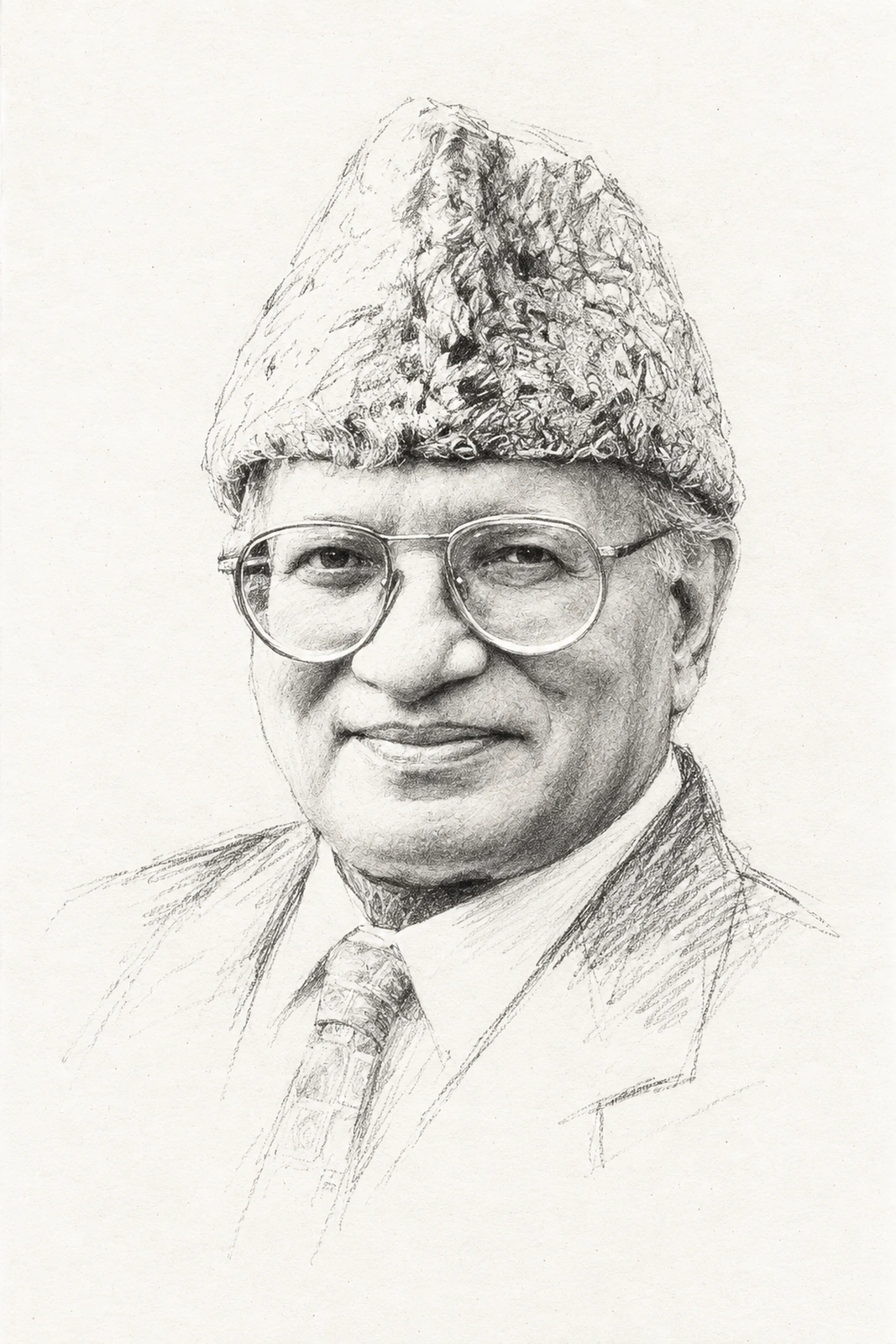
THE WRITTEN WORD
Miscellaneous Articles
Paragraph references are specific to this digital edition.
Miscellaneous Articles
This is an occasion for greetings and congratulations. Greetings to all the members of the Inner Wheel who are gathered here; congratulations to the distinguished leaders and to the chairperson who has been elected for the District.
Let us Reach Out, Promote Hope and Turn Giving into Living
NO. 301 INNER WHEEL DISTRICT (INDIA)
DISTRICT ASSEMBLY FOR
INSTALLATION CEREMONY OF DISTRICT CHAIRMAN
INAUGURAL ADDRESS
By
KIREET JOSHI
HONY. PRESIDENT DHARAM HINDUJA INTERNATIONAL CENTRE OF INDIC RESEARCH
at
10.30 A.M.
on
1st July, 1999
at
P.H.D. HOUSE, NEW DELHI
I
This is an occasion for greetings and congratulations. Greetings to all the members of the Inner Wheel who are gathered here; congratulations to the distinguished leaders and to the chairperson who has been elected for the District.
What is most inspiring is the underlying objective to which Inner Wheel is dedicated, namely, to promote true friendship, to encourage the ideals of personal service and to foster international understanding. And the theme of today on which we are dwelling with special emphasis, ‒ namely, to reach out, to promote hope, and to turn giving into living, — gives us a promise of a fruitful programme of thought and action.
There is a way of looking at things, particularly in the context of the worst things that are happening around us, according to which to give a message of hope is to strive to hope against hope. On the other hand, there is another way of looking at things, particularly in the context of the best things that are happening around us, according to which there is no difficulty which is not an opportunity, and there is no obstacle that is not meant to be overcome. I believe that the Inner Wheel is designed to promote this positive view, which I consider to be the fruit of mature and deliberate attitude of voluntary optimism.
And we can be sure that when women like you have come forward with commitment and dedication, hope will flourish and world will continue to realise those goals which can bring humanity nearer to its fulfilment.
II
Let us not minimise the problems that confront us and let us underline that we are living in super-normal times, and each one of us who wants to reach out is required to make a super-normal effort.
What is the sting of the problems of today?
Science and technology have made the world global, but the human consciousness has not become global; the organisational structures have become vast, but they are too vast for the blundering human ego and its limited ethical capabilities; humanity is driven towards a state of slavery of machinery that imposes upon it uniformity which, in turn, strangulates organic growth.
Population is increasing at an exponential rate. It took thousands of years to reach the first billion in early 19th century; it took only 100 additional years to reach the second billion; and it took only 30 more years to reach the third billion, and it took only fourteen years to reach the fourth billion. We are now approximating the 6th billion. But the size of the earth remains constant; resources are limited; serious environmental problems have arisen and, coupled with bombs and armaments, they have the potentiality of ruining the earth irreparably.
Humanity has, indeed, advanced and promoted ideals of social existence where the demands of liberty, equality and fraternity can be harmonised. But the human engineering employed in actualising these ideals has failed to knock the right door, which alone, when opened, can provide the required alchemy. It has failed to knock the door of spiritual resources, and instead it has been busy going round and round erecting structures that are bound to fail, ‒ the structures of Machine, Domination and Division.
Social institutions are breaking down, which adversely affect stability of families and interrelationships among members of families. Instruments and gadgets are multiplying so as to facilitate demands of comfort and appetites for pleasures.
Forces of Unreason are clashing with the light of the Reason.
Gravitational pulls of the lower nature are fighting against aspirations to rise higher, and this battle is so grim that drug addiction and diseases like AIDS are spreading fast all over the world.
Leaders of religions claim to possess the secrets of peace and harmony, but religions collide among themselves and show fissures of division and gulfs of distances that prevent the promise of the needed help.
Work ethos in our country is at a very low level. The unemployed struggle to get employment, but when employed, they cease to apply themselves meaningfully to their work.
Leaders in various fields, who should be able to provide the right leadership, manifest in a disturbing manner their self-centredness and lack of concern for others. Society is in a state of great malady.
The sting of the problem is the growing force of the gravitational pull of the lower impulses so as to weaken the forces of reason, goodwill and light of the spirit.
The kernel of the solution is the increase of the forces that can overcome the pulls of the lower nature and lift us on to the path of transformation by the illumining power of our spiritual and higher resources.
We need, therefore, people who can reach out. We need people who can keep hope alive, we need people who can turn giving into living.
III
Reaching out is the first step; but even that step needs to be prepared by a good deal of thought and vision. In order to reach out, we need to have a message; we need to be in a position to provide right counsel and right inspiration.
One of the areas where we can reach out is related to dominant minorities who monopolise the lion’s share of power and profit. The right counsel that can be given to these dominant minorities is that this is the hour to abdicate their domination and to impart their knowledge, their experience and their skills to all the other who have so far remained dormant and oppressed but who have now become awakened and are ready to climb to higher levels of thought and skills.
May I suggest that we need to reach out even to religious leaders. They need to be counselled that they can inspire people only if they can bridge the gulf between what is being professed and what is being practised. Similarly, when we reach out to political leaders, they need to be counselled that the present mistrust with which they are being viewed can be overcome only if they cease to live for themselves or for their families and demonstrate that people’s welfare is their central concern. Again, the businessmen need to be counselled that the wealth that they produce is to be utilised to create better and more qualified manpower and they can utilise their material prosperity for shaping the humane and harmonious civilisation. You will certainly reach out to husbands and wives who need to be counselled that their personal relationships can be durable and harmonious only if they overcome pride and prejudice, impatience and insistence on rigid opinions and personal preferences. As parents, they need to be counselled that children are not their possessions but their sovereigns, and that they should be in the centre of their care and concern. They need to be told that circumstances of life are to be so designed that they can serve as informal means of their children’s education, of their growth and development. Parents have to be ready to sacrifice their own pleasures and comforts so that highest interests of children are served under every circumstance. Professionals and experts, teachers and preachers, artists and artisans are to be counselled that it is by sharpening their abilities and their tools and by imparting their expertise to others that they can fulfil themselves and increase excellence among all members of society.
IV
Let us now come to the task of keeping hope alive. This task requires on our part engagement in activities of caring and sharing. Large sympathy, universality, charity and kindness, − these qualities have to be cultivated if we are to impart hope and warmth and enthusiasm to those who are weary and depressed. We ourselves need to have the faith that even though there may be darkness while walking in a tunnel, light awaits us at the end of the tunnel.
There are solid bases for keeping hope alive. Firstly, we have to realise that history tells us that humanity has the habit of survival, and that it has inexhaustible or even miraculous resources in its depths which can be brought forth in answer to the most difficult dangers or perils. Secondly, although we have at present a grim confrontation with the worst possibilities, there are also on the other hand, the best possibilities. At no time in the history was the message of international understanding put forth by the whole of humanity as the most desirable programme of action as it is today; at no stage in the history was the turn towards human unity as effective as it is today; at no stage of history have people spoken of total abolition of war as forcefully as today; and at no stage earlier was humanity as awakened and as gripped with the sense of necessity of ethical and spiritual transformation as today. It can, therefore, be said more confidently that not only shall we survive but also arrive at the gates of the bright future for all peoples of the world. We should, therefore, not fear to aspire and advocate the nourishment of hope in our hearts and in the hearts of our neighbours, − and who is not our neighbour in our present global village?
Our message of hope should be a message for positive action.
Let us discourage the attitudes of shrinkage, suffering or escape. Let us encourage the spirit of heroism, joy and victory.
Let us act and build bridges of understanding and fortresses and defences of peace and harmony. Let us realise and share with others the wisdom that circumstances are first to be endured and then combated so that newer and better circumstances are created. We can, let us affirm, shape our own destiny in the image of the light and glory of our inmost spirit.
There are many fields in which we can spread out to share and care and promote hope.
There are children who need to be cared for; there are children destitute and forlorn, who need to be rescued and brought into the field of meaningful learning. There are adolescents, whose capacities for dreaming have to be awakened, and whose habits and life styles have to be inspired by lessons of self-discipline and rigorous exercises of the heart, head and hand; drug addiction has to be prevented and newer healthy messages of the art and science of life are to be brought within the chambers of their thought and imagination.
Youths have to be understood and their wings of freedom and adventure have to be provided with the air and atmosphere of ever-ascending heights of boundless skies; their needs for work and their expanding abilities and skills have to be provided with meaningful responses in terms of opportunities, rewards and recognition.
Men and women in their partnership at various levels of life and work and in their responsibilities to their children have to be aided so that obstacles, − trivial, small or big, ‒ do not cause blockade in the paths of mutuality, progress and happiness; people in the midway of their lives have to be furnished with fresh ideas to update their knowledge and experience, to assimilate what they have learnt and to plunge again into greater responsibilities with new vigour and freshness.
The sick and the disabled need to be tended, healed and rehabilitated; lessons of physical fitness and mental care need to be brought to their homes and they have to be inspired to develop habits of physical exercise, healthy diet and fitness; the aged need not only sympathy but proper vocation and occupation; homes for the aged have to be multiplied with meaningful environment and facilities appropriate to their creative abilities, leisure and inner development.
V
Activities of caring and sharing have to ripen into the very breath and mode of our living. We have to realise that the entire world is ruled by a law of mutual giving; when we arrest the act of giving, — whether by coveting or by possessing, — we are actually assaulting the very principle of living. The self and the non-self, — each gets entangled in a tug of war, when each refuses to offer and sacrifice. Life is fire which is fuelled by constant acts of sacrifice, and miraculously, the fire of life is also the water of immortality. Self-giving is the secret of resurrection.
Let us, therefore, turn giving into living. In any case, there is no other way. When we think that we can live without giving, we think erroneously; awakened and truly illumined, we shall find that in the spontaneity of life we do not need either to take or to give, — there is simply a self-propelling course of giving which sustains itself, and our task is to allow it to happen without any obstacle arising from our narrow boundaries. Giving is living, and living then becomes limitless and universal.
Through what activities shall we express the gospel of living by giving? Let us suggest some of those activities in which we can get engaged in a constant process of self-giving.
Among the greatest and urgent concerns of humanity, the task of environmental protection should rank very high. Public awareness of environmental problems needs to be heightened; programmes of plantation of trees and of afforestation need to be multiplied vastly; development of eco-regions should be taken up in every district; non-conventional resources of energy should be harnessed in wider and wider areas.
Village reconstruction should aim at infra-structural development, with increasing emphasis on organic farming, cottage industries, multiple educational facilities, empowerment of weaker sections of society and strengthening facilities for marketing, co-operatives, and organisation of events relating to exhibitions, sharing of knowledge and sports. Programmes of urban development also need to be urgently attended with emphasis on population control, development of parks and creation of educational environment conducive to the development of learning society.
Integral development of groups of villages, districts and regions, empowerment of women and development of global consciousness among people, particularly among the growing generation − these and allied areas provide fruitful programmes of action.
As we begin to engage ourselves in one or the other of these areas, many others will come before our view, and we shall find that there is no dearth of avenues in which we can prove that we can turn giving into living.
VI
In the end, may I express my gratefulness to you all for inviting me to be a part of your programme. I consider this to be a privilege and hope to be with you again and again.
On Silence
I
The words "peace, calm, quiet, silence" have each their own shade of meaning.
Quiet is the condition in which there is no restlessness or disturbance.
(In Sanskrit, quiet is called achanchalata, अचचलता)
Calm is the condition of positive tranquility, which no disturbance can affect. (In Sanskrit, calm is called sthirata, स्थिरता)
Peace is a still more positive condition. It is a deepened calm there is settled and harmonious rest; there is a sense of deliverance; it is so positive that it amounts almost to a tranquil waveless ananda. (In Sanskrit, peace is called shanti, शांति)
Silence is the absence of all motion of thought or other vibration of activity. Silence is a state of Stillness. There can be varying degrees of depth of stillness. (In Sanskrit, silence is called nishchala nirvata, निश्चल निर्वाता)
It is in the state of deep calm or silence that one enters into cosmic consciousness which is limitless and even the calm of the Atman, the Self above, silent, immutable and infinite.
Peace is a sign of mukti; ananda moves towards siddhi, capacity of realising willed results.
Purity is to accept no other influence but only the influence of the Divine.
Purity means freedom from mixture. The Divine purity is that state when there is no mixture of the turbid ignorant movements of the lower nature.
When one has the experience of "solid block" feeling, then it indicates the descent of a solid strength and peace in the inner and external being. This is the sure foundation into which ananda, light, knowledge, bhakti can descend in the future and stand on it or play safely.
II
Techniques and methods of attaining quiet, calm, peace and silence.
All these states are very close together and bring each other.
Ordinary activity of the mind only creates surface ideas and representatives which are not true knowledge. Speech is usually the expression of the superficial nature; therefore, to throw oneself out too much in speech wastes the energy and prevents the inward listening which brings the word of true knowledge.
Thought can be a force which realises itself, but the ordinary surface thinking is not of that kind; there is in it more waste of energy than in anything else. It is in the thought that comes in a quiet or silent mind that there is power.
Instead of bubbling on the surface, one can go into one’s own depths and listen for what comes from a higher consciousness.
To retreat in a quiet place, where one does not expect any call is a very favourable condition.
To sit quietly and to sit comfortably or even to lie down comfortably is also very useful. Even walking leisurely or briskly (but without impatience) can also be a favourable condition.
The secret lies in the power of Concentration (ekagrata, एकाग्रता )
Concentration aims at bringing together all the threads of thoughts, feelings, vibrations on one single point.
The first step is to withdraw from everything that is not concerned with central point of concentration. (This is called pratyahara, प्रत्याहार).
The second step is to draw oneself again and again to the central point of concentration. (This is called dharana, धारणा)
The third step is to dwell for quite some time and even longer and longer on the central point of concentration. (This is called dhyana, ध्यान:).
The fourth step is to go beyond thought itself where one experiences the state of trance. (This is called samadhi, समाधि:).
In the lower state of samadhi, there is still some kind of thought; at a higher level, thought and the seed of thought are transcended or removed.
III
ON MEDITATION
Meditation is one kind of concentration.
Meditation begins with the chosen subject of concentration. Thus, if it be the Divine Love, then the mind should concentrate on the essence of the idea of God as Love; gradually various manifestations of Divine Love arise luminously not only to the thought, but in the heart and being and vision. The idea of God as Love, as it grows and develops, begins to mature in the experience of God as Love.
Afterwards the experience which has been attained has to be dwelt on more and more till it becomes a constant experience and finally the law of the being.
IV
ON CONTEMPLATION
Contemplation is another kind of concentration. It is more strenuous than meditation.
The method here is to fix the whole mind in concentration on the essence of the idea only. Here, the idea does not develop, but the idea itself is held in the centre of consciousness. By steady concentration on that essence of the idea, that which is behind the idea becomes realised. There is absorbed or ecstatic contemplation of the object. If one contemplates on the idea of God as Love, then one simply fixes one’s concentration on the essence of that idea, one does not develop this idea but one fixes concentration without wavering. In due course, the luminous experience of God as Love bursts upon the consciousness. Subsequently, the state in which we rise, must still be called down to take possession of the lower being, to shed its light, power and bliss on our ordinary consciousness.
V
ON SILENT WITNESSING
A third process of concentration is to watch or witness in-coming rush of thoughts very quietly; one stands back from the mental action altogether, not participating in but simply watching it; the time comes when the mental action gets tired of its leaping and running, and it falls into an increasing and finally an absolute quiet.
It may also be helpful if one, while watching the rush of thought movement, rejects the thoughts before they arrive near the brain. One casts thoughts away from the mind whenever they come and one holds firmly on the peace of the being which one finds to be within oneself as always self-existent.
When this self-existent peace is unveiled, a great calm settles on the being and there comes usually with it the perception and experience of the all-pervading silent Brahman, and begins to feel that everything else is a mere procession of forms like images cast on cinematographic screen.
VI
Whether by meditation or by contemplation, or by witnessing consciousness, when calm and silence is obtained, strenuous concentration will be found no longer necessary. A free concentration of will using thought merely for suggestion and the giving of light to the lower members will take its place.
By swifter or slower degrees, according to the previous preparation and purification of the body, life and mind, the knowledge of the Divine takes possession of our consciousness on all its planes and the image of the Divine is formed in our human existence even as it was done by the old Vedic Sadhakas.
VII
RENUNCIATION
Concentration and purification may be described as the right arm of the body of Yoga. Renunciation may be described as the left arm of the body of Yoga.
By purification and concentration we confirm in ourselves the truth of things, truth of being, truth of knowledge, truth of love, truth of works. By renunciation, we seize upon the falsehoods, pluck up their roots and cast them out of our way so that they shall no longer hamper by their persistence, their resistance or their recurrence the happy and harmonious growth of our divine living.
Renunciation of life is not the goal of life. Renunciation must be only of all that is other than opposed to the divine fulfilment. There should also be a progressive renunciation of all that is a lesser or only a partial achievement.
We shall have no attachment to our life in the world; if that attachment exists, we must renounce it and renounce utterly; but neither shall we have any attachment to the escape from the world; if that attachment exists, that also we must renounce and renounce it utterly.
The supreme advice that is given is that of an inward renunciation.
We are told that attachment and desire must be utterly cast out; this does not mean that there is nothing at all that we shall love, nothing in which we shall take delight. For attachment is egoism in life and not life itself; desire is limitation and insecurity in the seeking for pleasure and satisfaction and not the seeking after the divine delight in things.
Instead of attachment and desire, we must have a universal love. This love must be calm and yet eternal intense beyond the brief vehemence of the most violent passion. We must have a delight in things rooted in a delight that does not adhere to their forms but that which they conceal in themselves and that embraces the universe without being caught in its meshes.
METHODS AND TECHNIQUES OF RENUNCIATION
The most important method is first to turn inwards and to undertake introspection.
We look within ourselves without self-pity or self-flattery. As a scientist looks with his microscope into the object of investigation, even so, we look into ourselves as a scientist of self-knowledge.
There are two things which normally escape our attention, self-will in thought and self-will in action. These are to be taken note of and renounced.
Self-will means an egoism in the mind which attaches itself to its preferences, its habits, it’s past or present formations of thought and view and will. This attachment must be first observed and then entirely renounced from the mind.
By this renunciation, we must keep ourselves open to the higher Word from above and to the light of the thought that carries in it its own opposites.
Self-denial is a necessary discipline because our heart is ignorantly attached. Inhibition of pleasure is necessary because our senses are caught and clogged in the mud-honey of sensuous satisfactions; objects of pleasures should be rejected because the mind fixes on these objects and we are prevented from going within ourselves. External renunciation is not the essential, but even that is necessary for a time, indispensable in many things and sometimes useful in all.
A complete external renunciation is a stage through which the soul must pass at some period of its progress, ‒ though it should always be without self-willed violence: and fierce self-torturing.
In the end, this renunciation or self-denial is always an instrument and the period for its use passes.
Simultaneously with renunciation, one must practise the truth of the following two verses from the Ishopanishad:
"But he who sees everywhere the Self in all existences and all existences in the Self, shrinks not thereafter from anything."
"He in whom it is the Self-Being that has become all existences that are Becomings, for he has the perfect knowledge, how shall he be deluded, whence shall he have grief who sees everywhere oneness?"
VIII
EQUALITY
Knowledge is the consciousness of unity with the One.
Knowledge is tested when in any relation with the many different beings and existences of the universe, one can maintain an equal oneness with all.
Where there is inequality in the soul, there is an evidence of (i) motion of desire, (ii) play of personal will, feeling and action, (iii) activity of joy and grief or (iv) that disturbed and disturbing delight which is not true spiritual bliss but a mental satisfaction bringing in its train inevitably a counterpart of recoil of mental dissatisfaction.
Where there is inequality of soul, there is deviation from knowledge, loss of steadfast abiding in the all-embracing and all-reconciling oneness of the Brahman and unity of things.
In the attainment of equality, one knows in the midst of one’s action that one is free.
METHODS AND TECHNIQUES:
The Bhagavadgita is distinctive in describing equality as the heart of Yoga. (समत्वं योग उच्यते) Contemplation or meditation on various verses of the Gita where equality enjoined is an extremely useful aid in developing equality in our consciousness.
The following verses from the Bhagavadgita may, therefore, be studied very quietly and repeatedly:
सुखदु:खे समे कृत्वा लाभालाभौ जयाजयौ ततो युद्धाय युज्यस्व नैवं पापमवाप्स्यसि ,38
Being equal minded towards happiness and suffering, gain and loss, victory and defeat, engage yourself in the battle.2.38
भवार्जुन निर्द्वन्द्वो नित्यसत्त्वस्थो निर्योगक्षेम आत्मवान् , 45
Become, O Arjuna, free from dualities, ever-balanced, unconcerned with acquisition and preservation and seated in the inmost self. 2.45
योगस्थ: कुरु कर्माणि सङ्गं त्यक्त्वा धनञ्जय सिद्ध्यसिद्ध्यो: समो भूत्वा समत्वं योग उच्यते 2,48
Perform action, Arjuna, being fixed in Yoga, renouncing attachments and seated in equality in regard to success and failure. Equality is verily Yoga. 2.48
दु:खेष्वनुद्विग्नमना: सुखेषु विगतस्पृह: वीतरागभयक्रोध: स्थितधीर्मुनिरुच्यते 2, 56
He whose mind is not perturbed by adversity, who does not crave for happiness, who is free from attachment, fear and honour, -- he is the man of wisdom with intelligence fixed in equality. 2.56
यदृच्छालाभसन्तुष्टो द्वन्द्वातीतो विमत्सर: सम: सिद्धावसिद्धौ च कृत्वापि न निबध्यते 4, 22
He who is content with what he obtains without fever of strain, he who has transcended dualities, and he who is without envy and is equal in success and failure, he remains free even though engaged in action. 4.22
विद्याविनयसम्पन्ने ब्राह्मणे गवि हस्तिनि शुनि चैव श्वपाके च पण्डिता: समदर्शिन: 5, 18
Men of wisdom are those who have an equal eye for the brahmin imbued with learning and humility, a cow, an elephant, a dog and the despised. 5.18
इहैव तैर्जित: सर्गो येषां साम्ये स्थितं मन: निर्दोषं हि समं ब्रह्म तस्माद् ब्रह्मणि ते स्थिता: , 19
Those whose mind is seated seated in equality have conquered phenomenal existence here itself. As the Brahman is flawless and equal in all, even so they stand established in the Brahman. 5.19
न प्रहृष्येत्प्रियं प्राप्य नोद्विजेत्प्राप्य चाप्रियम् स्थिरबुद्धिरसम्मूढो ब्रह्मविद् ब्रह्मणि स्थित: 5, 20
He who is seated in the Brahman, and who is the knower of the Brahman, fully awakened with stable intelligence, ‒ he does not get excited by obtaining what is pleasant and does not get aggrieved by obtaining what is unpleasant. 5.20
जितात्मन: प्रशान्तस्य परमात्मा समाहित: शीतोष्णसुखदु:खेषु तथा मानापमानयो: 6, 7
The highest self of the one who is tranquil and who has conquered the lower self is seated in equality in regard to cold and heat, pleasure and pain, honour and dishonour.6.7
ज्ञानविज्ञानतृप्तात्मा कूटस्थो विजितेन्द्रिय: युक्त इत्युच्यते योगी समलोष्टाश्मकाञ्चन: 6, 8
He who is satisfied with the knowledge of the essence and the knowledge of manifestation, who remains unshaken, who has conquered the senses and to whom clod, stone and gold are the same, he is called a Yogin. 6.8
सर्वभूतस्थमात्मानं सर्वभूतानि चात्मनि
ईक्षते योगयुक्तात्मा सर्वत्र समदर्शन: 6, 29
He who is settled in Yoga has an equal eye everywhere, and he sees himself in all beings and all beings in himself. 6.29
यो मां पश्यति सर्वत्र सर्वं च मयि पश्यति तस्याहं न प्रणश्यामि स च मे न प्रणश्यति 6, 30
He who sees Me everywhere and sees all in Me, he never becomes lost to Me, nor do I become lost to him. 6.30
सर्वभूतस्थितं यो मां भजत्येकत्वमास्थित: सर्वथा वर्तमानोऽपि स योगी मयि वर्तते 6, 31
He who, seated in all beings, worships Me with steadfast oneness, he is a Yogi living in Me even though spread out in every way. 6.31
आत्मौपम्येन सर्वत्र समं पश्यति योऽर्जुन सुखं वा यदि वा दु:खं स योगी परमो मत: 6, 32
He who sees everywhere an image of himself, and he who has an equal eye for happiness and suffering, Arjuna, he is regarded as the supreme yogin. 6.32
अद्वेष्टा सर्वभूतानां मैत्र: करुण एव च निर्ममो निरहङ्कार: समदु:खसुख: क्षमी 12, 13
He who hates none and he who has friendliness and compassion for all, who is selfless, devoid of egoism, equal in suffering and happiness, forgiving......
सन्तुष्ट: सततं योगी यतात्मा दृढनिश्चय: मय्यर्पितमनोबुद्धिर्यो मद्भक्त: स मे प्रिय: 12, 14
Ever content, self-controlled and possessed of firm conviction, and one whose mind and intelligence are consecrated to Me, that Yogi, My devotee, is dear to Me.12.13 - 14
यस्मान्नोद्विजते लोको लोकान्नोद्विजते च य: हर्षामर्षभयोद्वेगैर्मुक्तो य: स च मे प्रिय: , 15
He by whom the world is not afflicted and whom the world cannot afflict, he who is free from joy, honour, fear and anxiety, he is dear to Me.12.15
अनपेक्ष: शुचिर्दक्ष उदासीनो गतव्यथ: सर्वारम्भपरित्यागी यो मद्भक्त: स मे प्रिय: , 16
He who is devoid of wants, who is pure and efficient, seated high above and free from all trouble, and he who has renounced all egoistic initiative, and who is My devotee, − he is dear to Me.12.16
यो न हृष्यति न द्वेष्टि न शोचति न काङ् क्षति शुभाशुभपरित्यागी भक्तिमान्य: स मे प्रिय: , 17
He who does not get excited nor does he get depressed, he who envies none and desires nothing, who has given up all good and evil, and he who is full of devotion, he is dear to Me.12.17
सम: शत्रौ च मित्रे च तथा मानापमानयो: शीतोष्णसुखदु:खेषु सम: सङ्गविवर्जित: , 18
तुल्यनिन्दास्तुतिर्मौनी सन्तुष्टो येन केनचित् अनिकेत: स्थिरमतिर्भक्तिमान्मे प्रियो नर: , 19
He who is equal to the enemy and the friend and he who remains equal in honour and dishonour, in cold or heat and in pleasure and pain and who is free from attachment, To whom censure and praise are equal, who is silent, and who is content with anything, homeless, steady-minded, full of devotion, ‒ that man is dear to Me.12.18 - 19
समं सर्वेषु भूतेषु तिष्ठन्तं परमेश्वरम् विनश्यत्स्वविनश्यन्तं य: पश्यति स पश्यति , 28
Because he sees the Lord, seated equally everywhere, and since he does not destroy self by the self, therefore, he attains to the Supreme goal.13.28
समं पश्यन्हि सर्वत्र समवस्थितमीश्वरम् न हिनस्त्यात्मनात्मानं ततो याति परां गतिम् , 29
Because he sees the Lord, seated equally everywhere, and since he does not destroy self by the self, therefore, he attains to the Supreme goal.13.29
समदु:खसुख: स्वस्थ: समलोष्टाश्मकाञ्चन: तुल्यप्रियाप्रियो धीरस्तुल्यनिन्दात्मसंस्तुति: , 24
मानापमानयोस्तुल्यस्तुल्यो मित्रारिपक्षयो: सर्वारम्भपरित्यागी गुणातीत: स उच्यते 14, 25
He who is equal in misery and happiness, settled in well-being, viewing a clod, stone and gold alike, free from preference for the pleasant and unpleasant, firm and the same in censure and praise, - He who prefers neither honour nor dishonour, neither friend nor foe and he who has renounced all egoistic initiative, he is said to have transcended the Gunas ( modes of Nature).14.24 - 25
न द्वेष्ट्यकुशलं कर्म कुशले नानुषज्जते त्यागी सत्त्वसमाविष्टो मेधावी छिन्नसंशय: , 10
He who does not desire to give up a disagreeable work or who is not attached to an agreeable work, and he who is imbued with sattwa and a steady mind where all doubts have been dispelled, he is the renouncer.18.10
ब्रह्मभूत: प्रसन्नात्मा न शोचति न काङ् क्षति सम: सर्वेषु भूतेषु मद्भक्तिं लभते पराम् , 54
He who has become one with the Brahman, whose self is ever glad, who desires for nothing and grieves for nothing, and he who is equal to all beings, he attains to supreme devotion for Me.18.54
In the course of development of equality, there are certain states which are semblances of equality, but they should be distinguished from the profound spiritual equality which the Gita teaches. For example, (i) there is an equality of disappointed resignation, (ii) an equality of pride, (iii) an equality of hardness and indifference. All these are egoistic in their nature; they must be rejected or transformed into the true quietude.
There are three phases of the development of equality:
(1) In the first phase of the development of equality, the real discipline begins with the movement towards mastery over those things from which we are at first inclined merely to flee.
It consists of enduring the shock of things, painful and pleasurable. It is complete when the soul can bear all touches without being pained or attracted, excited or troubled.
This stage of self-discipline is called Stoic self-discipline.
The stoic self-discipline is called, in Sanskrit, titiksha, तितिक्षा:
But this Stoic self-discipline is not necessarily an unmixed good, since it might lead to insensibility and inhuman isolation without giving the true spiritual state.
The Stoic equality is justified only as an element in the discipline of the Gita, but not as a goal. It is to be modified and heightened at a still higher level.
(2) The second phase of discipline consists of arriving at what may be called philosophical equality. It begins with a perception that there is in our being a lower self and a higher self, and that the lower self is to be conquered by the higher self.
The higher self is not insensitive and inhuman even when it is capable of mastery over common affections of our human nature. The higher self is discovered, first, by the power of the buddhi, the discerning mind. One begins to discover by means of introspective and discerning mind that all inequalities and turbulences belong to the lower self and that there is an undisturbed higher self which truly remains unaffected. This higher self regards alike clod and stone and gold, tranquil and self-poised in suffering and in happiness and honour and disgrace. In the perception of the higher self one becomes equal in soul to friend and enemy and to neutral and indifferent, because one sees that these transitory relations are born of the changing conditions of life.
(3) But there is a still higher third stage of equality.
Philosophic equality, which is attained in the second phase of discipline, is maintained by the power of the discerning mind and as long as equality is maintained by that power it does not give a sure foundation. As the Gita points out, "Even the mind of the wise man who labours for perfection is carried away by the vehement insistence of the senses." Therefore, one has to rise still higher to what may be called a divine birth.
In this new birth of consciousness, one finds the Divine not only in oneself, but in all beings. In one’s unity with all, one is filled with intense sympathy and oneness. One is no more intent on one’s lonely salvation. One even takes upon oneself the burden of the happiness and sorrow of others by which one is not oneself affected or subjected.
On who lives in this third stage of equality becomes a many-sided universal worker for the good of the world. In the words of the Gita he is युक्त कृष्णकर्माकृति (wholly engaged in fullness of work). One also becomes a Bhakta, a lover and a devotee of the Divine, a lover who loves God wherever he finds Him and who finds Him everywhere and what he loves, he does not disdain to serve nor does his action carry him away from the bliss of union, since all his acts proceed from the One and to the One. In this third stage, one arrives at a large synthetic equality in which all is lifted up into the integrality of the divine being and the divine nature.
IMPORTANT WARNING
It must be noted that the perception of equality does not mean blindness to differences and variations of expressions. It is a perception which goes behind differences and variations. It is the perception of the Complete and Immutable which dwells within.
This sense of equality seeks to understand and master the meaning of all happenings in the world, whether they are painful or pleasurable, whether they bring defeat or success, honour and disgrace, good repute or ill-repute, good fortune or evil fortune.
It will seek to understand and see the will of the Master in all works and results and all these as steps in the evolving expression of the Divine. It will perceive that all things move towards the Divine event. It perceives that each experience of suffering and want, of joy and satisfaction, is a necessary link in the carrying out of a universal movement which it is our business to understand and support.
This does not mean also that in the state of equality, one will remain a helpless spectator of events as they occur. On the contrary, one will enter into depths of quietude where one will strive to receive the message of the Divine Will which is always at work and which has always a message for the instrument who wants to carry out the Divine Will.
One is called upon to execute the Divine Will with full care and diligence.
But even in carrying out the Divine Will, one will be unshaken and will not be guided by the sense of revolt or condemnation but will make use of all the materials given in the world situation so as to marshal them for carrying out the Divine Will.
In that high status of spiritual equality, failure will be admitted as a passage as calmly as success until the hour of the divine victory arrives. The inner soul, the mind and the body will remain unshaken by acutest sorrow and suffering and pain if in the divine dispensation they come to us.
Thus in this great state of equality, one will continue steadily on one’s way meeting all things with an equal calm until one is ready for a more exalted status and can enter into the supreme and universal Delight, ananda.
Sense of Possession and Proprietorship: Methods and Techniques of its Elimination
April 19, 1996
I
The following words will need to be defined: (a) Possession; (b) Proprietorship; (c) Ego; (d) Egoism; (e) Ego and the Individual; (f) Freedom.
The following definitions are suggested:
POSSESSION:
Possession is a sense or fact of holding an object as one’s own and deriving there from personal enjoyment or satisfaction as also consequential sorrow because of an attack on the sense and fact of possession or loss thereof.
PROPRIETORSHIP:
Proprietorship is the sense or fact of one’s exclusive right of owning, possessing and handling an object or property as also the exclusive right to deal with that object or to dispose it off in any way that one desires in respect of it.
EGO:
Ego is a sense of finite individual that it is self-existent and that it is fundamentally free to think, feel and act without constraint from anywhere else. It is a self-contradictory sense which constantly wants to remain what it is while, at the same time, desiring to be other than itself by means of aggrandisement or by multiplying its relationships with the not-self.
EGOISM:
Egoism is the sense that one is different from others and superior to others in one respect or the other; it is riddled with the sense of rivalry, jealousy and pride.
EGO AND THE TRUE INDIVIDUAL (JIVA):
Whereas the Ego is a sense of the finite as self-existent, Jiva or the true individual is a self-conscious portion of the Infinite, fully aware that one is entirely dependent on the Infinite and lives in joy by mutuality of relationship with the Infinite and with the creatures of the Universe.
FREEDOM:
Egoistic consciousness has a false sense of freedom to do whatever it decides to do, while in fact it is entirely bound by chains of various qualities and threads of activities issuing from universal energies. True freedom is enjoyed by the true individual, in his experience, of his being above all qualities and threads of activities of the universe, and in action, united with the will of the Supreme Master of the Universe who is entirely free to initiate, execute and accomplish any possible activity.
II
BASIC STATEMENTS
I. Indivisibility of Reality:
In this whole world there is indivisible reality which appears to be divided. अविभक्तं च भूतेषु विभक्तमिव च स्थितम् भूतभर्तृ च तज्ज्ञेयं ग्रसिष्णु प्रभविष्णु च (Bhagavad Gita)
He is undivided and yet He seems to be divided in beings. He is to be known as supporting creatures, destroying them and creating them afresh.
This indivisibility can be seen at three levels:-
- In the universe as a whole where there is law of reciprocity;
अन्नाद्भवन्ति भूतानि पर्जन्यादन्नसम्भव: यज्ञाद्भवति पर्जन्यो यज्ञ: कर्मसमुद्भव: 3. 14
From food creatures come forth; the production of food is from rain; from sacrifice rain comes into being and sacrifice is born of action (karma).
कर्म ब्रह्मोद्भवं विद्धि ब्रह्माक्षरसमुद्भवम् तस्मात्सर्वगतं ब्रह्म नित्यं यज्ञे प्रतिष्ठितम्
Know the origin of Karma (of the nature of sacrifices ) comes from Brahman (the Veda) and the brahman comes from the Imperishable. Therefore, the all-pervading brahman ever centres round the sacrifice.
- In the operation of universal Prakriti which is like a huge machine mounted in motion;
ईश्वर: सर्वभूतानां हृद्देशेऽर्जुन तिष्ठति भ्रामयन्सर्वभूतानि यन्त्रारूढानि मायया . 61
The Lord dwells in the heart of all beings; O Arjuna, and by His Power (Maya) causes all beings to revolve as though mounted on a machine.
- Prakriti carries out the will of the Supreme.
मयाध्यक्षेण प्रकृति: सूयते सचराचरम् हेतुनानेन कौन्तेय जगद्विपरिवर्तते 9. 10
Under my guidance the prakriti gives birth to all things, moving and unmoving because of this O, son of Kunti (Arjuna), the world revolves.
II. Our Ignorance:
These great truths are not seen because of our ignorant psychology. This is particularly manifest in our sense-experience, in our experiences of the mental intelligence, in the operations of intellectual intelligence, and in the operations of egoistic intelligence. The nodal point of ignorance is egoism which obliges every individual to maintain a false account. To the large vision of universality, all things are equally important, to the egoistic consciousness the egoistic individual is all-important, and therefore, enters into its account book only what seems to be profitable to the egoistic individual.
Hence, every egoistic individual is in pursuit of amassing within oneself the maximum of the universal wealth which is available and sustains oneself by possession of whatever booty one can draw out from his environment and all-pervading universe.
प्रकृते: क्रियमाणानि गुणै: कर्माणि सर्वश: अहङ्कारविमूढात्मा कर्ताहमिति मन्यते . 27
Actions are done by modes of nature (gunas of prakriti). He, whose mind is deluded by the ego, thinks "I am the doer".
This gives rise to the psychology of "mine" and "thine".
III. Consequences of Egoistic Psychology:
The egoistic psychology is constantly besieged by the following: (i) dualities and bewildering multiplicity; (ii) doubts; (iii) helplessness under the pressure of desires; (iv) anger when desires are thwarted; (v) loss of memory under the pressure of anger; and (vi) consequential ruin of intellectual discrimination.
व्यवसायात्मिका बुद्धिरेकेह कुरुनन्दन बहुशाखा ह्यनन्ताश्च बुद्धयोऽव्यवसायिनाम् 2. 41
In this, o joy of the Kurus (Arjuna), the resolute (decided) understanding is single; but the thoughts of the irresolute (undecided) are many ‒ branched and endless.
ध्यायतो विषयान्पुंस: सङ्गस्तेषूपजायते सङ्गात्सञ्जायते काम: कामात्क्रोधोऽभिजायते . 62
When a man thinks of objects in his mind attachment to them arises. From attachment arises desire and from desire arises anger.
क्रोधाद्भवति सम्मोह: सम्मोहात्स्मृतिविभ्रम: स्मृतिभ्रंशाद् बुद्धिनाशो बुद्धिनाशात्प्रणश्यति . 63
From anger arises delusion; from delusion loss of memory; from loss of memory, the destruction of discrimination and from the destruction of discrimination he perishes.
The egoistic psychology tends often to get exaggerated in demonic qualities which impel one to think as follows: "I have gained this today. I will get the rest tomorrow."
आशापाशशतैर्बद्धा: कामक्रोधपरायणा: ईहन्ते कामभोगार्थमन्यायेनार्थसञ्जयान् . 12
Bound by hundreds of ties of desire given over to lust and anger, they strive to secure by unjust means hoards of wealth for the gratification of desires.
इदमद्य मया लब्धमिमं प्राप्स्ये मनोरथम् इदमस्तीदमपि मे भविष्यति पुनर्धनम् . 13
This today has been gained by me; this desire I shall attain; this is mine, and this wealth also shall be mine in future.
These demonic qualities lead individuals to deeper abyss of ignorance from where they can be only rescued with great difficulty. There is also increasing deviation from one’s own truth, one’s own welfare and one’s own true fulfillment. Ultimately, partial successes end up in series of great failures.
III
METHODS AND TECHNIQUES OF ELIMINATION OF SENSE OF POSSESSION AND PROPRIETORSHIP
1.Realise that the self is the friend of the Self and the self is the enemy of the Self. By means of the higher self, control the lower self.
उद्धरेदात्मनात्मानं नात्मानमवसादयेत् आत्मैव ह्यात्मनो बन्धुरात्मैव रिपुरात्मन: 6. 5
Let a man lift himself by himself; let him not lower himself for the self alone is the friend of the self and the self alone is the enemy of the self.
- Go back to the perception of the universal principle of indivisibility and realise that no individual can really escape from the indivisible movement of Prakriti and nobody can escape the decree of the Divine’s Will.
सर्वभूतस्थमात्मानं सर्वभूतानि चात्मनि ईक्षते योगयुक्तात्मा सर्वत्र समदर्शन: 6. 29
He whose self is harmonised by yoga, sees the Self abiding in all beings and all beings in the Self, everywhere he sees the same.
- Realise that an individual is a part of a scheme of the Whole and one should fall in line with the law of reciprocity.
अक्षरं ब्रह्म परमं स्वभावोऽध्यात्ममुच्यते भूतभावोद्भवकरो विसर्ग: कर्मसञ्ज्ञित: 8. 3
Brahman (or the Absolute) is the Imperishable (Akshara) Supreme (higher than all else). The essential nature is called to be the Individual Self (Adhyatma, He who dwells in the body). Karma is the name given to the creative force that brings beings into existence.
- The best way of applying the law of reciprocity is by adopting the law of sacrifice, Yajna.
नियतं कुरु कर्म त्वं कर्म ज्यायो ह्यकर्मण: शरीरयात्रापि च ते न प्रसिद्ध्येदकर्मण: 3. 8
Do then perform your bounden duty; for action is superior to inaction. Even by inaction the maintenance of the physical body would not be possible for you. यज्ञार्थात्कर्मणोऽन्यत्र लोकोऽयं कर्मबन्धन: तदर्थं कर्म कौन्तेय मुक्तसङ्ग: समाचर 3. 9
Except in the case of action for the sake of sacrifice this world is bound to work. Therefore, O son of Kunti (Arjuna) perform your action as a sacrifice, free from all attachment.
गतसङ्गस्य मुक्तस्य ज्ञानावस्थितचेतस: यज्ञायाचरत: कर्म समग्रं प्रविलीयते 4. 23 Of a person who is unattached, who is liberated whose mind is firmly established in wisdom who acts for the sake of sacrifice his whole action melts away.
Discover that behind the Ego, there is Swabhava. Behind Swabhava is the Jiva and behind Jiva is the Supreme Lord.
This knowledge will enable the individual to know one’s own Swadharma on the lines of his Swabhava and Swadharma will give him the knowledge of Swakarma.
श्रेयान्स्वधर्मो विगुण: परधर्मात्स्वनुष्ठितात् स्वधर्मे निधनं श्रेय: परधर्मो भयावह: 3. 35 One’s own duty, though devoid of merit is better than the duty of another even if well performed. Better is death in the performance of one’s own duty. The duty of another is full of fear.
Then he will realise a progressive way of coming out of the psychology of division and emerging into the psychology of indivisibility.
In doing so, he will move away from Tamas into Rajas and from Rajas to Sattwa.
Greater wisdom begins to dawn at a still higher level. He begins to learn the operations of the Divine’s Will in the world and comes to realise how to discover the Divine’s Will. This method and technique of the discovery of the Divine’s Will has three steps:
a. To do actions and to offer the results of actions to the Divine.
कर्मण्येवाधिकारस्ते मा फलेषु कदाचन मा कर्मफलहेतुर्भूर्मा ते सङ्गोऽस्त्वकर्मणि 2. 47
Your endeavour is in action and not in its fruits. Let not the fruit of action be your concern, nor let there be in you any attachment to inaction.
b. To offer the actions also to the Divine.
यत्करोषि यदश्नासि यज्जुहोषि ददासि यत् यत्तपस्यसि कौन्तेय तत्कुरुष्व मदर्पणम् 9. 27
Whatever you do, whatever you eat, whatever you offer in sacrifice, whatever you give away as gift; whatever austerity you practise, do that as an offering to Me, O son of Kunti (Arjuna).
चेतसा सर्वकर्माणि मयि सन्न्यस्य मत्पर: बुद्धियोगमुपाश्रित्य मच्चित्त: सततं भव . 57
Mentally resigning all deeds to Me, regarding Me as the highest goal, resorting to steadfastness in understanding, do you ever fix your mind on Me.
c. To offer oneself entirely to the Divine.
मन्मना भव मद्भक्तो मद्याजी मां नमस्कुरु मामेवैष्यसि युक्त्वैवमात्मानं मत्परायण: 9. 34
Fix your mind on Me; be devoted to Me; worship Mei bow down to Mei thus having made yourself steadfast in Me, taking Me as the Supreme Goal, you shall come to Me, the Self.
- One becomes free from the sense of possession and proprietorship.
In the final analysis, one comes to realise that by complete surrender to the Divine’s Will, one becomes liberated even while all actions are performed through one’s instrumentality by the Divine Himself.
आपूर्यमाणमचलप्रतिष्ठं समुद्रमाप: प्रविशन्ति यद्वत् तद्वत्कामा यं प्रविशन्ति सर्वे स शान्तिमाप्नोति न कामकामी 2.70
He attains peace, into whom all desires enter as waters enter the ocean, which though ever being filled is ever motionless; but not he who hugs his desires.
विहाय कामान्य: सर्वान्पुमांश्चरति नि:स्पृह: निर्ममो निरहङ्कार: स शान्तिमधिगच्छति
That man attains peace who has abandoned all his desires and moves about without longing, without selfishness and without vanity.
Free Will
Is human being free or not?
The answer is neither yes nor no.
Freedom is a matter of growth. At the lowest level one feels completely bound to the necessities of life, even an alternative does not present itself.
At a next higher level some alternatives become conceivable but not actually translatable. At a next higher level alternatives are really presented and there is even an actual exercise of choice, but one knows that one’s choice was bound and one could not have chosen otherwise.
At a still higher level, alternatives are presented, there is even exercise of choice and at the time of making a choice one feels that one was free to make a choice. But retrospectively one finds that one’s choice was not free.
At a next higher stage, there is presented to an individual a choice of good and evil. Here there is a conflict in the consciousness but more often than not, passions are so strong that one feels entirely incapable of choosing anything else than what passion dictates.
At next higher levels one strongly begins to feel that even when one was driven to do an evil action, one could still have chosen good in preference to evil. At this stage one begins to have not only a feeling of freedom but even an actual experience of the exercise of free will. But even then there is a mixture of pull towards evil and pull towards good and the life of battle between good and evil. A point is reached when one begins to choose good more and more frequently even when evil could have been chosen.
At a still higher level one finds that one is bound to choose good and he becomes incapable of choosing any one of the goods presenting before him. This is the stage where one begins to grow in oneness with Supreme will which is forever free.
Having reached this stage, one finds retrospectively that even at the lowest level of bondage there was the free acceptance of one’s condition of bondage and one could have chosen not to come at the stage of bondage at all. In other words, one finds that all bondage is in the ultimate analysis a freely chosen bondage.
Information, Knowledge & Spirituality - Questions and Answers
Q. 1. What do you think is the relationship between Information and knowledge?
Ans.: Information may be viewed as disclosure of and from a source that has some kind of thrust, which is often called in different contexts an urge or nisus or élan. The disclosure contains within itself some kind of an image or figure or symbol which normally expresses only partially the source from which the disclosure is generated. But disclosure implies its impingement or its imprint or impact on a surface which has a minimum degree of sensitivity so as to become sensitized by what is impinged on it and is stimulated to an effort to assimilate the impact, successfully or unsuccessfully and to get modified perceptively or imperceptively by that effort.
Normally, in our ordinary experience, information is a disclosure of a fact, which is expressed in some kind of language, and it is that expression that impinges on our sensitivity which, in its turn, is stimulated to assimilate what is impinged upon it, and as a consequence it gets modified. In the effort of assimilation of what is impinged on our surface sensitivity, we feel that the fact which made an impact on our surface sensitivity through an expressive language is seized or understood. Consequently, there is some kind of modification in our sensitive surface which is felt to be in a state of satisfaction or in a state of dissatisfaction and a state of further enquiry or activity. Normally, disclosures relate to particulars of facts, and sets of disclosures are only snippets. But even then snippets are capable of causing stimulation with consequent states of satisfied quietude or more or less insensitive indifference or an activity.
Normally, we make a distinction between information and knowledge. By information we mean disclosure of particular facts which are grasped by us in isolation from other facts and assimilated by us only as snippets without any holistic context or significance. Knowledge, on the other hand, involves a higher activity in which what is assimilated as disclosure of facts or particulars and grasped in form of snippets is churned by an effort that aims at enlargement of data, of context and by ideative movement that manifests an urge for comprehensiveness. This enlargement is progressive in character and it rises, with the help of concepts of universals – whether real or fictional. As a result, when facts get sufficiently supplemented by further data, and when this enlargement comes to be grasped in terms of some universal ideas and in some sense of comprehensiveness, - then the resultant packet of data, universal ideas and the relative sense of completeness can properly be called the packet of knowledge. Since this movement is progressive, the packet that we call knowledge rises indefinitely, and we able to reach higher and higher degrees of knowledge at a very high level of scientific and philosophical refinement. Knowledge tends to become belief that has resulted from an exercise at evaluation conducted by alternative standards of validity and truth.
At a still higher level, a distinction is made between knowledge and wisdom. In the context of this distinction, knowledge is perceptive and ideative grasp of totality or totalities through a medium which is always divisive, in terms of experience and in terms of accurate and fruitful application of whatever level of experience that has been gained. Wisdom, on the other hand, not only understands all that is contained in knowledge but it over-stands above what is contained as content of knowledge; wisdom, therefore, stems from a faculty that not only grasps but holds, no more conceptually, but in experience the totality or totalities that are viewed or grasped; and as a consequence, wisdom has in it an inborn skill of right and fruitful application in situations and of detecting secrets whereby solutions can be proposed and applied.
Q. 2. What is the relationship between Information and Evolution?
What has been said above is, of course, very rough, and it is presented without adequate elaboration but it will help us in finding an answer to your fathomless question of the relationship between information and evolution.
The relationship between information and evolution arises because the evolutionary process, when it is examined more and more thoroughly, betrays within its recesses the operation of consciousness of which information, knowledge and wisdom are important manifestations. That there is in the world the phenomenon of development and growth, and that in the processes of development and growth there are grades and graduated steps with specific boundaries and yet some kind of overlapping between the lower and the higher grades, appears to be quite evident, and despite controversies, it can be affirmed that there has been evolution of Life in Matter and of Mind in Life. There appears to be a law of multisided formations occurring in one grade, when, after reaching a high degree of complexity and subtlety, a radical step is taken, and a higher grade marking an ascent takes place. But every grade of ascent assimilates within itself from the lower grade what seems to support and sustain the new element which has appeared in the ascent. In other words, the law of evolution seems to be marked by ascent and integration. The questions which arise in regard to the process of evolution and the law of evolutionary process are more intricate than what could be answered in terms of the scientific theory which speaks of natural selection, struggle for existence, and survival of the fittest. That is the reason why the purely scientific theory has been questioned by a number of thinkers like Bergson, Alexander, Whitehead, Teillhard de Chardin, and Sri Aurobindo. These questions are centered on the apparent presence and operation of consciousness as a guiding force of evolution. There seems to be a design in the process of evolution, and the manifestation of consciousness in Matter remains inexplicable, if there is nothing else in the world except Matter and its epiphenomena. According to Sri Aurobindo, whose entire system of yoga aims at the evolution of supramental consciousness, the Inconscience, from which evolution begins, is itself explicable as and inversion of an anterior and original Superconscience. In other words, the Inconscient is involved Superconscient. That is the reason why evolution tends to evolve higher and higher terms of consciousness, and logically, there is no reason why mental consciousness should not be considered as a precursor of the evolution of supramental consciousness. In any case, in Sri Aurobindo’s own example, he was able to manifest higher grades of consciousness, and he had even been acting on the earth consciousness by the powers of supramental consciousness.
Today scientists are greatly perplexed and astonished when they are confronted by the phenomena which have been uncovered by strict scientific methods of the human body, of the brain and of the cells. In his latest book “How We Die” Sherwin Nuland points out that our human body has seventy five trillion cells, and a molecule of DNA, which is called repair enzyme, travels like a little motorboat up and down and finds errors, snips them out, corrects them and puts right thing back in time. He calls it the ultimate wisdom of the body. This is only one example to show relationship between information and evolution. For if the analysis that we have made of information, knowledge and wisdom is somewhat meaningful, it can be said that the whole world seems to be a vast sea of consciousness with graded waves in which there are bedrocks of information, hillocks of knowledge and peaks of wisdom which are constantly at work to produce more and more astonishing phenomena which, when truly analyzed, will reveal not only the mysteries of consciousness but even the magic of consciousness. Information itself is surprisingly magical, and even in the most physical phenomena which are operating in machines like computers we can see how chips that contain information are able to produce results which make significant meaning to their conscious users.
The subject is, of course very vast, but we can state by way of a brief conclusion that the relationship between information and evolution is so basic that we wonder why we do not wonder at ourselves. For we ourselves are packets of information containing potentially the peaks of wisdom and potentially capable of engineering our own evolution.
Q. 3. In what way does the word ‘God’ constitute spiritual information? Or in what way do you think thatShrutiin the Indian tradition refers to spiritual information?
Ans.: The word God is widely known in the world, and it stimulates an impact which is rather extraordinary. The word God furnishes the information regarding an invisible entity having such extraordinary powers that if that entity really existed, the individual who hears the word God can no more continue to exist or act in the way in which he or she had hitherto been living or acting. And even if such an entity does not exist, the hearer has to be quite sure that such an entity did not exist, and to arrive at that certainty, the hearer is obliged to institute some kind of enquiry or investigation. In this context, the word God as an item of information has a special distinction, and it can be said that the man or the woman who hears the word God has got to become engaged in a process of enquiry and thus he or she cannot remain the same as before after hearing this very distinctive word God.
It is in this context, that shruti, which primarily refers to hearing about God or Atman or Brahman or Paramatman, has been considered as an important process of initiation of a spiritual journey.
Q. 4. How would you explain that the Indian epistemological tradition of shravana, manana, nidhidhyasanaand sakshatkaraconstitute a fourfold ladder to spiritual transformation?
Ans.: Hearing of God or shruti is not, in the Indian tradition of yoga, aimed at creating a belief in God but at triggering of a process of reflection through a process of ratiocination. In includes a process of raising rational doubts, questioning, argumentation and sustained repetition of argumentation until the conclusion is arrived at and securely fixed in the mind. This is the process of manana. The aim of manana is to arrive at intellectual conviction of the truth or veracity of contents of shruti. In other words, the Indian tradition of yoga maintains that the existence of Atman or Brahman or of God or Ishwara is rationally sustainable, that even though the Atman and consciousness of Atman is supra-rational, it is not anti-rational and it is not merely a matter of acceptance in faith of a supra-rational revelation that was attained or received by a rare and exceptional individual, a Prophet, an Avatar or a founder of a particular religion. On the contrary, the Indian tradition of yoga maintains that it is possible by intellectual ratiocination to arrive at intellectual conviction of the distinction between Appearance and Reality and that the existence of Atman as reality can be intellectually sustained.
It is only when the process ofmananaarrives at the state of conviction that the next process begins. This process becomes easier because it is supported by the state of the mind which has been freed from doubt by the process of manana. The process which comes after mananais called nidhidhyasana. This word nidhidhyasanadescribes accurately the process that is conveyed by the meaning of the word. That process is a process of meditation and contemplation; and not merely that; it is a repeated meditation and contemplation. The object of thought and the object of shruti, namely, Atman or Brahman or Ishwara, is held in the center of consciousness with fixed concentration. This concentration can be meditative or contemplative or it can be both successively.
In the meditative concentration, the idea of Atman or Brahman or Ishwara is developed and there is a process of analysis and synthesis of the idea, but there is also at the same time an effort on the part of the seeker to go behind the idea, and there is an attempt to experience the truth of the idea. When this process is repeated regularly and persistently, then over a short or long period, the seeker is able to transcend the plane of thought and to get fixed in the plane of experience.
The experience may not last long; but the memory of the experience can once again be brought back; and when this is done repeatedly, the experience of Atman or Brahman or Ishwara becomes more durable. In due course of time, the experience becomes more and more durable and even permanent; then it is always present in the consciousness even when the outer consciousness is occupied with its surface activities; the seeker is able to return to the experience by suspending the surface activity of consciousness at will. In due course of time the surface consciousness remains more and more quiet and the inner experience remains more and more concrete and pervasive in all parts of the being. When there is permanent possession of the concrete experience of Atman or Brahman or Ishwara in the state of complete silence of the mind or even in a state of activities of higher consciousness which reflect and manifest truths of Atman or Brahman or Ishwara, then one is said to have sakshatkaraor realization. Sakshatkaraliterally means the process of making reality so real to experience that the validity of that experience is equivalent to the validity that we have in our ordinary experience of objects that we see in experience with our own eyes. Akshameans eye and Sstands for union, kara stands for activity of accomplishment. Sakshatkarameans, therefore, etymologically, activity of accomplishment of certainty equivalent to certainty that arises by the union of the object with the eyesight. In a state of sakshatkara one is able to experience indubitably the object of experience, namely, Atman or Brahman or Ishwara.
When nidhidhyasanafollows the path of contemplative concentration, one does not develop the idea on which concentration is to be fixed, but one holds the idea in the form of a short formula or a word or a symbol, and one penetrates it with intensity so that the thought plane is transcended, and one touches the plane of experience directly. When this process is repeated, one gets settled more and more durably in the experience of Atman or Brahman or Ishwara. The rest of the consequences are the same as in the meditative concentration.
Nidhidhyasanamay also follow a third process in which an effort is made to silence all thought movement and to penetrate straight into the plane of experience. This is the most difficult process, but it is also a practicable process as shown by some rare individuals like Sri Aurobindo who could establish complete silence of thought within three days and remain established in the experience of Brahman or Nirvana permanently thereafter.
This entire process rests upon the psychological truth that the plane of thought is a kind of a veil; but that veil can be penetrated by force of concentration; and when that penetration becomes effective, one can enter into the plane of experience or of intuitive knowledge which implies identity of the subject of knowledge with that object of knowledge. Intuition is, therefore, regarded to be knowledge by identity, and knowledge by identity implies knowledge by concrete experience.
Q. 5. How do you relate all this to the process of evolution?
Ans.: In the process of evolution, intuition plays a major role. At the lower levels of evolution, intuition manifests as instinct; an instinct is irresistible pulsation of propulsion of action, and therefore of development, and therefore of evolution. But instinct is not sufficient for higher and higher levels of evolution. For the scope of instinct is narrow and it fails to operate when the scope of action widens. Instinctive movement gives space to intellectual movement which has the capacity of widening of the scope of knowledge and activity. But intellectual movement is ideative, and it lacks the certainty and firmness which are available in experience. It is, therefore, useful as intermediate level of evolution; but evolution, in its upward movement, discovers the method of yogic experience and intuitive knowledge, which transcends the limitations of rational ideation. There are several methods of yogic experience, and the method which begins with shrutiand which ends with sakshatkarais one of the important methods. The intuitive knowledge gained by yogic knowledge provides to the seeker certainty of truths of wider ranges, and when intuitions of different wider ranges are integrated, one attains to integral knowledge. Integral knowledge is a major landmark in the evolutionary process, because with the possession of integral knowledge one is able to break the limitations which are present in our ordinary life; evolutionary process then becomes more rapid and more irreversible. Evolution itself evolves.
To conclude, one may say that as one ascends from information to knowledge and then to wisdom or from instinct to reason and from reason to integral experience, one is able to cross various steps of evolution more rapidly, and one is enabled to cause the evolution of evolution itself. Even the laws of evolution can undergo radical changes by the evolution of evolution; instead of evolution that starts from Ignorance to Knowledge, there can come about evolution that proceeds from Knowledge to further Knowledge.
The Sovereignty of Good
“There is a void,” Iris Murdoch, the author of this book avers, “in present-day moral philosophy.” Her book aims at providing a fresh analysis of normative experience and certain basic ideas and framework for moral philosophy in which the concept and experience of “good” is assigned sovereignty. The book analyses three major themes, viz., “the idea of perfection,” “God and Good” and “the sovereignty of good over other concepts”. While dealing with these three themes, she subjects moral theories being advanced in our contemporary times to severe criticism, viz., behaviorism, existentialism and utilitarianism, as also logical empiricism. She points out that all of them profess to be analytic and neutral, but underlying all of them, there is a theory of human nature which carries a particular value- judgment which is being sought to be imposed upon philosophical world. They advocate the idea of “good” as a function of will, acting in a world from where metaphysical entities are removed and where moral judgments are seen to be emotive responses or as persuasions or commands or rules. Referring to Hampshire’s books, “Thought and Action”, and “Disposition and Memory”, she points out that the picture of man that is drawn in these books is to be found more or less explicitly lurking behind much that is written nowadays on the subject of moral philosophy. This picture, the author comments, “is behaviorist in its connection of the meaning and being of action with the publicly observable, it is existentialist in its elimination of the substantial self and its emphasis on the solitary omnipotent will, and it is utilitarian in its assumption that morality is and can only be concerned with public acts. It is also incidentally what may be called a democratic view, in that it suggests that morality is not an esoteric achievement but a natural function of any normal man. This position represents, to put it another way, a happy and fruitful marriage of Kantian liberalism with Wittgensteinian logic solemnized by Freud.” (pp 8-9).
Murdoch’s main contention is that something vital is missing in the view of the moral life that has been presented, and her central point is to draw attention to the question of “what goes on inwardly” in between moments of overt “movement” and the resultant view of the status of choice, the meaning of freedom, and the whole problem of the relation of will to reason and intellect and desire. Apart from her forceful arguments that successfully show that the behaviorist, existentialist and utilitarian views fail to provide an adequately accurate description of search of value and of deeper processes of moral experience, she provides an analysis of those aspects of moral experience, which are so internal to the moral agent that they can never be seized by any framework of thought which is independent of outer verbal communication and yet which makes genuine difference in the progress of the individual which is most valuable in terms of moral transformation or mystic experience. By means of an illustration, she refers to an activity which is not observed by any external observer, an activity which is hard to characterize not because it is hazy but precisely because it is moral. In this analysis, she shows that “freedom is not the sudden jumping of the isolated will in and out of impersonal logical complex, it is a function of the progressive attempt to see a particular object clearly”. What happens when a person is gradually seized by the idea of justice and love or by an idea of perfection towards which one is attracted as though by magnet and begins to progress towards the ideal of justice and love and gradually transforms himself, as a result of which the facts about the world and about individual to whom one is related undergoes radical change? As a result of the progress, new perceptions arise and new actions and reactions begin to manifest which are filled with vibrations of ideal love and justice. According to her, this transition and this change are genuine moral experiences, quite different from the experience that one has when one goes for shopping and exercises freedom of choice and makes right decisions in the context of alternatives and makes purchases of the right goods. That shopping experience, whatever its merits, can hardly be compared with what genuinely undergoes as a result of a moral change and an enlargement of vision of things in the world which actually corresponds to true reality.
Murdoch lays a great stress on an idea of attention, looking. She points out that one can choose within the world one can see where the word ‘see’ in the moral sense means the clear vision that comes about as a result of moral imagination and moral effort. But she adds that this activity of attention is not sporadic and does not occur only when one faces alternatives and one is required to choose. According to her, the work of attention goes on continuously, it builds up imperceptibly structures of value around oneself, and one is not surprised that at crucial moments of choice, most of the business of choosing is already over. In this process, exercise of freedom is a small piecemeal business which goes on all the time, and it is not a grandiose leaping about unimpeded at important moments. Moral activity is continuous activity, freedom itself grows and becomes more and more informed by knowledge or by refined and honest perception what the case is really. She points out that man is not a combination of an impersonal rational thinker and a personal will. He is a unified being in whom perceptions, desires, choices, free-will continuously progress, and by the magnetic idea of perfection he tries to see justly, to overcome prejudice, to avoid temptation, to control and curb imagination, to direct reflection towards a growing vision of reality, - reality as it emerges when one looks at it in an attempt to be just and to love.
Against this background of moral experience, Murdoch attempts to describe what a good man is like. A good man, according to her, constantly asks the question as to how he can make himself morally better. And in this context, he is in search of techniques for the purification and reorientation of an energy which is naturally selfish, and with practice, one is able to surmount selfishness and make a choice when moment of choice arrives in the right direction.
In this connection, she refers to the technique of religion, of which the most widely practiced is prayer. In religion, she points out, God is a single perfect transcendent non-representable and necessarily real object of attention. The technique of prayer connects man with God, from whom sense of unity arises. From the idea of transcendence of God, two separate ideas arise, namely, perfection and certainty. From the idea of perfection arises the idea of order, and one is able to compare one’s actions with something that is connected in a systematic manner with the one who is conceived as perfect. In regard to concept of certainty, from the necessary existence of God, one derives guarantee that one can improve oneself and one can become better and better, since God uniquely excludes doubts and relativism. Hence, even if one perceives misery and evil, one is able to continue towards perfection and one continues to do better and better. Prayer in this context is an attention to God, who is a form of love, and with this goes the idea of grace, of a supernatural assistance to human endeavor which overcomes empirical limitation of personality.
But what if one does not accept the existence of God? Then, indeed, according to Murdoch, there is no problem of evil, but there is the almost insuperable difficulty at looking properly at evil and human suffering. But still, the concept of the good has a magnetic force for the human beings. It is that which suggests that “there is more than this” which can lift us from selfishness. One can be led to unselfish behavior in the concentration camp. According to Murdoch, this sense of the good which is indefinable, is a tiny spark of insight, and she maintains that that spark is real and that reality is evidenced clearly in great art and on account of which the artist is able to present the reality of the world. She points out that morality has always been connected with religion and religion with mysticism, but when religion disappears, morality is certainly more difficult but essentially the same. The background to morals, she holds out, is properly some sort of mysticism, if mysticism means a non-dogmatic essentially unformulated faith in the reality of the Good, occasionally connected with experience.
The world, according to Murdoch, is a matter of necessity and chance. And yet in this world, the Good can be imaged as a transcending magnetic centre, - the image which is least corruptible and most realistic which one can use in reflections upon the moral life. Murdoch assumes that there is no God and that the influence of religion is waning rapidly. In spite of this, according to her, one can appeal to certain areas of experience pointing out certain features, and using suitable metaphors and using suitable concepts where necessary, one can make these features visible. There is, she points out, a very small area of freedom which attains to the real and is attracted by the good. It is that freedom and that attraction to the good that is responsible for moral experience, and she maintains that there can be no substitute for pure, disciplined, professional speculation on that freedom and that which is attracted by the good. The only thing that is required is, according to her, the ability to see the world and the situation clearly and respond to it justly which is inseparable from virtue. She further suggests that the concepts which are central to morality are justice, truthfulness and humility. She points out that it is difficult to keep the attention fixed upon the real situation and to prevent it from returning surreptitiously to the self with consolations of self-pity, resentment, fantasy and despair. But duty has context and morality demands that the context is seen truly and justly. The operation of freedom is not like a shot arising as a leap without a context; the process by which the situation is sought to be seen accurately is accompanied by the growth of freedom, and the whole activity of our consciousness is relevant.
In analyzing the moral experience, Murdoch refers to Plato’s metaphor of the den. She points out that Plato’s description and vision of the Good which results in right action is an image of the journey of the soul as an ascent through several stages of enlightenment, progressively discovering at each stage that what it was treating as realities were only shadows or images of something more real still, and at the end of the quest, the soul reaches a non-hypothetical first principle which is the form of our idea of Good, which enables it then to descend and retrace its path, but moving only through the forms or true conceptions which have now been formed. It is through this process that the good man sees the way in which the virtues are related to each other, and in the process, he passes through a hierarchy of forms, and in this hierarchy Truth and Knowledge come fairly closely underneath Good. According to Plato, a complete unity is not seen until one has reached the summit, but moral advance carries with it intuitions of unity which are increasingly less misleading.
Having analyzed the process of moral experience as a journey through the Platonic image, she concludes that “the area of morals, and ergo of moral philosophy, can now be seen, not as a hole— and—corner matter of debts and promises, but as covering the whole of our mode of living and the quality of our relations with the world.” (p. 95)
In Murdoch’s view, the world is chance, and chance is really subdivision of Death. Nonetheless, on account of a genuine sense of morality, we are able to see the value of the good as the only thing of worth. The Good is a magnetic centre, and it obliges us to be drawn towards it, and there is a place both inside and outside religion for a sort of contemplation of the Good, in which one attempts to look right away from self towards a distant transcendent perfection, a source of uncontaminated energy, a source of new and quite undreamt of virtues. This contemplation is, according to Murdoch, the true mysticism which is morality, a kind of undogmatic prayer which is real and important, though perhaps also difficult and easily corrupted.
She maintains that love may seem to come close to Good, and yet, Good and Love should not be identified. In her view, love is the tension between the imperfect soul and the magnetic perfection. Love is the energy and passion of the soul in its search for Good, and in the process of this search, love becomes purified and becomes just. And it is that force that joins us to Good and joins us to the world through Good. She concludes: “Its existence is the unmistakable sign that we are spiritual creatures, attracted by excellence and made for the Good. It is the reflection of the warmth and light of the sun.” (p.100)
Considering the sweep of the vast areas that are covered in it, the book is too brief, and that is perhaps its great merit. This book is a penetrating critic of the view that value has its source in will and that when choices are presented to that will, rational considerations are made, and since will is free, that freedom is exercised and the possibility of making a right choice arises. According to Murdoch, this account, despite its being described and approved in different formulations of existentialism, behaviorism, and utilitarianism, fails to square with a genuine moral experience. According to Murdoch, moral experience is much more profound and that experience, as it matures, becomes the characteristic of the whole of our mode of living and the quality of our relations with the world. In this sense, one can speak of the pervasiveness of morality with which she identifies mysticism and a kind of un-dogmatic prayer which is real and important. She has, it seems, quite successfully shown that moral experience is so profoundly inward that that inwardness cannot be captured by behaviorism which, by its untenable assumption, restricts itself to the observable external behavior and conduct. Morality, she contends, is a matter of inner change; it is a matter of achieving accurate vision of the world as it is, a vision which is arrived at by the striving of one’s inmost soul that has irresistible attraction towards non-hypothetical reality of Good. A genuine moral experience goes much deeper than the experience of making right choices, rationally and freely, in our visit to a shop for making purchases. Morality, according to her, is not merely an experience, but a process of growth, which is not merely connected with making choices but, in first place, of arriving at accurate vision, of removing shadows. This process of growth is not a pursuit of enjoyment of this result or that result, as utilitarianism makes us believe. It is a pursuit of the sovereign value of Good, irrespective of any consequences; it is a process in which what comes to the moral agent is the justness, kindness and love with which one strains to perceive and appreciate the reality, situation and other human beings. It is an experience in which the egoistic self is lost; the sense that “I determine the good by my free will” is transcended in utter humility that confesses that “I am nothing in this world of chance”. One is driven to that magnetic centre, having reached which, one finds that freedom which has grown through a progressive development by means of which one is purified of pride and prejudice and in which the vision of the good shines and the right action shoots from there. This account transcends the existentialist’s analysis of self, angst and free will.
All this is brilliant and revelatory, and the analysis is more penetrating than what we find in contemporary study of moral experience. In a sense, it penetrates into the moral experience much more deeply than the Kantian idea of the categorical imperative. It must, however, be said that Murdoch does not do full justice to the rich insights that Kant has provided in the experience of categorical imperative, of the real nature of free will, and of the postulation of God, Freedom, and Immortality. Kant’s categorical imperative is neither utilitarian nor existentialist nor behaviorist. Like the Platonic Good, Kant perceives The Categorical Imperative as universal and as the magnetic centre which activates in man the drive towards the good and the right; and it is that which generates the operation of free will as good will. Kant’s free will does not spring all of a sudden, but it is seen embedded in our perception of the ought. One defect of Murdoch’s analysis appears to be her neglect of possibility of comparison between Kant and Plato. The sense of universality which is present in Kant’s perception of good needs to be underlined. Similarly, Kant’s “I” has also not been sufficiently appreciated in Murdoch’s analysis. The “I” in Kant is not merely the “I” that wills, having only one quality of freedom. That “I” becomes so imbued with goodness, purified from all desires, that it seeks no gains but a pure reflection of the highest good, in action which is universalisable. To do fair justice to Kant, one ought to bring out Kant’s view that the individual is not a mere instrument but an end in himself.
A question has been raised by Murdoch as to whether the Idea of the Good exists. In reply, she states: “No, not as people used to think that God existed.” ‘All one can do is to appeal to certain areas of experience pointing out certain features, and using suitable metaphors and inventing suitable concepts where necessary to make these features visible.’ Murdoch makes a distinction between God and Good, and as far as God is concerned, she really states that she assumes that ‘there is no God’. She maintains that if one does not believe in personal God, there is no ‘problem’ or evil, but there is almost insuperable difficulty of looking properly at evil and human suffering. But she goes farther and points out that realism demands a clear-eyed contemplation of the misery and evil of the world, and it is that clear-eyed perception which, combined with compassion, automatically suggests that there is ‘more than this’, and that very tiny spark of insight is real, and it is that insight which enables us to pursue the Good, in spite of the existence of evil and suffering and utter lack of finality in human life. She points out that the only genuine way to be good is to be good ‘for nothing’ in the midst of a scene where every natural scene, including one’s own mind is subject to chance, that is, to necessity. She adds: “that ‘for nothing’ is indeed the experienced correlate of the invisibility or non-representable blankness of the idea of Good itself”.
What are we to make of this analysis? Does it describe accurately moral experience? As far as Platonism is concerned, the concept of the Good is a culmination of a certain metaphysical argument. It is true that his metaphysical system can be questioned on the ground that although the entire trend in that metaphysical system tends towards monism, it is unable to connect the transient world with that transcendent Good, and thus there remains an unreconciled dualism. But the metaphysical framework is important for Plato. Murdoch, on the other hand, does not attempt to formulate any metaphysical theory, and therefore she does not need to defend her position within the frame of a metaphysical theory. Hers is a moral philosophy of moral experience, and she is content with a mere statement of what she thinks is the indubitable content of moral experience. We may admit that she has succeeded in her attack on existentialism, behaviorism and utilitarianism by showing that none of them provides an accurate account of moral experience. We may also admit that her account of moral experience is in many ways more accurate than that in the rival theories that she has attacked. But one can ask whether, despite the great degree of accuracy that we find in her analysis of moral experience, whether a more complete account is desirable and can be provided.
At one stage of her argument, Murdoch presents a few insightful dilemmas connected with moral experience, and although these dilemmas are more complex than those that a buyer in a shop faces and resolves, we do find at higher levels of moral experience, more complex dilemmas than those presented by Murdoch. Answers to these dilemmas are extremely difficult to find, and in respect of them we are obliged to go beyond what Murdoch is content with. Murdoch maintains that one can have genuine and accurate attention, that this attention can become progressively more and more intense, until after passing through stages of enlightenment, as in Plato’s picture of ‘soul’s journey’, and we are able to reach a non-hypothetical first principle which is the form or idea of the good. She goes further and says that mind which has ascended to the vision of the Good can subsequently see the concepts through which it has ascended in their true nature and their proper relationship to each other. And then, it is suggested that the dilemmas which she had spoken of earlier are resolved. Murdoch says: “The good man knows whether and when art or politics is more important than family. The good man sees the way in which the virtues are related to each other…True conceptions combine just modes of judgment and ability to connect with an increased perception of detail. The case of the mother who has to consider each one of her family carefully as she decides whether or not to throw aunty out. This double revelation of both random detail and intuited unity is what we receive in every sphere of life if we seek for what is best…A serious scholar who is also a good man knows not only his subject but the proper place of his subject in the whole of his life. The understanding which leads the scientist to the right decision about giving up a certain study or leads the artist to the right decision about his family is superior to the understanding of art and science as such.” As we ponder over these contentions of Murdoch, we begin to feel that she may be right in her contentions as far as these examples are concerned. But can we be sure? Does our moral experience show that within the field of that experience, we can acquire the vision of the good, even if try our very best? When Plato speaks of the vision of the good, he speaks of a revolutionary effort of the whole being by which one is able to untie the knots by which one is tied up to a post from where one could see only the wall in front of him and the shadows cast upon it, the source of which it was impossible for him even to imagine. Theoretically, one may grant the possibility of acquiring such a vision of Good, but one can grant it only if we have some kind of assured knowledge of the methods by which that vision of good can be acquired. And it is here that Murdoch’s canvas of moral experience seems to be limited. She speaks of the methods of all attention, for striving of the best, of looking at reality with justice and love and compassion. The science of mystic experience, while appreciating all these methods, uncovers the need for a number of radical methods in the process of application of which more complex dilemmas occur in human life, the solution of which does not allow us to leave most fundamental metaphysical questions unresolved and unanswered. Murdoch asserts that the world is a world of chance. Is this accurate and true? The world, she says, is vanity. Is this accurate and true? What is the soul, and why is it caught up in this mire of evil and suffering? One may try to avoid these questions, saying that the answers are not required, since the pursuit of the good is independent of these answers. But is this accurate and true? Unless I know the process by which I find myself in this would of evil and human suffering, how can I effectively reverse that process or undo that process? Merely by looking accurately? Surely much more is at stake. Religions may be waning and we may feel that it is good that they are waning. But does religion not provide a much larger field of the analysis of moral experience or mystic experience? We may agree that religions are dogmatic and that dogmatism must be transcended; we may agree that religions have failed to answer the problem of evil. But can we skirt the problem? And should we skirt the problem? Once again, the great science of mystic experience all over the world has affirmed something more and has opened up more avenues of experience and solutions of more and more complex dilemmas than what we find in Murdoch’s exposition of moral experience.
A more full-fledged account of moral experience brings out, indeed, greater height than Kant’s categorical imperative and Murdoch’s sovereignty of good. The ethical demand of our nature demands in the individual life and in collective life progressive actualization not only of justice, of right, of purity, and love but absolute justice, absolute purity, absolute love or selflessness of an action. But knowing that human action is always relative, mixed and uncertain and perplexed in its occasion, there is a deeper demand to actualize the union of inner being to the eternal and absolute good and to make our sense and will full of it so as to act out of its impulsions or its intuitions or its inspirations. It is here that moral effort and moral experience tends to rise into higher realms towards inalienable purity of the Divine Being and unity with the law of the divine knowledge and will, and a movement towards infinity and unity of divine love as also edification of divine strength and power. It is to the study of these possibilities which we find in the science of mystic experience that we are driven to move. In the context of these greater and profounder possibilities, Murdoch’s forceful and brilliant exposition of the moral experience can be seen only as an inspiring and elaborate introduction.