THE WRITTEN WORD
Marie Sklodowska Curie
Paragraph references are specific to this digital edition.
Marie Sklodowska Curie
Introduction
There are some lives more than others that are marked by destiny and whose extraordinary path is the stuff of which legends are made. Marie Curie, known as one of the greatest scientific geniuses of the century, was also a woman who knew, when needed, how to actively engage herself in the service of science. She entirely devoted herself to scientific research, having made this choice very early in her life and no obstacle could ever divert her from her mission.
Yet the obstacles were numerous: Marie was poor, she was born in an occupied country, Poland, under the yoke of Russia, and she was a woman in a world in which studies were reserved for men. Later, grief, solitude and illness did not succeed to discourage her. She gave herself with ardour to the ideal of science dedicated to progress and it is thus that after having isolated radium, she would develop applications for this discovery, especially in the therapeutic domain.
Marie had several dreams and she fought for them: there was her patriotic dream of national liberation, because her country was oppressed by Russia and Marie dreamt of a free Poland. In Warsaw she became very quickly aware of the danger it represented to express herself in her mother tongue and to be an intellectual. There was her humanitarian dream, to relieve human suffering, to educate people: she realized this and gave the world the means to treat serious illnesses. She who so much loved to learn dedicated part of her life to transmitting knowledge: already in adolescence, wishing for social justice she devoted herself to the education of children with inadequate means. And finally there was her greatest dream, her scientific dream: even as a young girl she had been fascinated by her father's physics apparatus. She was ready to sacrifice this dream to help her family but destiny intervened. Entering a laboratory of physics and chemistry for the first time, she met the force of her vocation. The call of science was so strong! It was an inner call that Marie could not resist: she had to study, study everything that science had discovered. So she decided to leave her family and her country.
In Paris, where she studied at the Faculty of Sciences at the Sorbonne, the most prestigious university of the time, Marie was a woman, in a century in which universities were essentially open to men. For Marie, it was also the struggle of a woman who stood out in a society that reserved for men certain domains of knowledge and responsibility that lead to teaching and research.
Sometimes she paid dearly as she broke the taboos of that settled society and in spite of the prejudice and scepticism of her colleagues she was at the forefront. When Marie launched into research, she fought her greatest battle. She had the intuition that the astonishing radiation emitted by uranium, the origin of which no one knew, was due to the existence of a new element. Her hypothesis was daring, but Marie did not hesitate. With perseverance and a self-confidence out of the ordinary, she went looking for this substance, in the heart of a ton of raw material. The element hitherto unknown was Radium. With her husband the physicist Pierre Curie, she succeeded in isolating Radium in conditions of exceptional difficulty. Pierre and Marie knew nothing of the dangers of the radiation of this radioactive material which they exposed themselves to daily.
A spark of genius, years of crushing work, Pierre and Marie gave birth to a new science: radioactivity, following it through its first steps.
When her companion died an accidental death, Marie was devastated but did not abandon the work. To accomplish the mission that she had been given, she went to the limits of her strength. Marie, a force in action, from the deadly battlefields of World War I, where she took her place at the front as the director of the new mobile radiological service which she created, to her almost permanent struggle against fatigue and pain due to exposure to radiation that ruined her health before killing her.
Before her death in 1934, she had created an Institute of Radium in both Paris and Warsaw, trained numerous scientists to succeed her and left as a testament to future generations of researchers, what only she could have written: a monumental work about radioactivity.
Even more extraordinarily, Marie, two time winner of the Nobel Prize, passed the torch to her daughter Irene Joliot-Curie, who carried out research with her husband Frederic Joliot. For their discoveries in artificial radioactivity, they received the Nobel Prize in Chemistry in 1935: five Nobel Prizes in the same family, a unique occurrence.
Marie Curie lives in our memory as an exceptional person: one who was fired up by the ideals of justice, peace and social progress. She had the genius of discovery, the intuition that science could open the doors of a new world. Among scientists and geniuses, Marie Curie remains a legendary figure, a unique example of grandeur of soul and simplicity of heart.
To illustrate this monograph we have drawn from the biography written by Eve Curie in 1938, four years after Marie's death. Eve, the youngest daughter of Pierre and Marie Curie, lived in New York where she died at the age of 103 on 26 October 2007.
In the introduction to her book, Madame Curie, Eve Curie wrote: "It would have been a crime to add the slightest ornament to this story, so like a myth. I have not related a single anecdote of which I am not sure. I have not deformed a single essential phrase or so much as invented the colour of a dress. The facts are as stated; the quoted words were actually pronounced."
The rigour of Eve Curie is a tribute to the scientific spirit, that her parents cherished; it is for this reason that we have chosen this source from among numerous other biographies available. As additional material, extracts have been taken from Autobiographical Notes" written by Marie Curie in 1923.
Marie Curie at work in her laboratory, 1911
Marie Sklodowska Curie
Polish childhood and adolescence
Marya Sklodowska was born on 7th November 1867 in Warsaw. She was the youngest in a family of five children, composed of four girls: Sophie or Zosia (1862), Bronislava or Bronya (1865), Helena or Hela (1866), Marya (1867), and one boy, Joseph, josio (1863). Little Marya, the favorite child, had many pet names, such as Manya, Manusia, Anupecio, as was often the case in Poland where affectionate names and diminutives are much used. Marya was a very lively child who loved to learn: at the age of four she could read, but her parents were prudent pedagogues and dreaded the precocity of their little girl. They wanted Marya to play the games of her age. When she asked, "May I read?" her mother often replied: "Manusia, I wish you would go into the garden instead!"
[...]A very special timidity reddened Manya's cheeks when she broached the subject of reading: the year before, in the country, Bronya, finding it extremely boring to have to learn the whole alphabet by herself, had taken it into her head to make her sister an experiment in education to 'play teacher' to her. For several weeks the little girls had amused themselves by arranging, in what was often enough an arbitrary order, their letters cut out of cardboard. Then, one morning, while Bronya was faltering out a very simple reading lesson to her parents, Manya grew impatient, took the opened book from her hands, and read aloud the opening sentence on the page. At first, flattered by the silence that surrounded her, she continued this fascinating game; but suddenly panic seized her. One look at the stupefied faces of Mr. and Mrs. Sklodowski, another of Bronya's sulky stare, a few unintelligible stammers, an irrepressible sob, and instead of the infant prodigy there was only a baby of four, crying in a doleful voice through her tears:
"Beg pardon! Pardon! I didn't do it on purpose. It's not my fault, it's not Bronya's fault! It is only because it was so easy!"
Wladyslaw Sklodowski, Marya's father, was a mathematics and physics teacher in a lycee in Warsaw. He would be Marya's first teacher of physics and chemistry. His wife Bronislava was the directress of one of the best private schools for girls in Warsaw. Having received an excellent education, she was also a musician who played the piano and loved to sing. She had to stop working at the school to take care of their five children. The Sklodowski's were not wealthy but the atmosphere in the family home was peaceful and joyous.
However, outside their home, the same harmony did not prevail! At the time of Marya's birth, Poland was like 'a prisoner in chains', and had not been an independent country for most of that century. Warsaw was in the part of Poland controlled by the Czar. Polish patriots were determined to regain control of their nation. The Sklodowski's were part of the intelligentsia who had for objectives, first, national liberation, and second the education of the people.
[... ] Its heroes [Poland's] were no longer those warriors armed with scythes, those who charged the Cossacks and died saying 'what happiness to die for my country!' The new heroes were the intellectuals, the artists, priests, schoolteachers - those upon whom the mind of the new generation depended. Their courage consisted in forcing themselves to be hypocrites, and in supporting any humiliation rather than lose the places in which the Tsar still tolerated them and from which they could secretly influence Polish youth, guide their compatriots.
[...] It was a cruel fate, in the year 1872, to be a Pole, a "Russian subject", and to belong to that vibrant "intelligentsia" whose nerves were so near the surface; among them revolt was ever brooding, and they suffered more painfully than any other class in society from the servitude imposed upon them.
Exactly a century before, greedy sovereigns, the powerful neighbors of a greatly weakened state, had decided Poland's ruin. Three successive partitions had dismembered it into fragments which became officially German, Russian and Austrian. On several occasions the Poles rose against their oppressors: They succeeded only in strengthening the bounds that held them prisoners. After the failure of the heroic revolution of 1831 the tsar Nicholas dictated severe measures of reprisal in Russian Poland. The patriots were imprisoned and deported in a body; their property was confiscated...
In this context, from childhood, Marya learned to fight. All the same, some burdens are very heavy for a little girl; at school for example, the teacher chose her to undergo the interrogation of the inspector who had the task to monitor whether the young students were learning Russian and czarist history, and certainly, that no courses were being taught in Polish! She felt humiliated and intensely disliked these moments when she was obliged to hide the truth, but as always throughout her life, Marya put on a brave face.
[... ] On the threshold, laced into his fine uniform - yellow pantaloons and a blue tunic with shiny buttons - appeared M. Honberg, inspector of private boarding schools in the city of Warsaw. [...] M. Honberg, accepting the chair offered by Mile Tupalska, seated himself heavily. "Please call one of these young people." In the third row Marya Sklodovska instinctively turned her frightened little face toward the window. A prayer rose in her: "Please god, make it someone else...Not me...Not me!"
But she knew very well that the choice would fall upon her. She knew that she was almost always chosen for the government inspector's questioning, since she was the most knowledgeable and since she spoke Russian perfectly. At the sound of her name she straightened up. She felt very warm. No, she felt cold. A dreadful shame seized her by the throat.
"Your prayer", snapped M. Honberg, whose attitude showed his indifference and boredom. Manya recited 'Our Father' correctly, in a voice without color or expression. One of the subtlest humiliations the Tsar had discovered was to make the Polish children say their Catholic prayers every day in Russian. Thus, while pretending to respect their faith, he was able to profane what they reverenced.
Manya's parents watched over the education of each of their children. But brutally, in 1876, at the age of nine, Manya was thrust from the protected world of childhood: her older sister Zosia caught typhoid fever and died; two years later, it was her mother's turn, exhausted after five years of struggle against tuberculosis. At the end of the 19th century, no one knew either the cause or the cure of this illness and rare was the family that escaped from its curse.
In this educated and united family in which Manya grew up, the ties strengthened even more after the disappearance of Zosia and Madame Sklodowska. Affection and solidarity continued to unite these beings throughout their lives.
Marya completed her secondary studies in 1883; she was first in her class and received a gold medal; it was the third gold medal for the Sklodowski family.
Marya then took a year off; she stayed either with her parents or with friends, discovering her country. When she returned to Warsaw, she spent a year giving private lessons to help cover the expenses of her family.
[... ] She was healthy, honest, sensitive and gay. She had a loving heart. She was, as her teachers say 'remarkably gifted'; she was a' brilliant student. But on the whole no startling characteristics distinguished her from the children who grew up with her: nothing had yet indicated her genius.
[... ] It might be supposed that Manya was at this time a young lady without a dowry, active and sensible, whose only interest was in building up her list of pupils. This supposition would be untrue. She had bravely accepted the - toilsome life of private lessons, by necessity; but she had another life, passionate and secret. Like every Pole of her place and time, she was exalted by dreams. There was one dream common to all the youth: the dream of nationhood. In their projects for the future, the desire to serve Poland took precedence over personal ambition, marriage and love.
[... ] The philosophical doctrines of the period gave this national progressionism a special direction. For some years past the positivism of Comte and Spencer had instigated new ways of thinking in Europe. At the same time, the work of Pasteur, Darwin and Claude Bernard had endowed the exact science with immense prestige. At Warsaw as elsewhere, even more than elsewhere, intellectual fashion grew away from the romantic spirit; it disdained the world of art and sensibility for a while; and the young people, inclined by their age to downright judgments, suddenly placed chemistry and biology above literature and deserted the writer's cult for that of the scientist. In free countries this current of ideas was allowed to develop publicly; but such was not the case in Poland, when every manifestation of independence of mind was regarded with suspicion. The new theories made their way and spread by underground routes.
[... ] Manya allied herself with some ardent positivists. [... ] At first timid and untrusting, before long Manya was conquered by her friends' bold ideas.
Like her classmates, Marya hoped to obtain an advanced degree even though women were not welcome at the University of Warsaw. Marya and Bronya joined other friends attending lessons in anatomy, natural history and sociology at the 'Floating University'. This illegal night school got its name from the fact that its classes met in changing locations, the better to evade the watchful eyes of the czarist authorities. Its students' lofty goal went beyond mere self-improvement. They hoped their grassroots educational movement would raise the likelihood of eventual Polish liberation.
The aim of the Floating University was not only to continue the education of young people just out of secondary school: in their turn the students were to become educators.
[... ] How is one to imagine the fervor of this girl of seventeen? Her childhood had been passed before mysterious divinities: the physics apparatus in her father's study; even before the science had been made 'fashionable' M. Sklodovski had transmitted his passionate curiosity to her. But that world was not enough for impetuous Manya; she plunged eagerly into other sections of the world's knowledge; she grasped at Auguste Comte and social evolution, she dreamed no longer of mathematics and chemistry alone, but wished to reform the established order and enlighten the masses of the people.
Forty years later, Maria would remember those days in her Autobiographical Notes.
Other means of instruction came to me through my being one of an enthusiastic group of young men and women of Warsaw, who united in a common desire to study, and whose activities were at the same time social and patriotic. It was one of those groups of Polish youths who believed that the hope of their country lay in a great effort to develop the intellectual and moral strength of the nation, and that such an effort would lead to a better national situation. The nearest purpose was to work at one's own instruction and to provide means of instruction for workmen and peasants. In accordance with this program we agreed among ourselves to give evening courses, each one teaching what he knew best. There is no need to say that this was a secret organization, which made everything extremely difficult. There were in our group very devoted young people who, as I still believe today, could do truly useful work. I have a lively memory of that sympathetic atmosphere of social and intellectual comradeship. Truly the means of action were poor and the results obtained could not be very considerable and yet I persist in believing that the ideas that then guided us are the only ones which can lead to true social progress. We cannot hope to build a better world without improving the individual. Towards this end, each of us must work toward his own highest improvement accepting at the same time his share of responsibility in the general life of humanity, our particular duty being to help those to whom we feel we can be most useful.
This make-shift education could not compare with the curriculum at any of the major European universities that admitted women. Although Maria understood this fact, at the Floating University she did get a taste of progressive thought and an introduction to new developments in sciences.
But what was happeningfor Bronya? Marya knew that the secret wish of her sister was to study medicine in Paris. Unfortunately, the savings that Bronya counted and recounted at the kitchen table were not enough to help her to realize her dream. But Marya found a way! Bronya would leave first and she proposed to work to help her. When Bronya had completed her studies Marya in turn would join her in Paris and live with her.
A governess in the countryside
This is how Bronya left for Paris and Marya became a governess in a home in Warsaw. She first found a position in the city that allowed her to remain near her father. But life was too expensive; Marya could not save enough money. She decided on exile to the countryside where she would be better paid and less tempted by expenses: she found a position as a governess, a hundred kilometers from Warsaw. Marya stayed for three years in a bourgeois family that owned a small estate and a sugar factory where she was well received and well treated. Yet this life and work seemed a little too conventional, too far from her ideals of justice and social progress; Marya as always had her progressive ideas, she needed to dedicate herself to more audacious projects to serve these ideals. She dreamed of 'educating the people'. So she decided to start a clandestine course for the children of Polish peasants that were illiterate. She wanted to 'awaken these young brains to the beauty of the national language and history'. Marya knew that if she were denounced, she risked deportation to Siberia. Nevertheless she threw herself into the adventure, with the agreement of her patrons with whom she succeeded to share her enthusiasm. Marya's room became a classroom!
[...] The dauntless girl went up to her room and waited until a noise of boots on the stairs, mingling with the shuffle of bare feet, announced the arrival of her disciples. She had borrowed a pine table and some chairs so that they could practice their writing comfortably. She had taken enough from her savings to buy them some copybooks and the pen which the numbed little fingers managed with such difficulty. When seven or eight young peasants were installed in the big room with chalked walls, Manya and Bronka Z. were barely able to maintain order and rescue the unhappy pupils who, sniffling and snorting with anguish, could not spell a difficult word.
[... ] In most of their bright eyes appeared a naive and violent desire to accomplish some day, those fabulous acts: reading and writing.
At night when the children had left, Marya worked further to enrich her own knowledge.
[...] It was indeed an all-powerful instinct that made her sit every night at her desk, reading volumes of sociology and physics borrowed from the factory library, or perfecting her knowledge of mathematics by correspondence with her father.
Marya, was a school teacher for six long years. It was in the course of her last year in Warsaw that she had the occasion to work for the first time in her life in a physics and chemistry laboratory. This first contact with the atmosphere of a science laboratory was a revelation; Marya had finally found her vocation! Her destiny began to unfold!
[...] Her vocation, for so long uncertain, had flashed into life. She was summoned to obey a secret order. She was suddenly in a hurry, whipped onward. When she took the test tubes of the Museum of Industry and Agriculture into her fine, clever hands, Manya returned, as if by magic, to the absorbing memory of her childhood, to her father's physics apparatus, motionless in its glass case, with which, in the old days, she had always wanted to play. She had taken up the thread of her life again.
Finally, in 1891, she called Bronya for help; she wanted to go to Paris. She wrote to her sister:
"You can put me up anywhere; I shall not bother you; I promise that I shall not be a bore or create disorder. I implore you to answer me but very frankly."
Bronya was married and had completed her studies, she could accommodate her younger sister. She replied to Marya that she could come as soon as possible.
Marya prepared for her departure: Paris was waiting, she was 24 years old.
She said good-bye to her father on the platform of the railway station. Promising to return quickly to live with him again, she boarded the train, almost ashamed of her good fortune.
[...] In the night pierced with whistles and the clank of old iron the fourth-class carriage was passing across Germany. Crouched down on her folding chair, her legs muffled up, her luggage, which she carefully counted from time to time, piled close around her, Manya tasted her divine joy. She mused upon the past, upon this magic departure for which she had waited so long. She tried to imagine the future. In her humility she thought that she would soon be back again in her native town, that she would find a snug little place as teacher there... She was far, very far, from thinking that when she entered this train she had at last chosen between obscurity and a blazing light, between the pettiness of equal days and an immense life.
The train brought her finally towards her dream and her destiny. Let us ponder one moment upon this enigma: at the age of 17 Marya knew four languages perfectly, in addition to her mother tongue: Russian, French, German, English ('English a little less well' she said). Her intellectual faculties were exceptional, her thirst to learn, to understand, and her endurance seemed to be without limit. Yet this remarkable girl had been placed as a governess for six long years! How is it that no one remarked on her highly distinctive capacities? Why had her vocation not been found out? How did her genius go unnoticed?
Eve Curie expresses the question and its reply in this way:
[...] Strange paradox: the high quality of Manya's youthful companions and their lively intelligence may be taken as explaining the secret of a haunting enigma. How was it that nobody discovered the extraordinary vocation, the genius, of this young girl? Why had she not been sent to study in Paris, instead of being allowed to seek employment as a governess?
Living among exceptional beings, with three young people who carried off diplomas and medals, who were brilliant, ambitious and ardent for work like herself, the future Marie Curie did not seem remarkable. In an intellectually narrow circle, surprising gifts are soon shown; they provoke astonishment and comment; but here, under the same roof, Josef, Bronya, Hela and Manya were all growing up, rivaling one another in aptitude and knowledge. Thus it came about that nobody, neither the old nor the young, recognized in one of these children the signs of a great mind; nobody was touched by its first radiations. There was no suspicion that Manya might be of a different essence from her brother and sisters, and she had no idea of it herself.
Paris at last!
You cannot hope to build a better world without improving the individuals. To that end, each of us must work for our own improvement and, at the same time, share a general responsibility for all humanity, our particularity being to aid those to whom we think we can be most useful.
— Marie Curie
After two days of traveling, Marya met Bronya and Casimir who had come to meet her at the platform of the railway station. Once settled, Marya enrolled at the Faculty of Sciences and every morning traversed Paris in a horse drawn double-decker bus to reach the university. For Marya, France was a country of liberty. "The familiar grip of servitude" had gone at last! We well understand Marya's almost euphoric happiness.
Then Manya, Marya became Marie. Marie, at last a student at the Faculty of Sciences of the Sorbonne, the most famous of universities. Life.with Bronya and her husband Casimir, a young doctor, was agreeable and fraternal. Bronya and Casimir often received Polish friends and Casimir very much liked to have discussions with his young sister-in-law.
But Marie, well surrounded with affection, had a need for quiet and contemplation, and more, she lost time in traveling which cost her dearly. After a few months, she moved to a small rented room in the Latin Quarter, a district around the Sorbonne University where many students lived.
Marie's life as a student was austere and solitary. She allowed no distractions and made no superfluous expenditures. If she had only the strict minimum, it was not only because she was poor, but also because she wanted to live so. It was not a life without joy, on the contrary. Because Marie wanted to learn everything about the secrets of science, she studied with passion and fervor, with joy in her heart in spite of the cold, the poverty and the privations; she was convinced that only the acquisition of knowledge could relieve the suffering and foster the progress of humanity. She therefore gave herself entirely to her studies and did not give way to weakness.
She showed the same qualities all her life: she was tenacious, persevering; once the goal to reach was identified she never abandoned it and never left a work unfinished. It was a beautiful life that strove for the realization of an ideal of progress. She moved forward with great strides. No task was too difficult, she excelled in all fields. She wrote,
My brother-in-law, recalling later these years of work under the conditions I have just described, jokingly referred to them as "the heroic period of my sister-in-law's life." For myself, I shall always consider one of the best memories of my life that period of solitary years exclusively devoted to the studies, finally within my reach, for which I had waited so long.
Remembering those difficult days, Marie always dedicated part of her time to teaching. Years later at the Radium Institute there were numerous scientists, often young Poles, to whom she gave her support.
[...] Work!...Work! Plunged altogether into study, intoxicated by her progress, Marie felt herself equal to learning everything mankind had ever discovered. She attended courses in mathematics, physics and chemistry. Manual technique and the minute precision of scientific experiment became familiar to her, little by little; soon she was to have the joy of being charged by Professor Lippmann with researches of no great importance, which nevertheless permitted her to show her deftness and the originality of her mind. In the physics laboratory of the Sorbonne, a high and wide room queerly ornamented by two little staircases which led to an interior gallery, Marie Sklodowska timidly tried her strength.
She had a passionate love for that atmosphere of attention and silence, the "climate" of the laboratory, which she was to prefer to any other up to her last day. She was on her feet, always on her feet, in front of an oak table supporting precision instruments, or else in front of the chemical hood where some material in fusion bubbled away, worried at by the fierce blowpipe. She was hardly to be distinguished, in her big smock and wrinkled linen from the thoughtful young men who bent beside her over the other blowpipes and other instruments. Like them, she respected the concentration of the place. She made no noise, she pronounced no useless word.
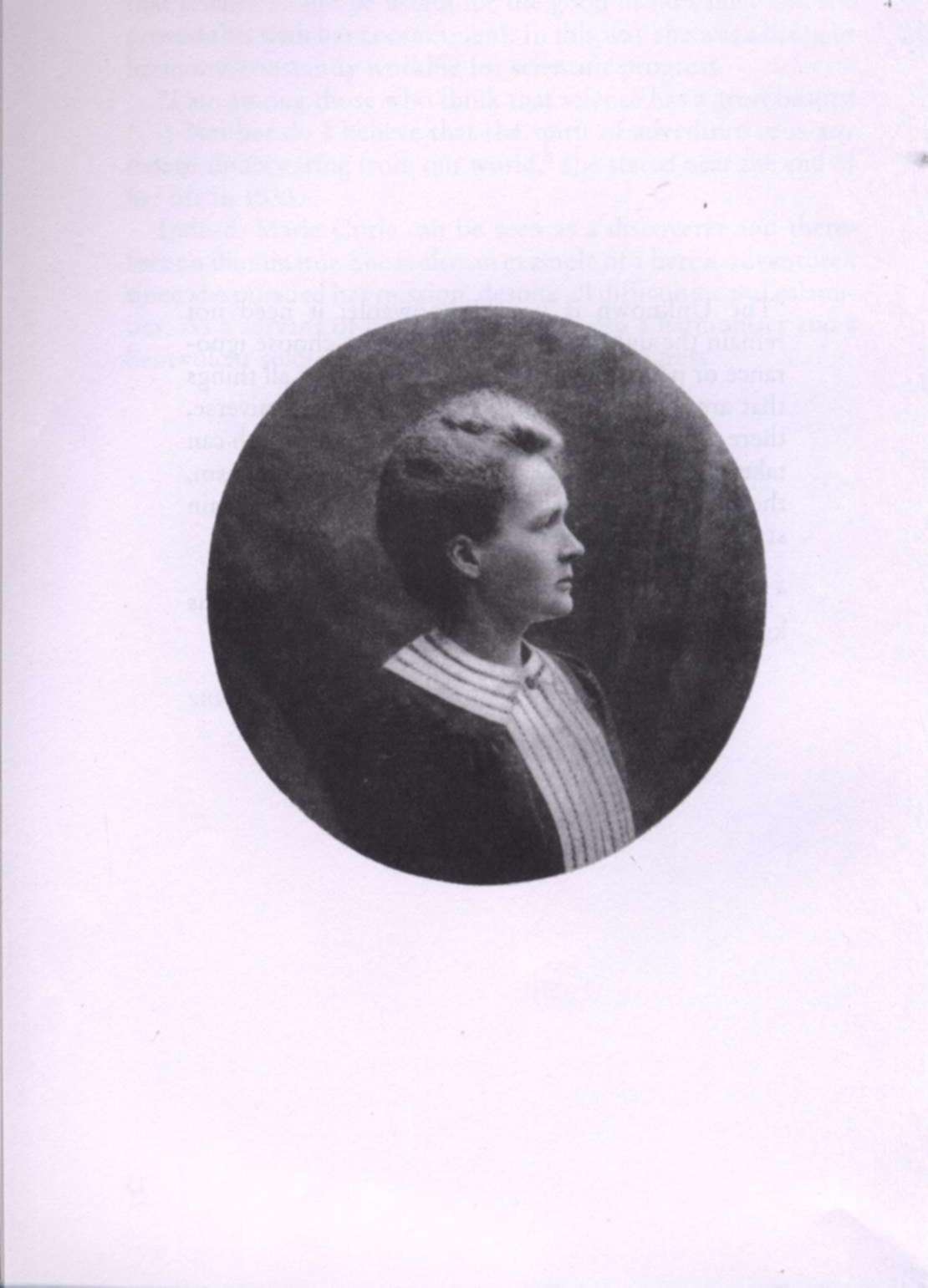
[...] Re-reading a little poem of my mother's, written in Polish, on this time of her life, and remembering the accounts of it that she sometimes gave me, with many a smile and humorous remark, looking at the only portrait of herself which she dearly cherished: the small photograph of a student girl with daring eyes and determine chin, I have felt that she never ceased to prefer these hard, fervent days to all others.
Ah! How harshly the youth of the student passes,
While all around her, with passion ever fresh,
Other youths search eagerly for easy pleasures!
And yet in solitude
She lives, obscure and blessed,
For in her cell she finds the ardor
That makes her heart immense.
But the blessed time is effaced.
She must leave the land of Science
To go out and struggle for her bread
On the grey roads of life.
Often and often then, her weary spirit
Returns beneath the roofs
To the corner ever dear to her heart
Where silent labor dwelled
And where a world of memory has rested.
She wrote to her brother Josef:
"It seems that life is not easy for any of us. But what of that? We must have perseverance and above all confidence in ourselves. We must believe that we are gifted for something, and that this thing, at whatever cost, must be attained. Perhaps everything will turn out very well, at the moment when we least expect it..."
She was proud of her poverty; proud of living alone and independent in a foreign city. Working in the evening beneath the lamp in her poor room she felt that her destiny, still insignificant, mysteriously related itself to the high existences she most admired, and that she became the humble unknown companion of those great scientists of the past, who were, like her, shut into their ill-lighted cells, like her detached from their time, and, like her, spurred their minds to pass beyond the summed acquired knowledge.
[...] Yes, these four heroic years were, not the happiest of Marie Curie's life, but the most perfect in her eyes, the nearest to those summits, of the human mission towards which her gaze had been trained.
An immense enthusiasm gave this girl of twenty-six the power to ignore the trials and privations she endured; to magnify her sordid existence into magic.
At the Faculty of Sciences at the Sorbonne there were very few young women on the benches of the amphitheatre when, in 1893, Marie received first place as Master of Physics. This first place allowed her to obtain a scholarship to prepare for a second degree in mathematics, which she received taking second place in 1894. Later, Marie reimbursed the grant that she had been awarded to the Secretary of the Alexandrowich Foundation, who was stunned by this unprecedented initiative. Marie wished that the funds that helped her would serve another poor young student.
For the work that was assigned to her at the research laboratory of Professor Lippmann, she needed to meet someone with knowledge of magnetism. This is how, one evening in the spring of 1894, she was introduced to a young physicist, already known in France and abroad for his work: Pierre Curie.
"She met a man whose genius was akin to her"
[... ] Pierre Curie was born in Paris, in Rue Cuvier, on May 15,1859. He was the second son of a physician, Dr Eugene Curie, who was himself the son of a doctor. The family was of Alsatian origin, and Protestant. The Curies, once of the lower bourgeoisie, had through generations, become intellectuals and scientists. Pierre's father had to practice medicine to earn his living; but he was devoted to research.
He had been for some time a worker in the laboratory of the Museum of Natural History in Paris, and he was the author of works on tuberculosis infection. His two sons, Jacques and Pierre, were drawn by science from their infancy. Pierre, with his independent and dreamy mind, was unable to adapt himself to systematic work and discipline. He had never been to school. Dr Curie, understanding that the boy was too original to be a brilliant pupil, had at first instructed him himself, and afterward had confided him to a remarkable teacher, Mr. Bazille. This liberal education had borne fruit: Pierre Curie was a bachelor of science at sixteen and had a Master's Degree in physics at eighteen. At nineteen he was appointed laboratory assistant to Professor Desaims in the Faculty of Science - a position he occupied for five years. He was engaged in research with his brother Jacques, who also had his degree and was a laboratory worker at the Sorbonne. The two young physicists soon announced the discovery of the important phenomenon of "piezoelectricity", and their experimental work led them to invent a new apparatus with many practical uses: piezoelectric quartz, which measures small quantities of electricity with precision. In 1883 the two brothers separated with regret: Jacques was appointed professor at Montpellier, and Pierre became chief of laboratory at the School of Physics and Chemistry of the City of Paris. Even though he devoted much time to demonstrations for the pupils, he pursued his theoretical work on crystalline physics. This work led to the formulation of the principles of symmetry, which was to become one of the bases of modern science.
Marie wrote,
"It was in 1894 that I first met Pierre Curie. One of my compatriots, a professor at the University of Fribourg, having called upon me, invited me to his home, with a young physicist of Paris, whom he knew and esteemed highly. Upon entering the room I perceived, standing framed by the French window opening on the balcony, a tall young man with auburn hair and large, limpid eyes. I noticed the grave and gentle expression of his face, as well as a certain abandon in his attitude, suggesting the dreamer absorbed in his reflections. He showed me a simple cordiality and seemed to me very sympathetic. After that first interview he expressed the desire to see me again and to continue our conversation of that evening on scientific and social subjects in which he and I were both interested, and on which we seemed to have similar opinions."
[... ] Pierre and Marie immediately discovered an intellectual affinity, which was very soon transformed into deeper feeling.
On August 10th 1894 Pierre wrote to Marie, "It would be a fine thing, just the same, in which I hardly believe, to pass our lives near each other, hypnotized by our dreams: your patriotic dream, our humanitarian dream, and our scientific dream. Of all those dreams the last is, I believe, the only legitimate one. I mean by that that we are powerless to change the social order and, even if we were not, we should not know what to do; in taking action, no matter in what direction, we should never be sure of not doing more harm than good, by retarding some inevitable evolution. From the scientific point of view, on the contrary, we may hope to do something, the ground is solider here, and any discovery that we may make, however small, will remain acquired knowledge."
Pierre and Marie had much in common: concerns about social justice, the same reverential passion for science, a sense of material disinterestedness and freedom; they also shared a love of nature and the same tastes in literature. For each of them, a beautiful life meant a life of work devoted to science and to progress.
[...] In July 1895, they were married at the town hall at Sceaux, where Pierre's parents lived. They were given money as a wedding present which they used to buy a bicycle for each of them, and long, sometimes adventurous cycle rides came to become their way of relaxing. Their life was otherwise quietly monotonous, a life filled with work and study.
Persuaded by his father and by Marie, Pierre submitted his doctoral thesis in 1895. It concerned various types of magnetism that is now known as Curie's Law.
Marie received the authorization, exceptional at that time, to work in the laboratory with her husband. She was also preparing for the examination for a fellowship in Secondary Education in which she secured first place in 1896. Should we say: as usual?
It must not be forgotten that if women were rare on the benches of the university, young foreign women were even more so.
A master's degree in physics, a master's degree in mathematics, a fellowship in secondary education, and a study on the magnetic properties of steel, this is what had been achieved by this young woman, 29 years old, who had arrived in Paris five years earlier.
But Marie did not stop there and in 1897 she decided on what no other woman before her had dared: to become a Doctor of Science. Marie had to decide on a subject for her thesis; it was a very important moment that would determine her future.
In the same year her first child, Irene, was born on 12th September.
The birth of a new science
In every particle, atom, molecule, cell of Matter
there lives hidden and works unknown
all the omniscience of the eternal and the omnipotence
of the infinite.
— Sri Aurobindo, Essays Human and Divine
[... ] She had to choose a subject of research which would furnish fertile and original material.
At this critical moment Pierre's advice had an importance which cannot be neglected. With respect to her husband, the young woman regarded herself as an apprentice: he was an older physicist, much more experienced than she. He was even, to put it exactly, her chief, her "boss".
But without a doubt Marie's character, her intimate nature had a great part in this all-important choice. From childhood the Polish girl had carried the curiosity and daring of an explorer with her. This was the instinct that had driven her to leave Warsaw for Paris and the Sorbonne, and had made her prefer a solitary room in the Latin Quarter to the Dulskis' downy nest. In her walks in the woods she always chose the wild trail or the unfrequented road. At this moment she was like a traveler musing on a long voyage. Bent over the globe and pointing out, in some far country, a strange name that excited his imagination, the traveler suddenly decides to go there and nowhere else: so Marie, going through the reports of the latest experimental studies, was attracted by the publication of the French scientist Henri Becquerel of the preceding year. She and Pierre already knew this work; she read it over again and studied it with her usual care.
After Roentgen's discovery of X rays, Henri Poincare conceived the idea of determining whether rays like the X ray were emitted by 'fluorescent' bodies under the action of light. Attracted by the same problem, Henri Becquerel examined the salts of a 'rare metal', uranium. Instead of finding the phenomenon he had expected, he observed another, altogether different and incomprehensible: he found that uranium salts spontaneously emitted, without exposure to light, some rays of unknown nature. A compound of uranium, placed on a photographic plate surrounded by black paper, made an impression on the plate through the paper. And like the X ray, these astonishing 'uranic' salts discharged an electroscope by rendering the surrounding air a conductor.
For the first time a physicist had observed the phenomenon to which Marie Curie was later to give the name of radioactivity. But the nature of the radiation and its origin remained an enigma...
Becquerel's discovery fascinated the Curies. They asked themselves whence came the energy, tiny, to be sure, which uranium compounds constantly disengaged in a form of radiation. And what was the nature of this radiation? Here was an engrossing subject of research, a doctor's thesis!
Marie then set to work, going step-by-step into the unknown; very quickly she had the intuition that something was taking place inside the atom and that radioactivity was an atomic phenomenon, a general property of matter. Her hypothesis was daring, she was curious and precise, fascinated by what she had found. The new radiation had to be analyzed with precision to identify the cause that provoked it. For her research, Marie Curie had at her disposition the equipment designed by Pierre to measure very low quantities of electricity, this remarkable equipment would be used for more than fifty years. She made rapid progress.
In one year she observed the rays emitted by uranium and by thorium, separated the first radioactive element, polonium, in July 1898, followed in December by that of radium.
Pierre and Marie had the genius to retain the idea that the atoms of radioactive elements disintegrate spontaneously, what they would call "the cataclysm of atomic transformation."
The atom transforms itself! It was a revolution in regard to the conception of an immutable indivisible atom! This discovery shattered the scientific dogmas of the time and eminent professors must have quivered on the benches of the amphitheatre of the Academy of Sciences when Pierre and Marie Curie explained their hypothesis!
They had, indeed, to confront doubts and prejudices, to fight against the formation that 'it is not possible'. But nothing would stop Pierre and Marie. They united their efforts and after several years of arduous work they isolated radium. In a small test tube they then brandished the 'new element'— luminous, blue in color, and dangerously marvelous! It was a spark of Promethean fire that these two persistent scientists extracted from the residue of uranium, inert in appearance: a spark that would illumine scientific research for a century to come.
[... ] These were unique moments in her unique life. The lay-man forms a theatrical and wholly false idea of the research worker and of his discoveries. 'The moment of the discovery' does not always exist: the scientist's work is too tenuous, too divided, for the certainty of success to crackle out suddenly in the midst of his laborious toil like a stroke of lighting, dazzling him by its fire. Marie standing in front of her apparatus, perhaps never experienced the sudden intoxication of triumph. This intoxication was spread over several days of decisive labor, made feverish by a magnificent hope. But it must have been an exultant moment when, convinced by the rigorous reasoning of her brain that she was on the trail of new matter.
[...] It was barely four years earlier that Marie had written:
"Life is not easy for any of us. But what of that? We must have perseverance and above all confidence in ourselves. We must believe that we are gifted for something, and that this thing, at whatever cost, must be attained." That "something" was to throw science upon a path hitherto unsuspected.
[...]By the force of her intuition the physicist had shown to herself that the wonderful substance must exist. She decreed its existence. But its incognito still had to be broken. Now she would have to verify hypothesis by experiment, isolate the material and see it. She must be able to announce with certainty: "it is there."
[...]A man chosen at random from a crowd to read an account of the discovery of radium would not have doubted for one moment that radium existed: beings whose critical sense has not been sharpened and simultaneously deformed by specialized culture keep their imaginations fresh. They are ready to accept an unexpected fact, however extraordinary it may appear, and to wonder at it.
The physicist colleagues of the Curies received the news in slightly different fashion. The special properties of polonium and radium upset fundamental theories in which scientists had believed for centuries. How was one to explain the spontaneous radiation of the radioactive bodies? The discovery upset a world of acquired knowledge and contradicted the most firmly established ideas on the composition of matter. Thus the physicist kept on the reserve. He was violently interested in Pierre and Marie's work, he could perceive its infinite developments, but before being convinced he awaited the acquisition of decisive results.
The attitude of the chemist was even more downright. By definition, a chemist only believes in the existence of a new substance when he has seen the substance, touched it, weighed and examined it, confronted it with acids, bottled it, and when he has determined its 'atomic weight.'
Now, up to the present, nobody had 'seen' radium. Nobody knew the atomic weight of radium. And the chemists, faithful to their principles, conclude: 'No atomic weight, no radium. Show us some radium and we will believe you.' To show polonium and radium to the incredulous, to prove to the world the existence of their 'children' and to complete their own conviction, M. and Mme Curie were now to labor for four years.
[...]What does it matter to Science if her passionate servants are rich or poor, happy or unhappy, healthy or ill? She knows that they have been created to seek and to discover, and that they will seek and find until their strength dries up at its source. It is not in a scientist's power to struggle against her vocation: even on his days of disgust or rebellion his steps lead him inevitably back to his laboratory apparatus. One cannot, therefore, be surprised at the brilliance of the researches Pierre and Marie carried out successfully during these difficult years. Radioactivity grew and developed, exhausting little by little the pair of physicists who had given it life.
The birth of this new science, Marie described with simplicity in her Autobiographical Notes,
"It seemed to me that the first thing to do was. to measure the phenomenon with precision. In this I decided to use that property of the rays which enabled them to discharge an electroscope. However, instead of the usual electroscope, I used a more perfect apparatus. One of the models of the apparatus used by me for these first measurements is now in the College of Physicians and Surgeons in Philadelphia. I was not long in obtaining interesting results. My determinations showed that the emission of the rays is an atomic property of the uranium, whatever the physical or chemical conditions of the salt were. Any substance containing uranium is much more active in emitting rays, as it contains more of this element.
I then thought to find out if there were other substances possessing this remarkable property of uranium, and soon found that substances containing thorium behaved in a similar way, and that this behavior depended similarly on an atomic property of thorium. I was now about to undertake a detailed study of the uranium and thorium rays when I discovered a new interesting fact.
I had occasion to examine a certain number of minerals. A few of them showed activity; they were those containing either uranium or thorium. The activity of these minerals would have had nothing astonishing about it, if it had been in proportion to the quantities of uranium or thorium contained in them. But it was not so. Some of these minerals revealed an activity three or four times greater than that of uranium. I verified this surprising fact carefully, and could not doubt its truth. Speculating about the reason for this, there seemed to be but one explanation. There must be, I thought, some unknown substance, very active, in these minerals. My husband agreed with me and I urged that we search at once for this hypothetical substance, thinking that, with joined efforts, a result would be quickly obtained. Neither of us could foresee that in beginning this work we were to enter the path of a new science which we should follow for all our future.
Of course, I did not expect, even at the beginning, to find a new element in any large quantity, as the minerals had already been analyzed with some precision. At least, I thought there might be as much as one per cent of the unknown substance in the minerals. But the more we worked, the clearer we realized that the new radioactive element could exist only in quite minute proportion and that, in consequence, its activity must be very great. Would we have insisted, despite the scarcity of our means of research, if we had known the true proportion of what we were searching for, no one can tell; all that can be said now is that the constant progress of our work held us absorbed in a passionate research, while the difficulties were ever increasing. As a matter of fact, it was only after several years of most arduous labor that we finally succeeded in completely separating the new substance, now known to everybody as radium.
Here is, briefly, the story of the search and discovery. As we did not know, at the beginning, any of the chemical properties of the unknown substance, but only that it emits rays, it was by these rays that we had to search. We first undertook the analysis of pitchblende from St. Joachimsthal. Analyzing this ore by the usual chemical methods, we added an examination of its different parts for radioactivity, by the use of our delicate electrical apparatus. This was the foundation of a new method of chemical analysis which, following our work has been extended, with the result that a large number of radioactive elements have been discovered.
In a few weeks we could be convinced that our prevision had been right, for the activity was concentrating in a regular way. And, in a few months, we could separate from the pitchblende a substance accompanying the bismuth, much more active than uranium, and having well defined chemical properties. In July, 1898, we announced the existence of this new substance, to which I gave the name of polonium, in memory of my native country. While engaged in this work on polonium, we had also discovered that, accompanying the barium separated from the pitchblende, there was another new element. After several months more of close work we were able to separate this second new substance, which was afterwards shown to be much more important than polonium. In December, 1898, we could announce the discovery of this new and now famous element, to which we gave the name of radium. However, the greatest part of the material work had yet to be done. We had, to be sure, discovered the existence of the remarkable new elements, but it was chiefly by their radiant properties that these new substances were distinguished from the bismuth and barium with which they were mixed in minute quantities. We had still to separate them as pure elements. On this work we now started. We were very poorly equipped with facilities for this purpose. It was necessary to subject large quantities of ore to careful chemical treatment. We had no money, no suitable laboratory, and no personal help for our great and difficult undertaking. It was like creating something out of nothing, and if my earlier studying years had once been called by my brother-in-law the heroic period of my life, I can say without exaggeration that the period on which my husband and I now entered was truly the heroic one of our common life.
We knew by our experiments that in the treatment of pitchblende at the uranium plant of St. Joachimsthal, radium must have been left in the residues, and, with the permission of the Austrian government, which owned the plant, we succeeded in securing a certain quantity of these residues, then quite valueless, and used them for extraction of radium. How glad I was when the sacks arrived, with the brown dust mixed with pine needles, and when the activity proved even greater than that of the primitive ore! It was a stroke of luck that the residues had not been thrown far away or disposed of in some way, but left in a heap in the pine wood near the plant. Some time later, the Austrian government, on the proposition of the Academy of Science of Vienna, let us have several tons of similar residues at a low price. With this material was prepared all the radium I had in my laboratory up to the date when I received the precious gift from the American women. The School of Physics could give us no suitable premises, but for lack of anything better, the Director permitted us to use an abandoned shed which had been in service as a dissecting room of the School of Medicine. Its glass roof did not afford complete shelter against rain; the heat was suffocating in. summer, and the bitter cold of winter was only a little lessened by the iron stove, except in its immediate vicinity. There was no question of obtaining the needed proper apparatus in common use by chemists. We simply had some old pine-wood tables with furnaces and gas burners. We had to use the adjoining yard for those of our chemical operations that involved producing irritating gases; even then the gas often filled our shed. With this equipment we entered on our exhausting work.
Yet it was in this miserable old shed that we passed the best and happiest years of our life, devoting our entire days to our work. Often I had to prepare our lunch in the shed, so as not to interrupt some particularly important operation. Sometimes I had to spend a whole day mixing a boiling mass with a heavy iron rod nearly as large as myself. I would be broken with fatigue at the day's end. Other days, on the contrary, the work would be a most minute and delicate fractional crystallization, in the effort to concentrate the radium. I was then annoyed by the floating dust of iron and coal from which I could not protect my precious products. But I shall never be able to express the joy of the untroubled quietness of this atmosphere of research and the excitement of actual progress with the confident hope of still better results. The feeling of discouragement that sometimes came after some unsuccessful toil did not last long and gave way to renewed activity. We had happy moments devoted to a quiet discussion of our work, walking around our shed.
One of our joys was to go into our workroom at night; we then perceived on all sides the feebly luminous silhouettes of the bottles or capsules containing our products. It was really a lovely sight and one always new to us. The glowing tubes looked like faint, fairy lights.
Thus the months passed, and our efforts, hardly interrupted by short vacations, brought forth more and more complete evidence. Our faith grew ever stronger, and our work being more and more known, we found means to get new quantities of raw material and to carry on some of our crude processes in a factory allowing me to give more time to the delicate finishing treatment.
At this stage I devoted myself especially to the purification of the radium, my husband being absorbed by the study of the physical properties of the rays emitted by the new substances. It was only after treating one ton of pitchblende residues that I could get definite results. Indeed we know to-day that even in the best minerals there are not more than a few decigrammes of radium in a ton of raw material.
At last the time came when the isolated substances showed all the characters of a pure chemical body. This body, the radium, gives a characteristic spectrum, and I was able to determine for it an atomic weight much higher than that of the barium. This was achieved in 1902.1 then possessed one decigram of very pure radium chloride. It had taken me almost four years to produce the kind of evidence which chemical science demands, that radium is truly a new element. One year would probably have been enough for the same purpose, if reasonable means had been at my disposal. The demonstration that cost so much effort was the basis of the new science of radioactivity."
Radium would become an extraordinary tool for the exploration of the structure of matter and radioactivity would open the way to the exploration of the atom and the nucleus of the atom. The transformation of the atomic nucleus would be applied in numerous disciplines. It would lead to the dawning of new scientific domains, to radiochemistry, to nuclear physics, to the dating of past events, to the study of cosmic rays and elementary particles. The work of Pierre and Marie Curie was also the base from which nuclear physics and molecular biology have developed.
Because of it, chemists have explored the intimate structure of matter, astrophysicists have explained the life and death of the stars and geophysicists have made progress in the study of terrestrial dynamics through the observation of the release of heat due to radioactive disintegration. Doctors and biologists have used radioactive traces and found new treatments, in particular, for cancer.
Fame and glory
[...] the means that science has put at our disposal eliminate
the peril of the subversion and destruction of an effete civilization
by stronger primitive peoples, but it is the resurgence of the
barbarian in ourselves, in civilized man,
that is the peril, and this we see all around us.
For that is bound to come
if there is no high or strenuous mental and moral ideal
controlling and uplifting the vital and physical man in us
and no spiritual ideal
liberating himself into his inner being.1
— Sri Aurobindo
[...] Radioactivity, born in France, rapidly conquered in foreign countries. From 1900 on, letters signed by the greatest names in science arrived in the Rue Lhomond. [...] In 1903 two English scientists, Ramsay and Soddy, demonstrated that radium continually disengaged a small quantity of a gas, Helium. This was the first known example of a transformation of atoms. [... ] Radio elements, even when they seemed to be unchangeable, were in a state of spontaneous evolution: the more rapid their rate of transformation, the more powerful their 'activity.' "Here we have a veritable theory of the transmutation of simple bodies, but not as the alchemists understood it (Pierre Curie was to write). Inorganic matter must have evolved, necessarily, through the ages, and followed immutable laws."
"We", "with joined effort" Marie wrote. For many years and under material conditions that have become legendary, Pierre and Marie associated their efforts. This collaboration of two scientists, two geniuses, is unique to that time. In their written report they used "we" or "one of us", and it would be impossible to distinguish the work of one from the other.
[...]We cannot and must not attempt to find out what should be credited to Marie and what to Pierre during these eight years it should be exactly what the husband and wife did not want. The personal genius of Pierre Curie is known to us by the original work he had accomplished before this collaboration. His wife's genius appears to us in the first intuition of discovery, the brilliant start and it was to reappear again, solitary, when Marie Curie, the widow unflinchingly carried the weight of a new science and consecrated it through research, step by step, to its harmonious expansion. We therefore have formal proof that in the fusion of their two efforts, in this superior alliance of man and woman, the exchange was equal. Let this certainty suffice for our curiosity and admiration.-
After the isolation of radium, Pierre and Marie would take a decision that would have important consequences on their lives as well as those of their family. This decision, taken together and without the least hesitation, perfectly illustrates the dedication of their lives to the ideals of scientific research. Any other decision, according to Marie, would have been contrary to the scientific spirit.
"Physicists always publish their researches completely. If our discovery has a commercial future that is an accident by which we must not profit. And radium is going to be of use in treating diseases... It seems to me impossible to take advantage of that."
After Marie said this, Pierre gave the American engineers the information they requested.
"In agreement with me [Marie Curie was to write twenty years later) Pierre Curie decided to take no material profit from our discovery: in consequence we took out no patent and we have published the results of our research without reserves, as well as the processes of preparation of radium. Moreover, we gave interested persons all the information they requested. This was a great benefit to the radium industry, which was enabled to develop in full liberty, first in France and then abroad, furnishing to scientists and doctors the products they needed. As a matter of fact this industry is still using today, almost without modification, the processes which we pointed out.
The 'Buffalo Society of Natural Science' has offered me, as a souvenir, a publication on the development of the radium industry in the United States, accompanied by photographic reproductions of the letters in which Pierre Curie replied most fully to the questions asked by the American engineers (1902 and 1903)."
And later on she will make this statement:
"A large number of my friends affirm, not without valid reasons, that if Pierre Curie and I had guaranteed our rights, we would have acquired the financial means necessary to the creation of a satisfactory Radium Institute, without encountering the obstacles which were a handicap to both of us, and which are still a handicap for me. Nevertheless, I am still convinced that we were right. Humanity certainly needs practical men, who get the most out of their work, and without forgetting the general good, safeguard their own interests. But humanity also needs dreamers, for whom the disinterested development of an enterprise is so captivating that it becomes impossible for them to devote their care to their own material profit. Without the slightest doubt, these dreamers do not deserve wealth because they do not desire it. Even so, a well-organized society should assure to such workers the efficient means of accomplishing their task, in a life freed from material care and freely consecrated to research."
In '903, Marie and Pierre were awarded half the Nobel Prize in Physics. The citation read: "in recognition of the extraordinary services they have rendered by their joint researches, on the radiation phenomena discovered by Professor Henri Becquerel." Henri Becquerel was awarded the other half for his discovery of spontaneous radioactivity.
Pierre and Marie could not go to Sweden, their visit was put off until a later date.
On 6th December '904 Marie gave birth to a second child, a little girl that she named Eve.
In '905 Pierre and Marie finally went to Stockholm.
[...] On June 6, 1905, in the name of his wife and himself, Pierre Curie spoke on radium before the Academy of Science of Stockholm. He evoked the consequences of the discovery of radium. In physics it profoundly modified the fundamental principles of mechanics. In chemistry it stirred up bold hypotheses on the source of energy which supplied the radioactive phenomena. In geology, in meteorology, it was 'the key to phenomena which had never been explained before'. In biology, last of all, the action of radium on cancerous cells had proved efficacious.
"Radium had enriched Knowledge and served the Good. But could it also serve the Evil?
One may also imagine (Pierre said in concluding) that in criminal hands radium might become very dangerous and here we may ask ourselves if humanity has anything to gain by learning the secrets of nature, if it is ripe enough to profit by them, or if knowledge is not harmful. The example of Nobel's discoveries is characteristic: powerful explosives have permitted men to perform admirable work. They are also a terrible means of destruction in the hands of criminals who lead the peoples towards war. I am among those who think, with Nobel, that humanity will obtain more good than evil from the new discoveries."
[... ] Radioactivity, generation of heat, production of helium gas and emanation, spontaneous self-destruction, how far we have traveled from the old theories on inert matter, on the immovable atom! Not more than five years before, scientists had believed our universe to be composed of defined substances, elements fixed forever. Now it was seen that with every second of passing time radium particles were expelling atoms of helium gas from themselves and were hurling them forth with enormous force. The residue of this tiny, terrifying explosion, which Marie was to call 'the cataclysm of atomic transformation,' was a gaseous atom of emanation which was transformed in his turn. Thus the radio elements formed strange and cruel families in which each member was created by the spontaneous transformation of the mother substance: radium was a 'descendant' of uranium, polonium a descendant of radium. These bodies, created at every instant, destroyed themselves according to eternal law; each radio element lost half of its substance in a time which was always the same, which was to be called its 'period'. To diminish itself by one half, uranium required several thousand million years, radium sixteen hundred years, the emanation of radium four days, and the 'descendants' of emanation only a few seconds.
-
The Life Divine, Chapter 28, The Divine Life, p. 1052, Sri Aurobindo Ashram Publication Trust, 1970. ↩
Joan Of Arc
(...) We were up at dawn, and after mass we started. In the hall we met the master of the house, "who was grieved, good man, to see Joan going breakfastless to such a day's work, and begged her to wait and eat, but she couldn't afford the time— that is to say, she couldn't afford the patience, she being in such a blaze of anxiety to get at that last remaining bastille which stood between her and the completion of the first great step in the rescue and redemption of France. Boucher put in another plea:
'But think—we poor beleaguered citizens who have hardly known the flavour of fish for these many months, have spoil of that sort again, and we owe it to you. There's a noble shad for breakfast; wait—be persuaded.'
Joan said—
'Oh, there's going to be fish in plenty; when this day's work is done the whole river-front will be yours to do as you please with.'
'Ah, your Excellency will do well, that I know; but we don't require quite that much, even of you; you shall have a month for it in place of a day. Now be beguiled—wait and eat. There's a saying that he that would cross a river twice in the same day in a boat, will do well to eat fish for luck, lest he have an accident.'
'That doesn't fit my case, for to-day I cross but once in a boat.'
'Oh, don't say that. Aren't you coming back to us?'
'Yes, but not in a boat.'
'How, then?'
'By the bridge.'
'Listen to that—by the bridge! Now stop this jesting, dear General, and do as I would have you. It's a noble fish.'
'Be good, then, and save me some for supper; and I will bring one of those Englishmen with me and he shall have his share.'
'Ah, well, have your way if you must. But he that fasts must attempt but little and stop early. When shall you be back?'