THE WRITTEN WORD
Lincoln - Idealist and Pragmatist
Paragraph references are specific to this digital edition.
Preface
The task of preparing teaching-learning material for value-oriented education is enormous.
There is, first, the idea that value-oriented education should be exploratory rather than prescriptive, and that the teaching-learning material should provide to the learners a growing experience of exploration.
Secondly, it is rightly contended that the proper inspiration to turn to value-orientation is provided by biographies, autobiographical accounts, personal anecdotes, epistles, short poems, stories of humour, stories of human interest, brief passages filled with pregnant meanings, reflective short essays written in well-chiselled language, plays, powerful accounts of historical events, statements of personal experiences of values in actual situations of life, and similar other statements of scientific, philosophical, artistic and literary expression.
Thirdly, we may take into account the contemporary fact that the entire world is moving rapidly towards the synthesis of the East and the West, and in that context, it seems obvious that our teaching-learning material should foster the gradual familiarisation of students with global themes of universal significance as also those that underline the importance of diversity in unity. This implies that the material should bring the students nearer to their cultural heritage, but also to the highest that is available in the cultural experiences of the world at large.
Fourthly, an attempt should be made to select from Indian and world history such examples that could illustrate the theme of the upward progress of humankind. The selected research material could be multi-sided, and it should be presented in such a way that teachers can make use of it in the manner and in the context that they need in specific situations that might obtain or that can be created in respect of the students.
The research team at the Sri Aurobindo International Institute of Educational Research (SAIIER) has attempted the creation of the relevant teaching-learning material, and they have decided to present the same in the form of monographs. The total number of these monographs will be around eighty to eighty-five.
It appears that there are three major powers that uplift life to higher and higher normative levels, and the value of these powers, if well illustrated, could be effectively conveyed to the learners for their upliftment. These powers are those of illumination, heroism and harmony.
It may be useful to explore the meanings of these terms - illumination, heroism and harmony - since the aim of these monographs is to provide material for a study of what is sought to be conveyed through these three terms. We offer here exploratory statements in regard to these three terms.
Illumination is that ignition of inner light in which meaning and value of substance and life-movement are seized, understood, comprehended, held, and possessed, stimulating and inspiring guided action and application and creativity culminating in joy, delight, even ecstasy. The width, depth and height of the light and vision determine the degrees of illumination, and when they reach the splendour and glory of synthesis and harmony, illumination ripens into wisdom. Wisdom, too, has varying degrees that can uncover powers of knowledge and action, which reveal unsuspected secrets and unimagined skills of art and craft of creativity and effectiveness.
Heroism is, essentially, inspired force and self-giving and sacrifice in the operations of will that is applied to the quest, realisation and triumph of meaning and value against the resistance of limitations and obstacles by means of courage, battle and adventure. There are degrees and heights of heroism determined by the intensity, persistence and vastness of sacrifice. Heroism attains the highest states of greatness and refinement when it is guided by the highest wisdom and inspired by the sense of service to the ends of justice and harmony, as well as when tasks are executed with consummate skill.
Harmony is a progressive state and action of synthesis and equilibrium generated by the creative force of joy and beauty and delight that combines and unites knowledge and peace and stability with will and action and growth and development. Without harmony, there is no perfection, even though there could be maximisation of one or more elements of our nature. When illumination and heroism join and engender relations of mutuality and unity, each is perfected by the other and creativity is endless.
In Lincoln, we see a man of ideals, aspiring for unity and liberty of the family of man, as he called it. His life illustrates the tapasya he undertook, - a tapasya that defined his purpose and empowered him not only with the skills necessary in the outer instruments but also with an inner strength for the fulfillment of those ideals. Like a well-conducted orchestra it took him progressively to the top, just at the time when the nation stood on the brink of a schism. Attacked by those who wanted to tear the nation apart and accused by the rest for inefficiency, he stood heroically in the face of the storm, following the voice of his soul as the civil war plundered the country. He embodied not only the spirit of heroism but also of harmony; he was a receptacle of an active inner power that could rein in and utilize the strengths and wisdom of his rivaling cabinet ministers and influence them to work in harmony despite their differences. Finally, his dependence on the Divine Will was his succour that comforted him when all else was raging around him and which led him through successfully to overpower the menace of division and oppression.
Message
Man approaches nearer his perfection when he combines in himself the idealist and the pragmatist, the originative soul and the executive power. Great executive personalities have usually been men of a considerable idealism. Some indeed have served a purpose rather than an ideal; even in the idea that guided or moved them they have leaned to its executive rather than its inspiring and originative aspect; they have sought their driving force in the interest, passion and emotion attached to it rather than in the idea itself. Others have served consciously a great single thought or moral aim which they have laboured to execute in their lives. But the greatest men of action who were endowed by Nature with the most extraordinary force of accomplishment, have owed it to the combination in them of active power with an immense drift of originative thought devoted to practical realisation.1
Introduction
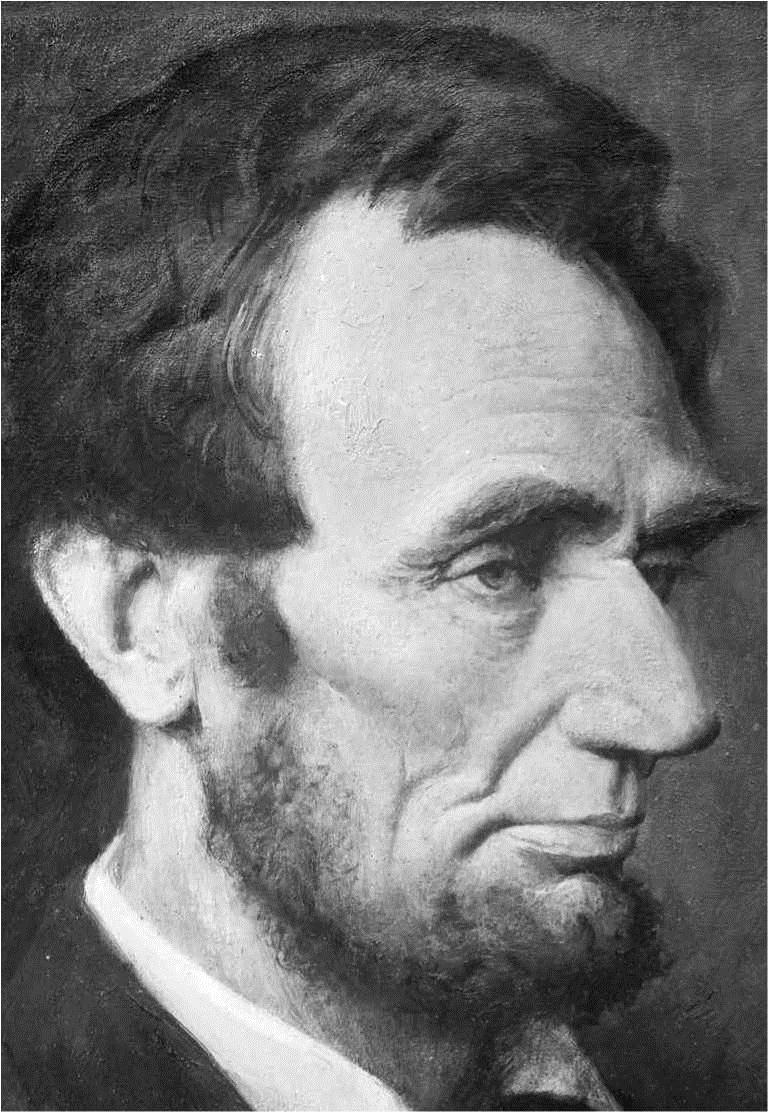
How did an unschooled woodcutter rise to become the president of America and steer the nation through its greatest crisis? What power in this man helped him to determine and direct the destiny of America?
Unity and liberty, two spiritual truths that are indispensable for a better world were intimate to Lincoln's being from the start - two truths that seem to have become the central thrust of his mission on earth. Perhaps Nature, therefore, planted him in a nation threatened by both slavery and disintegration; and be born into a family, which would sow the seeds of liberty early in his mind and heart.
Ideals are essential to bring about great change, but they need an immense executive power for the realization of such change. And Nature, it seems had decided to accomplish that in him; to chisel his instrumentality so that he would be capable of fulfilling the gigantic task ahead of him; a task that was as yet hidden from his sight.
‘For fifty years God rolled Abraham Lincoln through his fiery furnace. He did it to try Abraham and to purify him for his purposes. This made Mr. Lincoln humble, tender, forbearing, sympathetic to suffering, kind, sensitive, tolerant; broadening, deepening and widening his whole nature...'2, said William Herndon, Lincoln’s Law partner.
Herndon was intuitive; Lincoln was obliged to rise higher and higher and look down upon humanity and see the great family of man as he called it in one of his speeches, what ancient India called vasudhaiva kutumbakam. In the dark days of the war, Lincoln’s call to the Divine Guidance was the surrender of a man who had reached the summits of his own effort and now aspired to be led by Him, much like Draupadi and Arjuna:
I., felt I must put all my trust in Almighty God... I had tried my best to do my duty and had found myself unequal to the task. The burden was more than I could bear3’. ‘I told Him that this war was His war, that this cause was His cause. And after that, I don’t know how it was, and I cannot explain it, a sweet comfort crept into my soul. The feeling came that God had taken the whole business into His own hands4.’
There was a deep-rooted sense of compassion in him. He says in his autobiography that when he was seven, he killed a turkey for his family dinner, and felt so much remorse that he never hunted game again in his life. He often wondered how he was placed in the midst of such a terrible war with bloodshed all around him.
His childhood and early youth aided in the development of his physical being. They were miserably poor, and he was compelled to labor on his family farm and among poor people to win their daily bread. Physical hardships earned him a robust body; by sixteen years of age he was six feet four in height in a lean muscular frame.
He was given to melancholy; he would often sink into great depression and sadness. But it was countered by a great resilience in him that used his resources of humour and story telling to pull himself out of it. It developed into an art that remained with him till the end; village children who listened rapt to his stories in his childhood were replaced by his youthful friends and his colleagues on the law circuit and finally by his cabinet secretaries in government and generals during the war.
He had a thirst for knowledge and though his circumstances in life did not favour an easy path in his education, his spirit was strong and he harkened to its call and utilized every opportunity, every assistance that came his way and climbed the rungs of selfdevelopment; he augmented his learning through the few books and teachers he came across in his early years. His stepmother noticed that as a child he fretted if he could not put his thoughts into clear expression and would not rest until he achieved it. Even though his English was not florid, he had the power of putting across his thoughts very lucidly.
Seeing his perseverance, Nature conspired to assist him. Soon teachers and people of the village, noticing his enthusiasm to learn came forward to help him and slowly he acquired proficiency in English grammar, mathematics, poetry, debating and law. In fact, this early education helped him later in life when he was president of the United States; in times of great anxiety, he found comfort in passages from Shakespeare, which he often quoted. Cultivated by perseverance within and assistance without, all these powers latent within him emerged slowly but surely; he was being groomed for his ultimate role in life.
He was an explorer and his curiosity to see the world took him out of his little existence in the village, onto a flatboat5 to earn money. Every willing adventure provided him with a new experience; he witnessed a dozen slaves shackled together in irons, - a sight that never ceased to torment him. All these imprints upon his being were developing his psyche and preparing his heart and mind and intellect for a destiny that would be linked with the destiny of a nation.
His mind was ingenious; he developed an invention that would lift boats stuck in shallow waters; a result of an experience he had encountered during one of his flatboat journeys. Even adversity provided an opportunity to learn something - jobless, he volunteered for service in the Black Hawk War. Though he did not engage in combat it gave him experience of military life; and in his heart he felt great joy to be chosen captain by the men.
‘Lincoln had nothing, only plenty of friends’6, is how an acquaintance described him. And he maintained his friendships through his presidency; ‘he grew beyond his associates, but not away from them7’. He had great leadership qualities; he was fair and inherently honest; his friends trusted him completely and were willing to be led by him. There was no conscious effort towards this popularity; he flattered no one; it came naturally to him; he was wide in his being, kindly to all, such was the strength of his character and the inner beauty and purity of his being. People thronged around him; the woodcutter from the Wild West was sought after by college boys who would often find him flat on his back reading a newspaper devouring all the information he could find about statesmen and politicians.
The debates at the local clubs had sharpened his power of reasoning powers and developed and expanded his mental and oratory faculties; he would borrow books on political matters; soon his knowledge and interest in politics began to mature. He grew to love Henry Clay, his ‘beau ideal of a statesman’8. His entry and subsequent and rise in politics gradually prepared his executive powers; it chiseled his intellect and strengthened his resilience.
He was so in tune with the workings of Nature, every difficulty was turned into a blessing and opportunity, releasing one thread only to pick up another. After losing the seat in the Senate, he returned home and devoted himself to his Law practice and his family, essential to the rhythm of his life, only to bounce back when a political crisis in the nation ‘aroused him as he had never been before’9.
He was kindly, he was simple, he was humble; he grew into a man of deep convictions and ideals and to uphold them he was not afraid to stand against the crowd. His spiritual strength was visible in his dealings with bullies in his youth and grew firmer to support his ideals during his presidency when he was not afraid ‘to put his foot down’. He did not hesitate to assume unprecedented war powers when he thought it necessary for the safety of the nation despite his detractors who found his actions unconstitutional.
Lincoln was guided not by religion but by the spirit; he believed in God and the power and ultimate triumph of the right. This unwavering faith in Divine Providence ‘ran like a thread of gold through all his inner experiences of his life’, - during the death of his own little sons as well as during the tormenting war that relentlessly swallowed its children. He saw himself increasingly as an instrument in God’s hands and constantly asked for Divine Guidance. ‘Open on one side of his nature to all descending influences from Him to whom he prayed, and open on the other to all ascending influences from the people whom he served, he aimed simply to do his duty, to God and men. Acting rightly, he acted greatly. While he took care of deeds, fashioned by a purely ideal standard, God took care of results...,’10 much like Arjuna who fought at Kurukshetra and left the results in the hands of Krishna. He became an open receptacle as God leaned to act out His Will through Lincoln...
As the president of the nation, committed to the constitution that permitted the states to choose to remain slave or free states, he professed only the preservation of the Union as the principle objective of war, though personally he hated slavery. He waited hopefully and patiently; and when the time was right he issued the Emancipation Proclamation. Thenceforth, war was fought for the ideals of Unity as well as Liberty.
Yet complete equality for the Negroes he resisted, as did most men of his time. But he was plastic, open to change. Having witnessed their bravery on the battlefield, their intelligence, courage and conviction in their fight for liberty, and from his personal acquaintance with educated African Americans, he humbly acknowledged their right to equality and opened the door for black enfranchisement.
Before he could sit back in satisfaction over the safe passage of the nation, he was snatched away by death that had been mercilessly following him. Perhaps it was Divine Compassion that interrupted his sojourn on earth; his enemies would not have allowed him that relief; they would probably have harrowed him with endless charges for the unconstitutionality of the war powers he had assumed.
‘Humble child of the backwoods — boatman, ax-man, hired laborer, clerk, surveyor, captain, legislator, lawyer, debater, orator, politician, statesman, President, savior of the republic, emancipator of a race..11 All this he became in one single life...
As Sri Aurobindo has said,
“Man approaches nearer his perfection when he combines in himself the idealist and the pragmatist, the originative soul and the executive power”.12
And so, Lincoln, ‘a man after God’s pattern’13, could steer his country into a safe harbour, having preserved the Unity of the nation and established the ideal of Liberty.
The Story of Abraham Lincoln - Chapter I
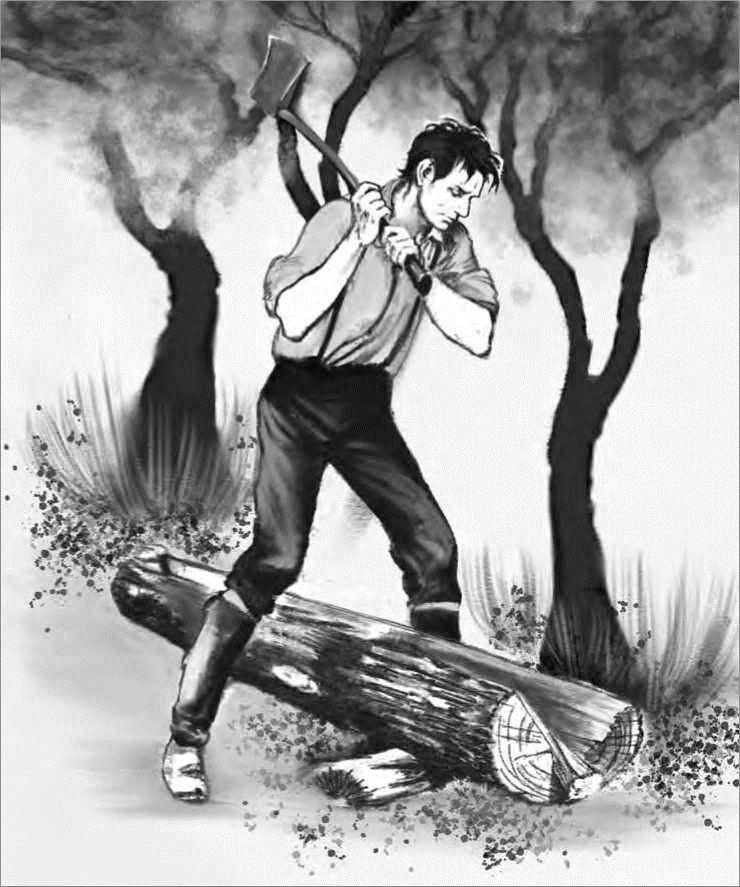
(Young Abraham on his father’s farm)
The Birth
February 12, 1809. Deep in the woods of Kentucky, in a little log cabin, on a cold winter morning, the sun rose to herald the birth of a baby born to Thomas Lincoln and Nancy Hanks. He was named Abraham Lincoln, after his grandfather, who was attacked and killed by Indians while labouring in the forest to develop a farm. Lincoln’s father, Thomas, was only six years old then (See Map p. X-B).
Though Thomas’ family had at one time owned slaves, his father despised slavery. And that became one of the reasons for their family’s migration from Kentucky. In 1816, they travelled with horses piled high with all their meager belongings, cutting and hewing through thick woods across the Ohio River, to the free state of Indiana, a wild region where slavery was not permitted and land was cheap. Abraham was seven years old.
Life was not easy. It was hard work developing a farm, clearing the forest, hoeing the fields and splitting wood to build fences and cabins and furniture. His father would take him along to help in the fields sowing corn and chopping wood. He was so good with the axe, that in his youth, his father often hired him out in the neighbourhood. Abraham was large for his age, and he later recalled working the axe almost constantly till the age of twenty-three, except of course, in plowing and harvesting seasons.
Lincoln referred to his parents as coming from ‘undistinguished families’. He nearly drowned once but a boy in his neighbourhood saved him; when he was ten, a horse kicked him in the head and nearly killed him.
They were religious people and in his childhood his mother would often recite passages to him and his sister from the bible. His parents were not literate but they wanted their children to get an education. After they finished their work in the fields, Abraham and his sister would embark on a long hike through woods and across streams to a school. He wrote in a sketch of himself:
“... There were some schools, so called; but no qualification was ever required of a teacher, beyond the “readin, writin, and cipherin”14 to the Rule of Three. If a straggler supposed to understand Latin happened to sojourn in the neighborhood, he was looked upon as a wizard. There was absolutely nothing to excite ambition for education... I have not been to school since. The little advance I now have upon this store of education, I have picked up from time to time under the pressure of necessity.”15
He once said that it would barely total a whole year if all the days of schooling were put together. ‘He was... never inside of a college or academy building till since he had a law-license...’16
“The Life of Washington, while it gave to him a lofty example of patriotism, incidentally conveyed to his mind a general knowledge of American history; and the Life of Henry Clay spoke to him of a living man who had risen to political and professional eminence from circumstances almost as humble as his own... Abraham must have been very young when he read Weems’ Life of Washington... Alluding to his early reading of this book, he says: “I remember all the accounts there given of the battle fields and struggles for the liberties of the country, and none fixed themselves upon my imagination so deeply as the struggle here at Trenton, New Jersey... I recollect thinking then, boy even though I was, that there must have been something more than common that those men struggled for.” Even at this age, he was not only an interested reader of the story, but a student of motives.”17
At the age of ten, Lincoln’s mother died. Seeing the sorry state of his household, Thomas married an old friend Sarah Bush Johnson, who was a widow with three children. She was a kind woman and Abraham bonded with her immediately. She encouraged him to learn and his first books of stories were part of the few possessions she brought with her to their home. She passed on to him her sense of humour, which later became legendary and a part of every sphere of his life:
“What he learned and stowed away was well-defined in his own mind, repeated over and over again till it was so defined and fixed firmly and permanently in his memory… He was dutiful to me always, he loved me truly I think.
I had a son John who was raised with Abe... but I must say... that Abe was the best boy I ever saw or ever expect to see.” 18
When Lincoln was a lawyer, he decided to buy a piece of land for his step mother; his friend suggested that he could arrange to get the property transferred to Lincoln’s name after her death, to which he replied, ‘I shall do no such thing. It is a poor return, at best, for all the good woman’s devotion and fidelity to me, and there is not going to be any halfway business about it!’19
His parents joined the local Baptist church; he would stand atop a tree stump and rattle off the sermons he had heard and make his friends laugh. This was, perhaps his initiation into speech making at which he later became very adept.
Lincoln was already six feet tall with angular looks and a lean frame by the time he reached the age of sixteen. All the hard work had made his body strong — he was good at athletics, — specially running and wrestling. Though he was friendly with many people he was not known to being close to anyone. In fact, with the passage of time, he grew further and further apart from his father.
He was very kind; finding a stray horse, which he recognized, he looked around for its rider. He found him lying on the ground drunk. Lincoln hauled him on his shoulder and took him to a house nearby, sent word to his father that he would not be returning home that night and looked after him through the night.
Older now, Lincoln ventured out to earn money. In his free time he had made a flatboat and could barely believe his eyes when two men paid him a dollar to ferry them across on it to a steamer ship on the Ohio River! ‘The world seemed wider and fairer before me. I was a more hopeful and confident being from that time.’20
Abraham now looked forward to seeing the rest of the world; he wished to widen his horizons and meet new people outside of his neighbourhood. At the age of nineteen, he was a tall and strong six foot four inch towering youth. His neighbour hired him to take his cargo on a flatboat down the Ohio and Mississippi Rivers all the way to a sugar plantation near New Orleans to be sold. Lincoln had no previous experience about business transactions, was not familiar with the river, had never made such a trip before, but he was so well known for his ability and integrity that his employer entrusted him with not only his cargo but also his son on this voyage. And Lincoln proved that his trust was not misplaced; it was a difficult journey; handling the boat in changing currents and jutting banks was not easy. But it was not only the rivers that were dangerous, — while they were docked, a gang of seven slaves tried to leap on to the boat with the intent to plunder. One by one, Abraham and his fellow traveller knocked them off the boat into the river, chased the others and gave them a severe thrashing, then sailed off towards New Orleans.
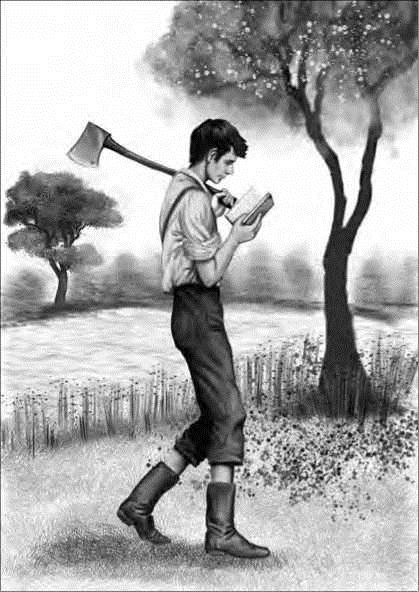
(Young Abraham’s love for books.)
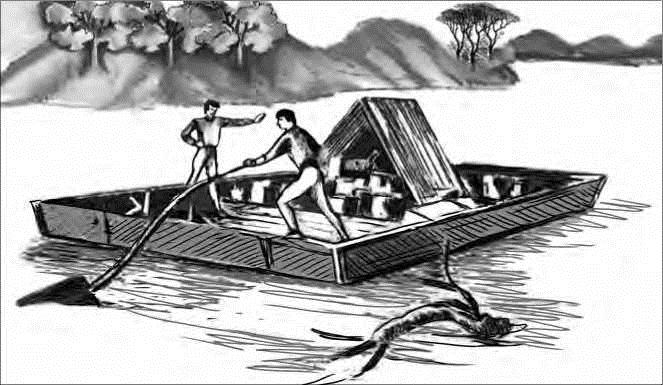
(Ferrying cargo on a flatboat down the Mississippi river.)
New Orleans was very different from any town he had ever seen! The port was crowded with boats, the docks were packed with cargo being loaded and unloaded off them, and Abraham could hear a cacophony of sounds coming from the hundreds of people going about their business at the port. Lincoln witnessed a slave market for the first time in his life; families of slaves broken up, men and women lined up on opposite sides, buyers checking on them like livestock before making their final purchase. Abraham completed the sale of cargo, sold the flatboat and returned home.
In 1830, when Abraham was twenty-one years old, his father decided to move the family to Illinois, where the prairies were supposed to be much more fertile. They set out towards their new destination in ox driven wagons loaded with their humble belongings. It was a difficult journey of two hundred miles covered in fifteen days — driving the wagons through mud and rivers overflowing with rain. Abraham helped him build their new cabin, split wood to make furniture for their home and fences to enclose their farm. After he had assisted his father in building their homestead and sowing corn in the fields, he decided to set out on his own.
Growing His Wings
In summer he tilled the soil and in winter he chopped wood and split logs to make fences — anything to keep himself clothed. There is a story that he made a bargain with a woman that he would split enough pieces of rail for her in return for a pair of trousers!
Having earned a good reputation, he was hired again to work on a ferry. The boat was launched and they set sail towards New Orleans. But as they neared New Salem, their boat got stuck at a milldam and they struggled to save it from sinking. Abraham tried to free the boat but failing to do so, he directed the crew to unload some of the cargo on to the shore to shift the balance to the stern. He then went ashore, hired a hand drill from a shop and plied a hole in the bow to allow the water to drain out.
So impressed was his employer by Abraham’s navigational skills and his honesty that he decided to utilize Abraham’s services to manage a general store and mill. In July 1831, twenty-two year old Abraham moved to New Salem; the store was not ready so Abraham boarded at a tavern and did odd jobs to keep body and soul together — Mentor Graham, the schoolmaster at New Salem, and clerk for the elections, hired him as his assistant for the elections of Governor and members of Congress. However innocuous, this was the beginning of his entry into politics.
Finding work in New Salem was easy for Lincoln, — be it splitting rails, repairing milldams, husking corn for farmers or working at the store; the locals found him to be hardworking, always willing to work for anyone who needed help. James Short, one of his first friends in New Salem thought he was the only man, who could husk twice the corn than he could. Abraham was funny, loved telling stories and made friends easily; he had never lived anywhere that had so many people — almost a hundred.
The store opened and Lincoln moved in. He still could not afford a place of his own; he slept in a back room of the store along with William Green, a clerk who helped him in the store. It was during this time that Abraham was nicknamed Honest Abe — he would go miles to return a few cents that had been overpaid by clients or to deliver supplies that had been under weighed by error during a purchase.
Another trait of his personality emerged during his stay in New Salem. While showing goods to a few ladies in his store, a bully came in and began using abusive language. Abraham asked him not to indulge in such behavior in the presence of ladies but it was to no avail. Abraham then followed him outside and without a shred of anger, beat him up. He then fetched water and washed his opponent’s face and did all he could to reduce his pain! The bully became his life long friend and a better man under his influence.
There was a gang at New Salem — the Clary’s Grove Boys — who prided themselves for their physical courage and skill and would challenge all newcomers to a race or a bout of wrestling to check them out. Abraham too had to pass that test. Seeing his large frame and strong body, their leader, Jack Armstrong, decided to be his opponent. It is debated as to who won the bout but either way, the boys found in Abraham an adversary worthy of respect and admiration and invited him to become a part of their gang. Soon, his honesty and fair play made them select him to judge races and other contests. He became popular not only for his physical capacity but also his witty jokes. Abraham’s friendship would be one that would serve Armstrong well later in his life.
Abraham did not share their indulgence in alcohol or tobacco. He was not a prude as to shun these vices or impose his aversion on others, — he found that alcohol left him ‘flabby and undone’.
Life in New Salem proved to be a great learning experience for Abraham. It was a welcome change to be among lettered people. In New Salem Abraham found his first set of friends who were men of accomplishment. Mentor Graham, a schoolteacher, took it upon himself to further his education; he encouraged his love for poetry and oratory; he would lend Abraham his book on English grammar and observed that no one could match the speed at which Lincoln acquired its rules.
Jack Kelso, the village genius, introduced Lincoln to the beauty of Shakespeare, Burns and Byron, — from whose works he quoted from time to time throughout his life. All these he studied while he worked at the general store. He regretted ‘his want of education, and’ did what he could ‘to supply the want...’21
James Rutledge, who started the New Salem Debating Society, lent him books and encouraged him to participate in debates. One such book contained Daniel Webster’s speech of 1830 criticizing the theory of nullification22. He was highly impressed. In time his confidence grew as he debated passionately on topics close to his heart.
Bowling Green, a prominent county commissioner and judge looked upon Lincoln as a son and fostered his career as a lawyer. Green would ask him to summarise cases and Lincoln often attended the local court to witness the hearings. Impressed by young Lincoln’s logic, he encouraged him to write legal documents for him. Later, Lincoln also appeared as witness and defendant in lawsuits where he was hired by creditors to collect their debts. In fact, it is said that during his deep depression in 1835 after the death of Anne Rutledge, his first love, Green and his wife took him to their log cabin and nurtured him till he overcame his grief.
Lincoln was known to be shy in the company of single women, perhaps he was afraid of rejection in love; but he was very comfortable among married women, who mothered him — preparing hot meals for him, repairing his ripped pants or simply giving him advice.
In 1832, his friends, especially James Rutledge, aware of Lincoln’s popularity, intelligence, proficiency in debating, and knowledge of the Sangamon River, encouraged him to run for State Legislature. They felt he would help serve the interests of their town’s economy. Abraham announced his candidacy through a political announcement; he opposed the development of a local railway project due to high costs, he supported navigational improvements on the river, promoted education for all, made demands for a National Bank and for high protective tariffs to protect indigenous industries.
Two events took place that changed Abraham’s life — the store he worked for ran out of business and the Black Hawk War23 began. Jobless, in 1832, he and his friends, eager to take part in the war, volunteered for service. Two men were nominated as captains, — Lincoln and one William Kirkpatrick. Three quarter of the volunteers voted for Lincoln and the remaining one fourth who had chosen Kirkpatrick changed sides and crossed over to Lincoln on seeing themselves in the minority. Lincoln later acknowledged, ‘I was elected a Captain of Volunteers — a success which gave me more pleasure than any I have had since.’24 Kirkpatrick had been a former employer who had cheated Lincoln of his wages, but the latter being above any ill-will, did not retaliate.
Lincoln’s men grew to respect and idolize him. When an Indian surrendered at their camp, his men wanted to kill him but Lincoln stopped them. When called a coward, rising to his full height he said, ‘If any man thinks I am a coward, let him test me’, allowing them to generously chose a weapon to compensate for his larger height and weight!
Lincoln did not get an opportunity to engage in any combat in the Black Hawk War. He returned to New Salem just two weeks prior to the elections but did his best to visit as many voters as he could to campaign. He went from door to door, helping people in their work. Wherever he would see a group of people he would join in and begin to speak. During one of his speeches, he saw two men getting into a fight. He saw that one of them was his friend who was being roughed up. He broke off, descended from the stage, hauled up the offender and threw him several feet away on the ground. Then, he went back on stage and resumed his speech as though nothing had happened. His military career (though short) and his popularity with the soldiers who served him and campaigned for him, no doubt helped him in his precinct where most people irrespective of their political leanings, voted for him, but Illinois being predominantly a Democratic state, he lost the general vote in the state. He remarked, ‘... ran for the Legislature the same year (1832) and was beaten — the only time I have been beaten by the people.’25 He was ambitious and it seems he had reached a certain inner decisiveness for the future.
Without a job and nowhere to go, he was anxious to stay at New Salem with his friends. He thought of studying law, but realized that without a better education he would not succeed. He contemplated on the idea of becoming a black smith too. He finally borrowed money from his friend William Greene, went into partnership with his friend Berry and bought over a general store. But, Berry was busy drinking and loafing and Lincoln, spent most of his time reading or telling stories, as a result of which, the store failed. He now owed Greene a lot of money; Lincoln called it the ‘National Debt’, and though it took him fifteen years, living true to his name, Honest Abe, he did pay back, not only the principle amount but also the enormous amount of accumulated interest.
Lincoln was in dire need of a job; his friends helped him out again and he became Postmaster of New Salem in 1833. He liked his new occupation; it gave him plenty of time and opportunity to read newspapers. And not one to be confined to an office, he tucked letters in his stovepipe hat and went around town delivering letters to the townsfolk. But he needed to make more money; with Mentor Graham’s help, he was hired by the County surveyor as an assistant to survey land in the vicinity of New Salem. Lincoln knew nothing of this trade, but determined to succeed, he bought a chain and compass, borrowed a book from his employer and set about once again to add to his growing set of skills. His wages helped feed both his body and his mind — he bought books and read constantly to improve his education. In 1835, Berry, his erstwhile partner in the store died, burdening Lincoln with his portion of the debt payable to Greene. It is said that his chain and compass were attached and sold to pay off part of the debt, but his friend James Short bought and returned them to Lincoln; enabling him to resume his duties once again. He was good at his job; he surveyed the town of Petersburg and territory next to it — politically too it was good for him, more and more people around New Salem got to know him.
Fledgling Flight
Up until now, Lincoln lived a life that was difficult, a personal struggle to keep body and soul together with an unflinching decision to educate himself despite endless hardships. His drive to learn as many trades as possible, an indefatigable aspiration to exceed pushed him to expand his mind and lead to a gradual development of his faculties. Determination and cheerfulness he knew, for it was these qualities that had fostered him through his difficult days. It was time to step into the public life and test his skills of oratory and ingenuity, courage and patience.
Lincoln was ambitious; he decided to stand for the Illinois Legislature elections again in 1834. His friends helped him immensely out of personal regard for him. Lincoln was vast and friendly in his mind and heart — a quality that would serve him well throughout his tests in time and circumstance.
Though defeated the previous time, he knew he was more widely known now, as his work as surveyor had taken him outside his town to various places. It is said that on the onset of his campaign, he sold his chain and compass and bought a horse to reach out to as many people as possible. As soon as it was over, he sold the horse and reclaimed his instruments; he would be unable to make a living without them. He visited people in farms and helped them, went to all types of social gathering — be it dances, wrestling matches, debates or other events. He had been honing his skills at giving speeches on the persuasion of his friends. But he did not talk much about his political objectives; people were divided in their political leanings — townsfolk were more in favour of Whigs26 while farm folk favoured the Democrats27.
Major Stuart, an acquaintance from the war, impressed with Lincoln’s canvassing, advised him to study law and promised to lend him his books. At the end of the canvassing, he went to Springfield to borrow them, returned home and began the study of law in earnest. When he ran out of money he would go on a surveying tour to earn enough to keep him going. His friends remember him sitting under an oak tree immersed in his books to the exclusion of all else — he had found his pursuit in life and was determined to master it.
His earnest efforts at campaigning paid off — he received the largest number of votes and in August 1834, he was elected a legislator of Illinois as a member of the Whig Party. He borrowed money to buy a suit and plodded about a hundred miles all the way to Vandalia, the capital of Illinois, marking the start of his public life. Since he was new to the world of politics, he spoke little and listened attentively to the older, more seasoned speakers in the house.
“The homely man was majestic, the plain, good-natured face was full of expression, the long, bent figure was straight as an arrow, and the kind and dreamy eyes flashed with the fire of true inspiration. His reputation was made, and from that day to the day of his death, he was recognized in Illinois as one of the most powerful orators in the state.”28
His second term in the Legislature in 1836 found him in the company of some of the brightest men of Illinois; Lincoln was considered by now as one of the leaders in the General Assembly.
It was here that Lincoln met Stephen Douglas, an attorney, only twenty-four, the youngest legislator in that house. They ‘marked out the course in which they were to walk — one to disappointment and a grave of unsatisfied hopes and baffled ambitions, the other to the realization of his highest dreams of achievement and renown, and a martyrdom that crowns his memory with an undying glory.’29 And it was here that they began their political fencing; on various issues, little knowing that it was to lead to a set of debates that would lay the foundations for liberty in America.
Lincoln learned the art of political bargaining. Stephen Douglas was pushing a multi-million dollar bond to improve the transport network in Illinois but did not support the shift of capital from Vandalia to Springfield. Lincoln shrewdly secured the shift to Springfield by tying one to the other; the Whigs from his county would accept the resolution for internal improvements only if Springfield was voted as the New Capital of Illinois.
The Nat Turner30 slave revolt in Virginia in 1831 provoked stronger slave laws. The slave states felt that the abolitionists in the north were causing these slave rebellions. So, the Southern states began appealing to Governors of Northern states like Illinois, for their support in protesting against the growth of the abolitionists. Illinois bordered two slave states, Missouri and Kentucky and was keen to be on friendly terms with them. Both the Democrats and the Whigs were against the abolitionists. Sentiments were such that anyone opposing a proslavery proposition was branded an abolitionist. When the Democrats proposed the following proslavery resolution, it was voted for by all but five members; Lincoln was one of them. It was brave of him; being branded as an abolitionist could have ruined his political career. It stated that the General Assembly highly disapproved of the formation of abolition societies and their doctrines; that the constitution gives the slave-holding States the right to slaves as property and that they cannot be deprived of that right without their consent and that the federal government cannot abolish slavery in the District of Columbia against the consent of its citizens.
Six weeks later Lincoln and Dan Stone issued a written protest that stated that they believe that a) The institution of slavery is founded on both injustice and bad policy; but that the broadcast of abolition doctrines tends rather to increase than to abate its evils; b) That the Congress of the United States has no power under the constitution to interfere with the institution of slavery in the different states; c) They believe that the Congress of the United States has the power under the Constitution to abolish slavery in the District of Columbia; but that that power ought not to be exercised unless at the request of the people of said District; d) The difference between these opinions and those contained in the said resolutions is their reason for entering this protest.31
He needn’t have made this written protest; but it was what he believed to be the truth. And he had the courage to proclaim it. Though he believed in the sentiments of the abolitionists, he did not believe in their methods. As he said later, ‘A drop of honey catches more flies than a gallon of gall.’32 When the session ended, Lincoln returned back a hundred miles. It was clear that in the field of politics, with his study of Law, and the courage of his convictions, Lincoln had found his feet.
New Skies
Lincoln had received his law license in 1836; he moved to Springfield, where he could see the possibility for both his legal and political career — he was already popular there as a legislator since he had been instrumental in the removal of the capital to Springfield, and Stuart had promised him a partnership in his law firm.
So, mid 1837, astride a borrowed horse, with all his earthly belongings in his saddlebags, he set out for Springfield. There, Lincoln met Joshua Speed, a merchant in his general store, who would become his most intimate and lifelong friend. Unable to afford the price of a single bed, he requested a loan promising to pay back once his career as a lawyer took off, but warning him that if it didn’t, he would never be able to pay it back. Seeing Abraham’s sad expression, Joshua offered him free lodgings above his general store, an offer Lincoln promptly took up and settled in immediately, and the two shared a room and bed for the next three and a half years.
Though Springfield was more cosmopolitan with better homes than New Salem, without money or friends he felt lonely and found the town dull. However, Speed and his acquaintances helped Lincoln get familiar with his new town. Lincoln loved telling stories and jokes and often read poems but sometimes he would prefer to be by himself. Speed recalls that people sought him out; he did not seek their company.
He began to practice law with Stuart, working independently for the last four years when Stuart, on being elected to the Congress, left Springfield in 1838. His next three years were spent ‘riding the 8th Judicial Circuit’33 (see Map p. XIII), handling debt-related cases relating to the Panic of 183734. His reputation as one of the best lawyers in Illinois was secured during this period.
His legal education was limited compared to other lawyers who came from educated backgrounds; he made up for that shortcoming by being very thorough in his investigations. He made a habit of arguing against himself; this practice gave the impression that he was rather slow at coming to conclusions but in actual fact it made him sure of the position he would be taking during proceedings.
He studied his cases meticulously and if he found one to be weak, he would advise the applicant to dismiss the case. At times when he found out that his client had lied to him, he would lose interest in that case and his effort henceforth would be only per functionary, or he would give it up half way through the proceedings. He truly believed in the establishment of justice, — there was a spontaneous dislike for immorality and wrongdoing in his mind and heart. At one time when he found out that he was defending a case that was on the wrong side of justice, he informed his partner that he was withdrawing from it. His partner, however, continued to defend their client. Much to Lincoln’s surprise, the verdict was in his favour, but he refused the nine hundred dollars that was paid as fee!
“In presenting a case to a jury, he invariably presented both sides of it.... His fairness was not only apparent but real... He would stand before a jury and yield point after point . so that, sometimes, his clients trembled with apprehension; and then, after he had given his opponent all he claimed, and more than he had dared to claim, he would state his own side of the case with such power and clearness that that which had seemed strong against him was reduced to weakness.. Every juror was made to feel that Mr. Lincoln was an absolute aid to him in arriving at an intelligent and impartial verdict.. The testimony of the lawyers who were obliged to try cases with him is that he was “a hard man to meet.”35”
He studied the backgrounds of his jury as well as he studied the elements of his cases. If they were rural folk, he would use simple terms and examples to ensure that they understood his point of view.
A funny yet heartfelt anecdote reflects again upon Lincoln’s kindness. During one of these travels from one county to the other, Lincoln came upon a pig struggling to extricate himself from the mud. Lincoln looked at his somewhat new clothes and rode on, ignoring the poor beast; but two miles later found that the thought of the struggling animal was distressing him — he turned around and went back to rescue the beast. On analyzing his actions he came to the conclusion that it was not for the sake of the pig but for his own peace of mind that he had rescued it!
Lincoln’s wit and humour were evident to all who were acquainted with him. Like a child he laughed at the subtlest of incidents and took delight in the simplest of things. But there were times when he would feel oppressed by the problems of his life and those of humanity.
“At one time, while riding the circuit with a friend, he entered into an exposition of his feelings, touching what seemed to him the growing corruption of the world, in politics and morals. “Oh how hard it is,” he exclaimed, “to die, and not to be able to leave the world any better for one’s little life in it!” Here was a key to one cause of his depression, and an index to his aspirations.”36
Lincoln was an extremely caring man; at the end of a hard day at court, instead of resting at the local inn with his colleagues, he made it a point to visit and with great humility, board with his poor and long lost cousins, aunts and uncles who lived in the town that he was riding through. He would listen to their story and if needed help them financially. He was wide in his being and a friend to all.
He was honest in all his dealings; in case he took up some new cases on the circuit that were not entered in the office in Springfield, he made it a point to divide the fee he received after each case, putting aside for his partner the sum due to him, duly labeled with full details.
Given his aspirations for a political career, Lincoln immersed himself into politics to advance the Whig party. He understood the economic situation in Illinois well — including the involvement of politicians in corrupt land deals. On occasions he was given to reckless tactics, though never without just cause.
Through the Sangamo Journal, he accused a Democrat congressman of acquiring land belonging to original settlers through dubious means. Despite these public accusations, the Democrat won by a great majority and Lincoln faced flak for his role in mud slinging.
Lincoln was reelected to Illinois General Assembly in 1838 and 1840 for a third and fourth term; during both terms he was nominated as speaker by the Whig party but failed in getting majority votes. In 1838, referring to the death of the Illinois abolitionist and editor Elijah P. Lovejoy, who was killed saving his printing press from a proslavery mob, Lincoln delivered a carefully worded speech to young men at the Springfield Lyceum, highlighting the dangers of using violence in a democracy:
“I do not mean to say, that the scenes of the revolution are now or ever will be entirely forgotten. They were the pillars of the temple of liberty... Passion has helped us; but can do so no more. It will in future be our enemy. Reason, cold, calculating, unimpassioned reason must furnish all the materials for our future support and defense. Let those materials be moulded into general intelligence, sound morality, and in particular, a reverence for the constitution and laws...”37
He canvassed for Stuart, his law partner for congress elections for which he again locked horns with the Democrat candidate Stephen Douglas over the issue of national banks. He played a prominent role in the debates in the legislature but was in the minority. In a desperate attempt to save the state bank of Illinois from closure by the Democrats, Lincoln with two other Whigs jumped out of the ground floor window to prevent a quorum. However, the counting had already been done, and they were called back, and the death knell for the bank was sounded. This tactic provoked derisive comments in the Democrat press. His main aim was now to focus on the Whigs winning the next Presidential election. Chosen as the presidential elector by Whigs, he canvassed actively for Harrison who won the 1940 elections.
The issue of slavery continued to pain him, as is evident in his letter to Joshua Speed:
“I confess I hate to see the poor creatures hunted down and caught... but I bite my lip and keep quiet. In 1841 you and I had together a tedious low-water trip. There were, on board, ten or a dozen slaves, shackled together with irons. That sight was a continual torment to me; and I see something like it every time I touch the Ohio, or any other slave-border. It is hardly fair for you to assume, that I have no interest in a thing, which has, and continually exercises, the power of making me miserable. You ought rather to appreciate how much the great body of the Northern people do crucify their feelings, in order to maintain their loyalty to the constitution and the Union.”38
He was torn between his moral stand against slavery and his loyalty to the constitution of America that legalized the right of the Americans to keep slaves. The passage of time would witness his efforts in the legislature and the congress to put an end to slavery in a staggered manner without violating the constitutional rights of the people.
Unable to handle his career as a politician and the law practice all by himself, he terminated his partnership with Stuart in 1841 and began another with Stephen Logan, one of the ablest and well read lawyers in Illinois. He watched Logan in court as he stated his case, saw how he investigated them, and honed his skills even further as a lawyer. In 1841, he won a case in defense of a slave owner in Illinois.
Though the people urged him again, Lincoln refused a seat in the legislature in the 1842 elections. He was keen to put his financial condition in order and felt he ought to devote more time to his cases.
To Build A Nest
A few months after he arrived in Springfield, Lincoln met Mary Todd. She belonged to a wealthy family from Kentucky that kept slaves. She was well educated, could speak French, loved fancy clothes and parties, — diametrically opposite to the Lincoln of humble beginnings, opposed to slavery, self taught, still a bit rough around the edges, despite his political and legal exposure to men of education. They came from different worlds.
She came to Springfield to live with her elder sister and brother-in-law. Her beauty and charm attracted many a suitor, — Stephen Douglas, Lincoln’s debating rival being one of them. But Mary was attracted to Lincoln; they shared a common love for poetry and politics. They were both prone to mood swings. They both hailed from Kentucky. Henry Clay, who influenced Lincoln’s political views, was a regular visitor at her father’s house in Kentucky. She saw the potential in Lincoln; he was quite vocal about his ambitions, — he had grown as a politician and a lawyer and there was promise of a great future. Despite their differences in society and class, they fell in love. Mary’s family disapproved of Lincoln, considering Mary’s higher station in life. Sensitive to the disapproval and unable to handle close relationships in his life, he broke off the engagement. Instead of feeling relief, he was miserable. Around the same time, his best friend Speed moved to Kentucky, — just when he needed his friend the most. He was distraught. He wrote to Stuart about his agony, ‘I am now the most miserable man living. If what I feel were equally distributed to the whole human family, there would not be one cheerful face on the earth.’39 Knowing of his tendency to go into depression, his friends were worried that he might end his life. He finally decided to visit Speed in Kentucky. This togetherness bore fruit, — his confidence in himself and his love was restored and he returned to Springfield happy. In fact, Lincoln too convinced Speed to marry the love of his life, Fanny.
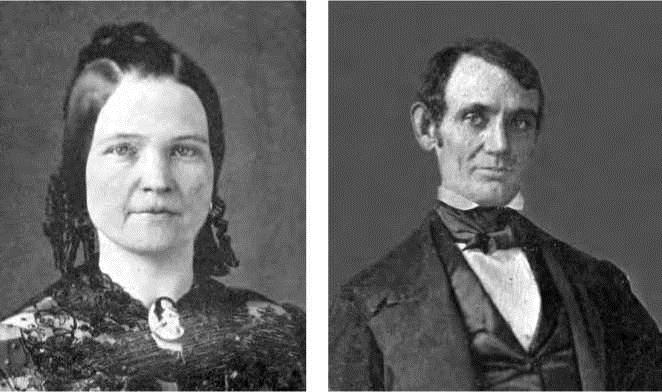
(Left: Mary Todd Lincoln (1846 or 1847), and right: Lincoln in Springfield at the same time)
Mary had written to Lincoln that she would wait for him to change his mind. A year later, they began courting again and finally in 1842, at thirty-three years of age, Lincoln wed Mary, ten years his junior. Though later Mary became impulsive and would be prone to hysterical behavior, Lincoln would always support her and care for her in times of agony. Mary admired him and depended on him emotionally. A deep love would bind them to each other till the end.
He could not as yet afford a house; but they enjoyed their blissful union at the local tavern where they boarded at four dollars a week. He missed his friend Speed tremendously; he often wrote to him of his political affairs, joys and sorrows, and Speed would mentor him. In 1843, he was disappointed on not being nominated for congress by the Whigs and it added insult to injury when his Party asked him to help Baker, his opponent, during the canvassing. In a subsequent letter he acknowledged that Speed was right in advising him to support his Party nominee.
And not only did he support Baker politically but also protected his person from physical harm. During his speech, some ruffians threatened to take Baker off the stage; Lincoln who was listening to his speech immediately came on stage and in a calm but firm voice, spoke of fair play and finally quieted the bullies with threats. What started as a fight for a seat in congress, terminated as an enduring friendship between Lincoln and Baker till the death of the latter.
His friendliness was not limited to only his dear friends, — he extended his heart to anyone who needed it. A client, on the verge of bankruptcy, gave him a promissory note in lieu of his fee. A few months later, when Lincoln met him, the poor man had also lost his hand in an accident. Seeing his plight and his embarrassment at not being able to pay his fee, Lincoln took out the promissory note and handed it back to his client. At that time it did not matter that he was having difficulty in meeting his own family expenses and could not afford to visit his friends.
In 1843, they were blessed with their first son, Robert. The fruits of his labour on the 8th Circuit were beginning to yield results. In a year’s time, he managed to buy their first house, which would be their home for seventeen years.
Joys of his new domestic life, legal cases in courthouses and local political intrigues kept Lincoln busy for two years. His partnership with Logan came to an end in 1844, after which he set up his own firm and invited young William Herndon as a junior lawyer. ‘Mr. Lincoln, you know I am too young, and I have no standing and no money; but if you are in earnest, there is nothing in this world that would make me so happy.’ Though Herndon was more educated than Lincoln, in all other respects he was his junior. Lincoln was like a father to Herndon; even when his drinking bouts caused embarrassment, Lincoln refrained from rebuking him. Their mutual respect and trust grew over time, ‘‘Billy and I never had the scratch of a pen between us; we just divide as we go along,’ said Mr. Lincoln’.40
The presidential elections of 1844 gave him a new vigour; his idol Henry Clay, was the candidate of the Whig Party for the presidency and he poured all his energies into the canvassing.
Once again, as a candidate for Presidential elector, he campaigned in the state of Illinois and later in Indiana, giving a string of speeches. Despite all the effort, Clay lost; not only the overall election but also the state of Illinois that supported expansionist ideas; it was a defeat that brought gloom to all his admirers, and in no small measure to Lincoln. But the campaign lifted Lincoln to great heights politically; his efforts had fortified the Whig Party in Illinois considerably, and his fame as a mighty debater had been proven throughout the country. His speeches, based on substantial facts and unarguable logic, became legendary.
The defeat of Clay was disappointing and unexpected for Lincoln. He believed that Clay was superior to Polk41, and the policies of the Whigs far superior to those of the Democrats, who fought the election on the Manifest Destiny platform. He blamed the people for their error in judgment rather than a shortcoming in his demi-god, Clay. Disgusted by the popular vote of the people given to one so undeserving in his eyes, he decided to quit politics and devote himself to his profession.
But destiny would not allow him to quit; two years hence, he got an opportunity to hear Clay speak on the subject of gradual emancipation at a meeting in Kentucky. He found it rather disappointing; it had neither the spontaneity nor the spirit he had expected. His personal interview with Clay was as disappointing as his speech had been. Though Clay appeared kind and acknowledged his gratitude for his active support during the campaign, Lincoln found Clay’s manner overbearing and to some extent condescending.
“It is quite possible that Mr. Lincoln needed to experience this disappointment... It was, perhaps, the only instance in his life in which he had given his whole heart to a man without knowing him. He was, certainly, from that time forward, more careful to look on all sides of a man, and on all sides of a subject, before yielding to either his devotion, than ever before.”42
Wind Beneath His Wings
In 1846, he made a bid for Congress and succeeded in securing a nomination; given his honest reputation and capabilities, the Whigs must have been as keen to have him in Congress on their ticket, as he was to be there.
His was the only Whig seat that won from Illinois in the House of Representatives; he was elected by an enormous margin and received votes that outnumbered those received by Clay in 1844. His popularity in his own district was phenomenal. As in New Salem during the Legislature elections, it was clear that he received votes that crossed party lines, thanks to the faith he evoked in his fellow men for his sincere and honest nature and honourable character.
Lincoln moved to Washington with his family and made their home in a boarding house where other congressmen were residing as well. With so much political and legislative experience behind him, Lincoln was quite comfortable in the House of Representatives. Coincidently, Stephen Douglas, his Democratic opponent from Illinois, at that time sat in the Senate. Almost like an operatic performance, leading to a crescendo, these two young political opponents were working their way up on the notes of the political scale. Illinois being predominantly Democratic, Douglas had an easy edge over him in Illinois. But the fact that Lincoln was the only Whig Congressman from Illinois made him conspicuous amongst his peers in Congress.
Lincoln was keenly aware of the issues that stirred the House and divided the people. Three issues were central to Lincoln’s participation in the Congress.
Though he had remained silent on his objection to the Mexican War (see Map p. XII A), and supported the funding for the war at the time of the election, Lincoln took the general Whig position in denouncing President Polk for waging a war on Mexico, which they termed was both unconstitutional and unnecessary. Polk, keen to justify the war and uphold himself before the people, had sent a message to the House asserting that Mexico had commenced the war ‘by invading our territory and shedding the blood of our citizens on our own soil.’43 Lincoln took the floor of the House and made a powerful speech in the House confronting Polk’s stand; he presented an elaborate paper called the ‘spot resolution’ demanding information about the exact spot on which Mexicans attacked American soldiers and shed their blood. He pointed out that Polk had transcended his executive powers, ‘...because the power of levying war is vested in Congress, and not in the President’44 It seems that Lincoln would later regret making this statement, since during his presidency, he would be extending the war powers of the executive.
During the second session of Congress, he tried to arrest the expansion of slavery by voting in support of the Wilmot Proviso45, which stated that all territory annexed after the Mexican War would be declared free soil.
Though Lincoln believed that slavery was morally wrong, he was controlled and held back by his obligation to the Constitution of the United States. In an effort to reduce slavery, he, in collaboration with Abolitionist congressman J. Giddings, proposed legislation for a gradual and compensated emancipation of slaves in the District of Columbia, subject to majority votes of its people. But his effort failed; Congress discarded his proposal, — abolitionists thought it was a very weak and conservative manner of dealing with the slavery issue, and the slaveholders felt threatened by such a radical approach.
Lincoln’s opposition to the Mexican War was considered antiexpansionist and was not received well in Illinois; they felt that Lincoln was misrepresenting their state in Congress. Democratic newspapers declared that ‘spotty Lincoln’ had committed political suicide. Herndon had tried to help Lincoln, both legally and politically:
“I wrote to him on the subject again and again and tried to induce him to silence, if nothing else; but his sense of justice and his courage made him speak, utter his thoughts, as to the war with Mexico... When Lincoln returned home from Congress in 1849, he was a politically dead and buried man; he wanted to run for Congress again, but it was no use...”46
Dejected with politics he returned to his law practice, which his junior partner William Herndon had been managing in his absence. Younger to Lincoln by ten years, he held him in great respect. They worked well together as a team and remained law partners till Lincoln’s death in 1865. He devoted himself to his practice; they moved their office into a larger space; his reputation as a first class lawyer of high integrity grew. He began to appear before the Supreme Court regularly and continued to ride the Eighth Circuit. Though personally Lincoln was opposed to slavery, as a professional lawyer he had been representing both slaves and slave owners in courts. His cases became more diverse, — he had clients from capital cities like Boston, New York, Philadelphia; he represented railroad companies, banks, insurance companies, merchants and manufacturers.
He always advised clients to settle matters amicably and to go to court only as a last resort. He took on cases that deserved merit and justice. Few lawyers in those days had the courage to take on fugitive cases, especially those with political ambitions, but Lincoln fearlessly accepted a case on its merit, irrespective of how it would affect his political career. An old widow who had been swindled by a pension agent; a free negro, who had foolishly gone ashore in a slave state and taken captive, his friend Armstrong’s son, who had been convicted for murder, — all were accepted by him as clients and helped. The last one was saved by Lincoln’s use of the farmer’s almanac47 to prove that the moon was at a low angle on the night of the murder and the witness’ claim that he had seen the accused in strong moonlight committing the crime was false.
Rarely did Lincoln raise objections in the courtroom, but if it ran against his principles of justice he did. And in the case of his cousin who was charged with murder, the judge, though a Democrat, sustained the objection, admitted the evidence presented by Lincoln and changed the verdict to ‘not guilty’.
Likewise, honesty and integrity were priority for him, over and above the interest of his clients. He once represented a client against a railroad company, claiming an amount that they owed him. The jury voted in favour of his client and when they were about to announce the amount after deductions, he declared that the deductions needed to be more. Even though his statement would grant less money to his client, he would not let it affect his decision based on fair play!
Though he was an extremely successful jury lawyer, his earnings were moderate; around fifteen hundred dollars a year. He did not care to charge too much from his clients. His law practice was going on well, and life was settling down into a fine rhythm when in 1850, Lincoln and Mary suffered a terrible loss. Though they had looked after him day and night, Eddy, their four-year-old son died. They were both devastated. To fight off depression, Lincoln returned to the Eighth Judicial Circuit and poured himself into his work. He became a close friend of Judge David Davis, who had practiced law with Lincoln before he became a judge. He had to look after Mary too, whose behavior had become unpredictable; she would erupt at the slightest instigation, and at times he would simply leave the house until her temper cooled off.
Ten months later, in December 1850, their third child, William was born. His birth helped alleviate their loss considerably. But within a few weeks he got news of his father’s death. Though he was her stepson, he cared for his stepmother’s welfare much more than her own son did. Lincoln’s concern about his stepmother’s future is evident in his letter to his stepbrother, chiding him for selling their father’s land and not making provisions for their mother’s future.
Mary joined the First Presbyterian Church a couple of years later and though Lincoln attended church sometimes he did not become a member. In 1854, they were blessed with a fourth son, Thomas, whom he lovingly called Tad.
This sabbatical from politics gave him time to be with his boys; he was a loving, gentle father with tremendous patience and tolerance to overlook their peevishness and wild activities. Their sweetness and innocence were a constant source of joy to him. But for his time in court, he spent most of the time in their company. He would be seen giving them pram rides in the streets, and as they grew older he carried them around on his shoulders and read to them too. He was not strict with them nor did he impose rules on them. Though such freedom did result in unruly behavior in his children, he preferred to shower them with fatherly love rather than parental control. Willie was a lot like him, — very intelligent, with a mind far ahead of his age, methodical and capable of great activity. He was a beautiful boy who was also very loving, honest and had great retentive powers. Lincoln had passed on to him his sense of humour as well as his fondness for writing poetry. ‘I know every step of the process by which that boy arrived at his satisfactory solution of the question before him, as it by just such slow methods I attain results’48 he would think of the special affinity he had with Willie.
Both he and Mary indulged the children tremendously, both at home and at the law office where they had a free run over tables and chairs, upsetting papers and ink stands, much to the chagrin of Mr. Herndon, his junior partner.
He also got time to study during this period; he decided to compensate his inadequacy in education by turning his attention to Mathematics and ‘nearly mastered the six-books of Euclid’49. He often thought about difficulties he had experienced in navigating his boat down the rivers during his New Salem days. He was good at mechanics; he had built a flatboat when he was not even twenty. He pondered over the invention of a device that could be attached to the hull of a boat and inflated to lift the vessel safely over an obstruction in the river and finally acquired a patent for it (the only president who patented an invention), though it was never used commercially.
The gulf between the north and south had been widening on many fronts, — economically, politically as well as culturally — the north was evolving as an industrial people; most inventions and technical improvements came from the north, most industries were set up there, large cities developed, population increased with immigrants from Europe who settled there and found work in the factories and in building of infrastructure projects like railroads, bridges, roads. They preferred a strong central government since it helped their economy in many ways — it would ensure good infrastructure like roads and railways that connected states for the transportation of goods, and a common currency that was best handled by a strong central government; matters of taxation would also be best if it became a central issue. On the slavery issue, the north was divided into two factions, — the abolitionists who wanted to put an end to slavery immediately and the others who recognized that it would be logical to arrest the growth of slavery, and allow it to die out on its own.
The south, on the other hand, was predominantly agrarian, mostly growing crops such as cotton, which was heavily dependent on slave labour. They preferred to be sovereign states that could govern themselves; their taxation policy was often in conflict with those of the north and they felt that the central government favoured the north. Also, the Southerners felt that a strong central government would threaten the slave system that was fundamental to their financial prosperity. The policy of the central government to encourage people to go west was also a bone of contention for both the south and the north; the Northerners wanted every new state added to the union to be a free state while the Southerners wanted it to be a slave state. It was important for both sides since the population of each state determined the number of congressman it could send to the House of Representatives. The greater the representation of slave states, the greater the influence over the legislation of bills that favoured slavery.
Very soon after the commencement of the Mexican War in 1846, conflict between the southern slave states and the northern free states had begun on the question of admitting the territories as free or slave states. There were at that time 15 free states and 15 slave states. The Southern states led by John Calhoun, objected to admission of California as a free state since it would swing the balance in favour of free states politically; by 1850, nine of them even threatened to leave the Union. Whig leader Henry Clay and Daniel Webster suggested a compromise designed to appease both the south and the north.
Known as the Compromise of 1850 (see Map p. XII A), it admitted California as a free state, New Mexico and Utah were declared as territories where the issue of slavery was to be settled later, slave trade was abolished in Washington D.C. and a Fugitive Slave Law (much abhorred by and protested against by Northerners) was approved that facilitated slave owners to recapture runaway slaves with federal assistance. This compromise deferred the conflict between the north and the south.
In 1852, on the death of his former idol Henry Clay, Lincoln delivered a eulogy at Springfield. His adulation of Clay had waned and this shift in his perceptions was apparent in his words:
“But Henry Clay is dead. His long and eventful life is closed. Our country is prosperous and powerful; but could it have been quite all it has been, and is, and is to be, without Henry Clay? Such a man the times have demanded, and such, in the providence of God was given us. But he is gone. Let us strive to deserve, as far as mortals may, the continued care of Divine Providence, trusting that, in future national emergencies, He will not fail to provide us the instruments of safety and security.”50
His prayer to the Divine for an instrument of safety and security seemed to be a silent offering of his own person for this task, as it were, — an offering that would manifest in his Presidential election eight years hence. The same year he canvassed for Winfield Scott, Whig candidate for Presidential elections after accepting the Presidential electoral ticket in 1852. Since victory for the Whigs in Illinois seemed impossible he did not invest too much of his time or energy into it.
The Story of Abraham Lincoln - Chapter II
Awakening
A couple of years later, things changed to revive Lincoln’s sagging interest in politics. In 1854, the Kansas-Nebraska bill was introduced by Senator Stephen Douglas.
It proposed to organize large tracts of land on the west of Missouri into two territories51 for settlers and for a Midwestern Transcontinental Railroad. He advocated popular sovereignty, which would leave the decision to permit slavery or not to the mandate of the people of each state. Douglas claimed that personally he was indifferent to the issue of slavery and believed that it would be in the interest of the nation to allow people of each state to choose democratically for themselves to be a free or slave state.
Douglas likened the Kansas-Nebraska Act (see Map p. XII-B) to the Compromise of 1850, where the issue of free or slave state was left to popular sovereignty in Utah and New Mexico. He argued that the Missouri Compromise52 of 1820 was not being violated, it was being ignored since the mandate to be a slave or free state would be given to the citizens of the states. However, anti slavery factions did not agree with him; they felt betrayed since Kansas-Nebraska Act violated the Missouri Compromise that had banned slavery in both these territories and declared that all states north of 36:30 latitude would in the future be free states; it would open those very doors again to slavery through popular sovereignty. However, little did Douglas realise that this very act would be the cause of the greatest conflict in the country leading to the Civil War, causing the death of thousands of its soldiers.
By 1854, Lincoln’s interest in politics had almost been overshadowed by his law profession. But the Kansas-Nebraska Act, passed in 1854 after months of debates in both houses, repealing the Missouri Compromise of 1820 ‘aroused him as he had never been before.’53
Lincoln was opposed to slavery, but he felt that it would be wiser to prevent any further expansion of slavery to other states, and gradually over time and through a mandate of the people eradicate slavery from each slave state (as he had suggested in the case of British Columbia). He did not agree with the abolitionists who wanted to end slavery immediately. He had doubts whether the white people and Negroes could co-exist peacefully with each other, given the racial incompatibility created over a hundred years. He feared that this Act would reverse the effort to contain slavery and might revive the African slave trade that would turn America into a massive slave empire.
Douglas addressed the people with the aim to defend the Kansas-Nebraska Act at Springfield with great confidence and the next day Lincoln replied, directly criticizing the Kansas— Nebraska Act:
“My distinguished friend says it is an insult to the emigrants to Kansas and Nebraska to suppose they are not able to govern themselves... I admit that the emigrant to Kansas and Nebraska is competent to govern himself, but I deny his right to govern any other person without that person’s consent.”54
This statement revealed the root of the matter and the gulf between the position of Douglas and Lincoln. Lincoln’s clarity in expression allowed the audience to see the immorality of ‘Popular Sovereignty’.
Douglas addressed the people defending the Kansas-Nebraska Act at Peoria. On 16th October 1854, Lincoln responded with his famous Peoria speech:
“… It is wrong; wrong in the direct effect, letting slavery into Kansas and Nebraska - and wrong in the prospective principle, allowing it to spread to every other part of the wide world, where men can be found inclined to take it.
“This declared indifference, but I must think, covert real zeal for the spread of slavery, I cannot but hate. I hate it because of the monstrous injustice of slavery itself. it deprives our republican institutions to taunt us as hypocrites.the real friends of freedom to doubt our sincerity.it forces so many really good men amongst ourselves into an open war with the fundamental principles of civil liberty—criticizing the Declaration of Independence and insisting that there is no right principle of action but self-interest.
“If all earthly power were given to me, I should not know how to do, as to the existing institution [of slavery]. My first impulse would be to free all the slaves and send them to Liberia - to their own native land. But a moment’s reflection would convince merits sudden execution is impossible. If they all landed there in a day, they all perish in the next ten days.Free them and make them politically and socially our equals? My own feelings will not admit this; and if mine did, we know that those of a great mass of white people will not. Whether this feeling accords with justice and sound judgment is not the sole question, if indeed it is part of it. A universal feeling, whether well or ill-founded, cannot be safely disregarded. We cannot then, make them equals. It does seem to me that systems of gradual emancipation might be adopted; but for their tardiness in this, I will not undertake to judge our brethren of the south.
“The doctrine of self-government is right - absolutely and eternally right - but it has no just application, as here attempted. When the white man governs himself, that is self-government; but when he governs himself, and also governs another man, that is more than self-government— that is despotism. .What I do say is, that no man is good enough to govern another man, without the other’s consent... Our Declaration of Independence says:
“We hold these truths to be self-evident: that all men are created equal; that they are endowed by their Creator with certain inalienable rights; that among these are life, liberty and the pursuit of happiness. That, to secure these rights, governments are instituted among men, DERIVING THEIR JUST POWERS FROM THE CONSENT OF THE GOVERNED.”
“… But Nebraska is urged as a great Union-saving measure.
Well I too go for saving the Union. Much as I hate slavery, I would consent to the extension of it rather than see the Union dissolved, just as I would consent to any GREAT evil, to avoid a GREATER one. But when I go to Union saving, I must believe, at least, that the means I employ has some adaptation to the end. To my mind, Nebraska has no such adaptation.
“… Slavery is founded in the selfishness of man’s nature - opposition to it is in his love of justice...repeal all past history, you still cannot repeal human nature.
“… Near eighty years ago we began by declaring that all men are created equal; but now from that beginning we have run down to the other declaration, that for SOME men to enslave OTHERS is a ‘sacred right of self-govern- ment.’.Let us return to the position our fathers gave it.
Let us re-adopt the Declaration of Independence. We shall have so saved [the Union], that the succeeding millions of free happy people, the world over, shall rise up, and call us blessed, to the latest generations.”55
He toured the state giving speeches to awaken the people to the injustices of the Act and enlighten them towards their duty towards the preservation of the union. Contrary to Douglas’ advice to the people, he insisted that whether the territories came in as slave or free states did affect the entire country since slave states had an advantage over free states in the Senate and House of Representatives.
The Kansas-Nebraska Act led to the emergence of the Republican Party in July 1854, founded by ex-Whigs and other antislavery activists. It was a merger of various groups, which were united by their passionate opposition to the expansion of slavery. It soon became the most dominant political Party in the North.
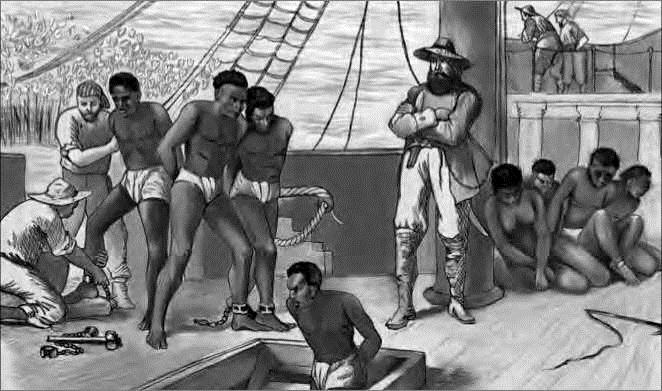
(Slaves being taken on a boat for trade)
In November 1854 Lincoln won the election to the Illinois House of Representatives on the Whig ticket but declined it. He felt it was time to make a bid for the Senate where he would be able to make a bigger difference.
The political parties too were going through a transition. The Southern Whigs had broken off from the main party and joined the Democratic Party. A faction of the Democratic Party broke off and formed the Anti-Nebraska Democratic Party. Here again we see how the greater interest of the nation superceded Lincoln’s own personal ambitions. The Whigs nominated Lincoln, the Anti-Nebraska Democrats nominated Lyman Trumball and the Democrats nominated Governor Matteson for the Senate. Lincoln did not want Governor Matteson to win since his stance on the subject of slavery was questionable. The only way possible was if the Whigs joined hands with the Anti-Nebraska Democrats. Since the Anti Nebraska Democrats were unwilling to sacrifice their nominee, he requested his friends to vote for Lyman Trumball instead of himself. This decision proved to be the right one; in time to come the new Republican Party would gather all these forces under its umbrella and choose Lincoln to stand at the helm.
Though Lincoln hated slavery, he was opposed to any unlawful opposition to it. The newly formed Abolitionist Party decided to come to assist the anti slavery faction in Kansas. Lincoln, answered in response to their cry for ‘Liberty, Justice, and God’s higher law’:
“Friends, you are in the minority — in a sad minority; and you can’t hope to succeed, reasoning from all human experience. You would rebel against the Government, and redden your hands in the blood of your countrymen. If you have the majority, as some of you say you have, you can succeed with the ballot, throwing away the bullet... Let there be peace . Revolutionize through the ballot-box, and restore the Government once more to the affection and hearts of men, by making it express, as it was intended to do, the highest spirit of justice and liberty. Your attempt, if there be such, to resist the laws of Kansas by force, will be criminal and wicked; and all your feeble attempts will be follies, and end in bringing sorrow on your heads, and ruin the cause you would freely die to preserve.”56
Since the Kansas-Nebraska Act opened up the territories, wagonloads of people moved into Kansas. Since it shared its border with Missouri, slaveholders from Missouri wanted Kansas also to be a slave state and felt threatened by the emigration of freeholders in Kansas. Both factions had aspirations to control the state policy; Slaveholders set up their convention in Lecompton and free-soilers chose Topeka as their headquarters. Slaveholders wanted to ensure that slavery is voted up by any means and resorted to corrupt measures and even violence to ensure that Kansas be brought in as a slave state. Polls were conducted that were completely controlled by proslavery hooligans of Missouri. President Franklin Pierce too supported the entry of Kansas as a slave state. Very soon there were skirmishes between the two factions. In 1856, a proslavery group ransacked a free soil stronghold, burned down a hotel and destroyed homes and shops. In retaliation, John Brown, an abolitionist killed a group of proslavery men. For months these two groups fought each other, destroying property and taking lives. What was purported to be a democratic Act was disintegrating into mayhem.
The violence and the corrupt politics in Kansas outraged the north and the antislavery faction and led to a rising of the tide against the Kansas-Nebraska Act. It reached the Congress; senators of several Northern states vehemently criticized Douglas’ Act; Democrat Preston Brooks physically attacked Charles Sumner57 after he delivered a sharp criticism of the Act in the Senate. The country was beginning to fall apart.
Unable to support the Whigs any further, in 1856, Lincoln joined the Republican Party, whose platform was expansionism and opposition to popular sovereignty. John C. Fremont was announced as their first presidential candidate. Lincoln campaigned fervently for the presidential elections and resultantly the Republican Party gained substantial support in the Northeast. But some southern politicians threatened to secede from the union if Fremont won the presidency, therefore, Democrat James Buchanan, won the election and was sworn in as President in 1856. Despite the Republicans losing the election, Lincoln had become a familiar and popular name in the North.
Kansas was still controlled politically by the proslavery faction despite the fact that free-soilers outnumbered them. President James Buchanan, like his predecessor, was a southern sympathizer and wanted Kansas to enter the union as a slave state. But Douglas objected since it violated his idea of Popular Sovereignty; it was the people of the state who ought to decide. Once again polls ensued, were indecisive, and the mayhem went on.
The issue of slavery was beginning to reach a crescendo; the Dred Scott Decision of 185758 angered the anti slavery faction even more and galvanized the Republican Party for the next elections. Further, the Fifth Amendment spelled out that no person could be deprived of ‘life, liberty or property (which included slaves) without due process of the law’; this made the Federal government powerless to prohibit the practice of slavery anywhere in the Union, even in free states where slavery was banned.
It was a severe setback for the abolitionists and the antislavery faction and appeared to be a momentous triumph for the south. But the Dred Scott Decision also challenged the sanctity of the Kansas-Nebraska Act, which advocated that the people of the state have the right to decide whether they want a free state or a slave state. The powerlessness of the Federal Government corresponded to the powerlessness of the state governments. The Dred Scott Decision rendered the principle of popular sovereignty null and void and Douglas was hard-pressed to reconcile both.59
Criticising the Dred Scott Decision, Lincoln said:
“... In those days, our Declaration of Independence was held sacred by all, and thought to include all; but now, to aid in making the bondage of the Negro universal and eternal, it is assailed, and sneered at, and construed, and hawked at, and torn, till, if its framers could rise from their graves, they could not at all recognize it....” 60
At the Republican Party Convention at Springfield, which nominated Lincoln for the Senate in 1858 he gave his famous house divided speech:
“… If we could first know where we are, and whither we are tending, we could then better judge what to do, and how to do it. We are now far into the fifth year, since a policy was initiated, with the avowed object, and confident promise, of putting an end to slavery agitation. Under the operation of that policy, that agitation has not only, not ceased, but has constantly augmented. In my opinion, it will not cease, until a crisis shall have been reached, and passed. ‘A house divided against itself cannot stand.’ I believe this government cannot endure, permanently half slave and half free. I do not expect the Union to be dissolved — I do not expect the house to fall — but I do expect it will cease to be divided. It will become all one thing or all the other. Either the opponents of slavery, will arrest the further spread of it, and place it where the public mind shall rest in the belief that it is in the course of ultimate extinction; or its advocates will push it forward, till it shall become alike lawful in all the States, old as well as new — North as well as South.
“Have we no tendency to the latter condition? ...
“The result is not doubtful. We shall not fail — if we stand firm, we shall not fail. Wise counsels may accelerate or mistakes delay it, but sooner or later the victory is sure to come.”61
With these words reflecting his inner conviction and strength of purpose, he closed his speech. Lincoln had deliberately quoted from the bible; on the evening previous to delivering his speech, he had read out his speech to Herndon.
“Mr. Herndon was startled at its boldness. “I think,” said he, “it is all true. But is it entirely politic to read or speak it as it is written?” “That makes no difference,” said Lincoln. “That expression is a truth of all human experience, — ‘a house divided against itself cannot stand.’ The proposition is indisputably true, and has been true for more than six thousand years; I want to use some universally known figure, expressed in simple language, that may strike home to the minds of men in order to rouse them to the peril of the times.”62”
He also wanted people to realize that despite Douglas’ statement that he was indifferent to the issue of slavery, he covertly was in favour of slavery and ought not to be trusted with the task of keeping the union from falling apart:
“... This was their lofty, and wise, and noble understanding… they knew the tendency of prosperity to breed tyrants, and so they established these great self-evident truths. While pretending no indifference to earthly honors, I do claim to be actuated in this contest by something higher than an anxiety for office... I am nothing; Judge Douglas is nothing. But do not destroy that immortal emblem of Humanity — the Declaration of American Independence.”63
Douglas, knowing that in Illinois there was a deep-seated universal prejudice against the Negro, constantly misrepresented Lincoln in his reference to the Declaration of Independence. Lincoln responded:
“My declarations upon this subject of Negro slavery may be misrepresented, but cannot be misunderstood. I have said that I do not understand the Declaration to mean that all men were created equal in all respects...Certainly the Negro is not our equal in color, perhaps not in many other respects; still, in the right to put into his mouth the bread that his own hands have earned, he is the equal of every other man, white or black.”64
When Douglas had heard of Lincoln’s nomination, he had remarked anxiously:
“I shall have my hands full. He is the strong man of the party — full of wit, facts, dates — and the best stump speaker, with his droll ways and dry jokes, in the West. He is as honest as he is shrewd, and if I beat him my victory will be hardly won.”65
Lincoln’s ‘house divided’ speech had a great impact on the people of the North about slavery dividing the Union. He then invited Douglas to engage in a series of public debates with him in their state (see Map p. XIII). He wanted to improve his position among the people. They faced each other seven times over three months in front of large crowds, sometimes upto fifteen thousand people. These Lincoln-Douglas debates of 1858 drew the attention of the entire nation. The press covered these debates comprehensively and the nation could follow the evolution of the campaign.
The two were complete antithesis of each other — Douglas was short in front of Lincoln’s towering frame, he was a known figure in the country while Lincoln enjoyed only a local reputation, Douglas was short and stocky, dressed in fancy clothes while Lincoln was thin and tall and plainly dressed. Douglas, a strong and formidable contestant, known as the ‘little giant’ was an outstanding orator with a booming voice, while Lincoln was ungainly on the podium and his voice often became high pitched when he spoke. Douglas was a former judge of the Supreme Court of Illinois and had been a sitting senator since 1847.
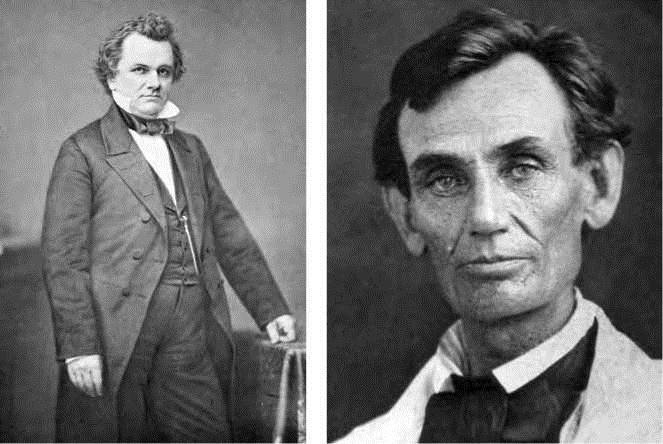
(The contenders in the debates of 1858 - Left: Stephen Arnold Douglas, and right: Lincoln)
These debates revolved around the subject of slavery; Douglas asserted the superiority of the white man while Lincoln referred to the Declaration of Independence that ‘all men are equal’. He attacked Douglas on three issues: he insisted that slavery was wrong and the nation could not permanently exist part slave and part free, that the doctrine of Popular Sovereignty that essentially suggests that if one man chooses to enslave another, no third man can intervene or object was wicked and that there existed a conspiracy to perpetuate slavery in the entire nation, a part of which were the Dred Scott decision and the Kansas-Nebraska bill.
At Quincy Lincoln closed his speech with the following remarks:
“… Judge Douglas asks you, ‘Why cannot the institution of slavery, or, rather, why cannot the nation, part slave and part free, continue as our fathers made it forever?’ In the first place, I insist that our fathers did not make this nation. part slave and part free. I insist that they found the institution of slavery existing here. They did not make it so, but they left it so, because they knew of no way to get rid of it at that time... More than that; when the fathers of the Government cut off the source of slavery by the abolition of the slave-trade, and adopted a system of restricting it from the new Territories where it had not existed. it was in the course of ultimate extinction; and when Judge Douglas asks me why it cannot continue as our fathers made it, I ask him why he and his friends could not let it remain as our friends made it?”66
At Alton, he began by saying:
“… What is it that we hold most dear among us? Our own liberty and prosperity. What has ever threatened our liberty and prosperity, save and except this institution of slavery? If this is true, how do you propose to improve the condition of things by enlarging slavery? — by spreading it out and making it bigger? You may have a wen or cancer upon your person, and not be able to cut it out lest you bleed, to death; but surely it is no way to cure it to ingraft it and spread it over your whole body — that is no proper way of treating what you regard a wrong. This peaceful way of dealing with it as a wrong — restricting the spread of it, and not allowing it to go into new countries where it has not already existed — that is the peaceful way, the old-fashioned way, the way in which the fathers themselves set us the example. Is slavery wrong? ... They are two principles that have stood face to face from the beginning of time; and will ever continue to struggle. The one is the common right of humanity, and the other the divine right of kings... ‘You work, and toil, and earn bread, and I’ll eat it.’ No matter in what shape it comes, whether from the mouth of a king who seeks to bestride the people of his own nation and live by the fruit of their labor, or from one race of men. for enslaving another race, it is the same tyrannical principle.”67
Lincoln stressed on the morality of the issue while Douglas stuck to the legality of the issue of slavery. However, in Douglas’ hometown Freeport, Lincoln decided to confront him on legal grounds. Since the Dred Scott Decision rendered the principle of popular sovereignty null and void, how could Douglas support both these conflicting views?
Douglas dismissed the Supreme Court verdict as irrelevant since according to the Act, people of a state had a right to self govern and choose to allow slavery or not in their state by electing representatives to the legislature who would establish regulations that would either permit or ban slavery in that territory or state. Such strong words did not go down well in the national media. They felt he was validating mobocracy over the law of the country. But Illinois was still strongly in favour of state rights; in 1858 Douglas won the Senate seat narrowly from Illinois.
The Ascent to the Top
Despite his disappointment, Lincoln continued to rise as a national figure and emerged as a strong Republican Party leader. He went back to his profession; politics had kept him away from his livelihood and he needed to earn money.
The Kansas turmoil resulted in a crack in the Democratic Party between the proslavery Southern states and the antislavery Northern states. The Republican Party reaped the benefit of this split and in the midterm elections of 1858 had secured seats in the northern and western states, thereby strengthening their position as the opposition party.
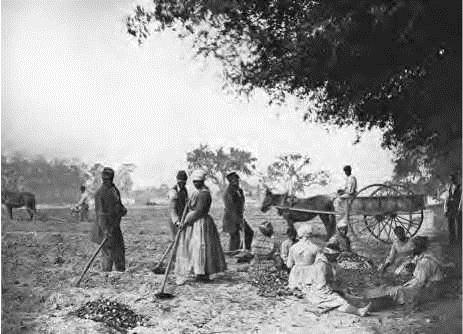
(Slaves working on a southern plantation)
In September 1859 when he heard that Senator Douglas was going to address people in Cincinnati, Ohio, he agreed to give a speech there as well. Speaking to the Kentuckians (slaveholders) in the audience he said:
“...I think slavery is wrong, morally and politically. I desire that it should be no further spread in these United States, and I should not object if it should gradually terminate in the whole Union.
“While I say this for myself, I say to you Kentuckians, that I understand you differ radically with me upon this proposition; that slavery is right; that it ought to be extended and perpetuated in this Union. Now, there being this broad difference between us I do not pretend in addressing myself to you, Kentuckians, to attempt proselyting you; that would be a vain effort.
“What do you want more than anything else to make successful your views of Slavery, — to advance the outspread of it, and to secure and perpetuate the nationality of it?...
What is indispensable to you? Why! if I may be allowed to answer the question, it is to retain a hold upon the North — it is to retain support and strength from the Free States. If you can get this support and strength from the Free States, you can succeed. If you do not get this support and this strength from the Free States, you are in the minority, and you are beaten at once.
“… I will tell you, … what we mean to do with you. We mean to treat you as near as we possibly can, like Washington, Jefferson and Madison treated you. We mean to leave you alone, and in no way to interfere with your institution; to abide by all and every compromise of the constitution... We mean to recognise and bear in mind always that you have as good hearts in your bosoms as other people, or as we claim to have, and treat you accordingly.
“… I want to know, now. what you mean to do. I often hear it intimated that you mean to divide the Union whenever a Republican, or anything like it, is elected President of the United States.
“Well, then, I want to know what you are going to do with your half of it? ... are you going to keep it right alongside of us outrageous fellows? Or are you going to build up a wall some way between your country and ours... You have divided the Union because we would not do right with you as you think, upon that subject; when we cease to be under obligations to do anything for you, how much better off do you think you will be? Will you make war upon us and kill us all? Why, gentlemen, I think you are as gallant and as brave men as live. but being inferior in numbers, you will make nothing by attempting to master us.”
Then addressing the entire audience of Ohio he said:
“It is a favorite proposition of Douglas’ that the interference of the General Government, through the Ordinance of ‘8768, or through any other act of the General Government, never has made or ever can make a Free State; that the Ordinance of ‘87 did not make Free States of Ohio, Indiana or Illinois. That these States are free upon his ‘great principle’ of Popular Sovereignty, because the people of those several States have chosen to make them so.
“Pray what was it that made you free? What kept you free? Did you not find your country free when you came to decide that Ohio should be a Free State? ... Let us take an illustration between the States of Ohio and Kentucky. Kentucky is entirely covered with slavery — Ohio is entirely free from it. What made that difference? Tell us, if you can. if there be anything you can conceive of that made that difference, other than that there was no law of any sort keeping it out of Kentucky?69 While the Ordinance of ‘87 kept it out of Ohio.
“... Illinois and Missouri came into the Union about the same time, Illinois in the latter part of 1818, and Missouri, after a struggle, I believe some time in 1820. At the end of that ten years,... the number of slaves in Illinois had actually decreased; while in Missouri, beginning with very few, at the end of that ten years, there were about ten thousand.
“… in Missouri there was no law to keep that country from filling up with slaves, while in Illinois there was the Ordinance of ‘87. The Ordinance being there, slavery decreased during that ten years — the Ordinance not being in the other, it increased from a few to ten thousand. Can anybody doubt the reason of the difference?
“I think all these facts most abundantly prove that my friend Judge Douglas’ proposition, that the Ordinance of ‘87 or the national restriction of slavery, never had a tendency to make a Free State, is a fallacy — a proposition without the shadow or substance of truth about it.
“Douglas looks upon slavery as so insignificant that the people must decide that question for themselves, and yet they are not fit to decide who shall be their Governor, Judge or secretary, or who shall be any of their officers. These are vast national matters in his estimation but the little matter in his estimation, is that of planting slavery there. That is purely of local interest, which nobody should be allowed to say a word about.
“Labor is the great source from which nearly all, if not all, human comforts and necessities are drawn... Some men assume. that nobody works unless capital excites them to work. They begin next to consider what is the best way. They say that there are but two ways; one is to hire men and to allure them to labor by their consent; the other is to buy the men and drive them to it, and that is slavery. Having assumed that, they proceed to discuss the question of whether the laborers themselves are better off in the condition of slaves or of hired laborers, and they usually decide that they are better off in the condition of slaves.
“In the first place, I say, that the whole thing is a mistake. That there is a certain relation between capital and labor, I admit. That it does exist, and rightfully exists, I think is true. That men who are industrious, and sober, and honest in the pursuit of their own interests should after a while accumulate capital, and after that should be allowed to enjoy it in peace, and also if they should choose when they have accumulated it to use it to save themselves from actual labor and hire other people to labor for them is right. In doing so they do not wrong the man they employ, for they find men who have not of their own land to work upon, or shops to work in, and who are benefited by working for others, hired laborers, receiving their capital for it. Thus a few men that own capital, hire a few others, and these establish the relation of capital and labor rightfully. A relation of which I make no complaint. But I insist that that relation after all does not embrace more than one-eighth of the labor of the country.”
He added that ‘the hired laborer with his ability to become an employer, must have every precedence over him who labors under the inducement of force’. He continued:
“Whoever desires the prevention of the spread of slavery and the nationalization of that institution, yields all, when he yields to any policy that either recognizes slavery as being right, or as being an indifferent things This government is expressly charged with the duty of providing for the general welfare. We believe that the spreading out and perpetuity of the institution of slavery impairs the general welfare. We believe — nay, we know, that that is the only thing that has ever threatened the perpetuity of the Union itself... Our friends in Kentucky differ from us.
“I say that we must not interfere with the institution of slavery in the states where it exists, because the constitution forbids it, and the general welfare does not require us to do so. We must not withhold an efficient fugitive slave law because the constitution requires us, as I understand it, not to withhold such a law. But we must prevent the outspreading of the institution, because neither the constitution nor general welfare requires us to extent it. We must prevent the revival of the African slave trade and the enacting by Congress of a territorial slave code. We must prevent each of these things being done by either Congresses or courts. The people of these United States are the rightful masters of both Congresses and courts not to overthrow the constitution, but to overthrow the men who pervert that constitution.
“To do these things we must employ instrumentalities. We must hold conventions; we must adopt platforms if we conform to ordinary custom; we must nominate candidates, and we must carry elections. In all these things, I think that we ought to keep in view our real purpose, and in none do anything that stands adverse to our purpose. If we shall adopt a platform that fails to recognize or express our purpose, or elect a man that declares himself inimical to our purpose, we not only take nothing by our success, but we tacitly admit that we act upon no [other] principle than a desire to have ‘the loaves and fishes’, by which, in the end our apparent success is really an injury to us.”70
So patiently he explained to the audience how Douglas was resorting to falsehood to convince the public about his Doctrine of Popular Sovereignty. So diligently he explained the history of the arrival of states into the Union and the laws adopted by the Federal Government to safeguard the country against the spread of slavery. And so lucidly he educated the masses about the difference between hired labour and slaves. He wanted to prepare them to vote wisely during the next presidential elections.
Jesse Fell, a friend of Lincoln, who had encouraged him to enter into these debates with Douglas, had begun to find in him the potential for higher office. He urged Lincoln to consider running for the office of president of the United States. In his inimitable humility and candidness, he replied:
“Oh, Fell, what’s the use of talking of me for the presidency, whilst we have such men as Seward, Chase and others, who are so much better known to the people. nobody, scarcely, outside of Illinois, knows me… I... admit that I am ambitious, and would like to be President. but there is no such good luck in store for me as the presidency of these United States; besides, there is nothing in my early history that would interest you or anybody else.”71
In fact urged by him he wrote a short autobiography for Fell, who got it published in a newspaper on February 1860. In the attached letter he remarked, “There is not much of it, for the reason,
I suppose, that there is not much of me.”72
In December 1859 Lincoln visited various towns in Kansas and addressed large gatherings of people eager to listen to his charming speeches and reassuring words. People responded with thundering applause.
On the evening of February 27, 1860 Lincoln addressed a large and brilliant audience at the Cooper Institute. An eyewitness that evening recounted:
“‘When Lincoln rose to speak, I was greatly disappointed. He was tall, tall, — oh, how tall, and so angular and awkward that I had, for an instant, a feeling of pity for so ungainly a man_ As Lincoln warmed to his subject, however, a change came over him. He straightened up... his face lighted up as with an inward fire; the whole man was transfigured. I forgot his clothes, his personal appearance, and his individual peculiarities. Presently, forgetting myself, I was on my feet like the rest, yelling like a wild Indian, cheering this wonderful man. When he reached a climax, the thunders of applause were terrific. When I came out of the hall, my face glowing with excitement and my frame all a-quiver, a friend, with his eyes aglow, asked me what I thought of Abe Lincoln, the rail-splitter. I said, ‘He’s the greatest man since St. Paul.”’73
During their debate at Ohio, Stephen Douglas had tried to convince the public that the Founding Fathers had believed in the system of slavery. To refute that statement, Lincoln prepared his speech after carefully examining the views of the 39 signers of the American constitution. He found that 21 of them believed that slavery should not be allowed to expand. In his speech he gave a detailed analysis along with statistical data of the views of the Founding Fathers individually, thereby proving to the audience that the position taken by the Republicans was not revolutionary, but similar to that of the Founding Fathers. He captivated the audience with his powerful words, and made direct and sharp references to the escalating discontent and aggression in the Southerners and their threat to secede if a Republican was elected President:
“...And how much would it avail you, if you could... break up the Republican organization? Human action can be modified to some extent, but human nature cannot be changed. There is a judgment and a feeling against slavery in this nation, which cast at least a million and a half of votes. You cannot destroy that judgment and feeling — that sentiment — by breaking up the political organization, which rallies around it.”
He advised his fellow Republicans of the need to be temperate but fearless in doing what they believed to be right:
“… A few words now to Republicans. Even though much provoked, let us do nothing through passion and ill temper. If slavery is right, all words, acts, laws, and constitutions against it, are themselves wrong, and should be silenced, and swept away. but, thinking it wrong, as we do, can we yield to them? Can we cast our votes with their view, and against our own? In view of our moral, social, and political responsibilities, can we do this?
“… Wrong as we think slavery is, we can yet afford to let it alone where it is. but can we, while our votes will prevent it, allow it to spread into the National Territories, and to overrun us here in these free States? If our sense of duty forbids this, then let us stand by our duty, fearlessly and effectively. Neither let us be slandered from our duty by false accusations against us, nor frightened from it by menaces of destruction to the Government. Let us have faith that right makes might; and in that faith, let us to the end dare to do our duty as we understand it.”74
His speech was published extensively in newspapers and used as campaign literature. It electrified intelligent and well-read New York citizens and Lincoln gained support in what was the home territory of William Seward, a Republican presidential nominee. It made him a known and popular figure throughout the country and was very much instrumental in his nomination for the Presidency. The press praised his speech and published rave reviews in their newspapers.
His successful address at Cooper Union institute had bolstered his confidence about his nomination for presidential elections on the Republican ticket. He toured New England for two weeks addressing folk and helping Republican candidates. Till now he had been a bit doubtful whether he would be nominated; but after his successful eastern tour and its thunderous response from the public, he confessed to Trumball75, ‘The taste is in my mouth a little.’76
In May 1860, the Illinois state convention of the Republican Party met to choose their Presidential candidate. There were four main contenders for the office of the president — William Seward from New York was considered the front runner; with Lincoln of Illinois, Salmon Chase of Ohio and Edward Bates of Missouri behind him. Seward was an experienced statesman and politician, a known leader in the Republican Party, having served as New York’s governor earlier and currently a senator. Lincoln, on the other hand, was just a country lawyer, having come into limelight only as the competitor of Senator Douglas in Illinois in 1858. His political reputation and support came mainly from the west. Therefore, Seward’s supporters expected their nominee would, without doubt, be nominated. Yet Lincoln’s Cooper Institute speech, had made him popular in the east, and ‘honest old Abe’ now became a known figure in most of the free states.
Despite his lack of experience and polish, Lincoln won the nomination and was declared the Republican Party’s presidential candidate with Senator Hannibal Hamlin as his vice-presidential running mate. Their platform stated the following: containment of slavery, abolishment of popular sovereignty, freeing of Kansas, high tariffs, internal improvements, and development of frontier regions — issues very close to Lincoln’s heart.
There is a wonderful anecdote with regard to his nomination:
“Judge Kelly of Pennsylvania, one of the committee, and a very tall man, looked at Mr. Lincoln, up and down... a scrutiny that had not escaped Mr. Lincoln’s quick eye. So, when he took the hand of the Judge, he inquired: “what is your height?” “Six feet three,” replied the Judge. “What is yours, Mr. Lincoln?” “Six feet four,” responded Mr. Lincoln. “Then, sir,” said the Judge, “Pennsylvania bows to Illinois. My dear man,” he continued, “for years my heart has been aching for a president that I could look up to; and I’ve found him at last, in the land where we thought there were none but little giants77.”78
Meanwhile, the Democratic Party split due to irreconcilable differences on the principle of slavery. Eventually, there was Lincoln of the Republicans, Stephen Douglas of the Democrats, John Breckenridge of the Southern Democrats and a third party sprang up called the Constitutional Union Party with their presidential candidate, John Bell.
Lincoln did not do any active campaigning; in fact he did not leave his hometown. He urged his visitors at Springfield to read his earlier speeches. In contrast, Douglas and Southern Democratic Party workers toured both the northern and the southern states. Lincoln’s party workers campaigned zealously, focusing on their party’s platform and thoroughly utilizing his life sketch — his humble rural background, his native intelligence, his rise from obscurity to prominence.
The Republicans were confident of Lincoln’s win provided they could establish their popularity in the northern states. They did not even campaign in the southern states but for a few border cities. By the end of the campaigning it was evident that the republicans had a clear advantage in the north. Its interesting to note that because of their system of counting, Lincoln won a sweeping 180 of a total of 303 electoral votes; 152 being the number needed to win, even though he won less than forty percent of the popular vote.79 (see Map p. XIV, A & B)
To the White House, Mr. President
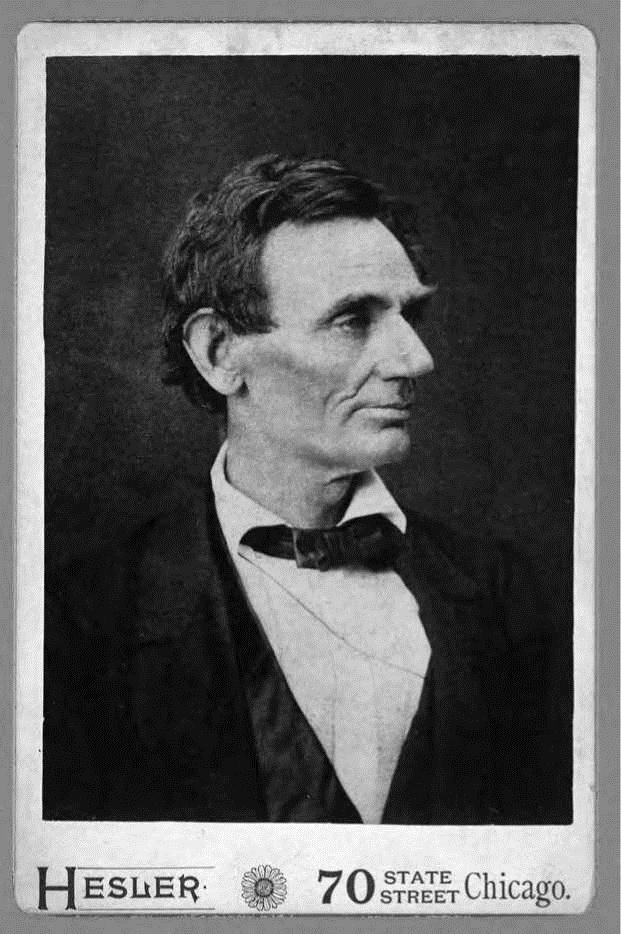
(Candidate for US President (1860))
On 6th November 1860, Lincoln was elected president of the United States. His response to his friends and supporters was, ‘Well, boys, your troubles are over now, but mine have just begun.’80 He was referring to the threat given by some Southern states that they would secede if an ‘anti-slavery’ republican was elected president. Though republicans had declared that they supported the right of each state to choose to be pro slavery or anti slavery their party platform stated that they were against the expansion of slavery in new territories. Having a national government, which wished to arrest the expansion of slavery, threatened the Southerners. Ten Southern states did not even have Lincoln’s name on the ballot. It was a formidable task before him, — to keep his nation from falling apart.
Till now the federal government had placated the south through legislations to arrest the spread of slavery but never attempted to put an end to it. But with the coming of Lincoln as President of the United States of America the southern states were convinced that the days of placation would soon be over.
No sooner had the news of his victory at the polls been announced, (See Chart p. XIV) he was beset with throngs of people who wished to meet with him — ‘those who called for love and those who sought for office’.81 Many advised him on the choice for his cabinet members; some republicans wished to make peace with the south by installing Southerners into it and compromising on the issue of slavery. But that was not acceptable to Lincoln; he would not compromise on his principles and though he knew that the road ahead was dark and dangerous he kept firm in his beliefs and refused such advice.
“All that I am in the world — the Presidency and all else — I owe to the opinion of me which the people express when they call me ‘Honest Old Abe’. Now, what would they think of their honest Abe if he should make such an appointment as the one proposed?”82
‘Harboring no jealousies, entertaining no fears concerning his personal interests in the future, he called around him the most powerful of his late rivals — Seward, Chase, Bates — and unhesitatingly gave into their hands powers which most Presidents would have shrunk from committing to their equals, and much more to their superiors, in the conduct of public affairs.’83 Despite the fact that they thought themselves to be superior to him in their education, social standing and their tenure in politics, Lincoln had made up his mind about having them in his cabinet. Lincoln knew that they would be capable of steering the country through this civil turbulence.
Seward gradually came to admire Lincoln and became his closest friend among his secretaries. Edward Bates was selected as an appeasement to the Border States that were proslavery. Chase, though highly egoistic and ambitious, was chosen as Secretary of Treasury because of his astute mind. Simon Cameron, extremely corrupt and greedy was the only person in his cabinet, who was given an office as a favour. Edwin Stanton who replaced Cameron was critical of Lincoln at first, but grew to admire and respect him and became one of his most faithful secretaries. Once when someone commented that Stanton had made an uncomplimentary remark about him, Lincoln brushed it aside, ‘If Stanton said that I was a damned fool, then I must be one, for he is nearly always right, and generally says what he means. I will step over and see him.’84 His lack of vanity was his very strength that with his straightforwardness and humility kept his warring cabinet together.
His victory at the polls did not go well with the southern states. South Carolina seceded from the union the very next month in December 1860. President Buchanan did not take any military action against this rebellious act; not willing to distance either one, he declared on one hand that the Southern states had no legal right to secede and on the other that the Federal Government had no legal right to prevent them from seceding.
Efforts were made by various sections of society to prevent this schism. Lincoln began to arrest the tide of slavery even before he assumed office. He privately communicated to various republicans in Congress advising them:
“Entertain no proposition for a compromise in regard to the extension of slavery. The instant you do, they have us under again; all our labor is lost, and sooner or later must be done over. Douglas is sure to be again trying to bring in his ‘Pop. Sov.’ Have none of it. The tug has to come & better now than later.
You know I think the fugitive slave clause of the constitution ought to be enforced-to put it on the mildest form, ought not to be resisted.”85
Two of Lincoln’s rivals who eventually became his indispensable Cabinet Secretaries
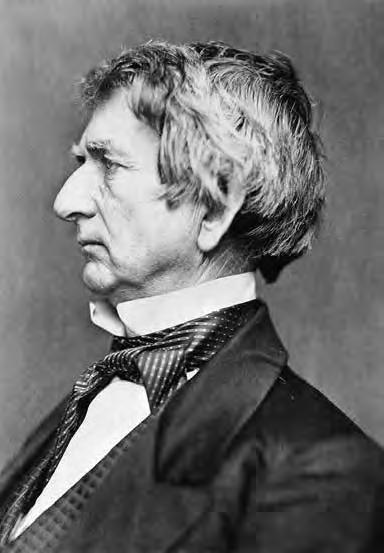
(William Seward, Lincoln’s Republican rival for the presidential nominations of the 1860 elections.)
(Edwin Stanton, a Democrat and a prominent lawyer. Though he had slighted Lincoln during a court case and was overbearing and ill tempered, Lincoln selected him for his innate honesty and intelligence.)
Meanwhile, events were moving towards a face off between South Carolina and the White House. Refusing to accept the demands of South Carolina to evacuate Charleston Harbour, Buchanan sent a supply ship to fortify Fort Sumter. Spotting it as it approached the harbour, South Carolina opened fire on it, forcing it to retreat.
Emboldened by South Carolina’s aggression, Mississippi, Florida, Alabama, Georgia, Louisiana followed suit and seceded from the Union with Texas being the last of the seven Southern states to do so on 1st February 1861. The rebel states met and formed the Confederate States of America under the presidency of Jefferson Davis and formed the Confederate army.
That was not all; every department in Washington was replete with spies and traitors; the Southerners in the Buchanan Cabinet and in Congress set into motion their plans to pillage the government of its resources. The federal treasury was depleted, navy ships were dispersed from their posts and arsenals were plundered to equip the southern army. Simultaneously, the Confederates seized several Southern coastal forts and war supplies.
All this he saw from a distance, knowing well that with seven rebellious states on his hands the Presidency would bring with it a crown of thorns. He was kept informed by fellow republicans in Congress about all important turn of events. The Border States were a buffer between the South and Washington; if they seceded, Washington would be vulnerable and its capture a calamity. General Scott had warned President Buchanan about the need to fortify their position in the Southern forts against the aggression from the seceded states; Buchanan ignored his advice; Lincoln, through a fellow republican, however, requested of General Scott, ‘.to be as well prepared as he can to either hold or retake the forts, as the case may require, at and after the inauguration.’86
Before departing for Washington, Lincoln decided to bid farewell to his stepmother. He travelled to Coles County and spent a day with her, reminiscing about his childhood and her cheerful influence on him. It was a sentimental reunion; she was worried for his safety and as he hugged her he had tears in his eyes.
A day prior to his departure from Springfield, Lincoln came to the law office to complete some unsettled matters with Herndon who relates a touching anecdote. After all the work was over, he ‘threw himself down on the old office sofa. He lay for some moments, his face towards the ceiling. Presently, he enquired, Billy. how long have we been together?” “Over sixteen years,” I answered. “We’ve never had a cross word during all that time, have we?” To which I returned a vehement, “No, indeed we have not”. He then recalled some incidents of his early practice and took great pleasure in delineating the ludicrous features of many a lawsuit on the circuit. I never saw him in a more cheerful mood. Before leaving he made the strange request that the signboard which swung on its rusty hinges at the foot of the stairway should remain. “Let it hang there undisturbed”, he said, with a significant lowering of his voice. “Give our clients to understand that the election of a President makes no change in the firm of Lincoln and Herndon. If I live I’m coming back some time, and then we’ll go right on practicing law as if nothing had ever happened.” He lingered for a moment as if to take a last look at the old quarters, and then passed through the door into the narrow hallway.87
On his departure from Springfield on 11th February 1861, his farewell address reflects the gravity of the state of affairs the nation was in. His faith and belief in God are evident in his appeal to the people of Springfield.
“... I go to assume a task more difficult than that which devolved upon General Washington. Unless the great God who assisted him, shall be with and aid me, I must fail. But if the same omniscient mind, and Almighty arm that directed and protected him, shall guide and support me, I shall not fail, I shall succeed. Let us all pray that the God of our fathers may not forsake us now. Friends, one and all, I must now bid you an affectionate farewell.”88
All his speeches on the way to Washington were well thought out, temperate, and yet with a sincere heartfelt honesty, asking his people for patience and faith in the American constitution. But, there was also a quiet resolve and firmness with regard to the problem of secession.
“I shall endeavor to take the ground I deem most just to the North, the East, the West, the South, and the whole country. I take it, I hope, in good temper — certainly no malice toward any section. I shall do all that may be in my power to promote a peaceful settlement of all our difficulties. The man does not live who is more devoted to peace than I am. None who would do more to preserve it. But it may be necessary to put the foot down firmly.”89
Along with temperance and warmth, his speeches contained words of eternal wisdom:
“...If the politicians and leaders of parties were as true as the PEOPLE, there would be little fear that the peace of the country would be disturbed. I have been selected to fill an important office for a brief period, and am now, in your eyes, invested with an influence which will soon pass away; but should my administration prove to be a very wicked one, or what is more probable, a very foolish one, if you, the PEOPLE, are but true to yourselves and to the Constitution, there is but little harm I can do, thank God!”90
An assassination plot was uncovered which forced him to travel in the cover of darkness. Travel schedules were changed to foil the assassination attempts. Lincoln was forced to enter Washington quietly under guard of General Scott’s men — a fact that was used by his adversaries to mock him as a coward. But prior to that, against the advice of his friends and colleagues he insisted on keeping to his schedule of raising the flag in Philadelphia, ‘even if it cost him his life.’
After twelve days of chequered journeying, dodging assassination plots and giving speeches in various towns and cities, he arrived in Washington.
He was not met with a warm welcome there, — its high society was against him and his principles. But despite the antagonistic atmosphere and threats of assassination looming on him, on 4th March 1861, after a strong inaugural address, assuring the people that he did not wish to deprive the South of their constitutional rights with regard to slavery, reasserting the rights of both state and federal governments but keeping the overall stress on the dire need of preserving the union, and remarking the secession by the Southern states legally null and void, he took oath of office and became the 16th president of the United States of America:
“Before entering upon so grave a matter as the destruction of our national fabric, with all its benefits, its memories, and its hopes, would it not be wise to ascertain precisely why we do it?
“... In your hands, my dissatisfied fellow-countrymen, and not in mine, is the momentous issue of civil war. The Government will not assail you. You can have no conflict without being yourselves the aggressors. ‘You’ have no oath registered in heaven to destroy the Government, while I shall have the most solemn one to preserve, protect, and defend it.”91
With great finesse he put the onus of any aggression on the South and any war by the union as a rightful defense to protect the nation, thereby fulfilling his declaration that he only wanted to preserve the nation.
“I am loath to close. We are not enemies, but friends. We must not be enemies. Though passion may have strained it must not break our bonds of affection. The mystic chords of memory, stretching from every battlefield and patriot grave to every living heart and hearthstone all over this broad land, will yet swell the chorus of the Union, when again touched, as surely they will be, by the better angels of our nature.”92
He ended on a conciliatory note appealing to the people of the south to remember that they were brothers belonging to the same nation.
However, contrary to his appeals and hopes, the very next day, word reached Washington that Fort Sumter had been surrounded by the confederacy and was running out of supplies.
If supplies were sent, the confederacy would attack. Without supplies General Anderson would be unable to hold the Fort.
Having declared that the union would not be the aggressor, Lincoln could not send reinforcements, as it would be called an act of war. Fearing loss of men and resources, Seward, Secretary of State and General Scott advised him to abandon the fort but Lincoln was loathe to do so, ‘by many it would be construed as a part of a voluntary policy; that at home it would discourage the friends of the Union, embolden its adversaries... in fact, it would be our national destruction consummated.’93 After much deliberation with other seasoned politicians, Lincoln sent a messenger with a note to the Governor of South Carolina:
“...I am directed by the President of the United States to notify you to expect an attempt will be made to supply Fort-Sumter with provisions only; and that, if such attempt be not resisted, no effort to throw in men, arms, or ammunition, will be made...”94
This notice seemed premonitory — even before the relief ship could arrive at Charleston Harbour, the Confederates demanded the evacuation of Fort Sumter. On Major Anderson’s refusal, they opened fire on Fort Sumter. Outnumbered in men and ammunition, on 14th April, the union army surrendered. The Civil War had begun (see Map p. XV).
While the revolution almost a hundred years ago against the mother country Britain, had created the United States, the Civil War between brothers would decide whether it was to be an undivided nation with a sovereign national government or a loose federation of independent states. On this outcome would rest its destiny — whether it would break into small quarreling countries where slavery still existed in some of its parts or it lived up to its declaration that all men were created equal.
Lincoln was neither in favour of war nor of keeping peace. He only wished to preserve the union and with this aggressive act of the Confederates, he felt that war would put an end to this rebellion. Having informed South Carolina that the relief ship would only be carrying provisions, the Union was now justified in protecting itself ‘in self defense’.
The very next day, on the 15th of April, he issued a proclamation to the state governors calling for 75000 troops. And on the 19th of April, Lincoln issued a proclamation declaring a blockade of the ports of South Carolina, Florida, Mississippi, Louisiana, Georgia and Alabama. Not having much industry, the south depended on foreign supplies for weapons and other goods. They traded cotton for weapons with England. To prevent goods, troops and weapons from entering the southern states, the Union Navy used as many as 500 ships to patrol the east coast from Virginia to Florida and the Gulf Coast from Florida to Texas. With these two key steps Lincoln commenced armed hostilities against the South in an attempt to preserve the union.
Virginia responded to the call for military volunteers by joining the confederacy, followed soon by Tennessee, North Carolina and Arkansas. Young men from both sides North and South joined their armies to fight for what they believed in. Those in the South did so, not so much for the cause of slavery but because they believed that a state had a right to self-rule.
To counter the effect of Virginia’s defection, in April, Lincoln offered the command of the Union armies to Colonel Robert E. Lee, noted for the capture of John Brown, an abolitionist who began an armed rebellion to put an end to slavery. Although Lee was against slavery, his allegiance to his home state prompted him to decline the offer, resign from his military position in the union army and join the confederacy. With great foreboding he remarked, ‘there is a terrible war coming, and these young men who have never seen war cannot wait for it to happen, but I tell you, I wish I owned every slave in the South, for I would free them all to avoid war.’95
(Salmon Chase, another rival during the republican nominations for the elections of 1860)
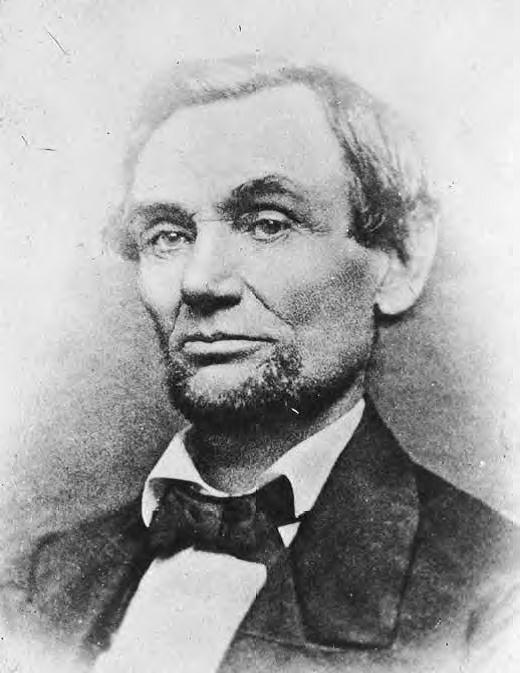
(Lincoln’s first picture showing his beard, grown reluctantly on the suggestion of a little girl Grace Bidell (1860))
Your very agreeable letter of the 15th is received. I regret the necessity of saying I have no daughter. I have three sons — one seventeen, one nine, and one seven. They with their mother constitute my whole family. As to the whiskers, as I have never worn any, do you not think that people would call it a piece of silly affectation were I to begin wearing them now?
I am your true friend and sincere well-wisher, A. Lincoln
(His response to Grace Bidell (1860))
The Story of Abraham Lincoln - Chapter III
The Border States
Soon after the attack on Fort Sumter and the call for troops, public opinion in the Border Slave States of Delaware, Maryland, Kentucky and Missouri was divided and their allegiance unclear. These slave states, rich in mineral and agricultural resources, were culturally closer to the south, but politically they were moderate and felt close ties with the Union. Economically they were no longer dependent only on the south; with the coming of the railroad their produce was increasingly being sent to the north as well. Their population size was half of that of the eleven confederate states (see Map p. XV-A).
Of the four Border States, Delaware had the least amount of slaves and therefore, posed the least risk of secession.
Maryland bordered Washington, the Union Capital on three sides; the capital’s telegraph and rail lines passed through it. Loss of Maryland would be disastrous to the Union — it would make Washington extremely vulnerable.
Kentucky’s importance was more strategic; it stood as a buffer between the Southern state of Tennessee and the Union states of Ohio, Indiana and Illinois. It also controlled major river systems that flowed into the Deep South.
Missouri, densely populated, protected the Union’s western flank and controlled the Mississippi river on its eastern shore. Loss of Missouri would make Kansas, Iowa and Illinois on its north vulnerable and the Union would find it difficult to control Kentucky on its east.
The strategic geographical location, their dense white population and their control over vital transportation and communication networks made their allegiance to the Union vitally important.
Lincoln now looked worriedly towards the Border States — they were still a part of the Union. In an attempt to keep them from seceding, Lincoln assured them that he did not wish to interfere with the Constitutional right of states to hold slaves where it already existed, (even though personally he was against slavery and wanted to prevent its expansion). But south sympathisers in these states wished for secession.
Soon after the Fort Sumter conflict, in a bid to isolate Washington, rebels in Maryland cut telegraph lines and rail ties. Massachusetts had been the first state to respond to the call for troops and dispatched a regiment within four days. As the troops headed for Washington passed through Baltimore, capital of Maryland, rebels attacked them. The Governor of Maryland and the Mayor of Baltimore were scared; though still a part of the Union, four out of every five persons in Maryland were supporters of the rebellion. When met by the mayor of Baltimore who unapologetically asked him to alter the route of the troops, Lincoln erupted furiously:
“... You express great horror of bloodshed, and yet would not lay a straw in the way of those who are organizing in Virginia and elsewhere to capture this city. The rebels attack Fort Sumter, and your citizens attack troops sent to the defense of the Government.I must have troops to defend this Capital. Geographically it lies surrounded by the soil of Maryland; and mathematically the necessity exists that they should come over her territory. Our men are not moles, and can’t dig under the earth; they are not birds, and can’t fly through the air. There is no way but to march across, and that they must do...”96
By May 10,000 troops were in place defending Washington; he now declared martial law in Maryland and arrested the rebels and put them in temporary detention. He also suspended the writ of Habeas Corpus,97 which was challenged by Chief Justice Taney.
Though the Governor of Kentucky had proposed that it should stay with the Union, his sympathies were clearly with the south. When Lincoln asked him to supply 100,000 men to fight for the Union cause, he responded, that Kentucky would ‘furnish no troops for the wicked purpose of subduing her sister Southern states’. Kentucky legislature, however, decided to stay neutral asking both sides to keep out. It was vital to keep an eye to ensure that the loyalist and rebel balance was not tipped over.
In July, he addressed congressmen at the special session he had called for in the aftermath of the surrender of Fort Sumter. He explained in detail the actions he had taken after the rebellion of the Southern states, and clarified the motive of war against the confederates. According to his belief, the Southern states were a part of the Union, secession was not legal and therefore as President, it was his responsibility to put down the rebellion and save the Union.
“... And this issue embraces more than the fate of the United States. It presents to the whole family of man the question whether a constitutional republic, or democracy — a government of the people by the same people — can or cannot maintain its territorial integrity against its own domestic foes. It presents the question whether discontented individuals, too few in numbers to control administration according to organic law in any case, can always, upon the pretenses made in this case, or on any other pretenses, or arbitrarily without any pretense, break up their government and thus practically put an end to free government upon the earth. It forces us to ask — Is there in all republics this inherent and fatal weakness? Must a government of necessity be too strong for the liberties of its own people, or too weak to maintain its own existence?...
“... Our popular government has often been called an experiment. Two points in it, our people have already settled — the successful establishing, and the successful administering of it. One still remains — its successful maintenance against a formidable attempt to overthrow it. It is now for them to demonstrate to the world, that those who can fairly carry an election, can also suppress a rebellion... Such will be a great lesson of peace; teaching men that what they cannot take by an election, neither can they take it by a war — teaching all, the folly of being the beginners of a war.”98
His speech in Congress won over many who doubted him at first. Now Lincoln needed a war plan and a system of command to put it into action. He rejected General Scott’s advice of avoiding battle and focusing on his Anaconda Plan of tightening the blockade and seizing control of the Mississippi river. He believed that an active war was the only way to win.
Neither the North nor the South expected it to be a long war. Each side thought the other too weak to last long. Each was in for a rude shock.
General McClellan
The battles in the American Civil War have been divided into the Eastern Theatre and the Western Theatre. Many important campaigns, launched by the Army of the Potomac to capture Richmond, the capital of the confederates in Virginia, were in the Eastern Theatre that included the states of Virginia, West Virginia, Maryland, Pennsylvania, the District of Columbia and the coastal forts and seaports of North Carolina. The Western Theater included the Mississippi River and west of the Appalachian Mountains, Georgia and the Carolinas (See Map p. XV-A).
Western Counties of Virginia with their small farms and the absence of slavery was a contrast to the rest of the state with its large farms and thriving slave culture. Unhappy with the east for ignoring their demand for lower taxes, they opposed the secession when Virginia agreed to break off from the union. Under General McClellan the union made a few victories in western Virginia in August 1861. This ended the confederate control in most western counties but for occasional raids and guerilla warfare from time to time. It also paved the way for West Virginia to become the thirty-fifth state of the Union in 1863.
The press and the radicals in the north were looking for a quick end to the war; they were confident of routing the south. Under pressure from them and encouraged by the victories in western Virginia, Lincoln, after consultation with the war cabinet, ordered union soldiers to cross the Potomac and attack the confederates in Virginia. The Union army under McDowell consisted mostly of raw civilians and he was hesitant to go into battle with such raw recruits. The North was routed at what is called the first battle of Bull Run on 21st July 1861. At start it seemed as though McDowell’s army had managed to rout the rebels, but it seems the south had been warned about the union attack and were prepared with General Jackson and his troops waiting to attack. Fortified by his presence, the retreating southern troops rallied behind and started a counter attack that ended in a shocking defeat for the North; on initial reports that the north had succeeded in routing the rebels, reporters, congressmen and civilians had come from Washington with picnic baskets to watch from a distance what they assumed would be a quick union win. In fact, the retreating union army ran headlong into the picnickers who too, observing the turn of tides were beating a hasty retreat. The only saving grace was that the tired confederates did not follow after the retreating Yankees to take over the Capital.
Washington was in shock; after several sleepless nights, Lincoln came out with a set of war plans. The South was larger in land mass than the North but in terms of population their nine million was half the strength against eighteen million northerners. Using this to his advantage, his main strategy was to attack the South on many fronts and move in a manner that they could use the support of the Border States.
He was already under pressure from all sides — Charles Sumner, a radical republican along with vice president Hamlin and a senator from Michigan had met with him to convince Lincoln that the civil war ought to be a conflict between slavery and freedom. Peace democrats or the copperheads99, wanting an immediate peace settlement with the confederates, denounced him for his anti-slavery leanings. Lincoln, on the other hand was keen to develop a broad foundation by ‘presenting the case before the country as one of Union versus Disunion’. 100
Lincoln needed bipartisan support, — he could afford to aggravate neither the democrats nor the republicans. He fostered friendship with war democrats like Andrew Johnson, who despite being a southern democrat refused to follow his state during secession, and Johnson of Maryland who stood behind him when he exercised his war powers while Justice Taney challenged them101. Lincoln rewarded many Democrats through government appointments barring military appointments, which were done on the basis of expertise. Nevertheless, several Generals he had chosen were Democrats, — McClellan, Butler etc.
After the defeat at Bull Run, slaves, on hearing of the fighting, fled into the Union army encampments and looked for work as labourers. The administration, worried that with slaves available as labourers and servants, the South had an advantage over the North in its available manpower for war, therefore did not discourage them from fleeing. Soon, Congress, came out with the 1st Confiscation Act in August 1861, to establish judicial proceedings to seize slaves that were used to help in the rebellion. Lincoln did not approve of it; he felt it might be rejected as unconstitutional, and would put into jeopardy any future attempts at emancipation of slaves. Secondly, he believed that it would push the Border States, especially Kentucky and Missouri into joining the confederacy. However, he signed it, albeit reluctantly, after much lobbying by powerful senators. It was anyway ineffective as the federal government had no control over the Southern states but for the areas they had captured in battle. But this confiscation bill was a step towards emancipation that would take place later.
Seeing rebel uprisings in Missouri, which included the Governor who was a south sympathizer, Lincoln sent troops to put down rebel voices. In August 1861, General Fremont, without consulting his superiors in Washington declared martial law stating that any civilian found with arms could be subject to a court-martial and shot and that slaves of people assisting the rebellion would be freed. This caused a great unrest in the Border States. Most of them were beginning to turn hostile towards the Union. Kentucky almost gave up their policy of neutrality. Lincoln ordered Fremont to alter it so as ‘to conform to and not to transcend’102 the Confiscation Act. Lincoln’s need to keep Kentucky from seceding is clear in his letter to Senator Orville Browning103, who had objected to his rescission of Fremont’s proclamation:
“... Genl. Fremont’s proclamation, as to confiscation of property, and the liberation of slaves, is purely political, and not within the range of military law, or necessity. If a commanding General finds a necessity to seize the farm of a private owner. he has the right to do so, and to so hold it, as long as the necessity lasts; and this is within military law, because within military necessity. But to say the farm shall no longer belong to the owner, or his heirs forever. is purely political, without the savor of military law about it. And the same is true of slaves. That must be settled according to laws made by law-makers, and not by military proclamations. The proclamation in the point in question, is simply “dictatorship.’’ It assumes that the general may do anything he pleases — confiscate the lands and free the slaves of loyal people, as well as of disloyal ones. I cannot assume this reckless position; nor allow others to assume it on my responsibility.
“I do not say Congress might not with propriety pass a law, on the point, just such as General Fremont proclaimed. I do not say I might not, as a member of Congress, vote for it. What I object to, is, that I as President, shall expressly or impliedly seize and exercise the permanent legislative functions of the government.
“So much as to principle. Now as to policy. No doubt the thing was popular in some quarters, and would have been more so if it had been a general declaration of emancipation. The Kentucky Legislature would not budge till that proclamation was modified; and Gen. Anderson telegraphed me that on the news of Gen. Fremont having actually issued deeds of manumission, a whole company of our Volunteers threw down their arms and disbanded. I was so assured, as to think it probable, that the very arms we had furnished Kentucky would be turned against us. I think to lose Kentucky is nearly the same as to lose the whole game. Kentucky gone, we can not hold Missouri, nor, as I think, Maryland. These all against us, and the job on our hands is too large for us. We would as well consent to separation at once, including the surrender of this capitol…”104
Southwestern Missouri went under the control of rebels but the rest of Missouri had been cleansed. Though the amended proclamation prevented Kentucky from seceding, it had an adverse effect in the North. The press and radical republicans, tired of an ineffective war, felt that Fremont’s proclamation would effectuate an anti slavery outcome and Lincoln’s intervention was an act of weakness. News came in that Lincoln’s taming of the proclamation had dispirited the people and therefore adversely affected volunteering in the Northwest. Abolitionists were angry and impatient; for them the purpose of the war was to put an end to slavery. Though they had backed the Republican Party during the 1860 elections, his policy to admit slavery in the states where slavery already existed, was considered by the radical abolitionists as proslavery and a cause for fear that the administration would not understand that the only solution to end the war and preserve the union was to end slavery. Frederick Douglass, a chief advocate of radical abolitionism believed that the Civil War gave an opportunity to the administration to politically and militarily put slavery behind them and begin afresh with equality between the blacks and whites while Lincoln believed that arresting the spread of slavery was enough; in time it would die out itself.
During the elections in August, Unionists in Kentucky won sufficient additional seats to prevent any veto by the governor. It had been good timing; when confederates violated the conditions of neutrality imposed by Kentucky and occupied Columbus, the Kentucky legislature directed the Governor to demand their evacuation. On the other hand, they granted permission to the Union army under General Grant to station his troops in Kentucky and ordered the Union flag to be raised over Frankfort, their capital, as their allegiance to the Union. However, the confederates did not back down; south sympathisers in western and central Kentucky established a parallel confederate government in Kentucky with George Johnson as its unofficial governor. Kentucky and Missouri were two states that had representatives in both the Union and the Confederate congresses and regiments in both the armies.
Lincoln’s decision to cancel General Fremont’s order to free rebel slaves in Missouri, his rescission of Secretary of War Simon Cameron’s order to permit freed slaves to be armed and serve in the union army, his revocation of General Hunter’s proclamation to emancipate all the slaves in the South Military Region105, were all taken as proof of Lincoln’s weakness in taking a brave and affirmative step to annihilate slavery. Determined to push Lincoln and his administration into immediate emancipation of slaves, Douglass put unrelenting pressure on them by harshly criticising Lincoln’s conciliatory policies in his speeches and newspaper articles.
Soon after he put McClellan in charge of the entire union army after the resignation of General Scott, in November 1861, he found the Union in potential threat from England and France over what is known as the Trent affair.106 Not wishing to get into an international war with either country, in December 1861, Seward and Lincoln labored hard to resolve this crisis and managed to settle it peacefully.
Though assured by McClellan repeatedly, Lincoln felt led down by his general who refused to attack the confederates for want of troops. During this period of lull, Lincoln decided to strengthen his war cabinet. Cameron, who had been given the post of Secretary of War only as part of a political bargain by Lincoln, was corrupt and ineffective. After much consultation, he decided to replace him with Edwin Stanton. During the days of their legal careers, Edwin Stanton’s insulting attitude towards Lincoln had hurt him so much that he had decided never to visit Cincinnati again. However, ignoring the personal affront, impressed by his purposefulness and intelligence that he showed in his work, Lincoln asked him to join his cabinet as Secretary of War. The appointment of Stanton was also politically shrewd; he was a democrat and as Attorney General in the Buchanan cabinet he had proved himself as a loyal Unionist.
People in the North were getting restless at this inaction. Though in general most people thought Lincoln to be an ‘excellent and wise man’, they, including some in his own administration thought that Lincoln lacked ‘will and purpose, and... has not the power to command’.107 The Trent affair had caused the nation great humiliation at foreign hands, a large army that cost the government tremendous expense lay idle, and with the Mississippi river closed, the farmers found no market for their produce. In the absence of McClellan who came down with typhoid, Lincoln even tried to function as the General-in-chief himself. But Lincoln, lacking in confidence, could not succeed in getting his other generals to move the army into action. He consulted military commanders, painstakingly read field reports and created an informal war council to discuss war matters and take advice. He even read Halleck’s book on war strategies to get a better understanding of military matters.
Frustrated with military inaction and reluctance on the part of McClellan to divulge his war plans, Lincoln published the President’s General War Order No. 1, on 27th January 1862 which:
“Ordered that the 22nd day of February 1862, be the day for a general movement of the Land and Naval forces of the United States against the insurgent forces.That all other forces, both Land and Naval, with their respective commanders, obey existing orders, for the time, and be ready to obey additional orders when duly given.
That the Heads of Departments, and especially the Secretaries of War and of the Navy, with all their subordinates; and the General-in-Chief, with all other commanders and subordinates, of Land and Naval forces, will severally be held to their strict and full responsibilities, for the prompt execution of this order.”108
His intention was to give a jolt to the armed forces, not to outline a battle plan. This he left to the generals. It seems that the order did spur the armed forces into action. Kentucky and most of Tennessee had to be abandoned by the confederates after the union forces attacked them in February 1862 at Mill Springs and captured Fort Henry and Fort Donelson and thereby opened up the Tennessee and Cumberland rivers. Henceforth, the Union dominated the state; the confederate governor Albert Johnson fled to Tennessee and the parallel Confederate government in Kentucky remained in name only.
Lincoln, swamped with issues regarding the war, dealing with public opinion, attacks from political opponents, international crises, and inadequacies of his own cabinet and generals, had no respite at home with his wife either. His marital life began to show the strain; he had no time for Mary. She went on shopping sprees, which enraged Lincoln — at a time when they were at war and the troops often went without supplies for lack of funds, Mary overspent on furnishings, crystal and clothes.
On the matter of their children, however, they agreed; they both indulged them and wanted to give them the best childhood possible. Willie and Tad, their younger sons were thrilled to find soldiers in their home! His ‘blessed fellows’ kept goats and a pony at home with whom they were allowed to roam around the White House freely; they even interrupted Cabinet meetings and official dinners. Though it exasperated members of his war cabinet, Lincoln never stopped them. Lincoln found it relaxing to be with his sons; he would sometimes be found explaining things in a patient and childlike manner and at other times on the floor on his back with his children pinning him down and riding on his stomach; it helped ease the enormous pressure he was working under during the war. But misfortune was on its way; in February 1862, Willie, so like his father with his quiet gentle nature, succumbed to typhoid fever. Mary went into a depression from which she did not truly recover. Lincoln, on the other hand had a nation depending on him to lead it during its civil strife; he struggled to rise out of the pain and sadness that engulfed him.
On the war front, by spring of 1862, there was little that could uplift his spirits but for forts Henry and Donelson on the border of Tennessee and Kentucky taken by the Union General Ulysses S. Grant. The battle at Shiloh, though won by the Union army had been costly; after losing the battle on the first day, Grant’s men wanted to retreat, but Grant refused to budge, ‘Retreat? No. I propose to attack at daylight and whip them.’109 Some of Lincoln’s men wanted to remove him from the command but Lincoln defended him, ‘I cannot spare this man; he fights’110. Lexington, in Missouri, fell to Confederate forces but Union forces had managed to weaken the confederate hold in Kentucky and Missouri and disturbed their control on a part of the Mississippi river by taking New Orleans. Confederate forces wanting to break the Union blockade that cut off Virginian cities from international trade attacked union ships at Hampton Roads. Ironclad CSS Virginia destroyed two wooden ships of the Union navy and damaged others. Stanton was alarmed; if it were not checked it would smash the blockade. USS Monitor arrived in time and damaged the CSS Virginia sufficiently to force it back to Norfolk.
Irritated by inaction and ill preparedness on the part of McClellan, who kept dallying, both Lincoln and Stanton decided to replace him with General Halleck and in July 1862 demoted him back to commander of the army of the Potomac.
Gradual Compensated Emancipation
Though the North had an advantage in size of army and weapons, their troops found it difficult to fight in unfamiliar southern terrain. The spirit of war was beginning to flag in the North and it seemed that many were keen to let the union divide and go their separate ways. So dismal did the situation seem that even Lincoln feared of ‘a bare possibility of our being two nations.’
But by early 1862, some good news had emerged — four of the Border States, Kentucky, Delaware, Maryland and Missouri decided to stay in the union.
As the union army marched into the South, slaves began to flee to the North. They were either employed as labourers in the army camps or by some commanders, returned to their owners. In March 1862, Congress passed the Act Prohibiting the Return of Slaves that forbade the Union Army and Navy from returning fugitive slaves. This was a significant change in Lincoln’s policy with regard to slavery; it revoked his earlier firm obedience of the Fugitive Slave Law and marked a change in his perception and policy on slavery. In May the same year Lincoln signed the Homestead Act of 1862 that stated that anyone who had not taken up arms against the US government, including women and slaves, was 21 years or older, could apply for a federal land grant. In June 1862, Congress with Lincoln’s approval passed a bill prohibiting slavery in all current and future territories of the Union.
A year into civil war had not proved conclusive. Lincoln began to look for alternate ways to resolve the conflict that divided the union. Though at first he believed that the war was being fought to preserve the union and not to interfere with slavery, now it was beginning to dawn on him that perhaps the only way to end this strife was to attack it at its root cause, which was slavery. Not wanting to violate the constitutional rights of slave states, he felt it would be better to appeal to them to voluntarily put an end to it.
In April 1862, he met with Charles Sumner and convinced Congress to pass a resolution for gradual compensated emancipation of slaves in the Border States. He met with their representatives at the White House and once again made an appeal as he had done a year ago. He gave them several reasons — by continuing with the institution of slavery the Border States encouraged the South to think of them as their own: ‘The institution (of slavery) in your states will be extinguished by mere friction and abrasion — by the mere incidents of the war’, he argued, ‘How much better for you, and for your people, to take the step which, at once, shortens the war, and secures substantial compensation for that which is sure to be wholly lost in any other event... I do not speak of emancipation at once, but of a decision at once to emancipate gradually’111, he reasoned. Despite his best efforts, the majority of representatives from the Border States argued against the idea of gradual emancipation. Only in the District of Columbia, which fell under direct federal control, was compensated emancipation enacted112.
Meanwhile the war was dragging on, thousands of soldiers were dead and yet no decisive outcome was in sight. Although McClellan was carrying out an excellent job of assembling and training his troops, he wrongly began to fear the strength of the confederate army and asked Lincoln for more troops. In a letter to Seward, asking for more recruits to take Richmond113, Lincoln was resolute, ‘I expect to maintain this contest until successful, or till I die, or am conquered, or my term expires, or Congress or the country forsakes me; and I would publicly appeal to the country for this new force.’114
On July 1st 1862, Lincoln called for 300,000 volunteers. Lincoln and McClellan shared a strained relationship; the general could not understand Lincoln’s concern to protect Washington. He disagreed with the president on the target — Lincoln felt their target ought to be to destroy the confederate army via a direct attack on Bull Run; McClellan insisted on taking Richmond, the confederate capital via the river where the union navy could protect his line of supplies. Despite Lincoln’s orders, McClellan prevailed on him. His over estimation of the size of the confederate force urged him to repeatedly demand reinforcement from authorities in Washington. Lincoln complied with his demands albeit reluctantly. Judging by the general’s earlier actions he was skeptical about his campaign. He felt that while McClellan was good at organizing an army and getting it ready, he became nervous as the moment of conflict approached and shrank from meeting the challenge. In June 1862, General McClellan launched the Peninsula Campaign to capture Richmond. But his illogical fear of the confederate numbers, rendered him slow to attack; despite his strength of a 100,000 men, after six battles fought over seven days, the Union Army was pushed back by General Lee’s army.
With the war not yielding favourable results, Lincoln felt the need to be cautious in his policies regarding slavery. He was careful not to rock the allegiance of the Border States. Though Congress passed the 2nd Confiscation Act in July 1862, enforceable only in union occupied areas of the South, that proclaimed that slaves of civilian and military confederate officials would be free forever, the Lincoln administration did not enforce it strongly. This was another bone of contention between the radical abolitionists and administration. They felt that all the Acts passed by Congress were meaningless until the President did not execute them by instructing his generals and other subordinates that they should be complied with. Also, the abolitionist wanted freedom from slavery throughout the union including the Border States.
Meanwhile there was threat of secession in California; not wanting to lose California to the rebels, on 1st July 1862, Lincoln signed the Pacific Railway Act that gave Railroad companies and their California investors right to build a railroad and telegraph line that ran between California to Nebraska, thereby linking California to the rest of the Nation.
Despite the war consuming all of his time, Lincoln, believing that higher education was important for the nation, signed the Morrill Act on 2nd July, 1862, that provided every state with public lands for the purpose of setting up universities specializing in mechanics, military tactics and agriculture. This Act was instrumental in changing the face of higher education in the United States of America. But his main concern was the war, the future of the rebel states and the status of slavery. The Republican Party was divided along sectional lines on these issues; the radical republicans believed in confiscation of rebel property and emancipation of slaves while the conservative republicans believed that the war should be fought without altering the social system prevalent in the rebel states, with a result that neither faction was committed to support Lincoln and his views.
Thoughts on Emancipation
Lincoln would often be seen sitting in the War Department with his head in his hands, waiting for news from the battlefronts. He was now beginning to believe that the preservation of the Union depended on the destruction of slavery. Lincoln looked helplessly at the difficult situation the Union was in militarily. The Union had been losing most of the battles; the army needed reinforcements. Negroes were the manpower that the country had available, he thought; emancipation was now a military necessity! The war had emboldened some of the slaves into fleeing into Union lines and working for the North as labourers, guides and spies; he was reasonably sure that the promise of freedom would probably cause a revolt among the Southern slaves and impel them to support the North in war. Secondly, the confederacy was courting England and France in a bid to get formal recognition as a sovereign nation; given their economic dependence on the import of cotton from the south for their cotton mills, it was quite possible that they would do so. But, since slavery had been banned in both countries, Lincoln knew that if the Union announced its decision to emancipate the slaves, fear of public outrage among their own people would prevent both countries from granting the Confederacy that recognition. He had to seize the moment, — otherwise it would be impossible to save the Union. Till now he had managed to keep the Border States within the Union; emancipation might push them to join the Confederates. Also, the presidential elections were a year away. Would the North support him and appreciate him in his bid to emancipate the slaves? It was a risk he would have to take.
Eckert, chief of the War Department, remembers him asking him for some paper, as ‘he wanted to write something special’. For the next two weeks Lincoln returned daily to the War Department. When he finished, he told Eckert that he had been writing an order giving freedom to the slaves in the south.
After much thought, in early July 1862, he put before his war cabinet his preliminary draft of the proclamation of emancipation, which would free all the slaves in the Confederacy. He wrote the Proclamation as a war measure to be issued by himself as Commander-in-Chief; he wanted to bypass constitutional objections that would have surely arisen. Stanton favoured it; Seward though reluctant at first, gave his approval but cautioned against issuing it without a major military victory since he believed that the people should see it as an act based on war and not based on morals or politics.
The war was changing many things. More and more slaves were running away from their owners in the South towards freedom. Though blacks in the North were free, Lincoln knew that they were not treated equal to the white man. He feared that the Civil War would give way to another unrest, — of white intolerance against equal rights for blacks. What was to be done with the thousands of free blacks running towards the North? Henry Clay had once proposed the idea of colonization that would separate the two races and put an end to any conflict that could potentially arise if they were to live as equals in the same space.
On 14th August, 1862, he, therefore, invited black leaders to the White House and made a proposition to them:
“... Your race are suffering, in my judgment, the greatest wrong inflicted on any people. But even when you cease to be slaves, you are yet far removed from being placed on an equality with the white race.
“… I need not recount to you the effects upon white men, growing out of the institution of Slavery.without the institution of Slavery and the colored race as a basis, the war could not have an existence.
“It is better for us both, therefore, to be separated. you may come to the conclusion that you have nothing to do with the idea of going to a foreign country. This is (I speak in no unkind sense) an extremely selfish view of the case.There is an unwillingness on the part of our people, harsh as it may be, for you free colored people to remain with us. Now, if you could give a start to white people, you would open a wide door for many to be made free.
If intelligent colored men, such as are before me, would move in this matter, much might be accomplished.For the sake of your race you should sacrifice something of your present comfort for the purpose of being as grand in that respect as the white people. The place I am thinking about having for a colony is in Central America. The country is a very excellent one for any people, and with great natural resources and advantages.Much, therefore, depends upon yourselves. If you will engage in the enterprise115 I will spend some of the money intrusted to me. I am not sure you will succeed. The Government may lose the money, but we cannot succeed unless we try; but we think, with care, we can succeed.The political affairs in Central America are not in quite as satisfactory condition as I wish.but it is true all the factions are agreed alike on the subject of colonization, and want it, and are more generous than we are here.Could I get a hundred tolerably intelligent men, with their wives and children, to “cut their own fodder,” so to speak?... I want you to let me know whether this can be done or not.”116
Lincoln’s proposition angered Frederick Douglass.117 He felt insulted by his words. The president had placed the responsibility of the war squarely on the shoulders of the blacks and expected them to bear the cross for the intolerance of the white people’s racial intolerance. In his Douglass’ Monthly, August 1862, dedicated to abolitionism and social reform, he wrote:
“… Mr. Lincoln assumes the language and arguments of an itinerant Colonization lecturer, showing all his inconsistencies, his pride of race and blood, his contempt for Negroes and his canting hypocrisy. Mr. Lincoln knows that in Mexico, Central America and South America, many distinct races live peaceably together in the enjoyment of equal rights. it is not the presence of the Negro that causes this foul and unnatural war, but the cruel and brutal cupidity of those who wish to possess horses, money and Negroes by means of theft, robbery, and rebellion. He is always brave and resolute in his interferences in favor of slavery, remarkably unconcerned about the wishes and opinions of the people of the north; apparently wholly indifferent to the moral sentiment of civilized Europe; but bold and self-reliant as he is in the ignominious service of slavery, he is as timid as a sheep when required to live up to a single one of his anti-slavery testimonies.”118
Unaware of Lincoln’s secret decision to emancipate all the slaves in the confederate states, pressure and criticism of Lincoln was rising. The abolitionists through newspaper articles and speeches were pushing him to take an aggressive stand against slavery. They strongly supported a war policy based on the eradication of slavery and denounced his deference to slavery in the Border States. In August, Horace Greeley, a Radical Republican and editor of the New York Tribune, published an open letter “The Prayer of Twenty Million” addressed to Lincoln. The main focus was on Lincoln’s hesitation to enforce the Confiscation Acts passed by Congress to seize Confederate property, including slaves, as a war measure. Many commanding officers and generals as well as the Lincoln administration were reluctant to enforce these orders and runaway slaves were often denied passage into safe Union lines. Greeley reasoned that it was impossible to put an end to the war without destroying slavery:
“… It seems to us the most obvious truth, that whatever strengthens or fortifies Slavery in the Border States strengthens also Treason... It is the duty of a Government... to oppose force to force in a defiant, dauntless spirit. It cannot afford to temporize with traitors nor with semi-traitors. . On the face of this wide earth, Mr. President, there is not one disinterested, determined, intelligent champion of the Union cause who does not feel. that the Rebellion, if crushed out tomorrow, would be renewed within a year if Slavery were left in full vigour.”119
In his reply to Greeley he made it clear:
“... My paramount object in this struggle is to save the Union, and is not either to save or to destroy slavery. If I could save the Union without freeing any slave I would do it, and if I could save it by freeing all the slaves I would do it; and if I could save it by freeing some and leaving others alone I would also do that. What I do about slavery, and the colored race, I do because I believe it helps to save the Union; and what I forbear, I forbear because I do not believe it would help to save the Union... I shall try to correct errors when shown to be errors; and I shall adopt new views so fast as they shall appear to be true views.
“I have here stated my purpose according to my view of official duty; and I intend no modification of my oft-expressed personal wish that all men every where could be free.”120
(Frederick Douglass: a former slave who escaped and became a leading voice of the abolition movement. [National Archives and Records Administration])
Lincoln chose not to reveal his decision about emancipation of Confederate slaves till after a military victory and stuck to his stance that for him the preservation of the union was of primary importance. He wanted to prepare the public on the shift in his stance with regard to slavery. As Harold Holzer, a Lincoln scholar writes, ‘It was one of Lincoln’s most skillful public relations efforts, even if it has cast longstanding doubt on his sincerity as a liberator’.
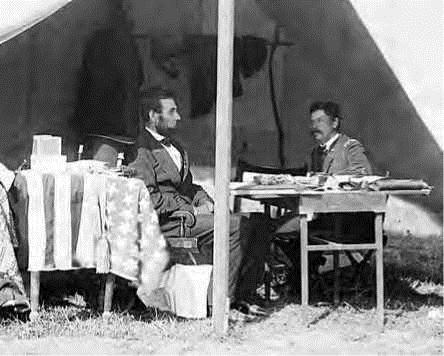
(President Lincoln with General McClellan on the battle-field of Antietam)
Victory at Antietam
They desperately needed to win a major victory but even a change in leadership did not yield any better results; the Union army now under General-in-chief Halleck and General Pope in command of the army of the Potomac suffered defeat yet again at the 2nd battle of Bull Run on 30th August 1862. It was a terribly disheartening sight; Lee’s advancing army threatened Washington, hospital beds were crowded with the wounded, and army commanders were busy blaming each other. Lincoln was shattered and fell into deep depression. With this defeat disappeared his occasion to issue the emancipation proclamation. In such moments of anguish when nothing seemed to be going in the intended direction, he often turned inwards and would reflect on God’s Will. On 2nd September, he penned down his musings:
“The will of God prevails. In great contests each party claims to act in accordance with the will of God. Both may be, and one must be wrong. God can not be for, and against the same thing at the same time. In the present civil war it is quite possible that God’s purpose is something different from the purpose of either party — and yet the human instrumentalities, working just as they do, are of the best adaptation to effect His purpose. I am almost ready to say this is probably true — that God wills this contest, and wills that it shall not end yet. By his mere quiet power, on the minds of the now contestants, He could have either saved or destroyed the Union without a human contest. Yet the contest began. And having begun He could give the final victory to either side any day. Yet the contest proceeds.”121
Despite McClellan’s shortcomings and misgivings of his war cabinet toward the general, Lincoln recalled him to resume command of the army to defend Washington. Lincoln knew he was respected by the soldiers and was the only general who could boost the morale of his men and bring order to the chaos.
In spite of serious mistakes, Lincoln did not reprimand his generals; in the middle of a war, any demoralization could have negative consequences, he always exercised enormous self-control with all — his generals as well as his cabinet members and was loathe to immediately dismissing them even in the face of gross incompetence.
The union now waited desperately for a military victory; he hoped for it when Confederate general Robert Lee invaded Antietam, Maryland in September 1862. Ignoring other demands for reinforcements, Lincoln backed McClellan with most of his military strength, with an order to destroy Lee’s army.
Lincoln found himself not only fighting a war with the rebels but also at the receiving end of a volley of sharp attacks from within the union. Flip-flopping between generals did not go down well with his critics; — his own cabinet members, the press, ministers of church, Congressmen, — they all denounced his decisions as weak and fickle and warned him that it would lead to ‘distrust and uncertainty’. Some demanded a complete revamping of his administration while others wanted him to get rid of McClellan. He was bombarded by demands for emancipation of slaves to which he was reluctant to give a direct response, ‘It is my earnest desire to know the will of Providence in this matter. And if I can learn what it is I will do it!’122
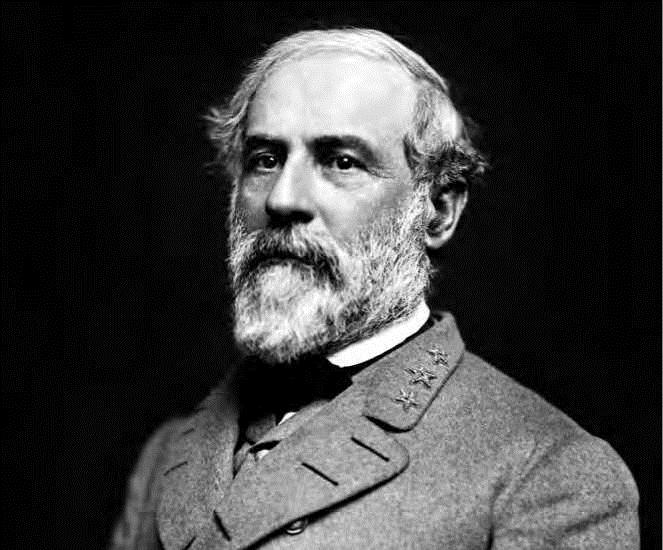
(General Robert E. Lee, Commander of the Confederate Army)
He bided his time for a military victory. On 17th September 1862, McClellan and his army defeated Confederate General Lee’s offensive at Antietam. The bloodiest single day battle with over 22,000 casualties, Union forces managed to drive out the confederates from Maryland but General McClellan’s chronic fear of the size of Lee’s force lost the Union the opportunity to wipe them out.
It could have been a more satisfying win, but nevertheless, the victory at Antietam finally gave Lincoln the opportunity to introduce the Emancipation Proclamation, an order that freed every slave in the confederate states. He met his cabinet and felt relaxed and relieved after months of tension and anguish. He met his cabinet and presenting a revised four page version of the emancipation proclamation to his cabinet he said, ‘I made a vow, a covenant, that if God gave us victory in the approaching battle, I would consider it an indication of Divine Will, and it is my duty to move forward in the cause of emancipation123.’ He had already decided the substance of the proclamation, he said firmly, but he welcomed the cabinet to suggest alterations to its form.
Slavery Needs To Go
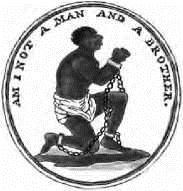
On 22nd September, Lincoln issued a Preliminary Emancipation Proclamation, which stated that he would order the emancipation of slaves of all states or parts of a state that did not end their rebellion against the Union by 1st January 1863.
The proclamation signaled the shift in the objective of the war between the North and South, — it was no more only the preservation of the union; it had become a conflict between freedom and slavery. Response from the North was obviously favourable. Anti slavery men were ecstatic; the New York Tribune and the Chicago Tribune sang his praises, as did the abolitionists and the ministers of church. Those who had admonished him for his errors and delays acknowledged that his proclamation was worth it. His critics who lambasted him over his weak stance against slavery were silenced. Frederick Douglass who never minced his words when criticising Lincoln for not taking strong measures to curb slavery burst out in jubilation:
“Common sense, the necessities of the war, to say nothing of the dictation of justice and humanity have at last prevailed. We shout for joy that we live to record this righteous decree. Abraham Lincoln, President of the United States, Commander-in-Chief of the army and navy, in his own peculiar, cautious, forbearing and hesitating way, slow, but we hope sure, has, while the loyal heart was near breaking with despair, proclaimed and declared: ‘That on the First of January... “Free forever” oh! long enslaved millions, whose cries have so vexed the air and sky, suffer on a few more days in sorrow, the hour of your deliverance draws nigh!”124
The war now became a war between slavery and freedom; though emancipation would adversely affect cotton supply from the Southern plantations to Britain and France, having abolished slavery, they could not anymore sympathise with the confederates for fear of domestic public outrage. The confederates lost all chance of any international support for their cause. Giuseppe Garibaldi congratulated Lincoln, ‘Posterity will call you the great emancipator, a more enviable title than any crown could be, and greater than any merely mundane treasure.’125
The South of course was livid; they justified themselves in carrying on the war. Confederate newspapers called him a ‘coward, assassin and savage.’ They felt it would encourage black rebellion in the South. The blacks on the other hand were ecstatic though not publically; they were secretly preparing to escape as quickly as they could. The Southern Unionists were angry; they wanted to preserve the union but did not want to lose their slaves. The Peace Democrats had always opposed emancipation and bitterly criticized it on grounds that it would promote continuation of the war and would tear the union apart even more. The War Democrats had supported the war only to save the Union; they did not want to fight for abolition. Racism was very much prevalent in both the north as well as the south. They denounced the proclamation as unconstitutional and branded him a dictator. The stock market fell. What pained Lincoln was the resentment and desertion in the armed forces. Would the North ‘accept this truly revolutionary challenge and begin fighting for freedom as well as the union? Or would white people refuse to do battle for black people?’126
Once the initial exhilaration had worn off, people in the North began to scrutinize the proclamation; the abolitionists who at first were ecstatic, were disappointed that it did not include two rebel states, Tennessee and Louisiana and that it excluded the loyal Border States. They felt that it was a half-hearted effort at emancipation — the government ordered emancipation where it had no control and exempted emancipation in areas that were in its control. The press began to denounce him and newspapers were replete with flagrant articles opposing it.
On 24th September, two days after the preliminary emancipation proclamation was announced, without consulting his cabinet, Lincoln suspended the writ of Habeas Corpus all over nation. It covered all those who aided the rebel cause, hindered military enlistment, resisted the draft or were guilty of disloyal practices; — the last covered newspaper editors who spoke critically of the union war effort. But it stilled public dissent. Fear of arrest, imprisonment, and punishment by military courts quieted down his critics. For Lincoln it was important to win the war and preserve the union at any cost.
The proclamation and the suspension of the writ of Habeas Corpus were used as effective issues by the Democrats to undermine the credibility of republicans during the 1862 House of Representatives election. Republicans took a beating but they managed to retain control over the House. Lincoln had to bear the brunt of their anger as conservative republicans blamed the emancipation proclamation and the suspension of the writ of liberty for their loss of popularity.
On 1st December 1862, Lincoln sent to the House and Senate, his annual message to Congress. It reflected his determination of carrying through his promise in his preliminary proclamation of September 1862 and carried in its words of wisdom a sincere and fervent prayer to the holders of powers in the government:
“...The dogmas of the quiet past are inadequate to the stormy present. The occasion is piled high with difficulty, and we must rise with the occasion. As our case is new, so we must think anew, and act anew. We must disenthrall ourselves, and then we shall save our country.
“Fellow-citizens, we cannot escape history. We of this Congress and this administration will be remembered in spite of ourselves... The fiery trial through which we pass, will light us down, in honor or dishonor, to the latest generation. We say we are for the Union. We know how to save the Union. We — even we here — hold the power, and bear the responsibility. In giving freedom to the slave, we assure freedom to the free — honorable alike in what we give, and what we preserve. We shall nobly save, or meanly lose, the last best, hope of earth. Other means may succeed; this could not fail. The way is plain, peaceful, generous, just — a way which, if followed, the world will forever applaud, and God must forever bless.”127
This was a presidential proclamation and not an Act passed by Congress. Lincoln was aware that having passed it as a war measure, chances were that it could be repealed after the war was over. Lincoln also knew that only Congress could remove slavery permanently.
His strong war measures met with a lot of criticism from the state governors and others but it also evidenced him as a strong leader in the midst of a civil conflict.
Lincoln tried hard to motivate McClellan but the general resented every effort, every suggestion that was sent by the president. Eventually, frustrated with his lack of initiative in leading his troops into battle and his never-ending excuses, Lincoln replaced McClellan with General Burnside in November 1862. A protege of McClellan, he would be less objectionable to his troops than anyone else, thought Lincoln; but on his own admission, Burnside was not experienced in leading the army of the Potomac. However, in the absence of anyone better and considering the urgency for some wins in war, the cabinet decided to give him a chance.
Sometimes Lincoln would take time out for a horseback ride; he would visit the wounded in hospital with Mary. The war occupied his mind; eating absently whatever was placed before him, he would often return to the White House office after dinner and work for four to five hours. During tense military operations, with his grey shawl wrapped around his shoulders, he would walk unescorted to the telegraph office in the War Department to receive the latest news from the front.
In October, Lincoln’s attention had to be diverted to another pressing problem. The Sioux Indians of Minnesota, not receiving the annuities from the government as compensation for surrendering their land, were starving. Desperate and aggrieved, a few young Sioux Indians raided a farm to steal eggs and killed five whites. Soon, the ferocity swelled and Indians in Southwestern Minnesota massacred 350 whites before they could be subdued. Lincoln sent General Pope to take charge of the situation, who quelled the rebellion and captured 1500 Indians, including women and children. The general and the local governor collaborated to hang the rebels but Lincoln immediately denied sanction. After sending Assistant Secretary to the Interior, John P. Usher to restore peace and provide him with information, he consulted with Bishop Whipple who suggested that this ‘wronged and neglected race’ needed to be dealt with ‘a new policy of honesty’.
Lincoln had earlier admitted that he was quite ignorant about the history between the Indians and the United States and had not had the opportunity to be acquainted much with them, but for the brief episode of the Black Hawk War. Lincoln’s own opinion about Indians was no different from that of other whites of his generation; they considered them as hurdles to an advancing society who needed to be civilized.
He received news that the local government was on the war path, not only to hang 303 Sioux Indians captured but also to drive out the peaceful Chippewas along with the Sioux tribe out of Minnesota and usurp their lands.
Despite protests from the Governor and counsel of General Pope that the people of Minnesota would not tolerate any leniency with regard to the retribution already decreed by the local authorities, Lincoln did not relent. He went through the record of each convicted Indian on the list to identify those who were guilty of murder and rape. He sent a list of 39 Sioux Indians guilty to be hanged. To ensure that no innocent was wrongly sent to his death, he prepared the list himself and cautioned the telegraph operator to practice caution while wiring the list to General Pope.
Burnside decided to lead the army on an offensive to capture Richmond, the confederate capital, his strategy relying on deception and speed. Lincoln suggested a direct battle with Lee’s army with its destruction as its aim rather than target on the capture of Richmond. Not being a military expert, and therefore, still hesitant to order his generals, Lincoln agreed to the general’s strategy but pressed Burnside to move rapidly. Lincoln’s fears came true; Burnside could not move fast enough, the pontoon bridges ordered by him did not arrive on time and he lost the advantage of surprise. Lee had plenty of time to deploy his troops in Fredericksburg waiting for the union army to cross the river. And the Union suffered one of its most crushing defeats at the battle of Fredericksburg, Virginia in December.
It was a difficult time for Lincoln to lose yet another battle. The news of the defeat roused public anger. They did not blame the general; their fury was directed toward his war council for the delay in sending the ordered bridges. Lincoln’s administration was targeted by the press as incompetent for its role in the ‘failure of the army, taxes, inflation, increasing national debt, insufficient cotton due to closure of the Mississippi river because of the war’. Lincoln admitted sadly, ‘If there is a worse place than hell, I am in it.’128 And there was trouble in his own backyard. Many of his cabinet members, especially Salmon Chase had complained that the president, but for Seward and Stanton, did not consult any of the others in state matters. Some Republicans met and decided that the president’s cabinet needed to be reorganized and obliquely alluded to Seward who needed to be removed, since he did not sympathise with the war and its causes. Seward promptly handed in his resignation to the president and refused to reconsider it. There was rivalry among them for his affection; Lincoln was aware of it and was prepared to bear with it for he knew that there was no clash of ideologies. Lincoln, already distraught after the defeat at Fredericksburg was anguished by this attack on the Secretary of State. ‘We are now on the brink of destruction. It appears to me the Almighty is against us, and I can hardly see a ray of hope,’ he confided to Orville Browning. However, he called a joint meeting of the republican senators and his cabinet members. Caught between disloyalty to the president and lying to the senators, Chase’s final admission of complete unity among the cabinet members weakened the case against Seward and a change in his cabinet was averted. He did not allow either to resign — Seward or Chase; as he admitted he needed both. It was a learning experience for the entire team; and Lincoln began to invite suggestions from his cabinet on controversial issues including the Emancipation Proclamation in which he added a paragraph suggested by Chase at the end. But most of all, this crisis made him aware of his own strength, ‘...I believe I have kept these discordant elements together as well as anyone could.’129
As Charles Dana, his Assistant Secretary of War observed:
“The relations between Mr. Lincoln and the members of his Cabinet were always friendly and sincere on his part. It was always plain that he was the master and they the subordinates. If he ever yielded to their will, it was because they convinced him that the course they advised was judicious and appropriate. I do not recollect a single occasion when any member of the Cabinet had got his mind ready to quit from any feeling of dissatisfaction with the President. Not that they were always satisfied with his actions, in their judgment much would have been done better if their views had been adopted and they individually had charge of it. In the discussion of important questions, whatever he said showed the profoundest thought, even when he was joking. He seemed to see every side of every question. He never was impatient, he never was in a hurry, and he never tried to hurry anybody else.”130
Emancipation Proclamation
For three months the country waited and watched; his detractors were waiting apprehensively, the abolitionists, the radicals and the people of the north were waiting hopefully and the confederates were waiting defiantly for the New Year. 100 days were over; the confederates did not end the rebellion, and Lincoln did not renege on his promise.
On 1st January 1863, Lincoln issued the Emancipation Proclamation, granting freedom to slaves in the ten states that were still in rebellion, thus applicable to 3 million of the 4 million slaves in the country. It also allowed freed slaves to enlist in the Union armed forces and receive wages. It ordered the union army and all branches of the executive to recognize and maintain the freedom of the ex-slaves. The proclamation neither compensated the owners, nor banned slavery nor gave citizenship to exslaves. However, it was a major milestone that opened the road to future strides towards banning slavery completely and granting citizenship to ex-slaves. As Lincoln approved of the final version of the document, he remarked, ‘I never, in my life, felt more certain that I was doing right, than I do in signing this paper. If my name ever goes into history it will be for this act, and my whole soul is in it.’131 He transcended both praises and blame — it was now a war about justice. The war for the union had widened its goal; he was now battling for liberty as well. Lincoln often acknowledged to his colleagues that some decisions he had taken were possibly beyond his constitutional rights, yet he took them because they were necessary at that time and the right thing to do. He was guided by his insight. It was never about exercising his power; it was about saving the nation. When asked how he would explain his actions, he smilingly replied, ‘I am like the Irishman, I have to do some things ‘unbeknownst to myself.’132
As the great day drew nearer, there was more singing in the slave quarters than usual. It was bolder, had more ring, and lasted later into the night. Most of the verses of the plantation songs had some reference to freedom…. Some man who seemed to be a stranger (a U.S. officer, I presume) made a little speech and then read a rather long paper — the Emancipation Proclamation, I think. After the reading we were told that we were all free, and could go when and where we pleased. My mother, who was standing by my side, leaned over and kissed her children, while tears of joy ran down her cheeks. She explained to us what it all meant, that this was the day for which she had been so long praying, but fearing that she would never live to see.
(Excerpt from ‘Up from Slavery’, memoir of African American Leader Booker T. Washington, who was 7 years old when the Emancipation Proclamation was read on his plantation.)
People on both sides criticized Lincoln’s order as a seizing of property rights and an attempt to start racial conflict. But there were those who passionately supported this measure; John Forbes, a wealthy abolitionist printed miniature booklets of the Emancipation Proclamation and had them placed in the backpacks of the Union soldiers. As they marched through enemy territory, they were to be distributed to the slaves, informing them that they were free. Emboldened by this measure, slaves fled from their masters, leaving the plantations and abandoning the work assigned to them — preparing food, sewing uniforms, as railroad repairmen, as common laborers in factories, shipyards and mines, and serving as hospital workers.
Despite the fact that Lincoln exempted the Border States from the Emancipation Proclamation, the governor of Kentucky complained that it encouraged slaves to flee in order to recruit in the Union army. Lincoln’s reply to him reflects his passionate but restrained stance (in deference to the constitution) against slavery:
“I am naturally anti-slavery. If slavery is not wrong, nothing is wrong. I can not remember when I did not so think, and feel. And yet I have never understood that the Presidency conferred upon me an unrestricted right to act officially upon this judgment and feeling. It was in the oath I took that I would, to the best of my ability, preserve, protect, and defend the Constitution of the United States. I could not take the office without taking the oath. Nor was it my view that I might take an oath to get power, and break the oath in using the power. I understood, too, that in ordinary civil administration this oath even forbade me to practically indulge my primary abstract judgment on the moral question of slavery. I had publicly declared this many times, and in many ways. And I aver that, to this day, I have done no official act in mere deference to my abstract judgment and feeling on slavery. I did understand however, that my oath to preserve the constitution to the best of my ability, imposed upon me the duty of preserving, by every indispensable means, that government — that nation — of which that constitution was the organic law. Was it possible to lose the nation, and yet preserve the constitution? By general law, life and limb must be protected; yet often a limb must be amputated to save a life; but a life is never wisely given to save a limb. I felt that measures, otherwise unconstitutional, might become lawful, by becoming indispensable to the preservation of the constitution, through the preservation of the nation. Right or wrong, I assumed this ground, and now avow it. I could not feel that, to the best of my ability, I had even tried to preserve the constitution, if, to save slavery, or any minor matter, I should permit the wreck of government, country, and Constitution all together. When, early in the war, Gen. Fremont attempted military emancipation, I forbade it, because I did not then think it an indispensable necessity. When a little later, Gen. Cameron, then Secretary of War, suggested the arming of the blacks, I objected, because I did not yet think it an indispensable necessity. When, still later, Gen. Hunter attempted military emancipation, I again forbade it, because I did not yet think the indispensable necessity had come. When, in March, and May, and July 1862 I made earnest, and successive appeals to the border states to favor compensated emancipation, I believed the indispensable necessity for military emancipation, and arming the blacks would come, unless averted by that measure. They declined the proposition; and I was, in my best judgment, driven to the alternative of either surrendering the Union, and with it, the Constitution, or of laying strong hand upon the colored element. I chose the latter. In choosing it, I hoped for greater gain than loss; but of this, I was not entirely confident. More than a year of trial now shows no loss by it in our foreign relations, none in our home popular sentiment, none in our white military force, — no loss by it any how or any where. On the contrary, it shows a gain of quite a hundred and thirty thousand soldiers, seamen, and laborers. These are palpable facts, about which, as facts, there can be no cavilling. We have the men; and we could not have had them without the measure.
“And now let any Union man who complains of the measure, test himself by writing down in one line that he is for subduing the rebellion by force of arms; and in the next, that he is for taking these hundred and thirty thousand men from the Union side, and placing them where they would be but for the measure he condemns. If he cannot face his case so stated, it is only because he cannot face the truth.
“I add a word, which was not in the verbal conversation. In telling this tale I attempt no compliment to my own sagacity. I claim not to have controlled events, but confess plainly that events have controlled me. Now, at the end of three years struggle the nation’s condition is not what either party, or any man devised, or expected. God alone can claim it. Whither it is tending seems plain. If God now wills the removal of a great wrong, and wills also that we of the North as well as you of the South, shall pay fairly for our complicity in that wrong, impartial history will find therein new cause to attest and revere the justice and goodness of God.”133
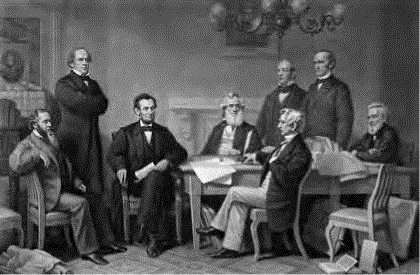
(The first reading of the Emancipation Proclamation in 1862 before the cabinet (painted by F.B. Carpenter))
The Emancipation Proclamation was Lincoln’s master act during his presidency. Many prior presidents had hoped for a nation without slavery, but were unable to achieve their ideal. Thomas Jefferson, one of the founding fathers and the main author of the Declaration of Independence had written: ‘I see not how we are to disengage ourselves from that deplorable entanglement, we have the wolf by the ears and feel the danger of either holding or letting him loose. I shall not live to see it but those who come after us will be wiser than we are, for light is spreading and man improving....’134
In Jefferson’s words Lincoln had found the proof that the founding fathers did not expect the position of blacks in society to remain unchanged and that the phrase that ‘all men are equal’ had been incorporated in the document for future use. They had ‘meant to declare the right, so that the enforcement of it might follow as fast as circumstances would permit. They meant to set up a standard maxim for a free society, which should be familiar to all, and revered by all’.135
Confederate Vice President Alexander Stephens, speaking of their newly created constitution had proudly declared that: ‘... Its foundations are laid, its corner-stone rests, upon the great truth that the negro is not equal to the white man; that slavery subordination to the superior race is his natural and normal condition. This, our new government, is the first, in the history of the world, based upon this great physical, philosophical, and moral truth.’136 The words in their constitution reflected the status of slave labour that was deeply entrenched in the South. Losing the war to the Confederates would mean a disastrous reversal in the march of humanity towards the ideal of liberty and the brotherhood of man.
Jefferson’s prayer found in Lincoln an ideal vessel for this monumental task. Liberty, an ideal that was struggling to manifest, blazed a way with one stroke of his pen, overriding all pro slavery Acts passed by Congress, shifting the authority to free slaves into the hands of the Government and its military and naval forces.
Apart from the moral impact of the Emancipation Proclamation, it also brought about tangible results in the war for the Union. It opened the doors for black enlistment, thereby encouraging the slaves to participate in a war being fought for their emancipation. Every slave that fled the south robbed them of their slave labour that sustained their plantations. On the International stage, the confederate attempt to be recognized as a sovereign nation by England and France was foiled. But the Emancipation Proclamation was criticized for granting emancipation where the Union had no control and exempting where it did. But its immediate effect was freedom to approximately 50,000 slaves in the federal occupied areas of the south. But more important than that was its ongoing effect — as the Union army pushed into enemy territory, they continued to free thousands of slaves. In a year’s time, more than 100,000 black troops had joined the Union army and by 1865 the number had swelled up to 300,000.
Lincoln’s method was gradual; he had to take into account the prevailing atmosphere in the country. It was imperative to court the Border States and keep them from seceding to the south and ensure the support of the Conservatives. Therefore, despite the fact that he personally hated slavery, he had only advocated a war to save the Union. He even rescinded the order of emancipation issued by General Fremont. He did not want to jeopardize the chance of an eventual emancipation by a premature action for which the climate of the nation was ill prepared. Then we see a shift in his actions — he supported the confiscation Acts, which freed slaves as contrabands of war. He proposed gradual compensated emancipation of slaves to the Border States to encourage them to participate in the abolition of slavery. As the war progressed and it became apparent that emancipation had become a war necessity, Lincoln grabbed the moment and delivered the country of its greatest affliction, slavery. Even though he exempted the Border States, Tennessee and parts of Louisiana, emancipation was immediate and it started the process of abolition that paved the way for complete liberation and ultimately to equality.
Frederick Douglass ecstatic with the sea change in the events over the last few months, gave a thundering speech at Cooper Institute in response to the Emancipation Proclamation:
“I congratulate you, upon what may be called the greatest event of our nation’s history, if not the greatest event of the century. In all these States Slavery is now in law, as in fact, a system of lawless violence, against which the slave may lawfully defend himself... The change in attitude of the Government is vast and startling. For more than sixty years the Federal Government has been little better than a stupendous engine of Slavery and oppression, through which Slavery has ruled us, as with a rod of iron… Assuming that our Government and people will sustain the President and the Proclamation, we can scarcely conceive of a more complete revolution in the position of a nation. I hail it as the doom of Slavery in all the States. Color is no longer a crime or a badge of bondage. I stand here tonight not only as a colored man and an American, but. as a colored citizen, having, in common with all other citizens, a stake in the safety, prosperity, honor, and glory of a common country. We are all liberated by this proclamation. Everybody is liberated. The white man is liberated, the black man is liberated, the brave men now fighting the battles of their country against rebels and traitors are now liberated. I congratulate you upon this amazing change — the amazing approximation toward the sacred truth of human liberty. All the space between man’s mind and God’s mind, says Parker, is crowded with truths that wait to be discovered and organized into law for the better government of society. Mr. Lincoln has not exactly discovered a new truth, but he has dared, in this dark hour of national peril, to apply an old truth, long ago acknowledged in theory by the nation — a truth which carried the American people safely through the war for independence, and one which will carry us, as I believe, safely through the present terrible and sanguinary conflict for national life, if we shall but faithfully live up to that great truth. Born and reared as a slave, as I was, and wearing on my back the marks of the slave-driver’s lash, as I do, it is natural that I should value the Emancipation Proclamation for what it is destined to do for the slaves. I do value it for that. It is a mighty event for the bondman, but it is a still mightier event for the nation at large, and mighty as it is for the both, the slave and the nation, it is still mightier when viewed in its relation to the cause of truth and justice throughout the world. It is in this last character that I prefer to consider it. There are certain great national acts, which by their relation to universal principles, properly belong to the whole human family, and Abraham Lincoln’s Proclamation of the 1st of January, 1863, is one of these acts.”137
Trouble with His Generals
The joy of issuing the Emancipation Proclamation was shortlived; Lincoln was plagued by the sight of hospitals overfull with the wounded, reports of desertion by soldiers who refused to fight for blacks troubled him, abolitionists hounded him for a complete ban on slavery and Democrats called the proclamation unconstitutional. Some of them were demanding reconciliation with the South and reestablishment of slavery.
If only he could end this war!
Unable to deliver victories, Lincoln replaced General Burnside with General Hooker in January 1863. It was brought to his notice that Hooker had not only ridiculed Burnside, his senior, but had also called Lincoln ‘a played out imbecile’. The last thing Lincoln wanted was to have his generals squabble with each other. After appointing him as general, he met Hooker cordially and handed him a letter that was a wonderful mix of reprimand, encouragement and wisdom that a father would give to a son:
“... I have placed you at the head of the Army of the Potomac. And yet I think it best for you to know that there are some things in regard to which, I am not quite satisfied with you. I believe you to be a brave and a skillful soldier, you do not mix politics with your profession, you have confidence in yourself and you are ambitious, which, within reasonable bounds, does good rather than harm. But I think that during Gen. Burnside’s command of the Army you thwarted him as much as you could, in which you did a great wrong to the country, and to a most meritorious and honorable brother officer. I have heard of your recently saying that both the Army and the Government needed a Dictator. Of course it was not for this, but in spite of it, that I have given you the command. Only those generals who gain successes, can set up dictators. What I now ask of you is military success, and I will risk the dictatorship. I much fear that the spirit, which you have aided to infuse into the Army, of criticising their Commander, and withholding confidence from him, will now turn upon you. I shall assist you as far as I can, to put it down. Neither you, nor Napoleon, if he were alive again, could get any good out of an army, while such a spirit prevails in it.
“And now, beware of rashness. Beware of rashness, but with energy, and sleepless vigilance, go forward, and give us victories.”138
The Emancipation Proclamation swelled up the union army; Congress passed the Civil War Military Draft Act139 in March 1863 that permitted free African Americans to join the army. The union draft was issued the same month and War Department opened its first bureau of Colored Troops. Frederick Douglass had been suggesting the idea of organizing black regiments since 1861. He issued a proclamation of his own, “Men of Color, to Arms!” and went from town to town, encouraging blacks to join the union army and fight for the union and their liberation. Lincoln pushed for black enrollment vociferously. He wrote to the military governor of Tennessee, a pro-union slave owner, urging him to recruit black soldiers:
“I am told you have at least thought of raising a Negro military force. In my opinion, the country now needs no specific thing so much as some man of your ability, and position, to go to this work. The colored population is the great available and yet unavailed of force for restoration of the union. The bare sight of fifty thousand armed and drilled black soldiers on the banks of the Mississippi would end the rebellion at once...”140
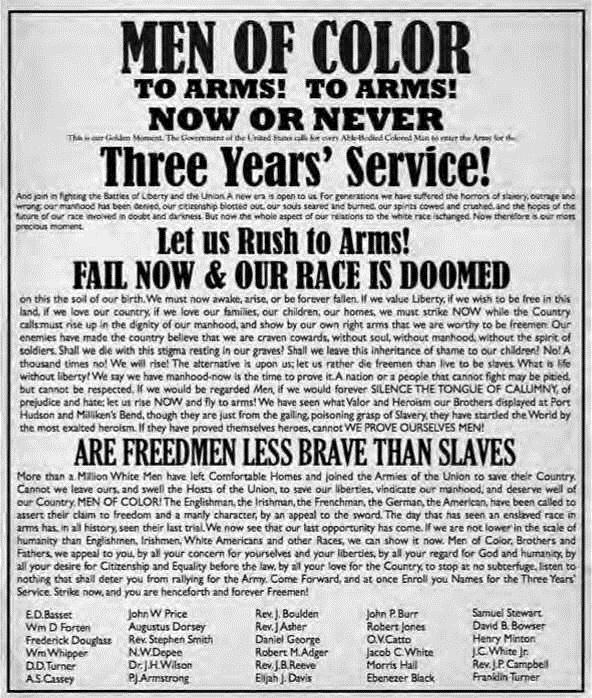
(Poster for black recruitment (reconstruction of the original))
To ensure that the white soldiers would support the arrival of blacks in the army, Lincoln decided on a lower salary for the blacks. In addition, the cost of their uniforms would be deducted from their pay while the white soldiers received a bonus to help them pay for their uniforms, which amounted to thirteen dollars per month for whites and seven dollars for blacks.
Some of his generals were disinclined to have blacks serving in the union army. General Grant, Lincoln’s deliverer of grand military successes, was one of them. Some officers were skeptical that blacks would flee in the face of danger. To ensure that there was no resentment from white soldiers having to fight alongside blacks, the administration decided to create separate black units commanded by white officers. Though Douglass at first was unhappy that blacks would be denied the status of an officer, he reasoned that it was important at that moment that they should participate in the war and fight for the union. Livid on being informed of recruitment of blacks in the union army, Confederate President Jefferson warned that captured black soldiers would be put to death or sold into slavery. Despite the threat issued by Jefferson, the blacks fought bravely in every battle they fought. But instead of being captured as prisoners of war, they were officially defined as insurrectionists and either executed or sold into slavery. More disconcerting was the news of the brutal conduct of some confederate soldiers who savagely slaughtered black soldiers.
There was a difference of opinion in the main objective of battles between Lincoln and his Generals. Lincoln felt that the destruction of the confederate army would lead to winning battles and ending the war rapidly. But his generals believed that it was necessary to capture Richmond in order to win the battle and the war. The union army had tried to capture Richmond four times and failed; twice at Bull Run, once at the Peninsula Campaign and recently at Fredericksburg. The army of the Potomac under General Hooker was all set to launch a campaign to yet again take Richmond, this time at Chancellorsville. As a reminder to his generals about the object of the battle, Lincoln gave a note as guidance to Hooker and his generals, ‘Our prime object is the enemies’ army in front of us, and is not with, or about, Richmond at all, unless it be incidental to the main object...’141 On his departure he told them, ‘I want to impress upon you two gentlemen in your next fight... put in all your men .’142
Hooker, extremely confident, set off promisingly, but as Lincoln feared, hesitated to move forward and push his offensive. This gave General Lee and Stonewall Jackson a chance to split their men and attack Hooker’s troops from two sides. Despite the fact that Hooker had twice as many men as the confederates, on 6th May 1863, the Union lost the battle at Chancellorsville, Virginia. Lincoln, spending most of his time at the War office, returned to the White House completely dejected and broken, ‘My God! My God! What will the country say! What will the country say!’143
Nothing seemed to be going right. The U.S. Naval operations at Charleston had been repulsed by confederate guns at Fort Sumter, Grant’s operations at Vicksburg had to be abandoned and General Rosecrans refused to move into action in Tennessee. So many military failures were enough for people to renew protests against the war and demand for peace negotiations. Voices of dissent were heard not only from the Democratic Party but also from Republicans who wanted abolitionist generals placed in command of the U.S. armies. Some pro slavery army officers were condemning the war as a ‘nigger war’ and criticised the president for overshooting his authority in suppressing civil rights. Vallandigham’s144 arrest added to the unrest and sparked off a massive public dispute about its constitutional legality.
Though seemingly down and out, Lincoln did not allow this terrible state of affairs to suck him in. In response to a criticism of himself and General Halleck and their military affairs, he replied in substance that:
“it may be a misfortune for the nation that he was elected President. But having been elected by the people, he meant to be President, and to perform his duty according to his best understanding, if he had to die for it...”.145
- Recollected Words of Abraham Lincoln, compiled and edited by Don E. Fehrenbacher and Virginia Fehrenbacher, p. 442.
Lincoln lacked military training and experience in warfare, which led to delays and failures in campaigns; in the eastern theatre, he constantly changed his generals. However, he was determined to find a way. Perhaps it was this lack of any previous military training, which allowed his practical brilliance to come forward and ultimately lead the union to victory.
Open Letter to the People
He decided that it was time to take active charge of military operations and repair his image in the eyes of the public.
Traditionally it was uncommon for presidents to make public addresses or react to political pressure or public opinion. But the rescission of civil liberties, suspension of the writ of Habeas Corpus, restriction of the freedom of speech and the press and arrests of dissidents gravely unsettled the American public. Democrats were forcefully objecting to the arrest of Vallandigham. Within the Republicans too some of his own friends felt the arrests were illegal and adversely affected the image of the government. The worst was the growing feeling in the soldiers that the only thing that prevented Lincoln from becoming a despot was the fear of international opinion.
He decided to use Vallandigham’s arrest as the lever by which he could address the public and inform them of the position of his administration. In response to a protest by a group of Democrats over Vallandigham’s arrest, he carefully prepared a public letter, read it out to his cabinet and then sent copies to the press. He began by congratulating the protestors for their allegiance to the cause of sustaining the union and upholding the government in all constitutional measures. He clarified that in normal times these would be violations of constitutional rights but the constitution allows the suspension of these liberties in case of rebellion or invasion. He mentions that he had been judicious in the application of such measures and in time to come, he would be reproached for not being stricter with such arrests. He explained that Vallandigham was not arrested because he was a democrat but because he was damaging the army, which was the backbone of the security of the nation.
His most effective argument came towards the end:
“Long experience has shown that armies can not be maintained unless desertion shall be punished by the severe penalty of death. The case requires, and the law and the constitution, sanction this punishment. Must I shoot a simple-minded soldier boy who deserts, while I must not touch a hair of a wiley agitator who induces him to desert?”146
He adds at the end a gentle rebuke:
“In this time of national peril I would have preferred to meet you upon a level one step higher than any party platform; because I am sure that from such more elevated position, we could do better battle for the country we all love, than we possibly can from those lower ones, where from the force of habit, the prejudices of the past, and selfish hopes of the future, we are sure to expend much of our ingenuity and strength, in finding fault with, and aiming blows at each other. But since you have denied me this, I will yet be thankful, for the country’s sake, that not all democrats have done so. He on whose discretionary judgment Mr. Vallandigham was arrested and tried, is a democrat, having no old party affinity with me; and the judge who rejected the constitutional view expressed in these resolutions, by refusing to discharge Mr. V. on Habeas Corpus, is a democrat of better days than these, having received his judicial mantle at the hands of President Jackson. And still more, of all those democrats who are nobly exposing their lives and shedding their blood on the battle-field, I have learned that many approve the course taken with Mr. V. while I have not heard of a single one condemning it.”147
The public responded heartily to his letter as was the response of his fellow republicans who congratulated him warmly. Success of this letter encouraged him to send out another public letter as response to another set of democrats protesting against Vallandigham’s arrest and exile to the confederate states. This time he boldly held him responsible for ‘... the desertions from the army, the resistance to the draft and even the assassination of Unionists.’ In fact he accused them of encouraging desertion, resistance to the draft etc. by recommending his case. At the end he promises to permit his return provided a majority of the protestors sign a pledge ‘to do all he can to have the officers, soldiers, and seamen of the army and navy... paid, fed, clad, and otherwise well provided and supported’.148 Their refusal only strengthened his position in the eyes of the public that his administration was exercising exceptional powers only for the security of the Union.
In June 1863, Lincoln proclaimed the admission of West Virginia into the Union as the 35th state.
Desperate For A Win
Seeing Hooker’s obduracy in repeating his earlier mistake of launching yet another attack on Richmond, Lincoln ultimately replaced him with General Meade in June 1863. Lee was on the move and heading towards Pennsylvania and found Meade on his heels. Lincoln had learned from his earlier mistakes, — he did not communicate directly with Meade but went through Halleck while he engaged himself in collecting troops to reinforce Meade’s army.
Lincoln was anxious — there had been too many defeats; the Union desperately needed to win. As he confided to General Sickles:
“... I went to my room and got down on my knees in prayer. Never before had I prayed with so much earnestness... I felt I must put all my trust in Almighty God. He gave our people the best country ever given to man. He alone could save it from destruction. I had tried my best to do my duty and had found myself unequal to the task. The burden was more than I could bear.”149 “… I told Him that this war was His war, and our cause His cause, but we could not stand another Fredericksburg or Chancellorsville. And after that, I don’t know how it was, and I cannot explain it, but soon a sweet comfort crept into my soul. The feeling came that God had taken the whole business into His own hands and that things would go right at Gettysburg and that is why I had no fears about you.”150
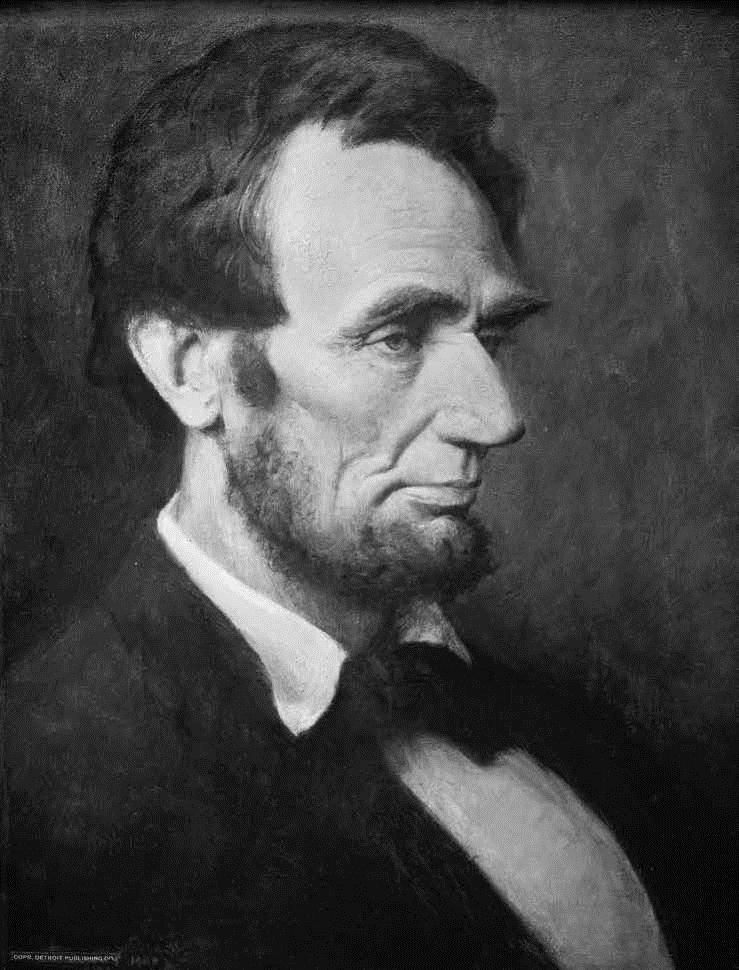
(Abraham Lincoln, painting by Volk Douglas)
He kept a close watch on Grant’s campaign in Vicksburg too. Despite several failed attempts to get Vicksburg, Grant, determined to succeed, finally decided to lay a siege on the city. July seemed like a good month for the Union, — news of three big victories came in, Gettysburg on 3rd July, Vicksburg on 4th, and port Hudson on the 9th. Lincoln was ecstatic. Finally, he could see the war coming to a terminating point. Also, with the capture of Port Hudson, the union army gained control of the Mississippi river and supplies for the confederate army from Texas and Arkansas were cut off. For the union it opened up the Mississippi river for supplies for the union armies and for northern goods to reach the Gulf of Mexico. It was good for the morale of the military, the civilians and businesses.
Ever ready to acknowledge his mistakes, Lincoln wrote to Grant a congratulatory note, ‘I write this now as a grateful acknowledgment for the almost inestimable service you have done the country’, adding, ‘I never had any faith, except a general hope that you knew better than I, that the Yazoo Pass expedition, and the like, could succeed... and when you turned Northward East of the Big Black, I feared it was a mistake. I now wish to make the personal acknowledgment that you were right, and I was wrong.’151
The victory at Gettysburg, though, was not complete; Lee’s army had yet again been allowed to retreat. Lincoln was furious; it meant that it would not be a swift end to the war. He was greatly disappointed with Meade, so disappointed that he wrote a letter to him holding him responsible for the survival of Lee’s army and for the prolongation of the war. But he neither sent it nor signed it. When his anger had abated he could see that Meade had done his best in the given circumstances; he went into battle after only four days of assuming command of the army, he did not know his soldiers, he had lost a lot of his troops in battle and many of his generals were killed or wounded.
It seems Meade came to know of Lincoln’s disappointment with his performance and therefore tendered his resignation. Lincoln pacified him yet honestly voiced his disappointment in a letter to Meade:
“... I am very — very — grateful to you for the magnificent success you gave the cause of the country at Gettysburg; and I am sorry now to be the author of the slightest pain to you. But I was in such deep distress by what appeared to be evidences that yourself, and Gen. Couch, and Gen. Smith, were not seeking a collision with the enemy, but were trying to get him across the river without another battle. What these evidences were, if you please, I hope to tell you at some time, when we shall both feel better. You fought and beat the enemy at Gettysburg; and, of course, to say the least, his loss was as great as yours. He retreated; and you did not pressingly pursue him. You had at least twenty thousand veteran troops directly with you in addition to those who fought with you at Gettysburg; while it was not possible that he had received a single recruit; and yet you stood and let the flood run down, bridges be built, and the enemy move away at his leisure, without attacking him.
“Again, my dear general, I do not believe you appreciate the magnitude of the misfortune involved in Lee’s escape; to have closed upon him would have ended the war. Your golden opportunity is gone, and I am distressed immeasurably because of it.
“I beg you will not consider this a prosecution, or persecution of yourself. As you had learned that I was dissatisfied, I have thought it best to kindly tell you why.”152
A New Confidence
A growing confidence could be seen in Lincoln; the positive reversal in military operations, his restored image in the eyes of the people and the approaching end of the war, reduced his dependence on his cabinet members. Some matters he would leave entirely to their discretion while on other matters such as those of reconstruction of the Union or slavery he consulted with no one. Even his loyal cabinet members complained of knowing only that which was published for all. As John Hay wrote to John Nicolay153:
“The tycoon is in fine whack. I have rarely seen him more serene and busy. He is managing this war, the draft, foreign relations, and planning a reconstruction of the Union, all at once. I never knew with what tyrannous authority he rules the cabinet, till now. The most important things he decides & there is no cavil. I am growing more and more firmly convinced that the good of the country absolutely demands that he should be kept where he is till this thing is over. There is no man in the country, so wise so gentle and so firm. I believe the hand of God placed him where he is.”154
This silent inner force was evident in Lincoln’s firm decision with regard to the New York draft riots in July 1863. The Civil War Military Draft Act was greatly disliked by the laboring class in the North. It was called the rich man’s Act since those who were affluent could pay their way out of military duty. Apart from their discontent with the Substitution and Commutation policy of the Act, they were resentful of losing their jobs to the free slaves who were pouring into New York after the emancipation proclamation. Employers would often switch to black labour during a strike. When the drawing of names began in New York, people poured into the streets, defied the police and attacked the draft headquarters and burned buildings. Most of their wrath was unleashed on the homes and establishments of African Americans. A regiment was sent from Gettysburg to help subdue the riots. After much damage to life and property, in which hundreds died and thousands were injured, the riots were quelled. To Governor Seymour’s protests to suspend the draft in New York on grounds of conscription being unconstitutional and the New York quota being unfairly large, Lincoln firmly declined. There was no time to waste on new experiments for provision of new manpower, he mentioned in his letter, or for the establishment of the constitutionality of the Draft. There was a war to be won. The draft procedure resumed peacefully a month later.
Though greatly troubled by the riots, when advised to appoint a special commissioner to investigate, Lincoln refused saying his report would ‘have simply touched a match to a barrel of gunpowder’. Some things are better left alone, he added and ‘one rebellion at a time is about as much as we can conveniently handle’.155
The Border States, especially Missouri, had been a perennial source of trouble for Lincoln. Continuous clashes between anti and pro slavery gangs would not allow civilian life to be peaceful. Even among the unionists there was bickering among the ‘Charcoals’, who favoured the immediate abolition of slavery and the ‘Claybanks’ who were moderate on the issue of slavery. They looked to him for arbitration but he refused to favor either faction and ‘stoutly tried to keep out of the quarrel’.156 Soon both sides began attacking him for favoring the other. When Missouri began debating upon the question of gradual emancipation, Lincoln announced that ‘the union men in Missouri who are in favour of gradual emancipation represented his views better than those who are in favour of immediate emancipation’.157 The plan of the Conservatives included indenturing of slaves over forty years of age as servants of their masters for life, under twelve till they reached the age of twenty three and all others were to be servants till 1876. Since the plan did not give the benefit of freedom to the slave immediately, Lincoln did not support the plan, thereby becoming yet again an object of their anger. The Radicals, disappointed by his denial of their requests to free the slaves immediately, enroll Missouri blacks in the army, remove the present military general from there and enforce martial law in Missouri, went back from Washington as his enemies. For all the care he took to keep the Border State from seceding, he found ‘he had no friends in Missouri’.158
The blacks now serving in the union army were seen fighting bravely in almost every part of the country; the army had changed its mind about the employment of Negro troops and welcomed them into their units. But news of savagery by the confederate soldiers and official orders to execute or sell black prisoners of war into slavery as they were insurrectionists provoked Lincoln into issuing a retaliation proclamation:
“... For every soldier of the United States killed in violation of the laws of war, a rebel soldier shall be executed; and for every one enslaved by the enemy or sold into slavery, a rebel soldier shall be placed at hard labor on the public works and continued at such labor until the other shall be released and receive the treatment due to a prisoner of war.”159
Douglass felt that it was time to demand equality for the black soldiers fighting in the war. He visited the president in August 1863 expecting to meet a ‘white man’s president, entirely devoted to the welfare of white men’.160 Lincoln listened to Douglass earnestly and accepted that unequal pay was unfair, but insisted that that the prevailing prejudice against blacks did not allow him to remedy it yet. However, at the closure of the meeting, Lincoln assured Douglass that in time to come the blacks in the army would get equal pay. A year later in 1864, he would fulfill his promise. Douglass came away feeling that Lincoln was ‘the first great man that I talked with in the United States freely who in no single instance reminded me of the difference between himself and myself, or the difference of color’.161
Fall elections in 1863 were crucial to Lincoln; losing them would signal the failure of the Republicans in the coming 1864 presidential elections. It would also stimulate the South; the Democrats were not keen for the continuance of war and it would be far easier to urge them for a restoration of the Union as it was than the Republicans. Lincoln’s people did everything possible to ensure victory in each of the difficult states; martial law was proclaimed in Kentucky and some Democratic candidates and voters were imprisoned, in other states government clerks and troops were given leave so that they could go home to vote. Illinois, Lincoln’s home state was a cause for concern too; surprisingly, the victories at Gettysburg and Vicksburg did not find the Illinoisans supporting the administration’s stand of fighting to the finish. They believed that since the confederates were weakened sufficiently, it was the right time to end the war and opt for peace dialogues.
Lincoln, however, found this hypothesis faulty; a restoration of the union according to him meant rolling right back into slavery, the emancipation proclamation would be null and void and it would put an end to black recruitment in the union armies. He also believed that the Confederate army was on the brink of falling apart; a few more union victories would have them concede defeat. Any effort before that to restore peace would strengthen them and undo all the effort made towards destruction of slavery. To abort any such possibility, Lincoln refused to meet with the Confederate Vice President who, under the pretext of a dialogue for exchange of prisoners, wanted to meet with him in Washington under a flag of truce.
It was time to once again talk to the people of the North. Lincoln was keen to put forward his viewpoint with regard to the war. He got an opportunity when James C. Conkling, a republican member of Illinois House of Representatives, requested him to attend a rally in Springfield. Unable to attend in person due to crucial military operations in Chickamauga that needed his presence in Washington, he sent a letter in defense of his policies to Conkling with instructions to ‘read it very slowly’:
“.…I do not believe any compromise, embracing the maintenance of the Union, is now possible...The strength of the rebellion, is its military. Meade’s army can keep Lee’s army out of Pennsylvania. But no paper compromise, to which the controllers of Lee’s army are not agreed, can, at all, affect that army. no word or intimation, from that rebel army, or from any of the men controlling it, in relation to any peace compromise, has ever come to my knowledge or belief. if any such proposition shall hereafter come, it shall not be rejected, and kept a secret from you.
“You dislike the emancipation proclamation.You say it is unconstitutional — I think differently. If it is not valid, it needs no retraction. If it is valid, it can not be retracted, any more than the dead can be brought to life.The war has certainly progressed as favorably for us, since the issue of the proclamation as before. at least one of those important successes, could not have been achieved when it was, but for the aid of black soldiers.
“You say you will not fight to free negroes. Some of them seem willing to fight for you; but, no matter. Fight you, then, exclusively to save the Union. I issued the proclamation on purpose to aid you in saving the Union...
>“… But negroes, like other people, act upon motives. Why should they do any thing for us, if we will do nothing for them? If they stake their lives for us, they must be prompted by the strongest motive — even the promise of freedom. And the promise being made, must be kept.
“… Peace does not appear so distant as it did. And then, there will be some black men who can remember that, with silent tongue, and clenched teeth, and steady eye, and well-poised bayonet, they have helped mankind on to this great consummation; while, I fear, there will be some white ones, unable to forget that, with malignant heart, and deceitful speech, they have strove to hinder it.”162
The letter was received with thunderous cheering from over 50,000 Unionists at the rally and subsequently it was published in every major newspaper throughout the country. Of course the Democratic newspapers criticized it but Republicans rallied around him in support of his policies. Read out in a mass meeting in New York City, it aroused cheers, tears and gratitude from its residents. The New York Times hailed the President as ‘a ruler who is so peculiarly adapted to the needs of the time as clear-headed, dispassionate, discreet, steadfast, honest Abraham Lincoln’. Well, Lincoln now had the faith of his people with him.
What was the secret of his success in the most adverse circumstances?
‘Mr. Lincoln managed his politics upon a plan entirely different from any other man the country has ever produced. It was by ignoring men, and ignoring all small causes, but by closely calculating the tendencies of events and the great forces which were producing logical results.’163 ‘He sought to control men through their reason and their conscience. The only art he employed was that of presenting his views so convincingly as to force conviction on the minds of his hearers and his readers.’164
Around the same time, news from General Rosecrans was grim. General Rosecrans’ army was holed up at Chattanooga with the enemy surrounding them and could hold out for around ten days only and urgently needed reinforcements. Stanton called an emergency war council and arranged to send 30,000 troops from Virginia by rail. Lincoln put General Grant in charge of the new operations of pushing the confederates out of Tennessee and back into Georgia.
Lincoln had been mulling over a very important issue — it was time to address the public again, this time to explain the implication of the massive war that the Americans had been thrust into. The erroneous demands of the public after the victories at Gettysburg and Vicksburg to restore the union and opt for peace negotiations still troubled Lincoln. He needed to make a public statement explaining the necessity of the continuation of war and the sacrifices demanded by it. The opportunity presented itself soon; he was asked to speak a few words at a ceremony on 19 November 1863, to dedicate a cemetery for soldiers who died at Gettysburg. He brooded over it, and without consulting any member of his cabinet, penned his speech in the silence of his thoughts.
He was not the primary speaker; Edward Everett165 spoke before him for over two hours. When it was Lincoln’s turn to speak, he climbed the dais and in 272 words, that lasted a little over two minutes, he gave a speech that touched the hearts of millions and electrified the entire nation. He did not use the word Gettysburg, or slavery, or mention the enemy; he spoke only of liberty, of devotion to it, a new birth of freedom and the immortality of democracy:
“Four score and seven years ago our fathers brought forth on this continent, a new nation, conceived in Liberty, and dedicated to the proposition that all men are created equal.
“Now we are engaged in a great civil war, testing whether that nation, or any nation so conceived and so dedicated, can long endure. We are met on a great battle-field of that war. We have come to dedicate a portion of that field, as a final resting place for those who here gave their lives that that nation might live. It is altogether fitting and proper that we should do this.
“But, in a larger sense, we can not dedicate — we can not consecrate — we can not hallow — this ground. The brave men, living and dead, who struggled here, have consecrated it, far above our poor power to add or detract. The world will little note, nor long remember what we say here, but it can never forget what they did here. It is for us the living, rather, to be dedicated here to the unfinished work which they who fought here have thus far so nobly advanced.
It is rather for us to be here dedicated to the great task remaining before us — that from these honored dead we take increased devotion to that cause for which they gave the last full measure of devotion — that we here highly resolve that these dead shall not have died in vain — that this nation, under God, shall have a new birth of freedom — and that government of the people, by the people, for the people, shall not perish from the earth.”166
It was not his brief words so much as his sincere and indomitable spirit with which he connected with his people. The newspapers were abound with appreciation. Of course, there were his detractors who criticized every word and every sentiment in it. Apart from calling it ‘silly, flat and dishwatery’, they accused him of perverting history. However, their protest was a weak and vain effort to prevent the widening of the objective of the ongoing war; now the nation would fight for the preservation of the union as well as for equality.
Maj. General Grant along with Sherman and Thomas now launched an offensive to capture the high ground surrounding Chattanooga where the confederate divisions were stationed. After defeating them in a series of maneuvers at Lookout Mountain and Missionary Ridge, they pushed the confederates into Georgia, thereby facilitating the invasion of the Deep South. The tides had turned; the Republican victory in the fall state elections added to the elation of battles going well for the Union; he now had people’s support behind him.
Quarantined due to a mild case of small pox, Lincoln had time to take stock of the union’s situation. On the operations of the war depended the complete support of all factions of his party and the prospects of his reelection in the presidential elections in 1864. Foreign matters were also showing positive results; two iron clad war ships being built for the confederacy by Lairds, a shipbuilding company, had been seized by the British government before it could be handed over to the confederate agent; Russian Czar Alexander I had sent his fleet of war ships to the Atlantic and Pacific harbours which gave the impression to the public that the union had the support of the Russians in case Britain and France decided to support the confederacy in the war.
Let’s Talk About Reconstruction
His public letters had greatly mustered public sentiment behind his administration and the fall state elections had maintained republican majority like the previous year. To secure the republican majority in the December assembly of the 38th Congress, Lincoln made every possible effort to get Frank Blair, brother of Postmaster Montgomery Blair as Speaker of the House. He was a conservative republican and had powerful connections with war democrats; this Lincoln felt would provide the Congress a Centrist control. Unfortunately it did not work out. He then opted for Washburne, an old friend, but when that also didn’t work out, he resigned to Colfax from whom he obtained an assurance that he would remain neutral in the forthcoming arguments between the radicals and conservatives in the Congress.
With the victories of Gettysburg and Vicksburg and the road open for invasion of the Deep South, it was a matter of time before the Confederates conceded defeat. Therefore, Lincoln knew that the arguments in Congress would be centered on the issues of restoration of the confederate states into the union and different factions would present their blueprint for the same.
The Democrats had already been demanding that the war should be called off, Southern states be pardoned, their place in Congress be restored by welcoming their representatives to Washington.
The conservative republicans were asking for no other condition but the emancipation of slaves for the restoration of the Southern states into the union. They further believed that freed blacks ought to be colonized.
The radical republicans further added equality to their formula for restoration, along with substantial modifications in the social and economic life of the Southerners. The Southern states were to be treated as a defeated state, to be put under jurisdiction of the Congress. Charles Sumner demanded that slavery ought to be abolished in the entire region, all Southern citizens, including blacks, were to be provided equal protection by law and ‘as a restraint upon the lawless vindictiveness and inhumanity of the Rebel States’, the Southern lands should be divided among ‘patriotic soldiers, poor whites and freed men’.167
Lincoln remained neutral in the face of these disagreements between different factions. Instead, after consulting his cabinet members, he began drafting his annual message to Congress along with a plan for the reconstruction of Southern states, steering clear of either of the extreme postures demanded by the various factions of the republicans.
In his announcement of the Proclamation of Amnesty and Reconstruction, which was attached to his message, he offered full pardon with restoration of all rights to property (not including slaves) to all rebels but for high ranking confederate officials, on the condition that they take an oath of future loyalty to the Constitution and promise to obey acts of Congress and proclamations issued by the President with regard to slavery. To encourage the political reorganization of Southern states, he further stated that their reestablished governments would be accorded recognition provided it was endorsed by a minimum of 10 percent of their 1860 voters who had taken the oath of allegiance.
He justified his proclamation on several grounds. The oath was necessary to separate the ‘loyal from the disloyal elements in the South’168. He was aware of another grave possibility — the South might decide to return to the fold asserting that they had never been out of the union; and congressmen with the same ideologies as before might provoke the nation into yet another war. The need to swear loyalty to proclamations and legislations regarding slavery was necessary to arrest any such endeavours to reinstate slavery. He made it amply clear that while he was president, he would not withdraw or modify the emancipation proclamation nor return to slavery any person who is free by the terms of that proclamation. Knowing that there would be various systems of reconstruction put forth by loyalists, towards the end he declares that ‘while the mode presented is the best the Executive can suggest, with his present impressions, it must not be understood that no other possible mode would be acceptable’169.
He reasserts his earlier message to the people on the danger of aborting the war before it reached its logical conclusion:
“...We must not lose sight of the fact that the war power is still our main reliance. To that power alone can we look, yet for a time, to give confidence to the people in the contested regions, that the insurgent power will not again overrun them.”170
This message and proclamation were supreme examples of Lincoln’s skillfulness at meeting every faction’s needs to some reasonable extent. Radicals happily found in it their demand for the liberation of slaves in no uncertain terms. Conservative republicans were satisfied by the clause that permitted the return of the Southern states back into the union.
Because the proclamation stated that he would ‘abide by and faithfully support all proclamations of the President made during the existing rebellion having reference to slaves, so long and so far as not modified or declared void by decision of the Supreme Court’171, War Democrats and others who doubted the legality of the emancipation proclamation were willing to support the amnesty and reconstruction proclamation.
Peace Democrats, unhappy to see in this proclamation the cleverness with which Lincoln had satisfied both factions of the Republican Party grudgingly admitted that it was ‘a creditable specimen of political dexterity’. Finding his terms for amnesty severe, Peace Democrats denounced him as being ‘insane with fanaticism, or a traitor who glories in this country’s shame’.172 But by and large his message to the Congress was received exceedingly well. Though enthusiastic appreciation came in from all quarters of the union, lauding him for a highly satisfactory message, perhaps the best words of praise came from one of his critics, Joseph Medill, who, stating the need for a leader with ‘a clear head, an honest mind and clean hands’, asked in his Chicago tribune, ‘Who is so fit to carry on what is begun as he who has so well conducted us... thus far?’173 On the forthcoming presidential elections he stated in no uncertain terms that the nation’s confidence was growing only towards one candidate, Abraham Lincoln.
Though Lincoln’s efforts to eradicate slavery through the emancipation Proclamation had already begun, it did not free the slaves in the Border States or in land under federal control. He also knew that it was still to be reviewed by the Supreme Court and chances were that Chief Justice Taney (responsible for the hated Dred Scott decision), in whose opinion the emancipation proclamation was unconstitutional, would in all likelihood overturn it. His amnesty and reconstruction proclamation was also an effort to encourage Southern states to abolish slavery and peacefully rejoin the union. Congressmen debated on the issue and came to the conclusion that the only way to make abolition of slavery utterly complete and irreversible was through a constitutional amendment. In December 1863, James M. Ashley, a Radical Republican, introduced a bill for such an amendment in Congress.
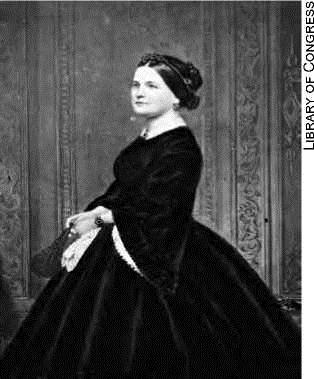
(Mrs Abraham Lincoln sometime during 1860-1865)
The Story of Abraham Lincoln - Chapter IV
Once Again
1864 Presidential elections were now less than a year away and as much as he disliked any stirring of the issue he could not ignore it anymore. Republican newspapers began speaking highly of many possible candidates — Seward, Fremont, Chase etc. in addition to appreciation of Lincoln. By November 1863, he had decided to contest again and declared that if his friends desired his renomination, he was agreeable to his candidacy.
Divergent views in the Republican Party began to come forward. Lincoln tried to pacify both factions of the party. He found himself caught in a very difficult situation — when he appeased the conservatives he upset the radicals who threatened to resign from the administration and when he agreed with radicals, conservatives would fume and complain. Lincoln was also opposed by another class on men; those with deep personal rivalries. Some resented that their advice was not heeded; others were dissatisfied that political favours were not returned.
In an effort to boost his chances of reelection he began hosting social events at the White House through the winter. To keep an eye on the abolitionists’ sentiment, Lincoln often invited Charles Sumner, a prominent abolitionist to the White House on personal visits; it would also prevent him from defecting to the opposition.
Within the republicans there was no discontent with Lincoln on ideological grounds; republicans like Salmon Chase, Horace Greeley and Benjamin Wade and others agreed on the need to fight the war till victorious, on the abolishment of slavery and the restoration of Southern states on fulfillment of certain conditions. In fact, in support of his Amnesty and Reconstruction proclamation, republicans worked hard to create laws to fulfill it. In keeping with his ideas, James Ashley introduced a bill for a constitutional amendment abolishing slavery nationally, (to which he also added Negro franchise).
They hesitated only on grounds of his incapacity to arrive at the goals effectively. They found him a weak administrator who despite two and a half years of an expensive war and loss to life and property was unable to defeat the rebels a quarter in manpower compared to the North. A call for 500,000 men in March for the Union armies did not make things better.
It was a disconcerting observation but his supporters felt comfort in the predictions of newsmen who had declared that ‘Mr. Lincoln has the confidence of the people, and even the respect and affection of the masses’174. Letters of appreciation by his supporters bolstered his spirit, especially words of support from the army, ‘I believe it is God’s purpose to end this war in the coming year and also his purpose to call Abraham Lincoln again to the Presidential Chair’.175
His supporters got to work immediately; they had to ensure his renomination by June when the republican convention would meet in Baltimore. His political workers mobilised support for Lincoln using Union Leagues all over the Northern States; they did not miss the opportunity at the New Hampshire republican convention, where his supporters pushed a resolution declaring Lincoln as the people’s choice for reelection. Simon Cameron, Lincoln’s former Secretary of War, grateful to him for bearing part of the blame for the blunders in the war department, took charge of getting the signatures of all Republican lawmakers of Pennsylvania on a request that Lincoln would allow his reelection. His supporters in the legislatures of several states declared their approval of his reelection. The New England Loyal Publication Society broke its rule against taking sides during elections and published a strong editorial prompting people that:
“A man’s adaptation to an official place cannot be perfectly known until it is practically tested.it is no time to risk anything. Wise policy impels the loyal people .to continue President Lincoln in his responsible position. and against the powerful will of the people, politicians are powerless”.176
Lincoln had been trying hard since the issue of the emancipation proclamation to get Governors in federal occupied congressional districts of Southern states to push for reconstruction. While Lincoln pressed upon the military governors and generals to organize free state governments, he also advised them to:
“Follow forms of law as far as convenient, but at all times get the expression of the largest number of the people possible177. What we do want is the conclusive evidence that respectable citizens of Louisiana, are willing to be members of congress & to swear support to the constitution; and that other respectable citizens there are willing to vote for them and send them. To send a parcel of Northern men here, as representatives, elected as would be understood, (and perhaps really so,) at the point of the bayonet, would be disgusting and outrageous”.178
However, news of the formation of free governments under Lincoln’s ten percent plan in Arkansas, Tennessee and Louisiana179 was not received well by the radicals, who denounced them and hoped to get a resolution passed in Congress to ensure that the eleven seceded states were not entitled to representation in the electoral colleges during the forthcoming presidential elections.
Lincoln’s party members opposed him on other grounds as well. Republican congressmen were critical of the power the executive branch had assumed during the war at the expense of the legislative branch. They felt that reconstruction ought to be a subject under Congressional control, not executive. By issuing the proclamation of amnesty and reconstruction, Lincoln had declared it as a subject under executive control.
Secondly, state governments in Southern states with ten percent representation of voters in Arkansas, Louisiana, Tennessee and North Carolina would earn Lincoln enough electoral votes needed to win the presidential election. Lincoln looked forward to their support but that was not the sole reason for his wanting their organization. He genuinely wanted the people of the states to abolish slavery and form their own government. Already peeved with his use of his war powers, the radicals resented the advantage he would have during the elections with the support of these new governments. Lashing out at Lincoln’s endeavor to organize free state governments in Southern states that were ruled by the despotic military laws, and objecting to Lincoln’s weak plan for reconstruction, a bill was introduced by radical republican Henry Winter Davis with the assistance of Benjamin Wade, Charles Sumner and other prominent radicals in Congress in February 1864. In contrast to Lincoln’s ten percent plan, it mainly declared that any state wanting readmission into the union would have to abolish slavery, 50 percent of its 1860 voters would have to take part in elections to form their government and that electors of state conventions had to take an oath that they had not voluntarily taken up arms against the Unites States or helped the rebellion. This was in direct contrast to Lincoln’s plan that required from those that did rebel, an oath of allegiance to the Union to not do so in the future.
Soon he found an opponent in his own backyard; Chase, Secretary of Treasury,180 with his passion for the presidential chair and supported by a belief that he was superior to Lincoln in his ability to lead the nation, had built up his own political support among the republicans. From as early as December 1863, his supporters with his tacit approval began to discuss strategies for Chase’s campaign. In February 1864, they secretly began circulating pamphlets among the party members criticising Lincoln as weak and indecisive and demanding a candidate who was an ‘advanced thinker; a statesman profoundly versed in political and economic science, one who fully comprehends the spirit of the age’.181 It left no one in doubt as to whom the pamphlets were alluding to.
Lincoln seemed quite unperturbed about news of Chase’s secret run for the nomination; by February, various Republican conventions had already declared support for Lincoln’s reelection.
Congressman Frank Blair attacked Chase on grounds of corruption in the War Department. In March, his supporters managed to expose his plan; not only was Chase forced to withdraw from the presidential race, he felt embarrassed enough to tender his resignation as secretary of treasury yet again. Shrewdly, Lincoln kept him waiting for a few months and then, much to the astonishment of his colleagues, refused to accept his resignation; with his renomination still uncertain, Chase was less harmful in the cabinet than outside it, he explained.
Radicals, still looking for an alternative to Lincoln, suggested the name of General Grant; he had been successful in his campaigns and would be a popular candidate as a president who could lead the union safely and swiftly through the war. However, Grant, having no political ambitions, refused; his loyalty to Lincoln would not allow him to accept the nomination. But by May most states fell into line in support of Lincoln for renomination; Western states were stronger in their support but despite resistance from Radicals, Eastern states also came through.
In the midst of all these developments, Lincoln had been looking for the right military general to lead the Union to final victory and bring the war to a close. In comparison to his lethargic generals in the Eastern theatre, those in the West were far more energetic and successful. He found in General Grant the capacity of motivating the troops into striding towards ultimate success. In March 1864, Lincoln promoted him to lieutenant general in charge of all Union armies. Leaving the Western armies under the command of General Sherman, Grant went to Virginia to take command of the army of the Potomac.
Grant, after much deliberation came up with the Overland Campaign, a plan to launch concurrent massive attacks in Virginia that would wear out the confederates and destroy them; General Butler would go towards Richmond to capture the confederate capital, General Meade, commanding the army of the Potomac would cross the Rapidan River into the wilderness of Northern Virginia to attack Lee and General Sigel would go south to capture railroad lines at Lynchburg, Virginia. Simultaneously, Grant ordered General Sherman to lead the armies of the West to capture Atlanta, an important supply centre and railroad hub for the confederates. Lincoln was pleased with Grant’s plan; finally he had found a general who shared his belief — to win the war it was imperative to destroy the confederate army.
With the election fever mounting, in May 1864, a faction of Republicans met at Cleveland and denounced the Lincoln administration for its weak and ineffective war policy. Most of the delegates were German Americans, mainly from Missouri where they hated Lincoln and were extremely devoted to John C. Fremont and a body of ultra-radicals abolitionists from the Northeast. They formed the Radical Democracy Party and nominated John C. Fremont, as their candidate for presidency, adopting a platform calling for a constitutional amendment prohibiting slavery and complete racial equality enforceable by law. It also backed direct presidential elections, single term for presidency, free speech, free press, habeas corpus and confiscation of rebel lands. Notable republicans like Horace Greeley stayed away after knowing that the majority was backing Fremont.
The Radicals in their platform had included constitutional amendment abolishing slavery and complete racial equality that included Negro franchise; Lincoln knew that the country was not ready for such an extreme measure. Before the republican convention met in June, he invited Senator Edwin D. Morgan of New York, to the White House, and asked him to include an amendment of the Constitution abolishing and prohibiting slavery forever as the substance of his opening speech and as the focal point in the party platform. This, he hoped, would win the dissidents back into their fold.
The Republican Convention that met at Baltimore in June was entirely controlled by Lincoln’s supporters. It was attended by various factions — radicals like Thaddeus Stevens, delegates from States undergoing reconstruction under Lincoln’s ten percent plan; Claybanks (conservatives) and Charcoals (radical) delegates from Missouri; it was also attended by some War Democrats. Decision had been taken to rename the convention as the National Union Party convention to avoid divisive factional issues erupting among the Republicans. The National Union Party, renamed thus, was also a means to attract War Democrats from the Border States who believed in Lincoln’s war policies but would not have voted for the Republican Party.
Their party platform called for an amendment to the constitution to terminate and forever prohibit the existence of slavery in the entire nation. Other issues in the platform were pursuit of war until complete confederate surrender, aid to disabled union veterans, continued European neutrality, enforcement of the Monroe Doctrine, appreciation of the emancipation proclamation and Negro enlistment, encouragement of immigration and the building of a transcontinental railroad. Lincoln was unanimously renominated as the Presidential candidate. Andrew Jackson, a War Democrat from the South was nominated as his running mate for Vice President; a clever choice as it symbolized a wider coalition and reflected the inclusiveness of all states in the union.
The party platform was immensely cheered by the masses and received rave reviews from the press:
“...The Proclamation of Emancipation and the use of negro troops… it is a proper and efficient means of weakening the rebellion which every person desiring its speedy overthrow must zealously and perforce uphold… let the Proclamation go wherever the army goes. and let it summon to our aid the negroes who are truer to the Union than their disloyal masters... let us protect and defend them... Is there anything unconstitutional in that? .And he who is willing to give back to slavery a single person. is not worthy the name of American.”182
Lincoln in Charge
With the renomination assured, Lincoln could now deal strongly with his cabinet and his party. He had already decided to relieve Chase from the post of Secretary of Treasury; he was waiting for the right time. Uncomfortable with each other during cabinet meetings, Chase himself presented the opportunity by tendering his resignation yet again. Chase, sure that it would once again be refused, was taken aback when Lincoln accepted it without demur and swiftly nominated William Fessenden as his secretary of the treasury. Satisfied with the reorganization of his cabinet, he now decided to assert his leadership in political issues.
Radicals, in an effort to assert congressional instead of the executive control over the process of reconstruction and to oppose Lincoln’s 10 percent plan for reconstruction, which they found too weak, had introduced the Wade-Davis bill in February. Lincoln found the language of the bill stating that the Southern states need to ‘rejoin’ the union to be in direct conflict with the republican rationale that the war was being fought ‘within the union’ to quell a rebellion. Secondly, Lincoln believed that Congress had no right to compel states to form constitutions abolishing slavery as the present constitution stated that slavery was a state issue. Moreover, Lincoln found it too severe; he wanted that the Southern states should be cajoled back into a harmonious coexistence instead of being treated like traitors who ought to be punished. With great difficulty Lincoln had managed to create a coalition between the War Democrats and Republicans to support his reelection; the Wade-Davis bill would shatter it. Emancipation movements that were beginning to take off in the Border States would be jeopardized. Free governments set up on the basis of his 10 percent plan in Louisiana, Arkansas and Tennessee would get nullified. By 2nd July it had been passed by both houses and presented to the president for his signature on the 4th. Lincoln decided to pocket veto183 the bill, protesting that ‘this bill was placed before me a few minutes before Congress adjourns. It is a matter of too much importance to be swallowed in that way’184.
Despite the fact that the Radicals could do much damage to his reelection, he defended his action, ‘...I must keep some consciousness of being somewhere near right. I must keep some standard of principle fixed within myself’185.
To clarify his position before the public, within four days he issued a proclamation stating that he was not inclined to limit himself to a single plan of restoration, or willing to discourage the efforts of the people of Arkansas and Louisiana who had set up their free state governments, nor did he believe that Congress had the right to abolish slavery in states. In the end he endorsed the bill as being satisfactory for those who wished to adopt it offering assistance to those who would.
The Mighty Scourge of War
After much thought and preparation, Grant’s Overland Campaign finally took off in May 1864. The confederates defeated Sigel, and Butler found himself surrounded by the enemy near Petersburg. The army of the Potomac combatted with Lee’s forces for 40 odd days; of a 120,000 union men against Lee’s force of 60,000, the union army fought four deadly battles and lost around 50,000 men to Lee’s losses of 30,000. Casualty news in the North earned Grant the title of ‘the Butcher’. Though Lincoln tried to keep himself busy with administrative matters, his people saw him walking up and down his office with ‘his long arms behind his back, his dark features contracted still more with gloom’186. At times the relentless war overwhelmed him, ‘Why do we suffer reverses after reverses! Could we have avoided this terrible, bloody war! ... Is it ever to end!’187 Though extremely devastated by the news of repeated setbacks, Lincoln tried not to get demoralized; Grant had reassured Lincoln, ‘I propose to fight it out on this line if it takes all summer.’188 He was different from his other Generals of the Eastern Theatre; he managed with as many men he had and he did not withdraw from battle like them, leaving the enemy to retort back for yet another battle. Despite the heavy losses, Lincoln had no choice but to support Grant; at this point this seemed the only way possible to arrive at victory. After four failed maneuvers, Grant pulled out of the last one at Cold Harbor, freed Butler and his men and attacked Petersburg, Richmond’s central rail hub. Unable to capture the city, Grant finally settled to besiege the town of Petersburg in mid June. Pinned down to defend Petersburg, Lee would be unable to send reinforcements to fight against Sherman who was trying to capture Atlanta.
Daily newspaper columns carrying the names of the dead, swelling numbers in hospitals, hundreds of letters pouring out the horrors of war and the suffering of the maimed by soldiers and war correspondents outraged the country. Horace Greeley wrote to the president that the nation was dreading the probability of another conscription and the never-ending carnage of war.
Lincoln was deeply affected by the dismal sights he saw and heard of. One evening, riding past a train of ambulances he anguished, “‘Look yonder at those poor fellows. I cannot bear it. This suffering, this loss of life is dreadful.’ In an effort to pull him out of his misery, his friend said, ‘do you remember writing to your sorrowing friend these words: ‘And this too shall pass. Never fear. Victory will come.’ ‘Yes,’ replied he, ‘victory will come, but it comes slowly.’”189
Lincoln when reviewing court martial sentences of soldiers charged with dereliction of duty would, as much as possible, send orders to release them from prison and return to duty. ‘Doesn’t it strike you as queer that I, who couldn’t cut the head off of a chicken, and who was sick at the sight of blood, should be cast into the middle of a great war, with blood flowing all about me?’190 he asked a colleague. Though not a member of any Christian Church, he sought comfort in the Bible and would be seen referring to it from time to time.
As the war progressed, he began to believe more and more that man’s actions were preordained and shaped by a Higher Power. In his letter to Hodges, from Kentucky, defending his reasons for shifting from his stance of not interfering with slavery towards emancipation of slaves and subsequent black recruitment, he writes:
“I claim not to have controlled events, but confess plainly that events have controlled me. Now, at the end of three years struggle the nation’s condition is not what either party, or any man devised, or expected. God alone can claim it. Whither it is tending seems plain. If God now wills the removal of a great wrong, and wills also that we of the North as well as you of the South, shall pay fairly for our complicity in that wrong, impartial history will find therein new cause to attest and revere the justice and goodness of God...”191
He again reiterated in a letter:
“...The purposes of the Almighty are perfect, and must prevail, though we erring mortals may fail to accurately perceive them in advance. We hoped for a happy termination of this terrible war long before this; but God knows best, and has ruled otherwise. We shall yet acknowledge His wisdom and our own error therein. Meanwhile we must work earnestly in the best light He gives us, trusting that so working still conduces to the great ends He ordains. Surely He intends some great good to follow this mighty convulsion, which no mortal could make, and no mortal could stay.”192
Lincoln could find nothing around that could comfort him; on the war front, Sherman had been fiercely battling the enemy to inch his way towards Atlanta but was struggling to get past the confederate army at Pace’s Ferry on 5th July; the army of the Potomac was tied up besieging Petersburg. Politically, his own party was split; though the conservatives were supporting him, the Radicals finding him too soft had nominated Fremont for presidency. Peace Democrats charged him for being too harsh and were probably going to opt for a peace platform in their convention in August.
To make things worse, General Lee took a bold step and sent a 15,000 strong confederate strength to attack the capital. Grant had moved most of the force to Richmond to join in the siege, leaving behind a paltry 9000 force to defend Washington. Seeing the approaching enemy, even clerks were handed rifles to defend the city. He was not worried about his safety; in fact he was livid to know that the navy had made preparations to whisk him and his family to safety in case the enemy captured the capital. On July 11th, awaiting reinforcements, Lincoln expectantly looked through his spyglass. He accompanied the troops to Fort Stevens where the battle had begun that morning. He was almost shot when he was standing on the parapet surveying the enemy. The confederate general retreated after two days when he saw the steady stream of reinforcements coming in. Lincoln was once again upset that the confederates had been allowed to escape.
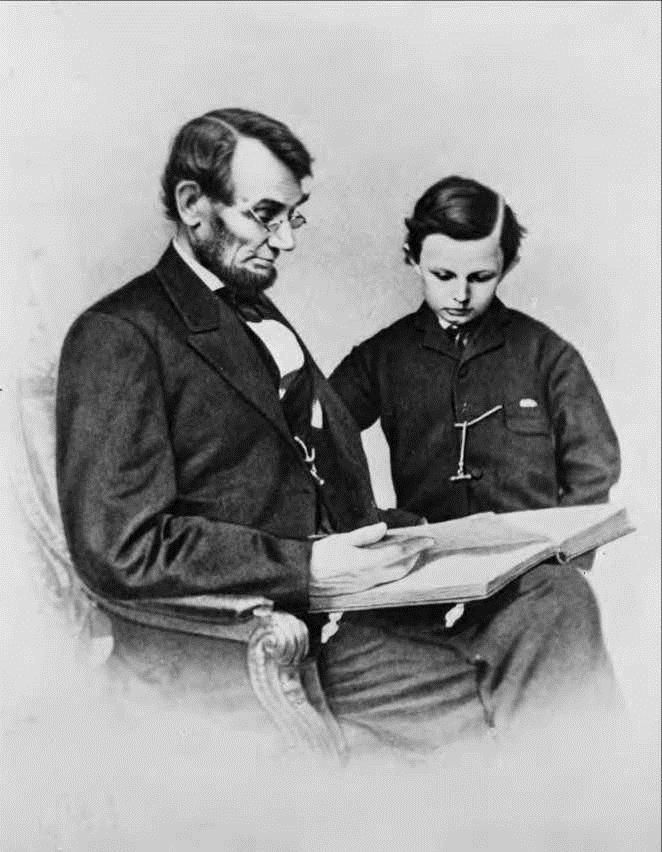
(Lincoln with his son Tad in 1864)
With losses mounting heavily, the army needed more troops. Mid July Lincoln found himself again calling for 500,000 more volunteers.
Disconcerted with so much criticism of Grant and of the mounting casualties, taking Tad with him, Lincoln paid a visit to Grant, his generals and his soldiers. The African American troops cheered their president and sang hymns while Lincoln regaled them with his anecdotes; he returned with only a brief word of advice that ‘all may be accomplished with as little bloodshed as possible’.193 His visit did much to revitalize and uplift everyone, including Lincoln. Knowing well the lassitude and ineptitude of his War Department with regard to the immediate needs of the war, he instructed Grant that any request to the administration ‘will neither be done nor attempted unless you watch it every day, and hour, and force it194’. Lincoln was desperate for a win; during the siege of Petersburg, appreciating Grant’s decision to persist, in August he wrote to him to ‘hold on with a bull-dog gripe, and choke and chew, as much as possible’195. The war was going to be long and expensive.
Confederate Conspiracy
Around the same time that Washington was attacked by confederate soldiers, Lincoln received a letter from Horace Greeley, the editor of the New York Tribune stating that three representatives of the Confederate government, with full authority to negotiate a peace, were waiting on the Canadian side of the Niagara Falls. Greeley pressed him to explore the situation; the Union was in a desperate condition, it would not do to let the people believe that the administration was not keen to make peace. Lincoln intuitively sensed a trap. Instinct warned him that it could be connivance between the Peace Democrats and the confederates to ruin the chances of a republican victory. But Greeley was an important opinion maker; any rejection of the peace talks by Lincoln would certainly hurt his reputation during the elections. Shrewdly, Lincoln decided to make the editor an envoy between the administration and the confederates at Niagara. He prepared a letter on 18th July addressed ‘To Whom It May Concern’, stating that:
“Any proposition which embraces the restoration of peace, the integrity of the whole Union, and the abandonment of slavery, and which comes by and with an authority that can control the armies now at war against the United States will be received and considered by the Executive government of the United States, and will be met by liberal terms on other substantial and collateral points; and the bearer, or bearers thereof shall have safe-conduct both ways.”196
These conditions went beyond his emancipation proclamation, which was limited in its scope. Also, the thirteenth amendment to the constitution had just recently failed to pass in Congress. He knew that the slave states would never agree to such a condition.
The response to his letter was worrisome for Lincoln. It gave the Democratic Party more substance to attack Lincoln during their convention scheduled to meet on 29th August; by asking for abolition of slavery, Lincoln had proved that he did not want to end the war, even though an honourable peace was knocking on our doors, they accused. It also boosted their morale to see fellow Republicans assail their own nominee.
The Radicals ought to have been congratulating Lincoln for taking such a bold stand against slavery; instead he found himself being charged with incompetence, indecisiveness and leniency towards the rebels. He had enough enemies who looked forward to pulling him down, — already livid with him for pocket vetoing the Wade-Davis bill, this new development gave them another reason to denounce him; they issued a manifesto in August, accusing Lincoln of utilizing reconstruction for securing electors in the Southern states to aid his own reelection campaign and of seizing power from Congress which ‘is paramount and must be respected’197. However, the charges were so extreme that their efforts boomeranged on them. Some Radicals Republicans decided to replace Lincoln with another nominee; but Chase declined, as did Charles Sumner. All were waiting for the outcome of the Democratic National Convention.
Lincoln’s declaration was also agitating the War Democrats into withdrawing their support. Robinson, the Democratic editor of the ‘Green Bay’ had been a genuine supporter of Lincoln but War Democrats supported Lincoln’s war policy for saving the Union; they did not support the abolition of slavery as a condition for peace talks, he said regretfully. Lincoln wrote a letter defending his actions with regard to the emancipation of slaves on moral grounds, saying that it would be treachery on his part towards the thousands of African Americans who had ‘come bodily over from the rebel side to ours’ and such a disloyalty would not ‘escape the curses of heaven’.198 He also defended his actions on practical grounds that without the thousands of African Americans who were fighting for the Union, it would not be possible to save the union. In a desperate bid to prevent the War Democrats from abandoning his reelection, he added towards the end that ‘if Jefferson Davis wishes^to know what I would do if he were to offer peace and reunion, saying nothing about slavery, let him try me’.199
He read out the letter to Frederick Douglass who angrily objected to it and warned him that it would be tantamount to a submission of Lincoln’s antislavery policy and could cause a reversal of all that had been accomplished till then. After listening to Douglass whom he had come to respect tremendously, and whose sentiments echoed his own, he decided not to send it to Robinson. He reconciled himself to having lost the allegiance of the War Democrats.
Lincoln’s biggest threat came from the conservative Republicans whose support now began to lose its zeal. They believed that his conditions for peace only served to fortify the resolve of the south to defiance, and being war weary, they feared that the war would continue incessantly. Current events on the war front did nothing to disabuse their notion. Also, they did not want to be associated with the abolitionists. The cost of the war was straining the treasury; they needed to procure a massive loan of $200,000,000 to meet their expenses. The siege on Petersburg had recently lost 4000 troops. If the call for volunteers did not produce sufficient men, Lincoln would have to enforce the draft, which would further make him unpopular; Congress having abolished the provision for commutation, the middle class would have no choice but to join the military forces.
With all these problems, even members of his own cabinet like Attorney General Bates and Orville Browning began to lose faith in him. By the end of August, Illinois, his home state, Pennsylvania, Indiana and New York, had all turned against him. Nothing short of a miracle could save his reelection.
Frederick Douglass too had been doubtful about supporting Lincoln in his reelection. In fact, he was leaning towards the radicals but he refrained when he heard of Fremont’s nomination. Lincoln invited Douglass to the White House for an urgent meeting. He wanted Douglass to know he supported Negro Suffrage as in the case of Louisiana and he wanted to ask Douglass for a favour.
On August 19, 1864, Lincoln met Frederick Douglass at the White House. He apprised him of the grave situation and asked for his assistance in mobilising escaped slaves to volunteer for the Union Army. Douglass was impressed with his meeting with Lincoln. On August 29th, he wrote to Lincoln:
“All with whom I have thus far spoken on the subject, concur in the wisdom and benevolence of the idea, and some of them think it is practicable. That every slave who escapes from the Rebel States is a loss to the Rebellion and a gain to the Loyal Cause, I need not stop to argue; the proposition is self evident. The negro is the stomach of the rebellion. I will therefore submit at once to your Excellency — the ways and means by which many such persons may be wrested from the enemy and brought within our lines.”200
What troubled Lincoln was the fate of the nation; facing squarely the faint chances of his reelection, Lincoln decided to do the best he could to save the union. Concentrating on that aspiration he prepared a memorandum on 23rd August 1864:
“This morning, as for some days past, it seems exceedingly probable that this Administration will not be re-elected. Then it will be my duty to so co-operate with the President elect, as to save the Union between the election and the inauguration; as he will have secured his election on such ground that he can not possibly save it afterwards.”201
During the next cabinet meeting he asked his members to sign at the back of the sealed document. He had decided that in the likely chance of his losing the elections, he would speak to McClellan, probably the president elect, to urge him to unite his influence over the people with his governmental powers to save the country. He was doubtful if McClellan would join hands with him, but ‘at least... I should have done my duty and stood clear before my own conscience’202.
The Democratic Party had swelled its numbers; the War Democrats had returned to its fold. On 30th August 1864, at the Democratic National Convention, War and Peace Democrats unanimously announced General George McClellan, a War Democrat as their presidential nominee and adopted a party platform, which declared:
“After four years of failure to restore the Union by the experiment of war, during which, .. the Constitution itself has been disregarded in every part, ... justice, humanity, liberty, and the public welfare demand that immediate efforts be made for a cessation of hostilities, . that. peace may be restored on the basis of the Federal Union of the States.”203
On the same day, extreme Radical Republicans like Greeley and Davis, still keen to replace Lincoln as presidential nominee, met in New York City and sent letters to various governors, but did not receive any resolute response from them. By the second week of September their plot to derail Lincoln crumbled.
In the meantime, unable to face his comrades after having fought so many battles with them, McClellan disowned the Democratic peace platform. It had been a desperate combination of a war nominee on a peace plank by the Democrats to keep their party united — one that from the beginning seemed unlikely to succeed.
General Sherman’s capture of Atlanta on 1st September, came as a Godsend. On the heels of the victory of Atlanta came the capture of Mobil, the last important port under confederate control. Relieved, Lincoln declared a day of thanksgiving and prayer for ‘the glorious achievements of the Army ... in the capture of the City of Atlanta, call for devout acknowledgement to the Supreme Being in whose hands are the destinies of nations...204
With the change of tides in war came the change in the demeanor of the Radicals; they began to criticize the peace plank of the Democrats, hailed the victories by Sherman and men like Greeley began campaigning for the Republican Party.
Lincoln, once again in full spirits, decided that it was time to unite his party and win back the support of the Radicals. He knew that though they did not have much regard for him, some Radical Republicans would rather support him than see McClellan or any other Democrat as president of the United States. They agreed to support his reelection but demanded the resignation of Montgomery Blair, Lincoln’s Postmaster General. Lincoln was very fond of Blair who had fervently supported Lincoln’s renomination but he was aware of his hostility towards the abolitionists. The radicals also offered to secure the withdrawal of Fremont from the presidential race if Lincoln agreed to the removal of Blair from his cabinet. Lincoln was unhappy, not only because it was unfair to Blair but mainly because he disliked being put to ransom. Responding honestly to Thaddeus Stevens, who came bearing the conditional offer, he said:
“…Am I to be a mere puppet of power — to have my constitutional advisers selected for me beforehand? I confess that I desire to be re-elected. I have the common pride of humanity to wish my past four years Administration endorsed; and besides I honestly believe that I can better serve the nation in its need of peril than any new man could possibly do....”205
Though Lincoln was sure that Fremont’s nomination was hardly a threat to his own, he did not want to lose the votes of the American-Germans who zealously supported him, as that could lose him the election to McClellan. He accepted the radical offer reluctantly.
Fremont, seeing his support slipping, finally withdrew from the race, announcing that he did so not because he supported Lincoln but because he did not want to see slavery restored in the union under McClellan.
With the crumbling of the Fremont campaign, it was a straight fight between McClellan and Lincoln. It became easier for him to get the last segment of Radicals within his fold. Chase, still smarting from his removal from the cabinet had been quietly emboldening the anti Lincoln movement. The position of Chief Justice appealed to him; with the fall of Atlanta, Mobil and Fremont’s campaign, he decided to publically appreciate Lincoln as it was in his interest to support him. He began sending feelers to Lincoln to consider him for the post. However, Lincoln had many other contenders for the same post, Stanton being one of them, and Montgomery Blair, the other. Despite urgent requests from Sumner on behalf of Chase, Lincoln did not respond. Desperate to please Lincoln, Chase finally entered the campaign actively, travelling from town to town, to push for his reelection.
In the meantime, by October, General Sheridan had pushed the confederates out of Shenandoah Valley, Virginia and burnt the farms thereby cutting off the rebel’s food supply; in the west, Sherman had destroyed Atlanta and began his march to the sea, destroying buildings, factories, farms and railroads on his way, making life insufferable for the Georgians. Lincoln was criticized for allowing Sherman to wreak this carnage, the Southerners hated him; but it was not his ruthlessness to see the South destroyed but his aspiration to shorten the war and reduce casualties. He wanted to begin the process of mending the rift, but to accomplish that he first needed to end the war.
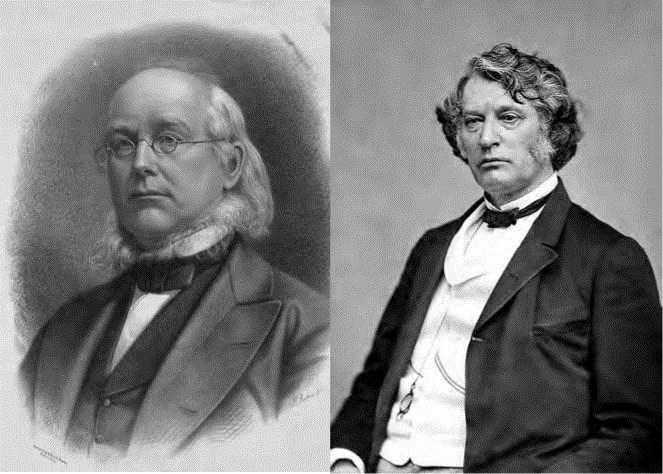
(Left: Horace Greeley, and right: Charles Sumner - both Radical Republicans who urged Lincoln towards emancipation)
For Lincoln, the preservation of the union was still of utmost importance; despite urgent requests from fellow republicans he did not postpone the military draft, though it was an unpopular measure. The enemy was on its last legs and the union army needed more men to win the war and he would do anything to ensure that.
He found himself mediating between his own campaigners whose quarrels were proving detrimental to their own party prospects. He ensured that soldiers in the field cast their votes. Since Indiana did not allow its soldiers to cast their votes for the state elections while they were on duty, and it was important to ensure a republican victory in the state, he requested Sherman to furlough206 them to go home and vote, adding that ‘they need not remain for the Presidential election, but may return to you at once’. Government employees in Washington were given leave too to go home and vote.
Disabusing the supposition of the Democrats and Radicals, he did not admit Colorado and Nebraska as new states or readmit Louisiana and Tennessee, (southern states undergoing reconstruction but still under military control), before the elections to increase his electoral votes. The election process was under the jurisdiction of the Congress; his duty was only to grant protection to ensure that it took place peacefully.
African-Americans by and large wanted him to win; a major part of the Abolitionists supported him completely, as did most denominations of the Church. People of the North grew to respect him, having witnessed his trials and tribulations over the years. H.W. Longfellow, Harriet Beecher Stowe (Uncle Tom’s Cabin) and Ralph Waldo Emerson, great writers of that period admired Lincoln. During the elections Emerson remarked, ‘Seldom in history was so much staked on the popular vote207’. Both believed that public decision very often determined the fate of the nation and their readiness to move towards a greater destiny. Perhaps his greatest supporter among the press was James Lowell, editor of North American Review who influenced public opinion by printing extended articles during 1864 in praise of Lincoln.
The Story of Abraham Lincoln - Chapter V
Welcome Again, Mr. President
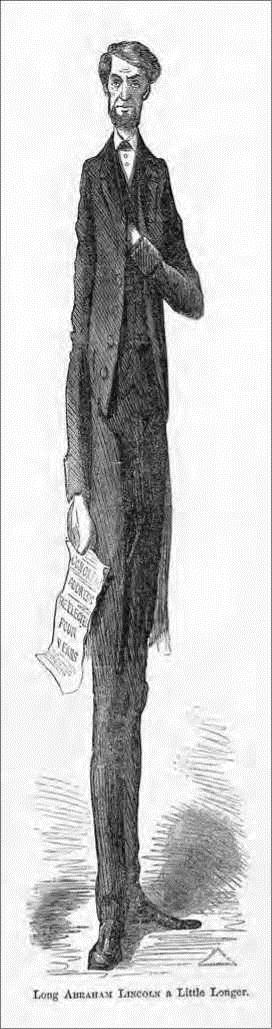
(“Long Abraham Lincoln a Little Longer” November 1864. Caricature of President Lincoln on his re-election to the Presidency. Cartoon by Frank Bellew.)
On 8th November, ‘Uncle Abe’ was reelected president of the United States of America; he won by a margin of more than 500,000 votes. The results were overwhelming, — but for New Jersey, Delaware and Kentucky, every state had voted for the Republican Party. McClellan received 45% of the popular vote, mostly from Irish and German American voters. Soldier votes went largely to ‘Father Abraham’, despite the fact that McClellan was a popular commander. The voters of 1860 had not changed their allegiance; countryside farmers, skilled workers, city professionals and the youth all voted for the Republican Party.
Apart from feeling relieved at his victory, Lincoln felt great happiness to see ‘that a people’s government can sustain a national election, in the midst of a great civil war’208; four million people had stepped out to vote. Despite his overwhelming victory, hoping to unite and work towards a common goal for the good of their nation he appealed to the Democrats, ‘...now that the election is over, may not all, having a common interest, re-unite in a common effort, to save our common country?’209
Assassination attempts had been on him made prior to his inauguration in 1861. By now threat letters ceased to disturb him; he refused to see them and asked his secretaries to throw them away. He believed that if conspirators plotted his death, no policing could prevent them from doing so. But with his reelection, confederates and their North sympathisers felt bitter about having to put up with his government for another term. Stanton and others in the administration worried about his safety; they deployed armed personnel to escort him when he went out and also stationed them outside his private rooms in the White House. A kidnapping attempt had failed in September 1864; he had also escaped a shot fired at him during his ride home from Soldier’s Home. He knew he was in danger but he was determined not to worry about it. On the night of November 8th, after the election results came in, Ward Lamon, Lincoln’s friend and bodyguard, armed with weapons to protect the president, slept outside Lincoln’s bedroom door through the night.
Before his inauguration in March, Lincoln had selected some new members for his cabinet, — Seward, Stanton and Welles he retained; they were invaluable to the tasks still pending. His new cabinet was a good blend of Radical and Conservative faction of the Republican Party. Compared to his previous cabinet members, who at the start were extremely ambitious and antagonistic towards each other and condescending towards him, his new cabinet members were genuinely fond of him. Stanton had become very close and attached to Lincoln. The years had softened Seward too towards Lincoln; he had grown to understand and appreciate the president for his qualities of both the head and heart.
Lincoln was straightforward yet tactful, could motivate and delegate, yet was decisive when needed, knew how to listen and also knew how to command, his humility, openness, lack of vanity and gratefulness; all these qualities produced the man and politician who not only managed his cabinet of rivals but also kindled in their hearts deep affection for him.
Not only his cabinet, his dealings with his generals were equally tactful and honest. Unhappy with two promotions given by the president to two of his officers, General Sherman telegraphed Washington about his displeasure. Instead of getting annoyed, Lincoln responded, ‘the two appointments referred to by you... were made at the suggestion of two men whose advice and character I prize most highly. I refer to Generals Grant and Sherman.’210
It was also time to decide on the Chief Justice of the nation. Lincoln knew that most cases in the coming years would involve the constitutionality of his policies regarding liberation of slaves and the legality of paper money that the Treasury printed to finance the war. Lincoln knew that Chase was a capable man; he had been responsible for the implementation of the National Banking Act in 1863, which provided a unified banking system to the country, the issue of paper currency ‘greenbacks’ in various denominations as well as the establishment of the Bureau of Internal Revenue for the collection of taxes in an effort to finance the war. Ignoring his reprehensible behavior towards him, Lincoln decided on Chase as Chief Justice; he knew he was the right man for the job.
Thirteenth Amendment
The new session of Congress beginning 5th December began uneventfully; with his overwhelming victory and the military successes, it was difficult for the opposition to attack him. In his annual message to Congress on December 6th 1864, he requested the members of the House to support the thirteenth amendment to the constitution abolishing slavery. In the previous Congress the Senate had passed the bill but it did not get the two-third majority in the House of Representatives. Lincoln had got it included as the keystone in the party platform of the National Union Convention. He added that:
“The intervening election shows almost certainly that the next Congress will pass the measure if this does not. Hence there is only a question of time as to when the proposed amendment will go to the States for their action. And as it is to so go at all events, may we not agree that the sooner the better?”211
Having made his appeal to congressmen, he now got to work to ensure the passage of this bill in the House; on it rested the abolition of slavery from the country, and the consequent end of the rebellion. He went into collaboration with James M. Ashley, who had introduced it in Congress in 1863.
Another development was taking place simultaneously; three confederate Government representatives were making their way towards City Point to negotiate for peace; this time it was not a plot by the Democrats or the confederates.
Earlier, Lincoln was against all peace talks with the confederates; therefore he had insisted on abolition of slavery as the condition knowing it would not be acceptable; also there was the risk that peace talks would lead to a truce that would give the confederacy its independence.
However, circumstances had changed. The Southern spirit to fight had been weakened by Sherman’s and Thomas’ victories in the West and Grant’s unrelenting siege on Petersburg in the East. The confederacy was almost ready to fall apart. Governors of Georgia and North Carolina were planning to make peace independent of the confederate government. A peace commission created by the Confederate House of Representatives had turned hostile towards Jefferson Davis, blaming him for the continuation of the war. This seemed like an opportune moment to strike. Towards the end of his annual message, Lincoln advised the public:
“...no attempt at negotiation with the insurgent leader could result in any good. He would accept nothing short of severance of the Union — precisely what we will not and cannot give.”
Alluding to Georgia and North Carolina, he said:
“… What is true, however, of him who heads the insurgent cause, is not necessarily true of those who follow. Although he cannot reaccept the Union, they can. Some of them, we know, already desire peace and reunion. The number of such may increase. They can, at any moment, have peace simply by laying down their arms and submitting to the national authority under the Constitution...”212
With that several emissaries from the North went forth to meet with the governors of those Southern states, which had openly shown an inclination to make peace. Most failed, but Francis Blair came back from Richmond carrying a letter from Davis, promising to appoint representatives for negotiating peace between the ‘two countries’. Not wanting to acknowledge the confederacy as a separate country, Lincoln sent Blair back with a message for Davis stating that he looked forward to ‘securing peace to the people of our one common country’.
To avoid endangering the passage of the thirteenth amendment, Lincoln diverted the three confederate representatives to City Point, Virginia instead of receiving them in Washington.
However, during the last few days of the debate in the house, word did get around. Frantically, Ashley inquired from Lincoln, ‘The report is in circulation in the House that Peace Commissioners are on their way or are in the city, and is being used against us. If it is true, I fear we shall loose the bill. Please authorize me to contradict it, if not true.’213
In response, Lincoln carefully penned the following on the same letter, ‘So far as I know, there are no peace commissioners in the city, or likely to be in it.’214
Some Congressmen were coaxed and some were pressurized while Seward bribed some with political appointments into supporting the bill. On 31st January 1865, the Thirteenth Amendment came through, voted for by more than two thirds of the house and sent to the states for ratification. Thaddeus Steven, who had worked on the antislavery movement for decades, aided Seward and Lincoln in pushing it through. ‘The greatest measure of the nineteenth century was passed by corruption, aided and abetted by the purest man in America,’215 he said.
Thrilled with this landmark event; Lincoln could rest assured that the nation now had the ‘King’s cure for all evil’216 to abolish slavery utterly and completely and with it, put an end to the war.
By end December Lincoln had received news of two new victories — Sherman had terminated his march to the sea by taking the city of Savannah and Thomas had checked the confederate invasion of Tennessee and destroyed their army at Nashville. The Thirteenth Amendment had been secured; fortified, he now turned his attention to the matter he had put on hold, — the confederate commissioners waiting at City Point for peace negotiations.
On 3rd February, he met them with Seward on the ‘River Queen’, his steamer at Hampton Roads. He rejected the confederate offer of truce to jointly fight the French out of Mexico. He offered them restoration of the Southern states into the union provided they laid down their arms in submission to the United States of America. Seward also announced that the Thirteenth Amendment of the constitution had been passed by the House and had been sent to the states for ratification. Seeing them unnerved Lincoln offered to them a word of advice. ‘Were I in your place, he said, ‘I would ‘get the governor of the state (Georgia) to call the legislature together, and get them to recall all the State troops from the war; elect Senators and Members to Congress, and ratify this Constitutional Amendment prospectively, so as to take effect — say in five years...’217 Completely disturbed, the confederate commissioners returned to Richmond from peace negotiations that were an absolute failure.
With Charity to All
These had been busy months; with great difficulty the Thirteenth Amendment had gotten through; the war, though now steering favourably in their direction, was still going on. His kind heart found it most disturbing when he had to review court martial cases. He pardoned soldiers who had been sentenced to death for sleeping on sentry duty, desertion and even treason; he was ‘unwilling for any boy under 18 to be shot’. ‘If almighty God gives a man a cowardly pair of legs, how can he help their running away with him?’218 he asked. And yet, when Nathaniel Gordon, who was convicted for capturing 800 negroes for selling them as slaves, appealed for pardon, Lincoln refused, ‘I believe I am kindly enough in nature, and can be moved to pity and to pardon the perpetrator of almost the worst crime that the mind of man can conceive... but any man, who, for paltry gain and stimulated only by avarice, can rob Africa of her children to sell into interminable bondage, I never will pardon.’219
Gideon Welles and Edward Bates, members of his cabinet criticized his kindness; it obstructed the course of military procedure, they felt. They often told him that ‘he was unfit to be entrusted with the pardoning power’.220 When two women came to him with a plea to pardon family members who had been imprisoned for resisting the draft, he called General Dana and after verifying the matter he instructed, ‘these fellows have suffered long enough. and now that my mind is on the subject I believe I will turn out the whole flock...’ The older woman, with tears in her eyes, said, ‘I shall probably never see you again till we meet in heaven.’ Taking both her hands in his, he replied, ‘I am afraid with all my troubles I shall never get to the resting place you speak of that you wish me to get there is, I believe, the best wish you could make for me… ’ Worried about serious matters that affected the destiny of the nation, Lincoln was just as sensitive about the destiny of individuals. He confided to his friend, Joshua Speed who witnessed this meeting, ‘Die when I may, I want it said of me by those who know me best to say that I always plucked a thistle and planted a flower where I thought a flower would grow.’221
Lincoln’s compassion was directed towards all; even his enemy. During his visit to an army hospital, he asked a confederate soldier whose leg had just been amputated, ‘Would you shake hands with me ifI were to tell you who I am?’ When the confederate said yes, Mr. Lincoln told him, ‘I am Abraham Lincoln, President of the United States.’ The eyes of both men filled with tears’222.
In fact, Lincoln’s compassion was endless; he saved hundreds of ‘sleeping sentries from the firing squad, reunited miscreant husbands with tearful wives and restored last-surviving sons to their widowed mothers’223.
With the winds of change that altered circumstances, Lincoln was quick to change his course of action. Earlier, the need of the hour was the abolition of slavery. Now with the Thirteenth Amendment signed and delivered, abolition was assured and ceased to be a pressing need. The need of the hour currently was to end the war and restore the Southern states back into the union, even if it happened piecemeal, state by state. In fact, he felt that if Southern states broke away from the confederacy and rejoined the union, it would end the rebellion. To accomplish that, he made a proposal to Congress stating that $400,000,000 were to be arranged for disbursement to the Southern states as compensated emancipation for their slave population. Lincoln was sincerely devoted to the cause of restoration of the union and the liberation of slaves — and was willing to be as generous as possible to achieve both his objectives. The republicans supported him fully in the creation of the Bureau of Freedmen, Abandoned Lands and Refugees; these offices would oversee the transition from slavery to freedom in the Southern states.
In view of the favourable circumstances of war and mandate, Lincoln firmly declared that he would veto any reconstruction bill that did not recognize the free state government that had been set up under his 10% plan in Louisiana. Apart from their importance for the restoration of the union, these free state governments were necessary for the ratification of the Thirteenth Amendment, which needed the votes of at least 27 of the 36 states before it could go into effect. Counting all Northern states and Border States where slavery had been abolished by now, they fell short of two votes. These votes could only come from those confederate states that were now under federal control. And without a government the amendment could not be ratified. To appease the radicals, Lincoln accepted Negro suffrage; his own thinking had evolved and he now believed that the educated African Americans and those who had served in the army should be permitted to vote. He showed them a copy of his letter to Governor Hahn, suggesting limited enfranchisement of blacks. Lincoln was in a hurry; he came straight to the point and asked the Senate, ‘Can Louisiana be brought into proper practical relations with the Union, sooner, by admitting or by rejecting the proposed Senators?’224 With great difficulty the Senate managed to get a majority of the Republicans to support the Louisiana bill, but because Negro enfranchisement was absent from their constitution, Charles Sumner and his group of Radicals blocked it. Despite Lincoln’s resolve to keep the reins of control over reconstruction in his hands, he could not steer it towards a Congressional approval for the admission of Louisiana.
Time to Rejoice
On March 4th, 1865, Lincoln was inaugurated a second time as America’s President. A huge crowd had collected on that cold and rainy day. Lincoln kept his speech short; he put forth before the people his thoughts about the war, a war that neither side thought would wreak so much devastation and pain to its people and yet needed to be fought till the end so that a ‘just and lasting peace, among ourselves, and with all nations’ could be established:
“On the occasion corresponding to this four years ago, all thoughts were anxiously directed to an impending civil war... And the war came…
“Neither party expected for the war, the magnitude, or the duration, which it has already attained. Neither anticipated that the cause of the conflict might cease with, or even before, the conflict itself should cease.
“Both read the same Bible, and pray to the same God; and each invokes His aid against the other. It may seem strange that any men should dare to ask a just God’s assistance in wringing their bread from the sweat of other men’s faces; but let us judge not that we be not judged. The prayers of both could not be answered; that of neither has been answered fully. The Almighty has His own purposes. ‘Woe unto the world because of offences! For it must needs be that offences come; but woe to that man by whom the offence cometh!’ If we shall suppose that American Slavery is one of those offences which, in the providence of God, must needs come, but which, having continued through His appointed time, He now wills to remove, and that He gives to both North and South, this terrible war, as the woe due to those by whom the offence came, shall we discern therein any departure from those divine attributes which the believers in a Living God always ascribe to Him?
“Fondly do we hope — fervently do we pray — that this mighty scourge of war may speedily pass away. Yet, if God wills that it continue, until all the wealth piled by the bondman’s two hundred and fifty years of unrequited toil shall be sunk, and until every drop of blood drawn with the lash, shall be paid by another drawn with the sword, as was said three thousand years ago, so still it must be said ‘the judgments of the Lord, are true and righteous altogether.’
“With malice toward none; with charity for all; with firmness in the right, as God gives us to see the right, let us strive on to finish the work we are in; to bind up the nation’s wounds; to care for him who shall have borne the battle, and for his widow, and his orphan — to do all which may achieve and cherish a just, and a lasting peace, among ourselves, and with all nations.”225
With these words Lincoln closed his address to the people at his second inauguration. In just 700 words he summed up the cause of war without directly attributing blame for it. As though he were looking down from above, he saw the spectacle of war as two brothers wrestling with each other. His wideness of vision is clear in his introspection of the civil war; ‘All dreaded it — all sought to avert it’. The war and the destruction it had wreaked had compelled him more and more to look towards the heavens for Divine Guidance. Lincoln always held both north and south responsible for bringing slavery into the country. He bows before the omnipotence of God and while praying for the speedy end of ‘this mighty scourge’, with true surrender and faith he adds that the cessation or continuation of war was no more in the hands of men, but in the hands of the Almighty. Inwardly, the sense of doer ship no more belonged to him. He had handed his instrumentality to the Divine.
Not all people understood his speech; it was not a standard speech speaking of war victories and promises. However, it pleased the radicals, the abolitionists and specially Frederick Douglass who called it a ‘sacred effort’. ‘I believe it is not immediately popular’, he wrote to Thurlow Weed, ‘Men are not flattered by being shown that there has been a difference of purpose between the Almighty and them. To deny it, however, in this case, is to deny that there is a God governing the world. It is a truth which I thought needed to be told...’226
On the night of the inaugural ball at the White House, when the police tried to stop Douglass from entering, Lincoln sent word to let him in — the first time that an African American had been a guest at a presidential reception. Lincoln had grown during his presidency; the war and its perilous course had chiseled his being; he did not shrink from difficult decisions; he had assumed unprecedented war powers, his only shelter being the Grace of the Almighty to whom he would time and again turn towards for guidance. His purity of purpose gave strength to his resolve.
Extremely fatigued in mind and spirit, Lincoln took a few days off from work. He had begun to look old beyond his years. Mary, fearing that he would not last his second term, urged him to arrange a lighter timetable. To get his mind off his work, she persuaded him to go see plays, especially Shakespeare, his favourite. Lincoln went often with either Mary or Tod or his secretaries or sometimes with a party of friends. These visits to the theatre or the opera were as much for the enjoyment as it was for the rest he could get.
Perhaps the best relaxation he found was in the carriage rides he took with Mary in the afternoons. He enjoyed their quiet conversations, reminiscing the past and looking towards the future. He spoke of a European vacation with Mary and their sons. The Lincoln family had suffered much during the course of his presidency; the loss of Willie and Robert’s enlistment had almost driven Mary to the brink.
Lincoln’s mind was always on the battlefield where his generals were pushing into enemy territory to rout them out. He was often overcome with fear that the overconfidence of his generals would bring about a reversal in their war fortunes and Lee would escape the siege of Petersburg, head for North Carolina for reinforcements and start a new battle. His generals also had a tendency to interfere with peace negotiations; recently, Lee had approached Grant to discuss the issues between the two hostile forces. Having seen the detrimental effect of Grant’s interference during the peace talks with Davis’ men,227 Lincoln categorically told him that the military should refrain from such matters as they were directly under the jurisdiction of the President.
Lincoln did not only want peace but also reconciliation. To discuss this matter further, he decided to visit Grant at City Point. Mary and Tad accompanied him on the River Queen. On 28th March 1865, Lincoln met with Sherman, Grant and Porter for a discussion regarding terms of surrender. He was afraid that the defeat of the confederate army would lead to anarchy and lawlessness among the disbanded soldiers. Not only suspension of hostility but reconciliation could prevent that. He wanted them to ‘get the deluded men of the rebel armies disarmed, and back to their homes’228; he wanted ‘no revenge, no harsh measures, but quite the contrary’229. ‘We want those people to return to their allegiance to the union and submit to the laws’.230
Good news came in on the 3rd April; the confederates had evacuated Petersburg and Richmond and Jefferson had fled. Lincoln decided to be present at the time Grant entered Richmond. Horrified by this news Stanton admonished Lincoln for taking such an awful risk, to which Lincoln coolly replied, ‘I can take care of myself’.231
On 4th April, Lincoln reached Richmond with Tad. As he entered the ravaged confederate capital, liberated slaves surrounded him; some wanted to shake his hand while some knelt before him and greeted him reverently as their messiah. Choked with emotion, he put his hands on their shoulder and asked them to kneel only before God.
His main purpose was to discuss with John Campbell, a high ranking Confederate who had met him during the Hampton Roads peace talks, the process of getting Virginia back into the union peacefully. Having laid out his terms for peace, which included mainly the cessation of hostilities by Virginia towards the union, abolition of slavery and the restoration of National Authority, Lincoln promised to return all properties (except slaves) seized under the Confiscation Act if the Virginians fulfilled the terms. On assurance from Campbell that slavery had become inoperative in the South and therefore would not be an issue, Lincoln suggested a plan for the rapid and peaceful restoration of Virginia into the union. Virginia’s existing confederate legislature could meet in Richmond and vote to withdraw from the Confederacy. Having done so, the President might lawfully and rightfully recognize them as the existing state government. There were problems though; this solution invalidated their policy of non-recognition of the Confederacy. Also, the legitimacy of the unionist government set up in the area under federal control in Virginia would become questionable. However, not willing to relinquish the possibility of a speedy restoration of Virginia he directed his men to permit the confederate men to convene in Richmond.
The union army was gaining more ground daily; waiting eagerly for confederate surrender, Lincoln returned to Washington on 8th April reading lines from Macbeth to his guests on the River Queen.
Union Statistics
2.9 million men served 1.5 million enlisted — 3 years duration 630,000 casualties 360,000 killed in action or died of disease
Confederate Statistics
1.2 million men served 800,000 enlisted — 3 years duration 340,000 casualties 250,000 killed in action or died of disease
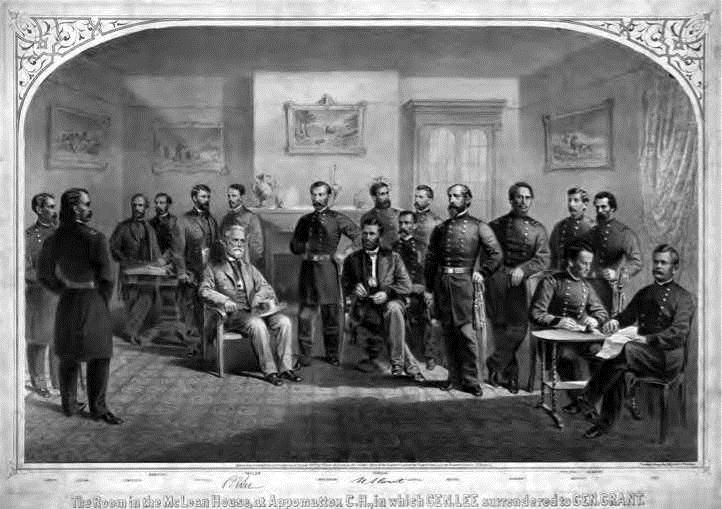
(General Lee surrenders to General Grant at Appomattox)
The War Is Over
On 9th April, Lee surrendered to Grant at Appomattox Court house. Lincoln hugged Stanton in sheer joy and relief but knew that a ravaged south and freed blacks awaited his leadership; just as five years ago the joy of winning his first presidential election, had brought with it the enormous responsibility of steering the nation through its domestic crisis. 11th April was a day of great jubilation; people gathered around the White House in joy; bands played, fireworks burst in the sky, men and women cried to see the President. Lincoln addressed the people from the 2nd floor balcony.
It was not a regular speech applauding the victories of the union armies; his mind had already moved on to the problems that often befall a nation suffering from the ravages of war. During his trip to Richmond, he had seen for himself the destruction inflicted by the war on the city, its burning buildings, abandoned streets, shut windows and drawn blinds of Southern homes, Union soldiers and sailors manning the city, and felt a deep-seated comprehension of the agony that the soldiers and civilians in the south were experiencing. He feared that Southern ‘society would be broken up; the disbanded armies would turn into robber bands and guerrillas’,232 which he must try to prevent.
He began his speech by expressing hope that the union victories would finally result in the speedy establishment of peace, but thenceforth it was devoted to the experiment being carried out for reconstruction in Louisiana. He reached out to his Northern people to make them understand the urgency of reconciliation with the people of the south; to partner them in the process of reconciliation, to confide in them of the difficulties in achieving it. He wanted them to rise above personal animosity and shortsightedness and look towards the holistic wellbeing of the entire nation.
He spoke of the unfortunate collision between the Executive and the Legislative branches of the government with regard to the process of reconstruction and about the criticism of his support of the new Government of Louisiana. He affirmed the power of Congress to decide upon the admission of the Louisiana government. He also confided in them of the shortcomings in the Louisiana constitution:
“The amount of constituency... would be more satisfactory to all, if it contained fifty, thirty, or even twenty thousand, instead of only about twelve thousand, as it does. It is also unsatisfactory to some that the elective franchise is not given to the colored man”.
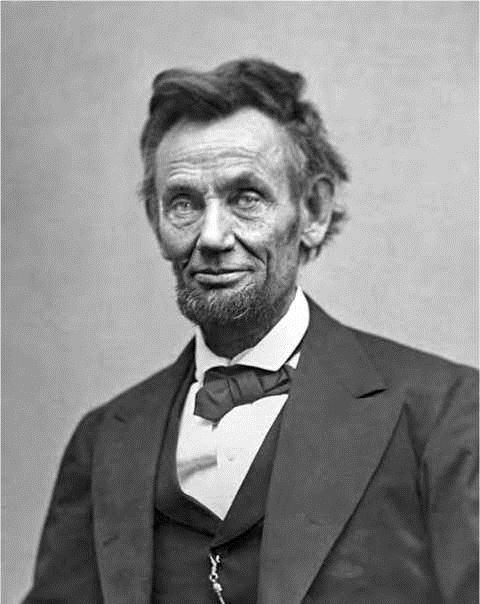
(Lincoln in February 1865, two months before his death. The fatigue from pressures of office are clearly evident on his face.)
He acknowledged his own personal desire to see the enfranchisement of the Negroes. He then spoke of all that it has accomplished:
“Some twelve thousand voters in the... slave-state of Louisiana have sworn allegiance to the Union. held elections, organized a State government, adopted a free-state constitution, giving the benefit of public schools equally to black and white, and empowering the Legislature to confer the elective franchise upon the colored man. Their Legislature has already voted to ratify the constitutional amendment recently passed by Congress, abolishing slavery throughout the nation.”
He appealed to the people to ‘join in doing the acts necessary to restoring the proper practical relations between these states and the Union’. He further warned them:
“If we reject, and spurn them, we do our utmost to disorganize and disperse them. If, on the contrary, we recognize, and sustain the new government of Louisiana. we encourage the hearts, and nerve the arms of the twelve thousand to adhere to their work. and fight for it, and feed it, and grow it, and ripen it to a complete success. The colored man too, in seeing all united for him, is inspired with vigilance, and energy, and daring, to the same end. Grant that he desires the elective franchise, will he not attain it sooner by saving the already advanced steps toward it, than by running backward over them?”
In the end he asked that though the Louisiana constitution is not all that is desired, ‘Will it be wiser to take it as it is, and help to improve it; or to reject, and disperse it?’233
He concluded that he would ‘make some new announcement to the people of the South’. It would seem that as he had allowed Campbell to assemble the rebel legislature of Virginia in order to withdraw from the confederacy, he might make the same offer to the other Southern states.
It was not a speech which the public was expecting, but it was an effort to ‘blaze a way through the swamp’ of criticism and opposition by the Radicals. It was an attempt to win their confidence and convince them of the effectiveness of this process of reconciliation and appeal for their support in his effort to put the war and devastation behind them as soon as possible.
There were those in the audience who sympathized with the south and felt that Lincoln had taken too many liberties. John Wilkes Booth was one of them. Hearing him speak of voting rights for blacks, he decided it would be the last speech he would ever make.
His 11th April speech unfortunately did not arouse the urgency that Lincoln aspired for. The Radicals did not accept his compromises for the Louisiana government. His own cabinet disapproved of his Campbell proposal for Virginia; consequently he sent word that since the confederates had surrendered, action on the part of the Virginia rebel legislature was not necessary.
Despite so much opposition, Lincoln did not give up. His cabinet met on the 14th April and agreed to restore and encourage commercial relations with the south. They all felt goodwill towards the Southern people and aspired to restore safety and government with as little harm to the people and their property. Even Lincoln acknowledged that he had ‘perhaps been too fast in his desires for early reconstruction’. Seeing their enthusiasm to find feasible reconstruction methods, Lincoln, feeling hopeful, observed that ‘if we were wise and discreet, we should reanimate the states and get their governments in successful operation, with order prevailing and the Union reestablished, before Congress came together in December’.234 He knew that ‘men in Congress, if their motives were good, were nevertheless impracticable, and who possessed feelings of hate and vindictiveness in which he did not sympathise and could not participate’.235
The terms of surrender offered by Grant at Appomattox, pleased Lincoln; he was convinced that news from Sherman from North Carolina would be good; the previous night he had the same dream he always had before every significant victory: ‘he seemed to be in some singular, indescribable vessel, and... he was moving with great rapidity towards an indefinite shore.’236
During the last few years, pained by the ravages of war, he often remarked that he would not outlast the rebellion; ‘but in the flush of triumph, — in his large, loving, and liberal plans for the good of the people whom the fortunes of war had left at his feet, — in his dreams of the future Union and harmony of the states, — he forgot this, and was hopeful and happy’.237 That afternoon, he slipped away with Mary for a carriage ride. Even she found his cheerfulness delightful, to which he responded, ‘we must both be more cheerful in the future, between the war and the loss of our darling Willie, we have both been very miserable.’238
He Belongs To the Ages
He looked forward to going to the theatre that evening. Major Rathbone and his fiancee were to be his guests. His advisors begged him not to go; with the recent confederate surrender, the threat to his life seemed more probable. Before leaving Washington for some work, Lamon, his bodyguard had urged him to stay home in his absence. Indifferent for his safety as always, Lincoln disregarded these warnings and accompanied by Mary left for the Theatre that evening.
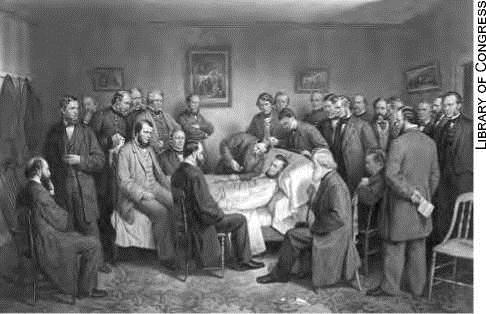
(Death of Lincoln, surrounded by his cabinet, generals and family.Painted and engraved by A.H. Ritchie)
Booth had failed several times in his attempt to kidnap the president. This time he was determined to avenge the south. Being an actor he was able to enter the presidential box without difficulty. He locked the door from inside and drawing out his gun, inched up behind the president and shot him in the head at close range. It was around 10:13 pm.
He had an ambitious plan; two of his accomplices were instructed to kill Vice President Johnson and Secretary of State, Seward. One got cold feet and the other entered the home of Seward and knocking down his son and daughter, managed his way into his bedroom. Repeatedly stabbing Seward in the neck, he flew back downstairs slashing anyone who came in his way. Seward was saved by the metal brace he was wearing on account of a carriage accident a week earlier.
Lincoln slumped forward, Mary screamed, Colonel Rathbone went after Booth who slashed him with a dagger and leaping over the box, managed to escape. A couple of army doctors present in the audience, carried out Lincoln to a boarding house across the street; the bullet was lodged behind his right eye; for the following nine hours doctors did their best. Mary sat beside him crying and begging him to speak. Most of his cabinet members except Seward gathered around him. Through the night his friends and colleagues poured in and sat weeping by his bedside. Charles Sumner, his supporter and agitator held his hand and cried. Stanton, eyes brimming with tears, checked himself from breaking down; as Secretary of War, he had to take over the reins and prevent the government from coming to a halt. Lincoln’s vital tenacity was so strong, said the doctors that he survived beyond the two hours they had predicted, given the nature of the injury.
At 7:22 am Lincoln breathed his last, — the final casualty of a war that tormented him through the years. As he stood by Lincoln’s deathbed, Stanton remarked, ‘Now he belongs to the ages.’
“His sun went down suddenly, and whelmed the country in a darkness which was felt by every heart; but far up the clouds sprang soon the golden twilight, flooding the heavens with radiance, and illuminating every uncovered brow with the hope of a fair to-morrow. The aching head, the shattered nerves, the anxious heart, the weary frame, are all at rest; and the noble spirit that informed them, bows reverently and humbly in the presence of Him in whom it trusted, and to whose work it devoted the troubled years of its earthly life….
“Never had the nation mourned so over a fallen leader. Not only Lincoln’s friends, but his legion of critics. now lamented his death and grieved for their country.’239 ‘From the sunniest hills of joy, the people went down weeping into the darkest valleys of affliction. Men met in the streets, and pressed each other’s hands in silence, or burst into tears... Millions felt that they had lost a brother, or a father, or a dear personal friend. It was a grief that brought the nation more into family sympathy than it had been since the days of the Revolution.’240
The White House threw open its doors to people to have one last look at that kind face; thousands came — ‘the rich and the poor, the white and the black, mingled their tokens of affectionate regard, and dropped side by side their tears upon the coffin. It was humanity weeping over the dust of its benefactor’.241
At his funeral in the White House, Rev. Dr. Gurley, speaking of the great national emergency in which Lincoln was called to power, said:
“He saw his duty as the chief magistrate of a great and imperiled people; and he determined to do his duty and his whole duty, seeking the guidance, and leaning upon the arm, of Him. Yes, he leaned upon His arm. He recognized and received the truth that the kingdom is the Lord’s.”242
He was finally taken back home to Springfield, Illinois, with his dear son Willie to be buried by his side — on a return journey that four years ago had brought him to Washington as president elect.
Nothing could have been more apt than a quote read out by Bishop Simpson from Lincoln’s speech in 1859. Referring to the slave power he had said:
“Broken by it I too, may be, bow to it, I never will. The probability that we may fail in the struggle, ought not to deter us from the support of a cause, which I deem to be just; and it shall not deter me. If ever I feel the soul within me elevate and expand to those dimensions not wholly unworthy of its Almighty Architect, it is when I contemplate the cause of my country, deserted by all the world besides, and I, standing up boldly and alone, and hurling defiance at her victorious oppressors.”243
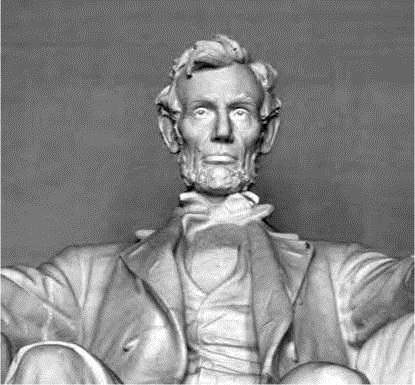
Excerpt from Holland’s Life of Abraham Lincoln by J.G. Holland
"... We have seen a great popular government, poisoned in every department by the virus of treason, and blindly and feebly tottering to its death, restored to health and soundness through the beneficent ministry of this true man, who left it with vigor in its veins, irresistible strength in its arms, the fire of exultation and hope in its eyes, and with such power and majesty in its step, that the earth shook beneath its stately goings.
We have seen four millions of African bondmen who, groaning in helpless slavery when he received the crown of power, became freemen by his word before death struck that crown from his brow.
We have seen the enemies of his country vanquished and suing for pardon; and the sneering nations of the world, whose incontinent contempt and spite were poured in upon him during the first years of his administration, becoming first silent, then respectful, and then unstinted in their admiration and approbation …
… Uninfluenced by popular clamor, and unbent by his own humane and Christian desire to see all men free, he did not speak the word of emancipation until his duty to the Constitution which he had sworn to protect and defend demanded it. It was not slowness, nor coldness, nor indifference that delayed the emancipation of the slaves. It was loyal, devoted, self-denying virtue…
... He knew and felt the weakness of human nature... Hence, he was patient with his enemies, and equally patient with equally unreasonable friends…
He has given them a statesman without a statesman’s craftiness, a politician without a politician’s meanness, a great man without a great man’s vices, a philanthropist without a philanthropist’s impracticable dreams; a Christian without pretensions, a ruler without the pride of place and power, an ambitious man without selfishness, and a successful man without vanity.
On the basis of such a manhood as this, all the coming generations of the nation will not fail to build high and beautiful ideals of human excellence, whose attractive power shall raise to a nobler level the moral sense and moral character of the nation.
This true manhood — simple, unpretending, sympathetic with all humanity, and reverent toward God — is among the noblest of the nation’s treasures; and through it, God has breathed, and will continue to breathe, into the nation, the elevating and purifying power of His own divine life.”
The Story of Abraham Lincoln - Chapter VI
After Lincoln
The search for Lincoln’s assassin, lead the police to his hideout near Washington; on April 26th 1865, Booth was killed while trying to escape. Eight of his accomplices were caught; four were subsequently hanged.
Fighting still continued in small areas of the West, Louisiana, Mississippi and Alabama. Jefferson Davis was captured on May 10th; by the end of May, the last confederate army had surrendered. During the civil war, more than 600,000 soldiers had been killed and 300,000 had been wounded.
Most of the south was destroyed during the civil war; farms, plantations and buildings had been burned down and crops destroyed. Confederate money was now worthless. The economy of the south was wrecked; Federal troops occupied southern states during reconstruction to ensure that laws were followed and no more uprisings took place. It was a big task; roads had to be rebuilt, plantations and farms had to be restarted, schools had to be set up for black children. Reconstruction was a tardy and labyrinthine process; one which did not do justice to Lincoln’s vision.
As Lincoln had predicted, the Southern whites were not yet ready to accept blacks into their society. Between 1865-1866 many southern states passed Black Codes — laws to prevent blacks from going to school, owning land, voting, and getting jobs. They wanted to prevent the blacks from rising in society; they wanted to keep them as labour on very low wages. Though blacks attained liberation, racial equality remained a distant dream, which would not be fulfilled until a century later.
Tennessee was the first state to be readmitted to the Union in 1866 and the last state was Georgia in 1870. During reconstruction that took place between 1865-1877, republicans passed four civil rights bills to protect the rights of African-Americans, the first being the 13th Constitutional Amendment that abolished slavery in 1865.
In 1866, Congress passed the 14th Amendment also called the Civil Rights Act that granted citizenship to African-Americans but not the right to vote.
In 1869, Congress passed the 15th Amendment giving African American males the right to vote.
In 1875, Congress passed the Civil Rights Act that guaranteed African-Americans equal treatment in public accommodations, public transport and prohibited exclusion from jury duty. But in 1883, Supreme Court ruling declared it unconstitutional.
In 1876, when Democratic strength increased in Congress and gained control of Southern state legislatures, they blocked additional progress and began to repeal civil rights laws.
In 1896, Democrats in Louisiana passed ‘grandfather clauses’, which were devious and crafty means like literacy tests and poll taxes to dodge the voting protection granted to African- American men in the 15th Amendment. They installed numerous such measures to prevent prior slaves and their descendants from voting. It stated that those who enjoyed the right to vote before 1866 would be exempt from educational, property, or tax requirements for voting. Since the former slaves did not get enfranchisement till the 15th amendment in 1869, these clauses worked to exclude blacks from voting and encourage enfranchisement among the poor and illiterate whites. Resultantly, there was a sharp drop in registered black voters from 44.8% to 4.0% by 1900. Louisiana’s example was followed by other Southern states, — Mississippi, South Carolina, Alabama and Virginia to enact their own ‘grandfather clauses’.
With a result, only 3% blacks were registered to vote by 1940.
In August 1963, one hundred years after the Emancipation Proclamation had been issued, Martin Luther King, Jr. stood on the steps of the Lincoln Memorial and delivered his famous speech, ‘I have a Dream...’ to press for racial equality in American society.
In 1964, Congress passed the 24th Amendment prohibiting poll tax in elections for federal offices, thereby facilitating African American enfranchisement.
To protest for African-American voting rights, in 1965, 500 non-violent civil rights activists marched from Selma to Montgomery, Alabama. The police used tear gas and clubs to beat up the protestors and drove them back to Selma. The attack was shown on television and triggered a national outcry. After securing court protection, Martin Luther King lead more than 3000 protestors from Selma with the strength growing to over 25,000 by the time he reached Montgomery. President Lyndon Johnson denounced the attack as ‘deadly wrong’.
In 1965, Congress passed The Voting Rights Act, permanently prohibiting hurdles (literacy tests, poll taxes and non-registration of African-American voters) that prevented African-Americans from exercising their right to vote under the 15th Amendment. This Act markedly expanded the franchise and is deemed as a landmark in the history of U. S. civil rights legislation.
(Native Americans: Sitting Bull, Lakota tribe, holy man and chief)
Appendix I: Pre-Lincoln History of America
American History, Prior to Abrahim Lincon
14,000 year before 985 AD
The first visitors to the American continents walked from Siberia over a land bridge (now Bering Strait) during the Ice Age. They entered through Alaska and over 4000-5000 years, they spread all over both the North and South American continents and its islands right up to Patagonia. By the end of the 15th century, there were at least 250 tribes with very diverse cultures and customs. They had at least 300 different languages and their scripts consisted of symbols. Some were semi-nomadic hunters, gatherers and fishers while others built settlements and farmed. These were the Native Americans who populated the Americas before the arrival of the Europeans (see Map p. I).
Historians now say that some of the cultures are as old as 40,000 years. But they do not know how or from where they came.
11th Century
Around the beginning of the 11th century, Vikings from Norway arrived at the shores of Eastern Canada. They created a settlement but failed to establish themselves. The natives, who were in larger numbers, were not friendly and the voyages were difficult; in around forty years they left America for good.
Did you know?
Native American tribes had a highly developed knowledge of Astronomy and Architecture. And yet, they were ignorant of the plough, the wheel and ships.
Some tribes built towns with houses, community courts and buildings for religious ceremonies. Some even had developed codes of law and a judicial system.
Trade and war existed side by side, though there were some tribes that did not know what war was and others that were continuously occupied in warring. They also created leagues of tribes to fight a common enemy tribe.
Some tribes injudiciously burnt fires or cut down forests for hunting or settlements. Consequently animals reduced, rivers and air got polluted which forced them to abandon their town and suburban areas - a tough lesson for reckless exploitation of Mother Nature.
On the other hand there were tribes, which were extremely conscious of the environment, using natural resources frugally.
Some tribes were very artistic and made beautiful pottery, woven baskets and elaborately carved wooden totem poles representing their heritage. They also kept slaves and were keen traders.
The tribes of the North East knew the use of copper and slate for weapons and farming implements. The canoe, a light boat, made out of birch, was their gift to the world.
For five hundred years after the Vikings departed, the Native Americans lived in peace.
Native American Quote
Honor the sacred. Honor the Earth, our Mother. Honor the Elders.
Honor all with whom we share the Earth: Four-leggeds, two-leggeds, winged ones, Swimmers, crawlers, plant and rock people. Walk in balance and beauty.
15th Century
Europe had been trading with the East for spices, silk, gold and silver for hundreds of years. In 1453, the Turkish Empire conquered Constantinople and cut off the trading route. Consequently, they began looking for alternate sea routes to the Indies.
End of 15th Century
Christopher Columbus believed that the earth was round and not flat, therefore it was possible to reach the Indies via the West. Of his propositions to various European monarchs, Queen Isabella of Spain agreed to finance his voyage to find this western trade route to the Indies. In 1492, he set out westward on his voyage to the Indies, which he thought was only 2500 miles away. He had underestimated it drastically; it was actually 7500 miles away. On finding land (an island in the Bahamas) after 61 days, he thought that his ship had reached the Indies and believed till his death that the place he had arrived at was the Indies (see Map p. II).
When he landed, he found that this New World was already inhabited by people. When word reached Europe that these people had no idea who Christ was, the missionaries were filled with zeal to spread Christianity there. On his subsequent voyage to the New World, missionaries accompanied Columbus. Also, the Spaniards believed that converting the natives to Christianity would be a good way to acquire both land and loyal subjects.
Columbus created a settlement called Hispaniola, enslaved the Native Americans to work on the land and imposed a tax payable in gold. Failure to pay resulted in their hands being cut off. To maintain law and order he also dealt with the settlers from Europe very harshly.
In 1513, Spain proclaimed that all Native Americans must convert or be enslaved or executed though the missionaries who accompanied the settlers were against the subjugation of Native Americans as slaves. A few decades later, the Pope declared that Indians were not to be enslaved.
But the voice of reason was too weak to halt the stride of this hunger for acquisition, and which would only increase and spread with the passage of time.
Though the Spanish had been the first to reach the Americas, they were soon followed by Portugal, France and England. The defeat of the Spanish offensive by Britain commenced the decline of the head start that Spain had in the New World.
Whether it was the Spanish or the English or other European settlers, all of them either enslaved the Native Americans, or killed them if they resisted. What began as an exploration of a new trade route ended up in acquisition of new lands irrespective of the fact that they were already inhabited. The question was not whether they should or should not colonise in the New World. The question was - how should the native inhabitants be dealt with so that colonisation could take place? It was an age of desire to explore, acquire and expand.
But the native population fell to disease much more than to swords and guns. The Europeans brought with them diseases against which the Native Americans had no immunity. As a result, the Native American population shrank drastically. Consequently, the Spanish began importing slaves from Africa to work on the land soon after Columbus arrived in the Americas - slave trade which would continue to be carried out by most European colonies in the New World.
End of 16th Century
Emboldened after its victory over the Spanish Armada, England began raiding Spanish ships returning home with riches from the New World.
17th Century
News of the New World reached the common folk back home. They began looking at the Americas for new settlements. People tired of overpopulated cities, tenant farmers who had been evicted and needed new dwellings and work, Protestants wanting religious freedom to practice their own form of Christianity and a new lot of enterprising people who desired to make money by collecting money from small investors and by financing colonists to produce goods in the New World and selling it back home - all these people pined for a new land and looked towards the Americas to settle anew.
English Colonies in South and North of the New World
In 1585, Sir Walter Raleigh, having received a patent from Queen Elizabeth, sailed west and founded the first English colony at Roanoke Island. They, however, returned home to England with Sir Francis Drake; altercations with Indians and shortage of food supplies forced them to abandon the colony. In 1587, Raleigh sent another group of 100 colonists under John White, who returned home to fetch supplies. Mysteriously, on his return to Roanoke Island in 1890, there was no one to be found. All the colonists had disappeared (see Map p. III).
In 1605, a group of English entrepreneurs formed the Virginia Company and got a charter from King James I to develop a colony in the Southern part of the Americas called Virginia.
Of the one hundred and forty four people who left for the new world, a quarter of them died on board. Some of the settlers had traded seven years of their labour for a passage to the Americas. Others belonged to the upper class, who did not know how to farm, hunt or live in the wild. When they arrived in Virginia and began the settlement of Jamestown they discovered it was swampy and inhabited by suspicious natives. Consequently, half of them perished due to disease, starvation or in attacks by unfriendly natives.
Some began to make friends with the natives; it brought much relief for the settlers as the natives provided food for them; also they got a respite from their attacks. Despite that, the settlers almost died of starvation, and Jamestown almost perished but for a relief expedition that came in time.
In 1613 Jamestown began growing tobacco, which became a money spinner for the settlers. On the heels of economic well being came seventy brides for these men. Their passage was paid in kind with one hundred and twenty pounds of tobacco per bride. It was now time to bring about some civic sense and social structure in the settlement. A legislative body was formed, which met for a week and passed laws prohibiting gambling and idleness, and made Sunday church service mandatory for all.
Within three weeks of this representative government coming into existence, Jamestown settlers bought twenty African slaves to work on their tobacco plantations from a Dutch ship that arrived carrying human cargo.
The Portuguese were the first to begin African slave trade, but were soon followed by the Spaniards, the Dutch and the British. Both the North and South used slaves - in the North as domestic servants and in the South as plantation workers.
Radical Protestants in Pennsylvania formally opposed the practice of slavery. Samuel Sewall, a New England judge called for the abolition of slavery. But this dissent was in its nascent form; it was too weak to make a difference.
In fact, now the colonial governments institutionalized slavery - Virginia passed a law that decreed slave’s children as slaves. Maryland declared that converting to Christianity did not release a slave from slavery - he was a slave for life. New York legislation recognised slavery as a legitimate practice.
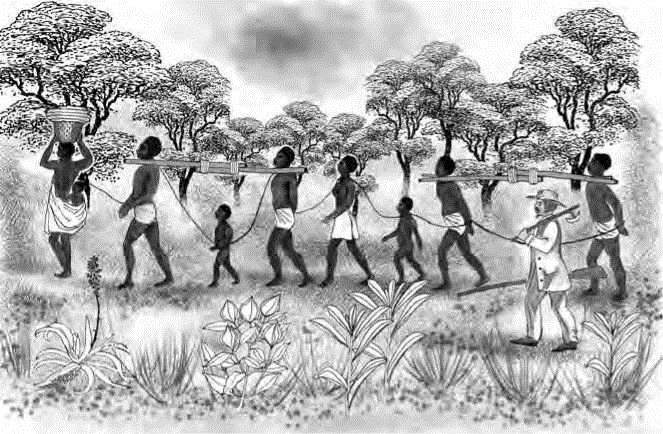
(African slave trade)
Slave trade thrived also because slaves were far less expensive than European servants. As a result the number of slaves in the New World rose dramatically.
In 1620, the third British colony came up in the New England area on the eastern coast. They were the Protestants who resented the still existing Catholic climate in England and wished to follow their faith in freedom. They decided to leave the church, for which the King of England ordered them to leave England. They relocated to Holland; hearing of the new world, they returned to England and petitioned for a charter to settle in the Americas. They took loans, formed a company and set sail on the ‘Mayflower’ for the new world. They were supposed to set up their colony in Virginia under the existing English governance according to the charter, but by mistake they arrived at Provincetown Harbour, Cape Cod, Massachusetts, which had till then not been colonised. Worried that some of the members were suggesting that they all return home, the leaders made a set of rules - known as the Mayflower Compact - which all the members agreed to obey.
Having been ruled by kings and subjected to laws enforced by them, this was an important development where a form of government was created by the people and for the people; one that would guide them for many decades.
Like the Jamestown folk, the Plymouth settlers also lost half its population to a harsh winter; but unlike them they were hard workers. Also, the natives in that area were friendly and often helped them. One of them spoke English and taught them how to grow indigenous crops, how to fish and survive the severe winter. The settlers traded fur for corn with the Indians, which they could send to England. Both the settlers and the natives promised not to harm each other; in fact, in 1621 they celebrated Thanksgiving together.
Plymouth colony (set up by these pilgrims) never grew too big; in 1691 it would become a part of the much larger Massachusetts Bay colony. Their contribution to the birth of the American nation was not so much in its size or its economic prosperity, but in its idea about self-rule, which had a lasting impact on the American mind and soul. It became the first stride towards the concept of self-rule.
In 1630, a strength of 500 settlers from England set sail towards Massachusetts Bay, New England area. They were Puritans - like the Pilgrims they also resented the suffocating interference of the Catholic Church, but unlike the Pilgrims, they did not want to separate from it, they wanted to ‘purify’ it.
Salem had been established as a colony a year earlier by another group of Puritans (see Map p. III).
By 1642, twenty thousand Puritans had sailed for America.
Puritans believed in hard work, good education and self-governance. They established fur, fishing and ship building industries, a system of free education, institutes of higher education, and a legal system. They printed their own books and developed various crafts.
But all was not well in their system. They were intolerant of any voice of religious disagreement - people who objected to their decrees were flogged or exiled or hanged. Crime was also dealt with very harshly - adultery was punishable by death, which was later trimmed down to whipping in public and the adulterer was forced to wear the alphabets AD stitched on their clothes. In fact, one can say that they had become a shadow of the very same intolerant and rigid system that they had aspired to purify.
The 17th century saw the sprouting of other English colonies all over America. Colonies in Maine, New Hampshire, Connecticut, North and South Carolina were either privately developed or were established by the Massachusetts Bay Colony.
The colony on Rhode Island had a unique beginning. Roger Williams, a minister in Salem was against the usurpation of land by the settlers from the natives without a valid treaty or negotiation. He also insisted that the state and church should be separate. Troubled by his radical ideas, the governing body decided to send him back to England. Having discovered their nefarious intentions in time, he fled to a neighbouring area, which soon became a refuge for those who did not like the way the Puritans ruled the colonies.
Mid 17th Century
Saw the development of another unique colony — a Catholic colony in Maryland. It had a thriving tobacco plantation, which permitted Protestants to settle in as well. When their numbers swelled, the Catholics felt threatened and passed a decree recognising all Christian religions, but proclaimed death penalty for atheists and Jews.
A third colony, unique in character was the ‘Quaker’ colony. Quakers laid stress on a personal and direct experience of Christ. Quakers were known for being pacifists, they dressed simply, they refused to swear oaths, they opposed alcohol and they participated in anti-slavery and social justice movements and prison reforms. William Penn, a wealthy Quaker, got a charter to colonise in America. He advertised openly and honestly and a rather unlike group of settlers made up the Quaker colony of Penn. The natives were treated fairly by him, the laws he made were liberal and anyone who wished to could settle down there. They founded the city of Philadelphia, second to Boston as a leading colonial culture center. In terms of religion, culture or ethnicity, it was the most genuinely tolerant among all the colonies.
Settlers and Natives
The settlers came and usurped with the King’s permission, land that did not belong to the crown. The natives were at first fascinated with the foreigners, their religion and customs but being turned into slaves on their own land was not accepted as a friendly overture. Trouble between the Native Americans and the settlers was natural in such circumstances. The Native American psyche looks upon land not as a personal belonging but as a mother who nurtures all.
During the 17th century, there were attacks and counter attacks in which thousands of people were killed — both native and settlers.
In Virginia, Natives attacked settlers and killed hundreds of them. A few months later, the settlers avenged by butchering hundreds of Native Americans.
In New Netherlands, Dutch colonists murdered a hundred natives in their sleep in the most dastardly manner. That was the beginning of an awful war that came to an end with a hundred and fifty Dutch soldiers killing seven hundred natives near Stamford.
In New England, though the Pilgrims’ relationship with the natives began on a friendly footing, and continued so for the next fourteen years, this peace ended when natives from the Pequot tribe killed a pirate and his crew. The Puritan army, along with their native allies went on a rampage; it resulted in the extermination of the Pequot tribe.
Peace reigned for the next 40 years.
But in 1675, a Native chief decided it was time to throw the foreigners out. The settlements in New England were razed to the ground when finally the colonies united and killed the Native chief. It would take the settlers another forty years to rebuild before they could look towards further expansion in the West (see Maps pp. IV, V and VII).
Birth of Americanism
18th Century
By 1732, thirteen English colonies had been established between Maine and South Carolina along the Atlantic coastline. Population had also grown to around 300,000, which included 25,000 African slaves. Settlers had come from other countries as well - the Irish, French, Scottish, German, Dutch began living in the English colonies (see Map p. VI).
Colonies were also becoming self-sufficient; their dependence on the mother country was waning. Boston and Philadelphia became publishing centers. Furniture and iron ore goods were being produced indigenously.
While English colonies dominated the South with their tobacco growers, and the New England area with their Puritans, the French dominated North America with Canada as its colony.
It was the era of greed and power, insecurity and expansion. The desire to be more powerful than the neighbouring kings provoked three wars in Europe between 1689 - 1748 that involved the English, Spanish and French. Its ripple effect was felt in their colonies. While wars were fought in Europe on three occasions, the English, French and Spanish colonies indulged in attacks and counter attacks and raids on each others colonies with the help of their respective Native American tribal allies. At the end of these three events, the sum total was that England emerged richer - it now possessed Nova Scotia, Newfoundland and the Hudson River Valley.
The Great Awakening
18th Century
Along with economic prosperity came the freedom to question the existing religious beliefs. The authority of the church had also begun to diminish. They did not become less devoted to Christ, but the colonists began to question the practice of the clergy dictating what they ought to think and what they ought to do. Speakers like Jonathan Edwards and George Whitfield urged the colonists to think for themselves and argued that God was to be loved and not just feared, that internal goodness was the best way to be happy on this earth.
This change in religious perception came to be known as the Great Awakening. It led to widespread discussions about religion, and in the sprouting of numerous other Christian sects and greater religious tolerance. Realising the effect of great speeches, they felt the need for trained ministers. Thus, colleges like Dartmouth, Brown, Princeton and Columbia, amongst others, were set up to fulfill this need. This spontaneous movement had an indispensable effect on the thinking of the colonists — they realised that individual strength could become a strong force if they worked together.
Unwittingly, the British had themselves provided the first step towards independence for the American colonies. They believed that unification of the colonies would make it easier to both govern these colonies and to fight the French. By 1763, after seven years of wars (also called the French and Indian War) between the British and the French and their native allies, the Treaty of Paris settled the war. France was finally driven out of America; Britain now owned Canada, all land east of the Mississippi River, Florida and some Caribbean islands (see Map p. VII).
This war marked the beginning of a more unified front in battle for the American colonies. But contempt between British commanders and the American militia serving under them during battles with the French marked the onset of hostility between Britain and the American colonists.
The population in the American colonies had grown enormously. 144 settlers in the new world in 1620 became 6,55,000 in 1730 in the thirteen colonies and by 1775 had become a strong 2.5 million. People believed in large families, for it meant more working hands. The growth in population was due also to immigration of settlers, not only from England but also from other European countries (see Chart p. VIII).
In the 18th century compared to people around the world, the American colonists had better living standards and physical health. The colonists were quite comfortable in the present state of affairs - lucrative trade, good protection by the British military forces, high wages, low living costs and minimal interference from Britain in matters of governance. But it would not remain so for too long.
(“Boston Tea Party”, US postage stamp issued in 1973, illustrating the revolt by the Americans against British taxes in 1773, by throwing British tea overboard.)
Resentment towards British Rule
Britain decided to prevent further friction with the natives who were feeling threatened with the expanding presence of the colonists. They, therefore, made the Proclamation of 1763 - no colonist could settle beyond the peak of the Appalachian Mountains. This was unacceptable to the colonists - they did not want to remain as a small group of colonies on the eastern coast. They had fought the French and the natives so that they could make a foray into the free West. The colonists ignored the Proclamation and this became a bone of contention between Britain and the colonists.
Years of continuous wars had established Britain as a strong military power in the West, but it came at a heavy price. Their national debt was almost a staggering $240 million. Since some of it was spent protecting the colonies from the French and the Spanish, the British government thought it was quite fair to make them pay for it.
To meet these expenses, it devised the Revenue Acts 1764 imposing taxes on sugar, wine, linen and silk. But taxation without representation was not acceptable to the colonists. They decided to boycott imported goods and increase their smuggling business.
Not satisfied with the revenue received, British parliament announced the Stamp Act 1765, declaring a levy on some goods, licenses, college degrees and all legal documents. Delegates from nine colonies met to discuss this grave problem, and sent a petition to Britain. When there was no response, they decided to boycott British wool, and encouraged colonists into wearing local clothing.
The British were forced to repeal the taxes only to be enforced again - this time through the Townshend Act 1767 on goods that included tea among other goods, with a view to fund the salaries of British judges and governors in the colonies. The colonists preferred the old system of the colonial legislature paying these salaries as it made it possible to influence these judges and governors during policy making.
To ensure the enforcement of this act, Townshend dispatched two regiments of redcoats to Boston, which was resented obviously by the American colonists. A skirmish provoked by the colonists resulted in the death of eleven of them at the hands of the British redcoats. To appease the aggrieved colonists, the Townshend act was repealed on all goods except tea.
Moderates on both sides maintained a status quo till things came to a head again. A million pounds of tea was packed off to the colonies at a price lower than the price of smuggled tea. The colonists resented this trade on a matter of principle. In 1773, at the Boston harbour, the colonists boarded three British ships and threw all the cases of tea overboard.
British parliament, livid with this behavior, passed the Repressive Acts 1774 to discipline the rebellious colonists —
Boston harbour was shut off till the Bostonians did not pay up for the damage caused. This meant no supply of food, medicines or other goods. To add insult to injury, British parliament allowed Quebec, now a British colony to extend its borders into the Ohio Valley. This aroused the colonies into unified action — food and other supplies came in through land and representatives from all colonies were called for a meeting to Philadelphia.
Birth of Congress
In 1774,56 delegates from all the colonies except Georgia met at Philadelphia for theFirst Continental Congress to discuss the issue. Some were politically conservative; others were radical in their thinking. At the end of seven weeks of deliberation, they decided to send a declaration of rights and grievances to the King, stating the following:
They would accept supervision of the King but not the governance of the British parliament.
They would form their own government through elected representatives.
All trade with Britain would be stopped till the Repressive Acts were not repealed.
The Congress also resolved that all colonies would stand by each other in case any one of them was attacked by Britain and ended with a promise to meet again the following year and take stronger actions in case Britain did not satisfactorily address their issues. This meeting of Congress bound these colonies together in a much more closer tie.
“The distinction between New Englanders and Virginians are no more. I am not a Virginian, but an American,”244 said Patrick Henry, delegate to the Congress.
The petition sent to Britain by the First Continental Congress was rejected. British parliament thought it was best to nip the matter in the bud. They, therefore, decided to cut off Massachusetts from the rest of the colonies.
The British commander at Boston ordered a raid in a suburb of Boston called Concord to seize guns and ammunition hoarded by the rebels, but a network of colonists called minutemen set out to warn them. The colonials encountered the British army in the town of Lexington; guns were fired — 8 minutemen were killed but due to the vigilance of the advance party, rebels in Concord were informed of the approaching British army and they were prepared. Whatever little the British found was seized by them, but on their return, the colonists attacked the redcoats.
The colonists, hiding behind trees and in houses opened fire on the redcoats in the streets. 90 colonists were dead but the British casualties were almost three times higher. Though not demanding independence yet, this marked the beginning of the American war against the mother country.
The American colonies were a fledgling compared to Britain, the mother country. Therefore, victory over dissidence in the American colonies was a foregone conclusion for many British generals. After all, their army had a strength of 50,000 men; they had the best navy in the world, and had 30,000 German mercenaries to fight for them. The Americans, on the other hand had no regular army, or navy or any substantial resources to put them together.
Despite such great advantages, Britain lost.
There was unrest in their own neighbourhood with Ireland; they could not depute their entire military strength to fight the Americans and their overconfidence in their military superiority over the colonies only weakened their position.
The American picture was not too bright — only one-third of the colonists supported the move for independence, onefifth were loyal to Britain, and the balance were indifferent. The American military was still in its pre-natal stage. They lacked discipline; officers were changed if the orders given were disliked by the soldiers; soldiers went home as soon as their term expired - irrespective of how the battle was going on; they were not very brave either - they often ran away seeing the British army advance; soldiers of one colony would not like being commanded by officers of another colony. There were never enough funds to feed or clothe them sufficiently. To top it all, Americans had their share of opportunists who thought nothing of selling goods to the British rather than to their own army or of hoarding goods to sell at a higher price later even though the army was in dire need for supplies.
Despite this dismal state of affairs, there was one positive factor - they had a common cause to fight for. Within a few years and plenty of battles, the American military had transformed from a ‘contemptible into a formidable enemy’ in the eyes of the British.
There took place 10 crucial battles, which shaped the American war of independence (see Map p. IX).
Congress at first refused to allow slaves to enlist in the continental army, but on reflection realized that there were chances that they might fight on behalf of the British. Therefore they agreed to George Washington’s suggestion and permitted freed slaves to enlist in the north to fight against the British. However, slave owners in the south refused to arm their slaves. Britain lured them with freedom to abandon their masters. Resultantly, some fled while some did fight for the Americans.
North
Soon after the fighting at Concord, in April 1775, the American forces captured Fort Ticonderoga near lake Chaplain and chased the British out of Boston.
In the same year, the Second Continental Congresstook place at Philadelphia; though the radicals believed that war for independence was unavoidable, the moderates still wanted to reconcile with Britain. ThisOlive Branch petition asking for equal taxes and free trade or no tax and strict trade rules, was sent to Britain.
Fighting continued, and in late 1775, the Americans lost both Quebec and New York. The British could easily have routed the American army had they not lingered long enough and given time to the American army to strategise and get back on their feet.
In 1776, in the battle for New York, the mother country used Hessians — hired German soldiers — to fight against the colonists. This enraged the Americans and even some of the moderates were obliged to consider a war of independence against Britain.
Meanwhile, the king rejected the Olive Branch petition. He further stopped all trade with America and ordered a naval blockade.
The conservatives were still hoping for a reasonable reconciliation with the mother country. The radicals, ready to break free, decided to stir up the emotions of fellowmen. In 1776, Thomas Paine,a political thinker, wrote a pamphlet called‘Common Sense’ putting in very simple language for the common people to understand, the reasons why independence for America was the right course of action. The effect of this pamphlet was staggering. It took the country by storm — to the extent that even some loyalists changed their mind and were obliged to agree that the British were indeed exploiting the American colonies and the idea of establishing independence was common sense. George Washington made it mandatory that it was read to his troops to make them fight harder.
“... There is something very absurd in supposing a continent to be perpetually governed by an island... Everything that is right or reasonable pleads for separation. The blood of the slain, the weeping voice of nature cries, ‘Tis time to part’. Even the distance at which the Almighty hath placed England and America is a strong and natural proof that the authority of the one over the other, was never the design of Heaven. The time likewise at which the Continent was discovered, adds weight to the argument, and the manner in which it was peopled, encreases the force of it. The Reformation was preceded by the discovery of America: As if the Almighty graciously meant to open a sanctuary to the persecuted in future years, when home should afford neither friendship nor safety.”245
The Americans were now unanimous in their mood for a revolution. In 1776, fifty-six representatives from the thirteen colonies met in Philadelphia to discuss the situation. Congress adopted the Declaration of Independence and declared themselves as a new nation called the United States Of America, and in 1777, the Articles of Confederation, elucidating the rights of the central and state governments was issued. But it took another four years before it would be ratified by all the states.
It had now turned into an out and out war of independence. In 1776, the Americans emerged victorious at Trenton and Princeton, followed by the surrender of the British army at Saratoga in 1777, the turning point for the Americans. The French, who till this moment, were helping the Americans under cover, now openly recognized America as an independent nation and declared themselves as American allies. Seeing this as a great opportunity to weaken their strong archrival Britain, eventually the Spanish and the Dutch also came in as allies.
In 1779, the American Navy, puny compared to the might of the British Navy won a momentous victory off the coast of England - a terrible blow to the pride of British navy.
South
In 1780, the Americans lost to the British in Charleston and in 1781 lost the battle at Guilford to the British but reclaimed it by the end of that year. And with the help of the French, they defeated the British at Yorktown, Virginia - British General Cornwallis surrendered his entire army of 8,000 men.
Finally in 1783, a peace treaty declared the independence of the thirteen United States of America. All the land from the Atlantic Coast to the Mississippi River and from Canada to Florida was ceded to the United States of America (see Map p. IX).
Among the many architects of American independence, one name that stands out most is that of George Washington - the indefatigable commander who lead the American soldiers across the colonies chasing after the British in an attempt to push them out. He faced defeat, desertion, disease, harsh winter, but never allowed his spirit to flag, instead he raised the morale of his men at every moment. He strategized constantly to keep one step ahead of his enemy and retreated only to come back stronger till his army finally wore out the British.
Independence had been achieved; it was now time to make a blueprint for their nation and put into place a proper governing machinery.
Though the Articles of Confederation were already there to guide the states in matters of rights and duties, there was constant quarreling among the states. Congress, comprising of equal representatives from each state, dealt with matters concerning war, coined money and ran the post office, but it could not wield any real authority in tax, trade or judicial matters.
Two legislations provided stability to this loosely held confederation of states. The Land Ordinance of 1785 declared that the land owned by the federal government but not claimed by the states would be divided into square townships and further divided into 36 areas to be auctioned. Part of the proceeds was to be allocated for the establishment of public schools.
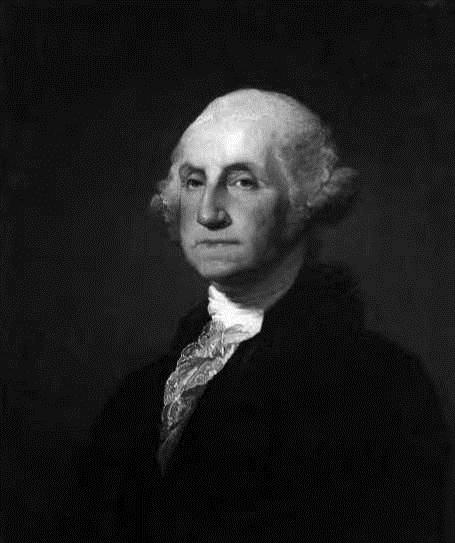
(George Washington, general in the American war of Independence and the first president of the USA (portrait by Gilbert Stuart))
The Northwest Ordinance of 1787 laid the foundation for the governance of the Northwest Territory and the admission of its parts as new states into the Union. It had three main principles:
When each district had a male population of 5000 free male adults it would become a territory in which they could form their own legislature, but till then it would be governed by a governor and judges appointed by Congress.
The Northwest Territory would have to be divided into minimum three and a maximum of five states and each state must have a population of minimum 60,000 people.
Slavery was banned in the Northwest Territory. Freedom of religion among other civil liberties, education was guaranteed and residing Native Americans were promised that they would be treated well.
New States were guaranteed equal status as compared to older ones.
While America was struggling to free itself from British rule, President Lincoln’s grandfather, Abraham Lincoln Sr., was trying to settle down in Kentucky. In the summer of 1786, while he was tending to his corn field with the help of his sons Josiah, Mordecai and Thomas (Lincoln’s father), a small Native Indian war party attacked them and killed Abraham. Mordecai ran to get a loaded gun from their cabin and Josiah ran to the Station to get help. Six year old Thomas stood in shock by his dead father. After this attack, the Lincoln family moved to a safer county in Kentucky...
Despite these ordinances two major issues plagued this fledgling nation - each state had its own currency and it was difficult to regulate commerce between them. Also, the federal government was in dire need of funds to run this union of states.
It was evident that the Articles of Confederation required fair amount of changes to prevent this Union from falling apart. In 1787, Congress sent delegates from each state to Philadelphia to discuss the future course of action. 55 delegates from across the states got together and studied and debated over various forms of prevailing governments; finally by majority vote the delegation adopted the United States Constitution. The main architects of the constitution were George Washington, a general during the war of Independence, John Adams, Benjamin Franklin who was an inventor246 and a writer, Thomas Jefferson, who drafted the declaration of independence earlier, James Madison, who had drafted the Virginia state constitution in 1776 upon which this document was based and Alexander Hamilton.
The constitution split the government into three branches:
1) The Legislature comprised of the Congress having:
The Senate, that would have two representatives from each state, which pleased the smaller states, and
The House of Representatives, which was divided according to size of population of each state, with slaves being counted as 3/5 of a person. This satisfied the slave states but the north resented it; their representation in the House went down.
The task of the Legislature was to pass laws that would help regulate commerce within states as well as with foreign countries. It was important for states to be well represented to ensure that laws passed by Congress were favourable to their state.
2) The Executive comprised of the President, the Vice President and his cabinet, which would assist him in his task of ensuring that the laws were enforced.
3) The Federal Judiciary having the Supreme Court on top (to settle matters of conflict). It was a system that allowed state governments to make their own laws on most issues.
By 1790 all the states agreed to ratify the constitution on a condition that a document stating the rights of an individual and state be put down in writing. To comply with this demand, the Bill of Rights consisting of 10 amendments to the constitution was added in 1791. This bill drew from various texts; - George Mason’s 1776 Virginia Declaration of Rights, the 1689 English Bill of Rights, Thomas Paine’s ‘Common Sense’ and other works of the Age of Enlightenment and earlier political documents like the Magna Carta. James Mason had suggested a ban on the continuation of slave trade but they were unable to accomplish it. Their inability to do so led to the bloody civil war.
George Washington was the unanimous choice as President considering his role in the Independence war. Though Washington belonged to no particular political party, people of a similar ideology gravitated towards each other and that gave rise to different political parties. He served for two terms; from 1789 - 1797.
On one hand there were the Federalistswho believed in a strong central government running banks, supporting business and putting restrictions on speech and the press. On the other side of the spectrum were theDemocratic-Republicans (who later were called just Republicans) who believed in more power for states and banks run by states, free speech and press.
America, now decided to build up a strong financial position. It, therefore, levied taxes on imported goods. It set up a National Chartered Bank for the purpose of depositing its revenue and printing paper money. With a result, it paid off all its debt (federal and state). War between Britain and France helped America increase its world market, which promoted development of its industry.
Teething troubles plagued America constantly, but they also helped iron out some of the weak issues in its system. State constitutions drafted by businessmen were tough on farmers, provoking them into armed rebellion. It led to many reforms in tax laws in favour of farmers and workmen.
“...a little rebellion now and then is a good thing….. the trees of liberty must be refreshed from time to time with the blood of patriots and tyrants….”
—Thomas Jefferson
During his presidency, Washington himself led a military force to put down a rebellion by distillers refusing to pay tax on whisky. This reinforced the need for a strong central government.
Victory of the U.S. army over Native Americans and their British allies ended the threat of the Native Americans and boosted the confidence of the U.S. armed forces.
Distressed by the French Revolution that lasted between 1789 and 1799, the federal Government under President John Adams (1897-1801) passed the Alien and Sedition Act (a total of four acts) in an attempt to muzzle the press that was writing against the federal government and to prevent a similar rebellion against the American government.
The Naturalization Act - The residence requirement for citizenship moved from five to fourteen years.
The Alien Act - The President could deport ‘dangerous’ aliens at will.
The Alien Enemy Act - The president could expel or imprison enemy aliens during times of declared war.
The Sedition Act - Any conspiracy against the government including riots and interference with officers would result in a high misdemeanor. This went so far as to stop people from speaking in a “false, scandalous and malicious” manner against the government.
The Anglo-French war after the French Revolution, threatened to engulf America as well. Though Federalists were proBritain due to trade and the Republicans were pro-French, both Washington and John Adams, the 2nd president of the USA, believed that the welfare of America lay in keeping itself out of all feuds. After plenty of trouble from the British navy which accosted American merchant ships, America (in an effort to keep itself out of this war), negotiated a treaty with Britain in which Britain gave up its forts in the Northwest and paid for damages caused to American merchant ships and in return America pledged to return its pre-revolution debts. A treaty was negotiated with France also; USA managed to keep itself out of the war.
19th century
The 19th century witnesses the adolescent years of America. The population was increasing by leaps and bounds - in 1800, there were around 5.3 million people including 900,000 slaves (a 35% increase in 10 years) of which 80% lived on farms. Property had become too expensive in the North and farmland had become infertile due to tobacco planting, so, people began moving west, where federal land was very cheap.
Thomas Jefferson, sworn in as the 3rd US president in 1801, sent an expedition across the continent to the West which brought back great knowledge of plants and animals that were found there and information about the fertility of soil. The Louisiana Purchase247 from the French that doubled the size of the country, that too at a pittance, was a great feat accomplished by Jefferson (see Map p. X-A).
British and French ships were found robbing American ships of both its cargo and men, this led Jefferson into forcing Congress to pass the Embargo Act that ended all American trade with foreign countries. But it was a costly decision; it led to the plummeting of the thriving American commerce resulting in ships sitting idle in US harbours and grains rotting for lack of permission to export.
Jefferson (1801-1809) formulated a policy to allow Native Americans to remain on the East of the Mississippi on the condition that they become ‘civilized’. He wanted them to learn to farm and give up their way of life as hunters. His main objective was to convince them to trade their lands for American goods. His plans for the Native Americans is evident in the letter he wrote in 1803 to William Henry Harrison:
“... Our system is to live in perpetual peace with the Indians, to cultivate an affectionate attachment from them, by everything just and liberal which we can do for them within the bounds of reason, and by giving them effectual protection against wrongs from our own people. The decrease of game rendering their subsistence by hunting insufficient, we wish to draw them to agriculture, to spinning and weaving. The latter branches they take up with great readiness, because they fall to the women, who gain by quitting the labors of the field for those, which are exercised within doors. When they withdraw themselves to the culture of a small piece of land, they will perceive how useless to them are their extensive forests, and will be willing to pare them off from time to time in exchange for necessaries for their farms and families. To promote this disposition to exchange lands, which they have to spare and we want, for necessaries, which we have to spare and they want, we shall push our trading uses, and be glad to see the good and influential individuals among them run in debt, because we observe that when these debts get beyond what the individuals can pay, they become willing to lop them off by a cession of lands... In this way our settlements will gradually circumscribe and approach the Indians, and they will in time either incorporate with us as citizens of the United States, or remove beyond the Mississippi. The former is certainly the termination of their history most happy for themselves; but, in the whole course of this, it is essential to cultivate their love. As to their fear, we presume that our strength and their weakness is now so visible that they must see we have only to shut our hand to crush them, and that all our liberalities to them proceed from motives of pure humanity only. Should any tribe be foolhardy enough to take up the hatchet at any time, the seizing the whole country of that tribe, and driving them across the Mississippi, as the only condition of peace, would be an example to others, and a furtherance of our final consolidation.”248
While America strove to expand her boundaries and struggled to restore its trade, on a cold winter morning of February 12th, 1809, a baby was born to Thomas and Nancy Hanks Lincoln in a little log cabin, deep in the Kentucky woods - Abraham Lincoln had arrived into the world with a promise of a new dawn...
US policy for acquiring land from the Natives had been to coerce them into selling it rather than go to war with them. As a result, several Native tribes, provoked by Britain, got together and waged a war on the Americans, which resulted in a draw, but weakened the Native American confederacy.
In 1809, Congress passed a law banning British and French ships from U.S. ports. A year later, James Madison (1809-1817), the 4th US president passed laws to revive the flagging US trade and lifted the ban on trade with both countries. However, Madison reimposed the trade ban, but only on British ships.
In 1812, blaming Britain for the terrible plight of their trade at sea due to plundering of U.S. ships by British ships, Madison declared war on Britain and gave orders to invade Canada. Though America was ill-prepared for this war, they went forth to battle; but did not meet with any success in the beginning.
But by 1813, luck changed. The Americans threw the British out of Detroit, defeated them at Thames River and put an end to British invasion of America through Canada. This would also be America’s last attempt to conquer Canada.
At sea, the American Navy with their warships won several battles against the British till the British sent reinforcements and prevented further encounters.
After defeating Napoleon in 1814, Britain turned its attention towards America and attacked Washington City, the American capital. Not prepared, the American army fled and the Britishers went on a burning spree, torching every public building including the White House. Instead of disheartening the Americans, it provoked them into action, which resulted in Britain retreating from Baltimore, Lake Chaplain and New Orleans after suffering heavy losses. Finally, in December 1814, both sides signed a treaty to end war. A treaty that has endured well — America and Britain have not fought since.
America had shown that when determined it could fight.
Individual colonies had grown into states and states had now become part of a nation. The first generation that had brought in the war of independence had almost disappeared. The new generation of Americans saw themselves as Americans, instead of as Virginians or New Yorkers.
Yet there were many events, which threatened to destroy this national spirit by creating a rift between the various regions of America.
The federal government had doubled the taxes on goods imported into the US in 1812. This move created a rift between the North and South since it earned the federal government revenue and boosted American industry as it encouraged people into buying indigenous goods instead of foreign goods. Since most manufacturing industries were in the North, it appreciated these tariffs but the South and the West, having few manufacturing units had nothing to gain, hated having to pay more.
Many state owned banks were set up since the first bank of the United States expired. But they extended credit and printed money in excess of their reserves. In 1816, the Federal Government set up a second Bank of the Unites States. The government was selling land cheap in the six new states that had joined in; this encouraged people to move West, and the banks recklessly lent money for land purchase. During the Panic of 1819, when prices of land, goods and crops crashed, many overextended state banks crashed. The Bank of the United States foreclosed on most of its debtors, leading to great resentment in the West against the North since they felt that the bank was a creation of financiers and speculators in the North. In an effort to revive the economy, the federal government reduced land rates - a move that was appreciated by the West but resented by the North, which saw it as a loss of profit.
American population was shooting up — owing not only to a galloping birthrate but also to immigrants from Europe. In 1820 the population was 9.6 million — a 33% increase in 10 years. There was plenty of land to inhabit, the passage was quite cheap and the American government made it very easy for immigrants to enter — there were no custom or immigration formalities. ‘... the sheer freedom of movement was staggering... In the five years up to 1820, some 100,000 people arrived in America without having to show a single bit of paper.’249
In 1819, John Quincy Adams, Secretary of State during Monroe’s Presidency announced the official policy of the State Department:
“The American republic invites nobody to come. We will keep out nobody. Arrivals will suffer no disadvantages as aliens. But they can expect no advantages either. Native- borns and foreign-borns face equal opportunities. What happens to them depends entirely on their individual ability and exertions, and on good fortune.”250
(Steamboat)
Up until the 19th century, most Americans lived on farms but after the war of 1812, there was a tremendous growth of factories and transportation systems. Cotton spinning factories, assembly plants, steam and water driven machines came into being.
The 19th century witnessed a new form of transportation - steamboats began to be used on the Mississippi to transport cargo. John Fitch, encouraged by the idea of the steam engine decided to try a similar experiment with boats. He developed a 45 feet long steamboat and ran it on the Delaware River in 1787. Its success encouraged him to build larger boats to carry passengers and cargo between Pennsylvania and New Jersey.
Canal building also boomed after the success of the Erie Canal joining Lake Erie to the Atlantic Ocean.
In the South, tobacco plantations were replaced by cotton and sugar due to inventions like the cotton gin that reduced labour considerably and a process that converted sugarcane into crystals through boiling. Suddenly there was a great demand for slaves on these plantations. Prior to this, the slave system was on the decline — importation of slavery had been constitutionally banned, religion opposed the practice of slavery, slave owners were scared of slave rebellion. But a boom in the sugar and cotton crops saw a rise in the demand for slaves. They became a precious commodity; owners encouraged slaves to have more children so that they could be sold for profit. As they passed hands, slave families got broken up. 900,000 slaves at the beginning of the 19th century had quadrupled by the time of the Civil War in 1860.
Slaves were another bone of contention between the South and the North. The North opposed slavery on moral grounds, though northerners they did not allow African Americans in the North to vote, testify at trials, sue in courts, marry outside their creed, join labour unions, live with the whites in their colonies or attend school and also because slaves made the position of the South stronger in the House of representatives since it was based on size of population. The free labourers in the West were resentful of the South because they had to compete with cheaper slave labour.
(Cotton gin)
President Monroe (1817-1825), though himself a slave owner from Virginia, was an advocate of antislavery and suggested that freed African Americans should be sent back to Africa since it did not seem possible for both races to live together in America. The government went so far as to establish a colony in Africa called Liberia for them, but most freed slaves wished to remain in the US as American citizens.
In 1820, Missouri and Maine were admitted as US states, one a slave state and the other a free state to preserve the balance between free and slave states that existed between America’s former 22 states. This law was called the Missouri Compromise of 1820 since it also stated that with the exception of Missouri, slavery would be prohibited in all territories north of 36:30 degrees north latitude. The South resented this move, as they did not want any clamp down on slavery and the North resented it because it amounted to an acknowledgement that slavery was acceptable (see Map p. X-B).
America bought Florida from the Spanish in 1819, and soon after, Venezuela, Brazil, Argentina, Chile and Mexico had gained their independence from the Spanish.
In 1823, the Monroe Doctrine was issued declaring that America would not interfere with existing European colonies in the New World but would not tolerate any further attempts by any European power to colonise land or interfere with any state in North or South America.
The next decade witnessed degradation in American politics - with supporters of various camps accusing the candidate from the opposition of corruption, murder, slave trading to downright vulgar accusations of gambling and bigamy to get the presidency. Focus shifted from real issues of national/state importance to candidate’s personalities.
On the other hand, newspapers and magazines became popular means of campaigning; voter turnout doubled between 1824 and 1828. Another positive change was a demand in North and West for free public schools.
John Quincy Adams, the next president, served one term from 1825-1829. He modernized the economy and promoted education; he also paid off most of the National debt.
But the efficiency of the government began diminishing - personnel of previous administrations began being replaced with personal office bearers. Federal jobs began to be given to campaign workers as rewards rather than on the basis of qualifications.
American Nationalism was being threatened yet again. In 1828, the federal government had again set high taxes on imported goods. The North welcomed the move, since it encouraged production of indigenous goods and reduced the demand for expensive British goods; the West also approved since revenue from these taxes would help build roads and canals it needed but the South felt it only hurt them; the suffering of British industry would make it more difficult for them to import cotton from the Southern plantation owners.
1830 saw a big change in transportation - the steam locomotive engine running on wooden tracks had arrived in America.
Within 30 years, America had built nearly 30,000 miles of tracks. Everything changed - more tracks meant more demand for labour, so immigration increased; more tracks meant a greater need of funds, so foreign investment increased; transportation of goods improved, so new markets developed, communication improved and people could travel from one place to the other faster.
A new sect of Christianity had developed in 1830 — Mormons. They were not received well by other people and after much persecution they travelled west and after two decades finally settled down in Utah, which was declared a territory in the Compromise of 1850 (see Map p. XII-A).
In 1830, a senator from South Carolina spoke in defense of the doctrine of nullification251 that granted states the right to accept or ignore federal law. Daniel Webster, one of the greatest orators of American history began his impassioned speech in defense of the Federal Union and against the theory of nullification. He said that federal laws were above the state laws, and that the resolution of conflicts between federal government and states were provided for in the Supremacy Clause and Article III of the constitution itself. It had a startling effect; thousands of copies of his speech were distributed and read, within a few years it found its place in textbooks in both North and West influencing thousands of youth. Abraham Lincoln, a young man in his twenties, was one of them.
However, despite so much opposition, in 1832, South Carolina passed the Ordinance of Nullification, declaring the federal tariffs null and void and its intent to defend its right with military action. Angered by this move, President Andrew Jackson sent the army to put down the rebellion but a compromise tariff was formulated which postponed the confrontation between the North and South for a few more decades.
A new political party came into existence in opposition to the policies of President Jackson and the Democrats - the Whig Party. Famous political leaders like Henry Clay, Daniel Webster, war heroes like Zachary Taylor and Winfield Scott and frontier man Abraham Lincoln were members of this party. They advocated the supremacy of Congress over the presidency. They promoted the idea of high tariffs, national bank for money supply and government programmes of internal improvements like roadways and canal building to achieve industrialization and boost economic growth. They believed in modernization based on skill; they encouraged public schools, private colleges and cultural institutions.
James Monroe had started a policy of moving the natives living east of the Mississippi on fertile land to the west of the Mississippi that were the dusty prairies. But now with the Americans moving West to find their fortune, something had to be done about the Native Americans who had been sent off there earlier.
In 1830, President Jackson (1829-1837) passed the Indian Removal Act. In his address to the Creek Indians, he said:
“Friends and Brothers - By permission of the Great Spirit above, and the voice of the people, I have been made President of the United States, and now speak to you as your Father and friend, and request you to listen. Your warriors have known me long. You know I love my white and red children, and always speak with a straight, and not with a forked tongue; that I have always told you the truth...
“Your bad men have made my heart sicken and bleed, by the murder of one of my white children in Georgia. Our peaceful mother earth has been stained by the blood of the whiteman and calls for punishment of his murderers, whose surrender is now demanded under the solemn obligation of the treaty which your chiefs and warriors in council have agreed to.
“Where you now are, you and my white children are too near to each other to live in harmony and peace. Your game is destroyed, and many of your people will not work and till the earth. Beyond the great River Mississippi, where a part of your nation has gone, your Father has provided a country large enough for all of you, and he advises you to remove to it. There your white brothers will not trouble you; they will have no claim to the land, and you can live upon it you and all your children, as long as the grass grows or the water runs, in peace and plenty. It will be yours forever. For the improvements in the country where you now live, and for all the stock, which you cannot take with you, your Father will pay you a fair price...
“Many years ago, I told you of this new country, where you might be preserved as a great nation. in that country, your father, the President, now promises to protect you, to feed you, and to shield you from all encroachment. Where you now live your white brothers have always claimed the land. The land beyond the Mississippi belongs to the President, and to none else; and he will give it to you for ever.”252 (See Map p. XI)
Within ten years, 100,000 natives had been removed from over 200 million acres of land and moved further West; thousands died due to disease, hunger and enforced exodus, which was aptly named Trail of Tears. The Sauk and the Fox tribe led by Chief Black Hawk went West across the Mississippi but in 1832, they changed their minds and returned and paid a heavy penalty for it - women, children and warriors were slaughtered by the US military force, and eventually they surrendered. One tribe kept the US army busy for 10 years in a war that cost the US millions before it finally surrendered to the US forces. Only one national leader, Henry Clay spoke out against this terrible policy.
... Abraham Lincoln, at 24, eagerly volunteered for service in the US military force to fight against Chief Black Hawk, but he never saw action...
New inventions in farming - the steel plow for planting crops and the rolling machine for harvesting crops reduced the time taken considerably, thereby increasing America’s crop yield tremendously.
In 1837, President Andrew Jackson’s policies had led to the destruction of the Second Bank of United States. Federal reserves had been moved from the Second Bank to some smaller state banks. But credit policies of these state banks were reckless; they loaned paper money indiscriminately, which they printed in excess of their reserves of gold and silver. To arrest this trend, Jackson ordered that federal land could be bought only on payment of gold or silver. People ran to banks to exchange their paper money for these precious metals, but the banks began to refuse them due to insufficient reserve; many banks crashed, thousands of people lost their land; loans dried up, businesses and civic projects collapsed, purchases went down, land prices plummeted; and all this led to severe unemployment which resulted in people going hungry and America suffered a terrible four-year recession.253
Martin Van Buren who became the eighth President of the U.S. in 1837 and served for four years inherited all these problems from Jackson.
American and Mexican settlers living in Texas, a colony in the newly formed country of Mexico had begun to see themselves as Texians rather than Mexicans. Slavery had been abolished in Mexico and it was mandatory for settlers to convert to Roman Catholicism, but American settlers ignored both these laws. When the Mexican President cancelled all special privileges given to Texas, the Texans declared their independence, threw the Mexican soldiers out and fortified a mission called the Alamo. In 1836, the Mexican army besieged the fort and killed all the rebels defending it. It incited the rebels even more; in a surprise attack they defeated the Mexican army and drove them out. Texas ratified a constitution and petitioned US for admission as a slave state. But Buren did not want the U.S. to annex Texas; it was only in 1845 that Texas would be admitted as a US slave state.
In 1841, Samuel Morse of New York invented the telegraph, the first instrument of mass communication. It revolutionised the world - by the end of the 19 th century most countries would be receiving and sending telegraphic communication.
The period between 1840 and 1850 witnessed an even greater aggression in America to expand westward. Though acquisition of land from Native Americans and from other colonisers to expand the young nation was a policy followed by most American leaders, it found a concretization in the words of John L. O’Sullivan, an American newspaper editor. ‘During the final phase of the Texas annexation crisis, he accused the European nations of ‘hostile interference’ in American affairs, “for the avowed object of thwarting our policy and hampering our power, limiting our greatness and checking the fulfillment of our manifest destiny to overspread the continent allotted by Providence for the free development of our yearly multiplying millions.”’254 In another newspaper column, referring to America’s dispute with England over Oregon, Sullivan wrote, “And that claim is by the right of our manifest destiny to overspread and to possess the whole of the continent which Providence has given us for the development of the great experiment of liberty and federated self-government entrusted to us”. His words describing America’s ‘manifest destiny’ made it a popular belief amongst the people that America had the God-given right to acquire land and expand from sea to sea.
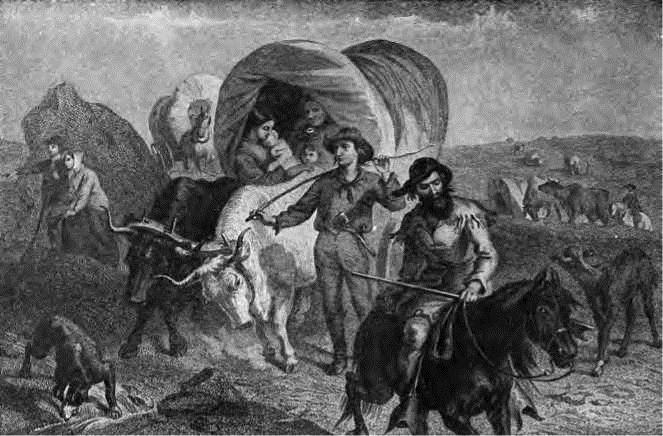
(Go West, young man! Emigrants moving West in covered wagons, often called prairie schooners.)
Polk had his eyes set on the Oregon territory, which was under the joint occupation and control of both Britain and America. To avoid another war, he reached a compromise with Britain and in 1846, part of the Oregon territory was acquired by the US, which later became the states of Washington, Oregon, and Idaho, and parts of the states of Montana and Wyoming. Migration to the West continued - it was a difficult journey fraught with perils and hardships but wagonloads of farm people kept going. Some settled in the Great Plains of Kansas and Nebraska while others journeyed further West till they reached Oregon. By 1846, around 5,000 Americans had settled there and by 1859 the territory would become a state. Manifest Destiny was being realized...
(Henry David Thoreau, author of “Civil disobedience”.)
James K. Polk (1845-1849), the 11th President of the US, had decided that acquisition of California territory was also imperative to fulfill its manifest destiny. So, what could not be acquired through negotiations with Mexico was usurped through war. In 1848, after defeating Mexico, around 500,000 square miles of Mexican land was ceded to America; it would become the states of California, Utah, Arizona, Wyoming, Nevada and parts of some other states. Polk agreed to pay 80% of what he had offered before the war.
Abraham Lincoln, a member of the House of Representatives and many others criticized the Mexican wars, calling it unjust and immoral. General Ulysses S. Grant who fought in the war as a young army lieutenant, wrote later:
“... I know the struggle with my conscience during the Mexican War. I have never altogether forgiven myself for going into that. I had very strong opinions on the subject. I do not think there was ever a more wicked war than that waged by the United States on Mexico. I thought so at the time, when I was a youngster, only I had not moral courage enough to resign. I had taken an oath to serve eight years, unless sooner discharged, and I considered my supreme duty was to my flag. I had a horror of the Mexican War, and I have always believed that it was on our part most unjust. The wickedness was not in the way our soldiers conducted it, but in the conduct of our government in declaring war... We had no claims on Mexico. Texas had no claims beyond the Nueces River, and yet we pushed on to the Rio Grande and crossed it. I am always ashamed of my country when I think of that invasion.”255
In protest, Henry David Thoreau, a famous American essayist, poet and philosopher refused to pay his poll tax and was consequently jailed. He expressed his protest in his famous essay ‘Civil Disobedience’, which was widely read by people including Mahatma Gandhi and Martin Luther King:
“Under a government which imprisons any unjustly, the true place for a just man is also a prison. where the State places those who are not with her, but against her,- the only house in a slave State in which a free man can abide with honor.. Cast your whole vote, not a strip of paper merely, but your whole influence. A minority is powerless while it conforms to the majority; it is not even a minority then; but it is irresistible when it clogs by its whole weight. If the alternative is to keep all just men in prison, or give up war and slavery, the State will not hesitate which to choose. If a thousand men were not to pay their tax bills this year, that would not be a violent and bloody measure, as it would be to pay them, and enable the State to commit violence and shed innocent blood. This is, in fact, the definition of a peaceable revolution, if any such is possible.”256
“I heartily accept the motto, that government is best which governs least; and I should like to see it acted up to more rapidly and systematically. Carried out, it finally amounts to this, which I also believe. That government is best which governs not at all; and when men are prepared for it, that will be the kind of government which they will have. Government is at best but an expedient; but most governments are usually, and all governments are sometimes, inexpedient.”257
The United States population was growing by leaps and bounds, owing to a large extent to immigrants who were now coming in from all over the world; from its own neighbourhood - Mexico and Canada, across the pacific from China and Japan and across the Atlantic from Ireland and Germany. These immigrants settled mostly in cities, living in clusters close to their own kind creating mini-nations.
Rise in immigration resulted in a growing resentment in the native born Americans towards the immigrants since jobs became a bone of contention. In 1849, it gave birth to the Nativists better known as the Know-Nothing Party, which demanded an end to immigration, a ban on immigrants holding office or voting and restrictions on Roman Catholics. Their Candidate Millard Fillmore would be sworn in as President from 1850-1853 after the untimely death of President Zachary Taylor.
Though the territory of California was meant only for America’s stride to touch the Pacific Ocean, it brought with it a tremendous windfall gain — unbeknown to its leaders there was tremendous wealth lying in its riverbeds. Gold was discovered in 1848, causing thousands of prospectors to rush over to the West to make their fortunes. Of them only a few struck gold and got rich but many stayed back and began working; California population became tenfold between 1848 and 1853.
Meanwhile the hostility over slavery was mounting up. Proslavery factions defended slavery through various arguments — apart from being profitable for slave-owners to keep slaves rather than free labour, they said that it was good for slaves too as slave-owners gave them shelter throughout their lives, it also civilised them through exposure to Christianity; and they asked one very pertinent question - what would America do with them once the slaves were freed? Considering this problem, most antislavery forces wanted only to arrest the spread of slavery in America, so that in time it would die out on its own. But there was an antislavery faction called the abolitionists who wanted to end slavery immediately.
Antislavery issues brought about an awareness of the lack of women’s rights in their country — like slaves, a woman could not vote, she had very little career options, after marriage all her property became her husband’s.
By mid 19th century, women began to publicly demand more rights for themselves. In 1848, at a women’s rights convention, Elizabeth Cady Stanton, a leading activist rephrased the declaration of Independence written by Jefferson in her declaration of sentiments, “All men and women are created equal.”
In 1850, during President Zachary Taylor’s short tenure, California was admitted as a free US state, in what is popularly called the Compromise of 1850. There were at that time 15 free states and 15 slave states. The Southern states objected since it would swing the balance in favour of free states politically; nine of them even threatened to leave the Union. Henry Clay, not wanting the Union to fall apart arrived at a formula with the help of a young Senator from Illinois, Stephen Douglas. A compromise was reached in which California was admitted as a free state, New Mexico and Utah were declared as territories where the question of slavery would be decided later, slave trade was abolished in Washington D.C. and a Fugitive Slave Law (much abhorred by and protested against by Northerners) was approved that facilitated slave owners to recapture runaway slaves with federal assistance.
In 1854, President Franklin Pierce signed the Kansas- Nebraska Act proposed by Stephen Douglas. It opened up large areas of land in the Northwest for settlers and the railroad but it repealed the Missouri Compromise that prohibited slavery in areas north of the 36:30 degrees north latitude, stating that the citizens of each territory would decide slavery. Stephen Douglas’ doctrine of Popular Sovereignty enraged the anti-slavery northerners and the abolitionists. Kansas became a hotbed of violence and President Pierce, unable to control it was denied the presidential nomination a second time and was replaced with President James Buchanan in 1857 who served till 1861 (see Map p. XII-B).
This issue led to a major reshuffle in the political parties; the Whig Party fell apart and a new party, the Republican Party took birth. The Northern Whigs favouring abolition of slavery joined the Republican Party while the Southern Whigs in favour of slavery joined the Democratic Party.
Abraham Lincoln had taken a sabbatical from politics and settled down in Springfield resuming his law career. The Kansas - Nebraska Act, ‘aroused him as he had never been before.’258 He entered back into politics and in 1858 invited Douglas to a series of debates on the issue of slavery, called the Lincoln- Douglas debates.
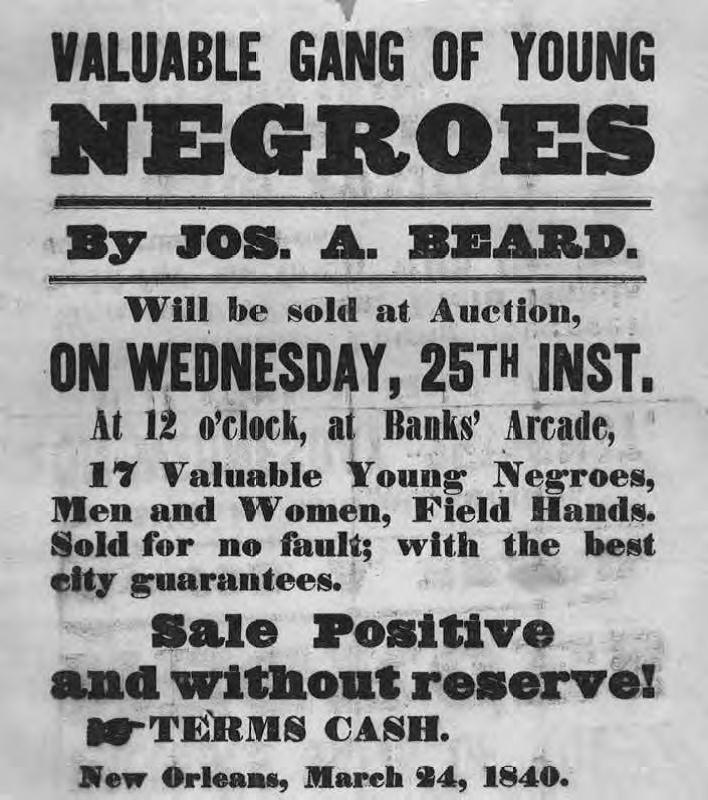
(Advertising poster for sale of negroes)
Appendix II: History of Slavery in America
Slavery came to the Americas in the 1600s, and helped build fortunes for the settlers. However, Christian missionaries and American Enlightenment forced people to think about putting an end to the institution of slavery. Towards the end of the 18th century, Northern states began abolishing it. The Northwest Ordinance of 1787 prohibited slavery in territories north of the Ohio River. From 1808, the importation of slaves was banned by the Constitution of the U.S. However, during the end of 18th century the cotton gin had been developed which made cotton plantations in the South lucrative; consequently slave trade revived despite its illegal status and slave labor became further embedded in the South, influencing its society as well as its politics. Southerners justified slavery as beneficial for both slaves and society, depicting slave masters as benevolent fathers.
However, economic forces were not the only obstacles to emancipation. White society could not reconcile itself to accept the Negro as his equal - even though free blacks had lived in both the North and South after the American Revolution and five thousand blacks had fought in it too. Solutions advocated by Presidents Jefferson and Monroe such as Gradual Emancipation and Colonisation did not prove successful. As the country expanded westward, the difficult issues with regard to slavery cropped up repeatedly with the North and South fighting over the status of the new territories and states with regard to slavery.
Wanting to influence Congress, the South succeeded in getting Congressional representation of slaveholding states in their favour. Each slave counted as 3/5th a person, thereby swelling that states representation as compared to those of the North. As a result, slaveholders’ interests were protected in the National Government, since majority presidents and Supreme Court justices were southern slaveholders.
With the passage of time, a new philosophy was taking shape. Apart from the humanitarian and moral reasons for objecting to slavery, the emergence of a free-labor industrial capitalism also disapproved of this aging slave institution. A growing number of Northerners, believed that slavery debased labor, prevented economic opportunity for the white labour class, discouraged education, and produced an autocratic class of people who seemed adamant to dominate the nation.
Appendix III: Presidential Elections in the United States of America
The President and Vice-President are elected every four years.
— They must be at least 35 years of age
— They must be native-born citizens of the United States, and
— They must have been residents of the U.S. for at least 14 years.
— A person cannot be elected to a third term as President.
State conventions of each political party choose their elected delegates who will go to the national convention in support of their presidential candidate.
At these National Conventions of each political party, delegates cast votes to nominate their presidential candidate. The nominated presidential candidate then selects a vice-presidential candidate who is called his running mate.
Candidates for President and Vice-President Run Together.
In the general election, each candidate for President runs together with a candidate for Vice-President on a “ticket”. Voters select one ticket to vote for; they can’t choose a presidential candidate from one ticket and a vice-presidential candidate from another ticket.
The Electoral College
During the national presidential election, voters from each of the 50 states and the District of Columbia, do not vote directly for the president; they are really voting for “electors” pledged to one of the tickets.
Political parties choose electors at their State party conventions or by a vote of the party’s central committee in each State.
Electors are selected according to their service and dedication to their political party. They may be State-elected officials, party leaders, or persons who have a personal or political affiliation with the Presidential candidate.
These electors need to pledge their vote beforehand to the party ticket. Each political party will have their list of electors in each state and the District of Columbia.
Number of Electors in each state is a total of its senators and its members in the House of representatives. Every state has two senators each but the members in the House of Representatives depend on the state population. The larger is the population, the larger is the number of electors in the state. The District of Columbia, although it isn’t a state, also participates in presidential elections -- it currently has three electors.
The People in Each State Vote for Electors in the Electoral College.
You are eligible to vote if you are above 18 years of age and a citizen of the United States, irrespective of race, color, or prior condition of servitude, sex or failure to pay any tax.
In most of the states, and also in the District of Columbia, the election is winner-take-all; whichever ticket receives the most votes in that state (or in D.C.) gets all the electors. For example, if there are 200,000 voters in a state and 15 electors. If Republican ticket wins 105,000 votes, and Democratic ticket wins 95,000 votes, then all 15 electors from that state will be republican electors. So, even though republicans only won 52.5 % of the ‘popular vote’, they get 100% of electors. (The only exceptions are Maine and Nebraska. In these states, just two of the electors are chosen in a winner-take-all fashion from the entire state. The remaining electors are determined by the winner in each congressional district, with each district voting for one elector.) These electors make up the “Electoral College.”
The Electoral College Votes for the President.
In each state on the same day across the country in November, the Electoral College votes for a President and Vice-President ticket, with each elector casting one vote; these votes are called electoral votes. Each elector is already pledged to vote for a particular ticket. In most elections, all the electors vote in accordance with the pledge they have made.
Normally, one of the candidates for President receives a majority (more than half) of the electoral votes; that person is elected President. That candidate’s vice-presidential running mate is elected Vice-President.
In case there is no clear majority, or there is a tie
There is a total of 538 electoral votes spread over 50 states and the District of Columbia. In case of a two-way election there is a possibility of a tie (each ticket wins 269 votes). When there are three or more presidential candidates, there is a possibility that none receive a majority.
In the rare event that no presidential candidate receives a majority of the electoral votes or there is a tie, then:
— The House of Representatives would choose the President; each state delegation in Congress casts one vote. Taking Florida for example, all its 27 representatives in the House would decide unanimously on one presidential candidate and cast one vote.
— The Senate would choose the Vice-President.
Appendix IV: Notes on the Practice of Law by Abraham Lincoln
I am not an accomplished lawyer. I find quite as much material for a lecture, in those points wherein I have failed, as in those wherein I have been moderately successful.
The leading rule for the lawyer, as for the man of every other calling, is diligence. Leave nothing for to-morrow, which can be done to-day. Never let your correspondence fall behind... When you bring a common-law suit, if you have the facts for doing so, write the declaration at once. If a law point be involved, examine the books, and note the authority you rely on upon the declaration itself, where you are sure to find it when wanted. The same of defenses and pleas. In business not likely to be litigated — ordinary collection cases, foreclosures, partitions, and the like, — -make all examinations of titles, and note them, and even draft orders and decrees in advance. This course has a triple advantage; it avoids omissions and neglect, saves your labor when once done, performs the labor out of court when you have leisure, rather than in court, when you have not. Extemporaneous speaking should be practised and cultivated. It is the lawyer’s avenue to the public. However able and faithful he may be in other respects, people are slow to bring him business if he cannot make a speech. And yet there is not a more fatal error to young lawyers than relying too much on speech-making. If any one, upon his rare powers of speaking, shall claim exemption from the drudgery of the law, his case is a failure in advance.
Discourage litigation. Persuade your neighbors to compromise whenever you can. Point out to them how the nominal winner is often a real loser — in fees and expenses, and waste of time. As a peacemaker the lawyer has a superior opportunity of being a good man. There will still be business enough.
Never stir up litigation. A worse man can scarcely be found than one who does this. Who can be more nearly a fiend than he who habitually overhauls the Register of deeds in search of defects in titles, whereon to stir up strife, and put money in his pocket? A moral tone ought to be infused into the profession, which should drive such men out of it.
The matter of fees is important, far beyond the mere question of bread and butter involved. Properly attended to, fuller justice is done to both lawyer and client. An exorbitant fee should never be claimed. As a general rule never take your whole fee in advance, nor any more than a small retainer. When fully paid beforehand, you are more than a common mortal if you can feel the same interest in the case, as if something was still in prospect for you, as well as for your client. And when you lack interest in the case the job will very likely lack skill and diligence in the performance. Settle the amount of fee and take a note in advance. Then you will feel that you are working for something, and you are sure to do your work faithfully and well. Never sell a fee note — at least not before the consideration service is performed. It leads to negligence and dishonesty — negligence by losing interest in the case, and dishonesty in refusing to refund when you have allowed the consideration to fail.
There is a vague popular belief that lawyers are necessarily dishonest. I say vague, because when we consider to what extent confidence and honors are reposed in and conferred upon lawyers by the people, it appears improbable that their impression of dishonesty is very distinct and vivid. Yet the impression is common, almost universal. Let no young man choosing the law for a calling for a moment yield to this popular belief - resolve to be honest at all events; and if in your own judgment you cannot be an honest lawyer, resolve to be honest without being a lawyer. Choose some other occupation, rather than one in the choosing of which you do, in advance, consent to be a knave.
— Lincoln, Speeches and Writings 1832-1858, page 245
Appendix V: Fragment on Slavery Written Around July 1, 1854 by Abraham Lincoln
Equality, in society, alike beats inequality, whether the latter be of the British aristocratic sort, or of the domestic slavery sort.
We know, Southern men declare that their slaves are better off than hired laborers amongst us. How little they know, whereof they speak! There is no permanent class of hired laborers amongst us. Twenty five years ago, I was a hired laborer. The hired laborer of yesterday, labors on his own account to-day; and will hire others to labor for him to-morrow. Advancement — improvement in condition — is the order of things in a society of equals. As Labor is the common burthen of our race, so the effort of some to shift their share of the burthen on to the shoulders of others, is the great, durable, curse of the race. Originally a curse for transgression upon the whole race, when, as by slavery, it is concentrated on a part only, it becomes the double-refined curse of God upon his creatures.
Free labor has the inspiration of hope; pure slavery has no hope. The power of hope upon human exertion, and happiness, is wonderful. The slave-master himself has a conception of it; and hence the system of tasks among slaves. The slave whom you can not drive with the lash to break seventy-five pounds of hemp in a day, if you will task him to break a hundred, and promise him pay for all he does over, he will break you a hundred and fifty. You have substituted hope, for the rod. And yet perhaps it does not occur to you, that to the extent of your gain in the case, you have given up the slave system, and adopted the free system of labor.
— Speeches and Letters of Abraham Lincoln, 1832-1865, by Abraham Lincoln page 57
Appendix VI - Lincoln’s Timeline
Lincoln’s Timeline
February 12, 1809: Birth of Abraham Lincoln in Hardin County, Kentucky.
1816: — Family relocates to Indiana
1818: — Mother Nancy Hanks Lincoln dies of milk sickness
1819: — Father Thomas Lincoln remarries widow Sarah Bush Johnston
1820: — Missouri Compromise issued
1828: — Works on flatboat to carry cargo to New Orleans
1830: — Family relocates to Illinois
1831: — Separates from his family, moves to New Salem, Illinois
1832: — Serves as captain in Black Hawk War, loses bid for Illinois State Legislature
1833: — Works as postmaster of New Salem and later as a surveyor
1834: — At age 24 elected to Illinois State Legislature
1835: — Enters into deep depression on the death of Ann Rutledge
1836: — Re-elected to Illinois State Legislature as a leader of Whig Party
1837: — Admitted to the bar in Illinois, relocates to Springfield, forms a law partnership with John Stuart and begins practicing law
1838: — Re-elected to Illinois State Legislature for a third term
1839: — Travels as a lawyer on the 8th Judicial Circuit, Illinois
1840: — Re-elected to Illinois State Legislature for a fourth term
1841: — Forms a law partnership with Stephen T. Logan
1842: — Marries Mary Todd
1844: — Forms law partnership with William Herndon
1846: — Elected to U.S. Congress as Whig Representative from Illinois
1848: — Criticises President Polk and the Mexican War on House floor
1849: — Introduces gradual emancipation bill for slaves in District of Columbia, completes term in U.S. Congress and returns to Springfield to practice law
1854: — Kansas-Nebraska Act becomes law; delivers famous ‘Peoria’ speech, declines ticket for Illinois State Legislature, makes a bid for U.S. senate
1855: — Loses Senate bid
1858:
June: — Receives Republican nomination for U.S. Senate; delivers ‘House Divided’ speech, participates in the Lincoln-Douglas debates in Illinois, loses Senate bid again
1860:
May: — Nominated for president by Republicans
November: — Elected 16th President of the United States
Dec. 20: — South Carolina secedes followed by 6 other states
1861:
April: — Confederate forces open fire on Fort Sumter, Civil War begins, Virginia secedes followed within weeks by 3 more Southern states
April-May: — Proclaims blockade against Southern ports, suspends writ of Habeas Corpus, declares martial law in Maryland
July: — Union defeated at Bull Run, Virginia, Lincoln appoints General McClellan as commander of the Potomac Army
August: — Declares martial law in Missouri, signs the Confiscation Act
November: — Appoints McClellan as Commander of the Union Army, Trent Affair strains relations with Britain
1862:
January: — Issues order no. 1, instructing the Union armies to advance by February 22nd
March: — Relieves McClellan as general-in-chief and takes supreme command of Union forces
April-June: — Battle of Shiloh, Tennessee resulting in heavy losses on both sides, Lincoln signs act abolishing slavery in District of Columbia, approves homestead Act facilitating thousands to go West, prohibits slavery in United States territories
August: — Union defeat at 2nd battle at Bull Run, Virginia
September: — Union forces push back the Confederate attack at the Battle of Antietam, Lincoln issues a preliminary Emancipation Proclamation
November: — Replaces McClellan with General Burnside
December: — Union army defeated at Fredericksburg, Virginia, West Virginia comes in as the 35th state into the Union
1863:
January: — Issues Emancipation Proclamation, replaces Burnside with General Hooker as Commander of the Army of the Potomac February: Signs a bill for a National Banking system
March-June: Lincoln signs Conscription Act, Union army defeated at Chancellorsville, Virginia, replaces Hooker with Meade
July: — Union forces victorious at Battle of Gettysburg and Vicksburg and gain control of Mississippi river, Lincoln writes order of retaliation
August: —Meets Frederick Douglass
September: — Union Army defeated at Chickamauga, Virginia, puts General Grant in command of the army of the Western theatre
November: — Delivers Gettysburg Address
December: — Issues initial plans for reconstruction
1864:
March: — Puts General Grant in charge of all Union Armies
June: — Nominated for President by National Union Party for a second term
Sept-Oct: — Sherman’s forces capture Atlanta, Union forces gain control of Shenandoah Valley
November: — Re-elected president of the United States
1865:
January: — Attends unsuccessful peace conference at Hampton Roads
March: — Lincoln delivers Second inaugural speech, grants pardon to Union deserters
April: — Grant’s forces capture Richmond, Lincoln visits Richmond, Lee surrenders to Grant near Appomattox Court House, Virginia, Lincoln makes last public speech concerning question of reconstruction
April 14: — Fatally shot by John Wilkes Booth in theatre
April 15: — Dies at 7:22 a.m.
Bill of Rights
Amendment I
Congress shall make no law respecting an establishment of religion, or prohibiting the free exercise thereof; or abridging the freedom of speech, or of the press; or the right of the people peaceably to assemble, and to petition the Government for a redress of grievances.
Amendment II
A well-regulated Militia, being necessary to the security of a free State, the right of the people to keep and bear Arms, shall not be infringed.
Amendment III
No Soldier shall, in time of peace be quartered in any house, without the consent of the Owner, nor in time of war, but in a manner to be prescribed by law.
Amendment IV
The right of the people to be secure in their persons, houses, papers, and effects, against unreasonable searches and seizures, shall not be violated, and no Warrants shall issue, but upon probable cause, supported by Oath or affirmation, and particularly describing the place to be searched, and the persons or things to be seized.
Amendment V
No person shall be held to answer for a capital, or otherwise infamous crime, unless on a presentment or indictment of a Grand Jury, except in cases arising in the land or naval forces, or in the Militia, when in actual service in time of War or public danger; nor shall any person be subject for the same offence to be twice put in jeopardy of life or limb; nor shall be compelled in any criminal case to be a witness against himself, nor be deprived of life, liberty, or property, without due process of law; nor shall private property be taken for public use, without just compensation.
Amendment VI
In all criminal prosecutions, the accused shall enjoy the right to a speedy and public trial, by an impartial jury of the State and district wherein the crime shall have been committed, which district shall have been previously ascertained by law, and to be informed of the nature and cause of the accusation; to be confronted with the witnesses against him; to have compulsory process for obtaining witnesses in his favor, and to have the Assistance of Counsel for his defence.
Amendment VII
In Suits at common law, where the value in controversy shall exceed twenty dollars, the right of trial by jury shall be preserved, and no fact tried by a jury, shall be otherwise re-examined in any Court of the United States, than according to the rules of the common law.
Amendment VIII
Excessive bail shall not be required, nor excessive fines imposed, nor cruel and unusual punishments inflicted.
Amendment IX
The enumeration in the Constitution, of certain rights, shall not be construed to deny or disparage others retained by the people.
Amendment X
The powers not delegated to the United States by the Constitution, nor prohibited by it to the States, are reserved to the States respectively, or to the people.
U.S. Bill of Rights: The first 10 amendments to the constitution of America. Authored by James Madison in reply to a demand from various states for greater protection of individual liberties and prohibitions on governmental power.
Appendix VII - Lincolns’ Anecdotes
On His Childlike Simplicity
(As narrated by a teacher of a school in a criminal neighbourhood of New York)
‘Our Sunday School in the Five Points was assembled one Sabbath morning, when I noticed a tall, remarkable looking man enter the room, and take a seat among us. He listened with fixed attention to our exercises, and his countenance often expressed such genuine interest that I approached him and suggested that he might be willing to say something to the children. He accepted the invitation with evident pleasure, and, coming forward, began a simple address, which at once fascinated every little hearer, and hushed the room into silence. His language was strikingly beautiful, and his tones musical with intensest feeling. The little faces around him would droop in sad conviction as he uttered sentences of warning, and would brighten into sunshine as he spoke cheerful words of promise. Once or twice he attempted to close his remarks but the imperative shouts of ‘go on, oh! go on,’ would compel him to resume. As I looked at the gaunt and sinewy frame of the stranger, and marked his powerful head and determined features now touched into softness by the impressions of the moment, I felt an irrepressible curiosity to learn something more about him, and when he was quietly leaving the room, I begged to know his name. He replied, ‘It is Abraham Lincoln, from Illinois.’’
On His Humility
The story is told of an army colonel who rode out to the Soldiers’ Home, hopeful of securing Lincoln’s aid in recovering the body of his wife, who had died in a steamboat accident. His brief period of relaxation interrupted, Lincoln listened to the colonel’s tale but offered no help. “Am I to have no rest? Is there no hour or spot when or where I may escape this constant call? Why do you follow me out here with such business as this?” The disheartened colonel returned to his hotel in Washington. The following morning, Lincoln appeared at his door, “I was a brute last night,” Lincoln said, offering to help the colonel in anyway possible.
On His Simplicity
In the White House, once Secretary of State, Seward, found Lincoln polishing his boots. ‘We do not blacken our boots,’ chided Seward. To which Lincoln replied in good humour, ‘Indeed, then whose boots do you blacken, Mr. Secretary?’
At another time, Seward, was shocked when he heard that Lincoln had stepped aside for a coloured woman at a muddy crossing. Lincoln confirmed that it was true and remarked smilingly, ‘Well, I don’t remember it, but I always make it a rule - if people don’t turn out for me, I will for them. If I didn’t, there would be a collision.’
On his Humour
Once, fellow republicans demanded the removal of Supreme Court Chief Justice of New Mexico, Kirby Benedict, on charges of drunkenness. Lincoln responded, ‘Well, gentlemen, I know Benedict... He may imbibe to excess, but Benedict drunk knows more law than all the people on the bench in New Mexico sober. I shall not disturb him.’
In 1846, when he was a candidate for Congress against a Methodist minister, the Rev. Peter Cartwright, his opponent openly accused him of being an unbeliever, and Lincoln never denied it. A story is told of Mr. Cartwright’s holding a revival meeting while the campaign was in progress, during which Lincoln stepped into one of his meetings. When Cartwright asked the audience, “Will all who want to go to heaven stand up?” all arose except Lincoln. When he asked, “Now, will all who want to go to hell stand up?” Lincoln still remained in his seat. Mr. Cartwright then said, “All have stood up for one place or the other except Mr. Lincoln, and we would like to know where he expects to go.” Lincoln arose and quietly said, “I am going to Congress,” and there he went.
Mr. Seward said: “Gentlemen, I will tell you one thing, Mr. Lincoln never tells a joke for the joke’s sake, they are like the parables of old-lessons of wisdom. When he first came to Washington he was inundated with office-seekers. One day he was particularly afflicted; about twenty place-hunters from all parts of the Union had taken possession of his room with bales of credentials and self-recommendations ten miles long. The President said:
“’Gentlemen, I must tell you a little story I read one day when I was minding a mudscow in one of the bayous near the Yazoo.
“’Once there was a certain king,’ he said, ‘who kept an astrologer to forewarn him of coming events and especially to tell him whether it was going to rain when he wanted to go on hunting expeditions. One day he had started off for the forest with his train of ladies and lords for a grand hunt, when the cavalcade met a farmer, riding a donkey, on the road. “Good morning, Farmer,” said the king. “Good morning, King,” said the farmer. “Where are you folks going?” “Hunting,” said the king. “Lord, you’ll get wet,” said the farmer. The king trusted his astrologer, of course, and went to the forest, but by midday there came on a terrific storm that drenched and buffeted the whole party. When the king returned to his palace he had the astrologer decapitated and sent for the farmer to take his place. “Law’s sake,” says the farmer when he arrived, “it ain’t me that knows when it’s goin’ to rain, it’s my donkey. When it’s goin’ to be fair weather that donkey always carries his ears forward so.” “Make the donkey the court astrologer!” shouted the king. It was done. But the king always declared that that appointment was the greatest mistake he ever made in his life.’
“Lincoln stopped there. ‘Why did he say it was a mistake?’ we asked him. ‘Didn’t the donkey do his duty?’ ‘Yes,’ said the President, ‘but after that time every donkey in the country assembled in front of the palace and wanted an office.’”
His Love for Poetry
(Henry C. White, Lincoln’s friend and fellow lawyer on the Illinois circuit has written in his book, ‘Life With Lincoln On The Circuit’:)
“I recollect that in the Fall of 1854, Mr. Lincoln, with other lawyers from abroad, drove over from Urbana the county seat to West Urbana (now Champaign) to see the embryo town and while there stopped at my law office... Lincoln took down a well-worn copy of Byron, which no boy’s library at that time was without and readily turning to the third canto of “Childe Harold” read aloud...:
>“He who ascends to mountain tops shall find Those loftiest peaks most wrapt in clouds and snow; He who surpasses or subdues mankind, Must look down on the hate of those below. Though high ABOVE the sun of glory glow, And far BENEATH the earth and ocean spread, Round him are icy rocks and loudly blow Contending tempests on his naked head, And thus reward the toils which to those summits lead.
“This poetry was very familiar to him. Evidently he looked specifically for and found it with no hesitation and read it with a fluency that indicated that he had read it often times before. I think I am justified in saying that he read it sadly and earnestly if not indeed reverently. I have, often times since, thought from this slight circumstance that he had a premonition that he was destined to ascend to the mountaintops of human achievement.
“But coming events cast their shadows before the career of this servitor of destiny so definitely as to deeply impress their object. One of them is thus often narrated: “A friend, once inquiring the cause of a deep depression under which he seemed to be suffering: ‘I have seen this evening again,’ he replied, ‘what I once saw before, on the evening of my nomination, at Chicago. As I stood before a mirror, there were two images of myself -- a bright one in front, and one that was very pallid, standing behind. It completely unnerved me; the bright one, I know, is my past, the pale one, my coming life. And feeling that there is no armor against destiny,’ he added, ‘I do not think I shall live to see the end of my term. I try to shake off the vision, but it still keeps haunting me.’”259
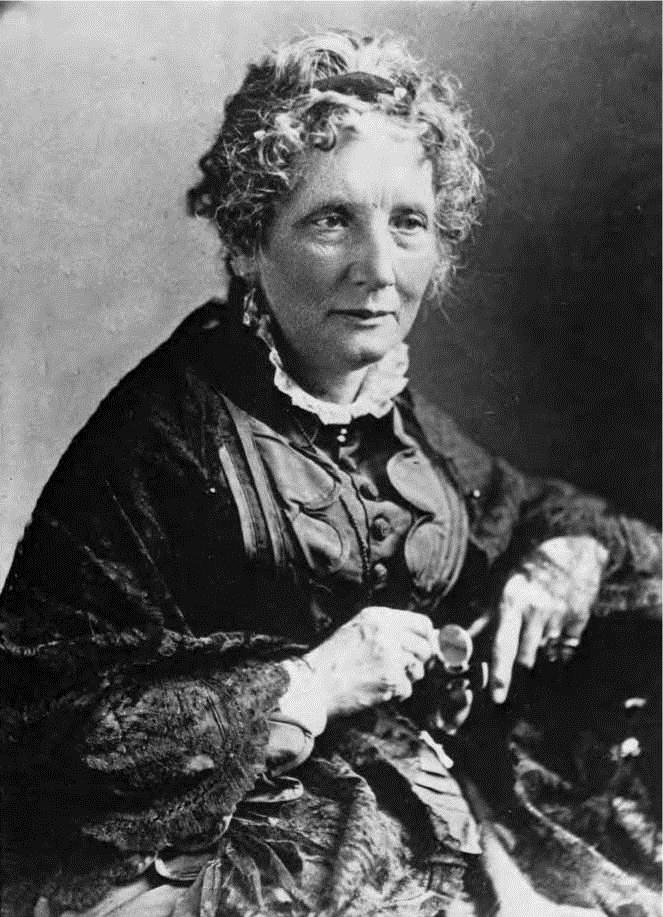
(Harriet Beecher Stowe, author of Uncle Tom’s cabin)
Appendix VIII - Uncle Tom’s Cabin
Uncle Tom’s Cabin by Harriet Beecher Stowe
Uncle Tom’s cabin is a story written during the days of slavery in the U.S. that illustrates the trials and tribulations of life as a slave in America. It focuses on the life of two slaves, Tom and 4-year-old Harry, who have been sold due to financial difficulties by their kind owner, a Kentucky farmer Shelby to Haley, a ruthless slave trader. While Eliza, mother of little Harry decides to run away with her son, Tom decides to go with Haley to be sold at a slave market. This story focuses on their respective journeys fraught with limitless dangers, physical challenges and emotional pain. It elucidates Eliza’s perils as she is hounded by Loker, a slave hunter, her miraculous crossing over a semi-frozen river to the North, which is relatively safer, her reuniting with her husband who too is a fugitive slave aspiring for freedom, and ultimately their escape to Canada with the assistance of Quakers. It tells the story of Uncle Tom, as his previous owner’s son George fondly called him; of his pain at being separated from his wife and children and his experiences as he saves Eva, the angelic little girl from drowning, and benevolent St. Clare, her father who buys him from Haley out of gratitude and takes him to their home in New Orleans. It recounts Uncle Tom’s growing friendship with Eva and their daily talks about their Christian faith. It is a story of his endless misery and adverse luck; the death of Eva and her father, after which he is sold off to his vicious new owner Legree, Uncle Tom’s unflinching faith in God despite relentless physical torment, ultimately of his death as he is savagely beaten for encouraging two female slaves to flee and the futility of the late arrival of his Master George who comes to buy him back. But it ends on a happy note; the other slaves either flee to safety or are emancipated.
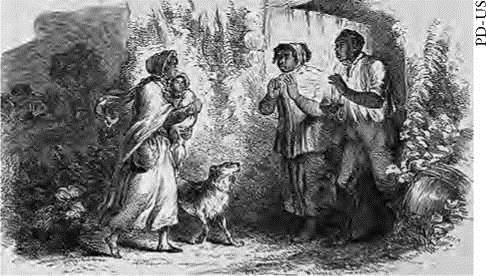
(Eliza comes to tell Uncle Tom that he is sold and that she is running away to save her child)
It is not a tale of cruelty and suffering alone; it is also about hope and promise; it is about determination and courage. The Quakers, Eva and St. Clare are benevolent forces, that come into their lives to soothe their journey through the pain and torture that they have to endure. It elucidates how St. Clare, with kindness and patience restored love and faith in Topsy, a slave girl, embittered by her painful life in servility. This story also illustrates the presence of faith and compassion that can transform and cleanse the most savage human heart of its hate and prejudice as the change that Eliza could bring about in Loker; despite his remorseless pursuit of her, she does not leave him to die after she shoots him; she treats his gunshot wound and nurses him till he is healthy again.
This novel was written by Harriet Beecher Stowe (1811- 1896), an author and social activist and published in 1851 as a series and later as a complete novel in 1852 as a reaction to the Fugitive Slave Law. A daughter of a preacher and sister of an abolitionist, she was raised in an atmosphere that supported social justice, women’s rights and the liberation of slaves.
The Fugitive Slave Law of 1850 made it mandatory for every citizen to aid and assist in catching runaway slaves. Bribery was rampant through which the commissioners facilitated the restoration of slaves to their owners. Harriet was livid. She felt it was immoral for the government to demand the complicity of ordinary citizens to aid in catching runaway slaves. She rebelled against the system and began harbouring runaway slaves in her home; to prevent her maid from being caught and returned to her owner, she helped her escape to Canada and gain legal freedom. But this was not enough to douse her anger towards the system of slavery prevalent in the country; she then decided to use her pen to fight against the system of slavery.
While she was living in Cincinnati, which was a hub for the underground railway260, she met with many fugitive slaves on their way to freedom. She had first hand information from her black cook and other servants who had been prior slaves about their painful experiences. She also received authentic information from Frederick Douglass and others about the realities of the Deep South where slavery was prevalent in its most ugly form. Josiah Henson, a fugitive slave who escaped to Canada, founded a settlement and opened a school for other fugitive slaves was the inspiration behind one of the characters in her novel, George Harris, Eliza’s husband.
Stowe actively supported social and political causes throughout her life and wrote novels, essays and textbooks till her death in 1896. Stowe’s novel made Northerners become conscious of not only the brutality that slaves were tolerating but also the beast that it brought out in their white masters. It fanned the flames of the divide between pro and anti slavery factions in America; - while it stimulated the abolitionist movement in the North it was met with anger and disapproval in the south. It sold 300,000 copies by the end of 1852 and became the second best selling book after the bible. It sold more in England than the U.S. and was greatly influential in moulding public opinion that finally pushed the Government of England a decade later to withdraw support to the south despite the mutually beneficial economic trade relationship. When Lincoln issued the Emancipation Proclamation in 1863, Stowe danced in the streets with joy.
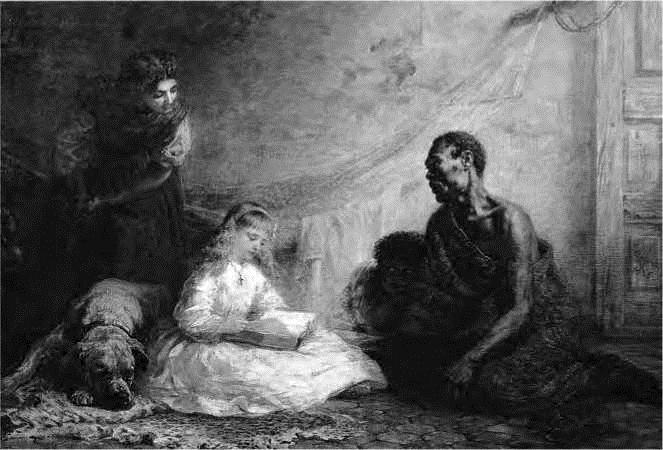
Sri Aurobindo on America
That is one considerable advantage of America; there is evidently a sufficiently widespread eagerness and openness of mind to new things. We have to see whether this will be sufficient to open the mind also to deep and true things. The spiritual future of America is not yet decided; it is in the balance. There is a great possibility before her, but it depends on Americans themselves whether she will make good and realise it. Otherwise she will follow the disastrous curve of other western peoples. India and America stand prominent at the two poles that have to meet and become one, the spiritual and the material life; one has shown a preeminent capacity of realisation on the spiritual, the other on the material plane. America must be able to receive freely India’s riches and to give freely in return from her own for the material organisation of a higher life on the physical plane; this is at once a condition and her chance. At present it is only a possibility; let us see whether it can be made an achieved and perfected symbol.261
Notes
Sri Aurobindo, Essays in Philosophy and Yoga: On Ideals
↩Faith and Morals: Genesis, Deuteronomy, Micah, edited by David Felty, p. 310.
↩Recollected Words of Abraham Lincoln, Don Edward and Virginia Fehrenbacher, p. 406.
↩Rediscovering God in America, by Newt Gingrich, p. 32.
↩A boat with a flat bottom and square edges for transport in shallow water.
↩The Life of Abraham Lincoln, by J. G. Holland, p. 60.
↩Lincoln’s New Salem, by Benjamin P. Thomas, p. 136.
↩The Lincoln-Douglas Debates, by Abraham Lincoln, Stephen A. Douglas, p. 57.
↩Lincoln: Speeches and Writings (1859-1865), Autobiography Written for Campaign, p. 167.
↩The Life of Abraham Lincoln, by J.G.Holland, p. 542.
↩Holland’s Life of Abraham Lincoln, by J.G. Holland, p. 544.
↩Sri Aurobindo, Essays in Philosophy and Yoga: On Ideals
↩Holland’s Life of Abraham Lincoln, by J.G. Holland, p.36.
↩calculating.
↩Lincoln: Speeches and Writings (1859-1865), letter to Jesse W. Fell, Enclosing Autobiography, Dec. 20th, 1859, p. 107.
↩Lincoln: Speeches and Writings (1859-1865), Autobiography written for campaign, June 1860, p. 162.
↩Holland’s Life of Abraham Lincoln, by J. G. Holland, p. 31.
↩Herndon’s Informants: Letters, Interviews, and Statements About Abraham Lincoln, Sarah Bush Lincoln’s interview, September, 1865, p. 108.
↩The Heart of Lincoln, By Wayne Whipple, p. 35.
↩The Inner Life of Abraham Lincoln: Six Months at the White House, by Francis Bicknell Carpenter, p. 98.
↩Lincoln: Speeches and Writings (1859-1865), Autobiography Written for Campaign, June 1860, p. 162.
↩Calhoun’s theory of nullification defended state rights to reject federal laws in case they were in conflict with the interest of the state.
↩The brief conflict in 1832 between the United States and Native Americans, when the latter entered into Illinois to settle down.
↩Lincoln: Speeches and Writings (1859-1865), letter to Jesse W. Fell, Enclosing Autobiography, Dec. 20th 1859, p. 107.
↩Lincoln: Speeches and Writings (1859-1865), letter to Jesse W. Fell, Enclosing Autobiography, Dec. 20th 1859, p. 107.
↩The Whig Party, in the United States, was concerned with promoting internal improvements, such as roads, canals, railroads, deepening of rivers, etc. They were popular in the West which, being isolated, was in need of markets.
↩Democrats wanted a weak federal government, believed in states’ rights, agrarian interests (especially Southern planters) and strict adherence to the Constitution; it opposed a national bank.
↩Holland’s Life of Abraham Lincoln, by J.G. Holland, p. 67.
↩Holland’s Life of Abraham Lincoln, by J.G. Holland, p. 69.
↩In 1831, Nat Turner, a slave, led a rebellion in Virginia and killed some sixty white men, women, and children. He and 16 of his conspirators were captured and executed. To warn other slaves, blacks were randomly killed, many were beheaded and their heads left along the roads to warn others. After this incident, planters tightened their grip on slavery.
↩Adapted from Lincoln’s original resolution.
↩Lincoln: Speeches and Writings (1832-1858), Address to the Washington Temperance Society of Springfield, Ill., 1842, p. 83.
↩Each state is divided into districts containing a number of counties. A single judge appointed for each district rode the circuit along with distinguished lawyers, holding court in each county. The circuit was covered on horseback or in a gig.
↩President Andrew Jackson’s policies had led to the destruction of the Second Bank of United States. Federal reserves had been moved from the Second Bank to some smaller state banks. But credit policies of these state banks were reckless; they loaned paper money indiscriminately, which they printed in excess of their reserves of gold and silver. To arrest this trend, Jackson ordered that federal land could be bought only on payment of gold or silver. People ran to banks to exchange their paper money for these precious metals, but the banks began to refuse them due to sufficient reserve; many banks crashed, thousands of people lost their land; loans dried up, businesses and civic projects collapsed, purchases went down, all this led to severe unemployment which resulted in people going hungry.
↩Holland’s Life of Abraham Lincoln, by J. G. Holland, p. 79.
↩Holland’s Life of Abraham Lincoln, by J. G. Holland, p. 83.
↩Lincoln: Speeches and Writings (1832-1858), Address to Young Men’s Lyceum at Springfield, January 27th 1838, pp. 35-36.
↩Collected Works of Abraham Lincoln, Volume 2, To Joshua F. Speed, Springfield, Aug. 24th 1855, p. 320.
↩Lincoln: Speeches and Writings (1832-1858), Letter to John Stuart, January 20th 1841, p. 69.
↩Life on the Circuit, by Henry C. Whitney, p. 460.
↩Democratic Candidate, 1844 Presidential elections.
↩Holland’s Life of Abraham Lincoln, by Josiah Gilbert Holland, page 96.
↩In Sept. 1845, President James K. Polk wanted to negotiate the disputed Texas border, settle U.S. claims against Mexico, and purchase New Mexico and California for up to $30 million. When his offer was snubbed by Mexico, he sent General Zachary Taylor with his troops to occupy the disputed area between the Nueces and the Rio Grande, and wanted to justify his aggression on grounds that Mexico refused to pay U.S. claims and refused to negotiate the purchase. However, he got word that Mexican troops had crossed the Rio Grande and killed 16 U.S. soldiers. He, therefore, changed his message that Mexico had ‘invaded...’ Though Congress approved the War, Whigs viewed Polk’s motives as immoral greed and abolitionists saw the war as an attempt to extend slavery. Democrats, however, especially those in the Southwest, strongly supported the conflict.
↩Lincoln: Speeches and Writings (1859-1865), Autobiography Written for Campaign, p, 166.
↩Mexico lost the War, a peace treaty was signed in which Mexico ceded all the territory now included in the states of New Mexico, Utah, Nevada, Arizona, California, Texas, and western Colorado for $15 million. In August 1846, Representative David Wilmot of Pennsylvania tried to add an amendment to it called the Wilmot Proviso, banning slavery from any territory acquired from Mexico but it was never passed.
↩The Hidden Lincoln, Emanuel Hertz, p. 172.
↩Calendar.
↩The Inner World of Abraham Lincoln, Michael Burlingame, p. 66.
↩Lincoln: Speeches and Writings (1859-1865), Autobiography Written for Campaign, p. 162.
↩Lincoln: Speeches and Writings (1832-1858), Eulogy on Henry Clay at Springfield, Ill, July 6th 1852, pp. 271-72.
↩Land west of Missouri was part of the Louisiana territory wherein the Missouri Compromise of 1820 had prohibited slavery north of the parallel 36:30 degrees north except within the boundaries of the proposed state of Missouri which came in as a slave state.
↩Missouri Compromise of 1820, in which Missouri was admitted as a slave state, Maine was admitted as a free state and states north of 36:30 degrees north latitude would be admitted into the union as free states.
↩Lincoln: Speeches and Writings (1859-1865), Autobiography Written for Campaign, page 154.
↩The Life of Abraham Lincoln, by Henry Raymond, page 21.
↩Lincoln: Speeches and Writings (1832-1858), Speech on the Kansas-Nebraska Act at Peoria, Ill, p. 307.
↩The Every-Day Life of Abraham Lincoln, by Francis F. Brown, p. 158.
↩Anti slavery leader of the Republican Party.
↩Dred Scott, a slave, who had been brought by his master to live in Illinois, a free state, had sued for his freedom on the grounds that according to the Missouri Compromise, after living in a free state for a fixed number of years, legally he could not be returned to slavery. Chief Justice Roger B. Taney (influenced by President Buchanan’s pro slavery views) passed a judgment that since the Constitution gave no rights to a slave, Scott could not present a case in a Federal court. Also, the Fifth Amendment spelled out that no person could be deprived of “life, liberty or property without due process of the law,” and since slaves were termed as property, the Federal government was powerless to prohibit the practice of slavery anywhere in the Union, even in free states where slavery was prohibited. This meant that someone from a free state could go to a pro slavery state, buy a slave and bring him back to a free state and keep him there as a slave. It amounted to a violation of the constitutional rights of the free states.
↩See previous footnote.
↩Lincoln: Speeches and Writings (1832-1858), Speech on the Dred Scott decision at Springfield, Illinois, June 26th 1857, p. 390.
↩Lincoln Speeches and Writings (1832-1858), ‘House Divided’ speech addressing his Republican colleagues in Springfield, 16th June 1858, p. 426.
↩The Every-Day Life of Abraham Lincoln, by Francis F. Brown, chapter XI, p. 178.
↩Collected Works of Abraham Lincoln, Volume 2, edited by Roy Basler, Speech at Lewistown, Illinois, on 17th August 1858, p. 544.
↩Lincoln: Speeches and Writings (1832-1858), Speech at Springfield on 17th July 1858, p. 460.
↩A. Lincoln: A Biography, by Ronald C. White, Jr., p. 258.
↩Lincoln: Speeches and Writings (1832-1858), 6th debate at Quincy, Illinois, 13th October 1858, p. 730.
↩Lincoln: Speeches and Writings (1832-1858), 7th debate at Alton, Illinois, 15th October 1858, p. 774.
↩The Northwest Ordinance was adopted by the Confederation Congress on July 13, 1787. It established a government for the Northwest Territory, defined the process for admitting a new state to the Union, and promised that newly created states would be equal to the original thirteen states. The Northwest Ordinance also protected civil liberties and outlawed slavery in the new territories.
↩Ohio was a part of the Northwest Territory under the Ordinance of 1787, which outlawed slavery; Kentucky was a territory under no law that kept slavery out.
↩Lincoln: Speeches and Writings, (1859-1865), Speech at Cincinnati, Ohio, 17th September 1859, p. 59.
↩http://hd.housedivided.dickinson.edu/node/34129.
↩Lincoln: Speeches and Writings, (1859-1865), To Jesse W. Fell, Enclosing Autobiography, Dec. 20, 1859, p. 106.
↩The Man Who Saved the Union: Ulysses Grant in War and Peace, by H.W. Brands.
↩Lincoln: Speeches and Writings (1859-1865), Cooper Union Speech, p. 111.
↩Lyman Trumbull was a United States Senator from Illinois during the American Civil War, and co-author of the Thirteenth Amendment to the United States Constitution.
↩Lincoln: Speeches and Writings (1859-1865), To Lyman Trumbull, April 29, 1860, p. 154.
↩‘little giants’ is a reference to Stephen Douglas.
↩Holland’s Life of Abraham Lincoln, by J.G. Holland, p. 230.
↩Presidential Elections in the USA, Appendix III.
↩Conversations with Lincoln, Compiled, edited and annotated by Charles M. Segal, p. 38.
↩Holland’s Life of Abraham Lincoln, J.G. Holland, p. 233.
↩The Every-day Life of Abraham Lincoln, by Francis Fisher Browne, p. 257.
↩The Every-day Life of Abraham Lincoln, by Francis Fisher Browne, p. 257.
↩Walking with Lincoln: Spiritual Strength from America’s Favorite President, by Thomas Freiling.
↩Lincoln: Speeches and Writings (1859-1865), To William Kellogg, Dec. 11th 1860, p. 190.
↩Collected Works of Abraham Lincoln, Volume 4, letter to E.B. Washburne, Dec. 21st 1860, p. 159.
↩Herndon’s Life of Abraham Lincoln, William H. Herndon and Jesse W. Weik, pp. 389-90.
↩Collected Works of Abraham Lincoln, volume 4, Farewell Address at Springfield, Illinois, Feb 11, 1861, p. 190.
↩Lincoln: Speeches and Writings (1859-1865), Address to the New Jersey General Assembly at Trenton, NJ, Feb. 21, 1861, p. 210.
↩Collected Works of Abraham Lincoln, Volume 4, p. 197.
↩Lincoln: Speeches and Writings (1859-1865), First inaugural address March 4th 1861, p. 215.
↩Lincoln: Speeches and Writings (1859-1865), First inaugural address March 4th 1861, p. 215.
↩Lincoln: Speeches and Writings (1859-1865), Special Message to Congress 4th July 1861, p. 246.
↩Lincoln: Speeches and Writings (1859-1865), letter to Robert S. Chew, April 6th 1861, p. 229.
↩Building Fluency Through Practice and Performance: American History, by Timothy Rasinski, Lorraine Griffith, p. 69.
↩Collected Works of Abraham Lincoln, Volume 4, Reply to Baltimore Committee, April 22, 1861, p. 342.
↩A writ of habeas corpus directs a government official, usually a prison warden, to produce the prisoner and justify the prisoner’s detention. If the prisoner argues successfully that the detention is in violation of a constitutional right, the court may order the prisoner’s release.
↩Lincoln: Speeches and Writings (1858-1865), Special Message to Congress, July 4th 1861, pp. 246-61.
↩The copperheads were the peace democrats in the north whose slogan was, “To maintain the Constitution as it is, and to restore the Union as it was.” They were against the American civil war.
↩Lincoln, by David Herbert Donald, p. 314.
↩After Lincoln suspended the writ of habeas corpus in parts of Maryland, Taney ruled as Circuit Judge in Ex parte Merryman (1861) that only Congress had the power to take this action.
↩Lincoln: Speeches and Writings (1859-1865), letter to John C. Fremont. Sep. 11. 1861, pp. 266-67.
↩An old friend of Lincoln, whom he often used as his eyes and ears and as a sounding board.
↩Lincoln: Speeches and Writings (1859-1865), Letter to Orville H. Browning, Sept. 22, 1861, pp. 268-70.
↩South Carolina, Georgia and Florida.
↩Two envoys from the confederate government managed to slip past the union blockade and made their way onto the English ship Trent headed towards England, in an effort to win recognition as a sovereign nation. A U.S. officer intercepted it, captured these envoys and imprisoned them in Boston. England took umbrage and accused the US of violating British neutrality thus leading to a diplomatic crisis between the two countries. England was prepared to enter into a war to ‘teach them a lesson’. They began by banning export of war material to America and sending troops to Canada. They also planned to blockade Northern ports and decided to attack the Northern fleet that was blockading the South. Lincoln, not wishing to risk a war with England and France while it was engaged already with the confederacy, decided to smooth things over. Secretary of State, Seward agreed to return the prisoners, but defended their US official’s action of capturing the confederate officials, while accepting that they could have allowed a court to affirm the legality of taking contraband prisoners. The explanations and efforts diffused the situation and a clash with England and France was averted. However, their objective was achieved; the confederates failed in their mission to get European support in the Civil War.
↩Howard K. Beale, editor, The Diary of Edward Bates, pp. 219-220 (December 31, 1861).
↩Lincoln: Speeches and Writings, President’s General War Order No. 1, pp. 303-304.
↩Nothing but Victory: The Army of the Tennessee, 1861-1865, by Steven E. Woodworth.
↩Abraham Lincoln and Men of War-times, By Alexander Kelly McClure, page 196.
↩Lincoln: Speeches and Writings (1859-1865), Appeal to Border States in favor of Compensated Emancipation, pp. 340-42.
↩This law prohibited slavery; 900 slaveholders were forced to free their slaves for an average compensation of $300 per slave by the government.
↩Confederate Capital in Virginia.
↩Lincoln: Speeches and Writings (1859-1865), letter to Seward, June 28th 1862, p.335.
↩Lincoln suggested that since Central America was rich in coalmines, it would be a good idea for the black people to engage themselves in such enterprise.
↩Lincoln: Speeches and Writings (1859-1865), Address on Colonization to a Committee of Colored Men, August 14, 1862, pp. 353-57.
↩Frederick Douglass was a self taught fugitive slave who joined the anti slavery movement in the North. He spoke out against slavery, began publication of a newspaper, which carried his articles for abolition of slavery and social reforms. Passionate about the cause, he did not hesitate to speak out against the Federal Government and its policies. In 1845 he published his autobiography. He became the most influential and famous African American of the 19th century.
↩Frederick Douglass: Selected Speeches and Writings, p. 511.
↩Slavery in the United States: A Social Political and Historical Encyclopedia, Volume I, edited by Junius P. Rodriguez, Horace Greeley’s “The Prayer of the Twenty Millions” (August 19, 1862), p. 692.
↩Lincoln: Speeches and Writings (1859-1865), reply to Horace Greeley, Aug. 22, 1862, pp. 357-58.
↩Lincoln: Speeches and Writings (1859-1865), Meditation on the Divine Will, p. 359.
↩Lincoln: Speeches and Writings (1859-1865), Reply to Chicago Emancipation Memorial, Washington, D.C., p. 361.
↩Adapted from Lincoln and Freedom: Slavery, Emancipation, and the Thirteenth Amendment, edited by Harold Holzer, Sara Vaughn Gabbard.
↩The Civil War Era: An Anthology of Sources, edited by Lyde Cullen-Sizer, Jim Cullen, page 191, Emancipation Proclaimed, Douglass’ Monthly, October 1862.
↩A Concise Chronicle History of the African-American People Experience in America, by Henry Epps, p. 114.
↩Lincoln, by Harold Holzer, p. 105.
↩Lincoln: Speeches and Writings (1859-1865), Annual Message to Congress, December 1st 1862, p. 415.
↩1863: Lincoln’s Pivotal Year, edited by Harold Holzer, Sara Vaughn Gabbard, p. 73.
↩Herndon: Lincoln, Jesse William Weik, ch. 18, p. 319.
↩Adapted from an excerpt from Recollections of the Civil War, by Charles A. Dana, p. 171.
↩Recollected Words of Abraham Lincoln, Compiled and Edited by Don E. Fehrenbacher and Virginia Fehrenbacher, p. 397.
↩Rufus Rockwell Wilson, editor, Intimate Memories of Lincoln, pp. 340-41.
↩Abraham Lincoln: Speeches and Writings (1859-1865), letter to Albert Hodges, 4th April 1864, p. 585.
↩The Magazine of American History with Notes and Queries, Volume 21, by John Austin Stevens, Benjamin Franklin DeCosta, Henry Phelps Johnston, Martha Joanna Lamb, Nathan Gillett Pond.
↩Lincoln: Speeches and Writings, Speech on the Dred Scott Decision, p. 117.
↩Black Reconstruction in America, By W. E. B. Du Bois, p. 44.
↩www.sethkaller.com/about/educational/douglass/
↩Lincoln: Speeches and Writings (1859-1865), adapted from letter to Hooker, Jan. 26th 1863, p. 433.
↩Also called the Enrollment Act, it was passed to provide fresh troops for the Union Army. It made it compulsory for all male citizens and immigrants who had filed for citizenship between the ages of 25-45 to enroll in the union army. A quota was established for each congressional district. It, however, had a policy of substitution wherein a draftee could send someone else in his place. There was also a policy of commutation where a draftee could relieve himself of his military service by paying $300.
↩Lincoln: Speeches and Writings (1859-1865), letter to Andrew Johnson, March 26, 1863, p. 440.
↩Lincoln: Speeches and Writings (1859-1865), memorandum on Hooker’s Plan of Campaign, c. early April 1863, p. 443.
↩Lincoln, by David Herbert Donald, p. 434.
↩Abraham Lincoln: A Life, Volume 2, by Michael Burlingame, p. 498.
↩General Burnside had arrested Ohio Democrat Vallandigham for violating general order number 38 issued against public expression of sympathy for the Confederacy. Vallandigham had given an inflammatory speech insinuating that the war was being fought to free slaves and enslave whites and incited the public that ‘King Abraham’ ought to be removed from the presidency. Denied a writ of Habeas Corpus, he was tried by the military court and imprisoned for two years. In protest the democrats came to the White House demanding his release.
↩Spoken by Lincoln in 1863 during a long conversation with James Taussig, a lawyer and Radical Republican from Missouri. He represented a group of German Americans who were critical of Lincoln and the General-in-chief Halleck.
↩Lincoln: Speeches and Writings (1859-1865), To Erastus Corning and Others, June 12, 1863, p. 454.
↩Lincoln: Speeches and Writings (1859-1865), to Erastus Corning and Others, June 12, 1863, p. 454.
↩Lincoln, by David Herbert Donald, p. 444.
↩Recollected Words of Abraham Lincoln, Don Edward and Virginia Fehrenbacher, p. 406.
↩Rediscovering God in America, by Newt Gingrich, p. 32.
↩Lincoln: Speeches and Writings (1859-1865), To Ulysses S. Grant, July 13, 1863, p. 477.
↩Lincoln: Speeches and Writings (1859-1865, To George G. Meade, July 14, 1863, p. 478.
↩Lincoln’s devoted secretaries.
↩Michael Burlingame, editor, At Lincoln’s Side: John Hay’s Civil War Correspondence and Selected Writings, p. 49.
↩Lincoln, by David Herbert Donald, p. 448.
↩Lincoln, by David Herbert Donald, p. 452.
↩Lincoln, by David Herbert Donald, p. 453.
↩Lincoln, by David Herbert Donald, p. 454.
↩Lincoln: Speeches and Writings (1859-1865), Order of Retaliation July 30, 1863, page 484.
↩Life and Times of Frederick Douglass, p. 285.
↩Frederick Douglass: Slavery and the Civil War: Selections from His Writings, p. 52.
↩Lincoln: Speeches and Writings (1859-1865), letter to James C. Conkling, August 26, 1863, page 495.
↩Herndon’s Informants, edited by Douglas L. Wilson and Rodney O. Davis, pp. 164-65.
↩James G. Blaine: Twenty Years of Congressman from Lincoln to Garfield, Volume I, p. 548.
↩Edward Everett was an American politician, pastor, educator, and diplomat from Massachusetts, known especially for his oratory skills. Everett, impressed by the crisp speech Lincoln gave, complimented him, ‘I should be glad if I could flatter myself that I came as near to the central idea of the occasion, in two hours, as you did in two minutes’.
↩Lincoln: Speeches and Writings (1859-1865), Address delivered at Gettysburg, Penn, November 19th 1863, p. 536.
↩Our Domestic Relations: or, How to Treat the Rebel States. By Hon. Charles Sumner.
↩Lincoln, by David Herbert Donald, page 472.
↩Lincoln: Speeches and Writings (1858-1865), Proclamation of Amnesty and Reconstruction, December 8, 1863, page 555.
↩Lincoln: Speeches and Writings (1858-1865), Annual Message to Congress, December 8, 1863, page 538.
↩Lincoln: Speeches and Writings (1858-1865), Proclamation of Amnesty and Reconstruction, December 8, 1863, page 555.
↩Lincoln, by David Herbert Donald, p. 473.
↩Lincoln, by David Herbert Donald, p. 474.
↩A. Lincoln: A Biography, By Ronald C. White, Jr., p. 614.
↩The Abraham Lincoln Papers at the Library of Congress, James C. Rice to Henry Wilson, Wednesday, November 11, 1863, images 2&3.
↩https://repository.library.brown.eduiviewers/image/zoom/bdr:80343
↩Collected Works of Abraham Lincoln, Volume 5, To Ulysses S. Grant, Andrew Johnson and Others, Oct. 21, 1862, p. 470.
↩Lincoln: Speeches and Writings (1858-1865), To George F. Shepley, Nov 21st 1862, page 384.
↩In February 1864, when the free state government in Louisiana was formed without calling a convention to draw up a new constitution for the state, it was criticised by most republicans. General Banks, in a hurry to set up a free government adopted the old constitution by merely declaring provisions relating to slavery as null and void. This left the state vulnerable to a reversal in case the pro slavery party got control. Radical and conservative republicans were both critical of these developments. Though Lincoln was pleased with the formation of the free state government in Louisiana, he felt badly about the defenselessness of the newly freed blacks and suggested to the new governor of Louisiana if ‘some of the colored people^for instance, the very intelligent, and especially those who have fought gallantly in our ranks’ should be permitted to vote.
↩Chase had been resentful of his humiliating position in the 1862 cabinet debacle and Lincoln’s warm relationship with Seward irked him. He felt his efforts to keep the administration financially afloat during the war were not appreciated and Lincoln’s decentralized administration policy did not allow him to exercise control over the disbursement of funds he so painstakingly made available.
↩Republican Opinions about Lincoln, document no. 18, p. 4.
↩The Black Phalanx: African American Soldiers in the War of Independence, the War of 1812 & the Civil War, by Joseph T. Wilson, p. 107.
↩Pocket veto - The Constitution grants the president 10 days to review a Bill passed by the Congress. If the president has not signed the bill after 10 days, it becomes law without his signature. However, if Congress adjourns during the 10-day period, the bill does not become law.
↩Inside Lincoln’s White House: The Complete Civil War Diary of John Hay, by John Hay, page 217.
↩Lincoln, by David Herbert Donald, page 511.
↩A. Lincoln: A Biography, by Ronald C. White, Jr., p. 631.
↩Forty Days, by Joseph Wheelan, p. 190.
↩Battle Cry of Freedom: The Civil War Era, by James M. McPherson, p. 731.
↩The Every-Day Life of Abraham Lincoln: A Narrative and Descriptive Biography with Pen-Pictures and Personal Recollections by those who knew him, by Francis Fisher Browne, chapter XIX.
↩Lincoln, by David Herbert Donald, p. 514.
↩Lincoln: Speeches and Writings (1858-1865), Letter to Albert G. Hodges, April 4th 1864, p. 585.
↩Lincoln: Speeches and Writings (1858-1865), Letter to Eliza P. Gurney Sept. 4th 1864, p. 627.
↩Grant, by Jean Edward Smith, p. 377.
↩Lincoln: Speeches and Writings (1859-1865), to Ulysses Grant, 3 Aug. 1864, p. 615.
↩Lincoln: Speeches and Writings (1859-1865), to Ulysses Grant, 17 Aug. 1864, p. 620.
↩Lincoln: Speeches and Writings (1859-1865), p. 611.
↩http://www.let.rug.nl/usa/documents/1851-1875/the-wade-davis-manifesto-august-5-1864.php
↩Lincoln: Speeches and Writings (1859-1865), To Charles D. Robinson, August 17, 1864, p. 620.
↩Lincoln: Speeches and Writings (1859-1865), p. 620.
↩Frederick Douglass: Reformer and Statesman, by L. Diane Barnes, p. 179.
↩Lincoln: Speeches and Writings (1859-1865), p. 624.
↩Inside Lincoln’s White House: The Complete Civil War Diary of John Hay, by John Hay, p. 248.
↩The American Conflict: A History of The Great Rebellion, By Horace Greeley, p. 668.
↩Collected Works of Abraham Lincoln, Volume 7, page 533, Proclamation of Thanksgiving and Prayer, 3rd September 1864.
↩Conversations with Lincoln, Charles M. Segal, p. 338.
↩Military leave.
↩History of the Civil War, 1861-1865, by James Ford Rhodes, p. 339.
↩Lincoln: Speeches and Writings (1858-1865), Response to a Serenade November 10, 1864, page 641.
↩Lincoln: Speeches and Writings (1858-1865), Response to a Serenade November 10, 1864, page 641.
↩Reminiscences of Abraham Lincoln, edited by Allen Thorndike Rice, p. 27.
↩Lincoln: Speeches and Writings (1858-1865), Annual Message to Congress, p. 658.
↩Lincoln: Speeches and Writings (1858-1865), Annual Message to Congress, p. 658.
↩Collected Works of Abraham Lincoln, Volume 8, letter from James Ashley, Jan. 31. 1865, p. 248.
↩Collected Works of Abraham Lincoln, Volume 8, letter from James Ashley, Jan. 31. 1865, p. 248.
↩Our Fiery Trial: Abraham Lincoln, John Brown, and the Civil War Era, by Stephen B. Oates, p. 83.
↩Lincoln: Speeches and Writings (1858-1865), Response to a Serenade, February 1, 1865, p. 670.
↩The Collapse of the Confederacy, edited by Mark Grimsley, Brooks D. Simpson, p. 32.
↩Presidential Anecdotes, by Paul F. Boller, page 139.
↩The Inner World of Abraham Lincoln, by Michael Burlingame, p. 23.
↩The Inner Life of Abraham Lincoln, by Carpenter, pp. 68-9.
↩Herndon’s Life of Lincoln, by William H. Herndon, Jesse W. Weik, p. 424.
↩Conversations with Lincoln, Charles M. Segal, editor, p. 210.
↩Civil War News, Book review by Dr. Allen C. Guelzo of ‘Don’t Shoot That Boy! Abraham Lincoln and Military Justice’, by Thomas P. Lowry.
↩Collected Works of Abraham Lincoln, Vol. 8, To Lyman Trumbull, Jan 9, 1865, p. 207.
↩Lincoln: Speeches and Writings (1859-1865), Second Inaugural Address, p. 294.
↩Lincoln: Speeches and writings (1858-1865), letter to T. Weed, March 15, 1865, p. 689.
↩In January 1865, to ensure that Lincoln met with the confederate representatives for peace talks, Grant persuaded the confederate commissioners to delete any reference to ‘two separate countries’ from their offer before sending it to Washington.
↩Lincoln the President: Last Full Measure, by J. G. Randall, Richard Nelson Current, p. 351.
↩Lincoln the President: Last Full Measure, by J. G. Randall, Richard Nelson Current, p. 351.
↩Lincoln, by David Herbert Donald, p. 574.
↩Lincoln: Speeches and Writings, p. 693.
↩Recollected Words of Abraham Lincoln, compiled and edited by Don E. Fehrenbacher and Virginia Fehrenbacher, p. 485.
↩Lincoln, Speeches and writings (1858-1865), Speech on Reconstruction April 11, 1865, p. 697.
↩Recollected Words of Abraham Lincoln, Compiled and Edited by Don E. and Virginia Fehrenbacher, p. 485.
↩Recollected Words of Abraham Lincoln, Compiled and Edited by Don E. and Virginia Fehrenbacher, p. 485.
↩Lincoln, by David Herbert Donald, p. 592.
↩Holland’s Life of Abraham Lincoln, by J.G. Holland, Chapter XXX.
↩Abraham Lincoln: A Life, Vol. 2, Michael Burlingame, p. 300.
↩With MaliceToward None: a Life of Abraham Lincoln. S.B. Oates, p. 434.
↩Holland’s Life of Abraham Lincoln, by J.G. Holland, Chapter XXX.
↩Holland’s Life of Abraham Lincoln, by J.G. Holland, Chapter XXX.
↩Holland’s Life of Abraham Lincoln, by J.G. Holland, Chapter XXX.
↩The Every-day Life of Abraham Lincoln: Student and Book Club Edition, by Francis Fisher Browne.
↩Patrick Henry: Voice of the Revolution, by Amy Kukla, Jon Kukla, p. 38.
↩‘Common Sense’ by Thomas Paine.
↩He invented the bifocal lens, the lightning rod, the Franklin stove and the flexible catheter.
↩France under Napoleon Bonaparte had acquired Louisiana from Spain in 1800 and taken possession in 1802, sending a large army to St. Domingue and ready to send another to New Orleans. Very apprehensive to have the very powerful French nation in control of New Orleans, Jefferson sent Monroe to France to buy New Orleans and West Florida for $10 million. Meanwhile, the French army in St. Domingue was annihilated by Yellow Fever. To cut his losses short, Napolean offered to sell the entire territory of Louisiana for $15 million. Though Monroe was not authorized for this, he agreed. Jefferson was very pleased, but also in a dilemma; a stickler for following the rules of the constitution, he was aware that as President, he did not have the constitutional powers to purchase land from another country. Yet, perceiving the public support for the Louisiana Purchase, he ignored the legal interpretation of the constitution.
↩Documents of United States Indian Policy, edited by Francis Paul Prucha, p. 22.
↩‘A History Of The American People’ by Paul Johnson.
↩The Freeman: Ideas on Liberty, Volume 54, p. 31.
↩Calhoun’s theory of nullification defended state rights to reject federal laws in case they were in conflict with the interest of the state.
↩The Papers of Andrew Jackson: 1829, by Andrew Jackson, Sam B. Smith, Harriet Fason Chappell Owsley, p. 112.
↩Panic of 1837.
↩Excerpt taken from Manifest Design: American Exceptionalism and Empire, by Thomas R. Hietala, page 255.
↩Around the World with General Grant, by John Russell Young, p. 376.
↩Sourcebook and Index: Documents That Shaped the American Nation, p. 141.
↩The Anthology of American Politics, by Thomas Paine, Abraham Lincoln, Alexander Hamilton, John Jay, James Madison, Patrick Henry, John Quincy Adams, Henry David Thoreau, Jefferson Davis.
↩Lincoln: Speeches and Writings (1859-1865), Autobiography Written for Campaign, p. 154.
↩Life on the Circuit with Lincoln, by Henry C.Whitney.
↩Though not really a railroad, it was a name used for a network of people, homes, and hideouts in the North that helped fugitive slaves as they fled from their southern owners enroute to Canada.
↩Sri Aurobindo, Autobiographical Notes and Other Writings of Historical Interest, The Complete Works of Sri Aurobindo: set of 37 volumes, Volume 36, page 385.
↩