THE WRITTEN WORD
Leonardo Da Vinci
Paragraph references are specific to this digital edition.
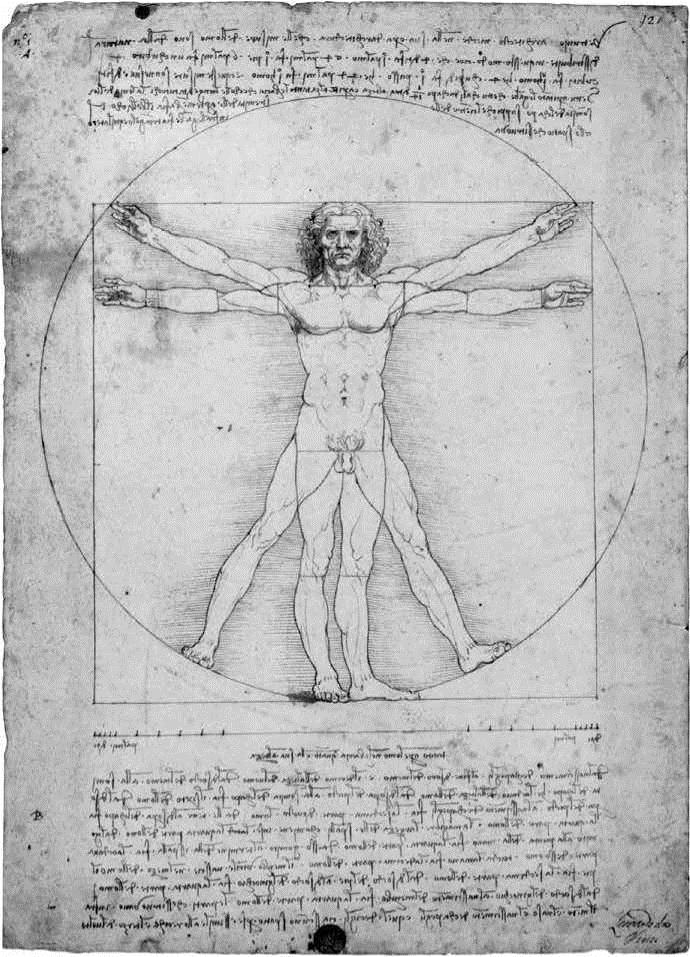
(The Human Proportions (after Vitruvius, c. 1490))
Preface
The task of preparing teaching-learning material for value-oriented education is enormous.
There is, first, the idea that value-oriented education should be exploratory rather than prescriptive, and that the teaching-learning material should provide to the learners a growing experience of exploration.
Secondly, it is rightly contended that the proper inspiration to turn to value-orientation is provided by biographies, autobiographical accounts, personal anecdotes, epistles, short poems, stories of humour, stories of human interest, brief passages filled with pregnant meanings, reflective short essays written in well-chiselled language, plays, powerful accounts of historical events, statements of personal experiences of values in actual situations of life, and similar other statements of scientific, philosophical, artistic and literary expression.
Thirdly, we may take into account the contemporary fact that the entire world is moving rapidly towards the synthesis of the East and the West, and in that context, it seems obvious that our teaching-learning material should foster the gradual familiarisation of students with global themes of universal significance as also those that underline the importance of diversity in unity. This implies that the material should bring the students nearer to their cultural heritage, but also to the highest that is available in the cultural experiences of the world at large.
Fourthly, an attempt should be made to select from Indian and world history such examples that could illustrate the theme of the upward progress of humankind. The selected research material could be multi-sided, and it should be presented in such a way that teachers can make use of it in the manner and in the context that they need in specific situations that might obtain or that can be created in respect of the students.
The research team at the Sri Aurobindo International Institute of Educational Research (SAIIER) has attempted the creation of the relevant teaching-learning material, and they have decided to present the same in the form of monographs. The total number of these monographs will be around eighty to eighty-five.
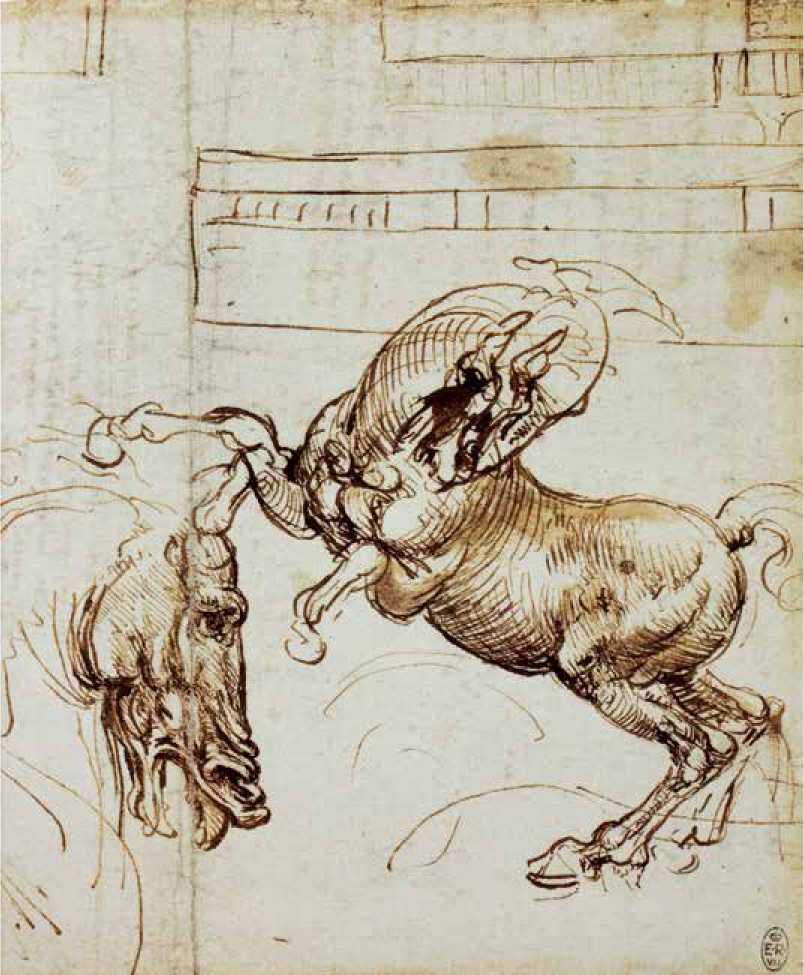
(Horse studies, c. 1503/4)
It appears that there are three major powers that uplift life to higher and higher normative levels, and the value of these powers, if well illustrated, could be effectively conveyed to the learners for their upliftment. These powers are those of illumination, heroism and harmony.
It may be useful to explore the meanings of these terms - illumination, heroism and harmony - since the aim of these monographs is to provide material for a study of what is sought to be conveyed through these three terms. We offer here exploratory statements in regard to these three terms.
Illumination is that ignition of inner light in which meaning and value of substance and life-movement are seized, understood, comprehended, held, and possessed, stimulating and inspiring guided action and application and creativity culminating in joy, delight, even ecstasy. The width, depth and height of the light and vision determine the degrees of illumination, and when they reach the splendour and glory of synthesis and harmony, illumination ripens into wisdom. Wisdom, too, has varying degrees that can uncover powers of knowledge and action, which reveal unsuspected secrets and unimagined skills of art and craft of creativity and effectiveness.
Heroism is, essentially, inspired force and self-giving and sacrifice in the operations of will that is applied to the quest, realisation and triumph of meaning and value against the resistance of limitations and obstacles by means of courage, battle and adventure. There are degrees and heights of heroism determined by the intensity, persistence and vastness of sacrifice. Heroism attains the highest states of greatness and refinement when it is guided by the highest wisdom and inspired by the sense of service to the ends of justice and harmony, as well as when tasks are executed with consummate skill.
Harmony is a progressive state and action of synthesis and equilibrium generated by the creative force of joy and beauty and delight that combines and unites knowledge and peace and stability with will and action and growth and development. Without harmony, there is no perfection, even though there could be maximisation of one or more elements of our nature. When illumination and heroism join and engender relations of mutuality and unity, each is perfected by the other and creativity is endless.
A study of the life of Leonardo brings to the students a deeper meaning of what we can call ‘genius’. Leonardo was more than a genius. Will Durant has remarked that Leonardo represents perfection of all the great attributes of the Renaissance in Europe. It may be said that Leonardo presented a marvellous example of the evolutionary stage from where superhumanity can gradually emerge. Leonardo’s knowledge was vast, and the knowledge had the glow of illumination; his heroism lay in transcending human limitations; and his sense of harmony manifested most visibly in his paintings, such as those of Mona Lisa, The Last Supper and The Virgin of the Rocks.
Leonardo has been compared by Will Durant with Augustus Caesar, although the latter stood out in the realm of statesmanship and the former stood out in the field of the vision of the future. But the comparison is just; both the personalities bear a magnificence and majesty of the kinghood of mankind. It is in this light that the monograph should be studied by the reader.
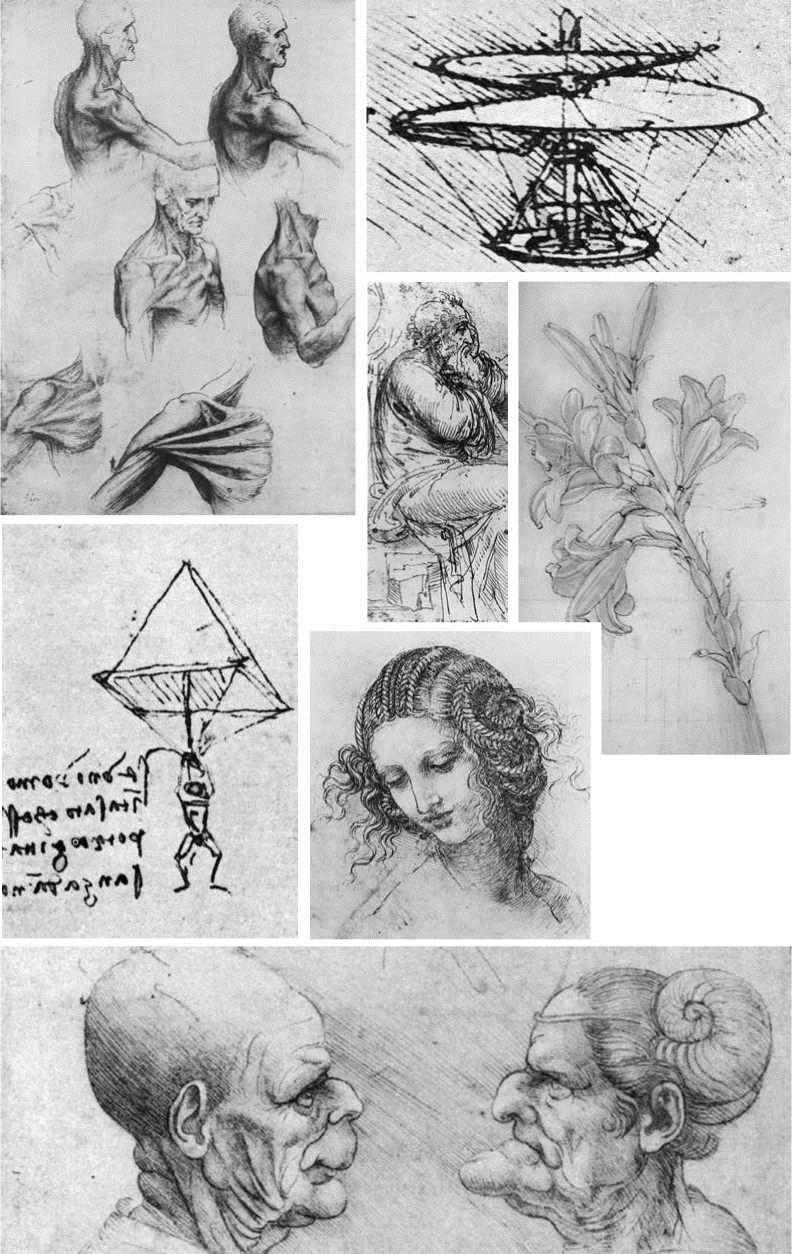
In the whole world there is perhaps no other example of a genius so universal, so inventive, so incapable of contenting himself, so eager for infinity, so naturally intelligent, so far ahead of his century and the centuries which followed. His figures express an incredible sensibility and spirit; they overflow with unexpressed ideas and sensations.
— Hippolyte Taine, 1866
Introduction
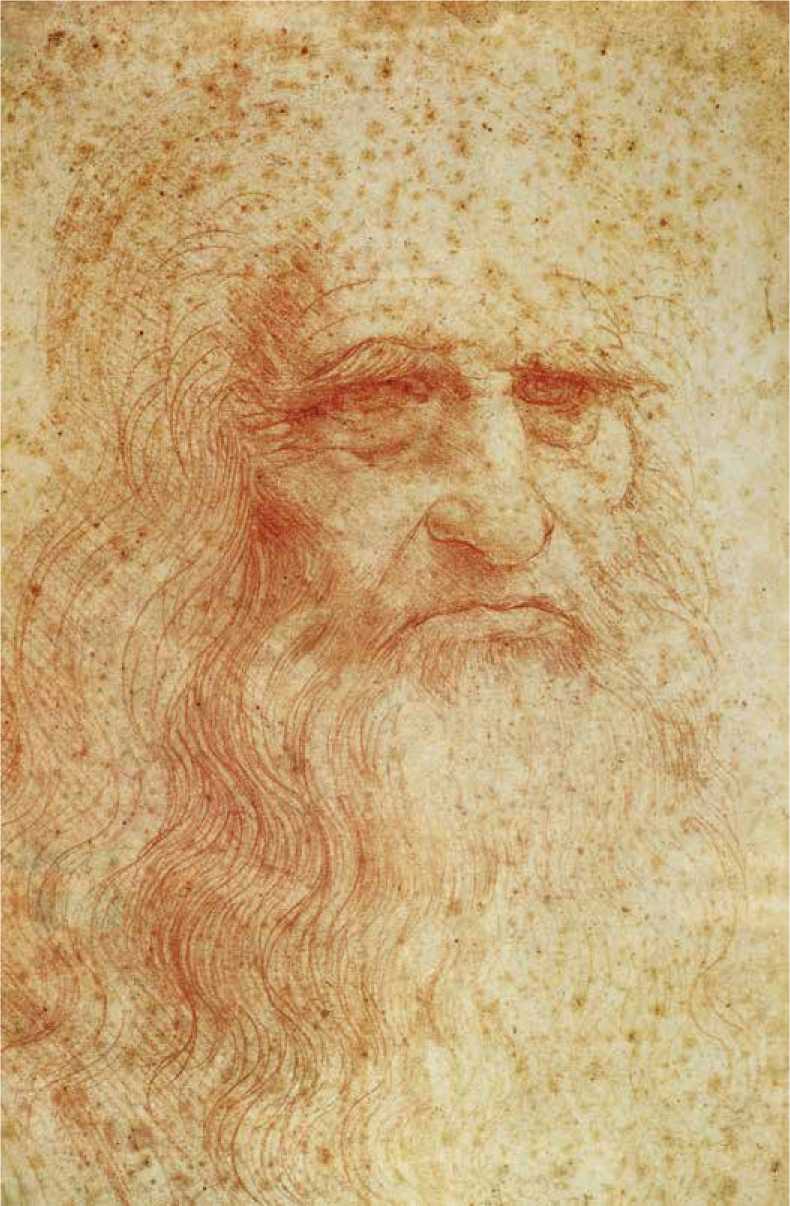
(Head of a bearded man (so-called Self-portrait, c. 1510/1515))
More than a century before Galileo, one man succeeded in overcoming the age-old distinction between the contemplative and active life, between science and craft, through a unique synthesis of scientific investigation and artistic expression. For his work in which he employed physical experimentation, mathematics and reason, he has been called the first modern engineer. He anticipated many inventions which would be realised only much later, such as the airplane, the submarine, the parachute, the armoured car. But the fact that he broke entirely with the medieval Aristotelian tradition and started a new quantitative and experimental approach to a new science of matter is what makes him the forerunner of early modern scientists like Galileo, Francis Bacon, William Harvey, Nicolaus Copernicus and Isaac Newton.1 This man was Leonardo da Vinci.
Leonardo’s lifetime was a period of great cultural turmoil, marked by such notable events as the introduction of the printing press (1455), the discovery of America (1492) and the beginning of the Protestant Reformation (1517). The Renaissance, which means a “rebirth” of ancient Greek and Roman culture, marked the decline of the Middle Ages and laid the foundations of modern times.
This complex process of cultural evolution started in the fourteenth century with a growing dissatisfaction with the medieval concepts of man and knowledge, and brought about radical changes before it ended in the seventeenth century. A firm foundation had been laid for a new science of nature, a new materialistic and utilitarian concept of man, and a new political order of independent, secular nation-states.2 Three distinct intellectual movements contributed to that process: the humanists, the Aristotelian scholars, and the artists and craftsmen.
The modern image of man originated in Renaissance philosophy and particular influence can be found in the works of humanists like Petrarch (De Remedius Utriusque Fortunae, 1366), Leon Battista Alberti (Della Famiglia, — On the Family — 1444), and Pico della Mirandola (De Dignitate Hominis, — On the Dignity of Man — 1486). The final dominance of this utilitarian image of man oriented around worldly success can be found in Adam Smith’s An Inquiry into the Nature and Causes of the Wealth of Nations, 1776.
The secular nation-states of the late seventeenth and eighteenth centuries in France, England and Spain replaced Papal and feudal power.
The humanists were originally university teachers of rhetoric, grammar, poetry and history, but came to include educated laymen, civil servants and merchants. To the humanists, the ideal individual was one equipped with intellectual and practical skills, and viewed as the conscious mover of his own fate. To them, the aim of life was success and fulfilment in the world, not beyond it. This new image of man as an active individual striving rationally towards worldly success began to replace the medieval world-view which was centred around religion and conceived of man’s earthly existence as a mere preparation and test for the promised life after death.
Simultaneously, the Aristotelian scholars who constituted the scientific community during the Middle Ages began a critical reflection on their traditional approach to science. Aristotelian science was based on daily-life experience and common sense and operated in a closed world — the earth as its centre — about which everything to be known had already been expounded by the great philosopher himself. This approach was naturally inimical to discovery and innovation, for it could not provide a conceptual framework within which new knowledge could be generated. This was especially crucial in the natural sciences like biology and physics where newly gathered information only too often proved Aristotle wrong. At first this situation led to a sort of scientific pluralism in the explanation of nature, and magic, alchemy and astrology flourished; but in the end, the new sciences of biology and physics based on reason, experiment and mathematics replaced the old Aristotelian concept of human knowledge.
The third movement contributing to the cultural change from the Middle Ages to modern times involved the Renaissance artists and craftsmen who were originally manual workers like painters (white-washers), masons and blacksmiths. Usually they lacked any formal education and had to rely exclusively on the knowledge transmitted orally through their guilds, and on their own experience and skill. Engaged in solving practical problems of construction and decor, they began to apply mathematics and experimentation as indispensable tools for their work. They found that the artist’s freedom to create was limited by nature’s own rules, and hence saw that a thorough knowledge of the hidden structure of reality was a necessary condition for any artificial recreation by the artist.
Leonardo da Vinci belonged to this third group. He received only a very basic formal education and was thirty years old when he finally learned Latin, a necessary tool since most books of these days were written in Latin. Yet his broad interest in scientific matters makes him an outstanding exception among the craftsmen and painters of his time. Leonardo transcended all traditional boundaries between science and art, and in the process raised both fields to new heights.
Chapter I
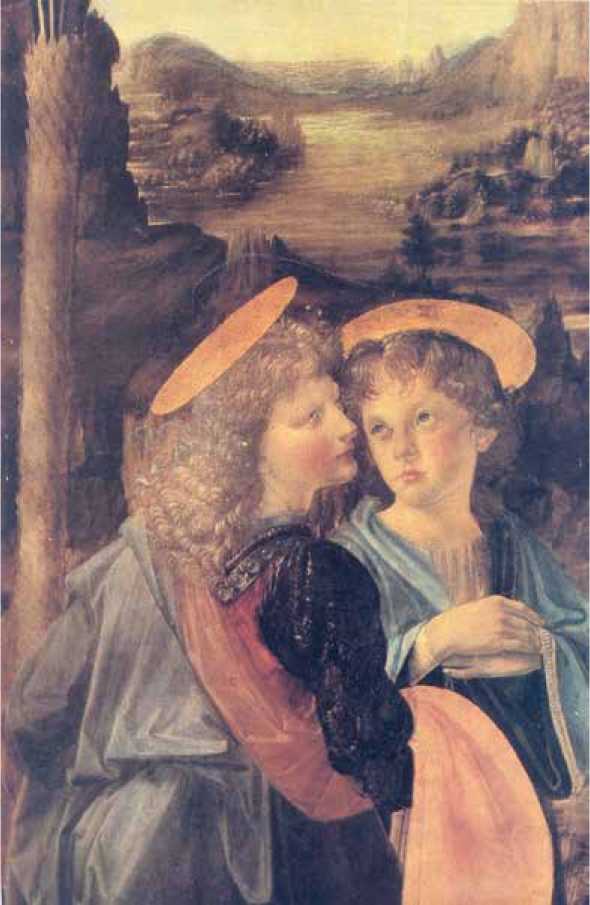
(Baptism of Christ, by Verrochio, detail. The angel on the left and the landscape are said to have been the work of Verrochio’s pupil Leonardo. According to Vasari the master was so chagrined that a child should know more than he that he abandoned painting.)
The man who painted the world-famous Mona Lisa was born near the village of Vinci, in the countryside of Florence, on April 15, 1452. He was baptized Leonardo and was to become one of the most brilliant figures in a fascinating period of European history, the Italian Renaissance. He is mostly known as an artist, but he was much more, and his impact on the course of Western history has been immeasurable. Leonardo’s unparalleled diversity of talents justifies calling him a “genius”, a true embodiment of the Renaissance ideal of a universal man. Not only did he excel as a painter and sculptor, but he displayed a whole range of artistic and scientific capacities in such diverse fields as mathematics, mechanics, aeronautics, anatomy, geography, botany, astronomy, military engineering and even town planning and architecture.
Leonardo began his career as a painter in his hometown, Florence, which was one of the two cultural centres of Renaissance Italy, the other being Venice. He became an apprentice to the painter and sculptor Andrea del Verrocchio, who is reported to have stopped painting when he saw that his young student Leonardo had surpassed him.3 Leonardo enjoyed inspiring companionship: among his fellow-students were Ghirlandaio and Perugino. And in the ruler of Florence, Lorenzo di Medici, “Il Magnifico”, Leonardo found an art-loving patron who generously promoted all the arts, literature and philosophy.4 But after executing a few major works — the large panel painting The Adoration of the Magi5 is a revealing example of his early mastery and remarkable talent — Leonardo left his hometown in 1482 to work for Ludovico Sforza, “Il Moro”, duke of Milan.6 The motives for this decision are not completely clear, but it seems that the intellectual atmosphere of Florence, which at that time was strongly influenced by mystical Hermetism and esoteric Neoplatonism, did not appeal to the more rationally inclined Leonardo.7 He was an independent and critical investigator who despised dogma as well as magic as futile attempts to understand and influence reality. Alchemy to him was nothing more than “the most foolish opinions”, and he even expressed his hope that the flourishing astrologers of his day would be castrated.8 He showed the same attitude towards Christian doctrine, if one can trust his sixteenth century biographer Vasari who related that “Leonardo was of so heretical a cast of mind that he conformed to no religion whatever, accounting it perchance much better to be a philosopher than a Christian.”9
Hermetic literature dates from the first to the last parts of the third century AD, and was rediscovered during the Renaissance. Hermetism is an effort to bridge the gap between religion and science and to deify man through knowledge of the world and experience of the transcendent divinity.
At any rate, when Leonardo heard that Ludovico wanted a military engineer, an architect, a sculptor, and a painter, he decided to offer himself as all these in one. And so he wrote his famous letter:
Most Illustrious Lord, having now sufficiently seen and considered the proofs of all these who count themselves masters and inventors of instruments of war, and finding that their invention and use of the said instruments does not differ in any respect from those in common practice, I am emboldened without prejudice to anyone else to put myself in communication with your Excellency, in order to acquaint you with my secrets, thereafter offering myself at your pleasure effectually to demonstrate at any convenient time all those matters which are in part briefly recorded below.
I have plans for bridges, very light and strong, suitable for carrying very easily...
When a place is besieged I know how to cut off water from the trenches, and how to construct an infinite number of... scaling ladders and other instruments ...
I have plans for making cannon, very convenient and easy of transport, with which to hurl small stones in the manner almost of hail ...
And if it should happen that the engagement is at sea, I have plans for constructing many engines most suitable for attack or defense, and ships which can resist the fire of all the heaviest cannon, and powder and smoke.
Also I have ways of arriving at a certain fixed spot by caverns and secret winding passages, made without any noise even though it may be necessary to pass underneath trenches or a river.
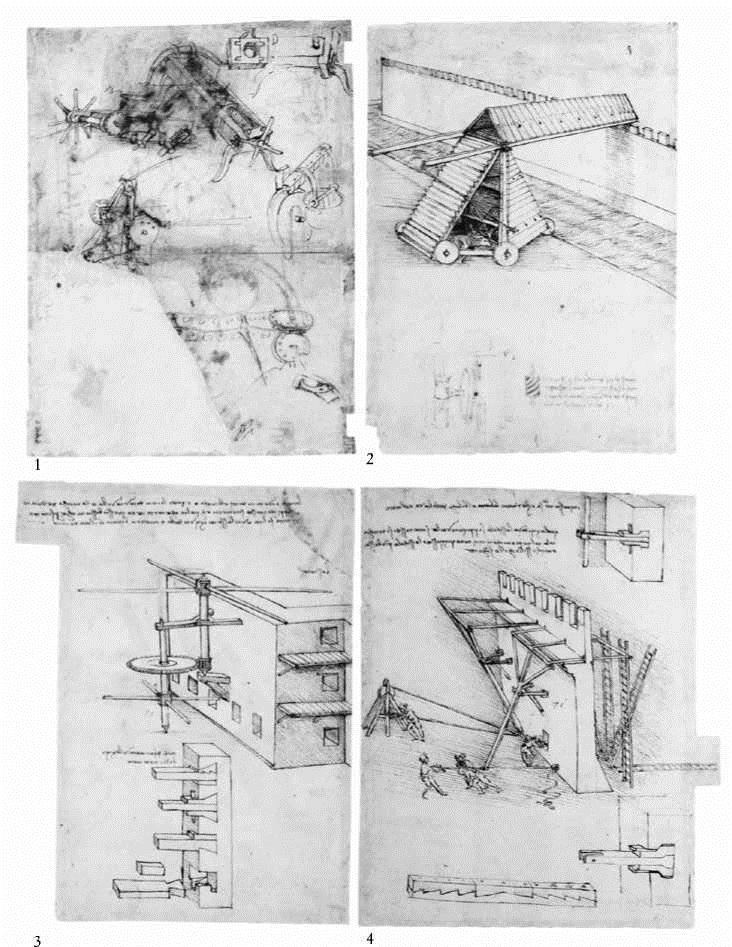
(1. Mechanism for drawing Crossbows - 2. Design for a Siege Machine with Covered Bridge - 3. Machine to prevent Fortress Walls being Scaled - 4. Mechanism for repulsing Scaling Ladders.)
Also I can make covered cars, safe and unassailable, which will enter the serried ranks of the enemy with artillery, and there is no company of men at arms so great as not to be broken by it. And behind these the infantry will be able to follow quite unharmed and without any opposition.
Also, if need shall arise, I can make cannon, mortars, and light ordnance, of very beautiful useful shapes, quite different from those in common use.
Where it is not possible to employ cannon, I can supply catapults, mangonels, traps, and other engines of wonderful efficacy not in general use. In short, as the variety of circumstances shall necessitate, I can supply an infinite number of different engines of attack and defense.
In time of peace I believe that I can give you as complete satisfaction as anyone else in architecture, in the construction of buildings both public and private, and in conducting water from one place to another.
Also I can execute sculpture in marble, bronze, or clay, and also painting, in which my work will stand comparison with that of anyone else whoever he may be.
Moreover, I would undertake the work of the bronze which shall endue with immortal glory and eternal honour the auspicious memory of the Prince your father and of the illustrious house of Sforza.
And if any of the aforesaid things should seem impossible or impracticable to anyone, I offer myself as ready to make trial of them in your park or in whatever place shall please your Excellency, to whom I commend myself with all possible humility.10
It is not known what Ludovico replied, but the thirty-year- old Leonardo entered the splendid court of Ludovico Sforza with great acclaim. He was described as “a beautiful person, well proportioned, with a fine beard well arranged in ringlets, reaching down to the middle of his chest”,11 and he fascinated his audience with his playing on a lyre his own hands had fashioned in the form of a horse’s head, with his gentle voice, and with his subtle arguments in conversation. “His powers of conversation were such as to draw to himself the souls of listeners”, remembers Vasari.12 Employed as a “painter and engineer of the Duke”, Leonardo directed an extensive workshop with several students, entertained the court with his decorations for the frequent festivities, and did some paintings, among them the beautiful Virgin of the Rocks and the monumental Last Supper.
The story of the execution of this last painting gives telling insights into the personality of the great painter. Shortly after he entered Ludovico’s service, the Duke asked him to depict the Last Supper on the far wall of the refectory where the Dominican friars took their meals, at the church of Santa Maria delle Grazie. For three years (1495-98) Leonardo laboured but dallied at the task. The head of the monastery complained to Ludovico of Leonardo’s apparent sloth: the painter would sit before the wall for hours without painting a stroke. Leonardo explained to his patron that the artist’s most important work lies in conception rather than execution. In this case he had two great difficulties, he said: to conceive features worthy of Jesus Christ, and to picture a man as heartless as Judas. Leonardo spent much of his time searching the streets of Milan for heads and faces that could serve him in representing the Apostles. One of the tragedies of Leonardo’s life is that because of certain unconventional mural techniques the paint soon began to flake and fall. Leonardo shunned the traditional fresco method where the painter had to work fast on wet plaster, and tried a new mixture of colours intended to give the painter more time for contemplation. Today, although we can hardly study the shades of subtleties of the painting, the composition and general outlines alone make it evident that The Last Supper deserves to be called the greatest painting of the Renaissance.
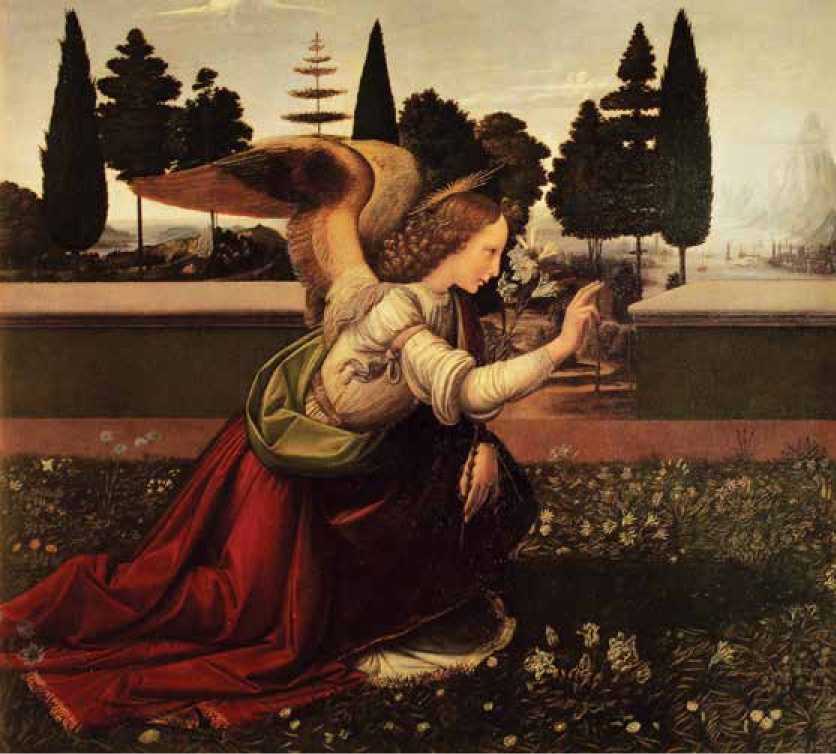
(Annunciation, c. 1472)
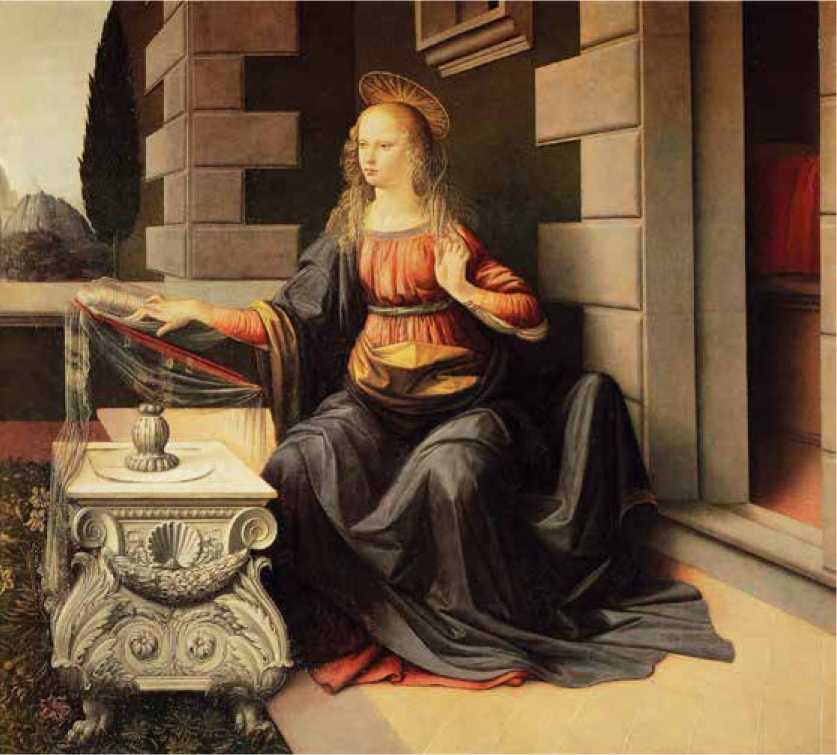
Leonardo’s most ambitious project for Ludovico, a sixteen-feet high equestrian statue in honour of Francesco Sforza, the Duke’s father, was a failure, an exhausting and unnerving experience for Leonardo. The tons of bronze intended for the statue were instead used to make cannonballs to fight the French who were then menacing Milan. After four years of work, Leonardo had only finished the clay model of the horse, which the French soldiers used as a target when they captured the city. The many anatomical sketches Leonardo had made were of such excellent quality that they set a new standard for anatomical drawings.
During the seventeen years Leonardo stayed in Milan he released the creative power of his investigative mind through the study of nature by all sorts of different means; ranging from geometry, architecture and painting to geology, biology and mechanical engineering. He recorded the proceedings of these studies in notebooks, writing the Italian vernacular in a strange mirror-script.13 (see example p. 83-85) He is said to have composed about 120 manuscripts, and the fifty that remain are a treasure for historians of science and philosophy. He combined text and illustrations as a method — he called it dimonstratione (demonstration) to present his discoveries and inventions; but the notebooks were never published.
One of the most striking themes in the notebooks, one which Leonardo spent half his life studying, is the problem of human flight. He envied the birds as a species in some ways superior to man. He studied every aspect of their wings and tails, and the mechanics of their soaring, gliding, turning and descending. And he planned the conquest of the air:
You will make an anatomy of the wings of a bird, together with the muscles of the breast, which move these wings. And you will do the same for a man, in order to show the possibility of a man sustaining himself in the air by the beating of wings.14
A bird is an instrument working according to mechanical law. This instrument it is within the power of man to reproduce with all its movements, but not with a corresponding degree of strength.15
In a brief essay, Sul Volo (On Flight), he described a flying machine made by him of strong cloth, leather and silk. He called this machine “the bird” and wrote instructions on how to fly it:
Make trial of the Machine over the water, so that if you fall you do not do yourself any harm...16
The great bird will take its first flight... filling the whole world with amazement and all records with its fame; and it will bring eternal glory to the nest where it was born.17
During Leonardo’s lifetime only one work of his was published, in collaboration with the mathematician Luca Pacioli, entitled De Divina Proportione (on Divine Proportion), published in Venice in 1509. His Treatise on Painting was edited after his death by his lifelong friend Francesco Melzi.18 This work must be seen in the context of the ongoing Renaissance discussion on the scientific foundation of art, as exemplified by the works of L.B. Alberti and Piero della Francesca.19 In the Treatise, Leonardo demonstrated the mathematical and biological basis of the art of painting, described the geometry of space and functioning of the eye, and expounded the concept of saper vedere (to know how to see), as the creative method not only for painting but for every conscious artistic expression. For Leonardo, “the eye is the window of the soul”20 and the most noble of the senses, constantly reflecting and determining what we call “reality”. The painter once endowed with the powers of perception and the perfect ability to pictorialize what he perceives becomes thus a real scientist, achieving knowledge by observation and reproducing that knowledge authentically.
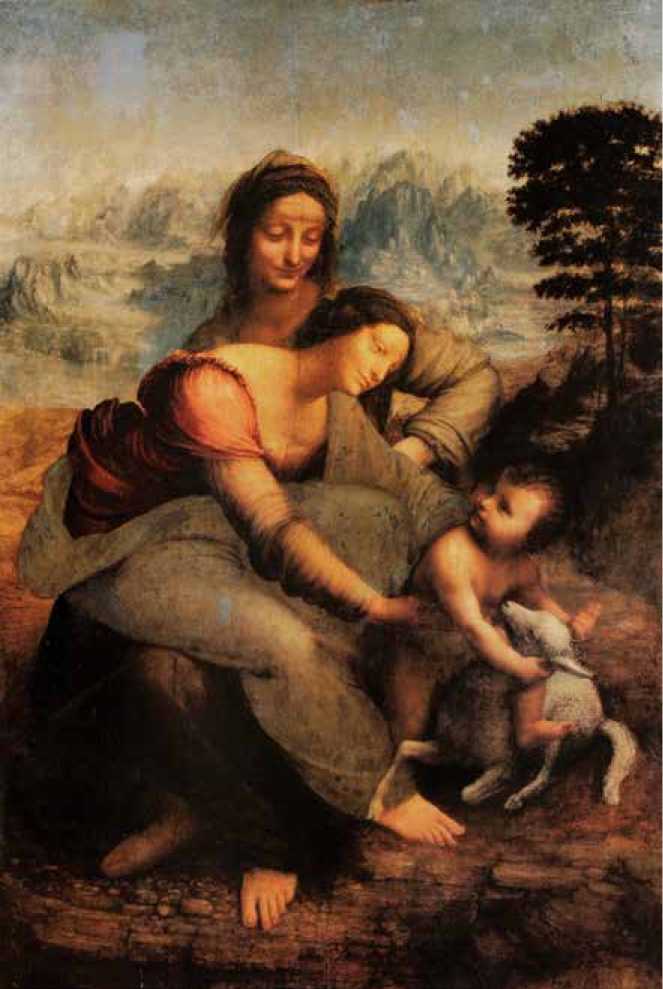
(Virgin and Child with St Ann, c. 1502/1513?)
Unexplained gaps in the chronology of Leonardo’s life between 1482 and 1487 have given rise to speculations about a journey to the Near East or even Asia, but apart from some passages in the Codice Atlantico notebook, there is no convincing evidence. In 1499 the French King Louis VII captured Milan and soon afterwards Leonardo and his friends returned to Florence where he was welcomed with honour and given ample opportunity to work. He made the cartoon for an altarpiece, The Virgin, Child, and St. Ann, and when it was publicly displayed it attracted large crowds of people who came as if attending a solemn festival. But his life was “so irregular and unsettled that he may be said to [have lived] from day to day.”21 Only his constant search for new frontiers can explain his decision to enter the service of the ruthless commander-in-chief of the Papal Army, Cesare Borgia, son of the notorious Pope Alexander VI.22 Borgia was entrusted with the mission of gaining control of central Italy, and Leonardo stayed with him as his “military engineer” for almost one year. Besides military advice, he supplied maps of cities and topographical sketches which laid the foundation of modern cartography.
Upon his return to Florence the governing council of the city organised a competition in the Palazzo Vecchio for the best mural painting on an historical theme. The population of Florence watched in expectation as the two greatest artists of the day, Leonardo and Michaelangelo, became competitors. But neither Leonardo’s Battle of Anghiari nor Michaelangelo’s Battle of Cesna were completed. It is not clear whether Leonardo’s return to Milan in 1506 was precipitated by personal quarrels with Michaelangelo or by disappointment with another failure to employ a new technique for the monumental (7x17 meters) mural (he seems not to have learned the lesson of The Last Supper).
However he asked for and was granted permission to leave Florence and work in Milan for the French Chancellor, Charles d’Amboise. Here Leonardo stayed for six years, decorating palaces, preparing festivals, designing canals and sewage systems for Milan, studying anatomy, and doing some painting. But his success as an engineer and scientist was marred by another disappointment in his work as a sculptor, when again an equestrian monument — this time for a victorious French Marshal — did not go beyond the stage of preliminary sketches. At any rate, it seems that Leonardo was more and more occupied with the scientific investigation of matter, and his notebooks of that time, including mechanical, optical, mathematical, biological and geological studies, reveal that he was increasingly convinced that nature worked on the basis of mathematically explicable rules. “Let no man who is not a mathematician read the elements of my work,”23 he insisted, recalling the ancient Greek mathematician Euclid and anticipating the quantification of natural philosophy by Galileo.
When the French lost Milan in 1513, Leonardo, now sixty, again had to move. He left for Rome where the art-loving Pope Leo X (formerly Giovani di Medici) commissioned great works from Raphael, Michaelangelo, Bramante and Peruzzi.24 He was entertained at the Belvedere, a summer palace atop the Vatican Hill, but could not find the place he deserved as a master artist and received no large commission from the Pope. In fact, Leo X complained about him: “This man will never get anything done, for he is thinking about the end before he begins.”25 Thus, after three years of disappointment and loneliness in Rome, Leonardo readily accepted an invitation from King Francis I to come to France. He spent the last three years of his life, accompanied by the faithful Francesco Melzi, in the castle of Cloux near the Loire river, greatly admired by the French King who later told Benevenuto Cellini that he “believed no other man had been born who knew as much about sculpture, painting and architecture, but still more... was a very great philosopher.”26 Francis I gave Leonardo complete freedom to make finishing touches on some of his paintings and to rearrange and edit his notebooks. Leonardo died on May 2, 1519, and was buried in the palace Church of Saint Florine, which was destroyed during the French Revolution and completely torn down in the early nineteenth century. Except for his creations, no trace of Leonardo remains. But he once wrote: “A day well spent makes it sweet to sleep, so a life well used makes it sweet to die.”27
Four centuries later, we may be able to see Leonardo’s impact and significance on the course of history much more clearly than his contemporaries, among whom only a handful realised his unique talent and his advanced state of consciousness. His synthesis of science and art, of investigation and expression, was a major break-through on the way towards modern empirical and rational science. His paintings, above all Mona Lisa and The Last Supper, are such extraordinary renderings of physical and spiritual realities as to be considered immortal peaks of art. In sculpture he conceived the greatest projects of his age, and the anatomical sketches for the two equestrian monuments still rank among the best works ever done in anatomy. As a scientist, besides inventing many curious devices, he initiated a new way of exploring matter: his methods of experiment and quantification combined with visual demonstrations and textual explanations anticipate the modern scientific methods, and his concept of “force” as the prime agent in organic and inorganic matter has become a fundamental notion of modern physics. His science of seeing, saper vedere, as a precise method of revealing and understanding the secrets of reality ranks beside Socrates’ Know that you do not know as a philosophical and practical guideline for a conscious life.
The philosopher and historian Will Durant has this to say about Leonardo:
How shall we rank him? — though which of us commands the variety of knowledge and skills required to judge so multiple a Man? The fascination of his polymorphous mind lures us into exaggerating his actual achievement; for he was more fertile in conception than in execution... And yet Leonardo’s studies of the horse were probably the best work done in anatomy of that age; Ludovico and Cesare Borgia chose him, from all Italy, as their engineer; nothing in the paintings of Raphael or Titian or Michaelangelo equals The Last Supper; no painter has matched Leonardo in subtlety of nuance, or in the delicate portrayal of feeling and thought and pensive tenderness; no statue of the time was so highly rated as Leonardo’s plaster Sforza; no drawing has ever surpassed The Virgin, Child and Ste Anne; and nothing in Renaissance philosophy soared above Leonardo’s conception of natural law.
He was not “the man of the Renaissance”, for he was too gentle, introverted, and refined to typify an age so violent and powerful in action and speech. He was not quite “the universal man”, since the qualities of statesman or administrator found no place in his variety. But, with all his limitations and incompletions, he was the fullest man of the Renaissance, perhaps of all time. Contemplating his achievement we marvel at the distance that man has come from his origins, and renew our faith in the possibilities of mankind.28
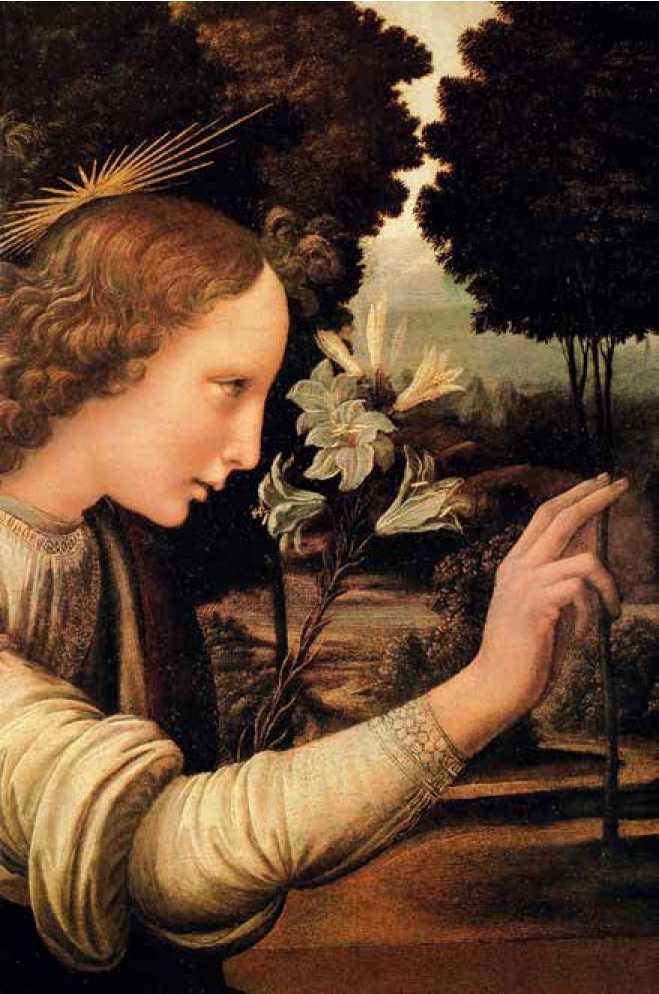
(Annunciation, detail)
Leonardo’s constant search for precision in cognition and for perfection in expression often brought him beyond the scope of the original task at hand, and he sometimes got lost in experimenting with details and distracted by exploring new possibilities. Sometimes when his thirst for knowledge was satisfied he lost interest in his subject and would drop it in favour of new frontiers. And only too often the ignorance and arrogance of his patrons frustrated him. His spiritual aspirations to see and to express clashed with the imperfections of the physical world. There was in him some conflict between the spiritual and the material. But in the instances that Leonardo was able to overcome this seeming contradiction and synthesize his vast talents, the results were so stupendous that they remain timeless inspirations in the search for an integral aim of life.
Altogether, his genius was so wonderfully inspired by the grace of God, his powers of expression were so powerfully fed by a willing memory and intellect, and his writing conveyed his ideas so precisely, that his arguments and reasonings confounded the most formidable critics.
— Giorgio Vasari, 1568
Chapter II
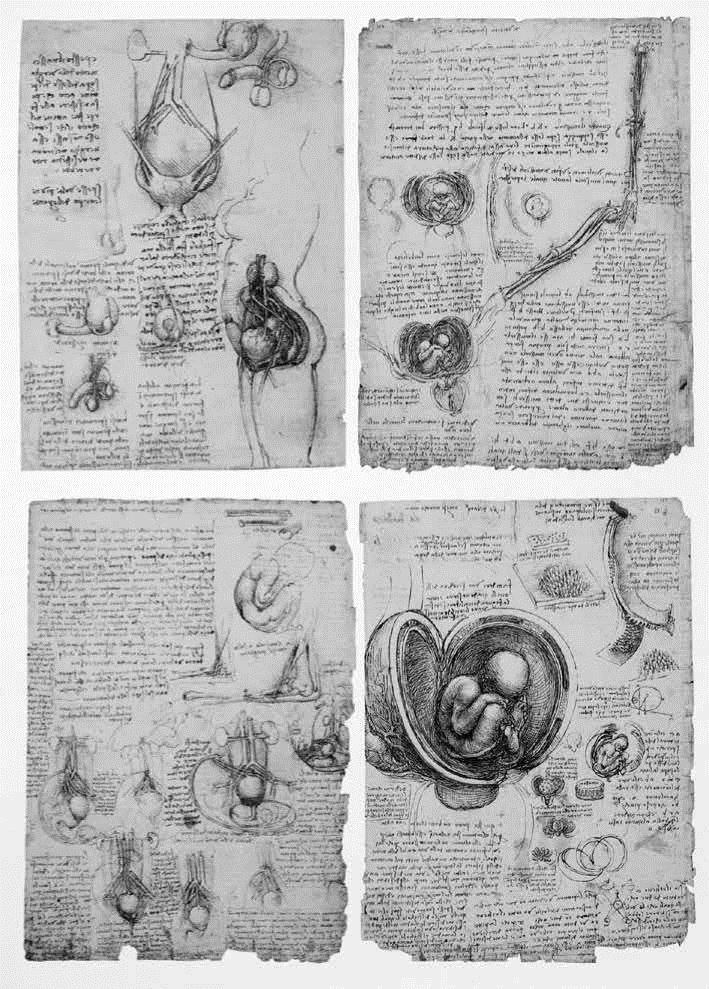
(Top left: comparative drawings of the male and female genitalia. Others: anatomical studies of the developing foetus)
When he writes that he is an uomo senza lettere, he is suggesting that he did not have a formal education, that he did not learn either Latin or Greek, or even the literary Italian of the times: in a word, that he is self-taught. And so, this genius with a universal mind, whose intelligence wished to capture and tap every source, never had the humanist formation, which during the Renaissance, distinguished the well bred from the common man.
He was an insatiable reader who exhaustively delved into the libraries of all of his friends. The books he bought or borrowed were destined for the purpose of discovering the universe. He thought that any book not read, and any experience not fully understood, left a hole in the fabric of the fundamental being.
It seems as though tradition never weighed him down nor slowed his pace, nor inhibited him in his flight towards the exploration of curiosities and realisations. He did not share the respect for “the Ancients” that sometimes paralysed the humanists religiously attached to antiquity.
He was only thirty years old when he introduced himself to Ludovico the Moor, the regent of the kingdom of Milan, in a famous letter where he offered him his secrets. He expressed himself as though he had in his power a method through which he could resolve all the problems that outside circumstances or his own will could pose to him.
He claimed that, “The senses belong to earth; reason stands apart from them in contemplation.” Would this be in part, the first instigator of his intellectual quest, the genesis of his notebooks? He was a tireless writer, filling notebook after notebook with his left-handed writing, each letter having its own nimble personality, the inverted writing akin to a secret code. The frequent diagrams reconstitute the movement of his running thought, fighting his own contradictions. I ask: this phrase constantly recurs. He was whipped forward by a sense of curiosity that nothing could quench, and which simultaneously embraced all forms of knowledge, intuitive and experimental, dialectic and factual. He seemed to contradict himself: he started with current public opinion and attempted to ascertain whether it was valid. He repeated an experiment ten times over, needing irrefutable proof before daring a personal affirmation. Although most of the time he kept records, he did not organize them, making it difficult to determine what his ultimate conclusions were.
Self-taught, with meagre means at his disposal, he explored the universe. Through the use of analogies and correspondences, he developed a general theory of the world — solid, powerful, coherent. He cities Aristotle: “Man deserves merit or blame only in consideration of what is in his power to do or not to do.” It is however from 1490 as far as can be seen, that Leonardo tries to assimilate and rigorously inventory (after what he called “my mathematical principles”): the totality of human knowledge; restructuring it, correcting it when needed, and stretching it if possible. He was always thinking about the universe, and he had fixed his sights on this obstinate rigour that considers itself the most demanding of all. This rigour established, a positive liberty becomes possible, while apparent liberty is only to be able to obey each impulse of chance; the more we enjoy, the more we are tied up around the same point, just as the cork bobbing on the sea which nothing holds, which is attracted by everything, and which all the forces of the universes fight over and destroy. The entire operation of this master Leonardo is uniquely deduced from his great work; as if a particular being had no relation to it. His thought appears more universal, so detailed and isolated that it does not seem to belong to an individual. There is no superstition of the intellect, no vain fears. Nor did he fear analyses; he drove them, or was driven by them; to some remote conclusion he returned without effort to the real. He imitated, he innovated; he did not reject the ancient because it was ancient or the new because it was new; but he consulted within himself something eternally real. Any knowledge we gather from his writings was not meant to be read by us. In all that the artist and the scholar has written, one must clearly distinguish what was meant for publication: those treatises he chose to distribute among his contemporaries and to posterity; treatises of all kinds — on the art of painting, on anatomy, on the horse, on the speed of air, on land formation, on prehistoric shells, on the flight of birds, on the construction of canals, on the drainage of swamps and so on, ad infinitum: enough to fill a multitude of existences. Not only did he write about all that could be known, but also about everything that could be done, since any knowledge that is not movement, or action, or cause for realizing is theory and not practice, and must be considered as accessory, less important than the rest. In his writings, Leonardo distributed didactical knowledge, he taught what he himself had learned; whether through books, through his conversations with men of all classes or professions that he had met, and — above all — through his own experience. Anything in his notebooks that was not meant to be published or to prepare for a future publication, was meant for him alone. From this tendency comes the apparent disjointedness of his notes, numbering more than 5000 unorganised pages. In spite of the mutilations that these notes were subjected to, the compilations, as they come to us remain a monument of inestimable importance. There exists nothing comparable among any of the documents at our disposal on the motivations of artistic creation and on the multiple preoccupations of a genius.
From these thousands of sketches and notes we get the extraordinary feeling of a staggering display of sparks exploding from some fantastic creation. Leonardo is revealed as obsessed by an endless number of problems, not only of perspective, physiology, geometry, architecture, sculpture, landscape, optics, shadow and light, ornaments, knots, rosettes, interlaces, meteorology, zoology, botany, as well as, among others mechanics, ballistics, and hydraulics, which materialize in projects of public works, artillery and other engines of war resulting in the famous diagrams of flying machines and submarines.
He writes: “One cannot possess either a lesser or greater domain than the domain of oneself.” This Apollo ravishes us to the utmost of ourselves. What is more seductive than a god who rejects mystery, who does not build his power on the disquiet of our senses, who does not address his prestige to the darkest, to the most vulnerable, the most sinister part of ourselves; who forces us to agree and not to bend; and for whom the miracle is to make himself clear; the depth, a perspective well-defined? Is there a better mark of an authentic and legitimate power than not to practice under a veil? Never was there for Dionysius a more deliberated enemy, nor one so pure, nor armed with so much light, than this hero less preoccupied with bending and breaking monsters than with considering their motives; disdainful of piercing them with arrows so much as harassing them with questions; their superior more than their conqueror, he wished to understand them rather than to triumph over them — almost to the point of reproducing them; and as soon as he got hold of their principles he could very well abandon them, derisively reducing them to the humble condition of particular cases and explicable paradoxes.
He was also a visionary who was not afraid to venture beyond the limits of experience and reason. Who can listen to him dreaming of a prehistoric era wherein huge fish lived in oceans covering the earth, and perceive the extent to which the naturalist and the poet reciprocated information? In the Codex Atlantica can be found an assortment of different, extraordinary texts where Leonardo appears under the guise, new and strange, of a visionary poet, an adventure novelist, capable of describing the destruction of the earth by a universal deluge with such tragic vivacity that it is as though he had really been there in the midst of the experience.
Here is the memory he records of having explored a cave, probably in the Apennines. In this extraordinary account, so characteristic of Leonardo, one finds intertwined the art of evoking an image and his passion for earthly enigmas.
“Driven by an ardent desire, anxious to see the varied and strange abundance of forms that artful nature creates, having gone a certain distance between the overhanging rocks, I arrived at the entrance of a huge cavern and stopping for a moment, struck with stupor since I did not know of its existence; back arching, the left hand embracing my knee while with the right shading my furrowed eyebrows, I leaned from side to side, to see if I could perceive anything inside, against the intensity of the darkness. After staying in this position for sometime, two emotions suddenly swelled in me — fear and desire — fear of this menacing dark cavern, desire to see what sort of marvel it was hiding.”
Leonardo made himself more admirable from research to research, training his thoughts, developing his acts. He used one or the other hand for his most precise designs; he stripped them down and reassembled them, he tightened the connections of his will with his powers, pushing his reasoning in the art further and preserving his elegance.
He had other forms of precious knowledge in addition to the knowledge obtained from books: intuitive knowledge and, knowledge of nature that only a man closely related to the elements, informed by them in the physical nature of his own body could possess. A good horseman, he gladly visited the stables of the Duke of Sforza or those of the pope, thoroughly noting down in his notebooks the particularities of the animals he favoured, he demonstrated by these notes what an intimate understanding of the animal he possessed. His sketches of horses are of stupefying anatomical exactitude and specially attest to an extraordinary understanding of the soul of the horse, of its distrustful and fierce restraint, of its savage fears, of its terrible whims. And so it is for the bird. His biographers tell us that he bought captured birds from peddlers to set them free. His sketches of birds in flight are numerous and he wrote a treatise on the topic. Whatever he was interested in took the shape of a treatise in which he would write down everything he knew about a particular subject. Seeing in the bird the very principles of flight, of ascending, the meaning of the appropriation of space in all its dimensions, in the spread of its wings and in the height of its trajectory, Leonardo wished to identify with, to become a real bird, building for himself the body of a bird: constructing a flying machine which will replace the natural mechanism of flight [see sketch p. 84]. That is why the first flying machine invented and built by Leonardo was the recreation, as perfectly as possible, of a bird. But because he realized the inconvenience of this artificial bird, Leonardo later invented the helicopter, which has nothing to do with the bird morphologically. While constructing the flying machine, Leonardo twice recorded the ambitious project in his notebook in almost identical terms: “From the mountain that carries the name of the great bird will take flight the famous bird which will fill the world with its great glory.” This mountain is Mount Ceceri: the Swan. There was no trace of his failures in his notebooks; failures had no interest for him; he erased them from his thoughts, he started differently with the thing which had failed, or he began something else.
This failure of Leonardo is the consequence of what he mistakenly imagined: that the impossible is possible in the absolute! His intentions and his imagination took giant strides; unfortunately, technique did not follow at the same pace.
Leonardo wanted to surpass the possibilities of his time. One would think that he wished to be independent of time, as of space, to escape from the constraints of dimensions, without worrying about what is real and what the world in which he lived demanded. This flight of the visionary, constantly unsatisfied, who aspired to perfection, led him to a series of well-known failures that trail his life.
The Mona Lisa was never delivered to the one who had commissioned it. It would seem that Leonardo always wished to win by postponing, that what he feared was to spoil with hurrying. So he maintained an Olympian impassivity in his defeats. The triple disasters of the equestrian statue, The Last Supper, and The Battle of Anghiari did not seem to discourage him. This serenity, this impassivity had at the time of the Italian wars a bizarre character. They contrast Leonardo to Michelangelo who was quick-tempered, vindictive and violent. And Leonardo’s ascetic solitude is contrasted with the voracious mondanity of Raphael. Though he was so careful and ingenious, he did not see to the preservation, even less to the publication, of his manuscripts and sketches. Even though it would have been easy for him, he did not bother to copy The Last Supper and The Battle of Anghiari on wood or canvas when he realized that they were deteriorating. In fact, few great men cared so little for their glory. Not even of one figure in all of Leonardo’s work can we be sure is a self portrait of the artist, until he made one when he was over sixty: it is as though he did it to take the exact measure of his own aging; he seemed to be looking at life fading away and at death advancing. We know that Leonardo was handsome; he simply did not want the memory of his beauty to survive. Leonardo did not care about his mortal remains, he did not think of having them returned to his place of birth after his death. The failure of The Battle of Anghiari, the great Florentine composition, reveals a curious aspect of his character, something which is both grandeur and a weakness. In this instance, his error consisted of the use of a technique not well adapted to the circumstances. Instead of the traditional fresco, he combined a mixture of elements thought to give more brightness and more brilliance to the painting. Unfortunately, this mixture failed: the colour would not dry, the walls remained impregnated with humidity; Leonardo pulled by other projects, quit Florence leaving The Battle of Anghiari in a deplorable state and it became impossible to save it.
Michelangelo had perhaps well understood this unlucky innovator the day he reproached him for not knowing how to finish.
Here, these two opposite personalities bring out their radical differences. One can hardly imagine Leonardo entirely dedicated to a colossal work such as the ceiling of the Sistine Chapel, spending years on scaffolding, face to face with the colossus he was creating, lying on his back, while the colour dripped from the brush down to his face and on to his clothing. This criticism seems justifiable when one considers the amount of work Leonardo left unfinished, because circumstances kept him from achieving them, as he depended on his protectors, on his patrons, on their whims, on their willingness. He did not have more freedom or more security than the other artists of that time. Alongside this external fatality there was another that was internal: that of the unequal harnessing of a too quick imagination, too ready to change subject and goal, and of this scruple he had to proceed in the realisation of what he undertook with extreme slowness, dedicating much time to preliminaries, to the preparatory work. But there was something else which Michelangelo refused to agree to, perhaps not even to understand, because this thought would have stopped his creative impulse and awakened uneasiness: that is, for Leonardo, nothing was ever finished. Gian Paolo Lomazzo in 1590 had this to say:
Whenever he began to paint, it seemed that Leonardo trembled, and he never finished any of the works he commenced because, so sublime was his idea of art, he saw faults even in the things that to others seemed miracles.
Giorgio Vasari said the following:
Clearly it was because of his profound knowledge of painting that Leonardo started so many things without finishing them; for he was convinced that his hands, for all their skill, could never perfectly express the subtle and wonderful ideas of his imagination.
When he travelled with the cumbersome luggage of The Virgin of the Rocks, the Bacchus, the St John, the Mona Lisa, at a time when travelling was difficult and dangerous for works of art, he knew that these paintings were not finished. It was especially because his metaphysics were of the infinite that he did not see a limit to artistic creation, nor to scientific research. Perhaps the finite appeared deceptive to him and he could not be satisfied with it: he needed the vast perspective of the infinite that he scanned with his physical eyes and the impetuous leap of thought. As a man of experience he knew the limits and the constraints of the finite. One year before his death, he recorded in his diaries words which have a weight, a density, a resonance, brightness, a forceful shock: “I will go on”. Michelangelo was right to say that Leonardo was incapable of terminating, since all his actions as a scholar, an artist, and as a man open onto the infinite.
We see a picture of the world as if here and there reducing itself into intelligible elements. At times our senses suffice, at other times, even though the most ingenious methods are involved, some gaps are left. The attempts remain blank. It is here the kingdom of our hero. He had an extraordinary sense of symmetry that made a problem of everything for him. The productivity of his mind slipped into any small crack of understanding. He was like a physical hypothesis. He would have to be invented, but he existed. The universal man can now be imagined. A Leonardo da Vinci may exist in our minds. In a very clear consciousness the memory and phenomenon find themselves so linked, expected, answered; the past so well used; the new so quickly compensated; the state of total relation so clearly won over that nothing seems able to start, nothing to end, in the heart of this almost pure activity.
The methods of his mind were such that in everything he came back to the origins, the principle; the experience and the knowledge acquired by others did not satisfy him. As it is, anything can become better. He questioned workmen and settled himself in their workshops, examining their tools, the way they used them, and he took those tools in his own hands, made the gestures of the workmen, and at the same time thought of the improvements that could be brought to this hammer, to that file, so that their ways could become more comfortable or more efficient. For example, before starting to dig a canal to change the course of the Arno River, he invented new pickaxes, new spades, a novel procedure to put up fences and caulk them. He had the genius of novelty because he had a creative sense and he knew that any human activity remained effective only if it moves. This passion he had for movement was the source of the idea that he had of progress in all fields, in science, techniques and art. “[...] art and scientific genius came together in Leonardo’s spirit,” said Thomas Mann.
Leonardo had the overwhelming impulses of the genius, he also patiently and carefully followed the methods of an explorer of knowledge that, following him, leave everything ironed out, checked, in place, before going any further. The orderly manner in which he organised his conquests is strict and meticulous; whether he galloped or plodded, it was with the same tenacious passion. Leonardo wrote that stupidity was a daughter of impatience. He worked at a terrific pace, but without haste. Always ready to wait, to postpone; it took him longer to paint the Mona Lisa than for Raphael to decorate the Vatican. What he conceived in a flash, he invariably postponed in the execution; he rarely missed reconsidering or modifying his own projects, he untiringly went over the series of means and causes; if he wanted to cut a piece of cloth, he began by inventing new scissors, a new alloy of metal for the scissors he wished to make. If he wanted to paint a smile he wanted to know the muscles that permit the smile. When Ludovico the Moor ordered the equestrian statue, Leonardo started to write a treatise on the horse and then one on the different ways to melt bronze.
His capacity to work was frightening. An ordinary man would labour enormously if only he had to copy so many sketches, verify so many calculations, put up so many apparatus, accumulate so many notes. And yet many of his notes, calculations, designs and even his paintings have disappeared. He retained all the appetites of adolescence with a robust hunger that sits at the banquet of everything knowable, with an incomparable faculty of understanding and assimilation, and the quiet and comforting conviction which irritated others so much — that the universal was his kingdom.
Leonardo’s sharpness of vision was prodigious, superhuman; the analysis of his sketches where one sees the course of water, the beating of wings proves it: Leonardo could see details that the human eye would capture only several centuries later, with the invention of slow motion cinema.
At one time or another, we have all played at throwing stones in water. Who among us has been able to observe that two pebbles thrown away from each other on a flat surface of water make two series of concentric circles which while widening meet and mix with one another without breaking — and be surprised and to come to a conclusion about the reasons for it? Leonardo observed that the water that seems to move, in reality is immobile; those are, he said, “some kind of little cuts or marks which, opening and closing, suddenly imprint a certain reaction on it which is more a vibration than a movement”. If the series of circles do not break when crossing each other “it is because water is homogenous in all its particles and this sort of vibration is transmitted to its particles, without the water itself moving”. And so having defined the principle of waves, Leonardo foresaw that sound and light spread in the air in the same way. Does it matter if afterward he was led astray? Nature was his laboratory; he identified his most perfect instrument of investigation. Open your eyes he said. Suffice it to see well to understand. He studied the holes in stones, gravel that rolls in rivers, lime and mud. From shells, from remains of algae that he found in mountain sediment he concluded that long ago oceans covered the globe. He arrived at the most amazing conclusions with bits of candles, the eye of a needle, a funnel, a bucket, a metal box. He used a glass globe filled with water as a magnifying lens. It is while passing a sheet of paper pierced with a pinhole in front of the surface of a white wall that he defined the trajectory of light rays. An ember shaken in the dark looks as though it is tracing a line of fire, or a knife stuck in a table with force and vibrating, giving the illusion of two knives, told him that the eye poorly defines images succeeding themselves too quickly; he observed the phenomenon many times; the string of a lute when oscillating also seems to split in two; the eye does not immediately assimilate the visual impression — was this not new proof that the eye has a purely receptive role and that light moves toward it at a tremendous speed?
If all Leonardo’s mental faculties were greatly developed or if his other activities appeared considerable in every field, the man becomes more and more difficult to grasp and has a tendency to escape from our effort. From one extremity of this mental outspread to another there are such distances that we have never gone! To us, the thread linking this mixture is missing. One must therefore linger, become familiar with, and overcome the obstacles which force themselves on our imagination, in this meeting of heterogeneous elements.
He established a relation between the movements of the eye, the mind and sunrays. Nothing is born, he thought, where nothing exists “neither sensitive fibre nor rational life”. His conception of the human machine influenced his engineering works and vice-versa; he argued botany with the vocabulary of an embryologist while approaching anatomy as a geographer.
He tried hard to embrace certain truths and certitudes. To bring to the humanly visible the infinitely great and the infinitely small he fabricated microscopes, telescopes and mirrors to capture reflections, stray light rays and evasive images. He tried to stretch his senses by all sorts of instruments of investigation, which would multiply his faculties to see and touch, which would bring the universe closer to his eyes and hands. He did not seem like everyone else, to have to attach himself to a nation, to a tradition, to a group practicing the same art, to be understood. He was made to be the despair of the modern man who from adolescence is plugged into a speciality in which it is believed he must become superior because he is shut in it. He was the master of faces, anatomies, and machines. He knew of what a smile is made; he could put it on the surface of a house, or in the lines of a garden. He ruffled and curled strings of water and tongues of fire. Nor would he hesitate to put himself at the service of another country. What were most important to him were not the fragile earthly frontiers, but the innumerable gifts that find their object and the occasion to be utilized. He was a citizen of the realm of Yoga. He had neither family nor country. Facing the future, he would discourage those who only lived in the present, as for example Ludovico. Thus this man who wished to understand all, to reproduce all, to penetrate and construct all, was used for his capacity to amuse or as a magician. He proposed designs of cities; instead, he was asked to design stage costumes.

(The optics of a mirror as described by Leonardo):
Whether he was studying human anatomy or optical theory, Leonardo’s scientific method was a combination of experiment and deduction. His detailed explanation of the aberrations of a concave spherical mirror is translated below. Reference points are identified in his characteristic mirror writing.
In respect of concave mirrors of the same diameter, the one with least concavity will unite a greater number of rays at the focal point of the said rays, and as a result will kindle fire the more readily and strongly.
Let the arc o p represent the mirror mentioned above; let a b be the locus between rays, raining down from the sun onto the mirror; n marks the center of the circle of the sphere, from which the said mirror gets its concavity; m is the point where most of the reflected rays converge, and where greater heat can be produced than in any other part of the pyramid of rays o p m.
The line or ray of sun that falls from b to p is that reflected in the line p m, at equal angles, as can be measured by the arc t r on the circumference round the point or center p. The same happens to all the rays that come from the sun a b, always striking the mirror and being reflected back from it at equal angles, as shown in the angles v x.)
Leonardo intensely disliked the pretence of priests who “propose words, amass great wealth and give away paradise”. “Many are those”, he wrote, “who swindle and simulate miracles, tricking the insane multitude; and if no one denounces their lies they would impose them on everybody”. The flagrant anticlericalism of Leonardo does not mean that he was an atheist. Leonardo believed in God — in a God not much Christian; he found him in the miraculous beauty of life, in the harmonious movement of the planets, in the wise alignment of muscles and nerves inside the body, in the inexpressible masterpiece that is the soul. He would almost be jealous of the Creator he calls primo motore: the inventor of all seems to him a better architect and mechanic that he will never be. “O admirable necessity!” he cried, talking about the eye. “O powerful action! What mind will ever be able to penetrate your nature? What language will know how to express this marvel? Probably none! It is here that human discourse turns towards the contemplation of the divine.”
Leonardo studied anatomy from his first years as an apprentice; his interest in “the art of building” did not bring him to the discovery of this science but instead, brought him into it; they both cement and use one another; and the branches of knowledge criss-cross and overlap each other, to prop each other up. Other sectors of his activity benefitted from what he acquired from these studies. Leonardo always put man at the centre of his researches. “Man is the world model,” he said. It seems that Leonardo, contrary to Socrates, did not believe that all men are good deep down. To him some individuals did not seem to deserve the body which has been endowed to them by the divine. Talking about the structure of bones, the muscles, and the organs he says: “I do not think that coarse men of bad manners and of little intelligence deserve either such a beautiful instrument or such a variety of mechanisms.” Their bad nature makes it impossible for them to appreciate the human marvel; therefore, they do not feel obliged to respect it. So they kill, tear and devour each other — betray. Stupidity, mediocrity, greediness, baseness, these defects aroused a kind of rage in Leonardo.
Leonardo, this indefatigable seeker, this prodigious distributor of treasure was elusive. Everywhere present, everywhere lively, active at the centre of each thing, identifying himself with the source of everything. He knew his power. He liked to be challenged, to be utilised. And also, he liked to serve. “May I be deprived of the faculty to act, before being tired of serving,” he repeats over and over again. “I would rather lack movement than usefulness, rather death than weariness. I am never tired of being useful”. If he found that nature is an admirable success, he was eager to get his hands on the work of man, this imperfection. “For the good of others, I will never do enough. Nature made me so”.
One revelatory sentence can be read in the Codex Atlantica, written by Leonardo near the end of his life: “While I thought that I was learning to live, I have been learning to die”. This is one of those phrases that can be turned inside out, questioning its multiple meanings. He has left, about death, some lines which perhaps came back to haunt him at the moment he was leaving everything. “See: one hopes and wishes to go back to one’s birthplace — just as the moths fly toward the light. And the one who always happily expects new months and new years — and even if the time to which he aspires finally arrives, he will always find that this time comes too late — that one does not know that his desire contains the seeds of his own death”. “But this nostalgic desire is the quintessence, the spirit of the elements, through which the soul, locked in the body, tends to return to its source. Know that this aspiration is the quintessence of life, the servitor of Nature and that Man is a summary of the world”. His judgement of death must be taken from a short text, which could have a place in the foreword of a treatise never completed on the human body. This man who had dissected corpses to follow the course of certain veins thought: the organisation of our body was such a marvellous thing that the soul, even though divine, only with great difficulty leaves the body in which it was living. “And I believe its tears and its suffering are not without reason,” says Leonardo. Let us not look too deeply into the meaning of these words. It is enough to consider the shadow projected here by some idea in formation: death, understood here by some as a disaster for the soul! The death of the body, diminution of this divine matter! Death touching the soul until it weeps and in its more cherished work by the destruction of such architecture that it had built to live in! The body has too many properties, it solves too many problems, it possesses too many functions and resources not to respond to some transcendental urgency, powerful enough to build it, but not powerful enough to avoid complications. It is the work and the instrument of someone who needs it, who does not reject it off-hand, who cries for it as one would cry for power. Such was Leonardo’s feeling.
Musing on pain — moral pain, not physical pain — he said: “The greater an individual, the greater his capacity for suffering grows.” Suffering also had a place in his material and spiritual universe; he did not cherish it, but he did not try to avoid it either. He would sometimes even sigh, feeling discouraged, and ask himself: “Lionardo perche tanto penate?” “My poor Leonardo, why did you try so hard?” Why in fact did he try so hard? Why did he want to amass for himself alone all the knowledge, which if divided, would make the wealth of specialists? Why had he always refused to acknowledge that the finite governs the life of men and that the infinite is the domain of metaphysics and, that one should not mix it with practical matters, at the risk of upsetting all intellectual and spiritual categories?
“What is the soul?” This is one small question which theologians and philosophers have had such difficulty to answer since man has begun to think. Leonardo slides it into the middle of a series of interrogations curiously chaotic; in appearance without any link between them. It is the discovery and the knowledge of the soul that he was pursuing, because he knew without a doubt that there resides the centre of everything, the seat of circular irradiation, the home of the rays of light, the place where they all converge and from where they diverge.
Chapter III
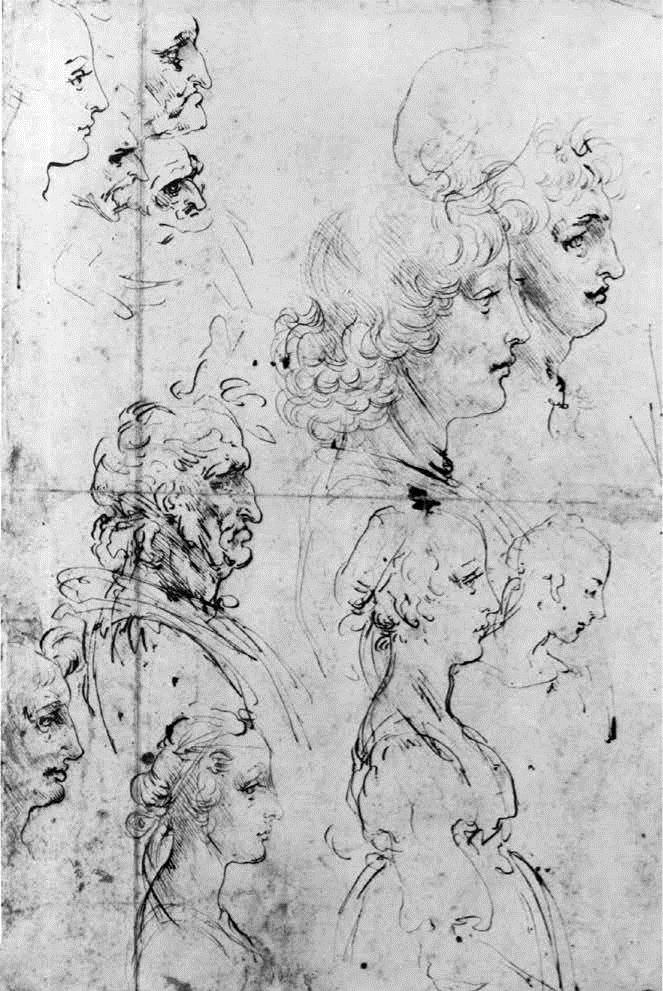
(“He filled entire pages with profiles...”)
When one examines the preoccupations of the Quattrocento artists and of Leonardo, and when one considers the incredible will for progress which moved these artists who had everything to discover, and, who in less than a century did discover everything (the principle of perspective, the science of anatomy, the rules of light...) — one understands how this era is different from the others, and what makes it unique. It is a heroic age of which each masterwork is a trophy, the mark of a conquest. This huge conquest comes from a return to Nature, meaning to the real. Leonardo fulfilled this idea linking it to another one doubly significant: the desire not to repeat what was done before. He wrote: “How the art of painting slowly declines and is slowly lost from age to age when painters only have their predecessors as models.”
But beginning with his sketches we see a demonstration of convergence of divergent concerns served by such a variety of means, that we find it difficult to reconcile such opposites in a single man. Often on the same page of his diagrams there is a constant going from one subject to another, attested by the juxtaposition of diagrams and notes that do not seem to have anything in common. For example, he filled entire pages with profiles and did so all his life. He drew a great number of them, all more or less the same: a repulsive, almost ferocious-looking old man, next to a handsome youth. In the domain of art, these diagrams represent grace and imagination on the one hand, and the strict discipline of the scientific naturalist on the other. He was as much interested in gross deformities as in beauty. Technically speaking, the range of Leonardo was extraordinarily wide: he excelled as much in imprecise sketches — calm, with an infinite rigour of detail — as in the spontaneous study: quick, febrile and violent. These two methods are as far apart as possible from one and the other. The quality of qualities, in Leonardo’s drawings, is this feeling of the free transfer of a vision to paper that has been neither clouded nor altered^ And yet, there is so little apparent effort in this marvellous alchemy that everything happens as if, by the simple action of a demiurge, earth transmuted into heaven.
One of the first signed works of Leonardo is the landscape of Santa Maria della Neve, dated 2 August 1473, a drawing which was later considered as “the first real landscape sketch in the occidental art”. In this work, what interested Leonardo more than description of the shapes of trees and rocks, was to capture the essence of the phenomena — winds, snow or rain moving through the sunlight. He expressed a new sensitivity to the values of light, which he vibrated with shadings, giving time density and transparency to the landscape. Volume and space, shadows and mist are animated by a powerful and dynamic stroke.
During his whole life, Leonardo had been obsessed by the movements of water. In his last years he started the series of strange, terrifying sketches, all under the name of Deluge. He predicted this Deluge would exterminate man and all his works, bringing an end to the world. Almost abstract and of a great audacity since he was breaking away from conventional art forms, these exercises of the imagination, of stupefying depth and vigour, show his passion for complex movements, for convolutions, as much as his dismay at the future of humanity. His scientific knowledge is used here, with an implacable logic, to demonstrate how poor the means at man’s disposal when he struggles with Nature; one sees here a prodigious spirit dredging the secret depths of his anguished soul: “Ah! What frightening tumults resound in the sadness of the air,” wrote Leonardo in the commentary which described his sketches. “Ah! What lamentations!”
The enormity of his drawing work shows us that his life was a long preparation for the art of painting, which to him was the supreme art. But knowing that it was his duty to bring it to perfection, moreover aware, to the highest degree, of the complexity of Nature which he proposed to equal, he forced himself to a preliminary labour of a gigantic scope, seemingly out of proportion, with the number of works that he actually accomplished. That an artist could dedicate years to the mental incubation of a painting which sometimes he would even not complete, is what his public could not fathom. This is why after the flashing debut that had left an unforgettable impression, Leonardo little by little tired his patrons and the public and became a legendary figure, admired for his past prowess. But all the while he had been devoting himself to the meticulous elaboration of future works that were constantly postponed.
What was his method of working?
Before deciding to sculpt or to paint, he travelled the road from the minutest detail to entire organized form. Before working on the human body, he completely mastered its secret springs and the internal structure. “Having learned the nature of nerves, muscles and tendons”, he wrote, “the painter will know exactly which nerves determine the movement of each member and their number, and which muscle provokes the contraction of the nerve when it swells, and what nerves, once converted into delicate cartilages envelop and contain this muscle. And so will he be able, in different ways and universally, to indicate the varied muscles, from the different poses of the figures.” Leonardo’s great contribution to anatomy lay in the creation of a system of drawing, still in general use, which enabled physicians to transmit their findings to students. Prior to his time the medical profession took little interest in anatomical drawing; many physicians actually opposed its use in books. Leonardo’s system involved the presentation of four views of a subject, and this was so clear and effective that physicians could no longer deny the value of art in teaching.
This rigourousness, which seemed to grow with age, explains both the severity of the study of drapes and the exuberance of the grotesque heads; he extended it to everything he perceived of the reality of the world. He was aware, above his senses, of the infinite plays of shadow and light, of the geometric sequences of the refraction.
The quality of grace comes before strength; the hyper-contracted muscles of Michaelangelo’s figures would always displease Leonardo. The smiles that radiate throughout his most famous paintings prove that gracefulness is not only “more beautiful than beauty”, but that it is stronger than strength.
Since light is God’s first creation; it is the painter’s first resource and should be his first care. The chiaroscuri, the sfumato make light spring from darkness, in a painting, as God made it spring in the world; a painting must express the splendour of light, which is the main characteristic of the Creation. In The Last Supper Leonardo tends to blend Christ with the light and Judas with the shadow; in The Virgin of the Rocks the Virgin is more brilliant than St Ann, on whose knees she is resting; the lower part of the body of the Mona Lisa is hardly seen on the background, on the contrary, her face is set on a luminous landscape. To Leonardo light was something toward which one climbs.
The artist in him wanted to embrace the whole of Nature, as if to build in his own vision, the unity of the spirit. Science and technique are always only auxiliaries to the service of art: “The one who disdains painting does not like Nature’s philosophy. Painting is the most beautiful language of the mind.”
The place that philosophy occupies in the life of the mind, the profound exigency of which it is the witness, the generalized curiosity that comes with painting or philosophy, the need for the number of facts that it holds and assimilates, the ever present thirst for cause, here was the permanent concern of the work of painting which occupied Leonardo.
In fact, Leonardo found in painting all the problems which the intention of a synthesis of Nature offered to the mind, because his painting always demanded of him a thorough and previous analysis of the objects he wished to represent, analysis which did not refer only to their visual characteristics, but which went to the most intimate or organic, to the physical, to the physiological, up to the psychological, so that in the end his eye, somehow, was able to perceive the visible characteristics of the model which resulted from its hidden structure.
In Leonardo’s Treatise on Painting he speaks a lot about relief, on its nature, its function, on the different ways to translate it, that is, to render the three dimensions of things on a surface essentially two-dimensional. However, he does not reveal the source of the intuition of its importance, its pre-eminence; the idea that painting must not be a linear representation of the world, but rather its representation in volumes. One of the key points of his Treatise on Painting is that: “The painter follows these two objectives, man and the intention of his soul. The first objective is easy to reach, the second harder, because he must represent it by the movements of the members.”
The Adoration of the Magi
Leonardo ended his Florentine period with a veritable manifesto of humanism. The unfinished Adoration of the Magi was the first painting he conceived in this radical — and even revolutionary — way.
The Renaissance already had a number of paintings on this subject, all of which had been painted in the narrative style. But Leonard chose to abandon narration, to represent instead the maelstrom of impression which had accompanied this major event of Christian history: the arrival on earth of the Son of God. Moreover, he deliberately ignored a logic that would impose on him only the presence of peasants or of Magi, or the union of both: he wanted to include the whole of humanity around the divine Infant. One critic has counted 66 characters... old men, young men, poets, soldiers, believers and non-believers.
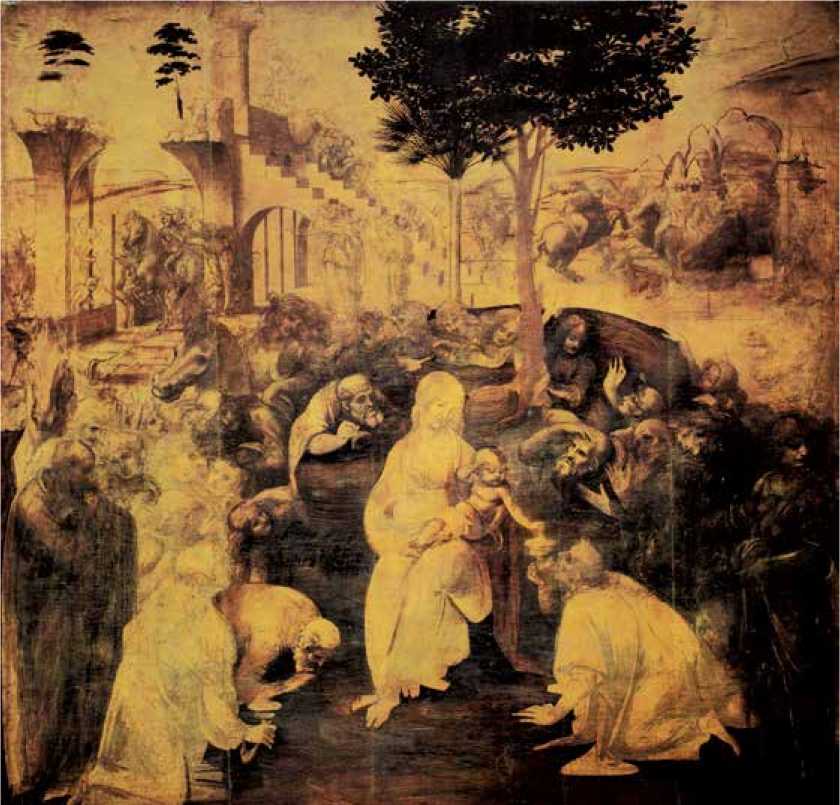
(The Adoration of the Magi, 1481/82)
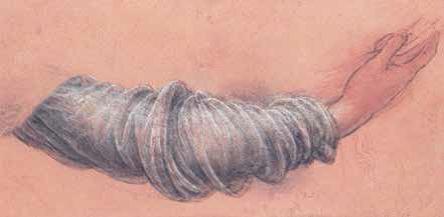
(Study for the sleeve of the Virgin and Child with St Ann, See p. 28)
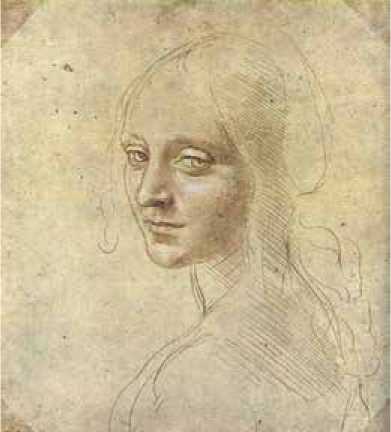
(Study for the angel’s head in the Louvre The Virgin of the Rocks (see p. 65))
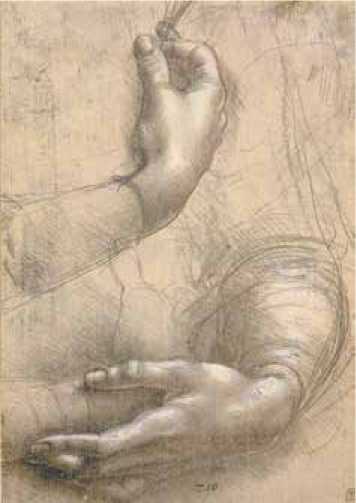
(Study of hands for Mona Lisa, see p. 76)
This painting has a profound meditative quality. In it the rational meets the irrational. The background layers open on vast perspectives of far away horizons; the foreground figures reveal a complex repertoiree of psychological attitudes of human relations and symbols. The mechanisms, the screws and springs of this pictorial machine are the figures, the gestures, the poses and his geometry the frame of mind, the attitudes and emotions. At the summit of the pyramid formed by the Virgin and the kneeling Magi is the Infant, the centre of this cosmogony. All around this young child, princes, shepherds, angels and knights move wrapped in this vast Epiphany — more revelation than simple adoration — such is the main idea of this composition.
Why did he believe that he had to introduce all these figures and elements into his compositions? One of the explanations that we can propose has to do with the profound feeling that Leonardo had for the bonds that unite all living creatures with Nature: trees, flowers, animals, men mingled and driven inexorably toward their destiny. Absolutely revolutionary, this was the most dramatic and the best-balanced composition of the whole Quattrocento, and the one in front of which generations of artists would lose themselves in an amazing contemplation.
The Virgin of the Rocks
The Virgin of the Rocks sings the victory of light over darkness. Here, Leonardo reconciled his imaginary universe with that of scientific naturalism. The painting is a mysterious revelation on a background which is not of this world: a grotto under an open sky where the Virgin takes refuge with Baby Jesus, St John the Baptist as a child, and an angel. But the figures have a supreme grace linked to a marvellous relaxed attitude, and the details of the vegetation are as close to nature as if they were from the hand of the best botanical painter.
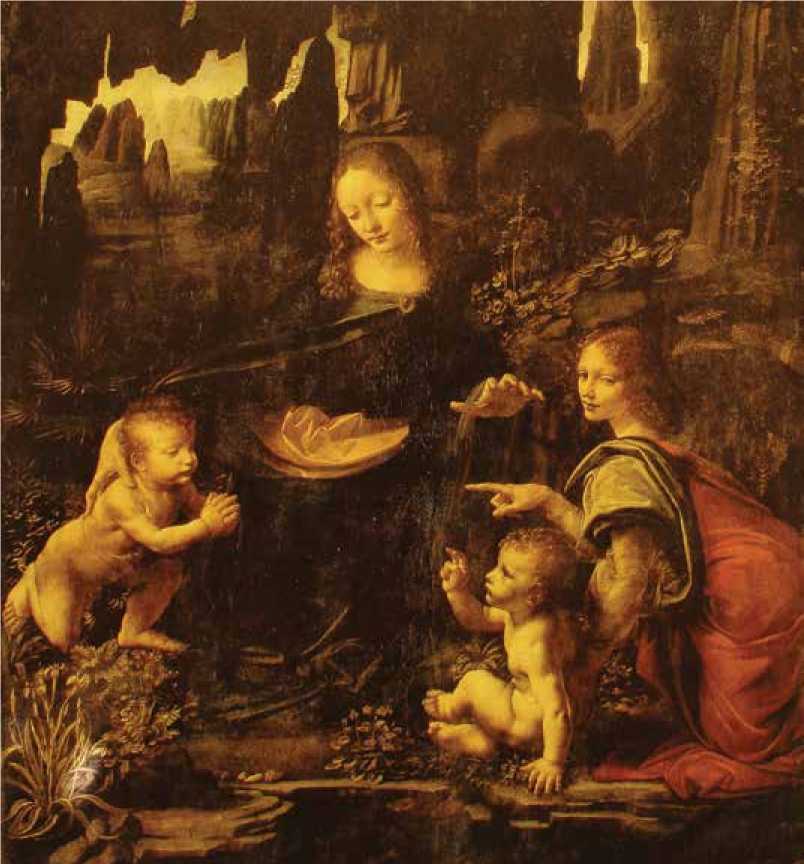
(The Virgin of the Rocks (detail), Paris)
The Virgin of the Rocks, rich in allusions and symbols, which overflow the usual limits of the mind, reveals the most enigmatic aspect of Leonardo’s character. What sense can we give to the enigmatic gesture of the angel, pointing to St John and not to Christ? The Virgin protects the Infant with her hand and seems to shelter him with a part of her cloak, is it St John, or perhaps humanity one sees instead, in its perpetual quest for divine protection? The centre of the composition is animated by a play of hands which has no equal in any work of art: one hand appears to protect, the others to worship, consecrate, and to indicate a mysterious point.
The characters are arranged in the usual pyramid, the Virgin’s head forming once more the summit. Leonardo finally could express his ideal of beauty in the angel’s face whose features do not any longer keep their shape according to a surface design, but seem to express its interiority. The grotto is immersed in a twilight atmosphere, veiled with a light mist of sfumato. The shaping of the subjects in sfumato is so delicate that the precise contours can hardly be perceived; faces and bodies materialise in the soft light which fall on them; and the shadows inside the grotto are so dense that they seem to possess their own substance. But the painting is not sombre and in spite of layers of varnish that soften its colours, they are always radiant.
Whatever the deep meaning of this work, and wherever and at whatever date Leonardo painted it, one fact certainly remains: it was his farewell to the Quattrocento. Having mastered the art of the Renaissance, he now went much further. Years would pass before he undertook another major work and, when he would decide to begin again, it would be to create one of the world’s marvels, the first classical example of the Renaissance ideals at their highest: The Last Supper.
But before we come to The Last Supper, let us take a look at The Battle of Anghiari.
The Battle of Anghiari
The central design of the Battle of Anghiari is of hexagonal shape and represents a tangle of men and horses overlapping and so close to each other, that it seems as if it is the preparatory study for a group sculpture. The rearing horses are reminiscent of an early work of Leonardo, The Adoration of the Magi, but there is no longer an expression of joy and exuberance that is communicated, but a sensation of furious and cruel drunkenness: the warriors chop each other with their sabres while the beasts kick and bite. This painting can be considered the crystallisation of Leonardo’s attitude toward war, which he called the pazzia bestialisima — the most bestial of madness — an opinion that his experience at the service of Caesar Borgia could only have reinforced. He wanted to transform The Battle of Anghiari into a terrible and timeless accusation and he succeeded by removing all background details. There is no decoration in the background and the fabulous costumes of the warriors do not belong to any precise period. To render the crystallisation more impressive, Leonardo directed all the lines of his composition — sabres, the men’s faces, the horses curving bodies and outstretched hooves — toward the interior. Nothing distracts the eyes from this accusation, which stands here as convincing as the evidence that a prosecutor would place on a table.
Leonardo had worked long on his idea on the way to represent a battle; it is this very idea he is going to follow. “You will first design the smoke of the artillery mixed in the air with the dust raised by the movement of the horses and the warriors”, he wrote around 1490. “You will redden the faces, the people, the air, the gunmen, their neighbours, and this redness will go fading while it moves away from its cause... Arrows will go up in all directions, they will come down, will fly in straight lines, filling the air, and the bullets of the gunmen will leave behind a track of smoke. If you show a man falling to the ground, reproduce the marks of his sliding down on the dust transformed into a pool of blood; and all around, in the viscous earth you will show the footprints of the men and the horses who went this way. A horse will drag his master’s dead body leaving behind him, in the dust and the mud, the traces of the cadavers. Make the losers pale and dejected, the eyebrows high and frowning and the forehead lined with painful wrinkles... Men in flight will cry, mouth wide open. Put all kinds of arms under the feet of the warriors — broken shields, lances, broken swords, and all such similar things. The dying will grind their teeth, their pupils rolled upwards, beating their bodies with fists and their legs twisted. You will draw an unarmed warrior knocked down who, facing his enemy, bites and scratches him, in cruel and bitter revenge; there will also be a horse without his rider galloping among enemies, mane flying in the wind and causing huge damage with its hooves. Or someone crippled falling to the ground, covering himself with his armour and the enemy bending over him to administer the fatal blow. Or again a group of men slaughtered, flung down on the cadaver of a horse. Many conquerors will leave the battlefield; they will depart from the entanglement wiping with both hands, over their eyes and their cheeks, the thick layer of mud caused by tears and dust. Take care not to leave any flat spot which would not have been saturated with blood.” In the Battle of Anghiari his idea on the way to represent a battle is made manifest.

(Copy after Leonardo’s Battle of Anghiari, by Peter Paul Rubens)

The Last Supper
In 1495, at the request of Ludovico Sforza, Leonardo set about painting the Last Supper on the wall of the dining room of the convent of Santa Maria delle Grazie, in Milan. For about 15 years Leonardo had been reflecting on the ideas which he developed in The Last Supper. And so, The Last Supper gave the artist the opportunity to test his idea that painting is something mental, and to achieve in a single piece of art, a synthesis of his vast experience in the optical domain, in musical harmony, in the fields of anatomy and architecture, in the realms of colour and perspective, as well as in the domains of matter and technique.
During the year when he worked on The Last Supper, the painter’s life became an inner adventure. It took Leonardo almost three years to paint this huge, obsessing project, which did not leave his thoughts for a moment. The Italian writer, Matteo Bandello, a student at the priory at the time of The Last Supper, watched Leonardo working and described it thus: “He would arrive at the convent at dawn. Quickly climbing the scaffolding, he worked without resting until the night’s shadow would force him to stop, without the least thought for food, so much absorbed by his work. At other times he would stay three or four days without touching a brush and would spend hours in front of his painting, arms crossed, looking carefully at its subjects, as though criticizing his own painting.”
This painting is not only prodigious in itself but later had a great influence. There is an aspect so evident in this masterpiece that it is often overlooked. In art few compositions offer so many difficulties as the presentation of thirteen subjects seated at a long table. Under Leonardo’s brush this difficulty has been so majestically overcome that it is not seen. One does not even think about it.
He cleverly placed familiar objects around the disciples so that he would not have recourse to imaginary outdated modes. The wall on which he was painting occupied one of the short sides of the long room of the refectory of the convent. In front of the opposite wall, the prior’s table was placed on a platform; all along the room there were rows of tables for the monks. The painting reproduced the tablecloths, knives, forks and the monk’s glasses. In Leonard’s mind, Christ had to nourish himself, in this company, with the same food as the mortals. When the painting was completed, in 1498, those who were invited to contemplate it must have thought they were the object of a hallucination: the monks’ room had become the extension of The Last Supper.
Another difficulty was the necessity to isolate Judas, in such a way that he could be recognized at first glance. For a thousand years, in fact from the first expression of Christian art, this problem was solved by placing Christ and the eleven faithful disciples on one side of the table, facing forward, with Judas on the other side. Artists, at the beginning of the Renaissance, broke off with the traditional representation of the religious themes. But generally speaking they could not discover other solutions to the presentation of the disciples. To isolate Judas, Leonardo found, at least apparently, an easy solution. He placed Judas on the same side of the table as the other disciples, but isolated him from them by his expression: psychologically making him an outsider. And this isolation is infinitely more poignant, clearer than a simple physical separation. Sombre, staring fixedly, Judas keeps himself away from Christ, forever a prisoner of his remorse and his solitude. The disciples question, address reproaches to themselves, forgive themselves and do not yet know who among them has betrayed Christ: but one who contemplates The Last Supper recognises the traitor at first glance. The only one, who is spared this wave of emotion breaking all around, is Christ. An aura of peace floats around him, space isolates him and indicates that he is at the centre of the event as well as of the painting.
In its complexity The Last Supper expresses perhaps better than any other work of Leonardo, the master’s innovations: the naturalness of the poses and the harmony with the psychological content; the insertion of each individual in a dynamic web of correspondence and contrasts, in an emotion which is indicated by the position of the hands and the movement of the heads; the psychological and not any longer the geometrical perspective, which enliven the scene in space and in the real light of the room. Tradition asks one to interpret the work as if Christ had just uttered the sentence: “One of you must betray me”, and says that Leonardo wished to fix forever this dramatic moment. The disciples deeply reacted to these words: a superb show of attitudes and gestures which reveal “the intentions of their souls.”
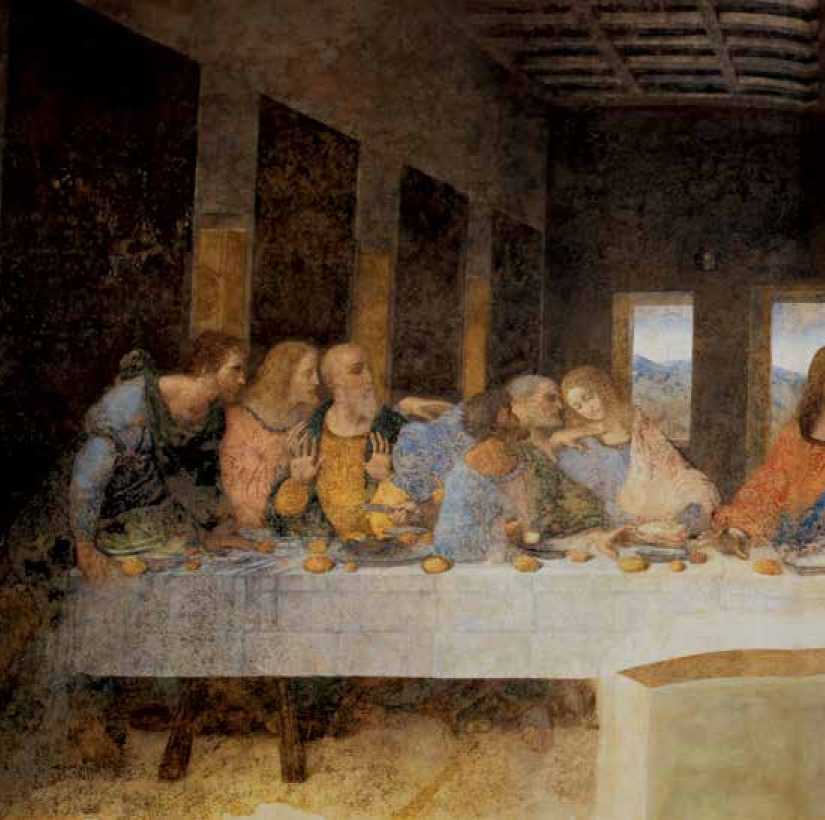
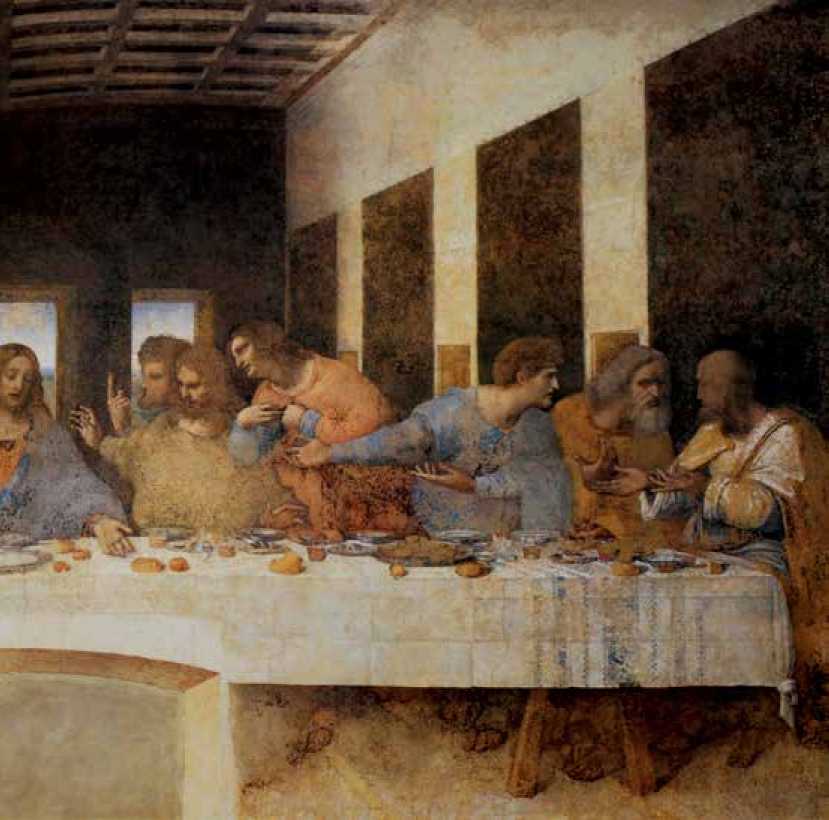
(The Last Supper. The traitor Judas, the fourth from left, with his right hand clutches the pouch containing the money he has been paid to betray Christ.)
It is assumed that the faces, except for that of Christ were those of people who Leonardo found in Milan or in the vicinity. Leonardo spent so many hours wandering in the haunts of the ruffians of Milan searching for the right Judas that the prior of Santa Maria delle Grazie complained to the Duke of Sforza that the work was going too slowly. Leonardo replied that he was having a hard time finding a Judas. But, if they insisted that he go ahead with his work, he could use the prior’s head, which would perfectly suffice. In fact, for Jesus he had two models in mind, but finally, the Christ became an abstraction not a portrait; a figure profoundly moving and universal.
As soon as The Last Supper was revealed, Leonardo’s contemporaries were stunned by the brutal revelation of reality. In one stroke, the traditional methods became obsolete and painting entered a new phase of its history. All references from that time agree in saying what admiration this piece aroused.
The unfortunate destiny of this prodigious composition, in which Leonardo gave the best of himself and dared to use an experimental technique, resulted in disaster. It was not long before The Last Supper began to deteriorate. If it is famous today, it is because of the number of copies that were made in the XVIth century, some by Leonardo’s direct disciples, which permit us to guess more or less what the original was like; notably the details and the colours and at the same time, to appreciate its incredible radiance. A series of restorations and wars, ending in the bombing of 1943, have reduced this masterpiece to a ghost-like state.
Mona Lisa
One of the worlds best loved paintings carried two names: Mona Lisa, a short form of Madona Lisa, the third wife of a Florentine merchant, and La Joconde, taken from the merchant’s name, Francesco de Giocondo.
The first time Madona Lisa posed for Leonardo, she was twenty-four years old. To the eyes of her contemporaries she was approaching maturity. As a portrait, this work was an admirable success, “an exact copy of the subject”, thought Vasari. But Leonardo far transcended the realistic portrait to make of his subject not only a woman, but the Woman. Under his hands, the individual and the symbolic became one. The idea that the artist had of the Woman as symbol does not coincide with that of most men. Leonardo portrays her with an absence of sensuality quite disconcerting, in fact making her appear at the same time voluptuous, cold and admirably beautiful.
The painting is of modest dimensions, but it feels monumental to the viewer, due to the effect achieved by setting the model in relation to the background of the portrait. This monumental effect further increases the impression of charm and coldness that Mona Lisa radiates. For centuries she has been contemplated with delight, astonishment, or with a feeling of awe. Technically, Leonardo brought to the peak of perfection the use of sfumato; it is not known how many layers of extreme thinness — perhaps as many as one hundred — play their role in the sfumato. The background is without any doubt the most beautiful of all Leonardo’s paintings. The details are precise but the jagged rocks, the water, the bones and blood of the earth bring to mind a romantic vision of earth the day after the Creation. This painting has had such an influence on art that it is quite difficult to look at it with fresh eyes.
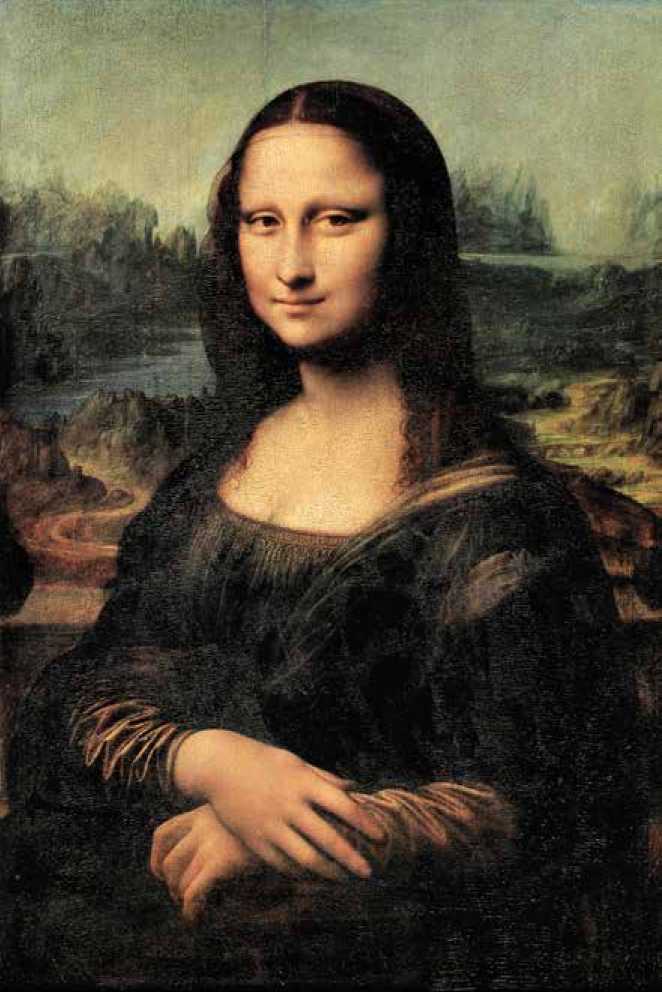
(Portrait of Lisa del Giocondo (Mona Lisa), 1503-1506 and later (1510?))
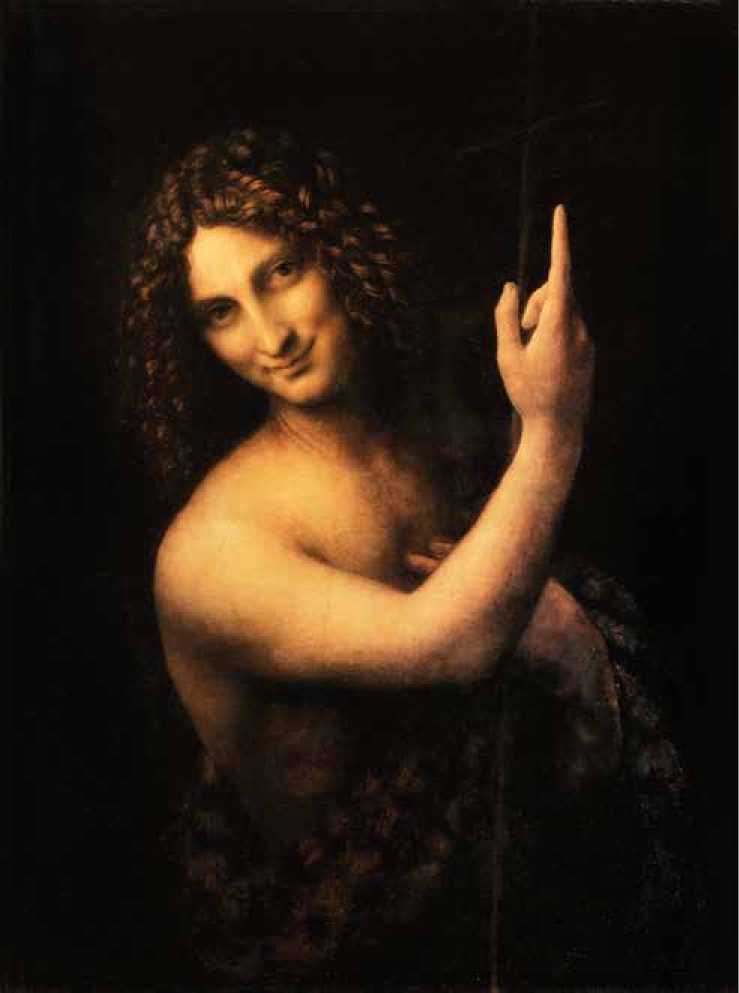
(St John the Baptist, c. 1513-1516?)
The Mona Lisa was an immediate success. From the time of its creation, people started to imitate and copy it, in France, in Italy, in Flanders, and in Spain. There are dozens of copies of this work, painted between the XVIth and the XIXth centuries. Its glory has never faded.
St John the Baptist
No matter how troubling it is, this tender face with a provoking smile is that of St John, just as Leonardo had wanted to interpret it, contrary to the traditional character of the ascetic, emaciated and full of fire. It is certain that by giving him this smiling and graceful pose, Leonardo had wanted to express the quintessence of the eternal mystery of which we find the signs in such a great part of his work — the enigma of Creation and of life itself.
The St John the Baptist reaches perfection in its fluidity and transparency. It seems that one cannot go further in the representation of the immaterial by the balance of shadow and light, of the concrete and the evanescent. This work which is more an apparition than a picture, also possesses the ring of ultimate success. The raised index finger of St John the Baptist would remain a prodigious affirmation, even if it was not pointing at anything in particular.
To Leonardo the question was always to know how the world is made and since this can never be ably resolved, he did not dare to ask others. Painting, a mental subject was, for him, a certain way to know and evidence of the knowledge acquired. He would never have said that it is a manual craft; he preferred it to sculpture, precisely because the latter seemed to him more manual and less mental. Even when he wrote about machines and tools, he more readily said: “I know the way to...” than: “I do...”. Art aims to render the individuality of the model, and, for that, it searches behind the lines that can be seen, for the movement the eye does not see, behind the movement itself, to something still more secret, the original intention, the fundamental aspiration of the subject. “The artist”, he says, “has first the universe in mind, then in the hands.” To him, science was not the only way to gain the knowledge of the world, but again neither the richest nor the truest of it. “Painting embraces all forms of Nature. You have the effects of the manifestation, we have the manifestation of the effects. In art, we can be said to be God’s grand children.”
Leonardo was a painter: painting was his philosophy. In fact he said it himself, and he spoke of painting as one speaks of philosophy. That is, he related everything to it. He had excessive ideas about painting, even a peculiar turn of thought which is far from satisfying the whole intelligence.
He felt with an intense suffering the constraint of time, and, in one page of the Codex Atlantica, he let out this moan, the distressing cry of a man who feels that life escapes him, and with life, action. “Oh time, consumer of things, and oh you, envious old age which destroys everything.” To surmount the anxiety of impermanence and this sensation at once physical and intellectual, of time, Leonardo took refuge in the pursuit of the eternal. Not in the metaphysical concept of eternity, but in the representation of something eternal: light. “Immerse everything in light, it is immersing them in the infinite”, one reads in the Leicester Manuscript. The problem of expression and representation of light becomes the major concern of the painter. In the domain of science and practical action, he knows very well that everything is devoured and nibbled by time; only in a work of art can beauty last, under one condition, that it contains the essence of infinity and eternity: light. Then the great miracle is accomplished. The subjects which represent perishable beings become infinite and eternal by wrapping themselves in this mysterious luminosity which transposes them into other dimensions, into a world devoid of the sad bonds of death and old age. “Beautiful mortal things go and do not last”, it is written in the Forster Manuscript, but the privilege of art, beyond everything, is to confer a kind of immortality to the mortal element by associating it to light, dissolving it in light. In this Leonardo was also a forerunner.
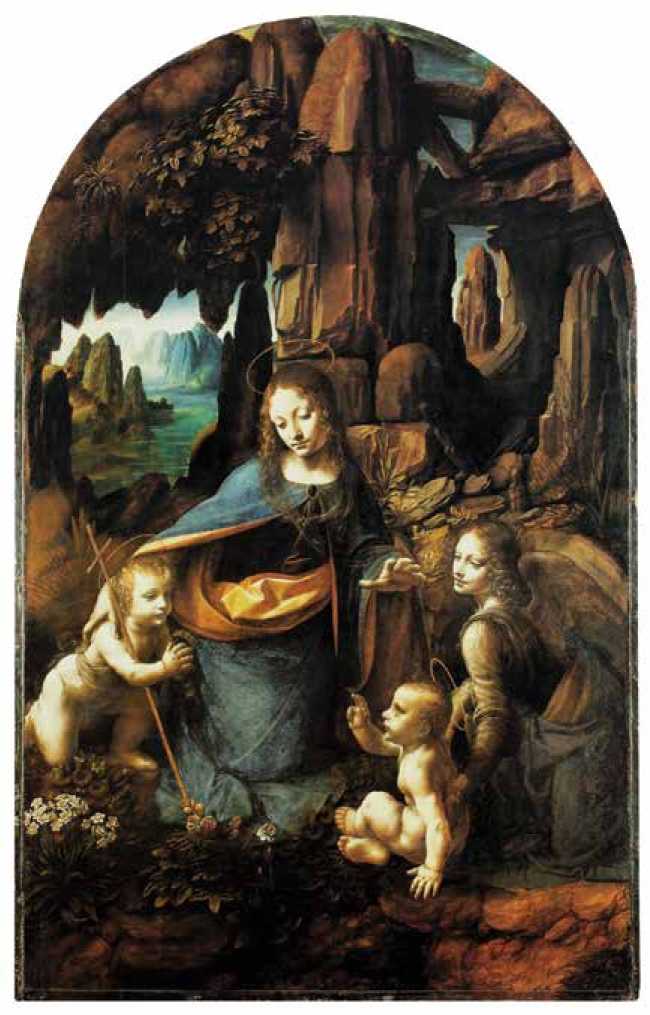
(The Virgin of the Rocks, London)
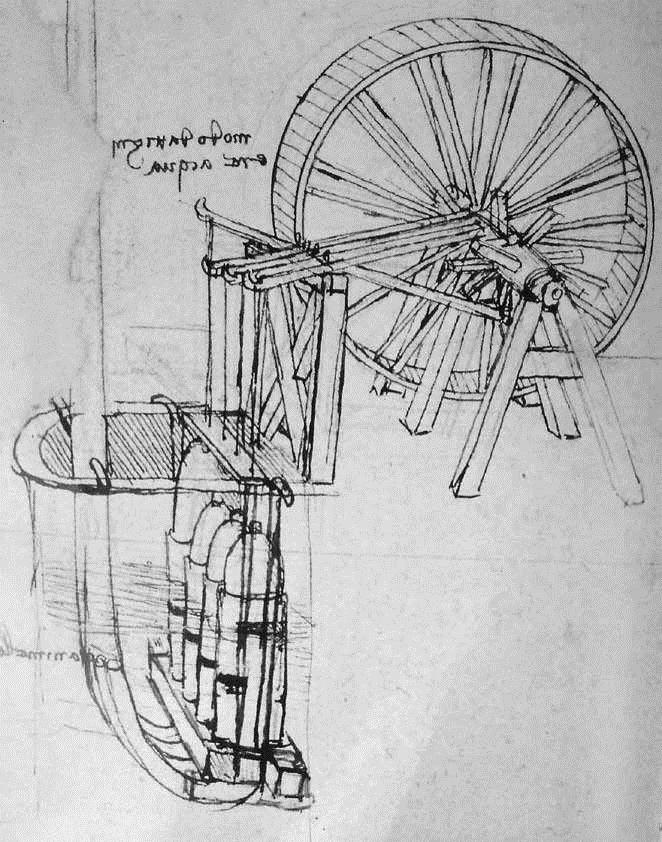
(Study of a hydraulic device. Leonardo’s applied mechanics, perhaps more than any other of his scientific or technical pursuits, strike sparks of recognition and admiration in the machine-conscious 21th Century mind.)
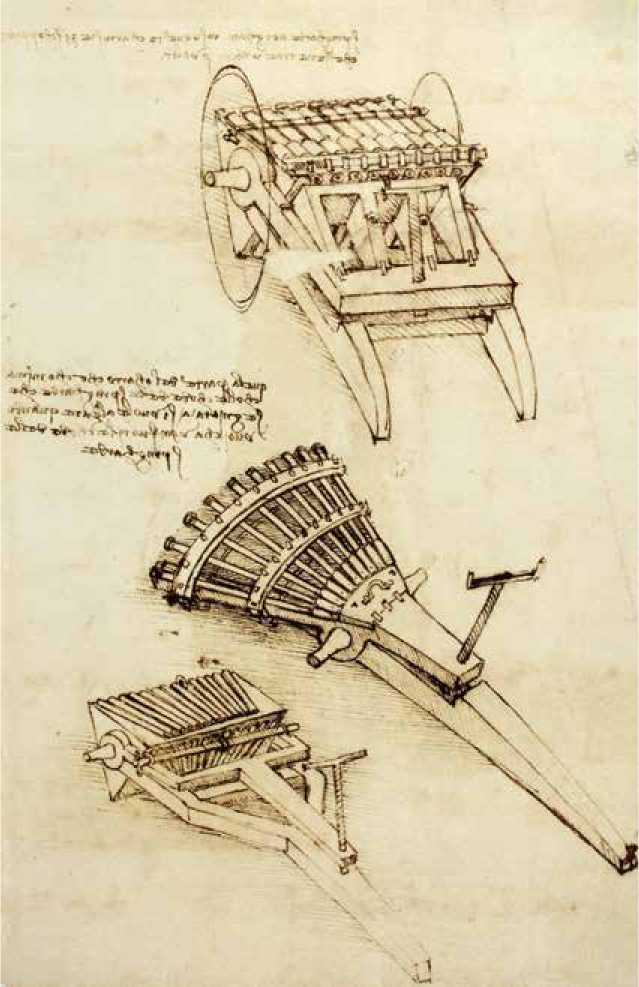
(Sheet of Studies with multi-barrelled guns, c. 1482)
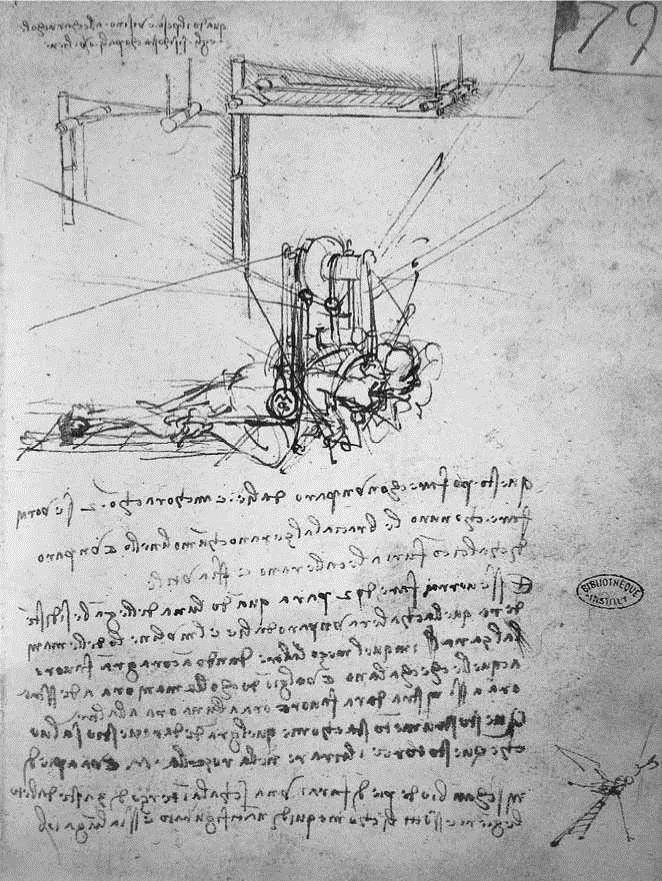
(Study of a flying Machine with a Hand and Foot-Powered mechanism 1487-1490)
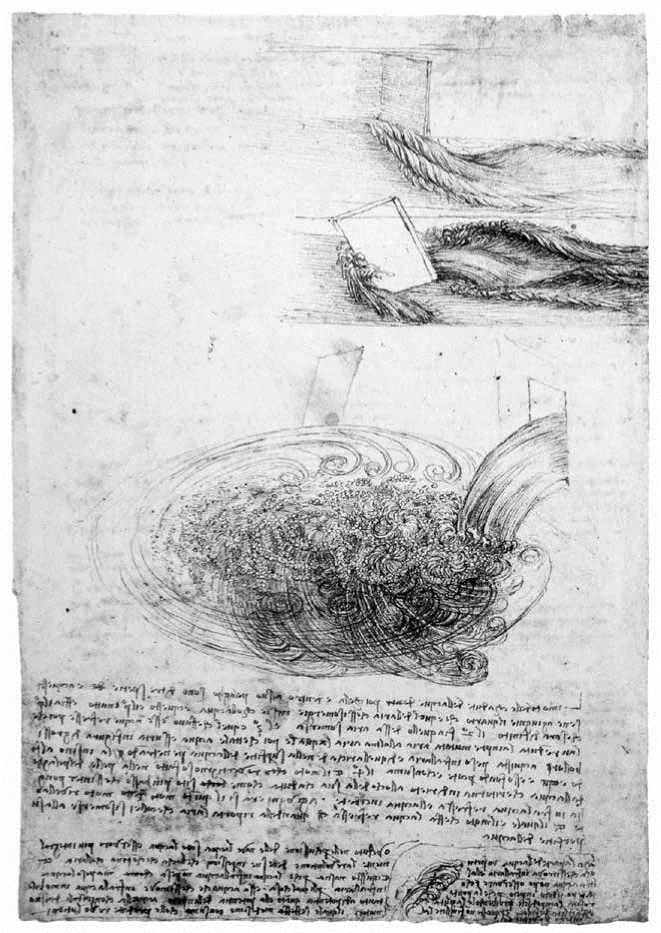
(Studies of water formations, c. 1507 Leonardo’s superhuman quickness of vision is shown in these sketches of flowing water - at top as it swirls around impeding boards, then below as it rushes into as pool.)
Appendix
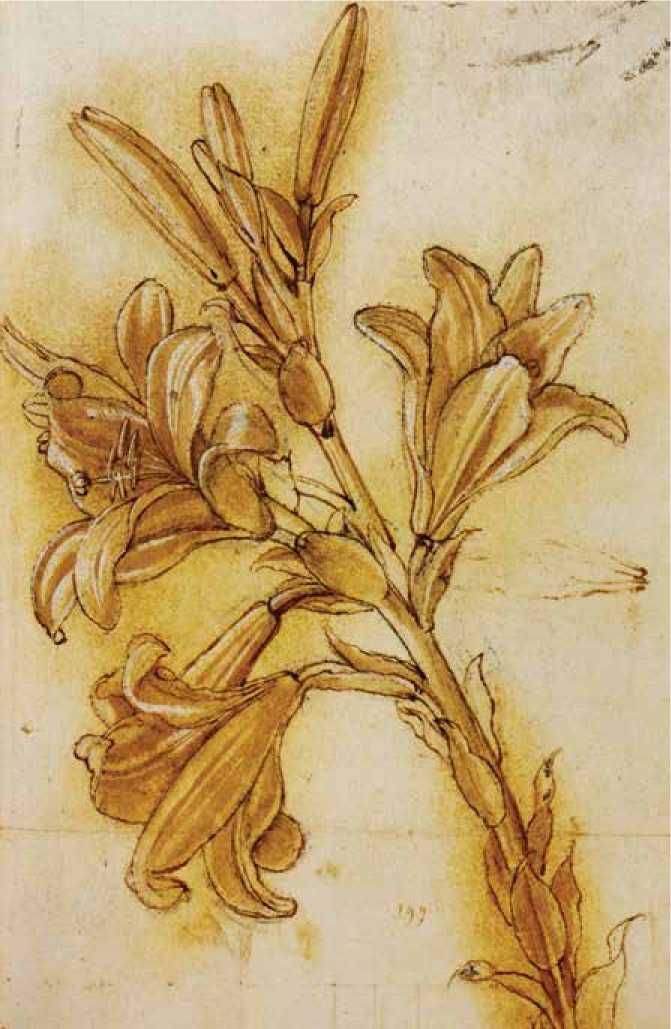
Sri Aurobindo and the Mother on Leonardo da Vinci
But very obviously, in the use of the intuition the poet and artist cannot proceed precisely in the same way as the scientist or philosopher. Leonardo da Vinci’s remarkable intuitions in science and his creative intuitions in art started from the same power, but the surrounding or subordinate mental operations were of a different character and colour.
Sri Aurobindo, The Renaissance in India: Indian Art - I
Augustus Caesar organised the life of the Roman Empire and it was this that made the framework of the first transmission of the Graeco-Roman civilisation to Europe — he came for that work and the writings of Virgil and Horace and others helped greatly towards the success of his mission. After the interlude of the Middle Ages, this civilisation was reborn in a new mould in what is called the Renaissance, not in its life-aspects but in its intellectual aspects. It was therefore a supreme intellectual, Leonardo da Vinci, who took up again the work and summarised in himself the seeds of modern Europe.
Sri Aurobindo, Letters on Poetry and Art: Augustus Caesar and Leonardo da Vinci
What Leonardo da Vinci held in himself was all the new age of Europe on its many sides. But there was no question of Avatarhood or consciousness of a descent or pressure of spiritual forces. Mysticism was no part of what he had to manifest.
Sri Aurobindo, Letters on Yoga - I: Specific Avatars and Vibhutis
For, eventually, the evolution of Europe was determined less by the Reformation than by the Renascence; it flowered by the vigorous return of the ancient Graeco-Roman mentality of the one rather than by the Hebraic and religio-ethical temperament of the other. The Renaissance gave back to Europe on one hand the free curiosity of the Greek mind, its eager search for first principles and rational laws, its delighted intellectual scrutiny of the facts of life by the force of direct observation and individual reasoning, on the other the Roman’s large practicality and his sense for the ordering of life in harmony with a robust utility and the just principles of things. But both these tendencies were pursued with a passion, seriousness, a moral and almost religious ardour which, lacking in the ancient Graeco-Roman mentality, Europe owed to her long centuries of Judaeo-Christian discipline.
Sri Aurobindo, The Human Cycle: The Age of Individualism and Reason
In matters of art the western mind was long bound up as in a prison in the Greek and Renaissance tradition modified by a later mentality with only two side rooms of escape, the romantic and the realistic motives, but these were only wings of the same building; for the base was the same and a common essential canon united their variations. The conventional superstition of the imitation of Nature as the first law or the limiting rule of art governed even the freest work and gave its tone to the artistic and critical intelligence. The canons of western artistic creation were held to be the sole valid criteria and everything else was regarded as primitive and half-developed or else strange and fantastic and interesting only by its curiosity.
Sri Aurobindo, The Renaissance in India: Indian Art - I
The Renascence was an awakening of the life spirit to wonder and curiosity and reflection and the stirred discovery of the things of the life and the mind...
The soul of the Renascence was a lover of life and an amateur of knowledge...
Sri Aurobindo, The Future Poetry: The Movement of Modern Literature - I
The Renaissance brings in the sense of a liberation from the burden and the obligation; it looks at life and loves it in excess; it is carried away by the beauty of the body and the senses and the intellect, the beauty of sensation and action and speech and thought, — of thought hardly at all for its own sake, but thought as a power of life.
Sri Aurobindo, The Future Poetry: The Course of English Poetry - I
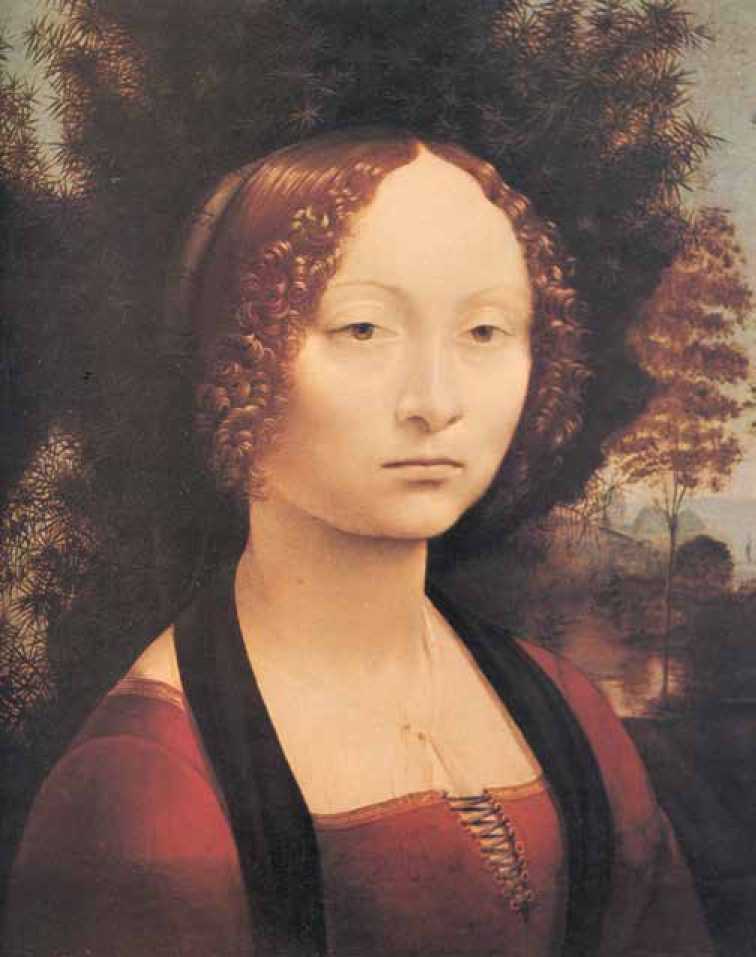
A man like Leonardo da Vinci was a Yogi and nothing else. And he was, if not the greatest, at least one of the greatest painters, — although his art did not stop at painting alone.
The Mother, Questions and Answers (1929 - 1931): 28 July 1929
30 June, 1962
As a child, when I was around ten or twelve years old, I had some rather interesting experiences which I didn’t understand at all. I had some history books - you know, the textbooks they give you to learn history. Well, I’d read and suddenly the book would seem to become transparent, or the printed words would become transparent, and I’d see other words or even pictures. I hadn’t the faintest idea what was happening to me! And it appeared so natural to me that I thought it was the same for everybody. .. .And several times the corrections I got on one person or another turned out to be quite exact and detailed. And (I see it now — I understood it later on) they were certainly memories.
… I found out many, many things about Joan of Arc - many things. And with stunning precision, which made it extremely interesting. I won’t repeat them because I don’t remember with exactness, and these things have no value unless they are exact. And then, for the Italian Renaissance: Leonardo da Vinci, Mona Lisa; and for the French Renaissance: Frangois I, Marguerite de Valois, and so forth.
Twice I knew that it wasn’t just images but something that had happened to ME, but it took another form.
I wanted to clarify something……..I don’t know if Mona Lisa and Marguerite de Valois were your incarnations, but weren’t they contemporaries!?...
Yes, but I told you — four at once!
Four at once. And, in general, they were the different states of being of the Mother — the four aspects. Generally one aspect in each embodiment (when there were four). Or else this or that aspect might have been less present in one embodiment and more present in another. Sometimes there was a fairly central presence and then at the same time less central, less important emanations. But that has happened several times - several times. On two occasions it was particularly clear. But I have often sensed that there wasn’t merely ONE embodiment, that the course of history may have crystallized around this or that person, but there were other embodiments less (how to put it?) ... less conspicuous, somewhere else.
They are the different aspects of the Mother.
The Mother, Mother's Agenda — 1962: June 30, 1962
Mona Lisa
(6 February, 1940)
Mother was arranging flowers. It was an understanding that in order to save time I could show to her paintings etc., at that hour when she arranged flowers.
C: Can I show the Plate now?
Mother smiled and said: Yes. Yes.
After seeing the painting Mother said: That is the best.
C: Is that so?
Mother: I think so. We shall see. Sri Aurobindo was the artist.
C: Leonardo da Vinci?
Mother smiled sweetly and said: Yes.
Then I pointed to the picture and said: Mother, it seems this is yours?
Mother: Yes, do you not see the resemblance?
Mother put her finger on the lips (as in the picture) and showed also the lower portion of the face.
— Champaklal Speaks, Editor M. P. Pandit, pp 45-46
A student had written to the Mother asking if Sri Aurobindo was Leonardo da Vinci in one of his past births.
The Mother wrote to the student an illuminating answer the exact words of which are not remembered, but what She had written was somewhat to the following effect: It cannot be said like that, but the Supreme Lord, while coming down as an avatar borrowed the soul that was in one of its births Leonardo da Vinci.
— K. J.
Notes
Even though there is no direct connection between Leonardo and these early modern scientists, because none of his writings were published before 1651, there is nevertheless no doubt that Leonardo’s widespread fame as an artist and engineer had a strong influence on many scientifically and philosophically-oriented thinkers in the sixteenth and seventeenth centuries. Galileo Galilei (1564-1642) at least was raised in the same intellectual climate of central and northern Renaissance Italy.
↩The first scientific academy, the Academia Secretorum Naturae, was founded in Italy by the natural philosopher Giambattista della Porta in 1560. The final institutionalisation of modern science is generally attributed to the foundation of the Royal Society in England in 1662, and to the Academie des Sciences in France in 1669.
↩Andrea del Verrocchio (1435-1488) was an outstanding and widely talented artist. He directed the most important workshop in Florence during Leonardo’s youth. His most famous work is the bronze statue David, in the Piazza della Signoria in Florence.
↩The Medici were a family of bankers and traders who ruled Florence and later Tuscany from 1434 to 1737. They provided three Popes, married into the royal families of Europe and were exceptional patrons of art. Lorenzo (1449-1492) continued the tradition of his father Cosimo and surrounded himself with philosophers, poets and artists.
↩The Adoration of the Magi is a popular theme of Christian mythology. Leonardo’s painting should be seen in contrast with those of Sandro Botticelli (1475) and of Albrech Durer (1483).
↩Ludovico Sforza (1452-1505), an offspring of the Milanese Sforza dynasty, made Milan the most splendid court in Europe during his reign.
↩Renaissance Neoplatonism was a philosophical movement that returned to the ancient sources of Platonic philosophy. Sponsored by the Medici, the Platonic Academy of Florence became the leading centre for the study and translation of Platonic texts. Masilio Ficino (1433-1499) and Pico della Mirandola (1463-1494) were its major philosophical exponents, while Sandro Botticelli (1445-1510) visualised the Platonic world-view in his painting Primavera (Spring) in 1475. See Edgar Wind, Pagan Mysteries in the Renaissance (London: Faber and Faber, 1958).
↩Cf. Will Durant, The Story of Civilization Part V: The Renaissance. (New York: Simon and Schuster, 1953), p. 222.
↩Giorgio Vasari (1511-1574) was an artist and, more importantly, an art historian whose book Le Vite dei più eccellenti Architetti, Pittori, e Scultori Italiani, published in 1550, gives a detailed account of the life of Leonardo. Vasari is quoted from Irma A. Richter, The Notebooks of Leonardo da Vinci, (Oxford University Press, reprint 1980), p. 288.
↩Reproduced by Will Durant, op. cit., pp. 202-203.
↩Richter, op. cit., p. 293.
↩Vasari, quoted in Richter, op. cit., p. 330.
↩For recent editions of Leonardo’s notebooks, see Jean P. Richter, The Literary Works of Leonardo da Vinci, 3rd ed., 2 vols. 1970; or Edward McCurdy, The Notebooks of Leonardo da Vinci, 2 vols. 1955.
↩Leonardo, Codice Atlantico; quoted by Will Durant, op. cit., p. 220.
↩Leonardo, Codice Atlantico; quoted by Will Durant, op. cit., p. 220.
↩Cf. Irma A. Richter, op. cit. p. 298.
↩Leonardo, Sul Volo, quoted by Will Durant, op. cit., p. 220.
↩Luca Pacioli (1450-1520) an eminent Renaissance mathematician, published De Divina Proportione in Venice in 1509. Two recent editions of the Treatise on Painting by Leonardo are: C. Pedretti, On Painting: A Lost Book, (Berkeley, 1964); and A. o. MacMahon, Treatise on Painting, (Princeton, 1956).
↩Geometrical perspective as a tool to pictorialise space was discovered during the Renaissance by several artists. The first publications on that theme are from Piero della Francesca (1420-1492), one of the most important artists of the Renaissance, in De Prospettiva Pingendi, 1482; and Della Pittura by Leon Battista Alberti.
↩Leonardo, Trattato della Pittura; cf. Irma A. Richter, op. cit., p. 4.
↩Vasari as quoted by Irma A. Richter, op. cit., p. 341f.
↩The Spanish Cardinal Rodrigo Borgia (1431-1503) became Pope Alexander VI in 1492. Indulging in orgies and crime he is often regarded as the personification of the declining moral standards of the Vatican during the Renaissance. His son Cesare (14751507) and his daughter Lucrezia (1480-1519) were of the same mould, unscrupulously pursuing power and wealth. For Niccolo Macchiavelli, Cesare Borgia was a model of the successful secular ruler. See Niccolo Macchiavelli, Il Principe, (The Prince).
↩Cf. Will Durant, op. cit., p. 222.
↩Giovani di Medici acquired Papal authority in 1503 and tried to consolidate the Vatican after the devastating rulership of Pope Alexander VI. Bramante (1444-1514), the architect of St. Peter’s Bassilica, Michaelangelo (1475-1564) the sculptor, and Raphael (1483-1520) the painter were among the artists who found generous employment in Rome during his reign.
↩Vasari, as quoted by Richter, op. cit., p. 377.
↩Benevenuto Cellini, quoted by Richter, op. cit., p. 383.
↩Will Durant, op. cit., p. 227.
↩Will Durant, op. cit., pp. 227-28.
↩