THE WRITTEN WORD
Lenin and the Russian Revolution
Paragraph references are specific to this digital edition.
Lenin... he was a brain.
The Mother, Words of the Mother-I: Early Talks
(The below lines seem to be an apt description of the personality and work of Lenin (Ed))
The mental man, the man of a self-dominating and self-formative mind and will conscious of an ideal and turned towards its realisation, the high intellect, the thinker, the sage, less kinetic and immediately effective than the vital man, who is the man of action and outer swift life-fulfilment, but as powerful and eventually even more powerful to open new vistas to the race, is the normal summit of Nature’s evolutionary formation on the human plane.
Sri Aurobindo, The Life Divine-II: The Evolutionary Process-Ascent and Integration
Preface
The task of preparing teaching-learning material for value-oriented education is enormous.
There is, first, the idea that value-oriented education should be exploratory rather than prescriptive, and that the teaching-learning material should provide to the learners a growing experience of exploration.
Secondly, it is rightly contended that the proper inspiration to turn to value-orientation is provided by biographies, autobiographical accounts, personal anecdotes, epistles, short poems, stories of humour, stories of human interest, brief passages filled with pregnant meanings, reflective short essays written in well-chiselled language, plays, powerful accounts of historical events, statements of personal experiences of values in actual situations of life, and similar other statements of scientific, philosophical, artistic and literary expression.
Thirdly, we may take into account the contemporary fact that the entire world is moving rapidly towards the synthesis of the East and the West, and in that context, it seems obvious that our teaching-learning material should foster the gradual familiarisation of students with global themes of universal significance as also those that underline the importance of diversity in unity. This implies that the material should bring the students nearer to their cultural heritage, but also to the highest that is available in the cultural experiences of the world at large.
Fourthly, an attempt should be made to select from Indian and world history such examples that could illustrate the theme of the upward progress of humankind. The selected research material could be multi-sided, and it should be presented in such a way that teachers can make use of it in the manner and in the context that they need in specific situations that might obtain or that can be created in respect of the students.
The research team at the Sri Aurobindo International Institute of Educational Research (saver) has attempted the creation of the relevant teaching-learning material, and they have decided to present the same in the form of monographs. The total number of these monographs will be around eighty to eighty-five.
It appears that there are three major powers that uplift life to higher and higher normative levels, and the value of these powers, if well illustrated, could be effectively conveyed to the learners for their upliftment. These powers are those of illumination, heroism and harmony.
It may be useful to explore the meanings of these terms—illumination, heroism and harmony—since the aim of these monographs is to provide material for a study of what is sought to be conveyed through these three terms. We offer here exploratory statements in regard to these three terms.
Illumination is that ignition of inner light in which meaning and value of substance and life-movement are seized, understood, comprehended, held, and possessed, stimulating and inspiring guided action and application and creativity culminating in joy, delight, even ecstasy. The width, depth and height of the light and vision determine the degrees of illumination, and when they reach the splendour and glory of synthesis and harmony, illumination ripens into wisdom. Wisdom, too, has varying degrees that can uncover powers of knowledge and action, which reveal unsuspected secrets and unimagined skills of art and craft of creativity and effectiveness.
Heroism is, essentially, inspired force and self-giving and sacrifice in the operations of will that is applied to the quest, realisation and triumph of meaning and value against the resistance of limitations and obstacles by means of courage, battle and adventure. There are degrees and heights of heroism determined by the intensity, persistence and vastness of sacrifice. Heroism attains the highest states of greatness and refinement when it is guided by the highest wisdom and inspired by the sense of service to the ends of justice and harmony, as well as when tasks are executed with consummate skill.
Harmony is a progressive state and action of synthesis and equilibrium generated by the creative force of joy and beauty and delight that combines and unites knowledge and peace and stability with will and action and growth and development. Without harmony, there is no perfection, even though there could be maximisation of one or more elements of our nature. When illumination and heroism join and engender relations of mutuality and unity, each is perfected by the other and creativity is endless.
Lenin marked an important stage in the history of the world. The world has been revolutionised, and no more can capitalism have the monopoly of the earth. The injustice that is inherent in capitalism was greatly understood by Lenin, not merely by his reading of Marx but by actual experience of Russia of his own times. Intellectually he was sharp, and he was thus a great votary of clarity and illumination. That he was not even merely a thinker but acted vigorously to change the world gives us an inspiring example of heroism. Finally, it can easily be seen that his love for humanism was an expression of his love for harmony in the world. He had rightly come to the conclusion that communism can survive only if the ideal of comradeship and brotherhood of mankind could come to be practiced. Thus Lenin can be seen as a great visionary who wanted fraternity as a basis of equality and liberty; indeed, liberty, equality and fraternity can be harmonised only if communism comes to be spiritualised. It seems that the near future will hold out a proof for spiritualisation of communism.
Introduction
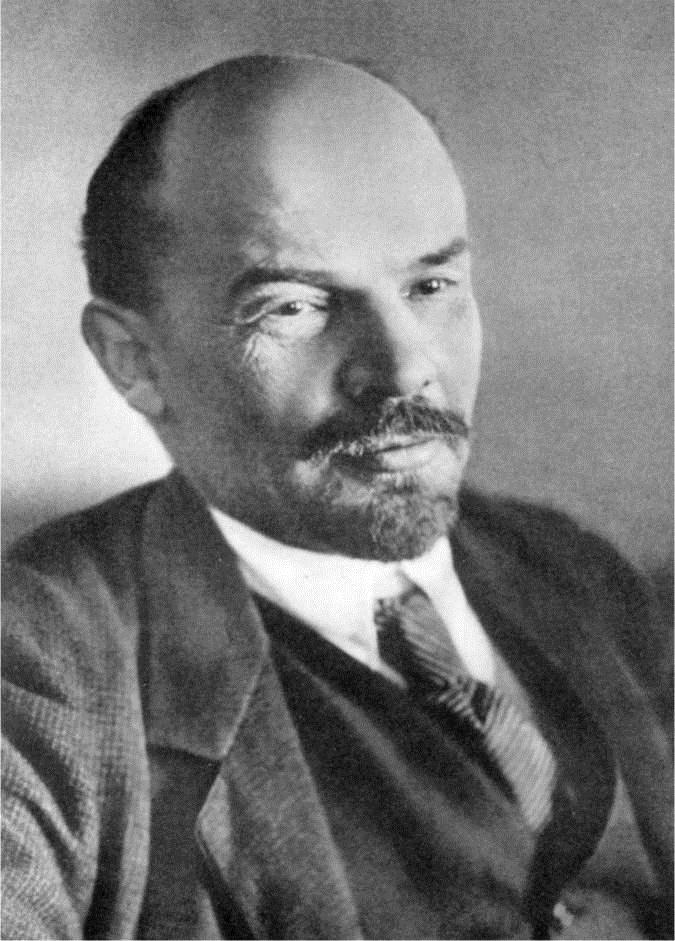
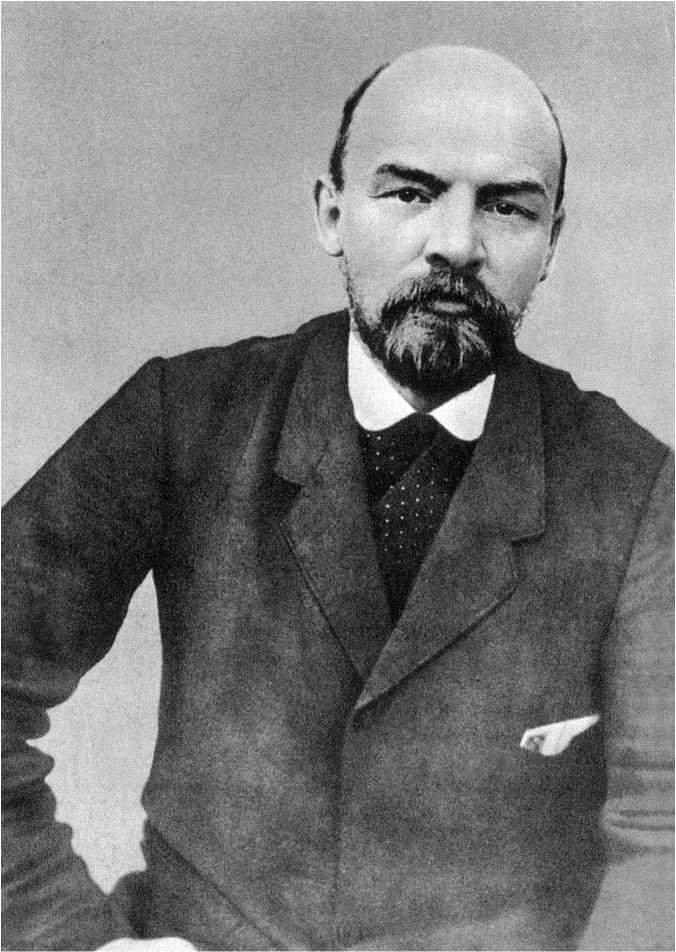
(M.S. Nappelbaum’s official portrait of Lenin, January 1918. This was the first such photo taken of him after the seizure of power.)
At the time of the Russian Revolution, the empire ruled by Tsar Nicholas II was vast, stretching over some 22 million square kilometers from the Baltic to the Pacific and from the Arctic to the Black Sea. Over this area, much of which was empty wasteland, was spread a population of 130 million, of whom less than half were “Great Russians”, speaking Russian as their mother tongue. The rest of the imperial subjects comprised a turbulent mixture of fiercely nationalistic minorities—Ukranians, Poles, Balts, Kazakhs, Caucasians, Finns, Uzbeks, Armenians, Tartars, Germans, Jews and Mongols. The task of ruling such a vast and variegated population, most of them impoverished peasants engaged in primitive agriculture, was not easy. The country with many nationalities, many languages and a nation largely illiterate, was held together by autocratic means.
It was the overriding preoccupation of keeping the empire together that had marked tsarist rule for the last 300 years. The principal instrument of this policy was a class of dependant landowners who received and retained their estates in return for doing the royal bidding. As “service men” of the tsars, they ruled over the countryside with absolute authority, leading the peasants into battle, levying taxes from them to wage war and punishing those who refused to pay or to fight.
The peasants, who had, over the years, been gradually reduced from the status of independent farmers to that of serfs, were bound to the land and service of the local squire. Starved, beaten and despised, the Russian serfs were, in fact, close to being slaves. In the eyes of members of the Russian ruling class, the peasantry was a wild beast that had to be feared, chained and kept under guard.
By the 19th century, the more enlightened and intellectual members of the nobility, especially those who had been educated abroad, were increasingly dissatisfied with a system which kept the majority of the Russian people in a state of medieval ignorance and poverty. In 1825, their discontent erupted in an anti-tsarist coup, led by liberal noblemen and army officers. The uprising though quickly suppressed, was the first sign of a conflict between the autocracy and the intelligentsia that was to dominate Russia through the 19th century and into the 20th. The surviving demonstrators, who called themselves Decembrists, were arrested and exiled to Siberia. In the coming years, they came to be seen as heroes among Russian revolutionaries.
Russia entered a catastrophic war with the French, British and Ottomans in the Crimean peninsula, in 1853. The cause for Russia’s defeat three years later was not only the incompetence of the military leadership but Russia’s primitive economic and social system. Against a rising tide of popular frustration, Tsar Alexander II thought that the best way of averting disaster was to introduce his own reform programme, the principal point of which was the liberation of the serfs. In spite of great opposition from the landowners, Alexander signed the emancipation decree.
Though the rural agrarian peasants were emancipated from serfdom in 1861 its results were far from ideal. The peasants received only half the land that they had been cultivating as serfs, and they had to pay even for that. They were quick to show their displeasure: in the first four months following the emancipation, there were 647 incidents of peasant rioting; and during the year there were 499 major disturbances which had to be put down by the military. In the province of Kazan, 70 rioting villagers were shot dead.
The anger of the peasants was matched by that of the intellectuals, whose demands for legalized political parties and a freely elected parliament went far beyond anything the Tsar had in mind. Convinced that they would never achieve their objectives through peaceful means, many dissidents turned to terrorism. Their prime target was Tsar Alexander, who escaped six assassination attempts. In March 1881, two members of a terrorist group succeeded in killing the Tsar with a bomb thrown under his coach. The government rushed through a series of draconian new measures which included strict censorship and increased police powers; this further alienated the ordinary, law-abiding citizen without deterring the revolutionaries.
By the turn of the twentieth century, Russian society was further divided, and the Russian tsar estranged from his people as had never been so far. By the early 1900s, the anti-tsarist movement was divided into two main parties—the Socialist Revolutionaries, or SRs, and the Social Democrats. The SRs believed that the only class that was capable of carrying through radical social change was the peasantry who made up 85 percent of the population and lived in an almost permanent state of dissatisfaction. Many SRs believed that the traditional form of village organization, the peasant commune, with its emphasis on common ownership and collective decision-making, was a model for the socialist society of the future.
The Social Democrats found these views “populist” and “utopian” and believed that the struggle for socialism had to be carried out in accordance with “scientific principles”—that is in accordance with the principles laid down by the German left-wing philosopher, Karl Marx. Marx had died in penury after a long exile. His theory purported to explain the prime cause of historical change. In Marx’s view, mankind progressed as a result of the conflict that existed between classes, passing through three major stages on the road to political perfection—feudalism, capitalism and socialism. The final stage, socialism would come about when the workers, or proletariat, seized power from their capitalist oppressors and ushered in the first entirely classless—and harmonious—society.
It was the almost religious certainty underlying the theory of history that made Marxism so appealing to the revolutionaries. No matter how hard their struggle or how great their sacrifice, they found consolation in the belief that time would bring them the ultimate victory.
In Russia, however, where large-scale industrialization had only just begun and the urban proletariat was tiny compared with the peasantry, capitalism was to all appearances only in its infancy, and Marx’s necessary conditions for revolution seemed very far away. Meanwhile the Social Democrats had to pursue the vital task of spreading the Marxist message. Soon some agitators began to organize the workers to fight against the government and many felt obliged to disregard the law and constituted authority. Low wages, bad housing and inhumane working conditions had given the proletariat as great a sense of grievance as the peasantry. Urban conditions were dreadful, dangerous and unsanitary. The workers proved highly receptive to the propaganda of the Social Democrats, and some of the party leadership began to look forward to the emergence of a mass labour movement similar to those in more liberal Western countries such as Britain and France. There were others, however, who believed that such a movement would lose its revolutionary character and become a vehicle for reform rather than change. The fiercest critic of the “reformist” view was a young lawyer, Vladimir Ilyich Ulyanov—better known to his comrades as V. I. Lenin.1
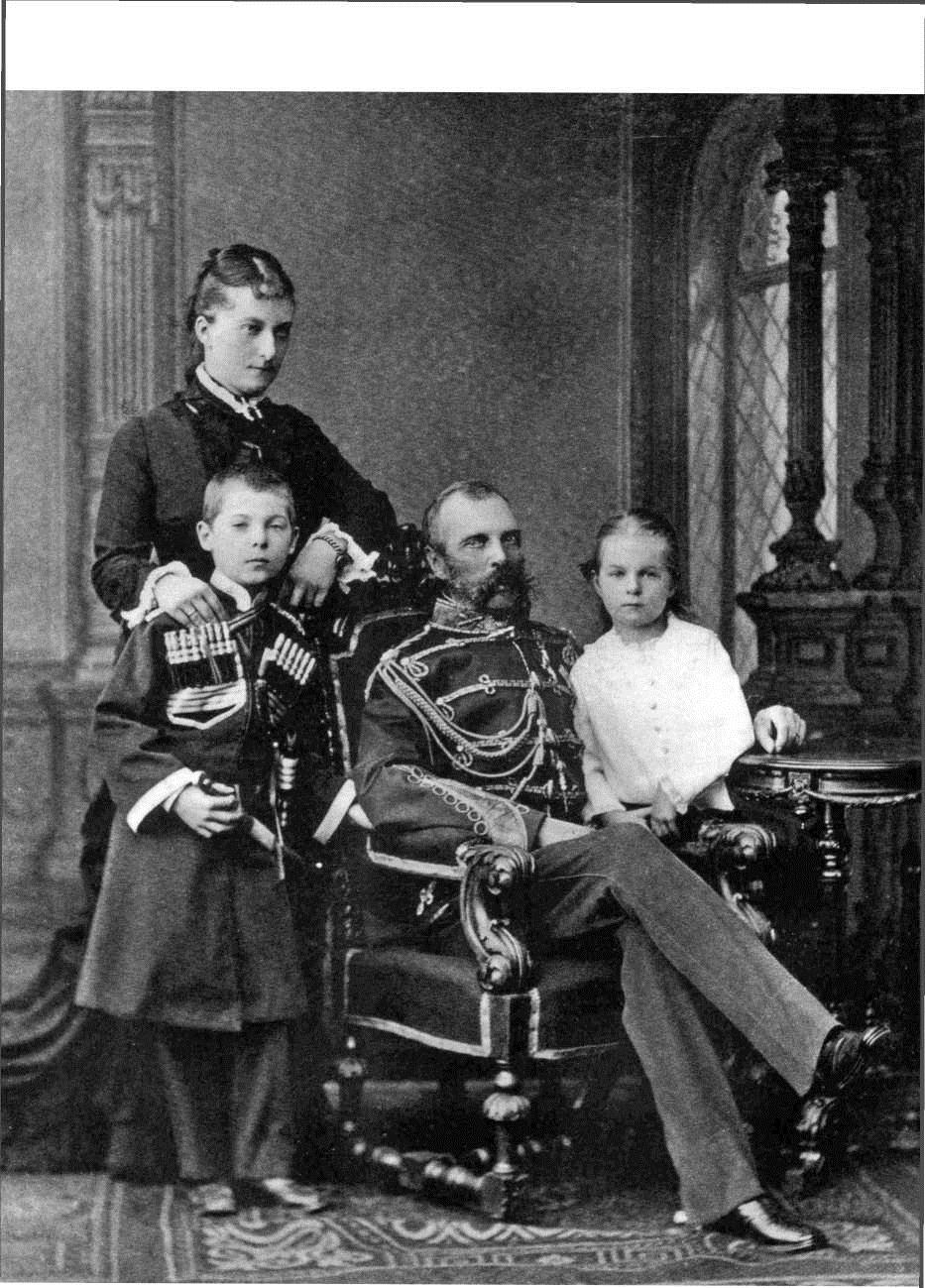
(The Tsar reformer, Alexander II, with his family.)
Chapter-I: Vladimir Ilyich Ulyanov (1870-1924)
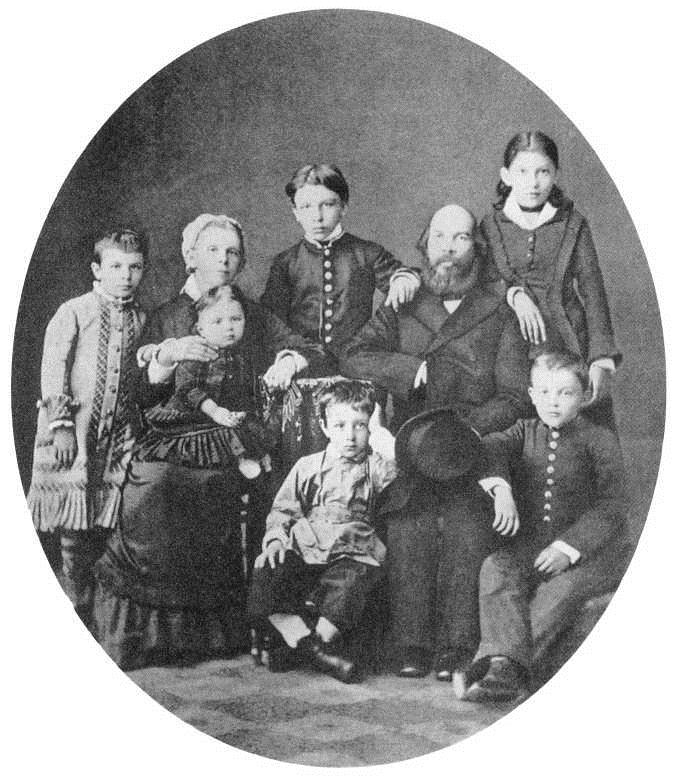
(The Ulyanov family in 1879, from let to right: (standing) Olga, Alexandr, Anna; (Seated) Maria Alexandrovna with daughter Maria, Dmitri, Ilya Nikolaevich and Vladimir.)
Vladimir Ilyich Ulyanov was born in 1870, on April 10 2, in Simbirsk, a town on the river Volga, that later was in his honour called Ulyanovsk. He adopted in 1901 the last name Lenin—a name that is said to have been derived from the Lena, the longest river in Siberia. It was the main—one in a series of many—pseudonyms that he was obliged to use while undertaking revolutionary activities in Europe. His family was well-to-do, and Lenin, the third child was close to his parents and the other five siblings.
His parents both educated and highly cultured, encouraged a passion for learning in their children, especially Lenin who was a voracious reader and finished with a first position in his high school, leaving school with a gold medal for his exceptional performance. He decided that he wanted to study law at Kazan University.
In spite of his well-to-do background and a comfortable life during his school years, the rest of his life did not prove to be easy for Lenin and his family. His father passed away in 1886, and then a tragic event happened in 1887 that had a profound effect on his life; Aleksandr, his older brother, who was a university student at the time, was arrested and hanged for being a part of a group planning to assassinate Emperor Alexander III. Aleksandr’s involvement in political activism against the autocracy was not an isolated incident in Lenin’s family. In fact, all of Lenin’s siblings would take part to some degree in revolutionary activities. Lenin gained an interest in revolutionary leftist politics following his brother’s execution and the same year enrolled at Kazan University to study law. However, he did not stay there for long, as during his first term, he was expelled for taking part in a student demonstration. After one protest demonstration he was arrested and taken to the police station. One of the police officers asked: “Why are you rebelling, young man? After all, there is a wall in front of you.” Lenin confidently replied: “The wall is tottering, you only have to push it for it to fall over.”
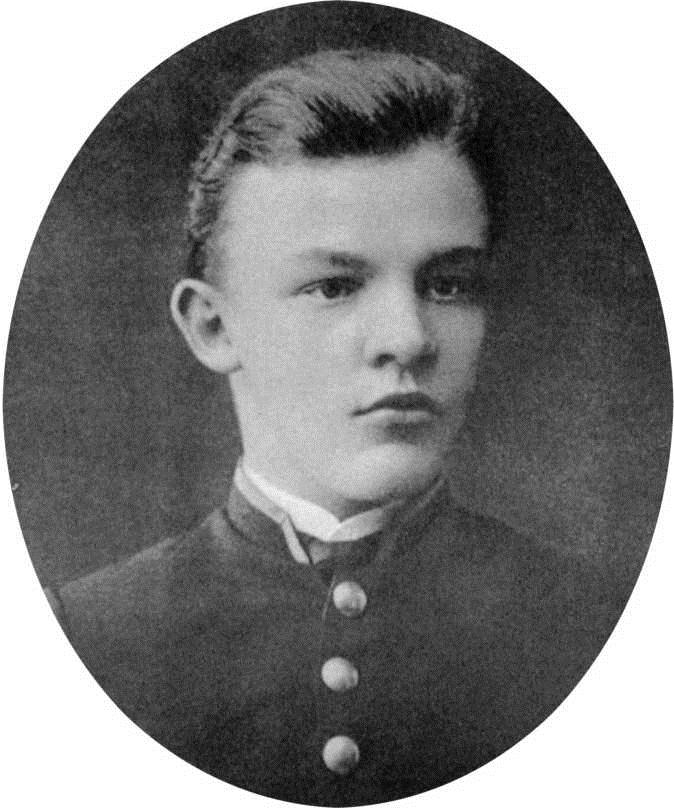
(Vladimir Ulyanov, aged seventeen)
He was put under police surveillance and exiled to his grandfather’s estate in the village of Kokushkino, where he stayed along with his sister Anna, who too had been ordered by the police to live there as a result of her own suspicious activities. Here, Lenin’s political education began. His main activity was self-education, an intellectual self-preparation. He plunged into the study of radical literature; a novel that made a deep and lasting impact on him was, What Is To Be Done? by Nikolai Chernyshevsky, a story of socialists living in communes and of an activist’s total dedication to revolutionary politics. Lenin began the study of the works of the German philosopher, Karl Marx, who was to influence him deeply. His famous book Das Kapital would affect Lenin’s thinking enormously and by 1889 he was a committed Marxist.
With his family Lenin left for the city of Samara where he obtained permission to continue his studies away from the university. Being used to studying on his own, this posed no problem for him and finally in 1892, he received his law degree from the St. Petersburg University, achieving great success. He received the highest possible grade in every subject and was the only student that year to do so. He began to practice law and most of his clients being peasants and Russians from the poorer section of society gave him a further insight into their struggles with the existing legal system.
Lenin dedicated himself to becoming a revolutionary and revolutionary politics became his prime focus. In 1893 he moved again, choosing St. Petersburg, the Russian capital at the time, for his residence. There, Lenin made contact with other Marxists through a network of informal discussion groups, and participated in their activities. In 1895, Lenin made the first of many trips abroad primarily to make contact with some of the leading Marxists who were living in exile, in particular Georgy Plekhanov,3 considered the father of Russian Marxism, by whom he was greatly inspired. After he visited Switzerland in 1895, one of his hosts wrote the following about him:
I felt that I had before me a man who would be the leader of the Russian Revolution. He was not only a cultured Marxist—of these there were many—but he also knew what he wanted to do and how to do it. 4
Back in St. Petersburg he continued with his political agitation, becoming soon a senior figure within the League of Struggle for the Emancipation of the Working Class 5 which had just been established. Lenin wrote a number of essays and pamphlets; in fact, he was a prolific writer, and he also regularly delivered lectures on Marx’s Das Kapital, besides smuggling seditious literature into Russia. These activities had come to the notice of the authorities and finally they took action in December 1895. Lenin was arrested and so were other Marxist activists, his colleagues from the League of Struggle for the Emancipation of the Working Class. Lenin after a period of detention was exiled and sent to Siberia where later he was joined by Nadezhda Krupskaya his fiancée, a committed Marxist herself who later became his wife. During the four years in exile he produced thirty works of political theory and it was during this time that he is said to have clarified and consolidated his political thinking.
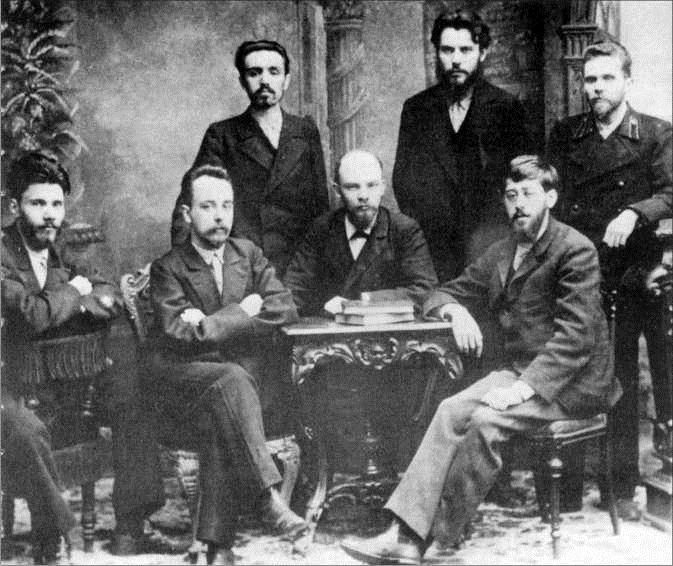
(The leaders of the Petersburg League of Struggle for the Liberation of the Working Class. Seated behind the table: Lenin. The picture was taken when they were released from prison before being sent to Siberia.)
After his release from exile, Lenin fled to Western Europe, living in Germany, England and then Switzerland. In 1900, Lenin felt strongly the need of a Marxist newspaper and the formation of a political party; both could be used as vehicles to overthrow the Tsarist regime. He was a marked man in Russia under the constant surveillance of the Okhrana6 (the Russian secret police) and so had to base his publishing activities in Europe. He joined other leading exiled Marxists, Plekhanov and Martov, in starting a newspaper called Iskra, or The Spark,7 to expound their thinking and develop their ideas, and which they hoped would unify underground Russian Marxist groups which were scattered throughout Russia and western Europe, into a Social- Democratic party. The idea was that a newspaper would be the best way to build the party, and develop the core of party thought. To avoid imprisonment by Russian authorities, he was forced to print the paper in European countries. Iskra would go on to become the most successful underground publication, smuggled into Russia illegally. It contained contributions from many known figures of Marxism all over Europe and in 1902 regularly from the young Ukrainian, Leon Trotsky. During these years of travel Lenin maintained close contacts with other revolutionaries in exile. Between 1893 and 1902, Lenin began to revise his understanding of Marx, the essential features of which would be called in later years, Leninism. His idea was that a class consciousness had to be developed among the masses by making them politically aware, by a well organized revolutionary party with an elite leadership in the vanguard—the “vanguard of the proletariat”, leading ultimately to the dictatorship of the proletariat.
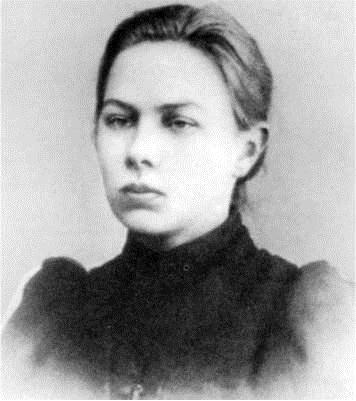
(Nadezhda Krupskaya in 1895)
In 1902, he brought out a booklet What Is To Be Done? which stirred up a huge controversy among the readers. “Give us an organization of revolutionaries,” he exhorted in the booklet, “and we will overturn Russia!” This type of exhortation was new for the Marxists who till then were used to a more moderate approach.
For the people sympathetic to Lenin and his approach, this booklet “was his hymn to leadership.” It conveyed his sense of urgency and his insistence that the great duty in politics was to lead the way. From then onwards, even though he would go on to write numerous pamphlets, articles, and books, What Is To Be Done? would be taken as Lenin’s defining interpretation of Marxism, based on Russian conditions.We are told that:
He cheered and cajoled his fellow activists. He managed to let them know that, whatever difficulties they might be experiencing, he understood them—and yet he also expected them to produce wonderful results. ‘Miracles’, he asserted, were within the range of attainment of Russia’s Marxists. Too much rationality was no great thing: ‘We’ve got to dream!’8
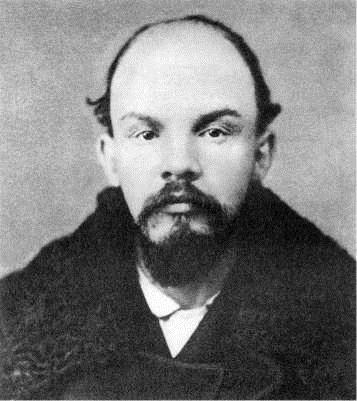
(Vladimir Ulyanov in 1895. Picture taken by the police photographer)
While completing What Is To Be Done? he was also involved with other political tasks such as editing Iskra and getting a draft party programme ready in time for the Second Party Congress of The Russian Social Democratic Labor party (RSDLP), a party that he had just joined. It had been secretly formed at a congress at Minsk in 1898; based on the doctrines of Marxism, it had been formed to unite the various revolutionary parties. The task of preparing a draft party programme was a difficult and time-consuming task as Lenin differed on many points from his mentor, the prominent Marxian scholar and revolutionary, Plekhanov, for whom, till then, he had a great admiration as the founder of Russian Marxism. He was a pupil of Plekhanov and one of his most passionate supporters.
Plekhanov had written for Iskra when Iskra was founded in 1900 and along with Lenin supported proletarian revolution and attacked revisionism. However, Lenin wanted a programme that was suitable for a fighting political party. Though he and his followers wanted policy to be based on sound intellectual ground, uncompromising revolutionary action was of equal importance to them.
According to Leon Trotsky, one of the leading Russian revolutionaries—arrested for dissident activities while yet a teenager, he had not spent a single year on Russian soil as a free man—and a close associate of Lenin in later years, Lenin had:
... only one goal before his eyes, and towards this final goal he was pressing, whether in politics or in his theoretical or philosophical studies, in discussions with others or in learning foreign languages. His was perhaps the most determined utilitarianism ever produced in the laboratory of history. [Lenin’s] whole being geared to one great purpose. He possessed the tenseness of striving towards his goal.9
He says further:
Lenin went abroad neither as a Marxist ‘generally speaking’, nor in order to devote himself to some ‘general’ literary-revolutionary work, nor for the purpose of carrying on the twenty-year-old activities of The Emancipation of Labour 10. No. he went as a potential leader, as the leader of the revolution which was welling up, which he sensed and perceived. He went in order to build, in the shortest possible time, an ideological base and an organizational framework for that revolution. When I spoke about Lenin’s tense concentration on his goal—concentration which was both passionate and disciplined—I did not see it as an effort to achieve a ‘final triumph’, no, that would have been too vague and meaningless; I saw it as a concrete, direct, immediate work towards the practical aim of speeding up the outbreak of the revolution and of securing its victory.11
In 1903, Lenin attended the Second Congress of the Russian Social Democratic Labor Party (RSDLP), held in Brussels and then in London, which had been organized in an attempt to unite the party, to create a united force. However, it was an event that would lead to a split within the party. Should the party comprise activists (as Lenin urged) or have a broader membership? This was the issue, and Lenin argued forcefully for a streamlined party leadership group, one that would lead a network of lower party organizations and their workers.
Among all these varied tendencies and attitudes assembled under the banner of Iskra, which found their reflection in the editorial team, Lenin was the only one to personify the future: its grave tasks, its cruel struggles and innumerable victims. Hence the vigilance and suspicion of a combatants Lenin began the task of sifting the cadres anew in a more stern and exacting manner.12
He believed that capitalism would only disappear with a revolution, not with gradual reforms, and that revolution was only possible under certain conditions; the revolution, to be followed by a dictatorship of the proletariat as the first stage of moving towards communism, and the need for a vanguard party to lead the proletariat in this effort. The party was split between Lenin’s group called henceforth the Bolsheviks (Bolsheviki or majority group), and the group led by Martov, called the Mensheviks (Mensheviki or minority group), over the issue of “reformism”. The Mensheviks were more focused on changing Russia peacefully through an evolutionary process, while the Bolsheviks wanted revolutionary change. Lenin’s group remained in the majority for a very short while, but he kept the name and developed a disciplined, revolutionary group. His brainchild Iskra, which had been his life for three years, had now to be relinquished to the Mensheviks who took control, unwilling as he was to serve under them; there was an unbridgeable gap between his own unwavering determination and the other group’s lack of political will. His break with his former colleagues done in the ‘best interests of the revolution’ brought him a great deal of criticism and he made enemies by what was seen as scant respect for the old guard. His uncompromising stand was viewed by many as “intransigence and ruthlessness—though he would call it revolutionary purity...”13 A year and a half later he would launch his own newspaper called Vpervod (Forward).
Leon Trotsky, who after his escape from Siberia had worked with Lenin on the revolutionary newspaper Iskra, in London, was initially a supporter of the Menshevik Internationalists faction of the Russian Social Democratic Labour Party before joining Lenin’s Bolsheviks at a later period. He has commented on this event in the following words:
To take such a step facing the opposition of half the assembly, having Plekhanov as a doubtful semi-ally and all the other members of the editorial staff as determined opponents; to embark in such conditions on a work like this, one had to have faith not only in the cause but also in one’s own strength.
This faith in his own strength was the result of Lenin’s self-evaluation tested in practical experience. He acquired it also during the work with the ‘masters’ and through the first skirmishes—already then there were sparks flying and flashes of lightning portending the thunders and the tempests of the coming rupture.
It was Lenin’s impressive singleness of purpose which allowed him to embark upon his task and to conclude it.
Tirelessly, he was tightening the string of his bow more and more, to the limit—quietly testing: was there no flaw? no danger that it would snap? From all sides he heard warnings: do not make it any tauter, don’t!
“It will not snap,” answered the master archer, “our bow is made of unbreakable proletarian stuff, and the string has to be tightened more and more, for the arrow is heavy and we have to launch it far, very far into the distance.”14
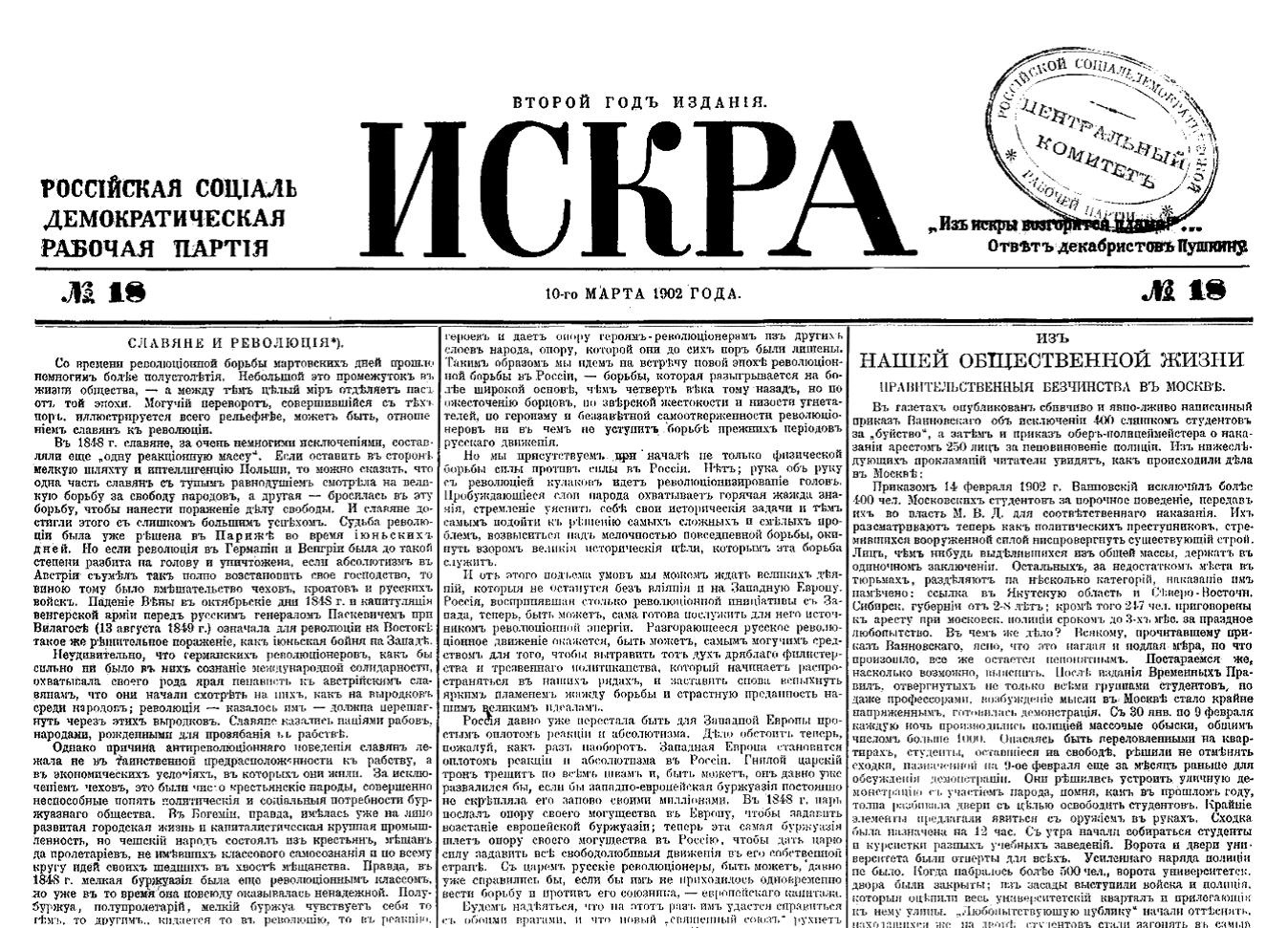
(The revolutionary newspaper Iskra)
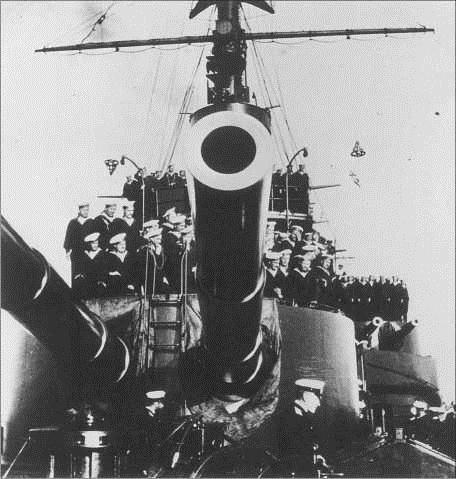
(A Russian warship before meeting the Japanese.)
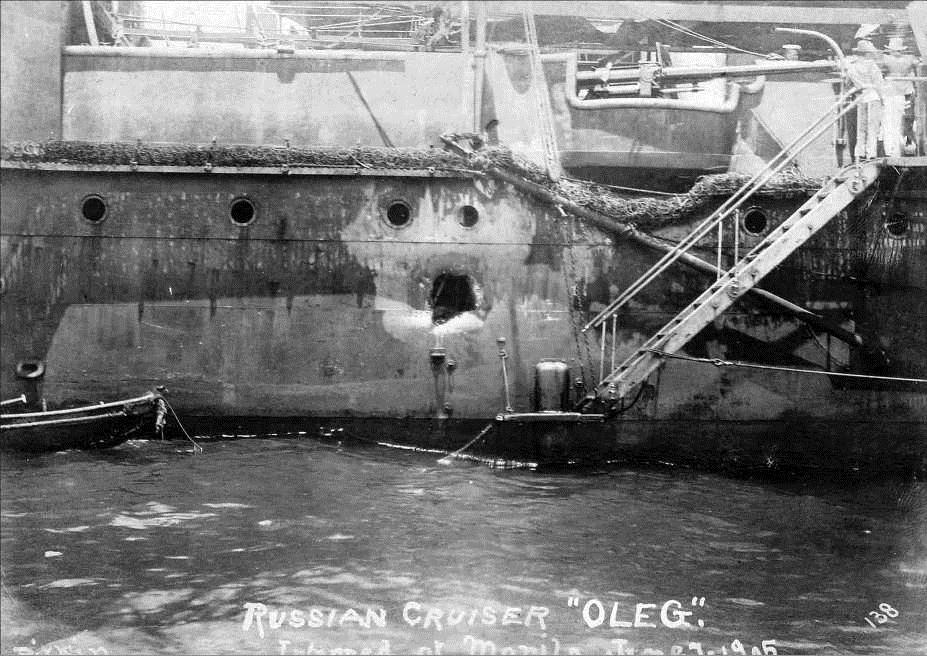
(Russian protected cruiser Oleg, showing battle damage after the Battle of Tsushima where the Russian fleet was annihilated by the Japanese)
Chapter-II
In 1904 Russia rather unwisely went to war with Japan. This conflict had a profound impact on Russian society. After a number of crushing and humiliating defeats, citizens from all walks of life began to voice their discontent over the country’s political structure and called for reform. This exacerbated the economic crisis that the country had been heading towards since four years. The failure of the land reforms of the early 1900s had led to increasing peasant disturbances and revolts, with the goal of securing ownership of their land. The rapid industrialization of Russia also resulted in urban overcrowding and poor conditions for urban industrial workers. Between 1890 and 1910, the population of the capital of St. Petersburg rose and almost doubled, with Moscow experiencing similar growth. Strikes and demonstrations erupted in many parts; Russia was heading towards an outright collapse.
On 9th January, 1905, a group of unarmed workers including women and children, in St. Petersburg peacefully took their concerns directly to the city’s palace to submit a petition to Emperor Nicholas II for the granting of civil rights. They were met by security forces, who ordered them to disperse, and when they did not heed, fired on the group. A great number of innocent demonstrators were killed and wounded. This massacre outside the Winter Palace, transformed the situation and the consequence of “Bloody Sunday” as it came to be called, was irrevocable. Violence and disorder swept through the country. This incident sparked a series of events that became known as the 1905 Revolution.
The news of the Russian revolutionary crisis reached Geneva the day after the massacre in St. Petersburg, where throughout the day “... the sedate streets of Geneva resounded with the shouts of newspaper boys—Revolution en Russie!...”15 Lenin (who was in Geneva) and other underground revolutionaries were in a state of shock and excitement and the feeling of many was that they had to return to Russia. Lenin, however, was not yet ready to go, in spite of exhortations from top revolutionaries; he believed as a revolutionary leader he should not risk his personal safety.
Strikes took place all over the country, the universities closed down and there were mutinies in the army and the navy. Vociferous complaints about the lack of civil liberties and demands for a constituent assembly and an end to absolute rule were raised by Russians from all walks of life.
In October, events again exploded in Russia and after a general strike, workers took events in their own hands and with the help of Mensheviks set up the St. Petersburg Soviet, an elected committee. Many such soviets sprang up in different parts of Russia. A shaken yet hesitant Nicholas II was forced to agree to political change and in order to placate his citizens, signed the October Manifesto, pledging a constitution, an extended franchise, and civil liberties, most notably the creation of an elected legislative assembly known as the Duma. Soon after the proclamation of the manifesto strikes ended and civil unrest abated and there were even some demonstrations of support in the cities. However, the next month saw another general strike as Russians felt that the reforms were insufficient and the Duma was merely a consultative body. Trotsky, who had meanwhile returned to Russia and joined the St. Petersburg Soviet, was arrested along with other members of the St. Petersburg Soviet in December, 1905.
A question frequently asked is why did Lenin fail to seize the moment and head back for Russia? When he did return to St. Petersburg in November 1905, the moment had passed. That none of the émigré political activists took advantage of the moment was largely because Russia had seen many protests and incidents of civil unrest come up before and subsequently come to nought, so there was neither belief nor readiness for action.
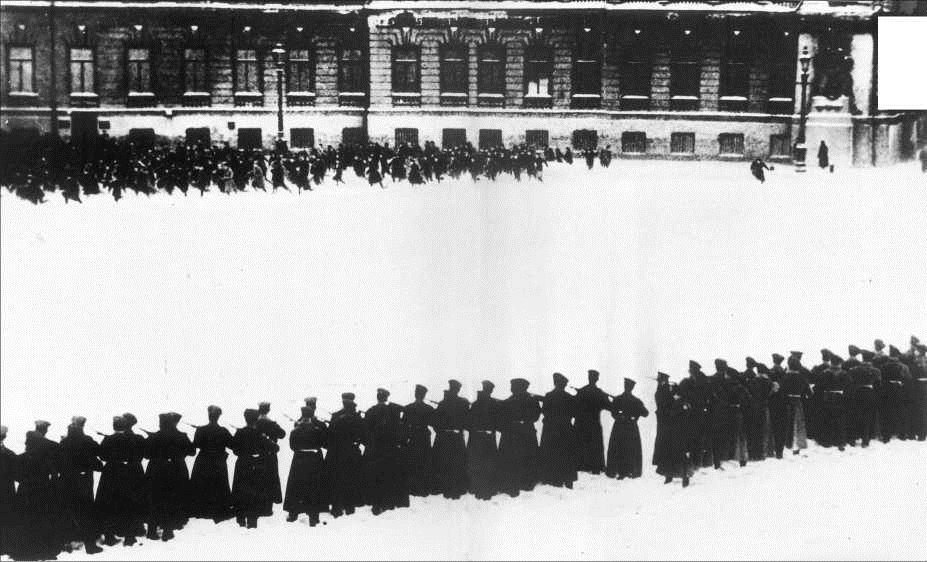
(Bloody Sunday, 22nd January 1905. A petition was taken to Tsar at the St. Petersburg Winter Palace. The people were mown down.)
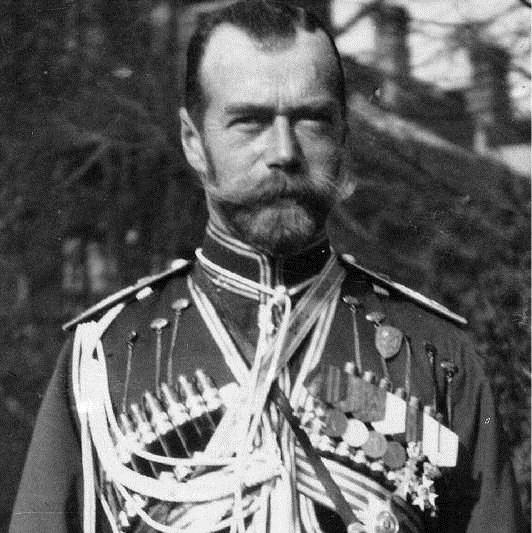
(Left: The Tsar Nicholas ll)
Though the revolutionary movement failed to achieve immediate success, Lenin continued working tirelessly between 1907 and the outbreak of World War I. He settled first in Switzerland, where he edited the Social Democrats’ new party newspaper, Proletary, for some time, and supervised the smuggling of it into Russia.
The fifth party congress held in London, in 1907, was the largest till then. The intellectuals were still in majority in the RSDLP, but the party ranks now included over one hundred representatives from Russia’s burgeoning urban working classes. Lenin is said to have taken centre stage from the outset. His friend, the writer, Maxim Gorky, was struck by his persuasive arguments;
For [Maxim] Gorky, as for many others during those three weeks in May, Lenin’s greatness lay in his direct manner. He had the ability to breathe life and logic into complex political questions, treating them “so simply, no striving after eloquent phrases... but every word uttered distinctly, and its meaning marvelously plain.”16
However, the ongoing disagreement between the Bolsheviks and the Mensheviks continued. The Bolsheviks thought that only a violent uprising in the proletariat could truly create a communist state, the rebellion headed by a small number of intelligent revolutionaries. For the Mensheviks gradual reform and democracy were what would take Russia forward into communism and with the formulation of parties and a parliament, the workers would then be empowered.
Lenin however, was not “content to wait while history took its predetermined course.” Instead, he argued, a real and complete revolution, one that could lead to Socialist Revolution that could spread outside of Russia, must be through the united leadership of the urban proletariat and the peasantry. The Mensheviks argued against Lenin’s centralized, dictatorial party model. From their point of view, Lenin’s ideas led the way towards a one-man dictatorship over the people whom he actually wanted to empower.
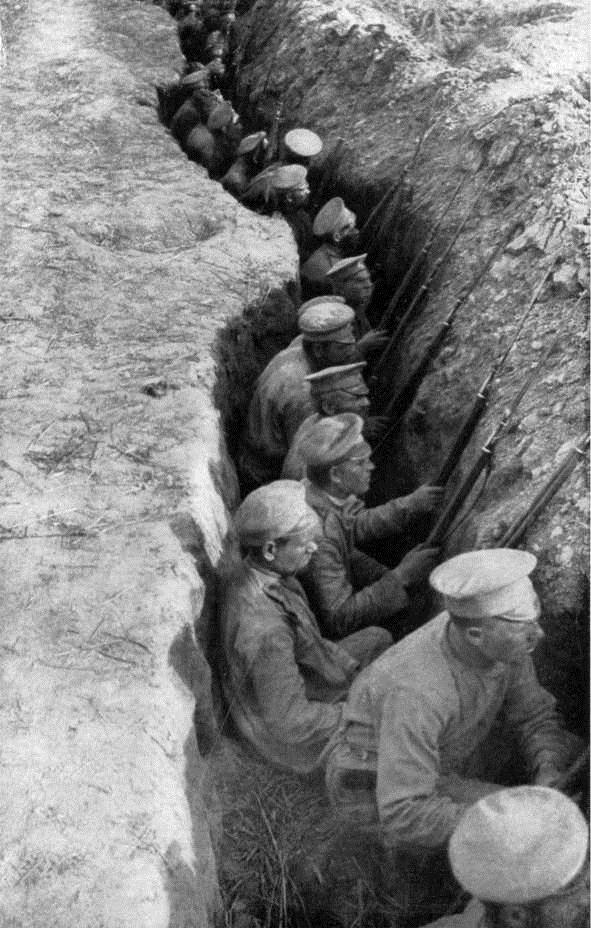
(Russian troops in trenches during World War I, facing Germans)
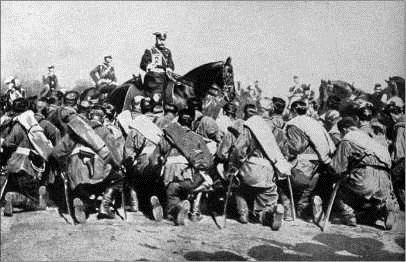
(The Tsar visiting the troops during World War I)
The fighting between the Bolsheviks and the Mensheviks would continue until a 1912 party conference in Prague where at Lenin’s urging, the delegates voted to break away from the Social Democrats and to form a separate socialist party. From that point the Bolsheviks and Mensheviks existed as separate political entities.
From 1911 onwards there was a resurgence of working-class militancy and large scale strikes became common in the two major cities of St. Petersburg and Moscow culminating in July 1914, when the capital was paralysed by a general walk-out and workers and police fought hand-to-hand battles.
It was only with the outbreak of World War I on August 1 that revolutionary fervor subsided and it seemed that the war forged a new bond between Sovereign and people. The bond would not remain intact for long; in fact World War I was to prove the undoing of tsarist rule. During World War I, Lenin was in exile again, and residing in Switzerland. As always, his mind stayed focused on revolutionary politics. During this period, in 1916, he wrote and published Imperialism, The Highest Stage of Capitalism.
It was his task, Lenin tells us in State and Revolution, “to resuscitate the real teachings of Marx.” He sought to do this... by insisting that progress towards Socialism could only be revolutionary, not evolutionary as Bernstein and the revisionists maintained.
... He was one of the greatest revolutionary strategists of all time, and nothing is more typical of him than his unequivocal insistence on the necessity of revolution.
It was Lenin’s. great task to adapt Marxism to Russia. As a Russian of the Russians who need yield place to no one in Russian history in his instinctive understanding of Russian realities, and as a revolutionary strategist of genius, he realized that in certain circumstances revolution is possible in Russia. Those circumstances were Tsarist defeat in war and the existence to take advantage of it of a resolute, highly disciplined group of professional revolutionaries, limited in number... His interpretation of Marx convinced him that war was inevitable.
His knowledge of Russia convinced him that Russian defeat was inevitable. Therefore it was for him to create the party which would carry the revolution through to its successful conclusion. 17
The war was a disaster for Russia. By the summer of 1915, Russian casualties had reached an astronomical figure and huge areas of the empire were under German occupation.
The tsarist government, through its prodigious incompetence, seemed to pose almost as great a threat as the Germans. Every item of equipment was in short supply. Many men were sent to the front without boots, without proper clothing, and sometimes even without rifles.18
As the war continued to go badly for the Russians with one military defeat after another compounded by the loss of territory and the extreme food shortages, there was increasing unrest in the cities. Despair gained ground as public confidence in the Tsar diminished alarmingly. As the power of the imperial regime diminished, Vladimir Lenin rose to prominence as the most powerful figure in Russia.
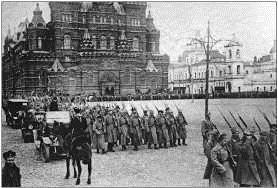
(Left: Russian soldiers marching in Petrograd in February 1917.)
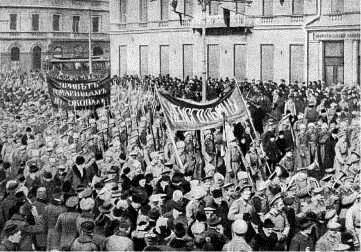
(Right: Soldiers demonstrations, 1917.)
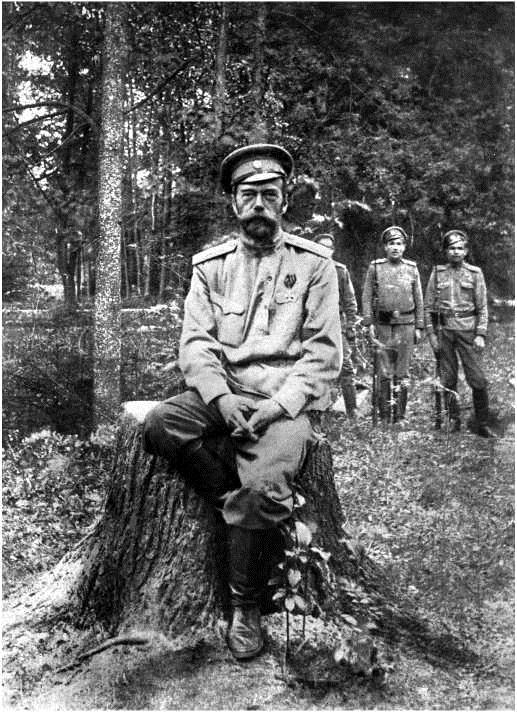
(One of the last photos of the Tsar)
Chapter-III
Even though Lenin returned to Russia only after the February Revolution in 1917, having been in exile since 1900, he nevertheless had an enormous influence and led the October Revolution. Few other émigré revolutionaries had Lenin’s firmness and self-confidence, strength of vision and decisiveness for Russia’s future. Lenin’s great strength was an ability to organise the party—and much of this had to be done in secret before October 1917. Getting things done was Lenin’s main quality and he got things done as a result of meticulous organisation.
In 1917, Russia, war-weary and desperate with cold and hunger, did away with tsarist rule. This revolution broke out spontaneously on 23rd February, 1917, without definite leadership and formal plans; it seemed that the Russian people had had enough of the existing system. Petrograd, 19 the capital, became the focus of attention, and, on this date, people at the food queues started a demonstration. Many thousands of women textile workers who had come out of their factories—it was International Women’s Day but largely as a protest against the acute shortages of bread—joined the demonstrators. Mobs marched through the streets, shouting slogans such as “Bread!” and “Give us bread!” Large numbers of men and women were on strike and by 25th February everything had virtually shut down in the city. Police lost control on the situation as students, white collar workers and teachers joined the workers in the streets. Soldiers mutinied and there was near total breakdown of military power and collapse of civil authority. Seeing the demonstrations on such a massive scale, the cabinet resigned as calls went out to replace them with responsible members. Nicholas fearing for his life admitted defeat finally and abdicated on 2nd March, ending the 300 year rule of the Romanov dynasty.
Lenin, then in Switzerland, read about the Revolution occurring in the newspapers, when the first news of the revolution reached on 15th March.20
Stunned and delighted, Lenin and Nadya read the reports...There really could be no doubt: Revolution had occurred….. This time monarchy had been blown away.21
Lenin’s return home was imperative now. But that was a difficult task in the middle of the First World War. Switzerland was surrounded by the warring countries of France, Germany, Austria- Hungary and Italy. Finally, on the evening of 3rd April, 1917, Lenin arrived in Petrograd (it is believed he transited through the front in a sealed train with the secret help of the German officials to pass through their territory), and he on arriving:
… finally saw the Russian masses as they really were and witnessed what Nadya called “the grand and solemn beauty of the Revolution” in all its visceral power and immediacy—an experience he had missed in 1905. “Yes,” he whispered under his breath, as he emerged out onto the square packed with thousands of eager faces:
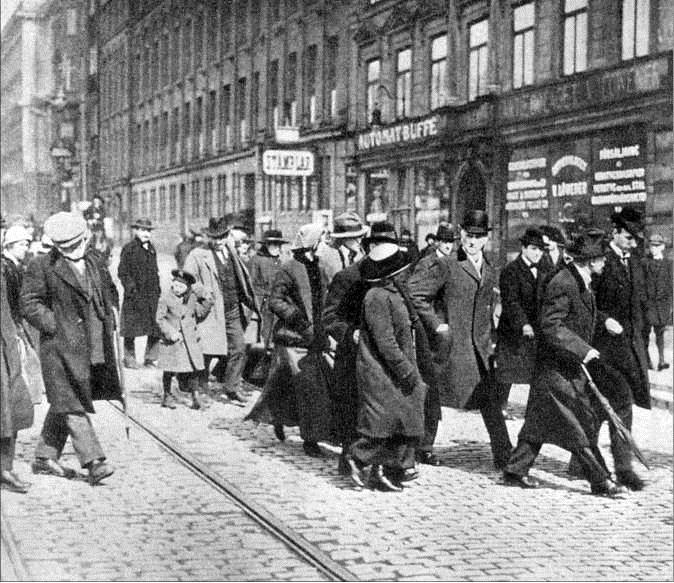
(Lenin’s voyage back to Russia: Lenin and his fellow travellers in Stockholm, days after disembarking from the sealed train across Germany. The woman in the large bonnet following Lenin is his wife Nadya.)
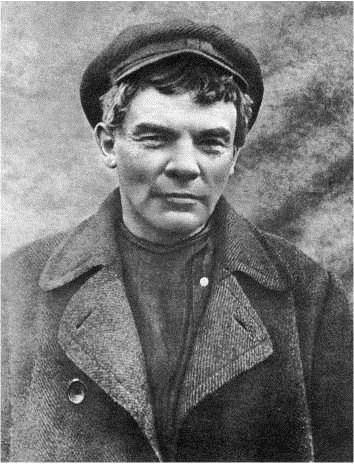
(Picture taken of Lenin for his official documents with which to escape to Finland)
“Yes, this is the revolution.”22
Lenin’s return was greeted by the Russian populace, as well as by many leading political figures, with great rapture and applause. His arrival was enthusiastically awaited, and a large crowd of supporters thronged to greet him and cheered as he stepped off the train. He was carried shoulder-high from the platform to the station hall.
The atmosphere was electric; the sense of euphoria palpable. “Just think,” recalled an exhilarated Feodosiya Drabkina23 of that memorable night, “in the course of only a few days Russia had made the transition from the most brutal and cruel arbitrary rule to the freest country in the world.”...
As the crowd rumbled in excitement, with sailors and soldiers hurling their caps in the air for joy, only a few fractured words of Lenin’s speech penetrated the crowd. The people needed three things—peace, bread, and land. They must “fight for the social revolution, fight to the end, till the complete victory of the proletariat.” And then, amid the clamor, one distinctive Leninist phrase was hurled at the crowd. “Long live the worldwide socialist revolution!”24
Following the February revolution, Russia was under dual power of the Provisional Government (the temporary government that replaced the tsar) and the Petrograd Soviet (an influential local council representing workers and soldiers in Petrograd). The two groups coordinated with each other on major issues but were often at odds with each other. Lenin to the shock and surprise of everyone condemned both the Provisional Government and the Petrograd Soviet for their ideologies and policies. At an impromptu meeting of party members later that night Lenin asserted that the only way to end the war was to overthrow the Provisional Government—the Provisional Government had taken the major decisions of remaining in the war and postponing the land reforms—and form a soviet government by soldiers, peasants and workers.
Among those listening to Lenin’s two-hour tirade was a Menshevik, Nikolay Sukhanov, who had slipped past the Bolshevik guards. “I shall never forget that thunderlike speech...,” he wrote. “It seemed as though all the elements had risen from their abodes, and the spirit of universal destruction, knowing neither barriers nor doubts, neither human difficulties nor human calculations, was hovering round… above the heads of the bewitched delegates.”25
Lenin called for a new revolution; the Bolsheviks should press ahead to a revolution of the workers and the peasants and not rest content, like almost all other Russian socialists, with the “bourgeois” February Revolution. He reiterated that the country was still at war and the new government had failed to give the people bread and land. He gave several speeches in the days following his arrival, calling for the overthrow of the Provisional Government. April Theses was the name given to the publication of the collection of speeches given by Lenin during those days. Pravda (Truth), the Bolshevik newspaper, on 7th April, published the ideas contained in those speeches.
Apart from a short period in 1905, Lenin had spent 15 years as an émigré abroad. Yet:
His sense of the real, his intimate understanding of the living and toiling worker had not weakened during these years at all; on the contrary, through theoretical study and his creative imagination it had become even more solid. From episodic and accidental encounters, from observation whenever an opportunity occurred, Lenin gathered details which allowed him to build up a whole.
However, it was as an émigré that he spent those years of his life during which he finally acquired the stature to play his future historical role. When he arrived in Petersburg, he brought with him those revolutionary conclusions which summed up all his social-theoretical work and all the practical experience of his life. He proclaimed the watchword of socialist revolution the minute he touched the soil of Russia. But only then, face to face with the awakening working masses of Russia, all the accumulated knowledge, all that had been pondered, and all that had been resolved, went on practical trial. The formulae stood the test. Moreover, only here in Russia, in Petersburg, in daily life, they took on a concrete irrefutable shape and consequently an irresistible force... The entire reality asserted itself with the full voice of the revolution. And here Lenin demonstrated—or perhaps he himself realized it fully for the first time—to what degree his ear was attuned to the still discordant clamour of the awakening masses. With what profound, almost organic, contempt he viewed the mice-like scurrying of the leading parties of the February revolution, and the waves of ‘powerful’ public opinion beating upon one newspaper and another; with what scorn he looked at the short-sighted, self satisfied, babbling official Russia of the February days! Behind this stage hung with democratic props, he heard the rumble of events on quite a different scale. When the sceptics were pointing to all the difficulties of his enterprise, to the mobilization of bourgeois public opinion, to the simplicity of the petty-bourgeoisie... He saw and he understood the difficulties just as well as did the others; but he also had the almost physical awareness—as if it were tangible—of the gigantic historical forces pent up and now ready for the tremendous burst which was to overcome all obstacles.26
In his April Theses, he argued that the country was passing from the first stage of the revolution to its second stage. The first stage owing to the insufficient class-consciousness and organisation of the proletariat, placed power in the hands of the bourgeoisie; it must now place power in the hands of the proletariat and the poorest sections of the peasants—“All power to the soviets” was his slogan. He advocated non-cooperation with the liberals (i.e. non hard-line Communists) and an immediate end to the war. The April Theses was more radical than anything his fellow revolutionaries had heard before and invited a great deal of controversy.
Trotsky describes Lenin and that moment in history thus:
... Lenin invariably seemed extremely preoccupied—under the apparent calmness and his usual matter-of-fact behavior one could sense a tremendous inner tension. At that time the Kerensky regime seemed all-powerful.
Bolshevism seemed a quantite negligeable. The party itself was not yet aware of its gathering strength. And yet Lenin was leading it, unfalteringly, towards momentous tasks.
His speeches at the First Congress of the Soviets surprised the Social Revolutionary and the Menshevik majority and provoked their anxiety. Confused, they sensed that this man was aiming very, very high. But they did not see his goal. And the petty-bourgeois revolutionaries wondered: What is he? Who is he? Simply a madman or a historical missile endowed with an unheard of explosive force?
... he made the impression of someone who had not as yet said all he had to say, or who said it not quite as he
wished to... At that moment an extraordinary breath of air drifted over the hall: it was the blast of the wind of future change felt by everybody, while bewildered eyes anxiously followed Lenin’s figure, so ordinary and so enigmatic.27
At first his was a lone voice and his resolute and uncompromising stand isolated Lenin and the Bolsheviks. Lenin, however, worked ceaselessly and within a few months with the powerful slogans of ‘Peace, land and bread,’ he began to win over the Russian people no longer able to bear the crushing burden of war and poverty, and steadily the popularity of the Bolsheviks increased.
In July this popularity manifested in a pro-Bolshevik uprising known as the July Days. There were demonstrations against the Provisional Government and riots resulting in many deaths. However, the government responded with a heavy hand against the Bolsheviks and Lenin was accused of being a German spy. Pravda was closed down and several leaders arrested. Lenin had to go into hiding again as the Bolshevik central committee feared for his life. Russia plunged into further chaos as lawlessness and disorder gained ground. There was a threat of a coup by the right-wing, which brought a fresh upsurge of support for the Bolsheviks and they won control over the Petrograd and Moscow soviets.
By September 1917, Lenin believed the Russian people were ready for another revolution and exhorted the Bolshevik central committee to make preparations. “.he was acutely aware that there was no time to be lost. It is impossible to maintain a revolutionary situation at will until such moment as the party is ready to make use of it.”28
“History will not forgive us,” he declared, “if we do not seize power now.”29 However, the central committee decided to wait—there were differences within the party itself—and it was only at a secret meeting of the Bolshevik leaders on 10th October, that he successfully convinced the others that it was time for an armed uprising. The date of 24th October was tentatively fixed and it was agreed that the Military Revolutionary Committee (MRC) that had been formed would arrange the details of the uprising. However, all would have been lost when on that date the government suddenly took action and declared the MRC illegal; orders went out for Trotsky and other Bolshevik leaders to be arrested. Lenin from his secret hideout made a last minute appeal to the central committee:
With all my power I wish to persuade the comrades that now everything hangs on a hair... We must at all costs, this evening, tonight, arrest the ministers. We must not wait!! We may lose everything.30
In the early hours of 25th October, the revolution began. The October Revolution led by Vladimir Lenin, was far less sporadic than the revolution of February and came about as the result of deliberate planning and coordinated activity to that end. The Revolution of October 1917 is a classic example of how Lenin and Trotsky worked together.
Leon Trotsky had joined the Mensheviks in the 1903 split; a year later in 1904 he left the Mensheviks describing himself a “non-factional social democrat”. During the years leading up to 1917, he occupied himself with trying to bring the differing factions together and in the process clashing with many prominent members of the party including Lenin. Later he admitted that he had been wrong to oppose Lenin on the issue of the party. He had spent ten years as an émigré revolutionary in Europe and America, before returning to Russia in March 1917 where he assumed control of a Menshevik group that sided with the Bolsheviks.
Lenin’s organizing skills—he understood the minutest details—combined powerfully with Trotsky’s skills as a military leader, his rousing oratory and his devotion to the revolution. The planning for the revolution was done by Lenin and the actual execution of what Lenin had planned was carried out by Trotsky. This combination infused the rest of the party with enthusiasm and vigour which was vital at that point and during the critical time that immediately followed the Bolsheviks rise to power in Russia. However, none of this would have been meaningful, if the Bolsheviks had not offered the people what appealed to them. Lenin’s message of “Peace, bread and land” found widespread acceptance.
Describing Lenin’s role during the Revolution of 1917, Trotsky has said the following:
One has to learn not to lose one’s breath in the rush of revolutionary events. When the tide is flowing strongly, when the forces of revolution are automatically gathering strength, and the forces of reaction are scattering and fritter away, then there is the great temptation to let oneself be carried by the elemental power of the mighty wave. Success too quick may be as dangerous as defeat. Not to lose sight of the guiding light of events; after each new success to tell oneself: nothing has been achieved yet, nothing made quite secure; five minutes before final victory to act with the same vigilance, the same energy and the same tenacity with which one acted five minutes before the beginning of the military operations; five minutes after victory, even before the first triumphant applause has sounded, to remind oneself: What has been conquered has not yet been secured and no time must be lost—such was the attitude, such was the manner and such was the method of Lenin; such was the organic essence of his political character and revolutionary spirit.31
On 24th October troops loyal to the Bolsheviks took up crucial positions in the city. Sporadic violence took place on the night of 24-25. By the 25th October every key building in St. Petersburg was under Bolshevik control, except the Winter Palace where Kerensky 32 and the other Ministers remained with a small guard. The Provisional Government had been overthrown by Vladimir Lenin, leader of the Bolshevik Party, along with the workers’ Soviets on 25th October 1917, (of the Julian calendar which Russia was using at that time). At the emergency meeting of the Petrograd Soviet, Trotsky made the historic announcement, that the power of Kerensky had been overthrown and that a socialist administration would now assume power.
Lenin, now chairman of the Bolshevik cabinet—the Council of People’s Commissars—addressed the All-Russian Congress of Soviets. Lenin attending the meeting undisguised for the first time stood up to speak to “a thundering wave of cheers”. According to the American journalist John Reed, Lenin waited for the applause to subside before declaring simply: “We shall now proceed to construct the Socialist order!” There was thunderous applause again. Reed described the man who appeared at about 8:40 pm:
A short, stocky figure, with a big head set down in his shoulders, bald and bulging. Little eyes, a snubbish nose, wide, generous mouth, and heavy chin; clean-shaven now, but already beginning to bristle with the well-known beard of his past and future. Dressed in shabby clothes, his trousers much too long for him. Unimpressive, to be the idol of a mob, loved and revered as perhaps few leaders in history have been. A strange popular leader—a leader purely by virtue of intellect; colourless, humourless, uncompromising and detached, without picturesque idiosyncrasies—but with the power of explaining profound ideas in simple terms, of analysing a concrete situation. And combined with shrewdness, the greatest intellectual audacity.33
Soon after, Lenin proceeded to propose a Decree on Peace and a Decree on Land which were passed by the Congress.
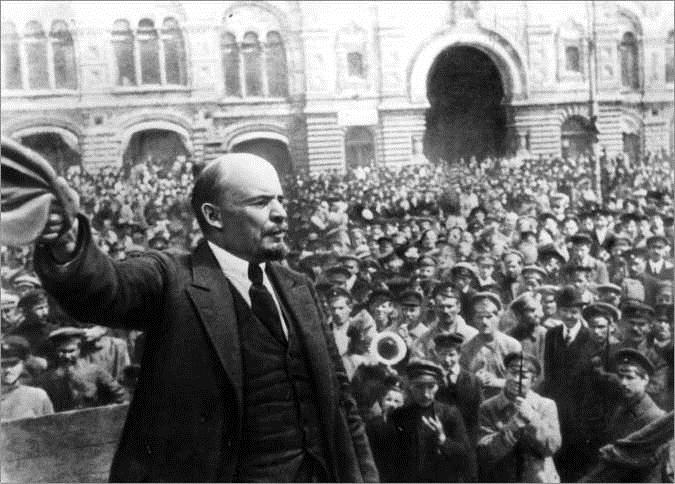
(Lenin making a speech in Moscow)
While Lenin was undisputed political leader, Trotsky was a close partner, leading the Petrograd Soviet and its Military-Revolutionary Committee. It is the MRC which stormed the Winter Palace and ejected the liberal Provisional Government of Alexander Kerensky. Morgan Phillips Price, an Englishman, sent to report for the Manchester Guardian in 1917, watched the Bolshevik leaders, Vladimir Lenin and Leon Trotsky, very closely during this period. He wrote the following:
Lenin struck me as being a man who, in spite of the revolutionary jargon that he used, was aware of the obstacles facing him and his party. There was no doubt that Lenin was the driving force behind the Bolshevik Party... He was the brains and the planner, but not the orator or the rabble-rouser. That function fell to Trotsky. I watched the latter, several times that evening, rouse the Congress delegates, who were becoming listless, probably through long hours of excitement and waiting. He was always the man who could say the right thing at the right moment. I could see that there was beginning now that fruitful partnership between him and Lenin that did so much to carry the Revolution through the critical periods that were coming.34
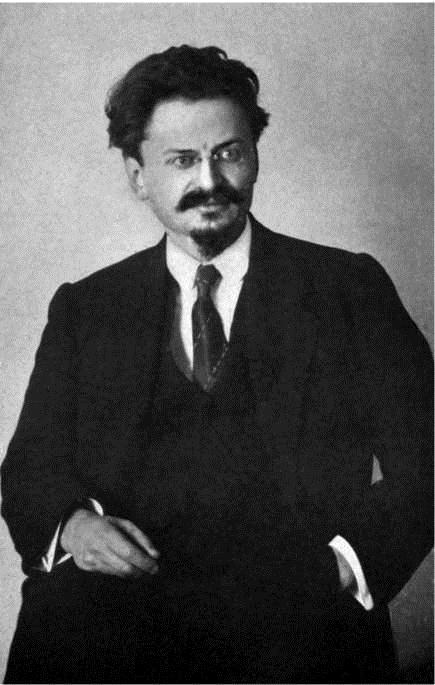
(Leon Trotsky)
Leon Trotsky describes Lenin’s style of speaking:
… But a line of intense and powerful thought cuts its way surely and clearly through these cumbrous phrases.
Is the speaker really a profoundly educated Marxist, thoroughly versed in economic theory, a man of enormous erudition? It seems, now and again rather, that here is a self-educated man who has arrived at an extraordinary degree of understanding all by himself, by an effort of his own brain, without any scientific apparatus, any scientific terminology, and now expounds it all in his own manner. How is it that we get such an impression? Because the speaker has thought out things not only for himself, but also for the broad masses; because his own ideas have been filtered through the experiences of these masses and in the process have become free of theoretical ballast. He can now construct his own exposition of problems without the scientific scaffolding which served him so well when he approached them first himself... 35
Lenin’s speeches are characterized by what is so essential in all his activity: the intentness on the goal, his purposefulness. The speaker is not out to deliver an oration, but to guide towards a conclusion which is to be followed by action.36
Chapter-IV
The October 1917 revolution ended the phase of the revolution which had started earlier that year in February, replacing Russia’s short-lived provisional parliamentary government with government by soviets; and the establishment of the Russian Socialist Federative Soviet Republic, the world’s first constitutionally socialist state, with Lenin as Chairman of the Soviet Government.
Lenin worked quickly to consolidate power and revolutionise the state, implementing socialist reforms, transferring to workers’ soviets, land and estates held hitherto by the imperial regime, reorganizing into the Russian Communist Party, the various factions in the party.

(Brest-Litovsk, 1918)
Anyone who knew anything about Lenin was aware that one of his strong points was the ability in every instance to distinguish the essence of the matter from the form. But it might be worthwhile to stress that he also attached importance to the form, realizing how much the formal side of things dominates people’s mind; in this way he was able to invest formality with substance. From the moment of the deposition of the Provisional Government, Lenin systematically, in small things as well as in great, acted as a government should. We had not yet any governmental apparatus; our contact with the provinces was non-existent; we were sabotaged by officialdom; Vikzhel was interfering... with our telegraphic connections with Moscow; we had no money; we had no army. But all the time and everywhere Lenin ruled by decisions, decrees, and orders in the name of the government. It goes without saying that Lenin less than anybody else was inclined to be impressed by the magic of formality. He was acutely conscious of the fact that our strength lay in this new governmental apparatus which was organizing itself from below, from the Petersburg districts. But in order to conduct the work ‘from above’, from the offices deserted by the saboteurs, in conjunction with the creative work from below, this formal tone was needed, the tone of a government which today is still suspended in a vacuum, but which tomorrow or the day after would become a force, and for this reason already today acts as a force. This formality was also needed in order to discipline our own brethren. The governmental apparatus was slowly spreading its net over the turmoil and ferment, over revolutionary improvisations of advanced proletarian groups.37
Lenin negotiated a peace treaty with Germany so that Russia could be brought out of the war, faced as it was with the threat of German invasion. On 3rd March, 1918, the treaty was signed at Brest-Litovsk in spite of meeting resistance from many members of the Bolshevik hierarchy who were opposed to peace at any price with the Germans. Lenin wanted peace at any cost so that the Bolsheviks could concentrate on the work needed to be done in Russia itself, and he finally forced through the decision for acceptance, by threatening to resign. The Bolshevik leaders signed the Treaty, whereby vast stretches of Western Russia, including most of the Ukraine, the Baltic states and the South of Finland (who gained her independence), had to be delivered up to the Central Powers.
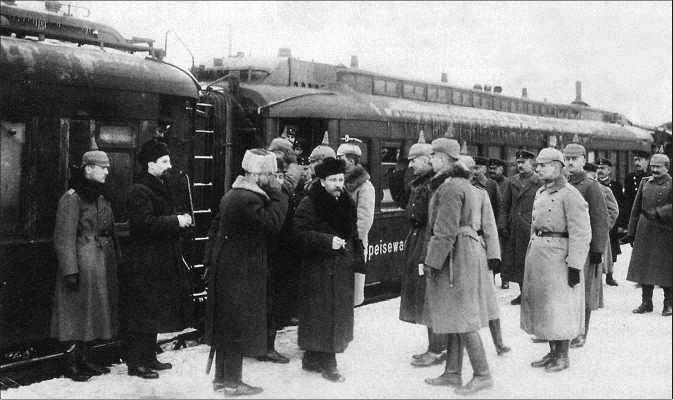
(Soviet delegation’s arrival at Brest-Litovsk for negotiations)
Trotsky’s words give us an insight which explains what is considered by many as Lenin’s “uncompromising stance” in critical situations:
Lenin himself, in the Iskra, I think, expressed for the first time the idea that in the complex chain of political acts one had to be able, at a given moment, to discern the main, the central, link in order to seize it and to impart to the whole chain the desired direction. More than once Lenin used to return to this conception and even to the metaphor. From his conscious mind this methodological notion seemed to have permeated into his subconscious and in the end it became as if his second nature. During the most critical periods, when he was faced with tactical decisions involving a high degree of risk or exceptional responsibility, Lenin was able to set aside all that was irrelevant, all that was secondary, all that was inessential and that could be deferred. This does not mean that he considered only the main, the central part of his task, ignoring the details. On the contrary, he viewed the problem with which he had to come to grips in all its concrete reality, approaching it from every side, weighing all its details, sometimes even tertiary ones, searching for ever new points of attack, trying to find new ways of exercising pressure, of checking facts, and calling for action. But in all this he would never lose sight of ‘the link’, which at that particular moment he thought was of decisive importance. He brushed aside not only everything directly or indirectly in conflict with the job in hand, but also everything which might disperse attention or slacken tension. In the most critical moments he became as if deaf and blind to all that went beyond the cardinal problem which absorbed him. In the mere posing of other questions, ‘neutral ones’, he saw a danger from which he instinctively recoiled. Later on, when the critical hurdle was happily cleared, Lenin would still now and again exclaim: “And yet we quite forgot to do this or that...” Or “we missed an opportunity because we were so preoccupied by the main thing...” Someone would answer him: “But this question had been posed, and this proposal had been made, only you did not want to hear anything!”
“Didn’t I? Impossible!” he would say, “and I don’t remember a thing.”
At that point he would burst out laughing, with malicious laughter in which there was an admission of ‘guilt’; and he would make a characteristic gesture of raising his arm and moving it helplessly down, as if resigned: well, one cannot do everything. This ‘shortcoming’ of his was only the obverse side of his talent to mobilize, to the utmost degree, all his inner forces. Precisely this talent made of him the greatest revolutionary in history.38
The same year, a bloody civil war broke out and during the civil war thus unleashed by the Treaty of Brest-Litovsk, the Bolsheviks found themselves desperately fighting for survival against anti-Bolshevik Russians. The hostile forces, called the ‘Whites’ were composed of former officers of the Tsar, conservatives, and other socialists opposed to the drastic restructuring by the Bolsheviks, and importantly who were supported by the Allied Powers 39.
Russia’s Bolshevik government had to fight not only tsarist forces, but also foreign powers intent on restoring the old order. In the east, Czech and Japanese troops occupied Siberia; from the Arctic ports of Archangel and Murmansk, British, American and French forces threatened northern Russia; while German and Austrian units marched in from the west.40
Soon forces would have reached Moscow, the new capital of Russia. The Bolsheviks controlled Moscow, Petrograd and areas of the Russian heartland. Lenin was forced to put together an army—made up of revolutionaries and radical communists who were party members, that were called the ‘Reds’—into the field to do battle with the White Army. It appeared as if the new socialist state would fall, but the Red Army managed to repulse the attacks and survive. The campaigns launched by the White Army would have crushed the revolution had they not been opposed in grim earnest by the Reds. By 1920 the Whites had been driven back. The attempt at armed intervention by the Allied Powers failed and the Bolshevik forces won the ensuing civil war against overwhelming odds.
Just as Trotsky played a leading role, together with Lenin, during the 1917 Russian Revolution, it was Trotsky who organized the Red Army as well as the fight back against all the forces of reaction that were attempting to strangle the revolution in blood. Under his leadership, the Red Guards which were volunteer groups forming a Bolshevik militia consisting of factory workers, peasants, soldiers and sailors—which he had created in 1917 for the October revolution—were combined with former imperial army officers to form the Red Army. Strict discipline was kept to see that these former imperial officers were loyal to the Bolshevik cause.
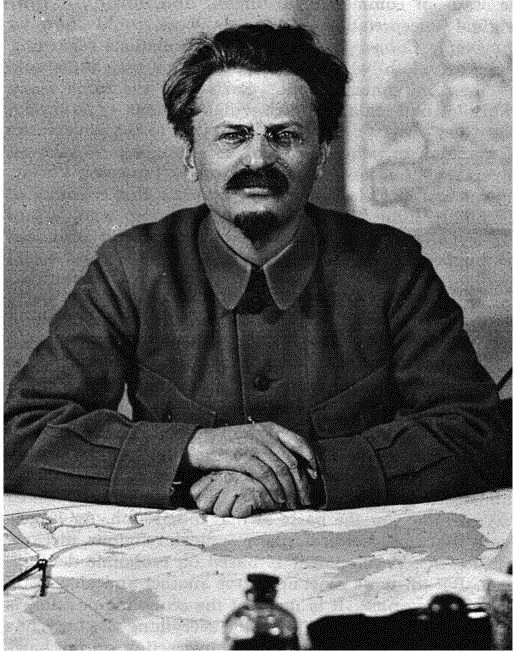
(Leon Trotsky, Commissar of War (1918-25))
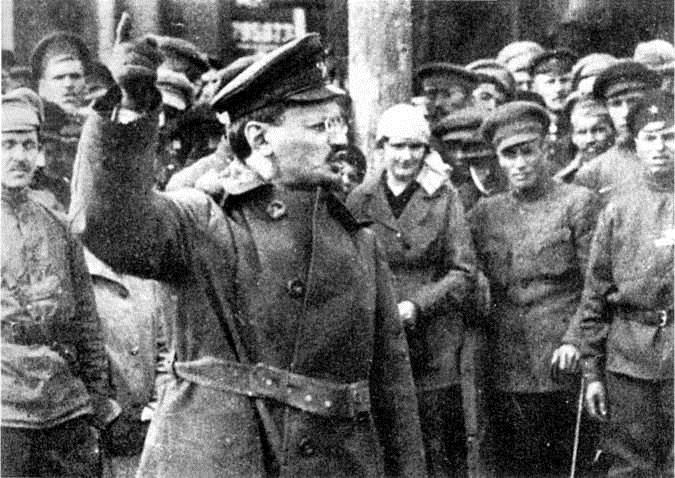
(Trotsky addressing Red Army troops during the Civil War)
Political violence rose up as a reaction to the Brest-Litovsk Treaty and assassinations were carried out by the Socialist Revolutionaries—a radical socialist party that had become influential—bent upon sabotaging the Peace Treaty. The conditions prevailing in Russia at the time are described by Trotsky:
The spring of 1918 was very hard indeed. Sometimes one had the feeling that everything was slipping away, going to pieces, that there was nothing to hold on to, nothing to lean on. On the one hand it was quite obvious that had it not been for the October upheaval, the country would have fallen into decay. On the other, in the spring of 1918 one had to pose the question: Will this country, so exhausted, so ruined, and so desperate, have enough vitality to support the new regime? There were no supplies. There was no army. The governmental machinery was just beginning to be organized. Plots and conspiracies were spreading like festering sores. The Czechoslovak army on our soil behaved like an independent power; we could do nothing, or nearly nothing, to oppose it.
... This foreign army spread like a tumour into the limp flesh of south-eastern Russia, meeting no resistance, and growing bigger with the accretion of the Social Revolutionaries and other activists of an even whiter hue. Although power was already in Bolshevik hands everywhere, there was still considerable disarray in the provinces. It was only in Petersburg and in Moscow that the revolution had been really carried through; in the majority of the provincial cities the October Revolution, like the February one, was carried, so to speak, over the telegraph poles. Here in some places they were linked, in others they were not, just because things were happening in the capital. The formlessness of the social environment, the lack of resistance on the part of the former masters found its reflection in a certain formlessness on the revolutionary side. The appearance on the scene of the Czechoslovak battalions modified the situation, first to our disadvantage but in the end in our favour.
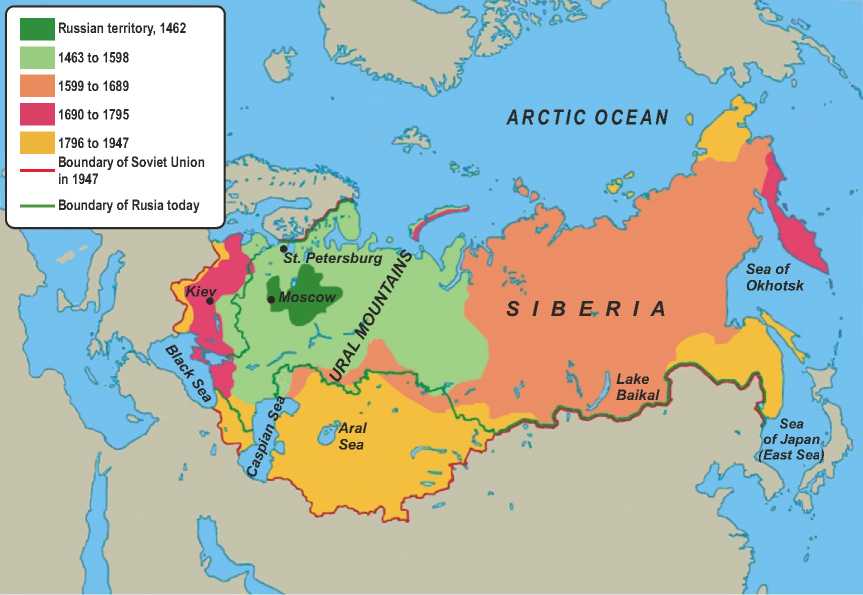
(Russian and Soviet Expansion)
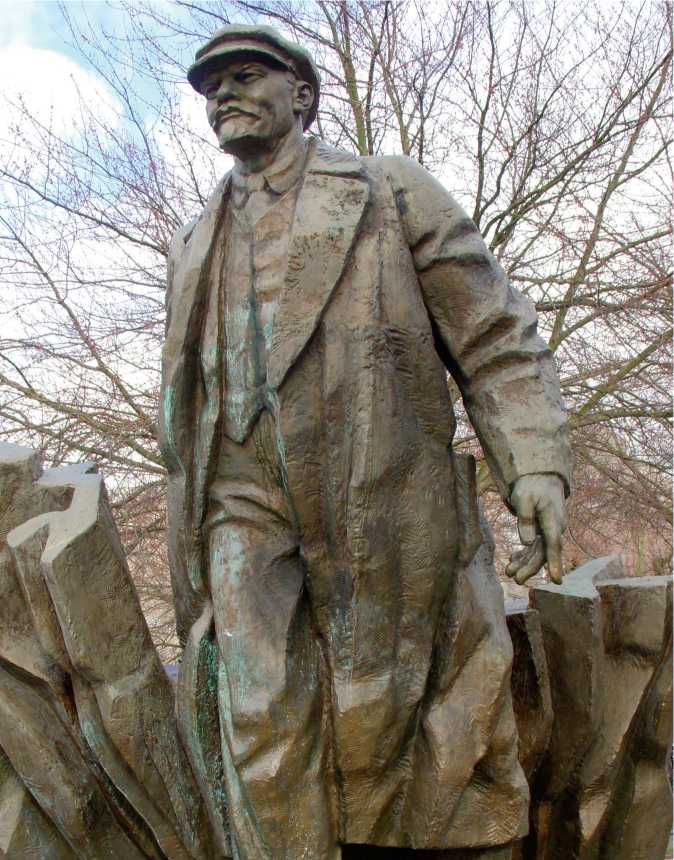
(Statue of Lenin (Seattle, USA))
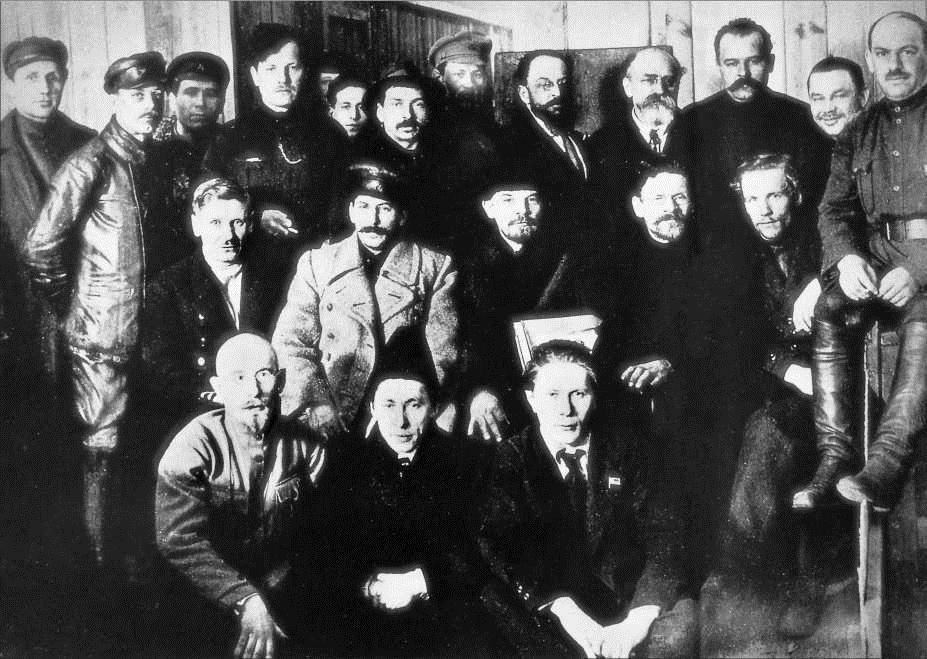
(Delegates to the VIIIth Congress of the Communist Party (1919), Stalin, Lenin and Trotsky at the centre.)
... the Czechoslovak uprising... shook the party out of its depression, so widespread since the Brest-Litovsk peace… it was then that a radical change took place.
…The revolution grew in power and vigour. 41
There were two serious assassination attempts on Lenin’s life. In the attempt in August 1918, the assailant succeeded in seriously wounding Lenin who narrowly escaped with his life, after taking two bullets. One bullet would remain till it was removed by a surgeon three years later. He recovered, however, though his health was never the same again,—this increased his popularity among the people reinforcing among them the belief of his indispensability in the prevailing conditions of chaos.
... there was the force of his [Lenin’s] idealism and the tenacity of his indomitable will which at the sharp turns of history made him cut corners and foreshorten distances. He believed in what he was saying. The deep and unyielding conviction that there were tremendous possibilities of human development for which one could, one should, pay the price of suffering and sacrifice, was always the hallmark of Leninism.42
Lenin and the Soviet government came out victorious in spite of the severe opposition faced. However, by this time the Russian economy was in ruin and there was great discontent among the peasants and the workers. The country over which Lenin now presided was reeling from the bloody civil war and in a state of collapse.
Famine and poverty, shortages and inflation became very much a part of life for the Russians.
Lenin proposed the New Economic Policy, in 1921, a system of ‘state capitalism’, which was largely an agricultural policy which allowed peasants to sell their grain on the open market; it also encouraged small-scale private industry and public sector heavy industry while encouraging trade by giving concessions to foreign capitalists. This system of ‘mixed economy’ started the process of industrialisation and recovery from the Russian Civil War. Lenin took a series of measures aimed at buttressing the sinking economy and to prevent further bloodshed and chaos. With the NEP, the socialist nationalisation of the economy could then be developed to industrialise Russia, strengthen the working class, and raise standards of living—health, housing and education; thus the NEP would advance socialism against capitalism.
The “State Commission for Electrification of Russia” was the first-ever Soviet plan for national economic recovery and development. The Commission and Plan were initiated and supervised by Lenin. Lenin’s belief in the central importance of electrification to the achievement of communism is represented by his statement in 1920 that:
Communism is Soviet power plus the electrification of the entire country in modernising Russia into a 20th-century country.
The Plan represented a major restructuring of the Soviet economy based on total electrification of the country. Lenin’s stated goal for it was:
... the organization of industry on the basis of modern, advanced technology, on electrification which will provide a link between town and country, will put an end to the division between town and country, will make it possible to raise the level of culture in the countryside and to overcome, even in the most remote corners of land, backwardness, ignorance, poverty, disease, and barbarism.43
Though Lenin was extraordinarily energetic his physical health had never been very good—suffering as he did from insomnia, migraines and a weak stomach, from a young age. The attack on Lenin’s life had left him in a debilitated physical condition which was aggravated by the mental strain of the many years of revolutionary work, the leading of a revolution, fighting a civil war against great odds, governing amidst the chaos and dissent. To add to this was the fact that he was known to work fourteen to sixteen hours daily, occupied ceaselessly with all matters whether major or minor. Dmitri Volkogonov44 had this to say about Lenin towards the end of his life:
Lenin was involved in the challenges of delivering fuel into Ivanovo-Vosnesensk45... the provision of clothing for miners, he was solving the question of dynamo construction, drafted dozens of routine documents, orders, trade agreements, was engaged in the allocation of rations, edited books and pamphlets at the request of his comrades, held hearings on the applications of peat, assisted in improving the workings at the “Novii Lessner” factory, clarified in correspondence with the engineer P. A. Kozmin the feasibility of using wind turbines for the electrification of villages... all the while serving as an adviser to party functionaries almost continuously.
The creation of the Soviet Union took place in 1922, when the Russian SFSR became one of its republics unifying with former territories of the Russian Tsarist regime, and Lenin was its leader.
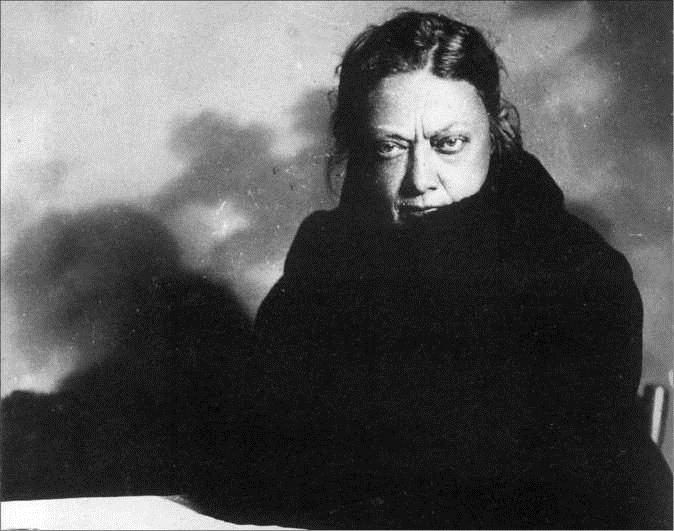
(Nadezhda Konstantinovna Krupskaya in 1919)
Lenin’s health was by now declining rapidly. The chronic headaches and insomnia grew worse and he found himself unable to carry on with the workload that had been his since 1917. These chronic ailments and the heart seizures put him in a mood of deep pessimism. “A night doomed to insomnia is a truly terrible thing when you have to be ready in the morning for work, work, work without end...”46 he confided to his medical specialist who saw that he was suffering from cerebral exhaustion. By now he was extremely fatigued and felt isolated as never before. Despite his chronic ailments he had to go on despite the fact that he found his work extremely difficult to cope with.
Lenin suffered a stroke in May 1922, and then a second one in December of the same year. With declining health and facing the probability of his imminent death, Lenin was troubled by the future of the Revolution and the problem of how the Revolution could flourish after him. He worried about the policies of the central party leadership and how after him the newly formed USSR would be governed. He saw that the party and the government had moved far from its revolutionary goals:
... he disliked the new Soviet bureaucracy almost as much as he had disliked the old Tsarist autocracy. In considerable bitterness he called the Soviet republic “a Work-State with bureaucratic excrescences,” and at the end of 1922 he admitted: “We have taken over the old State apparatus.”47
By the end of 1922 he became greatly troubled by the question of the future leadership and as his disquiet increased he felt impelled to write a secret letter to the Congress. Having lost the use of his right side, he was forced to dictate the letter. This document became known as Lenin’s Testament.
Lenin begins formulating a program for the rebuilding of the Soviet government. The first two letters focus on reducing bureaucratism in the State Planning Commission and the Central Committee, while the third letter deals with the necessity of ensuring minority cultures in Russia have national self-determination. Lenin emphasises the need to make these changes to the Soviet government and warns of potentially disastrous consequences if the necessary but difficult steps are not taken. These works begin Lenin’s early and incredibly insightful critique of the Soviet government; notably suggesting the removal of Stalin. 48
On 10th March, 1923, Lenin’s health was dealt another severe blow when he suffered an additional stroke, this one taking away his ability to speak and concluding his political work. Nearly ten months later, on 21st January, 1924, aged 53, he passed away in the village at his estate at Gorki settlement (later renamed Gorki Leninskiye). In a testament to his standing in Russian society, his corpse was embalmed and placed in a mausoleum on Moscow’s Red Square.
In the four days that the Bolshevik leader Vladimir Ilyich Lenin lay in state, more than 900,000 mourners viewed his body in the Hall of Columns; among the statesmen who expressed condolences to the Soviet Union was Chinese premier Sun Yat-sen, who said:
Through the ages of world history, thousands of leaders and scholars appeared who spoke eloquent words, but these remained words. You, Lenin, were an exception. You not only spoke and taught us, but translated your words into deeds. You created a new country.
You showed us the road of joint struggle... You, great man that you are, will live on in the memories of the oppressed people through the centuries.49
Vladimir Lenin led the Bolshevik Revolution that changed the direction of Russia completely, and was the architect of the Soviet state. After his death the political theory incorporating his contributions to Marxist thought and the practical Russian application of Marxism was called Leninism, which later coupled with Marxist economic principles by his successors, was called Marxism-Leninism. Lenin has been called the most important revolutionary in history, and the most important political figure of the twentieth century. Robert Service in his biography of Lenin says:
Without Lenin, there would have been no Revolution in October 1917. Without Lenin, the Russian Communist Party would not have lasted much beyond the end of 1921.50
In his biography of Lenin, Louis Fischer has the following to say about him:
[Lenin’s collected writings] reveal in detail a man with iron will, self-enslaving self-discipline, scorn for opponents and obstacles, the cold determination of a zealot, the drive of a fanatic, and the ability to convince or browbeat weaker persons by his singleness of purpose, imposing intensity, impersonal approach, personal sacrifice, political astuteness, and complete conviction of the possession of the absolute truth. His life became the history of the Bolshevik movement.51
The following words of Trotsky on Lenin provide a fitting tribute to him:
Our great party embracing half a million is a great community with great experience, but in this half million men Lenin occupies a place that is incomparable. The historical past knows no man who has exerted such influence, not only on the destiny of his own land, but on the destiny of mankind; she has no standard with which to measure Lenin’s historical significance.52
What constituted Lenin’s genius? It consisted precisely in this: that through him the young Russian proletariat liberated itself from the conditions shackling its development and reached towards the heights of historic universality. Lenin’s personality, deeply rooted in the soil of Russia, burst forth, grew organically, expanded into creative and genuine internationalism. Lenin’s genius consisted, first of all, in transcending all confines.53
After Lenin
After Lenin’s passing, the possibility of international revolution kept receding and the “international proletarian revolution” envisaged by him did not come about. Despite initial success one revolution after the other was defeated; the German Revolution of 1918 lasted only for one year and in Hungary and Italy too revolution was short lived. The revolutionary wave caused by the Russian Revolution of 1917, lasted only till 1923.
Trotsky, who was a key figure in the Bolshevik seizure of power in Russia, second only to Vladimir Lenin in the early stages of Soviet Communist rule, had long been seen as Lenin’s obvious successor. A communist theorist, a prolific writer, and leader in the 1917 Russian Revolution, he was the people’s Commissar for foreign affairs under Lenin (1917-1918), and then head of the Red Army as the people’s Commissar of army and navy affairs (1918-1924). He has been described as a stirring public speaker, an efficient administrator and an untiring worker.
However, in April 1922, Stalin who had been till then largely in the background, though in the inner circle of the party since 1917, came to the forefront. He was a strong supporter of Lenin, and just a month before his first stroke Lenin created a post for Stalin, making him General Secretary of the Communist Party. This position gave Stalin control over party appointments and hence tremendous influence among the party members. During Lenin’s absence, due to his illness, Stalin used his position to appoint his supporters as officials. Lenin, though he was still officially head of the government, was disabled and hence began a power struggle.
.. The two main contenders in the struggle for succession were the charismatic Trotsky and the apparently dull and pedestrian Stalin. Unlike Trotsky, Stalin was a bureaucrat rather than a thinker or a man of action. But he was a master of intrigue, a quality which, combined with immense patience, had gained him the post of general secretary of the Communist party.
Stalin’s influence served him well and:
... the central committee duly elected him as a member of the temporary triumvirate that would steer Russia through Lenin’s illness. Under the guidance of the triumvirate... bureaucracy flourished, as Stalin spread the tentacles of his influence through the party machine; and early in 1923, regional minorities, who had managed to gain a measure of independence during the civil war, were heavy-handedly forced to join Russia in the Union of Soviet Socialist Republics.54
When Lenin regained enough strength and returned to work, he became aware for the first time of Stalin’s real character and the degree of his ambition. He saw that:
... the state had become a mass of red tape and incompetence; furthermore the increased centralization had robbed regional and representative bodies of their power. He reserved his strongest criticism for Stalin, claiming he was too crude to lead the revolution into the future, and urging the party to remove him from office.55
From Lenin’s Testament it is clear that he considered Trotsky by far the most capable to succeed him; the Testament was Lenin’s secret document to be presented at the forthcoming Party Congress. Lenin’s third stroke took away his power of speech, and Stalin becoming aware of the document and its contents had it suppressed with the collusion of the leading party members. It was banned from the media.
After Lenin’s death, Stalin set about the process of removing all his potential rivals. This he did by first allying himself with them against political opponents and then suddenly shifting his allegiance isolating his former supporters and thus giving himself the opportunity to charge them with political divisiveness. This tactic was used by Stalin to dispose of Trotsky. There ensued a struggle between Stalin’s group and the Left Opposition led by Trotsky. This was a struggle between the genuine representatives of the working class and the ‘bureaucratic elite’; the bureaucracy in order to establish control felt compelled to eliminate the genuine traditions of Bolshevism. Trotsky’s struggle against Stalin’s policies and methods failed and he was removed from power, and expelled from the party in 1927. The brilliant Trotsky was outmaneuvered by Stalin who was not gifted by any great intelligence; Trotsky was a poor politician and Stalin the master of politics emerged the victor.
Trotsky’s supporters urged him to organize a military coup, which as Commissar of War he was in a good position to do. Trotsky rejected this idea and resigned his post. He was expelled from the Soviet Union by Stalin and large numbers of his supporters were thrown into Stalin’s camps from where they never returned. He continued to write and to criticize Stalin. Trotsky was brutally assassinated in 1940, on orders from Stalin, while living in Mexico.
The dictatorship became not so much the dictatorship of a Party as of an individual, working through a huge bureaucracy and “dedicated to the use of force, a Moloch to whom the majority of Lenin’s original companions have been sacrificed.”56 In a few years the nature of the Party changed tremendously from what it had been in Lenin’s time.
The growth of Stalin’s dictatorship can be seen in the changing nature of the Party. The Communist Party, while Lenin lived, enjoyed a considerable measure of freedom of discussion and even of action. It debated, at great length and with greater virulence, the policy to be adopted towards the German peace terms offered at Brest-Litovsk. Then, when a weak Russia was involved in a life-and-death crisis, a group of Communist leaders—Radek, Kollontai, Orinsky—published a daily paper in Moscow expressly to defeat Lenin’s policy. Then, too, considerable discretion was left to Trotsky in his negotiations with the Germans. Trotsky’s pre-revolution quarrels with Lenin, indeed, seemed no bar to their intimate collaboration after it. Lenin, who loved theoretical disputations, could conduct the fiercest of polemics with Bukharin and yet remain friendly with him. Pravda, the organ of the Party, ran a special discussion page to which Trotsky, Kamenev, and Zinoviev never hesitated to contribute articles highly critical of adopted policy.57
The difference was obvious now, when no Party member dare proclaim himself an “oppositionist” and ask for the right to criticise the policies of the Government. Lenin’s New Economic Policy which permitted small-scale enterprise was abandoned by Stalin, in 1928 and a forced “collectivization” of small peasant plots was put into place. All possible sources of resistance disappeared from both town and country with the growth of dictatorship. Resistance from peasants was suppressed by herding them into collective farms and those resisting were meted out the same treatment as other nationalists, religious leaders, internal opponents within the Party, critical intellectuals and in particular the Bolsheviks,—all were arrested and imprisoned, deported to labour camps or executed. In a campaign starting in 1934 and reaching its peak in 1937-38, called the
Great Terror or the Great Purge, all political opposition was crushed; starting with Stalin’s closest party colleagues and by the end, all the prominent Bolsheviks who had taken a leading role in the 1917 Revolution, were executed.
Everywhere it has become obvious that, in spite of its grandiose title, the Union of Soviet Socialist Republics, the Soviet has no independent existence in Russia today.58
Stalin was the absolute ruler and under him Russia grew into a totalitarian State. He emerged as one of the most formidable dictators that the world has known and the Russians had to endure a greater tyranny under him than they had under the Tsars.
Whatever the Western communists came to know of Lenin and Leninism was only that which had the approval of Stalin; the Lenin projected by Stalin was his friend who had chosen him as successor. All opponents of the official version of the past were either killed or sent to the forced labour camps. It was, however, only in 1953 after Stalin’s death that the communist world came to know that there had been differences between Lenin and Stalin. Lenin’s Testament would only be revealed in 1956 by Nikita Khrushchev, causing a sensation not only in the USSR but also among Western communists. It was only then, through Khrushchev, that it became known that Stalin had been guilty of mass murders in the 1930s.
Rapid industrialization was ordered by Stalin and as soon as the Soviet Union industrialized, particularly after World War II, it became a great power. With highly advanced military technology it then transformed itself into a superpower. The Soviet Union maintained its status as one of the world’s two superpowers for four decades. However, in the following decade, its economic and political structures began visibly crumbling resulting in the dissolution of the Union of Soviet Socialist Republics in 1991. Russia was then recognized internationally as the Soviet Union’s legal successor.
Notes - The Revolutions in Russia
The Marxist émigré Alexeev expressed his view on the manner in which the change in the Russian political regime would occur, thus: “In Russia,” said Alexeev, “the change will not come about gradually, but rather violently, precisely as a result of the rigidity 59 of autocracy.”60
The Revolution of 1905
As 1904 came to an end, rumblings of discontent in Russia had been gathering since summer and were now reaching crisis point. The costly imperialist war with Japan had brought a series of crushing defeats ending with the Russian navy under siege at Port Arthur. This exacerbated the economic crisis in Russia that had been gathering since 1900. With prices rising in the shops, calls were mounting to improve factory conditions and wages and regulate the long working day. Students were turning out regularly for mass rallies protesting the abuses of the czarist government... With provincial governments in Russia calling up troops to control unrest, and clashes between police and workers in the major cities of St. Petersburg, Odessa, and Moscow, the Okhrana had reported that “universal attention was utterly transfixed by the unusual growth of the anti- governmental, oppositionist and social-revolutionary movement.” The reactionary minister of the interior and chief of gendarmes... had been assassinated on 28th July, 1904, warning of things to come. On the streets of St. Petersburg, with calls mounting for civil liberties and constitutional reforms, there was the whiff of revolution.
Even the reticent Nicholas II had noticed the dramatic air of change: “It is as if the dam has been broken: in the space of two or three months Russia has been seized with a thirst for change. Revolution is banging on the door.”
In Geneva too Lenin sensed an approaching storm. But with the RSDLP hamstrung by dissent, what would he or the party have to offer when the moment came?61
The year 1905 saw the existing political discontent erupt into a full scale revolution. On Sunday, 9th January, the workers of St. Petersburg organized a peaceful demonstration to demand political and constitutional reform. A crowd of over 100,000 men, women and children including whole families marched peacefully through the centre of St. Petersburg, to present to the Tsar, Nicholas II, a humble petition, a heartfelt statement of their grievances:
Sire, —
We working men of St. Petersburg, our wives and children, and our parents, helpless, aged men and women, have come to you, O Tsar, in quest of justice and protection. We have been beggared, oppressed, over-burdened with excessive toil, treated with contumely. We are not recognized as normal human beings, but are dealt with as slaves who have to bear their bitter lot in silence. Patiently we endured this; but now we are being thrust deeper into the slough of rightlessness and ignorance, are being suffocated by despotism and arbitrary whims, and now, O Tsar, we have no strength left. The awful moment has come when death is better than the prolongation of our unendurable tortures. Therefore, we have left work, and informed our employers that we shall not resume it until they have fulfilled our demands. What we have asked is little, consisting solely of that without which our life is not life, but hell and eternal torture...62
(The demonstrators led by Father Gapon)
Carrying religious banners and portraits of the Tsar, some singing hymns, led by the Orthodox priest Father Gapon who was carrying a large cross, the demonstrators eventually assembled near the Tsar’s Winter Palace and, asked for the Tsar to appear so that they could present him with a petition. The demonstrators were not anti-tsarist; in fact they genuinely felt that the Tsar whom they called affectionately “little father” had their best interests at heart, and once he knew of their sufferings and discontent, he would put in place remedial measures. Written by Father Gapon, the petition was signed by three hundred thousand people calling for his intercession in granting them a reduction in working hours, the right to vote and an end to the disastrous war with Japan.
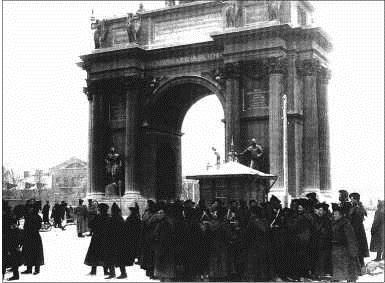
(Soldiers blocking Narva Gate on Bloody Sunday)
The demonstrators did not know that the Tsar, who had perhaps been forewarned of the demonstration, had left the Winter Palace for his summer residence. They found their way to the Winter Palace barred by armed troops and mounted Cossack cavalry. The police, who had just finished putting down a series of strikes by industrial workers, had standing orders to get rid of any problems, besides there had been a further deployment of troops to bolster the existing garrison. They fired a few warning shots and then they opened fire onto the crowd, which included women and children as well as church leaders. As the crowd scattered, Cossacks pursued them on horseback with drawn swords, troops continuing to fire on them. Many in the crowd were trampled to death in the ensuing panic. Soon there were “pools of blood on the white snow”. Panic, horror and then indignation spread among the public. Estimates of the total death toll range from a few hundred to several thousand. This was a defining moment as news of the massacre spread quickly, and many saw it as a sign that the Tsar had complete disregard for the ordinary people. This event became known as “Bloody Sunday”, and is usually considered the start of the active phase of the revolution.
The indifference, weakness and oppressiveness that had been faced by the Russians for a long time, had been blamed by them on the shortcomings of Nicholas’ advisers and the regime. However, this extreme incident immediately transformed the situation, electrifying the nation and leading to the loss of their age-old faith in the Tsar as the guardian of the people. The following months witnessed the eruption of violence across the country—strikes, riots, demonstrations, mutinies in the navy and army, became the order of the day. Gorky is said to have cabled Hearst’s New York Journal “The Russian Revolution has begun.”
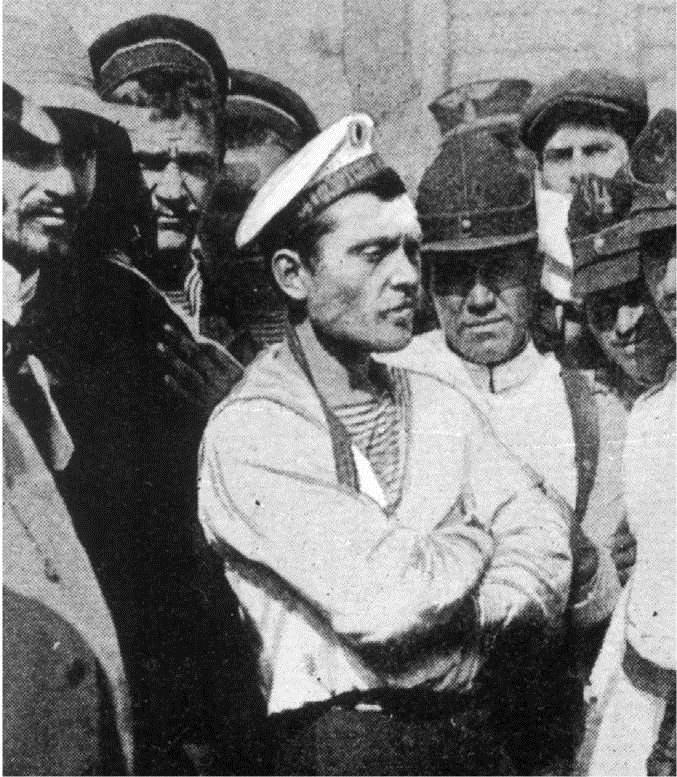
(Matsushenko, the leader of the uprising in the famous mutiny of the Potemkin warship in June 1905)
The primary result of the Revolution of 1905 was that the Tsar now forced to make concessions, offered some reforms in an attempt to keep his regime from being toppled—the ‘October Manifesto’ a precursor to the Constitution of 1906 which authorised the establishment of a parliament the Duma. This was enough to stem the tide of revolution as the Russian liberals were satisfied by the October Manifesto and made preparations for the upcoming Duma’s elections. Even though the Government retained its authority and the Tsar his autocratic power, the Russian people now reviled the Tsar and distrusted him. Radical socialists and revolutionaries denounced the elections, however, and called for an armed uprising to destroy the Empire.
In the months following, terrorism and assassinations continued and for the first time revolutionary parties attracted a large following. According to most historians the events of “Bloody Sunday” led to the Revolution of 1917.
The Revolution of 1917
The Russian Revolution of 1917 was one of the most significant events in the 20th century. It completely changed the government of Russia and Russia’s outlook on life. The Russian Revolution is the collective term for a series of events and two revolutions in Russia in 1917, which brought down the Tsarist autocracy and led to the creation of the Russian SFSR (Soviet Federative Socialist Republic).
The First World War, more than any other event, brought revolution to Russia; the Tsarist government, still recovering from the damage of the 1905 Revolution, could not bear the stresses and strain that the war imposed. By 1915, Russian casualties in the war had reached a total of almost four million with large areas of Russia under German occupation. The stress of the war strained further the failing economy; food shortages were a major problem and inflation had pushed up the prices alarmingly. Strikes were frequent and the crime graph rose and the Russian people endured and suffered. Okhrana, the Russian secret police, in a report warned of “the possibility in the near future of riots by the lower classes of the empire enraged by the burdens of daily existence.” By the end of 1916, the morale of the soldiers had sunk very low and there was “despair that the slaughter would ever end.”
The discontent and resentment of the people of Russia against the autocracy and the weak and inefficient government of Nicholas II grew, and it was strongly felt that he was unfit to rule. He was advised by Sir George Buchanan, the British Ambassador in Russia, to “break down the barrier that separates you from your people to regain their confidence.” However, there was little response from the Tsar.
Ultimately, these factors, along with the growth of political consciousness, the impact of revolutionary ideas and their development and the revolutionary movements (particularly since the 1905 Bloody Sunday Massacre) led to the Russian Revolution of 1917 and the year saw two very distinct ones: the first, known as the February Revolution and the second the October Revolution.
By the end of February 1917, the political eruption that Lenin had long predicted took place. On February 23, 1917, a large gathering of working-class women convened in the centre of Petrograd to mark International Women’s Day. The gathering took the form of a protest demonstration calling for “bread and peace.” While the demonstration began peacefully, it turned violent by the next morning as thousands and thousands of other striking workers calling for the end of monarchist rule and the war, joined the demonstration. Troops were called out and they fired on the rioters; however, several soldiers abstained as they empathized with the people and not the government. The following day many soldiers mutinied and the crowds swelled. They immediately began to call for full-scale revolution and an end to the monarchy altogether.
The February Revolution was largely a spontaneous event. It began in much the same way as had dozens of other mass demonstrations in Russia in previous years. It was not a planned uprising and none of the revolutionary leaders were involved. They were caught quite by surprise at the outcome. Robert Service in his biography of Lenin gives this account of the February Revolution:
... Industrial strikes had been occurring for some days, starting with action by women textile workers. The trouble had quickly spread to the labour-force of the Putilov metallurgical plant and the police proved incapable of keeping control.
... the popular mood was implacable. Workers were aggrieved by the deteriorating conditions in the factories and by the food shortages. The government, moreover, could no longer rely upon the troops in the capital’s garrisons to suppress political protest. The Mensheviks meanwhile re-formed a Petrograd Soviet and campaigned for a republic. By then the socialist parties sensed that the moment of Revolution had arrived. The Emperor tried to abdicate in favour of his haemophiliac son Alexei; but it was not to be. On 2nd March he saw that the game was up and abdicated in favour first of his son and then of his brother Mikhail. This concession was inadequate for the rebels and power passed to the leaders of the dispersed State Duma. The Romanov dynasty which had ruled Russia since 1613 had been overthrown.”63
The February Revolution brought down the Russian monarchy which had been in existence for 1,000 years and brought about the establishment of a temporary government called the Provisional Government.
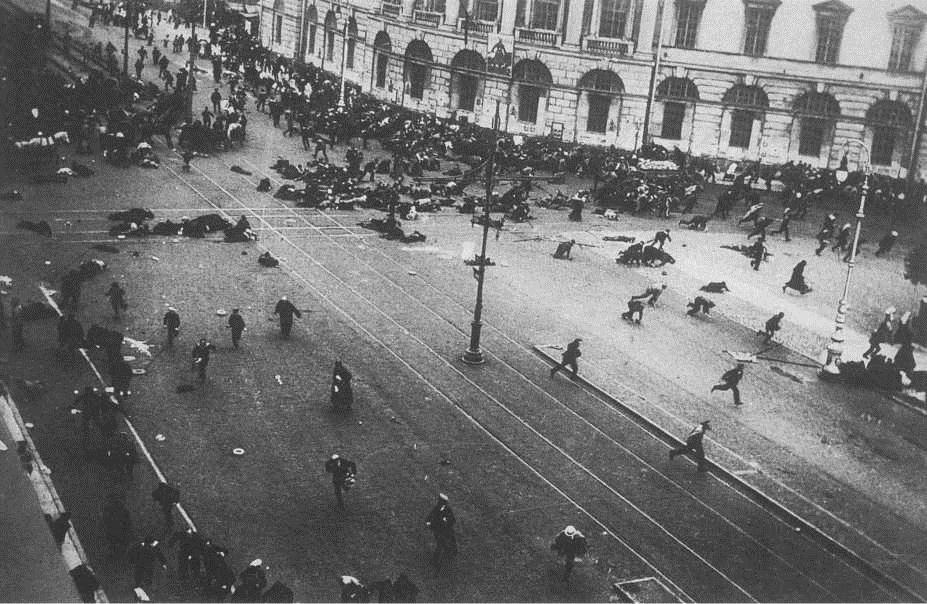
(Clash between Bolshevik and government troops (1917))
However, the Petrograd Soviet that had come into existence in 1905, and whose leaders were mainly Mensheviks and Social Revolutionaries, differed greatly with the Provisional Government about the direction that Russia should take. In spite of differences these two groups and other political groups managed somehow to work together. Lenin’s arrival in Russia in 1917 brought an immediate change in the political situation. Lenin realised that the time had come for the Bolsheviks to seize power and planned the overthrow of the ineffective Provisional Government. In the famous secret meeting of October 10, he exhorted the twelve party leaders to agree and work for an armed rebellion. In spite of receiving the backing of only ten of them he went ahead with the planning.
Once the Winter Palace was taken on the 26th, with barely a shot fired, with Kerensky having fled earlier, the takeover was complete and Lenin’s October Revolution had been achieved with the bare minimum of drama or bloodshed. The October Russian Revolution succeeded in establishing the Bolsheviks as the leaders of Russia and the creation of the first communist country.
For Marxists, the October Revolution of 1917 was the greatest single event in human history. It was the first time in history that the toiling classes could successfully throw off the yoke of the oppressors. Despite the ravages of war, these three years leading up to the victory of the soviets, had endorsed Lenin’s version of Marxist doctrine, whereby the proletariat and peasantry together had been able to complete the revolution. According to some, the October Revolution has been completely justified by history. For Russia the revolution opened the door to fully enter the industrial age. Russia was a mostly agrarian nation prior to 1917, with very limited industrial development. Russia had yet to achieve the level of development of its European neighbors who had been industrialized for more than fifty years and were technologically more advanced. After October 1917, the country’s development took a new turn as industrial regions started to come up taking the country’s development forward. Education was introduced on a large scale and illiteracy was soon a thing of the past. The nationalized planned economy succeeded in transforming one of the most backward economies into a powerful nation second only to the United States of America thereby demonstrating, as Trotsky has pointed out, the viability of socialism.
The October Revolution of 1917 was a radical turning point in the history of Russia, affecting the social structure, economics, industrial development, international relations and Russian culture. The rulers of Russia were no longer from the aristocracy but from the intellectual and working classes, marking a great change in the country’s direction.
John Reed, an American journalist who was in Russia participating in the famous October Revolution, has made the following close observations from his vantage position, in his famous book, Ten Days that Shook the World:
... No matter what one thinks of Bolshevism, it is undeniable that the Russian Revolution is one of the great events of human history, and the rise of the Bolsheviki a phenomenon of world-wide importance.
... Instead of being a destructive force, it seems to me that the Bolsheviki were the only party in Russia with a constructive program and the power to impose it on the country. If they had not succeeded to the Government when they did, there is little doubt in my mind that the armies of Imperial Germany would have been in Petrograd and Moscow in December, and Russia would again be ridden by a Tsar.64
World War I
On 1st August, 1914, Germany declared war on Russia. World War I (or the Great War as this war was called before World War II began) lasted for four years starting on 28th July, 1914. All the great powers of the world were involved in a gruesome conflict by two opposing alliances: the Allies and the Central Powers. The Allies or the Triple Entente 65 and the Central Powers consisting of the German Empire, the Austro-Hungarian empire, the Kingdom of Bulgaria and the Ottoman Empire. This war was centred in Europe and was one of the largest wars in history involving more than 70 million military personnel.
It was a time in Europe when there was a resurgence of imperialism reflecting in the foreign policies of its major powers. Serbia had been delivered an ultimatum by Austria-Hungary on the killing of the heir to the Austrian-Hungarian throne, Archduke Franz Ferdinand, by a Serbian. The ultimatum was intentionally so worded that it would be impossible for the Serbians to meet the demands and thus Austria-Hungary could provoke a war. Thus war was declared by them on 28th July 1914 and Serbia was invaded. Due to Russia’s close ties with Serbia, the Tsarist government stood by Serbia in its confrontation with Germany, so when Austria declared war on Serbia, war was declared by Germany on Russia. Alliances that had been previously formed to maintain the balance of power were invoked and soon the major countries were at war. On 28th October 1914, Turkey bombed the Russian Black Sea ports and entered the war on the side of the Central Powers. Britain declared war on Germany on 4th August 1914.
Just nine years earlier Russia had been defeated in a war with Japan, and thus Russia was hardly prepared for another war. Also the Revolution of 1905, had further stressed the empire. Russia was not financially at the same level as its European neighbours; its industry was still developing and could in no way contend with the powerful opposing nations such as Germany.
Russia’s first major battle of the war was a disaster: in the 1914 Battle of Tannenberg where Russia invaded German East Prussia, and the first battle of the Masurian Lakes, as many as over 200,000 Russian lives were lost, forcing the Russians to retreat from German territory. Though Russia had complete success with its invasion of the Austro-Hungarian province of Galicia, the first two years of the war inflicted heavy defeats on Russia and mainly saw the army in steady retreat. These defeats were on account of Russia being critically short of all material essentials—equipment such as weapons, ammunition and clothing. Poor organization and above all incompetent leadership from its generals and officers brought about disaster. Poor roads and railways made difficult the job of deployment of troops.
By mid 1915 the Russian army had failed to make any significant territorial gains but had lost around 80,000 soldiers. Desertions, infighting and general disorder in the Russian army grew, as discontent rose on the home front. The war had caused huge food shortages and the militarization of industry which along with the enormous death toll and continuing loss of territory, brought home to the Russians the fact that they had everything to lose and little to gain from the war as the country’s economic and political problems worsened. The Tsar, Nicholas II, took direct command of the army in September, personally overseeing the Russian theatre of war and leaving his wife, the Tsarina Alexandra, in charge of the government. This was an ill-conceived move as the inexperience of Nicholas as a military commander proved to be calamitous, and his incompetent wife who had been left in charge of domestic affairs, was unpopular in Russia. The ill-equipped Russian forces were at a total disadvantage against the vastly superior German army, which was better led, trained and supplied. Conscription had brought into the war unwilling and untrained soldiers, who were then pressed into action without weapons, ammunition and even shoes.
By the end of October 1916, Russia’s losses were enormous; between 1,600,000 and 1,800,000 military lives lost, 2,000,000 prisoners of war, and 1,000,000 men missing adding up to a total of over 5,000,000 men. The war was devastating not just for the soldiers but also for the economy which was breaking down under the strain of the war. The regime seemed unaffected by these appalling losses; there was widespread discontent—demoralization and war weariness were setting in.
The war continued to go badly; food was scarce and large numbers of peasants—mostly women—poured into stet towns looking for work, where they had to live and work in the most dreadful conditions of squalor. With a devastated economy, staggering outstanding war debts and soaring inflation, chaos prevailed and civil unrest increased—Russia was on the verge of complete collapse.
By the end of February 1917 the storm of revolution broke and soon the Russian monarchy was toppled. The Provisional Government promised solidarity with the Allied powers. The weakness of the Provisional Government and the rising discontent among the Russians led to the increase in popularity of the Bolsheviks led by Lenin which demanded that Russia pull out of the war immediately.
On 26th October 1917, when Lenin’s government secured power, its first action was to pass the Decree of Peace. Lenin then sent to all the participants in the war, diplomatic messages calling for peace; hostilities to cease without annexations. His peace appeal was ignored and so a Soviet delegation led by Trotsky (Commissar for Foreign Affairs) in December began negotiations for a separate peace with Germany. The Russian army had practically disintegrated and the Germans’ price for ending hostilities was high. The Bolshevik leaders were divided on this issue and the debates continued. Soon the German troops were marching into Russia resuming the invasion and Russia was forced to sign an armistice with Germany and Austria on 3rd December, 1917. The formal peace treaty—the Treaty of Brest-Litovsk was signed only on 3rd March, 1918, bringing an end to four years of war between Russia and Germany.
The peace treaty proved very costly; by its terms Russia had to give up huge tracts of its territories which included Finland, Poland, Latvia, Lithuania, Estonia, Ukraine, Belarus and the Caucasus region. The Treaty of Brest-Litovsk caused a lot of resentment in many quarters in the country, against Lenin who was desperate to bring Russia out of the war in order to safeguard the Revolution. The Soviets would regain these lost territories only after World War II.
By the end of World War I four major imperial powers ceased to exist—the German, Russian, Austro-Hungarian and the Ottoman. The map of Europe was redrawn into smaller states as these empires broke up and some of them dismantled entirely.
Timeline
Note: The Julian calendar was used in Russia until the adoption of the Gregorian calendar in February 1918, used by the Western world till today. During the 19th century the calendar fell 12 days behind and in the 20th century it fell 13 days behind the Gregorian calendar. The date between brackets gives the Gregorian calendar date.
1870
April 10 (22): Vladimir Ilyich Ulyanov (Lenin) born in Simbirsk.
1886
January 12 (24): Death of Vladimir’s father.
1887
May 8 (20): Alexandr, Vladimir’s older brother hanged for conspiracy to assassinate the Tsar.
August 13 (25): Vladimir enrolls in the Kazan university. In December he is arrested and expelled for participating in students’ protests.
1888-89
Resides in Kazan and Samara, begins study of law and revolutionary literature.
1892
July 23 (Aug 4): Gains license to practice law.
1893
Becomes active member of Marxist study group. Moves to St.
Petersburg on August 31 (September 12).
1895
Journeys to Europe to meet European and exiled Russian revolutionaries.
(Autumn): League of Struggle for the Emancipation of the Working Class is founded in St. Petersburg with Vladimir as member.
Dec 8 (20): Arrested in St. Petersburg.
1896
Vladimir held by police and kept in detention for the whole year.
1897
January 29 (Feb 10): Vladimir is exiled to Shushenskoye in Siberia.
1898
Mar 13-15 (Mar 25-30): Founding Congress of Russian Social Democratic Labour Party (RSDLP) in Minsk.
July 10 (22): Vladimir marries Nadezhda K. Krupskaya.
1899
March 24-31 (April 5-12): Publication of Vladimir’s book The Development of Capitalism in Russia.
1900
Jan 29 (Feb 10): Vladimir’s Siberian exile ends. He settles in Pskov.
July 16 (29): Vladimir leaves Russia for Europe. Settles in Munich in September.
December 11 (24): First issue of Vladimir’s paper Iskra.
1901
May: Krupskaya joins Vladimir after completing her term of exile.
December: Vladimir uses the pseudonym ‘Lenin’ for the first time.
1902
March: Lenin Publishes the famous What is to be Done?
1903
April: Moves to London after a brief residence in Geneva.
July 17-Aug 10 (July 30-Aug 23): Second Congress of RSDLP held in Brussels and London. Party splits into Bolshevik and Menshevik factions. Lenin separates from Iskra.
1904-5
Russo-Japanese War. Russia loses war.
1905
January: Lenin begins publishing a new paper Vyperod.
Jan 9 (22): Bloody Sunday in St. Petersburg. Revolution of 1905 begins.
Apr 12-27 (Apr 25-May 10): Third Congress of RSDLP held at London. Mensheviks do not attend.
October: St. Petersburg Soviet formed. October Manifesto declared.
November: Lenin returns to St. Petersburg after government grants amnesties to political exiles and prisoners.
1906
Apr 10-25 (Apr 23-May 8): Fourth (Unity) Congress of the RSDLP held at Stockholm. Mensheviks attend. Lenin elected to the Presidium.
1907
January: Lenin moves to Finland for security reasons.
Apr 30-May 19 (May 13-June 1): Fifth Congress of unified RSDLP is the largest. Held at London. Lenin elected to the Presidium.
August: Stuttgart Congress of the Socialist International. Lenin attends.
1908
Jan 7 (Jan 20): Lenin settles in Geneva.
October: Lenin completes his book, Materialism and Empirio-crticism.
November (December): Lenin moves to Paris.
Dec 21-27 (Jan 3-9, 1909): Fifth Congress of the All-Russian RSDLP. Held in Paris. Lenin again elected to Presidium.
1910
August: Lenin meets Maxim Gorky the writer, in Italy. Attends the Copenhagen Conference of the Second International.
1912
Jan 5-17 (18-30): Prague Conference. Bolsheviks declare themselves autonomous body.
April: First issue of Pravda published in Russia.
1914
July 18 (Aug 1): Germany declares war on Russia.
August: Lenin forced to leave Russia and emigrates to Berne, Switzerland.
1915
Aug 23-26 (Sep 5-8): Zimmerwald Conference of anti-war Socialists. Lenin attends.
1916
Jan-June: Lenin writes Imperialism, The Highest Stage of Capitalism.
February: Moves to Zurich.
Apr 11-17 (24-30): Second “Zimmerwald Conference” held at Kienthal. Lenin participates.
1917
Feb 17 (Mar 2): Tsar Nicholas abdicates. Provisional Government is formed in Russia.
Apr 3 (16): Lenin and his party arrive in Petrograd after transiting Germany in a sealed train.
Apr 7 (18): April Theses published in Pravda.
April (May): Seventh Congress of the RSDLP (Bolsheviks) in Petrograd. Lenin takes a prominent role.
May 21-June 1 (June 3-14): First All-Russian Congress of Soviets of Workers and Soldiers.
July: Uprising known as the July Days.
July: Lenin forced into hiding; escapes to Finland.
July 26-Aug 3 (Aug 8-16): Sixth Congress of the RSDLP held in semi-legal conditions. Lenin guided the Congress from underground, taking part in drafting all important resolutions. Elected unanimously honorary chairman.
September: Lenin argues for a new uprising.
mid-Oct: Lenin returns to Petrograd secretly from Finland, pushes for an immediate insurrection despite strong opposition within the party.
Oct 25 (Nov 7): The Soviet Government is formed with Lenin as Chairman.
1918
Jan 16 (29): Lenin dissolves Constituent Assembly.
March 3: Treaty of Brest-Litovsk ends hostilities with Germany.
March 10: Lenin and Soviet Government move to Moscow.
August 30: Attempt to assassinate Lenin. He is wounded.
1919
March 2-6: Communist International (Comintern) is founded.
1921
February 23-March 17: Kronstadt uprising against the Soviet Government.
March 17: Tenth Party Congress. New Economic Policy (NEP) begins.
1922
May 26: Lenin suffers his first stroke.
November: Lenin’s last public speech.
Dec 15: Lenin suffers a second stroke.
Dec 24: Politburo orders that Lenin be kept in isolation.
Dec 30: Formal establishment of the Union of Soviet Socialist Republics (USSR).
1922-23
December-January: Lenin composes several letters into what became known as his Last Testament.
1923
March 2: Lenin writes his last document: Better Fewer, But Better; on the reorganization and the reduction in size of the Soviet Government.
March 9: Lenin suffers his third stroke which robs him of his speech.
May 12: Lenin removed to a party sanatorium at Gorki.
1924
Jan 21: Lenin dies.
Appendix - I
The age of Capitalism and business is drawing to a close.
But the age of Communism, too, will pass. For Communism as it is preached is not constructive, it is a weapon to combat plutocracy. But when the battle is over and the armies are disbanded for want of employment, then Communism, having no more utility, will be transformed into something else that will express a higher truth.
We know this truth, and we are working for it so that it may reign upon earth.
The Mother, Mother's Agenda — 1951-1960: March 21, 1956
(Question) Somebody told X that Sri Aurobindo brought about the Russian revolution through Lenin. X told Y that people here were over-credulous and believed such things. Y said that if it is possible to cure dangerous diseases of the body by Yogic power, why should it not be possible to act on the mind of another person and pour in him immense vital force which can bring about such results as the Russian revolution?
(Answer) The statement made to X was not quite correct; it is putting things in too physical a form. A spiritual and occult working supplies forces and can watch over the members of the execution of a world event, but to put it like that makes the actual workers too much of automata which they are not.
Sri Aurobindo, Letters on Himself and the Ashram: Sri Aurobindo's Force and World Events
At any rate, Sri Aurobindo doesn’t deny that he did something!
No! (Mother laughs.)
The Mother, Mother's Agenda — 1971: November 27, 1971
Appendix - II (Citations from Sri Aurobindo)
We give below some relevant citations from the writings of Sri Aurobindo which relate to the theory of capitalism, socialism and anarchism and also to the ideal solution that can be found in the spiritual enlightenment and spiritualisation of the actual nature of man.
(Subtitles and questions before the citations are from the editor)
Reaction to Capitalism
Transition from Democratic Individualism to Democratic Socialism and Collectivistic Socialism or Governmental Communism
What is the remedy of Capitalism? Socialism? What is Socialism? Is it democratic? Is it undemocratic? Is it a restricted democracy? Is it identical with Communism, or is it different from it? Socialism leads to the sacrifice of individual liberty in order to establish the principle of Equality. What is the remedy? Democratic Socialism? Is Democratic Socialism likely to succeed? Is it likely to be widespread in the near future? Or will it give way to State Socialism? What is the truth behind the State Socialism? What are the defects of the State Socialism? Is the principle of Equality indispensable to State Socialism? Why does State Socialism or Governmental Communism lead to Totalitarianism? Is not Totalitarianism the denial of Reason?—Is it not the suicide or execution of the rational and intellectual expansion of the human mental being? Is Totalitarianism likely to be the inevitable end of the Age of Reason? Or is there some other possibility? Is Collectivism not an indispensable stage of Human development? Can not the defects of Collectivism be remedied? Can Collectivism be not spiritualised?
What is the Justification of Socialism?
“Its true nature, its real justification is the attempt of the human reason to carry on the rational ordering of society to its fulfilment, its will to get rid of this great parasitical excrescence of unbridled competition, this giant obstacle to any decent ideal or practice of human living. Socialism sets out to replace a system of organized economic battle by an organized order and peace. This can no longer be done on the old lines, an artificial or inherited inequality brought about by the denial of equal opportunity and justified by the affirmation of that injustice and its result as an eternal law of society and of Nature. That is a falsehood which the reason of man will no longer permit.”
Socialism must do away with individual liberty, even if it professes to respect it
“Neither can it be done, it seems, on the basis of individual liberty; for that has broken down in the practice. Socialism therefore must do away with the democratic basis of individual liberty, even if it professes to respect it or to be marching towards a more rational freedom. It shifts at first the fundamental emphasis to other ideas and fruits of the democratic ideal, and it leads by this transference of stress to a radical change in the basic principle of a rational society.”
Sri Aurobindo, The Human Cycle: The Curve of the Rational Age
Socialism must do away with the inherited right in the property in order to establish Equality
“Equality, not a political only, but a perfect social equality, is to be the basis. There is to be equality of opportunity for all, but also equality of status for all, for without the last the first cannot be secured; even if it were established, it could not endure. This equality again is impossible if personal, or at least inherited right in property is to exist, and therefore socialism abolishes—except at best on a small scale—the right of personal property as it is now understood and makes war on the hereditary principle. Who then is to possess the property? It can only be the community as a whole. And who is to administer it? Again, the community as a whole. In order to justify this idea, the socialistic principle has practically to deny the existence of the individual or his right to exist except as a member of the society and for its sake. He belongs entirely to the society, not only his property, but himself, his labour, his capacities, the education it gives him and its results, his mind, his knowledge, his individual life, his family life, the life of his children.”
Sri Aurobindo, The Human Cycle: The Curve of the Rational Age
The inevitable character of Socialism is to determine the whole life of the society
“Moreover, since his individual reason cannot be trusted to work out naturally a right and rational adjustment of his life with the life of others, it is for the reason of the whole community to arrange that too for him. Not the reasoning minds and wills of the individuals, but the collective reasoning mind and will of the community has to govern. It is this which will determine not only the principles and all the details of the economic and political order, but the whole life of the community and of the individual as a working, thinking, feeling cell of this life, the development of his capacities, his actions, the use of the knowledge he has acquired, the whole ordering of his vital, his ethical, his intelligent being. For so only can the collective reason and intelligent will of the race overcome the egoism of individualistic life and bring about a perfect principle and rational order of society in a harmonious world.”
Sri Aurobindo, The Human Cycle: The Curve of the Rational Age
This is denied or minimised by the most democratic socialists
“It is true that this inevitable character of socialism is denied or minimised by the more democratic socialists; for the socialistic mind still bears the impress of the old democratic ideas and cherishes hopes that betray it often into strange illogicalities. It assures us that it will combine some kind of individual freedom, a limited but all the more true and rational freedom, with the rigours of the collectivist idea. But it is evidently these rigours to which things must tend if the collectivist idea is to prevail and not to stop short and falter in the middle of its course. If it proves itself thus wanting in logic and courage, it may very well be that it will speedily or in the end be destroyed by the foreign element it tolerates and perish without having sounded its own possibilities. It will pass perhaps, unless guided by a rational wisdom which the human mind in government has not yet shown, after exceeding even the competitive individualistic society in its cumbrous incompetence.”
Sri Aurobindo, The Human Cycle: The Curve of the Rational Age
Hesitations of Social Democracy, and the likely future of Social Democracy
“These hesitations of social democracy, its uneasy mental poise between two opposing principles, socialistic regimentation and democratic liberty may be the root cause of the failure of socialism to make good in so many countries even when it had every chance on its side and its replacement by the more vigorous and ruthlessly logical forces of Communism and Fascism. On the other hand, in the northernmost countries of Europe, a tempo rising, reformist, practical Socialism compromising between the right regulation of the communal life and the freedom of the individual has to some extent made good; but it is still doubtful whether it will be allowed to go to the end of its road. If it has that chance, it is still to be seen whether the drive of the idea and the force it carries in it for complete self-effectuation will not prevail in the end over the spirit of compromise.”
Sri Aurobindo, The Human Cycle: The Curve of the Rational Age
The truth behind the collective idea of socialism
“The rational collectivist idea of society has at first sight a powerful attraction. There is behind it a great truth, that every society represents a collective being and in it and by it the individual lives and he owes to it all that he can give it. More, it is only by a certain relation to the society, a certain harmony with this greater collective self that he can find the complete use for his many developed or developing powers and activities. Since it is a collective being, it must, one would naturally suppose, have a discoverable collective reason and will which should find more and more its right expression and right working if it is given a conscious and effective means of organized self-expression and execution. And this collective will and intelligence, since it is according to the original idea that of all in a perfect equality, might naturally be trusted to seek out and work out its own good where the ruling individual and class would always be liable to misuse their power for quite other ends. The right organisation of social life on a basis of equality and comradeship ought to give each man his proper place in society, his full training and development for the common ends, his due share of work, leisure and reward, the right value of his life in relation to the collective being, society. Moreover, it would be a place, share, value regulated by the individual and collective good and not an exaggerated or a depressed value brought to him fortuitously by birth or fortune, purchased by wealth or won by a painful and wasteful struggle. And certainly the external efficiency of the community, the measured, ordered and economical working of its life, its power for production and general well-being must enormously increase, as even the quite imperfect development of collective action in the recent past has shown, in a well-organized and concentrated State.
If it be objected that to bring about this result in its completeness the liberty of the individual will have to be destroyed or reduced to an almost vanishing quantity, it might be answered that the right of the individual to any kind of egoistic freedom as against the State which represents the mind, the will, the good and interest of the whole community, sarvam brahma, is a dangerous fiction, a baneful myth. Individual liberty of life and action,—even if liberty of thought and speech is for a time conceded, though this too can hardly remain unimpaired when once the socialistic State has laid its grip firmly on the individual,—may well mean in practice an undue freedom given to his infrarational parts of nature, and is not that precisely the thing in him that has to be thoroughly controlled, if not entirely suppressed, if he is to become a reasonable being leading a reasonable life? This control can be most wisely and effectively carried out by the collective reason and will of the State which is larger, better, more enlightened than the individual’s; for it profits, as the average individual cannot do, by all the available wisdom and aspiration in the society. Indeed, the enlightened individual may well come to regard this collective reason and will as his own larger mind, will and conscience and find in a happy obedience to it a strong delivery from his own smaller and less rational self and therefore a more real freedom than any now claimed by his little separate ego.”
Sri Aurobindo, The Human Cycle: The End of the Curve of Reason
Discrepancy between the ideas of Socialism and Actual Facts of Human Nature
“The pity of it is that this excellent theory, quite as much as the individualist theory that ran before it, is sure to stumble over a discrepancy between its set ideas and the actual facts of human nature; for it ignores the complexity of man’s being and all that that complexity means. And especially it ignores the soul of man and its supreme need of freedom, of the control also of his lower members, no doubt,— for that is part of the total freedom towards which he is struggling,— but of a growing self-control, not a mechanical regulation by the mind and will of others. Obedience too is a part of its perfection, but a free and natural obedience to a true guiding power and not to a mechanised government and rule. The collective being is a fact; all mankind may be regarded as a collective being: but this being is a soul and life, not merely a mind or a body. Each society develops into a sort of sub-soul or group-soul of this humanity and develops also a general temperament, character, type of mind, evolves governing ideas and tendencies that shape its life and its institutions. But the society has no discoverable common reason and will belonging alike to all its members; for the group-soul rather works out its tendencies by a diversity of opinions, a diversity of wills, a diversity of life, and the vitality of the group-life depends largely upon the working of this diversity, its continuity, its richness. Since that is so, government by the organized State must mean always government by a number of individuals,— whether that number be in theory the minority or the majority makes in the end little fundamental difference. For even when it is the majority that nominally governs, in fact it is always the reason and will of a comparatively few effective men—and not really any common reason and will of all—that rules and regulates things with the consent of the half-hypnotised mass.”
Sri Aurobindo, The Human Cycle: The End of the Curve of Reason
Examples of Communist Russia and National Socialist Germany
“This truth has come out with a startling force of self-demonstration in Communist Russia and National Socialist Germany,—not to speak of other countries. The vehement reassertion of humanity’s need of a King crowned or uncrowned,— Dictator, Leader, Duce or Fuhrer—and a ruling and administering oligarchy has been the last outcome of a century and a half of democracy as it has been too the first astonishing result of the supposed rise of the proletariate to power.”
Sri Aurobindo, The Human Cycle: The End of the Curve of Reason
Socialism and the trinity of Liberty, Equality and Fraternity Socialism and Totalitarianism
“This is indeed already the spirit, the social reason,—or rather the social gospel,—of the totalitarianism whose swelling tide threatens to engulf all Europe and more than Europe. Totalitarianism of some kind seems indeed to be the natural, almost inevitable destiny, at any rate the extreme and fullest outcome of Socialism or, more generally, of the collectivist idea and impulse. For the essence of Socialism, its justifying ideal, is the governance and strict organisation of the total life of the society as a whole and in detail by its own conscious reason and will for the best good and common interest of all, eliminating exploitation by individual or class, removing internal competition, haphazard confusion and waste, enforcing and perfecting co-ordination, assuring the best functioning and a sufficient life for all. If a democratic polity and machinery best assure such a working, as was thought at first, it is this that will be chosen and the result will be Social Democracy. That ideal still holds sway in northern Europe and it may there yet have a chance of proving that a successful collectivist rationalisation of society is quite possible.
But if a non-democratic polity and machinery are found to serve the purpose better, then there is nothing inherently sacrosanct for the collectivist mind in the democratic ideal; it can be thrown in the rubbish-heap where so many other exploded sanctities have gone. Russian Communism so discarded with contempt democratic liberty and attempted for a time to substitute for the democratic machine a new sovietic structure, but it has preserved the ideal of a proletarian equality for all in a classless society. Still its spirit is a rigorous totalitarianism on the basis of the dictatorship of the proletariate, which amounts in fact to the dictatorship of the Communist party in the name or on behalf of the proletariate. Non-proletarian totalitarianism goes farther and discards democratic equality no less than democratic liberty; it preserves classes,—for a time only, it may be,—but as a means of social functioning, not as a scale of superiority or a hierarchic order.”
Sri Aurobindo, The Human Cycle: The Curve of the Rational Age
Totalitarianism-the suicide or the execution of the rational and intellectual expression of the human mental being
“If this trend becomes universal, it is the end of the Age of Reason, the suicide or the execution,—by decapitation or lethal pressure, peine forte et dure,—of the rational and intellectual expansion of the human mental being. Reason cannot do its work, act or rule if the mind of man is denied freedom to think or freedom to realise its thought by action in life. But neither can a subjective age be the outcome; for the growth of subjectivism also cannot proceed without plasticity, without movement of self-search, without room to move, expand, develop, change. The result is likely to be rather the creation of a tenebrous No Man’s Land where obscure mysticisms, materialistic, vitalistic or mixed, clash and battle for the mastery of human life.”
Sri Aurobindo, The Human Cycle: The Curve of the Rational Age
Will Totalitarianism occupy the globe?
“But this consummation is not certain; chaos and confusion still reign and all hangs in the balance. Totalitarian mysticism may not be able to carry out its menace of occupying the globe, may not even endure. Spaces of the earth may be left where a rational idealism can still survive. The terrible compression now exercised on the national mind and life may lead to an explosion from within or, on the other hand, having fulfilled its immediate aim may relax and give way in calmer times to a greater plasticity which will restore to the human mind or soul a more natural line of progress, a freer field for their self-expanding impulse.
In that case the curve of the Age of Reason, now threatened with an abrupt cessation, may prolong and complete itself; the subjective turn of the human mind and life, avoiding a premature plunge into any general external action before it has found itself, may have time and freedom to evolve, to seek out its own truth, its own lines and so become ready to take up the spiral of the human social evolution where the curve of the Age of Reason naturally ends by its own normal evolution and make ready the ways of a deeper spirit.”
Sri Aurobindo, The Human Cycle: The Curve of the Rational Age
Reaction to the Supremacy of the State and to Totalitarianism Transition to Anarchism, intellectual or spiritual: towards the true Solution
What are the basic springs of Anarchism? What is Anarchism? What is the relationship between Anarchism and the democratic godheads of humanity? Will Anarchism go beyond the stage of theory and intellectual revolt? “The State will wither away”—Is not that Russian ideal of Communism Anarchistic? Is that ideal not likely to be realised? What are the defects of Anarchism? Will Anarchism be surpassed? What is the true solution?—Spiritual or Spiritualised Anarchism? — Or a radical spiritual change and transformation?
The pressure of the Modern State and the Reaction of Anarchism
“Already the pressure of the State organisation on the life of the individual has reached a point at which it is ceasing to be tolerable. If it continues to be what it is now, a government of the life of the individual by the comparatively few and not, as it pretends, by a common will and reason, if, that is to say, it becomes patently undemocratic or remains pseudo-democratic, then it will be this falsity through which anarchistic thought will attack its existence. But the innermost difficulty would not disappear even if the Socialistic State became really democratic, really the expression of the free reasoned will of the majority in agreement. Any true development of that kind would be difficult indeed and has the appearance of a chimera; for collectivism pretends to regulate life not only in its few fundamental principles and its main lines, as every organized society must tend to do, but in its details, it aims at a thoroughgoing scientific regulation, and an agreement of the free reasoned will of millions in all the lines and most of the details of life is a contradiction in terms. Whatever the perfection of the organized State, the suppression or oppression of individual freedom by the will of the majority or of a minority would still be there as a cardinal defect vitiating its very principle. And there would be something infinitely worse. For a thoroughgoing scientific regulation of life can only be brought about by a thoroughgoing mechanisation of life. This tendency to mechanisation is the inherent defect of the State idea and its practice. Already that is the defect upon which both intellectual anarchistic thought and the insight of the spiritual thinker have begun to lay stress, and it must immensely increase as the State idea rounds itself into a greater completeness in practice. It is indeed the inherent defect of reason when it turns to govern life and labours by quelling its natural tendencies to put it into some kind of rational order.”
Sri Aurobindo, The Human Cycle: The End of the Curve of Reason
Can anarchistic thought find a satisfying social principle?
“The question remains whether anarchistic thought supervening upon the collectivistic can any more successfully find a satisfying social principle. For if it gets rid of mechanism, the one practical means of a rationalising organisation of life, on what will it build and with what can it create?”
“...we find it declaring that all government of man by man by the power of compulsion is an evil, a violation, a suppression or deformation of a natural principle of good which would otherwise grow and prevail for the perfection of the human race.”
Sri Aurobindo, The Human Cycle: The End of the Curve of Reason
Intellectual Anarchism: its two proposals
“.…it is... clear that the more the outer law is replaced by an inner law, the nearer man will draw to his true and natural perfection. And the perfect social State must be one in which governmental compulsion is abolished and man is able to live with his fellowman by free agreement and co-operation. But by what means is he to be made ready for this great and difficult consummation? Intellectual anarchism relies on two powers in the human being of which the first is the enlightenment of his reason; the mind of man, enlightened, will claim freedom for itself, but will equally recognise the same right in others. A just equation will of itself emerge on the ground of a true, self-found and unperverted human nature. This might conceivably be sufficient, although hardly without a considerable change and progress in man’s mental powers, if the life of the individual could be lived in a predominant isolation with only a small number of points of necessary contact with the lives of others. Actually, our existence is closely knit with the existences around us and there is a common life, a common work, a common effort and aspiration without which humanity cannot grow to its full height and wideness. To ensure co-ordination and prevent clash and conflict in this constant contact another power is needed than the enlightened intellect. Anarchistic thought finds this power in a natural human sympathy which, if it is given free play under the right conditions, can be relied upon to ensure natural co-operation: the appeal is to what the American poet calls the love of comrades, to the principle of fraternity, the third and most neglected term of the famous revolutionary formula. A free equality founded upon spontaneous co-operation, not on governmental force and social compulsion, is the highest anarchistic ideal.”
Sri Aurobindo, The Human Cycle: The End of the Curve of Reason
Co-operative communism or Communalism
“This would seem to lead us either towards a free co-operative communism, a unified life where the labour and property of all is there for the benefit of all, or else to what may better be called communalism, the free consent of the individual to live in a society where the just freedom of his individuality will be recognised, but the surplus of his labour and acquisitions will be used or given by him without demur for the common good under a natural co-operative impulse.”
Sri Aurobindo, The Human Cycle: The End of the Curve of Reason
Discrepancy between the ideas of Anarchism and the Actual Facts of Human Nature
“The severest school of anarchism rejects all compromise with communism. It is difficult to see how a Stateless Communism which is supposed to be the final goal of the Russian ideal can operate on the large and complex scale necessitated by modern life. And indeed it is not clear how even a free communalism could be established or maintained without some kind of governmental force and social compulsion or how it could fail to fall away in the end either on one side into a rigorous collectivism or on the other to struggle, anarchy and disruption. For the logical mind in building its social idea takes no sufficient account of the infrarational element in man, the vital egoism to which the most active and effective part of his nature is bound: that is his most constant motive and it defeats in the end all the calculations of the idealising reason, undoes its elaborate systems or accepts only the little that it can assimilate to its own need and purpose. If that strong element, that ego-force in him, is too much overshadowed, cowed and depressed, too much rationalised, too much denied an outlet, then the life of man becomes artificial, top-heavy, poor in the sap of vitality, mechanical, uncreative. And on the other hand, if it is not suppressed, it tends in the end to assert itself and derange the plans of the rational side of man, because it contains in itself powers whose right satisfaction or whose final way of transformation reason cannot discover. If reason were the secret, highest law of the universe or if man the mental being were limited by mentality, it might be possible for him by the power of the reason to evolve out of the dominance of infrarational Nature which he inherits from the animal. He could then live securely in his best human self as a perfected rational and sympathetic being, balanced and well-ordered in all parts, the sattwic man of Indian philosophy; that would be his summit of possibility, his consummation. But his nature is rather transitional; the rational being is only a middle term of Nature’s evolution. A rational satisfaction cannot give him safety from the pull from below nor deliver him from the attraction from above. If it were not so, the ideal of intellectual Anarchism might be more feasible as well as acceptable as a theory of what human life might be in its reasonable perfection; but, man being what he is, we are compelled in the end to aim higher and go farther.”
Sri Aurobindo, The Human Cycle: The End of the Curve of Reason
Spiritual Anarchism: Defects of its present formulation
“A spiritual or spiritualised anarchism might appear to come nearer to the real solution or at least touch something of it from afar. As it expresses itself at the present day, there is much in it that is exaggerated and imperfect. Its seers seem often to preach an impossible self-abnegation of the vital life and an asceticism which instead of purifying and transforming the vital being, seeks to suppress and even kill it; life itself is impoverished or dried up by this severe austerity in its very springs. Carried away by a high-reaching spirit of revolt, these prophets denounce civilisation as a failure because of its vitalistic exaggerations, but set up an opposite exaggeration which might well cure civilisation of some of its crying faults and uglinesses, but would deprive us also of many real and valuable gains.”
Sri Aurobindo, The Human Cycle: The End of the Curve of Reason
The inability of any “ism” to express the truth of the Spirit
“But apart from these excesses of a too logical thought and a onesided impulsion, apart from the inability of any “ism” to express the truth of the spirit which exceeds all such compartments, we seem here to be near to the real way out, to the discovery of the saving motive-force.”
Sri Aurobindo, The Human Cycle: The End of the Curve of Reason
The Solution: Fulfilment of Liberty, Equality, Fraternity: Spiritual Enlightenment alone can illumine the Actual Nature of Man
“The solution lies not in the reason but in the soul of man, in its spiritual tendencies. It is a spiritual, an inner freedom that can alone create a perfect human order. It is a spiritual, a greater than the rational enlightenment that can alone illumine the vital nature of man and impose harmony on its self-seekings, antagonisms and discords. A deeper brotherhood, a yet unfound law of love is the only sure foundation possible for a perfect social evolution, no other can replace it. But this brotherhood and love will not proceed by the vital instincts or the reason where they can be met, baffled or deflected by opposite reasonings and other discordant instincts. Nor will it found itself in the natural heart of man where there are plenty of other passions to combat it. It is in the soul that it must find its roots; the love which is founded upon a deeper truth of our being, the brotherhood or, let us say,—for this is another feeling than any vital or mental sense of brotherhood, a calmer more durable motive-force,—the spiritual comradeship which is the expression of an inner realisation of oneness. For so only can egoism disappear and the true individualism of the unique godhead in each man found itself on the true communism of the equal godhead in the race; for the Spirit, the inmost Self, the universal Godhead in every being is that whose very nature of diverse oneness it is to realise the perfection of its individual life and nature in the existence of all, in the universal life and nature.”
Sri Aurobindo, The Human Cycle: The End of the Curve of Reason
Does this solution put off the consummation of a better human society to a far-off date in the future evolution of the race?
“This is a solution to which it may be objected that it puts off the consummation of a better human society to a far-off date in the future evolution of the race. For it means that no machinery invented by the reason can perfect either the individual or the collective man; an inner change is needed in human nature, a change too difficult to be ever effected except by the few. This is not certain; but in any case, if this is not the solution, then there is no solution, if this is not the way, then there is no way for the human kind. Then the terrestrial evolution must pass beyond man as it has passed beyond the animal and a greater race must come that will be capable of the spiritual change, a form of life must be born that is nearer to the divine. After all there is no logical necessity for the conclusion that the change cannot begin at all because its perfection is not immediately possible. A decisive turn of mankind to the spiritual ideal, the beginning of a constant ascent and guidance towards the heights may not be altogether impossible, even if the summits are attainable at first only by the pioneer few and far-off to the tread of the race. And that beginning may mean the descent of an influence that will alter at once the whole life of mankind in its orientation and enlarge for ever, as did the development of his reason and more than any development of the reason, its potentialities and all its structure.”
Sri Aurobindo, The Human Cycle: The End of the Curve of Reason
“It is not enough even that the idea of the kingdom of God on earth, a reign of spirituality, freedom and unity, a real and inner equality and harmony—and not merely an outward and mechanical equalisation and association—should become definitely an ideal of life; it is not enough that this ideal should be actively held as possible, desirable, to be sought and striven after, it is not enough even that it should come forward as a governing preoccupation of the human mind. That would evidently be a very great step forward,— considering what the ideals of mankind now are, an enormous step. It would be the necessary beginning, the indispensable mental environment for a living renovation of human society in a higher type. But by itself it might only bring about a half-hearted or else a strong but only partially and temporarily successful attempt to bring something of the manifest Spirit into human life and its institutions. That is all that mankind has ever attempted on this line in the past. It has never attempted to work out thoroughly even that little, except in the limits of a religious order or a peculiar community, and even there with such serious defects and under such drastic limitations as to make the experiment nugatory and without any bearing on human life. If we do not get beyond the mere holding of the ideal and its general influence in human life, this little is all that mankind will attempt in the future. More is needed; a general spiritual awakening and aspiration in mankind is indeed the large necessary motive-power, but the effective power must be something greater. There must be a dynamic re-creating of individual manhood in the spiritual type.”
Sri Aurobindo, The Human Cycle: The Advent and Progress of the Spiritual Age
Notes
Adapted from The World in Arms, History of the World, Time-Life Series.
↩(April 22). Russia till February 1918 used the Julian calendar, while the Western world used the Gregorian calendar which is in use today. During the nineteenth century the Julian calendar fell 12 days behind and, in the twentieth century it fell 13 days behind the Gregorian calendar. Generally, all dates cited by historians for pre-revolutionary events are according to the Julian calendar.
↩One of the founders of the first Marxist organisation in Russia: the Emancipation of Labour group.
↩The World in Arms, History of the World, Time-Life Series, p. 55.
↩Earlier the group was known as the Social Democrats.
↩An acronym for The Department for the Protection of Order and Public Security.
↩Its motto was taken from the Decembrists’ reply to the poet Pushkin: “From the spark a flame will be kindled.”
↩Robert Service, Lenin: A Biography, p. 141.
↩Leon Trotsky, On Lenin, pp. 11-12.
↩A Russian Marxist group
↩Leon Trotsky, On Lenin, p. 64.
↩Leon Trotsky, On Lenin, p. 66.
↩Helen Rappaport, Conspirator: Lenin in Exile, p. 96.
↩Leon Trotsky, On Lenin, pp. 66-67.
↩Helen Rappaport, Conspirator: Lenin in Exile, p. 120.
↩Helen Rappaport, Conspirator: Lenin in Exile, pp. 161.
↩C.L.Wayper, Political Thought, pp. 221, 223.
↩The World in Arms, History of the World, Time-Life Series, pp. 60-1.
↩Saint Petersburg was founded by Tsar Peter the Great on May 27 (Julian calendar) 1703. From 1713 to 1728 and from 1732 to 1918, it was the Imperial capital of Russia. In 1914 Saint Petersburg was named Petrograd and in 1918, the capital shifted to Moscow. Petrograd was named Leningrad in 1924. Since 1991, it is again Saint Petersburg.
↩According to the Gregorian calendar.
↩Robert Service, Lenin: A Biography, p. 254.
↩Helen Rappaport, Conspirator: Lenin in Exile, pp. 299-300.
↩A Russian revolutionary underground worker.
↩A Russian revolutionary underground worker.
↩The World in Arms, History of the World, Time-Life Series, p. 65.
↩Leon Trotsky, On Lenin, pp. 77-8.
↩Leon Trotsky, On Lenin, p. 70.
↩Leon Trotsky, On Lenin, p. 81.
↩The World in Arms, History of the World, Time-Life Series, p. 86.
↩The World in Arms, History of the World, Time-Life Series, p. 66.
↩Leon Trotsky, On Lenin, p. 90.
↩The Provisional Government was led by Alexander Kerensky.
↩John Reed, Ten Days That Shook the World, London: Penguin (1977), p. 128 (Available online, courtesy of the Marxist Internet Archive).
↩Price was sent to Petrograd and reported on the overthrow of Tsar Nicholas II.
↩Leon Trotsky, On Lenin, p. 139.
↩Leon Trotsky, On Lenin, p. 141.
↩Leon Trotsky, On Lenin, p. 116.
↩Leon Trotsky, On Lenin, pp. 123-5.
↩The countries of Great Britain, France, USA and Japan.
↩The World in Arms, History of the World, Time-Life Series, p. 66.
↩Leon Trotsky, On Lenin, pp. 128, 129,132,133, 135.
↩Leon Trotsky, On Lenin, pp. 125-126.
↩Lenin, Collected Works, Vol. 30, p. 335.
↩Russian historian and Colonel-General who was the former head of the Soviet military’s psychological warfare department. He published revealing biographies of Joseph Stalin and Vladimir Lenin, among others.
↩A textile manufacturing city in Russia.
↩Robert Service, Lenin: A Biography, p. 439.
↩C. L. Wayper, Political Thought, p. 229.
↩Lenin’s Testament, formally Letter to the Congress, Russian Pismo K Syezdu, two-part document dictated by Lenin on Dec. 23-26, 1922, and Jan. 4, 1923, and addressed to a future Communist Party Congress. It contained guideline proposals for changes in the Soviet political system and concise portrait assessments of six party leaders (Joseph Stalin, Leon Trotsky, Grigory Y. Zinovyev, Lev B. Kamenev, Nikolay Bukharin, and Georgy Pyatakov). The testament, written while Lenin was recovering from a severe stroke, concluded with a recommendation that Stalin be removed from his position as secretary-general of the party.—http://www.britannica.com/EBchecked/topic/335969/Lenin’s-Testament.
↩Sun Yat-sen in a 1924 response to Lenin’s death, as quoted in A Short History of the World, Vol. 2 (1974) by Albert Zakharovich Manfred; also in Lenin: A Biography (1983)
↩Robert Service, Lenin: A Biography, p. 434.
↩Louis Fischer, The Life of Lenin, 1964, pp. 21-22.
↩Leon Trotsky, Lenin III
↩Leon Trotsky, On Lenin, p. 171.
↩The World in Arms, History of the World, Time-Life Series, p. 75.
↩The World in Arms, History of the World, Time-Life Series, p. 75.
↩Political Thought, C. L. Wayper, p. 235.
↩Political Thought, C. L. Wayper, p. 235.
↩Political Thought, C. L. Wayper, p. 236.
↩In English in the original.
↩Leon Trotsky, On Lenin, pp. 33-4.
↩Helen Rappoport, Conspirator: Lenin in Exile, p. 116.
↩The Story of My Life, by Father Gapon, London: Chapman & Hall, 1906.
↩Robert Service, Lenin: A Biography, p. 253.
↩John Reed, Ten Days that Shook the World, Preface. Transcribed from a 1919, 1st Edition, published by BONI & Liveright, Inc. Transcribed and marked up for the John Reed Internet Archive.
↩Britain, France and Russia.
↩