THE WRITTEN WORD
Introductory notes on Socrates, Plato and Aristotle
Paragraph references are specific to this digital edition.
Introductory notes on Socrates, Plato and Aristotle
Socrates
“It (the true soul) is the concealed Witness and Control, the hidden Guide, the Daemon of Socrates, the inner light or inner voice of the mystic.”1
One of the greatest of the Greeks was Socrates who is known as the father of Philosophy. His early life is not much known but he must have lived a disciplined life right from early boyhood. We are told that he had a great power of endurance and could bear extreme cold and heat. He was a sturdy soldier and had shown remarkable skill and valour in several battles.
It is, however, said that he was very ugly; he had a snub nose and a considerable belly. He was always dressed in shabby old clothes and went barefoot everywhere.
But he was a profound thinker and philosopher. Even when he went to serve in the Army, he used to spend his time in thinking. One morning, while he was on military service, he was thinking about something. He thought and thought over some problem which he could not solve. He would not give up and continued thinking from early dawn until noon — he stood fixed in thought; at noon when attention was drawn to him all people began to wonder at him. At last, after supper some people brought out their mats and slept in the open air to watch him and see whether he would stand all night. There he stood until the following morning; and with the return of light he offered a prayer to the sun, and went his way.
At another time, Socrates and his friend Aristodemus went together to a banquet, but on the way Socrates went into a trance and dropped behind. When Aristodemus arrived at the feast, he was asked by the host: “What have you done with Socrates?” Aristodemus was astonished to find that Socrates was not with him; in those days rich people used to have slaves; so a slave was sent to look for him. The slave returned and said: “There he is fixed, and when I called him he would not stir. Those who know him well explain that he has a way of stopping anywhere and losing himself without any reason”. Socrates came only when the feast was half over.
Socrates was a great seeker of truth and he had developed a method of enquiry which has come to be known as the Socratic Method. This method, which is also called dialectic, consists of arriving at conclusions by question and answer. Socrates used to begin an enquiry by saying that he knew nothing or very little about the subject of enquiry. Then he would invite certain notions or definitions of the subject under enquiry; this would be followed by presenting some difficulties in accepting those notions or definitions; he would then suggest some modifications or present some new hypothesis followed by fresh discussions. Quite often the discussions would end in stimulating questions instead of arriving at conclusions. But when he would arrive at any conclusions, it would be only after examining the subject freely and from as many points of view as possible.
This method seems to have been practised by Zeno, the disciple of Parmenides. For if we read Plato's dialogue, Parmenides, we find that Zeno uses the same kind of dialectic as Socrates uses elsewhere in other dialogues of Plato. But there is no doubt that Socrates developed this method and, through Plato it has determined to a very large extent the form of subsequent philosophy.
There is a fundamental distinction between science and philosophy; science seeks facts and the laws governing them, while philosophy attempts to interpret and evaluate the facts from the point of view of the whole. Evidently, the Socratic Method is not the scientific method; for it presupposes the prior existence of notions or definitions about the subject under inquiry; it does not arrive at new facts. What the method attempts to do is to examine the given facts and notions from various points of view, to clarify them and to give them a coherent form. This is the philosophical method. For although in philosophy, nothing is to be taken for granted, it cannot and does not originate in a vacuum; there must already be some glimpse of light in the human mind which would initiate philosophical reflection. This glimpse may be either in the form of a personal experience or in the form of a Word or, to use the Indian terminology, sruti, heard from the lips of the man of experience or realization. In Indian philosophy, the authority given to sruti is higher than that given to any other mode of knowledge except that of direct experience or realization. In many ways, therefore, the Socratic Method and the Indian philosophical method are similar.
Socrates used to go to market places and ask questions to the passers-by. But his questions were so deep that many young people found in him a great teacher. He had therefore gathered round him a band of young people who used to go to him for learning. One of these young men was Plato, his chief disciple and one of the greatest philosophers of the world.
Socrates had a friend. Once he went to the oracle of Delphi whom he asked if there were any one wiser than Socrates. The oracle said that there was none. On hearing this, he was very pleased and told Socrates what the oracle had spoken to him. But when Socrates heard this he was greatly puzzled. He thought that he knew nothing and yet he could not believe that the god Apollo could be wrong. He therefore went about among those people who were famous for their wisdom. First he went to a politician who was thought wise by many and regarded himself as still wiser. But Socrates found out that he had no wisdom. He then went to poets and asked them to explain their poems. But they could not. Then he knew that poets do not write by wisdom but only by genius and inspiration. Then he went to the artisans, but found that they too were not wise. Finally he concluded: “God alone is wise; the wisdom of men is worth little or nothing. I am called the wisest among men; but that is not because I have wisdom. Others too have no wisdom and yet think they have it, whereas I have no wisdom but know that I do not have it. This is the truth of the oracle.”
But during this inquiry, Socrates showed the people whom he interviewed their ignorance and this embittered many. Already many elderly philosophers and politicians of Athens were afraid of the great influence that Socrates wielded over the young people. They therefore brought a charge against him. They said: “Socrates is an evil-doer and a curious person, searching into things under the earth and above the heaven; and making the worse appear the better, and teaching all this to others”. They held that Socrates was guilty of not worshipping the gods of the State and inventing new gods. They further said that he was guilty of corrupting the young by teaching them wrong things.
In his dialogue, Apology, Plato has described the trial of Socrates. Socrates defended himself. But his accusers were not open to reason. He was therefore sentenced to death. In those times, it was a custom that the wife and children of the accused would come before the court; they would cry and beg of the judges to lessen the punishment. But Socrates was not afraid of death and he was sure within himself that he was not guilty. He therefore prevented his wife and children from coming to the court for pleading. On the contrary, he said, “Those of us who think that death is an evil are in error... for death is either a dreamless sleep or the soul migrates to another world. In the next world, I will converse with Hesiod and Homer; and in that world they do not put men to death for asking questions”.
And then he added: “The hour of departure has come, and we go our ways — I to die and you to live. Which is better God alone knows.”
Socrates was cheerful up to the last minute of his life. When he was given hemlock to drink, he took it without any complaint or sorrow. Within a few minutes, his limbs became cold and thus ended the great life of Socrates.
Among the many views of Socrates, his doctrine of ‘Virtue is Knowledge’ is perhaps the most important. This doctrine can be interpreted in two ways, according as we attach different meanings to the words ‘Virtue’ and ‘Knowledge’. We shall deal with them one after the other.
Traditionally, it is held that the ethical problem is a double one first, the problem of knowing what is right and, second, the problem of doing what is known to be right. But, according to the first interpretation, Socrates identifies Knowledge, the first problem, with Virtue, the second problem. According to Socrates, it is maintained, knowing and doing cannot be separated. If a person knows a thing to be right, he cannot but do it. Or, in other words, person cannot voluntarily do wrong.
Knowledge, on this view, means the knowledge of what is good and the knowledge is the intellectual apprehension. And by virtue is meant any good deed of an agent who has apprehended it to be good.
The plausibility of this interpretation depends upon the two dialogues Charmides and Laches, in which the Socratic doctrine is expounded to a certain extent. In Laches, Socrates says in effect that it is not the case that the brave man is never afraid, but in spite of his fear he advances, rushes the slopes and captures enemy's weapons. Why does he? Because he is afraid of certain things even more than of the weapons — such things as the doing of what is disgraceful, of feeling shame, of the reputation for cowardice, of betraying one's comrades. What then is the difference between a coward and a brave man? The difference is that while the brave man knows what is really to be afraid of, the coward does not. Hence the knowledge of the right makes the former courageous.
The argument in Charmides is that it is the knowledge of the mean between extreme indulgence and extreme asceticism that makes a man temperate or sober. These two dialogues give a clue, it is said, as to what meaning is attached by Socrates to the word ‘Knowledge’. Here there is no reference to the knowledge of the whole reality or of the Highest Good; it is therefore not mystic or intuitive knowledge which is an attribute of spiritual experience. Knowledge is, therefore, concluded to be intellectual apprehension of the right in a given particular situation. But at a deeper level, Socrates made a distinction between opinion and knowledge, to which we shall turn.
Opinion and Knowledge: Opinion is an apprehension of the particular, which is partly real and partly unreal, whereas Knowledge is the comprehension of the universal which is wholly real. It is the knowledge which, according to Socrates, liberates man from the bonds of ignorance and evil.
What in effect have we arrived at? Virtue is not this virtue or that virtue and knowledge is not the apprehension of a particular good. What Socrates seems to be stating is that there is a state of consciousness where there is totality of Knowledge which manifests spontaneously in the forms of virtuous actions. Indeed this state does not belong to the moral plane; for in the moral plane we cannot speak of having attained to the totality of Knowledge and unity of virtues. There the state is always contrasted with WHAT OUGHT TO BE. This contrast ceases when the Summum Bonum or the Highest Good is attained in the state of spiritual illumination. Indeed even in the spiritual field, there are degrees and progression; but the essential knowledge is present at every stage which prevents evil in Will. With reference to the spiritual man therefore we can say: Virtue is Knowledge.
We have to remember that although Socrates initiated the rational movement in Western Philosophy through his method of dialectic, he was essentially a mystic. As we saw, he used to go into a state of trance quite frequently, and he is reported to have been guided by his Daemon, the inner soul, light and guide. To such a man, indeed, no given action is good unless it is a manifestation of the integrating experience which is also the state of true knowledge. In the Republic of Plato, we read the myth of the den, where the way by which the Highest Good is realized is described. What we get there is the symbolic description of spiritual experience. That realization is not intellectual apprehension, but that in which cognition, affection and conation are fused together and transcended. It is, then, we may conclude, the knowledge obtained on this transcendental level that is referred to by Socrates in his doctrine ‘Virtue is Knowledge’.
One of the important consequences of the Socratic Method was to arrive at definitions. What therefore the Socratic doctrine states is the definition of Virtue; it does not enunciate the principle of the development of virtue. It is not an answer to the question: “How to be good?” It is rather an answer to the question: ‘What is the definition of Good?’ If therefore we argue against the doctrine by appeal to the facts of moral struggle in which there is a constant division between what one knows to be good and what one does, that would be irrelevant. For what Socrates seems to have been concerned with was to give a definition of Virtue, not a guiding principle of moral development.
Plato
The history of thought may, in a sense, be regarded as an account of the cyclical movement of the modes of knowledge: sensation, perception, reason, intuition and still higher modes of cognition. At different periods one or another of these predominates and asserts its own truth and standards of truth. Thus we have the age of intuition such as that of the Veda and the Upanishad, the age of mixed intuition and reason such as that of the Darshanas in the East and that of Socrates and Plato in the West, the age of Pure Reason as that of Descartes, Spinoza, Leibnitz and Kant, and the age of the senses as that of Locke and Hume and Logical Positivism.
In this cyclical movement, the age to which Plato belongs was the period when intuitive knowledge was receding into the background and making way for the free play of reason and its allied instruments. The early age of Greece was the age of the Mysteries where there was the supreme reign of occult and intuitive knowledge. When we come to Pythagoras, this supremacy is lost, but still intuition predominates. In Socrates we find a child of the Mystics capable of intuitive knowledge and contacting and following an inner voice, the ‘Daemon’; but his methods of inquiry have already become rational and dialectical and in effect he initiates the rational movement in Western philosophy. Yet in his most important doctrines such as that of ‘Virtue is Knowledge’ he identifies knowledge with the knowledge belonging to spiritual consciousness. And in his life we find him being moved and motivated by the high ethical and spiritual sense. But when we come to Plato, we find that the mystic tendency is on the wane, although the setting sun of mysticism casts its gold on the horizon and we find in Plato a most captivating combination of mysticism and reason.
Plato inherits the mysticism of the past but moulds it in his rational receptacle. He himself was deeply influenced by Socrates and in his highest heights he understands, touches, nay, communicates with the supreme and most mysterious spiritual reality. But it is through mind that he reaches the summit to capture that reality. Indeed, Plato is essentially the Mind or Thought reflecting and drawing upon the treasures of Intuition. In consequence, he stands out as a thinker presiding over the new dawn of Reason but having at his back the splendour and glory of the waning age of Intuition.
Although he is a disciple of mystics, his life is not moved by any religious motive or fervour. But the lack of this motivation is amply compensated by his large and wide and rich mind, high artistic genius commanding creative expression, and an intense dynamic nature expressing itself in concentrated efforts at the realization of a sublime and ideal order of existence on the earth. In his early youth we find him planning for a political career. It was only because he found that the then political conditions would not permit him to be useful to the state that he changed his mind. The death of Socrates put a seal on this change and made him decide finally for the life of a professional philosopher. But even then he did not remain merely an armchair philosopher. He established in Athens an Academy for training and imparting to students a comprehensive education; and in due course this Academy became a great center of learning where students came from many parts of the civilized world. It supplied to the Greek states many scholars, statesmen and individuals of high culture. He laid the foundations of this Academy so deep that it lived for hundreds of years until Justinian disestablished it.
He was so deeply concerned with the future of humanity that he speculated on the problem of an ideal order of existence and came to the conclusion which he set forth in his Republic:
“Until philosophers are kings, or the kings and princes of this world have the spirit and power of philosophy, and political greatness and wisdom meet in one, and those commoner natures who pursue either to the exclusion of the other are compelled to stand aside, cities will never have rest from these evils — no, nor the human race, as I believe — and then only will this our State have a possibility of life and behold the light of day.”
This conviction was not merely intellectual: he made a few attempts to realize the ideal of his vision. He undertook two journeys to Sicily and employed himself in the task of training Dionysius II. In the first journey he had to undergo such humiliation — he was sold in the market as a slave and escaped death by being ransomed by someone — that if he had not at his heart the great consideration for the future of human progress, he would have declined the second invitation of Dionysius. Of course, he failed in his attempts but his vision of the ideal state remained up to this day an inspiration to many thinkers, visionaries, statesmen and servants of mankind.
However, Plato is preeminently a philosopher. He was a mathematician and gave a high place to mathematics in his system of education; he was an educationist, a great literary artist, a social and political thinker, a law giver, a utopian and in a sense, even a theologian; but all these were his subordinate and supporting aspects, none supreme or equal to his philosophical personality. Philosophy is the very soul and breath of Plato. His mind is constantly fixed on the supreme Idea of the Good, he is constantly engaged in reconciling and harmonizing the universal Ideas, his constant task is to reflect and meditate upon the Real and differentiate it from the phenomenon and the appearance.
The concept of the Good is the culmination of Plato’s philosophy. There is, according to Plato, a distinction between reality and appearance. The former is the universal and the permanent, the latter particular and transient; the former is the object of true knowledge, the latter the object of either imagination or opinion. The world as we perceive, according to Plato, is relative and therefore incapable of being known absolutely and therefore truly. Particulars, according to him, possess contradictory qualities; a thing which we might call beautiful has some elements of ugliness too; it is not pure and ideal and unmixed Beauty; what is smaller as compared to one thing is bigger as compared to another, it is therefore at once smaller and bigger, it is relative. Finally, particulars are constantly in the flux and therefore constantly change their nature; they are therefore being-non-being.
Particulars are, according to Plato, the objects of perceptions, and perception, he contends, is not knowledge. In his dialogue Thaetetus, he points out that comparison, knowledge of existence and understanding of number are essential to knowledge but they cannot be perceived by senses. We speak, for instance, of two things being unequal but this presupposes an ideal of equality which is not derived from perception, since there are no two things exactly equal to each other. We know, for instance, that color is different from sound, but there is no sense-organ which can perceive both. There must therefore be a faculty higher then sense-organs which is capable both of perceiving things directly without any aid or sense-organs as well as of making use of sense-organs. Moreover, an essential object of knowledge is existence, and this we do not perceive by sense-organs; it is the mind which directly reaches existence. Plato concludes that perception is not knowledge, because “it has not part in apprehending truth since it has none in apprehending existence.”
That which the higher faculty perceives directly is, according to Plato, the essential and universal element in the particular. This element he calls the Idea or the Form. Pertaining to each characteristic of a particular thing there is universal Idea by participating in which the particular thing is what it is. Indeed, each particular thing has many characteristics, and therefore each particular should be regarded as participating in many universal Ideas. A cat, for instance, partakes of the universal cattiness, but also of Beauty, Blackness and so on. A particular cat may die but the universal Ideas of which it partakes are permanent; they are eternal.
These Ideas are, according to Plato, typal or ideal; things of the world are copies of these Ideas; they reflect or imitate them and become what they are. But the original stuff of the particulars, the substance which imitates and reflects the Ideas, is Matter which is indefinable since it is something of the nature of non-being. It is a non-entity which, however, is and partakes of the universal Ideas. Particulars are not the manifestation of the universals, nor are universals made of the particulars; Ideas are self-existent and uncreated; the original stuff of the particulars too is self-existent and uncreated, but this self-existent is non-existent and attains to being only by partaking of the universal Ideas.
Obviously, one feels here the limitations of Plato’s theory. A self-existent which is non-existent is self-contradiction; it is inconceivable and therefore something that cannot be. If it is really non-existent what is it that partakes of the Ideas? And can the non-existent ever attain to being? Plato would say that perhaps it cannot and it does not and therefore it is neither being nor non-being; object not of knowledge but only of opinions. It is a mere appearance. But still, if it is an appearance, it must in some sense be. And if it is, it must be related to the Ideas and by that relation would form a unity of a total existence of Reality.
There are several other difficulties too with respect to this theory. In fact, Plato himself is aware of them. Indeed, we find that he puts in his Parmenides certain objections to his own theory of Ideas. The first argument relates to this question whether the particular partakes of the whole Idea or only of a part. It is argued that if it is the former, one thing is at many places at once; if the latter, the Idea is divisible, and a thing which is a part of smallness will be smaller than the absolute smallness, which is absurd. The second argument is the same as Aristotle's argument of “the third man”. It states that since there is similarity between the thing and the Idea of which it partakes, there must still be another Idea to explain this similarity; and if there is such another Idea, there will be similarity between these two, to explain this similarity between the two, to explain these two, to explain which there will be the need to posit a still further Idea and ad infinitum. There is still a third argument which points out that since everything in the world has a corresponding Idea, there must be Ideas corresponding to hair, mud and dirt as well, an argument which is rejected not on any rational ground but only with indignation. According to a further argument, if Ideas are thoughts, thoughts must be of something and therefore they cannot be ultimate. There are still some more arguments which, however, are not so important.
All these arguments point to the difficulty of reconciling the universal and the particular.
And in Parmenides itself, Plato seems to be struggling to arrive at some solution. For although the dialogue is inconclusive, he at least shows the impossibility of assuming the One only or the Many only as the ultimate reality; for he argues that if the One is, many cannot be and if the Many are, the One cannot be. In the Sophist, he attempts to show how the Being and the Non-Being can co-exist and on this basis he even goes to show how even the Ideas themselves could be synthesized and harmonized into a unity. And in Plato’s concept of the Good, we find a principle of the supreme harmonization of all the Ideas. A philosopher, according to Plato, is one who is engaged in the task of synthesizing the Ideas and in perceiving them as the manifestation of the three highest Ideas of Truth, Beauty and Goodness which in turn are united in the supreme Idea of the Good. The Good, according to Plato, is not essence, “but far exceeds essence in dignity and power”. At places we get the impression that the Good, according to Plato, is the Supreme Reality which is the source of all, including even particulars. And indeed, if the Universal Ideas are so many forms of the Good, there is no logical impossibility in affirming that particulars are the still further forms of the Universal Ideas. We would then get a hierarchy of the totality of existence as tabulated below:
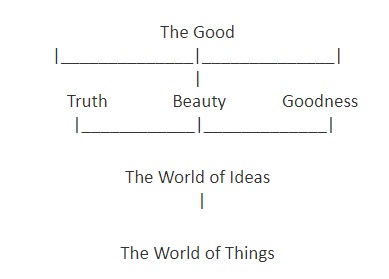
But we find in Plato the strain of a double-thought. There are places such as in the allegory of the den, where he compares the Good with the Sun and gives an impression that it is the source of all things; but there are other places such as in the Timaeus where he seems to think that the Good is the source only of Ideas and not of things. It is this double-thought which makes it difficult for us to be precise about Plato’s position with regard to the Good.
The problem of reconciling the universals and particulars has bewildered philosophers up to the present day. They have arrived either at an ultimate dualism or at a monism in which particulars are pronounced to be ultimately illusory. Plato who seems to be aware of the difficulties of either position does not commit himself clearly to any position but leaves certain loose ends which can be developed further in the future.
If we consider the problem of the universals and the particulars, it seems that it arises because we attempt to measure the infinite and the universal in terms of the finite and the particular. The particulars are one thing and none other at once “here” and “now” and in a certain definite sense; but even they, when analysed fully, turn out to have an infinite complexity impossible to measure in terms of finitude, in each particular there are many aspects co-existing and at the vanishing-point of each finite we find the whole infinite containing in it all contradictions and oppositions. If, on the other hand, we begin with the infinite and affirm its existence, we cannot label it with any limitation; we cannot then say it must be one thing and one thing alone and incapable of being anything else. For the infinite is the ultimate meaning of all things and therefore the substance of all. In logical terms, it is the affirmation of all propositions. There is no proposition which cannot be made of the infinite; therefore of it, it can be true to say that it is at once universal and particular. In this view, therefore, there is no necessity to posit an entity opposed to the universal and the infinite in order to account for the origin of particulars. The particular is the eternal form of the infinite and the universal; for the infinite, we can say with Plato, “is not essence, but far exceeds essence in dignity and power.”
If the infinite is not only an essence but a power of self-formation in infinite number of forms, each particular is essentially the infinite but unique and particular in form and name; the process of self-formation does not proceed by the division of the infinite and therefore the infinite remains undivided even in its self-formations; but each self-formation is a form and power of the infinite manifesting in Time and Space; each particular therefore occupies a definite and limited position in Space-Time. On this view, we have the reply to the first argument leveled in the Parmenides against the Theory of ideas.
The argument of the “third man” too could be met by pointing out that similarity between the two is not the cause of an Idea but the effect of it; therefore when we explain the similarity between two things by positing a universal Idea, not only is the similarity between two things but also their similarity with the Universal Idea is explained.
As to the question whether there is any typal mud or dirt, Plato could not adduce any rational ground for the rejection of the suggestion because he was not able to reconcile the world of Ideas with the imperfections of the world. It is indeed impossible to reconcile the two in the framework of Plato’s theory; it has to be greatly enlarged and we have to introduce many concepts such as of Evolution and others and thus modify the original Platonic theory, a task which falls outside the scope of this essay.
But in spite of these defects, Plato’s idea that particulars have in them the Universal Ideas which are supra-sensible and that these Ideas form a unity of the Supreme Good can still be accepted as valid, unless we refuse to go beyond the evidence of the senses; but in the face of the growing evidence of the supraphysical phenomena, the refusal of the senses is becoming less and less formidable and the mind is being prepared to arrive at a loftier and more idealistic view of the world. In this process, Plato’s concept of the Good is bound to find its proper revaluation and acceptance as a great truth of the ultimate reality.
Aristotle
As we know, Plato had established an Academy, where a number of students and thinkers used to join in pursuit of higher knowledge, particularly of philosophy. Aristotle, who was born in 384 B.C. at Stagira in Thrace, came to Athens at the age of eighteen, and he remained in the Academy for nearly twenty years, until the death of Plato in 348-7 B.C. It may be remembered that Aristotle's father had inherited a position of family physician to the King of Macedonia. As a result, in 348 B.C. Aristotle became tutor to Alexander who was at that time thirteen years old. When he attained the age of sixteen, Alexander was appointed regent during his father's (Philip's) absence.
The relations of Aristotle and Alexander are difficult to ascertain. As we all know, Plato had visualized a Utopia, where the highest power would be laid in the hands of the Guardians, who would be philosophers. The ideal of a philosopher-king has remained a dream for many great philosophers and for many rulers. It is quite likely that Aristotle wanted to see in Alexander a philosopher-king and he imparted to him a wide background of knowledge. But Alexander was highly ambitious, and although he had respect for Athenian Culture, and although he admired Aristotle, it appears that as in the field of political conquest, so in the field of knowledge, he wanted to be always superior and in fact first and supreme above all. He, therefore, expected that Aristotle should acquaint him with all the knowledge he possessed and that he should probably be the only confidant of Aristotle's new discoveries in the field of knowledge.
From 335 B.C. to 323 B.C., Aristotle lived in Athens. But it was during these twelve years during which he lived in Athens, that Aristotle founded his own school and wrote most of his books. In 323 B.C., Alexander died during his voyage of conquest. At the death of Alexander, Athenians rebelled and turned on his friends. Because of the relationship between Alexander and Aristotle, Athenians indicted Aristotle for impiety. But Aristotle was not like Socrates, and in order to avoid punishment, he fled away from Athens. In 323 B.C., Aristotle passed away.
There is some kind of continuity in the development of philosophy starting from the tradition of the Greek mysteries. There is a ground to suggest that these mysteries were similar to those prevalent in India. There was no doubt that there was a good deal of contact between ancient India and ancient Greece, and one finds that the secrets of the Vedic knowledge and the mystical knowledge that we find in the Vedas are echoed in the Eleusianian mysteries, which were impregnated in Orphism. Orphism had certain ceremonies, which were sacraments, and they were intended to purify the soul. The Orphics had, like the Vedic and the Upanishadic Rishis, the practice of initiation by which the seekers, without distinction of race or sex, could be imparted secret knowledge. The idea of the secret knowledge, when it declined, rose again in the conception of philosophy as a way of life.
Pythagoras, who flourished about 532 B.C., established a religion, of which the main tenet was the transmigration of souls. The school of Pythagoras represents the main current of the Eleusian mysteries, although Pythagoreans formed a movement of reforms. Pythagoras was on the side of mysticism, though this mysticism had an intellectual aspect. Pythagoras thought that the soul is immortal, and that whoever comes into existence is born again in the revolutions of a certain cycle. In the society that he founded, men and women were admitted on equal terms and property was held in common. There was a common way of life. Scientific and mathematical discoveries were deemed collective. Pythagoras himself was a great mathematician, and it is well known that Pythagoras was immensely influential in the field of mathematics. It was on the basis of mathematics that thought came to be regarded as superior to the knowledge derived from senses.
Pythagoras maintained that all things are numbers. He discovered the importance of numbers in music, and the connection, which he established between music and arithmetic, survives in certain terms, which are used in mathematics even today, such as Harmonic Mean, Harmonic Progression.
We are all aware of the greatest discovery of Pythagoras, which is taught as Pythagorean Theorem, according to which the sum of the squares on the sides adjoining the right angle in a right-angled triangle is equal to squares on the remaining side, the hypotenuse. This theorem was also known to Indians many centuries earlier, as it is found in Sulba Sutras of Indian mathematics.
It was through mathematics that the belief was generated in Greece in a super-sensible intelligible world. Geometrical numbers and figures are super-sensible, and in order to enter into the world of ideal which are super-sensible realities, one should pass through the discipline of mathematics. Greek thinkers came to maintain that numbers are eternal and they can be conceived as God's thoughts.
Pythagoras exercised a great influence on Parmenides, who we may recall, invented a form of metaphysical argument that, in one form or another, is to be found among many metaphysicians right up to the present day.
His main teaching was related to what he called the way of truth as opposed to the way of opinions. What he says about the way of truth is, in its essential point, as follows:
“Thou canst not know what is not — that is impossible — nor utter it; for it is the same thing that can be thought and that can be.”
Parmenides had a great influence on Socrates, who developed the theory of concepts, which he employed in formulating definitions in regard to various terms that he discussed, particularly those relating to virtues and matters relating to wisdom.
Plato derived his philosophy largely from Pythagoras, Parmenides and Socrates. Plato maintained that mathematics has to be the starting point of the study of philosophy; he further maintained that mathematical numbers are super-sensible and that beyond mathematical numbers there is a realm of Ideas or Forms. Ideas or Forms can be conceived but not perceived. These Ideas are basically concepts which can be used in defining terms, which may be related to physical objects but which are not themselves physical in character. According to Plato, Ideas are universal and supra-sensible as opposed to physical objects, which are all particular in character. Ideas, according to Plato, can be arranged in a hierarchy, so that larger Ideas subsume less large Ideas. This hierarchy is topped by a trinity of the most universal Ideas, namely, the Ideas of Truth, Beauty and Goodness. These three Ideas can further be subsumed under one supreme Idea, the Idea of the Good. The Good, according to Plato, far exceeds essence both in dignity and power. There is reason to believe that Plato conceived of God and the supreme Idea of the Good to be interchangeable.
Plato, like Pythagoras, believed in the immortality of the soul. God, according to Plato, did not create the world out of nothing but rearranged pre-existing material. He put intelligence in the soul and soul in the body. The soul, according to Plato, must strive to overcome the obstruction of the body and the physical senses, which give us no knowledge. The soul should, therefore, develop the light of the reason which can conceive the Ideas, and the ideas which are general and universal and indivisible give us true knowledge. In fact, since the soul is immortal, it had a previous existence from which it had migrated into the body; since coming into the body and since obstructed by physical senses, it forgot the knowledge of the Ideas which it possesses inherently. When the soul returns to the Ideas by overcoming the obstructions of the physical senses, it comes back to itself -- to its own sense of immortality and it remembers the Ideas. According to Plato, true knowledge is reminiscence.
All this, in brief, can be considered to be the minimum background for understanding Aristotle.
The main difference between Plato and Aristotle lies principally in regard to theory of Ideas. As we know, Plato's theory of Ideas developed from the fact that a number of particular objects are similar to each other. One cat is similar to another cat, one chair is similar to another chair, and one bed is similar to another bed. The question is as to how these similarities can be explained. Plato's answer is that similarity can be explained by the fact that the similar objects that we perceive are mere copies of a universal Form or universal Idea. All red objects are similar to each other in so far they are all red and that is because they are copies of the universal Ida of redness. All chairs are alike because they all partake of a universal Idea or Form of a chair or chairness; all cats are similar to each other because they partake of the universal Idea of cattiness. All ideas are universal, and they explain similarities among particular objects.
The question, however, that arose was as to how and from where particulars came into existence. Plato found it very difficult to maintain that particulars are manifestations of universals. He found the gap between the particulars and the universals so great that he could not think that particulars could have originated from the universals. According to Plato, particulars are copies of the universals but not manifestations of the universals. Universals do not consist of particulars; hence they could not have manifested from the universals. Universals, according to Plato, are not a sum of particulars, since universals are indivisible and have no parts.
Moreover, universals are, according to Plato, real, and they alone are objects of knowledge. Particulars, on the other hand, are only partly real and partly unreal. They are real in so far as they partake of the universal, and they are unreal in so far as they are particulars and in so far as they are objects of sense perception. Sense-perception, according to Plato, does not give us knowledge; sense-perception can at best give us opinion.
From where do the particulars then originate? This is the question that remains obscure in Plato's philosophy. What one can gather from Plato's writings is that there is, apart from the realm of Ideas which exists really, there is something like Matter which does not really exist, but which can copy the universals, something on which universal Ideas are imprinted and by virtue of this imprinting, they partake of reality to some extent. These partly real and partly unreal imprints are what may be called particular objects.
But it can be seen that this answer is highly unsatisfactory, and it cannot stand the rigour of reasoning which cannot conceive of something that is at once real and unreal. In other words, Plato's philosophy can be seen as incomplete in so far as it does not give satisfactory answer to the question of the origin and sustenance of the ever-changing flux of the world of particular objects.
The starting point of Aristotle's philosophy is Aristotle's own theory of universals and particulars. According to Aristotle, a universal cannot exist by itself, but only in particular things. This is in contrast to Plato, who maintained that universals are real in themselves and that they are eternal, whether they are copied in particular things or not. According to Aristotle, a universal is not a substance. “It seems impossible”, Aristotle says, “that any universal term should be the name of a substance. For... the substance of each thing is that which is peculiar to it, which does not belong to anything else, but the universal is common, since that is called universal which is as such as to belong to more than one thing”.
According to Aristotle, universal is of such a nature that it has to be predicated of many subjects. By individual, Aristotle means that which is not thus predicated.
Let us try to understand this doctrine. There are, in our language, different kinds of words. There are proper names, and there are adjectives. The proper names apply to things or to persons, each of which is the only thing or person to which the name in question applies. Words such as France, Napoleon are unique. There are not a number of instances to which these names apply. On the other hand, words like cat, dog, man apply to many things. In addition, there are adjectives such as cattiness, dogness and human. But a particular cat is particular by itself, and it is different from another cat, and that particularity is not shared by anybody or anything else. It would be seen that adjectives depend on particulars. Adjectives do not seem to be hanging in the air but are to be found in particular objects.
This, in brief, is what Aristotle seems to suggest. And at this point, it may be argued that although qualities which are designated by the words that we call adjectives, cannot exist without some subject, but they can exist without this or that subject; similarly a subject or a noun word or a proper name cannot exist without some quality, but can exist without this or that quality.
In fact, we find that Aristotle does not succeed in pointing out that universals must depend on particulars. In reality, the question of universals and particulars and the relationship has been a matter of continuous debate, and we shall require a larger ground to arrive at any satisfactory answer, and this can be done at a later stage.
There are three terms in the philosophical systems of Plato and Aristotle regarding which greater precision is needed, and yet that precision is difficult to arrive at. These terms are: “Ideas”, “Forms”, and “Universals”. It appears that in the Platonic philosophy, these three terms are interchangeable, but in the philosophy of Aristotle, it appears that they are not interchangeable. This is mainly because Aristotle is critical of Plato's theory of Ideas. One of the important criticisms that Aristotle advances against Plato's theory of Ideas is that of the ‘third man’. The argument runs as follows:
“If two men resemble because they resemble the ideal man, there must be still a third man, a more ideal man similar to both ordinary man and the ideal man.”
Another argument of Aristotle can be summed up as follows:
“Socrates is both a man and an animal, and the question arises whether the ideal man is an ideal animal also; if he is, there must be as many ideal animals as there are species of animals.”
This appears rather strange and even impossible.
Aristotle points out that when a number of individuals share one common quality that cannot be the cause of their relation to something of the same kind as themselves, but more ideal.
In addition, Aristotle advances a number of other arguments, most of which were already found in Plato's own dialogue, ‘Parmenides’. From these arguments, Aristotle attempted to show that there are no Ideas independent of individuals, even when they resemble each other; the common qualities that similar individuals possess among themselves are simply universals, which exist or persist only in individual things. And whereas individual things exist, universal qualities cannot exist independently of individual things.
It appears that the final outcome is the unsustainability of the theory of Ideas and to suggest that there are no such things as Ideas but universals, and that universals do not have any inherent existence, independent of individual things.
On the other hand, as we have seen above, this theory of Universals is not satisfactory, and this theory does not succeed in proving that universals cannot exist independent of individual things.
The philosophical position of Aristotle, however, becomes more complex when he introduces another important term in his philosophy, namely, ‘Essence’. Usually, the word ‘Essence’ is synonymous with ‘Universals’, but according to Aristotle, the words ‘Essence’ and ‘Universals’ are not interchangeable. According to him, ‘Essence’ is what you are by nature. In other words, essence is one of your properties which you cannot lose without ceasing to be yourself. Thus essence is what makes an individual thing individual and what makes a species a particular species. But at this point, a question would arise: If the essence of species is what makes species specific, does that essence not exist in all the members of the species? In that sense, is essence not universal? Thus it would seem that the word essence and the word universal should be interchangeable. In this way, we can say that Aristotle's dealing with this term essence lacks precision.
Again, the complexity of Aristotle's metaphysics becomes more complex when we come to the distinction that he makes between ‘Form’ and ‘Matter’. To understand this distinction, we may take an example of a marble statue. Here marble is the matter, while the shape conferred by the sculptor is the form. If a man makes a bronze sphere, then Aristotle points out that bronze is the matter and sphericity is the form. Another example that has been given is that of a calm sea. Here water is the matter, and smoothness is the form.
To Aristotle, ‘Form’ is to be understood as that which confers unity, and unity is teleological. Aristotle goes farther. The form of a thing is its essence and primary substance. Forms are substantial, although universals are not. But having said this, when we take an example, the situation seems to be more puzzling. When a man makes a brazen sphere, both the matter and form already existed, and all that he does is to bring them together; the man does not make the form just as he does not produce brass. But from where does form originate? According to Aristotle, there are eternal things and these have no matter, except those of them that are movable in space. Things increase in actuality by acquiring form; matter without form is only a potentiality.
In this view, forms exist independently of the matter in which they are imprinted in exemplified manner.
It will be at once seen that Aristotle seems to return here to the Platonic theory of ‘Forms’ or ‘Ideas’. Aristotle tried to reject the reality of Ideas, but he could not reject the reality of forms.
By his own argumentation, he was obliged to speak of forms as existing independently, and there does not seem to be any ground for Aristotle's rejection of what Plato had conceived of ‘Ideas’. According to Plato, ‘Ideas’ and ‘Forms’ are interchangeable, and Aristotle's account of Forms also seems to suggest that ‘Forms’ are ‘Ideas’. It is true that Aristotle tries to suggest that a Form is quite different from a universal, but this attempt is hardly successful. According to Aristotle, Forms are more real than matter, and this reminds us of Plato's view of real reality of the Ideas. Aristotle's view that Form is identical with Essence and that Form is more real than Matter leads us to the conclusion that Forms are universal in character. Thus we come once again to Platonic view that Forms, Ideas and Universals are interchangeable. It appears that although Aristotle wanted to depart from Plato, he could not eventually succeed in doing so.
Parallel to distinction between Matter and Forms in the philosophy of Aristotle is a distinction between potentiality and actuality. Matter is, according to Aristotle, a potentiality; it is a potentiality of form, when matter assumes form, it becomes more actual. If we consider things of the world in a kind of hierarchy, things which have greater forms, are more actual, and at the highest point we arrive at that which is pure form, having no matter. Pure form is thus pure actuality.
According to Aristotle, God is pure form and pure actuality; in Him, therefore, there can be no change. The universe and everything in it is in a state of potentiality in varying degrees of actuality; hence, everything continues to change to attain greater and greater form; everything in the world is thus going towards pure form and therefore, towards God.
This brings us to Aristotle's theory of God.
According to Aristotle, there are three kinds of substances: — those that are insensible and perishable, those that are sensible and perishable, and those that are neither sensible nor perishable. The first class includes plants and animals, the second includes the heavenly bodies, which according to Aristotle undergo no change except in respect of motion, and the third, includes the rational soul in man and also God.
Aristotle points out that there must be something which originates motion, and this something must itself be unmoved, and must be eternal, must itself be substance, and must be actual.
The object of desire and the object of thought, according to Aristotle, cause movement, without themselves being in motion.
Thus God produces motion by being loved, whereas every other cause of motion works by its being in motion.
God is the first cause; He is the unmoved mover of things.
God is pure form, and pure form is pure thought, for thought is what is best. Life belongs to God; for the actuality of thought is life and God is that actuality.
God is actuality, and that means that God exists. And since God is unmoved mover, He is self-dependent, and His life is good and eternal.
God is thus a living being, eternal, most good, so that life and duration continue to be eternal and belong to God. This is God. This is what Aristotle states:
“It is clear then from what has been said that there is a substance which is eternal and unmovable and separate from sensible things. It has been shown that this substance cannot have any magnitude, but is without parts and indivisible... But it has also been shown that it is impassive and unalterable; for all the other changes are posterior to change of place.”
Aristotle goes farther and points out that the perfection of God consists in his thinking of what is perfect. And what is perfect is God Himself. To use his own statement: “It must of itself that the divine thought thinks (since it is most excellent of things), and its thinking is of thinking on thinking.”
In order to discuss the concept of God, we would require the study of the entire world-history of philosophy, religion and spirituality. And we cannot venture upon this task in this brief note on Aristotle. But if one wishes to be both comprehensive and clear regarding God, the best thing to do is to study Sri Aurobindo’s magnum opus, ‘The Life Divine’.
Appendix
Sri Aurobindo’s Remarks on Plato
(Selected from the Writings of Sri Aurobindo)
“Plato's world of ideas is a confused attempt to arrive at this condition of things, confused because it unites two incompatible things, the conditions of Avyakta and those of the next state presided over by Hiranyagarbna”
“Now, in ancient Europe the schools of intellectual philosophy were preceded by the secret doctrines of the mystics; Orphic and Eleusinian mysteries prepared the rich soil of mentality out of which sprang Pythagoras and Plato. A similar starting-point is at least probable for the later march of thought in India. Much indeed of the forms and symbols of thought which we find in the Upanishads, much of the substance of the Brahmanas supposes a period in India in which thought took the form or the veil of secret teachings such as those of the Greek mysteries.”
“It is true that under his [Plato's] impress I rashly started writing at the age of 18 [more likely 19] an explanation of the cosmos on the foundation of the principle of Beauty and Harmony, but I never got beyond the first three or four chapters.”
“It was Meredith who taught me that the epigram is the soul of style, and Plato who whispered that rhythm is its body. Words are the texture of the flesh and sentences the system of hard matter that gives it consistency: the texture of the flesh may be coarse or delicate, and as you design so you shall build.
Just as Socrates was nothing without his daemon, so the artist is helpless if he has not his daemon at his elbow. And who is the artist's daemon?
The artistic conscience.”
“Plato in his Republic has dwelt with extraordinary emphasis on the importance of music in education; as is the music to which a people is accustomed, so, he says in effect, is the character of that people.”
“Poetry is created not from the intellect or the outer imagination but comes from a deeper source within to which men have no means of access except when the divine part within seizes on the brain and makes it a passive instrument for utterance the full meaning of which the brain is unable at the moment to grasp. This is the divine mania and enthusiasm which the subtle spiritual discernment of Plato discovered to be the real meaning of what we call inspiration. And of this unattainable force the best lyrics of Rabindranath are full to overflowing.”
“Truth is an infinitely complex reality and he has the best chance of arriving nearest to it who most recognises but is not daunted by its infinite complexity. We must look at the whole thought-tangle, fact, emotion, idea, truth beyond idea, Philosophy conclusion, contradiction, modification, ideal, practice, possibility, impossibility (which must be yet attempted,) and keeping the soul calm and the eye clear in this mighty flux and surge of the world, seek everywhere for some word of harmony; not forgetting immediate in ultimate truth, nor ultimate in immediate, but giving each its due place and portion in the Infinite Purpose. Some minds, like Plato, like Vivekananda, feel more than others this mighty complexity and give voice to it. They pour out thought in torrents or in rich and majestic streams. They are not logically careful of consistency, they cannot build up any coherent, yet comprehensive systems, but they quicken men's minds and liberate them from religious, philosophic and scientific dogma and tradition. They leave the world not surer, but freer than when they entered it.”
“Three or four times in history a stream of this energy has poured out upon Europe, but each time Europe has rejected wholly or partially the spiritual substance of the afflatus and used it rather as an impulse to fresh intellectual and material activity and progress.
The first attempt was the filtering of Egyptian, Chaldean and Indian wisdom through the thought of the Greek philosophers from Pythagoras to Plato and the Neo-Platonists; the result was the brilliantly intellectual and unspiritual civilisation of Greece and Rome. But it prepared the way for the second attempt when Buddhism and Vaishnavism filtered through the Semitic temperament entered Europe in the form of Christianity. Christianity came within an ace of spiritualising and even of asceticising the mind of Europe; it was baffled by its own theological deformation in the minds of the Greek fathers of the Church and by the sudden flooding of Europe with a German barbarism whose temperament in its merits no less than in its defects was the very antitype both of the Christian spirit and the Graeco-Roman.”
“To ignore the influence of the mystic thought and its methods of self-expression on the intellectual thinking of the Greeks from Pythagoras to Plato is to falsify the historical procession of the human mind. It was enveloped at first in the symbolic, intuitive, esoteric style and discipline of the Mystics, — Vedic and Vedantic seers, Orphic secret teachers, Egyptian priests. From that veil it emerged along the path of a metaphysical philosophy still related to the Mystics by the source of its fundamental ideas, its first aphoristic and cryptic style, its attempt to seize directly upon truth by intellectual vision rather than arrive at it by careful ratiocination, but nevertheless intellectual in its method and aim. This is the first period of the Darshanas in India, in Greece of the early intellectual thinkers. Afterwards came the full tide of philosophic rationalism, Buddha or the Buddhists and the logical philosophers in India, in Greece the Sophists and Socrates with all their splendid progeny; with them the intellectual method did not indeed begin, but came to its own and grew to its fullness. Heraclitus belongs to the transition, not to the noontide of the reason; he is even its most characteristic representative. Hence his cryptic style, hence his brief and burdened thought and the difficulty we feel when we try to clarify and entirely rationalise his significances. The ignoring of the Mystics, our pristine fathers, purve pitarah, is the great defect of the modern account of our thought-evolution.”
“What precisely is the key-note of Heraclitus’ thinking, where has he found his starting-point or what are the grand lines of his philosophy? For if his thought is not developed in the severe systematic method of later thinkers, if it does not come down to us in large streams of subtle reasoning and opulent imagery like Plato's but in detached aphoristic sentences aimed like arrows at truth, still they are not really scattered philosophical reflections. There is an inter-relation, an inter-dependence; they all start logically from his fundamental view of existence itself and go back to it for their constant justification.”
“Heraclitus’ affirmation is not simply that the One is always Many, the Many always One, but in his own words, “out of all the One and out of One all.” Plato's phrasing of the thought, “the reality is both many and one and in its division it is always being brought together,” states the same idea in different language. It means a constant current and backcurrent of change, the upward and downward road, and we may suppose that as the One by downward change becomes completely the All in the descending process, yet remains eternally the one everliving Fire, so the All by upward change may resort completely to the One and yet essentially exist, since it can again return into various being by the repetition of the downward movement.”
“Why should the stream be, as Heraclitus himself admits, the same stream although it is ever other and other waters that are flowing? It was in this connection that Plato brought in his eternal, ideal plane of fixed ideas, by which he seems to have meant at once an originating real-idea and an original ideal schema for all things. An idealistic philosophy of the Indian type might say that this force, the Shakti which you call Fire, is a consciousness which preserves by its energy its original scheme of ideas and corresponding forms of things.”
“No doubt, in seeking Truth we must seek it for its own sake first and not start with any preconceived practical aim and prepossession which would distort our disinterested view of things; but when Truth has been found, its bearing on life becomes of capital importance and is the solid justification of the labour spent in our research. Indian philosophy has always understood its double function; it has sought the Truth not only as an intellectual pleasure or the natural dharma of the reason, but in order to know how man may live by the Truth or strive after it; hence its intimate influence on the religion, the social ideas, the daily life of the people, its immense dynamic power on the mind and actions of Indian humanity. The Greek thinkers, Pythagoras, Socrates, Plato, the Stoics and Epicureans, had also this practical aim and dynamic force, but it acted only on the cultured few. That was because Greek philosophy, losing its ancient affiliation to the Mystics, separated itself from the popular religion; but as ordinarily Philosophy alone can give light to Religion and save it from crudeness, ignorance and superstition, so Religion alone can give, except for a few, spiritual passion and effective power to Philosophy and save it from becoming unsubstantial, abstract and sterile. It is a misfortune for both when the divine sisters part company.”
“But even without religion philosophy by itself can give us at least some light on the spiritual destiny of man, some hope of the infinite, some ideal perfection after which we can strive. Plato who was influenced by Heraclitus, tried to do this for us; his thought his ideas under the influence of the East and how they affected Christianity. The Stoics, still more directly the intellectual descendants of Heraclitus, arrived at very remarkable and fruitful ideas of human possibility and a powerful psychological discipline, — as we should say in India, a Yoga, — by which they hoped to realise their ideal.”
“We see in how many directions the deep divining eye of Heraclitus anticipated the largest and profoundest generalisations of Science and Philosophy and how even his more superficial thoughts indicate later powerful tendencies of the occidental mind, how too some of his ideas influenced such profound and fruitful thinkers as Plato, the Stoics, the Neo-platonists. But in his defect also he is a forerunner; it illustrates the great deficiency of later European thought, such of it at least as has not been profoundly influenced by Asiatic religions or Asiatic mysticism.”
“The average European draws his guiding views not from the philosophic, but from the positive and practical reason. He does not absolutely disdain philosophy like Mr. Archer. But he considers it, if not a “man-made illusion”, yet a rather nebulous, remote and ineffective kind of occupation. He honours the philosophers, but he puts their works on the highest shelf of the library of civilisation, not to be taken down or consulted except by a few minds of an exceptional turn. He admires, but he distrusts them. Plato's idea of philosophers as the right rulers and best directors of society seems to him the most fantastic and unpractical of notions; the philosopher, precisely because he moves among ideas, must be without any hold on real life. The Indian mind holds on the contrary that the Rishi, the thinker, the seer of spiritual truth is the best guide not only of the religious and moral, but the practical life. The seer, the Rishi is the natural director of society; to the Rishis he attributes the ideals and guiding intuitions of his civilisation. Even today he is very ready to give the name to anyone who can give a spiritual truth which helps his life or a formative idea and inspiration which influences religion, ethics, society, even politics.”
“What we mean by inspiration is that the impetus to poetic creation and utterance comes to us from a superconscient source above the ordinary mentality, so that what is written seems not to be the fabrication of the brain-mind, but something more sovereign breathed or poured in from above. That is the possession by the divine enthousiasmos of which Plato has spoken.”
“Early Rome and Sparta were barren of thought, art, poetry, literature, the larger mental life, all the amenity and pleasure of human existence; their art of life excluded or discouraged the delight of living. They were distrustful, as the exclusively ethical man is always distrustful, of free and flexible thought and the aesthetic impulse. The earlier spirit of republican Rome held at arm's length as long as possible the Greek influences that invaded her, closed the schools of the Greek teachers, banished the philosophers, and her most typical minds looked upon the Greek language as a peril and Greek culture as an abomination: she felt instinctively the arrival at her gates of an enemy, divined a hostile and destructive force fatal to her principle of living. Sparta, though a Hellenic city, admitted as almost the sole aesthetic element of her deliberate ethical training and education a martial music and poetry, and even then, when she wanted a poet of war, she had to import an Athenian. We have a curious example of the repercussion of this instinctive distrust even on a large and aesthetic Athenian mind in the utopian speculations of Plato who felt himself obliged in his Republic first to censure and then to banish the poets from his ideal polity. The end of these purely ethical cultures bears witness to their insufficiency. ”
“He (Plato) was trying to express in a mental way the One containing the multiplicity which is brought out (created) from the One — that is the Overmind realisation. Plato had these ideas not as realisations but as intuitions which he expressed in his own mental form.”
“Atlantis is not an imagination. Plato heard of this submerged continent from Egyptian sources and geologists are also agreed that such a submersion was one of the great facts of earth history.”
“Plato was a great writer as well as a philosopher — no more perfect prose has been written by any man.
In some of his books his prose carries in it the qualities of poetry and his thought has poetic vision. That is what I meant when I said it was poetry.”
“We may reasonably doubt whether even a Plato or a Shankara marks the crown and therefore the end of the outflowering of the spirit in man. We are apt to suppose that these may be the limit because these and others like them seem to us the highest point which the mind and soul of man can reach but that may be the illusion of our present possibility .”
Notes
Sri Aurobindo, The Life Divine - I: The Double Soul in Man
↩