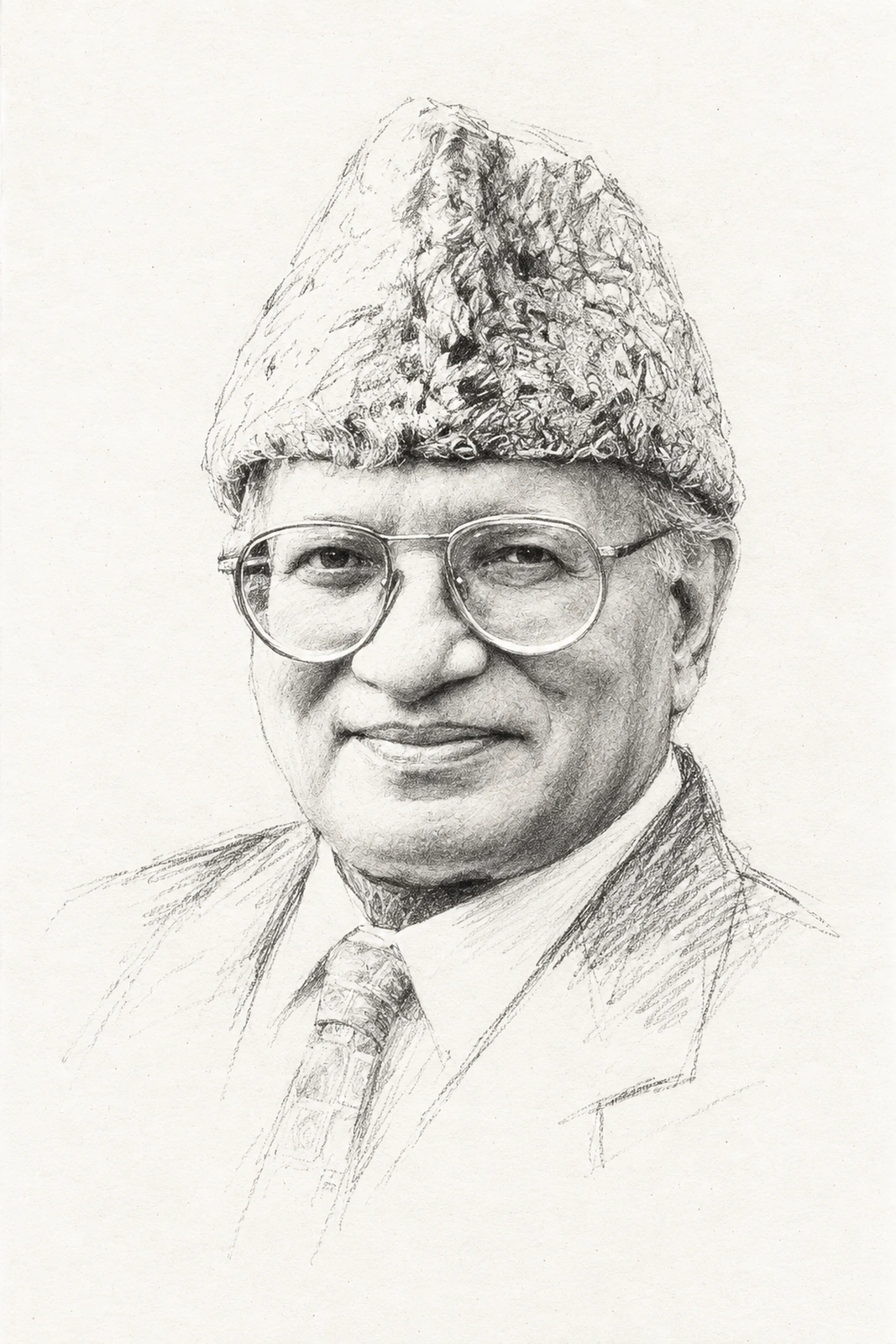
THE WRITTEN WORD
Dharma
Paragraph references are specific to this digital edition.
Dharma (Law of Life) and Karma (Right Action)
The world of today presents a bright aspect on account of great scientific and technological advancement. Communication and transportation have developed to such great heights that the world has shrunk and even countries and continents have begun to look like provinces of one globe. There are also prospects that if humanity could arrive at a new cooperative spirit, drudgery and poverty can be eliminated and life could be lived on this earth with continuous progression towards higher and higher levels of prosperity. In this great task, all of us and young people, in particular, can play a decisive role.
Analysis of the Concept of Karmayoga
- All people in general seek success
- Success is normally understood to mean achievement or realisation of the object of desire or occurrence of intended results.
- Often success turns out to be temporary and one moves on in a circle of transient satisfactions and dissatisfactions; often success is found to be elusive and failure becomes a recurrent theme of the story of life; consequently, grief and discontent afflict people and this, in turn, sharpens people’s search for success or for the real meaning of success or for the means by which grief and discontent are removed.
- Is there any effective, true and scientific method by which this search can be aided and answered?
- ’Detachment’, it is said, is the master-word of the method, and the cultivation of detachment passes through 3 main stages:
- The first stage is that of one’s upliftment from absorption in grooves of work and fruits of works.
- The second stage is marked by development of capacity to work without the desire to clutch at and enjoy fruits of work.
- The third stage is attained by the increasing experience of inner serenity, harmony and peace, irrespective of whether works are crowned with success or failure, pleasure or pain, honour or dishonour.
Ideally, true success is the attainment of this state of ’atmaprasada’ − inner spontaneous contentment that comes by finding one’s station in the true Self.
Once this state becomes stable, grief and discontent no more afflict the inner life and even outer life ceases to be turbulent and disorderly.
Often, this state induces inclination towards withdrawal from life and action, and one is allured away by the gospel of inaction and neglect of the welfare and solidarity of mankind, ’lokasangraha’
It is this gospel of inaction that has caused much confusion, degradation and decline in the world, particularly, in the life of India.
Hence, we must ask whether ’atmaprasada’, the inner detachment and harmony and serenity is the highest and last word of wisdom or whether there is something more to be looked for.
There is something more, − that is at least what we find in the Gita’s gospel of Karma Yoga, − Yoga of Works.
It is in the state of atmaprasada that one begins to experience the emergence of a Will (as distinguished from desire), which is vast, impersonal, unwavering, wise and luminous.
It is with the growth of that Will that one begins to have a simultaneous experience of (a) inner detachment and (b) outer actions of knowledge, love and life-force (i.e., activities of acquisition, possession, relationship and enjoyment, such as those exemplified in the traditional image of Janaka).
One begins to have clarities in the mind and one moves widely in inner spaces.
One acts and pursues objects of inner aspiration; one even focuses on results of action and strives to achieve them: but whatever the degree of success or failure that comes in his way the inner contentment and happiness remains unaltered and tends to increase and become maximum. The important point is, however, that action is not given up: action is a must.
At this stage, three processes mark the development:
- Limitations of our instruments of action, − of body, life and mind, are gradually broken by a process of widening. heightening and deepening of consciousness as also of chiselling the expressions of the body, life and mind;
- The thrust and goal of the vast, impersonal and luminous Will begin to be understood, and one begins to allow the melting of one’s limited aims and objects in that Will;
- that will begins to operate more and more powerfully, and high dynamo of automatic Action begins to generate circumstances, instruments and energies so that that will becomes increasingly accomplished, even though in that process one’s petty, narrow and egoistic desires get uplifted, purified, fulfilled or even denied and annulled.
This is what is called ’Siddhi’, the state of successful realization in Yoga.
The question now is as to how we can present and demonstrate the application of the above system of knowledge and method.
We may have to take the help of academicians, scholars who are well versed in the Veda, Vedanta and Yoga, and scientists (who have some basic knowledge of inner disciplines).
Our goal must be to communicate with the common man so that he can use the above system of knowledge and method for his day-to-day activities for his and society’s benefits.
Dharma and Fourfold Social Order
One of the powerful elements of the vitality of India is to be seen in the application of Dharma in building up social institutions and structures. Dharma as applied to society had its origin in the Vedic psychological concept of the fourfold personality of the consciousness that stands behind the cosmic manifestation. If we use modern terminology to describe the fourfold personality, we may speak of it as the synthesis of the personality of knowledge and wisdom, the personality of strength, power, courage and heroism, the personality of mutuality that emerges from universal love and harmony, and the personality of skill, of work that is infused with the subtleties of skill, and perfection in works. In India, this psychological concept of fourfold personality has got formulated in terms of social organisation as a structure of the fourfold order or Varna Vyavastha. Like all social structures in any civilization, the Indian structure, too, passed through several stages, and as its mature stage, it imparted to the entire course of social development remarkable solidity, strength and vitality. Brahmins who pursued knowledge were ready to renounce the comforts and luxuries that could be derived from activities of commerce and other pursuits of wealth; Kshatriyas manifested exemplary heroism to protect the weak and the causes of maintenance of justice and social order; Vaishyas worked for production of wealth but also cultivated the dharma of charity and offered economic support to the needs of the State and promotion of those who lived for knowledge and wisdom as also for the needy and the poor. There was a system where leading Kshatriyas and Vaishyas ensured in every village that nobody went to sleep in hunger or in privation of basic needs of life. Today, even in the declining period of that social structure, in spite of increasing rigidities, disabilities, distortions and mechanical absurdities, something of the truth of that fourfold social order still survives, and it is still one of the reasons why our society continues to survive, despite unpardonable poverty among various weaker sections of the society. It is also to be observed that the very fact that the degeneration of Varna system into casteism has been combated over a long period of Indian history by a number of saint leaders like Gyaneshwar, Tukaram, Narsi Mehta and thousands of others is a testimony that the spirit of India has been ill at ease with casteism Happily, casteism is being rejected by the growing enlightened opinion. The development of that enlightened opinion is instructive on account of two factors. In the first place, enlightened leaders have understood the true truth of the ancient Varna system and endeavoured − not to revive the ancient system, ‒ but to apply its inner truths to new conditions under which a new ideal of social structure is proposed to be recast. An important proposal is that every individual is to be so educated as to develop integral personality that would harmonise all the four personalities that are inherent in the individual and human psychology. On the other hand, enlightened leaders have also perceived clearly that casteism imprisons the individual in a network where application of the truths of modern ideals of progress, i.e. liberty, equality, fraternity, cannot flourish. Hence, they advocate individual freedom and perceive in that freedom a gateway to the high Indian ideal of liberation, Mukti. They perceive that the individual liberty is to be reconciled with socialistic equality, at the basis of which they perceive the truth of the Indian vision of Samam Brahma. And they perceive the freedom of the individual as the true basis of brotherhood, which can thrive only when brotherhood is practised by individuals who are free and who embrace the ideal of brotherhood voluntarily.
It is true that enlightened leaders have not yet become so powerful as to root out casteism. Nor have they been able yet to develop an alternative social structure where liberty, fraternity and equality are embedded in the light of the ancient Indian aims of mukti, samam brahmaand lok samgrah. But the power of the enlightened leaders is growing, and the vitality of the enlightened opinion is gripping powerfully the vision of the youth today. It may therefore be hoped more and more confidently that India will develop a new form of social structure by application of the knowledge of the perennial dharma, sanatana dharma, and will succeed in the creation of a new form of social order appropriate to the needs of today and tomorrow. The vitality of India is bound to become powerfully manifest when this new structure begins to be conceived and shaped.
Let us recall Iqbal who has expressed in one of our national songs his intuitive insight that there is something perennial in India, that there is some perennial source of vitality which does not allow India to perish.
कुछ बात है कि हस्ती मिटती नहीं हमारी
I suggest that that perennial source of vitality is the capacity of India to apply over perennial dharma, − not religion but the noble law of individual and collective development, − to changing conditions of social life and social institutions.
Dharma and Karma
Introduction
The world of today presents a bright aspect on account of great scientific and technological advancement. Communication and transportation have developed to such great heights that the world has shrunk and even countries and continents have begun to look like provinces of one globe. There also prospects that if humanity could arrive at a new cooperative spirit, drudgery and poverty can be eliminated and life could be lived on this earth with continuous progression towards higher and higher levels of prosperity. In this great task, all of us and young people, in particular, can play a decisive role.
And yet, on the other hand, we witness a state of great confusion and perplexity. Consequently we find lack of leadership, lack of consensus, lack of transparency and accountability, rise of fundamentalism and terrorism, and gulfs between generations also between ends and means.
This confusion is pervasive and covers all domains of life, whether social, political, economic, ecological, ethical or spiritual. This confusion has created anguish and anxiety and there is widespread search for effective solutions.
Palliatives, such as methods to reduce stress, structural changes in the economy or systemic reforms in various fields are being suggested for improving the quality of our lives, but they do not touch the roots of the problems. It appears that we need to go deeper and understand the underlying reasons for the present situation of chaos.
Solutions are often sought at the level of speculations which only end in inconclusive debates; sometimes references are made to unfounded dogmas of the past which are covered in mythologies; or else suggestions are made to regulate life by rituals, ceremonies, and customs.
None of these approaches is satisfactory to the modern mind which bases its orientation on verifiable, repeatable and expandable knowledge which alone can give a secure basis for techniques, methods and their applications.
A concerted effort is therefore required to discover, develop, and articulate the knowledge that is needed in this regard Unfortunately, even in institutions of higher learning, research into this knowledge is marginal or absent.
It seems that one line of inquiry would be to uncover those resources of knowledge which have remained buried not only in the ancient traditions of wisdom but also in the later developments of these traditions.
Often people belonging to practical walks of life seem to wonder how reflections on such abstruse subjects like dharma and karma would promote their capabilities and possibilities of success. We must therefore address to this query with all seriousness. We shall also need to present the right perspective. What we intend to do is not to philosophise but to present contents of knowledge and formulas of methods and techniques which can be applied by people in various vocations and professions, including business, industry and politics.
And we shall have special emphasis on dealing with the question of success.
It will be seen in the ultimate analysis that when we have clarity of vision, and when we begin to work for larger causes and interests, we shall have the possibility of attaining to true success instead of false success, to durable success instead of transitory success, and even to higher levels of heroism and glory.
We often find people thinking about themselves instead of thinking about larger interests of larger number of people. This leads to confusion and wrong judgment; we also fall into vicious circles of narrow competitions in which each one tries to outdo the other by defeating rather than developing competitions in which one encourages the others to excel and to surpass one’s limitations. All these aspects need to be taken into account if are looking to the attainment of growth, progress and all-round advancement of human civilisation and culture.
It is a common experience that leaders, whether in spiritual life or political life, truly succeed only when they practice what they preach. But otherwise, when leaders cannot provide inspiring examples of their life and actions, it is the common man who becomes a victim and is led to live life at lower levels gripped by fear and anxiety. This is an aspect which has to be kept in view. It is only when we can make common people fearless by providing to them the right type of leadership and right type of examples of true success that can break the vicious circle of our present predicament.
It is in this large context that we propose to present in the following pages valuable insights that we can extract from various records of knowledge. We propose to begin with the exploration of the Vedic tradition; at a later stage, we shall also study other traditions.
The Vedic tradition begins with four compilations, called "samhitas", namely, "Rigveda", "Yajurveda", "Samaveda" and "Atharvaveda". These "samhitas" tend to be identified exclusively with Hinduism; but when we study them impartially, we find that they are records of the earliest inspired seekers of knowledge and wisdom and their discoveries have universal significance.
The greatest discovery that the Vedic explorers seem to have made is that of the fourth world, as distinguished from the world of matter (prithvi), world of life (antariksha), and the world of mind (dyau). This fourth world was called "turiyam swid", the world of unmixed truth (stayam, ritam), ‒ the world of everlasting light.
They also discovered and perfected the path by which other seekers and explorers can travel to that world. It is in this context that they spoke of "agni", not the ritualistic fire, but the Mystic Fire, which is described in the very first hymn of the Veda as the leader of the journey, knower of the truth, and the one who can call down higher knowledge into the lower human world.
They also laid down four conditions for the attainment of the goal; these consist of the cultivation of universal wideness, universal friendliness, intense power of austerity, and the capacity to bear the highest bliss.
Our aim is to help people to understand deeper knowledge in a simpler way so that they can be led to apply that knowledge in their practical life and day-to-day affairs.
The Vedic explorers who were called Rishis devoted themselves to teaching in order to generously share their precious knowledge with members of the younger generations.
The system of education built by these Rishis was based upon sound psychological principles and provided stimulating conditions for building up personalities and characters of students.
In due course, however, the system declined due to the gradual loss of the spirit and knowledge that were prominent among the Rishis and they began to be gradually eclipsed among the Acharyas, Pandits and Purohits who succeeded them.
Even today, attempts are being made to resurrect the ancient system and it is hoped that the knowledge eclipsed by time will be recovered integrally. This is the task to which we are committed and to which invite all our readers.
Three important methods which they developed as an aid to the attainment were meditative concentration, performance of action with view to exchange human energies with cosmic energies, and dwelling on the truth at the levels of the mind, life and body by their full consecration. The knowledge of the fourth world and of the methods to reach that world gave rise to further knowledge of dharma (law of life) and karma (right action). It is this subject on which we shall concentrate in a language that avoids technical complexities which bewilder the common man
II
WHAT IS DHARMA? WHAT IS KARMA?
1
The concepts of Dharma and Karma have been derived from the discoveries that were made by the great seers of the Vedic period. Among these discoveries, the central discovery was of what may be called ’Substance’.
In their own peculiar language, they described it as something that subsists eternally, and which is wonderful. The wonder of the nature of this substance was that it combined together "essence" and "power". Just as in modern physics, we have the strange nature of the ultimate constituent of Matter which is, in one sense, of the nature of a particle and, in other sense, of the nature of a wave, even so, the Substance discovered by the Vedic seers (Rishis) was that of Vasu, (essence) and Urja (energy or power) at the same time.
It was further discovered by them that essence and power, although one, had internal interrelationship. In this relationship, essence is foundational and power is subordinate. Hence, while essence could be independent of the movement of energy or power, the movement of energy or power could subsist only on the ground of essence and the will of the essence.
Essence was termed in Sanskrit as Sat and energy was named Chit or Chitshakti. The union of the two was called the status of Supreme Delight (Ananda). This gave rise to the concept of Sacchidananda subsequently in the Upanishads.
The Vedic seers also discovered that the energy or power moves forward from the essence or remains contained and latent in essence in accordance with the Will that is inherent in essence. Essence is free to exercise the Will or to withhold the Will. This power of exercising or withholding the Will was, according to them, will-force or Tapas.
When the will-force is exercised, vibrations issue out of Tapas. These vibrations have a rhythm which translates the will or intention that is inherent in essence. Vibrations issuing out of Tapas with definite measures of rhythm, their regularities and their uniformities was called by them Eternal Law. This Eternal Law, they declared, is ’Sanatana Dharma’.
For, Dharma means the law of life that sustains and regulates rhythms of vibrations and holds together these vibrations within the limits of measures determined by Tapas. Accordingly, ’Sanatana Dharma’ is supposed to hold the eternal time-sequences of creation in the system of integrity and unity. The Vedic seers declared that it is by applying the knowledge of this Dharma that one can become a harmonious part of the unity of creation and develop one’s life smoothly in accordance with the intention that is contained in the creative activity of Tapas.
The Vedic seers went farther in their search and their discovery. They found out that the basic rhythm of creative activity followed a very specific pattern.
This pattern consisted of essence emanating energy from within itself and energy returning back again to offer itself to the essence. Self-giving of essence to the energy and self-giving of energy to the essence, they declared, is the fundamental law of all that subsists in the world.
This mutual self-giving was called by the Vedic Seers as Karma (Right Action). It is only when this mutual self-giving is perceived that one can get the clue or the secret of right action and it is only when this is applied in life that right action is performed.
It will be clear that right action or Karma is an action that is determined by Dharma. Where there is no dharma, there is no right action, and where there is action but no dharma, action becomes either distorted or perverted, which is also called ’vikarma’.
In the technical language which was used by the Vedic seers, the act of mutual self-giving was called Yajna. Yajna is translated as "sacrifice". It was, therefore, declared that Karma in the sense of right action should be performed in the spirit of sacrifice.
Sacrifice often indicates some kind of a painful abdication or renunciation; and we are often told that one should sacrifice one’s attachments, even though this may be proved to be painful. But this idea of painful sacrifice is only valid at lower levels where we have not understood the secret of right action and the secret of intention of Creation. When this secret is rightly understood, one is inspired to offer not only one’s attachments but all that one is and one has, and the resultant is not pain but joy and enjoyment.
It is for this reason that the Ishopanishad, which is the shortest treatise of Dharma and Karma lays down two important applications of the knowledge of the creation as a movement of mutual self-giving. First of these two applications is as follows:
"It is only by performance of right action that one should continue to live and wish to live even up to hundred years. This is the only way, and there is none other." The second application is contained in the famous prescription: "By renouncing one should enjoy, one should not covet to oneself what belongs to someone else.”
These two statements contain all that is essential in the understanding and application of Dharma and Karma
III
Two things that cannot be doubted (individuals and circumstances)
Let us pursue our understanding of Dharma and Karma. The Indian idea of Dharma begins with two things that cannot be doubted. There is, first, the experience of each individual as observer who observes, experiences, acts and reacts. And there is, second, a field of circumstances in which the individual finds himself or herself and in which he or she works, learns, and struggles to arrive at mastery.
Circumstances are favourable, unfavourable or indifferent, depending generally upon how the individual looks upon them. Even a blooming garden may appear to be a desert, if one is depressed; on the other hand, everything may seem bright and friendly, if one is in a serene state of mind and heart. But often one finds oneself quite oppressed by circumstances and one seeks to change them or even to escape from them, if that were possible. It is here that one speaks of the problems of life and one wonders what life is about and whether life has any meaning, and, if so, what precisely is that meaning
IV
Quest of the meaning of life
There are several answers to the question of the meaning of life; and when we consider them, we are led to speculation and to debate; but we arrive at definite knowledge only when repeated experimentation and verification impose upon us a secure and sure conclusion. Till then, the best thing we can do is to take life and its varied experience as a process of learning and cultivate patience so as to avoid one-sided opinions and narrow convictions.
In the meantime, there are certain attitudes that can be derived from the Indian tradition of knowledge, which can help everyone in dealing with life and circumstances.
V
How to deal with life and circumstances
The following ten formulas can be regarded as basic to Dharma and Karma, and if one abides by them, one can easily graduate to higher levels of maturity and dexterity in dealing with life and circumstances.
Do not allow circumstances to overpower you to such an extent that you cannot observe them with impartiality and objectivity.
Learn to observe your state of mind and heart and register your reactions to your circumstances.
When you are happy with your circumstances and when you find that your life is proceeding smoothly, avoid excitement. Remember that happiness is enjoyed best and lasts longer when law of restraint is followed. This means that nothing is done in excess. Speak only what is indispensable; think with quietude and seriousness; act with generosity and nobility; enjoy with increasing sense of detachment and renunciation of the sense of possession.
Even when circumstances are unfavourable, avoid sense of disappointment and depression. Remember the wise maxim: "This will also pass."
Do not try to escape from circumstances. Take them as opportunities to learn and to grow. Even difficulties are there to be overcome. At the end of the tunnel, there is light. Remember that even stones around you can give useful sermons if you cultivate the art of patient hearing. You also arrive at state where you have dialogue with stones.
Do not do anything merely to seek pleasure; but find pleasure in whatever you do or whatever you are required to do.
Nothing gives greater happiness than the cultivation of your capacities, potentialities and faculties. And as you cultivate them, uncomparable happiness will come when you express your actualised capability, ‒ in whatever form you are best at: writing, painting, conversing, listening, or even in contemplation in silence.
There is always something in you that is responsible for the circumstances in which you are situated. If you want to change them, find out what vibrations there are in you that correspond to what you dislike or disapprove of in your circumstances. Change your inner vibrations and you will see that the outer circumstances will gradually change. Do not expect, however, immediate changes; both your inner vibrations and outer circumstances have the force of habit and they have tendency to recur. Be therefore patient and work constantly on yourself ‒ again and again. You are bound to succeed.
Think over yourself, your natural inclinations and your highest aspirations. Think over individuals in your circumstances, their inclinations and their highest aspirations. Think over the characteristics of your circumstances, which of them facilitate your progress and which of them obstruct your progress. Place all these thoughts in your active awareness: and ASPIRE that everything, ‒ yourself, individuals in your circumstances, and circumstances themselves change in such a way that the very best emerges.
For any problem of life, there are horizontal solutions, which can all serve as provisional solutions; but prepare yourself for what can be called vertical solutions, which alone can really be satisfying and durable.
Horizontal solutions depend upon devices and their applications that can be conceived at various levels of our thinking and mental judgments. They will inevitably present themselves in our journey of life, and they can all be utilised to uplift ourselves vertically on a higher level of our being. But when we are really uplifted vertically, we shall find increasing quietude, control over our passions, inner harmony and serenity, and genuine humility that eliminates selfishness and egoism. Two things will aid us in arriving at vertical solutions: Goodwill and Fearlessness.
VI
WHEN IN CRISIS
Crisis is a situation where a problem or a group of problems becomes extremely oppressive because its solution is urgent and imperative while it appears to be almost impossible to be practicable. In the life of individuals, as in that of nations or of the world, critical situations do arise and they constitute most important episodes of life during which radical changes occur or when desperate urge arises to escape rather than to confront the burdens of responsibility.
Greatest aid should, therefore, be provided to all those who are passing through a crisis.
The following preliminary advice relating Dharma and Karma may perhaps be found in order.
- The urge to escape from the problem should be discouraged; it should at the time be emphasised that no crisis can be overcome by allowing the crisis to persist in the hope that it will disappear by lapse of time. There is often a tendency to build up rational arguments in favour of escapist measures; this is what can be called rationalisation, and one should reject it.
- There are some who tend to become flippant and stoop to ignoble means to resolve the problem. Both these tendencies should be strictly eliminated.
- The most important thing to be done is to remain utterly quiet and unshaken in the faith that the right solution will open up if one sincerely aspires to get the needed help. As Christ had declared: Knock and the door will be opened; ask and you will be given. One should remember how Arjuna in his moment of crisis at the battlefield of Mahabharata approached Sri Krishna and asked for his advice. His humility led him to declare to Sri Krishna: "Rule over me", "Shadhi mam".
In the moment of crisis, must turn to the wisest advice that may be available in the given situation.
And must prepare oneself to make whatever radical changes one is required to make in his personal attitudes, thoughts, feelings and activities.
Sacrifice of one’s limitations, attachments, preferences and egoism is normally the one thing needed to overcome a crisis.
Concept of Dharma and Karma and its Application in Ascent of Human Life
DHARAM HINDUJA INTERNATIONAL CENTRE OF INDIC RESEARCH
CONCEPT
of
DHARMA & KARMA
and
its
APPLICATION
IN ASCENT OF HUMAN LIFE
DELIVERED
by
DR. KIREET JOSHI
on
MAY 27, 1997
at
SEMINAR HALL, RAJENDRA BAHVAN, DEEN DAYAL UPADHYAYA MARG, NEW DELH
I
agnir hi devām̐ amṛto duvasyaty athā dharmāṇi sanatā na dūduṣat
The immortal mystic fire of aspiration adores cosmic powers and beings so that the eternal principles of Dharma may not be violated. Rigveda III.3.1
The concepts of Dharma and Karma have been derived from some of the important discoveries which were made by the Vedic Rishis. We shall refer mainly to of these discoveries:
1
Greatest of these discoveries was that of the fourth world as distinguished from the world of matter (prithvi), world of life (antariksha) and the world of mind (dyau). This fourth world was called "Turiyam Swid", the world of truth and of everlasting light. Three words describe this fourth world: satyam, ritam, brihat, truth, right and the vast.
Modern knowledge acknowledges the existence of Matter, which we can sense through our sense-organs; it also accepts the existence of Life that pulsates in the universe through the process of association, growth and disintegration; it further admits Mind as the power and substance of Idea or Thought. But it has still not re-discovered the Vedic "fourth world" that is superior to Idea and which can be described as “Real-Idea", since it is regarded as capable of realising ideative concepts.
2
Going beyond the fourth world, the Vedic explorers discovered what they called "ekam sat", the one Reality. It was described as wonderful since it combined in a very special way the "essence" and "power". Somewhat as in modern Physics we have the strange nature of ultimate constituent of Matter, which is, in one sense, of the nature of particle and, in another sense, of the nature of wave, even so, the Reality which was described by the Vedic seers was at once of the nature of essence (vasu) and energy or power (ūrjā).
3
Vedic seers also discovered that energy moves forward from the essence or remains contained in essence in accordance with the Will that is inherent in essence. Essence is free to exercise the Will or to withhold the Will
When the will-force is exercised, vibrations of energy emerge. These vibrations have rhythms; these rhythms have definite measures, regularities and uniformities; these measures and regularities came to be seen as expressions of regular law of cycles of life. The Vedic seers called them the eternal law of life in Sanskrit, it was called "sanatana dharma".
For Dharma means the law of life that holds together vibrations and rhythms of life and development within definite measures and regularities. "Sanātana Dharma" is the law of life that holds together in a systematic manner and unfailingly the integrity and progression of all life in the universe.
The Vedic seers declared that it is by applying the knowledge of this Dharma that one can become a harmonious part of the unity of universal life.
4
"Sanātana Dharma" in its application to human life traces the path by which one could travel successfully to the fourth world and to the original Reality.
The question is as to how to effect this travel.
It is in answer to this question that the Vedic Rishis spoke of "Agni", not the ritualistic fire, but the Mystic Fire which is described in the very first hymn of the Veda as the leader of the journey of life, knower of the truth and one who can call down higher knowledge into the lower human world
They also laid down that Agni is the upward aspiration which is seated in the heart of every living and thinking being, and that it is by kindling this aspiration that the human journey can be conducted on the right road.
They also discovered four conditions which have to be fulfilled for the attainment of the goal. Those four conditions are the cultivation of
- universal wideness;
- universal friendliness,
- intense power of austerity, and
- capacity to bear the highest bliss,
In their own language, Vedic Rishis named these four conditions as related to Varuna Mitra, Aryaman and Bhaga.
Three important methods were further developed by the Vedic seers as a part of the practice of Sanātana Dharma.
(a) Method of Meditative Concentration:
This implied the discovery that intellect is the most important element in human psychology and that if intellect can be concentrated on the light of the truth, the right and the vast, one can make an entry into the fourth world of ever-lasting light and of Sacchidananda. Hence, the most important method which has become famous in the Vedic Dharma is the method of concentration and the formula that was given as an aid is called Gāyatri Mantra which is as follows:
Om bhūr bhuvaḥ svah tat savitur varenyam bhargo devasya dhimahi dhiyo yo nah prachodayāt. (Rigveda 3.62.10)
"May we meditate on the supreme light of Truth so that our intellect be guided by it"
While meditation is one of the methods of concentration, contemplation is another. In meditation, an idea is developed and successive steps are marked by their corresponding experiences in contemplation, the mind is fixed on a symbol that represents an idea, and the reality behind the idea is experienced by means of penetration through the symbol.
(b)Method of Performance of Action with a view to exchange human energies with cosmic energies:
This method of exchange was called by the Vedic Rishis as the method of sacrifice or yajña. By sacrifice was not meant the sacrifice of animals but sacrifice of psychological limitations.
Sacrifice often indicates some kind of painful abdication or renunciation, and we are often told that one should sacrifice one’s attachments, even though that may prove to be painful. But this idea of painful sacrifice is only valid at lower levels where we have not understood the secret of right action and the secret of the intention of the universal life. But when this secret is rightly understood, it is realised that the entire movement of life, entire rhythm of life, entire Dharma of life, reduces itself to mutual self-giving of oneself to the universe and self-giving of the universe to each and every individual in return. With this realisation one is inspired to offer not only one’s attachments but all that one is and one has. And the resultant is not pain but joy and ever-increasing joy.
All action, Vedic seers declared, which is done in the spirit of sacrifice or yajña is Right Action or Karma.
(c) Method of Dedicated offering of the body, life and mind to the practice of ideals:
This would mean a firm resolution to dedicate one’s life to follow Dharma and Karma and to practise the principles of Truth and Harmony in each and every process of thinking, feeling and acting and in every vibration of the body. This method gradually matures in the method of intense devotion of Bhakti for the Supreme Reality
It will be seen that the synthesis of knowledge, action and devotion was an ancient discovery of the Vedic Rishis, and it is this synthesis which has constantly been emphasised in all the developments of the Vedic tradition.
II
anāsritaḥ karmaphalam kāryani karma karoti yah.
sa samnyāsi ca yogi ca na niragnir na cā’ kriyah.
One who performs his right action, without having any attachment to its results, is the one who has truly renounced (the worldly bondage) and is yet master of action - not the one who has renounced fire or his own responsibilities of action.
Gitā 6.1
Dharma is law of life.
But what is life? Life is pulsation, dynamism and growth. According to the Vedic view, the process of pulsation and dynamism is universal and it has rhythms with specific measures and regularities. These measures and regularities constitute the law of Dharma. It is when this law is observed and implemented that life grows and develops in the right direction.
Karma or Right Action is basically action that is determined by Dharma. Actions which are made without taking into account the principles of Dharma become distorted.
The word Dharma is often used as if it were the same as religion. This is unfortunate, and this mistake should be avoided.
There is a great difference between Dharma and religion. Dharma is law of life and development, and it is based upon the knowledge of the underlying truths of the universe. Religion, on the other hand, is predominantly a system of beliefs and practices of rituals and ceremonies; religion also tends to become an institution which pervades social structure of society. Each religion has its own set of doctrines and system of worship. But Dharma has no creed or systems of beliefs; it is based upon knowledge and can be practised and applied; it can be verified and tested. Dharma is the inner spirit of commitment to abide by the law of life and development.
Karma is connected with inner spirit of sacrifice and self-giving. Every action that is involved in inner renunciation of the sense of possession and attachment can rightly be called Karma or right action,
The greatest fear of human beings is that of disintegration, this fear impels them to acquire support of objects and relationships by means of which they try to overcome the process of disintegration. It is this acquisition of objects and relationships that creates attachments and sense of possession. Human beings are thus sustained by a net of objects and relationships, the strongest thread of which is a sense of attachments and of possession. But however strong this net may be, it is built by ignorance of true Self. For when the true Self is realised, one finds that it does not need to have the fear of disintegration, since it is by its very nature permanent and indestructible. Renunciation of attachments and sense of possession is the means by which the true Self is realised
III
idai sariram kaunteya kşetramityabhidhiyale.
etad yo vetti taṁ prāhuḥ kşetrajna iti tadvidah
O Son of Kunti, this physical life is called the field of circumstances and the one who knows it is called the knower of the field.
Gitā 13.2
Two Things That Cannot Be Doubted
The Indian idea of the application of Dharma and Karma begins with two things that cannot be doubted. There is, first, the experience of each individual as an observer who observes, experiences, acts and reacts And there is, second, a field of circumstances in which the individual finds himself or herself and in which he or she works, learns, and struggles to arrive at mastery.
Circumstances are favourable, unfavourable or indifferent, depending generally upon how the individual looks upon them. Even a blooming garden may appear to be a desert, if one is depressed; on the other hand, everything may seem bright and friendly, if one is in a serene state of mind and heart. But often one finds oneself quite oppressed by circumstances and one seeks to change them or even to escape from them, if that were possible.
Formulas of Application:
The following ten formulas can be regarded as basic to the application of Dharma and Karma while dealing with life and circumstances. And if one abides by them, one can easily graduate to higher levels of maturity and dexterity in dealing with life and circumstances.
1
Do not allow circumstances to overpower you to such an extent that you cannot observe them with impartiality and objectivity.
2
Learn to observe your state of mind and heart and register your reactions to your circumstances
3
When you are happy with your circumstances and when you find that your life is proceeding smoothly, avoid excitement.
Remember that happiness is enjoyed best and lasts longer when law of restraint is followed. This means that nothing is done in excess.
Speak only what is indispensable; think with quietude and seriousness, act with generosity and nobility, enjoy with increasing sense of detachment and renunciation of the sense of possession.
4
Even when circumstances are unfavourable, avoid sense of disappointment and depression Remember the wise maxim: "This will also pass."
5
Do not try to escape from circumstances, Take them as opportunities to learn and to grow.
Even difficulties are there to be overcome. At the end of the tunnel, there is light. If stones are metaphors for hardships in our lives, remember that even stones can teach useful sermons if we decide to confront hardships as experiences to learn from.
You can also arrive at a state where you can have a dialogue with stones.
6
Do not do anything merely to seek pleasure, but find pleasure in whatever you do or whatever you are required to do.
Concentrate on the work that you are engaged in and perform it as perfectly as possible, but take care that the work is completed at the needed hour.
7
Nothing gives greater happiness than the cultivation of your potential capacity in whatever you are best at: writing, painting, conversing, listening, or even contemplation in silence.
8
There is always something in you that is responsible for the circumstances in which you are situated.
If you want to change them, find out what vibrations there are in you that correspond to what you dislike or disapprove of in your circumstances.
Change your inner vibrations and you will see that the outer circumstances will gradually change.
Do not expect, however, immediate changes, both your inner vibrations and outer circumstances have the force of habit and they have tendency to recur.
Be therefore patient and work constantly on yourself — again and again.
You are bound to succeed.
9
Devote some of your time everyday as a routine to think over yourself, in particular about:
- Your natural inclinations and your highest aspirations;
- The natural inclinations and the highest aspirations of the individuals around you;
- The characteristics of your circumstances.
10
For any problem of life, there are temporary solutions, which can all serve as provisional solutions, but prepare yourself for what can be called permanent solutions, which alone can really be satisfying and durable
Temporary solutions depend upon devices and their applications that can be conceived at various levels of our thinking and mental judgments
They will inevitably present themselves in our journey of life, and they can all be utilised to uplift ourselves on a truer level of our being
But when we are really uplifted, we shall find increasing quietude, control over our passions, inner harmony and serenity, and genuine humility that eliminates selfishness and egoism,
Two things will aid us in arriving at permanent solutions:
Goodwill and Fearlessness
Yajurveda expresses the aspiration for Goodwill in the following words:
suşārathir aśvān iva yan manuşyān
nenīyate’ abhłśubhir vajina iva.
hrtpratiștham yad ajiram javistham
tan me manaḥ śivasaņkalpam astu.
(Shukla Yajurveda XXXIV.6)
"Our mind is like a good charioteer driving mighty horses by means of reins. Mind leads men constantly while remaining un-aging, most speedy and being established in the heart. Let that mind be filled with goodwill."
On fearlessness, we have the following Vedic hymn.
abhayam mitrād abhayam amitrād
ablayani matad abiliyoulin puro yah
abhayam naktam abhayam diva nah
sanvā āśā mama mitram bhavantu.
(Atharvaveda 19.15.5-6)
"Let there be) fearlessness from the friend as also fearlessness from the enemy, fearlessness from the known as also fearlessness from what is ahead. (Let there be) fearlessness in us during the night as also during the day, let everything in all the quarters of the world be friendly to me."
When In Crisis
Crisis is a situation where a problem or a group of problems becomes extremely oppressive because its solution is urgent and imperative but seems to be almost impossible. In the life of individuals, as in that of nations or of the world, critical situations do arise and they constitute most important episodes of life during which radical changes occur or when desperate urge arises to escape rather than to confront the burdens of responsibility.
Greatest aid should, therefore, be provided to all those who are passing through a crisis.
The following preliminary advice relating to Dharma and Karma may perhaps be found in order.
1
The urge to escape from the problem should be discouraged, it should at the same time be emphasised that no crisis can be overcome by allowing the crisis to persist in the hope that it will disappear by lapse of time. This leads to escapist measures.
2
There are some who tend to become flippant and stoop to ignoble means to resolve the problem. Both these tendencies should be strictly eliminated.
3
The most important thing to be done is to remain utterly quiet and unshaken in the faith that the right solution will open up if one sincerely aspires to get the needed help.
One should remember how Arjuna in his moment of crisis at the battlefield of Mahābhārata approached śrī Krishna and asked for his advice. His humility led him to declare to ’Sri Krishna: "Rule over me”, "Shădhi mām"
In the moment of crisis, one must turn to the wisest advice that may be available in the given situation.
One must remain calm and aspire in the faith that the right solution will be found from within oneself or from wisest who may be around us. It is equally important to prepare oneself to make whatever changes one is required to make in his personal attitudes, thoughts, feelings and activities.
Sacrifice of one’s attachment to preferences and to egoism is needed to overcome a crisis.
IV
yat sānon sānum āruhad
bhury aspasſa kartvam.
Rigveda 1.10.2
As one ascends from peak to peak, there is made clear the much that has still to be done.
While the whole world is a vast system of universal rhythms of development, human life has its own specific rhythms of development, which are subordinate to the universal ones. The law of life that is observed in the development of human beings would constitute a special application of "Sanātana Dharma", eternal law of life.
What distinguishes human beings from animals is that there is in him a conscious urge to exceed himself. It is righty said that discontent with oneself is a distinguishing feature of the human being. At every stage of development, the human being ultimately aspires to cross the limitations of that stage and to climb upwards into the next higher stage of development.
Four Aims of Human Effort
Normally, a human being has a composite personality expressing physical life (annamaya), vital life (prāṇamaya) and mental life (manomaya). How to harmonise rhythms of these three aspects and how to exceed them is the main domain of dharma.
Physical and vital life have to be developed gradually and should be regulated by the general principles of mental development. The principles of mental development are those of the pursuit of truth, harmony and goodness. These principles are the central core of Dharma.
At more advanced stages when the mental life begins to predominate, more rigorous methods of Dharma should be applied. Here, the laws that would govern the processes of crossing the limitations of ordinary manhood should be applied.
Manusmriti presents ten constituents of Dharma in one brief verse as follows:
dhrtin ksamā damo’steyam
Saucam indriyanigrahan
dhir vidyā satyam akrodho
daśakaṁ dharmalakṣaṇam.
(Manusmriti VI.92)
"Perseverance, forgiveness, discipline, non-covetousness, purity, control of senses, intellectual insight, knowledge, truthfulness, non-irritability these are the ten characteristic constituents of dharma.”
At a still later level, the aim should be not only the perfection of the physical life, vital life and mental life but also the attainment of the status of liberation (moksha) and perfection.
Three Levels of Human Life
Without going into details, it may be said that methods of dharma are the methods of human ascent. Human ascent consists also of gradual crossing of limitations oftamas and rajas to reach sattva.
Life of tamas is a life of sloth, attachment to ignorance, mechanical routine and concern for maintenance of physical life.
The life of rajas is the life of desire and ambition, of struggle and competition, and of aggrandisement and increasing acquisition, possession, domination and enjoyment.
The life of rajas is the life of passion and drive and dynamism, at certain levels, the life of rajas tends to become even gigantic and titanic. The life of sattva is marked by pursuits of knowledge and light, balance and harmony, purity and nobility, impartiality and universality. The life of sattva has its spontaneous orientation towards self-control and self-knowledge and it tries to breakdown the limitations of egoism in order to become sympathetic to all beings and creatures of the world.
The development of the qualities of Sattwa is given the highest importance in Dharma.
Four Types of Human Beings
It is also recognised that there are four deeper springs of human personality which emanate from the inmost recesses of the soul. These are impulsions towards knowledge, power, harmony and skill.
While all human beings have these four impulsions, only one of them normally predominates. Hence, there are four types of human beings, those who pursue knowledge, those who pursue power, those who pursue harmony, and those who pursue skill.
The original Dharma visualised that the laws of development of these four types cannot be identical. Each type has its own rhythms of development which should be perfected and transcended. At the highest levels, one can integrate the qualities of all the four types, this integration would result in the perfection of integral personality.
Four Stages of Human Life
Dharma also recognises that there are four main stages of development through which every human being normally passes stage of childhood and studentship; stage of adulthood and life of responsibility of family life; stage of widening and heightening which require deeper reflection and self-less action beyond the confines of one’s own family life, and the last stage is that of real maturity, great renunciation, self-mastery and widest interest to serve the entire humanity and world.
The result of this complex understanding of human life is that one should not impose the rhythms of development which are valid at one stage of development to another stage of development; that one should not impose rhythms of development which are reserved for one type of personality on another type of personality, and that one should not impose an effort which any individual at a given stage of development cannot bear and fulfill
But four general principles of application can be discerned:
- Everyone should devote himself or herself as a student engaged in the task of learning and growing;
- Everyone should find out his or her own teacher, recognising that the mother and father are his or her first teachers and that one who has attained to higher levels of knowledge and realisation has yet to be sought after and his instructions should be followed and practised;
- Ono should increasingly gain the knowledge of the secret meaning of life and also the art and science of living, and
- Ono should recognise one’s true nature to understand the right rhythms of development that are appropriate to oneself in order to live according to them and achieve further development towards one’s true self.
The following three methods also can be applied generally to all at every level of development:
- To aspire with enthusiasm and burning zeal to grow and develop,
- To cross always the limitations of selfishness and egoism, and
- To develop higher and higher levels of sincerity to achieve peaks of excellence and perfection.
Dharma and karma - Reflections on Applications
There is today a deep but painful search for the fundamental ideals of social reconstruction, which is being attempted under the influence of three principles of progress, which came to be formulated in the West under the interrelated concepts of liberty, equality, and fraternity, which, in turn, have been imprinted powerfully on humanity under the impress of the French Revolution. The history of the modern West, as also of the developing nations in the world, can be studied as an account of social, economic and political experimentation the aim of which has been to implement these three principles.
But in several ways, these principles seem to collide powerfully with some of the ancient Indian ideas that had shaped its social, economic and political structure. Again, that structure of ancient India passed through several stages, and in the declining period it gave rise to increasing rigidities, disabilities, distortions and mechanical absurdities, – some of which were combated by a number of Saint-leaders, who had understood better the deeper spirit of the ancient social structure, as also by other leaders who, in our own times, have understood, adequately or inadequately, the inner meaning of the Western message of freedom, equality and brotherhood. But this combat has not been successful and we are still in the midst of a battle which is not only bewildering and perplexing but which is also ridden with confusions and blind prejudices and passions. India’s progress is thus greatly obstructed and halted, and we cannot expect to advance further if we cannot resolve this battle to a successful conclusion. In this context, one of the central issues on which we shall be required to have great and fresh clarity is that of Dharma and Karma and its applications in the individual and collective life.
The current economic field, whether competitive or socialistic, is a field of the job market, which is being fed by human resources trained by educational factories providing courses and programmes not related directly to the needs of the job market nor to the demands of the fulfilment of intrinsic human ends. An individual who gets a bit of training in English literature finds a job in a pharmaceutical shop, and a scientist may get a job in a factory that produces spectacles. The relationship of training with work and the relationship of work with the deeper spirit of the individual are hardly taken into account. And yet, the Indian mind, consciously or subconsciously, wants to arrive at some meaningful connection between the process of education and preparation for a work that might truly express the individual’s inmost nature and inmost means of fulfillment. There appears to be thus a great disequilibrium between the Indian cultural concepts of life, work and fulfillment and what the present structure proposes to the individual to expect from the field of work. Work, according to the deepest cultural ethos of India, is connected not merely with the processes and skills of a job, but also with a profound series of ideas and aspirations connected with "kartavyam karma", the work that has to be done not optionally but inevitably as a part of the inmost fulfilment of swabhavaand swadharma, −as a part of the expression of the inmost recesses of the being to be executed according to the right law of development of the being. In other words, the inmost demand of Indian culture is to create a society in which every individual is trained for a work by performance of which one can attain, gradually and increasingly, highest fulfillment, − cultural, ethical and spiritual.
On the other hand, many current ideas, practices and customs in India betray casteism, which has its own attitudes towards work, duties and responsibilities. Happily, casteism is being rejected by the growing enlightened opinion. This opinion is largely guided by the concept of individualism, − an off-shot of the modern principle of Liberty, − which notices that casteism binds the individual to a small group, − both in regard to relationship and function, − while individualism liberates the individual from narrow loyalties and fixed grooves of accident of birth into larger universe of free growth and participation in larger ends of the society and even humanity. It also notices that while casteism imprisons the individual in a network of hierarchy, inequity, and perpetual social injustice, modern advocacy of a socialist structure of social equity is evidently superior, since it offers to the individual equal opportunity and equal dignity with everybody else as a human being. And socialistic equality, it is further noticed, if and when realised, would bring to every individual freedom from the tyranny of injustices that are inherent in hierarchies. It is also rightly seen that casteism is a great divisive force and its perpetuity imperils the spirit of unity, harmony and oneness.
This enlightened opinion has, however, not yet become so powerful as to root out casteism nor has it as yet succeeded in developing an alternative structure which can not only provide individual freedom but also eliminate injustices of domineering individuals and groups that perpetuate themselves on the strength of their past history, accident of birth, and exploitation of the noble idea of individualism for wrong ends. Again, this enlightened opinion has not yet discovered or invented a social system in which equity is really enjoyed and not constantly endangered by increasing mechanisation, impersonalisation, and dehumanisation. And, still again, this enlightened opinion has not yet discovered the alchemy by which universal brotherhood can be rightly practised both in inner and outer life. This enlightened opinion, therefore, has yet to grow, and in this process of growth, secrets of the ancient Indian concepts of work in relation to Dharmaand Karmamay prove to be highly useful.
Casteism often tends to defend itself on the confusion it makes between itself and the ancient system of chaturvarnyaand it arrogates to itself profounder ideas of kartavyam karma, niyatam karma, sahajam karma, swabhavajam karma, and even profounder ideas of swabhavaand swadharma. It is by this false arrogation that it proposes to perpetuate itself and portray itself as the right expression of the Indian concept of dharmaand karma. But it must be stressed that the caste system is quite different from the ancient chaturvarnyasystem and must be seen as the later disintegrated degeneration and gross meaningless parody of the ancient system.
The theory of the ancient system of chaturvarnyaproceeded from the supposition that each individual has his own peculiar inner nature, which is born from and reflects one element of the divine nature. It further supposed that the human being falls into four types of qualities and functions, guna karma. There is, first and highest, the personality of learning and thought and knowledge; next the personality of power and action, ruler, warrior, leader, administrator; third in the scale, the economic personality, the producer or the wealth-getter, the merchant, artisan and cultivator; and last, the personality of labour and menial service. The economic order of society was cast in the form and gradation of these four types; even ethical and psychical culture of the society came to be designed on the same pattern of the fourfold order, which created the framework of training each individual according to the predominant nature, swabhava, that the individual represented. But the deepest justification for this fourfold order was spiritual in character.
The entire system emphasised that the intellectual, ethical and spiritual growth of the individual is the central need of the race, and that the individual and social life should be so organised that the work that the individual was expected to do was in consonance with the inmost nature, swabhava, which originated from a certain still deeper spiritual stuff and power. The rule and law of development of that inner nature, dharma, guided the development of the individual, and work that the individual performed was expected to be utilised as the material for self-experience and self-expression, and as a means of self-finding and self-realisation. The laws of the society and the laws of individual’s development constituted a harmony and a complex of dharma. Karma, or action, was understood, not as a job to be performed merely for economic sustenance of the individual or the society but chiefly as the means of inner growth of faculties, powers, personality and processes of knowing oneself and fulfilling oneself.
Karmacame, therefore, to be understood as niyatam karma, action regulated by the processof self-development, swabhava, and the lawof self-development, swadharma; karmaor action came to be understood as sahajam karma, action that is born along with oneself, one’s inmost self; karmacame to be understood as swbahavajam karma, action born from one’s deepest nature and one’s self-becoming. On the other hand, vikarmacame to be understood as an action opposed to one’s nature and one’s own law of self-development, — opposed to swabhavaand swadharma. And akarmacame to mean a state that lies above work, the state that is not attached to work, a state similar to the lotus leaf, which can bear on its surface drops of water without yet becoming wet. For it was recognised that work has its ultimate origin in what the Bhagavadgitacalls Purushottama, Supreme Purusha, who is at once aksharaand kshara, the immobile and the mobile, the one who remains akarmi— uplifted and untouched by action, — even when manifesting, controlling and ruling the billions and trillions of forces of work. Karma, as understood in the Bhagavadgita, is an instrument of lifting the individual from the circle of ordinary qualities of dullness, feverish dynamism and of light and harmony, — qualities of tamas, rajasand sattwa, —by ever-increasing and progressive climbing so as to reach a simultaneous status of aksharaand kshara, of immobility and mobility, — but both free from the three qualities of gunasof sattwa, rajas, and tamas. The ideal to be reached by karma, by action, is to be a channel entirely passive for the free and unobstructed passage of the divine will. All this and much more was implied when Sri Krishnaannounced that the fourfold order of the society was created divinely, on the basis of quality and action, gunaand karma. The implication was that the individual could work out the stair of development by utilising gunaand karmato reach the divine source.
The guidance that we get from the Bhagavadgitaon this important subject can be stated in the form of three propositions:
All actions must be determined from within man because each action has in it something his own, some characteristic principles and inborn power of his nature. That is the efficient power of his spirit, which creates the dynamic form of his soul in nature, and to express and perfect it by action, to make it effective in capacity and conduct and life is his work, his true karma. That points him to the right way of his inner and outer living and is the right starting-point for farther development.
Secondly, there are broadly four types of nature, each with its characteristic function and ideal rule of work and character, and the type indicates man’s proper field and should trace for him his just circle of function in his outer social existence.
And thirdly, whatever work a man does, if done according to the law of his being, the truth of his nature, can be turned Godwards and made an effective means of spiritual liberation and perfection.
It must not be thought that the fourfold order of the society was peculiar to India, although its cultural, ethical and spiritual character was unique. The fourfold order came to be evolved at a certain stage of social evolution in other ancient or medieval societies with certain differences. It may also be noted that the old system everywhere broke down and gave place to a more fluid order. In India, this old system broke down and gave place to a confusion and complex social rigidity and economic immobility degenerating towards a chaos of castes. But still, no society can function without the fourfold order, since in every society there is the need of four functions and four types of individuals to fulfil those functions. Even if one could create a purely productive and commercial society such as modern times have attempted, even then, there would emerge thinkers moved to find the law and truth and guiding rule of the society, the captains and leaders utilising productive activity as an excuse for the satisfaction of their need of adventure and battle and leadership and dominance, the many typical purely productive and wealth-getting men, and finally, the average workers needing and provided with the modicum of labour and the reward of the labour. This shows that there is some inherent truth in the fourfold order, even though the framework in which this truth comes to be expressed may not be adequate, and, therefore, liable to disruption, distortion or degeneration.
We may, therefore, ask the question as to whether this concept of fourfold order has any meaning and utility for social reconstruction and whether it should be re-studied and re-formulated as an aid to the contemporary need to evolve a new social order. In any case, a study of this problem is necessitated by the fact that India has reached a stage of development where, on the one hand, the modern wave of liberty, equality and fraternity has already altered the framework of our economic, commercial and political life and yet, on the other, casteism still persists and seeks to perpetuate itself by taking resort to the deeper concept of dharmaand karma, which had led to the formation of the ancient system of chaturvarnya.
The advantages of the modern framework of society where every individual is expected to fulfil certain common obligations, which are not specific only to one particular type of people belonging to one sector of human activity but to all sectors of life and in all the main departments of human activities, are mainly the following: (i) this framework helps to promote greater solidarity, unity and fullness in the life of the community; (ii) it also promotes a more all-round development of the complete human being as opposed to the endless divisions and over specialisation and the narrowing and artificial shackling of the life of the individual to which the Indian system eventually led.
On the other hand, the ancient system of chaturvarnyahad achieved three important gains: First of all, it could make its chief aim to minimise the incidence of war. For this purpose, it limited the military obligation to the small class who by their birth, nature and tradition were marked out for this function and found in it their natural means of self development through the flowering of the soul in the qualities of courage, disciplined force, strong helpfulness and chivalrous nobility for which the warrior’s life pursued under the stress of a high ideal gives a field and opportunities. The rest of the community was in every way guarded from slaughter and outrage.
The second gain of that system was that life was elevated to pursuits, which were not strictly economical, although the economic activities of the Vaishyawere concentrated on personal prosperity and also of social prosperity. And although all the members of the society could pursue wealth and collection and storing of wealth, one was encouraged in the case of brahmins, kshatriyasand shudrasto keep the economic motive subordinate to those motives, which were appropriate to the function and type of qualities, which were recognised as uniquely their own. This also helped in their retaining arthaand kamaas important parts of the scheme of the purushartha, but it emphasised the overarching control of dharmaand ultimate pursuit of moksha.
And the third gain of that system was the support and aid it gave to lift the culture from lower pulls of economic barbarism and vital philistinism to greater heights of rational, ethical and aesthetic culture as also to still higher heights of religious and spiritual culture.
Let us note the main stages through which the ancient system of chaturvarnyapassed. According to the Indian theory, the chaturvarnyasystem was based upon the typal principle, and the typal principle is not suitable either to the periods of highest attainment of humanity or to the eras of its lowest possibility. It is neither the principle of the ideal age, the age of the perfected Truth, satyayugaor kritayuga, in which the human being moves according to some high and profound realisation of the divine possibility, nor of the iron age, the kaliyuga, in which the human being collapses towards the life of instincts, impulses, and desires with the reason degraded into a servant of the lower life. The typal order is the appropriate principle of the intermediate ages of the human cycle in which attempts are made to maintain some imperfect form of the true law, of dharma, by will-power and the force of character in the treta, and by law, arrangement and fixed convention in the dwapara. Therefore, it is said that Vishnuis the king in the treta, but in the dwapara, he becomes the arranger and codifier of the knowledge and the law. In these intermediate ages, the principle of order may take refuge in a limited perfection, suppressing some elements to perfect others.
We may suggest that there was a stage where the framework of fourfold order had not got crystallised. There was also a period when there was a rivalry between the brahminsand kshatriyasfor supremacy. But when the fourfold order became crystallised and was practised with some kind of ideality, the important factors in determining the test ofvarna were the intellectual capacity of the individual, the turn of the temperament, ethical nature and spiritual stature. In Guna karma vibhagashah, as the Bhagavadgitaputs it, the test was based on quality and work. There had come about the erection of a rule of family living, a system of individual observance and self-training, a force of upbringing and education, which would bring out and formulate these essential things. The individual was carefully trained in the capacities, habits and attainments, and was habituated to the sense of honour and duty necessary for the discharge of his allotted function in life. The concerned individual was scrupulously equipped with the science of the things he had to do, the best way to succeed in it, and to attain to the highest rule and recognised perfection of its activities. The Indian idea in its purity fixed status of a person not by birth, but by the capacities and inner nature.
In this stage, the great social ideals were built and a great emphasis was laid on the idea of social honour. The honour of the brahminrested in purity, piety, high reverence for things of the mind and spirit and a disinterested disposition, exclusive pursuit of learning and knowledge; the honour of a kshatriyalived in courage, chivalry, strength, self-restraint and self-mastery, nobility of character and the obligation of that nobility; the honour of the vaishyawas maintained by rectitude of pooling mercantile vitality, sound production, order, liberality and philanthropy; the honour of the shudraconsisted in obedience, subordination, faithful service, and disinterested attachment. This system was supported by the ashram vyavastha, and the idea of fourfold purushartha, that aimed at a regulated enjoyment of arthaand kamaunder the guidance of dharmaand ultimate seeking of spiritual liberation, moksha. Ashram vyavasthawas based upon the psychological understanding of the needs of human personality that arise at different stages of life and it provided guidance to each as to how best to meet these needs so that the ultimate ends of spiritual life could be served on a sound foundation of progressive growth.
But these ideas and sense of honour gradually began to become a matter of convention. In the end, when the typal stage passed into the conventional stage fully, these noble things became a tradition in thought and on lips rather than a reality of life. At the conventional stage, the external supported the outward expressions of the spirit and outer form became more important than the ideal; the body or even the clothes came to be regarded as more important than the person. At first, the birth did not seem to have been of the first importance in the social order. But afterwards, the son of a brahmincame to be looked upon conventionally as a brahmin; birth and profession were together the double bond of the hereditary convention. The maintenance of psychological and ethical qualities passed from the first place to a secondary or to even a quite tertiary importance. They even ceased to be indispensable, and they came to be dispensed with as an ornamental fiction. In the full economic period, the priest and the pundit bore the name of the brahmin; the retrograde and feudal baron flourished under the name of the kshatriya; the trader and the money-getter enriched himself under the name of vaishya; and the half-fed labourer and economic serf suffered under the name of shudra. Finally, even the economic basis began to disintegrate. Birth, family custom, deformations, new accretions of meaningless or fanciful or religious sign and ritual became the important links in the system. The caste system of the iron age came in full swing. The whole system began to crumble, and what remained was a name, a shell which must either be dissolved by a new emphasis on individual perfectibility, or else it would continue to affect the entire society fatally with weakness and falsehood. That is the last and the present state of the caste system in India.
At this stage, it appears that the Western ideals of liberty, equality and fraternity can be utilised by India profitably, if we look into them with deeper understanding. They have come upon India in their imperfect formulations and in their unripe stages of experimentation. As such, they need to be formulated more adequately and experimented upon with greater wisdom, and that should be the task of all who are keen to clarify the confusion and re-build the life of India on new lines, not by abandoning the rich and valuable heritage of the spiritual, ethical and cultural experience, not also by abandoning the lessons of dharma and karma, but by deriving deeper truths of that heritage and developing new knowledge and a new fund of wisdom.
The ideal of liberty is fundamentally the ideal of the individual self-determination and its message is consonant with the Indian idea to lift the individual from the bonds of mechanical necessities to the heights of spiritual freedom, individual integrality and individual fullness that can contain both the universal and transcendental reality. The ideal of equality is the idea of mutuality and harmony and its message is to restore sound equation between the individual and the individual and between the individual and the collectivity. Its call is to awaken into us the vision of one underlying reality that can harmonise diversity into unity. It is consonant with the ancient Indian vision of samam brahma, one equal brahman, and it counsels us that when this vision is introduced practically into all aspects of our dynamic life, we can bring about the true reign of harmony. And the ideal of fraternity fulfils both liberty and equality, extracting them both from their antinomies, and it provides to both of them the alchemy of living realisation. Its message is none other than the Vedic message, which calls upon all to move together and to commune together in common partnership, comradeship and brotherhood, − samgacchadhvam samvadadhvam. These three ideals are entirely capable of being harmonised with the Indian ethical and spiritual ideals, and they can be perfectly welcomed and embraced in the new fabric that is being woven for our social reconstruction.
On the other hand, the truths of chaturvarnyaneed to be distilled and they can even be further deepened, heightened and enriched. The hints and clues are already available in the Indian experience. The Purusha Sukta, which is often cited in support of the chaturvarnya, when rightly understood, gives us the underlying truth of the integrality of the four divine qualities. Its description of the creative Deity, from whose mouth, arms, thighs and feet, the four orders are said to have sprung, is not merely a poetical image. The Creator’s body was to the Vedic poet more than an image; it expressed the divine reality. Human society for them was an attempt to express in life the cosmic Purusha. Man and cosmos are both are symbols and expressions of the same hidden Reality. This image expresses the divine as the integralityof knowledge, power, harmony and skill. And although at that typal stage of human civilisation these four powers got developed, each somewhat independently of the others, they are not really independent of each other. The integrality of the Divine can be integrally expressed only when these four powers are developed in their combination and mutuality, and if this meaning is extracted and implemented properly, we can easily see in what new direction we can reconstruct the Indian society. The profound ideas of ethical and spiritual aims that lie at the root of chaturvarnyaneed not be given up; only the emphasis laid on the relative independence of four powers of personality will have to be brought into harmony with the demands of their integrality. Each individual will have to be developed and educated in such a way that, by taking advantage of predominance of knowledge, power, harmony or skill, each of these four powers can be balanced with others and all of them can be integrated.
Creation of increasing number of individuals, embodying in themselves all the four powers of personality and all of them expressing the inmost integrality of perfection, their integral divinity, would avoid the necessity of social stratification and division of the society in castes or classes. The greater the perfection of the individual, the greater will be the need of the perfection of the society, and this cannot but culminate in the operation of the ideal law of social development, where both the individual and the society grow from within and aid each other in their progressive growth towards increasing harmony and unity. And such a development would perfectly harmonise with the principles of liberty, equality and fraternity.
The Bhagavadgita,too, seems to indicate the path of further development of dharmain some such direction, so that a greater dharma, even while abandoning all dharmas,can be arrived at in complete freedom and integrality of the divine’s expression in the individual and in the society. Bringing out this clue from the Bhagavadgita,Sri Aurobindo concludes in his"Essays on the Gita"in these words:
"Then as we get beyond the limitation of the three Gunas, so also do we get beyond the division of the fourfold law and beyond the limitation of all distinctive Dharmas, sarvadharman parityaijya. The Spirit takes up the individual into the universal Swabhava, perfects and unifies the fourfold soul of nature in us and does its self-determined works according to the divine will and the accomplished power of the godhead in the creature.
"...Our work should be according to the truth within us, it should not be an accommodation with outward and artificial standards: it must be a living and sincere expression of the soul and its inborn powers. For to follow out the living inmost truth of this soul in our present nature will help us eventually to arrive at the immortal truth of the same soul in the now superconscious supreme nature. There we can live in oneness with God and our true self and all beings and, perfected, become a faultless instrument of divine action in the freedom of the immortal Dharma."
Sri Aurobindo: "Essays on the Gita", Centenary Edition, Vol. 13, 507.
Vedic philosophy of dharma
(In brief and essential terms)
I
अ॒ग्निर्हि दे॒वाँ अ॒मृतो॑ दुव॒स्यत्यथा॒ धर्मा॑णि स॒नता॒ न दू॑दुषत्॥1
The immortal mystic fire of aspiration adores cosmic powers and beings so that the eternal principles of Dharma may not be violated.
The concepts of Dharmaand Karma have been derived from some of the important discoveries which were made by the Vedic Rishis. We shall refer mainly to five of these discoveries.
1
Greatest of these discoveries was that of the fourth world as distinguished from the world of matter (prithvi), world of life (antariksha) and the world of mind (dyau). This fourth world was called “turiyam svid, the world of truth and of everlasting light. Three words describe this fourth world: satyam, ritam, brihat, truth, right and vast.
Modern knowledge acknowledges the existence of Matter, which we can sense through our sense-organs; it also accepts the existence of Life that pulsates in the universe through the process of association, growth and disintegration; it further admits Mind as the power and substance of Idea or Thought. But it has still not rediscovered the Vedic “fourth world” that is superior to idea and which can be described as Real-Idea, since it is regarded as capable of realising ideative concepts.
2
Going beyond the fourth world, the Vedic explorers discovered what they called ekam sat, the one Reality. It was described as wonderful since it combined in a very special way the “essence” and “power”. Somewhat as in modern Physics we have the strange nature of ultimate constituent of Matter, which is, in one sense, of the nature of particle and, in another sense, of the nature of wave, even so, the Reality which was described by the Vedic seers was at once of the nature of essence (vasu) and energy or power (ūrja).
3
Vedic seers also discovered that energy moves forward from the essence or remains contained in essence in accordance with the Will that is inherent in essence. Essence is free to exercise the Will or to withhold the Will.
When the will-force is exercised, vibrations of energy emerge. These vibrations have rhythms; these rhythms have definite measures, regularities and uniformities; these measures and regularities came to be seen as expressions of regular law of cycles of life. The Vedic seers called them the eternal law of life. In Sanskrit, it was called sanatana dharma.
For Dharma means the law of life that holds together vibrations and rhythms of life and development within definite measures and regularities. Sanatana Dharma is the law of life that holds together in a systematic manner and unfailingly the integrity and progression of all life in the universe.
The Vedic seers declared that it is by applying the knowledge of this Dharma that one can become a harmonious part of the unity of universal life.
4
Sanatana Dharma in its application to human life traces the path by which one could travel successfully to the fourth world and to the original Reality.
The question is as to how to effect this travel.
It is in answer to this question that the Vedic Rishis spoke of Agni, not the ritualistic fire, but the Mystic Fire which is described in the very first hymn of the Rigveda as the leader of the journey of life, Knower of the truth and one who can call down higher knowledge into the lower human world.
They also laid down that Agni is the upward aspiration which is seated in the heart of every living and thinking being, and that it is by kindling this aspiration that the human journey can be conducted on the right road.
They also discovered four conditions which have to be fulfilled for the attainment of the goal. These conditions are the cultivation of:
- Universal wideness;
- Universal friendliness;
- Intense power of austerity; and
- Capacity to bear the highest bliss.
In their own language, Vedic Rishis named these four conditions are related to Varuņa, Mitra, Aryaman and Bhaga.
5
Three important methods were further developed by the Vedic seers as a part of the practice of Sanatana Dharma.
(a) Method of Meditative Concentration:
This implied the discovery that intellect is the most important element in human psychology and that if intellect can be concentrated on the light of the truth, the right and the vast, one can make an entry into the fourth world of everlasting light and of sacchidananda. Hence, the most important method which has become famous in the Vedic Dharma is the method of concentration and the formula that was given as an aid is called Gāyatrīmantra which is as follows:
तत्स॑वि॒तुर्वरे॑ण्यं॒ भर्गो॑ दे॒वस्य॑ धीमहि। धियो॒ यो नः॑ प्रचो॒दया॑त्॥2
“May we meditate on the supreme light of Truth so that our intellect be guided by it.”
While meditation is one of the methods of concentration, contemplation is another. In meditation, an idea is developed and successive steps are marked by their corresponding experiences; in contemplation, the mind is fixed on a symbol that represents an idea, and the reality behind the idea is experienced by means of penetration through the symbol.
(b) Methods of Performance of Action with a view to exchange human energies with cosmic energies:
This method of exchange was called by the Vedic Rishis as the method of sacrifice or yajña. By sacrifice was not meant the sacrifice of animals but sacrifice of psychological limitations.
Sacrifice often indicates some kind of painful abdication or renunciation; and we are often told that one should sacrifice one’s attachments, even though that may prove to be painful. But this idea of painful sacrifice is only valid at lower levels where we have not understood the secret of right action and the secret of the intention of the universal life. But when this secret is rightly understood, it is realised that the entire movement of life, entire rhythm of life, entire dharma of life, reduces itself to mutual self-giving of oneself to the universe and self-giving of the universe to each and every individual in return. With this realisation one is inspired to offer not only one’s attachments but all that one is and one has. And the resultant is not pain but joy and ever-increasing joy.
All action, Vedic seers declared, which is done in the spirit of sacrifice or yajña is Right Action or Karma.
(c) Method of Dedicated offering of the body, life and mind to the practice of ideals:
This would mean a firm resolution to dedicate one’s life to follow dharma and karma and to practise the principles of Truth and Harmony in each and every process of thinking, feeling and acting and in every vibration of the body. This method gradually matures in the method of intense devotion or bhakti for the Supreme Reality.
It will be seen that the synthesis of knowledge, action and devotion was an ancient discovery of the Vedic Rishis, and it is this synthesis which has constantly been emphasised in all the developments of the Vedic tradition.
II
अनाश्रित: कर्मफलं कार्यं कर्म करोति य: स संन्यासी च योगी च न निरग्निर्न चाक्रिय: 3
“One who performs his right action, without having any attachment to its results, is the one who has truly renounced (the worldly bondage) and is yet master of action – not the one who has renounced fire or his own responsibilities of action.”
Dharmais law of life.
But what is life? Life is pulsation, dynamism and growth. According to the Vedic view, the process of pulsation and dynamism is universal and it has rhythms with specific measures and regularities. These measures and regularities constitute the law of Dharma. It is when this law is observed and implemented that life grows and develops in the right direction.
Karmaor Right Action is basically action that is determined by Dharma. Actions which are made without taking into account the principles of Dharma become distorted.
The word Dharma is often used as if it were the same as religion. This is unfortunate, and this mistake should be avoided.
There is a great difference between Dharmaand religion. Dharmais law of life and development, and it is based upon the knowledge of the underlying truths of the universe. Religion, on the other hand, is predominantly a system of beliefs and practices of rituals and ceremonies; religion also tends to become an institution which pervades the structure of the society. Each religion has its own set of doctrines and system of worship. But Dharma has no creed or systems of beliefs; it is based upon knowledge and can be practised and applied; it can be verified and tested. Dharmais the inner spirit of commitment to abide by the law of life and development.
Karmais connected with inner spirit of sacrifice and self-giving. Every action that is involved in inner renunciation of the sense of possession and attachment can rightly be called Karma or right action.
The greatest fear of human beings is that of disintegration; this fear impels them to acquire support of objects and relationships by means of which they try to overcome the process of disintegration. It is this acquisition of objects and relationships that creates attachments and sense of possession. Human beings are thus sustained by a net of objects and relationships, the strongest thread of which is the sense of attachment and possession. But, however, strong this net may be, it is built by ignorance of true Self. For when the true Self is realised, one finds that it does not need to have the fear of disintegration, since it is by its very nature permanent and indestructible. Renunciation of attachments and sense of possession is the means by which the true self is realised.
III
इदं शरीरं कौन्तेय क्षेत्रमित्यभिधीयते एतद्यो वेत्ति तं प्राहु: क्षेत्रज्ञ इति तद्विद: 4
“O Son of Kunti, this physical life is called the field of circumstances and the one who knows it is called the knower of the field.”
Two Things That Cannot Be Doubted:
The Indian idea of the application of Dharma and Karma begins with two things that cannot be doubted. There is, first, the experience of each individual as an observer who observes, experiences, acts and reacts. And there is, second, a field of circumstances in which the individual finds himself or herself and in which he or she works, learns, and struggles to arrive at mastery.
Circumstances are favourable, unfavourable or indifferent, depending generally upon how the individual looks upon them. Even a blooming garden may appear to be a desert, if one is depressed; on the other hand, everything may seem bright and friendly, if one is in a serene state of mind and heart. But often one finds oneself quite oppressed by circumstances and one seeks to change them or even to escape from them, if that were possible.
Formulas of Application:
The following ten formulas can be regarded as basic to the application of Dharmaand Karma while dealing with life and circumstances. And if one abides by them, one can easily graduate to higher levels of maturity and dexterity in dealing with life and circumstances.
Do not allow circumstances to overpower you to such an extent that you cannot observe them with impartiality and objectivity.
Learn to observe your state of mind and heart and register your reactions to your circumstances.
When you are happy with your circumstances and when you find that your life is proceeding smoothly, avoid excitement. Remember that happiness is enjoyed best and lasts longer when law of restraint is followed. This means that nothing is done in excess. Speak only what is indispensable; think with quietude and seriousness; act with generosity and nobility; enjoy with increasing sense of detachment and renunciation of the sense of possession.
Even when circumstances are unfavourable, avoid sense of disappointment and depression. Remember the wise maxim: This will also pass.
Do not try to escape from circumstances. Take them as opportunities to learn and to grow. Even difficulties are there to be overcome. At the end of the tunnel, there is light. If stones are metaphors for hardships in our lives, remember that even stones can teach useful sermons if we decide to confront hardships as experiences to learn from. You can also arrive at a state where you can have a dialogue with stones.
Do not do anything merely to seek pleasure; but find pleasure in whatever you do or whatever you are required to do. Concentrate on the work that you are engaged in and perform it as perfectly as possible, but take care that the work is completed at the needed hour.
Nothing gives greater happiness than the cultivation of your potential capacity in whatever you are best at: writing, painting, conversing, listening, or even contemplation in silence.
There is always something in you that is responsible for the circumstances in which you are situated. If you want to change them, find out what vibrations there are in you that correspond to what you dislike or disapprove of in your circumstances. Change your inner vibrations and you will see that the outer circumstances will gradually change. Do not expect, however, immediate changes; both your inner vibrations and outer circumstances have the force of habit and they have the tendency to recur. You are bound to succeed.
Devote some of your time everyday as a routine to think over yourself, in particular about: Your natural inclinations and your highest aspirations. The natural inclinations and the highest aspirations of the individuals around you. The characteristics of your circumstances.
For any problem of life, there are temporary solutions, which can all serve as provisional solutions; but prepare yourself for what can be called permanent solutions, which alone can really be satisfying and durable.
Temporary solutions depend upon devices and their applications that can be conceived at various levels of our thinking and mental judgements.
They will inevitably present themselves in our journey of life, and they can all be utilised to uplift ourselves on a truer level of our being.
But when we are really uplifted, we shall find increasing quietude, control over our passions, inner harmony and serenity, and genuine humility that eliminates selfishness and egoism.
Two things will aid us in arriving at permanent solutions:
Goodwill and Fearlessness
Yajurveda expresses the aspiration for Goodwill in the following words:
सुशारथिरश्वानिव यन्मनुष्यान् नेनीयतेऽभीशुभिर्वाजिन इव । हृत्प्रतिष्ठं यदजिरं जविष्ठं तन्मे मनः शिवसंकल्पमस्तु ।।5
“Our mind is like a good charioteer driving mighty horses by means of reins. Mind leads men constantly while remaining unaging, most speedy and being established in the heart. Let that mind be filled with goodwill.”
On fearlessness, we have the following Vedic hymn:
अभयं मित्रादभयममित्रादभयं ज्ञातादभयं पुरो य:। अभयं नक्तमभयं दिवा न: सर्वा आशा मम मित्रं भवंतु।।6
“(Let there be) fearlessness from the friend as also fearlessness from the enemy, fearlessness from the known as also fearlessness from what is ahead. (Let there be) fearlessness in us during the night as also during the day; let everything in all the quarters of the world be friendly to me.”
When In Crisis:
Crisis is a situation where a problem or a group of problems becomes extremely oppressive because its solution is urgent and imperative but seems to be almost impossible. In the life of individuals, as in that of nations or of the world, critical situations do arise and they constitute most important episodes of life during which radical changes occur or when desperate urge arises to escape rather than to confront the burdens of responsibility.
Greatest aid should, therefore, be provided to all those who are passing through a crisis.
The following preliminary advice relating to Dharmaand Karma may perhaps be found in order:
- The urge to escape from the problem should be discouraged; it should at the same time be emphasised that no crisis can be overcome by allowing the crisis to persist in the hope that it will disappear by lapse of time. This leads to escapist measures.
- There are some who tend to become flippant and stoop to ignoble means to resolve the problem. Both these tendencies should be strictly eliminated.
- The most important thing to be done is to remain utterly quiet and unshaken in the faith that the right solution will open up if one sincerely aspires to get the needed help.
One should remember how Arjuna in his moment of crisis at the battlefield of Mahabharata approached Sri Krishna and asked for his advice. His humility led him to declare to Sri Krishna: “Rule over me”, shādhi mām.
In the moment of crisis, one must turn to the wisest advice that may be available in the given situation.
One must remain calm and aspire in the faith that the right solution will be found from within oneself or from the wisest who may be around us. It is equally important to prepare oneself to make whatever changes one is required to make in his personal attitudes, thoughts, feelings and activities.
Sacrifice of one’s attachment to preferences and to egoism is needed to overcome crisis.
IV
यत्सानोः॒ सानु॒मारु॑ह॒द्भूर्यस्प॑ष्ट॒ कर्त्व॑म्।7
“As one ascends from peak to peak, there is made clear the much that has still to be done.”
While the whole world is a vast system of universal rhythms of development, human life has its own specific rhythms for development, which are subordinate to the universal ones. The law of life that is observed in the development of human begins would constitute a special application of Sanatana Dharma, eternal law of life.
What distinguishes human beings from animals is that there is in him a conscious urge to exceed himself. It is rightly said that discontent with oneself is a distinguishing feature of the human being. At every stage of development, the human being ultimately aspires to cross the limitations of that stage and to climb upwards to the next higher stage of development.
Four Aims of Human Effort:
Normally, a human being has a composite personality expressing physical life (annamaya), vital life (prāņamaya) and mental life (manomaya). How to harmonise rhythms of these three aspects and how to exceed them is the main domain of dharma.
Physical and vital life have to be developed gradually and should be regulated by the general principles of mental development. The principles of mental development are those of the pursuit of truth, harmony and goodness. These principles are the central core of Dharma.
At more advanced stages when the mental life begins to predominate, more rigorous methods of Dharma should be applied. Here, the laws that would govern the processes of crossing the limitations of ordinary manhood should be applied.
Manusmriti presents ten constituents of Dharma in one brief verse as follows:
धृतिः क्षमा दमोऽस्तेयं शौचमिन्द्रियनिग्रहः । धीर्विद्या सत्यमक्रोधो दशकं धर्मलक्षणम् ॥8
“Perseverance, forgiveness, discipline, non-covetousness, purity, control of senses, intellectual insight, knowledge, truthfulness, non-irritability – these are the ten characteristic constituents of dharma.”
At a still later level, the aim should be not only perfection of the physical life, vital life and mental life but also attainment of the status of liberation (moksha) and perfection.
Three Levels of Human Life:
Without going into details, it may be said that methods of dharma are the methods of human ascent. Human ascent consists also of gradual crossing of limitations of tamas and rajas to reach sattva.
Life of tamas is a life of sloth, attachment to ignorance, mechanical routine and concern for maintenance of physical life.
The life of rajas is the life of desire and ambition, of struggle and competition, and of aggrandisement and increasing acquisition, possession, domination and enjoyment. It is the life of passion and drive and dynamism. At certain levels, the life of rajas tends to become even gigantic and titanic.
The life of sattva is marked by pursuits of knowledge and light, balance and harmony, purity and nobility, impartiality and universality. It has its spontaneous orientation towards self-control and self-knowledge and it tries to break down the limitations of egoism in order to become sympathetic to all beings and creatures of the world.
The development of the qualities of sattva is given the highest importance in Dharma.
Four Types of Human Beings:
It is also recognised that there are four deeper springs of human personality which emanate from the inmost recesses of the soul. These are impulsions towards knowledge, power, harmony and skill.
While all human beings have these four impulsions, only one of them normally predominates. Hence, there are four types of human beings, -- those who pursue knowledge, those who pursue power, those who pursue harmony, and those who pursue skill.
The original Dharma visualised that the laws of development of these four types cannot be identical. Each type has its own rhythms of development which should be perfected and transcended. At the highest level, one can integrate the qualities of all the four types; this integration would result in the perfection of integral personality.
Four Stages of Human Life:
Dharmaalso recognises that there are four main stages of development through which every human being normally passes; stage of childhood and studentship; stage of adulthood and life of responsibility of family life; stage of widening and heightening which require deeper reflection and selfless action beyond the confines of one’s own family life; and the last stage is that of real maturity, renunciation, self-mastery and widest interest to serve the entire humanity and the world.
The result of this complex understanding of human life is that one should not impose the rhythms of development which are valid at one stage of development to another stage of development; that one should not impose rhythms of development which are reserved for one type of personality on another type of personality; and that one should not impose an effort which any individual at a given stage of development cannot bear and fulfil.
But four general principles of application can be discerned:
- Everyone should devote himself or herself as a student engaged in the task of learning and growing;
- Everyone should find out his or her own teacher, recognising that the mother and father are his or her first teachers and that one who has attained to higher levels of knowledge and realisation has yet to be sought after and his instructions should be followed and practised;
- One should increasingly gain the knowledge of the secret meaning of life and also the art and science of living; and
- One should recognise one’s true nature to understand the right rhythms of development that are appropriate to oneself in order to live according to them and achieve further development towards one’s true self.
The following three methods also can be applied generally to all at every level of development:
- To aspire with enthusiasm and burning zeal to grow and develop;
- To cross always the limitations of selfishness and egoism; and
- To develop higher and higher levels of sincerity to achieve peaks of excellence and perfection.