THE WRITTEN WORD
Danton and the French Revolution
Paragraph references are specific to this digital edition.
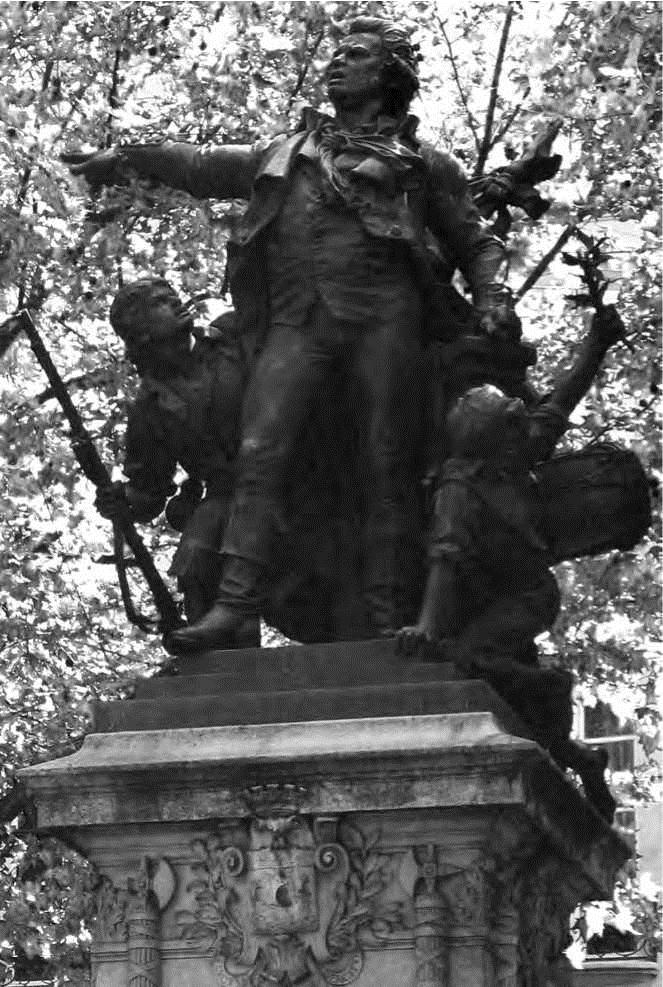
(Statue of Danton, St Germain Boulevard, Paris)
Preface
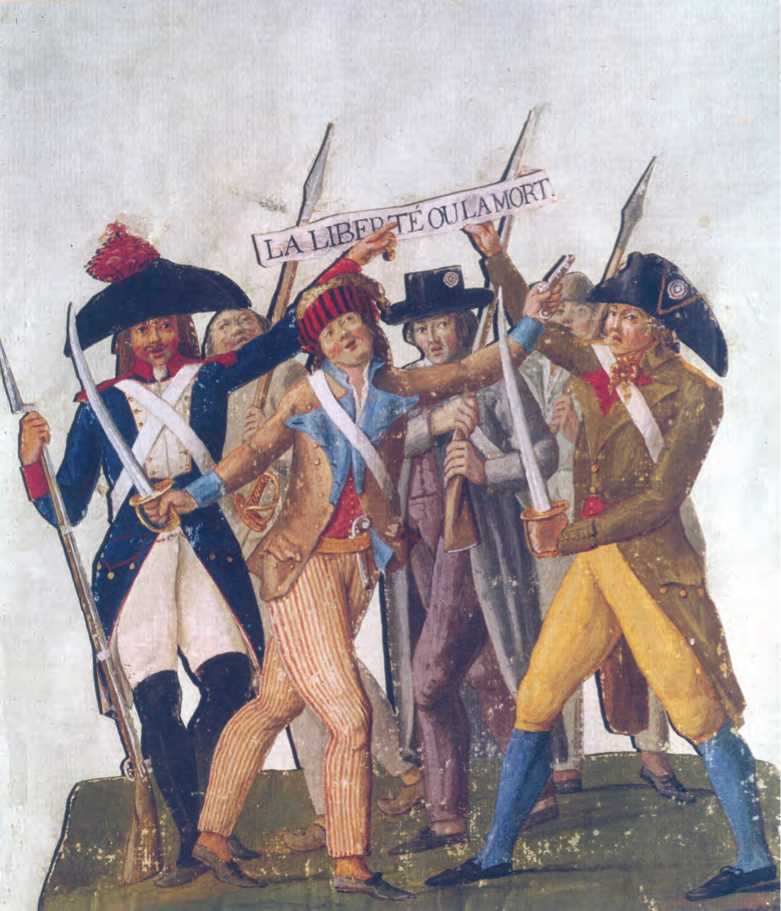
(Departure of volunteers for the front, 1792. Banner says: “Liberty or Death”, Gouache by the Lesueur brothers)
The task of preparing teaching-learning material for value-oriented education is enormous.
There is, first, the idea that value-oriented education should be exploratory rather than prescriptive, and that the teaching-learning material should provide to the learners a growing experience of exploration.
Secondly, it is rightly contended that the proper inspiration to turn to value-orientation is provided by biographies, autobiographical accounts, personal anecdotes, epistles, short poems, stories of humour, stories of human interest, brief passages filled with pregnant meanings, reflective short essays written in well-chiselled language, plays, powerful accounts of historical events, statements of personal experiences of values in actual situations of life, and similar other statements of scientific, philosophical, artistic and literary expression.
Thirdly, we may take into account the contemporary fact that the entire world is moving rapidly towards the synthesis of the East and the West, and in that context, it seems obvious that our teaching-learning material should foster the gradual familiarisation of students with global themes of universal significance as also those that underline the importance of diversity in unity. This implies that the material should bring the students nearer to their cultural heritage, but also to the highest that is available in the cultural experiences of the world at large.
Fourthly, an attempt should be made to select from Indian and world history such examples that could illustrate the theme of the upward progress of humankind. The selected research material could be multi-sided, and it should be presented in such a way that teachers can make use of it in the manner and in the context that they need in specific situations that might obtain or that can be created in respect of the students.
The research team at the Sri Aurobindo International Institute of Educational Research (SAIIER) has attempted the creation of the relevant teaching-learning material, and they have decided to present the same in the form of monographs. The total number of these monographs will be around eighty to eighty-five.
It appears that there are three major powers that uplift life to higher and higher normative levels, and the value of these powers, if well illustrated, could be effectively conveyed to the learners for their upliftment. These powers are those of illumination, heroism and harmony.
It may be useful to explore the meanings of these terms-illumination, heroism and harmony-since the aim of these monographs is to provide material for a study of what is sought to be conveyed through these three terms. We offer here exploratory statements in regard to these three terms.
Illumination is that ignition of inner light in which meaning and value of substance and life-movement are seized, understood, comprehended, held, and possessed, stimulating and inspiring guided action and application and creativity culminating in joy, delight, even ecstasy. The width, depth and height of the light and vision determine the degrees of illumination, and when they reach the splendour and glory of synthesis and harmony, illumination ripens into wisdom. Wisdom, too, has varying degrees that can uncover powers of knowledge and action, which reveal unsuspected secrets and unimagined skills of art and craft of creativity and effectiveness.
Heroism is, essentially, inspired force and self-giving and sacrifice in the operations of will that is applied to the quest, realisation and triumph of meaning and value against the resistance of limitations and obstacles by means of courage, battle and adventure. There are degrees and heights of heroism determined by the intensity, persistence and vastness of sacrifice. Heroism attains the highest states of greatness and refinement when it is guided by the highest wisdom and inspired by the sense of service to the ends of justice and harmony, as well as when tasks are executed with consummate skill.
Harmony is a progressive state and action of synthesis and equilibrium generated by the creative force of joy and beauty and delight that combines and unites knowledge and peace and stability with will and action and growth and development. Without harmony, there is no perfection, even though there could be maximisation of one or more elements of our nature. When illumination and heroism join and engender relations of mutuality and unity, each is perfected by the other and creativity is endless.
The study of Danton is one of the most appropriate studies in connection with the theme of heroism. Danton was not himself a great hero, but he poured the force and vigor of heroism among the people of France, and the atmosphere of heroism surged forth everywhere in France. “We must dare, and dare, and dare...” became a force of mantra which even today stirs us to take the path of courage against difficulties and obstacles.
It must also be noted that the French Revolution aimed at the union of three great ideals: Liberty, Equality and Fraternity. There can be no better definition of harmony than the union of these three ideals. When we read about Danton, we must remember that, even in his fierce battle against the established agencies of oppression, Danton’s heart was the heart of a lover of his motherland, and it was his effort towards harmony that ultimately lead him to be guillotined.
Lastly we must also remember that heroism and harmony have their true birthplace in the realm of illumination. Thus this monograph will give a potent message of illumination, heroism and harmony.
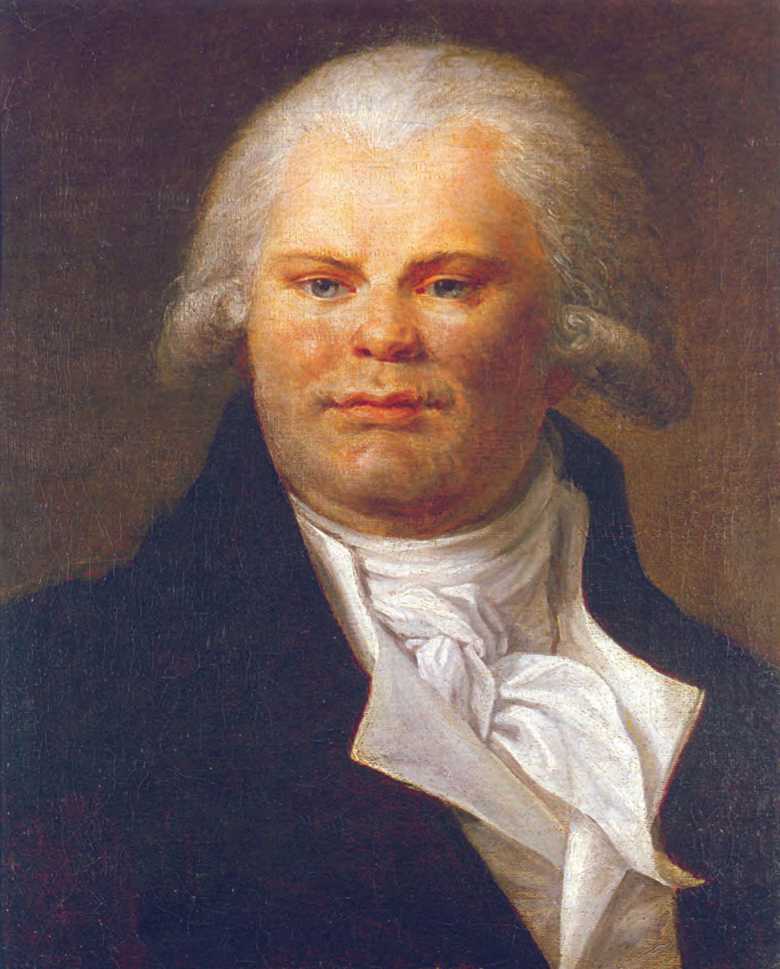
(Portrait of Danton, painting by Constance Charpentier, c. 1790)
Introduction
Danton was the very soul of the French Revolution. His unique energy and courage was determinant to help save France from foreign invasions during the most crucial months of the Revolution. Danton would not have become quite a legend without the French Revolution but it may equally be said that the French Revolution, probably, could not have sustained itself without Danton.
Danton, after receiving a good education in a bourgeois family in the East of France, moved to Paris where he became a moderately successful lawyer. He was a big man with a big florid face, rather ugly and scarred by small pox, with a strong voice and a talent for oratory. He was 30 years old in 1789 when the French Revolution broke out.
In August 1788 the King Louis XVI and his ministers had to accept to call for an Estates General, an assembly composed of representatives from all over France. The aim was to endorse their proposals for solving an acute financial crisis and also to hear the many different grievances coming from all sections of the people.
On May 5 1789, the Estates General met. Then, after weeks of confrontation with the King, the majority of the deputies, mostly bourgeois representatives joined by a few from the nobility and the clergy, declared themselves to be the people’s representatives, and formed a National Assembly. That assembly subsequently would be called the Constituent Assembly as it would frame a new Constitution for the country. At the same time, during summer, many popular revolts happened all over France. On July 14 a Parisian mob stormed a prison-fortress called La Bastille, symbol of the monarchic autocracy. A few months later, another Parisian riot forced the royal family to leave their palace of Versailles where they lived far from popular turmoil and to settle in the Tuileries palace right in the centre of an effervescent Paris.
From that moment till the middle of 1791, the relations between the King and the Assembly, which took seriously its self-appointed task of reforming and reorganizing France, steadily deteriorated. The King’s attempt at fleeing France—which ended in abject failure at Varennes, quite close to the frontier—added to the mistrust. During the same period, the newly created political clubs of Paris gained more and more influence, particularly the Club of Jacobins and the Club of Cordeliers, in which Danton had a towering presence.
In September 1791, the King had no other choice than to accept the new Constitution. He was now the “King of the French”, and not the “King of France”. This ended centuries of monarchy by divine right. The other monarchies in Europe (Austria, Prussia, England) feared that this revolutionary zeal spread and affect their own people. France was soon at war with several neighbours.
The initial defeats saw the rise of Danton as a leader. He had a decisive role in the fateful day of August 10, 1792, when a mob stormed the Tuileries palace, forcing the royal family to take refuge with the Assembly, thus becoming in effect its prisoners. By the evening, the monarchy had fallen and had been replaced by the first French Republic.
From that day, Paris, with its improvised local government “la Commune”, became central to the Revolution. Danton was made minister of Justice. And it is as Minister of Justice that he would passionately arouse the courage of the French people threatened by powerful armies from all sides. Many officers and soldiers, being from the nobility, had gone into exile. Peasants, workmen, small middle-class shop-keepers would then volunteer in great number to enrol in the army for the defence of something that they had started to see as their nation. They went, as Victor Hugo said, “Against the whole of Europe and its captains,... the soul without fear and the feet without shoes.” The person who gave them courage was Danton.
At the beginning of 1793, the Assembly, by then the Legislative Assembly, voted the death of the King. Danton and his friends voted for the execution.
As the Revolution became ever more radical and was devouring its own children, Danton withdrew to his native place. He was tired of the excesses and the increasing fanaticism. Yet, encouraged by some of his friends he came back to Paris in a bid to end the vicious circle of suspicions, denunciations, arrests and executions called la Terreur. His erstwhile friend and now enemy Robespierre 1 managed to get him accused of treason, arrested and judged. Danton was not even allowed to defend himself. He was guillotined on April 5, 1794.
Robespierre himself would be executed on July 28, 1794, and this marked the end of the Terror. But the Revolution was still on, and it is only with Napoleon’s arrival on the stage that it ended.
The contribution of Danton, as intense as it has been, was remarkably brief: a little more than a year. As Hilaire Belloc, a British historian and writer put it, there were thirteen months, during which Danton was the main inspiration of the giant upheaval. Here is what Belloc writes in the preface of his book Danton A Study published in 1899.
He does not even, as do Robespierre or Mirabeau,2 and others, occupy the stage of the Revolution from the first. Till the nation is attacked, his role is of secondary importance But it is only in the saving of France when the men of action were needed, that he leaps to the front. Then, suddenly, the whole nation and its story becomes filled with his name. For thirteen months, from that 10th of August 1792, which he made, to the early autumn of the following year, Danton, his spirit, his energy, his practical grasp of things as they were, formed the strength of France. While the theorists, from whom he so profoundly differed, were wasting themselves in a kind of political introspection, he raised the armies He formed the Committee to be a dictator for a falling nation. All that was useful in the Terror was his work; and if we trace to their very roots the actions that swept the field and left it ready for rapid organisation and defence, then at the roots we nearly always find his masterful and sure guidance.
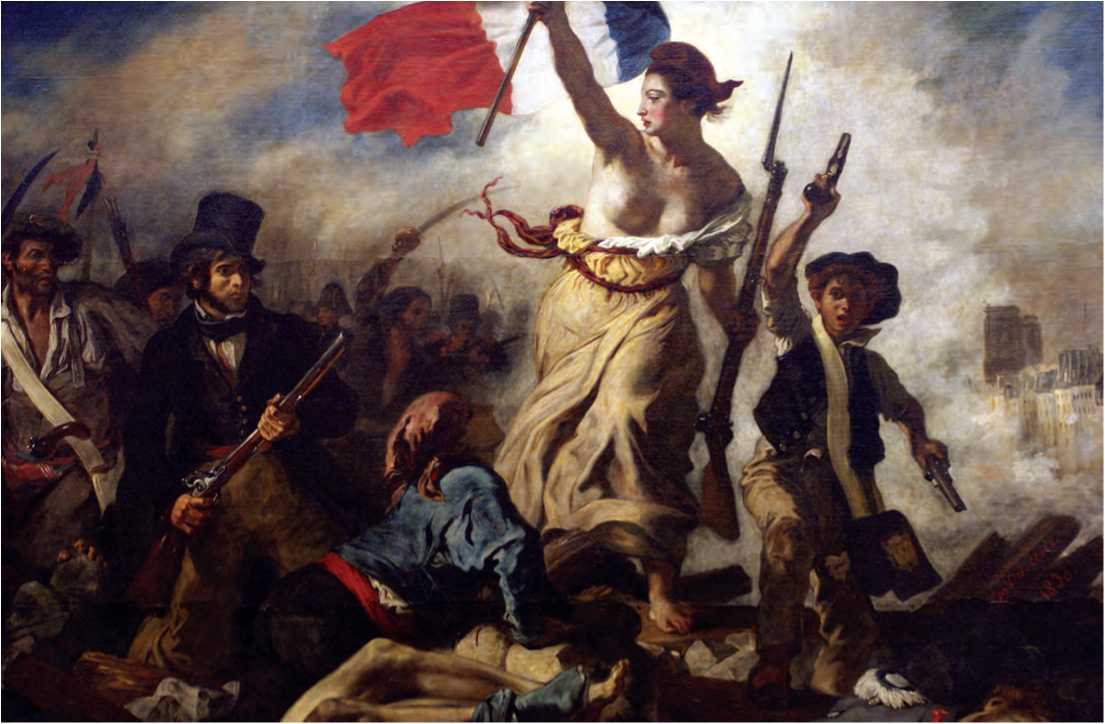
(Liberty Guiding the People, painting by Delacroix)
There are in the Revolution two features, one of which is almost peculiar to itself, the other of which is in common with all other great crises in history.
The first of these is that it used new men and young men, and comparatively unknown men, to do its best work.... This feature makes the period unique, and it is due to this feature that so many of the Revolutionary men have no history for us before the Revolution They come out of obscurity, they pass through the intense zone of a search-light; they are suddenly eclipsed upon its further side.
The second of these features is common to all moments of crisis. Months in the Revolution count as years... In every history a group of years at the most, sometimes a year alone, is the time to be studied day by day. In comparison with the intense purpose of a moment whole centuries are sometimes colourless....
Belloc’s way to look at Danton is to concentrate on the essential thrust of his life. Danton had a destiny, a crucial role to play in the unfolding of one of the biggest events in History, a Revolution which would shake the establishment everywhere in Europe and deeply influence the evolution of societies in the world. This is his contribution and this is what makes him a giant among men whatever may have been the limitations and defects in his nature which some smaller men who wrote about him keep bringing forth as if they matter so much. There is a tendency to deny greatness to men or women who may have committed truly heroic deeds but have otherwise shown serious defects in their nature: we like our heroes to be devoid of any blemishes. But it is very rare in life to find such characters. Surely Danton was no Joan of Arc, that extraordinary heroine of France’s middle age history, but his utmost patriotism and love of France gave him the undaunted energy to act decisively at the moment of France’s greatest peril during the Revolution.
On August 10, 1792, there was indeed a very serious threat that the Revolution could be arrested. Foreign troops were preparing to invade France. The invaders had a very simple plan: re-establish the authority of the King of France and arrest and prosecute the leaders of the mob which was trying to undo the normal order of society. The army commander of the Allies, the Duke of Brunswick, had issued on July 25th a Manifesto that read like an ultimatum and was threatening the French people of very severe reprisals. Among other statements, the Manifesto declared:
Their Majesties the emperor [of Austria] and the king of Prussia having entrusted to me the command of the united armies which they have collected on the frontiers of France, I desire to announce to the inhabitants of that kingdom the motives which have determined the policy of the two sovereigns and the purposes which they have in view. [...]
The city of Paris and all its inhabitants without distinction shall be required to submit at once and without delay to the king, to place that prince in full and complete liberty, and to assure to him, as well as to the other royal personages, the inviolability and respect which the law of nature and of nations demands of subjects toward sovereigns... Their said Majesties declare, on their word of honor as emperor and king, that if the chateau of the Tuileries is entered by force or attacked, if the least violence be offered to their Majesties the king, queen, and royal family, and if their safety and their liberty be not immediately assured, they will inflict an ever memorable vengeance by delivering over the city of Paris to military execution and complete destruction, and the rebels guilty of the said outrages to the punishment that they merit….
This manifesto, known in Paris by July 28th, inflamed the popular sentiment and reinforced the doubts of many about the loyalty of the King to France. In fact, it seems that the King himself understood immediately how damaging this manifesto was to his cause and he even denounced it. But his entourage, beginning with the Queen, Marie-Antoinette, was trying to influence him against the Revolution. What made the Brunswick Manifesto even more damaging was the fact that Marie-Antoinette was the daughter of the emperor of Austria. She was in fact called the Austrian by most people in France in a very disparaging way. But beyond the obvious clumsiness of the foreign leaders who unnecessarily let the popular sentiment of the people of France be inflamed in such a way, the menace was indeed formidable. The Prussian army was known to be one of the best in the world and there is little doubt that, if the Allies had been able to capture Paris, it may have led to the collapse of the Revolution and to the restoration of the old regime, at least for some years. The risk was therefore considerable and it is at this point that Danton begun his truly epoch-transforming intervention.
The manifesto made the insurrection of the 10th of August quite inevitable. Danton took the lead when he came back from his native place on the evening of the 9th and organised it. He had probably already decided by that day that the time had come to get rid of royalty in order to save the Revolution. And this is what happened.
Here is an account by Hilaire Belloc of the momentous events of August 10 and of the following months which Danton essentially inspired by the sheer force of his personality and his abiding preoccupation with saving France from the great dangers arising from the overthrow of monarchy:
Danton went to Arcis and settled an income on his mother in case of his death, came back to Paris, and on the night of the 9th of August the Sections named commissioners to act. They met and formed the “insurrectionary commune.” At eight the next morning they dissolved the legal commune, kept Danton, and directed the fighting of the morning. [...]
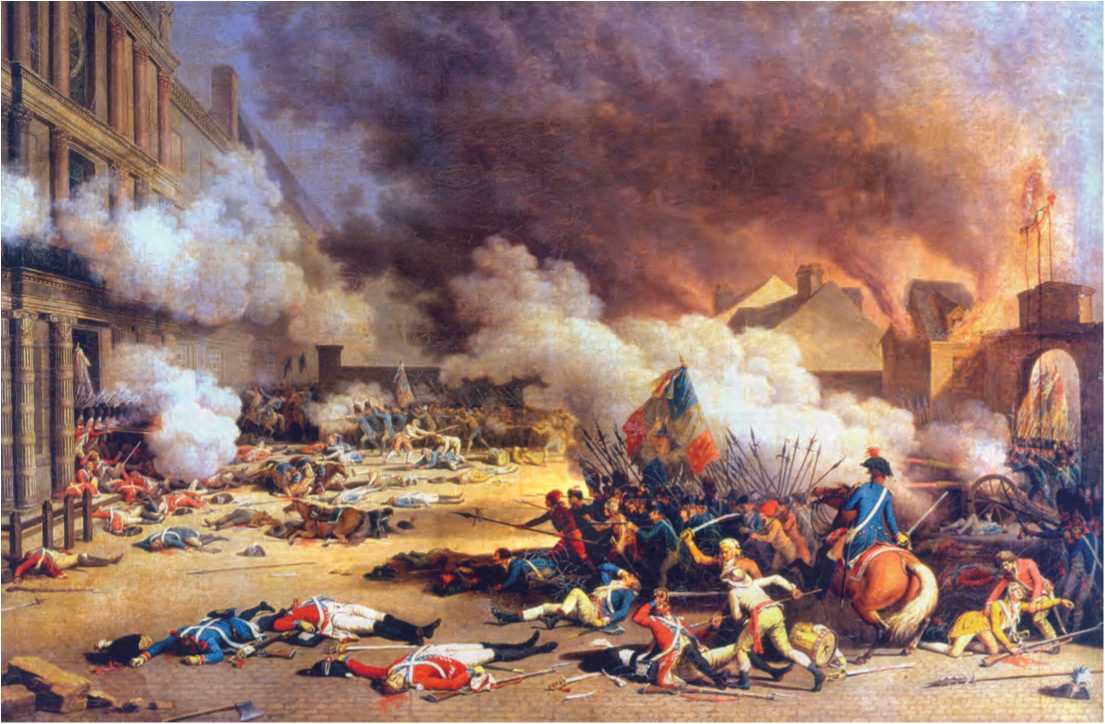
(The storming of the Tuileries palace, painting by Jacques Bertaux-1793)
Danton, who had not slept but had lain down in Desmoulin’s 3 flat till midnight, had been to the Hotel de Ville since two in the morning. He acted during the short night (a night of calm and great beauty, dark and with stars) as the organiser and chief of the insurrection.
Especially he appointed Santerre 4 to lead the National Guard. On these rapid determinations the morning broke, and the first hours of the misty day passed in gathering the forces. […]
[The Tuileries Palace has been invaded, most of its garrison killed. The King and family went to the Assembly for protection. They were arrested for high treason. Thus fell the centuries-old monarchy.]
The 10th of August is not, in the history of the Revolution, a turning-point or a new departure merely; it is rather a cataclysm, the conditions before and after which are absolutely different. […]
There is no better test of what the monarchy was than the comparison of that which came before with that which succeeded its overthrow. There is no continuity. On the far side of the insurrection, up to the 9th of August itself, you have armies (notably that of the centre) contented with monarchy; you have a strong garrison at the Tuileries, the ministers, the departments, the mayor of Paris (even) consulting with the crown. The King and the Girondins are opposed, but they are balanced; Paris is angry and expectant, but it has expressed nothing—it is one of many powers. The moderate men, the Rolands and the rest, are the radical wing. It is a triumph for the Revolution that the Girondins should be again in nominal control.
The acute friction is between a government of idealists standing at the head of a group of professional bourgeois, and a crown supported by a resurrected nobility, expecting succour and strong enough to hazard a pitched battle.
Look around you on the 11th of August and see what has happened. Between the two opponents a third has been intervened—Paris and its insurrectionary Commune have suddenly arisen. The Girondins are almost a reactionary party. The Crown and all its scaffolding have suddenly disappeared. The Assembly seems something small, the ministry has fallen back, and there appears above it one man only—Danton, called Minister of Justice, but practically the executive itself. A crowd of names which had stood for discussion, for the Jacobins, for persistent ineffective opposition, appear as masters. In a word, France had for the moment a new and terrible pretender to the vacant throne, a pretender that usurped it at last—the Commune.
The nine months [that followed]... formed the Republic;... they are the introduction to the Terror and to the great wars, and from the imprisonment of the King to the fall of the Girondins the rapid course of France is set in a narrowing channel… The Commune, the body that conquered in August, is destined to capture every position, and, as one guarantee after another breaks down, it will attain, with its extreme doctrines and their concomitant persecution, to absolute power.
What was Danton’s attitude during this period? It may be summed up as follows: Now that the Revolution was finally established, to keep France safe in the inevitable danger. He put the nation first... The Revolution had conquered: it was there; but France, which had made it and which proposed to extend the principles of self-government to the whole world, was herself in the greatest peril. When discussion had been the method of the Revolution, Danton had been an extremist. He was Parisian and Frondeur in 1790 and 1791; it was precisely in that time that he failed. The tangible thing, the objective to which all his mind leaned, appeared with the national danger; then he had something to do, and his way of doing it, his work in the trade to which he was born, showed him to be of a totally different kind from the men above whom he showed. I do not believe one could point to a single act of his in these three-quarters of a year which was not aimed at the national defence.
[...] Now, after the insurrection, he became “in himself the executive,” and later “in himself the Committee.” So much is he the first man in France during these few months of his activity, that only by following his actions can you find the unity of this confused and anarchic period.
It falls into four very distinct divisions, both from the point of view of general history and from that of Danton’s own life. The first includes the six weeks intervening between the 10th of August and the meeting of the Convention; it is a time almost without authority; it moves round the terrible centre of the massacres. During this brief time the executive, barely existent, without courts or arms, had him in the Ministry of Justice as their one power—a power unfortunately checked by the anarchy in Paris.
The second division stretches from the meeting of the Convention to the death of the King. It covers exactly four months, from September 1792 to January 1793. It is the time in which the danger of invasion seems lifted, and in which Danton in the Convention is working publicly to reconcile the two parties, and secretly to prevent, if possible, the spread of the coalition against France.
The third opens with the universal war that follows the death of Louis, and continues to a date which you may fix at the rising of the 10th of March, or at the defeat of Neerwinden on the 19th. Danton is absent with the army during the greater part of these six weeks; he returns... when things were at their worst, to create the two great instruments which he destined to govern France—the Tribunal and the Committee [of Public Safety]. Finally, for two months, from the establishment of these to the expulsion of the Girondins on the 2nd of June, he is being gradually driven from the attempt at conciliation to the necessities of the insurrection. He is organising and directing the new Government of the Public Safety, and in launching that new body, in imposing that necessary dictator, we shall see him sacrificing one by one every minor point in his policy, till at last his most persistent attempt—I mean his attempt to save the Girondins—fails in its turn. Having so secured an irresistible government, and having created the armies, the chief moment of his life was past. It remained to him to retire, to criticise the excesses of his own creation, and to be killed by it.
(from Danton A Study, by Hilaire Belloc, pp. 166-175)
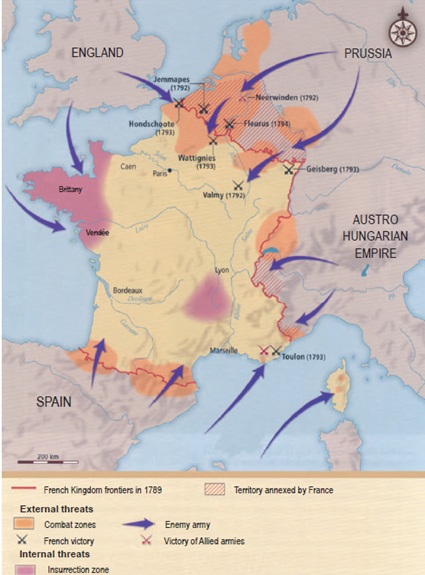
1792-1794: EXTERNAL AND INTERNAL FRONTS
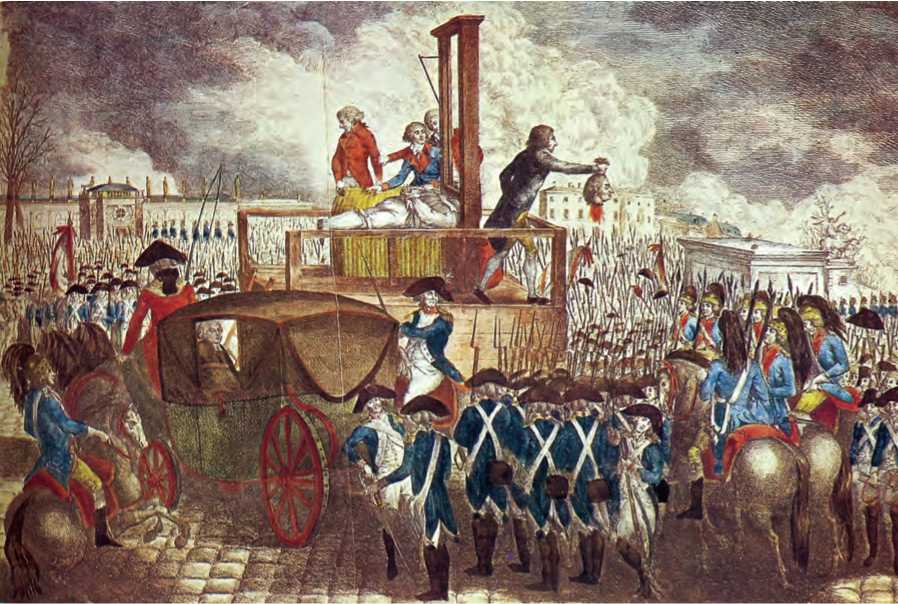
(Execution of Louis XVI in the Place de la Revolution, 21 January 1793)
Foreign armies invaded France on August 19th and the loss of Verdun on September 3rd meant that the road to Paris was opened. Members of the Legislative Assembly were in panic and many leaders talked of leaving Paris and move the government down south near the river Loire, a distance of about 300 km. Danton rejected this plan. He knew instinctively that losing Paris would deal a mortal blow to the Revolution which was then only beginning. So, for Danton, losing Paris was not an option and he swung into action, using very effectively his gift of oratory. It was during these days that he pronounced the immortal sentence to which his name will be for ever associated:
The tocsin which is about to sound is no alarm-signal but a summons to charge the foe. To conquer, gentlemen, we must dare, and dare, and dare, and so save France.
Sri Aurobindo, the great Indian revolutionary, seer and poet, saw the greatness in Danton. In his studies of human evolution, Sri Aurobindo gave importance to the French Revolution as one of these rare moments where the Spirit seems to move directly the masses of humanity. For him, the role of Danton in the French Revolution was crucial:
There are times when a single personality gathers up the temperament of an epoch or a movement and by simply existing ensures its fulfilment. It would be difficult to lay down the precise services which made the existence of Danton necessary for the success of the Revolution. There are certain things he did, and no man else could have done, which compelled destiny; there are certain things he said which made France mad with resolution and courage. These words, these doings ring through the ages. So live, so immortal are they that they seem to defy cataclysm itself and insist on surviving eternal oblivion. They are full of the omnipotence and immortality of the human soul and its lordship over fate. One feels that they will recur again in aeons unborn and worlds uncreated. The power from which they sprang, expressed itself rarely in deeds and only at supreme moments. The energy of Danton lay dormant, indolent, scattering itself in stupendous oratory, satisfied with feelings and phrases. But each time it stirred, it convulsed events and sent a shock of primal elemental force rushing through the consciousness of the French nation. [...] Every great flood of action needs a human soul for its centre, an embodied point of the Universal Personality from which to surge out upon others. Danton was such a point, such a centre. His daily thoughts, feelings, impulses gave an equilibrium to that rushing fury, a fixity to that pregnant chaos. He was the character of the Revolution personified,—its heart, while Robespierre was only its hand. History which, being European, lays much stress on events, a little on speech, but has never realised the importance of souls, cannot appreciate men like Danton. Only the eye of the seer can pick them out from the mass and trace to their source those immense vibrations.
This statement of Sri Aurobindo goes straight to the core of Danton’s being. This is why his life, as brief as it was, has been so important in the long struggle of man’s evolution. At the time of the greatest crisis, when the gains of the nascent revolution could have been trampled under the boot of foreign armies, alone he stood, like a massive presence, giving heart and direction to the people of France.
In the following pages, we shall try to evoke Danton through a few texts which, we feel, do justice to the true character of this great man. A few extracts of some of his most famous speeches are also presented. In appendices, a brief history of the French Revolution is given as well as a time-line.
Danton by Hilaire Belloc
Extracts from “Danton A Study” by Hilaire Belloc
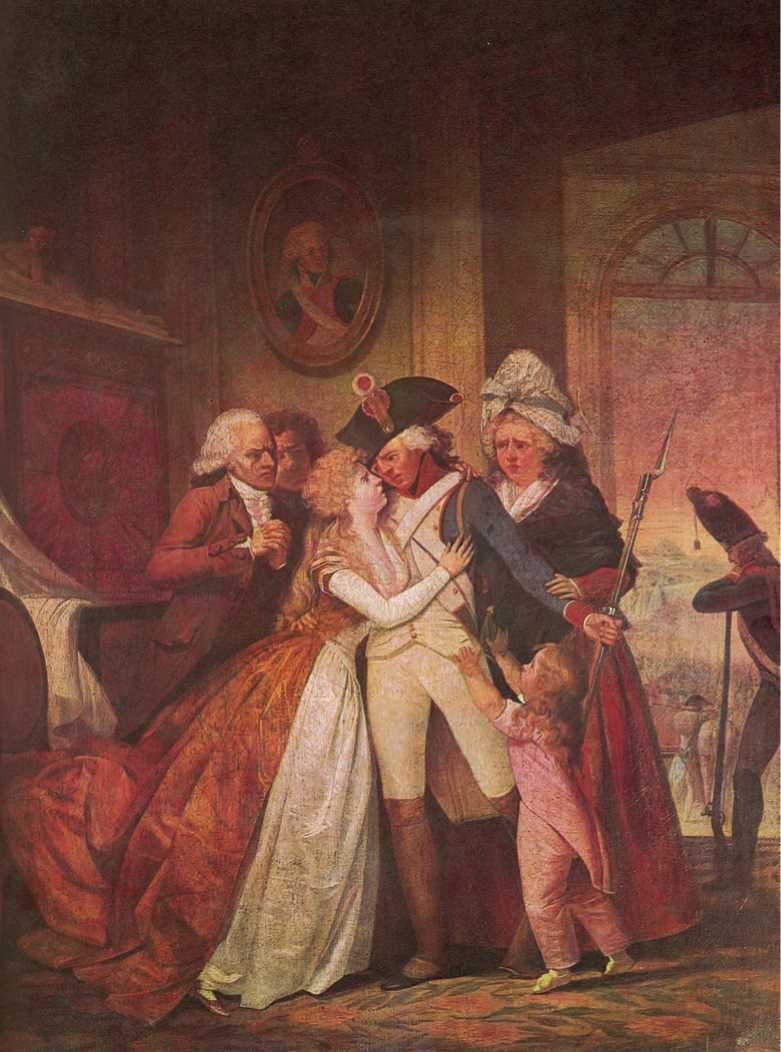
(Departure of a volunteer to the revolutionary armies, painting by Watteau de Lille)
Danton belonged to the bourgeoisie in rank, to the less visionary in the bent of his mind. A young and successful lawyer of thirty, the Revolution found him unknown to politics and not desiring election. It was the accident of oratory that gave him his first position. He discovered himself to be a leader, and there grouped round him a knot of the most ardent, some of them the most brilliant, younger reformers. The electoral district to which he happened to belong became through him the most democratic, and, in some ways, the most violent of Paris.
That part of him which led to such a position was his sympathy. His tenderness (and he had a great share of this quality) was hidden under the energy of his rough voice, great frame, and violent gesture. His pity he was slow to express. But the great crowd of men who were unrepresented, the smaller but more influential class of those who felt and knew but could not speak—these were attracted to him because he had the instinct of the people. He was a demagogue at moments and for a purpose, but never by profession nor for any period of time. What he was, however, all his life and by nature, was a Tribune.
The secret workings of the soil, the power that makes all the qualities of a nation from its wine to its heroes, these had produced him as they produce the tree or the harvest. He is the most French, the most national, the nearest to the mother of all the Revolutionary group. He summed up France; and, the son of a small lawyer in Champagne, he was a peasant, a bourgeois, and almost a soldier as well. When we study him it is like looking at a landscape of Rousseau’s or a figure of Millet’s. We feel France.
His voice was a good symbol of his mind, for there was heard in it not only the deep tone of a multitude, but that quality which comes from the mingling of many parts—the noise of waters or of leaves. In his political attitude he attained this collective quality, not by a varying point of view which is confusion, but by an integration. His opinions erred on the side of bluntness and of directness. They were expressed in plain sentences of a dozen words; he abhorred the classical allusion, he was chary of metaphor. He spoke as a crowd would speak, or an army, or a tribe, if it had a voice
This was Danton, the public orator and the Tribune, who for two years was heard at the Cordeliers, who spoke always for the purely democratic reform, who opposed the moderates, and who helped to destroy the compromise. Never identified with Paris, he yet saw clearly the necessity of Paris. He admitted her claim, fenced with her arrogance, but never worshipped her idols; once or twice he even dared to blame her worst follies. Elected to the administration of the city, he played but a slight role, and until the spring of 1792 there is in him no other quality.
The spring of 1792 produced the war with Europe, and from that date Danton appears in another light. Had he died then, we should have known him only by chance references, a centre of strong reforming speeches, an obscure man in opposition. But with the outbreak of a war which he had done nothing to bring on, and which his party thought unwise, Danton shows that his character, in summing up his fellows, caught especially their patriotism. France was the first thought, and if we could hear not the debaters only, but all the voices of France when the invasion began, it would be this immediate necessity of saving the country that would drown all other opinions. Thence, and for a full year after, Danton becomes the leading man of France.
The ability which has led to his legal success (now that his office is abolished and its reimbursement invested in land) seems turned upon the political situation, and such ability combined with such a representative quality pushes him to the front. Two qualities appeared in him which he himself perhaps had not guessed—the power of rapid organization, and the power of so judging character as to bring diplomacy to bear upon every accident as it arrived.
It was not strictly he who made the 10th of August, but he was the leader. He saw that with the King in power the Prussians would reach Paris, and more than any man he organized the insurrection that was the one act of violence in his life.
The rest of the nineteen months that fate allowed [him] were spent in the attempt to reconcile and harmonise all the forces he could gather for the salvation of the nation. Perhaps it was his chief fault that in this matter he held to no pure idea.
A Republican and an ardent reformer, he yet seems to have thought France of so much the first importance that he compromised and trafficked with all possible allies. He attempted to stave off the war with England;... he tried to prevent vengeance from following the Girondins; when the extremists captured the great Committee, he acquiesced, and still wrestled with the forces of disunion. He would have hidden, if possible, those wounds which weakened France in the eyes of the world, and he waged a futile war with the pure idealists—the men of one dogma, who in so many separate camps were destroying each other for their civic faith, and preparing all the evils of a persecution.
On another side of political action he appeared more resolute than any man. It was he who saw the necessity of a strong government, he who created the revolutionary tribunal, and he who is chiefly responsible for the first Committee of Public Safety. He made the dictatorship, caring nothing for the principle, caring only to throw back the foreigner. “He stamped with his foot, and armies came out of the earth.” The violent metaphor is just. There is a succession, a stream of great armies (they say four millions of men!) pouring out from France for twenty years. If you will glance at the head of that stream, and wonder when you read of Napoleon what first called up the regiments, you may see on the Champ de Mars in ‘92, and later demanding the great levy of ‘93, the presence of Danton, the orator with the voice of command, the attitude of a charge, the right arm thrown forward in the gesture of the sword.
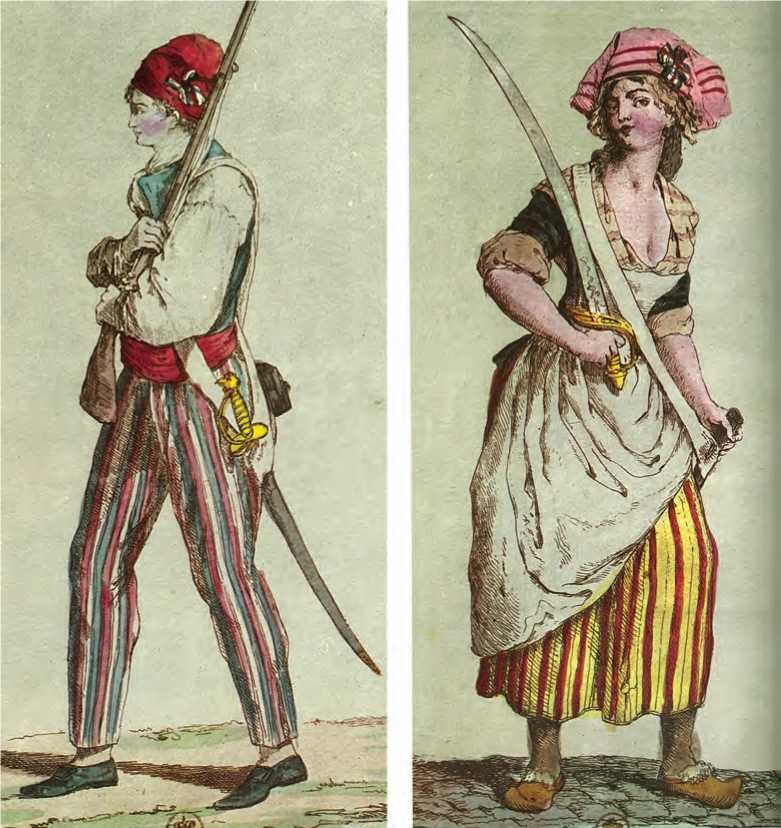
(New revolutionary attire for lower classes in Paris.)
The “sans culottes” were so named because they wore long trousers with red and white stripes instead of the traditional silk knee-breeches. They had a kind of red conical cap, the “bonnet rouge” (this Phrygian cap was used in the Antiquity by freed slaves and thus was the symbol of freedom from tyranny). The women wore a striped skirt.
Possessed of astounding vigour, but lacking ambition, a lover of immediate but not of permanent fame, his superb energy after a year of effort spent itself in a demand for repose. In September 1793 he thought his work done and his position secure. He went back into his country home, walked in the fields he loved (and of which he talked before his death), revelled in Arcis, filling himself into the convivial pleasure that he had always desired. He came back in November secure and happy—ready, almost from without and as a spectator, to continue the task of welding the nation together. It was too late. He had created a machine too strong for his control. He had seen the Terror swallow up the Girondins, and had cried because he could not save them.
With the winter he began his protests, his persistent demands for reason and for common-sense; in the religious and in the political persecution he called for a truce, always his effort turned to the old idea—a united Republican France, strong against Europe, with exceptional powers against treason in a time of danger, but with a margin on the side of mercy.
He failed. The extreme theorists whom he despised had captured his dictatorship, and, in April 1794 they killed him.
From Danton A Study, pp. 35-39
What picture shall we make of him to carry with us in the scenes in which he is to be the principal actor? He was tall and stout, with the forward bearing of the orator, full of gesture and of animation. He carried a round French head upon the thick neck of energy. His face was generous, ugly, and determined.
With wide eyes and calm brows, he yet had the quick glance which betrays the habit of appealing to an audience His upper lip was injured, and so was his nose,—by nature his nose was small. His was one of those faces rarely seen, and always associated with energy and with leadership, whose great foreheads overhang a face that would be small, were it not redeemed by the square jaw and the mouth. Thus [a French writer] will call him “a caricature of Socrates”—and he had farther been disfigured by the small-pox, with which disease that forerunner of his, Mirabeau, had also been disfigured. His lip had been torn by a bull when he was a child, and his nose crushed in a second adventure, they say, with the same animal. In this the Romans would perhaps have seen a portent; but he, the idol of our Positivists, found only a chance to repeat Mirabeau’s expression that his “boar’s head frightened men.”
In his dress he had something of the negligence which goes with extreme vivacity and with a constant interest in things outside oneself; but it was invariably that of his rank. Indeed, to the minor conventions Danton always bowed, because he was a man, and because he was eminently sane. More than did the run of men of that time, he understood that you cut down no tree by lopping at the leaves, nor break up a society by throwing away a wig. The decent self-respect which goes with conscious power was never absent from his costume, though it often left his language in moments of crisis, or even of irritation.
I will not insist too much upon his great character of energy, because it has been so over-emphasised as to give a false impression of him. He was admirably sustained in his action, and his political arguments were as direct as his physical efforts were continuous, but the banal picture of fury which is given you by so many writers is false. For fury is empty, whereas Danton was full, and his energy was at first the force at work upon a great mass of mind, and later its momentum.
Save when he had the direct purpose of convincing a crowd, his speech had no violence, and even no metaphor; in the courts he was a close reasoner, and one who put his points with ability and with eloquence rather than with thunder. But in whatever he undertook, vigour appeared as the taste of salt in a dish. He could not quite hide this vigour: his convictions, his determination, his vision all concentrate upon whatsoever thing he has in hand.
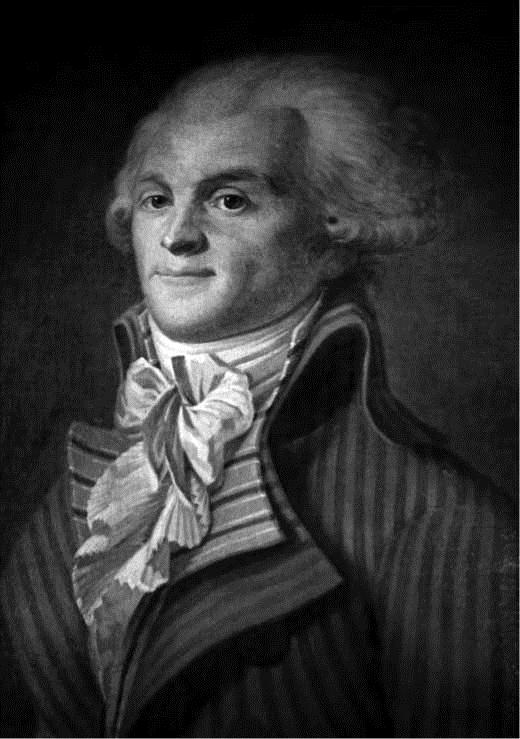
(Maximilien Robespierre)
He possessed a singularly wide view of the Europe in which France stood. In this he was like Mirabeau, and peculiarly unlike the men with whom revolutionary government threw him into contact. He read and spoke English, he was acquainted with Italian. He knew that the kings were dilettanti, that the theory of the aristocracies was liberal. He had no little sympathy with the philosophy which a leisurely oligarchy had framed in England; it is one of the tragedies of the Revolution that he desired to the last an alliance, or at least peace, with this country. Where Robespierre was a maniac in foreign policy, Danton was more than a sane—he was a just, and even a diplomatic man.
He was fond of wide reading, and his reading was of the philosophers; it ranged from Rabelais to the physiocrats in his own tongue, from Adam Smith to the “Essay on Civil Government” in that of strangers; and of the Encyclopedia he possessed all the numbers steadily accumulated. When we consider the time, his fortune, and the obvious personal interest in so small and individual a collection, few shelves will be found more interesting than those which Danton delighted to fill.
In his politics he desired above all actual, practical, and apparent reforms; changes for the better expressed in material results. He differed from many of his countrymen at that time, and from most of his political countrymen now, in thus adopting the tangible. It was a part of something in his character which was nearly allied to the stock of the race, something which made him save and invest in land as does the French peasant, and love, as the French peasant loves, good government, order, security, and well-being.
There is to be discovered in all the fragments which remain to us of his conversations before the bursting of the storm, and still more clearly in his demand for a centre when the invasion and the rebellion threatened the Republic, a certain conviction that the revolutionary thing rather than the revolutionary idea should be produced: not an inspiring creed, but a goal to be reached, sustained him. Like all active minds, his mission was rather to realise than to plan, and his energies were determined upon seeing the result of theories which he unconsciously admitted, but which he was too impatient to analyse.
His voice was loud even when his expressions were subdued. He talked no man down, but he made many opponents sound weak and piping after his utterance. It was of the kind that fills great halls, and whose deep note suggests hard phrases. There was with all this a carelessness as to what his words might be made to mean when partially repeated by others, and such carelessness has caused historians still more careless to lend a false aspect of Bohemianism to his character. A Bohemian he was not; he was a successful and an orderly man; but energy he had, and if there are writers who cannot conceive of energy without chaos, it is probably because in the studious leisure of vast endowments they have never felt the former in themselves, nor have been compelled to control the latter in their surroundings.
As to his private life, affection dominated him. Upon the faith of some who did not know him he acquired the character of a debauchee. For the support of this view there is not a tittle of direct evidence. He certainly loved those pleasures of the senses which Robespierre refused, and which Roland was unable to enjoy; but that his good dinners were orgies or of any illegitimate loves (once he had married the woman to whom he was so devotedly attached) there is no shadow of proof. His friends also he loved, and above all, from the bottom of his soul, he loved France. His faults—and they were many—his vices (and a severe critic would have discovered these also) flowed from two sources: first, he was too little of an idealist, too much absorbed in the immediate thing; secondly, he suffered from all the evil effects that abundant energy may produce—the habit of oaths, the rhetoric of sudden diatribes, violent and overstrained action, with its subsequent demand for repose.
Weighted with these conditions he enters the arena, supported by not quite thirty fruitful years, by a happy marriage, by an intense conviction, and by the talents of a man who has not yet tasted defeat. I repeat the sentence applied to another: “Active and sane, robust and ready for glory, the things he loved were his wife and the circumstance of power.”
From Hilaire Belloc, Danton A Study, pp. 53-56
Danton’s personality
Extracts from “Danton and the French Revolution” by Charles F. Warwick
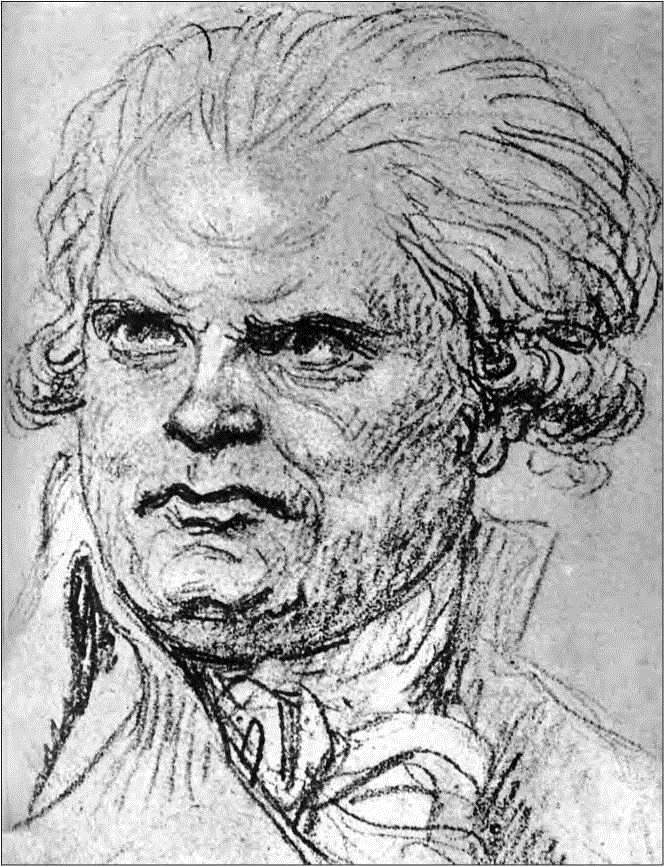
(Extracts from Danton and the French Revolution by Charles F. Warwick)
With the exception of Mirabeau, Danton was the strongest character the Revolution produced. “He bore,” says Mignet,” a physical resemblance to that tribune of the higher classes. He had irregular features, a powerful voice, impetuous gesticulation, a daring eloquence, a lordly brow. Their vices too were the same, only Mirabeau’s were those of a patrician, Danton’s those of a democrat. That which there was of daring in the conceptions of Mirabeau was to be found in Danton, but in another way, because in the Revolution he belonged to another class and another epoch.” So much, in many ways, did they resemble each other that Danton was frequently alluded to as the “Mirabeau of the Sans Culottes.”
In appearance Danton was impressive, picturesque. His massive, herculean frame towered above his fellows; his head was surmounted by a heavy shock of black hair that resembled the mane of a lion; his shirt, open at the front, revealed the sinewy neck of a bull; his eyes were small, deeply set but piercing; his nose was crushed; his face scarred, and his features were pitted with the smallpox. His very homeliness seemed to add force, even dignity, to his presence, and when he arose to address the Assembly he displayed a vigor and exerted a power that not only riveted the attention of men but made his adversaries quail. As homely and as scarred in feature as Mirabeau, he followed the example of his great compeer by frequently in his public speeches alluding to his ugliness. Upon one occasion he cried out: “My Medusa head that makes the aristocrats to tremble.” At the Jacobins’ he declared that he had the harsh expression of freedom. “Nature has endowed me with an athletic form and Liberty’s rugged features.”
“His rugged face reminds us,” said one of his contemporaries, “of a caricature of Socrates.” “He was marked,” says a French author, “with the smallpox like Robespierre, but had a masculine countenance, broad nostrils, forward lips, and a bold air wholly unlike his.” “The broad, rude features speak withal of wild human sympathies,” says another. Carlyle, in his vividly descriptive style, pictures him as: “The huge, brawny figure; through whose black brows and rude, flattened face there looks a waste of energy as of Hercules not yet furibund.” To appreciate the force of such a countenance one must study every detail, every feature, and then combine them. “Paint me as I am,” cried Cromwell, “warts and all.”
When animated in discussion Danton’s face revealed every emotion of his soul. A distinguished French historian describing him says: “What a frightful visage has this Danton! Is this a cyclop or some goblin? That large face, so awfully scarred by the smallpox, with its small, dull eyes, looks like a brooding volcano. No, that is not a man, but the very element of confusion swayed by madness, fury, and fatality! Awful genius, thou frightenest me! Art thou to save or ruin France?” Further on the same writer continues: “What frightens me the most is that he has no eyes; at least they are scarcely perceptible. What! Is this terrible blind man to be the guide of nations? ...And yet this monster is sublime. This face almost without eyes seems like a volcano without a crater—a volcano of horrors or of fire—which in its pent-up furnace is brooding over the struggles of nature... How awful will be the eruption... That face is like a nightmare from which one cannot escape, a horrible oppressive dream... We become mechanically attracted towards this visible struggle of opposite principles... It is a devoted Oedipus who, possessed with his own enigma, carries within his breast a terrible sphinx that will devour him.”
It is always interesting to picture a man whose character we are studying as he appeared to his contemporaries in the everyday walks of life. During his attendance upon the sessions of the Assembly, he wore a dark blue coat with full skirts cut in the fashion of the period, broad flaps at the pockets, and two rows of brass buttons; a colored vest or waistcoat, usually buff or yellow; culottes and top boots. If he had ever worn silk stockings and buckled shoes, he had long since discarded them. A stock and an expansive scarf or tie encircled his neck. He carried a watch and wore a fob. In the matter of attire it is certain he was not so particular or fastidious as Robespierre, but there is sufficient proof that he was neither slouchy nor untidy, and that he did not affect that carelessness in dress that was the homage the demagogues paid to the rabble.
He was a whole-souled man of the world, fond of its pleasures; he often gave offense to many of his colleagues because of his aristocratic taste and extravagance, which they thought were not consistent in one who professed the austere virtues of republicanism.
“There have been few stronger men than this Danton,” says Watson. His natural endowments were great. They would have been great in any period, but in stirring times, that is in a revolution, they were of the highest order. His courage and daring were superb; when others quailed in the face of disaster, when the armies of allied Europe threatened France, and the provinces were in revolt, he never wavered. It may be said of him, as Livy said of a celebrated Roman: “He never despaired of the Republic.” Carlyle asserts that the French Revolution did produce some original men among the twenty-five millions, at least one or two units. Some reckon, he says, as many as three and then names them in the following order: Napoleon, Danton, and Mirabeau. Whether more will come to light he cannot say, but in the meanwhile he advises the world to be thankful for these three, well knowing how rare such men are. That indeed is a great group, and it may be said that without Danton, Napoleon, perhaps, would have had no theatre for his genius. So deeply did Danton impress himself upon the Revolution that it is difficult to imagine what its history would have been without him. No crisis daunted, no defeat disheartened, no danger nor disaster appalled him. “It is not the alarm-cannon that you hear,” he cried when the Prussians were at Verdun and Paris was stricken with terror, “but the pas de charge against our enemies.” “Retire behind the Loire? No!” he exclaimed, “rather than retreat and abandon the capital we will burn it to ashes.” His was the ruling influence that effected the dethronement of the king, the destruction of the monarchy, and the establishment of the Republic.
There were periods in the Revolution when he made its events, when he stamped his personality upon its character. He stood for its purposes, its principles. In him were concentrated its vigor, its force, its energy; he was the embodiment of its violence. When it wavered he gave it an impetus; when its advance column halted or recoiled, he seized the standard and led the way. He had the superb qualities of leadership—those qualities that are not acquired by time, labor nor even experience, but are innate.
Lord Brougham, who knew personally many of the patriarchs that survived the Revolution, said that they were all of one mind in declaring that Danton was unquestionably its principal leader. There was not one of his contemporaries, in the later period of the Revolution, that was his equal. It can almost be said that during a portion of 1793 he was the Revolution.
Such men as Danton make revolutions and reach results that weaklings could not encompass. They are made to fit conditions and they become instruments in the hands of Providence to effect those changes that are for the betterment of the human race in the eternal struggle for the ideal. They fill up large spaces in the exciting and transforming periods of the world’s history. Without fear themselves, audacious and defiant, they inspire the confidence and the courage of other men by their conduct and example. Their bravery is contagious and infectious.
Danton was the man for his times. He was possessed of the spirit of the Revolution, he loved to breathe its atmosphere. He delighted to brave its dangers, to bridge over its perils. The din and turmoil of controversy and contention were music to his ears. “Bold, ardent, greedy of excitement, he had thrown himself eagerly into the career of disturbance and he was more especially qualified to shine in the days of terror.” He was seldom if ever disconcerted; in an emergency, he had the presence of mind that comes from courage and possessed that quickness and accuracy of perception that enabled him to act with judgment and wisdom on the moment. He could perceive instantly the mistake of an adversary and had a fertility of resources upon which to draw to take advantage of the error.
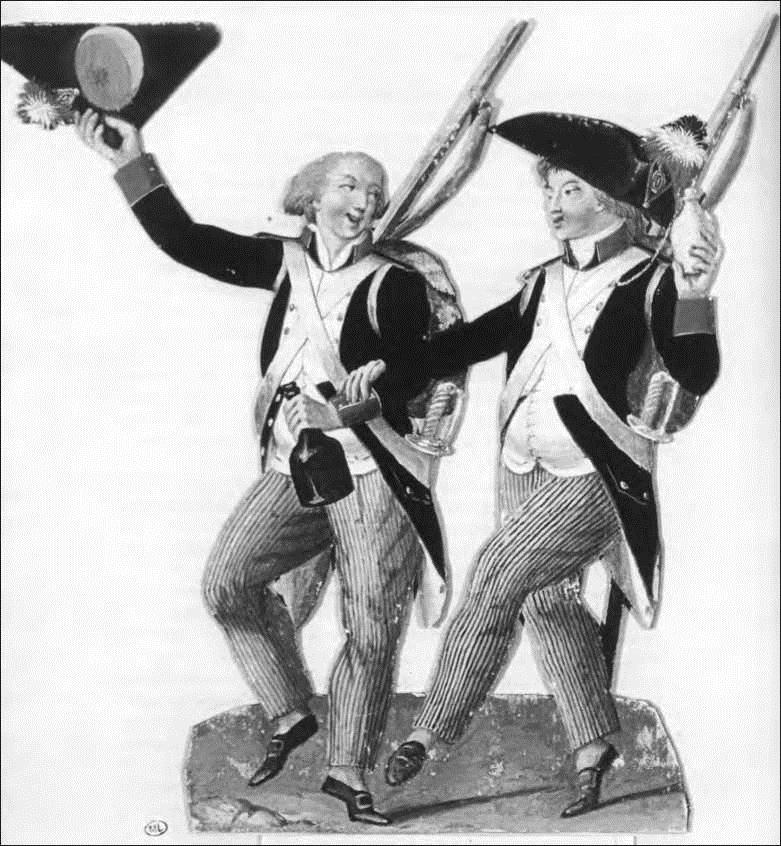
(Joyous departure of army volunteers, Gouache by the Lesueur brothers)
This man in his passion was as savage as a tiger, and yet naturally in disposition he was as affectionate as a child and as tender as a woman. “One sees those fire-eyes ... fill with the water of tears.” He presented a mixture of the most opposite qualities. “He had impulses of humanity as he had of fury; he had low vices but generous passions—in a word he had a heart.”
“They say best men are molded out of faults,” Lord Macaulay in describing him says: “He was brave and resolute, fond of pleasures, of power, and of distinction, with vehement passions, with lax principles, but with some kind and manly feelings, capable of great crimes, but capable also of friendship and of compassion.”
In the opinion of Morley, “He was one of the men who strike deep notes. He had that largeness of motive, fullness of nature, and capaciousness of mind which will always redeem a multitude of infirmities.”
He was ardently fond of his mother; he was a faithful husband, a devoted father, and a loyal friend. “No man was truer to his friends or more dangerous to his foes.” The love he had for his first wife was ideal and the affection he had for Camille was that of Jonathan for David. By nature he was a man of sentiment and deep emotions; he had fine taste and was passionately fond of books, music, and flowers. He was open-hearted, generous, of a most forgiving disposition, too big to harbor a grudge, and no one would accept an apology more quickly, if sincere and offered in a proper spirit.
In those days of slaughter, when life was so cheap, he would not encompass the death of a rival for the sake of advancing his own ambitions. “He was,” says Stephens, “above petty feuds and laughed at the idea of vengeance on his personal enemies.” At the time of the September massacres he sacrificed none to personal animosity, as it was said Robespierre did, but, at his own instance and risk, saved enemies as well as friends from slaughter by having them released from prison. Appeals to his heart were seldom made in vain. He was not plagued by envy nor jealousy; those mean and little qualities were foreign to his nature. He was absolutely free from cant; bold, outspoken, natural, with no affectation in manner or language, he was without the pretension to sincerity that so characterized Robespierre.
His religious faith was not well defined; it is very evident he was not hampered in his conduct by the influence of any creed; even the principles of Christianity did not restrain him. Religion was not fashionable nor popular during the Revolution. The Church itself, for a century or more, had been honeycombed with scepticism and because of the corruption and extravagance of the upper clergy it had fallen into disfavor. There may, however, have been lingering in the heart of Danton, as there is in the heart of almost every man, the sweet influence of that early religious training at the mother’s knee.
When Danton was married the second time, which was in July, 1793, at the very height of the Revolution, the ceremony was performed by an orthodox or non-juring priest. This may have been at the suggestion of the bride, for her mother was a very religious woman, and a man like Danton, who was not in any sense of the word a bigot, would be likely to treat such matters with an utter disregard. So far as he personally was concerned, it would not have made much difference to him who officiated, provided the ceremony was legal; yet Lamartine says that he retired to an inner room and made confession just before he was married… it is said that when he was upon the platform of the scaffold, a priest in the crowd, whom he recognized, gave him absolution. [...]
He has been charged with venality, but a careful examination of the testimony fails to make out a case that would support a conviction in any tribunal of justice. After the discovery of Mirabeau’s bargain with the court, charges of bribery against public men in those days of acute suspicion became very common. In extenuation of Mirabeau’s corruption some one has said: “He may have sold himself, but he surely never delivered himself.” So far as Danton was concerned there is not a scintilla of evidence that he, even without delivery, ever sold himself.
At his trial he said in answer to one of the charges: “You say that I have been paid, but I tell you that men made as I am cannot be paid, and I put against your accusation, of which you cannot furnish a proof, nor the shadow, nor the beginning of a witness—the whole of my revolutionary career.” This is a bold denial and does not sound like the language of a guilty man. [...]
On December 3, 1793, when attacked by the Hebertists, he uttered the following emphatic denial: “You will be astonished, when I lay bare to you my private affairs, to see the colossal fortune which my enemies and yours have charged me with, reduced to the little amount of property which I have always had. I defy my opponents to furnish the proof of any crime whatever to me.” He demanded that a committee be appointed to examine into the charges, but after a speech by Robespierre it was considered not at all necessary.
At Danton’s death his estate was sequestered, and he left just about what he could honestly have made and saved in his professional and public career. These matters have been most carefully investigated and considered by M. Bougeart and Dr. Robinet, and they acquit Danton of every charge of venality.
One of the greatest lawyers England ever produced, Lord Brougham, in commenting upon this question, writes: “A charge of corruption has been brought against Danton, but upon very inadequate grounds. The assertion of royalist partisans that he had stipulated for money and the statement of one that he knew of its payment and had seen the receipt (as if a receipt could have passed) can signify nothing when put in contrast with the known facts of his living throughout his short public career in narrow circumstances.”
Stephens and Aulard both favor this view of the case. The former author says in his French Revolution: “Mirabeau declares openly in a letter... that the triumvirate and Orleanists had intrigued with Danton and had bribed him with a large sum, but all such stories have been proved to be false by the careful examination of his monetary affairs during the Revolution.”
As a politician Danton was original, ingenious, resourceful, and possessed to a high degree the arts of the demagogue—we mean by this a demagogue in the best sense of that word, a leader of the people. He was not of the type of John Wilkes. Danton was denominated “the Alcibiades of the Rabble,” but this designation was not altogether apposite; he was of the people and loved their cause and never flattered or cajoled simply to mislead them. His patriotism was unquestioned; he was devoted to France and every inch of her soil was dear to him. He was a partisan or a party man in the full meaning of the term. Mignet goes so far as to say: “The welfare of his party was in his eyes superior to the law and even to humanity.”
His ambition was not personal; he would willingly have sacrificed himself for the Republic or his party. “Que mon nom soit fletri”—“Let my name be blighted if but the cause succeed,” he cried out in one of his heated harangues. At times he was not particular in the choice of the methods he employed to attain an object; he believed in the dangerous doctrine, “the end justifies the means,” and so was not always governed by high moral principles.
Revolutionists cannot be saints nor be expected, perhaps, to practise a fine code of ethics in so fierce a conflict as was being waged in France. “He deemed,” says Mignet, “no means censurable so they were useful.” Thiers writes of him: “Prompt and decisive, not to be staggered either by the difficulty or by the novelty of an extraordinary situation, he was capable of judging of the necessary means and had neither fear nor scruple about any.” Citing from Lamartine, “Danton’s revolutionary principles were well known. To abstain from a crime necessary or barely useful he considered a weakness.” The same author on another page says: “He was devoid of honor, principles, or morality; he only loved democracy because it was exciting.” Quoting further from the same writer: “He had everything to make him great but virtue.” But he will stand a fair comparison in these particulars, that is in so far as his methods and principles are concerned, with the other public men of his day. He no doubt in a desperate game did not scruple about the means to reach an end, but it must be said to his credit that he would rather play fair than false. There was an underlying foundation of honor and truth in his character.
Every man with a virtuous strain, who in order to win when in a contest ignores or offends moral considerations, always tries to satisfy his conscience by making a promise to reform after the conflict. That cold, crafty politician, Louis XI, worked the two ends of the line, for he fumbled his relics and mumbled his prayers both before and after the commission of his political crimes. Even Marat was wont to say that if he lived long enough to witness the triumph of the Republic he would take refuge in the sphere of his scientific and literary studies. Danton persistently contended that everything he did was for the welfare of his country and the restoration of order; he always had a reason for his action and even excused his conduct in reference to the September Massacres 5 (which by many is considered the greatest blot upon his character) by declaring that the slaughter of the aristocrats was to insure peace and the safety of the Republic and that the security and perpetuity of the nation were paramount to all other considerations. It is the same argument advanced as an excuse for war when both sides are praying to the one God for victory, but what may be justified as a necessity in a nation is denounced as a crime in an individual.
Whatever else may be said of Danton, he was not mean nor contemptible in his methods. “His vices,” declares a distinguished French historian, “partook of the heroic.” He was a Colossus of tremendous force, whom nothing could affright, nothing dismay. He would combat man or devil and defy single-handed the allied armies of Europe. It is the inborn courage of the man that commands our admiration. We have no time to criticise his faults or the means he adopted to reach his ends, we are so impressed with his superb boldness and audacity. In judging men of that period, and considering them from a moral standpoint we are apt to apply the rules that obtain to-day. This is wrong; it is not fair to them. It was an exceptional era, everything was topsy turvy—religion, society, politics, government. “All men were under the influence of a temporary delirium, a delirium which rendered them alike insensible to their own sufferings, blind to their own perils, neglectful of their duties, and regardless of other men’s rights.” All these matters must be taken into consideration when we judge the actors of those days, if we desire to do them justice.
Danton was a good reader of human nature, he could “see quite through the thoughts of men,” but he was at times too confiding and trustful and placed faith and reliance in those whom he ought to have known would betray him. Like a man who always fights in the open, he often expressed himself too freely.
As a politician he was not cunning, in a low sense, and he therefore in this particular was no match for his wily adversary, Robespierre; so at last this great leader of almost superhuman power, this giant, was like Samson shorn of his strength and bound with thongs, falling an easy prey to his crafty and relentless foe.
In diplomacy Danton was clever and keen; he was shrewd in negotiation and well equipped to further and protect the interest committed to his care. Dumouriez was an intriguer and a diplomat of the first order, but Danton saw through his plans with an unerring eye and measured exactly the purposes of his ambition.
As a statesman Danton had a constructive intellect, but he left to smaller men the carrying out of his plans; he had no special aptitude for details. “He was the most constructive mind of all the public men of the Revolution, as constructive as it was possible to be at the threshold of a transition period.” A distinguished French author goes so far as to say: “He was even a greater statesman than Mirabeau, if by that appellation we mean the man who understands the mechanism of government independently of its ideal. He had political instinct.”
It was he that, in the spring of 1793, proposed and had carried a measure abolishing imprisonment for debt. It was he that favored the abolition of slavery in all the French possessions. “By sowing liberty in the new world,” he said, “we shall cause it to bear abundant fruit and shoot profound roots there.” This was at a time when slavery was an established institution in the American Republic. He advocated the pensioning of maimed soldiers. “Would it not be well,” he urged, “to grant land in the suburbs of Paris to those worthy citizens who have been mutilated in the defense of the Republic, and also give them beasts and thus start, under the very eyes of the Convention, a colony of patriots who have suffered for the fatherland?” This suggestion led to the appropriation of large sums of money for the pensioning of veterans. A decree providing that the husband should not dispose of the common property without the consent of the wife received his warm approval. He believed children belonged to the State rather than to their parents, and... strongly favored compulsory education, especially did he endorse a system of manual training.
“When you sow the vast field of the Republic,” he said, “do not, I beg you, count the cost of the seed. Next after bread, education is the first necessity of the life of the people After giving France liberty and conquering her enemies, nothing will be more glorious than to secure to coming generations an education worthy of our liberty.”
It was on Danton’s motion that the Convention decreed, on April 2, 1793, that “in every section of the Republic, when the price of corn is not in a just proportion to wages paid, the treasury shall levy a contribution on the rich, out of which shall be defrayed the difference between such price of corn and the wages of the needy.” This smacks of Socialism, but under an orderly condition and outside of a revolutionary period Danton would probably not have favored such a plan. He believed the law of the Maximum, which fixed a price above which the necessaries of life could not be sold, was a proper and beneficial regulation under prevailing conditions.
The law of Forty Sous, proposed by him in September, 1793, provided that “the sections of Paris shall assemble in regular sessions every Sunday and Thursday, and every citizen so attending shall be paid forty sous for each and every session.” This was a sop to the multitude.
One of the most remarkable features of the French Revolution was the eloquence that suddenly burst forth from every quarter; it seemed as if the thoughts of men, so long imprisoned, when freed, broke out into triumphant song. It was the renaissance of liberty; the minds of men were aflame and their tongues but expressed their joy in the liberation. No period in history ever produced a greater number of orators. Vergniaud stands in the very front rank; he would have stood high in any age. He had the soul, the emotion, the imagination of the bon orator. His flights were into the empyrean, his imagery was beautiful, his figures strong, his allusions apt, his logic clear, and his argument cogent and convincing. Mirabeau’s eloquence was in many respects unsurpassed. He stood in a class by himself. Isnard’s impassioned utterances thrilled the heart of France. “He was the most ardent of them all.” Barnave, who coped even with Mirabeau, was an orator of marvelous power; and so we could go on through a long list of names.
Many of the orators of the Convention, unless they spoke extemporaneously, revealed in their finished orations the care taken in their preparation; their speeches had the smell of the lamp about them. Not so with Danton; in his “eloquence there appears no preparation, no study, nothing got up for mere effect.” His speeches were harangues; they were nearly all short. They came red-hot from his soul and carried the truth home to the hearts of men; in their vehemence they bore down all opposition. He had the faculty of expressing a thought in a flash. In a few living words he could weave a vivid epigram. He was always a master of commanding phrase and on the spur of the moment would utter those fiery sentences that became party shibboleths and aroused courage even in the faint-hearted.
His argument was a succession of blows dealt quickly upon vital spots. Some one has said: “Eloquence with Danton was an explosion of the Soul.” A well-known French author calls him “the Pluto of Eloquence.” Another says: “His eloquence was like the loud clamor of the Mob.” His oratory had a simplicity, a beauty, a rugged strength all its own. What can be finer than his defiant challenge, after the death of Louis, to the allied kings of Europe, at whose feet he threw down “as gage of battle the head of a king.”
Sometimes, from a rhetorician’s point of view, his figures were unrefined, coarse, exaggerated, and defective in taste. For example, in a speech of remarkable power in answer to an attack made upon him in the Assembly, he closed with the following metaphor: “I have entrenched myself in the citadel of reason. I shall sally forth with the artillery of truth and I shall crumble to dust the villains who have presumed to accuse me.” Such metaphors may be unpardonable in the opinion of a schoolman, but the action of Danton was so strong, his expression so energetic that under the spell of his eloquence his auditors did not stop to criticise his figures of speech. Language so bombastic, had it come from a little man or a speaker with a weak voice, or one without strong emotions, would have set the Assembly in a roar. A most distinguished British orator in commenting on this speech says: “Such violent metaphors, of a vulgar class, Danton could venture upon from his thundering voice and overpowering action. In another they would have excited the ridicule from which those physical attributes rescued them in him.” In pure declamation Danton must have been magnificent.
Were we to look for a specimen of his manner, perhaps none more characteristic could be found than his reply to an attack made upon him by Lasource, who charged him with his known partiality for Dumouriez (whose treason at this time was laid bare) Stung and incensed by so foul an accusation, the great tribune retorted with all the strength he could summon and in conclusion said: “If then it was the profound sense of duty which dictated the condemnation of the king—if you conceived that you thereby saved the people and thus performed the service which the country had a right to expect from its representatives—rally, you who pronounced the tyrant’s doom, rally around me against the cowards who would have spared him; close your ranks; call the people to assemble in arms against the enemy without and to crush the enemy within; confound by the vigor and steadfastness of your character all the wretches, all the aristocrats, all the moderates, all those who have slandered you in the provinces. No more compromise with them! Proclaim this, you who have never made your political position available to you as it ought to be, and let justice at last be done to you! You perceive by the situation in which I at this moment stand, how necessary it is that you should be firm and declare war on all your enemies be they who they may. You must form an indomitable phalanx… For me, I march onward to a republic; let us all join in the advance; we shall soon see which gains his object—we or our slanderers!”
Another fine example of his style, perhaps even more characteristic than the foregoing, is the speech he made in reply to Gensonne, the Girondin, who had as usual been theorizing and at the same time reflecting upon the political supremacy assumed by Paris: “ What are your laws and theories to us, when the only law is to triumph and the sole theory for the nation is the theory of existence? Let us first save ourselves; we can discuss matters afterwards. France at this moment is neither at Lille nor Marseilles, nor at Lyons, nor at Bordeaux, but is everywhere where men think or act or fight for her. We have no longer departments nor separate interests, lines are obliterated between the provinces, all is France. Geography is at an end; there is but one people—there should be but one republic! Was it at Lyons they took the Bastille? Did Marseilles effect the 20th of June? Do we owe to Bordeaux the 10th of August? Everywhere, wherever she has been saved, wherever her flag floats, wherever her cause is waged, or her principles are triumphant, there is France—there the one entire indivisible nation. What mean you by the tyranny of Paris? It is the tyranny of the head over the limbs—the tyranny of life over death. You seek to parcel out liberty so as to make it weak and vulnerable in all its members; we would declare liberty as indivisible as the nation, so that it may be unassailable in its head.”
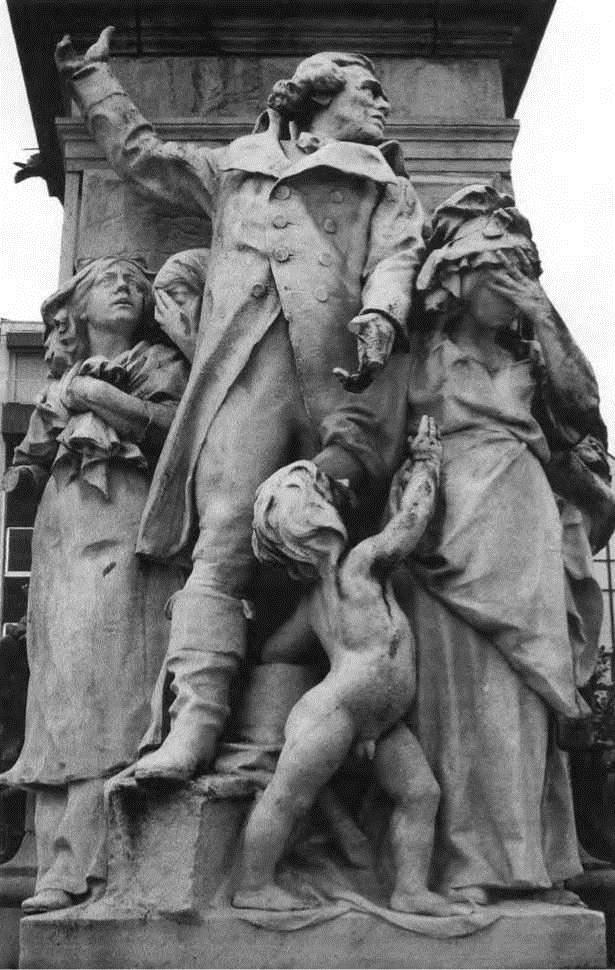
(Danton haranguing ladies of the food market (Bas relief on the statue of Danton at Tarbes, France))
Danton’s voice was of immense scope and volume: he could tone it down to the soft and tender chirps of a cooing dove, or could bellow like a Stentor. When angry or emphatic he could be heard an incredible distance. Michelet describes him as shaking the windows while addressing the Club of the Cordeliers. At his trial he was distinctly heard by a vast multitude of people that had gathered outside of the court house.
The energy of Danton in the days of his activity was prodigious; his labors were titanic, no task was impossible, and yet we marvel that in the time allotted to him he accomplished so much. His entire political career extended over a comparatively short period, three years at the most; but in that brief space he made his reputation. It was not a slow ascent to fame by years of preparation and service under a settled government, but an immediate, a sudden rise to power, to be cut short in the heyday of his manhood, for he went to the scaffold in the thirty-fifth year of his age, even before he had reached the real prime and vigor of his life. [...]
It was not until the death of Mirabeau that he took a prominent part in the politics of the nation. Before that his reputation was local, virtually confined to the section of the Cordeliers, so that his political career covered a period of perhaps less than three years; but it was a most strenuous period, for in those three years history was made faster than it is in a decade under a settled government in time of peace.
A superficial glance at the French Revolution is apt to give the impression that it was but a saturnalia of crime. A closer inspection, however, will prove that this was not the case. It had a meaning and a purpose; it was a dreadful reckoning with the past; it was a heroic effort for the liberation of mankind from tyranny. “When oppression renders a revolution necessary,” said La Fayette, “insurrection is the most sacred of duties.”
“The nation was worn out with long wars and exhausted by supplying the extravagance of its rulers, who gave themselves up alternately to a fondness for pleasure and for arms.” The leaders of the Revolution saw in man, irrespective of his position in social and political life, a human being entitled to the sympathies of his fellows and the protection of government, not a creature to be oppressed but to be elevated, not to be deprived of his rights but to be secure in their enjoyment.
The energies of the Revolution may have been misdirected by vicious and ambitious men, in its excesses it may have disgraced and dishonored humanity, it may not have accomplished all that it should have attained, but it must be admitted that it did moderate the power of the tyrant and if it did nothing more than effect the abolition of feudalism that was worth all the blood that was shed. It was a tremendous burst of energy, agitating all France and every state in Europe. It was like a seething volcano that had been accumulating its force for centuries, and when it broke forth it overwhelmed and submerged everything in its pathway and shook the earth with its vibrations. Paris was the crater of this volcanic eruption.
The French Revolution was a war of ideas, and, although the ideas at times were confused, out of all this chaos were at last evolved the principles of law, justice, equality, and humanity. Judge it not alone by its excesses but also by its results; for notwithstanding its terrors, its horrors, its crimes, it was a blessing to mankind, overthrowing many vile institutions and reforming many others which it did not destroy. In the life of the civilized world today are to be traced its principles, its purposes, its philosophy.
from Charles F. Warwick, Danton and the French Revolution, George W. Jacobs Publishers, Philadelphia, 1908, ch. XXXIII, pp.423-450
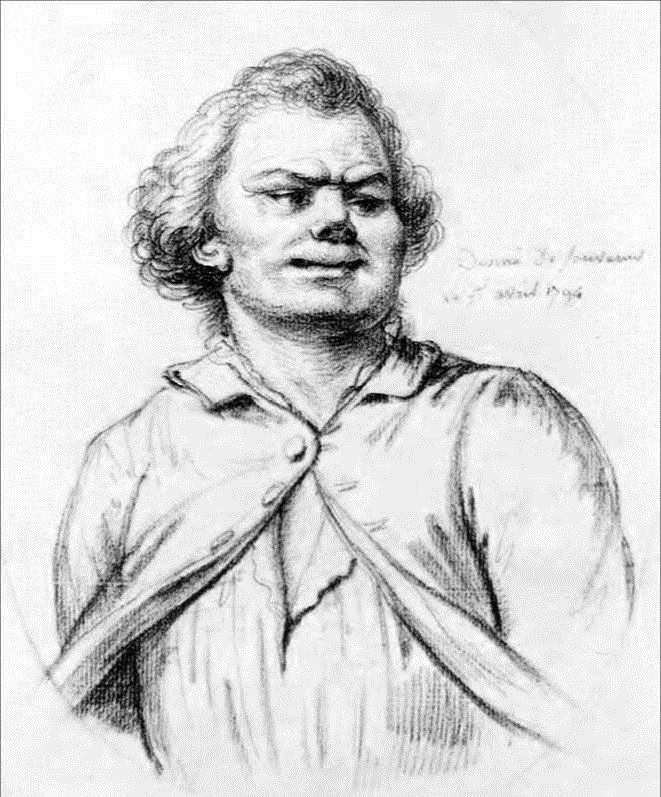
(Danton on the scaffold)
Danton’s Important Speeches
(A few extracts)
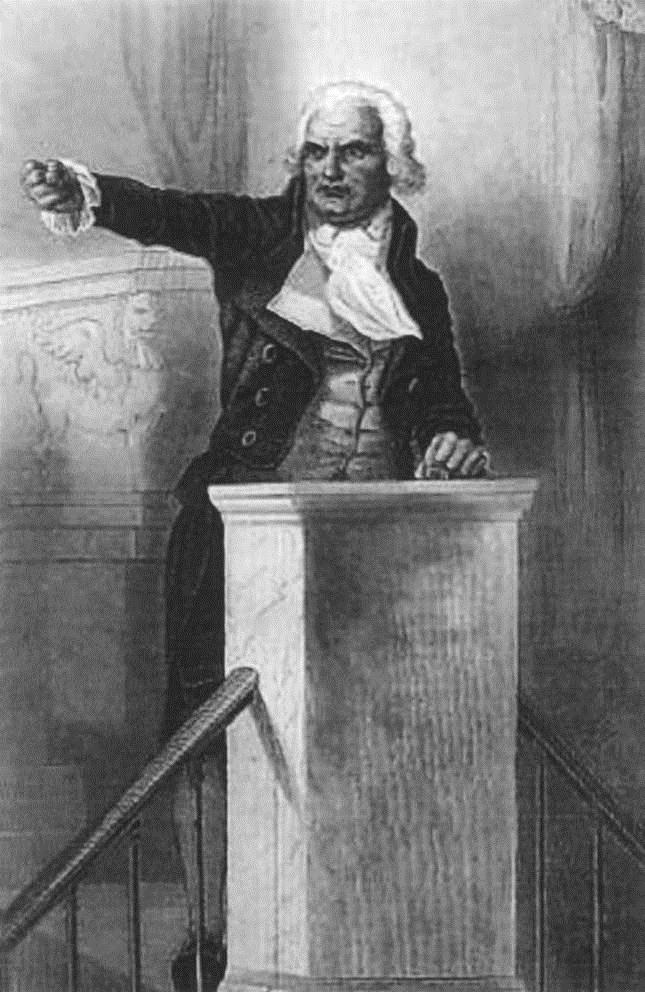
(Danton speaking at the Convention)
In December 1791, Danton was elected joint deputy-procureur of the Commune of Paris and on this occasion delivered a memorable speech of which we give below a few extracts:
... My duty, gentlemen, is to take my seat among you because the friends of liberty and the Constitution so will it, a duty the more the binding because at a moment when the country is threatened on all sides it is impossible to refuse a post which, like a sentinel’s on outpost duty, may be one of peril. In embarking on the career thus opened to me I should not have addressed you now, after having disdained to say a word during all the Revolution in answer to innumerable calumnies, but should have let time and my conduct speak for me, if the functions to which I am about to devote myself had not wholly altered my position. As an individual I scorn the shafts aimed at me as I do the whistling of an idle wind. But I owe it to the people as their servant, if not to reply to every petty and contemptible accusation, at least to combat hand to hand anyone seeming to be sincere in his attacks.
Paris, like France, consists of three divisions. One hates all liberty, all equality, all constitutions, and deserves all the ills which would have crushed it as it would like to crush the nation. With it I hold no parley. My one wish is to fight it to the death. The second consists of the flower of the Revolution’s ardent friends, coadjutors, and strongest mainstays. It has always wished me to be here. It needs no words of mine. Its judgment has been passed on me. I will never betray its trust. The third, as numerous as it is well meaning, is equally desirous of liberty, but dreads its storms. It does not hate its champions, whom it would second at a crisis, but it often condemns their energy, which it deems habitually out of place or dangerous. It is to citizens of this class, whom I respect even when they lend too ready an ear to the perfidious machinations of men hiding atrocious designs under the mask of moderation, to these, I say, I feel it my duty as a magistrate of the people frankly and solemnly to enunciate my political principles.
Nature has endowed me with an athletic form and liberty’s rugged features. Happy in not being born of one of our old, privileged, and consequently emasculated orders, I am a self-made man with all my natural forces intact, though never for a moment ceasing, either in private life or the profession I have chosen, to show my ability to combine cool reason with a warm heart and strength of character. If in the springtide of our country’s regeneration my love of my country has been an over boiling passion; if to avoid seeming weak I have allowed myself to seem extravagant [...]—it is because I am accustomed to act in accordance with the eternal laws of justice, it is because I am incapable of continuing intimacies which are no longer honourable and associations with men who dare to apostatise from the faith in the people which they once proclaimed.
So much for my past life. Now, gentlemen, for the future. I have been appointed to help to maintain the Constitution and to execute the laws to which the nation has sworn. Well, I will keep my oath. I will fulfil my duty. I will to the utmost of my ability maintain the Constitution and only the Constitution, since so I shall at the same time defend equally liberty and the people. My predecessor said that in conferring office upon him the King gave a new proof of his attachment to the Constitution. With at least equal ardour the people in choosing me wills that Constitution. Therefore it has seconded the King’s intentions. Are they not two eternal truths which we have uttered, he and I? All history proves that never has a people under its own laws, under a constitutional monarchy, been the first to break the covenant. Nations never change or modify their Government unless driven to do so by outrageous oppression. Constitutional Monarchy may last for centuries longer than Despotic Monarchy has lasted. They are philosophers only in name who frame only systems for the destruction of empires. Vile flatterers of kings who tyrannise over and starve the people are surer causes of desire for another government than all the philanthropists who publish schemes of absolute liberty. The French nation with greater self-respect has not lost its greater generosity. Breaking its fetters it has preserved the Monarchy without fearing it, and without hating it has purged it of its taints. Royalty should respect a people in whom long oppression has not obliterated the inclination to be trustful, often too trustful. Let it hand over of its own accord to the law’s vengeance all conspirators without exception, and all those lackeys of conspiracy who get kings to give them instalments of sham reactions to which they then want to rally, so to speak, a party on trust.
Let royalty at length show itself the loyal friend of liberty, its sovereign; then it may be sure of lasting as long as the nation itself; then it will be seen that the citizens who are only accused of exceeding the Constitution by the very men who clearly will not carry it into effect, that these citizens, whatever arbitrary theories they may have about liberty, do not seek to break the social pact; that they do not wish, for the sake of something ideally better, to overthrow an order of things based on equality, justice, and liberty. Yes, gentlemen, I must repeat it: whatever my own ideal was, when the Constitution was being revised, as to things and persons, now the oath has been taken I would cry aloud for the death of him who should raise a sacrilegious hand against it, were he my brother, my friend, or my own son.
Such are my sentiments. The general will of the French people, as shown in its solemn adhesion to the Constitution, shall always be my supreme law. I have consecrated my whole life to the people, which will never again be attacked, be betrayed, with impunity, and will soon sweep all tyrants off the earth if they do not abandon the league they have formed against it. I will die, if necessary, in defence of its cause. My last prayers shall be in its behalf. It and it only deserves them. Its intelligence, its courage, have raised it from the depths of nothingness. The same intelligence and courage shall make it immortal.
On September 2, 1792, at one o’clock in the morning, Danton, then Minister of Justice, made his famous speech in the Legislative Assembly which ends with the immortal sentence: “To conquer, gentlemen, we must dare, and dare, and dare, and so save France”. He was trying to counter the spread of panic in the Assembly, in the Commune as well as in Paris due to the foreign invasion and initial defeats and restore order without which the much needed disciplined and forceful action became difficult. Shortly after this speech, he went to the Champ de Mars, a large place in the centre of Paris and there, he harangued the crowd to enlist so that many volunteers from the people would join to oppose the invasion. Three weeks later came the famous victory of Valmy where an army of volunteers won the battle over the professional armies of the enemy.
It is, gentlemen, gratifying to the Minister of a free people to have to announce to you that the country is on the way to safety. Everywhere it is alert, astir, afire for battle. You know that Verdun is not yet in the enemy’s hands. You know that the garrison has sworn to sacrifice the man who first utters the word ‘Surrender.’ Our people are on the way, some to the frontier, others to dig entrenchments, while the rest will defend our towns with their pikes. Paris is about to second these splendid efforts. The Commissioners of the Commune are going by solemn proclamation to invite citizens to arm themselves and march in the country’s defence. This, gentlemen, is a moment when you may proclaim that the capital has deserved well of France. This is a moment when the National Assembly is about to turn itself into a War Committee. We demand your concurrence with us in directing this sublime movement of the people, by nominating Commissioners to second us in these great measures. We demand punishment of death against anyone refusing to serve or surrender arms. We demand that instructions shall be issued to the citizens which shall give method to their movements. We demand the despatch of couriers to all the departments, notifying them of the decrees you will have issued. The tocsin which is about to sound is no alarm-signal but a summons to charge the foe. To conquer, gentlemen, we must dare, and dare, and dare, and so save France.
During the early days of the Convention which met first on September 21, 1792, there were rumours of conspiracies towards dictatorship. Danton spoke forcefully for liberty but also for fairness in dealing with accusations which might be unfounded. He once more called for the unity of France.
… It is an auspicious day for the nation and the French republic which brings us to fraternal explanations. If there are criminals, if there exists any man so ill-minded as to desire to dominate the people’s representatives despotically, let him be unmasked, let his head fall. There are rumours of dictatorships and triumvirates. Such charges should not be vague and indefinite. Let the man who makes them give his name. I would do so myself were the charge to involve the death of my best friend. The members for Paris ought not to be charged collectively. I shall not attempt to answer for each of them. I am responsible for no one, shall speak for no one but myself. I am ready to recapitulate to you all my public career. For three years I did all that I felt it my duty to do in the cause of liberty. As Minister I used all the vigour in me to the utmost. To the Council I brought all the zeal and energy of a citizen glowing with love for his country. […]
It is very true that excellent citizens have allowed themselves to carry republicanism to excess. It cannot be denied. But no one has a right to accuse a group of members of the excesses of the individuals who compose it. As for me, I do not belong to Paris. I belong by birth to a Department towards which my eyes always turn fondly, but not one of us belongs to this or that Department, but to all France. Leaving personalities, therefore, let us consider what is the interest of the State. A strong law to put down conspiracies against liberty is undeniably necessary. Well, let us pass such a law, a law making advocacy of a triumvirate or dictatorship punishable with death. But while laying firmly the foundations of equality, let us crush out the spirit of faction, which can only end in ruin. It is alleged that there are men among us who would like to dismember France. Let us dispel fantasies so monstrous by making advocacy of them punishable with death. France must be an indivisible whole. The men of Marseilles stretch out hands to the men of Dunkirk. I demand, therefore, the death-penalty against anyone attempting to destroy the unity of France, and I propose that the Convention should lay down, as the basis of the Government it is to constitute, unity of representation, unity of executive. Such concord is sacred. To hear of it will make the Austrian tremble. Achieve it and your enemies are no more.
By February 1793, France was at war with Austria, Prussia, England, Holland, Sardinia and Spain. The situation was again quite desperate. The French armies were dispirited and disorganized. Danton had just lost his wife to whom he was fondly attached and he was truly broken-hearted. But yet again, as in August, when men’s hearts were failing them for fear, Danton remained undaunted and for the second time infused his own spirit into the nation. On March 8, 10 and 11, he made a succession of great speeches on the imminence of the danger and the spirit in which it should be met.
... With a general’s genius Dumouriez unites the art of inspiring and cheering the soldier. We have heard the army even in the hour of defeat calling for him with loud cries. History will judge his talents, his passions, his faults. But one thing is certain—that his interest is in the splendour of the Republic. If we support him, if we send an army to aid him, he will soon make our enemies repent of their past successes....
This he said in the first of his speeches, after some letters from Dumouriez had been read in the Assembly. The necessity of reinforcing the army was its keynote.
... Only danger could evoke the full energy of Frenchmen. Recruiting was well enough, but what was wanted was volunteers, the volunteers of 1792, the volunteers of Paris. Paris must rekindle the blaze she lighted then, and do it at once, without a moment’s delay. Commissioners must visit every Section that very night (‘ce soir’), and call out its members to enlist, to fly to the defence of Belgium, in redemption of liberty and their oaths to their country. It was not the generals but themselves who were to blame in having promised reinforcements never sent. In 1792 the enemy had begun by victories. But those victories had roused the nation. So now let it be again, and let the Commissioners be appointed that very hour (‘a I’instant’)....
The subsequent reports of the Commissioners showed how effective had been the results of their mission.
On the 9th he proposed the release of all who were imprisoned for debt, to give them the chance of volunteering:
.. the propertied class must not take fright at his proposal. Whatever extravagances individuals might have countenanced the nation would always respect the rights of property. But if the poor were to respect the rich the rich must respect the poor. Even on lower grounds the lender would not suffer by his proposal. Now when he could imprison a debtor he was less cautious in his loans. It was not, however, on mercenary considerations but in accordance with eternal laws and the rights of humanity that misfortune should not be punished as a crime...
In so speaking Danton was in advance of his age….
The next day riots broke out in Paris in connection with, if not wholly in consequence of, disastrous rumours from Belgium and of alleged atrocities of the enemy in Liege. Danton's speech of the 10th was in effect an answer to that of Robespierre (who was mostly preoccupied with finding traitors), and in its first and last sentences, undisguisedly.
... What has been said to you about the general situation is true, but at the present moment we are less concerned with causes of our disasters than with the remedies. When I see the house ablaze I don’t attend to the rascals running off with the furniture: I put out the fire. What I wish to impress on you now you have heard Dumouriez’s letters read, is that if you would save the Republic you have not a moment to lose. The plan of Dumouriez was worthy of his genius. I am bound to say so, and more emphatically now than lately. He warned us three months ago that the difficulties in its way would be doubled if we were afraid to execute it in winter. We are to blame. Let us make amends. Let us march to his aid. Dumouriez only needs men. France has men in millions. Our enemies are making desperate efforts… Despatch your commissioners, then, at once. Sustain them energetically. Send them off this evening, this very night, with this message to the rich: ‘Either the aristocracy of Europe must pay our debt or you. All the people can give is its blood. It gives it lavishly. Be you lavish with your miserable gold.’ I brush aside all party passion. The only passion dear to me is the public good. In a terrible crisis, when the enemy was at our gates, I said: ‘Your disputes are despicable. I know no enemy but one. You weary me with your personal recriminations when you should be striving for the safety of the State. I abjure you all as traitors to the country. All of you are equally to blame.’ And I said: ‘Reputation! What do I care for my reputation? Blighted be my name so France be free.’ Why haggle about the loss this or that party will sustain by commissioners being chosen from its ranks? Scorn such fears. Think only of disseminating your energy through France. The post of honour is his who proclaims to the people that the terrible debt under which it staggers shall be paid by the enemy or the rich. We are in cruel straits, with our discredited currency and starving workmen. We want a radical cure. On, then! let us conquer Holland, reanimate English republicans, move all France to the war, and so win imperishable glory. Be worthy of your noble destiny. No recriminations, no quarrels, and the country is saved...
On the 30th of March, some members in the Convention attacked Danton. He answered that he was prepared to face all the accusations which he considered to be calumnies. But then he made a passionate appeal that everything should be in the open and his adversaries, whoever they are, should be as frank as he was:
.. So prepare to be as frank as I am—frank men even in your hatred, frank in your passions. All these discussions may even now, perhaps, profit the State. Our ills spring from our dissensions. Well, let us make a clean breast of them all. For how comes it that one half of this Assembly treats the other as conspirators, that one half thinks the other wishes to have it massacred? There was a time for passion. Unhappily that is in the course of Nature. But the hour has come for a complete understanding, that everyone may judge himself according to his own conscience. Let it be known, then, whether you are two factions in one body, an Assembly full of reciprocal jealousy, or whether you are united to save the country. Do you long for reconciliation? Then with one accord concur in those strict and strong measures demanded by the people against the treasons of which it has so long been victim. Tell the people the truth. Arm them. Armies on the frontiers are not enough. We want at the centre of the Republic one main column which may facilitate war abroad by confronting the enemy at home...
Danton was truly larger than life. Such personalities easily attract accusations by lesser men who are jealous of such vital power. One of the most common attacks was about his suspected venality, a charge which could never be really substantiated. His natural largeness of vision made men of more narrow conviction uneasy and they would quickly suspect him of betrayal. So he had often to defend himself, a, for instance, he did once in the Club of Jacobins on December 3, 1793:
... I heard some uncomplimentary remarks. Already grave charges have been brought against me. I claim the right to clear myself before the people, who can easily be made to see my innocence and my love of liberty. I summon all who may have conceived reasons for distrusting me to specify their accusations, for I wish to answer them publicly. I have been met with marks of hostility on mounting the rostrum. Have I, then, lost the look of a man who is free? Am I no longer he who stood at your side in the hour of danger? Am I no longer the man whom you have often embraced as your friend, and who would die with you? Have I not been made the target of persecution? I was one of Marat’s boldest champions. I call to witness the shade of the Friend of the People in my justification. You will be amazed, when I initiate you into my private life, to see that the colossal fortune attributed to me by men who are as much your enemies as mine dwindles to the modicum of property I have always possessed. I defy my ill-wishers to produce against me proof of any crime. All their attempts will fail to overwhelm me. I want to stand face to face with the people. You shall judge me in its presence. I will no more tear out a page of my life than you will one of yours destined to make the annals of liberty immortal...
Finally Danton was arrested and put on trial early April 1794 with some of his close associates. The extremists such as Robespierre who were then leading the Revolution in its period of Terror considered Danton’s great popularity as a danger, as they were aware that he felt that there was no necessity to continue with the terror. During the trial, at the beginning when he was allowed to speak, Danton spoke very eloquently and the impact of his words were so great on the large crowd which had come inside and outside to listen that the authorities took fright and decided to find devious ways to silence him. They pretended that the discovery of a “conspiracy” made it necessary to silence the accused. Indeed, they later destroyed the records of the trial so that the traces of Danton’s remarkable self defence were erased. Below are a few sentences which are attributed to Danton during these days of the trial, which have been noted and preserved by some witnesses.
Let the cowards who calumniate me confront me. Only let them show themselves and I will cover them with ignominy.
My life! I am weary of it. I long to be quit of it.
Men of my stamp have no price. On their foreheads are stamped in ineffaceable characters the seal of liberty, the genius of republicanism.
Ah! St. Just, thou shall answer to posterity for thy defamation of the people’s best friend and boldest champion.
As I read through this list of horrors I shudder all over with indignation.
Let my accusers come forward, and I will plunge them into the nothingness out of which they ought never to have emerged. Appear, you impostors, and I will tear off the mask which conceals you from the people’s vengeance.
Never was I influenced by cupidity or ambition. Never have my private feelings compromised the public welfare. Always for my country, body and soul, I have sacrificed without stint for it the whole of my being.
Two days this tribunal has known Danton. To-morrow he hopes to sleep on the bosom of glory. Never has he prayed for indulgence, and he will be seen hasting to the scaffold with the serenity of an innocent conscience.
Speeches extracts from A.H. Beesly, Life of Danton, Longman, Green, and Co, London, New York and Bombay, 1906
The Convention
(By Victor Hugo)
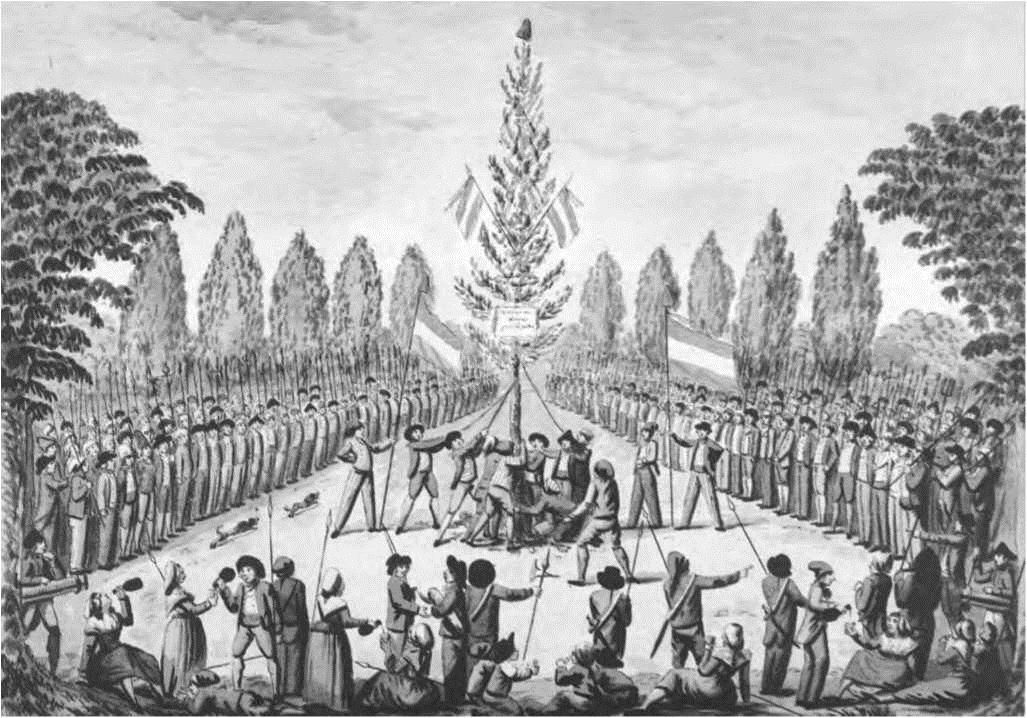
(Ceremony of the erection of a Liberty Tree)
The Convention was the third parliament assembly, after the Constituante and Legislative assemblies, during the French Revolution. It lasted from 21 September 1972 to 26 October 1795. As the Convention is generally identified with the Terror period of the Revolution, during which there had been excesses and atrocities, it has acquired a rather dubious reputation. But the Convention has also been an assembly in which some eminent members did an enormous work of inventing and creating a new society. After the Convention, France had deeply changed at many levels, changes which would be later completed and consolidated by Napoleon. The famous French poet Victor Hugo, who was born only a few years after the end of the Revolution, was a great admirer of the Convention. We give below a few extracts of the inspired pages he dedicated to the Convention in his celebrated book Ninety-Three, pages in which he vividly recreates the special atmosphere of this assembly.
THE CONVENTION.
We approach the grand summit. Behold the Convention!
The gaze grows steady in presence of this height.
Never has a more lofty spectacle appeared on the horizon of mankind.
There is one Himalaya, and there is one Convention.
The Convention is perhaps the culminating point of History.
During its lifetime—for it lived—men did not quite understand what it was. It was precisely the grandeur which escaped its contemporaries; they were too much scared to be dazzled. Everything grand possesses a sacred horror. It is easy to admire mediocrities and hills; but whatever is too lofty, whether it be a genius or a mountain—an assembly as well as a masterpiece—alarms when seen too near. An immense height appears an exaggeration. It is fatiguing to climb. One loses breath upon acclivities, one slips down declivities; one is hurt by sharp, rugged heights which are in themselves beautiful; torrents in their foaming reveal the precipices; clouds hide the mountain-tops; a sudden ascent terrifies as much as a fall. Hence there is a greater sensation of fright than admiration. What one feels is fantastic enough—an aversion to the grand. One sees the abyss and loses sight of the sublimity; one sees the monster and does not perceive the marvel. Thus the Convention was at first judged. It was measured by the purblind,—it, which needed to be looked at by eagles.
To-day we see it in perspective, and it throws across the deep and distant heavens, against a background at once serene and tragic, the immense profile of the French Revolution. [....]
Among these men full of passions were mingled men filled with dreams. Utopia was there under all its forms,—under its warlike form, which admitted the scaffold, and under its innocent form, which would abolish capital punishment; phantom as it faced thrones; angel as it regarded the people. Side by side with the spirits that fought were the spirits that brooded. These had war in their heads, those peace. One brain, Carnot, brought forth fourteen armies; another intellect, Jean Debry, meditated a universal democratic federation.
Amid this furious eloquence, among these shrieking and growling voices, there were fruitful silences. Lakanal remained voiceless, and combined in his thoughts the system of public national education; Lanthenas held his peace, and created the primary schools; Revelliere Lepaux kept still, and dreamed of the elevation of Philosophy to the dignity of Religion. Others occupied themselves with questions of detail, smaller and more practical. Guyton Morveaux studied means for rendering the hospitals healthy; Maire, the abolition of existing servitudes; Jean Bon Saint-Andre, the suppression of imprisonment for debt and constraint of the person; Romme, the proposition of Chappe; Duboe, the putting the archives in order; Coren Fustier, the creation of the Cabinet of Anatomy and the Museum of Natural History; Guyomard, river navigation and the damming of the Scheldt. Art had its monomaniacs. On the 21st of January, while the head of monarchy was rolling on the Place de la Revolution, Bezard the Representative of the Oise, went to see a picture of Rubens, which had been found in a garret in the Rue Saint-Lazare. Artists, orators, prophets, men-giants like Danton, child-men like Cloots, gladiators and philosophers, all had the same goal,—progress. Nothing disconcerted them. The grandeur of the Convention was the searching how much reality there is in what men call the impossible. At one extreme, Robespierre had his eye fixed on Law; at the other, Condorcet had his fixed on Duty.
Condorcet was a man of reverie and enlightenment. Robespierre was a man of execution; and sometimes, in the final crises of worn-out orders, execution means extermination. Revolutions have two currents,—an ebb and a flow; and on these float all seasons, from that of ice to flowers. Each zone of these currents produces men adapted to its climate, from those who live in the sun to those who dwell among the thunderbolts. [....]
The people had a window opening on the Convention,—the public tribunes; and when the window was not sufficient, they opened the door, and the street entered the Assembly. These invasions of the crowd into that senate make one of the most astounding visions of history. Ordinarily those irruptions were amicable. The market-place fraternized with the curule chair; but it was a formidable cordiality,—that of a people who one day took within three hours the cannon of the Invalides and forty thousand muskets besides. At each instant a troop interrupted the deliberations; deputations presented at the bar petitions, homages, offerings. The pike of honour of the Faubourg Saint Antoine entered, borne by women. Certain English offered twenty thousand pairs of shoes for the naked feet of our soldiers. “The citizen Arnoux,” announced the Moniteur, “Cure of Aubignan, Commandant of the Battalion of Drome, asks to march to the frontiers, and desires that his cure may be preserved for him.”
Delegates from the Sections arrived, bringing on hand-barrows, dishes, patens, chalices, monstrances, heaps of gold, silver, and enamel, presented to the country by this multitude in rags, who demanded for recompense the permission to dance the Carmagnole before the Convention. Chenard, Narbonne, and Valliere came to sing couplets in honour of the Mountain. The Section of Mont Blanc brought the bust of Lepelletier, and a woman placed a red cap on the head of the President, who embraced her. The citizenesses of the Section of the Mail “flung flowers” to the legislators. “The pupils of the country” came, headed by music, to thank the Convention for having prepared the prosperity of the century. The women of the Section of the Gardes Francaises offered roses; the women of the Champs Elysees Section gave a crown of oak-leaves; the women of the Section of the Temple came to the bar to swear “only to unite themselves with true Republicans.” The Section of Moliere presented a medal of Franklin, which was suspended by decree on the crown of the statue of Liberty. The Foundlings—declared the Children of the Republic—filed through, habited in the national uniform. The young girls of the Section of Ninety-two arrived in long white robes, and the “Moniteur” of the following morning contained this line: “The President received a bouquet from the innocent hands of a young beauty.” The orators saluted the crowds, sometimes flattered them: they said to the multitude, “Thou art infallible; thou art irreproachable; thou art sublime.” The people have an infantile side: they like those sugar-plums. Sometimes Riot traversed the Assembly: entered furious and withdrew appeased, like the Rhone which traverses Lake Leman, and is mud when it enters and pure and azure when it pours out.
Sometimes the crowd was less pacific, and Henriot was obliged to come with his furnaces for heating shot to the entrance of the Tuileries.
At the same time that it threw off revolution, this Assembly produced civilization. Furnace, but forge too.
In this caldron, where terror bubbled, progress fermented. Out of this chaos of shadow, this tumultuous flight of clouds, spread immense rays of light parallel to the eternal laws,—rays that have remained on the horizon, visible forever in the heaven of the peoples, and which are, one, Justice; another, Tolerance; another, Goodness; another, Right; another, Truth; another, Love.
The Convention promulgated this grand axiom: “The liberty of each citizen ends where the liberty of another citizen commences,”—which comprises in two lines all human social law. It declared indigence sacred; it declared infirmity sacred in the blind and the deaf and dumb, who became wards of the State; maternity sacred in the girl-mother, whom it consoled and lifted up; infancy sacred in the orphan, whom it caused to be adopted by the country; innocence sacred in the accused who was acquitted, whom it indemnified. It branded the slave-trade; it abolished slavery. It proclaimed civic joint responsibility. It decreed gratuitous instruction. It organized national education by the normal school of Paris; central schools in the chief towns; primary schools in the communes. It created the academies of music and the museums. It decreed the unity of the Code, the unity of weights and measures, and the unity of calculation by the decimal system. It established the finances of France, and caused public credit to succeed to the long monarchical bankruptcy. It put the telegraph in operation. To old age it gave endowed almshouses; to sickness, purified hospitals; to instruction, the Polytechnic School; to science, the Bureau of Longitudes; to human intellect, the Institute. At the same time that it was national it was cosmopolitan. Of the eleven thousand two hundred and ten decrees which emanated from the Convention, a third had a political aim; two thirds, a human aim. It declared universal morality the basis of society, and universal conscience the basis of law. And all that servitude abolished, fraternity proclaimed, humanity protected, human conscience rectified, the law of work transformed into right, and from onerous made honourable,—national riches consolidated, childhood instructed and raised up, letters and sciences propagated, light illuminating all heights, aid to all sufferings, promulgation of all principle,—the Convention accomplished, having in its bowels that hydra, the Vendee 6; and upon its shoulders that heap of tigers, the kings.7
Immense place! All types were there,—human, inhuman, superhuman. Epic gathering of antagonisms. [....]
Spirits which were a prey of the wind. But this was a miracle-working wind. To be a member of the Convention was to be a wave of the ocean. This was true even of the greatest there. The force of impulsion came from on high. There was a Will in the Convention which was that of all, and yet not that of anyone person. This Will was an Idea,—an idea indomitable and immeasurable, which swept from the summit of heaven into the darkness below. We call this Revolution. When that Idea passed, it beat down one and raised up another; it scattered this man into foam and dashed that one upon the reefs. This Idea knew whither it was going, and drove the whirlpool before it. To ascribe the Revolution to men is to ascribe the tide to the waves.
The Revolution is a work of the Unknown. Call it good or bad, according as you yearn toward the future or the past, but leave it to the power which caused it. It seems the joint work of grand events and grand individualities mingled, but it is in reality the result of events. Events dispense, men suffer; events dictate, men sigh. The 14th of July is signed Camille Desmoulins; the 10th of August is signed Danton; the 2nd of September is signed Marat; the 21st of September is signed Gregoire, the 21st of January is signed Robespierre; but Desmoulins, Danton; Marat, Gregoire, and Robespierre are mere scribes. The great and mysterious writer of these grand pages has a name,—God; and a mask, Destiny. Robespierre believed in God: yea, verily!
The Revolution is a form of the eternal phenomenon which presses upon us from every quarter, and which we call Necessity. Before this mysterious complication of benefits and sufferings arises the Wherefore of history. Because: this answer of him who knows nothing is equally the response of him who knows all.
In presence of these climacteric catastrophes which devastate and revivify civilization one hesitates to judge their details. To blame or praise men on account of the result is almost like praising or blaming ciphers on account of the total. That which ought to happen happens; the blast which out to blow blows. The Eternal Serenity does not suffer from these north winds. Above revolutions Truth and Justice remain as the starry sky lies above and beyond tempests.
Such was the unmeasured and immeasurable Convention,—a camp cut off from the human race, attacked by all the powers of darkness at once; the night-fires of the besieged army of Ideas; a vast bivouac of minds upon the edge of a precipice. There is nothing in history comparable to this group, at the same time senate and populace, conclave and street-crossing, Areopagus and public square, tribunal and the accused.
The Convention always bent to the wind; but that wind came from the mouth of the people, and was the breath of God.
And to-day, after eighty-four years have passed away, always when the Convention presents itself before the reflection of any man, whosoever he may be,—historian or philosopher,—that man pauses and meditates. It would be impossible not to remain thoughtfully attentive before this grand procession of shadows.
From Victor Hugo, Ninety-Three, Carroll & Graf Publishers, Inc., New York 1998
The French Revolution
(A text by Sri Aurobindo)
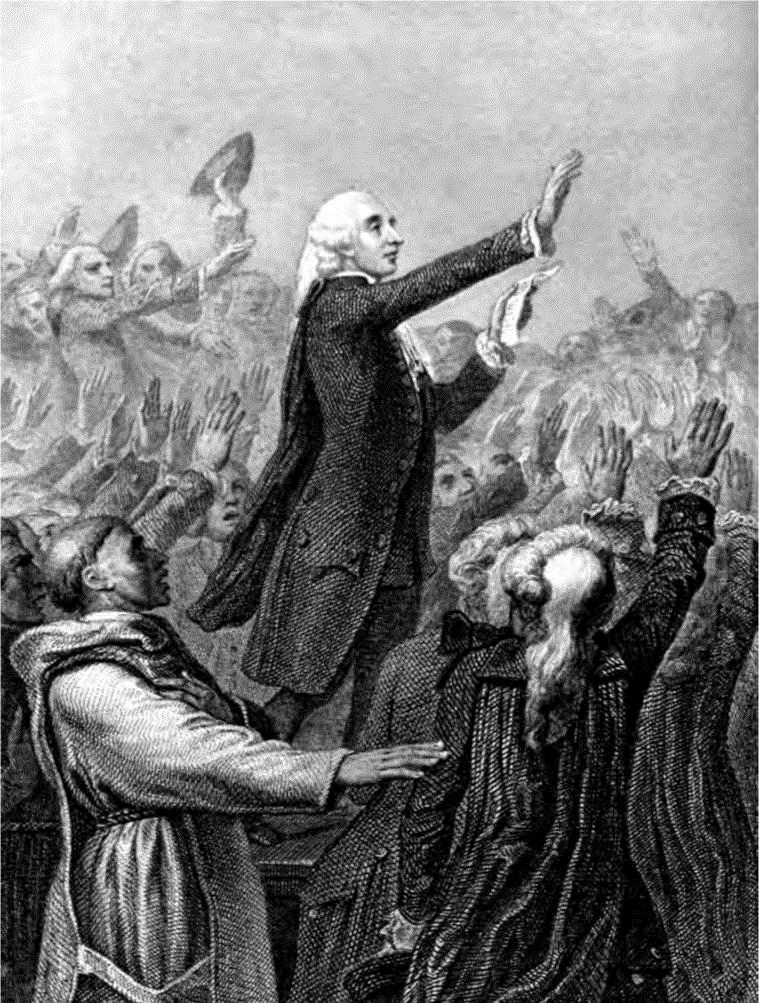
(Tennis Court Oath (detail), painting by David)
The greatness of the French Revolution lies not in what it effected, but in what it thought and was. Its action was chiefly destructive. It prepared many things, it founded nothing. Even the constructive activity of Napoleon only built a halfway house in which the ideas of 1789 might rest until the world was fit to understand them better and really fulfil them. The ideas themselves were not new; they existed in Christianity and before Christianity they existed in Buddhism; but in 1789 they came out for the first time from the Church and the Book and sought to remodel government and society. It was an unsuccessful attempt, but even the failure changed the face of Europe. And this effect was chiefly due to the force, the enthusiasm, the sincerity with which the idea was seized upon and the thoroughness with which it was sought to be applied. The cause of the failure was the defect of knowledge, the excess of imagination. The basal ideas, the types, the things to be established were known; but there had been no experience of the ideas in practice. European society, till then, had been permeated, not with liberty, but with bondage and repression; not with equality, but with inequality and injustice; not with brotherhood, but with selfish force and violence. The world was not ready, nor is it even now ready for the fullness of the practice. It is the goal of humanity, and we are yet far off from the goal. But the time has come for an approximation being attempted. And the first necessity is the discipline of brotherhood, the organisation of brotherhood,—for without the spirit and habit of fraternity neither liberty nor equality can be maintained for more than a short season. The French were ignorant of this practical principle; they made liberty the basis, brotherhood the superstructure, founding the triangle upon its apex. For owing to the dominance of Greece and Rome in their imagination they were saturated with the idea of liberty and only formally admitted the Christian and Asiatic principle of brotherhood. They built according to their knowledge, but the triangle has to be reversed before it can stand permanently.
Sri Aurobindo, Early Cultural Writings: Historical Impressions: The French Revolution
The action of the French Revolution was the vehement deathdance of Kali trampling blindly, furiously on the ruins She made, mad with pity for the world and therefore utterly pitiless. She called the Yatudhani in her to her aid and summoned up the Rakshasi. The Yatudhani is the delight of destruction, the fury of slaughter, Rudra in the Universal Being, Rudra, the bhuta, the criminal, the lord of the animal in man, the lord of the demoniac, Pashupati, Pramathanatha. The Rakshasi is the unbridled, licentious self-assertion of the ego which insists on the gratification of all its instincts good and bad and furiously shatters all opposition. It was the Yatudhani and the Rakshasi who sent their hoarse cry over France, adding to the luminous mantra, Liberty, Equality, Fraternity, the stern and terrible addition “or Death.” Death to the Asura, death to all who oppose God’s evolution, that was the meaning. With these two terrible Shaktis Kali did Her work. She veiled Her divine knowledge with the darkness of wrath and passion, She drank blood as wine, naked of tradition and convention She danced over all Europe and the whole continent was filled with the war cry and the carnage and rang with the hunkara and the attahasyam. It was only when She found that She was trampling on Mahadeva, God expressed in the principle of Nationalism, that She remembered Herself, flung aside
Napoleon, the mighty Rakshasa, and settled down quietly to her work of perfecting nationality as the outer shell within which brotherhood may be securely and largely organised.
The Revolution was also great in its men filling them all with its vehemence, its passion, its fierce demand on the world, its colossal impetus. Through four of them chiefly it helped itself, through Mirabeau, Danton, Robespierre and Napoleon. Mirabeau initiated, Danton inspired, Robespierre slew, Napoleon fulfilled. The first three appeared for the moment, the man in the multitude, did their work and departed. The pace was swift and, if they had remained, they would have outstayed their utility and injured the future. It is always well for the man to go the moment his work is done and not to outstay the Mother’s welcome. They are fortunate who get that release or are wise enough, like Garibaldi, to take it. Not altogether happy is their lot who, like Napoleon or Mazzini, outstay the lease of their appointed greatness.
Sri Aurobindo, Early Cultural Writings: Historical Impressions: The French Revolution
Mirabeau ruled the morning twilight, the sandhya of the new age. Aristocratic tribune of the people, unprincipled champion of principles, lordly democrat,—a man in whom reflection was turbulent, prudence itself bold, unflinching and reckless, the man was the meeting-place of two ages. He had the passions of the past, not its courtly restraint; the turbulence, genius, impetuosity of the future, not its steadying attachment to ideas. There is an honour of the aristocrat which has its root in manners and respects the sanctity of its own traditions; that is the honour of the Conservative. There is an honour of the democrat which has its root in ideas and respects the sanctity of its own principles; that is the honour of the Liberal. Mirabeau had neither. He was the pure egoist, the eternal Rakshasa. Not for the sake of justice and liberty did he love justice and liberty but for the sake of Mirabeau. Had his career been fortunate, the forms of the old regime wide enough to satisfy his ambitions and passions, the upheaval of 1789 might have found him on the other side. But because the heart and senses of Mirabeau were unsatisfied, the French Revolution triumphed. So it is that God prepares the man and the moment, using good and evil with a divine impartiality for His mighty ends. Without the man the moment is a lost opportunity; without the moment the man is a force inoperative. The meeting of the two changes the destinies of nations and the poise of the world is altered by what seems to the superficial an accident.
Sri Aurobindo, Early Cultural Writings: Historical Impressions: The French Revolution
There are times when a single personality gathers up the temperament of an epoch or a movement and by simply existing ensures its fulfilment. It would be difficult to lay down the precise services which made the existence of Danton necessary for the success of the Revolution. There are certain things he did, and no man else could have done, which compelled destiny; there are certain things he said which made France mad with resolution and courage. These words, these doings ring through the ages. So live, so immortal are they that they seem to defy cataclysm itself and insist on surviving eternal oblivion. They are full of the omnipotence and immortality of the human soul and its lordship over fate. One feels that they will recur again in aeons unborn and worlds uncreated. The power from which they sprang, expressed itself rarely in deeds and only at supreme moments. The energy of Danton lay dormant, indolent, scattering itself in stupendous oratory, satisfied with feelings and phrases. But each time it stirred, it convulsed events and sent a shock of primal elemental force rushing through the consciousness of the French nation. While he lived, moved, spoke, felt, acted, the energy he did not himself use, communicated itself to the millions; the thoughts he did not utter, seized on minds which took them for their own; the actions he might have done better himself, were done worse by others. Danton was contented. Magnificent and ostentatious, he was singularly void of personal ambition. He was satisfied to see the Revolution triumph by his strength, but in the deeds of others. His fall removed the strength of victorious Terror from the movement within France, its impulse to destroy and conquer. For a little while the impetus gathered carried it on, then it faltered and paused. Every great flood of action needs a human soul for its centre, an embodied point of the Universal Personality from which to surge out upon others. Danton was such a point, such a centre. His daily thoughts, feelings, impulses gave an equilibrium to that rushing fury, a fixity to that pregnant chaos. He was the character of the Revolution personified,—its heart, while Robespierre was only its hand. History which, being European, lays much stress on events, a little on speech, but has never realised the importance of souls, cannot appreciate men like Danton. Only the eye of the seer can pick them out from the mass and trace to their source those immense vibrations.
Sri Aurobindo, Early Cultural Writings: Historical Impressions: The French Revolution
One may well speak of the genius of Mirabeau, the genius of Danton; it is superfluous to speak of the genius of Napoleon. But one cannot well speak of the genius of Robespierre. He was empty of genius; his intellect was acute and well-informed but uninspired; his personality fails to impress. What was it then that gave him his immense force and influence? It was the belief in the man, his faith. He believed in the Revolution, he believed in certain ideas, he believed in himself as their spokesman and executor; he came to believe in his mission to slay the enemies of the idea and make an end. And whatever he believed, he believed implicitly, unfalteringly, invincibly and pursued it with a rigid fidelity. Mirabeau, Danton, Napoleon were all capable of permanent discouragement, could recognise that they were beaten, the hour unsuitable, fate hostile. Robespierre was not. He might recoil, he might hide his head in fear, but it was only to leap again, to save himself for the next opportunity. He had a tremendous force of sraddha. It is only such men, thoroughly conscientious and well-principled, who can slay without pity, without qualms, without resting, without turning. The Yatudhani seized on him for her purpose. The conscientious lawyer who refused a judgeship rather than sacrifice his principle by condemning a criminal to death, became the most colossal political executioner of his or any age. As we have said, if Danton was the character of the French Revolution personified when it went forth to slay, Robespierre was its hand. But, naturally, he could not recognise that limitation; he aspired to think, to construct, to rule, functions for which he was unfit. When Danton demanded that the Terror should cease and Mercy take its place, Robespierre ought to have heard in his demand the voice of the Revolution calling on him to stay his sanguinary course. But he was full of his own blind faith and would not hear. Danton died because he resisted the hand of Kali, but his mighty disembodied spirit triumphed and imposed his last thought on the country. The Terror ceased; Mercy took its place. Robespierre, however, has his place of honour in history; he was the man of conscience and principle among the four, the man who never turned from the path of what he understood to be virtue.
Sri Aurobindo, Early Cultural Writings: Historical Impressions: The French Revolution
Napoleon took up into himself the functions of the others. As Mirabeau initiated destruction, he initiated construction and organisation and in the same self-contradictory spirit; he was the Rakshasa, the most gigantic egoist in history, the despot of liberty, the imperial protector of equality, the unprincipled organiser of great principles. Like Danton, he shaped events for a time by his thoughts & character. While Danton lived, politics moved to a licentious democracy, war to a heroism of patriotic defence. From the time he passed, the spirit of Napoleon shaped events and politics moved to the rule first of the civil, then of the military dictator, war to the organisation of republican conquest. Like Robespierre he was the executive hand of destruction and unlike Robespierre the executive hand of construction. The fury of Kali became in him self-centred, capable, full of organised thought and activity, but nonetheless impetuous, colossal, violent, devastating.
Sri Aurobindo, Early Cultural Writings: Historical Impressions: The French Revolution
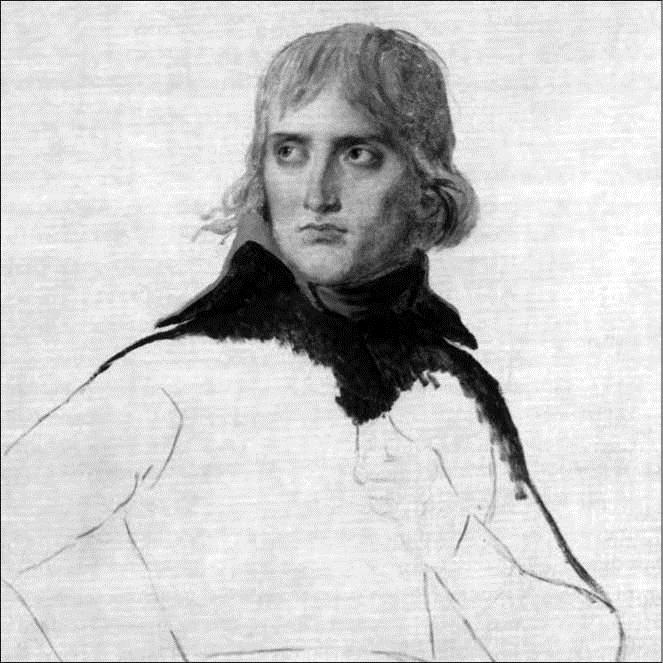
Appendices
Brief history of the French Revolution
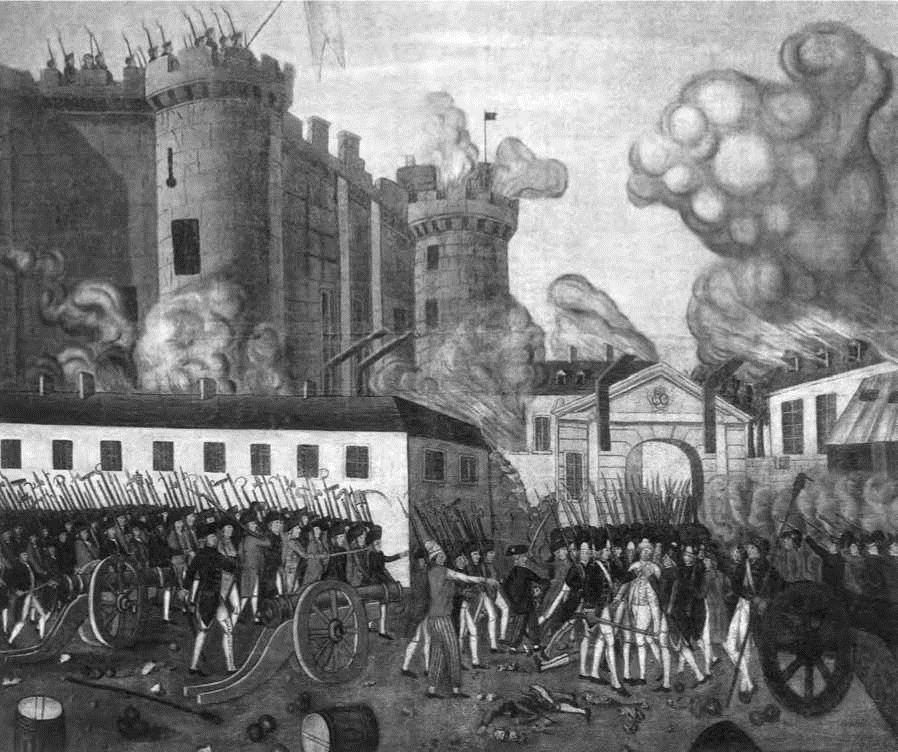
(Storming of La Bastille-14 July 1789, oil paint on canvas)
The French Revolution marked a turning point in European history. The events that began to unfold in 1787 and that terminated with the fall of Napoleon Bonaparte in 1815 unleashed forces that altered not only the political and social structure of states but the map of Europe. Many attempts were made, in France and in other European countries, to undo the work of the Revolution and to repress the ideas of liberty, equality, constitutionalism, democracy, and nationalism that the Revolution had inspired. But the Old Regime was dead, in France at least, and a Europe dominated by monarchy and aristocracy and by a hierarchical social order could never be fully restored. With the coming of the French Revolution, then, we enter into a more modern world—a world of class conflict, middle-class ascendancy, acute national consciousness, and popular democracy. Together with industrialization, the Revolution reshaped the institutions, the societies, and even the mentalities of Europeans.
The origins of the French Revolution
By the last half of the eighteenth century, France appeared to have overcome the dismal cycle of famine, plague, and high mortality that, previously, had inhibited both demographic and economic growth. The vast majority of Frenchmen who lived in the villages and tilled the fields were better off than their counterparts in most of Europe. French peasants, for example, owned some 40% of the country’s farmlands. The mild inflationary trend that characterized much of the eighteenth century increased the wealth of large landowners and surplus wealth in agriculture served to stimulate the expansion of the French economy as a whole. Modest advances in the textile and metallurgical industries, the construction of new roads and canals, and urban growth were other indications of economic development.
Yet, despite evident signs of prosperity, there was great discontent and restlessness in France in the 1780s. French institutions were obsolete, inefficient, and uncoordinated. They were controlled by the nobility and by self-perpetuating corporations of hereditary officeholders. To anyone touched by the ideas of the Enlightenment they seemed irrational and unjust. The middle classes, especially, were offended by the legal and social distinctions that kept them from attaining high office or exerting political influence. Every bishop in France was of noble birth; only nobles could receive commissions in the army; bourgeois plans for economic reform were constantly thwarted by the privileged classes. The economy, particularly in agriculture, remained unstable and subject to fluctuations that could drive the peasants and urban poor to starvation. An inefficient and inequitable tax system yielded too small an income to support the state, discouraged economic growth, and fell most heavily on the poor. On the eve of the Revolution, France faced a conjuncture of crises. Three of these crises—agrarian distress, financial chaos, and aristocratic reaction—were particularly acute.
Agrarian Distress
Bad weather and poor harvests in 1787 and 1788 weakened an agricultural economy that was already somewhat unstable. The poorer peasants lived at a subsistence level; with poor crops they starved. The purchasing power of well-to-do peasants declined. Grain shortages led to sharp price increases, particularly in the cost of bread. Moreover, from the late 1770s the long-term growth of the French economy had been interrupted in several important areas, such as the wine trade, and between 1776 and 1787, agricultural profits generally declined, though not to the low levels of the first part of the century. Nevertheless, noblemen and other large landowners, who had become accustomed to high profits, sought to save their own declining fortunes by demanding from their tenant farmers dues and obligations that had long been neglected. The countryside was ripe for revolution.
Financial Chaos
The finances of Louis XVI’s government were a shambles. By 1787 one-half of the nation’s tax revenues went to service the massive public debt that Louis XIV had left to his successors. France’s involvement in the Seven Years’ War and in the American War for Independence had driven the government further along the road to bankruptcy. Without a reform of the tax system the king could not meet his obligations. But such a reform would mean an attack on the privileges of the upper classes, and this Louis could never quite summon the courage to do.
Three ministers struggled with the problem. The first, the Swiss banker Necker, was dismissed by the king in 1781 after he had proposed some modest reforms. Necker’s successor, Calonne, thought he could carry on without much change. But as the deficit mounted he grew alarmed, and in 1786 he proposed a much more radical program than Necker’s. The most striking provision of Calonne’s program was a direct tax on all landowners-noble and commoner, lay and clerical… In addition, older taxes, such as the faille, which weighed on the lower orders, were to be reduced. Calonne’s reforms struck at the very heart of the system of privilege and the social hierarchy of the Old Regime.
Calonne, aware that there would be bitter opposition to his plans, persuaded the king to call a conference of notables hoping that they could be induced to back his program. But the members of this assembly, meeting in February 1787, were drawn largely from the privileged orders and refused to support Calonne.
The king now dismissed Calonne and put in his place one of Calonne’s chief opponent, Lomenie de Brienne, Archbishop of Toulouse. This prelate, though a member of both the higher nobility and the higher clergy, soon came to the same conclusions as Calonne. He tried to enact a similar reform program, but the Parlement of Paris, the most privileged of all the corporations of officeholders, refused to register the royal edicts. It declared that only the Estates General could approve such measures. When Brienne tried to break the opposition by exiling the magistrates of the Parlement and then by abolishing the high courts, he touched off furious protests by many members of the upper bourgeoisie and the nobility. In the face of attacks by the socially and politically powerful, the government backed away from its reform program. In July 1788, the king yielded to the opposition and ordered a meeting of the Estates General for May 1789.
Aristocratic Reaction
During the 1780s, then, aristocratic demands on the peasantry were aggravating the distress of the countryside, and aristocratic resistance to tax reform was hampering the government in its attempts to revamp the nation’s financial structure. These were two facets of the aristocratic reaction that was directly responsible for the coming of the French Revolution.
The tremendous strength of the French privileged classes had been built up steadily during the reigns of Louis XV and Louis XVI. At every turn the poor, the aspiring middle class, and enlightened reformers in government confronted the fact of privilege. Some men of the Enlightenment, in particular Voltaire, and such royal ministers as Turgot and Calonne encouraged the king to rationalize state finance and to bring a measure of justice to French society at the expense of the privileged groups. Louis XVI supported several of these plans for reform, but he always backed down when the privileged classes protested. By the 1780s it appeared that the French king was the prisoner of the nobility and that he would do nothing to displease them.
Moreover, the nobles were particularly skillful in confusing the issue. Certain privileges, such as those that protected the laws, institutions, and customs of the provinces from encroachments by the central government, limited the arbitrary power of the king. They could be called liberties rather than privileges. These liberties were compared with the restrictions on royal power in England, and the English were regarded as the freest people in Europe. Thus the nobles could resist royal attacks on any form of privilege by asserting that the king was going to attack all privileges and all liberties and that he was simply trying to get rid of all restrictions on his power. Through this device, the nobility and the parlements were able to gain wide support and considerable sympathy when they resisted the arbitrary orders of the king, even when those orders were directed toward desirable ends.
There were those, however, who were not deceived by the rhetoric of the privileged orders. The hesitations of the king and the intransigence of the aristocracy increased the bitterness of large sections of the population. They wanted to put an end to privilege, and they felt that the unreformed monarchy would not help them in this struggle. The attack on privilege and the demand for equality before the law were the driving forces in the Revolution from beginning to end. Aristocratic stubbornness and royal weakness made it impossible to achieve equality through peaceful reform. In the end, privilege could be destroyed only by attacking aristocracy and monarchy.
The French Revolution and the King

(Tennis Court Oath, drawing by David)
The Estates General, which had not met since 1614, was convened by the king at Versailles on May 5, 1789. The electoral process by which deputies were selected was a relatively generous one: all adult French males had the right to vote, indirectly, for representatives to the Third Estate, which served the interests of the commoners. Moreover, following some recent examples in provincial assemblies, the Third Estate was given twice as many representatives as those of either the First or the Second Estate. The First and Second Estates (the clergy and the nobility, respectively) represented the privileged orders. The king had asked that all local electoral assemblies draw up cahiers de doleances—lists of grievances—to submit to the Estates General when it met. Thus in the months preceding the convening of the Estates General, a great political debate occurred. Almost all politically minded men agreed that the monarchy should yield some of its powers to an assembly and seek consent to taxation and legislation. By 1788 some noblemen were willing to go part way in abolishing privileges and in equalizing taxation. But the early debates in the Estates General revealed that the lawyers and bourgeois who represented the Third Estate were bent on a much more drastic reform.
The Estates General and the National Assembly
The mood of the Third Estate was best expressed by one of its deputies, the Abbe Sieyes. In a famous pamphlet, What Is the Third Estate?, Sieyes argued that the real French nation was made up of people who were neither clergymen nor noblemen, and that this majority should have the decisive voice in all political matters. This idea, which approached the doctrine of popular sovereignty, was translated into action during the opening debate on voting procedures in the Estates General. Since the Third Estate had as many representatives as the other two combined, it wanted the three Estates to meet and vote together. A few liberal nobles and a somewhat larger number of the lower clergy were sure to support the Third Estate, so joint meetings would give the Third Estate a clear majority. The king and the privileged orders, on the other hand, demanded that the Estates vote separately. This was traditional procedure in meetings of the Estates General, and it assured that the first two Estates would retain control.
The Third Estate not only rejected the king’s plan for separate meetings: it declared itself the National Assembly of France and invited the other Estates to sit with it. The National Assembly then assumed the right to approve all taxation and to withhold all taxation if its political demands were not met. In the face of this bold initiative, the king hesitated but finally resorted to a show of force. On June 20 he had the Third Estate barred from its usual meeting place. The deputies then convened in a nearby indoor tennis court and took an oath not to disband until they had drafted a constitution. This Tennis Court Oath (see painting p.92) was the first great act of the bourgeois revolution in France.
In a dreary repetition of the political ineptitude he had shown in previous crises, Louis XVI missed his chance to act as impartial mediator between the hostile Estates. On June 23 he went before the Estates General and offered a program of reform that only partly satisfied the demands of the Third Estate for tax reform and did nothing to abolish the privileges of the nobility. At about the same time, the king began to concentrate troops around Versailles and Paris. His aim was to put down any disturbances that might occur should he decide to dissolve the Assembly. By now, however, neither partial reform nor brute force was a sufficient answer to the political crisis. The revolution had already become a battle between those who desired a more equal and open society and those who wanted to preserve the privileges of the aristocracy.
The Popular Revolt
Most of the deputies in the Third Estate were lawyers, professional men, and lesser officeholders. Their aspirations were those of the French bourgeoisie. In the urban centers and the countryside resided yet another element of the Third Estate—the mass of artisans, shopkeepers, and peasants who lived in poverty or on the edge of it. Their aspirations and needs were not identical with those of the deputies at Versailles. But in the summer of 1789 a series of spontaneous popular disturbances and revolts broke out that linked, for the moment at least, the bourgeoisie and the common people in an uneasy alliance against the aristocracy.
Notable among these uprisings was an attack on July 14 (still France’s national holiday) on the Bastille, a royal fortress and prison in Paris. By the end of June the city of Paris had grown tense. The economic depression of the 1780s and the poor harvests of 1788 and 1789 had reduced the urban poor to misery, and to misery was now added the fear that the king and the aristocrats were conspiring to dissolve the Estates General. When the king’s troops appeared on the outskirts of the city, the Parisians well understood why they were there. The immediate reaction of the citizens was to arm themselves. It was their search for arms that brought the leaders of the Parisian electoral assembly and a crowd of journeymen and workers from the Saint-Antoine district to the Bastille on July 14. The commandant at first barred the gates and fired on the crowd. He then lost his nerve, opened the gates, and the crowd stormed in and slaughtered the garrison. This was typical of the royal government’s behavior during the first stages of the Revolution; it used just enough force to anger the people but never enough to subdue them.
The fall of the Bastille was an event of small consequence—the crowd had destroyed little more than a building—but its implications were immense. The attack was regarded as a blow against royal depotism. It showed that the Revolution was not simply a debate over a constitution. More crucially, it brought the city of Paris and the political leaders of Paris to the forefront. A new, insurrectionary municipal government was formed; henceforth Paris would shape the direction of the Revolution. Finally, the events in Paris set off revolts in the provinces.
About the same time that the Parisian crowds were taking the Revolution into their own hands, the French peasants, also disappointed with the slow pace of reform, began to take action of their own. Like the poor of the cities, the peasants had been heartened by the political promise of the winter of 1788/89. They had patiently drawn up their cahiers and they had chosen their electoral committees; then they had waited confidently for relief to follow. The Estates General met in May. Spring passed and summer came, but the peasants were still poor; they were still not allowed to till the unused land of the nobles; and they still had to pay their customary dues.
Then, during July 1789, the month of the storming of the Bastille, rumors spread through rural France that there would be no reforms and that the aristocrats were coming with troops to impose reaction on the countryside. The result was panic and rioting throughout the country. During the “Great Fear,” as it is called, frightened peasants gathered to defend against the unnamed and unseen enemy. Once assembled and armed, however, they turned against the enemy they knew—the local lord. Though the lords were rarely in residence, peasants burned their chateaux, often tossing the first brand into the counting house, where the hated records of their payments were kept.
The Destruction of Privilege
The popular revolts and riots had a profound impact on the king, the aristocracy, and the deputies of the Third Estate alike. Already in June, before the storming of the Bastille, Louis XVI had recognized the National Assembly and ordered the clergy and the nobles to sit with the Third Estate. He also recognized the revolutionary government of Paris and authorized the formation of a National Guard composed largely of members of the bourgeoisie. But the king received no credit for his concessions from the revolutionary leaders, who felt, quite rightly, that his sympathies were still with the nobles. At the same time, Louis’ indecision had discouraged many of the strongest supporters of the Old Regime. The most reactionary noblemen, headed by the king’s brother, the Count of Artois, began to leave the country. Other members of the aristocracy sought to preserve their property by making dramatic concessions to the call for reform.
On the night of August 4, one nobleman, the Viscount de Noailles, stood before the Assembly and proposed that all feudalities and obligations be abolished. In a performance at once impressive and bizarre, nobles, clerics, and provincial notables arose to renounce noble privileges, clerical titles, and provincial liberties. The Old Regime was dismantled in one night of heated oratory, and the way seemed clear for the Assembly’s main business—to provide a constitution for France. The implementation of the concessions of August 4 was somewhat less tidy. The structure of aristocratic privilege was indeed abolished by decree, along with tax exemptions and hereditary office holding, but peasants were to continue paying customary dues to their lords until they had redeemed them. Only when the Revolution reached a more radical stage was this obligation abolished.
The Declaration of the Rights of Man
On the whole, the National Assembly had succeeded in wiping out the privileges of the upper classes, the corporations of officeholders, and the provinces. Now it faced the task of creating new political, legal, and administrative structures for the country. The ideological framework for this task was set forth by the constitution-makers in the Declaration of the Rights of Man, which they adopted on August 27, 1789.
In this preamble to a constitution yet unformed, the members of the National Constituent Assembly (the National Assembly acting in its constitution-making role) established a set of principles idealistic enough to sustain the enthusiasm of the mass of Frenchmen for the Revolution and sweeping enough to include all humanity. Basic ideas were personal freedom, equality under the law, the sanctity of property rights, and national sovereignty. The first article said: “Men are born and remain free and equal in rights; social distinctions may be based only upon general usefulness.” There were to be no class privileges and no interference with freedom ‘of thought and religion’. Liberty, property, security, and resistance to oppression were declared inalienable and natural rights. Laws could be made and taxes levied only by the citizens or their representatives. The nation, not the king, was sovereign, and all power came from and was to be exercised in the name of the nation. Thus was established the framework for a system of liberty under law. The Declaration was a landmark in the fight against privilege and despotism, and it had a great appeal to revolutionary and democratic factions throughout Europe.
The October Days
The Declaration of the Rights of Man was not simply a page lifted from John Locke, the philosophes, and the Americans. It was a highly political document hammered out in an Assembly that was showing itself to be increasingly divided. There were those among the moderate leaders of the Assembly who found the Declaration too radical and sweeping. These men desired to reconcile Louis XVI with the Revolution and to construct a constitutional system on the English model with a monarch guided by an assembly controlled by the rich and the well-born. The issues that divided the crown and the country could not be compromised. Louis simply refused to give formal approval to the decrees and the Declaration that followed the August 4 night.
The king’s recalcitrance, the divisions in the Assembly, and the food shortages combined to produce yet another popular explosion. On October 5, 1789, a crowd of some twenty thousand armed Parisians marched on Versailles, demanding bread and insisting that the royal family return to Paris. The king considered flight, but he was persuaded by Necker, who had been recalled to the government, and by Lafayette, leader of the National Guard, to appease the crowd and leave Versailles. On October 6 the king, Queen Marie-Antoinette, and the royal family drove into Paris in their carriage, surrounded by shouting crowds, and established themselves at their palace in the center of the city. A few days later, the National Constituent Assembly followed.
The Parisians seemed satisfied with the king’s capitulation, and the Assembly, together with the king and his ministers, turned to the question of the constitution. Henceforth, however, the deliberations of the Assembly were to take place in the heated atmosphere of Parisian politics. Here in the capital many political clubs were formed to debate the issues and settle on policy. The most famous was the Jacobin Club, which included many of the radical members of the Assembly like Robespierre, Couthon, Saint Just. Here too were political agitators, journalists of all opinions, and, above all, crowds that could be mobilized to bring pressure on the Assembly. From the autumn of 1789 on, the Revolution became more and more a Parisian affair.
The Achievements of the National Constituent Assembly, 1789-91 It took two years to draft the constitution. By the end of that time the government had been reorganized, the Church had been
dispossessed of its lands, and the rights of Frenchmen had been more clearly defined. Here are the main results of the Assembly’s complex and lengthy deliberations:
The Monarchy. By acts passed in September 1789, Louis XVI was reduced from his position as a monarch by divine right to the role of a constitutional officer of the nation. He was given the right of suspensive veto over legislation, a right that allowed him to delay the passage of laws for two years. The monarchy remained a hereditary institution, and the king retained control of military and foreign affairs.
The Legislature. The Constitution of 1791 provided for a unicameral Legislative Assembly, elected for two years. The Assembly had the power to initiate and enact legislation and to control the budget. It also had the exclusive right to declare war. Members of the Constituent Assembly were forbidden to serve in the new legislature, an unfortunate decision that barred experienced men from a body that had few precedents to guide it.
The Electorate. The Constitution did not provide for universal manhood suffrage. It divided Frenchmen into active and passive citizens. Only the former, who met a property qualification, had the right to vote. The active category comprised some 4 million men in a total population of about 25 million. Active citizens voted for electors, who in turn elected the Legislative Assembly. These electors, as well as officeholders in the Assembly, were drawn from some fifty thousand of the country’s wealthiest men. Even with these restrictions, a far larger percentage of the population could vote and hold office than in England.
The Administration. The elimination of aristocratic privilege invalidated most of local administration, controlled by the nobility or small oligarchies of officeholders and rich bourgeois. The Assembly completed the process of dismantling the administrative apparatus of the Old Regime by abolishing all former provinces, intendancies, and tax farms. On a clean administrative map they drew eighty-three departments, roughly equal in size, with uniform administrative and judicial systems. Administration was decentralized and put in the hands of some forty thousand local and departmental councils, elected by their constituents.
The Church. The reorganization of the French Church was decreed by the Civil Constitution of the Clergy, promulgated in August 1790. It was one of the most important and fateful acts of the Revolution. The Assembly confiscated the lands of the Church and, to relieve the financial distress, issued notes on the security of the confiscated lands. These notes, or assignats, circulated as money and temporarily relieved the financial crisis. In addition, clergymen became paid officials of the state, and priests and bishops were to be elected by property-owning citizens.
The Constitution of 1791, together with the Declaration of the Rights of Man, summed up the principles and politics of the men of 1789. In its emphasis on property rights, its restrictive franchise, and its fiscal policy, the Constitution had a distinctly bourgeois bias. To look upon the document simply as a product of selfish interest, however, would be to underestimate the achievement of the constituents. A new class of peasant proprietors had been created. The framework for a society open to talent had been established. Administrative decentralization, it was thought, had overcome the prevailing fear of despotism. Equality before the law, if not political equality, had been made a fact. These were impressive and revolutionary achievements. But to succeed and mature, the new order established by the Constituent Assembly needed peace, social stability, and the cooperation of the king. None of these was forthcoming. Within a year the Constitution of 1791 had become a dead letter, and the Revolution had entered a new phase.
The Failure of Constitutional Monarchy
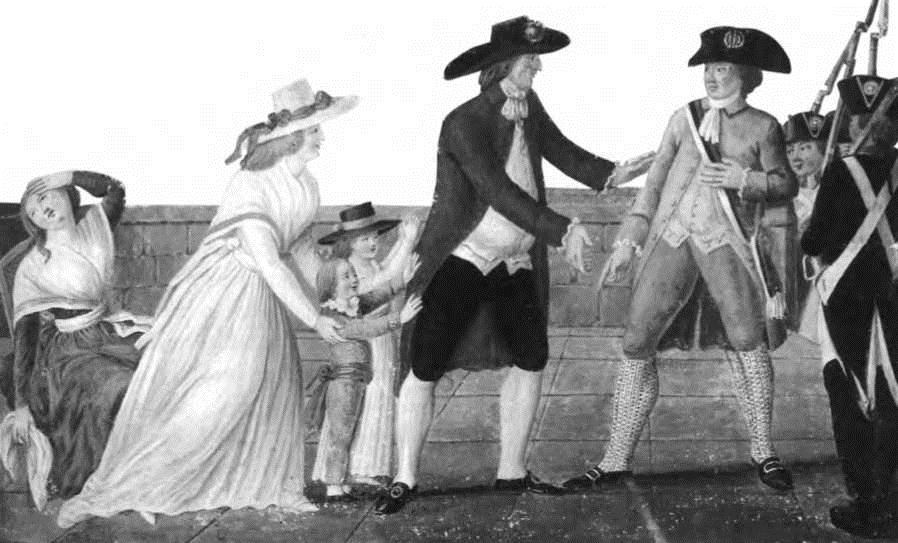
(Arrest of the royal family in Varennes)
The Constitution of 1791 was surely an imperfect instrument. The Civil Constitution of the Clergy offended the pope, who had not been consulted. His disapproval forced a crisis of conscience on French Catholics. Many bishops and priests refused to accept the Civil Constitution, and they found broad support in the country. Schism in the Church became a major factor in the eventual failure of the Assembly to create a stable government for France. Moreover, the restrictive franchise opened the constitution-makers to the charge that they wanted to substitute an oligarchy for an aristocracy. Such obvious defects, however, were not alone responsible for the failure of constitutional monarchy. The principal culprit was the monarch himself.
At the head of the government stood a king who was thoroughly discredited. In June 1791, Louis XVI tried to escape from France in order to join the forces of counterrevolution outside the country. He very nearly succeeded but was caught at Varennes, near the eastern frontier, and was brought back to Paris. This humiliating episode destroyed what little authority Louis still possessed. In order to keep himself from being completely displaced, he swore to obey the new constitution; but he was now no more than a figurehead. From the very beginning, the constitutional monarchy was flawed.
At this point the situation was complicated by outside pressures. Louis’ fellow monarchs in Europe were unhappy over the way in which their royal colleague was being treated. The privileged orders in other countries feared that the levelling principles of the Revolution would spread. The English, many of whom had sympathized with the Revolution so long as it seemed to be following an English model, began to denounce the radicalism and violence of the French. Edmund Burke, in particular, saw clearly the radical nature of the Revolution. In his Reflections on the Revolution in France (1790) he insisted on the importance of tradition in preserving an orderly society and declared that it was folly to abandon time-tested institutions in favor of new ones based on abstract ideas. He convinced almost everyone in power in England. Hostility to France was an old tradition; Burke gave new reasons for continuing it. And everywhere French refugees spread counterrevolutionary propaganda urging Europe’s monarchs to intervene.
The Legislative Assembly, September 1791-September 1792 The Legislative Assembly met in an atmosphere of intrigue, fear, and factional strife. The Assembly, itself bitterly divided, was deprived of the hard-won political experience of the men who had drafted the Constitution.
There were two issues on which it was almost impossible to find a solid majority. The first was the position of the king. He could not be trusted, and he would not commit himself to the principle of equality, on which everyone did agree. Was it worth compromising with the king in order to preserve the constitution and the unity of the country? If not, how far should the Assembly go in restraining or in punishing the king?
The second problem, which caused even sharper divisions of opinion, was that of defining “equality.” Was the emphasis to be on equality before the law, or on equality of opportunity, or on political equality, or on economic equality, or on a mixture of two or more of these ideals? Here there was not only no clear majority, but no consistency within groups and even within individuals.
There were no parties in the Assembly, but there were the “clubs,” loosely organized associations with affiliates in the provinces. One of the largest and best-organized groups was the Jacobin Club, with 136 members out of the 745 representatives. The Jacobins were republicans and wanted to get rid of the king. But they were also well-to-do bourgeois; no poor man could afford to pay their membership dues. They were far from agreement on political and economic equality, or on the pace at which change should take place. They were divided into at least two factions. One faction was led by Brissot de Warville, the ablest politician in the Assembly. The other, composed mainly of Parisians, eventually found a leader in Maximilien Robespierre.
The issue that temporarily united the Assembly was declaring war on Austria. Stupid diplomacy by European monarchs, even more stupid politics in the French royal court, and a very real threat of counterrevolution convinced millions of patriotic Frenchmen that the forces of reaction were about to destroy all that had been gained since 1789 and that war was the only way to save their country and their freedom. The emperor of Austria and the king of Prussia in the Declaration of Pillnitz (August 1791) proclaimed that European monarchs must unite to restore order and monarchy in France. This was largely bluff, but it sounded ominous. Some conservative ministers thought that a victorious war against Austria would strengthen the king and allow him to end the Revolution. However, Louis XVI and his Austrian queen, Marie Antoinette, apparently hoped for a French defeat that would lead to the restoration of royal authority.
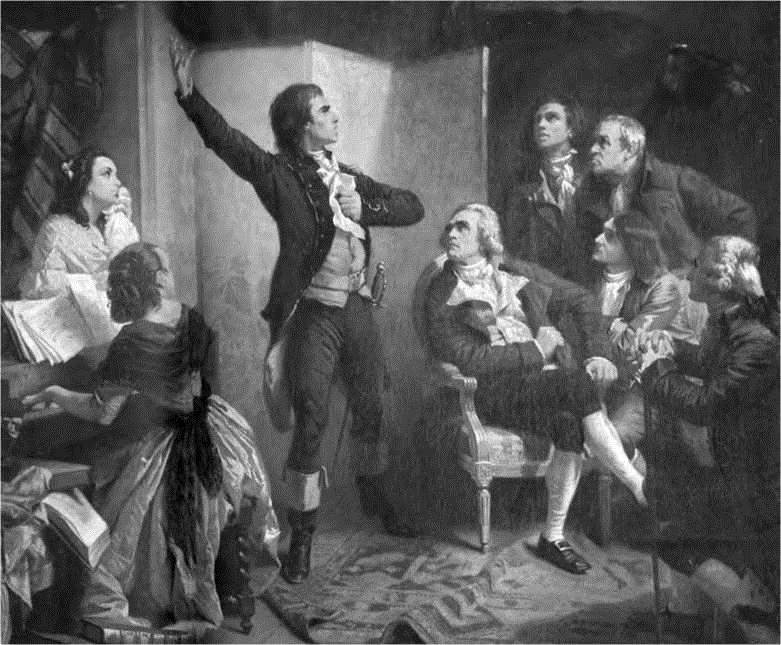
(Rouget de l’Isle sings la Marseillaise for the first time on 25 April 1792)
External threats and court plots played into the hands of Brissot’s republican faction. Brissot believed that a crusade to unseat the monarchs of Europe would rekindle the revolutionary fervor of the French people and rally them around his plan to establish a republic in France. He was opposed in the Jacobin Club by Robespierre, who feared that a war would strengthen the conservatives and lead to dictatorship. But Brissot proved the stronger, and the powerful Jacobin Club passed a resolution advocating a declaration of war. Brissot took the issue before the Assembly, and in April 1792 all but seven deputies voted for war with Austria.
The First War of the Revolution
The declaration of war transformed the Revolution. With war came the end of the monarchy and the constitution. With it also came terror and dictatorship. France became not simply the home of the Revolution but the exporter of revolutionary ideals. Finally, under the stress and emotions of war, France became a modern, unified nation-state.
The war began badly. The French army lacked leadership and discipline. The government was short of money and hampered by disputes. The royal family and their supporters encouraged the enemy. It is not surprising that the Austrians and their allies were soon able to advance along the road to Paris.
Two things saved the Revolution at this moment of crisis. The Austrian and Prussian generals, who were as incompetent as the French, delayed and divided their forces. And there was a genuine outburst of patriotic and revolutionary enthusiasm in France. It was during this crisis that the Marseillaise was composed, a stirring appeal to save the country from tyranny. The French kept on fighting, despite their failures, and their army did not melt away as the refugee nobles had predicted. So, when the Austro-Prussian army was checked at Valmy, one hundred miles from Paris, in September 1792, its cautious commander decided to call off the invasion. The allies had lost their best chance to crush the Revolution before it gathered strength.
The French Republic
During these gloomy months, when everything seemed to be going wrong, the radical politicians of Paris gained a commanding position in the government. These Jacobins—Robespierre and Danton were the most important—based their power on national guards summoned to protect the capital, on the Parisian crowds, and, from August 10, 1792, on an insurrectionary Paris Commune that replaced the legal municipal government. The poorer classes were suffering from an economic depression caused by war and political uncertainty, and they were terrified by the thought that the Old Regime might be revived. The bourgeois radicals in the Assembly never fully sympathized with the desire of Paris artisans and workers for economic equality, but they could agree with them on the need for drastic political changes. In August Danton organized an uprising in Paris that led to the storming of the Tuileries palace and forced the royal family to seek protection in the Legislative Assembly which then suspended the king from office and issued a call for a revision of the constitution. A National Convention, elected by universal manhood suffrage, was to determine the new form of the French government. The events of August triggered what is often called the Second French Revolution. This revolution began with the deposition of Louis XVI; it ended in a bloody terror that consumed its own leaders. It confirmed Burke’s most dire prophecies. And yet the Second French Revolution did not follow inexorably upon the first. War created its own necessities, survival being the most pressing.
The Convention and the Jacobins
The National Convention met in Paris on September 21, 1792, in the wake of a fierce bloodletting earlier in the month—the so-called September massacres. There was a great popular fear of conspiracies by the nobility plotting their revenge.These massacres, which took the lives of some thirteen hundred prisoners in Paris, were part of a pattern of fear, terror, and revolutionary justice that persisted throughout much of the Convention’ s three-year rule.
The delegates to the Convention were elected by a minority of Frenchmen, despite universal manhood suffrage. Many citizens were repelled by the deposition of the king and the violence of the summer. Others were intimidated. Some were excluded by governmental decree. Thus the most radical elements of the French population had disproportionate strength in the elections. Not surprisingly, many of the delegates were Jacobins.
The Jacobins were divided. The followers of Brissot, now called the Girondists, made up one faction. They dominated the Convention in its early months. In general, the Girondists represented the interests of provincial republicans, and they were bitterly opposed to the Paris Commune. Their foreign policy was aggressive and expansionistic. It was they, for example, who issued a manifesto in November 1792 offering France’s aid to all revolutionaries throughout Europe. In domestic affairs, the Girondists were relatively moderate—at least when compared with their Parisian enemies. On the prime issue of 1792, the fate of the king, the Girondists urged that Louis XVI be imprisoned for the duration of the war. There was little doubt then—and less now—that Louis was guilty of treason. But the resolution condemning him to death passed by only one vote. He was guillotined on January 21, 1793. This victory for the so-called Mountain —Robespierre and Danton’s faction—was followed by a purge of the Girondists in June 1793. The architects of France’s war policy were among the first victims of that policy.
The Jacobins and the War
The Girondists fell before their Jacobin opponents in the wake of crushing French defeats by a new coalition of European powers. The execution of Louis XVI, France’s designs on Holland, and its annexation of Savoy and Nice prompted England, Spain, Portugal, and several lesser states to join Austria and Prussia in the war against France. In the face this formidable combination, the French armies suffered a series of reversals. The victor of Valmy, General Dumouriez, was badly defeated in Belgium, and, in the spring of 1793, he defected to the enemy.
Now the government, under the direction of a Committee of General Defense (later the Committee of Public Safety), undertook to organize the entire nation for war. It applied conscription on a nationwide scale for the first time in modern European history. It raised huge armies, far larger than those of Louis XIV, far larger than those that could be called up by the old-fashioned monarchies against which France was fighting. And it supported those armies by means of confiscation and heavy taxes. The armies were organized by a military genius, Lazare Carnot, an engineer who made a science out of the service of supply. He also established the division as a tactical unit.
The monarchies of Europe, which were used to fighting limited wars with limited resources for limited gains, were overcome by a French nation organized for war. They could not afford to arm all their people; they still depended on the old officer corps for their leaders. And, if they despised the Revolution, they were still not prepared to sacrifice all their resources to put it down. Other problems distracted the crowned heads of Europe: England was seeking colonial conquests, and the eastern powers were still concerned with the Polish problem. So the French recovered from the blows of 1793 and by the late spring of 1794 had broken through into the Low Countries. When the Convention ended its work in 1795, France was stronger and held more territory than it had under Louis XIV at the height of his power.
The Instruments of Jacobin Rule
Military success was achieved only through the intensive and often brutal organization of the French people. The Constituent Assembly’s program of administrative decentralization had left France without any effective chain of command linking the National Convention in Paris to the provinces. Moreover, the Convention was an ungainly body, incapable of swift action. Into this void moved the radical Jacobins. In the provinces, Jacobin clubs virtually replaced local governing bodies and through their committees of surveillance controlled public life. At the center, executive power was entrusted to two committees—the Committee of Public Safety and the Committee for General Security. The former wielded almost dictatorial power over France from July 1793 until July 1794. It had twelve members, of whom Robespierre was the most prominent.
The genuine achievement of the twelve capable men who composed the Committee of Public Safety, in coping with internal unrest and external war, is often overlooked because of the “Reign of Terror” they imposed on France. The Terror must be put into the context of the problems that confronted Robespierre, Carnot, and their colleagues. From early 1793 there had been a series of internal rebellions against the government. Conservative peasants of the Vendee, a region in the west of France, had revolted against the national conscription and in favor of their priests who opposed the Civil Constitution. Later the Girondists, who opposed what they thought was excessive centralization, stimulated local uprisings in some large provincial towns. In the heat of war, such rebellions appeared treasonable, and the Terror was used as a political weapon to impose order. Also, during much of the Committee’s tenure, Parisian politicians, both left and right of Robespierre, manoeuvred to secure power. Terror, against Danton among others, was a weapon in these internecine conflicts. There was an economic terror directed against war profiteers and hoarders. There were local terrors, uncontrolled from the center, in which Jacobins and undisciplined representatives of the government took revenge on enemies. In the end, the Terror gained a certain momentum of its own, and the list of suspects grew. Among the factors in Robespierre’s fall was the fear of the Convention that its remaining members would soon become victims of revolutionary justice.
In all, some forty thousand people were killed by the government and its agents. The largest number of victims were peasants; next came rebellious citizens of provincial towns, and politicians. Some hundreds of thousands of suspects were imprisoned and proper judicial procedures, such as the right of the accused to counsel, were undermined. Even the Committee of Public Safety finally divided over the excesses of the Terror. When military successes restored a measure of stability to France, the National Convention reasserted its authority. Among its first acts was the arrest and execution of Robespierre in July 1794.
Jacobinism and French Society
The militant phase of Jacobinism was of relatively short duration. The Committee of Public Safety ruled for a year, and Robespierre had complete authority for only four months. Thus, beyond the brilliant organization of the national defence, the Jacobins made few permanent contributions to French institutions and society. Certain of their acts, however, have remained of symbolic significance to the French Left. Among these were the guarantees of the right to a public education for all and the right of public welfare for the poor; these guarantees were set forth in an abortive constitution drawn up in 1793. In addition, the Jacobins were responsible for decrees establishing price controls and providing for the division of confiscated property among the poor. These decrees, however, were not enforced with much zeal because they were not the product of a conscious social philosophy. They were opportunistic acts designed to win over the disaffected crowds in the cities and the landless peasants at a time of national crisis. The Jacobins were radical democrats who believed deeply in political equality; they were not socialists. With their fall in the summer of 1794, the Revolution fell back into the hands of the propertied bourgeoisie. It was this class that in the end gained most from the Revolution.
The Thermidorian Reaction and the Directory, 1795-99
The end of Robespierre and the Jacobins touched off a wave of reaction against the excesses of the Terror. This “Thermidorian reaction,” named after the month in the revolutionary calendar, when Robespierre was executed (Thermidor/July), turned against the austerity of Jacobin rule and at times took the form of a “white terror” against the radicals in Paris and the provinces.
In 1795 the Convention finally presented France with a constitution, the third since 1789. It provided for a five-man executive board, called the Directory, and a two-house legislature. Even the republican-oriented Convention had been sufficiently sobered by the Terror to abandon its promise of universal suffrage, and the franchise was weighted in favor of the propertied classes. Once in office, the Directory proved both corrupt and incompetent. It maintained a militantly aggressive foreign policy and allowed the French economy to deteriorate disastrously. A more or less communistic movement led by “Gracchus” Babeuf received some support from the poor, but was easily suppressed. The French poor were still largely artisans and peasants, property owners and not wage-earners. More dangerous was a royalist revival. Elections in 1797 demonstrated such an upsurge in royalist sentiment that the results had to be cancelled. The Directory’s single source of strength was the army. With the economy foundering and popular unrest increasing, the Directory was ripe for the coup d'etat that in 1799 brought one of its most successful generals, Napoleon Bonaparte, to power.
Napoleon’s Rise to Power
Napoleon Bonaparte was born on the island of Corsica in 1769, shortly after the island had been annexed by France. The Bonapartes were members of the minor nobility of Corsica, and at the age of nine Napoleon was admitted to a military school in France… When most of the aristocratic officer corps left France after the fall of the monarchy, Napoleon stayed on to serve the Republic. He rose to become a brigadier general in 1793 at the age of twenty-four. He helped to reconquer Toulon—one of the towns that rebelled against the Convention in 1793—and he suppressed a royalist riot against the Convention in 1795. By 1797, when the Directory felt its power slipping, Barras, one of the Directors, realized that Napoleon’s support could be valuable. He sought Napoleon’s friendship first by introducing the young general to one of his cast-off mistresses, Josephine (whom Napoleon married), and then by giving him command of an army that was preparing for an invasion of Lombardy, a province in northern Italy that was then under the control of Austria.
The Italian campaign of 1797 was a success. It removed Austria from the war, gave France control of northern Italy, and established Napoleon’s reputation as an outstanding general. After the defeat of the Austrians only England was still at war with France. In 1798 Bonaparte took an army by sea to Egypt, where he hoped to sever England’s lifeline to India. He easily defeated the Egyptians, but the English admiral Horatio Nelson sank the French fleet near the mouth of the Nile. Napoleon’s army, trapped in Egypt, was soon decimated by disease and dysentery. In the midst of this crisis, Napoleon heard that the Directory was in danger of falling and that some of the Directors wanted to create a military dictatorship. Leaving his army in Egypt, he made his way secretly back to France to offer his services to the conspirators.
The most important Director was the Abbe Sieyes, and it was with this former leader of the First French Revolution that Napoleon conspired. On November 9, 1799, [18 Brumaire] he used military force to compel the legislators to abolish the Directory and substitute a new government in which a board of three consuls would have almost absolute power. The conspirators asked Napoleon to serve as one of the consuls. Apparently they hoped he would provide the personal popularity and military power needed to support a regime that would be dominated, behind the scenes, by the other two consuls. But when the new constitution was written—at Napoleon’s orders—the general emerged as First Consul and virtual dictator of France. When the French people were invited to endorse the constitution in a plebiscite, they voted overwhelmingly to accept it. To Frenchmen exhausted by years of revolution, terror, and economic instability, Napoleon seemed to be the guarantor both of the gains of the Revolution and of order.
From Joseph R. Strayer & Hans W. Gatzke, The Mainstream of Civilization, Harcourt Brace Jovanovich, 1979, Ch. 23, The French Revolution and Napoleon, pp. 522-536.
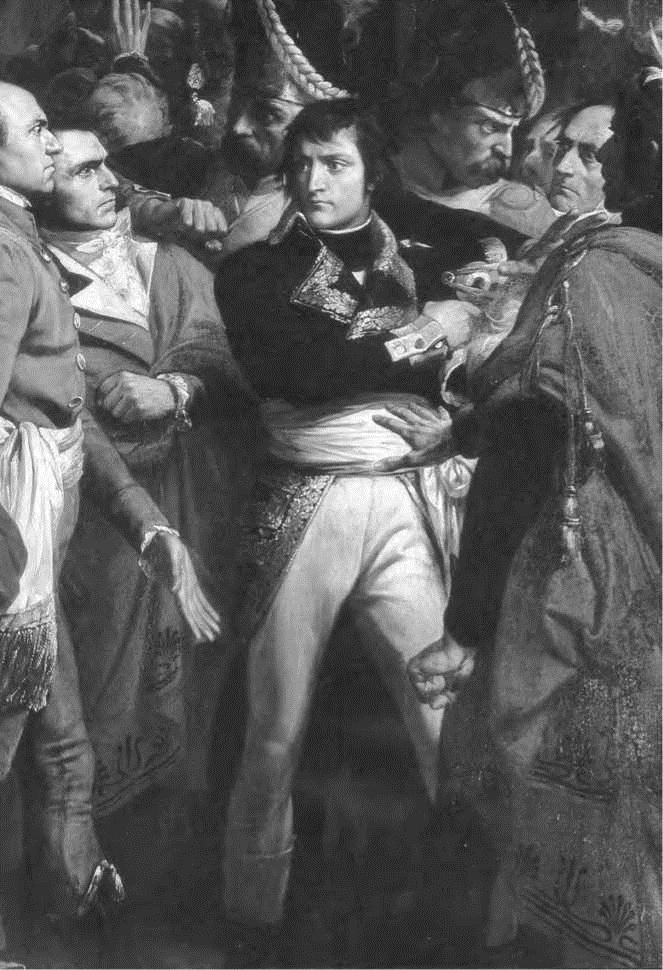
(Napoleon on the day of the Coup d’Etat of 18 Brumaire (9 November 1799) (detail), oil on canvas by François Bouchot.)
Timeline of the French Revolution

(Solemn opening of the Estates General, May 5, 1789)
Events preceding but pertinent to the French Revolution
The Enlightenment, which led to many European writers criticising the Monarchy and espousing democratic, liberalist, nationalist and socialist ideas.
1740
The War of Austrian Succession caused the French monarchy to fall heavily into debt.
1756
Start of the Seven Years’ War, which compounded the debt situation.
1775
Start of the American War of Independence (1775-1783).
1778
France declares war against Great Britain in support of the American colonies. The subsequent war worsens the debt situation further.
1783
Laki eruption in Iceland and colder climate of the Little Ice Age combined with France’s failure to adopt the potato as a staple crop contributes to widespread famine and malnutrition.
Treaty of Paris ends the war. The success of the American colonists against a European power increases the ambitions of those wishing for reform in France.
Financial crisis and Assembly of Notables
1786
August 20: Finance minister Calonne informs the King that the royal finances are insolvent.
December 29: The Assembly of Notables is convoked.
1787
February 22: First Assembly of Notables meets against a background of state financial instability and general resistance by the nobility to the imposition of taxes and fiscal reforms.
May 25: The first Assembly of Notables is dissolved.
July 2: Parlement of Paris overwhelmingly rejects the royal legislation.
August 6: Legislation passed at a lit de justice. Subsequently the parlement declares the registration was illegal.
1788
May 8: Judicial reforms partly abolishing the power of parlements to review legislation are forced through the parlements by Lamoignon.
June: Outcry over the enforced reforms ensues, and courts across France refuse to sit.
July 5: Brienne begins to consider calling an Estates-General.
August 8: Informed that the royal treasury is empty, Brienne sets May 1, 1789 as the date for the Estates-General to try to restore confidence with creditors.
August 16: Repayments on government loans stop, and the French government effectively declares bankruptcy.
November 6: Necker convenes a second Assembly of Notables to discuss the Estates-General.
1789
April 27: The Reveillon Riots in Paris, due to low wages and food shortages, led to about 25 deaths by troops.
May 5: The Estates-General is convoked for the first time since 1614.
Estates-General and Constituent Assembly
May 5: Meeting of the Estates-General-voting to be by Estate, not by head.
May 28: The Third Estate (Tiers Etat) begins to meet on its own, calling themselves “communes” (commons).
June 13: Some priests from the First Estate choose to join the Third Estate.
June 17: The Third Estate (commons) declares itself to be the National Assembly.
June 20: Third Estate/National Assembly are locked out of meeting houses; the Third Estate decides upon a declarative vow, (The Tennis Court Oath), not to dissolve until the constitution has been established.
June 27: Louis recognises the validity of the National Assembly, and orders the First and Second Estates to join the Third.
July 9: National Assembly reconstitutes itself as National Constituent Assembly.
July 11: Necker dismissed by Louis; populace sack the monasteries, ransack aristocrats’ homes in search of food and weapons.
July 13: National Guard formed in Paris, of middle class men.
July 14: Storming of the Bastille; de Launay, (the governor) is massacred.
July 16: Necker recalled, troops pulled out of Paris.
July 17: The beginning of the Great Fear, the peasantry revolt against feudalism and a number of urban disturbances and revolts. Many aristocrats flee Paris to become emigres. Louis XVI accepts the tricolor cockade.
August 4: Surrender of feudal rights: The August Decrees.
August 26: The Assembly adopts The Declaration of the Rights of Man and of the Citizen.
September 11: The National Assembly grants suspensive veto to Louis XVI; Louis fails to ratify the August acts of the National Assembly.
October 5-6: Outbreak of the Paris mob; Liberal monarchical constitution; Women’s March on Versailles.
October 6: Louis XVI agrees to ratify the August Decrees, Palace of Versailles stormed. Louis and the National Assembly move to Paris.
1790
January: Former Provinces of France replaced by new administrative Departments.
February 13: Suppression of monastic vows and religious orders.
May: 19 Nobility abolished by the National Assembly.
July 12: The Civil Constitution of the Clergy. Priests to take an oath of loyalty to the state, splitting the clergy between juring (oath-taking) and non-juring priests.
July: Growing power of the clubs (including: Cordeliers, Jacobin Club).
July: Reorganization of Paris.
August 16: The parlements are abolished.
September: Fall of Necker.
1791
March 10: The Pope condemns the Civil Constitution of the Clergy.
June 20-25: Royal family’s flight to Varennes.
June 25: Louis XVI forced to return to Paris.
July 15: National Assembly declares the King to be inviolable and he is reinstated.
September 13-14: Louis XVI formally accepts the Constitution.
September 30: Dissolution of the National Constituent Assembly.
Legislative Assembly
October 1: Legislative Assembly meets—many young, inexperienced, radical deputies.
1792
January-March: Food riots in Paris.
April 20: France declares war against Austria.
April 28: France invades Austrian Netherlands.
July 5: Legislative Assembly declares that the fatherland is in danger (La Patrie en Danger).
July 25: Brunswick Manifesto—warns that should the royal family be harmed by the popular movement, an “exemplary and eternally memorable revenge” will follow.
July 30: Austria and Prussia begin invasion of France.
August 1: News of the Brunswick Manifesto reaches Paris—interpreted as proof that Louis XVI is collaborating with the foreign Coalition.
August 9: Revolutionary commune takes possession of the hotel de ville.
August 10-13: Storming of the Tuileries Palace. Swiss Guard massacred. Louis XVI of France is arrested and taken into custody, along with his family. Georges Danton becomes Minister of Justice.
August 16: Paris commune presents petition to the Legislative Assembly demanding the establishment of a revolutionary tribunal and election of a National Convention.
August 19: Lafayette flees to Austria. Invasion of France by Coalition troops led by Duke of Brunswick.
August 22: Royalist riots in Brittany, Vendee.
September 3: Fall of Verdun to Brunswick’s troops.
September 3-7: The September Massacres of prisoners in the Paris prisons.
September 19: Dissolution of Legislative Assembly.
National Convention
September 20: First session of National Convention. French Army stops advance of Coalition troops at Valmy.
September 21: Abolition of royalty and proclamation of the First French Republic.
September 22: First day of the French Revolutionary Calendar (calendar introduced in 1793).
December 3: Louis XVI brought to trial, appears before the National Convention. Robespierre argues that “Louis must die, so that the country may live”.
1793
January 21: Citizen Louis Capet (ex. Louis. XVI) guillotined.
March 7: Outbreak of rebellion against the Revolution: War in the Vendee.
March 11: Revolutionary Tribunal established in Paris.
April 6: Committee of Public Safety established.
May 30: A revolt breaks out in Lyon.
June 2: Arrest of Girondist deputies to National Convention by Jacobins.
June 10: Jacobins gain control of the Committee of Public Safety.
June 24: Ratification of new Constitution by National Convention, but not yet proclaimed.
July 27: Robespierre elected to Committee of Public Safety.
July 28: Convention proscribes 21 Girondist deputies as enemies of France.
August 23: Levee en masse (conscription) order.
September 5: Start of Reign of Terror.
September 9: Establishment of sans-culottes paramilitary forces-revolutionary armies.
September 17: Law of Suspects passed.
September 22: A new calendar is introduced, with September 22, 1792, as the start of year I.
September 29: Convention passes the general maximum decree, fixing the prices of many goods and services.
October 10: The Constitution of 1793 is put on hold; decree that the government must be “revolutionary until the peace”.
October 16: The former Queen Marie-Antoinette is guillotined.
October 31: The 21 Girondist deputies guillotined.
December 4: Law of 14 Frimaire (Law of Revolutionary Government) passed; power becomes centralised on the Committee of Public Safety.
1794
March 30: Danton, Desmoulins and their supporters arrested.
April 5: Danton and Desmoulins guillotined.
May 7: National Convention, led by Robespierre, passes decree to establish the Cult of the Supreme Being.
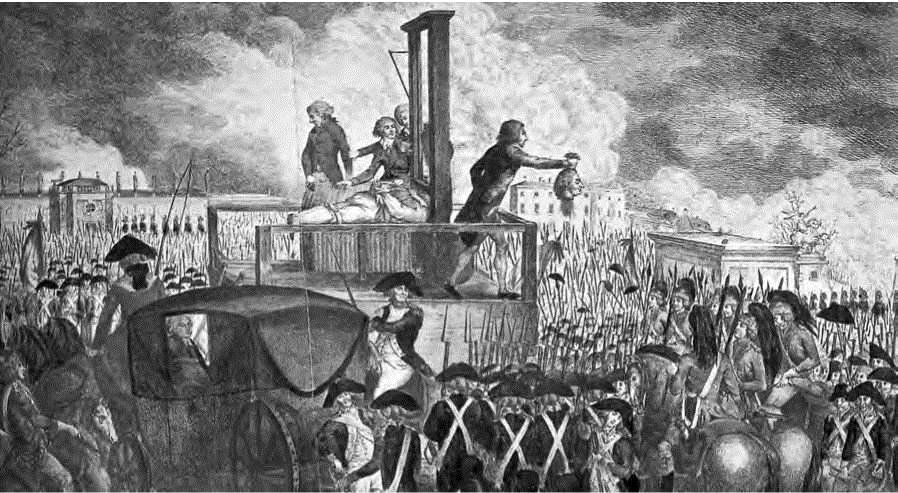
(Execution of the King)
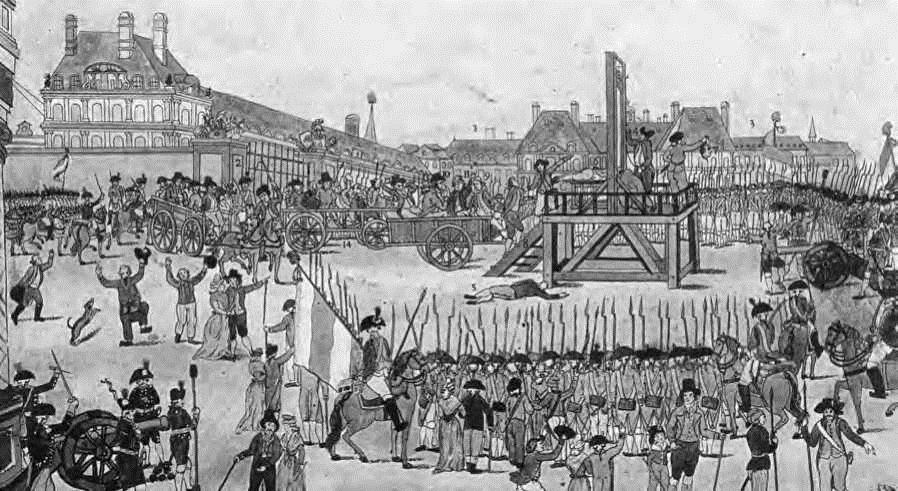
(Execution of Robespierre)
June 8: Festival of the Supreme Being.
June 26: French forces defeat Austrians at the Battle of Fleurus.
July 27-28: Night of 9-10 Thermidor—Robespierre arrested, guillotined without trial, along with other members of the Committee of Public Safety. End of the Reign of Terror. Also called The Thermidorian Reaction.
Latter half of 1794: The White Terror—reaction against remaining Jacobins.
1795
May 31: Suppression of the Paris Revolutionary Tribunal.
August 22: 1795 Constitution ratified—bicameral system, executive Directory of five.
October 26: National Convention dissolved.
The Directory
• November 2: Executive Directory takes on executive power.
1799
November 9: The Coup d’Etat of 18 Brumaire: end of the Directory.
December 24: Constitution of the Year VIII—leadership of Napoleon established under the Consulate. French Revolution may be considered ended.
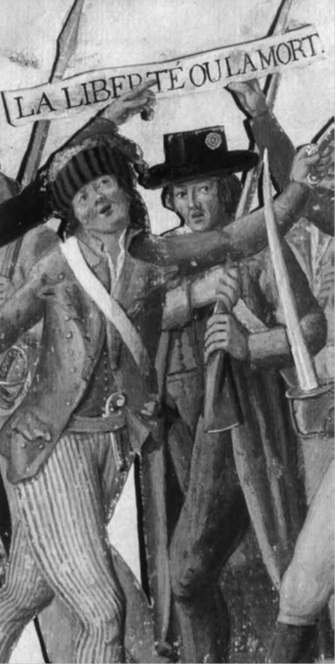
(La Liberte Oulamort)
Short Bibliography
A.H. Beesly, Life of Danton, Longman, Green, and Co, London, New York and Bombay, 1906, reedited by General Books, 2009.
Hilaire Belloc, Danton A Study, Charles Scribner’s Sons, New York, 1899, reedited by Bibliolife, 2009.
Thomas Carlyle, The French Revolution: A History, Random House Publishing Group, 2002.
William Doyle, The French Revolution A Very Short Introduction, Oxford University Press, USA, 2001.
Victor Hugo, Ninety-Three, Carroll & Graf Publishers, NY, 1998.
Jocelyn Hunt, The French Revolution, Routledge, 1998.
David Lawday, Danton, Jonathan Cape, 2009.
Georges Lefebvre, The French Revolution: From Its Origins To 1793, Routledge Publishers, 2010.
Charles F. Warwick, Danton and the French Revolution, George W. Jacobs, Publishers, USA, 1908, reedited by General Books, 2009.
Notes
Maximilien Robespierre (6 May 1758-28 July 1794) is one of the best-known and most influential figures of the French Revolution. He largely dominated the Committee of Public Safety and was instrumental in the period of the Revolution commonly known as the Reign of Terror. He was described as being physically unimposing yet immaculate in attire and personal manners. His supporters called him “The Incorruptible”, while his adversaries called him “dictateur sanguinaire” (blood-thirsty dictator).
↩The comte de Mirabeau (9 March 1749-2 April 1791) was a French revolutionary, as well as a writer, diplomat, freemason, journalist and French politician. He was a popular orator and statesman. During the Revolution, he was a moderate, favoring a constitutional monarchy built on the model of England. He died early and thus did not see the collapse of the French monarchy which he did try to save.
↩Camille Desmoulins: (March 2, 1760-April 5, 1794) was a journalist and politician who was a close friend and political ally of Georges Danton. He was arrested and guillotined with him.
↩Antoine Joseph Santerre (16 March 1752-6 February 1810) was a businessman and general. He led the people of the St. Antoine district in the successful assault on the Tuileries Palace.
↩The September Massacres were a wave of mob violence which overtook Paris in late summer 1792. By the time it had subsided, half the prison population of Paris had been executed: some 1,300 trapped prisoners, including many aristocrats.
↩The Vendee was a province near Brittany where a large anti-revolutionary insurrection lasted for years.
↩All the kings of Europe allied against France.
↩