THE WRITTEN WORD
Curriculum Handbook
Paragraph references are specific to this digital edition.
Curriculum Handbook
Indian Institute of Teacher Education
Introduction
We are passing through a great transition. The old is becoming obsolete and the new is still in the process of emergence. The olds ways of learning and teaching are found to be too rigid and too outmoded. A greater application of psychological principles is being increasingly demanded. It has been urged that the training of the young requires on the part of the teacher a deep psychological knowledge.
According to some thinkers, the present educational system is a huge factory of mis-education. According to them, the spontaneity of the child is smothered at an early stage by our mechanical methods which are prevalent in our educational system. They contend that the child is not a plastic material which can be moulded according to educators’ design, but it is a closed bud having its own inherent capacity to flower and blossom, requiring only the favourable climatic conditions such as the right atmosphere, environment, inspiration and guidance.
Each child, according to them, is a psychological entity, having its own specific individual needs of growth which have to be understood and developed by the same kind of knowledge and tact by which a good gardener tends to varieties of plants and trees in his garden. Just as each plant needs to be individually looked after, even so, each child, it is contended, is required to be looked after individually.
It has been further held that each individual is a great potential dynamo of energy, and if we do not deal with that potentiality, only very little gets actualised, and the rest remains dormant and uncultivated. This means a tremendous waste both for the nation and the world. Not to tap the full potentialities of each individual is thus psychologically unsound and economically unproductive.
It has, therefore, been urged that our educational system should either be set aside altogether through some kind of ’de-schooling’ or radically changed in such a way that each individual is provided with conditions and facilities under which he can grow towards his fullness on the lines that are psychologically appropriate to him.
There is another line of thinking, according to which it is not enough to develop the potentialities of the individual but also to direct these potentialities towards their highest values. It has been argued that the psychological development of the individual is an extremely dangerous process, unless the development is guided by wisdom and skill and directed towards certain desirable and sublime ideals.
There is a risk, it is argued, of succeeding in developing only highly egoistic and selfish individuals, if we insist only upon development and do not take great care to insist on the discovery of the right values, aims, objectives and ideals. It has, therefore, been urged that education should be value-oriented and should provide those conditions and facilities under which individual is enabled to discover the highest possible values and embody them as effectively as possible in thought, feeling and action.
An unprecedented education experiment which is taking place in different parts of the world today has resulted in the formulation of new models of learning-teaching process. It has been argued that learning is a process of transmutation; transmutation of innate reflexes into organised and conscious perceptions, visions and actions, transmutation of innate drives into wise and skilful pursuit of means and ends, and transmutation of innate tendencies into a harmonious integrated personality.
It has been contended that there are observable and discernible processes by which the process of learning or of transmutation can be accelerated. We are often asked to consider the tremendous feat of learning that the child performs in the first few years of its life. It has been contended that the child learns so fast because all its occupations are occupations of learning. For the child, all play is learning, and all learning is play. Again, it is contended, the child learns so fast because the child deals with its universe with its total being by the exercise of all its faculties and by a concrete urge of experience. It has been argued that our entire learning process should be so changed that we are able to create for the learner the same conditions which obtain in the child’s encounter with its universe. Some educationists have, therefore, pleaded for a search of a school that has no walls, and for studies that have no boundaries.
It has also been argued that the learner learns best under the conditions of freedom to choose, under teacher’s wise guidance, what he wants to learn and what he should learn. The learner should have also the freedom of pursuing his studies at his own pace. This argument is further intensified when it is seen that an indispensable condition of the moral and spiritual development is secured only when the learner is given ample opportunities to exercise his free will.
Learning by doing is being increasingly advocated. At the same time, it is being recognised that there are, for different categories of learners, different ways of learning. Some students learn better through aesthetic experience, some others through manual work, while still others through intellectual or meditative contemplation. It has, therefore, been suggested that an ideal system of education should provide to each learner that method or such combination of methods which is suitable to his specific needs of learning.
Self-learning is being given in several experiments a pre-eminent place.
Individualised programmed instruction, for example, follows an instructional model which aspires to produce an effective communication for securing precisely defined goals of learning, in a manner timed to meet the needs of the individual, mostly with the help of programmed teaching and learning material. An important variant of individualised learning is that of learning by consultation with the teacher, as and when needed. Lecture system, which caters to group learning, plays a minor role in experiments which emphasise self-learning. Even the syllabi and examination system are required to be radically changed in the context of a system based upon self-learning.
Project systems try to combine self-learning with group-learning. Projects may be directed towards an exploration or towards producing some practical action under certain actual situations. In a model that is known as Info-Bank, the learner is required to define what he is interested in and the kind of approach that he wants to undertake. The learner is given the freedom to govern his reading and practical activities and to judge the knowledge acquired and its significance. In some educational experiments, a combination of different information materials is made available to the learner and he is given the freedom to construct and control his own learning process and the environment suitable for the chosen learning process. In yet another instructional model, individual learners learn from one another by informing and consulting one another mutually from time to time. At a higher level of consultation, there is experimental testing and feedback. In some models, the learner takes over the roles of those responsible for action and decision in simulated environment. In some cases, problems to be solved are frequently more complex and make the acquisition of external information necessary, while in others the required information is supplied in advance. In the ’Workshop Model’, the learners work like colleagues, supported, if necessary, by organisers and advisers, on the solution of real problems with which they are confronted. In this model, the learning of the methods of work is as important as the production of results.
Educationists are perplexed by the phenomenon of unprecedented explosion of knowledge. Teachers and learners are required to deal with this explosion, and efforts are being made to discover accelerated methods of learning and teaching. The necessity of continuous or lifelong education is also being underlined. At the same time, teachers and students are required to distinguish more clearly than ever before, those aspects of knowledge which are essential from those which are of peripheral importance.
There is also today an unparalleled width and depth of enquiry, which necessitates a new kind of learning-teaching process that would be at once comprehensive and yet peculiarly specialised or varied so as to suit each individual.
Again, there is today, a great quest all over the world towards the synthesis of knowledge and synthesis of culture. Ancient knowledge is being recovered in the context of the modern knowledge. The humanist and the technologist are finding themselves in greater and greater need of each other. It is being increasingly recognised that the learner should not only develop his rational faculties but should also pursue moral and aesthetic tendencies. In India, we go farther and underline the need of a synthesis of science and spirituality.
Against this background, there is a quest to discover a point of convergence where different sciences and humanities can meet in a synthesis of knowledge. There is a search for an all-embracing project of work-experience that would generate a continuing process of lifelong education. And there is a search for a programme of learning that would necessitate a spontaneous harmony of the needs of personal development with those of collective development. It is being asked if there is a tool of acceleration of the summing up of the past and the unfolding of the future. And it is asked if there is a method and content of education that would necessitate an automatic synchronisation of studies, work-experience and flowering of faculties and values. It has become necessary, both for the learner and for the teacher, to discover or invent such methods by the employment of which the explosion of knowledge can be contained and personality can be developed which would harmonise, progressively, the wideness of the humanist and the skills of the technologist, the disciplined will-force of the moralist and the refined imagination of the artist, and the scrupulous knowledge of the scientist and the sublime vision, wisdom and ever growing perfection of the profound and wide spiritual culture.
It is seen that there are today powerful trends that necessitate a continual revision of the contents of education as also a continued refinement of the learning-teaching process.
It is against this background that there is a serious thinking in our country to determine the new role that the teacher is called upon to play. The situation in India is in a sense more complex than in many other countries of the world.
India is passing through a tremendous period of scientific and cultural efflorescence. This period was preceded by a powerful phase of the national freedom struggle during which the Indian subcontinent passed through an unprecedented churning of mental, aesthetic, moral and spiritual ideas. In the course of this churning, profound experiments in the field of education took place, the lessons of which need still to be assimilated. There grew in India during this period an irresistible sentiment to give the children and the youths of our country a new kind of education, which is freed from the fetters of the system given to us by the British and which would ensure development and promotion among students and teachers not only of the highest values of physical, emotional, mental, aesthetic, moral and spiritual culture, but also those values which are uniquely Indian, and which would at the same time promote a new kind of synthesis appropriate to our own synthetic culture. India has developed a kind of secularism which needs to be properly defined, understood and promoted. We have to build up young men and women who would have pride in the Indian heritage and our synthetic culture. This would mean that we have to the children and youths a true knowledge of India, of India’s complexity, of India’s greatness and of India’s innate tendencies to harmonise and synthesise.
The task that lies ahead of Indian education is difficult. We are being called upon to take into account the educational needs both of today and of tomorrow.
Kireet JoshiChairman Working Group for Curriculum Development
About the Curriculum
As we now embark on the very important task of setting up the Indian Institute of Teacher Education, IITE, the presence of our Hon. Chief Minister can be felt like the presence of the priest who initiated the education of Balaram and Sri Krishna, as narrated in the following verse:
The great Priest of Yadava race, Garg, initiated the commencement of education or vidyaramba of Balarama and Shri Krishna. Thus, they both attained total knowledge and became universal teachers orJagat Gurus.
It is rare that a Chief Minister initiates programmes of education and we feel proud that our Hon’ble Chief Minister Shri Narendra Modi initiated a series of innovative education programs in the state beginning with Kanya Kelavani Abhiyaan. People, in some pockets, may interpret that as a part of routine rhetoric. But, when such interventions sustain for a decade with the same or even greater force and vigor, it becomes evident that it is indeed driven by a deep commitment and vision. It comes through very clearly when the Chief Minister candidly admits that he finds the campaign for school enrolment of girl children more gratifying than his swearing in as the Chief Minister!
Following many interventions in education, it is now the setting up of an innovative institution devoted to teacher education, with distinctive and novel features. An Institution to ’create excellent teachers - well endowed physically, creatively, intellectually and most of all - a cheerful, humane person’ -that was the vision and mandate of the Chief Minister.
The setting up of the Indian Institute of Teacher Education (IITE) and providing an integrated program for graduation with teacher education and creating outstanding teachers of all round excellence has been his dream. At first sight, this seemed a near impossible mission. However as this seed of an idea grew, it did start appearing to be a far off, distant possibility but nevertheless a possibility. As we spent many days and evenings, trying to reflect on the attributes, qualities and properties, the DNA or the "genetic code" of a good teacher began to reveal itself. This has only been possible with the example, instruction and inspiration of a great teacher, who was made of exactly such DNA! He has consecrated his life time to the cause of education. Prof. Kireet Joshi, virtually an institution in himself, was inspired by the vision of the Chief Minister and based on his life experience in teaching gave us the working paper for the IITE Curriculum Committee. He carefully handpicked members of the Curriculum Committee, each of whom has spent many years in this domain and is an expert in their own right. The constitution of the Curriculum Committee is given in annexure I of this document.
The Curriculum Committee had its first meeting on 20th April, 2010 and started the task in right earnest. Firstly, transposing the dream of the Chief Minister Shri Narendra Modi and the vision of Prof. Kireet Joshi into a "transactable" matrix and framework of courses and credits was a very daunting task. After a lot of discussions, debates, arguments, questions, concerns, consultations and reflection, the curriculum finally emerged. Populating the frame with courses in respective disciplines without compromising on the basic premise and philosophy of integrality was the next step. This was accomplished by the good participation, support and ownership of local subject experts from Gujarat as well. The list of these experts is at annexure II of this document. This process lasted about four months on an average. The entire curriculum was then compiled together to fit it into the framework which would be ready for use by the I ITE.
What has evolved with all these experts as the curriculum of IITE, is perhaps, its unique strength. As articulated in the working paper in the annexure, the student teachers would have the option of choosing to study life skills such as tattooing, architecture, composing poems, knowledge of the art of war, of arms, of armies, and subjects and skills related to Multilingual Web Technology, horticulture, musical instruments - Flute, Sitar, Santoor, Tabla etc. and martial arts. Such teachers that have been trained by this curriculum would have multiple competencies so that they would be in demand from all over the country and some of them could even be spared for export to foreign countries.
The curriculum is also innovative, in that, it provides and facilitates ’reading and research’, mentoring and the provision of cross registration of courses across the rigid boundaries of disciplines and branches. More than anything else, the curriculum would be evolving based on experience and seek to truly make the experience of each teacher enriching with sufficient freedom to choose and learn as they metamorphose into great teachers driven by the highest aspiration.
I would be failing in my duty if I do not point out that all this work has been constantly guided by our Hon.Minister (Education) Shri Ramanlal Vora, who had actually piloted the IITE bill in the Vidhan Sabha. The Hon.Minister of State (Education), Prof. Vasuben Trivedi has given a lot of guidance and inputs on various aspects, including the courses, skills and competencies of the student teachers. I would also like to place on record the help, guidance and active participation of the Principal Secretary, Education Department, Dr. Hasmukh Adhia in the creation of the IITE.
Smt. Jayanti Ravi IASMember Secretary Working Group for Curriculum Development
Philosophy & Framework of IITE
INTRODUCTION
The Gujarat State has recently taken important initiatives to express its commitment to innovations in Education. In February 2009, the Gujarat Educational Innovations Act was passed by the Gujarat Legislative Assembly; this Act underlines the necessity of innovating the education system as a whole and it contributed to the development of an innovative concept of Children’s University, in respect of which an Act was passed by the Gujarat Legislative Assembly in June last. The problems of teacher’s education are the next steps that have been taken up by the Government of Gujarat. The Indian Institute of Teacher Education Act was passed in March 2010. The Curriculum Committee that has been constitute4d for developing a curriculum of the IITE has a special privilege and responsibility to look at the problems of teachers’ education in the context of emerging needs of today and tomorrow, and to deliberate on the most fundamental problems which have not so far received adequate attention in the fields of educational research, particularly, in the field of pedagogy. (Copies of the above Acts are enclosed.)
Apart from the above-mentioned three Acts, which have been passed by the Gujarat Legislative Assembly, the Universities in Gujarat have initiated a massive effort at the introduction of semester system and credit system in a phased manner. The new climate which has been created in the higher education as a result of this initiative is favorable to the innovative spirit of the Curriculum Committee of the IITE.
I
The fundamental thrust of the curriculum that the Committee has to develop will result from the emerging and imperative need to develop new types of teachers that can respond to the oft-repeated ideal ideal of education for integral development of personality which would be both value-oriented and skill-oriented, and which would be sensitive to both science science and aesthetics, and which would not only be global in character and outlook but also empowered to discharge corresponding responsibilities. This may appear to be a tall goal, but considering the speed with which the contemporary world is spinning forward, it may seem that even our farthest forward looking ideas will soon become common place. It is with that sense that we can think of the following new thrusts to the programmes of teacher’s education:
We may think of 4 or 5 year integrated programme of teacher’s integrated education and thus of providing to the candidates for teacher education sufficient time to develop their own integral personality, their value-orientation, their skill-orientation and their global outlook and its allied abilities, such as multilingualism and wide knowledge of India and the world as also sensitiveness to empathies with the students of today and tomorrow who have begun to manifest new attitudes and new inclinations, which need to be understood, appreciated and channelised towards the fulfillment of the highest aspirations of humanity.
In consonance with the aims of semester system and credit system, we need to emphasise the theme of interdisciplinarity and even though we may retain the present day streams of arts, science and commerce, we need to ensure that the products of I ITE are interdisciplinary and are able to enter into the new fields of inquiry without psychological blockades of rigidity and inability.
We have in India already an experience of integrated teacher education programme which was initiated by the NCERT and successfully implemented at its Mysore Campus. Even today the Mysore University has continued this 4 or 5 year integrated programme for arts, science and commerce, and we can learn a great deal from its curriculum and even adopt many of its elements.
At same time, we can think developing a few foundational courses, which break the boundaries of the present day streamlines and which would also respond to the holistic demands that our educational system is now beginning to make upon teachers. In this context, we may propose to have in the new curriculum that we shall have to frame the following foundational courses, which can all be spread over 4 years / 5 years:
General Knowledge Course;
Contemporary Global World;
Skill-oriented Education;
Value-oriented Education;
Fundamental Duties;
Indian Culture;
Philosophy of Education and Life;
Education for Personality Development
In addition, we will also conceive two or three or four Core Courses, again spread over 4 or 5 years. These Core Courses can be envisaged to aid the teachers in their actual school work where they will be serving as teachers’. These courses can be as follows:
Education for Integral Development of Personality
Education Through Indian Culture
Multisided Physical Education
Multilingual Courses
III
We may briefly analyse the above mentioned Foundational and Core Courses:
1. General Knowledge Course:
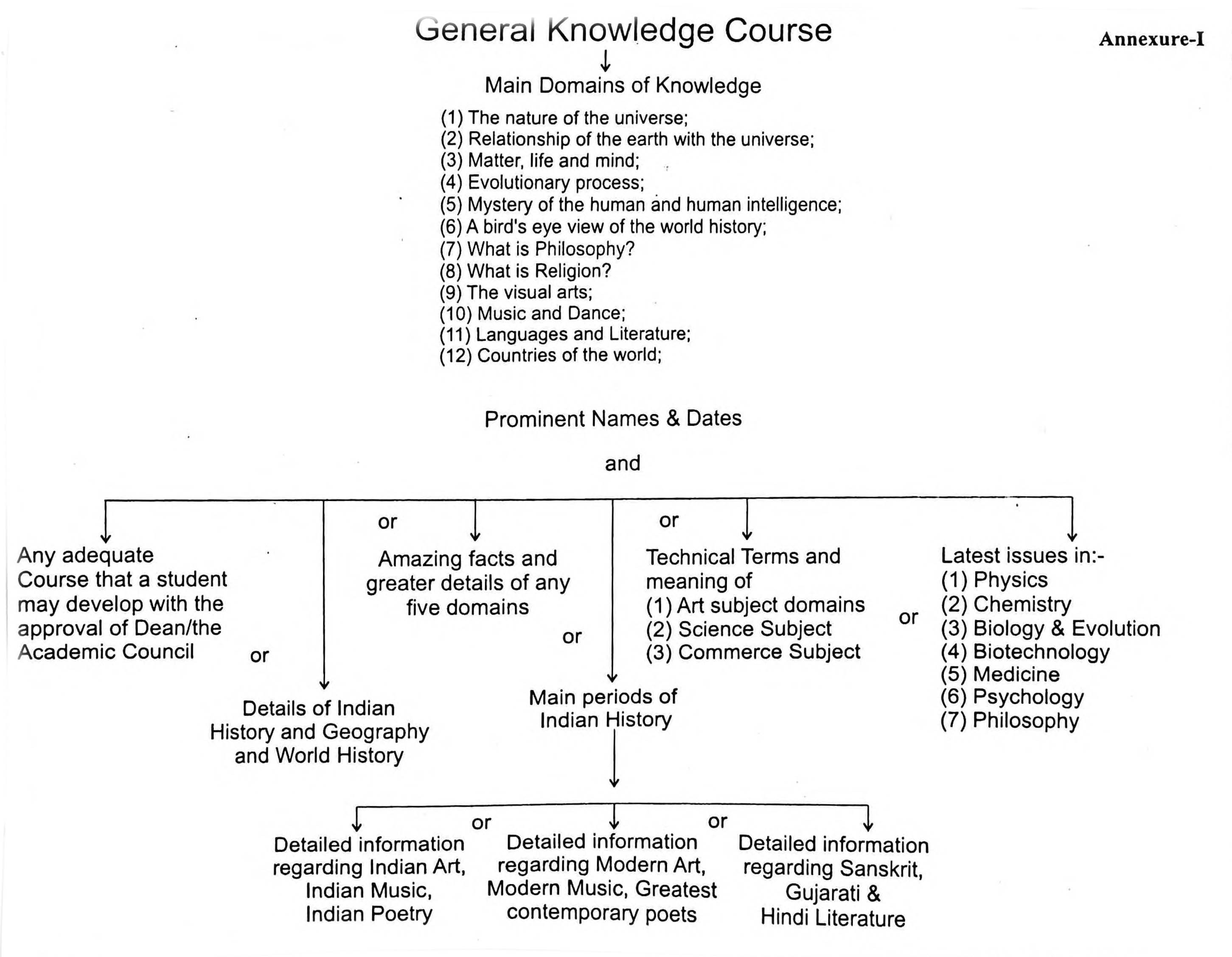
As far as the General Knowledge Course is concerned, we may conceive of this course to consist of two components. The first component would only acquaint the students with the domains in respect of which we may expect students to possess some acquaintance with prominent names, terms, phrases, etc., in regard to these domains (Annexure -1). They may include:-
The nature of the universe;
Relationship of the earth with the universe;
Matter, life and mind;
Evolutionary process;
Mystery of the human body and human intelligence;
A bird’s eye view of the world history;
What is Philosophy?
What is Religion?
The visual arts;
Music and dance;
Languages and Literatures;
Countries of the world.
The second component of this course would consist of a number of alternatives, and students may be allowed to select any two or three alternative studies. This may include, with greater details, the following topics:-
(a) Amazing facts of any five domains;
(b) Some details of Indian history and geography and the world history and geography;
(c) Latest issues in any one of the following themes:
Physics;
Chemistry;
Biology and Evolution;
Biotechnology;
Medicine;
Psychology; and
Philosophy
(d) Technical terms (and meanings) of any one domain of - arts or any of the domains of sciences or any one of the domains of industries and commerce;
(e) Basic details of the main periods of Indian history;
(f) Detailed information regarding modern art, modern music, greatest contemporary poets; or
(g) Detailed information regarding Sanskrit, Gujarati, Hindi and English literature, etc.
2. Contemporary Global World:
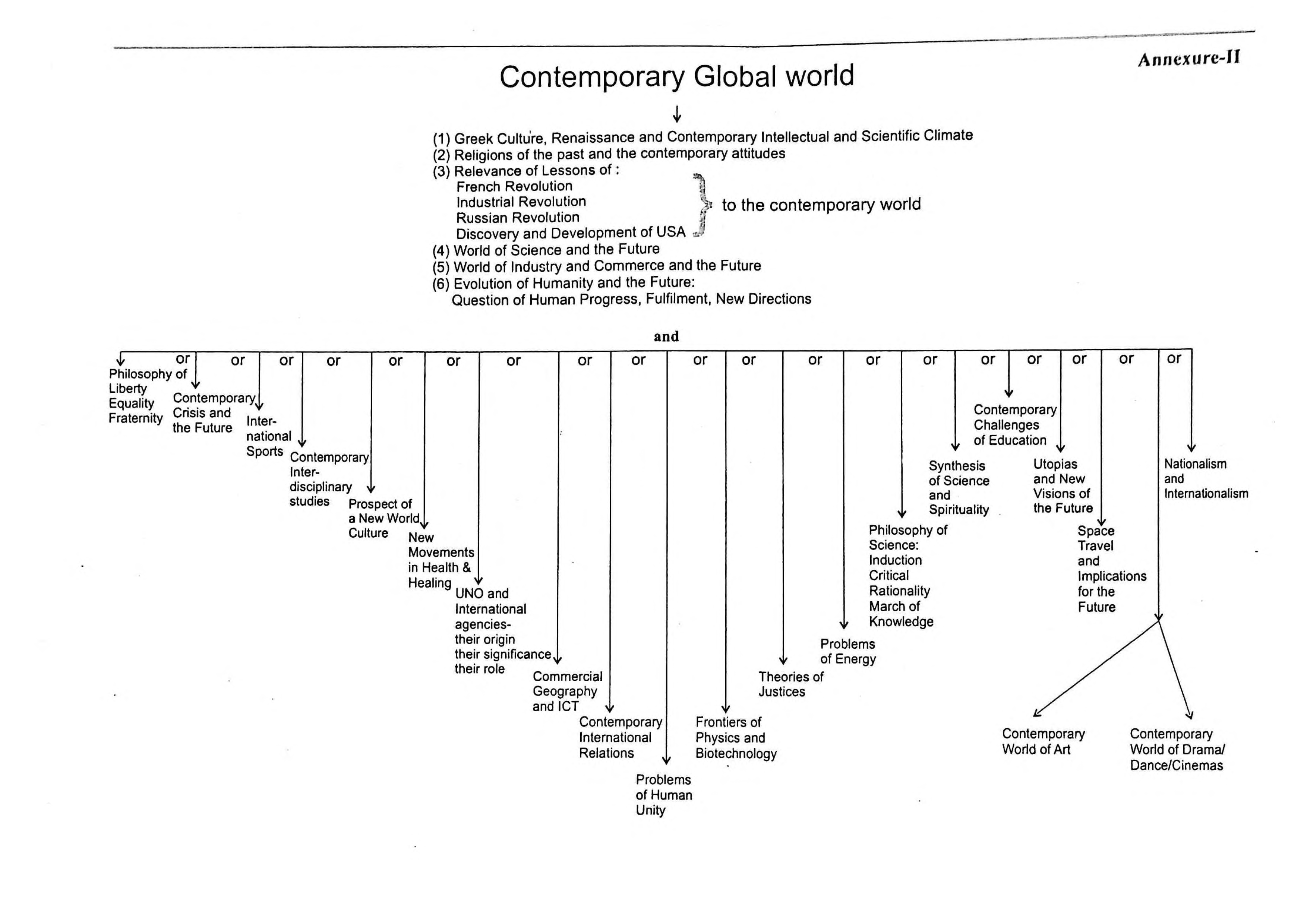
This course may have two components (Annexure - II). The first component may consist of the study of:
(h) Greek Culture, Renaissance and contemporary scientific climate;
(i) Religions of the past and the contemporary attitudes;
(j) Relevance of lessons of - French Revolution, Industrial Revolution, Russian Revolution, Discovery and development of USA, — to the contemporary world;
(k) World of Science and the Future;
(l) World of Industry and Commerce and the Future;
Evolution of Humanity and the Future - question of human progress, fulfillment, new directions;
The second component may consist of a number of alternatives and students may be allowed to have a choice to choose two or three of the following and similar subjects:
a) Philosophy of Liberty, equality and Fraternity;
b) Contemporary Crisis and the Future;
c) International Sports;
d) Contemporary interdisciplinary studies;
e) Prospect of a New World Culture;
f) New Movements in Health and Healing;
g) UNO and international agencies - their origin, their significance and their role;
h) Commercial Geography and ICT;
i) Contemporary International Relationship;
j) Problems of Human Unity;
k) Frontiers of Physics and Biotechnology;
l) Theories of Justice;
m) Problem of Energy;
n) Philosophy of Science: Induction, Critical Rationality, March of Knowledge;
o) Synthesis of Science and Spirituality;
p) Contemporary challenges of Education;
q) Utopias and New Visions of the Future;
r) Space Travel and Implications for the Future;
s) Contemporary World-Art and Contemporary World of Drama/Dance/Cinema;
t) Nationalism and Internationalism.
3. Skill-oriented Education:
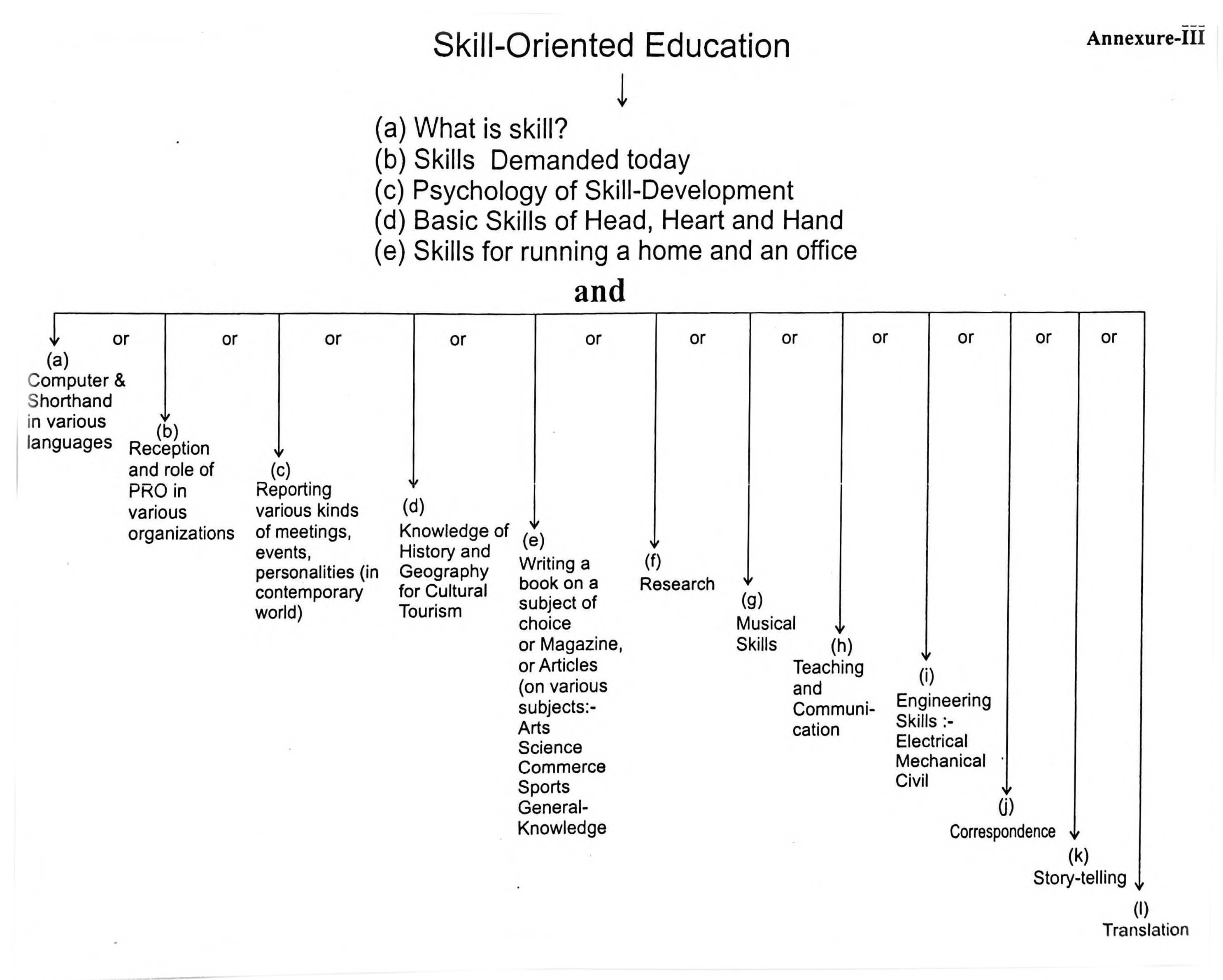
The third course - Skill-Oriented Education will also have two components. The first component would provide a general idea of what exactly skill means and what kind of skills are demanded in the contemporary world. It may also provide a short discussion on psychology of skill development and how basic skills of head, heart and hand can be blended. Finally, this course may also provide to every student skills for running a home and an office. (Annexure - III)
The second component of this course may allow a student to choose two or three of the following, so that every student gets opportunity to develop corresponding skills:
Computer and shorthand in various languages;
Reception and role of PRO in various organizations;
Reporting various kinds of meetings, events, personalities (in contemporary world);
Knowledge of History and Geography for Cultural Tourism;
Writing a book on a subject of choice or Magazine or Articles (on various subjects - Arts, Science, Commerce, Sports, General- Knowledge);
Research;
Musical Skills;
Teaching and Communication;
Engineering Skills - Electrical, Mechanical, Civil;
Correspondence;
Story-telling;
Translation.
4. Value-Oriented Education:
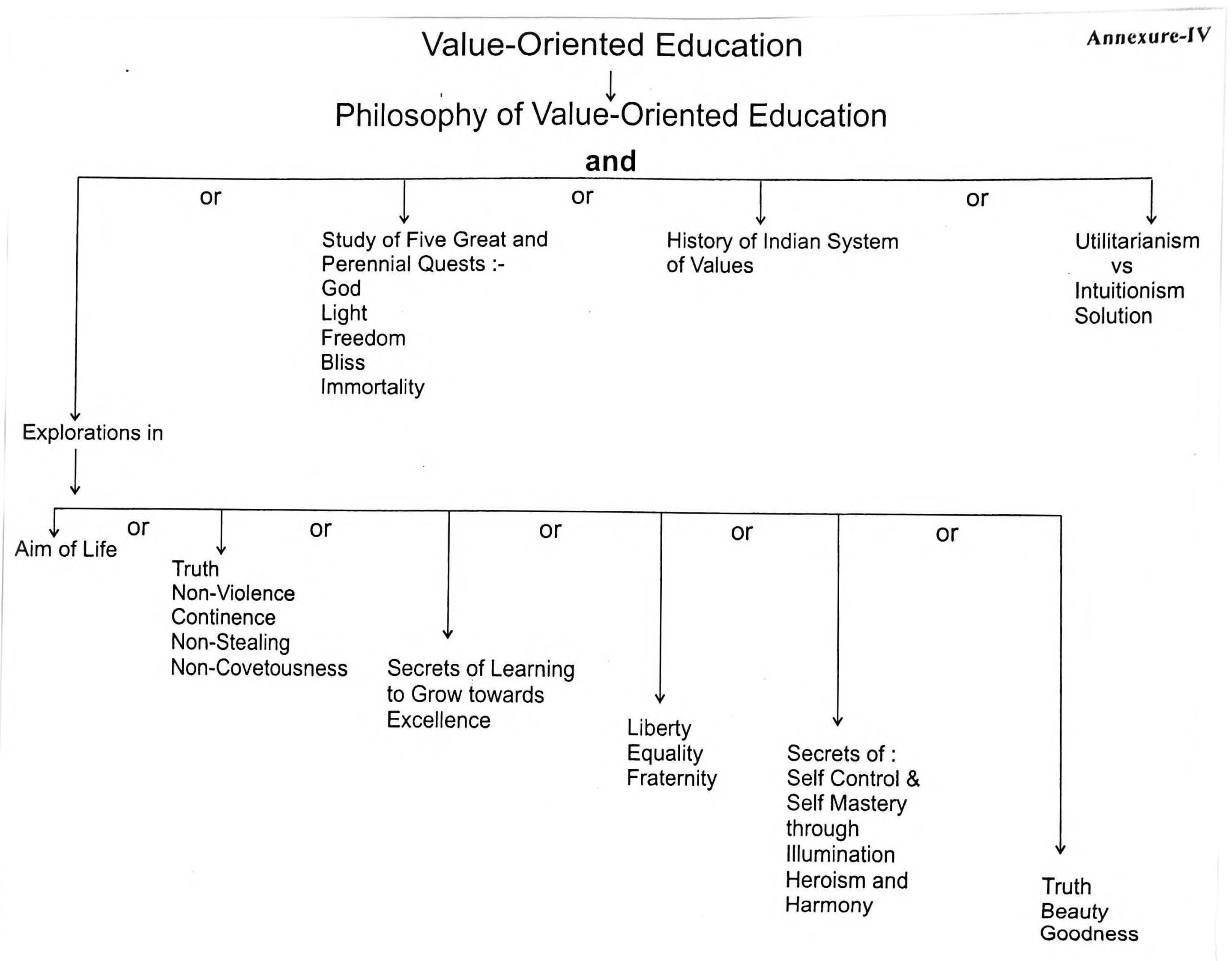
The course on Value-Oriented Education, in its first component part, would provide basic philosophy of Value-Oriented Education, and its second component would provide exploration in any of two or three allied themes (Annexure - IV)
(a) Explorations in -
Aim of Life;
Truth, None-Violence, Continence, Non-Stealing, Non-Covetousness;
Secrets of Learning to grow towards Excellence;
Liberty, Equality, Fraternity;
Secrets of - Self-control, and Self-mastery through Illumination, Heroism and Harmony;
Truth, Beauty and Goodness;
(b) Study of Five great and perennial quests - God, Light, Freedom, Bliss and Immortality;
(c) History of Indian system of Values;
(d) Utilitarianism versus Intuitionism: Solution.
5. Fundamental Duties:
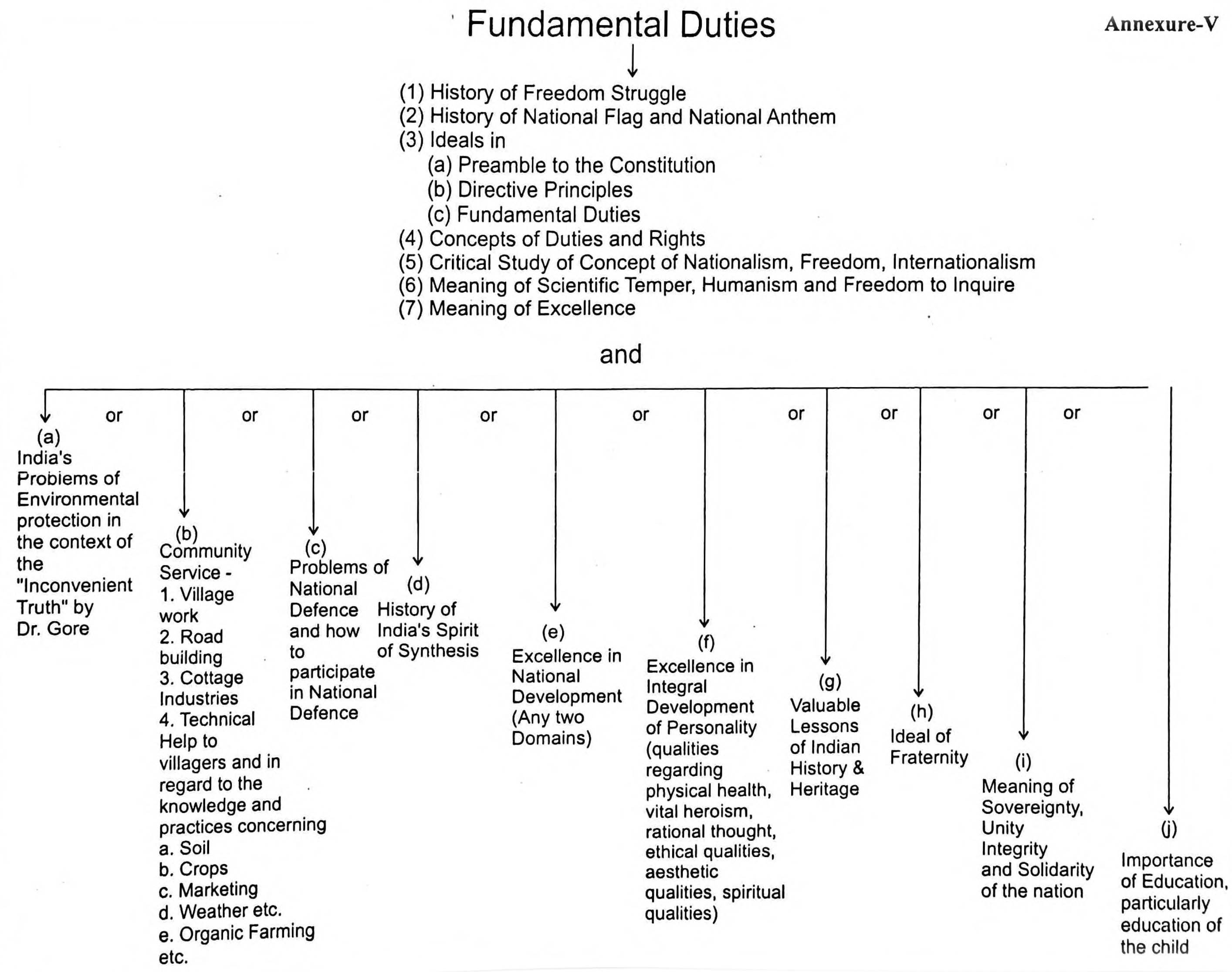
The course related to Fundamental Duties, in its first component would provide to the student a general introduction to the following themes (Annexure - V)
History of Freedom Struggle;
History of National Flag and National Anthem;
Ideals referred to in - (a) Preamble to the Constitution; (b) Directive Principles; and (c) Fundamental Duties;
Concepts of Duties and Rights;
Critical study of concept of Nationalism, Freedom and Internationalism;
Meaning of Scientific Temper, Humanism and Freedom to inquire;
Meaning of Excellence.
In addition, in its second component, it would provide to the students a possibility of more detailed study of two or three of the any following or allied themes:
a. India’s problems of environmental protection in the context of the "Inconvenient Truth" by A.L.Gore;
b. Community Service relating to:
Village Work;
Road building;
Cottage Industries;
Technical Help to villagers and in regard to the knowledge and practice concerning - (a) Soil; (b) Crops; (c) Marketing; (d) Weather, etc.; (e) Organic Farming, etc.
c. Problems of National defense and how to participate in National Defense;
d. History of India’s Spirit of Synthesis;
e. Excellence in National Development (Any two Domains);
f. Excellence in Integral Development of Personality (qualities regarding physical health, vital heroism, rational thought, ethical qualities, aesthetic qualities, spiritual qualities);
g. Valuable lessons of Indian History and Heritage;
h. Ideal of Fraternity;
i. Meaning of Sovereignty, Unity, Integrity and Solidarity of the nation;
j. Importance of Education, particularly Education of the Child.
6. Indian Culture:
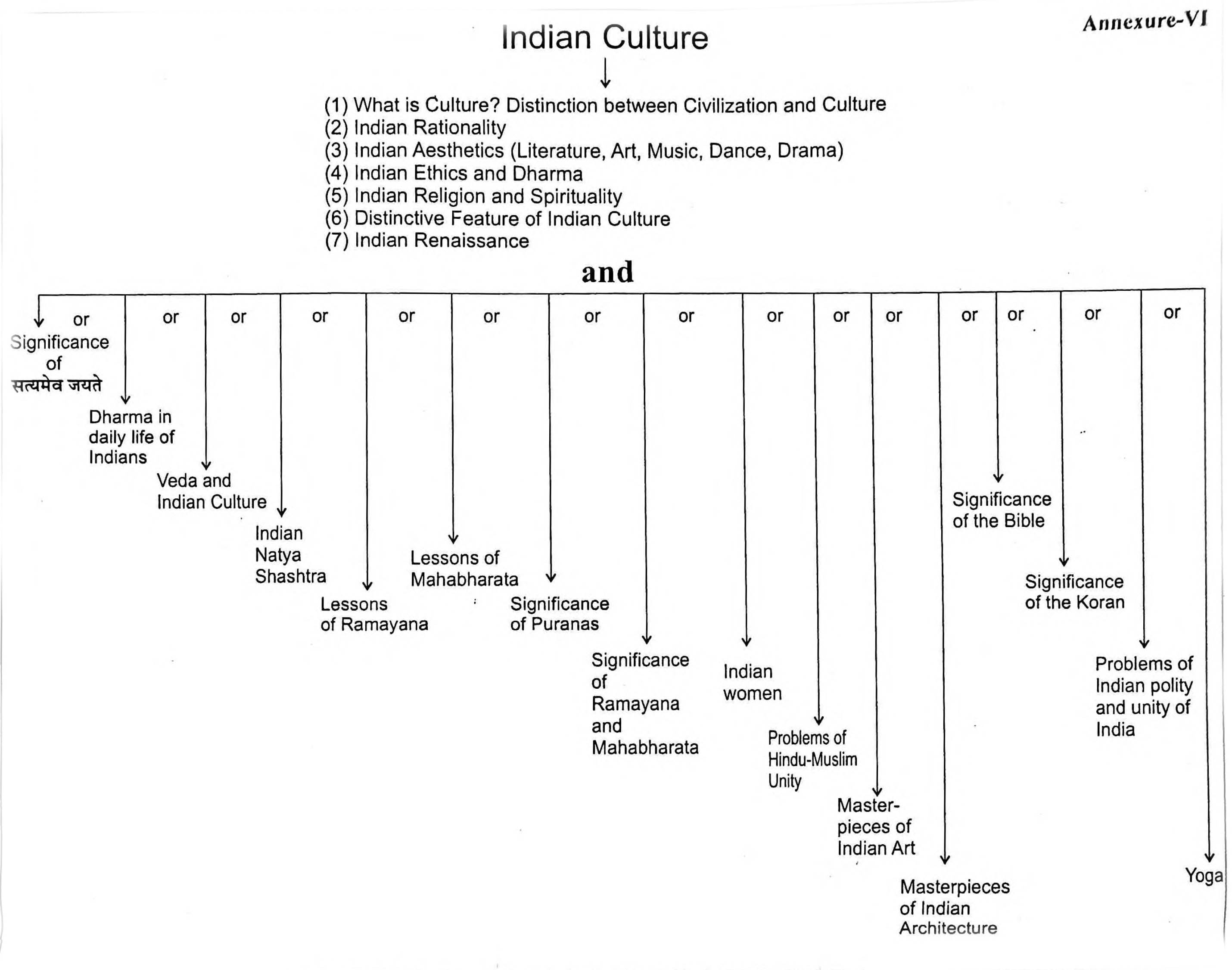
The course relating to Indian Culture, will provide in its first component general information and discussion on the following topics (Annexure VI):
a. What is Culture? Distinction between Civilisation and Culture;
b. Indian Rationality;
c. Indian Aesthetics (Literature, Art, Music, Dance, Drama);
d. Indian Ethics and Drama;
e. Indian Religion and Spirituality;
f. Distinctive Features of Indian Culture;
g. Indian Renaissance.
In the second component, it will provide a possibility of choosing any two or three of the following or allied themes for a more detailed study -
a. Significance of — सत्येव जयते - satyam eva jayate;
b. Dharma in daily life of Indians;
c. Veda and Indian Culture;
d. Indian Natya Shastra;
e. Lessons of Ramayana;
f. Lessons of Mahabharata;
g. Significance of Puranas;
h. Significance of Ramayana and Mahabharata;
i. Indian Women;
j. Problems of Hindu-Muslim Unity;
k. Masterpieces of Indian Art;
l. Masterpieces of Indian Architecture;
m. Problems of Indian Polity and Unity of India; and
n. Yoga
7. Philosophy of Education and Life:
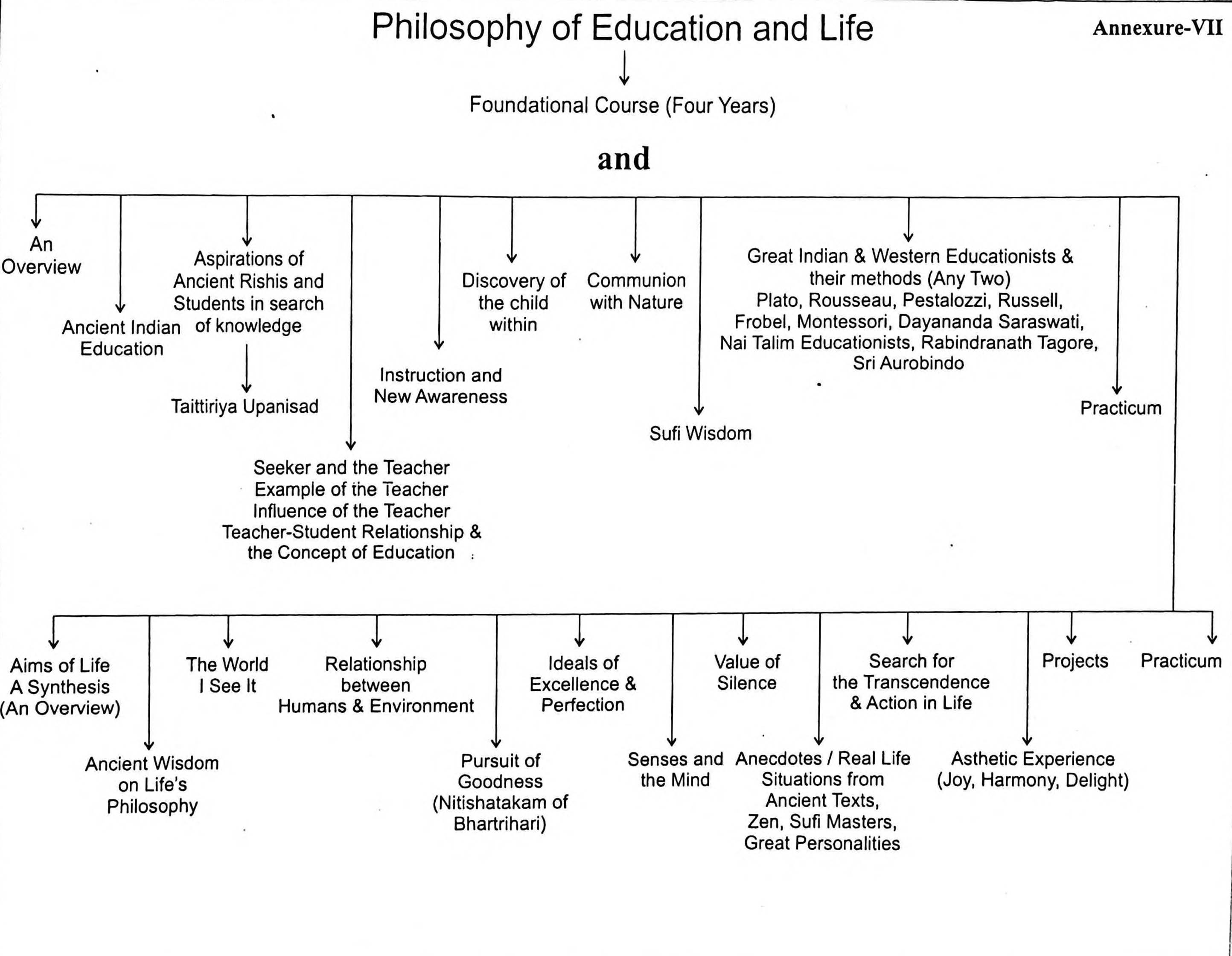
There has been one criticism of the educational system that it is divorced from life. This is a valid criticism because, even philosophically, the aims of education and life should be co-terminus. However, when thought is being developed for relating education to life, there is no clarity as to how education and life can be correlated. A deeper reflection is absolutely necessary in the proposed programme. We may, therefore, provide for a philosophical exploration of the aims of life as also of how thinkers of the East and the West have endeavored to develop their philosophy of education in the context of the aims of life.
Many others subjects and topics can also be included. Some of the relevant topics have been indicated in the relevant (Annexure VII).
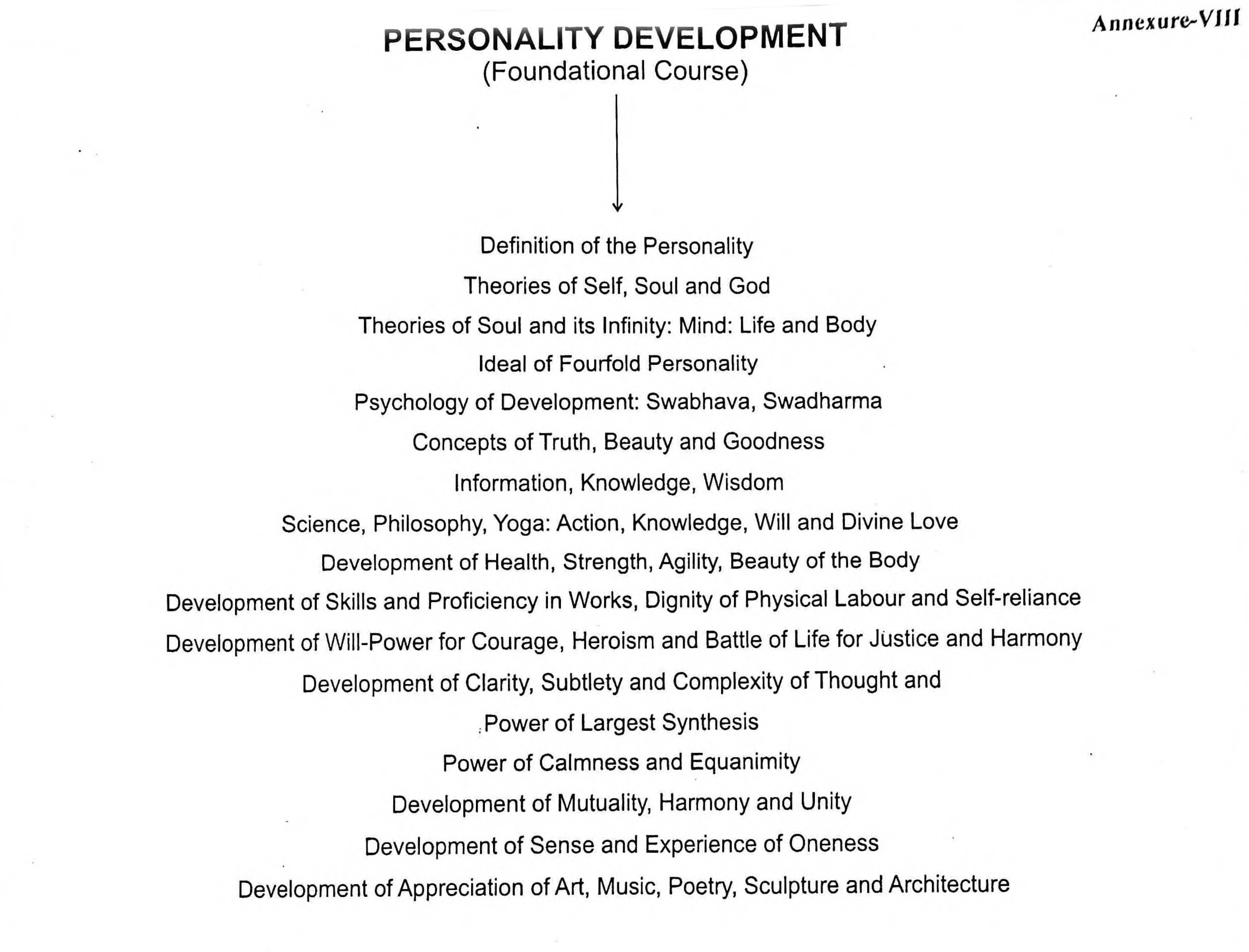
8. Education for Personality Development:
If one of the acknowledge aims of education is the development of the multisided integral personality, the teachers of today and tomorrow should be empowered to develop their own integral personality and they should have a good philosophical and psychological grounding in the concept of personality and in the processes of integration of personality. Keeping this in view, we may suggest the topics under this subject, which have been indicated in the relevant. (Annexure VIII)
CORE COURSES:
As far as the core courses are concerned, one general remark that we make is that they are necessary for conducting class teaching, and they will have to involve a good deal of project work and practicals.
9. Education for Integral Development of Personality:
If the teacher is conceived as a gardener and a child as the bud that contains within itself the potentialities of full-blown flower, we may be able to get the insights as to what has to be the role of the teacher while tending the bud so that it receives necessary environment, atmosphere, influence and some kind of intervention of intelligent and deliberate but extremely careful and restrained care of the teacher. The teacher is not merely an instructor, but she provides atmosphere and environment through her own internalized values, capacities and also her knowledge and wisdom. Only thinkers can produce thinkers, and only the courageous can impart inspiration towards heroism; only light can kindle lamps, and only the kind and the compassionate can provide to the students the required warmth and uplifting influence. How to implement this oft repeated precept into actual practice of teaching and learning in a class situation has to be worked out carefully. In the relevant Annexure-IVa tentative curriculum has been presented.
10. Education Through Indian Culture:
In the Annexure X, a tentative statement has been made for the consideration of the Committee.
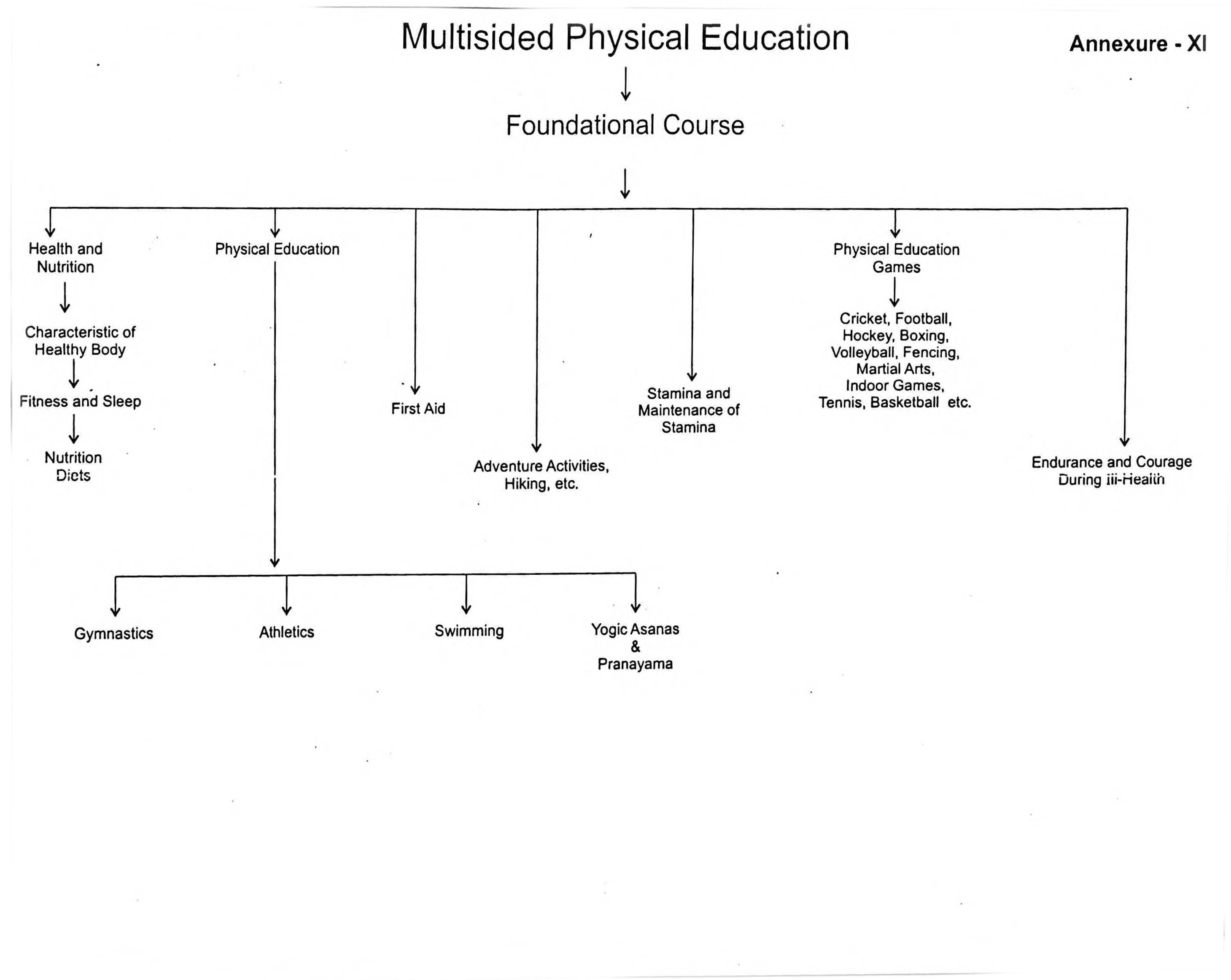
11. Multisided Physical Education:
One of the great deficiencies in Indian system of education is its neglect of meaningful programme of physical education. Sometimes what goes under the programme of yoga has not been sufficiently well planned and what goes under P.T. is so perfunctory that it neither serves the purposes of health nor of strength nor of agility of the physical bodies of the students. A healthy and strong body should be regarded as pre-requisite for any candidate to be a good teacher. Only then the teacher will be able to inspire the child to become a good gymnast, athlete or swimmer, body builder or a good yogi having the right type of the body for spiritual accomplishments.
In the relevant Annexure XI details of this programme have been suggested, and it may be recommended that every student in the IITE should undergo a comprehensive and multisided physical education, and the Institute must find the required time for this purpose.
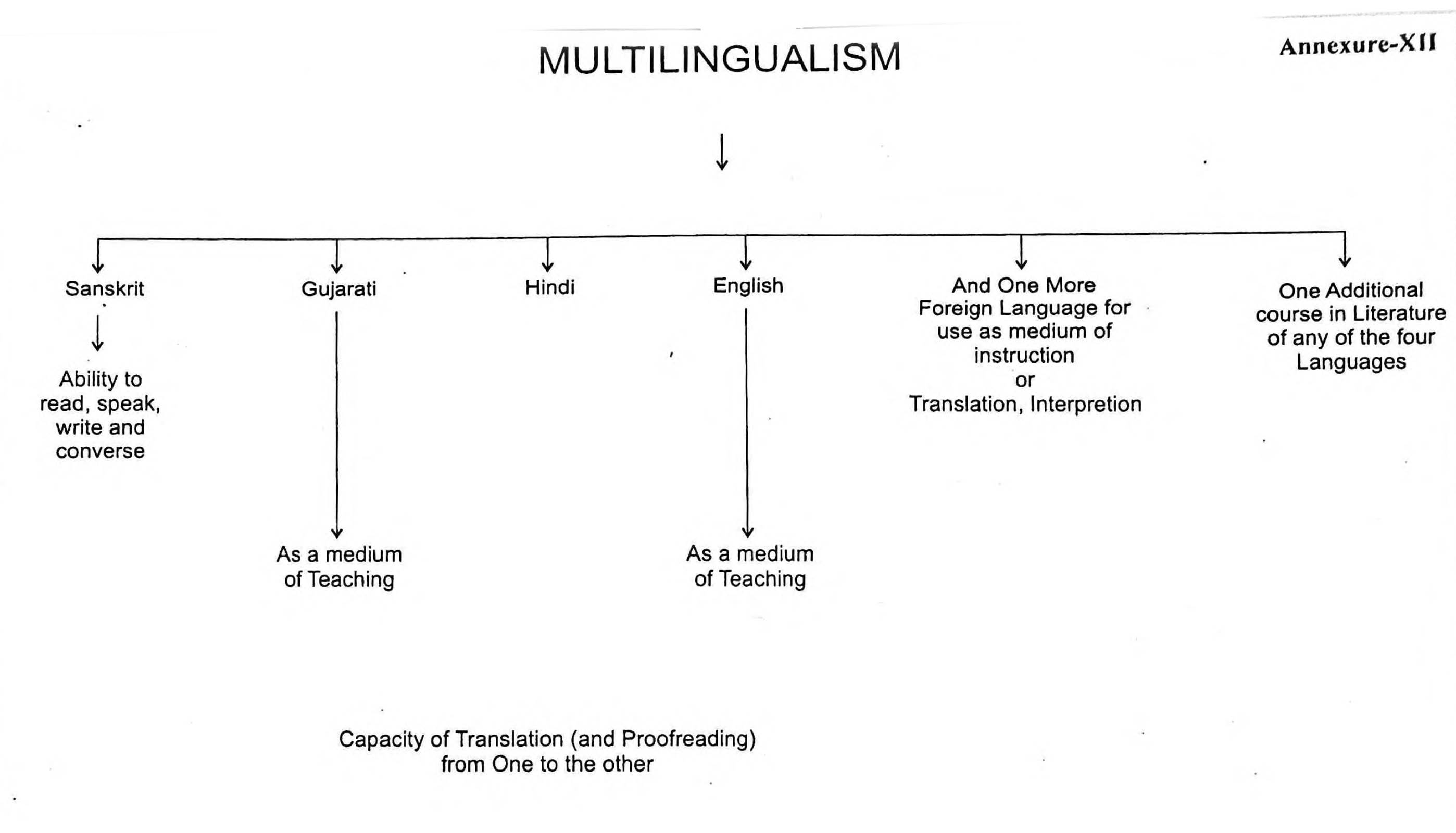
12. Multilingual Course:
In the relevant Annexure XII, it is suggested that provisions should be made in this Institute to empower every student to have competence in Gujarati and in English so that both can be used as media instruction.
It is further suggested that every student should have competence to read, write and understand Hindi, along with the capacity to translate Hindi into Gujarati and English and vice-versa.
It is also further suggested that every student should have knowledge of Sanskrit so that she can understand, read, speak, converse in Sanskrit at a minimum level and also be able to translate simple passages of Sanskrit into Gujarati or English.
Finally, it is also suggested that if the products of IITE are to be global, they should also have sufficient exposure in one additional foreign language such as French, which has large canvas in the world, and which is also accepted as a language of the United Nations and its agencies.
It is to be understood that most of the students have great linguistic deficiencies, and the committee may like to consider this problem and suggest some crash course for students to acquire capacities of eloquence both in Gujarat/Hindi and English.
III
In addition to the above, the Curriculum Committee may like to make recommendations on the following:
• Credit to be given for the various topics under the Foundational Course and under the Core Courses.
• Credit to be given to Core Courses in Arts, Science and Commerce and other interdisciplinary courses.
• Expected time hours that can be recommended for Core Courses, Foundational Courses and Optional Courses.
• A complete scheme of 4 or 5 years integrated courses.
• Acceptability of the proposed courses by the NCTE.
It may also be added that the Credit System should be made so flexible that interdisciplinary courses can be framed by students according to their inclinations and proficiency. In particular, it may be emphasized that we need to promote:
• Multilingualism
• Issue of Cultural History and the Future
• Interdisciplinarity of the themes such as the following:
a. Ideal of Human Unity
b. Evolution and Future of Human Species
c. History of Religions
d. Classics
e. Philosophy, Astronomy and Classical Languages, etc.
IV
Some thought needs to be devoted to the farming of Time-Tables and to the question of compulsory attendance at lectures.
If the Credit System has to succeed, and if students are to be encouraged to develop the capacity of self-learning (in the light of UNESCO’s thoughts in "Learning: Treasure Within"), we shall have to modify greatly the present Timetable system, and while students may be required to be present in Lecture Halls/Video-Libraries/Book Libraries/Portals Rooms/Libraries, etc., we have to allow students to study through self-learning rather than through attendance at Lectures, according to full-time fixed time-tables. New types of Time- Tables have been thought of.
V
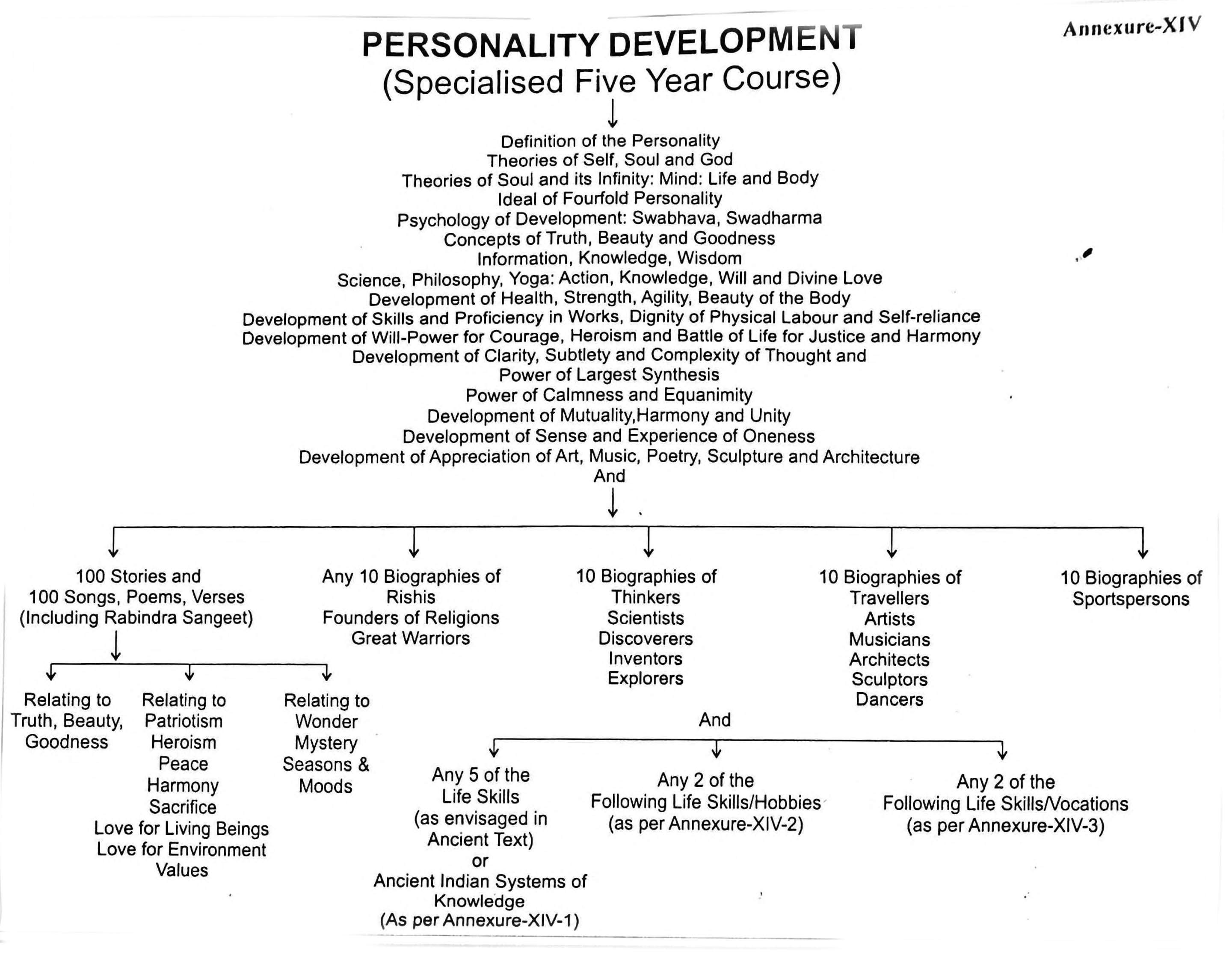
We may also suggest several Specialised Courses, a tentative list of which is given at Annexure XIII.
The student may be required to offer any three specialized Courses. In the Annexure XIV, we present for consideration some detailed proposals for a specialized 5 years course for Personality Development, which includes lists of Life-Skills.
In Annexure XV, we present suggested details for a specialized course in Philosophy of Education And Life.
Annexure XVI suggests topics to be included in a 5 years course in Physical, Vital and Mental Education.
VI
Examination Reforms need to be revised in the light of the following:
• Examination on Demand (as in NIOS)
• Examination of Skills
• Examination of Personality Development
• Examination of Physical Fitness
ANNEXURE IX
Education for Integral Development of Personality
To Know Oneself and to Control Oneself
(An Exploratory Draft Programme)
Classes I and II
I. Stories and plays to illustrate the following themes:
The ideal of truth: To speak the truth, whatever the consequences.
Aspiration for perfection: Whatever you do, do it as perfectly as you can.
Dreams of the new world: Where truth alone prevails, where beauty and goodness pervade.
II. Special exhibitions on the above themes.
III. Teachers may recommend the following exercises and help each child to practise them:
Exercises in remembering and repeating noble aspirations and thoughts.
Exercises in observations and accurate description (leaves, plants, flowers, minerals, scenes, animals, figures, human body, artistic pictures, musical pieces, building, objects, events).
Art of bathing, art of cleaning the teeth, art of dreaming, art of sitting and standing in right postures.
Exercises in control of the senses:
Control in regulating calls of nature, thirst and appetite;
Control in speech;
Control in behaviour;
Control in movement and action.
Classes III and IV
I. Development of the sense of wonders:
Examples from astronomy: distance, vastness, galaxies, expanding universe.
Examples from physics: what is matter behind what we see and touch?
Examples from chemistry: what is water? Is it mere oxygen and hydrogen or something more?
Examples from other sciences: caterpillar and butterfly, language and understanding, outer man and inner man.
II. Training of the senses and their powers:
Knowledge of the senses: five senses of knowledge, five senses of action.
Exercises of vision and hearing: art and music as instruments.
Exercises of concentration in sense activities.
Inner senses: capacities to see the invisible and to hear the inaudible.
III. Awareness of the body:
Elementary knowledge relating to health, strength and beauty of the body.
Art of relaxation and art of sleeping.
The body as the temple of the spirit.
IV. Teachers may recommend, according to circumstances, the following attitudes and exercises:
One should study, not to pass examinations, but to discover the secrets of the world.
Work with the body is indispensable for true knowledge and experiences.
Practise of concentration in every activity: concentration is the key to all progress.
Practise of quietude and silence in ‘ ‘Rooms of Silence’’.
Impromptu periods or moments when children are asked to be as quiet as possible.
Directions to Teachers (Class I - IV)
Some practical hints that result form the application of methods of psychological and value-oriented development are suggested here:
(a) It may first be noted that a good many children are under the influence of the inner psychic presence which shows itself very distinctly at times in their spontaneous reactions and even in their words. All spontaneous turning to love, truth, beauty, knowledge, nobility, heroism is a sure sign of the psychic influence.
(b) To recognise these reactions and to encourage them wisely and with a psychic feeling would be the first indispensable step.
(c) The best qualities to develop in children are:
sincerity perseverance
honesty peace
straightforwardness calm
cheerfulness self-control
courage self-mastery
disinterestedness truth
patience harmony
endurance liberty
(d) These qualities are taught infinitely better by examples than by beautiful speeches.
(e) The undesirable impulses and habits should not be treated harshly. The child should not be scolded. Particularly, care should be taken not to rebuke a child for a fault which one commits oneself. Children are very keen and clear-sighted observers; they soon find out the educator’s weaknesses and note them without pity.
(f) When a child makes a mistake, one must see that he confesses it to the teacher or the guardian spontaneously and frankly; and when he has confessed it he should be made to understand with kindness and affection what was wrong in the movement and that he should not repeat it. A fault confessed must be forgiven.
(g) The child should be encouraged to think of wrong impulses not as sins or offences but as symptoms of a curable disease alterable by a steady and a sustained effort of the will - falsehood being rejected and replaced by truth, fear by courage, selfishness by sacrifice, malice by love.
(h) Great care should be taken to see that unformed virtues are not rejected as faults. The wildness and recklessness of many young natures are only the overflowing of an excessive strength, greatness and nobility.
(i) An affection that is firm yet gentle, sees clearly, and a sufficiently practical knowledge will create bonds of trust that are indispensable for the educator to make the education of a child effective.
(j) When a child asks a question, he should not be answered by saying that it is stupid or foolish, or that the answer will not be understood by him. Curiosity cannot be postponed, and an effort must be made to answer questions truthfully and in such a way as to make the answer comprehensible to his mental capacity.
(k) The teacher should ensure that the child gradually begins to be aware of the psychological centre of his being, the psychic being, the inner seat of the highest truth of our existence.
(l) With that growing awareness, the child should be taught to concentrate on his presence and make it more and more a living fact.
(m) The child should be taught that whenever there is an inner uneasiness, he should not pass it off and try to forget it, but should attend to it, and try to find out by an inner observation the cause of the uneasiness, so that it can be removed by inner or other methods.
(n) It should be emphasised that if one has a sincere and steady aspiration, a persistent and dynamic will, one is sure to meet in one way or another, externally by study and instruction, internally by concentration, revelation or experience, the help one needs to reach the goal. Only one thing is absolutely indispensable, the will to discover and realise. This discovery and this realisation should be the primary occupation of the being, the pearl of great price which one should acquire at any cost. Whatever one does, whatever one’s occupation and activity, the will to find the truth of one’s being and to untie with it must always be living, always present behind all one does, all that one thinks, all that one experiences.
All the above suggestions are to be implemented from day to day under various circumstances and in the context of living problems of the growth of children.
The role of the teacher is to put the child upon the right road to its own perfection and encourage it to follow it, watching, suggesting, helping, but not imposing or interfering. The best method of suggestion is by personal example, daily conversation and books read from day to day.
Class V
I. Science and Values:
A simple statement of the major facts of evolution:
Emergence of matter.
Emergence of life in matter.
Emergence of mind in life.
Man is evolving.
Striking phenomenon of the mutation of a caterpillar into a butterfly.
Future possibilities of the evolution of man. Yoga is a scientific and methodised effort of the evolution of man.
II. Aids for the Development of Value-Consciousness and Experience:
To ask oneself: what am I?
Story of the search of Svetaketu and Nachiketas.
Listening to music: selected ragas (Indian) and harmonies (Western)
Picture of the beauty of nature.
Study of great personalities: the Buddha (a detailed study).
Need for physical fitness: what it means (topic for study and reflection).
III. Teachers may recommend the following exercises according to circumstances and in response to the individual needs of each student:
Resolve daily to be truthful, to be free from fear and to have goodwill for everyone.
Works of labour and community service with an inner motive of dedication.
Clarity of thought: there is a distinction between appearance and reality (Examples from science, history, literature and philosophy).
Cleanliness and purity of the body, exercises for the body.
Class VI
I. Science and Values
Striking facts revealed by science:
Extraordinary phenomenon of intelligence in animals and birds.
Possibility of intelligence even in matter or material objects.
Complex organisation of social life in certain species of insects, animals and birds.
Man’s intelligence: is it superior to the intelligence of animals and birds in every respect.
Value-oriented methods of developing intelligence and knowledge:
Concentration - silencing of the mind
Intense search for the truth
Sincerity in thought, word and deed
Deep humility
II. Aids for Developing of Value-Consciousness and Experience:
Introspection: distinction between thought, will, emotion, impulse, sensation, perception, and functions of the body.
Story of Arjuna at the beginning of the Mahabharata War to illustrate the above distinctions (other similar stories)
Determination of the aim of life:
The Meaning of an idea
Ideals of truth, beauty and goodness
Ideal of perfection
Study of great personalities: Jesus Christ (a detailed story).
Listening to music: selected ragas (Indian) and harmonies (Western).
Examples of poetic excellence: regional poetry, Sanskrit poetry, English poetry.
Need to control and master the lower nature (topic for study and reflection).
Diet and health.
II. Exercises to be recommended:
To makes in daily life the choice for control and mastery, for regularity and punctuality; the choice for truth and perfection, for work and perseverance to the end of the work, for seriousness of purpose and inner joy and equality in all circumstance.
To remember the aim of life and to:
a. Review daily before retiring one’s actions, thoughts, feelings, in relation to the aim of life.
b. Try to harmonise thoughts, words, feelings and deeds to as to progress more in this direction.
- To observe in oneself and to practise through daily effort and exercise:
a. Creative urge towards poetry, music, art, crafts, dance, drama, reading, writing.
b. Capacities to feel wideness, intensity and height of consciousness and experience.
Works of labour and community service with an inner motive of dedication - learning the art of sweeping rooms, courtyards, washing of dishes and clothes, and elements of first aid.
Enlarge interests: there is no subject which is not interesting.
Will always for health, strength, agility, plasticity and beauty. Remember: it is not virtue to fall ill. If ill:
a. Examine diet
b. Examine habits
c. Examine feelings, thoughts and actions - correct them and recover health.
- Daily one hour of relaxation and games, etc.
Class VII
I. Science and Values
How are plants different from animals?
Do plants and trees have feelings?
Experiments of Jagdish Chandra Bose.
Experiments of effects of music on plants.
Study of flowers as symbols of psychological states and powers.
II. Aid for the Development of Value-Consciousness and Experience:
Calm and intimate company of plants, trees and flowers.
A study of the:
a. Stories of Bodhisattva from the Jatakas.
b. Parables from the Bible.
c. Questions put to Yuddhishthira on the bank of the lake and his answers.
d. Messages received by Prophet Mohammad from the Angel.
e. Account of Rabindra Nath Tagore’s experience of his opening to poetic inspiration.
f. “Powers of the Mind” - from Swami Vivekananda.
Topic for deep study and reflection: how to progress continuously?
Study of great personalities: Prophet Mohammad (a detailed study).
III. Methods for the development of the following qualities and skills:
Quietude
Interest in languages
Poetry and music
Clarity of thinking
Will-power
IV. Exercises to be recommended:
Develop awareness.
Go deep, very deep within in search of the soul. (Concentrate on the region of the “solar plexus” and collect all your consciousness, and go deeper and deeper in that region, with quietude, and practice this often.)
Study repeatedly and practise the message given in:
a. The description of the Sthithaprajna as given in the Gita.
b. “The Sermon on the Mount”, from the New Testament.
c. “If you hast the work, this is they work”, by Sri Aurobindo.
Works of labour and community service with an inner motive of dedication.
Daily one hour of exercises, games, etc.
Class VIII
I. Science and Values:
Surprising mysteries of the human body as revealed by science.
Value-oriented concept of the body:
a. The body as the temple of the spirit.
b. The subtle body and its functions.
c. The concept of chakras (centres of vibrations) and their functions.
d. The concept of kundalini: how it can be awakened in different ways.
- Yogic concept of the perfection of the body by a total psychological transformation.
II. Aids for the Development of Value-Consciousness and Experience:
The ideal and practice of brahmacharya (example of Dayananda Saraswati).
Study of passages from Plato, particularly from the Apology and The Republic.
Study of passages from the Upanishads, particularly Isha Upanishad.
Contemplation on the concept of “Universals”.
Topic for deep study and reflection: “What is my role in the world?”
Reflection:
a. What is the aim of learning languages? How to enrich knowledge of languages?
b. What is the essence of mathematics?
c. What is science?
Is language a science?
Is mathematics a science?
Is history a science?
Is geography a science?
d. What is the difference between science and art?
A detailed study of the life and work of Tiruvalluvar.
Daily one hour of exercises and games, etc.
Class IX
I. Science and Values:
The concept of matter in modern science and yoga.
The concept of life in modem science and in yoga. .
Importance of the sun and its energy for the life on the earth.
The nature of the light of the sun (Saura Agni): how it is different from the light of ordinary fire {Jada Agni) and electricity (Vidyut Agni).
The concept of Agni in yoga.
Speed of light: its importance in science. Position of an object moving at the speed of light. The concept of the mobile-immobile. Compare this with: “It moves, It moves not” - the Upanishadic description of reality.
The concept of time in modem science.
Speed of consciousness exceeds that of light according to yogic knowledge.
II. Aids for the Development of Value-Consciousness and Experience:
What is the process of thinking? How is thinking different in science from that in philosophy?
What is technology? How should technology be learnt?
What is the difference between art and technology?
Observation of the different levels of being in man: the distinction between the physical man, the vital man, the mental man, the spiritual man and the integral man.
Topic for deep study and reflections: “Unity of knowledge” or “All knowledge, scientific, philosophic or yogic, tends ultimately to be identical.”
III. Exercises to be recommended:
Repeated study and contemplation of Chapter XI of the Bhagavad Gita.
Vow of the Buddha
Selected Psalms
Islamic prayers
Selected portions from Tulsidas
Songs of Mirabai, Surdas, Tukaram, Ramprasad, and other saints
Prayer of Swami Vivekananda
Class X
I. Sciences and Values:
- Our knowledge regarding man:
a. Man in evolution
b. Has man made progress?
c. Limitations of man
The phenomenon of death. What is death? (in the physical, psychological and yogic senses). Can death be conquered?
Dependence of bodily life on respiration, food, blood circulation and sleep. Is this dependence necessary or indispensable?
The yogic powers of mastery over food, sleep, respiration and blood circulation. Limitation of these powers; dangers of these powers, real perfection.
The right attitude towards food, sleep, respiration and other limitations of the body. Need for temperance: avoidance of extremes. Need for change of consciousness. Mastery over bodily limitations possible only at the highest levels of yoga.
The concept of the divine body.
II. Aids for the Development of the Yogic Consciousness and Experience:
- Elementary powers of expression. Necessity and methods of development of these powers, particularly, in relation to:
a. Faultless language expression.
b. Faultless bodily expressions: recitation, singing, eurhythmies and dramatics.
c. Faultless deeper expressions: poetry, dance, art and craft.
- Elementary powers of perceptions. Necessity and methods of development of these powers, particularly in relation to:
a. Refined vision and audition, appreciation of art and music.
b. Inner yogic visions and voices.
c. Sympathetic feeling and understanding, experience of cooperation, harmony, mutuality and oneness.
- Elementary powers of action. Necessity and methods of development of these powers, particularly in connection with:
a. The relationship between knowledge and action.
b. The relationship between ideal and practice.
c. The relationship between dedication and heroism.
Works of labour and community service with an inner motive of dedication.
Study of great personalities (A detailed study of life of Mahavira)
Why and how to study? (A topic for study and reflection.)
III. Exercises to be recommended:
- Remember and practise in daily life:
a. Work, not to come first, but to do your very best.
b. You have no right to criticise anybody, unless you can do better than the one whom you want to criticise.
c. Cultivate in yourself those qualities which you want others to cultivate.
d. Select books, magazines, and films with utmost care, and under the guidance of some teachers whom you trust.
e. Do not indulge; do not kill your emotions, but learn the difficult art of control, purification, mastery and transformation.
f. You have within yourself an inner soul, full of purity, joy and love and light. You are to discover it and bring it forward in all your activities, thoughts and feelings.
Continue to enlarge interests.
Continue to will for health, strength, agility, plasticity and beauty.
Daily one hour of exercise and games, etc.
IV. Programmes of Self-Education
The following exercises may be recommended:
Observation and developments of the natural tendencies, preferences, inclinations and interests.
Where have I reached in my progress?
What are my defects?
How to face defects without depressions?
What should I do to overcome my defects?
Preparation of a programme of self-discipline.
Am I talking too much? To learn to speak only what is necessary.
Am I lazy? To resolve to remove idleness.
How to organise my life and my activities?
V. Study of selections from Valmiki and Vyasa
VI. A detailed study of the life and work of Guru Nanak.
Class XI
I. Science and Values:
The role of intuition in discoveries and inventions of science. Yoga as a conscious methods of the development of intuition.
Ancient Indian sciences and yoga.
Ancient Indian knowledge and modem scientific knowledge; some striking examples.
Systems of yoga: Hatha Yoga, Raja Yoga, Karma Yoga, Jnana Yoga, Bhakti Yoga, Tantra, Integral Yoga.
II. Aids for the Development of the Yogic Consciousness and Experience:
Need for the systematic knowledge of the principles and methods of yoga.
Need for the Teacher: the real inner Teacher.
Need for inner aspiration in the student.
The right attitude towards time: to do everything as quickly and perfectly as possible.
Study of great personalities: Sri Ramakrishna and Swami Vivekananda (a detailed study).
III. Exercises to be recommended:
Reflections on:
Scientific and philosophical methods of knowledge.
Can science and philosophy explain the ultimate reason of events and processes of the world?
Value and limitations of the philosophical concepts of:
Deism
Pantheism
Theism
Monism
Omnipresence, omniscience and omnipotence of God.
Value and limitations of the philosophical proofs of the existence of God.
Can God be experienced? Affirmation of spiritual experiences. Varieties of spiritual experience. Yoga as a systematic knowledge of spiritual experience.
Class XII
I. Science and Values:
Yoga as an exploration of existence by an enlargement of consciousness.
Yoga, like science, is a systematic body of knowledge.
Yoga, like science, is non-dogmatic.
Yoga, like science, accepts the criterion of verification by experience.
Yoga is science, per excellence (statements from Swami Vivekananda on this subject).
Materialism, science and yoga.
Need for the synthesis of science and spirituality.
Science and the discovery of the fourth dimension.
Discovery of the manifold dimensions of human personality.
II. Central Experience of Inner Consciousness:
- Experience of the true individuality:
a. Experience of the Witness Self.
b. Experience of the Psychic Being in formation.
c. Experience of the discovery of the Psychic Being - experience of the second birth.
Experience of Silence or of nirvana.
Experience of the Cosmic Consciousness.
Integral experience of the simultaneous Silence and Dynamism.
Supramental time-vision.
III. Aids for the Development of the Yogic Consciousness and experience:
A brief study of the following topics:
- All life must be accepted, but all life must be transformed.
Works of knowledge
Works of love
Works of life-force
Problems in accepting and transforming these works.
- Synthesis of the four main theories of the aim of life:
Supracosmic
Supraterrestrial
Cosmic-terrestrial
Integral
Development of a vision of ideal perfection, individual and collective.
Man’s present condition and possibilities of his further evolution.
Psychological experiences of various parts and domains of being. Conflicts between the rational being, the aesthetic being and the ethical being. How to resolve these conflicts?
IV. Exercises to be recommended:
Sustained exercises of clear thought.
Intensive introspection.
Progressive harmonisation of various parts of the being.
Creative work with sustained enthusiasm and the spirit of perfection in expression.
Programmes of dedicated community service.
Consistency in aspiration, effort and dedication.
Equality in success or in failure, while working constantly for the triumph of the Truth.
Development of the powers of philosophical reasoning, scientific observation and experimentation, artistic expression, and technological skill. Harmonisation of these powers by rigorous internal exercises of will.
V. Programmes of Self-Education:
To discover within oneself the secret guide and teacher and to take up the charge of educating oneself progressively and integrally.
ANNEXURE-X
EDUCATION THROUGH INDIAN CULTURE TO CHILDREN OF INDIA
Class I to IV
The first lesson may underline the concept of reverence to the highest, which is common in all parts of India, and which transcends barriers of religions and beliefs. The most important phrase is: HHt namo namah — salutation, and salutation again. The message of this phrase has become embedded in the entire style of life in India and even in greetings to each other Indians make various gestures of salutations.
Truth is another word that has to be underlined. The search for the Truth supersedes every other search in Indian culture.
The story of the Buddha to be told to the children in detail - his search for the truth was so intense that he renounced all else, -- his kingdom, his wife, his child, - - everything that was dear and near, everything that was pleasant.
Renunciation (wr) is another important common element in Indian culture. India celebrates renunciation and values it most.
The story of the search for the Truth and renunciation is further illustrated by the story of Nachiketas.
The story of Nachiketas can be recounted as given in the Kathopanishad. The story of renunciation is also illustrated through the story of Sri Rama, which can be told to underline Sri Rama’s renunciation and his emphasis on action to uphold the truth.
The story of Harischandra can also be told - it illustrates both Truth and renunciation.
The story of Shivi can also be told in the same connection.
The ideal of Truth is so much emphasized that India when it became free adopted the following as its official motto: — satyam eva jayate.
From where is this motto derived, let us make a search.
It would be found in Mandukya Upanishad. What are Upanishads? They are the highest literature of India. It is in the Upanishads that we find the description of ancient India. Kings and princes and ordinary children are found here in search of Truth and they knock on the doors of the huts of the Rishis in the forest.
The seekers of knowledge in search of teachers have since that time remained an ideal feature of Indian culture.
While telling this, the following statements may be emphasized: Our culture is the culture oftyaga.
Even kings used to abdicate their kingdoms in order to seek the highest knowledge and Truth towards the end of their life. The story of Kunti, Gandhadri and Dhritrashtra can be told in this context.
Ten taktyena bhunjita is another concept that can be introduced from the Ishopanishad.
Abdication of desires is the one message in all religions which are prevalent in India. During the freedom struggle, the idea of abdication was most important. The story of freedom struggle to be told in this connection.
Reference may also to be made o light and sound show of Andaman Nicobar. The story of Bal Gangadhar Tilak, story of Sri Aurobindo, the story of Dr. Rajendra Prasad, Subhash Chandra Bose, Khudiram Bose, Bhagat Singh, Chandrashekhar Azad, etc. This is the India that should be loved and cherished.
Another aspect of Indian culture is “sarva hitaya” - work for the benefit of all. Reference from Bhagavadgita, Buddhism, Jainism and Islam, etc., can be told. In this connection, we can tell the story of Sri Rama; for public welfare he sacrificed his personal life; story of Sri Krishna and Arjuna; tjW HJT? - solidarity of people was the ideal given by Sri Krishna to Arjuna; story of goodwill; the story of Christ; Buddha’s story of compassion and the idea of sarvodaya, can be emphasised here.
Search for good, love, and joy (ananda). Indian culture is full of festivals of joy, kavya, sangita, stories of Sri Krishna, Shiva, and Mahalaksmi.
For Class V to XII
Class V
The curriculum of class V may be divided in three parts:
Part I
This part should be devoted to the following topics:
a. The story of Sanskrit in India;
b. Important authors, who wrote in Sanskrit, and whose works are memorable;
c. The story of Tamil: famous authors in Tamil and famous works in Tamil
d. The story of Pali and authors who wrote in Pali: memorable works in Pali;
e. The story of Prakrit: great authors who wrote in Prakrit and memorable works in Prakrit;
f. Origin and development of the modem Indian languages: Names of all modern Indian languages and famous authors and the works in these languages;
g. The story of Arabic, Turkish and Persian in India: famous authors and famous works in these languages.
h. Arrival and development of English in India: famous Indian authors and famous works of Indian authors in English.
Part II
Two greatest works of India in Sanskrit: The Ramayana and The Mahabharata.
An outline of the contents of there two works.
Part III
Definition of Culture.
What is Indian Culture?
Spirituality, brilliance of intellectuality and profusion of creativity.
Class VI
(Note: Curriculum of class VI to VIII in Indian culture may be prescribed only for those students, who want to pursue the course of Indian culture at an advanced level. For those who do not wish to do so, may be allowed to take up at this stage, an advanced course in any other subject in which they are interested in a special way.)
Story of Astronomy and Mathematics in India: famous authors in Astronomy and Mathematics and famous works of these famous authors.
The following topics may be emphasized:
a. The concept of Brahmanda;
b. Ancient Indian concept of the Earth that moves around the sun; The ancient Indian concept of planets. The concept of Gravitation in ancient India.
c. Life and works of Varahamihir;
d. Invention of the concept of zero;
e. Indian Mathematical sciences: Arithmetic, Algebra, Geometry. Measurements and calculations up to highest possible integers and lowest possible fractions;
f. An account of great advances in Astronomy and Mathematics in ancient India, which anticipated discoveries of the modem period of the world history.
g. Advances in Astronomy and Mathematics in modem India, which absorbed western advances in the modem period.
Class VII
Ancient Indian Physics and Chemistry:
a. The concept of five basic elements: ether, air, fire, water, and earth;
b. Sankhya theory of evolution and Vaisheshika theory of atom;
c. The concept of speed of light;
d. Ancient chemistry in India;
e. Ancient chemistry and Ayurveda.
Class VIII
Development of Ayurveda in ancient India, and its continuity right up to the present day.
The following topics to be emphasized:
a. Knowledge of the human body, anatomy and physiology (in bare outline);
b. Concept of Doshas;
c. Theory of health and strength in Ayurveda: relationship with Physical exercises of Hatha Yoga;
d. Concept of longevity;
e. Indian surgery;
f. Plastic surgery and its survival right up to the arrival of the British in India;
g. Present status of Ayurveda in India;
h. Indian games, wrestling, and exercises for physical perfection;
Class IX
a. Famous Indian stories: Panchtantra and Hitopadesh and Jataka stories;
b. History of Sanskrit drama with special reference to (i) Bharata Muni and
c. Abhinavagupta (ii) famous Sanskrit dramas prior to Kalidasa;
d. Kalidasa: his poetry and drama;
e. Post-Kalidasian drama;
f. Katha Sarit Sagar;
g. Use of Prakrit in Sanskrit dramas;
h. Bare outline of the great stories and dramas, written in India in Arabic and Persian;
i. Bare outline of stories and dramas written in modem Indian languages;
j. Indian authors in English: Rabindranath Tagore and Sri Aurobindo.
Class X
The curriculum of class X will be devoted to Indian Art.
Special reference to:
a. Indian concept of Art; illustrations in Poetry, Music, Painting, Architecture and Sculpture;
b. Various stages of development in Art, particularly paintings.
c. Outstanding paintings, right up to Mughal period;
d. Indian architecture, temples, palaces, churches, Gurudwaras and others; Mughal architecture in India: Importance of Taj Mahal.
Class XI
a. Systems of Indian Philosophy: Main schools and their fundamental doctrines;
b. Indian ethics: outline study of ethics and yoga of Geeta.
c. Dharmashashtras and Nitishashlras of India;
d. Arthshashtra of India (a bare outline);
e. Other numerous social sciences:
f. Concept of 64 sciences and arts.
Class XII
a. Religions in India; spirit of tolerance and synthesis;
b. Systems of Yoga and systems of synthesis of Yoga;
c. Indian polity and India Renaissance;
d. Leaders of Indian Renaissance;
e. Problem of contemporary Indian culture and external Influences;
f. Towards a great synthesis of the East and the West.
Self Learning Project (Any 1 Subject)
• Teaching any One or Two School Subjects
• Teaching New Subjects of Development of Personality
• Teaching Groups of Hobbies
• & Teaching Group of Vocational Courses
• Teaching Physical Education
• Teaching Gifted Creativity
• Teaching Differently Abled Children
• Teaching Early Childhood Education (Including Health, Nutrition and First Aid)
• Ayurveda, Allopathy, Homeopathy and Unani
• Teaching Complete Harmony of Body, Mind and Consciousness through Yoga
• Teaching Computer
• Philosophy of Education
• Psychology of Education
• & Sociology of Education
• Education of Aesthetics
• Education of Values
• & Education About Religions
• Development of Integral Personality
Life Skills
Sixty-four Arts mentioned in ancient texts:
Singing;
Playing on musical instruments;
Dancing;
Union of dancing, singing, and playing instrumental music;
Writing and drawing;
Tattooing;
Arraying and adoring an idol with rice and flowers;
Spreading and arranging beds or couches of flowers, or flowers upon the ground;
Colouring the teeth, garments, hair, nails and bodies, i.e. staining, dyeing, colouring and painting the same;
Fixing stained glass into a floor;
The art of making beds, and spreading out carpets and cushions for reclining;
Playing on musical glasses filled with water;
Storing and accumulating water in aqueducts, cisterns and reservoirs;
Picture making, trimming and decorating;
Stringing of rosaries, necklaces, garlands and wreaths;
Binding of turbans and chaplets and making crests and top-knots of flowers;
Scenic representations, stage playing;
Art of making ear ornaments;
Art of preparing perfumes and odours;
Proper disposition of jewels and decorations, and adornment in dress;
Magic or sorcery;
Quickness of hand or manual skill;
Culinaryart, i.e. cooking and cookery;
Making lemonades, sherbets, acidulated drinks, and spirituous extracts with proper flavour and colour;
Tailor’s work and sewing;
Making parrots, flowers, tufts, tassels, bunches, bosses, knobs, etc., out of yarn or thread;
Solution of riddles, enigmas, covert speeches, verbal puzzles and enigmatical questions;
A game, which consisted in repeating verses, and as one person finished, another person had to commence at once, repeating another verse, beginning with the same letter with which the last speaker’s verse ended, whoever failed to repeat was considered to have lost, and to e su J I forfeit or stake of some kind;
The art of mimicry or imitation;
Reading, including chanting and intoning;,
Study of sentences difficult to pronounce. It is played as a game chiefly by women and children an consists of a difficult sentence being given, and when repeated quickly, the words are often transposed or badly pronounced;
Practice with sword, single stick, quarter staff and bow and arrow;
Drawing inferences, reasoning or inferring;
Carpentry, or the work of a carpenter;
Architecture, or the art of building;
Knowledge about gold and silver coins, and jewels and gems;
Chemistry and mineralogy;
Colour jewels, gems and beads;
Knowledge of mines and quarries;
Gardening; knowledge of treating the diseases of trees and plants, of nourishing them, and determining their ages;
Art of cock fighting, quail fighting and ram fighting;
Art of teaching parrots and starlings to speak;
Art of applying perfumed ointments to the body, and of dressing the hair with unguents and perfumes and braiding it;
The art of understanding writing in cipher, and the writing of words in a peculiar way;
The art of speaking by changing the forms of words. It is of various kinds. Some speak by changing the beginning and end of words, others by adding unnecessary letters between every syllable of a word, and so on;
Knowledge of language and of the vernacular dialects;
Art of making flower carriages;
Art of framing mystical diagrams, of addressing spells and charms, and binding armlets;
Mental exercises, such as completing stanzas or verses on receiving a part of them; or supplying one, two or three lines when the remaining lines are given indiscriminately from different verses, so as to make the whole an entire verse with regard to its meaning; or arranging the words of a consonants, or leaving them out altogether; or putting into verse or prose sentences represented by signs or symbols. There are many other such exercises;
Composing poems;
Knowledge of dictionaries and vocabularies;
Knowledge of ways of changing and disguising the appearance of persons;
Knowledge of the art of changing the appearance of things, such as making cotton to appear as silk, coarse and common things to appear as fine and good;
Various ways of gambling;
Art of obtaining possession of the property of others by means of mantras or incantations;
Skill in youthful sports;
Knowledge of the rules of society, and of how to pay respect and compliments to others;
Knowledge ofthe art of war, of arms, of armies, etc.;
Knowledge of gymnastics;
Art of knowing the character of a man from his features;
Knowledge of scanning or constructing verses;
Arithmetical recreations;
Making artificial flowers;
Making figures and images in clay.
Vidyas as mentioned by Narada to Sanatkumarin Chhandogya Upanishad, Chapter VII. 1.2:
Grammar;
pitryam- the rites for the manes;
Rashim-mathematics;
Daivam - subject of natural disturbances;
Nidim-mineralogy;
Vakovakyam-logic;
Ekayanam-Ethics;
Deva-vidyam - Etymology;
Brahma-vidyam - knowledge of the Vedas -Rig, Yajur and Sama - regarding pronunciation, ceremonial, prosody and lighting of fire;
Bhutavidyam - science of five elements;
Kstaravidyam - science of archery;
Nakshatrav-vidyam- astrology;
Sarpa Vidyam-Science of serpents;
Devajana-vidyam - fine arts.
Life Skills I Hobbies
Chess.
Reading—Book are treasure of knowledge and this hobby will certainly come helping a long way in life.
Playing the Guitar
Ballroom Dancing
Woodworking
Gardening
Car Restoration
Metalworking
Marksmanship
Marksmanship requires pure concentration and a steady hand.
Collecting like postal stamps, first day covers, coins, etc.
Camping/Backpacking
Ship in a Bottle
Whittling
Geocaching
Sports: Football, Hockey, Cricket, weightlifting, running, bouldering, kho-kho, kabbadi, Baseball, etc.
Model Building
Leatherworking
Bowling
Archery
Letter Writing
Martial Arts
Yoga - Asana, Pranayama, Meditation.
Hiking
Photography
Pool/Billiards
Mountaineering
Cooking
Blacksmithing
Flying
Magic
Learning a Foreign Language
Blogging
Fencing
Drawing and Painting
AmateurAstronomy
Genealogy
- Adventure Races
Knitting
- Computer Programming
Aeromodeling
Amateur Radio
Animals/pets/dogs
Astrology
Beadwork
Beatboxing
Birdwatching
Boating
Bonsai Tree
Bringing FoodTo The Disabled
Building A House For Habitat For Humanity
Building Dollhouses
Butterfly Watching
Button Collecting
Calligraphy
Candle Making
Canoeing
Car Racing
Cloud Watching
Collecting Antiques
Collecting Artwork
Compose Music
Computer activities
Crafts
Crochet
Crocheting
Crossword Puzzles
Dolls making
Embroidery
Freshwater Aquariums
Frisbee Golf-Frolf
Go Kart Racing
Grip Strength
HandwritingAnalysis
Home Repair
Horseriding
Hot air ballooning
Hula Hooping
Jewelry Making
Jigsaw Puzzles
Juggling
Kites
Learning An Instrument
Learning To Pilot A Plane
Legos
Listening to music
Making Model Cars
Matchstick Modeling
Papermaking
Parachuting
Piano
Pottery
Puppetry
Pyrotechnics
Rafting
Reading
Reading To The Elderly
Rescuing Abused Or Abandoned Animals
Robotics
Rock Collecting
Scrapbooking
Skeet Shooting
Singing In Choir
Skateboarding
Sketching
Sky Diving
Soap Making
Storytelling
Swimming
Tea Tasting
Toy Collecting
Tutoring Children
Video Games, such as Age of Mythology, etc.
Writing
Scale Modeling / Dioramas
Beautician
Art of telling Jokes
Food Decorating
Basket making
Rice sculpture
Animal communication
Hobbies related to the religions of the world
Fashion Designing (Specialised course)
Cosmetics
Making Perfumes
Childcare
Diets
Natural remedies
Modeling
PATIO ART: HOWTO MAKE STAINED GLASS WIND CHIMES FOR YOUR HOME AND GARDEN
Mosaic Art and Style
Annexure - XIV-3
Life Skills I Vocations
I. DRAWING AND PAINTING (Specialisation in any of the five or six)
Surreal Painting
Romance
Madhubani Painting
Miniature Painting
Impressionism
Renaissance Art
Abstract Paintings
Semi Abstract Paintings
Mughal Paintings
Rajasthani Paintings
Mathura Art
Figurative Paintings
Landscape Paintings
Ceramics
Sculpture
Glass Painting
Basholi, Guler-Kangra and Sikh Lepakshi Painting
Batik Painting
Indian Murals Paintings
Indian Folk Paintings
Silk Paintings
South Indian form of Painting (Thanjavur)
Atavahana Paintings (2nd century B.C. to 2nd century A, D.)
Kushana School of Paintings (1 st to 3rd century A.D.)
Gupta Period Paintings (4th too 6th century A.D.)
Vakataka Paintings (4th to 6th century A.D.)
Early Western Chalukya Paintings (6th to 8 th century A.D.)
Bhanja Paintings (8th century A.D.)
Pallava Paintings (7th to 9th century A.D.)
Early Pandyan Paintings (7th to 9 th century A.D.)
Early Chera Paintings (8th to 9th century A.D.)
Rashtrakuta Paintings (8th to 1 Oth century A.D.)
Chola School of Paintings (9th to 13th century A.D.)
Hoysala Paintings (11 th to 13th century A.D.)
Kakatiya Paintings (11 th to 13th century A.D.)
Vijayanagara Paintings (14th to 17th century A.D.)
Nayaka Period Paintings (17th to 18th century A.D.)
Paintings of Medieval Kerala (16th to 18 th century A.D.)
Pala and Medieval Eastern School of Paintings (9th to 16th century A.D.)
Medieval Western Paintings (11 th to 15 th century A.D.)
Pahari Paintings (16th to 19th century A.D.)
Deccani or Dakhani Paintings (17th to 19th century A.D.)
Mysore andTanjore Traditional Paintings (17th to 19th century A.D.)
Gujarati painting - glass painting, Kalampari art
Fabric Painting
Encaustic Painting - involves working with pigment, wax, and heat
Chinese/Japanese painting (including Sumi-e), both of which are distinctive and very beautiful styles of brush painting.
Portraits individuals, groups of people, couples and self-portraits.
Comic animation
II. COMPUTER RELATED COURSES (Five year course)
Computer Teacher Course (5 year course)
1st year
Computer Fundamentals
Operating System concepts Linux & Unix
Windows XP/7/Vista
MS Word
MS Excel
MS Powerpoint
Access & Outlook
Bharatiya Open Office
Networking
Web Server Concepts
Introduction to FLASH
TALLY
Introduction to Basic Java
2ndYearCourse:
PageMaker
CorelDRaw
Photoshop
Editing a layer mask
Opacity of Layer
Illustrator
FLASH
Leap Office/ISM
Multilingual Web Technology
Software Engineering Technique
C/C++
CCB&MT
HTML/DHTML
JavaScript/VB Script
Asp.net
FrontPage
DreamWeaver
Photoshop
Flash
GIF Animator Introduction
Internet/Project
Concept of Web Server
TCP/IP
JavaScript
Oracle
Sql. Server
Project
3rd to 5th Year:
MULTIMEDIA
Image Editing
CorelDraw Photoshop InDesign
Advance Image Editing Illustrator
2D Animation
Flash Swish MAX GIF Animator
Audio Sound Forge
Video-Editing
Premier
3D Animation 3D MAX Poser
Maya Software
Animated Film Projects
Ecommerce
III. Computer Hardware (1 year Course).
IV. Cooking (National and International Cuisine).
V Classical Dances (Indian Classical - e.g. Kathak, Manipuri, Kathkali, Bharatnatyam, Kuchipudi, Oddisi etc.)
VI Musical Instruments-Flute, Sitar, Santoor, Tabla etc.
VII Vocal Ragas-(Indian Ragas)
VIII Agriculture
IX Horticulture
X Floriculture
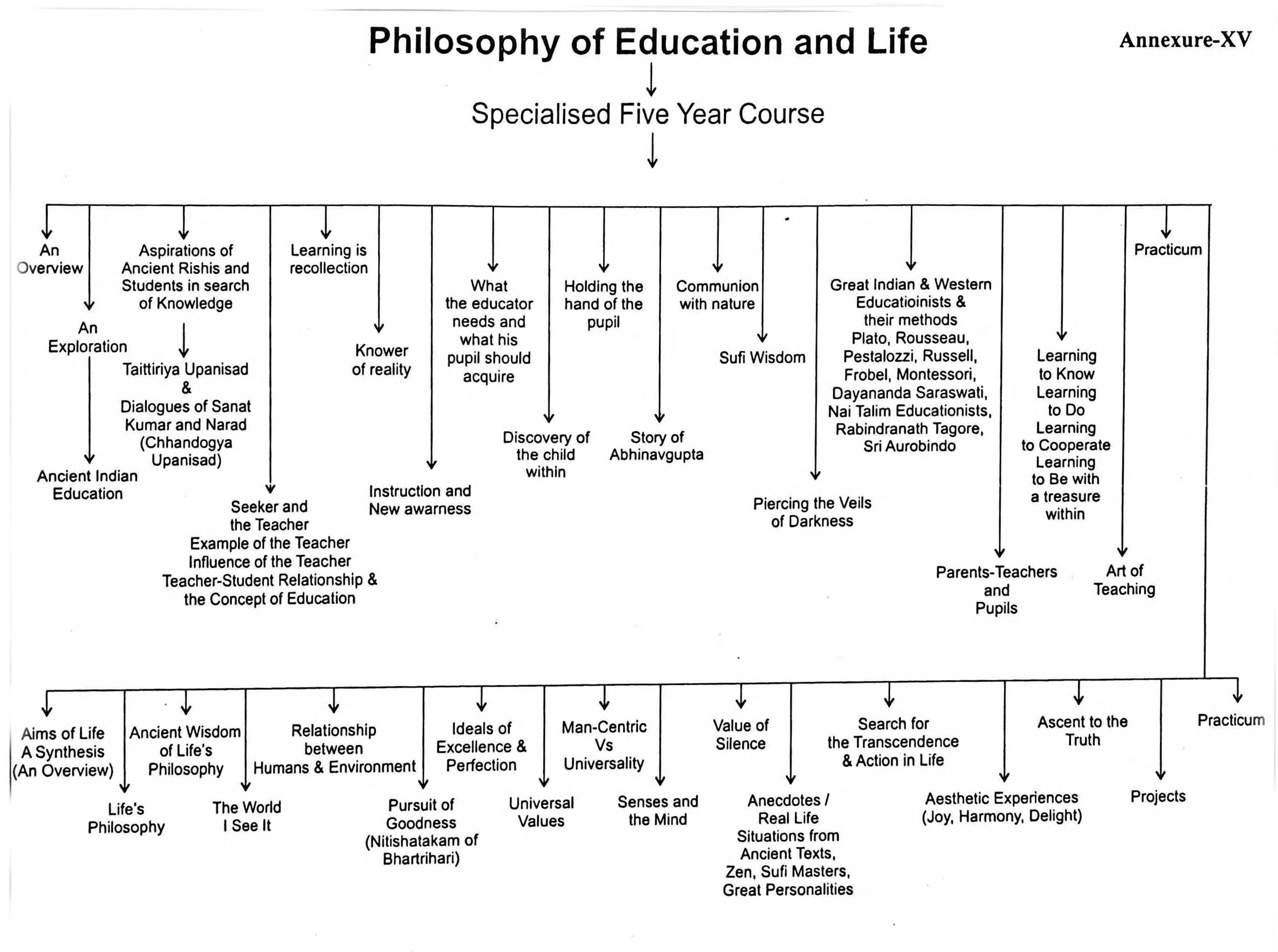
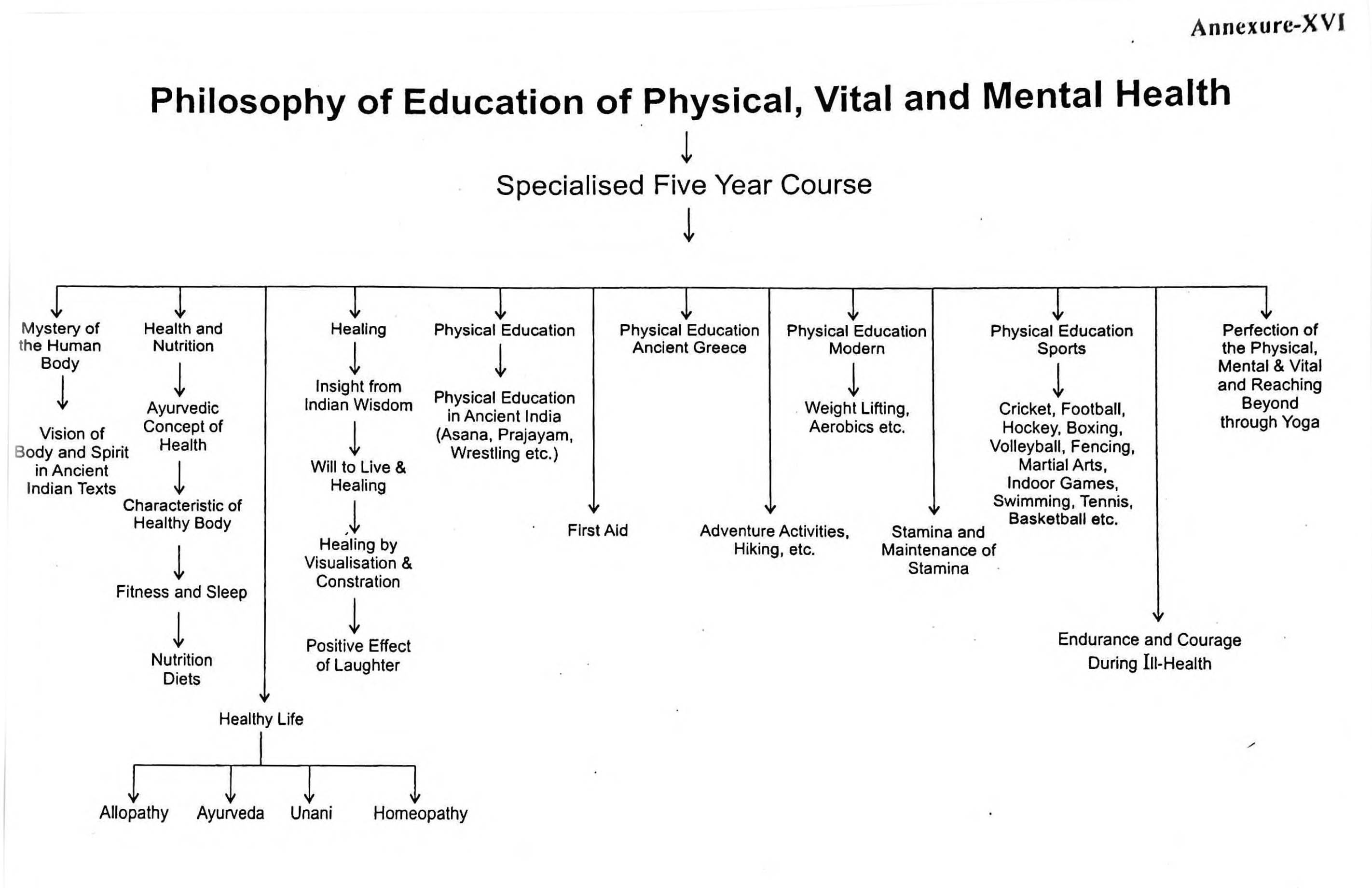
The following topics to be emphasized:
a. Knowledge of the human body, anatomy and physiology (in bare outline);
b. Concept of Doshas;
c. Theory of health and strength in Ayurveda: relationship with Physical exercises of Hatha Yoga;
d. Concept of longevity;
e. Indian surgery;
f. Plastic surgery and its survival right up to the arrival of the British in India;
g. Present status of Ayurveda in India;
h. Indian games, wrestling, and exercises for physical perfection;
Class IX
a. Famous Indian stories: Panchtantra and Hitopadesh and Jataka stories;
b. History of Sanskrit drama with special reference to (i) Bharata Muni and Abhinavagupta (ii) famous Sanskrit dramas prior to Kalidasa;
c. Kalidasa: his poetry and drama;
d. Post-Kalidasian drama;
e. Katha Sarit Sagar;
f. Use of Prakrit in Sanskrit dramas;
g. Bare outline of the great stories and dramas, written in India in Arabic and Persian;
h. Bare outline of stories and dramas written in modem Indian languages;
i. Indian authors in English: Rabindranath Tagore and Sri Aurobindo.
Class X
The curriculum of class X will be devoted to Indian Art. Special reference to:
a. Indian concept of Art; illustrations in Poetry, Music, Painting, Architecture and Sculpture;
b. Various stages of development in Art, particularly paintings.
c. Outstanding paintings, right up to Mughal period;
d. Indian architecture, temples, palaces, churches, Gurudwaras and others; Mughal architecture in India: Importance of Taj Mahal.
Class XI
a. Systems of Indian Philosophy: Main schools and their fundamental doctrines;
b. Indian ethics: outline study of ethics and yoga of Geeta.
c. Dharmashashtras and Nitishashtras of India;
d. Arthshashtra of India (a bare outline);
e. Other numerous social sciences;
f. Concept of 64 sciences and arts.
Class XII
a. Religions in India; spirit of tolerance and synthesis;
b. Systems of Yoga and systems of synthesis of Yoga;
c. Indian polity and India Renaissance;
d. Leaders of Indian Renaissance;
e. Problem of contemporary Indian culture and external Influences;
f. Towards a great synthesis of the East and the West.
Curriculum Overview
UTE Curriculum Handbook
Curriculum dimension
Physical dimension
Yoga, Sports, Games & an overall rigorous physical regimen
Creative dimension
Music, Dance, Painting, Art forms & other creative activities
Intellectual dimension
Logic, Rationality, Languages Domain Knowledge, Technology, Understanding, Application & other higher order analytical & thinking capabilities
Reflection dimension
Compassion, Sensitivity, Introspection, Communication & other intellectual & emotional skills
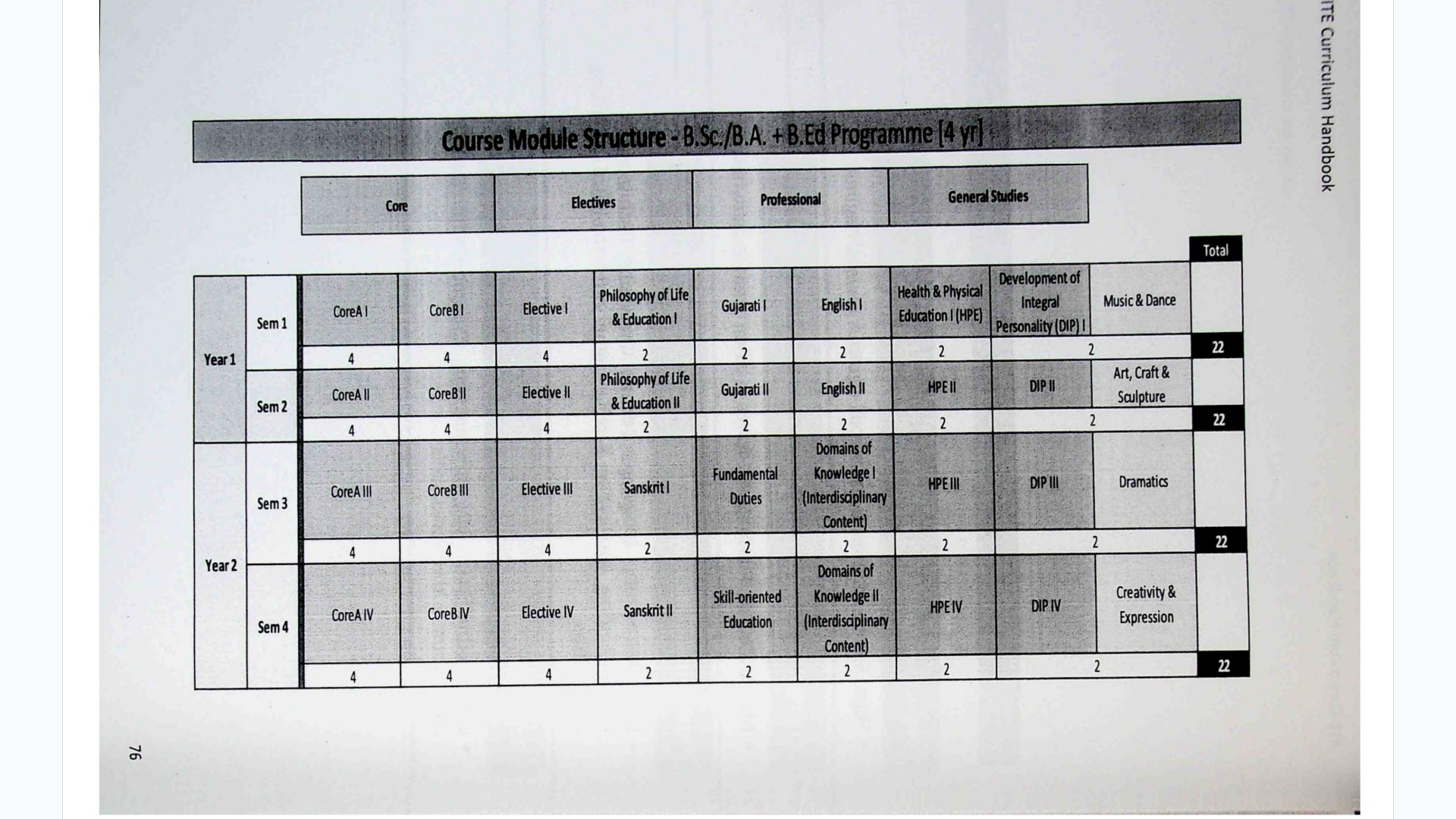
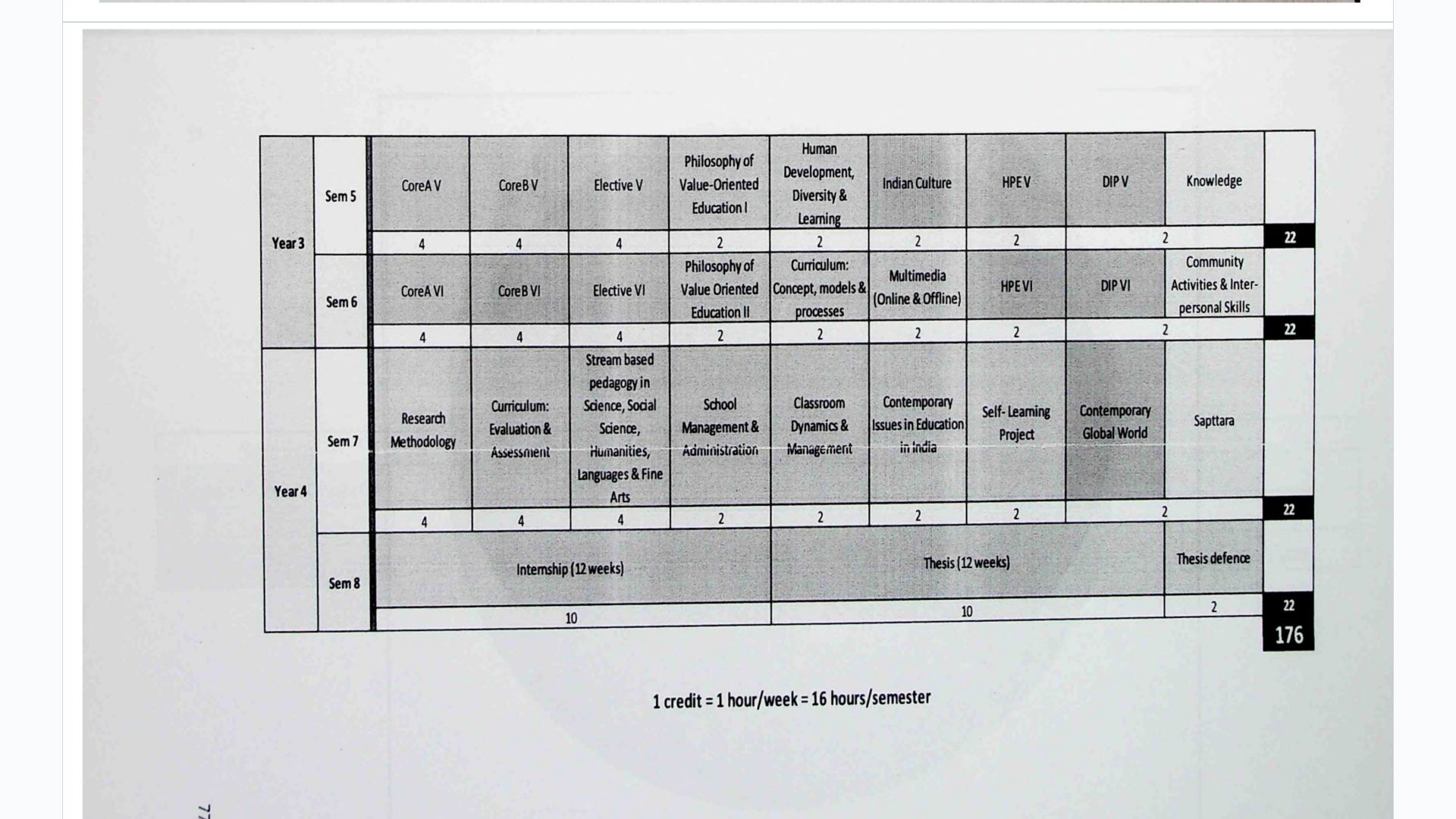
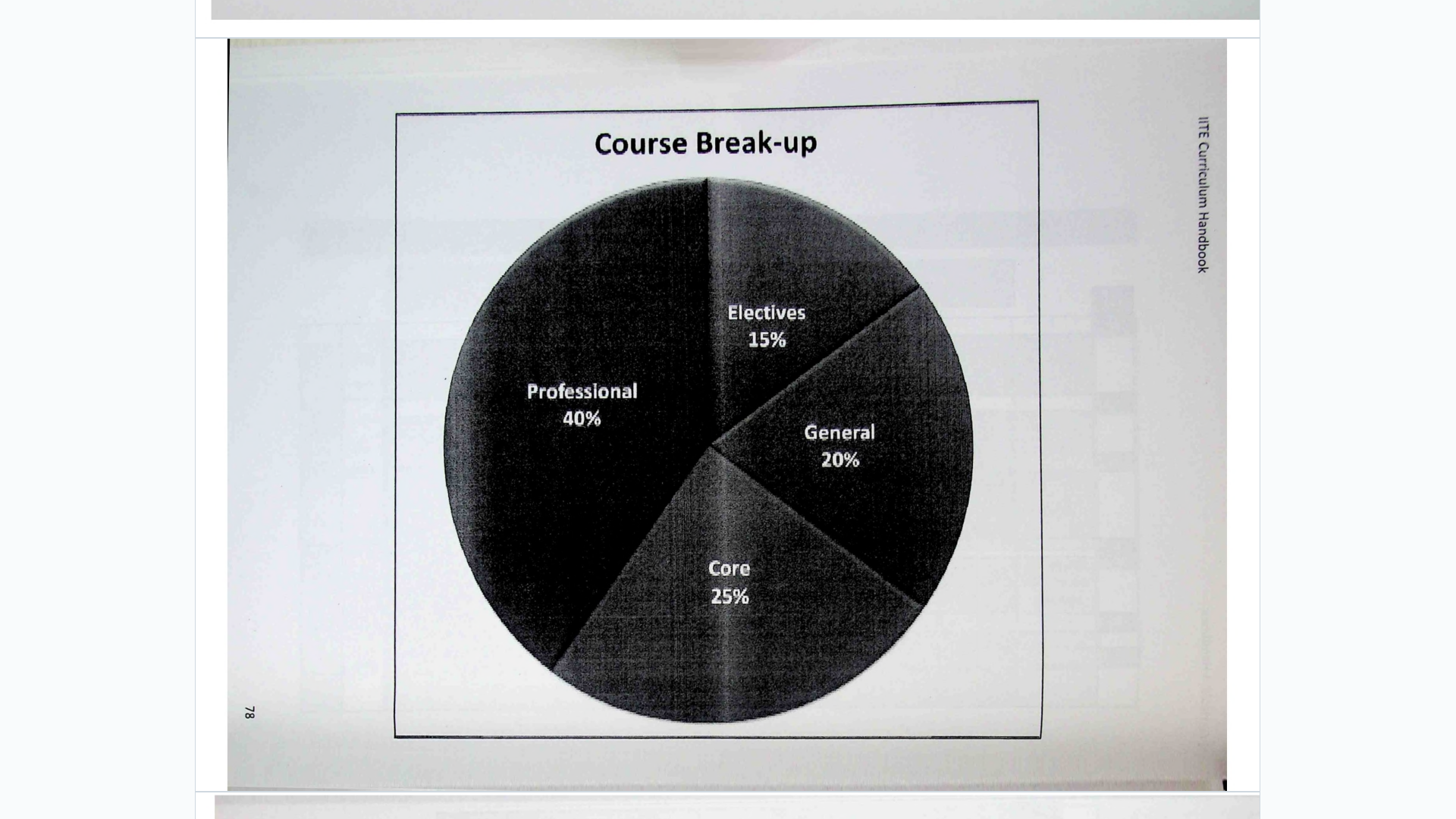
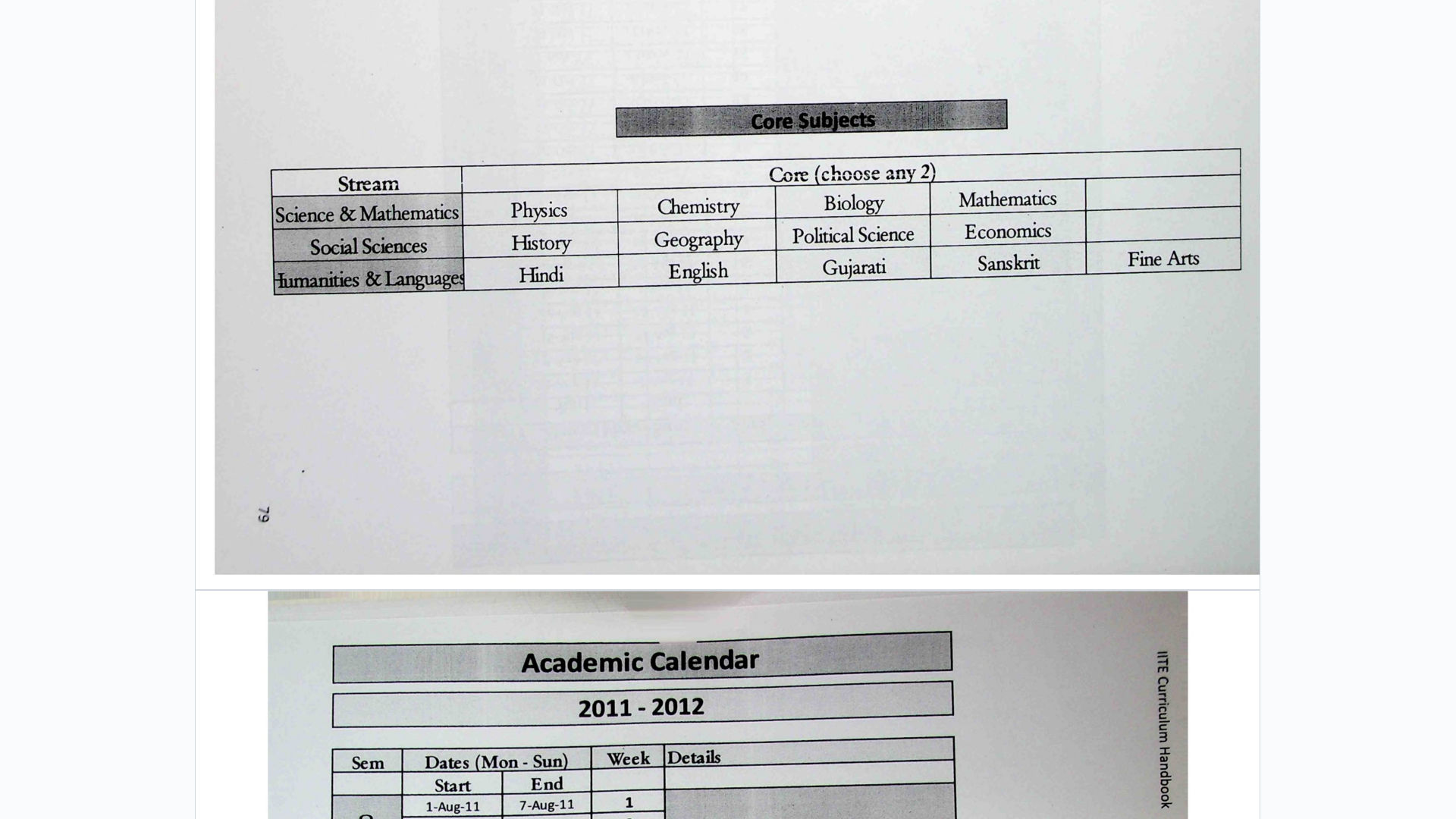
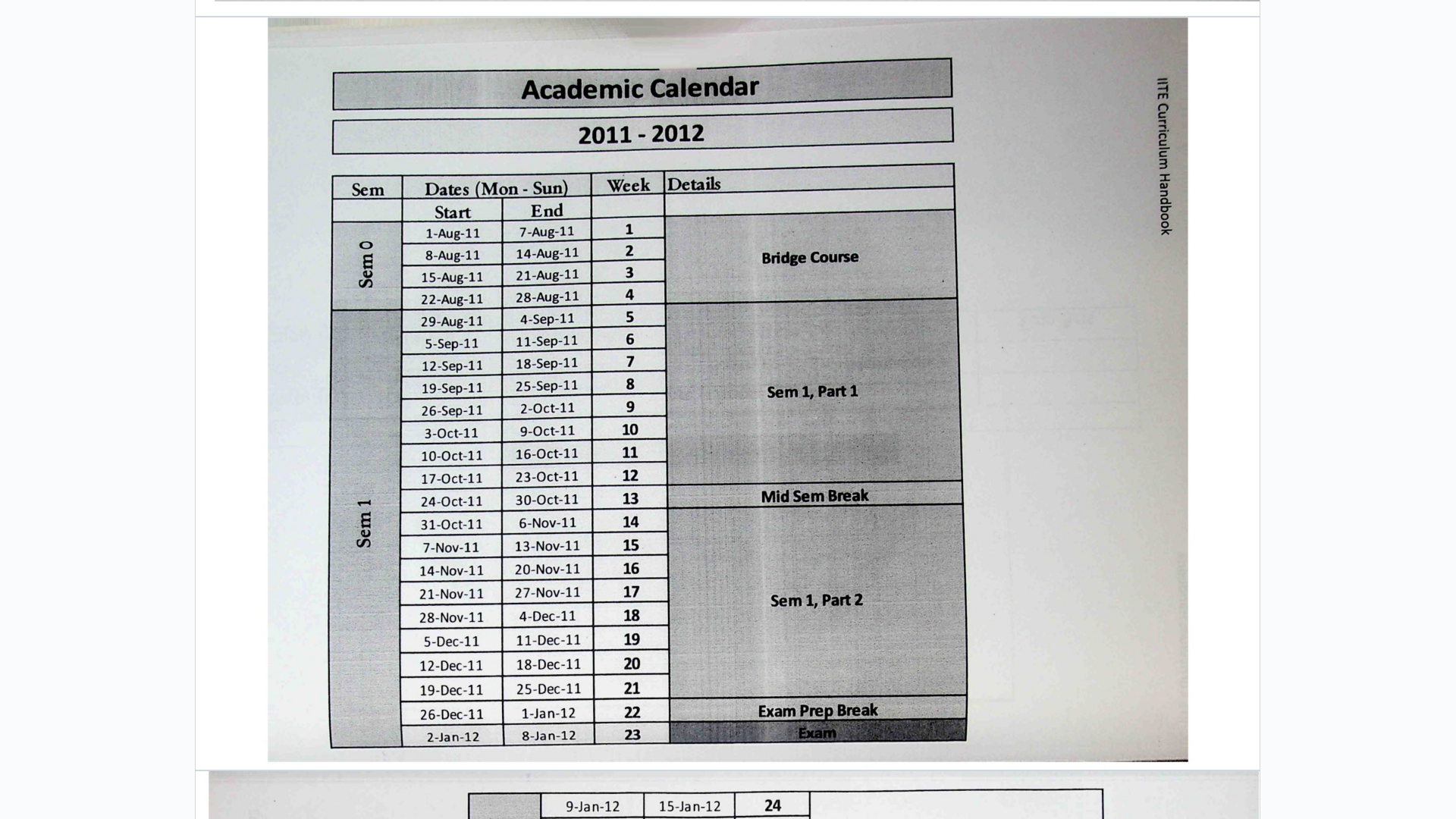
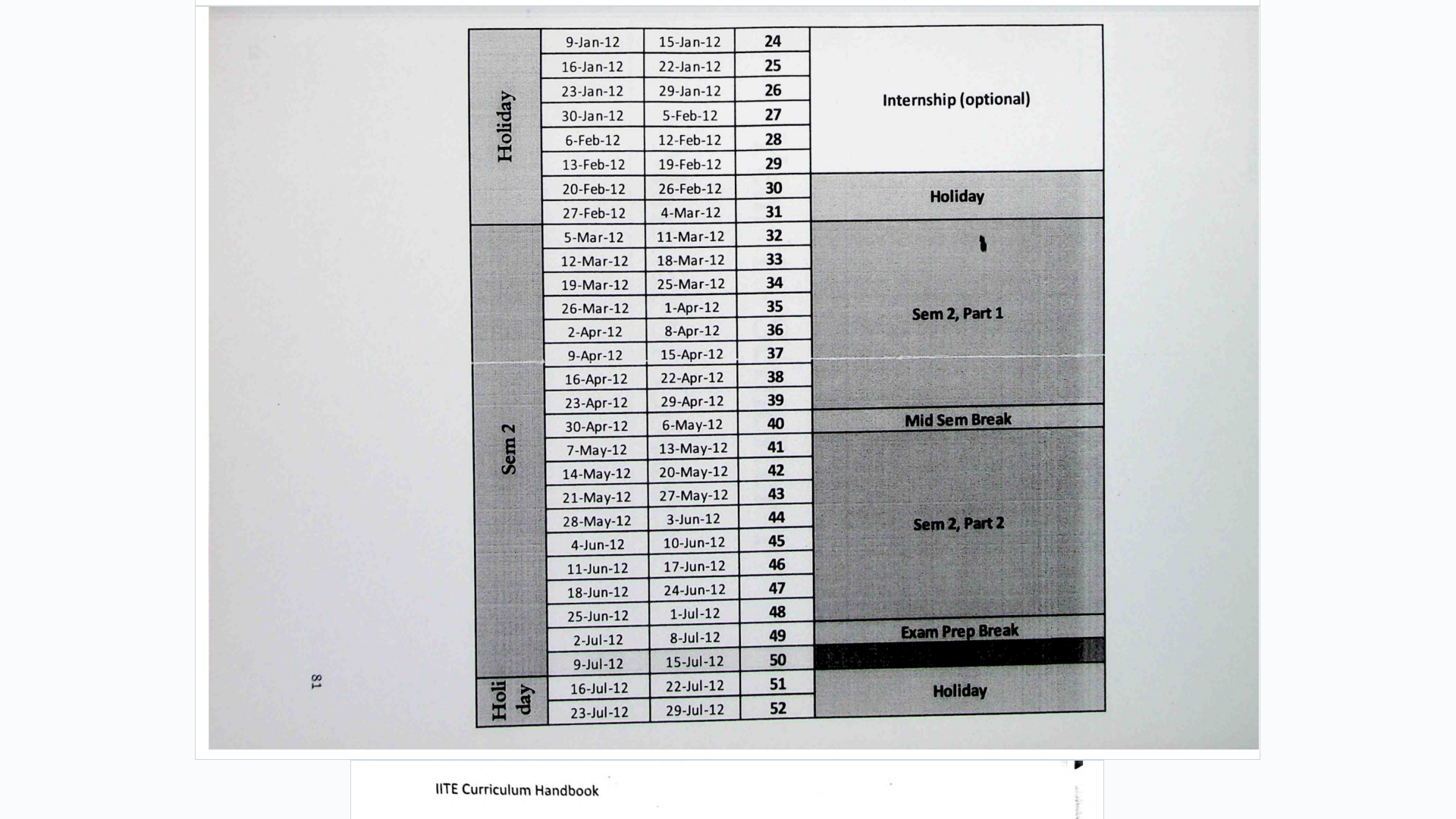
Year 1 - Semester 1
Manual of Courses
List of Courses for Year 1 Semester 1
Course Credits
Students must undergo bridge courses in English and Gujarati before commencing the studies of the first semester.
A. Core/Content Courses
ANY 3 COURSES FROM ■ 12
Science and Mathematics
Physics
Chemistry
Biology
Mathematics
OR
Social Sciences
History
Geography
Political Science
Economics
OR
Humanities and Languages
Hindi
English
Gujarati
Sanskrit
Fine Arts
b. Professional Courses
Philosophy of Life and Education I 2
Communication Skills: Gujarati I 2
Communication Skills: English I 2
C. General Studies
Health and Physical Education I 2
Development of Integral Personality I with the focus on Music & Dance 2
Total 22
Bridge Courses
English
Note:
It is generally observed that the language competence of students when they complete senior secondary school is weak. Therefore, it is desirable that students of the integrated teacher education programme undergo bridge courses in English and Gujarati before commencing the studies of the first semester. In this context two bridge courses of 50 hours duration have been designed and will be offered by the IITE to students admitted to the integrated course. It is suggested that the bridge courses be offered for four weeks prior to the commencement of the first semester.
The bridge course in Sanskrit may be offered before commencement of the third semester.
Course Objectives:
The course intends the participants to get acquainted with the basic language functions in English which would be of use to them in regular classroom teaching situations as well as their professional work experiences. In addition, the idea is to develop basic skills in communication in English which would enhance the participants’ confidence in using English as a tool for teaching other subjects.
More specifically, this course aims to help participants to
• develop a smooth flow of thoughts
• develop skills of expression of their thoughts and feelings
• acquire basic interactional skills
• use English language in day to day life including classroom situations
• develop satisfactory levels of sociolinguistic competence
• develop proficiency in English to enhance academic uptake and output
• understand and participate in simple classroom talks in English
• to make short speeches
• participate in question -answer sessions in the classroom
• be able to independently read and understand simple passages in English
• be able to write passages.
Course Outline (A 50- hour programme)
| No
I | Language Functions | Grammar Item in Focus | Vocabulary | | | Introducing Yourself/ Someone, Asking about someone, Exchanging personal information | Wh-Questions,
Yes-No Questions
Short Answer
Questions | Words referring to relations and family | | 2 | Talking about daily schedule, work place | Simple Present Tense, Statements, At, On, Around, Until, Before | Adjectives and nouns referring to occupations and place and nature of work | | 3 | Talking about Prices/Preferences, Giving Opinions, Making Comparisons, Buying & Selling Things | How Much/Many, | Adjectives
Demonstratives | | 4 | Talking about likes & dislikes | Simple Present Tense, Wh-Qs with ’Do’, Modal Auxiliaries | Adjectives and adverbs regarding hobbies | | 5 | Talking about families | Present Continuous
Tense, Determiners: All, Nearly all, Most, Many, a lot of, some | Verbs referring to actions and processes at places of work | | 6 | Asking about and describing routines and exercises | Present perfect | Adverbs of frequency | | 7 | Talking about past events, Giving opinions about past experiences | Past Tense | Regular-irregular verbs | | 8 | Asking about and describing locations, places and neighbourhood | There is/are,
Prepositions of place | | | 9 | Describing and identifying people | Question form | Adjectives for describing people | | 10 | Asking about and describing cities, Asking for and giving suggestions, Talking about Travel and Tourism | Conjunctions | Adverbs, Adjectives describing places | | 11 | Talking about health problems, Asking for and giving advice, Making requests | Modal verbs | Words referring to health, medical help, hospital, counselling etc | | | Expressing likes and dislikes, Agreeing and disagreeing, Ordering a meal | Either...or
Neither.... nor | Words from hospitality, hotel, food etc | | 13 | Describing countries, Making comparisons, Talking about distance | Comparatives and suggestive | Words referring to climate, weather, culture | | | Talking about plans,
Making invitations, accepting and rejecting invitations, Giving reasons, Taking and leaving messages | Future with present continuous
i
i
1 | Words referring to sports, concerts, entertainment etc. | | 15 | Giving Instructions and responding to them | Imperatives | |
Sample: Giving Instructions
Instructions are a necessary component of the teaching-learning process. Of all the interaction that takes place at educational institution instructions take a vital form. It is important that a teacher has competence enough to convey, through words, what s/he wants the students to do. The delivery of instructions reflects a teacher’s ability to communicate in a precise and understandable manner. Unlike other situations, classroom instructions need to be brief and clear; there is no scope for ambiguity.
In Classroom
Please take your notebooks out and write the words /points from the board.
Maintain silence we are not supposed to disturb other classes.
Please speak louder so that everyone sitting here can hear you.
Raise your hand if you have a problem. 1 will help you.
Use the dustbin to throw rubbish. You will make the place dirty otherwise. / Throw the rubbish in the dustbin. Do not litter around.
Look at the picture/chart carefully. I am interested in knowing your observations.
Please raise your hand to give answers. It is difficult to listen when everybody is speaking at the same time.
Think before you answer. It is advisable to think and act. / You will participate better/ more meaningfully.
If the fans and lights are not being used, switch them off. Let’s save electricity.
Speak English. You will get good practice. You will develop good command of the language.
Please pay attention to the way I read. Notice the changes in my voice / Please observe carefully how 1 modulate my voice.
Sit in a proper posture. Your posture shows your attitude to work.
Reply in complete sentences so that others understand what you say.
It is the duty of everyone to keep the classroom clean. You will set an example for others.
Form groups of four or five members. We are going to work in groups.
Take permission before leaving the classroom. I should know where you are . going. .
Do your homework regularly. It will keep you active and you won’t burden yourself with work later / If you finish your tasks regularly, you will not feel the burden later.
Always revise the content taught in the classroom; this will help you update what you have learned.
Bring your textbooks daily. You cannot depend on others’ help all the time.
Please write a leave application to let me know about your absence. 1 will be able to guide you about what you miss in your absence.
Please read the passage carefully and understand the meaning.
Concentrate on what you are doing. Looking here and there will distract you from your work.
Submitting your projects and assignments in time will reduce your burden and will give you time to engage in other activities.
Be punctual and attend school sessions regularly. Punctuality makes a man perfect I By learning to be punctual, you will develop many other good habits.
Please do not write on the walls and desks. It looks indecent. It leaves a bad impression about you.
Open the window to let some fresh air in. The more we use natural light the more we save electricity.
Keep a separate notebook for each subject. Your notes will not get mixed up.
Maintain discipline in the classroom. You will leave a favourable impression
about yourself.
Make sure that what you speak is relevant. You will help me teach better/ It will help us remain focused on the topic.
Check the spellings of the words you write. This will enable you to know what mistakes you make. You will learn from your mistakes.
Please do not pluck flowers from the garden. They look beautiful on plants.
You will look good in clean and tidy clothes.
References:
- Krishnaswami, 2004 English Grammar Macmillan
- Natraj, Sulabha 2005 Developing Communication Skills: A Handbook for Learners and Teachers of English, Charutar Vidya Mandal
- Umra, Damayanti, 2008 Language Games, Charutar Vidya Mandal
Bridge Course
Gujarati
A Bridge course on Gujarati
(A 50-hour programme)
Based on Functional Gujarati and Communicative Approach
• Words and Sentence patterns associated with Gujarati culture (Cultural Need) like પોળ, ચકલા, કોતરકામ, નવરાત્રાં-નવરાતર-નવરાત્રિ, જલ્સા, હાલ etc.
• Words and sentence patterns to talk to people of Gujarat (Social Need) like
Greetings- E9t? H^HL?
Introduction
Names of Things around
Describing the Things: Adjectives
Telling about Place, Position (Prepositions)
Everyday Expressions
Actions (daily routine)
Making Requests
Getting Information- Inquiring, Providing Information
Giving Commands, Instructions and responding to them
Expressing Choices, Options
Telling Time
Talking about work places
Describing events in the past (Stories, anecdotes, reports)
Talking about Future Activities (plans, imagination, fantasy)
Talking about activities across time- Past, Present, Future- Difference
• Phonetics: major features
• Proverbs in Gujarati
• Understanding and appreciating songs and Garba in Gujarati
• Simple dialogues in varied situations
• Making short speeches: Welcome, introduction, expressing appreciation etc.
• Developing reading and writing skills: popular stories, simple poems, essays, newspaper reports
• Presentations (Academic/Professional Need)
• Correspondence (Academic/Professional Need)
• Translation of news items, reports, articles, narratives, stories, plays, poems etc. (From Gujarati to Foreign language and vice-versa)
Content Courses
Science and Mathematics
Physics-1
Credits: 4
Course Objectives:
Students will:
• Understand Newton’s three laws of motion
• Explain the role of forces
• Applications of these laws
• Describe the atomic structure and properties of solid
• Explain the temperature, heat and heat transfer
• Describe the properties of waves and sound
• Unit-I Mechanics -1
| Name of Chapter | Contents | | Chapter:2 (Text Book: l)
Newton’s First Law of Motion-Inertia
and
Problems given in the Text Book:2" University Physics with Modern Physics " By Hugh D. Young & Roger A. Freedman, (12th Edition)
Publisher: Pearson
Topics 5.1 to 5.5 | Aristotle on Motion | | | Copernicus and the Moving Earth | | | Galileo and the Learning Tower | | | Galileo’s Inclined Planes | | | Newton’s First Law of Motion | | | Net Force | | | The Equilibrium Rule | | | Support Force | | | Equilibrium of Moving Things | | | The Moving Earth | | chapter:3(Text Book: l)
Linear Motion | Motion is Relative | | | Speed | | | Instantaneous Speed | | Problems given in the Text Book:2"
’ University Physics with Modern Physics " By Hugh D. Young & Roger A. Freedman, (12th
; Edition) | Average Speed
Velocity
Constant Velocity | | i Publisher: Pearson | Changing Velocity | | Topics 2.1 to 2.7 1 | Acceleration
Acceleration on Galileo’s Inclined
Planes
Free Fall
How Fast
How Far
How Quickly” How Fast" Changes |
Unit-II Mechanics-II
| Name of Chapter | Contents | | Chapter:4(Text Book: l)
Newton’s Second Law of Motion
Problems given in the Text Book:2”
University Physics with Modern Physics " By Hugh D. Young & Roger A. Freedman, (12th Edition)
Publisher: Pearson
Topics 4.4 to 4.7 & 5.6 to 5.9 | Force Causes Acceleration | | | Friction | | | Mass and Weight | | | Mass Resist Acceleration | | | Newton’s Second Law of Motion | | | When Acceleration is g-Free Fall | | | When Acceleration is Less Than g-Non free Fall | | chapter:5 (TextBook: l)
Newton’s Third Law of Motion
Problems given in the Text Book:2" | Forces and Interactions | | | Newton’s Third Law of Motion | | | Defining Your System | | | Action and Reaction on Different | | University Physics with Modern Physics " By Hugh D. Young & Roger A. Freedman, (12th Edition)
Publisher: Pearson
Topics 4.9 to 4.11 | Masses | | | Summary of Newton’s Three Laws | | | Vectors | | | Force Vectors | | | Velocity Vectors | | | Components of Vectors |
Unit-III Properties of Matter
| Name of Chapter | Contents | | Chapter: ll(Text Book:1)
The Atomic Nature of Matter
Problems given in the Text Book:2" University Physics with Modern Physics " By Hugh D. Young & Roger A. Freedman, (12th Edition)
Publisher: Pearson
Topics 4.1 to 4.2 | The Atomic Hypothesis | | | Characteristics of Atoms | | | Atomic Imagery | | | Atomic Structure | | | The Elements | | | The Periodic Table of Elements | | | Isotopes | | | Compounds and Mixtures | | | Molecules | | | Antimatter | | | Dark Matter | | chapter:12
Solids | Muller’s Micrograph | | | Crystal Structure | | | Density | | | Elasticity | | | Tension and Compression | | | Arches | | | Scaling |
Unit-IV Heat
| Name of Chapter | Contents | | Chapter: 15 (Text Book:1)
Temperature, Heat and Expansion
Problems given in the Text Book:2" University Physics with Modern Physics " By Hugh D. Young & Roger A. Freedman, (12th Edition)
Publisher: Pearson
Topics 17.1 to 17.4 & 17.6 | Temperature | | | Heat | | | Measuring Heat | | | Specific Heat Capacity | | | The High Specific Heat Capacity of Water | | | Thermal Expansion | | | Expansion ofWater | | Chapter:16(Text Book:1)
Heat Transfer
Problems given in the Text Book:2"
University Physics with Modern Physics " By Hugh D. Young & Roger A. Freedman, (12th Edition)
Publisher: Pearson
Topics 17.12 to 17.16 | Conduction | | | Convection | | | Radiation | | | Emission of Radiant Energy | | | Absorption of Radiant Energy | | | Reflection of Radiant Energy | | | Cooling at Night by Radiation | | | Newton’s Law of Cooling | | | The Greenhouse Effect | | | Solar Power | | | Controlling Heat Transfer |
Unit-V Sound
| Name of Chapter | Contents | | Chapter:19(Text Book:1)
Vibrations and Waves
Problems given in the Text Book:2"
University Physics with Modern Physics " By Hugh D. Young & Roger A. Freedman, (12th Edition)
Publisher: Pearson
Topics 15.1,15.3,15.6 | Vibration of a Pendulum | | | Wave Description | | | Wave Motion | | | Wave Speed | | | Transverse Waves | | | Longitudinal Waves | | | Interference | | | Standing Waves | | | Doppler Effect | | | Bow Waves | | | Shock Waves | | Chapter:20(Text Book:1)
Sound
Problems given in the Text Book:2"
University Physics with Modern Physics " By Hugh D. Young & Roger A. Freedman, (12th Edition)
Publisher: Pearson
Chapters 19 & 20
Topics 16.3 to 16.9,16.14 to 16.18 | Origin of Sound | | | Nature of Sound in Air | | | Media that Transmit Sound | | | Speed of Sound in Air | | | Reflection of Sound | | | Refraction of Sound | | | Energy in Sound Waves | | | Forced Vibrations | | | Natural Frequency | | | Resonance | | | Interference | | | Beats |
Text Book:1 Conceptual Physics by Paul G. Hewitt 11th Edition published by PEARSON
Text Book:2 University Physics with Modern Physics By Young & Freedman Publisher: Pearson (12th Edition)
Additional Reference:
- Fundamental of Physics by Heliday, Resnik & Walker.
- The Elements of Physics By I. S. Grant & W. R. Philips Publisher: Oxford University Press.
- Understanding Physics by Karen Cummings, Priscilla Laus, Edward Redish, Patrick Coonay Publisher: Wiley, Student Edition.
- Physics (Cambridge Law Price Edition) By Gilbert Rowell and Sydher Herdon Publisher: Cambridge University Press.
Suggested Website for eLearning/ICT Based activity:
- http://bcs.wiley.com/he- bcs/Books? action=index&itemld=0471150584&itemTypeId=BKS&bcsId=1907 (Free)
- http://www.physicsclassroom.com/ (Free)
- http://www.sciencejoywagon.com/physicszone/(Free)
- http://library.thinkquest.org/10796/ (Free)
Laboratory Course in Physics
- Study of motion using inclined plane (of three different shapes)
- To study the use of measuring devices (Vernier calipers, micrometer screw, spherometer, spectrometer and travelling microscope
- To determine the frequency of A.C. source by Sonometer and Bar magnet
- Melday’s experiment
- Stefan’s law of radiation
- Analysis of Error
- X-Ray diffraction pattern
- To determine the Young’s modulus of the material of a rectangular bar by bending (Koening’s method)
- To determine the emf by Thermocouple
- To determine the modulus of rigidity of the material of wire with the help of Torresonal pendulum
Suggested Website for e-Learning/ICT Based Activity for Virtual Laboratory
- http://phet.colorado.edu/en/simulation/forces-and-motion
- http://phet.colorado.edu/en/simulation/sound
- http://phet.colorado.edu/en/simulations/category/phvsics/heat-and- thermodynamics
References:
- Practical physics by C.L. Arora, Pub: S. Chand
- Practical Physics by Gupta & Kumar Pub: Pragati Prakashan
- An Advance Course in Practical Physics by D. Chattopadhyay & P. C. Rakshit Pub: New Central Book Agency (P) Ltd.
- ISC Practical Physics
- Laboratory Manual for Conceptual Physics by Paul Robinson
Chemistry- 1
Credits: 4
Course Objectives:
Students will:
ã Acquire the knowledge of chemistry and the pedagogy to teach the same.
ã Understand the concepts of chemistry and methods used to teach them.
ã Apply the concepts in day to day life as well as classroom situations.
ã Develop pedagogical competencies to teach chemistry at secondary level.
Unit 1: Bridge Course in Chemistry ‘Orientation to Chemistry’
Meaning and Nature of Science.
Branches of SciencefPure and Applied)
Historical Background of Chemistry as a Branch of Science.
Basic Concepts in Chemistry: acid, base, atom, elements, compounds, mixtures, molecules, basic trends in periodic table, atomic radius, ionic radius, ionization energy, electrode potential electro-negativity, electron-affinity, and reactions.
Unit 2: Introduction to Chemistry
Meaning and Scope of Chemistry.
Branches of Chemistry: Organic, Inorganic, Analytical, Physical, Polymer, Industrial, etc.
Nobel Prizes in Chemistry.
Unit 3: Basic Concepts in Chemistry
Atomic Structure: De Broglie matter waves, Heisenberg uncertainty principle, Schrodinger wave equation, significance of wave functions, Atomic orbitals, Quantum numbers, Aufbau and Paulis exclusion principles, Hund’s multiplicity rule. Variation of orbital energies with atomic number and energy level diagram, electronic configuration of elements, effective nuclear charge and shielding; radial and angular wave functions and distribution curves, shape of s, p, d orbitals and their characteristics.
Types of Bonds: Introduction to ionic bond, covalent bond, coordinate bond, hydrogen bond and meaning of bond energy.
Chemistry I- Practical Work
Volumetric titrations
Litmus tests
Project on Chemistry in day to day life
Biology-1
Credits: 4
Course Title: Cell biology, Genetics, Molecular biology
Unit: -1: Cell structure of prokaryote and eukaryote
ã Ultra structure and functions of cell organelles
ã Cell wall, Plasma membrane, Endoplasmic reticulum, Chloroplast, Mitochodria, Ribosomes of prokaryotes and eukaryotes, Lysosomes, Centrioles, Cilia and flagella, Golgi complex, Nucleus, structure of chromosome, Protoplasm
Unit: - 2: Microscopy and cell division and cell cycle
ã Simple microscope
ã Compound microscope
ã Dark-field microscope
ã Fluorescence microscope
ã Phase contrast microscope
ã Electron microscope
ã Mitosis
ã Meiosis and significance of crossing over
Unit: - 3: Genetics and molecular biology
ã Mendel’s experiments - monohybrid and dihybrid cross and mendelian laws
ã Incomplete dominance (e.g. Mirabilis Jalapa)
ã Co dominance (e.g. Skin colour in cattle)
ã . Supplementary gene(9:3:4)
ã Complimentary gene(9:7)
ã Multiple alleles( Human blood group)
ã Polygenic inheritance(Skin colour in human)
ã Mutation and its related diseases in plants and animals
ã Sex determination (Chromosomal base, Environmental base and Temperature base)
ã Sex linked inheritance (X linked and Y linked inheritance)
ã Sex influence inheritance (Baldness in human)
Unit:-4: Biochemistry
ã Inorganic compound - Water and minerals
ã Classification, Structure and functions of organic compounds - Carbohydrates, Lipids, Proteins, Nucleic acids
ã Enzymes- classification & nomenclature, action, Factors affect enzyme activity
ã Plants hormones
ã Endocrine glands and its hormone
References:
Cell Biology by G. D. Power (Text) - (Himalaya Publishing House, Bombay)
Cell Biology by De Roberties et al (Text) - (W. B. Saunders, Philadelphia)
A Text Book of Cytology by R.C. Dahela and S.R. Varma (Text) - (Jayprakashnath and Co., Meerut)
Cell Biology by J. D. Burke (Scientific Book Agency, Calcutta)
Cell Biology: A molecular approach by R.D. Dyson (Allyn & Bacon, Boston)
Cytology by C.D. Darlington
Genetics by V.B. Rastogi
Principles of genetics by Sinnott, Dunn and Dobzhansky (Text) - (Mcgraw Hill)
Genetics by E. Altenberg (Text) - (Holt, Rinehart & Winston, New York)
Genetics by Strickberger (Macmillan)
Principles of Biochemistry by A. B. Lehninger (CBS Publisher& Distributors, Delhi)
Fundamentals of Biochemistry by J.L. Jain (S. Chand, Delhi)
Biochemistry by Shrivastava
Plant physiology by Verma (S. Chand and Co.)
Biology- I (Practical)
Charts of Typical Cell structure of prokaryota and eukaryote
Charts / Micrographs of cell organelles
Cellwall, Plasma membrane, Endoplasmic reticulum, Chloroplast, Mitochondria, Ribosomes of prokaryotes and eukaryotes, Lysosomes, Centrioles, Cilia and flagella, Golgi complex, Nucleus, structure of chromosome.
To study mitosis in onion root tip and permanent slides of meiosis
Study of stages of mitosis
Study of stages of meiosis
Training in fixing staining and squashing for cytological study
To solve genetics problems (related to syllabus)
Structures of DNA: A, B, C, D and Z
DNA hybridization
To determine pH of water using universal indicator.
Perform histochemical tests for Carbohydrate, lipids and protein.
Demonstrate the activity of amylase and catalyses enzymes in plant tissues.
Mathematics 1
Credits 4
Learning Objectives: To understand and apply the concepts, principles and techniques of analytical Geometry and Differential Calculus in problem solving; To acquire an insight into the pedagogical aspects of these topics.
Course content:
UNIT 1: Analytical Geometry
Coordinates of point; Cartesian coordinates and Polar Coordinates of a point in R2; Cartesian Co-ordinates.
Position vector of point in R2 and R3; Modulus of a vector; Distance formulae in R2 and R3; vector addition; Scalar multiple of vector; Scalar product of two vectors; Projection of a vector on another vector; Vector product of two vectors; Scalar triple product of three vectors; vector triple product of three vectors.
Vector Equation of a straight line in R2 and Cartesian equation of straight line in R2; angle between two lines- conditions of parallelism and perpendicularity.
Vector equation of a plane and Cartesian equation of a plane; Angle between two planes; vector equation of a straight line in R3; Cartesian equation of a straight line in R3.
Vector equation of circle in R2; Cartesian equation of circles; Orthogonal circles; Tangent to a circle; Vector equation of sphere; Cartesian equations of sphere; Tangent plane to a sphere.
UNIT-2: Calculus-1 (Differential Calculus)
Function
Functions and their graphs; Polynomial, rational, symmetric and radical parametric function; Equation of plane curve; Limit of a function; Statement of properties of continuous functions.
Derivative of function:
Derivative and techniques of differentiation - of sum, Product, quotient of two functions, of a function, Meaning of derivative - as rate of change and as the slope of tangent; Equations to the tangent; Normal to a plane curve; Angle of intersection of two curves; Conditions for orthogonally and tangency between two curves; signs of derivatives - Increasing and decreasing functions; Some cases of maxima and minima.
Reference for both Units:
Calculus and Analytical Geometry - George Thomas (ADDISON WESLWY PUBLISHING CO)
Calculus of one and several Variables - Sales and Einar Hille (WILEY INTERNATIONAL)
Calculus- Vols. I and II- Lipman Bers (HOLT, RINEHART & WINSTON - Indian Edition: IBH PUBLISHING Co., Bombay)
Content Courses
Social Sciences
History 1
Credits 4
Yet to be prepared
Geography 1
Credits 4
Unit-1:
Introduction: Meaning, definition and nature of Geography - place of geography among social and natural science -Relation with other disciplines- Its subjects matter.
Brief introduction of solar system - origin of the Earth and the solar system- Interior of the Earth - Distribution of continents and Oceans - continental Drift theory - Plate Tectonics - Major Landforms.
Unit-2:
Evolution of Geography Thought - Determinism, Possibilism and other concepts - systematic & Regional Geography - Brief idea about qualification - Recent trends in Geography.
Unit-3:
Structure and composition of Atmosphere - Elements of climate and weather - major factor affecting the distribution of elements of weather - Insolation, Atmospheric pressure, wind system, Humidity and Precipitation.
Unit-4:
Sub- marine relief features- characteristics of ocean water- Distribution of Temperature and salinity of oceans- Ocean currents, wares and tides natural religions of the world - meaning, classification and general understanding - A detailed study of (1) Equatorial Forest Region, (2) Tropical Grassland (Sudan type) (3) Hot and Dry regions (Desert type), (4) Taiga region.
Suggested Readings
Dikshit R.D.: Geography Thought - A Contextual History of Ideas, Prentice Hall of India Pvt. Ltd, 2000.
Farro Charles: Principles of General Geography, General Printers and publishers, Mumbai. 2003.
Hartshorn, Richard: Perspectives on the Nature of Geography, Rand, McNally and Co. New York, 1967.
Harvey David: Explanation in Geography; Edwards Arnold, London, 1972
Holt, Jensen, A; Geography, Its History and concepts; Longman’s 1980.
Hussain, Majid: Evolution of Geographical Thought; Rawat Publication, Jaipur- 1984.
Political Science 1
Credits 4
Unit-1: Political Science: Meaning, Scope, Importance of the study, Inter disciplinary relations.
Unit-2: State: Elements of the State, State and Society, Origin and Development of the State
Force Theory
Divine Theory
Evolutionary Theory
Social Contract Theory
Unit-3: Sovereignty: Meaning, Features, Austin’s Theory of Sovereignty, Pluralistic Theory of Sovereignty, Sovereignty in the context of the changing global scenario.
Unit-4: - Political Power, authority, legitimacy, welfare state
- Law: Definition, meaning, sources of Law
Economics 1
Credits 4
Unit 1: Basic concepts and definition
Utility: goods and services. Money, wealth and welfare. Value and price. Monetary income and real income. Scarcity of resources and problem of choice. Definitions of economics: Adam Smith, Marshall and Robbins. Micro economics and macro economics.
Unit 2: Demand analysis
Concept of utility. Law of diminishing marginal utility. Concept of equi-marginal utility. Meaning of demand. Derivation of demand curve with the help of utility analysis. Demand function. Law of demand. Expansion and contraction of demand. Increase and decrease in demand. Elasticity of demand and its types and their methods of calculation. Factors affecting elasticity of demand.
Unit 3: Supply analysis and price determination
Meaning of supply. Difference between supply and stock. Supply function. Law of supply. Expansion and contraction of supply. Increase and decrease in supply. Elasticity of supply and factors affecting elasticity of supply. Price determination through demand and supply. Effect of changes in demand and supply on price individually and jointly.
Unit 4: Factors of production and division of labour:
Meaning and characteristics of land, labour, capital and entrepreneurship. Meaning, types, advantages and disadvantages of division of labour. Factors affecting division of labour. Production function.
Unit 5: Market, Revenue, Cost and Production function:
Meaning and functions of market. Concepts of revenue: average, marginal and total revenue. Concepts of cost: fixed, variable, total, average, average fixed, average variable and marginal cost. Relations between average and marginal cost. Short term and long term cost Meaning, short run and long run production functions. Law of variable proportions. Returns to scale. Iso-quant and Iso-cost curves and producer’s equilibrium. Break-even analysis.
Unit 6: Indifference curve analysis:
Concept, schedule, diagram. Marginal rate of substitution. Assumptions of Hicksian analysis, characteristics of indifference curve, Concept of price line and changes in location and shape. Changes in price line. Consumer’s equilibrium. Normal goods, inferior goods and Giffen goods. Price effect, income effect and substitution effect.
Content Courses
Humanities and Languages
Hindi 1
Credits 4
उद्देश्य
प्रस्तुत पाठ्यक्रम की समाप्ति पर विद्यार्थी :
उपन्यास और कहानी के स्वरुप का परिचय दे सकेंगे ।
हिन्दी उपन्यास और कहानी के विकास के रुपरेखा स्पष्ट कर सकेंगे।
उपन्यास और कहानी के मूल कथ्य, संवेदना, उद्देश्य, परिवेश एवं पात्रों का परिचय दे सकेंगे।
क्रेडिट - १
इकाई - ०१
उपन्यास के स्वरुप एवं तत्त्वों का परिचय
हिन्दी उपन्यास के विकास की संक्षिप्त रुपरेखा
निर्धारित उपन्यास: ’गवन’ की वस्तु का परिचय
’गबन’ उपन्यास का उद्देश्य
इकाई ०२
’गवन’ उपन्यासके मुख्य चरित्र (नायक-नायिका)
’गबन’ उपन्यास के गौण चरित्र
’गवन’ उपन्यास का परिवेश
’गबन’ उपन्यास की भाषा और शैली
इकाई - ०३ क्रेडिट - १
कहानी के स्वरुप का परिचय एवं हिन्दी कहानी के विकास की संक्षिप्त रुपरेखा
कहानी - १ - आकाशदीप (प्रसाद) कथ्य, चरित्र, परिवेश, उद्देश्य एवं भाषा- शैली
’कफन’ (प्रेमचंद) कथ्य, चरित्र, परिवेश, उद्देश्य एवं भाषा - शैली
कहानी - ३ - ’पत्नी’ (जैनेन्द्र) कथ्य, चरित्र, परिवेश, उद्देश्य एवं, भाषा - शैली
इकाई – ०८ क्रेडिट २
कहानी - ४ - ’गैंग्रीन (अज्ञेय) कथ्य, चरित्र, परिवेश, उद्देश्य एवं भाषा - शैली
कहानी - ५ - ’चीफ की दावत, (भीष्म साहनी), कथ्य, चरित्र, परिवेश, उद्देश्य एवं भाषा - शैली
कहानी - ६- दिल्ली में एक मौत, (कमलेश्वर), कथ्य, चरित्र, परिवेश, उद्देश्य एवं भाषा शैली
कहानी ७- ’सुख: ( काशीनाथ सिंह) कथ्य, चरित्र, परिवेश, उद्देश्य एवं भाषा शैली
आधार ग्रंथ
संक्षिप्त गबन: प्रेमचंद
कथा - सेतु : सं. उमाशंकर तिवारी/श्रीमती माधुरी सिंह, वाणी प्रकाशन: नई दिल्ही.
संदर्भ ग्रंथ
हिन्दी उपन्यास: एक अन्तर्यात्रा : डॉ. रामदरश मिश्र, राजकमल प्रकाशन दिल्ली.
हिन्दी कहानी : अंतरंग पहचान: र्डा. रामरश मिश्र, नेशनल पब्लिक हाउस, दिल्ली.
कहानी : नयी कहानी : डॉ. नामवरसिंह: लोक भारती प्रकाशन नई दिल्ली.
प्रेमचंद: एक अध्ययन: राजेश्वर गुरु: एस. चंद एण्ड कंपनी, दिल्ली.
प्रेमचंद और उनका युग: रामविलास शर्मा : राजकमल प्रकाशन दिल्ली.
शिक्षण पद्धति :
व्याख्यान
रचना का पठन एवं चर्चा परिचर्चा
भाषा एवं अभिव्यक्ति संबंधी मुद्दों की चर्चा
दश्य एवं श्राव्य माध्यमों का उपयोग
क्रियात्मक कार्यशाला :
संबंधित मुद्दों पर विद्यार्थी आलेख तैयार करें ।
रचनात्मक लेखन का प्रयास
अतिरिक्त वाचन के लिए प्रोत्साहन
English 1
Credits 4
Unit 1: Language
• Grammar
The Sentence
Parts of Speech
Gender
Singular - plural
Punctuation marks
• Conversational English
Meeting and introduction
Talking about yourself
Telephoning - on landline & cell phones
Good wishes, thanks
Unit 2: Poetry
• Text: Hundred Poems edited by Mahendra Meghani Lok-Milap Trust, Bhavnagar, 1994.
Ten poems to be selected from this text.
Unit 3: Drama
• Text: Three One-Act Plays edited by C. Mahajan OUP, 1994.
Unit 4: Fiction: Short Story
• Text: Gijubhai’s Tales for Children translated by Chittaranjan Pathak, Utthan Sewa Sansthan, Anand Niketan School, Ahmedabad
Ten stories to be selected from this text.
Gujarati 1
Credits 4
ગુજરાતી પદ્ય સાહિત્ય
હેતુઓ: આ સેમેસ્ટરના અભ્યાસ દ્વારા વિદ્યાર્થી- ગદ્ય, પદ્યનો ભેદ સમજી શકશે.
લોકગીત, એનાં લક્ષણો, એમાં આલેખાયેલા લોકજીવનનો પરિચય મેળવી શકશે.
મધ્યકાલીન, અર્વાચીન અને છેલ્લા પચાસ વર્ષની ગુજરાતી કવિતાની મુખ્ય ધારાઓ, સ્વરૂપો અને સર્જકોનો પરિચય મેળવી શકશે.
ગુજરાતી સાહિત્યના આરંભથી તે આજસુધીની કવિતાના સંવેદન અને અભિવ્યક્તિમાં આવેલા ક્રમિક પરિવર્તનનો પરિચય મેળવી શકશે.
ગુજરાતી સાહિત્યના આરંભથી તે આજસુધીની કવિતાના સંવેદન અને અભિવ્યક્તિમાં આવેલા ક્રમિક પરિવર્તનોનો પરિચય મેળવી શકશે.
કવિતાના છંદ, અલંકાર, કલ્પન, પ્રતિક, રસ, ધ્વનિ જેવા ઘટકોનો પરિચય કેળવશે.
કાવ્યપાઠ કરી શકશે.
એકમ: ૧. ગુજરાતી લોકગીત. ૧ ક્રેડીટ (૧૬ તાસ)
• ગુજરાતી લોકગીતના લક્ષણો, પ્રકારો એમાં આલેખાયેલ લોકજીવન
• પસંદગીના લોકગીતોનું અધ્યયન.
૧. તમે મારાં દેવના દીધેલ છો. (હાલરડું) (પૃ. સ.A)
૨. તમે કેટલા ભાઈ કુંવારા રાજ. (રમત-ગમત-ગીત)(પૃ. ૩૮.A)
૩. સૂરજ ઊગ્યો રે (લગ્નગીત) (પૃ. ૫૫.A)
૪. ગોરીમોરી ફાગણ ફાલ્યો (ઋતુગીત) (પૃ. ૬3A)
૫. લવિંગ કેરી લાકડિયે (અબોલા-વડ છડ)(પૃ.૭૦. A)
૬. વહુએ વગોવ્યાં મોટાં ખોરડાં (ઘટનામૂલક)(પૃ.૭૦. A)
૭. ખમ્મા મારા નંદજીના લાલ (રાસ) (પૃ.૮૮. A)
૮. મોરલી તે ચાલી રંગ રુસણે (રાસ) (પૃ.૧૦૦. A)
એકમ: ૨ મધ્યકાલીન ગુજરાતી કવિતા. ૧ ક્રેડીટ (૧૬ તાસ)
મુખ્ય ધારાઓ, સ્વરૂપો, સર્જકોનો પરિચય.પસંદગીના સર્જકોના પસંદગીના કાવ્યોનું અધ્યયન.
૧. ‘વસંતવિલાસ’ (કડી-૨૭ થી ૫૦). (પૃ.૬. B)
૨. નરસિંહ મહેતા. - ભોળી રે ભરવાડણ હરિને વેચવાને ચાલી રે. (પૃ.૧૫. B)
વૈષ્ણવજન તો તેને કહીએ, જે પીડ પરાઈ જાણે રે. (પૃ.૨૦. B)
જે ગમે જગતગુરુદેવ જગદીશને, (પૃ.૨૧. B)
અખિલ બ્રહ્માંડમાં એક તું શ્રીહરિ, (પૃ.૨૨. B)
૩. મીરાંબાઈ
ઝેર તો પીધાં છે જાણી જાણી, (પૃ.૫૦. B)
જૂનું તો થયું રે, દેવળ જૂનું તો થયું. (પૃ.૫૪ B)
૪. અખો.
છપ્પા શિષ્ય અંગ. બે છપ્પા- -સુતર આવે ત્યમ તું રહે, (પૃ.૮૯ B)
ખટદર્શનના જૂ જવા માતા, (પૃ.૮૯ B)
પદ - શાં શાં રૂપ વખાણું, સંતો રે ! (પૃ.૮૫ B)
૫. પ્રેમાનંદ. સુદામાચરિત. કડવું.૧૦, મિત્રગોષ્ઠિ (પૃ.૧૦૪,૧૦૫ B)
૬. શામળ. રાવણ
- મંદોદરી સંવાદ માંથી જુદા જુદા વર્ણોની સલાહ (પૃ.૧૪૭-૧૪૯ B)
૭. દયારામ.
ઓ વાંસલડી ! વેરણ થઈ લાગીરે વ્રજની નારને (પૃ.૨૩૩ B)
મનજી મુસાફર રે ! ચાલો નિજ દેશભણી. (પૃ.૨૨૯ B)
એકમ: ૩. અર્વાચીન ગુજરાતી કવિતા. ૧ ક્રેડિટ(૧૬ તાસ)
• ગુજરાતી સાહિત્યના સુધારક યુગ, પંડિત યુગ, ગાંધીયુગની કવિતાના મુખ્ય સર્જકો, એમની કવિતાની લાક્ષણિકતાનો પરિચય સ્વરૂપોનો પરિચય પણ અપેક્ષિત છે
• પસંદગીના સર્જકોના પસંદગીનાં કાવ્યોનું અધ્યયન.
૧. દલપતરામ: - તું તારું સંભાળ. (દોહરા). (પૃ.૩૦ C)૨, નર્મદ:
૨. જય! ગરવી ગુજરાત (પૃ.૫૯ C)
- શંખનાદ સંભળાયે ભૈયા. (પૃ.૮૨ C)
૩. મણિલાલ દ્વિવેદી
- અમર આશા,કહીં લાખો નિરાશામાં,અમર આશા છુપાઈ છે. (પૃ.૧૦૭ C)
૪. બાળશંકર કંપારિયા
– ગુજારે જે શિરે તારે (પૃ.૧૧૧C)
૫. નરસિંહ રાવ. પ્રેમલ જ્યોતિ તારો દાખવી.. (પૃ.૧૨૭ C) C=કાવ્યસંચય -૨૬. કાન્ત.મણિશંકર રત્નજી ભટ્ટ
સાગર અને શશી (પૃ.૧૪૩C)
‘વસંત વિજય’ ખંડકાવ્ય (પૃ.૧૪૯-૧૫૩ C)
૭. કલાપી. ગ્રામ્ય માતા. (૧૭૧ C)
૮. ન્હાનાલાલ
ઝીણા ઝીણા મેહ (૨૧૧ C)
આ વસંત ખીલે શતપાંખડી, હરિ ! આવોને, (૨૩૨ C)
મ્હારાં નયણાંની આળસ રે, ન નીરખ્યાં હરિને જરી, (૨૩૧ C)
૯. બ. ક. ઠાકોર. જૂનું પિયેર ઘર (૨૫૩ C)
એકમ: ૪ છેલ્લા પચાસ વર્ષની કવિતા. ૧ ક્રેડિટ(૧૬ તાસ)
• છેલ્લા ૫૦ વર્ષની કવિતાના વિશેષો અને પ્રમુખ સર્જકોનો ટૂંકો પરિચય
• પસંદગીના કાવ્યોનું અધ્યયન: ૮ કવિના નામ અકારાદિક્રમે આપ્યાં છે.)
૧. અવિનાસ વ્યાસ: માડી તારું કકું ખર્યું ને (પૃ. 3 D)
૨. ઉમાશંકર જોશી : પંખી લોક (પૃ ૬ D)
૩. જયન્ત પાઠક: થોડા વગડાનો શ્વાસ..(પૃ ૨૨ D)
૪. પ્રહલાદ પારેખ: આજ અંધાર ખુશ્બોભર્યો લાગતો (પૃ. ૩૬ D)
૫. પ્રિયકાન્ત મણિયાર: આ નભ ઝૂકયું તે કાનજી... (પૃ. ૩૭ D)
૬. મકરન્દ દવે : ગમતાંનો કરીએ ગુલાલ (પૃ. ૪૧ D)
૭. મનુભાઈ ત્રિવેદી : ‘ગાફિલ’ જુદી જિંદગી છે મિજાજે મિજાજે (પૃ. ૪૪ D)
૮. રમેશ પારેખ: તારો મેવાડ મીરાં છોડશે (પૃ. ૫૧ D)
૯. રાજેન્દ્ર શાહ: નિરુદ્દેશે.. (પૃ. પર D)
૧૦. રાજેન્દ્ર શુકલ: હજો હાથ કરતાલ.. (પૃ. ૫3 D)
૧૧. રાવજી પટેલ: આભાસી મૃત્યુનું ગીત, મારી આંખે કંકુના સૂરજ.. (પૃ. ૫૫ D)
૧૨. લાભશંકર ઠાકર: અવાજને ખોદી શકાતો નથી (પૃ. ૫૬ D)
૧૩. સિતાંશુ યશચંદ્ર: સિંહવાહિની સ્તોત્ર (પૃ. ૬૪ D)
૧૪. સુન્દરમ: એક અચંબો (પૃ. ૬૮ D)
૧૫. હરિન્દ્ર દવે : માધવ ક્યાંય નથી મધુવનમાં (પૃ. ૭૧ D)
સંદર્ભ પુસ્તકો :
૧. ગુજરાતી લોકગીત. હસુ યાજ્ઞિક. (A) ગૂર્જર ગ્રંથરત્ન કાર્યાલય અમદાવાદ પૂ આ ૨૦૦૭૨. કાવ્યસંચય ૧ સંપા. અનંતરાય
રાવળ, હીરા રામનારાયણ પાઠક (B) ગુજરાતી સાહિત્ય પરિષદ. અમદાવાદ પૃ આ ૧૯૮૧.૩. કાવ્યસંચય-૨ સંપા ધીરુભાઈ ઠાકર,
વ્રજલાલ દવે.(C) ગુજરાતી સાહિત્ય પરિષદ. અમદાવાદ પ્ર. આ ૧૯૮૦૪. સ્વર્ણિમ કાવ્ય-કુંભ સંપા નીતિન
વડગામા(D) સૌરાષ્ટ્ર યુનિ. રાજકોટ પ્ર આ. ૨૦૧૦.
શિક્ષણ પ્રદ્ધતિ:
૧. વર્ગ વ્યાખ્યાન
૨. દ્રશ્ય, શ્રાવ્ય માધ્યમ (ઘણી બધી કવિતા દ્રશ્ય, શ્રાવ્ય રૂપે ઉપલબ્ધ છે)
૩. પ્રોજેક્ટ વર્ક,
૪. પરિસંવાદ
૫. જૂથ ચર્ચા.
૬. વિશેષ વાંચન માટે પ્રોત્સાહનસંદર્ભ પુસ્તકોમાં અન્ય કાવ્યો છે એ વાંચવા પ્રેરી શકાય. .
Sanskrit 1
Credits 4
સંસ્કૃત સાહિત્ય
ઉદ્દેશ:
(૧) વિદ્યાર્થીઓ સંસ્કૃત સાહિત્યનો પરિચય કેળવે
(૨) રઘુવંશ વગેરે મહાકાવ્યોનો પરિચય કેળવે
(૩) નીતિશાસ્ત્રના સિદ્ધાન્તો સમજે
Unit - 1
સંસ્કૃત સાહિત્યનો ઉદ્ભવ અને વિકાસ
ઇતિહાસ-પુરાણ સાહિત્યની ઉત્પત્તિ
કાલિદાસ-જીવન, કવન અને સમય
કાલિદાસની કૃતિઓનો પરિચય
Text - અભિજ્ઞાનશાકુન્તલના ચોથા અંકનો સંક્ષિપ્ત સારાંશ
तत्र श्लोक चतुष्टयम् - ઉક્તિનું વિશ્લેષણ
उपमा कालिदासस्य - ઉક્તિની સાર્થકતા સિદ્ધ કરો
Text - રઘુવંશ- દ્વિતીય સર્ગ-૧-૩૦ શ્લોક
Unit - 2
સંસ્કૃત સાહિત્યમાં નીતિકથાઓનું સ્થાન અને મહત્ત્વ
પંચતંત્રની રચનાનો મૂળ ઉદ્દેશ, રચિયતા, રચનાકાળ
હિતોપદેશની પ્રસ્તાવના
હિતોપદેશ, પંચતંત્ર કથાઓનું સાહિત્યિક અને સામાજિક મૂલ્યાંકન
Text -પંચતંત્ર- અપરિક્ષિતકારકની કથાઓ
Text – હિતોપદેશની સુહૃભેદની કથાઓ
Unit - 3
Text -शुकनासोपदेशः - कादम्बरी - बाण
Text -प्रथमोच्छ्वासः - दशकुमारचरितम् - दण्डी
Text - तत्र शङ्का न कर्तव्या - સુરેશચંદ્ર જે. દવે, नाट्यपंचामृत - બૃહદ્ ગુજરાત સંસ્કૃત પરિષદ,
અમદાવાદ
Text -दशमस्त्वमसि - भाषा प्रवेश भाग -१, पाठ:-४८, संस्कृत भारती, नवदेहली
Unit - 4
આધુનિક સંસ્કૃત સાહિત્ય
Text - भारतीस्तवः - सप्तश्लोकी – બ્રહ્મશ્રી કપાલી શાસ્ત્રી, અર્વાચીન સંસ્કૃત સાહિત્યનો ઇતિહાસ, અનુ.
અનંતરાય રાવળ, વિજયા લેલે, પાન નં. ૨૯૩
Text –भारतीपारिजातम् સર્ગ-૧, શ્લોકનં ૧ થી ૫૦, શ્રીભગવદાચાર્ય
Text -भवानी भारती – શ્લોક ૧ થી ૧૦, લે. શ્રી મહર્ષિ અરવિંદ ઘોષ, સં રમણલાલ ડી. પાઠક, અરવિંદ
મેમોરિયલ ટ્રસ્ટ, શ્રી અરવિંદ નિવાસ, દાંડીયા બજા૨, વડોદરા-૧
ગઝલ, હાઈકૂ, સોનેટ કાવ્યો, લોકગીતોનો પરિચય
સંસ્કૃત ગરબા સાહિત્યનો પરિચય
Fine Arts 1
Credits 4
Introduction:
The early expressions of human beings are found in all cultures and developed societies. The primitive human beings were not capable of expressing themselves in perfect languages but were masters in expressing themselves with the help of gestures and postures and/or signs and symbols. They had their own developed system for communication and later they have been identified as an art. Whatever they did to develop societies and these societies have contributed in making the world in which we live today. Art is as ancient as human cultures. None can trace the exact dates of origin of these arts and they have emerged naturally.
Fine Arts (Visual and Performing Arts):
Art is the common word for all arts; and art is divided into two broad categories, viz. Fine Arts and Performing Arts. In the present time, there are more art forms added to them. They are known as applied arts or art of presentation, folk arts, etc. As we know, there are many forms of arts, and the team has made hierarchical structure of the word art and thereon, to be considered for the proposed course.
| Fine Arts | Drawing | Deals with drawing shapes, sketches, animals, landscape, etc. | | | | Painting | Painting drawings | | | | Sculpture | Carving idols, models, etc | | | Creative arts | Clay Moulding | Making models from natural and/or inorganic clay | | | | Pottery | Making vessels from mud. | | | Art of Presentation | Graphics | Presentation with pictures, drawings, sketches, etc. | | | | Animation | Animated graphics manually | | | Performing Arts | Music | Vocal | Performance in form of dance | | | | Instruments | | | | Dance | Folk | Human expressions in form of dance | | | | Classical | | | | Drama | Theatre | Staging events in form of play | | | | Folk | | | | Puppetry | Using puppets for presentation | |
General aim of the Course:
The course is proposed with a sublime aim of developing such skills identified from these arts which are required for teaching learning process. These skills will help prospective teachers to be an efficient and an effective teacher. It is also observed that the teacher carries out many activities which can be easily seen in above arts. It may be objected that there is no direct association of these arts in classroom activities, but the skills developed for these activities help the teachers a lot for curriculum transaction. It means they help them in their teaching-learning process. The teacher who can sing and present the poem, who can draw so naturally that depicts original thing, who can make use of techniques like role-play and simulation, who can provide helpful suggestions on dance and music, etc., is the teacher with significant difference. Such teachers play very vital role in the development of learners, and in true sense she is the real teacher. The course will help the prospective teachers to be a real teacher, loved by learners.
The following aims have been articulated for entry level course. These aims will guide use to develop further courses.
Aims
Fine Arts (Elementary or Entry Level)
To enable learners to
• Understand the visual medium.
• Develop the skill of drawing lines, shapes, textures and colours.
• Develop the skill of drawing figures, sketches, natural scenes, etc.
• Develop the skill of visualising different objects.
• Develop the skill of 2-dimensional and 3-dimensional figures.
• Develop the art of drawing for effective graphical presentation.
• Develop an art of visualisation.
• Develop an art of associating different modes of presentation.
• Develop an understanding of sculpture as an art.
• Understand the value of art in teaching-learning process.
Art of presentation
This skill is required to make teachers, presenters of visual medium. No medium is perfect until it is presented. The teacher must understand and value this skill because through good presentation the subject matter becomes lucid. This skill will enable the prospective teachers understanding techniques of making any visual medium enriching hearts and brains of learners.
Music (Elementary or Entry Level)
To enable learners to
• Understand the music as a whole.
• Develop the skill of making use of voice to sing.
• Develop the skill of playing instruments.
• Understanding Swars.
• Develop the skill of recitation.
• Develop the skill of singing with instruments.
• Understand the distinction between classical and folk music.
Dance (Elementary Level)
To enable learners to
• Understand the dance as a tool of community communication.
• Understand the utility value of dance for preserving cultural heritage.
• Develop the skills of brain-body coordination for expressing oneself through dance.
• Developing an art of non-verbal communication through dance.
• Strengthening community bond through folk dance.
• Develop skills of expressions for effective communication.
Theatre (Drama)
To enable learners to
• Understand a theatre as a tool of communication.
• Know the basics/fundamentals of theatre as an art.
• Understand folk theatre for community learning.
• Develop skills of theatre arts for staging plays.
• Develop understanding of components of theatre.
• Develop the understanding of on stage and back stage activities for all performing arts.
• Know the significance of sets, lights, make-up, costumes, background music, props, etc.
• Stage plays in school theatre.
Unit 1: Fine Arts
History of Art & Communication
Basic elements of Drawing
Shade/Colour/Contrast
Pattern, Repetition, Rhythm
Unit 2: Music
Swar Lagavat (mandra sadhana)
Different Alankars (Alankars in singing different Taal)
Taal (different Taal exercises)
Unit 3: Dance
Definition of Dance. Importance of Ghungharoo in dance
Beginning and Development of dance (Vaidik-Pauranik). Mudras and Aanga
Three major divisions of dance. Introduction to Navras.
Introduction to general Terminology of music and dance. Lay-Taal
Unit 4: Drama
Theatre: Meaning, concept, Theatre an Overview. Visiting Theatres in the neighbourhood.
SANSKRIT- INDIAN THEATER. [C.I.D.] History of Indian Drama, Origin, Sources. Viewing recording Sanskrit plays.
Natya Shastra: Introduction. Chanting Shlokas
Introduction to Classical Plays in Sanskrit: Urubhangam by Bhasa. Play Reading
Professional Courses
Philosophy of Life and Education 1
Credits 2
Aims of the course:
Every individual, at some point in his or her life, will encounter questions regarding the aim of life, such as: What am I to do? What role do I have to play m the vast and mysterious universe? What is the best and highest goal that 1 should aim to realise. An intellectual enquiry into these questions would be an excellent aid in the ultimate search for the aim of life and to the lifelong fulfillment of the individual. This course seeks to lead the students to such an enquiry.
Learning Objectives:
• Students will explore a variety of views and opinions about the aim of life.
• Students will come to an adequate understanding of the variety of aims of life.
• Students will be able to articulate their understanding of the different aims of life.
• Students will be able to form their own views about their own aim of life.
Methodology for the course:
• Discussions: The teacher leads the students in a philosophical discussion, based on the preface, overview and the four basic categories described at the beginning of the book Aim of Life.
• Group Presentations: The students are broken into groups and each group is assigned one chapter which they are to study and present to the rest of the class on an assigned day.
• Projects or Papers: There will be two assignments during the course of the term. The first assignment may be a short essay on any aspect of views of one of the personalities. The second assignment may be a more substantial project which is at the culmination of the term in which the student is required to present a thesis based on the study of at least two of the views in this book.
o They may use the time in the class to consult with the teacher, do additional reading, work on the project, etc.
o The themes, questions for these projects may be suggested by the teacher or mutually agreed upon between the student and the teacher.
Assessment for the course:
• Class Discussions
• Presentation
• Project Work
• Examination (not essential)
Content of the course:
It may be acknowledged that throughout the history of awakened thought, there has been a persistent questioning about the aim of human life and answers have been sought at various levels of reflection and critical thought. Answers have been derived from morality, religion, spiritual experience, humanism, and critical scientific enquiry amongst many others.
The book titled Aim of Life, published by Sri Aurobindo International Institute of Educational Research (SAUER), Auroville, is presented to us as a vast canvas related to the theme of the aim of life. It is meant to be exploratory in nature. Texts have been selected from many important works related to the aim of life, in the spirit of collecting at random some flowers from a beautiful garden and yet giving us a glimpse of a large variety of views on the subject so that each individual may make an intellectual enquiry and arrive at their own conclusions freely.
The contents of the books are as follows:
AIM OF LIFE
| | The following bulleted portions of the book are mandatory | | | | 1 | 3 Preface | | | | | 3 An Overview | | | | | 3 The Supracosmic View | | | | | 3 The Cosmic terrestrial View | | | | | 3 The Supra Terrestrial View | | | | | 3 The Integral View | | | | | | | | | 1 | Isha Upanishad | Upanishads | Eastern | | 2 | Ecstasy Of Divine Love | Chaitanya Mahaprabhu | Eastern | | 3 | Have You Seen God | Swami Vivekananda | Eastern | | 4 | The Ascent To The Truth | The Mother | Eastern | | 5 | Life’s Philosophy | Jawaharlal Nehru | Eastern | | 6 | Pursuit Of Goodness | Bharitri | Eastern | | 7 | Brahman Is Real- The World Is A Lie | Adi Shankara | Eastern | | 8 | Search For Utter Transcendence | Buddha | Eastern | | 9 | The Sermon On The Mount | Jesus Christ | Eastern | | 10 | Submission To The Will Of The Supreme | Prophet Mohammad | Eastern | | 11 | The Apology | Socrates | Western | | | Proofs Of The Existence Of God And Of The
Human Soul | Rene Descartes | Western | | 13 | Relentless Adventure And Ambition | Alexander The Great | Western | | 14 | Search For Excellence And Perfection | Leonardo Da Vinci | Western | | 15 | A Free Man’s Worship | Bertrand Russell | Western | | 16 | The World As I See It | Albert Einstein | Western |
Communication Skills: Gujarati 1
Credits 2
કોમ્યુનિકેશન સ્કીલ ઈન ગુજરાતી.ભાષાવિવેક.
હેતુઓ: આ સેમેસ્ટરના અભ્યાસ દ્વારા વિદ્યાર્થી
• ભાષા,બોલી,વાણીનો ભેદ,એના કાર્યોનો પરિચય મેળવી શકશે .
• ભાષાના વર્ણો,ધ્વનિઓના ઉચ્ચારણ સ્થાન,વાગ્ અવયવોની જાણકારી મળશે.
• ભાષાના શબ્દભંડોળ,સમાનાર્થી,અનેકાર્થી ,વિદ્યાર્થી,શબ્દો ,ઉચ્ચારણ કે વર્ણનું સામ્ય - અર્થભેદ,રૂઢિ પ્રયોગ કહેવત ઈત્યાદિનો પરિચય કેળવી શકશે.
• ભાષાના વ્યાકરણનો પરિચય મેળવી શકશે .
• છંદ,અલંકારનો પરિચય કેળવશે .
• ભાષાનો સર્જનાત્મક વિનિયોગ કરવામાં વિવેક કેળવાશે.
એકમ: ૧ .ભાષા પરિચય ૧ ક્રેડિટ) ૧૬ તાસ (
ભાષા એટલે શું
એકમ: ૩. શબ્દવિવેક
- ભાષાના વિવિધ કાર્યો,ઉચ્ચારણતંત્ર,ધ્વનિ,ધ્વનિ ઘટકો.
ભાષા અને બોલી,બોલીભેદો
એકમ: ૨. વ્યાકરણ પરિચય -ગુજરાતીમાં વર્ણવ્યવસ્થા -પદ પરિચય:નામ સર્વનામ,વિશેષણ,ક્રિયાપદ,ક્રિયાવિશેષણ,નામયોગી ,ઉભયાન્વયી ,કેવળપ્રયોગી ,કૃદંત –
સંધિ – સમાસ
એકમ: ૩. શબ્દવિવેક ૧ ક્રેડિટ) ૧૬ તાસ (
- ગુજરાતી ભાષાના પરિપ્રેક્ષ્યમાં શબ્દરચના
ગુજરાતી ભાષાનું શબ્દભંડોળ
ગુજરાતીમાં પ્રત્યયો
સમાનાર્થી શબ્દો,અનેકાર્થી શબ્દો,વિદ્યાર્થી શબ્દો
ઉચ્ચારણ કે વર્ણનું સામ્ય,અર્થભેદ
શબ્દસમૂહ માટે એક શબ્દ
રૂઢિપ્રયોગો અને કહેવતો
જોડણીના નિયમો
વિરામચિહ્નો
એકમ: ૪. છંદ,અલંકાર
- ગુજરાતીના છંદો – માત્રામેળ,અક્ષરમેળ
ગુજરાતીમાં અલંકારો
શબ્દાલંકાર - ,અર્થાલંકાર
સંદર્ભ પુસ્તકો - ભાષાપરિચય અને ગુજરાત ભાષાનું સ્વરૂપ: જયંત કોઠારી ,યુનિવર્સિટી ગ્રંથનિર્માણ
બોર્ડ,ગુજરાત રાજ્ય,અમદાવાદ - . ભાષાવિવેક
પ્રકાશક: ભાષાનિયામકની કચેરી ,ગુજરાત રાજ્ય,ગાંધીનગર.કોમ્યુનિકેશન સ્કીલ ઈન ગુજરાતી
Communication Skills: English 1
Credits 2
Aim of the course:
The major aim of developing one’s skills of communication is to establish rapport with the self and thereby with others around. This implies going beyond exchange of information, even use of sophisticated expressions and courtesies. It is a reflection of one’s inner self. An effective communicator is open to accept one’s shortcomings and appreciate strengths of others. Lacunae in communication, essentially, are due to internal conflicts among communicators. Raising levels of consciousness is the basic necessity to resolve conflicts. Such an approach to developing communicative competence can become an additional accomplishment, a requisite of a truly educated individual, more so of individuals aspiring to be teachers. Thus, effective communication is a creative process.
The primary function of teachers is to improve student learning and inspire them to respect themselves, thereby instil confidence in them. Language being a tool to develop and crystallize thoughts and academic work essentially being verbal, a satisfactory level of linguistic competence is a must. For this to happen, teachers require effective communication.
Objectives: The specific objectives of the course will be to enable the student-teachers to
Be able to understand and participate in simple classroom talks in English.
Be able to listen to and understand academic inputs through lectures and other audio materials.
Be able to make short speeches.
Be able to participate in question -answer sessions in the classroom.
Be able to independently read and understand simple passages in English.
Be able to write passages.
Be able to prepare oral and written reports.
Be able to undertake formal writing.
(1 hr each of theory & practicum: language lab + tutorials)
Unit I. Language functions
- Greeting people. Introducing oneself, getting to know people.
- Making inquiries, responding to simple inquiries.
- Seeking information, permission, advice, and help.
- Describing places, people, events, processes.
- Offering help, giving advice. .
- Asking for and giving directions.
- Explaining events, giving reasons.
- Raising doubts, asking for clarification.
- Entering into extended conversations.
- Complimenting and consoling.
- Opening and closing conversations.
- Narrating stories and incidents.
- Making simple, short announcements and talks.
- Listening to news, talks, announcements on the radio and other audio tracks.
- Prayers and songs in English.
Unit 11. English Grammar
Simple/habitual present, present continuous, simple past
Time and tense: modal auxiliaries (expression of future time)
Unit III. Lexical Registers
Nouns and adjectives: appearance, shape, size, shades of colours, mental attitudes, personality traits, home and neighbourhood (kitchen and other rooms), objects of use at home, at school/college, in the market, at the railway station, funfair, vegetables/fruit, crops, professions and professionals, nature (mountains, water bodies, forests, etc), society (festivals, customs, etc)
Unit IV Specific Areas and activities (ESP):
technology, agriculture, sports, marketing, a. academics, travel and transportation, imagination and fantasy, hobbies, adventure, ambition/wish/aspiration, world of adolescence and youth, arts (folk art and fine art), literature
Verbs and adverbs: sports and games, entertainment, hobbies, (focus on processes: how the game is played), classroom/school/college campus and activities therein, adventure
References:
Krishnaswamy, 2001, English Grammar, OUP
Natraj, S, 2004, Developing Communication Skills: A Handbook for Teachers & Learners of English, CVM, Vallabha Vidyanagar
General Studies
Health and Physical Education 1
Credits 2
Course Objective: A health and strong body should be regarded as pre-requisite for any candidate to be a good teacher. Only then the teacher will be able to inspire the child to become a good gymnast, athlete or swimmer, body builder or a good yogi having the right type of the body for spiritual accomplishments.
Perspective: Basic Concepts about Health, Human Being and Integral perspective of Physical Education
The Concept of Health
Planes and parts of human being: What is the Body?, What is Mind?, What is Soul?, What is Spirit?, What is Self?
Exploration of the terms ’ Swasthya’ and ’Arogya’.
The concept of Integral health: An evolving state of progressive harmonization and growth of the human being around psychic consciousness;
Integral health and physical education: Extended [outer and inner) benefits of physical education in helping one to develop integrally.
(l.e.influence of proper physical education over mental, vital and psychic growth): such as - Team spirit, discipline, acceptance of the decision of the referee, equanimity in success or failure, - Spiritual and psychic harmony, Dominating over thoughts, desires and impulses in such a way that following are developed simultaneously: Healthy and Strong Body, Increasing Enthusiasm for endurance and heroism, Clarity of thoughts, Quietude of the Mind under the authority of Psychic and Spiritual Consciousness - Physical Consciousness - a means of expression of Divinity through beauty.
- Subtle aspects of health: Strength, Agility, Proportions of the Body, Duty of the Body, What is Vitality? What is Rationality?
Practical work:
Running: sprint running (100 mts, 200 mts, 400 mts) skills
Rules for sprint running, 400 mts standard track equipment.
Volley ball: skills, rules of the game, play field, equipments.
Pranayam: Meaning of Pranayam, rules of pranayam, Kapalbhati Pranayam.
Asana: Meaning of Asana, Rules of asana, Padmasana, Baddha padmasana, Lolasana Shavasana.
Dumbbells: stroking series.
Fields and Equipments:
Field : 400 mts standard track, playfield for volleyball, assembly hall.
Equipments: Starting blocks, spikes clappers, whistles, flags, tape (steel) stopwatches.
Volleyballs, equipments for volleyball game, stand for umpire, carpets, and dumbbells.
Development of Integral Personality (DIP1) with focus on Music & Dance
Credits 2
Course Objective:
Philosophical Aspect
If one of the acknowledged aims of education is the development of the multisided integral personality, the teachers of today and tomorrow should be empowered to develop their own integral personality and they should have a good philosophical and psychological grounding in the concept of personality and in the processes of development and integration of personality.
Self-Study Aspect
If the teacher is conceived as a gardener and a child as the bud that contains within itself the potentialities of full-blown flower, we may be able to get the insights as to what has to be the role of the teacher while tending the bud so that it receives necessary environment, atmosphere, influence and some kind of intervention of intelligent and deliberate but extremely careful and restrained care of the teacher. The teacher is not merely an instructor, but she provides atmosphere and environment through her own internalized values, capacities and also her knowledge and wisdom. Only thinkers can produce thinkers, and only the courageous can impart inspiration towards heroism; only light can kindle lamps, and only the kind and the compassionate can provide to the students the required warmth and uplifting influence. How to implement this oft repeated precept into actual practice of teaching and learning in a class situation has to be worked out carefully. A tentative curriculum ‘To know oneself and to control oneself has been appended, topics from which can be selected by students for self-study.
Aim of Philosophical Study: To study concepts of person and personality. Both western and Indian views should be included. These would include distinction between introvert and extrovert; concepts of ego, superego, personality and individuality. Person as a soul, psychic being, Soul and the Divine Reality.
Recommended Texts:
Education for Personality Development by Kireet Joshi in book titled ’Education for Tomorrow’
Contemporary Schools of Psychology by Woodworth
Self Study Component
To Know Oneself and to Control Oneself-1
I. Stories and plays to illustrate the following themes:
The ideal of truth: To speak the truth, whatever the consequences.
Aspiration for perfection: Whatever you do, do it as perfectly as you can.
Dreams of the new world: Where truth alone prevails, where beauty and goodness pervade.
II. Special exhibitions on the above themes.
III. Teachers may recommend the following exercises and help each child to practise them:
Exercises in remembering and repeating noble aspirations and thoughts.
Exercises in observations and accurate description (leaves, plants, flowers, minerals, scenes, animals, figures, human body, artistic pictures, musical pieces, building, objects, and events).
Art of bathing, art of cleaning the teeth, art of dreaming, art of sitting and standing in right postures.
Exercises in control of the senses:
Control in regulating calls of nature, thirst and appetite;
Control in speech;
Control in behaviour;
Control in movement and action.
IV Development of the sense of wonders:
Examples from astronomy: distance, vastness, galaxies, expanding universe.
Examples from physics: what is matter behind what we see and touch?
Examples from chemistry: what is water? Is it mere oxygen and hydrogen or something more?
Examples from other sciences: caterpillar and butterfly, language and understanding, outer man and inner man.
V. Training of the senses and their powers:
Knowledge of the senses: five senses of knowledge, five senses of action.
Exercises of vision and hearing: art and music as instruments.
Exercises of concentration in sense activities.
Inner senses: capacities to see the invisible and to hear the inaudible.
VI. Awareness of the body:
Elementary knowledge relating to health, strength and beauty of the body.
Art of relaxation and art of sleeping.
The body as the temple of the spirit.
VII. Teachers may recommend, according to circumstances, the following attitudes and exercises:
One should study, not to pass examinations, but to discover the secrets of the world.
Work with the body is indispensable for true knowledge and experiences.
Practise of concentration in every activity: concentration is the key to all progress.
Practise of quietude and silence in "Rooms of Silence".
5. Impromptu periods or moments when children are asked to be as quiet as possible.
Year 1 - Semester 2
Manual of Courses
List of Courses for Year 2 Semester 2
Course Credits
A. Core/Content Courses
ANY 3 COURSES FROM: 12
Science and Mathematics
Physics
Chemistry
Biology
Mathematics
OR
Social Sciences
History
Geography
Political science
Economics
OR
Humanities and Languages
Hindi
English
Gujarati
Sanskrit
Fine Arts
Professional Courses
Philosophy of Life and Education II 2
Communication Skills: Gujarati 11 2
Communication Skills: English II 2
Health and Physical Education II 2
Development of Integral Personality II with focus on Art, Craft & Sculpture 2
General StudiesTotal 22
Content Courses
Science and Mathematics
Physics-2
Credits: 4
Learning Objectives:
After completing this semester, you can
Understand the concept of Momentum, Energy, Rotational Motion and Gravity
Explain the various types of energy and the conservation of energy
Describe the different type of rotational motion and conservation of momentum
Understand the law of Gravity and its effect
Explain properties of liquid, gases and plasma
Describe the laws of Thermodynamics and Entropy
Understand properties of musical sound and light
Unit-I Mechanics-I
| Name of Chapter | Contents | | Chapter:6(Text Book: l)
Momentum
Problems given in the Text Book:2" University Physics with Modern Physics " By Hugh D. Young & Roger A. Freedman, (12th | Momentum | | | Impulse | | | Impulse Changes Momentum | | | Case l: Increasing Momentum | | | Case 2: Decreasing Momentum |
| Edition)
Publisher: Pearson
Topics 8.2,8.4 to 8.7 | Case 3: Decreasing Momentum over a
Short Time | | | Bouncing | | | Conservation of Momentum | | | Collisions | | | More Complicated Collisions | | Chapter:7(Text Book.l)
Energy
Problems given in the Text Book:2"
University Physics with Modern Physics " By Hugh D. Young & Roger A. Freedman, (12th Edition)
Publisher: Pearson
Topics 6.1 to 6.5, 6.10, 6.11 | Work | | | Power | | | Mechanical Energy | | | Potential Energy | | | Kinetic Energy | | | Work-Energy Theorem | | | Conservation of Energy | | | Machines | | | Efficiency | | | Comparison of Kinetic Energy and Momentum | | | Energy for Life | | | Sources of Energy, |
Unit-II Mechanics-II
| Name of Chapter | Contents | | Chapter: 8 (Text Book 1) | Circular motion | | Rotational Motion | Rotational Inertia | | | Torque. | | Problems given in the Text Book 2 | Centre of Mass and Centre of Gravity |
| "University Physics with Modern Physics” by Hugh D. Young & Roger A. Freedman, (12th Edition)
Publisher: Pearson
Topics
10.1,10.10,10.11,10.14,11.2,
5.20,5.21,5.23 | Locating the Centre of Gravity | | | Stability | | | Centripetal Force | | | Centrifugal Force | | | Centrifugal Force in a Rotating Reference Frame | | | Simulated Gravity | | | Angular Momentum | | | Conservation of Angular Momentum | | Chapter: 9(Text Book 1)
Gravity
Problems given in the Text Book 2
" University Physics with Modern Physics " By Hugh D. Young & Roger A. Freedman, (12th Edition)
Publisher: Pearson
Topics 12.1,12.2,12.4 to 12.8 | The Universal Law of Gravity | | | The Universal Gravitational Constant, G | | | Gravity and Distance: The Inverse-Square Law | | | Weight and Weightlessness | | | Ocean Tides | | | Tides in the Earth and Atmosphere | | | Tides on the Moon | | | Gravitational Fields | | | Gravitational Field Inside a Planet | | | Einstein’s Theory of Gravitation | | | Black Holes | | | Universal Gravitation | | Chapter:10(Text Book I)
Projectile and Satellite Motion
Problems given in the Text Book: 2
" University Physics with Modern Physics " By Hugh D. Young & Roger A. Freedman, (12th Edition) | Projectile Motion | | | Projectiles Launched Horizontally | | | Projectile Launched at an Angle | | | Fast-Moving Projectiles-Satellites | | | Circular Satellite Orbits | | | Kepler’s Laws of Planetary Motion | | | Energy Conversion and Satellite Motion | | Publisher: Pearson
Topics 3.6 to 3.8 | Escape Speed |
Unit-III Properties of Matter
| Name of Chapter | Contents | | | Chapter:13(Text Book 1) | Pressure | | | quids
Problems given in the Text Book 2
" University Physics with Modern Physics " By Hugh D. Young & Roger A. Freedman,
(12th Edition)
Publisher: Pearson
Topics 14.2,14.3,14.5 to 14.7 | Pressure in a Liquid | | | | Buoyancy | | | | Archimedes Principle | | | | What Makes an Object Sink or Float? | | | | Flotation | | | | Pascal’s Principle | | | | Surface Tension | | | | Capillarity | | | | | | | Chapter:14 (Text Book 1) | The Atmosphere | | | | Atmospheric Pressure | | | Gases and Plasmas | Barometer | | | | Boyle’s Law | | | | Buoyancy of Air | | | | Bernoulli’s Principle | | | | Applications of Bernoulli’s Principle | | | | Plasma | | | | Plasma in the Everyday World | | | | Plasma Power | |
Unit-IV Heat
| Name of Chapter | Contents | | Chapter:17(Text Book 1)
Change of Phase | Evaporation | | | Condensation | | | Condensation in the Atmosphere | | | Fog and Clouds | | | Boiling | | | Geysers | | | Boiling is a Cooling Process | | | Boiling and Freezing at the same time | | | Melting and Freezing | | | regulation | | | Energy and Changes of Phase | | Chapter:18 (Text Book 1)
Thermodynamics
Problems given in the Text Book 2
" University Physics with Modern Physics ” By Hugh D. Young & Roger A. Freedman,
(12th Edition)
Publisher: Pearson
Topics 19.2,19.5,19.7,19.8,20.1 to 20.9 | Absolute Zero | | | Internal Energy | | | First Law of Thermodynamics | | | Adiabatic Processes | | | Meteorology and the First Law | | | Second Law of Thermodynamics | | | Heat Engines | | | Order Tends to Disorder | | | Entropy |
Unit-V Sound & Properties of Light
| Name of Chapter | Contents | | Chapter:21(Text Book 1)
Musical Sounds | Pitch | | | Sound Intensity and Loudness | | | Quality | | | Musical Instruments | | | Fourier Analysis | | | Compact Discs | | Chapter:7 (Text Book 1)
Properties of Light | Electromagnetic Waves | | | Electromagnetic Wave Velocity | | | The Electromagnetic Spectrum | | | Transparent Material | | | Opaque Material | | | Shadows | | | Seeing light-The Eye |
Text Book 1: Conceptual Physics by Paul G. Hewitt 11th Edition published by PEARSON
Text Book 2: University Physics with Modern Physics By Young & Freedman Publisher: Pearson(12, h Edition)
Additional References:
Fundamental of Physics by Heliday, Resnik & Walker
The Elements of Physics by 1. S. Grant & W. R. Philips Publisher: Oxford University Press
Understanding Physics by Karen Cummings, Priscilla Laus, Edward Redish, Patrick Coonay.
Publisher: Wiley, Student Edition
- Physics (Cambridge Law Price Edition) By Gilbert Rowell and Sydher Herdon. Publisher: Cambridge University Press
Suggested Website for eLearning/ICT based activity:
bcs/Books? action=index&itemId=0471150584&itemTypeld=BKS&bcsld=1907 (Free)
Physics -2 (Practicals):
Acceleration due to gravity by Bar Pendulum
To study simple harmonic under damped oscillations and to calculate (1) time period T of Oscillation (2) angular frequency w (3) relaxation time T and (4) the quality factor Q
To determine the Moment of Inertia of fly wheel
To find viscosity using Seari’s viscometer •
To determine unknown frequency of the tuning fork using Resonator
To determine the specific heat capacity of a liquid by comparing its rate of cooling that of a liquid of known specific heat capacity (method of cooling by applying Newton’s law of radiation)
To determine refractive index of liquid using combination of lens (Boye’s method)
To determine the thermal conductivity of glass in the form of a tube.
Least square method using calculator
To find magnetic moment using deflection magnetometer
Suggested Website for eLearning/ICT Based Activity for Virtual Laboratory
References:
Practical physics by C.L Arora, Pub: S. Chand
Practical Physics by Gupta & Kumar Pub: Pragati Prakashan
An Advance Course in Practical Physics by D. Chattopadhyay & P. C. Rakshit. Publisher: New Central Book Agency (P) Ltd.
ISC Practical Physics
Laboratory Manual for Conceptual Physics by Paul Robinson
Chemistry- 2
Credits: 4
Learning Objectives:
In this semester, the objective is to develop understanding of
Introduction to states of matter
Basic principles of chemical kinetics
Widening the base of chemical bonding & organic chemistry.
Unit-I: States of matter:
Solid, liquid and gaseous states
Crystal structure; Explanation of cubic, body centred cube and face centred cube
Properties of liquids (Explanation of vapour pressure, surface tension, viscosity and parachore)
Ideal and real gases, review of gases
Laws and ideal gas equation
Liquification of gases
Unit-II: Chemical bonding - II
Geometry of molecules
Bond angles, bond length and bond energies
Valance shell electron pair repulsion theory (VSEPR), Prediction of geometry using VSEPR theory
Metallic bond and hydrogen bond (conductors, insulators and semiconductors)
Inter molecular and Intra molecular H-bond
Importance of hydrogen bonding in biological molecules
Unit-Ill: Organic reaction mechanism
Fission of covalent bond
Nucleophiles and electrophiles
Nucleophilic substitution reaction mechanism (Sn1 and Sn2)
Electrophilic substitution reaction mechanism (Se1 and Se2)
Unit-lV: Electrochemistry
Concept of electrode potential
Nernst electrode potential equation
Types of electrode
Reversible and irreversible electrodes, indicator and reference electrodes
Expression for the EMF of a cell
Hydrogen electrode, calomel electrode and quinhydrone electrode
Electrochemical series of electrode potential
Application of EMF measurements
Unit-V: Chemical kinetics -1
Order and molecularity of reactions
Rates of chemical reactions
Rate laws
Derivation of rate constants for zero, first, and second order reaction
Methods of determination of order of chemical reactions
Graphical and analytical methods, using integrated rate equations and fractional life method
Chemistry-2 (Practicals):
(i) Organic spotting - solids and liquids (4 solids + 2 liquids)
Solids: Acid - benzoic, oxalic, succinic
Phenol - α and β napthols
Neutral - urea, thiourea, napthelene
Liquids: aniline, nitrobenzene, benzaldehyde, ethanol, chloroform, Chlorobenzene, acetone
(ii) Viscosity measurement: Benzene, CCUl4 CHCl3
Biology-2
Credits: 4
Ecology and Wildlife
Unit: -1: Ecology
Definition, Scope and Applications of Ecology
Ecological factors - edaphic, climatic, physiographic and biotic factors
Population Ecology - Definition of population; species and population
Population Attributes: Density, Natality, Mortality, age distribution, Disperal and Dispersion; Cyclical oscillations; Home range and territory; Environmental resistance and carrying capacity of a population. Interaction between populations. Concept of a Niche: Gauze Principal
Biotic community; concept of Biotic Community; Community structure, succession (hydrosere, Xerosere), climax community, Ecotone.
Applied Ecology:
Pollution - Definition and classification - Pollutants of air, water and soil and their effect on the ecosystem and mankind; Radioactive pollution of Biosphere; pollution control.
Unit: - 2
Limiting factors - Laws of limiting factors: Liebig’s law of minimum and Shelford’s low of tolerance, Factor compensation and Ecotype.
Ecosystem - Energy overflow in Ecosystem, Energy flow diagrams and their interpretations, Tropic levels and types of pyramids, Productivity and the methods of determining primary productivity. Biogeochemical cycles in ecosystem; carbon, Nitrogen, Phosphorous and sulphur cycles; cycling of organic nutrients and recycling pathways.
Habitat ecology - Marine and terrestrial ecology and their types,
Unit: - 3: Wildlife
Introduction to the terms: National parks, Sanctuaries
Elementary knowledge of:
Marine National Parks of Gujarat
Velavadar National park
Gir National park and Sanctuary
Wildass Sanctuary of Gujarat
Nalsarovar Bird Sanctuary
Wildlife management tools: Binoculars, camera, Radio-transmitters/receivers, Tranquilizer gun and darts
Some endangered fauna of India (brief note on Asiatic Lion, Snow Leopard, Black buck, Gangetic dolphin, India wildass, One-horned Rhino, Great Indian Bustard, Great Indian Hornbill, Peacock, Mountain Quail and Vulture
Conservation:
- Ecological crisis and conservation of the environment; Conservation of wildlife and soil; National parks and sanctuaries; National and International efforts for conservation of wildlife.
Unit:-4: Evolution
Theories and evidences
Lamarckism and Neo-Lamarckism
Darwinism and Neo-Darwinism
Devries work on mutation
Variation
Isolation
Speciation
References:
Ecology by P. S. Varma & Agrawal (S. Chand & Co. - Delhi]
Fundamentals of Ecology by P. S. Odum
Ecology and Environment by P.D. Sharma (Rastogi Pub., Meerut)
Ecology by S.K. Charles (Prentice Hall of India, Delhi)
Indian Wildlife, Shrilanka, Nepal., APA Publication
Wildlife of India by Mark E. Tritsch, Harper Collins Pub.
Threatened Animals of India by B. K. Tikader, ZSI, Calcutta
Cytology, Genetics and Evolution by K. Periaswamy (Emkay Publication, Delhi)
Cytology, Genetics and Evolution by P. K. Gupta (Rastogi publication, Delhi)
Organic evolution by Arora
BIOLOGY- 2 (PRACTICAL)
The study of following animals through specimen/diagram/chart/model
- Ecological adaptations.
Terrestrial: Toad, Jackal.
Aquatic: 1. Fresh water: Vorticella, Spongilla, Hydra, Pila, Ophiocephalns.
- Marine water: Megalopa larva, Noctiluca, Loligo, Sea anemone, Chiton, Arenicola, Nereis, Mudskipper
- Deep sea: Sole fish, Chimaera.
- Ecological adaptations.
Arborial: Chameleon, Parrot, Draco.
Fossorial: Phrynosoma, Snake.
Volant: Bat, Crow.
- Evidence of Evolution.
- Homologous organs: Fore and hind limbs.
Pectoral and pelvic- girdles, vertebrae.
- Analogous organs: Wings of insects, bird and Bat.
- Evidence of Evolution by connecting link.
: Paripatus,
: Archaeopteryx,
: Duckbill(platypus
Estimations of free CO2 in the sample water.
Estimations of Alkalinity in the sample water.
Estimations of Chlorinity in the sample water.
Estimations of Total Hardness in the sample water.
Estimations of Ca & Mg hardness in the sample water.
Endangered fauna of India (as per theory syllabus)
Wildlife management tools (as per theory syllabus)
National parks and sanctuaries spotting in map of Gujarat.
Mathematics- 2
Credits 4
OBJECTIVES: To develop an understanding of the concepts of number system and their crucial role in Modern mathematics; to apply principles and techniques of integration in real life situations; to acquire an insight into the pedagogical aspects of Number system and Integration.
COURSE CONTENT:
Unit 1: Number System
Integers: Nature numbers; The principle of mathematical induction, The structural properties of integers, The order relation - well ordering principle, Divisibility- the Euclidean algorithm, prime and Co-prime numbers, The H.C.F. and L.C.M. Unique factorization theorem, Congruence modulon, Addition and multiplication modulon.
Rational numbers: Equality addition and multiplication of rational numbers, The order relation, The structural properties of rational numbers, The density property of rationals.
Real numbers: Existence of irrational numbers; the number line; Upper and lower bounds of sets of real numbers; The order relation; The structural properties of real numbers; Open and closed intervals of the number line.
Complex number : Equality, addition and multiplication of complex numbers; Structural properties of complex numbers; Impossibility of order relation on complex numbers; Argand diagram; De Moivre’s theorem.
References:
A Brief Survey of Modern Algebra by G. Birkhoff & S. Maciane. (MACMILLAN - Indian Edition: IBH PUBLISHING CO., Bombay).
Unit 2: Calculus-ll(Integral Calculus)
Integral Of a Function: Indefinite integral as anti-derivative; Integral of elementary functions.
Techniques of integration: Integration by substitution; integration by parts.
Integration Of Various Types Of Functions: Rational functions - resolving into partial fractions; Irrational algebraic functions; Trigonometric functions reducible to rational functions by substitution.
Definite Integrals: Integration under limits - definite integral and the Newton-Leibnitz formula; Techniques of evaluating definite integrals; Reduction formulae; properties of definite integrals.
References:
Integral Calculus by Shanti Narayan (SULTAN CHAND & Co.).
Calculus of one and several variables by Sales and Einar Hille (WELEY INTERNATIONAL).
Calculus and Analytical Geometry by George B.Thomas (ADDISON WESLEY CO.)
Calculus - Vols. I &I1 by Lipman Bers (HOLT, R1NBHART & WINSTON - Indian Edition: 1BH PUBLISHING CO. Bombay).
Content Courses
Social Sciences
History - 2
Credits 4
yet to be prepared
Geography- 2
Credits 4
Course Title: Physical Geography - 1 (Geomorphology)
Unit-1:
Nature and scope of Physical Geography -Its relations with other earth sciences, Geological Time Scale
Unit-2:
Interior of the earth, its various concepts- plate Tectonics - Movements of Earth’s crust- organic and Epeirogeni movements and resultant land forms - Isostasy-Earthquakes and volcanoes - Mountain Building.
Unit-3:
Rocks, their types - formation of rocks - classification of rocks -effects of erosion and weathering.
Unit-4:
Geographic Processes of erosion, transportation and position - cycle of erosion-concepts of Davis and Penk - fluvial, glacial, arid and karst topography.
Application of Geomorphology to human activities (Settlements, transport, land use, mining etc)
Suggested reading:
Dasgupta, A. R. and Kapoor A. N.: Physical Geography; S. Chand & Co. Ltd., New Delhi, 1992.
Dayal P: A Text-book of Geographology; Shukla book depot Patna, 1996.
Monkhouse F. S.: Principles of Physical Geography; Holder and Stoughton, London, 1960
Singh C.: Geomorphology, Prayag Pustakalaya, Allhabad, 1998.
Sparks, B. W.: Geomorphology, Longmans, London, 1960
N. and Strahler, A. H.: Modern Physical Geography John Wiley & sons; revised edition 1992.
Thornbury, W.D.: Principles of Geomorphology, Wiley Eastern. 1969.
Woodridge S. W. and Morgan R. S.: The Physical Basis of Geography- An outline of Geomorphology
Political Science - 2
Credits 4
Course Title: Governmental Machinery
Unit – 1: Constitution: Definition, Meaning, features of Ideal Constitution, Constitutionalism
Unit-2: Type of Government:
Unitary Government
Federal Government
Unit-3: Organs of the Government:
Legislature, Executive & Judiciary, Theory of Separation of Power, Parliamentary & Presidential Government
Unit-4: Election: Electoral Systems, types of electoral system
• Political parties: Types of party System
• Public opinion
Economics - 2
Credits 4
1. Perfect competition and monopoly:
Meaning, characteristics, pure and perfect competition, short and long run equilibrium of the firm and Industry. Consumer’s sovereignty under Perfect Competition. Concept and characteristics of monopoly. Price discrimination. Concept of dumping. Equilibrium of the firm. Evils of monopoly. Concept of monopsony and bilateral monopoly.
12. Imperfect Competition:
Concept and characteristics of Monopolistic Competition. Equilibrium of the firm in short and long run under Monopolistic Competition. Selling cost and its impact. Concept of Duopoly. Oligopoly: concept and Kinked demand curve.
13. Growth and development:
Concepts of growth and development. Indicators of development. Concept of human development: HD1, HP1-1, HPI-2, GDI, GEM.
14. Sustainable Development: .
Concept: Definitions and principles. Brundtland Commission Report and World Bank Report. Measurement of sustainable development: natural capital stock, green accounting, environmental value and social discount rate. Agenda-21. Pros and cons of environmentalism.
15. .Budget:
Annual Budget of the Government, Performance budget and Zero-based Budgeting, Revenue receipts and capital receipts. Concepts of direct and indirect taxes and advantages and disadvantages, non-tax revenue, plan and non-plan expenditure. Concept of developmental and non-developmental expenditure. Concepts of Deficit: Revenue deficit, Capital deficit, Budgetary deficit, Primary deficit and Fiscal deficit with reference to the Indian economy.
16. Money:
Definitions, functions and types of money. Demand for and supply of money. Factors affecting demand for and supply of money. Ml, M2, M3 and M4 in Indian economy.
Content Courses
Humanities and Languages
Hindi 2
Credits 4
उद्देश्य:
हिन्दी काव्य की प्रवृत्तियों का परिचय दे सकेंगे ।
कविता की व्यख्या तथा समीक्षा कर सकेंगे ।
उचित आरोह और अवरोह के साथ कविताएँ पढ़ सकेंगे ।
इकाई – १ क्रेडिट– १
भक्तिकाल की प्रवृत्तियाँ : ज्ञानाश्रयी प्रेमाश्रयी, रामभक्ति, कृष्णभक्ति ।
कबीर – दोहे
सूरदास - पद
तुलसीदास केवट- प्रसंग
बिहारी - दोहे
उपर्युक्त कवियों की कविताएँ ’काव्य वाटिका’ से)
इकाई -२ क्रेडिट– १
आधुनिक काल: पूर्व छायावादी कविता की प्रवृत्तियाँ छायावादी कविता की प्रवृत्तियाँ ।
मैथिलीशरण गुप्त - दोनों ओर प्रेम पलता है, सखि, वे मुझसे कहकर जाते ।
जयशंकर प्रसाद मधुमय देश, बीती विभावरी ।
सूर्यकान्त त्रिपाठी ’निराला’ - भिक्षुक, अभी न होगा मेरा अन्त ।
सुमित्रानन्दन पंत सुख दुख, मानव ।
इकाई - ३ क्रेडिट– १
छायावादोत्तर कविता की प्रवृत्तियाँ प्रगतिवादी कविता की प्रवृत्तियाँ ।
हरिवंशराय बच्चन’ - अग्निपथ, प्रार्थना मत कर ।
रामधारी सिंह ’दिनकर’ हिमालय के प्रति ।
शिवमंगल सिंह ’सुमन’ - वरदान माँगूँगा नहीं, मिट्टी की महिमा ।
नागार्जुन उनको प्रणाम, रहा उनके बीच मैं ।
इकाई – ४ क्रेडिट– १
’प्रयोगवाद’, ’नयी कविता’ और ’समकालीन कविता’ की प्रवृत्तियाँ
सच्चिदानन्द हीरानन्द वात्स्यायन ’अज्ञेय’
भवानीप्रसाद मिश्र - गीत करोश ।
सर्वेश्वरदयाल सक्सेना देशगान, जड़े ।
राजेश जोशी मारे जायेंगे ।
आधार - ग्रंथ
काव्य वाटिका सं. दशरथ ओझा, राजपाल एंड सन्स, कश्मीरी गेट, दिल्ली ११०००६
आधुनिक कविता सरिता सं. अरविन्द देसाई, राजपाल एंड सन्स, दिल्ली ११०००६
हिन्दी काव्य सोपान- सं. सत्यप्रकाश मिश्र, लोकभारती प्रकाशन, एम. जी. रोड, इलाहाबाद
संदर्भ - ग्रंथ
हिन्दी साहित्य का सुबोध इतिहास - गुलाब राय
हिन्दी साहित्य का इतिहास सं. नगेन्द्र
आधुनिक साहित्य की प्रवृत्तियाँ - नामवर सिंह
नयी कविता : मूल्य-मीमांसा -- बैजनाथ सिंहल
English - 2
Credits 4
Unit 1: Language
• Grammar
Articles
Prepositions
Tenses
Voice
Brief, clear and polite messages on the cell phone
• Conversational English
Asking for things - food and drinks, shops and services
Making offers and refusing them
Invitations - accepting and refusing
• Writing: Writing a paragraph of about ten sentences
Unit 2: Poetry
Form: Lyrics - Types of lyricsssss
Text: Twenty Indian Poems, edited by Arvind Krishna Meherotra, OUP, 1990 Five poems to be selected from this text.
Unit 3: Drama
Form: One-act play, tragedy, Comedy
Text: All My Sons by Arthur Miller
Unit 4: Fiction
Form: Short Story
Text: Howl taught My Grandmother to Read and Other Stories by Sudha Murty, Puffin Books, 2004.
Five stories to be selected from this text.
Gujarati - 2
Credits 4
ગુજરાતી ગદ્ય સાહિત્ય
હેતુઓ:આ સેમેસ્ટરના અભ્યાસ દ્વારા વિદ્યાર્થી
કથાસાહિત્યના વિવિધ પ્રકારોનો ભેદ સમજી શકશે
લોકકથા ,નવલકથા ,ટૂંકીવાર્તાના લક્ષણોનો પરિચય મેળવી શકશે.
નવલકથા ,ટૂંકીવાર્તાની વિકાસરેખાનો પરિચય મેળવી શકશે.
ભાષાની અભિવ્યક્તિની વિવિધ તરાહોનો પરિચય મેળવી શકશે.
સામ્પ્રત પરિસ્થિતિમાં ઉમદા જીવન મૂલ્યોની અનિવાર્યતા સમજાશે.
જીવન જીવવાની સમ્યકદ્રષ્ટિ પ્રાપ્ત થશે.
વિવિધતામાં મૂલગત એકતાનો બોધ થશે.
એકમ: ૧ ૧ ક્રેડિટ) ૧૬ તાસ(
લોકકથા ,ટૂંકીવાર્તા,નવલકથા ,લઘુકથાના લક્ષણો ,સામ્ય-વૈષમ્ય
ગુજરાતી ટૂંકીવાર્તાની વિકાસરેખા
ગુજરાતી નવલકથાની વિકાસરેખા
એકમ: ૨ ૧ ક્રેડિટ) ૧૬ તાસ(
પસંદગીની ગુજરાતી લોકકથાઓનું અધ્યયન
પુરુરવા-ઉર્વશી
ગામણીચંડ
શીલવતી
કર્પૂરમંજરી
નંદબત્રીસી
સંદર્ભ પુસ્તક:શ્રેષ્ઠ ભારતીય લોકકથાઓ
હસુ યાજ્ઞિક
ગૂર્જર ગ્રંથરત્ન કાર્યાલય,અમદાવાદ,પ્ર .આ .૨૦૦૯
એકમ: ૩ ૧ ક્રેડિટ) ૧૬ તાસ(
પસંદગીની ગુજરાતી ટૂંકીવાર્તાઓનું અધ્યયન
પોસ્ટઓફિસ – ધૂમકેતુ) પૃ .૨૦(
મુકુન્દરાય – રા .વિ .પાથક) પૃ .૩૬(
વહુ અને ઘોડો – ઝવેરચંદ મેઘાણી) પૃ.૫૭(
માને ખોળે - સુન્દરમ્) પૃ .૭૯(
મા – પન્નાલાલ પટેલ) પૃ .૧૩૭(
ટપુભાઈ રાતડિયા – જ્યંતિ દલાલ
રાક્ષસ – સુરેશ જોશી) } -૧(
કોઈ બીજો માણસ – હિમાંશી દવે) પૂ .૧૬૮(
વાડો – મોહન પરમાર) પૃ -૧૭૪(
પન્નાભાભી – જોસેફ મેકવાન) પૃ -૨૫૬( – (સંદર્ભ વિશ્વકક્ષાની ગુજરાતી વાર્તાઓ)
એકમ: ૪ ૧ ક્રેડિટ) ૧૬ તાસ(
નવલકથાનું અધ્યયન
ગાંધીની કાવડ લે .હરીન્દ્ર દવે
(પ્રવીણ પુસ્તક ભંડાર,રાજકોટ,પ્ર .આ .૧૯૯૨)
સંદર્ભ પુસ્તકો :
શ્રેષ્ઠ ભારતીય લોકકથાઓ .હસુ યાજ્ઞિક .ગૂર્જર ગ્રંથરત્ન કાર્યાલય .અમદાવાદ -પ્ર .આ . ૨૦૦૯ વિશ્વકક્ષાની ગુજરાતી વાર્તાઓ -સંપા .મણિલાલ પટેલ,મોહન પરમાર,આર . આર .શેઠની કં .પૂ .આ ૨૦૦૦
ગાંધીની કાવડ -હરીન્દ્ર દવે
ટૂંકીવાર્તા અને ગુજરાતી ટૂંકી વાર્તા -યંત કોઠારી
ગુજરાતી વાર્તાસંચય ભાગ -૧,૨ સંપા .જયંત પારેખ,શિરીષ પંચાલ,પ્રકાશન –મુંબઈ યુનિ .ગુજ .વિભાગ .પ્રાપ્તિસ્થાન .સંવાદ પ્રકાશન વડોદરા ,પાર્શ્વ પ્રકાશન,અમદાવાદ
શિક્ષણ પદ્ધતિ:
વર્ગ વ્યાખ્યાન
દ્રશ્ય શ્રાવ્ય માધ્યમ
પ્રોજેક્ટ વર્ક
પરિસંવાદ,જૂથ ચર્ચા
વિશેષ વાંચન માટે પ્રોત્સાહન
Sanskrit - 2
Credits 4
ઉદ્દેશ:
સંસ્કૃત કાવ્ય સાહિત્ય
૧. સંસ્કૃત કાવ્યોનો પરિચય
૨. વાલ્મીકિ, વ્યાસ, કાલિદાસ વગેરે મહાકવિઓની વિદ્વત્તા તથા સાહિત્ય સમૃદ્ધિનો સુલભ પરિચય કેળવવો
૩. નીતિમય જીવનના પાઠો શીખે
Unit-1
૧. સંસ્કૃત કાવ્ય સાહિત્યની ઉત્પત્તિ અને વિકાસ
૨. આદિકાવ્ય રામાયણની વિશેષતા
૩. આદિકવિ વાલ્મીકિનું જીવન અને કવન
૪. રામાયણનું સામાજિક મૂલ્ય
૫. Text વાલ્મીકિ રામાયણ-સુંદરકાંડ, સમીક્ષિત આવૃત્તિ, પ્રાચ્યવિદ્યામંદિર, મ.સ.વિશ્વવિદ્યાલય, વડોદરા, સર્ગ-૧, શ્લોક-૧થી૫૦
Unit-2
૬. મહાભારતનો સંક્ષિપ્ત પરિચય
૭. મહર્ષિ વેદવ્યાસની પ્રતિભા
૮. "व्यासोच्छिष्टं जगत्सर्वम्” ઉક્તિનું સાહિત્યિક મૂલ્યાંકન
૯. Text - મહાભારતનું ભીષ્મપર્વ અધ્યાય ૨૩ થી ૪૦(ભ. ગી.)
૧૦. Text - મહાભારતનું અનુશાસન પર્વ (વિ.સ. નામ સ્તોત્ર), અધ્યાય નં ૧૩૫
Unit-3
૧૧. શ્રીમદ્ ભાગવત- લોકપ્રિય એક પુરાણ
૧૨. श्रीमद् भागवतं पुराणतिलकम् - એક સાહિત્યિક મૂલ્યાંકન
૧૩. ભાગવતનો સંક્ષિપ્ત પરિચય
૧૪. विद्यावतां भागवते परीक्षा મૂલ્યાંકન
૧૫. Text - કેટલાક શ્લોકોનો પરિચય
१. सच्चिदानन्दरूपाय – माहात्म्य - १.१
२. जयति जगति मायां - माहात्म्य - १.८०
३. विपदः सन्तु नः शश्वत् १.८.२५
४. स्वनिगममपहाय मत्प्रतिज्ञाम् – १.९.३७
५. निगमकल्पतरोर्गलितं फलम् - १.१.३
६. योऽन्तः प्रविश्य मम वाचमिमाम् – ४.९.६
७. नैतमनस्तव कथासु निकुण्ठनाथ- ७.९.३९
८. तव कथामृतं तप्तजीवनम् - १०.३१.९
९. नृदेहमाद्यं सुलभं सुदुर्लभम् - ११.२०.१७
१०. नामसंकीर्तनं यस्य सर्वपापप्रणाशनम् - १२.१३.२३
Unit-4
૧૬. સ્તોત્ર સાહિત્યનો પરિચય
૧૭. સંસ્કૃતના સ્તોત્રોની વિશેષતા
૧૮. શંકરાચાર્ય, ઉપમન્યુ, પુષ્પદંત, કુલશેખર, યામુનાચાર્ય, માનતુંગાચાર્ય વગેરેના સ્તોત્રોનું સાહિત્યિક મૂલ્યાંકન
૧૯. Text - કેટલાક સ્તોત્રોના શ્લોકો :
નર્મદાષ્ટકમ્ -૬,૮
શિવાપરાધક્ષમાપનસ્તોત્ર -૧૨,૧૩
શિવમહિમ્નસ્તોત્ર- ૭,૨૪
ચર્પટપંજરિકાસ્તોત્ર - ૪,૫,૧૩
દેવ્યપરાધક્ષમાપનસ્તોત્ર- ૩,૧૧
આધારગ્રંથો
૧ વાલમીકિ રામાયણ-સુંદરકાંડ, સમીક્ષિત આવૃત્તિ, પ્રાચ્યવિદ્યામંદિર, મ.સ.વિશ્વવિદ્યાલય, વડોદરા
२ वैदिक वाङ्मय का इतिहास, पं. भगवतदत्त, प्रणव प्रकाशन, दिल्ही
३ संस्कृत साहित्य की रूपरेखा – डॉ. चन्द्रशेखर पाण्डेय, प्र. साहित्य निकेतन कानपुर
૪ મેકડોનલ કૃત સંસ્કૃત સાહિત્યનો ઇતિહાસ, અનુ. મોહનલાલ પાર્વતી શંકર દવે, અમદાવાદ
૫ મહાભારત-સમીક્ષિત આવૃત્તિ, ભાંડારક૨ ઓરીએન્ટલ ઇન્સ્ટીટ્યૂટ, પૂણે
૬ મહાભારત–ગુજરાતી સાહિત્ય પ્રદાન પ્રતિષ્ઠા, મુંબઈ, પ્રવીણ પ્રકાશન, રાજકોટ
૭ મહાભારત- ગીતાપ્રેસ ગોરખપુર
૮ મહાભારતનું ચિંતન- સ્વામી સચ્ચિદાનંદ, દંતાલી આશ્રમ
૯ ભાગવતમહાપુરાણમ્- સમીક્ષિત આવૃત્તિ, પ્ર. ભો. જે. વિદ્યાભવન, આશ્રમ રોડ, અમદાવાદ
૧૦ ભાગવત સ્તોત્રસુધા, લે. ડૉ. જયંતિલાલ કે. ભટ્ટ, પ્રાપ્તિ સ્થાન: ‘સુરભારતી’, ગાયત્રીકૃપા પાર્ક, આજવા રોડ, વડોદરા-૧૯
૧૧ બૃહફ્તોત્રરત્નહાર - સં વેંકટેશ શાસ્ત્રી, ગુજરાતી ન્યૂસ પ્રેસ, મુંબઈ
૧૨ સ્તોત્ર સંગ્રહ - સસ્તુ સાહિત્ય વર્ધક કાર્યાલય
Fine Arts - 2
Credits 4
Unit 1: Fine Arts
Advanced Drawing
Perspective/ Relation with Proportion
Free Drawing
Graphic Presentation/ Diagram
Unit 2: Music
Tanpura playing (Demonstration, tuning, etc.)
Introduction to Accompaniment (demo)
Types of Instruments, Musical (demo)
Introduction to Different Genres of Music (demo)
Unit 3: Dance
Aadinritya (Folk dances of Gujarat, Saurashtra and Kuchchh)
Folk dances of India (Basic introduction)
Classical dances of India (Basic introduction)
Different dance forms of world (Basic introduction)
Unit 4: Drama
Modern Indian Drama [M.D.C] 1. General Introduction. 2. Norms of Play Analysis (Reading and viewing recorded plays.)
Western Drama [W.D] 1. Mimesis 2. Realism (Play Reading and viewing recorded plays.)
Theatre Architecture - Appreciation of general architecture (Visiting different kinds of theatres)
Origin of theatre (Project)
Professional Courses
Philosophy of Life and Education - 2
Credits 2
Aim of the course:
To enquire into the philosophy of teaching and learning of several teachers in the history of the world.
Objectives of the course:
Students will explore a variety of views and opinions about the nature of teaching and learning and the best methods of teaching and learning.
Students will come to an adequate understanding of the subject of teaching and learning.
Students will be able to articulate their understanding of the subject.
Students will be able to form their own views and identify the qualities that make a good teacher and a good student.
Methodology for the Course:
1. Discussions: The teacher leads the students in a philosophical discussion, based on the Preface and the Overview in the book The Good Teacher and The Good Pupil. The discussion will be based on various themes of teaching and learning such as: What is the role of instruction, example and influence in the teaching process? Is it enough for a teacher to have professional competence and the power of communication? If not, what more can we expect? What are the qualities of a good student? What is the value of concentration in the process of learning? What is the role of sincerity? What is the ideal relationship between a teacher and a student? What is the role of freedom vs. disciplines in the process of teaching and learning?
2. Group Presentations: The students are broken into groups and each group is assigned one chapter which they are to study and present to the rest of the class on an assigned day. However, the goal would be not merely to present but to try and teach the content to the rest of their peers. The group should consider the methods they will employ to teach this content to the class in such a way that chosen methods are appropriate in regard to the content as well as the audience. There is a dynamic interaction between the teachers and learners, leading to a spark of enthusiasm on the part of the learners for the subject. This should be followed by an open discussion with the entire class along with the teacher regarding whether the "lesson" presented created an enthusiasm for the subject, an eagerness to learn, an easy opening for grasping the essence of the subject.
3. Projects or Papers: There will be one assignment which will be due at the end of the term. This will be an essay on any one of the themes touched upon during the course of the term, based on an in-depth study and analysis of one or two of the chapters. The themes include the following: instruction, example and influence; teacher-centered education vs. child-centered education; freedom vs. discipline; ideal relationship between teacher and the pupil amongst many others. More themes for this essay may be suggested by the teacher or mutually agreed on between the student and the teacher.
Assessment for the course:
Class Discussions
Presentation or "Teaching"
Essay
Examination (not essential)
Content of the course:
What makes a good teacher good? What is it that makes a good student? What is the ideal relationship of a teacher and student? These are all difficult questions and even those who advocate child-centered education have different views on the subject. As we will all be students as well as teachers throughout our lives in some capacity or the other, as parents, mentors, professionals in the work place, it is important to make an exploration into a variety of views on the subject.
The book The Good Teacher and the Good Pupil published by Sri Aurobindo International Institute of Educational Research (SAUER), Auroville, aims at exactly such an exploration. The passages are selected at random and are in a variety of forms such as: stories and parables, some are accounts of experiences, some are essays, a few are autobiographical, one or two are poems, and some are in the form of epistles or dialogues. It gives each individual a colourful and interesting bouquet to explore the theme of The Good Teacher and The Good Pupil.
The contents of the books are as follows:
THE GOOD TEACHER & THE GOOD PUPIL
| | The following two chapters are mandatory | | | | | 1. Preface | | | | | 2. An Overview | | | | | The Rishi & The Brahmacharin | Vedas & Upanishad | . Introduction
- Text:
Aspirations and Victories of the Ancient Rishis
Brahmacharins in search of Knowledge
Notes | | | The Human Disciple | Arjuna & Sri Krishna | . Introduction
Text
Notes | | | The Seeker & The Teacher | The Buddha | . Introduction
Text
Notes | | | Learning Is Recollection | Socrates & Meno | . Introduction
Text | | | Knower Of Reality | Plato & The Simile Of The Cave | . Introduction
Text
Notes | | | Instruction & New Awareness | Zen | . Introduction
Text | | | Sufi Wisdom | | . Introduction
Text | | | A Story Of Initiation | Story Of Mahatma Junun | . Introduction
Text | | | The Would Be Gentleman | Story Of Monsieur | . Introduction
Text | | | | Jourdain By Moliere | 23. Notes | | | Communion
With Nature | Wordsworth | . Introduction
Text
Notes | | | Holding The Hand Of The Pupil | Jean-Jacques Rousseau | . Introduction
Text | | | A Lover Of Children | Johann Heinrich
Pestalozzi | . Introduction
Text | | | An Illumined Teacher And A Brilliant Pupil | Sri Ramakrishna & Swami Vivekananda | . Introduction
Text | | | The Parrot’s Training | Story By Rabindra Nath Tagore | . Introduction
Text
Notes | | | Piercing The Veils Of Darkness | Anne Sullivan & Helen Keller | . Introduction
Text
Notes | | | Discovery Of The Child | Maria Montessori | . Introduction
Text
Notes | | | A Few Letters From A Father To His Daughter | Jawaharlal Nehru | . Introduction
Text | | | What The Educator Needs And WhatHis Pupils Should Acquire | Bertrand Russell | . Text
Introduction | | | My Elder Brother | Story By Munshi Premchand | . Introduction
Text
Notes | | | The Little Prince | Story By Antoine De Saint- Exupery | . Introduction
Text
Notes | | | Magister Ludi | A Story By Hermann Hesse | . Introduction
Text
Notes | | | Jonathan Livingstone Seagull | A Story By Richard Bach | . Introduction
Text
Notes | | | Teacher-Student Relationship In The ’Banking’ Concept Of Education | A Critique By Paulo Freire | . Introduction
Text
Notes | | | To Parents, Teachers And Pupils | The Mother | . Text
Introduction |
Communication Skills: Gujarati 2
Credits 2
લેખન કૌશલ
હેતુઓ: આ સેમેસ્ટરના અભ્યાસ દ્વારા વિર્ધ્યાર્થી-
ભાષાનો સચોટ,અર્થક્ષમ વિનિયોગ કરી શકશે .
એનું અભિવ્યક્તિ કૌશલ વિકસશે.
અસરકારક કોમ્યુનિકેશન કરી શકશે.
એકમ:૧ ૧ ક્રેડિટ
પત્રલેખન
તાસ(અરજીલેખન
ફરિયાદ પત્રલેખન
એકમ ૨
નિબંધ લેખન,અહેવાલ લેખન)રિપોર્ટ: (ડાયરી/લોગબુક લેખન,વ્યાખ્યાન/પુસ્તક વાંચન નોંધ લેવી :પુસ્તકોનું /સામયિક લેખોનું સૂચિકરણ કરવું .
એકમ:૩ ૧ ક્રેડિટ ૧૬ તાસ(
સારલેખન,વિવરણ,શબ્દકોશના વિવિધ પ્રકારોનો પરિચય,શબ્દોને અકારાદિ ક્રમમાં ગોઠવવા.
એકમ:૪ ૧ ક્રેડિટ ૧૬ તાસ(
અનુવાદ
અંગ્રેજીમાંથી ગુજરાતી તેમજ ગુજરાતીમાંથી અંગ્રેજી અનુવાદ કરવા
હિન્દીમાંથી ગુજરાતી તેમજ ગુજરાતીમાંથી હિન્દી અનુવાદ કરવા
સંદર્ભ પુસ્તકો :
ભાષાવિવેક
પ્રકાશક:ભાષાનિયામકની કચેરી ,ગુજરાત રાજ્ય,ગાંધીનગર.અપતિનો આસ્વાદ .પ્રસાદ બ્રહ્મભટ્ટ
Communication Skills: English 2
Credits 2
Unit I: Language Functions
Negotiating/ bargaining/ persuading/making one’s point in the face of opposition
Preparing short oral and written reports
Presenting book and film reviews
Understanding and interpreting proverbs
Therapeutic writing: diaries, biographic writing
Participating in debates and group discussions
Pronunciation practice: Basic elements of stress, intonation and rhythm in English
Writing longer paragraphs
Reading and understanding research reports
Writing notes, messages,
Understanding barriers in communication
Nonverbal communication
Academic listening and note taking
Models of communication, channels of communication
Art of small talk
Communication flow: ethical considerations
Features of effective writing: cohesion, organisation, sentence coordination, flow, use of foreign words and expressions, readability
Unit II English Grammar
Negation, interrogation, exclamation
Passivisation: conditions/ situations for choice of the passive voice (with and without ’by’)
Unit III Lexical Register
Idiomatic expressions and phrasal verbs
Unit IV English for Instructional Purposes
Classroom instruction: small classroom talks, small talks on the premises.
Language games and tasks,
Declamation, recitation, reading aloud, debate, group discussion
Organisation of programmes (anchoring, making short speeches)
General Studies
Health and Physical Education - 2
Credits 2
Course Objective: A health and strong body should be regarded as pre-requisite for any candidate to be a good teacher. Only then the teacher will be able to inspire the child to become a good gymnast, athlete or swimmer, body builder or a good yogi having the right type of the body for spiritual accomplishments.
Perspective: Basic concepts of Nutrition and Diet, Exercise physiology and detailed study of various exercises and games
Know your body: Elements of Anatomy and Physiology, Normal growth and development, Self, Functions of the Self, Discipline of the Body and the Necessity of relaxation
Basic concepts of Nutritional requirements, nutritional assessment, nutritive value of foods, balanced diet ( Right type and quality of Diet) for normal growth and development
Necessity of exercise, Exercise Physiology
Methodology of Physical Exercises: Indian System of Hathayoga: Asanas, Pranayama and Immobility of the body as and when required
Ordinary Indian Exercises: Sit-ups, Stretches, Mace Exercises, Massage, Oiling the Wrestling Pit, Wrestling, Mulkhum
Indian Games: Kabaddi, Kho-Kho, Swimming
Western Exercises: Sit-ups, Weight Lifting, Isometric Stretching, Cycling, Boxing, Fencing, Wrestling
Games like Cricket, Football, Volleyball, Table tennis, Tennis, Splinting, Hurdles, Trampoline Exercises
Practical work:
Running: sprint running (100 mts, 200 mts, 400 mts) skills
Rules for sprint running, 400 mts standard track equipment.
Volley ball: skills, rules of the game, play field, equipments.
Pranayam: Meaning of Pranayam, rules of pranayam, Kapalbhati Pranayam.
Asana: Meaning of Asana, Rules of asana, padmasana, baddha padmasana, lolasana, shavasana.
Dumbbells: stroking series.
Fields and Equipments:
400 mts standard track, play field for volleyball, assembly hall.
Equipments: Starting blocks, spikes clappers, whistles, flags, tape (steel) stopwatches.
Volleyballs, equipments for volleyball game, stand for umpire, carpets, dumbbells.
Development of Integral Personality (DIP2) with focus on Art, Craft & Sculpture
Credits 2
Course Objective:
Philosophical Aspect
If one of the acknowledged aims of education is the development of the multisided integral personality, the teachers of today and tomorrow should be empowered to develop their own integral personality and they should have a good philosophical and psychological grounding in the concept of personality and in the processes of development and integration of personality.
Self-Study Aspect
If the teacher is conceived as a gardener and a child as the bud that contains within itself the potentialities of full-blown flower, we may be able to get the insights as to what has to be the role of.the teacher while tending the bud so that it receives necessary environment, atmosphere, influence and some kind of intervention of intelligent and deliberate but extremely careful and restrained care of the teacher. The teacher is not merely an instructor, but she provides atmosphere and environment through her own internalized values, capacities and also her knowledge and wisdom. Only thinkers can produce thinkers, and only the courageous can impart inspiration towards heroism; only light can kindle lamps, and only the kind and the compassionate can provide to the students the required warmth and uplifting influence. How to implement this oft repeated precept into actual practice of teaching and learning in a class situation has to be worked out carefully. A tentative curriculum ’To Know Oneself and to Control Oneself has been appended, topics from which can be selected by students for self-study.
Aim of Philosophical Study: To examine relationship of individual personality with other entities
Relationship of individual with Divine
Relationship of individual with the universe and harmonization of relationship through an integrated view of philosophy, psychology, physical sciences, art and craft and technology.
Relationship of individual with family, friends, related groups and society.
Recommended Texts:
Ideal Law of Social Development by Sri Aurobindo in book titled ‘Human Cycle’
Self Study Component
To Know Oneself and to Control Oneself -11
Some practical hints that result from the application of methods of psychological and value-oriented development are suggested here:
(a) It may first be noted that many children are under the influence of the inner psychic presence which shows itself very distinctly at times in their spontaneous reactions and even in their words. All spontaneous turning to love, truth, beauty, knowledge, nobility, heroism is a sure sign of the psychic influence.
(b) To recognise these reactions and to encourage them wisely and with a psychic feeling would be the first indispensable step.
(c) The best qualities to develop in children are:
| Sincerity | Perseverance | | Honesty | Peace | | Straightforwardness | Calm | | Cheerfulness | Self-control | | Courage | Self-mastery | | Disinterestedness | Truth | | Patience | Harmony | | Endurance | Liberty |
(d) These qualities are taught infinitely better by examples than by beautiful speeches.
(e) The undesirable impulses and habits should not be treated harshly. The child should not be scolded. Particularly, care should be taken not to rebuke a child for a fault which one commits oneself. Children are very keen and clear-sighted observers; they soon find out the educator s weaknesses and note them without pity.
(f) When a child makes a mistake, one must see that he confesses it to the teacher or the guardian spontaneously and frankly; and when he has confessed it he should be made to understand with kindness and affection what was wrong in the movement and that he should not repeat it. A fault confessed must be forgiven.
(g) The child should be encouraged to think of wrong impulses not as sins or offences but as symptoms of a curable disease alterable by a steady and a sustained effort of the will - falsehood being rejected and replaced by truth, fear by courage, selfishness by sacrifice, malice by love.
(h) Great care should be taken to see that unformed virtues are not rejected as faults. The wildness and recklessness of many young natures are only the overflowing of an excessive strength, greatness and nobility.
(i) An affection that is firm yet gentle, sees clearly and a sufficiently practical knowledge will create bonds of trust that are indispensable for the educator to make the education of a child effective.
(j) When a child asks a question, he should not be answered by saying that it is stupid or foolish, or that the answer will not be understood by him. Curiosity . cannot be postponed, and an effort must be made to answer questions . truthfully and in such a way so as to make the answer comprehensible to his mental capacity.
(k) The teacher should ensure that the child gradually begins to be aware of the psychological centre of his being, the psychic being, the inner seat of the highest truth of our existence.
(l) With that growing awareness, the child should be taught to concentrate on his presence and make it more and more a living fact.
(m) The child should be taught that whenever there is an inner uneasiness, he should not pass it off and try to forget it, but should attend to it, and try to find out by an inner observation the cause of the uneasiness, so that it can be removed from within or other methods.
(n) It should be emphasized that if one has a sincere and steady aspiration, a persistent and dynamic will, one is sure to meet in one way or another, externally by study and instruction, internally by concentration, revelation or experience, the help one needs to reach the goal. Only one thing is absolutely indispensable, the will to discover and realise. This discovery and this realisation should be the primary occupation of the being, the pearl of great price which one should acquire at any cost. Whatever one does, whatever one’s occupation and activity, the will to find the truth of one’s being and to untie with it must always be living, always present behind all one does, all that one thinks, all that one experiences.
All the above suggestions are to be implemented from day to day under various circumstances and in the context of living problems of the growth of children.
The role of the teacher is to put the child upon the right road to its own perfection and encourage it to follow it, watching, suggesting, helping, but not imposing or interfering. The best method of suggestion is by personal example, daily conversation and books read from day to day.
I. Science and Values: A simple statement of the major facts of evolution:
Emergence of matter.
Emergence of life in matter.
Emergence of mind in life.
Man is evolving.
Striking phenomenon of the mutation of a caterpillar into a butterfly.
Future possibilities of the evolution of man. Yoga is a scientific and methodized effort of the evolution of man.
Aids for the Development of Value-Consciousness and Experience:
To ask oneself: what am I?
Story of the search of Svetaketu and Nachiketas.
Listening to music: selected ragas (Indian) and harmonies (Western)
Picture of the beauty of nature.
Study of great personalities: the Buddha (a detailed study).
Need for physical fitness: what it means (topic for study and reflection).
III. Teachers may recommend the following exercises according to circumstances and in response to the individual needs of each student:
Resolve daily to be truthful, to be free from fear and to have goodwill for everyone.
Works of labour and community service with an inner motive of dedication.
Clarity of thought: there is a distinction between appearance and reality (Examples from science, history, literature and philosophy).
Cleanliness and purity of the body, exercises for the body.
Year 2 - Semester 3
Manual of Courses
List of Courses for Year 2 Semester 3
Students must undergo bridge course in
Sanskrit before commencing the studies of the third semester.
Course Credits
A. Core/Content Courses
ANY 3 COURSES FROM: 12
Science and Mathematics
Physics
Chemistry
Biology
Mathematics
OR
Social Sciences
History
Geography
Political Science
Economics
OR
Humanities and Languages
Hindi
English
Gujarati
Sanskrit
Fine Arts
B. Professional Courses
Communication Skills: Sanskrit I 2
C. General Studies
Fundamental Duties 2
Domains of Knowledge I (Interdisciplinary Content) 2
Health and Physical Education III 2
Development of Integral Personality III with focus on Dramatics 2
Total 22
Bridge Course
Sanskrit
Course Outline:
Unit 1 - Developing, Listening and Speaking skills
Listening to and singing prayers and songs in Sanskrit –Vedic hymns
Listening to simple dialogues
Greetings in Sanskrit
Introducing oneself in Sanskrit
Talking about the objects of use in daily life
Talking about one’s daily routine
Talking about one’s family
Talking about one’s school
Talking about the places
Expressing likes and dislikes in Sanskrit
Expressing desires
Reciting and memorizing simple subhashitas
Performing a skit or a drama in Sanskrit
Pronunciation practice through tongue twisters
Unit 2 - Developing Reading and writing skills in Sanskrit
Reading simple stories in Sanskrit
Reading and understanding mottos of well known educational institutions
Reading and understanding the national song
Reading subhashitas and understanding their educational value and lessons for life
Reading works of great ancient writers -browsing
Taking down dictation in Sanskrit
Content Courses
Science and Mathematics
Physics - 3
Credits: 4
Course Objectives:
By completing this semester, you will
Understand the concepts of Electricity, Magnetism and Electromagnetism
Describe the applications of these concepts
Explain the properties of light
Unit-I Electricity-I
| Name of Chapter | Contents | | Chapter:22 (Text Book: l)
Electrostatics
Problems given in the Text Book:2”
University Physics with Modern Physics " By Hugh D. Young & Roger A. Freedman, (12th Edition)
Publisher: Pearson
Topics: 21.1 to 21.7 and 23.3, 23.5 | Electrical Forces | | | Electric Charges | | | Conservation of Charges | | | Coulomb’s Law | | | Conductors and Insulators | | | Semiconductors | | | Superconductors | | | Charging | | | Charging by Friction and Contact | | | Charging by Induction | | | Charge Polarization | | | Electric Field | | | Electric Shielding | | | Electric Potential | | | Electric Energy Storage | | | Van de Graff Generator |
Unit-II Electricity-II
| Name of Chapter | Contents | | Chapter:23 (TextBook:1)
Electric Current
Problems given in the Text Book:2" University Physics with Modern Physics " By Hugh D. Young & Roger A. Freedman, (12th Edition)
Publisher: Pearson
Topics: 25.1 to 25.11 | Flow of Charge | | | Electric Current | | | Voltage Sources | | | Electrical Resistance | | | Ohm’s Law | | | Ohm’s Law and Electric Shock | | | Direct Current and Alternating Current | | | Converting AC to DC | | | Speed and Source of Electrons in a Circuit | | | Electric Power | | | Electric Circuits | | | Series Circuits | | | Parallel Circuits | | | Parallel Circuits and Overloading | | | Safety Fuses |
Unit-III Magnetism
| Name of Chapter | Contents | | Chapter:24 (Text Book:1)
Magnetism
Problems given in the Text Book:2” University Physics with Modern Physics " By Hugh D. Young & Roger A. Freedman, (12th Edition)
Publisher: Pearson
Topics: 27.1 to 27.3, 27.7, 27.11, 28.1 to 28.5 | Magnetic Forces | | | Magnetic Poles | | | Magnetic Fields j | | | Magnetic Domains | | | Electric Currents and Magnetic Fields | | | Electromagnets | | | Superconducting Electromagnets | | | Magnetic Force on Moving Charged Particles | | | Magnetic Force on Current-Carrying Wires | | | Electric Meters | | | Electric Motors | | | Earth’s Magnetic Field | | | Cosmic Rays | | | Biomagnetism |
Unit-III Electromagnetism
| Name of Chapter | Contents | | Chapter:24 (Text Book: l)
Electromagnetic Induction
Problems given in the Text Book:2"
University Physics with Modern Physics " By Hugh D. Young & Roger A. Freedman, (12th Edition)
Publisher: Pearson
Topics: 29.1 to 29.3, 29.6 to 29.7, 29.10, 29.12,30.3,30.4 | Electromagnetic Induction | | | Faraday’s Law | | | Generators and Alternating Current | | | Power Production | | | Turbo generator Power | | | MHD Power | | | Transformers | | | Self-Induction | | | Power Transmission | | | Field Induction | | | In Perspective |
Unit-IV: Light-I
| Name of Chapter | Contents | | Chapter:28 (Text Book: l)
Reflection and Refraction
Problems given in the Text Book:2” University Physics with Modern Physics " By
Hugh D. Young & Roger A. Freedman, (12th Edition)
Publisher: Pearson
Topics: 33.1 to 33.3 and 33.6, 34.1, 34.2, 34.5, 34.6, 34.7 | Reflection | | | Principle of Least Time | | | Law of Reflection | | | Plane Mirrors | | | Diffuse Reflection | | | Refraction | | | Mirage | | | Cause of Refraction | | | Dispersion | | | Rainbows | | | Total Internal Reflection | | | Lenses | | | Image Formation by a Lens | | | Lens Defects |
Unit-V: Light-II
| Name of Chapter | Contents | | Chapter:29 (Text Book: l)
Light Waves
Problems given in the Text Book:2"
University Physics with Modern Physics" By Hugh D. Young & Roger A. Freedman, (12th Edition)
Publisher: Pearson
Topics: 35.1,35.2, 35.5, 35.6, 36.1 to 36.3 | Huygens’s Principle | | | Diffraction | | | Interference | | | Single-Color Thin-Film Interference | | | Interference Colors by Reflection from
Thin Films | | | Polarization ’ | | | Three-Dimensional Viewing | | | Holography |
Text Book: l Conceptual Physics by Paul G. Hewitt 11th Edition published by PEARSON
Text Book:2 University Physics with Modern Physics By Young & Freedman Publisher: Pearson(12th Edition)
Additional References:
Fundamental of Physics by Heliday, Resnik & Walker
The Elements of Physics by 1. S. Grant & W. R. Philips Publisher: Oxford University Press
Understanding Physics by Karen Cummings, Priscilla Laus, Edward Redish, Patrick Coonay. Publisher: Wiley, Student Edition
Physics (Cambridge Law Price Edition) By Gilbert Rowell and Sydher Herdon. Publisher: Cambridge University Press
Suggested Website for eLearning/lCT Based activity:
bcs/Books? action=index&itemld=0471150584&itemTypeld=BKS&bcsId=1907 (Free)
http://www.physicsclassroom.com / (Free)
Physics-3 (Practical):
Value of capacity of a Capacitor
Value of inductance of an Inductor
Series and Parallel resonance
Study of Transformer
To study maximum power transform theorem
Vibration magnetometer
Newton’s ring
Resolving power of Telescope
Calcite prism (Double Reflection)
Owen’s Bridge
Decay constant
Suggested Website for eLearning/ICT Based Activity for Virtual Laboratory
http://phet.colorado.edu/en/simulations/category/physics/electricity-magnets- and-circuits
http://phet.colorado.edu/en/simulations/category/physics/light-and-radiation
References:
Practical physics by C.L. Arora, Pub: S. Chand
Practical Physics by Gupta & Kumar Pub: Pragati Prakashan
An Advance Course in Practical Physics by D. Chattopadhyay & P. C. Rakshit
Pub: New Central Book Agency (P) Ltd.
ISC Practical Physics
Laboratory Manual for Conceptual Physics by Paul Robinson
Chemistry- 3
Credits: 4
Learning Objectives:
In this semester, the objective is to develop the understanding of
Transition metals
Co-ordination compounds
Stereochemistry
Widening the base of chemical kinetics
Photochemistry
Unit-I: Transition metals
Shape of d orbitals
Elements of first transition series
Electronic configuration
Physical and chemical properties of transition metals
Variable oxidation states
Magnetic properties
Coloured compounds
Unit-H: Co-ordination compounds
Explanation of simple salt, double salt and complex salt
Formation of complex salts
Werner’s theory
Explanation of primary and secondary valency
Types of ligands, monodentate, bidentate and polydentate ligands
Formation of chelates
Explanation of bonding in complex compounds by valence bond theory
Unit-Ill: Stereochemistry-I
Types of isomerism, types of stereoisomerism
Geometrical isomerism in C=C and C=0 compounds
Optical activity, experimental determination of optical activity
Enantiomerism and tetrahedral carbon
Asymmetric carbon atom
Optical isomerism and optical isomers
Unit-lV: Chemical kinetics-II
Arrhenius equation and concept of energy of activity
Collision theory and transition state theory (elementary treatment of reaction rates)
Catalysis, theory of catalysis
Unit-V: Photochemistry
Photochemical process
Grothus-Draper’s law
Einstein’s law of photochemical equivalence and quantum yield
Examples of low and high quantum yield
Photosensitization
Luminescence, phosphorescence, fluorescence and chemiluminescence
Chemistry -3 (Practical):
(i) Inorganic Qualitative Analysis (Water insoluble, minimum six salts)
Cations: Cu2, Al3+, Cr3, Fe3, Ni2, Ca2, Ba2, Sr2, Mg2+, As3, Bi3, Cd2 , Zn2, Mn2
Anions: S2-, COs2-, 0z~, PO43-
(ii) Volumetric analysis:
KMnO4 - FeS04.7H20
K2Cr2O7 - FeS04 (NH4)2SO4,6H20
I2 - Na2S2O3.5H2O (lodimetry)
CuSO4.5H2O - Na2S203.5H2O (Iodometry)
Biology - 3
Credits: 4
Unit: -1
General account of viruses and bacteria - Occurrence, morphology, structure, reproduction and economic importance.
Taxonomic position, occurrence, structure of thallus, vegetative, asexual, sexual reproduction and life cycle of the following genera:
Cyanophyceace - Nostoc
Chlorophyceace -Spirogyra
Phaeophyceace - Ectocarpus
Rhodophyceace - Batrachospermum
Economic importance of Algae.
Unit: - 2
Taxonomic position, occurence, structure of thallus, vegetative, asexual, sexual reproduction and life cycle of the following genera:
Phycomycetes:- Mucor
Ascomycetes:- Yeast
Basidiomycetes:- Puccinia
Economic importance of fungi (as food and medicine)
Types and economic importance of Lichen.
Unit: - 3
General classification of invertebrates
Protozoa - General characters of the phylum. Classification of phylum up to classes with examples
Reproduction on protozoa, Host-parasitic relationship
Brief outline of the history of plasmodium
Porifera - General characters of the phylum. Classification of phylum up to classes with examples
Unit: - 4
Coelentrata - General characters of the phylum. Classification of phylum up to classes with examples
Type study Hydra - External morphology and alternation of generation
Platyhelmithes - General Characters of the phylum. Classification of phylum up to classes with examples
Type study - Liver fluke - Organization, excretion, reproduction
Nementhlmithes - General characters of the phylum. Classification of phylum up to classes with examples
References:
Text Book of Algae by Venkateswaralu (Maruthi Book Depot, Guntur)
Text Book of Algae By Sarkar
Text Book of Algae by J.S. Gupta
Text Book of Algae by H.D. Kumar
Algae by B. R. Vashishtha (S. Chand and co.)
Plant virus by Kenneth Smith (Methulm)
A text book of fungi, bacteria and viruses by H.C. Dubey
Introduction to Fungi by C.J. Alexopoulos
Fungi by Rai and Sharma (Kitab mahal, Allahbad)
Fungi by B. R. Vashishtha (S. Chand and co.)
A class book of fungi by Chopra (S.Nagin & Co., Jullundhar)
Invertebrate Zoology by E.L. Jordon and P.S. Verma - (Sulchand & Co., Delhi)
Invertebrate Zoology series by R.L.Kotpal - (Rastogi Publication, Meerut)
Invertebrate Zoology by J.K. Dhami and P.S. Dhami -(Sulchand & Co., Delhi)
A manual of Zoology Vol. 1 by Ekamberanath Ayyar (Vishwanathan Madras)
A Student’s text book of Zoology by Adam Sedgwick Vol. 1,11 and 111 (Central Book Depot, Allahabad)
A text book of Zoology Vol. I by Parker and Haswell (Macmillan)
Biology - 3 (Practical)
Objectives: To develop the skills of identification and classification of lower plants using microscope, drawing, dissecting plant parts and mounting.
Study of various bacteria through permanent slides.
Study of Tobacco mosaic virus specimen.
To identify, classify and describe algae (as per theory syllabus)
To prepare temporary slides of reproductive organs of algae (as per theory syllabus).
To study permanent slides of algae (as per theory syllabus).
To identify, classify and describe fungi (as per theory syllabus)
To prepare temporary slides of reproductive organs of fungi (as per theory syllabus).
To study permanent slides of fungi and lichen (as per theory syllabus).
Classification of Phylum Protozoa
Entamoeba, Difflugia, Noctiluca, Trypanosoma,
Giardia, Balantidium, Plasmodium.
Classification of Phylum Porifera.
Clathrina, Scycon, Hyalonema, Euplectella,
Euspongia, Cliona, Spongilla
Classifications of Phylum Coelenterata.
Obelia, Bougainvillea, Tubularia, Physalia, velella
Plumularia, Zooanthus, Fungia, Coral.
Classifications of Phylum Platyhelmenthes. Polystoma, Fasciola, Taenia
Classifications of Phylum Aschelminthes. Trichinella,
Wauchereria (Filaria), Enterobius
(Pin worm), Ancyclostoma (Hook worm)
Study of life history of Amoeba and Paramecium.
Study of life history of Hydra and Liver fluke.
Mathematics- 3
Credits 4
Course Objectives: To provide an understanding of properties of Matrices and their applications to linear equations, sequences and series, vector functions, plane curves and surfaces; To integrate the content with methodology.
Course Content:
Unit-1: Matrices
Definition of a matrix; Matrix addition and multiplication; Algebra of matrices; Symmetric, skew- symmetric, transpose, Hermitian, skew-Hermitian matrices.
Determinant of a matrix; Elementary properties of determinant.
Adjoint of matrix; Inverse of matrix; Singular and non-singular matrices.
Rank of a matrix; Application of matrices to linear equations.
References:
A text Book of Matrices by J. N. Kapur and M. K. Singhal (R. Chand & Co.) (Sections 1.1 to 1.9; 2.1 to 2.4; 4.1 to 5.4; 7.1 and 7.2)
First course in Liner Algebra by P. B. Bhattacharya, S. K. Jain and S. R. Nagpaul (WILEY EASTERN INADIA LTD.) (Chapter 1 and 2; Sections 1 to 8; Chapter 3; Section 1 to 5)
Unit-2: Calculus- III
NUMERICAL SEQUENCES AND SERIES: Limit of a sequence; Convergence of sequences; Bounded sequences; Theorems on limits (Statements only), Cauchy s criterion convergence.
INFINITE SERIES: Convergence; Tests of convergence; Comparison tests; Ratio test and root test; integral test (no proof); Absolute convergence and conditional convergence; Leibnitz’s rule.
VECTOR FUNCTIONS: Vector function of a scalar variable and their differentiation; Partial differentiation of functions of two or three variables; Euler's theorem on homogeneous function; Total derivative and chain rule; Directional derivative and gradient; Extreme values of functions of two variables; Lagranges method of multipliers.
CURVES AND SURFACES: Equations of plane curves; Curves in space and surfaces; Tangent plane and normal line to a surface; Tangent line and normal plane to a curve.
STUDY OF THE PLANE CURVES- Parabola. Ellipse, Hyperbola, Cycloid, Cardaioide, Catenary and Astroid- with reference to the properties - (a) Standard Equation, (b) Symmetry, (c) Centre and (d) Boundedness/unboundedness.
STUDY OF THE SURFACES - Ellipsoid, Hyperboloid of one sheet, Hyperboloid of two sheets, Paraboloid; Right Circular Cylinder with axis along a coordinate axis and Right Circular cone with vertex at the origin and axis along a coordinate axis.
References:
Calculus and Analytical Geometry by George B. Thomas (ADDISON WESLEY CO.)
Calculus of one and several variables by Salas and Einar Hille (WILEY INTERNATIONAL).
Calculus - Vols. 1 and II by Lipman Bers (HOLT, RINEHARD & WINSTON - Indian Edition; 1BH PUBLISHING Co., Bombay).
Content Courses
Social Sciences
History - 3
Credits 4
yet to be prepared
Geography- 3
Credits 4
Course Title: Physical Geography - II (Climatology and Oceanography)
Unit-1:
Meaning of weather and climate - elements of weather factors affecting their distribution over the earth - Insolation - Distribution of temperature- Global heat budget - Distribution of Atmospheric pressure- Planetary, Periodic and Variable winds.
Unit-2:
Humidity- forms of Condensation and Precipitation - Types of rainfall- Classification of Climates - Koppen’s and Thornth wait’s classification of climates - Role of climates on human life- Climate changes.
Unit-3:
Meaning of Oceanography - Relations with other Sciences- Surface configuration of. Ocean floor - Continental shelf, Continental slope, Abyssal Plain, Mid- Oceanic ridges, marine trenches & canyons
Unit-4:
Distribution of temperature and salinity of ocean water - Circulation of Oceanic water- Waves, tides and currents - Currents of Pacific, Atlantic and Indian Ocean - Marine deposits - Corals their origin and distribution - Formation of coral reefs
Suggested readings
Barry, R. G. and Chorley R. J.: "Atmosphere, Weather and Climate”, Routledge, 1998.
Chritchfield H.: "General Climatology", Prentice Hall, New York. 1975.
Dasgupta, A. R. & A. N. Kapoor: "Physical Geography", S. Chand & Co. Ltd, New Delhi, 1992.
Trewarthe, G. T. and Horn, L. A. : "Introduction to Climate: International Students’ Edition", McGraw-Hill, New York, 1980.
Garrison, T: "Oceanography", Wordsworth Company, USA, 1998.
Gerald. S: "General Oceanography - An Introduction", John Wiley & Sons New York, 1980.
Political Science - 3
Credits 4
Course Title: Indian Polity
Unit-1: Basic features of Indian Constitution, Preamble, Fundamental rights & duties, Directive Principles of State Policy
Unit-2: Union Government: Parliament, President, Prime Minister & Council of Ministers
State Government: Governor, Chief Minister, Council of Ministers, Centre-State relations
Unit-3: Indian Judiciary system: Supreme Court.
Unit - 4: Political Parties: National & Regional Parties Election Commission, Election reforms
Economics - 3
Credits 4
1. Value of Money:
Meaning and concept of Price Index and its limitations; Quantitative theory of money; Fisher’s and Cambridge’s equations and comparison between them; Monetarism: Milton Friedman.
2. Inflation and Depression:
Meanings of inflation, deflation, disinflation, reflation, stagflation and depression; Types, causes and effects of inflation; Control of inflation: administrative, monetary and fiscal measures; Meaning and types of unemployment; Phillips Curve.
3. Income, employment and unemployment:
Classical theory; Keyensian theory: objections to classical theory, effective demand, aggregate demand and supply, consumption function, marginal propensity to save and consume, marginal efficiency of capital and factors affecting MEC; Concept of multiplier and accelerator.
4. Introduction to public economics:
Market failure and need of state intervention; Private goods vs. public goods; Concept of Merit goods; Private cost-benefit and social cost-benefit; Causes of increase in public expenditure; Effects of public expenditure on production, employment and income distribution; Concept of supply side economics.
5. Taxation:
Objectives of taxation; Theories of taxation: equity, ability and benefit; Tax burden and shifting of burden; Tax incidence with varying elasticity; Tax capitalization.
6. Public Debt:
Causes of public debt; Implicit debt; Structure and risk; Internal debt and external debt; Burden of debt: Lerner and Buchanan.
Content Courses
Humanities and Languages
Hindi 3
Credits 4
सेमेस्टर ३: हिन्दी नाट्य साहित्य
उद्देश्य:
विद्यार्थी हिन्दी नाटक और एकांकी के तत्वों की सामान्य चर्चा कर सकेंगे ।
विद्यार्थी नाटक और एकांकी मे अंतर समझ सकेंगे ।
विद्यार्थी हिन्दी नाटक और एकांकी के इतिहास का संक्षिप्त परिचय दे सकेंगे।
विद्यार्थी नाटक और एकांकी की समीक्षा कर सकेंगे ।
संवादों को उचित अनुतान के साथ बोल सकेंगे ।
विद्यार्थी भाषा और बोली में अन्तर जान सकेंगे ।
ईकाई - १ - हिन्दी नाटक के तत्त्वों की समीक्षा
(कथावस्तु चरित्र चित्रण, देशकाल और वातावरण, संवादयोजना, रंगमंचीयता, भाषा शैली, उद्देश्य)
ध्रुवस्वामिनी
कथावस्तु
चरित्रचित्रण
उद्देश्य
रंगमंचीयता
ईकाई- २ - हिन्दी नाटक के उद्भव और विकास की संक्षिप्त रुपरेखा ।
ध्रुवस्वामिनी
देशकाल और वातावरण
संवाद योजना
भाषा शैली
इकाई - ३. - हिन्दी एकांकी के तत्वो की समीक्षा
(कथावस्तु एवं मूल संवेदना, चरित्र चित्रण, देशकाल और वातावरण, संवाद योजना, उद्देश्य, भाषा शेली)
ऐकांकी तत्वो के आधार पर समीक्षा
ताँबे के कीडे ( भुवनेश्वर प्रसाद)
दीपदान ( र्डा. रामकुमार वर्मा )
ईकाई- ४ - हिन्दी एकांकी के उद्भव और विकास की संक्षिप्त रुपरेखा ।
तत्त्वों के आधार पर एकांकी की समीक्षा :
लक्ष्मीका स्वागत (उपेन्द्रनाथ अश्क)
रीढ़ की हड्डी (जगदीश चन्द्र माथुर)
बहुत बड़ा सवाल (मोहन राकेश)
आधार ग्रंथ:
आठ एकांकी: संपादन: देवेन्द्रराज अंकुर, महेश आनंद, वाणी प्रकाशन, नई दिल्ली।
सर्वश्रेष्ठ एकांकी: संपादन: नत्थनसिंह, सुधा भूषण, एस. चंद एन्ड कंपनी दिल्ली ।
संदर्भग्रंथ:
आधुनिक हिन्दी नाटक, डॉ. नगेन्द्र, नेशनल पब्लिक हाउस, दिल्ली ।
आधुनीक हिन्दी नाटक और रंगमंच नेमिचन्द्र जैन, दि मैकमिलन कं. ओफ ईन्डिया लि. ।
आधुनिक हिन्दी नाटक और नाट्यकार डर्डा. रामकुमार गुप्ता, जवाहर पुस्तकालय, आगरा।
प्रसाद के नाटक: स्वरुप और संरचना, डर्डा. गोविन्द चातक साहित्यभारती, दिल्ली ।
हिन्दी एकांकी की शिल्प-विधि का विकास, सिद्धनाथ कुमार, ईन्द्रप्रस्थ प्रकाशन दिल्ली
हिन्दी नाटक का उद्भव और विकास ( डर्डा. दशरथ औझा)
English - 3
Credits 4
Unit 1: Language
Grammar
Auxiliary: Primary and Modals
Concord
Vocabulary
Prefix - suffix
Synonyms, antonyms
Conversational English
Introduction, opinions and ideas
Asking information - agreeing or correcting
Statement - Explanation - Being sure and unsure - Predictions - Opinions - Having ideas.
Telling and asking people to do things Orders - Request - Permission- Suggestion- Advice - Telling someone to do something - Warnings - Reminders - Threats - Insisting - Persuading
Writing: Letter writing
Personal letters of thanks, condolence, invitation regrets etc.
Decisions and intentions
Willingness - refusal - promise
Unit 2: History of English Literature
- Ages: Mid Twentieth Century; Modern Period; Age of Hardy.
Primary acquaintance with
General and literary characteristics of the Age
Major writers and their work. (List to be provided)
- To be tested by objective-type questions
Unit 3 Prose
- Miscellaneous prose to be selected from books and periodicals
Unit 4 Fiction: Short novel
- Text: Animal Farm by George Orwell
Gujarati - 3
Credits 4
અન્ય ગુજરાતી ગદ્યસ્વરૂપો
હેતુઓ:આ સેમેસ્ટરના અભ્યાસ દ્વારા વિદ્યાર્થી
વિવિધ સાહિત્ય સ્વરૂપો વચ્ચેનો ભેદ સમજી શકશે.
સર્જનાત્મક ગદ્યના વિવિધ સાહિત્ય સ્વરૂપોની સમીક્ષા કરી શકશે.
ભાષાના માન્ય સ્વરૂપ અને વિવિધ બોલીભેદોનો પરિચય કેળવશે.
એકાંકીના અધ્યયન દ્વારા વિદ્યાર્થીની અભિનય ક્ષમતા વિકસશે.
સંવેદનને વિવિધ સાહિત્ય સ્વરૂપોમાં ઢાળવાની આવડત વિકસશે.
વિવિધ સાહિત્ય સ્વરૂપોનો ગુજરાતી સાહિત્યમાં થયેલા વિકાસનો પરિચય મળશે.
ઉમદા જીવનમૂલ્યો ચરિતાર્થ કરવાની પ્રેરણા મળશે.
એકમ: ૧ એકાંકી સાહિત્ય
ગુજરાતી એકાંકી સાહિત્ય સ્વરૂપ લક્ષણો ,વિકાસરેખા
પસંદગીના એકાંકીઓનું એધ્યયન
હંસા : બટુભાઈ ઉમરવાડિયા
હોહોલિકા : ચં .ચી .મહેતા
માની દીકરી : જ્યંતિ દલાલ
પિયોગોરી : કૃષ્ણલાલ શ્રીધરાણી
નીલાંચલ: શિવકુમાર જોષી
બાથટબમાં માછલી : રઘુવીર ચૌધરી
ડિમલાઈટ: રઘુવીર ચૌધરી
હુકમ,માલિક: ચિનુ મોદી
હું પશલો છું : ઈન્દુ પુવાર
ઝેરવું : મધુરાય
એકમ: ૨ નિબંધ સાહિત્ય
નિબંધ સ્વરૂપ લક્ષણો અને વિકાસરેખા
પસંદગીના નિબંધોનું અધ્યયન
મધ્યાહ્નનું કાવ્ય: કાકસાહેબ કાલેલકર
ગંધ: અભિજ્ઞાનની મુદ્રિકા : સુરેશ જોશી
મેળો : દિગીશ મહેતા
પરોઢ,નગર અને હું: ચન્દ્રકાન્ત શેઠ
વિદિશા : ભોળાભાઈ પટેલ
ખિસકોલીઓ: પ્રવીણ દરજી
પહેલો વરસાદ: મણિલાલ હ .પટેલ
એકમ: ૩ પ્રવાસ નિબંધ: પ્રવાસ નિબંધ,લક્ષણો ,વિકાસરેખા
આબુ ; ઉમાશંકર જોશી
સૌરાષ્ટ્રનાં ખંડેરોમાં : ઝવેરચંદ મેઘાણી
શૂલપાણેશ્વર: અમૃતલાલ વેગડ
હરદ્વાર: સ્વામી આનંદ
દક્ષિણ ચીનનાં ગામડાં : રવિશંકર મહારાજ
રહાઈન હાઈડસબર્ગ: ચં .ચી .મહેતા
પારિસ: મહીપતરામ નીલકંઠ
એકમ: ૪ રેખાચિત્રો : લક્ષણો ,વિકાસરેખા
નારાયણ હેમચંદ્ર: ગાંધીજી
મહાદેવભાઈ દેસાઈ વિશે : નારાયણ દેસાઈ
દાનો કોળી : મુકુન્દરાય પારાશર્ય
રવિશંકર મહારાજ: ઉમાશંકર જોશી
ભાંજગડિયો : ઈશ્વર પેટલીકર
નગીનભાઈ: રઘુવીર ચૌધરી
ઉમાશંકર જોશી : વિનોદ ભટ્ટ
સમ્પ્રજ્ઞ સમકાલીન: સુરેશ જોશી :સુમન શાહ
લાલાભાઈ: ભગીરથ બ્રહ્મભટ્ટ
ચોથો માણસ: વીનેશ અંતાણી
સંદર્ભ પુસ્તકો :
ગૂર્જર એકાંકી સંચય: સંપા .રઘુવીર ચૌધરી ,સતીશ વ્યાસ, ગૂર્જર ગ્રંથરત્ન કાર્યાલય,અમદાવાદ, .આ .૧૯૯૬
પ્રશિષ્ટ ગુજરાતી નિબંધ: સંપા .ભોળાભાઈ પટેલ અરુણોદય પ્રકાશમ,અમદાવાદ,પૃ .આ .૨૦૦૮
અમર પ્રવાસ નિબંધો : સંપા .ભોળાભાઈ પટેલ આર .આર .શેઠની કં .અમદાવાદ,પ્ર .આ,.૨૦૦૦
અમર રેખાચિત્રો સંપા .મણિલાલ હ .પટેલ આર.આર.શેઠની કં .અમદાવાદ પ્ર .આ .૨૦૦૦
Sanskrit-3
Credits 4
વૈદિક સાહિત્ય
ઉદ્દેશ:
૫. વૈદિક સાહિત્યનો ઇતિહાસ
૬. વૈદિક સંસ્કૃતિના યજ્ઞ, દાન, તપ તથા સ્વાધ્યાયના મહત્ત્વથી પરિચિત થાય
૭. મંત્રોની મહત્તા સમજે
Unit–1
વેદ વિશ્વનો પ્રચીન ધર્મગ્રંથ
વેદ શબ્દના અર્થ, વેદોનું મહત્ત્વ, વેદોનું અપૌરુષેયત્વ
સંહિતા, બ્રાહ્મણ, આરણ્યક, ઉપનિષદ
ઋગ્વેદ સંહિતા, શુક્લયજુર્વેદ સંહિતા, સામવેદ સંહિતા, અથર્વવેદ સંહિતા
કેટલાક મંત્રોનું અર્થદર્શન - શુક્લયજુર્વેદ ૨૫.૧૪-૨૩, શુક્લયજુર્વેદ ૩૪.૧-૬, ૠગ્વેદ ૧૦.૯૦.૧-૧૬, (શુક્લયજુર્વેદ ૩૧.૧-૧૬), ૠગ્વેદ ૧૦.૧૯૧.૪, શુક્લયજુર્વેદ ૪૦.૧, ૠગ્વેદ ૫.૮૨.૫, (શુક્લયજુર્વેદ ૩૦.૩), ૠગ્વેદ ૭.૫૯.૧૨, શુક્લયજુર્વેદ ૩.૬૦, ૠગ્વેદ ૧.૧૬૪.૪૬
Unit–2
ઉપનિષદ સાહિત્યનો સંક્ષિપ્ત પરિચય
મુખ્યત્વે ૧૧ ઉપનિષદો
Text - ઇશાવાસ્ય ઉપનિષદ
Text - કેનોપનિષદ
Unit–3
છંદશાસ્ત્ર વિશે પ્રાથમિક સમજૂતી
છંદોમાં વર્ણમેળ છંદો
છંદોનું બંધારણ, દૃષ્ટાંત સહિત
અનુષ્ટુપ્, ઉપજાતિ, વંશસ્થ, દ્રુતવિલંબિત, શિખરિણી, વસંતતિલકા, માલિની, સગ્ધરા, શાર્દુલવીક્રિડીતમ્, મંદાક્રાંતા
Unit–4
૨૧. કાવ્યની પરિભાષા, પ્રકારો(ઉત્તમ, મધ્યમ, કનિષ્ઠ)
૨૨. મહાકાવ્યો, ખંડકાવ્યો, ગેયકાવ્યો
૨૩. રસની પરિભાષા, રસની સંખ્યા, સ્થાયીભાવો, સંચારિભાવો, પ્રત્યેક રસનું એક-એક દૃષ્ટાંત
૨૪. સાહિત્યમાં અલંકારનું સ્થાન
૨૫. અલંકારના પ્રકારો
૨૬. Text- શબ્દાલંકાર-ઉપમા, અનુપ્રાસ, અર્થાલંકાર, અતિશયોક્તિ, અર્થાન્તરન્યાસ
આધારગ્રંથો
१ वैदिक साहित्य एवं संस्कृति – पं. बलदेव उपाध्याय
૨ વૈદિક સાહિત્યનો ઇતિહાસ- ડૉ. વસંતકુમાર ભટ્ટ, સરસ્વતી પુસ્તક ભંડાર, અમદાવાદ
૩ વેદપરિચય- મહર્ષિ વેદવિજ્ઞાન, ૩, હાઈલેન્ડપાર્ક, પોલીટેકનીક પાસે, અમદાવાદ
૪ વેદોનો વારસા વૈભવ-ડૉ. ગૌતમ વાડીલાલ પટેલ, પ્ર. ડૉ. ગૌતમ વાડીલાલ પટેલ, એમ-
૪ ૬૭/૫૨૧, શાસ્ત્રીનગર, અમદાવાદ
૫ વૈદિક સાહિત્યનો ઇતિહાસ-પ્રો. જીતેન્દ્ર દેસાઇ, પાર્શ્વ પ્રકાશન, અમદાવાદ
૬ વૈદિકોપદેશ ચંદ્રિકા - સ્વામીશ્રી ગંગેશ્વરાનંદજી
૭ વેદનું રહસ્ય - શ્રી અરવિંદો ઘોષ, અનુ. શાંતિલાલ ઠાકર, શ્રીઅરવિંદ આશ્રમ, પોંડીચેરી
Professional Courses
Communication Skills: Sanskrit 1
Credits 2
ઉદ્દેશ:
કૌશલ્ય:
• સંસ્કૃતભાષાના વ્યવહારિક વ્યાકરણનો પરિચય કેવળ
• નાના નાના વાક્યોમાં વાતચીત કરે
• દૂરભાષ ૫૨ વાર્તાલાપની ક્ષમતા કેળવે
Unit - 1 Language Function
• શબ્દભેદ
• વાક્યભેદ
• લિંગભેદ
• વચન પરિચય
Unit - 2
• કાળપરિચય
• પ્રથમ પ્રકા૨ - વર્તમાનકાળ, હ્યસ્તન ભૂતકાળ, આજ્ઞાર્થ, વિધ્યર્થ દષ્ટાન્ત સાથે
• દ્વિતીય પ્રકાર - પરોક્ષ ભૂતકાળ, શ્વસ્તન ભવિષ્યકાળ, સામાન્ય ભવિષ્યકાળ, આશીર્વાદકાળ, સામાન્ય ભૂતકાળ, શરતી ભવિષ્યકાળ, દૃષ્ટાંત સાથે
Unit - 3
• અવ્યયનું લક્ષણ
• અવ્યયોની સંખ્યા
• અવ્યયોના પ્રયોગો તથા દષ્ટાતો
Unit - 4
• શબ્દ શક્તિ - અભિધા, લક્ષણા, વ્યંજના
• ઉપસર્ગોની સંખ્યા અને પ્રયોગો
• સમાસનો સંક્ષેપ પરિચય
• દ્વન્દ્ર, તત્પુરુષ, કર્મધારય, બહુવીહિ, અવ્યયીભાવ, દ્વિગુ
આધારગ્રંથો
• ૧ સંસ્કૃત સ૨ળ પ્રબોધ, ડૉ. નારાયણ કંસારા
• ૨ સંસ્કૃત સરલ સરણિ, ભાગ-૧-૨, અરવિંદ આશ્રમ, પોંડીચેરી
• ૩ સંસ્કૃત વ્યાકરણ પ્રવેશિકા, શ્રીબાબુરામ સક્સેના
• ૪ સંસ્કૃત વ્યાકરણ પ્રબોધ, શ્રી પુરુષોત્તમ ઈ. પટેલ, હાથીખાના, રતનપોળ
• ૫ પ્રથમદીક્ષા
– संस्कृत वाग्व्यवहार
– वाक्यविस्तरः
– सम्भाषणम्
પ્રકાશન: રાષ્ટ્રીય સંસ્કૃત સંસ્થાનમ્, નવીદિલ્હી
General Studies
Health and Physical Education - 3
Credits 2
Perspective: Philosophy of Physical Education and Health:
Philosophy of physical education and health in Ayurveda
Philosophy of physical education and health in Modern Medicine
Philosophy of physical education and health in Homeopathy, Acupuncture and other health sciences
Synthesis of various systems of health
Normal Health: Innate Mystery and the Wonder of the Body, Wisdom of the Body, Wisdom regarding the Body
Concept of the Perfection of the Body
Practical work:
Throwing: Shot put, skills, rules for shot put, play field, equipments.
Basketball: skills, rules of the game, play fields, equipments.
Pranayam: Suryabhedan
Asana: Vajrasana, Akarna Dhanurasana, Ustrasana, Gurbhasana.
Lezim: Ghati series
Minor games: Recreational, relay, lead up, games, combative.
Fields and Equipments:
Throwing circle and field for shot put, play field for basket ball, field for minor games, Assembly Hall.
Equipments: Shot put, Tape (Steel), Basketball, equipments for Basketball game carpet, Lazim
Development of Integral Personality (DIP3) with focus on Dramatics
Credits 2
Aim of Philosophical Study: To study concept of fourfold personality of knowledge, heroism, harmony and skill.
Recommended texts:
Four austerities and four liberations by the Mother
Part I of Education of the Complete person by Chitwan Mittal
Self Study Component:
To Know Oneself and to Control Oneself - III
Science and Values
Striking facts revealed by science:
Extraordinary phenomenon of intelligence in animals and birds.
Possibility of intelligence even in matter or material objects.
Complex organisation of social life in certain species of insects, animals and birds.
Man’s intelligence: is it superior to the intelligence of animals and birds in every respect.
Value-oriented methods of developing intelligence and knowledge.
Concentration - silencing of the mind
Intense search for the truth
Sincerity in thought, word and deed
Deep humility
II. Aids for Developing of Value-Consciousness and Experience.
Introspection: distinction between thought, will, emotion, impulse, sensation, perception, and functions of the body.
Story of Arjuna at the beginning of the Mahabharata War to illustrate the above distinctions (other similar stories)
Determination of the aim of life:
The Meaning of an idea
Ideals of truth, beauty and goodness
Ideal of perfection
Study of great personalities’. Jesus Christ (a detailed story).
Listening to music: selected ragas (Indian) and harmonies (Western).
Examples of poetic excellence: regional poetry, Sanskrit poetry, English poetry.
Need to control and master the lower nature (topic for study and reflection).
Diet and health.
II. Exercises to be recommended:
To make in daily life the choice for control and mastery, for regularity and punctuality; the choice for truth and perfection, for work and perseverance to the end of the work, for seriousness of purpose and inner joy and equality in all circumstance.
To remember the aim of life and to:
a) Review daily before retiring one’s actions, thoughts, feelings, in relation to the aim of life.
b) Try to harmonise thoughts, words, feelings and deeds to as to progress more in this direction.
- To observe in oneself and to practise through daily effort and exercise:
a) Creative urge towards poetry, music, art, crafts, dance, drama, reading, writing.
b) Capacities to feel wideness, intensity and height of consciousness and experience.
Works of labour and community service with an inner motive of dedication - learning the art of sweeping rooms, courtyards, washing of dishes and clothes, and elements of first aid.
Enlarge interests: there is no subject which is not interesting.
Will always for health, strength, agility, plasticity and beauty. Remember: it is not virtue to fall ill. If ill:
a) Examine diet
b) Examine habits
c) Examine feelings, thoughts and actions - correct them and recover health.
- Daily one hour of relaxation and games, etc.
II. Science and Values
- How are plants different from animals?
- Do plants and trees have feelings?
- Experiments of Jagdish Chandra Bose.
- Experiments of effects of music on plants.
- Study of flowers as symbols of psychological states and powers.
IV. Aid for the Development of Value-Consciousness and Experience:
Calm and intimate company of plants, trees and flowers.
A study of the:
Stories of Bodhisattva from the Jatakas.
Parables from the Bible.
Questions put to Yuddhishthira on the bank of the lake and his answers.
Messages received by Prophet Mohammad from the Angel.
Account of Rabindra Nath Tagore’s experience of his opening to poetic inspiration.
"Powers of the Mind" - from Swami Vivekananda.
Topic for deep study and reflection: how to progress continuously?
Study of great personalities: Prophet Mohammad (a detailed study).
V. Methods for the development of the following qualities and skills:
Quietude
Interest in languages
Poetry and music
Clarity of thinking
Will-power
VI. Exercises to be recommended:
- Develop awareness.
- Go deep, very deep within in search of the soul. (Concentrate on the region of the "solar plexus” and collect all your consciousness, and go deeper and deeper in that region, with quietude, and practice this often.)
- Study repeatedly and practise the message given in:
a) The description of the Sthithaprajna as given in the Gita.
b) "The Sermon on the Mount", from the New Testament.
c) "If you hast the work, this is the}’ work”, by Sri Aurobindo.
Works of labour and community service with an inner motive of dedication.
Daily one hour of exercises, games, etc.
Fundamental Duties
Credits:2
Unit 1
- History of Freedom Struggle;
- History of National Flag and National Anthem;
- Ideals referred to in -
a) Preamble to the Constitution;
b) Directive Principles; and
c) Fundamental Duties;
Concepts of Duties and Rights;
Critical study of concept of Nationalism, Freedom and Internationalism;
Meaning of Scientific Temper, Humanism and Freedom to inquire;
Meaning of Excellence.
In addition, in its second component, it would provide to the students a possibility of more detailed study of two or three of the any following or allied themes:
Unit 2
India’s problems of environmental protection in the context of the "Inconvenient Truth” by Al Gore;
Community Service relating to:
Village Work;
Road building;
Cottage Industries;
Technical Help to villagers and in regard to the knowledge and practice concerning - (a) Soil; (b) Crops; (c) Marketing; (d) Weather, etc.; (e) Organic Farming, etc.
Problems of National defence and how to participate in National Defence;
History of India’s Spirit of Synthesis;
Excellence in National Development (Any two Domains);
Excellence in Integral Development of Personality (qualities regarding physical health, vital heroism, rational thought, ethical qualities, aesthetic qualities, spiritual qualities);
Valuable lessons of Indian History and Heritage;
Ideal of Fraternity;
Meaning of Sovereignty, Unity, Integrity and Solidarity of the nation;
Importance of Education, particularly Education of the Child.
Domains of Knowledge - 1 (Interdisciplinary Content)
Credits: 2
Course Objective: Students to be asked to explore in detail two or three of the following domains:-
The nature of the universe;
Relationship of the earth with the universe;
Matter, life and mind;
Evolutionary process;
Mystery of the human body and human intelligence;
A bird’s eye view of the world history;
What is Philosophy?
What is Religion?
What is art?;
What is Music and dance?;
Languages and Literatures;
Countries of the world.
Sample Course Outlines:
The Nature of the Universe
Objective: Students should observe night sky and be able to identify constellations and planets. Using telescopes it has been possible to see galaxies, which are star clusters containing several billion stars. In the first quarter of the twentieth century observation of speeds and distances of galaxies enabled Hubble to reach the conclusion that galaxies are receding away from each other and that the universe is expanding. If the universe is expanding then there must have been a time in the past when the universe had its beginning. This event is called the Big Bang. The understanding of the formation of galaxies and of stars within the galaxy, the end of life of stars after they have exhausted their source of energy and their settling down as white dwarf stars, neutron stars and black holes is the triumph of the twentieth century astronomy and astrophysics. Students should be able to ask questions about cosmological models, life on earth and possibility of existence of life elsewhere in the universe and search for it.
Sky chart. Constellation. Galaxies. Drift of galaxies away from each other. Hubble’s relation - speed of drift of galaxies versus distance. Cosmological principle. Expanding Universe. Big Bang cosmology. Origin of time. Age of the universe. Birth and death of stars. Energy production in stars. Stars factory of production of elements. White dwarf stars, neutron stars, black holes. Formation of planets. Universality of physical laws. Evolution of life on earth - life elsewhere in the universe. Search for Extra Terrestrial Intelligence (SET1).
References:
Stephen W. Hawking, A Brief History of time, Bantom Books.
Steven Weinberg, the First Three Minutes - A Modern View of the Origin of the Universe, Fontana Paperbacks.
Relationship of Earth with the Universe
Objective: Students should observe night sky and view the universe as it appears when seen from earth. Observations remaining the same but with a change of perspective from geocentric to heliocentric view of the universe analysis of motion of planets result in simplification from complicated epicycles to elliptic orbits of the planets around the sun with simple algebraic relation between orbital distance from the sun and orbital period of the planets. Realization that the earth is one of the planets of the star sun instead of diminishing the importance of the earth in the universe as resulted in formulation of principles of modern science and understanding of the physical laws which have universal application. Earth is a cold planet and depends entirely on sun for energy that sustains life on it. Student should understand that seasons on earth arise not because of change of distance of the earth from Sun in its orbital motion but because of the inclination of the spinning axis of the earth with respect to its orbital plane. A noticeable impact of unsustainable life style by man is depletion of non-renewa e resources of the earth and consequent ecological imbalance which has put t e p anet earth at risk for life of man and those of other species that coexist wit it. y understanding the process of evolution and conditions for sustenance of life on earth the student should be able to make choice of a sustainable life style.
Sky chart, Astronomy, Galaxy Milky Way. Location of the star. Sun in t e ga axy i y Way. Sun. Production of energy in sun. Solar system. Earth the third p anet o sun. lew of universe seen from earth. Flat earth to spherical earth. Earth s s a ow on m0°n during lunar eclipse - evidence for spherical earth. Ptolemic mode . opernican mo e of solar system. Kepler’s laws of planetary motion. Spinning of eart a ou i s ax Inclination of earth axis to orbital plane - seasons on earth.
Conditions for sustenance of life on earth. Life on earth and evolution. Global warming Planet at risk - Al Gore’s "An Inconvenient Truth .
Validity of laws of science discovered on earth throughout the un^ cosmological model of the universe. Life elsewhere in the universe.
Terrestrial Intelligence (SETI).
Evolutionary Process
Objectives’ The greatest wonder on earth is the scientific evidence that all life on earth has evolved from a common ancestor. Student should explore the process of evolution based on Darwin’s theory of natural selection buttressed by scientific developments in molecular biology and be able to construct broad outline of the "the tree of life" with speciation events. If the chemical origin of life, its continuation as explained by recent developments in molecular biology, conditions for sustenance of life on earth are accepted then an obvious question to ask is whether we are alone in this universe or the universe is abundantly rich in life.
All life on earth shares a common ancestor -all species have the same DNA code. Age of earth. "Tree of life" and its time sequence over 3500 million years. Origin of primitive life on earth - Achaea, bacteria, eukaryote, Fossil records and diversity of living organism. Evolutionary relationship. Ancestral lineage. Speciation event. Extinction, survival. Accumulation of oxygen from photosynthesis.
Gregor Mandel’s fundamentals of genetics. Chromosomes. Cells. DNA molecule. Double helix. Replication of DNA molecule in a cell and cell division. Gene as fundamental units of DNA molecule. DNA sequence in chromosomes.
Mechanisms of the process of evolution: mutation, Darwin’s theory of natural selection, migration, genetic drift, gene flow.
Human evolution, Hominid family tree. Misconceptions about human evolution - human did not evolve from chimpanzee - humans are not "higher" or "more evolved" than other living organisms.
References:
Life on Earth - A natural history, David Attenborough, Fontana/Collins.
The Greatest Show on Earth - the Evidence for Evolution, Richard Dawkins, Bantam Press.
DNA - the Secrets of Life, James Watson, Arrow Books.
Year 2 - Semester 4
Manual of Courses
List of Courses for Year 2 Semester 4
Course Credits
A. Core/Content Courses
ANY 3 COURSES FROM: 12
Science and Mathematics
Physics
Chemistry
Biology
Mathematics
OR
Social Sciences
History
Geography
Political science
Economics
OR
Humanities and Languages
Hindi
English
Gujarati
Sanskrit
Fine Arts
B. Professional Courses
Communication Skills: Sanskrit II 2
C. General Studies
Skill-Oriented Education 2
Domains of Knowledge II (Interdisciplinary Content) 2
Health and Physical Education IV 2
Development of Integral Personality IV with focus on Creativity & Expression 2
Total 22
Content Courses
Science and Mathematics
Unit-III Atomic and Nuclear. Physics-II
| Name of Chapter | Contents | | Chapter:34 (Text Book: l)
Nuclear Fission and Fusion
Problems given in the Text Book:2” University Physics with Modern Physics " By Hugh D. Young & Roger A. Freedman, (12th Edition)
Publisher: Pearson
Topics: 43.12,43.13 | Nuclear Fission | | | Nuclear Fission Reactor | | | Plutonium | | | The Breeder Reactor | | | Fission Power | | | Mass-Energy Equivalence | | | Nuclear Fusion | | | Controlling Fusion |
Unit-IV Relativity-I
| Name of Chapter | Contents | | Chapter:35 (Text Book: l)
Special Theory of Relativity
Problems given in the Text Book:2"
University Physics with Modern Physics " By Hugh D. Young & Roger A. Freedman, (12th Edition)
Publisher: Pearson
Topics: 37.2 to 37.4, 37.6, 37.8, 37.11, 37.12 | Motion Is Relative | | | Michelson-Morley Experiment | | | Postulates of the Special Theory of Relativity | | | Simultaneity | | | Space-time | | | Time Dilation | | | The Twin Trip | | | Addition of Velocity | | | Space Travel | | | Length Contraction | | | Relativistic Momentum | | | Mass, Energy, and E=mc2 | | | The Correspondence Principle |
Unit-V Relativity-II
| Name of Chapter | Contents | | Chapter:36 (Text Book: l)
General Theory of Relativity | Principle of Equivalence | | | Bending of Light by Gravity | | | Gravity and Times: Gravitational Red Shift | | | Gravity and Space: Motion of Mercury | | | Gravity, Space and a New Geometry | | | Gravitational Waves | | | Newtonian and Einsteinian Gravitation |
Text Book: l Conceptual Physics by Paul G. Hewitt 11th Edition published by PEARSON
Text Book:2 University Physics with Modern Physics By Young & Freedman Publisher: Pearson(12th Edition)
Additional References:
Fundamental of Physics by Heliday, Resnik & Walker
The Elements of Physics by 1. S. Grant & W. R. Philips Publisher: Oxford University Press
Understanding Physics by Karen Cummings, Priscilla Laus, Edward Redish, Patrick Coonay. Publisher: Wiley, Student Edition
Physics (Cambridge Law Price Edition) By Gilbert Rowell and Sydher Herdon. Publisher: Cambridge University Press
Suggested Website for eLearning/ICT Based activity:
Physics 4 (Practical):
Activation energy of semiconductor
Identification of elements using line spectra
Absorption co-efficient of a liquid using photocell
To determine wave length of sodium source by double slit diffraction
Electron diffraction pattern
Characteristic of LDR
Study of polarized light using photocell
References:
Practical physics by C.L. Arora, Pub: S. Chand ■
Practical Physics by Gupta & Kumar Pub: Pragati Prakashan
An Advance Course in Practical Physics by D. Chattopadhyay & P. C. Rakshit Pub: New Central Book Agency (P) Ltd.
ISC Practical Physics
Laboratory Manual for Conceptual Physics by Paul Robinson
Chemistry- 4
Credits:4
Course Objectives:
In this semester, the objective is to develop the understanding of
- Surface chemistry
- Environmental chemistry
- Nuclear chemistry.
- Polymer chemistry
- Thermodynamics
Unit-I: Surface chemistry
Adsorption, theory of adsorption, factors affecting adsorption
Fruendlich’s adsorption isotherm
Derivation of Langmuir’s adsorption isotherm
Catalysis, homogeneous and heterogeneous catalysis
Unit-II: Environmental chemistry
Environmental pollution due to chemicals
Water and air pollution
Water analysis
Air quality monitoring
Green house effect
Acid rain
Ozone depletion
Climate change
Unit-Ill: Nuclear chemistry
Fundamental particles of nucleus, isotopes
Stability of nucleus
n/p ratio
Natural radioactivity and disintegration rate
Average life
Radioactive series
Nuclear fission
Principle and types of nuclear reactors
Unit-IV: Polymer chemistry
Polymerization
Types of polymerization
Classification of polymer substances based on sources
Polymerization reaction
Molecular forces and repeating units
General methods of polymerization
Molecules mass of polymers
Unit-V: Thermodynamics
Definition of thermodynamic terms
Types of systems
Properties of systems
Definitions of Work, Heat and energy
Derivation of mathematical expression for work done in reversible expansion
Isothermal expansion of an ideal gas
Conservation of energy
The first law of thermodynamics
Chemistry -4 (Practical)
Hardness of Water
Chemical Oxygen Demand (COD) measurement
Volumetric analysis
Estimation of NOz" (Back titration)
Estimation of Ni2+ (Back titration)
Organic Spotting (Bifunctional Compounds, any four):
Salicylic acid, sulphanilic acid, anthranilic acid, p-nitrobenzoic acid, p-toluidine, p- nitroaniline,
m-nitroaniline, p- nitrophenol, o- nitrophenol
Hydrolysis of ester
CH3COOCH3 -> HCI
CH3COOCH3 -> H2SO4
CH3COOCH3 (4ml) -> HCI
CH3COOCH3 (6 ml)->HCI
Reference books for theory:
‘Concise Inorganic Chemistry’ by J. D. Lee, 5/E, Oxford University Press, Indian Edition.
’Basic Inorganic Chemistry’ by F. A. Cotton and G. Wilkinson, Wiley publication.
Inorganic Chemistry’ by Shriver & Atkins, 4/E, Oxford University Press, Indian Edition.
’Advanced Inorganic Chemistry’ by Gurdeep Raj, Goel Publishing House Meerut.
’Organic Chemistry’ by G. Marc Loudon, 4/E, 2010, Oxford University Press, Indian Edition,
’Organic Chemistry’ by Robert Thornot Morrison, Robert Neilson Boyd, 6/E, 1992, Prentice Hall of India Pvt. Ltd, New Delhi.
’Text book of Organic Chemistry’ by P. L. Soni and H. M. Chawla, 26/E, 1995, Sultan Chand & Sons Publication, New Delhi.
’Text book of Organic Chemistry’ by P. S. Kalsi, 1999, MacMillan of India Pvt. Ltd.
Organic Chemistry’ by Bhupinder Mehta, Manju Mehta, Prentice Hall of India Pvt. Ltd, New Delhi.
’Organic Chemistry’ by Bahel & Bahel., S.Chand publication New Delhi.
Elements of Physical Chemistry’ by Peter Atkins & Julio De Paula, 5/E, Oxford University Press, Indian Edition.
’Physical Chemistry’ by P. W. Atkins, 7/E, 2002, Oxford University Press, Indian Edition.
’Physical Chemistry’ by W. J. Moore, MacGraw Hill Publication, 1996, 6/E.
’Principle of Physical Chemistry’ by Puri, Sharma & Pathania, 41/E, Vishal Publishers.
’Essentials of Physical Chemistry’ by Bahl & Tuli. 22/E, S.Chand publication New Delhi.
‘Advanced Physical Chemistry’ by Gurdeep Raj, 19/E, Goel Publishing House Meerut.
Reference books for practicals:
’Vogel’s Textbook of Quantitative Chemical analysis’ Revised by G. H. Jeffery, J. Bassett, J. Mendham & R. C. Denney, 5/E, ELBS (English Language Book Society) Longman.
’Analytical Chemistry’ by Dhruba Charan Dash, PHI Learning Private Ltd, New Delhi, 2011.
’Advanced Practical Inorganic Chemistry’ by Gurdeep Raj, 9/E, Goel Publishing House, Meerut.
’Vogel’s Textbook of Macro and Semimicro Qualitative Inorganic Analysis’, 5/E, Orient Longman Ltd.
Biology - 4
Credits: 4
Unit: -1
Bryophytes: - Taxonomic position, occurance, external and internal structure of thallus,
Reproduction and life cycle of the following genera:-
Hepaticepsida - Marchantia, Pellia, Anthocerose
Economic importance of Bryophytes.
Unit: - 2
Pteridophyte:- Taxonomic position, occurance, morphology and anatomy, reproduction and life cycle of the following genera:-
- Psilopsida:- Psilotum
- Pteropsida:- Nephrolepis
- Lycopsida:- Selaginella
- Sphenopsida:- Equisetum
Unit: - 3
Annelida:- General characters of the phylum. Classification of phylum upto classes with examples
Type study - Earthworm- Morphology, digestive system, circulatory system, excretory system, nervous system, reproductive system
Arthropoda:- General characters of the phylum. Classification of phylum upto classes with examples
Unit: - 4
Mollusca:- General characters of the phylum. Classification of phylum upto classes with examples
Type study - Pila - Morphology, digestive system, circulatory system, excretory system, nervous system, reproductive system
Echinodermata: - General Characters of the phylum. Classification of phylum upto classes with examples
References:
Introduction to Embryophyta (Vol. 1-Bryophyta) by N.S. Parihar (Central Book Depot, Allahabad)
Bryophytes for degree course by Venkateswarlu (Muruthi Book Depot, Guntur)
Cryptogamic Botany Vol. II by Smith (McGraw Hill)
Text book of Pteridophytes by K.R. Sporne (Hutchinson, London)
An Introduction to Pteridophyta by A.Rashid
Invertebrate Zoology by E.L. Jordon and P.S. Verma -(Sulchand & Co., Delhi)
Invertebrate Zoology series by R.L.Kotpal - (Rastogi Publication, Meerut)
Invertebrate Zoology by J.K. Dhami and P.S. Dhami -(Sulchand & Co., Delhi)
A manual of Zoology Vol. 1 by Ekamberanath Ayyar (Vishwanathan Madras)
A Student’s text book of Zoology by Adam Sedgwick Vol. 1,11 and HI (Central Book Depot, Allahabad)
A text book of Zoology Vol. 1 by Parker and Haswell (Macmillan)
Biology - 4 (Practical)
Objectives: To develop the skills of identification and classification of lower plants using microscope, drawing, dissecting plant parts and mounting.
Study of Marchantia, Pellia, and Anthoceros through permanent slides.
To identify, classify and describe Marchantia, Pellia, and Anthoceros.
Study of external and internal characters of Marchantia, Pellia, and Anthoceros through temporary mounting.
Study of reproductive organs of Marchantia, Pellia, and Anthoceros through temporary mounting.
Study of Psilotum, Nephrolepis, Selaginella and Equisetum through permanent slides.
Study of external and internal characters of Psilotum, Nephrolepis, Selaginella and Equisetum through temporary mounting.
To identify, classify and describe Psilotum, Nephrolepis, Selaginella and Equisetum.
Study of reproductive organs of Psilotum, Nephrolepis, Selaginella and Equisetum through temporary mounting.
Classification of Phylum Annelida, Arthropoda.
Annelida: Nereis, Earthworm, Leech.
Arthropoda: Paripatus, Crab, Prawn, Centipede,
Millipede, Bed bug, Grass hopper,
Scorpion, Tick.
Classification of Phylum Mollusca to Echinodermata.
Mollusca: Chiton, Pila, Unio, Pearl oyster, Sepia, Dentalium.
Echinodermata: Brittle star, Sea cucumber, Sea- lily, Sea-urchin
- Study of life history of Amoeba and Paramecium
- Study of life history of Hydra and Liver fluke.
Mathematics- 4
Credits 4
Course objectives: To enable the students to understand and use methods or ordinary differential equations; to study iterated integrals, vector calculus line integrals, surface integrals and their pedagogical aspects.
Unit-1: Methods Of Ordinary Differential Equations.
Nature of differential Equations: Formation of differential equations from physical situations; Order degree and solution of an equation; Geometrical meaning.
First order equations: Equations with separable variables: Homogeneous equations and equations reducible to homogeneous equations; Liner equations; Exact equations and integrating factors; Applications of first order equations to; geometry- orthogonal trajectories; Physical problem growth, decay, chemical reaction, falling bodies and other rate problem- (With techniques of solving equations).
Second order linear equations: Homogeneous equation and general solution; The use of one known solution to find another solution: The homogeneous equation with constant coefficients: Non-homogeneous equation and the method of undetermined coefficients: The method of variation of parameters: Applications of second order linear equations to physical problem- vibration in mechanical systems and electrical systems - (with techniques of solving equations).
Method of Laplace transforms: Elementary properties of Laplace transform: Inverse Laplace transforms: The use of Laplace transform to solve a second order linear initial value problem with constant coefficients.
References: 1. Differential equations in the applications and Historical notes - George Simmons
THM Edition.
(ch.1: Secs. 1 to 5; ch.2; ch.3; Sec.14 to 20; ch. 10: Sec.50 to 53)
Unit 2: Calculus -IV
Double Integral: Iterated integrals; Computation of areas; Triple integrals; Volumes; Transformation of coordinates; The Jacobians; Polar, cylindrical and spherical coordinates; Areas / volumes and surface areas.
Gradient of a scalar field - Divergence and curl of a factor field; The conservative field; Necessary and sufficient condition; Two dimensional fields.
Line integrals and surface integrals; Green’s Theorem in the place; Gauss Divergence theorem; Stoke’s theorem.
References:
Calculus and analytical geometry by George B. Thomas (ADDISON WESLEY PUBLISHIN CO.).
Calculus - An introduction to applied Mathematics by H.P. Greenspan and D.J. Denney (MCGRAW HILL KOGAKOSTA LTD.)
Calculus - Vols. 1 & II Lipmana Bers (HOLT, RINEHART &WINSTON- Indian Edition: IBH PUBLISHING CO., Bombay).
Content Courses
Social Sciences
Political Science - 4
Credits 4
Course Title: State Politics: with Special reference to Gujarat State
Unit-1: Emergence of Gujarat as a separate State - Maha Gujarat movement, Gujarat: Post 1960, Major political events (Navnirman movement, Communal riots)
Unit-2: Gujarat: Political and Executive set-up, Panchayati Raj in Gujarat, Present Scenario
Unit-3: Gujarat: Political Parties, Party System, Elections of Gujarat Legislative Assembly, Role of ruling-opposition party, Representation of Gujarat at Centre
Unit - 4: Gujarat: Pressure groups, working style, major movement
Economics - 4
Credits 4
1. Theories of international trade:
Theory of absolute cost advantage, comparative cost and factor endowment. Terms of trade: concept and gains. Reciprocal demand theory. Free trade vs. protectionism. Infant industry, employment, pauper labour, industrialization and BOP arguments.
2 .Exchange rate:
Determination and factors affecting exchange rate. Classical theory: demand and supply. Fixed and floating exchange rate. Theory of purchasing power. Purchasing power parity. Concept of optimum currency area.
3. Balance of payments:
Meaning. Current, capital and reserve accounts. Balance of payments and balance of trade. Causes and remedies of imbalance. Devaluation and depreciation of currency: meaning and its limitations.
4. WTO, IMF and IBRD:
GATT and WTO. Principles of WTO. Major agreements under WTO. Special and preferential treatment to developing countries. Ministerial conferences of WTO. India and WTO. Functions and role of IMF and IBRD.
5. Environment:
Meaning and difference between environment and ecology. Environment as a public good and externalities. Relationship between environment and economic development. Causes and effects of environmental degradation. Renewable and non-renewable resources. Concept of carrying capacity of the Earth.
6. Environmental issues:
Land, water and air pollution and their remedies. Pollution prevention, control and abatement. Global warming, its economic impact and prevention. Loss of biodiversity and conservation. Deforestation and desertification: problems and remedies.
Content Courses
Humanities and Languages
Hindi 4
Credits 4
(बी ए.एम एड् द्वितिय वर्ष )
सेमेस्टर ४: हिन्दी भाषा व्याकरण तथा साहित्य शास्त्र
उद्देश्य:
हिन्दी के विविध रूपों की समझ प्राप्त करेंगे
काव्य, तथा वाड़मय के अंतर को जानेंगे ।
उचित ढंग से सस्वर वाचन करेंगे ।
हिन्दी की शब्द रचना समझेंगे तथा नए शब्दों की रचना कर सकेंगे ।
वाक्य की आवश्यकता के अनुरूप पद का निर्माण करेंगे।
मानक वर्तनी का उपयोग कर शुद्ध लेखन करेंगे ।
काव्य रस के घटक के पहचानेंगे।
काव्यालंकारों का उदाहरण दे सकेंगे।
छंदो के स्वरुप से परिचित होंगे।
इकाई - ०१ भाषा तथा साहित्य शास्त्र
१.१.१ हिन्दी भाषा के उद्भव और विकास का संक्षिप्त परिचय
१.१.२ हिन्दी के विविधरुप
१.२.१ साहित्य का तात्पर्य, प्रयोजन
१.२.२ काव्य और वाड़मय में अंतर
१.३.१ स्थान तथा प्रयत्न के आधार पर हिन्दी ध्वनियों (स्वनो का वैज्ञानिक अध्ययन)
१.३.२ मानक हिन्दी स्वनिम (वर्ण), वर्ण तथा अक्षर में अंतर
१.३.३ मानक हिन्दी वर्तनी
इकाई – ०२ क्रेडिट - १
२.१ शब्दभेद हिन्दी शब्द तथा पद् व्यवस्था
२.१.१ संरचना के आधार पर शब्द भेद (मूल, यौगिक, योगरुढ
२.१.२ स्रोत के आधार पर शब्द भेद (तत्सम, तद्भव, देशज, विदेशी
२.१.३ अर्थ के आधार शब्दभेद (एकार्थ अनेकार्थी समानार्थी विरुद्धार्थी)
२.२ शब्द निर्माण
२.२.१ उपसर्ग द्वारा
२.२.२ प्रत्यय द्वारा
२.२.३ संधि- समास द्वारा
२.३ पद
२.३.१ शब्द और पद में अंतर
२.३.२ पदभेद: विकारी और अविकारी
२.३.२.१ संज्ञा सर्वनाम, क्रिया, विशेषण
२.३.२.२ क्रिया विशेषण, संबंधबोधक, समुच्चयबोधक, विस्मयादिबोधक, निपात तथा परसर्ग का परिचय
२.४ लिंग, वचन, काल और कारक के कारण पद के रूप में परिवर्तन
इकाई - ३ - हिन्दी वाक्य व्यवस्था क्रेडिट – १
३.१ वाक्य की अवधारणा तथा वाक्यार्थ ग्रहण
३.२. वाक्य रचना पदक्रम, अवन्ति का महत्व
३.२.१ वाक्य के अंग.. उद्देश्य, विधेय
३.२.१ वाक्य विश्लेषण
३.२.१.१ मुख्य वाक्य
३.२.१.२ उपवाक्य
३.३ वाक्य के प्रकार
३.३.१ रचना के आधार पर
३.३.२ अर्थ के आधार पर
३.४ वाक्य का रूपांतरण
३.५ विराम चिह्न और उनका उपयोग
३.६ वाक्य की अशुद्धियाँ, उनका निवारण
इकाई - ४ साहित्य शास्त्र क्रेडिट – १
४.१ शब्द शक्ति महत्व तथा भेदों का समान्य परिचय
४.२ रस ( परिचयात्मक) (घटक, भेद, मूलवृत्ति से संबंध)
४.३ अलंकार तथा उसके भेद, निम्नलिखित अलंकारों का सोदाहरण परिचय (अनुप्रास, यमक, श्लेष, वक्रोक्ति, उपमा, उत्प्रेक्षा, रुपक, अतिशयोक्ति, अन्योक्ति, विरोधाभास तथा मानवीकरण )
४ ४ छंद
४.४.१ छंद के घटकों का सामान्य परिचय महत्व
४.४.२ मात्रा की गणना, गणों की गणना
४.४.३ निम्नलिखित छंदो का सोदाहरण परिचय (दोहा, चौपाई, सोरठा, बरवै, रोला कवित्त, सवैया, गीतिका, हरिगीतिका
आधार ग्रंथ:
N.C.E.R.T. की कक्षा ११, १२ के लिए प्रकाशित हिन्दी व्याकरण तथा रचना पुस्तक
भाषा शिक्षण और भाषा विज्ञान: (ब्रजेश्वर वर्मा) केन्द्रीय हिन्दी संस्थान, आगरा।
साहित्यशास्त्र परिचय: (राधावल्लभ त्रिपाठी) (N.C.E.R.T.)
संदर्भ ग्रंथ
हिन्दी भाषा और लिपि का ऐतिहासिक विकास (सत्यनारायण त्रिपाठी)
व्यावहारिक हिन्दी व्याकरण (श्यामचंद्र कपूर)
आधुनिक हिन्दी व्याकरण और रचना ( वासुदेवनंदन प्रसाद)
नालंदा सामान्य हिन्दी (डर्डा. पृथ्वीनाथ पांडेय)
भारतीय काव्य शास्त्र (भगीरथ मिश्र)
छंद शास्त्र (शिवनंदन प्रसाद)
शिक्षण पद्धति :
चर्चा परिचर्चा
प्रोडोक्ट
समूह चर्चा
स्व. अध्ययन
English - 4
Credits 4
Unit 1 Language
- Grammar
Direct - indirect
Types of sentences (Simple, Complex, Compound)
- Vocabulary
One-word substitute (list of 50 words to be provided)
Idiomatic usage (list of 50 usages to be provided)
- Writing: Letter writing
- Formal letters: application, inquiry, complaint, leave note
- Conversational English
Feelings
Exclamations - Being pleased and annoyed - Likes and dislikes - Looking forward to something - Wishing and hoping - Preferences - Showing surprise and interest - Regret - Worry
Right and wrong
Approving and disapproving
Blaming someone - Complaining - Apologies.
Unit 2 History of English Literature
Ages: Age of Tennyson, Age Wordsworth, Age of Johnson Primary acquaintance with
General and literary characteristics of the Ages
Major writers and their works (List to be provided)
To be tested by objective - type questions
Unit 3 Prose
- Text: Women Who Dared edited by Ritu Menon, NBT, 2002 Three personalities to be selected
Unit 4 Fiction: Short novel
- Text: Samskara by UR Anatha Murthy OUP (1976)
Gujarati - 4
Credits 4
સાહિત્ય મીમાંસા
હેતુઓઃ આ સેમેસ્ટરના અભ્યાસ દ્વારા વિદ્યાર્થી
સાહિત્ય અને તેના મૂળભૂત ઘટકોનો પરિચય મેળવી શકશે.
સાહિત્યના મર્મને પામી એના ગુણદોષની પરીક્ષા કરી શકશે.
ઉત્તમ સાહિત્ય કોને કહેવાય એનો વિવેક કરી શકશે.
સાહિત્યનો આસ્વાદ કરી, કરાવી શકશે.
એકમ: ૧ પરિભાષાઓનો પરિચય
નીચે દર્શાવેલી સંજ્ઞાઓનો પરિચય મેળવવો.
૧. કલા ૨. સાહિત્ય ૩. સૌન્દર્ય ૪. રસાનુભવ ૫. સાધારણીકરણ
૬. અનુકરણ ૭. કથાવસ્તુ ૮. મોટીફ ૯. કલ્પના ૧૦. પ્રતીક
એકમઃ૨
કાવ્યની વિવિધ વ્યાખ્યાઓ અને ઘટકો
(પૂર્વ, પશ્ચિમના વિદ્વાનોએ આપેલી વ્યાખ્યાઓનો પરિચય)
કાવ્ય સર્જનના હેતુ
(પૂર્વ-પશ્ચિમની વિચારણા)
કાવયસર્જનના પ્રયોજન
એકમઃ :3
શબ્દ શક્તિ
અભિધા, લક્ષણા, વ્યંજના, તાત્પર્ય શક્તિ
એકમઃ૪
રસ, અલંકાર, ધ્વનિ, વક્રોક્તિ સિદ્ધાંતોની પ્રાથમિક પરિચય
સંદર્ભ પુસ્તકોઃ
ભારતીય કાવ્યસિદ્ધાંત, જયંત કોઠારી, નટુભાઈ રાજપરા, ગૂર્જર ગ્રંથરત્ન કાર્યાલય, અમદાવાદ
વિવેચન પોથી : શિરીષ પંચાલ
સાહિત્યકોશ ભાગ-૨ ગુજરાત સાહિત્ય પરિષદ,અમદાવાદ
છાંદસી: કાંતિલાલ કાલાણી વોરા એન્ડ કંપની, અમદાવાદ
શિક્ષણ પદ્ધતિ
વર્ગવ્યાખ્યાન
દ્રશ્ય શ્રાવ્ય (વિવિધ રસની પ્રસ્તુતિ, મુદ્દાઓ)
પ્રોજેક્ટ વર્ક
પરિસંવાદ- જૂથ ચર્ચા
Sanskrit - 4
Credits 4
સંસ્કૃત વ્યાક૨ણ તથા સંભાષણ
ઉદ્દેશ:
૧. વિદ્યાર્થીઓ વ્યાકરણના શુદ્ધ પ્રયોગો કરતાં શીખે
૨. ભાષાકીય ખૂબીઓ અને ખામીઓ સમજે
Unit - 1
૩. સન્ધિઓ અને તેનાં દૃષ્ટાંતો
૪. સ્વરાન્ત શબ્દો (પું. સ્ત્રી. નપુ.) વ્યંજનાન્ત શબ્દો (પું. સ્ત્રી. નપુ.)
૫. ધાતુઓ- ચાર કાળ- વર્તમાનકાળ, હ્યસ્તન ભૂતકાળ, આજ્ઞાર્થ, વિધ્યર્થ- દૃષ્ટાંત સહિત
Unit - 2
૬. ધાતુઓના બીજા છ કાળ પરોક્ષ ભૂતકાળ, સામાન્ય ભવિષ્યકાળ, આશીર્વાદાત્કાળ, ભવિષ્યકાળ, અદ્યતન ભવિષ્યકાળ, શરતી ભવિષ્યકાળ તથા અવ્યયો
Unit - 3
૭. કારક, સમાસ
૮. સ્ત્રી પ્રત્યય, ઉપસર્ગો
Unit - 4
૯. સંભાષણ
૧૦. જૂદા જૂદા વિષયોને અનુલક્ષીને સંસ્કૃતનાં વાક્યો બનાવવાં
૧૧. વાંચનનો અભ્યાસ (ઉચ્ચે:)
૧૨. સંભાષણનો અભ્યાસ
૧૩. વાર્તાકથન, વાર્તાલેખન
૧૪. સમાચારપત્ર- શ્રવણ
૧૫. અમરકોશ- પ્રથમ ખંડ વર્ગ-૧, સ્વર્ગ વર્ગ
આધારગ્રંથો
૧ સંસ્કૃત સરળ પ્રબોધ - ડૉ. નારાયણ મ. કંસારા, મહર્ષિ વેદવિજ્ઞાન અકાદમી
२ संस्कृतस्य व्यावहारिक स्वरूपम् – डॉ. नरेन्द्र, अरविंद आश्रम, पोंडीचेरी
૩ સંસ્કૃત વ્યાકરણ પ્રબોધ - પં. પુરુષોત્તમ ઇ. પટેલ, હાથીખાના, રતનપોળ, અમદાવાદ
૪ સંસ્કૃત વ્યાકરણ પ્રવેશિકા-પં. બાબુરામ સક્સેના, પ્ર. રામનારાયણલાલ, ઇલાહાબાદ (હિન્દી)
૫ ભાષાપ્રવેશ - ભાગ- ૧-૨, સંસ્કૃત ભારતી, નવદેહલી
૬ અભ્યાસદર્શિની – પં. જનાર્દન હેગડે, સંસ્કૃત ભારતી, બેંગાલૂર
૭ પ્રૌઢ૨ચનાનુવાદ કૌમુદી – પં. ચક્રધર
૮ Sanskrit Grammar – V. S. Apte
૯ અમરકોશ - નિર્ણય સાગર પ્રેસ, મુંબઈ
૧૦ અમરકોશ - સં. પં. કે. કે. શાસ્ત્રી, અમદાવાદ
૧૧ Sanskrit-English Dictionary – V. S. Apte
૧૨ સંસ્કૃત-ગુજરાતી શબ્દકોશ - ગુજરાત વિદ્યાપીઠ
૧૩ સંસ્કૃત-હિન્દી શબ્દકોશ - વામન એસ. આપ્ટે
૧૪ ગુજરાતી-સંસ્કૃત શબ્દકોશ, મહર્ષિ વેદવિજ્ઞાન અકાદમી
૧૫ સંસ્કૃત-ગુજરાતી શબ્દકોશ, મહર્ષિ વેદવિજ્ઞાન અકાદમી
Fine Arts - 4
Credits 4
Unit 1: Fine Arts
Basic Understanding of Computer-Arts & Skills (15 Assignments)
All Theory plus practical
Latest Technology available on Internet and Web
Presentation through Computers
Unit 2: Music
Different style and Gharana introduction (Raga Singing) Practical Demonstration, Listening, etc.
Types of Ragas (Shudhdha - Chhayalag, Mishra, etc.)
Raga Analysis (Demonstration)
Presentation of Raga (Demo. & Exercise Presentation of Raga)
Unit 3: Dance
Beginning and development of Bharatnatyam (Variations of Aaduvs)
Introduction to various terminologies of Bharatnatyam (Shanchalan: Drashtibhed and Grivabhed. Presentation of Stuti and Padm)
Introduction to Taal, Lay and Literatures included (Natuyangam information)
Knowledge about stage, make-up, lights and costumes (Basic introduction)
Unit 4: Drama
COSTUME DESIN1NG. 1. Definition of costume (Selecting and designing appropriate costumes)
STAGE CARPENTRY & SCENIC DES1G1NG. 1. Introduction and Stage term-their meaning & description. (First-hand experience of Stage and parts of them, understanding different kinds of stage)
STAGE LIGHTING & STAGE MAKE-UP. Introduction (Understanding lighting and make-up for theatre)
PLAY PRODUCTION. 1. Stimulate Creative Abilities. 2. DRAMA WITHOUT SCRIPT. (Simple play production)
Professional Courses
Health and Physical Education - 4
Credits 2
Perspective: Stories of the Marvels of the Body and Extra-ordinary Feats, Concept of Physical Fitness, Basic First Aid:
- Stories of Physical Adventure, Endurance and Triumphs over Handicaps.
- Stories of lives of great Athletes, Gymnasts, Body Builders, Dancers.
- Stories of Masters of Games like Cricket etc.
- Stories of great events of Physical attainment such as Conquest of Everest etc.
- Science and Art of Camping, Hiking, etc.
- Rationale of First Aid, What every teacher should know how to help students who need First Aid: Diagnosis, prevention and treatment of common injuries in the playground.
- Ideals of Sportsmanship, Importance of Regularity and Punctuality for Health.
- Concept of Physical Fitness.
Practical:
Throwing: Discuss, skills, rules for discuss throw, play field, equipments.
Game: Foot ball, badminton, skills, rules of the games, play fields, equipments.
Pranayam: Chandra Bhedan Pranayam.
Asana: Makarasana, ardha Matsyendrasana, Uttanpadasana, Pavanmuktasana.
Minor games: Recreational, Relay, Lead-up games combative.
Field and Equipments:
Field: Throwing circle and filed for discuss play field for football, badminton court, fields for minor games, Assembly hall
Equipments: Discuss, Tape (steel) Football, equipment for Badminton and football carpet.
Development of Integral Personality (DIP4) with focus on Creativity & Expression
Credits 2
Aim of Philosophical Study: To examine Process of Development of a Personality including
Role of the teacher in the development of personality
Role of the ecology of the educational system
Process of Self Knowledge and Self Control
Recommended Texts:
Sri Aurobindo’s Philosophy of Human Development by Prof Kireet Joshi in book titled Philosophy of Supermind
On Education by Mother
Self Study Component:
To Know Oneself and to Control Oneself - IV
I. Science and Values:
Surprising mysteries of the human body as revealed by science.
Value-oriented concept of the body:
The body as the temple of the spirit.
The subtle body and its functions.
The concept of chakras (centres of vibrations) and their functions.
The concept of kundalini: how it can be awakened in different ways.
Yogic concept of the perfection of the body by a total psychological transformation.
II. Aids for the Development of Value-Consciousness and Experience:
The ideal and practice of brahmacharya (example of Dayananda Saraswati).
Study of passages from Plato, particularly from the Apology and The Republic.
Study of passages from the Upanishads, particularly Isha Upanishad.
Contemplation on the concept of "Universals".
Topic for deep study and reflection: "What is my role in the world? ’
Reflection:
What is the aim of learning languages? How to enrich knowledge of languages?
What is the essence of mathematics?
What is science?
Is language a science?
Is mathematics a science?
Is history a science?
Is geography a science?
What is the difference between science and art?
A detailed study of the life and work of Tiruvalluvar.
Daily one hour of exercises and games, etc.
III. Science and Values:
The concept of matter in modern science and yoga.
The concept of life in modern science and in yoga.
Importance of the sun and its energy for the life on the earth..
The nature of the light of the sun (Saura Agni): how it is different from the light of ordinary fire (Jada Agni) and electricity (Vidyut Agni).
The concept of Agni in yoga.
Speed of light: its importance in science. Position of an object moving at the . speed of light. The concept of the mobile-immobile. Compare this with: "It moves, It moves not” - the Upanishadic description of reality.
The concept of time in modern science.
Speed of consciousness exceeds that of light according to yogic knowledge.
IV. Aids for the Development of Value-Consciousness and Experience:
What is the process of thinking? How is thinking different in science from that in philosophy?
What is technology? How should technology be learnt?
What is the difference between art and technology?
Observation of the different levels of being in man: the distinction between the physical man, the vital man, the mental man, the spiritual man and the integral man.
Topic for deep study and reflections: "Unity of knowledge” or "All knowledge, scientific, philosophic or yogic, tends ultimately to be identical."
V. Exercises to be recommended:
Repeated study and contemplation of Chapter XI of the Bhagavad Gita.
Vow of the Buddha
Selected Psalms
Islamic prayers
Selected portions from Tulsidas
Songs of Mirabai, Surdas, Tukaram, Ramprasad, and other saints
Prayer of Swami Vivekananda
Skill-Oriented Education
Credits: 2
Course Objective: Skill-Oriented Education has two components. The first component provides a general idea of what exactly skill means and what kind of skills are demanded in the contemporary world. It also provides a short discussion on psychology of skill development and how basic skills of head, heart and hand can be blended. Finally, this course also provides to every student skills for running a home and an office.
The second component of this course allows students to choose one or two of the following, so that every student gets opportunity to develop corresponding skills:
Computer and shorthand in various languages;
Reception and role of PRO in various organizations;
Reporting various kinds of meetings, events, personalities (in contemporary world);
Knowledge of History and Geography for Cultural Tourism;
Writing a book on a subject of choice or Magazine or Articles (on various subjects - Arts, Science, Commerce, Sports, General-Knowledge);
Research;
Musical Skills;
Teaching and Communication;
Engineering Skills - Electrical, Mechanical, Civil;
Correspondence;
Story-telling;
Translation.
Brief Outline of Programmes of Skill Development
1) Computer skills
Theory
Fundamentals of computers
Scope of Computers
Internet: uses in personal and academic spaces.
Using multimedia in teaching.
Practical
MS Office
Internet
2) Reception and Public relation skills
Theory
Concept, role and functions of a PRO.
Role of Reception in an Organisation
Meaning and Importance of a PRO
Role of a PRO
Skills required as a PRO
Qualities of an Effective PRO
Interpersonal and Intrapersonal Skills
PROs Various organizations: Public and Private Sectors
Role of PRO in public and private sectors and examples
Practical
Visit to at least two private and / or public organizations and report.
Interview a PRO
Two simulated situations: one public and one private.
3) Report writing skills
Theory
Concept of report writing.
Meaning of report writing
Importance of report writing
Features of a good report
Types of report writing.
Meaning, features, format and observation of sample reports
Incident Report Academic report
Case study report
Project report
Steps of report writing.
Define the purpose of your report
Define the readers of your report.
Define your sources of data
Gather and analyze your data
Decide on your recommendations
Decide on the key points to include in the report
Selecting and preparing tools & its validation
Data collection
Data analysis and interpretation
Documentation
Characteristics of a researcher.
Quest for knowledge
Honest and frank attitude
Perseverance
Social skills
Intellectually / conceptually sound theory and practical skills.
Practical
Action research
Review of a research report
7) Musical Skills
Theory
Basic appreciation of Music
Types of Music:
Classical, Semi classical, Light, Folk, Fusion.
Vocal, Instrumental
Indian and Western
Famous Indian musicians
2. Practical
Selection of any one form of music and stage presentation
8) Teaching and Communication skills
Theory
Basic skills of teacher
Communication as a tool for effective teaching: Verbal and No -verbal
Practical:
Seminar presentation, News reading, Story narration and Declamation.
9) Engineering skills
Theory
Need for engineering skills.
Basics of equipments used in daily life, (electrical and electronic)
Fundamentals of civil engineering.
Practical
List equipments in all categories.
Use and Repair at least 2 equipments.
10) Correspondence
1. Theory
Forms/ medium of correspondence
Meaning of correspondence and its importance.
Medium of correspondence: visual, audio, AV, technology aided, etc.
Thumb rules in correspondence
Levels of correspondence
One to one correspondence
Mass media correspondence
Academic correspondence and its types
Other forms of correspondence
1. Practical
Correspondence exercise (2 ways) for all forms at all levels
11) Story-Telling
1. Theory
- Relevance of story- telling
- Importance of story telling
Relevance of Story Telling in schools: Value inculcation, teaching subjects through stories, etc.
Importance of expression, voice modulation, visuals and props in story-telling and its effectiveness.
Types and Forms of story-telling.
Cultural Stories: Meaning examples, features and demonstration.
Social Stories: Meaning examples, features and demonstration.
Digital Story telling: Meaning examples, features and demonstration.
Story telling thorough Puppets: Meaning examples, features and demonstration.
Value based Stories: Meaning examples, features and demonstration.
Modes of story-telling.
Digital story telling: using basic technological tools.
Traditional ways of storytelling.
Animated story telling
Practical
Narrating any two forms of story-telling using props.
12.) Translation
1. Theory
Importance of translation
Introduction to the basic concepts of translation; a review of the main linguistic applications of use for translation; initiation to the practice of translation; introduction to translation tools.
Need of translation in 21st century.
Fundamentals of translation
Technical terminologies and Rules for translation: translating in one language to another ■. •
Computer and documentary tools for the translator and the interpreter: memories, databases and translation programmes; document research, use and evaluation techniques.
1. Practical
Translating two articles and its revision
Other Skills
Depending on the facilities that can be arranged at the I ITE, students should be given the opportunity to learn 1-2 of the following life skills/hobbies:
Sixty-four Arts mentioned in ancient texts:
- Singing;
- Playing on musical instruments;
- Dancing;
- Union of dancing, singing, and playing instrumental music;
- Writing and drawing;
- Tattooing;
- Arraying and adoring an idol with rice and flowers:
- Spreading and arranging beds or couches of flowers, or flowers upon the ground; Colouring the teeth, garments, hair, nails and bodies, i.e. staining, dyeing, colouring and painting the same;
- Fixing stained glass into a floor;
- The art of making beds, and spreadingout carpets and cushions for reclining;
- Playing on musical glasses filled with water;
- Storing and accumulating water in aqueducts, cisternsand reservoirs;
- Picture making, trimming and decorating;
- Stringing of rosaries, necklaces, garlands and wreaths:
- Binding of turbans and chaplets and making crests and top-knots of flowers;
- Scenic representations, stage playing;
- Art of making ear ornaments:
- Art of preparing perfumes and odours;
- Proper disposition of jewels and decorations, and adornment in dress,
- Magic or sorcery;
- Quickness of hand or manual skill;
- Culinary art. i.e. cooking and cookery; ,
- Making’lemonades, sherbets, acidulated drinks, and spirituous extracts with proper flavour and colour;
- Tailor’s work and sewing;
- Making parrots, flowers, tufts, tassels, bunches, bosses, knobs, etc., out of yarn or thread.
- Solution of riddles, enigmas, covert speeches, verbal puzzles and enigmatical questions.
- A game, which consisted in repeating verses, and as one person finished, another person had to commence at once, repeating another verse, beginning with the same letter with which the last speaker’s verse ended, whoever failed to repeat was considered to have lost, and to be subject to pay a forfeit or stake of some kind;
- The art of mimicry dr imitation;
- Reading, including chanting and intoning;
- Study’ of sentences difficult to pronounce. It is played as a game chiefly’ by women and children and consists of a difficult sentence being given, and when repeated quickly, the words are often trans posed or badly pronounced:
- Practice with sword, singlestick, quarter staff and bow and arrow;
- Drawing inferences, reasoning or inferring;
- Carpentry, or the work of a carpenter;
- Architecture, or the art of building;
- Knowledge about gold and silver coins, and jewels and gems;
- Chemistry’ and mineralogy;
- Colour jewels, gems and beads;
- Knowledge of mines and quarries;
- Gardening; knowledge of treating the diseases of trees and plants, of nourishing them, and determining their ages;
- Art of cock fighting, quail fighting and ram fighting;
- Art of teaching parrots and starlings to speak;
- Art of applying perfumed ointments to the body, and of dressing the hair with unguents and perfumes and braiding it;.
- The art of understanding writing in cipher, and the writing of words in a peculiar way,
- The art of speaking by changing the forms of words. It is of various kinds. Some speak by changing the beginning and end of words, others by adding unnecessary letters between every- syllable of a word, and so on;
- Knowledge of language and ofthe vernacular dialects;
- Art of making flower carriages; .
- Art of framing mystical diagrams, of addressing spells and charms, and binding armlets
- Mental exercises, such as completing stanzas or verses on receiving a part of them, or supplying one. two or three lines when the remaining lines are given indiscriminately from different verses, so as to make the whole an entire verse with regard to its meaning: or arrangmgthe work leaving them out altogether; or putting into verse or prose sentences represented by signs or symbols. There arc many other such exercises;
Life Skills /Hobbies
- Chess
- Reading-Book arc treasure of knowledge and this hobby will certainly come helping a long way in life.
- Playing the Guitar
- Ballroom Dancing
- Woodworking
- Gardening
- Car Restoration
- Metalworking
- Marksmanship Marksmanship requires pure concentration and a steady hand.
- Collecting like postal stamps, first day covers, coins, etc.
- Camping-Backpacking
- Ship in a Bottle
- Whittling
- -1. Geocaching
- Sports: Football. Hockey. Cnckcl, weightlifting, running, bouklcring. kho-kho. kabbudi. Baseball, etc.
- Model Building
- Lealherworking
- Bowling
- Archery
- Letter Writing
- Martial Arts
- Yoga - Asana. Pranayama, Meditation.
- Hiking
- Photography
- Poo V Billiards
- Mountaineering
- Cooking
- Blacksmithing
- Flying
- Magic
- Learning a Foreign Language
- Blogging
- Fencing
- Drawing and Painting
- Amateur Astronomy
- Genealogy
- Adventure Races
- Knitting
- Computer Programming
- Aeromodeling
- Amateur Radio
- Animal^pets’dogs
- Astrology
- Beadwork
- Beatboxing
- Bird watching
- Boating
- Bonsai Tree
- Bringing Food To The Disabled
- Building A House For Habitat For Humanity
- Building Dollhouses
- Butterfly Watching
- Button Collecting
- Calligraphy
- Candle Making
- Canoeing
- Car Racing
- Cloud Watching
- Colleen ng Antiques
- Collecting Artwork
- Compose Music
- Computer activities
- Crafts
- Crochet
- Crocheting
- Cnissword Puzzles
Domains of Knowledge - 2 (Interdisciplinary Content)
Credits 2
Course Objective: Students to be asked to explore in detail two or three of the following topics:-
Amazing facts of any five domains;
Some details of Indian history and geography and the world history and geography;
Latest issues in any one of the following themes:
Physics;
Chemistry;
Biology and Evolution;
Biotechnology;
Medicine;
Psychology; and
Philosophy
Technical terms (and meanings) of any one domain of - arts or any of the domains of sciences or any one of the domains of industries and commerce;
Basic details of the main periods of Indian history;
Detailed information regarding modern art, modern music, greatest contemporary poets; or
Detailed information regarding Sanskrit, Gujarati, Hindi and English literature, etc.
Year 3 - Semester 5
Manual of Courses
List of Courses for Year 3 Semester 5
Course
Credits
A. Core/Content Courses
ANY 3 COURSES FROM:
Science and Mathematics
Physics
Chemistry
Biology
Mathematics
OR
Social Sciences
History
Geography
Political science
Economics
OR
Humanities and Languages
Hindi
English
Gujarati
Sanskrit
Fine Arts
B. Professional Courses
Philosophy of Value-Oriented Education J 2
Indian Culture 2
Health and Physical Education V 2
Development of Integral Personality V with focus on Knowledge 2
Human Development, Diversity & Learning 2C. General StudiesTotal 22
Content Courses
Science and Mathematics
Physics - 5
Credits:4
yet to be prepared
Chemistry- 5
Credits: 4
yet to be prepared
Biology -5
Credits - 4
yet to be prepared
Mathematics- 5
Credits 4
yet to be prepared
Content Courses
Social Sciences
History - 5
Credits 4
yet to be prepared
Geography- 5
Credits 4
Course Title - Geography of India
Unit -1:
Physical aspects: Physiographic divisions - Climate, Seasons and Climatic of India- Geological structure - Seismic zones of India.
Unit-2:
Drainage Pattern - River systems of India- Distribution of major vegetation types and animals — major soil types of India - soil regions.
Unit-3:
Economic activities -- Agriculture, cropping pattern, major crops, Green Revolution - major Agro-based Industries; Cotton and Jute Textile Industries, Dairy, Sugar Industry etc, Mineral and Energy resources - Iron & steel, Chemical, Petro-chemical, Cement, Fertilizer and Electronics Industries.
Unit-4:
Population, its distribution, density, growth, age-sex compositions, urbanization - population issues and policies with reference to population explosion- problems related to population.
N.B. Reference to Gujarat will be highlighted in all topics, mentioned above.
Suggested readings:
- Dasgupta, A. C.: Economics Geography of India; A. Kukherji & Co. Kolkata
- Deshpande, C. D. (1992): India - A Regional Interpretation; Northern Bork centre, New Delhi
- Dubey R. N.: Economic Geography of India, Kitab Mahal, Allahabad
- Nath P. and Sengupta, S. (1992): Geography of India, Concept publishing company, New Delhi
- Singh Gopal: A Geography of India, Atma Ram & sons, New Delhi
Political Science - 5
Credits 4
Yet to be prepared
Economics - 5
Credits 4
Course Title: Indian Economy
1. National Income:
Concept of GDP and NDP. GDP at market prices and constant prices. Concept of GNP and NNP. Factor cost and national income. Methods of calculating national income. Trends in India’s GDP and per capita GDP since Independence.
2. Structure of Indian economy and agriculture:
Share and trends in the share of Agriculture, Industry and Services Sector in the GDP and employment of India. Meaning, components; advantages and disadvantages of Green Revolution. Causes and remedies of low productivity of Agriculture in India. Agricultural marketing - APMCs. Land reforms and its limitations. Concept of organic agriculture. Corporate agriculture and Contract farming.
3. Industries:
General classification of Industries: cottage and tiny Industries, Small and medium Industries, large scale Industries. Use based classification: Basic goods, Intermediate goods, Capital goods and Consumer goods Industries. Infrastructure Industries. Importance of Small Scale Industries. Production and Employment scenario in all Industries. Trends in share of Industries in the National Income. Components of Index of Industrial Production
4. Sectors of Industries:
Role and importance of Public and Private sectors in the Indian economy. Public sector: objectives, performance and limitations. Share of public and private sectors in National Income and Employment.
5. Service sector and Unorganized Sector in India:
Role, trends and performance of Services Sector in the Indian economy. Three types of Services. Meaning and definitions of the Unorganized Sector. Size and employment in the Unorganized Sector. Importance and problems of the Unorganized Sector.
6. Policies of GO1:
LPG in India. Latest Industrial and Agriculture Policies of GOI. Major provisions of SEZ, EXIM, FD1 and Fil policies of GOI. Administered prices mechanism: Minimum support price, Procurement price and Issue price.
Content Courses
Humanities and Languages
Hindi 5
Credits 4
yet to be prepared
English - 5
Credits 4
yet to be prepared
Gujarati - 5
Credits 4
yet to be prepared
Sanskrit - 5
Credits 4
yet to be prepared
Fine Arts - 5
Credits 4
yet to be prepared
Professional Courses
Human Development, Diversity and Learning
Credits 2
Aim: This paper aims at enabling the students develop a perspective on Human development as an academic discipline of study and explore its potential and possibilities. It expects the students to engage with the issue of aims of human development/life through the study of some major theoretical perspectives in the field and examine their implications for education.
Approach to Facilitation: It is suggested that the facilitator encourages the students to reflect on the key theoretical issues and develop a perspective. The introduction of the theoretical concepts would focus on clarity of concepts enabling the learners to synthesize and articulate their own views for meaningful connections and applications within the immediate socio-cultural context. While engaging with the major theoretical perspectives on human development, the concepts relevant to the Indian mind and psyche will be given emphasis. There will be exercises towards the end of this course that help the students integrate the knowledge gained and explore its implication for personal meaning and values. The aim of the practicum is to enable the learners experience the concepts in real life situations. Different units are uneven in terms of time needed to lead to meaningful understanding.
Unit 1
Different Perspectives on Human Development
The concept of Human Development and its aim across cultures, historical periods and philosophical perspectives: An exploration of implications for human life, its meaning and goals
Unit 2
The Evolution of Human development as an academic discipline: Looking back
Unit 3
Major perspectives in Human Development: Key educational implications
Cognitive Development: The Piagetian and the neo-Piagetian approach; The socio-cultural approach of Vygotsky (and post Vygotskyan theorists,) and the Information- Processing approach.
Moral Development: Lawrence Kohlberg, Carol Gilligan, Richard Shweder
Language Development: Major theoretical perspectives
Social-Emotional Development: Bowlby, Erik Erikson
Integral Development: Sri Aurobindo
Unit 4
Human Development in the Indian Context: Theoretical and Practical Issues
Units
Contemporary issues in Human Development: Looking ahead
Practicum: Focus
A dynamic and practical understanding of key theoretical concepts
Observing children in varied socio-cultural contexts.
Units 5
1. Key Concepts and Issues in Learning and Cognition
- Nature and concept of learning: Multiple perspectives and evolution of the concept.
- Learning and knowledge.
6. The Epistemological Basis of Different Approaches to Learning
- Objectivism, Pragmatism, Interpretivism and the Integral Perspective.
7. Different Perspectives in Learning and Cognition: Educational Implications
- Behaviourism: Theories, Issues and Criticisms. Cognitive information processing, Constructivism and situated Cognition. Humanistic and Integral Perspectives.
8. Facilitating Learning
- The context of learning; Motivational factors. Learning Styles and Strategies and Developmental considerations
9. Building a Personal Theory of Cognition and Learning; the recursive process of theory construction.
Practicum: Focus
Exploring methods of Knowing and Learning:
Applications to self-An Experiential Project
Applications to Education
10. Understanding the Self: Uniqueness and True Individuality
Understanding the nature of self and personality: The structure of the human personality
The development of the Self and Identity: Understanding dynamics and processes
Becoming a True Individual: Challenges and Possibilities
The relation between the individual and the collective
Growing consciously: Scope, attitudes and strategies
11. Diversity and Uniqueness in Education: The Individual-Psychological Dimension
Exploring the inner psychological basis of uniqueness: The person as a soul in evolution
Understanding the true needs of students
Relating to and communicating with students
Addressing the special needs: The differently abled students
Gender and schooling
Creating an inclusive classroom culture: To understand the learning needs of each student and find ways of facilitating it in educational processes.
12. Diversity and Uniqueness in Education: The Socio-cultural Dimension
Examining the Hidden Curriculum in education system; and challenging the attitudes and structures that contribute towards maintaining the inherent contradictions and weaknesses of the system; Re-engaging with the aim and vision of education
Reflections on gender-stereotyping, socio-economic inequalities, prejudice against linguistic and religious groups, disabled persons in education system and ways to address them.
Education for Collective Harmony: The evolutionary and curricular considerations
Practicum: Focus
Becoming a True Individual: A practicum
Creating an Education System for the Future: A Project
Philosophy of Value Oriented Education 1
Credits 2
Unit 1: What are Values?
Objectives: Students will arrive at an adequate understanding of the term ’value’. They will examine the difference between fact and value, difference between virtue and value, different types of values, necessary and sufficient condition of a value.
Unit 2: Values in the Indian Context
Objectives: Students will study the meaning of values in the Indian context. They will identify and examine specifically Indian values. Students will briefly explore the history of the development of value systems in India.
Readings: Evaluational Education vis-a-vis Value-Education: A Vedanta Perspective in the light of Swami Vivekananda’s Teachings by Swami Atmapriyananda, pp. 130- 144.From Philosophy and Science of Value Education in the Context of Modern India.
Unit 3: Values in the Lives of Persons
Objectives: Students will examine the concepts of self-control and self-mastery through illumination, heroism and harmony. Students will examine the secrets of learning to grow towards excellence and perfection.
Readings: The Science of Living in Education, Part One. By The Mother, Sri Aurobindo Ashram, Pondicherry, 1997, pp. 3-8.
Unit 4: Values in Society
Objectives: Students will examine the concepts of liberty, equality and fraternity and their interrelationships.
Readings:® On Liberty by John Stuart Mill.
Full text available at http://www.utilitarianism.com/ol/one.html.>
Two Concepts of Liberty by Isiah Berlin, in Four Essays on Liberty. Oxford University
Press, Oxford, (1969). Full text available at: http://www.nyu.edu/projects/nissenbaum/papers/twoconcepts.pdf •
The Age of Individualism and Reason by Sri Aurobindo, in The Human Cycle, Sri Aurobindo Ashram, Pondicherry, 1992, pp. 11-20.
Unit 5: Eternal and Universal Values
Objectives: An examination of the eternal and universal values of Truth, Beauty and Goodness. Study of five great and perennial quests of mankind: God, Light, Freedom, Bliss, and Immortality.
Readings: • The Suprarational Beauty by Sri Aurobindo, in The Human Cycle, Sri Aurobindo Ashram, Pondicherry, 1992, pp. 127-135. The Suprarational Good by Sri Aurobindo, in The Human Cycle, Sri Aurobindo Ashram, Pondicherry, 1992, pp. 136- 144.
The Life Divine, Sri Aurobindo, Sri Aurobindo Ashram, Pondicherry, Chapter One, Para 1.
General Studies
Health and Physical Education - 5
Credits 2
Perspective: Teacher as a Health Care Guardian
General knowledge regarding primary immunization,
General knowledge regarding basic environmental and hygienic measures for health promotion and disease prevention
General knowledge regarding common diseases and remedies
Knowledge regarding common home remedies
Practical:
yet to be prepared
Development of Integral Personality (DIPS) with focus on Knowledge
Credits 2
Aim of Philosophical Study: To study various texts which represent integral personality
Apology by Plato translated into Gujarati by Mahatma Gandhi - Ek
Satyavir ni Katha
Thus spake Vivekananda
Powers of the Mind by Vivekananda
Tagore’s experience of awakening and his poem on awakening
Parrot’s Training by Tagore
Chapter 3 of Dayananda Saraswati’s book Satyartha Prakash
Supreme Discovery by The Mother
Methodology: Discussion based
Self Study Component:
To Know Oneself and to Control Oneself - V
I. Sciences and Values:
- Our knowledge regarding man:
a. Man in evolution
b. Has man made progress?
c. Limitations of man
The phenomenon of death. What is death? (in the physical, psychological and yogic senses). Can death be conquered?
Dependence of bodily life on respiration, food, blood circulation and sleep. Is this dependence necessary or indispensable?
The yogic powers of mastery over food, sleep, respiration and blood circulation. Limitation of these powers; dangers of these powers, real perfection.
The right attitude towards food, sleep, respiration and other limitations of the body. Need for temperance: avoidance of extremes. Need for change of consciousness. Mastery over bodily limitations possible only at the highest levels of yoga.
The concept of the divine body.
II. Aids for the Development of the Yogic Consciousness and Experience:
- Elementary powers of expression.
Necessity and methods of development of these powers, particularly, in relation to:
a. Faultless language expression.
b. Faultless bodily expressions: recitation, singing, eurhythmies and dramatics.
c. Faultless deeper expressions: poetry, dance, art and craft.
- Elementary powers of perceptions.
Necessity and methods of development of these powers, particularly in relation to:
a. Refined vision and audition, appreciation of art and music.
b. Inner yogic visions and voices.
c. Sympathetic feeling and understanding, experience of cooperation, harmony, mutuality and oneness.
- Elementary powers of action.
Necessity and methods of development of these powers, particularly in connection with:
a. The relationship between knowledge and action.
b. The relationship between ideal and practice.
c. The relationship between dedication and heroism.
Works of labour and community service with an inner motive of dedication.
Study of great personalities (A detailed study of life of Mahavira)
Why and how to study? (A topic for study and reflection.)
III. Exercises to be recommended:
- Remember and practise in daily life:
a. Work, not to come first, but to do your very best.
b. You have no right to criticise anybody, unless you can do better than the one whom you want to criticise.
c. Cultivate in yourself those qualities which you want others to cultivate.
d. Select books, magazines, and films with utmost care, and under the guidance of some teachers whom you trust.
e. Do not indulge; do not kill your emotions, but learn the difficult art of control, purification, mastery and transformation.
f. You have within yourself an inner soul, full of purity, joy, love and light. You are to discover it and bring it forward in all your activities, thoughts and feelings.
Continue to enlarge interests.
Continue to will for health, strength, agility, plasticity and beauty.
Daily one hour of exercise and games, etc.
IV. Programmes of Self-Education
The following exercises may be recommended:
Observation and developments of the natural tendencies, preferences, inclinations and interests.
Where have I reached in my progress?
What are my defects?
How to face defects without depressions?
What should I do to overcome my defects?
Preparation of a programme of self-discipline.
Am I talking too much? To learn to speak only what is necessary.
Am I lazy? To resolve to remove idleness.
How to organise my life and my activities?
V. Study of selections from Valmiki and Vyasa
VI. A detailed study of the life and work of Guru Nanak.
Indian Culture
Credits: 2
Course Objective: The course relating to Indian Culture, will provide in its first component, general information and discussion on the following topics:
What is Culture? Distinction between Civilisation and Culture;
Indian Rationality.
Indian Aesthetics (Literature, Art, Music, Dance, Drama);
Indian Ethics and Drama.
Indian Religion and Spirituality.
Distinctive Features of Indian Culture.
Indian Renaissance.
In the second component, it will provide a possibility of choosing any two or three of the following or allied themes for a more detailed study -
Significance of- satyameva jayate;
Dharma in daily life of Indians;
Veda and Indian Culture; .
Indian Natya Shastra;
Lessons of Ramayana;
Lessons of Mahabharata;
Significance of Puranas;
Significance of Ramayana and Mahabharata;
Indian Women;
Problems of Hindu-Muslim Unity;
Masterpieces of Indian Art;
Masterpieces of Indian Architecture;
Problems of Indian Polity and Unity of India; and
Yoga
Year 3 - Semester 6
Manual of Courses
List of Courses for Year 3 Semester 6
Course Credits
A. Core/Content Courses
ANY 3 COURSES FROM: 12
Science and Mathematics
Physics
Chemistry
Biology
Mathematics
OR
Social Sciences
History
Geography
Political science
Economics
OR
Humanities and Languages
Hindi
English
Gujarati
Sanskrit
Fine Arts
B. Professional Courses
Philosophy of Value Oriented Education 11
Curriculum: Concept, models and processes 2
Multimedia (Online and Offline)
C. General Studies
Health and Physical Education VI 2
Development of Integral Personality VI 2
with focus on Community Activities &
Inter-personal Skills
Total 22
Content Courses
Science and Mathematics
Physics - 6
Credits: 4
yet to be prepared
Chemistry- 6
Credits: 4
yet to be prepared
Biology -6
Credits - 4
yet to be prepared
Mathematics- 6
Credits 4
yet to be prepared
Content Courses
Social Sciences
History - 6
Credits 4
yet to be prepared
Geography- 6
Credits 4
Course Title: Cartography
Unit-1:
Nature and scope of cartography - Basic Principles of cartography- maps- meaning, definition and types of maps.
Unit-2:
Scales: Types and importance of scales- statements, scale, Numerical (or Representative Fraction) Scale and Linear Scale Construction of Linear, Diagonal and Comparative Scales - Conversion of Scales - Enlargement and Reduction of maps - Graphical and instrumental methods - Measurement of an area - Geometric and instrumental methods.
Unit-3:
Methods to show relief features on map - Pictorial and Mathematical methods - Hachures, Layer tint, Hill shading, Physiographic methods- Spot Height, Bench Mark, Trigonometric station, Contours - Profile drawing - Longitudinal, Transverse, Projected, Composite and super imposed profiles - Contour diagrams for various landforms.
Unit-4:
Weather Maps and charts - Symbols used to show various atmospheric elements, Pressure, wind, rainfall, Clouds, Sea Conditions, other atmospheric Conditions - Interpretation of Indian Daily Weather Report (1DWR charts) - Climograph, hyther graph, wind rose.
Suggested readings:
Hammond, R, and Mecullogh, P.S.(1974): Quantitative Techniques in Geography; Oxford University Pressure, London.
Ishtiag, M.(1989): A Textbook of Practical Geography; Heritage Publishers, New Delhi.
Misra, R.P. and Ramesh, A (1989): Fundamentals of Cartography; Concept Publishing Co; New Delhi.
Monkhouse, F.J. and Wilkinson, H.R. (1980): Maps and Diagrams; Methuen & Co. Ltd.
Singh, R.L. and Dutt, P.K.(1966): Elements of Practical Geography; Students’ Friends; Allahabad.
Political Science - 6
Credits 4
Yet to be prepared
Economics - 6
Credits 4
Course Title: Indian economy-2
1. Population:
Theory of demographic transition with reference to India. Demographic profile of India since 1950-51: birth rate, death rate, growth rate, gender ratio, age composition, density of population, Infant Mortality Rate, Maternal Mortality Rate, Fertility Rate, average life expectancy, literacy rate. Recent Population policy of Government of India.
2. Banking and financial institutions:
Nationalized banks. Private banks. Regional Rural Banks. NABARD and S1DBI. National and state financial institutions. Role of NBFCs. Unorganized money mar e in n i
3. Budget:
Last five years’ trends in - Sources of income of G01, Expenditure, revenue and capital, plan and non-plan, development and non-development. s‘ reve^,Ue.’ Capi a ’ budgetary, fiscal and primary. Deficit financing in In la. c is major
provisions. Latest budget of G01.
4. Monetary Policy and Fiscal policy:
Meaning, objectives and effectiveness of monetary policy. Quantitative instruments: BR, RR, RRR, CRR and SLR. Open market operations. Selective Credit Control. RBI’s latest movements. Meaning, objectives and effects of Fiscal Policy. GOI’s fiscal policy.
5. Federal Finance:
Constitutional provisions. Issues in center-state finance relations. Issues in state-local bodies finance relations. Issues in GOI-local bodies relations. Last two Finance Commission’s reports and their main recommendations.
3. Poverty and unemployment:
Definition of poverty. Income-expenditure approach. Deprivation approach. Studies on poverty. Rural-urban divide. Trends in poverty reduction. Trends in various types of unemployment in India.
Content Courses
Humanities and Languages
Hindi - 6
Credits 4
yet to be prepared
English - 6
Credits 4
yet to be prepared
Gujarati - 6
Credits 4
yet to be prepared
Sanskrit - 6
Credits 4
yet to be prepared
Fine Arts - 6
Credits 4
yet to be prepared
Professional Courses
Curriculum: Concepts, Models and Processes
Credits 2
Course Objectives: The broad aim of this course is to promote enquiry into the rationale which underlies curriculum selection and legitimation of formal curriculum content. It further facilitates the student-teacher’s thinking on social influences on curriculum change, and on matters of planning and implementation.
The student-teachers encouraged to pursue the questions of balance, integration and choice which relate to the curriculum as a whole.
Lastly, the curriculum assessment in practice to bring in curriculum change.
Curriculum Concept: Analysis of curriculum as intent and as reality; curriculum as the reflection of educational ideas and aspirations to be operationalized curriculum as means to provide experiences to realize educational proposal into practice.
Unit 1: Curriculum Content
- Analysis of assumptions: the nature of knowledge, the nature of the child and the nature of the society.
- Debate on what and whose knowledge to be ’worthwhile’ - and pursued.
- Debate on competing conception of balance and development of individual needs and the needs of the society.
Unit 2: Curriculum Development
- Analysis of models: ’Objective model’ and ’Process model’.
- Approaches to curriculum development: Role of central and state governments of India.
- "Centralized and De-centralized curriculum development
Unit 3: Curriculum Assessment
- Evaluation of curriculum as a whole
- Assessment of courses and curriculum material
- Tools of assessment
Philosophy of Value Oriented Education 2
Credits 2
Unit 1: What is Value-Oriented Education?
Objectives: Students will understand what is meant by value-oriented education and will discuss its relevance to contemporary society.
Unit 2: Pioneers of Value-Oriented Education in India
Objectives: The student will be familiarised with the educational philosophy of the pioneers of the Indian renaissance: Dayananda Saraswati, Swami Vivekananda, Mahatama Gandhi, Rabindranath Tagore and Sri Aurobindo.
Readings: ? § Swami Dayanand ke shiksha darshan mein mulyon ka mahatwa by jaidev Vedalankar, pp. 105-110.§ •Swami Vivekananda’s Philosophy of Education by Sunil Kumar, pp. 111-118.§» Gandhian Values in Education by Ramjee Singh pp. 119- 128.§ All From Philosophy of Value-Oriented Education, Theory and Practice.
National Value of Art, article by Sri Aurobindo available in full at: http://www.odinring.de/eng/art.htm •Parrot’s Training: A Story by Rabindranath Tagore, Presented by Sisi r Kumar Das, pp. 583- 586. From Philosophy of Value-Oriented Education, Theory and Practice.
Unit 3: The Government and Value-Oriented Education
Objectives: The students will achieve an adequate understanding of the history of value-oriented education in India. They will examine the recommendations of some of the major national reports on the subject. They will also read some of the prominent papers presented at National Seminars organised on the subject and discuss various Initiatives of relating to Value-Oriented Education taken by Government bodies such as the NCERT.
Readings: §• Policy Perspectives on Values in School Education by J.S. Rajput, pp. 163- 179. From Philosophy and Science of Value Education in the Context of Modern India Report on Value Orientation of Education. Parti. (Ref. Chapters 1,2 and 3).
Unit 4: Value-Oriented Education and the Role of the Teacher
Objectives: Students will examine the role of the teacher in value
Should Value Education by taught by instruction, example, influence explo tion.
Unit 5: Value-Oriented Education and the Whole Curriculum
Objectives: Students will be able to evaluate pros and cons regarding the question: Should Value-Oriented Education be a part of the whole curriculum or a separate curricular area?
Readings: •Value-Oriented Education draft programme by Kireet Joshi§» Value Education in Schools: Strategies and Implementation by Kireet Joshi, pp. 26-39. From Value Education in Indian Schools
Unit 6: Value-Oriented Education and the Curricular Subjects- part 1
Objectives: Students will examine the role of literature and the visual and performing arts in imparting value-oriented education.
Readings: Literature: § •Promoting Value Education through Children’s Literature by Indranath Choudhari, pp.395-402. §• Value Education through Comics and Short Stories by Sohayl Mohajer, pp.403-407.§ »Value Education in Indian Schools: Promoting Values through Children’s Literature by J. Bapu Reddy, pp. 416-425. ALL FROM Value Education in Indian Schools. AND § »Stories of the Spirit, Stories of the Heart by Anjali Jaipuria, pp. 499-504. §• The Compliant Prodigal: A Story by Sarat Chandra Chattopadhyaya presented by Kireet Joshi, pp. 529-572. § »A Cap for Steve: A story by Morley Callaghan, presented by Kireet Joshi, pp. 573-582.§ • Collected Stories by Anjali Jaipuria, pp. 587- 608. ALL FROM Philosophy of Value-Oriented Education, Theory and Practice. Visual and Performing arts: § • Development of Values through Mime Theatre by Niranjan Goswami, pp. 408-415 FROM Value Education in Indian Schools
Unit 6: Value-Oriented Education and the Curricular Subjects- part 2
Objectives: Students will examine the role of science, mathematics, astronomy and physical education in imparting value-oriented education.
Readings: Literature: SCIENCE: § Science, Education and Human Values by Asis Dutta, pp. 123-129. § Science as an Aid towards Value Education by J.V. Narlikar, pp. 147-153. FROM • Philosophy and Science of Value Education in the Context of Modern India.
MATHEMATICS AND ASTRONOMY: • Reminiscences by Rabindranath Tagore, (on his experience of encountering the concept of infinity) PHYSICAL EDUCATION: • Physical Education by The Mother, in Education, Part One, published by Sri Aurobindo Ashram, Pondicherry, pp. 12-17. AND § Minimum Program in Schools on Yoga, Meditation, Prayer and Development of Will Power by A.P. Jain § Yoga, Meditation and Spirituality by A.R. Seetha Ram FROM • Value Education in Indian Schools
Multimedia (Online and Offline)
Course Credits 2
| Objective | Unit | Theory | Credit | Practicum | Credit |
|---|---|---|---|---|---|
| 1 | 1.1 | eContent: Meaning, definitions, significance, | |||
| 1.2 | Introduction to Synchronous and asynchronous mode of learning: Meaning, definitions, eTutoring, advantages and limitations | Visiting websites delivering eContent, identifying type of content delivery | |||
| 1.3 | Development of eContent: Identifying content to be developed, objectives for respective mode of learning, learning outcomes and selection of media | Content analysis, Task analysis, Instructional objectives for content to be developed, layout/planning eContent development | |||
| 1.4 | Presentation and Multimedia: Meaning, definitions, tools for developing content in multimedia | Using paintbrush, WordPad, (Corel or Adobe+ Software is preferred) | |||
| Introduction to |
PowerPoint: | | PowerPoint presentation: adding audio and/or audio-visual clips, graphics, animations, voiceover, etc. Managing files required to be attached for presentation. | | | | 2.2 | Making audio and audio-visual clips | | Sound recording on PC, Recording with Video Camera or Webcam, making short clips to attach (Use of Moviemaker Software) | | | | 2.3 | Managing documents | | Scanning photographs, pictures, diagrams, charts, text and inserting them in presentation. | | | | 2.4 | Introduction to Flash as tool for Animation | | Making or converting PDF files Some preliminary exercise to understand animation | | | | 3.1 | Developing webpage: html files | | HTML tags and/or using utility or tailor made software for developing webpage, like MS Publisher | | | | 3.2 | Linking pages: hyperlink, attaching various sources to webpage . | | Inserting links, audio files, video files, etc. | | | | 3.3 | Content delivery in synchronous mode: Meaning of e-Instruction (like face- to-face in traditional teaching) | | Firsthand experience of content delivery in synchronous mode | | | | 3.4 | Content delivery in asynchronous mode: e-Tutoring, publishing teaching-learning material, enlisting the tasks and feedback | | Firsthand experience of content delivery in asynchronous mode | | | 4 | 4.1 | e-Learning: Learning through computers and internet: Meaning, Definitions, significance, Characteristics | | | | | | 4.2 | Learning with computers: Teaching Learning Material on CDs/DVDs, Hard-disks, etc. | | Learning material that can be used on stand-alone computers and for computer assisted instructions/learning either in lab or in classroom WBT and WBL (Web based Teaching and Learning) and Virtual classroom | | | | 4.3 | Online learning: Synchronous and asynchronous learning | | Attending teleconferencing for first hand experience | | | | 4.4 | Learning through Satellite: TV and Radio (Teleconferencing: audio, video-audio and video-video) | | | |
General Studies
Health and Physical Education - 6
Credits 2
Perspective: Subtle Influences of Physical Exercises:
Growth and Awareness of Consciousness through exercises: Body awareness and exercises regarding Body Awareness
Power of Consciousness and its aid to health and strength
Philosophy of Evolution and the Human body
Philosophy of mastery over the Body
Philosophy of subtle Sheathe of the Body (Indian Concept)
Practical:
yet to be prepared
Development of Integral Personality (DIP6) with focus on Community Activities & Interpersonal Skills
Credits 2
Aim of Philosophical Study: To study biographies of integral personality
Recommended Texts: Biographies of the following may be recommended:
- Buddha
- Mahavira
- Prophet Mohammed
- Jesus Christ
- Joan of Arc
- Guru Nanak
- Pestalozzi
- Montessori
- Helen Keller
Self Study Component:
To Know Oneself and to Control Oneself - VI
I. Science and Values:
The role of intuition in discoveries and inventions of science. Yoga as a conscious methods of the development of intuition.
Ancient Indian sciences and yoga.
Ancient Indian knowledge and modern scientific knowledge; some striking examples.
Systems of yoga: Hatha Yoga, Raja Yoga, Karma Yoga, Jnana Yoga, Bhakti Yoga, Tantra, Integral Yoga.
II. Aids for the Development of the Yogic Consciousness and Experience:
Need for the systematic knowledge of the principles and methods of yoga.
Need for the Teacher: the real inner Teacher.
Need for inner aspiration in the student.
The right attitude towards time: to do everything as quickly and perfectly as possible.
Study of great personalities: Sri Ramakrishna and Swami Vivekananda (a detailed study).
III. Exercises to be recommended:
Reflections on:
Scientific and philosophical methods of knowledge.
Can science and philosophy explain the ultimate reason of events and processes of the world?
Value and limitations of the philosophical concepts of:
Deism
Pantheism
Theism
Monism
Omnipresence, omniscience and omnipotence of God.
Value and limitations of the philosophical proofs of the existence of God.
Can God be experienced? Affirmation of spiritual experiences. Varieties of spiritual experience. Yoga as a systematic knowledge of spiritual experience.
I. Science and Values:
Yoga as an exploration of existence by an enlargement of consciousness.
Yoga, like science, is a systematic body of knowledge.
- Yoga, like science, is non-dogmatic.
- Yoga, like science, accepts the criterion of verification by experience.
- Yoga is science, per excellence (statements from Swami Vivekananda on this subject).
Materialism, science and yoga.
Need for the synthesis of science and spirituality.
Science and the discovery of the fourth dimension.
Discovery of the manifold dimensions of human personality.
II. Central Experience of Inner Consciousness:
Experience of the true individuality:
Experience of the Witness Self.
Experience of the Psychic Being in formation.
Experience of the discovery of the Psychic Being - experience of the second birth.
Experience of Silence or of nirvana.
Experience of the Cosmic Consciousness.
Integral experience of the simultaneous Silence and Dynamism.
Supramental time-vision.
III. Aids for the Development of the Yogic Consciousness and experience:
A brief study of the following topics: .
- All life must be accepted, but all life must be transformed.
Works of knowledge
Works of love
Works of life-force
Problems in accepting and transforming these works.
- Synthesis of the four main theories of the aim of life:
Supracosmic
Supraterrestrial
Cosmic-terrestrial
Integral
Development of a vision of ideal perfection, individual and collective.
Man’s present condition and possibilities of his further evolution.
Psychological experiences of various parts and domains of being. Conflicts between the rational being, the aesthetic being and the ethical being. How to resolve these conflicts?
IV. Exercises to be recommended:
Sustained exercises of clear thought.
Intensive introspection.
Progressive harmonisation of various parts of the being.
Creative work with sustained enthusiasm and the spirit of perfection in expression.
Programmes of dedicated community service.
Consistency in aspiration, effort and dedication.
Equality in success or in failure, while working constantly for the triumph of the truth.
Development of the powers of philosophical reasoning, scientific observation and experimentation, artistic expression, and technological skill. Harmonisation of these powers by rigorous internal exercises of will.
V. Programmes of Self-Education:
To discover within oneself the secret guide and teacher and to take up the charge of educating oneself progressively and integrally.
Year 4 - Semester 7
Manual of Courses
List of Courses for Year 4 Semester 7
Course Credits
B. Professional Courses
School Management and Administration 2
Self- Learning Project 2
Research Methodology 4Curriculum: Evaluation and Assessment 4Stream based pedagogy in Science, SocialScience, Humanities, Languages and Fine Arts 4Classroom Dynamics & Management 2Contemporary Issues in Education in India 2C. General StudiesContemporary Global World with focus onSapttara 1 2
Total 22
Professional Courses
Research Methodology
Course Credits 4
Unit I: Educational Research and its Design
1. Educational Research
Sources of Acquiring Knowledge: Learned authority, tradition, experience, scientific method.
Meaning, steps and scope of educational research.
Meaning, steps and assumptions of scientific method. Aims and characteristics of research as a scientific activity
Ethical Considerations in Educational Research
Paradigms of educational research: Quantitative and Qualitative
Types of research Fundamental, Applied and Action
2. Research Design
Meaning, definition, purposes and components of research design
Difference between the terms research method and research methodology
Research Proposal: Its Meaning and Need
Identification of a research topic: Sources and Need
Review of related literature
Rationale and need of the study
Definition of the terms: Real, nominal and Operational
Variables
Research questions, aims, objectives and hypotheses
Assumptions, if any
Methodology, sample and tools
Scope, limitations and delimitations
Significance of the study
Techniques of data analysis and unit of data analysis
Bibliography
Budget, if any
Chapterisation
Unit II: Research Hypotheses and Sampling
3. Variables and Hypotheses
(a) Variables
- Meaning of Variables
- Types of Variables (Independent, Dependent, Extraneous, Intervening and Moderator)
(b) Hypotheses
- Concept of Hypothesis
- Sources of Hypothesis
- Types of Hypothesis (Research, Directional, Non-directional, Null, Statistical and Question form)
- Formulating Hypothesis
- Characteristics of a good hypothesis
- Hypothesis Testing and Theory
- Errors in Testing of Hypothesis
4. Sampling
Concepts of Universe and Sample
Need for Sampling
Characteristics of a good Sample
Techniques of Sampling
Probability Sampling
Non-Probability Sampling
Unit III: Research Methodology, Tools and Techniques
5. Research Methodology
(a) Descriptive Research
- Causal - Comparative
- Correlational
- Case Study
- Ethnography
- Document Analysis
- Analytical Method
(b) Historical Research: Meaning, Scope of historical research, Uses of history, Steps of doing historical research (Defining the research problem and types of historical inquiry, searching for historical sources, Summarizing and evaluating historical sources and Presenting pertinent facts within an interpretive framework.) Types of historical sources, External and internal criticism of historical sources.
(c) Experimental Research
- Pre-Experimental Design, Quasi - Experimental Design and True - Experimental Designs,
- Factorial Design I Independent Groups and repeated measures.
- Nesting Design
- Single - subject Design
- Internal and External Experimental Validity
- Controlling extraneous and intervening variables.
6. Tools and Techniques of Research
(a) Classical Test Theory and Item Response Theory of Test Construction.
(b) Steps of preparing a research tool.
- Validity (Meaning, types, indices and factors affecting validity)
- Reliability (Meaning, types, indices and factors affecting reliability)
- Item Analysis (Discrimination Index, Difficulty index)
- Index of Measurement Efficiency
- Standardisation of a tool
(c) Tools of Research
- Rating Scale
- Attitude Scale
- Opinionnaire
- Questionnaire
- Aptitude Test
- Checklist
- vii) Inventory
- viii) Semantic Differential Scale
(d) Techniques of Research
- Observation
- Interview
Unit IV: Data Analysis and Report Writing
7. Data Analysis
(a) Types of Measurement Scale (Nominal, Ordinal, Interval and Ratio)
(b) Quantitative Data Analysis
- Parametric Techniques
- Non-Parametric Techniques
- Conditions to be satisfied for using parametric techniques
- Descriptive data analysis (Measures of central tendency, variability, fiduciary limits and graphical presentation of data)
- Inferential data analysis
- Use of Excel in Data Analysis
- Concepts, use and interpretation of following statistical techniques: Correlation, t-test, z-test, ANOVA, Critical ratio for comparison of percentages and chi-square (Equal probability and Normal Probability Hypothesis).
- Testing of Hypothesis
(c) Qualitative Data Analysis
- Data Reduction and Classification
- Analytical Induction .
- Constant Comparison
8. Research Reporting
(a) Formal, Style and Mechanics of Report Writing with Reference to
- Dissertation and Thesis and
- Paper
(b) Bibliography
(c) Evaluation of Research Report
Suggested References:
Best, J.W. and Kahn, J (1997) Research in Education (7th Ed) New Delhi: Prentice-Hall of India Ltd.
Borg. B.L. (2004) Qualitative Research Methods. Boston: Pearson.
Bogdan, R.C. and Biklen, S.K. (1998) Qualitative Research for Education: An Introduction to Theory and Methods. Boston MA: Allyn and Bacon.
Bryman, A. (1988) Quantity and Quality in Social Science Research. London: Routledge.
Charles, C.M. and Merton, C.A.(2002) Introduction to Educational Research. Boston: Allyn and Bacon.
Cohen, L and Manion, L. (1994) Research Methods in Education. London: Routledge.
Creswell, J.W. (2002) Educational Research. New Jersey: Upper Saddle River.
Creswell, J.W. (1994) Research Design. London: Sage Publications.
Denzine, N.K. and Lincoln, Y.S.(Eds) (1994) Handbook of Qualitative Research London, Sage Publications.
Diener, E. and Crandall, R. (1978) Ethics in Social and Behavioural Research. Chicago: University of Chicago Press.
Dillon, W.R. and Goldstein, M. (1984) Multivariate Analysis Methods and Applications. New York, John Wiley and Sons.
Gay, L.R. and Airasian, P. (2003) Educational Research. New Jersey: Upper Saddle River.
Husen, T. and Postlethwaite, T.N. (eds.) (1994) The International Encyclopaedia of Education. New York: Elsevier Science Ltd.
Keeves J.P. (ed.) (1988) Educational Research, Methodology and Measurement: An International Handbook Oxford, Pergamon. a
McMillan, J.H. and Schumacher, S. (2001) Research In Education. New York. Longman.
Curriculum: Evaluation and Assessment
Credits 4
Course Objectives: This course aims at generating an understanding that evaluation is an integral component of education. Its primary function is to enhance student learning and improve teacher performance. Evaluation is essentially a comprehensive and a continuous process and aims at addressing different dimensions of the educative process. An understanding of the concept of evaluation and different approaches to assessment is expected to enable student-teachers construct valid and reliable tools of assessment. It will enable them to appreciate that assessment is much more than grading and certification. Understanding of different types of assessments -normative, criterion referenced, quantitative and descriptive, will help then conceptualize evaluation as a facilitative and an enabling process as oppose to categorizing and labelling learners. •
It is further expected that the study of this course will develop the required skills and competencies to statistically analyze assessment data and interpret results for feedback and corrective action. One of the important and highly desirable goals of assessment is to reveal potential for learning and suggest psychological and educational interventions to help learners realize their potentials.
Study of this course should essentially sensitize prospective teachers to the issues, of equity, accountability and ethics such as fairness in assessment, accommodating diversity while evaluating students and upholding dignity and self-esteem of learners while communicating the outcomes of assessment.
Unit 1: Evaluation, Measurement and Assessment: An enquiry into the nature of these concepts.
Unit 2: Assessment Procedures
- Norm referenced Testing
- Criterion referenced Testing
- Formative and Summative Assessment
- Standardized Assessment
- Achievement Tests
- Diagnostic Tests
- Aptitude Test
- Issues of validity and reliability
Unit 3: Interpreting Test Scores
- Basic concepts & Statistical Analysis of test scores
- Types of Scores
- Interpretation
Unit 4: Authentic Assessment
- Accommodating diversity in assessment
- Performance in Context: Portfolios and Profiles
- Assessing learning potential
- Grading and Reporting
- Equity and Ethical issues
Stream Based Pedagogy: Science
Course Credits 2
Course Objectives: To enable the pupil teachers to;
- develop a critical understanding about the nature of science and its interface with society
- develop an understanding about the nature of science curriculum and its transactional implications
- acquire a conceptual understanding of the processes in learning of science and pedagogical issues
- develop competencies is assessment of learning in science
- address the major concerns relating to science education
- acquaint with need and processes for professional development
- become a reflective practitioner in service education
Unit I: Nature of Science and Science Education
Nature of science, science as a process and science as a body of knowledge, science-technology-society interface. Aims of teaching science, objectives of teaching at upper primary, secondary and senior secondary levels. Science education in the context of a developing country.
Unit II: Curriculum in Science
Nature of curriculum in science and general principles of curriculum construction in science, organization of content in science curriculum, integrated approach to teaching of science, curriculum evaluation, national and international perspectives in science curriculum frameworks.
Unit III: Teaching-Learning in Science
Cognitive development of learners and teaching of science, constructivist approach to teaching of science, pre-conceptions and misconceptions of learners in science, development of inquiry skills, inductive, deductive logic and problem solving skills.
Process Skills in Science: Experimentation, observation, inferring, predicting. Role of demonstration and activities in learning in science, creative expressions in science, science projects, science fairs and field visits, science clubs.
Unit IV: Evaluation in Science
Evaluation of learning outcomes in science - thinking skills and process skills. Portfolios as a means for continuous and comprehensive assessment. Assessment of projects and creative expressions - drawings, posters, poetry, drama etc. Remedial programmes and activities.
Unit V: Major Issues in Science Education
Science Education for children with special needs (challenged as well as gifted], indigenous pedagogy, critical pedagogy in science, socio-cultural dimension in science teaching, gender issues, etc.
Unit VI: Professional Development of the Science Teacher
Need for professional development. Processes for professional development at individual and organizational levels. Action research as a means of professional development.
Analysis of curriculum policies and related documents with reference to science education, analysis of existing school science curriculum and science text books, observation of science related processes in schools and interaction with science teachers in schools.
Suggested Readings:
- Barba, H. Robertta, Science in Multi-Cultural Classroom. A Guide to Teaching and Learning.
- Beyer, E. London and Apple W. Michael (2nd Edition), The Curriculum, Problems, Politics and Possibilities.
- Boyd, Joe and Whitelaw Walter, Understanding Science, Teacher’s Resource Book.
Stream Based Pedagogy: Social Science
Course Objectives:
To enable the student teachers to
Understand the basic concepts of Social Science.
Understand the scope of Social Science and its importance in school curriculum.
Understand educational objectives of teaching Social Science at primary and secondary level.
Appreciate the need for learning social science at secondary school level
Understand the approaches, methods and techniques of teaching Social Science.
Understand the uses of different reference materials and teaching aids in teaching Social Science.
Develop teaching skills and competencies to teach Social Science effectively.
Prepare and use different types of instructional materials in the teaching of Social Science.
Organize Co-curricular activities for promoting social science learning
Acquaint with need and processes for professional development.
Unit-1 Concept of Social Science and Objectives of teaching Social Science
a) Concept of Social Science
- Concept of Social Science v/s Social Studies
- Meaning, Nature and Scope of Social Science
- Relationship of Social Science with other subjects
- Significance of Social Science in school curriculum
b) Objectives of teaching Social Science
- Bloom’s Taxonomy of Educational objectives
- General and Specific objectives of teaching Social Science
Unit - 2 Planning, Approaches and Methods of Teaching Social Science
1. Planning: Concept, Types, Steps and Significance
2. Approaches
- Inductive
- Deductive
- Indo-deductive
- Constructivist
- Participatory
c) Methods
- Lecture cum Discussion
- Story-telling and narration
- Role play and dramatization
- Source method
- Project method
- Excursion method
- Using current events in teaching Social Science
- Technology assisted Teaching-learning
Unit -3 Teaching Aids, Material Production and Co-curricular activities
Teaching Aids: Types, Importance and Characteristics of good teaching aids. Uses of globe, maps, time-line, charts, atlas, bulletin boards, newspaper, magazines
Material Production
Preparing digital lessons and using them in the classroom
Preparing OHP slides
Preparing and using teaching aids
c) Co-curricular activities
- Field trips: Museums, planetariums, exhibitions, etc.
- Arranging exhibitions and displays on bulletin boards
- Showing films and videos on topics related to Social Science
- Forming Social Science Club and organizing activities for the club
- Creating Classroom Resource Centre/Self Access Centre
Unit 4 Text book, Teacher and Evaluation in Social Science
a) Text-book
- Importance of Text book
- Characteristics of good text book
- Evaluation of text books of Social Science
b)Social Science Teacher
- Qualification and Qualities of effective Social Science teacher
- Resourcefulness and creativity in teaching
- Action research
c) Evaluation
- Concept, Process and tools and techniques of evaluation
- Diagnostic test and remedial work
- Blue-Print and its preparation
Stream Based Pedagogy: Humanities and Languages
Course Credits 2
yet to be prepared
Stream Based Pedagogy: Fine Arts
yet to be prepared
School Management and Administration
Course Credits 2
Unit-1: Educational Management
Concept, Need, Characteristics and Principles of Educational Management.
Unit-2: School Management and Organization
- Role of Head Master in School Administration, supervision and inspection.
- Human Resources and Administration.
- Optimum use of available resources for growing and development of the school and staff development programmes.
Unit-3: School Records
Time Table
Importance
Factor Affecting
School Register
Importance
Importance of Register: Class Register, General Register, Cumulative Record Card, Logbook (Teacher Diary)
Administration of school Register
Unit-4: Educational Institutions
Educational Structure of the Primary and Secondary education at state level and district level.
Function of
Commissionerfor Schools.
District Education Officer, D.P.E.O.
3. NCTE, NCERT, MHRD, CTE, IASE, CABE, UGC, GCERT (SCERT), DIET, Introduction and Functions
Text Book Board - Information and Function.
Gujarat Secondary Education Board.
Gujarat Higher Secondary Education Board.
Objectives and Functions.
Unit-5: Educational Policy
National Knowledge Commission
Role
Concept
Recommendation
National Education Policy Documents (1986)
Needs and Characteristics
Status of Teachers
Woman Education
Wastage and Stagnation
Navodaya Vidyalayas
Revised New (National) Policy of Education (1992)
Recommendation
Evaluation
i. Right to Education Act (2009)
ii. National Curriculum Frame work (2001 & 2005)
References:
"Theory of Educational Administration", New Delhi, Department of Education Administration N.C.E.R.T.
Naik, J. P. ’The Role of Government of India in Education’, Ministry of Education, Delhi 1963
Shukla, P. D. ‘Administration of Educational in India’, New Delhi, Vikas Publication, 1982
Monhan, W.G., ’Contemporary Educational Administration’, Hengst, H. R., London, Me millan ECO, 1982
Thakur, A. S. & Other, ’Educational Administration’, New Delhi, National Book Trust, 1980
Contemporary Issues in Education in India
Course Credits 2
Aim:
This course aims to develop an understanding of the emergence of India as a nation state and its policy vision and efforts in evolving a national system of education. Students are expected to engage with the discourse on modernization and education. More specifically, it aims to help future teachers understand the wider national and local contexts in which a variety of government and non-government schools function, and appreciate that democratic society must be built on a universal, just and equitable system of education. This require building a perspective on the processes of alienation and socio-economic deprivation of a large number of students and school push-outs, an analysis of the complex relationship between education and equality, and critical appraisal of policies and recommendations of major commissions and committees. As part of this critical analysis, the course focuses on specific themes, such as, curriculum and knowledge selection, the nature of pedagogy, the quality of teacher education, the role of values and the significance of language in education.
The aim is not to deliver lectures but to adopt different interactive methodologies for the teaching of this course. It is important that students are encouraged to collect reading from several sources, including the print media, and make group or individual presentations on specific topics, followed by classroom discussion. One practicum per unit is an essential requirement on the suggested themes/topics with aims to enrich and strengthen students’ understanding by juxtaposing their field knowledge with that from written sources.
Course Objectives:
understand the pedagogical issues of teacher education.
analyze the quality issues of Teacher Education.
Search the administrative issues related to Teacher Education and criticize them.
conduct a small research on the various aspects of Teacher Education, school education and challenges of the education.
assess Right to Education and debate on its issues.
investigate on the issues of Inequality.
review critically the present school system.
analyze school curriculum and pedagogy.
Inculcate the values of Education among students.
Identify the values of education among students.
Identify the linguistic problems and reflect on it.
Recognize the barriers faced by learning through integration of ICT.
Unit: 1 Issues in Teacher Education
1. Pedagogical Issues
- Issues related to teaching-learning processes, curricular aspects (practicability, uniformity, modernization)
- The need for professional teacher education, difference between education and training.
2. Quality Issues
- Effect of recruitment policy on evaluation and assessment in teacher-education
- Social credibility of teacher preparation and teacher in society
3. Administrative Issues
- Recognition, criteria for admission procedure.
- A critical review of the role of teacher education institutes at the elementary, secondary and higher secondary levels
Practicum: Critical observation of (Pre-service/In-service) teacher education programmes in two different types of institution, with a focus on the pedagogy, content of curriculum, infrastructure, fee structure etc.
Unit: 2 Issues in School Education
1. Education as a Fundamental Right
- Right to Education (RTE) Act -a critical appraisal
- Policies and programmes for Universalization of Elementary Education
2. Education and Inequality
- Issues related to inequality, identity and marginalization in school - with respect to a child’s case, class, gender and religious or tribal identity
- A critical review of the present school system: the public-private, a stratified government school system - Education Guarantee scheme, Alternative schools, Non formal Education, Kendriya, Navodaya and Pratibha Vikas Vidyaiayas, the vision of the common school system, issues of ’equal opportunities’ with ’equality of outcomes’ in the context of reproduction of inequality through class and social differentiation
3. Curriculum and Pedagogy
- Local versus national curriculum framework
- Analysis of pedagogies in school
Practicum:
- Survey of working children in the neighborhood, listening to and recording of narrative of a few children, both boys and girls under the age of 14 years
- A comparative analysis of two different types of school in the neighborhood - collecting qualitative and qualitative and quantitative information on enrolments, retention, teachers, infrastructure, students and their socio-economic background, talking and listening to a few students and parents in their homes
Unit: 3 Challenges of Contemporary Education scenario
1. Values and Education
- Understanding the conflict between the articulated ’ideal’ and the implicit ’hidden’ values of school and society, with reference to policy documents: Kothari Commission, NPE, NCF etc.
- Introduction to M. K. Gandhi’s vision and philosophy of Nayee Taleem
2. Language Issues
- Understanding linguistic plurality as an educational resoui ce, not a problem
- Medium of instruction at school
3. Future Challenges
- Education to All: Resource management, Teacher -Student Ratio, child labour and Education
- Integration of ICT in Education
Practicum:
- A case study of an institution working on Gandhian philosophy.
- A study of practical implication of policies suggested by Kothari commission, NPE, NCF etc.
- A study of linguistic issues faced by school human resources.
- Action research on challenges of teacher education.
References:
Ahluwalia, S. P. (2008). Education Issues and Challenges. APH Publishing Corporation,, New Delhi.
Chakrabarti, Mohit (1993). Challenges in Teacher Education. Daya Publishing House, New Delhi.
Chakrabarti, Mohit (2007). Modern Issues in Education. Kanishka Publishers, New Delhi.
Hemchand, T.K. (2008). Problems of Secondary Education. Crescent Pub., New Delhi.
Mishra, Bhavna (2008). Current Issues in Modern Education. Mohit Publications, New Delhi.
Mishra, B.K. & Mohanty R.K.(2003). Trends & issues in Indian Education. Surya Publication, Meerut.
Mishra, Manju (2007). Modern Indian Education and Problems (Ed.). Alfa Publications, New Delhi.
Mishra, R.S. (2008). Problems of School Teacher. Commonwealth Publishers, New Delhi.
Kamat, H.D. (2005). Problems of Reforms in Schools (Ed.). Commonwealth Publishers, New Delhi.
Qureshi, M.U. (2005). Problems of Indian Education. Anmol Publications Pvt. Ltd., New Delhi.
Rangnathan, Snehlata (2008). Educational Reforms and Planning Challenge. Kanishka Publishers, New Delhi.
Rao, V.K. & Reddy, R.S. (2008). Social Issues in Education (Ed.). Commonwealth Publishers, New Delhi.
Rudramamba, B. (2004). Problems of Teaching (Ed.).A.P.H. Publishing Corporation, New Delhi.
Sivadasan, Pillai (1990). Contemporary Issues in Education. The Associated Publishers, Ambala Cantt, India.
Self-Learning Project
Course Credits 2
Course objective: Students will develop a teaching module on any of the attached topics with the help and guidance of their teachers. The development of the teaching module will involve research on the given subject and preparation of lesson plans, teaching-learning materials etc. Students will make presentations of their module to their peers.
Self Learning Project
(Any 1 Subject)
Teaching any One or Two School Subjects
Teaching New Subjects of Development of Personality
Teaching Groups of Hobbies
Teaching Group of Vocational Courses
Teaching Physical Education
Teaching Gifted Creativity
Teaching Differently Abled Children
Teaching Early Childhood Education (Including Health, Nutrition and FirstAid) Ayurveda, Allopathy, Homeopathy and Unani
Teaching Complete Harmony of Body. Mind and Consciousness through Yoga Vs- Teaching Computer
Philosophy of Education
Psychology of Education
Sociology of Education
Education of Aesthetics
Education of Values
Education About Religions
Development of Integral Personality
General Studies
Contemporary Global World
Credits 2
Course Objectives:
This course may have two components (Annexure - //). The first component may consist of the study of:
Greek Culture, Renaissance and contemporary scientific climate;
Religions of the past and the contemporary attitudes;
Relevance of lessons of - French Revolution, Industrial Revolution, Russian Revolution, Discovery and development of USA, - to the contemporary world;
World of Science and the Future;
World of Industry and Commerce and the Future;
Evolution of Humanity and the Future - question of human progress, fulfilment, new directions;
The second component may consist of a number of alternatives and students may be allowed to have a choice to choose two or three of the following and similar subjects:
Philosophy of Liberty, equality and Fraternity;
Contemporary Crisis and the Future;
International Sports;
Contemporary interdisciplinary studies;
Prospect of a New World Culture;
New Movements in Health and Healing;
UNO and international agencies - their origin, their significance and their role;
Commercial Geography and ICT;
Contemporary International Relationship;
Problems of Human Unity;
Frontiers of Physics and Biotechnology;
Theories of Justice;
Problem of Energy;
Philosophy of Science: Induction, Critical Rationality, March of Knowledge;
Synthesis of Science and Spirituality;
Contemporary challenges of Education;
Utopias and New Visions of the Future;
Space Travel and Implications for the Future;
Contemporary World-Art and Contemporary World of Drama/Dance/Cinema;
Nationalism and Internationalism.
Year 4 - Semester 8
Manual of Courses
List of Courses for Year 4 Semester 8
Course Credits
Professional Courses
Full time Internship (12 weeks) 10
Thesis (12 weeks) 10
Thesis Defence 2
Total 22
Internship
Course Credit 10
Unit 1
Highlights of Progressive education. - Psychologising Education
from Pastolozzi to Dewey
Post Deweyian developments
Unit 2
Psycho-social Dynamics of the class- room teaching the Socio-emotional climate of a class.
(Sociometry; determining social relationship patterns, leadership patterns in a class)
Class- room Discipline and Freedom - problems and practices
Unit 3
Motivation
Attention and interest: subjective and objective conditions of an attention
Laws of Associations: Contiguity, contrast, similarity, cause and effect
Unit 4
Logical Processes
Laws of Thought
- Concepts, judgment, reasoning
• Inductive & deductive reasoning.
• Inference; Western & Indian (Nyaya)
• Definition; Explanation
• Fallacies
Unit - 5
Development of skills in teaching - Classroom Communication and Interaction
Unit - 6
Lesson Planning - units and Subunits
Student Participation
Self-Directed learning
Questioning
Narration, description, explanation, reflectivity
ICT-based lessons [CAL]
Unit - 7
Understanding and using Materials
Use of Supplementary materials Audio- Visual Aids, O.H.P, Films, cartoon strips and other authentic materials, use of the library as a learning resource
Units - 8
Getting ready to teach
Demonstration; Micro - teaching; simulated teaching etc
Visits to schools
Simulated Teaching practice
Practicum
Preparation of a socio-gram/ socio-metric test for a class.
Preparation of test based on Laws of Association. (Simulated Administration)
A long essay on Discipline and Democracy in a school class.
Exercises related to Syllogistic Reasoning and related fallacies (Group Work)
Naiyayika pramanas of valid reasoning (Self- Study)
A comparative Study of Indian and Western Inferential Reasoning - Simulated Exercise.
Preparing 3 lesson plans related to each of the School - teaching subjects; discussed with the Subject teacher (method-master/mentor)
Preparing a project related to supplementary material.
Exercises in micro - teaching
Conducting at least 2 simulated teaching classes
Capitalizing ones understanding of Education for Integral Personality in a school situation - a project based on personal experiences
Annexure A: Constitution of Working Group
Annexure A
Constitution of a working group (or formulating action Plan and Road Map for Establishment of the University of teacher’s Education in Gujarat.
Government of Gujarat, Education Department, No. UTE-2010-1-kh 1, Sardar Bhavan, New Sachivalaya, Gandhinagar. Dated 23 February, 2010
Resolution:-
The state government has decided in principle for establishing a University of teacher’s education in Gujarat. Accordingly, a working group for " Curriculum Development” comprising of the following members is formed.
| . | Prof. Shri Kireet Joshi
Advisor to Hon. Chief Minister | Chairman | | . | Prof. Shri A.N.Maheshwari
Formerly Chairman, National Council of Teacher Education. | Member | | . | Prof. Shri R.P.Sharma
Formerly Head and Dean, Faculty of Education, University of Delhi | Member | | 4. | Shri M.N.Bhad, Director, GCERT, Gandhinagar | Member | | 5. | Dr. T. S. Joshi, Principal, DIET, Gandhingar | Member | | 6. | Dr. G.T.Sarvaiya, Formerly DEO, Gandhinagar | Member | | 7. | Prof. Prbhjyot, Principal, Maharshi Valmiki College of Education. University of Delhi | Member | | 8. | Pro. Bharati Baveja, Formerly Director. Central Institute of Education, University of Delhi. | Member | | 9. | Prof. Shyam Memon, Vice Chancellor, Dr. B. R. Ambedakar University. | Member | | 10. | Dr. Monica Gupta, Asst. Professor, Gargi College, University of Delhi. | Member | | 11. | Smt. Jayanti S. Ravi, Commissioner, Higher Education, Gandhinagar | Member Secretary |
- The above working group would also provide for ’course correction’ and modifications or changes in the blue print and road map during the course of implementation.
By Order and in the name of the Governor of Gujarat,.

(Victor Mecwan ) Deputy Secretary to the Government of Gujarat Education Department
Copy forwarded with compliments for information and necessary action to:
P.S. to Hon’ Chief Minister, Government of Gujarat, Gandhinagar.
P.S. to Hon’ Education Minister, Government of Gujarat, Gandhinagar •
Dr. Kireet Joshi, Advisor to Hon. Chief Minister, Sachivalya, • . Gandhinagar. . . ’ .
P.S. to Principal Secretary, Education Department, Gandhinagar.
Commissioner of Higher Education, Gujarat State, Gandhinagar.
All the Member ( through commission of Higher Education )
7/ Select file
| Sr. No. | Name/Address | Phone No. | | Resi: | Professor Kireet Joshi: Chairman
K-206, Sector-19, Gandhinagar | 49744 | | Resi: | Professor A.N, Maheshwari
Formerly Chairman, National Council of Teacher Education
A-193A Sushant Lok-1, Gurgaon - 122009 | 63311
0120 2571567
0120 2571567 | | Resi: | Professor R.P. Sharma
Formerly Head and Dean, Faculty of Education, Uni. Of Delhi.
B-5/38, Sector-4, Rohini, New Delhi-85. | 25925 | | Resi: | Shri M.N. Bhad
Director, GCERT, Gandhinagar.
Plot No.: 493/1, Sector: 8, Gandhinagar. | | | Resi: | Dr. T.S. Joshi
Principal, DIET, Gandhinagar
’Shiv Darshan’, Plot No. 560/B, Vastu Nirman Society, Near 22-29 Bus Stand, Sector-22, Gandhingar. | 05790 | | Resi: | Dr. G.T. Sarvaiya
Formerly DEO, Gandhinagar.
Plot No.: 204, Anandnagar, Sector: 27. Gandhinagar. | 00756 | | Resi: | Professor Prabhjyot
Principal, Maharshi Valmiki College of Edu.. Uni. Of Delhi
D-415, Ila Appartments. B-7. Vasundhara Enclave, Delhi-96. | 55306 | | Resi: | Professor Bharati Baveja
Formerly, Director. Central Institute of Edu., Unt Of Delhi.
C-11, Mauricenagar, Uni. Of Delhi, Delhi-110007. | 52575
bharatibaveia@gmail.com
|
| Resi: | Professor Shyam Menon
Vice Chancellor, Dr. B.R.Ambedakar University
33-B, Chhatra Marg, Uni. Of Delhi - 110007. | 19999
011-27666694
shyambmenon@gmail.corn | | Resi: | Dr. Monica Gupta
Asst Professor, Gargi College, Uni. Of Delhi.
House No. 77. Sector-29. Noida. | 15693 | | Resi: | Smt Jayanti S. Ravi:
Commissioner, Higher Education, Gandhinagar: Member Secretory
House No. 16-A, KH Type. Sector. 19, Gandhinagar. | 06018 |
Annexure B: List of Subject Resource Persons
| No | Name | | 1. | Shri Kireet Joshi | | 2. | Shri A.N.Maheshwari | | 3. | Shri Prabhjyot Kulkarni | | 4. | Shri Bharati Baweja | | 5. | Shri R.P.Sharma | | 6. | Shri Monica Gupta | | 7. | Shri Chitwan Mittal | | 8. | Shri Rashmi Shethi | | 9. | Shri Shyam Menon | | 10. | Shri A.K.Singh | | 11. | Smt.Jayanti S. Ravi | | 12. | Shri G.T.Sarvaiya | | 13. | Shri M.N.Bhad | | 14. | Shri R.U.Purohit | | 15. | Shri M.R.Upadhyay | | 16. | Shri Vijay Sevak | | 17. | Shri Balwant Jani | | 18. | Shri Sulabha Nataraj | | 19. | Shri T.S.Joshi | | 20. | Shri Mahendra Chotalia | | 21. | Shri Kalpesh Pathak | | 22. | Shri Param Pathak | | 23. | Shri Dushyant Shukla | | 24. | Shri Bhalendu Vaishnav | | 25. | Shri J.K.Savaliya | | 26. | Shri K.R.Gohil | | 27. | Shri Raj Gopalanji | | 28. | Shri Dharmishtha Panchai | | 29. | Shri B.J.Bhatt | | 30. | Shri Jyotiben Thanki | | 31. | Shri G.K.Dave | | 32. | Shri. Prashantbhai | | 33. | Shri. Sharad Joshi | | 34. | Shri. Mehboob Desai | | 35. | Rizwan Kadri | | 36. | Shri. Nikhil Kharod | | 37. | Swami Nikhileshwarananda | | 38. | Shri. Prashant Dave | | 39. | Dr. Goel | | 40. | Ranjana Argade | | 41. | Dhvanil Parekh | | 42. | Nitin Vadgama | | 43. | Rajendra Chotalia | | 44. | Niranjan Patel | | 45. | Vijay Pandya | | 46. | Dr. Vasavda | | 47. | H.J.Joshi | | 48. | K.N.Joshipura | | 49. | Dr. Jasraj | | 50. | Pro. Siddharth Bhatt | | 51. | Amit Dholakia1 | | 52. | Pro. Amita Shah | | 53. | Hemant Shah | | 54. | Mahesh Joshi | | 55. | Dilip Charan | | 56. | Dr. S.P.Sharma | | 57. | H.C.Sardar, | | 58. | H.J.Jani | | 59. | M.M.Gandhi | | 60. | Vedant Pandya | | 61. | Kamlesh Jani | | 62. | Kiran Pandya | | 63. | S.P.Sharma | | 64. | UabenJoshi | | 65. | Sudarshan Panigrahi | | 66. | Nimisha Joshi | | 67. | Dr. G.J. Thakkar | | 68. | Dr. Sucheta Jasrai | | 69. | Dr. Kalpesh H. Pathak | | 70. | Dr. Dhwanil Parekh | | 71. | Sunil Sagar | | 72. | Bhatt Udayan | | 73. | Anand K. Bhatt | | 74. | Harish Iyer | | 75. | Dr. N. K. Datta | | 76. | Dr. DA. Odedra | | 77. | A. J. Shah | | 78. | Sanjay Patel | | 79. | Dr. Hemant M. Patel | | 80. | Dr. G. M. Sutariya | | 81. | Dr. J. S. Sharma | | 82. | Bhatt Kartikey S. | | 83. | Dr. M. R. Joshi | | 84. | M. K. Laliwala | | 85. | Dr. P. P. Parekh | | 86. | Rakesh R. Pandya | | 87. | Hemendra Shah | | 88. | Kauangal Jignesh M. | | 89. | Dr. Shailesh N. Zala | | 90. | Prof. S. M. Joshi | | 91. | Dr. Anil Ambasana | | 92. | Dr. Bharat Ramanuj | | 93. | Rakesh Ranjan | | 94. | Divyesh M. Patel | | 95. | Rohitbhai S. Valand | | 96. | Kirankumar Chauhan | | 97. | Shamsha Emanuel | | 98. | Sarika Chauhan | | 99. | Nandita Nagar | | 100. | Neepa Bharucha | | 101. | Dr. Daymanti J. Umra | | 102. | Siddharth N. Bhatt | | 103. | Nishtha Desai | | 104. | Dilip Dave | | 105. | Pathan Sultan Ahmed M. | | 106. | Alok Gupta | | 107. | Malti Devi R. Dubey | | 108. | V.K.Singh | | 109. | Dr. Omprakash R.Gupta | | 110. | Dr. Omprakash H.Shukla | | 111. | Ramanlal Pathak |